2.1.1. The Imbalance Between Supply and Demand of Flexibility Under High Penetration of DPV
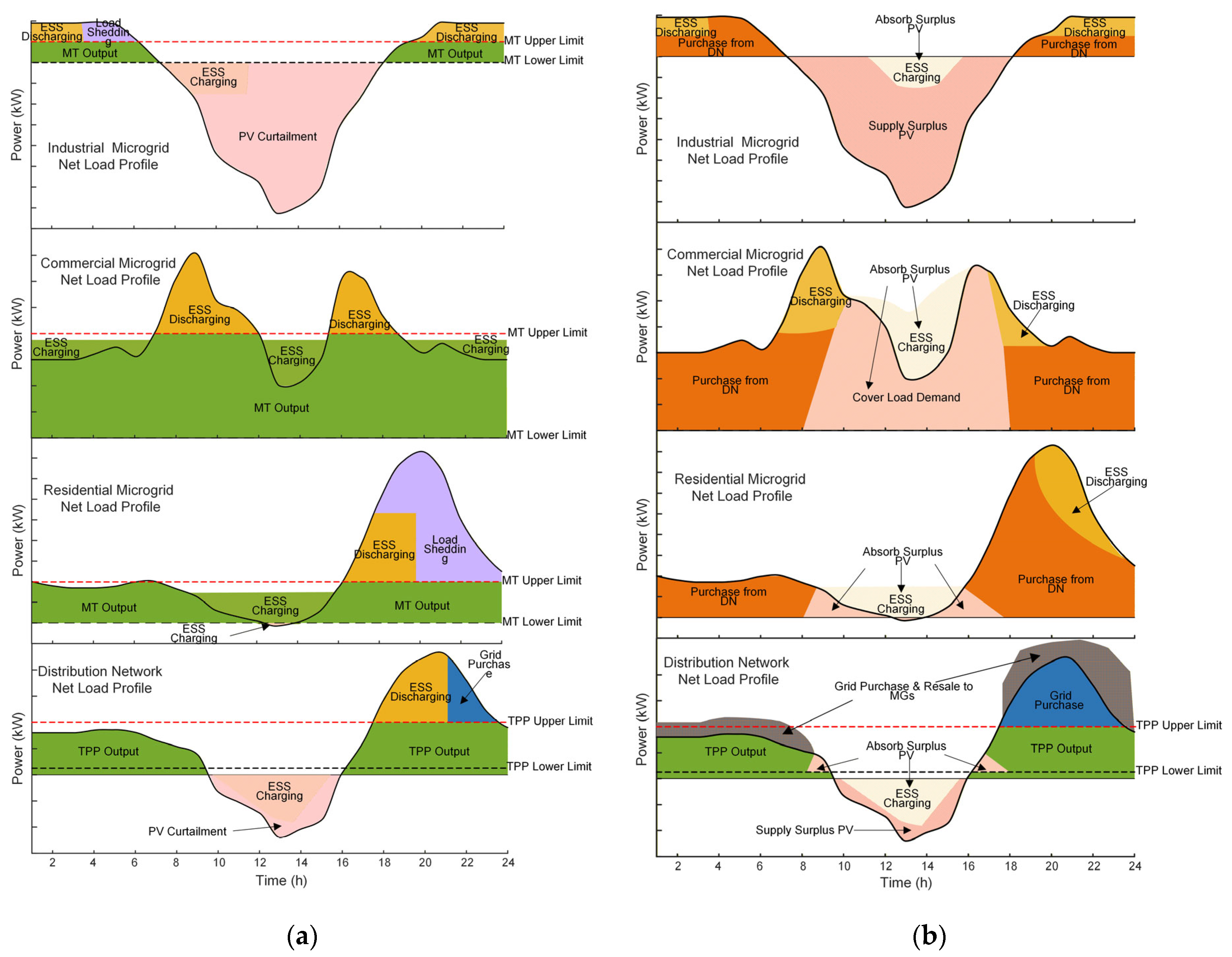
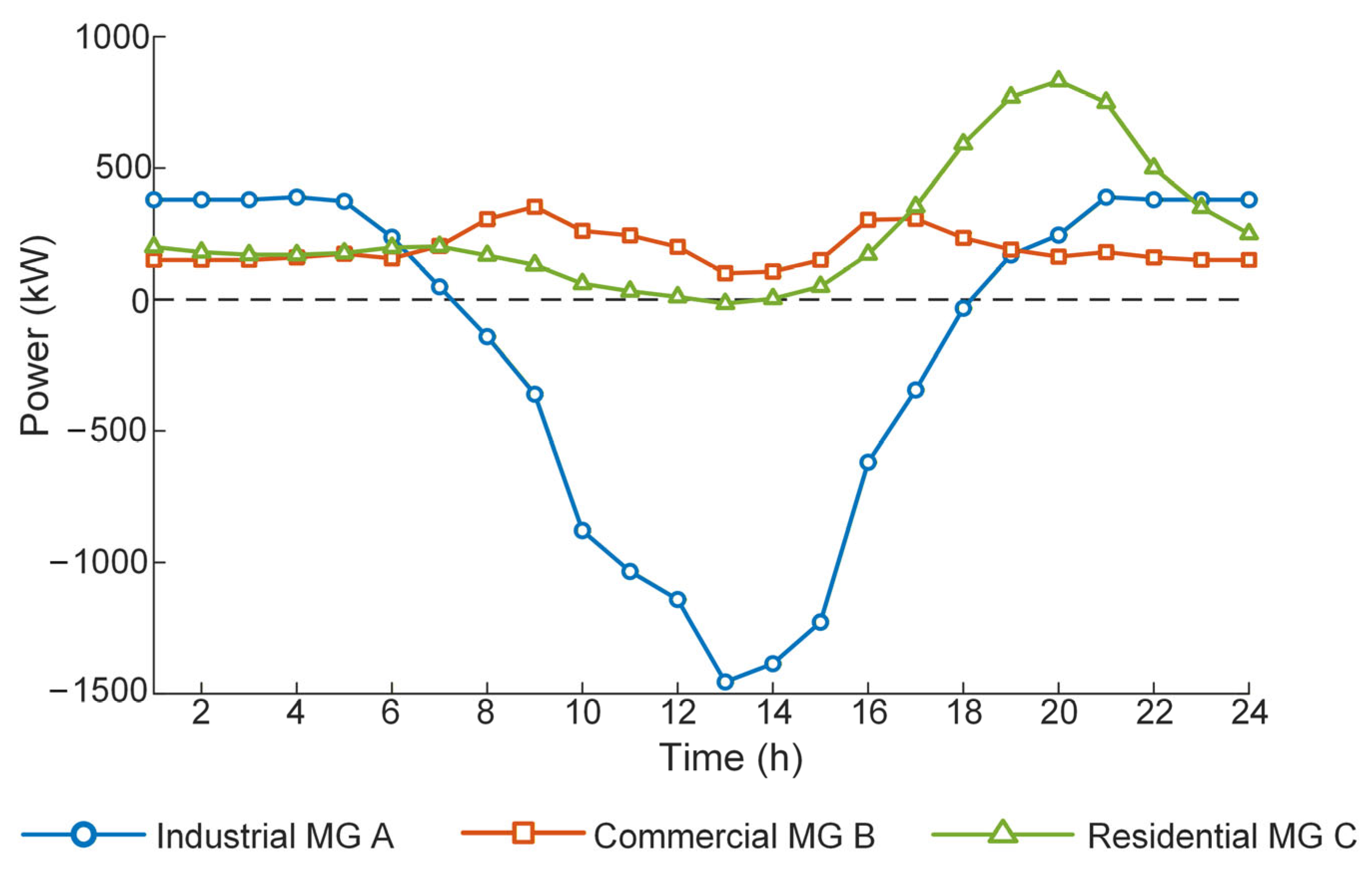
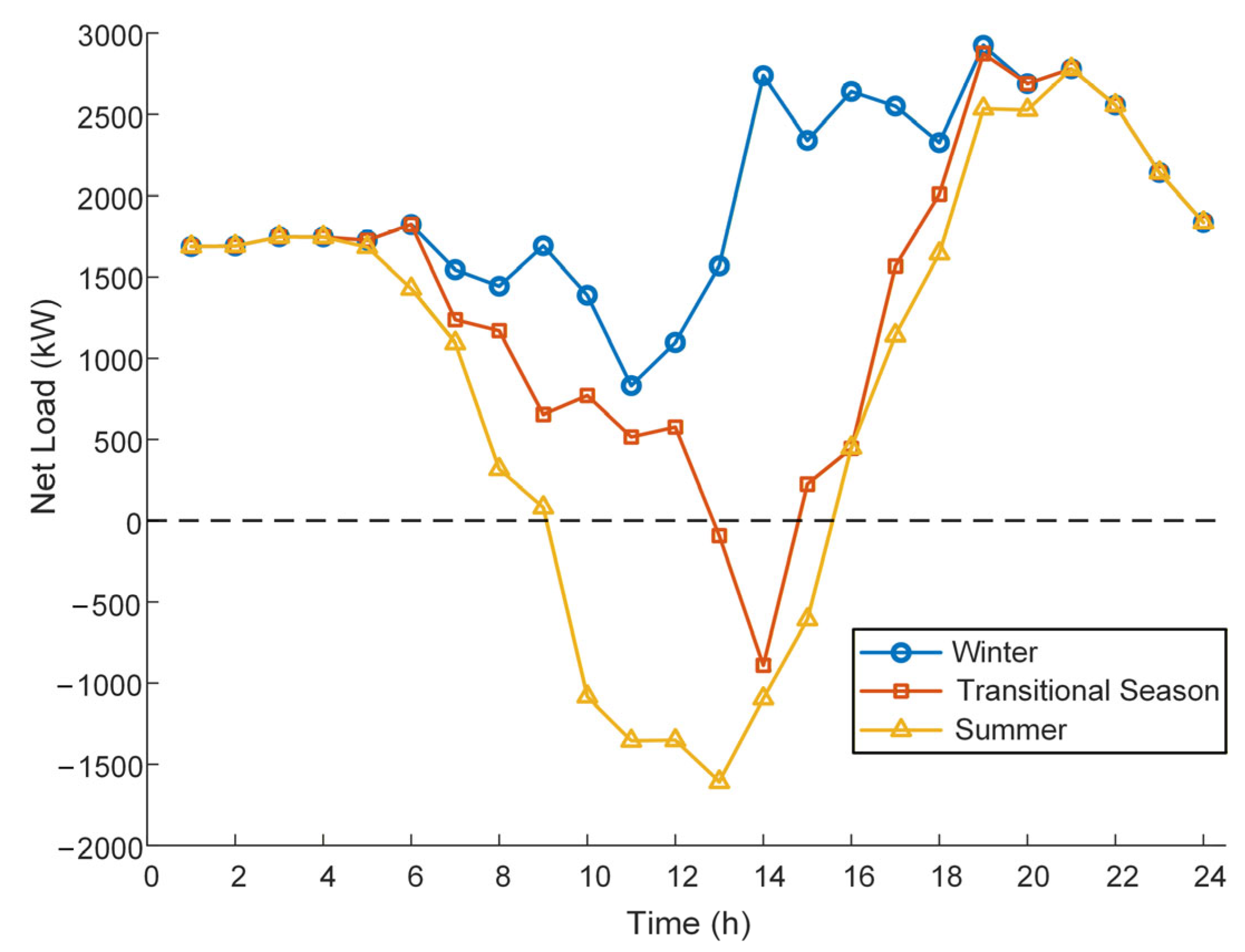
The high proportion of DPV integration exacerbates the changes in the temporal characteristics of the net load in the distribution system. This is reflected in a significant dip in net load during midday due to concentrated DPV generation, while during the morning and evening load peak periods, the sharp reduction in DPV output increases the demands on the system’s flexibility regulation capabilities.
In MMG distribution systems, the flexibility supply and demand characteristics vary across different types of microgrids due to differences in source-load structures and flexibility resource configurations. Taking a high-penetration industrial microgrid as an example, its DPV installed capacity is typically higher than the daytime load demand. During peak DPV generation periods, the net load sharply decreases, resulting in significant generation surplus, which forces the system to curtail excess electricity through DPV generation abandonment.
where
is the light curtailment power caused by the lack of flexibility reduction ability of the industrial microgrid at time
t;
and
are the actual DPV output and load power of industrial microgrid at time
t;
is the down-regulation flexibility power of industrial microgrid at time
t.
In contrast, load-dominated microgrids (such as residential microgrids) experience a sharp increase in net load during nighttime or periods of insufficient DPV generation. The internal flexibility resources may be unable to meet the load demand, leading to load shedding to maintain power balance.
where
is the load shedding power caused by the lack of flexibility up-regulation ability of the residential microgrid at time
t;
and
are the actual DPV output and load power of residential microgrid at time
t;
is the up-regulated flexibility power of residential microgrid at time
t.
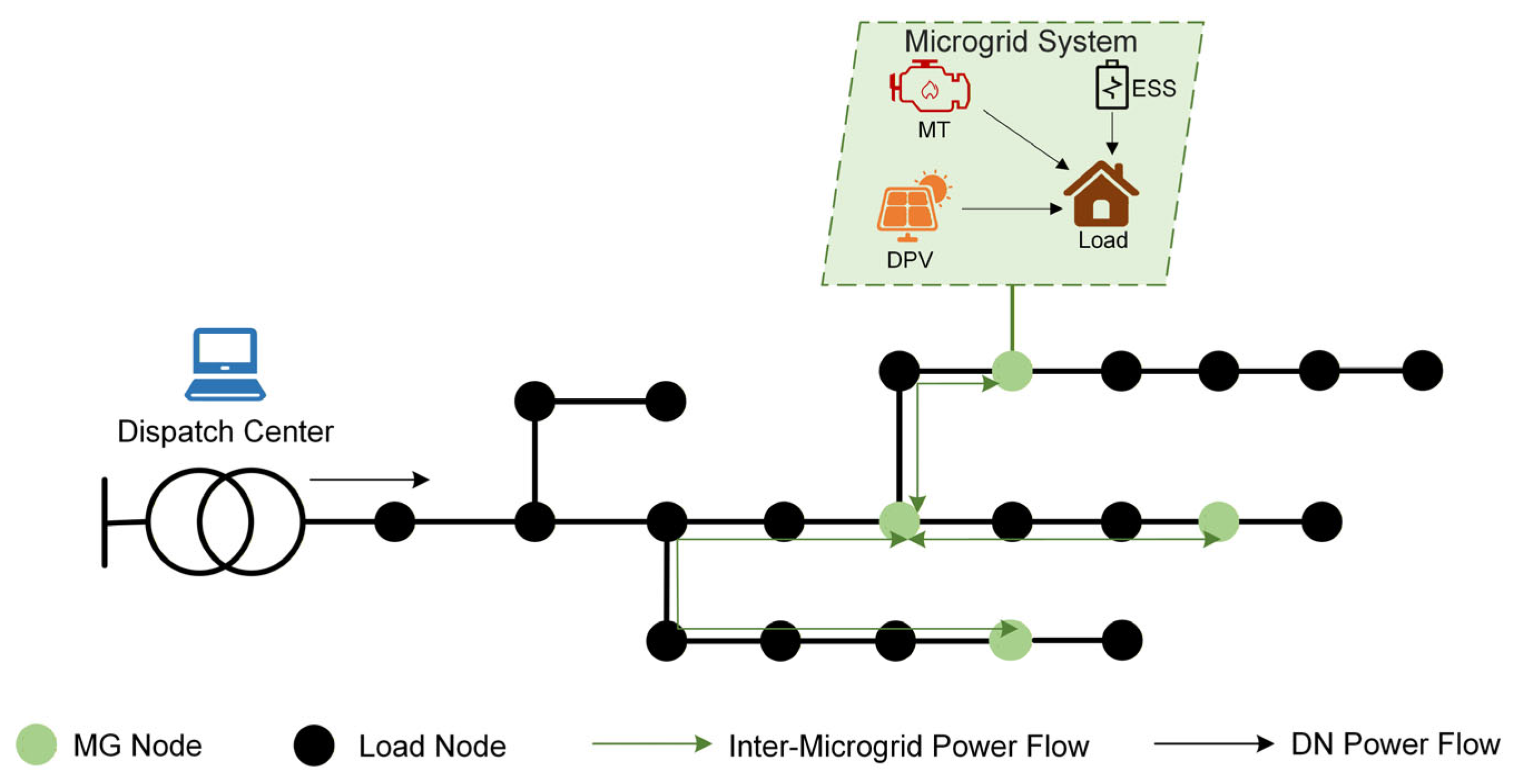
From the perspective of the DN, the spatiotemporal aggregation of outputs from multiple DPV nodes further exacerbates the fluctuations in the system’s net load, significantly increasing the overall regulation pressure on the DN. At the same time, due to limitations in the transmission capacity of DN lines and operational constraints, flexibility resources between nodes cannot flow freely. As a result, although the system may still have some regulation potential at the overall level, local congestion can prevent these resources from being effectively utilized, leading to DPV generation curtailment or load shedding. Therefore, under the high penetration of DPVs, evaluating system operation risks solely based on installed capacity or reserve levels is no longer sufficient. It is crucial to characterize the system’s operational state from the perspective of flexibility supply and demand relationships and their temporal matching.
2.1.2. Flexibility Margin Index Considering Network Constraints
To accurately assess the flexibility supply and demand relationships at both the node and system levels, as well as their spatiotemporal matching characteristics, this paper constructs a flexibility margin index , from the perspective of the power supply–demand gap and the matching of adjustable flexibility capabilities, while considering network constraints.
- (1)
Maximum Power Gap
The maximum power gap of the system at time
t, denoted by
, is defined as:
where Ω
L, Ω
PV, and Ω
G denote the sets of loads, DPV units, and conventional generators, respectively;
is the minimum technical output of generator
C.
If > 0, the system experiences a load deficit, requiring the generation units to increase output or purchase electricity from external sources. When = 0, the system is at the power balance critical point. If < 0, it indicates that the system is experiencing generation surplus, and there is a demand for downward flexibility adjustment.
- (2)
Adjustable Flexibility Power
Conventional generators can provide flexibility within their output range. Let
and
denote the available upward and downward flexibility power of conventional units at time
t respectively:
where
and
denote the upper and lower output limits of conventional unit
n, and
represents the output of unit
n at time
t.
Energy storage systems (ESS) can mitigate load fluctuations and supply flexibility resources to the system. Let
and
denote the upward and downward flexibility power of the ESS at time
t respectively:
The maximum upward and downward flexibility power of the system at time
t under operational constraints, denoted by
and
respectively, are expressed as:
- (3)
Flexibility Margin Index
Even if there is local regulation potential, transmission congestion may prevent flexibility from being effectively supplied, resulting in a situation where the system-level
remains insufficient. To address the spatial mismatch of flexibility, this paper incorporates the actual load shedding amount
and DPV curtailment amount
after system optimization as correction factors. A piecewise function model for
is constructed as follows:
where
Sbase is the base capacity of flexibility resources.
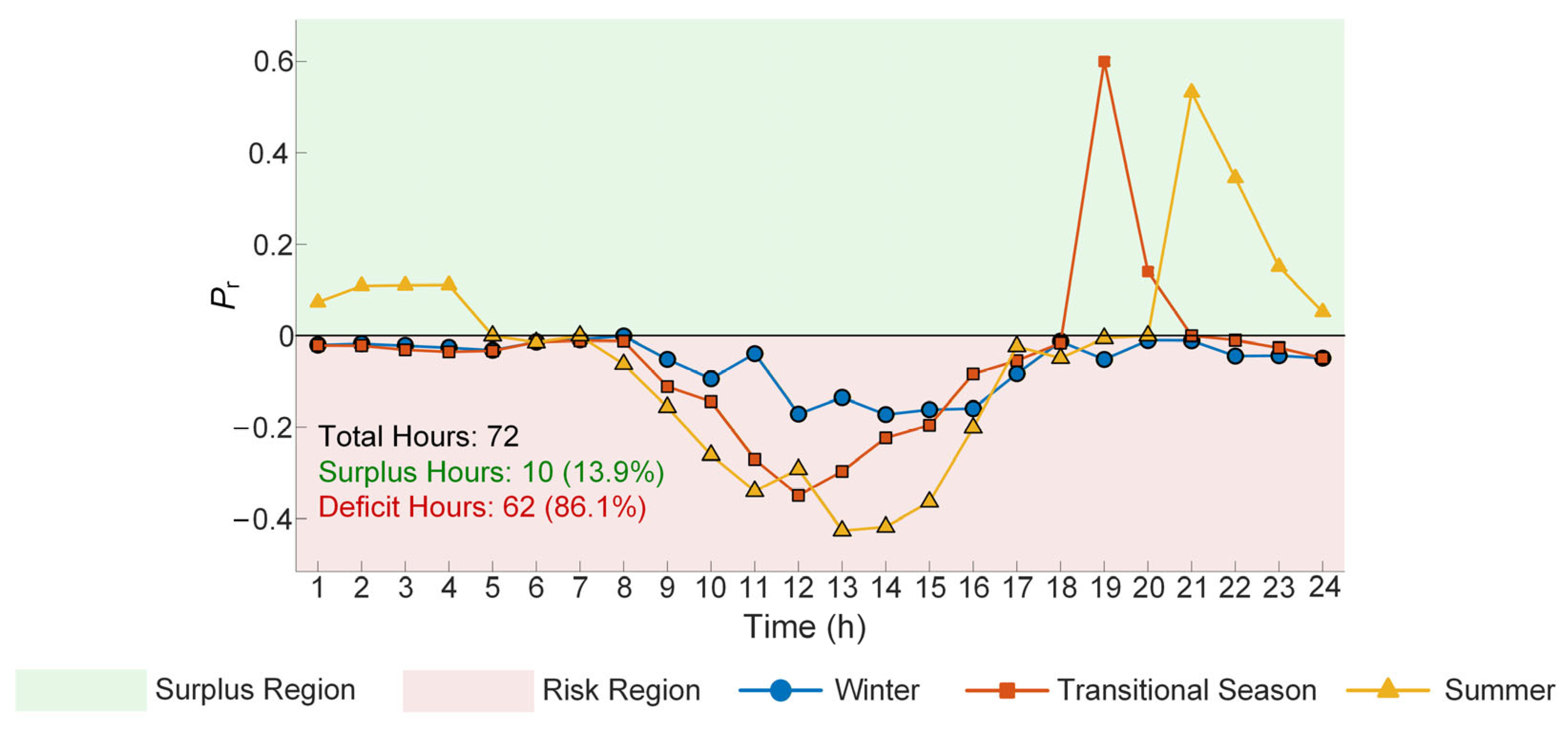
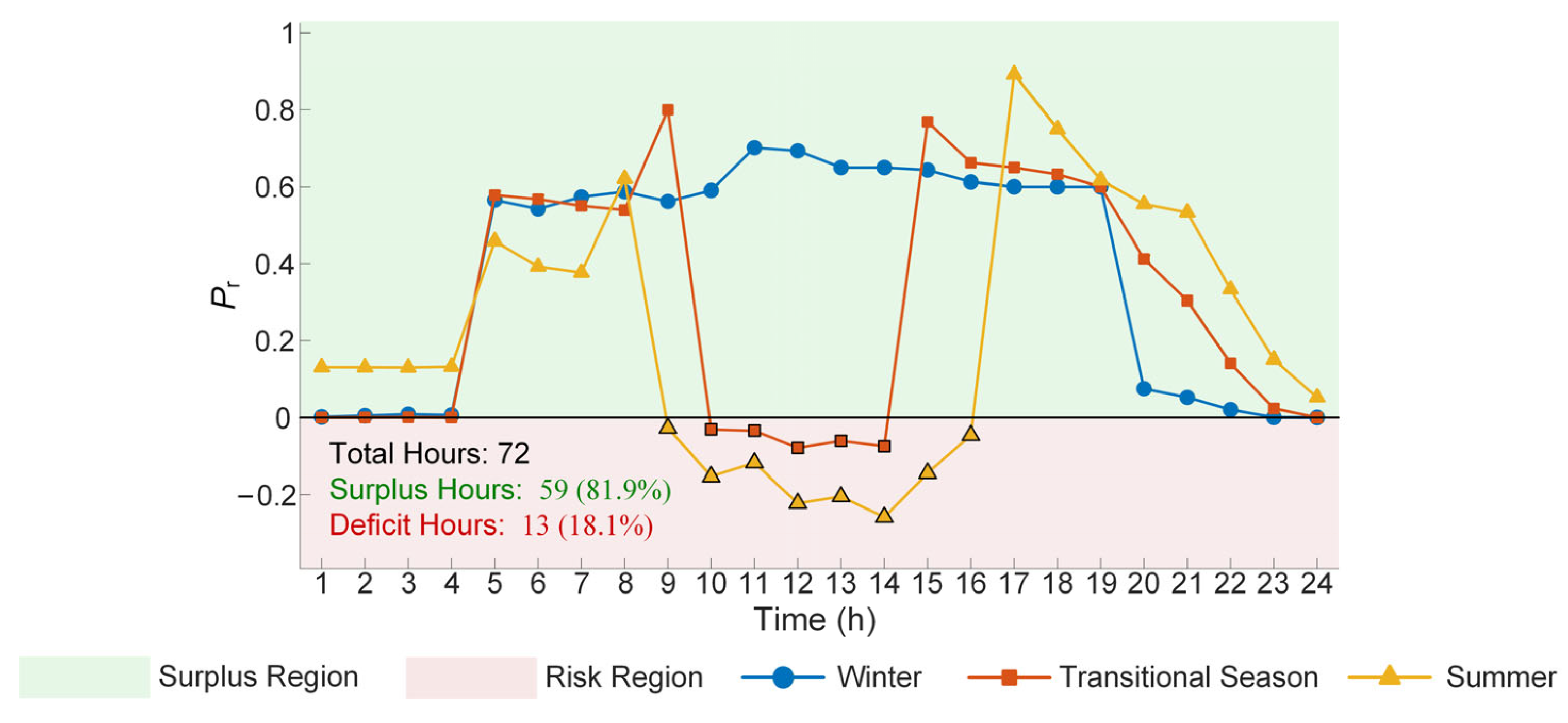
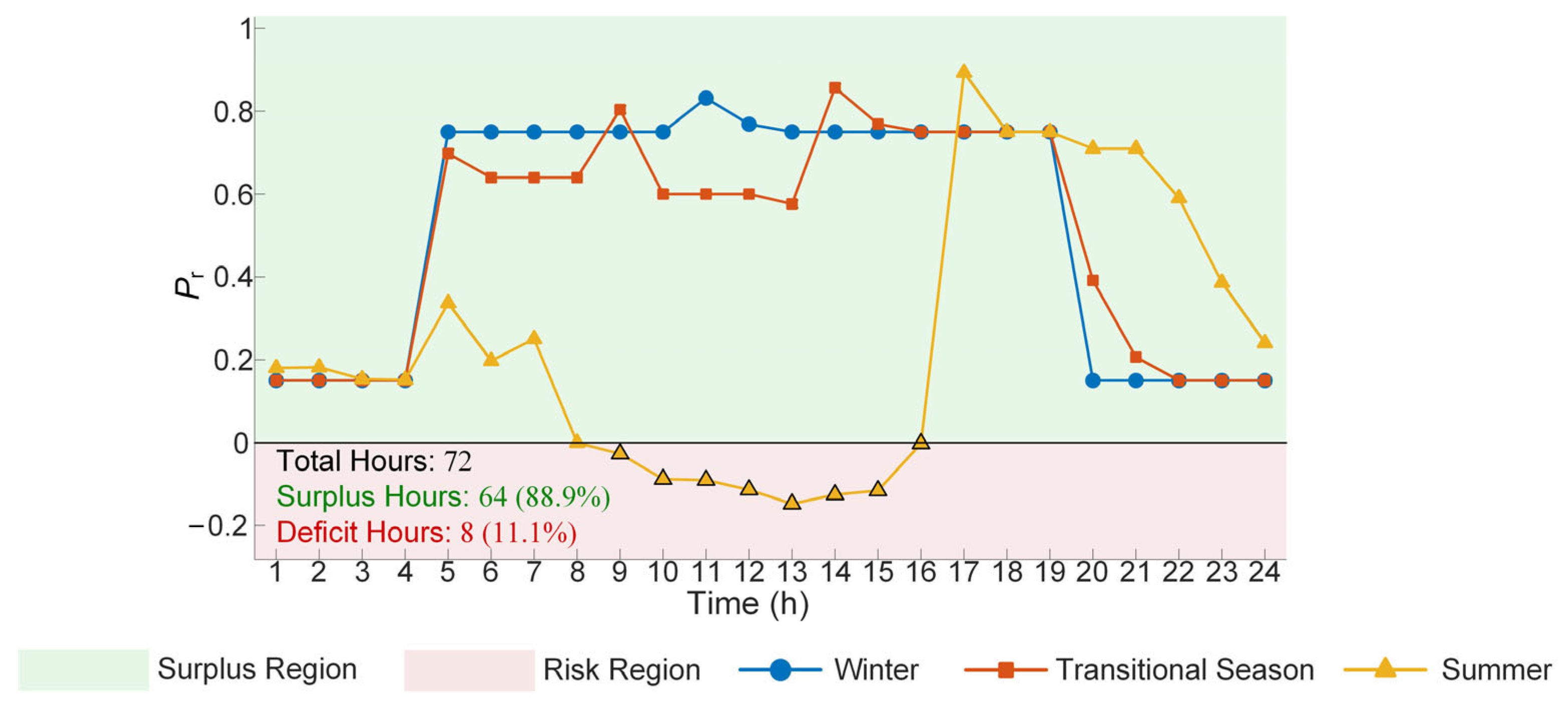
Pr > 0 indicates ample flexibility resources, with a larger value representing a higher regulation margin; = 0 denotes critical balance with no remaining capability; Pr < 0 indicates insufficient flexibility, with more negative values reflecting higher risk of load shedding or DPV curtailment.
Flexibility margin index has the ability of hierarchical evaluation. When the evaluation object is a single microgrid or DN node, Pr is used to describe the local flexibility of the node in the current operating state, reflecting its ability to cope with net load fluctuations independently. When the evaluation object is the whole DN–MMG system, comprehensively considers the flexibility potential of global flexibility resources under network constraints, which is used to characterize the overall adjustment ability state of the system level.
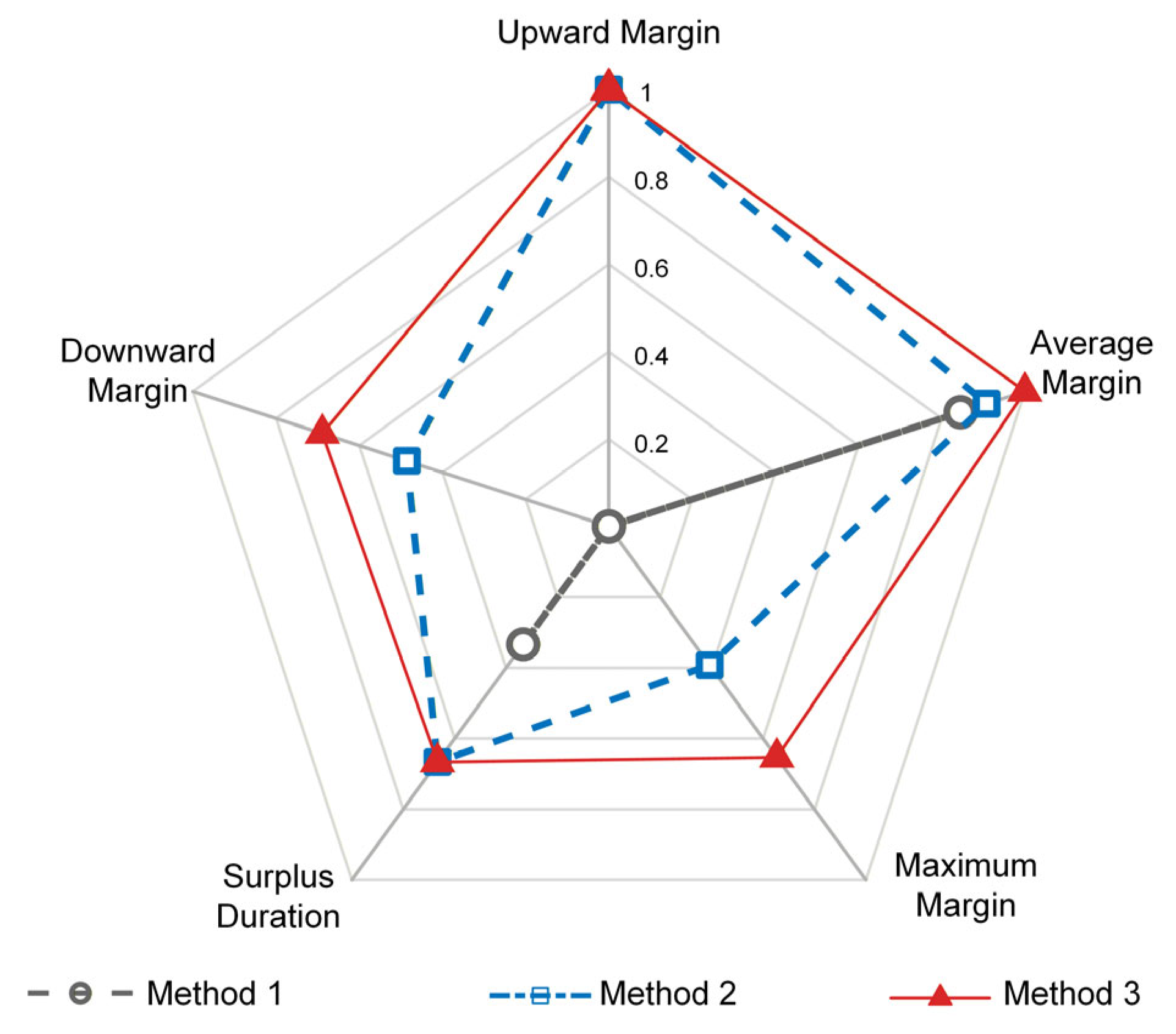
In order to further quantify the risk degree of the system at the time of insufficient flexibility. By defining the up-regulation margin deficiency
Umid and the down-regulation margin deficiency
, the flexibility deficit level of the system in different adjustment directions is evaluated. The smaller the index value (closer to 0), the lower the flexibility risk corresponding to the system. As shown in Formula (8):
where Ω
up and Ω
dn represent the sets of upward and downward adjustment demands, respectively;
ɛ is the decision threshold, which is set to a very small positive value of 10
−5, and can be neglected in practical engineering applications.
The index proposed in this paper primarily quantifies the system’s regulation capacity from the perspective of active power balance. However, by incorporating an AC power flow model that considers reactive power balance and voltage constraints, a more conservative scheduling strategy is selected during the optimization process to avoid voltage violations at nodes or branch congestion. This approach indirectly reflects the contribution of reactive power flexibility and voltage regulation to the flexibility margin.