Article

Climate Trends and Future Scenarios in Afghanistan: Implications for Greenhouse Gas Emissions, Renewable Energy Potential, and Sustainable Development


by
Noor Ahmad Akhundzadah
Department of Natural Resources and the Environment, College of Agriculture & Life Sciences, Cornell University, Ithaca, NY 14853, USA
Energies 2026, 19(4), 1067; https://doi.org/10.3390/en19041067
Submission received: 16 January 2026 / Revised: 12 February 2026 / Accepted: 16 February 2026 / Published: 19 February 2026

Abstract

Although Afghanistan’s contribution to global and regional greenhouse gas (GHG) emissions is minimal, it remains among the countries most vulnerable to the impacts of climate change. Rising temperatures and decreasing precipitation have significantly disrupted the country’s natural resources, including water supplies, agriculture, forests, rangelands, and ecosystems, threatening its agrarian economy and socio-economic stability. Simultaneously, Afghanistan has substantial untapped renewable energy potential, especially in hydropower, solar, wind, and biomass. This study analyzes historical (1970–2014) and projected (2015–2099) climate trends across Afghanistan by examining mean annual temperature and precipitation using the Mann–Kendall test and Sen’s Slope estimator. Results indicate a significant warming trend, with a 1.58 °C rise in temperature and a 36 mm decrease in annual precipitation over the past five decades. Future projections based on Shared Socioeconomic Pathways (SSPs) from the Coupled Model Intercomparison Project Phase 6 (CMIP6) suggest continued temperature increases, while precipitation trends vary geographically and over time, showing increases, decreases, or little change. The study also evaluates Afghanistan’s GHG emissions, which are negligible on regional and global scales. Despite its abundant renewable energy resources, the country still depends heavily on electricity imports from neighboring nations, leaving much of its domestic potential untapped. Harnessing these renewable resources can provide a practical path toward energy independence, zero-emission energy generation, and sustainable long-term development. This research emphasizes the urgent need for Afghanistan to strategically develop its renewable energy sector to boost climate resilience, enhance energy security, and promote sustainable economic growth.

1. Introduction

Since 1850, global greenhouse gas (GHG) emissions have steadily increased, with a sharp acceleration after 1970, primarily driven by fossil fuel use, industrial activity, and rapid economic growth [1,2]. As a result, the average global surface temperature is expected to have risen by about 1.3 °C by 2023 compared to pre-industrial levels [3]. In 2022, total global GHG emissions reached 53.8 gigatons of carbon dioxide equivalent (Gt CO2-eq), not including emissions from land use, land-use change, and forestry (LULUCF). Fossil CO2 made up 71.6% of total emissions, followed by methane (CH4; 21%), nitrous oxide (N2O; 4.8%), and fluorinated gases (2.6%) [4].
Although Afghanistan contributes minimally to global emissions, releasing roughly 29 million tons of CO2-eq annually (about 0. 054% of the global total), it remains one of the most vulnerable nations to climate change impacts [5,6,7]. Climate trends indicate rising temperatures, decreasing precipitation, and more frequent, intense rainfall events over shorter periods. These changes have significantly affected key sectors, particularly water resources and agriculture, which underpin Afghanistan’s economy and rural livelihoods [8,9,10,11]. Climate variability has increased the frequency of floods, droughts, soil erosion, and environmental degradation across major river basins [12,13,14,15,16,17,18,19]. Afghanistan’s hydrological system, heavily dependent on seasonal rainfall, snowmelt, and glacier runoff, is especially vulnerable to climate shifts. Changes in precipitation patterns and earlier seasonal warming have increased the frequency of spring flash floods and exacerbated drought conditions during critical agricultural periods [20,21,22,23,24,25]. With about 80% of the population relying directly or indirectly on agriculture, these climate impacts threaten livelihoods, food security, and poverty [5,12,26,27,28]. Estimate the change in key climate variables, river discharge, agricultural output reduction, livelihood shifts due to climate change, and the scale of climate-related disasters, which vary widely across studies because they depend on satellite observations and gridded datasets. This variation reflects the scarcity of long-term ground-based meteorological and hydrological data.
Climate change impacts are especially severe in conflict-affected and fragile states, where existing socio-economic and institutional vulnerabilities intensify climate risks. Although these countries contribute minimally to global emissions, they face disproportionate impacts, including food insecurity, displacement, and heightened competition for limited natural resources. In this context, climate change acts as a threat multiplier, heightening instability and humanitarian crises [29,30,31]. Furthermore, environmental challenges are worsened by Afghanistan’s long history of conflict, beginning with the Soviet invasion in 1979 and continuing through decades of civil war and political upheaval [32]. Prolonged conflict has severely damaged physical infrastructure, governance, and socio-economic systems, hindering the country’s ability to respond effectively to climate risks and natural disasters [33,34]. Additionally, ongoing insecurity and conflict in Afghanistan have severely hindered, and sometimes completely stopped, hydrometeorological monitoring since around 1980. This disruption has led to a critical shortage of long-term, consistent data, making it a “data-scarce” region, which impairs accurate climate assessment, effective water resource management, and the development of energy infrastructure [35,36].
Existing studies on climate change in Afghanistan are limited and fragmented. For example, earlier research has examined historical climate trends [37,38], effects on water resources and agriculture [10,11,39,40,41], land use and livelihoods [12,26,27,42,43], and climate-related hazards such as floods and droughts [8,16,17]. Few studies have examined future climate change using updated emissions scenarios, and very little attention has been paid to national GHG emissions, mitigation strategies, and renewable energy options within the Shared Socioeconomic Pathways (SSPs) framework [44].
This study offers a comprehensive assessment of climate change in Afghanistan by examining observed and projected climate trends, national GHG emissions, and the potential role of renewable energy in mitigating climate change and supporting sustainable development. Historical (1970–2014) and future (2015–2099) climate projections are analyzed using the Coupled Model Intercomparison Project Phase 6 (CMIP6) [45] datasets under five SSP scenarios (SSP1–1.9, SSP1–2.6, SSP2–4.5, SSP3–7.0, and SSP5–8.5) [44]. Trend detection is carried out with the Mann–Kendall test [46,47] and Sen’s slope estimator [48] to evaluate the direction and strength of change. Additionally, Afghanistan’s historical GHG emissions are assessed, and the country’s renewable energy potential is explored as a pathway for climate mitigation and long-term sustainable development. By integrating climate impacts, emissions analysis, future projections, and mitigation strategies, this study addresses a critical gap in the literature and provides evidence-based insights to promote climate-resilient development in Afghanistan.
The rest of the paper is organized into subsections, with a detailed explanation of Afghanistan’s current energy use and renewable potential included in the Section 1. It then proceeds to the Section 2, Section 3, Section 4 and Section 5, Materials and Methods, Results, Discussion, Conclusions, and Recommendations sections.

1.1. Afghanistan’s Current Energy Usage and Renewable Energy Potential

1.1.1. Current Energy Use and Structural Constraints

Afghanistan remains one of the most energy-poor countries in the world [49]. With a gross domestic product (GDP) per capita of approximately USD 500 and annual electricity consumption of only 138 kWh per capita as of 2019, the country ranks among the lowest globally in terms of energy access and use [50]. Expanding access to reliable electricity is widely recognized as a critical development priority for Afghanistan, second only to establishing the rule of law. Although modest progress was achieved in energy infrastructure development during the past two decades, the sector remains fragile, underdeveloped, and highly dependent on external resources [51]. By 2017, an estimated 97% of Afghan households reportedly had access to electricity; however, this figure masks profound disparities in service quality and reliability. Only 30.9% of households were connected to the national utility grid, while approximately 70%, predominantly in rural areas, relied on decentralized, off-grid, or informal energy sources, including diesel generators, solar home systems, and traditional biomass [52]. These arrangements often provide limited and intermittent power, constraining productive economic activities and basic service delivery.
In 2017, Afghanistan’s national power system supplied approximately 1433 MW of electricity, more than half of which (828 MW) was imported from neighboring countries. Electricity imports comprised 350 MW from Tajikistan, 320 MW from Uzbekistan, 50 MW from Turkmenistan, and 108 MW from Iran [49,53]. Domestic generation contributed only 605 MW, derived primarily from hydropower (263.4 MW), thermal power plants (248 MW), and diesel generators (93.3 MW) [53]. Despite these contributions, supply has consistently fallen short of demand, resulting in frequent outages, load shedding, and substantial unmet energy needs nationwide.
This structural dependence on electricity imports, estimated at approximately 80% of total supply, poses significant risks to Afghanistan’s energy security, particularly given regional geopolitical tensions and financial constraints [54]. Although national strategies such as the Afghanistan Power Sector Master Plan (APSMP) were developed to address these challenges, implementation has been hindered by prolonged political instability, weak governance, and institutional fragility, leaving the power sector vulnerable to operational and financial insolvency [55,56].

1.1.2. Renewable Energy Potential and Opportunities

Despite its severe energy deficit, Afghanistan possesses abundant and largely untapped renewable energy resources [57,58]. The country’s diverse geography and climatic conditions provide substantial potential for hydropower, solar, wind, geothermal, and biomass energy, collectively exceeding projected national electricity demand. Harnessing these resources offers a strategic pathway to reduce import dependence, enhance energy security, and support inclusive economic development, particularly in rural and remote regions [59,60].
Hydropower: Afghanistan’s mountainous terrain, shaped by the Hindu Kush and associated Himalayan orogeny, features elevations exceeding 7000 m and is intersected by numerous perennial rivers. These physiographic characteristics create exceptional hydropower potential. National estimates place Afghanistan’s technically feasible hydropower capacity at more than 23,000 MW, sufficient to meet projected domestic electricity demand well beyond mid-century [58,61]. However, limited infrastructure, decades of conflict, and underinvestment have constrained effective utilization of this resource, resulting in persistently low hydropower generation relative to potential. The APSMP projected peak electricity demand to reach approximately 3500 MW by 2032, highlighting a significant opportunity for domestic hydropower expansion to close the supply–demand gap [55].
Solar Energy: Afghanistan is exceptionally well-suited for solar power generation due to its geographic location, high elevation, and arid climate. The country experiences approximately 300 sunny days per year, with high levels of solar irradiance across most regions. The total feasible national solar generation capacity has been estimated at approximately 222,000 MW [57]. Despite this vast potential, solar deployment remains limited to small-scale projects and household-level installations, primarily in off-grid contexts [62,63]. Given its modularity, declining costs, and suitability for decentralized systems, solar energy is among the most immediately viable options for expanding electricity access in remote and underserved areas.
Wind Energy: Afghanistan also exhibits strong wind energy potential, particularly in western and southwestern provinces, including Herat, Farah, and Nimroz. Wind speeds in these regions frequently exceed 6.8 m s−1, surpassing the threshold required for economically viable wind power generation. Reported capacity factors exceed 42%, significantly higher than the global average of 20–35% [64]. Estimated net annual energy production ranges from approximately 2418 to 3709 MWh MW−1, compared to a global average of roughly 1752–3066 MWh MW−1 [62]. Total wind energy capacity is estimated at approximately 150,000 MW, with an exploitable capacity of around 66,700 MW [53,57], underscoring the strategic importance of wind power within Afghanistan’s renewable energy portfolio.
Geothermal Energy: Afghanistan’s location along active tectonic zones within the Hindu Kush region provides favorable conditions for geothermal energy development. Active geothermal systems extend from the Wakhan Corridor in the Afghan Pamir to the Herat fault system in the west [63,65,66]. Approximately 70 geothermal sites have been identified, with estimated generation capacities ranging from 5 to 20 MW per site. Despite this potential, no geothermal power projects are currently operational in Afghanistan, largely due to limited technical capacity, high upfront costs, and insufficient institutional support [67].
Biomass and Biogas Energy: As an agrarian society, Afghanistan relies heavily on biomass for household energy needs. Traditional biomass sources, including firewood, crop residues, and animal dung, account for approximately 85% of total national energy consumption [68]. While this reliance reflects resource availability, it has contributed to severe deforestation and environmental degradation. The estimated technical potential for modern biomass-based electricity generation is approximately 4000 MW, comprising 3092 MW from crop residues, 841 MW from animal manure, and 94 MW from municipal solid waste [57,69]. Transitioning from traditional biomass to cleaner biogas and biomass energy systems could improve energy efficiency, reduce environmental pressures, and enhance rural livelihoods.

2. Materials and Methods

2.1. Study Area

Afghanistan is a landlocked country in South–Central Asia, characterized by a predominantly arid-to-semiarid climate and extreme topographic variability. The country covers an area of approximately 652,230 km2 [70] and is dominated by rugged mountain systems that occupy nearly two-thirds of its territory. The Hindu Kush mountain range, extending from northeast to southwest across the country, forms the principal physiographic feature and divides Afghanistan into distinct geographic and climatic regions.
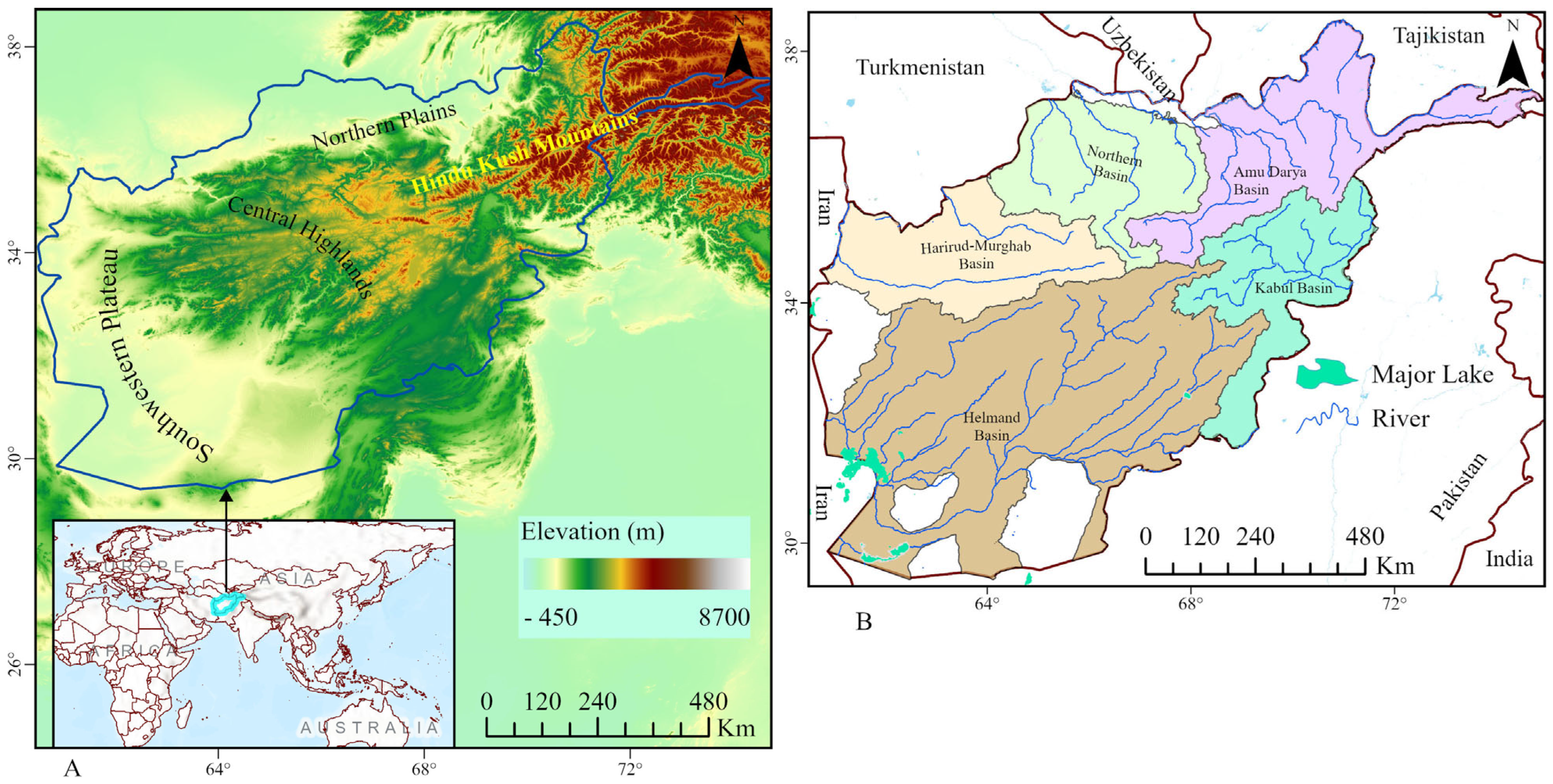
Based on elevation and physiography, Afghanistan can be broadly classified into four major physical–climatic regions [71,72,73] (Figure 1A):
Hindu Kush Mountains: Extending from the northeastern Pamir region southwestward, this high-mountain system contains some of the highest peaks in the country, including Mount Noshaq (7492 m a.s.l.). These mountains serve as the primary source of snow and glacier-fed rivers.
Central Highlands: Covering much of central Afghanistan, this region is characterized by high plateaus, deep gorges, and complex topography, accounting for a substantial portion of the national land area.
Northern Plains: Located along the Amu Darya River, this region features relatively flat terrain with fertile alluvial soils and is Afghanistan’s most productive agricultural zone.
Southwestern Plateau: A predominantly arid to semi-arid lowland region encompassing the Helmand and Sistan Basins, including the Registan and Dasht-e Margo deserts, with elevations declining to approximately 230 m a.s.l.
This wide elevation gradient, ranging from over 7000 m in the northeast to less than 250 m in the southwest, strongly influences atmospheric circulation, surface energy balance, and hydrological processes. As a result, Afghanistan exhibits pronounced spatial variability in climate, soil types, vegetation cover, and agricultural practices, and is highly susceptible to climate-related hazards, including droughts and flash floods.

2.1.1. Climate

Afghanistan has a continental climate marked by hot summers, cold winters, and strong seasonal and altitudinal contrasts. The climate is generally arid to semi-arid, with deserts, steppes, and high-mountain climatic regimes closely linked to elevation [74]. Mean annual precipitation increases with altitude, ranging from less than 50 mm yr−1 in the southwestern deserts (e.g., Helmand and Sistan Basin) to 1100–1400 mm yr−1 in the northeastern Hindu Kush and Pamir ranges [73].
Winter precipitation, primarily in the form of snow, is associated with the eastward movement of Mediterranean cyclonic systems between November and April [75,76]. These systems play a critical role in sustaining seasonal snowpacks and glaciers. During summer, occasional incursions of monsoonal air masses linked to the Intertropical Convergence Zone (ITCZ) can bring limited rainfall and sporadic snowfall to the highest mountain peaks in northeastern Afghanistan [76].
Lowland regions in the west and north typically receive 50–100 mm of annual precipitation and experience extreme temperature variability. Mean summer temperatures frequently exceed 33 °C, while winter temperatures average around 10 °C. In contrast, high-altitude and glaciated catchments in the eastern river basins may receive up to 1000 mm of winter precipitation, with mean winter temperatures below 0 °C and summer temperatures near 15 °C [43,77]. In desert regions such as the Helmand Basin, summer temperatures can exceed 45 °C, imposing severe constraints on agriculture and human livelihoods [78] . Only 6–12% of Afghanistan’s land area is arable, and agricultural production is heavily dependent on irrigation, particularly in river valleys and alluvial plains [79].

2.1.2. Hydrology

Afghanistan’s hydrological system is organized into five major river basins: the Amu Darya, Helmand, Kabul, Harirud–Murghab, and Northern basins [73] (Figure 1B). Four of these basins are transboundary, with surface waters flowing into neighboring countries including Pakistan, Iran, Turkmenistan, Uzbekistan, and Tajikistan.
The headwaters of Afghanistan’s rivers originate primarily in snow- and glacier-fed catchments of the Hindu Kush Mountains, at elevations exceeding 7000 m a.s.l., before descending to arid lowlands below 250 m a.s.l. in the south and southwest [80]. River discharge is highly seasonal and variable, with spring and early summer flows dominated by snowmelt contributions [81].
Snowpacks and glaciers function as natural water-storage systems, sustaining dry-season river flows and supporting groundwater recharge. However, limited water-storage infrastructure, steep terrain, and rapid snowmelt frequently lead to destructive flash floods during spring, causing extensive land-cover changes and posing serious risks to rural communities and infrastructure [82,83].

2.2. Data

2.2.1. Past Climate and Future Climate Projection

Historical climate conditions in Afghanistan were analyzed using mean annual temperature and precipitation data from 1970 to 2014. These data were obtained from the GFDL-ESM4 Earth System Model developed by the Geophysical Fluid Dynamics Laboratory (GFDL) [84] as part of the Coupled Model Intercomparison Project Phase Six (CMIP6) framework [45]. Future climate projections were analyzed for two time horizons: a near-term period (2015–2056) and a long-term period (2057–2099). Projections were evaluated across five Shared Socioeconomic Pathways (SSPs): SSP1–1.9, SSP1–2.6, SSP2–4.5, SSP3–7.0, and SSP5–8.5, representing a broad range of future socioeconomic and emissions scenarios [45]. To identify and quantify historical and projected climate change, this study focused on mean annual temperature and precipitation, as rising temperatures and declining precipitation are the most critical climate stressors affecting Afghanistan’s water resources, agriculture, and livelihoods. Trend detection was conducted using the non-parametric Mann–Kendall (MK) test [46,47] and the Sen’s Slope (SS) estimator [48]. These methods are commonly used in hydro-climatic research because of their robustness against non-normal data and missing values [85]. The MK and SS tests were applied consistently across all SSP scenarios to evaluate the magnitude and statistical significance of trends in temperature and precipitation under different future pathways.

2.2.2. CMIP6 and GFDL-ESM4 Model and Data

CMIP6 comprises a coordinated set of 23 Earth System Models designed to improve the representation of physical, chemical, and biological processes governing past, present, and future climate variability [45]. Outputs from CMIP6 models are typically validated, bias-corrected, and downscaled to enhance their usefulness at the regional scale, particularly in areas with limited data [86,87]. The GFDL-ESM4 (also known as ESM4.1) combines advanced atmospheric (AM4), oceanic (OM4), land surface (LM4), and biogeochemical components to offer a detailed view of Earth system interactions [84]. The model provides global monthly climate data from 1850 to 2100 and has shown improved accuracy in simulating large-scale circulation, hydrological processes, and climate sensitivity. The dataset used in this study was obtained through the Climate Data Store (CDS), where additional quality control and bias correction are applied [88]. Original outputs at a spatial resolution of 1° × 1° were further downscaled to 0.25° × 0.25° using spatial disaggregation techniques to improve the representation of climate variables over Afghanistan. This study focused on near-surface air temperature and precipitation from the available variables. The historical period covers 1970–2014, while future projections extend from 2015 to 2099 across all five SSP scenarios.

2.2.3. Greenhouse Gases and Renewable Energy

National greenhouse gas (GHG) emissions data for 1970–2022 were sourced from the Emissions Database for Global Atmospheric Research (EDGAR), developed by the European Commission [4]. EDGAR provides harmonized and transparent estimates of major GHGs, including CO2, CH4, N2O, and fluorinated gases, across key sectors such as agriculture, energy production, transportation, industry, buildings, and waste management. The database adheres to internationally accepted methodologies consistent with Intergovernmental Panel on Climate Change (IPCC) guidelines [89,90] and provides a long, internally consistent time series suitable for trend analysis. Hydropower data for Afghanistan were compiled from multiple published sources, including the Afghanistan Power Sector Master Plan (APSMP) [55]. Solar and wind energy potential were assessed using spatial datasets from the Global Solar Atlas and Global Wind Atlas developed by the World Bank [91,92]. Information on geothermal and biomass energy resources was obtained from existing literature [65,69]. All spatial analyses and maps were produced using ArcGIS Pro (3.6.0.), with base layers and reference data sourced from Esri, FAO, NOAA, USGS, and NASA.

2.3. Methods

2.3.1. Data Processing and Analysis

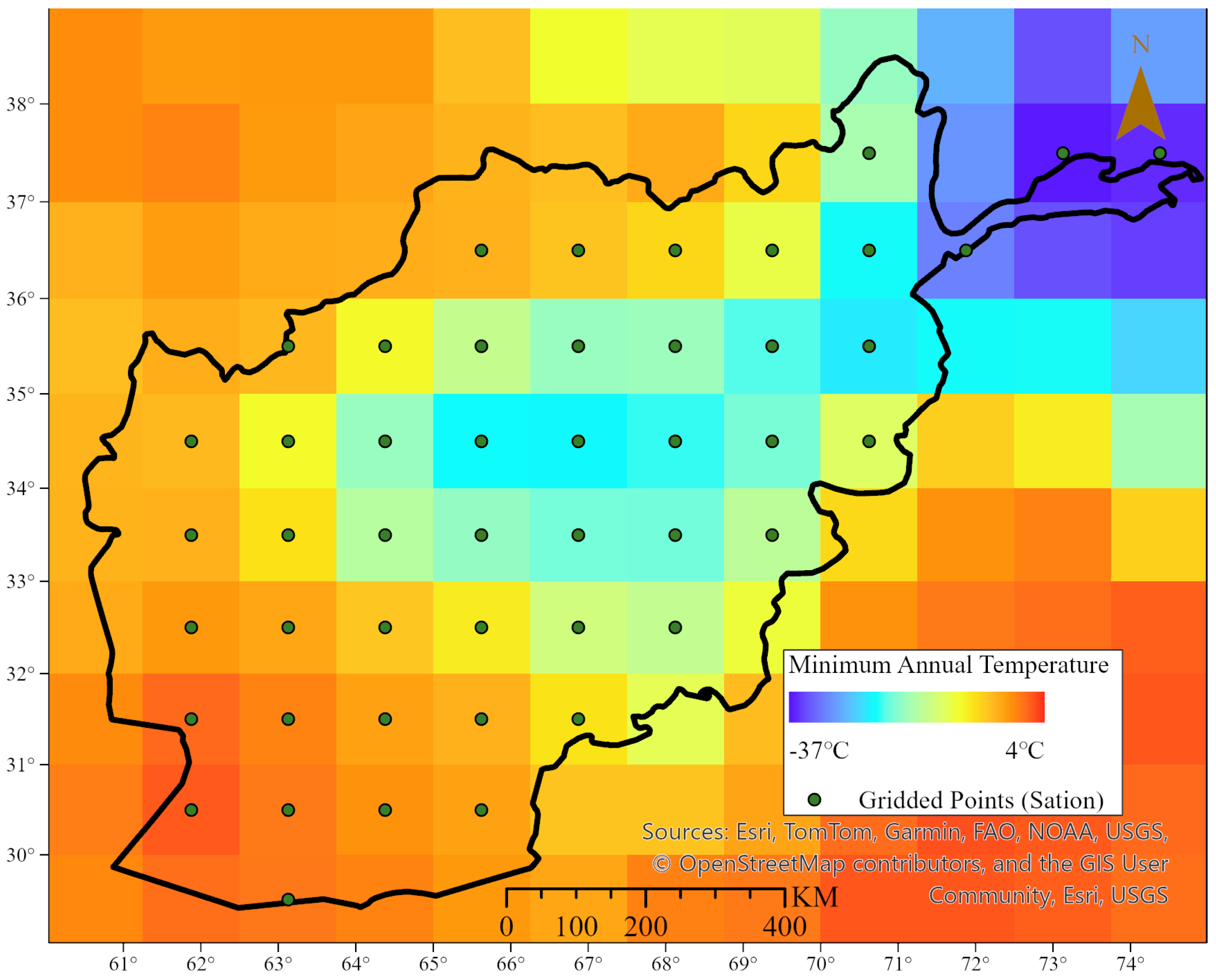
NetCDF files from the GFDL-ESM4 dataset were downloaded from the Climate Data Store and processed using ArcGIS Pro [93]. The datasets were first subset and converted to Cloud Raster Format (CRF) using the Subset Multidimensional Raster tool [94]. CRF raster was then transformed into a gridded point dataset (stations) with each point representing the centroid of a 1° grid cell. Mean annual temperature and precipitation time series were extracted for each grid point for the historical period (1970–2014) and future projection periods (2015–2056 and 2057–2099). Zonal Statistics were applied to generate tabular datasets with annual values for all grid points across the study period. To minimize the impact of outliers, the time series were examined and smoothed to 85% to detect potential anomalies, considering the sensitivity of the MK and SS tests to extreme values. Trend analyses were conducted using the Mann–Kendall test and Sen’s Slope estimator, implemented through the Python package (3.13.3) developed by Hussain and Mahmud [95]. Statistical significance was assessed at a 0.05 level (95% confidence interval). Figure 2 shows the spatial distribution of gridded points derived from the GFDL-ESM4 dataset, which form the basis for extracting mean annual temperature and precipitation time series used in the trend analysis.

2.3.2. Mann–Kendall (MK) Test

The Mann–Kendall (MK) test [46,47] is a widely used non-parametric statistical method for detecting monotonic trends in time-series data. Because it does not require the data to follow a specific distribution, the MK test is particularly suitable for environmental, hydrological, and climatological datasets that often violate normality assumptions. The test evaluates whether a statistically significant upward or downward trend exists over time and has been extensively applied in studies of hydrology, meteorology, and water quality [96,97,98,99,100,101].
The MK test statistic S is calculated by summing the signs of differences between all possible pairs of observations in a time series:
S = i = 1 n 1 j = i + 1 n s g n X j X i
where n is the total number of observations, and Xj and Xi are the data values at time steps i and j (j > i), respectively. The sign function sgn(·) is defined as:
s g n X j X i = + 1 ,   i f   X j X i > 0 0 ,   i f   X j X i = 0 1 ,   i f   X j X i < 0
For time series containing tied values, the variance of the S -statistic is computed as:
V a r S = n n 1 2 n + 5 j = 1 m t j t j 1 2 t j + 5 18
where m is the number of tied groups and t j is the number of data points in the j -th tied group.
The standardized test statistic Z is then calculated as:
z = S 1 V a r S     i f       S >   0 0                                 i f     S   =   0 S + 1 V a r S       i f       S <   0
A positive Z -value indicates an increasing trend, while a negative Z -value indicates a decreasing trend in the time series. The statistical significance of the detected trend is assessed using the corresponding p-value. In most environmental studies, a significance level of p < 0.05 is commonly adopted to reject the null hypothesis of no trend [102].
In addition, Kendall’s Tau ( τ ), introduced by Kendall , is often reported alongside the MK test as a non-parametric measure of the strength and direction of monotonic association between ranked variables [103].

2.3.3. Sen’s Slope (SS) Estimator

Sen’s slope estimator [48] is a non-parametric method used to quantify the magnitude of a monotonic trend detected by the MK test. It provides a robust estimate of the rate of change over time and is particularly effective for datasets containing outliers or non-normally distributed values.
The Sen’s slope Q is computed as the median of all possible pairwise slopes:
Q = M e d i a n X j X k j k , for   j > k
where X j and X k are data values at times j and k , respectively. The median of these slopes represents the overall trend magnitude per unit time. A positive Sen’s slope indicates an increasing trend, whereas a negative value indicates a decreasing trend.
The combined use of the MK test and Sen’s slope estimator enables both trend detection and quantification, making them complementary and widely accepted tools in hydro-climatic trend analysis.

3. Results

3.1. Climate Change

3.1.1. Temperature Trends

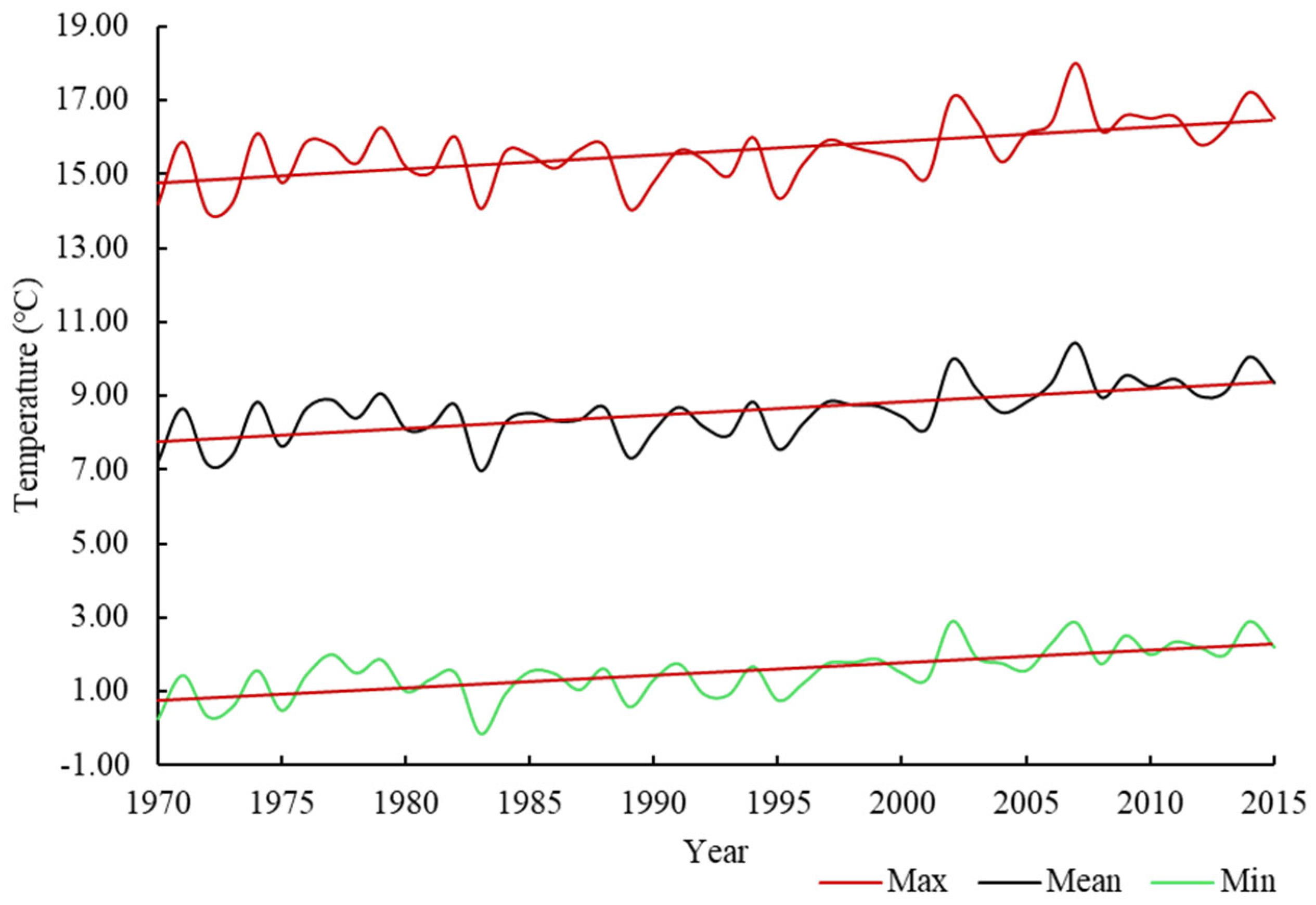
Trends in annual maximum, minimum, and mean temperatures from 1970 to 2015 were analyzed using the MK test and SS estimator. The findings show a statistically significant warming trend across all temperature metrics (Figure 3; Table 1). The MK test indicates highly significant positive trends in maximum, minimum, and mean annual temperatures, with Z values ranging from 3.649 to 4.765 and p-values < 0.001 (Table 1). Positive Kendall’s tau coefficients (τ = 0.377–0.492) further support the strength and consistency of these upward trends.
Sen’s Slope estimates show an annual warming of 0.037 °C for maximum temperature, 0.036 °C for mean temperature, and 0.033 °C for minimum temperature (Table 1). Over 45 years, these rates resulted in total increases of approximately 1.61 °C (Max), 1.58 °C (Mean), and 1.47 °C (Min). The trend in Figure 3 clearly demonstrates a steady rise in all temperature measures, especially after the late 1990s. The warming observed in Afghanistan exceeds the global average increase for comparable periods, underscoring the country’s heightened vulnerability to climate change. This greater warming is linked to Afghanistan’s mostly arid and semi-arid climate, limited vegetation, complex terrain, and strong land–atmosphere feedback. Rising temperatures are likely to increase evapotranspiration, accelerate snow and glacier melt, and place greater stress on already fragile water supplies, agriculture, and ecosystems.

3.1.2. Precipitation Trends

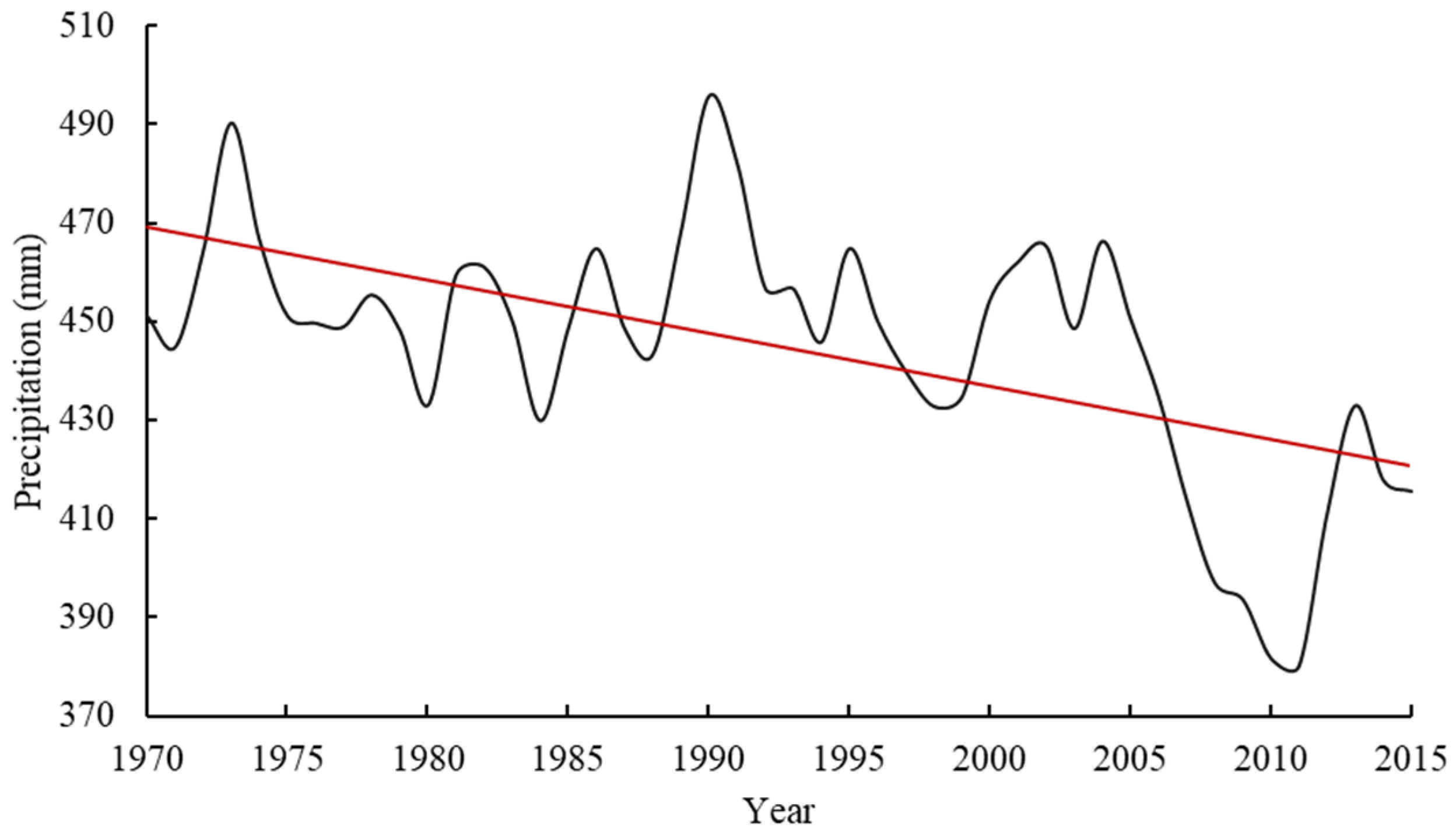
Mean annual precipitation trends were examined using the MK and SS methods (Figure 4; Table 1). The findings show a statistically significant decrease in annual precipitation over the study period. The MK test yields a negative Z value of −3.183 (p < 0.001), indicating a notable downward trend. The negative Kendall’s tau (τ = −0.329) indicates a consistent decline over time. Sen’s Slope analysis estimates a reduction rate of roughly −0.81 mm yr−1, resulting in a total decrease of about 36 mm during the period studied. Figure 4 displays marked year-to-year variability; however, the fitted Sen’s slope line clearly illustrates a long-term downward trend in precipitation. This ongoing decline suggests a shift toward drier hydroclimatic conditions, which, combined with rising temperatures, could significantly increase drought frequency, reduce surface water resources, and intensify groundwater stress. Overall, the simultaneous trends of notable warming and falling precipitation highlight escalating hydroclimatic stress in Afghanistan, with serious consequences for water security, rain-fed agriculture, and climate resilience.

3.1.3. Future Climate Projection Scenarios

Temperature
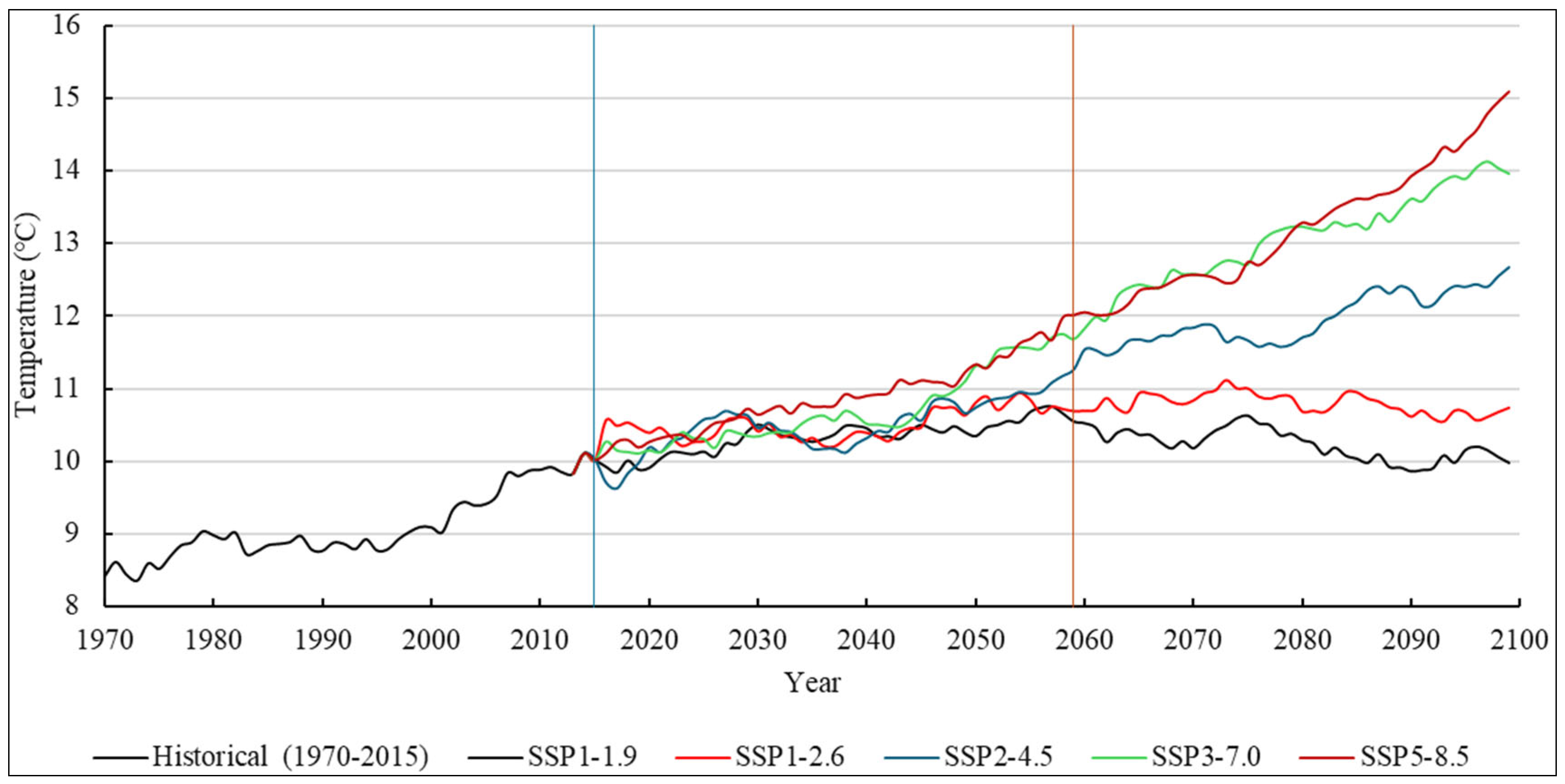
Near Future (2015–2056). Over the near future, the mean annual temperature shows a statistically significant increasing trend across all SSP scenarios (p < 0.001 based on the MK test; Table 2; Figure 5). Sen’s slope estimates indicate modest warming under low-emission pathways, with increases of approximately 0.62 °C under SSP1–1.9 and 0.45 °C under SSP1–2.6. Under intermediate forcing, SSP2–4.5 exhibits an increase of about 0.78 °C, while substantially higher warming is projected under high-emission scenarios, reaching approximately 1.44 °C under SSP3–7.0 and approximately 1.39 °C under SSP5–8.5. Notably, the warming projected under SSP3–7.0 and SSP5–8.5 approaches the 1.5 °C threshold set by the Paris Agreement, even in the near future [104].
Far Future (2057–2099). Temperature trends differ greatly among scenarios in the distant future (Table 2; Figure 5). Under SSP1–1.9 and SSP1–2.6, the average annual temperature shows statistically significant decreases (p < 0.05), with reductions of approximately −0.63 °C and −0.13 °C, respectively, reflecting the effects of strong mitigation and stabilization pathways. In contrast, SSP2–4.5, SSP3–7.0, and SSP5–8.5 exhibit strong and statistically significant warming, with projected increases of roughly 1.22 °C, 2.27 °C, and 2.94 °C, respectively. These findings highlight an accelerating warming trend under higher forcing scenarios, especially under SSP3–7.0 and SSP5–8.5, while lower-emission pathways significantly limit long-term temperature rise. Overall, the forecasted regional temperature increases are somewhat lower than the global-mean projections reported in earlier studies, indicating spatial differences in the warming response.
Precipitation
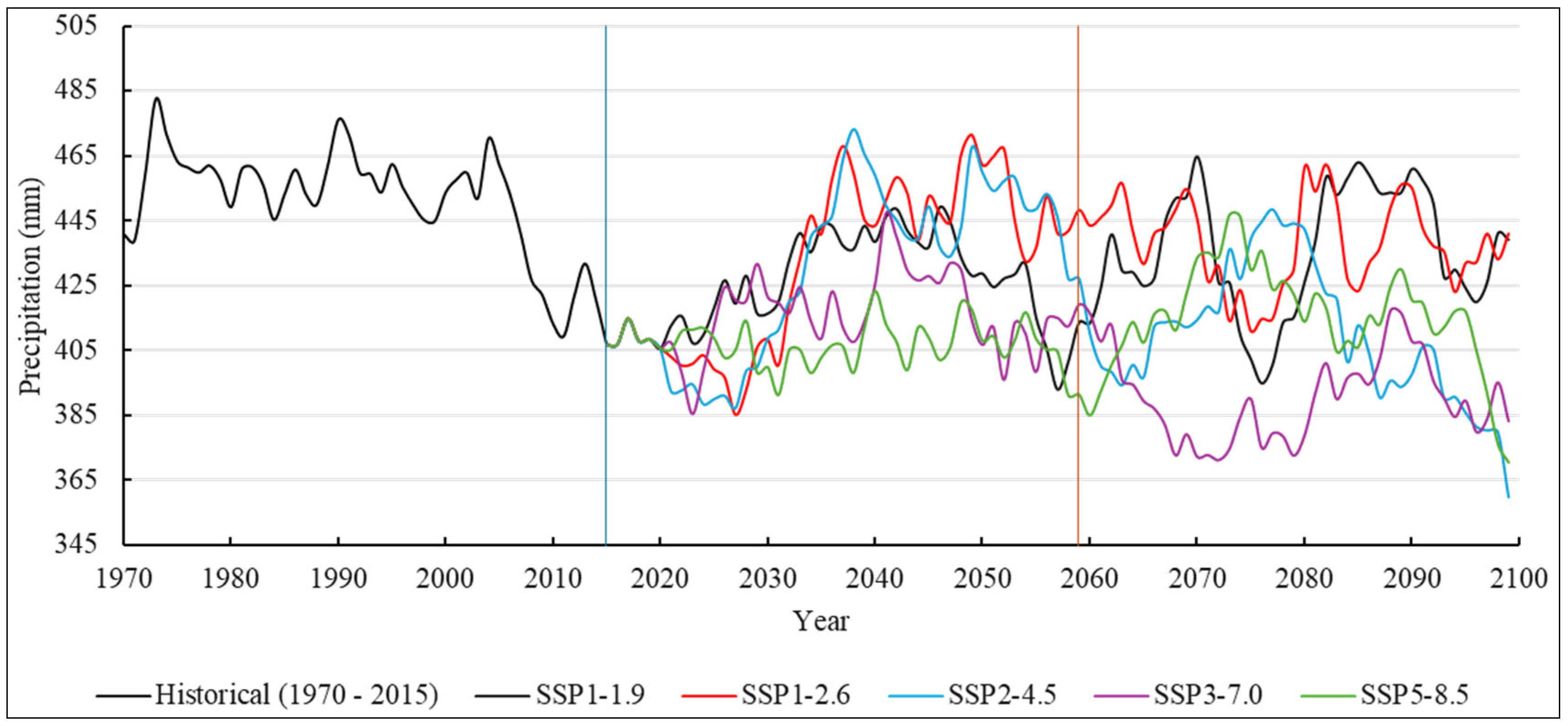
Based on future projections and trend analyses using the MK test and SS estimator (Table 2; Figure 6), mean annual precipitation varies by scenario and period.
Near Future (2015–2056). All SSP scenarios show statistically significant increasing precipitation trends (p < 0.001), with Sen’s slope estimates indicating positive changes throughout the basin. The largest increase occurs under SSP1–2.6 (approximately 131 mm), followed by SSP2–4.5 (around 67 mm) and SSP3–7.0 (about 51 mm). More moderate increases are projected under SSP5–8.5 (roughly 31 mm) and SSP1–1.9 (about 28 mm). These results suggest an overall wetting trend in the near future, although the magnitude of increase generally decreases under higher-forcing scenarios.
Far Future (2057–2099). In this distant future, precipitation patterns become increasingly uncertain and inconsistent across scenarios. Only SSP1–1.9 shows a statistically significant upward trend (p = 0.021), with an estimated increase of about 24 mm. In contrast, SSP2–4.5 shows a statistically significant downward trend (p = 0.001), with a projected decrease of approximately 40 mm, suggesting a possible shift toward drier conditions under this pathway. The other scenarios (SSP1–2.6, SSP3–7.0, and SSP5–8.5) do not show statistically significant trends, although Sen’s slope estimates suggest slight decreases (−5 mm to 0 mm). These mixed signals underscore the growing uncertainty in long-term precipitation forecasts, particularly under high-emission scenarios.

3.2. National Greenhouse Gas (GHG) Emissions

Afghanistan’s greenhouse gas (GHG) emissions remain extremely low on both a per capita and per-GDP basis and are negligible in terms of global historical responsibility. In 2022, total national GHG emissions were approximately 29 Mt CO2-equivalent, representing about 0.05% of global emissions. This low contribution reflects decades of limited industrialization, prolonged conflict, and constrained economic activity.

3.2.1. Composition of GHG Emissions

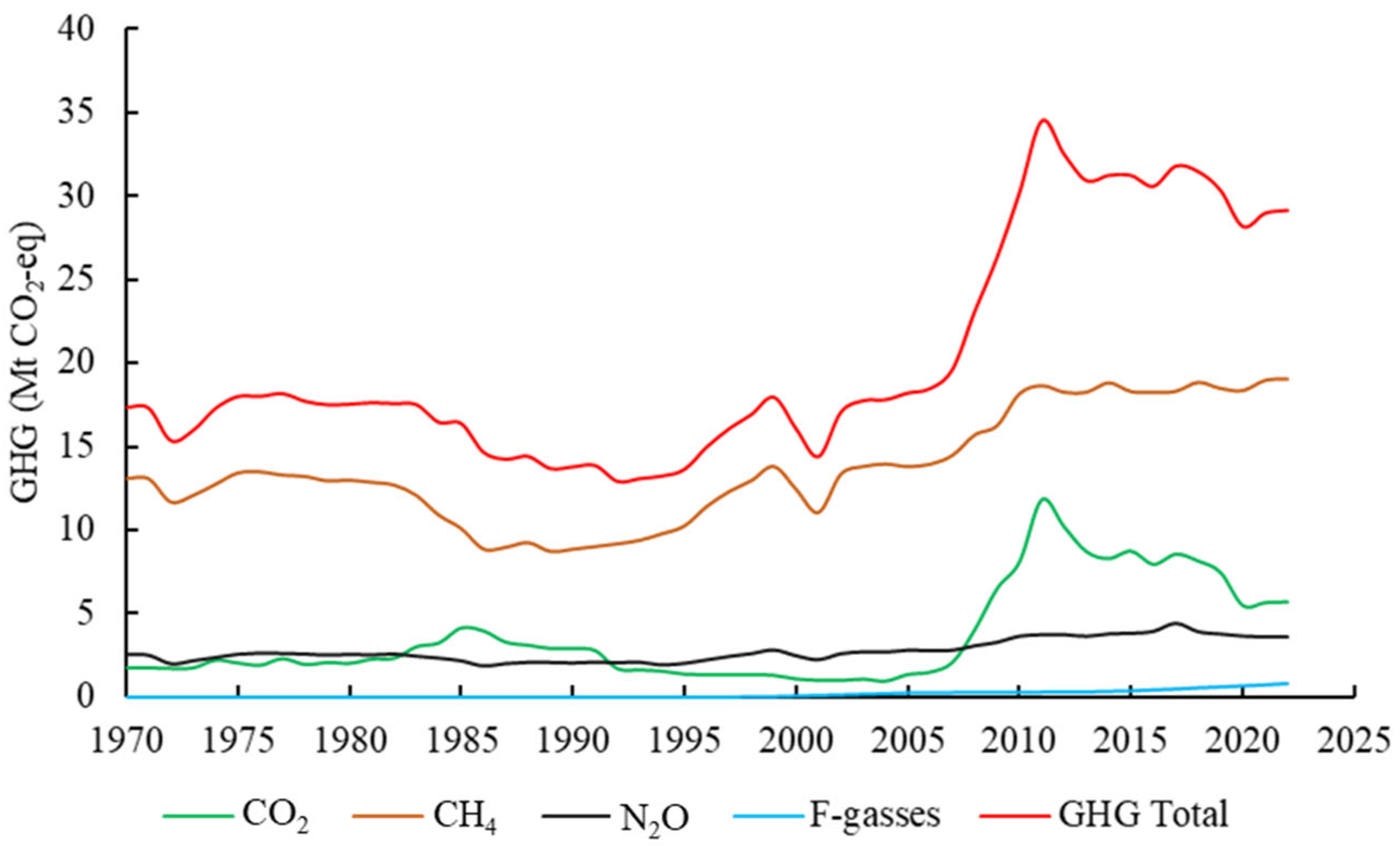
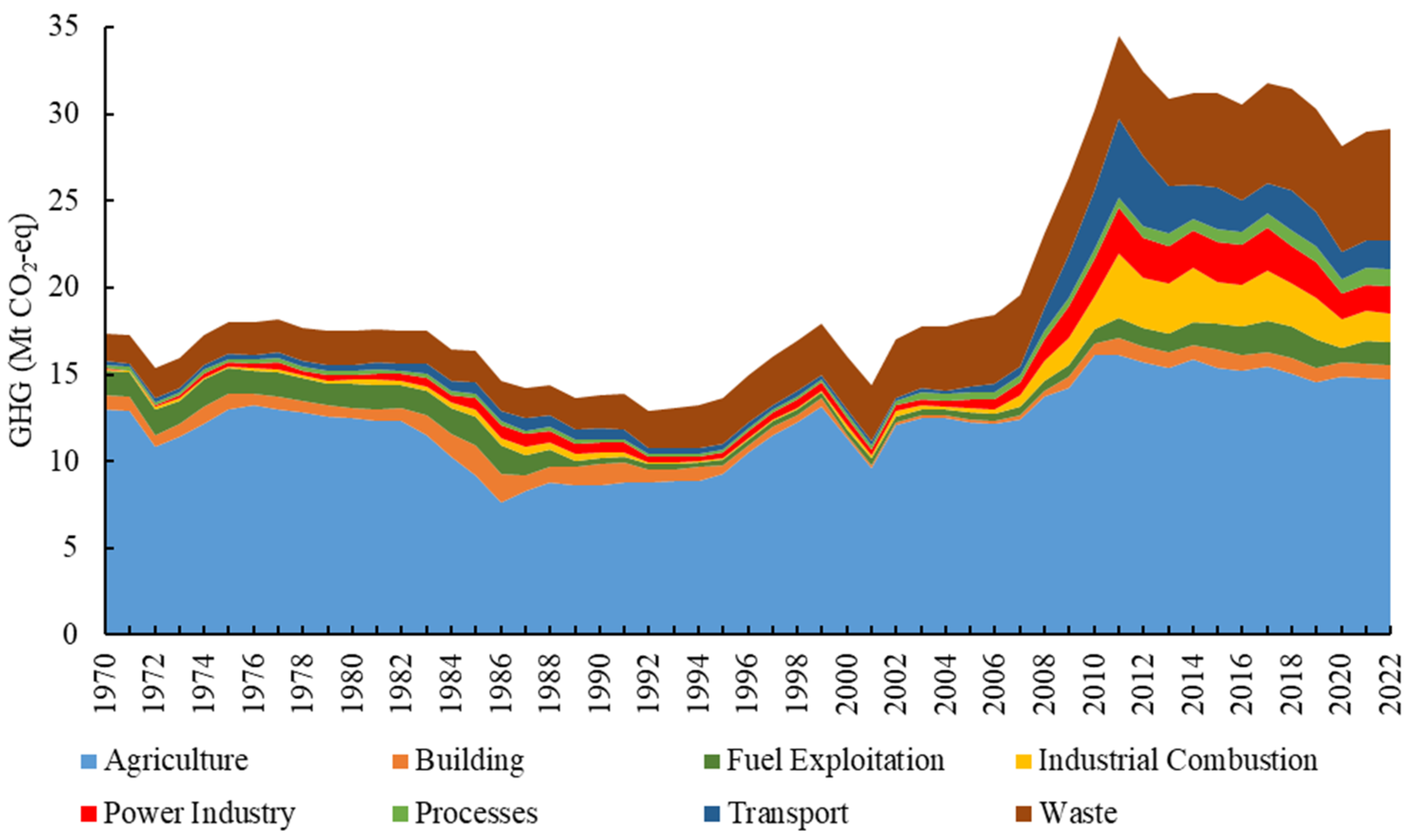
Afghanistan’s emissions profile is strongly dominated by methane (CH4), which accounts for approximately 68% of total GHG emissions over the historical period (1970–2022), followed by carbon dioxide (CO2; 18%) and nitrous oxide (N2O; 13%) (Figure 7). Fluorinated gases (F-gases) contribute less than 1%, reflecting the absence of large-scale industrial and refrigeration-intensive sectors. Methane emissions originate primarily from agriculture and livestock, especially enteric fermentation in ruminants, with smaller contributions from manure management and rice cultivation. Nitrous oxide emissions are mainly associated with agricultural soils and fertilizer use, while carbon dioxide emissions arise predominantly from fossil fuel combustion, land-use change, and deforestation [105]. Although emissions from Land Use, Land-Use Change, and Forestry (LULUCF) are excluded from the sectoral breakdown shown in Figure 8, land degradation, forest loss, and ecosystem decline remain important contributors to Afghanistan’s overall carbon balance [106,107,108].

3.2.2. Temporal Trends in Emissions (1970–2022)

Figure 7 illustrates that total GHG emissions remained relatively stable from the 1970s through the early 2000s, followed by a marked increase after 2006, coinciding with the post-2004 reconstruction, infrastructure development, and the expansion of energy demand under the Government of the Islamic Republic of Afghanistan (GoIRA). This period was characterized by increased oil consumption in transport and electricity generation, rapid urbanization, and expanded construction activity. Total GHG emissions peaked at approximately 34 Mt CO2-eq in 2011, driven largely by rising CO2 and CH4 emissions. CO2 emissions alone reached approximately 12 Mt CO2-eq in 2011, after which they declined as security conditions deteriorated, economic activity slowed, and investment in transport and industry declined. By 2019, total emissions had fallen to roughly 30 Mt CO2-eq, dropped further to about 28 Mt CO2-eq in 2020 during the COVID-19 pandemic, and then rebounded to about 29 Mt CO2-eq slightly by 2022. Despite this post-2011 decline in CO2 emissions, methane emissions remained persistently high, reflecting structural dependence on agriculture and livestock, as well as increasing emissions from waste management in urban areas since the mid-1990s.

3.2.3. Sectoral Contributions to GHG Emissions

Figure 8 presents GHG emissions by sector for the period 1970–2022 (excluding LULUCF). Agriculture has consistently been the largest-emitting sector, accounting for the majority of national emissions throughout the period. This dominance reflects Afghanistan’s agrarian economy and reliance on livestock-based livelihoods. The waste sector is the second-largest and fastest-growing source of emissions, particularly since the mid-1990s, driven by urban population growth, inadequate waste collection systems, and unmanaged landfills. Transport, power generation, and industrial combustion show comparatively lower absolute emissions but exhibit a noticeable increase during the 2010–2020 development period, consistent with increased vehicle use, diesel generators, and a fossil-fuel–based electricity supply. Emissions from buildings, fuel exploitation, and industrial processes remain relatively minor, underscoring Afghanistan’s limited industrial base. Overall, sectoral trends confirm that Afghanistan’s emissions growth is driven more by structural development pressures than by industrial expansion.

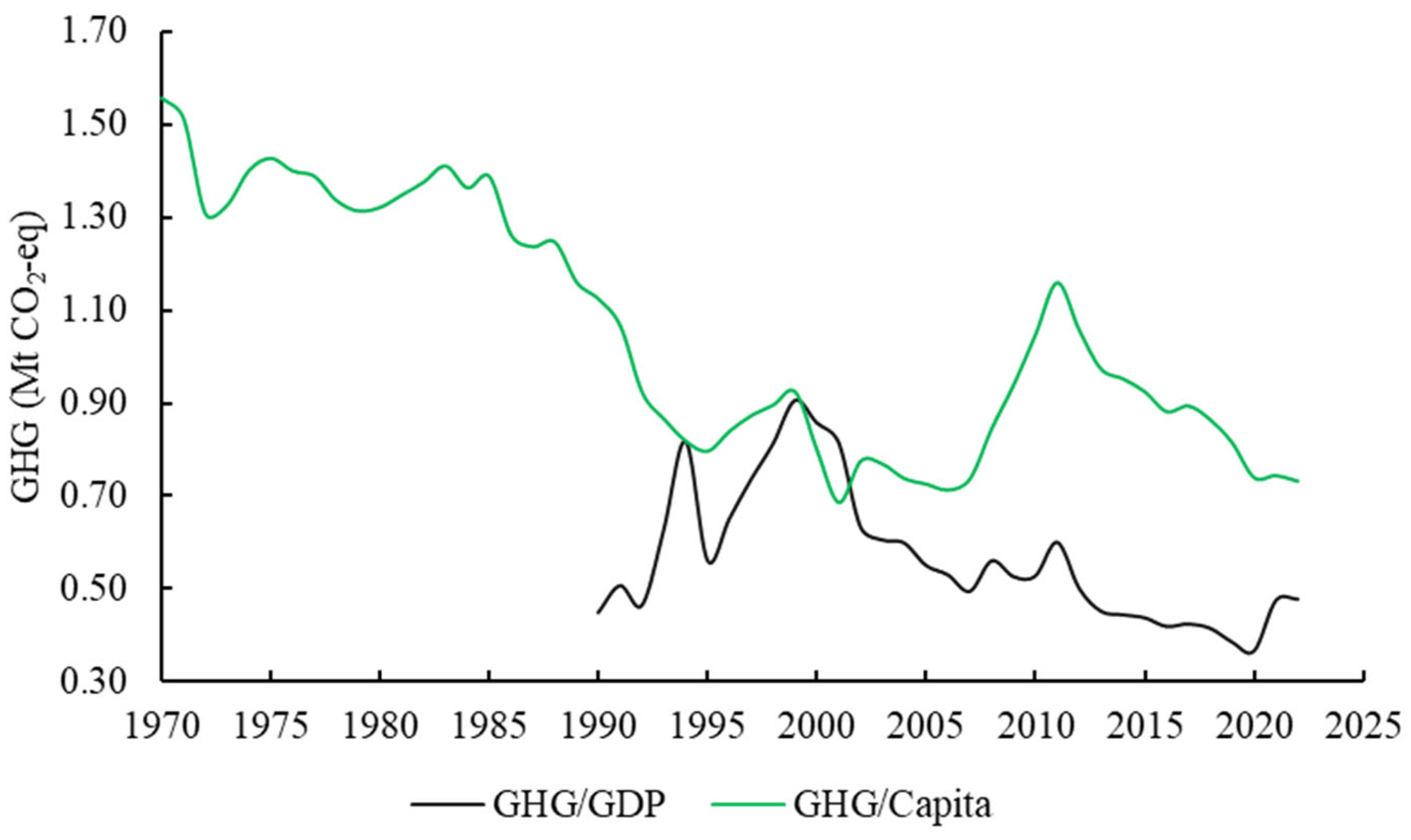
3.2.4. GHG Emissions per GDP and per Capita

GHG emissions per unit of GDP have declined strongly since 1970 (Figure 9), indicating a very low carbon intensity of economic output. This pattern reflects constrained industrial activity, low energy consumption, and limited manufacturing capacity rather than improvements in energy efficiency. Similarly, per capita GHG emissions have declined over time and remain among the lowest globally. Independent estimates from the EDGAR database for the 1990s corroborate this trend. The declining per capita emissions trajectory underscores Afghanistan’s minimal individual carbon footprint despite population growth.

3.2.5. Regional Context and Comparison with Neighboring Countries

In a regional perspective, Afghanistan’s emissions (29 Mt CO2-eq), are substantially lower than those of all neighboring countries, except Tajikistan. In 2022, neighboring states such as Pakistan (546 Mt CO2-eq), Iran (952 Mt CO2-eq), Uzbekistan (227 Mt CO2-eq), and China (15,685 Mt CO2-eq) emitted orders of magnitude more GHGs than Afghanistan. China alone accounted for nearly 29% of global GHG emissions, exceeding those of the entire region [4,90].

3.2.6. Climate Vulnerability Despite Low Emissions

Despite its negligible contribution to global emissions, Afghanistan is among the most climate-vulnerable countries worldwide [106]. Rising temperatures, declining and increasingly variable precipitation, glacier retreat, and reduced surface water availability have intensified droughts, flash floods, and avalanches, leading to widespread displacement, agricultural losses, and infrastructure damage [8,16,37,40,109,110]. Forest loss, land degradation, and declining vegetation cover have weakened natural carbon sinks, while climate-driven water scarcity has accelerated ecosystem degradation [107,111,112]. Climate-related health risks, particularly respiratory illnesses linked to dust storms, air pollution, and prolonged drought, are increasing [113,114]. These impacts are compounded by economic fragility, conflict, and limited institutional capacity for climate adaptation, reinforcing the paradox that Afghanistan faces severe climate risks despite contributing very little to the problem [29,106].

4. Discussion

4.1. Observed Climate Change and Hydroclimatic Stress in Afghanistan

The results provide strong evidence of statistically significant warming across Afghanistan from 1970 to 2014, accompanied by a long-term decrease in average annual rainfall. The consistent upward trends in maximum, minimum, and average temperatures identified by both the MK test and SS estimator show that warming is not sporadic but steady and ongoing. The estimated increase of roughly 1.5–1.6 °C over 45 years exceeds the global mean temperature rise reported for comparable periods, confirming that Afghanistan is warming at a rate faster than the global average [115]. This amplified warming aligns with patterns seen in arid and semi-arid regions, where land–atmosphere feedback, sparse vegetation, and high solar radiation boost surface heating [116]. Afghanistan’s complex topography further increases spatial variability in warming, particularly in mountainous areas, where snow–albedo feedback can accelerate temperature increases [117]. The marked warming since the late 1990s aligns with the global trend of rising temperatures but also highlights regional sensitivity to climate change. Rising temperatures have significant hydrological effects. Increased evapotranspiration demands lower effective precipitation even in years with near-average rainfall, thereby worsening drought conditions. Accelerated melting of seasonal snow and glaciers may temporarily boost runoff in high-altitude basins but ultimately endanger long-term water supply as cryosphere reserves shrink [21,110]. These processes are especially critical in Afghanistan, where surface water flows and groundwater recharge are tightly linked to snowmelt patterns [118,119,120].
The noted decline in average annual precipitation confirms the trend of increasing hydroclimatic stress. Although year-to-year variations are high, the negative Sen’s slope indicates a persistent shift toward drier conditions. When precipitation decreases while temperatures rise, the result is a substantial reduction in water availability, more frequent and severe droughts, and greater pressure on groundwater resources. This combined effect is particularly harmful to rain-fed farming, which supports a large portion of rural communities, and to shallow alluvial aquifers that lack long-term buffering capacity.

4.2. Implications of Future Climate Projections

Future climate projections highlight a clear split between low- and high-emission scenarios, emphasizing the essential role of global mitigation in shaping Afghanistan’s climate future. In the short term (2015–2056), warming is unavoidable across all pathways, with projected increases nearing or surpassing 1.5 °C under high-emission scenarios. This indicates that Afghanistan will face significant warming regardless of immediate mitigation efforts, stressing the importance of adaptation strategies. In the longer term (2057–2099), the divergence between scenarios becomes more evident. Under strong mitigation pathways (SSP1–1.9 and SSP1–2.6), temperature stabilization or slight cooling is expected, demonstrating the success of aggressive emissions reductions. Conversely, SSP3–7.0 and SSP5–8.5 project severe warming exceeding 2–3 °C, which would fundamentally change Afghanistan’s hydroclimatic system. Such warming levels are likely to exceed critical thresholds that affect crops, water infrastructure, and ecosystems.
Projected changes in precipitation are more uncertain than temperature trends, consistent with findings from global climate modeling. The near-future increase in precipitation across scenarios may seem to offset past drying; however, higher temperatures will probably offset these gains through increased evapotranspiration. Additionally, increased rainfall does not necessarily improve water security, as heavier storms can increase runoff and flooding while reducing groundwater recharge. In the long term, the lack of statistically significant precipitation trends under most scenarios highlights growing uncertainty and the possibility of increased variability, rather than clear signs of wetter or drier conditions. The significant decline observed in SSP2–4.5 indicates that even moderate pathways could lead to drier conditions, underscoring the need to prepare for water shortages rather than relying on uncertain rainfall increases.

4.3. Greenhouse Gas Emissions: Minimal Responsibility, Structural Constraints

Afghanistan’s national greenhouse gas emissions are exceptionally low compared to global and regional standards, making up only about 0.05% of worldwide emissions in 2022. This modest contribution underscores Afghanistan’s limited historical responsibility for climate change and stands in sharp contrast to the severe climate impacts the country is facing. The high methane levels in Afghanistan’s emissions mostly reflect the structure of its economy, rather than industrial activity. Livestock-based farming, limited mechanization, and poor waste management are the main sources of emissions. Carbon dioxide emissions remain relatively low due to limited industrialization, low energy use, and slow economic growth. The small role of fluorinated gases also indicates the absence of energy-intensive industries. Trends over time indicate that emissions growth since the mid-2000s has been driven by post-conflict rebuilding, urban growth, and increased use of fossil fuels in transport and power generation, rather than by long-term industrial development. The decline after 2011 demonstrates the vulnerability of emissions to political instability and economic downturns. Importantly, methane emissions remained high, indicating that emissions from agriculture and waste are deeply rooted and less responsive to short-term economic fluctuations. The decline in emissions per unit of GDP and per capita does not necessarily indicate improved efficiency. Instead, it reflects structural underdevelopment and energy hardship. Afghanistan’s very low per capita emissions highlight that individual consumption remains minimal, even as climate risks grow.

4.4. Sectoral Drivers and Development Pathways

Sectoral analysis confirms that agriculture and waste dominate Afghanistan’s emissions profile. This finding has important policy implications: mitigation strategies focused on improved livestock management, manure handling, climate-smart agriculture, and modern waste systems could reduce emissions while simultaneously improving livelihoods, sanitation, and public health. The relatively small contribution of transport and power generation indicates both a challenge and an opportunity. While current emissions are low, future development pathways could significantly increase dependence on fossil fuels if deployment of renewable energy is not prioritized. Afghanistan’s substantial solar, wind, and hydropower potential presents a critical opportunity to pursue low-carbon development while enhancing energy security and resilience.

4.5. Renewable Energy and Sustainable Development

Afghanistan has significant renewable energy potential, including solar, wind, hydropower, and biomass (as detailed in Section 1.1). Utilizing these resources is essential for sustainable growth in a country where decades of conflict have badly damaged infrastructure, limited economic progress, and worsened environmental issues. Renewable energy offers a key opportunity to address ongoing challenges related to energy access, environmental health, and economic stability, while also supporting climate action and building resilience. The development of renewable energy directly supports the United Nations Sustainable Development Goals (SDGs), especially SDG7 (Affordable and Clean Energy), SDG13 (Climate Action), and SDG15 (Life on Land) [121]. Afghanistan has already implemented several policies and strategic plans to promote renewable energy and sustainable development [55,122,123,124,125]. However, progress is hindered by financial, institutional, and security challenges. Therefore, by utilizing renewable energy, Afghanistan can:
Promoting Social Equity and Stability: Decentralized renewable energy systems—such as solar mini-grids and community-based micro-hydropower- can significantly expand electricity access in remote and rural areas where grid extension is technically difficult and prohibitively costly. Improved energy access promotes social inclusion, reduces disparities between urban and rural areas, and improves human development outcomes. Reliable electricity supports education and healthcare services, particularly in schools and clinics, thereby helping to reduce poverty and improve the quality of life. Additionally, fair energy distribution can lessen local resource conflicts and generate economic opportunities in underserved regions. While energy access alone cannot address the root causes of conflict or migration, it can help mitigate socioeconomic vulnerabilities that contribute to instability.
Stimulating Economic Development and Energy Security: Afghanistan relies heavily on imported electricity and fossil fuels, which strain foreign exchange reserves and make the country vulnerable to supply disruptions from external sources. Expanding domestic renewable energy production can boost energy security, lower reliance on imports, and strengthen macroeconomic stability. The renewable energy sector also has the potential to generate jobs in construction, installation, maintenance, and local manufacturing supply chains. Investing in renewables can stimulate local economies and support productive uses of electricity, such as agro-processing, irrigation pumping, and cold storage, which are especially crucial in an economy where agriculture provides a large share of livelihoods.
Mitigating Environmental Degradation and Enhancing Resilience: Switching to renewable energy cuts greenhouse gas (GHG) emissions, local air pollution, and dependence on fuelwood, which leads to deforestation and land degradation. In a country highly susceptible to climate variability, particularly droughts and water shortages, renewable energy solutions, such as solar-powered irrigation and decentralized generation, can enhance adaptive capacity and strengthen climate resilience. Investing in renewable energy is therefore more than just a technical fix; it is a strategic development approach that combines environmental protection, economic recovery, and social stability.
Achieving Net-Zero Emissions in the Energy Sector: Under the Paris Agreement, countries are encouraged to limit the rise in global average temperature to 1.5 °C above pre-industrial levels [126,127]. Achieving net-zero emissions (NZE) involves balancing anthropogenic greenhouse gas emissions with removals. In Afghanistan, the energy sector, particularly electricity imports, diesel generation, and biomass combustion, offers a key opportunity for mitigation. Although Afghanistan’s total global emissions are very small relative to those of major emitters, shifting from non-renewable to renewable energy sources would substantially reduce domestic emissions intensity and local pollution.
Afghanistan has several advantages that could boost renewable energy development: high solar irradiance across much of the country, extensive wind corridors (particularly in the west and north) [57], untapped small- and medium-scale hydropower potential, and available land for utility-scale renewable projects [128,129]. The country also holds mineral resources such as copper, iron, and lithium [130], which are relevant for renewable technologies and energy storage systems. However, realizing this potential requires careful governance, environmental safeguards, infrastructure development, and transparent resource management to avoid resource-related conflicts.
While rapid transition scenarios should be realistically framed, given the current lack of institutional and financial constraints, a phased renewable energy strategy could significantly decarbonize Afghanistan’s energy mix over time. Such a transition would produce cascading benefits by reducing emissions in electricity generation, transport electrification, irrigation pumping, and small-scale industry. Although Afghanistan’s emissions are minor globally, aligning national development with global NZE pathways would: improve domestic energy independence, enhance public health, reduce deforestation pressures, strengthen international climate cooperation, and provide access to climate finance. With coordinated engagement from legitimate government institutions, the private sector, international partners, and local communities, renewable energy can become a cornerstone of Afghanistan’s long-term development strategy.

4.6. Implications for Policy and Research

Taken together, the observed trends and future projections indicate that Afghanistan’s main climate issue is adaptation rather than mitigation. However, low-carbon development remains crucial for preventing the country from locking in future emissions growth as stability and development advance. Combining climate adaptation, renewable energy deployment, sustainable agriculture, and ecosystem restoration provides the most promising path forward. From a research perspective, the results emphasize the need for basin-scale analyses that connect climate change to hydrology, groundwater recharge, and transboundary water governance. Improving observational networks, integrating climate projections with hydrological models, and enhancing cross-border data sharing will be essential for managing shared water resources amid a changing climate.

4.7. Limitations and Data Considerations

Afghanistan has faced prolonged periods of war, conflict, and political instability since the late 1970s, especially after the Soviet invasion [32]. As a result, systematic hydrometeorological, river-gauging, agricultural, demographic, and environmental data collection were severely disrupted. Over five decades of conflict, research institutions, monitoring networks, databases, and national information archives were heavily damaged or destroyed [36,131,132]. Consequently, nationwide planning, monitoring, and research activities have become fragmented and inconsistent. These disruptions have caused significant spatial and temporal data gaps, reducing the accuracy and dependability of environmental assessments. Gridded climate datasets are usually created from ground-based station observations; therefore, their accuracy relies heavily on the density, consistency, and reliability of these observations. In Afghanistan, however, hydrometeorological monitoring networks declined sharply after the 1980s. The lack of observed data also limits the validation of satellite-based and reanalysis products, which increases uncertainty in climate and hydrological analyses.
Given these data-scarce conditions, satellite-based and globally gridded datasets have become essential alternatives to ground observations. These datasets provide consistent spatial and temporal coverage, supporting long-term studies of climate and hydrological trends in areas with limited in situ data. However, their effectiveness varies across variables and regions. To address this issue, multiple gridded climate datasets, including CRU TS4 [133], TerraClimate [134], CHIRPS [135], APHRODITE [136], and TRMM [137], were compared.
Comparative analyses consistently show a statistically significant warming trend across Afghanistan during the historical period. In contrast, precipitation trends exhibit higher variability, with positive, negative, or non-significant changes depending on the dataset and region. This variability reflects both the inherent uncertainty in precipitation modeling and the climatic complexity of arid and semi-arid regions. Despite these uncertainties, most studies show a general decrease in annual rainfall in Afghanistan [8,37,138].
Future temperature projections under different Shared Socioeconomic Pathways (SSPs) are fairly consistent across models, whereas precipitation projections remain uncertain and vary by model, a common issue noted for dryland regions. Among CMIP6 models, GFDL-ESM4 was selected as the primary climate projection dataset for this study due to its detailed Earth-system modeling, extensive data coverage, and alignment with observed regional climate patterns [84]. The model showed strong performance and produced statistically significant, physically plausible results across SSP scenarios.
It is important to emphasize that the goal of this study is not to make exact predictions, but to identify stable large-scale patterns in past and future climate conditions. These patterns are considered within the broader context of climate effects, vulnerability, and mitigation strategies. The findings clearly show that Afghanistan is experiencing significant impacts of climate change despite contributing minimally to global greenhouse gas emissions. Observed warming trends and projected future changes highlight the country’s high climate vulnerability and underscore the need to strengthen renewable energy development, climate resilience strategies, and sustainable development planning.
Regarding greenhouse gas emissions data, Afghanistan completed its first National Inventory Report (NIR) in 2019 [105], which covered sectoral emissions for the period 1990–2017, following IPCC guidelines. However, since the NIR does not go back to the 1970s and does not fully align with the timeframe of this study, the EDGAR database [4,90] was used as the primary emissions dataset. EDGAR provides consistent, long-term emissions data from 1970 to 2022, ensuring compatibility with the climate analysis period. Importantly, the NIR and EDGAR datasets show similar emission trends and magnitude estimates for overlapping years, supporting the reliability of the chosen emissions data.

5. Conclusions

This study offers comprehensive evidence of accelerating hydroclimatic change in Afghanistan and places these trends within the country’s greenhouse gas (GHG) emissions profile and climate vulnerability context. Climate analysis from 1970 to 2014 shows statistically significant warming across all temperature measures, with annual maximum, mean, and minimum temperatures rising by approximately 1.61 °C, 1.58 °C, and 1.47 °C, respectively. This warming rate exceeds the global average over comparable periods, reflecting Afghanistan’s heightened climate sensitivity, driven by its arid-to-semiarid conditions, complex topography, sparse vegetation, and strong land–atmosphere feedback mechanisms. At the same time, annual precipitation decreased significantly by about 36 mm, indicating a persistent shift toward drier hydroclimatic conditions. The combination of rising temperatures and reduced precipitation intensifies evapotranspiration, accelerates snowpack and glacier melt, reduces groundwater recharge, and increases the frequency and severity of droughts, thereby directly threatening agriculture, ecosystems, and national water security.
Future projections under Shared Socioeconomic Pathways (SSPs) highlight the crucial impact of emission trajectories. From 2015 to 2056, all SSP scenarios forecast significant warming, with higher-emission pathways nearing or surpassing the 1.5 °C limit. While precipitation is expected to increase slightly in the near term across scenarios, long-term forecasts (2057–2099) show considerable variability and uncertainty. Strong mitigation pathways (SSP1–1.9 and SSP1–2.6) significantly limit long-term warming and, in some cases, stabilize temperature rises. Conversely, high-forcing scenarios (SSP3–7.0 and SSP5–8.5) lead to accelerated warming, approaching approximately 3 °C by the late century, along with uncertain and possibly declining precipitation trends. These findings demonstrate that global mitigation efforts will play a decisive role in shaping Afghanistan’s future hydroclimatic stability.
Despite its high vulnerability, Afghanistan’s contribution to global climate change remains minimal. In 2022, total national emissions were about 29 Mt CO2-equivalent—roughly 0.05% of global emissions. Emissions are primarily from methane produced by agriculture and livestock, whereas carbon dioxide emissions remain low due to limited industrial activity and restricted energy use. Per capita and per-GDP emissions are among the lowest worldwide, reflecting structural underdevelopment rather than intentional decarbonization. Compared to neighboring countries, Afghanistan’s emissions are significantly lower, underscoring a clear disparity between its responsibility and climate exposure.
Afghanistan, therefore, faces increasing hydroclimatic stress under both current and future conditions while maintaining an extremely small carbon footprint. Strengthening climate adaptation, especially in integrated water resources management, climate-resilient agriculture, ecosystem restoration, and disaster risk reduction, is urgently needed. Fair international climate finance, technical cooperation, and ongoing global mitigation are crucial to supporting resilience-building in one of the world’s most climate-vulnerable yet least responsible countries. At the same time, Afghanistan has significant renewable energy potential, including solar, wind, hydropower, and biomass resources. Strategic investment in these sectors provides a pathway to expand energy access, cut environmental degradation, improve economic stability, and align long-term development with low-carbon and climate-resilient futures.

Funding

No funding has been received for this research.

Data Availability Statement

This study utilized the GFDL-ESM4 gridded datasets for mean annual temperature and precipitation time series. Annual greenhouse gas (GHG) emissions data were sourced from the EDGAR database. All these global datasets are publicly available for download from the following online sources: GFDL-ESM4: https://cds.climate.copernicus.eu/datasets/projections-cmip6?tab=download (accessed on 15 February 2026). EDGAR: https://edgar.jrc.ec.europa.eu/dataset_ghg2024 (accessed on 15 February 2026). Comprehensive information about the datasets is provided in the Section 2.2 data section. Details of the datasets are provided in [4,45,84].

Acknowledgments

I extend my deepest gratitude to the South Asia Program (SAP) and the Department of Natural Resources and the Environment (DNRE) at Cornell University for providing invaluable resources, fostering an enriching academic environment, and facilitating connections within the scholarly community. I am also profoundly grateful to the International Institute of Education, Scholar Rescue Fund (IIE-SRF), for their generous support of my fellowship.

Conflicts of Interest

The author declares that they have no conflicts of interest.

References

  1. Forster, P.M.; Smith, C.J.; Walsh, T.; Lamb, W.F.; Lamboll, R.; Hauser, M.; Ribes, A.; Rosen, D.; Gillett, N.; Palmer, M.D.; et al. Indicators of Global Climate Change 2022: Annual Update of Large-Scale Indicators of the State of the Climate System and Human Influence. Earth Syst. Sci. Data 2023, 15, 2295–2327. [Google Scholar] [CrossRef]
  2. IPCC. Summary for Policymakers. In Climate Change 2023: Synthesis Report. Contribution of Working Groups I, II and III to the Sixth Assessment Report of the Intergovernmental Panel on Climate Change; Core Writing Team, Lee, H., Romero, J., Eds.; Arias, P., Bustamante, M., Elgizouli, I., Flato, G., Howden, M., Méndez-Vallejo, C., Pereira, J.J., Pichs-Madruga, R., Rose, S.K., Saheb, Y., Sánchez Rodríguez, R., Ürge-Vorsatz, D., Xiao, C., Yassaa, N., Romero, J., Kim, J., Haites, E.F., Jung, Y., Stavins, R., Birt, A., Ha, M., Orendain, D.J.A., Ignon, L., Park, S., Park, Y., Reisinger, A., Cammaramo, D., Fischlin, A., Fuglestvedt, J.S., Hansen, G., Ludden, C., Masson-Delmotte, V., Matthews, J.B.R., Mintenbeck, K., Pirani, A., Poloczanska, E., Leprince-Ringuet, N., Péan, C.; IPCC: Geneva, Switzerland, 2023. [Google Scholar]
  3. Forster, P.M.; Smith, C.; Walsh, T.; Lamb, W.F.; Lamboll, R.; Hall, B.; Hauser, M.; Ribes, A.; Rosen, D.; Gillett, N.P.; et al. Indicators of Global Climate Change 2023: Annual Update of Key Indicators of the State of the Climate System and Human Influence. Earth Syst. Sci. Data 2024, 16, 2625–2658. [Google Scholar] [CrossRef]
  4. Crippa, M.; Guizzardi, D.; Pagani, F.; Banja, M.; Muntean, M.; Schaaf, E.; Becker, W.; Monforti-Ferrario, F.; Quadrelli, R.; Risquez Martin, A.; et al. GHG Emission of All World Countries; Publications Office of the European Union: Luxembourg, 2023. [Google Scholar]
  5. Azizi, M.I.; Xu, B.; Kamara, M.; Rahmani, B. Impacts of Climate Change in Afghanistan and an Overview of Sustainable Development Efforts. Eur. J. Theor. Appl. Sci. 2024, 2, 495–516. [Google Scholar] [CrossRef] [PubMed]
  6. White, C.J.; Tanton, T.W.; Rycroft, D.W. The Impact of Climate Change on the Water Resources of the Amu Darya Basin in Central Asia. Water Resour. Manag. 2014, 28, 5267–5281. [Google Scholar] [CrossRef]
  7. Aich, V.; Akhundzadah, N.A.; Knuerr, A.; Khoshbeen, A.J.; Hattermann, F.; Paeth, H.; Scanlon, A.; Paton, E.N. Climate Change in Afghanistan Deduced from Reanalysis and Coordinated Regional Climate Downscaling Experiment (CORDEX)-South Asia Simulations. Climate 2017, 5, 38. [Google Scholar] [CrossRef]
  8. Hayat, E.; Tayfur, G. Meteorological Drought and Trend Effects on Transboundary River Basins in Afghanistan. Theor. Appl. Clim. 2023, 154, 1253–1275. [Google Scholar] [CrossRef]
  9. Kassam, K.A. Viewing Change through the Prism of Indigenous Human Ecology: Findings from the Afghan and Tajik Pamirs. Hum. Ecol. 2009, 37, 677–690. [Google Scholar] [CrossRef]
  10. Nasimi, M.N.; Sagin, J.; Wijesekera, N.T.S. Climate and Water Resources Variation in Afghanistan and the Need for Urgent Adaptation Measures. Int. J. Food Sci. Agric. 2020, 4, 49–64. [Google Scholar] [CrossRef]
  11. Raoufi, H.; Jafari, H.; Sarhadi, W.A.; Salehi, E. Assessing the Impact of Climate Change on Agricultural Production in Central Afghanistan. Reg. Sustain. 2024, 5, 100156. [Google Scholar] [CrossRef]
  12. Gbadegesin, T.; Andrée, B.P.J.; Braimoh, A. Climate Shocks and Their Effects on Food Security, Prices, and Agricultural Wages in Afghanistan; World Bank: Washington, DC, USA, 2024. [Google Scholar]
  13. Eekhout, J.P.C.; de Vente, J. Global Impact of Climate Change on Soil Erosion and Potential for Adaptation through Soil Conservation. Earth. Sci. Rev. 2022, 226, 103921. [Google Scholar] [CrossRef]
  14. Spink, P. Climate Change Drives Migration in Conflict-Ridden Afghanistan; ActionAid International: Johannesburg, South Africa, 2020. [Google Scholar]
  15. Caretta, M.A.; Mukherji, A.; Arfanuzzaman, M.; Betts, A.; Gelfan, A.; Hirabayashi, Y.; Lissner, T.K.; Liu, J.; Lopez Gunn, E.; Morgan, R.; et al. Water. In Climate Change 2022: Impacts, Adaptation and Vulnerability. Contribution of Working Group II to the Sixth Assessment Report of the Intergovernmental Panel on Climate Change; Pörtner, H.-O., Roberts, D.C., Tignor, M., Poloczanska, E.S., Mintenbeck, K., Alegría, A., Craig, M., Langsdorf, S., Löschke, S., Möller, V., et al., Eds.; Cambridge University Press: Cambridge, UK; New York, NY, USA, 2022. [Google Scholar]
  16. Ikram, Q.D.; Jamalzi, A.R.; Hamidi, A.R.; Ullah, I.; Shahab, M. Flood Risk Assessment of the Population in Afghanistan: A Spatial Analysis of Hazard, Exposure, and Vulnerability. Nat. Hazards Res. 2024, 4, 46–55. [Google Scholar] [CrossRef]
  17. Iqbal, M.S.; Dahri, Z.H.; Querner, E.P.; Khan, A.; Hofstra, N. Impact of Climate Change on Flood Frequency and Intensity in the Kabul River Basin. Geosciences 2018, 8, 114. [Google Scholar] [CrossRef]
  18. Rousta, I.; Olafsson, H.; Moniruzzaman, M.; Zhang, H.; Liou, Y.A.; Mushore, T.D.; Gupta, A. Impacts of Drought on Vegetation Assessed by Vegetation Indices and Meteorological Factors in Afghanistan. Remote Sens. 2020, 12, 2433. [Google Scholar] [CrossRef]
  19. UNEP. Post-Conflict Environmental Assessment, Afghanistan; UNEP: Nairobi, Kenya, 2003. [Google Scholar]
  20. Bajracharya, S.R.; Maharjan, S.B.; Shrestha, F.; Guo, W.; Liu, S.; Immerzeel, W.; Shrestha, B. The Glaciers of the Hindu Kush Himalayas: Current Status and Observed Changes from the 1980s to 2010. Int. J. Water Resour. Dev. 2015, 31, 161–173. [Google Scholar] [CrossRef]
  21. Akhtar, F.; Azizi, A.H.; Borgemeister, C.; Tischbein, B.; Awan, U.K. The Changing Face of Snow Cover in Afghanistan: Opportunities for Development Interventions. In Exploring Hope: Case Studies of Innovation, Change and Development in the Global South; Emerald Publishing Limited: Leeds, UK, 2024; pp. 177–182. [Google Scholar]
  22. Azizi, A.H.; Akhtar, F.; Kusche, J.; Tischbein, B.; Borgemeister, C.; Oluoch, W.A. Machine Learning-Based Estimation of Fractional Snow Cover in the Hindukush Mountains Using MODIS and Landsat Data. J. Hydrol. 2024, 638, 131579. [Google Scholar] [CrossRef]
  23. Bulbulshoev, U.; Kassam, K.A.; Ruelle, M. Ecology of Time: Calendar of the Human Body in the Pamir Mountains. J. Persianate Stud. 2011, 4, 146–170. [Google Scholar] [CrossRef]
  24. Jamalzi, A.R.; Rahman, G.; Akhtar, F.; Ikram, Q.D.; Kwon, H.H. Spatiotemporal Assessment and Trend Analysis of Meteorological Drought in Afghanistan (1974–2023) Using SPI and SPEI Indices. J. Hydrol. Reg. Stud. 2025, 61, 102711. [Google Scholar] [CrossRef]
  25. Xu, J.; Grumbine, R.E.; Shrestha, A.; Eriksson, M.; Yang, X.; Wang, Y.; Wilkes, A. The Melting Himalayas: Cascading Effects of Climate Change on Water, Biodiversity, and Livelihoods. Conserv. Biol. 2009, 23, 520–530. [Google Scholar] [CrossRef]
  26. Sarfaraz, M.Y.; Hakimi, M.P.; Achak, J. Global Warming and Its Impact on Rural Livelihood in Afghanistan: Challenges, Opportunities, and Pathways for Sustainable Development. J. Environ. Clim. Ecol. 2025, 2, 20–28. [Google Scholar] [CrossRef]
  27. Safi, L.; Mujeeb, M.; Sahak, K.; Mushwani, H.; Hashmi, S.K. Climate Change Impacts and Threats on Basic Livelihood Resources, Food Security and Social Stability in Afghanistan. GeoJournal 2024, 89, 85. [Google Scholar] [CrossRef]
  28. Samim, S.A.; Hu, Z.; Stepien, S.; Amini, S.Y.; Rayee, R.; Niu, K.; Mgendi, G. Food Insecurity and Related Factors among Farming Families in Takhar Region, Afghanistan. Sustainability 2021, 13, 10211. [Google Scholar] [CrossRef]
  29. Sitati, A.; Joe, E.; Pentz, B.; Grayson, C.; Jaime, C.; Gilmore, E.; Galappaththi, E.; Hudson, A.; Alverio, G.N.; Mach, K.J.; et al. Climate Change Adaptation in Conflict-Affected Countries: A Systematic Assessment of Evidence. Discov. Sustain. 2021, 2, 42. [Google Scholar] [CrossRef]
  30. Xie, X.; Hao, M.; Ding, F.; Scheffran, J.; Ide, T.; Maystadt, J.F.; Qian, Y.; Wang, Q.; Chen, S.; Wu, J.; et al. The Impacts of Climate Change on Violent Conflict Risk: A Review of Causal Pathways. Environ. Res. Commun. 2024, 6, 112002. [Google Scholar] [CrossRef] [PubMed]
  31. See, S.; Opdyke, A.; Banki, S. A Review of the Climate Change-Disaster-Conflict Nexus and Humanitarian Framing of Complex Displacement Contexts. Clim. Dev. 2025, 1–14. [Google Scholar] [CrossRef]
  32. Rubin, B.R. Afghanistan: The Last Cold-War Conflict, the First Post-Cold-War Conflict. In War, Hunger, and Displacement; Oxford University Press: Oxford, UK, 2011; Volume 2, pp. 23–52. [Google Scholar]
  33. Grau, L.W. Rodric Braithwaite, Afgantsy: The Russians in Afghanistan 1979–1989. In The Journal of Power Institutions in Post-Soviet Societies; Profile Books: London, UK, 2011; p. 431. [Google Scholar] [CrossRef]
  34. Mena, R.; Hilhorst, D.; Peters, K. Disaster Risk Reduction and Protracted Violent Conflict: The Case of Afghanistan; Overseas Development Institute: London, UK, 2019. [Google Scholar]
  35. World Bank. Strengthening Hydromet and Early Warning Services in Afghanistan; World Bank: Washington, DC, USA, 2018. [Google Scholar]
  36. GoIRA. Environmental Law; NEPA: Kabul, Afghanistan, 2007.
  37. Akhundzadah, N.A. Analyzing Temperature, Precipitation, and River Discharge Trends in Afghanistan’s Main River Basins Using Innovative Trend Analysis, Mann–Kendall, and Sen’s Slope Methods. Climate 2024, 12, 196. [Google Scholar] [CrossRef]
  38. Rehana, S.; Krishna Reddy, P.; Sai Bhaskar Reddy, N.; Daud, A.R.; Saboory, S.; Khaksari, S.; Tomer, S.K.; Sowjanya, U. Observed Spatio-Temporal Trends of Precipitation and Temperature Over Afghanistan. In Climate Change Impacts on Water Resources: Hydraulics, Water Resources and Coastal Engineering; Jha, R., Singh, V.P., Singh, V., Roy, L.B., Thendiyath, R., Eds.; Springer International Publishing: Cham, Switzerland, 2021; pp. 377–392. ISBN 978-3-030-64202-0. [Google Scholar]
  39. Aawar, T.; Khare, D. Assessment of Climate Change Impacts on Streamflow through Hydrological Model Using SWAT Model: A Case Study of Afghanistan. Model. Earth Syst. Environ. 2020, 6, 1427–1437. [Google Scholar] [CrossRef]
  40. Ghulami, M. Assessment of Climate Change Impacts on Water Resources and Agriculture in Data-Scarce Kabul Basin, Afghanistan. Ph.D. Thesis, Université Côte d’Azur, Nice, France, 2017. [Google Scholar]
  41. Miller, J.D.; Immerzeel, W.W.; Rees, G. Climate Change Impacts on Glacier Hydrology and River Discharge in the Hindu Kush–Himalayas. Mt. Res. Dev. 2012, 32, 461–467. [Google Scholar] [CrossRef]
  42. Sarwary, M.; Senthilnathan, S.; Vidhyavathi, A.; Kokilavani, S. Socio-Economic Impact of Climate Change, Adaptation and Determinants of Willingness to Pay for Crop Insurance in Central Agro-Climatic Zone of Afghanistan. Curr. J. Appl. Sci. Technol. 2020, 39, 83–92. [Google Scholar] [CrossRef]
  43. Savage, M.; Dougherty, B.; Hamza, M.; Butterfield, R.; Bharwani, S. Socio-Economic Impacts of Climate Change in Afghanistan: A Report to the Department for International Development; Stockholm Environment Institute: Stockholm, Sweden, 2009. [Google Scholar]
  44. Lee, J.-Y.; Marotzke, G.; Bala, L.; Cao, S.; Corti, J.P.; Dunne, F.; Engelbrecht, E.; Fischer, J.C.; Fyfe, C.; Jones, A.; et al. Future Global Climate: Scenario-Based Projections and Near-Term Information. In Climate Change 2021: The Physical Science Basis. Contribution of Working Group I to the Sixth Assessment Report of the Intergovernmental Panel on Climate Change; Masson-Delmotte, V., Zhai, P., Pirani, A., Connors, S.L., Péan, C., Berger, S., Caud, N., Chen, Y., Goldfarb, L., Gomis, M.I., et al., Eds.; Cambridge University Press: Cambridge, UK; New York, NY, USA, 2021; pp. 553–672. [Google Scholar]
  45. Eyring, V.; Bony, S.; Meehl, G.A.; Senior, C.A.; Stevens, B.; Stouffer, R.J.; Taylor, K.E. Overview of the Coupled Model Intercomparison Project Phase 6 (CMIP6) Experimental Design and Organization. Geosci. Model Dev. 2016, 9, 1937–1958. [Google Scholar] [CrossRef]
  46. Mann, H.B. Nonparametric Tests Against Trend. Econom. J. Econom. Soc. 1945, 13, 245–259. [Google Scholar] [CrossRef]
  47. Kendall, M.G. Rank Correlation Methods. Biometrika 1957, 44, 298. [Google Scholar] [CrossRef]
  48. Sen, P.K. Estimates of the Regression Coefficient Based on Kendall’s Tau. J. Am. Stat. Assoc. 1968, 63, 1379–1389. [Google Scholar] [CrossRef]
  49. Ahady, S.; Dev, N.; Mandal, A. An Overview of the Opportunities and Challenges in Sustaining the Energy Industry in Afghanistan. In Proceedings of the E3S Web of Conferences; EDP Sciences: Les Ulis, France, 2020; Volume 173. [Google Scholar]
  50. World Bank. Afghanistan Development Update; World Bank: Washington, DC, USA, 2024. [Google Scholar]
  51. Poole, L. Afghanistan Tracking Major Resource Flows 2002–2010; ALNAP: London, UK, 2011. [Google Scholar]
  52. IRoA_CSO. Afghanistan Living Conditions Survey 2016–17; Government of Afghanistan: Kabul, Afghanistan, 2016; Volume 14.
  53. Slimankhil, A.K.; Anwarzai, M.A.; Sabory, N.R.; Danish, M.S.S.; Ahmadi, M.; Ahadi, M.H. Renewable Energy Potential for Sustainable Development in Afghanistan. J. Sustain. Energy Revolut. 2020, 1, 8–15. [Google Scholar] [CrossRef]
  54. ADB. Energy Supply Improvement Investment Program: Sector Assessment (Summary): Energy; ADB: Mandaluyong City, Philippines, 2015. [Google Scholar]
  55. Fichtner. Power Sector Master Plan: Ministry of Energy and Water, Islamic Republic of Afghanistan; Fichtner: Stuttgart, Germany, 2013. [Google Scholar]
  56. OSCE. The Effects of the Crisis in Afghanistan on Central Asia’s Energy Sector; OSCE: Vienna, Austria, 2024. [Google Scholar]
  57. World Bank. Afghanistan Renewable Energy Development Issues and Options; Energy Stu.; World Bank: Washington, DC, USA, 2018. [Google Scholar]
  58. Ahmadzai, S.; McKinna, A. Afghanistan Electrical Energy and Trans-Boundary Water Systems Analyses: Challenges and Opportunities. Energy Rep. 2018, 4, 435–469. [Google Scholar] [CrossRef]
  59. Shoaib, A.; Ariaratnam, S. A Study of Socioeconomic Impacts of Renewable Energy Projects in Afghanistan. Procedia Eng. 2016, 145, 995–1003. [Google Scholar] [CrossRef]
  60. Akhundzadah, N.A.; Kassam, K.A. Water Sovereignty as a Pathway to Food and Energy Security in Afghanistan. Discov. Sustain. 2025, 6, 628. [Google Scholar] [CrossRef]
  61. Doran, D.; Christensen, M.; Rosenstock, T. Hydropower in Afghanistan Opportunities, Challenges, and the Legal Framework. Int. J. Hydropower Dams 2014, 21, 6. [Google Scholar]
  62. Ershad, A.M.; Brecha, R.J.; Hallinan, K. Analysis of Solar Photovoltaic and Wind Power Potential in Afghanistan. Renew. Energy 2016, 85, 445–453. [Google Scholar] [CrossRef]
  63. Fahimi, A.; Upham, P. The Renewable Energy Sector in Afghanistan: Policy and Potential. Wiley Interdiscip. Rev. Energy Environ. 2018, 7, e280. [Google Scholar] [CrossRef]
  64. Lu, X.; McElroy, M.B.; Kiviluoma, J. Global Potential for Wind-Generated Electricity. Proc. Natl. Acad. Sci. USA 2009, 106, 10933–10938. [Google Scholar] [CrossRef]
  65. Anwarzai, M.A.; Nagasaka, K. Utility-Scale Implementable Potential of Wind and Solar Energies for Afghanistan Using GIS Multi-Criteria Decision Analysis. Renew. Sustain. Energy Rev. 2017, 71, 150–160. [Google Scholar] [CrossRef]
  66. Mostafaeipour, A.; Dehshiri, S.J.H.; Dehshiri, S.S.H.; Jahangiri, M.; Techato, K. A Thorough Analysis of Potential Geothermal Project Locations in Afghanistan. Sustainability 2020, 12, 8397. [Google Scholar] [CrossRef]
  67. Ludin, G.A.; Amin, M.A.; Aminzay, A.; Senjyu, T. Theoretical Potential and Utilization of Renewable Energy in Afghanistan. AIMS Energy 2017, 5, 1–19. [Google Scholar] [CrossRef]
  68. Pang, S. Fuel Flexible Gas Production: Biomass, Coal and Bio-Solid Wastes. In Fuel Flexible Energy Generation: Solid, Liquid and Gaseous Fuels; Elsevier Inc.: Amsterdam, The Netherlands, 2016; pp. 241–269. ISBN 9781782423997. [Google Scholar]
  69. Milbrandt, A.; Overend, R. Assessment of Biomass Resources in Afghanistan; Nrel: Golden, CO, USA, 2011. [Google Scholar]
  70. FAO. Land Cover Atlas of the Islamic Republic of Afghanistan; FAO: Rome, Italy, 2016. [Google Scholar]
  71. Ahmadi, J. Afghanistan Geography: Mountain Regions and Region Specific Soil Types. Int. J. Multidiscip. Res. Growth Eval. 2021, 2, 326–328. [Google Scholar]
  72. Abdullah, S.; Chmyriov, V.M. Outline of Physical Geological of Afghanistan. In Geology and Mineral Resources of Afghanistan; British Geological Survey (BGS): London, UK, 2008; pp. 2–13. [Google Scholar]
  73. Shroder, J.F. Hydrogeography (Drainage Basins and Rivers) of Afghanistan and Neighboring Countries. In Transboundary Water Resources in Afghanistan: Climate Change and Land-Use Implications; Elsevier: Amsterdam, The Netherlands, 2016; pp. 23–40. ISBN 9780128018866. [Google Scholar]
  74. Shokory, J.A.N.; Lane, S.N. Ice Cover Loss and Debris Cover Evolution in the Afghanistan Hindu Kush Himalaya between 2000 and 2020. Arct. Antarct. Alp. Res. 2024, 56, 2373858. [Google Scholar] [CrossRef]
  75. Glantz, M.H. Water, Climate, and Development Issues in the Amu Darya Basin. Mitig. Adapt. Strat. Glob. Change 2005, 10, 23–50. [Google Scholar] [CrossRef]
  76. Shokory, J.A.N.; Tsutsumi, J.G.; Yamada, H.; Klove, B. Intra-Seasonal Variation of Rainfall and Climate Characteristics in Kabul River Basin. Cent. Asian J. Water Res. 2017, 3, 24–40. [Google Scholar]
  77. NEPA; UNEP. Climate Change and Governance in Afghanistan; NEPA & UNEP: Nairobi, Kenya, 2015.
  78. Whitney, J.W. Geology, Water, and Wind in the Lower Helmand Basin, Southern Afghanistan; USGS Publications Warehouse: Reston, VA, USA, 2006.
  79. World Bank. Islamic Republic of Afghanistan Agricultural Sector Review: Revitalizing Agriculture for Economic Growth Job Creation and Food Security; World Bank: Washington, DC, USA, 2014. [Google Scholar]
  80. Shroder, J.F.; Bishop, M.P. Glaciers of Asia—Selected Glaciers of Afghanistan. In Satellite Image Atlas of Glaciers of the World; U. S. Geological Survey: Reston, VA, USA, 1988. [Google Scholar]
  81. Sinfield, L.; Shroder, J.F. Ground-Water Geology of Afghanistan. In Transboundary Water Resources in Afghanistan: Climate Change and Land-Use Implications; Elsevier: Amsterdam, The Netherlands, 2016; pp. 41–90. ISBN 9780128018866. [Google Scholar]
  82. OCHA. Afghanistan: Snapshot of Flash Floods in 2022; OCHA: New York, NY, USA, 2022. [Google Scholar]
  83. IFRC. Emergency Plan of Action Operation Update Afghanistan: Drought and Flash Floods; IFRC: Kabul, Afghanistan, 2020. [Google Scholar]
  84. Dunne, J.P.; Horowitz, L.W.; Adcroft, A.J.; Ginoux, P.; Held, I.M.; John, J.G.; Krasting, J.P.; Malyshev, S.; Naik, V.; Paulot, F.; et al. The GFDL Earth System Model Version 4.1 (GFDL-ESM 4.1): Overall Coupled Model Description and Simulation Characteristics. J. Adv. Model. Earth Syst. 2020, 12, e2019MS002015. [Google Scholar] [CrossRef]
  85. Then, Y.J.; Syafrina, A.H. Modified Mann-Kendall with Higher-Order Statistics for Trend Analysis. Sci. Rep. 2026, 16. [Google Scholar] [CrossRef]
  86. François, B.; Vrac, M.; Cannon, A.J.; Robin, Y.; Allard, D. Multivariate Bias Corrections of Climate Simulations: Which Benefits for Which Losses? Earth Syst. Dyn. 2020, 11, 537–562. [Google Scholar] [CrossRef]
  87. Gebrechorkos, S.; Leyland, J.; Slater, L.; Wortmann, M.; Ashworth, P.J.; Bennett, G.L.; Boothroyd, R.; Cloke, H.; Delorme, P.; Griffith, H.; et al. A High-Resolution Daily Global Dataset of Statistically Downscaled CMIP6 Models for Climate Impact Analyses. Sci. Data 2023, 10, 611. [Google Scholar] [CrossRef]
  88. CDS. CMIP6 Climate Projections. Available online: https://cds.climate.copernicus.eu/datasets/projections-cmip6?tab=quality_assurance_tab (accessed on 1 January 2025).
  89. IPCC. Climate Change and Land: An IPCC Special Report. In Climate Change and Land; Cambridge University Press: Cambridge, UK, 2019; pp. 437–550. [Google Scholar]
  90. Janssens-Maenhout, G.; Crippa, M.; Guizzardi, D.; Muntean, M.; Schaaf, E.; Dentener, F.; Bergamaschi, P.; Pagliari, V.; Olivier, J.G.J.; Peters, J.A.H.W.; et al. EDGAR v4.3.2 Global Atlas of the Three Major Greenhouse Gas Emissions for the Period 1970-2012. Earth Syst. Sci. Data 2019, 11, 959–1002. [Google Scholar] [CrossRef]
  91. World Bank. Solar Resource Maps of Afghanistan. Available online: https://old.solargis.com/maps-and-gis-data/download/afghanistan (accessed on 5 January 2025).
  92. SOLARGIS. Global Solar and Wind Atlas. Available online: https://globalsolaratlas.info/map (accessed on 5 January 2025).
  93. Esri ArcGIS Pro. Available online: https://www.esri.com/en-us/arcgis/products/arcgis-pro/overview (accessed on 10 July 2024).
  94. ArcGIS Pro. Subset Multidimensional Raster (Multidimension). Available online: https://pro.arcgis.com/en/pro-app/latest/tool-reference/multidimension/subset-multidimensional-raster.htm (accessed on 5 January 2025).
  95. Hussain, M.; Mahmud, I. PyMannKendall: A Python Package for Non Parametric Mann Kendall Family of Trend Tests. J. Open Source Softw. 2019, 4, 1556. [Google Scholar] [CrossRef]
  96. Yue, S.; Pilon, P. A Comparison of the Power of the t Test, Mann-Kendall and Bootstrap Tests for Trend Detection. Hydrol. Sci. J. 2004, 49, 21–37. [Google Scholar] [CrossRef]
  97. Yi, X.; Li, G.; Yin, Y. Spatio-Temporal Variation of Precipitation in the Three-River Headwater Region from 1961 to 2010. J. Geogr. Sci. 2013, 23, 447–464. [Google Scholar] [CrossRef]
  98. Frimpong, B.F.; Koranteng, A.; Molkenthin, F. Analysis of Temperature Variability Utilising Mann–Kendall and Sen’s Slope Estimator Tests in the Accra and Kumasi Metropolises in Ghana. Environ. Syst. Res. 2022, 11, 24. [Google Scholar] [CrossRef]
  99. Singh, R.N.; Sah, S.; Das, B.; Potekar, S.; Chaudhary, A.; Pathak, H. Innovative Trend Analysis of Spatio-Temporal Variations of Rainfall in India during 1901-2019. Theor. Appl. Clim. 2021, 145, 821–838. [Google Scholar] [CrossRef]
  100. Kumar, P.; Sharma, M.C.; Saini, R.; Singh, G.K. Climatic Variability at Gangtok and Tadong Weather Observatories in Sikkim, India, During 1961–2017. Sci. Rep. 2020, 10, 15177. [Google Scholar] [CrossRef]
  101. Yuan, L.; Yang, G.; Li, H.; Zhang, Z. Spatio-Temporal Variation Analysis of Precipitation during 1960-2008 in the Poyang Lake Basin, China. Open J. Mod. Hydrol. 2016, 06, 115–127. [Google Scholar] [CrossRef]
  102. Andrade, C. The P Value and Statistical Significance: Misunderstandings, Explanations, Challenges, and Alternatives. Indian J. Psychol. Med. 2019, 41, 210–215. [Google Scholar] [CrossRef]
  103. Kendall, M.G. A New Measure of Rank Correlation. Biometrika 1938, 30, 81–93. [Google Scholar] [CrossRef]
  104. UN. Paris Agreement; United Nations: New York, NY, USA, 2015. [Google Scholar]
  105. NEPA; UNEP. Afghanistan’s National GHG Inventory Report (NIR) 2019: Submission under the United Framework Convention on Climate Change (UNFCCC); NEPA & UNEP: Nairobi, Kenya, 2019.
  106. Brown, O. Climate-Fragility Risk Brief: Afghanistan; adelphi research gGmbH: Berlin, Germany, 2019. [Google Scholar]
  107. Teimoory, N.; Sasaki, N.; Abe, I. Estimation of Baseline Emissions, Forest Reference Emission Level, and Carbon Removals Due to Forest Area Changes in Afghanistan between 1993 and 2030. Clean. Prod. Lett. 2022, 2, 100003. [Google Scholar] [CrossRef]
  108. Najmuddin, O.; Li, Z.; Khan, R.; Zhuang, W. Valuation of Land-Use/Land-Cover-Based Ecosystem Services in Afghanistan—An Assessment of the Past and Future. Land 2022, 11, 1906. [Google Scholar] [CrossRef]
  109. Kraaijenbrink, P.D.A.; Bierkens, M.F.P.; Lutz, A.F.; Immerzeel, W.W. Impact of a Global Temperature Rise of 1.5 Degrees Celsius on Asia’s Glaciers. Nature 2017, 549, 257–260. [Google Scholar] [CrossRef] [PubMed]
  110. Azizi, F.; Shokory, J.A.N.; Lane, S.N. Glacial Lake Formation and Evolution in the Hindukush Region of Afghanistan between 1990 and 2020. Geogr. Ann. Ser. A Phys. Geogr. 2025, 1–28. [Google Scholar] [CrossRef]
  111. Saba, D.S. Afghanistan: Environmental Degradation in a Fragile Ecological Setting. Int. J. Sustain. Dev. World Ecol. 2001, 8, 279–289. [Google Scholar] [CrossRef]
  112. Akhundzadah, N.A. Investigating Climate Change Impacts from Hydroclimatic Trends and Land Cover Change in Afghanistan’s Helmand River Basin. Theor. Appl. Clim. 2026, 157, 79. [Google Scholar] [CrossRef]
  113. Masood, W.; Aquil, S.; ullah, H.; Nadeem, A.; Mehmood, H.; Islam, Z.; Essar, M.Y.; Ahmad, S. Impact of Climate Change on Health in Afghanistan amidst a Humanitarian Crisis. J. Clim. Change Health 2022, 6, 100139. [Google Scholar] [CrossRef]
  114. Hahad, O. Burden of Disease Due to Air Pollution in Afghanistan—Results from the Global Burden of Disease Study 2019. Int. J. Environ. Res. Public Health 2024, 21, 197. [Google Scholar] [CrossRef]
  115. NCEI. Monthly Global Climate Report for Annual. 2025. Available online: https://www.ncei.noaa.gov/access/monitoring/monthly-report/global/202513 (accessed on 10 February 2026).
  116. Gu, L.; Schumacher, D.L.; Wang, H.M.; Yin, J.; Fischer, E.M. Land-Atmosphere Feedbacks Drive Dryland Drought and Expansion under Climate Warming. Innovation 2025, 6, 5. [Google Scholar] [CrossRef]
  117. Abbas, H.; Daramola, M.T.; Xu, M. Elevation-Dependent Warming and Possible-Driving Mechanisms over Global Highlands. Int. J. Clim. 2024, 44, 4157–4177. [Google Scholar] [CrossRef]
  118. Karim, A.Q.; Sadat, S.H. Groundwater of Afghanistan (Potential Capacity, Scarcity, Security Issues, and Solutions). In Global Groundwater: Source, Scarcity, Sustainability, Security, and Solutions; Elsevier: Amsterdam, The Netherlands, 2020; pp. 323–328. ISBN 9780128181720. [Google Scholar]
  119. Daqiq, M.T.; Sharma, R.; Karunakalage, A.; Kannaujiya, S. Determination of Groundwater Storage Variation, Deficit, and Abstraction in Afghanistan and the Assessment of the Evolution of Vadose Zone in Kabul City. IEEE Trans. Geosci. Remote Sens. 2023, 61, 5219618. [Google Scholar] [CrossRef]
  120. Mack, T.J. Groundwater Availability in the Kabul Basin, Afghanistan. In Groundwater of South Asia; Mukherjee, A., Ed.; Springer Nature: Berlin/Heidelberg, Germany, 2018; pp. 23–35. ISBN 978-981-10-3889-1. [Google Scholar]
  121. UN. Transforming Our World: The 2030 Agenda for Sustainable Development; United Nations: New York, NY, USA, 2015. [Google Scholar]
  122. MEW. Renewable Energy Policy; MEW: Kabul, Afghanistan, 2015. [Google Scholar]
  123. ITP. Renewable Energy Roadmap for Afghanistan; ITP: New Delhi, India, 2017. [Google Scholar]
  124. MEW and MRRD. Afghanistan Rural Renewable Energy Policy; MEW and MRRD: Kabul, Afghanistan, 2013. [Google Scholar]
  125. GoIRA. Afghanistan National Peace and Development Framework (ANPDF II) 2021 to 2025; GoIRA: Kabul, Afghanistan, 2021. [Google Scholar]
  126. Black, R.; Cullen, K.; Fay, B.; Hale, T.; Lang, J.; Smith, S. Taking Stock: A Global Assessment of Net Zero Targets; Energy & Climate Intelligence Unit: London, UK; Oxford Net Zero: Oxford, UK, 2021. [Google Scholar]
  127. Fankhauser, S.; Smith, S.M.; Allen, M.; Axelsson, K.; Hale, T.; Hepburn, C.; Kendall, J.M.; Khosla, R.; Lezaun, J.; Mitchell-Larson, E.; et al. The Meaning of Net Zero and How to Get It Right. Nat. Clim. Change 2022, 12, 15–21. [Google Scholar] [CrossRef]
  128. Ghubar, N.; Shirani, H. Development of Hydropower in Afghanistan for Clean and Sustainable Energy. Repa Proceeding Ser. 2020, 1, 13–21. [Google Scholar] [CrossRef]
  129. Danish, M.S.S.; Senjyu, T.; Sabory, N.R.; Danish, S.M.S.; Ludin, G.A.; Noorzad, A.S.; Yona, A. Afghanistan’s Aspirations for Energy Independence: Water Resources and Hydropower Energy. Renew. Energy 2017, 113, 1276–1287. [Google Scholar] [CrossRef]
  130. Doebrich, J.L.; Wahl, R.R. Geologic and Mineral Resources Map of Afghanistan; USUG: Denver, CO, USA, 2006. [Google Scholar]
  131. Oxfam. The Cost of War Afghan Experiences of Conflict, 1978–2009; Oxfam: Nairobi, Kenya, 2009. [Google Scholar]
  132. Holloway, K.; Ullah, Z.; Ahmadi, D.; Hakimi, E.; Ullah, A. Climate Change, Conflict and Internal Displacement in Afghanistan; ODI Global: London, UK, 2022. [Google Scholar]
  133. Harris, I.; Osborn, T.J.; Jones, P.; Lister, D. Version 4 of the CRU TS Monthly High-Resolution Gridded Multivariate Climate Dataset. Sci. Data 2020, 7, 109. [Google Scholar] [CrossRef] [PubMed]
  134. Abatzoglou, J.T.; Dobrowski, S.Z.; Parks, S.A.; Hegewisch, K.C. TerraClimate, a High-Resolution Global Dataset of Monthly Climate and Climatic Water Balance from 1958-2015. Sci. Data 2018, 5, 170191. [Google Scholar] [CrossRef]
  135. Funk, C.; Peterson, P.; Landsfeld, M.; Pedreros, D.; Verdin, J.; Shukla, S.; Husak, G.; Rowland, J.; Harrison, L.; Hoell, A.; et al. The Climate Hazards Infrared Precipitation with Stations—A New Environmental Record for Monitoring Extremes. Sci. Data 2015, 2, 150066. [Google Scholar] [CrossRef]
  136. Yatagai, A.; Kamiguchi, K.; Arakawa, O.; Hamada, A.; Yasutomi, N.; Kitoh, A. Aphrodite: Constructing a Long-Term Daily Gridded Precipitation Dataset for Asia Based on a Dense Network of Rain Gauges. Bull. Am. Meteorol. Soc. 2012, 93, 1401–1415. [Google Scholar] [CrossRef]
  137. Liu, Z.; Ostrenga, D.; Teng, W.; Kempler, S. Tropical Rainfall Measuring Mission (TRMM) Precipitation Data and Services for Research and Applications. Bull. Am. Meteorol. Soc. 2012, 93, 1317–1325. [Google Scholar] [CrossRef]
  138. Suryavanshi, S.; Joshi, N.; Maurya, H.K.; Gupta, D.; Sharma, K.K. Understanding Precipitation Characteristics of Afghanistan at Provincial Scale. Theor. Appl. Clim. 2022, 150, 1775–1791. [Google Scholar] [CrossRef]
Figure 1. Geographical position, Elevation (m), and river basin map of Afghanistan. (A) shows the elevation distribution and the four major physical–climatic regions. (B) depicts Afghanistan’s hydrological system with five major river basins.
Energies 19 01067 g001
Figure 2. GFDL-ESM4 raster background of minimum temperature for January 2023. The gridded points show stations.
Energies 19 01067 g002
Figure 3. Positive upward trends in Maximum (Max), Minimum (Min), and Mean annual temperature calculated using the SS method from 1970 to 2015.
Energies 19 01067 g003
Figure 4. Negative downward trends in mean annual precipitation calculated by the SS method from 1970 to 2015.
Energies 19 01067 g004
Figure 5. Mean annual temperature graph for historical reference (1970–2014) and all five future projection SSP scenarios for near-term (2015–2056) and long-term (2057–2099).
Energies 19 01067 g005
Figure 6. Mean annual precipitation graph for historical reference (1970–2014) and all five future projection SSP scenarios for near-term (2015–2056) and long-term (2057–2099).
Energies 19 01067 g006
Figure 7. Shows Afghanistan’s annual CO2, CH4, N2O, F-gas, and total GHG emissions from 1970 to 2022.
Energies 19 01067 g007
Figure 8. Total GHG emissions by sectors in Afghanistan from 1970 to 2022.
Energies 19 01067 g008
Figure 9. GHG/GDP emission in Afghanistan from 1970 to 2022. GHG per capita emissions are from 1990 to 2022.
Energies 19 01067 g009
Table 1. MK and SS test results for time series annual temperature and precipitation from 1970 to 2015.
VariablesTrendp-ValueZTauSVar_SSlopeIntersectChange
Max+<0.0003.6490.37737410,4480.037141.610 °C
Min+<0.0004.7650.49248810,4440.03311.465 °C
Mean+<0.0004.3250.44744310,4460.03681.575 °C
Precipitation<0.001−3.183−0.329−32610,424−0.809467−35.596 mm
Table 2. MK and SS calculated mean annual temperature and precipitation for all five SSP scenarios for the near-term (2015–2056) and long-term (2057–2099).
MK and SS Results of mean annual precipitation for the near future (2015–2056)
Scenario Trendp-ValueZTauSVar_SSlopeIntersectChange (mm)
SSP1–1.9+<0.0003.5140.37732584990.68941328
SSP1–2.6+<0.0006.6230.71061285093.200369131
SSP2–4.5+<0.0004.7480.50943985081.64040467
SSP3–7.0+<0.0004.4340.47641085051.25038351
SSP5–8.5+<0.0005.6610.60752384990.75038531
MK and SS Results of mean annual precipitation for the far future (2057–2099)
Scenario Trendp-ValueZTauSVar_SSlopeIntersectChange (mm)
SSP1–1.9+0.0212.3050.24522191060.57141824
SSP1–2.60.000.550−0.598−0.064−589094−0.125443−5
SSP2–4.50.001−3.256−0.345−3129118−0.952432−40
SSP3–7.00.000.721−0.356−0.038−359109−0.111392−5
SSP5–8.50.000.9410.0730.008891180.0004160
MK and SS Results of mean annual temperature for the near future (2015–2056)
Scenario Trendp-ValueZTauSVar_SSlopeIntersectChange (℃)
SSP1–1.9+<0.0005.6510.60652284990.015100.615
SSP1–2.6+<0.0003.2740.35130385060.011100.451
SSP2–4.5+<0.0004.1960.45038885040.019100.779
SSP3–7.0+<0.0007.5590.81069885020.035101.435
SSP5–8.5+<0.0007.1100.76365785100.034101.394
MK and SS Results of mean annual temperature for the far future (2057–2099)
Scenario Trendp-ValueZTauSVar_SSlopeIntersectChange (℃)
SSP1–1.9<0.000−5.424−0.575−5199119−0.01511−0.630
SSP1–2.60.018−2.347−0.249−2259109−0.00311−0.126
SSP2–4.5+<0.0006.9530.73666591170.029111.218
SSP3–7.0+0.0008.7190.92483491270.054122.268
SSP5–8.5+0.0009.0240.95686391230.070112.940
Disclaimer/Publisher’s Note: The statements, opinions and data contained in all publications are solely those of the individual author(s) and contributor(s) and not of MDPI and/or the editor(s). MDPI and/or the editor(s) disclaim responsibility for any injury to people or property resulting from any ideas, methods, instructions or products referred to in the content.