Experimental Confirmation of Increasing Oil Displacement Efficiency Using a Slug of Aqueous Suspension of Surfactants and Nanoparticles Followed by Flooding

 ,
,  , , and
Abstract
1. Introduction
1.1. Peculiarities of the Interaction Between Nanoparticle Suspensions and Surfactants with Reservoir Fluids
1.2. Mechanism of the Impact of Surfactant and Nanoparticle Compositions on the Productive Formation: The Role of Wettability and Electrostatic Interactions
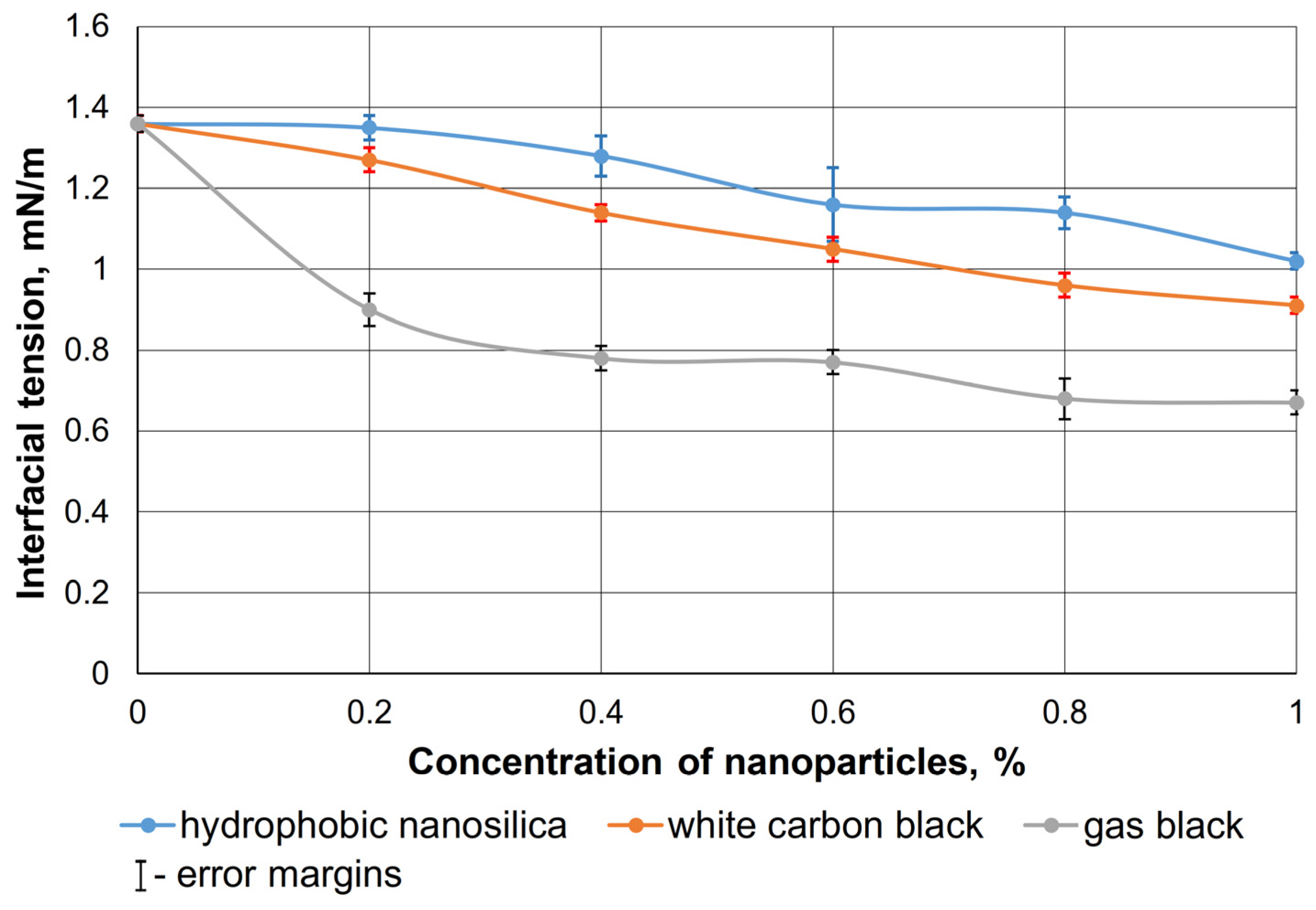
1.3. Aspects of Interfacial Tension Reduction in Systems Comprising Surfactants, Nanoparticles, and Reservoir Fluids
1.4. Conclusion
2. Materials and Methods
2.1. Tested Compositions and Additives
2.2. Determination of Interfacial Tension
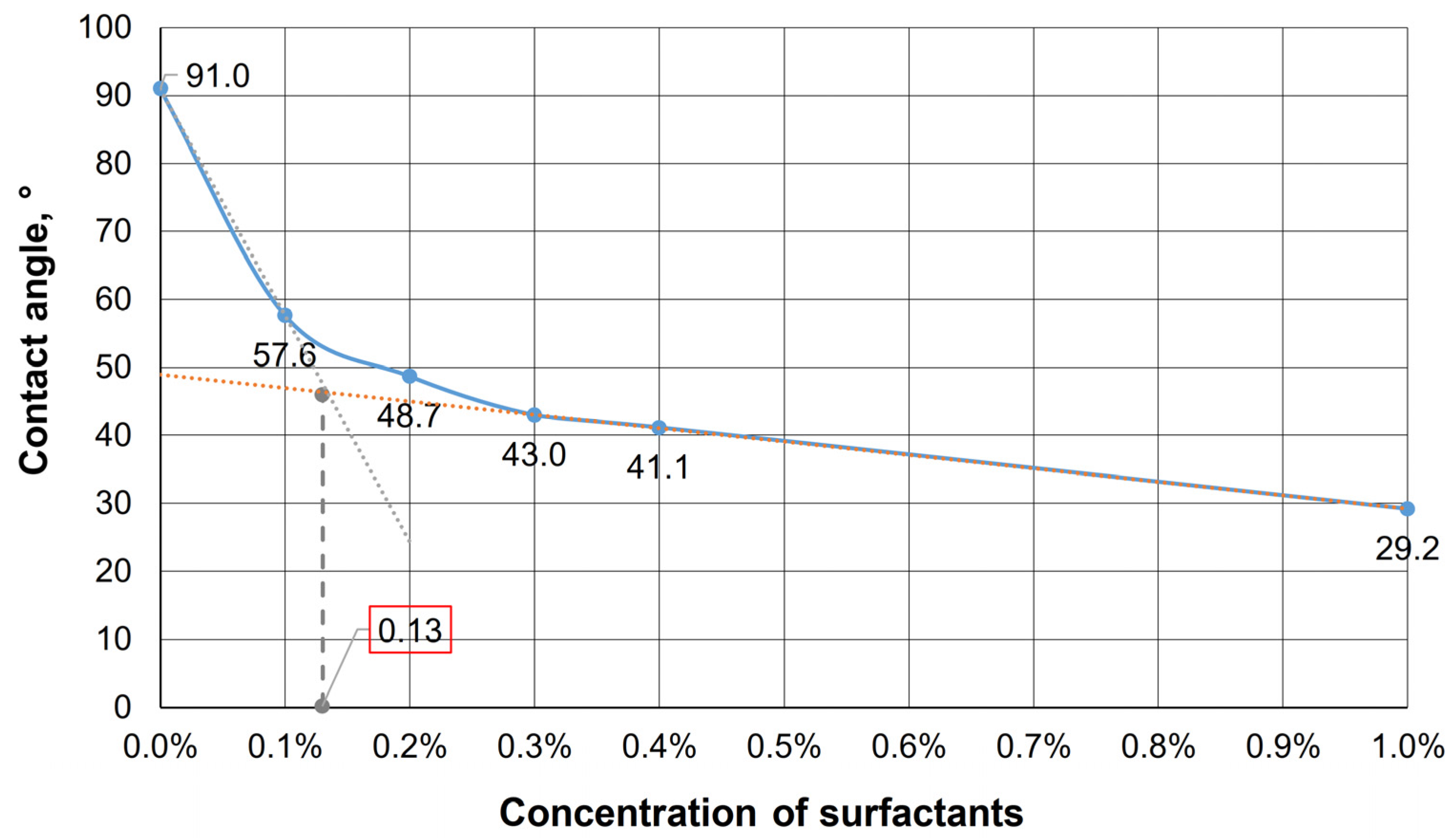
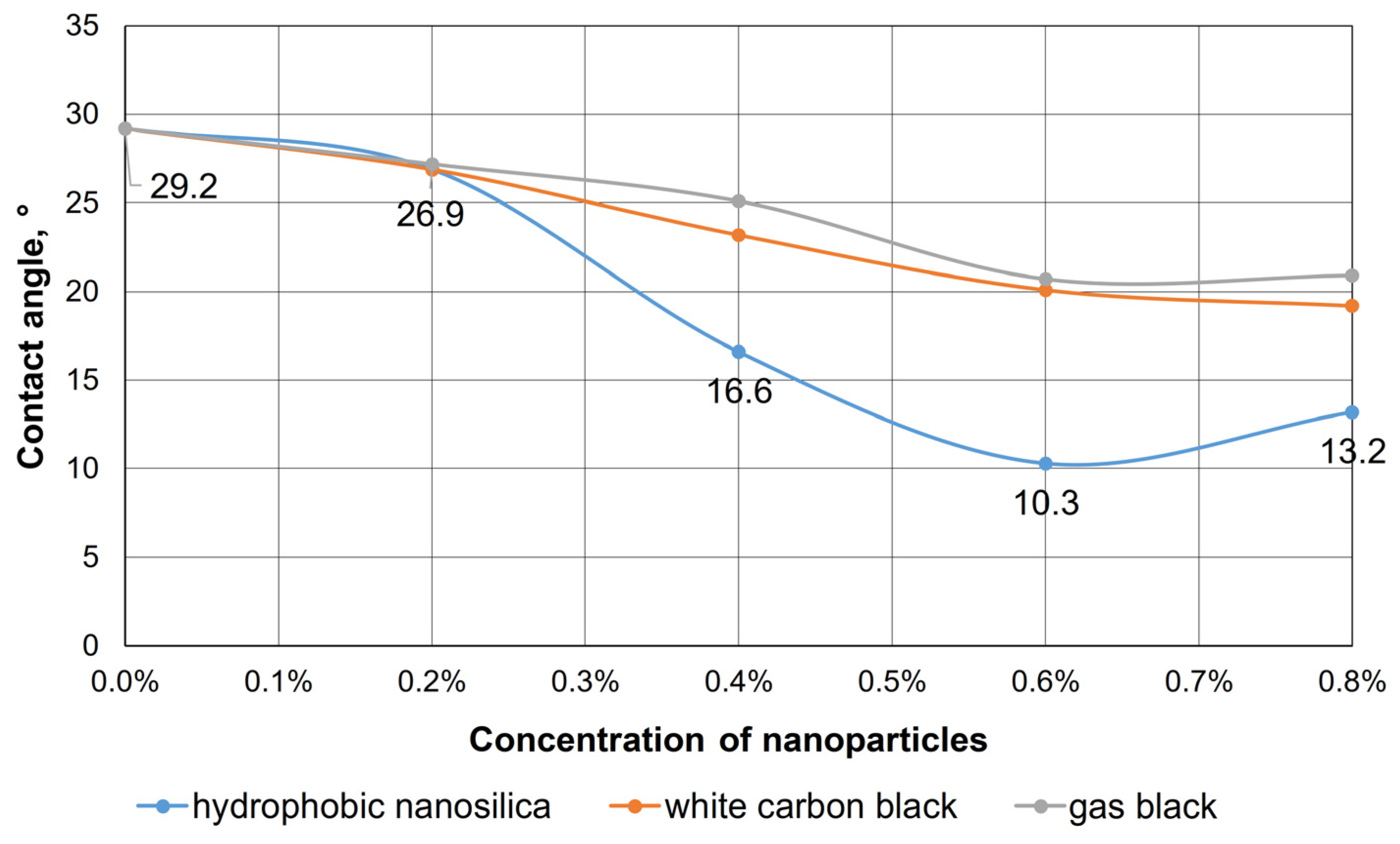
2.3. Determination of the Wetting Contact Angle
- Preparation of synthetic oil, consisting of 50% topped crude oil and 50% deposits of heavy components with the following composition: 22.48% asphaltenes, 11.40% resins, 18.02% paraffins, and 48.10% petroleum residue—followed by normalization, which involved thermostating at 90 °C for 4 h;
- Thorough grinding in a porcelain mortar of an equal amount of disaggregated core and synthetic oil until a homogeneous wax-like mass was obtained;
- Placing the wax-like mass into a hand press and molding a pellet with a diameter of 20 mm and a thickness of 3 mm.
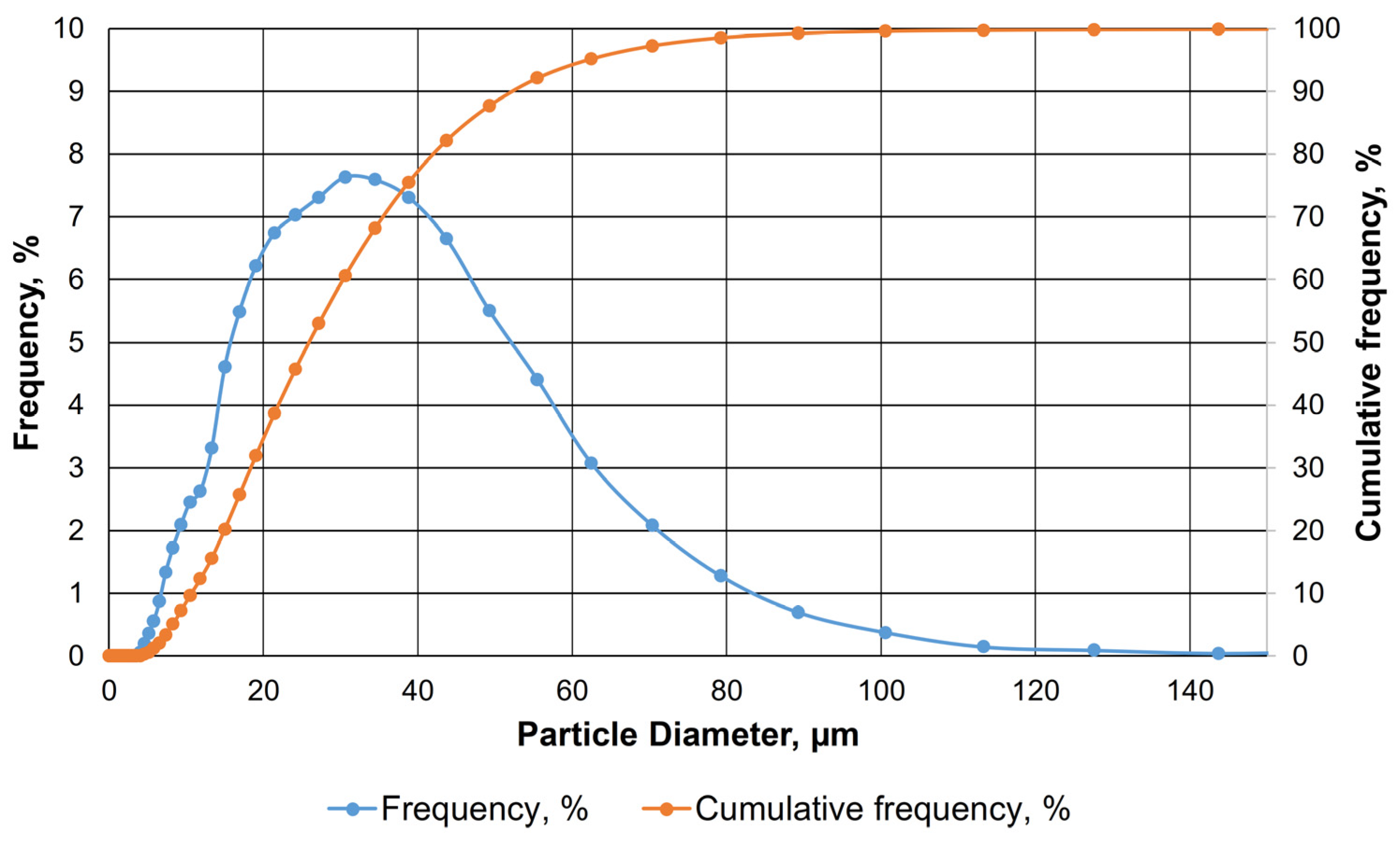
2.4. Determination of Particle Size
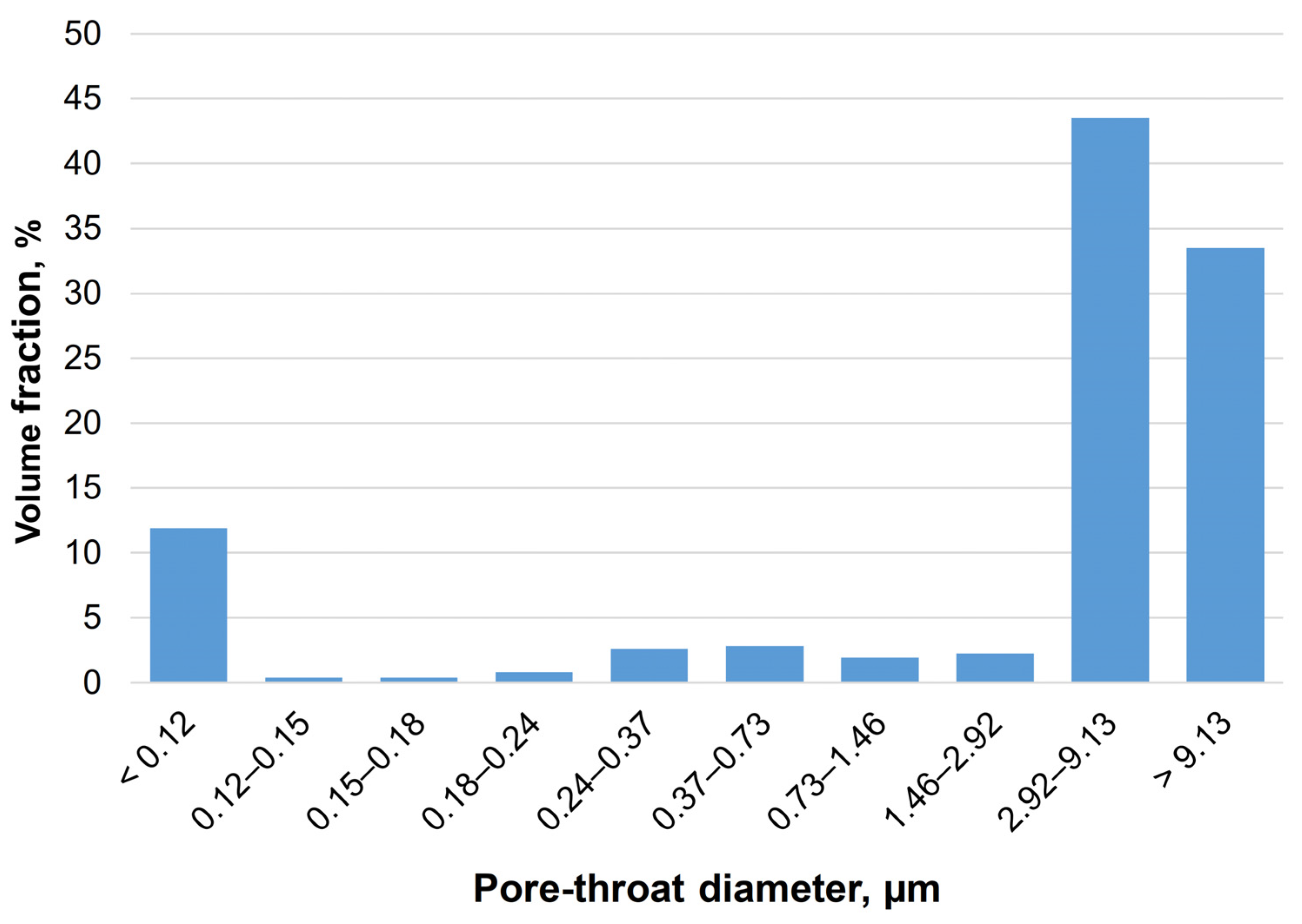
2.5. Determination of Pore Size Distribution
2.6. Determination of Sedimentation Stability of Colloidal Solutions
2.7. Methodology of Filtration Studies
2.8. Qualitative Determination of Surfactants Adsorbed on Nanoparticle Aggregate Surfaces
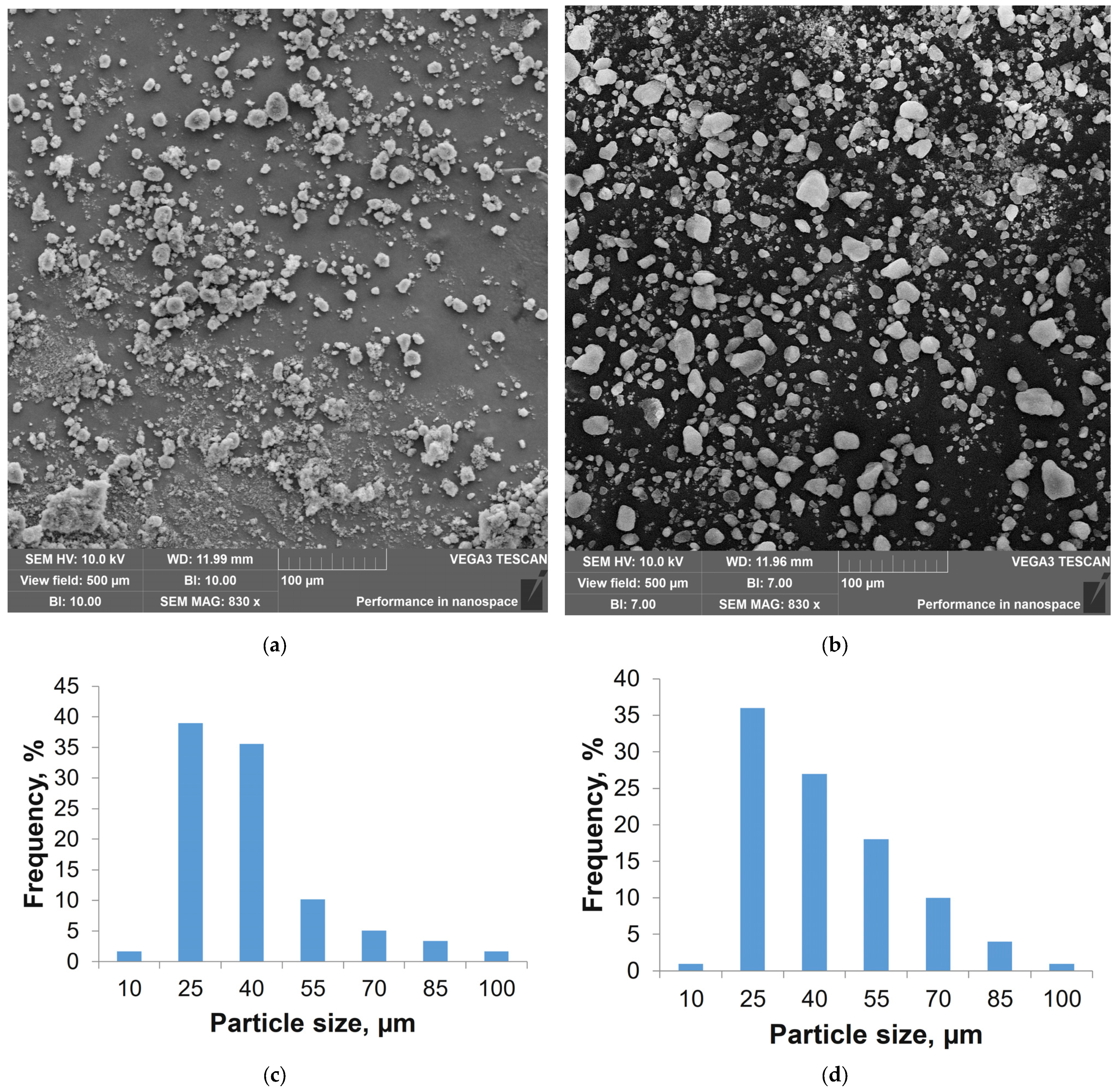
2.9. Electron Microscopy for Determining the Size of Nanoparticle Aggregates with Surfactants
3. Results and Discussion
3.1. Justification of the Surfactant–Nanoparticle Composition
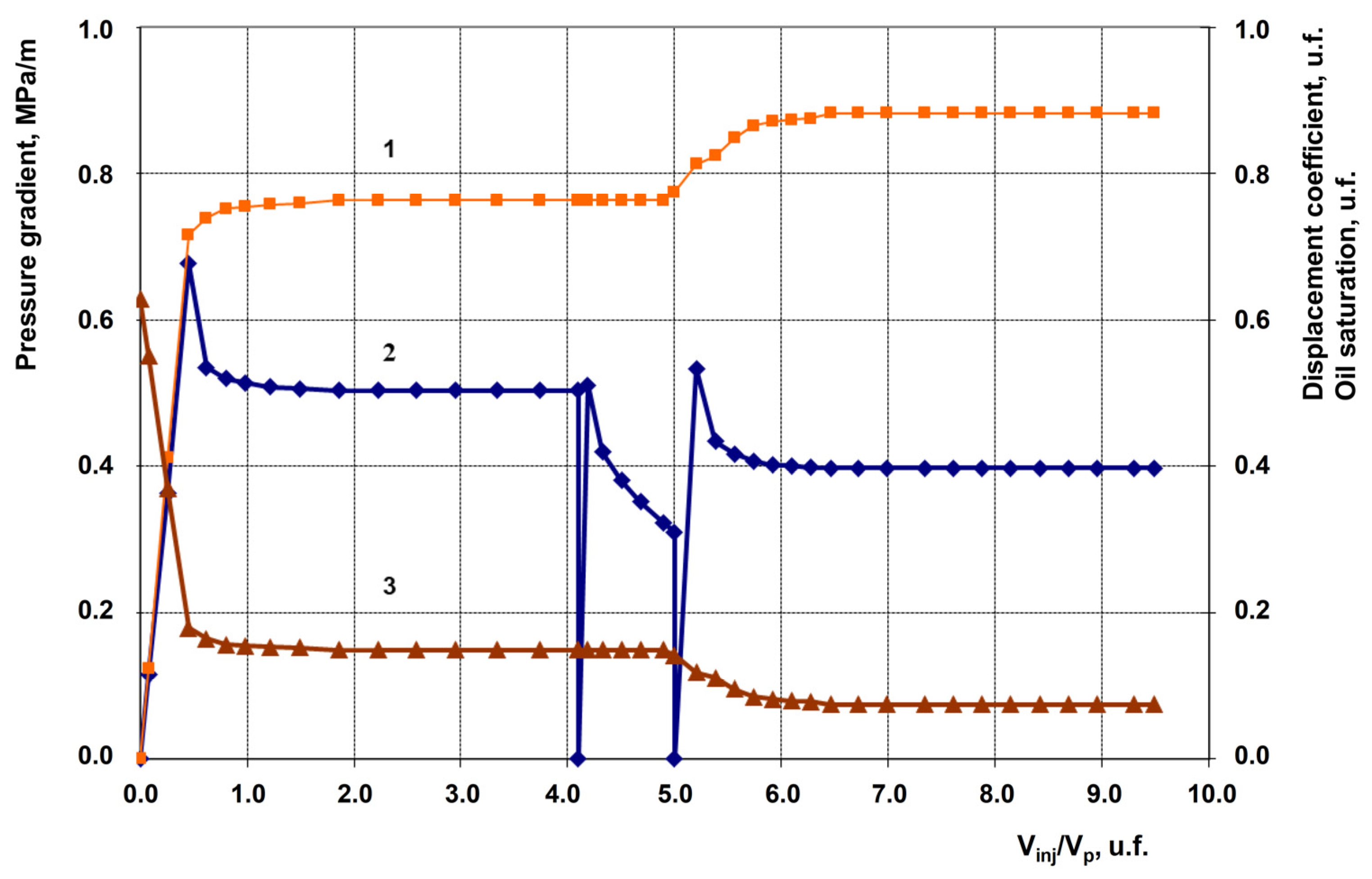
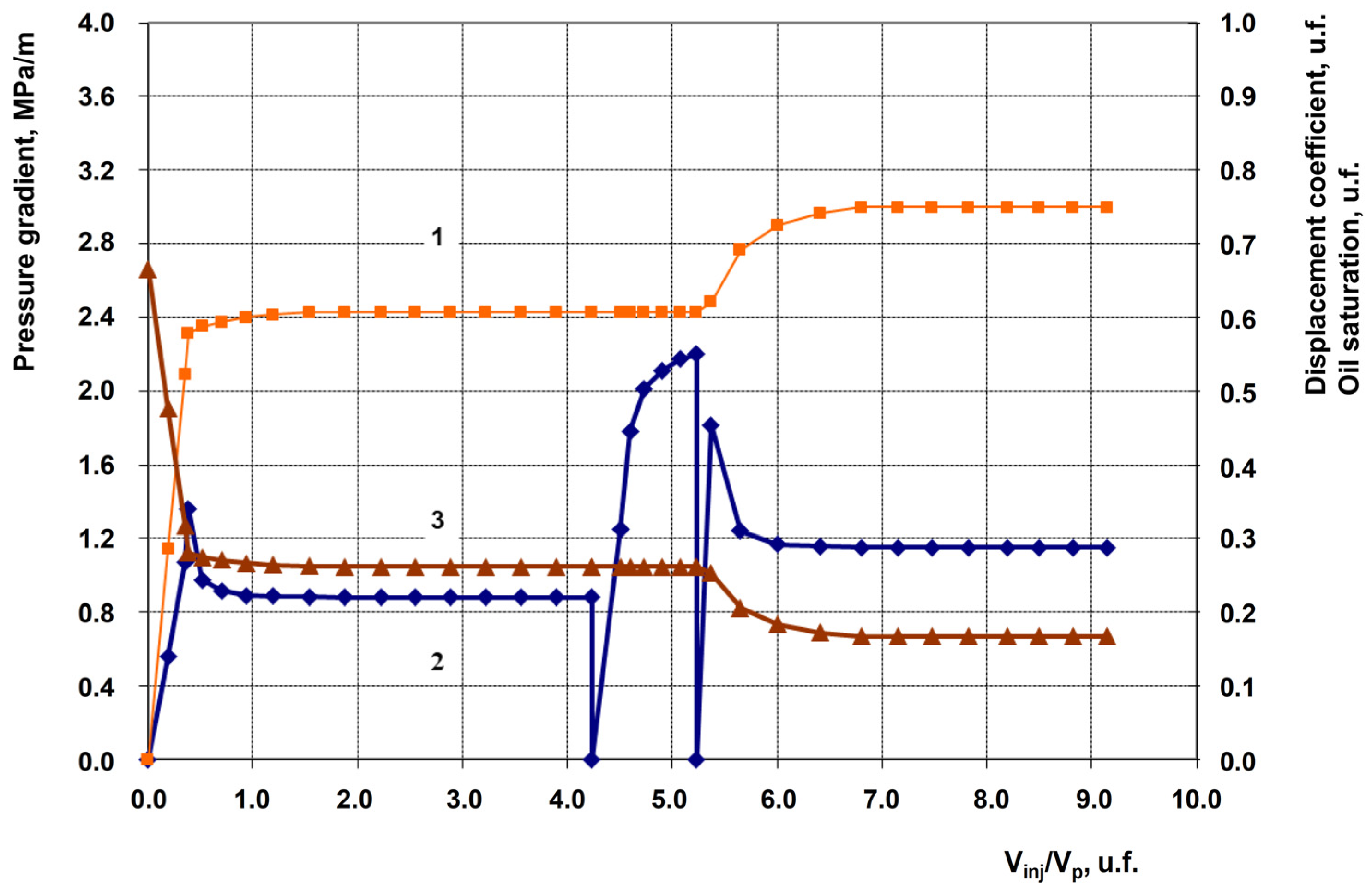
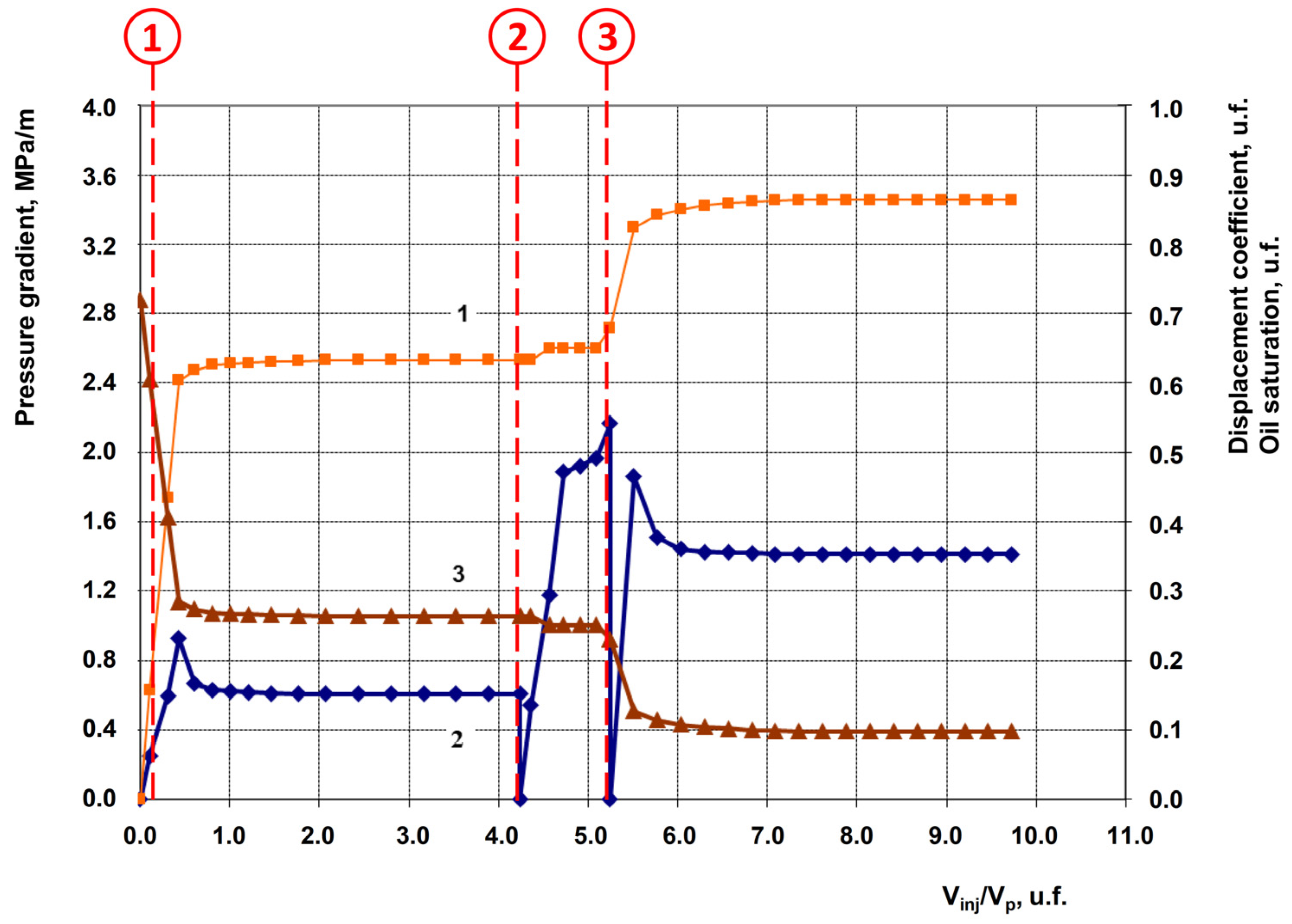
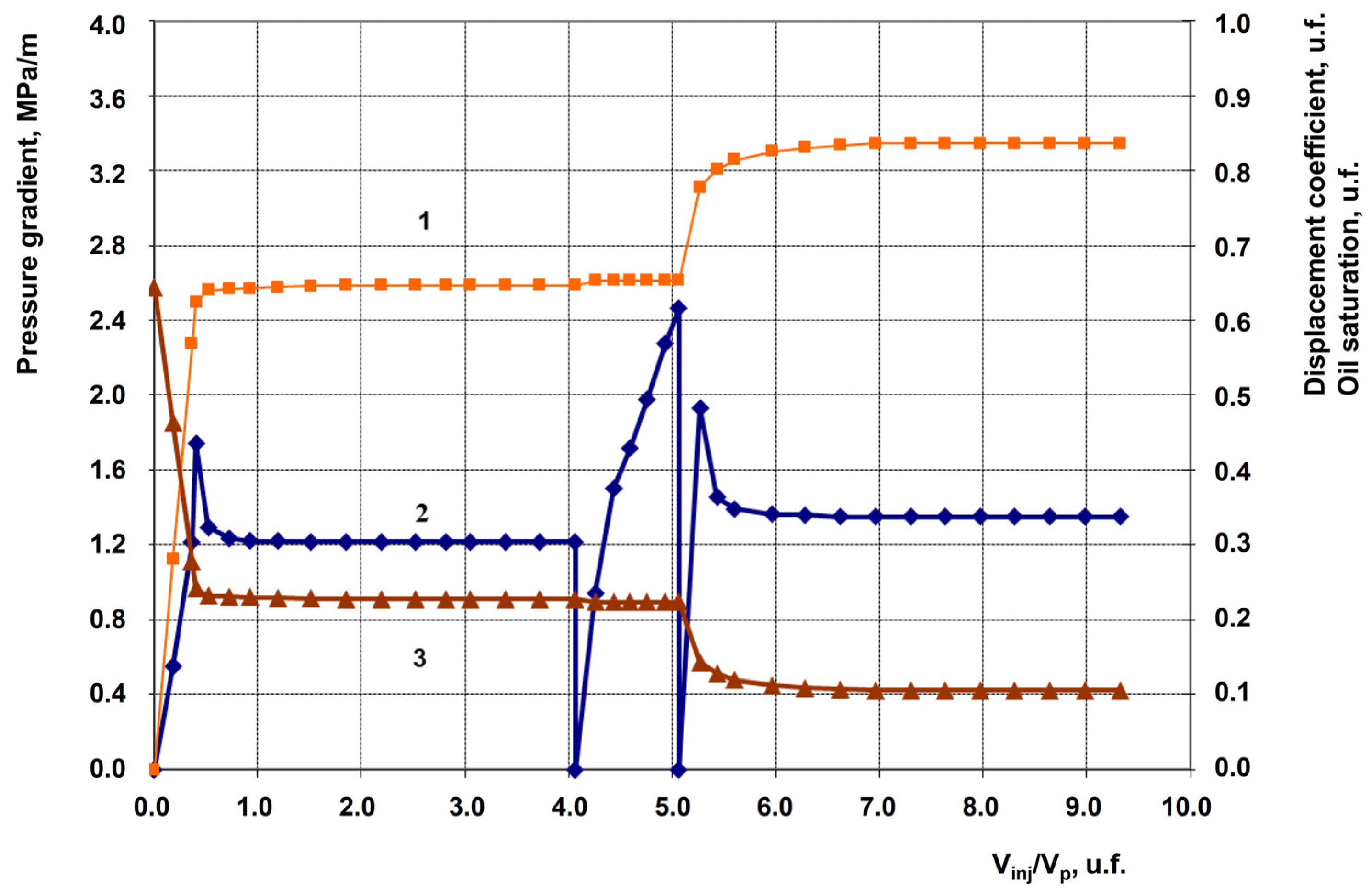
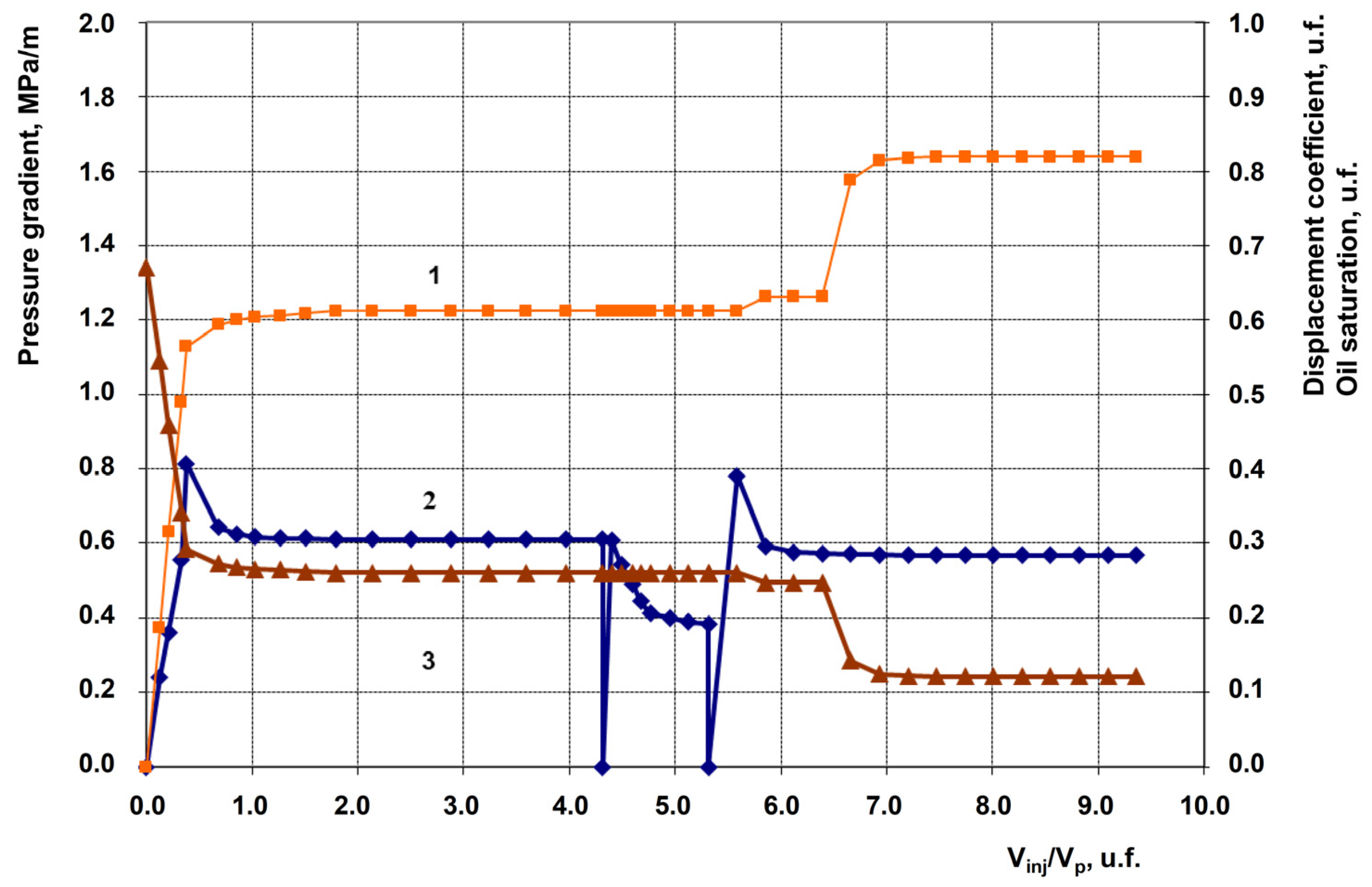
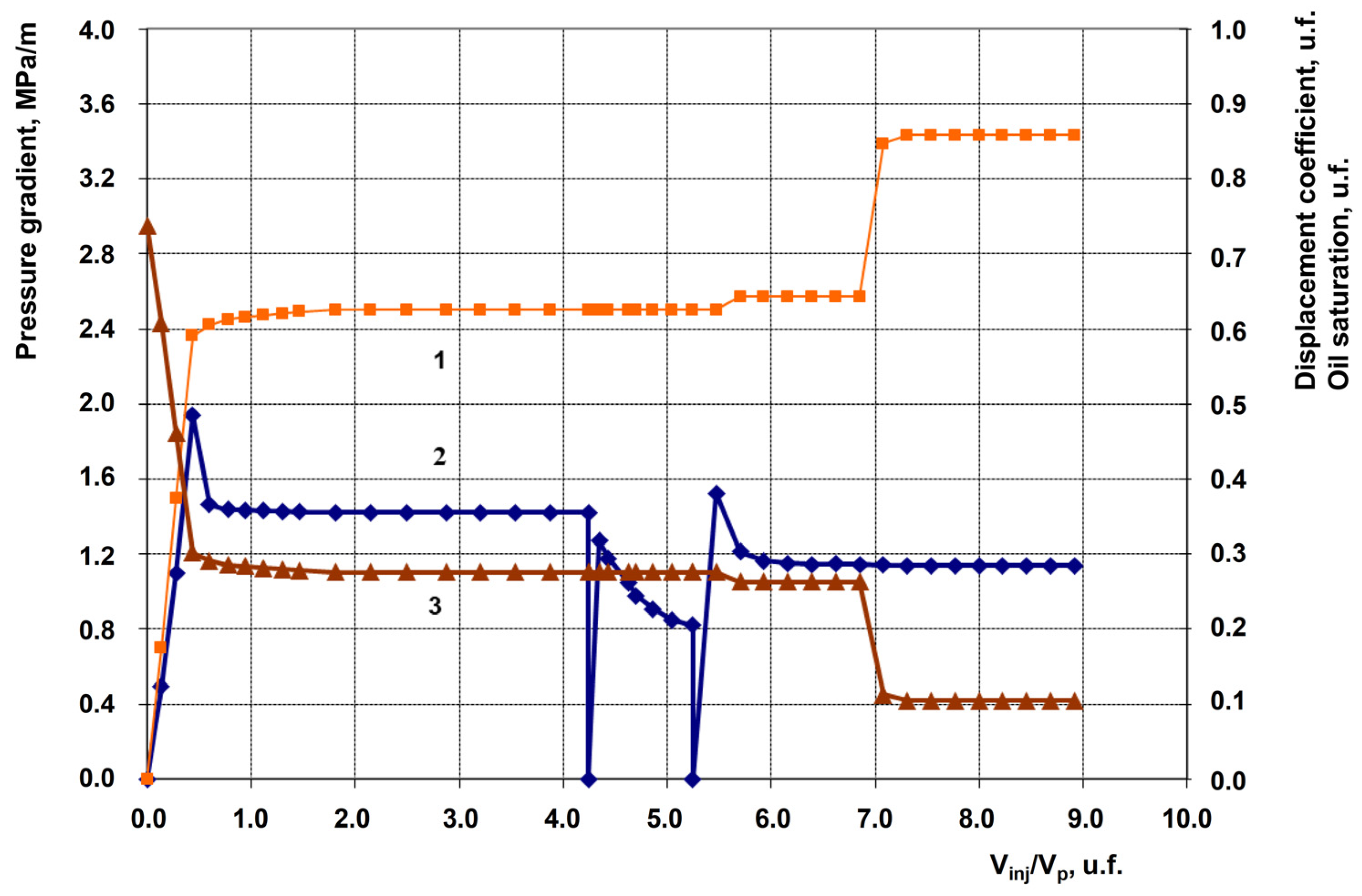
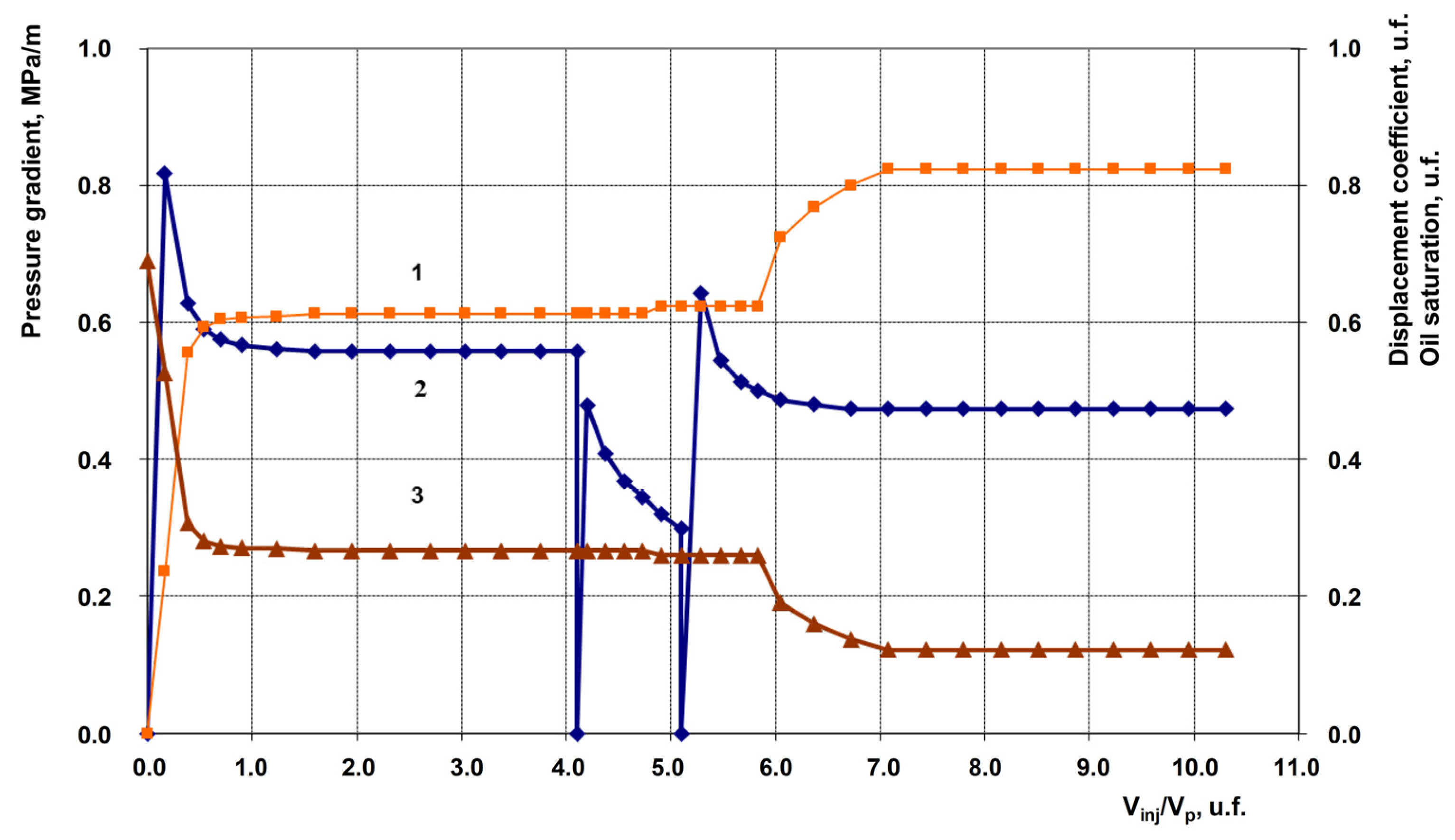
3.2. Description of Filtration Experiments
- (1) initial waterflooding until displacement parameters stabilize to establish residual oil saturation in the model (flooding with up to 4.2 pore volumes, PV);
- (2) injection of 1.0 PV of a suspension containing the surfactant composition (1%) and hydrophilic nanosilica HCSIL200 (1%);
- (3) follow-up flooding with formation water until oil displacement indicators stabilize to displace the remaining residual oil with water.


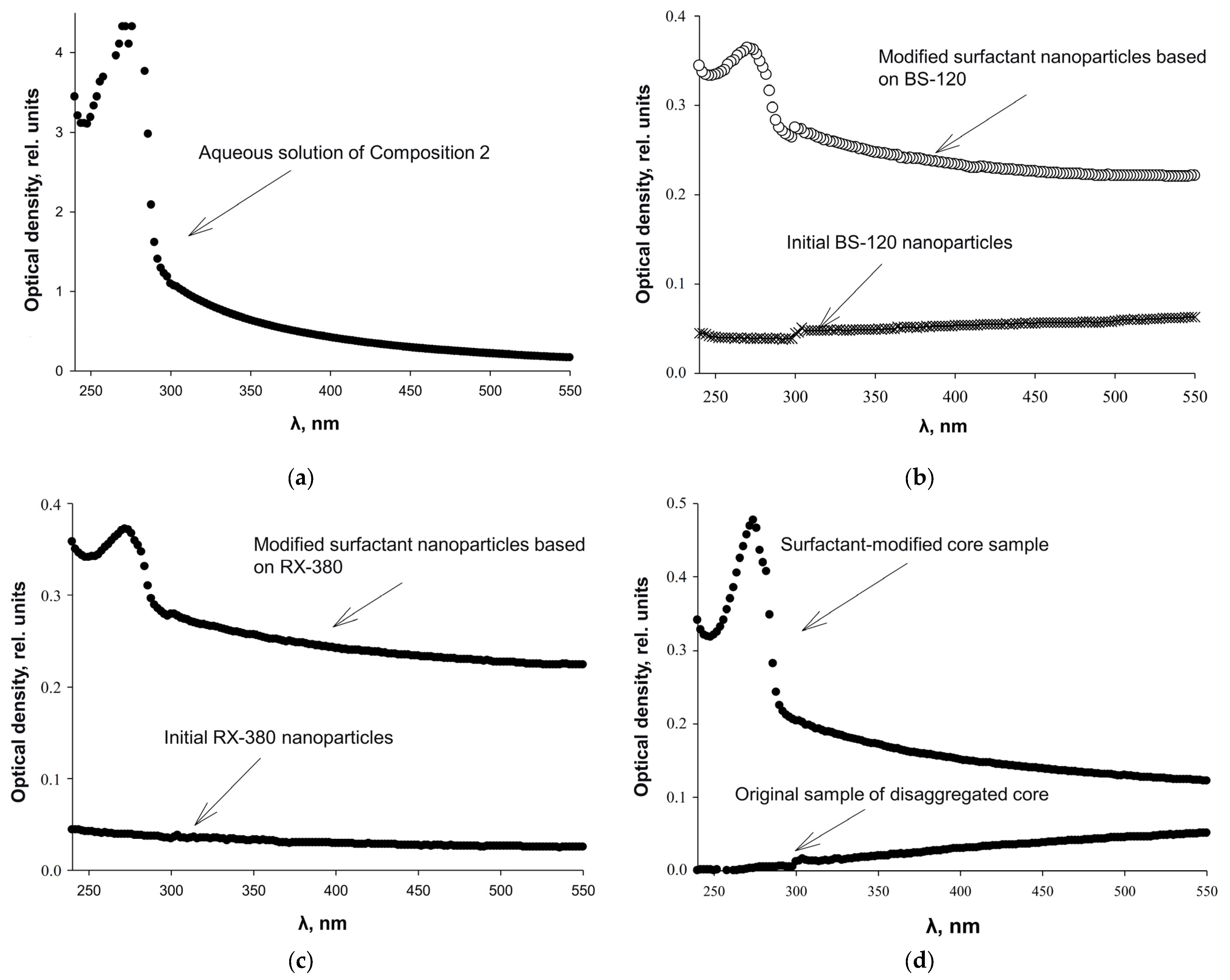
3.3. Determination of Comparative Adsorption of Surfactant Components on Nanoparticle Surfaces by UV Spectroscopy
4. Conclusions
Author Contributions
Funding
Data Availability Statement
Conflicts of Interest
Abbreviations
| NS | nonionic surfactant |
| AS | anionic surfactant |
| BET | Brunauer–Emmett–Teller |
| ISO | International Organization for Standardization |
| SMLS | static multiple light scattering |
| TSI | Turbiscan Stability Index |
| PV | pore volume |
| ARPD | asphaltene-resin-paraffin deposits |
| CMC | critical micelle concentration |
References
- Alsaba, M.T.; Al Dushaishi, M.F.; Abbas, A.K. A Comprehensive Review of Nanoparticles Applications in the Oil and Gas Industry. J. Petrol. Explor. Prod. Technol. 2020, 10, 1389–1399. [Google Scholar] [CrossRef]
- Hajiabadi, S.H.; Aghaei, H.; Kalateh-Aghamohammadi, M.; Sanati, A.; Kazemi-Beydokhti, A.; Esmaeilzadeh, F. A Comprehensive Empirical, Analytical and Tomographic Investigation on Rheology and Formation Damage Behavior of a Novel Nano-Modified Invert Emulsion Drilling Fluid. J. Pet. Sci. Eng. 2019, 181, 106257. [Google Scholar] [CrossRef]
- Thakkar, A.; Raval, A.; Chandra, S.; Shah, M.; Sircar, A. A Comprehensive Review of the Application of Nano-Silica in Oil Well Cementing. Petroleum 2020, 6, 123–129. [Google Scholar] [CrossRef]
- Sriram, S.; Kumar, A. Separation of Oil-Water via Porous PMMA/SiO2 Nanoparticles Superhydrophobic Surface. Colloid Surf. A Physicochem. Eng. Asp. 2019, 563, 271–279. [Google Scholar] [CrossRef]
- Torsæter, O. Application of Nanoparticles for Oil Recovery. Nanomaterials 2021, 11, 1063. [Google Scholar] [CrossRef] [PubMed]
- Maia, K.C.B.; Densy dos Santos Francisco, A.; Perisse Moreira, M.P.; Nascimento, R.S.V.; Grasseschi, D. Advancements in Surfactant Carriers for Enhanced Oil Recovery: Mechanisms, Challenges, and Opportunities. ACS Omega 2024, 9, 36874–36903. [Google Scholar] [CrossRef]
- Ivanova, A.A. Dynamic Modelling and Experimental Evaluation of Nanoparticles Application in Surfactant Enhanced Oil Recovery. Ph.D. Thesis, Skolkovo Institute of Science and Technology, Moscow, Russia, 2020. [Google Scholar]
- Sharma, K.P.; Aswal, V.K.; Kumaraswamy, G. Adsorption of Nonionic Surfactant on Silica Nanoparticles: Structure and Resultant Interparticle Interactions. J. Phys. Chem. B 2010, 114, 10986–10994. [Google Scholar] [CrossRef]
- Zargartalebi, M.; Kharrat, R.; Barati, N. Enhancement of Surfactant Flooding Performance by the Use of Silica Nanoparticles. Fuel 2015, 143, 21–27. [Google Scholar] [CrossRef]
- Patel, H.; Shah, S.; Ahmed, R.; Ucan, S. Effects of Nanoparticles and Temperature on Heavy Oil Viscosity. J. Pet. Sci. Eng. 2018, 167, 819–828. [Google Scholar] [CrossRef]
- Safiei, W.; Rahman, M.M.; Kulkarni, R.; Ariffin, M.N.; Abd Malek, Z.A. Thermal Conductivity and Dynamic Viscosity of Nanofluids: A Review. J. Adv. Res. Fluid Mech. Therm. Sci. 2020, 74, 66–84. [Google Scholar] [CrossRef]
- Mishra, P.C.; Mukherjee, S.; Nayak, S.K.; Panda, A. A Brief Review on Viscosity of Nanofluids. Int. Nano Lett. 2014, 4, 109–120. [Google Scholar] [CrossRef]
- Ahmadi, L.; Ahmadi, E.; Mohamadnia, Z. Demulsification of Water in Crude Oil Emulsions through Magnetic Nanocomposites Decorated with Poly(Ionic Liquid)s. J. Mol. Liq. 2022, 357, 119162. [Google Scholar] [CrossRef]
- Gallego, J.F.; Medina, O.E.; Tengono, J.A.; Mazo, C.; Maya, A.F.; Caro, C.; Cortés, F.B.; Franco, C.A. Demulsification of Water-in-Oil Emulsion with Carbon Quantum Dot (CQD)-Enhanced Demulsifier. Processes 2025, 13, 575. [Google Scholar] [CrossRef]
- Cabiguen, M., Jr.; Saaid, I.M.; Santos, J.D.; Manalo, L. Dehydration of Crude Oil Emulsion Using Nanoparticles as Demulsifier: A Review. Nano Hybrids Compos. 2025, 49, 79–95. [Google Scholar] [CrossRef]
- Arab, D.; Kantzas, A.; Bryant, S.L. Nanoparticle Stabilized Oil in Water Emulsions: A Critical Review. J. Pet. Sci. Eng. 2018, 163, 217–242. [Google Scholar] [CrossRef]
- Ahmadi, S.; Khormali, A.; Kazemzadeh, Y. A Critical Review of the Phenomenon of Inhibiting Asphaltene Precipitation in the Petroleum Industry. Processes 2025, 13, 212. [Google Scholar] [CrossRef]
- Abbasi, T.; Bayati, B.; Ghamartale, A.; Rezaei, H. Nanoparticle-Mediated Control of Asphaltene Aggregation in Oil Reservoirs: Insights and Implications. J. Mol. Liq. 2025, 423, 126975. [Google Scholar] [CrossRef]
- Pourya Najjar, A.M.Z.; Mohammadi, S.; Mirzayi, B.; Mahmoudi Alemi, F.; Ghanbarpour, O. A Mechanistic Study of Asphaltene Formation and Aggregation in Presence of Metallic-Based Nanoparticles. Geoenergy Sci. Eng. 2024, 234, 212637. [Google Scholar] [CrossRef]
- Yang, S.; Yan, C.; Cai, J.; Pan, Y.; Han, Q. Research Progress in Nanoparticle Inhibitors for Crude Oil Asphaltene Deposition. Molecules 2024, 29, 1135. [Google Scholar] [CrossRef]
- Li, X.; Guo, Y.; Sun, Q.; Lan, W.; Guo, X. Effect of Nanoparticles on Asphaltene Aggregation in a Microsized Pore. Ind. Eng. Chem. Res. 2018, 57, 9009–9017. [Google Scholar] [CrossRef]
- Hou, Z.; Jiang, W.; Wu, X.; Gai, J.; Zheng, L.; Chen, J.; Wang, S.; Lu, S.; Huang, B.; Sun, J.; et al. Critical Review on the Molecular Behavior of Surfactants at the Oil–Water Interface During Oil Displacement. Energy Sci. Eng. 2026, ese3.70429. [Google Scholar] [CrossRef]
- Hirudayanathan, H.P.; Debnath, S.; Anwar, M.; Johar, M.B.; Elumalai, N.K.; Mohammed Iqbal, U. A Review on Influence of Nanoparticle Parameters on Viscosity of Nanofluids and Machining Performance in Minimum Quantity Lubrication. Proc. Inst. Mech. Eng. Part E J. Process Mech. Eng. 2025, 239, 1005–1024. [Google Scholar] [CrossRef]
- Alhassawi, H.; Romero-Zerón, L. New Surfactant Delivery System for Controlling Surfactant Adsorption onto Solid Surfaces. Part I: Static Adsorption Tests. Can. J. Chem. Eng. 2015, 93, 1188–1193. [Google Scholar] [CrossRef]
- Nourafkan, E.; Hu, Z.; Wen, D. Nanoparticle-Enabled Delivery of Surfactants in Porous Media. J. Colloid Interface Sci. 2018, 519, 44–57. [Google Scholar] [CrossRef]
- Amirianshoja, T.; Junin, R.; Kamal Idris, A.; Rahmani, O. A Comparative Study of Surfactant Adsorption by Clay Minerals. J. Pet. Sci. Eng. 2013, 101, 21–27. [Google Scholar] [CrossRef]
- Budhathoki, M.; Barnee, S.H.R.; Shiau, B.-J.; Harwell, J.H. Improved Oil Recovery by Reducing Surfactant Adsorption with Polyelectrolyte in High Saline Brine. Colloid Surf. A-Physicochem. Eng. Asp. 2016, 498, 66–73. [Google Scholar] [CrossRef]
- Chang, H.L.; Zhang, Z.Q.; Wang, Q.M.; Xu, Z.S.; Guo, Z.D.; Sun, H.Q.; Cao, X.L.; Qiao, Q. Advances in Polymer Flooding and Alkaline/Surfactant/Polymer Processes as Developed and Applied in the People’s Republic of China. J. Pet. Technol. 2006, 58, 84–89. [Google Scholar] [CrossRef]
- Islam, R. Economically and Environmentally Sustainable Enhanced Oil Recovery; John Wiley & Sons, Inc: Hoboken, NJ, USA, 2020; 816p, ISBN 978-1-119-47909-3. [Google Scholar]
- Pereira, M.L.D.O.; Maia, K.C.B.; Silva, W.C.; Leite, A.C.; Francisco, A.D.D.S.; Vasconcelos, T.L.; Nascimento, R.S.V.; Grasseschi, D. Fe3O4 Nanoparticles as Surfactant Carriers for Enhanced Oil Recovery and Scale Prevention. ACS Appl. Nano Mater. 2020, 3, 5762–5772. [Google Scholar] [CrossRef]
- Rosestolato, J.C.S.; Pérez-Gramatges, A.; Lachter, E.R.; Nascimento, R.S.V. Lipid Nanostructures as Surfactant Carriers for Enhanced Oil Recovery. Fuel 2019, 239, 403–412. [Google Scholar] [CrossRef]
- Wu, Y.; Chen, W.; Dai, C.; Huang, Y.; Li, H.; Zhao, M.; He, L.; Jiao, B. Reducing Surfactant Adsorption on Rock by Silica Nanoparticles for Enhanced Oil Recovery. J. Pet. Sci. Eng. 2017, 153, 283–287. [Google Scholar] [CrossRef]
- Massarweh, O.; Abushaikha, A.S. The Use of Surfactants in Enhanced Oil Recovery: A Review of Recent Advances. Energy Rep. 2020, 6, 3150–3178. [Google Scholar] [CrossRef]
- Almahfood, M.; Bai, B. The Synergistic Effects of Nanoparticle-Surfactant Nanofluids in EOR Applications. J. Pet. Sci. Eng. 2018, 171, 196–210. [Google Scholar] [CrossRef]
- Eltoum, H.; Yang, Y.-L.; Hou, J.-R. The Effect of Nanoparticles on Reservoir Wettability Alteration: A Critical Review. Pet. Sci. 2021, 18, 136–153. [Google Scholar] [CrossRef]
- Sircar, A.; Rayavarapu, K.; Bist, N.; Yadav, K.; Singh, S. Applications of Nanoparticles in Enhanced Oil Recovery. Pet. Res. 2022, 7, 77–90. [Google Scholar] [CrossRef]
- Cheraghian, G.; Hendraningrat, L. A Review on Applications of Nanotechnology in the Enhanced Oil Recovery Part A: Effects of Nanoparticles on Interfacial Tension. Int. Nano Lett. 2016, 6, 129–138. [Google Scholar] [CrossRef]
- Tavakkoli, O.; Kamyab, H.; Shariati, M.; Mustafa Mohamed, A.; Junin, R. Effect of Nanoparticles on the Performance of Polymer/Surfactant Flooding for Enhanced Oil Recovery: A Review. Fuel 2022, 312, 122867. [Google Scholar] [CrossRef]
- Le, N.Y.T.; Pham, D.K.; Le, K.H.; Nguyen, P.T. Design and Screening of Synergistic Blends of SiO2 Nanoparticles and Surfactants for Enhanced Oil Recovery in High-Temperature Reservoirs. Adv. Nat. Sci. Nanosci. Nanotechnol. 2011, 2, 035013. [Google Scholar] [CrossRef]
- Gowtham, V.M.; Deodhar, S.; Thampi, S.P.; Basavaraj, M.G. Association in Like-Charged Surfactant–Nanoparticle Systems: Interfacial and Bulk Effects. Langmuir 2024, 40, 17410–17422. [Google Scholar] [CrossRef]
- Correia, E.L.; Thakur, S.; Ervin, A.; Shields, E.; Razavi, S. Adsorption of Surfactant Molecules onto the Surface of Colloidal Particles: Case of like-Charged Species. Colloid Surf. A Physicochem. Eng. Asp. 2023, 676, 132142. [Google Scholar] [CrossRef]
- Xu, F.; Zhong, X.; Li, Z.; Cao, W.; Yang, Y.; Liu, M. Synergistic Mechanisms Between Nanoparticles and Surfactants: Insight Into NP–Surfactant Interactions. Front. Energy Res. 2022, 10, 913360. [Google Scholar] [CrossRef]
- Betancur, S.; Carrasco-Marín, F.; Franco, C.A.; Cortés, F.B. Development of Composite Materials Based on the Interaction between Nanoparticles and Surfactants for Application in Chemical Enhanced Oil Recovery. Ind. Eng. Chem. Res. 2018, 57, 12367–12377. [Google Scholar] [CrossRef]
- Agi, A.; Junin, R.; Gbadamosi, A. Mechanism Governing Nanoparticle Flow Behaviour in Porous Media: Insight for Enhanced Oil Recovery Applications. Int. Nano Lett. 2018, 8, 49–77. [Google Scholar] [CrossRef]
- Chen, W.; Schechter, D.S. Surfactant Selection for Enhanced Oil Recovery Based on Surfactant Molecular Structure in Unconventional Liquid Reservoirs. J. Pet. Sci. Eng. 2021, 196, 107702. [Google Scholar] [CrossRef]
- Chen, C.; Wang, S.; Kadhum, M.J.; Harwell, J.H.; Shiau, B.-J. Using Carbonaceous Nanoparticles as Surfactant Carrier in Enhanced Oil Recovery: A Laboratory Study. Fuel 2018, 222, 561–568. [Google Scholar] [CrossRef]
- Liu, Y.; Liang, F.; Wang, Q.; Qu, X.; Yang, Z. Flexible Responsive Janus Nanosheets. Chem. Commun. 2015, 51, 3562–3565. [Google Scholar] [CrossRef] [PubMed]
- Radnia, H.; Rashidi, A.; Solaimany Nazar, A.R.; Eskandari, M.M.; Jalilian, M. A Novel Nanofluid Based on Sulfonated Graphene for Enhanced Oil Recovery. J. Mol. Liq. 2018, 271, 795–806. [Google Scholar] [CrossRef]
- Cao, J.; Chen, Y.; Wang, X.; Zhang, J.; Li, Y.; Wang, S.; Wang, X.; Liu, C. Janus Sulfonated Graphene Oxide Nanosheets with Excellent Interfacial Properties for Enhanced Oil Recovery. Chem. Eng. J. 2022, 443, 136391. [Google Scholar] [CrossRef]
- Rezvani, H.; Binks, B.P.; Nguyen, D. Surfactant-Nanoparticle Formulations for Enhanced Oil Recovery in Calcite-Rich Rocks. Langmuir 2024, 40, 24989–25002. [Google Scholar] [CrossRef]
- Alhuraishawy, A.K.; Hamied, R.S.; Hammood, H.A.; AL-Bazzaz, W.H. Enhanced Oil Recovery for Carbonate Oil Reservoir by Using Nano-Surfactant: Part II. In Proceedings of the SPE Gas & Oil Technology Showcase and Conference, Dubai, United Arab Emirates, 21–23 October 2019. [Google Scholar] [CrossRef]
- Al-Asadi, A.; Rodil, E.; Soto, A. Nanoparticles in Chemical EOR: A Review on Flooding Tests. Nanomaterials 2022, 12, 4142. [Google Scholar] [CrossRef]
- El-Masry, J.F.; Bou-Hamdan, K.F.; Abbas, A.H.; Martyushev, D.A. A Comprehensive Review on Utilizing Nanomaterials in Enhanced Oil Recovery Applications. Energies 2023, 16, 691. [Google Scholar] [CrossRef]
- Kandiel, Y.E.; Attia, G.M.; Metwalli, F.I.; Khalaf, R.E.; Mahmoud, O. Nanoparticles in Enhanced Oil Recovery: State-of-the-Art Review. J. Petrol. Explor. Prod. Technol. 2025, 15, 66. [Google Scholar] [CrossRef]
- Hosny, R.; Zahran, A.; Abotaleb, A.; Ramzi, M.; Mubarak, M.F.; Zayed, M.A.; Shahawy, A.E.; Hussein, M.F. Nanotechnology Impact on Chemical-Enhanced Oil Recovery: A Review and Bibliometric Analysis of Recent Developments. ACS Omega 2023, 8, 46325–46345. [Google Scholar] [CrossRef] [PubMed]
- Behera, U.S.; Poddar, S.; Deshmukh, M.P.; Sangwai, J.S.; Byun, H.-S. Comprehensive Review on the Role of Nanoparticles and Nanofluids in Chemical Enhanced Oil Recovery: Interfacial Phenomenon, Compatibility, Scalability, and Economic Viability. Energy Fuels 2024, 38, 13760–13795. [Google Scholar] [CrossRef]
- Jia, H.; Kang, Y. A Comprehensive Review on Application and Perspectives of Nanomaterials in Enhanced Oil Recovery. Energy Fuels 2025, 39, 2916–2942. [Google Scholar] [CrossRef]
- Franco, C.A.; Franco, C.A.; Zabala, R.D.; Bahamón, Í.; Forero, Á.; Cortés, F.B. Field Applications of Nanotechnology in the Oil and Gas Industry: Recent Advances and Perspectives. Energy Fuels 2021, 35, 19266–19287. [Google Scholar] [CrossRef]
- Kaito, Y.; Goto, A.; Ito, D.; Murakami, S.; Kitagawa, H.; Ohori, T. First Nanoparticle-Based EOR Nano-EOR Project in Japan: Laboratory Experiments for a Field Pilot Test. In Proceedings of the SPE Improved Oil Recovery Conference, Online, 25–29 April 2022. [Google Scholar] [CrossRef]
- Kanj, M.Y.; Rashid, M.H.; Giannelis, E.P. Industry First Field Trial of Reservoir Nanoagents. In Proceedings of the SPE Middle East Oil and Gas Show and Conference, Manama, Bahrain, 25–28 September 2011. [Google Scholar] [CrossRef]
- Olayiwola, S.O.; Dejam, M. A Comprehensive Review on Interaction of Nanoparticles with Low Salinity Water and Surfactant for Enhanced Oil Recovery in Sandstone and Carbonate Reservoirs. Fuel 2019, 241, 1045–1057. [Google Scholar] [CrossRef]
- Sheng, J.J. Status of Surfactant EOR Technology. Petroleum 2015, 1, 97–105. [Google Scholar] [CrossRef]
- Volokitin, Y.; Shuster, M.; Karpan, V.; Koltsov, I.; Mikhaylenko, E.; Bondar, M.; Podberezhny, M.; Rakitin, A.; Batenburg, D.W.; Parker, A.R.; et al. Results of Alkaline-Surfactant-Polymer Flooding Pilot at West Salym Field. In Proceedings of the SPE EOR Conference at Oil and Gas West Asia, Muscat, Oman, 26–28 March 2018. [Google Scholar] [CrossRef]
- Altunina, L.K.; Kuvshinov, V.A. Fundamental and Applied Aspects of Physical and Chemical Methods for Enhanced Oil Recovery, Created at the Institute of Petroleum Chemistry SB RAS. Surfactant-Based Compositions for Enhancing Oil Recovery. Chem. Sustain. Dev. 2025, 33, 89–116. [Google Scholar] [CrossRef]
- Safarov, F.; Telin, A.; Vezhnin, S.; Fakhreeva, A.; Akhmetov, A.; Lenchenkova, L.; Yakubov, R.; Ovchinnikov, K.; Podlesnova, E.; Latypova, L. Integrated Reservoir Stimulation with Polyacrylamide Hydrogels and Surfactant Solutions for Oil Recovery Enhancement. Pet. Explor. Dev. 2025, 52, 1593–1608. [Google Scholar] [CrossRef]
- Esfandyari, H.; Shadizadeh, S.R.; Esmaeilzadeh, F.; Davarpanah, A. Implications of Anionic and Natural Surfactants to Measure Wettability Alteration in EOR Processes. Fuel 2020, 278, 118392. [Google Scholar] [CrossRef]
- Ovchinnikov, K.A.; Podlesnova, E.V.; Telin, A.G.; Safarov, F.E.; Sergeeva, N.A.; Ratner, A.A. Composition for Enhanced Oil Recovery and Method of Its Application. Russian Patent RU,280,0175, 1 July 1989. [Google Scholar]
- Wang, Z.; Dai, C.; Liu, J.; Dong, Y.; Liu, J.; Sun, N.; Li, L. Anionic-Nonionic and Nonionic Mixed Surfactant Systems for Oil Displacement: Impact of Ethoxylate Chain Lengths on the Synergistic Effect. Colloid Surf. A Physicochem. Eng. Asp. 2023, 678, 132436. [Google Scholar] [CrossRef]
- Ovchinnikov, K.A.; Podlesnova, E.V.; Safarov, F.E.; Sergeeva, N.A.; Telin, A.G.; Kleimenov, A.V. Selection of Surfactant Compositions for Extraction Residual Oil Reserves in the Conditions of High-Temperature Reservoirs of The Neocomian Deposits of the BS Group Formations of Western Siberia. Pet. Eng. 2023, 21, 29–43. [Google Scholar] [CrossRef]
- Li, K.; Wang, D.; Jiang, S. Review on Enhanced Oil Recovery by Nanofluids. Oil Gas Sci. Technol.–Rev. IFP Energies Nouv. 2018, 73, 37. [Google Scholar] [CrossRef]
- Silantiev, V.V.; Validov, M.F.; Miftakhutdinova, D.N.; Morozov, V.P.; Ganiev, B.G.; Lutfullin, A.A.; Shumatbaev, K.D.; Khabipov, R.M.; Nurgalieva, N.G.; Tolokonnikova, Z.A.; et al. Sedimentation Model of the Middle Devonian Clastic Succession of the South Tatar Arch, Pashyian Regional Stage, Volga-Ural Oil and Gas Province, Russia. Georesursy 2022, 24, 12–39. [Google Scholar] [CrossRef]
- Burkhanov, R.N.; Lutfullin, A.A.; Ibragimov, I.I.; Maksyutin, A.V. Core Column Filtration Testing Supplemented by Measurements of Oil Optical Properties. In Proceedings of the SPE Russian Petroleum Technology Conference, Online, 26–29 October 2020. [Google Scholar] [CrossRef]
- Meshalkin, V.; Asadullin, R.; Vezhnin, S.; Voloshin, A.; Gallyamova, R.; Deryaev, A.; Dokichev, V.; Eshmuratov, A.; Lenchenkova, L.; Pavlik, A.; et al. Engineering and Technological Approaches to Well Killing in Hydrophilic Formations with Simultaneous Oil Production Enhancement and Water Shutoff Using Selective Polymer-Inorganic Composites. Energies 2025, 18, 4721. [Google Scholar] [CrossRef]
- Levashenko, G.I.; Simonkov, V.V. Determination of the Optical Constants of Soot in Hydrocarbon Fuel Combustion Products at λ = 10.6 Μm. Phys. Combust. Explos. 1995, 31, 70–73. [Google Scholar]
- Khlebtsov, B.N.; Khanadeev, V.A.; Khlebtsov, N.G. Determination of the Size, Concentration, and Refractive Index of Silica Nanoparticles from Turbidity Spectra. Langmuir 2008, 24, 8964–8970. [Google Scholar] [CrossRef] [PubMed]
- OST 39-204-86; Oil. Laboratory Method for Determining the Residual Water Saturation of Oil and Gas Reservoirs Based on the Dependence of Saturation on Capillary Pressure. Minnefteprom: Moscow, USSR, 1986.
- GOST 26450.0-85; Mineral Rocks. General Requirements for Sampling and Sample Preparation for the Determination of Reservoir Properties. USSR State Committee for Standards (GOST): Moscow, USSR, 1985.
- ISO/TR 13097; Guidelines for the Characterization of Dispersion Stability. The International Organization for Standardization: Geneva, Switzerland, 2013.
- OST 39-195-86; Oil. Method of Determining the Coefficient of Displacement of Oil by Water in the Laboratory. Minnefteprom: Moscow, USSR, 1986.
- Mansurov, R.R.; Safronov, A.P.; Lakiza, N.V.; Leiman, D.V. Adsorption of TX-100 and SDBS on the Surface of Alumina and Maghemite Nanoparticles from Aqueous Solutions. Chim. Tech. Acta 2014, 1, 50–55. [Google Scholar] [CrossRef]
- Scale Software. Available online: https://antropol.narod.ru/Scale.zip (accessed on 12 November 2025).
- Startseva, R.K.; Parfenova, M.A.; Zaripov, R.N.; Blinov, S.A.; Fakhretdinov, R.N.; Lyapina, N.K. Modeling the Composition and Properties of Residual Oil. Pet. Chem. 1998, 38, 96–101. [Google Scholar]
- Razavifar, M.; Abdi, A.; Nikooee, E.; Aghili, O.; Riazi, M. Quantifying the Impact of Surface Roughness on Contact Angle Dynamics under Varying Conditions. Sci. Rep. 2025, 15, 16611. [Google Scholar] [CrossRef]
- Minakov, A.V.; Pryazhnikov, M.I.; Pryazhnikov, A.I.; Yakimov, A.S.; Denisov, I.A.; Lobasov, A.S.; Nemtsev, I.V.; Rudyak, V.Y. Application of Micro- and Nano- Fluid Processes in Enhance Oil Recovery. Oil. Gas. Innov. 2022, 2, 68–73. [Google Scholar]
- Kanj, M.Y.; Funk, J.J.; Al-Yousif, Z. Nanofluid Coreflood Experiments in the ARAB-D. In Proceedings of the SPE Saudi Arabia Section Technical Symposium, Al-Khobar, Saudi Arabia, 9–11 May 2009. [Google Scholar] [CrossRef]
- Ruchomski, L.; Mączka, E.; Kosmulski, M. Dispersions of Metal Oxides in the Presence of Anionic Surfactants. Colloids Interfaces 2018, 3, 3. [Google Scholar] [CrossRef]
- Safarov, F.E.; Telin, A.G.; Fakhreeva, A.V.; Bayanov, R.R.; Sergeeva, N.A.; Ovchinnikov, K.A.; Podlesnova, E.V.; Kleimenov, A.V. The Use of Sacrificial Reagents to Increase the Efficiency of Surfactant Compositions in Oil Recovery Enhancement Technologies in Conditions of High-Temperature Reservoirs of the Neocomian Deposits of the Bs Group of Western Siberia. Oil. Gas. Innov. 2024, 1, 37–45. [Google Scholar]
- Rahman, A.F.A.; Arsad, A.; Vo, D.-V.N.; Bahari, M.B. Nano-Silica to Reduce of Surfactant Adsorption in Oil Recovery: A Review. Environ. Chem. Lett. 2025, 24, 173–199. [Google Scholar] [CrossRef]
- Bondor, P.L. Applications of Carbon Dioxide in Enhanced Oil Recovery. Energy Convers. Manag. 1992, 33, 579–586. [Google Scholar] [CrossRef]



| Nanoadditive | Specific Surface, m2/g | Calculated Mean Diameter, nm |
|---|---|---|
| White carbon black BS-120 NU | 132 | 20.7 |
| Hydrophilic nanosilica HCSIL200 | 202 | 13.5 |
| Hydrophobic nanosilica RX380 | 380 | 7.2 |
| No | Parameter | Value |
|---|---|---|
| 1 | Core model length | 100–300 mm |
| 2 | Core temperature regulation range | (+25)–(+150) °C |
| 3 | Maximum overburden pressure | 70 MPa |
| 4 | Maximum reservoir pressure | 55 MPa |
| Exp. No. | Displacing Agent (Post-Waterflood) | Permeability, 10−3 μm2 | Displacement Coefficient | Increase in Displacement Coefficient, % | ||
|---|---|---|---|---|---|---|
| Absolute Gas Permeability | Oil Phase Permeability | Base | Post-Composition Injection | |||
| 1 | Anionic + Nonionic surfactant composition, 1% in fresh water (Baseline experiment) | 258.9 | 105.9 | 0.763 | 0.882 | 11.9 |
| 2 | Anionic + Nonionic surfactant composition + 1% Hydrophilic nanosilica HCSIL200 | 201.9 | 70.2 | 0.607 | 0.750 | 14.3 |
| 3 | Anionic + Nonionic surfactant composition + 1% Hydrophobic nanosilica RX-380 | 262.3 | 117.6 | 0.633 | 0.864 | 23.1 |
| 4 | Anionic + Nonionic surfactant composition + 1% Uncompacted white carbon black | 199.5 | 62.1 | 0.647 | 0.837 | 19.0 |
| 5 | Anionic + Nonionic surfactant composition + 1% Graphene | 249.8 | 92.3 | 0.612 | 0.819 | 20.7 |
| 6 | Anionic + Nonionic surfactant composition + 1% Shungite (elutriated) | 200.3 | 67.3 | 0.626 | 0.858 | 23.2 |
| 7 | Anionic + Nonionic surfactant composition + 1% Gas black | 253.4 | 96.2 | 0.613 | 0.824 | 21.1 |
| 8 | 1% Anionic surfactant + 1% Graphene | 251.9 | 94.2 | 0.730 | 0.901 | 17.1 |
| 9 | 1% Anionic surfactant + 1% Uncompacted white carbon black | 250.8 | 93.1 | 0.622 | 0.741 | 11.9 |
| 10 | 1% Nonionic Surfactant + 1% Graphene | 252.2 | 95.6 | 0.651 | 0.745 | 9.4 |
| 11 | 1% Uncompacted white carbon black in fresh water | 239.1 | 82.7 | 0.599 | 0.599 | 0.0 |
Disclaimer/Publisher’s Note: The statements, opinions and data contained in all publications are solely those of the individual author(s) and contributor(s) and not of MDPI and/or the editor(s). MDPI and/or the editor(s) disclaim responsibility for any injury to people or property resulting from any ideas, methods, instructions or products referred to in the content. |
© 2026 by the authors. Licensee MDPI, Basel, Switzerland. This article is an open access article distributed under the terms and conditions of the Creative Commons Attribution (CC BY) license.
Share and Cite
Safarov, F.; Voloshin, A.; Telin, A.; Fetisov, A.; Lenchenkova, L.; Dokichev, V.; Yakubov, R.; Gallyamova, R.; Ratner, A.; Sergeeva, N.; et al. Experimental Confirmation of Increasing Oil Displacement Efficiency Using a Slug of Aqueous Suspension of Surfactants and Nanoparticles Followed by Flooding. Energies 2026, 19, 1059. https://doi.org/10.3390/en19041059
Safarov F, Voloshin A, Telin A, Fetisov A, Lenchenkova L, Dokichev V, Yakubov R, Gallyamova R, Ratner A, Sergeeva N, et al. Experimental Confirmation of Increasing Oil Displacement Efficiency Using a Slug of Aqueous Suspension of Surfactants and Nanoparticles Followed by Flooding. Energies. 2026; 19(4):1059. https://doi.org/10.3390/en19041059
Chicago/Turabian StyleSafarov, Farit, Aleksander Voloshin, Aleksey Telin, Andrey Fetisov, Lyubov Lenchenkova, Vladimir Dokichev, Ravil Yakubov, Rida Gallyamova, Artem Ratner, Natalia Sergeeva, and et al. 2026. "Experimental Confirmation of Increasing Oil Displacement Efficiency Using a Slug of Aqueous Suspension of Surfactants and Nanoparticles Followed by Flooding" Energies 19, no. 4: 1059. https://doi.org/10.3390/en19041059
APA StyleSafarov, F., Voloshin, A., Telin, A., Fetisov, A., Lenchenkova, L., Dokichev, V., Yakubov, R., Gallyamova, R., Ratner, A., Sergeeva, N., Gusarova, E., Pavlik, A., & Politov, A. (2026). Experimental Confirmation of Increasing Oil Displacement Efficiency Using a Slug of Aqueous Suspension of Surfactants and Nanoparticles Followed by Flooding. Energies, 19(4), 1059. https://doi.org/10.3390/en19041059