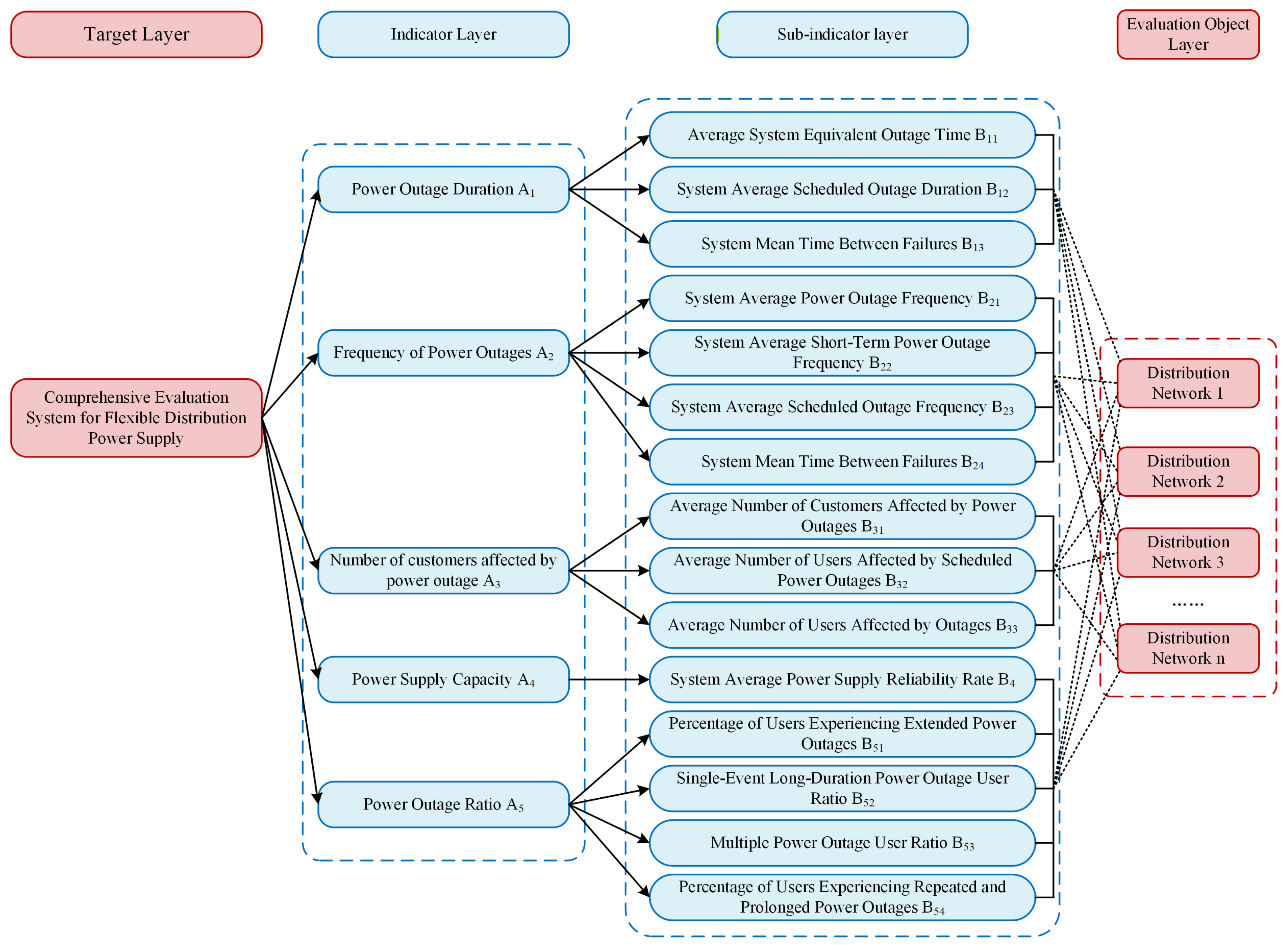
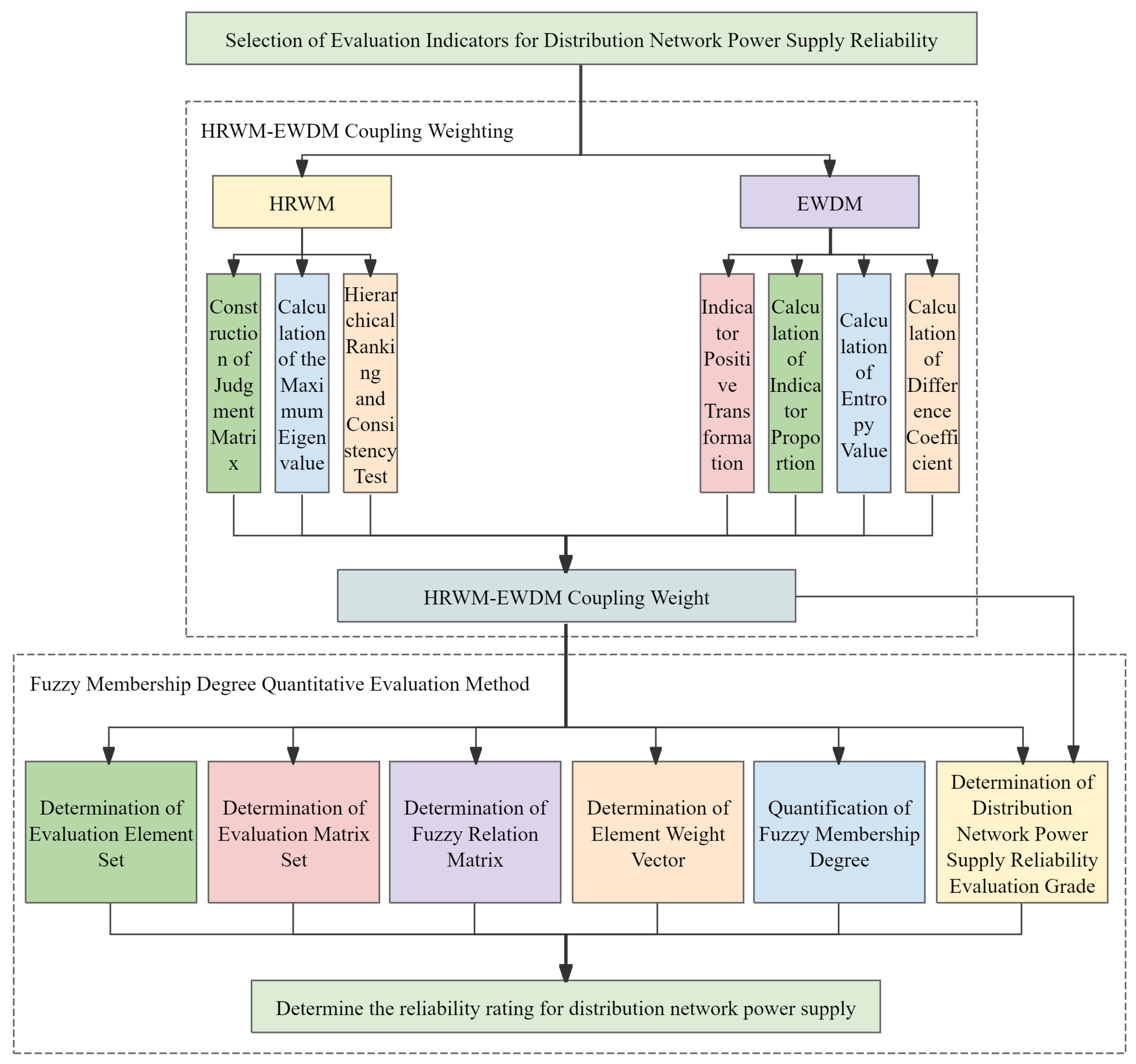
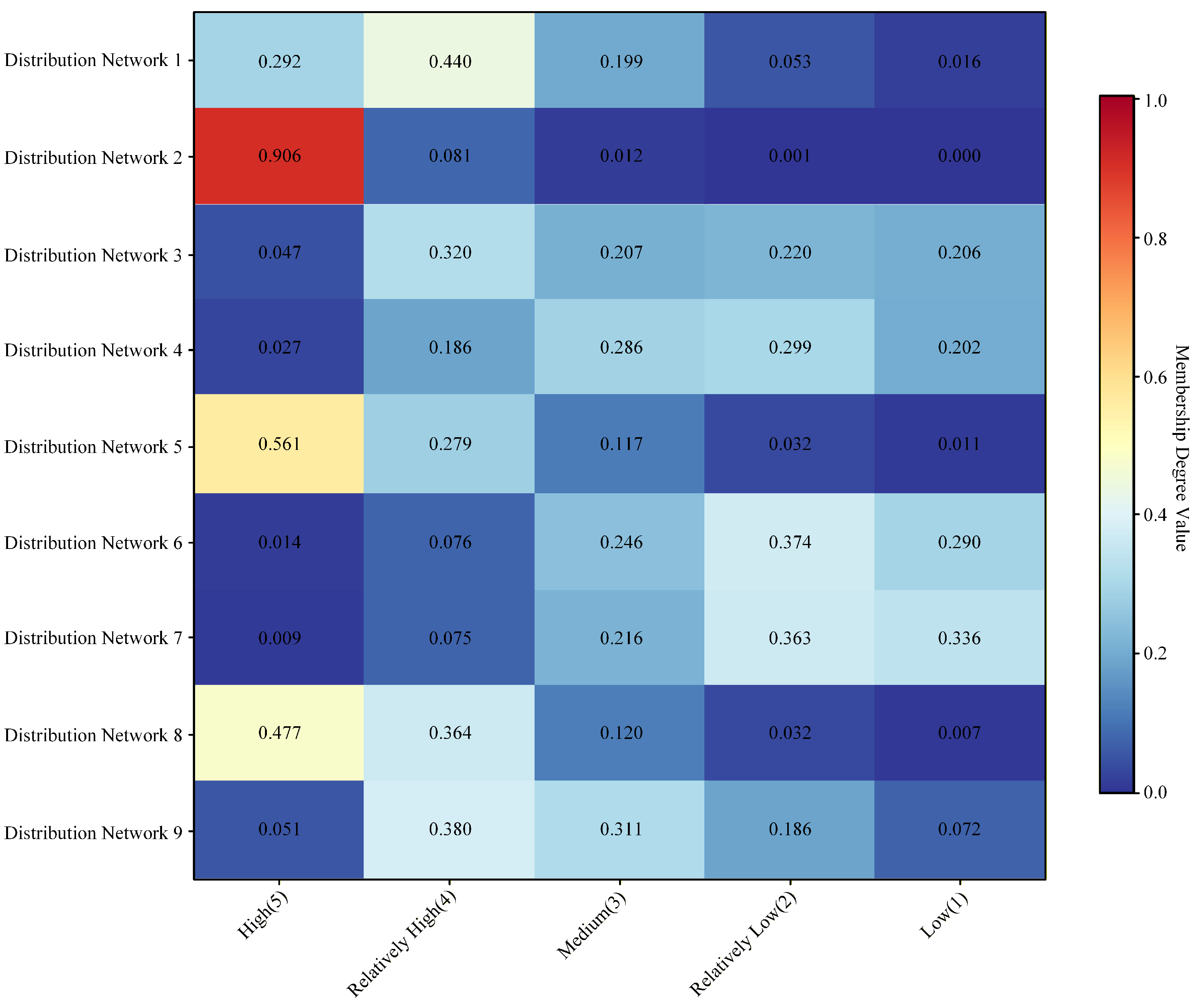
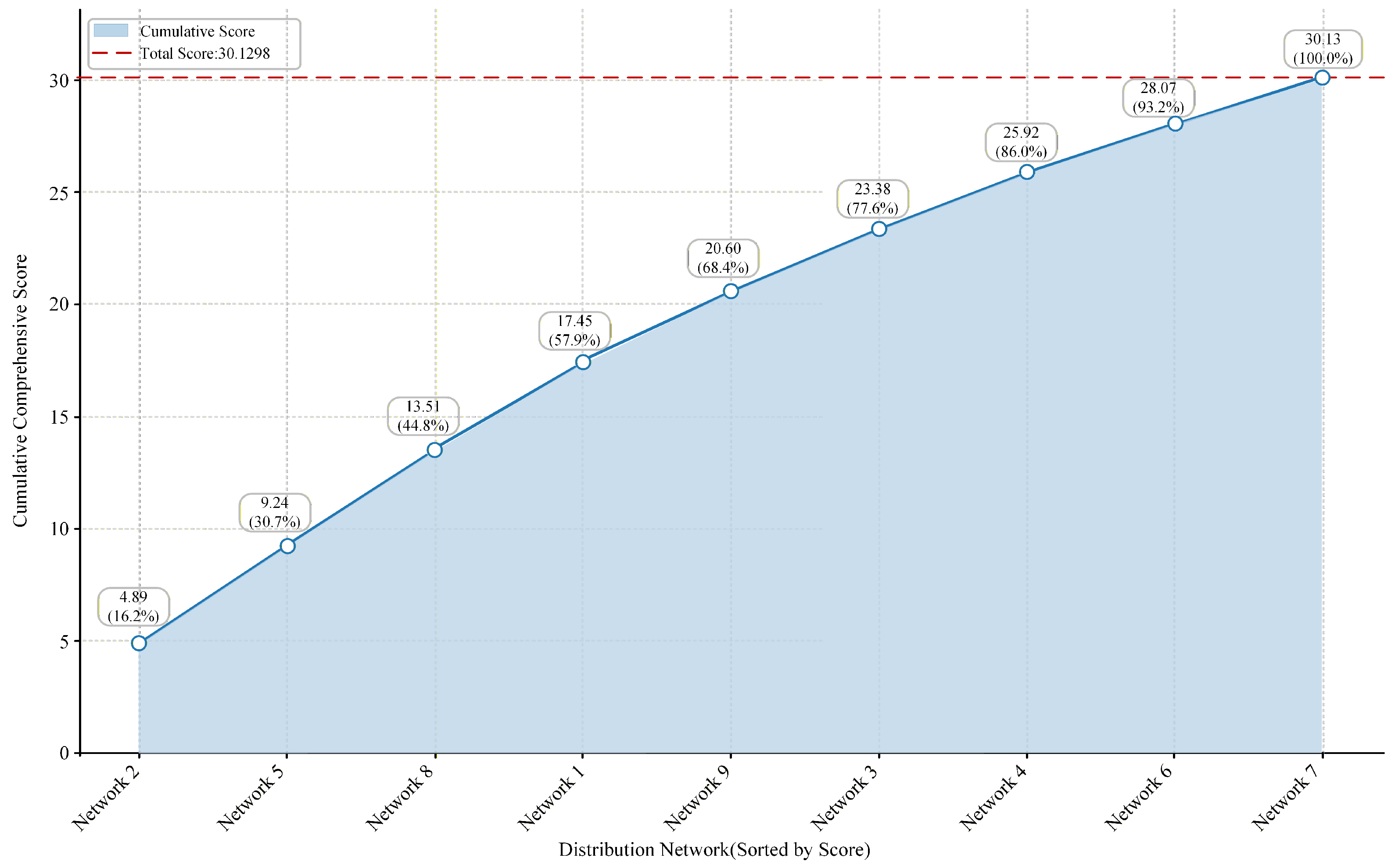
In the process of building a reliability evaluation model of the distribution network power supply, the scientific and reasonable setting of the weights is crucial for the accuracy and scientific validity of the evaluation results [
23]. At present, the weight assignment strategies can generally be divided into two types: objective weight assignment and subjective weight assignment. The subjective weighting method relies largely on the subjective judgment of experts based on their own experience, and this judgment is inevitably subject to the limitation of objectivity. Objective weighting methods, based on data and algorithms, can be said to be somewhat objective and scientific but at the same time, they will also ignore the significant role of historical experience in practice. Therefore, both traditional weighting methods have their own deficiencies [
24,
25]. In view of this, this paper has put forward for the first time a multi-coupling weight generation strategy that combines hierarchical recursive trade-off and entropy-based weight generation. By means of the method of multiplicative coupling, this strategy calculates out the last comprehensive weights, with the benefit of both methods. Therefore, the process of determining the weights is properly optimized so as to be able to give more scientific and accurate weights to assess the reliability of the supply of a distribution network.
2.4.1. Hierarchical Recursive Weighting Method
The hierarchical recursive weighting method constructs a clearly layered structure to decompose complex power supply reliability problems into multiple interrelated sub-problems. Then, based on recursive logic, it gradually derives upward from underlying factors and comprehensively weighs the influence degree of each hierarchical factor on power supply reliability [
26,
27,
28,
29]. This method usually relies on expert judgment in weight assignment and hierarchical coupling analysis, where experts are equipped with distribution network operation experience, reliability management background and system planning expertise.
All experts involved in this study possess profound professional accumulation and rich practical experience in the field of distribution networks, with an authoritative, professional and comprehensive background: all have more than 10 years of working experience, including 15 experts with over 15 years and 5 experts with over 20 years, covering the whole process of planning and design, operation and maintenance management, and reliability assessment. The expert panel comprises 6 university experts, 10 technical backbones from electric power enterprises, and 4 experts from research institutions, balancing theoretical research and engineering practice. Among them, 12 hold senior engineer or higher professional titles, 8 possess doctoral degrees, and 6 have participated in the revision of industrial standards or provincial-level distribution network reliability assessment projects. Their research directions cover distribution network planning, fault diagnosis, reliability index system, power data analysis, etc., ensuring the scientific and reasonable judgment of index weights.
The expert judgment in this study refers to the scoring of the relative importance of each hierarchical indicator by the expert panel, and the aggregation and subjectivity control of expert judgment are carried out through unified scoring criteria, multi-round scoring, consistency testing and weighted aggregation to ensure the scientificity and objectivity of subjective weight assignment, and the specific process is as follows:
(1) Unified scoring criteria to standardize expert judgment
Before scoring, the expert panel is trained uniformly, including the explanation of the four-layer evaluation index system, the definition of each indicator, the nine-point scaling method (
Table 1) for importance comparison, and the actual operation characteristics of the research area’s distribution network. A unified scoring manual is issued to ensure that all experts have the same understanding of the scoring criteria and avoid subjective deviations caused by inconsistent understanding.
(2) Multi-round blind scoring to reduce individual subjective bias
The expert panel adopts the blind scoring method (excluding the expert’s name and unit in the scoring form) to carry out two rounds of scoring: the first round is independent scoring by each expert, and the research team counts the scoring results and feeds back the extreme values (maximum and minimum) and their reasons to the experts without revealing the source of the extreme values; the second round is the revised scoring by experts, who can revise their own scores according to the extreme value feedback and their own professional judgment, and explain the revision reasons if the score is adjusted by more than 2 points (nine-point scale).
(3) Expert judgment consistency test to screen abnormal scores
The Kendall coefficient of concordance (W) is used to test the consistency of the expert scoring results, and the test is carried out for the first-level and second-level indicators. The value range of W is , and the closer W is to 1, the higher the consistency of expert judgment. In this study, the consistency test standard is set as : if the test result meets the standard, the scoring results are retained; if not, the research team organizes the experts to conduct a round of discussion, and the experts revise the scores based on the discussion results until the consistency standard is met. The test results show that the Kendall coefficient of concordance of the expert scoring results for all indicators is between and , which meets the consistency requirement.
(4) Weighted aggregation of expert scores to determine the final judgment matrix
According to the professional background and experience level of the experts, the weighted aggregation method is adopted to calculate the final scoring results: the weight of university experts (6 persons) is 0.3, the weight of electric power enterprise technical backbones (10 persons) is 0.45, and the weight of research institution experts (4 persons) is 0.25 (the weight is determined based on the proportion of experts in each field and their practical experience in distribution network reliability evaluation). The final judgment matrix (A, A1-A5) of the HRWM is constructed based on the aggregated scoring results, which fully integrate the professional advantages of experts in different fields and avoid the one-sidedness of individual expert judgment.
(5) Dual quality control to ensure the rationality of expert judgment
In the whole process of expert judgment, the research team sets up two quality control links: first, the pre-quality control (unified training and scoring manual) to standardize the scoring behavior; and second, the post-quality control (consistency test and extreme value screening) to eliminate abnormal scores. At the same time, all expert scoring records, revision reasons and discussion minutes are archived for review, ensuring the traceability of expert judgment.
The above expert judgment aggregation and subjectivity control measures effectively reduce the individual subjective bias of experts, ensure the consistency and rationality of the expert judgment results, and lay a solid foundation for the scientific assignment of subjective weights by the HRWM.
Combined with experts’ long-term practice and professional knowledge in power grid planning, operation and maintenance control, fault analysis, and other fields, the relative importance and recursive relationship of each hierarchical index are determined. Such quantitative analysis, which integrates expert domain experience with hierarchical recursion and weight balancing, can not only effectively handle the problem of multi-factor coupling in complex systems but also fully explore the potential logical relationships among various factors, providing a more scientific and accurate basis for distribution network power supply reliability assessment. The steps of determining the weights of indicators of the HRWM include
(1) Constructing the judgment matrix
where
is the judgment matrix, and the pairwise comparison matrix is established according to the nine-point scaling method, where
n is the number of indicators;
represents the importance ratio of factor
i to factor
j.
(2) Calculate the maximum eigenvalue of the judgment matrix
where
is the maximum eigenvalue;
is the influence weight of the subsystem corresponding to the
i-th influencing factor.
(3) Hierarchical single ordering and its consistency test
where CI is the consistency index. When it equals 0, the hierarchical ordering result exhibits perfect consistency; the closer it is to 0, the more acceptable the consistency of the hierarchical ordering result. Conversely, an increase in the CI value indicates poorer consistency of the ordering result.
where RI is the random consistency index used to evaluate the CI value; the relationship between the RI values of various orders and the matrix order is detailed in
Table 2 below.
where CR is the consistency ratio. When the CR value of the judgment matrix is <0.1, it indicates that the matrix meets the consistency requirement. Conversely, it is necessary to appropriately adjust the element values within it and reconstruct the judgment matrix to ensure the consistency of the matrix.
(4) Calculate the weights of each indicator
where
.