Article

Design and Simulation of a Magnetic Flux Control System Using Gradient Permeability Ceramics for Rapid Induction Welding of Cable Conductors

1
Guangzhou Power Supply Bureau of Guangdong Power Grid Co., Ltd., Guangzhou 510000, China
2
State Key Laboratory of High-Efficiency Special Cable Technology, Harbin University of Science and Technology, Harbin 150080, China
*
Author to whom correspondence should be addressed.
Energies 2026, 19(4), 1006; https://doi.org/10.3390/en19041006
Submission received: 30 December 2025 / Revised: 23 January 2026 / Accepted: 9 February 2026 / Published: 14 February 2026

Abstract

Efficient on-site connection of power cable conductors is critical for ensuring the safe operation of the power grid. Traditional thermite welding methods pose significant safety risks, including open flames and fumes. Meanwhile, induction heating, when applied to cable conductors, faces challenges of severe magnetic field dispersion, low heating efficiency, and a high risk of damaging adjacent insulation layers. This paper proposes a novel magnetic flux control system based on gradient permeability ceramics to address these issues. The core of this system is the synergistic utilization of a gradient permeability composite ceramic mold and a high-permeability shielding shell. A 2D axisymmetric multiphysics coupled model was established to compare the performance of the optimized system with a conventional case and single control components. Simulation results demonstrate that the optimized system increases the magnetic flux density at the weld seam to 3.7 times that of the conventional setup (0.263 T). Consequently, the weld seam of the 240 mm2 copper conductor is rapidly heated to the melting point of copper (1083 °C) within 7.78 s. Due to the high heating rate, upon completion of the welding process, the temperatures of the inner shielding and insulation layers are only 48.8 °C and 24.3 °C, respectively, well below the materials’ safety thresholds. These findings suggest that the proposed magnetic flux control strategy achieves rapid and precise heating, offering a theoretical foundation for the development of high-performance on-site equipment for fabricating cable joints.

1. Introduction

Power cables act as the arteries of modern energy transmission networks, where the reliability of cable joints directly determines the overall safety and stability of the system [1,2,3,4]. In the on-site fabrication of cable joints, the conductor connection is one of the core steps that determines their reliability.
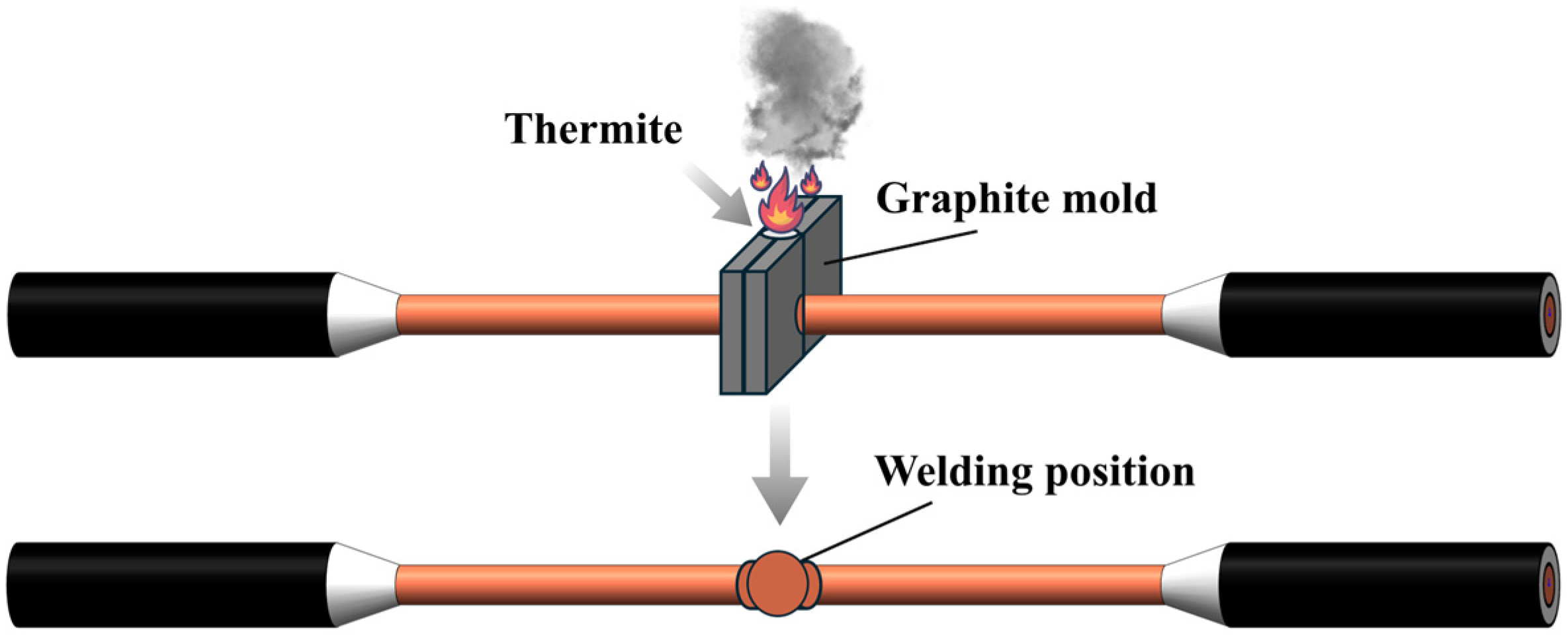
For a long time, traditional welding methods such as thermite welding have long been employed due to their mature processes and high connection strength. As shown in Figure 1, Thermite welding relies on a high-temperature exothermic reaction to produce molten metal for conductor joining, resulting in joints with high strength, corrosion resistance, and stable electrical properties, making it extensively used in power engineering, grounding systems, and high-strength metal connections [5,6,7,8,9]. However, this process requires open-flame operations, posing significant fire and explosion risks in confined and flammable environments like cable wells or tunnels, which presents a severe threat to construction safety [10,11,12,13]. Furthermore, the fumes released during welding are hazardous to operators’ health and the environment. Consequently, developing a flameless, efficient, clean, and safe alternative for on-site conductor welding has become a major technical challenge in modern cable joint fabrication.
In this context, induction heating welding has emerged as a promising alternative for on-site conductor joining. This method uses a high-frequency alternating magnetic field generated by an induction coil to induce eddy currents, thereby achieving localized material fusion through resistive heating [14,15]. By eliminating open flames, it fundamentally mitigates fire and explosion hazards [16]. Moreover, induction welding provides high processing speed, concentrated thermal effects, and non-contact operation, addressing the inefficiencies and safety issues associated with conventional welding methods.
Despite these advantages, the practical application of induction heating to low-permeability conductors such as copper and aluminum remains inefficient. At high frequencies or under complex field conditions, challenges including magnetic field dispersion, insufficient heat concentration at the weld seam, and undesired heat transfer to adjacent insulation layers become particularly pronounced [17]. Existing induction welding systems still lack effective magnetic flux control and localized thermal power management, posing major barriers to achieving high-efficiency and high-quality conductor welding in practical on-site environments.
To address these challenges, magnetic flux control plays a decisive role in induction heating. By manipulating, concentrating, and redistributing magnetic field lines, a flux controller optimizes electromagnetic energy transfer and thermal generation [18,19]. Previous studies have demonstrated that introducing soft-magnetic composites or flux-guiding devices can enhance power density, minimize energy losses, and shorten heating cycles during induction-based heating and welding [20,21].
However, research specifically targeting magnetic flux control in cable conductor welding is still limited. Most current designs focus primarily on coil geometry and power parameters, neglecting the optimization of the magnetic flux pathway [22,23]. Few investigations have explored the use of gradient-permeability or magnetic-shielding structures to improve weld quality [24,25]. Moreover, on-site implementations often suffer from magnetic leakage, unstable temperature fields, and sensitivity to process parameters, calling for integrated optimization via numerical modeling and experimental validation [26,27,28].
Based on these considerations, this paper introduces a magnetic flux control system for induction welding that employs a gradient-permeability ceramic mold coupled with a high-permeability shielding shell. The proposed system focuses the magnetic flux precisely at the weld seam while minimizing flux leakage, thereby achieving both spatial and temporal energy concentration. The design also emphasizes modularity and portability, meeting the requirements of on-site cable installation [20]. A 2D axisymmetric multiphysics simulation is conducted to analyze the influence of magnetic flux control on heating efficiency. Comparative analysis across multiple configurations demonstrates the effectiveness of the proposed design in enhancing welding precision, speed, and safety, providing a theoretical framework and engineering guidance for next-generation cable jointing equipment.

2. Induction Heating System Design and Principles

To mitigate magnetic field dispersion and improve heating efficiency in the induction welding of copper conductors, this study proposes a magnetic flux control system featuring gradient-permeability ceramics. The system’s core principle is to engineer the ceramic mold with gradient magnetic permeability, which guides and confines the electromagnetic field generated by the induction coil, ensuring precise, high-density energy concentration at the weld seam. This section presents the system architecture and describes its key functional components.

2.1. Structure of the Magnetic Flux Control System

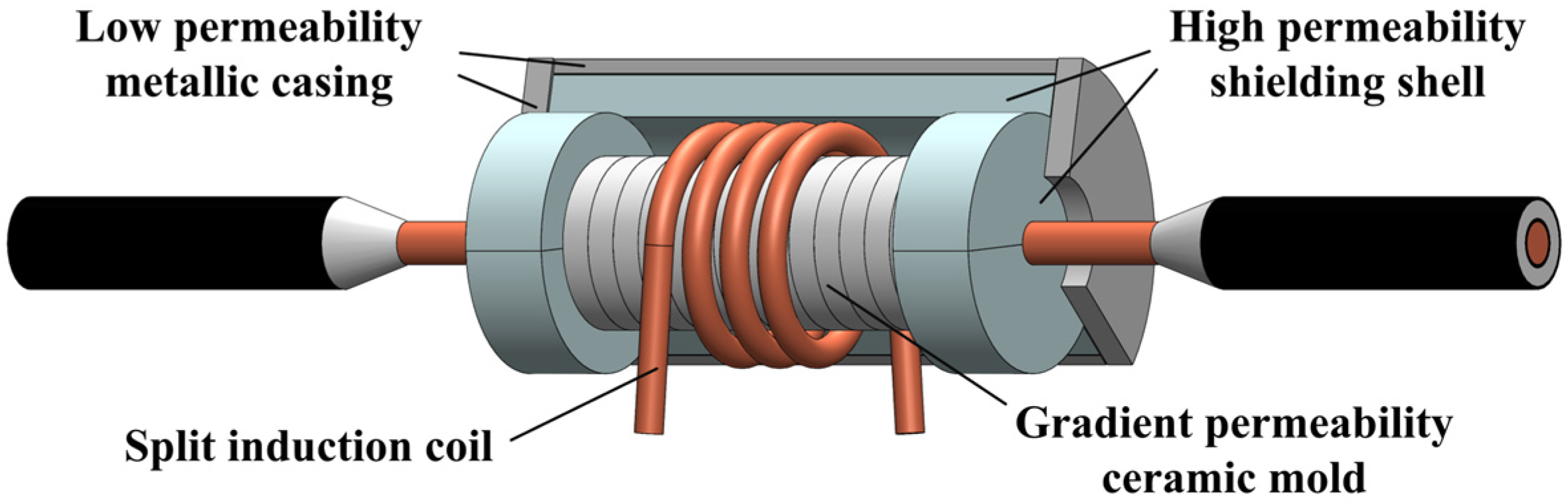
The magnetic flux control system proposed in this paper features a modular structure, with its overall configuration illustrated in Figure 2. The system is primarily composed of four coaxial key components: a Gradient Permeability Ceramic Mold, a Split Induction Coil, a High-Permeability Shielding Shell, and a Low-Permeability Metallic Casing.
Gradient-permeability ceramic mold: As the core innovation of the system, this component serves both as a structural support and a magnetic field concentrator. During welding, it aligns and stabilizes the conductors, while its graded magnetic permeability actively directs magnetic flux toward the weld seam center, creating a localized, high-intensity magnetic field.
Split induction coil: The coil is the energy source that generates the alternating magnetic field. This design utilizes a thick-walled, water-cooled copper tube with a low number of turns (4 turns) to carry the large current required to generate sufficient heating power. To meet the requirements of portability and ease of use in on-site construction, the coil is designed as a split-type structure, a mature application in other induction heating scenarios where direct placement over the workpiece is not feasible [29].
High-permeability shielding shell: Fabricated from composite ceramics with high relative permeability, the shell surrounds the coil externally, providing a low-reluctance path for magnetic flux. This structure suppresses outward flux leakage and confines magnetic energy within the working cavity, thereby synergistically enhancing flux concentration and minimizing unintended heating of adjacent regions [30].
Low-permeability metallic casing: Serving as the outermost layer, this casing offers mechanical reinforcement and environmental protection.
To satisfy the requirements of portability and ease of use for on-site power cable construction, all core components of the system are designed with a split, clam-shell configuration. By using hinge or bolt-clamping mechanisms, operators can easily open the device and enclose it around the cable to be welded, which enhances on-site installation efficiency and operability.

2.2. Design of Gradient Permeability Ceramics

Precise magnetic flux control requires materials that can guide magnetic field lines effectively while resisting excessive self-heating under alternating electromagnetic fields. Conventional flux concentrators, such as soft magnetic alloys and silicon steel laminations, though highly permeable, suffer from severe eddy-current heating losses under strong AC fields, rendering them unsuitable for induction welding applications [31]. Therefore, the key challenge lies in developing a composite material that simultaneously provides high magnetic permeability (relative permeability μr > 10), elevated electrical resistivity (ρ > 108 Ω·cm to suppress eddy currents), thermal stability (working temperature > 1100 °C to withstand molten copper), and mechanical robustness (compressive strength > 100 MPa).
To address this challenge, this paper proposes a soft ferrite-insulating ceramic composite material. This composite leverages the advantages of both components by mixing soft ferrite particles into an insulating ceramic matrix: the magnetic phase provides tunable permeability, while the non-magnetic matrix offers insulation to suppress eddy current losses, along with mechanical strength and temperature resistance [32]. Eddy current suppression is achieved by the insulating alumina matrix, which disrupts macroscopic conductive paths and confines induced currents to individual ferrite particles. This micro-scale confinement significantly increases electrical resistivity, minimizing parasitic Joule heating at high frequencies. By adjusting the two-phase ratio, the material’s relative permeability μr can be tuned from 1 to several hundred, while maintaining an electrical resistivity ρ between 108–1012 Ω·cm. The composite also supports working temperatures up to 1500 °C and compressive strengths of 100–400 MPa, meeting diverse engineering demands [33].
In this study, Nickel–Zinc (NiZn) ferrite was selected as the magnetic phase due to its high and stable relative permeability across the operating frequency range (several kHz to hundreds of kHz). Unlike Manganese–Zinc (MnZn) ferrites, which may exhibit lower resistivity and significant eddy current losses at high frequencies, the selected NiZn ferrite grade provides a much higher volume resistivity (108 Ω·cm). This ensures that eddy current losses induced by the alternating magnetic field are minimal, even within the ferrite particles. For the non-magnetic matrix, alumina (Al2O3) is chosen as the insulating base. Its extremely high volume resistivity (1014 Ω·cm) effectively suppresses the formation of eddy currents. Alumina also offers excellent mechanical strength and temperature resistance up to 1500 °C, providing reliable structural support for the system.
The system described in this paper requires composite ceramics with various relative permeabilities. To accurately predict and prepare composites with a specific effective permeability (μeff), this study employs the classic symmetric Bruggeman effective medium theory to solve for the volume fraction of the magnetic phase, f [34]. According to the Bruggeman model for a two-phase random mixture [35,36], its mathematical expression is:
f μ f μ eff μ f + 2 μ eff + 1 f μ 0 μ eff μ 0 + 2 μ eff = 0 ,
where f is the volume fraction of the magnetic phase; μeff is the effective relative permeability of the composite material; μf is the relative permeability of the pure ferrite material (in this study, μf ≈ 125 for NiZn ferrite at the operating frequency), and μm is the relative permeability of the non-magnetic matrix (alumina), where μm ≈ 1.
In this research, a series of composite ceramics with μeff = 1, 6, 10, 20, 50, and 100 were designed. By solving the above equation, the required ferrite volume fractions, f, can be calculated. The results are shown in Table 1. The permeability gradient (1, 6, 10, 20, 50, 100) is designed based on the non-linear response of magnetic flux distribution to material reluctance. A higher resolution is assigned to the low-permeability region near the weld seam to precisely control the magnetic ‘compression’ effect, as this zone experiences the most significant spatial variation in magnetic vector potential. This non-uniform distribution ensures an optimal balance between the precision of flux focusing and the complexity of the modular ceramic structure.
Structurally, the ceramic mold consists of multiple stacked composite rings, each fabricated with a different ferrite concentration. As shown in Figure 2, the rings are arranged symmetrically about the weld seam: the lowest-permeability ring (μeff = 1) is positioned at the center, while rings with progressively higher permeability are placed outward. This graded configuration establishes a low-reluctance magnetic path, directing field lines toward the weld seam and concentrating magnetic flux within the mold’s interior. Consequently, the gradient design enables precise flux focusing, ensuring maximum energy density at the target region for efficient conductor welding.

3. Simulation Methodology

To validate the effectiveness of the proposed magnetic flux control system and to systematically evaluate the roles of its key components, this study employs finite element analysis to perform an electromagnetic-thermal multiphysics coupled simulation. This section provides a detailed description of the simulation model setup, physics configurations, comparative cases, and the solution process.

3.1. Geometric Model and Material Properties

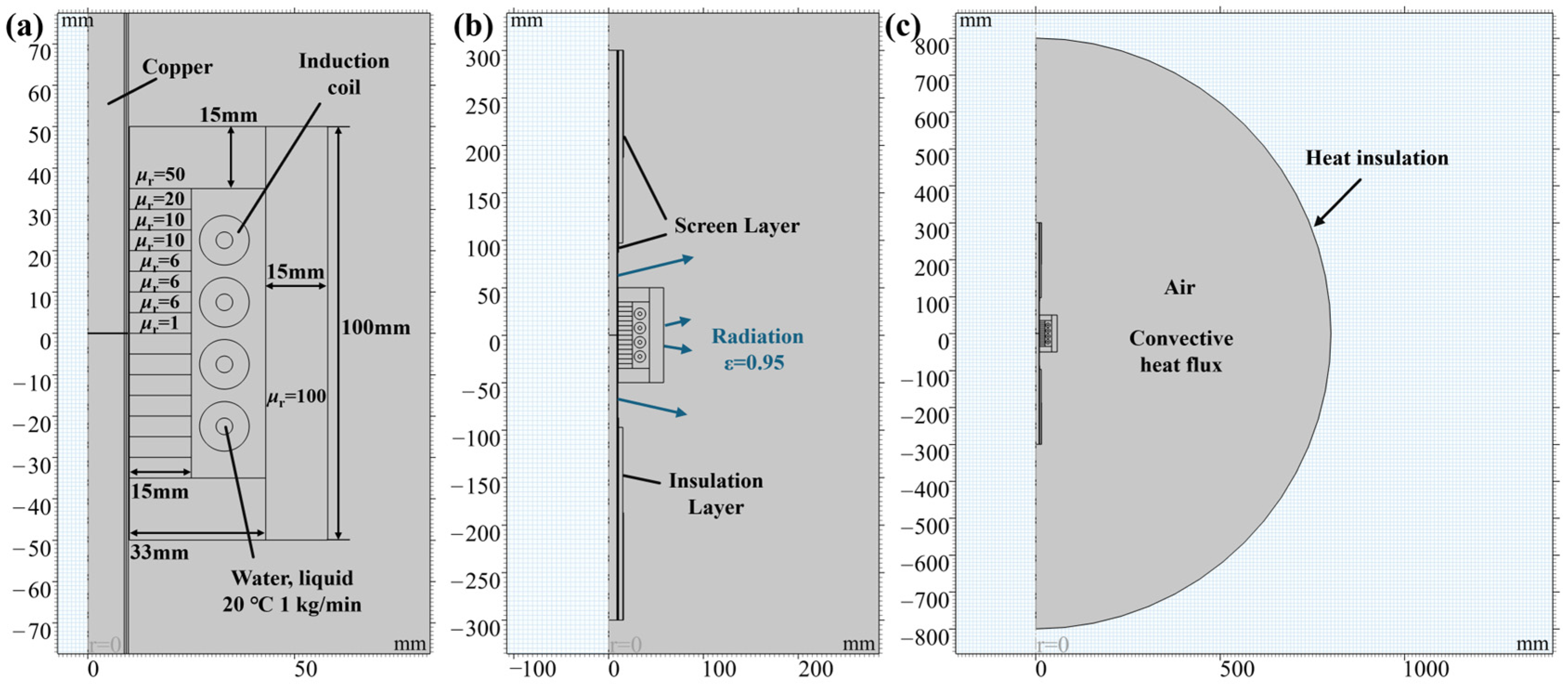
The simulation geometry was constructed based on a standard 10 kV power cable joint. The main structural parameters include a 240 mm2 conductor cross-section, an insulation layer thickness of 4.5 mm, and 0.7 mm for both the inner and outer shielding layers. To optimize computational efficiency, a 2D axisymmetric model was developed (Figure 3), incorporating the copper conductors, insulation and shielding layers, and all key magnetic flux control components.
The materials involved in the simulation and their key physical properties are listed in Table 2. The properties of the gradient permeability ceramics are defined according to the design theory presented in Section 2.2. To ensure the accuracy of the simulation results, the temperature-dependent characteristics of parameters such as electrical conductivity and thermal conductivity have been considered for all materials.
σcopper (T) is the conductivity of the conductor, and it follows the function given in the following equation:
σ copper ( T ) = σ 0 1 + α T T ref
where σ0 = 5.96 × 10⁷ S/m is the reference conductivity at reference temperature Tref = 293.15 K, and α = 0.0039 1/K is the resistivity temperature coefficient.

3.2. Physical Model and Boundary Conditions

The simulation process in this study couples two physics interfaces: Magnetic Fields and Heat Transfer in Solids. The electromagnetic field is solved in the frequency domain to simulate the magnetic field generated by the alternating current in the coil. The induction coil is configured as a multi-turn coil feature, with an excitation current RMS value of 2100 A and a frequency of 40 kHz.
The governing equation for the electromagnetic field is the Helmholtz equation based on the magnetic vector potential. The heat transfer is solved using a transient study to simulate the conduction and diffusion of Joule heat generated by electromagnetic induction within the system. The heat source is defined by the coupled electromagnetic-thermal interface, where the Joule loss density from the electromagnetic solution is applied as the thermal source. The governing equation for heat conduction is Fourier’s law of heat conduction.
The heat transfer equations are based on Fourier’s law and the law of conservation of energy to obtain the temperature field distribution inside the cable.
ρ C p T t + ρ C p u · T + · q = Q q = k T
where T is the temperature in K, ρ is the density in kg/m3, Cp is specific heat capacity in J/kg·K, k is the thermal conductivity in W/m·K, and Q is the volume power of heat source in W/m3. The heat source comes from the electromagnetic field.
In a 2D electromagnetic model, the axially flowing current in the cable conductor passes through the plane of the model. To solve for the electromagnetic field, Maxwell’s equations in the frequency domain are used.
× H = σ + j ω ε E × E = j ω μ H
where ε and μ are the permittivity and permeability, respectively. So, the electromagnetic heat energy can be expressed as
Q = 1 2 Re J E + 1 2 Re j ω B H
The electromagnetic thermal control equations can be obtained by solving the equations simultaneously.
To simulate the water-cooling effect, the interior of the induction coil is cooled by a water flow with a mass flow rate of 1 kg/min and an inlet temperature of 20 °C. The outermost surface of the heating system is assigned natural convection and surface radiation boundary conditions to simulate heat exchange with the ambient air (35 °C). The outermost boundary of the simulation domain is set to magnetic insulation to confine the magnetic field within the computational domain.

3.3. Configuration of Comparative Cases

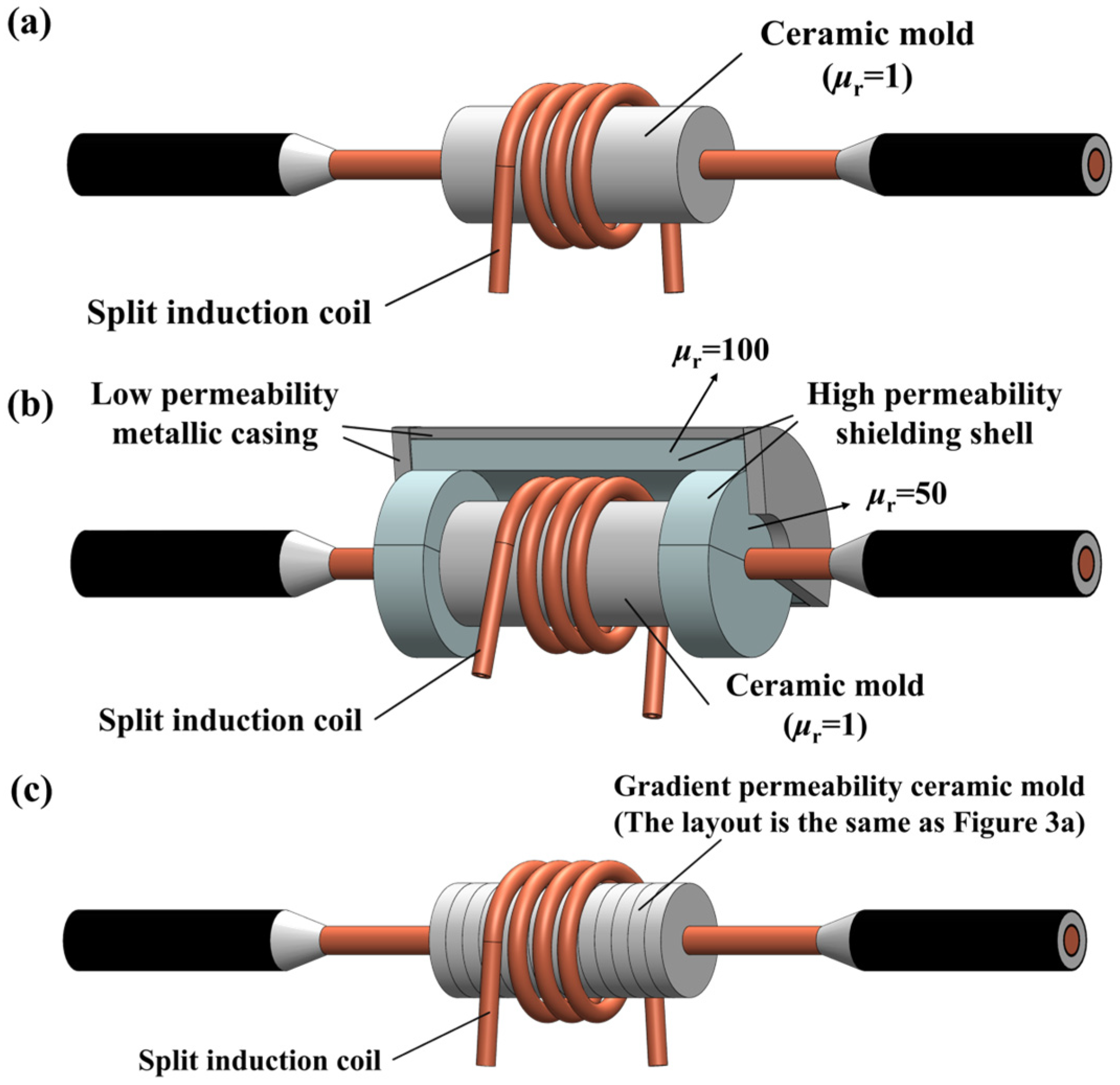
To evaluate both the individual and combined effects of the gradient-permeability mold and high-permeability shielding shell, four representative simulation cases were established (Figure 4 and Table 3). Among them, “Shell only” and “Gradient mold only” serve as intermediate configurations between the Conventional and Optimized systems. All cases share identical coil excitation parameters, geometry, and boundary conditions; the sole distinction lies in the arrangement of magnetic flux control components.

3.4. Mesh and Solver Configuration

To ensure the accuracy of the electromagnetic-thermal coupling, the mesh was meticulously configured based on the calculated skin depth (δ ≈ 0.33 mm for copper at 40 kHz). A boundary layer mesh consisting of 10 layers with a stretching factor of 1.2 was applied to the conductor surface, where the first layer thickness was set to 0.05 mm to fully resolve the induced current density. For the gradient ceramic mold, refined triangular elements were used, with a maximum element size of 0.5 mm in high-gradient regions to ensure flux convergence. The final model consists of approximately 89,268 domain elements. A mesh independence test was performed, confirming that increasing the element count further resulted in less than a 0.5% change in the peak weld seam temperature. A frequency-transient solver was employed for the study. A frequency-transient solver was employed for the study.

4. Results and Discussion

4.1. Mechanism of Magnetic Field Control

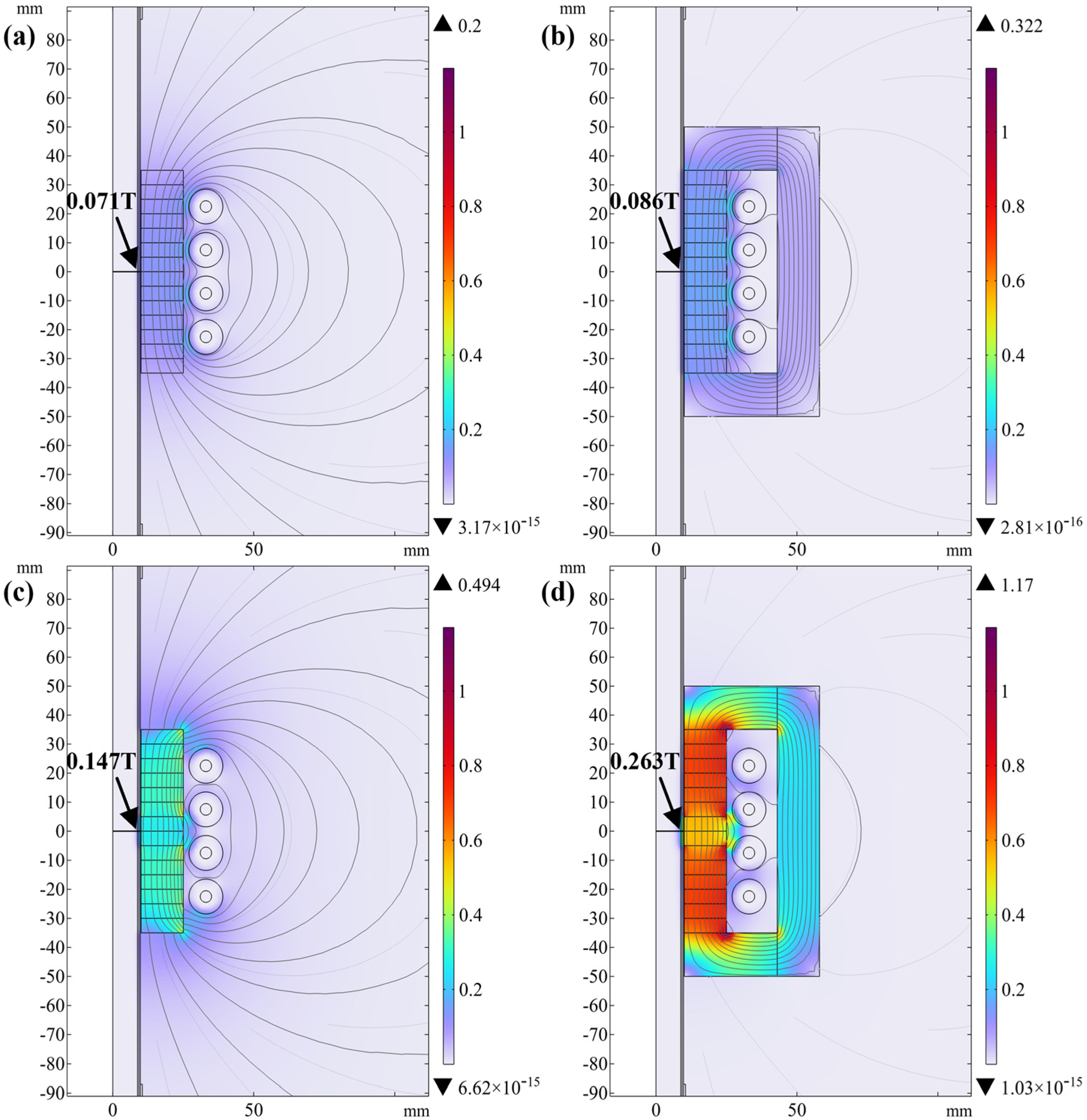
Induction heating converts electromagnetic energy into thermal energy, and precise magnetic-field control is essential for achieving efficient and localized heating. The magnetic field distribution has a decisive impact on the heating effect. Figure 5 illustrates the paths of the magnetic field lines and the spatial distribution of magnetic flux density for the four cases. In the conventional heating setup (Figure 5a), the magnetic field lines emanate from the coil and disperse outwards, leading to significant magnetic flux leakage and low energy utilization efficiency. This flux leakage, caused by the lack of an effective magnetic path, is one of the primary reasons for the low efficiency of traditional induction coils when heating low-permeability materials. When the shielding shell is introduced (Figure 5b), the high-permeability shell provides a low-reluctance path for the external magnetic field lines, confining them within the system and significantly reducing flux leakage. However, inside the coil, the magnetic field distribution remains relatively uniform. For the case with only the gradient mold (Figure 5c), the gradient permeability structure bends the magnetic field lines toward the higher-reluctance central region of low permeability, demonstrating a certain degree of focusing capability. In the design proposed in this paper (Figure 5d), the internal focusing effect of the gradient mold and the external confinement effect of the shielding shell work synergistically. The magnetic field lines are effectively guided and compressed into a compact loop that passes only through the weld seam area, forming a highly efficient energy channel.
The differences in the distribution of magnetic field lines are ultimately reflected in the magnitude of the magnetic flux density. Figure 5 also compares the magnetic flux density for the four cases. The optimized system achieves a magnetic flux density of 0.263 T in the central region of the weld seam, whereas the peak values for the Conventional case, Shell only, and Gradient mold only are merely 0.071 T, 0.086 T, and 0.147 T, respectively. This clearly demonstrates that the optimized system, through synergistic control, enhances the magnetic field strength in the target region by a factor of 3.7, far exceeding the effect achievable by optimizing either the shielding shell or the gradient permeability mold alone.

4.2. Heating Performance and Precision

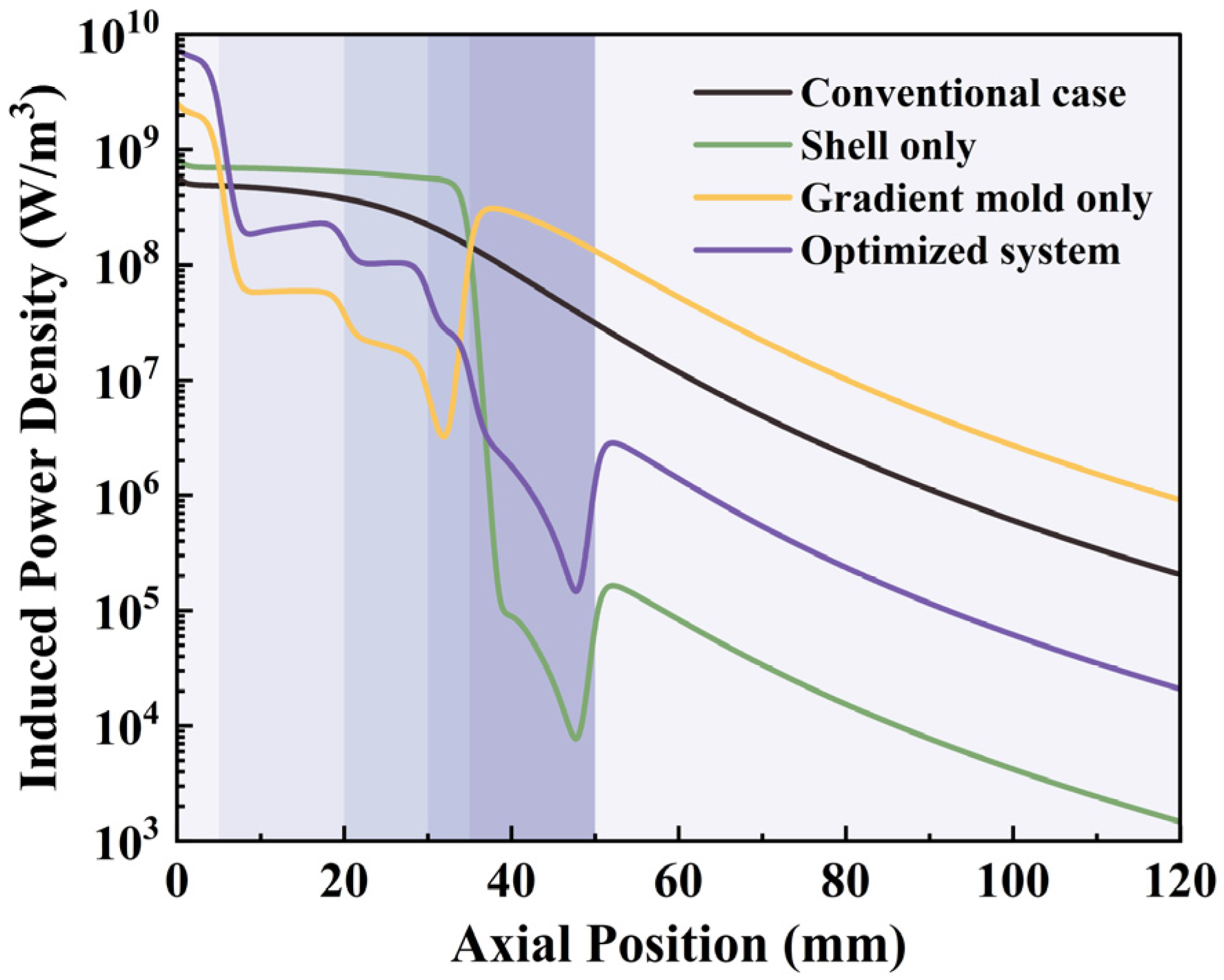
The precise control of the electromagnetic field is ultimately manifested in the spatial distribution of the induced thermal power [37]. Figure 6 shows the axial distribution curves of induced thermal power density along the conductor surface, illustrating the fundamental differences in heating capability and precision among the four cases.
The optimized system exhibits the strongest heating power at the weld seam, with a peak power density approaching 1010 W/m3 at the center (z = 0), which is more than an order of magnitude higher than that of the Conventional case. More importantly, its power density curve is not only high in value but also narrowly distributed. The abrupt changes in power density precisely correspond to the boundaries of the different permeability ceramic rings in the gradient mold (indicated by the background shading). Away from the central weld seam region, the power density attenuates sharply, indicating that the energy is precisely concentrated within a narrow target area, effectively suppressing stray heating. The intermediate cases reveal the origin of this phenomenon: the Gradient mold-only case enhances the central power density to over 109 W/m3 through its focusing capability, but the power decays slowly at a distance from the weld seam, indicating energy dispersion. Conversely, in the Shell-only case, the power decays rapidly at distant points, effectively suppressing flux leakage, but its enhancement of the central power is limited. The subtle rise in power density observed in the Gradient mold only case at 35–50 mm is attributed to the local flux concentration provided by the high-permeability outer rings (μeff = 20), which attract magnetic field lines toward the conductor surface. In contrast, the Shell-only case exhibits a sharp drop because the external high-permeability shell provides a low-reluctance path that confines the magnetic flux within the coil region, preventing axial leakage and starving distant conductor segments of induction energy. Therefore, the performance of the optimized system is not a simple superposition of its individual components. The synergy between the two effects endows it with both the weld seam heating capability from the gradient mold and the rapid spatial power decay from the shielding shell. This ability to apply most energy to the weld seam meets the requirements for highly efficient and precise induction heating.
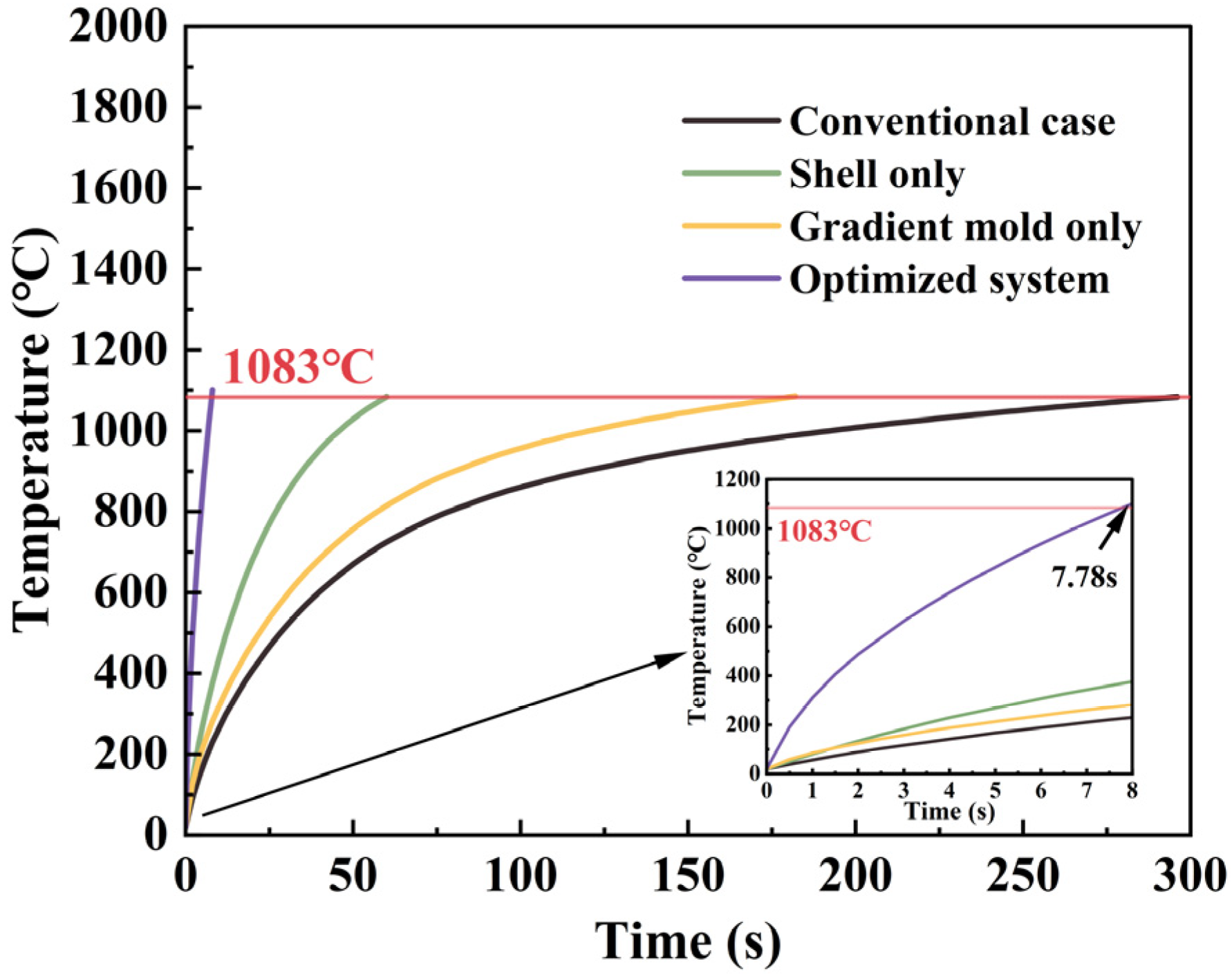
The precision of energy input directly determines the conductor’s temperature rise. The heating capability at the weld seam is the most direct indicator of the system’s efficiency. By tracking the temperature change at the center of the weld seam (z = 0, r = 0) with a probe, the temperature-time curves for the four cases are plotted in Figure 7. The optimized system demonstrates exceptional heating efficiency, with its temperature curve showing a steep upward trajectory, raising the weld seam center from 20 °C to the melting point of copper (1083 °C) in just 7.78 s. In the same timeframe, the other comparative cases exhibit slow temperature rises, failing to reach the temperature required for effective welding. Upon continued heating, the Shell only, Gradient mold only, and Conventional cases eventually reach the melting point at 60 s, 182 s, and 296 s, respectively. This significant advantage is a direct result of efficient and precise induction heating.
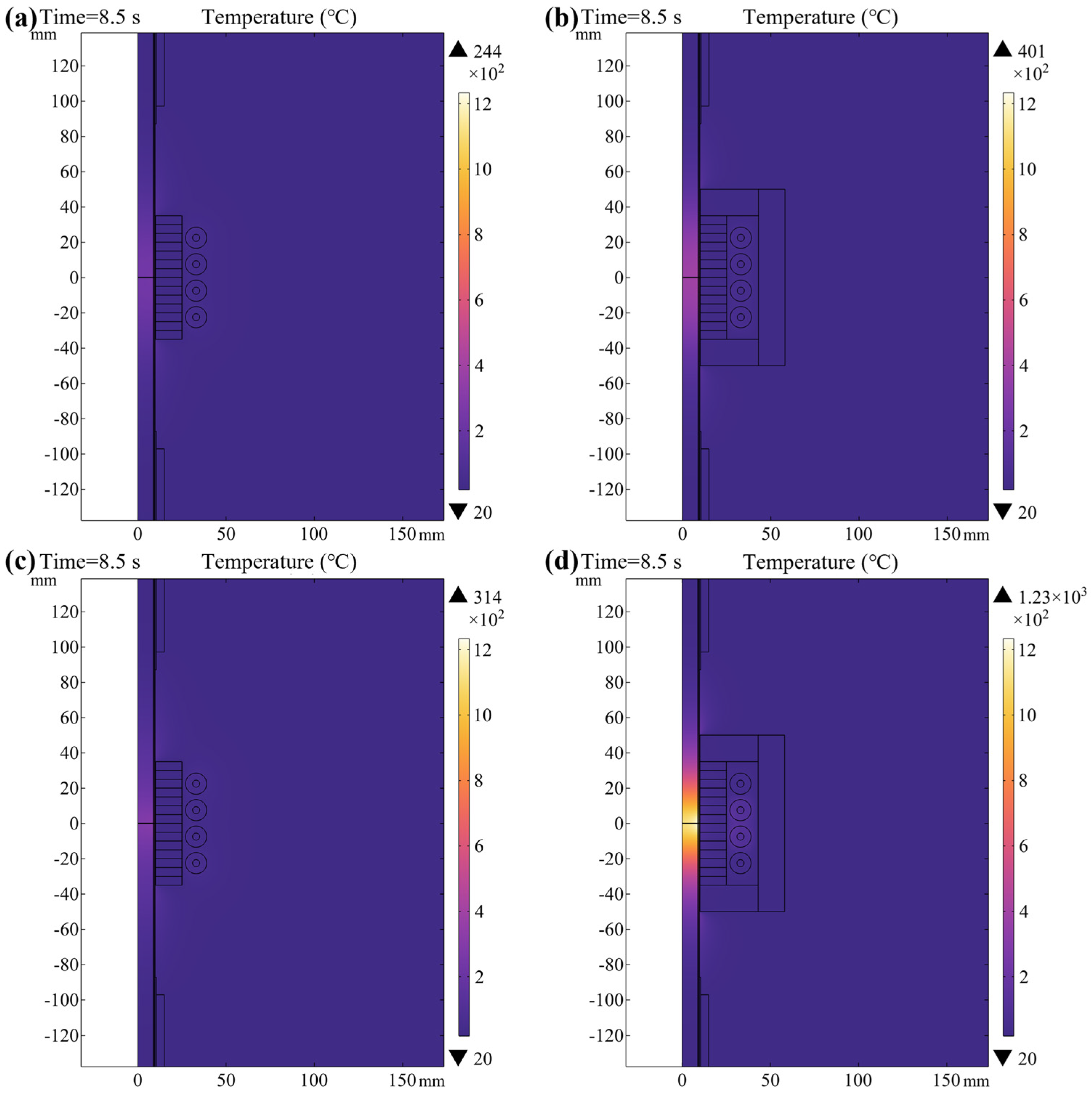
Furthermore, the injected induction heating energy is ultimately reflected in the system’s temperature distribution. Figure 8 displays the temperature field contour plots for the four cases at t = 8.5 s, by which time the weld seam temperature of the optimized system has already exceeded the melting point of copper. All plots use a uniform color scale. The optimized system (Figure 8d) shows the most ideal temperature field morphology. Its hot spot is strictly confined to the weld seam center (z = 0), where the temperature has surpassed the melting point of copper. Concurrently, axial heat diffusion is extremely well-controlled, with the majority of the conductor and the adjacent insulation layer remaining near their initial temperature (20 °C). In the Conventional case (Figure 8a), the overall temperature rise at the same moment is very limited, far from achieving effective heating. More critically, its weak heat distribution is also diffuse, with heat spread evenly along the conductor segment, failing to form an effective central hot spot. The intermediate cases highlight the limitations of single control methods. While the Shell-only case (Figure 8b) suppresses distant heat diffusion to some extent, its overall temperature rise is slow, requiring 60 s to reach the melting point of copper. The Gradient mold-only case (Figure 8c) shows some focusing capability but fails to form a sufficiently distinct hot zone within 182 s of heating. The spatial distribution of the temperature field confirms the high heating efficiency and precision of the optimized system.
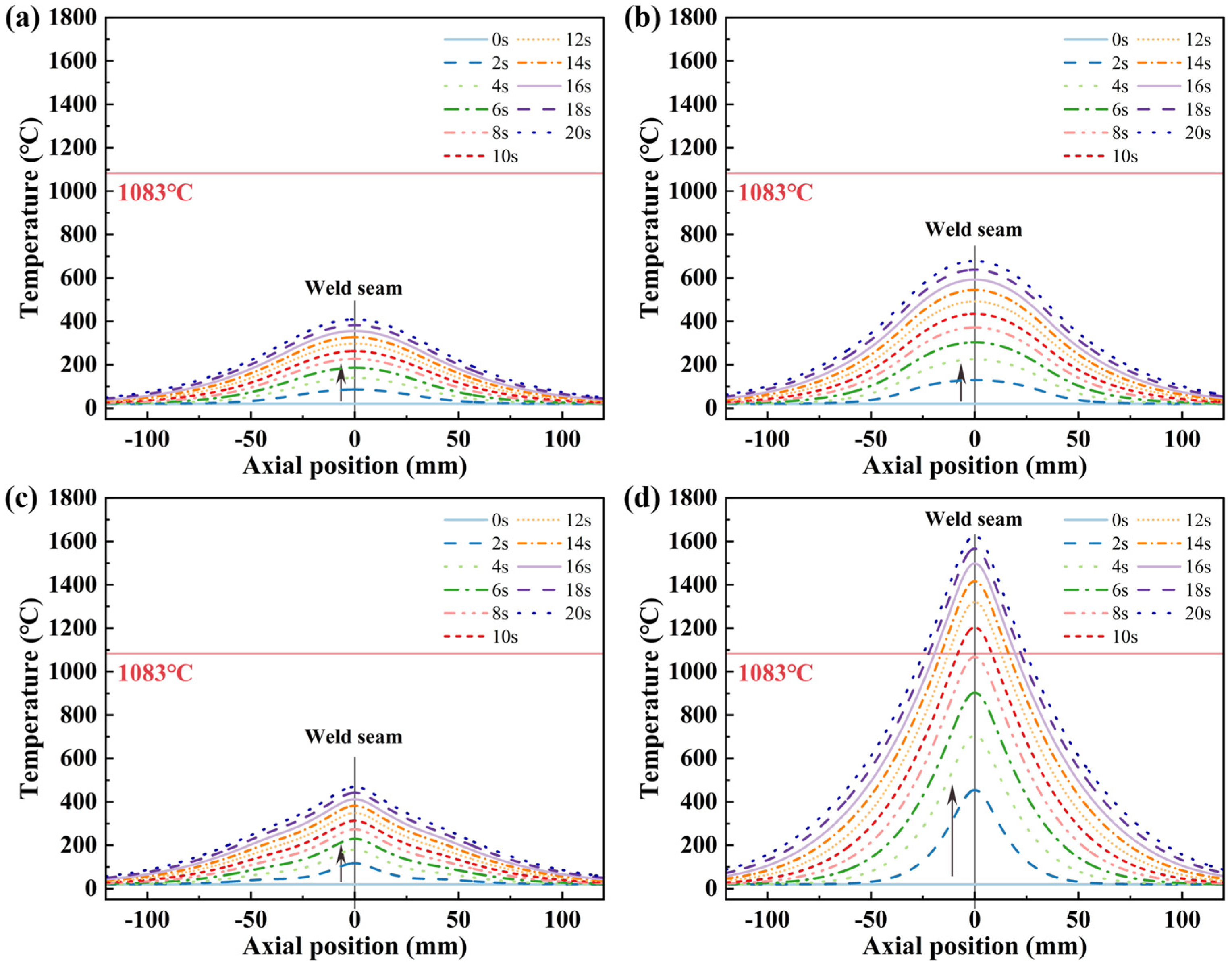
Besides the heating rate, the precision of the heating process is another key criterion for evaluating system performance. Figure 9 shows the spatiotemporal evolution of the axial temperature distribution for the four cases. For the optimized system, the temperature distribution during heating appears as a tall, narrow peak. As shown in Figure 9d, the peak is located at the weld seam center (z = 0), rises rapidly over time, and exhibits minimal broadening. This indicates that heat is efficiently concentrated and rapidly accumulated within the weld seam, achieving a high degree of energy focusing in both space and time. In contrast, the temperature distribution curve for the Conventional case (Figure 9a) is low and wide. As heating progresses, not only does the central temperature rise slowly, but the temperatures on both sides of the conductor segment also rise to levels comparable to the optimized system. The temperature profiles of the Shell-only and Gradient mold-only cases fall between these two extremes. The Shell-only case (Figure 9b) partially suppresses distant heat diffusion, but its central peak lacks concentration. The Gradient mold-only case (Figure 9c) can form a relatively distinct central peak, but its heating rate is insufficient. The spatiotemporal evolution of the axial temperature corresponds perfectly with the axial induced thermal power density distribution (Figure 6), validating the heating capability of the optimized system in terms of both heating rate and location.
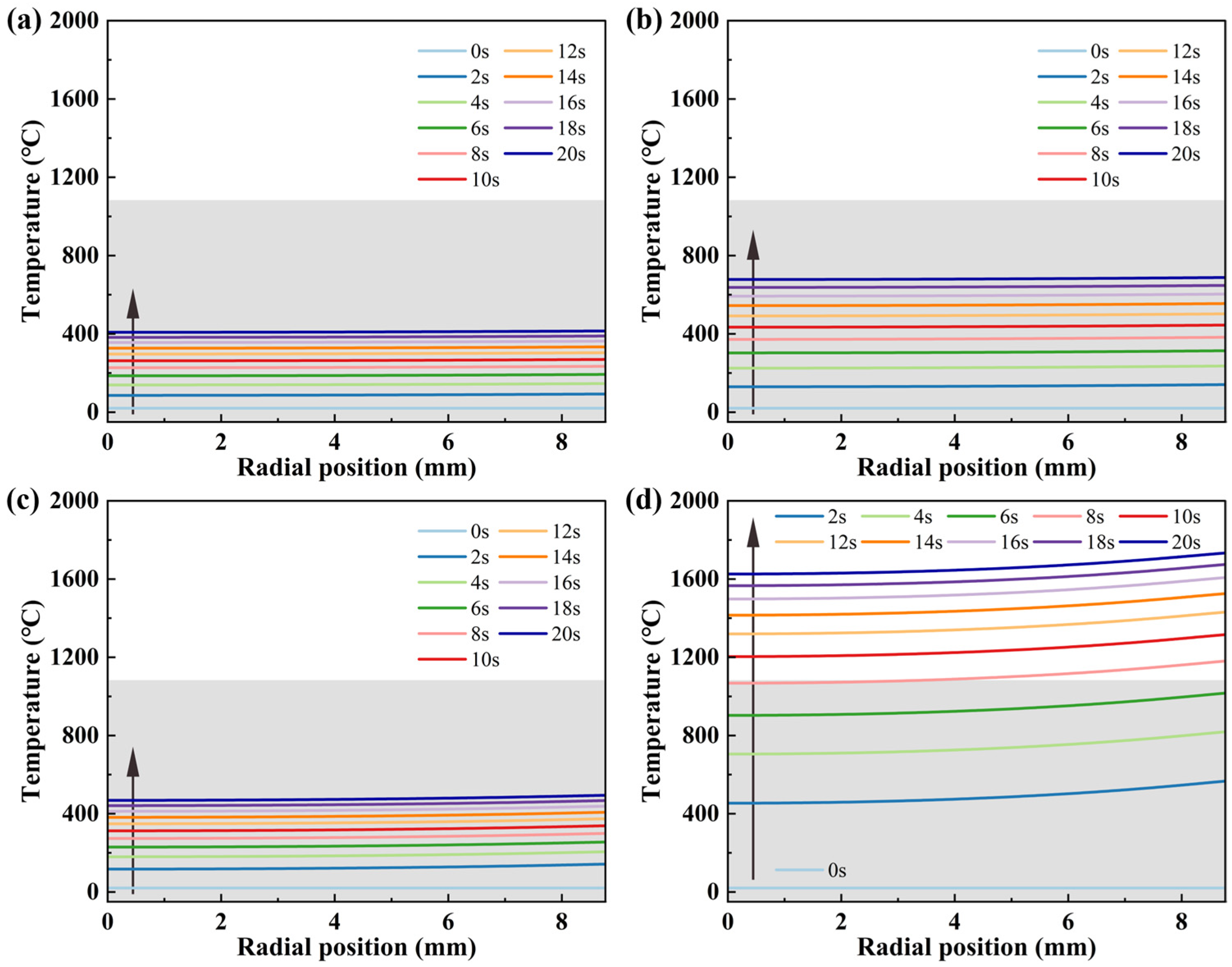
High-quality conductor welding requires not only precise axial heating of the weld seam but also uniform heating across the conductor cross-section to form a good, uniform molten pool. Figure 10 illustrates the dynamic changes in the radial temperature distribution within the weld seam cross-section (z = 0) during the heating process. The radial direction refers to the coordinate axis r in the 2D axis-symmetric model. Specifically, the radial temperature distribution is analyzed along the cross-section of the weld seam center (z = 0), extending from the conductor core (r = 0) to its outer surface (r = 8.75 mm). The results show that for the optimized system (Figure 10d), despite the skin effect causing the surface to heat faster than the core, heat is able to conduct rapidly from the surface to the center. In the time after reaching the melting point, the temperature difference between the conductor surface and center is controlled to within 100 °C, indicating that the entire cross-section is sufficiently and relatively uniformly heated. In contrast, although the radial temperature curves for the other three cases (Figure 10a–c) are flat, this is a result of insufficient heating. During a heating period of up to 20 s, the overall temperature remains far below the welding temperature, and due to the low heating efficiency, almost no temperature gradient is established within the conductor. Uniform heating is fundamental to forming a defect-free, fully penetrated welded joint, and the optimized system maintains excellent heating quality even while achieving extremely rapid heating.

4.3. Thermal Impact on Adjacent Layers

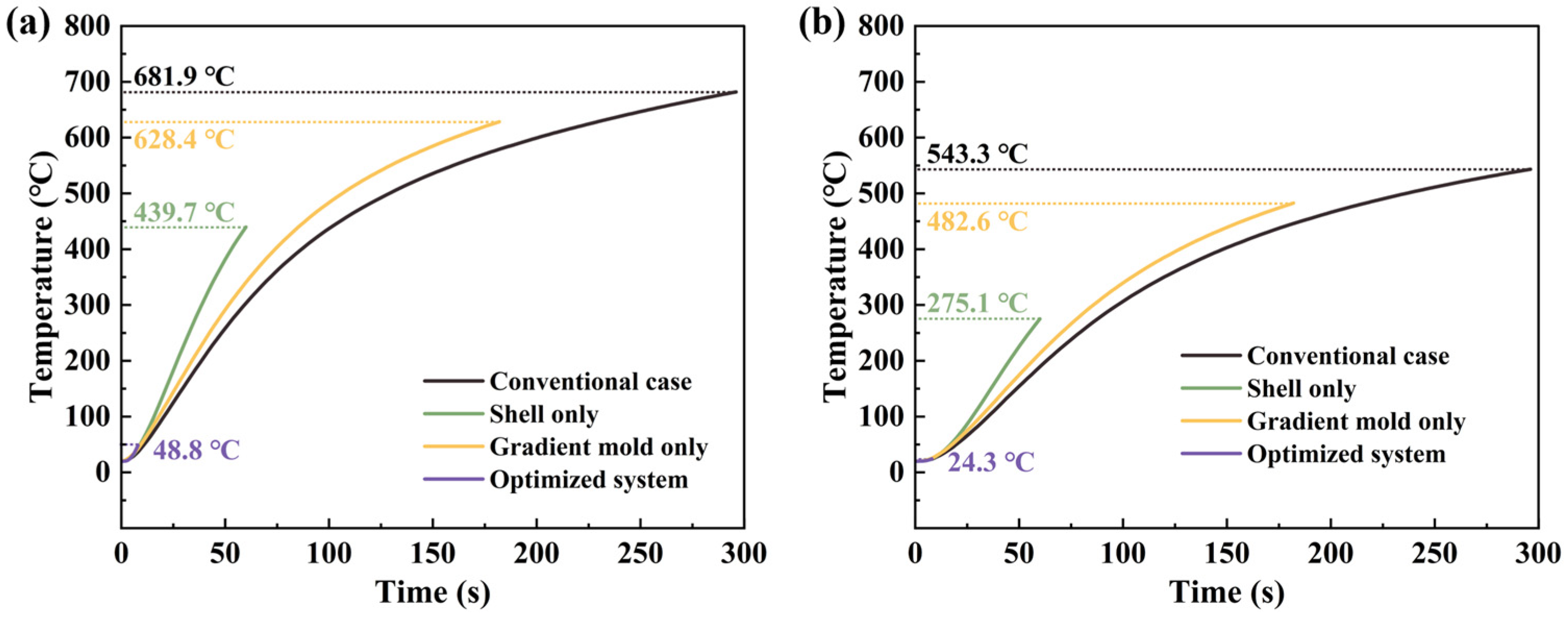
To evaluate the safety of the proposed system, it is essential to analyze the thermal impact on adjacent layers at the moment of weld completion for each configuration. Although the conventional and intermediate cases exhibit negligible temperature rise at 8.5 s, they must undergo prolonged heating to reach the target welding temperature. Comparing the systems at their respective melting points (7.78 s for the optimized system vs. 296 s for the conventional case) provides a realistic assessment of their practical feasibility. This approach highlights whether the flux control strategy can effectively suppress the heat conduction to the XLPE insulation. Figure 11 compares the temperature evolution at the inner screen (Figure 11a) and insulation interfaces (Figure 11b) for all cases at the instant the weld-seam center reaches the melting point of copper.
In the optimized system, its heating rate is so high that there is almost insufficient time for heat to conduct outwards. Consequently, upon completion of welding, the temperatures of the screen and insulation layers are only 48.8 °C and 24.3 °C, respectively, representing a minimal temperature rise. This proves that the optimized system causes virtually no damage to the insulation and screen layers during welding. In contrast, to reach the same target welding temperature, the other setups require prolonged, continuous heating, which leads to a large amount of stray heat being conducted to the adjacent layers. After 296 s of heating, the temperatures of the screen and insulation layers in the Conventional case have climbed to 681.9 °C and 543.3 °C, respectively. The Gradient mold-only case, being slightly faster, results in slightly lower adjacent layer temperatures, but they still reach 628.4 °C and 482.6 °C. The Shell-only case requires less time, but its adjacent layer temperatures still soar to 439.7 °C and 275.1 °C. These temperatures far exceed the long-term operating temperatures, and even the thermal decomposition temperatures, of the screen material and cross-linked polyethylene (XLPE) insulation. This would cause irreversible thermal damage to these critical materials, severely threatening the electrical performance and operational safety of the joint [38].
The current study utilizes the Bruggeman model to predict macroscopic electromagnetic properties. Future work will incorporate high-order effects such as temperature-dependent permeability and interfacial thermal resistance to further refine the system performance during prolonged operations.
From the perspective of engineering implementation, the gradient composite ceramic mold exhibits high manufacturability and economic viability. The mold can be fabricated using standard powder metallurgy or slurry infiltration techniques, using commercially available NiZn ferrite and alumina powders. Although the customized gradient structure involves a more complex layering process during filling, the resulting ceramic mold is highly durable and reusable for numerous welding cycles. Given that the prevention of thermal damage to high-voltage cable insulation can avoid massive repair costs and power grid downtime, the proposed system offers a cost-effective solution for high-performance cable joining.

5. Conclusions

This study addresses the safety risks associated with traditional conductor welding, specifically the open flames and toxic fumes inherent in exothermic welding as mentioned in the introduction and the inefficiency of conventional induction heating for copper cables. To overcome these challenges, a novel magnetic flux control system based on gradient-permeability ceramics was designed, modeled, and systematically evaluated through comparative multiphysics simulations. The key conclusions are summarized as follows:
  • An order-of-magnitude increase in heating rate was achieved, validating the design’s effectiveness. The proposed optimized system can heat the weld seam of a 240 mm2 copper conductor to its melting point (1083 °C) in 7.78 s, a rate far exceeding that of the Conventional case (296 s) and the intermediate cases. This demonstrates a powerful synergistic effect between the focusing action of the gradient permeability mold and the confinement action of the high-permeability shielding shell;
  • A high degree of precision in the heating process was realized. The magnetic flux density at the weld seam center of the optimized system is 3.7 times that of the Conventional case, which in turn increases the induced thermal power density by more than an order of magnitude. The analysis shows that the system achieves a high concentration of energy in both space (via magnetic flux focusing) and time (via rapid energy injection within 7.78 s, which is significantly shorter than the characteristic thermal diffusion time of the cable system). This temporal and spatial localization effectively suppresses stray heating while enabling ultra-high-speed heating (38 times faster than the conventional case). Furthermore, excellent heating quality was maintained; the radial temperature difference across the conductor cross-section was kept below 100 °C at the moment of fusion (<10% of the melting point). This high degree of thermal uniformity ensures near-simultaneous melting from the conductor surface to the core, providing a solid basis for forming a defect-free, fully fused welded joint;
  • The optimized system successfully prevents heat diffusion to the shielding and insulation layers through its rapid and precise heating strategy. Upon completion of the welding task, the temperature rise in its inner shielding and insulation layers was minimal (48.8 °C and 24.3 °C, respectively), whereas for the other cases to achieve the same goal, the maximum temperatures exceeded 600 °C.
The proposed magnetic flux control system offers a highly promising technological solution for the safe, rapid, precise, and environmentally friendly on-site welding of power cable conductors. The design methodology presented in this study is scalable and can be adapted to various cable specifications by recalibrating the gradient permeability profiles. Furthermore, the proposed magnetic flux control strategy is applicable to both copper and aluminum conductors across different voltage ratings, demonstrating significant potential for broader industrial application in power grid construction. Future research could focus on the following aspects: (1) building an experimental platform to physically validate the simulation results; (2) optimizing the system parameters for cables of different specifications and materials; and (3) conducting in-depth studies on the long-term service performance (e.g., thermal shock resistance, mechanical stability) of the gradient permeability composite ceramics.

Author Contributions

Conceptualization, B.B. and R.Z.; Data curation, S.Z.; Formal analysis, S.Z. and R.Z.; Funding acquisition, X.Z.; Investigation, J.Z.; Methodology, J.B. and G.L.; Project administration, X.Z.; Resources, J.W.; Software, J.B.; Supervision, S.Z. and G.L.; Validation, B.B.; Visualization, M.Z.; Writing—original draft, S.Z., B.B., J.B., J.Z., R.Z. and G.L.; Writing—review and editing, X.Z., J.W. and M.Z. All authors have read and agreed to the published version of the manuscript.

Funding

This research received no external funding.

Data Availability Statement

The original contributions presented in this study are included in the article. Further inquiries can be directed to the corresponding authors.

Conflicts of Interest

Authors Shuo Zha, Bingchang Bi, Jianbin Bi, Jiakun Zou, Ming Zeng, Renfei Zhang, Guochu Luo were employed by Guangzhou Power Supply Bureau of Guangdong Power Grid Co Ltd. The remaining authors declare that the research was conducted in the absence of any commercial or financial relationships that could be construed as a potential conflict of interest.

References

  1. Rafati, A.; Mirshekali, H.; Shaker, H.R.; Bayati, N. Power Grid Renovation: A Comprehensive Review of Technical Challenges and Innovations for Medium Voltage Cable Replacement. Smart Cities 2024, 7, 3727–3763. [Google Scholar] [CrossRef]
  2. Yang, F.; Cheng, P.; Luo, H.; Yang, Y.; Liu, H.; Kang, K. 3-D Thermal Analysis and Contact Resistance Evaluation of Power Cable Joint. Appl. Therm. Eng. 2016, 93, 1183–1192. [Google Scholar] [CrossRef]
  3. Späck-Leigsnering, Y.; Ruppert, G.; Gjonaj, E.; De Gersem, H.; Koch, M. Towards Electrothermal Optimization of a HVDC Cable Joint Based on Field Simulation. Energies 2021, 14, 2848. [Google Scholar] [CrossRef]
  4. Yu, T.; Liu, S.; Duan, X.; Zhong, C.; Duan, J.; Zeng, Z.; Zhang, D. Research on Defects of High Voltage Cable Fusion Joint Using XLPE Insulation Material. J. Phys. Conf. Ser. 2022, 2378, 012017. [Google Scholar] [CrossRef]
  5. Wang, J.; Li, H.; Hu, C.; Wang, Z.; Han, K.; Liu, D.; Wang, J.; Zhu, Q. The Efficiency of Thermite-Assisted Underwater Wet Flux-Cored Arc Welding Process: Electrical Dependence, Microstructural Changes, and Mechanical Properties. Metals 2023, 13, 831. [Google Scholar] [CrossRef]
  6. Liu, Y.; Tsang, K.S.; Tan, Z.E.; Alagu Subramaniam, N.; Pang, J.H.L. Investigation on Material Characteristics and Fatigue Crack Behavior of Thermite Welded Rail Joint. Constr. Build. Mater. 2021, 276, 122249. [Google Scholar] [CrossRef]
  7. Kewalramani, R.G.; Riehl, I.; Hantusch, J.; Fieback, T. Numerical Investigation of the Cooling Stage during Aluminothermic Welding of Rails: Rapid Welding Process without Preheating. Therm. Sci. Eng. Prog. 2023, 37, 101610. [Google Scholar] [CrossRef]
  8. Josefson, B.L.; Bisschop, R.; Messaadi, M.; Hantusch, J. Residual Stresses in Thermite Welded Rails: Significance of Additional Forging. Weld World 2020, 64, 1195–1212. [Google Scholar] [CrossRef]
  9. Li, H.; Hu, C.; Hu, J.; Han, K.; Wang, Z.; Yang, R.; Liu, D. Underwater Wet Welding of High-Strength Low-Alloy Steel Using Self-Shielded Flux-Cored Wire with Highly Exothermic Al/CuO Mixture. J. Mater. Process. Tech. 2024, 328, 118404. [Google Scholar] [CrossRef]
  10. Jia, X.; Tong, L.; Hu, X.; Mao, J. General Mechanism Review of Aluminum-Based Thermite Reaction. Adv. Eng. Mater. 2025, 27, 1172. [Google Scholar] [CrossRef]
  11. Yang, Z.; Liu, H.; Li, M.; Wang, X.; Li, Y.; Han, Z.; Singh, A.V.; Jiang, L.; Rotaru, A. Combustion and Energy Release Characteristics of Al/CuWO4 Metal Oxide-Based Thermite. Ceram. Int. 2025, 39, 091301. [Google Scholar] [CrossRef]
  12. Esteve, A.; Rossi, C. Thermite Combustion: Current Trends in Modeling and Future Perspectives. Appl. Energy Combust. Sci. 2025, 22, 100332. [Google Scholar] [CrossRef]
  13. Nie, H.; Chan, H.Y.; Pisharath, S.; Hng, H.H. Combustion Characteristic and Aging Behavior of Bimetal Thermite Powders. Def. Technol. 2021, 17, 755–762. [Google Scholar] [CrossRef]
  14. Tong, D.; Gu, J.; Totten, G.E. Numerical Investigation of Asynchronous Dual-Frequency Induction Hardening of Spur Gear. Int. J. Mech. Sci. 2018, 142–143, 1–9. [Google Scholar] [CrossRef]
  15. Tong, D.; Gu, J.; Yang, F. Numerical Simulation on Induction Heat Treatment Process of a Shaft Part: Involving Induction Hardening and Tempering. J. Mater. Process. Tech. 2018, 262, 277–289. [Google Scholar] [CrossRef]
  16. Yousefzadeh, Z.; Rezvani Rad, M.; McDonald, A.; Lloyd, S.M. Life Cycle Assessment of a Thermal Sprayed Al2O3–NiCr Resistive Heating Coating for Pipe Freeze Protection. J. Therm. Spray Techn. 2022, 31, 378–395. [Google Scholar] [CrossRef]
  17. Xiao, Y.; Wen, H.-Y.; Han, Y.; Li, D.-L.; Xu, D. Comparative Study of Typical Electromagnetic Heating Methods in Welded Pipe: Induction Heating Versus Contact Heating. J. Therm. Sci. Eng. Appl. 2023, 15, 061002. [Google Scholar] [CrossRef]
  18. Wu, Y.; Xiao, L.; Han, S.; Chen, J. Magnetic Flux Concentration Technology Based on Soft Magnets and Superconductors. Crystals 2024, 14, 747. [Google Scholar] [CrossRef]
  19. Kim, D.-S.; So, J.-Y.; Kim, D. Study on Heating Performance Improvement of Practical Induction Heating Rice Cooker with Magnetic Flux Concentrator. IEEE Trans. Appl. Supercond. 2016, 26, 0604304. [Google Scholar] [CrossRef]
  20. Li, F.; Li, X.; Wang, T.; Rong, Y.; Liang, S.Y. In-Process Residual Stresses Regulation during Grinding through Induction Heating with Magnetic Flux Concentrator. Int. J. Mech. Sci. 2020, 172, 105393. [Google Scholar] [CrossRef]
  21. Li, F.; Ning, J.; Wang, T.; Liang, S.Y. Analytical Modeling and Sensitivity Analysis of the Temperature Distribution in the Planar Scanning Induction Heating Based on 2D Moving Heat Source. J. Mech. Sci. Technol. 2019, 33, 5093–5102. [Google Scholar] [CrossRef]
  22. Dong, H.; Zhao, Y.; Yuan, H. Effect of Coil Width on Deformed Shape and Processing Efficiency during Ship Hull Forming by Induction Heating. Appl. Sci. 2018, 8, 1585. [Google Scholar] [CrossRef]
  23. Sureshkumar, A.; Gunabalan, R.; Vishnuram, P.; Ramsamy, S.; Nastasi, B. Investigation on Performance of Various Power Control Strategies with Bifilar Coil for Induction Surface Melting Application. Energies 2022, 15, 3301. [Google Scholar] [CrossRef]
  24. Kilic, V.T.; Unal, E.; Volkan Demir, H. High-efficiency Flow-through Induction Heating. IET Power Electron. 2020, 13, 2119–2126. [Google Scholar] [CrossRef]
  25. Bio Gassi, K.; Guene Lougou, B.; Baysal, M.; Ahouannou, C. Thermal and Electrical Performance Analysis of Induction Heating Based-thermochemical Reactor for Heat Storage Integration into Power Systems. Int. J. Energy Res. 2021, 45, 17982–18001. [Google Scholar] [CrossRef]
  26. Nishikawa, D.; Miyamoto, K.; Kobayashi, H.; Inoue, R.; Ueda, H.; Kim, S. Study on the Current Bypassing and Mechanical Properties of No-Insulation HTS Coil With Protection Ring. IEEE Trans. Appl. Supercond. 2021, 31, 4603405. [Google Scholar] [CrossRef]
  27. Xie, Y.; Chu, G.; Wang, Y. Study on the Induction Heating Thermal Field in a Vulcanizing Machine Aimed at Temperature Uniformity Control. Int. J. Therm. Sci. 2026, 219, 110223. [Google Scholar] [CrossRef]
  28. Miyoshi, T.; Omori, H.; Maeda, G. Reduction of Magnetic Flux Leakage from an Induction Heating Range. IEEE Trans. Ind. Appl. 1983, IA-19, 491–497. [Google Scholar] [CrossRef]
  29. Watanabe, T.; Nagaya, S.; Hirano, N.; Fukui, S.; Furuse, M. Development of Conduction-Cooled Superconducting Split Coil for Metal Melting by DC Induction Heating. IEEE Trans. Appl. Supercond. 2018, 28, 3700104. [Google Scholar] [CrossRef]
  30. Cui, P.; Zhu, W.; Ji, H.; Chen, H.; Hang, C.; Li, M. Analysis and Optimization of Induction Heating Processes by Focusing the Inner Magnetism of the Coil. Appl. Energy 2022, 321, 119316. [Google Scholar] [CrossRef]
  31. Calata, J.N.; Lu, G.-Q.; Ngo, K. Soft Magnetic Alloy–Polymer Composite for High-Frequency Power Electronics Application. J. Electron. Mater. 2013, 43, 126–131. [Google Scholar] [CrossRef]
  32. Yang, Y.; Wang, Y.; Wu, S.; Liu, C.; Chen, L. Core Loss Analysis of Soft Magnetic Composites Considering the Inter-Particle Eddy Current Loss. AIP Adv. 2021, 11, 015140. [Google Scholar] [CrossRef]
  33. Corcolle, R.; Ren, X.; Daniel, L. Effective Properties and Eddy Current Losses of Soft Magnetic Composites. J. Appl. Phys. 2021, 129, 015103. [Google Scholar] [CrossRef]
  34. Bruggeman, D.A.G. Berechnung Verschiedener Physikalischer Konstanten von Heterogenen Substanzen. I. Dielektrizitätskonstanten Und Leitfähigkeiten Der Mischkörper Aus Isotropen Substanzen. Ann. Phys. 1935, 416, 636–664. [Google Scholar] [CrossRef]
  35. Cordier, A.; El Khal, H.; Siebert, E.; Steil, M.C. On the Role of the Pore Morphology on the Electrical Conductivity of Porous Yttria-Stabilized Zirconia. J. Eur. Ceram. Soc. 2019, 39, 2518–2525. [Google Scholar] [CrossRef]
  36. Das, B.C.; Hossain, A.K.M.A. Rietveld Refined Structure, Ferroelectric, Magnetic and Magnetoelectric Response of Gd-Substituted Ni–Cu–Zn Ferrite and Ca, Zr Co-Doped BaTiO3 Multiferroic Composites. J. Alloys Compd. 2021, 867, 159068. [Google Scholar] [CrossRef]
  37. Rudnev, V.; Akers, R.R.; Baake, E.; Ferguson, B.L.; Totten, G. ASM Handbook: Induction Heating and Heat Treatment; ASM International: Materials Park, OH, USA, 2014. [Google Scholar]
  38. Alshrah, M.; Adeyemi, I.; Janajreh, I. Kinetic Study on Thermal Degradation of Crosslinked Polyethylene Cable Waste. J. Polym. Res. 2022, 29, 289. [Google Scholar] [CrossRef]
Figure 1. Schematic of the conventional exothermic welding process. Stripped conductor ends are enclosed in a graphite mold where a high-temperature thermite reaction is triggered, generating molten metal to fuse the joint at the welding position.
Energies 19 01006 g001
Figure 2. Schematic diagram of the magnetic flux control system.
Energies 19 01006 g002
Figure 3. The 2D axisymmetric geometric model. (a) Definition of key geometric structures and material regions (b) Cable region (c) Entire computational domain.
Energies 19 01006 g003
Figure 4. Schematic diagram of comparative cases. (a) Conventional case, (b) Shell only, (c) Gradient mold only.
Energies 19 01006 g004
Figure 5. Comparison of magnetic field distribution for each case: (a) Conventional case, (b) Shell only, (c) Gradient mold only, (d) Optimized system.
Energies 19 01006 g005
Figure 6. Axial distribution of induced thermal power density along the conductor surface for each case. The darker background areas represent regions of higher permeability.
Energies 19 01006 g006
Figure 7. Temperature-time curves at the weld seam center for each case.
Energies 19 01006 g007
Figure 8. Temperature field contour plots for each case at t = 8.5 s: (a) Conventional case, (b) Shell only, (c) Gradient mold only, (d) Optimized system.
Energies 19 01006 g008
Figure 9. Spatiotemporal evolution of the axial temperature distribution for each case: (a) Conventional case, (b) Shell only, (c) Gradient mold only, (d) Optimized system.
Energies 19 01006 g009
Figure 10. Spatiotemporal evolution of the radial temperature distribution for each case: (a) Conventional case, (b) Shell only, (c) Gradient mold only, (d) Optimized system.
Energies 19 01006 g010
Figure 11. Temperatures at (a) the inner interface of the inner screen layer and (b) the inner interface of the insulation layer for each case at the moment the weld seam is heated to its melting point.
Energies 19 01006 g011
Table 1. Required ferrite volume fractions for achieving target effective permeabilities, calculated based on the Bruggeman symmetric medium theory.
Target Effective Relative Permeability (μeff)Required Ferrite Volume Fraction (f)
10
60.31
100.35
200.42
500.59
1000.86
Table 2. Physical properties of the main materials in the simulation model. (Note: Material parameters are sourced from standard COMSOL 6.4 libraries and industrial datasheets; composite properties are calculated using the Bruggeman theory).
MaterialRelative Permeability (μr)Electrical Conductivity (S/m)Thermal Conductivity (W/(m·K))Density (kg/m3)Heat Capacity (J/(kg·K))
Copper1σcopper (T)4008960385
Insulation Layer11 × 10−150.289202300
Screen Layer15 × 1040.411001500
Composite Ceramic1, 6, 10, 20, 50, 1001 × 10−10202200800
Induction Coil15.8 × 1074008960385
Table 3. Configuration details of the four comparative cases.
CaseCeramic MoldHigh-Permeability Shielding ShellDesign Purpose
Conventional case (Figure 4a)Alumina (μr = 1)NoneServes as a baseline to simulate conventional induction heating.
Shell only (Figure 4b)Alumina (μr = 1)YesTo evaluate the magnetic field confinement effect of the shield.
Gradient mold only (Figure 4c)Gradient permeabilityNoneTo evaluate the magnetic field focusing effect of the gradient mold.
Optimized system (Figure 2)Gradient permeabilityYesTo evaluate the synergistic effect of the complete proposed system.
Disclaimer/Publisher’s Note: The statements, opinions and data contained in all publications are solely those of the individual author(s) and contributor(s) and not of MDPI and/or the editor(s). MDPI and/or the editor(s) disclaim responsibility for any injury to people or property resulting from any ideas, methods, instructions or products referred to in the content.