1. Introduction
Electrochemical insights developed in other energy technologies have significantly contributed to the conceptual and material development of microbial fuel cells (MFCs). Research on lithium–sulfur and sodium–sulfur batteries, as well as on polymer electrolyte and anion-exchange membrane fuel cells, has clarified how ion transport, interfacial passivation, and membrane conductivity govern stable potentials and low internal resistance [
1,
2,
3,
4,
5,
6,
7,
8,
9,
10,
11,
12,
13,
14]. These advances demonstrate that interfacial control and electrolyte design—central to battery and actuator technologies—can also guide the engineering of ion diffusion and charge separation in MFCs. Similarly, ionomeric actuators and ionic polymer–metal composite devices highlight how polymer flexibility, hydration, and ion mobility affect electrochemical coupling, insights that can be adapted to optimize MFC membranes and electrode coatings [
9,
11,
12,
13,
14].
The growing global energy crisis, intensified by climate change and ecosystem degradation, has increased the urgency to develop renewable technologies that ensure sustainable and efficient energy generation [
3]. Among these, microbial fuel cells (MFCs) have emerged as bioelectrochemical systems capable of directly converting the chemical energy contained in organic matter into electricity through microbial metabolism [
14,
15,
16,
17,
18]. Their potential to produce clean energy under mild operational conditions situates them as a promising alternative within the renewable energy landscape [
19,
20,
21]. In particular, MFCs integrate biological and electrochemical processes, allowing simultaneous energy recovery [
5,
22].
The basic principle of an MFC lies in the oxidation of organic compounds at the anode and the reduction in oxygen at the cathode, coupled through microbial metabolism and external electron flow [
9,
15,
18]. However, although this concept is well established, practical applications still face critical challenges. The power output of MFCs remains considerably lower than that of conventional fuel cells, even under optimized laboratory conditions [
16,
23,
24]. Scale-up efforts are hindered by mass-transfer limitations, unstable biofilm formation, electrode degradation, and the heterogeneity of organic substrates [
23,
24,
25]. These factors directly impact energy yield and long-term reproducibility. Moreover, while MFCs offer environmental benefits, their sustainability and energy efficiency must be evaluated through integrated techno-economic and ecological assessments [
22,
26].
At the cathodic level, one of the main limitations is the sluggish oxygen-reduction reaction (ORR), which constrains power generation [
27]. To overcome this kinetic bottleneck, catalysts such as MnO
2, Pd, and NiO have been applied to enhance ORR kinetics under neutral conditions [
28,
29]. More recently, platinum-group-metal-free (PGM-free) catalysts have attracted attention as sustainable and cost-effective alternatives to platinum-based materials [
30,
31]. Biomass-derived carbon composites and graphitic coatings provide additional advantages by combining high surface area, catalytic activity, and corrosion resistance [
10,
32]. Hierarchical cathode designs and nanostructured catalyst layers have improved oxygen diffusion and reduced overpotential losses, contributing to higher overall efficiency [
33,
34,
35]. These studies illustrate that cathode optimization is as crucial as anode design in achieving balanced charge transfer and stable power output.
The overall performance of MFCs depends on the synergy between three main components: microbial metabolism, electrode materials, and redox kinetics [
33,
36,
37]. At the anode, biofilm stability and electron transfer are strongly influenced by surface properties such as roughness, conductivity, and hydrophilicity [
33,
35,
38]. Conventional graphite plates exhibit chemical inertness and high conductivity but limited surface area. Subsequent designs introduced conductive polymers and nanostructured composites, which enhanced microbial adhesion and current density [
39,
40]. Carbon–metal hybrids and alloy coatings further improved work-function alignment and charge transfer efficiency [
34,
37,
41]. In this work, we employed a single-chamber, membrane-less microbial fuel cell with both electrodes fully immersed in a glucose-enriched electrolyte and an air-breathing cathode. Single-chamber air-cathode designs have been widely used because they simplify construction and allow efficient oxygen reduction at the cathode while still generating measurable power despite oxygen diffusion into the bulk liquid [
42,
43,
44]. In such systems, oxygen unavoidably diffuses from the air headspace through the cathode region into the anolyte and towards the anode, which decreases coulombic efficiency but does not suppress current generation [
43,
45].
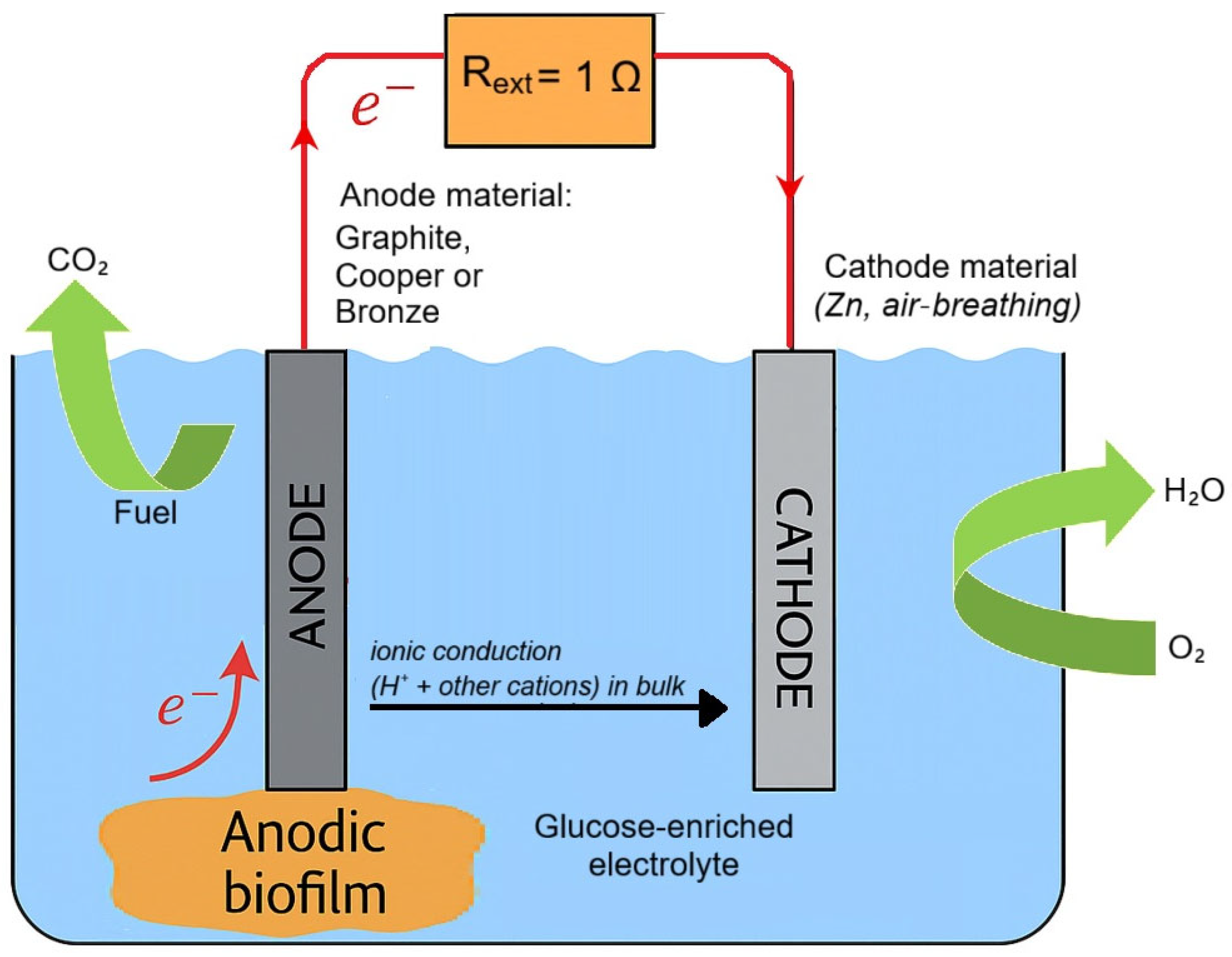
Our schematic representation (
Figure 1) therefore depicts oxygen entering the reactor at the cathodic side and both electrodes completely submerged in the electrolyte, consistent with how the cell was actually operated.
The anode chamber was not intended to be strictly anaerobic. Instead, the reactor was operated under microaerobic conditions where oxygen serves as a competing but not exclusive terminal electron acceptor. Miniature and single-chamber MFCs with aerobic or partially oxygenated anode compartments have shown that electroactive biofilms can still transfer electrons to the anode even when dissolved oxygen is present, although this occurred at lower coulombic efficiencies compared to strictly anaerobic systems [
43,
45]. In our configuration, the microbial consortium consumes oxygen within the biofilm and bulk liquid while simultaneously directing a fraction of electrons towards the anode, which is consistent with the moderate but stable voltages observed.
Comparative analyses of metallic and carbonaceous electrodes have shown that corrosion behavior, ion release, and biofilm morphology directly affect long-term electrochemical stability [
24,
35,
37,
38,
39,
40,
46,
47,
48]. The superior performance of graphitic surfaces is often attributed to their favorable microstructure, biocompatibility, and low toxicity [
35,
38]. Meanwhile, compact MFC architectures designed as biosensors have demonstrated that minimizing electrode spacing and controlling oxygen gradients can enhance voltage stability and response reproducibility [
22,
26,
49]. Such miniaturized formats confirm that geometric and material optimization can stabilize redox gradients even in low-power systems, offering design principles applicable to larger energy-oriented configurations.
The evolution of MFC technology has also been shaped by biological advances. Mixed microbial consortia have demonstrated superior substrate versatility, self-regulation, and operational stability compared to pure cultures [
36,
50,
51]. Such communities establish metabolic cooperation networks where fermentative and oxidative microorganisms complement each other, enhancing both energy yield and resilience [
21,
50]. For example,
Saccharomyces cerevisiae and
Acetobacter aceti form a natural syntrophic pair: the yeast ferments glucose into ethanol, while the bacterium oxidizes ethanol into acetate and CO
2; in bioelectrochemical configurations, this cascade can, in principle, provide electrons to an anode surface as reported for AAB-based MFCs [
52,
53,
54].
Although anaerobic anodes are often recommended to maximize electron recovery, several studies have shown that
Saccharomyces cerevisiae can continue to produce ethanol even when oxygen is available, provided that sugar concentrations and growth rates are sufficiently high. Under aerobic chemostat conditions,
S. cerevisiae exhibits substantial specific ethanol productivities when glucose is the growth-limiting substrate, reflecting the well-known phenomenon of aerobic or Crabtree-positive fermentation [
55]. Likewise, under enological conditions, small oxygen additions are required for sterol and fatty acid synthesis but do not prevent fermentative metabolism; oxygen pulses mainly affect fermentation kinetics rather than fully switching to respiration [
56]. These results support the view that ethanol production can persist under microaerobic conditions similar to those expected in our single-chamber reactor.
On the other hand,
Acetobacter aceti is an obligate aerobe that grows optimally in low-alcohol media at moderate dissolved oxygen levels. A kinetic study of submerged acetic fermentations reported that
A. aceti growth is inhibited at high ethanol concentrations and at dissolved oxygen levels above about 5 ppm, whereas lower oxygen concentrations favor productive acetic fermentation [
57]. Therefore, a mildly oxygenated anolyte is compatible with ethanol oxidation to acetic acid by
A. aceti. Taken together, these findings indicate that the coexistence of
S. cerevisiae (primarily fermentative) and
A. aceti (obligately respiratory) in a microaerobic single-chamber MFC is biochemically feasible: yeast cells can supply ethanol, while
A. aceti can oxidize ethanol to acetic acid using oxygen and potentially the anode as alternative electron acceptors.
Similar cascade mechanisms have been observed in other electrogenic consortia where fermentation products act as biological mediators for electron flow [
21,
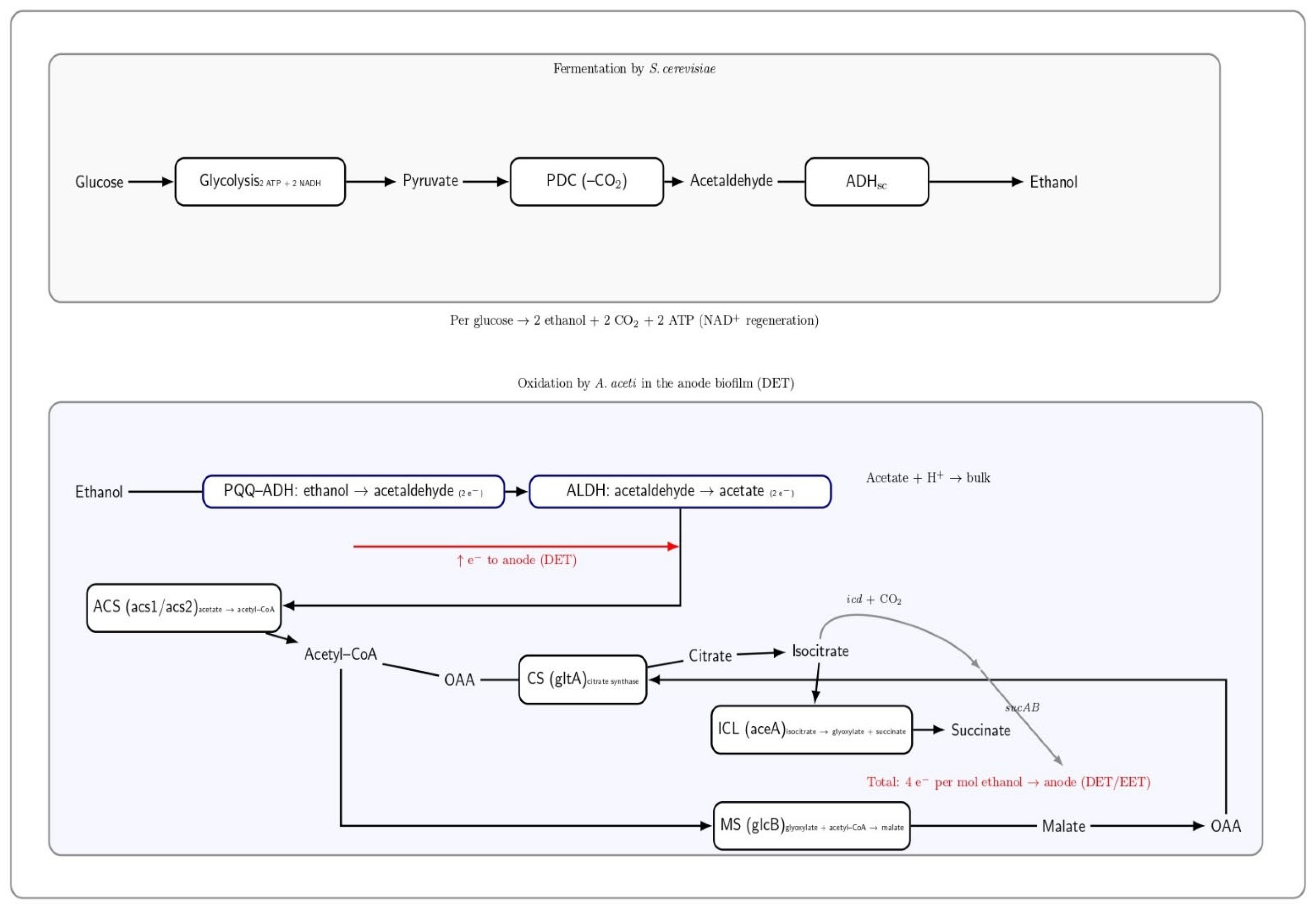
36]. Beyond electrochemical contexts, mixed fermentations such as those observed in kombucha cultures demonstrate analogous yeast–AAB interactions that stabilize metabolic fluxes through redox cooperation, reflecting the same cascade exploited in this study [
58,
59], as shown in
Figure 2. The incorporation of advanced materials has further boosted electrochemical performance. Nanostructured carbon supports, doped composites, and hybrid architectures have improved conductivity, surface area, and microbial biocompatibility [
6,
7,
47,
60]. These materials facilitate direct electron transfer (DET), a key process by which microorganisms donate electrons to conductive surfaces without synthetic mediators [
52]. For instance,
A. aceti possesses
pyrroloquinoline quinone (PQQ)-dependent alcohol dehydrogenases that enable electron transfer through its periplasmic membrane to the electrode [
52,
53]. In such systems, electrode material and biofilm architecture jointly determine current density and redox potential [
33,
34,
38,
61].
In our single-chamber system, the anode region is not strictly anaerobic, but is, rather, microaerobic. Under such conditions,
Saccharomyces cerevisiae can maintain high ethanol yields while consuming small oxygen pulses that actually improve fermentation kinetics [
55,
56], whereas
Acetobacter aceti uses the residual oxygen as terminal electron acceptor for incomplete ethanol oxidation to acetate [
57,
62]. Thus, both organisms can coexist functionally despite partial oxygen diffusion from the cathode.
In addition to material and biological innovation, advances in data analysis have strengthened the understanding of MFC dynamics. The nonlinear and multivariate nature of MFC behavior, driven by interactions among substrate concentration, redox potential, and microbial growth, challenges traditional empirical models [
63,
64]. Consequently, multivariate statistical tools and machine learning frameworks have been increasingly applied to evaluate latent variables, quantify causal relationships, and forecast energy generation under varying operational conditions [
63,
64,
65]. Optimization algorithms and predictive modeling approaches help identify critical parameters, improve system efficiency, and reduce experimental uncertainty, supporting the rational design of MFC architectures [
24,
25,
63,
64,
65,
66].
Despite these advances, accurately predicting MFC behavior remains complex due to nonlinear interactions among substrate concentration, redox potential, biofilm growth, and voltage response [
63,
64,
65,
66]. Traditional empirical approaches often fail to capture the multivariate dependencies that govern electrochemical performance. For this reason, partial least squares structural equation modeling (PLS-SEM) has emerged as a robust tool to evaluate hidden relationships among operational and electrochemical variables. These models enable the identification of the most influential electrochemical and biological parameters, supporting rational design and optimization of MFC systems [
63,
64,
65,
66].
In addition to predictive modeling, the study incorporates the variance inflation factor (VIF) as a diagnostic parameter to detect multicollinearity among electrochemical indicators. High interdependence between physicochemical variables—such as pH, ORP, and salinity—can distort the estimation of structural coefficients and reduce the interpretability of causal paths in PLS-SEM models [
67]. Including VIF assessment (<5 as the general threshold) ensures that each indicator contributes uniquely to the latent constructs (
Substrate Quality,
Redox Parameters, and
Voltage Production), thus reinforcing model robustness and predictive reliability. This diagnostic step is particularly relevant in microbial fuel cell studies, where strong redox coupling and ionic intercorrelations frequently occur due to shared electrochemical equilibria [
4]. By integrating VIF control, this research guarantees that the proposed relationships between operational and electrochemical variables are statistically valid and not artifacts of redundant information.
Within this framework, the present study addresses a fundamental problem in microbial electrochemical systems: the limited ability to quantitatively predict voltage behavior from easily measurable variables. This limitation hinders the translation of laboratory-scale findings into scalable bioenergy solutions. Therefore, the objective of this study is to develop a predictive statistical model capable of describing and forecasting the electrochemical performance of microbial fuel cells based on experimental variables such as substrate composition, redox indicators, and voltage response. The research focuses on a single-chamber, membrane-less configuration using the mixed consortium S. cerevisiae–A. aceti, aiming to correlate material-dependent voltage differences with physicochemical parameters that define energy output. The ultimate goal is to contribute to the advancement of bioelectrochemical modeling for sustainable and energy production based on physicochemical variables.
2. Methods
2.1. Study Design
A single-chamber microbial fuel cell (MFC) system was developed and operated under batch conditions, fed with molasses as the carbon substrate. The system integrated a dual biocatalytic process, coupling Saccharomyces cerevisiae fermentation with Acetobacter aceti ethanol oxidation to enhance redox turnover and energy recovery. The MFC array consisted of 27 identical units grouped into three electrode material pairs: bronze–Zn (MFC 1–9), copper–Zn (MFC 10–18), and graphite–Zn (MFC 19–27). All of these shared the same geometry and operating conditions, each with a liquid volume of 250 mL, and both electrodes were fully immersed in the electrolyte (a single-chamber, membrane-less electrolyte); no anode deoxygenation was applied, and they were monitored over 20 operational cycles of 5 days each, yielding 540 observations overall.
Three electrode material combinations were tested to evaluate the influence of anode–cathode materials on electrochemical performance and ionic dynamics. The material selection was guided by recent evidence on interfacial resistance control, surface texturization, and optimization of extracellular electron transfer and oxygen-reduction reaction (ORR) kinetics [
8,
41,
68]. All electrodes were pretreated with dilute HCl (10%) and rinsed with distilled water before installation. The cells were maintained at 28 ± 2 °C and pH 3.8–4.2 without active aeration. Voltage was recorded continuously under a fixed external load of 1 Ω, and conductivity, salinity, total dissolved solids, pH, oxidation-reduction potential, electric conductivity, and Brix were measured every cycle to evaluate electrolyte evolution and system stability.
Table 1 summarizes the complete MFC configuration and operating conditions, including electrode area.
2.2. Substrate and Inoculation
The substrate was food-grade molasses (10–13.5 °Bx), diluted to ~10 g COD L−1. The initial pH was set to 6.8 ± 0.2; during the operation, it decreased and stabilized at 3.8–4.2 due to acetic acid production and conductivity of 3–6 µS cm−1. The inoculum consisted of S. cerevisiae (ethanol producer) and A. aceti (ethanol oxidizer), stabilized for 48 h in batch mode prior to electrical coupling. Operation followed repeated 5-day batch cycles. At the end of each cycle, 10 mL of the original molasses solution (at 30–50% of the initial °Brix) was aseptically added to the reactor without removing any liquid in order to replenish fermentable sugars while preserving the established biofilm and suspended biomass.
2.3. Data Acquisition and Instrumentation
Voltage (OCV and under load) was measured with a Pro’sKit MT-1210 digital multimeter Manufactured by Prokit’s Industries Co., Ltd. and produced in New Taipei City, Taiwan. A YIERYI BLE-C600 multiparameter device Manufactured by Shenzhen Yieryi Technology Co., Ltd. and produced in Shenzhen, China monitored potential hydrogen potential (pH), temperature (°C), oxygen-reduction potential (ORP), salinity, electric conductivity, and total dissolved solids.
2.4. SEM Model (PLS-SEM)
The statistical analysis was conducted using SmartPLS v3.2.9. Reflective constructs included Substrate Quality, Redox Parameters, and Voltage Production.
Reliability was evaluated with Cronbach’s alpha (α), Dijkstra–Henseler’s rho (ρa), and composite reliability (CR); for the model to be considered acceptable, all of them must exceed the threshold value of 0.70. Average Variance Extracted (AVE) was used to assess convergent validity, with acceptable values defined as AVE ≥ 0.50; to confirm that the constructs in the model are conceptually distinct from each other, the Fornell–Larcker criterion was applied.
Structural model assessment included collinearity (VIF < 5), path coefficients (β), explained variance (R2), effect sizes (f2; small, 0.02; medium, 0.15; large, 0.35), predictive relevance (Q2, via 7-fold omission), and PLSpredict. Bootstrap resampling was performed with 5000 iterations, two-tailed tests, and a 95% confidence level for t and p values.
Best practices were anchored in PLS-SEM methodology and electrochemical interface theory, covering surface robustness [
68], stability [
11,
69,
70], work function tuning [
41], and ionic transport [
48].
2.5. Hypothesis and Decision Criteria
Two hypotheses were tested:
H0. Substrate, electrodes, and redox parameters exert no significant effect on voltage production (β = 0).
H1. Substrate, electrodes, and/or redox parameters exert a significant effect on voltage production (β > 0).
H0 is rejected when p < 0.05. Model strength was confirmed when f2 ≥ 0.15, R2 ≥ 0.50, and Q2 > 0.
3. Results
A total of 540 experimental measurements were obtained from 27 single-chamber microbial fuel cells (MFCs) operated over 20 observation cycles. Each electrode material pair exhibited a characteristic electrochemical response, and the overall behavior of the array reflected the operation of the mixed
Saccharomyces cerevisiae–Acetobacter aceti consortium under the imposed feeding regime [
21,
36,
50,
71].
Across all reactors, the Brix values gradually decreased over time, confirming the continuous consumption of fermentable sugars throughout the 20 cycles. Salinity and total dissolved solids (TDSs) followed a similar overall downward trend, consistent with substrate conversion and progressive electrolyte dilution, although their absolute values remained higher in the metallic electrode groups. The oxidation-reduction potential (ORP) was maintained within a moderately oxidizing range (≈235–255 mV), and electrical conductivity (EC, µS cm−1) varied within a relatively narrow window, indicating that the electrolyte preserved sufficient ionic strength for charge transport. The pH stayed within an acidic interval (3.6–4.0), compatible with acetic fermentation conditions; however, direct analytical measurements of ethanol and acetate were not performed, so their production and consumption are inferred from established pathways for S. cerevisiae and A. aceti.
The voltage profile of the MFC array exhibited two distinct phases. During the initial hours of operation, a marked increase in potential was observed, coinciding with the period of intense sugar consumption. After this initial transient, the potential gradually stabilized, and the open-circuit voltage exceeded 0.8 V and remained relatively steady throughout the monitoring period for all three electrode material pairs.
Marked material-dependent differences were recorded. The bronze–Zn cells (MFC 1–9) exhibited the lowest voltages and highest salinity, reflecting galvanic corrosion and metal-ion release [
37]. The copper–Zn systems (MFC 10–18) reached intermediate voltages with moderate corrosion resistance, whereas the graphite–Zn units (MFC 19–27) achieved the highest and most consistent voltages with minimal ionic leakage. These results are aligned with those of reports highlighting the superior electrochemical stability and biocompatibility of carbonaceous electrodes compared with metallic ones [
35,
38]. The observed hierarchy (graphite > copper > bronze) supports the interpretation that electrode surface chemistry directly modulated electron-transfer efficiency and biofilm integrity [
33,
34,
37].
3.1. MFC Electrochemical and Physicochemical Dataset
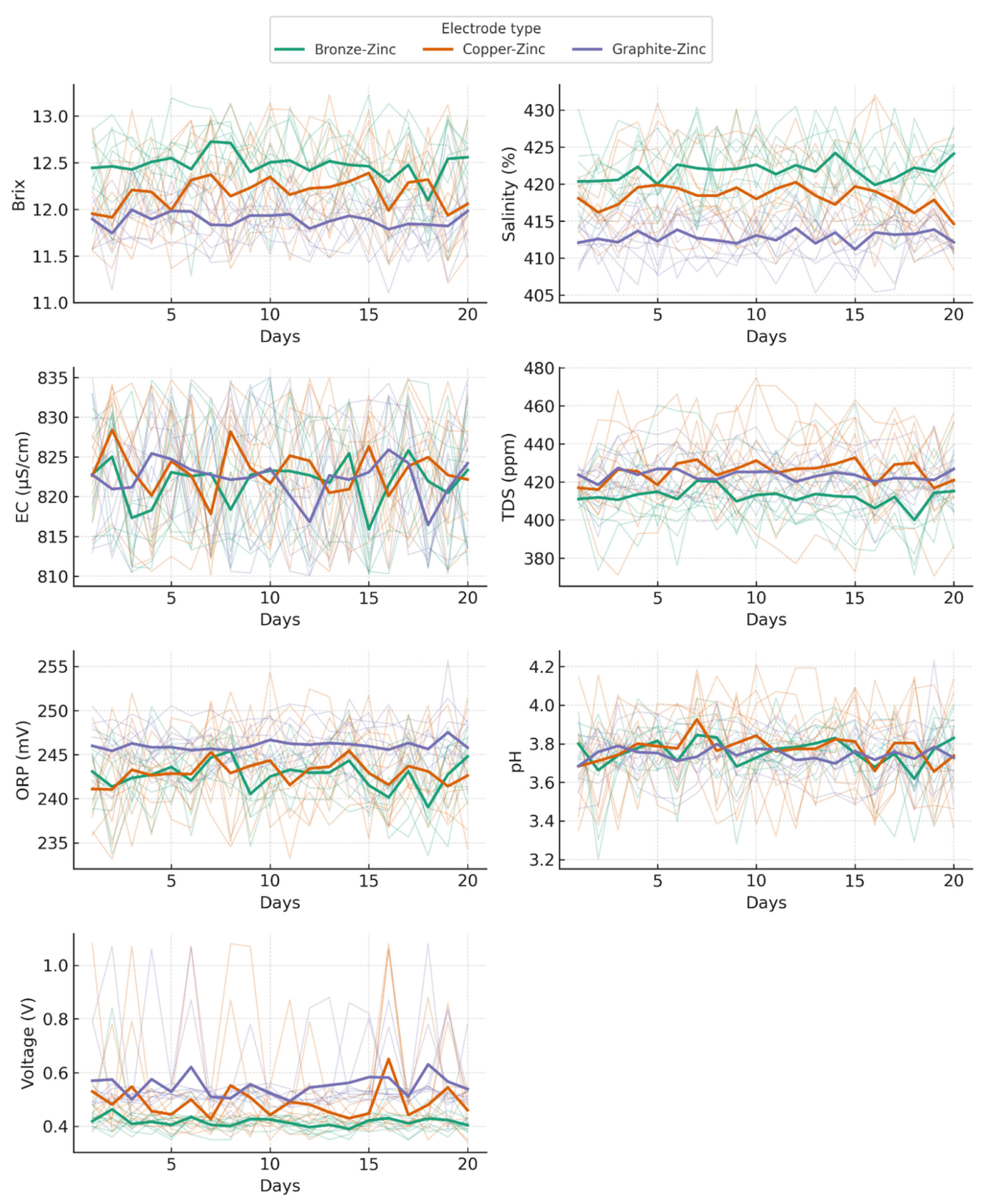
Figure 3 shows that the temporal evolution of voltage across the 27 single-chamber MFCs separates into three performance tiers associated with electrode composition. Throughout the 20-day operation, MFC 1–9 (bronze–Zn) produced the lowest voltages, MFC 10–18 (copper–Zn) showed intermediate but more dispersed values, and MFC 19–27 (graphite–Zn) maintained the highest and most stable voltages. This order of performance agrees with previous reports on the electrochemical stability of bronze, copper, and graphite anodes in MFC applications [
35,
37,
38].
Figure 3 also shows that salinity and total dissolved solids (TDSs, ppm) decreased gradually in all reactors. Their absolute values were highest in the bronze–Zn cells, intermediate in the copper–Zn cells, and lowest and most stable in the graphite–Zn group. Electrical conductivity (EC, µS cm
−1) and oxidation-reduction potential (ORP) values were higher on average in the graphite–Zn systems than in the bronze–Zn and copper–Zn systems. The pH remained moderately acidic (≈3.6–4.0) for all electrode types, with larger day-to-day fluctuations in the copper–Zn MFCs than in the other configurations.
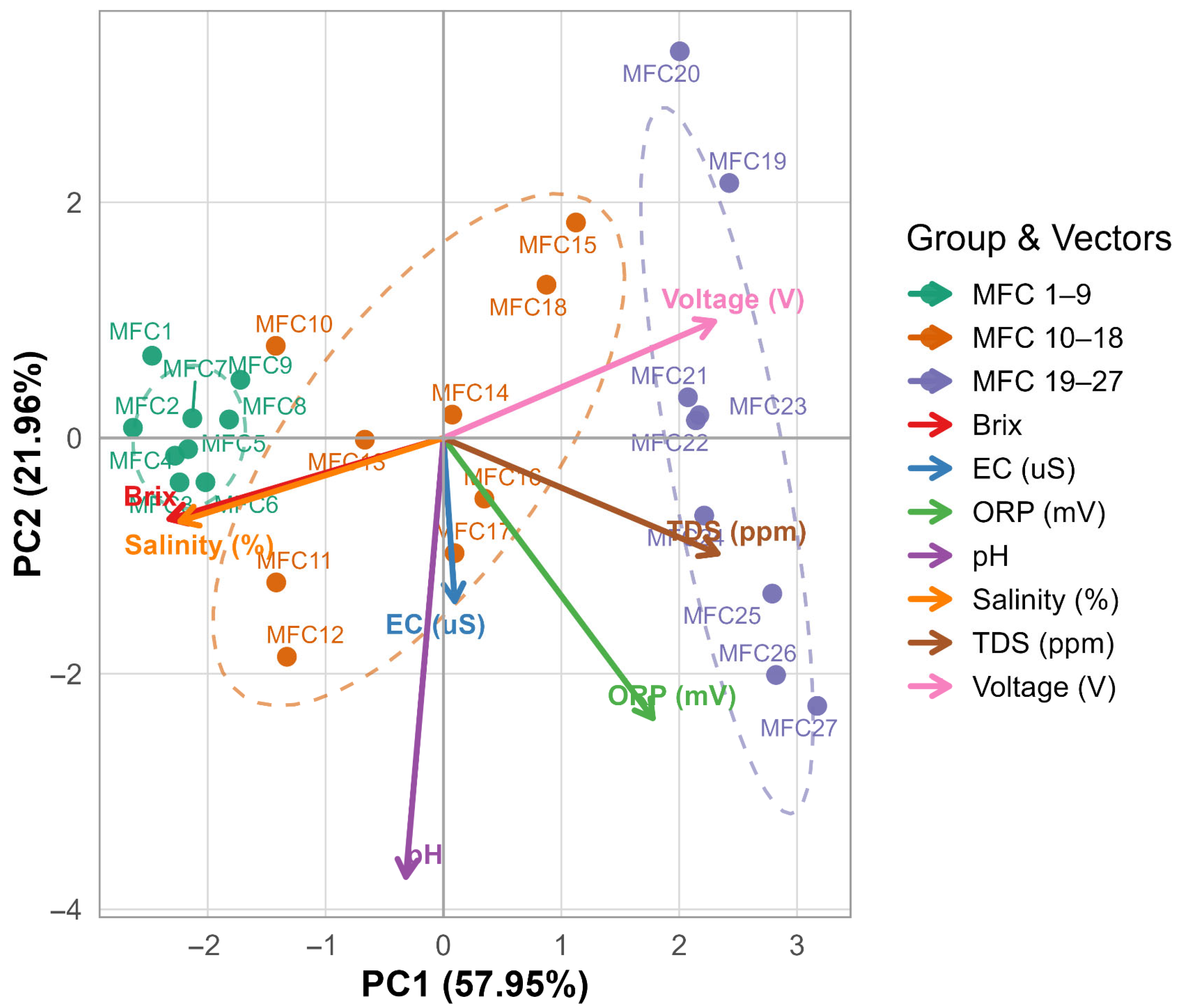
As shown in
Figure 4, the joint behavior of the seven physicochemical variables is summarized into two orthogonal dimensions that capture the electrochemical heterogeneity among the 27 MFCs. PC1 (57.95%) represents a redox–energetic axis, where voltage (V) loads positively together with ORP (mV) and TDS (ppm), defining the trade-off between power generation and electrolyte oxidation. MFC 19–27 (graphite–Zn) cluster at the positive extreme, associated with higher voltage and enhanced redox potential under stable ionic conditions, while MFC 1–9 (bronze–Zn) occupy the opposite side, characterized by elevated salinity and reduced electrochemical efficiency. The intermediate block (MFC 10–18, copper–Zn) plots between both clusters, confirming its transitional behavior with moderate conductivity and partial passivation effects. PC2 (21.96%) expresses a secondary acid–substrate gradient, dominated by pH and Brix, separating the slightly more fermentative units (lower pH, higher Brix) from oxidative, energy-efficient ones. Together, both axes illustrate that improvements in electrode inertness and conductivity from bronze to graphite shift the system toward a regime of higher voltage, lower ionic release, and more favorable redox balance, confirming the material-driven optimization of energy generation.
The three electrode material combinations form clearly differentiated clusters. MFC 1–9 (bronze–Zn) are positioned at the negative end of PC1, characterized by high salinity and low voltage; MFC 10–18 (copper–Zn) occupy an intermediate region reflecting moderate conductivity and partial surface passivation; and MFC 19–27 (graphite–Zn) cluster at the positive extreme, indicating higher voltage and more stable redox conditions.
These patterns confirm that the material composition of the electrodes determined the electrochemical domain of each group: systems with inert, conductive surfaces (graphite–Zn) achieved improved charge transport and lower ionic stress compared to metallic pairs. The PCA thus reinforces the experimental observation that the redox environment and electrode material jointly define the efficiency of the S. cerevisiae–A. aceti consortium.
3.2. Reliability and Validity of Constructs
Table 2 presents the reliability and convergent validity indices. These indices confirm the internal consistency and convergent validity of constructs in bioelectrochemical SEM models [
72].
Table 2 presents the internal consistency and convergent validity of the constructs used in the structural equation model. The reliability coefficients Cronbach’s α, Dijkstra Henseler’s
, and composite reliability (CR) were evaluated according to the criteria proposed by [
67]., who recommend values ≥ 0.70 as indicative of satisfactory internal consistency. The Average Variance Extracted (AVE), defined as the proportion of variance explained by the latent construct relative to measurement error [
73], serves as a measure of convergent validity, where values ≥ 0.50 confirm that the indicators adequately represent the construct.
In this model, the Voltage Production and Redox Parameters constructs met these thresholds, confirming high internal consistency and strong convergent validity. Conversely, Substrate Quality did not reach the minimum acceptable values (CR = 0.145; AVE = 0.393), indicating that the indicators grouped under this construct were insufficiently correlated to define a coherent latent variable—an issue commonly reported in electrochemical models with complex multicollinearity among physicochemical parameters [
74].
3.3. Structural Model Adjustment
Table 3 shows the global fit indices of the SEM model, including SRMR, NFI, and chi-square. These indices allow comparison between the observed data and the theoretical model, following the acceptance criteria proposed in the methodological literature [
69].
Table 3 summarizes the global goodness-of-fit indicators obtained for the structural equation model. The Standardized Root Mean Square Residual (SRMR = 0.165) lies within the range considered acceptable for exploratory PLS-SEM models (0.10–0.20) [
67]. The unweighted least squares discrepancy (
= 0.980) and geodesic discrepancy (
= 0.849) values were close to each other, indicating a consistent approximation between the empirical and model-implied correlation matrices [
73].
The chi-square statistic (χ
2 = 1,718,444) and the Normed Fit Index (NFI = 0.533) provide additional evidence of a moderate fit between the theoretical and observed data, which is considered acceptable in exploratory structural models involving complex electrochemical variables [
67,
73,
74]. Collectively, these indicators support that the proposed SEM model achieves a satisfactory global adjustment according to established methodological standards for variance-based structural equation modeling.
3.4. Multicollinearity of Indicators
Table 4 reports the variance inflation factor (VIF) values for the indicators. These results reveal cases of severe collinearity, reinforcing the need for variable refinement and the selection of more robust constructs [
72]. Previous studies have also noted that multicollinearity may limit the interpretation of electrochemical variables in MFCs, particularly in the analysis of oxidation-reduction potential [
4].
The VIF analysis plays a crucial role in verifying the independence of indicators within the SEM framework. Values greater than 10 indicate severe collinearity, while those below 5 are generally acceptable for exploratory models [
67,
73].
3.5. Explained Variance and Effects
Table 5 presents the adjusted R
2 values and the effect sizes (f
2) for each construct. The model explains more than 90% of the variance in voltage production, indicating a substantial effect. These results are consistent with findings from studies that optimized graphene-coated anodes, achieving higher explanatory efficiency in electrochemical models [
75].
3.6. Structural Coefficient
Table 6 summarizes the path coefficients (β), together with their
t and
p values, allowing verification of the significance of the relationships proposed in the structural model. The findings show that both redox parameters and substrate quality have a positive and significant effect on voltage production (
p < 0.001), supporting the working hypothesis.
3.7. PLS Predictive
Table 7 presents the Q
2 values obtained through the cross-omission technique, which validates the predictive capacity of the model. The positive and high values confirm that the model possesses predictive power beyond explanatory fit, in accordance with both classical and modern SEM evaluation criteria [
2].
3.8. SEM Model
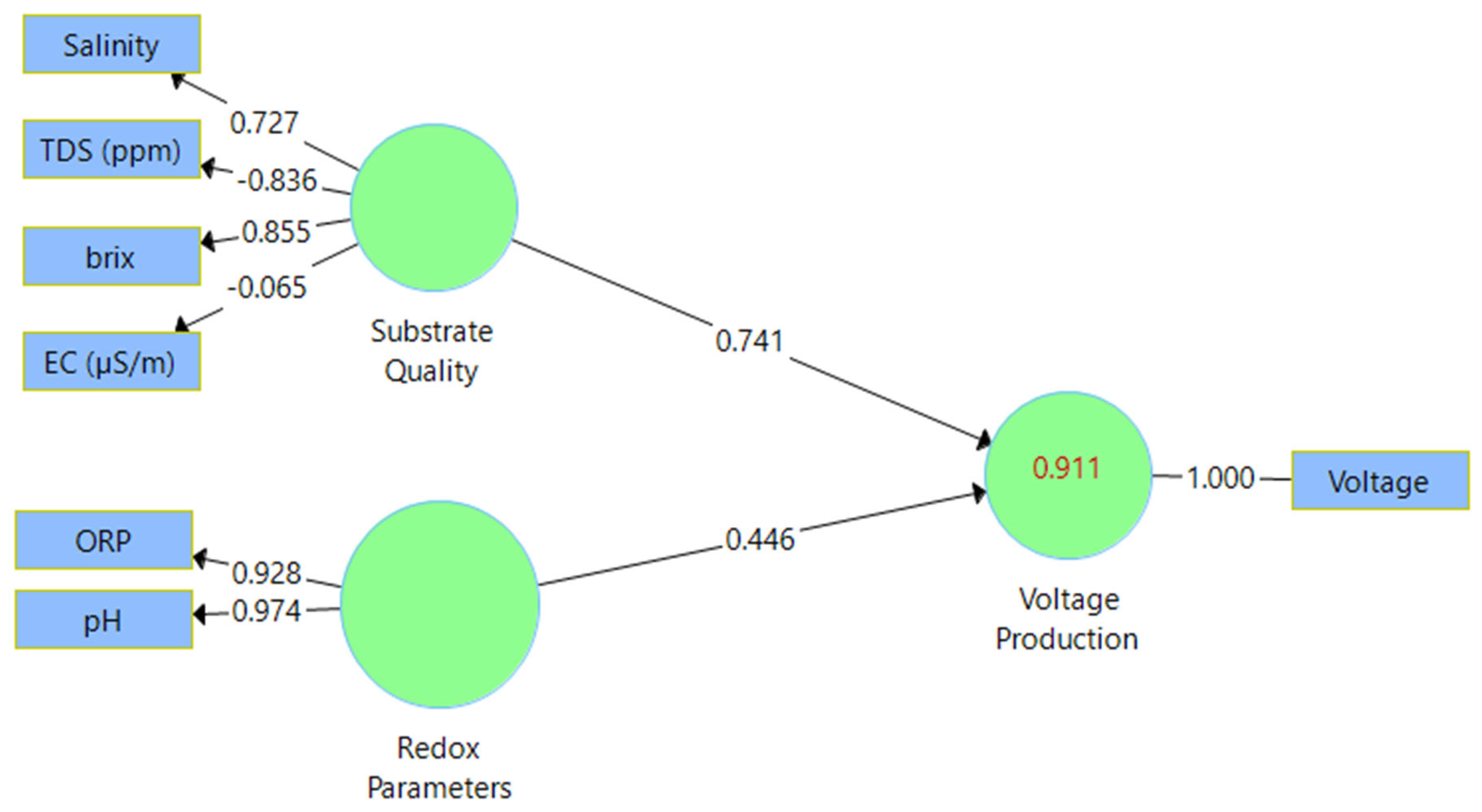
The SEM diagram shown in
Figure 5 indicates that voltage production is primarily explained by redox parameters (β = 0.446;
p < 0.001), with an R
2 of 0.911. Although the
Substrate Quality construct exhibited a significant relationship, its statistical reliability did not meet the minimum criteria; therefore, its inclusion should be considered marginal. Nonetheless, this outcome aligns with the biological roles of the microorganisms involved:
Acetobacter aceti facilitates electron transfer, while
Saccharomyces cerevisiae is responsible for utilizing glucose-rich biomass.
4. Discussion
Microbial fuel cells convert chemical energy from organic substrates directly into electrical energy through the metabolic activity of electrogenic microorganisms [
15]. Their performance depends on complex interactions between microbial metabolism, electrode properties, and ionic transport [
18]. In mixed-culture systems, cooperation between fermentative and oxidative species enhances substrate utilization and voltage generation due to complementary metabolic pathways [
21,
36,
50]. These mechanisms form the theoretical basis for the behavior observed in this study.
The electrochemical behavior observed here, characterized by an open-circuit potential above 0.8 V and a stable voltage pattern over 20 cycles, confirms that the mixed biocatalysis of
S. cerevisiae and
A. aceti can sustain efficient electron transfer even in a single-chamber, membrane-less configuration. Such single-chamber architectures offer advantages in cost and design simplicity compared with dual-chamber systems, though they are more susceptible to oxygen diffusion and pH gradients [
25]. The performance obtained with the mixed-culture graphite–Zn pair exceeded that of single
S. cerevisiae cultures and approached the values achieved by
A. aceti in dual-chamber systems employing polymeric membranes [
71]. The OCV achieved in this single-chamber, membrane-less configuration approached the values reported for dual-chamber systems employing polymeric membranes [
71], showing that comparable cell voltages can be obtained even without an ion-exchange membrane.
The metabolic coupling between both microorganisms explains the progressive decrease in Brix and the evolution in ORP and TDS recorded during the operational cycles.
S. cerevisiae ferments glucose to ethanol, whereas
A. aceti oxidizes this ethanol to acetic acid and CO
2, releasing electrons to the anode through PQQ-dependent alcohol dehydrogenases [
52]. In electrochemical studies where
A. aceti cells were immobilized on electrodes, these membrane-bound dehydrogenases have been shown to support direct electron transfer (DET) to the electrode surface without synthetic mediators [
53]. This cascade agrees with known biochemical pathways linking glycolysis, ethanol fermentation, and acetic acid oxidation as drivers of electron flow [
21]. In the present system, voltage remained stable without synthetic mediators. In
Acetobacter and related acetic acid bacteria, ethanol is incompletely oxidized to acetic acid by membrane-bound, pyrroloquinoline quinone (PQQ)-dependent alcohol dehydrogenase and aldehyde dehydrogenase, which channel electrons into the ubiquinone pool and a terminal ubiquinol oxidase in the cytoplasmic membrane [
62,
76]. This respiratory chain couples ethanol oxidation to proton translocation across the membrane and oxygen reduction to water, generating a proton motive force. The proton motive force in turn energizes a dedicated efflux system that exports acetic acid/acetate from the cytoplasm and periplasm to the exterior, leading to substantial accumulation of acetic acid in the bulk liquid during ethanol oxidation [
62]. Moreover, in ethanol-grown
A. aceti cells, the high activity of membrane alcohol dehydrogenase strongly favors the ethanol oxidation pathway over acetate oxidation [
76].
These biochemical characteristics support the metabolic model proposed for our system: yeast cells convert sugars into ethanol, and
A. aceti respire ethanol to acetic acid via membrane-bound dehydrogenases while continuously exporting acetic acid into the electrolyte. In a biofilm attached to a conductive surface, this same network of dehydrogenases and redox carriers can in principle transfer part of the electrons derived from ethanol/acetate oxidation to an external solid electron acceptor such as the anode, especially under microaerobic conditions where oxygen and the anode compete for electrons [
62,
76]. However, since ethanol and acetate concentrations were not quantified and no specific electrochemical tests of direct electron transfer were carried out, we present this pathway as a plausible metabolic mechanism that rationalizes the observed voltage evolution, rather than as conclusive proof that
A. aceti performs direct electron transfer in our configuration.
Material selection was also critical. The voltage hierarchy (graphite > copper > bronze) reflects the influence of electrode composition on ionic release and biofilm stability. The chemical inertness of graphite minimized corrosion and promoted a continuous conductive biofilm, consistent with the statistically significant relationship between redox parameters and voltage production (β = 0.446;
p < 0.001). This trend agrees with electrochemical studies reporting that the conductivity and roughness of anodes strongly influence electron-transfer efficiency and microbial adhesion [
33,
34]. Similar results were observed in transition-metal-modified anodes, showing enhanced current density and surface charge transfer [
53].
In addition to the galvanic contribution of the zinc–air cathode, the anode material strongly influences biofilm viability. Copper and copper alloys are well known for their oligodynamic effect, as corrosion products such as Cu
2+ and cupric oxides exhibit broad-spectrum antimicrobial and antibiofilm activity even at low concentrations [
77,
78]. In microbial fuel cells, copper anode corrosion has been shown to decrease power generation as dissolved copper becomes toxic to electroactive microorganisms [
79,
80]. By contrast, carbon-based electrodes such as graphite are widely used because they are electrically conductive, chemically stable and largely non-corrosive and biocompatible in bioelectrochemical systems [
81,
82]. Therefore, the superior and more stable performance of the graphite–Zn configuration in our array is consistent with reduced release of toxic copper species and better long-term biofilm compatibility, while all configurations still operate as hybrid bio–galvanic systems in which oxygen reduction at the zinc cathode remains an intrinsic abiotic contributor to current generation [
82].
Furthermore, differences in corrosion resistance and ion leaching among metals have been shown to impact MFC performance [
37]. Although unmodified graphite was used here, the comparable OCV suggests that even simple carbon surfaces can sustain efficient electron transfer through the PQQ–cytochrome c complex intrinsic to
A. aceti [
52,
53]. The improved performance of graphite is also consistent with findings that carbon-based anodes favor microbial attachment and stability over metallic surfaces [
35,
38].
In all electrode pairs tested (bronze–Zn, copper–Zn, and graphite–Zn), the cell potential arises from oxidation reactions at the anode—either corrosion of the metallic anode (bronze or copper) or bio-oxidation of organic matter on graphite—balanced by oxygen reduction at the air-breathing zinc cathode. Under these aerated conditions, zinc, although connected as the cathode, can also experience parasitic corrosion, so abiotic electrode reactions are always present together with microbial metabolism [
37,
83,
84]. Metallic anodes such as bronze and copper are additionally prone to corrosion, releasing metal ions and contributing extra abiotic current that can inflate the measured signal and reduce coulombic efficiency [
37,
53,
83]. The higher and more stable voltages observed with graphite–Zn are therefore more consistently explained by the combination of lower corrosion and better biofilm compatibility, together with bioelectrochemical activity of the consortium, rather than by a mechanism dominated by purely biological electron flow. The higher and more stable voltages observed with graphite–Zn are best interpreted as the combined result of reduced corrosion, better biocompatibility and possible contributions from microbial metabolism, rather than as evidence of purely biological electron flow.
Biofilm formation dynamics play a fundamental role in maintaining long-term voltage stability. The stable output recorded across 20 operational cycles suggests that a mature and conductive biofilm developed on the graphite electrode, consistent with previous observations of biofilm growth kinetics in electrogenic systems [
51]. Mixed cultures can enhance these properties by forming stratified communities, where fermentative and oxidative species exchange metabolites and electrons efficiently [
36]. This organization likely explains the steady voltage profile and low dispersion observed across repeated cycles.
Voltage evolution followed a biphasic trend: an initial increase that coincided with vigorous yeast fermentation, followed by a gradual stabilization that is compatible with a scenario in which
A. aceti progressively gains relevance within the consortium. Similar sequential patterns have been described as indicative of potential cooperative electron transfer between fermentative and oxidative microorganisms in bioelectrochemical systems [
21,
36,
50].
The obtained energy yield is consistent with the coproduction of acetic acid and electricity previously reported in acetic acid–bacteria-based MFCs, where open-circuit voltages of around 0.34 V and power densities of 2.47 mW cm
−2 were achieved [
54]. In our single-chamber, air-breathing configuration, the observed higher cell potentials (>0.8 V) can be explained by the combined contribution of galvanic reactions between the Zn–electrode pairs and the activity of the mixed
S. cerevisiae–A. aceti consortium under repeated glucose feeding [
36,
42,
43,
44,
45]. The literature shows that
S. cerevisiae can continue producing ethanol under microaerobic conditions, while
A. aceti incompletely oxidizes ethanol to acetic acid via membrane-bound dehydrogenases that export acetic acid to the medium and could, in principle, transfer electrons to solid surfaces [
55,
56,
57,
62,
76]. Thus, sustained voltage over multiple 5-day cycles is compatible with a scenario in which yeast continuously supplies fermentative products and
A. aceti partially oxidizes ethanol/acetate, while electrons are captured at the anode; however, because ethanol and acetic acid were not quantified and abiotic galvanic currents cannot be excluded, this cooperation should be regarded as a plausible working model rather than conclusively demonstrated. The PLS-SEM analysis supports this interpretation at a statistical level: redox-related indicators such as ORP, EC, and TDS emerged as dominant predictors of voltage (R
2 = 0.911; Q
2 = 0.906), values comparable to those reported for other energy-related systems modelled using PLS-SEM [
63,
64,
65]. Accordingly, the model is best viewed as a tool that captures the strong association between electrochemical variables and cell voltage, while not resolving the exact biotic versus abiotic contributions to current generation.
The cathodic process also deserves consideration. The oxygen-reduction reaction (ORR) often constitutes the main kinetic limitation in MFCs [
27]. Strategies using PGM-free catalysts have been proposed to improve cathode performance while maintaining low cost and environmental compatibility [
31].
The contribution of
S. cerevisiae to electron generation, although indirect, proved essential for maintaining the redox balance of the system. Previous studies have demonstrated that yeast-based MFCs typically require artificial mediators such as methylene blue to achieve maximum OCV values near 384 mV [
85]. In contrast, the present system achieved higher voltages without mediators, suggesting that the presence of
A. aceti replaced the chemical shuttle with a biological mediator—ethanol. The sequence ‘glucose → ethanol → acetate’ could therefore function as a natural electron-relay mechanism between both microorganisms, consistent with earlier analyses of electron transfer in mixed cultures [
21,
36]. Furthermore, chemically treated carbon materials have been shown to improve the interface between yeast and electrode, achieving power densities of 256 mW m
−2 [
86]. In this work, the graphite electrode provided an effective conductive interface, while the cooperative metabolism of the consortium further amplified current generation beyond what can be achieved by either species alone.
Electrode architecture and effective surface area are critical parameters influencing current density and biofilm distribution [
33,
34]. The results presented here are aligned with previous studies showing that an increase in electrode surface area enhances microbial colonization and charge transfer [
34]. Additionally, the observed voltage stability over multiple cycles reflects not only the redox buffering capacity of the system but also the robustness of the microbial interface [
38,
51]. The consistent electrochemical behavior of
S. cerevisiae and
A. aceti under acidic conditions aligns with recent reports confirming the tolerance of yeast and acetic acid bacteria to low pH in bioelectrochemical systems [
87,
88].
The discussion of scale-up feasibility is also relevant. While the laboratory configuration demonstrated high reproducibility, scaling MFCs to practical volumes remains limited by mass transport, electrode degradation, and voltage drop due to increased internal resistance [
24]. Nonetheless, single-chamber reactors such as the one used here represent a promising compromise between complexity and efficiency for bioenergy generation [
25]. Continuous improvements in electrode design, microbial selection, and reactor geometry could further enhance performance and stability.
The environmental implications of MFCs extend beyond energy recovery. Several studies have reported their ability to reduce chemical oxygen demand (COD) [
5].
Further, energy efficiency and sustainability considerations should guide future developments. Recent analyses highlight that material optimization and integrated configurations can significantly increase overall energy recovery in MFCs [
26]. From a broader perspective, microbial electrochemical systems align with global sustainability goals for low-carbon bioenergy [
22]. Hybrid bioelectrochemical systems incorporating multiple biocatalysts have also been proposed to enhance process stability and energy conversion [
49]. The present study provides a foundation for such hybrid designs by demonstrating the compatibility and complementary electroactivity of
S. cerevisiae and
A. aceti in a simple, membrane-less architecture.
Overall, integrating
S. cerevisiae and
A. aceti in a single-chamber configuration produced voltages comparable to or higher than those of dual-chamber systems reported in the literature [
54,
71]. The statistical confirmation that redox variables explained more than 90% of the voltage variance validates the predictive model and underscores the central role of redox processes encompassing both abiotic electrode reactions and microbial metabolism in determining system performance. These findings suggest that biological cascades can complement or even replace synthetic mediators in simple single-chamber configurations.