Article

Voltage Stability Mechanism of Grid-Connected Permanent Magnet Synchronous Generator Under Large Grid-Side Disturbances

1
State Grid Anhui Electric Power Research Institute, Hefei 230061, China
2
Sichuan Energy Internet Research Institute, Tsinghua University, Chengdu 610213, China
*
Author to whom correspondence should be addressed.
Energies 2026, 19(3), 820; https://doi.org/10.3390/en19030820
Submission received: 10 December 2025 / Revised: 23 January 2026 / Accepted: 28 January 2026 / Published: 4 February 2026

Abstract

As a mainstream new energy generation technology, elucidating the grid-connected voltage stability mechanisms of permanent magnet synchronous generator (PMSG) is critical for ensuring stable integration of high-penetration renewable energy. Existing research on the voltage stability of grid-connected PMSG systems is confined to single-fault scenarios, failing to adequately account for the impacts of other significant internal grid disturbances, such as direct current blockings and increased renewable energy penetration. Moreover, the traditionally used simplified grid model with a voltage source in series with an impedance is overly idealized, making it difficult to comprehensively reveal the transient stability mechanisms of grid-connected PMSG systems under complex multi-disturbance conditions. To address this issue, this paper proposes a numerical analysis method to investigate the grid stability mechanisms of PMSG systems under various grid disturbance scenarios. First, an electromagnetic transient simulation model of the grid-connected PMSG system is established. Next, key parameters influencing the system’s voltage stability are identified using the global sensitivity Sobol method. Subsequently, a transient voltage stability assessment index and a method for revealing the grid stability patterns of PMSG systems are presented. Finally, the PMSG system is integrated into the CSEE standard test system on the CloudPSS platform for validation and analysis. The results demonstrate that the proposed method effectively reveals voltage stability mechanisms considering various internal grid disturbances, and the mechanistic characteristics it reveals differ significantly from conclusions drawn using a simplified grid model.

1. Introduction

As a predominant form of wind energy conversion, grid-connected permanent magnet synchronous generator (PMSG) systems play a critical role in enhancing wind power penetration [1,2]. However, the stability of such systems is subject to complex coupling effects among multiple parameters [3,4,5]. It is therefore essential to conduct in-depth analysis of their stability mechanisms, with particular focus on identifying key parameters influencing system stability under both steady-state and disturbed conditions, and elucidating how these parameters govern the system’s stability characteristics [6,7,8].
Stability analysis of PMSG-based wind power systems primarily employs time-domain simulation (TS), energy function methods (EFMs), and the equal-area criterion (EAC) [9,10]. Among these, TS solves the differential equations of the system via numerical integration and generates time-domain curves of state variables. Its intuitive and reliable results are often used as a benchmark to validate other analytical methods [11,12]. For instance, one study [13] analyzed voltage stability using TS and calculated the voltage stability characteristics at each load based on the stable power limit at load nodes. Another study [14] demonstrated through TS that line-commutated high-voltage direct current (HVDC) systems equipped with damping controllers can effectively enhance the damping performance of offshore wind farms and suppress power oscillations. For PMSG systems, an average-value model with high computational efficiency was developed in [15] and validated using TS. In [16], a complex torque method was introduced to investigate subsynchronous oscillation in PMSG systems, revealing the influence of grid strength, operating conditions, and controller parameters on system damping. These findings were ultimately verified using a detailed TS model. TS is also widely applied to analyze system transient processes during faults and to validate the operational characteristics of various control and protection strategies [11,12]. The EFM is based on the concept of transient energy and constructs Lyapunov functions to quantify transient stability by calculating the system’s transient energy and evaluating stability margins. For example, [17] investigated a robust control strategy for the energy conversion system of a PMSG based on the Lyapunov method. In [18], the dynamic behavior of a PMSG with back-to-back voltage source converters was simulated, and the closed-loop stability of its event-triggered control system was analyzed using the Lyapunov method. A robust sliding-mode current control strategy was proposed in [19], with system stability analyzed via the Lyapunov method; this approach effectively reduces total harmonic distortion and improves power quality. In [20], a dynamic energy function for doubly fed induction generator (DFIG)-based wind power systems was established to quantitatively analyze the stability of low-frequency oscillations caused by wind farm–grid interactions, revealing the underlying dynamic mechanisms. A stability assessment method based on energy dissipation intensity for subsynchronous oscillations was proposed in [21], and the results confirmed the effectiveness of this index in evaluating the stability margin of wind-integrated power systems. The EAC is a stability assessment method valued for its computational simplicity. However, its application to full-converter PMSG systems requires careful consideration of model suitability and underlying assumptions. For example, [22] employed the EAC to study phase-locked loop instability in grid-connected voltage source converters, identifying two main causes of large-signal instability: absence of equilibrium points and insufficient deceleration area, which prevents the system from transitioning between equilibrium points during transients. In summary, both EAC and EFM require the reconstruction of system mathematical models, often relying on simplified equivalent representations. While TS is regarded as the most accurate approach for stability analysis, its computational efficiency becomes a limitation in large-scale, repetitive simulations. This necessitates optimization strategies to reduce iteration counts and improve simulation performance [23,24]. Furthermore, current studies predominantly employ simplified voltage-source-with-impedance grid-equivalent models. Such models overlook critical internal grid disturbance factors, such as HVDC pole blocking—which permanently interrupts DC power transmission under severe faults—and the impact of high-penetration renewable energy integration. As a result, they cannot adequately capture the interaction characteristics under complex multiple disturbances in real power systems, thereby limiting a comprehensive understanding of grid stability mechanisms in PMSG-dominated systems [25,26,27].
The main contributions of this paper are threefold: First, a combined methodology integrating batch TS and global sensitivity analysis is employed to identify critical system parameters affecting voltage stability. Second, the study reveals the differential impact patterns of various internal grid disturbances—including direct current (DC) blockings, high-penetration renewable integration, and transmission line faults—on the voltage stability mechanisms of PMSG-based integration systems. Finally, the inherent stability characteristics of grid-connected PMSG systems under different disturbance scenarios are elucidated from a mechanistic perspective.
The remainder of this paper is structured as follows: Section 2 develops an electromagnetic transient (EMT) simulation model for integrating PMSG into the Chinese society for electrical engineering (CSEE) standard test system. Section 3 introduces the theoretical foundations for global sensitivity calculation and the voltage transient stability index. Section 4 provides a case study analysis. Section 5 concludes the paper.

2. EMT Model of Grid-Connected PMSG

The modeling of PMSG primarily focuses on the process of maximum power point wind energy capture and power converter-based energy conversion. With wind speed as the primary input, the system adjusts the pitch angle to adapt to varying wind conditions. Based on the measured rotor speed and a preset optimal tip–speed ratio, the controller calculates the ideal rotational speed for the current wind speed. The torque control loop then generates an optimal torque reference value proportional to the square of the rotational speed. This torque command drives the permanent magnet synchronous generator to produce variable-frequency AC power, which is first rectified to DC and subsequently inverted to grid-frequency AC (50 Hz) for grid integration.
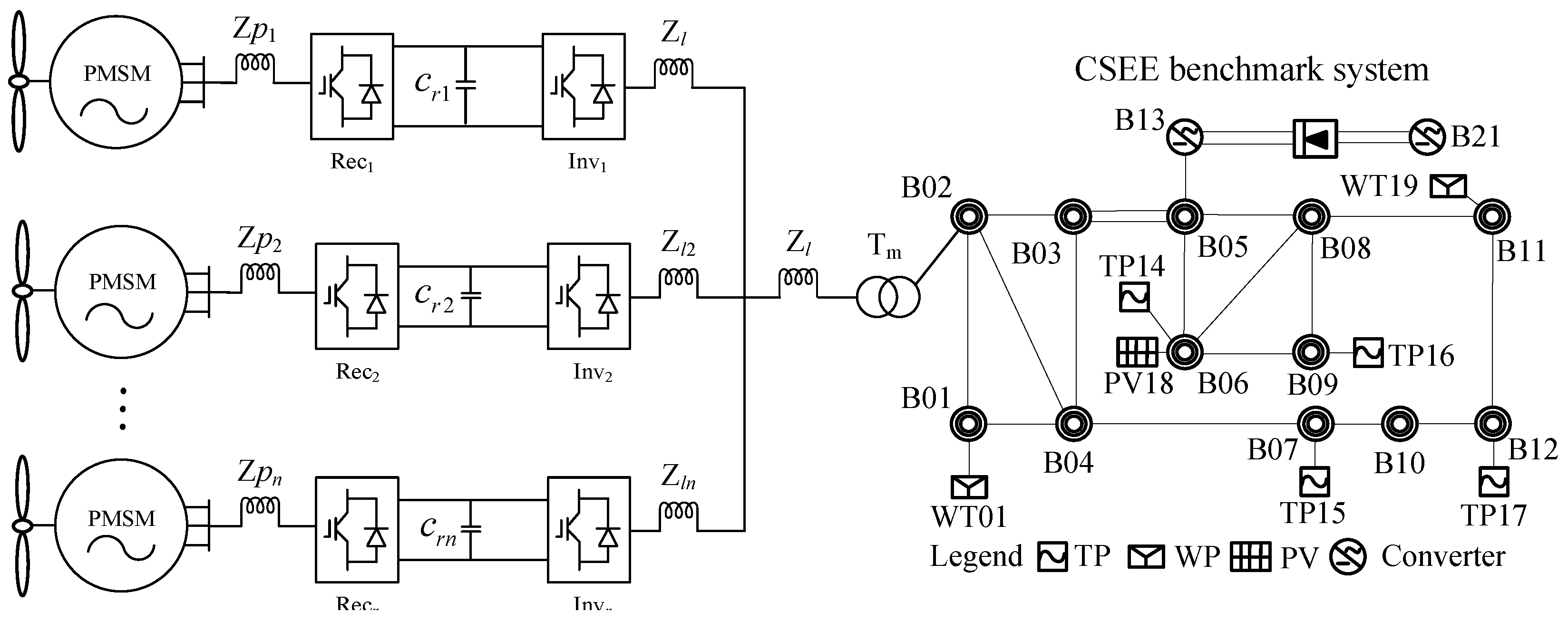
Figure 1 illustrates the block diagram of a PMSG integrated into the CSEE standard test system grid. The PMSG system employs a vector control strategy based on dual-PWM converters, incorporating generator-side maximum power point tracking (MPPT) control and grid-side DC voltage/reactive power control [28,29]. Each PMSG unit comprises a wind turbine and a synchronous generator. The mechanical power captured by the wind rotor is determined by (1). The mechanical power generated by the wind turbine is converted into AC power through the stator and rotor of the synchronous generator. This AC power flows into the AC side of the rectifier via the machine-side low-pass filter Z p n . The rectified DC power is stabilized by the DC-link capacitor C r n and then inverted into grid-frequency AC power by the inverter. The grid-frequency AC power passes through the filter impedance Z l n and is finally collected at the Point of Common Coupling (PCC) before being integrated into the CSEE benchmark system grid model via the transmission line Z l and transformer T m . The CSEE standard test system primarily comprises conventional power plant (TP), wind power (WP), photovoltaic power (PV), and converter stations (B21), with bus nodes labeled B01 through B13.
P m = 1 2 ρ A C p ( λ , β ) v 3
where ρ is the air density, A is the swept area of the rotor, C p is the power coefficient, λ is the tip speed ratio, β is the blade pitch angle, and v is the wind speed.
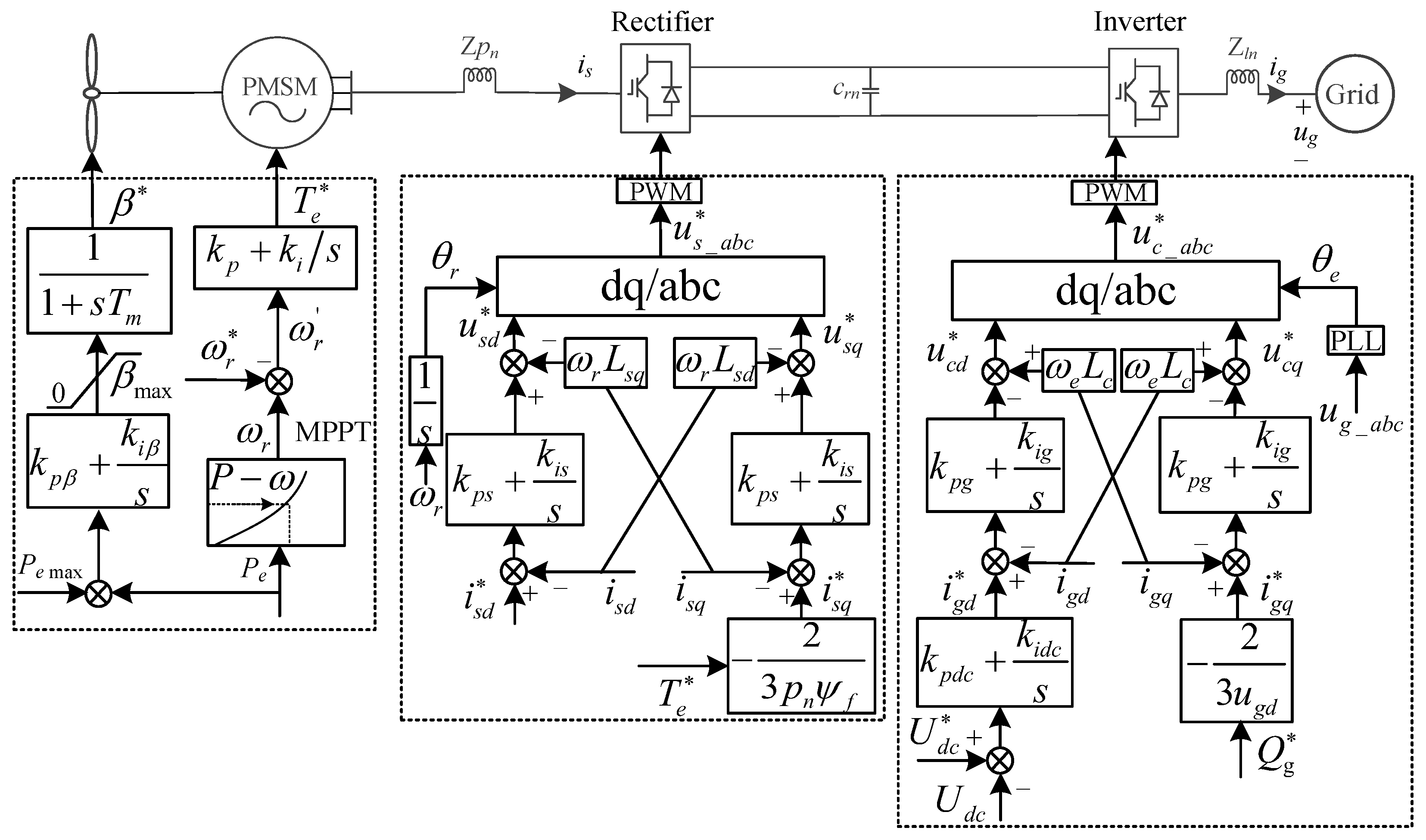
On the left of Figure 2 presents the integrated control strategy for the wind turbine and synchronous generator of a PMSG operating across the entire wind speed range. Under below-rated wind speed conditions, the system employs an MPPT strategy based on optimal power-angular speed characteristics. The measured rotor speed ω r is compared with its preset optimal reference value ω r * derived from the turbine’s aerodynamic characteristics, with the resulting angular speed error ω r fed into a proportional–integral (PI) controller having the transfer function k p + k i / s . The controller outputs the electromagnetic torque reference T e * , which adjusts the generator torque to dynamically track the MPPT, thereby maximizing energy capture. When the electrical power P e reaches or exceeds the rated power P e m a x , the system switches to pitch angle control mode. In this mode, a PI controller with the transfer function k p + k i / s regulates the blade pitch angle β within the range of [ 0 , β m a x ] to generate the reference value β * . This action limits the captured wind energy while maintaining both output power and rotor speed near their rated values.
In the center of Figure 2, the control block diagram of the PMSG machine-side converter is presented. The system employs a standard vector control strategy, where the alternating current (AC) quantities in the three-phase stationary frame ( a b c ) are converted into DC quantities in the rotating reference frame ( d q -frame) using the Park Transformation given in Equation (2).
i s d i s q = 2 3 cos θ cos ( θ 2 π / 3 ) cos ( θ + 2 π / 3 ) sin θ sin ( θ 2 π / 3 ) sin ( θ + 2 π / 3 ) i s a i s b i s c
where i s a , i s b , and i s c refer to the machine-side three-phase AC currents, and i s d and i s q are the DC component currents in the rotating coordinate frame. θ is the grid phase angle tracked by the phase-locked loop.
To achieve Maximum Torque Per Ampere (MTPA) control, the reference direct-axis current i s d * is conventionally set to zero. The reference quadrature-axis current i s q * is derived from the torque reference value T e * through the electromagnetic torque relationship given in Equation (3).
i s q * = 2 3 p n ψ f T e *
where p n is the number of pole pairs, and ψ f is the permanent magnet flux linkage.
The current loops in the dq-frame are regulated using PI controllers ( G P I ( s ) = k p + k i / s ). The outputs of these controllers, after feedforward compensation, generate the reference voltage signals as shown in Equations (4) and (5).
u s d * = G P I ( s ) ( i s d * i s d ) ω r L s q i s q
u s q * = G P I ( s ) ( i s q * i s q ) + ω r L s d i s d
where the d-axis and q-axis reference currents i s d * and i s q * are compared with their measured values, with the errors regulated by PI controllers G P I ( s ) = k p s + k i s s to generate reference voltages u s d * and u s q * . These voltages are transformed into three-phase signals u s , a b c * via Inverse Park Transformation using the angle θ r , obtained by integrating ω r , for rectifier modulation. L s d and L s q represent the machine-side d-axis and q-axis inductances, respectively.
u s a * u s b * u s c * = cos θ sin θ cos ( θ 2 π / 3 ) sin ( θ 2 π / 3 ) cos ( θ + 2 π / 3 ) sin ( θ + 2 π / 3 ) u s d * u s q *
The right side of Figure 2 illustrates the dual-loop vector control structure of the grid-side converter in the synchronous rotating reference frame, designed to maintain DC-link voltage and reactive power. In the outer-loop DC voltage control, the measured DC voltage U d c is compared with its reference U d c * , and the resulting error is processed by a PI regulator to generate the d-axis current reference i g d * as shown in Equation (7). Simultaneously, the outer-loop reactive power control computes the q-axis current reference in Equation (8), based on the reactive power reference Q g * and the grid d-axis voltage component u g d .
i g d * = K p d c + K i d c s ( U d c * U d c )
i g q * = 2 3 u g d Q g *
The d- and q-axis current references i g d * and i g q * are then compared with their corresponding measured values i g d and i g q . The current errors are regulated by inner-loop PI controllers ( k p g + k i g s ), producing the preliminary voltage control signals u c d and u c q .
To compensate for cross-coupling effects, a voltage feedforward term ω e L c i g q is added in the d-axis channel, while a coupling compensation term ω e L c i g d is introduced in the q-axis channel, yielding the final modulated voltage signals shown in Equations (9) and (10).
u c d * = k p g + k i g s ( i g d * i g d ) + u g d ω e L g i g q
u c q * = k p g + k i g s ( i g q * i g q ) + u g q + ω e L g i g d
Finally, the d- and q-axis voltage references u c d * and u c q * are transformed into three-phase modulation signals u c , a b c * via Inverse Park Transformation (dq/abc), using the grid voltage phase angle θ e provided by a phase-locked loop (PLL). These signals drive the inverter converter pulse width modulation (PWM).

3. Simulation-Based Voltage Stability Mechanism Theory

3.1. Sensitivity Analysis Based on the Sobol Method for Key Parameters

This section conducts a global sensitivity analysis using the Sobol method to quantify the impact of various system parameters on the stability index, determine their sensitivity ranking, and thereby identify the key influencing parameters. The Sobol method is a global sensitivity analysis technique that quantifies how variations in input parameters contribute to the variance of model outputs [30]. Parameters are ranked by their contribution to output variance, with those having the highest contributions identified as key factors.
First, the matrix construction procedure involves Monte Carlo sampling to generate two independent base matrices, A and B, each of dimension n × p , with n denoting the number of samples and p the number of parameters. The hybrid matrix A B ( i ) is then constructed by substituting the i-th column of matrix A with the i-th column of matrix B, following the formulation presented in Equation (11).
A B ( i ) = [ a 1 , a 2 , , a i 1 , b i , a i + 1 , , a p ]
Based on the EMT simulation model established in Section 2, the output results corresponding to the given input sample matrices A, B, and A B ( i ) are calculated as shown in Equations (12)–(14).
Y A = f ( A )
Y B = f ( B )
Y A B ( i ) = f ( A B ( i ) ) for i = 1 , 2 , , p
where f ( · ) represents the system simulation model.
Next, the sensitivity indices are computed. The total output variance is calculated as shown in Equation (15).
V ( Y ) = 1 n j = 1 n ( Y A ( j ) Y ¯ A ) 2
where Y ¯ A is the mean of Y A .
For each parameter x i , the first-order effect variance is initially computed, followed by the derivation of its first-order sensitivity index as shown in Equations (16) and (17), respectively. The first-order sensitivity index S x i quantifies the individual contribution of parameter x i to the output uncertainty, excluding interactions with other parameters. A higher value of S x i indicates a stronger independent influence of the parameter on the model output.
V x i = 1 n j = 1 n Y B ( j ) ( Y A B ( i , j ) Y A ( j ) )
S x i = V x i V ( Y )
The total-effect index S T i quantifies the total contribution of parameter x i to the output variance, incorporating both its first-order effect and all higher-order interactions with other parameters. The total-effect variance is first computed as shown in Equation (18), followed by the calculation of the total-effect index according to Equation (19).
V i = 1 n j = 1 n Y B ( j ) · ( Y A B ( i , j ) Y A ( j ) )
S T i = 1 V i V ( Y )

3.2. Transient Voltage Stability Theory

This section first presents the quantitative metrics for voltage stability assessment, followed by the setup procedure for obtaining voltage simulation data through electromagnetic transient simulation under different disturbance scenarios within the power grid.

3.2.1. Transient Voltage Stability Assessment

As presented in Reference [31], the voltage stability assessment index can be mathematically represented as (20).
θ V i = D i + t t + Δ t V N V i ( t ) d t
where V i ( t ) denotes the instantaneous grid connection point voltage of the direct-drive wind farm under fault mode i; t represents the fault clearing time; and Δ t indicates the duration during which V i ( t ) remains below the nominal voltage V N . According to the Technical Code for Power System Security and Stability Calculation, which specifies that bus voltage stability is demonstrated by its recovery to above 0.8 per unit within 10 s after fault clearance, Δ t is generally taken as 10 s. The penalty term D i is set to zero if the voltage recovers to above 0.8 per unit within 10 s; otherwise, it is assigned a value of 10 based on engineering practice.

3.2.2. Simulation-Based DM Mode

This section considers the following grid disturbance modes (DMs) including increased penetration of renewable energy, monopolar DC blocking, bipolar DC blocking, and line-to-ground faults at the bus. The simulation scenarios (SSs) for different disturbance modes are set up as shown in Table 1.
Four distinct operational scenarios are established in the simulation based on Table 1. Scenario 1 represents enhancing the penetration of new energy (EPNE), achieved by ramping up renewable generation while correspondingly reducing synchronous generator output at t = 0.1 s. Scenario 2 simulates HVDC pole blocking (PB), initiated at t = 2.9 s and cleared after 0.1 s at t = 3.0 s. Scenario 3 examines HVDC pole blocking (BB), similarly triggered at t = 2.9 s and lasting 0.1 s until clearance at t = 3.0 s. Scenario 4 involves a ground fault (GF) at the PMSG grid connection point, occurring at t = 2.9 s and isolated after 0.1 s through line removal at t = 3.0 s.

4. Case Study

This section presents the simulation-based verification analysis conducted on the CloudPSS platform. The simulation validation system is based on the architecture shown in Figure 1, incorporating a direct-drive wind power generation system into the CSEE standard test grid. First, a comparative analysis is performed to examine how system parameters influence voltage stability indices under different disturbance scenarios. Building on this, key system parameters are identified across various disturbance conditions. Subsequently, an in-depth investigation into the instability mechanisms of different modes is carried out, and the validity and accuracy of the proposed methodology and findings are confirmed by comparing stability index results with time-domain simulation outcomes.

4.1. Comparative Analysis of Stability Mechanisms

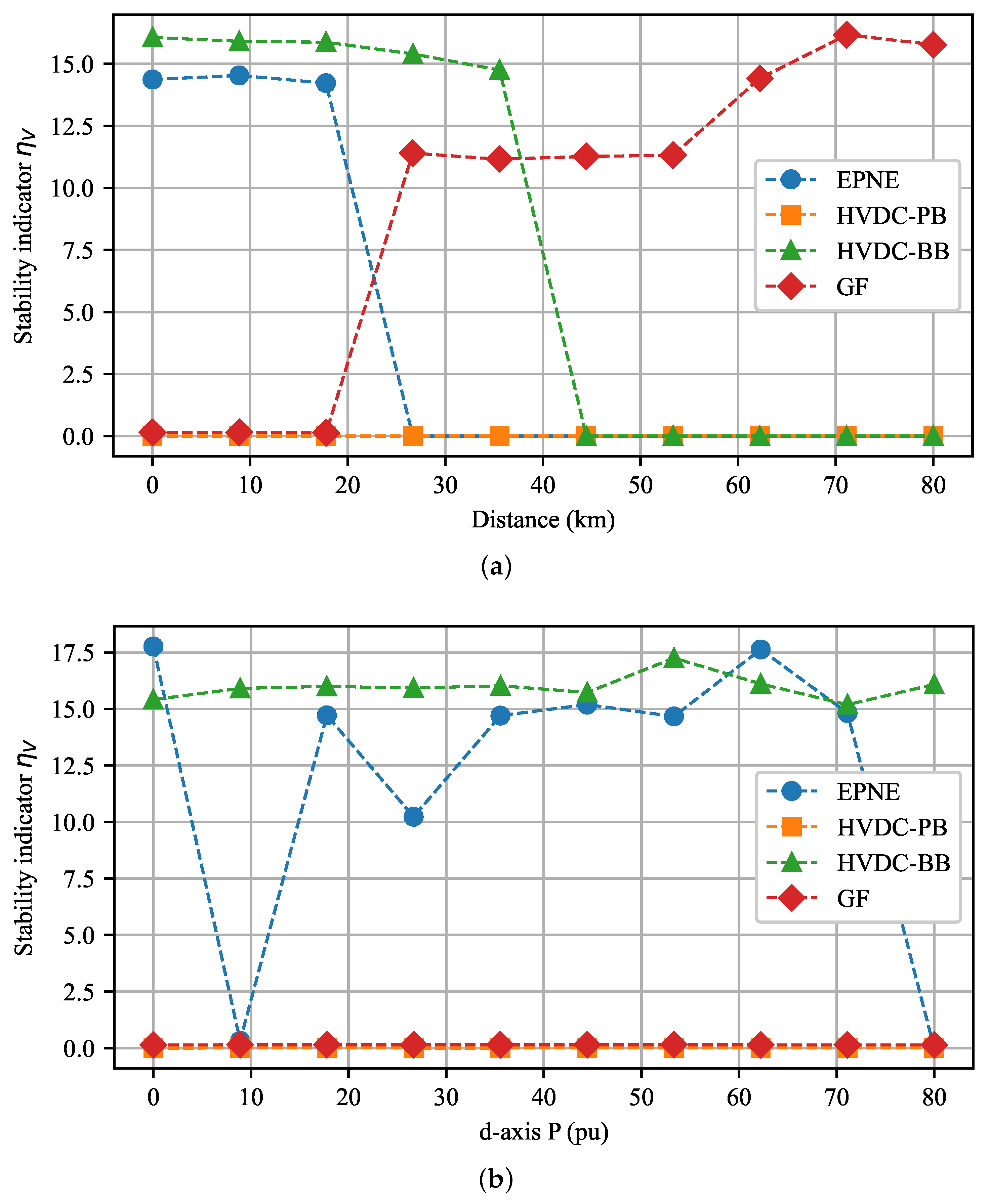
A comparative analysis of stability mechanisms under four distinct disturbance scenarios, including renewable energy power escalation, DC monopolar blocking, DC bipolar blocking, and transmission line faults. The comparative validation results are illustrated in Figure 3.
The voltage stability indices of the PMSG-based wind farm under four disturbance scenarios are presented in Figure 3, demonstrating their variations with two system parameters: the wind farm’s grid integration distance and the proportional coefficient of the grid-side d-axis controller. The four scenarios—renewable energy power increase, HVDC single-pole blocking, HVDC double-pole blocking, and transmission line fault—are represented by the blue, orange, green, and red dotted lines, respectively, illustrating the behavior of the voltage stability index across varying grid integration distances. In Figure 3a, the system remains stable under the HVDC single-pole blocking scenario across the entire integration distance range of 1–80 km, with stability indices consistently below 10. With increased renewable energy penetration, the system becomes unstable at shorter integration distances (approximately 1–18 km) but regains stability when the distance extends beyond 18 km up to 80 km. The HVDC double-pole blocking scenario exhibits a similar trend to renewable energy penetration enhancement, though with a narrower stable operating range of approximately 35–80 km. In contrast, the ground fault scenario demonstrates an opposite pattern: the system remains stable at shorter distances (about 0–18 km) but becomes unstable when the integration distance increases beyond 18 km. In Figure 3b, the system maintains stability across the entire range (1–80) of the grid-side d-axis proportional coefficient under both HVDC single-pole blocking and line grounding fault scenarios, demonstrating stronger robustness against control parameter variations in these two fault modes. In contrast, the system becomes consistently unstable when subjected to HVDC double-pole blocking. Under the renewable energy penetration enhancement scenario, however, system stability shows high sensitivity to this parameter, remaining stable only at two specific coefficient values (9 and 80) while becoming unstable at all other points within this range.
This analysis reveals the limitations of conventional modeling approaches that represent the grid as a simple inductive impedance in series with a voltage source and focus solely on grounding faults at the interconnection point. Such simplifications prove inadequate for comprehensively understanding the stability mechanisms of grid-connected PMSG wind farms under varying DM scenarios and control parameters.

4.2. Identifying Critical System Parameters

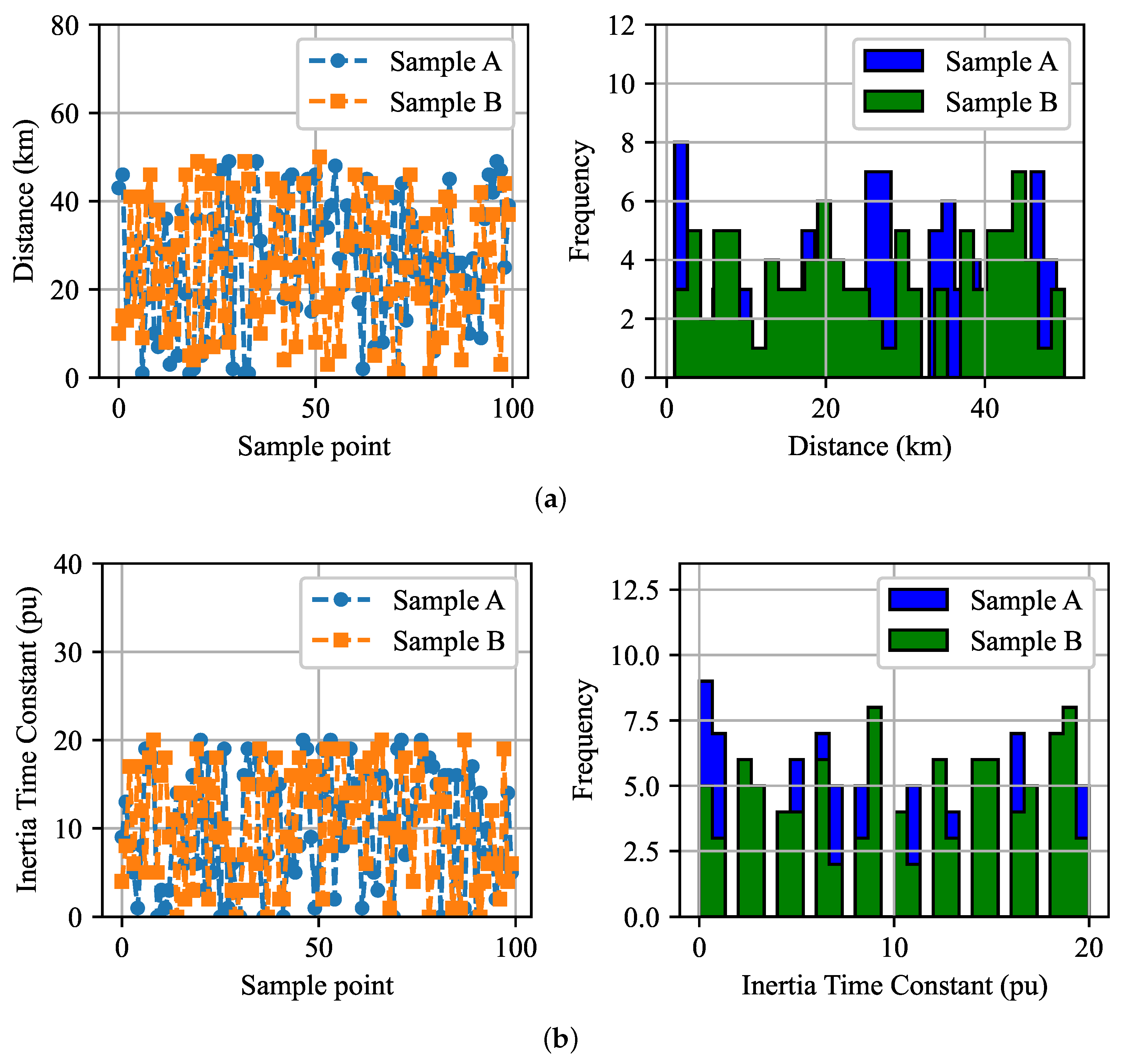
This section employs electromagnetic transient simulation and Sobol global sensitivity analysis to identify the key parameters influencing system voltage stability. A Monte Carlo method is first used to sample the system parameters listed in Table 2, which include the PMSG connection distance, the phase-locked loop proportional coefficient, the inertia time constant, and the proportional coefficient of the grid-side PI controller [32]. The table specifies the value ranges and the number of samples for each parameter. The distribution of the sampled parameters is shown in Figure 4. Figure 4a illustrates the sample distribution of the PMSG connection distance, ranging from 1 km to 50 km, while Figure 4b shows the distribution of the inertia time constant, varying from 1 pu to 20 pu.
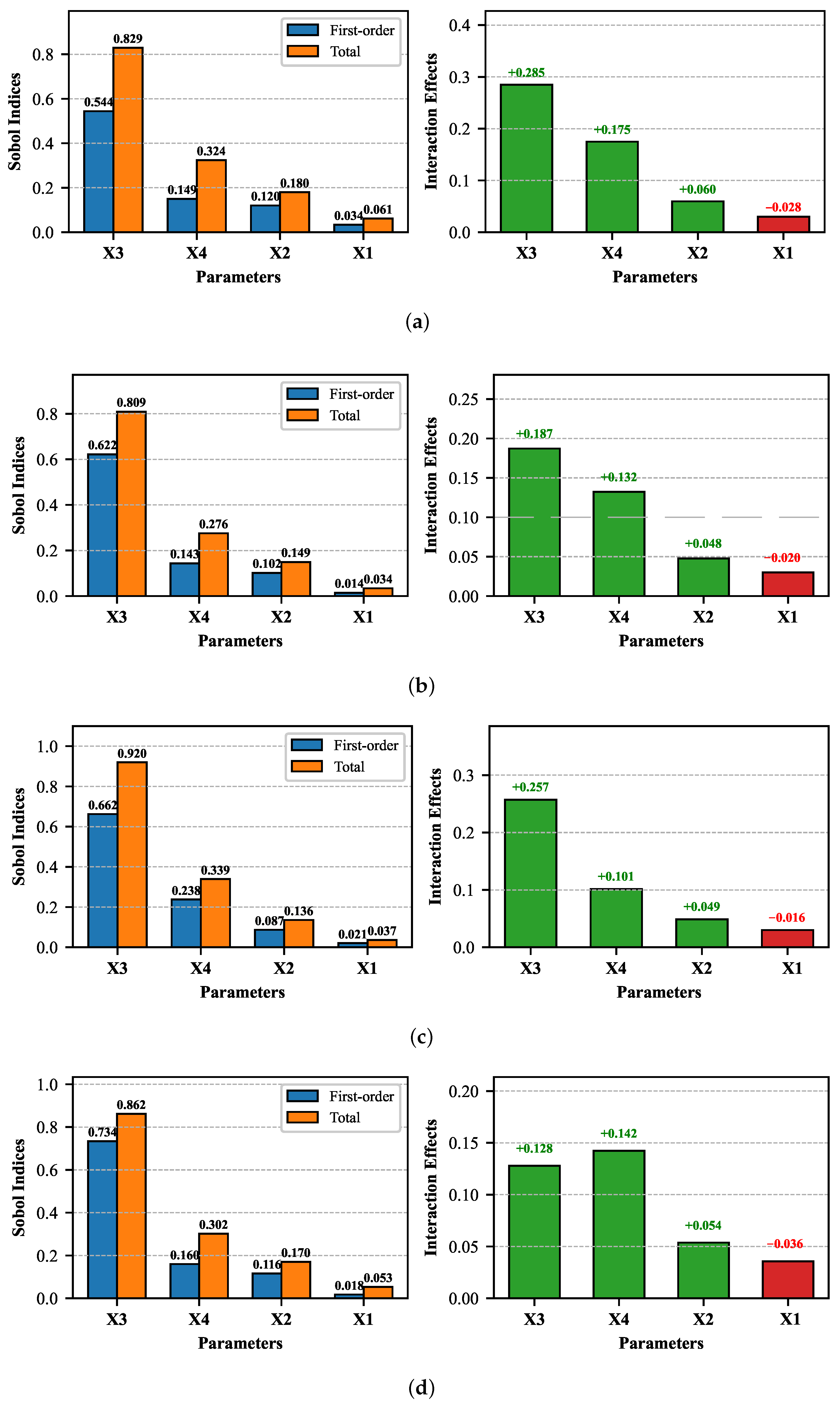
Figure 5 presents the sensitivity ranking results of various system parameters under four disturbance scenarios. Figure 5a–d correspond to the IREB, MDB, BDB, and BAF scenarios, respectively, showing the first-order and total-effect rankings for connection distance, PLL proportional coefficient, inertia time constant, and grid-side proportional coefficient. In each subfigure, the left side uses blue bars to represent the first-order effects and orange bars for the total effects, while the right side displays the ranking of interaction effects. Across all scenarios, the relative influence of each parameter on system stability remains consistent, with the order of importance descending as follows: X 3 (connection distance), X 4 (inertia time constant), X 2 (grid-side proportional coefficient), and X 1 (PLL proportional coefficient).

4.3. Transient Voltage Stability Analysis

The previous section employed EMT simulations and the Sobol sensitivity analysis method to establish the importance ranking of parameters affecting the transient voltage stability of PMSG grid integration. Parameters X 3 , X 4 , and X 2 were identified as the dominant factors influencing the system’s transient voltage stability. This section aims to elucidate the impact patterns of these dominant parameters on transient voltage stability across the four disturbance scenarios.
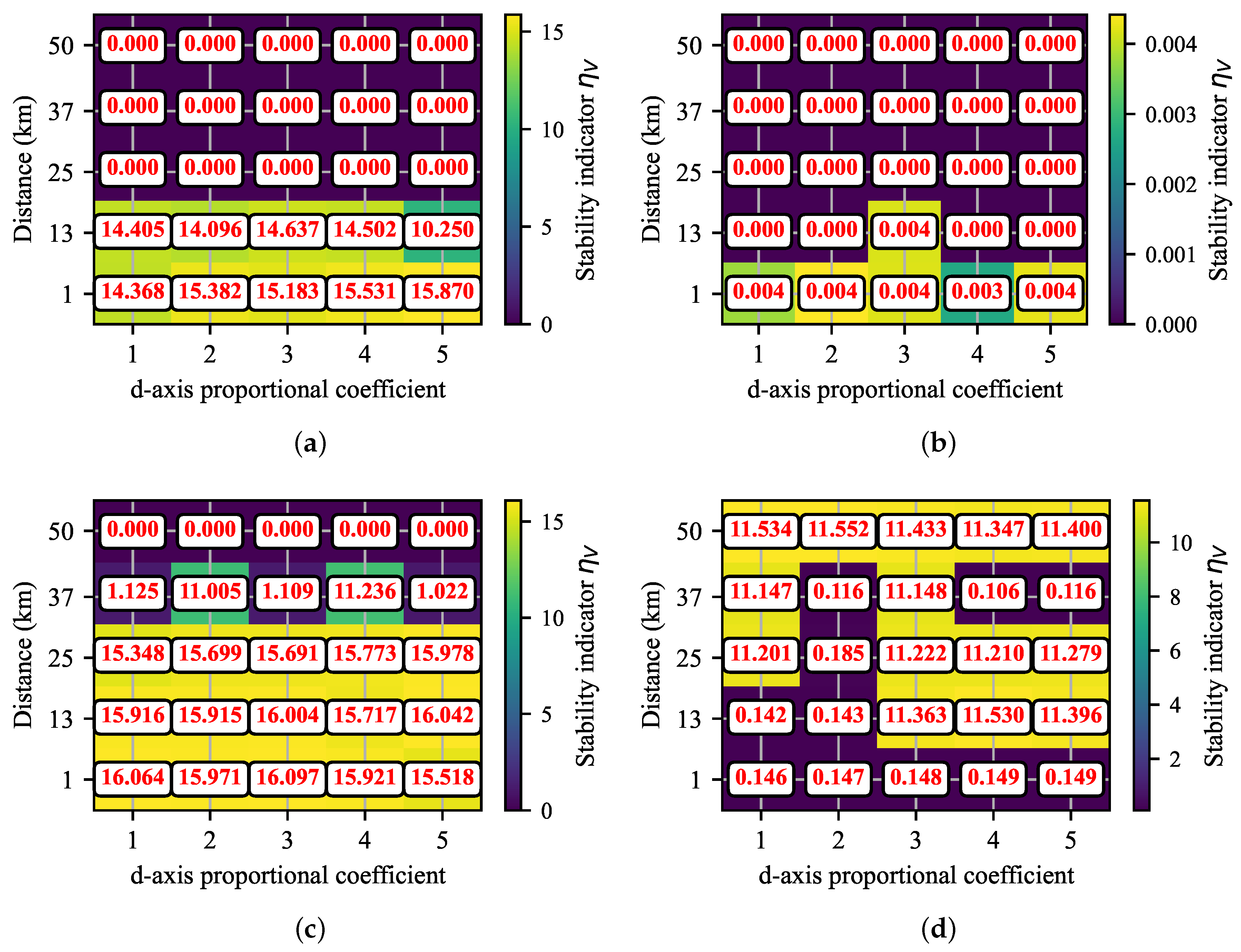
Figure 6a demonstrates that under the renewable energy penetration increase scenario, the system remains unstable across all integer values (1–5) of the grid-side d-axis proportional coefficient at integration distances of 1 km and 13 km, while maintaining stability within the same coefficient range at distances of 25 km, 37 km, and 50 km. As shown in Figure 6b, the system exhibits stable operation across all 25 parameter combinations during HVDC single-pole blocking events. Under the HVDC double-pole blocking scenario in Figure 6c, the system becomes unstable throughout the 1–5 coefficient range at integration distances of 1, 13, and 25 km, while at 37 km, it shows instability specifically at coefficient values 2 and 4 but maintains stability at values 1, 3, and 5. For the ground fault condition depicted in Figure 6d, the system remains stable across all integer values (1–5) of the proportional coefficient when the integration distance is 50 km.
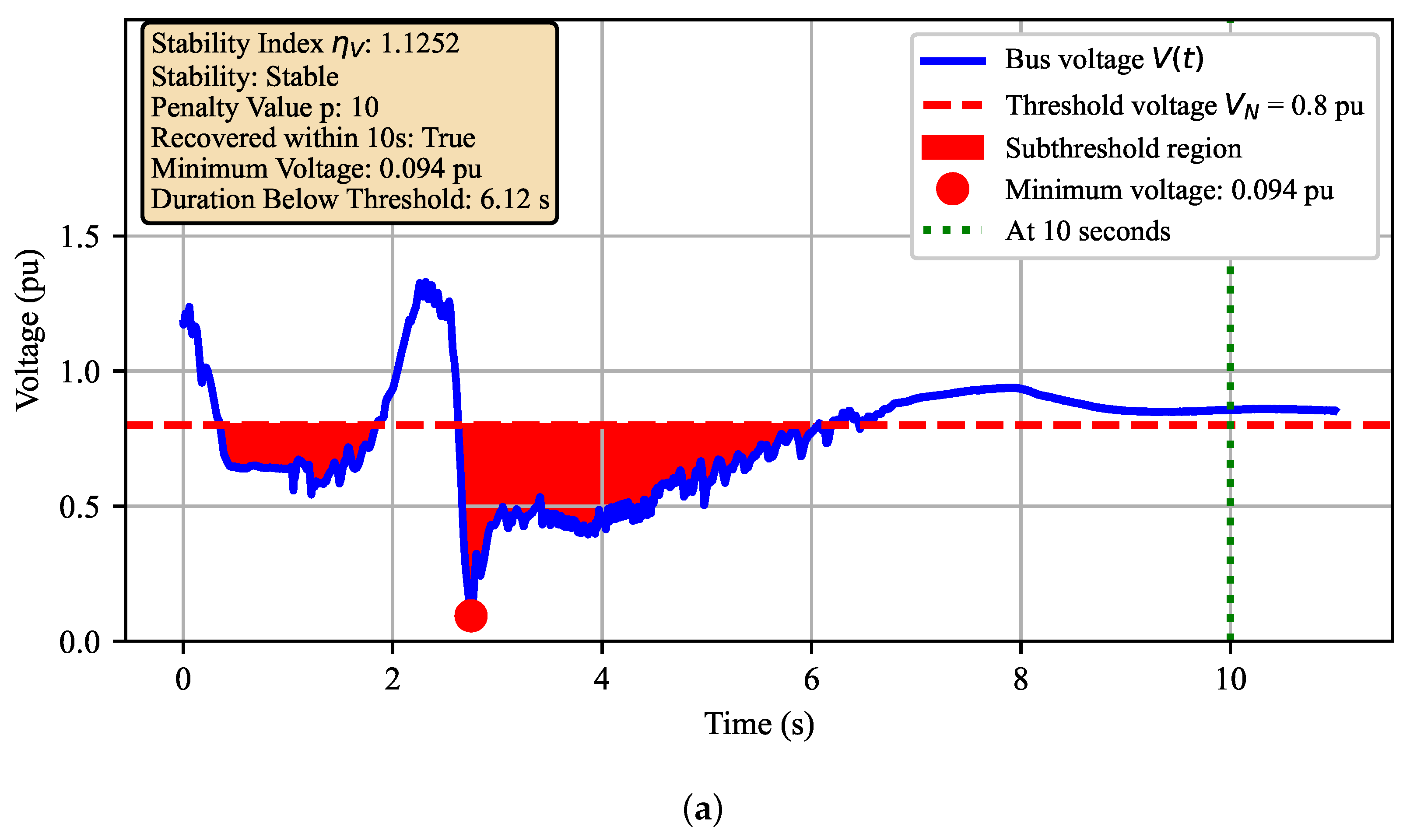
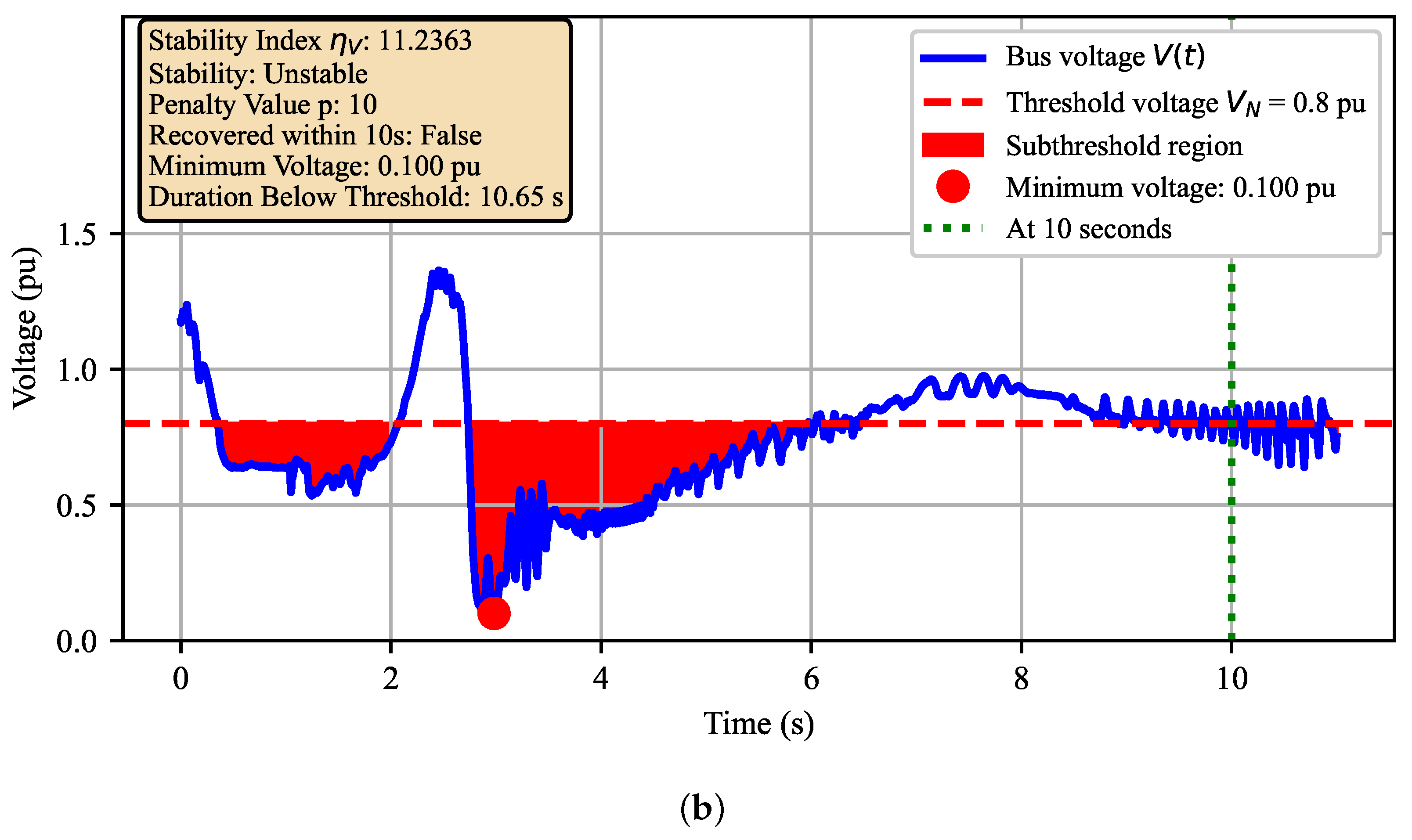
Figure 7 presents the TS waveforms under the DC bipolar blocking disturbance mode, corresponding to the operating condition shown in Figure 6c. The data covers a duration of 11 s after the fault. Key elements in the figure are illustrated as follows: the blue solid line represents the RMS value of the time-domain waveform, the red dashed line indicates the stability threshold of 0.8 pu, the red shaded area marks the regions where voltage falls below the stability threshold, and the red dots denote the lowest RMS points during the sampled time intervals. Stability criterion information is provided in the upper-left corner of the figure. In Figure 7a, with a connection distance of 37 km and the same grid-side d-axis proportional coefficient of 1, the voltage stability index is 1.1252. The RMS voltage recovers above the stability threshold at approximately 6.5 s and remains stable thereafter. The duration during which the voltage is below the threshold is 6.12 s, demonstrating that the system returns to a stable state. In Figure 7b, with the same connection distance of 37 km but a grid-side d-axis proportional coefficient of 2, the voltage stability index is 11.2363. Although the RMS voltage recovers above the threshold around 6.5 s, it drops again at approximately 9 s and fails to recover by the end of the 10 s period. The total time below the stability threshold is 10.65 s, indicating that the system ultimately becomes unstable under this configuration.
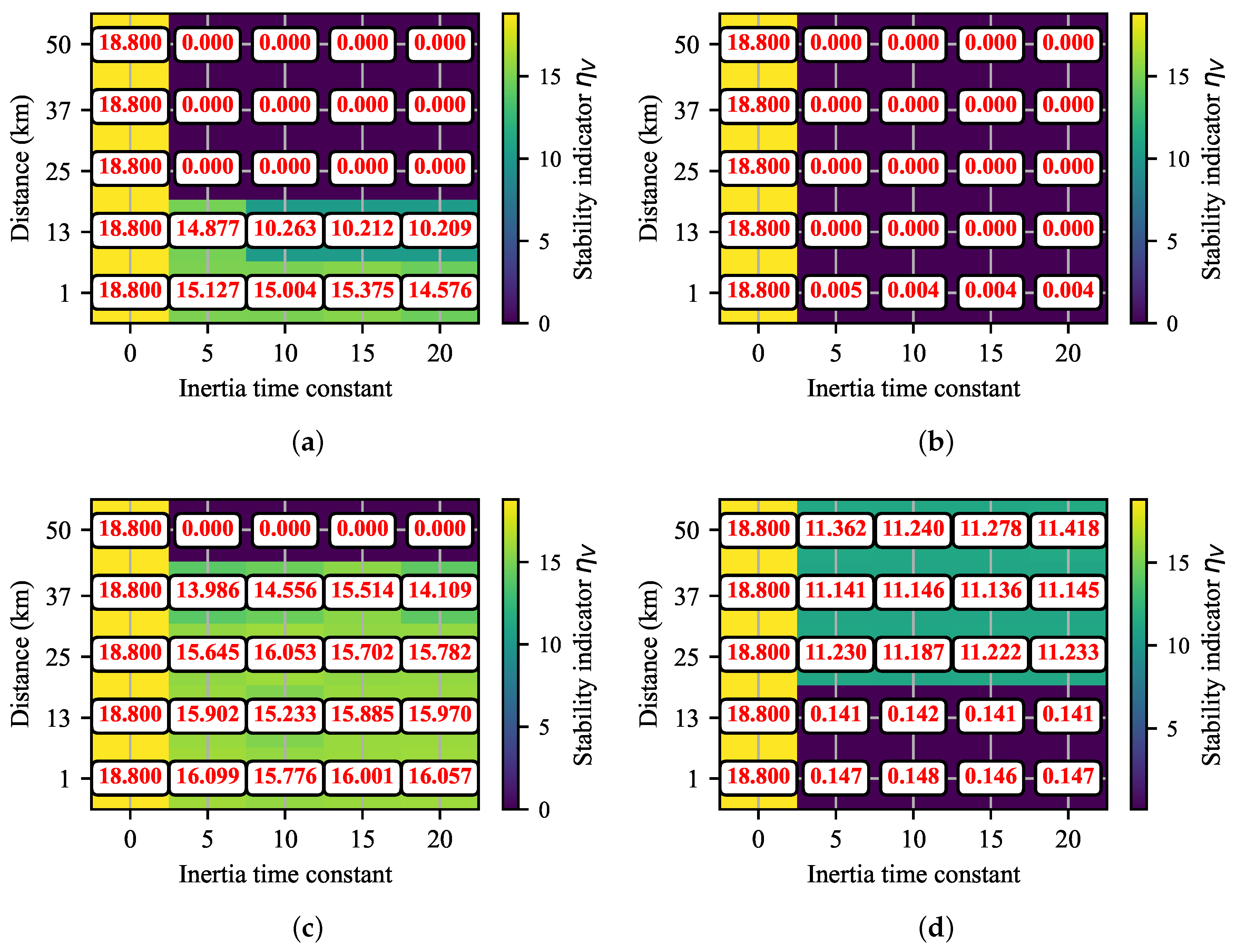
In Figure 8a,b,d, a zero rotor inertia time constant leads to system instability across all integration distances. Under the renewable energy penetration increase scenario depicted in Figure 8a, when the time constant reaches 5 or higher, the system maintains stability at integration distances of 25 km and beyond. During HVDC single-pole blocking events in Figure 8b, the system remains stable across all integration distances provided the time constant is non-zero. The HVDC double-pole blocking scenario presented in Figure 8c demonstrates the most stringent stability requirements, where stability is achieved only at the 50 km integration distance with a non-zero time constant. For the ground fault condition shown in Figure 8d, while the system maintains stability at integration distances of 1 km and 13 km when the time constant is 5 or greater, it becomes unstable across all time constant values when the integration distance increases to 25 km and beyond.
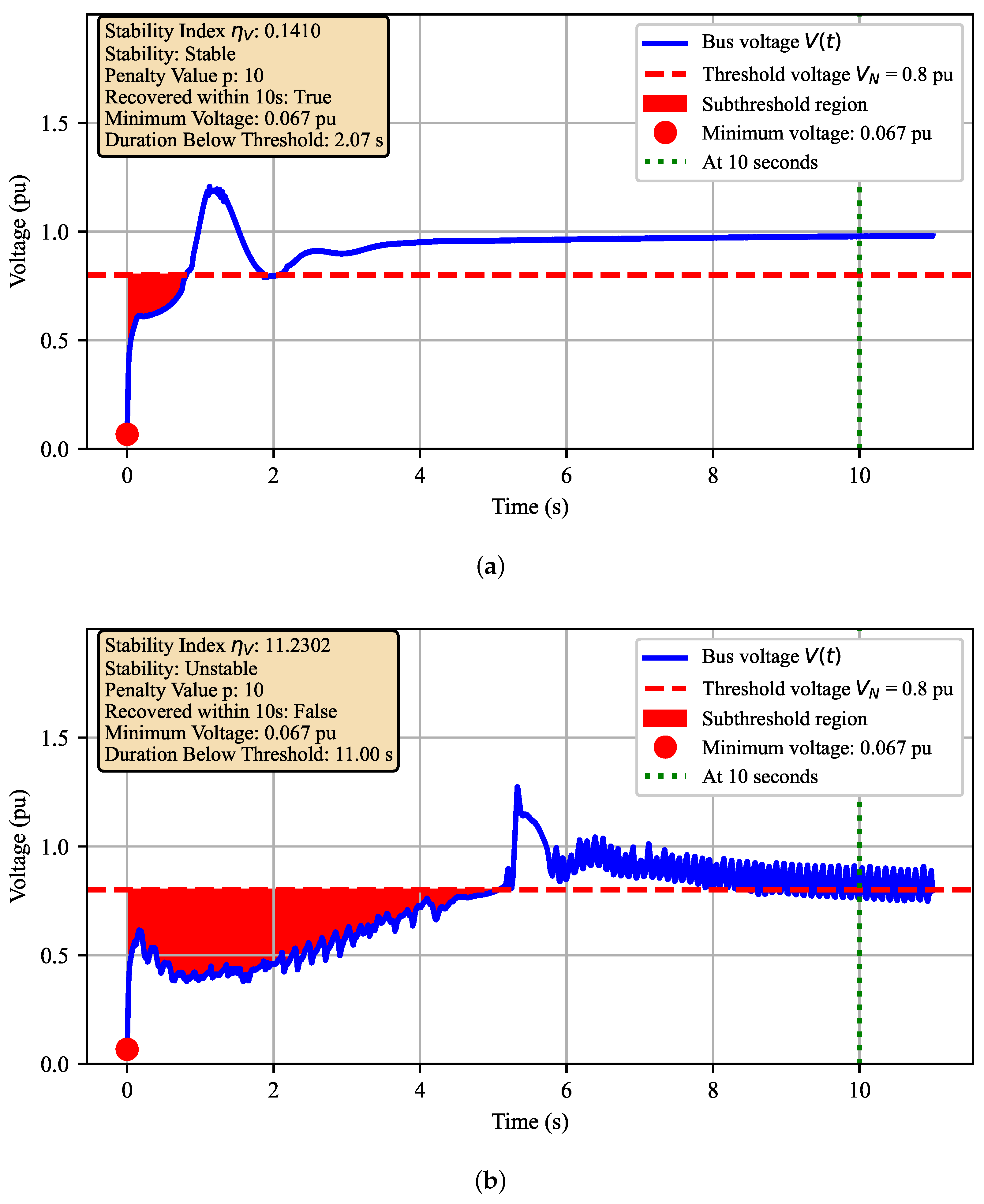
Figure 9 presents the time-domain simulation waveforms under the ground fault condition, corresponding to the operating scenario shown in Figure 6d, with data recorded over an 11 s post-fault duration. In Figure 9a, with an integration distance of 13 km and a rotor inertia time constant of 5, the voltage stability index is 0.141. The waveform remains below the stability threshold for 2.07 s, but by the 10 s mark, the voltage has recovered above the threshold, indicating that the system remains stable under this disturbance condition. In contrast, Figure 9b shows the configuration with an integration distance of 25 km and a rotor inertia time constant of 25, where the voltage stability index is 11.2302. Although the RMS voltage recovers above the threshold around 5 s, it begins to oscillate persistently above and below the stability threshold after approximately 8 s. The total duration below the threshold throughout the sampling period reaches 11 s, demonstrating that the system operates in an unstable state.

5. Conclusions

This study proposes a numerical method integrating electromagnetic transient (EMT) simulation and Sobol sensitivity analysis to elucidate the stability mechanisms of grid-connected permanent magnet synchronous generator (PMSG) systems, taking into account typical internal grid disturbances such as DC blocking and line faults. Through simulation analysis and experimental validation, the following conclusions are drawn: under different types of internal grid disturbances, the grid-connected PMSG system exhibits differentiated transient stability characteristics; voltage stability analysis under multiple disturbance scenarios based on the CSEE standard system indicates that the integration distance of the PMSG has the most significant impact on the system’s transient voltage stability.
In future work, further stability mechanism analysis can be conducted on more typical cases to derive more universal patterns and conclusions.

Author Contributions

Conceptualization, X.M. and W.D.; methodology, X.M.; software, W.D.; validation, K.L.; formal analysis, W.T. and Y.Z.; data curation, Z.W.; writing—original draft preparation, X.M.; writing—review and editing, W.D.; visualization, L.G.; supervision, Y.Z.; investigation, Y.P.; project administration, W.D.; funding acquisition, X.M. All authors have read and agreed to the published version of the manuscript.

Funding

This work was supported by the Science and Technology Project of State Grid Anhui Electric Power Company (Project No. 521205240013).

Data Availability Statement

The original contributions presented in the study are included in the article, further inquiries can be directed to the corresponding author.

Conflicts of Interest

The authors declare no conflicts of interest.

Abbreviations

The following abbreviations are used in this manuscript:
BAFbus-to-ground fault
BDBbipolar DC blocking
CSEEChinese society for electrical engineering
DMdisturbance mode
EACequal-area criterion
EFMenergy function method
EMTelectromagnetic transient
HVDChigh-voltage direct current
IREPincreased renewable energy penetration
MDBmonopolar DC blocking
MPPTmaximum power point tracking
MTPAMaximum Torque Per Ampere
PCCPoint of Common Coupling
PIproportional–integral
PLLphase-locked loop
PMSGpermanent magnet synchronous generator
PWMpulse width modulation
RMSroot mean square
SSsimulation scenarios
TStime-domain simulation

References

  1. Wang, Y.; Ji, H.; Ye, Y.; Zhao, Z. Diagnosis of Interturn Fault and High-Resistance Connection Fault in Permanent Magnet Synchronous Wind Generator Using Calculated Internal Impedance. IEEE Trans. Energy Convers. 2025, 40, 2770–2780. [Google Scholar] [CrossRef]
  2. Wu, L.; Zhou, H.; Zhang, J.; Shi, Y.; Li, J. Thermal-Flow Performance of Stator Ventilation Structure Featuring Z-Shape Channels in Permanent Magnet Synchronous Wind Generators. IEEE Trans. Energy Convers. 2025, 1–10. [Google Scholar] [CrossRef]
  3. Xie, H.; Yao, J.; He, W.; Yang, D.; Gong, S.; Zhao, L. Transient Stability Analysis and Improved Control Strategy of PMSG-based Grid-forming Wind Energy Conversion System Under Symmetrical Grid Fault. J. Mod. Power Syst. Clean Energy 2025, 13, 128–141. [Google Scholar] [CrossRef]
  4. Zhang, Y.; Zhan, M.; Kurths, J. Transient Stability Assessment of PMSG Grid-Connected System with High-Dimensional Nonlinearity by Normal-Form Method. IEEE J. Emerg. Sel. Top. Power Electron. 2025, 13, 2173–2187. [Google Scholar] [CrossRef]
  5. Wang, Y.; Zhao, C.; Guo, C.; Rehman, A.U. Dynamics and small signal stability analysis of PMSG-based wind farm with an MMC-HVDC system. CSEE J. Power Energy Syst. 2020, 6, 226–235. [Google Scholar] [CrossRef]
  6. Ma, J.; Deng, Y.; Xu, H.; Zhao, Y. Oscillation Stability Control Based on Equipment-Level and Farm-Level Cooperative Optimization for Power System Connected with Direct-Drive PMSG-Based Wind Farms. J. Mod. Power Syst. Clean Energy 2025, 13, 1580–1592. [Google Scholar] [CrossRef]
  7. Wang, L.; Truong, D.-N. Stability Enhancement of a Power System With a PMSG-Based and a DFIG-Based Offshore Wind Farm Using a SVC With an Adaptive-Network-Based Fuzzy Inference System. IEEE Trans. Ind. Electron. 2013, 60, 2799–2807. [Google Scholar] [CrossRef]
  8. Kim, Y.-W.; Sul, S.-K. Stability Analysis of Active Front End and Permanent Magnet Synchronous Generator with Back EMF-Based Sensorless Control for DC Marine Vessels. IEEE Trans. Power Electron. 2023, 38, 5411–5421. [Google Scholar] [CrossRef]
  9. Zhang, M.; Yuan, X.; Hu, J. Mechanism Analysis of Subsynchronous Torsional Interaction with PMSG-Based WTs and LCC-HVDC. IEEE J. Emerg. Sel. Top. Power Electron. 2021, 9, 1708–1724. [Google Scholar] [CrossRef]
  10. Zheng, Z.; An, Z.; Shen, C. Evaluation Method for Equivalent Models of PMSG-Based Wind Farms Considering Randomness. IEEE Trans. Sustain. Energy 2019, 10, 1565–1574. [Google Scholar] [CrossRef]
  11. Ali, M.H.; Murata, T.; Tamura, J. Effect of coordination of optimal reclosing and fuzzy controlled braking resistor on transient stability during unsuccessful reclosing. IEEE Trans. Power Syst. 2006, 21, 1321–1330. [Google Scholar] [CrossRef]
  12. Luo, Y.; Yao, J.; Chen, Z.; Huang, S.; Chen, S.; Zhang, Q.; Qin, Z. Transient synchronous stability analysis and enhancement control strategy of a PLL-based VSC system during asymmetric grid faults. Prot. Control Mod. Power Syst. 2023, 8, 1–17. [Google Scholar] [CrossRef]
  13. Nagao, T.; Tanaka, K.; Takenaka, K. Development of static and simulation programs for voltage stability studies of bulk power system. IEEE Trans. Power Syst. 1997, 12, 273–281. [Google Scholar] [CrossRef]
  14. Wang, L.; Wang, K.-H. Dynamic Stability Analysis of a DFIG-Based Offshore Wind Farm Connected to a Power Grid Through an HVDC Link. IEEE Trans. Power Syst. 2011, 26, 1501–1510. [Google Scholar] [CrossRef]
  15. Zhang, Q.; He, J.; Xu, Y.; Hong, Z.; Chen, Y.; Strunz, K. Average-Value Modeling of Direct-Driven PMSG-Based Wind Energy Conversion Systems. IEEE Trans. Energy Convers. 2022, 37, 264–273. [Google Scholar] [CrossRef]
  16. Zhai, W.; Jia, Q.; Yan, G. Subsynchronous Oscillation Characteristics for Direct Drive Wind Farm Based on Complex Torque Coefficient Method. CSEE J. Power Energy Syst. 2025, 11, 1523–1532. [Google Scholar] [CrossRef]
  17. Noman, M.; Li, G.; Wang, K.; Han, B. Electrical control strategy for an ocean energy conversion system. Prot. Control Mod. Power Syst. 2021, 6, 1–18. [Google Scholar] [CrossRef]
  18. Mani, P.; Joo, Y.H. Fuzzy Event-Triggered Control for Back-to-Back Converter Involved PMSG-Based Wind Turbine Systems. IEEE Trans. Fuzzy Syst. 2022, 30, 1409–1420. [Google Scholar] [CrossRef]
  19. Antonysamy, R.P.; Lee, S.R.; Jung, S.Y.; Joo, Y.H. Performance Enhancement Using Robust Sliding Mode Approach-Based Current Control for PMVG-WECS. IEEE Trans. Ind. Electron. 2023, 70, 10156–10166. [Google Scholar] [CrossRef]
  20. Shen, Y.; Ma, J.; Wang, L. Study on DFIG Dissipation Energy Model and Low-Frequency Oscillation Mechanism Considering the Effect of PLL. IEEE Trans. Power Electron. 2020, 35, 3348–3364. [Google Scholar] [CrossRef]
  21. Ma, J.; Shen, Y. Stability Assessment of DFIG Subsynchronous Oscillation Based on Energy Dissipation Intensity Analysis. IEEE Trans. Power Electron. 2020, 35, 8074–8087. [Google Scholar] [CrossRef]
  22. Hu, Q.; Fu, L.; Ma, F.; Ji, F. Large Signal Synchronizing Instability of PLL-Based VSC Connected to Weak AC Grid. IEEE Trans. Power Syst. 2019, 34, 3220–3229. [Google Scholar] [CrossRef]
  23. Li, D.; Shen, C.; Liu, Y.; Chen, Y.; Huang, S. A Dynamic Equivalent Method for PMSG-WTG Based Wind Farms Considering Wind Speeds and Fault Severities. IEEE Trans. Power Syst. 2024, 39, 3738–3751. [Google Scholar] [CrossRef]
  24. Sergakis, A.; Gkiolekas, N.; Salinas, M.; Mueller, M.; Gyftakis, K.N. Alternative Diagnostic Approaches for Various Single-Fault Conditions in Direct-Drive Low-Speed Coreless Permanent Magnet Generators. Energies 2025, 18, 5973. [Google Scholar] [CrossRef]
  25. Dwaza, K.N.; Krishnamurthy, S.; Mataifa, H. Time-Domain Modeling and Simulation of Hybrid Perturb and Observe–Particle Swarm Optimization Maximum Power Point Tracking for Enhanced CubeSat Photovoltaic Energy Harvesting. Energies 2025, 18, 5957. [Google Scholar] [CrossRef]
  26. Jo, H.; Lee, J.; Kim, S. Frequency Scanning-Based Dynamic Model Parameter Estimation: Case Study on STATCOM. Energies 2025, 18, 1326. [Google Scholar] [CrossRef]
  27. Xie, Q.; Zheng, Z.; Xiao, X.; Dai, T.; Ren, J.; Xu, B. Synchronization Stability Constrained SFCL-Based Fault Ride-Through Strategy for PMSG. IEEE Trans. Appl. Supercond. 2024, 34, 5601905. [Google Scholar] [CrossRef]
  28. Wang, Y.; Meng, J.; Zhang, X.; Xu, L. Control of PMSG-Based Wind Turbines for System Inertial Response and Power Oscillation Damping. IEEE Trans. Sustain. Energy 2015, 6, 565–574. [Google Scholar] [CrossRef]
  29. Wei, C.; Zhang, Z.; Qiao, W.; Qu, L. An Adaptive Network-Based Reinforcement Learning Method for MPPT Control of PMSG Wind Energy Conversion Systems. IEEE Trans. Power Electron. 2016, 31, 7837–7848. [Google Scholar] [CrossRef]
  30. Wang, Y.; Zhai, B.; Gao, S.; Guo, Y.; Shen, C.; Chen, Y.; Zheng, Z.; Song, Y. Data-Driven Parameter Calibration of Power System EMT Model Based on Sobol Sensitivity Analysis and Gaussian Mixture Model. IEEE Trans. Power Syst. 2025, 40, 1024–1036. [Google Scholar] [CrossRef]
  31. Xue, A.; Zhou, J.; Liu, R.; Chow, J.H.; Bi, T. A New Practical Transient Voltage Stability Margin Index Based on Multiple-two-element Notation Criterion. Proc. CSEE 2018, 38, 4117–4125+4317. [Google Scholar] [CrossRef]
  32. Jing, M.; Honglu, X.; Xiangyu, L. Study on Transient Stability Mechanism for Grid-Connected Direct-Drive Wind Power Systems under Strong Interactions. Proc. CSEE 2025, 45, 4669–4681. [Google Scholar] [CrossRef]
Figure 1. PMSG grid-connected structure diagram.
Energies 19 00820 g001
Figure 2. PMSG control system: synchronous generator control system on the left, rectifier torque-current closed-loop control system in the center, and inverter power DC voltage closed-loop control system on the right.
Energies 19 00820 g002
Figure 3. Variation in transient voltage stability index with system parameters (inertia constant and connection point location) under different disturbance: (a) Enhancing the penetration of new energy. (b) HVDC pole block.
Energies 19 00820 g003
Figure 4. Variation in transient voltage stability index with system parameters (inertia constant and connection point location) under different grid disturbance: (a) Enhancing the penetration of new energy. (b) HVDC pole block.
Energies 19 00820 g004
Figure 5. Variation in transient voltage stability index with system parameters under different grid disturbance scenarios: (a) Enhancing the penetration of new energy. (b) HVDC pole block. (c) HVDC bipolar block. (d) Ground fault.
Energies 19 00820 g005
Figure 6. Variation in transient voltage stability index with system parameters (d-axis proportional and connection point location) under different grid disturbance scenarios: (a) Enhancing the penetration of new energy. (b) HVDC pole block. (c) HVDC bipolar block. (d) Ground fault.
Energies 19 00820 g006
Figure 7. Time-domain waveforms: (a) distance 25 km, proportional coefficient 1, (b) distance 37 km, proportional coefficient 1.
Energies 19 00820 g007aEnergies 19 00820 g007b
Figure 8. Variation in transient voltage stability index with system parameters (inertia constant and connection point location) under different grid disturbance scenarios: (a) Enhancing the penetration of new energy. (b) HVDC pole block. (c) HVDC bipolar block. (d) Ground fault.
Energies 19 00820 g008
Figure 9. Time-domain waveforms: (a) distance 13km, inertia time constant 5; (b) distance 25km, inertia time constant 5.
Energies 19 00820 g009
Table 1. Simulation scenario configuration.
SSScenario 1Scenario 2Scenario 3Scenario 4
DM
EPNE0.1sNoneNoneNone
PBNone[2.9–3] sNoneNone
BBNoneNone[2.9–3] sNone
GFNoneNoneNone[2.9–3] s
Table 2. System parameter settings.
SSRangeSample Points
DM
Point of connection distance[1–50 km]100
PLL proportional coefficient[1–70 pu]100
Inertia time constant[0–20 pu]100
Grid-side proportional coefficient[1–5 pu]100
Disclaimer/Publisher’s Note: The statements, opinions and data contained in all publications are solely those of the individual author(s) and contributor(s) and not of MDPI and/or the editor(s). MDPI and/or the editor(s) disclaim responsibility for any injury to people or property resulting from any ideas, methods, instructions or products referred to in the content.