1. Introduction
China’s desert and Gobi regions are rich in wind and solar resources and host large-scale renewable energy installations. In large-scale new energy bases, PV power generation primarily relies on solar radiation. However, these areas also experience frequent sand and dust weather events, such as floating dust, blowing sand, and sandstorms, which are characterized by early onset, high intensity, and extensive impact. Sand and dust weather can reduce ground-level solar irradiance and significantly decrease PV power generation. In the most severe cases, this could lead to shutdowns of units at new energy bases and interruptions in power transmission, resulting in significant losses [
1]. Beyond local PV performance degradation, dust storms can also threaten grid-level energy security. An extreme dust storm in Spain caused nationwide PV output reductions exceeding 80% on a single day and prolonged losses over 50%, leading to significant economic and operational impacts on the power system. Such results emphasize the importance of developing robust forecasting and mitigation methods for PV power generation under sandstorm weather [
2]. Some studies have further linked meteorological conditions with photovoltaic generation characteristics. Reference [
3] proposed a historical PV-output characteristic extraction framework based on weather-type classification, indicating that PV output exhibits distinct behaviors under different weather patterns. Nevertheless, these approaches mainly focus on conventional conditions and remain insufficient for rapidly evolving extreme sand and dust weather. Therefore, accurate and timely forecasting of PV output in response to dust weather, considering meteorological uncertainties, can help new energy bases schedule and allocate flexible resources in advance, ensuring stable power transmission.
Existing PV output forecasting methods can be broadly categorized into three types: data-driven, physical modeling, and hybrid approaches. Among them, the data-driven approach primarily utilizes historical data from PV power stations, leveraging the powerful nonlinear fitting capability of neural networks to learn underlying patterns and predict future PV power generation [
4,
5,
6]. Its limitation lies in the lack of interpretability of the prediction mechanism, as it proves highly unreliable for scenarios outside the distribution of the training data and exhibits strong dependence on data quality. Physical modeling, on the other hand, is based on the physical principles of PV power generation and the technical parameters of PV modules. It offers strong interpretability regarding the physical mechanisms of weather changes [
7], and employs forecasted irradiance values as inputs to construct a chain of physical calculation models [
8]. After instantiating the model parameters, the prediction accuracy will be determined by the input data. However, because physical models require detailed system parameters and precise numerical weather prediction (NWP) data, they are inherently complex and demand considerable effort to ensure their accuracy. Hybrid forecasting methods combine the advantages of different forecasting models to overcome the limitations of any single model, thereby achieving more accurate and stable prediction results [
9,
10].
Although renewable energy output forecasting technology has formed a relatively well-established technical system, research under extreme weather conditions still faces the following main challenges: (1) The low probability of extreme weather events leads to scarce historical samples, which severely impacts the performance and development potential of deep learning models, resulting in issues such as overfitting and poor test data performance; (2) When meteorological factors undergo abrupt changes beyond the historical experience boundaries of the model, and renewable energy output characteristics alter drastically, the models struggle to capture such sudden variations, demonstrating poor adaptability.
Significant progress has been made in research on renewable energy output forecasting under extreme weather conditions. Considering the issue of sample deficiency, reference [
11] decomposed the power samples during cold waves into baseline and loss sequences, establishing separate forecasting models. By utilizing the characteristic parameters of wind turbine protection control, the method identifies and extracts periods of power loss. Reference [
12] defined and established discriminant models for three types of extreme weather—cold waves, typhoons, and icing—based on meteorological factors. Employing the concept of transfer learning with pre-training and fine-tuning effectively enhanced forecasting accuracy. Reference [
13], from the perspective of distributed PV power generation, defined extreme weather events and addressed issues such as data scarcity and uncertainty by proposing a few-shot data augmentation method based on generative adversarial network (GAN). The study used an enhanced long short-term memory network (LSTM) optimized by Rime Ice Optimization as the forecasting model, validated under five typical extreme weather conditions. The aforementioned methods effectively define and discriminate extreme weather from a data perspective, mitigating the issue of data scarcity to a certain extent. Reference [
14] employed a truncated normal distribution to model extreme weather intensity and introduced Kalman filtering to dynamically correct wind speed, adapting to the non-Gaussian characteristics of wind speed noise during extreme weather. Reference [
15] proposed a short-term power forecasting method for distributed PV that integrates a graph attention network (GAT), convolutional neural network (CNN), and spiking neural p systems (SNPSs) to enhance LSTM. This approach utilizes a comprehensive methodology combining spatial correlation mining, meteorological feature extraction, and time-series modeling. These studies address the poor adaptability of renewable energy output forecasting models under extreme weather conditions by attempting to extract and incorporate extreme weather features, thereby enhancing model adaptability and robustness.
However, unlike the effects of cloud cover on solar radiation, dust storms simultaneously scatter and absorb radiation. Furthermore, the variable particle characteristics make it difficult for models to accurately quantify their impact [
16]. NWP typically lacks detailed aerosol data, leading to incomplete input information. Moreover, the rapid dynamic changes and strong spatiotemporal heterogeneity of dust make it challenging to capture its variations effectively using a single station. This necessitates upscaling the prediction to a regional level. Consequently, there remains a lack of research on renewable energy output forecasting that accounts for the impact of sand and dust storms. In regional forecasting studies, Reference [
17] divided geographical locations into grid cells and established a mapping relationship between gridded irradiance and PV power output using a 3D CNN for short-term power forecasting of distributed PV station clusters. Reference [
18] integrated physical principles with data-driven advantages by incorporating solar time and Earth’s tilt angle as physical factors, clustering the study area, and applying black-box modeling to enhance the robustness of both regional and single-site PV forecasting. Reference [
8] proposed a scenario-based detector placement algorithm that leverages spatiotemporal correlations between adjacent stations to capture cloud movement. Although these studies improve PV forecasting accuracy through image feature extraction, their predictive performance is constrained in desert scenarios where supporting datasets often fail to meet conditions such as consistent solar time and multi-station observations.
In recent years, satellite remote sensing technology, capable of macroscopically observing cloud cover and movement, has been progressively applied in solar radiation and PV output forecasting studies. Reference [
19] used a bi-directional extrapolation method to simulate cloud layer movement, incorporating the predicted cloud imagery as input features into a spatial-temporal graph neural network (ST-GNN) for PV output forecasting. Reference [
20] focused on dynamic cloud modeling by introducing effective cloud albedo as a core input. It employed a spatiotemporal autoencoder prediction model based on convolutional long short-term memory (ConvLSTM), enabling both deterministic and probabilistic forecasts without requiring ground-based calibration measurements. Reference [
21] proposed a fully convolutional neural network (FCNN) model for interpolating NWP irradiance data, addressing the issue of insufficient temporal resolution caused by storage limitations. This model relies solely on extraterrestrial irradiance and does not require complex atmospheric transmission models. Although these models have demonstrated success in capturing key features such as cloud system movement and spatial correlation, revealing significant potential, no studies have yet applied them to desert and Gobi environments. Irradiance exhibits distinct physical properties and attenuation mechanisms during dust storms and cloud motion. Furthermore, challenges persist at the regional scale, including increased model complexity due to dimensionality and limitations in prediction accuracy.
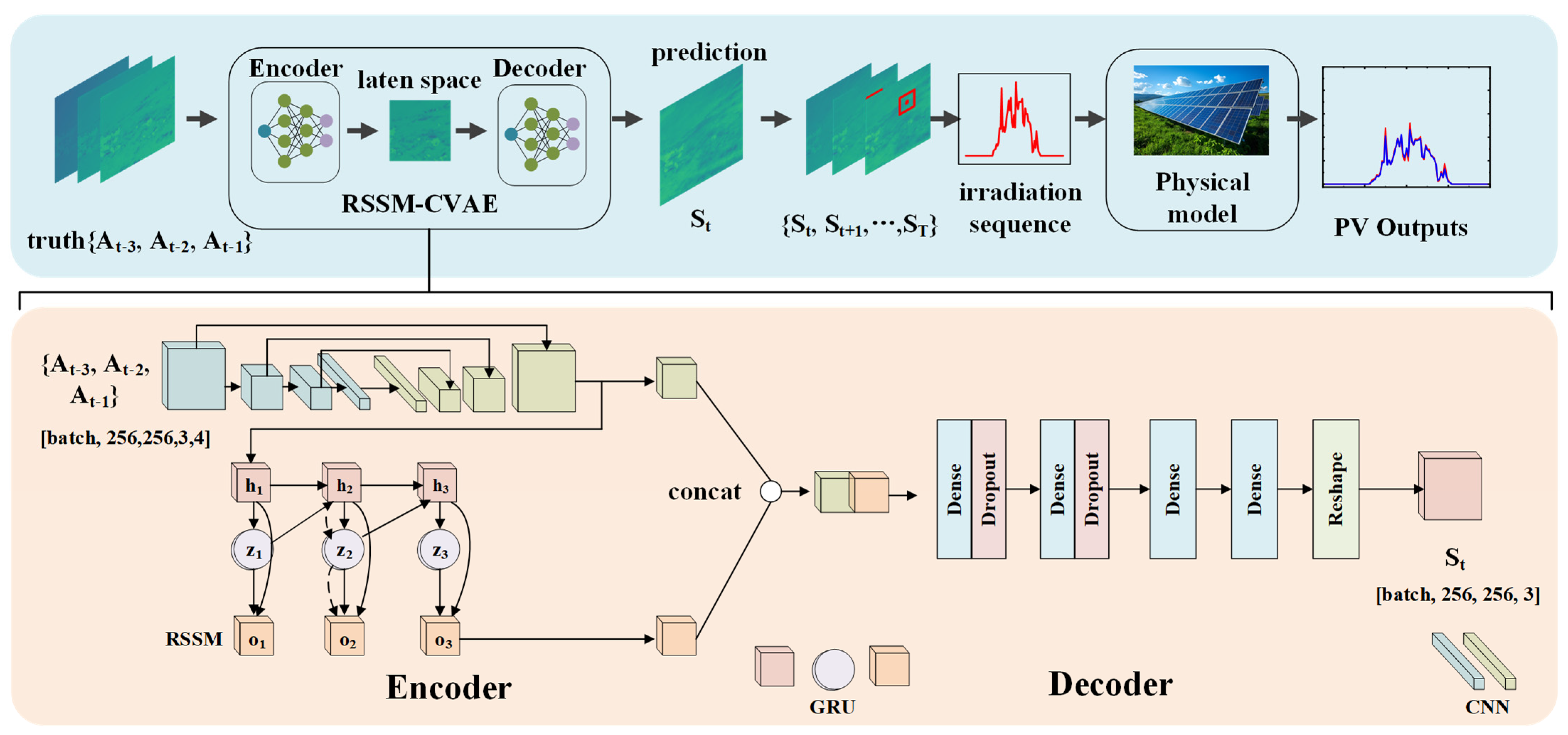
To address the aforementioned challenges, this paper establishes a hybrid data-physics driven model for PV output forecasting. Compared with the existing research, the main contributions of this paper are as follows:
The transition from single-station to regional spatiotemporal prediction is fully conducted in this paper, covering the shift from one-dimensional time-series data to two-dimensional spatiotemporal image forecasting using satellite-based global irradiance data, and tracking the evolving trajectory of irradiance under sand and dust weather to deduce its variations.
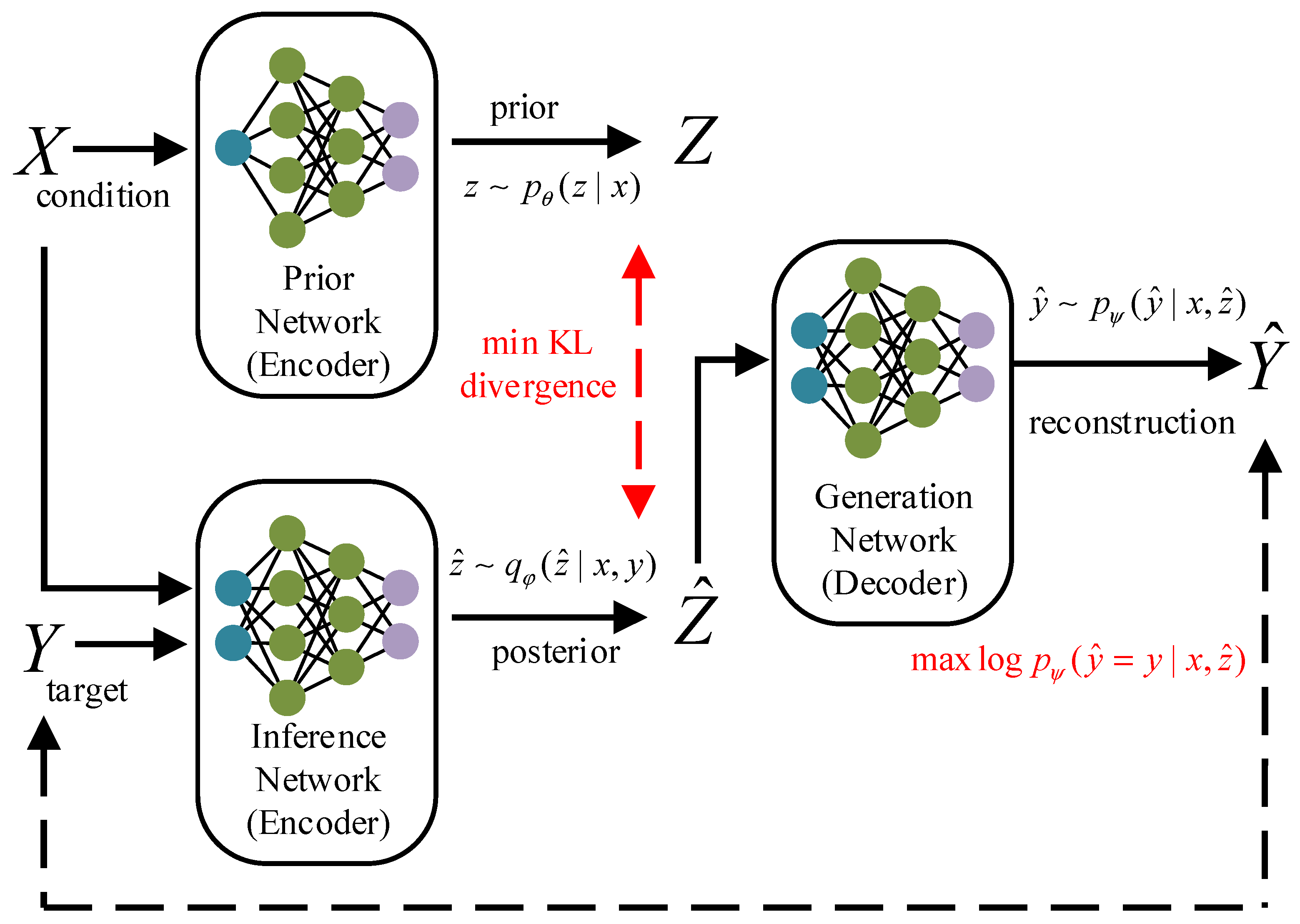
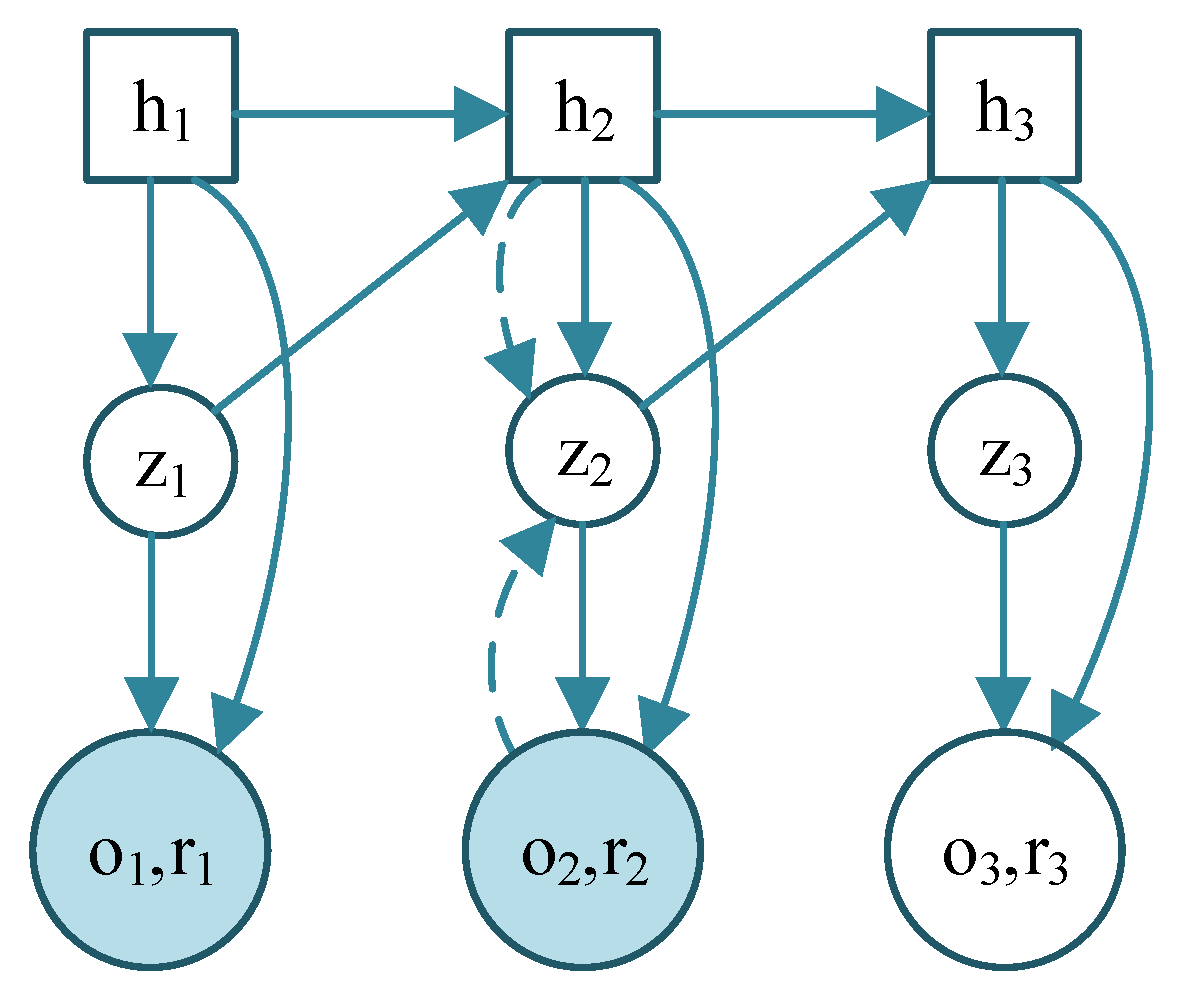
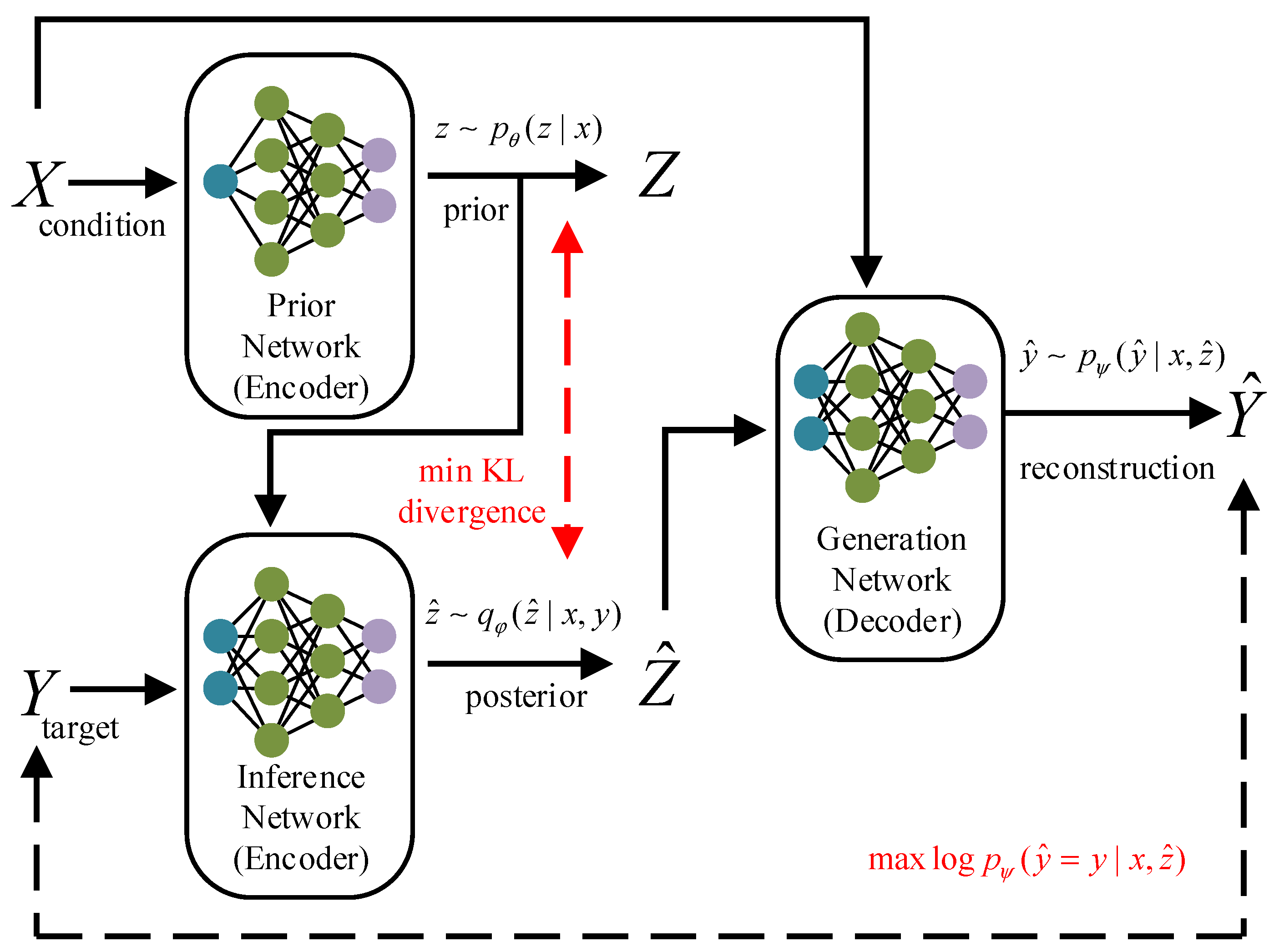
To accommodate the increased forecasting complexity and computational cost resulting from this dimensional expansion, a forecasting model based on CVAE is proposed. This model captures both deterministic trends and stochastic fluctuations in temporal irradiance data, providing essential support for subsequent PV power calculation.
A physics-based calculation model for meteorological to PV output conversion is constructed in this paper, considering the isotropic distribution tendency of scattered irradiance and variations in sky clarity under dust weather conditions, with irradiance as inputs, combined with the scale parameters of the photovoltaic plant to output the corresponding power magnitude, thereby addressing the issue of insufficient historical output data for new energy bases.
3. Experimental Results and Analysis
The data-driven meteorological data used in this study are sourced from the National Satellite Meteorological Center of China (NSMC), specifically including AGRI dust detection and AGRI surface incident solar radiation data [
24], with a temporal resolution of 1 h per sample. The temporal range of dust event samples was selected from the atmospheric environment bulletin provided by the China Meteorological Administration (CMA) government portal, while the spatial range covers the Xinjiang region of China, which experiences the most frequent dust events. The physics-based PV data are derived from the photovoltaic power output dataset available in the Science Data Bank (ScienceDB) [
25], which has a temporal resolution of 15 min per sample and covers PV power generation and measured meteorological data for the period 2018–2019.
3.1. Satellite Data Preprocessing
An initial screening was performed using the provided quality control flags inherent in the satellite data to identify and clean abnormal data points in the meteorological satellite irradiance measurements. These anomalies, including fill values, invalid values, and spatiotemporal inconsistencies caused by sensor malfunctions, were subjected to data cleansing and local neighborhood anomaly detection. Invalid data were removed to minimize their impact on the performance of the forecasting model proposed in this study. The processed dataset was then normalized using the Min-Max normalization method, which linearly scales the data to the range [0, 1] to eliminate the influence of differing dimensional units, as shown in the equation:
3.2. Evaluation Indicators
To validate the performance of the proposed method, this paper employs two standardized metrics: the mean absolute error (MAE) and root mean square error (RMSE). Let
and
denote the true value and predicted value of surface solar irradiance at spatial position j in the i-th sample, respectively. For a test set containing m samples, each with an image size of h × w, the MAE and RMSE are defined as follows:
To facilitate comparison of relative error levels across different regions or irradiance components, this study simultaneously calculated the normalized mean absolute error (NMAE) and normalized root mean square error (NRMSE). The normalization factor is the average value
of all true values in the test set.
where
is the reference value of irradiance, provided by the Fengyun satellite product documentation, with a value of 1500 W/m
2. This eliminates the influence of irradiance units, allowing the relative magnitude of errors to be expressed as percentages and ensures comparability of results across different studies or conditions.
3.3. Regional Irradiation Forecast
In this study, the optimized CVAE model is employed to predict regional irradiance data. All case studies were implemented in a TensorFlow 2.0 and Python 3.8 environment. The model architecture and parameter settings are summarized in
Table 1.
The frequency of dust storm events from 2019 to 2023 showed a trend of decreasing first and then increasing, as shown in
Table 2. Among these years, 2019 and 2023 had the highest frequencies. Only the 2022 dust storm event exhibited characteristics such as a late onset time, weak intensity, and a small affected area; events in other years were similar. Regarding specific indicators, ozone concentrations showed little overall variation across the five years, while PM
10 concentrations were higher only in 2019 compared to the other four years. Furthermore, considering the common data splitting ratios for training and testing sets and the need for consistency between prediction models and physical verification timelines, this study adopted the following data partitioning strategy: the 2019 sample data was selected as an independent test set, while data from 2020 to 2023 served as the training set.
The spatial scope covers the area between 42.82° N and 29.13° N latitude, and 73.86° E and 91.65° E longitude, encompassing southern Xinjiang and parts of Tibet. The experimental results are as follows.
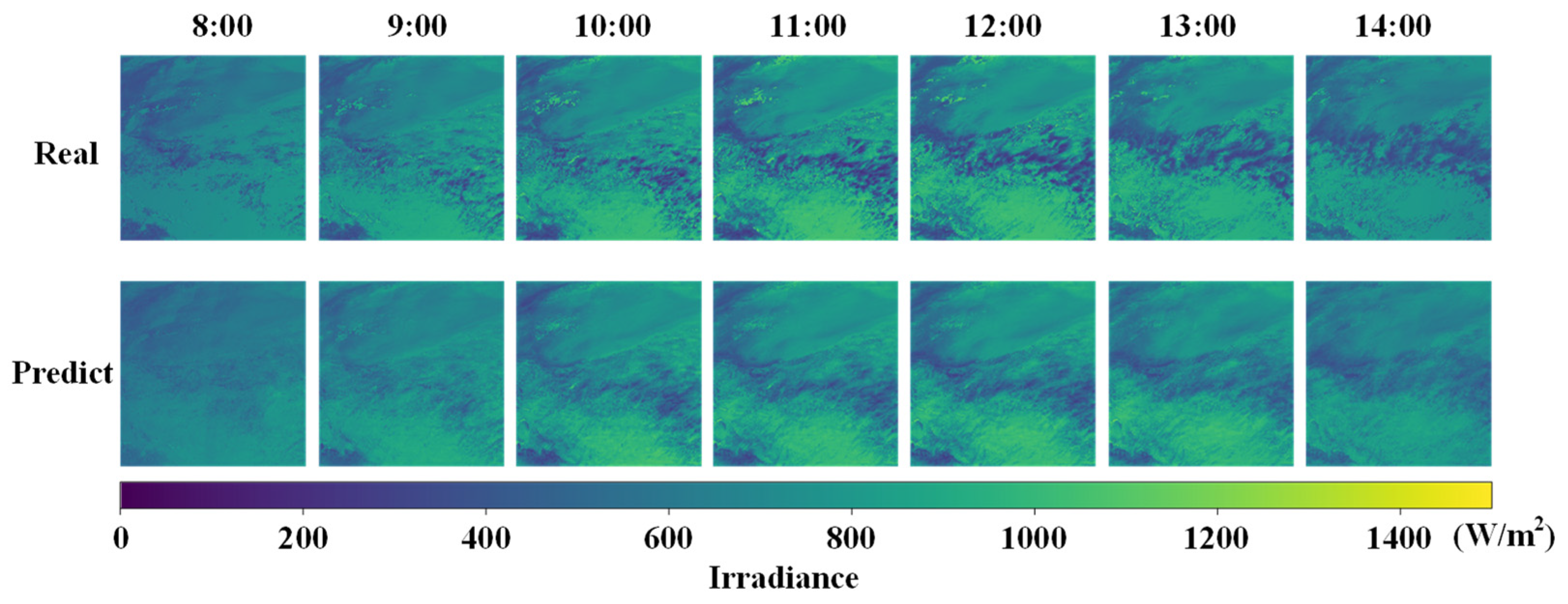
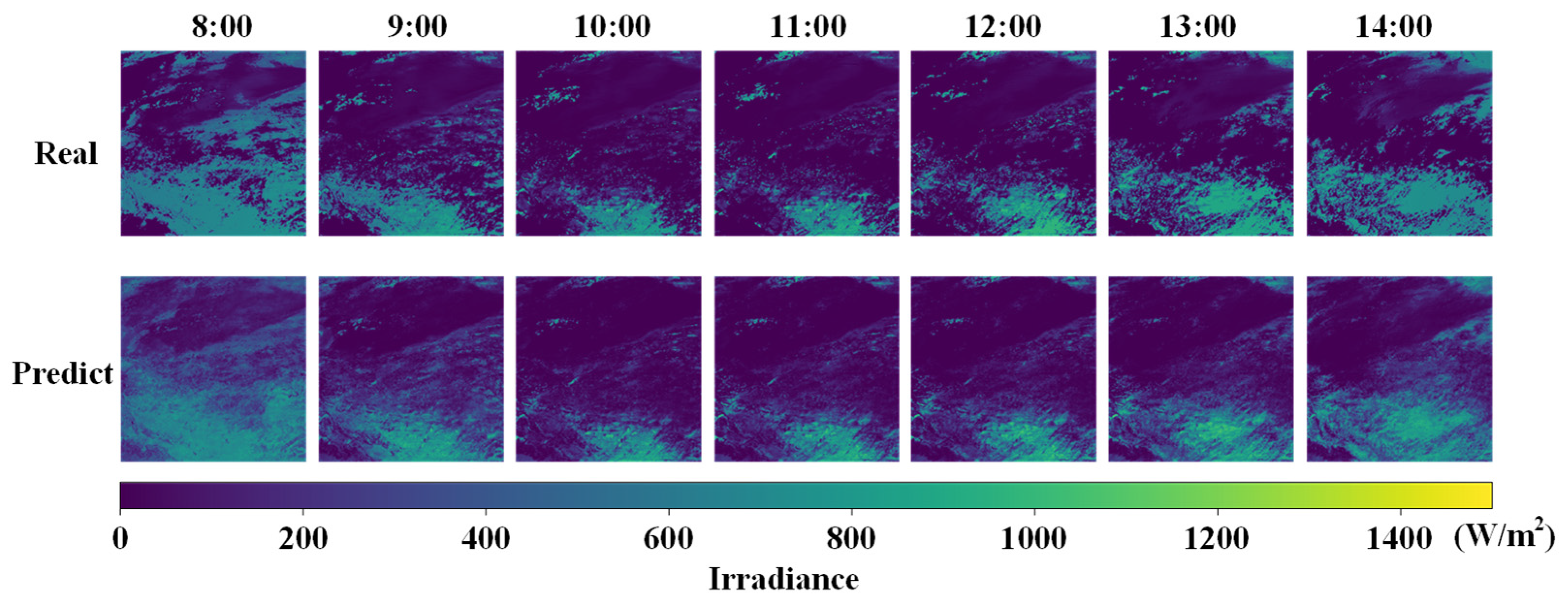
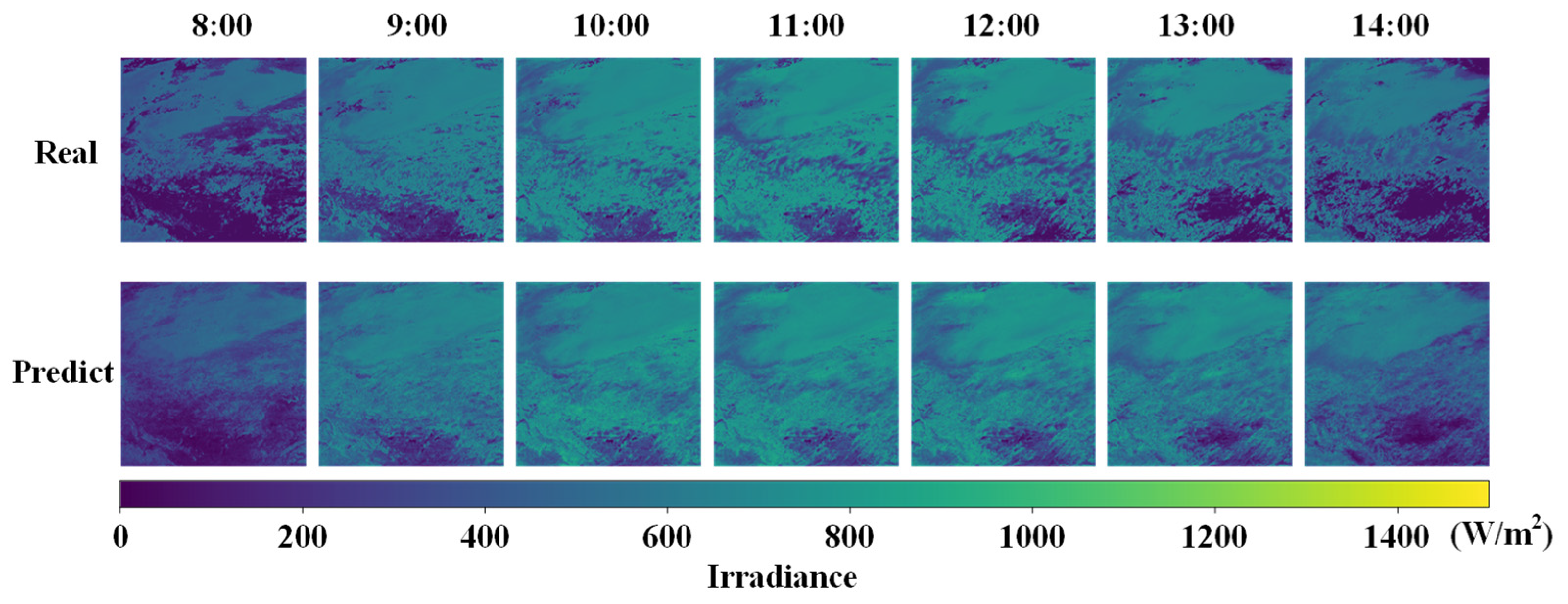
Figure 5,
Figure 6 and
Figure 7 present the prediction results of three types of regional irradiance—GHI, DNI, and DHI—based on the proposed method. As can be observed, GHI exhibits the highest overall irradiance, with peak values in desert regions reaching up to 1100 W/m
2. This is followed by DNI, which shows a strong correlation with solar elevation angle, peaking at noon when the solar path is shortest and decaying rapidly during early morning or late afternoon when the solar angle is low. In contrast, DHI increases gradually after sunrise as the solar elevation angle rises.
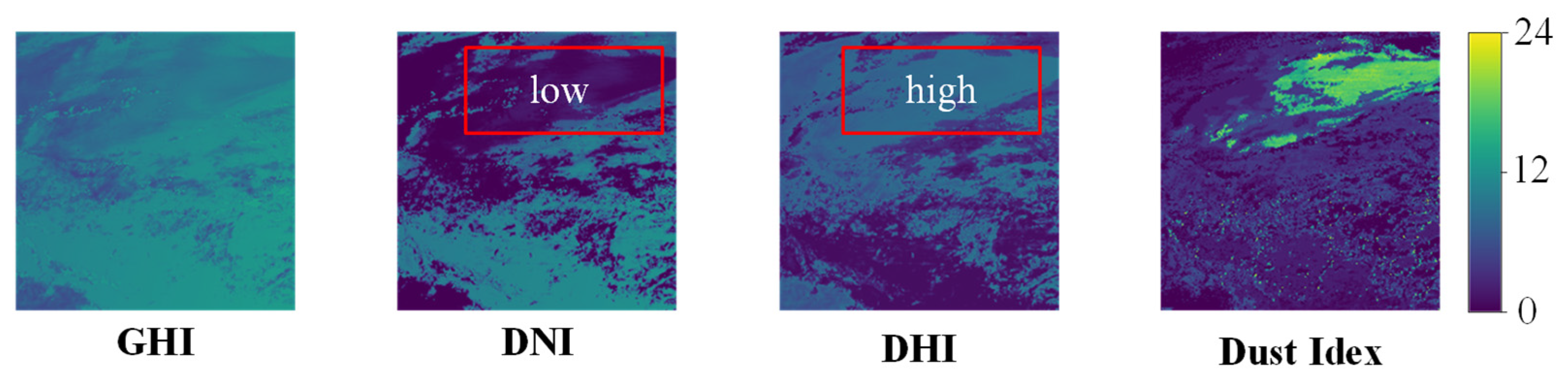
In order to quantitatively validate the physical mechanisms of the attenuation and scattering effects of dust aerosols on solar radiation, we conducted a further analysis of dust index products provided by Fengyun satellites during the same period. These data were temporally and spatially matched with irradiance data, with values ranging from 0 to 24, where higher values indicate a greater concentration of dust in the atmospheric column of the corresponding region.
Figure 8 shows the spatial distribution of dust monitoring indices at three irradiance measurement points in time. A significant spatial coupling relationship is evident: areas of high dust concentration overlap considerably with regions of low DNI values. Within the Taklamakan Desert (the red-boxed area in
Figure 8), dust indices generally exceed 16, corresponding to pronounced troughs in DNI values. This confirms the strong attenuation effect of dust aerosols on direct solar radiation: dust particles reduce DNI while enhancing DHI through multiple scattering. When dust concentrations are sufficiently high, the enhanced scattering radiation effect causes DHI to exceed DNI, which is consistent with the predicted results.
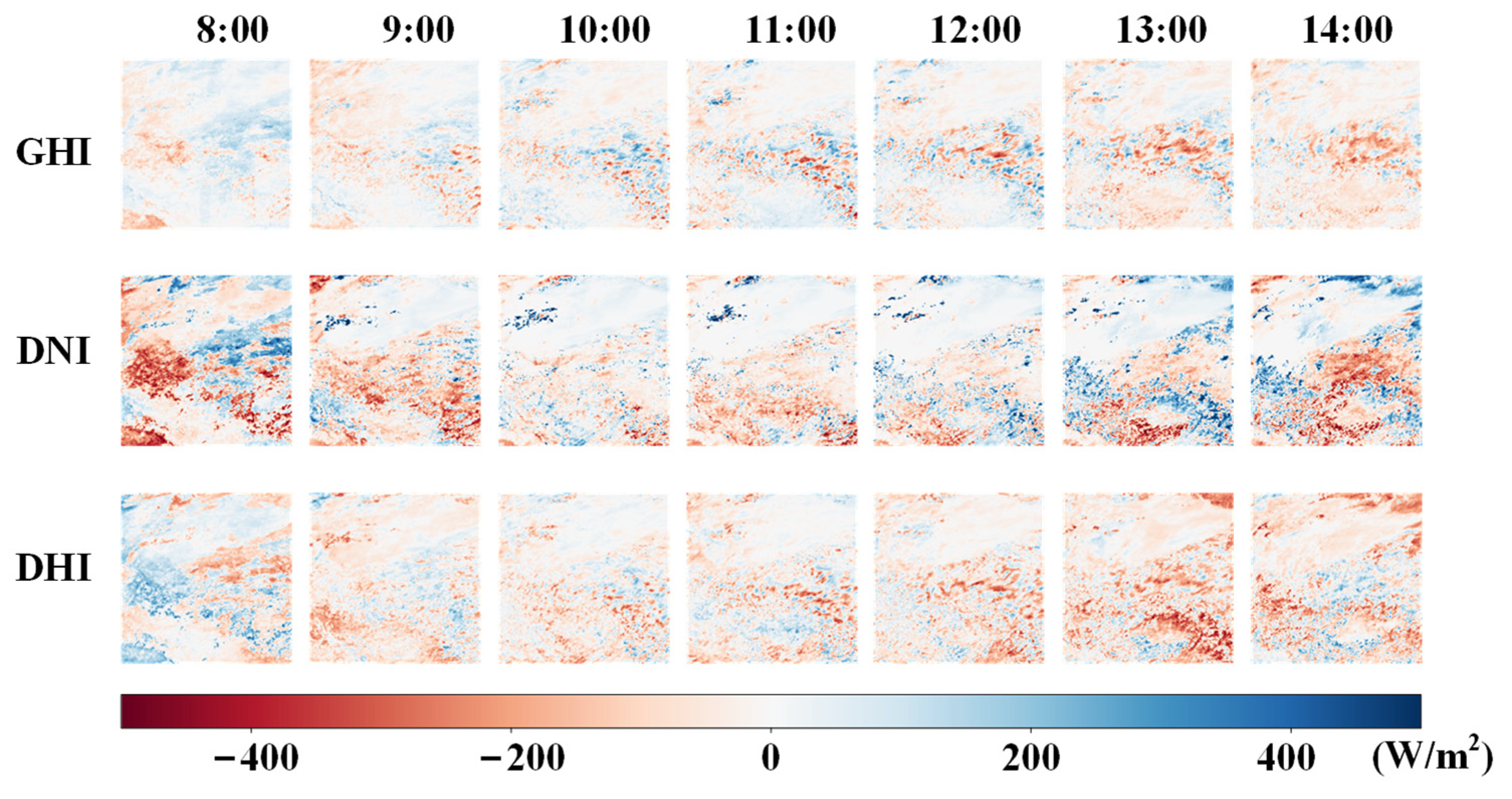
It can be observed that the proposed prediction method effectively captures irradiance variation trends under dust weather conditions. To visually highlight subtle differences that are challenging to detect through direct visual comparison between real and predicted images, a differential calculation is performed between the ground truth and prediction results. This emphasizes discrepant regions and quantifies local errors, with the calculation expressed as follows:
The differential calculation results are shown in
Figure 9, and as shown in
Table 3, the average differential values across all regional points are 55.903 W/m
2 for GHI, 96.538 W/m
2 for DNI, and 82.913 W/m
2 for DHI. Based on the valid range of 0–1500 W/m
2 for surface solar incident radiation provided by the NSMC, the percentage error metrics were calculated as shown in
Table 3. The validation results indicate that the NMAE for GHI is 3.727%, with the NRMSE of 5.351%; for DNI, the NMAE is 6.436%, with the NRMSE of 10.015%; and for DHI, the NMAE is 5.258%, with the NRMSE of 7.450%. It can be observed that the predictions for DHI perform the best, followed by GHI. These results demonstrate that the proposed method achieves low error in regional predictions for all three types of irradiances.
To further assess the reliability of the model proposed in this paper, we quantified the uncertainty of its predictions. For each test sample, 100 samples were drawn from the model to generate multiple prediction trajectories. For each prediction point, the mean, standard deviation were calculated and compared with different methods. The comparison results are shown in
Table 4.
In terms of average prediction error, the RSSM-CVAE model achieved lower MAE values than the Transformer model for all three irradiance forecasts, with respective reductions of 40.9%, 21.0% and 36.8%. The mean RMSE was also lower than that of the Transformer model by 34.2%, 21.1% and 37.5%, respectively. In terms of prediction stability, the Transformer model demonstrated high stability by exhibiting minimal fluctuation in multiple prediction results. However, this came at the cost of higher average errors.
3.4. Ablation Experiments and Analysis
The standard CVAE tends to lose fine-grained dynamic information when processing continuous spatiotemporal sequences. The RSSM specifically addresses this issue by introducing separate deterministic and stochastic states. The deterministic state explicitly models the memory effects of physical processes, while the stochastic state captures uncertain fluctuations, such as turbulence. In order to validate the necessity of each core component of the proposed framework and to assess the incremental value of the recurrent state space model relative to standard conditional variational autoencoders, systematic ablation experiments were designed to compare the performance of the full model with that of baseline models from which RSSM components had been removed.
As shown in
Table 5, introducing the RSSM module significantly and consistently enhances the performance of all three types of irradiance prediction. The MAE and RMSE of the complete model are lower than those of the baseline model for all metrics. Notably, the model shows particularly significant improvements for GHI and DHI, with reductions in MAE of 31.5% and 33.1%, respectively. This suggests that the RSSM module substantially improves the modeling capability for global radiation trends and complex scattering processes. While DNI’s MAE decreased significantly by 19.3%, its RMSE improved by a relatively smaller amount of 7.7%. RMSE penalizes large errors through its squared term, meaning rare but highly erroneous DNI prediction instances contribute disproportionately to RMSE. CVAE-RSSM model significantly improves the overall DNI trend and mean error by leveraging the deterministic nature of RSSM. However, while its predictive capability for these extreme, sudden attenuation events has improved, it cannot eliminate all such occurrences. Consequently, the percentage improvement in RMSE is diluted by these residual, unavoidable large errors.
3.5. Model Robustness Analysis
To evaluate the model’s adaptability to dust storm events across different years, annual tests were conducted. The model’s structure and hyperparameters were fixed, with each individual year forming the test set and all other years forming the training set. NMAE and NRMSE were then calculated for the model on each test set. The results are presented in
Table 6.
The model demonstrates strong predictive performance in years with moderate to high-intensity dust storms and widespread impacts. For example, taking GHI, its NMAE remained stable between 3.25% and 5.71% across the four years, while its NRMSE fluctuated between 4.39% and 7.56%, indicating reasonable variability. However, in 2021, when dust activity was weaker, errors increased slightly. This suggests that the model’s predictive capability for less frequent, lower-intensity dust events in the training data could be improved. This is a clear limitation of the model, as its performance depends on the representativeness of the training data for the forecasted weather conditions.
3.6. Validation of the Complete Hybrid Forecasting Pipeline
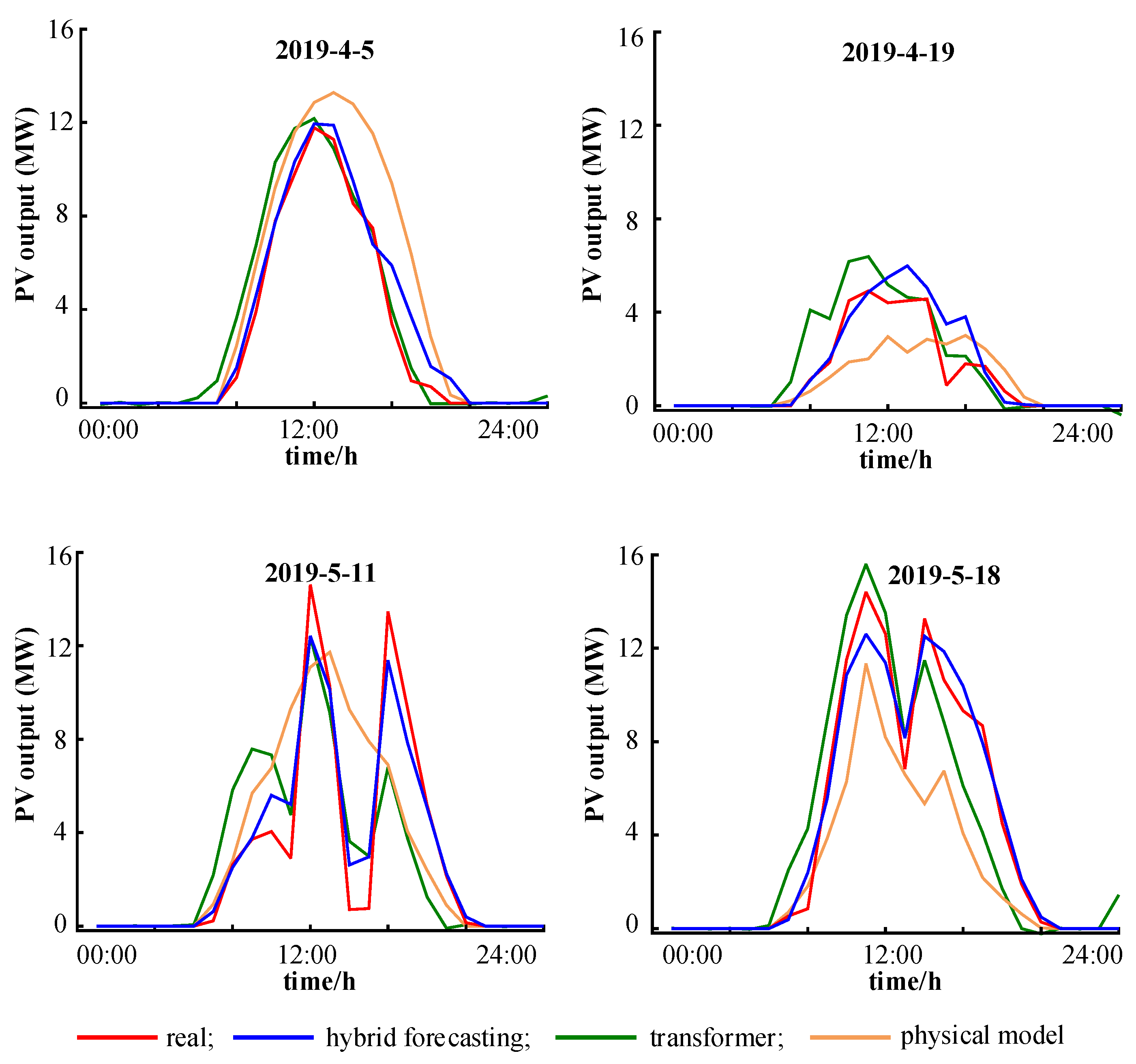
This study selected four dust storm events occurring in the region where the PV power station is located during 2019 from the Chinese meteorological yearbook report [
26] for validation. To maintain data authenticity and avoid introducing interpolation errors, we opted for temporal alignment to match higher-resolution photovoltaic power data with satellite data. Although this method loses sub-hour-scale fluctuation information, it effectively captures core dynamic changes. Given that this study focuses on hourly scale forecasting and that dust events typically persist for several hours, this approach constitutes a reasonable choice for the research objectives. The predicted GHI, DNI and DHI data are input into the physical model, which uses the Perez model to calculate photovoltaic power generation under diffuse radiation conditions on an inclined surface. This model provides precise full-sky simulations by decomposing diffuse radiation into three components and integrating sky brightness with the transparency coefficient. This makes the model applicable to various meteorological conditions. In order to quantitatively evaluate the superiority of the proposed hybrid-driven framework over conventional methods, it is compared with two typical benchmark approaches: (1) Pure data-driven method: A spatiotemporal prediction model based on Transformers. (2) Physics-based method: A physical computation chain utilizing NWP irradiance inputs and the Perez model. The computational results are shown in
Figure 10 and error calculation results are shown in
Table 7.
It can be seen that the hybrid driving method proposed in this paper significantly outperforms both single methods in terms of MAE and RMSE metrics. Compared to the purely data-driven method, the MAE decreased by 0.5548 MW and the RMSE by 0.7309 MW. Compared to the physics-only method, the MAE decreased by 0.9878 MW and the RMSE by 1.5743 MW. The hybrid method exhibits a greater reduction in RMSE than in MAE, indicating a more pronounced improvement in handling extreme errors. The purely physics-driven method yields the highest errors, with the RMSE being particularly pronounced. This is primarily due to significant uncertainties in NWP forecasts of aerosol concentration and distribution during extreme weather events, such as sandstorms. This leads to systematic biases in the input irradiance data. The data-driven approach outperformed the purely physics-driven method, demonstrating its ability to learn effective spatial and temporal patterns from historical data. However, its performance is limited in two ways. First, the scarcity of historical operational data from desert PV plants restricts the expressive power of data-driven models. Second, as a deterministic model, the Transformer struggles to generalize when encountering sudden dust events that are not sufficiently covered in the training data. It also fails to provide quantifiable information on prediction uncertainty.
3.7. Verification of Scattered Irradiance on Inclined Surfaces
To analyze and compare the completeness of the physical meaning and the generalizability of the Perez model, the corresponding PV power under the Haydavies, Klucher, and Reindl scattering irradiance decomposition and conversion models was verified through comparison. The comparison results are shown in
Table 8. Specifically, Haydavies divides DHI into isotropic and circadian components, offering simplified calculations with significant improvements over isotropic models. Reindl builds upon Haydavies by incorporating anisotropic treatment of ground-reflected radiation, while Klucher enhances Haydavies with a horizon ring scattering correction, demonstrating strong performance under moderate scattering conditions.
Under dust storm conditions, it can be observed that the Perez model demonstrates optimal performance in terms of MAPE and RMSE compared to other models. Meanwhile, the Klucher model exhibits superior performance in MAE. Taking into account the physical universality of the models and their performance across multiple metrics, this study selects the Perez model as the physical core.
5. Discussions
Compared to existing studies on the forecasting of photovoltaic power generation, this framework offers several significant advantages in the event of a dust storm. Most prior research has focused on cloud-dominated attenuation mechanisms, primarily relying on ground-based observational data or purely data-driven learning strategies [
13,
15,
19,
20]. While these methods perform well under normal or cloudy conditions, they exhibit significantly reduced robustness when aerosol scattering and absorption dominate radiation transport processes, particularly in desert regions where there is limited historical operational data.
As shown in
Table 9, existing regional-scale methods based on satellite imagery primarily simulate cloud motion and spatial correlations, rather than explicitly incorporating the physical processes that convert irradiance into photovoltaic power generation. In contrast, this study integrates a generative spatiotemporal forecasting model with a physics-based photovoltaic power calculation chain. The RSSM-CVAE module simultaneously captures the deterministic transport patterns and random fluctuations of dust aerosols. Meanwhile, the physical model explicitly accounts for isotropic scattering tendencies and variations in sky transparency under dusty conditions. This hybrid design ensures the framework’s effectiveness even when historical power samples are scarce.
The experimental results further validate this advantage. As shown in
Table 7, during dust storm events, the proposed hybrid framework achieved reductions in MAE and RMSE of 52.7% and 45.4%, respectively, compared to the purely data-driven Transformer model. Compared to the purely physical model, the reductions were 66.5% and 64.2%, respectively. Furthermore, the annual robustness assessment in
Table 6 shows that, during severe dust years, the NMSE for GHI consistently remained below 6%, demonstrating stable performance under intense aerosol perturbations. These results confirm that integrating probabilistic spatial-temporal forecasting with physical power conversion significantly improves robustness in extreme dust conditions. From an applicability perspective, this method requires only two input datasets that are readily available: (i) regional-scale, time-series meteorological data, such as satellite-derived irradiance products; (ii) the fundamental physical parameters of the photovoltaic power plant. Consequently, this approach is well-suited to large-scale PV bases in arid and semi-arid regions, where ground-based observations and historical operational records are limited. In these regions, dust aerosols dominate the radiation attenuation process and their scattering and absorption mechanisms align with the physical assumptions adopted in this study.
However, certain limitations warrant attention. The Perez diffuse irradiance model used in this study is inherently empirical and was calibrated using statistical observational data. If the dominant aerosol type in the target region differs significantly from desert dust, for example, in coastal areas with marine aerosols or industrial zones with complex anthropogenic particulates, the empirical coefficients may no longer be applicable. In such cases, the Perez model would require regional recalibration or the adoption of more sophisticated radiative transfer models. Furthermore, integrating aerosol optical depth products with multispectral satellite data in future research could enhance the physical consistency of the irradiance-to-power conversion process under various extreme meteorological conditions.