Article

Numerical Simulation Study of Multi-Component Discontinuous Chemical Flooding

1
State Key Laboratory of Offshore Oil and Gas Exploitation, Beijing 102299, China
2
CNOOC Research Institute Co., Ltd., Beijing 102299, China
*
Author to whom correspondence should be addressed.
Energies 2026, 19(3), 750; https://doi.org/10.3390/en19030750
Submission received: 20 December 2025 / Revised: 16 January 2026 / Accepted: 20 January 2026 / Published: 30 January 2026
(This article belongs to the Section H1: Petroleum Engineering)

Abstract

Discontinuous phase flooding (such as polymer microspheres) is an important method for enhancing oil recovery. With the hydration swelling and elastic properties, a unique “migration–entrapment–remigration” discontinuous flow behavior is identified during flooding. And a more pronounced conformance control effect is observed in high-permeability flow channels and deeper reservoir regions compared to continuous phase flooding. These complex seepage mechanisms pose significant challenges to reservoir numerical simulation. Based upon a chemical reaction framework, a multi-component mathematical model comprising oil, gas, water, pre-discontinuous phase, and discontinuous phase components is developed in this study. The discontinuous phase is generated through chemical reactions involving the pre-discontinuous phase. A minimum reaction porosity is first introduced in the chemical reaction process to enhance the discontinuous phase generation in high-permeability regions. A threshold pressure is incorporated into the discontinuous phase equation for the “migration–entrapment–remigration” discontinuous flow characteristics. The model is subsequently solved using a fully implicit finite volume method. A new numerical simulator implementing this approach is developed in C++. Validation through physical experiments confirms the method’s accuracy. The discontinuous migration process of “migration–entrapment–remigration” is clearly reflected through the injection pressure fluctuations during simulation. Mechanistic models and field-scale simulations both confirm that discontinuous phase flooding significantly enhances oil recovery efficiency, outperforming both water flooding and continuous phase flooding. The novel reaction specification enhances conformance control in high-permeability channels, as demonstrated by the simulation results. The proposed model accurately captures the migration characteristics of the discontinuous phase and holds important practical value for reservoirs with discontinuous phase flooding.

1. Introduction

Offshore mature oilfields have successively entered the high water-cut development stage. Long-term water flooding has exacerbated formation heterogeneity, leading to the formation of dominant flow channels, ineffective circulation of injected water, and residual oil retention in low-permeability zones [1,2]. Against this backdrop, chemical flooding has become an effective technical measure for enhanced oil recovery [3,4].
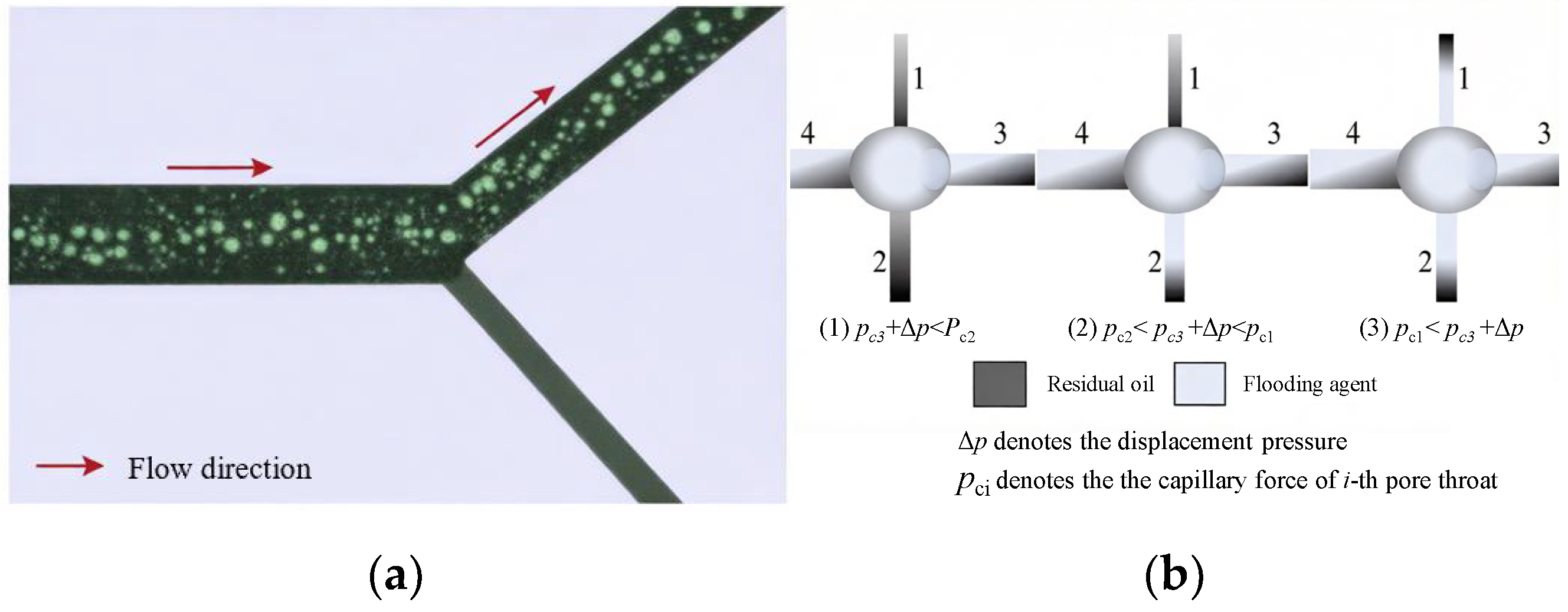
As the most mature chemical EOR technology, polymer flooding effectively improves the oil–water mobility ratio and reservoir heterogeneity, and has been widely applied in various oilfields [5,6,7]. However, polymer flooding faces inherent limitations: it struggles to effectively seal high-permeability zones without compromising low-permeability regions, frequently resulting in either plugging without concomitant displacement or displacement without effective plugging. Existing polymer flooding systems struggle to meet the EOR requirements of highly heterogeneous reservoirs. To address this, numerous researchers have introduced discontinuous phase flooding (e.g., polymer microspheres) to enhance recovery [8,9]. Extensive experimental studies have shown that the discontinuous phase exhibits hydration and swelling characteristics, expanding deep within the reservoir and readily entering high-permeability zones, where it provides a more significant plugging effect in the high-permeability zones, as illustrated in Figure 1a [10,11,12]. Simultaneously, due to its elastic properties, the discontinuous phase would temporarily plug pore throats for profile control and displacement. As the pressure differential increases, exceeding the threshold pressure gradient with flooding, the discontinuous phase breaks through and continues to migrate, demonstrating a seepage characteristic of “migration–plugging–breakthrough–remigration,” as shown in Figure 1b. This seepage process fundamentally differs from the displacement mechanism of traditional continuous phase agents [13,14]. As we can see, the discontinuous phase flooding shows three distinct flow characteristics of migration–plugging–remigration discontinuous flow behavior, high permeability and deep reservoir zone comfortable control.
Some scholars have conducted research on the numerical simulation of the different chemical flooding processes [15,16]. In 2016, Cao Weidong et al. investigated the oil displacement mechanisms of non-homogeneous combination flooding systems [17,18]. They characterized the discontinuous migration behavior of B-PPG particles by introducing a particle passage factor. Their work provided theoretical support and practical tools for composite flooding technology, but it insufficiently considered the deep reservoir area comfortable control effect. In addition, a multi-phase, multi-component cross-linked polymer flooding model based on a black-oil model is developed for the simulation of the polymer cross-linking process [19,20]. With chemical reactions between different components, cross-linked polymer flooding is generated in the deep reservoir region during simulation. However, this struggles to describe the discontinuous migration characteristics of the discontinuous phase. In 2022, Zhao et al. established a numerical simulation method of particle gel flooding [21,22]. They introduced a chemical reaction model to account for the hydration expansion process. Also, they considered the water phase permeability reduction factor as permeability-dependent, achieving a representation of the stronger plugging effect of the high-permeability layers. However, it is hard to characterize the discontinuous behavior. In summary, numerous numerical simulation methods have yet to integrate complex flow mechanisms of the different chemical flooding methods. As stated in the aforementioned literature, the flow characteristics of deep profile control, stronger plugging in high-permeability zones and the discontinuous seepage behavior have been investigated along with different numerical methods, as shown in Table 1. But no existing model integrates the above mechanisms simultaneously. This limitation hinders direct application to numerical simulations of discontinuous phase flooding.
Therefore, this paper introduces an novel numerical simulator for discontinuous phase flooding. First, a multi-component mathematical model is developed, incorporating traditional oil, gas, and water phases alongside the novel pre-discontinuous and discontinuous phase components. Key mechanisms—including deep profile control, enhanced plugging in high-permeability zones, and discontinuous flow behavior—are integrated by introducing chemical reaction and threshold pressure gradient. Subsequently, the simulator’s accuracy is validated against experimental data and its practical utility is demonstrated through a field case application. It can guide the development of discontinuous phase applications.

2. Mathematical Model

2.1. Model Assumptions

(1)
Temperature changes are not considered.
(2)
The oil component exists solely in the oil phase, and the water component exists solely in the water phase. No mass exchange occurs between the oil and water components. The gas component can exist in both the gas and oil phases (as free gas and dissolved gas, respectively), and no mass exchange occurs between the gas and water components.
(3)
The pre-discontinuous phase acts similarly to a tracer, neglecting the permeability or water viscosity of the pre-discontinuous phase.
(4)
The discontinuous phase component exists only in the water phase.

2.2. Characterization of Discontinuous Phase Flow Mechanisms

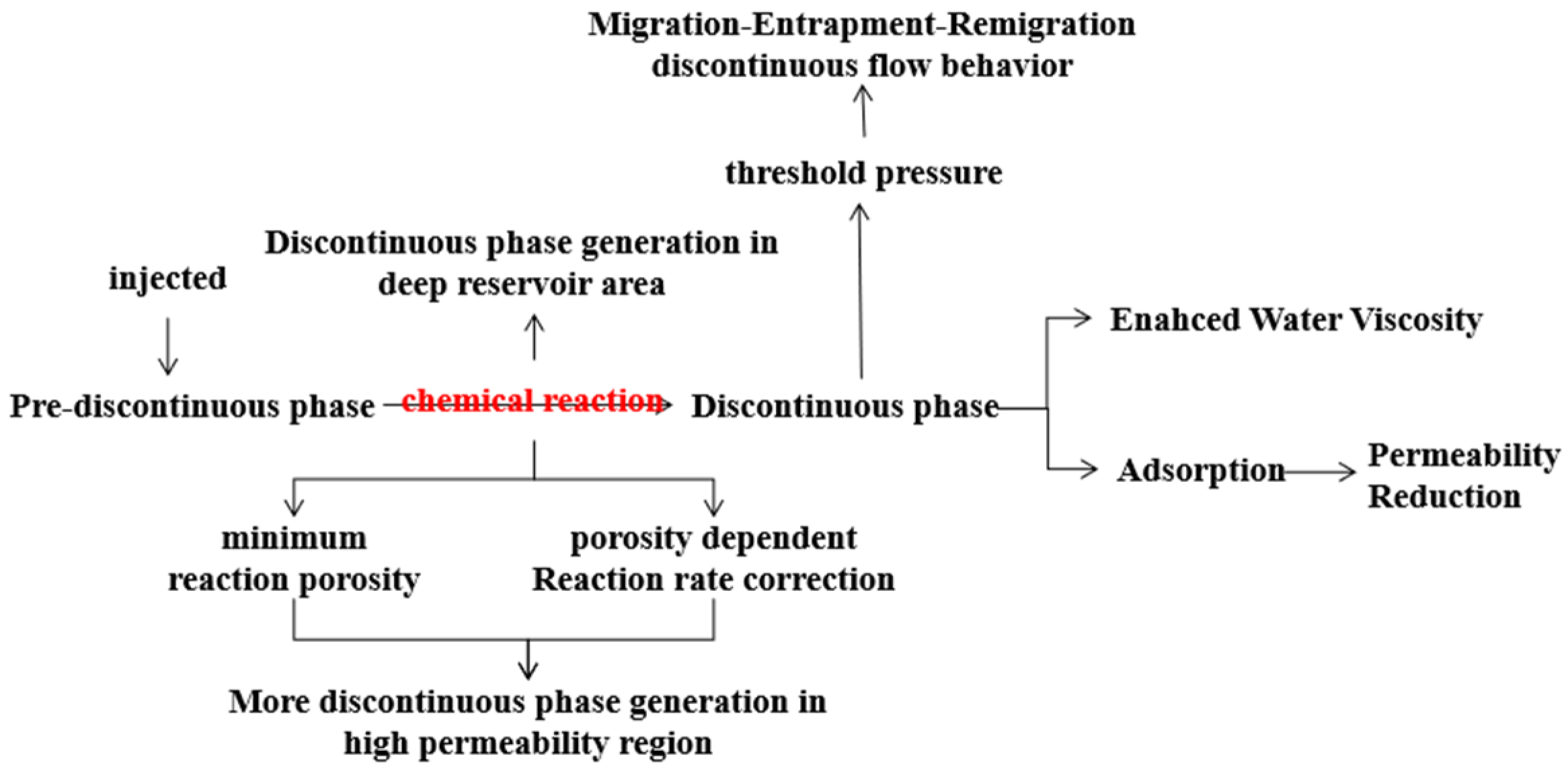
The discontinuous phase exhibits hydration swelling and elastic properties. It demonstrates complex flow behavior, enhancing oil recovery by increasing water phase viscosity and reducing water relative permeability. As we can see in Figure 2, a chemical reaction is introduced to approximate the physical process of hydration swelling in the discontinuous phase, simulating discontinuous phase generation within the deep reservoir. Crucially, the chemical reaction coefficient is modeled as porosity-dependent, resulting in greater discontinuous phase generation within high-permeability zones, thereby characterizing the stronger plugging. Furthermore, a threshold pressure is introduced to capture the “migration–entrapment–remigration” discontinuous flow characteristic.
(1)
Hydration swelling of the discontinuous phase
The discontinuous phase is generated from the pre-discontinuous phase during the reaction. And a minimum chemical reaction concentration is introduced. When the pre-discontinuous phase concentration exceeds this threshold, the reaction is triggered. This achieves the generation of the discontinuous phase deep within the reservoir, approximating the hydration swelling process of the discontinuous phase.
d C pd d t = ( ϕ ϕ min ) θ K ( C pd C pd min )
d C d d t = ( ϕ ϕ min ) θ K ( C p d C p d min )
In the equations, K = ln 2 λ .
In the equations, Cpd and Cd represent the concentrations of the pre-discontinuous phase and discontinuous phase, m3/m3, respectively; K denotes the chemical reaction rate constant, characterizing the conversion rate from the pre-discontinuous phase to the discontinuous phase, 1/d; λ is the conversion half-life, defined as the time required for the pre-discontinuous phase concentration to decay to half during the reaction, d; Cpdmin refers to the minimum reaction concentration, below which the conversion reaction does not occur, m3/m3; ϕmin indicates the minimum reaction porosity, where regions with porosity below this value prevent the entry of the pre-discontinuous phase and subsequent generation of the discontinuous phase, dimensionless; θ is the porosity exponent, reflecting the extent of porosity’s influence on the reaction rate and used to adjust the reaction rate of the pre-discontinuous phase across varying porosities; and the subscripts pd and d correspond to the pre-discontinuous and discontinuous phases.
(2)
Enhanced plugging in high-permeability zones
In the chemical reaction converting the pre-discontinuous phase to the discontinuous phase, a minimum reaction porosity (ϕmin) is introduced. When the reservoir porosity is below this threshold, the chemical reaction does not occur, ensuring that the discontinuous phase is generated only in reservoirs with relatively larger porosity, thereby achieving selective plugging in high-permeability zones. Additionally, a porosity exponent (θ) is incorporated to intensify the generation reaction of the discontinuous phase in regions with higher porosity. The combination of these two model settings effectively characterizes the enhanced plugging effect in high-permeability zones, as illustrated in Equations (1) and (2).
(3)
Migration–Entrapment–Remigration discontinuous flow behavior
Following the work of Cao et al. [17], a threshold pressure (pmax) is defined for the discontinuous phase. When the pressure gradient is smaller than this threshold, the discontinuous phase remains immobile. The discontinuous phase would migrate until the pressure gradient exceeds the threshold with flooding. This model setting can approximately capture the migration, entrapment, remigration, and re-entrapment behavior characteristic of the discontinuous phase.
V d = k k rw μ weff R k C d M Φ w , M = 1 , Φ w > P max 0 , Φ w < P max
(4)
Viscosity of the Discontinuous Phase Solution
Enhancing water phase viscosity is one of the key mechanisms through which the discontinuous phase improves oil recovery. The unified viscosity model for polymer solutions established by Delshad et al. is adopted to characterize the viscosity variation in the discontinuous phase [6].
μ weff = μ sh + μ el μ sh = μ w + μ d 0 μ w 1 + λ 1 γ 2 n 1 1 2 μ el = μ max { 1 exp [ λ 2 τ r γ n 2 1 ] }
(5)
Adsorption of the Discontinuous Phase
The adsorption of the discontinuous phase is characterized using the Langmuir adsorption model:
C d a = a C dmax C d 1 + b C d
(6)
Permeability Reduction Factor of the Discontinuous Phase
R k = 1.0 + ( R F F 1.0 ) C d a C d amax
In the equation, RFF represents the residual resistance factor of the rock, while Cdamax denotes the maximum adsorption concentration in kg/kg; Rk refers to the water phase permeability reduction factor, dimensionless.

2.3. Continuity Equations

With the above assumptions, components for the pre-discontinuous phase and discontinuous phase are considered, building upon the conventional black-oil model. Based on the characterization of the discontinuous phase seepage mechanisms, continuity equations for the five components—oil, gas, water, pre-discontinuous phase, and discontinuous phase—are formulated as follows:
[ k k ro B o μ o Φ o ] + q o = t ( ϕ S o B o )
[ k k rw B w μ weff R k Φ w ] + q w = t ( ϕ S w B w )
[ k k rg B g μ g Φ g ] + [ R so k k ro B o μ o Φ o ] + q g = t ( ϕ S g B g )
[ k k rw C pd B w μ weff R k Φ w ] ϕ S w B w ( ϕ ϕ min ) θ K ( C pd C pd min ) + q w C pd = t ( ϕ S w C pd B w )
[ k k rw C d B w μ weff R k Φ w ] + ϕ S w B w ( ϕ ϕ min ) θ K ( C pd C pd min ) + q w C d = t ( ϕ S w C d ( 1 S d ) B w + ρ r C d a ( 1 ϕ ) )
In the equations, Φ l = P l ρ g D .
In the equations, So, Sg, and Sw represent the saturations of the oil, gas, and water phases, respectively, dimensionless; qo, qg, and qw denote the volumetric injection/production rates per grid block for the oil, gas, and water phases, respectively, m3/d; Bo, Bg, and Bw are the formation volume factors of the oil, gas, and water phases, respectively, dimensionless; Rso is the solution gas-oil ratio, m3/m3; k denotes the absolute permeability of the reservoir, mD; D represents the formation depth at the center of the grid block, m; ϕ is the porosity, dimensionless; kro, krg, and krw are the relative permeabilities of the oil, gas, and water phases, respectively, dimensionless; and μo is the viscosity of the oil phase, mPa·s.

3. Numerical Solution and Validation

3.1. Discrete Flow Equations

The model with multi flow mechanisms is very complex, making it challenging to obtain a stable and accurate result. Then, finite volume and fully implicit methods are adopted. With the finite volume method, the discrete flow equations are obtained:
T λ o n + 1 Φ o n + 1 + q o n + 1 = V ( ϕ S o B o ) n + 1 ( ϕ S o B o ) n Δ t
[ T λ w n + 1 Φ w n + 1 ] + q w n + 1 = V ( ϕ S w B w ) n + 1 ( ϕ S w B w ) n Δ t
[ T λ g n + 1 Φ g n + 1 ] + [ T λ o n + 1 Φ o n + 1 ] + q g n + 1 = V ( ϕ S g B g ) n + 1 ( ϕ S g B g ) n Δ t
[ T λ w n + 1 C pd n + 1 Φ w ] ( ϕ S w B w ) n + 1 ( ϕ ϕ min ) θ K ( C pd n + 1 C pd min ) + q w n + 1 C pd n + 1 = V ( ϕ S w C pd B w ) n + 1 ( ϕ S w C pd B w ) n Δ t
[ T λ w n + 1 C d n + 1 Φ w n + 1 ] + ( ϕ S w B w ) n + 1 ( ϕ ϕ min ) θ K ( C pd n + 1 C pd min ) + q w n + 1 C d n + 1 = V ( ϕ S w C d ( 1 S d ) B w + ρ r C d a ( 1 ϕ ) ) n + 1 ( ϕ S w C d ( 1 S d ) B w + ρ r C d a ( 1 ϕ ) ) n Δ t
Then, the solution of the fully implicit model is obtained through the Newton–Raphson iteration method:
[ R w S w R w S g R w P o R w C pd R w C d R o S w R o S g R o P o R o C pd R o C d R g S w R g S g R g P o R g C pd R g C d R pd S w R pd S g R pd P o R pd C pd R pd C d R d S w R d S g R d P o R d C pd R d C d ] δ S w δ S g δ P o δ C pd δ C d = R w R o R g R pd R d
where λ o = k ro μ o B o , λ w = k rw μ weff B w R k , λ g = k rg μ g B g .
  • where T is the inter-grid transmissibility, m2·m; λo, λw, λg are the mobility of oil, water and gas phase; and δSw, δSg, δPo, δCpd and δCd are the solution variables.

3.2. Simulator Development

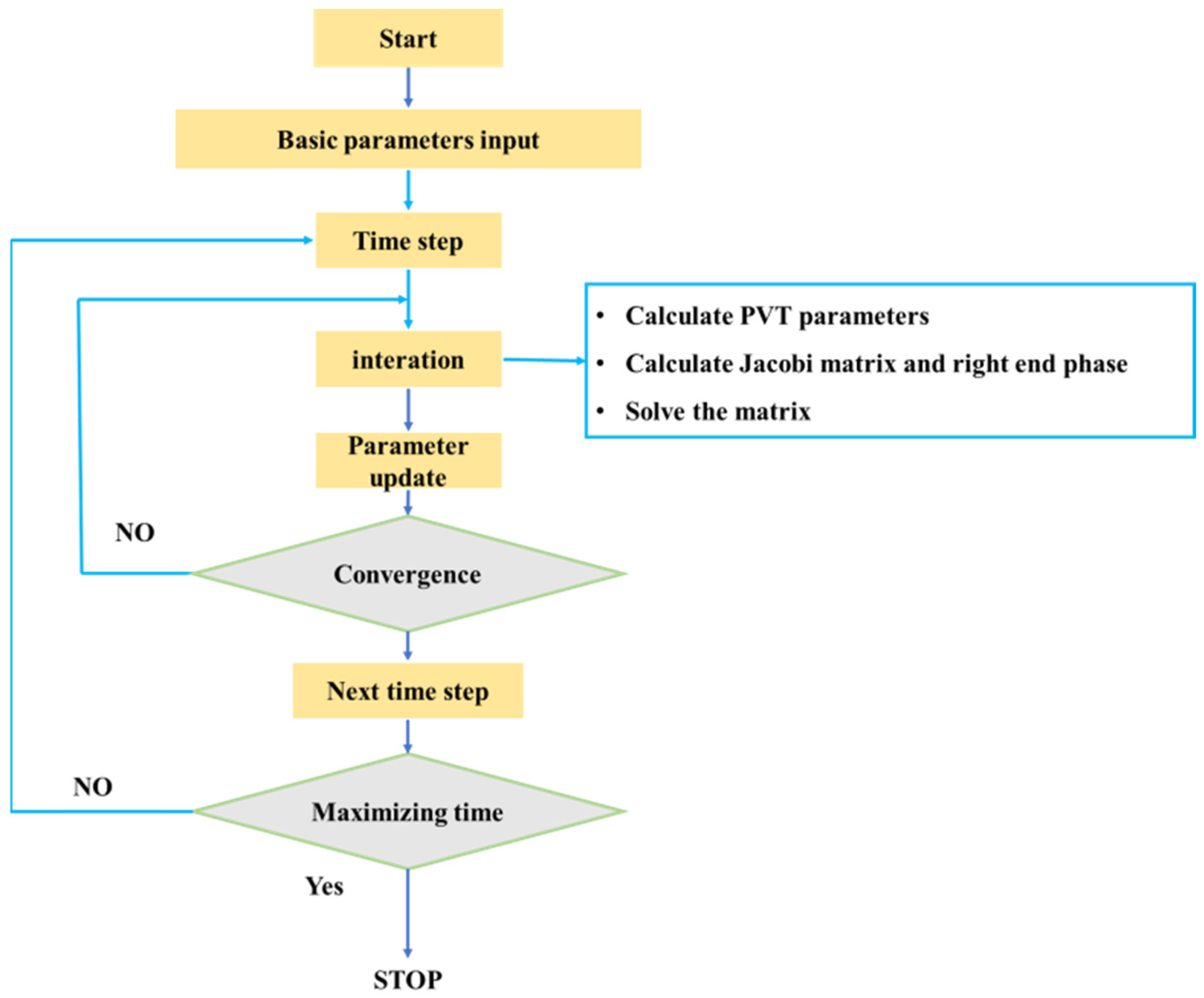
This approach enables the simultaneous solution of all equations at each time step, thereby achieving stable and robust simulations incorporating multiple flow mechanisms. Based on the discrete flow equations, the numerical simulator is compiled by using C++ language. The full calculation process is shown in Figure 3. In every iteration, the Jacobi matrix in Equation (17) is assembled and solved. If the solution variable δX is small enough, the current time step will be finished. We evaluate the convergence by δ X = ( δ X ) 2 . If its value reduces below or is equal to the tolerable error, the calculation will move to the next time step. In this work, the tolerable error is set as 0.001 and the max iteration number in one step is set as 25.

3.3. Validation

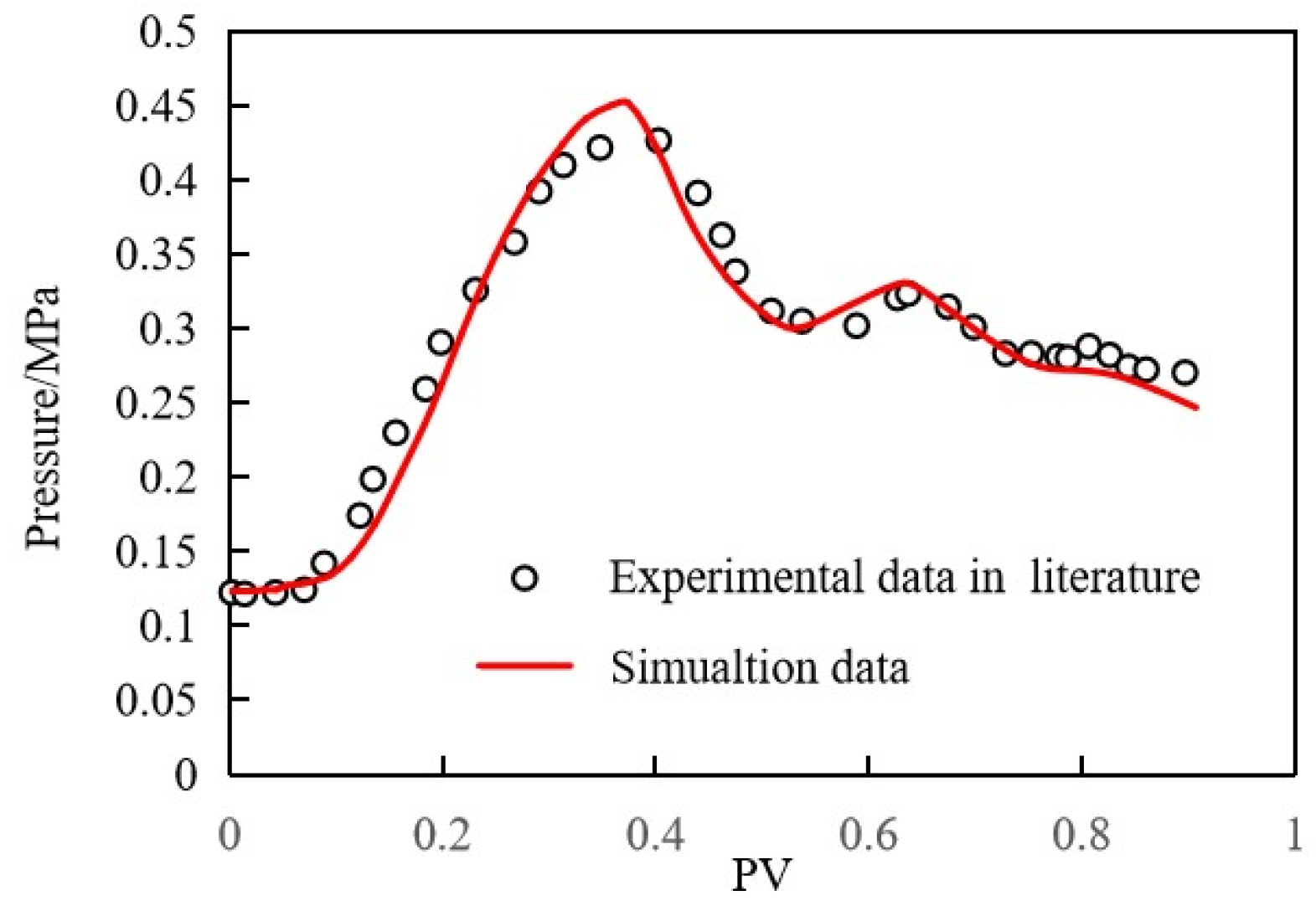
The numerical simulation results of this study were validated against the experimental data reported by Sun et al. [11]. A model with dimensions of 18 m × 0.043 m × 0.045 m and an average permeability of 5000 mD was constructed. The simulation comprises 3980 daily time steps, requiring a total of 11,584 Newton iterations. With an average of three iterations per time step, these results demonstrate robust computational convergence. The variation in injection pressure was measured for various injected pore volumes (PV). Both the numerical simulation and experimental results exhibited significant fluctuations in injection pressure, reflecting the “migration–entrapment–remigration” behavior characteristic, as shown in Figure 4. The consistency rate between the numerical simulation results and experimental data exceeded 90%, and the RSME is just 0.0139 MPa, confirming the accuracy of the proposed numerical simulation method for discontinuous phase flooding.

4. Sensitivity Analysis and Field Application

4.1. Sensitivity Analysis

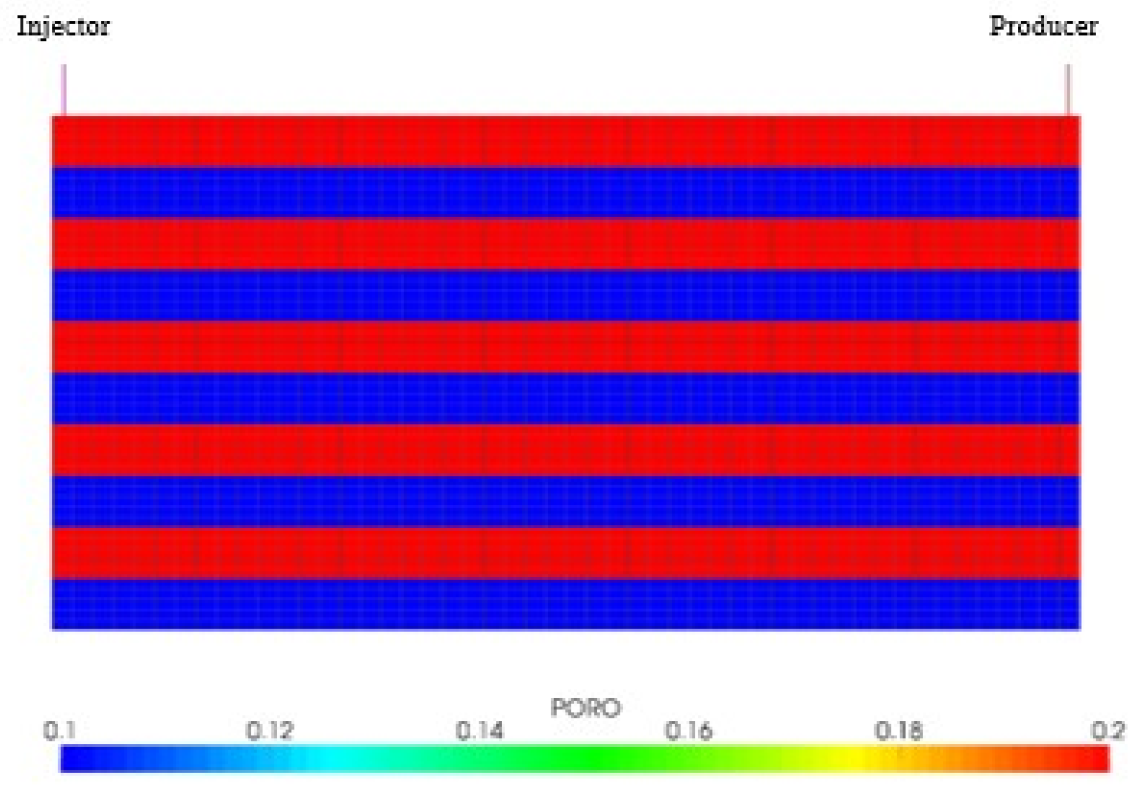
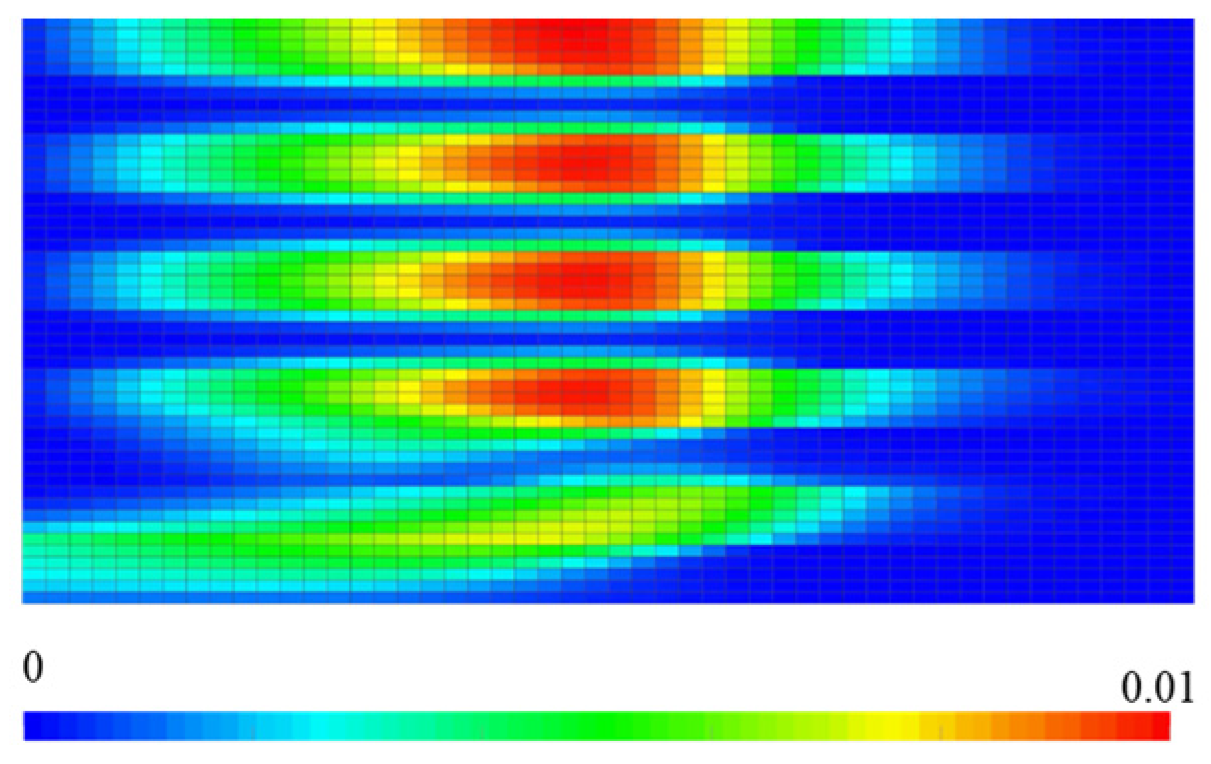
A one-dimensional multi-layer model with strong heterogeneity is illustrated in Figure 5. The model configuration includes one injection well and one production well. The flooding sequence consists of an initial 1500-day water flooding period, followed by 1200 days of discontinuous phase flooding, and a final 2500-day extended water flooding stage. The fundamental parameters of the model are summarized in Table 2. Figure 6 depicts the simulated discontinuous phase concentration distribution. The discontinuous phase predominantly forms in the central reservoir region and high-permeability layers, effectively validating the accuracy of the proposed numerical simulation method. Based on this model, the impact of key seepage mechanisms during discontinuous phase flooding is analyzed.
1.
Impact of chemical reaction half-life
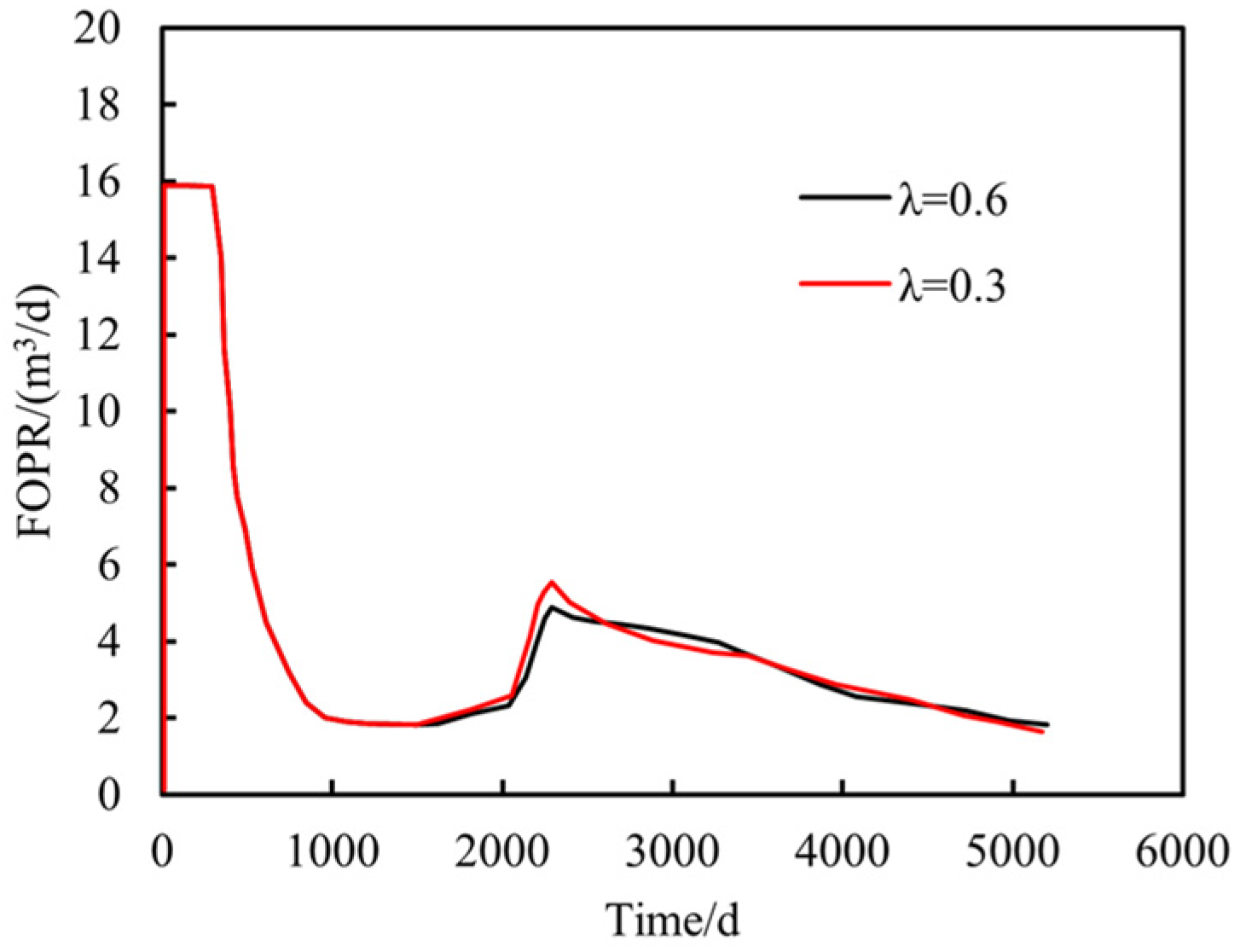
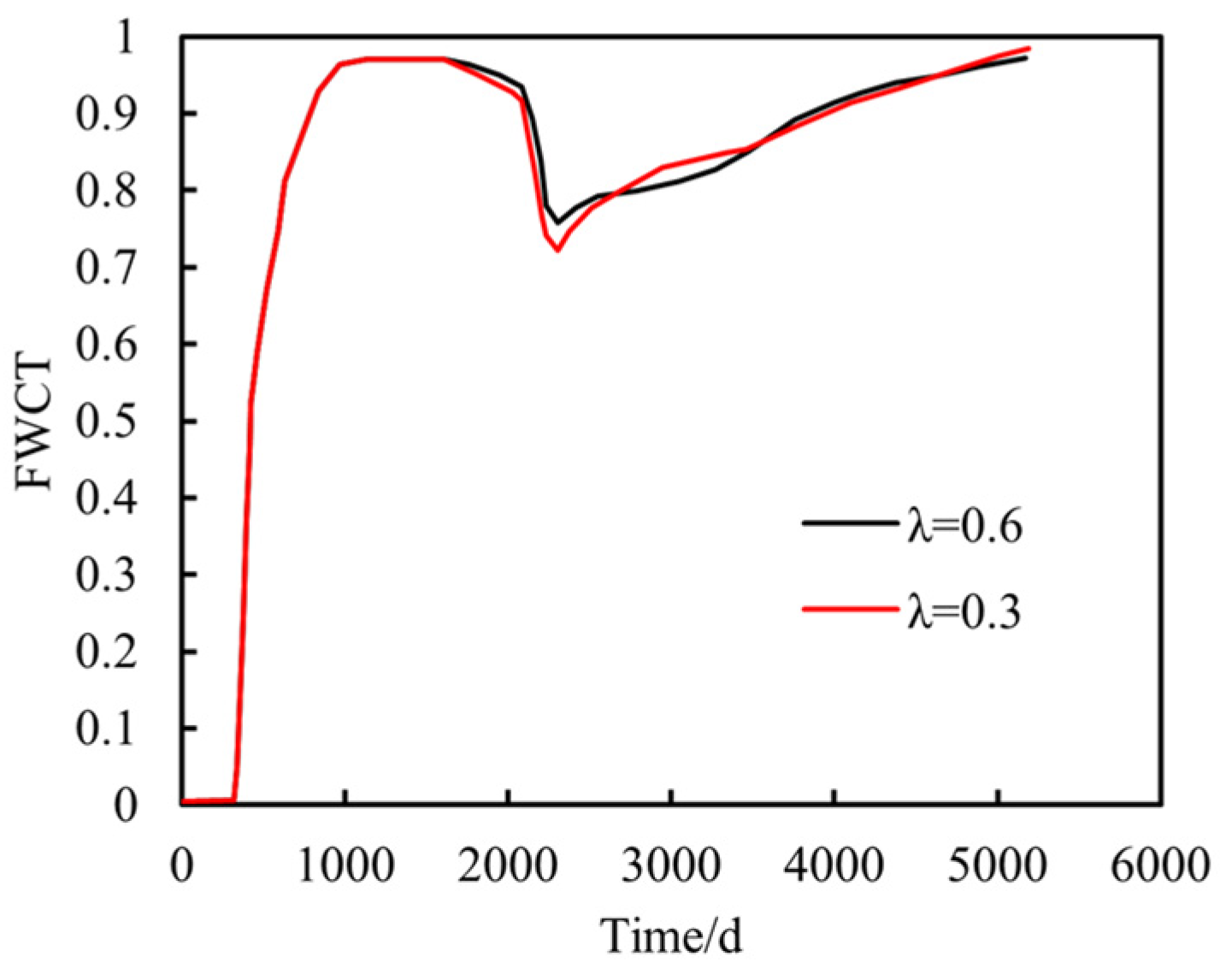
The chemical reaction half-life (λ) is a key parameter controlling the reaction rate. A longer half-life corresponds to a slower conversion rate from the pre-discontinuous phase to the discontinuous phase. Simulations were conducted with half-life values set to 0.3 and 0.6, and the results are shown in Figure 7 and Figure 8. As observed, a longer half-life leads to a smaller reaction rate constant, resulting in slower generation of the discontinuous phase from the pre-discontinuous phase. This weakens the plugging effect and reduces the extent of water cut reduction.
2.
Impact of minimum reaction porosity
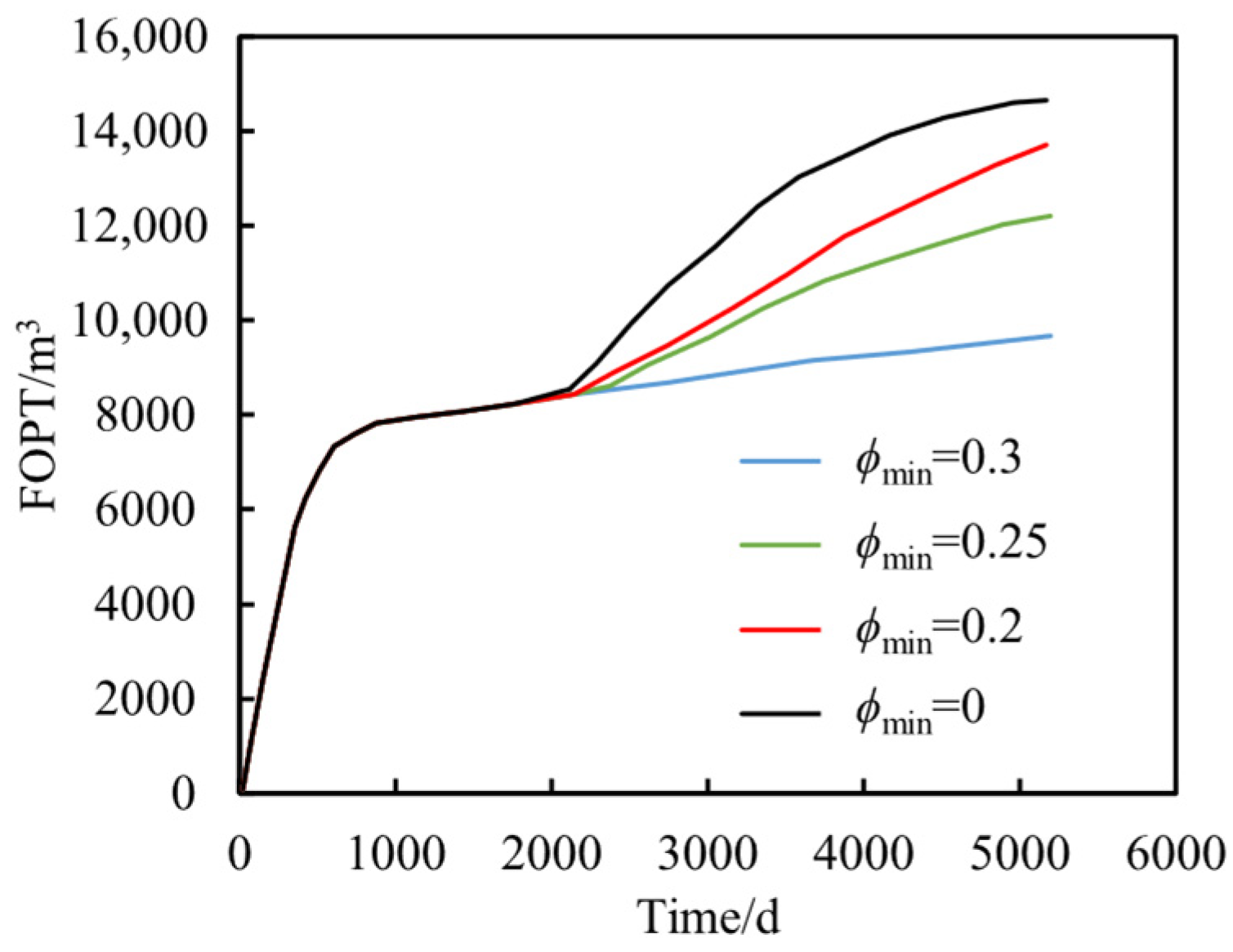
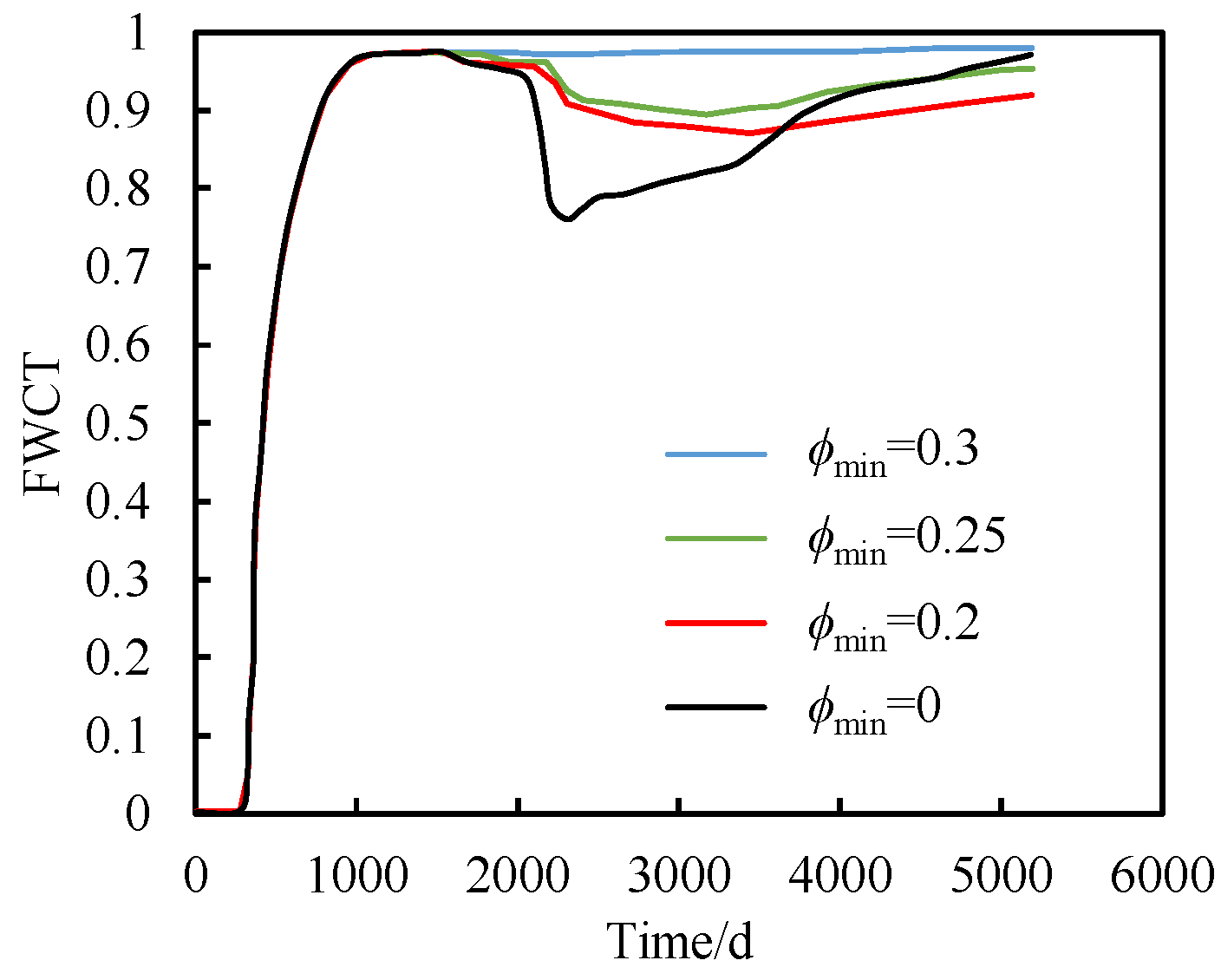
The minimum reaction porosity determines the lower porosity limit for the generation of the discontinuous phase. In reservoir zones with porosity below this threshold, no discontinuous phase is formed. Four simulation cases (model 1 to model 4) were configured with minimum reaction porosity values of 0.3, 0.25, 0.2, and 0, respectively, as summarized in Table 3. The corresponding simulation results are presented in Figure 9 and Figure 10. As shown in the results, model 1, configured with a minimum reaction porosity of 0.3, prevents the generation of the discontinuous phase entirely, leading to the highest water cut and the lowest oil production. In contrast, model 4 has a threshold of 0, resulting in the lowest water cut and the highest oil production. Compared to model 2, model 3 exhibits more significant plugging in high-permeability layers with stronger reaction, leading to a greater reduction in water cut and better oil enhancement performance.
3.
Influence of porosity exponent
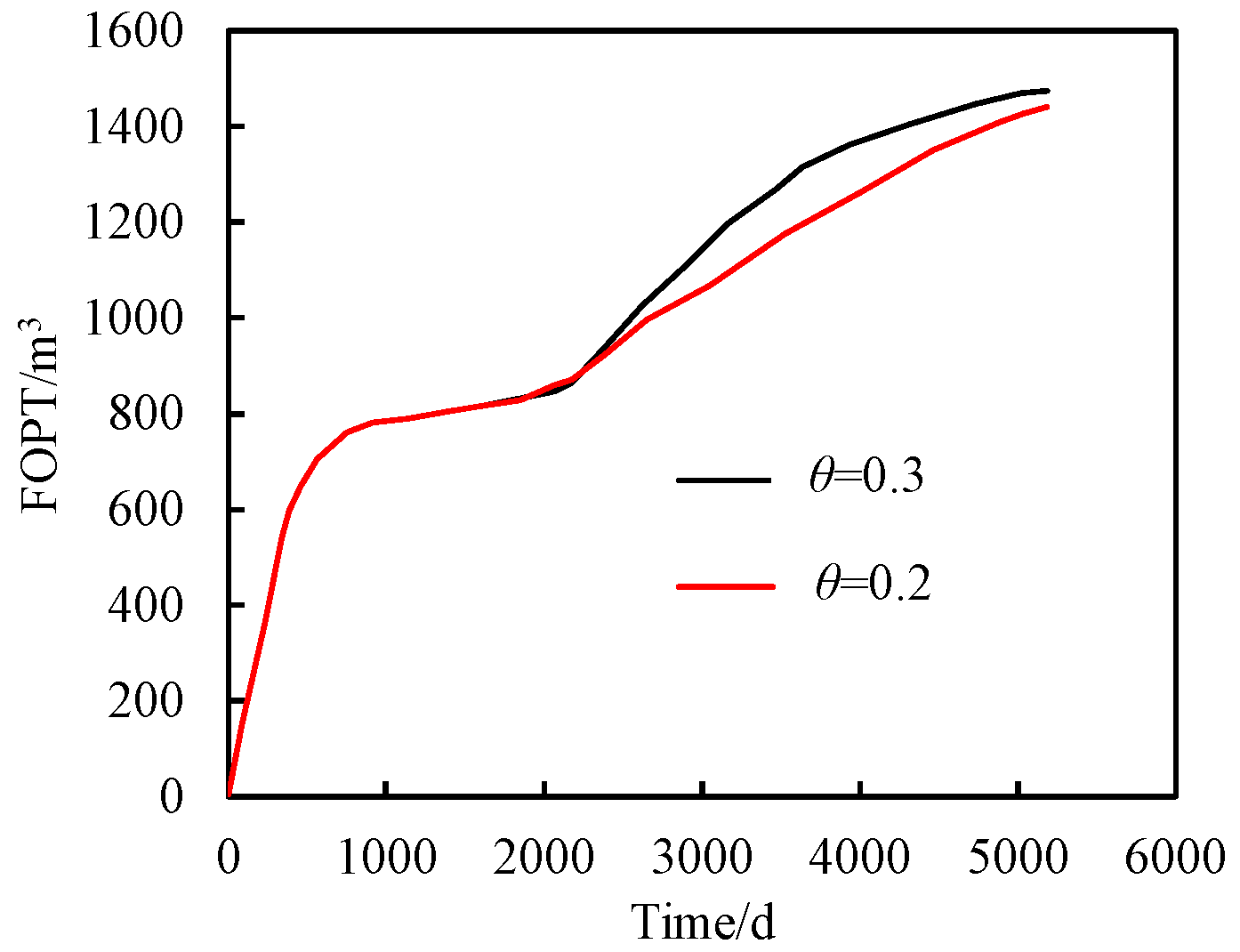
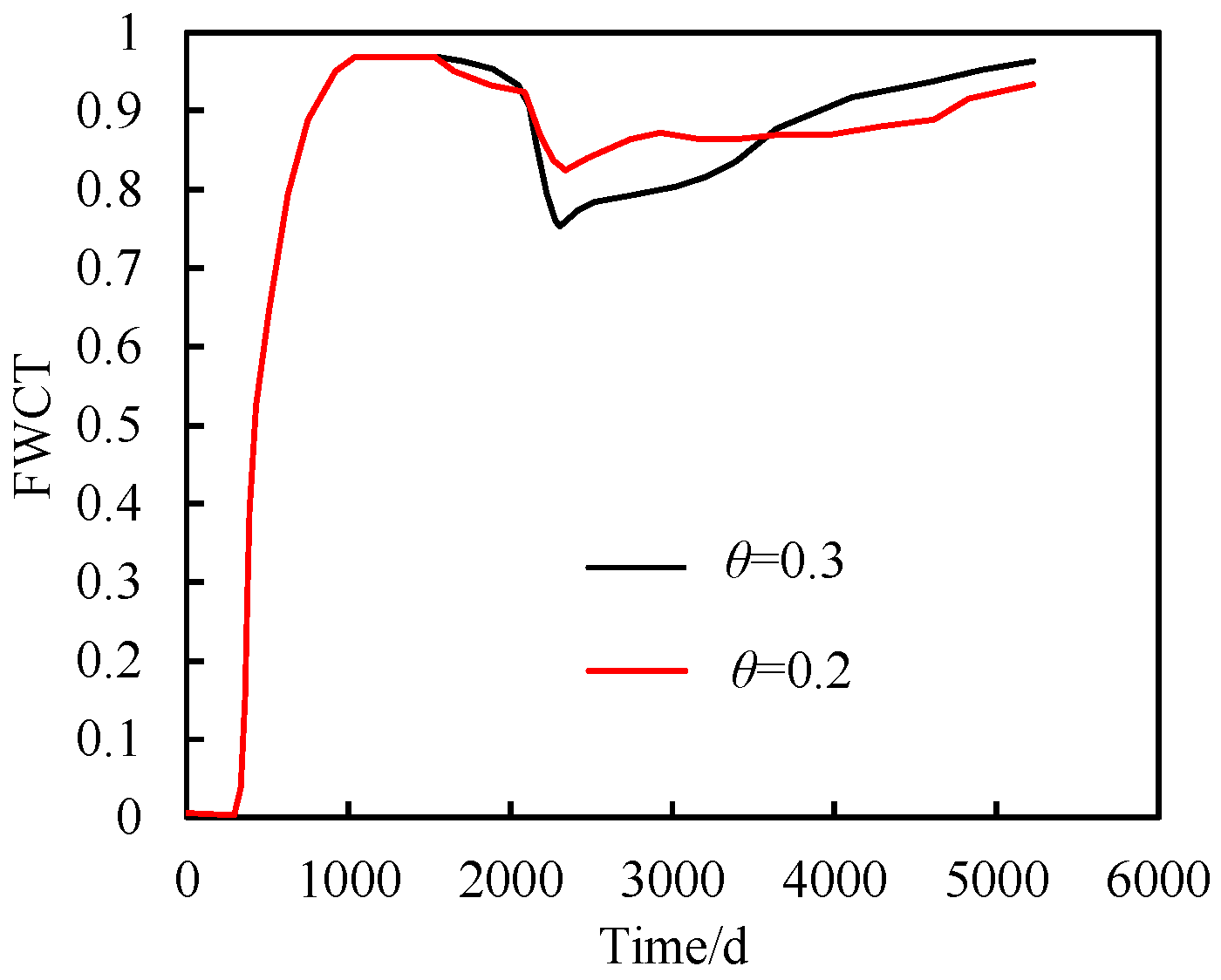
The porosity exponent directly affects the rate of the chemical reaction between the pre-discontinuous phase and the discontinuous phase. A higher porosity exponent intensifies the chemical reaction, leading to an increased proportion of discontinuous phase generated in high-permeability layers and enhancing the plugging effect in these zones. Simulations were performed with porosity exponent values set to 2.0 and 3.0, with the results shown in Figure 11 and Figure 12. As demonstrated, a larger porosity exponent accelerates the generation of the discontinuous phase, resulting in a more pronounced plugging effect in high-permeability layers. This leads to a greater reduction in water cut and significantly improved oil recovery performance.
4.
Effect of minimum reaction concentration
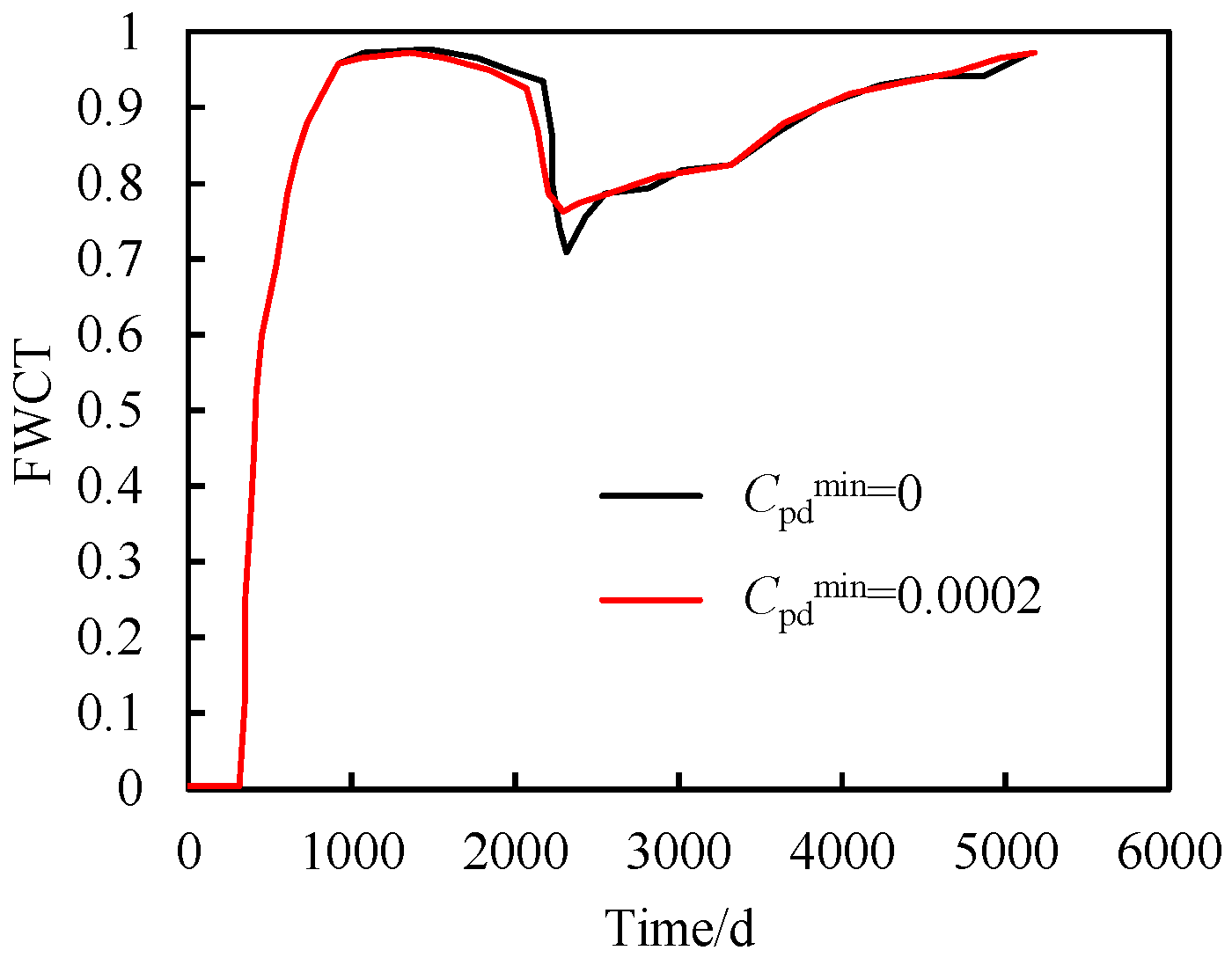
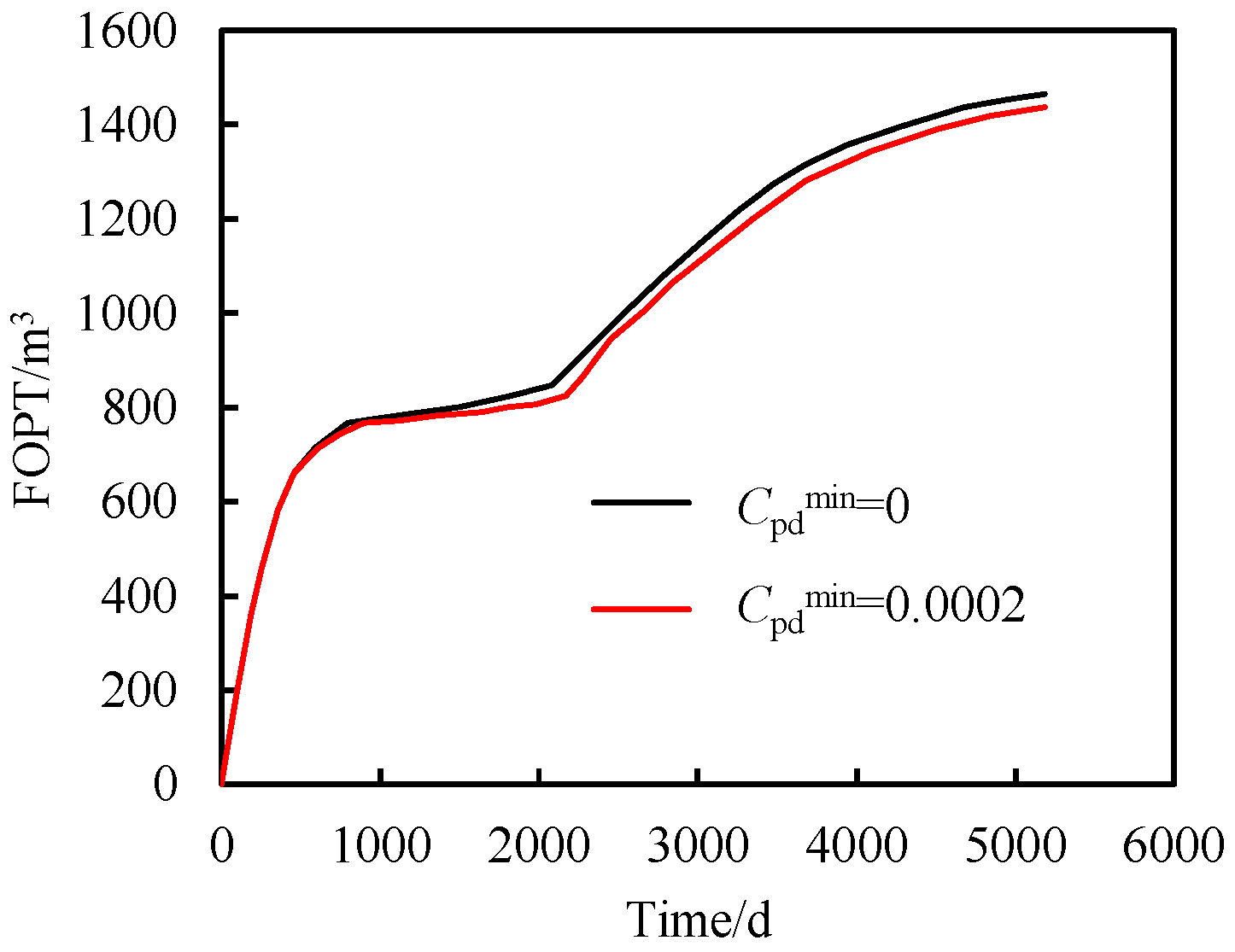
Figure 13 and Figure 14 present the influence of the minimum reaction concentration on cumulative oil production and water cut. The water cut reduction due to discontinuous phase is observed to be delayed when the minimum concentration is considered. This delay is attributed to the later generation of the discontinuous phase under this condition.
5.
Effect of discontinuous phase viscosity
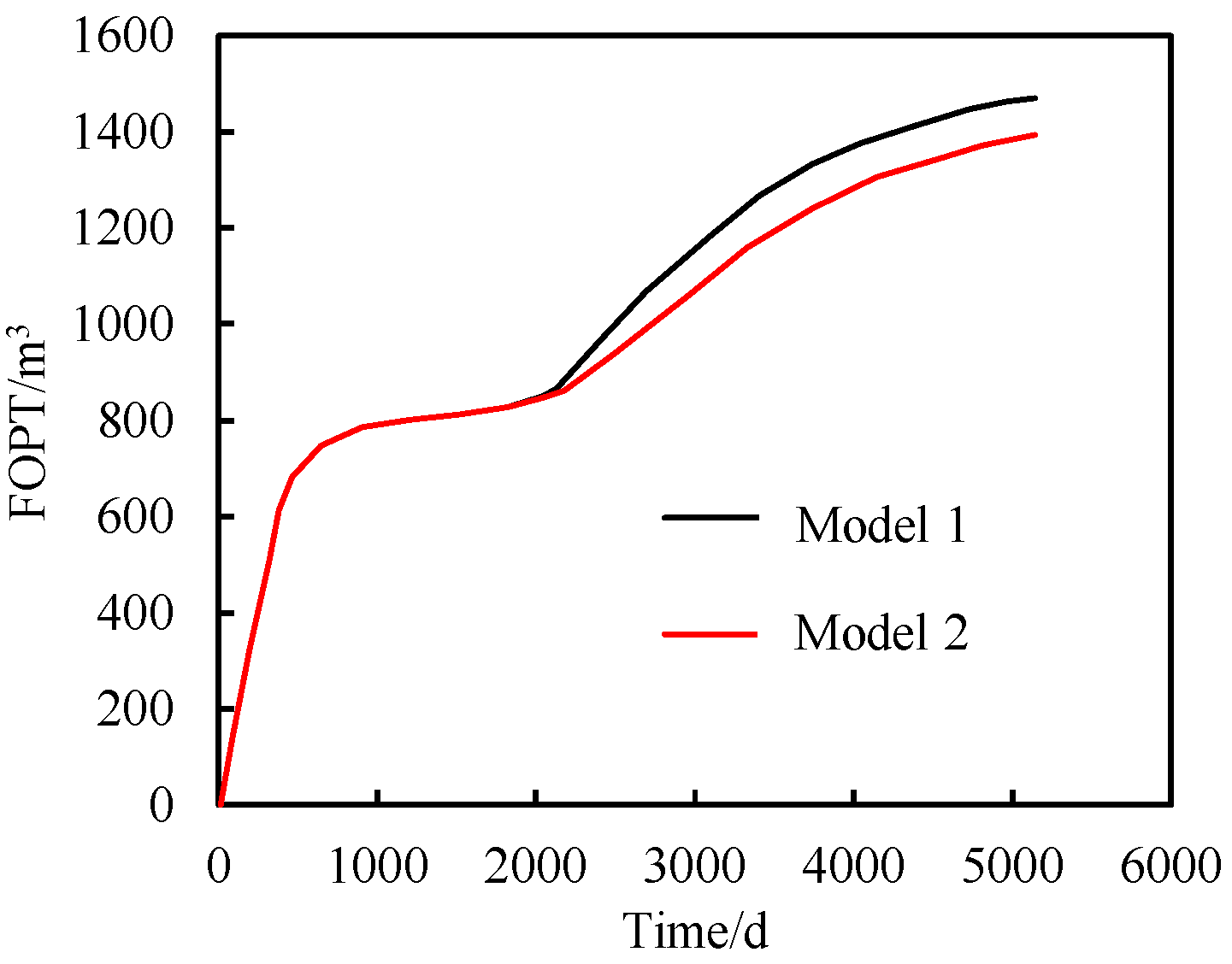
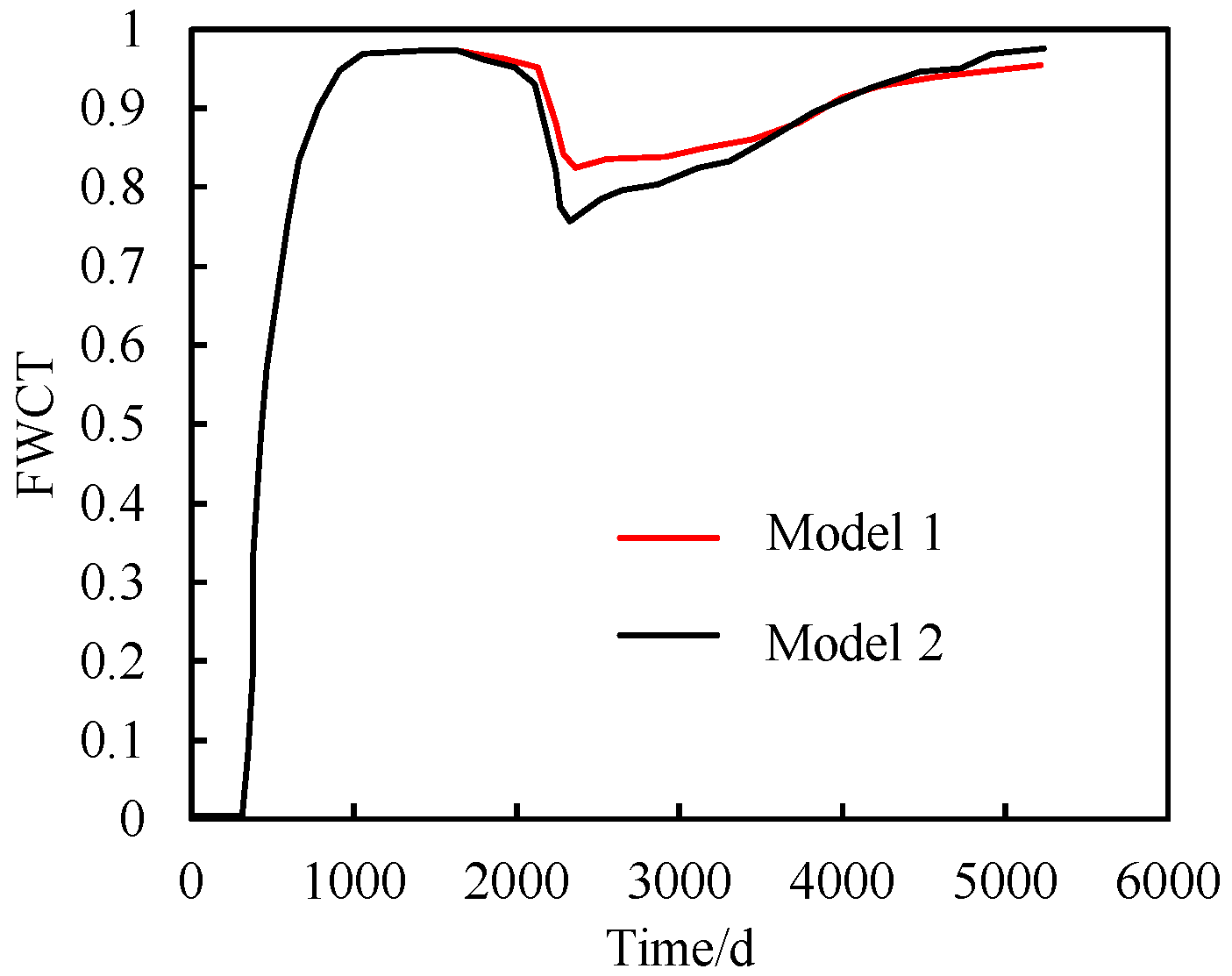
Enhancing water phase viscosity is also the key mechanism of the discontinuous phase. Different viscosity enhancement models for discontinuous phase flooding were established, as summarized in Table 4. The simulation results for cumulative oil production and water cut under these models are presented in Figure 15 and Figure 16. The results demonstrate that greater viscosity enhancement by the discontinuous phase leads to more effective regulation of the water–oil mobility ratio. This results in lower water cut and higher oil production, confirming the significant contribution of viscosity enhancement to recovery efficiency.

4.2. Field Application

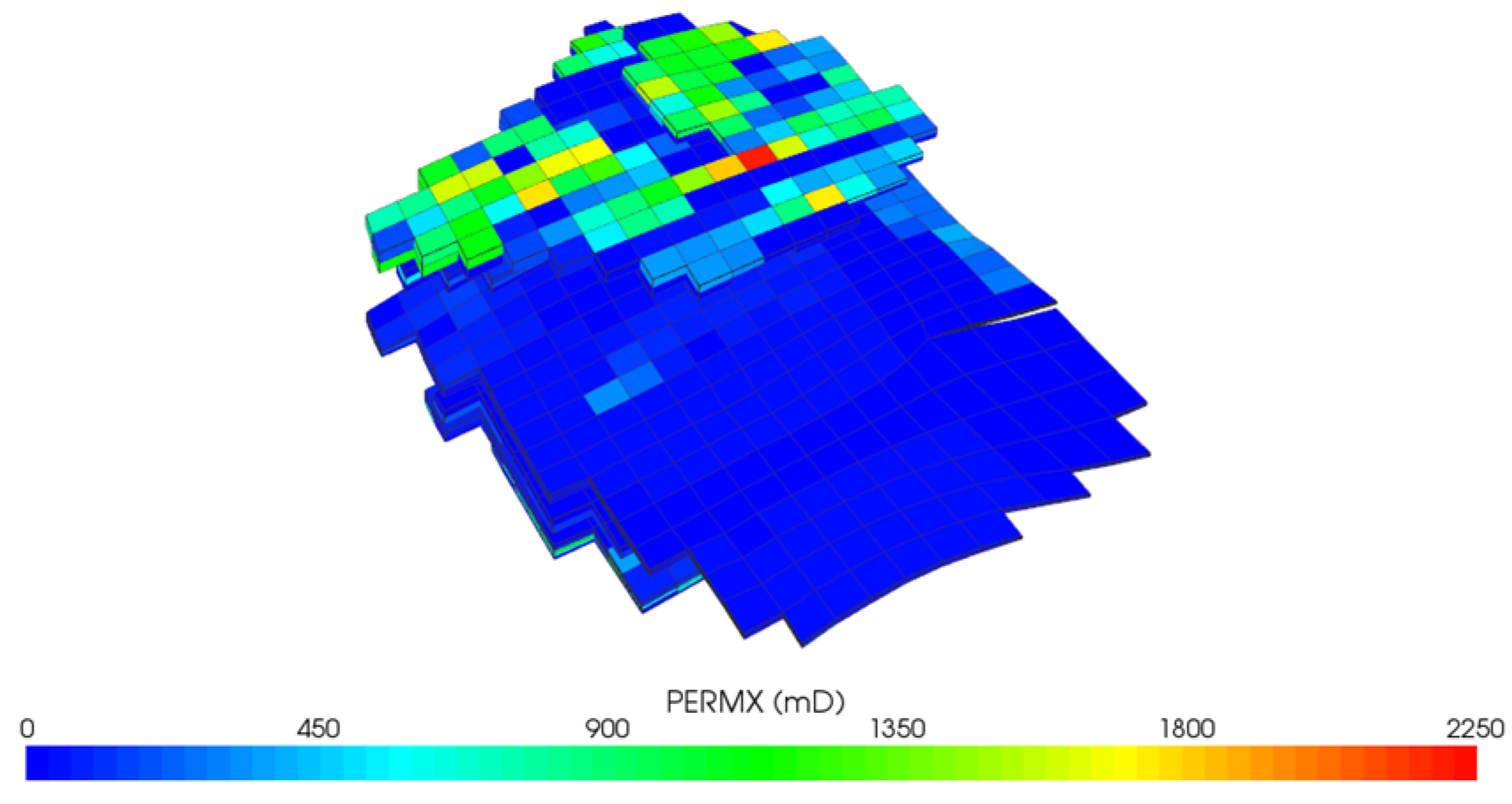
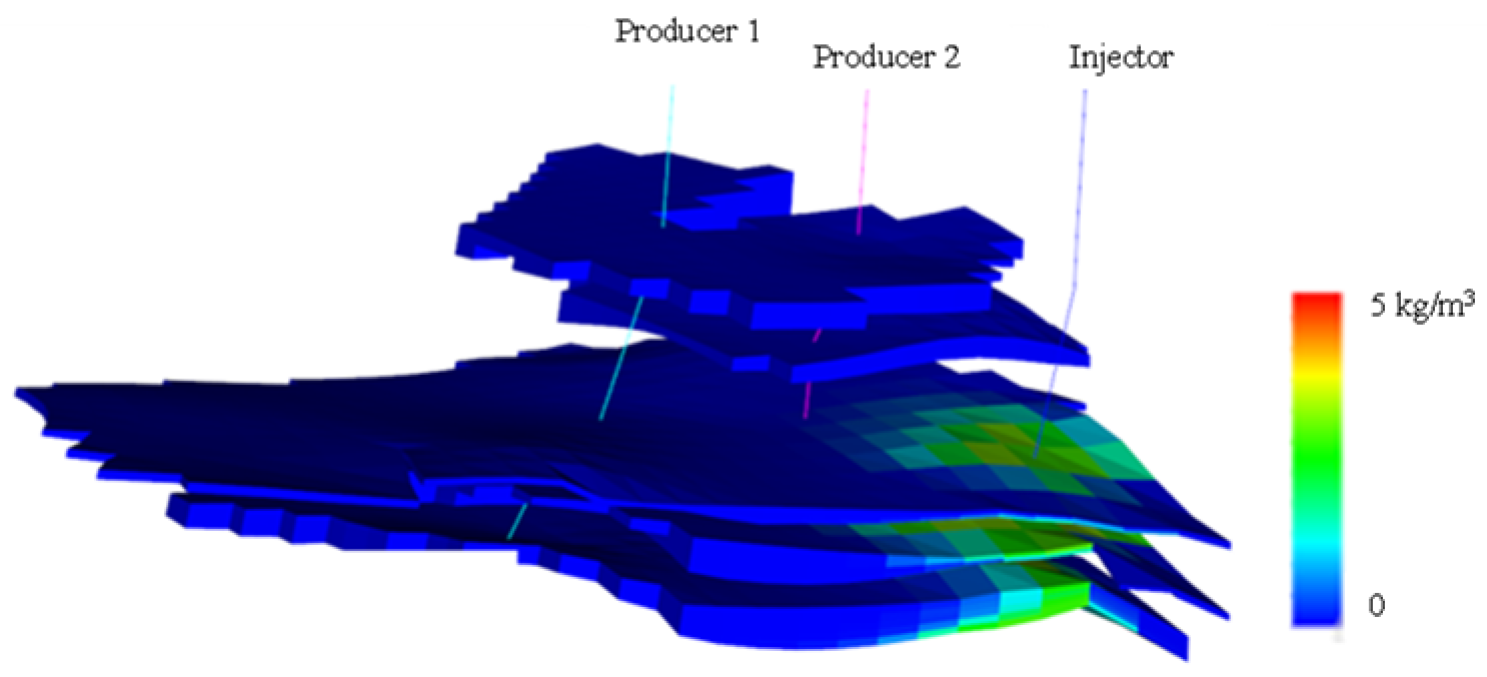
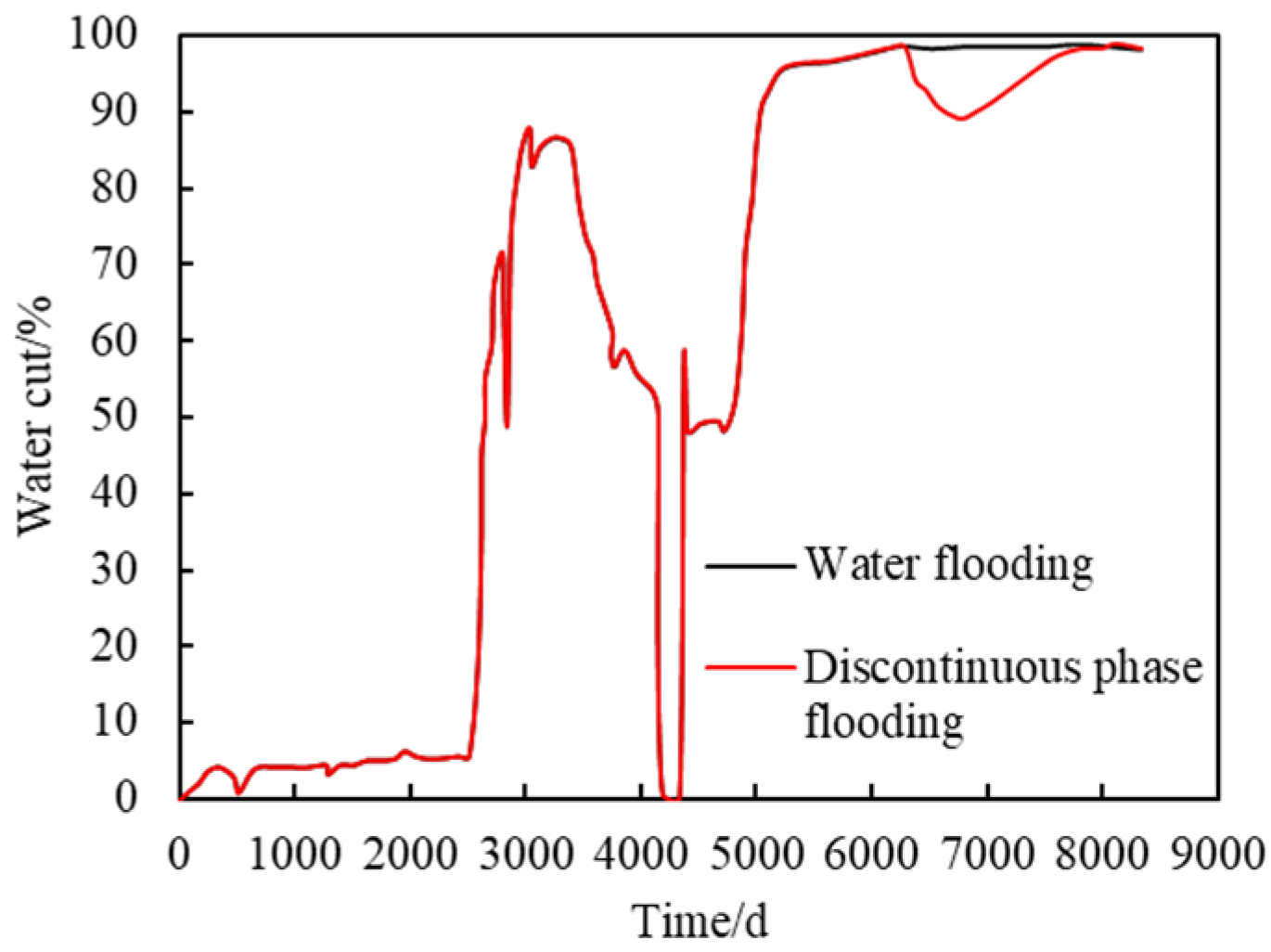
To further investigate the applicability of discontinuous phase flooding, a numerical simulation study was conducted on an actual reservoir. The target reservoir is a typical unconsolidated sandstone offshore oilfield with strong heterogeneity, featuring permeability ranging from 30 md to 2186 md and porosity varying between 0.03 and 0.39. The porosity and permeability distributions are shown in Figure 17. The model is about 2300 active grids with three wells. A pre-discontinuous phase solution with 1% concentration was designed for a five-year discontinuous phase flooding process. The discontinuous phase concentration distribution is observed in Figure 18. Compared with water flooding, the discontinuous phase flooding reduced the water cut of production wells by 11.23 percentage points, as shown in Figure 19, demonstrating the practical applicability of the proposed numerical simulation method for field deployment.

5. Conclusions

A multi-component mathematical model comprising oil, gas, water, pre-discontinuous phase, and discontinuous phase was developed for discontinuous phase flooding, followed by numerical discretization and the implementation of a numerical simulator. To characterize the complex seepage behaviors of discontinuous phases, chemical reactions between the pre-discontinuous phase and the discontinuous phase, as well as a threshold pressure for discontinuous phase migration, were introduced. The main conclusions are as follows:
  • By modifying the reaction process, the simulation captures the discontinuous phase’s deep reservoir profile control and enhanced high-permeability zone plugging. During flooding, this phase predominantly forms in mid-reservoir regions and high-permeability layers. As the chemical reaction intensifies, the enhanced oil recovery effect contributed by the discontinuous phase increases.
  • Introducing a threshold pressure enabled the numerical simulation to effectively characterize the discontinuous “migration–entrapment–remigration” flow behavior. During displacement, injection pressure showed distinct oscillations that align closely with experimental observations, directly validating the proposed method.
  • Using the numerical simulation approach developed in this study, a discontinuous phase flooding strategy was designed for a typical offshore block, achieving a notable reduction in water cut. The model presented here holds significant application value.
  • The multi-component reaction model and numerical simulation method offer valuable insights for other chemical flooding techniques. However, significant uncertainties in the model’s parameters challenge its application across diverse reservoirs. In addition, the effects of particle size distribution have not been considered. Further research is therefore critical to bridge these gaps and enhance practical applicability.

Author Contributions

Writing—original draft, Y.C.; Methodology, Z.W.; Methodology, Supervision, Y.S.; data curation, J.Z.; Methodology, Supervision, W.Z. All authors have read and agreed to the published version of the manuscript.

Funding

This research was funded by the Science and Technology Project of CNOOC Research Institute Ltd. (Grant No. KJ202500219) and the Science and Technology Major Project of CNOOC during the 14th Five-Year (Grant No. KJGG2021-0506).

Data Availability Statement

The original contributions presented in this study are included in the article. Further inquiries can be directed to the corresponding author.

Conflicts of Interest

The authors were all employed by the company CNOOC Research Institute Ltd. The authors declare that this study received funding from CNOOC Research Institute Co., Ltd. The authors declare that the research was conducted in the absence of any commercial or financial relationships that could be construed as potential conflicts of interest.

References

  1. Dai, Q.; Zhang, L.; Wang, P.; Zhang, K.; Chen, G.; Chen, Z.; Xue, X.; Wang, J.; Liu, C.; Yan, X.; et al. Adaptive constraint-guided surrogate enhanced evolutionary algorithm for horizontal well placement optimization in oil reservoir. Comput. Geosci. 2025, 194, 105740. [Google Scholar] [CrossRef]
  2. Cui, Y.; Zhou, W.; Liu, C. Integrated Modeling of Time-Varying Permeability and Non-Darcy Flow in Heavy Oil Reservoirs: Numerical Simulator Development and Case Study. Processes 2025, 13, 1683. [Google Scholar] [CrossRef]
  3. Yuan, S.; Han, H.; Wang, H.; Luo, J.; Wang, Q.; Lei, Z.; Xi, C.; Li, J. Research progress and potential of new enhanced oil recovery methods in oilfield development. Pet. Explor. Dev. 2024, 51, 963–980. [Google Scholar] [CrossRef]
  4. Zhang, J.; Li, Y.; Li, X.; Guan, C.; Chen, X.; Liang, D. Mechanism of enhanced oil recovery by discontinuous chemical flooding in Bohai oilfield. Shiyou Xuebao/Acta Pet. Sin. 2024, 45, 988–998. [Google Scholar]
  5. Farhadinia, M.A.; Mohanty, K.K. Heavy oil recovery using hot polymer flooding: Simulation studies on mechanisms and injection patterns. Fuel 2026, 405, 136435. [Google Scholar] [CrossRef]
  6. Wei, Z.; Cui, Y.; Su, Y.; Zhou, W. Fast History Matching and Flow Channel Identification for Polymer Flooding Reservoir with a Physics-Based Data-Driven Model. Processes 2025, 13, 2610. [Google Scholar] [CrossRef]
  7. Li, X.; Zhang, J.; Zhang, Y.; Guan, C.; Liu, Z.; Hu, K.; Xian, R.; Li, Y. Experimental Study on the Application of Polymer Agents in Offshore Oil Fields: Optimization Design for Enhanced Oil Recovery. Polymers 2025, 17, 244. [Google Scholar] [CrossRef]
  8. Dai, C.; Liu, J.; Li, L.; Liu, Y.; Xu, Z.; Sun, N.; Ding, F.; Sun, Y. Characteristics and action mechanism of self-growing hydrogel particle fracture control system. Shiyou Xuebao/Acta Pet. Sin. 2022, 43, 840–848. [Google Scholar]
  9. Jiang, H.; Yang, H.; Zhang, X.; Kang, W.; Wang, R.; Li, H.; Zhang, S.; Chen, X.; Peng, L.; Shi, H.; et al. Advances of polymer microsphere and its application in porous media for enhanced oil recovery. Adv. Colloid Interface Sci. 2025, 346, 103687. [Google Scholar] [CrossRef] [PubMed]
  10. Bai, B.; Leng, J.; Wei, M. A comprehensive review of in-situ polymer gel simulation for conformance control. Pet. Sci. 2022, 19, 189–202. [Google Scholar] [CrossRef]
  11. Sun, Z.; Lu, X.G.; Sun, W. The profile control and displacement mechanism of continuous and discontinuous phase flooding agent. J. Dispers. Sci. Technol. 2017, 38, 1403–1409. [Google Scholar] [CrossRef]
  12. Sun, Z.; Wu, X.; Kang, X.; Lu, X.; Li, Q.; Jiang, W.; Zhang, J. Comparison of oil displacement mechanisms and performances between continuous and dispersed phase flooding agents. Shiyou Kantan Yu Kaifa/Pet. Explor. Dev. 2019, 46, 116–124. [Google Scholar] [CrossRef]
  13. Yang, N.; Wang, Z.; Li, Z.; Si, S.; Liu, Y.; Dai, C.; Zhao, G. Comprehensive Displacement System Utilizing Dispersed Particle Gels Coupling Viscosity Reduction and Breakthrough Channel Control for Heavy Oil Cold Production. Energy Fuels 2025, 39, 12449–12461. [Google Scholar] [CrossRef]
  14. Cheng, T.; Ding, J.; Yang, Z.; Qu, M.; Bai, M.; Liu, Z.; Gong, X.; Ren, Y. Synergistic profile control and oil-displacement method for efficient development of heterogeneous reservoirs. Geoenergy Sci. Eng. 2026, 257, 214245. [Google Scholar] [CrossRef]
  15. Leng, J.; Wei, M.; Bai, B. Review of transport mechanisms and numerical simulation studies of preformed particle gel for conformance control. J. Pet. Sci. Eng. 2021, 206, 109051. [Google Scholar] [CrossRef]
  16. Hou, J.; Wu, D.; Wei, B.; Zhou, K.; Gong, L.; Cao, X.; Guo, L. Percolation characteristics of discontinuous phase and mechanisms of improving oil displacement efficiency in heterogeneous composite flooding. Zhongguo Shiyou Daxue Xuebao (Ziran Kexue Ban)/J. China Univ. Pet. (Ed. Nat. Sci.) 2019, 43, 128–135. [Google Scholar]
  17. Cao, W.; Dai, T.; Yu, J.; Lu, T.; Cheng, A.; Xi, K. A numerical simulation method of heterogeneous combination flooding. Oil Gas Geol. 2016, 37, 606–611. [Google Scholar]
  18. Hou, J.; Liu, Y.; Wei, B.; Cao, X.; Sun, J.; DU, Q.; Song, K.; Yuan, F.; Sun, P.; Ji, Y.; et al. Capsule polymer flooding for enhanced oil recovery. Pet. Explor. Dev. 2024, 51, 1092–1100. [Google Scholar] [CrossRef]
  19. Dong, X. Numerical Simulation Study on Crosslinked Polymer Profile Control. Master’s Thesis, China University of Petroleum (East China), Qingdao, China, 2018. [Google Scholar]
  20. Yang, X.; Shen, W.; Li, X.; Xie, K.; Chen, J.; Li, N.; Wang, H. Numerical simulation study on parameter optimization of crosslinked polymer flooding for enhanced oil recovery in heavy oil reservoirs. J. Petrol. Explor. Prod. Technol. 2025, 15, 189. [Google Scholar] [CrossRef]
  21. Leng, J.; Wei, M.; Bai, B. Impact of Polymer Rheology on Gel Treatment Performance of Horizontal Wells with Severe Channeling. SPE J. 2022, 27, 1017–1035. [Google Scholar] [CrossRef]
  22. Zhao, Y.; Bai, B. Laboratory Evaluation of Placement Behavior of Microgels for Conformance Control in Reservoirs Containing Superpermeable Channels. Energy Fuels 2022, 36, 1374–1387. [Google Scholar] [CrossRef]
Figure 1. Displacement mechanism of discontinuous phase fluid. (a) Microfluidic experiment of discontinuous phase flooding agents; (b) Discontinuous phase flow with 4 different flow tube.
Energies 19 00750 g001
Figure 2. The characterization of discontinuous phase seepage mechanisms.
Energies 19 00750 g002
Figure 3. Flowchart of the numerical simulation.
Energies 19 00750 g003
Figure 4. Comparison of numerical simulation and experimental results.
Energies 19 00750 g004
Figure 5. One-dimensional multi-layer model with strong heterogeneity.
Energies 19 00750 g005
Figure 6. The concentration distribution of discontinuous phase during simulation.
Energies 19 00750 g006
Figure 7. Daily oil production under different chemical reaction half-lives.
Energies 19 00750 g007
Figure 8. Water cut under different chemical reaction half-lives.
Energies 19 00750 g008
Figure 9. Cumulative oil production under different minimum reaction porosity values.
Energies 19 00750 g009
Figure 10. Water cut under different minimum reaction porosity values.
Energies 19 00750 g010
Figure 11. Cumulative oil production under different porosity exponent values.
Energies 19 00750 g011
Figure 12. Water cut under different porosity exponent values.
Energies 19 00750 g012
Figure 13. The influence of minimum reaction concentration on the cumulative oil production.
Energies 19 00750 g013
Figure 14. The influence of minimum reaction concentration on the water cut.
Energies 19 00750 g014
Figure 15. Cumulative oil production under different viscosity–concentration relationships.
Energies 19 00750 g015
Figure 16. Water cut under different viscosity–concentration relationships.
Energies 19 00750 g016
Figure 17. Permeability distribution in the representative block.
Energies 19 00750 g017
Figure 18. Discontinuous phase concentration distribution in the representative block.
Energies 19 00750 g018
Figure 19. Comparison of water cut.
Energies 19 00750 g019
Table 1. Studies of different chemical flooding processes.
ResearchChemical FloodingDiscontinuous Seepage BehaviorHigh-Permeability Comfortable ControlDeep Reservoir Area Comfortable Control
Cao Weidong (2016) [17]Heterogeneous combination flooding
Dong Xiang (2018) [19]Cross-linked polymer flooding
Zhao et al. (2022) [22]Particle gel
Table 2. Basic model parameters.
ParameterValueParameterValue
Grid number50 × 1 × 50Grid size20 × 10 × 10 ft
Permeability of high-permeability region 700Rock compressibility44 × 10−6
Permeability of low-permeability region 5Porosity of high-permeability
region
0.3
Initial water saturation0.22Porosity of low-permeability region0.2
Oil viscosity 1.1700Initial oil saturation0.78
Oil formation volume factor1.11Water viscosity0.96
Table 3. Models with different minimum reaction porosity values.
ParametersModel 1Model 2Model 3Model 4
Minimum Reaction
Porosity
0.30.250.20
Table 4. Model parameters for different discontinuous phase viscosities.
Discontinuous Phase ConcentrationWater Phase Viscosity Multiplier
Model 1 Model 2
0.01.01.0
3.525.015.0
7.030.020.0
Disclaimer/Publisher’s Note: The statements, opinions and data contained in all publications are solely those of the individual author(s) and contributor(s) and not of MDPI and/or the editor(s). MDPI and/or the editor(s) disclaim responsibility for any injury to people or property resulting from any ideas, methods, instructions or products referred to in the content.