Article

Cold Climate Field Study of the Effect of Defrost Controls on the Integrated Performance of a Ductless Air-Source Heat Pump


1
National Laboratory of the Rockies, Golden, CO 80401, USA
2
Alaska Center for Energy and Power, University of Alaska Fairbanks, Fairbanks, AK 99775, USA
3
Bristol Bay Campus, University of Alaska Fairbanks, Dillingham, AK 99576, USA
*
Author to whom correspondence should be addressed.
Energies 2026, 19(3), 733; https://doi.org/10.3390/en19030733
Submission received: 17 December 2025 / Revised: 23 January 2026 / Accepted: 27 January 2026 / Published: 30 January 2026
(This article belongs to the Section J: Thermal Management)

Abstract

Residential heat pumps have advanced over the past decade to allow for operation at colder temperatures. However, the challenges of frost accumulation and defrosting the outdoor coil remain. The goal of this study was to evaluate the impact of the control algorithms that determine when a heat pump needs to defrost and when the base pan heater runs on the overall heating efficiency of the heat pump. In this study, which occurred during the 2023–2024 heating season, we measured the performance of a ductless air-source heat pump installed in Fairbanks, Alaska, USA. The heat pump was instrumented to measure the electrical input and the thermal output, as well as selected internal variables and indoor and outdoor environmental conditions. The heat pump was first operated with factory default control algorithms associated with the initiation of defrost and control of the base pan heater. These factory default algorithms focused on aggressively defrosting the outdoor coil and keeping the base pan ice-free. In the middle of the winter, these algorithms were changed to focus on reducing defrost cycles and increasing efficiency, while the heat pump continued to be operated and monitored. The results showed that significant increases in efficiency are possible by improving the defrost and base pan heater control algorithms.

1. Introduction

While heat pumps have been used for residential space heating for decades, their adoption, particularly in cold climates, has been limited due to their reduced capacity and efficiency at low outdoor air temperatures and inability to operate at very low temperatures due to high compressor discharge temperatures [1]. Technologies for addressing these challenges have been incorporated into some newer heat pumps, including variable-speed compressors and vapor injection. These newer heat pumps tout an increased capacity and efficiency at lower temperatures and operating ranges down to −35 °C (−31 °F).
One challenge with air-source heat pumps is frost accumulation on the outdoor coil during heating operation [2]. When the outdoor coil temperature is both below freezing and below the outdoor dewpoint, frost will accumulate on the coil. Accumulated frost degrades heat transfer and decreases airflow through the coil, resulting in a reduced efficiency and capacity. To melt accumulated frost, most residential heat pumps use a 4-way valve to reverse the refrigeration cycle, transferring heat from indoors to the outdoor coil [2]. This has the undesirable effects of interrupting the space heating process, cooling the space, and using energy. The amount of frost that accumulates on the outdoor coil is dependent on several factors, including the outdoor humidity, outdoor temperature, and outdoor heat exchanger temperature. A simple and common approach for initiating defrost is the time–temperature method. This approach uses a temperature sensor on the outdoor coil. When the temperature sensor reads below freezing, the runtime is accumulated up to a predetermined limit (usually between 30 and 120 min). Once the predetermined runtime is reached with the coil below freezing temperature, the unit will initiate a defrost cycle. This approach can result in unnecessary defrost cycles during outdoor conditions with a low dewpoint (i.e., dry conditions or very cold conditions).
Research related to the defrosting operation of heat pumps has focused on three key areas: determining the optimal time to initiate a defrost cycle, improved methods for defrosting the outdoor coil, and anti-frosting technologies that would eliminate the need to defrost the outdoor coil. Ma et al. [3] summarize the published research from 2018 to 2023 on these topics.
Several studies have focused on identifying the optimal defrost initiation time. These approaches include employing machine learning [4,5,6,7] and creating mathematical models [8,9,10,11,12]. These approaches generally require extra sensors and/or detailed data. The mathematical model implemented in [9] requires only ambient temperature, humidity, and heat pump runtime as inputs for its model. This approach may be feasible for fixed speed compressor heat pumps with enough laboratory data to develop a robust model. However, implementing such a model for a heat pump with a variable speed compressor whose operating speed varies continuously with the changes in load would be considerably more challenging.
In addition to defrost timing, research has been performed on anti-frosting and defrosting techniques. Anti-frosting methods include evaporator structure modification [13], surface wettability modification [14,15,16,17,18,19,20], system design [21,22,23,24], and operating parameter design [25,26,27,28,29]. Defrosting methods described in the past five years include reverse cycle defrosting [30,31,32,33,34,35], hot gas bypass defrosting [36], hot liquid defrosting [37,38,39], and thermal storage defrosting [40,41,42,43,44]. The main barrier for the application of these technologies in the residential heat pump market is cost.
Additionally, some cold climate-focused heat pumps utilize a base pan heater to ensure that the melted frost from defrost cycles does not refreeze in the base pan and cause an accumulation of ice.
There are few studies that evaluate the impact of the frosting and defrosting of air-source heat pumps in the field. A study by Trojanowski et al. [45] measured the field performance of several ductless air-source heat pumps. The measured 24 h average COPs were correlated to measured steady-state COPs, with the results showing 24 h COPs ranging from 50% to 100% of the steady-state values depending on the heat pump, and noting both cycling and defrost cycles as contributors to the COP degradation.
This paper evaluates the integrated performance of a ductless air-source heat pump. Two different sets of defrost and base pan heater control algorithms were evaluated, one focused on aggressively defrosting the coil and maintaining an ice-free base pan, and the other on increasing the heating runtime between defrost cycles and reducing base pan heater energy consumption. The integrated performance for these two control algorithms is compared to assess the impact on performance across a range of outdoor temperatures and thermal loading levels.

2. Materials and Methods

2.1. Unit Information and Installation

Details on the selected heat pump are provided in Table 1. The unit was installed at the National Laboratory of the Rockies’ Alaska Campus located in Fairbanks, AK, USA, in November 2023. The outdoor unit was installed outdoors, and the indoor unit was installed in a room dedicated to heat pump testing. Several portable electric heaters and portable air conditioners were co-located in the room to provide the ability to modulate the heating load served by the heat pump. This allowed the performance of the heat pump to be measured across a wide range of thermal loads independent of outdoor air temperature. The heat pump being evaluated was set to maintain approximately 21 °C (70 °F) return air temperature. The heating set point for the existing space heating system serving the room was turned down to 16.7 °C (62.0 °F) to prevent it from heating unless the heat pump was unable to meet the load.

2.2. Controls Change

The heat pump was shipped with software that resulted in frequent defrosts and base pan heater use, referred to as “defrost-aggressive” in this paper. While the exact details of this algorithm were not shared because they are proprietary, the algorithm included both demand-based and timed criteria that included outdoor air and outdoor coil temperatures, at a minimum. After collecting over a month of data with the defrost-aggressive software, the controls of the heat pump were modified with assistance from the manufacturer in January 2024. The goal of modifying the controls was to improve system performance by decreasing the frequency of defrost cycles and reducing the runtime of the base pan heater. Due to software limitations, the changes that were made had to be relatively simple. Therefore, the resulting modifications were not a final recommended control strategy but rather controls that allow for exploring the potential for improving the heat pump integrated performance. This aligned with the main goal of this study (the goal was not to come up with a specific final control strategy). The final version of the software was uploaded to the equipment on 30 January 2024 and included the following modifications:
  • A four-hour minimum heating runtime between defrost cycles was implemented to reduce the frequency of defrost cycles.
  • The base pan heater operation was limited to the time during defrost and the five minutes immediately following defrost.
The revised controls, referred to as “efficiency-focused” in the rest of the paper, remained active through the rest of testing period, which was approximately three months.

2.3. Instrumentation/Setup

The heat pump was instrumented to allow for the measurement of the air-side sensible heating capacity and power use. Additional sensors were added to collect indoor and outdoor conditions, determine operating mode of the heat pump, and provide additional information regarding the operation of the system. A list of sensors, their associated accuracies, and the accuracy of the data acquisition system (DAS) used to measure the output of the sensors is provided in Table 2. The data were collected using a Campbell Scientific datalogger (model CR1000x) with a sampling interval of 5 s. The datalogger and sensors were all calibrated at intervals recommended by their respective manufacturers, with the exception of the thermocouples and hot wire anemometer. Because the thermocouples were not calibrated, the uncalibrated accuracy of the thermocouples is provided in Table 2. The hot wire anemometer’s signal was not used to determine an exact air velocity, as noted below, so calibration was not necessary.
To account for the non-uniformity of supply air temperature, a grid of five thermocouples was positioned in the centers of equally sized areas covering the supply air outlet of the unit. Those individual temperature measurements were averaged to estimate the supply air temperature.
The indoor air flow rate was measured by proxy using a hot wire anemometer secured to the return air inlet of the indoor unit. The output of the hot wire anemometer was correlated with the mass flow rate of air measured using a portable calibrated nozzle with booster fan. The setup of the nozzle airflow measurement required constructing a large plenum on the air outlet of the unit to capture the supply air, while minimizing the influence of the plenum itself on the airflow pattern. A booster fan was then used to adjust the static pressure inside the plenum to have a zero differential with the ambient pressure to emulate the free-air operation of the unit. This process was performed at the start of testing and again at the end of testing (otherwise the plenum was off). Comparison of the pre-test and post-test results showed less than 8% difference across the airflow range measured during the field test.

2.4. Capacity and COP Calculations

The capacity of the heat pump was calculated based on air-side measurements according to Equation (1):
Q ˙ = V ˙ s t d · ρ s t d h s u p p l y h r e t u r n ,
where
  • Q ˙ is the delivered heating capacity of the system in kW;
  • V ˙ s t d is the volumetric flow rate of air at standard conditions in m3/s;
  • ρ s t d is the density of dry air at standard conditions of 21.1 °C (70.0 °F) and a barometric pressure of 101.3 kPa (14.70 psi) in kg/m3;
  • h s u p p l y is the specific enthalpy of supply air in kJ/kg;
  • h r e t u r n is the specific enthalpy of return air in kJ/kg.
The supply air and return air enthalpy in units of kJ per kg of dry air were calculated according to h = 1.006·T + ω·(2501 + 1.86·T), where ω is the humidity ratio in the air in kg of water vapor per kg of dry air and T is the dry bulb temperature of the air in degrees Celsius [48]. The humidity ratio of the supply air was always assumed to be the same as the humidity ratio of the return air because the heat pump only provides sensible heating. During defrost, when there is the possibility of latent cooling, the indoor fan is turned off, resulting in no airflow, no measured capacity, and therefore no impact due to the lack of a supply air humidity measurement. Any remaining moisture on the indoor coil after a defrost cycle would be evaporated into the air, providing latent heating and sensible cooling. The latent heating is not measured and would exactly balance out the latent cooling during the defrost cycle. The sensible cooling associated with the evaporation of the moisture back into the air would be measured and accounted for in the heating capacity.
The instantaneous COP of the system was calculated according to COP = Q ˙ / W ˙ , where Q ˙ is the heating capacity and W ˙ is the total power used by the system (with matching units). The integrated COP over a time interval was calculated as C O P ¯ = Q ˙ / W ˙ with capacity and power samples being summed over the desired time interval (typically one hour, referred to as hourly integrated COP in the rest of the manuscript).

2.5. Integrated COP vs. Thermal Load and Outdoor Temperature

Using the hourly performance data collected, an analytical function was derived to model the integrated COP as a function of the thermal load and outdoor temperature. This was performed separately for the defrost-aggressive and efficiency-focused control strategies, resulting in two different analytical functions (of the same form but with different coefficients). While outdoor humidity can affect frosting and subsequently COP, it was not included as a variable in the performance model for several reasons. First, the temperature range for the defrost-aggressive data was very cold, with a −18.3 °C (0.9 °F) median outdoor air temperature. Frosting at these low temperatures is generally minimal. Second, the high frequency of defrost cycles with the defrost-aggressive control resulted in minimal instances of observed frosting. Third, the climate in Fairbanks, Alaska, USA, is generally dry, and therefore frosting is less of a concern than in other areas. We do expect frosting to have a larger effect on the efficiency-focused control algorithm data, particularly during warmer outdoor temperatures. However, to maintain consistency in the model forms between the two control algorithms, outdoor humidity was not included as a variable.
The derivation of the form of the analytical function is based on the fact that the integrated COP as a function of the thermal load can be approximated with a quadratic function [49]. Using the vertex form of a quadratic function, the integrated COP can be expressed as a function of the thermal load as follows:
C O P ¯ = a Q ˙ h 2 + k ,
where
  • C O P ¯ is the integrated COP;
  • Q ˙ is the thermal load or average capacity delivered by the heat pump in kW;
  • a is the vertical stretch factor;
  • h is the x-coordinate of the peak of the quadratic function, which means it is the thermal load at which the peak COP occurs;
  • k is the y-coordinate of the peak of the quadratic function, which means it is the peak COP.
  • a, h, and k can depend on the outdoor temperature. With the simplifying assumption that a, h, and k depend on the outdoor temperature linearly, Equation (2) can be written as follows:
C O P ¯ ( T , Q ˙ ) =   c 1 T + c 2 Q ˙ c 3 T + c 4 2 + c 5 T + c 6 ,
where
  • T is the outdoor temperature in degrees Celsius;
  • c1, c2, …, c6 are constants associated with the linear functions.
Expanding Equation (3) to eliminate the parentheses results in a bivariate polynomial with the following members:
C O P ¯ T , Q ˙ = C 1 + C 2 T + C 3 Q ˙ + C 4 T 2 + C 5 Q ˙ 2 + C 6 T Q ˙ + C 7 T Q ˙ 2 + C 8 T 2 Q ˙ + C 9 T 3 ,
where
  • C1, C2, …, C9 are coefficients associated with the individual members of the bivariate polynomial.
Using Equation (4), a least squares method multiple linear regression was performed on the hourly performance data collected (each data point being represented by a given integrated COP, thermal load, and outdoor temperature) to determine coefficients C1 to C9. This was performed separately for the defrost-aggressive and efficiency-focused control strategy data sets. The result was two different specific versions of Equation (4), and thus two unique analytical models for the integrated COP as a function of the thermal load and outdoor temperature. These two models were used to evaluate the differences in the heat pump performance between the two control strategies.

3. Results

3.1. Performance Data Collected

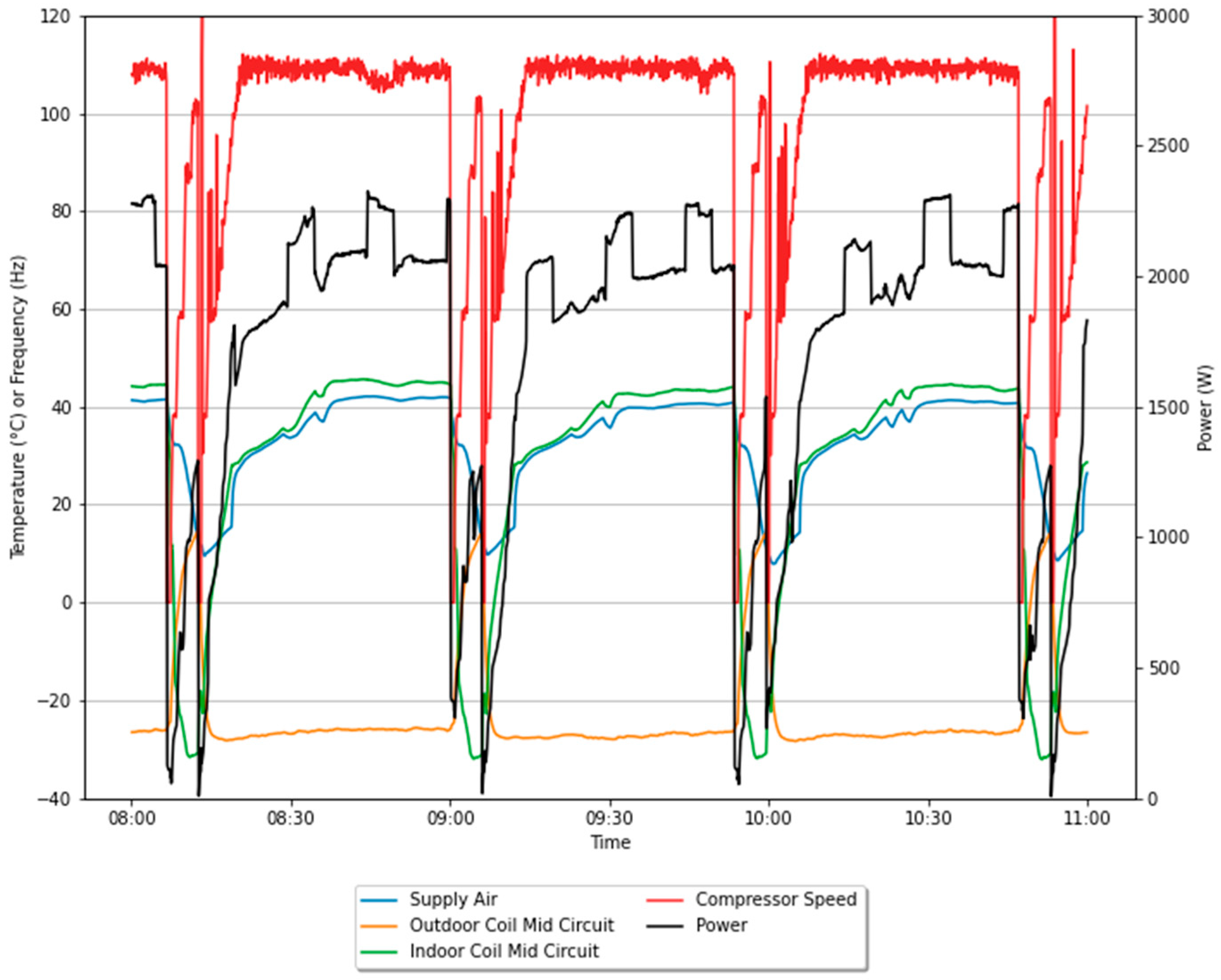
Figure 1 shows an example plot of the time series data for the defrost-aggressive controls when the outdoor air temperature was below −20 °C. During the three-hour time period shown, there were four defrost cycles. The defrost cycles are characterized by the following steps:
  • The compressor stops, while the reversing valve is shifted to the cooling mode. This is illustrated in Figure 1 by a sharp decrease in power and compressor speed.
  • The compressor starts in cooling mode, absorbing heat from the indoor coil and rejecting it to the outdoor coil. This is illustrated in Figure 1 by a combination of an increase in the compressor speed and power, a decrease in the indoor coil mid-circuit temperature, and an increase in the outdoor coil mid-circuit temperature.
  • Once the outdoor coil mid-circuit temperature reaches approximately 15 °C (59 °F), the compressor stops again, while the reversing valve shifts back into the heating mode, concluding the defrost cycle.
Through visual observations, it was determined that the heat pump was generally defrosting prior to accumulating any significant frost. This observation was backed up by the measured data. Significant frost buildup would reduce the heat transfer of the outdoor coil, resulting in a lower refrigerant pressure and coil temperature. The outdoor coil mid-circuit temperature in Figure 1 does not exhibit any significant decrease between defrost cycles.
The base pan heater operation can be seen in the unit power trace shown in Figure 1. The base pan heater cycles on for approximately 5 min and off for 10 min throughout the data. The increase in power is approximately 260 W, resulting in an average power consumption of 87 W at this outdoor temperature.
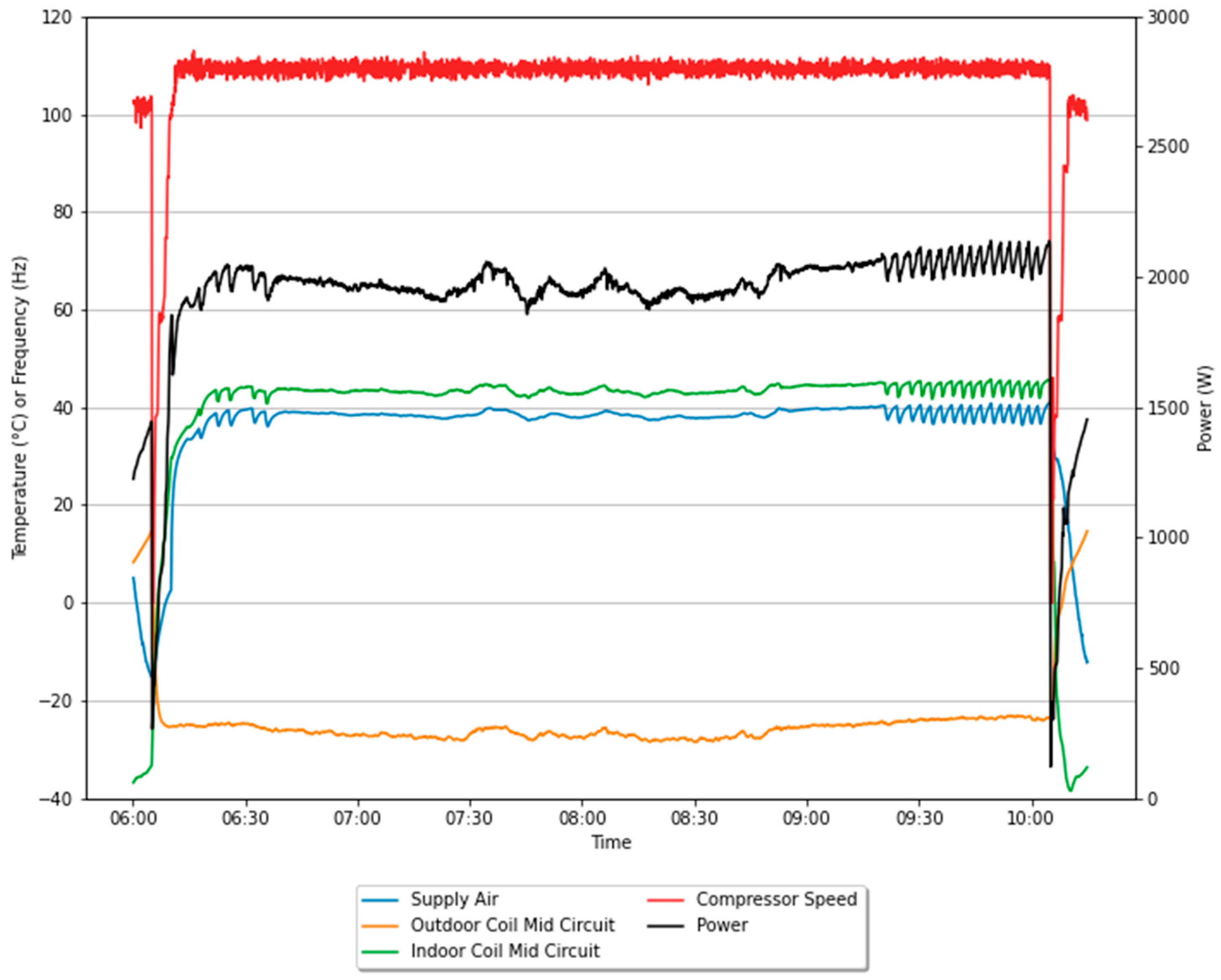
Figure 2 shows an example plot of the time series data for the efficiency-focused controls. The data cover a time period of just over four hours at an outdoor temperature similar to that of the data shown in Figure 1. During this period, a defrost cycle ends just after 6:00 a.m. and another defrost cycle begins just after 10:00 a.m., reflecting the four-hour minimum runtime between defrost cycles that was imposed in the efficiency-focused software update. Even with four hours of heating operation between defrosts, there is not any significant decrease in the outdoor mid-coil temperature, indicating that no significant frosting was present at the start of the defrost cycle just after 10:00 a.m.
While difficult to discern from the data plotted in Figure 2, it was confirmed through the base pan heater current measurement that it was only energized during defrost and the five-minute period immediately following defrost.
To further quantify the impact that the control change had on defrost and base pan heater operation, the data were analyzed to compare the fraction of the total power used by the base pan heater and the time spent defrosting the coil as a percentage of the heating runtime. To ensure a fair comparison, the data are analyzed with respect to outdoor temperature bins of 5 °C (9.8 °F), filtering the data for time periods when no additional heating or cooling load was being imposed on the space. Table 3 compares the average heating delivered, average return air temperature, and standard deviation of the return air temperature for both control algorithms. The heating delivered for both algorithms matches within ±10% for all bins except for the −32.5 °C bin. At this low temperature, the heat pump was unable to keep up with the load due to heating operation being interrupted by frequent defrost cycles. This is also evident by the 1.8 °C lower average return air temperature. The more frequent defrosts of the defrost-aggressive control also contribute to the larger variation in the return air temperature, as seen in the higher standard deviations.
Table 4 shows a comparison of the base pan heater power use as a percentage of the total power use and defrost runtime as a fraction of the heating runtime. The efficiency-focused control reduced the base pan heater power use from 5 to 13% of the total power to less than 2% of the total heat pump power use, an average savings of ~80 W of continuous power use for the temperature bins shown. The defrost runtime was also reduced, particularly at temperatures below −15 °C, where the defrost runtime as a fraction of the heating runtime was reduced by 72–86%
While Table 4 provides a useful comparison of how the two algorithms affected defrost and base pan heater operation, it only captures their difference under a single thermal loading scenario (i.e., building load line). To assess overall performance across a wide range of thermal loads, the integrated COP was investigated.
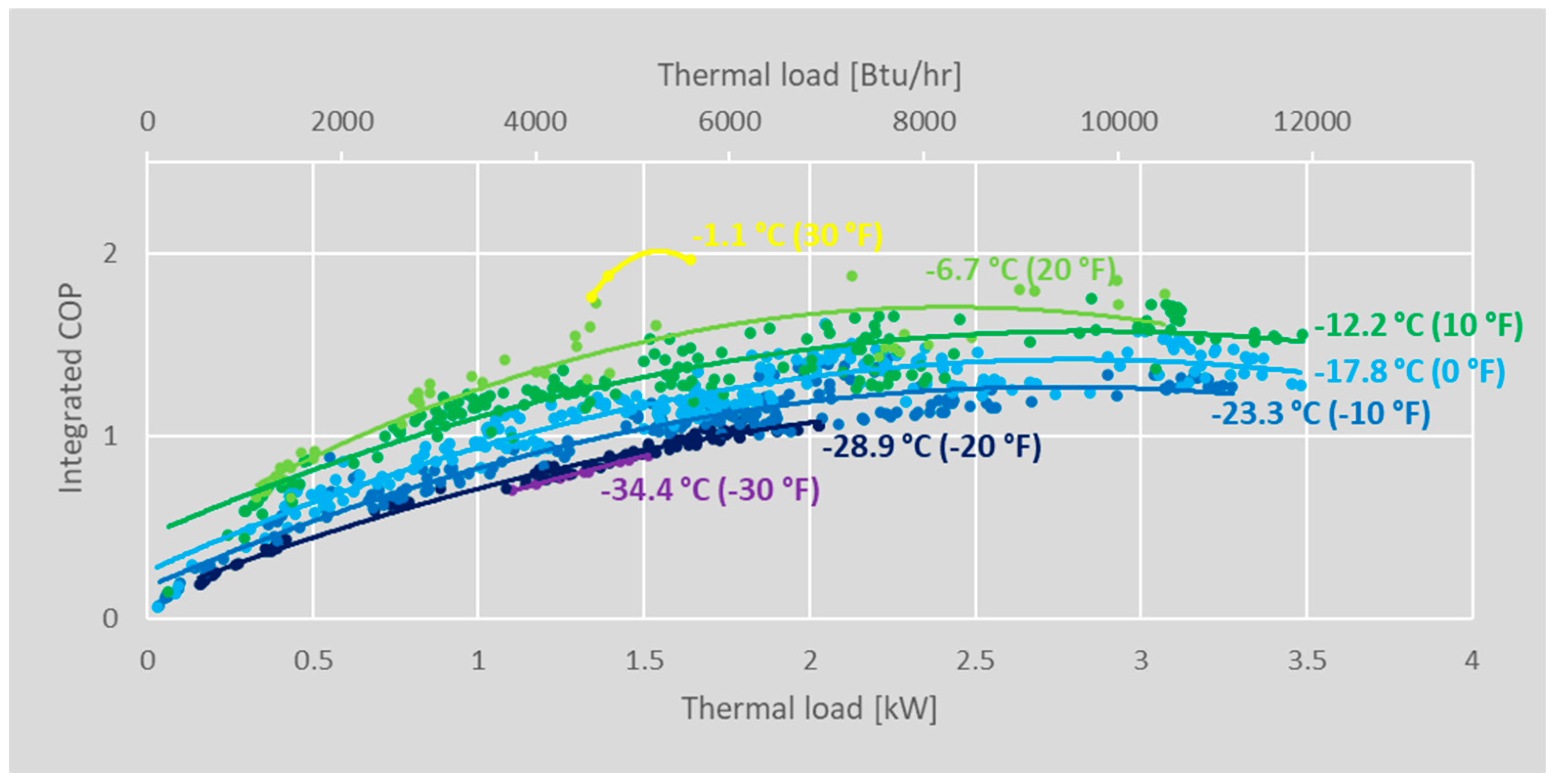
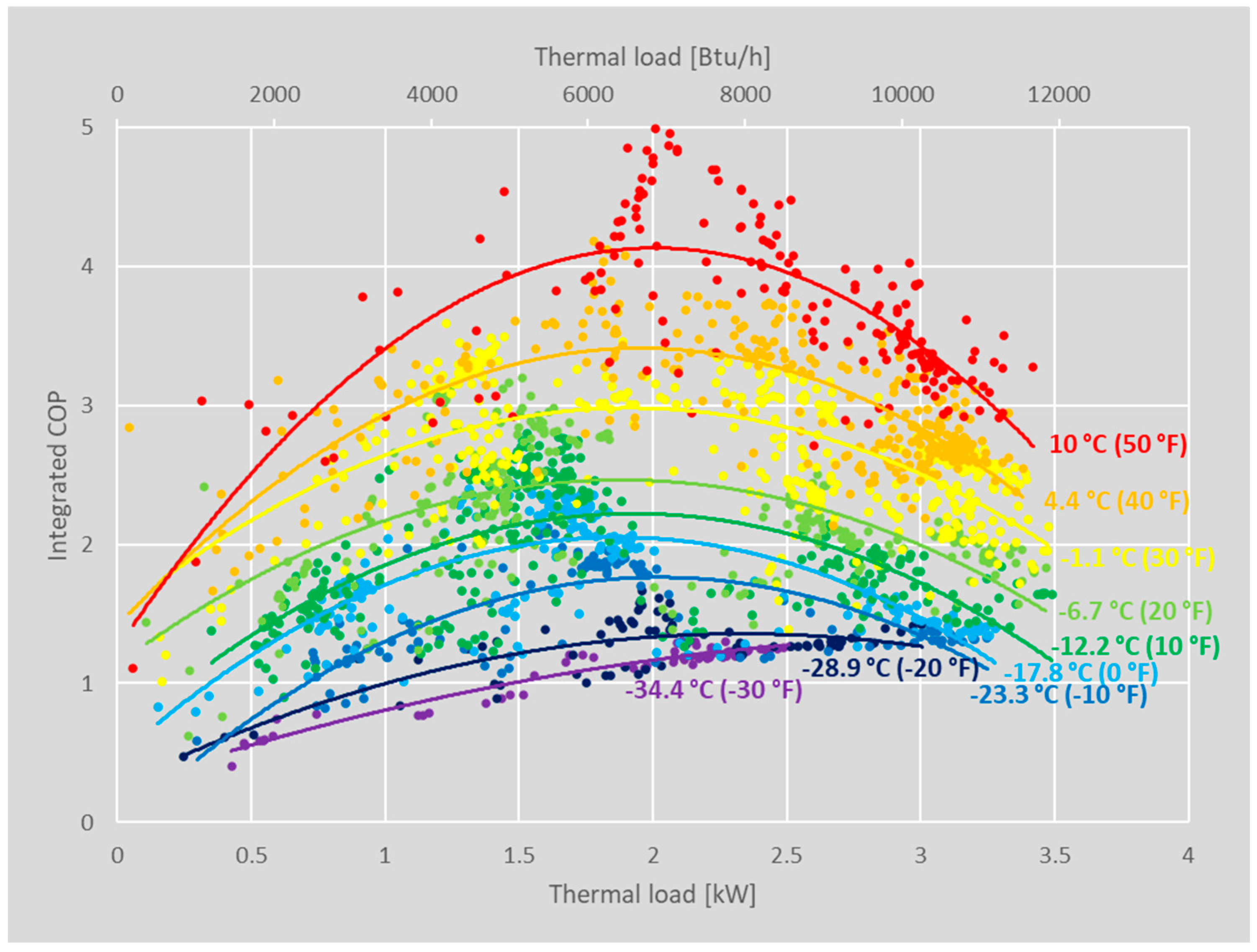
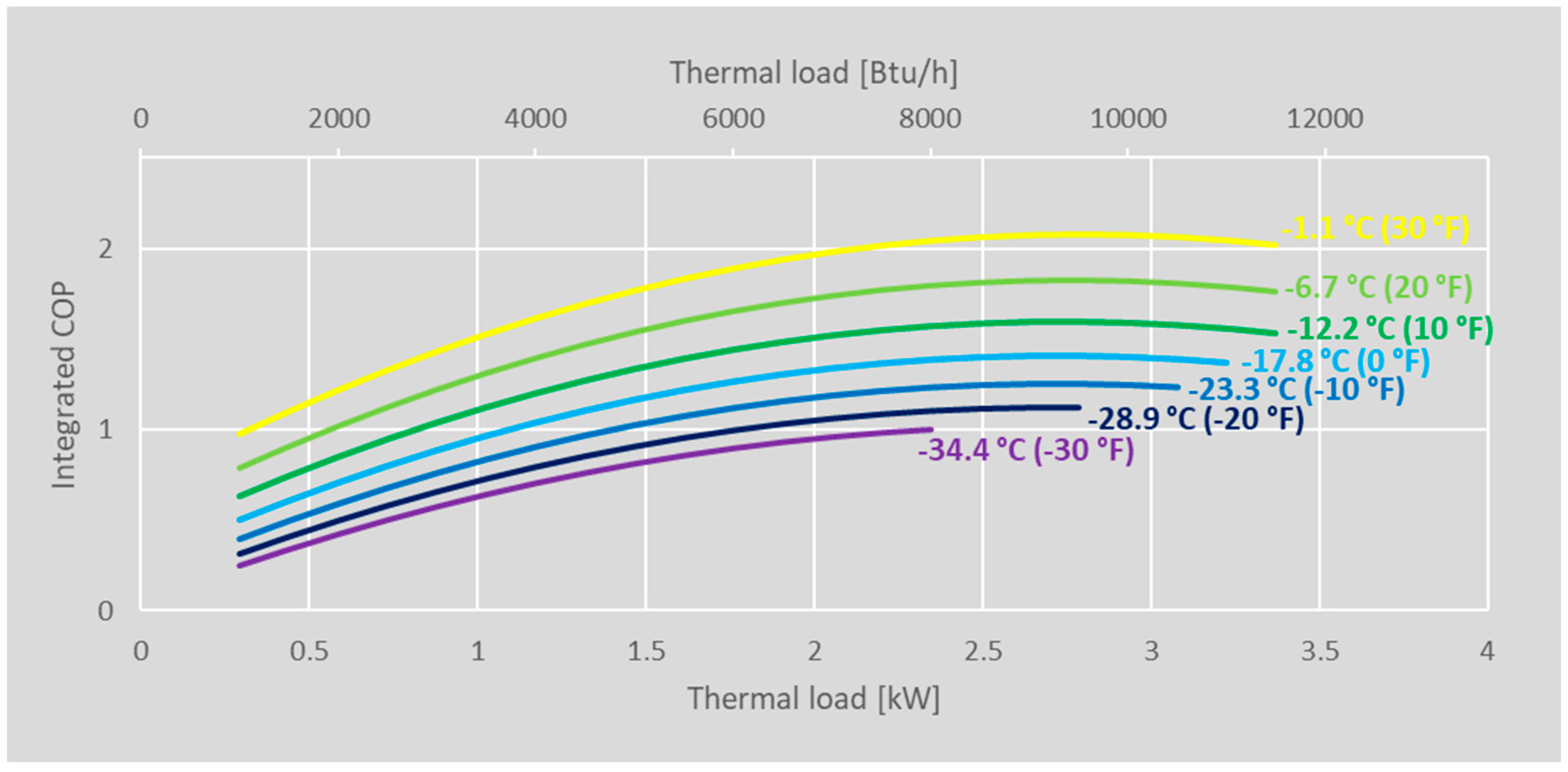
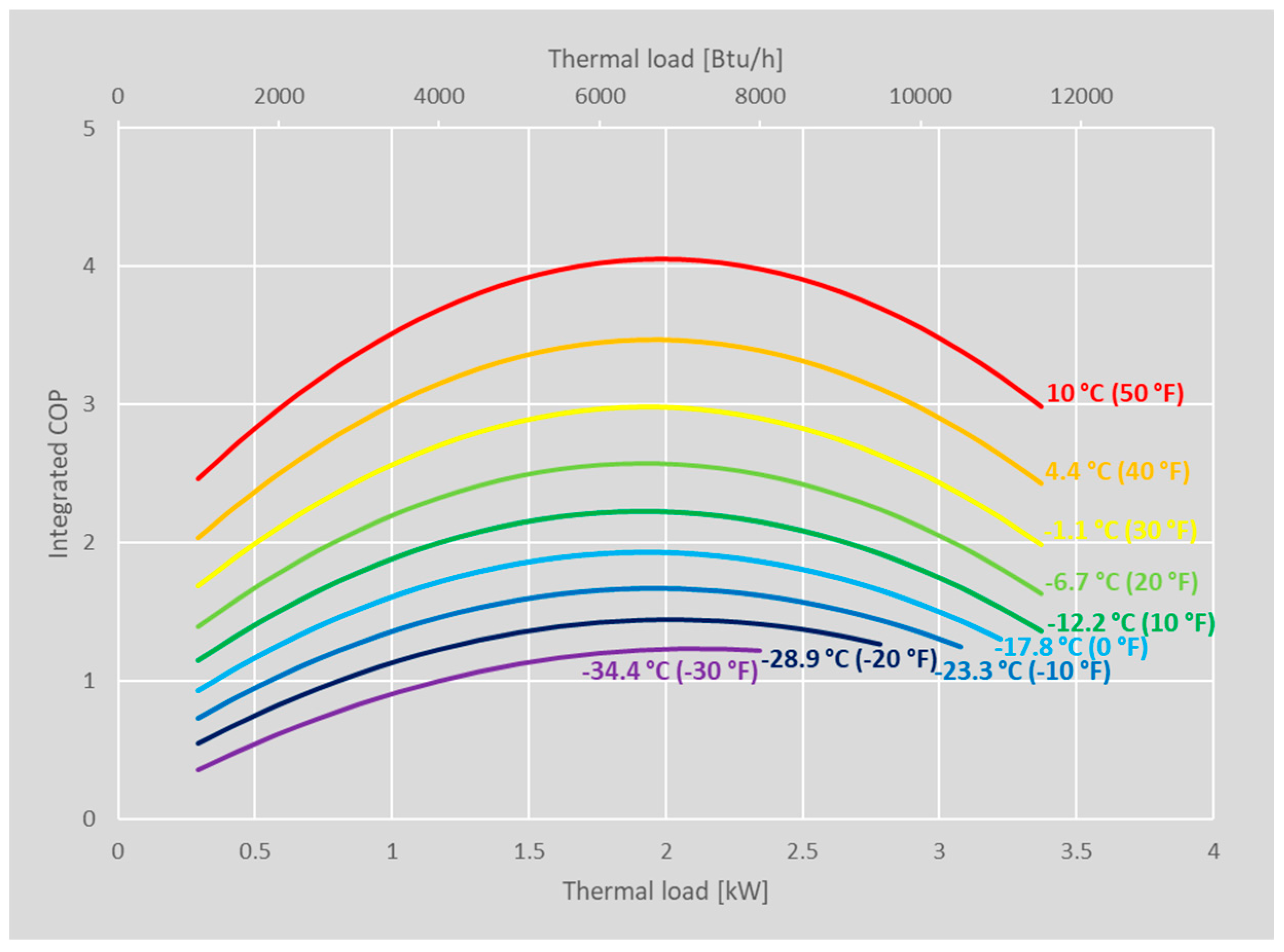
The hourly integrated COP data collected were separated into temperature bins, with each bin spanning the range of 5.6 °C (10.0 °F). The graphs used in this paper refer to the individual bins using the center point of the given bin (for example, a −17.8 °C (0.0 °F) bin represents the range of temperatures from −20.6 °C (−5.0 °F) to −15 °C (5.0 °F)). The integrated COP data points in each temperature bin were plotted separately for the defrost-aggressive and efficiency-focused control strategies against the thermal load, and second-order polynomial trendlines were added to the plots—see Figure 3 and Figure 4.
From Figure 3 and Figure 4, one can see that, in general, the efficiency-focused controls resulted in a significantly higher integrated COP than the defrost-aggressive controls. But a comparison based on these two figures is not very accurate because the data points in each temperature bin are treated equally regardless of which part of the temperature bin they fall into. For example, if a data point for one control strategy is close to the bottom of the temperature range represented by a given bin and a data point for the other control strategy is close the top of the temperature range of this bin, some of the difference in the integrated COP can be due to the different temperatures and not entirely due to the different controls. However, these two figures (including the trendlines used in these figures) are useful in confirming that the integrated COP as a function of the thermal load can be approximated with a second-order polynomial (this is also in alignment with [49], where a second-order polynomial was shown to be suitable for approximating a heat pump steady-state COP as a function of the thermal load). As described in the Methods section, this fact was used to create an analytical model for the integrated COP as a function of the thermal load and outdoor temperature, where the actual temperature (not just the temperature bin) of each data point collected was used in the creation of this analytical model. Then, this analytical model can be used to compare the two control strategies.

3.2. Analytical Model for Integrated COP vs. Thermal Load and Outdoor Temperature

As described in the Methods section, an analytical model for the integrated COP as a function of the thermal load and outdoor temperature was created separately for the defrost-aggressive and efficiency-focused control strategies via multiple linear regressions of the performance data collected (both models have the same form, but different coefficients). The results are as follows:
The analytical model determined for the integrated COP as a function of the thermal load (in kW) and outdoor temperature (in °C) for the defrost-aggressive controls is
C O P ¯ T , Q ˙ = 0.738 + 0.03441 T + 1.001 Q ˙ + 5.036 × 10 4 T 2 0.1787 Q ˙ 2 + 0.01013 T Q ˙ 1.409 × 10 3 T Q ˙ 2 + 5.017 × 10 5 T 2 Q ˙ + 2.504 × 10 6 T 3 ,
with a coefficient of determination (R2) of 0.933.
The analytical model determined for the integrated COP as a function of the thermal load (in kW) and outdoor temperature (in °C) for the efficiency-focused controls is
C O P ¯ T , Q ˙ = 1.238 + 0.05189 T + 1.900 Q ˙ + 9.087 × 10 4 T 2 0.4907 Q ˙ 2 + 0.02892 T Q ˙ 6.547 × 10 3 T Q ˙ 2 + 1.829 × 10 4 T 2 Q ˙ + 1.182 × 10 5 T 3  
with an R2 of 0.860. The lower R2 for the efficiency-focused control model is likely due to the less frequent defrost cycles and data including warmer outdoor air temperatures. Since the underlying data are hourly averages, the 4 h minimum heating runtime between defrosts cycles will yield many hours where the performance is not impacted by a defrost cycle. These hours will have higher COPs than hours where a defrost cycle occurred (while operating over the same outdoor air temperature and delivering the same average capacity to the space). When the unit was operating with the defrost-aggressive controls and frequently defrosting every 45 min, most hourly data points will reflect some performance penalty due to defrost, and accordingly there will be less variation in the data. Additionally, since frost development is generally worse at mild outdoor air temperatures, the actual frosting of the coil likely contributes to the higher variability in performance. Since the data for the efficiency-focused controls included warmer ambient temperatures than the defrost-aggressive control data, it would be expected to have more variability and a resultingly lower R2.
Plotting the analytical models for the integrated COP as a function of the thermal load and outdoor temperature for the defrost-aggressive controls (Equation (5)) and efficiency-focused controls (Equation (6)) results in the graphs shown in Figure 5 and Figure 6, respectively.

3.3. Comparison of the Defrost-Aggressive and Efficiency-Focused Control Strategies

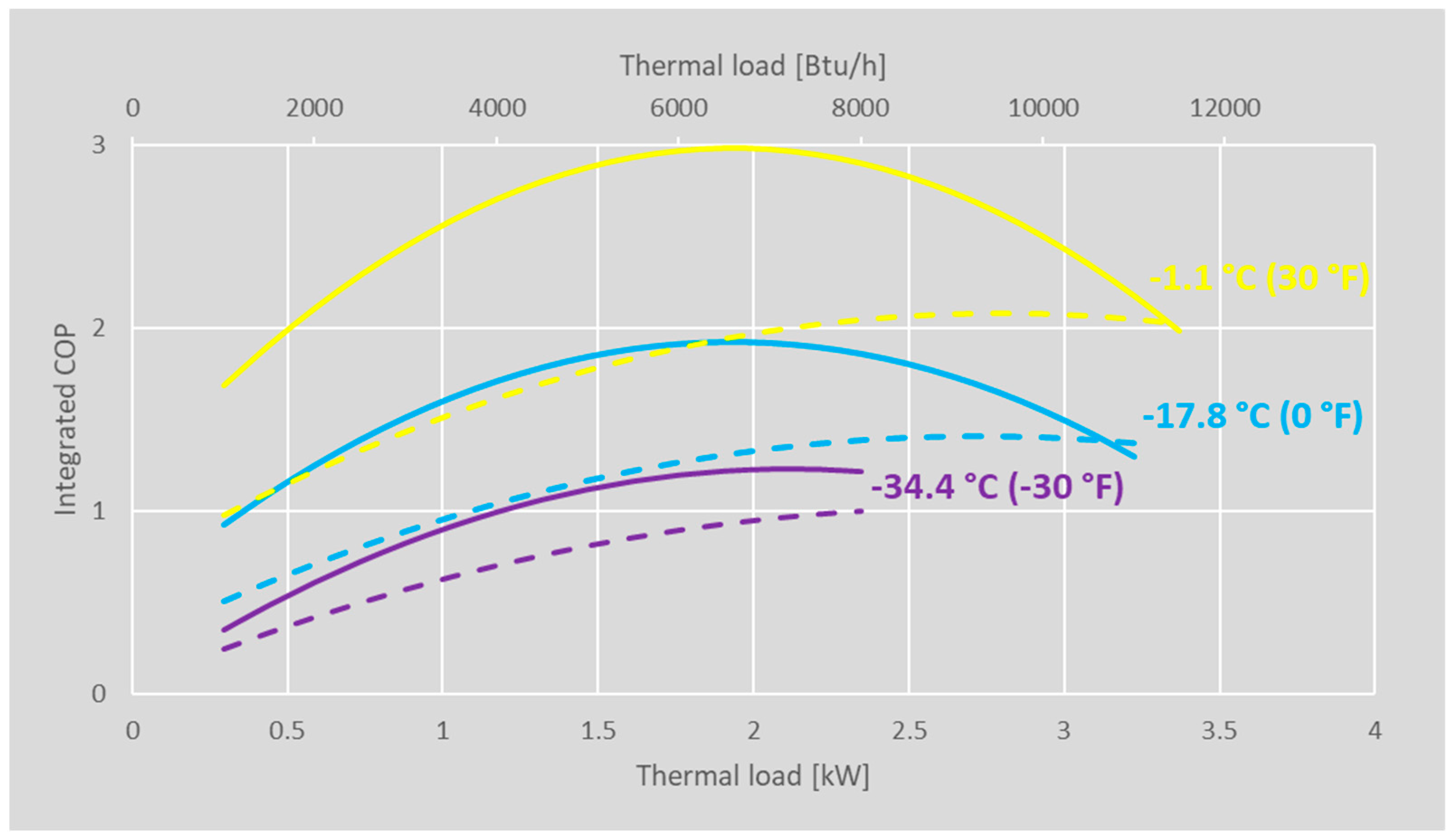
From Figure 5 and Figure 6, one can see that, in general, the efficiency-focused controls resulted in a significantly higher integrated COP than the defrost-aggressive controls. To compare the difference in the integrated COP directly, it is useful to plot both control strategies into the same graph. For the sake of better readability, this was performed for temperatures spaced further apart—see Figure 7.
As seen in Figure 7, the integrated COP for the efficiency-focused control strategy was significantly higher than that for the defrost-aggressive strategy for most of the levels of thermal loading. This is with the exception of very high levels of thermal loading, where the integrated performance of both control strategies was essentially the same. It was through visual observations that it was determined that the defrost-aggressive control strategy was triggering defrosts even when they were not needed, but the details of the defrost-aggressive control strategy are unknown to us. The fact that the integrated COP at very high levels of thermal loading is essentially the same for both control strategies suggests that the unnecessary defrosts with the defrost-aggressive control strategy at high levels of thermal loading might not have been as frequent. It can also be that, because high levels of thermal loading in general require a lower outdoor coil temperature (to extract heat from the outdoor air at a higher rate), the outdoor coil frosting associated with the prolonged time between defrosts for the efficiency-focused control strategy might have resulted in a loss of efficiency that negated the gains through less frequent cycling. But investigating the exact reasons was beyond the scope of this study. The fact that the gain in the integrated COP through the efficiency-focused controls (compared to the defrost-aggressive controls) increases as the thermal load decreases from those very high levels of thermal loading is also due to the modified controls of the base pan heater. For the efficiency-focused controls, the average power going into the base pan heater is lower than for the defrost-aggressive controls. Since the power going into the base pan heater is mostly independent of the thermal load, the relative efficiency gains are not as strong at high levels of thermal loading when the base pan heater power is relatively small compared to the overall heat pump power. However, relative efficiency gains become more significant at lower levels of thermal loading when the base pan heater power becomes bigger relative to the overall heat pump power.
The main goal of this study was to identify whether there is space for improvements in efficiency through improved defrost controls, but optimizing those controls was beyond the scope of this research. Figure 7 shows that there is a significant opportunity for an improvement in efficiency through improved defrost controls, and it is our recommendation for future studies to optimize those controls.

4. Conclusions

In this study, the field performance of a ductless mini-split heat pump was evaluated in a very cold climate in Fairbanks, Alaska. The performance data was first collected with factory controls, which prioritized maintaining the frost-free operation of the unit through aggressive defrost. The controls were then changed to prioritize efficiency, and performance data were collected with these new efficiency-focused controls. It was shown that the efficiency-focused control strategy resulted in significant improvements in the integrated COP compared to the defrost-aggressive control strategy. The results suggest that optimizing defrost controls is an important area for improving the field performance of air-source heat pumps.

Author Contributions

J.M.: methodology, data curation, writing—original draft, funding acquisition, visualization. T.M.: conceptualization, methodology, formal analysis, investigation, writing—original draft, visualization, funding acquisition. D.T.-M.: investigation. V.S.: project administration, investigation. C.D.: methodology, investigation. J.W.: methodology, investigation. R.S.: investigation. All authors have read and agreed to the published version of the manuscript.

Funding

This work was authored by the National Laboratory of the Rockies for the U.S. Department of Energy (DOE) under Contract No. DE-AC36-08GO28308. Funding provided by the U.S. Department of Energy Office of Critical Minerals and Energy Innovation Building Technologies Office. The views expressed in the article do not necessarily represent the views of the DOE or the U.S. Government. The U.S. Government retains and the publisher, by accepting the article for publication, acknowledges that the U.S. Government retains a nonexclusive, paid-up, irrevocable, worldwide license to publish or reproduce the published form of this work, or allow others to do so, for U.S. Government purposes.

Data Availability Statement

The original contributions in this study are included in the article. Further inquiries regarding the data can be made to the corresponding author.

Acknowledgments

The authors would like to acknowledge Tony Bouza and Payam Delgoshaei for funding and supporting this project. Additionally, the authors would like to acknowledge the efforts of Bruno Grunau, Qwerty Mackey, Matt Irinaga, Ron Ponchione, and Dave Wesolowski for their assistance and support throughout the project.

Conflicts of Interest

The authors declare no conflicts of interest.

Abbreviations

The following abbreviations are used in this manuscript:
COPCoefficient of performance
DASData acquisition system
EEREnergy efficiency ratio
HSPFHeating seasonal performance factor
SEERSeasonal energy efficiency ratio

References

  1. Shen, B.; Abdelaziz, O.; Rice, C.K. Cold Climate Heat Pumps Using Tandem Compressors. In 2016 ASHRAE Winter Conference Proceedings; ASHRAE: Orlando, FL, USA, 2016. [Google Scholar]
  2. ASHRAE. ASHRAE Handbook HVAC Systems and Equipment (SI); ASHRAE: Peachtree Corners, GA, USA, 2024. [Google Scholar]
  3. Ma, L.; Sun, Y.; Wang, F.; Wang, M.; Zhang, S.; Wang, Z. Advancements in anti-frosting and defrosting techniques for air source heat pumps: A comprehensive review of recent progress. Appl. Energy 2025, 377, 124358. [Google Scholar] [CrossRef]
  4. Wang, W.; Zhou, Q.; Tian, G.; Wang, Y.; Zhao, Z.; Cao, F. A novel defrosting initiation strategy based on convolutional neural network for air-source heat pump. Int. J. Refrig. 2021, 128, 95–103. [Google Scholar] [CrossRef]
  5. Guo, Y.; Shao, S.; Geng, X.; Li, H.; Wang, Z.; Akkurt, N. A data-driven evaluating method on the defrosting effect of the air source heat pump system in Beijing. Appl. Therm. Eng. 2023, 235, 121377. [Google Scholar] [CrossRef]
  6. Bai, X.; Liu, S.; Deng, S.; Zhang, L.; Wei, M. An optimal control strategy for ASHP units with a novel dual-fan outdoor coil for evener frosting along airflow direction based on GRNN modelling. Energy Build. 2023, 292, 113136. [Google Scholar] [CrossRef]
  7. Klingebiel, J.; Salamon, M.; Bogdanov, P.; Venzik, V.; Vering, C.; Müller, D. Towards maximum efficiency in heat pump operation: Self-optimizing defrost initiation control using deep reinforcement learning. Energy Build. 2023, 297, 113397. [Google Scholar] [CrossRef]
  8. Yoo, J.W.; Chung, Y.; Kim, G.T.; Song, C.W.; Yoon, P.H.; Sa, Y.C.; Kim, M.S. Determination of defrosting start time in an air-to-air heat pump system by frost volume calculation method. Int. J. Refrig. 2018, 96, 169–178. [Google Scholar] [CrossRef]
  9. Li, Z.; Wang, W.; Sun, Y.; Liang, S.; Deng, S.; Lin, Y.; Wu, X. A novel defrosting initiating method for air source heat pumps based on the optimal defrosting initiating time point. Energy Build. 2020, 222, 110064. [Google Scholar] [CrossRef]
  10. Feng, H.; Wang, Z.; Wei, P. A novel index model for defrosting initiating time point of air source heat pump based on the cusp catastrophe theory. Energy Build. 2022, 263, 112016. [Google Scholar] [CrossRef]
  11. Chung, Y.; Na, S.I.; Choi, J.; Kim, M.S. Feasibility and optimization of defrosting control method with differential pressure sensor for air source heat pump systems. Appl. Therm. Eng. 2019, 155, 461–469. [Google Scholar] [CrossRef]
  12. Zhu, J.; Sun, H.; Liu, X.; Sun, Z.; Lei, Z. Theoretical and experimental research on a new defrosting control strategy based on differential pressure sensor. Int. J. Refrig. 2022, 143, 11–18. [Google Scholar] [CrossRef]
  13. Yu, S.; Su, Y.; Cai, W.; Qiu, G. Experimental investigation on an air source heat pump system with a novel anti-frosting evaporator. Appl. Therm. Eng. 2023, 221, 119910. [Google Scholar] [CrossRef]
  14. Boyina, K.S.; Mahvi, A.J.; Chavan, S.; Park, D.; Kumar, K.; Lira, M.; Yu, Y.; Gunay, A.A.; Wang, X.; Miljkovic, N. Condensation frosting on meter-scale superhydrophobic and superhydrophilic heat exchangers. Int. J. Heat Mass Transf. 2019, 145, 118694. [Google Scholar] [CrossRef]
  15. He, H.; Lyu, N.; Liang, C.; Wang, F.; Zhang, X. Effect of micro-nano structure on anti-frost and defrost performance of the superhydrophobic fin surfaces. Exp. Therm. Fluid Sci. 2023, 144, 110878. [Google Scholar] [CrossRef]
  16. Li, F.; Wu, S.; Ma, Z.; Zhao, R.; Huang, D. Effect of surface coating on defrosting water drainage characteristics of vertical-fin microchannel frosting evaporator. Appl. Therm. Eng. 2022, 208, 118220. [Google Scholar] [CrossRef]
  17. Wang, H.; Zhang, F.; Wang, J.; Wang, Z.; Xu, H.; Zhang, W. Efficient defrosting on hybrid surfaces with heterogeneous wettability. Case Stud. Therm. Eng. 2023, 45, 102999. [Google Scholar] [CrossRef]
  18. Wang, F.; Tang, R.; Wang, Z.; Yang, W. Experimental study on anti-frosting performance of superhydrophobic surface under high humidity conditions. Appl. Therm. Eng. 2022, 217, 119193. [Google Scholar] [CrossRef]
  19. Shim, J.; Oh, S.; Kim, S.; Seo, D.; Shin, S.; Lee, H.; Ko, Y.; Nam, Y. Long-lasting ceria-based anti-frosting surfaces. Int. Commun. Heat Mass Transf. 2023, 140, 106550. [Google Scholar] [CrossRef]
  20. Mahvi, A.J.; Boyina, K.; Musser, A.; Elbel, S.; Miljkovic, N. Superhydrophobic heat exchangers delay frost formation and enhance efficency of electric vehicle heat pumps. Int. J. Heat Mass Transf. 2021, 172, 121162. [Google Scholar] [CrossRef]
  21. James, A.; Raj, A.K.; Srinivas, M.; Mohanraj, M.; Jayaraj, S. Experimental investigations on a solar heat pump system having hybrid collector with dual cooling arrangements for delaying frost generation. Therm. Sci. Eng. Prog. 2023, 39, 101720. [Google Scholar] [CrossRef]
  22. Fan, C.; Xiong, T.; Yan, G.; Yu, J.; Zhang, H.; Chu, W.; Wang, Q. Retarding frosting of an air source heat pump by using vapor-bypassed evaporation technique. Int. J. Refrig. 2021, 127, 69–77. [Google Scholar] [CrossRef]
  23. Jiang, Y.; Pu, J.; Zhang, H.; Liu, S.; Wang, Y.; You, S.; Wan, Z.; Wu, Z.; Fan, X.; Liu, Z.; et al. The frost restraining effect of solar air collector applied to air source heat pump. Appl. Therm. Eng. 2023, 225, 120215. [Google Scholar] [CrossRef]
  24. Ma, L.; Wang, F.; Wang, Z.; Wang, Z.; Zhang, S.; Sun, Y. Thermodynamic mechanism of high energy performance of air source heat pump with coupled liquid-storage to gas-liquid separator. Sol. Energy 2023, 255, 497–506. [Google Scholar] [CrossRef]
  25. Lin, Y.; Sun, Y.; Luo, J.; Wei, W.; Wang, W.; Luo, Q.; Liu, S.; Deng, S. A novel coefficient of frosting suppression based on the real-time operating characteristics of air source heat pumps. Energy Build. 2023, 284, 112814. [Google Scholar] [CrossRef]
  26. Zhong, H.; Zeng, L.; Long, J.; Xia, K.; Lu, H.; Yongga, A. Anti-frosting operation and regulation technology of air-water dual-source heat pump evaporator. Energy 2022, 254, 124393. [Google Scholar] [CrossRef]
  27. Liu, S.; Bai, X.; Deng, S.; Zhang, L.; Wei, M. Developing a novel control strategy for frosting suppression based on condensing-frosting performance maps for variable speed air source heat pumps. Energy Build. 2023, 289, 113049. [Google Scholar] [CrossRef]
  28. Liu, S.; Bai, X.; Zhang, L.; Lin, Y.; Deng, S.; Wang, W.; Wei, M. Developing condensing-frosting performance maps for a variable speed air source heat pump (ASHP) for frosting suppression. Appl. Therm. Eng. 2022, 211, 118397. [Google Scholar] [CrossRef]
  29. Liao, C.; Zeng, L.; Long, J.; Yongga, A. Research on anti-frosting potential of air source heat pump evaporator in hot-summer and cold-winter zone. Appl. Therm. Eng. 2023, 220, 119684. [Google Scholar] [CrossRef]
  30. Qu, M.; Xia, L.; Deng, S.; Jiang, Y. A study of the reverse cycle defrosting performance on a multi-circuit outdoor coil unit in an air source heat pump—Part I: Experiments. Appl. Energy 2012, 91, 122–129. [Google Scholar] [CrossRef]
  31. Xiong, T.; Ying, Y.; Han, B.; Yan, G.; Yu, J. Comparison of energy supplies and consumptions in heat pump systems using finned tube and microchannel heat exchangers during defrosting. Int. J. Refrig. 2021, 132, 222–232. [Google Scholar] [CrossRef]
  32. Li, J.; Fan, Y.; Zhao, X.; Bai, X.; Zhou, J.; Badiei, A.; Myers, S.; Ma, X. Design and analysis of a novel dual source vapor injection heat pump using exhaust and ambient air. Energy Built Environ. 2022, 3, 95–104. [Google Scholar] [CrossRef]
  33. Ma, J.; Kim, D.; Braun, J.E.; Horton, W.T. Development and validation of a dynamic modeling framework for air-source heat pumps under cycling of frosting and reverse-cycle defrosting. Energy 2023, 272, 127030. [Google Scholar] [CrossRef]
  34. Song, M.; Xu, X.; Mao, N.; Deng, S.; Xu, Y. Energy transfer procession in an air source heat pump unit during defrosting. Appl. Energy 2017, 204, 679–689. [Google Scholar] [CrossRef]
  35. Li, Y.; Li, Z.; Fan, Y.; Zeng, C.; Cui, Y.; Zhao, X.; Li, J.; Chen, Y.; Chen, J.; Shen, C. Experimental investigation of a novel two-stage heat recovery heat pump system employing the vapor injection compressor at cold ambience and high water temperature conditions. Renew. Energy 2023, 205, 678–694. [Google Scholar] [CrossRef]
  36. Wang, Y.; Ye, Z.; Song, Y.; Yin, X.; Cao, F. Experimental investigation on the hot gas bypass defrosting in air source transcritical CO2 heat pump water heater. Appl. Therm. Eng. 2020, 178, 115571. [Google Scholar] [CrossRef]
  37. Liang, C.; Li, X.; Meng, X.; Shi, W.; Gu, J.; Wang, B.; Lv, Y. Experimental investigation of heating performance of air source heat pump with stable heating capacity during defrosting. Appl. Therm. Eng. 2023, 235, 121433. [Google Scholar] [CrossRef]
  38. Niu, J.; Ma, G.; Xu, S. Experimental research on hot liquid defrosting system with multiple evaporators. Appl. Therm. Eng. 2020, 179, 115710. [Google Scholar] [CrossRef]
  39. Ma, G.; Lu, T.; Liu, F.; Niu, J.; Xu, S. Experimental study on hot liquid subcooling defrosting of an air source heat pump with multi-connected outdoor units. Energy Build. 2023, 291, 113104. [Google Scholar] [CrossRef]
  40. Hu, W.; Song, M.; Jiang, Y.; Yao, Y.; Gao, Y. A modeling study on the heat storage and release characteristics of a phase change material based double-spiral coiled heat exchanger in an air source heat pump for defrosting. Appl. Energy 2019, 236, 877–892. [Google Scholar] [CrossRef]
  41. Long, Z.; Jiankai, D.; Yiqiang, J.; Yang, Y. A novel defrosting method using heat energy dissipated by the compressor of an air source heat pump. Appl. Energy 2014, 133, 101–111. [Google Scholar] [CrossRef]
  42. Liu, Z.; Fan, P.; Wang, Q.; Chi, Y.; Zhao, Z.; Chi, Y. Air source heat pump with water heater based on a bypass-cycle defrosting system using compressor casing thermal storage. Appl. Therm. Eng. 2018, 128, 1420–1429. [Google Scholar] [CrossRef]
  43. Karaağaç, M.O.; Ergün, A.; Gürel, A.E.; Ceylan, İ.; Yıldız, G. Assessment of a novel defrost method for PV/T system assisted sustainable refrigeration system. Energy Convers. Manag. 2022, 267, 115943. [Google Scholar] [CrossRef]
  44. Yang, B.; Dong, J.; Zhang, L.; Song, M.; Jiang, Y.; Deng, S. Heating and energy storage characteristics of multi-split air source heat pump based on energy storage defrosting. Appl. Energy 2019, 238, 303–310. [Google Scholar] [CrossRef]
  45. Trojanowski, R.; Loprete, J.; Lindberg, J.; Butcher, T.; Walburger, A.; Genzel, N. Field Validation of Innovative Air-Source Heat Pumps for Cold-Climate Heating Applications. BNL–224785-2023-FORE; Brookhaven National Laboratory (BNL): Upton, NY, USA, 2023. [CrossRef]
  46. Appendix M to Subpart B of 10 CFR Part 430. Available online: https://www.ecfr.gov/current/title-10/appendix-Appendix%20M%20to%20Subpart%20B%20of%20Part%20430 (accessed on 28 May 2025).
  47. NEEP’s Cold Climate Air Source Heat Pump List. Available online: https://ashp.neep.org/#!/ (accessed on 22 January 2026).
  48. ASHRAE. ASHRAE Fundamentals; ASHRAE: Peachtree Corners, GA, USA, 2021. [Google Scholar]
  49. Marsik, T.; Stevens, V.; Garber-Slaght, R.; Dennehy, C.; Strunk, R.T.; Mitchell, A. Empirical Study of the Effect of Thermal Loading on the Heating Efficiency of Variable-Speed Air Source Heat Pumps. Sustainability 2023, 15, 1880. [Google Scholar] [CrossRef]
Figure 1. Example timeseries data of the defrost-aggressive controls when the outdoor temperature was below −20 °C.
Energies 19 00733 g001
Figure 2. Example timeseries data of the efficiency-focused controls when the outdoor temperature was below −20 °C.
Energies 19 00733 g002
Figure 3. Hourly integrated COP data points collected for the defrost-aggressive controls. The thermal load is on the x-axis, and the outdoor temperature bin into which the data point falls is expressed using the color. Each bin spans a range of 5.6 °C (10.0 °F). The center points of the bins used are −1.1 °C (30.0 °F), −6.7 °C (20.0 °F), −12.2 °C (10.0 °F), −17.8 °C (0.0 °F), −23.3 °C (−10.0 °F), −28.9 °C (−20.0 °F), and −34.4 °C (−30.0 °F). Second-order polynomial trendlines for each temperature bin are also shown in the graph.
Energies 19 00733 g003
Figure 4. Hourly integrated COP data points collected for the efficiency-focused controls. The thermal load is on the x-axis, and the outdoor temperature bin into which the data point falls is expressed using the color. Each bin spans a range of 5.6 °C (10.0 °F). The center points of the bins used are 10.0 °C (50.0 °F), 4.4 °C (40.0 °F), −1.1 °C (30.0 °F), −6.7 °C (20.0 °F), −12.2 °C (10.0 °F), −17.8 °C (0.0 °F), −23.3 °C (−10.0 °F), −28.9 °C (−20 °F), and −34.4 °C (−30.0 °F). Second-order polynomial trendlines for each temperature bin are also shown in the graph.
Energies 19 00733 g004
Figure 5. Plot of the analytical function that models the integrated COP as a function of the thermal load and outdoor temperature for the defrost-aggressive controls.
Energies 19 00733 g005
Figure 6. Plot of the analytical function that models the integrated COP as a function of the thermal load and outdoor temperature for the efficiency-focused controls.
Energies 19 00733 g006
Figure 7. Plots of the analytical functions that model the integrated COP as a function of the thermal load and outdoor temperature for the defrost-aggressive controls (dashed line) as well as efficiency-focused controls (full line). Plots shown are for −1.1 °C (30.0 °F), −17.8 °C (0.0 °F), and −34.4 °C (−30.0 °F).
Energies 19 00733 g007
Table 1. Detailed heat pump information.
Outdoor UnitCompressor type3 phase DC inverter-driven rotary
Compressor modelPanasonic (Kadoma, Osaka, Japan) 5RD138ZB021
RefrigerantR-410A
OilPolyvinyl Ether (PVE)
FanVariable speed horizontal discharge
Metering deviceBi-flow electronic expansion valve
Defrost mechanismReverse-cycle
Base pan heaterFactory-installed
Indoor UnitStyleDuctless highwall
FanVariable speed
Performance 4Rated cooling capacity3.52 kW (12.0 kBtu/h)
SEER 127
EER 215.0
Rated heating capacity @ 8.3 °C (47.0 °F)4.25 kW (14.5 kBtu/h)
Maximum heating capacity @ −15 °C (5 °F)4.98 kW (17.0 kBtu/h)
HSPF 313.0
1 Seasonal energy efficiency ratio [46]. 2 Energy efficiency ratio [46]. 3 Heating seasonal performance factor [46]. 4 Performance data taken from NEEP’s Cold Climate Air-Source Heat Pump List [47].
Table 2. List of sensor details.
MeasurementSensorSensor AccuracyDAS Accuracy
Supply and return air temperatures, refrigerant temperaturesType T thermocouples±0.5 °C (0.9 °F)Reference temperature: ±0.2 °C (0.36 °F)
±(0.4% of measurement + 0.15 μV)
Outdoor air temperatureVaisala HMP110±0.2 °C (0.36 °F) at 0 °C to 40 °C (32 °F to 104 °F)
±0.4 °C (0.72 °F) at −40 °C to 0 °C (−40 °F to 32 °F)
±(0.4% of measurement + 1 μV)
Return air humidityVaisala HMP110±1.5% RH±(0.4% of measurement + 1 μV)
Outdoor air humidityVaisala HMP 110±1.5% RH (0–90% RH) at 0 °C to 40 °C (32 °F to 104 °F)
±2.5% RH (90–100% RH) at 0 °C to 40 °C (32 °F to 104 °F)
±3.0% RH (0–90% RH) at −40 °C to 0 °C (−40 °F to 32 °F)
±4.0% RH (90–100% RH) at −40 °C to 0 °C (−40 °F to 32 °F)
±(0.4% of measurement + 1 μV)
AirflowTEC Minneapolis Duct Blaster±3% FSDG-1000: the greater of ±0.9% of reading or 0.12 Pa
Total powerWattNode MB
AccuCT 20 Amp
±0.5% nominal
±2% of reading
Not applicable, digital communication
Fan powerWattNode MB
AccuCT 5 Amp
±0.5% nominal
±2% of reading
Not applicable, digital communication
Return air velocityOmega FMA901R-V1 hot wire anemometer±2% fullscale or 0.076 m/s (0.25 ft/s)±(0.4% of measurement + 1 μV)
Base pan heater currentJC10F-5-V±2% fullscale±(0.4% of measurement + 1 μV)
Compressor frequencyAccuCT 5 Amp current transformer ±(0.02% of reading + 0.2 Hz)
Table 3. Comparison of delivered heating and return air temperature at different outdoor temperatures for the defrost-aggressive (DA) and efficiency-focused (EF) controls.
Temperature Bin (°C)Avg. Delivered Heating (kW)Avg. Return Air
Temperature (°C)
Std. Dev. of Return Air Temperature (°C)
DAEFDAEFDAEF
−32.51.422.1219.421.21.40.7
−27.51.711.8820.521.21.40.9
−22.51.871.7920.921.41.40.6
−17.51.661.7521.221.41.20.5
−12.51.381.5021.321.30.70.7
−7.51.321.3321.321.41.00.7
Table 4. Comparison of base pan heater power as a percentage of total power and defrost runtime as a fraction of heating runtime at different outdoor temperatures for the defrost-aggressive (DA) and efficiency-focused (EF) controls.
Temperature Bin (°C)Base Pan Heater Power (% of Total)Defrost Runtime Fraction of Heating Runtime
DAEFDAEF
−32.54.9%0.4%0.140.02
−27.54.8%0.7%0.150.02
−22.55.3%0.9%0.090.03
−17.56.2%0.7%0.080.02
−12.58.4%1.8%0.040.04
−7.513.4%1.8%0.080.03
Disclaimer/Publisher’s Note: The statements, opinions and data contained in all publications are solely those of the individual author(s) and contributor(s) and not of MDPI and/or the editor(s). MDPI and/or the editor(s) disclaim responsibility for any injury to people or property resulting from any ideas, methods, instructions or products referred to in the content.