Phasor Estimation of Transient Electrical Signals Using Modified Covariance Enhanced Cleaned Characteristic Harmonic Filtering in Protection Relay


Abstract
1. Introduction
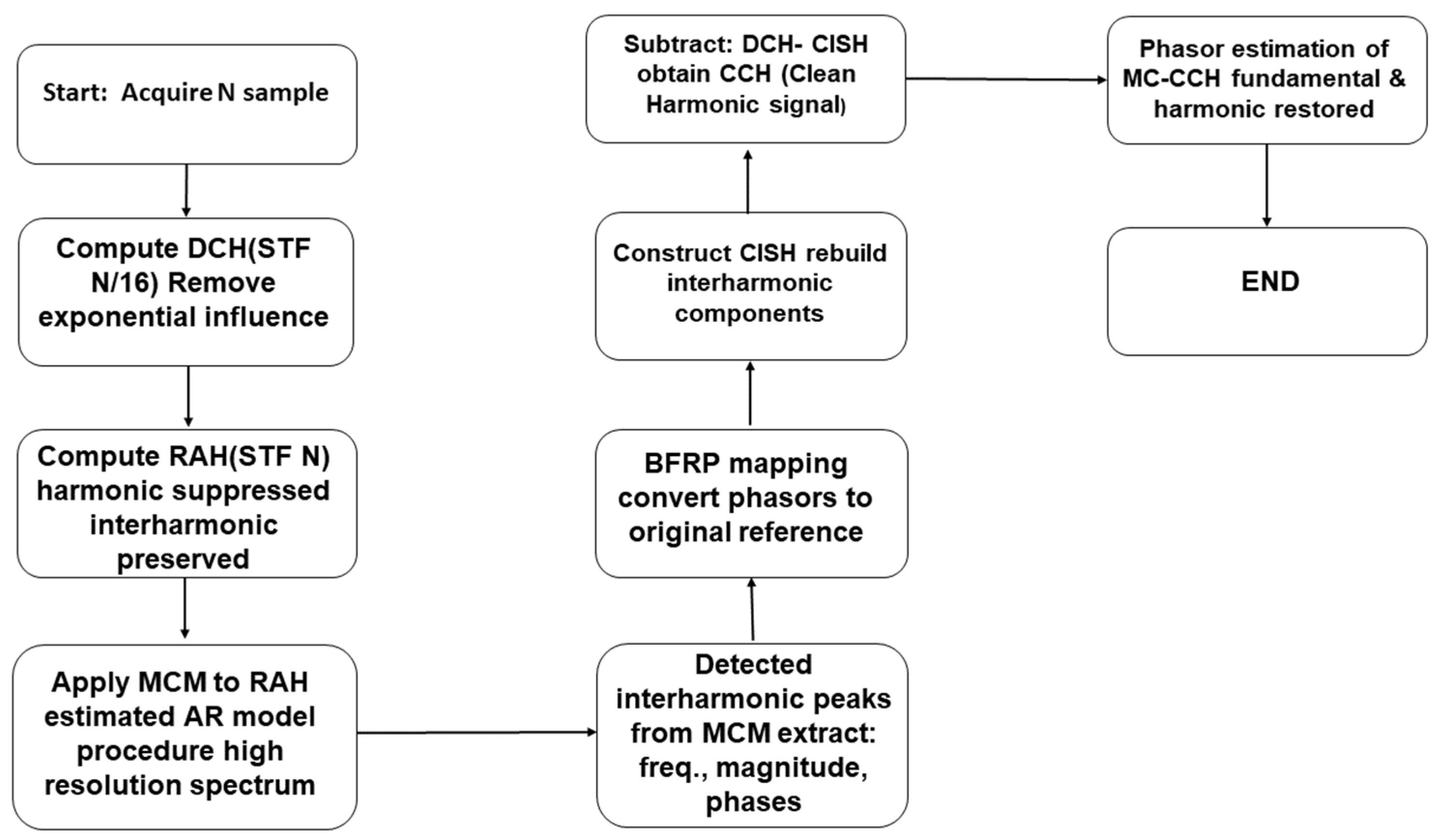
2. Methodology Flowchart
3. Proposed Algorithm
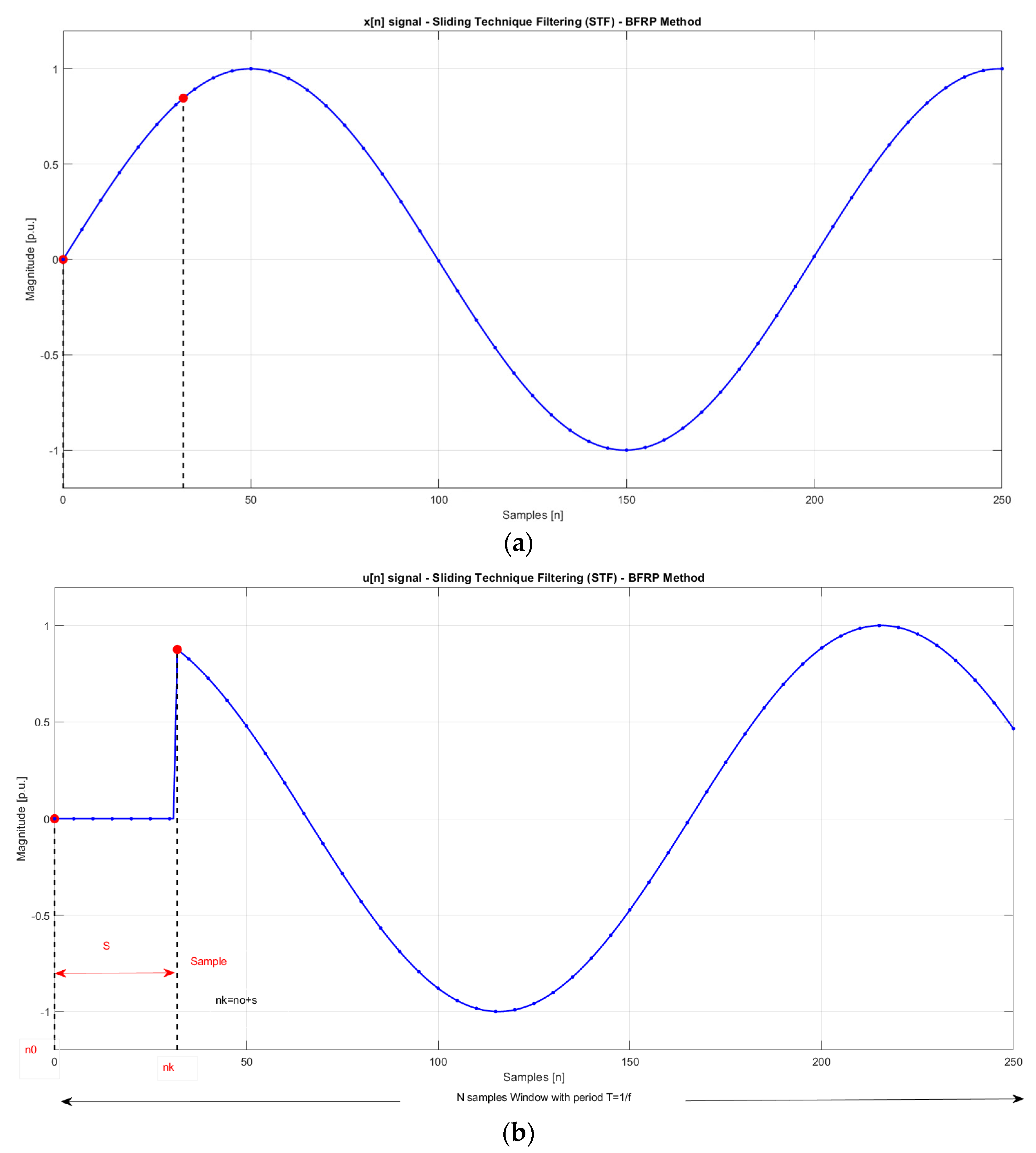
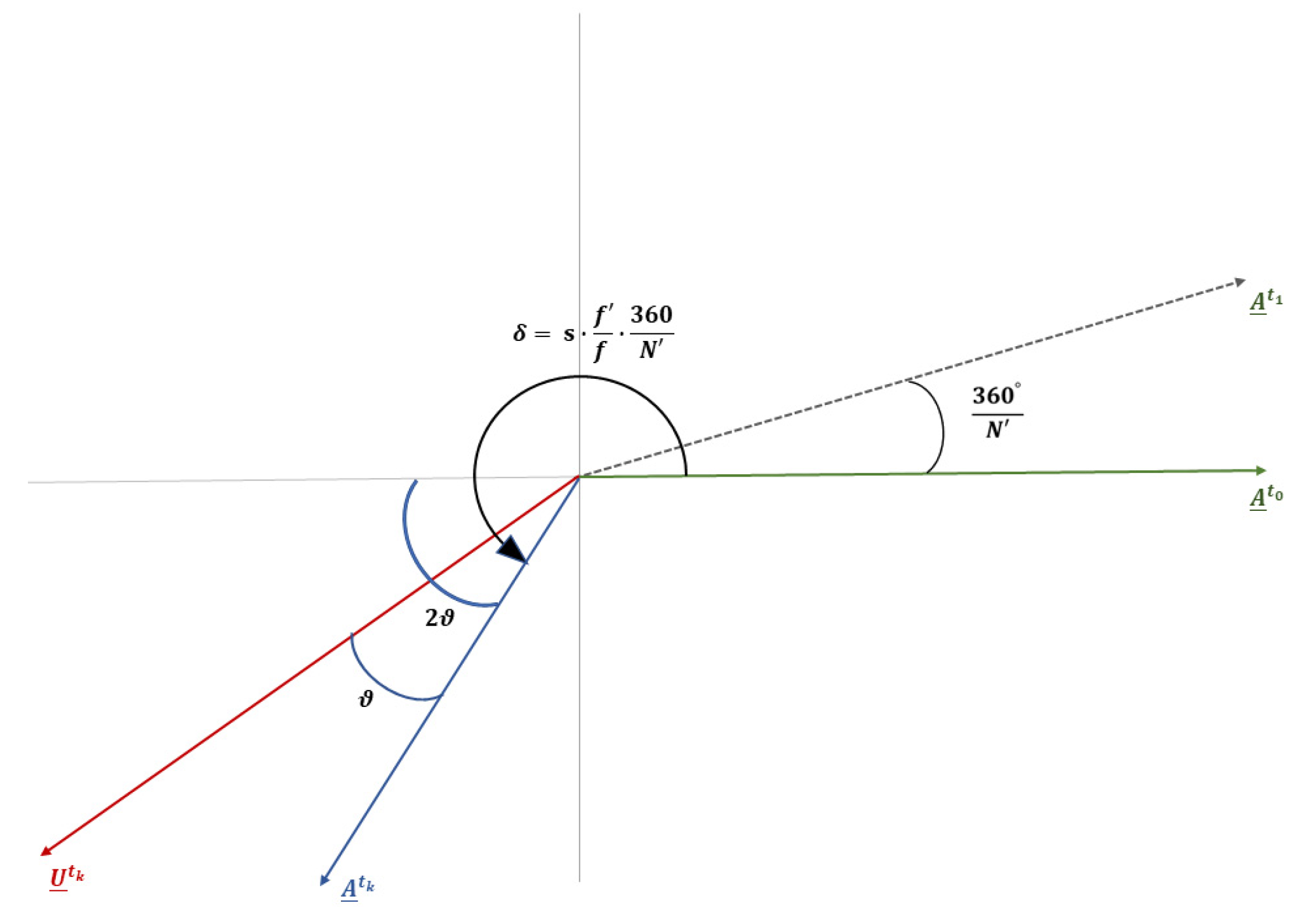
3.1. Biunivocal Frequency Relationship of Phasors (BFRP)
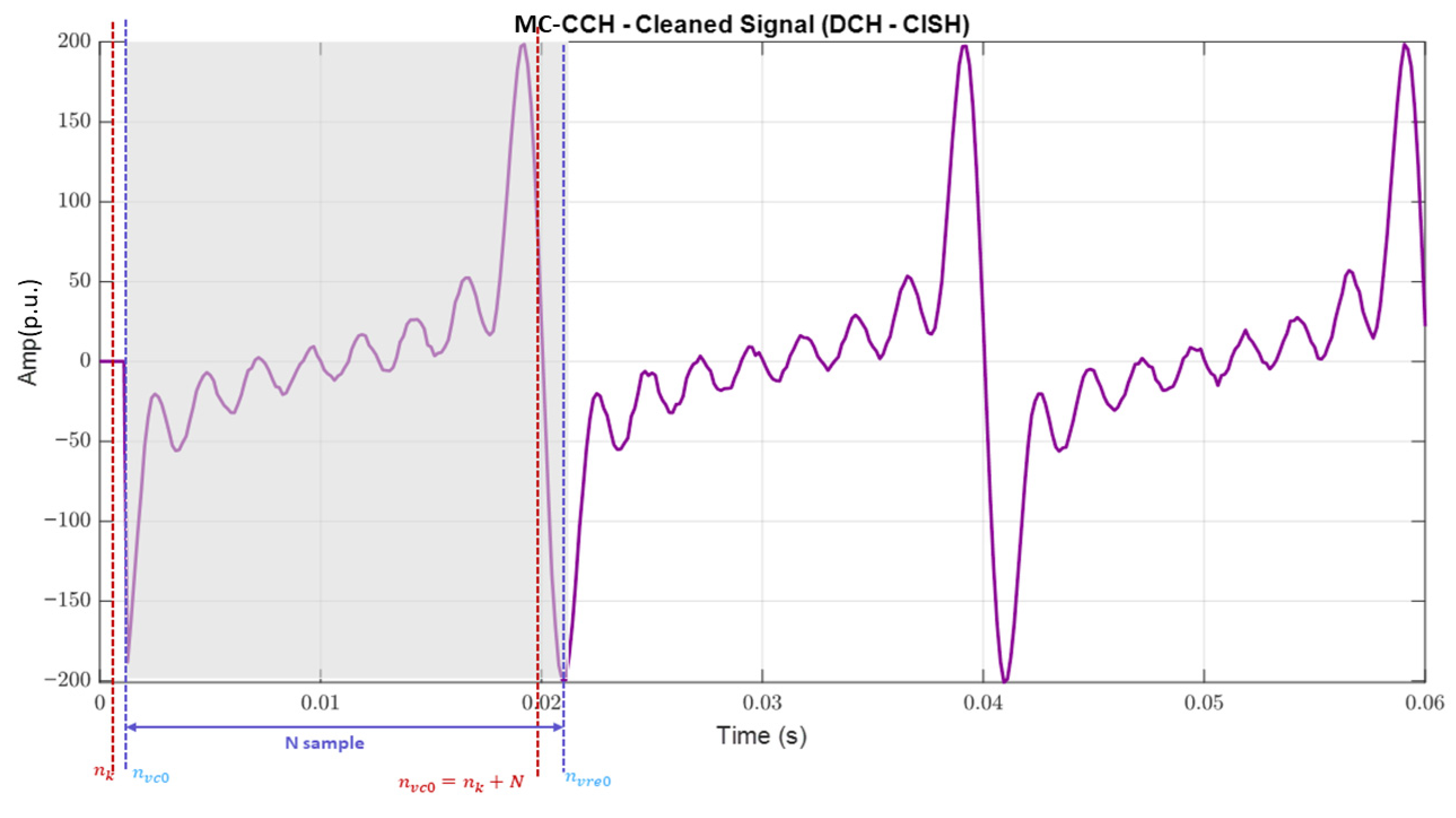
3.2. Obtaining the MC-CCH Wave Integration
- 1.
- Signal Preparation: the RAH signal segment is prepared for analysis without windowing or zero-padding, as MCM provides superior resolution without the techniques mentioned.
- 2.
- Autoregressive Modeling: a linear predictor is an adaptive filter that forecasts the amplitude of the signal at time m, x(m), using a linear combination of P previous samples [x (m − 1), …, x (m − P)] aswhere is the prediction of the signal x(m), and the vector is the coefficient vector of a predictor of order P. The prediction error e(m), i.e., the difference between the actual sample x(m) and its predicted value , is defined as:where is the AR coefficient and e(m) is the prediction error [34]. In this work, P is selected = 30 in order to receive accurate results for all three cases.
- 3.
- Modified Covariance Optimization: the MCM minimizes the sum of the forward and backward prediction errors:This approach provides superior frequency resolution compared to standard covariance methods.
- 4.
- Frequency Estimation: the AR polynomial roots are calculated:Frequencies of sinusoidal components correspond to the angles of roots lying close to the unit circle:where is the angle of root of .
- 5.
- Amplitude and Phase Estimation: for each detected frequency, the amplitudes and phases are estimated using the least squares technique.
- 6.
- Adaptive Window Processing: for each new RAH sample, steps 2–5 are iteratively executed; an adaptive observation window expands by one sample at each iteration while preserving the required spectral resolution. The window length is progressively increased until the estimated magnitude, phase, and frequency values satisfy predefined convergence criteria, at which point the window size is considered stabilized.
- 7.
- Change Detection: if the estimated values change significantly after stabilization, the process restarts from step 1 to detect new signal components.
3.3. Derivation of Original Signal Phasors
4. Results and Discussion
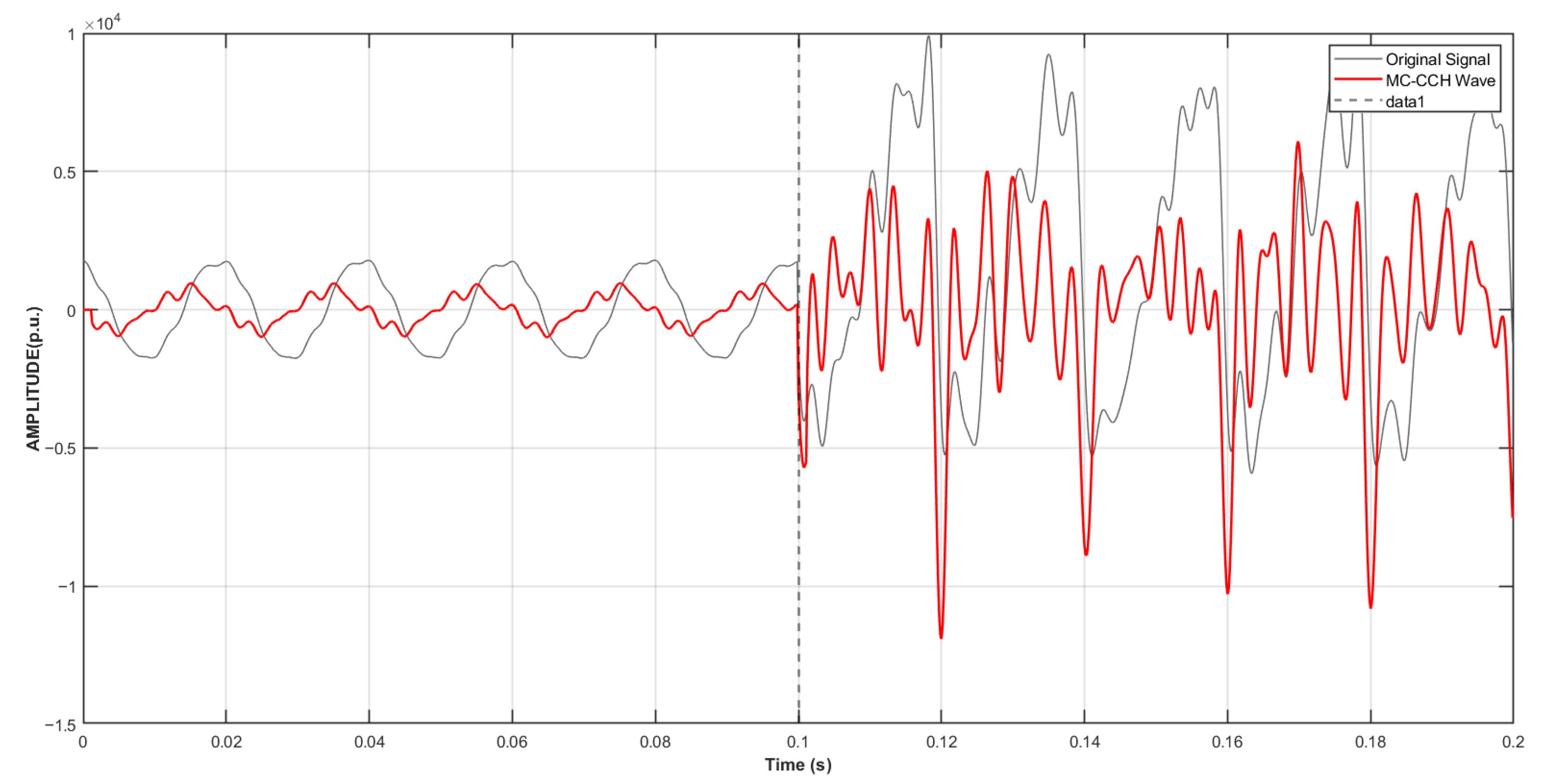
- Signal Integrity: a temporal comparison between the original input signal and the extracted MC-CCHDF signal.
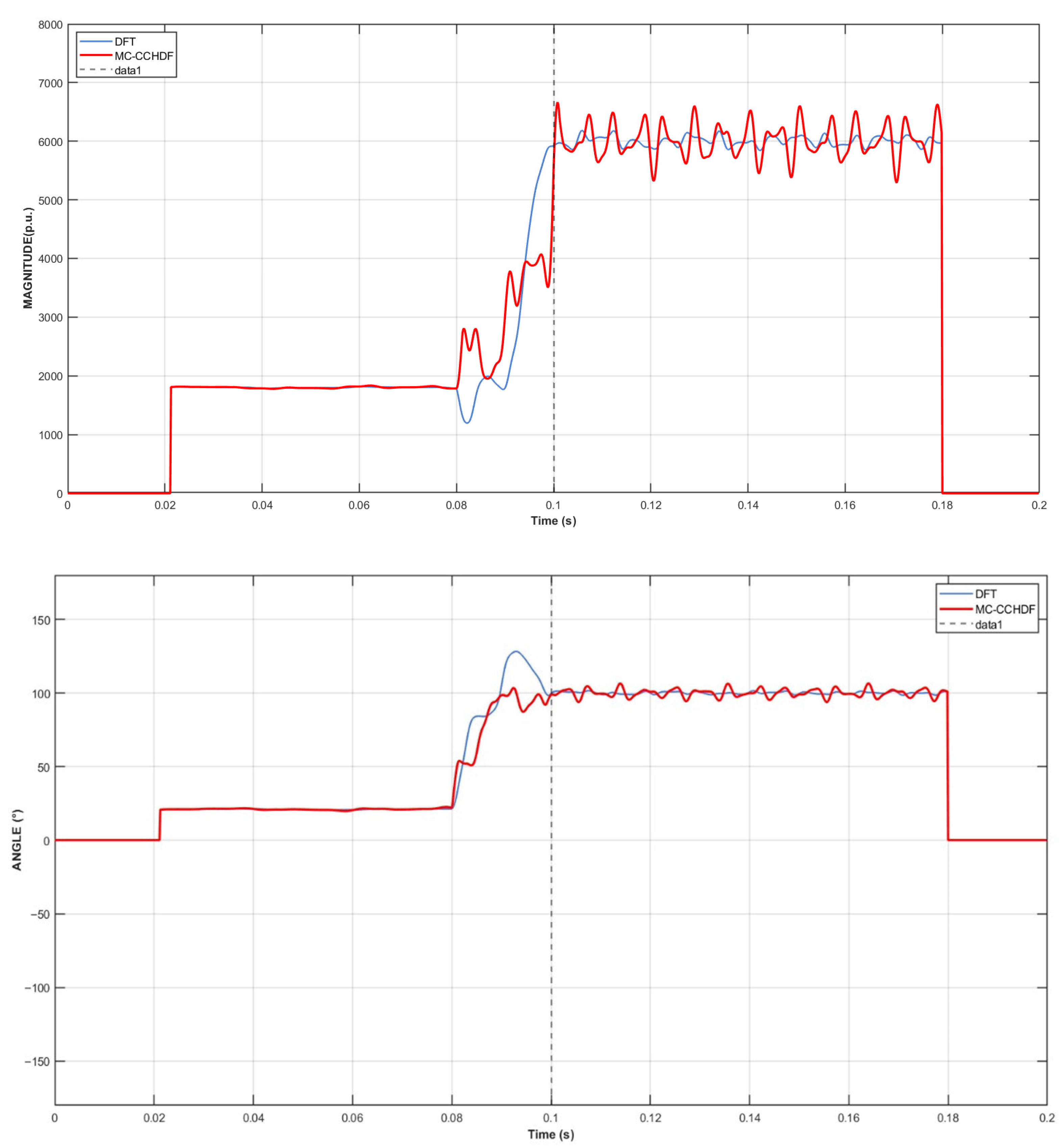
- Magnitude Estimation: a comparative assessment of the fundamental phasor modulus, benchmarking proposed algorithm against standard DFT techniques.
- Phase Estimation: an evaluation of the fundamental phase angle accuracy, contrasting the tracking capabilities of the proposed method with those of the DFT.
4.1. Evaluation of the Method for the Test Signals
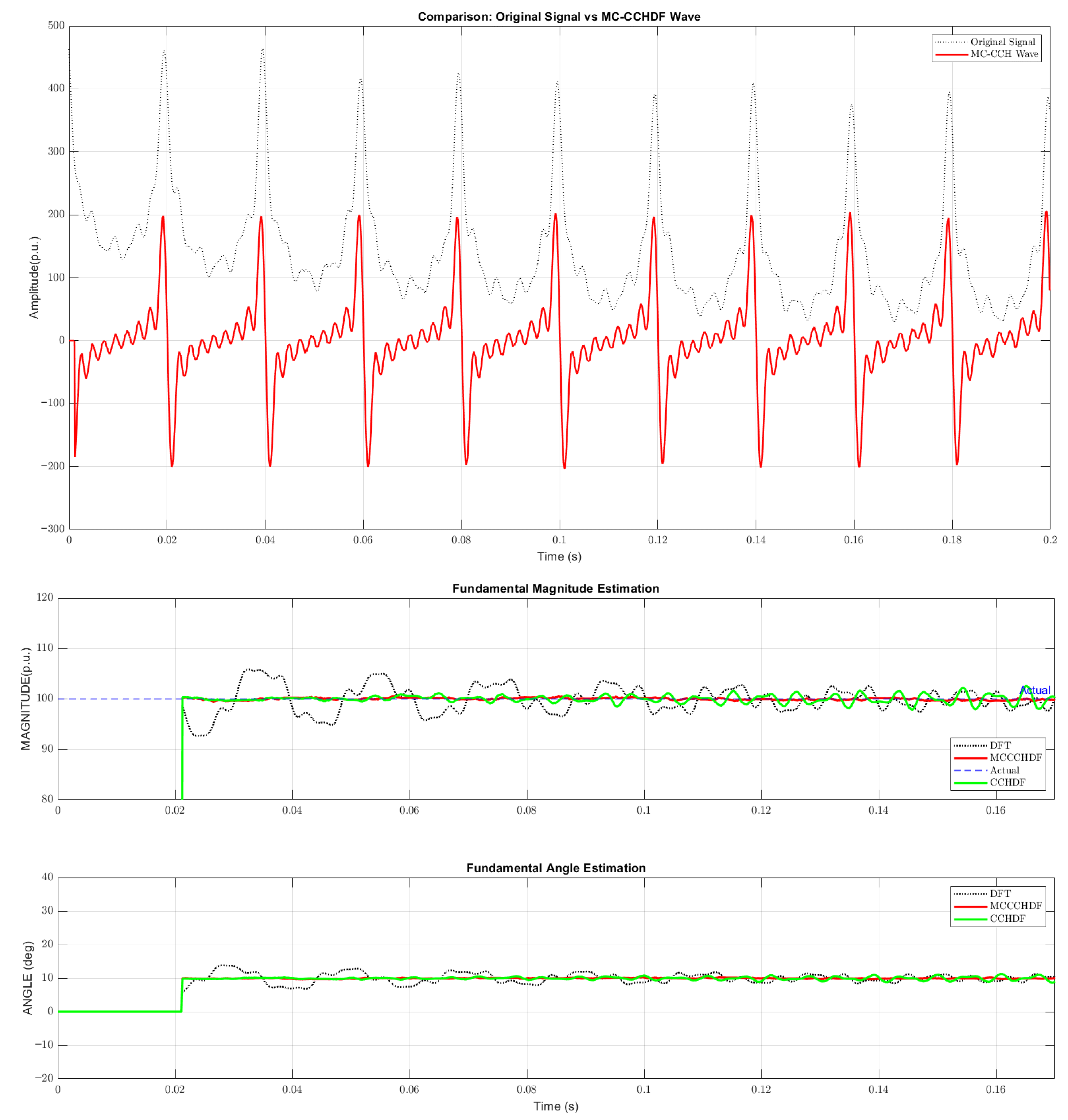
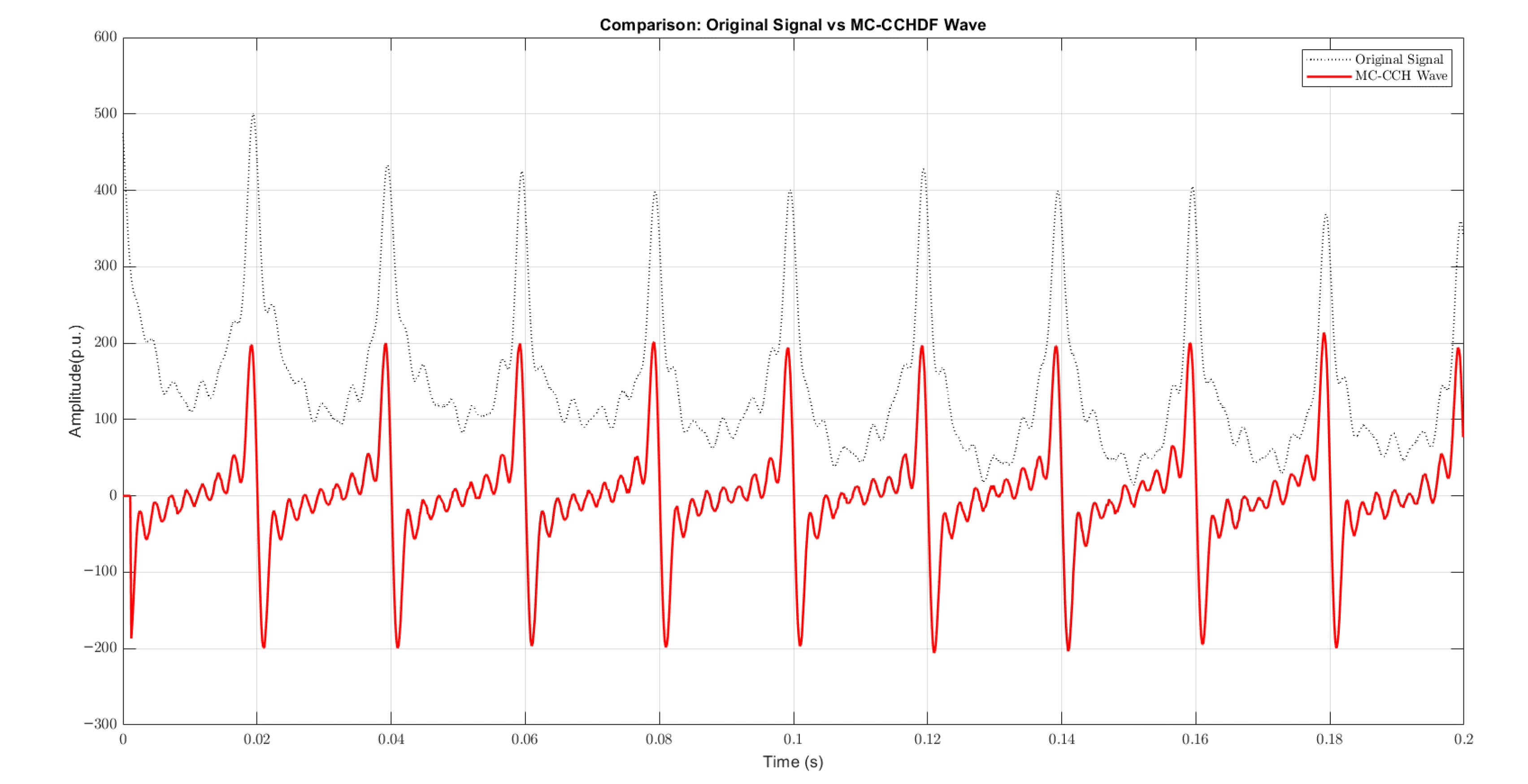
- Figure 8 for Case 1 illustrates the original signal with the associated MC-CCHDF Wave, and calculated modulus and angle, respectively.
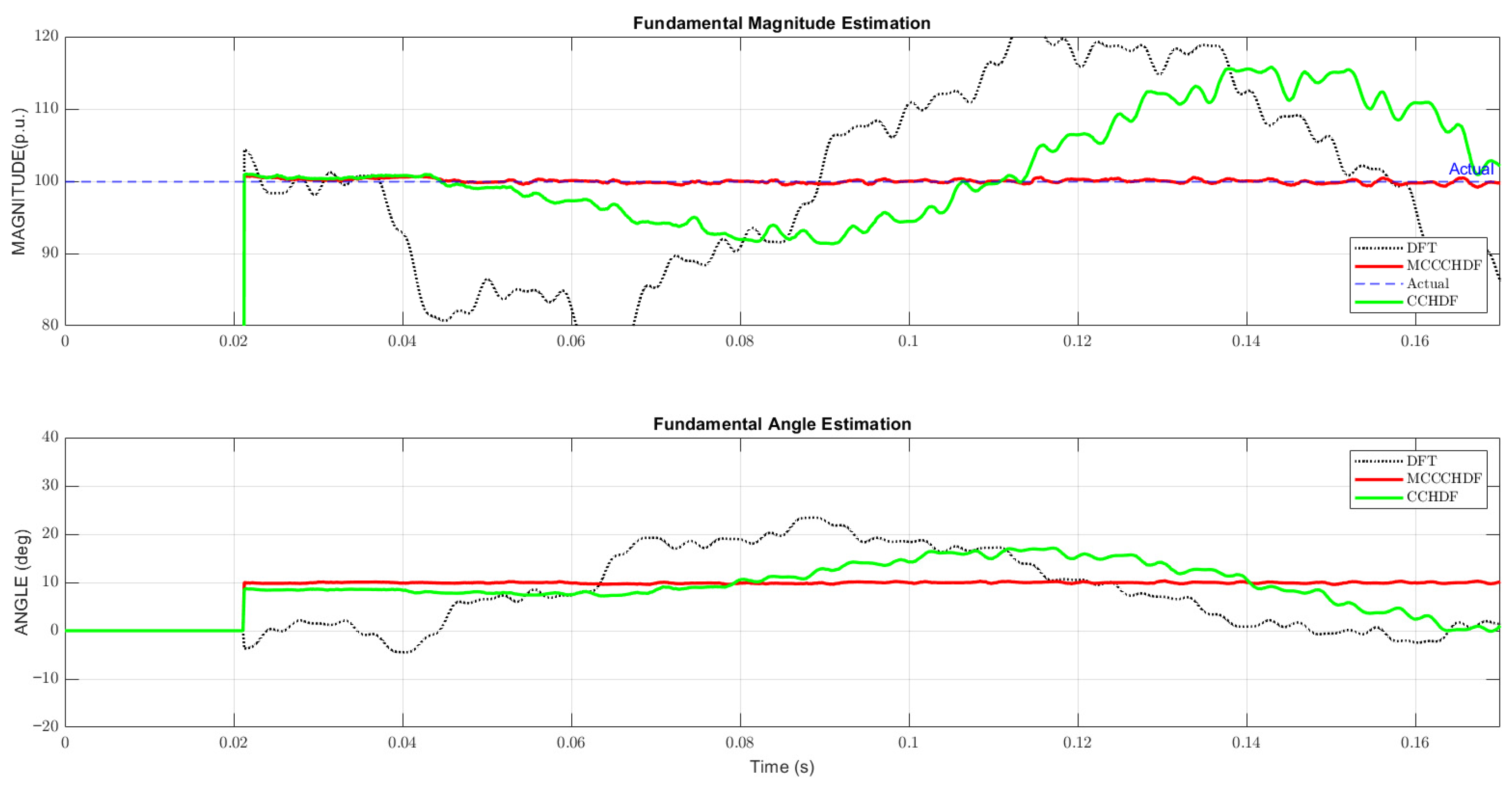
- Figure 9 for Case 2 illustrates the original signal with its MC-CCHDF Wave, and the calculated modulus and angle, respectively.
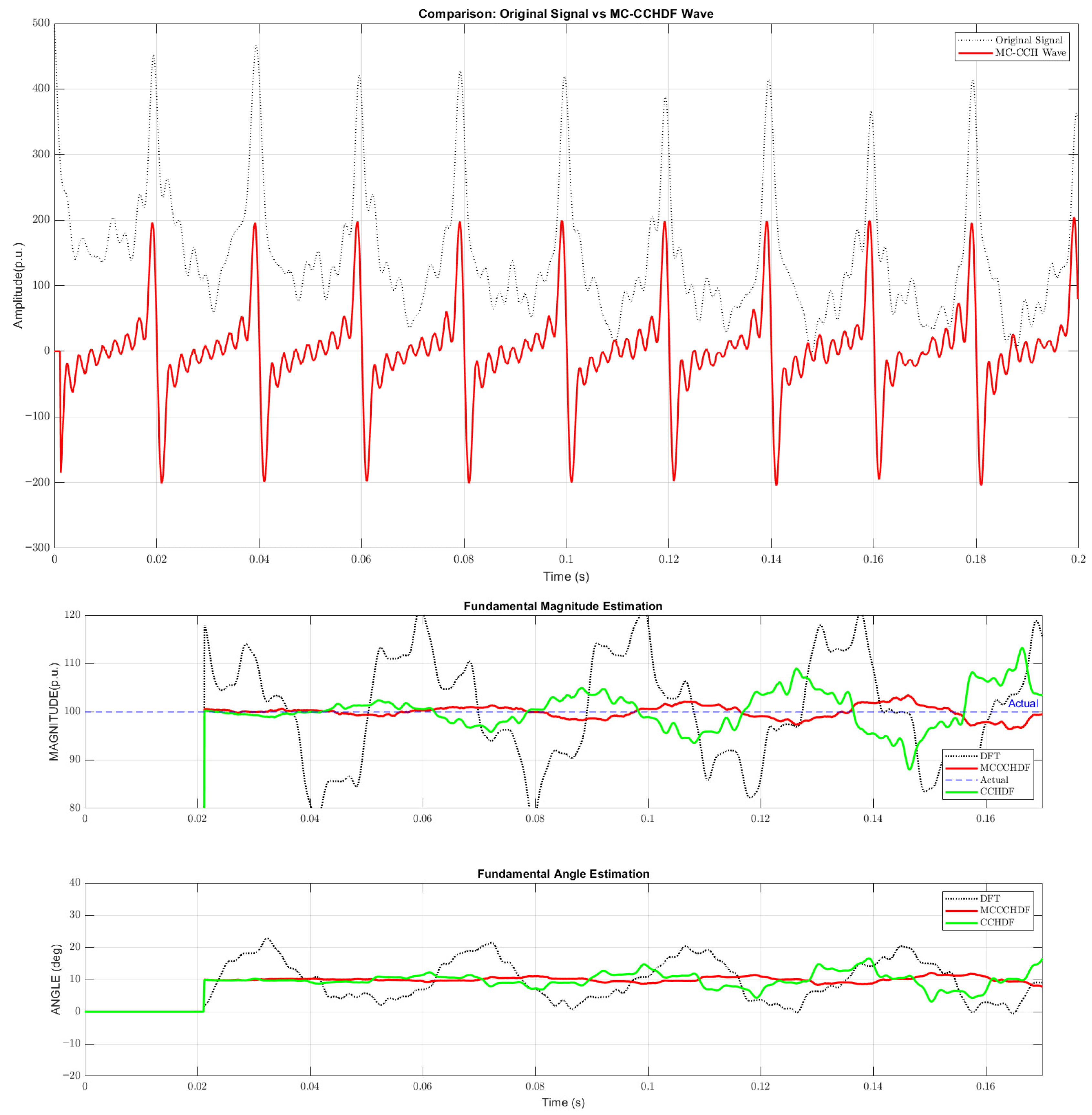
- Figure 10 for Case 3 illustrates the original signal and its MC-CCHDF Wave, and calculated modulus and angle, respectively.
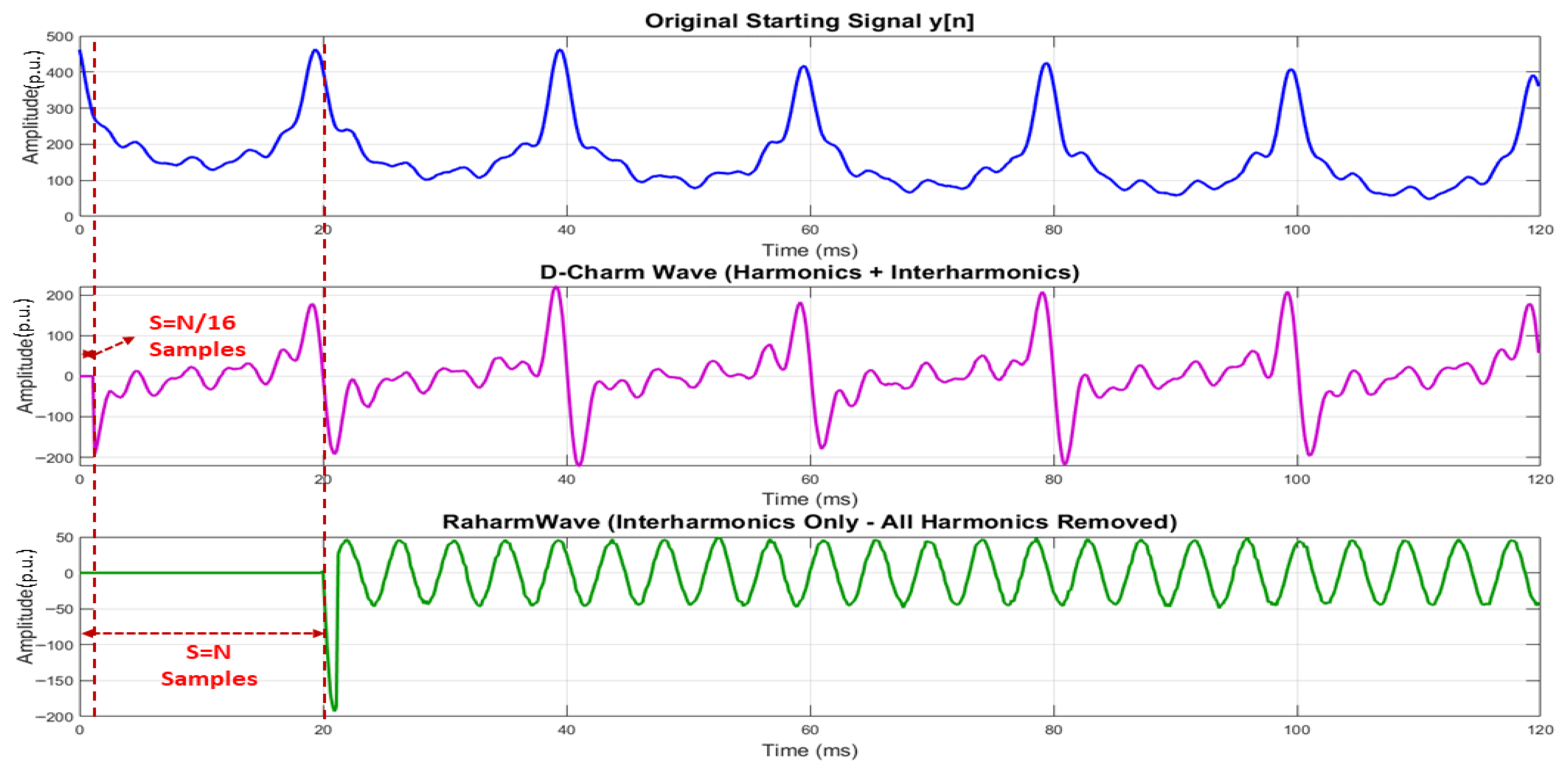
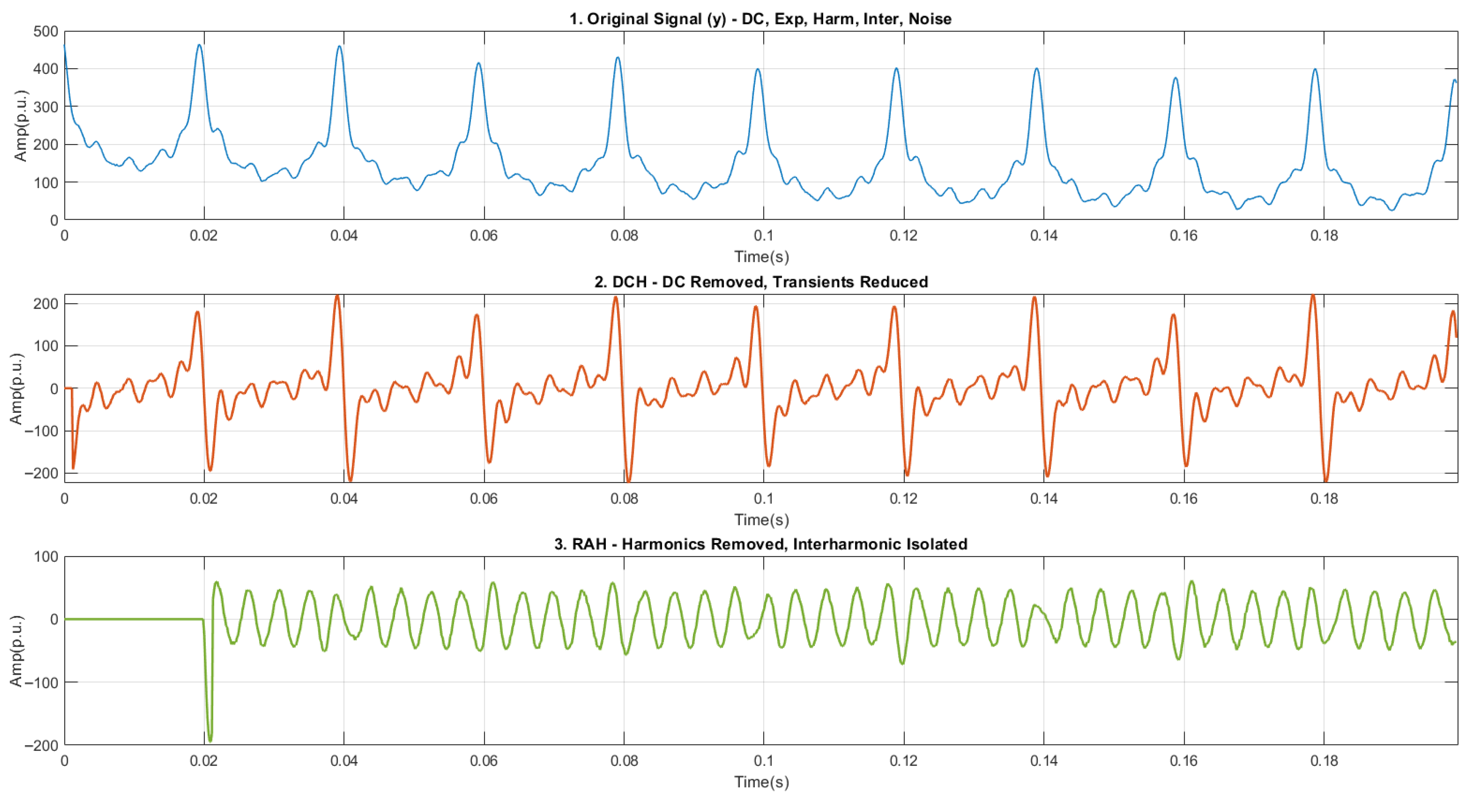
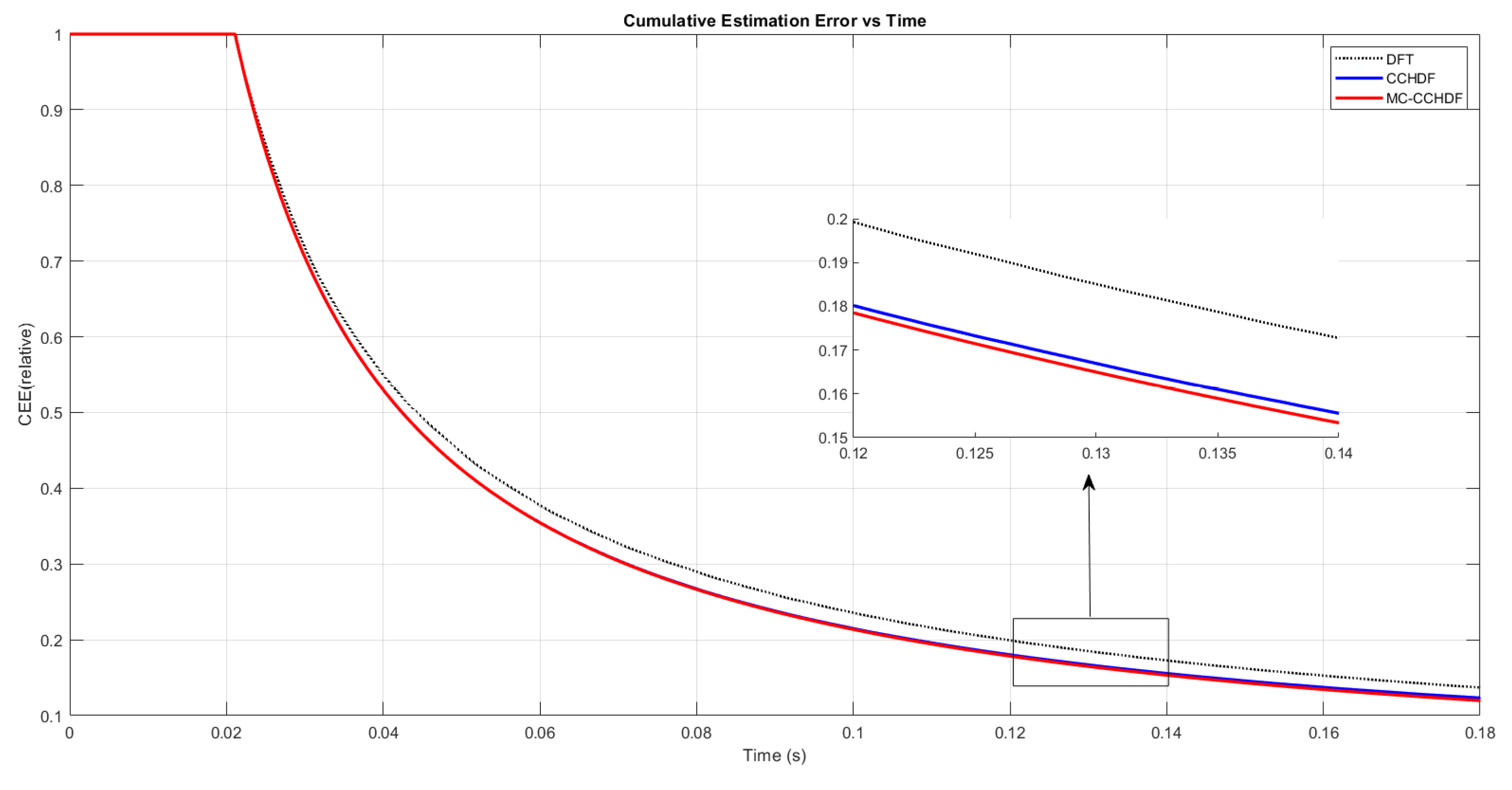
- Response Time: the processing delay of the method does not depend on the characteristics of the waveform under analysis. As illustrated in Figure 6, the output becomes available after approximately (N + N/16 + N/8) samples are processed, which corresponds to slightly more than one fundamental cycle from the time the signal begins to be sampled. Consequently, the algorithm starts delivering valid amplitude and phase estimates just after one cycle of data acquisition.
- Fast Convergence: once the output is initiated, the estimates of both magnitude and phase approach the correct values rapidly and remain stable thereafter.
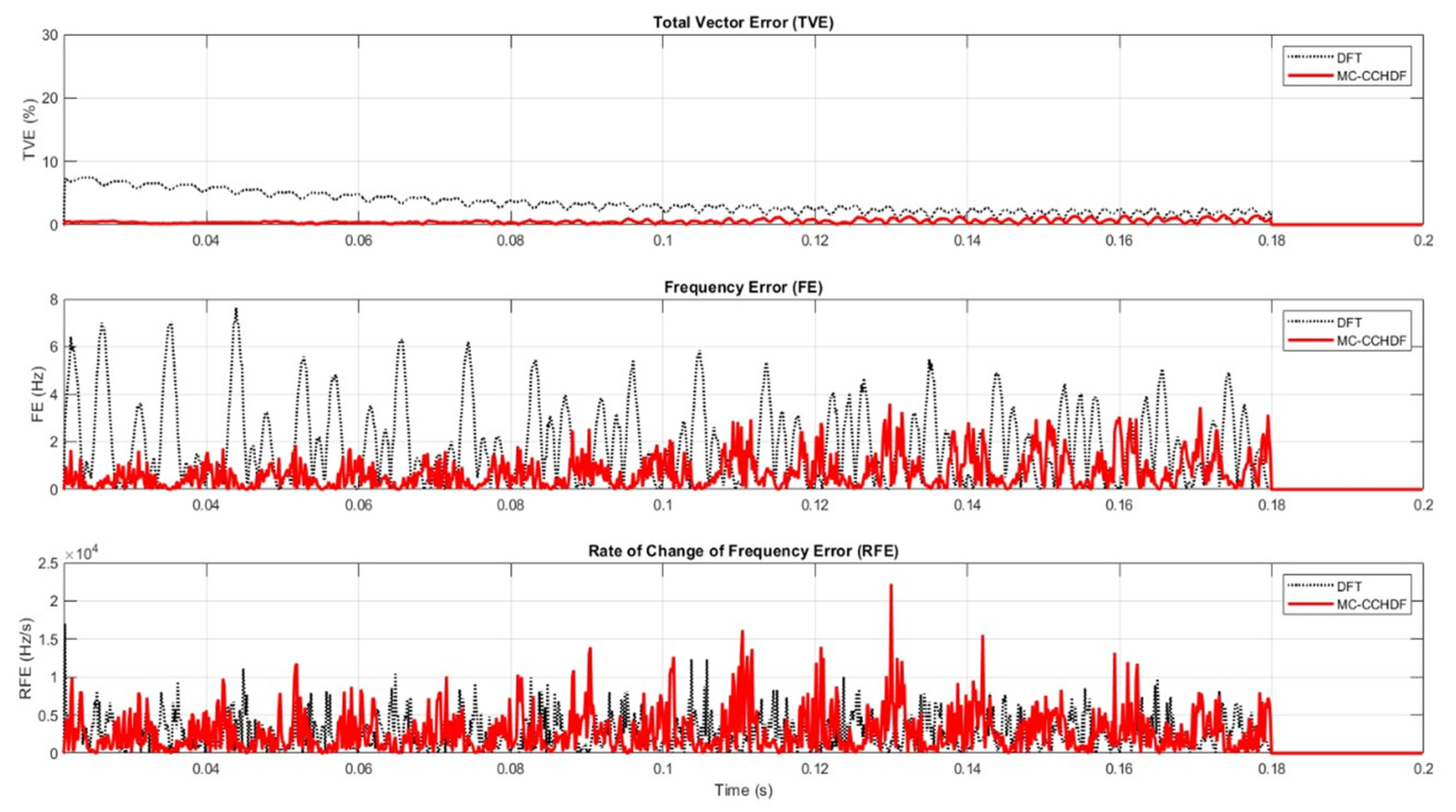
- Stable Steady State Behavior: after convergence, the algorithm maintains the estimated phasors without noticeable oscillatory deviations, even under adverse conditions involving multiple interharmonics and noise.
- Superiority over Existing Approaches: the conventional approaches (including DFT) were unable to provide accurate phasor values for the transient used; whereas the proposed approach delivered reliable estimates for all test cases.
- Noise and Multiple Exponentials: the inclusion of multiple exponentially decaying components as well as noise had minimal impact both on the accuracy of the estimates and on the convergence time. The robustness of the algorithm remained preserved.
- Effect of Interharmonics on the Convergence Speed: the Convergence rate is strongly influenced by the number and frequency range of interharmonic components. In general, higher-frequency interharmonics contributed to a faster and cleaner convergence. Low-frequency interharmonics (including subharmonics) required more time to be detected, since a greater window of data is required for reliable estimation. Additionally, increasing the number of interharmonics makes detection more challenging, particularly in the lower-frequency range, which can increase the convergence time.
- Case 1: with a signal high-frequency interharmonic component, the convergence occurred almost immediately after the processing delay.
- Case 2: the presence of the subharmonic resulted in convergence occurring roughly one cycle after the required delay, since additional data were needed before the estimations became reliable.
- Case 3: in this situation, the signal included three interharmonics, one of which was close to the fundamental frequency. This slowed the convergence process, and correct phasor estimation was achieved at slightly more than one and a half cycles.
- Improve Exponential Suppression: with higher time resolution, the STF stages can further suppress the decaying exponential terms, although the influence of noise must be carefully considered in selecting an appropriate slip value. Thus, a trade-off between protection speed and noise sensitivity must be made.
- Higher Maximum Detectable Interharmonic Frequency: increasing the sampling frequency expands the theoretical detectable frequency range under the Nyquist criterion. Nevertheless, in protection equipment this is not critical, since antialiasing filters prevent frequencies above approximately 400 Hz from entering the relay.
- Improved Spectral Resolution: higher sampling frequencies narrow the frequency resolution of the modified covariance spectrum, which results in more precise interharmonic detection and consequently, more accurate phasor estimation. However, greater resolution does not imply faster detection, since temporal information not spectral resolution determines the convergence time. For this reason, the algorithm employs an adaptive RAH window to obtain sufficient temporal content for reliable interharmonic extraction.
4.2. Simulation Enviroment and Implementation
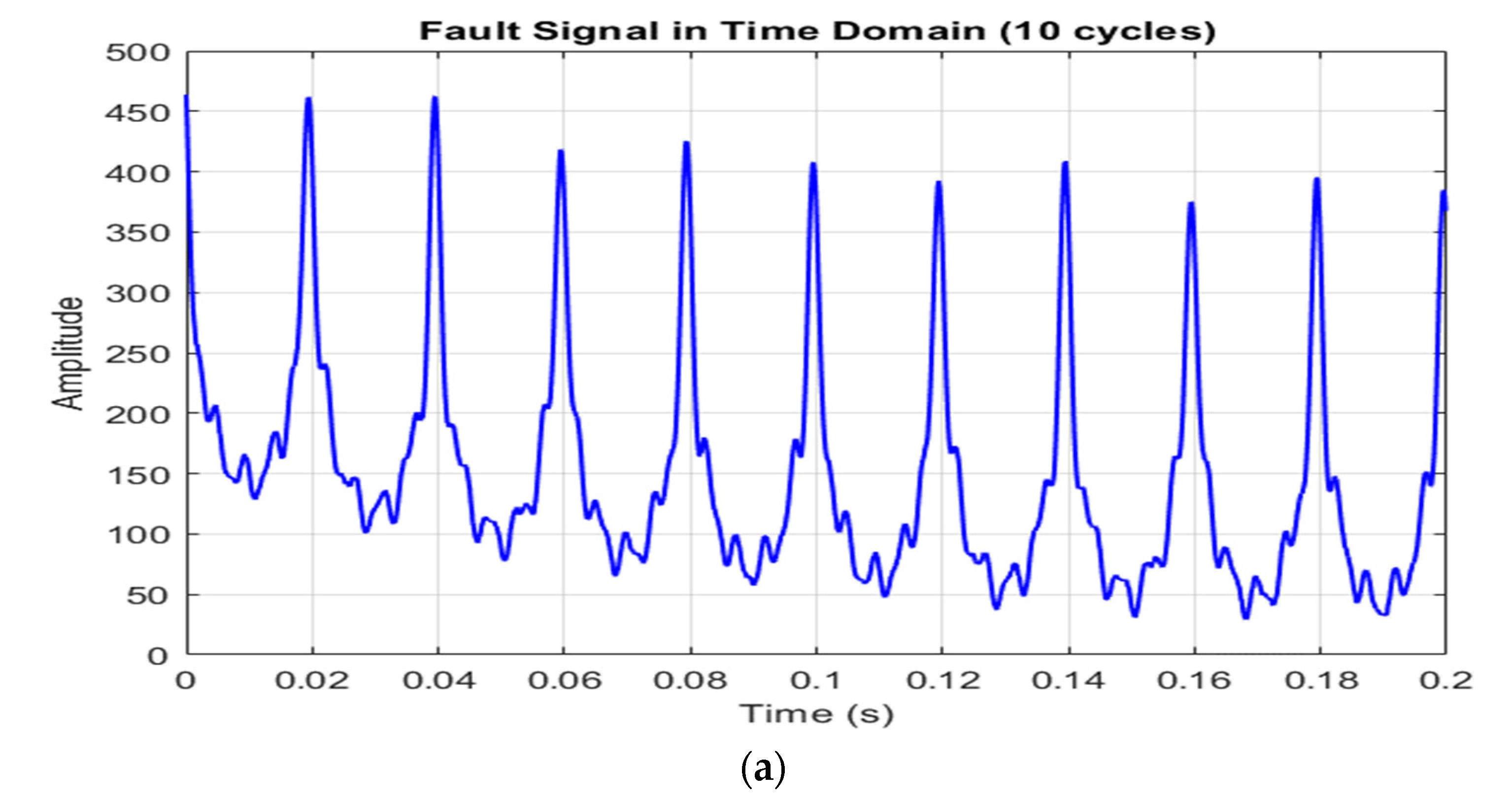
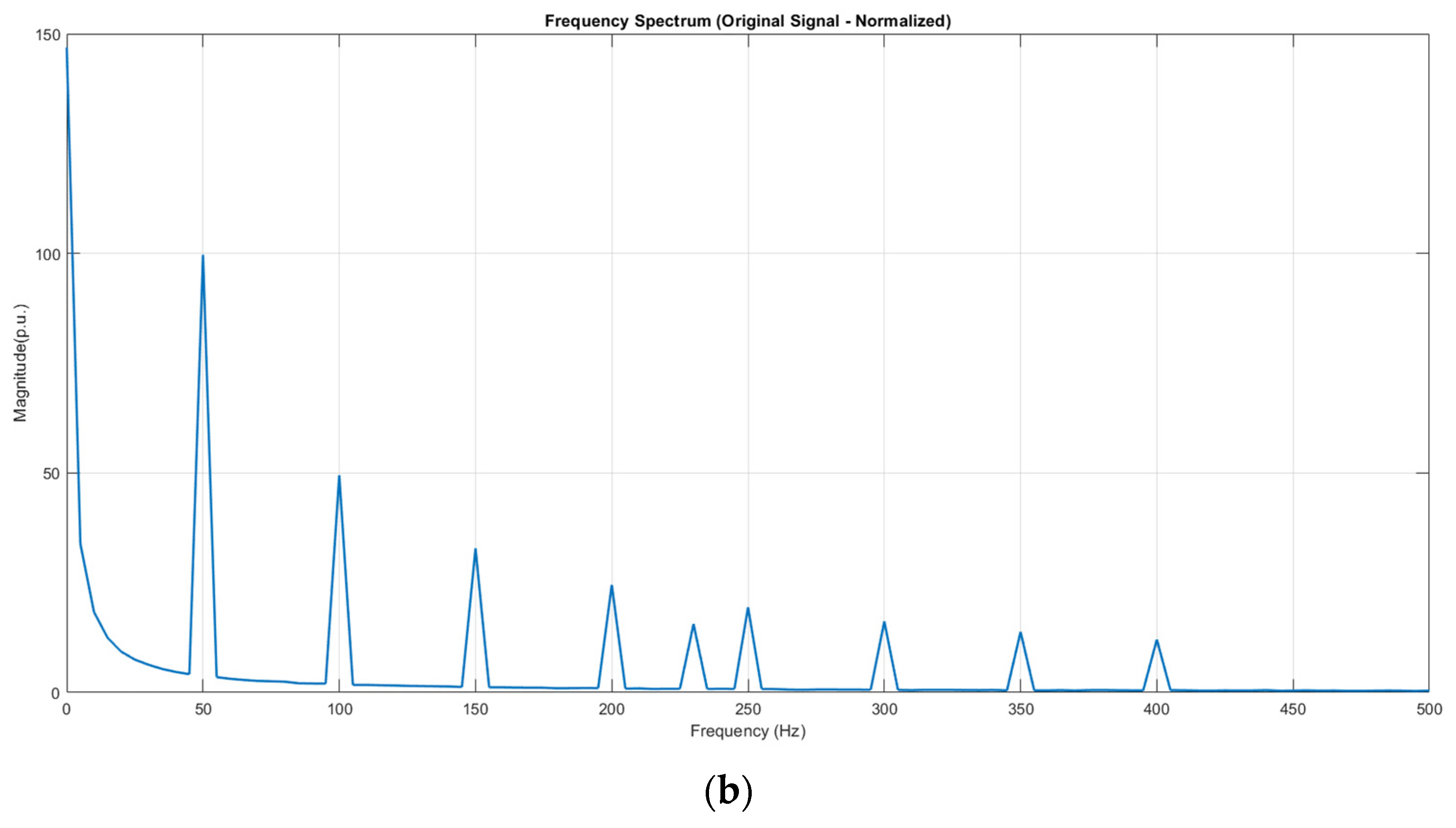
4.3. Evaluation of the Method Fault in Network
5. Conclusions
Author Contributions
Funding
Data Availability Statement
Conflicts of Interest
References
- Phadke, A.G.; Thorpand, J.S. Computer Relaying for Power Systems; John Wiley & Sons: Hoboken, NJ, USA, 2009. [Google Scholar]
- Jia, T.; Yao, L.; Yang, G. A new fault location method for high-voltage transmission lines based on ICEEMDAN-MSA-ConvGRU model. IET Gener. Transm. Distrib. 2024, 18, 2650–2668. [Google Scholar] [CrossRef]
- Parpaei, M.; Abyaneh, H.A.; Razavi, F. An innovative method to eliminate multiple exponentially decaying DC components based on the discrete Fourier transform in the numerical distance relay. IET Gener. Transm. Distrib. 2022, 16, 3617–3635. [Google Scholar] [CrossRef]
- Vlahinić, S.; Brnobić, D.; Vučetić, D. Measurement and analysis of harmonic distortion in power distribution systems. Electr. Power Syst. Res. 2009, 79, 1121–1126. [Google Scholar] [CrossRef]
- Altintasi, C.; Aydin, O.; Taplamacioglu, M.C.; Salor, O. Power system harmonic and interharmonic estimation using Vortex Search Algorithm. Electr. Power Syst. Res. 2020, 182, 106187. [Google Scholar] [CrossRef]
- Ghafari, C. Innovative Numerical Protection Relay Design on the Basis of Sampled Measured Values for Smart Grids. Ph.D. Thesis, Université Grenoble Alpes, Grenoble, France, 2016. [Google Scholar]
- Rana, M.M. Least mean square fourth based microgrid state estimation algorithm using the internet of things technology. PLoS ONE 2017, 12, e0176099. [Google Scholar] [CrossRef] [PubMed]
- Riahinia, S.; Ameli, A.; Ghafouri, M.; Yassine, A. Recursive Least-Square-Based Parameter Estimation for Dynamic State Estimation in Power Grids. In Proceedings of the 2023 IEEE 2nd Industrial Electronics Society Annual On-Line Conference (ONCON), Online, 8–10 December 2023; IEEE: New York, NY, USA, 2023. [Google Scholar]
- Silva, K.M.; Küseland, B.F. Phasor estimation using a modified sine filter combined with an adaptive mimic filter. In Proceedings of the International Conference on Power Systems Transients, Delft, The Netherlands, 14–17 June 2011. [Google Scholar]
- Ogar, V.N. Modelling of a Protective Scheme for AC 330 kV Transmission Line in Nigeria. Ph.D. Thesis, University of Glasgow, Glasgow, UK, 2023. [Google Scholar]
- Tîrnovan, R.A.; Cristea, M. Advanced techniques for fault detection and classification in electrical power transmission systems: An overview. In Proceedings of the 2019 8th International Conference on Modern Power Systems (MPS), Cluj-Napoca, Romania, 21–23 May 2019; pp. 1–6. [Google Scholar] [CrossRef]
- Arboleda, E.R.; Daang, J.A.M.; Omas-as, A.M. Advancements in Fault Detection Techniques for Transmission Lines: A Literature Review. Int. J. Res. Publ. Rev. 2024, 5, 553–572. [Google Scholar] [CrossRef]
- Vannesjö, A. Using DFT-Based Filter Topologies for High Power Transformer Analysis: Theoretical and Experimental Assessment of Windowing Techniques in DFT-Based Filters. Bachelor’s Thesis, KTH Royal Institute of Technology, Stockholm, Sweden, 2025. [Google Scholar]
- Ray, P.K.; Panigrahi, B.K.; Rout, P.K.; Mohanty, A.; Dubey, H. Detection of faults in a power system using wavelet transform and independent component analysis. In Computer, Communication and Electrical Technology; CRC Press: Boca Raton, FL, USA, 2017; pp. 227–231. [Google Scholar]
- Charfi, F.; Haddad, K.; Francois, B. Power system fault monitoring using wavelet transform. In Proceedings of the 2004 IEEE 35th Annual Power Electronics Specialists Conference (IEEE Cat. No. 04CH37551), Aachen, Germany, 20–25 June 2004; IEEE: New York, NY, USA, 2004. [Google Scholar]
- Ahmed, N.; Hashmani, A.A.; Khokhar, S.; Tunio, M.A.; Faheem, M. Fault detection through discrete wavelet transform in overhead power transmission lines. Energy Sci. Eng. 2023, 11, 4181–4197. [Google Scholar] [CrossRef]
- Mohd Amiruddin, A.A.A.; Zabiri, H.; Taqvi, S.A.A.; Tufa, L.D. Neural network applications in fault diagnosis and detection: An overview of implementations in engineering-related systems. Neural Comput. Appl. 2020, 32, 447–472. [Google Scholar] [CrossRef]
- Heo, S.; Lee, J.H. Fault detection and classification using artificial neural networks. IFAC-PapersOnLine 2018, 51, 470–475. [Google Scholar] [CrossRef]
- Muthamizhan, T.; Aijaz, M.; Sekhar, D.C. Wavelet-ANN based detection of fault location of hybrid renewable energy sources connected power transmission system. Int. J. Renew. Energy Res. 2024, 14, 551–562. [Google Scholar] [CrossRef]
- Shekar, S.C.; Salkuti, S.R. Wavelet-ANN Based Detection of Fault Location of Renewable Energy Sources Integrated Power Transmission System. In Energy and Environmental Aspects of Emerging Technologies for Smart Grid; Springer: Berlin/Heidelberg, Germany, 2024; pp. 599–627. [Google Scholar]
- Karmacharya, I.M.; Gokaraju, R. Fault location in ungrounded photovoltaic system using wavelets and ANN. IEEE Trans. Power Deliv. 2017, 33, 549–559. [Google Scholar] [CrossRef]
- Singh, S.V.P.; Prasad, T.; Kamila, S.; Agnihotri, P. Fault detection and classification using wavelet and ANN in DFIG and TCSC connected transmission line. arXiv 2023, arXiv:2308.09046. [Google Scholar] [CrossRef]
- Ankar, S.; Yadav, A. Wavelet-ANN based fault location scheme for bipolar CSC-based HVDC transmission system. In Proceedings of the 2020 First International Conference on Power, Control and Computing Technologies (ICPC2T), Raipur, India, 3–5 January 2020; IEEE: New York, NY, USA, 2020. [Google Scholar]
- Morais, A.; Cardoso, G.; Mariotto, L.; Ferreira, G. Numerical distance relaying algorithm based on Mathematical Morphology and Least-Squares Curve Fitting method. Electr. Power Syst. Res. 2011, 81, 1144–1150. [Google Scholar] [CrossRef]
- Narang, J.K.; Bag, B. Detection of cyber-attacks in smart power transmission system using mathematical morphology and autoencoder. In Proceedings of the 2022 2nd Asian Conference on Innovation in Technology (ASIANCON), Pune, India, 26–28 August 2022; IEEE: New York, NY, USA, 2022. [Google Scholar]
- Wu, Q.-H.; Lu, Z.; Ji, T. Protective Relaying of Power Systems Using Mathematical Morphology; Springer: Berlin/Heidelberg, Germany, 2009. [Google Scholar]
- Marz, M.B. Interharmonics: What They Are, Where They Come from and What They Do; Minnesota Power System Conference Paper; American Transmission Company: Waukesha, WI, USA, 2016. [Google Scholar]
- Chen, L.; Zhao, W.; Wang, F.; Wang, Q.; Huang, S. An interharmonic phasor and frequency estimator for subsynchronous oscillation identification and monitoring. IEEE Trans. Instrum. Meas. 2018, 68, 1714–1723. [Google Scholar] [CrossRef]
- Xiang, P.; Duan, D.; Zhao, X.; Zhang, X.; Zheng, X.; Zou, H.; Wu, J.; Liu, X. A Phasor Estimation Algorithm Based on Iterative Filtering to Remove the Decaying Direct Current Component. IEEE Access 2024, 12, 165253–165264. [Google Scholar] [CrossRef]
- Dam, H.; Nordholm, S.; Cantoni, A.; Dehaan, J. Iterative method for the design of DFT filter bank. IEEE Trans. Circuits Syst. II Express Briefs 2004, 51, 581–586. [Google Scholar] [CrossRef]
- Mojiri, M.; Karimi-Ghartemani, M.; Bakhshai, A. Estimation of power system frequency using an adaptive notch filter. IEEE Trans. Instrum. Meas. 2007, 56, 2470–2477. [Google Scholar] [CrossRef]
- Vazquez, J.; Miñambres, J.F.; Zorrozua, M.A.; Lázaro, J. Phasor Estimation of Transient Electrical Signals Composed of Harmonics and Interharmonics. Energies 2021, 14, 5166. [Google Scholar] [CrossRef]
- Kay, S.M. Modern Spectral Estimation; Pearson Education India: Chennai, India, 1988. [Google Scholar]
- Vaseghi, S.V. Advanced Digital Signal Processing and Noise Reduction; John Wiley & Sons: Hoboken, NJ, USA, 2008. [Google Scholar]
- IEC Std. 61000-4-30; Power Quality Measurement Methods, Testing and Measurements Techniques, 1.0 ed. International Electrotechnical Commission (IEC): Geneva, Switzerland, 2003.
- IEC 61000-4-7; General Guide on Harmonics and Interharmonics Measurements, for Power Supply Systems and Equipment Connected Thereto. International Electrotechnical Commission (IEC): Geneva, Switzerland, 2010.
- IEEE Std C37.118.1-2011; IEEE Standard for Synchrophasor Measurements for Power Systems. IEEE: New York, NY, USA, 2011.
- Papic, V.; Djurović, Z.M.; Kovacevic, B. Adaptive Doppler–Kalman filter for radar systems. IEE Proc.-Vis. Image Signal Process. 2006, 153, 379–387. [Google Scholar] [CrossRef]
- Martin, K.; Hamai, D.; Adamiak, M.G.; Anderson, S.; Begovic, M.; Benmouyal, G.; Brunello, G.; Burger, J.; Cai, J.Y.; Dickerson, B.; et al. Exploring the IEEE standard C37.118–2005 synchrophasors for power systems. IEEE Trans. Power Deliv. 2008, 23, 1805–1811. [Google Scholar] [CrossRef]



| C0 | C1 | C2 | 1 (ms) | 2 (ms) | h | Ah | fh (Hz) | αh (◦) | z [n] |
| 100 | 80 | 50 | 100 | 50 | 8 | 100/h | 50 h | 180 h/18 | 1% A1 |
| Ai1 | f i1 (Hz) | αi1 (◦) | |||||||
| 15 | 230 | −40 |
| C0 | C1 | C2 | 1 (ms) | 2 (ms) | h | Ah | fh(Hz) | αh(◦) | z[n] |
| 100 | 80 | 50 | 100 | 50 | 8 | 100/h | 50 h | 180 h/18 | 1% A1 |
| Ai1 | f i1 (Hz) | αi1(◦) | Ai2 | f i2 (Hz) | αi2 (◦) | ||||
| 20 | 42 | 30 | 14 | 270 | −60 |
| C0 | C1 | C2 | 1 (ms) | 2 (ms) | h | Ah | fh(Hz) | αh(◦) | z[n] |
| 100 | 80 | 50 | 100 | 50 | 8 | 100/h | 50 h | 180 h/18 | 1% A1 |
| Ai1 | f i1 (Hz) | αi1(◦) | Ai2 | f i2 (Hz) | αi2 (◦) | Ai3 | f i3 (Hz) | αi3 (◦) | |
| 25 | 77 | 45 | 20 | 180 | −40 | 15 | 370 | −30 |
| Actual and Estimated | Case1 | Case2 | Case3 |
|---|---|---|---|
| Ai1 | 15 | 20 | 25 |
| 15 | 20.21 | 24.93 | |
| f i1 (Hz) | 230 | 42 | 77 |
| 230 | 42.2 | 77.2 | |
| αi1 (◦) | −40 | 30 | 45 |
| −39.98 | 26.22 | 43.30 | |
| Ai2 | 14 | 20 | |
| 13.98 | 19.97 | ||
| fi2 (Hz) | 270 | 180 | |
| 270 | 180.1 | ||
| αi2 (◦) | −60 | −40 | |
| −60.41 | −40.92 | ||
| Ai3 | 15 | ||
| 14.86 | |||
| fi3 (Hz) | 370 | ||
| 370.1 | |||
| αi3 (◦) | −30 | ||
| −30.60 |
| Method | Data Window Length | Sensitivity to DC Offset | Interharmonic Handling | Frequency Deviation Robustness | Computational Burden | Suitability for Real Time Protection |
|---|---|---|---|---|---|---|
| Standard DFT (1-Cycle) | 1 Cycle | High | Poor (spectral leakage) | Poor | Low | Limited under transients |
| Cosine/Sine filter | 1–2 cycles | Moderate | Poor | Moderate | Low | Limited |
| Wavelet-based method | 5–10 cycles | Low | Moderate | High | Limited by latency | |
| Original CCHDF(DFT-base) | 1–2 cycles | Very low | Moderate | Moderate | Moderate | Good |
| Proposed MC-CCHDF | 1–2 cycle | Very low | High (MCM-based) | High | Moderate | Excellent |
Disclaimer/Publisher’s Note: The statements, opinions and data contained in all publications are solely those of the individual author(s) and contributor(s) and not of MDPI and/or the editor(s). MDPI and/or the editor(s) disclaim responsibility for any injury to people or property resulting from any ideas, methods, instructions or products referred to in the content. |
© 2026 by the authors. Licensee MDPI, Basel, Switzerland. This article is an open access article distributed under the terms and conditions of the Creative Commons Attribution (CC BY) license.
Share and Cite
Alwan, N.; Papic, V. Phasor Estimation of Transient Electrical Signals Using Modified Covariance Enhanced Cleaned Characteristic Harmonic Filtering in Protection Relay. Energies 2026, 19, 711. https://doi.org/10.3390/en19030711
Alwan N, Papic V. Phasor Estimation of Transient Electrical Signals Using Modified Covariance Enhanced Cleaned Characteristic Harmonic Filtering in Protection Relay. Energies. 2026; 19(3):711. https://doi.org/10.3390/en19030711
Chicago/Turabian StyleAlwan, Natheer, and Veljko Papic. 2026. "Phasor Estimation of Transient Electrical Signals Using Modified Covariance Enhanced Cleaned Characteristic Harmonic Filtering in Protection Relay" Energies 19, no. 3: 711. https://doi.org/10.3390/en19030711
APA StyleAlwan, N., & Papic, V. (2026). Phasor Estimation of Transient Electrical Signals Using Modified Covariance Enhanced Cleaned Characteristic Harmonic Filtering in Protection Relay. Energies, 19(3), 711. https://doi.org/10.3390/en19030711