Article

System Synchronization Based on Complex Frequency

1
School of Electric Power Engineering, Kunming University of Science and Technology, Kunming 650051, China
2
Electric Power Research Institute of Yunnan Power Grid Co., Ltd., Kunming 650000, China
*
Author to whom correspondence should be addressed.
Energies 2026, 19(3), 701; https://doi.org/10.3390/en19030701
Submission received: 23 December 2025 / Revised: 24 January 2026 / Accepted: 24 January 2026 / Published: 29 January 2026

Abstract

The increasing penetration of renewable energy leads to a continuous reduction in system inertia, for which conventional synchronization criteria based solely on frequency consistency can no longer accurately capture the coupled dynamics of frequency and voltage during transients. To address this issue, this paper employs the concept of complex frequency and develops an analysis framework that integrates theory, indices, and simulation for assessing synchronization stability in low-inertia power systems. Firstly, the basic concepts and mathematical formulation of complex frequency and complex frequency synchronization are introduced. Then, dynamic criteria for local and global complex synchronization are established, upon which a complex inertia index is proposed. This index unifies the supporting role of traditional frequency inertia and the voltage support capability associated with voltage inertia, enabling the quantitative evaluation of the strength of coordinated frequency–voltage support and disturbance rejection within a region. Finally, transient simulations on a modified WSCC nine-bus system are carried out to validate the proposed method. The results show that the method can clearly reveal the synchronization relationships between subnetworks and the overall system, providing a useful theoretical reference for stability analysis and control strategy design in low-inertia power systems.

1. Introduction

In conventional AC power systems, synchronization is typically defined as the uniformity of rotor angle variation rates among all synchronous generating units in the network [1]. Synchronization studies can essentially be regarded as a class of transient stability analyses, whose primary objective is to ensure that system voltage and frequency remain stable following disturbances [2]. In classical power systems dominated by synchronous generators, transmission lines are generally strongly inductive. As a result, practical control strategies often treat active power/frequency (P–f) control and reactive power/voltage (Q–V) control as approximately decoupled, handling voltage regulation and frequency regulation in separate loops [3]. However, this decoupled treatment neglects the intrinsic coupling between the electromagnetic and mechanical states within a synchronous generator, namely the interaction between rotor mechanical dynamics and excitation system dynamics. Under large disturbances or fast regulation requirements, this interaction can be amplified, leading to coupling and interference between the voltage control loop and the frequency control loop(s). The resulting additional voltage and frequency oscillations may adversely affect the transient stability of the overall system [4,5,6,7,8].
With the large-scale grid integration of renewable energy sources, synchronous generators and their rotational inertia are increasingly being replaced by power electronic interface devices. As a result, the equivalent system inertia is significantly reduced, the frequency dynamics become much faster, and the system exhibits markedly increased sensitivity to active power disturbances [9,10,11]. Under these conditions, even small to medium-scale disturbances may trigger noticeable discrepancies in inter-area frequency responses and transient desynchronization between local subnetworks and the bulk system, thereby increasing the risk of system separation, load shedding, and even regional blackouts. If synchronization is still judged solely by the uniformity of electrical angle variation rates, it becomes difficult to promptly identify and accurately characterize these emerging instability mechanisms. Recent studies have shown that, in low-inertia power systems, the coupling between active power frequency and reactive power voltage is significantly strengthened, and the time scales of voltage and frequency regulation tend to converge. Local voltage disturbances can propagate through control loops and network power flows and, in turn, feed back adversely on frequency stability [12,13]. Meanwhile, most generation and load units employing AC regulation are equipped with fast voltage and current control loops, rendering the node voltage magnitude and its rate of change increasingly critical to disturbance propagation and inter-area interactions. In recent years, a complex frequency analysis framework has been proposed and applied to transient studies of power systems, in which the real part of the complex frequency represents the normalized rate of change in node voltage magnitude, while the imaginary part corresponds to the conventional system frequency deviation, thereby capturing the coupled voltage frequency dynamics within a unified mathematical description [14].
Based on this, the concept of complex frequency synchronization and related stability criteria were further developed to analyze multivariable synchronous behavior in converter-dominated systems, revealing the respective advantages and limitations of voltage–frequency coupling between different regions [15,16]. Therefore, introducing the notion of complex frequency synchronization, which characterizes the coordinated evolution of local voltage magnitude and phase angle speed, is of substantial theoretical and practical significance for identifying steady-state instability risks induced by local voltage frequency coupling under high renewable penetration, and for enhancing the accuracy of dynamic stability assessment and control strategy design in low-inertia power systems.

2. Complex Frequency Synchronization Principle

2.1. Complex Frequency

The conventional complex frequency is defined as the complex variable in the Laplace transform, S = σ + j ω , where the real part σ is the damping factor and the imaginary part ω is the conventional instantaneous angular frequency [17]. However, with the large-scale integration of inverter-based resources (IBRs), the coupling between system frequency and voltage has become increasingly pronounced, and this traditional definition of complex frequency can no longer accurately capture the dynamic characteristics of electrical quantities during transients. To address this issue, F. Milano proposed a new definition of complex frequency η = ε + j ω , in which the real part ε represents the normalized rate of change in the voltage magnitude, while the imaginary part ω remains the conventional instantaneous angular frequency [14]. In this way, voltage and frequency can be described within a unified framework. Figure 1 compares the complex frequency responses of a system dominated by synchronous generators and a low-inertia system dominated by power electronic converters. In the conventional power system, the disturbance response of the real part of the complex frequency exhibits a relatively small amplitude and a time scale that is clearly shorter than that of frequency oscillations of electrical quantities, so that the transient dynamics of voltage and frequency are relatively decoupled. In contrast, in the low-inertia power system, the real and imaginary parts of the complex frequency display almost identical evolution, and their time scales become markedly aligned, reflecting a much stronger coupling between voltage and frequency. This comparison further illustrates the necessity of introducing complex frequency-based unified descriptions and synchronization criteria under low-inertia conditions.
A brief mathematical derivation of the new complex frequency concept is given below. The voltage at an arbitrary bus k in the network ( k N ) can be expressed as
u ¯ k = u d + j u q = u e j θ
In Equation (1), u and θ denote the voltage magnitude and phase angle at node k, respectively. Rewriting (1) as ϑ ¯ = e l n u + j θ , where ϑ ¯ denotes the complex angle [14], and differentiating (1) with respect to time yields
u ¯ ˙ = v ˙ v + j θ ˙ u ¯
Letting U = ln v , (2) can be simplified as
u ¯ ˙ = U ˙ + j θ ˙ u ¯
Defining the complex frequency as η = U ˙ + j θ ˙ = ε + j ω .

2.2. Fundamental Principle of Complex Frequency Synchronization

Complex frequency synchronization refers to the dynamic process in which, after a disturbance or control action has settled, the complex frequency η ¯ = ε + j ω at every node of the system converges to the same constant value over the entire network [18]. Its rigorous mathematical definition is
lim t η ¯ k t = λ ,     k N
When the complex frequencies of all nodes in the region converge to a constant value λ , the system is said to achieve complex frequency synchronization. Starting from the node voltage dynamics, a sufficient condition for such convergence is derived below.
The complex frequency at node k can be written as η k t = v k t ˙ / v k t , from (2), where v k t denotes the voltage signal at node k , and v k t = e ϑ , with ϑ being the complex phase angle in (1).
Solving the above differential algebraic equations (DAEs) by the separation of variables and integrating from the initial time t 0 to t yields the expression of v k ( t ) as
v k t = v k t 0 e t 0 t η k s d s
When t , the integral term of η k ( s ) in (4) can be decomposed into a limit value and a deviation term, namely
t 0 t η k s d s = λ t λ t 0 + C k t
In Equation (6), C k t = t 0 t ( η k S λ ) d s .
Equation (5) indicates that the deviation term is absolutely integrable, which ensures that its integral evolves as a convergent dynamic process as t , and its limit is finite.
From basic mathematical relations, if the absolute integral of a function is finite, then the integral of the function itself is also finite and convergent. Hence,
C k = lim t C k t = t 0 η k s λ d s
Substituting (6) into the target expression e λ t v k ( t ) , as t , the limit of (6) becomes
ϕ k = v k t 0 e C k λ t 0
Therefore, one obtains e λ t v k ( t ) ϕ k ( t ) ; this shows that the convergence of the complex frequency together with the absolute integrability of its deviation constitutes a sufficient condition for the complex frequency synchronization of the system. Complex frequency synchronization not only requires conventional frequency uniformity but also imposes a stricter requirement that voltage dynamics exhibit consistent behavior in both the time domain and the direction of magnitude variation. This provides a more comprehensive index framework for transient and voltage stability assessment in high-penetration, low-inertia power systems [19].

2.3. Scope of Synchronization Criteria

The concept of complex frequency synchronization provides a generalized and complementary extension of the conventional notion of synchronization at the theoretical level. When the system voltage magnitude is essentially constant ( ρ = 0 ), this concept reduces to classical synchronization in the sense of uniform angular frequency [14]. From a control perspective, complex frequency synchronization represents a new synchronization paradigm; it treats the normalized rate of change in voltage magnitude ρ and the angular frequency ω as joint synchronization objectives, thereby requiring new measurement and control architectures (such as coupled [ ω , ρ ] -based droop schemes) and significantly improving the robustness of frequency signals in the early stages following a disturbance. Table 1 summarizes the key differences between conventional synchronization and complex frequency synchronization.

2.3.1. Application Scenarios of Complex Frequency Synchronization

In the following typical scenarios, focusing solely on conventional rotor angle synchronization is clearly insufficient and complex frequency synchronization is required to capture the full system dynamics.
  • Systems with high penetration of inverter-based resources. In such systems, rotational stability is directly determined by electrical and control dynamics, and the inertial response of conventional synchronous machines is effectively replaced by virtual inertia. At the same time, voltage-side dynamics have a pronounced impact on the transient response when the penetration level of grid-following (GFL) converters exceeds about 60% voltage dynamics or excitation-related dynamics tend to emerge or deteriorate before frequency synchronization issues become evident [20]. Hence, it is necessary to monitor both ρ and ω in order to detect instability risks at an early stage.
  • Operating conditions involving phase-locked loops (PLLs), such as grid connection or mode switching [21]. When responding to faults, switching events, or other disturbances, PLLs are prone to abrupt frequency changes or oscillations. A complex frequency can provide a smoother and more reliable frequency indicator, and the inclusion of the voltage magnitude rate ρ helps mitigate the signal distortion associated with using ω alone.
  • Distribution networks with low X / R ratios, or systems whose electrical dynamics have time scales comparable to those of the control loops. When line resistance cannot be neglected, the coupling between active power/frequency and reactive power/voltage is significantly strengthened (with approximate relationships such as ( q ˙ G ω ,   p ˙ G ρ ) , so traditional observations based solely on ω will overlook the influence of voltage dynamics on frequency behavior [14]. In addition, in low-inertia systems, the time scales of line dynamics and AC filter control dynamics can be comparable, making the conventional assumption of neglecting network dynamics no longer valid.
  • Islanded or weakly coupled operating areas. During transients, significant discrepancies may arise among the nodal frequencies ω [22], so relying solely on a single measurement point or on the system center of inertia (COI) frequency cannot accurately assess the synchronization status. In this case, employing a regionally consistent complex frequency variable η can enhance the overall coordination of the system and improve the robustness of stability and synchronization criteria.
  • Control scenarios with coupled frequency and voltage oscillations. The complex frequency synchronization framework indicates that, even in lossy networks, frequency oscillations can be suppressed through coordinated active and reactive power control. Simulation studies further show that frequency regulation based on the combined use of ρ , ω , and η achieves a better performance than schemes relying solely on active power p [23]. In essence, this requires treating ω and ρ as joint control objectives.

2.3.2. Application Scenarios of Conventional Synchronization

Although complex frequency synchronization provides a more general framework for analyzing the stability of low-inertia power systems, this does not imply that traditional synchronization criteria based solely on the angular frequency ω have become invalid. Therefore, after clarifying the application scenarios of complex frequency synchronization, it is still necessary to systematically review and delineate the conditions under which conventional synchronization remains applicable. When the system dynamics satisfy, or are close to satisfying, the following assumptions, monitoring ω alone is sufficient to accurately characterize the synchronization status.
  • Systems in which synchronous generators (SGs) dominate or the voltage stiffness is relatively high [24]. When the system is dominated by SGs and the automatic voltage regulator (AVR) together with the power system stabilizer (PSS) can effectively maintain the bus voltage magnitude nearly constant, one has ρ 0 . In this situation, system dynamics are mainly reflected in the frequency channel, and complex frequency synchronization naturally degenerates into conventional angular frequency synchronization. Existing work [21] also indicates that, as long as the system is able to preserve a firm voltage profile, stability issues arise primarily on the frequency side; only when the share of converter-interfaced generation (CIG) keeps increasing and the firm voltage condition is weakened do both state variables become necessary.
  • Systems dominated by grid-forming converters (GFMs) that do not rely on phase-locked loops (PLLs) for synchronization. In GFM-based architectures providing system-wide voltage and frequency support, the frequency ω at the point of common coupling is prescribed by internal control rather than obtained via PLL tracking. This yields a frequency signal that is largely immune to grid disturbances. If, in addition, the AC system experiences only small variations in voltage magnitude, ω can be regarded as a reliable indicator of the synchronization state [25].
Quasi-steady-state operation or small disturbance conditions. Reference [26] emphasizes that, under the quasi-steady-state assumption, frequency differences among system nodes are extremely small; in this regime, ρ is typically close to zero, and ω is usually much larger than ρ . In such cases, neglecting the influence of ρ and focusing solely on ω constitutes a reasonable and sufficiently accurate engineering approximation.

3. Design of Robustness Indices for System Synchronization

To further quantify the dynamic behavior of a system under disturbances, a set of synchronization performance indices is developed on the basis of the proposed complex frequency synchronization criterion. Conventional same-frequency criteria focus mainly on frequency dynamics and are therefore inadequate for capturing the coupled voltage frequency characteristics of low-inertia systems. In this context, two key indices are introduced in this paper. The first is the oscillation decay rate, which is used to evaluate the damping of transient dynamics during the synchronization process. The second is the complex inertia, which provides an overall measure of the system’s capability to support both voltage and frequency. Taken together, these two indices offer complementary tools for synchronization assessment and control design, from the viewpoints of dynamic evolution and steady-state equivalence, respectively [27].

3.1. Oscillation Decay Rate

The oscillation decay rate is an index characterizing the dynamic process by which a system restores synchronization after a disturbance; physically, it provides a quantitative description of the local damping characteristics of the system and is therefore crucial for identifying weakly damped components in frequency oscillations [28].
Within the complex frequency framework, the real and imaginary parts of the complex frequency at node k can, after a disturbance, be approximated by the following exponential decay models:
ε k t ε ¯ k A ε , k e σ ε , k
ω k t ω ¯ k A ω , k e σ ω , k
Among them, σ ε , k and σ ω , k are defined as the oscillation decay rates of the voltage component and frequency component at node k , respectively. Larger values of these parameters indicate the faster decay of the corresponding oscillations, stronger damping, and the higher robustness of the synchronization process. Conversely, if the decay rates are significantly small, the associated node may be subject to sustained oscillations, potentially threatening the overall stability of the system.
At the subnetwork or system-wide level, the overall dynamic performance of a region can be evaluated by analyzing the statistical distribution of nodal decay rates. If multiple nodes within a given subnetwork exhibit uniformly low decay rates, that region can be identified as a critical area with insufficient damping and should be prioritized for controller parameter optimization or the installation of additional damping devices.

3.2. Complex Inertia

In conventional AC power systems, the inertia constant M characterizes the capability of synchronous generators to withstand sudden changes in rotor speed and determines the rate of frequency decline following an active power imbalance. Since electromagnetic transients are much faster than electromechanical ones, engineering analysis typically adopts the approximate decoupling between P / f and Q / V channels [29]. However, with the large-scale integration of high-penetration renewable resources, this separation of time scales is significantly weakened: voltage and frequency evolve on comparable time scales, and their mutual dynamic responses are of the same order of magnitude. As a result, relying solely on the mechanical inertia M is no longer sufficient to fully describe the transient response characteristics of the system.
To jointly capture these two types of dynamics within a unified framework, a voltage inertia H v is introduced on the basis of M to measure the inertial support capability of the system against voltage variations, and the two are further combined into the complex inertia ζ = H v , k + j M ω , k . A theoretical derivation of the complex inertia concept is given below.
Consider the Norton equivalent at the target node, whose total terminal admittance is denoted as follows [24]:
Y e q j ω = Y t h j ω + Y d e v i c e j ω
In Equation (11), Y h is the equivalent admittance of the external network, as seen from the node (including lines, shunt compensators, transformers), and Y d e v i c e is the admittance of the interfaced device (grid-connected converters, synchronous machines) together with its voltage/reactive power control loops, all referred to the terminal. The reactive power is written as
Q = V 2 B e q ω , B e q = Y e q
To relate the frequency-dependent terminal susceptance to an energy-like quantity, we consider the driving point behavior of the Norton equivalent in (11). In the frequency band of interest, the terminal admittance can be expressed as Y e q , i ( j ω ) = G e q , i ( ω ) + j B e q , i ( ω ) , and the subsequent derivation focuses on the reactive part B e q , i ( ω ) . Under this passive, lossless one-port approximation, Foster’s reactance theorem [30] guarantees that the driving point reactance exhibits a strictly monotonic dependence on ω , which enables a physically meaningful energy representation based on the frequency dependence of the driving point reactance/susceptance. Accordingly, under a given terminal voltage magnitude V i , the reactive energy associated with the port can be expressed as
W v i s V i , ω = 1 4 V i 2 d d ω ω B e q ω
In Equation (13), W v i s ( V i , ω ) denotes the reactive energy stored at the port, an energy-like measure associated with the electric field energy that is periodically exchanged with the source. It should be emphasized that this quantity is different from reactive power: Q i in (12) describes the rate of energy exchange (var), whereas W v i s is introduced here to quantify the storage attribute implied by the frequency dependence of the port susceptance.
This explicitly shows that the port energy attribute depends not only on B e q , i itself but also on its frequency dependence. Therefore, (13) indicates that both the physical shunt capacitance of the network and the virtual capacitive effect introduced by reactive power control are embedded into the equivalent susceptance B e q , i ( ω ) . Accordingly, the voltage inertia constant and voltage stiffness at node i are defined as
H v , i V i 0 2 4 S b a s e d d ω ω B e q , i ω , K v , i = V i 0 2 S b a s e B e q ω 0
In (14), K v , i is the voltage stiffness proposed in [24] used to describe the voltage support capability of node i , whereas H v , i quantifies the node’s resistance to the rate of change in voltage (RoCoV).
The voltage support capability of a node can be characterized by its ability to inject capacitive reactive power, whose physical essence is a capacitive support effect [31].
Therefore, the frequency-dependent characteristic of B e q is mapped to explicit equival capacitance parameters that simultaneously reflect static support and dynamic regulation capabilities, defined as
C e q s t a t B e q ω 0 ω 0 , C e q d y n d B e q d ω
Here, the static equivalent capacitance C e q stat represents the effective capacitive energy storage capability, while the dynamic capacitance C e q dyn quantifies the slope of the equivalent susceptance B e q with respect to frequency, capturing the dynamic response of the port to external frequency disturbances. B e q can be approximated as
B e q ω ω 0 C e q s t a t + ω ω 0 C e q d y n
Substituting (15) and (16) into d / d ω ω B e q ( ω ) and evaluating at ω = ω 0 yields d / d ω ω B e q ( ω ) ω 0 = ω 0 C e q s t a t C e q d y n .
For compactness, we denote C e q = d / d ω ω B e q ( ω ) ω 0 , and then (14) reduces to (17).
H v , i = V 2 C e q S b a s e
The mechanical swing equation can be written as
2 H ω s d ω d t = P m P e
Introducing the real part of the complex frequency into (17) gives
ε t V ˙ t V t = ω ¯ t
Substituting (13) into the energy balance relation yields
W ˙ v i s 1 2 V 2 d d ω ω B e q | ω 0 ε = Δ Q
Combining (17) and (20), the following equivalent relationship between the voltage inertia constant and the real part of the complex frequency is obtained
V 0 2 2 S b a s e C e q ε H v ε = Δ Q
In summary, two parallel power inertia relations are derived
M ω ˙ = Δ P   H v ε = Δ Q
Define ζ = H v ε + j M ω ˙ = H v , k + j M ω , k , where ζ is termed the complex inertia.
The concept of complex inertia characterizes the dynamic disturbance rejection strength of a local region in both the voltage and frequency dimensions. By jointly computing and comparing, for each node, the voltage inertia contribution H v , k and the frequency inertia contribution M ω , k , one can quantitatively evaluate the voltage support and frequency support capabilities of each subnetwork. This approach effectively identifies regional networks with insufficient post-disturbance voltage support or weak damping of frequency oscillations, thereby providing theoretical guidance for targeted reactive power compensation and the optimal placement of energy storage resources.

3.3. Effect of Voltage Inertia Values

3.3.1. Effect of Voltage Level

From (17), it can be seen that, under the premise that the equivalent capacitance C e q remains unchanged and taking the base capacitance as the reference, the voltage inertia H v exhibits a quadratic relationship with the voltage V ; that is, the higher the voltage level, the stronger the voltage inertia-based support of the network.
To quantitatively evaluate the influence of voltage variations on H v , a dimensionless sensitivity is defined as
S V = H v V 0 V 0 H v
From (14), the partial derivative of H v with respect to the bus voltage can be obtained as
S V = C e q V 0 S b a s e V 0 1 2 S b a s e C e q V 0 2 = 2
From (24), it can be concluded that S v = 2 , indicating that when C e q and S b a s e remain unchanged, a 1% increase in voltage results in a 2% increase in voltage inertia H v . This conclusion is independent of specific numerical parameters and depends only on the quadratic relationship between H v and V 0 2 . This result provides a quantitative explanation for the engineering observation that high-voltage transmission networks generally exhibit better voltage stability margins.

3.3.2. Effect of Equivalent Capacitance/Equivalent Susceptance

From (17), the partial derivatives of voltage inertia H v with respect to the equivalent capacitance and equivalent susceptance are
H v C e q = V 0 2 2 S b a s e , H v B e q = V 0 2 2 ω 0 S b a s e
Equation (25) shows that both partial derivatives are positive, indicating that any small variation in the equivalent capacitance C e q or equivalent susceptance B e q will directly affect the voltage inertia H v , and that this relationship is linear.
The sources of equivalent capacitance/equivalent susceptance mainly include two categories. One is the inherent capacitance of the network, which is constrained by voltage level, line length, and geometric parameters. Under otherwise-identical conditions, inherent capacitance at higher voltage levels contributes more significantly to voltage inertia H v .
The second category consists of shunt capacitor installations. If a shunt capacitor with capacitance C c a p is installed at a node, then
C e q , n e w = C e q , 0 + C c a p ,   B n e w = B e q , 0 + Δ B c a p
From (26), it can be seen that H v increases proportionally with the added capacitance. Physically, this is equivalent to enhancing the energy storage capability of the electric field at the node, thereby suppressing the rate of voltage change and reducing the peak value of the transient voltage recovery.

3.3.3. Effect of the Real Part of Complex Frequency

Let ψ ( V ) = v 2 / v 0 2 . Under the assumption that the disturbance constant remains unchanged, Equation (20) becomes
ε t = Δ Q p . u 2 H v ψ V t
Equation (27) indicates that, at any time instant t , the transient rate ε ( t ) is strictly inversely proportional to the instantaneous voltage inertia H v .

4. Case Studies

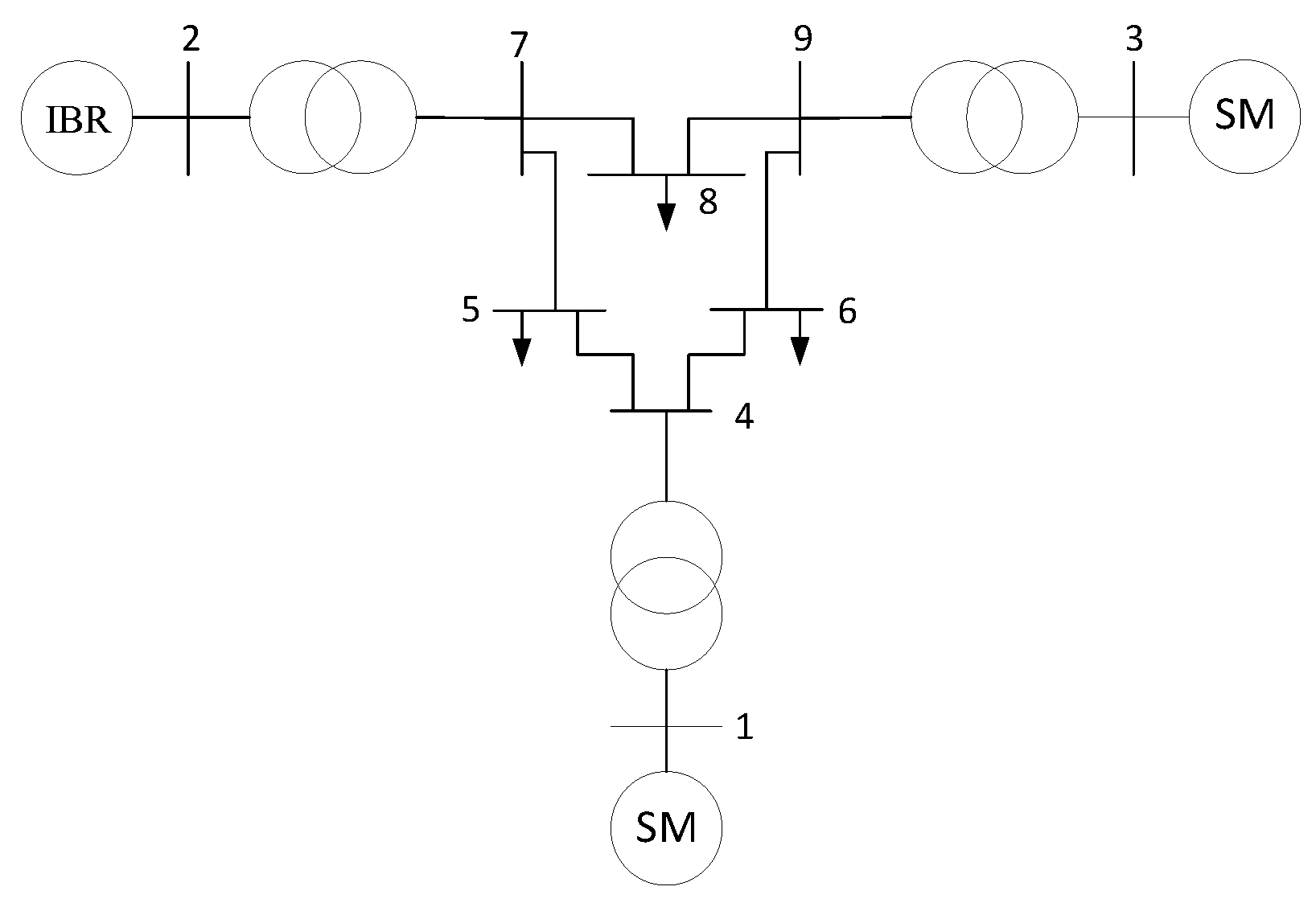
To verify the effectiveness of the proposed complex frequency synchronization criterion and its associated indices, a modified WSCC nine-bus system is established using the open-source tool Andes [32] and transient simulations are carried out for analysis [33]. As shown in Figure 2, each synchronous generator is equipped with a complete excitation system and governor, while the synchronous generator at bus 2 is replaced by a photovoltaic generation unit. According to the electrical coupling between each generator and its neighboring load buses, the system buses are partitioned into three subnetworks: S1 (bus 2, bus 7, bus 5), S2 (bus 1, bus 4, bus 6), and S3 (bus 3, bus 8, bus 9).
Section 4.1 investigates the local synchronization characteristics of the system through time domain simulations. Based on the aforementioned synchronization criterion, the analysis starts from the convergence behavior of individual buses and is then extended to the synchronization within each subnetwork. On this basis, Section 4.2 evaluates the global synchronization performance of the overall system from the perspective of subnetwork synchronization and further examines the oscillation decay rate and complex inertia synchronization indices.

4.1. Local Synchronization Analysis

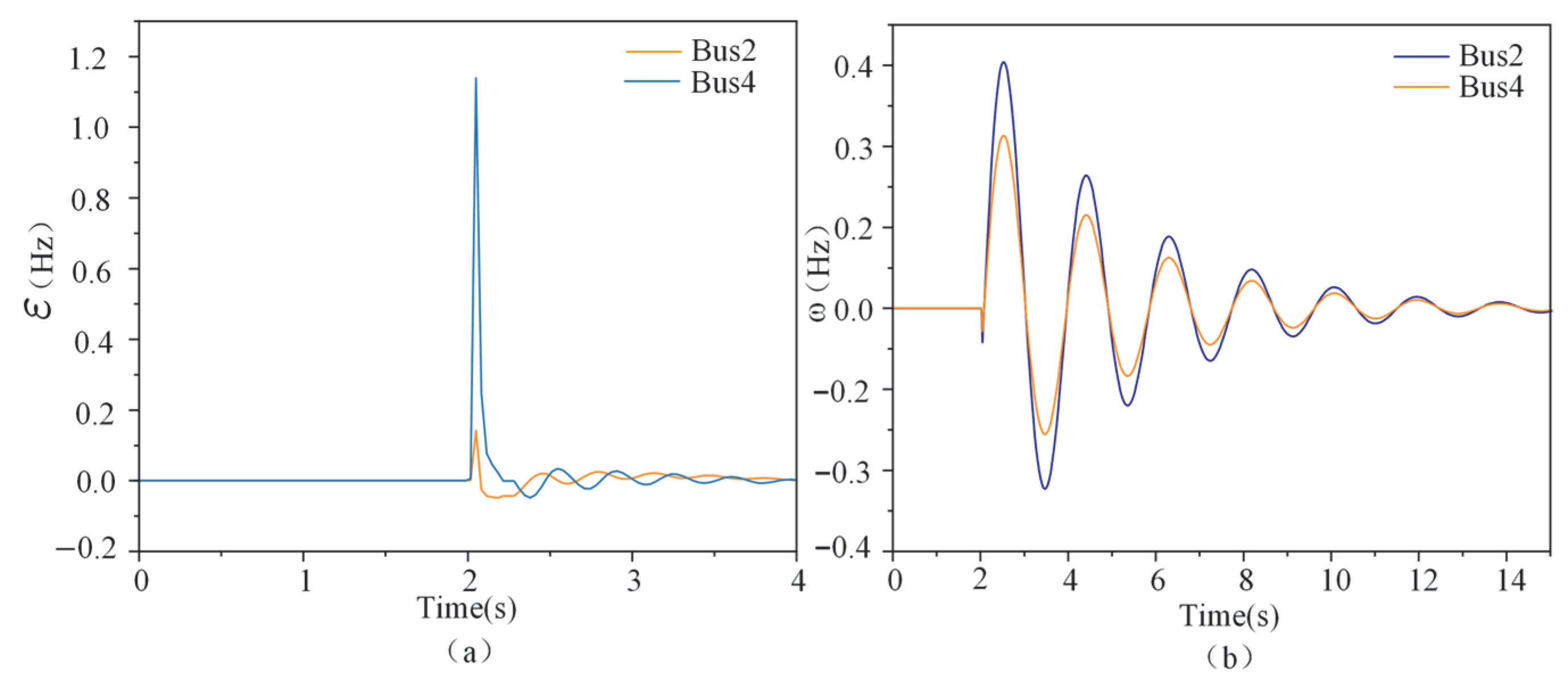
To analyze the synchronization characteristics of the system, the following disturbance scenario is considered: at t = 2   s , the load connected to bus 6 is tripped. The complex frequency at each bus is measured using the BusFreq module.
The left panel plots the real part of the complex frequency, ε , which reflects the normalized rate of change in the voltage magnitude. When the disturbance occurs at t = 2   s , both buses exhibit a pronounced overshoot in ε , and their decay trajectories and convergence speeds are clearly different. The right panel shows the conventional angular frequency ω . During the transient, the two curves gradually decay and almost coincide. Under traditional synchronization criteria that only examine whether frequency or rotor angle converges to a common steady-state value, the system would therefore be judged as having returned to a stable operating condition. However, Figure 3 reveals that the real parts at the two buses display evident overshoot at the disturbance instant, and their decay paths and convergence rates differ markedly. This indicates that the rate of change behavior of the voltage magnitude does not achieve uniform convergence, and that there exists dynamic inconsistency that is obscured when one looks only at frequency.
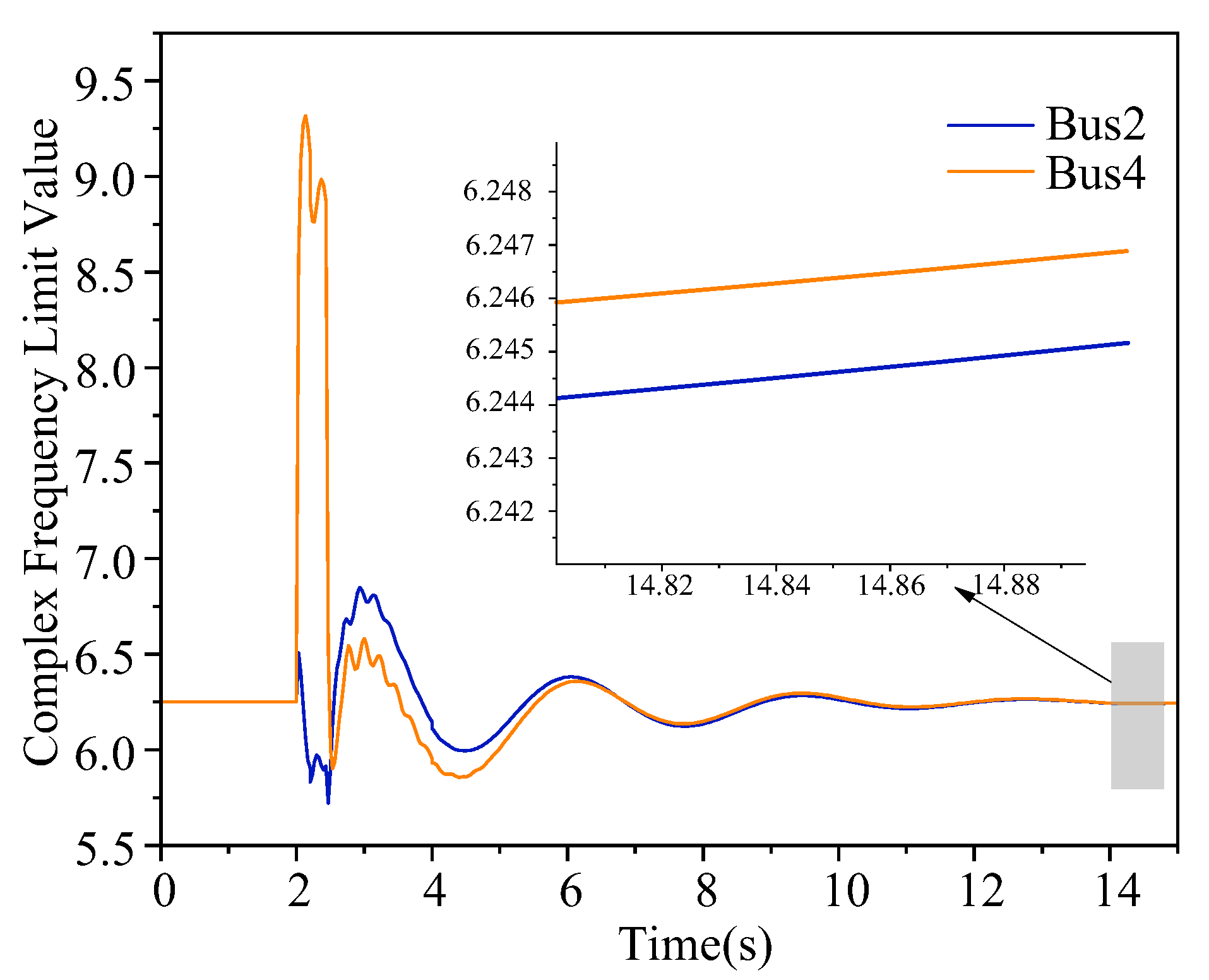
Figure 4 further demonstrates that the complex synchronization criterion requires not only that the bus frequencies approach the same value in steady state, but also that the voltage frequency dynamic responses remain coordinated throughout the entire transient process. The results show that, although the system appears to exhibit a synchronous trend in terms of frequency, the analysis from the complex frequency perspective indicates that the system is actually in a nonsynchronized state. This phenomenon is consistent with the definition of complex frequency synchronization given in this paper, and it reveals the potential risk associated with apparent synchronization but internal desynchronization: differences in voltage recovery rates among buses will aggravate reactive power oscillations, weaken the overall damping of the system, and make it difficult for local oscillations to decay synchronously across the network [34]. More critically, if different buses respond differently to the same disturbance, protection devices may misoperate or lose coordination, thereby jeopardizing the secure and stable operation of the system [35].
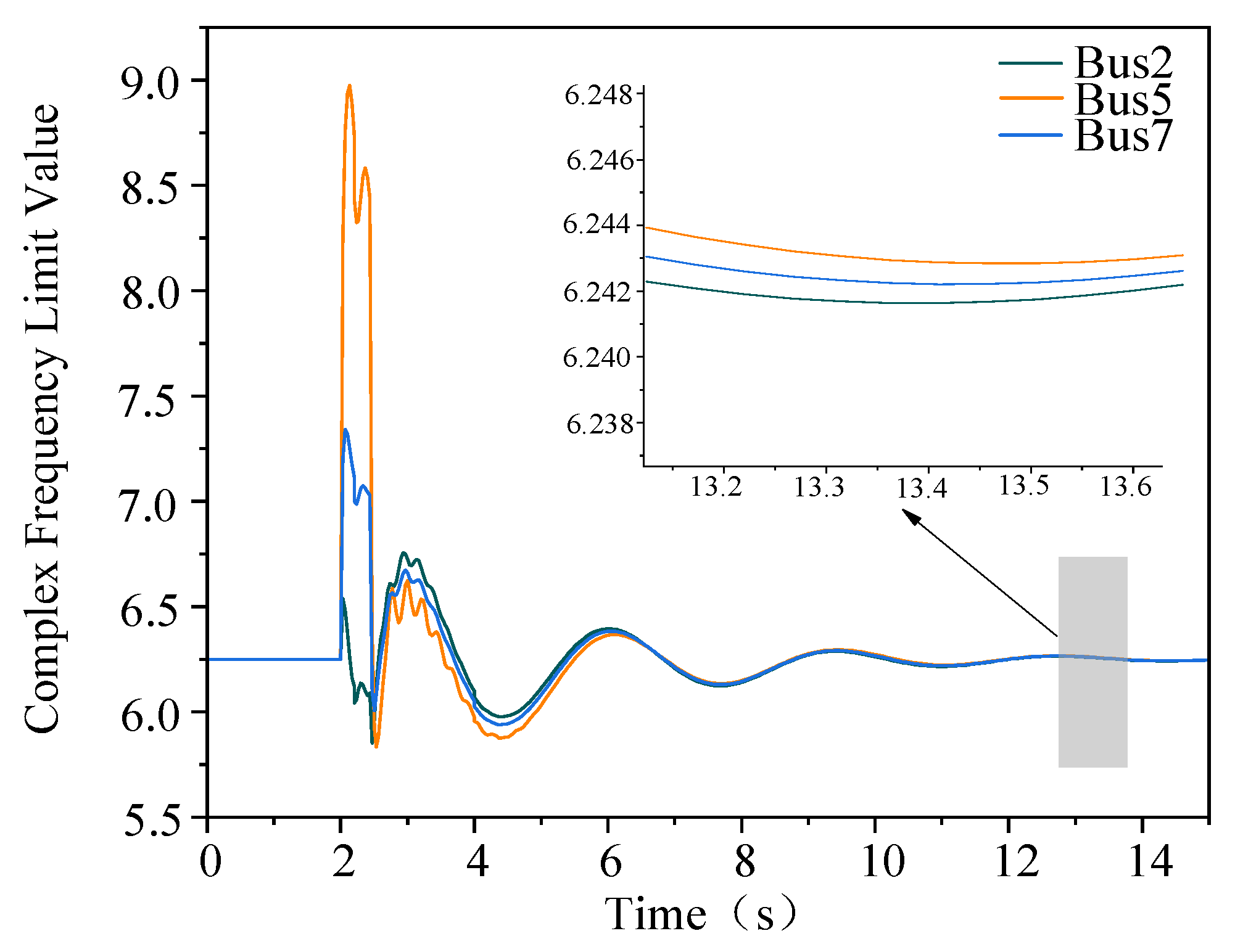
To investigate and compare the synchronization tendency of each subnetwork under the same disturbance, time domain simulations are carried out for the above contingency. While the convergence in Figure 5, Figure 6 and Figure 7 can be qualitatively observed from the trajectories, a quantitative measure is needed to clearly distinguish the synchronization speed among subnetworks and to avoid conclusions based on momentary curve intersections. Therefore, we introduce the subnetwork synchronization time T s y n c , defined as the earliest time instant after the disturbance when the maximum mismatch among the buses’ trajectories within a subnetwork falls within a relative tolerance band τ around the subnetwork steady-state limit value and remains within this band continuously over a time window Δ T . In this work, τ is set to 0.5% and Δ T is chosen as one dominant post-disturbance oscillation period estimated from the peak-to-peak interval after the first swing. Based on this definition, Figure 5 shows the post-disturbance complex frequency response of subnetwork S1.
Immediately after the disturbance at t = 2 s, all three trajectories exhibit a pronounced overshoot and then enter a decaying process; although their initial magnitudes differ, the overall oscillation patterns remain consistent. Around t 14 s, the three curves converge to the same steady-state value, indicating that, within subnetwork S1, the nodal rate of change in voltage magnitude and the angular frequency achieve coordinated responses in both dimensions, thereby satisfying the strict definition of complex frequency synchronization. To quantify the synchronization speed, we define the synchronization time T s y n c as the time it takes for the maximum deviation among the nodes in S1 to fall below 0.5% of the steady-state value. For S1, the synchronization time is approximately 12 s.
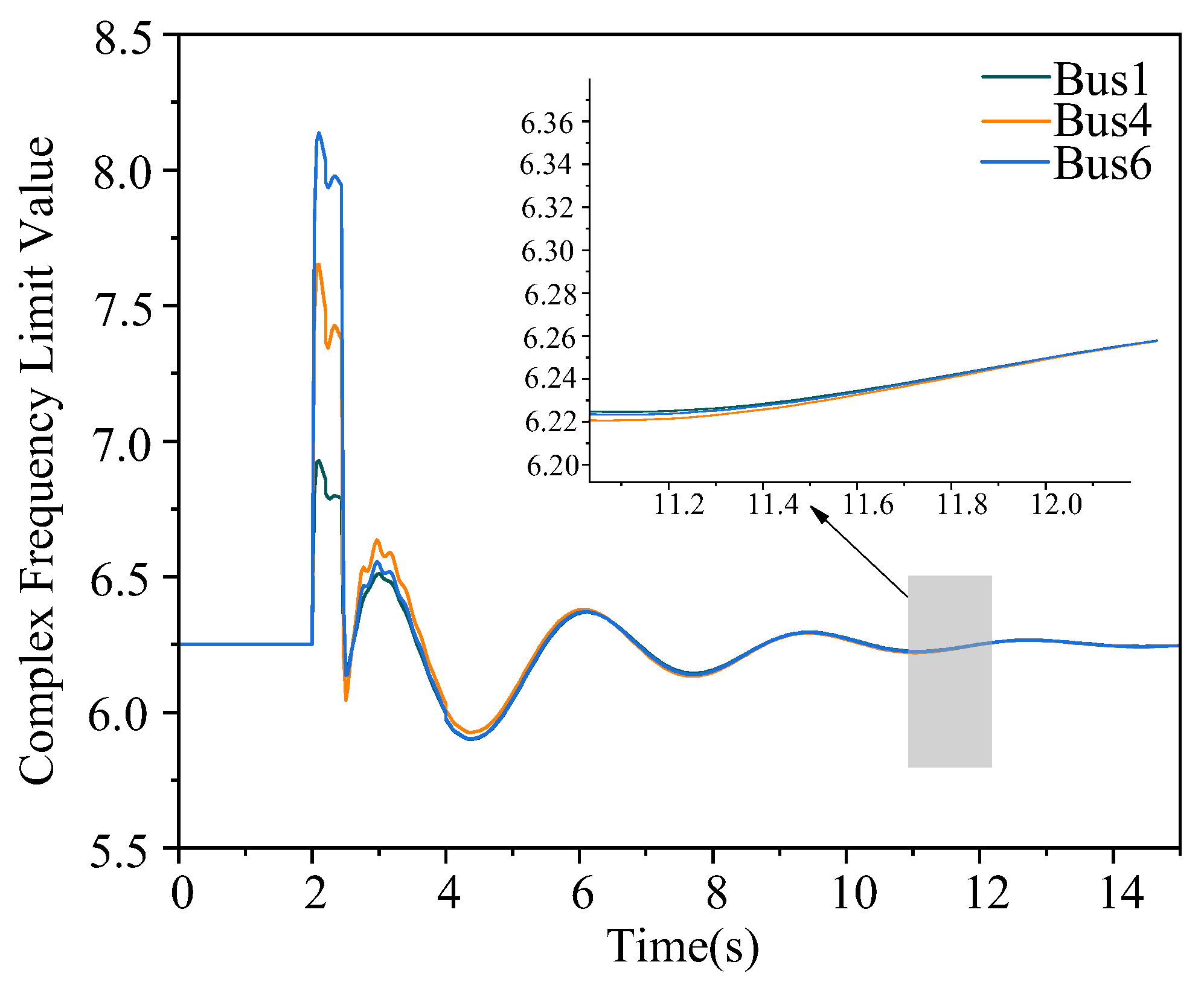
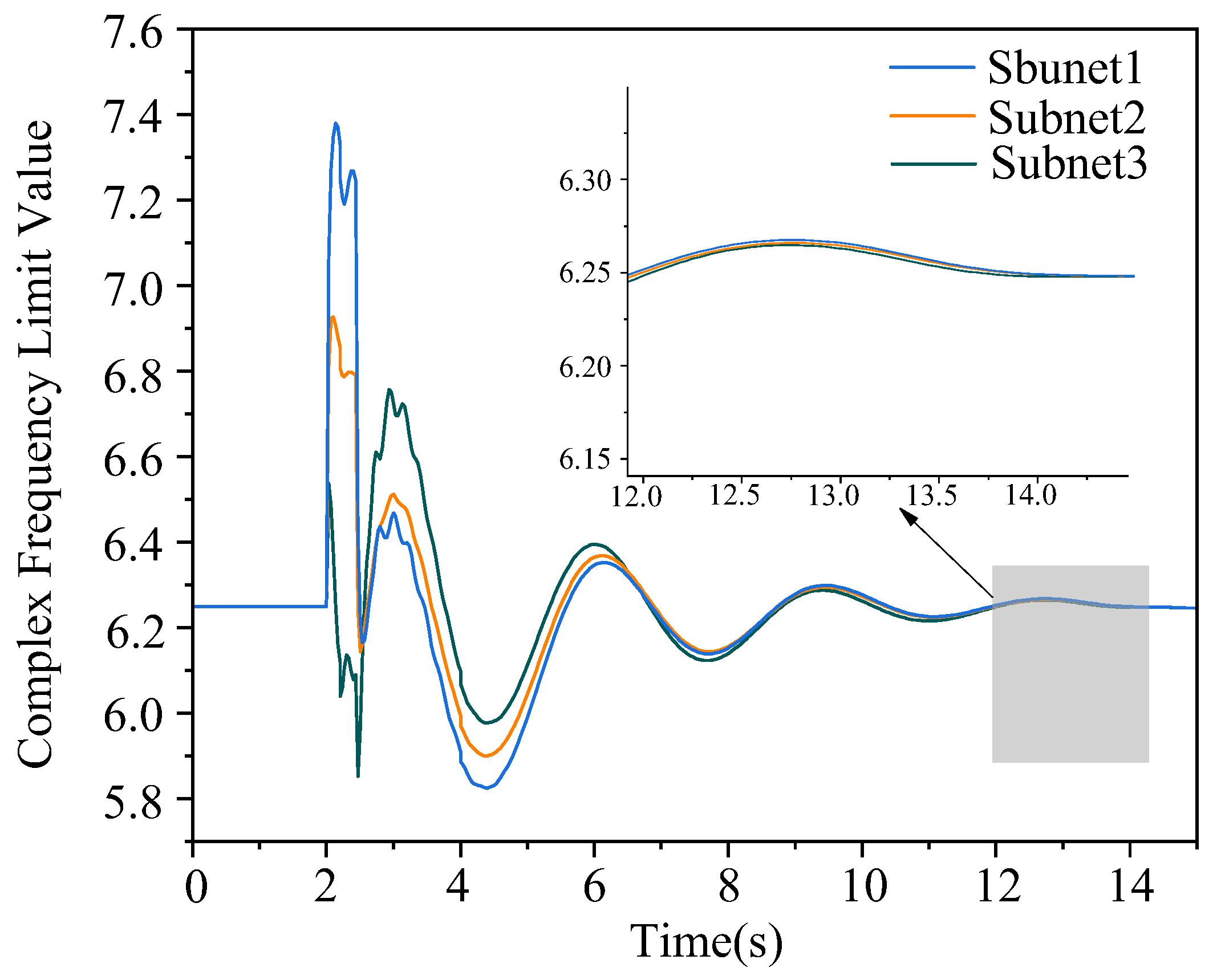
Figure 6 presents the dynamic response of the complex frequency limit values at buses 1, 4, and 6 in subnetwork S2. The responses at buses 1 and 4 show larger amplitudes with more pronounced oscillations, whereas the trajectory at bus 6 is relatively smooth. As the transient progresses, the system gradually regains synchronization: although the three curves differ in oscillation amplitude and phase, their oscillatory and decaying trends are essentially consistent. The magnified inset clearly shows that, for t 12 s, all three trajectories converge to the same steady-state value. Using the synchronization time metric defined above, this indicates that subnetwork S2 reaches synchronization at around t 12 s, corresponding to an estimated synchronization time of approximately T s y n c 10 s after the disturbance.
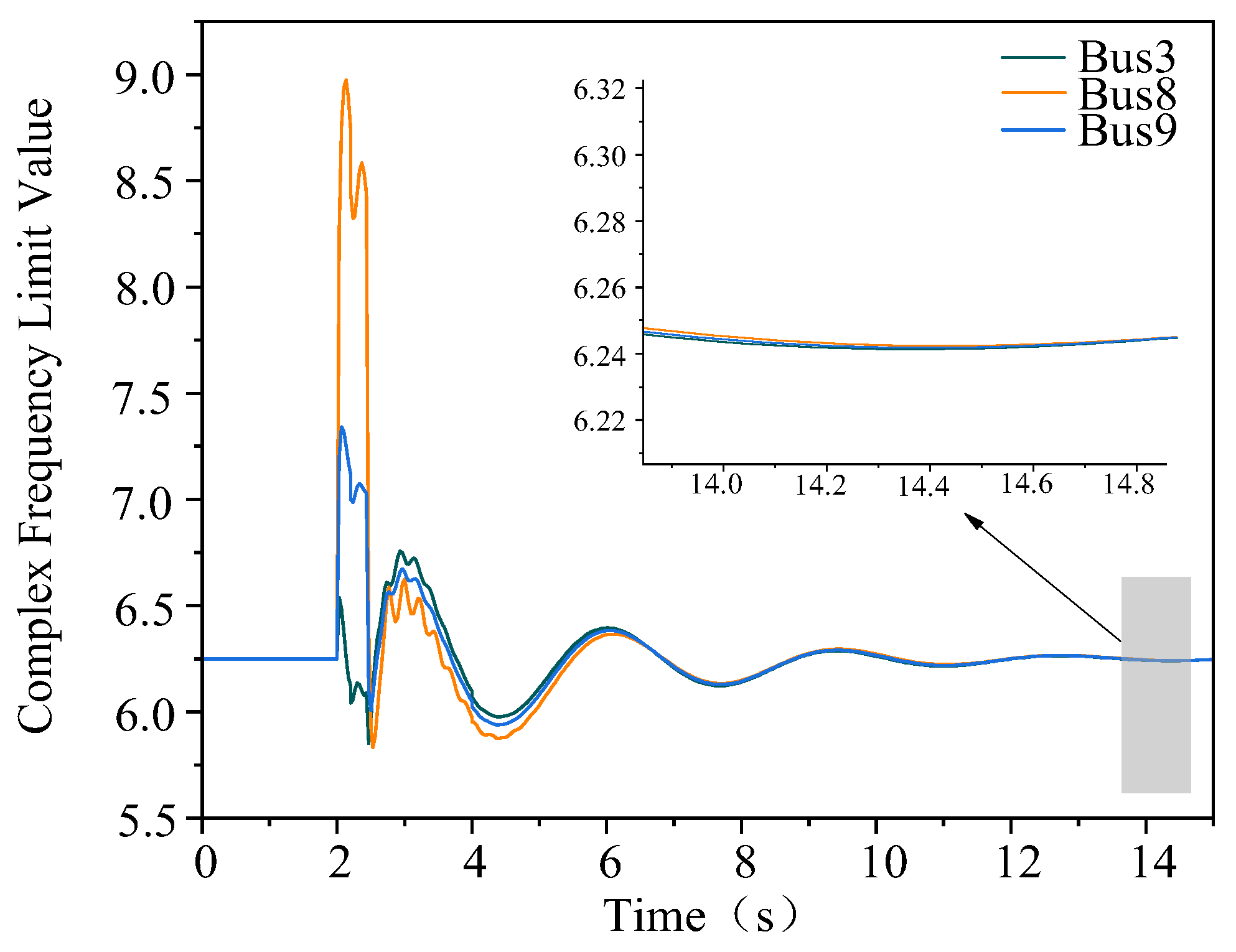
As the transient evolves, the three trajectories display highly consistent oscillatory decay patterns and remain closely synchronized in their dynamic evolution. The enlarged inset indicates that, for t 14 s, all curves converge to the same steady-state value, and the oscillation decay during the transient is well coordinated, with no local loss-of-step phenomena. Subnetwork S3 reaches synchronization at around t 14 s, corresponding to an estimated synchronization time of approximately T s y n c 12 s after the disturbance. Compared with S1 and S2, the synchronization process of S3 is smoother, reflecting stronger regional damping and better dynamic coherence.
As seen in the figure, all three trajectories exhibit a pronounced overshoot immediately after the disturbance and then enter a decaying oscillatory stage, among which the transient magnitude at bus 8 is the largest, indicating that this node bears a relatively stronger impact. As the transient evolves, the three trajectories display highly consistent oscillatory decay patterns and remain closely synchronized in their dynamic evolution. The enlarged inset indicates that, for t 12   s , all curves converge to the same steady-state value, and the oscillation decay during the transient is well coordinated, with no local loss-of-step phenomena. This response characteristic demonstrates that S3 achieves strict complex frequency synchronization: its internal nodes exhibit good dynamic coordination in both the voltage rate of change and angular frequency dimensions. Compared with S1 and S2, the synchronization process of S3 is smoother, reflecting stronger regional damping and better dynamic coherence.
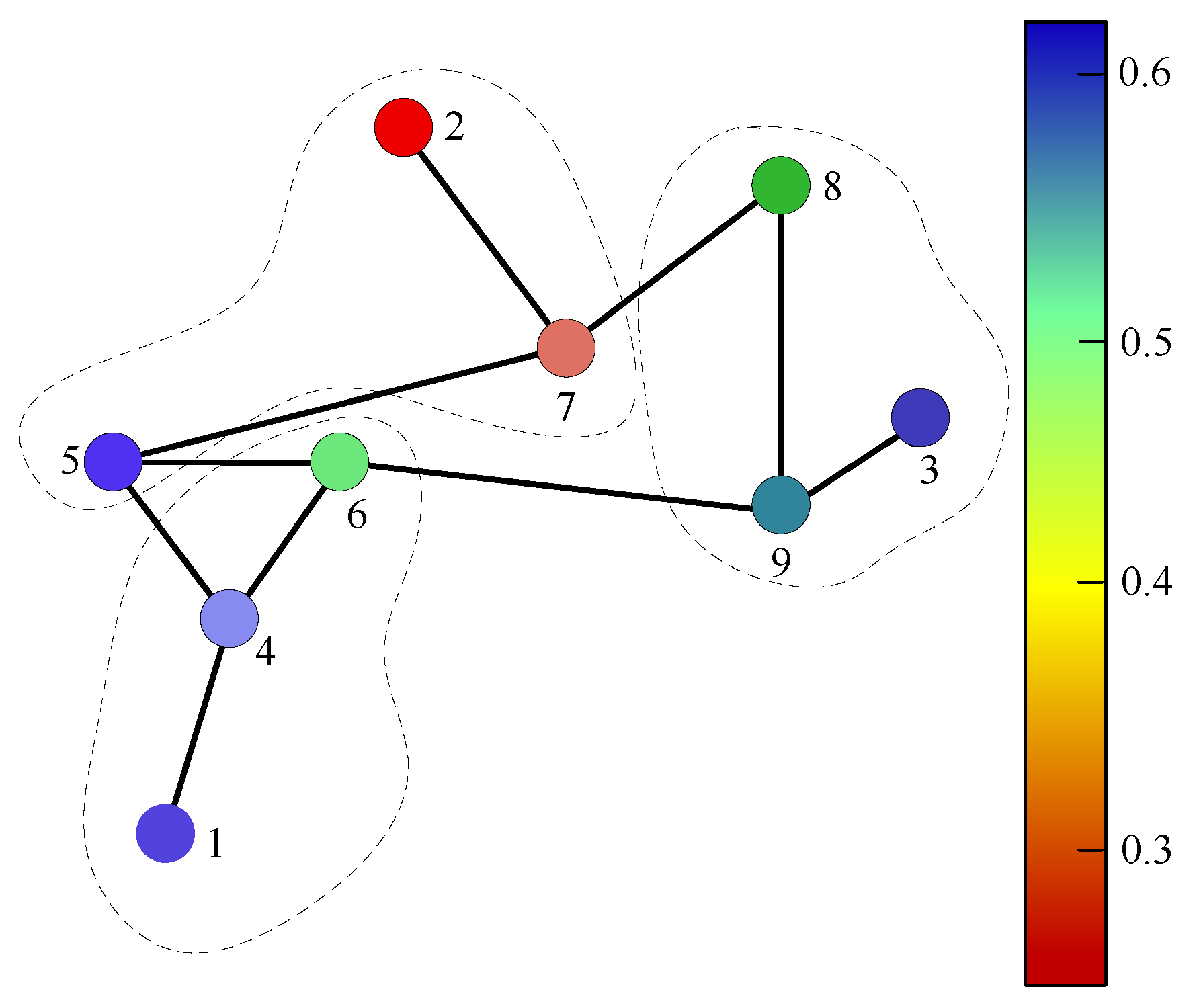
Figure 8 depicts the spatial heat map distribution of oscillation decay rates for all nodes in the nine-bus system. Regions in cool colors correspond to higher decay rates and therefore stronger damping performances, whereas regions in warm colors indicate lower decay rates and slower oscillation attenuation. From the nodal perspective, buses 2 and 7 clearly appear in warm tones, and bus 5 lies between warm and neutral tones, implying that these three nodes dissipate post-disturbance oscillation energy more slowly overall. In contrast, buses 3, 8, and 9 are mainly shown in cool or slightly cool colors, and their oscillation decay rates are markedly higher, revealing a stronger local damping capability. Extending the analysis of oscillation decay rates from individual nodes to regional areas thus helps identify subregions with weak damping and provides a theoretical basis for the subsequent optimization of damping-related control parameters and the siting of additional damping devices.

4.2. Global Synchronization Analysis

In Section 4.1, the complex frequency synchronization trajectories of the three subnetworks were presented separately, and it was shown that their post-disturbance convergence speeds and damping levels differ significantly. However, comparisons restricted to the internal behavior of each subnetwork are not sufficient to capture their integrated impact on the overall dynamic coordination of the system. To assess the global complex synchronization process among the three subnetworks under the same disturbance scenario (load shedding at bus 6 at t = 2   s ), it is necessary to introduce a global network synchronization curve. Specifically, the complex frequency limit values of S1, S2, and S3 are aggregated at the subnetwork level so as to obtain trajectories that reflect the evolution of global coherence.
As shown in Figure 9, the three curves almost coincide before the disturbance, indicating that the entire network is operating at a common steady-state point. Once the load at bus 6 is removed at t = 2 s, the complex frequency limit values of the three subnetworks diverge rapidly. Among them, S1 exhibits the largest response magnitude: both its initial overshoot and the subsequent reverse swing over a certain period are significantly larger than those of S2 and S3, and its oscillation decay process lasts longer, with the trajectory remaining visibly separated from the other two curves during approximately 6–8 s. The global network-wide synchronization can be regarded as restored at around t 14 s, corresponding to an estimated global synchronization time of approximately T s y n c G 12 s after the disturbance. This observation also confirms that the overall restoration of global coherence is largely governed by the slowest-converging subnetwork S1.
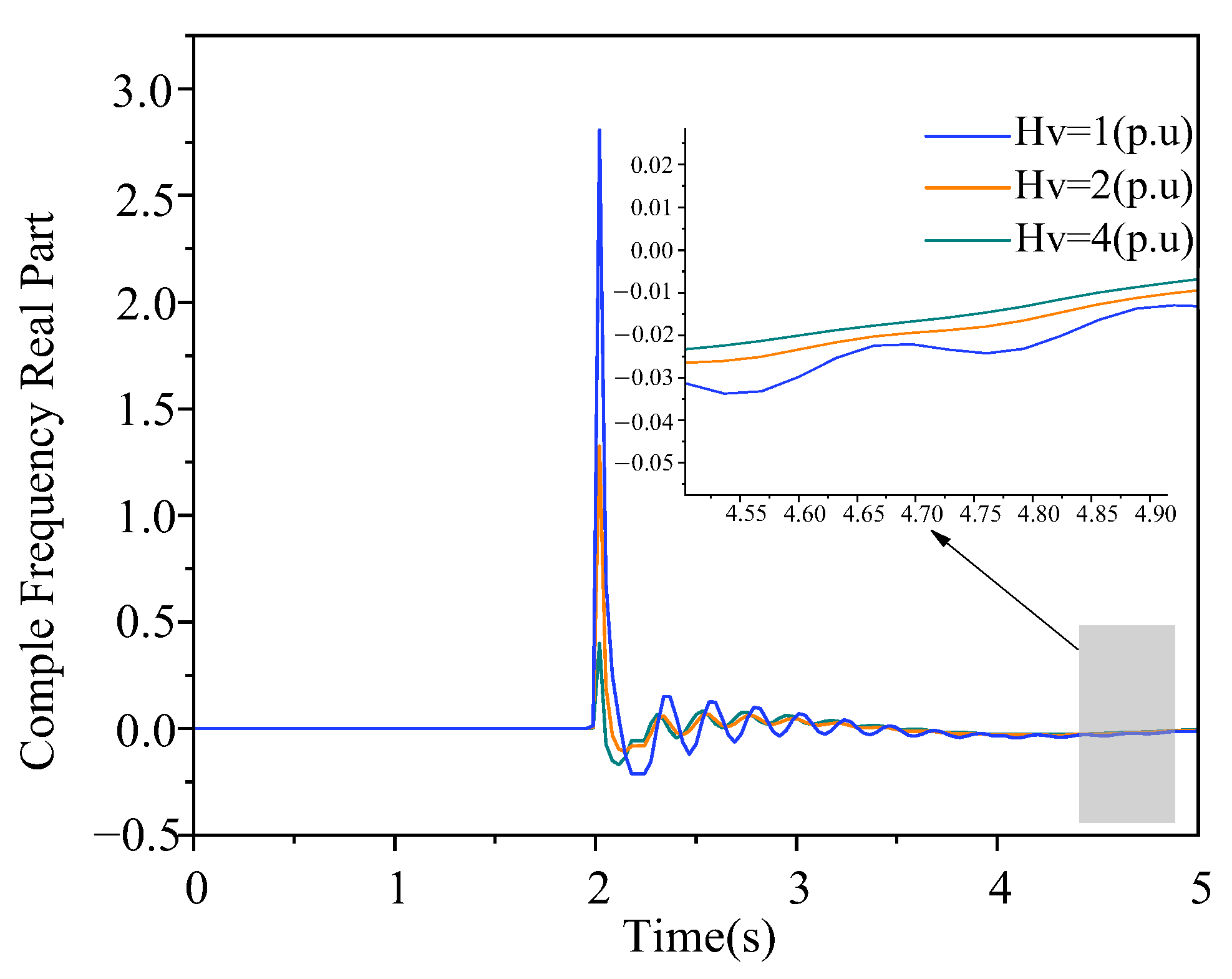
The parameter H v in Figure 10 refers to the voltage inertia constant at bus 4. According to Section 3.3.2, H v depends linearly on the equivalent capacitance/equivalent susceptance seen from the bus terminal and thus can be tuned by modifying the local shunt capacitive support. In the case study, the three scenarios ( H v = 1,2,4 ) are obtained by changing only the shunt compensation at bus 4, while keeping the network topology and all machine/converter control parameters unchanged. Practically, this can be interpreted as installing shunt capacitor banks of different sizes or, equivalently, employing a shunt FACTS device whose susceptance setpoint is adjusted. The added shunt capacitance increases the local equivalent capacitance from C e q , 0 to C e q , 0 + C s h (and correspondingly the equivalent susceptance from B e q , 0 to B e q , 0 + ω 0 C s h ), consistent with (26), thereby yielding the prescribed H v values used in Figure 10.
Before the disturbance, all three curves remain flat around zero, indicating that the system operates at a steady state with zero rate of change in voltage magnitude. After the load at t = 2   s is shed, the three trajectories all exhibit a pronounced positive spike followed by a decaying oscillation. Among them, the case with H v = 1 has the largest peak and the strongest oscillation; when H v = 2 , both the peak value and oscillation amplitude are reduced; and when H v = 4 , the initial spike is clearly suppressed and the subsequent oscillations decay rapidly, so that the overall response is characterized by smaller peaks and smoother fluctuations. In the enlarged steady-state transition region it can be seen that, for larger H v , the real part of the complex frequency after the disturbance decays closer to the zero axis and varies more smoothly. In summary, the voltage inertia H v is introduced to mitigate abrupt voltage variations in a similar way to how mechanical inertia H ω suppresses frequency deviations in conventional systems. Both parameters represent the system’s ability to resist dynamic disturbances, but on different physical channels.
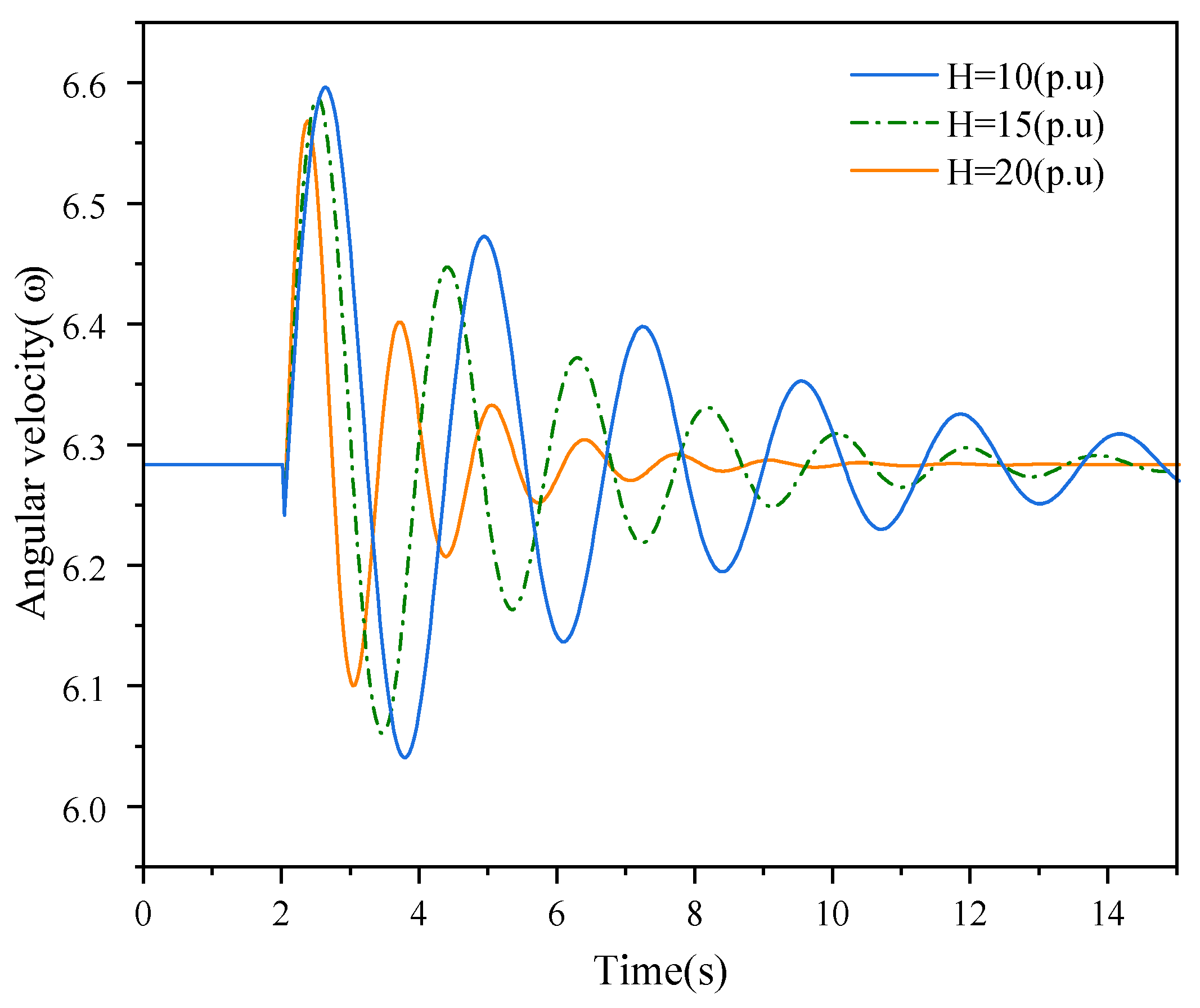
As shown in Figure 11, when H ω = 10 , the initial overshoot of the frequency deviation and the subsequent oscillation amplitude are the largest, and the time required for the frequency to settle around the new equilibrium is also relatively long. As H ω is increased to 15 and 20, the initial frequency deviation progressively decreases, the oscillation peaks and troughs are clearly suppressed, and for H ω = 20 the frequency enters a decaying oscillatory regime more rapidly and converges to its steady-state value. The similarity in waveform characteristics between the two figures shows that the voltage-side inertia parameter H v and the conventional mechanical inertia H ω play analogous inertial buffering roles in their respective channels: the former improves voltage dynamic performance by suppressing abrupt changes and oscillations in the real part of the complex frequency, while the latter enhances frequency stability by reducing frequency deviations and accelerating the decay of frequency oscillations. Together, they constitute the complex inertia framework defined in this paper, providing a solid basis for the unified assessment of voltage–frequency coupled dynamics.

5. Conclusions

Building on the theory of complex frequency, this paper proposes a complex frequency-based synchronization criterion suitable for partitioned power systems, which can uniformly describe the synchronization status of the system at three levels: node, subnetwork, and overall network. Transient simulations on a modified WSCC nine-bus system, together with comparisons against traditional synchronization criteria that rely solely on frequency consistency, demonstrate that the proposed method can still distinguish the numerical differences between the real and imaginary parts of the complex frequency even when the system appears frequency-synchronized. In doing so, it clearly reveals local and inter-subnetwork desynchronization phenomena and accurately captures the adverse impact of delayed local complex synchronization on the global synchronization process.
On this basis, two quantitative indices are further introduced: the oscillation decay rate and the complex inertia. The oscillation decay rate characterizes the damping level of nodes and subnetworks and the dissipation rate of oscillation energy; its spatial distribution helps identify poorly damped regions and provides guidance for regional damping enhancement and control resource allocation. The complex inertia index extends the conventional notion of rotational inertia by introducing the concept of voltage inertia, thereby unifying the dynamic response characteristics on the frequency and voltage sides. It enables a joint assessment of the disturbance rejection capability of local areas in both dimensions. Simulation results show that increasing voltage inertia not only suppresses abrupt changes and oscillations in the real part of the complex frequency, but also yields response dynamics that are consistent with the effect of traditional inertia on frequency behavior, thus validating complex inertia as an effective composite indicator of system dynamic strength.
Future work can proceed in two directions. First, the complex synchronization criterion and complex inertia index will be systematically embedded into existing stability assessment frameworks to develop unified methods that simultaneously cover voltage stability and angle stability, and their applicability will be validated under multiple operating scenarios. Second, leveraging the spatial distribution characteristics of oscillation decay rate and complex inertia, we will investigate control and optimization strategies for distribution-level renewable-dominated power systems, including virtual inertia and voltage inertia allocation, coordinated active reactive power control, and partitioned operation and protection setting design under complex synchronization constraints, so as to provide new theoretical support and engineering approaches for the dynamic security and stable operation of power systems.

Author Contributions

Conceptualization, L.T.; methodology, Y.W., C.W., and L.T.; validation, L.T. and Y.W.; formal analysis, Y.W.; investigation, P.L., J.X., and K.L.; resources, L.T. and Y.W.; writing—original draft preparation, Y.W.; writing—review and editing, L.T., and C.W.; visualization, Y.W. All authors have read and agreed to the published version of the manuscript.

Funding

This research received no external funding.

Data Availability Statement

The original contributions presented in this study are included in the article. Further inquiries can be directed to the corresponding author.

Conflicts of Interest

Author Chenglei Wang was employed by the company Electric Power Research Institute of Yunnan Power Grid Co., Ltd. The remaining authors declare that the research was conducted in the absence of any commercial or financial relationships that could be construed as a potential conflict of interest.

References

  1. Sajadi, R.; Kenyon, W.; Hodge, B.M. Synchronization in electric power networks with inherent heterogeneity up to 100% inverter based renewable generation. Nat. Commun. 2022, 13, 2490. [Google Scholar] [CrossRef] [PubMed]
  2. Hatziargyriou, N.; Milanovic, J.; Rahmann, C.; Ajjarapu, V.; Canizares, C.; Erlich, I.; Hill, D.; Hiskens, I.; Kamwa, I.; Pal, B.; et al. Definition and classification of power system stability—Revisited & extended. IEEE Trans. Power Syst. 2021, 36, 3271–3281. [Google Scholar]
  3. Paganini, F.; Mallada, E. Global analysis of synchronization per-formance for power systems: Bridging the theory-practice gap. IEEE Trans. Autom. Control 2020, 65, 3007–3022. [Google Scholar] [CrossRef]
  4. Colombino, M.; Groß, D.; Brouillon, J.-S.; Dörfler, F. Global phase and magnitude synchronization of coupled oscillators with application to the control of grid-forming power inverters. IEEE Trans. Autom. Control 2019, 64, 4496–4511. [Google Scholar] [CrossRef]
  5. Kundur, P.; Paserba, J.; Ajjarapu, V.; Andersson, G.; Bose, A.; Canizares, C.; Hatziargyriou, N.; Hill, D.; Stankovic, A.; Taylor, C.; et al. Definition and classification of power system stability IEEE/CIGRE joint task force on stability terms and definitions. IEEE Trans. Power Syst. 2004, 19, 1387–1401. [Google Scholar] [CrossRef]
  6. Yang, P.; Liu, F.; Wang, Z.; Wu, S.; Mao, H. Spectral analysis of network coupling on power system synchronization with varying phases and voltages. In Proceedings of the 2020 Chinese Control And Decision Conference (CCDC), Hefei, China, 22–24 August 2020; pp. 880–885. [Google Scholar]
  7. Yu, C.; Xiao, W. Synchronizability and synchronization rate of ac microgrids: A topological perspective. IEEE Trans. Netw. Sci. Eng. 2024, 11, 1424–1441. [Google Scholar] [CrossRef]
  8. NERC/WECC Joint Task Force. 1200 MW Fault Induced Solar Photo-Voltaic Resource Interruption Disturbance Report; Technical Report; NERC: Atlanta, GA, USA, 2017. [Google Scholar]
  9. Ulbig, A.; Borsche, T.S.; Andersson, G. Impact of low rotational inertia on power system stability and operation. IFAC Proc. 2014, 47, 7290–7297. [Google Scholar] [CrossRef]
  10. Markovic, U.; Stanojev, O.; Aristidou, P.; Vrettos, E.; Callaway, D.; Hug, G. Understanding small-signal stability of low-inertia systems. IEEE Trans. Power Syst. 2021, 36, 3997–4017. [Google Scholar] [CrossRef]
  11. Denholm, P.; Gevorgian, V.; Zhang, Y. Inertia and the Power Grid: A Guide Without the Spin; Technical Report; NREL/TP-6A20-73856; NREL: Golden, CO, USA, 2020. [Google Scholar]
  12. Bhujel, N.; Tamrakar, U.; Hansen, T.M.; Byrne, R.H.; Tonkoski, R. Model predictive integrated voltage and frequency support in microgrids. In Proceedings of the IEEE PES General Meeting, Montreal, QC, Canada, 2–6 August 2020. [Google Scholar]
  13. Bernal, R.; Milano, F. Improving voltage and frequency control of DERs through dynamic power compensation. Electr. Power Syst. Res. 2024, 235, 110768. [Google Scholar] [CrossRef]
  14. Milano, F. Complex frequency. IEEE Trans. Power Syst. 2022, 37, 1230–1240. [Google Scholar] [CrossRef]
  15. He, X.; Geng, H. PLL Synchronization Stability of Grid-Connected Multiconverter Systems. IEEE Trans. Ind. Appl. 2022, 58, 830–842. [Google Scholar] [CrossRef]
  16. Yang, P.; Liu, F.; Liu, T.; Hill, D.J. Augmented synchronization of power systems. IEEE Trans. Autom. Control 2024, 69, 3673–3688. [Google Scholar] [CrossRef]
  17. Huang, B. Complex frequency wave analysis for electric networks. J. Guangxi Univ. (Nat. Sci. Ed.) 1988, 13, 38–46. [Google Scholar]
  18. He, X.; Häberle, V.; Dörfler, F. Complex-Frequency Synchronization of Converter-Based Power Systems. IEEE Trans. Control. Netw. Syst. 2024, 12, 787–799. [Google Scholar] [CrossRef]
  19. Pinheiro, B.; Ponce, I.; Dotta, D.; Milano, F. Teager Energy Operator as a Metric to Evaluate Local Synchronization of Power System Devices. arXiv 2025, arXiv:2503.06548. [Google Scholar] [CrossRef]
  20. Gu, Y.; Green, T.C. Power System Stability With a High Penetration of Inverter-Based Resources. Proc. IEEE 2023, 111, 832–853. [Google Scholar] [CrossRef]
  21. Milano, F.; Dorfler, F.; Hug, G.; Hill, D.J.; Verbi, G. Foundations and Challenges of Low-Inertia Systems (Invited Paper). In Proceedings of the 2018 Power Systems Computation Conference (PSCC), Dublin, Ireland, 11–15 June 2018; Available online: https://ieeexplore.ieee.org/document/8450880 (accessed on 10 October 2025).
  22. Trujillo, M.; Sajadi, A.; Shaw, J.; Hodge, B.-M. Computationally Efficient Analytical Models of Frequency and Voltage in Low-Inertia Systems. arXiv 2025, arXiv:2506.06620. [Google Scholar] [CrossRef]
  23. Domingo-Enrich, R.; He, X.; Häberle, V.; Dörfler, F. Dynamic Complex-Frequency Control of Grid-Forming Converters. In Proceedings of the IECON 2024-50th Annual Conference of the IEEE Industrial Electronics Society, Chicago, IL, USA, 3–6 November 2024; pp. 1–6. [Google Scholar]
  24. Xu, Z.; Zhang, N.; Zhang, Z.; Huang, Y. The definition of power grid strength and its calculation methods for power systems with high proportion nonsynchronous-machine sources. Energies 2023, 16, 1842. [Google Scholar] [CrossRef]
  25. Ortega, A.; Milano, F. Comparison of different PLL implementations for frequency estimation and control. In Proceedings of the 2018 18th International Conference Harmonics and Quality of Power (ICHQP), Ljubljana, Slovenia, 13–16 May 2018; pp. 1–6. [Google Scholar] [CrossRef]
  26. Gao, H.; Magnússon, S.; Coffrin, C.; Dörfler, F.; Hug, G.; Modaresi, J. Common-Mode Frequency of Power Systems Affected by Voltage Dynamics. IEEE Trans. Power Deliv. 2024, 39, 3279–3291. [Google Scholar] [CrossRef]
  27. Ponce, I.; Milano, F. Analytical Framework for Power System Strength. arXiv 2025, arXiv:2507.16061. [Google Scholar] [CrossRef]
  28. Chompoobutrgool, Y.; Li, W.; Vanfretti, L. Development and implementation of a Nordic grid model for power system small-signal and transient stability studies in a free and open source software. In Proceedings of the 2012 IEEE Power and Energy Society General Meeting, San Diego, CA, USA, 22–26 July 2012; pp. 1–8. [Google Scholar]
  29. Zhu, L.; Hill, D.J. Stability analysis of power systems: A network synchronization perspective. SIAM J. Control. Optim. 2018, 56, 1640–1664. [Google Scholar] [CrossRef]
  30. Foster, R.M. A reactance theorem. Bell Syst. Tech. J. 1924, 3, 259–267. [Google Scholar] [CrossRef]
  31. Zecchino, A.; Marinelli, M. Analytical assessment of voltage support via reactive power from new electric vehicles supply equipment in radial distribution grids with voltage-dependent loads. Int. J. Electr. Power Energy Syst. 2018, 97, 17–27. [Google Scholar] [CrossRef]
  32. Cui, H.; Li, F.; Tomsovic, K. Hybrid Symbolic-Numeric Framework for Power System Modeling and Analysis. IEEE Trans. Power Syst. 2021, 36, 1373–1384. [Google Scholar] [CrossRef]
  33. Bernal, R.; Milano, F. Complex Frequency-Based Control for Inverter-Based Resources. J. Mod. Power Syst. Clean Energy 2025, 13, 1630–1641. [Google Scholar] [CrossRef]
  34. Kabiri, R.; Holmes, D.G.; McGrath, B.P.; Meegahapola, L.G. Control of active and reactive power ripple to mitigate unbalanced grid voltages. IEEE Trans. Ind. Appl. 2016, 52, 1660–1668. [Google Scholar] [CrossRef]
  35. Haddadi, A.; Zhao, M.; Kocar, I.; Karaagac, U.; Chan, K.W.; Farantatos, E. Impact of inverter-based resources on negative sequence quantities-based protection elements. IEEE Trans. Power Deliv. 2021, 36, 289–298. [Google Scholar] [CrossRef]
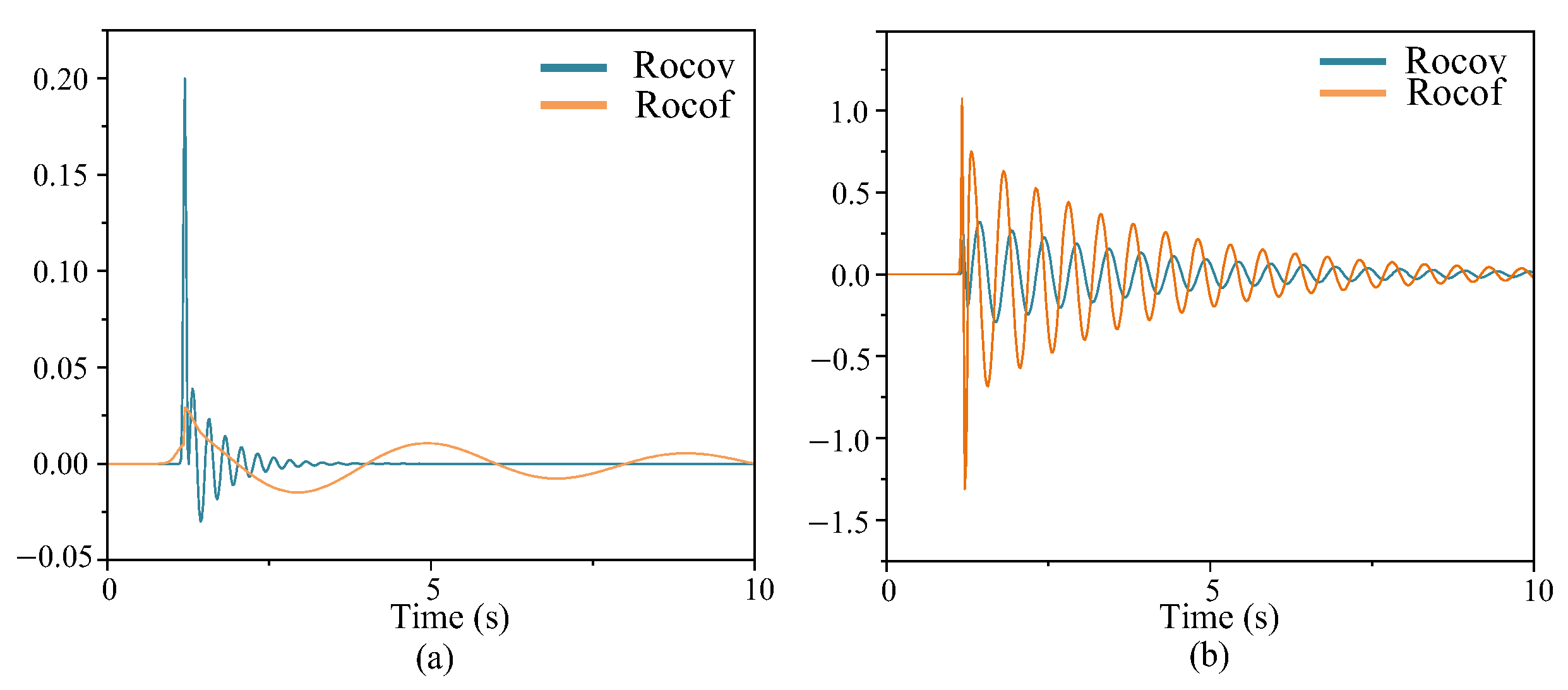
Figure 1. Variation in the voltage–frequency time scale coupling relationship: (a) traditional power system; (b) low-inertia power system.
Energies 19 00701 g001
Figure 2. Modified WSCC 9-bus system.
Energies 19 00701 g002
Figure 3. Complex frequency trajectories at buses 2 and 4: (a) real part response; (b) imaginary part response.
Energies 19 00701 g003
Figure 4. Complex synchronization curves for bus 2 and bus 4.
Energies 19 00701 g004
Figure 5. Complex synchronization curve for subnetwork S1.
Energies 19 00701 g005
Figure 6. Complex synchronization curve for subnetwork S2.
Energies 19 00701 g006
Figure 7. Complex synchronization curve for subnetwork S3.
Energies 19 00701 g007
Figure 8. Heatmap of oscillation attenuation rate distribution for 9 nodes.
Energies 19 00701 g008
Figure 9. Global network synchronization curve.
Energies 19 00701 g009
Figure 10. Rate of change in the real part of the complex frequency at different H v values.
Energies 19 00701 g010
Figure 11. System frequency variation under different inertia parameters H ω .
Energies 19 00701 g011
Table 1. Comparison between conventional synchronization and complex frequency synchronization.
ItemConventional SynchronizationComplex Frequency Synchronization
Synchronized variableAngular frequencyconsistency ( ω or f )Complex frequency consistency
η = V ˙ / V + j θ ˙
Core requirement ω i ω * (or f i f * ) η i η * , both θ ˙ i θ ˙ * and ( V ˙ i / V i ) ε *
Physical meaningCaptures synchronization in the frequency/angle channelCaptures coordinated synchronization in both voltage magnitude dynamics and frequency/angle dynamics
Characteristics of desynchronizationPersistent mismatch in angle speed trajectoriesMismatch in either channel; notably, apparent frequency synchronization but internal desynchronization can occur when θ ˙   aligns while V ˙ / V does not
Suited scenariosSynchronous generator-dominated grids, high voltage stiffness, small disturbances, quasi-steady conditionsConverter-dominated/low-inertia systems, weak grids, strong P–f and Q–V coupling, fast voltage control dynamics, PLL-related transients
Relationship between the two-Reduces to conventional synchronization when V ˙ / V 0 (voltage magnitude is nearly constant)
Disclaimer/Publisher’s Note: The statements, opinions and data contained in all publications are solely those of the individual author(s) and contributor(s) and not of MDPI and/or the editor(s). MDPI and/or the editor(s) disclaim responsibility for any injury to people or property resulting from any ideas, methods, instructions or products referred to in the content.