Review

Integrated On-Board Charger, Wireless Charging and Auxiliary Power Topologies for EVs: A Survey

by
Dorathi Christine D. R. Singh
1,
Narayanamoorthi R
1,*,
Jamal Aldahmashi
2 and
Amr Yousef
3,*
1
Department of Electrical and Electronics Engineering, SRM Institute of Science and Technology, Chennai 603203, Tamil Nadu, India
2
Department of Electrical Engineering, College of Engineering, Northern Border University, Arar 91431, Saudi Arabia
3
Electrical Engineering Department, University of Business and Technology, Jeddah 23435, Saudi Arabia
*
Authors to whom correspondence should be addressed.
Energies 2026, 19(3), 689; https://doi.org/10.3390/en19030689
Submission received: 23 December 2025 / Revised: 20 January 2026 / Accepted: 22 January 2026 / Published: 28 January 2026
(This article belongs to the Collection "Electric Vehicles" Section: Review Papers)

Abstract

Deploying independent plug-in chargers, wireless chargers and auxiliary power modules within a single Electric Vehicle (EV) leads to an increased system complexity, higher component count and reduced power density. Integrated charger architectures address these limitations by unifying multiple charging and power conversion functions within a common hardware framework. Such integration reduces hardware redundancy, improves volumetric efficiency and enables more compact and cost-effective EV designs. Recent studies have explored a wide range of integrated charger topologies, targeting improvements in power density, cost and charging flexibility, often involving trade-offs such as reduced efficiency in exchange for smaller size or lower complexity. This paper presents a review of recent integrated charging topologies for EV applications, emphasizing system-level insights, design trade-offs, emerging trends and key technical challenges with the objective of guiding the development of efficient and scalable next-generation EV charging systems.

1. Introduction

EVs are typically equipped with two battery systems: a high-voltage (HV) battery pack that supplies power to the traction motor and a low-voltage (LV) battery pack with a comparatively lower capacity. An isolated DC-to-DC converter is commonly used to charge the LV battery directly from the HV battery pack [1]. Modern EVs incorporate three distinct charging and power conversion subsystems: (i) an on-board wired charging system, (ii) a wireless charging system—both primarily used for charging the HV battery pack—and (iii) an auxiliary power conversion system for charging the LV battery pack [2]. In traditional EV architectures, charging and auxiliary power conversion subsystems are implemented as separate units, resulting in an increased cost, weight and volume. To address these limitations, recent research and industrial efforts are increasingly focused on integrated charging systems that consolidate these functionalities within a unified hardware platform. Such integration improves system efficiency and power density by enabling a shared utilization of key components, including semiconductor switches, magnetic elements and control circuits, across multiple operating modes [3]. By reconfiguring and reusing both passive and active components across multiple operating modes, integrated systems reduce hardware redundancy, enabling more compact, lightweight and cost-effective EV powertrains [4]. Additionally, the multifunctional use of components simplifies thermal management and reduces interconnection losses. However, integrating multiple charging functions within a unified system introduces several technical challenges. These include zero-torque conditions during charging, increased control and thermal management complexity, elevated total harmonic distortion (THD) and electromagnetic interference (EMI). Maintaining galvanic isolation between the propulsion battery and the grid also imposes significant design constraints. Furthermore, seamless and reliable mode switching among driving, wired charging, wireless charging and auxiliary power delivery is essential for practical deployment [5]. In response to these challenges, numerous integrated charger topologies have been proposed in recent years, each designed for specific performance objectives and application requirements [6]. The increasing power levels of on-board chargers (OBCs) and auxiliary power modules (APMs), combined with the limited available space in EV platforms, necessitate high-power-density designs and often result in increased cost and power losses. To address these challenges, the U. S. Department of Energy has defined performance targets for OBCs and APMs by 2025, including efficiencies up to 98%, compact designs achieving power densities of approximately 4.6 kW/L and cost targets in the range of USD 35–40 per kilowatt [7].
The integration of system components in EVs has long been investigated to increase overall power density. Earlier research primarily examined OBCs that reutilize drivetrain components. The work in [8] reviews OBCs that repurpose existing propulsion equipment, demonstrating early attempts to reduce hardware redundancy. In contrast, Ref. [9] focuses on vehicle-to-grid (V2G) compatible integrated topologies and compares their multi-mode control strategies. Multi-phase machine-based OBC solutions are surveyed in [10], whereas [11] provides a comprehensive review of single-phase integrated chargers. A different direction is explored in [12], which studies the use of already available vehicle power electronics for charger-less battery charging. Similarly, Ref. [13] analyses integrated OBC designs targeting reductions in component count, size, weight and cost. Beyond conductive charging, Ref. [14] introduces a WPT system with integrated supercapacitor storage, while [15] investigates integration using traction-system components. A broader comparative perspective is presented in [6], outlining the advantages and limitations of integrating propulsion systems, APMs or wireless chargers. Further consolidation is discussed in [16,17], which review approaches for embedding the charging function directly into the electric drive and motor. These structures enable flexible coupling or decoupling depending on the mode of operation, which results in an increased operational complexity. Advanced control strategies are therefore employed to manage switching operations, maintain resonance conditions and optimize energy transfer across HV and LV domains, thereby mitigating this complexity. Recent advances also focus on supporting bidirectional charging (BC), enabling V2G, vehicle-to-home (V2H) or vehicle-to-load (V2L) functionality, as well as the Simultaneous Charging (SC) of HV and LV battery systems through unified power paths. By combining WPT interfaces with APM functionality, fully integrated charger topologies have emerged that consolidate OBC, WPT and APM functions into a single, modular system. These architectures represent the next generation of EV power electronics, offering improved compactness, intelligent energy management and seamless multi-domain power routing.
Unlike earlier reviews, this paper provides a unified and system-level synthesis of integrated EV charger architectures across all three major domains: OBC and APM, OBC and WPT and fully integrated OBC, WPT and APM solutions. As integrated charging remains an emerging research area with relatively limited consolidated literature, this review addresses a clear gap by providing a comprehensive and structured overview of current developments. This paper combines topology-level classification with cross-cutting analysis of magnetic, electronic and compensation network integration strategies and links these to practical EV requirements, including efficiency–volume trade-offs, EMI/EMC constraints, misalignment effects, thermal limitation and cybersecurity considerations. The literature was sourced primarily from IEEE Xplore, ScienceDirect, Elsevier, Springer and MDPI, covering the period 2014–2025, with an emphasis on recent developments from 2020 onward. The review focuses on prototyped or experimentally validated integrated chargers whenever available, and on topologies that explicitly integrated OBC with APM and/or WPT functions. This comprehensive perspective positions the paper as a timely and distinctive contribution to the evolving field of integrated EV charger technologies. This work follows a narrative review methodology.

2. Topologies of Integrated Chargers

2.1. OBC and APM Topologies

2.1.1. Triple-Active Bridge (TAB) Topology

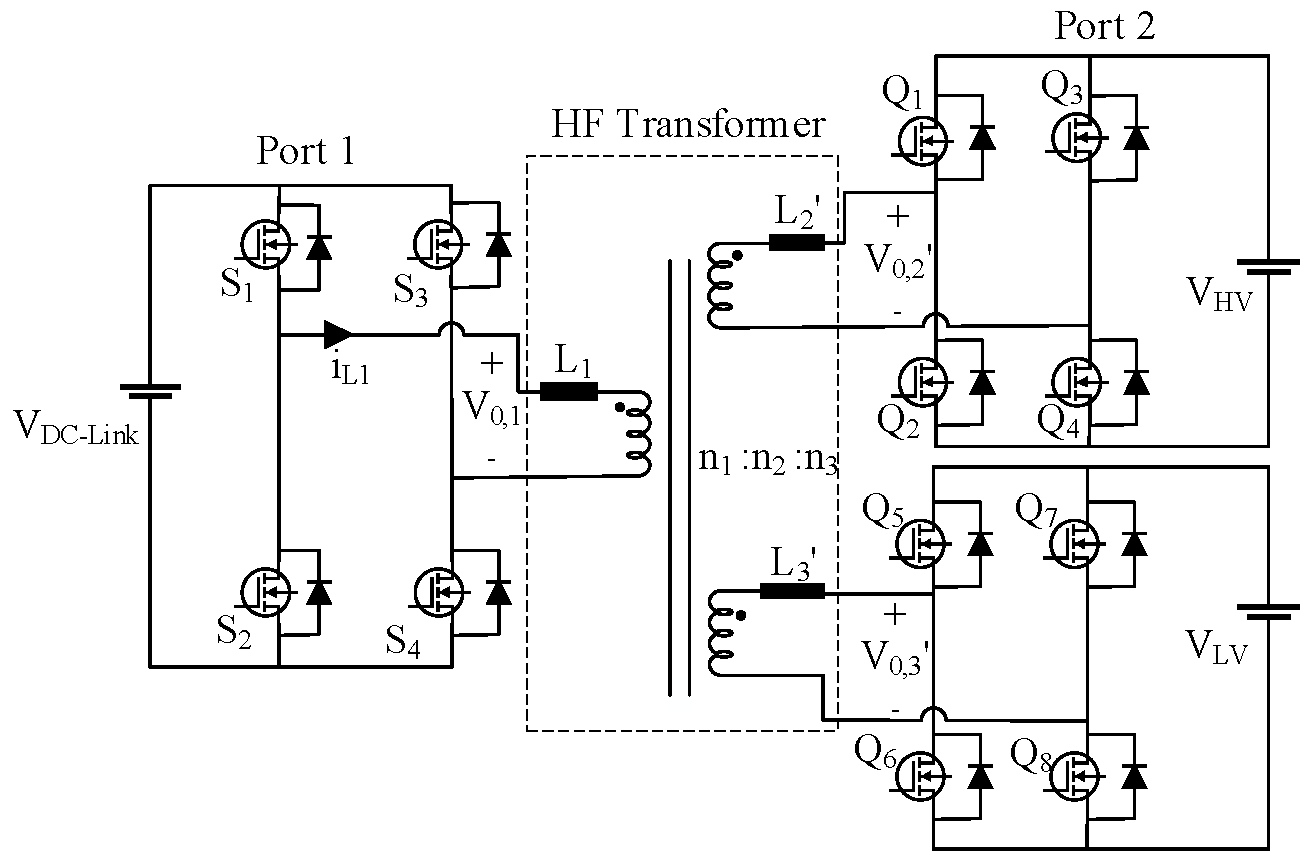
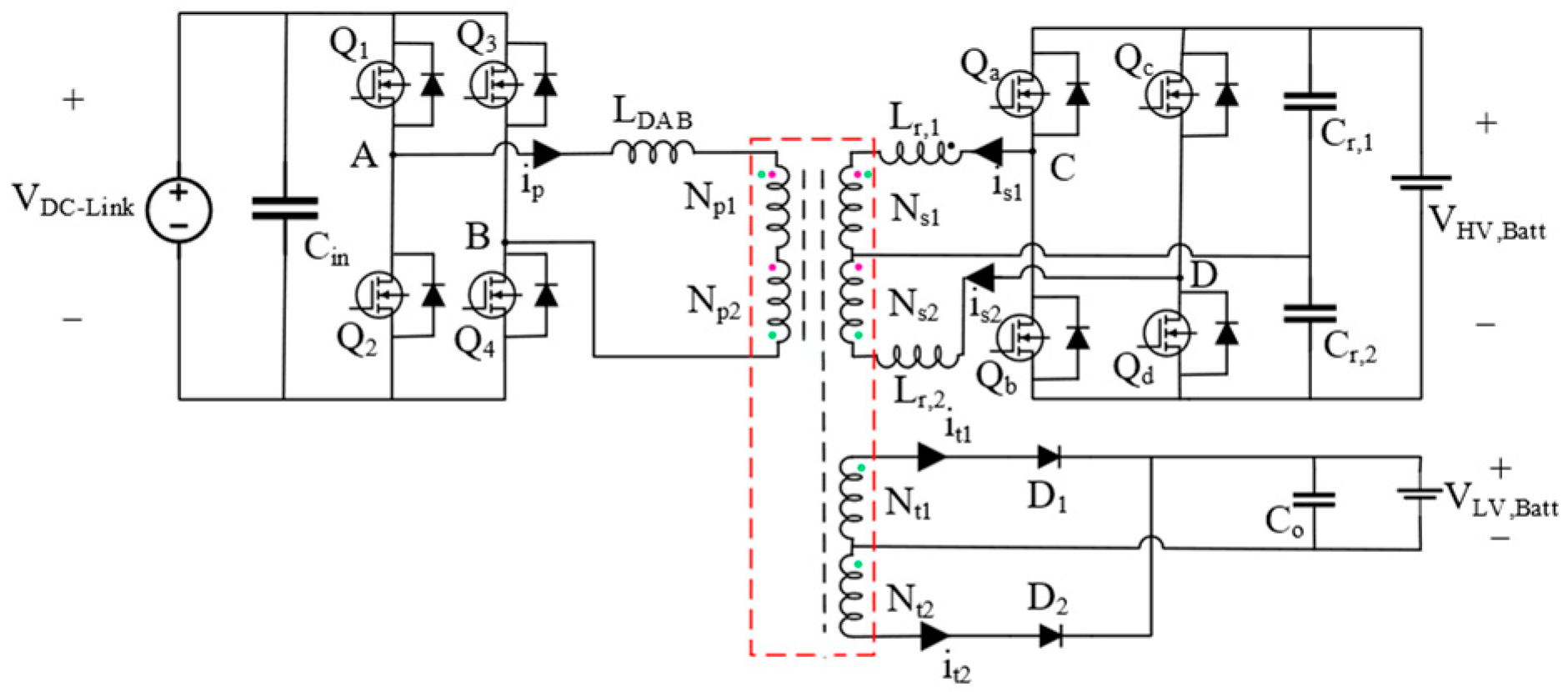
Kougioulis et al. [18] presented a control strategy for a Triple-Active Bridge (TAB) converter aimed at reducing total conduction losses in the LV bridge by exploiting five degrees of freedom (DOFs): two phase-shift variables and three duty-cycle variables. The system as shown in Figure 1, employs a three-winding Transformer (TF) with a turn ratio of P1: P2: P3 = 20:18:1 and a power flow distribution of 1: (2/3): (1/3), which results in a 16.7% reduction in the magnetic component volume and a corresponding reduction in core size. This configuration achieves a reduction of at least 50% in total semiconductor losses. The study reports that ports 1 and 2 account for nearly 40% of the total semiconductor conduction losses, while losses at port 3 are minimized through current optimization and the use of low-on-resistance devices connected in parallel. However, the LV bridge loses Zero Voltage Switching (ZVS) under certain operating conditions, leading to additional turn-on losses. Overall, switching losses are reported to contribute approximately 20% to the total semiconductor losses.

2.1.2. Integrated DC-to-DC Conversion System (IDCS) Topology

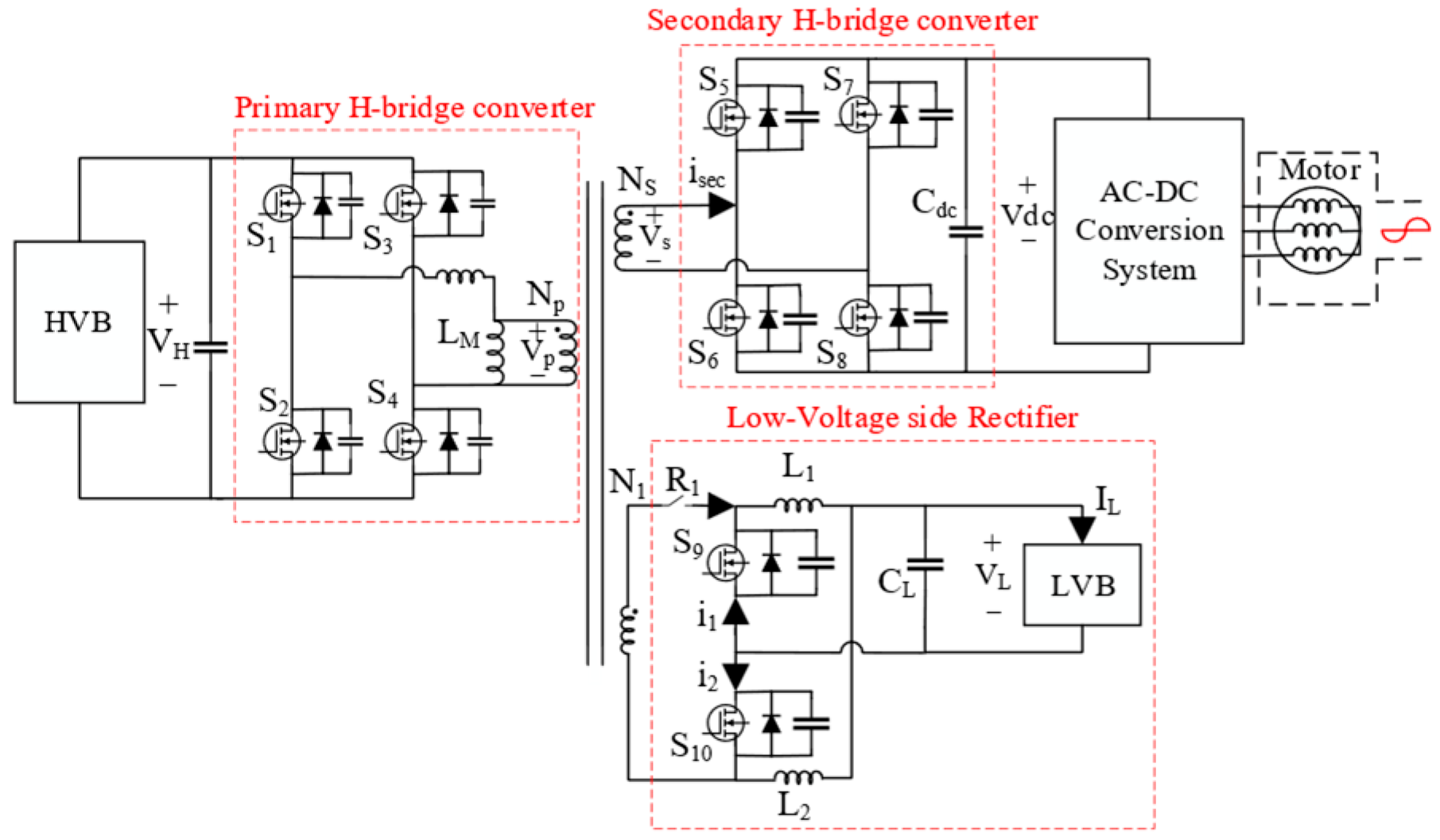
Kim I et al. [19] proposed an integrated architecture based on a Dual Active Bridge (DAB) converter that consolidates the functions of the OBC, LV DC-to-DC converter (LDC) and traction converter (TC). The topology as shown in Figure 2, operates in three distinct modes and supports both SC and bidirectional power flow. The system demonstrates a peak efficiency of 97.4% at 90% load during LDC-traction mode, 96.7% during LDC mode, and 98% during SC mode at full load. A cost analysis reveals that the proposed system reduces expenses by 32%, 35% and 21% compared to discrete DC-to-DC conversion systems (DCS), systems with integrated OBC and LDCs (OLID) and systems integrating OBC with the traction converter (OTID), respectively. The overall cost is minimized by 41%.

2.1.3. Phase-Shift Full-Bridge (PSFB) Converter with Forward Converter Topology

Nam V et al. [20] outlined a converter topology as shown in Figure 3, that eliminates circulating currents through the integration of an additional snubber circuit. This modification reduces the voltage applied to the output inductor during the freewheeling interval, thereby significantly decreasing the inductor current ripple. The converter maintains a high efficiency across the entire load range, achieving a peak efficiency of 96.03% for input voltages between 290 V and 400 V. In HV battery charging mode, a maximum efficiency of 98.2% is reported, while in discharging mode the peak efficiency reaches 97.58%.

2.1.4. Isolated Dual-Output Isolated Converter Topology

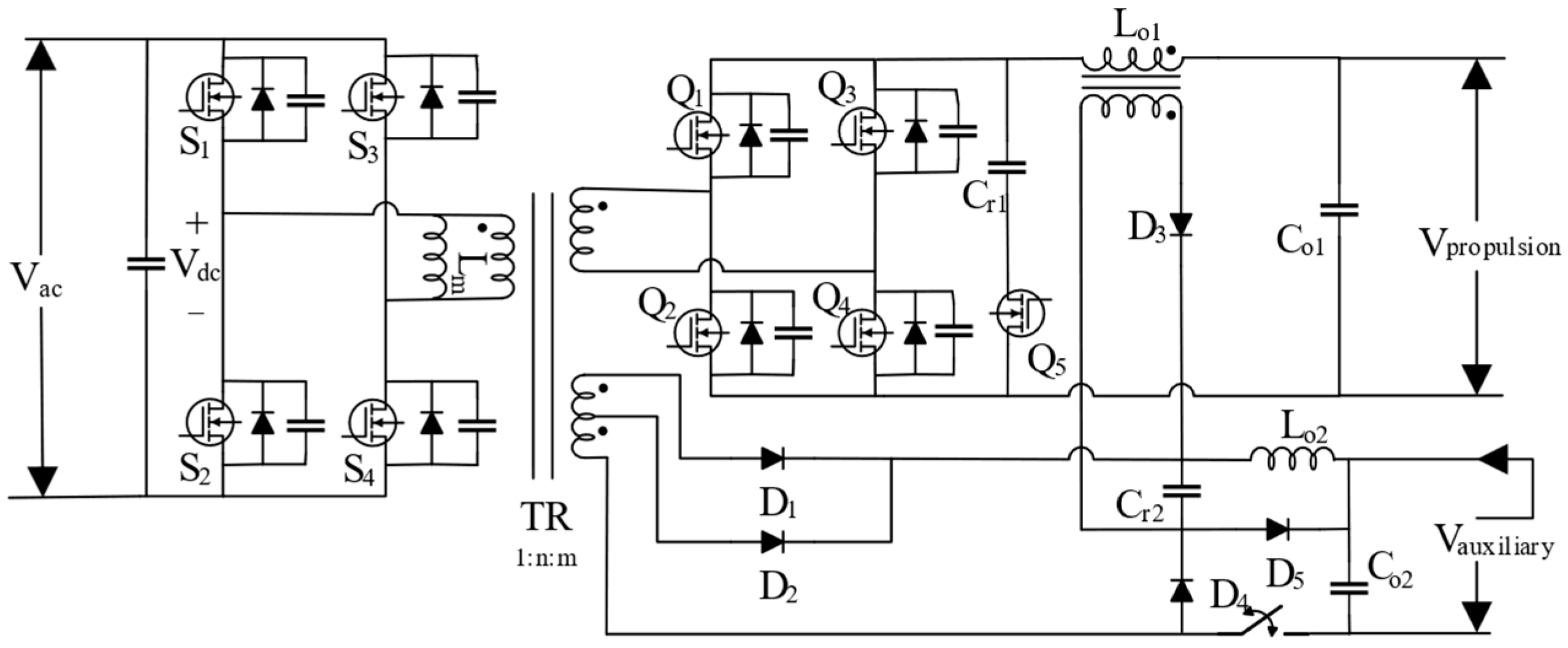
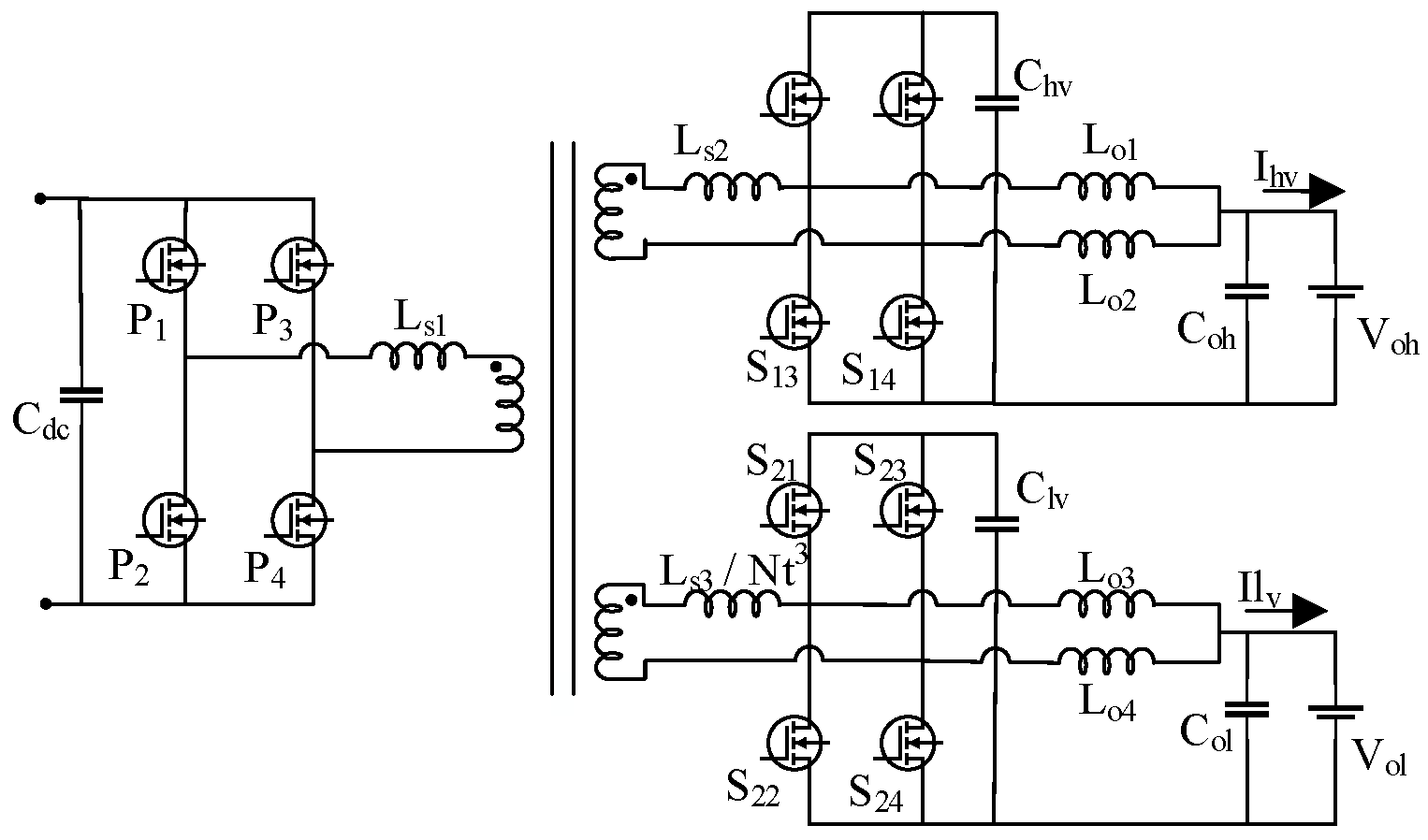
Tang Y et al. [21] formulated an integrated topology that combines an LLC resonant converter and a CLLLC converter using a three-winding gapped TF with a high leakage inductance, enabling the integration of resonant and magnetizing inductances within the TF. This topology as shown in Figure 4, offers a reduced capacitor stress, lower differential-mode noise, and mitigation of flux-doubling during startup. Primary and secondary windings are positioned on opposite EE core limbs, while the tertiary winding resides in the center leg. On the LV side, synchronous full-bridge rectification is adopted to minimize conduction losses and circulating current, with additional back-to-back switches providing load disconnection and reverse polarity protection. The proposed converter achieves a peak efficiency of 96% in V2G operation at 1.1 kW and 93.3% during high-to-low (H2L) transfer at 500 W, with an overall power density of 11.7 W/in3, supported by optimized low-resistance interconnections.

2.1.5. Multifunctional Isolated DC-to-DC Converter Topology

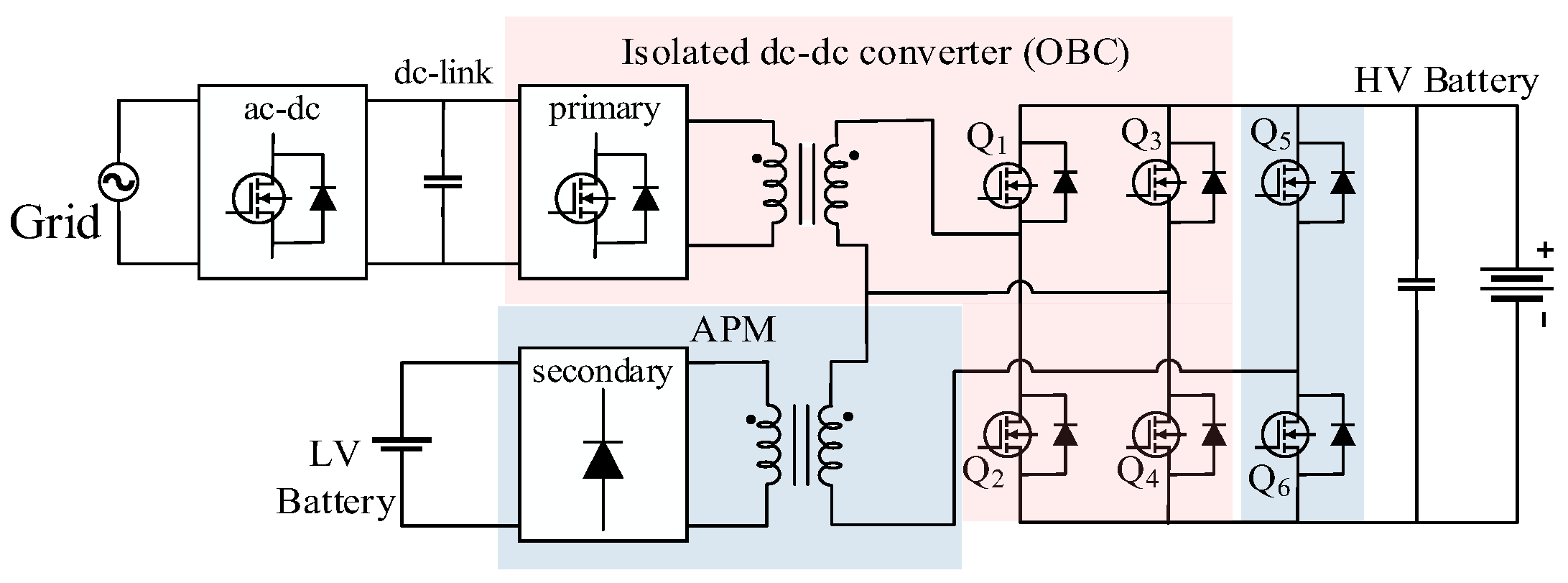
Jo C et al. [22] introduced a multifunctional isolated DC-to-DC converter based on a multi-winding TF, in which the primary and secondary windings are placed on the two outer legs of an EE core, while the tertiary winding is located on the center leg. The topology is depicted in Figure 5. The coupling between the windings varies with the operating mode and is controlled through a pulse width modulation (PWM) strategy. During OBC charging and discharging modes, where the HV battery is either charged from or discharged to the grid, the converter operates as a DAB, resulting in a negligible voltage across the tertiary winding. When the OBC is used to charge the LV battery, the converter operates as an LLC resonant converter. In OBC charging and discharging modes, the converter achieves maximum efficiencies of 98.4% and 98.6%, respectively, at an output power of 1.2 kW. In LDC mode, a maximum efficiency of 93.22% is attained at an output power of 600 W.

2.1.6. PSFB Converter with LLC Resonant Converter Topology

Yu G et al. [7] put forth an integrated charger architecture that merges the secondary leg of the OBC and the primary leg of the APM into a common leg, enabling both independent and simultaneous operation while reducing the total number of switches. A variable DC-link control scheme is employed for the LLC resonant converter, allowing near-unity gain operation with a narrow frequency control range. This charger as shown in Figure 6, incorporates a half-bridge LLC resonant converter with adaptive DC-link control and a PSFB converter with a current doubler (CD) rectifier. The PSFB topology provides a wide operating range and structural simplicity, while the CD rectifier enables a lower TF turn ratio and reduced secondary-side winding current. The proposed integrated charger achieves a 17% reduction in volume, 19% cost savings and 66% lower conduction losses compared to conventional chargers, while demonstrating peak efficiencies of 96.89% and 95.46%.

2.1.7. Dual-Functional Unit (DFC) Topology

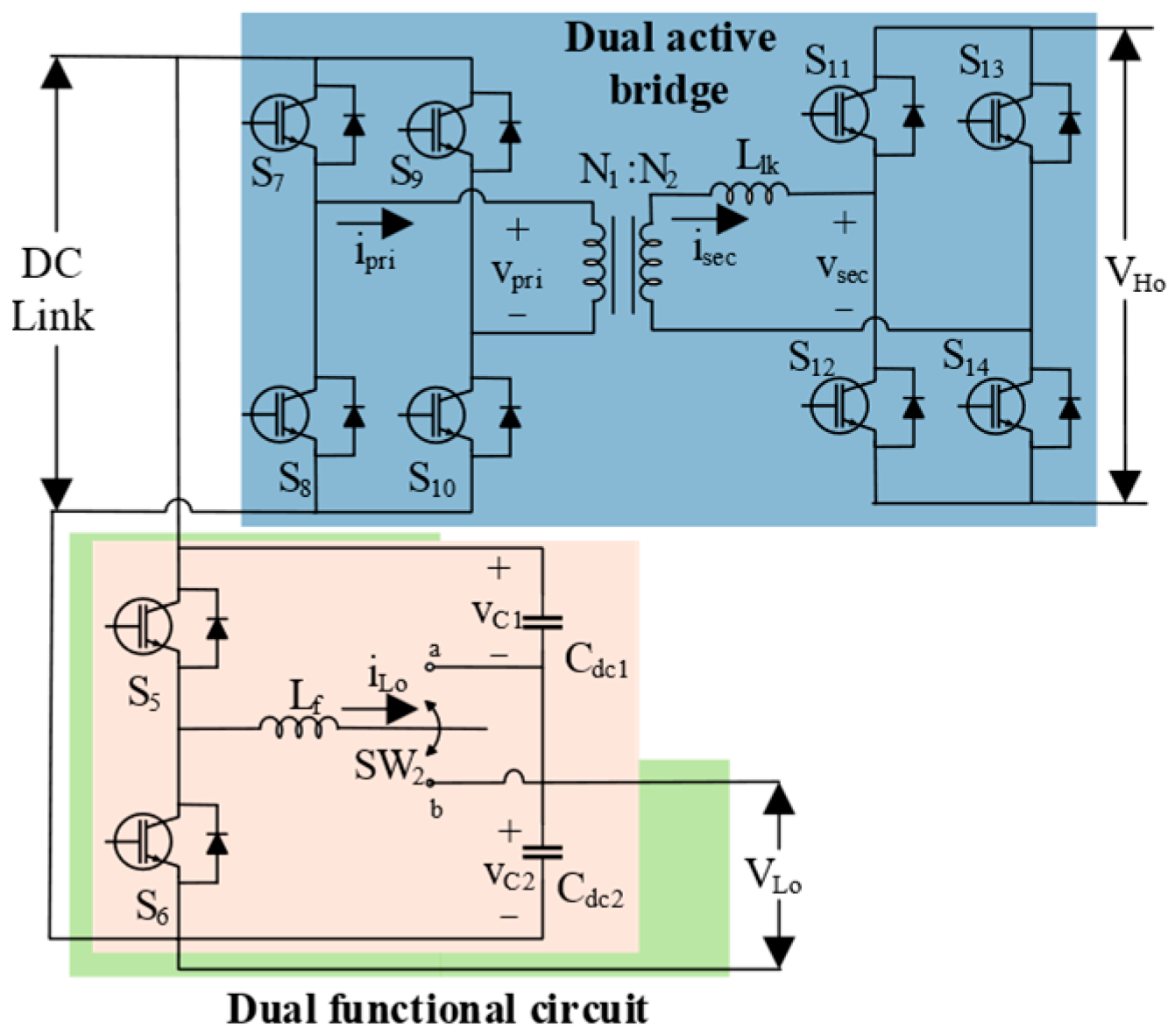
Nguyen H et al. [1] focused on mitigating low-frequency ripple power at the DC-link, enabling a significant reduction in the required capacitor size. The proposed converter as shown in Figure 7, consists of three stages: a full-bridge converter, a DAB converter and a DFC responsible for LV battery charging and active power decoupling. The system achieves an overall efficiency of approximately 92.6% when the HV battery is charged from the grid. During grid-to-vehicle (G2V) operation, where the HV battery supplies power back to the grid, the efficiency ranges from 90.8% to 95.3%. For HV-to-LV battery charging, the efficiency varies between 77.7% and 89.24%. Compared with the existing solution reported in [23], the inclusion of an auxiliary circuit reduces the converter’s efficiency by 1.7% but leads to substantial reductions in cost and volume by 53.4% and 70.2%, respectively.

2.1.8. Current-Fed Triple-Active Bridge (CFTAB) Converter Topology

Zhu L et al. [24] outlined a current-fed three-port converter in which power flow is regulated through a phase-shift control between the ports. This converter shown in Figure 8, employs five independent control variables to enable flexible and precise power management. The topology utilizes negatively coupled inductors to significantly reduce the output filter size. Due to the interleaved operation of the phase-shifted legs, the coupled inductors effectively cancel the DC component of the output current, resulting in magnetic flux generated primarily by AC ripple currents. In addition, the HV and LV battery voltages are center-aligned with the primary side voltage, yielding zero power transfer between these two ports under steady-state conditions. The proposed system achieves a power density of 2.05 kW/L. To further enhance system performance, the implementation of power decoupling methods and closed-loop control strategies has been suggested.

2.1.9. Full-Bridge Isolated DC-to-DC Converter Topology

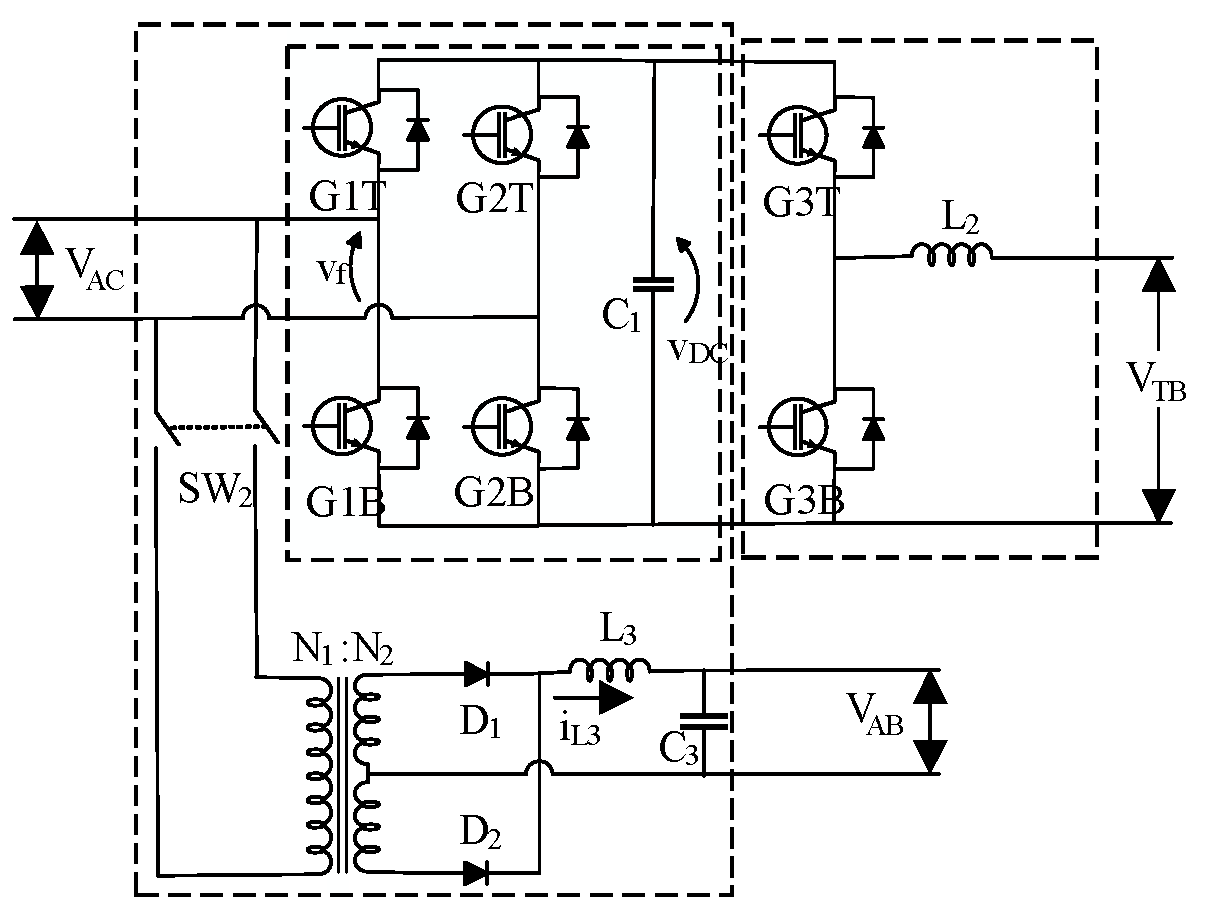
Pinto J et al. [3] proposed a bidirectional full-bridge AC-to-DC converter system that reutilizes the Insulated Gate Bipolar Transistors (IGBTs) of the full-bridge converter in conjunction with a compact high-frequency TF and two fast-recovery diodes, thereby forming a full-bridge isolated DC-to-DC converter. Figure 9 illustrates the system topology. The reactive power is dynamically regulated in accordance with grid requirements. The During G2V operation, the full-bridge functions as a rectifier, whereas in V2G mode it operates as an inverter. Concurrently, the DC-to-DC converter operates in buck mode during G2V operation and in boost mode during V2G operation. Gate pulses for both modes are generated using a predictive current control algorithm implemented with a unipolar sinusoidal PWM (SPWM). When the HV battery charges the LV battery, the full-bridge converter switches serve as the primary side switches, and the DC-to-DC converter remains inactive. The bidirectional converter draws sinusoidal current independent of grid voltage variations, thereby enhancing the grid power quality. Table 1 presents a comparison of the OBC and APM integrated topologies.

2.2. WPT and APM Topologies

2.2.1. Reverse Winding Topology

Wu Y et al. [25] proposed a coil design in which the APM coil employs reverse windings while the compensating inductor is integrated with the receiving coil and configured as a quadrupole structure. This arrangement illustrated in Figure 10, ensures magnetic decoupling from both the unipolar transmitting (Tx) and receiving (Rx) coils. Frequency control is applied to regulate the three full-bridge converters. However, frequency bifurcation (or frequency splitting) is observed, resulting in a non-monotonic variation in the output voltage with the operating frequency. The system enables the wireless charging of both the HV and LV batteries, achieving an efficiency of 93%. When the HV battery is used to charge the LV battery, the efficiency ranges from 75.4% to 80.25%.

2.2.2. APM TF-Based Topology

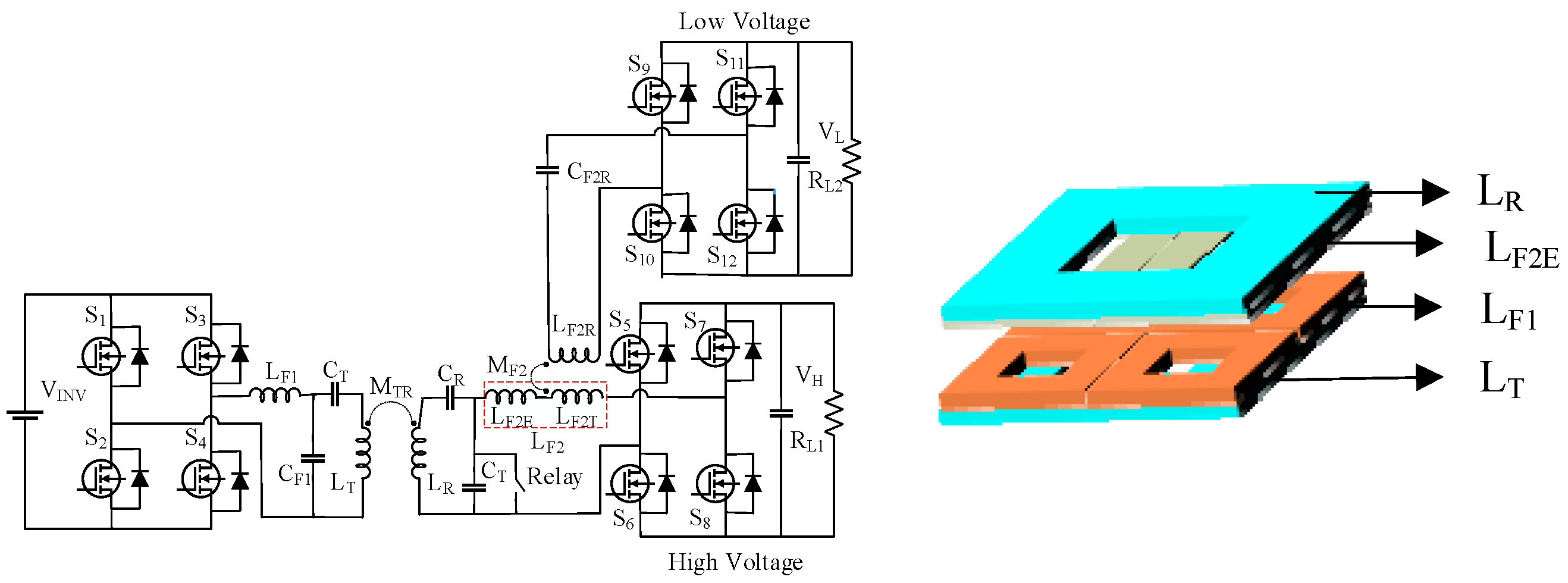
Zhang Y et al. [26] presented an integrated topology based on an LCC–LCC compensation topology, where a relay enables switching between two operating modes: WPT charging of both the HV and LV batteries, and the HV battery charging the LV battery through an APM path. Figure 11 presents a conceptual view of the system topology. In Mode I, the HV output exhibits a constant current (CC) characteristic, while the LV side maintains a constant voltage (CV) output independent of the load. In Mode II, the HV and LV outputs are decoupled, allowing the LV side to sustain a CV output regardless of load variations on the HV side. The Tx coils of the WPT system are designed as unipolar coils, while the compensation inductors are magnetically integrated as a quadrupolar coil on the Tx side and a bipolar coil on the receiving side. Synchronous rectification and ZVS are employed to reduce switching and conduction losses, resulting in a DC-to-DC efficiency of approximately 96% during Mode I. Loss distribution analysis reveals that, in Mode I, the magnetic coupler is the dominant source of loss, whereas in Mode II the main losses occur in the APM TF and compensating inductance. Efficiency improvements can be achieved by enhancing the coil quality factor and coupling coefficient in Mode I, and by optimizing the TF and passive components in Mode II.

2.2.3. S-S Compensated Coupling Topology

Wu Y et al. [27] designed the Tx and Rx coils as unipolar coils with 10 turns each, optimized for efficient magnetic coupling. Figure 12 illustrates the proposed topology. A separate LV coil, consisting of two turns, is placed on the same layer as the Rx coil to facilitate auxiliary power transfer. When both the HV and LV batteries are charged simultaneously via the wireless link, the system achieves an efficiency of approximately 92%. In APM mode, the HV battery supplies power to the LV battery through the LV coil, enabling internal energy management without the need for external input. Table 2 presents a comparative overview of the WPT and APM integrated topologies.

2.3. OBC and WPT

2.3.1. Hybrid DAB and LCC-S Converter Topology

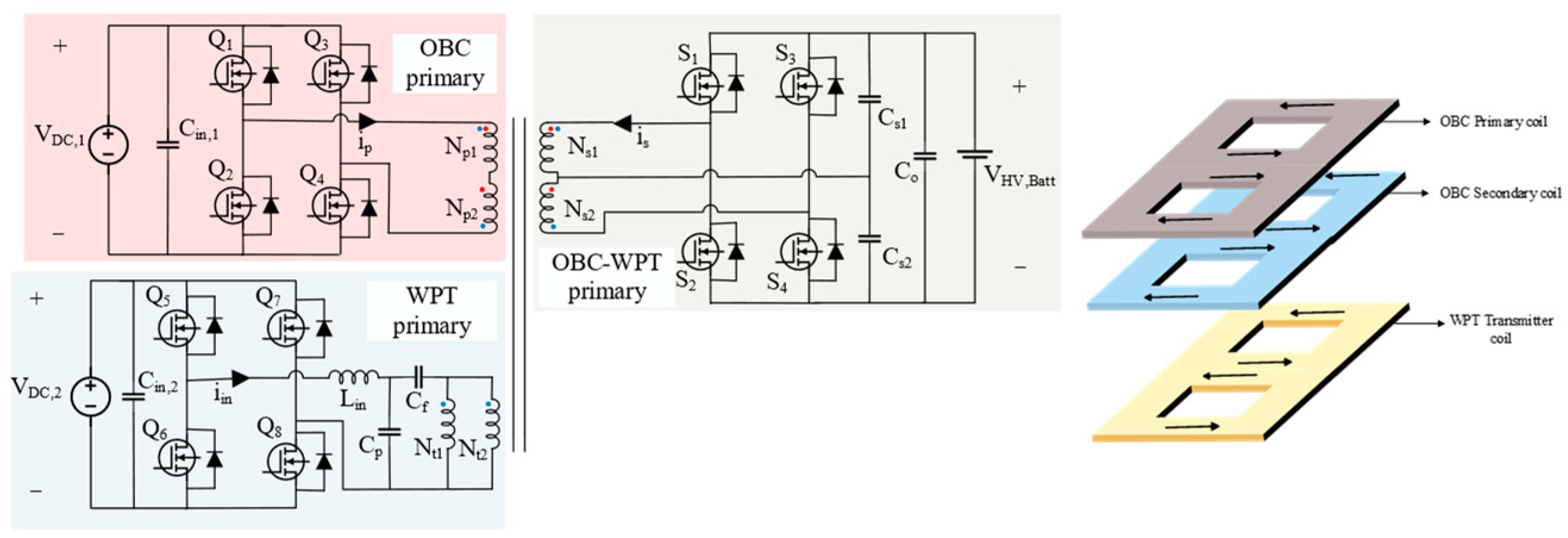
Jo C et al. [28] demonstrated a system that features a novel magnetic coupler design where the secondary coil is shared between OBC and WPT modes. The system as shown in Figure 13, operates as a DAB converter and LCC-S compensated converter in OBC and WPT modes, respectively. The Rx pad incorporates both the OBC primary coil and the OBC/WPT secondary coil, arranged in separate layers to minimize magnetic interference. The OBC primary is wound in opposing directions and connected in series, while the WPT Tx pad comprises two rectangular coils that exclusively couple with the reconfigurable OBC/WPT secondary coil. The system achieves high efficiencies of 97.59% in OBC mode and 94.14% in WPT mode. At light loads under aligned conditions, the system shifts away from resonance in WPT mode, resulting in elevated circulating currents and hard turn-off losses, despite the compensation network being designed to tolerate misalignment. Compared to conventional separated OBC and WPT systems, the proposed design achieves a 10.88% reduction in volume and a 10.21% reduction in cost.

2.3.2. Hybrid CLLC and LCC-S Topology

Zhang Y et al. [29] designed the coupling coils such that the Rx coil should be strongly coupled with the Tx coil of the OBC system and loosely coupled with the Tx coil of the WPT system. This is achieved by stacking the Rx coil with the OBC Tx coil, while the WPT Tx coil and compensating inductor are positioned to reduce magnetic interaction as shown in Figure 14. Despite the integration, the system achieves a 97% efficiency in OBC mode and 96% in WPT mode. The efficiency is slightly impacted by the increased leakage in OBC mode and the reduced coupling in WPT mode. Due to differing transfer characteristics, output power varies with load in opposite trends for each mode, suggesting the need for an additional DC-to-DC stage for voltage regulation.

2.3.3. Dual-Bridge Series Resonant Converter (DBSRC) Topology

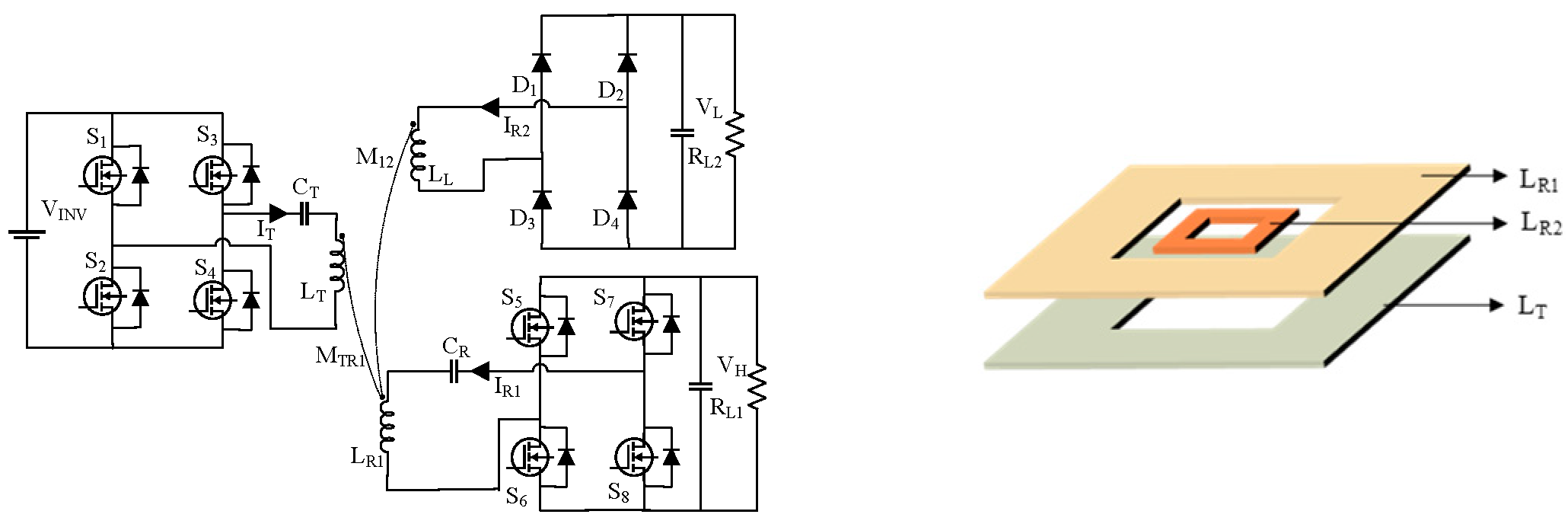
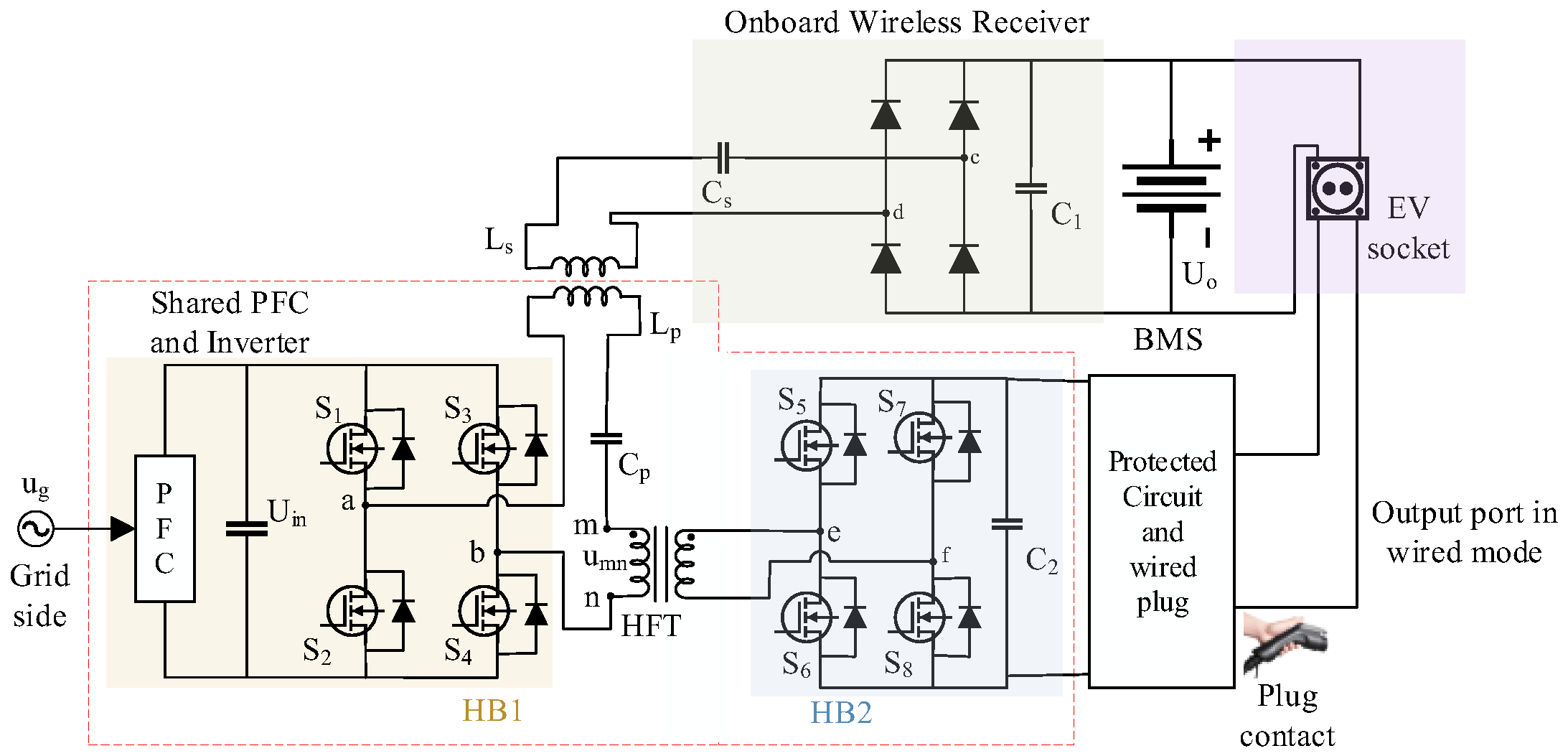
Wu F et al. [30] proposed a unified converter architecture that shares the input PFC stage, inverter, resonant network, TF and rectifier. In wired mode, power is transferred through a high-frequency TF (HFT) and delivered to the on-board battery via an active rectifier and charging gun. Figure 15 presents a conceptual view of the system topology. In wireless mode, the Tx coil serves as the magnetic coupling element, transferring power through the wireless coils and a diode rectifier to the battery. To address frequency detuning caused by parameter fluctuations in wireless operation, a closed-loop frequency tuning strategy is implemented using the existing TF and resonant network from the wired mode. At a Tx power of approximately 5800 W, the system demonstrates a high efficiency, with power loss on the skid plate remaining below 0.7% and the maximum temperature rise under 0.4%. These results confirm that the system operates with minimal EMI and maintains thermal stability. High efficiencies of 92.7% and 91.4% are obtained for the wired and wireless modes, respectively.

2.3.4. Integrated WPT-CLLC Resonant Converter Topology

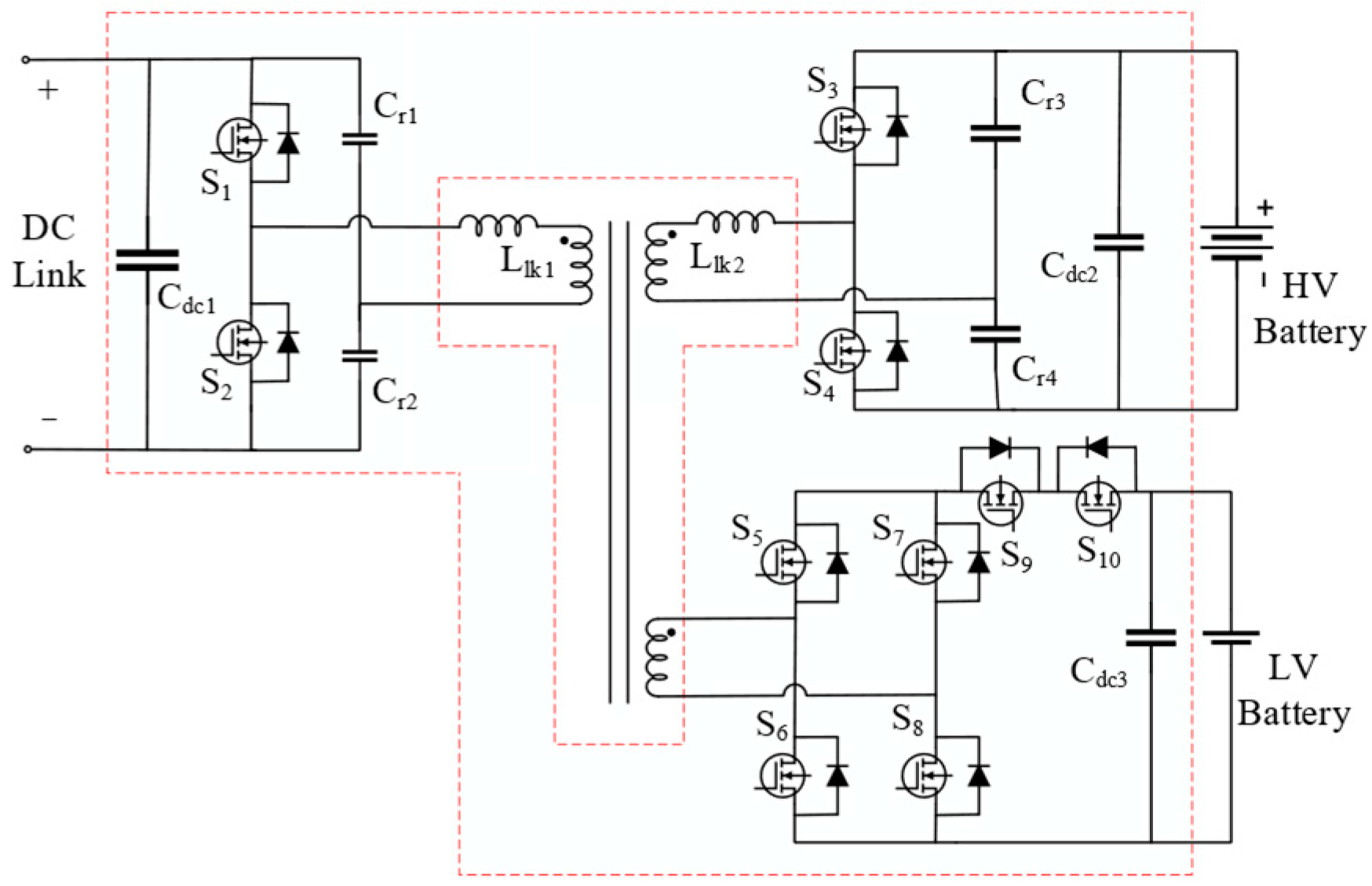
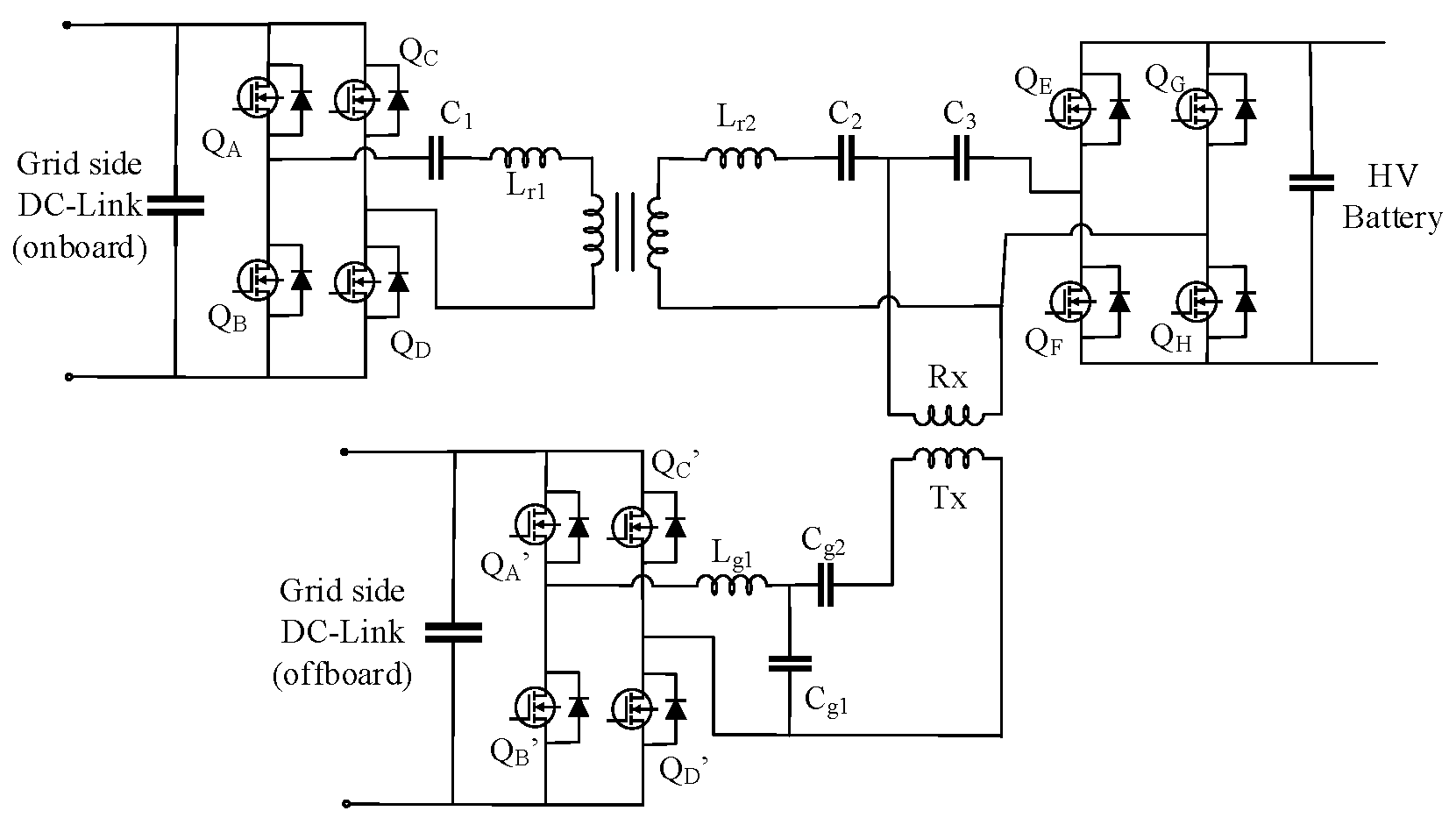
Elshaer M et al. [31] proposed an integrated WPT system in which the Rx coil is directly interfaced with the secondary side of a CLLC resonant converter. The secondary capacitors of the CLLC network are split to enable dual-mode operation, allowing for seamless transitions between wired and wireless charging. This configuration minimizes current circulation through the Rx coil during OBC and eliminates losses in the TF primary during wireless operation. A bidirectional DC-to-DC converter controls the power flow to the HV battery through a phase-shift modulation of both the full-bridge inverter and rectifier. Figure 16 provides an overview of the system topology. By independently tuning the phase shift between the rectifier legs and the inverter–rectifier bridges, two additional DOFs are introduced for precise power regulation. Switching frequency control and a PI controller are employed to achieve optimal soft-switching and improve misalignment tolerance. The system achieves peak efficiencies of 95.6% during wired charging at 5 kW and 93.4% during wireless charging at 7.7 kW. Table 3 presents a comparative overview of the OBC and WPT architectures.

2.4. OBC, WPT and APM

2.4.1. Parallel-Wound Coil Integrated LCC/S-S Compensation Topology

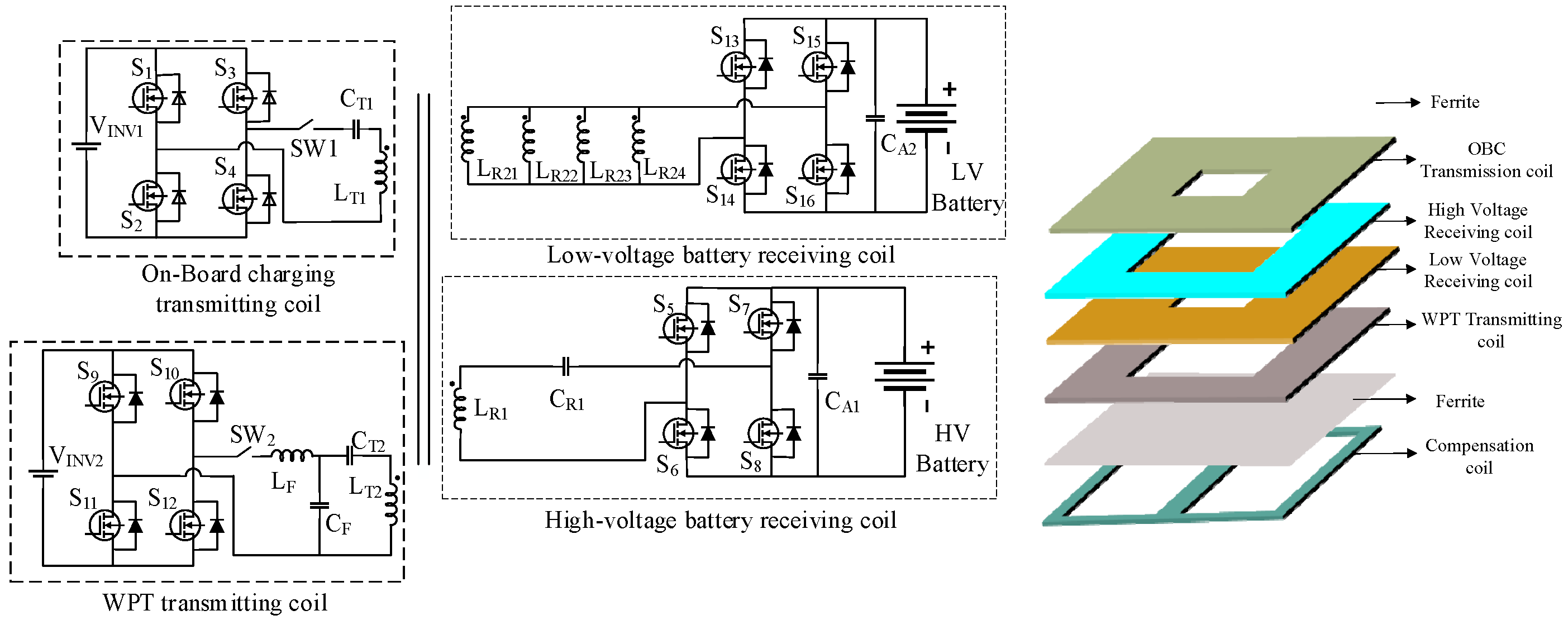
Xu W et al. [32] demonstrated a vertically stacked OBC Tx coil, HV receiving coil and LV receiving coil in increasing order of distance from the magnetic core. Figure 17 depicts the overall topology of the proposed framework. The WPT Tx coil and its compensating inductor are placed above and below their respective magnetic cores, with the inductors wound in a DD configuration to achieve magnetic decoupling from the WPT coil. To reduce self-inductance and meet LV-side voltage requirements, a parallel winding strategy is implemented with four groups of wires, each consisting of three parallel conductors, that are interleaved and sequence-exchanged across layers to ensure uniform current sharing. LCC compensation is used on the WPT transmitting side for voltage gain control, while leakage-based and S–S compensation schemes are employed across the vehicle side in all other modes. By selectively disconnecting coils based on the operating mode, the system enables efficient and compact multi-mode operation with shared magnetic components.

2.4.2. Multi-Function Magnetic Coupler-Based Topology

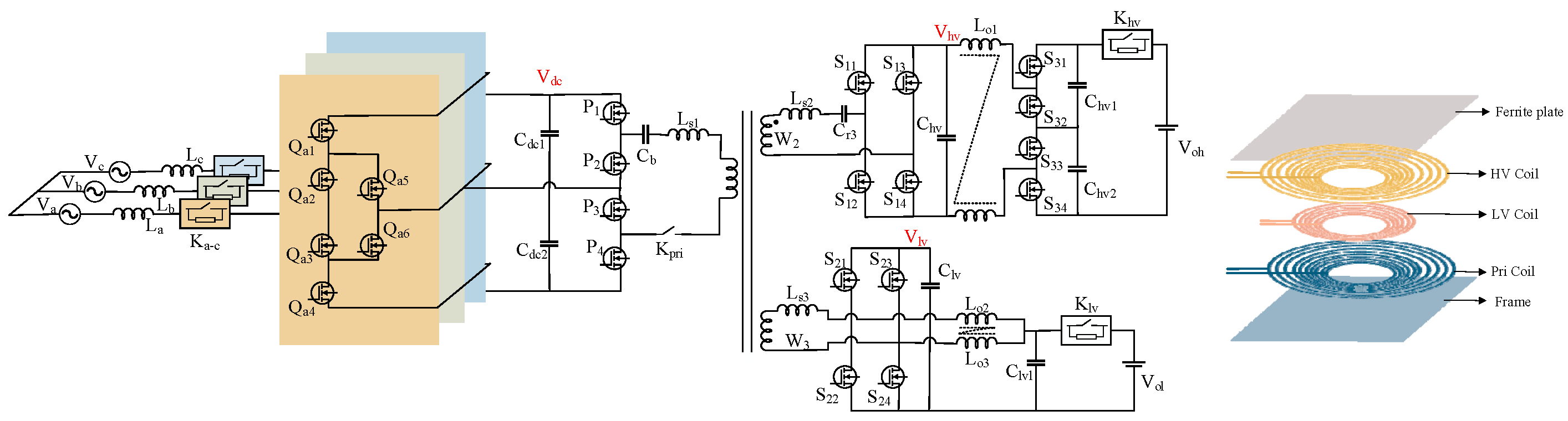
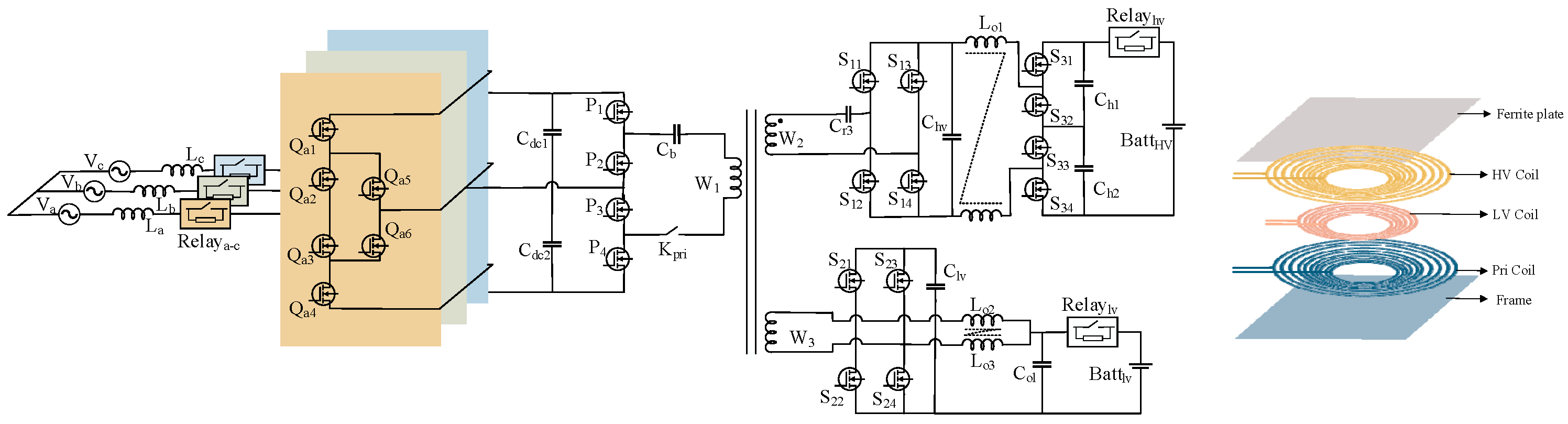
Zhu L et al. [33] proposed a topology where a multi-winding WPT charging pad serves as the main TF in the OBC and APM modes. The magnetic coupler serves as either the main TF or the receiver pad for the WPT mode. The front-end AC-to-DC converter is built using three Active Neutral Point Clamping (ANPC) legs. The TAB converter configuration, featuring a voltage-fed (VF) port on the HV side and a current-fed (CF) port on the LV side, is shown in Figure 18. The HV battery is interfaced with a three-level boost converter connected in series. The boost converter plays different roles in different charging modes, i.e., in WPT mode, the boost converter matches the output voltage from the rectifier and the HV battery and controls the charging power. In APM mode, the converter works in buck mode to minimize the voltage applied to the CFDAB stage. During the bidirectional OBC mode, the converter acts as a DAB converter. When the WPT charges the battery, the LCC-S compensation used ensures a constant voltage gain regardless of the load condition. When the HV battery charges the LV battery, lower current stress is observed on the LV-side switches.

2.4.3. Dual-Receiver Multilayer Magnetic Coupler Topology

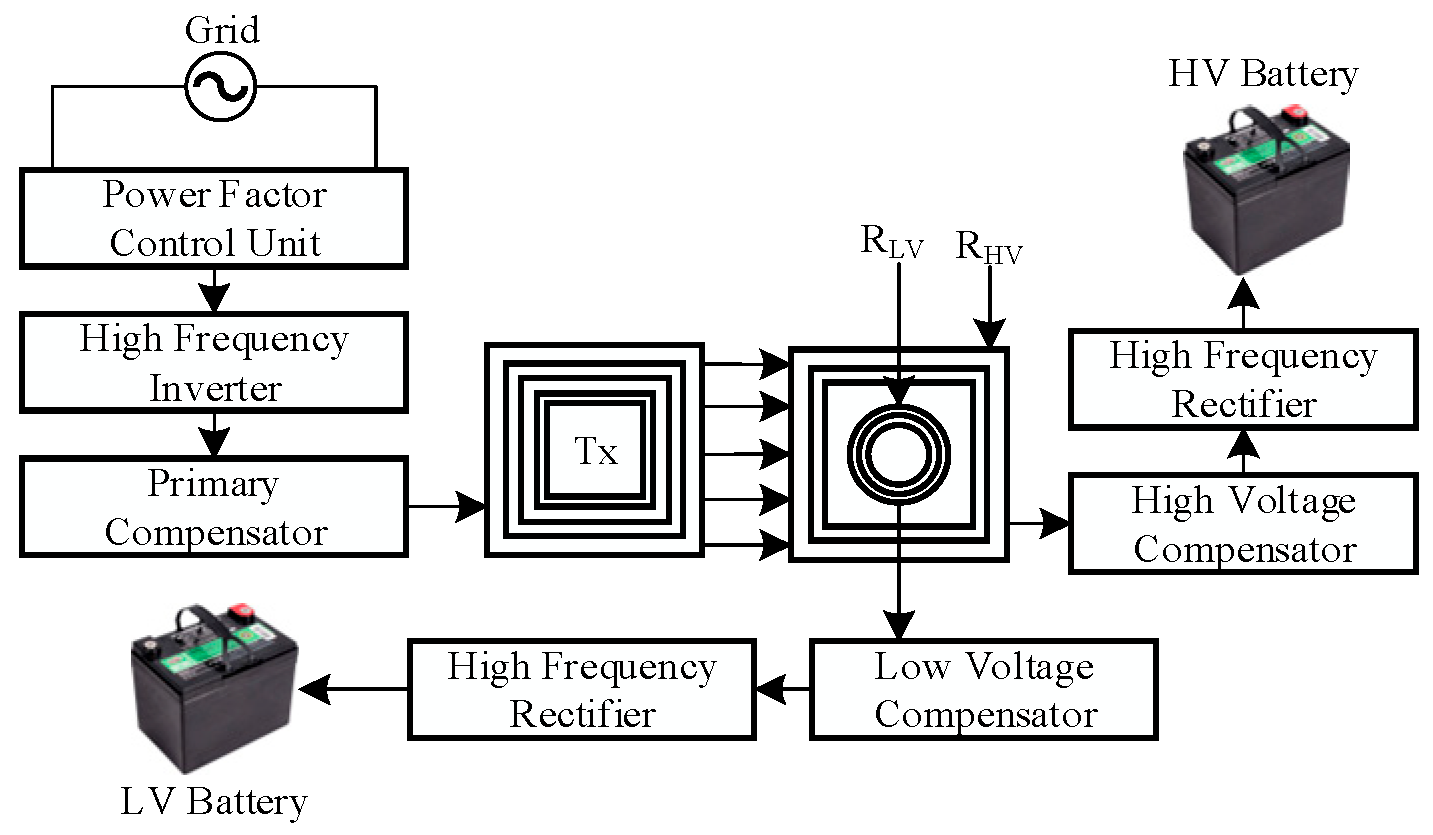
Nakkeeran R et al. [34] designed an integrated system to smooth out output power fluctuations caused by crosstalk and resonance frequency fluctuations while also ensuring efficiency during misalignment. Figure 19 presents a conceptual view of the system topology. To eliminate voltage conflicts between the Tx winding and the LV winding, the system employs relays that selectively isolate the windings during different operational modes. S-S compensation, complemented by an active reactance compensator that dynamically adjusts the reactive elements based on load, mitigates cross-coupling effects. The reported efficiencies achieved were 88.1% for WPT operation and 89% for the APM.

2.4.4. Shared Power Converter Topology

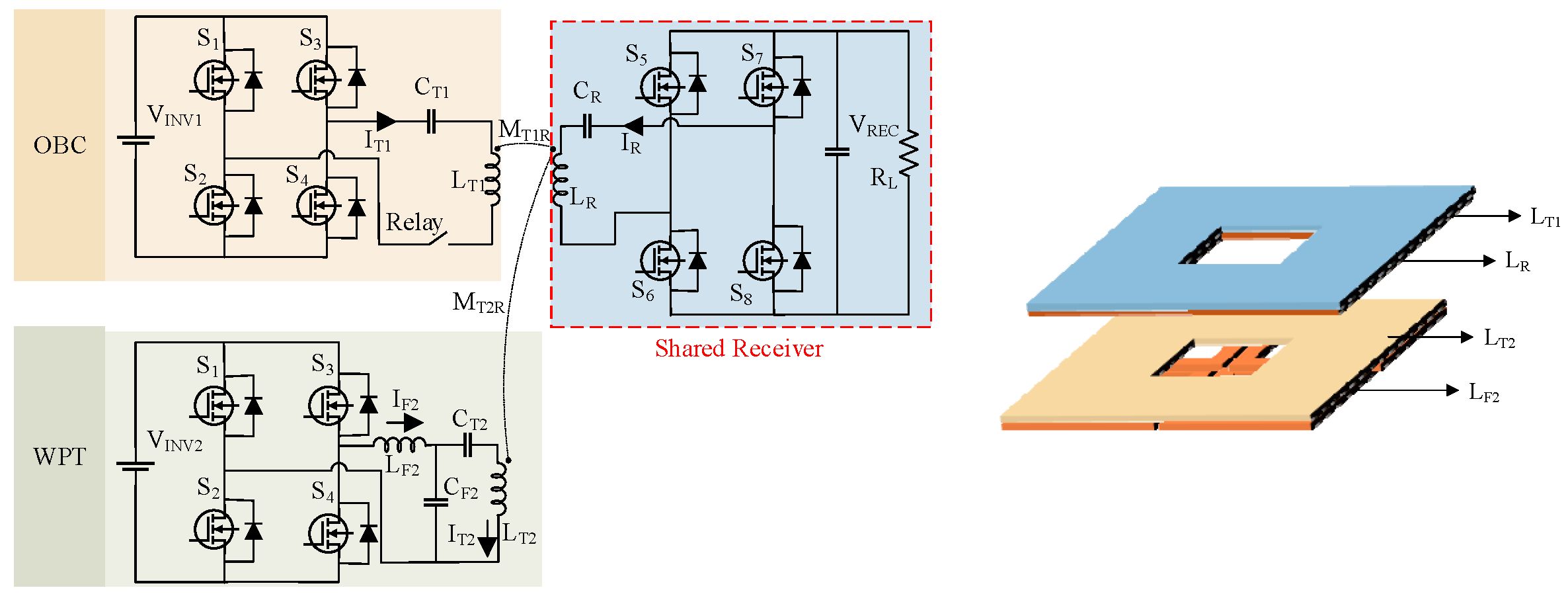
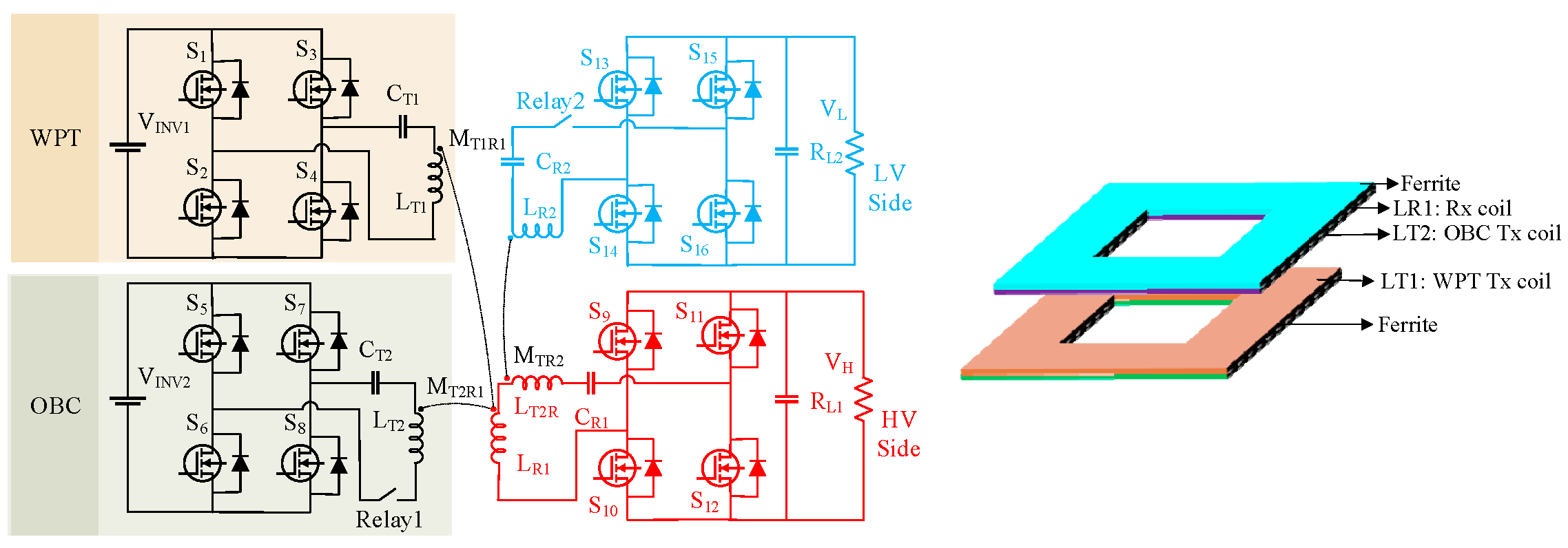
Wu Y et al. [35] designed a WPT subsystem that employs an S–S compensation network to achieve a CC output and an OBC that utilizes a CLLC resonant converter. Figure 20 provides an overview of the system topology. A dedicated APM TF facilitates bidirectional power flow between the HV and LV batteries, enabling flexible power management across different modes. LT2 and LR1 coils are stacked and strongly coupled, while LT1 and LR1 remain weakly coupled, ensuring the necessary magnetic isolation between WPT and OBC operations. In wireless charging mode, the maximum efficiency is 96.3% when the HV battery is charged alone and 86.7% when the LV battery is charged alone. In conductive charging mode, the HV battery achieves a peak efficiency of 97.6%, while the LV battery reaches a maximum efficiency of 78%.

2.4.5. Multipurpose Magnetic Coupler-Based Topology

Liang Z et al. [36] proposed a charger with a shared magnetic coupler that supports OBC, WPT and APM modes through selective coupling. The system as shown in Figure 21, integrates a three-level ANPC rectifier and a TAB converter, with LCC-S compensation adopted for wireless charging. Control techniques such as phase-shift and PWM, along with zero-current detection (ZCD)-based synchronous rectification, are used. To reduce the resistance of the LV coil and achieve strong coupling, a multiturn-paralleling structure is used. The system reports peak efficiencies of 96.1% in OBC mode, 92% in WPT mode and 92% in APM mode, while occupying just 9.92 L, over 2 L less than comparable non-integrated solutions. Table 4 summarizes the key differences among the topologies.

3. Key Features

3.1. Magnetic Coupling

In EVs, OBC and APM integration is implemented using a three-winding HFT, which serves as the central interface in multi-port DC-to-DC converter topologies [18,19,21,22,24]. This configuration typically features primary, secondary and tertiary windings corresponding to different functional ports, enabling bidirectional energy flow and galvanic isolation between HV and LV battery domains. Table 5 provides a comparison of TF-based integration. It should be noted that several reviewed studies do not explicitly specify whether galvanic isolation is preserved across all operating modes; therefore, the isolation behavior may be mode-dependent and implementation specific. To address the limitations associated with HFTs, [7] proposes an alternative architecture with two magnetically integrated TFs. In this scheme, the secondary leg of the OBC and the primary leg of the APM are combined into a shared magnetic leg, resulting in a flatter profile, simplified magnetic design and more straightforward flux path and leakage inductance management. While this method slightly reduces the integration density, it offers a more practical solution for thermally and spatially constrained EV platforms.
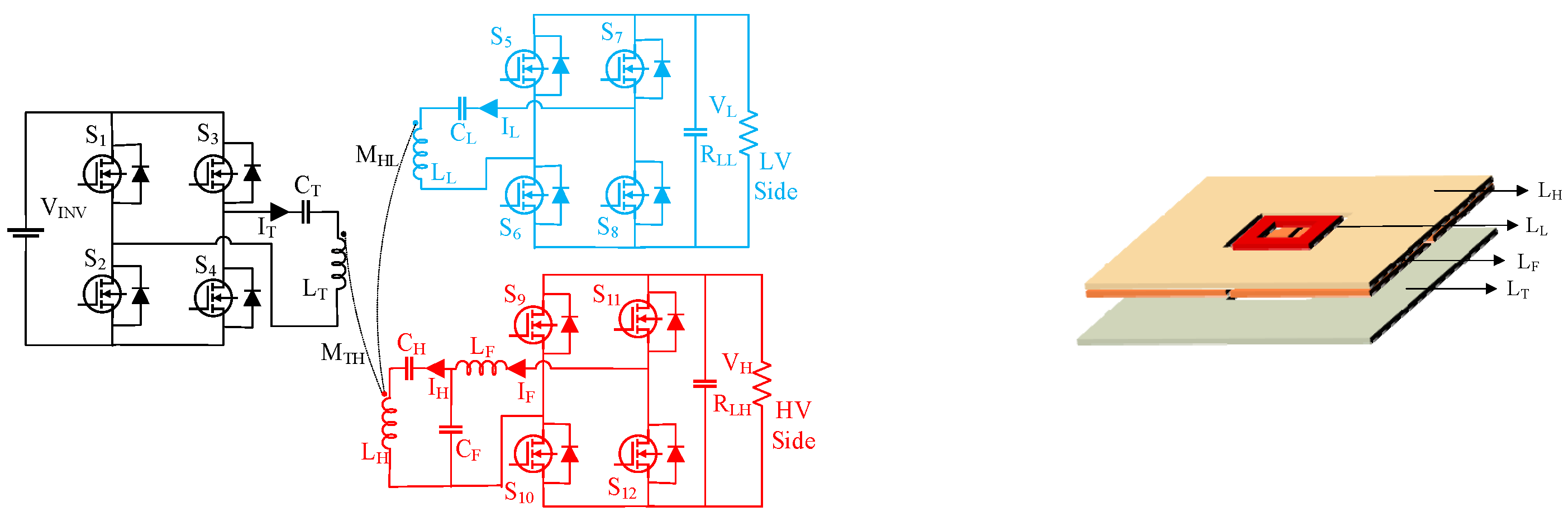
In advanced WPT architectures, the coupler is reimagined as a shared magnetic interface supporting multiple power paths, i.e., the same coil structure can be reused to route power internally between varied voltage domains within the vehicle. In such systems, the WPT charging pad is often designed as a multi-winding magnetic coupler that can function not only as the receiver coil in the WPT mode but also as the main high-frequency TF during wired charging operations. The winding topologies employed in Integrated architectures have been illustrated in Figure 22. This dual-use magnetic structure supports seamless mode switching and aligns well with multi-port converter topologies that manage bidirectional energy flow. For instance, the architecture proposed by [36] demonstrates how the repurposed magnetic coupler can support both HV and LV domains across OBC and WPT operations without compromising isolation or performance. The system in [28] reported a 10.88% reduction in system volume and a 10.21% cost savings, while [36]’s design achieved a reduction of over 2 L in total magnetic component volume through the shared use of HV and LV windings. However, leveraging WPT coils across multiple charging modes requires precise control over magnetic coupling and the operating frequency to ensure a mode-selective, efficient and isolated power transfer. These requirements drive the need for advanced compensation topologies and coil design strategies capable of tuning magnetic behavior across operating modes. Supporting this, the experimental results in [30] demonstrate that, at high Tx power levels, the system exhibits minimal EMI and excellent thermal stability, reinforcing the viability of such integrated magnetic structures.
Among the most widely adopted compensation configurations are the S–S and LCC topologies. The S–S topology is known for its inherent CC output characteristics, making it suitable for applications requiring stable charging current [32,35]. In contrast, the LCC topology, often implemented on the HV side, is favored for achieving CV output when paired with series compensation on the LV side [25]. Configurations such as LCC–LCC and LCC–S offer distinct advantages. Figure 23 illustrates the compensation topologies employed in integrated chargers. The LCC–LCC arrangement provides CC characteristics, which can be adapted to realize a CV output at the LV end through appropriate control strategies [26]. Additionally, the LCC–S topology maintains a near-constant primary-side power loss regardless of load, enhancing system efficiency and predictability [28]. It also ensures a stable voltage gain across varying load conditions [33] and is effective in achieving the desired voltage conversion ratio on the wireless charging side [32].
Among the various compensation topologies, LCC compensation is especially favored in WPT applications due to its high efficiency, ZVS capability and tolerance to misalignment. To address concerns regarding the need for extra passive elements, recent designs have explored embedding the compensation inductors directly within the Tx or Rx coils, thereby sharing the magnetic path and eliminating the need for separate magnetic elements [25,26,29,32]. Advanced winding configurations such as unipolar, bipolar and quadrupolar coils are instrumental in this regard.

3.2. Electronic Integration

Electronic integration in EV charging systems, with both wireless and plug-in charging paths, comes with increased design complexity, elevated switching and conduction losses and intricate mode management challenges. Also, the coexistence of traction batteries and auxiliary batteries adds to the complexity. Recent advances in EV OBC systems focus on integrating multiple converter topologies, enabling a seamless operation across grid-connected, WPT and auxiliary power modes by dynamically adapting roles like buck, boost and bidirectional power flow [1,28,33]. Resonant converter topologies, including LLC, CLLLC and hybrid PSFB designs, are frequently integrated to reduce switching losses, current stress and component count, while providing soft-switching and bidirectional capability through advanced control algorithms [3,7]. Innovative solutions utilize electromagnetic integrated TFs (EMITs) and multi-winding arrangements to intertwine resonant stages, enabling an efficient voltage regulation and power delivery to both high-voltage traction batteries and low-voltage DC loads [21]. Sharing components such as heatsinks, filters and switching legs across converter stages further simplifies the system design without compromising performance [7]. Moreover, active clamp circuits, current-doubler synchronous rectifiers and dual-functional circuits facilitate active power decoupling and reduce conduction losses [1,19]. Additional topologies employing current-fed three-port converters and asymmetrical half-bridge modes address voltage stress and conduction losses [24,37]. Table 6 presents an overview of electronics interfaces employed in integrated chargers. These integrated converter solutions prove their capability to manage diverse power sources and operating conditions.
Across the surveyed converter topologies, a clear shift is observed towards unified control architectures that complement deep electronic integration. Designs such as the hybrid DAB-LCC-S [28] and triple full-bridge with selective switching [32] demonstrate how shared power stages enable multifunctional operation. Integrated control strategies govern multiple operating modes through modulation schemes like PWM, phase-shift, predictive current control and orthogonal phase regulation [22,33,34], enabling seamless transitions between charging systems and battery domains. Adaptive and frequency-shift-based methods [28,33,36] further optimize performance under variable load or resonance conditions. In such systems, soft-switching and intelligent frequency control [24,29] improve efficiency and enable misalignment tolerance or fault recovery. Ultimately, control strategies serve as the backbone for the coordination of integrated chargers, balancing dynamic power flow, ensuring safety and unlocking multifunctionality across varying grid, load and alignment conditions.
While a higher integration enhances compactness and power sharing, it tightly couples control loops and protection schemes, escalating the overall system complexity and requiring meticulous coordination in mode switching and thermal management. Conversely, loosely integrated designs [25,35] simplify control and improve modularity, but at the cost of increased hardware and reduced flexibility. The control strategies reviewed define a spectrum of trade-offs. Simpler designs employ conventional PWM or phase-shift control; advanced systems leverage Triple-Phase shift (TPS), sensor-less tuning and multi-degree-of-freedom controllers [3,30,33] to enable real-time adaptation and sophisticated energy flow regulation. For instance, Ref. [31] enables dual-mode operation with a minimal component count, relying on coordinated phase-shift and frequency-tuned control to maintain soft-switching and efficiency across wired and wireless modes. Mode-aware, adaptive control platforms that maintain ZVS, minimize switching losses and support safe transitions even across shared magnetic or converter stages will be the future of integrated charging solutions.

4. Future Trends and Challenges

4.1. Achieving ZVS Across Varying Voltages

In systems such as three-phase converters with a constant DC voltage, the ZVS region is typically narrow and often only achieved at or near maximum power through duty cycle regulation. Techniques such as maintaining the load angle below 90° can help extend the ZVS region across a broader power range [39]. In the context of integrated chargers, frequent mode switching introduces a wide range of voltage and power levels, increasing thermal stress and degrading system reliability. As shown in [18], while efforts to minimize conduction losses can be effective, they may unintentionally forfeit ZVS under certain voltage and power conditions, leading to trade-offs. Therefore, sophisticated control strategies such as predictive modulation, adaptive load angle tuning or coordinated phase-shift control are essential to retain ZVS across dynamic conditions. As emphasized in [7], these control techniques safeguard components from excessive thermal stress during transitions.

4.2. Thermal Management in High-Power Applications

Thermal management is a critical aspect of system integration. Without adequate thermal management, excessive heat build-up can degrade component performance, shorten its lifespan and, in extreme cases, result in catastrophic failure. The converter design proposed in [21] is shown to produce increased circulating currents when there are large differences between input and output voltages, leading to inefficiencies and potential thermal challenges. Similarly, Ref. [22] emphasizes that high-power applications, such as fast charging, are particularly vulnerable to overheating if a robust thermal management system is not in place. In integrated chargers, the reuse of components such as inductors, TFs and switching bridges across multiple operating modes leads to continuous or near-continuous thermal stress on shared elements. The excessive heating in one mode can propagate and impact the performance and reliability of other subsystems, making it difficult to isolate and manage thermal hotspots. In tightly integrated systems, the localized cooling of high-loss areas or mode-specific thermal design optimizations may be essential to ensure long-term reliability without compromising compactness or power density.

4.3. Efficiency Loss Due to Misalignment and Leakage Inductance

To address the problems associated with misalignment in wireless charging systems, a variety of misalignment tolerance strategies have been established in the literature [40,41,42,43,44]. The coils presented in [28,31,32] exhibit an enhanced tolerance to misalignment; however, this design optimization often results in a reduced efficiency under well-aligned conditions, due to compensation strategies tailored to misaligned geometries. Studies such as [29,34] have further identified power losses during misalignment, attributing them to increased leakage inductance. Interestingly, Ref. [21] leveraged this leakage inductance constructively as a component in resonance tuning. The difference in efficiency under alignment and misalignment conditions may exhibit different results depending on the control method and system specifications [28].

4.4. EMI and Isolation Related Issues

As inferred in [32], EMI can substantially impact the functionality of other electrical components in the EV, especially in wireless charging systems. The Coupling–Inductance-Controlled Hybrid Charging Topology [45] highlights that high-frequency switching, which is intrinsic to wireless charging modes, is a primary source of EMI. This interference can disrupt the functionality of sensitive electrical and electronic systems. To mitigate these effects and ensure compliance with EMC standards, ensuring proper electrical isolation, especially between HV and LV domains, is crucial. Therefore, adopting optimized EMI mitigation strategies such as a careful layout design, common-mode filtering and shielding while maintaining a high-power density and compactness is essential for robust and efficient integrated systems.

4.5. Efficiency–Volume Trade-Off

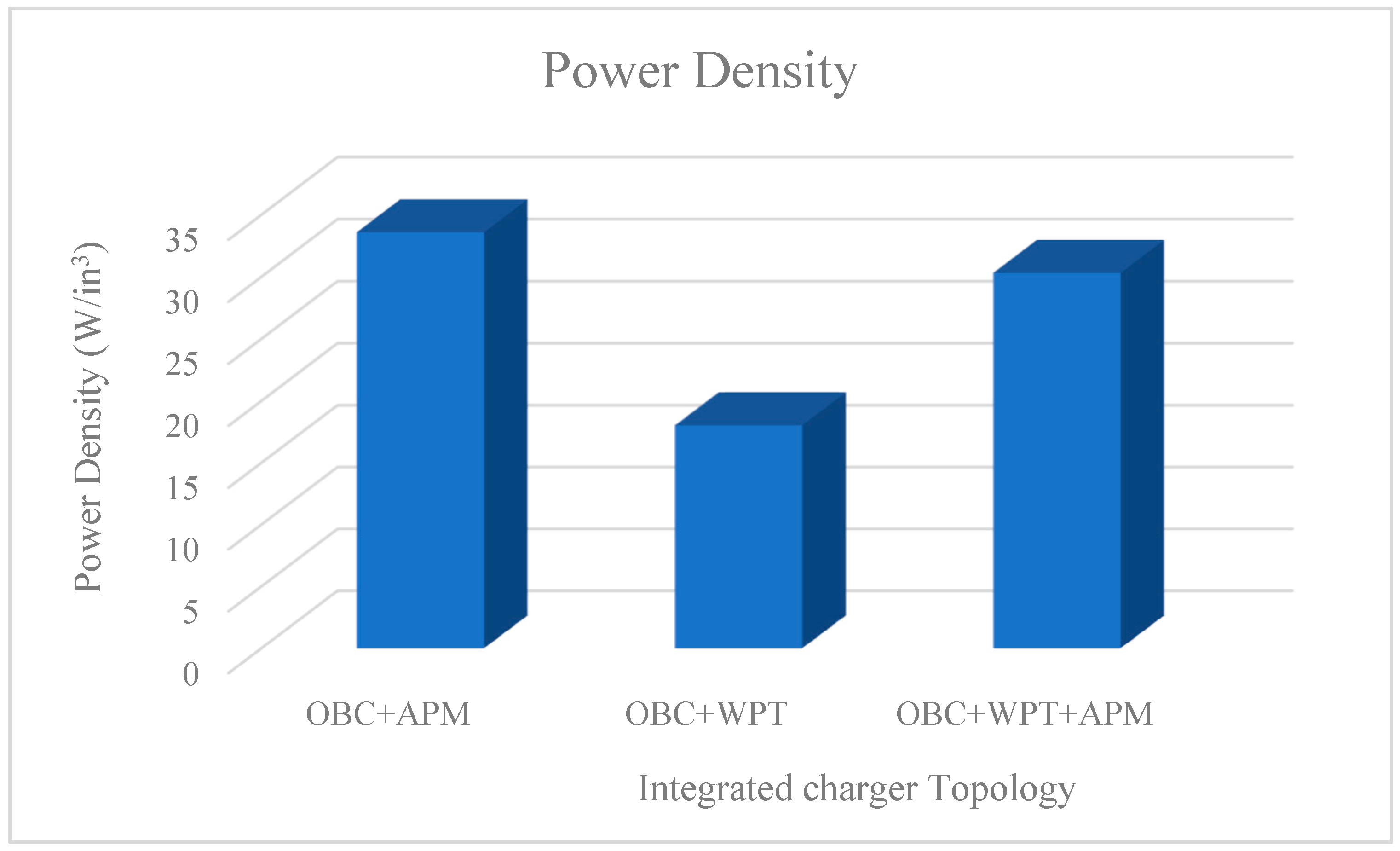
In EVs, minimizing volume directly contributes to an increased power density, making integration an essential consideration for achieving compact and efficient designs. For example, Ref. [33] reports a volume reduction of over 2 L compared to standalone units, achieving a significantly higher power density of 1.85 kW/L, which surpasses that of standalone OBC at 1.29 kW/L and APM at 0.45 kW/L. Similarly, Ref. [26] demonstrates a high-power-density design with a total volume of 9.92 L, achieving an efficiency of approximately 94%. However, this efficiency remains slightly lower than that of non-integrated systems. Further advancements in integration are highlighted in [34], where the combination of OBC, WPT and APM systems results in an overall efficiency of approximately 88%. Figure 24 represents the reported power density values as obtained from different studies under varying design constraints and operating conditions. While these values reflect the trade-offs inherent in integrated systems, they underline the potential of integration to significantly enhance power density, even as efficiency optimization remains a key challenge for future development.

4.6. Frequency Bifurcation/Frequency Splitting Issues

A phenomenon termed bifurcation, or “frequency splitting,” arises in WPT systems [46,47]. Within certain coupling ranges, this causes the system to resonate at two distinct non-resonant frequencies, complicating efficient power transfer. In integrated chargers that embed WPT coils as TF substitutes, bifurcation poses a significant challenge to maintaining stable operation across all modes. Recent works [48] have explored leveraging one of the split frequencies to maintain efficiency under fluctuating coupling. Two-port network modelling [49,50] and reflection coefficient minimization techniques like Minimum Reflection Coefficient Magnitude (MRCM) [51] have shown promise in improving frequency control compared to traditional Zero Phase Angle (ZPA) tuning. Furthermore, adaptive inverter-based methods [52,53,54,55,56] have been developed to mitigate bifurcation’s effects through dynamic switching control. For instance, reverse winding configurations [35] and high-order compensated systems [26] exhibit a pronounced bifurcation, leading to non-monotonic output behavior that complicates frequency tuning. This underscores the need for advanced frequency control strategies that maintain stable operation under the dynamic alignment and load conditions inherent to integrated charging environments. Among the integrated architecture, fully integrated topologies employing multi-coil compensation networks and selective decoupling designs are most susceptible to frequency bifurcation due to mode dependence and resonant interactions. Future integration strategies may involve real-time coupling estimation, closed-loop impedance tracking or machine learning-based frequency prediction to dynamically avoid unstable bifurcation zones during operation [57,58,59].

4.7. Bidirectional and Simultaneous Power Flow

Bidirectionality allows the HV battery to feed power back to the grid, while simultaneously supplying the LV battery and other auxiliary component functions that ideally should occur in parallel without manual intervention or operational conflict. However, achieving this level of functionality in integrated systems is non-trivial. Simultaneous operation places significant demands on the system, especially when the HV battery is expected to charge the LV battery while also supporting propulsion and exporting power externally. Without proper energy decoupling and control, these simultaneous tasks can lead to power flow conflicts, thermal stress and instability. This makes the integration of bidirectional DC-to-DC converters essential, as they enable regulated energy exchange in both directions and allow the dynamic reallocation of power based on real-time demands. To handle these challenges, converter architectures must support multiple energy paths with either galvanic isolation or energy buffering, ensuring that operations at one end do not compromise those at another. Advanced control strategies are required to coordinate power sharing, optimize efficiency and maintain system balance under varying load conditions [60,61,62,63]. Ultimately, integrating both bidirectional and simultaneous operation capabilities into a unified charger design is a crucial step toward more intelligent, autonomous and resilient EV power systems.

4.8. Control Complexity in Multi-Mode Systems

The very essence of integration, component sharing and mode merging makes advanced control strategies essential for reliable operation. The number of operating modes and transitions increases exponentially with bidirectional and multi-voltage support, placing significant strain on the control architecture. To address this, advanced digital controllers such as high-speed microcontrollers, Digital Signal Processors (DSPs) or Field-Programmable Gate Arrays (FPGAs) are employed to handle the real-time logic required for precise mode scheduling and fault mitigation [64]. Moreover, predictive control strategies like Model Predictive Control (MPC) offer a dynamic and optimized way to manage transitions while respecting system constraints [65]. Hierarchical or distributed control structures can also be adopted to offload and segment control responsibilities. As integrated chargers continue to evolve in complexity and capability, sophisticated control frameworks are foundational to safe, efficient and flexible system operation.

4.9. Cybersecurity and Fault Detection

This expanded role of integrated chargers makes cybersecurity and fault detection critical nodes in the vehicle’s electrical and control architecture. As EVs evolve toward more autonomous, lightweight and connected designs, any security breach in the integrated charger could compromise vital systems, including drive control, telematics and external communication. Furthermore, the high degree of coupling between subsystems in integrated architectures increases the risk of fault propagation, where a failure in one converter path can affect others. To mitigate these risks, secure microcontrollers, encrypted communication protocols and comprehensive real-time diagnostics are required. These measures ensure system resilience, operational continuity and user safety in the face of both external threats and internal faults, reinforcing the necessity of robust cyber–physical integration in future EV platforms.

4.10. Environmental Considerations and Sustainability Challenges

The long-term sustainability of EV deployment is constrained by the environmental challenges associated with battery production, raw material extraction and end-of-life recycling. Although integrated charging architectures do not directly address these issues, they can indirectly support more sustainable EV systems by improving power density, reducing hardware redundancy and enhancing charging efficiency. These improvements may decrease material consumption, lower onboard mass and reduce energy losses during charging. A comprehensive consideration of environmental and lifecycle challenges therefore remains an important direction for future research.

5. Conclusions

Integrated charger topologies have become a key enabler of compact, cost-effective and energy-efficient EV power systems, and they are expected to play an essential role in the next generation of scalable and sustainable transportation. Future work should prioritize system performance under dynamic conditions, safety and interoperability to support wider adoption. Key technical challenges remain, including frequency splitting, coupling variability, EMI/EMC compliance, thermal stress and cybersecurity in multi-function architectures. Progress is anticipated through high-density SiC/GaN converters, multifunctional magnetic structures, adaptive control, thermal–electromagnetic co-design and secure V2G communication. Finally, standardization and lifecycle-aware design will be critical as full integrated charging solutions move toward commercial readiness.

Author Contributions

D.C.D.R.S. contributed to conceptualization, methodology, investigation, data curation and writing of the original draft. N.R. contributed to conceptualization, methodology, formal analysis, supervision and writing—review and editing. J.A. contributed to validation, resources and funding acquisition. A.Y. contributed to conceptualization, project administration, supervision and writing—review and editing. All authors have read and agreed to the published version of the manuscript.

Funding

This research received no external funding.

Data Availability Statement

The datasets used and/or analyzed during the current study available from the corresponding author on reasonable request.

Conflicts of Interest

The authors declare no conflicts of interest.

Abbreviations

The following abbreviations are used in this manuscript:
EVElectric Vehicle
HVHigh-Voltage
LVLow-Voltage
THDTotal Harmonic Distortion
EMIElectromagnetic Interference
OBCOn-Board Charger
APMAuxiliary Power Module
V2GVehicle-to-Grid
BCBidirectional Charging
V2HVehicle-to-Home
V2LVehicle-to-Load
SCSimultaneous Charging
TABTriple-Active Bridge
DOFDegrees of Freedom
TFTransformer
ZVSZero Voltage Switching
IDCSIntegrated DC-to-DC Conversion System
DABDouble-Active Bridge
LDCLow-Voltage DC Converter
TCTraction Converter
DCSDC-to-DC Conversion System
OLIDOBC and LDC Integrated DC-to-DC Converter
OTIDOBC and TC Integrated DC-to-DC Converter
PSFBPhase Shift Full-Bridge
H2LHigh-to-Low
PWMPulse Width Modulation
CDCurrent Doubler
DFCDual-Functional Unit
G2VGrid-to-Vehicle
CFTABCurrent-Fed Triple-Active Bridge
IGBTsInsulated Gate Bipolar Transistors
SPWMSinusoidal Pulse Width Modulation
TxTransmitting
RxReceiving
CCConstant Current
CVConstant Voltage
DBSRCDual-Bridge Series Resonant Converter
HFTHigh-Frequency Transformer
ANPCActive Neutral Point Clamping
VFVoltage-Fed
CFCurrent-Fed
ZCDZero Cross Detection
EMITElectromagnetic Integrated Transformer
MRCMMinimum Reflection Coefficient Magnitude
ZPAZero Phase Angle
DSPDigital Signal Processor
FPGAField-Programmable Gate Array
MPCModel Predictive Control
TPSTriple-Phase Shift

References

  1. Nguyen, H.V.; To, D.-D.; Lee, D.-C. On-board Battery Chargers for Plug-in EVs with Dual Functional Circuit for Low-Voltage Battery Charging and Active Power Decoupling. IEEE Access 2018, 6, 70212–70222. [Google Scholar] [CrossRef]
  2. Dhananjaya, M.; Potnuru, D.; Manoharan, P.; Alhelou, H.H. Design and Implementation of Single-Input-Multi-Output DC-DC Converter Topology for Auxiliary Power Modules of EV. IEEE Access 2022, 10, 76975–76989. [Google Scholar] [CrossRef]
  3. Pinto, J.G.; Monteiro, V.; Gonçalves, H.; Afonso, J.L. On-board Reconfigurable Battery Charger for EVs with Traction-to-Auxiliary Mode. IEEE Trans. Veh. Technol. 2014, 63, 1104–1116. [Google Scholar] [CrossRef]
  4. Wouters, H.; Martinez, W. Bidirectional On-board Chargers for EVs: State-of-the-Art and Future Trends. IEEE Trans. Power Electron. 2024, 39, 693–716. [Google Scholar] [CrossRef]
  5. IEEE Std 2030.13-2024; IEEE Guide for Electric Transportation Fast Charging Station Management System Functional Specification. IEEE: New York, NY, USA, 2024; pp. 1–63. [CrossRef]
  6. Nasr Esfahani, F.; Darwish, A.; Ma, X.; Twigg, P. Non-Integrated and Integrated On-Board Battery Chargers (iOBCs) for EVs (EVs): A Critical Review. Energies 2024, 17, 2285. [Google Scholar] [CrossRef]
  7. Yu, G.; Choi, S. An Effective Integration of APM and OBC with Simultaneous Operation and Entire ZVS Range for EV. IEEE Trans. Power Electron. 2021, 36, 10343–10354. [Google Scholar] [CrossRef]
  8. Metwly, M.Y.; Abdel-Majeed, M.S.; Abdel-Khalik, A.S.; Hamdy, R.A.; Hamad, M.S.; Ahmed, S. A Review of Integrated On-Board EV Battery Chargers: Advanced Topologies, Recent Developments and Optimal Selection of FSCW Slot/Pole Combination. IEEE Access 2020, 8, 85216–85242. [Google Scholar] [CrossRef]
  9. Jaman, S.; Chakraborty, S.; Tran, D.-D.; Geury, T.; El Baghdadi, M.; Hegazy, O. Review on Integrated On-Board Charger-Traction Systems: V2G Topologies, Control Approaches, Standards and Power Density State-of-the-Art for Electric Vehicle. Energies 2022, 15, 5376. [Google Scholar] [CrossRef]
  10. Subotic, I.; Bodo, N.; Levi, E.; Dumnic, B.; Milicevic, D.; Katic, V. Overview of fast on-board integrated battery chargers for electric vehicles based on multiphase machines and power electronics. IET Electr. Power Appl. 2016, 10, 217–229. [Google Scholar] [CrossRef]
  11. Subotic, I.; Levi, E. A review of single-phase on-board integrated battery charging topologies for electric vehicles. In Proceedings of the 2015 IEEE Workshop on Electrical Machines Design, Control and Diagnosis (WEMDCD), Turin, Italy, 26–27 March 2015; pp. 136–145. [Google Scholar] [CrossRef]
  12. Dong-Gyun Woo, G.-Y.; Choe, J.-S.; Kim, B.-K.; Lee, J.H.; Gu-Bae, K. Comparison of integrated battery chargers for plug-in hybrid electric vehicles: Topology and control. In Proceedings of the 2011 IEEE International Electric Machines & Drives Conference (IEMDC), Niagara Falls, ON, Canada, 15–18 May 2011; pp. 1294–1299. [Google Scholar] [CrossRef]
  13. Saraswathi, V.N.; Ramachandran, V.P. A comprehensive review on charger technologies, types, and charging stations models for electric vehicles. Heliyon 2024, 10, e38945. [Google Scholar] [CrossRef]
  14. Ruddell, S.; Madawala, U.K.; Thrimawithana, D.J. A Wireless EV Charging Topology with Integrated Energy Storage. IEEE Trans. Power Electron. 2020, 35, 8965–8972. [Google Scholar] [CrossRef]
  15. Na, T.; Yuan, X.; Tang, J.; Zhang, Q. A review of on-board integrated electric vehicles charger and a new single-phase integrated charger. CPSS Trans. Power Electron. Appl. 2019, 4, 288–298. [Google Scholar] [CrossRef]
  16. Yilmaz, M.; Krein, P.T. Review of integrated charging methods for plug-in electric and hybrid vehicles. In Proceedings of the 2012 IEEE International Conference on Vehicular Electronics and Safety (ICVES 2012), Istanbul, Turkey, 24–27 July 2012; pp. 346–351. [Google Scholar] [CrossRef]
  17. Sousa, T.J.C.; Pedrosa, D.; Monteiro, V.; Afonso, J.L. A Review on Integrated Battery Chargers for EVs. Energies 2022, 15, 2756. [Google Scholar] [CrossRef]
  18. Kougioulis, I.; Wheeler, P.; Ahmed, M.R. An Integrated On-Board Charger and Auxiliary Power Module for EVs. In Proceedings of the 2022 IEEE Applied Power Electronics Conference and Exposition (APEC), Houston, TX, USA, 20–24 March 2022; pp. 1162–1169. [Google Scholar] [CrossRef]
  19. Kim, I.; Park, J.-W. New Integrated DC–DC Conversion System for EVs. IEEE Trans. Ind. Electron. 2024, 71, 7126–7135. [Google Scholar] [CrossRef]
  20. Nam, V.-H.; Tinh, D.-V.; Choi, W. A Novel Hybrid LDC Converter Topology for the Integrated On-Board Charger of EVs. Energies 2021, 14, 3603. [Google Scholar] [CrossRef]
  21. Tang, Y.; Lu, J.; Wu, B.; Zou, S.; Ding, W.; Khaligh, A. An Integrated Dual-Output Isolated Converter for Plug-in EVs. IEEE Trans. Veh. Technol. 2018, 67, 966–976. [Google Scholar] [CrossRef]
  22. Jo, C.-H.; Kim, S.-M.; Jo, S.-J.; Xie, J.; Kim, D.-H. Multifunctional Isolated DC-DC Converter for EVs. In Proceedings of the 2024 IEEE 10th International Power Electronics and Motion Control Conference (IPEMC2024-ECCE Asia), Chengdu, China, 17–20 May 2024; pp. 1471–1475. [Google Scholar] [CrossRef]
  23. Kim, S.; Kang, F.-S. Multifunctional On-board Battery Charger for Plug-in EVs. IEEE Trans. Ind. Electron. 2015, 62, 3460–3472. [Google Scholar] [CrossRef]
  24. Zhu, L.; Bai, H.; Brown, A.; Keuck, L. A Current-fed Three-port DC/DC Converter for Integration of On-board Charger and Auxiliary Power Module in EVs. In Proceedings of the 2021 IEEE Applied Power Electronics Conference and Exposition (APEC), Phoenix, AZ, USA, 14–17 June 2021; pp. 577–582. [Google Scholar] [CrossRef]
  25. Wu, Y.; Wang, H.; Zhuang, Y.; Zhang, Y. A Shared Charging Channel for Power and Auxiliary Batteries in EVs. IEEE Trans. Ind. Electron. 2024, 71, 8199–8203. [Google Scholar] [CrossRef]
  26. Zhang, Y.; Wu, Y.; Zhou, M.; Zhou, H.; Mao, X.; Jin, T.; Chen, X. An Integrated EV Charging System of WPT and Auxiliary Power Module with Shared Converter and Magnetic Coupler. IEEE Trans. Ind. Electron. 2024, 71, 10414–10421. [Google Scholar] [CrossRef]
  27. Wu, Y.; Pan, W.; Wang, H.; Shen, Z.; Zhang, Y. An Integrated Structure of Wireless Charging System and Auxiliary Power Module in EVs. In Proceedings of the 2023 IEEE 6th International Electrical and Energy Conference (CIEEC), Hefei, China, 12–14 May 2023; pp. 949–953. [Google Scholar] [CrossRef]
  28. Jo, C.-H.; Kim, D.-H. Simplified Integration of Bidirectional OBC and WPT Charging Systems with Reconfiguring Topology for EVs. IEEE Trans. Power Electron. 2025, 40, 7651–7656. [Google Scholar] [CrossRef]
  29. Zhang, Y.; Wu, Y.; Shen, Z.; Pan, W.; Wang, H.; Dong, J.; Mao, X.; Liu, X. Integration of On-board Charger and Wireless Charging System For EVs with Shared Coupler, Compensation, and Rectifier. IEEE Trans. Ind. Electron. 2023, 70, 7511–7514. [Google Scholar] [CrossRef]
  30. Wu, F.; Wu, S.; Wei, Y.; Ray, P.K.; Liu, H. Integrated Wired/Wireless Charging System for Electrical Vehicles with Resonant Frequency Tuning Function. IEEE Trans. Power Electron. 2024, 39, 10704–10709. [Google Scholar] [CrossRef]
  31. Elshaer, M.; Bell, C.; Hamid, A.; Wang, J. DC–DC Topology for Interfacing a WPT System to an On-Board Conductive Charger for Plug-In EVs. IEEE Trans. Ind. Appl. 2021, 57, 5552–5561. [Google Scholar] [CrossRef]
  32. Xu, W.; Wu, Y.; Xie, R.; Ouyang, H.; Zhuang, Y.; Mao, X.; Zhang, Y. An Integrated Structure of WPT, On-board Charger, and Auxiliary Power Module in EV Charging Systems. In Proceedings of the 2024 IEEE 7th International Electrical and Energy Conference (CIEEC), Harbin, China, 10–12 May 2024; pp. 4964–4969. [Google Scholar] [CrossRef]
  33. Zhu, L.; Liang, Z.; Sun, Y.; Li, J.; Qin, R.; Basu, A.; Costinett, D.; Bai, H. Charging Pad as the TF: Integration of On-board Charger, Auxiliary Power Module and Wireless Charger for EVs. In Proceedings of the 2023 IEEE Energy Conversion Congress and Exposition (ECCE), Nashville, TN, USA, 29 October–2 November 2023; pp. 1718–1724. [Google Scholar] [CrossRef]
  34. Nakkeeran, R.; Bharatiraja, C. Design, Development, and Experimental Analysis of a Dual Receiver Integrated On-Board Resonant Charger for Main and Auxiliary Battery Charging in EV Applications. In Proceedings of the 2024 IEEE 4th International Conference on Sustainable Energy and Future Electric Transportation (SEFET), Hyderabad, India, 31 July–3 August 2024; pp. 1–5. [Google Scholar] [CrossRef]
  35. Wu, Y.; Pan, W.; Xu, W.; Xie, R.; Zhuang, Y.; Mao, X.; Zhang, Y. An Integrated Charger of WPT, On-board Charger, and Auxiliary Power Module for EVs. IEEE Trans. Power Electron. 2025, 40, 6334–6344. [Google Scholar] [CrossRef]
  36. Liang, Z.; Zhu, L.; Sun, Y.; Li, J.; Qin, R.; Arka, B.; Costinett, D.; Bai, H. Full Integration of On-Board Charger, Auxiliary Power Module, and Wireless Charger for EVs Using Multipurpose Magnetic Couplers. IEEE Trans. Ind. Electron. 2024, 71, 9962–9967. [Google Scholar] [CrossRef]
  37. Lee, S.-H.; Lee, B.-S.; Kwon, D.-H.; Ahn, J.-H.; Kim, J.-K. Two-Mode Low-Voltage DC/DC Converter with High and Wide Input Voltage Range. IEEE Trans. Ind. Electron. 2021, 68, 12088–12099. [Google Scholar] [CrossRef]
  38. Wu, F.; Wang, K.; Su, J. TAB Series-Resonant DC-DC Converter and Multi-Phase-Shift Based Global Optimization Modulation. Appl. Sci. 2022, 12, 6783. [Google Scholar] [CrossRef]
  39. Ashique, R.H.; Salam, Z.; Maruf, M.H.; Shihavuddin, A.; Islam, M.T.; Rahman, M.F.; Kotsampopoulos, P.; Fayek, H.H. A Comparative Analysis of Soft Switching Techniques in Reducing the Energy Loss and Improving the Soft Switching Range in Power Converters. Electronics 2022, 11, 1062. [Google Scholar] [CrossRef]
  40. Xie, S.; Wu, L.; Zhang, X.; Huang, J.; Li, L. Misalignment-Tolerant WPT System Based on Double-Layer Quadrature Double-D Coil with Magnetic Field Control. IEEE Trans. Transp. Electrif. 2024, 10, 9945–9958. [Google Scholar] [CrossRef]
  41. Li, Z.; Li, X.; Zhou, Y.; Liu, Y.; Ban, M. Improving Misalignment Tolerance for the Wireless Charging System Using Multiple Coils Coupler. IEEE Trans. Power Electron. 2024, 39, 7721–7735. [Google Scholar] [CrossRef]
  42. Ghazizadeh, S.; Ahmed, K.; Seyedmahmoudian, M.; Mekhilef, S.; Chandran, J.; Stojcevski, A. Critical Analysis of Simulation of Misalignment in Wireless Charging of EVs Batteries. Batteries 2023, 9, 106. [Google Scholar] [CrossRef]
  43. Zhang, Y.; Huang, Z.; Xie, R.; Chen, X.; Li, Z. Misalignment Tolerance and Interoperability of Wireless Charging System Based on Two-Channel Topology and Coil Optimization. IEEE Access 2024, 12, 120306–120315. [Google Scholar] [CrossRef]
  44. Hou, L.; Xiao, J.; Liang, J.; Chen, S.; Mo, Y. High-Misalignment Tolerance Wireless Charging System for Constant Voltage/Current Output Using Variable Structure Hybrid Topology. In Proceedings of the 2024 10th International Conference on Power Electronics Systems and Applications (PESA), Hong Kong, China, 5–7 June 2024; pp. 1–8. [Google Scholar] [CrossRef]
  45. Deng, Q.; Cheng, Y.; Chen, F.; Czarkowski, D.; Kazimierczuk, M.K.; Zhou, H.; Hu, W. Wired/Wireless Hybrid Charging System for Electrical Vehicles with Minimum Rated Power Requirement for DC Module. IEEE Trans. Veh. Technol. 2020, 69, 10889–10898. [Google Scholar] [CrossRef]
  46. Wang, C.-S.; Covic, G.A.; Stielau, O.H. Power transfer capability and bifurcation phenomena of loosely coupled inductive power transfer systems. IEEE Trans. Ind. Electron. 2004, 51, 148–157. [Google Scholar] [CrossRef]
  47. Okasili, I.; Elkhateb, A.; Littler, T. A Review of WPT Systems for EV Battery Charging with a Focus on Inductive Coupling. Electronics 2022, 11, 1355. [Google Scholar] [CrossRef]
  48. Mastri, F.; Costanzo, A.; Mongiardo, M. Coupling-Independent WPT. IEEE Microw. Wirel. Compon. Lett. 2016, 26, 222–224. [Google Scholar] [CrossRef]
  49. Qu, X.; Jing, Y.; Han, H.; Wong, S.-C.; Tse, C.K. Higher Order Compensation for Inductive-Power-Transfer Converters with Constant-Voltage or Constant-Current Output Combating TF Parameter Constraints. IEEE Trans. Power Electron. 2017, 32, 394–405. [Google Scholar] [CrossRef]
  50. Li, S.; Mi, C.C. WPT for EV Applications. IEEE J. Emerg. Sel. Top. Power Electron. 2015, 3, 4–17. [Google Scholar] [CrossRef]
  51. Seo, D.-W.; Lee, J.-H. Frequency-Tuning Method Using the Reflection Coefficient in a WPT System. IEEE Microw. Wirel. Compon. Lett. 2017, 27, 959–961. [Google Scholar] [CrossRef]
  52. Zhang, J.; Zhao, J.; Zhang, Y.; Deng, F. A WPT System with Dual Switch-Controlled Capacitors for Efficiency Optimization. IEEE Trans. Power Electron. 2020, 35, 6091–6101. [Google Scholar] [CrossRef]
  53. Zhao, J.; Zhang, J.; Zhang, Y.; Din, Z.; Juri, J. A Reactive Compensation Method Using Switch Controlled Capacitor for WPT. In Proceedings of the 2019 IEEE Energy Conversion Congress and Exposition (ECCE), Baltimore, MD, USA, 29 September–3 October 2019; pp. 2112–2117. [Google Scholar] [CrossRef]
  54. Kong, S.; Kim, M.; Koo, K.; Ahn, S.; Bae, B.; Kim, J. Analytical expressions for maximum transferred power in WPT systems. In Proceedings of the 2011 IEEE International Symposium on Electromagnetic Compatibility, Long Beach, CA, USA, 14–19 August 2011; pp. 379–383. [Google Scholar] [CrossRef]
  55. Zhao, C.; Wang, Z.; Du, J.; Wu, J.; Zong, S.; He, X. Active resonance WPT system using phase shift control strategy. In Proceedings of the 2014 IEEE Applied Power Electronics Conference and Exposition—APEC 2014, Fort Worth, TX, USA, 16–20 March 2014; pp. 1336–1341. [Google Scholar] [CrossRef]
  56. Gu, W.-J.; Harada, K. A new method to regulate resonant converters. IEEE Trans. Power Electron. 1988, 3, 430–439. [Google Scholar] [CrossRef]
  57. Tang, Z.; Johansen, F.; Davari, P. Closed-loop impedance modeling and analysis of three-phase active rectifier below 150 kHz frequency range. In Proceedings of the 2023 25th European Conference on Power Electronics and Applications (EPE’23 ECCE Europe), Aalborg, Denmark, 4–8 September 2023; pp. 1–9. [Google Scholar] [CrossRef]
  58. Khan, S.A.; Ahn, D. Coupling Estimation and Maximum Efficiency Tracking in Multi-Transmitters WPT for Fast Moving Receiver. IEEE Access 2024, 12, 9952–9962. [Google Scholar] [CrossRef]
  59. Islam, A.; Jawad, A.; Chowdhury, S.M.H. A Machine Learning Based Frequency Response Prediction of Deloaded Photovoltaic System Under Variability. In Proceedings of the 2023 International Conference on Technology and Policy in Energy and Electric Power (ICT-PEP), Jakarta, Indonesia, 2–3 October 2023; pp. 195–200. [Google Scholar] [CrossRef]
  60. Goudarzitaemeh, S.; Pahlevani, M. A Bidirectional DC–DC Converter with Direct Power Transfer. IEEE Open J. Power Electron. 2024, 5, 232–249. [Google Scholar] [CrossRef]
  61. Gorji, S.A.; Sahebi, H.G.; Ektesabi, M.; Rad, A.B. Topologies and Control Schemes of Bidirectional DC–DC Power Converters: An Overview. IEEE Access 2019, 7, 117997–118019. [Google Scholar] [CrossRef]
  62. Rakesh, O.; Anuradha, K. Analysis of Bidirectional DC-DC converter with Wide Voltage Gain for charging of EV. In Proceedings of the 2021 7th International Conference on Electrical Energy Systems (ICEES), Chennai, India, 11–13 February 2021; pp. 135–140. [Google Scholar] [CrossRef]
  63. Waghmare, T.; Chaturvedi, P. Study of Bidirectional DC-DC Converter: Control Schemes and Switching Techniques. In Proceedings of the 2020 IEEE First International Conference on Smart Technologies for Power, Energy and Control (STPEC), Nagpur, India, 25–26 September 2020; pp. 1–6. [Google Scholar] [CrossRef]
  64. Sui, Q.; Du, B.; Zuo, Y.; Martinez, W. Exploring the Potential of FPGA in High-Frequency Switching DC-DC Boost Converters Using Model Predictive Control. In Proceedings of the 2025 IEEE Applied Power Electronics Conference and Exposition (APEC), Atlanta, GA, USA, 16–20 March 2025; pp. 2752–2756. [Google Scholar] [CrossRef]
  65. Rana, M.M.; Alam, S.M.; Rafi, F.A.; Deb, S.B.; Agili, B.; He, M.; Ali, M.H. Comprehensive Review on the Charging Technologies of EVs (EV) and Their Impact on Power Grid. IEEE Access 2025, 13, 35124–35156. [Google Scholar] [CrossRef]
Figure 1. TAB architecture.
Energies 19 00689 g001
Figure 2. IDCS architecture.
Energies 19 00689 g002
Figure 3. Modified PSFB architecture.
Energies 19 00689 g003
Figure 4. Isolated dual-output isolated architecture.
Energies 19 00689 g004
Figure 5. Multifunctional DC-to-DC converter architecture.
Energies 19 00689 g005
Figure 6. Modified LLC converter architecture.
Energies 19 00689 g006
Figure 7. DFC architecture.
Energies 19 00689 g007
Figure 8. CFTAB architecture.
Energies 19 00689 g008
Figure 9. Full-bridge isolated DC-to-DC architecture.
Energies 19 00689 g009
Figure 10. Reverse winding architecture.
Energies 19 00689 g010
Figure 11. APM TF-based architecture.
Energies 19 00689 g011
Figure 12. S-S compensated architecture.
Energies 19 00689 g012
Figure 13. Hybrid DAB architecture.
Energies 19 00689 g013
Figure 14. Hybrid CLLC architecture.
Energies 19 00689 g014
Figure 15. DBSRC architecture.
Energies 19 00689 g015
Figure 16. Integrated WPT-CLLC architecture.
Energies 19 00689 g016
Figure 17. Parallel-Wound architecture.
Energies 19 00689 g017
Figure 18. Multi-function magnetic coupler architecture.
Energies 19 00689 g018
Figure 19. Dual-Receiver Multilayer architecture.
Energies 19 00689 g019
Figure 20. Shared power converter architecture.
Energies 19 00689 g020
Figure 21. Multipurpose magnetic coupler architecture.
Energies 19 00689 g021
Figure 22. Windings employed in integrated chargers.
Energies 19 00689 g022
Figure 23. Compensation employed in integrated chargers.
Energies 19 00689 g023
Figure 24. Comparison of power density for representative integrated EV charger topologies.
Energies 19 00689 g024
Table 1. Comparison table for OBC and APM integrated topologies.
Ref.SwitchesDiodesTFSCBCfs
(kHz)
PHV (kW)PLV
(kW)
Power Density (W/in3)ηoverallηLV
[18]1211-1003.31.6---
[19]10-1901.40.1--96.7
[20]1341-30–503.31-96.0395
[21]10-1-180–2003.3111.79493.3
[22]821-1003.31.5--93.22
[7]6-2184–2433.30.4/1--95.46
[1]14-1-103.31.5--89.24
[24]12-1-50–100113.533.6--
[3]62120–403.50.5---
Table 2. Comparison table for WPT and APM integrated topologies.
Ref.CompensationSCBCfs
(kHz)
PHV (kW)PLV
(kW)
ηoverallηLV
[25]LCC-S, S-S-851.20.025-80.25
[26]LCC-S851.20.5582.5-
[27]S-S-851.80.014--
Table 3. Comparison table for OBC and WPT integrated topologies.
Ref.SwitchesCompensation UsedBCfs
(kHz)
P (kW)Power Density (W/in3)ηOBCηWPT
[28]12LCC-S81–1023.318.0397.5994.14
[29]12LCC-S, S-S-851.2-97.596
[30]8S-S-85–881-92.791.4
[31]12LCC85/3805/7.7-95.693.4
Table 4. Comparison table for OBC, WPT and APM integrated topologies.
Ref.SwitchesSCBCCompensationfs
(kHz)
PHV (kW)PLV
(kW)
Power Density (W/in3)ηOBC-LVηWPT-LV ηHV-LV
[32]16--LCC-S, S-S85–111.171.90.15-86.8983.0487.2
[33]34-LCC-S42.5–2406.60.8-959292
[34]---S-S 3.31.4--88.189
[35]16S-S85/1001.50.0897-7786.780
[36]34-LCC-S42.5–2406.61.530.3296.19296
Table 5. Comparison of TF-based integration.
Ref.TopologyKey Benefits/Challenges
[18]3-winding
  • 16.7% reduction in magnetic volume
  • Complexity in winding and leakage design
[19]3-winding
  • Requires careful multi-port control
[21]3-winding gapped TF
  • Eliminates the need for external inductors
  • Precise control of resonant parameters is needed
[22]EE core
  • Flux balancing and current steering complexity
[7]Dual TF
  • Simpler flux path and low-profile design
  • Slightly reduced integration level
[24]3-winding
  • Flexible control
  • Complex TF design
Table 6. Electronic interfaces employed in integrated chargers.
Ref.Converter
Topology
Operating ModesKey Features/Challenges
[18]TABMulti-port power transfer
  • Achieves up to 50% total power loss reduction compared to 2-DOF systems [38].
  • Ports 1 and 2 experience higher circulating current and reactive power.
  • Switching losses ≈ 20% of the total semiconductor loss.
[19]DAB and PSFB-basedLDC traction, LDC and SC
  • DAB acts as the central integration unit for all DC-to-DC functions.
  • Enables bidirectional power transfer between HV, LV and traction domains.
[20]Hybrid LDCG2V, V2G and HV-LV
  • Additional snubber circuit suppresses circulating currents.
  • Reduced output inductor voltage during freewheeling lowers current ripple.
  • High efficiency maintained across wide input range (290–400 V).
[21]Integrated isolated DC-to-DCG2V, V2G and H2L
  • Combines LLC and CLLLC resonant converters within a single architecture.
  • Exhibits lower differential-mode noise and suppresses flux-doubling during startup.
[22]DAB and LLCOBC charging, OBC discharging and LDC
  • During charging/discharging, the converter operates as a DAB converter.
  • In discharging mode, the secondary bridge leads to reverse power flow.
  • For LVB charging, the converter operates as an LLC resonant converter.
[7]Hybrid LLC-PSFBSC, V2G and APM standalone
  • Common leg integration of OBC and APM reduces conduction loss by ~50%.
  • Provides fault-mitigation in cases of open-circuit faults in the common switch leg.
[1]Hybrid full-bridge-DAB-DFCG2V and V2G modes, H2L mode
  • The DFC functions as an APD to absorb ripple during HV battery charging.
  • Achieves ~53.4% cost reduction and ~70.2% volume reduction compared to [23].
[24]Current-fed 3-port converter-
  • LV port uses current-fed operation to boost voltage, reduce TF turn ratio and improve regulation.
  • Lower current stress on low-side switches compared to voltage-fed converters.
[3]Full-bridge converter-HFT-fast diodesG2V, V2G and T2A modes
  • PI controller regulates CV charging of the LV battery via PWM duty adjustment.
  • Switching frequency is selected as a trade-off between IGBT switching losses and HFT size.
[25]Multiple
full-bridge
WPT and APM, APM
  • May exhibit frequency bifurcation, causing non-monotonic voltage–frequency response.
[26]LCC-LCC-S resonantWPT and APM, APM
  • Slightly inductive input impedance enables ZVS operation.
  • Relay-based switching supports mode transition.
[27]Hybrid dual full-bridgeWPT and APM, APM
  • Enables seamless mode-based switching.
[28]Hybrid DAB and LCC-SOBC and WPT
  • Enables mode-dependent operation as a DAB converter and LCC-S compensated converter.
  • Misalignment in WPT mode causes off-resonant operation.
[29]CLLC-LCC-S dual-mode
converter
OBC and WPT
  • Provides passive tolerance to misalignment through power reduction.
  • OBC and WPT modes exhibit opposite load characteristics.
[30]DBSRCWired and wireless
  • Adapts to changes in coupling coefficient and coil alignment.
  • Control complexity increases due to adaptive control requirements.
[31]CLLC-based WPTOBC and WPT
  • Rx coil current is minimized in OBC mode to reduce conduction losses.
  • Primary side switching is disabled in WPT mode to avoid switching losses.
  • Secondary bridge adapts to load variation and misalignment.
[32]Three full-bridgeOBC for HV, OBC for LV, HV for LV, WPT for HV, WPT for LV
  • Mode selection enables OBC or WPT operation via controlled switching.
  • Partial disconnection ensures electrical isolation of power paths.
  • System reconfiguration depends on charging demand.
[33]Hybrid three-level ANPCBidirectional OBC, WPT and APM
  • HV battery charges the LV battery through a TAB converter in a VF-CFDAB configuration.
  • Current stress on LV-side switches is reduced.
[34]Two-legged full-bridgeWPT and APM mode, APM mode
  • Reduced conduction paths due to fewer active devices.
  • Lower system complexity and reduced potential losses.
[35]Full-bridge converterWireless charging, conductive charging and HV-LV
  • The inverter voltage leads current slightly, and the input impedance is mildly inductive, enabling ZVS.
[36]TABWPT, OBC and HV-LV
  • Independent operation improves control flexibility.
  • Output power is controlled by the TAB and DC-to-DC converter.
Disclaimer/Publisher’s Note: The statements, opinions and data contained in all publications are solely those of the individual author(s) and contributor(s) and not of MDPI and/or the editor(s). MDPI and/or the editor(s) disclaim responsibility for any injury to people or property resulting from any ideas, methods, instructions or products referred to in the content.