Article

Experimental Investigation of Pressure Pulsation Characteristics on Guide Vane Surface of a Low-Specific-Speed Pump–Turbine in Turbine Mode

1
China Institute of Water Resources and Hydropower Research, Beijing 100038, China
2
Yellow River Water Conservancy and Hydropower Development Group Co., Ltd., Jiyuan 459017, China
*
Author to whom correspondence should be addressed.
Energies 2026, 19(3), 666; https://doi.org/10.3390/en19030666
Submission received: 18 December 2025 / Revised: 20 January 2026 / Accepted: 24 January 2026 / Published: 27 January 2026
(This article belongs to the Section A: Sustainable Energy)

Abstract

To investigate the hydraulic instability mechanisms of low-specific-speed pump–turbines operating in turbine mode, this study experimentally characterized the pressure distribution and pulsation evolution on the guide vanes of a model unit (ns = 28) using an embedded sensor technique. By overcoming the accessibility limitations of traditional measurement methods, this research reveals the distinct pressure response mechanisms on the guide vane Front Side (upstream-facing) and Back Side (runner-facing). The results demonstrate that the time-averaged pressure distribution is highly sensitive to the Guide Vane Opening (GVO). Specifically, pressure on the Front Side increases with GVO, dominated by the improvement of flow pattern and stagnation effect, whereas pressure on the Back Side decreases monotonically, governed by the Bernoulli effect. Increasing the GVO significantly improves pressure uniformity, reducing the surface pressure gradient by 55%. Regarding dynamic characteristics, pressure fluctuation intensity on the Back Side is significantly higher than that on the Front Side. Furthermore, fluctuations are notably amplified near the tongue, confirming that flow distortion induced by the tongue is a key factor driving circumferential non-uniformity. Spectral analysis identifies the Blade Passing Frequency (BPF) as the dominant frequency, verifying Rotor–Stator Interaction (RSI) as the primary excitation source, while the guide vane channel exhibits a significant low-pass filtering effect on high-order harmonics. These findings provide a solid theoretical foundation and data support for the optimal design and stability control of pump–turbine guide vanes.

1. Introduction

Pumped storage hydropower, as the most mature and widely deployed large-scale energy storage technology, plays a vital role in modern power systems by providing peak shaving, valley filling, frequency regulation, and emergency reserve capacity [1]. With the rapid increase in renewable energy installations in China, grid dependence on flexible regulation resources has grown significantly. Consequently, the operating range of pumped storage units has continuously expanded, and frequent transitions between operating conditions as well as off-design operations have become common [2,3,4]. However, under such complex conditions, hydraulic instabilities have become increasingly prominent, with vibration and noise induced by pressure fluctuations exhibiting complex frequency characteristics posing major threats to safe and stable unit operation [5,6,7,8].
As a key flow-passage component, the guide vane directly governs flow distribution and energy conversion efficiency by adjusting its opening. While the runner is the core component governing the unit’s energy conversion efficiency, the guide vanes are decisive in maintaining operational stability, particularly under off-design conditions. Located between the stay vanes and the runner, the guide vane domain acts as a crucial transition zone where the flow redirects from circumferential to axial. The internal flow is highly complex due to the combined influences of spiral case asymmetry, runner blade-passing effects, and the guide vane cascade geometry [9,10,11]. Particularly at small guide vane openings, the flow exit angle severely deviates from the design value. This tends to induce flow separation along blade surfaces and intensify rotor–stator interactions in the vaneless space, which markedly increases local pressure fluctuations [12,13,14]. These strong fluctuations may excite guide vane vibration through fluid–structure interaction and propagate upstream to the spiral case or downstream to the runner, potentially triggering system-wide hydraulic resonance. In severe cases, this may result in fatigue cracks in the guide vanes, seal failure, or even unplanned unit shutdowns [15,16].
In recent years, extensive research has been devoted to understanding pressure fluctuation mechanisms in pump–turbines. On the numerical side, Zhang et al. [17] employed large-eddy simulation to reveal interactions between runner vortices and guide vane shedding vortices; Li et al. [18] investigated effects of operating head on runner pressure fluctuations and dynamic stresses; Yi et al. [19] examined pressure fluctuation characteristics and internal flow patterns in the vaneless space under different heads; Yang et al. [20] analyzed rotor–stator interactions in turbine mode at high head, demonstrating that pressure fluctuations in the vaneless space are influenced by guide vane wakes, runner excitation, low-frequency disturbances in the draft tube, and spiral case asymmetry, with pronounced spatial variability. Liang et al. [21] further investigated pressure pulsations and rotating stall in pump mode. They showed that rotating stall originates near the guide vane trailing edges and is exacerbated when operating conditions deviate from the optimum point. The resulting flow separation and high entropy production regions contribute to intensified pulsations. On the experimental side, Hasmatuchi [22] reported systematic measurements of pressure fluctuations under typical operating conditions, analyzing frequency components, spatial distribution, and mechanisms. Liu et al. [23] visualized vortex motion in the vaneless space using particle image velocimetry, finding that vortices originating near the guide vane side propagate downstream and partially block the flow passage. Li et al. [24] revealed hysteresis behavior at different guide vane openings through model testing, confirming that hydraulic loss is the dominant cause and that low-frequency pulsation sources vary with guide vane openings. Deng et al. [25] employed laser Doppler velocimetry to measure draft tube velocity distributions, demonstrating a strong correlation between velocity and pressure fluctuations, with velocity fluctuation frequency closely matching pressure fluctuation frequency and increasing with higher cavitation coefficients.
Despite significant progress in research concerning the unsteady characteristics of Pumped Storage Hydropower (PSH) units [26], the majority of studies remain focused on the vaneless space and the runner [27,28]. Consequently, our understanding of the pressure distribution and pulsation response on the surface of the guide vanes remains limited. In fact, the instability phenomena inherent to PSH units—whether the “S-characteristic” region encountered during turbine operation under low head or the hump characteristic region during pump operation—are both closely linked to complex vortex structures within the runner and flow separation occurring within the guide vane cascade [29,30].
Traditional pressure measurement approaches, which typically place sensors within the vaneless space, are insufficient for fully elucidating the generation, transmission, and evolution mechanisms of pressure pulsations on the guide vane surface. Particularly, given the increasing prevalence of large-capacity, high-head PSH units, relying solely on existing sensor arrangements is inadequate for accurate identification and suppression of the pulsation sources. During operation, the guide vane opening must be frequently adjusted, making it challenging for conventional external sensors to achieve precise surface pressure measurements. Moreover, narrow passages and complex flow structures around guide vanes make it difficult for traditional sensor layouts to capture detailed evolution of pressure pulsations along both flow and circumferential directions. Therefore, a profound understanding of the pressure distribution and pulsation characteristics within the guide vane region holds significant research value. However, a theoretical gap remains in understanding how the complex pressure waves generated by Rotor–Stator Interaction (RSI) in the vaneless space specifically act upon and evolve along the guide vane surfaces. Existing theories and measurements in the vaneless space cannot be directly extrapolated to the guide vane surface due to the complex boundary layer effects and geometric constraints of the cascade. Consequently, establishing a direct correlation between the excitation source (RSI) and the dynamic load (surface pressure) requires precise in situ measurements, which are currently lacking in published studies. The research team at the China Institute of Water Resources and Hydropower Research (IWHR) has accumulated rich experience in pump–turbine design [31,32], operational stability analysis [33,34], and model and field testing [9,35,36]. This expertise provides a solid technical foundation and engineering basis for further investigation into the pressure pulsation mechanism on the guide vane surfaces. To address this theoretical and experimental gap, this study designed and fabricated a specially instrumented guide vane with embedded pressure sensors. Experiments investigating pressure pulsations in the guide vane region were conducted on a model PSH unit characterized by high head and low specific speed. The primary objective is to obtain the characteristics of pulsation evolution along both the streamwise and circumferential directions on the guide vane surface. This work aims to reveal the unsteady dynamic behavior of the guide vane region and provide theoretical support and practical references for guide vane optimization, pulsation source suppression, and enhancing the stable operation of PSH units.

2. Model Test for Pump–Turbine

2.1. Model Test Bench and Pump–Turbine Model

2.1.1. Description of the Model Test Bench

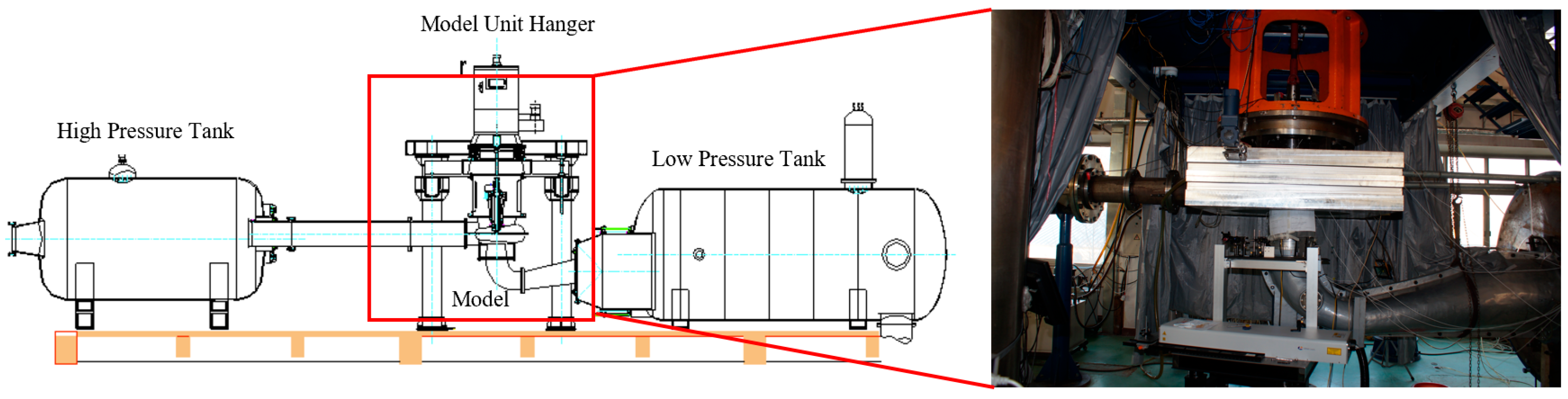
As shown in Figure 1, experiments were conducted on the TP3 universal test bench at the China Institute of Water Resources and Hydropower Research, a closed-loop system designed for model tests of hydraulic turbines, pumps, and pump–turbines [36]. The test bench is equipped with high-precision flow meters, differential pressure sensors, absolute pressure sensors, torque transducers, and in situ calibration systems. The measurement accuracy and operational stability of all test parameters satisfy the requirements of the IEC 60193 standard [37]. Specifically, the uncertainty for flow measurement is controlled below 0.13%, and the comprehensive uncertainty of the model efficiency test is maintained within ±0.2%.

2.1.2. Uncertainty Analysis of Model Test

The overall experimental uncertainty comprises both random and systematic components. To evaluate the random uncertainty under stable operating conditions, ten consecutive data acquisitions were performed at a single test point. Based on the dispersion of these efficiency measurements, the relative random uncertainty of the efficiency (Er) was calculated to be 0.0162%. The relative measurement uncertainties for the flow rate (EQ), head (EH), torque (ET), and rotational speed (En) were determined to be ±0.131%, ±0.0394%, ±0.1014%, and ±0.0082%, respectively. Consequently, the comprehensive uncertainty Et in turbine mode was calculated as ±0.171%, which is well within the permissible limit of ±0.20%. The equations for the calculation are as follows:
E r = t 0.95 N 1 × i = 1 n η i η ¯ 2 / N N 1 η ¯ × 100 %
E t = E r 2 + E Q 2 + E H 2 + E T 2 + E n 2
where N is the number of measurements, t0.95 (N − 1) is the t-distribution value corresponding to a 95% confidence level with (N − 1) degrees of freedom (here, t0.95(9) = 2.262), ηi is the efficiency of the i-th measurement, and η ¯ is the arithmetic mean of the efficiency from N measurements.

2.1.3. Pump–Turbine Model

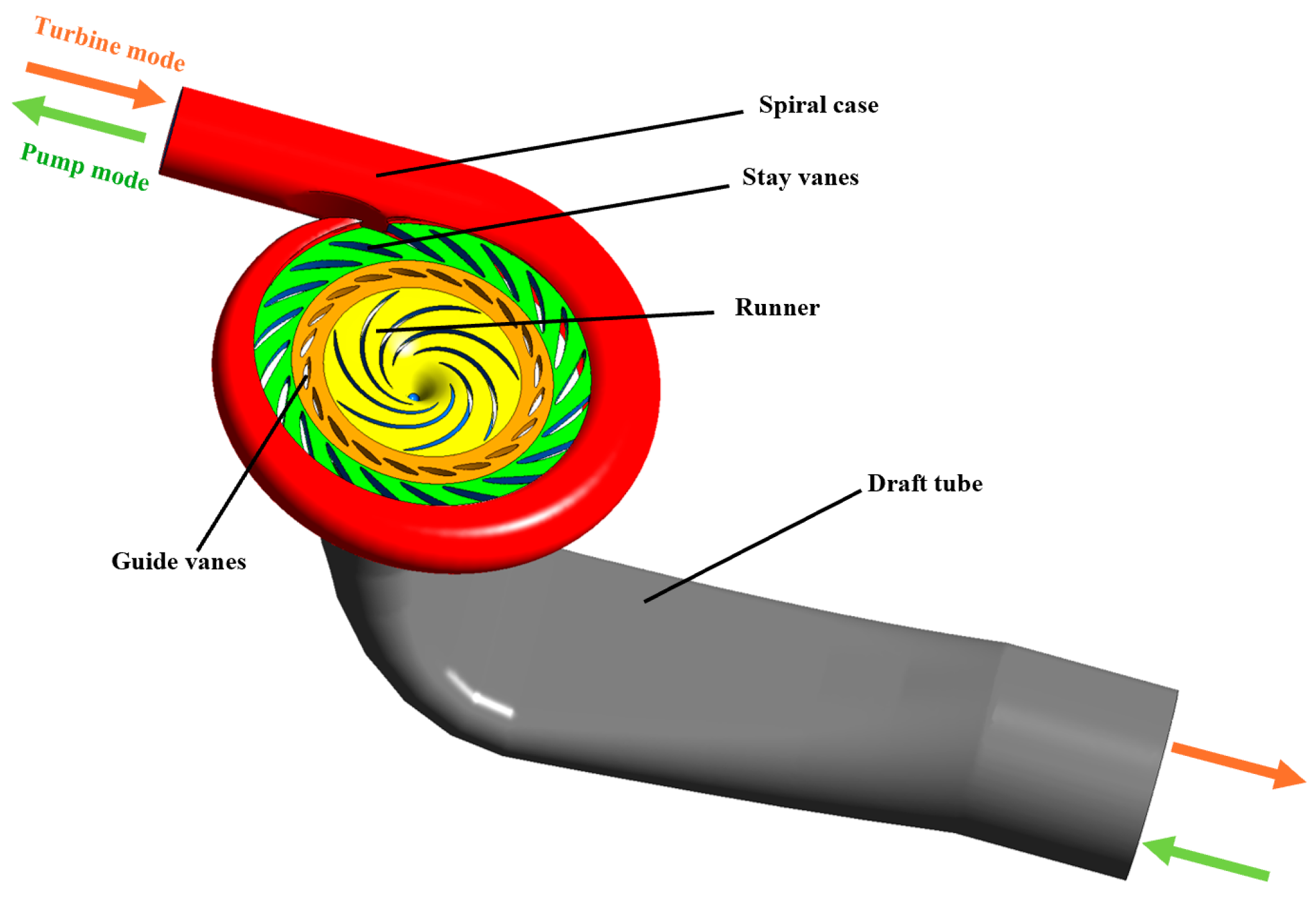
A low-specific-speed pump–turbine model with ns = 28 was investigated. The model was scaled from the prototype with a geometrical similarity ratio of 1:7.76. The main geometric parameters are listed in Table 1. As shown in Figure 2, the model consists of five components: the spiral case, stay vanes, guide vanes, runner, and draft tube. The specific speed ns is defined as:
n s   =   n Q H 3 / 4
where n is the rotational speed in r/min, Q is the flow rate at the best efficiency point (BEP) in m3/s, and H is the head in m.

2.2. Arrangement of Pressure Pulsation Measurement Points for Model Test

The pump–turbine model is made of metallic materials, except for the straight conical section of the draft tube, which is constructed from transparent acrylic to facilitate flow visualization downstream of the runner and within the conical section. All flow-passing surfaces are unpainted and uncoated, and the turbine model maintains full geometric similarity to the prototype. The stop-block clearances were adjusted in strict accordance with IEC 60193.
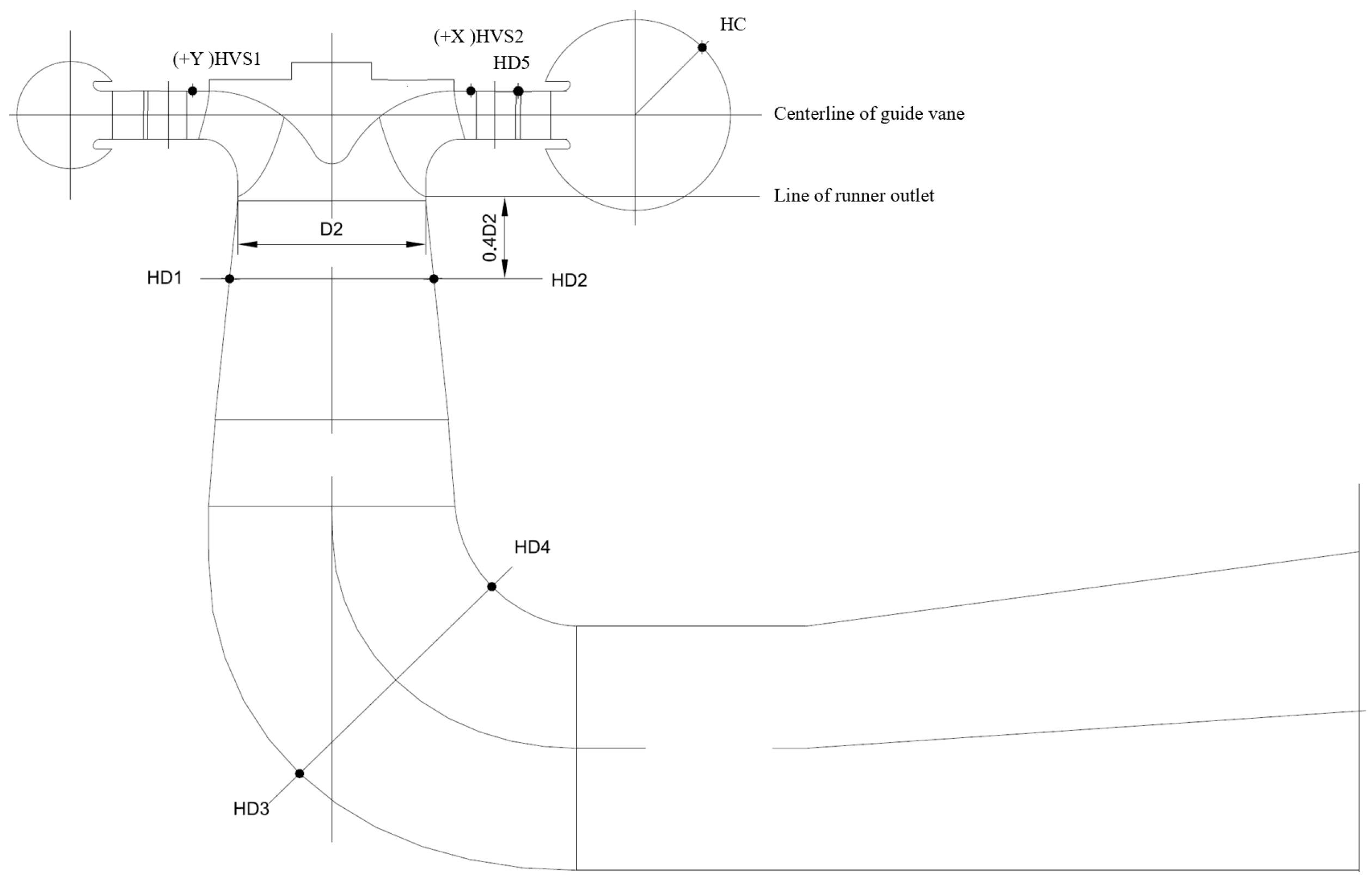
Pressure pulsations at the spiral case inlet, the vaneless space, and the draft tube were measured using the existing instrumentation of the model test platform in accordance with IEC requirements. As shown in Figure 3, eight pressure pulsation measurement points were installed: one at the inlet section of the spiral case; one between the stay vanes and guide vanes; two located at the +Y and +X positions downstream of the guide vanes and upstream of the runner; two on the upstream and downstream sides of the conical section of the draft tube at a distance of 0.4D2 from the runner outlet; and two at 45° on the upstream and downstream sides of t the draft pipe elbow. The pressure pulsation sensors measure pressure pulsations within a frequency range of 0.5 to 250 kHz.

2.3. Pressure Pulsation Measurement Inside the Guide Vane

2.3.1. Internal Structure and Fabrication of the Special Guide Vane

To investigate the pressure pulsation characteristics on the guide vanes of the pump–turbine, a model test was performed on the low-specific-speed pump–turbine. Pressure pulsation signals on the guide vane surfaces were obtained using specially fabricated guide vanes equipped with embedded pressure sensors.
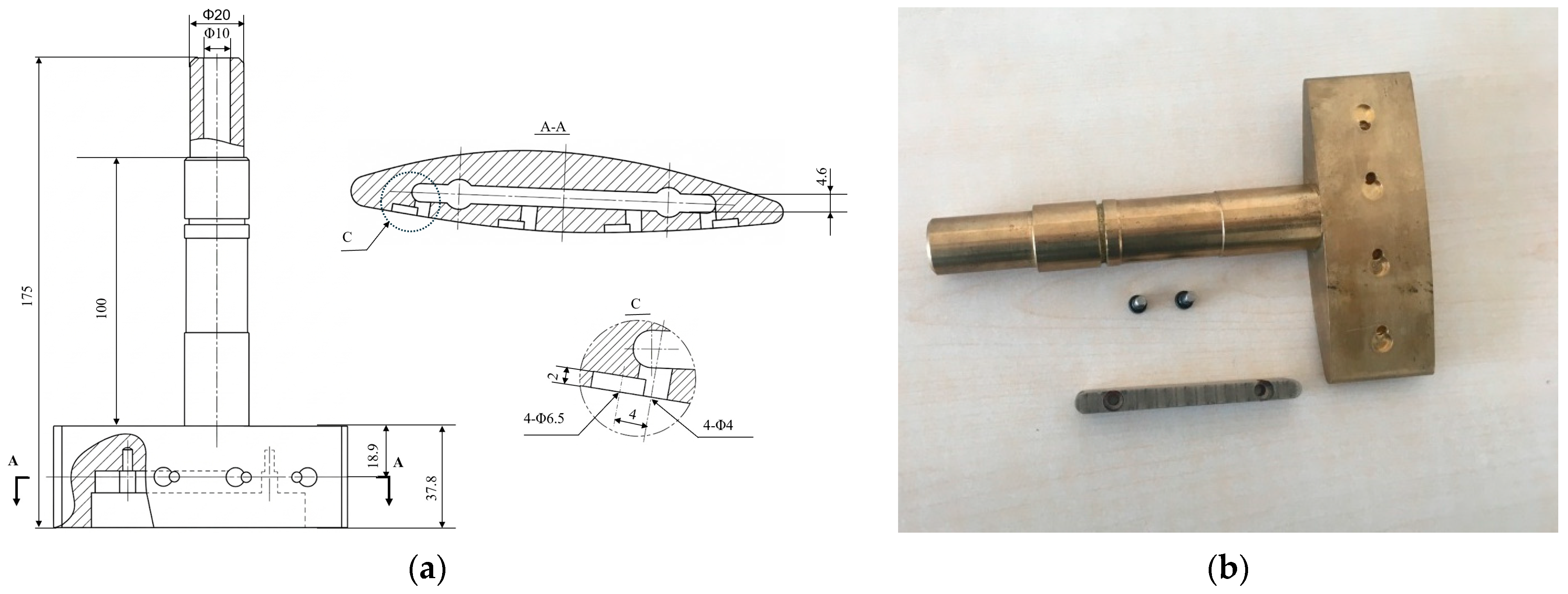
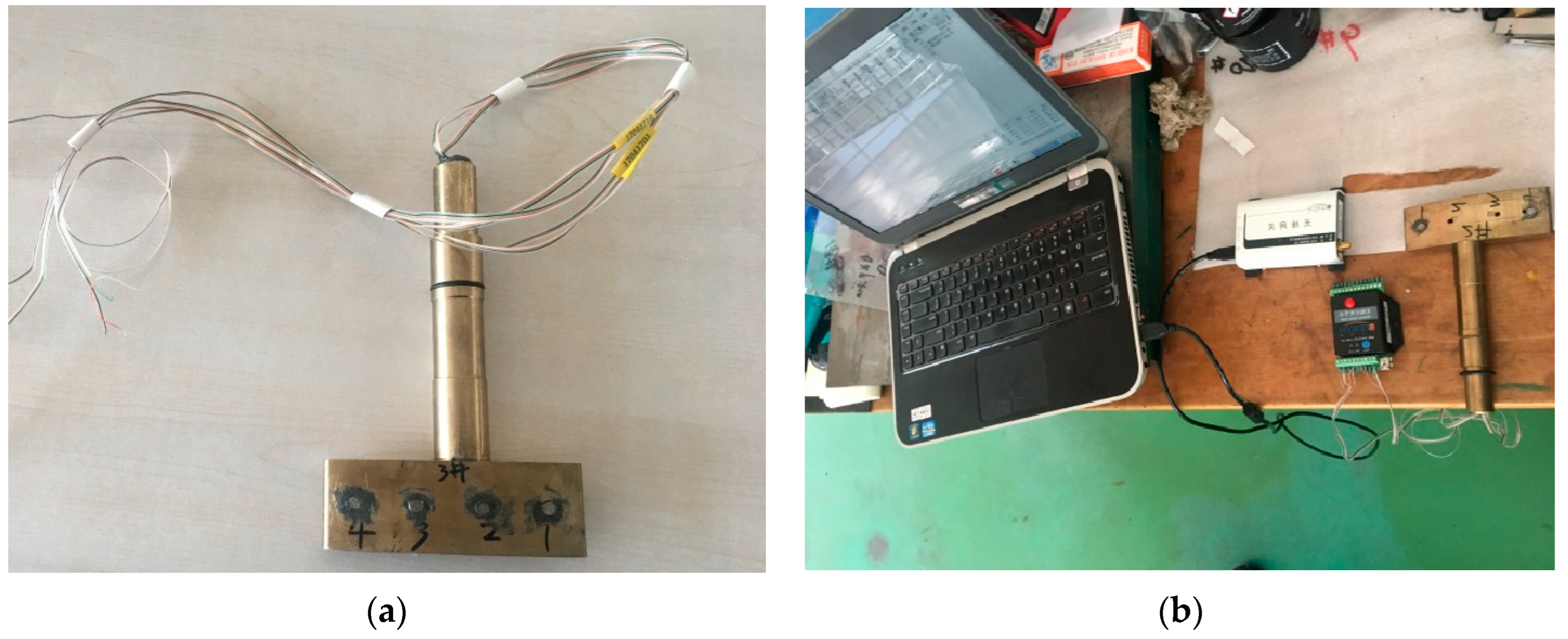
The structure of the special guide vane is shown in Figure 4. To minimize the influence of sensor installation on the flow, each pressure sensor was mounted inside a small cavity machined on the guide vane surface, with the sensor diaphragm kept flush with the vane surface. The signal cable was routed through a recessed slot on the top surface of the guide vane. The assembly consists of a guide vane body and a sealed cover mounted on top. The sensors were placed into their respective slots, and the wires were routed to the external equipment. Each slot and gap was sealed with sealant, and the cover plate was connected to the bottom of the guide vane using bolts to complete the wiring. After the installation of the sensor and signal cable, the sealing cover was fixed using screws, sealed with adhesive, and the guide vane surface was polished to ensure smoothness. The installation of the sensors and signal cables is shown in Figure 5. The sensor signal is transmitted through the slot in the guide vane trunnion to the data acquisition system installed on the top cover. The cable layout and data acquisition system are illustrated in Figure 5.

2.3.2. Arrangement of Pressure Pulsation Measurement Points on the Special Guide Vanes

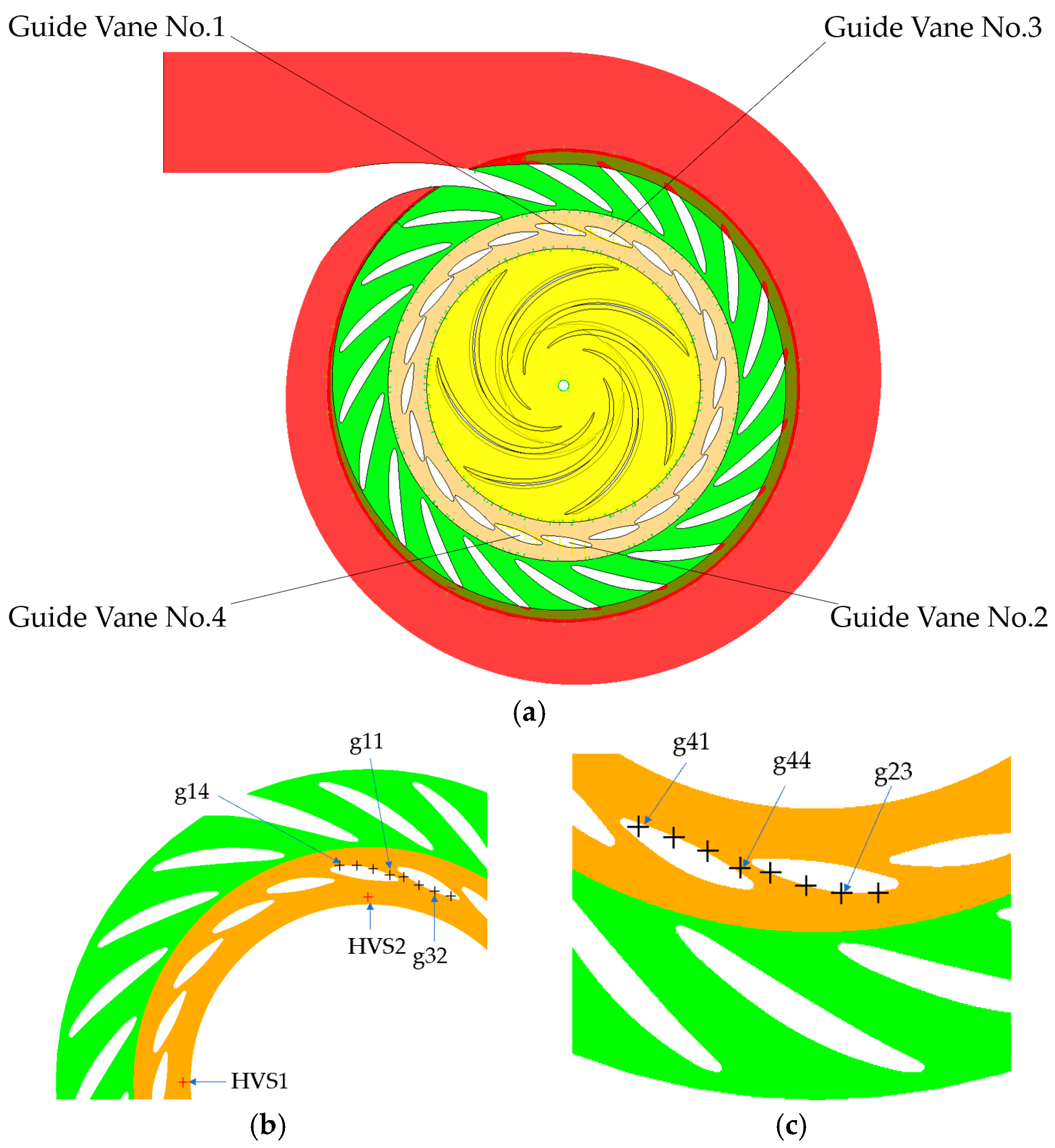
Based on engineering experience, a pressure pulsation measurement scheme was designed for both the guide vane region and the entire flow passage of the model pump–turbine. As shown in Figure 6a, four guide vanes were manufactured as special guide vanes and numbered consecutively as Guide Vane No. 1 to No. 4 in the circumferential direction. Guide Vanes No. 1 and No. 4 form a pair of adjacent vanes located near the spiral casing tongue, while Guide Vanes No. 2 and No. 3 form another adjacent pair on the opposite side of the runner. In total, sixteen dynamic pressure sensors were installed on the surfaces of these four guide vanes.
On each special guide vane, four measurement points were arranged along the flow direction at the mid-span of the vane, as illustrated in Figure 6b,c. This layout enables a detailed investigation of the pressure distribution and pressure pulsation characteristics on the guide vane surfaces under different operating conditions, as well as a comparison of the flow behavior in passages located near and away from the spiral casing tongue.
To analyze the flow characteristics at different circumferential positions, the measurement points were numbered from g11 to g44. The numbering rule is denoted as gij, where the first index i (i = 1–4) represents the guide vane number (Guide Vane No.i), and the second index j(j = 1–4) represents the sequence of the measurement point along the flow passage. Under turbine operating conditions, the sequence number j decreases along the flow direction; that is, measurement points with larger j values are located closer to the guide vane inlet, whereas those with smaller j values are closer to the outlet. For example, g11 denotes the measurement point near the outlet of Guide Vane No. 1, while g44 corresponds to the point near the inlet of Guide Vane No. 4, as shown in Figure 6b,c.
Guide Vanes No. 1 and No. 2, as well as Guide Vanes No. 3 and No. 4, form two pairs of opposite guide vane passages located on both sides of the same meridional channel. This arrangement facilitates comparisons of the flow characteristics at symmetric and asymmetric circumferential locations, providing a solid basis for subsequent analyses of the pressure distribution and pulsation propagation in the guide vane passages.
In reversible pump–turbine units, the absolute inflow direction on the guide vanes reverses between pump mode and turbine mode, resulting in a complete inversion of the surface loading distribution. Consequently, using the conventional “pressure side/suction side” terminology adopted for fluid machinery blade profiles may lead to ambiguity and misinterpretation.
For guide vanes, the naming conventions for blade surfaces often differ between the turbomachinery and hydraulic machinery fields. Directly adopting terms such as “Pressure Side” and “Suction Side,” which originate from classical airfoil theory, can easily lead to confusion and misinterpretation, particularly in reversible units.
To avoid such confusion, the present study adopts a unified definition based solely on the geometric orientation of the guide vane, which remains invariant under different operating modes:
(a).
Front Side of guide vane: Defined as the surface oriented towards the stay vanes.
(b).
Back Side of guide vane: Defined as the surface oriented towards the runner.

2.3.3. Data Acquisition System and Calibration of Pressure Sensors

Data collection was performed using the data acquisition system installed on the top cover. Dynamic pressure sensors were employed to measure the pressure pulsations on the surfaces of the guide vanes. The technical specifications of the pressure sensors are listed in Table 2. The acquisition system employed eight 4-channel SG404EX wireless nodes (Bee Data Co., Ltd., Beijing, China) with a sampling rate of 1 kilo samples/s per channel. These battery-powered modules (60 × 80 × 33 mm3) supported an 80-m communication range, enabling simultaneous onboard storage and wireless real-time transmission.
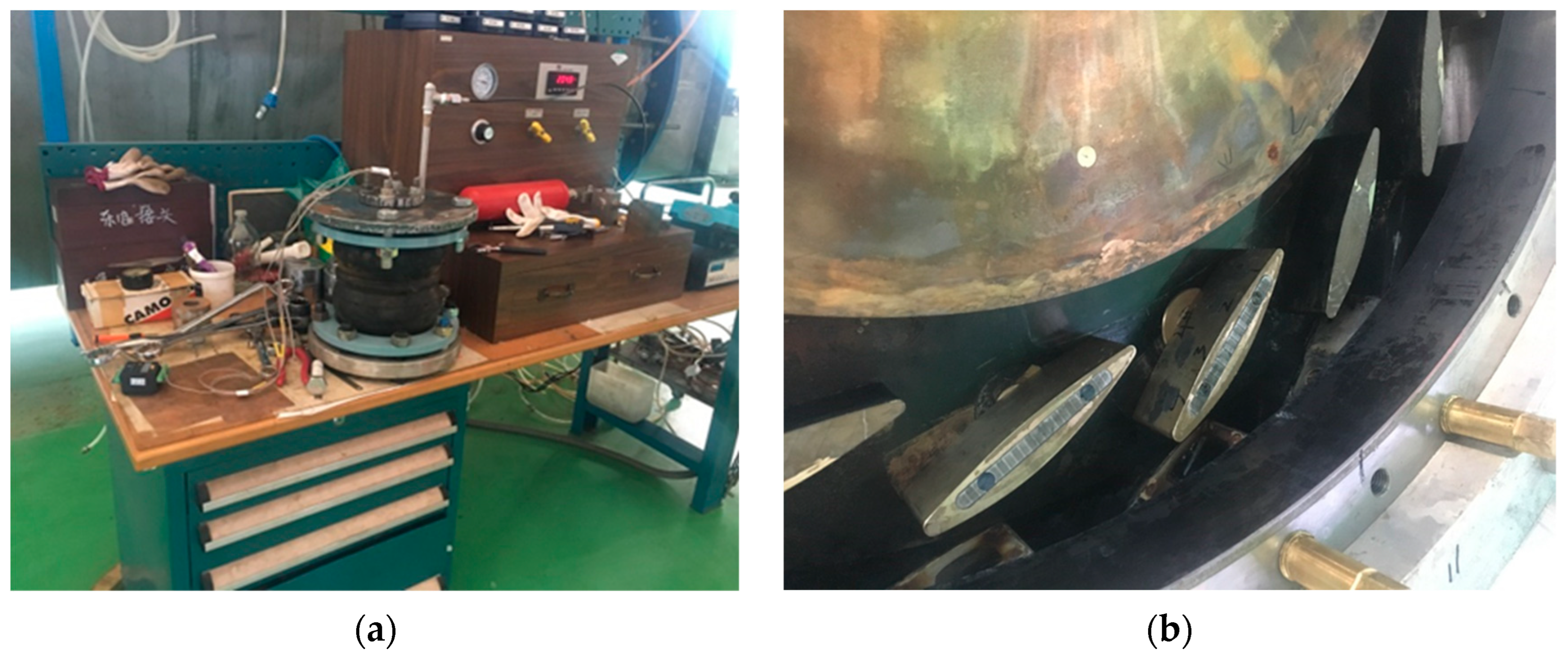
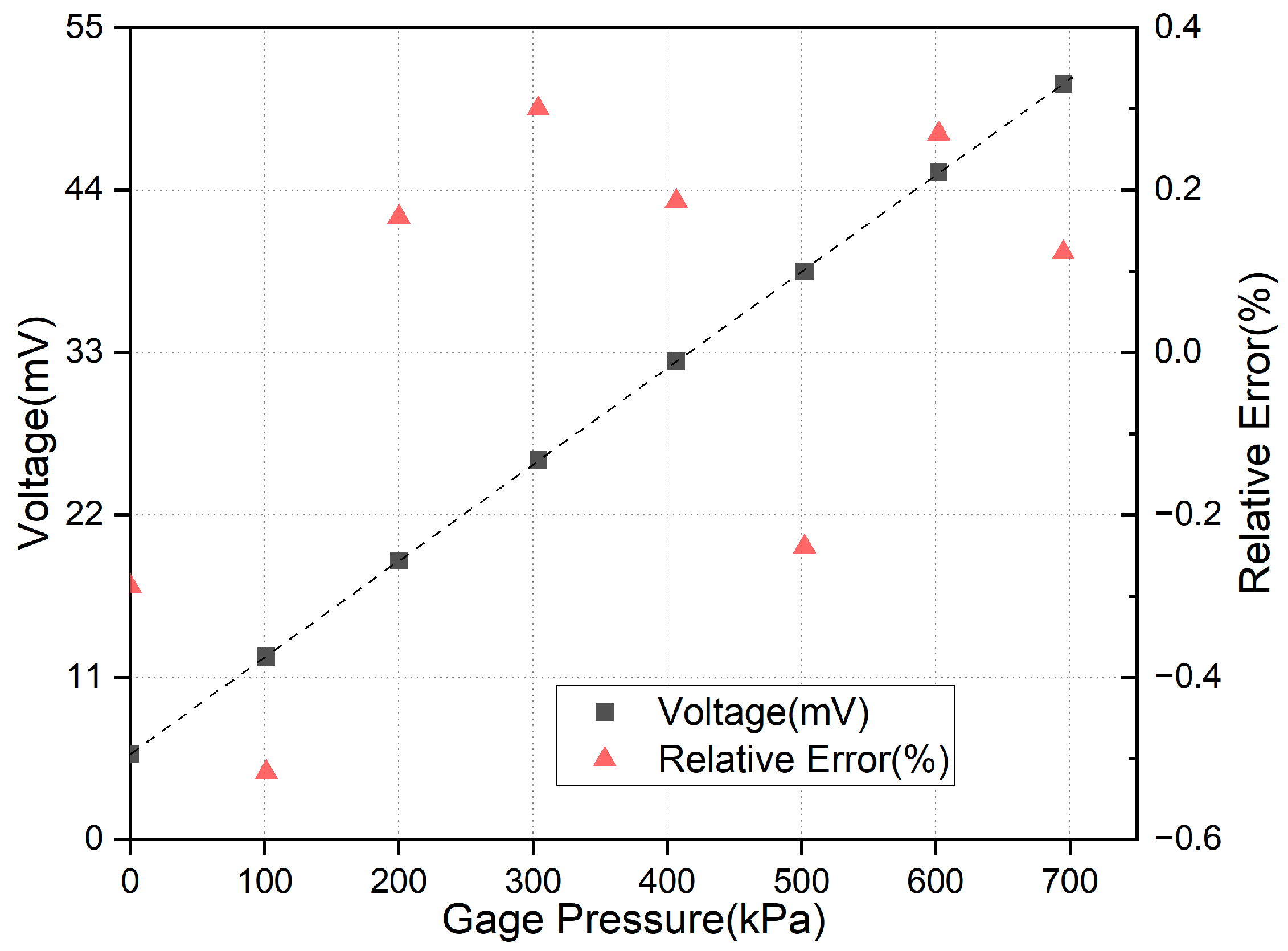
As shown in Figure 7, all pressure sensors were calibrated to ensure measurement accuracy and consistency. The pressure pulsation sensors were calibrated from 0 kPa to 700 kPa gauge pressure using a DPI610PC pressure calibrator (Druck Ltd., Leicester, UK) with an accuracy of ±0.025% FS. Within the full calibration range (0–700 kPa), the measurement uncertainty remained within 0.5% as the calibration result is shown in Figure 8, meeting the accuracy requirements for pressure pulsation measurements in model tests. In addition, to minimize measurement errors and improve signal stability, zero-drift inspection and correction were carried out for each sensor channel before every test to ensure a stable signal baseline.

3. Result and Discussion

3.1. Performance Characteristics in Turbine Mode

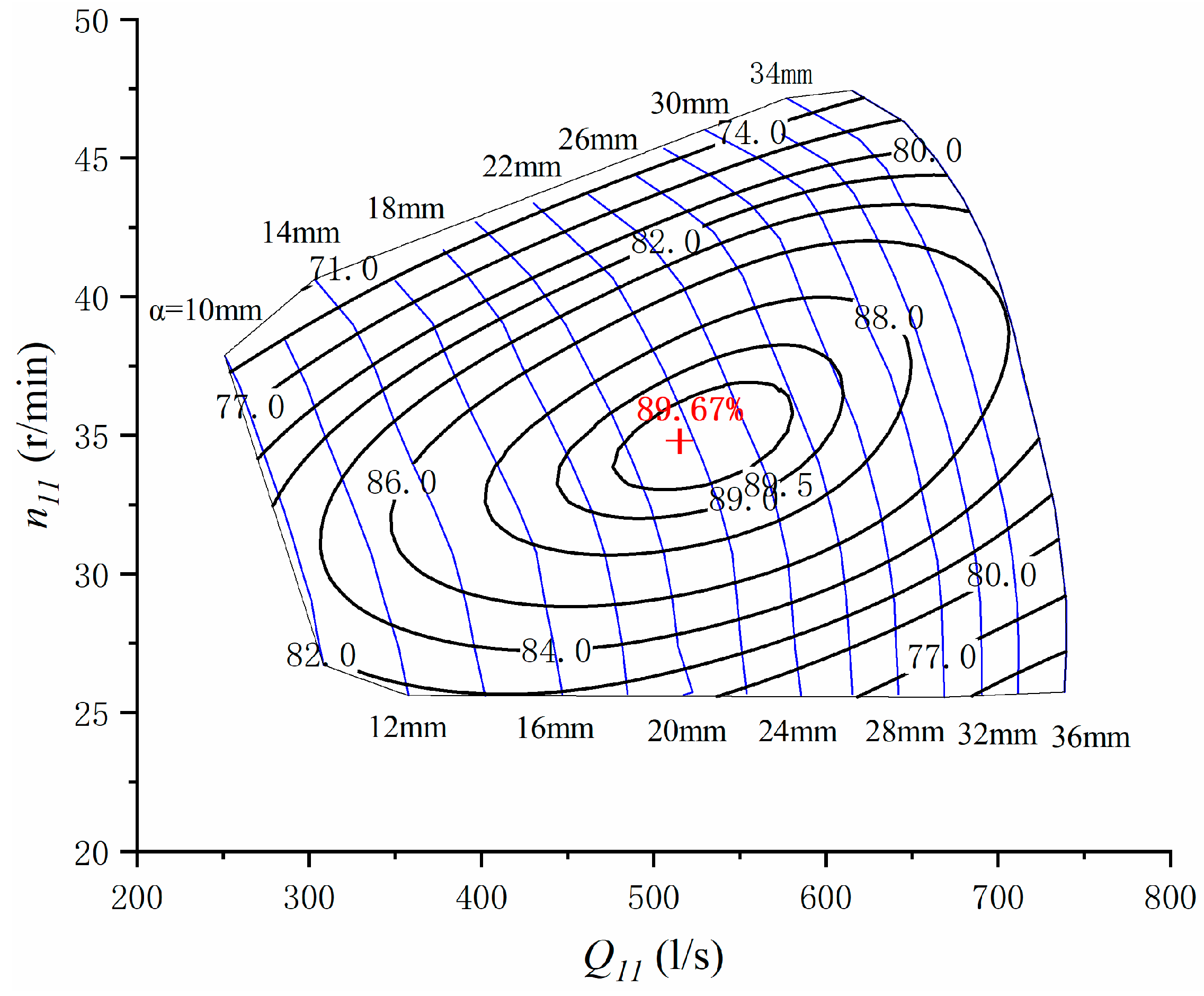
Experiments were conducted under a head of 20 m. During the tests, both the guide vane opening and the rotational speed were adjusted, with the guide vane opening varied from 10 mm to 36 mm and the rotational speed n11 ranging from 25 r/min to 47 r/min. The turbine-mode performance characteristics were analyzed based on the model test data. Figure 9 presents the comprehensive characteristic curves in turbine mode, where the contour lines represent iso-efficiency curves.
The optimal model efficiency reaches 89.67%, corresponding to prototype-scaled efficiency of 92.19%. This operating point occurs at a unit speed of n11 = 33.98 r/min and a unit flow rate of Q11 = 509.80 L/s. The unit speed n11 and unit discharge Q11 are defined as:
  n 11 = n D 1 H
Q 11 = Q D 1 2 H
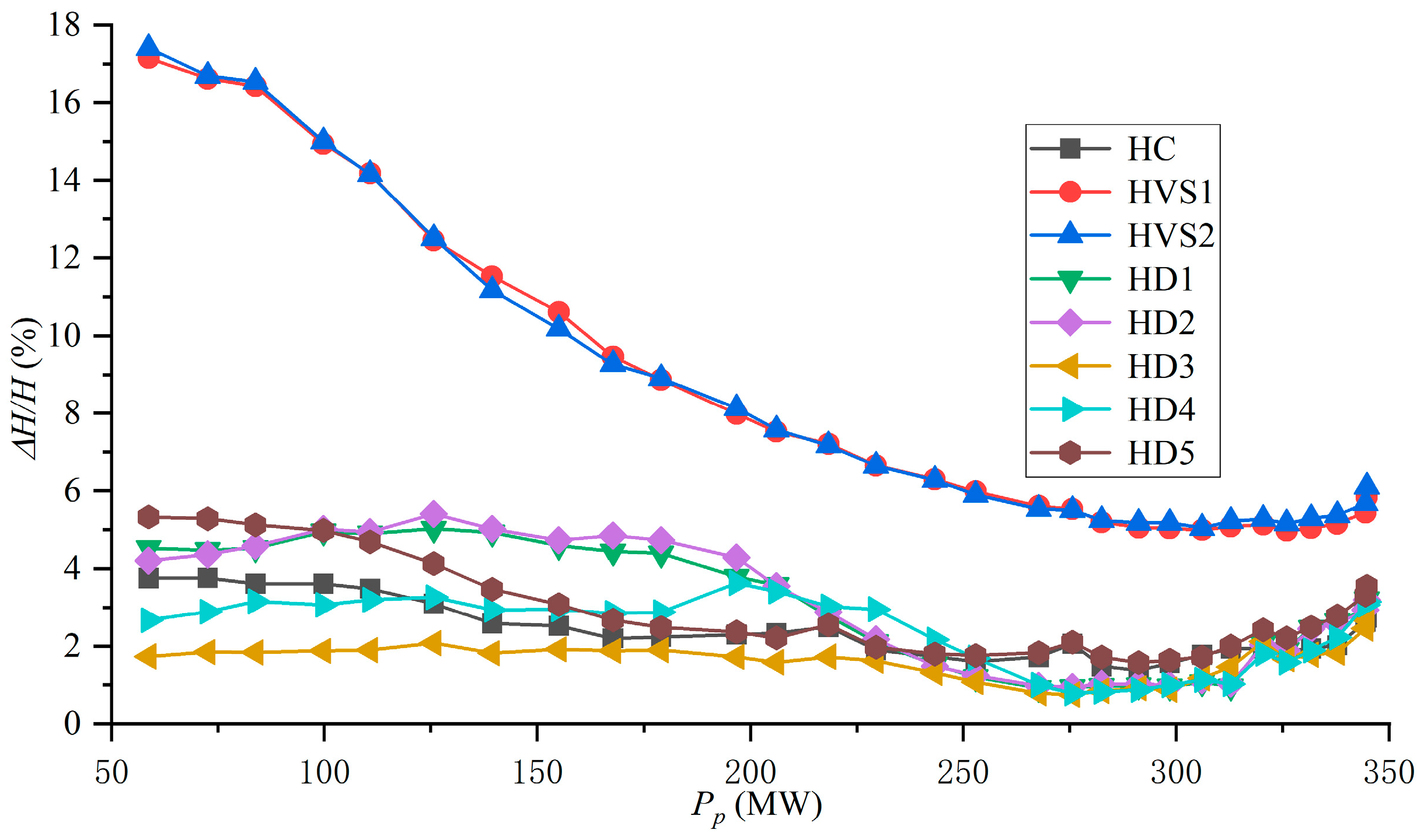
To characterize the pressure pulsation behavior at different measuring locations, this study utilizes the dimensionless peak-to-peak pressure pulsation amplitude (ΔH/H). According to the IEC 60193 standard, this parameter is defined as the ratio of the peak-to-peak pressure fluctuation (ΔP) measured at a stable operating period to the total head (H) of the unit. Figure 10 presents the variation in the dimensionless peak-to-peak pressure pulsation (ΔH/H) as a function of the output power Pp under the condition of Hp = 611.6 m. Here, Pp denotes the prototype scaled output power, and Hp denotes the corresponding prototype scaled head. Across most operating regimes, the maximum pressure pulsation amplitude is typically observed in the vaneless space (corresponding to measuring points HVS1 and HVS2). Since the vaneless space is the critical region for energy transfer and flow transition between the guide vanes and the runner, its internal flow field is highly sensitive to variations in guide vane opening and guide vane geometry. Therefore, conducting in-depth research on the pressure pulsation within the vaneless space, particularly in the regions directly influenced by the guide vanes, is of significant importance and necessity for accurately elucidating the unsteady characteristics of the unit during turbine operation.

3.2. Pressure Pulsation Characteristics on the Guide Vane Surface

3.2.1. Pressure Distribution on the Guide Vane Surface

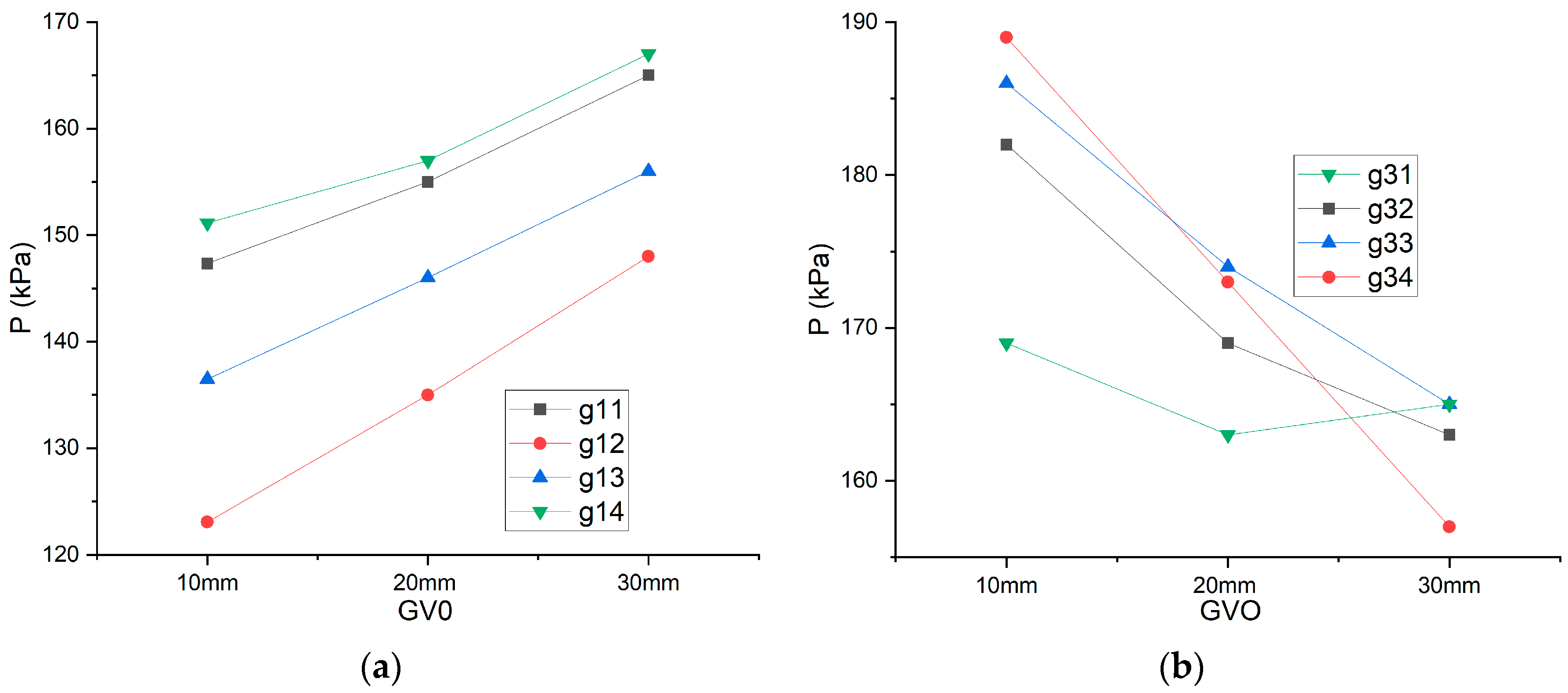
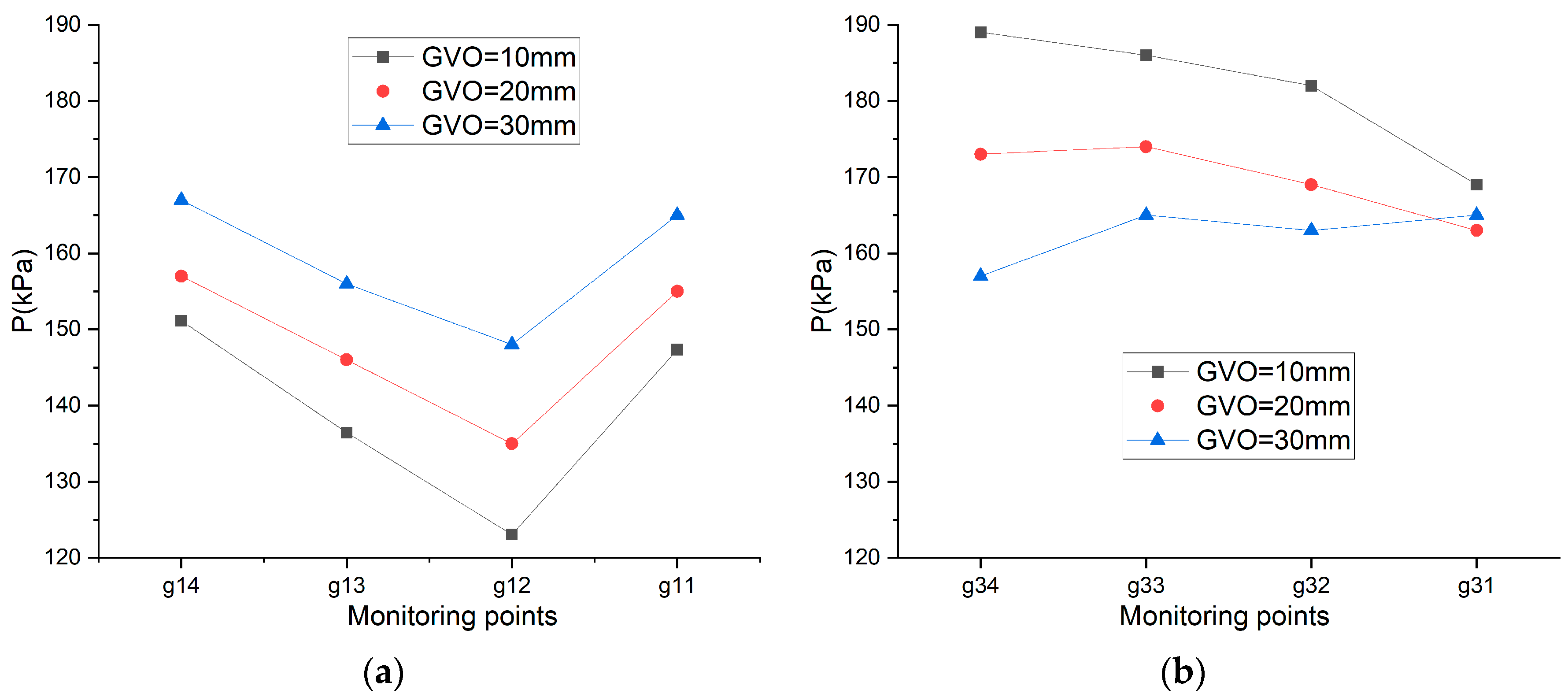
To investigate the pressure distribution characteristics in the guide vane region, time-averaged pressures were measured at multiple monitoring points on the guide vane surfaces across different Guide Vane Openings (GVO). Figure 11 and Figure 12 illustrate the time-averaged pressure distribution along various measuring locations on the Front Side of Guide Vane No. 1 and the Back Side of Guide Vane No. 3 under three typical GVOs (GVO = 10 mm, 20 mm, and 30 mm).
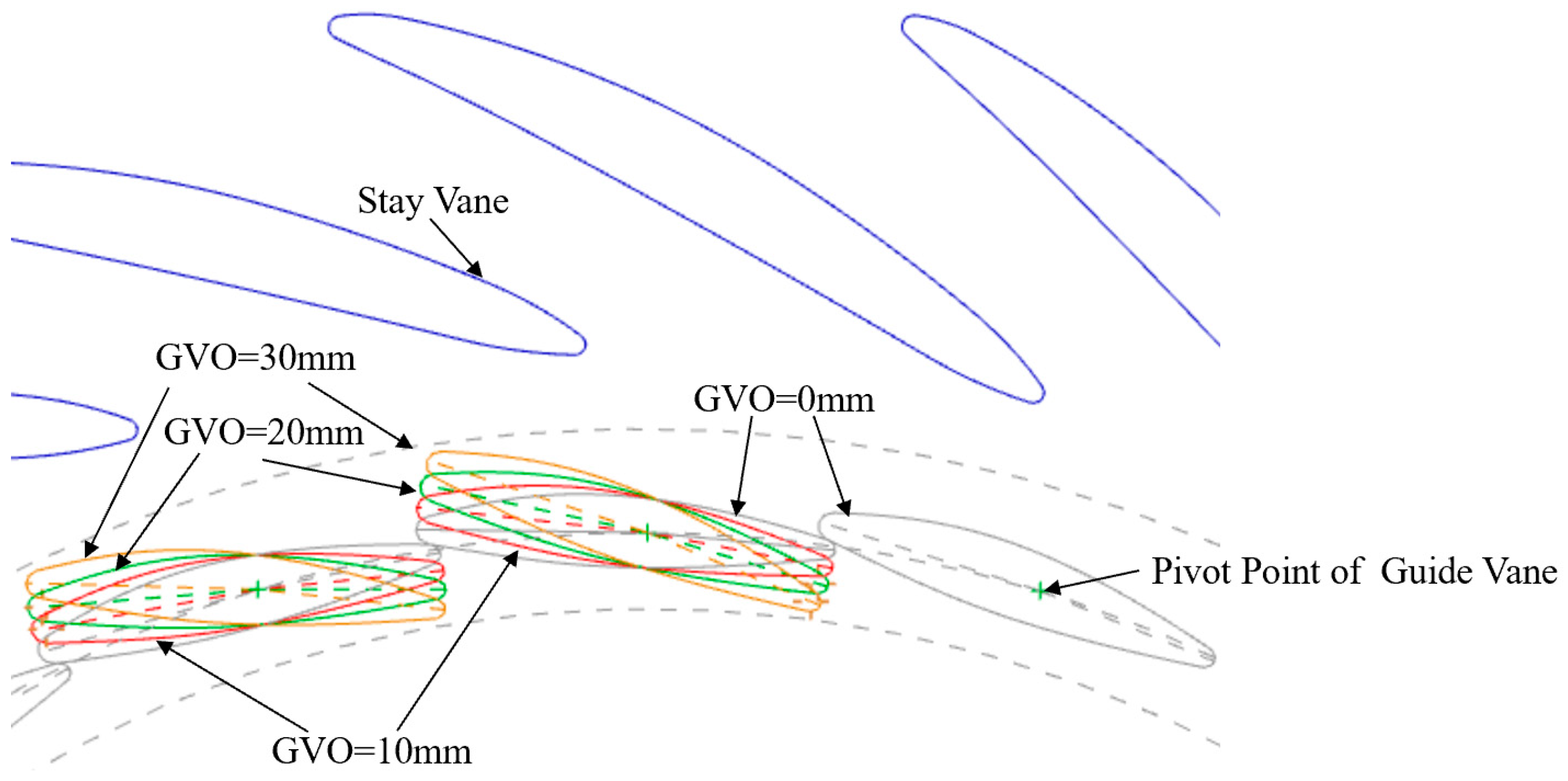
In order to clarify the geometric relationship within the flow channel, Figure 13 presents the superimposed profiles of the guide vanes at different openings (0 mm, 10 mm, 20 mm, and 30 mm). As shown, the variation in GVO significantly alters the geometric interference between adjacent blades and the effective flow cross-section, which directly determines the inflow angle and velocity entering the runner.
Analyzing the pressure characteristics on the Front Side of Guide Vane No. 1 (Figure 11a), the results indicate that the pressure at the same monitoring point increases significantly with increasing GVO across all tested conditions. This is likely due to two main reasons. On the one side, the large positive angle of attack under small GVO conditions is likely to induce flow separation on the Front Side of the guide vane [6,33], forming a low-pressure turbulent zone. As the GVO increases, the flow has become smoother, consequently leading to an increase in static pressure. Furthermore, this side is located in the impact zone of the incoming flow. As the guide vane opening increases, the flow rate through the unit increases significantly, and the flow velocity from the spiral case and fixed guide vanes into the guide vane area also increases. When the fluid impacts the blades, part of the kinetic energy is converted into pressure energy. The higher the flow velocity, the higher the resulting local pressure.
As shown in Figure 12a, the pressure on the Front Side exhibits a non-monotonic distribution along the streamwise direction at a fixed GVO: the pressure peaks at point g14, rapidly decreases along the flow direction, reaches a minimum value at g12, and then shows a marked increase at g11, where the pressure is significantly higher than at g13. This distribution is due to local fluid acceleration and compression in the region of maximum blade curvature (near g12), resulting in the lowest static pressure. In contrast, the gradual decrease in curvature on both sides causes the fluid to decelerate, converting kinetic energy back into static pressure and leading to a pressure recovery. Notably, the pressure increase at g12 is significantly higher than at other monitoring points as GVO increases, indicating that this location is the most sensitive to changes in guide vane opening.
Figure 11b presents the pressure variation on the Back Side of Guide Vane No. 3, which displays a trend distinctly different from the Front Side. Overall, the pressure on the Back Side monotonically decreases as the GVO increases. This is primarily because the larger opening increases the mean flow velocity in the channel, leading to a corresponding reduction in static pressure.
As depicted in Figure 12b, the uniformity of the pressure distribution across the monitoring points varies significantly with GVO. Under the small GVO of 10 mm, there are considerable pressure differences among the measuring points, indicating a highly non-uniform blade loading. For GVOs of 10 mm and 20 mm, the pressure generally decreases along the streamwise direction, exhibiting a notable pressure gradient. Conversely, at the large GVO of 30 mm, the pressure at the monitoring points initially increases and then slowly decreases along the flow path. The pressure difference between the measuring points is markedly reduced in this condition, and the blade load distribution tends to be more uniform.
Comparing the pressure variations between the Front Side of Guide Vane No. 1 and the Back Side of Guide Vane No. 3, entirely different flow mechanisms are evident under small GVOs. The non-monotonic pressure distribution on the Front Side reflects the presence of a local flow separation zone near the region of maximum curvature (g12). In contrast, the pressure on the Back Side decreases monotonically along the flow path, indicating a relatively stable attached flow driven by the favorable pressure gradient.
The disparity in pressure distribution between the guide vane surfaces holds critical engineering significance. The large pressure difference across the guide vane surfaces can induce significant unsteady hydraulic loads, increasing guide vane root stress, accelerating fatigue damage accumulation, and potentially exciting structural vibrations via fluid–structure interaction. Resonance may occur if the excitation frequency approaches the natural frequency. Furthermore, the low-pressure zone near g12 on the Front Side is highly susceptible to cavitation (sheet cavitation has been previously observed in this region [38]). Meanwhile, the non-uniform blade loading on the Back Side under small GVO increases the risk of blade fatigue failure. With the increased frequency of PSH unit mode switching, the accumulated duration of small GVO operation is prolonged, leading to a dramatic increase in the number of high-stress cycles, thus posing higher demands on material strength and fatigue resistance.
Increasing the GVO significantly enhances pressure uniformity, but the underlying mechanisms differ fundamentally between the front and back sides. For the Front Side of guide vane, increasing the GVO improves the angle of attack, suppresses potential flow separation, and consequently reduces pressure non-uniformity; the separation zone shrinks when the opening increases from 10 mm to 30 mm, and the pressure at the minimum pressure point g12 rises significantly. For the Back Side of guide vane, pressure homogenization is primarily achieved by enlarging the flow passage area and reducing the velocity gradient. Specifically, the pressure difference between the inlet side monitoring point (g31) and the outlet side (g34) decreases from approximately 20 kPa at small GVO to about 9 kPa at large GVO, representing an approximate 55% reduction in the pressure gradient. As the flow rate increases, the pressure at the same monitoring point on the Back Side of guide vane drops significantly, reflecting the enhanced kinetic energy and reduced static pressure due to the increased flow. Pressure homogenization not only reduces hydraulic losses and mitigates the pressure gradient on the guide vane surface but also weakens the pressure pulsation excitation source, thus contributing to improved hydraulic stability and vibration characteristics of the unit. Therefore, the hydraulic design must comprehensively consider the pressure distribution characteristics of the guide vane across the entire operating range. Optimizing the blade profile curvature and the angle-of-attack matching to maintain a relatively uniform pressure distribution across different openings is crucial for enhancing the wide-range operating stability of PSH units.

3.2.2. Time-Domain Characteristics of Pressure Pulsations on the Guide Vane Surface

Based on the preceding analysis, it is known that obvious flow separation may exist on the Front Side of guide vane under small GVO conditions, while the Back Side of guide vane exhibits significant load non-uniformity. These complex flow behaviors are important sources of hydraulic instability and enhanced pressure pulsations. Therefore, this section selects the small opening condition of 10 mm to conduct an analysis of its pressure pulsation characteristics.
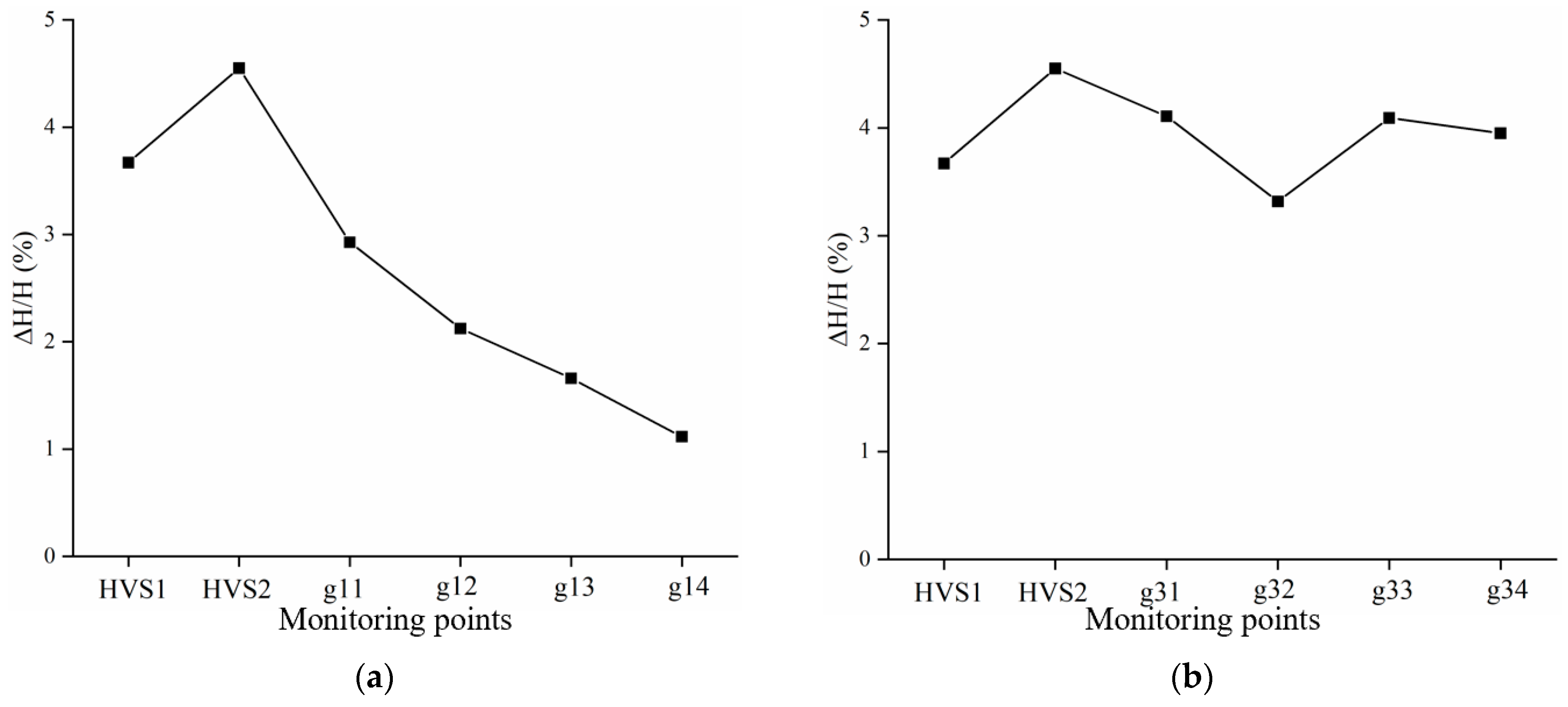
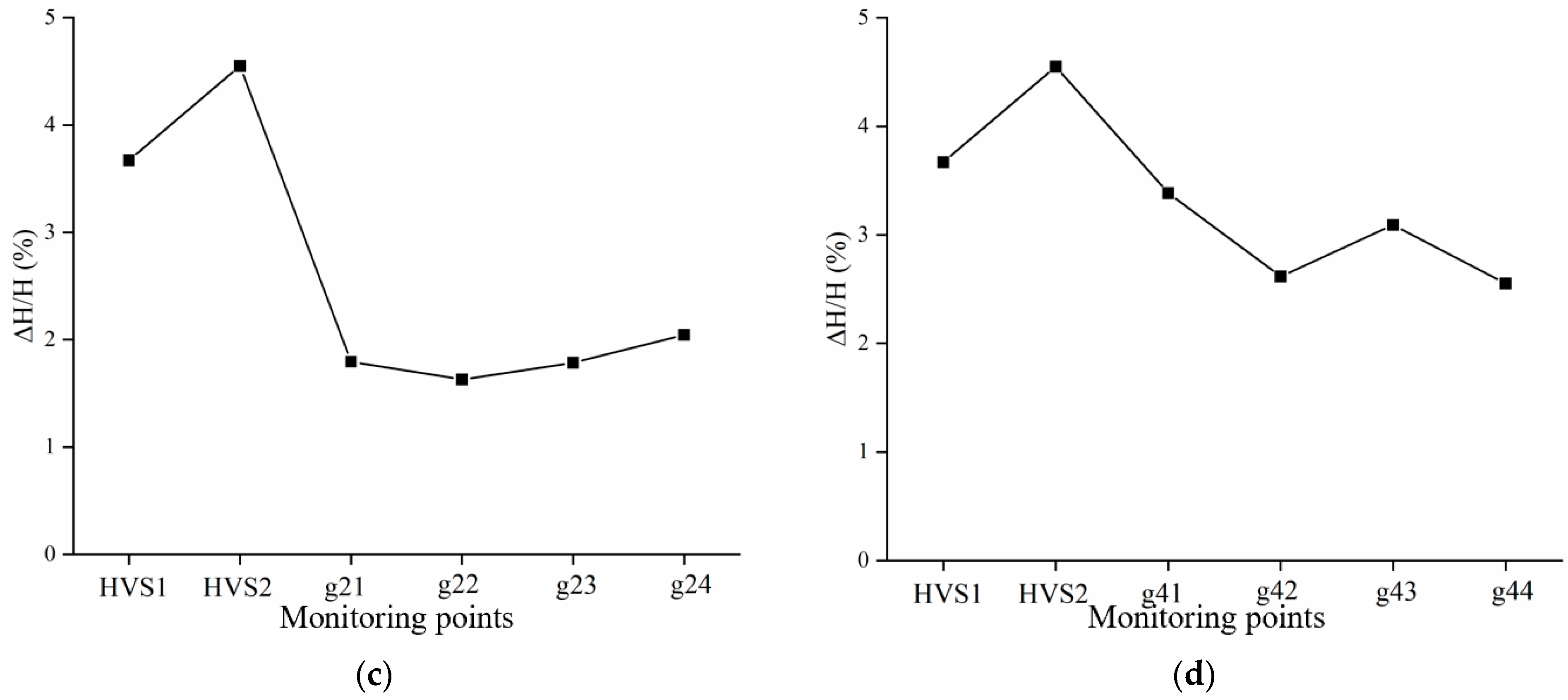
Figure 14 presents the dimensionless peak-to-peak pressure pulsation amplitude (ΔH/H) at various monitoring points in the guide vane region under the small opening condition. Since the pressure pulsation in the vaneless space is obviously stronger than in other regions, the vaneless space monitoring points HVS1 and HVS2 are included as a reference, in order to facilitate the comparison of the relative pulsation intensity on the guide vane surface. HVS1 is located near the area of Guide Vane No. 2 and Guide Vane No. 4, and HVS2 is located near the area of Guide Vane No. 1 and Guide Vane No. 3. As seen from the figure, the pulsation amplitudes of the vaneless space monitoring points HVS1 and HVS2 are the highest, and HVS2 is clearly higher than HVS1, indicating that the internal pressure pulsation of the vaneless space also possesses obvious circumferential non-uniformity.
When the fluid enters the vaneless space from the narrow channels formed by the densely arrayed guide vanes, the pressure pulsation amplitude significantly increases due to the effect of Rotor–Stator Interaction (RSI). For the Front Side of guide vane, the pulsation amplitude of Guide Vane No. 1 along the flow direction shows a monotonically increasing trend; the pulsation amplitude at the outlet side monitoring point g11 is increased by about 62% compared to the inlet side point g14, illustrating that the pressure disturbance transmitted from the vaneless space rapidly decays at the Front Side inlet of the guide vane. For the spatially corresponding monitoring points on the Front Side of guide vane, the pulsation amplitudes of the four monitoring points on Guide Vane No. 2 are clearly smaller than those on Guide Vane No. 1, and the pulsation difference along the flow direction is small, reflecting that the flow in this area is relatively stable.
For the Back Side of guide vane, the pulsation amplitude of Guide Vane No. 3 is relatively close to the vaneless space level, and the pulsation amplitudes along the flow direction at different measuring points are all large. The pulsation amplitude variation along the flow direction of Guide Vane No. 4 is similar to that of Guide Vane No. 3, but its overall amplitude is lower. The pulsation variation range along the Back Side is extremely small, indicating that the pressure disturbance from the vaneless space can propagate along the Back Side of guide vane with low losses, thereby maintaining high pulsation intensity.
By comparing the flow channels formed by the two adjacent guide vanes, it can be found that the pulsation amplitudes at the Back Side monitoring points are generally larger than those at the Front Side. This is because the Back Side is unobstructed and close to the high-speed rotating runner, allowing the periodic pressure waves from the runner side to act more directly and intensely on the blade surface, while the solid structure obstruction leads to the Front Side pulsation amplitude being significantly lower than the Back Side.
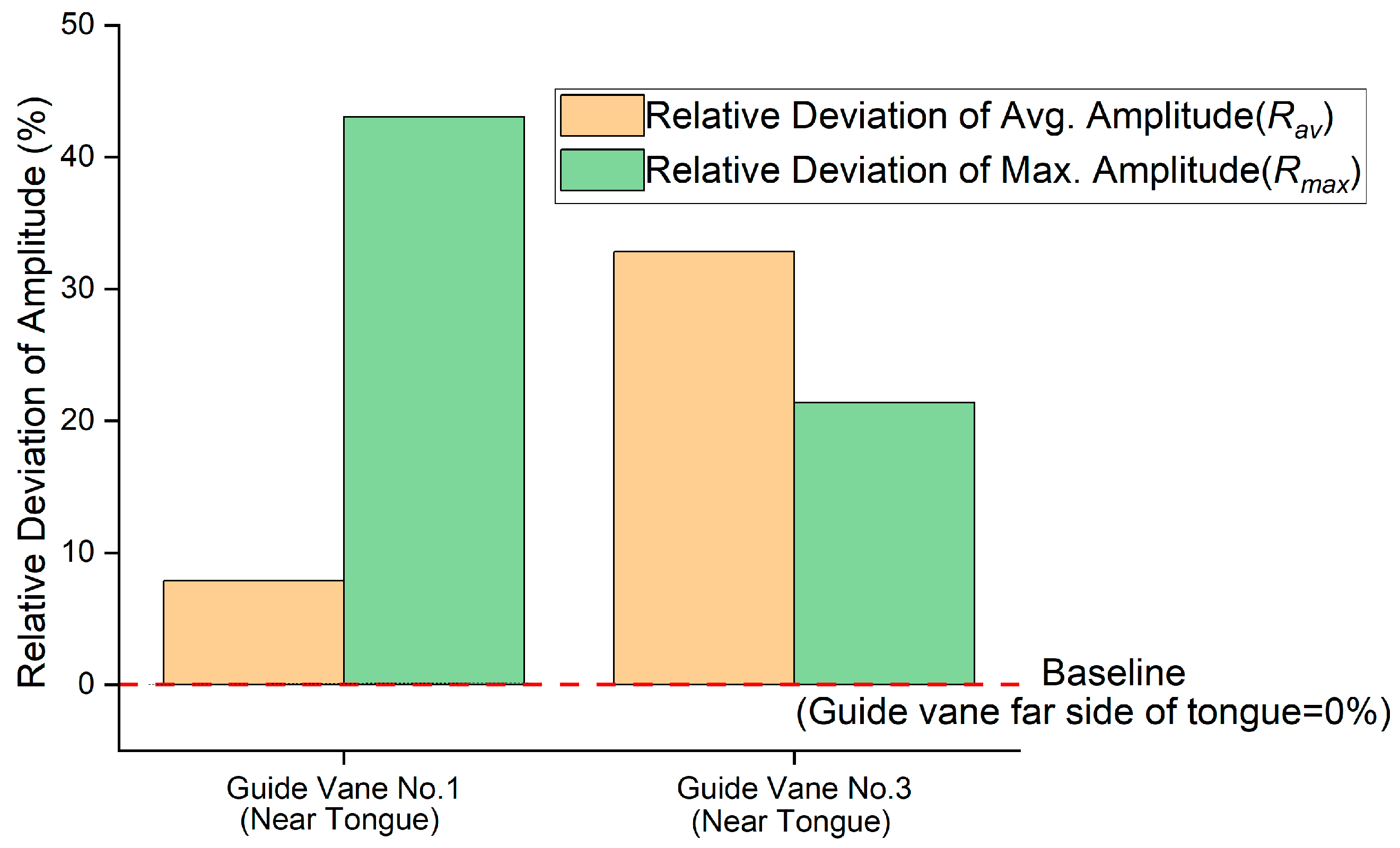
The asymmetry of pressure pulsations is quantified by the Relative Deviation of Average Amplitude (Rav) and Maximum Amplitude (Rmax), defined as:
R a v = H ¯ n e a r H ¯ f a r H ¯ f a r × 100 %
R m a x = H n e a r m a x H f a r m a x H f a r m a x × 100 %
where H ¯ and H m a x denote the arithmetic mean and the maximum value of the peak-to-peak amplitudes across the four monitoring points, with the subscripts ‘near’ and ‘far’ corresponding to the guide vanes near the tongue and on the opposite side, respectively.
Figure 15 illustrates the relative deviation of pressure pulsation amplitudes on the guide vanes near the tongue. It can be observed that regions near the tongue (Guide Vanes No. 1 and 3) show significantly higher pulsation intensities than the far-side reference points (Guide Vanes No. 2 and 4). This obvious circumferential non-uniformity primarily originates from the flow field distortion caused by the geometric structure of the casing tongue, which makes the flow in the tongue area more complex and the pulsation stronger; while the flow approaching the channels far from the casing tongue is uniform, and the pulsation intensity is relatively weaker.
For the flow channel formed by Guide Vane No. 1 and Guide Vane No. 3, the large pulsation amplitude difference between the two sides is attributed to the non-uniformity of the flow distribution, thereby further enhancing the flow unsteadiness; while the pulsation amplitudes on both sides of the flow channel formed by Guide Vane No. 2 and Guide Vane No. 4 are similar, the asymmetry is weaker, reflecting better flow uniformity in this region.
The high pulsation amplitude on the Guide Vane No. 3 surface means that the overall pulsation in this region is significant. Combined with its circumferential position being close to the casing tongue, it can be inferred that this enhanced pulsation is closely related to tongue wake shedding. This flow instability not only enhances local pressure fluctuations but may also excite guide vane vibration through fluid–structure interaction, making it one of the major hydraulic vibration sources under small GVO operating conditions.
These pressure pulsation characteristics have severe engineering implications for the structural integrity and operation of the unit. The extreme pressure difference and pressure pulsation level act directly on the guide vane body, generating severe cyclic bending stresses that accelerate fatigue damage accumulation at the vane root and trunnion. Furthermore, under small opening conditions (e.g., 10 mm), the unstable flow on the Front Side creates a local low-pressure zone near point g12, which significantly increases the risk of cavitation erosion. Therefore, optimizing the startup strategy to quickly pass through the small-opening zone is critical to mitigating these vibration sources and protecting the guide vanes from structural failure.

3.2.3. Frequency-Domain Characteristics of Pressure Pulsations on Guide Vane Surface

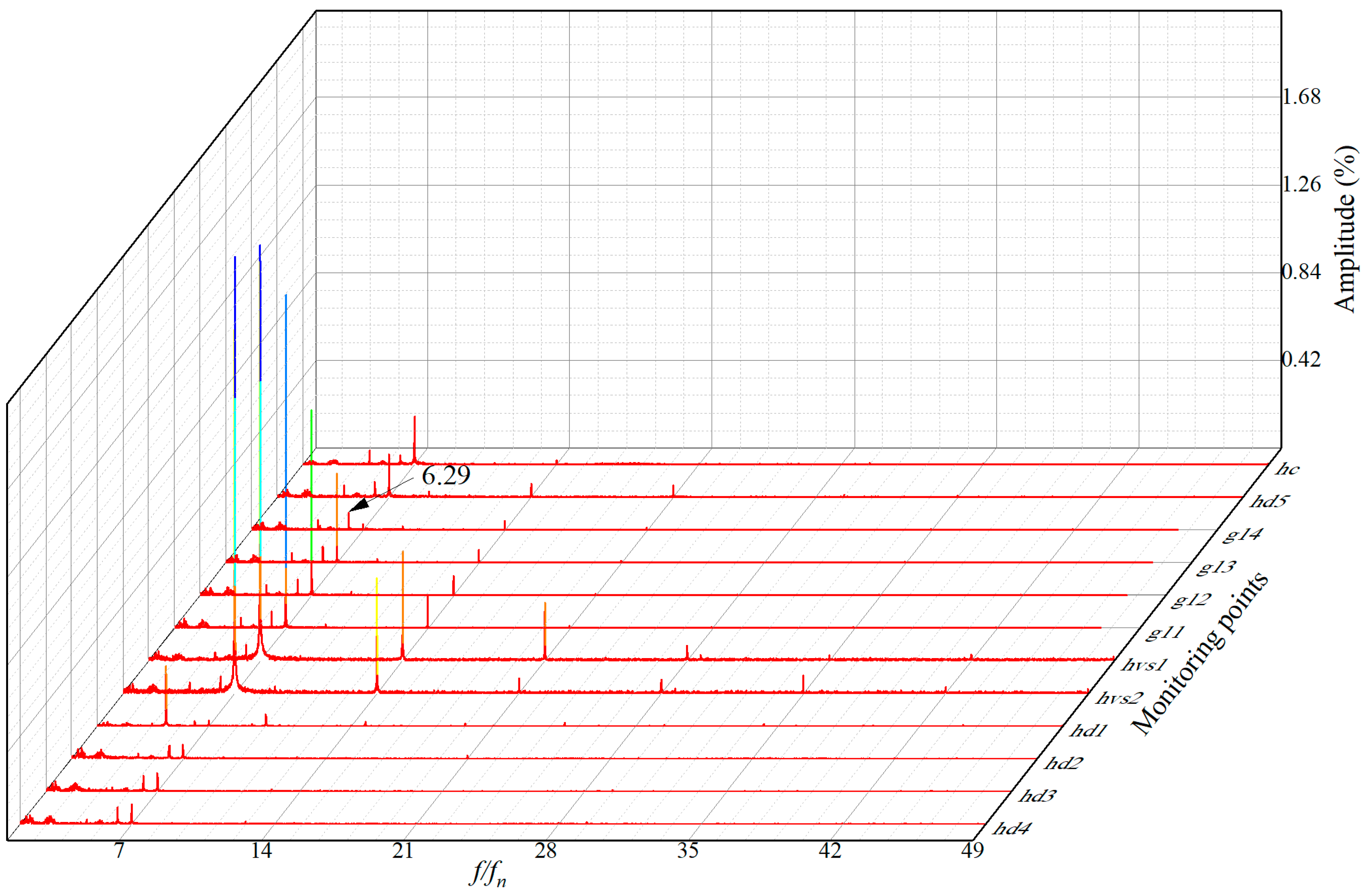
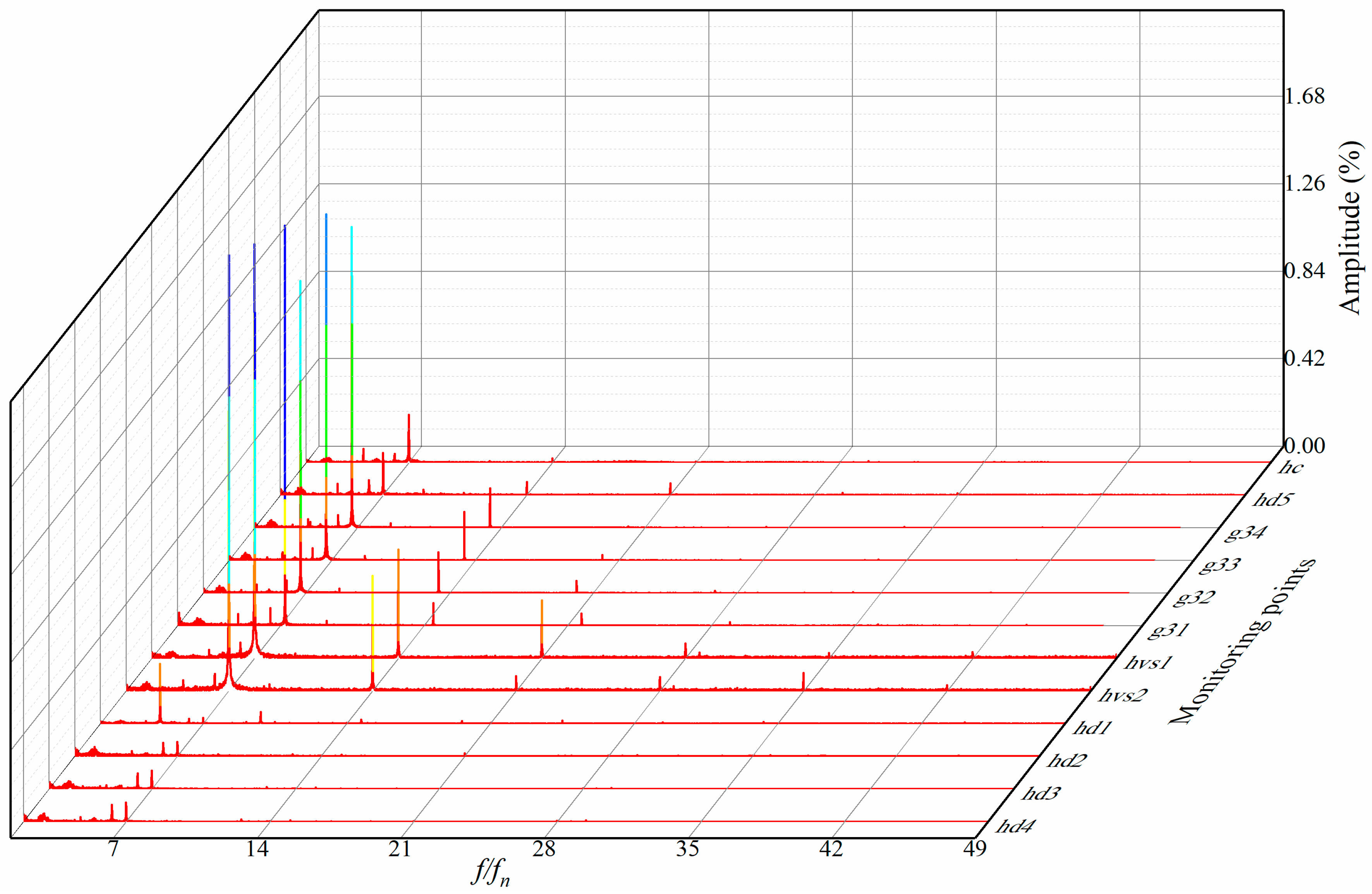
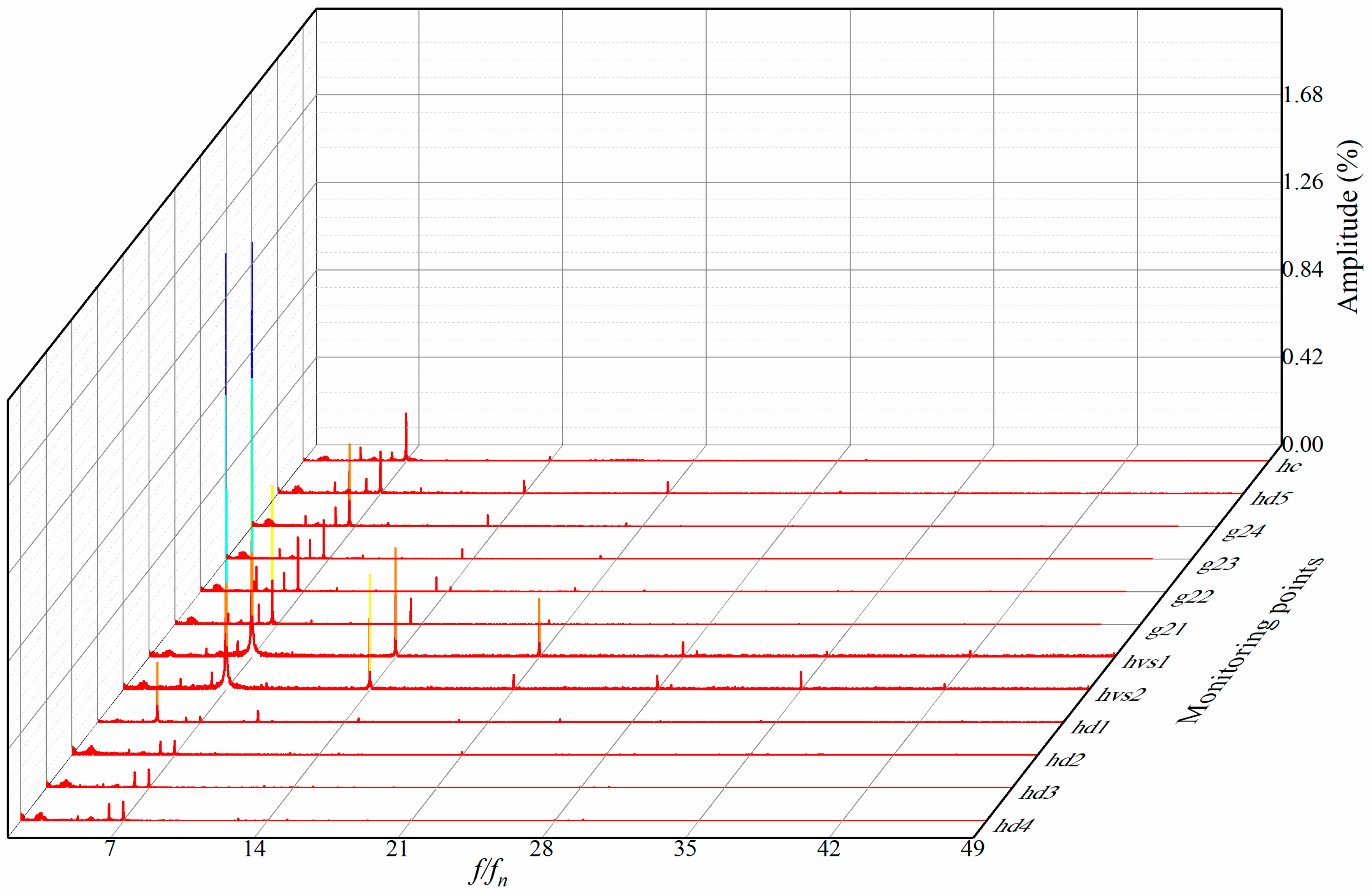
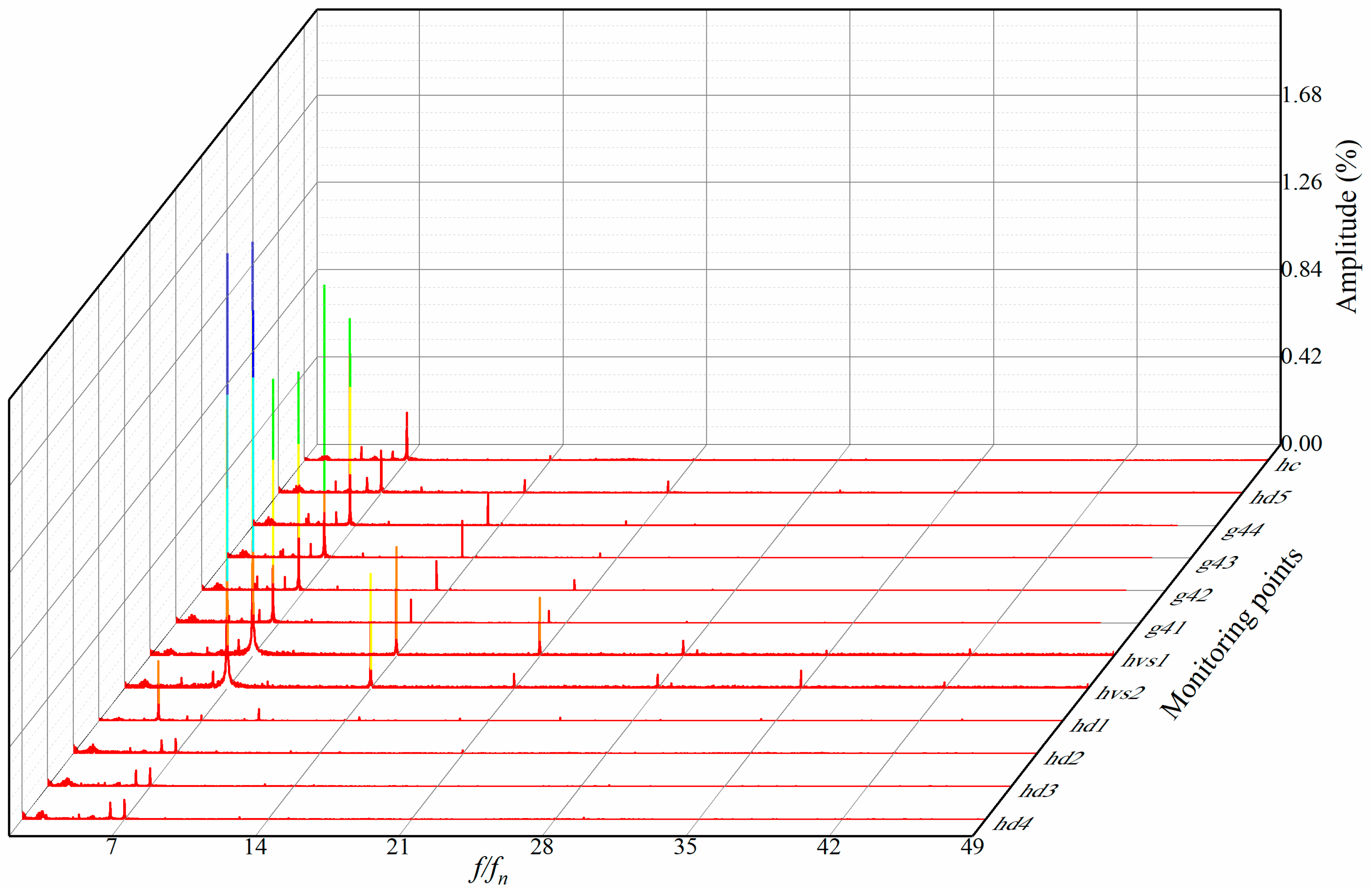
To reveal the frequency components of pressure pulsations in the guide vane region and identify their physical excitation sources, the time-domain pressure signals of all monitoring points on Guide Vane Nos. 1–4 were subjected to Fast Fourier Transform (FFT). Figure 16, Figure 17, Figure 18 and Figure 19 present the spectral distributions of each monitoring point, where the frequency f is nondimensionalized by the runner rotation frequency fn (11.657 Hz), in the form of f/fn.
The frequency domain analysis indicates that, except for point g14, the dominant frequency of the remaining monitoring points is concentrated around 7fn, which corresponds to the Blade Passing Frequency (BPF), a typical Rotor–Stator Interaction (RSI) effect between the guide vanes and the runner.
For point g14, the dominant frequency is approximately 6.29 fn, slightly lower than the BPF. This deviation suggests that the pressure pulsation in this area may be primarily controlled by periodic shedding vortices, thereby generating a dominant frequency independent of the runner-guide vane interaction frequency. Simultaneously, the BPF signal undergoes significant energy dissipation while propagating toward the guide vane Front Side inlet; this energy is further weakened by turbulent dissipation and vortex shedding processes, leading to the deviation of the dominant frequency at point g14 from the BPF.
Compared to other measuring points, the pulsation amplitude of the dominant frequency component (BPF) on the surface of the guide vanes is only second to that in the vaneless space. Compared to the vaneless space, the amplitude of the dominant frequency component decays by approximately 4–50% at the back-side monitoring points, while the decay is more pronounced at the front-side monitoring points, reaching 20–91%, excluding point g14. This difference is also reflected in the magnitude: the BPF amplitude on the Back Side (Guide Vanes Nos. 3 and 4) is about 1.2 to 7 times that on the Front Side (Guide Vanes Nos. 1 and 2). This is primarily because the Back Side directly faces the runner, allowing the propagation path of the periodic pressure disturbance to be more direct and experience less attenuation, leading to a significant enhancement of the dominant frequency energy on the Back Side. In terms of the streamwise distribution, the amplitude on the Back Side measuring points (Guide Vane Nos. 3 and 4) is relatively high, and Guide Vane No. 3 is higher than Guide Vane No. 4; both show consistent streamwise variation trends. Conversely, the amplitude on the Front Side measuring points (Guide Vane Nos. 1 and 2) is relatively low, and the amplitude of Guide Vane No. 1 is higher than Guide Vane No. 2 (excluding point g14). In terms of frequency components, the high-order harmonic components (f/fn > 21) are almost completely suppressed, and the spectrum is mainly composed of the BPF and its low-order harmonics. This is because the guide vane channel’s geometric constraint and boundary layer viscous dissipation exert a stronger filtering and dissipation effect on the short-wavelength high-frequency components, whereas the long-wavelength low-frequency signals can propagate through the flow channel with low losses.
While the dominant frequency is determined by the RSI, the casing tongue significantly modulates the spatial distribution of the pulsation energy. Consequently, guide vane channels closer to the tongue experience higher excitation intensity due to the local flow distortion. The guide vanes closer to the casing tongue position are more susceptible to enhanced non-uniform inflow and wake disturbances, making the RSI stronger in this area. In contrast, Guide Vane No. 4 is located circumferentially further away from the casing tongue, and the inflow entering this channel has been somewhat homogenized by the action of the casing and its adjacent guide vanes. Therefore, the BPF amplitude at the Back Side monitoring points of Guide Vane No. 3 is generally higher than the corresponding points on the Back Side of Guide Vane No. 4.
The experimental results clearly identify the physical sources of hydraulic instability in the guide vane region. The Rotor–Stator Interaction (RSI) is confirmed as the primary excitation source, evidenced by the dominance of the Blade Passing Frequency (BPF) across most monitoring points. This high-frequency pulsation arises as the rotating pressure field of the runner blades periodically sweeps past the stationary guide vanes. Crucially, the asymmetry of the spiral case (the “Tongue Effect”) significantly modulates this excitation source. The flow distortion caused by the tongue structure leads to uneven hydraulic loading, causing the guide vanes located near the tongue (No. 1 and No. 3) to experience significantly intensified pulsations compared to those in circumferentially symmetric positions.

4. Conclusions

This study characterized the evolution of pressure pulsations on the guide vanes of a low-specific-speed (ns = 28) pump–turbine model operating in turbine mode, utilizing an embedded sensor technique. By overcoming the accessibility limitations of traditional measurements, this research investigated the hydraulic instability mechanisms through in situ monitoring of the guide vane surfaces. The study revealed the asymmetric pressure distribution on the guide vanes and clarified the distinct spatial evolution of pressure pulsations on the Front Side (upstream-facing) and Back Side (runner-facing). Based on the statistical analysis of time- and frequency-domain data, the main conclusions are summarized as follows:
(1)
Sensitivity of Time-Averaged Pressure to GVO: The time-averaged pressure distribution on the guide vane surface exhibits high sensitivity to the Guide Vane Opening (GVO). Specifically, the pressure on the Front Side typically increases with GVO, whereas the pressure on the Back Side monotonically decreases. The governing flow mechanisms differ significantly between these two regions. On the Front Side, the positive angle of attack (characteristic of partial load conditions) gradually decreases as the flow rate increases, thereby improving the flow regime. Simultaneously, the stagnation effect converts kinetic energy into pressure energy, causing a pressure rise. Conversely, pressure variation on the Back Side is governed by the Bernoulli effect, primarily driven by the conversion of kinetic energy into pressure energy. Notably, increasing the GVO from 10 mm to 30 mm improved pressure distribution uniformity and reduced the surface pressure gradient by 55%, indicating that a larger GVO is a critical operating parameter for mitigating non-uniform hydraulic loads.
(2)
Spatial Disparity in Pressure Fluctuation Intensity: Under small GVO conditions, the pressure fluctuation intensity within the guide vane region is second only to that in the vaneless space. The fluctuation amplitude on the Back Side is significantly higher than that on the Front Side. This disparity arises because the Back Side directly faces the runner, subjecting it to periodic pressure waves with minimal propagation attenuation. In terms of streamwise distribution, the fluctuation amplitude on the Front Side increases gradually along the flow direction, whereas the intensity on the Back Side shows little streamwise variation. Furthermore, circumferential analysis reveals that pressure fluctuation amplitudes near the tongue are significantly higher than those in regions far from the tongue. This confirms that flow distortion induced by the tongue is a key factor driving the circumferential non-uniformity and local enhancement of pressure pulsations in the guide vane region.
(3)
Spectral Characteristics and RSI Mechanisms: The study confirms that the dominant frequency in the guide vane region is the Blade Passing Frequency (BPF, i.e., 7fn), verifying that Rotor–Stator Interaction (RSI) is the primary excitation source of unsteady pressure in this domain. The BPF amplitude is spatially highly non-uniform, with significantly elevated values observed on guide vanes near the tongue, suggesting that the circumferentially non-uniform inflow locally enhances the RSI effect. Interestingly, high-order harmonic components (f/fn > 21) are significantly suppressed. This strongly suggests that, due to geometric constraints and boundary layer effects, the guide vane channel exerts a significant low-pass filtering effect on short-wavelength, high-frequency pressure pulsations.
This study provides a solid theoretical and practical foundation for the optimal design of guide vanes, the precise identification and suppression of pulsation sources, and the assurance of stable unit operation over a wide operating range. It should be noted that the current work focuses on the turbine mode under a single head condition. Future studies will extend the experimental investigation to pump mode and a wider range of heads to further validate the generality of the observed pressure pulsation characteristics.

Author Contributions

L.H. (Lei He 1), data curation, data analysis, and writing—original draft preparation; L.H. (Lei He 2), experimental investigation; Z.G., supervision, methodology, and Writing—review and editing; J.Z., experimental design; Y.Y., writing—review and editing. All authors have read and agreed to the published version of the manuscript.

Funding

This research was funded by the IWHR Research & Development Support Program (Grant Nos. HM0145B432016, HM0145B222020) and Open Fund of Key Laboratory of Fluid and Power Machinery, Ministry of Education (LTDL-2023014).

Data Availability Statement

The original contributions presented in the study are included in the article, and further inquiries can be directed to the corresponding author.

Acknowledgments

The authors would like to thank the anonymous reviewers and the editor for their valuable and insightful suggestions.

Conflicts of Interest

Author Lei He 2 was employed by Yellow River Water Conservancy and Hydropower Development Group Co., Ltd. The remaining authors declare that the research was conducted in the absence of any commercial or financial relationships that could be construed as a potential conflict of interest.

References

  1. Yang, W.; Zhao, Z.; Pérez-Díaz, J.I.; Hunt, J.; Vagnoni, E.; Nøland, J.; Quaranta, E.; Wang, R.; Li, X.; Cheng, Y. Pumped storage hydropower operation for supporting clean energy systems. Nat. Rev. Clean Technol. 2025, 1, 454–473. [Google Scholar] [CrossRef]
  2. Xiao, Y.; Zhang, M.; Lei, L.; Ma, C.; Zhao, Z.; Chen, H.; Mahmude, A.; Chen, D. Balancing operational efficiency and regulation performance, for guiding pumped-storage day-ahead scheduling. J. Clean. Prod. 2024, 481, 144097. [Google Scholar] [CrossRef]
  3. Wang, R.; Yang, W.; Ji, L.; Li, X.; Zhang, S.; Jing, X. Regulation intensity assessment of pumped storage units in daily scheduling for renewable energy consumption. Sustain. Energy Technol. Assess. 2023, 56, 103027. [Google Scholar] [CrossRef]
  4. Huang, Y.; Yang, W.; Zhao, Z.; Han, W.; Li, Y.; Yang, J. Dynamic modeling and favorable speed command of variable-speed pumped-storage unit during power regulation. Renew. Energy 2023, 206, 769–783. [Google Scholar] [CrossRef]
  5. Egusquiza, E.; Valero, C.; Huang, X.; Jou, E.; Guardo, A.; Rodriguez, C. Failure investigation of a large pump-turbine runner. Eng. Fail. Anal. 2012, 23, 27–34. [Google Scholar] [CrossRef]
  6. Xu, H.; Lu, L.; Wang, W.; Zhao, L. Study on generating mechanism of pressure fluctuation in the vaneless region of the pump-turbine. J. China Inst. Water Resour. Hydropower Res. 2020, 18, 248–256. (In Chinese) [Google Scholar]
  7. Xiao, W.; Chen, L.; Ren, S.; Yan, B.; Liu, Z.; Xiao, Y. Analysis of Pressure Fluctuation of a Pump-Turbine with Splitter Blades on Small Opening in Turbine Mode. Energies 2024, 17, 2957. [Google Scholar] [CrossRef]
  8. Stosiak, M.; Karpenko, M.; Skačkauskas, P. Variations in the pressure pulsation spectrum of a hydraulic system with an oscillating relief valve. Adv. Mech. Eng. 2025, 17, 16878132251343945. [Google Scholar] [CrossRef]
  9. Xue, P.; Liu, Z.; Lu, L.; Gao, Z.; Meng, X. Experimental research on the rotating stall of a pump-turbine in pump mode. Water 2019, 11, 2426. [Google Scholar] [CrossRef]
  10. Zhao, Y.; Li, D.; Chang, H.; Fu, X.; Wang, H.; Qin, D. Suppression effect of bionic guide vanes with different parameters on the hump characteristics of pump-turbines based on entropy production theory. Energy 2023, 283, 128650. [Google Scholar] [CrossRef]
  11. Liu, B.; Luo, Y.; Jin, F.; Zhang, H.; Ouyang, J.; Wang, Z.; Ma, M. Effect of runner blades-guide vanes combination on a prototype pump-turbine pressure pulsation characteristics in turbine mode with special emphasis on rotor–stator interaction. Phys. Fluids 2025, 37, 096111. [Google Scholar] [CrossRef]
  12. Li, Q.; Zhang, Q.; Yu, J.; Fu, G.; Li, J.; Wu, Z.; Cheng, L.; Zheng, J.; Ren, S. Hydraulic Stability of Francis Turbines; China Water and Power Press: Beijing, China, 2014; pp. 268–270. (In Chinese) [Google Scholar]
  13. Lu, J.; Zhu, D.; Tao, R.; Xiao, R.; Liu, W. Flow stability analysis of a pump-turbine operating under energy storage small opening conditions. Eng. Comput. 2025, 42, 3491–3520. [Google Scholar] [CrossRef]
  14. Chen, X.; Li, Q.; Xin, L.; Zhang, S.; Feng, L.; Han, T. Study on the influence of pre-guide vanes on the bladeless region of water pump-turbine at small opening. AIP Adv. 2025, 15, 035228. [Google Scholar] [CrossRef]
  15. Zuo, Z.; Liu, S. Flow-induced instabilities in pump-turbines in China. Engineering 2017, 3, 504–511. [Google Scholar] [CrossRef]
  16. Ji, Q.; Wu, G.; Liao, W.; Fan, H. Flow Deflection between guide vanes in a Pump-turbine Operating in Pump Mode with a Slight Opening. Energies 2022, 15, 1548. [Google Scholar] [CrossRef]
  17. Zhang, Y.; Jiang, W.; Wang, Y.; Li, Y.; Chen, D. Vortex structure and pressure fluctuation of a pump-turbine in pump mode using large Eddy simulation. Proc. Inst. Mech. Eng. Part A J. Power Energy 2023, 237, 999–1013. [Google Scholar] [CrossRef]
  18. Li, X.; Cao, J.; Zhuang, J.; Wu, T.; Zheng, H.; Wang, Y.; Zheng, W.; Lin, G.; Wang, Z. Effect of Operating Head on Dynamic Behavior of a Pump–Turbine Runner in Turbine Mode. Energies 2022, 15, 4004. [Google Scholar] [CrossRef]
  19. Yi, C.; Zhang, Z.; Dong, H.; Lu, Y.; Xu, S.; Li, X.; Sun, C.; Zhang, S.; Wang, Z. Research on pressure fluctuation distribution law and rotor-stator interaction of pump-turbine in vaneless region of turbine mode. Front. Energy Res. 2025, 12, 1387367. [Google Scholar] [CrossRef]
  20. Yang, H.; He, Q.; Huang, X.; Yang, M.; Bi, H.; Wang, Z. Experimental and Numerical Investigation of Rotor–Stator Interaction in a Large Prototype Pump–Turbine in Turbine Mode. Energies 2022, 15, 5523. [Google Scholar] [CrossRef]
  21. Liang, A.; Li, H.; Zhang, W.; Yao, Z.; Zhu, B.; Wang, F. Study on pressure fluctuation and rotating stall characteristics in the vaneless space of a pump-turbine in pump mode. J. Energy Storage 2024, 94, 112385. [Google Scholar] [CrossRef]
  22. Hasmatuchi, V. Hydrodynamics of a Pump-Turbine Operating at Off-Design Conditions in Generating Mode; Technical Report; EPFL: Lausanne, Switzerland, 2012. [Google Scholar]
  23. Liu, D.; Li, Z.; Xu, L.; Li, J.; Yang, Y.; Wang, X.; Pang, J.; Liu, X. Vortex motion in vaneless space and runner passage of pump-turbine in S-shaped region. Phys. Fluids 2024, 36, 025115. [Google Scholar] [CrossRef]
  24. Li, D.; Chang, H.; Zuo, Z.; Wang, H.; Li, Z.; Wei, X. Experimental investigation of hysteresis on pump performance characteristics of a model pump-turbine with different guide vane openings. Renew. Energy 2020, 149, 652–663. [Google Scholar] [CrossRef]
  25. Deng, W.; Li, Z.; Ji, L.; Shang, L.; Liu, D.; Liu, X. Laser Doppler Velocimetry Test of Flow Characteristics in Draft Tube of Model Pump-turbine. Processes 2022, 10, 1323. [Google Scholar] [CrossRef]
  26. Gui, Z.; Xiao, Y. Overview of Hydraulic Stability of Pumped Storage Units in Unsteady state. Hydropower Pumped Storage 2019, 5, 98–101. (In Chinese) [Google Scholar]
  27. Xu, L.; Liu, D.; Li, Z.; Zhao, X.; Liu, X. Experimental and numerical simulation research on flow characteristics of model pump-turbine in four-quadrant operating quadrants. J. Energy Storage 2022, 54, 105083. [Google Scholar] [CrossRef]
  28. Zhang, H.; Chen, D.; Wu, C.; Wang, X.; Lee, J.M.; Jung, K.H. Dynamic modeling and dynamical analysis of pump-turbines in S-shaped regions during runaway operation. Energy Convers. Manag. 2017, 138, 375–382. [Google Scholar] [CrossRef]
  29. Deng, W.; Xu, L.; Li, Z.; Tang, W.; Wang, X.; Shang, L.; Liu, D.; Liu, X. Stability Analysis of vaneless Space in High-Head Pump-Turbine under Turbine Mode: Computational Fluid Dynamics Simulation and Particle Imaging Velocimetry Measurement. Machines 2022, 10, 143. [Google Scholar] [CrossRef]
  30. Lai, X.; Chen, X.; Liang, Q.; Ye, D.; Gou, Q.; Wang, R.; Yan, Y. Experimental and numerical investigation of vortex flows and pressure fluctuations in a high-head pump-turbine. Renew. Energy 2023, 211, 236–247. [Google Scholar] [CrossRef]
  31. He, L.; Gao, Z. Study on the influence of different circumferential offsets between guide vanes on the hydraulic efficiency of a pump-turbine. J. China Inst. Water Resour. Hydropower Res. 2019, 5, 386–393. (In Chinese) [Google Scholar]
  32. He, L.; Gao, Z.X.; Zhao, L.C.; Wang, W.P.; Meng, L.; Liao, C.L. Numerical study on the performance characteristics of a high-head pump-turbine based on the GEKO model. J. Phys. Conf. Ser. 2024, 2752, 012077. [Google Scholar] [CrossRef]
  33. He, L.; Gao, Z.; Chen, Y.; Zhang, J.; Ma, B.; Meng, X.; Rao, L. Numerical simulation prediction of pressure distribution of guide vanes in a high-head pump-turbine. IOP Conf. Ser. Earth Environ. Sci. 2021, 774, 012038. [Google Scholar] [CrossRef]
  34. He, L. Investigation on Internal Pressure Pulsation of High-Head Pump-Turbines. Master’s Thesis, China Institute of Water Resources and Hydropower Research, Beijing, China, 2020. (In Chinese) [Google Scholar]
  35. Gao, Z.; Zhu, W.; Meng, L.; Zhang, J.; Zhang, F.; Pan, L.; Lu, L. Experimental study of Francis turbine pressure fluctuations and the pressure fluctuation superposition phenomenon inside the runner. J. Fluids Eng. 2018, 140, 041208. [Google Scholar] [CrossRef]
  36. Zhu, L.; Meng, X.; Zhang, J.; Chen, Y.; Zhang, H.; Wang, W.; Lu, L. Pressure fluctuation test and vortex observation in Francis turbines draft tube. IOP Conf. Ser. Earth Environ. Sci. 2019, 240, 022029. [Google Scholar] [CrossRef]
  37. IEC 60193; Hydraulic Turbines, Storage Pumps and Pump-Turbines—Model Acceptance Tests. International Electrotechnical Commission: Geneva, Switzerland, 2019.
  38. Xue, P.; Liu, Z.; Lu, L.; Gao, Z.; Meng, X. Experimental study on influence of guide vane opening on flow field in guide vane region under pumping mode of pump-turbine. Water Resour. Hydropower Eng. 2020, 51, 123–129. (In Chinese) [Google Scholar]
Figure 1. Model test bench.
Energies 19 00666 g001
Figure 2. 3D Pump–turbine model.
Energies 19 00666 g002
Figure 3. Arrangement of pressure pulsation measurement points.
Energies 19 00666 g003
Figure 4. Structure of the special guide vane. (a) 2D view. (b) Physical model.
Energies 19 00666 g004
Figure 5. Data acquisition system of the special guide vane. (a) Arrangement of sensors and signal cables. (b) Data acquisition system.
Energies 19 00666 g005
Figure 6. Arrangement of monitoring points on special guide vanes. (a) Location of special guide vane. (b) Monitoring points on Guide Vanes No. 1 and No. 3. (c) Monitoring points on Guide Vanes No. 2 and No. 4.
Energies 19 00666 g006
Figure 7. Test bench and sensor calibration system. (a) Pressure sensor calibration system. (b) Test bench with special guide vanes and data acquisition system.
Energies 19 00666 g007
Figure 8. Calibration curve and the relative error of the pressure sensor.
Energies 19 00666 g008
Figure 9. Comprehensive characteristic curves in turbine mode.
Energies 19 00666 g009
Figure 10. Nondimensional peak-to-peak values of pressure fluctuation (ΔH/H) versus power output under the operating condition of Hp = 611.6 m.
Energies 19 00666 g010
Figure 11. Pressure at monitoring points for various GVOs. (a) Guide Vane No. 1 (Front Side). (b) Guide Vane No. 3 (Back Side).
Energies 19 00666 g011
Figure 12. Pressure at monitoring points for various monitoring points. (a) Guide Vane No. 1. (b) Guide Vane No. 3.
Energies 19 00666 g012
Figure 13. Schematic diagram of guide vane profiles at different GVOs.
Energies 19 00666 g013
Figure 14. Comparison of pressure pulsations at various monitoring points under small GVO conditions. (a) Guide Vane No. 1. (b) Guide Vane No. 3. (c) Guide Vane No. 2. (d) Guide Vane No. 4.
Energies 19 00666 g014aEnergies 19 00666 g014b
Figure 15. Relative deviation of pressure pulsation amplitudes on the guide vanes near the tongue.
Energies 19 00666 g015
Figure 16. Frequency-domain plot for monitoring points of Guide Vane No. 1.
Energies 19 00666 g016
Figure 17. Frequency-domain plot for monitoring points of Guide Vane No. 3.
Energies 19 00666 g017
Figure 18. Frequency-domain plot for monitoring points of Guide Vane No. 2.
Energies 19 00666 g018
Figure 19. Frequency-domain plot for monitoring points of Guide Vane No. 4.
Energies 19 00666 g019
Table 1. Geometric parameters of the pump–turbine model.
ParameterSymbolValue
Number of runner bladesZr7
Runner inlet diameterD1548.88 mm
Runner outlet diameterD2250 mm
Height of guide vanesb37.8 mm
Number of stay vanesZs20
Number of guide vanesZg20
Table 2. Technical specifications of the pressure sensor.
Product InformationTechnical Parameters
ModelMSP1015-700 (MT Microsystems Co., Ltd., Shijiazhuang, China)
Diameter4.6 mm
Thickness0.91 mm
Measurement range700 kPa
Response frequency200 kHz
Comprehensive error0.50%
Supply voltage10 V
Disclaimer/Publisher’s Note: The statements, opinions and data contained in all publications are solely those of the individual author(s) and contributor(s) and not of MDPI and/or the editor(s). MDPI and/or the editor(s) disclaim responsibility for any injury to people or property resulting from any ideas, methods, instructions or products referred to in the content.