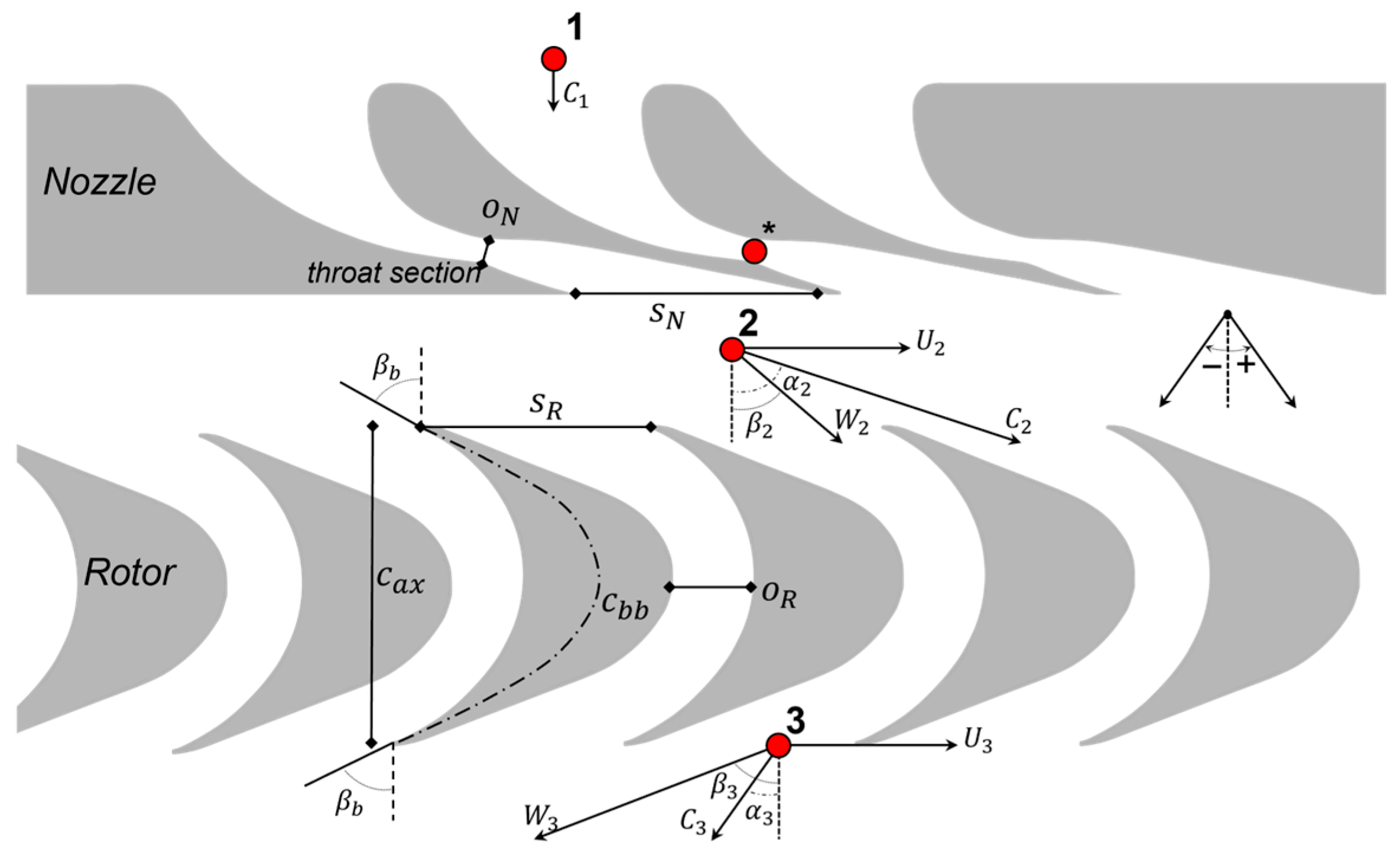
1. Introduction
Organic Rankine Cycle (ORC) systems, particularly small-scale versions, are gaining attention for their ability to efficiently convert low-grade heat (<250 °C) into electricity. The use of organic fluids makes these compact systems ideal for applications where waste heat recovery or renewable energy sources, such as biomass, geothermal, or solar-thermal, are available at a small scale.
Expander is a key component in these cycles as it has a major influence on overall performance. On small power units (<50 kWe), volumetric expanders are mostly used [
1]; nevertheless, turbo-expanders, such as a single highly loaded impulse axial turbines, can be deployed [
2]. Moreover, these machines present some interesting characteristics compared to volumetric ones, such as reduced mechanical losses, compactness, lightness, and more flexible control. However, for small power, the turbomachinery size cannot be reduced indefinitely due to the penalties caused by small dimensions, which, combined with the low entropy drop and mass flow rate in such facilities, often necessitate partial admission configuration [
3], which consist of blocking some of the nozzle channels. Even if this configuration induces less losses for micro-turbines [
2], they bring a new type of losses: the partial-admission losses (PA), which have to be taken into account for performance assessment.
Furthermore, turbomachinery used in ORC are more subject to supersonic regime due to the higher density of the organic fluids. Indeed, in such fluids the sound speed is significantly lower than in air or steam. This point requires the consideration of real gas behavior [
4]. Moreover, due to the wide temperature range of ORCs, the fluid selection is of crucial importance. Also, the regulation around these fluids is evolving over time due to safety concerns, ozone depletion potential, or global warming potential [
5,
6]. Thus, adopting a multi-fluid approach is essential for both experimental and numerical ORC developments since it will allow us to have a long-term vision and strategy.
Several techniques, exhibiting different levels of complexity, have been developed over time to evaluate turbine performance. The simplest approach relies on the use of selection charts, such as the Smith charts [
7], the Balje charts [
8], or more recently, charts based on specific non-dimensional quantities tailored to turbines operating with organic fluids [
9]. These methods provide a convenient means to estimate turbine performance with reasonable accuracy for given operating conditions.
At the opposite end of the spectrum, Computational Fluid Dynamics (CFD) offers a highly detailed and powerful tool for turbine analysis. However, it is computationally demanding and requires full knowledge of the turbine geometry, which limits its applicability when a large number of operating points must be assessed.
Between these two extremes, meanline models—based on semi-empirical correlations—offer an efficient compromise for performance prediction. They rely on dimensional quantities and provide a physically grounded description of turbine behavior by accounting for the various loss mechanisms occurring through the machine. Moreover, they can accommodate a wide range of operating conditions and different working fluids by using appropriate thermodynamic databases.
From the 1950s and the Ainley and Mathieson (AM) paper [
10], several meanline models have been developed in order to guide manufacturers to design axial-flow turbines. One of the remarkable aspects of the Ainley–Mathieson family of loss methods is that it has been updated with new experimental data several times, since most of models have the same architecture and differ by the addition of new elements over time [
11,
12,
13].
A large number of studies have investigated axial turbines using meanline models. The most relevant for the present work are summarized in
Table 1. Salah et al. [
14] evaluated four major meanline models on air, CO
2, and ORC axial turbines of different scales (from a few kW to a few MW) and operating ranges. This study represents the most extensive comparison of meanline models reported in the literature. The authors reported significant deviations between the models but did not identify a clearly superior approach. However, for the small ORC turbine (144 kWe) taken from Da Lio et al. [
9], the Craig and Cox (CC) [
11] and Aungier (AU) [
13] models showed the best agreement, with errors below 1% in total-to-static efficiency. Unfortunately, this validation is based on a single operating point, corresponding to the Best Operating Point (BOP). Consequently, it does not allow a thorough assessment of the advantages and limitations of the meanline models when applied to organic fluids.
Meroni et al. [
15] focused on turbines more relevant to the present study: small-power impulse turbines (3 kWe), with partial admission (ε = 0.4). They developed a numerical code to optimize ORC turbine design using the CC method, with adjustments: shock loss coefficients from Kacker and Okapuu (KO) [
12] and partial-admission losses from Traupel [
16]. The model was validated on a single experimental point, yielding efficiency errors of 1.29 points on the efficiency and power errors within 7%.
Qin et al. [
17] applied the KO model to optimize partially admitted (ε = 0.22) pure-impulse axial turbines operating with steam at very high pressure ratios (π = 25) for unmanned vehicles. The model was validated against both CFD simulations and experimental data across a wide velocity ratio range (0.09–0.26, including the design point). All methods (experimental, CFD, meanline) predicted efficiency within ±10%.
Most studies assume that choking occurs when the Mach number reaches unity in the nozzle throat. However, as emphasized by Shahbazi et al. [
18], this holds only for isentropic flows. Indeed, including frictional losses in the converging nozzle section leads to overprediction of the critical mass flow rate [
14].
It is worth noting that most previous studies using a meanline approach focus on design optimization rather than performance assessment, as in the present work. Therefore, adaptations are necessary. In this study, turbine geometry is known, whereas velocities and thermodynamic properties must be computed from boundary conditions—specifically, stagnation pressure and temperature at the turbine inlet. The runner rotational speed is also an input, reflecting electrical grid constraints rather than turbine design. Depending on the study, authors use outlet stagnation pressure [
9,
18,
19] flowrate [
20,
21] or both [
15,
22] as boundary conditions. In the present case, the turbine operates in the supersonic regime, therefore the three quantities
are interrelated [
23], making it more appropriate to compute the mass flow rate rather than prescribe it.
Finally, the study that best aligns with the present work is that of Anderson et al. [
19], who propose a robust numerical method using the AM meanline model and specifically dedicate to the performance assessment of axial turbines operating with air. They clearly detail the governing equations and the unknowns of their system and validate their approach using several experimental datasets over a wide range of operating conditions: pressure ratios between 1.4 and 3.8, shaft torques between 20 and 100 N·m, and rotational speeds from 70% to 105% of the design value. As emphasized by the authors, variable rotational speed (off-design operation) is crucial for ORCs subjected to fluctuating heat sources such as waste-heat recovery. Their validation is convincing, with mass flow rate predictions within ±2.5% and torque predictions within ±10%. For these reasons, the present study is strongly inspired by their equation system.
Nevertheless, compared to all the relevant studies presented in
Table 1, in order to evaluate the performance of pure-impulse, partially admitted axial turbines operating with organic fluids, several additional developments and new assumptions are required. Moreover, as highlighted by Meroni et al. [
15], there is a significant lack of experimental data on small axial turbines used in ORCs. For this reason, a dedicated experimental campaign was conducted for this study on an ORC testing loop using R1233zd(E). This campaign has enabled a rigorous assessment of the robustness of the developed numerical model over a wide operating range, including highly off-design conditions (low velocity ratios), different pressure ratios, and various inlet temperatures. In addition, previous experimental results obtained on another testing loop, using two pure fluids (NOVEC
TM649 [
24] and HFE7000) and three of their mixtures, are also used as validation points. Overall, this constitutes, to the authors’ knowledge, the largest experimental dataset used to validate such a numerical model.
The paper is organized as follows:
Section 2 presents the main methodology,
Section 3 introduces the numerical model,
Section 4 describes the experimental campaign, and
Section 5 compares the numerical and experimental results.
Table 1.
State-of-the-art of main studies related to the present work.
Table 1.
State-of-the-art of main studies related to the present work.
| Author | Meroni et al. [15] | Qin et al.
[17] | Salah et al. [14] | Shahbazi et al.
[18] | Anderson et al. [19] | Present Study |
Fluid
(approach) | R113
(real gas) | Steam
(ideal gas) | R245fa | Combustion gases
(real gas) | Air
(real gas) | R1233zd(E)
NOVECTM649
HFE7000
Mixtures
(real gas) |
| Type of turbine | Impulse | Impulse | Reaction | | | Impulse |
| Power | 3 kWe | 13 kWe | 440 kWe | | 150 kWe | 0.2–3 kWe |
| Partial admission? | Yes, 0.4 | Yes, 0.22 | No | No | No | Yes 0.17 and 0.25 |
| Off design? | No | Yes | No | Yes | Yes | Yes |
| Meanline model | CC adjusted | KO | AM, KO, CC, AU | AU | AM | AU |
| Chocking | | | | | | |
| Boundary conditions | | | | | | |
| Validation | EXP (1 pt) | CFD and EXP (3 pts) | EXP (1 pt) | EXP (4 turbines: 1 pt/turbine) | EXP(~40 pts) | EXP (>300 pts) |
| Results | 1.29 pt trend and 7% power | . <10% | CC and AU the best | | | |
3. Numerical Model
Starting from geometry and boundary conditions easily accessible with experiment—namely, stagnation pressure and temperature at the inlet, exit pressure, and rotational speed—the numerical model has to compute velocity triangle and thermodynamic states at the main points of the turbine in order to assess its performance.
3.1. Global Architecture
The present model lies at the boundary between sequential-modular (SM) and equation-oriented (EO) formulations. Although it was strongly inspired by the work of Anderson et al. [
19], the EO approach did not yield satisfactory results. For this reason, the calculation through the turbine is divided into three solvers that follow the flow path.
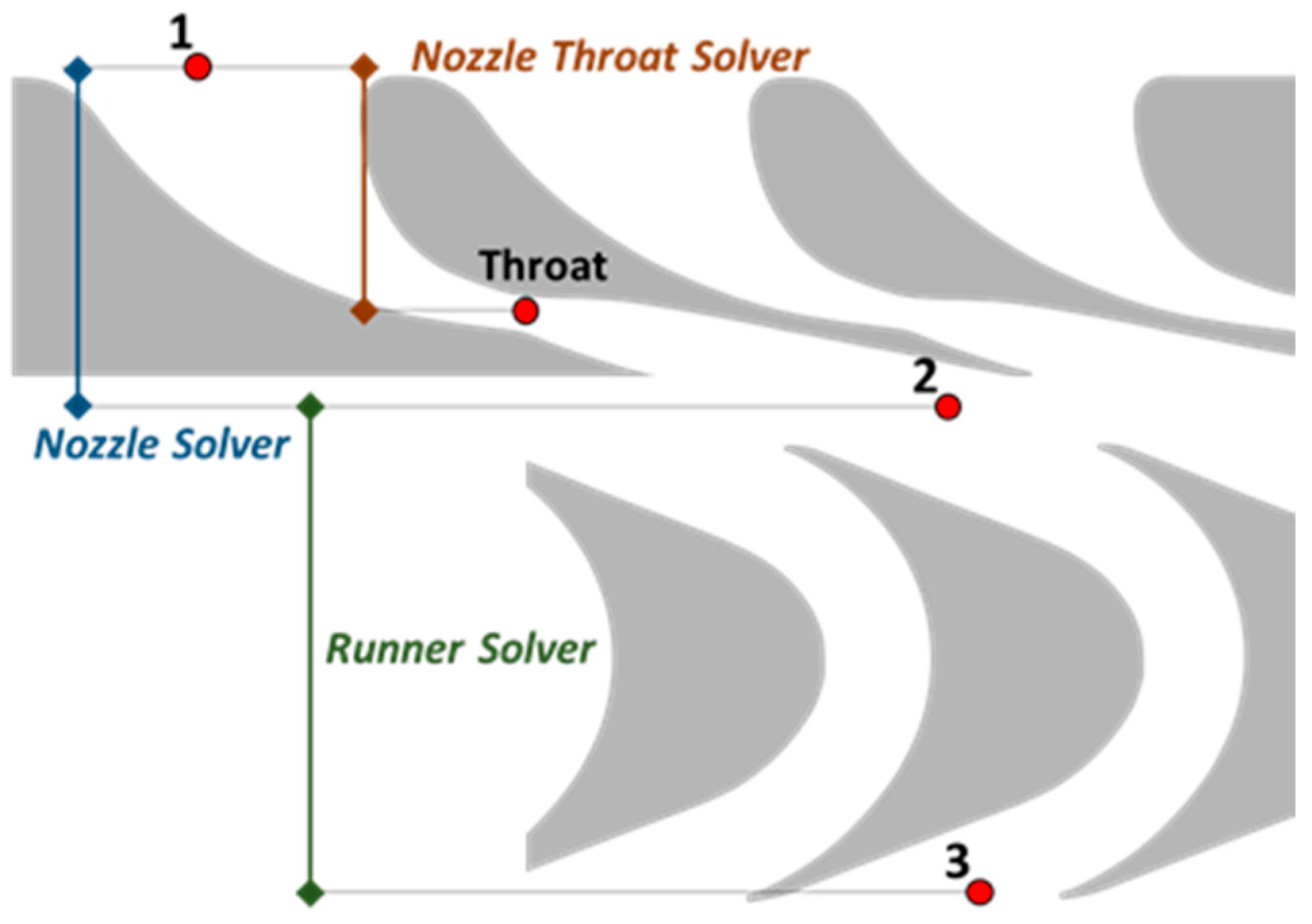
Figure 3 summarizes the application range of each solver. Each solver applies mass and energy conservation laws together with loss coefficients provided by the meanline method and adapted to the specific component.
The throat solver evaluates the chocking conditions at the nozzle throat. It computes the mass flow rate by maximizing it under two constraint equations, further details are provided in the next section. The nozzle solver computes the flow through the entire nozzle and provides the state at point 2 (velocity, angle, and thermodynamic state), as well as the nozzle losses. Similarly, the runner solver computes the flow through the runner and provides the state at point 3 together with the runner losses.
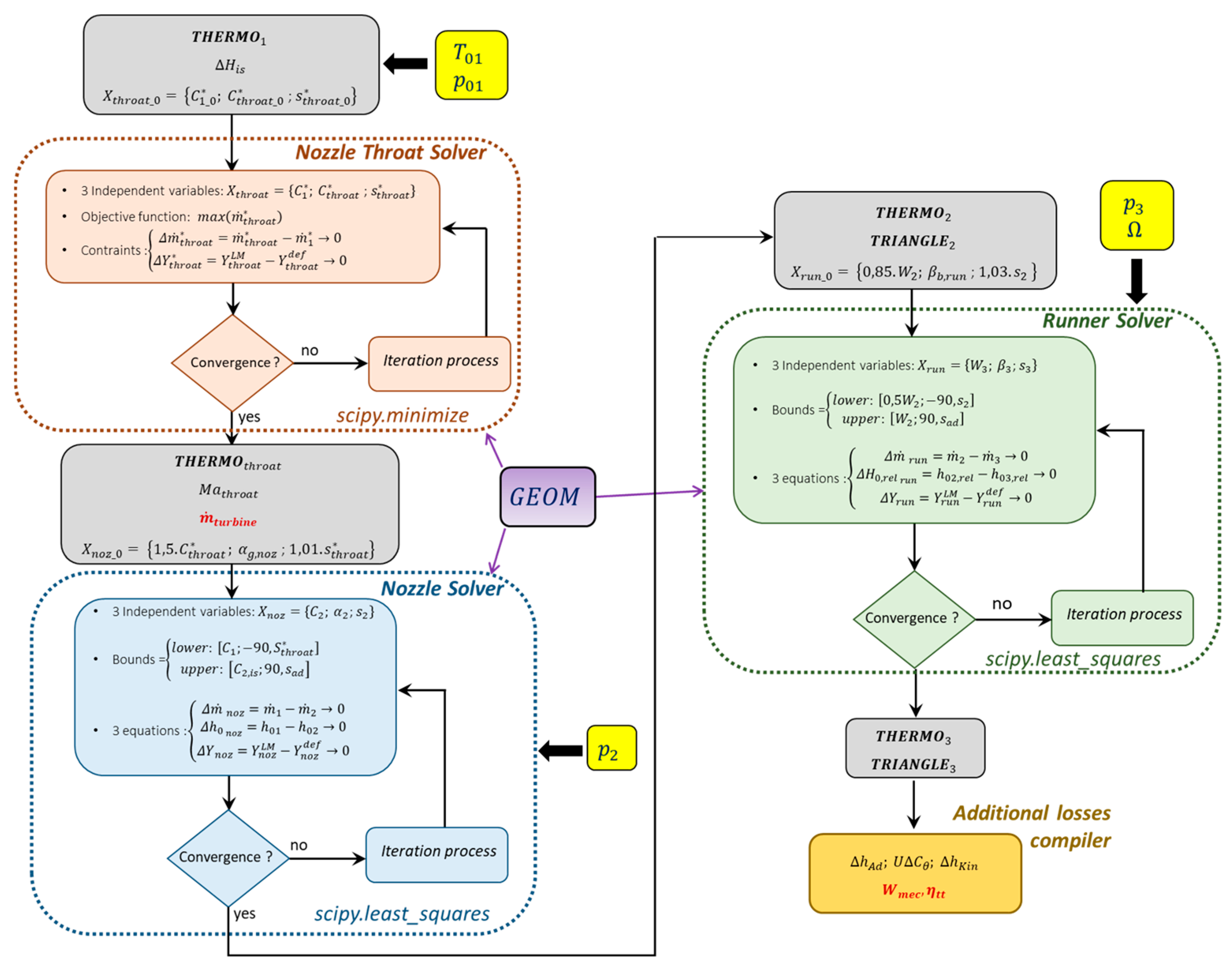
The main flowchart of the present model is depicted in
Figure 4. Between each solver, the thermodynamic state (
THERMO) and velocity triangle (
TRIANGLE) of each specific point are computed. Some of these variables serve as initial condition for the next solver. For example, the throat velocity computed in the Nozzle Throat Solver is used as the initial guess for C
2.
In addition, computed quantities can also be used as bounds for the next solver. For instance, the nozzle outlet entropy s
2 is used as lower bound for the runner-outlet entropy s
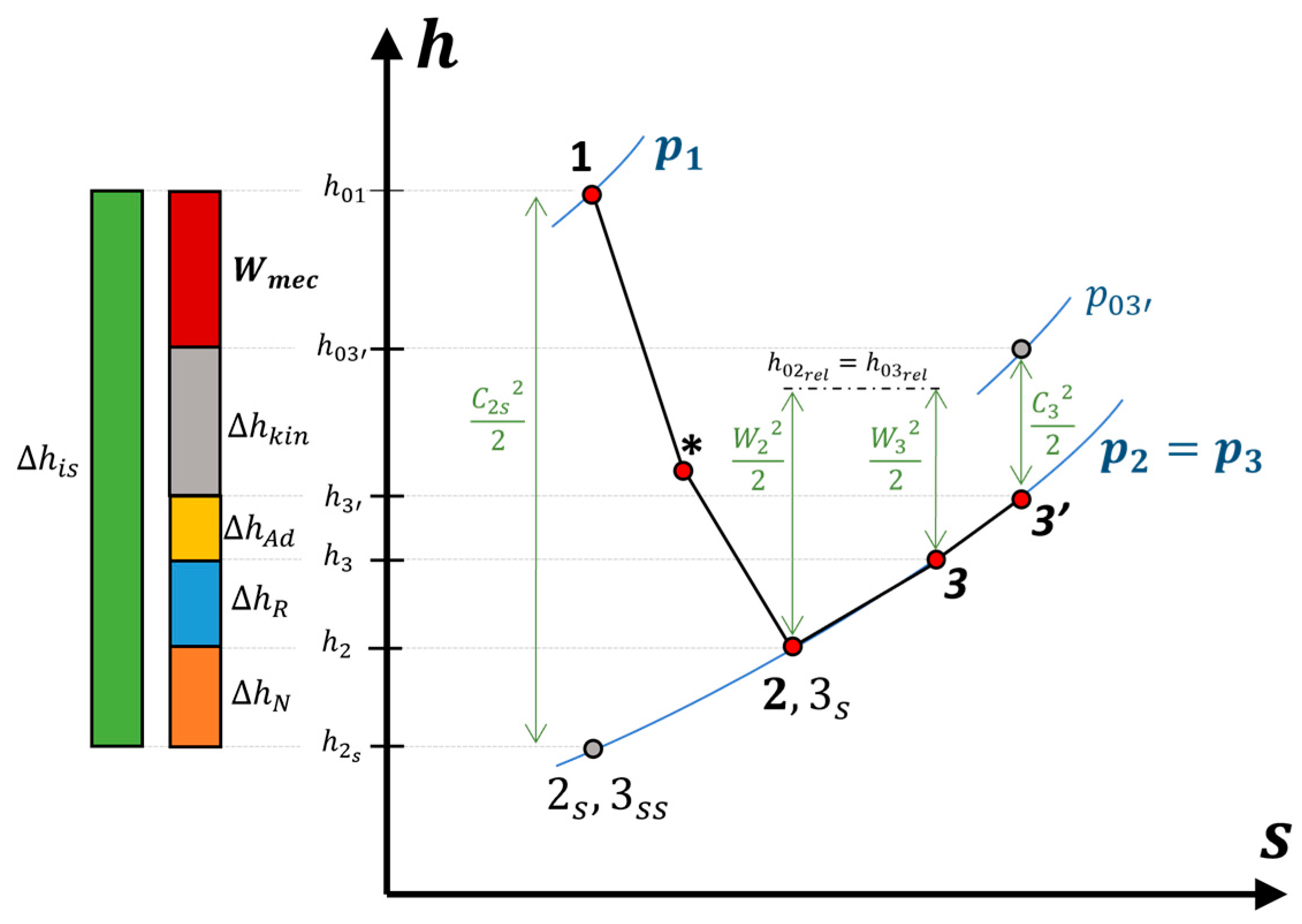
3, ensuring entropy increase through the runner. A strong velocity constraint is also imposed: W
3 is restricted to the interval
to remain consistent with the pure-impulse hypothesis and with the h–s diagram of
Figure 2. For the same reason, the outlet static pressure is directly imposed in the loss coefficient definition and outlet stagnation pressure (Equations (6) and (7)) in both the nozzle and runner solvers.
Finally, a compiler computes the additional losses (equations are provided in
Section 3.4.2) and evaluates the main turbine performance metrics, namely the mechanical work and the total-to-total efficiency. These quantities can be directly compared with experimental results.
3.2. Throat Solver
As previously explained, choking conditions are determined by maximizing the mass flow rate at the throat, following the approach of [
18,
19]. For this purpose, three independent variables are provided to the solver: the critical velocity at the nozzle inlet
, the critical velocity at the throat
, and the critical entropy at the throat
.
Assuming the flow is perpendicular to the throat section, the mass flow rate is given by:
where
is the throat area and
is the critical density at the throat. The critical enthalpy at the throat
is calculated thanks to the stagnation enthalpy conservation in the nozzle:
To ensure physical consistency, two closure conditions are introduced:
For the second condition, the loss coefficient from the meanline model (LM subscript) is adapted to the converging section of the nozzle.
The SciPy (v 1.16.0) function minimize, with the
SLSQP method [
28], is used to maximize the critical mass flow rate at the throat while enforcing the two constraint equations.
In summary, the Nozzle Throat Solver provides the thermodynamic state at the throat as well as the mass flow rate through the turbine. It will be validated independently against experimental results in
Section 5.1.
3.3. Nozzle and Runner Solvers
For both the entire nozzle and the runner, a non-linear system of three equations is solved by providing three independent variables and using the SciPy function least squares with the trf method. The three independent variables are as follows:
Outlet velocity: either absolute (C2) for the nozzle or relative (W3) for the runner.
Outlet angle: either absolute () for the nozzle or relative (
) for the runner.
Outlet entropy for both solvers.
Two of the tree equations are the same for both solvers:
Note that the loss coefficient is adapted to the frame considered (stationary or rotating).
The third equation expresses energy conservation. For the nozzle, this corresponds to stagnation enthalpy conservation, similar to Equation (9) but applied at the nozzle outlet (point 2) instead of the throat section. For the runner solver, rothalpy conservation is used as the third equation:
This simplification to the original rothalpy conservation is justified by the purely axial nature of the turbines studied, which implies no change in rotational velocity between the inlet and outlet of the runner.
3.4. Meanline Model Setting Up
3.4.1. Aungier Model
As highlighted in
Section 1, despite the large number of available meanline models, there is no consensus on the best approach. Since these models generally represent successive developments of earlier formulations, the model of Aungier [
13] was selected, as it is the most recent and comprehensive. In addition, the author provides explicit equations for each loss mechanism considered, which are significantly easier to implement than complex charts requiring interpolation.
The total loss coefficient returned by the model is a sum of several individual loss coefficients, which must be treated as independent for the model to remain valid [
2]. In this study, only five of the seven proposed by the author are considered:
Clearance losses are neglected due to the large shroud thickness (
Section 2.2), and lashing-wire losses are not considered because the turbines under investigation are not equipped with them.
The considered losses are:
Profile losses: due to friction and blade wakes;
Secondary losses: caused by unbalanced forces acting on the fluid through a blade row;
Shock losses: produced by shock waves occurring near the hub stream surface;
Supersonic Expansion losses: caused by the over-expansion of blade row at high discharge Mach number;
Trailing-Edge losses: due to the finite thickness of the blade trailing-edge, which creates flow separation and induces recirculation zones.
The numerical implementation of this model is rigorously followed to assess its ability to predict the performance of the turbines used in ORCs.
3.4.2. Additional Losses
Aungier provides also a large number of additional losses, which are considered as enthalpy decrements in the overall energy equation (Equation (2)). Among those used in the present study, two categories can be distinguished: losses related to partial admission et losses related to disk friction.
The latter category accounts for friction occurring in the enclosed rotating disk between the fixed nozzle and the rotating rotor. It also includes the clearance-gap windage loss, resulting from shear forces on the rotating walls of the shrouded blades in close proximity to the fixed turbine casing.
Regarding the first category, Aungier only considers the windage and sector-end losses, and not expansion losses, contrary to most authors studying this effect [
16,
25]. However, as noted by [
2], there is no clear consensus on losses induced by partial admission, and the present study follows Aungier’s formulation rigorously. Moreover, according to [
3], partial-admission laws reported in the literature show the greatest divergence at low partial-admission rates (
), which corresponds exactly to the conditions studied here.
In conclusion, the total enthalpy decrement for the additional losses is:
3.5. Discussion
One can note that, in both the Nozzle and Runner solvers, the flow angle does not appear in the energy conservation equation. As a result, the nonlinear system is partially decoupled, which may lead to convergence difficulties and non-unique solutions. Furthermore, no equation governing flow deviation is included in the solvers, unlike in Anderson et al. This choice was made because enforcing energy conservation was considered more important, and adding a flow-deviation equation was found to compromise it. For this reason, the energy equation was retained as the primary constraint.
In addition, as recalled by Tosto et al. [
27], a turbine vane becomes critically limited in operating range when the turbine reaches choking conditions, corresponding to a meridional outlet Mach number above 1; across all test points, however, the meridional Mach number remains below 0.7.
These considerations will be further supported by the results obtained through numerical validation (
Section 5).
4. Experimental Facilities
The present study uses experimental results from two different ORC testing loops: AMORCE and GEOHEX. Both have been designed and installed at the Components and Thermal Storage Laboratory (LCST) of the French Alternative Energies and Atomic Energy Commission (CEA). The first one has been previously investigated [
29,
30] and provided a large dataset including different fluids and mixtures over a wide range of operating conditions which will be useful for numerical model comparison. In contrast, the GEOHEX testing loop has been operated specifically for the present study. During this experimental campaign, the ORC was not operated in accordance with any dedicated control strategy. Instead, the test rig was run over extended ranges of conditions (including non-optimal points) in order to properly characterize turbine behavior in off-design and part-load operations.
4.1. Turbines Parameters
Table 2 summarizes key data for the two turbines. Both operate with very low partial-admission rates, and the GEOHEX turbine delivers roughly ten times the power of the AMORCE unit. However, only one working fluid (R1233zd(E)) has been tested on GEOHEX, whereas AMORCE has operated with two pure fluids and three of their mixtures.
4.2. ORC Testing Loops
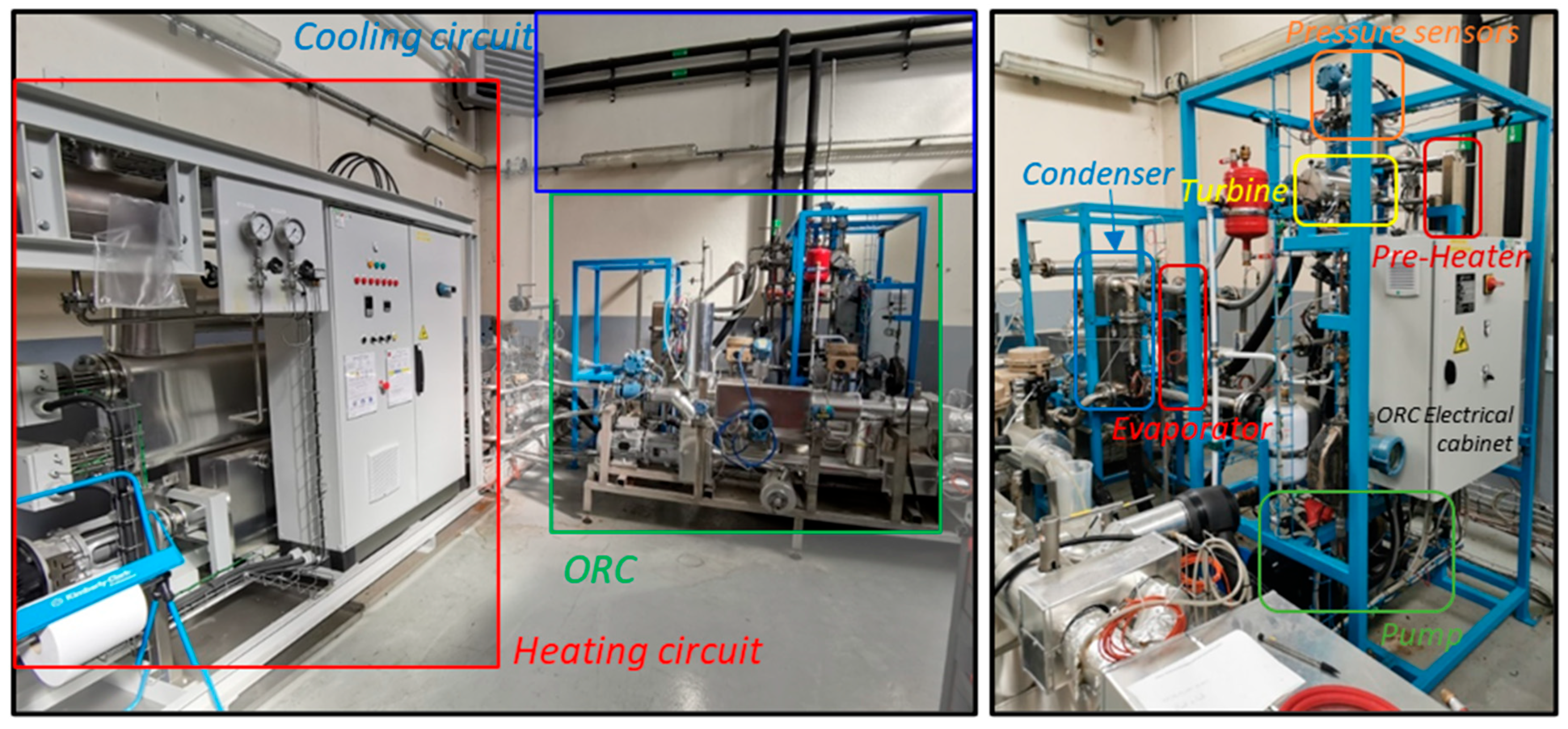
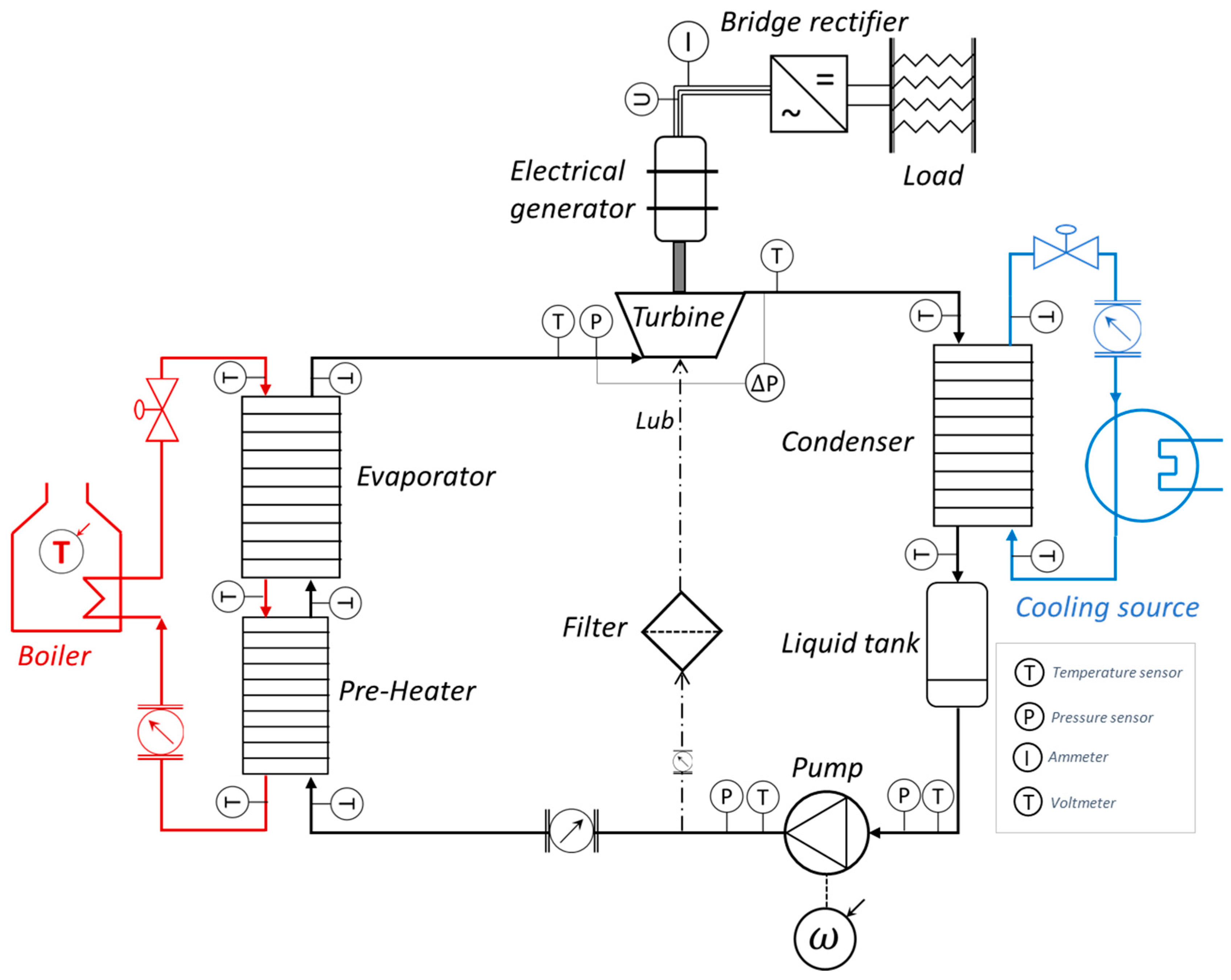
Pictures and a schematic diagram of the GEOHEX ORC testing loop are shown in
Figure 5 and
Figure 6, respectively. The main components are three heat exchangers, a volumetric pump, and the turbine. The entire loop is insulated with a 0.1 m thick layer of rock wool.
The cooling source uses water from the building cooling circuit at 13 °C, and only the mass flow rate can be adjusted in the condenser to modify the condensation conditions. On the hot side, the 80 kW boiler heats the thermal oil (SERIOLA ETA32) up to 170 °C with an adjustable mass flow rate before its inlet to the evaporator. The Wanner Hydra-Cell multi-membrane volumetric pump is driven by a 0–50 Hz variable-frequency drive, allowing adjustment of the working-fluid mass flow rate.
Finally, the partially admitted axial turbine is connected to a synchronous E+A generator whose efficiency is known. The three-phase AC current is converted into DC single-phase current through an AC/DC converter bridge. The electrical power is then dissipated through electrical resistors for which the global impedance is known, which in turn affects the rotational speed of the shaft. Current and voltage sensors are installed on the three-phase AC line, allowing the electrical power produced by the generator to be measured:
Furthermore, the voltage sensor enables the determination of the turbine rotational speed using the back-EMF constant.
A very small portion of fluid is extracted after the pump in order to lubricate the turbine. Mass flowmeters are installed on this lub pipe as well as on the main loop, so the repartition between the actual working fluid through the turbine and the lubrication flow is precisely known.
4.3. Acquisition and Uncertainties
Thermometers and pressure gauges are placed at all main points of the loop. Note that the pressure drop across the turbine is measured using a differential pressure sensor for improved accuracy. The models of the different sensors used in the GEOHEX loop are summarized in
Table 3. The uncertainties associated with the sensors, as well as the uncertainties from the data logger (National Instrument 1 Hz) or the automaton (WAGO 0.1 Hz), are also specified.
An experimental data point is recorded when all variables of interest (pressure, temperature, mass flow rate, electrical power, etc.) remain within a predefined variation range—specific to each variable and listed in
Table 3—for more than three minutes. This criterion ensures that the turbine operates under steady-state conditions. All experimental data points considered in this study are presented in
Section 4.5.
The uncertainties associated with the turbine measurements were rigorously evaluated by combining both sensor and data-acquisition contributions. For each measured quantity, the manufacturer specifications were applied either as a constant value (e.g., pressures, voltages, and currents) or as a function of the measured value (e.g., temperatures and mass flow rates). The acquisition-system uncertainty, representing the limitations of the data-logging hardware, was accounted for separately and combined with the sensor uncertainty using the root-sum-of-squares (RSS) method to obtain a total type-B uncertainty for each measurement [
31]:
For quantities such as enthalpy, which are derived from measured temperature and pressure using thermodynamic property calls to REFPROP, numerical partial derivatives were computed using small, fixed numerical increments to propagate the input uncertainties through to the derived quantities. For example:
Uncertainty propagation was then performed using the standard orthogonal formulation, in which the uncertainty in enthalpy was evaluated as the square root of the sum of the squared contributions of each independent variable:
For other derived quantities, the total uncertainties were obtained by propagating the uncertainties of enthalpy differences, mass flow rate, electrical power, and rotational speed through the corresponding equations, again using a linearized RSS approach. This hierarchical combination of sensor, acquisition, and derived-quantity uncertainties provides a comprehensive and traceable assessment of the reliability of all measured and computed turbine parameters.
4.4. Experimental Results
Only a few experimental quantities are available for comparison with the numerical results. These are:
The mass flow rate through the turbine, directly measured by the mass flow meter;
The mechanical work, evaluated using Equation (1);
The mechanical power, expressed as:
Here, denotes the mass flow rate of the fluid actually expanding in the turbine (i.e., excluding the lubrication flow). Note also that all three latter quantities depend on the stagnation enthalpies at the turbine boundaries, . Since no measurements are available inside the turbine, the inlet and outlet points correspond to the locations of the external sensors. In this regard, stagnation and static enthalpies are equivalent because the kinetic term in the loop piping is negligible.
Because the lubrication line introduces colder fluid into the turbine casing, the working fluid experiences thermal mixing before reaching the outlet sensor. As a result, the measured outlet temperature does not correspond to the real outlet state of the working fluid alone
. To correct this effect, and since the lubrication line is instrumented, an energy balance can be established:
where
is the total mass flow rate at the turbine exit (sum of the lubrification and working mass flow rate),
the outlet enthalpy of interest, and
is the thermal power associated with heating and evaporating the lubrication fluid. This evaporation is assumed to occur at the turbine low pressure, from the pump-exit temperature up to the measured turbine-outlet temperature. Equation (18) is thus used to retrieve the corrected outlet enthalpy required (
) for the mechanical power calculation.
Mechanical power can also be estimated from the measured electrical power:
where
is the generator efficiency, which depend on electrical power and rotational speed and is provided by the manufacturer.
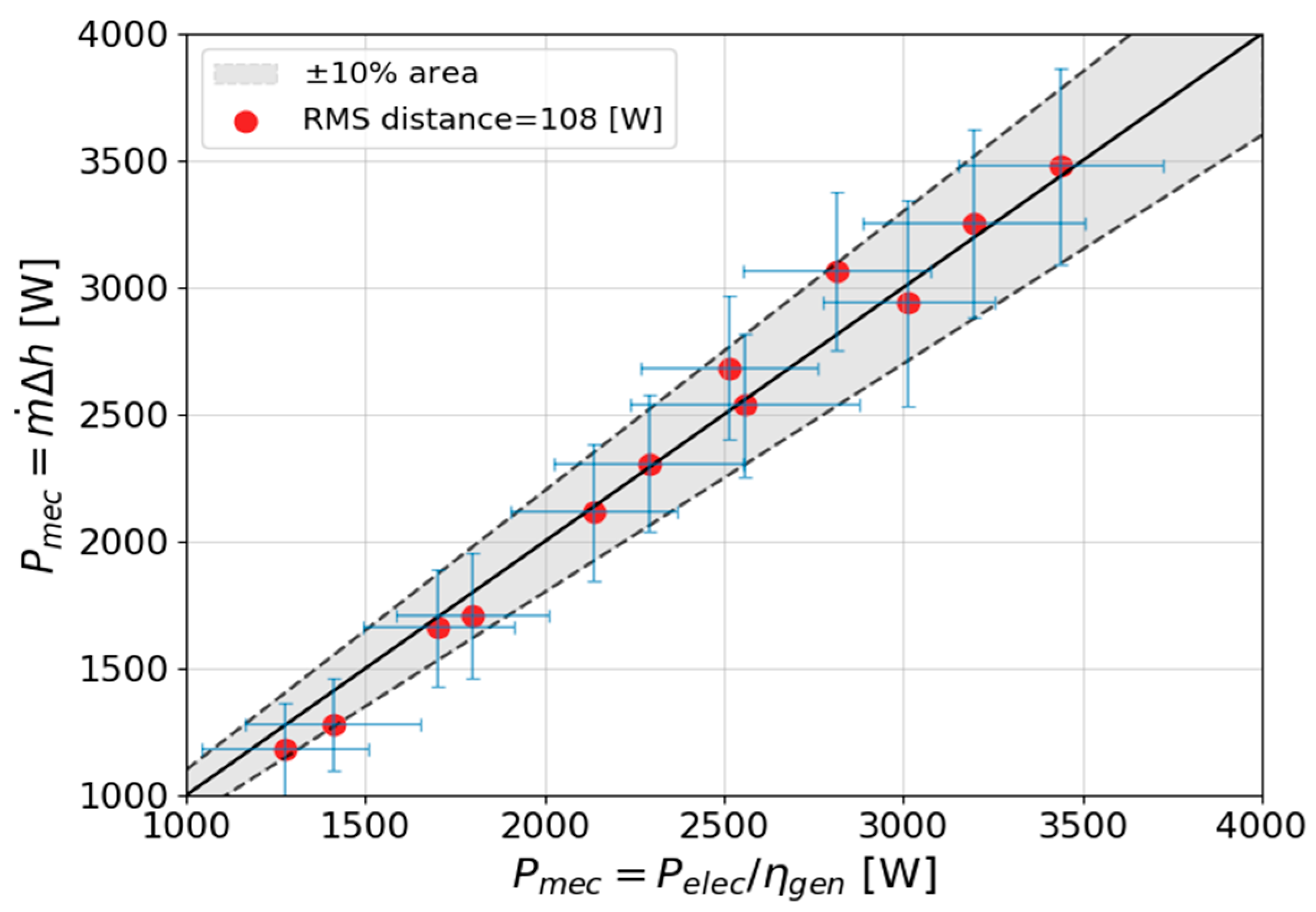
This allows a consistency check between two independent estimates of mechanical power. As shown in
Figure 7, the agreement between the two methods is quantified using the Root Mean Square (RMS) of orthogonal distances to the ideal
line. The RMS value shown on the plot corresponds to all experimental points for which the comparison is valid (
, while only a subset of the points is displayed for clarity.
The excellent agreement—an RMS deviation of 108 W over 102 test points—demonstrates that the mechanical power measurements in the GEOHEX testing loop are highly reliable.
4.5. Tested Point
A summary of all experimental points is provided in
Table 4. The first rows correspond to the measurements obtained with the GEOHEX loop and presented above. The following rows summarize the experimental results from the AMORCE loop, produced by [
29,
30]. These results are less accurate because their studies were not specifically focused on turbine performance analysis, and because the outlet temperature cannot be reconstructed and the generator efficiency is unknown. Therefore, a mathematical reconstruction of the electromechanical losses of the generator is required (see
Section 5.3). Nevertheless, the very large dataset from this loop—covering a wide range of temperatures, pressures, mass flow rates, and working fluids—must be considered in the present study.
It is worth noting that all fluids are operated far from their critical pressure. In addition, all experimental points from AMORCE correspond to very low rotational speeds due to the choice of the electrical load, whose impedance is not adapted to the turbine. Consequently, these points represent highly off-design operating conditions, which constitute an additional challenge for the numerical model.
6. Conclusions
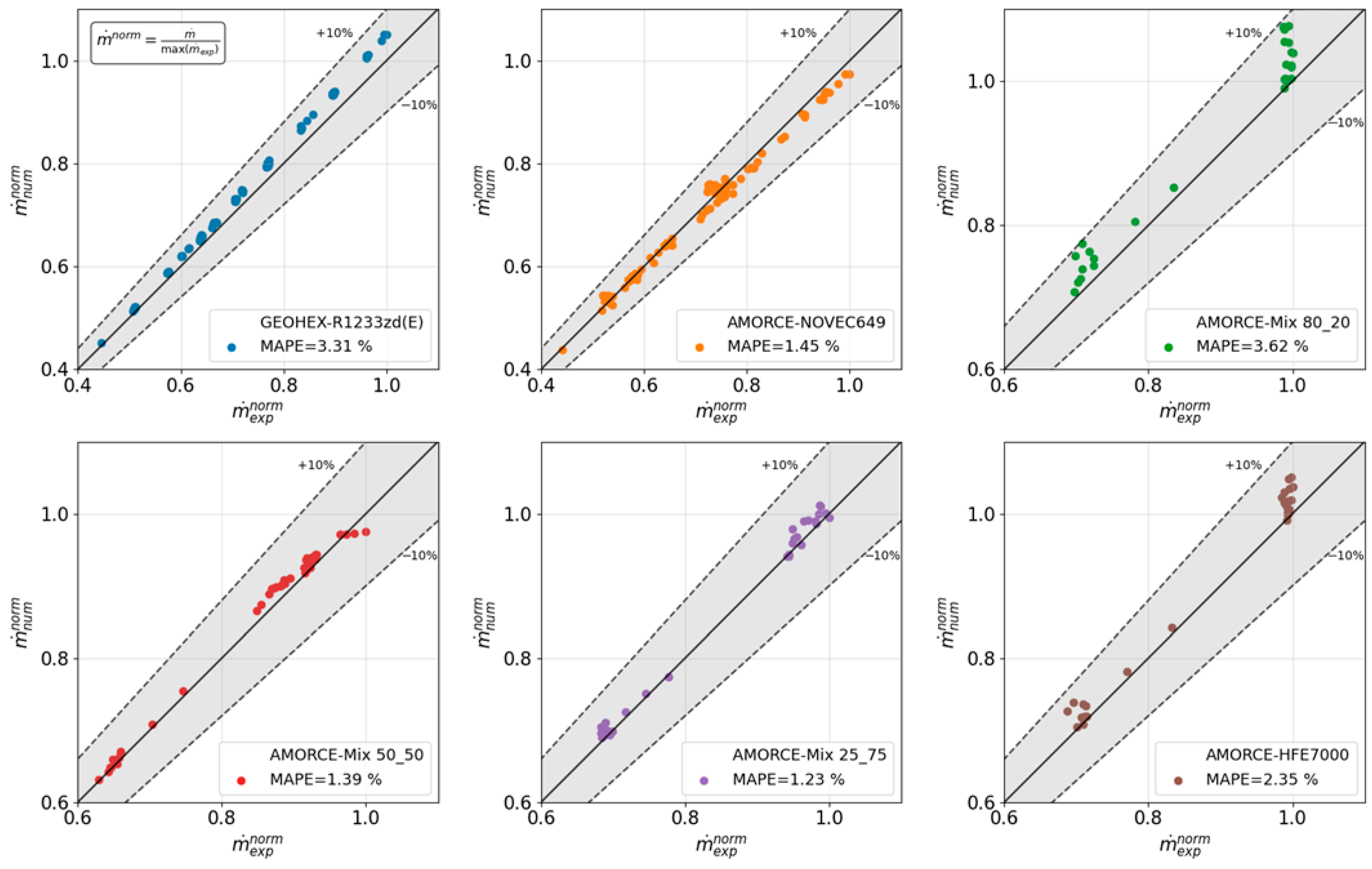
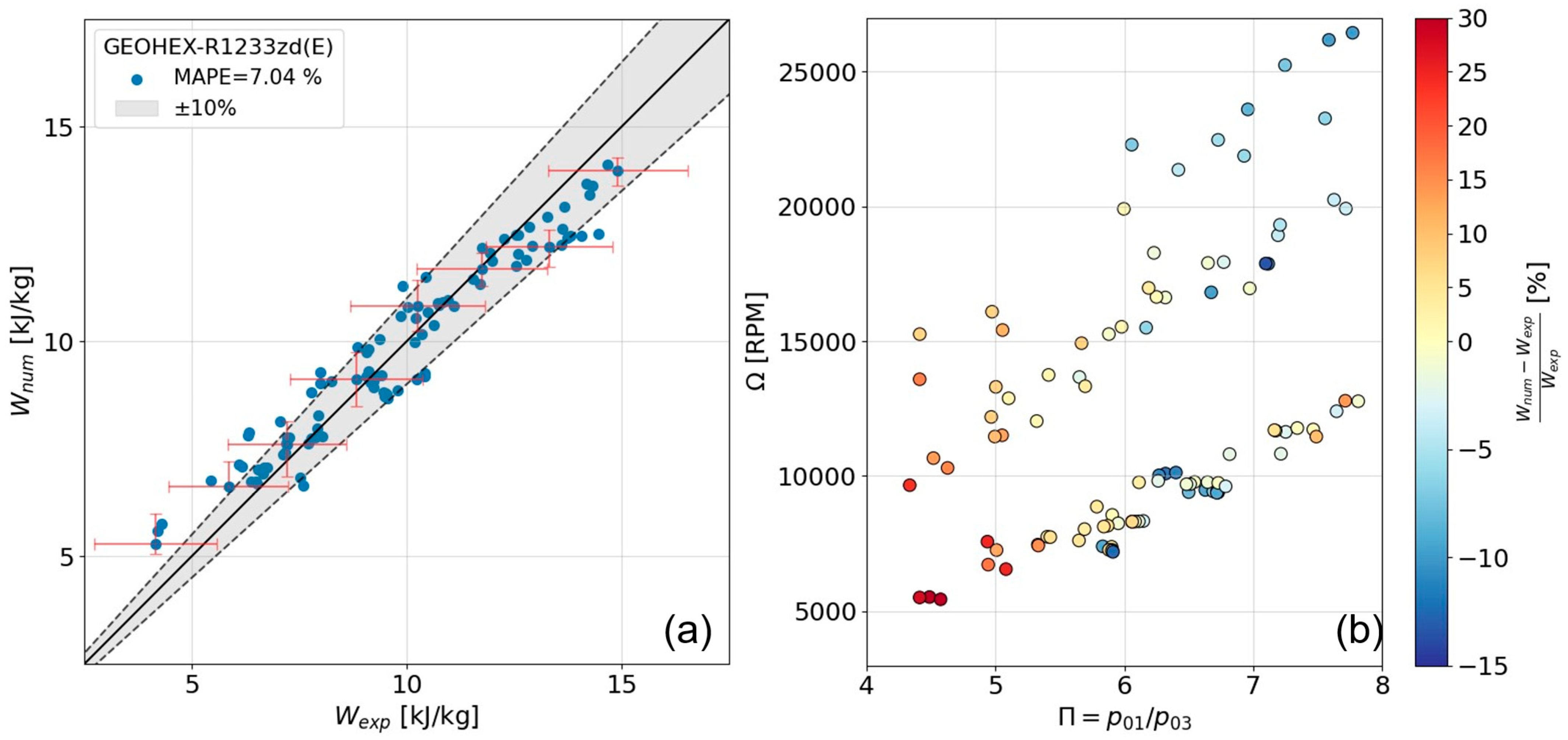
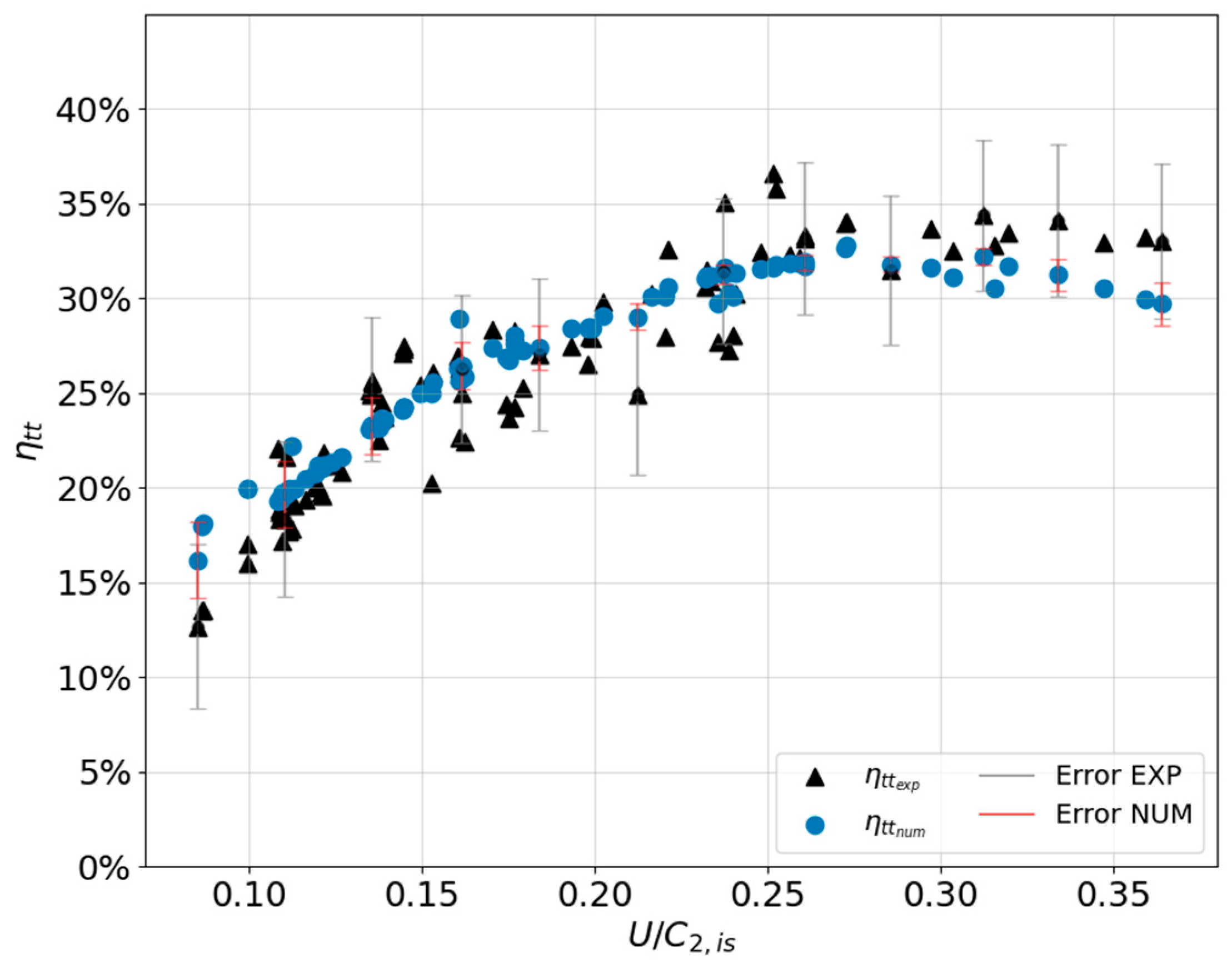
The objective of this work was to evaluate the robustness of the Aungier meanline model to predict the performance of a pure-impulse axial turbine with partial admission operating in ORCs. To this end, a numerical model was developed based on the methodology of Anderson et al., adapted to real-fluid thermodynamics and incorporating the pure-impulse hypothesis. In parallel, an experimental campaign was conducted on a 3 kWe ORC test bench using R1233zd(E) to characterize the turbine under various operating conditions. The mechanical power delivered by the turbine was measured using two independent methods, which showed excellent agreement. Numerical and experimental results were then compared and demonstrated strong consistency, with a mass-flow-rate prediction MAPE of 3.31% over 102 points and a mechanical-work MAPE of 7.04%.
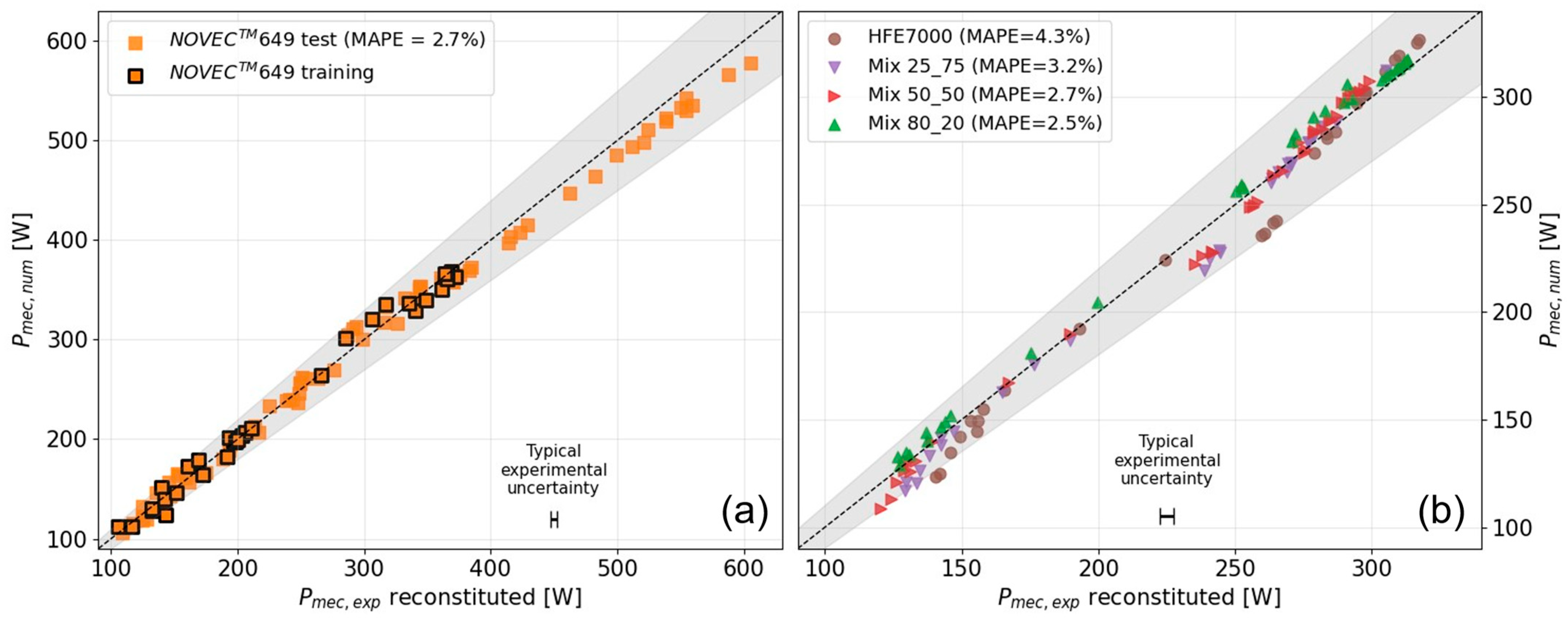
Furthermore, a large dataset of 267 experimental points—obtained from another ORC test loop using NOVEC™ 649, HFE7000, and three of their mixtures—was also confronted with the numerical model. The mass flow rate was accurately predicted for all fluids, confirming the robustness of the critical flow rate maximization procedure. Since only electrical power was available in this dataset, a multivariable linear model was introduced to reconstruct generator losses. Calibrated using a limited set of measurements for a single fluid, it was then applied to the entire dataset to enable direct comparison between numerical and experimental turbine power. The agreement remained strong over the remaining dataset of the fluid used for training, with a maximum MAPE of 2.7%, even beyond the calibration range (at high power). When extended to the second fluid and to the zeotropic mixtures using the same calibration relation, the results were still very good, showing minimal fluid sensitivity and a maximum MAPE of 4.3%.
In conclusion, the Aungier meanline model demonstrated strong predictive robustness for turbine performance, even under severe off-design conditions and for a wide range of organic fluids and mixtures. This is highly encouraging for industrial applications, as it avoids the need to develop a new numerical model for each new organic fluid.