An Optimization Method for Distribution Network Voltage Stability Based on Dynamic Partitioning and Coordinated Electric Vehicle Scheduling


Abstract
1. Introduction
1.1. Background
1.2. Literature Review
1.3. Paper Contributions and Organizations
- A dynamic partitioning strategy based on hourly updates to the electrical-distance matrix is proposed, incorporated with PV output, WT output, and EV dispatchable capacity. The hourly adaptive partitioning model is capable of enhancing the grid’s adaptability to RES fluctuations and EV spatiotemporal transfer characteristics.
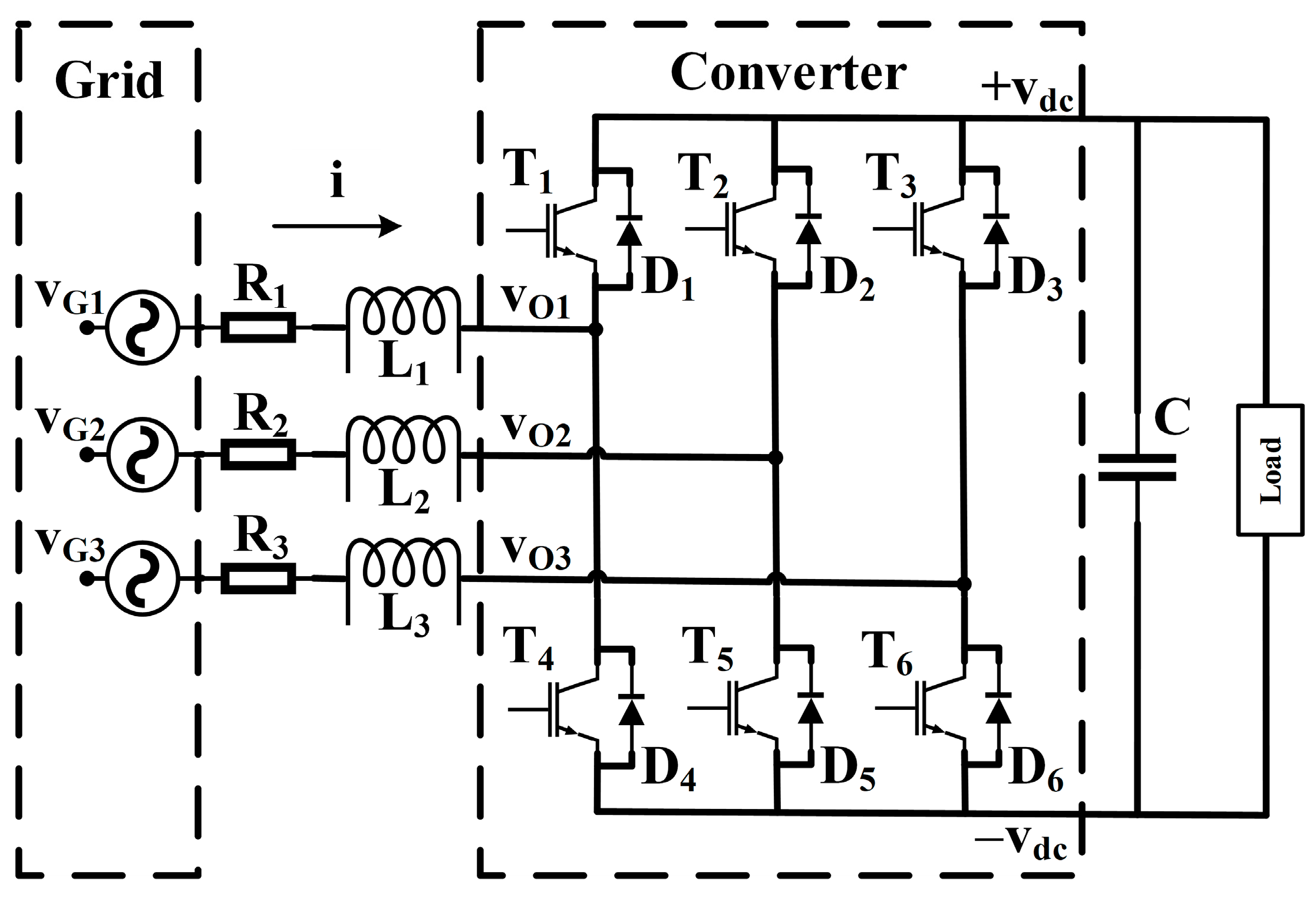
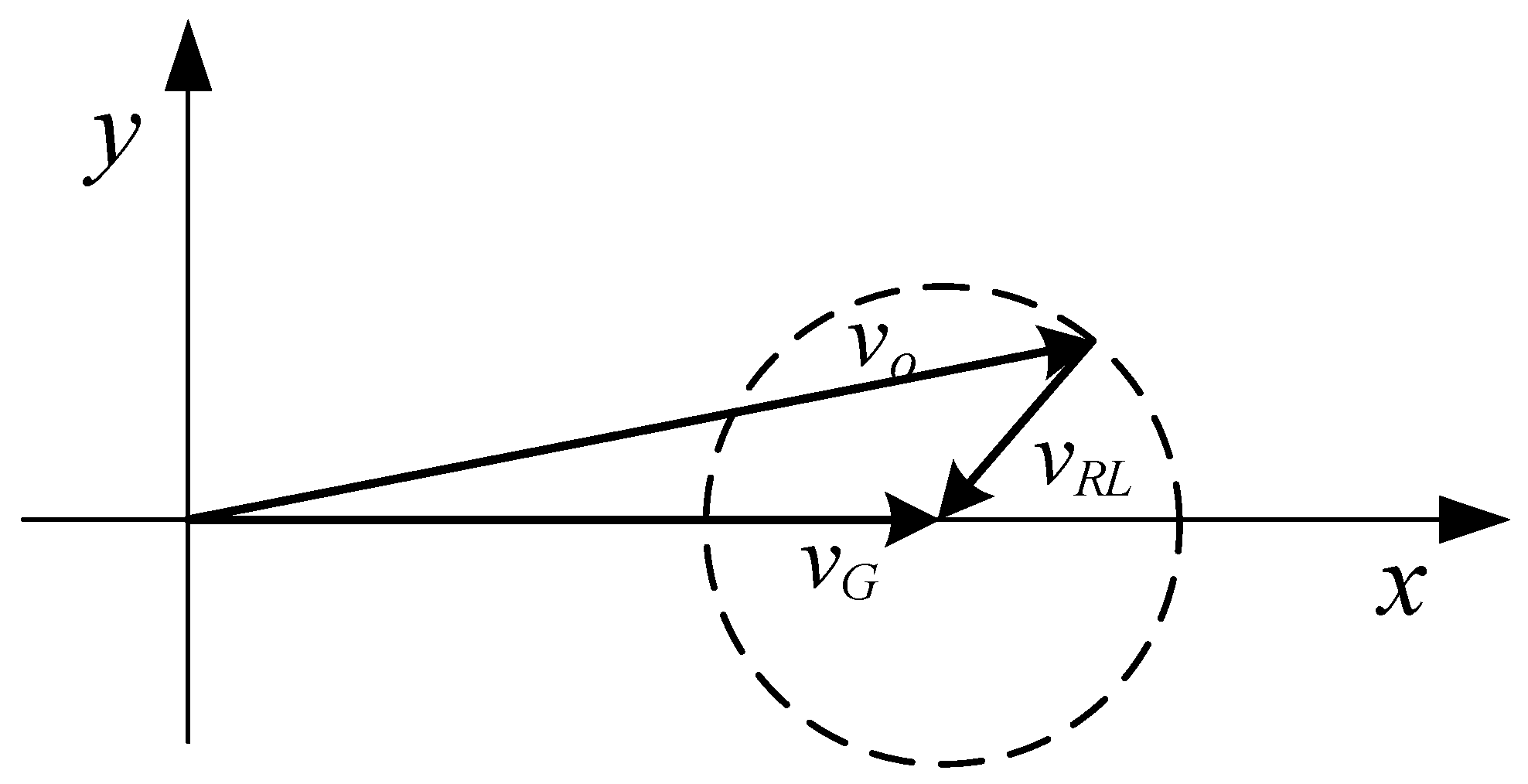
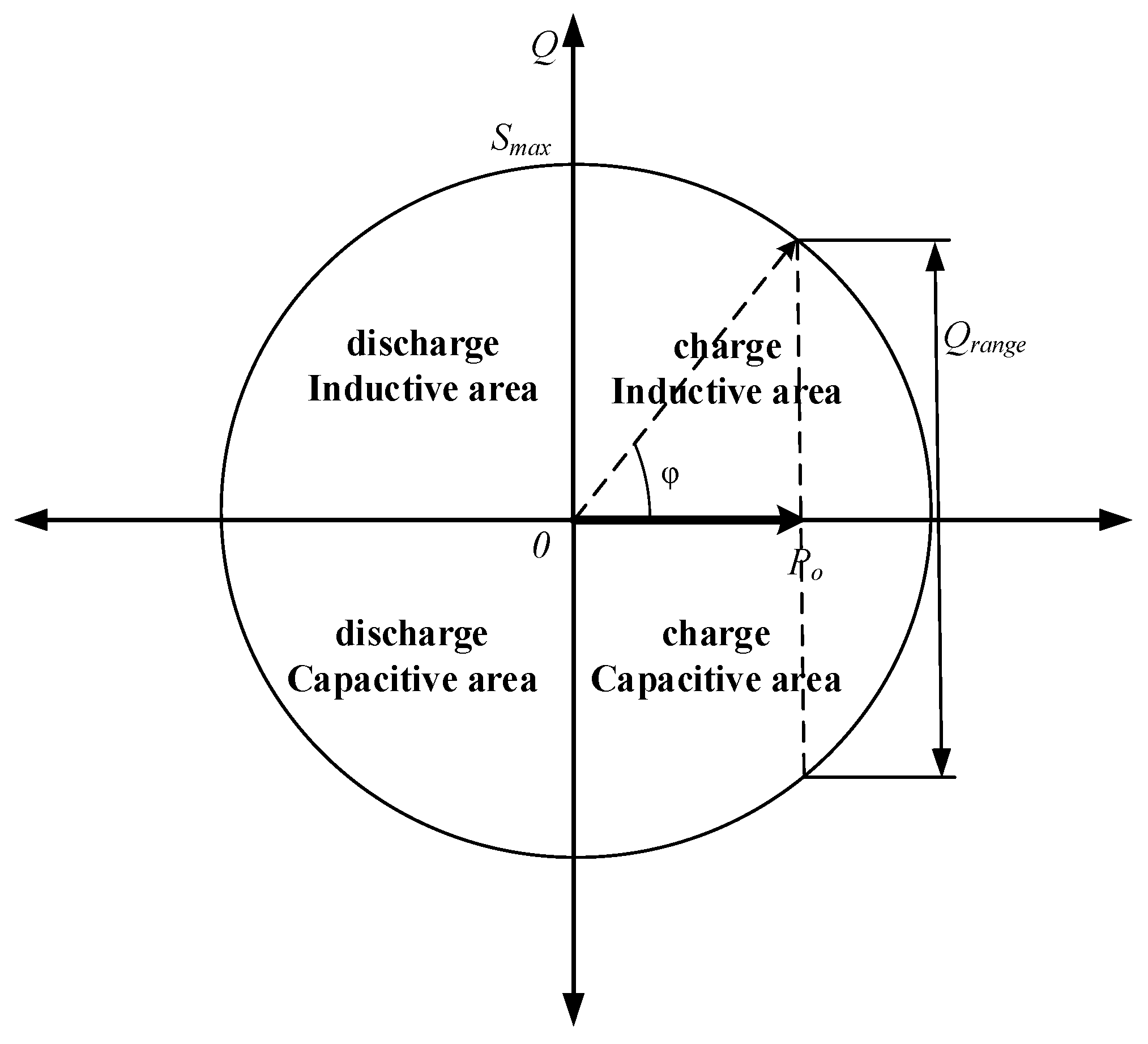
- Leveraging the bidirectional charging/discharging capability of EVs, reactive power response is coordinated with active power scheduling. By regulating the power-factor angle of the bidirectional charger, joint active–reactive control is achieved, improving voltage support while respecting SOC-dependent capability limits.
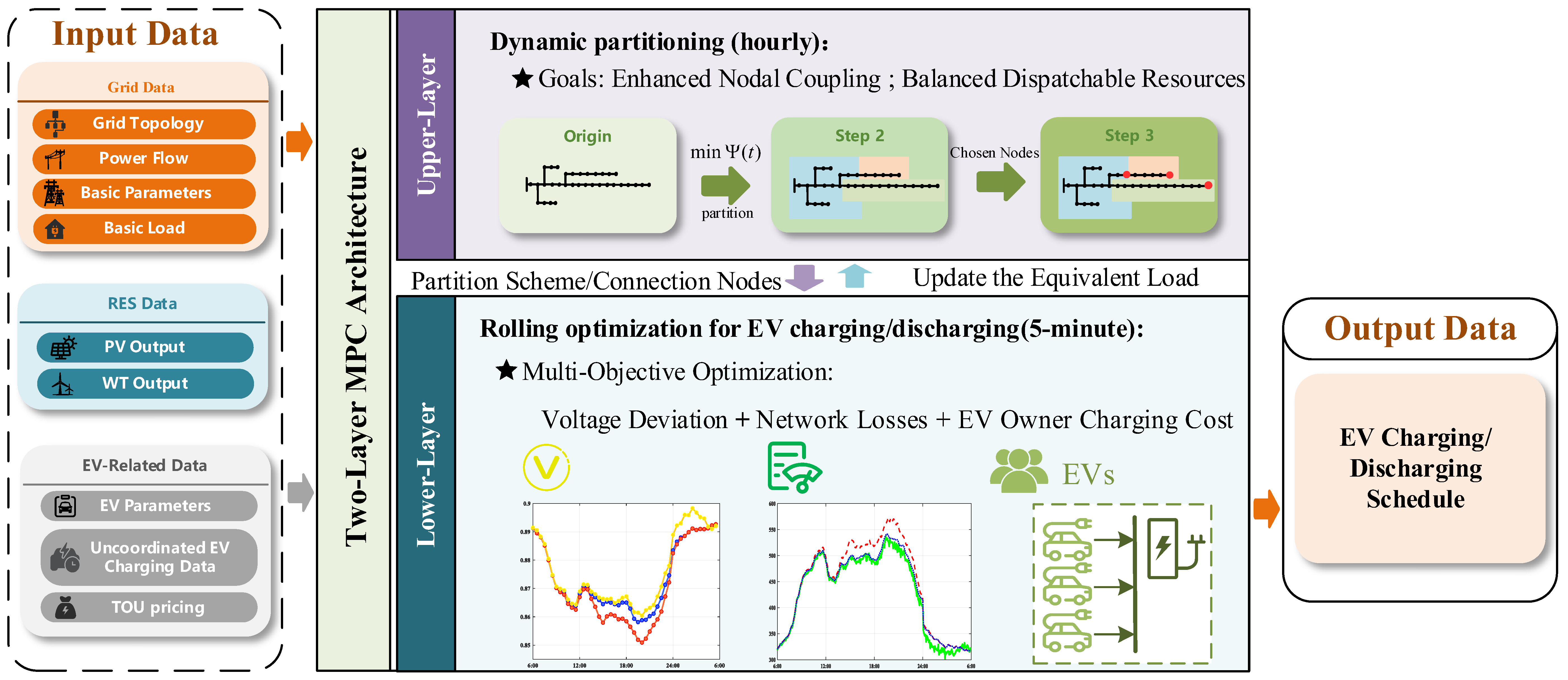
- A hierarchical optimization framework based on model predictive control (MPC) is designed. The upper layer updates partitions and identifies critical voltage nodes on an hourly basis using forecasting WT/PV output and EV availability. The lower layer performs 5 min rolling optimization of EV charging/discharging and reactive support setpoints to enable real-time power allocation and spatiotemporal coordination.
2. General Description and Problem Statement
3. Dynamic Partitioning Method for Distribution Networks Considering WT/PV Fluctuations and EV Dispatchable Capacity
3.1. Electrical Distance Definition
3.2. Multi-Source Dynamic Data Input
3.2.1. Renewable Energy Output Model
- (1)
- PV output Model
- (2)
- WT output Model
3.2.2. Electric Vehicle Stochastic Model
3.3. Dynamic Partitioning Adjustment Mechanism for Distribution Networks
| Algorithm 1. Dynamic Partitioning of Distribution Network |
| Input: , , EV distribution, Output: Optimized partitioning scheme 1: for each time window t (hourly): 2.: Calculate power flow based on latest RES and load data to update 3: initialize partitions 4: while i < max_i + 1 and not converged: 5: Compute for all partitions 6: Calculate 7: for each overloaded : 8: Locate centroid 9: Identify boundary nodes 10: Select = argmax 11: Find target minimizing 12: if constraints satisfied: 13: Migrate from to 14: end if 15: end for 16: Update 17: Check convergence 18: end while 19: return optimized partitions 20: end for |
4. Optimization Scheduling Strategy
4.1. EV Charging/Discharging and Reactive Power Response Characteristics
4.1.1. Reactive Power Response of Charging Piles
4.1.2. Individual Electric Vehicle Charging-Discharging Model
4.2. Optimization Model
4.2.1. Objective Function
- (1)
- Voltage Deviation
- (2)
- Network Losses
- (3)
- EV Owner Charging Cost
4.2.2. Constraints
4.2.3. Multi-Objective Normalization
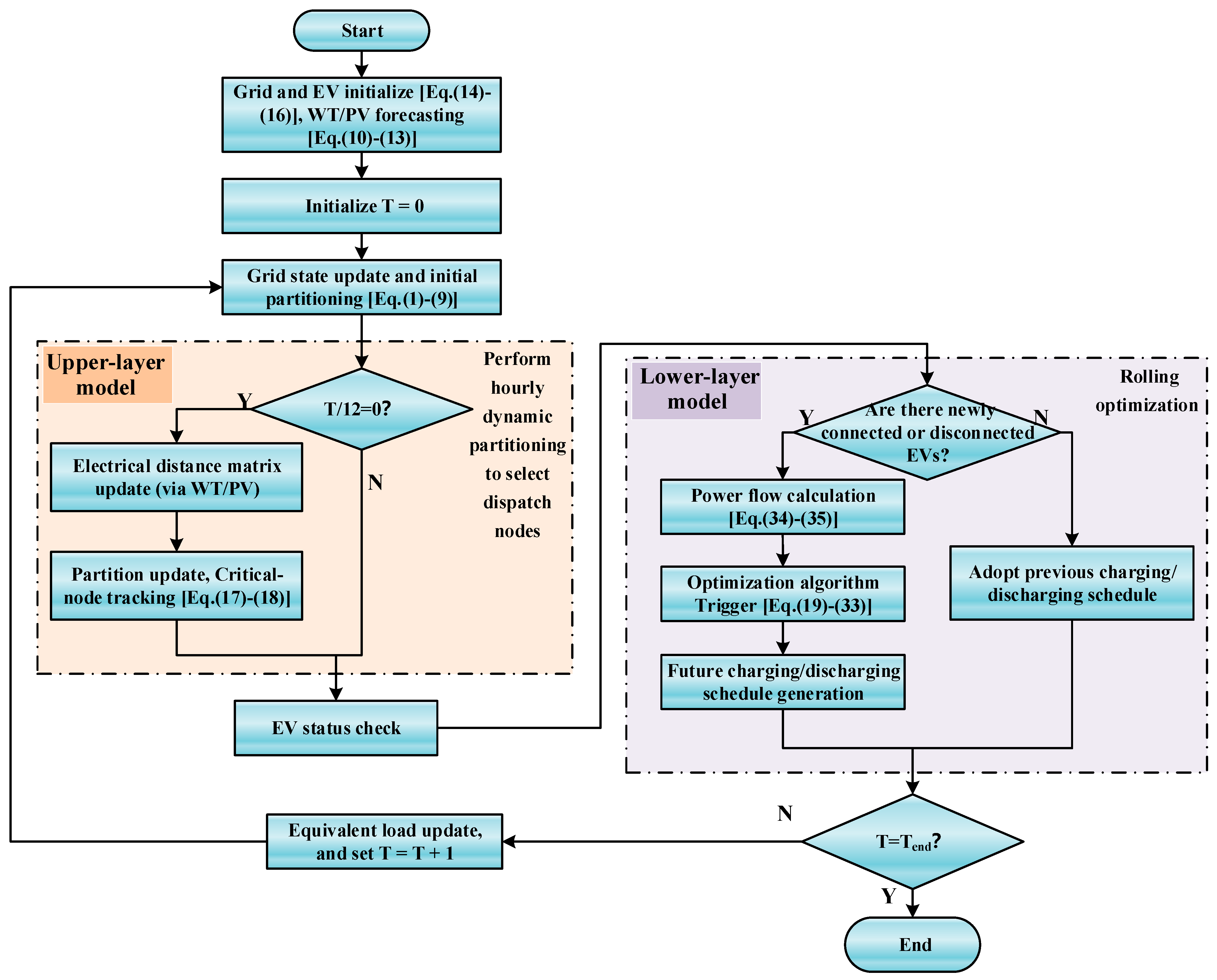
4.3. Flowchart of the Proposed Two-Layer Optimization Model
- (1)
- Initialization: Initialize the grid topology model, EV parameters, and forecasting WT/PV output curves. Set the scheduling resolution to min and initialize the time index . Update the initial grid operating state and compute the initial partition used to start the closed-loop process.
- (2)
- Upper-layer hourly update (rectangle with an orange fill): The upper-level model is triggered at the beginning of each hour to dynamically adjust the network partitions. It (i) updates the electrical distance matrix using the forecasted wind/PV output and system states for the current period, (ii) performs dynamic partitioning as described in Chapter 3 to determine the hourly partition boundaries, and (iii) identifies the critical node within each partition by tracking the node with the largest voltage deviation. It then schedules the EVs that need to be connected to the grid in the next period to these critical nodes. The resulting partition scheme and critical nodes provide spatial guidance for the rolling control of the lower-level model in the following hour. It should be clarified that dynamic partitioning does not alter the physical network topology or reassign the connection points of already connected EVs. Once an EV is connected to the grid, it remains stationary. After the partition is dynamically adjusted in the next time period, newly arriving EVs in that subsequent period will be scheduled to connect to the updated critical node, while previously connected EVs remain unaffected.
- (3)
- Lower-layer rolling control and feedback (rectangle with a purple fill): At each 5 min interval, the controller checks the status of EVs. If new EVs are connected or existing ones are disconnected, a power flow update is performed and rolling-horizon optimization is triggered to generate updated charging/discharging and reactive power setpoints for all connected EVs over the forthcoming intervals. Otherwise, the setpoints from the previous rolling window continue to be used. After applying the current interval’s setpoints, the algorithm updates the equivalent load curve/state, sets , and repeats until . It is worth noting that the upper-layer partition update is executed hourly, while the lower-layer rolling optimization is triggered by EV connection/disconnection events, which reduces the number of full optimizations compared to strict periodic re-solving. Therefore, real-time deployability is evaluated at the level of a single rolling window: the time required to solve one rolling optimization should be shorter than the sampling interval. For larger systems, future adoption of computationally efficient power-flow approximations could further reduce the delay.
5. Simulation and Case Study Results
5.1. Simulation Parameter Settings
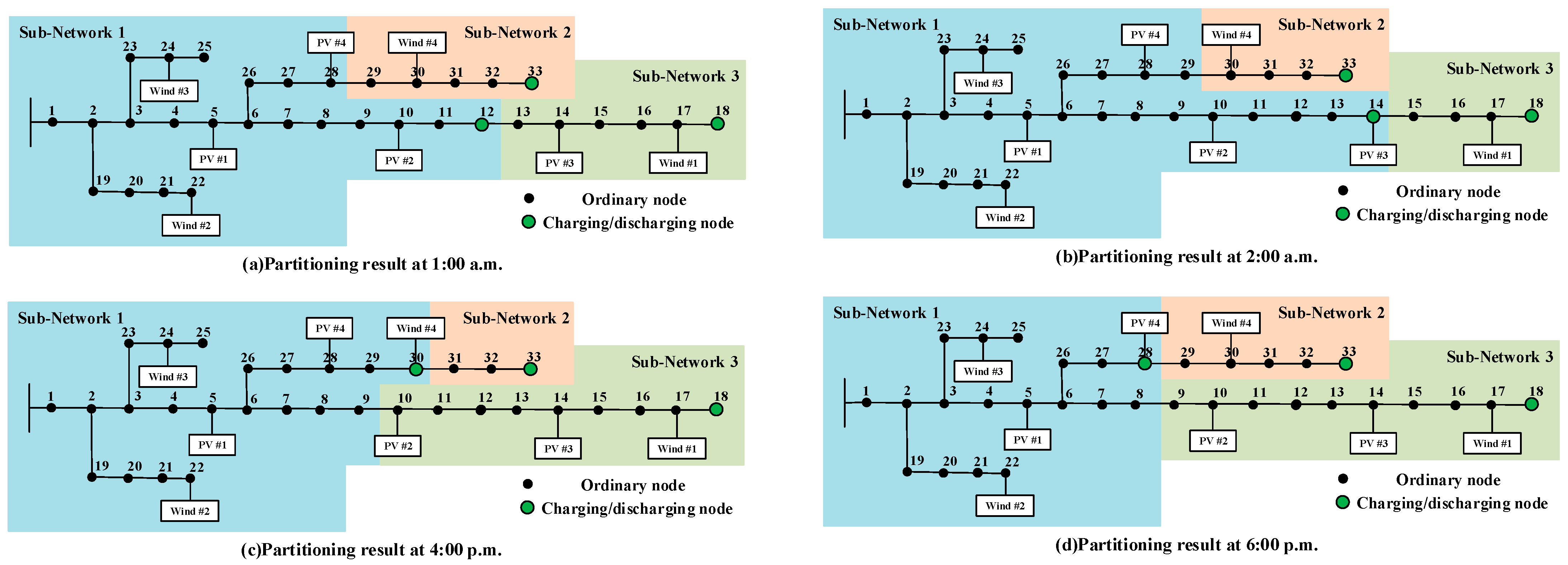
5.2. Dynamic Network Partitioning Results
5.3. Distribution Network Voltage Optimization Analysis
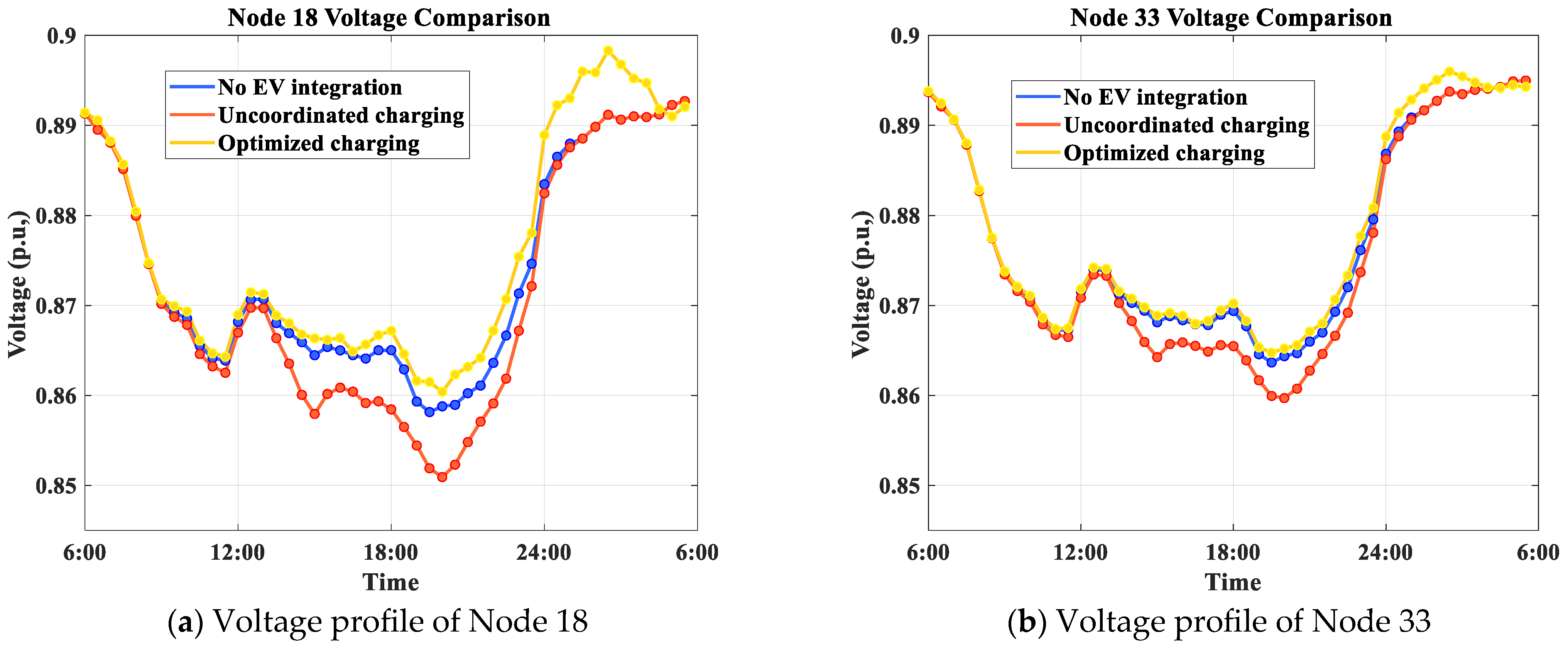
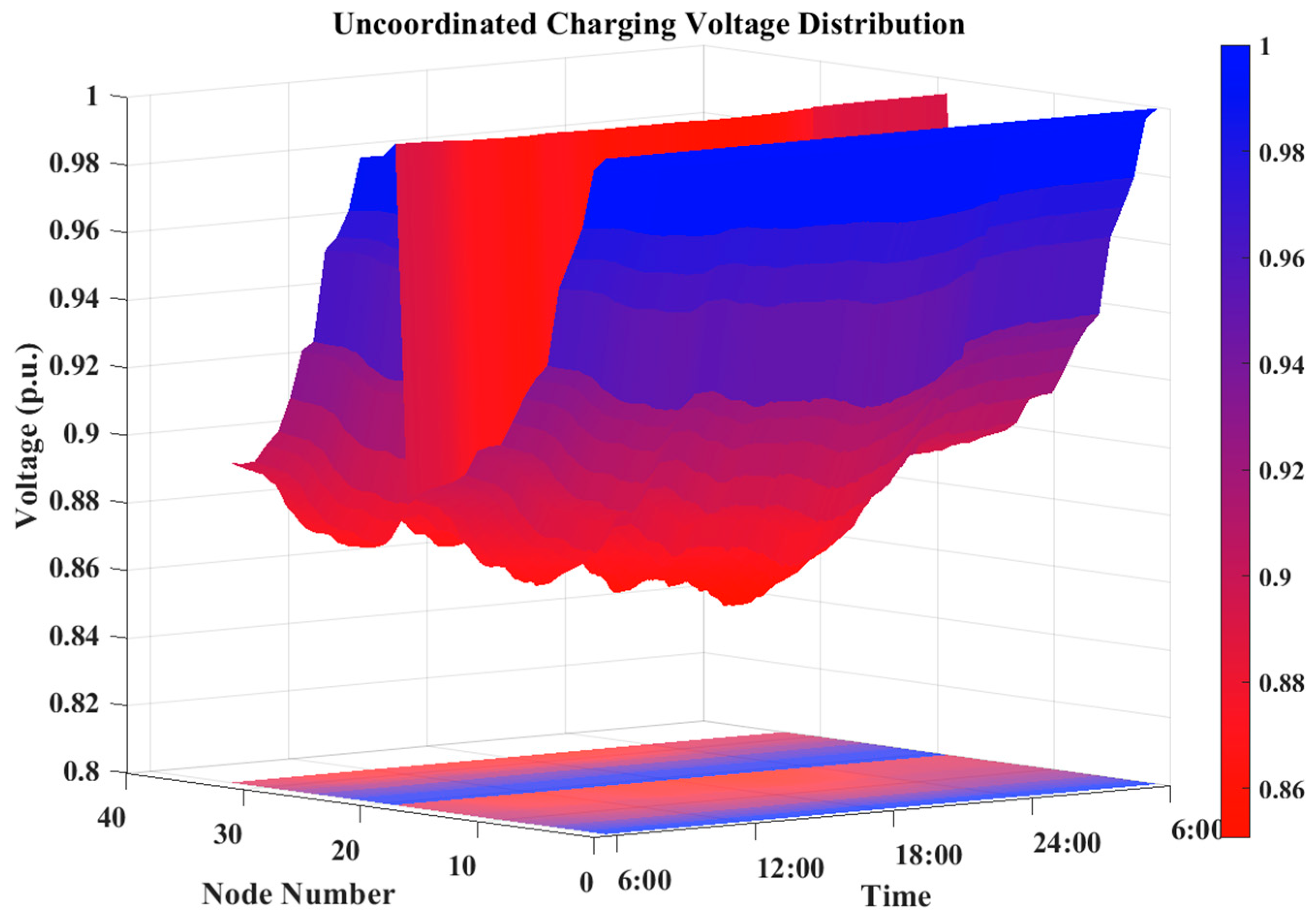
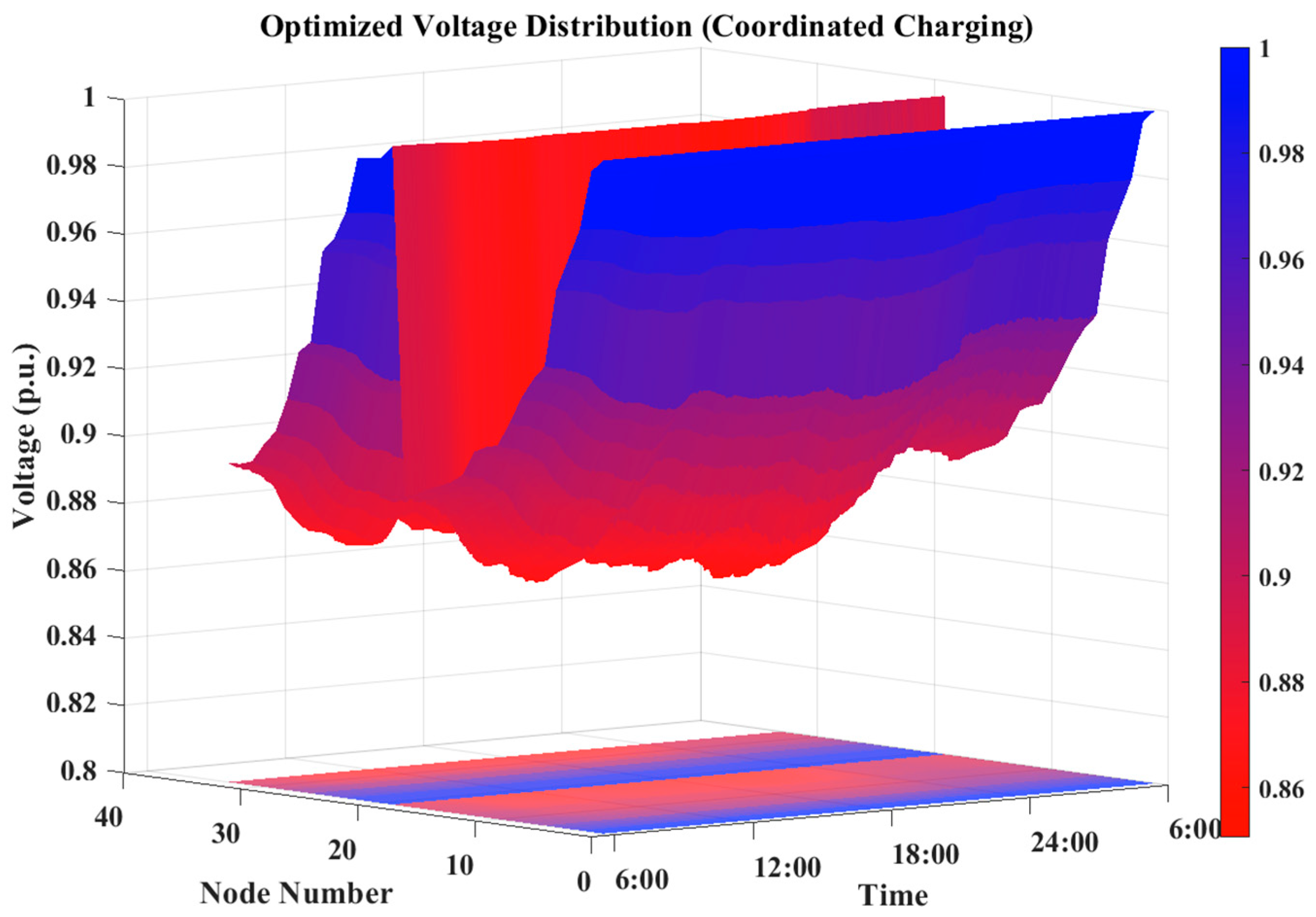
5.3.1. Impact of Controlled Versus Uncontrolled Electric Vehicle Charging on Grid Voltage
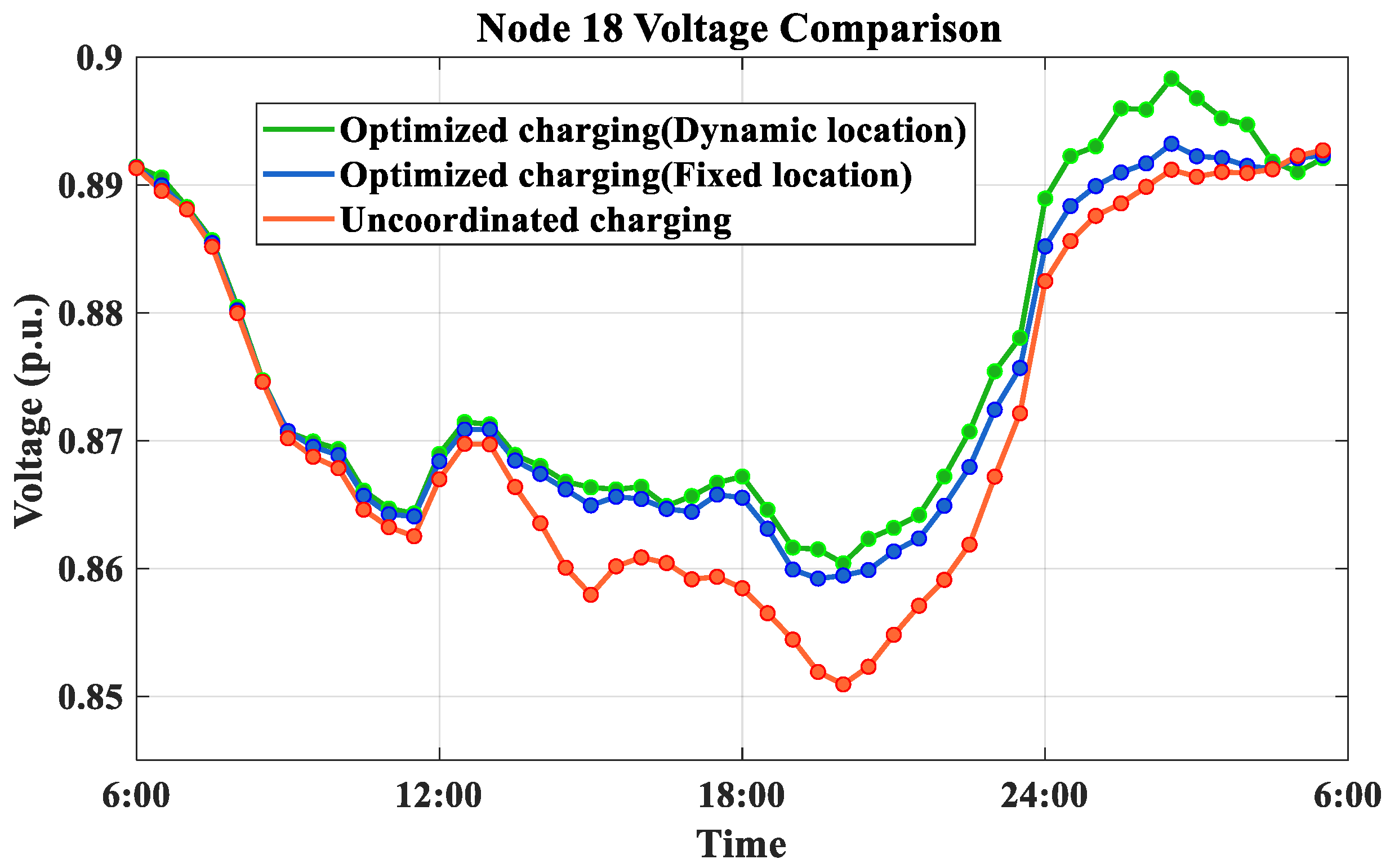
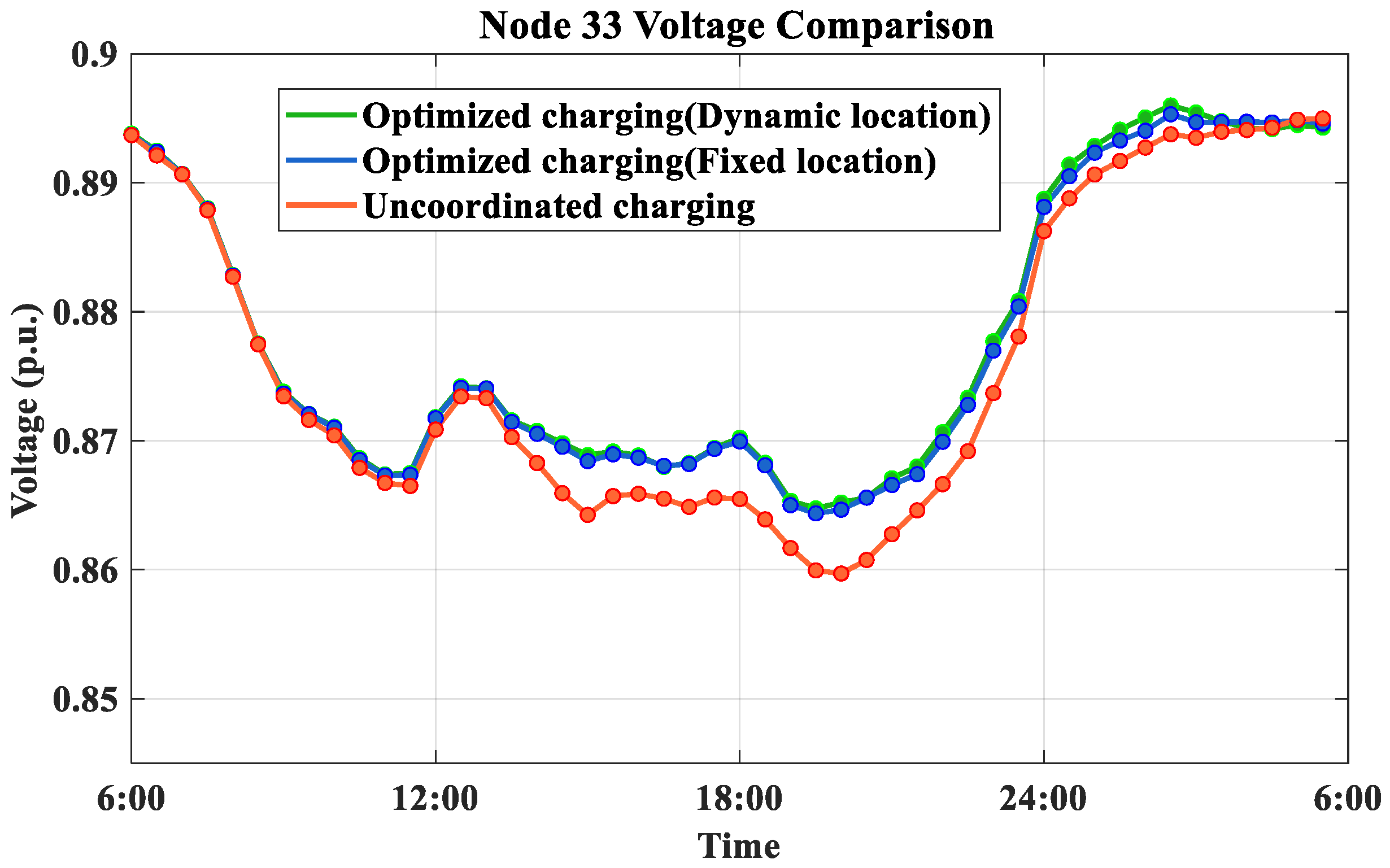
5.3.2. Voltage Comparison Between Dynamic and Static Charging Nodes
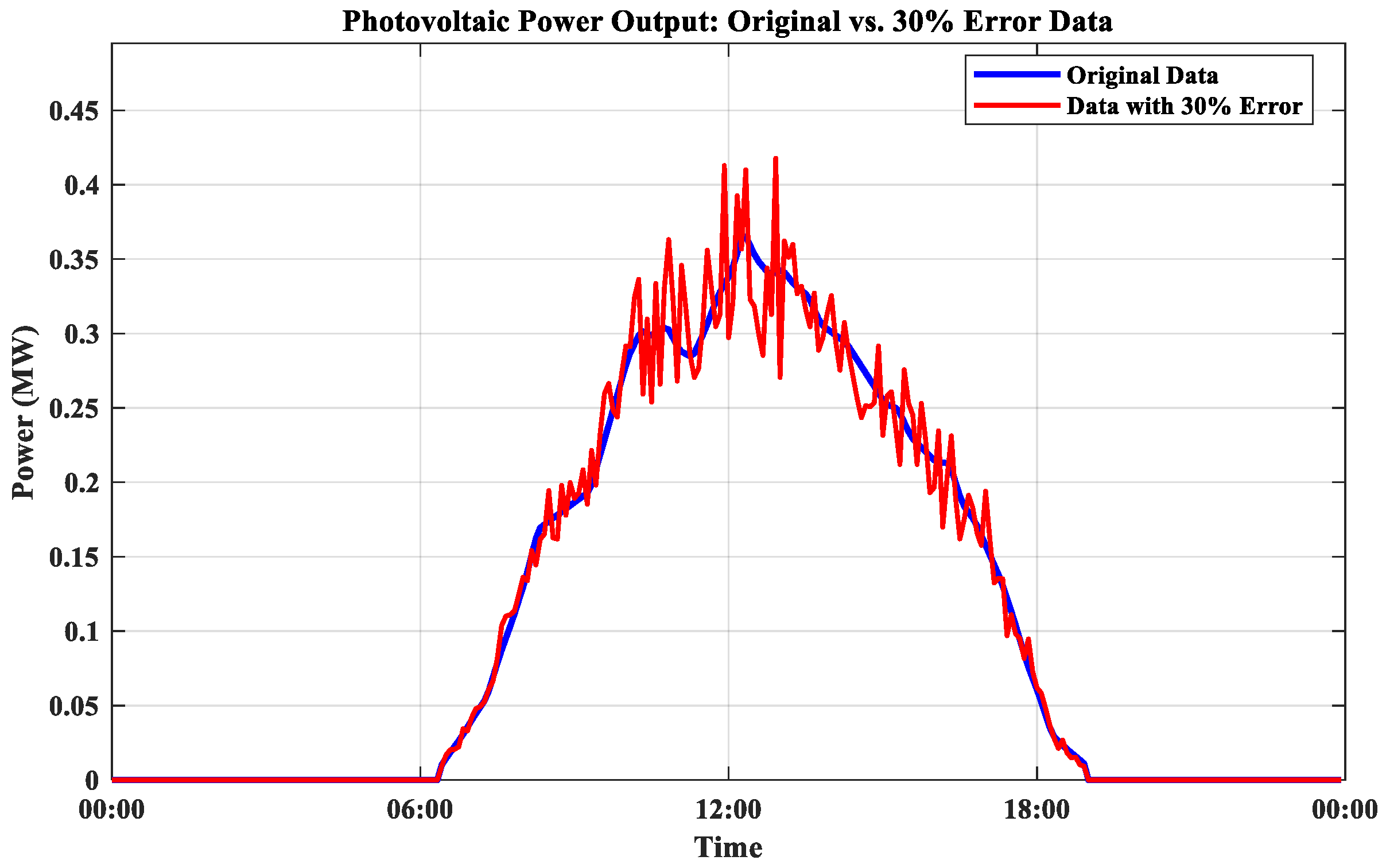
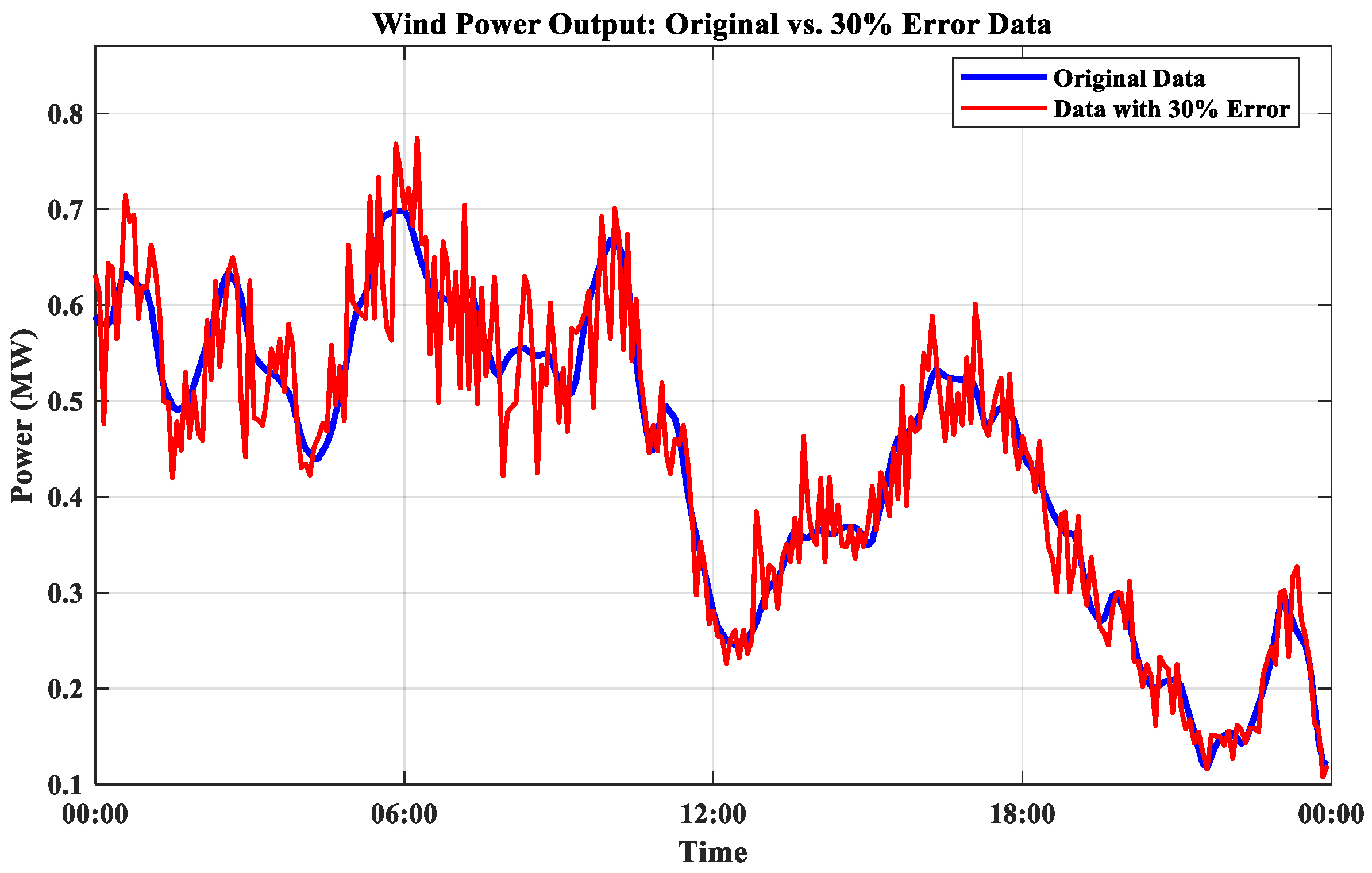
5.3.3. Voltage Comparison with and Without Renewable Energy Forecast Errors
5.4. Network Loss Optimization Analysis
6. Summary and Prospect
6.1. Summary
6.2. Discussion in Real-World Application
6.3. Future Work
Author Contributions
Funding
Data Availability Statement
Conflicts of Interest
References
- Keramidas, K.; Diaz, V.A.; Weitzel, M.; Marie, T.; Stephane, T.-M.; Antonio, S.R.; Orcid-Logomark, K.J.; Rita, V.D.; Qimin, C.; Sha, F.; et al. Global Energy and Climate Outlook 2019: Electrification for the Low-Carbon Transition; Publications Office of the European Union: Luxembourg, 2020. [Google Scholar] [CrossRef]
- IEA. World Energy Outlook 2019; International Energy Agency: Paris, France, 2019; Available online: https://www.iea.org/reports/offshore-wind-outlook-2019 (accessed on 19 November 2019).
- Secinaro, S.; Brescia, V.; Calandra, D.; Biancone, P. Employing bibliometric analysis to identify suitable business models for electric cars. J. Clean. Prod. 2020, 264, 121503. [Google Scholar] [CrossRef]
- Rahman, M.M.; Al-Ammar, E.A.; Das, H.S.; Ko, W. Comprehensive impact analysis of electric vehicle charging scheduling on load-duration curve. Comput. Electr. Eng. 2020, 85, 106673. [Google Scholar] [CrossRef]
- Ehsani, M.; Singh, K.V.; Bansal, H.O.; Mehrjardi, R.T. State of the Art and Trends in Electric and Hybrid Electric Vehicles. Proc. IEEE 2021, 109, 967–984. [Google Scholar] [CrossRef]
- Liu, K.; Liu, Y.L. Stochastic user equilibrium based spatial-temporal distribution prediction of electric vehicle charging load. Appl. Energy 2023, 339, 120943. [Google Scholar] [CrossRef]
- Alam, M.J.E.; Muttaqi, K.M.; Sutanto, D. Effective utilization of available PEV battery capacity for mitigation of solar PV impact and grid support with integrated V2G functionality. IEEE Trans. Smart Grid 2016, 7, 1562–1571. [Google Scholar] [CrossRef]
- Wang, X.; He, Z.; Yang, J. Unified strategy for electric vehicles participate in voltage and frequency regulation with active power in city grid. IET Gener. Transm. Distrib. 2019, 13, 3281–3291. [Google Scholar] [CrossRef]
- Ren, H.; Zhang, A.; Wang, F.; Yan, X.; Li, Y.; Duić, N.; Shafie-Khah, M.; Catalão, J.P. Optimal scheduling of an EV aggregator for demand response considering triple level benefits of three-parties. Int. J. Electr. Power Energy Syst. 2021, 125, 106447. [Google Scholar] [CrossRef]
- Yan, D.; Ma, C. Stochastic planning of electric vehicle charging station integrated with photovoltaic and battery systems. IET Gener. Transm. Distrib. 2020, 14, 4217–4224. [Google Scholar] [CrossRef]
- Vijayan, V.; Mohapatra, A.; Singh, S.N.; Dewangan, C.L. An Efficient Modular Optimization Scheme for Unbalanced Active Distribution Networks With Uncertain EV and PV Penetrations. IEEE Trans. Smart Grid 2023, 14, 3876–3888. [Google Scholar] [CrossRef]
- Nowak, S.; Wang, L.; Metcalfe, S.M. Two-level centralized and local voltage control in distribution systems mitigating effects of highly intermittent renewable generation. Int. J. Electr. Power Energy Syst. 2020, 119, 105858. [Google Scholar] [CrossRef]
- Long, Y.; Kirschen, D.S. Bi-Level Volt/VAR Optimization in Distribution Networks With Smart PV Inverters. IEEE Trans. Power Syst. 2022, 37, 3604–3613. [Google Scholar] [CrossRef]
- Hoque, M.M.; Khorasany, M.; Razzaghi, R.; Jalili, M.; Wang, H. Network-Aware Coordination of Aggregated Electric Vehicles Considering Charge–Discharge Flexibility. IEEE Trans. Smart Grid 2023, 14, 2125–2139. [Google Scholar] [CrossRef]
- Ullah, I.; Zheng, J.F.; Iqbal, M.; Ahmad, M.; Jamal, A.; Severino, A. Interpretive structural model for influential factors in electric vehicle charging station location. Energy 2025, 325, 136154. [Google Scholar] [CrossRef]
- Zhu, L.; Meng, X.; Wang, L.; Zhang, N.; Wang, H. Voltage Control Strategy for Low-Voltage Distribution Network with Distributed Energy Storage Participating in Regulation under Low-Carbon Background. Sustainability 2023, 15, 9943. [Google Scholar] [CrossRef]
- Sun, X.; Qiu, J.; Zhao, J. Real-Time Volt/Var Control in Active Distribution Networks With Data-Driven Partition Method. IEEE Trans. Power Syst. 2021, 36, 2448–2461. [Google Scholar] [CrossRef]
- Wang, Z.H.; Tan, W.X.; Li, H.; Ge, J.M.; Wang, W. A voltage coordination control strategy based on the reactive power-active network loss partitioned aggregation domain. Int. J. Electr. Power Energy Syst. 2023, 144, 108585. [Google Scholar] [CrossRef]
- Meng, L.; Yang, X.; Zhu, J.; Wang, X.; Meng, X. Network partition and distributed voltage coordination control strategy of active distribution network system considering photovoltaic uncertainty. Appl. Energy 2024, 362, 122846. [Google Scholar] [CrossRef]
- Zhao, R.F.; Hou, Z.F.; Lu, J.G.; Lin, G.H.; Yan, J.D.; Chen, J.D.; Pan, K.Y.; Wang, F.Y. Distributed coordinated service restoration strategy for transmission and distribution networks based on distribution network partition. Electr. Power Syst. Res. 2025, 246, 111675. [Google Scholar] [CrossRef]
- Yu, H.X.; Wang, Y.; Wang, Q.; Cheng, Z.; Li, S.Y.; Xiao, X.Y.; Chen, Y.Z. Dynamic network partition and voltage regulation method by PVs considering reactive power compensation benefits. Int. J. Electr. Power Energy Syst. 2025, 165, 110464. [Google Scholar] [CrossRef]
- Pamshetti, V.B.; Singh, S.; Singh, S.P. Combined Impact of Network Reconfiguration and Volt-VAR Control Devices on Energy Savings in the Presence of Distributed Generation. IEEE Syst. J. 2020, 14, 995–1006. [Google Scholar] [CrossRef]
- Barros, D.; Neves, A.L.W.; Dantas, M.K. Controlled Switching of Series Compensated Transmission Lines: Challenges and Solutions. IEEE Trans. Power Deliv. 2020, 35, 47–57. [Google Scholar] [CrossRef]
- Fei, D.; Murali, B. Coordinated Use of Smart Inverters with Legacy Voltage Regulating Devices in Distribution Systems with High Distributed PV Penetration—Increase CVR Energy Savings. IEEE Trans. Smart Grid 2023, 14, 1804–1813. [Google Scholar] [CrossRef]
- Kisacikoglu, M.C.; Ozpineci, B.; Tolbert, L.M. EV/PHEV bidirectional charger assessment for V2G reactive power operation. IEEE Trans. Power Electron. 2013, 28, 5717–5727. [Google Scholar] [CrossRef]
- Wang, Y.Q.; Guo, X.Z.; Zhang, C.; Liang, R.; Peng, T.; Yang, Y.; Wu, M.J.; Zhou, Y.X. Multi-strategy reference vector guided evolutionary algorithm and its application in multi-objective optimal scheduling of microgrid systems containing electric vehicles. J. Energy Storage 2024, 95, 112500. [Google Scholar] [CrossRef]
- Wang, Y.Q.; Wang, H.; Razzaghi, R.; Jalili, M.; Liebman, A. Multi-objective coordinated EV charging strategy in distribution networks using an improved augmented epsilon-constrained method. Appl. Energy 2024, 369, 123547. [Google Scholar] [CrossRef]
- Long, H.; Guo, Z.Y.; Zhou, C.G. A charge-discharge optimization strategy considering the spatiotemporal distribution of electric vehicles and the operational safety of the power distribution network in the power-transportation coupling network. J. Clean. Prod. 2024, 452, 142067. [Google Scholar] [CrossRef]
- Guo, S.L.; Li, P.P.; Ma, K.; Yang, B.; Yang, J. Robust energy management for industrial microgrid considering charging and discharging pressure of electric vehicles. Appl. Energy 2022, 325, 119846. [Google Scholar] [CrossRef]
- Lenka, R.K.; Panda, A.K.; Senapati, L. Grid integrated multifunctional EV charging infrastructure with improved power quality. J. Energy Storage 2024, 76, 109637. [Google Scholar] [CrossRef]
- Chen, J.; Bei, G.; Zhang, Q.; Huang, L.; Liu, K.; Chen, P. Integrated reactive power optimization for distribution systems considering electric vehicle dis-/charging support. Energy Rep. 2023, 9, 1888–1896. [Google Scholar] [CrossRef]
- Gholami, K.; Karimi, S.; Rastgou, A.; Nazari, A.; Moghaddam, V. Voltage stability improvement of distribution networks using reactive power capability of electric vehicle charging stations. Comput. Electr. Eng. 2024, 116, 109160. [Google Scholar] [CrossRef]
- Wang, J.; Bharati, R.G.; Paudyal, S.; Ceylan, O.; Bhattarai, B.P.; Myers, K.S. Coordinated Electric Vehicle Charging With Reactive Power Support to Distribution Grids. IEEE Trans. Ind. Inform. 2019, 15, 54–63. [Google Scholar] [CrossRef]
- Mejia-Ruiz, G.E.; Cardenas-Javier, R.; Paternina, M.R.A.; Rodriguez-Rodriguez, J.R.; Ramirez, J.M.; Zamora-Mendez, A. Coordinated Optimal Volt/Var Control for Distribution Networks via D-PMUs and EV Chargers by Exploiting the Eigensystem Realization. IEEE Trans. Smart Grid 2021, 12, 2425–2438. [Google Scholar] [CrossRef]
- Haider, R.; Annaswamy, A.M. A hybrid architecture for volt-var control in active distribution grids. Appl. Energy 2022, 312, 118735. [Google Scholar] [CrossRef]
- Zhang, W.J.; Gandhi, O.; Quan, H.; Rodríguez-Gallegos, C.D.; Srinivasan, D. A multi-agent based integrated volt-var optimization engine for fast vehicle-to-grid reactive power dispatch and electric vehicle coordination. Appl. Energy 2018, 229, 96–110. [Google Scholar] [CrossRef]
- Karagiannopoulos, S.; Mylonas, C.; Aristidou, P.; Hug, G. Active distribution grids providing voltage support: The swiss case. IEEE Trans. Smart Grid 2021, 12, 268–278. [Google Scholar] [CrossRef]
- Quijano, D.A.; Padilha-Feltrin, A.; Catalão, J.P.S. Volt-Var Optimization With Power Management of Plug-In Electric Vehicles for Conservation Voltage Reduction in Distribution Systems. IEEE Trans. Ind. Appl. 2024, 60, 1454–1462. [Google Scholar] [CrossRef]
- Shan, Y.; Hu, J.; Guerrero, J.M. A model predictive power control method for PV and energy storage systems with voltage support capability. IEEE Trans. Smart Grid 2020, 11, 1018–1029. [Google Scholar] [CrossRef]
- Hu, J.; Ye, C.; Ding, Y.; Tang, J.; Liu, S. A Distributed MPC to Exploit Reactive Power V2G for Real-Time Voltage Regulation in Distribution Networks. IEEE Trans. Smart Grid 2022, 13, 576–588. [Google Scholar] [CrossRef]
- Huang, A.L.; Mao, Y.X.; Chen, X.S.; Xu, Y.H.; Wu, S.X. A multi-timescale energy scheduling model for microgrid embedded with differentiated electric vehicle charging management strategies. Sustain. Cities Soc. 2024, 101, 105123. [Google Scholar] [CrossRef]
- Nguyen, H.T.; Choi, D.-H. Decentralized Distributionally Robust Coordination Between Distribution System and Charging Station Operators in Unbalanced Distribution Systems. IEEE Trans. Smart Grid 2023, 14, 2164–2177. [Google Scholar] [CrossRef]
- Pareschi, G.; Küng, L.; Georges, G.; Boulouchos, K. Are travel surveys a good basis for EV models? Validation of simulated charging profiles against empirical data. Appl. Energy 2020, 275, 115318. [Google Scholar] [CrossRef]
- Kesler, M.; Kisacikoglu, M.C.; Tolbert, L.M. Vehicle-to-Grid Reactive Power Operation Using Plug-In Electric Vehicle Bidirectional Offboard Charger. IEEE Trans. Ind. Electron. 2014, 61, 6778–6784. [Google Scholar] [CrossRef]
- Wickramasinghe Abeywardana, D.B.; Acuna, P.; Hredzak, B.; Aguilera, R.P.; Agelidis, V.G. Single-Phase Boost Inverter-Based Electric Vehicle Charger With Integrated Vehicle to Grid Reactive Power Compensation. IEEE Trans. Power Electron. 2018, 33, 3462–3471. [Google Scholar] [CrossRef]
- Chang, W.G.; Yang, Q. Game-theoretic risk-averse day-ahead optimal bidding strategy of virtual power plant aggregated with heterogeneous distributed resources. Energy 2025, 336, 138087. [Google Scholar] [CrossRef]



| Parameter Category | Parameters | Value |
|---|---|---|
| System Benchmark | Base Capacity | 10 MVA |
| Base Voltage | 12.66 kV | |
| Reference Voltage of Root Node () | 1.0 p.u. | |
| Active Power Weight Coefficient () | 0.7 | |
| Time resolution | 5 min | |
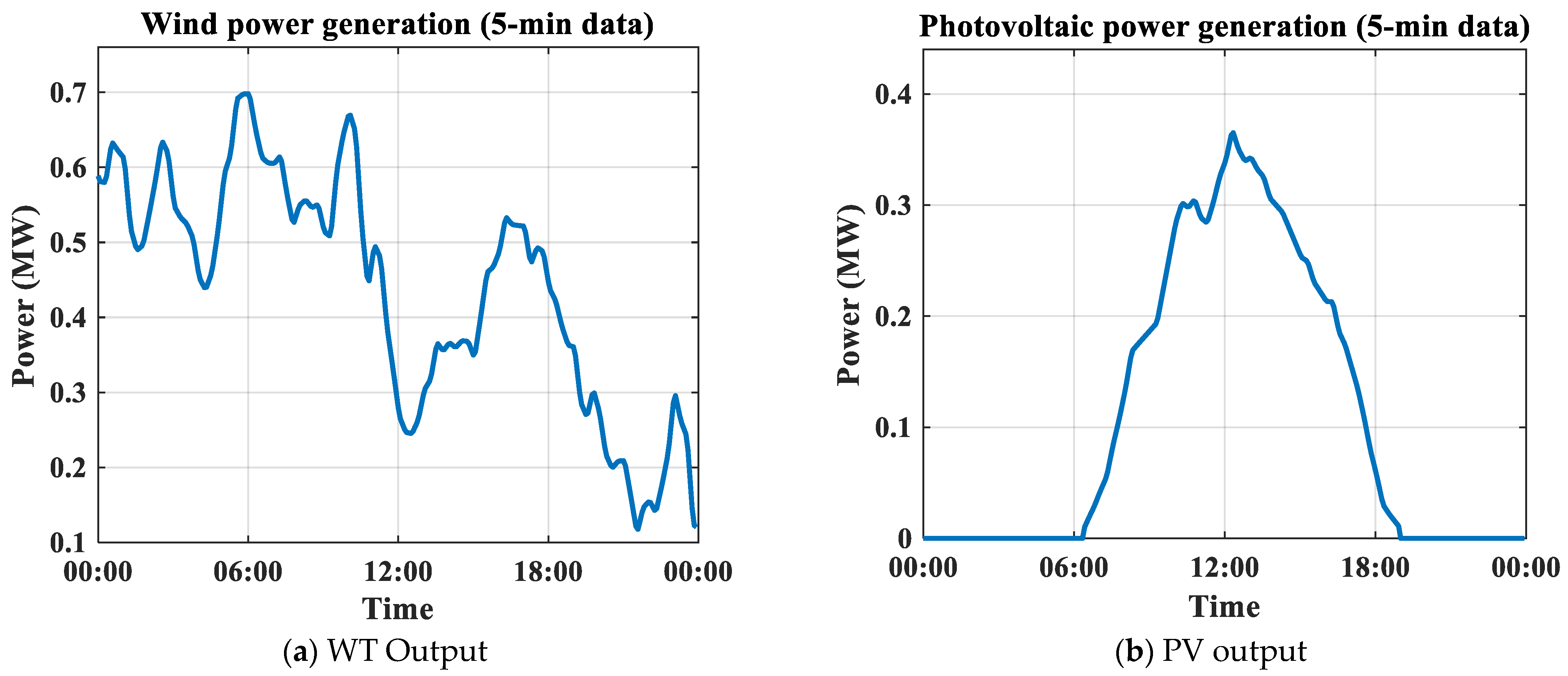
| WT | Rated Capacity per WT | 0.7 MW |
| Total Installed Capacity | 2.8 MW | |
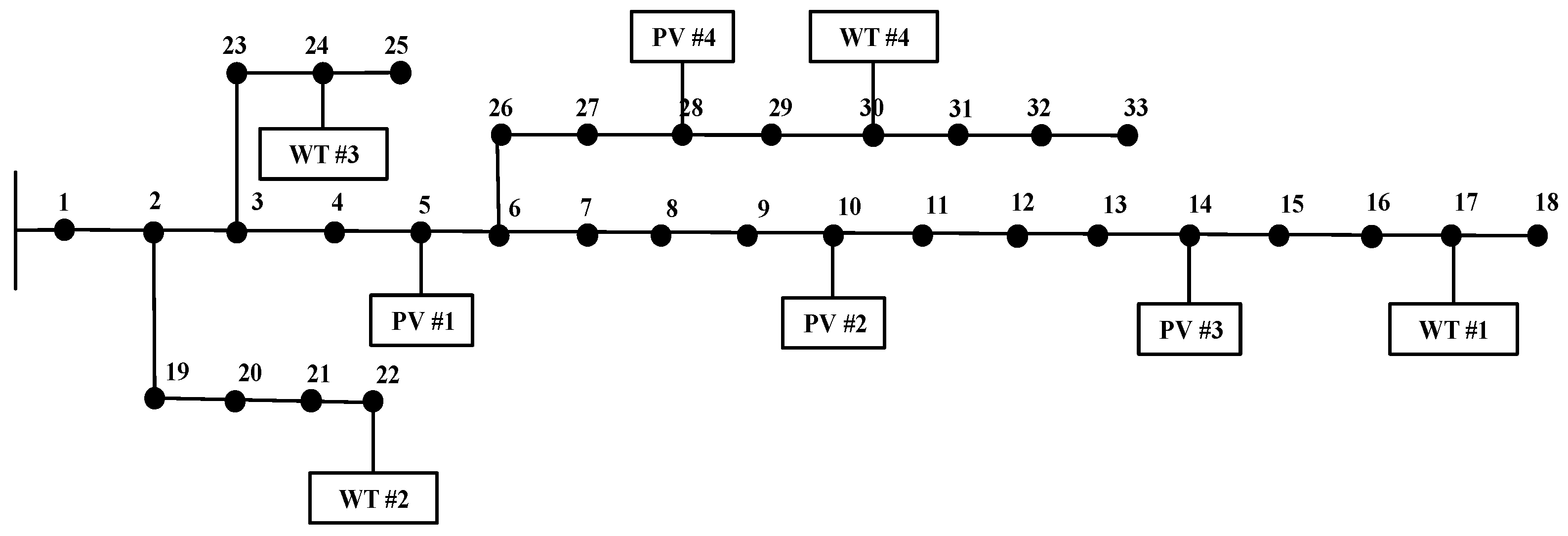
| Access Nodes | [#17, #22, #24, #30] | |
| Power Factor | 0.95 | |
| PV | Rated Capacity per PV Module | 0.37 MW |
| Total Installed Capacity | 1.48 MW | |
| Access Nodes | [#5, #10, #14, #28] | |
| Power Factor | 0.9 | |
| EV | Number of EVs Participating in Scheduling | 100 |
| EV Charge Power Limit (; ) | ±7.5 kW | |
| EV Discharge Power Limit (; ) | ±7.5 kW | |
| EV Battery Capacity (C) | 30 kWh | |
| Minimum SOC () | 0.2 | |
| Maximum SOC () | 0.8 | |
| EV charging/discharging efficiency | 0.9 | |
| max power factor angle () | −arccos(0.95) | |
| min power factor angle () | +arccos(0.95) |
Disclaimer/Publisher’s Note: The statements, opinions and data contained in all publications are solely those of the individual author(s) and contributor(s) and not of MDPI and/or the editor(s). MDPI and/or the editor(s) disclaim responsibility for any injury to people or property resulting from any ideas, methods, instructions or products referred to in the content. |
© 2026 by the authors. Licensee MDPI, Basel, Switzerland. This article is an open access article distributed under the terms and conditions of the Creative Commons Attribution (CC BY) license.
Share and Cite
Chen, R.; Dong, W.; Lu, C.; Zhang, J. An Optimization Method for Distribution Network Voltage Stability Based on Dynamic Partitioning and Coordinated Electric Vehicle Scheduling. Energies 2026, 19, 571. https://doi.org/10.3390/en19020571
Chen R, Dong W, Lu C, Zhang J. An Optimization Method for Distribution Network Voltage Stability Based on Dynamic Partitioning and Coordinated Electric Vehicle Scheduling. Energies. 2026; 19(2):571. https://doi.org/10.3390/en19020571
Chicago/Turabian StyleChen, Ruiyang, Wei Dong, Chunguang Lu, and Jingchen Zhang. 2026. "An Optimization Method for Distribution Network Voltage Stability Based on Dynamic Partitioning and Coordinated Electric Vehicle Scheduling" Energies 19, no. 2: 571. https://doi.org/10.3390/en19020571
APA StyleChen, R., Dong, W., Lu, C., & Zhang, J. (2026). An Optimization Method for Distribution Network Voltage Stability Based on Dynamic Partitioning and Coordinated Electric Vehicle Scheduling. Energies, 19(2), 571. https://doi.org/10.3390/en19020571