Article

An Experimental Study on the Effect of Compaction Pressure on Potassium Release During Biomass Briquette Combustion

1
Guangdong Electric Power Development Co., Ltd., Guangzhou 510030, China
2
State Key Laboratory of Coal Combustion, Huazhong University of Science and Technology, Wuhan 430074, China
*
Author to whom correspondence should be addressed.
Energies 2026, 19(2), 511; https://doi.org/10.3390/en19020511
Submission received: 29 November 2025 / Revised: 13 January 2026 / Accepted: 17 January 2026 / Published: 20 January 2026
(This article belongs to the Topic Advances in Biomass Conversion, 2nd Edition)

Abstract

Biomass briquettes are an environmentally friendly fuel and have extensive utilization prospects. Compaction pressure is a crucial factor during the production of biomass briquettes, affecting its densification and subsequent potassium release behavior. The release of alkali metals during combustion is typically studied using offline analytical techniques. However, these methods fail to provide real-time measurement of alkali metals release during the combustion process. Therefore, FES, through its equipment simplicity, low operational cost, real-time measurement, and robust adaptability to industrial environments, is commonly employed. In this study, the effect of compaction pressure (80, 130, and 180 MPa) of camphor wood briquettes on potassium release in a premixed flame was investigated by means of Flame Emission Spectroscopy. A spectrometer was used to obtain flame spontaneous emission spectra at three heights above the burner. Based on the proposed spectral analysis method and a calibration procedure, time-resolved flame temperature and concentration of gas-phase potassium in camphor wood briquette combustion were simultaneously measured. The experimental results at the three measurement heights showed that both peak concentration and the amount of gas-phase potassium released from biomass briquettes decreased with the increase in compaction pressure. Furthermore, the amount of potassium released from biomass briquettes at a compaction pressure of 180 MPa was the lowest at all three measurement heights, at 28.0, 14.5, and 21.8 ppm·s. Moreover, the potassium release rate from 0 to 63 s was rapid, and there was an exponential increase in the release ratio curve. The release ratio of potassium reached 50% before entering the ash stage under a compaction pressure of 80 and 130 MPa; in comparison, it only reached 35% under 180 MPa. The potassium release ratio at HAB = 4 cm under compaction pressures of 80, 130, and 180 MPa was 54%, 50%, and 35%, respectively. The findings of this study directly link compaction pressure to K release and demonstrate the applicability of FES for real-time alkali metal detecting, offering both theoretical and practical pathways toward cleaner biomass combustion.

1. Introduction

Biomass briquettes are an important renewable and clean energy source. They offer unique advantages in fuel applications, including high combustibility, eco-friendliness, and ease of storage and transportation [1]. Moreover, briquetting is an effective utilization technique for optimizing the combustion performance of biomass. In some countries in North and South America and the European Union, biomass briquettes have been widely used [1]. However, biomass briquettes contain the alkali metal potassium (K), which vaporizes into the gas phase during combustion and reacts with sulfur dioxide present in the flue gas, forming a viscous coating of sulfate [2,3]. This sticky coating promotes the agglomeration of fly ash and its adhesion to the heat transfer surfaces of boilers, leading to fouling and slagging issues [4,5]. When the slag layer reaches a certain thickness, furnace shutdowns for maintenance are required, resulting in economic losses. Investigating the release patterns of alkali metals can therefore aid in mitigating ash deposition problems during biomass combustion.
The release of alkali metals during combustion is typically studied using offline analytical techniques. However, these methods are limited to analyzing alkali metals before and after combustion. They necessitate complex sample preparation, involve prolonged testing cycles, and, most importantly, fail to provide real-time measurement of potassium (K) release during the combustion process [6]. In recent years, optical detection techniques have been increasingly applied in online combustion monitoring. The current most commonly applied techniques primarily fall into two categories: passive detection methods, which involve the analysis of flame spontaneous radiation characteristics, and active spectroscopic techniques that involve the utilization of lasers for probing [7]. Among these techniques, Planar Laser-Induced Fluorescence (PLIF) and Laser-Induced Breakdown Spectroscopy (LIBS) are representative active laser-based detection methods. Van Eyk et al. [8] conducted a quantitative measurement of sodium (Na) atom release in coal combustion using PLIF. Hsu et al. [9] developed a novel application of LIBS to simultaneously measure Na and K in coal and wood particle combustion. However, laser-based active spectroscopic techniques are susceptible to external environmental interference during measurement, leading to laser energy fluctuations, making it difficult to achieve reliable online monitoring.
In contrast, passive spectral detection technologies, primarily Flame Emission Spectroscopy (FES), can be effectively adapted to various industrial scenarios. FES enables direct online detection of gaseous alkali metals within the flame. With its simple equipment and low maintenance costs, it is particularly suitable for online monitoring of industrial furnaces [7]. Mason et al. [10] measured the peak release rate and fraction of potassium from various biomass fuels by means of FES. Subsequently, in Mason et al.’s study [11], models of K release from different forms of biomass were established based on measurement results by means of FES. Lou et al. [12] developed an in situ FES method that successfully distinguished the sodium emission characteristics at different combustion stages of coal, revealing that temperature and thermal radiation play a key role in sodium release during coal combustion. Pu et al. [13] were the first to utilize FES for the online measurement of flame temperature, emissivity, band thermal radiation, and gaseous alkali metal concentration in a pilot-scale boiler under various experimental conditions. Pu et al. [14] employed a combined approach of imaging and FES techniques to investigate the effects of kaolin addition on the combustion behavior of two Zhundong coals. The addition of kaolin was found to influence all combustion stages for both types of coal. When the chestnut shell blending ratio increased, several parameters changed nonlinearly: ignition delay time, volatile flame temperature, and gaseous K release. This demonstrates a significant synergistic effect. Bi et al. [7] employed FES and X-ray fluorescence to analyze gaseous sodium (Na) concentration, temperature distribution, and ash composition. The results indicated that blending gasification fine slag with high-alkali coal significantly reduces the release of gaseous Na. FES therefore distinguishes itself from other spectroscopic methods. Its advantages include simple equipment, low operational cost, and strong adaptability to industrial settings. These enable effective real-time monitoring of alkali metal K release in biomass briquettes.
The compaction pressure is a crucial factor during the production of biomass briquettes, and affects their densification and subsequent K release behavior [15]. Poddar et al. [16] investigated the effects of compression pressure on the density and calorific value of different types of wood chip feedstocks. They found that changes in density were directly related to the compression pressure, whereas variations in calorific value were influenced to a greater extent by the compression method and less by moisture and ash content. Wang et al. [17] studied the effects of biomass pellet particle size and pelleting pressure on combustion characteristics and potassium release during volatile combustion. The findings demonstrated that pelleting pressure had a smaller effect on volatile flame temperature compared to particle size; however, it generally led to an increase in the maximum temperature. Current research on the effect of compaction pressure on alkali metal release has not yet achieved real-time detection, making it difficult to accurately determine the behavior of alkali metals at different stages of the release process.
Therefore, in this study, FES technology is employed to simultaneously measure the concentration of gaseous K and flame temperature during different compaction pressure biomass combustion conditions. Combined with experiments conducted under different compaction pressures, the release behavior of gaseous alkali metal K in biomass combustion is investigated. In this study, we establish a direct, practical link between compaction pressure and slagging, providing new insights for optimizing briquetting conditions to mitigate alkali-related deposition. Our findings also demonstrate and validate FES as a robust, industrially adaptable tool. It can diagnose alkali metal release online. This contributes to advanced monitoring solutions for cleaner and more efficient biomass combustion systems.

2. Experimental Principle

2.1. Biomass Briquette Preparation

Camphor wood is a renewable lignocellulosic biomass rich in biopolymers. It presents a promising solution for producing alternative fuels, which contributes to energy security, reduced fossil fuel dependence, and lower greenhouse gas emissions [18,19]. The raw biomass material in the experiment comprised camphor wood collected from Hubei province, China. The results of the proximate and ultimate analyses of camphor wood are shown in Table 1. The camphor wood powder was compressed to tablet-type briquettes under different pressures in a universal material testing machine (Type: CMT5205). The preparation process and the machine specifications are described in a previous study [15]. To ensure the reproducibility of the experimental results, all samples used in the experiment weighed 0.3 ± 0.005 g and measured 10 mm in diameter. This range facilitates visualization and dynamic monitoring of the combustion process using instruments such as high-speed cameras or spectrometers. Furthermore, it exhibits a moderate combustion duration, enabling complete observation of key stages, including devolatilization, char combustion, and burnout. This setup is suitable for investigating combustion characteristics.
In laboratory investigations, a compaction pressure of 60 MPa is sufficient to form a biomass pellet from powder. Densification equipment is characterized by varying expected compaction pressures, such as 100–150 MPa (and more) of pellet mill and 100–200 MPa (and more) of roll press [20]. Thus, the compaction pressures used in biomass preparation for the experiment were 80, 130 and 180 MPa, respectively. The height of biomass briquettes was 4 mm, and almost no difference between the samples under the three compaction pressures was found. The ash composition analysis results of the samples are presented in Table 2. From the perspective of boiler slagging mechanisms, the roles of K and Ca are fundamentally different. Although the results presented in Table 2 indicate a higher content of Ca, calcium is primarily bound within mineral lattices, exhibiting low volatility and limited mobility, with most retained in the bottom ash. In contrast, despite its lower concentration, K acts as a key reactive component governing the rate and severity of slagging. We therefore focus on the release behavior of K. The combustion experiments of camphor wood briquettes with different compaction pressures were repeated three times to avoid contingency. The measurement results showed good repeatability; therefore, average values of time-resolved flame temperatures and concentrations of gas-phase potassium in three measurements were simultaneously taken and then analyzed.

2.2. Experimental Setup

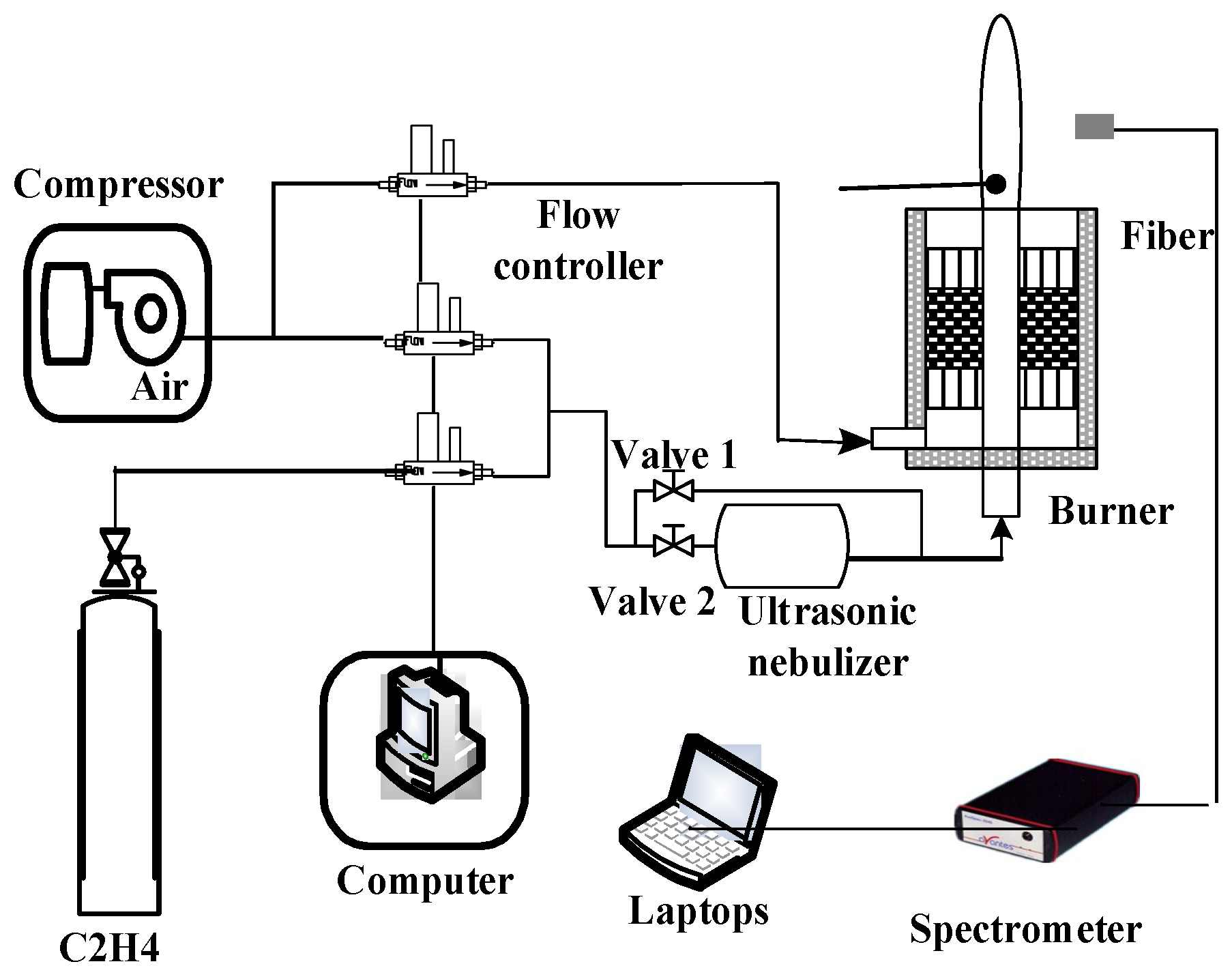
The experimental setup, illustrated in Figure 1, includes a premixed burner (diameter: 10 mm), mass flow controllers, an ultrasonic nebulizer, and a spectrometer. Two mass flow controllers were used to regulate the flow rates of air (1 L/min) and ethylene (0.244 L/min), establishing a stable premixed flame with an equivalence ratio of 3.49. Under these conditions, the premixed flame, with a height of 7.5 cm, produced significant amounts of soot. During the experiment, a biomass briquette was suspended on a tantalum wire at a height of 2 cm above the burner (HAB = 2 cm). Flame spontaneous emission spectra were collected using a spectrometer equipped with an optical fiber and a collimating lens. The lens was mounted on a translational stage, enabling measurements at heights of 3, 3.5, and 4 cm above the burner. The spectral signal was delivered to the spectrometer through an optical fiber. The measurement wavelength range of the spectrometer (Type: AvaSpec-ULS3648) is from 660 to 850 nm, and its spectral resolution is 0.14–0.18 nm. In addition, dark noise was removed prior to the acquisition of FES data.
Before burning the biomass briquettes, a calibration procedure was performed. An ultrasonic nebulizer was employed to atomize the potassium solutions. The droplets containing potassium entered the flame with the premixed stream. The details of the calibration procedure will be described in subsequent sections. Thereafter, the tantalum wire holding the biomass briquette was fixed on a translational platform, and a step motor was used to control its movement. Before the biomass briquettes entered the flame, the spectrometer had begun collecting spectral data for 180 s. Next, the biomass briquette was moved into the flame, burning for 600 s. The spectrometer continuously collected spectral data for 120 s after the biomass briquette was moved out of the flame.

2.3. Analysis of Flame Spontaneous Emission Spectra

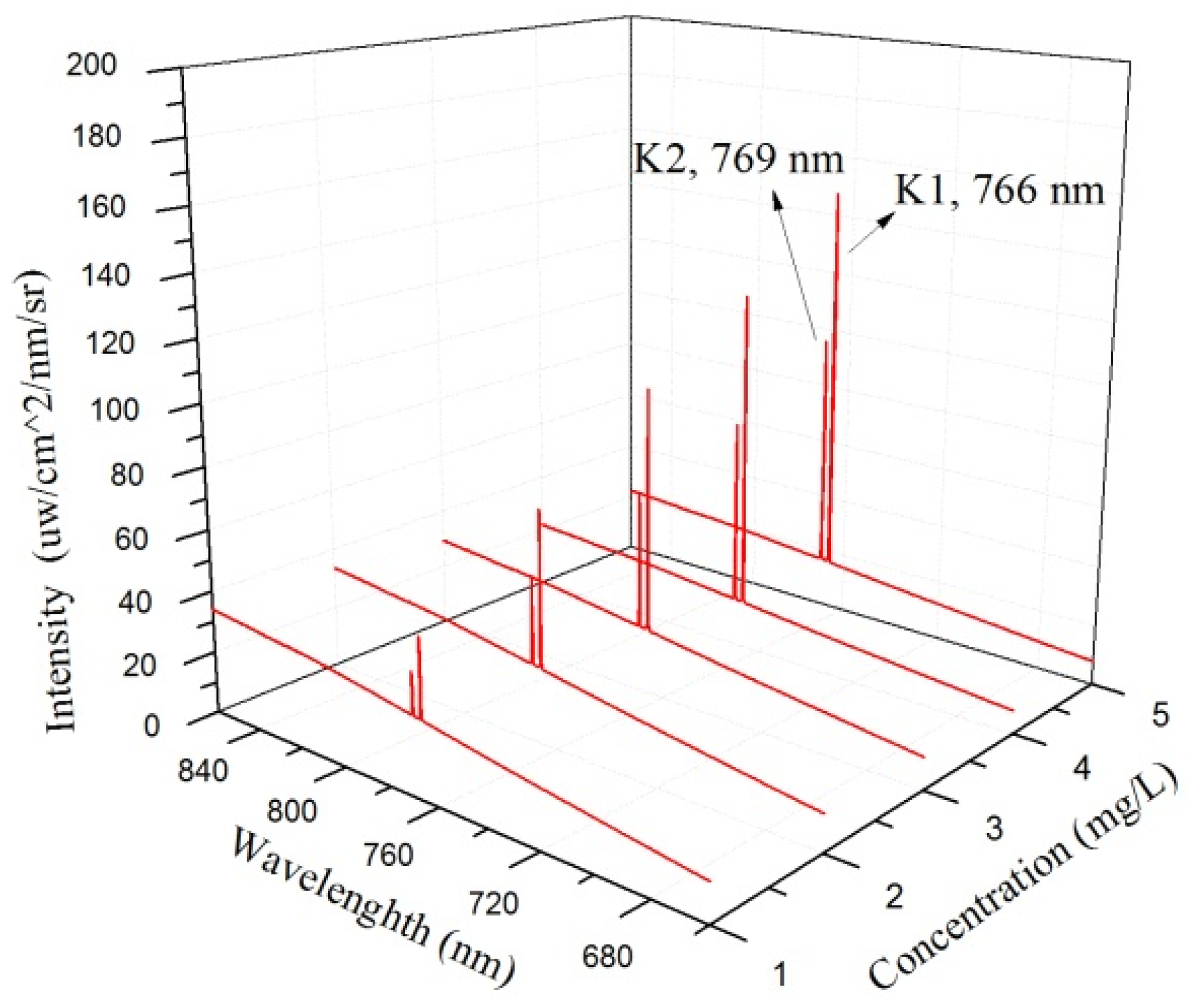
To quantitatively analyze flame spontaneous emission spectra, the relative spectral profile obtained by the spectrometer was transferred to absolute spectral radiation intensities using a blackbody furnace. Flame spectral radiation intensities can be obtained as the product of the coefficients gained from the blackbody furnace and the photon counts of radiation [7]. As shown in Figure 2, when droplets containing a known quantity of potassium were seeded into the premixed flame, spectral radiation intensities I e received by the spectrometer were equal to the sum of continuous spectral radiation intensities I c from particulates in the flame and discontinuous spectral intensities I d , from potassium emission lines at wavelengths of 766 and 769 nm in the flame. Equation (1) shows the relationship between the variables:
Ie = Ic + Id
Equation (1) is proposed to automatically separate both spectral radiation intensities and radiation intensity information from the measured flame emission spectra [13].
Continuous spectral radiation intensities from the soot flame can be described using the approximate form of Planck’s radiation law for a blackbody at temperature T and emissivity ε λ . With Hottel and Broughton’s empirical emissivity model for soot particles, flame temperature and emissivity can be calculated using a numerical algorithm such as the least squares method [7,21]. In addition, after T and ε λ are obtained, continuous spectral radiation intensities I c can be re-calculated. The intensities of the potassium emission lines are shown in Equation (2):
Id = IeIc
Equation (2) was used to calculate the concentration of gas-phase potassium in the flame through a calibration procedure.
The temperature in this study was determined using a multi-wavelength calculation method. The detailed calculation procedure can be found in our previous research [12]. If two monochromatic radiation intensities I ( λ ,   T ) , I ( λ + λ ,   T ) emitted from one point at two different wavelengths λ , λ + λ can be obtained, dividing one expression by the other yields the following two-color equation:
I ( λ , T ) I ( λ + λ , T ) = [ ε ( λ ) ε ( λ + λ ) ] ( λ + λ λ ) 5 e [ C 2 T ( 1 λ 1 λ + λ ) ]
In which, for wavelength λ , the emissivity is ε ( λ ) ; for wavelength λ + λ , the emissivity is ε ( λ + λ ) . If λ is small, ε ( λ ) ε ( λ + λ ) can be considered as 1. However, λ should not be excessively small, as this could introduce considerable computational errors. Under the assumption of constant emissivity, the temperature T at wavelength λ and λ + λ is given by Equation (4):
T = C 2 ( 1 λ 1 λ + λ ) / ln [ I ( λ , T ) I ( λ + λ , T ) ( λ λ + λ ) 5 ]
For the spectrometer system, radiation intensities at multiple wavelength pairs, λ and λ + λ , are measured. The average temperature T is then calculated using the equation based on these wavelength pairs.

2.4. Calibration Procedure

Accurate calibration of the spectroscopic detection system is essential for achieving quantitative analysis of K in flames based on spectral information. Calibration experiments were conducted on a single-particle test platform equipped with a solution nebulization injection device. This device converts liquid samples into aerosols, which are then introduced into a high-temperature flue gas environment. Under high-temperature conditions, K in the sample undergoes thermal excitation to higher energy states and subsequently emits characteristic spectral signals upon returning to the ground state. The FES detection system captures the intensity of K atomic emission lines at different concentrations. This establishes a quantitative relationship between spectral signals and gaseous K concentration. In the experiments, a certified single-element organometallic standard solution (10 mg/mL) was used to prepare KCl standard solutions at different concentrations through volumetric dilution. The solution concentrations were 10, 20, 30, 40, and 50 mg/L, respectively. Small droplets containing a known quantity of potassium were produced using an ultrasonic nebulizer operating at an atomization rate of 0.14 mL/min (control accuracy of 99%) and introduced into the flame. To minimize systematic errors, air was employed as the carrier gas to introduce the nebulized alkali metal solution into the burner. Due to sufficient premixing with air and ethylene, the potassium distribution was assumed uniform. As potassium solutions of different concentrations were seeded into the flame, the spontaneous emission spectra of the flame obtained from the spectrometer are shown in Figure 2. The intensities of potassium emission lines can be obtained through flame spectra analysis as described above. Based on the theory of FES, a linear relationship exists between the intensities of potassium emission lines and the concentration of gas-phase potassium in the flame. However, this linear relationship is influenced by self-absorption as the concentration of potassium atoms in the flame increases. In the present study, this effect was corrected using the Beer–Lambert law.
ln I = ln A + b·ln C
where I is the intensity of K measured using FES, b is the coefficient of self-absorption, C is the concentration of K in the seeded flame, and A is an empirical constant. The self-absorption coefficient b is generally taken to be 1. After the linear fitting of the relation of intensity and concentration, the calibration Equation (6) can then be used to ensure the reliability and accuracy of the calibration procedure. Further methodological details can be found in our previously published study [14].
I = 371.2025 × C   R2 = 0.9998
In the calibration equation, I (μw/cm2/nm/sr) is the intensity of potassium emission lines at a wavelength of 766 nm and C (ppm) is the concentration of gas-phase potassium in the flame.

3. Experimental Results and Analysis

3.1. Representative Flame Images

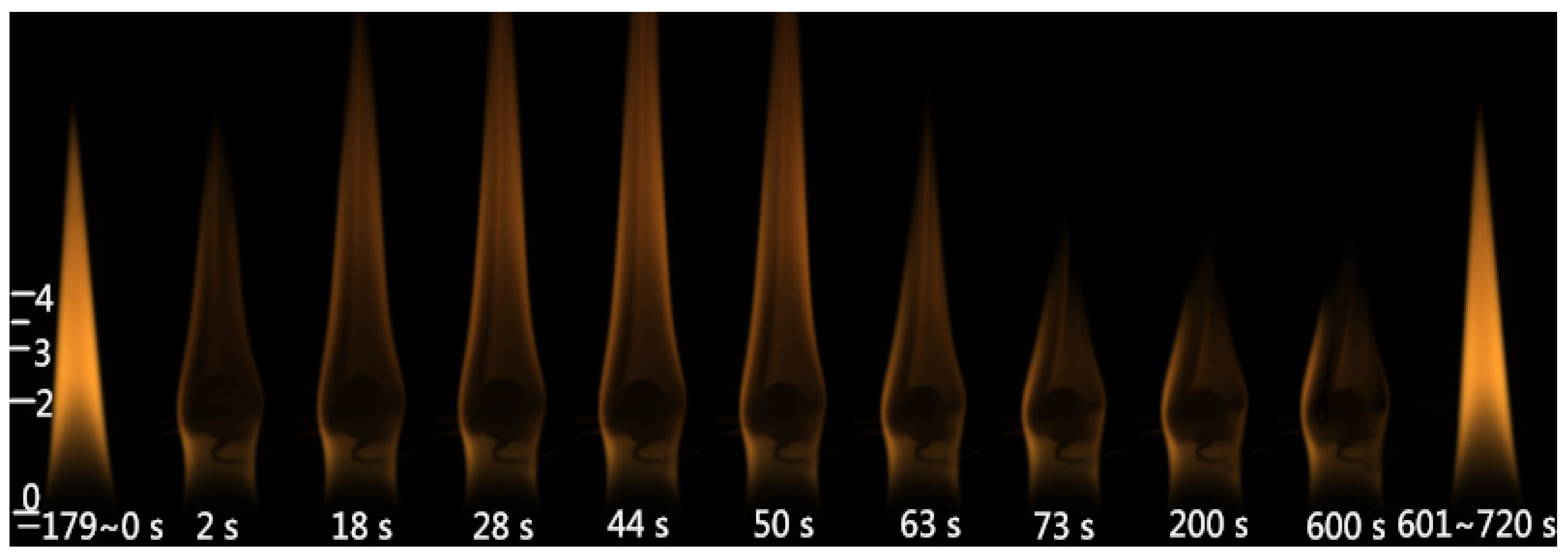
A digital camera was used to take photographs of the flame during the entire combustion process of the camphor wood briquette. In general, biomass combustion comprises devolatilization, char combustion, and ash stages. As an example, flame images of the biomass briquette (compaction pressure: 130 MPa) combustion are shown in Figure 3. Before the biomass briquette was added to the flame (from −179 to 0 s), the premixed flame was stable. After the biomass briquette was added to the flame, large amounts of volatiles were released due to the heat of the flame. Prior to volatile ignition, the particles undergo moisture evaporation, the gas diffuses into the pores, and the combustible gaseous components volatilize. During this stage, the lower surface of the particle is first exposed to high-temperature gases, with the flue gas flow at the edges being faster, resulting in a high oxygen diffusion rate. The fine particles in this region begin to combust first, explaining why the image shows the brightest coloration beneath the particle [22], thus representing the devolatilization stage. In the initial stage of char combustion, the particle contour became progressively clearer with bright edges, indicating the onset of combustion in the outer carbon layer of the particle. Subsequently, the char continued to burn, and the flame height increased, peaking at approximately 44 s. As combustion proceeded, the flame gradually diminished, and a shadowy annular region extended from the particle edge toward the center, quickly covering the entire surface, corresponding to the gradual thickening of the ash layer during the final stage of combustion. Thereafter, the combustion process entered the ash stage. The height of the flame was very low, and thereafter, the flame shape remained in this state with an imperceptible change until the biomass briquette was removed. Lastly, the flame returned to its original shape. The flame images of the other two types of camphor wood briquette (compaction pressures of 80 and 180 MPa) were similar to those of 130 MPa.

3.2. Flame Temperatures

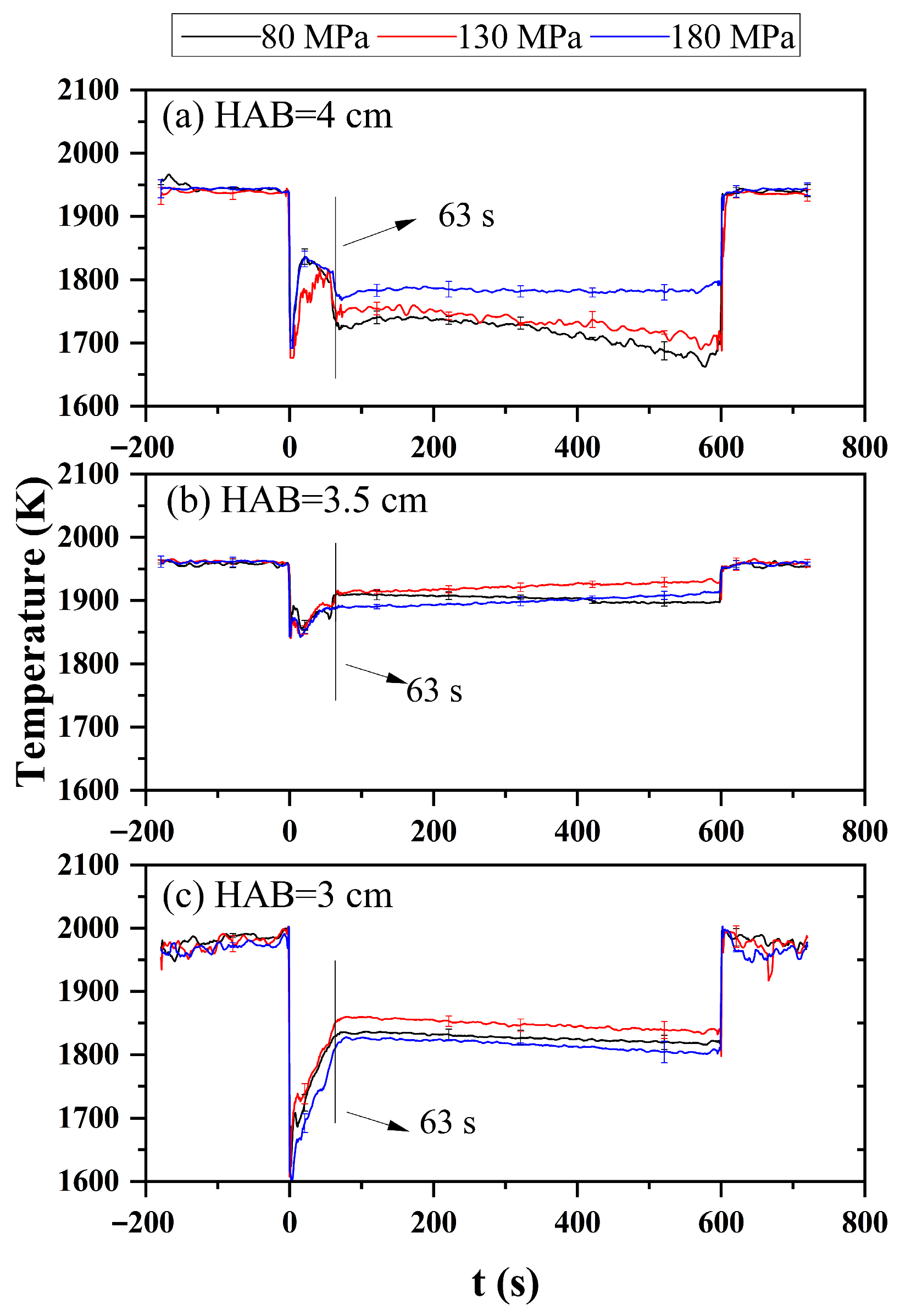
Investigating the release characteristics of alkali metals during biomass combustion can help prevent economic losses caused by slagging. Temperature was a critical parameter in the biomass combustion process, as the K release trends were closely associated with the flame temperature. The flame temperatures over time under three compaction pressures and at three heights above the burner (HAB) are shown in Figure 4. The standard deviation of the temperature data is less than 10%, indicating high stability and reliability of the temperature results. When no biomass briquette was present in the flame, the temperatures at all three HAB in the premixed flame were similar and remained around 1950 K. However, a rapid temperature drop occurred once the camphor wood briquette was introduced into the flame. This change occurred because the biomass briquette and tantalum wire disrupted the flow field. They generated a vortex phenomenon, which hindered ethylene combustion. Consequently, the flame temperature decreased. In addition, the evolution of volatiles also depletes local oxygen, thereby further reducing the combustion intensity and local temperature. Thereafter, heat gradually discharged with the combustion of biomass; therefore, the flame temperature gradually increased. However, during biomass combustion, the release of moisture and volatiles from the pellet leads to local cooling and oxygen depletion, resulting in temperatures lower than the initial baseline. After approximately 63 s, the temperature stabilized as combustion entered the ash stage, with most biomass consumed. At this point, the measured temperature primarily reflected that of the ethylene flame alone. Nevertheless, due to the continued presence of ash and the tantalum wire in the flame, the recorded temperature remained slightly lower than that of pure ethylene combustion.
However, based on the temperature results, the temperature variation trend from 0 to 63 s at HAB = 4 cm differed from that at HAB = 3 and 3.5 cm. As shown in Figure 4a, the temperature increased to a certain degree with the combustion of biomass, before exhibiting a declining trend until stabilizing. As biomass releases heat during combustion, the flame temperature increases. In this regard, a similar temperature variation trend should be observed at an HAB of 3.5 and 3 cm. However, because of the presence of the biomass briquette and tantalum wire in the flame, the decrease in oxygen content in this location could affect the combustion of the biomass briquette. As a result, the heat released from biomass combustion was insufficient to raise the temperature above that of the flame itself. Therefore, the measured temperature kept increasing until the ash stage was reached. Based on this explanation, it is recognized that the higher the measuring position, the smaller the effect of the vortex phenomenon.

3.3. Concentration of Gas-Phase Potassium

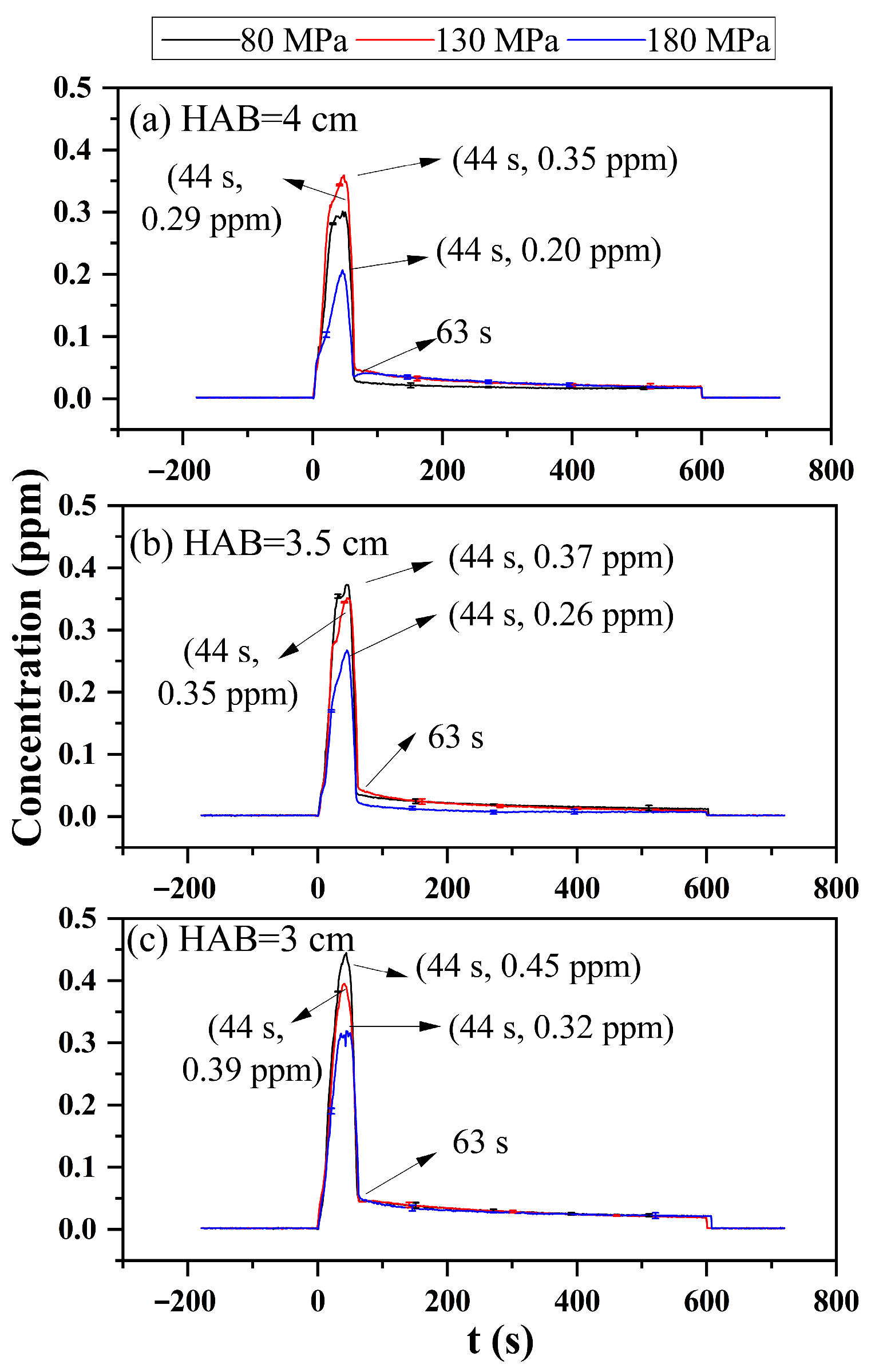
The temporal variation in gas-phase potassium concentration released under three different compaction pressures and three heights above the burner (HAB) is illustrated in Figure 5. The calculated standard deviation is less than 10%, indicating low dispersion and good repeatability in the gaseous potassium concentration release data. As shown in the figure, potassium release continued throughout the entire combustion process of the biomass briquette, persisting up to 600 s, albeit at very low concentrations toward the end of the process, suggesting that potassium was almost completely released over the full combustion duration. Moreover, it is evident that the potassium was mainly released before 63 s. During this stage, due to the high temperature of the flame (roughly 1950 K), the biomass rapidly dries and then burns. A large number of volatiles are released, followed by rapid access to the char stage; during this period, the potassium concentration in the flame is incredibly high. Once the char has combusted, less potassium is released from the ash, meaning that the concentration detected using the spectrometer is very low.
For different compaction pressures, the concentration curves are significantly different from 0 to 63 s, particularly the maximum concentration of gas-phase potassium. However, the points of maximum concentration at different compaction pressures were identical (44 s). As shown in Figure 5, the peak concentration at 180 MPa is lower than that at 130 and 80 MPa. Under the condition of 180 MPa, compared to 80 MPa, the K release concentrations at the three different HAB decreased by 0.13 ppm, 0.11 ppm, and 0.15 ppm, respectively. The increase in pressure enhanced particle densification, resulting in reduced internal porosity, which consequently inhibited internal air diffusion and combustion intensity within the particle, ultimately leading to a decrease in potassium release [23]. In addition, at the lower measurement positions (HAB = 3 and 3.5 cm), it is evident that the peak concentration of potassium release gradually decreases with the increase in compaction pressure. When the measurement was conducted at HAB = 4 cm, although a clear linear trend with increasing pressure—as observed at lower heights—was not evident, certain consistent patterns in potassium release across different compaction pressures can still be identified. This phenomenon may be attributed to the existence of a pressure threshold, within which increasing the pressure has a relatively limited inhibitory effect on K release. Moreover, regardless of the height, the peak concentration is the lowest at compaction pressure of 180 MPa. The increase in compaction pressure reduced the porosity of the biomass char, thereby inhibiting the K release. Therefore, our results provide evidence that compaction pressure affects potassium release during biomass briquette combustion. Based on the study by Mason et al., we have not only accomplished online monitoring of the three-stage K release but also provided novel findings regarding the suppression of alkali metal K release considering compaction pressure [11]. Moreover, in contrast to conventional methods that require the addition of kaolin to suppress alkali metal release [7], this study achieves effective suppression of alkali metal release by adjusting the fuel forming pressure. This method eliminates the need for any external additives, thereby contributing to reduced energy costs.

3.4. Discussion and Analysis

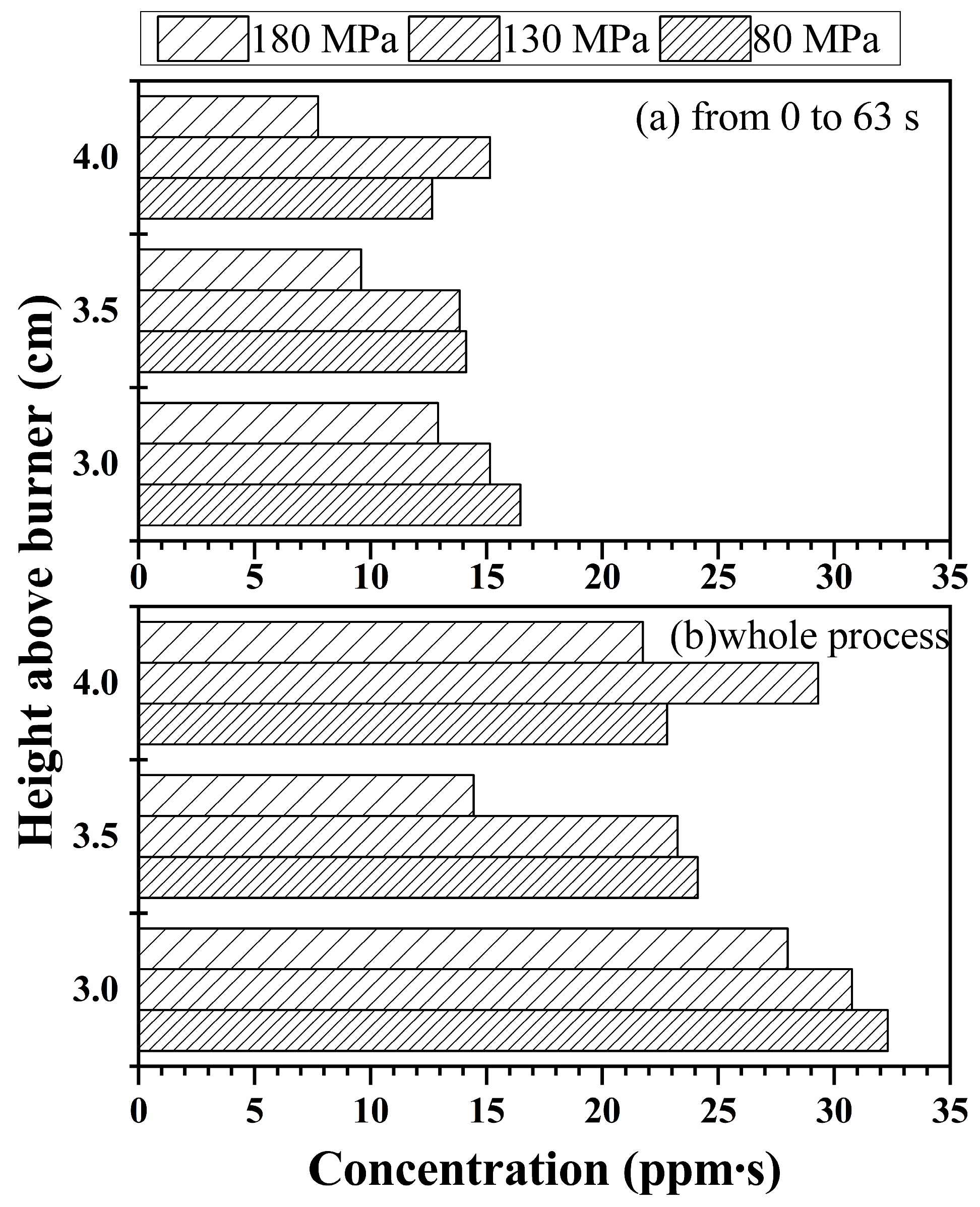
The measurement results presented above show that the dynamic release behavior of gas-phase potassium from the biomass briquettes is related to compaction pressure. To gain a better understanding of its effect, the release amount and proportion of potassium were analyzed. The release amount of potassium is the area under the profile of concentration. Figure 6 illustrates the cumulative release of potassium. It shows amounts for both the initial stage (0–63 s) and the entire combustion process under different compaction pressures.
The amount of potassium released from 0 to 60 s is shown in Figure 6a. Under the same compaction pressure, the release generally increased from high to low measurement heights, except at 4 cm under 130 MPa. Furthermore, higher compaction pressures typically corresponded to greater potassium release, with the same exception noted above. As shown in Figure 6b, the total potassium release varied with compaction pressure. The smallest release occurred at 180 MPa, with values of 28.0, 14.5, and 21.8 ppm·s at heights of 3, 3.5, and 4 cm, respectively. Additionally, potassium release at 3 and 3.5 cm decreased with increasing compaction pressure; in comparison, no clear trend was observed at 4 cm. Although potassium concentrations measured after 63 s were relatively low, the extended-release duration resulted in a large cumulative integral area, which explains the significant total release amounts shown in Figure 6.
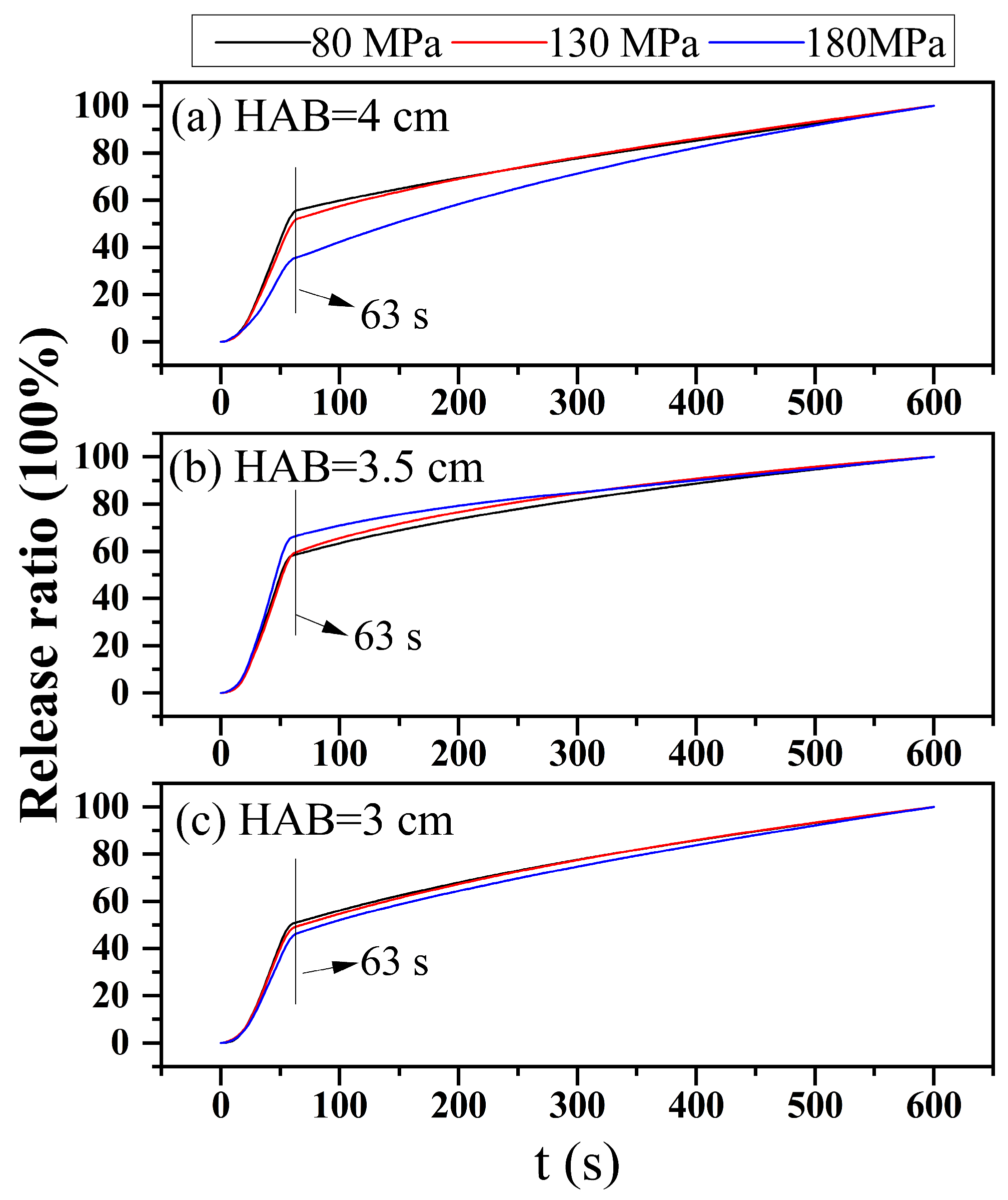
The percentage of potassium released during biomass combustion can be calculated as the ratio of the temporal amount to the total release (not the initial amount in the biomass), with the results shown in Figure 7. From 0 to 63 s, an exponential increase in the released proportion curve is observed, before growth slows and finally gradually approaches 100%. Moreover, the results show that the release rate of potassium is rapid from 0 to 63 s. There is no clear difference in the release ratio between 130 and 80 MPa at all three HAB. However, under a compaction pressure of 180 MPa, the release ratios from the biomass briquette are significantly different at HAB = 4 cm. Before entering the ash stage, the release ratio of potassium at HAB = 4 cm under compaction pressures of 180, 130, and 80 MPa ( [ K ] 180 M p a 63 s , [ K ] 130 M p a 63 s , [ K ] 80 M p a 63 s ) is 54%, 50%, and 35%, respectively. The ratio of potassium released under 180 MPa is much smaller than that under 130 and 80 MPa. However, at HAB = 3.5 cm, [ K ] 180 M p a 63 s , the release ratio is 66%, with more than half of the potassium being released into the gas phase. The above evidence demonstrates that the flame position has an effect on the released amount of potassium.
The results confirm that the compaction pressure can affect the release of potassium once more. In fact, the biomass briquette was burned in the furnace and the ash was removed after burnout. Based on the results of the release ratio, it is evident that there is a considerable amount of potassium remaining in the ash. The K in the ash is not released; compaction pressure therefore effectively inhibited K release.
Overall, it can be concluded that compaction pressure has a significant effect on the release of alkali metals in biomass briquette combustion. However, the compaction pressure is usually determined empirically during the biomass briquette production as long as the molded fuel is not structurally weak. The biggest disadvantage of biomass combustion is the effect of alkali metals on the biomass furnace. It would be beneficial to assess whether a more suitable compaction pressure could be determined to reduce the effect of gas-phase potassium release on the boiler.

4. Conclusions

In this study, based on a simple and inexpensive FES technique for online simultaneous measurement of flame temperature and the concentration of gas-phase potassium in biomass briquette combustion, the effect of compaction pressure (80, 130, and 180 MPa) on K release behavior was investigated. The experimental results show that compaction pressure significantly regulates the pore structure and combustion characteristics of fuels, thereby influencing the dynamic release of K. As compaction pressure increases, the internal porosity of the fuel decreases and diffusion resistance rises, which in turn suppresses the release intensity of K. The amount of potassium released is the lowest at a compaction pressure of 180 MPa. The potassium release ratio at HAB = 4 cm under compaction pressures of 80, 130, and 180 MPa is 54%, 50%, and 35%, respectively. Furthermore, the amount of potassium released from the biomass briquette at a compaction pressure of 180 MPa was the smallest at all three measurement heights, with values of 28.0, 14.5, and 21.8 ppm·s, respectively. Given the observed K release patterns, increasing the compaction pressure helps reduce the release of alkali metal potassium. Simultaneously, the HAB also influences the release process, with the inhibitory effect of pressure variation on potassium release being more pronounced at lower measurement heights. In this study, we establish a direct, practical link between compaction pressure and slagging, providing new insights for optimizing briquetting conditions to mitigate alkali-related deposition. We also demonstrate and validate the effective application of FES as a robust, industrially adaptable tool for online diagnosis of alkali metal release, thereby contributing to advanced monitoring solutions for cleaner and more efficient biomass combustion systems.

Author Contributions

Methodology, H.Y. and Y.M.; Validation, H.Y.; Investigation, Y.M. and Z.Y.; Resources, B.Y.; Data curation, Z.Y.; Writing—original draft, C.L.; Writing—review and editing, B.Y.; Supervision, C.L.; Project administration, X.T. and C.L.; Funding acquisition, B.Y. and X.T. All authors have read and agreed to the published version of the manuscript.

Funding

This work was supported by the Research Project of Guangdong Electric Power Development Co., Ltd. (Ged/11-2025-071).

Data Availability Statement

The original contributions presented in this study are included in the article. Further inquiries can be directed to the corresponding author.

Conflicts of Interest

Authors Huafeng Ye, Yisheng Mao and Xinda Tan were employed by the Guangdong Electric Power Development Co., Ltd. The remaining authors declare that the research was conducted in the absence of any commercial or financial relationships that could be construed as a potential conflict of interest.

Abbreviations

The following abbreviations are used in this manuscript:
FESFlame Emission Spectroscopy
LIBSLaser-Induced Breakdown Spectroscopy
PLIFPlanar Laser-Induced Fluorescence
HABHeight Above the Burner
KPotassium

References

  1. Goh, C.S.; Junginger, M.; Cocchi, M.; Marchal, D.; Thraen, D.; Hennig, C.; Heinimo, J.; Nikolaisen, L.; Schouwenberg, P.-P.; Bradley, D.; et al. Wood pellet market and trade: A global perspective. Biofuels Bioprod. Biorefining-Biofpr 2013, 7, 24–42. [Google Scholar] [CrossRef]
  2. Blaesing, M.; Zini, M.; Mueller, M. Influence of Feedstock on the Release of Potassium, Sodium, Chlorine, Sulfur, and Phosphorus Species during Gasification of Wood and Biomass Shells. Energy Fuels 2013, 27, 1439–1445. [Google Scholar] [CrossRef]
  3. Öhman, M.; Boman, C.; Hedman, H.; Nordin, A.; Boström, D. Slagging tendencies of wood pellet ash during combustion in residential pellet burners. Biomass Bioenergy 2004, 27, 585–596. [Google Scholar] [CrossRef]
  4. Li, L.; Yu, C.; Huang, F.; Bai, J.; Fang, M.; Luo, Z. Study on the Deposits Derived from a Biomass Circulating Fluidized-Bed Boiler. Energy Fuels 2012, 26, 6008–6014. [Google Scholar] [CrossRef]
  5. Viklund, P.; Hjornhede, A.; Henderson, P.; Stalenheim, A.; Pettersson, R. Corrosion of superheater materials in a waste-to-energy plant. Fuel Process. Technol. 2013, 105, 106–112. [Google Scholar]
  6. Yuan, Y.; Li, S.; Yao, Q. Dynamic behavior of sodium release from pulverized coal combustion by phase-selective laser-induced breakdown spectroscopy. Proc. Combust. Inst. 2015, 35, 2339–2346. [Google Scholar] [CrossRef]
  7. Bi, S.; Yang, Z.; Lou, C.; Yao, B.; Pu, Y.; Chen, D.; Wang, H.; Jia, Z. Experimental study on gas-phase sodium measurement during co-combustion of high-alkali coal with coal gasification fine slag and kaolin. Fuel 2025, 398, 135530. [Google Scholar] [CrossRef]
  8. van Eyk, P.J.; Ashman, P.J.; Alwahabi, Z.T.; Nathan, G.J. Simultaneous measurements of the release of atomic sodium, particle diameter and particle temperature for a single burning coal particle. Proc. Combust. Inst. 2009, 32, 2099–2106. [Google Scholar] [CrossRef]
  9. Hsu, L.-J.; Alwahabi, Z.T.; Nathan, G.J.; Li, Y.; Li, Z.S.; Alden, M. Sodium and Potassium Released from Burning Particles of Brown Coal and Pine Wood in a Laminar Premixed Methane Flame Using Quantitative Laser-Induced Breakdown Spectroscopy. Appl. Spectrosc. 2011, 65, 684–691. [Google Scholar] [CrossRef]
  10. Mason, P.E.; Darvell, L.I.; Jones, J.M.; Williams, A. Observations on the release of gas-phase potassium during the combustion of single particles of biomass. Fuel 2016, 182, 110–117. [Google Scholar] [CrossRef]
  11. Mason, P.E.; Jones, J.M.; Darvell, L.I.; Williams, A. Gas phase potassium release from a single particle of biomass during high temperature combustion. Proc. Combust. Inst. 2017, 36, 2207–2215. [Google Scholar] [CrossRef]
  12. Lou, C.; Pu, Y.; Zhao, Y.; Bai, Y.; Yao, B.; Yu, D. An in-situ method for time-resolved sodium release behaviour during coal combustion and its application in industrial coal-fired boilers. Proc. Combust. Inst. 2021, 38, 4199–4206. [Google Scholar]
  13. Pu, Y.; Jia, Z.; Wang, Z.; Yao, B.; Lou, C.; Li, Y. Experimental study of combustion characteristics and ash-related issues of ammonia co-firing with high alkali pulverized coal in a 4 MW boiler. Proc. Combust. Inst. 2024, 40, 105642. [Google Scholar] [CrossRef]
  14. Pu, Y.; Wang, H.; Guo, L.; Lou, C. Effect of Kaolin Addition on Combustion Behavior of Zhundong Coal Pellet Using Flame Emission Spectroscopy. Combust. Sci. Technol. 2023, 197, 1809–1828. [Google Scholar] [CrossRef]
  15. Hu, Q.; Shao, J.; Yang, H.; Yao, D.; Wang, X.; Chen, H. Effects of binders on the properties of bio-char pellets. Appl. Energy 2015, 157, 508–516. [Google Scholar] [CrossRef]
  16. Poddar, S.; Kamruzzaman, M.; Sujan, S.M.A.; Hossain, M.; Jamal, M.S.; Gafur, M.A.; Khanam, M. Effect of compression pressure on lignocellulosic biomass pellet to improve fuel properties: Higher heating value. Fuel 2014, 131, 43–48. [Google Scholar] [CrossRef]
  17. Wang, X.; Ma, T.; Sun, J.; Jiang, L.; Liu, Y.; Yu, B.; Chen, Y.; Zhai, M.; Zhou, H. Effects of pelletizing pressure and particle size on flame characteristics and potassium release in volatile combustion of biomass pellets. Biomass Bioenergy 2025, 199, 107916. [Google Scholar] [CrossRef]
  18. Lupoi, J.S.; Singh, S.; Simmons, B.A.; Henry, R.J. Assessment of Lignocellulosic Biomass Using Analytical Spectroscopy: An Evolution to High-Throughput Techniques. Bioenergy Res. 2014, 7, 1–23. [Google Scholar]
  19. Zhang, J.J.; Zhang, W.H.; Cai, Z.Y.; Zhang, J.L.; Guan, D.; Ji, D.D.; Gao, W.S. Effect of Ammonia Fiber Expansion Combined with NaOH Pretreatment on the Resource Efficiency of Herbaceous and Woody Lignocellulosic Biomass. Acs Omega 2022, 7, 18761–18769. [Google Scholar] [CrossRef]
  20. Kaliyan, N.; Morey, R.V. Factors affecting strength and durability of densified biomass products. Biomass Bioenergy 2009, 33, 337–359. [Google Scholar] [CrossRef]
  21. Zhang, Z.H.; Song, Q.; Alwahabi, Z.T.; Yao, Q.; Nathan, G.J. Temporal release of potassium from pinewood particles during combustion. Combust. Flame 2015, 162, 496–505. [Google Scholar] [CrossRef]
  22. Paulauskas, R.; Striugas, N.; Sadeckas, M.; Sommersacher, P.; Retschitzegger, S.; Kienzl, N. Online determination of potassium and sodium release behaviour during single particle biomass combustion by FES and ICP-MS. Sci. Total Environ. 2020, 746, 141162. [Google Scholar] [CrossRef]
  23. Liu, Z.; Li, J.B.; Zhu, M.M.; Wang, Q.H.; Lu, X.F.; Zhang, Y.Y.; Zhang, Z.Z.; Zhang, D.K. Investigation into scavenging of sodium and ash deposition characteristics during co-combustion of Zhundong lignite with an oil shale semi-coke of high aluminosilicate in a circulating fluidized bed. Fuel 2019, 257, 116099. [Google Scholar] [CrossRef]
Figure 1. Experimental setup.
Energies 19 00511 g001
Figure 2. Flame spontaneous emission spectra at different concentrations of potassium.
Energies 19 00511 g002
Figure 3. Representative images of biomass briquette (compaction pressure 130 MPa) combustion.
Energies 19 00511 g003
Figure 4. The flame temperatures varying with time under three compaction pressures and at (a) HAB = 4 cm, (b) HAB = 3.5 cm, and (c) HAB = 3 cm.
Energies 19 00511 g004
Figure 5. The concentration of gas-phase potassium release varying with time under three compaction pressures and at (a) HAB = 4 cm, (b) HAB = 3.5 cm, and (c) HAB = 3 cm.
Energies 19 00511 g005
Figure 6. Amount of potassium released from the biomass briquette at different compaction pressures during stage (a) from 0 to 63 s and (b) the entire process.
Energies 19 00511 g006
Figure 7. Release ratios of potassium under different compaction pressures at (a) HAB = 4 cm, (b) HAB = 3.5 cm, and (c) HAB = 3 cm.
Energies 19 00511 g007
Table 1. Proximate and ultimate analyses of camphor wood (note: db is dry basis).
Proximate Analysis (wt%)Ultimate Analysis (wt%)
MdbAdbVdbFCdbCdbHdbNdbSdbOdb
4.030.8987.9311.1848.75.930.510.1743.8
Table 2. Ash composition analysis of camphor wood.
Ash Composition (wt%)
MgOAl2O3SiO2P2O5SO3K2OCaOFe2O3
12.96-10.388.725.327.9953.770.59
Disclaimer/Publisher’s Note: The statements, opinions and data contained in all publications are solely those of the individual author(s) and contributor(s) and not of MDPI and/or the editor(s). MDPI and/or the editor(s) disclaim responsibility for any injury to people or property resulting from any ideas, methods, instructions or products referred to in the content.