1. Introduction
In recent years, the power sector has been undergoing an unprecedented transformation. Driven by the transition of energy structures, the advancement of ultra-high-voltage transmission projects, and the establishment of smart grid systems, the operating voltages, capacities, and service conditions of electrical equipment are increasingly surpassing traditional limits. Against this backdrop, the reliability of insulation systems has emerged as a critical factor for ensuring the safe and stable operation of modern power grids, with materials science playing an ever more prominent role [
1]. Among various insulating media, polymers have attracted considerable attention due to their unique microstructures and tunable properties. Compared with conventional inorganic insulators, polymeric materials offer an exceptional combination of electrical performance, mechanical toughness, chemical resistance, and processability, establishing their indispensable role in high-voltage equipment [
2]. Today, polymeric dielectrics are deeply integrated acrossn power systems, from cable and transformer winding insulation to core components in gas-insulated switchgear (GIS) and composite insulators [
3]. Concurrently, the rapid deployment of renewable energy systems, the rise of marine transmission projects, and developments in high-voltage direct current (HVDC) and pulsed power technologies are continuously driving polymer insulation toward higher performance, greater reliability, and enhanced adaptability to complex service conditions. It is anticipated that polymeric materials will play an increasingly central role in future high-voltage electrical equipment, while also posing new challenges for performance enhancement and modification strategies.
Historically, conventional organic and inorganic insulating materials—such as natural rubber, paper-based insulation, varnished cloth, and epoxy resins (EP), adequately met the basic insulation requirements of early high-voltage equipment. However, their inherent properties gradually revealed systemic limitations under modern high-voltage environments [
4]. Such materials generally exhibit high moisture absorption, susceptibility to environmental degradation, limited thermal stability, and declining dielectric strength under prolonged operation. Moreover, combined mechanical and thermal stresses often induce cracking, aging, or deterioration of dielectric properties. As voltage levels continue to rise, these traditional materials increasingly struggle to withstand high electric fields, thermal loads, and complex operational conditions, falling short of the stringent reliability, lifespan, and safety demands of contemporary electrical equipment.
Entering the 21st century, driven by rapid advances in materials science, polymer research has shifted from merely enhancing electrical insulation toward multifunctional and composite material development. Innovations in modern polymers focus on nanocomposite engineering, intelligent functional design, and sustainability, aiming to elevate overall material performance [
5]. For instance, nanocomposites incorporating nano-scale fillers effectively enhance dielectric properties, suppress space charge accumulation, and improve thermal and mechanical robustness [
6]. Materials such as polypropylene (PP) and biaxially oriented polypropylene (BOPP), valued for their environmental friendliness and thermal stability, have been widely applied in HVDC capacitors and power electronic devices [
7]. High-performance engineering plastics, including polyimide (PI) and polyether ether ketone (PEEK), exhibit excellent thermal resistance and radiation tolerance, showing promising applications in ultra-high-voltage direct current transmission systems and nuclear power insulation [
8]. Nevertheless, despite these advances, challenges remain, including long-term aging, interfacial stability, and filler dispersion, which require ongoing research and innovation.
This review systematically summarizes recent advances in polymeric materials for high-voltage applications, highlighting the technological evolution from conventional insulators to modern high-performance composites. By analyzing the characteristics of various materials and their applications in high-voltage electrical equipment, the review identifies key challenges and proposes future research directions. These insights provide a theoretical basis for the selection, modification, and innovation of polymeric materials in high-voltage systems, ultimately contributing to the enhanced safety and reliability of electrical equipment.
2. Applications of Polymeric Materials in High-Voltage Systems
Owing to their outstanding electrical properties, diverse chemical structures, and tunable physical characteristics, polymeric materials have become indispensable in the field of high-voltage technology. They find extensive applications in critical areas such as cable insulation, equipment protection, and high-efficiency energy storage.
Table 1 provides a detailed overview of polymeric materials employed across key components of high-voltage power systems, systematically delineating their specific compositions and functional characteristics.
2.1. Applications of Polymeric Materials in High-Voltage Transmission
Owing to their lightweight, high strength, low dielectric loss, and excellent processability, polymeric materials have become one of the most critical insulating media in modern high-voltage transmission systems [
19]. Against the backdrop of increasing voltage levels, compact device architectures, and complex operating environments, PE, XLPE, PP, and their nanocomposite and functionalized derivatives have demonstrated an increasingly indispensable role in core equipment such as cables, bushings, and insulators. Through molecular structure tailoring, crosslink network design, interface engineering, and multi-scale filler incorporation, these materials achieve comprehensive optimization of dielectric properties, thermal stability, and electrical treeing resistance [
20], providing a robust material foundation for more reliable and efficient transmission systems.
In the domain of power cables, XLPE insulation has emerged as the mainstream material for medium- and ultra-high-voltage applications due to its high dielectric strength, excellent thermo-mechanical stability, and superior resistance to electrical aging [
21].
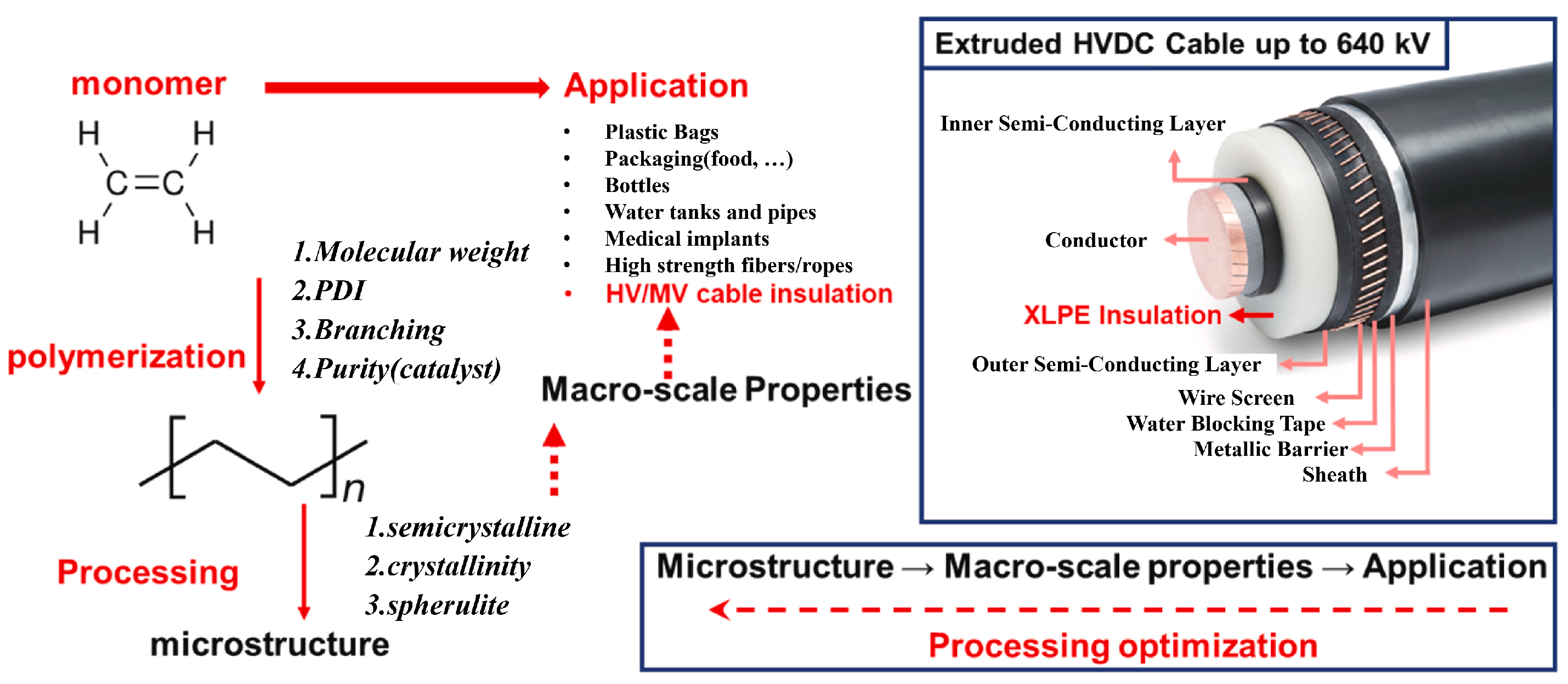
Figure 1 illustrates the typical structure and application of cross-linked polyethylene (XLPE) in high-voltage cable insulation. As shown in the figure, the XLPE insulation layer tightly surrounds the conductor, forming the core insulating component of the cable. This configuration represents the fundamental form of XLPE as a cable insulation material, whose insulating performance is directly governed by its intrinsic microstructure and cross-linking network. In high-voltage direct current (HVDC) transmission cables, the insulation layer is required to withstand high electric fields, elevated temperatures, and long-term mechanical stresses. The uniformity and structural integrity of the insulation are, therefore, critical for suppressing partial discharges, retarding electrical treeing degradation, and maintaining low DC conductivity. Moreover, the crosslinked network significantly elevates the thermal deformation temperature, extending the long-term operating temperature of XLPE from approximately 70 °C to above 90 °C, while maintaining stable dielectric properties under extreme conditions such as short-circuit impulses. Early studies have shown that under high electric fields and high-temperature conditions, the accumulation of space charge causes field distortion, disrupting the uniform distribution of the electric field and creating localized field enhancement effects. This enhanced field accelerates the migration of charge carriers, increasing current density and electrical stress, which in turn may lead to electrical breakdown or partial discharge, reducing dielectric strength and electrical stability. Charge injection typically occurs at the interface between the electrode and polymer. When the electric field strength is sufficiently high, charge carriers enter the polymer and begin to migrate. However, traps formed by the molecular structure and cross-linked regions of the polymer capture the charge, limiting its migration, which enhances charge localization and slows down the migration process. Therefore, the microstructure of the polymer directly influences the distribution of traps and the mobility of charge carriers, thereby affecting the overall performance of the material. Pourrahimi et al. further elucidated how the interfaces between crystalline and amorphous regions, crystallinity, and trap state distribution regulate carrier transport, thereby determining the direct current (DC) conductivity and overall insulation performance of XLPE in HVDC cables [
22]. Further enhancements rely on multidimensional structural modulation strategies, including deep-trap induction via nanoparticles to suppress space charge accumulation [
23], liquid polybutadiene to densify the crosslink network [
24], and side-chain modified voltage stabilizers to inhibit electrical tree growth [
25]. These approaches collectively advance the insulation performance of XLPE, supporting higher voltage levels and extended service lifetimes [
26].
For overhead transmission lines, polymeric composite insulators are gradually replacing traditional ceramic and glass counterparts due to their lightweight, high mechanical strength, superior hydrophobicity, and pollution flashover resistance [
27,
28]. SR shed materials exhibit excellent hydrophobic migration, significantly reducing surface water film formation and enhancing flashover voltage under humid and heavily polluted conditions [
29,
30]. Additionally, Ogbonna et al. proposed reinforcing epoxy matrices with E-CR glass or PI fibers to further improve fracture toughness and aging resistance [
31]. The weatherability, erosion resistance, and mechanical reliability of composite insulators make them essential structural components in outdoor high-voltage transmission systems [
32].
In cable sheath systems, polyolefins such as LDPE, HDPE, and PVC have long served as primary sheath materials, providing moisture resistance, chemical protection, and mechanical safeguarding [
33]. With rising current densities and extended service periods, research on sheath materials has increasingly focused on enhancing thermal conductivity, interface stability, and halogen-free flame retardancy [
34,
35]. Nanofillers such as ZnO and Al
2O
3 not only improve mechanical and dielectric strength but also reduce losses by constructing interfacial trap structures that inhibit charge migration [
36,
37]. Gouda et al. demonstrated through numerical simulations and experiments that nanocomposite sheaths can lower conductor temperatures and enhance thermo-electrical coupling performance [
38]. In terms of flame retardancy, halogen-free systems such as Mg(OH)
2 and Al(OH)
3 significantly reduce smoke toxicity, though they require careful control of filler dispersion and interface quality. Recent efforts, therefore, emphasize the synergistic design of flame retardants, coupling agents, and nanofillers [
39].
Overall, the application of polymeric materials in high-voltage transmission systems is transitioning from simple material selection to deeply engineered, structure–property–performance optimization. Material design strategies centered on interface engineering, nanocomposites, multifunctional additive synergy, and green flame retardancy continue to advance cable insulation, insulator, and sheath technologies toward higher reliability, longer service life, and environmental compatibility, providing crucial material support for future ultra-high-voltage and smart grid infrastructure.
2.2. Applications of Polymeric Materials in High-Voltage Equipment
Owing to their tunable molecular structures, excellent dielectric properties, processability, and lightweight high-strength characteristics, polymeric materials have become a core insulation system in modern high-voltage equipment [
40]. In transformers, GIS/GIL, high-voltage switchgear, and emerging sensor technologies, polymeric systems such as PE, XLPE, PP, EP, and PVDF are widely employed to sustain voltages, regulate electric fields, and form the integral structure of devices. Their low dielectric constant, high breakdown strength, and robust thermal and aging resistance enable stable performance under complex electric fields, coupled thermal–humidity stress, and partial discharge conditions [
41]. Compared with traditional inorganic materials such as ceramics and mica, polymers allow for integrated molding and structural lightweighting, while their performance can be tailored through molecular chain design, composite modification, and interface engineering, effectively mitigating space charge accumulation, electrical tree initiation, and local field distortion.
In high-voltage transformer insulation, polymeric films are gradually replacing conventional paper/oil systems due to their superior dielectric strength, partial discharge tolerance, and thermal stability [
42]. Modern insulation design emphasizes the synergistic optimization of dielectric loss, thermal deformation temperature, and interfacial adhesion to ensure long-term winding reliability under thermal cycling, moisture exposure, and partial discharge (PD) stress [
43,
44,
45]. Recent strategies incorporating 2D materials and nanofillers have significantly improved field uniformity and discharge resistance. For example, Cheng et al. demonstrated that introducing PDA-coated MoS
2 into PI enhances both breakdown strength and mechanical performance, highlighting the effectiveness of interface functionalization [
46]. Additionally, surface nanocoatings and self-assembled thin layers have been employed to suppress local corona and extend discharge lifetime; Ren et al. reported that a montmorillonite coating on Kapton
® markedly delayed PD inception [
47]. These studies collectively indicate that multi-scale interface engineering will be a key direction for advancing transformer insulation materials [
48], providing essential support for the next generation of compact, high-efficiency electrical equipment.
In high-voltage switchgear and GIS insulation components, EP dominate due to their superior dielectric strength, mechanical robustness, and ability to be cast into complex geometries [
49]. Compared to ceramics or Bakelite, epoxies offer notable advantages in weight, strength, and process adaptability [
50]. Through filler reinforcement, hybrid structure design, and chain-segment engineering, the inherent brittleness of epoxy can be mitigated. Wang et al. proposed epoxy-terminated polyester toughening to provide high-toughness insulators [
51], while Jiang et al. employed E-POSS and glass fiber hybridization to more than double tensile strength and significantly enhance thermal stability [
52]. With the accelerated application of artificial intelligence (AI) in material formulation prediction and curing process optimization, epoxy systems are poised to achieve multi-objective optimization of dielectric, mechanical, and thermal performance.
In flexible sensing and self-powered applications, the structural design flexibility of polymers offers distinct advantages. PVDF and its copolymers, owing to their high
-phase content and mechanical flexibility [
53], are extensively employed in flexible piezoelectric sensors, wearable devices, and energy harvesting systems. Sasikumar et al. reported that Sm
xZn
1−xCoO
3/PVDF composites significantly enhanced sensor sensitivity [
54], while Fang et al. developed self-powered PVDF nanofiber-based sensors demonstrating excellent mechanical-to-electrical energy conversion, enabling intelligent monitoring without external power [
53]. Through microstructural control, interfacial polarization enhancement, and innovative energy collection schemes, PVDF-based materials continue to expand their potential in high-sensitivity, highly integrated sensing systems [
55,
56].
Table 2 summarizes representative quantitative physical properties of polymeric materials currently employed in high-voltage equipment. It can be observed that conventional insulation materials such as XLPE and PP still exhibit outstanding dielectric strength and low dielectric loss, but their inherently low thermal conductivity poses challenges for compact and high-power-density equipment. In contrast, epoxy and polyimide systems provide superior mechanical integrity and thermal stability, making them suitable for GIS and transformer insulation, albeit requiring interface and toughness optimization. Notably, nanofiller-reinforced polymer composites demonstrate a broad and designable property window, particularly in thermal conductivity and breakdown performance, indicating strong potential for next-generation high-voltage equipment under high field, high temperature, and high-frequency conditions.
In summary, the application of polymeric materials in high-voltage equipment has evolved from traditional structural insulation to multifunctional systems characterized by designable performance, tunable interfaces, and integrable functionalities. Future developments will rely on multi-physics coupling design, nano-interface engineering, and intelligent material optimization, constructing multi-scale structures and high-efficiency interfaces to overcome performance bottlenecks under high field, high temperature, and high-frequency conditions, thus, providing a more reliable, lightweight, and intelligent insulation and functional material foundation for next-generation high-voltage equipment.
2.3. Applications of Polymeric Materials in High-Voltage Energy Storage
As power systems evolve toward HVDC operation, high energy density, and intense pulsed conditions, insulation media in high-voltage energy storage devices demand elevated dielectric strength, interfacial stability, and long-term reliability [
68]. Polymeric materials, with their tunable chain structures, lightweight nature, and exceptional electric field tolerance, have emerged as indispensable components in such systems. Representative polymers including PI, PVDF, PP, and their microstructure-enhanced variants maintain low dielectric loss and high breakdown strength under extreme electric fields, while exhibiting excellent thermal stability and interfacial uniformity, effectively mitigating local overfields, thermal accumulation, and electrochemical side reactions [
69]. Furthermore, the flexibility and processability of polymers enable layered architectures, interfacial gradients, and nanofiller dispersion, allowing synergistic tuning of dielectric constant, thermal conductivity, and mechanical strength, thereby supporting miniaturization, lightweighting, and high integration in high-voltage energy storage systems.
In film capacitors, high breakdown field strength and low dielectric loss constitute the primary performance metrics [
70,
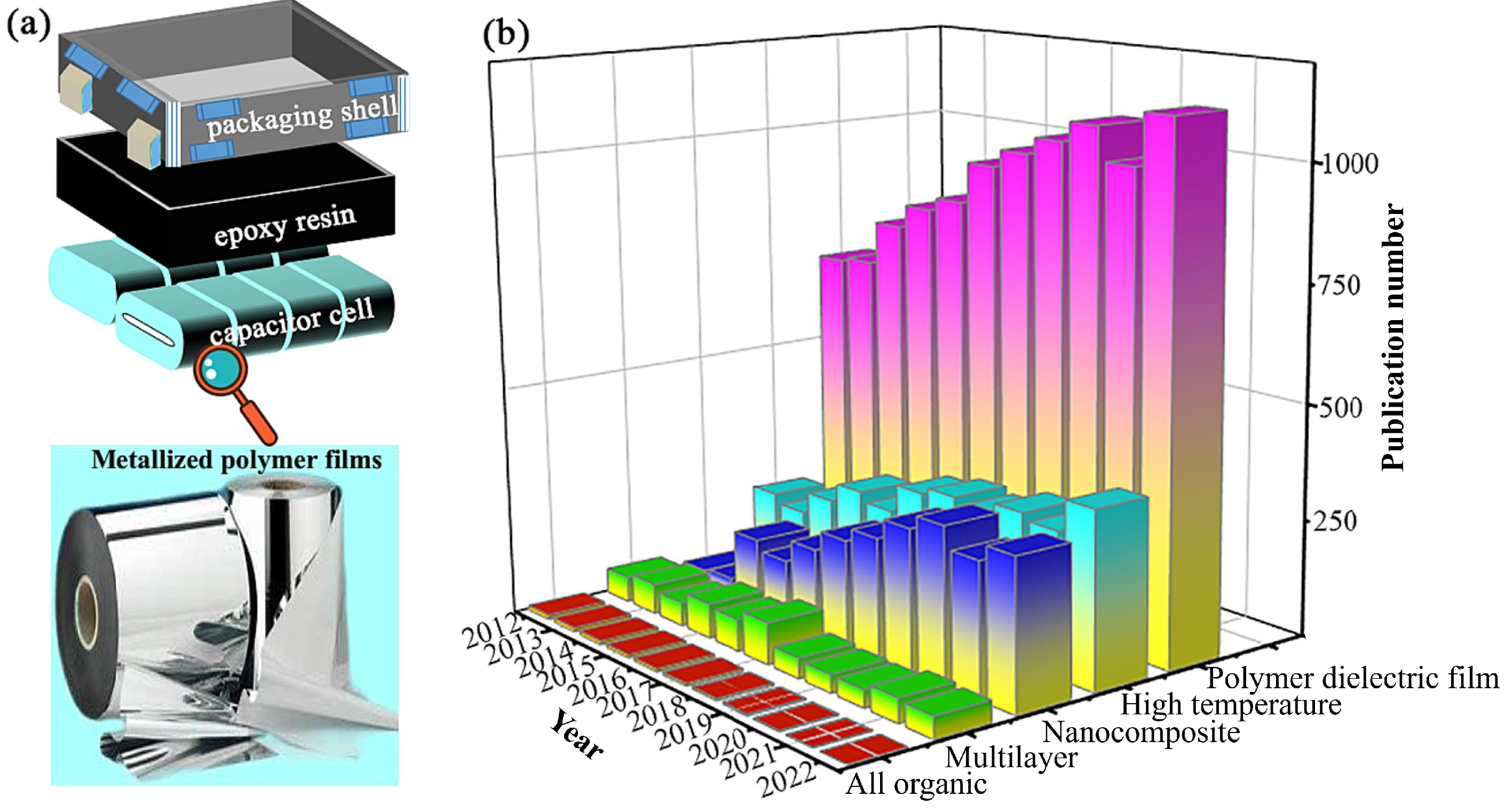
71]. As illustrated in
Figure 2, a film capacitor mainly consists of a capacitor core, encapsulation layer, housing, and leads. Among these components, the capacitor core composed of metallized polymer films is the most critical part, as its material properties directly determine the overall operational characteristics of the capacitor, including dielectric constant, dielectric loss, breakdown strength, electrical resistivity, and glass transition temperature [
72,
73]. To enhance the energy storage performance of polymer dielectric films, a variety of modification strategies based on micro- and meso-scale structural regulation have been proposed over the past decade. These approaches include tailoring molecular chain structures, introducing fillers or polymer blends as secondary phases, and constructing multilayer architectures, with the aim of simultaneously increasing the dielectric constant and breakdown strength at room temperature while effectively suppressing conduction losses under elevated temperature conditions. [
74,
75] Among existing polymer dielectric materials, biaxially oriented polypropylene (BOPP) has become the most widely used mainstream dielectric material for film capacitors due to its low dielectric loss, high breakdown strength, and excellent long-term reliability [
76,
77]. Through microstructural modulation, multilayer architectures, and filler incorporation
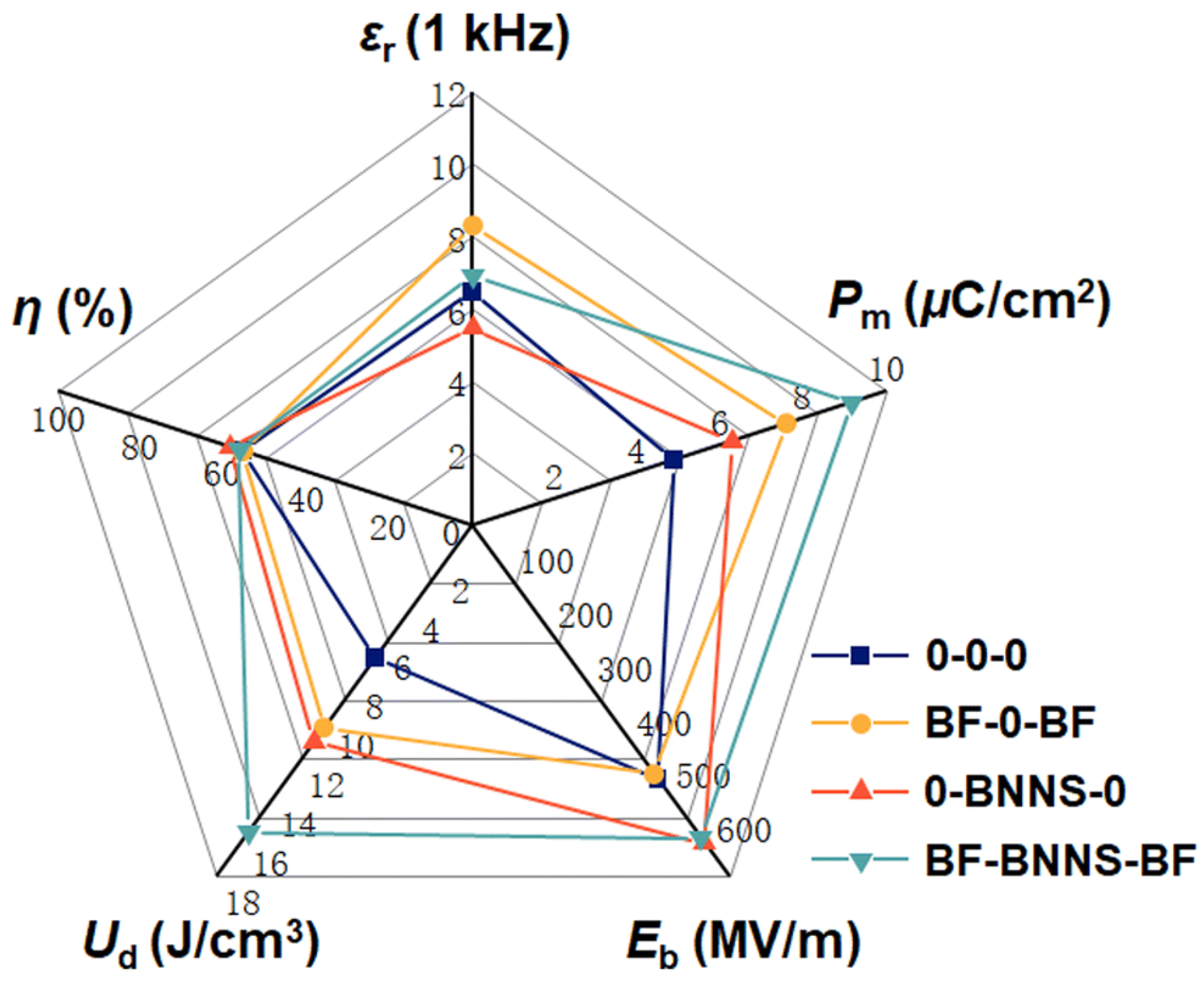
Figure 2, energy storage density can be significantly enhanced. For instance, Du et al. increased the discharge energy density of 3.4 µm BOPP at low temperatures to 11.83 J/cm
3 [
78]; Liu et al. achieved an improvement from 1.45 J/cm
3 to 2.77 J/cm
3 in high-temperature energy density via surface grafting [
79]; Zeng et al. used biaxial stretching to induce oriented structures in BOPP, optimizing dielectric and mechanical properties [
80]. These studies demonstrate that chain-level control and interfacial engineering can overcome conventional PP film limitations, enabling reliable energy storage under high-field and high-temperature conditions.
In electrolytic capacitors, the introduction of conductive polymers significantly reduces ESR, enhances ripple current capability, and improves thermal stability [
82]. PEDOT, owing to its high conductivity and chemical stability, is among the most representative conductive polymers [
83,
84,
85]. Advanced composite strategies further enhance performance: Gao et al. combined PEDOT/PSS with potassium iodide redox electrolytes to achieve a high specific capacity of 51.3 mAh/g [
86]; Li et al. constructed 3D conductive networks using PEDOT/nitrogen-doped carbon nanosheets, obtaining 412 F/g at 1 A/g [
87]. These results indicate that polymer chain regulation and interfacial synergy can further improve the reliability of electrolytic capacitors under high-frequency, high-ripple, and wide-temperature operation [
88].
In supercapacitors, conductive polymers such as PANI attract attention due to their high specific capacitance and abundant redox activity [
89,
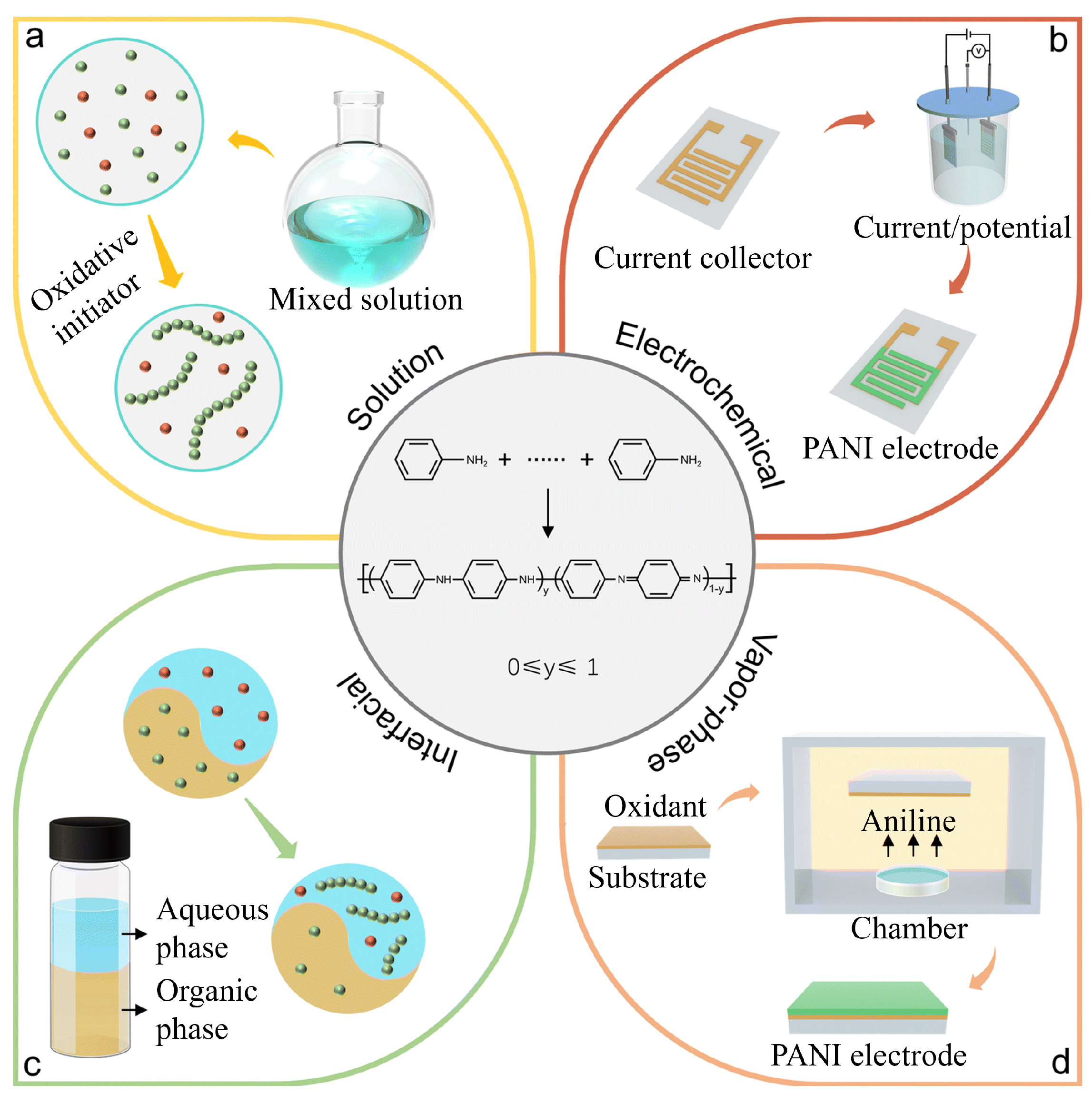
90]. Electrochemical performance critically depends on conductive network configuration and micro/nano-structuring. As shown in
Figure 3, chemical oxidation, electrochemical deposition, interfacial polymerization, and microwave-assisted synthesis are major fabrication strategies, enabling precise control over PANI morphology and electron/ion transport [
90].
Table 3 summarizes the variations in key parameters such as temperature, time, catalyst, and reaction system across different polymerization methods. By precisely controlling these parameters, the micro/nano-structure of PANI is successfully formed, which significantly enhances its electroactive surface area and ionic mobility, thereby further improving energy storage efficiency [
91]. Composite designs further expand performance boundaries: Du et al. combined PANI with carbon materials and transition metal compounds to improve cycling stability and power performance [
92]; Dai et al. integrated PANI with MoS
2 and organic molecules, demonstrating excellent adaptability for miniaturized and flexible energy storage [
93].
In summary, although polymer roles vary across energy storage devices, the underlying principle is consistent: by tuning polymer chain structures, constructing heterogeneous interfaces, and introducing hierarchical micro/nano architectures, dielectric performance, electrochemical stability, and mechanical reliability can be systematically optimized. Looking forward, advances in situ characterization, interface engineering, and machine learning (ML)-driven design are expected to enable polymers to achieve higher energy density, safety, and multifunctional integration, providing a robust material foundation for next-generation high-voltage energy storage systems.
3. Advances in Polymeric Material Modification
The fundamental requirements for polymers in high-voltage applications converge on three critical challenges: charge management, interfacial control, and thermal stability. These challenges constitute the primary driving forces behind the evolution of subsequent material modification strategies. While polymers are extensively employed due to their lightweight nature, ease of processing, and chemical resistance, most conventional polymers exhibit inherent limitations in mechanical strength, thermal endurance, chemical tolerance, or functional versatility [
98]. As demands for materials performance become increasingly stringent across high-end manufacturing, biomedical, and renewable energy sectors, single-structure polymers are often insufficient to meet the multifaceted requirements of complex service conditions. For instance, the brittleness of polystyrene, the limited low-temperature toughness of polyolefins, and the thermal thresholds of engineering plastics necessitate targeted modification to optimize their performance.
3.1. Physical Modification of Polymers
Physical modification of polymers involves structural tuning from the macro- to microscale without altering the chemical composition, aiming to enhance the thermal, mechanical, and dielectric performance under high-voltage conditions [
99]. The principal approaches include blending, filler incorporation, and plasticization, all of which fundamentally target the regulation of phase structure, interfacial energy states, and chain segment mobility.
Table 4 reveals the critical role of filler types, size combinations, and their compatibility with the matrix in synergistically enhancing multiple properties of polymer insulating materials. It also reflects significant differences in thermal aging behavior and long-term service stability across different systems, providing important references for the structural design and material selection of high-voltage insulating materials.
Blending modifies polymers by combining distinct polymeric species or elastomers to synergistically adjust chain flexibility, crystallization behavior, and dielectric properties. Beyond the traditional concept performance complementarity, recent studies emphasize precise control over phase distribution and interfacial architecture to achieve stable electric field profiles and coupled thermal responses. For instance, elastomer/PP blends have been employed to simultaneously enhance mechanical toughness and breakdown strength, demonstrating that the designability of blend microstructures is critical for cable insulation materials [
104,
105]. Filler-based modification introduces inorganic or organic particulates into the polymer matrix to impart multifunctional enhancements such as mechanical reinforcement, thermal conductivity, electrical conductivity, or insulation. Compared to earlier approaches focusing on filler type and loading, contemporary research prioritizes the energetic structure of the filler–matrix interface, interfacial thermal resistance, and the construction of multiscale pathways. For example, BN and AlN fillers, when coupled with rational interface engineering, significantly improve both the thermal conductivity and breakdown strength of EP, driven by the synergistic formation of 3D thermal networks and deep trap interfacial states [
106,
107]. Plasticization employs low-molecular-weight plasticizers to modulate chain mobility, thereby enhancing flexibility and processability. In high-voltage insulation applications, plasticization strategies extend beyond merely increasing flexibility, focusing also on effects on free volume, phase stability, and dielectric loss. For instance, in PMMA systems, plasticizers can simultaneously improve flexibility and polarization control, enabling a comprehensive optimization of optical and dielectric properties [
108,
109].
Overall, physical modification strategies have evolved from targeting single property enhancements to establishing a synergistic framework that integrates multi-scale structural design, interfacial energy states, and polymer chain dynamics. Within this framework, blending enables phase-state modulation, filler incorporation facilitates interfacial engineering and thermal pathway construction, and plasticization regulates chain mobility. Collectively, these strategies address the comprehensive requirements of high-voltage insulating polymers, including thermal stability, charge management, and mechanical reliability. Despite the evident success of physical modification in optimizing polymer processability and macroscopic performance, these approaches fundamentally rely on non-covalent interactions, rendering long-term stability under complex operating conditions a persistent challenge. To achieve more durable and precise control over material properties at the molecular scale, research has increasingly shifted toward chemical modification, wherein covalent alterations of polymer chains provide a more robust and foundational route for the design and development of next-generation high-performance dielectric materials.
3.2. Chemical Modification of Polymers
Chemical modification of polymers, achieved by altering backbone or side-chain structures [
110], establishes stable covalent bonds at the molecular scale and represents a fundamental strategy for long-term material reliability and precise control of charge dynamics. Unlike physical modification, which is inherently limited by interfacial interactions and compatibility, chemical modification enables direct tuning of molecular energy levels, chain rigidity, and network topology. Crosslinking, grafting, and copolymerization, although mechanistically distinct, collectively constitute the molecular engineering toolkit for high-voltage insulating polymers.
Crosslinking not only constructs a 3D network to enhance thermo-mechanical stability but also modulates trap energy levels and carrier migration pathways in the vicinity of crosslinking points [
111]. Recent studies have shifted focus from merely increasing the degree of crosslinking to controlling the chemical characteristics of the crosslinked network. For instance, specific crosslinking agents can introduce deep traps in XLPE, reduce carrier mobility, and reinforce resistance against water-treeing degradation [
112,
113]. This highlights that crosslinking chemistry has evolved from a structural reinforcement method to a targeted tool for controlling charge behavior and aging tolerance. Grafting introduces polar or functional side groups onto the polymer backbone, effectively modulating charge injection barriers, local potential landscapes, and polarization response, making it a powerful strategy for space charge regulation. In typical cable polymers such as PP and PE, moderately polar grafted structures have been demonstrated to create stable deep traps, suppress carrier migration, and significantly enhance DC breakdown strength and aging stability [
114,
115]. Copolymerization, by sequentially combining different monomers, allows systematic tuning of chain flexibility, polarity, and phase morphology, offering the highest degree of freedom in molecular structure engineering. In applications such as EP and high-frequency dielectrics, copolymer architectures can simultaneously optimize electric field uniformity, thermal stability, and dielectric loss, demonstrating a highly controllable structure–property relationship [
116,
117]. Current trends emphasize manipulating chain sequences to regulate free volume, energy level distribution, and phase evolution, thereby enabling integrated optimization for high-voltage, high-frequency, and high-temperature environments. Eldesoky et al. [
118] prepared functionalized and non-functionalized zinc oxide-modified XLPE nanocomposites via melt blending, with the addition of zinc oxide ranging from 0.5% to 5% (wt.). The study demonstrated that, compared to pure XLPE, the incorporation of ZnO nanoparticles improved the electrical properties of the composite materials, see
Table 5.
Overall, chemical modification has progressed from enhancing intrinsic material properties to enabling directional control of charge dynamics, interfacial energy level engineering, and quantifiable structure–property correlations. Crosslinking focuses on network topology and trap energy construction, grafting emphasizes polarity tuning and trap engineering, and copolymerization provides chain design and phase-state control. Together, these strategies offer critical design space to meet the demands of higher electric fields, complex service conditions, and extended operational lifetimes.
3.3. Plasma-Based Polymer Modification
In recent years, with the miniaturization of high-voltage equipment and the intensification of electric fields, the surface electrical properties and interfacial stability of polymeric insulators have emerged as critical factors limiting system reliability. While conventional chemical modification can enhance polarity or interfacial adhesion, it often introduces chemical residues and interfacial defects. Plasma-based modification, owing to its clean, controllable, low-temperature, and efficient characteristics, has increasingly become a key strategy for enhancing the insulation performance of polymers [
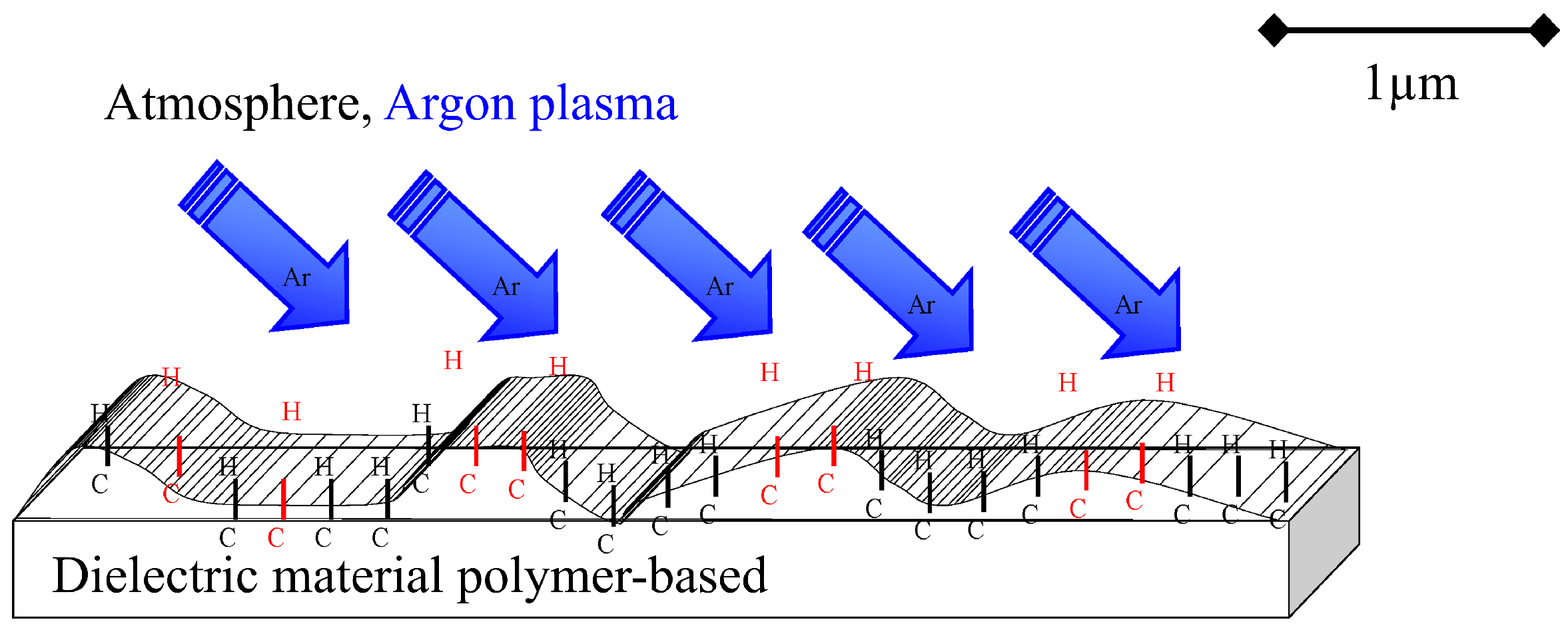
119]. At the microscopic level, ions, electrons, and high-energy neutral species generated during plasma discharge induce selective sputtering on the polymer surface, resulting in controlled nano- to microscale roughness, grooves, or periodic patterns, as illustrated in
Figure 4. Such tunable micro- and nanostructures not only increase interfacial contact area and wettability but also improve local electric field distribution and adhesion performance. By adjusting processing parameters such as power, gas composition, and treatment duration, the surface morphology can be precisely controlled over a wide range.
Concurrent with physical etching, plasma exposure exposes fresh polymer chains and generates abundant free radicals, endowing the process with a coupled physical–chemical effect. Chemically, bombardment by reactive species and ultraviolet irradiation induces cleavage of C-C and C-H bonds, producing free radicals that react with oxygen, nitrogen, or other reactive species to introduce polar functional groups such as hydroxyl, carbonyl, and amide moieties on the surface [
121]. This functionalization substantially increases surface energy, raises interfacial charge injection barriers, and enhances the wettability and adhesion of polymers such as polyolefins and epoxies.For instance, the initial water contact angle of plasma-treated polyethylene can drop to around 40° [
122]. Che et al. reported that atmospheric pressure
-plasma treatment markedly enhances the surface hydrophilicity of HDPE, PA12, and PA6, with contact angles immediately decreasing by 47.3°, 42.6°, and 50.1°, respectively [
123].
Building upon surface activation, plasma techniques can further achieve interface functionalization. Cui et al. utilized a nanosecond pulse-driven Ar/OMCTS plasma jet to modify the surface of epoxy resin. Their study showed that at an OMCTS carrier gas flow rate of 35 mL/min, the water contact angle increased from 60.3° to 143°, the surface flashover voltage rose from 14.3 kV to 17.1 kV, and the surface conductivity improved by nearly two orders of magnitude [
124]. Kang et al. increased the contact angle of PTFE from an initial 113.8° to 172.5° through plasma treatment, reduced the sliding angle to less than 1°, lowered the surface energy to 0.02 mN/m, and demonstrated excellent self-cleaning performance [
125]. Li et al.employed an atmospheric-pressure ammonia water-mixed plasma jet to treat polytetrafluoroethylene (PTFE), significantly enhancing its surface wettability and adhesion properties. After 120 s of treatment with a 1% ammonia water mixture, the water contact angle of PTFE decreased from 101° (untreated) to 19°, while the peel strength increased from 84 N/m to 530 N/m, an improvement of 446 N/m [
126].
As illustrated in
Figure 5, a platform was provided for hierarchical core–shell and hollow SiO
2 coatings [
127] and expanding the design space for composite interfaces. Such functionalized interfaces can modulate trap distributions and alter surface conduction pathways, thereby enhancing breakdown voltage and controlling interfacial charge.
The synergistic effects of structural etching, chemical activation, and functional layer construction manifest most prominently under high-field conditions. Plasma-induced polar groups, surface roughness modulation, and trap engineering collectively improve treeing resistance, partial discharge tolerance, and long-term electrical aging behavior. For example, Saman et al. demonstrated that surface modification of SiO
2 nanoparticles using atmospheric-pressure plasma, with only 3 wt% incorporation, significantly enhanced the insulation performance of XLPE nanocomposites [
128].
These findings indicate that plasma-induced surface chemical reconstruction not only regulates the physicochemical properties of polymer interfaces but also provides an effective route to enhance the high-field reliability of insulation systems [
129]. It is important to note that the beneficial effects of plasma treatment strongly depend on treatment intensity and duration—excessive plasma exposure can induce chain scission or oxidative degradation, compromising mechanical and dielectric properties, as observed in PE and other oxidation-prone polymers [
130]. Moreover, the functional groups introduced by plasma may undergo degradation or rearrangement over time or under environmental stress, leading to attenuation of the modification effect. Developing plasma treatment methods with long-term stability remains a critical research priority. Additionally, achieving uniform surface modification on complex geometries or large polymer components continues to be a significant technical challenge, making precise control of plasma parameters essential for achieving desired high-voltage performance.
4. Recent Advances in Polymer Materials for High-Voltage Applications
In recent years, as extreme operating conditions increasingly challenge material performance, research on polymer materials for high-voltage applications has deepened and expanded. Current research has shifted beyond merely enhancing the intrinsic properties of materials, focusing instead on systematically improving their reliability, durability, and adaptability under high-pressure environments through structural design, functional integration, and intelligent strategies. Within this framework, nanocomposites—owing to their exceptional tunability in mechanical and functional properties, high-throughput design and performance prediction enabled by AI, and the damage tolerance and extended service life offered by self-healing polymeric materials—have emerged as the three most promising frontiers in the field. These directions will be elaborated in detail in the following sections.
4.1. Nanocomposite Materials
It should be noted that in recent years, filler systems used to enhance the physical properties of polymer composites have shown a clear trend toward diversification. In addition to traditional micron-sized inorganic fillers, such as SiO
2, Al
2O
3, and MgO, low-dimensional nanofillers as well as functionalized fillers with special interfacial structures, such as core–shell structured particles and porous fillers, have gradually garnered attention. Such fillers demonstrate unique advantages over conventional fillers in regulating heat conduction paths, charge trapping behaviors, and mechanical reinforcement mechanisms. Key comparative features of nanofillers are summarized in
Table 6, highlighting their superior capability to impart multifunctional improvements, including enhanced dielectric strength, thermal conductivity, and mechanical robustness.
By incorporating nanofillers into polymer matrices with controlled interfacial modification, dispersion, and orientation, significant enhancements in dielectric strength, thermal conductivity, as well as tracking and erosion resistance can be achieved without markedly increasing the filler volume fraction [
135]. The underlying mechanisms include modulation of local electric field distribution by nanofillers, interfacial polarization effects on dielectric constant and loss, and suppression of microcrack propagation and electrical treeing by nanoscale structures, collectively improving breakdown behavior and dielectric stability under high-voltage conditions [
136]. Further studies have revealed that filler morphology, specific surface area, and interfacial compatibility are critical determinants of composite performance. For instance, small amounts of functionalized graphene or carbon nanotubes can effectively enhance local field uniformity and mechanical strength in insulating layers [
137]. However, excessive filler loading or poor dispersion may create conductive pathways, resulting in decreased breakdown voltage, as illustrated in
Figure 6, where different filler formulations significantly influence the overall performance of polymer materials. To address filler aggregation issues, Khanum et al. employed an electrostatic dispersion technique to achieve uniform incorporation of silica nanoparticles in EP. This approach not only reduced composite viscosity and improved processability but also preserved flexural strength, offering a promising route for high-performance epoxy nanocomposite fabrication [
138].
From an engineering perspective, research on nanocomposites for high-voltage cables and outdoor insulators is gradually shifting from laboratory-scale formulation optimization to scalable production and long-term aging reliability validation. This transition necessitates that material design simultaneously accounts for weather resistance, interfacial aging behavior, process compatibility, and cost, ensuring durable performance of polymer insulators in high-voltage environments [
140]. Traditional high-volume-fraction nanocomposites, however, often exhibit limited performance enhancement. Rui et al. demonstrated that reducing the nanofiller content below 0.5% while introducing local free volume can enhance the dielectric constant without compromising breakdown strength, opening new avenues for designing high-performance, low-loss dielectric materials across broad temperature ranges [
141]. To overcome high-temperature performance degradation in polymer nanocomposites, Singh et al. employed sub-nanometer sheets with unique structures as fillers, achieving exceptional energy storage density even at elevated temperatures [
142].
It is worth noting that the choice of filler content has a critical impact on the properties of composite materials. A low filler content often fails to form a continuous functional network, while excessive filler loading tends to induce agglomeration, interfacial defects, and deterioration of processability, thereby compromising dielectric strength and long-term reliability. Therefore, most studies have demonstrated that there exists an optimal range of filler content that balances dielectric, thermal, and mechanical properties. This range is specifically dictated by filler size, morphology, and the nature of interfacial interactions.
Table 7 summarizes the typical loading ranges and primary physical modification effects of different filler types. Overall, low-loading nanofillers primarily modulate dielectric/thermal properties through interfacial effects, while higher loadings of inorganic micro-fillers facilitate the construction of continuous functional networks. Moreover, the hybrid filler strategy has been demonstrated in multiple studies to balance multiple properties at relatively low total filler content, offering practical guidance for performance-optimized design. It should be emphasized that the aforementioned concentration ranges are not fixed values, but rather empirical intervals commonly adopted for balancing performance enhancement and processing reliability across different filler systems. The specific optimal concentration must still be determined through comprehensive design that considers matrix type, interfacial modulation strategy, and target service performance.
Furthermore, the emerging hybrid filler strategy in recent years has provided new insights for achieving multi-property synergistic optimization in polymer nanocomposite insulators [
155]. By introducing filler systems with varying scales or functionalities, multi-scale regulation of filler dispersion, interfacial interactions, and orientation behavior can be achieved at both macroscopic and microscopic levels, thereby effectively mitigating the performance limitations or trade-offs commonly encountered in single-filler systems. Benefiting from this collaborative design of multi-scale and multi-functional fillers, the composites exhibit synergistic improvements in dielectric strength, thermal stability, and mechanical properties, while simultaneously suppressing electrical treeing growth and microcrack propagation. This significantly enhances their breakdown behavior and dielectric reliability under high-voltage conditions.
It should be emphasized that precise control of filler morphology, specific surface area, interfacial compatibility, and loading content is crucial to avoid filler agglomeration or the formation of conductive pathways, which could otherwise lead to the deterioration of insulation performance. Looking ahead, it is necessary to further deepen the understanding of the filler–matrix interfacial interaction mechanisms, systematically explore the synergistic effects among diverse nanofillers, and develop scalable fabrication and processing techniques that balance performance regulation with engineering feasibility, thereby promoting the reliable application of nanocomposite insulating materials in high-voltage electrical equipment.
4.2. Application of AI in High-Voltage Polymeric Materials
The development of conventional polymeric insulators heavily relies on iterative experimentation, resulting in long development cycles, high costs, and low efficiency. The integration of ML with multiscale simulation has emerged as a transformative approach to overcome these limitations. ML can mine experimental and literature data to construct predictive models linking material composition, microstructure, and dielectric properties, enabling rapid screening of candidate materials and prediction of key performance metrics [
156]. Multiscale simulations, spanning atomic, molecular, and macroscopic levels, reveal charge transport, interfacial coupling, and structural evolution mechanisms, providing a theoretical foundation for materials optimization [
157]. In recent years, AI/ML has become a crucial tool in high-voltage polymer research, significantly reducing trial-and-error costs and facilitating data-driven design of high-performance insulating materials [
158,
159].
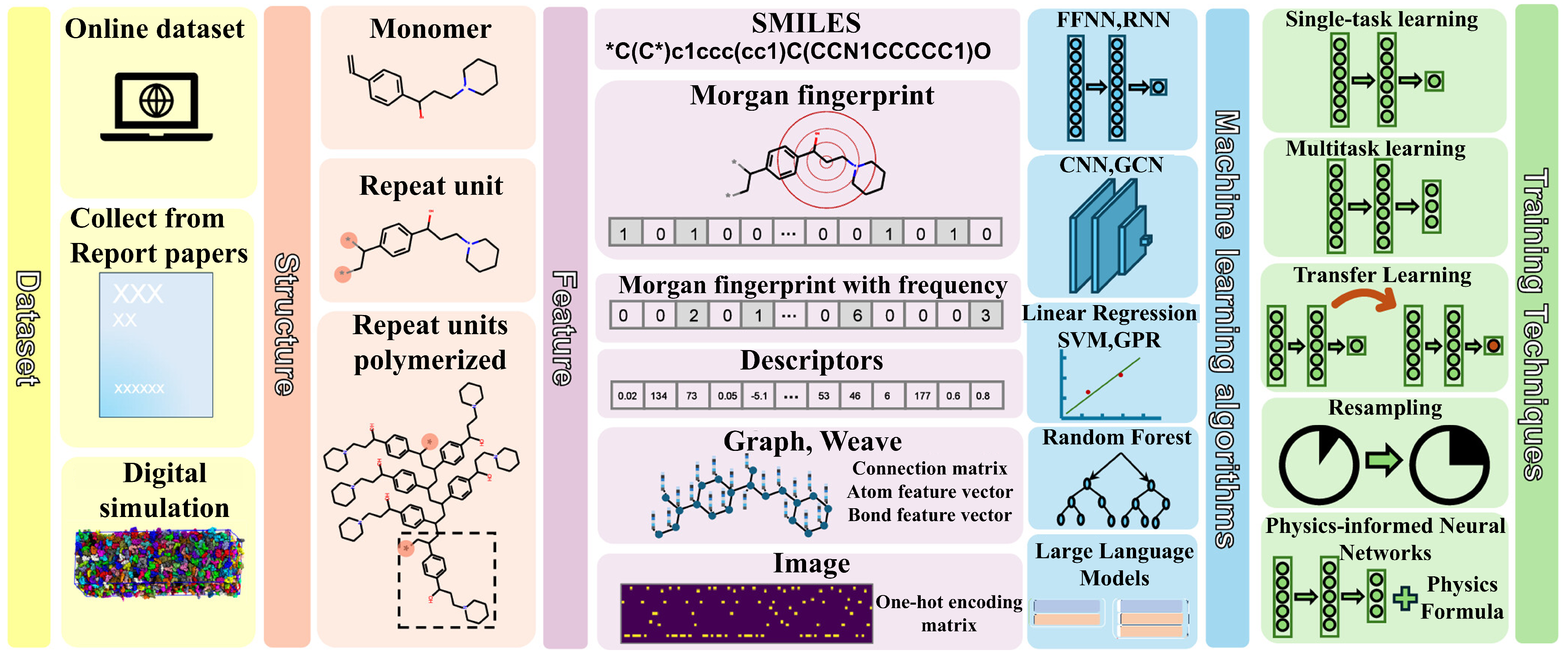
With the rapid development of high-throughput computation and materials informatics, AI—particularly ML—has become a central driver for designing and predicting the performance of high-voltage polymeric insulators. The AI-driven design workflow, illustrated in
Figure 7, establishes a systematic pipeline from molecular structure to performance prediction. This framework translates molecular descriptors into machine-readable features, applies diverse ML models for training and optimization, and ultimately achieves accurate property prediction and efficient candidate screening [
160].
To develop high-performance PI, Tao et al. employed a combined ML and molecular dynamics strategy, demonstrating the effectiveness of data-driven approaches in polymer research. Such approaches not only optimize specific materials but also enable rapid discovery of novel polymers with targeted functionalities. For instance, Li et al. identified new thermally stable polysulfones that balance thermal stability and electrical insulation performance [
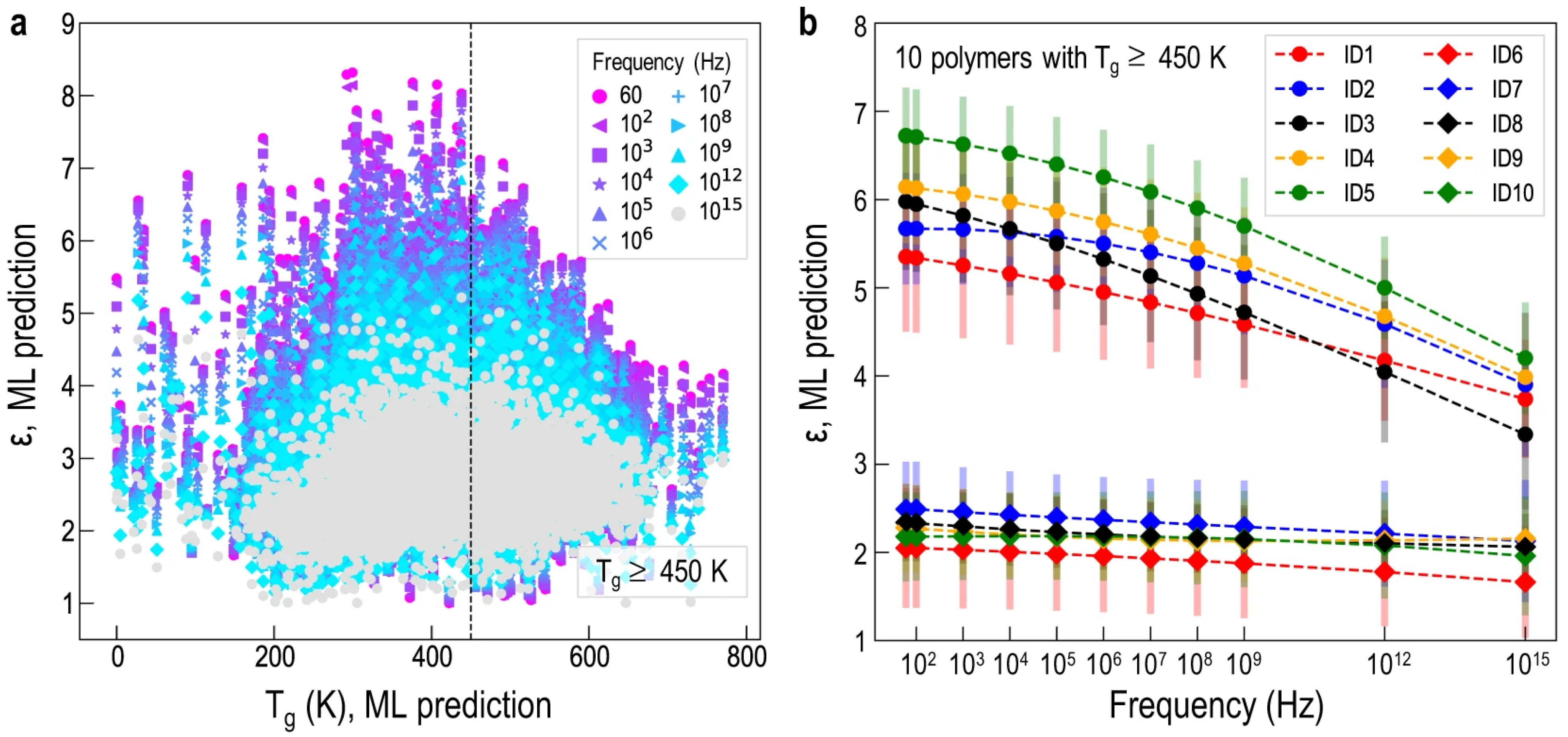
161]. Beyond material discovery, ML excels in property prediction. Chen et al. developed a Gaussian process regression-based model capable of accurately predicting dielectric constants across fifteen orders of magnitude in frequency. As shown in
Figure 8, the model was applied to high-throughput screening of 11,000 synthesizable polymers, providing an efficient and reliable approach to accelerate dielectric material design [
162].
AI-assisted design further enables breakthrough performance improvements. Gurnani et al. combined AI with molecular engineering to develop polybornylene and PI dielectrics exhibiting both high thermal stability and energy density, achieving an energy density of
at 200 °C —eleven times higher than commercial materials—overcoming the conventional trade-off between high-temperature stability and energy storage, and providing novel solutions for capacitors under extreme conditions [
156]. Overall, AI-assisted materials design shifts the paradigm from empirical trial-and-error to accurate prediction, accelerating polymer development.
In high-voltage diagnostics, PD signals are early indicators of insulation failure. Conventional methods rely on time-frequency analysis, thresholds, or expert rules. Modern AI techniques, such as convolutional neural networks, transformers, and feature-based classifiers like random forests, can automatically extract discriminative features from raw or preprocessed PD waveforms [
163], significantly improving detection accuracy and fault classification in noisy environments. Haiba et al. exemplified this approach by integrating acoustic emission with artificial neural networks to intelligently detect and classify PD in ceramic insulators. Using discrete wavelet transform features, their classification model achieved an overall accuracy of 96.03%, outperforming traditional Fourier analysis, and providing high-precision diagnostics for power equipment [
164]. Similarly, Wang et al. developed a dielectric gradient and polynomial chaos neural network model to predict composite dielectric constants and, combined with phase-field modeling, revealed interfacial structure effects on breakdown pathways at the 3D scale [
165].
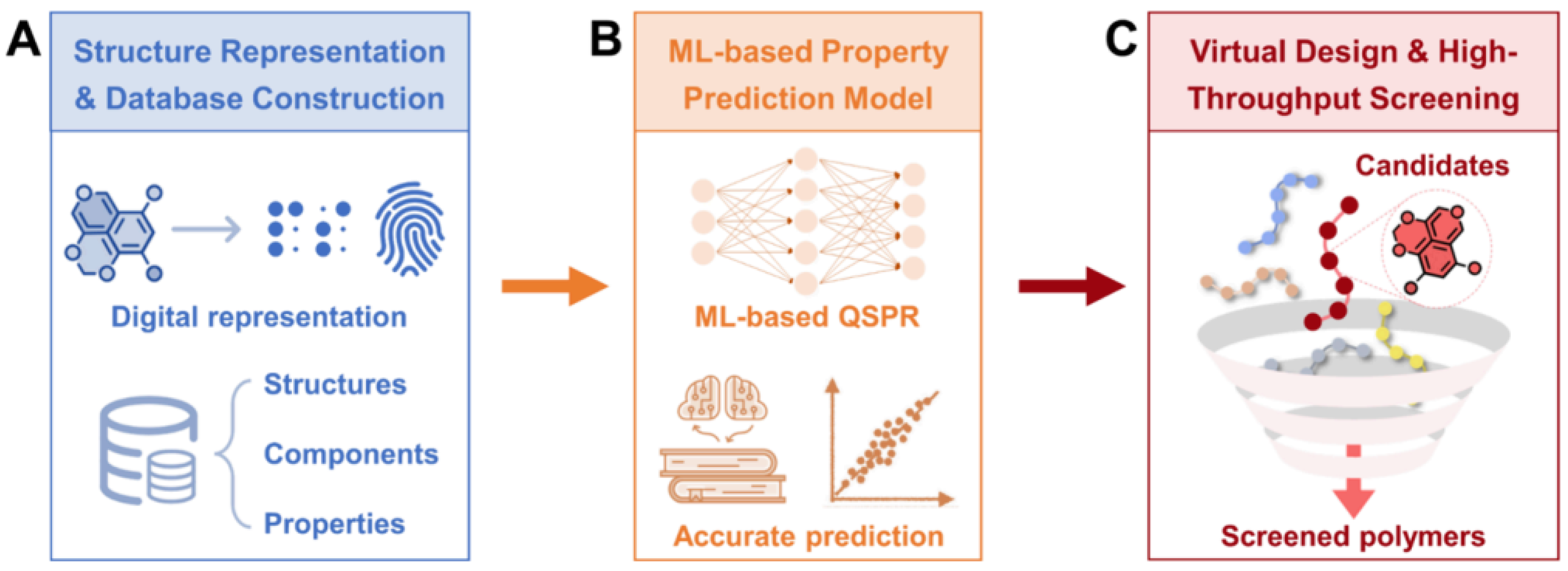
Compared to traditional empirical or rule-based screening, AI enables rapid construction of structure–property relationships and prediction of dielectric and mechanical responses under high-voltage conditions, facilitating inverse design of polymer systems to meet target dielectric constants, breakdown strength, and losses. The ML-assisted design workflow, illustrated in
Figure 9, encompasses structural digitization, database construction, ML-assisted property prediction, and virtual high-throughput screening, forming a closed-loop framework for efficient, accurate polymer discovery.
Specifically, supervised learning models, physics-constrained surrogate models, and generative models have been employed to: (1) predict dielectric constants and breakdown fields for varying polymer chemistries or nanofiller contents; (2) learn interpretable material fingerprints from limited experimental or first-principles data; (3) guide high-throughput experimental screening, substantially reducing experimental iterations and resource consumption [
167]. AI can also optimize simulation parameters and meshing, learning physical rules from extensive simulation data to improve convergence and reliability [
168]. Mohanty et al. developed a charge-based recurrent neural network surrogate potential, using two rounds of active learning to accurately simulate polymer dynamics such as polyethylene glycol [
169].
Nevertheless, AI deployment in high-voltage polymer research faces challenges, including scarcity of standardized datasets, limited model interpretability, and uneven distribution of experimental data under extreme conditions, which constrain model generalization and reproducibility [
170]. Future efforts should focus on establishing open, standardized data platforms, integrating physical priors into ML frameworks [
171], and implementing active learning with closed-loop experimental design for deeper AI-experiment integration.
4.3. Self-Healing Polymeric Materials
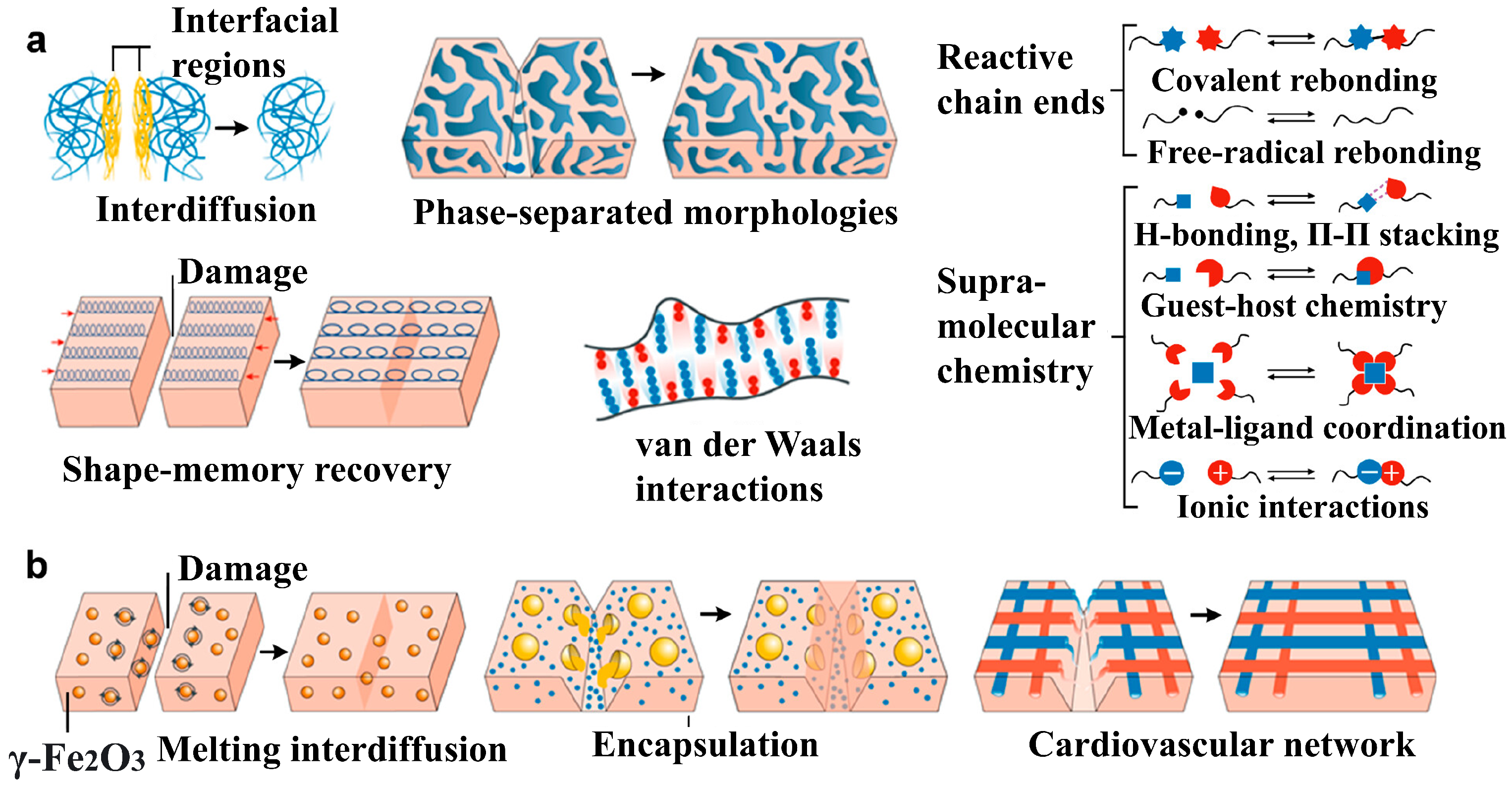
To enhance the operational reliability and lifespan of high-voltage electrical equipment, considerable research has focused on developing self-healing insulating polymers. These materials possess the intrinsic capability to autonomously repair structural and functional damage induced by mechanical stress or electrical breakdown through chemical reactions or physical reorganization processes [
172], effectively delaying insulation aging and failure [
173]. Representative self-healing mechanisms, including dynamic reversible chemical bonds and physical reconfiguration, are illustrated in
Figure 10. Self-healing insulating polymers hold significant promise for applications in high-voltage cables, insulating coatings, and power apparatuses, particularly in smart grids and systems operating under extreme conditions, where recoverability and long-term stability are of critical engineering importance.
From a macroscopic strategy perspective, most approaches introduce microcapsules, repair agent release mechanisms, or reversible chemical bond networks within the polymer matrix to restore structure and electrical properties post-damage [
175,
176]. Microcapsule-encapsulated repair systems have been successfully applied for water-tree remediation in cable insulation [
177]. Han et al. emphasized that in high-voltage environments, self-healing must remain effective under the influence of electric fields and damaged insulation states, with the competitive “degradation–healing” dynamics serving as a critical metric for feasibility [
178]. Tan et al. employed a microphase-separated, shape-memory polymer matrix to achieve localized healing at incipient electrical tree cracks, effectively suppressing failure propagation and significantly enhancing post-breakdown recoverability [
179].
The distinctive capacity of self-healing polymers for autonomous recovery after damage provides a novel pathway to improve the long-term reliability and service life of high-voltage systems. Nevertheless, challenges remain, including the competition between degradation and healing under high-voltage stress, the influence of electric fields on the healing kinetics, and the full restoration of electrical properties after repair. Future development of self-healing insulating polymers for high-voltage applications must integrate: (1) reversible or releasable repair mechanisms; (2) stability under electric fields and elevated temperatures; and (3) post-healing electrical performance comparable to the pristine material, thereby enabling their practical implementation in smart grid infrastructure and extreme operational environments.
5. Future Directions and Challenges
As high-voltage equipment evolves toward higher voltage ratings, greater transmission capacity, and more compact architectures, the design of polymeric insulating materials is shifting from the traditional focus on breakdown strength and thermal stability to a holistic, application-oriented performance framework. In emerging platforms such as ultra-high-voltage direct current transmission, flexible DC systems, cable accessories, offshore wind power installations, and compact transformers, insulating materials must endure stronger electric fields, elevated temperatures, and complex multi-physics coupling, while simultaneously exhibiting long term durability, low dielectric loss, environmental compatibility, and maintainability. These next generation operational requirements directly drive innovations in polymer structure design, interfacial engineering, and functional integration.
In high-voltage cables and accessories, key operational challenges include space charge accumulation, electric field distortion, inception of electrical trees, and local stress concentrations arising from thermal mismatches at interfaces. Consequently, future material development will increasingly emphasize interface engineering and charge management. Functionalized metal oxide and ceramic fillers can be used to construct interfacial trap structures with tunable energy levels, thereby suppressing charge migration and homogenizing local fields. Layered interfacial coatings provide a complementary approach to address dispersion and stability issues of nanofillers in polyolefin systems such as XLPE, ensuring stable dielectric performance under high-field and high-temperature conditions. These application driven composite systems are expected to underpin future advances in dielectric breakdown resilience, charge regulation, and thermal management. In extreme operating environments, such as flexible converter valves, submarine cables with rich high-frequency harmonics, and high-temperature superconducting devices, insulating materials must also combine resistance to partial discharge with structural recoverability. Self-healing insulating systems, thus, represent a critical avenue for development. Extrinsic self-healing mechanisms can address sudden defects such as treeing or interfacial damage, while intrinsic self-healing materials, based on dynamic bonds or reversible networks, provide autonomous repair of internal defects in inaccessible high-voltage cable regions. Progress in this domain will depend on advances in multi-scale characterization and quantitative aging models to establish predictable relationships between self-healing mechanisms and insulation reliability. For components with pronounced field gradients, such as cable terminations and accessory interfaces, there is a growing demand for materials capable of electric field modulation. Capacitive materials with dielectric constant gradients and resistive materials with nonlinear conductivity can effectively mitigate field concentration in complex geometries. Higher voltage levels and more compact architectures impose stringent requirements for thermal tolerance, structural consistency, and manufacturability, motivating research into multilayer gradient structures, printable gradient dielectrics, and interface stabilized designs. Furthermore, under the global “carbon neutrality” paradigm, environmental sustainability has emerged as a critical consideration. Bio-based polymers, nanocellulose, and lignin derived fillers are attractive candidates for “green high-voltage insulation” due to their favorable mechanical properties and low environmental footprint. However, significant polarity mismatches with conventional polyolefin matrices necessitate the development of efficient coupling agents, interfacial compatibilization strategies, or multiphase synergistic networks to meet stringent requirements for thermal stability, dielectric loss, and breakdown strength under high-voltage operation.
Despite these clear directions, the development of high-voltage polymeric insulators faces multiple challenges. Industrial-scale uniformity in nanofiller dispersion and interfacial stability remains difficult, resulting in performance gaps between laboratory and field applications. Unified models for interfacial polarization and trap-state modulation are lacking, limiting the transition from empirical to mechanism-driven material design. Long-term aging under high-field, high-temperature, and multi-physics coupled conditions remains complex, rendering lifetime prediction uncertain. The engineering validation of emerging self-healing, gradient, and environmentally sustainable materials is time-consuming, and standardized testing frameworks are still incomplete, impeding large-scale deployment.
Overall, the future trajectory of high-voltage polymer insulation research is evolving from isolated performance optimization toward a systems-level paradigm encompassing structure, interface, processing, and reliability. Only through a deep understanding of interfacial mechanisms, enhanced manufacturing consistency, predictive multi-physics aging models, and sustainable material design can the next generation of high-performance, long-life, and reliable polymeric insulators be widely deployed in advanced electrical power systems.
6. Conclusions and Outlook
This review systematically examines the escalating performance demands for polymeric insulating materials in high-voltage applications, providing a coherent framework that links recent advances in multi-scale structural engineering, interfacial design, and functional modifications with the intrinsic requirements of high-voltage systems. By integrating these developments, a comprehensive understanding of the interplay between high-voltage operational conditions and material properties is established. The global energy landscape is undergoing profound transformation, with power systems evolving toward higher voltage levels, increased power density, and greater operational flexibility. Concurrently, the rapid integration of renewable energy, accelerated fluctuations in grid operation, and the deployment of extreme-environment applications are continuously redefining the performance boundaries of high-voltage insulating polymers. Looking ahead, research on polymeric insulation will increasingly shift from single-property enhancement toward a holistic focus on reliability under complex service conditions. Key directions include controlling charge transport under intense electric fields, maintaining dielectric stability under high-temperature and high-frequency conditions, predicting aging behavior under multi-physics coupling, and ensuring structural resilience under extreme mechanical and thermal stresses. Moreover, alongside the development of smart grids and advanced monitoring technologies, attention to material detectability, self-regulation, self-healing, and environmental sustainability is expected to become central to future research efforts. Overall, the advancement of high-voltage polymeric insulators will align with the broader trajectory of energy systems and grid modernization. Driven by accelerated energy transition and rapid iteration of high-end electrical equipment, the next generation of high-performance, intelligent, and sustainable insulating materials will provide a robust technological foundation for the safe, efficient, and long-term operation of advanced power systems.