Article

Transient CFD Analysis of Combustion and Heat Transfer in a Coal-Fired Boiler Under Flexible Operation

1
School of Energy Science and Engineering, Harbin Institute of Technology, Harbin 150001, China
2
School of Energy and Power Engineering, Huazhong University of Science and Technology, Wuhan 430074, China
3
Harbin Boiler Factory Co., Ltd., Sandadongli Road No. 309, Harbin 150046, China
*
Author to whom correspondence should be addressed.
Energies 2026, 19(2), 478; https://doi.org/10.3390/en19020478 (registering DOI)
Submission received: 25 November 2025 / Revised: 13 January 2026 / Accepted: 14 January 2026 / Published: 18 January 2026
(This article belongs to the Special Issue Carbon Dioxide Capture, Utilization and Storage (CCUS): 3rd Edition)

Abstract

As a reliable peak-shaving power source, coal-fired boilers’ flexible operation technology has become a key support for achieving the low-carbon transition. To enhance the peak-shaving capacity of the boiler, it is urgent to explore the transient mechanisms of flow, combustion, and heat transfer under dynamic conditions. In this study, the heat transfer characteristics of the burner under varying load conditions and the combustion characteristics in boilers under low and dynamic load conditions are investigated by CFD numerical simulation technology based on a 10 MW coal-fired test bench. The results indicate that at load rates of 2%/min and 4%/min, heat flux density remains mostly consistent across the upper wall of the furnace. At 6%/min, the heat flux near dense pulverized coal flow exceeds that near fresh coal flow. At 60% load, the flow fields are symmetrical, optimizing flame filling and distribution. As the load drops to 40%, the upper flow field begins to distort, and by 20% load, turbulence and uneven temperature distribution arise. At 20% load, the one-layer burner demonstrates superior flow field stabilization compared to the two-layer configuration, with particle concentration remaining lower near the wall above the burner but higher in the cold ash hopper, while high-temperature zones predominantly concentrate in the furnace center with minimal areas exceeding 1900 K. A boiler designed for concentration separation enhances airflow and decreases wall particle concentration at 20% load, resulting in a more uniform temperature distribution with high-temperature zones further from the walls.

1. Introduction

In the context of the accelerating global transition to low-carbon energy, China’s new energy industry has made significant advancements. As of the end of 2023, the installed capacities of wind [1] and photovoltaic [2] power generation have historically exceeded the 1 billion kilowatt mark, accounting for 36% of the total installed capacity in the country’s power generation sector. This achievement positions China as a global leader in new energy capacity [3]. However, the inherent intermittency and volatility of these energy sources increasingly conflict with the rigid balancing requirements of the power system [4]. In this context, though the market share of coal-fired power generation shows a slow downward trend, the deep peak regulation capability and load response speed of coal-fired power units have become essential for ensuring the safe operation of the power system and achieving synergy between generation sources and the grid. Current research on the flexible peak regulation of thermal power units primarily focuses on two dimensions: stable combustion at low loads and dynamic response under variable loads [5,6,7].
In studies on combustion in a modified 330 MWe opposed-wall combustion boiler operating under varying loads, it was observed that a decrease in load resulted in reduced O2 consumption and flue gas temperature, as well as a lower rate of temperature increase, ultimately leading to impaired combustion within the furnace [8]. Research focused on the combustion stability and NOx emission characteristics of a 300 MW tangentially fired lignite boiler operating under ultra-low-load conditions revealed that decreasing load was associated with a rapid decline in average furnace temperature, delayed ignition of pulverized coal, a gradual loss of virtual circulation within the furnace, and a deterioration in combustion stability [9]. The instability of combustion in pulverized coal boilers at low loads can be attributed to an increased primary air (PA)/coal ratio and a reduction in furnace temperature due to diminished coal consumption [10]. To achieve stable combustion at low loads, several strategies have been proposed, including combustion-supporting modifications, burner optimization, adjustments to pulverizing systems, coal blending, and fine-tuning. The application of plasma ignition technology to assist the ignition of pulverized coal can effectively reduce ignition delay times and enhance overall ignition performance [11]. Optimizing the swirl burner by reducing the flow area of the internal and external secondary air (SA) tubes, combined with the introduction of an overfire air (OFA) system, significantly improves flame combustion fullness and maintains stability [12]. Furthermore, integrating small powder silos for storing pulverized coal at high loads and supplying it during low loads can enhance the ignition and combustion characteristics of pulverized coal [13]. A specific study on fuel blending strategies for a retrofitted down-fired 660-MWe utility boiler demonstrated that blending lean coal with anthracite allows such boilers to sustain stable combustion at 57% load [14]. Additionally, a parallel arrangement of oil secondary air in a fuel-rich coal/air flow enables stable combustion at a rated load of 33%, improving the burnout rate of pulverized coal and reducing NOx emissions [15]. Among various technologies for stable low-load combustion, transforming the combustion system—particularly through the optimization of burner structures—can enhance the stable combustion capabilities of equipment via multi-physical field coupling design, while also being cost-effective and convenient for operation and maintenance [16]. Research on flow field reconstruction mechanisms for burner core components can not only mitigate bottlenecks in low-load combustion but also simplify systems and reduce operational costs, thereby providing essential support for the iterative development of advanced deep peak-shaving technologies in pulverized coal boilers.
With the normalization of deep peak-shaving in pulverized coal boilers, frequent fluctuations in unit load have exacerbated safety concerns related to key pressure-bearing components, such as the water wall. Particularly during rapid variable load operations, drastic changes in furnace heat load and fluctuations in the working medium parameters of the water wall create dual dynamic excitations, leading to the cumulative effects of alternating thermal stress. Research indicates that this alternating load can result in circumferential fatigue cracks on the pipe wall [17,18,19]. Once these cracks initiate, they exhibit significant expansion characteristics as peak-shaving frequency increases: initial micro-cracks form a parallel distribution with multiple channels on the fire-facing side. The radial crack group experiences an exponential increase in depth with the number of thermal stress cycles, ultimately penetrating the pipe wall and causing the leakage of the working fluid. This damage process is characterized by low-cycle fatigue, which has emerged as the principal bottleneck restricting the safety of deep peak-shaving in boilers. In response to these challenges, numerous research teams have undertaken systematic investigations into key technologies, such as combustion optimization and advanced control. During variable load operations of the boiler, properly adjusting parameters such as outlet oxygen, SOFA air volume, and the water–coal ratio can optimize combustion within the furnace and control NOx emissions [20]. Appropriate fuel quantity, varying air volume ratios, and other parameters can further enhance combustion conditions during startup [21]. Moreover, a control model based on the boiler–turbine coordinated heating model can increase the variable load rate of the cogeneration unit to 2.9% Pe/min [22]. The variable load rate can be elevated from 1.5% Pe/min to 4.5% Pe/min using a dynamic coordinated control strategy supported by high-pressure extraction throttling [23]. Currently, scholarly research, both domestically and internationally, primarily investigates boiler variable load processes through industrial experimental analyses and system strategy simulations, with few attempts made to perform transient simulations of the combustion system. Accordingly, there is an urgent need to develop a combustion-heat transfer coupling transient model to quantitatively analyze the influence of variable load rates on combustion and heat transfer within the furnace, accurately revealing the co-evolution mechanism of combustion stability and heat transfer efficiency during load disturbances.
In addition, the burner in the boiler combustion system serves as the core conduit for energy conversion and release, with its structural characteristics and dynamic control capabilities directly influencing the unit’s stable combustion performance and load response quality. A suitable burner design can stabilize combustion within the furnace under low-load conditions and minimize the thermal inertia response delay of the boiler to load commands during rapid load changes. Technologies such as multi-stage vane swirl burners [24], reverse injection front chamber burners with bluff bodies [25], oxygen-enriched low NOx burners integrated with liquefied natural gas [26], self-sustaining internal combustion engine burners [27], preheating burners [28], and horizontal bias burners [29] can achieve stable combustion in furnace while enhancing combustion intensity during low-load and variable-load conditions. The horizontal bias burner, particularly suited for four-corner tangentially fired boilers, demonstrates excellent ignition and stable combustion characteristics at low loads [30,31]. Consequently, the horizontal bias burner is poised to play a pivotal role in the flexibility transformation of thermal power units.
Despite the stable combustion characteristics exhibited by horizontal bias burners, there exists a significant paucity of research focusing on transient simulations of the combustion processes in pulverized coal boilers during variable load operations. Consequently, this study develops a numerical model based on a 10 MW coal-fired test bench, with an emphasis on the heat transfer characteristics of the burner under variable load conditions. The primary objective of this research is to elucidate the mechanisms that influence the combustion characteristics of the boiler under varying low and dynamic load conditions. This work addresses a critical gap in the domain of transient simulations related to variable load operations on the combustion side of coal-fired units, thereby providing both theoretical support and practical engineering insights for the flexible peak regulation of pulverized coal boilers.

2. Calculation Simulation Setting and Working Condition Design

2.1. Introduction of Simulation Object

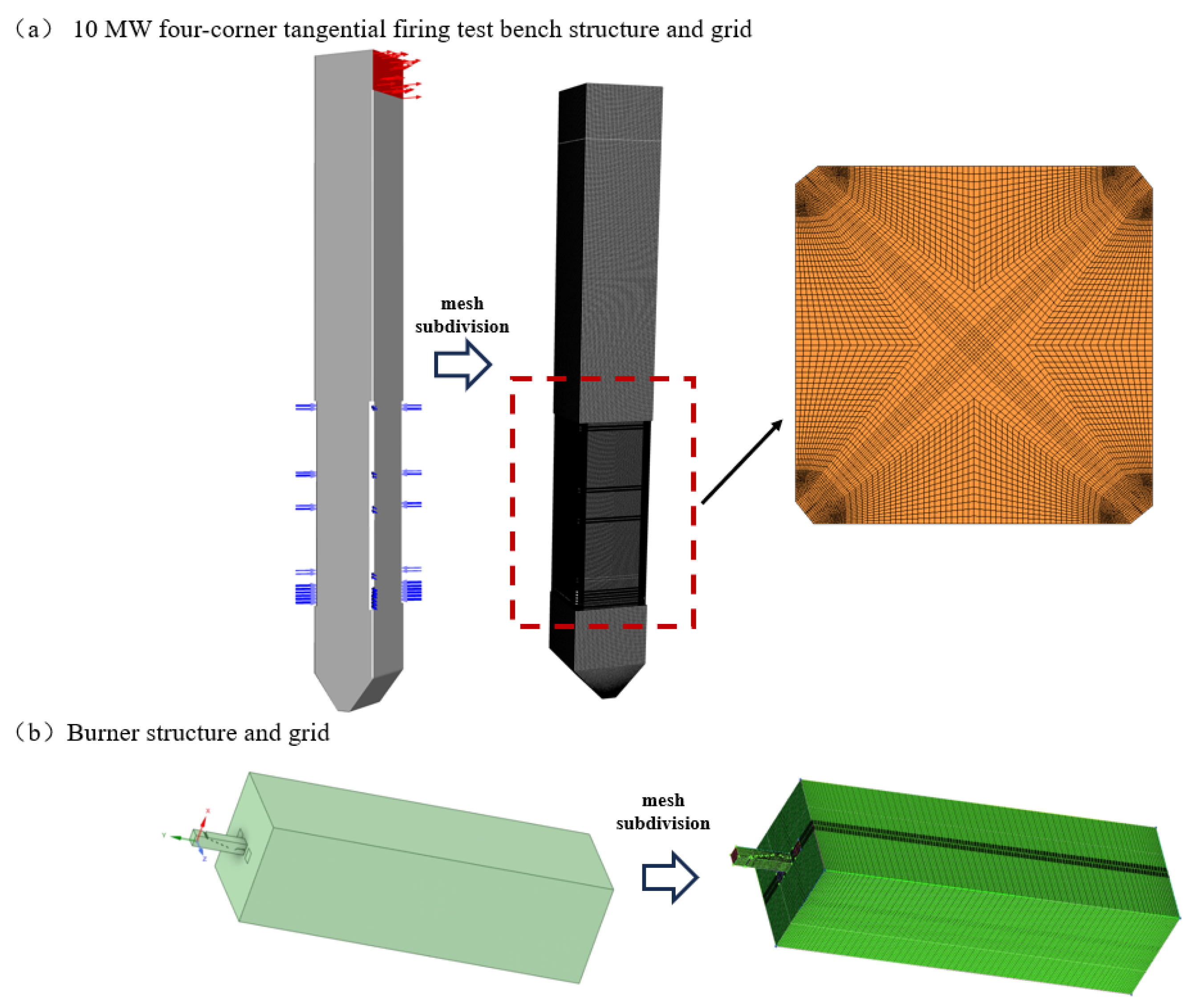
The research object of this paper is a 10 MW four-corner tangential pulverized coal combustion test bench and its horizontal bias burner. The test bench body adopts a Π-type arrangement, as shown in Figure 1a. Along the direction of flue gas flow, it is divided into burner module, burnout air module, horizontal flue module, secondary air preheater module, primary air preheater module, high-temperature economizer module and low-temperature economizer module. The burner is a horizontal bias burner, as shown in Figure 1b. The burner is composed of three types of air ducts: primary air ducts, secondary air ducts and sofa air ducts. The primary air duct is equipped with a louvered pulverized coal concentrator, which is composed of a baffle block, four blades and a triangular prism bluff body (bottom width of 10 mm) at the nozzle. The coal used in the test bench is Shenhua bituminous coal, and its industrial analysis and elemental analysis are shown in Table 1.

2.2. Computational Simulation Method

The heat transfer characteristics of the burner under variable load and the combustion characteristics of the boiler under low load and variable load conditions are studied. Based on some the literature and related experimental equipment, a 10 MW tangential pulverized coal combustion test bench research model [32,33] and a burner research model [34,35] are designed, as shown in Figure 2. The CFD computational domain covers the complete furnace, burner, overfire air zone, and horizontal flue inlet section. The total height of the furnace is 28 m, the width is 2 m, and the depth is 2 m; the burner zone is arranged in the height range of 3 m to 7.6 m at the lower part of the furnace, with a total of two layers of burner nozzles. The inner diameter of the primary air duct of the horizontal bias burner is 0.32 m, the inner diameter of the secondary air duct is 0.56 m, and the inner diameter of the overfire air nozzle is 0.42 m. Ansys 2021/R1 SpaceClaim software is used to physically model the designed boiler research model and burner, and ICEM is used to divide the geometric model into grids. In order to better reflect the flow field in the burner, the combustion area of the boiler and the plane part of the burner are carefully divided and the grid is drawn along the jet direction to reduce the influence of the grid on the jet diffusion. Appropriateness reduces the number of grids in the upper part of the furnace and the cold ash hopper area, reduces the calculation time and improves the accuracy. A hybrid mesh division method of structured and unstructured grids is adopted. The main area of the furnace uses hexahedral structured grids, and complex geometric areas such as burner nozzles use tetrahedral unstructured grids for transition to ensure a balance between mesh quality and computational efficiency. The overall orthogonality of the mesh is greater than 0.85, the skewness is less than 0.5, and the Jacobian determinant of all mesh elements is greater than 0.7, meeting the requirements of numerical calculation accuracy. A total of five layers of boundary layers are set; the thickness of the first layer of grids is 0.005 m, and the grid growth rate is 1.2.
In this paper, Fluent is used to simulate the flow and combustion in the burner and furnace. The SIMPLE algorithm is used to calculate the velocity field and pressure field in the model [36]. Some studies [37,38] have found that the Realizable k-ε model can be used to deal with the rotating flow field, similar to the four-corner tangential boiler, and better simulation results are achieved compared with other turbulence models, such as the SST k-ω model. Therefore, this model is used to simulate the flow field in the furnace. In this paper, the P-1 model is used to calculate the radiation heat transfer in the furnace [39]. The model considers the radiation heat transfer between gas and particles, which consumes fewer computing resources. However, the P-1 model may underestimate the underestimate anisotropy in particle-laden flows, offering a compromise between accuracy and computational cost. The gas-phase radiative absorption coefficient is calculated by the Weighted Sum of Gray Gases (WSGGM) model with high accuracy [39]. Before the pulverized coal enters the furnace combustion, it is necessary to carry out the process of removing volatile matter. The volatilization rate of this process is affected by the content of volatile matter [40]. This paper uses the two-step competitive reaction model (two-competing-rates) to simulate the process [41]. The diffusion-dynamic reaction model is used to simulate the combustion process of coke, which takes into account the effects of diffusion and reaction kinetics on the reaction rate of particle surface [42]. Details of the numerical model can be found in the Supplementary File.

2.3. Boundary Conditions

The boundary conditions of different loads of the 10 MW tangentially pulverized coal combustion test bench in the simulation are set as shown in Table 2. Due to the influence of the inherent delay of the coal mill pulverizing system and the limitation of the minimum stable combustion rate, it is difficult to improve the load climbing rate of the boiler under low load operation [43]. Therefore, the simulation conditions in this paper are mainly medium- and low-load (20–60%). Each tuyere adopts the mass flow inlet boundary condition; according to the field data, the wall temperature above the SOFA-3 of the furnace is set to 350 K, and the wall temperature below the SOFA-3 of the furnace is set to adiabatic [32] to simulate the actual furnace wall. The wall emissivity is set to 0.8; the furnace outlet is set as the pressure outlet boundary condition, and the pressure value is set to −100 Pa. The diameter distribution of the pulverized coal was specified as Rosin–Rammler, with a mean diameter of 60 μm and a spread parameter of 1.5 employed in the simulations. The particle size distribution of the coal powder is shown in Table 3. In addition, in the study of the influence of variable load rate on boiler, this paper uses UDF to control load change; a linear ramp function was used to adjust coal and air mass flow rates over time, with a time step of 0.001 s to ensure numerical stability and capture dynamic effects. This paper studies the influence of variable load rate of 2%/min on boiler combustion based on 20% load parameters, and studies the influence of variable load rate of 2%/min, 4%/min and 6%/min on boiler combustion based on 30% load parameters.
This study examines the burner by analyzing the impact of variable load rates of 2%/min, 4%/min, and 6%/min on combustion, based on the boundary parameters of the boiler operating at 40% load. Given the brief residence time of pulverized coal flow within the burner, the burner wall can be approximated as an adiabatic wall for computational purposes. The model utilized in this study represents a half burner and a section of the furnace. Accordingly, in conjunction with existing literature, the temperature of the furnace inlet wall is set at 600 K to accurately simulate the actual furnace wall conditions, while the temperature of the surrounding furnace walls is set at 1000 K to emulate the combustion gas temperature within the furnace. The primary and secondary air ducts are designated as the flow inlets, and the furnace outlet is configured as the pressure outlet boundary.

2.4. Grid Independence Verification

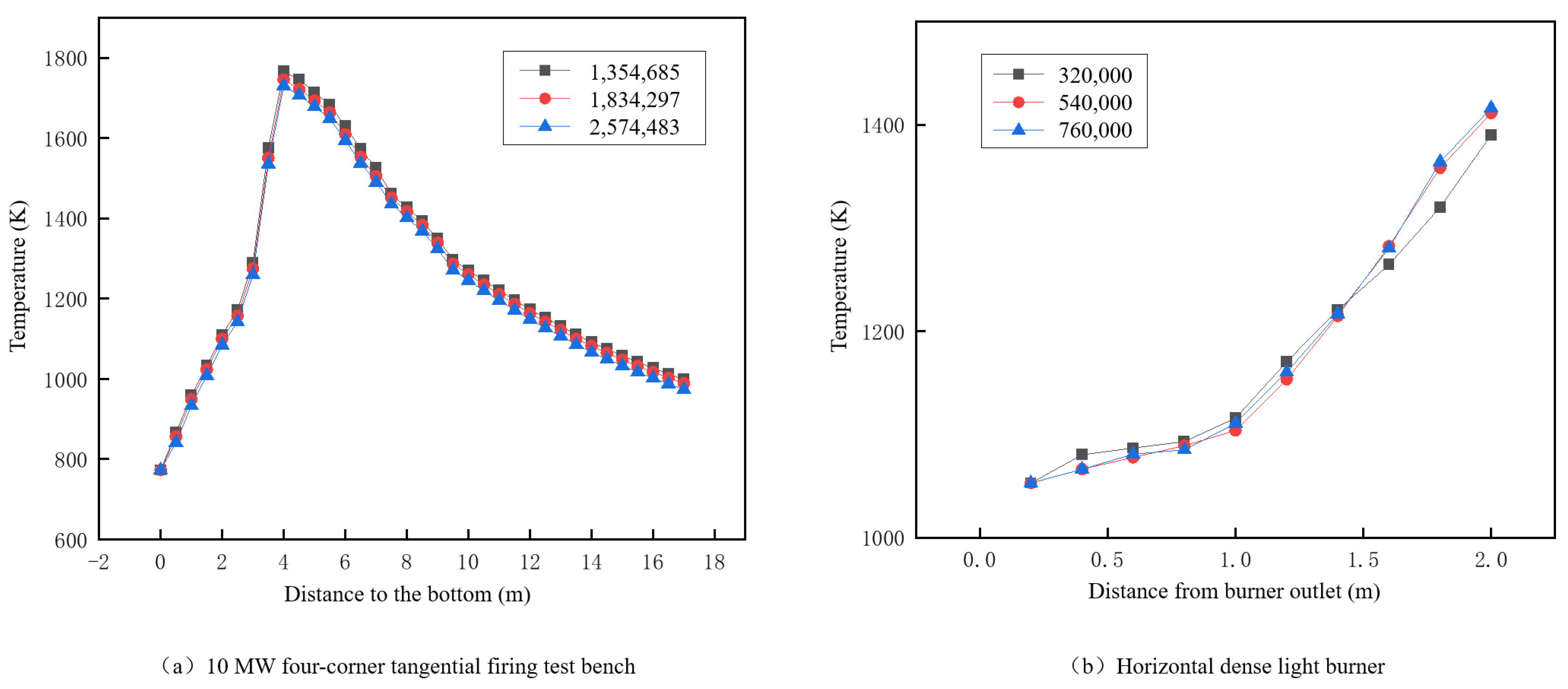
In order to ensure that the accuracy of the simulation is not affected by the number of grids, grid independence verification is carried out before the simulation [38]. In this paper, three grid numbers of 1.35 million, 1.83 million and 2.57 million were selected to verify the grid independence of the 10 MW tangentially pulverized coal combustion test bench, and three grid numbers of 320,000, 540,000 and 760,000 were selected to verify the grid independence of the burner. By comparing the cross-section temperature distribution in the direction of flue gas flow under the same combustion conditions, the appropriate number of grids is selected for subsequent calculation. The comparison of the calculation results under the three grid numbers is shown in Figure 3. The results show that when the number of grids is 1.35 million and 320,000, the calculation results are different from the other two sets of grids. The calculation results of the other two grids are basically unchanged. Considering the calculation efficiency and calculation accuracy, the grids with the numbers of 1.83 million and 320,000 are selected for subsequent simulation calculation.

3. Simulation Results and Analysis

3.1. Effect of Variable Load Rate on Heat Transfer of the Burner

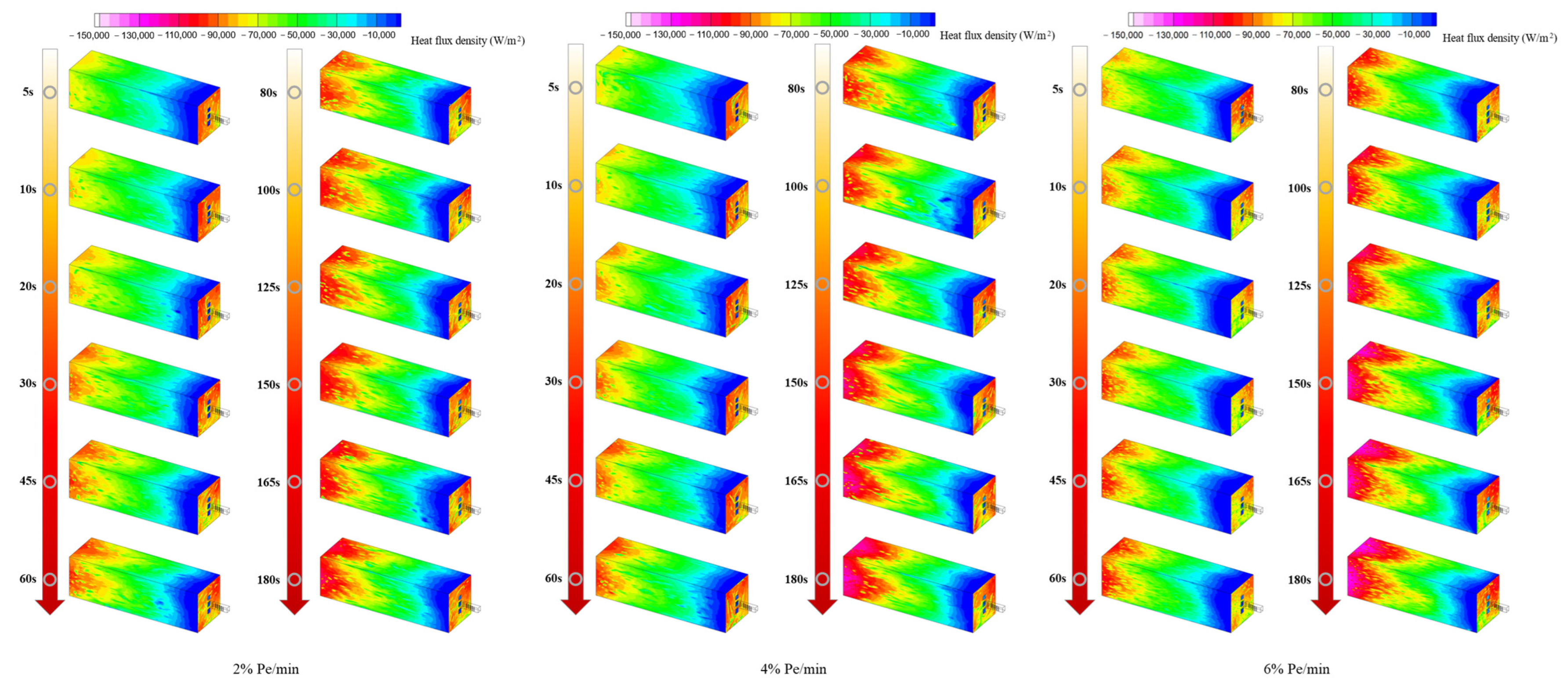
Figure 4 illustrates the temporal distribution of heat flux on the furnace wall under varying load rates. An analysis of the heat flux distribution across three operational conditions indicates that heat flux density increases as one approaches the furnace outlet. This phenomenon arises because the ignition of pulverized coal occurs in the furnace’s midsection, with complete combustion taking place near the outlet. As a result, the highest flue gas temperature—and thus the maximum wall heat flux density—occurs at the furnace outlet. Over time, the heat flux density near the outlet continues to rise due to increasing feed rates, which enhance both the combustion and heat transfer rates [44]. The rate of change in variable load has a minimal impact on the area of high heat flux in the airflow direction at any given moment; however, it significantly influences the heat flux values in fixed areas along this direction. This can be attributed to the variable load rate having little effect on the location of the high-temperature region within the furnace. Furthermore, an examination of the upper wall of the furnace reveals that when the variable load rate is 2% Pe/min and 4% Pe/min, the heat flux density remains relatively uniform. Conversely, at a variable load rate of 6% Pe/min, the heat flux density near the dense pulverized coal flow side exceeds that near the fresh pulverized coal flow side. This discrepancy is due to the excessively high variable load rate, which results in delayed mixing of pulverized coal and air, leading to an accumulation of pulverized coal on one side and elevated heat release, thereby resulting in higher flue gas temperatures in that region.

3.2. Influence of Different Loads on Boiler Combustion Characteristics

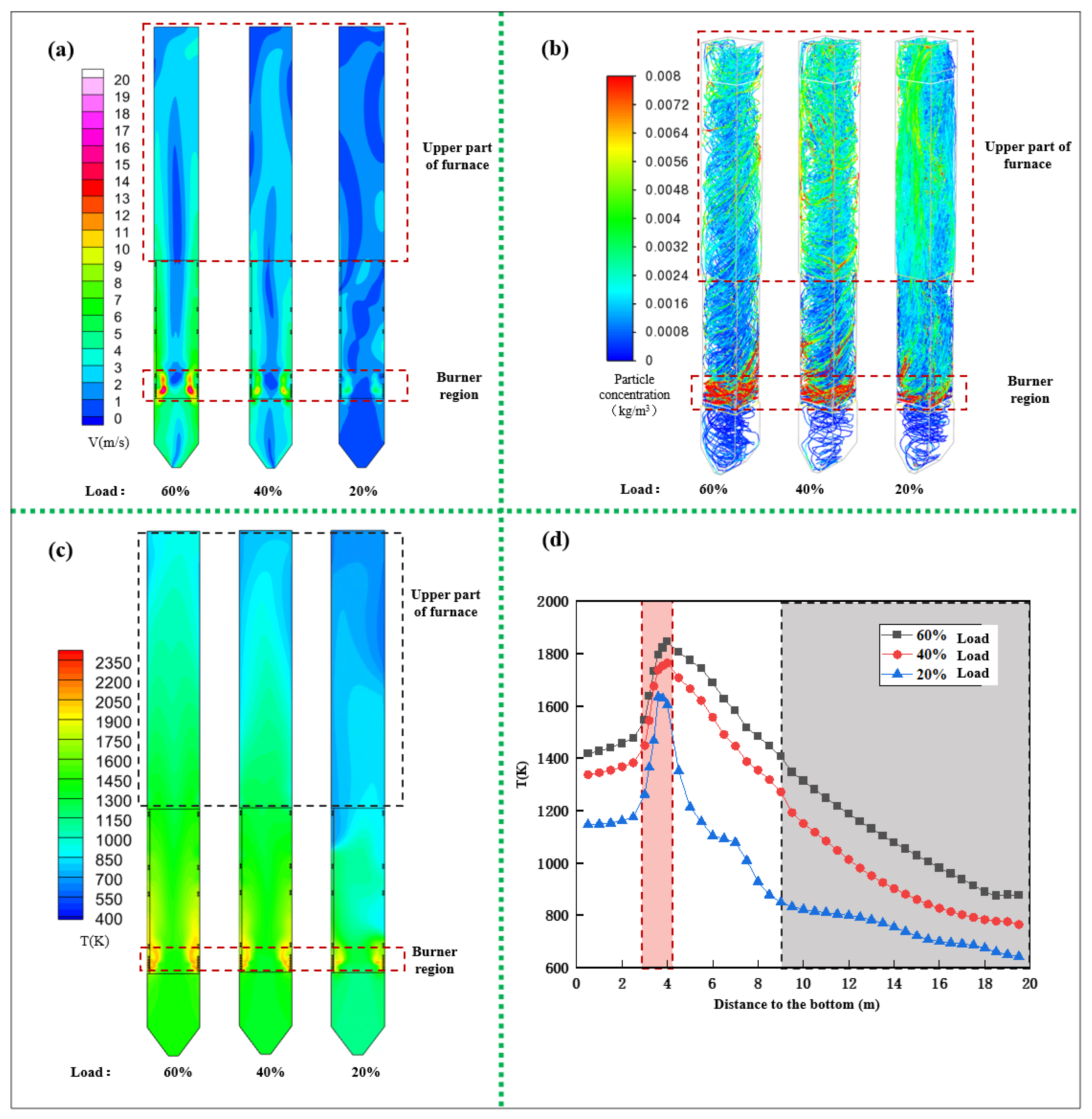
When the load on a pulverized coal boiler varies, both the coal supply and air intake change, affecting airflow velocity and flow field distribution within the furnace. This alteration subsequently influences flame distribution and heat transfer across the heating surface, impacting the boiler’s economy and safety. To gain insights into combustion characteristics at different loads, this section investigates boiler performance at 60%, 40%, and 20% loads, as illustrated in Figure 5. The flow field distribution in the furnace under these varying loads is displayed in Figure 5a. The diagram shows that the flow field is symmetrical at 60% load, whereas at 40% load, the upper flow field begins to distort, and at 20% load, the flow field throughout the furnace becomes disordered. This phenomenon is consistent with the conclusion of “disappearance of the furnace virtual tangential circle and deterioration of combustion stability” found by Ma et al. [9] in the ultra-low load experiment of a 300 MW tangentially fired boiler. This trend suggests that as the load decreases, the symmetry of the flow field deteriorates. At higher loads, both primary and secondary air supply volumes are substantial, resulting in increased airflow velocities (with areas exceeding 4 m/s predominating) that maintain flow field symmetry. Furthermore, at loads above 40%, sufficient airflow from the burner area reaches the upper portion of the furnace, stabilizing the tangential flow field. However, at 20% load, a significant reduction in gas flow and a downward shift in airflow support restrict the tangential circulation to the burner area, leading to disruptions in other regions. Such deviations in flue gas flow negatively, affect combustion efficiency, and exacerbate wear on the furnace water wall, ultimately impacting overall boiler economy and safety. Figure 5b illustrates the trajectories of coal particles, color-coded according to their concentration, under different loads. The analysis reveals that as the load increases, particle concentration near the burner wall rises, while concentration near the upper wall decreases. High load conditions yield a larger intake volume of air, resulting in greater tangential circles and increased airflow velocity, allowing pulverized coal to readily reach the wall surface due to inertia. Conversely, reduced loads diminish airflow and support, shifting airflow dynamics near the upper wall and increasing particle concentration in that region. This rise in wall particle concentration accelerates wear on the water wall, significantly affecting boiler safety. Figure 5c,d depict the temperature distribution within the furnace. These figures indicate that at 60% load, the high-temperature flame distribution is widest, with optimal flame filling, and the region with an average temperature of 1200 K extends from the furnace bottom to the upper section. As the load decreases, the flame range diminishes, and the 1300 K region becomes confined to the upper part of the furnace. When the load falls to 20%, the temperature distribution becomes markedly uneven; the lower part of the upper section veers toward the left wall while the upper section shifts toward the right wall. This phenomenon is attributed to the disordered flow field at 20% load, causing airflow to deviate from the central axis and directing high-temperature flue gas toward the water-cooled wall surface.
At 20% load, the unstable combustion zones near the burner outlet exhibit a typical temperature range of 850–1050 K and a local equivalence ratio of 0.65–0.85. This lean air–fuel ratio, combined with low furnace temperature, leads to increased CO concentration and unburned carbon content in fly ash, reducing combustion efficiency. In the burner area, as load decreases, coal supply diminishes, resulting in reduced combustion-heat release and fewer high-temperature flames above 1900 K, which consequently lowers the average temperature. A comparison of overall furnace temperatures reveals minimal reductions at loads above 40%. However, at 20% load, a substantial temperature drop is observed, particularly between the burner area and the upper section, due to insufficient coal supply, leading to reduced unburned carbon in the burnout zone compared to at 40% and 60% loads.
By observing Table 4 and comparing the CO mass fraction at the 3.61 m level, it can be found that as the load decreases, the CO mass fraction increases, from 0.002938 to 0.004446, and the area with a CO mass fraction above 0.013 gradually increases. This is because when the load decreases, the primary air volume drops, resulting in insufficient oxygen and incomplete combustion of coal powder particles, which generates a large amount of CO, leading to an increase in the CO mass fraction. However, at the 3.71 m level, the CO mass fraction decreases as the load decreases, and the area with a CO mass fraction above 0.013 gradually reduces. When the load is 20%, the area with a CO mass fraction above 0.013 is almost non-existent. This is because at high loads, a large amount of coal is fed, and many unburned coal particles rise to this level to react, thereby generating a large amount of CO. At a 20% load, the coal feed is smaller, and most of the reactions are completed below 3.71 m, resulting in less CO generation above 3.71 m. By comparing the O2 mass fraction at different heights under the same operating conditions, it can be found that as the height increases, the O2 mass fraction decreases, and the area with an O2 mass fraction below 0.02 increases. This indicates that the reaction of coal particles mainly occurs in the area after 3.71 m. The unburned carbon particles and carbon monoxide in the burner area will react with the oxygen in the secondary air after the burner area, thereby promoting the complete combustion of the carbon particles. By comparing the O2 mass fraction at different loads at 3.61 m and 3.71 m, it can be found that as the load decreases, the O2 mass fraction decreases, and the O2 mass fraction in the center area drops from 0.08 to 0.04. This indicates that at low loads, a large number of coal powder particles react in this area, and the reaction occurs earlier.

3.3. Influence of the Number of Burner Opening Layers on Boiler Combustion Characteristics Under 20% Load

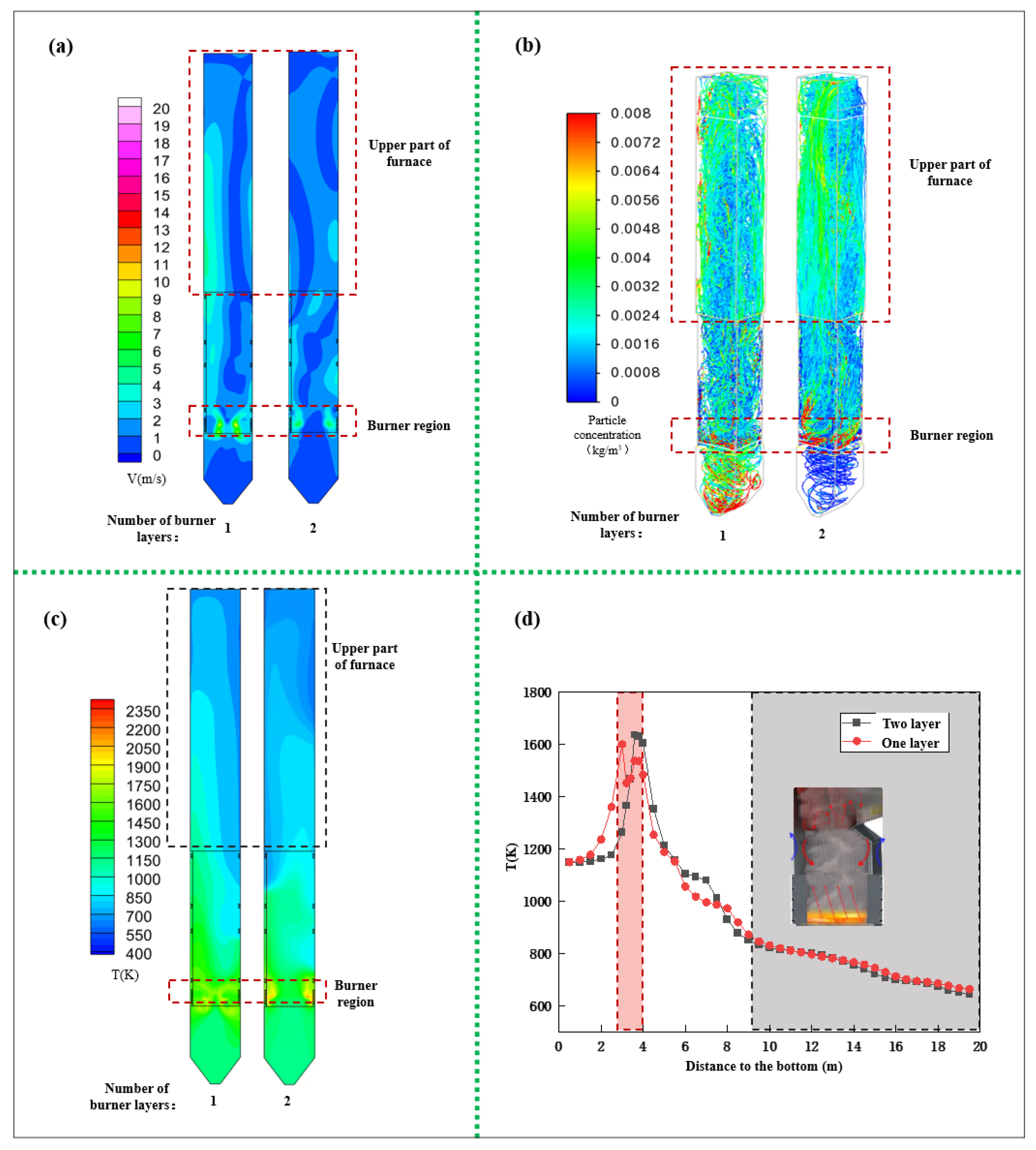
The operation of various combinations of burner layers significantly influences both the flow and temperature fields within the furnace, as well as the height of the combustion center. This section investigates the impact of one-layer and two-layer burner designs on combustion characteristics at 20% load. Figure 6a illustrates the flow fields in the furnace with varying burner layers under low-load conditions. The diagram indicates that the flow field associated with a one-layer burner is more stable than that of a two-layer burner, characterized by continuous ‘tangential circles’ throughout the furnace and minimal lateral shifting. In the burner area, the one-layer burner configuration exhibits higher airflow velocity and turbulence intensity, facilitating the efficient mixing of pulverized coal with air. Figure 6b compares the trajectories of coal particles across different burner opening layers at low load. The results demonstrate that, compared to the two-layer burner configuration, the concentration of coal particles near the wall in both the burner area and upper furnace decreases with the one-layer burner setup. This occurs because the single-layer burner doubles the airflow intake without interference from adjacent burners, allowing air to reach the furnace center more effectively and pushing pulverized coal away from the walls, thereby reducing wall concentrations. However, in the cold ash hopper region, a noted increase in pulverized coal particle concentration suggests inadequate support from the adjacent combustion, permitting particles to enter this area, which consequently results in incomplete combustion and diminished performance in the furnace. Figure 6c,d illustrates the temperature distributions in the furnace under varying burner layers at low load. The comparison reveals that the high-temperature region with a one-layer burner tends to shift toward the left wall due to insufficient support from additional burners, resulting in flow field instability and directing flue gas toward one wall. Quantitative analysis shows that at the cross-section 1.5 m above the burner outlet, the one-layer burner has an average gas temperature of 1120 K with a standard deviation of 85 K, while the two-layer burner exhibits an average temperature of 1180 K and a smaller standard deviation of 62 K. In the burner area, boilers equipped with a single-layer burner display fewer regions exceeding 1900 K. This phenomenon is attributed to reduced turbulence intensity compared to the two-layer burner, which diminishes combustion intensity and contributes to increased levels of unburned carbon. An analysis of the average temperature distribution along the furnace height indicates that the upper furnace temperatures for both configurations are approximately equal, suggesting consistent exothermic reactions in that region. However, approximately 3 m from the furnace bottom, the average temperature peak for the one-layer burner is lower than that of the two-layer burner, reflecting inadequate support and insufficient turbulence intensity that causes the combustion center to shift downward. This situation allows unburned carbon to enter the cold ash hopper area, negatively impacting combustion efficiency and fostering increased unburned carbon generation. Overall, the combustion performance of the two-layer burner exceeds that of the one-layer burner.

3.4. The Effect of Rich–Lean Separation on Boiler Combustion Characteristics at 20% Load

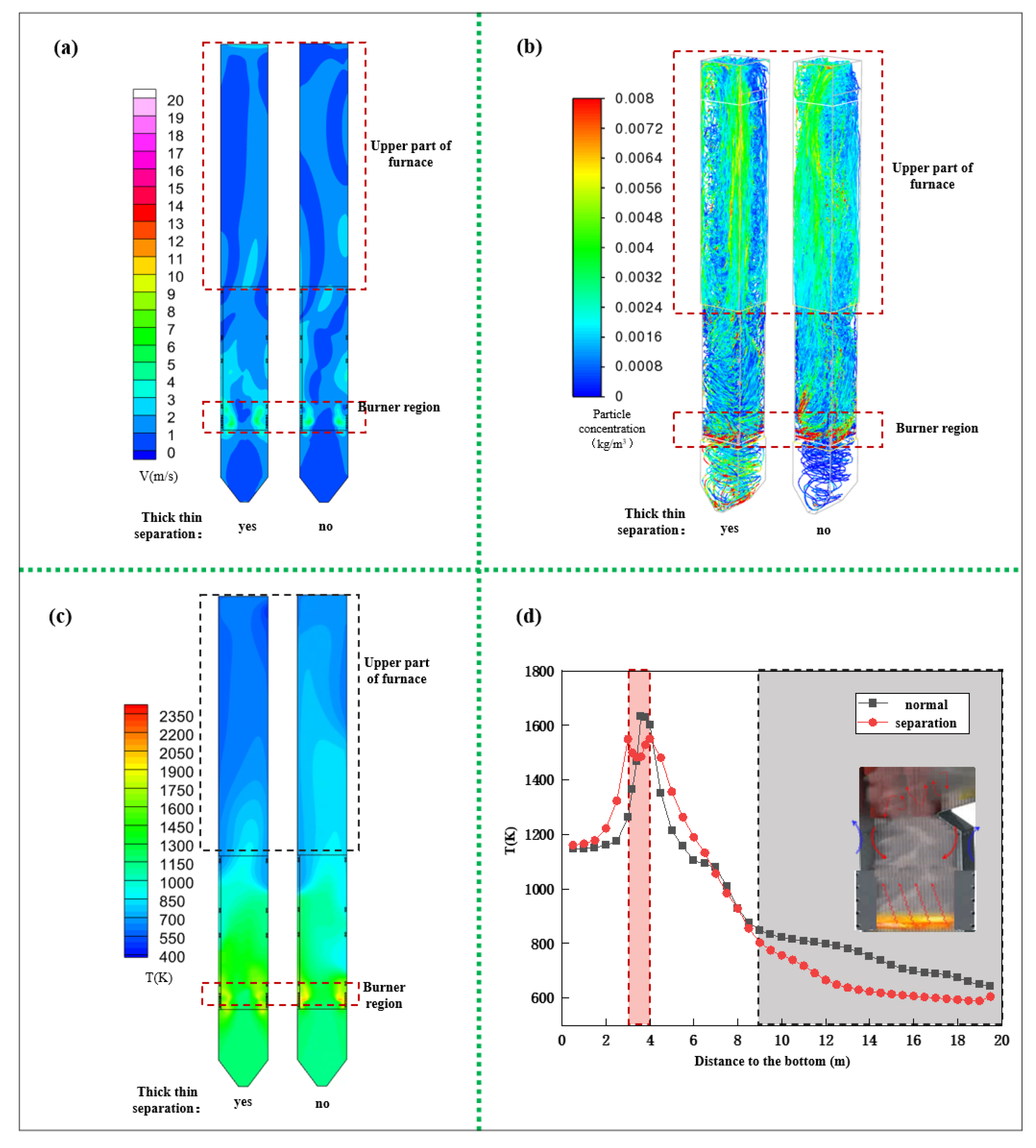
Thick–thin separation technology is critical for achieving high efficiency and stable combustion in pulverized coal boilers while preventing slagging and high-temperature corrosion. This section employs burner outlet parameters from previous studies—a dense–thin air ratio of 1.24 and a concentration factor of 1.752—as boundary conditions to assess the impact of concentration separation on boiler combustion characteristics. Figure 7a illustrates the flow fields in the furnace, both with and without concentration separation, under low-load conditions. Comparisons reveal minimal alteration in longitudinal flow fields, which remain unstable in both scenarios, with flue gas rising along the walls. This stable behavior indicates that concentration separation primarily modifies the horizontal distribution of pulverized coal without significantly affecting the longitudinal airflow dynamics. Observations in the burner area show that the boiler with concentration separation exhibits higher airflow fullness, effectively enhancing the mixing of coal and air, thereby improving pulverized coal combustion. This is consistent with the conclusion of “rich-lean separation can avoid pulverized coal wall aggregation and optimize temperature field distribution” found by Liu et al. [45] in the horizontal rich–lean burner retrofitting experiment. Figure 7b presents coal particle trajectories corresponding to both configurations under low load. Analysis indicates that the boiler with concentration separation has reduced particle concentrations at the burner wall compared to the boiler without separation. This effect results from the separation technology dividing pulverized coal streams into concentrated and lighter flows, allowing lighter flows to remain near the walls while directing concentrated flows toward the center of the furnace. However, due to low-load conditions, reduced momentum hampers airflow from maintaining a tangential state, leading to increased particle concentrations at the upper furnace walls. Observations of particle motion suggest that concentration separation technology enhances airflow dynamics to some extent, expanding the area displaying ‘swirl’ behavior and relegating the ‘non-swirl’ state primarily to the upper furnace. Figure 7c,d illustrates temperature distributions within the furnace under varying conditions. Quantitative indicators show that at the 1.5 m cross-section above the burner outlet, the standard deviation of gas temperature is 58 K for the boiler with rich–lean separation, significantly lower than the 92 K observed without separation, indicating a more uniform temperature distribution. The temperature contours indicate a more uniform distribution in the boiler with rich–lean separation than in one without it, suggesting that this technology positively influences flame structure and flow field distribution. Additionally, the absence of excessively high-temperature flue gas concentrated on a single side wall in the furnace with concentration separation promotes more even heating. However, examination of the burner area reveals fewer high-temperature regions above 1900 K in the boiler with concentration separation. Further analysis of average temperature distributions along the boiler height shows that regions between 2 and 6 m from the bottom of the boiler with rich–lean separation exhibit higher average temperatures than those lacking it, despite the maximum temperature being lower in the former. This phenomenon occurs because the separation technology divides pulverized coal into two streams, which facilitates the ignition of concentrated pulverized coal gas flows. While the lighter pulverized coal gas flow restricts the movement of pulverized coal particles, it simultaneously provides the oxygen necessary for combustion to the concentrated pulverized coal gas flow, thereby effectively enhancing the combustion intensity. Consequently, combusted pulverized coal is nearly entirely consumed near the burner area, resulting in a decrease in unburned particles in the upper boiler section [45]. Therefore, the average temperature near the burner area is higher, while the temperature in the upper part of the furnace is lower.

3.5. The Influence of Different Variable Load Rates on the Combustion-Heat Transfer Characteristics of the Boiler

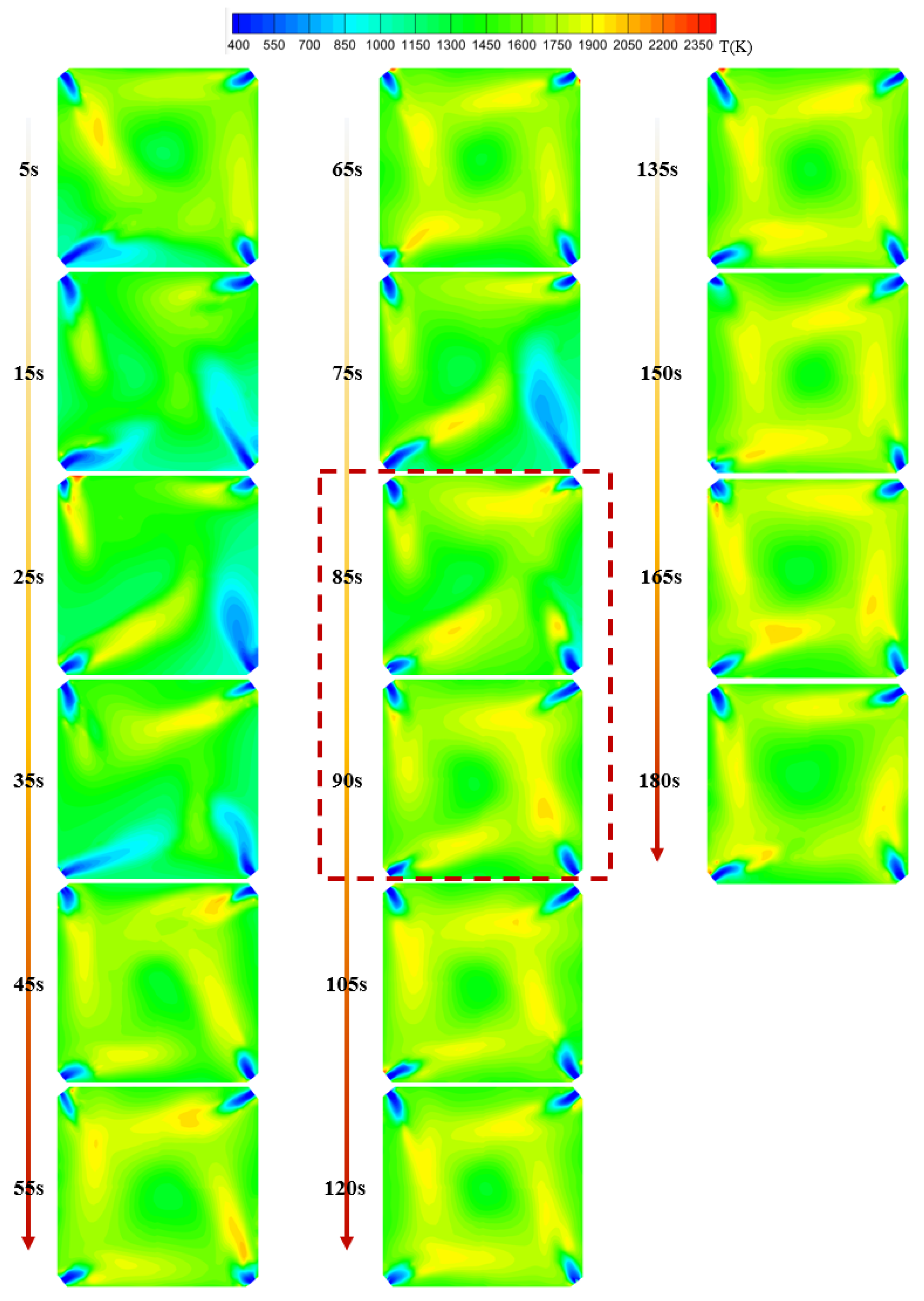
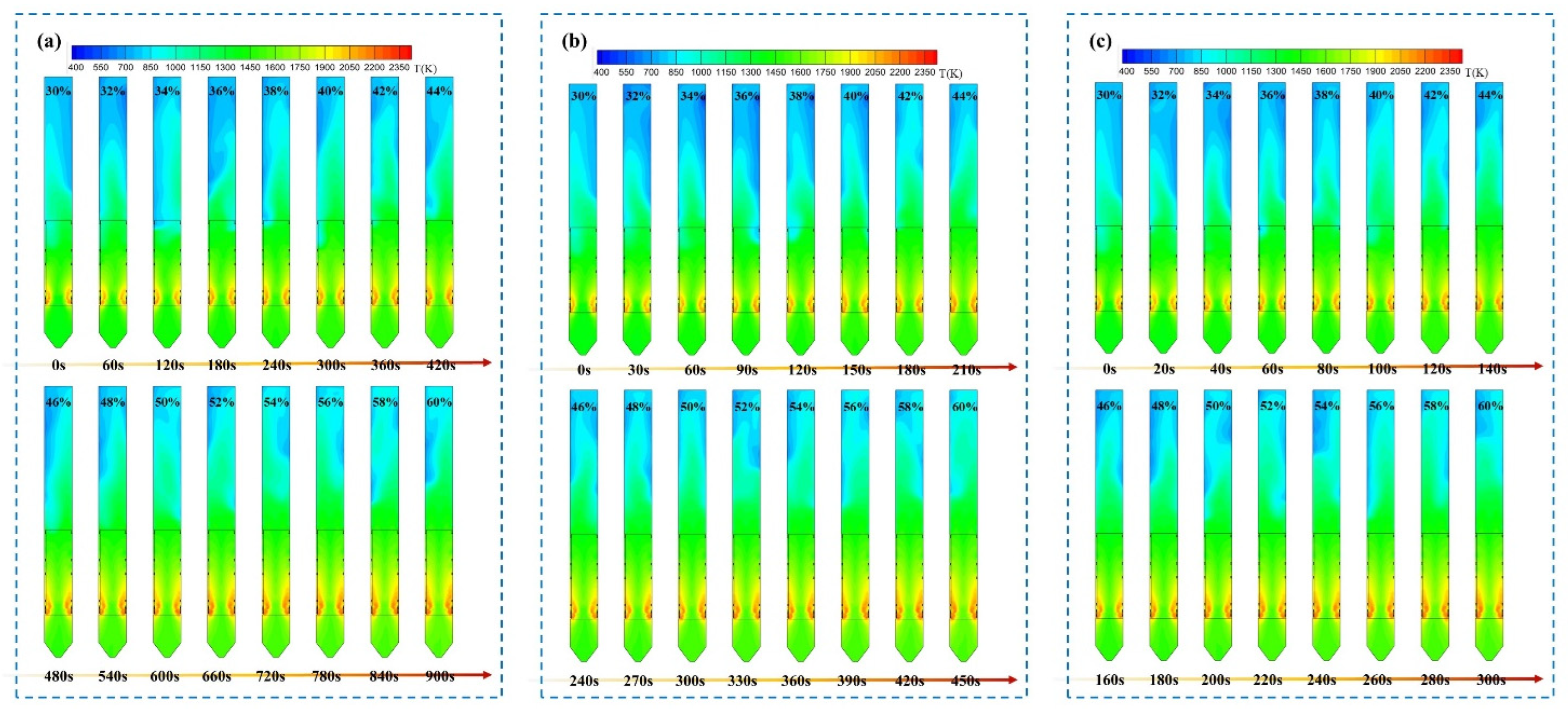
This section analyzes the variable load operation of the boiler at a 20% loading level, specifically focusing on a variable load rate of 2% Pe/min over a duration of three minutes. Figure 8 illustrates the temperature distribution over time at a height of 2.24 m under this 2% Pe/min variable load rate. The findings reveal that during the first 85 s, the pulverized coal flow in one section of the furnace fails to combust, indicating combustion instability during this period. The primary cause of this instability is the insufficient amount of coal at a 20% load, which results in inadequate heat generation from combustion. The excessively rapid variable load rate of 2% Pe/min contributes to delays in the adjustment of fuel and air volumes, leading to unbalanced air–fuel ratios and prompting combustion oscillations [46]. By 90 s, the tangential circulation in the furnace stabilizes, and the flame becomes steady as the increased boiler load elevates the furnace temperature, facilitating the ignition of pulverized coal and enhancing the air–fuel ratio. Consequently, a nonlinear control strategy is essential during the transition from low to high load: while operating within the very low range, the load regulation rate should be maintained below the rated variable load rate (Vref); as the load increases to mid to high ranges, the regulation rate may be dynamically increased to exceed Vref. Furthermore, the integral average of the regulation rate for each stage should be utilized to meet the overall rated variable load requirements, balancing thermal stress constraints with the need for timely adjustments. Given the unstable combustion observed at a 20% load, this section proceeds to examine variable load operations starting from a 30% load. Figure 9 presents temperature distributions over time under varying variable load rates. Comparing the combustion zone temperature distributions across three conditions reveals that variable load rates have minimal influence on combustion zone temperatures, with the burner zone flame remaining stable. However, the upper furnace temperature distribution shows a more uniform profile at a 2% Pe/min variable load rate compared to the irregular patterns seen at 4% and 6% Pe/min rates. The excessive variable load rates lead to unreasonable swirl intensities of secondary and burnout air within the furnace, undermining the maintenance of the ‘tangential circle’ state. Consequently, high-temperature flue gas intermittently erodes the left and right walls, posing significant operational safety risks. Moreover, the high-temperature area exceeding 1400 K for both the 4% Pe/min and 6% Pe/min load rates is smaller than that observed at lower rates. This observation suggests that combustion inefficiencies at elevated variable load rates reduce overall furnace temperatures and, consequently, lower the flue gas temperature at the tail.
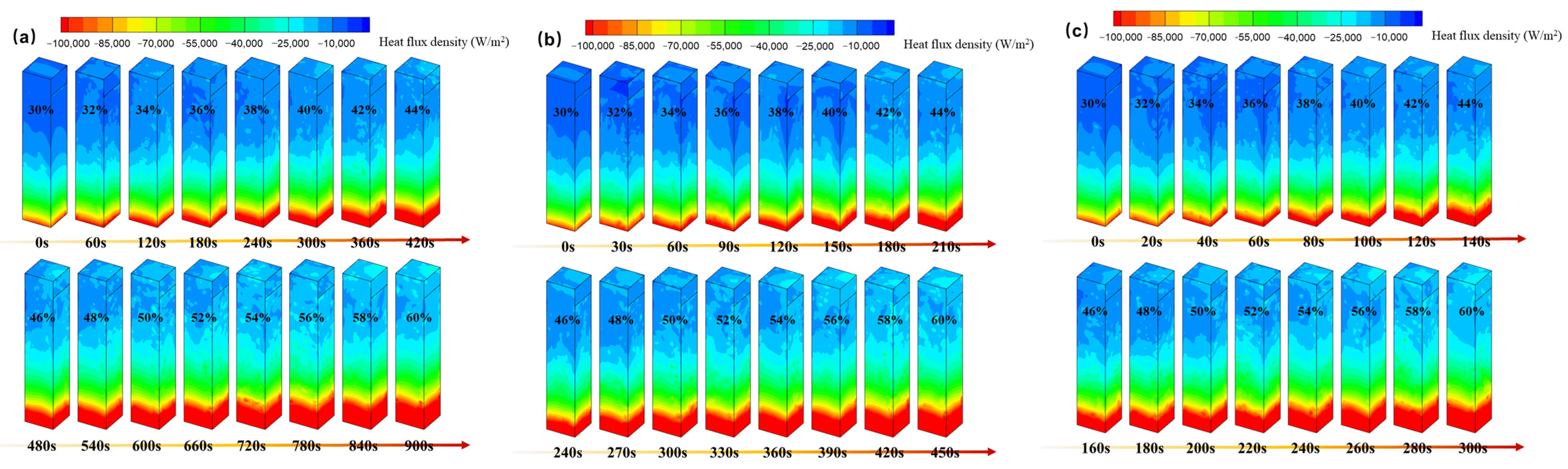
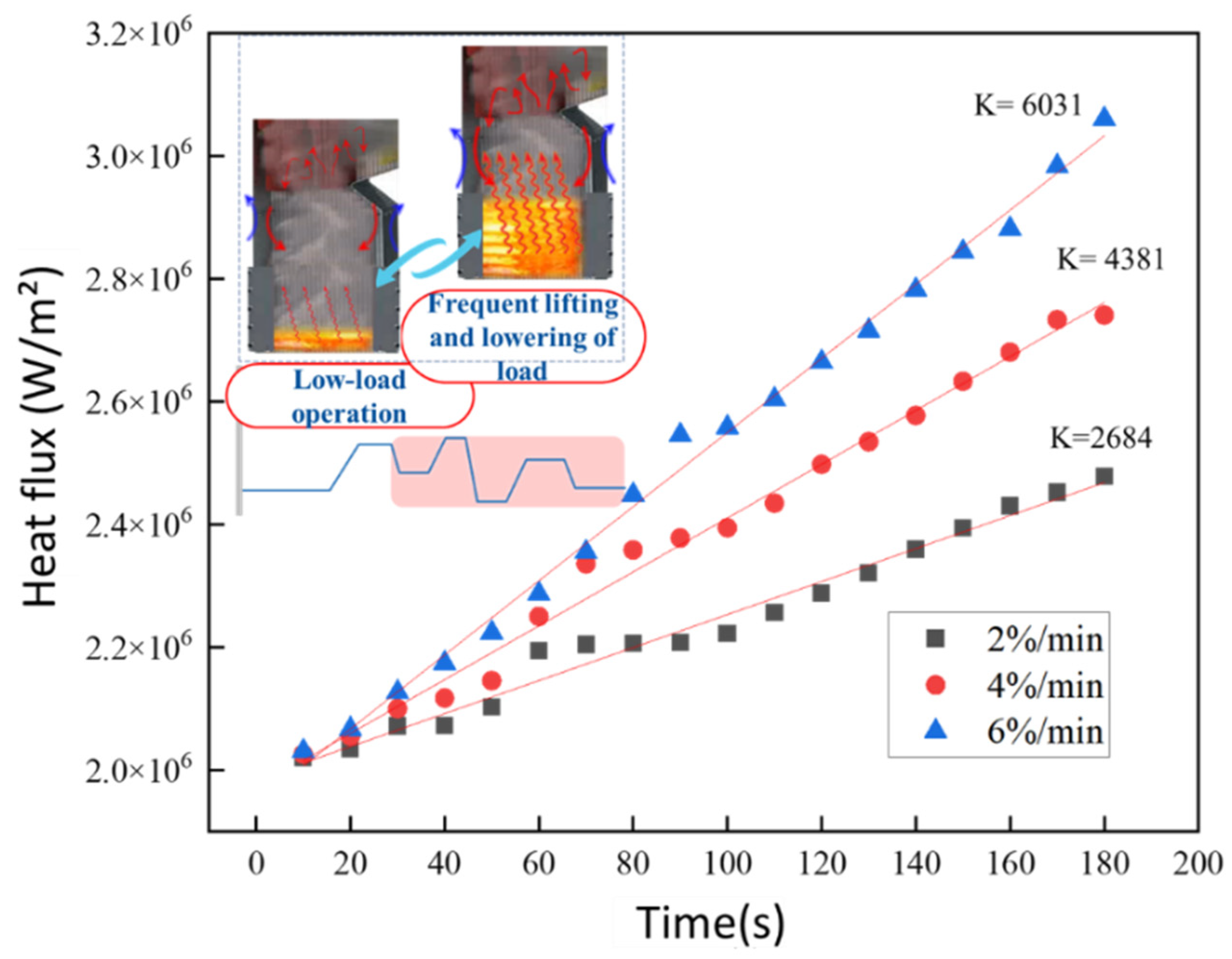
Several studies [17,18,19] have indicated that variable load operations in boilers are often associated with the phenomenon of wall “overtemperature.” This section focuses on the distribution of heat flux along the furnace wall, examining how varying load rates influence this distribution. Figure 10 portrays the trends of heat flux density in the furnace over time under different load rates. Observational data reveal that heat flux density increases from the bottom to the top of the furnace, exhibiting distributions characterized by “higher in the middle and lower at both ends” and “higher at one end and lower at the opposite end.” The emergence of these patterns is directly related to the dynamics of flue gas flow within the furnace. The scouring of the wall surface by flue gases elevates temperatures in these regions, thereby increasing heat flux density. As the variable load rate rises, the area with a heat flux density exceeding −100,000 W/m2 in the upper furnace expands. Figure 11 depicts total heat transfer variations over time under varying load rates. By analyzing the heat transfer data, the rates of change at different load rates were determined to be 2684 W/(m2·s), 4381 W/(m2·s), and 6031 W/(m2·s). The relationship between changes in heat transfer and variable load rates can be represented by the linear equation: y = 836x + 1018 (x: %Pe/min, y: W/(m2·s), R2 = 0.998).

3.6. Nonlinear Load-Control Strategy and Limitations

The transient CFD results explicitly reveal the coupling mechanism between the variable load rate, furnace combustion stability, and wall heat transfer characteristics, thereby providing a quantitative foundation for the proposed nonlinear load-control strategy. At ultra-low loads (20% load), the furnace temperature is relatively low (average temperature < 1100 K), and the tangential circulation of flue gas is weak. When the variable load rate exceeds 2%/min, the regulation of coal and air supply lags behind the load variation, leading to an unbalanced air–fuel ratio (local equivalence ratio: 0.65–0.85) and combustion oscillations (see Figure 8). At medium–high loads (40–60% load), furnace combustion is fully developed, and the flow field maintains excellent symmetry (Figure 5a). The adequate coal supply and air volume at medium–high loads enhance the turbulent intensity within the furnace, which facilitates the rapid mixing of pulverized coal and air while improving adaptability to load fluctuations. As highlighted in Section 3.5, a nonlinear load-control strategy is imperative during the transition from low to high loads.
It should be noted that the current numerical model has certain limitations: compared to large eddy simulation (LES), the realizable k–ε model based on Reynolds-averaged Navier–Stokes (RANS) equations cannot capture fine-scale turbulent structures; the P-1 radiation model simplifies directional radiation transfer; and only Shenhua bituminous coal is considered, with no verification conducted for other coal types. These limitations indicate that the research findings are most applicable to tangentially fired boilers equipped with horizontal bias burners and utilizing bituminous coal with similar properties. When applying the proposed nonlinear load-control strategy to other boiler types or coal varieties, it is necessary to modify the model parameters and validate the strategy through field tests to ensure operational safety and efficiency.

4. Conclusions

In order to solve the problem of combustion instability, asymmetric heat flux distribution, and an increased risk of water wall tube overheating due to thermal fatigue during deep peak shaving of boilers, this study employs high-fidelity transient Computational Fluid Dynamics (CFD) simulations based on a 10 MW tangentially fired test bench equipped with a horizontal bias burner. The primary objective is to explore the transient mechanisms of flow, combustion, and heat transfer under dynamic conditions, thereby providing foundational insights for safer and more efficient flexible operation.
(1)
Near the furnace outlet, heat flux density increases over time. While variable load rates of 2%/min, 4%/min, and 6%/min minimally affect the size of the high-heat-flux area, they significantly impact localized heat flux values. At 2%/min and 4%/min, heat flux is uniform along the upper wall, but at 6%/min, it becomes uneven, with higher density adjacent to the dense pulverized coal flow compared to the fresh coal flow side.
(2)
At 60% load, the flow field shows symmetry, and the flame has optimal fullness with a temperature of 1200 K spanning from the furnace bottom to the upper section. At 40% load, the upper flow field begins to distort, and by 20% load, the flow field becomes disordered, exhibiting uneven temperature distributions and reduced high-temperature flames above 1900 K. Increasing load results in higher particle concentrations near the burner wall and lower concentrations near the upper wall.
(3)
At 20% load, the flow field in furnace with single-layer burner is more stable than with two-layer burner. Particle concentrations near the boiler walls are lower, while concentrations in the cold ash hopper are higher. The high-temperature region is centrally concentrated, with fewer areas exceeding 1900 K. Single-layer burners show lower average temperature peaks near 3 m from the furnace bottom. Boilers with rich–lean separation improve airflow fullness and achieve a more uniform temperature distribution, reducing wall particle concentrations. For the 20% low-load condition, the combined configuration of the two-layer burner and rich–lean separation is recommended.
(4)
A nonlinear control strategy is necessary as the load transitions from low to high. In extremely low operating ranges, load regulation rates should remain below the rated variable load rate (Vref), while they can be increased beyond Vref in medium–high ranges. Integral averaging of these regulation rates ensures compliance with rated variable load requirements while managing thermal stress.

Supplementary Materials

The following supporting information can be downloaded at: https://www.mdpi.com/article/10.3390/en19020478/s1, File S1. Numerical Model Details

Author Contributions

Conceptualization, D.F.; methodology, Y.W. (Yi Wang) and Z.Z.; software, C.L.; validation, D.F. and S.S.; investigation, X.G.; resources, Y.Z.; data curation, Y.W. (Yongjie Wang); writing—original draft preparation, C.L.; writing—review and editing, Z.Z.; visualization, Y.Z. and C.L.; supervision, Y.W. (Yongjie Wang); project administration, S.S.; funding acquisition, Y.W. (Yi Wang) All authors have read and agreed to the published version of the manuscript.

Funding

This work is supported by the National Key R&D Program of China (2022YFB4100600).

Data Availability Statement

Dataset available on request from the authors.

Conflicts of Interest

Authors Yongjie Wang and Xin Guo were employed by Harbin Boiler Factory Co., Ltd. The remaining authors declare that the research was conducted in the absence of any commercial or financial relationships that could be construed as a potential conflict of interest.

Nomenclature

A1Pre-exponential factors of devolatilization at low temperature (s−1)
A2Pre-exponential factors of devolatilization at high temperature (s−1)
E1Activation energy of devolatilization at low temperature (J/kmol)
E2Activation energy of devolatilization at high temperature (J/kmol)
MarMoisture, as received (wt.%)
AarAsh, as received (wt.%)
VarVolatile matter, as received (wt.%)
FCarFixed carbon, as received (wt.%)
CarCarbon, as received (wt.%)
HarHydrogen, as received (wt.%)
OarOxygen, as received (wt.%)
NarNitrogen, as received (wt.%)
St,arTotal sulfur, as received (wt.%)
Qnet,arNet calorific value, as received (MJ·kg−1)
tTime (s)
TTemperature (K)
vGas velocity (m/s)
Abbreviations
MCRMaximum continuous rating
SOFASeparated overfire air
PAPrimary air
SASecondary air
VrefVelocity reference

References

  1. Decastro, M.; Salvador, S.; Gómez-Gesteira, M.; Costoya, X.; Carvalho, D.; Sanz-Larruga, F.; Gimeno, L. Europe, China and the United States: Three different approaches to the development of offshore wind energy. Renew. Sustain. Energy Rev. 2019, 109, 55–70. [Google Scholar] [CrossRef]
  2. Guo, J.; Li, R.; Cai, P.; Xiao, Z.; Fu, H.; Guo, T.; Wang, T.; Zhang, X.; Wang, J.; Song, X. Risk in solar energy: Spatio-temporal instability and extreme low-light events in China. Appl. Energy 2024, 359, 122749. [Google Scholar] [CrossRef]
  3. The National Energy Administration Released the National Power Industry Statistics from January to July. China Electr. Power News, 21 August 2023. (In Chinese)
  4. Ouyang, T.; Qin, P.; Tan, X.; Wang, J.; Fan, J. A novel peak shaving framework for coal-fired power plant in isolated microgrids: Combined flexible energy storage and waste heat recovery. J. Clean. Prod. 2022, 374, 133936. [Google Scholar] [CrossRef]
  5. Li, J.; Ho, M.S.; Xie, C.; Stern, N. China’s flexibility challenge in achieving carbon neutrality by 2060. Renew. Sustain. Energy Rev. 2022, 158, 112112. [Google Scholar] [CrossRef]
  6. Zhou, J.; Liu, X.; Zhang, H. Control characteristic analysis of typical coal-fired boilers during low load or variable load running. Therm. Power Gener. 2018, 47, 34–40. [Google Scholar] [CrossRef]
  7. Yu, W.; Yang, P.; Wang, F.; Li, Q.; Zhao, G.; Ma, J.; Ma, S. Research and challenge of coal power technology development in china under the background of dual carbon strategy. J. China Coal Soc. 2023, 48, 2641−2656. [Google Scholar] [CrossRef]
  8. Li, S.; Chen, Z.; He, E.; Jiang, B.; Li, Z.; Wang, Q. Combustion characteristics and NOx formation of a retrofitted low-volatile coal-fired 330 MW utility boiler under various loads with deep-air-staging. Appl. Therm. Eng. 2017, 110, 223–233. [Google Scholar] [CrossRef]
  9. Ma, D.; Zhang, S.; He, X.; Zhang, J.; Ding, X. Combustion stability and NOx emission characteristics of a 300 MWe tangentially fired boiler under ultra-low loads with deep-air staging. Energy 2023, 269, 126795. [Google Scholar] [CrossRef]
  10. Ma, D.; Zhang, S.; He, X.; Tao, L.; Shi, H.; Chen, D. Technical problems occurring in ultra-low load operation of pulverized coal-fired boilers and the solutions. J. Chin. Soc. Power Eng. 2019, 39, 10. [Google Scholar]
  11. Zhao, F.; Li, S.; Ren, Y.; Yao, Q.; Yuan, Y. Investigation of mechanisms in plasma-assisted ignition of dispersed coal particle streams. Fuel 2016, 186, 518–524. [Google Scholar] [CrossRef]
  12. Chen, Z.; Wang, Q.; Wang, B.; Zeng, L.; Che, M.; Zhang, X.; Li, Z. Anthracite combustion characteristics and NOx formation of a 300 MWe down-fired boiler with swirl burners at different loads after the implementation of a new combustion system. Appl. Energy 2017, 189, 133–141. [Google Scholar] [CrossRef]
  13. Ma, D.F.; Zhang, S.Y.; He, X.; Tao, L.; Shi, H.F.; Chen, R.Y. Technical problems and countermeasures for ultra-low load operation of pulverized coal boilers. J. Power Eng. 2019, 39, 784–791+803. (In Chinese) [Google Scholar]
  14. Liu, G.; Li, Z.; Chen, Z.; Zhu, X.; Zhu, Q. Effect of the anthracite ratio of blended coals on the combustion and NOx emission characteristics of a retrofitted down-fired 660-MWe utility boiler. Appl. Energy 2012, 95, 196–201. [Google Scholar] [CrossRef]
  15. Du, H.; Li, Z.; Liu, Z.; Zhang, M.; Huang, C.; Jiang, G.; Chen, Z.; Song, J.; Fang, F.; Su, J.; et al. Industrial measurement of combustion and NOx formation characteristics on a low-grade coal-fired 600MWe FW down-fired boiler retrofitted with novel low-load stable combustion technology. Fuel 2022, 321, 123926. [Google Scholar] [CrossRef]
  16. Ouyang, Z.; Wang, H.; Lyu, Q.; Zhu, S.; Zeng, X.; Su, K. Research Progress on Deep Peak Shaving Technology of Pulverized Coal-fired Boiler Power Unit. Proc. CSEE 2023, 43, 8772–8790. [Google Scholar] [CrossRef]
  17. Liang, B. Cause analysis on transversal cracks formation of water wall tubes in a boiler. Phys. Test. Chem. Anal. Part A Phys. Test. 2018, 54, 536–539. [Google Scholar] [CrossRef]
  18. Shen, K.; Cai, W.; Du, S.; Dong, S.; Gao, D.; Yang, Z.; Li, J. Cause analysis and treatment measures of water cooling wall pipe leakage in a power station boiler. Corros. Prot. 2022, 43, 62–67. [Google Scholar] [CrossRef]
  19. Liu, W. Analysis and research on transverse cracks in high temperature corrosion zone of boiler water wall. Technol. Innov. Appl. 2021, 11, 56–58. [Google Scholar] [CrossRef]
  20. Kong, C.; Zhao, B.; Liu, J.; Yang, X.; Huang, J.; Tian, S.; Zhong, Z.; Fu, Q. Study of NOx reduction during the adjustment of boiler combustion. Power Syst. Eng. 2015, 31, 41–43+6. [Google Scholar]
  21. Du, J.; Wang, C.; Lu, X.; An, G.; Yan, H.; Ma, H.; Yan, X. Combustion Adjustment in Initial Startup Stage of 660MW Supercritical Fossil Power Unit. J. Phys. Conf. Ser. IOP Publ. 2021, 1732, 012113. [Google Scholar] [CrossRef]
  22. Wang, W.; Liu, J.; Zeng, D.; Fang, F.; Niu, Y. Modeling and flexible load control of combined heat and power units. Appl. Therm. Eng. 2020, 166, 114624. [Google Scholar] [CrossRef]
  23. Wang, Z.; Liu, M.; Yan, H.; Yan, J. Optimization on coordinate control strategy assisted by high-pressure extraction steam throttling to achieve flexible and efficient operation of thermal power plants. Energy 2022, 244, 122676. [Google Scholar] [CrossRef]
  24. Huang, C.; Li, Z.; Lu, Y.; Chen, Z.; Liu, H.; Kang, Y.; Wei, W. Research on a novel universal low–load stable combustion technology. Energy 2024, 310, 133223. [Google Scholar] [CrossRef]
  25. Song, M.; Huang, Q.; Niu, F.; Li, S. Recirculating structures and combustion characteristics in a reverse-jet swirl pulverized coal burner. Fuel 2020, 270, 117456. [Google Scholar] [CrossRef]
  26. Zhao, H.; Li, W.; Zhang, J.; Ding, X.; Kang, Z. Retrofit and application of pulverized coal burners with LNG and oxygen ignition in utility boiler under ultra-low load operation. Heliyon 2024, 10, e29154. [Google Scholar] [CrossRef]
  27. Tang, H.; Yao, G.; Wang, Z.; Yang, J.; Han, X.; Sun, L.; Xu, Z. Study on low-load combustion characteristics of a 600 MW power plant boiler with self-sustaining internal combustion burners. Appl. Therm. Eng. 2025, 267, 125859. [Google Scholar] [CrossRef]
  28. Zhu, S.; Zhou, H.; Li, Z.; Zeng, X.; Ouyang, Z.; Hui, J.; Lin, J.; Su, K.; Wang, H.; Ding, H.; et al. Wide-load combustion characteristics of lean coal tangential preheating combustion. Energy 2025, 323, 135845. [Google Scholar] [CrossRef]
  29. Gong, G.X. Contrastive research of two kinds of bias burners in 360t/h coal-fired boiler. Power Syst. Eng. 2011, 27, 17–19. [Google Scholar] [CrossRef]
  30. Wang, Z.; Sun, S.; Qian, L.; Meng, S.; Tan, Y. Numerical Study on the Stereo-Staged Combustion Properties of a 600 MWe Tangentially Fired Boiler; Cleaner Combustion and Sustainable World; Springer: Berlin/Heidelberg, Germany, 2013; pp. 1109–1120. [Google Scholar]
  31. Wang, Z.; Sun, S.; Zhao, N.; Wu, S.; Tan, Y. Numerical Simulation of the Gas-Solid Flow in a Square Circulating Fluidized Bed with Secondary Air Injection; Cleaner Combustion and Sustainable World; Springer: Berlin/Heidelberg, Germany, 2013; pp. 539–552. [Google Scholar]
  32. Zhang, L.B.; Jia, G.; Zhai, S.B.; Pang, Z.Z. MW-level experimental study on combustion characteristics of anthracite and bituminous coal mixed fuel. Boil. Manuf. 2023, 5, 15–17+35. (In Chinese) [Google Scholar]
  33. Gu, W.L.; Sun, S.Z.; Wang, J.J.; Zhai, S.B.; Xu, Y.H.; Wang, M.H.; Song, X.; Yan, Y.F. Experimental study on the coupling combustion of biomass particles and pulverized coal. Boil. Manuf. 2021, 3, 8–10+21. (In Chinese) [Google Scholar]
  34. Zheng, H.; Wei, G.; Song, M.; Diao, Y.; Wang, J.; Yu, Q.; Shen, T. Experimental study on combustion performance of a novel central fuel-rich direct current pulverized-coal burner. Proc. CSEE 2023, 43, 7530–7538. [Google Scholar] [CrossRef]
  35. Zeng, G.; Sun, S.; Yang, X.; Zhao, Y.; Zhao, Z.; Ye, Z.; Gao, J. Effect of the primary air velocity on ignition characteristics of bias pulverized coal jets. Energy Fuels 2017, 31, 3182–3195. [Google Scholar] [CrossRef]
  36. Huang, J.; Liao, Y.; Lin, J.; Dou, C.; Huang, Z.; Yu, X.; Yu, Z.; Chen, C.; Ma, X. Numerical simulation of the co-firing of pulverized coal and eucalyptus wood in a 1000MWth opposed wall-fired boiler. Energy 2024, 298, 131306. [Google Scholar] [CrossRef]
  37. You, C.F.; Qi, H.Y.; Xu, X.C.; Baudoin, B. Numerical simulation of flow field in tangentially fired boiler using different turbulence models and discretization schemes. J. Chin. Soc. Power Eng. 2001, 02, 1128–1131. [Google Scholar]
  38. Khan, A.; Irfan, M.; Niazi, U.M.; Shah, I.; Legutko, S.; Rahman, S.; Alwadie, A.S.; Jalalah, M.; Glowacz, A.; Khan, M.K.A. Centrifugal Compressor Stall Control by the Application of Engineered Surface Roughness on Diffuser Shroud Using Numerical Simulations. Materials 2021, 14, 2033. [Google Scholar] [CrossRef]
  39. Benim, A.C.; Canal, C.D.; Boke, Y.E. Computational investigation of oxy-combustion of pulverized coal and biomass in a swirl burner. Energy 2022, 238, 121852. [Google Scholar] [CrossRef]
  40. Fan, Y.; Zhang, F.; Wang, Y.; Wang, L.; Liu, J.; Tan, H.; Xu, X.; Wang, X. Numerical simulation on the influence of secondary air ratio and swirling intensity on the performance of a pre-combustion low nitrogen swirl burner. Clean Coal Technol. 2022, 28, 69–78. [Google Scholar]
  41. Wei, D.; Wu, L.; Wang, T.; Sun, B. Numerical simulation of ammonia combustion with sludge and coal in a utility boiler: Influence of ammonia distribution. J. Energy Inst. 2023, 111, 101409. [Google Scholar] [CrossRef]
  42. Field, M.A. Rate of combustion of size-graded fractions of char from a low-rank coal between 1 200 K and 2 000 K. Combust. Flame 1969, 13, 237–252. [Google Scholar] [CrossRef]
  43. Gao, H. Research on flexible load variation control strategy for 600 MW coal-fired power unit. Northeast. Power Technol. 2025, 3, 17–22. [Google Scholar]
  44. Liu, P.; Liu, Z.; Miao, P.; Zheng, X.; Xing, W.; Jia, N. Investigation on on-off characteristic of 80 MW pulverized coal industrial water boiler. J. China Coal Soc. 2024, 49, 4627−4633. [Google Scholar] [CrossRef]
  45. Liu, C.L. Prevention of slagging in boilers and retrofitting horizontal rich/lean burners thereof. Therm. Power Gener. 2005, 34, 63–65. [Google Scholar] [CrossRef]
  46. Li, X.; Duan, L.; Ji, R.; Niu, F. Research progress of peaking technology for flexibility modification ofpulverized coal boiler combustion system. Coal Qual. Technol. 2024, 39, 1–13. [Google Scholar] [CrossRef]
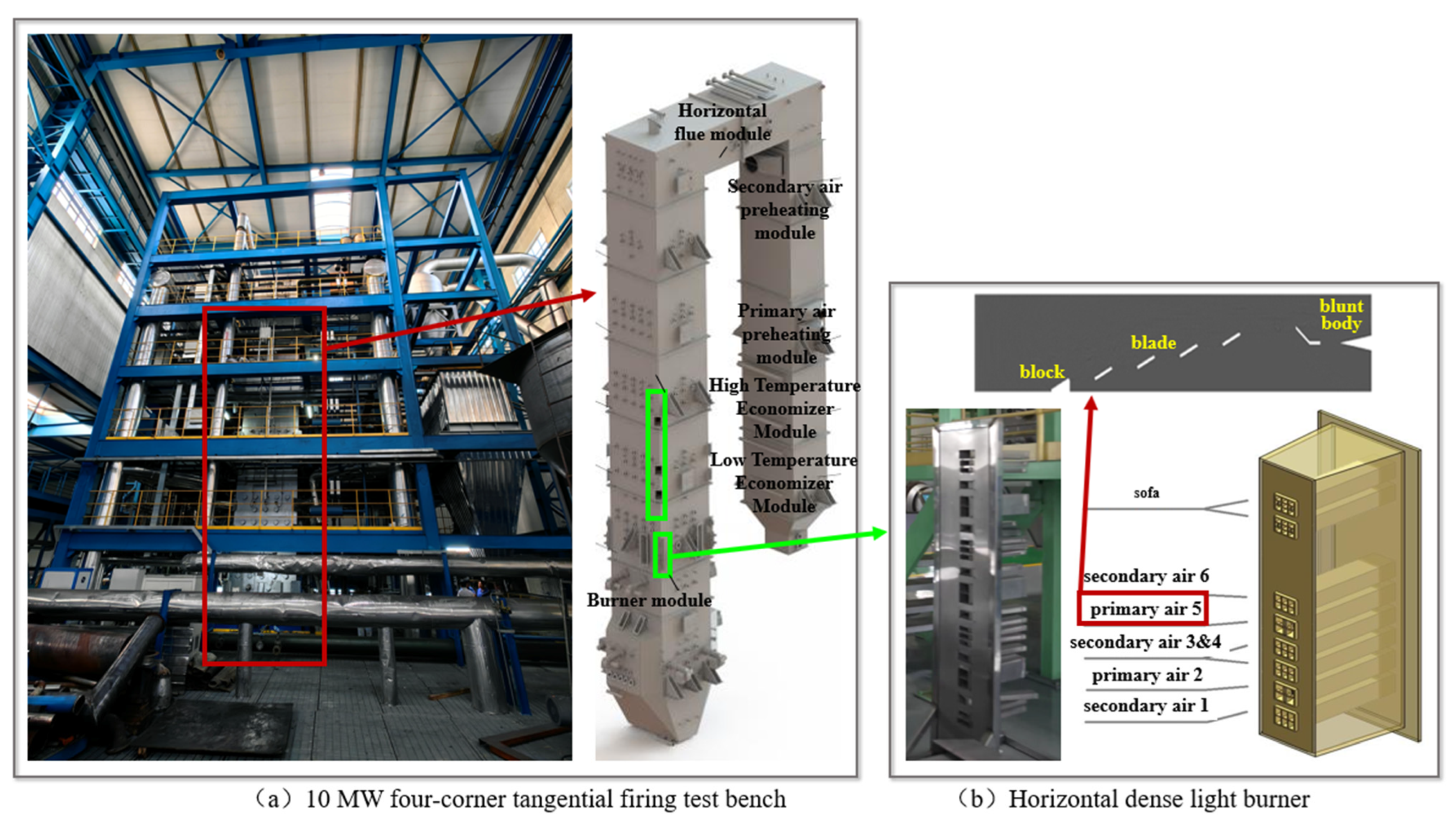
Figure 1. Simulation object structure diagram.
Energies 19 00478 g001
Figure 2. Simulation object structure and grid.
Energies 19 00478 g002
Figure 3. Grid independence verification.
Energies 19 00478 g003
Figure 4. Distribution of heat flux density on furnace wall with time under different variable load rates.
Energies 19 00478 g004
Figure 5. Under different loads, (a) the flow field, (b) the coal particle trajectories colored according to particle concentration, (c) the temperature distribution, and (d) the temperature variation curve along the furnace height (Light red area: burner region; Grey area: upper part of furnace).
Energies 19 00478 g005
Figure 6. With different burner opening layers under low load, (a) the flow field, (b) the coal particle trajectories colored according to particle concentration, (c) the temperature distribution, and (d) the temperature variation curve along the furnace height (Light red area: burner region; Grey area: upper part of furnace).
Energies 19 00478 g006
Figure 7. With and without concentration separation under low load, (a) the flow field, (b) the coal particle trajectories colored according to particle concentration, (c) the temperature distribution, and (d) the temperature variation curve along the furnace height (Light red area: burner region; Grey area: upper part of furnace).
Energies 19 00478 g007
Figure 8. The temperature distribution at 2.24 m with time at 2% Pe/min variable load rate based on 20% load.
Energies 19 00478 g008
Figure 9. Based on the 30% load, the distribution of temperature in the furnace with time under different variable load rates is analyzed. (a) 2% Pe/min, (b) 4% Pe/min, (c) 6% Pe/min.
Energies 19 00478 g009
Figure 10. Based on the 30% load, the distribution of heat flux density in the furnace with time under different variable load rates is analyzed. (a) 2% Pe/min, (b) 4% Pe/min, (c) 6% Pe/min.
Energies 19 00478 g010
Figure 11. The change in total heat transfer with time under different variable load rates.
Energies 19 00478 g011
Table 1. Proximate analysis, ultimate analysis, and calorific value of Shenhua bituminous coal.
ItemProximate Analysis/(wt.%)Ultimate Analysis/(wt.%)Calorific Value/(MJ·kg−1)
MarAarVarFCarCarHarOarNarSt,arQnet,ar
Shenhua bituminous coal9.366.4828.1156.0569.833.949.080.910.4026.42
Table 2. Working condition parameters under different loads.
ItemUnitLoad
60%MCR40%MCR20%MCR
Coal mass flow ratekg/s0.1890.1260.063
Total air mass flow ratekg/s2.041.360.68
Primary mass flow ratekg/s0.4680.3120.156
Secondary mass flow ratekg/s1.2240.8160.408
Overfire air mass flow ratekg/s0.3480.2320.116
Primary air temperatureK368368368
Secondary air temperatureK573573573
Burnout air temperatureK573573573
Particle diameterμm5.83~2305.83~2305.83~230
Table 3. Particle size distribution of fuel Shenhua bituminous coal.
Particle Diameter (μm)>5>10>20>30>50>90>160>200>230
Mass Fraction (%)97.089.274.562.142.318.73.21.20.4
Table 4. The average mass fractions of CO and O2 in horizontal sections at different heights under different loads.
LoadMass Fraction of COMass Fraction of O2
SA-Air6
(3.71 m)
PA-Air4
(3.61 m)
PA-Air2
(3.31 m)
SA-Air6
(3.71 m)
PA-Air4
(3.61 m)
PA-Air2
(3.31 m)
60%MCR0.0028570.0029380.0025450.036180.041360.06150
40%MCR0.0027920.0032050.0025300.033120.039150.06301
20%MCR0.0027750.0044460.0022510.025840.030670.07350
Disclaimer/Publisher’s Note: The statements, opinions and data contained in all publications are solely those of the individual author(s) and contributor(s) and not of MDPI and/or the editor(s). MDPI and/or the editor(s) disclaim responsibility for any injury to people or property resulting from any ideas, methods, instructions or products referred to in the content.