Article

Adaptive PID Control Based on Laplace Distribution for Multi-Environment Temperature Regulation in Smart Refrigeration Systems

Department of Architectural Engineering, Daejin University, Pocheon 11159, Republic of Korea
Energies 2026, 19(2), 477; https://doi.org/10.3390/en19020477 (registering DOI)
Submission received: 14 November 2025 / Revised: 12 January 2026 / Accepted: 16 January 2026 / Published: 18 January 2026

Abstract

This study presents an Adaptive PID controller designed to enhance temperature stability and energy performance in household refrigerator systems subject to non-stationary disturbances. Classical PID control is limited by fixed gains and the assumption of linear time-invariant dynamics, which is frequently violated by door opening, load variation, and compressor cycling. To address this issue, the proposed approach introduces a Laplace-distribution-based adaptive gain function L(t) that adjusts controller sensitivity according to the statistical rarity of the composite temperature error. The method preserves the conventional PID control structure while introducing a lightweight gain-scaling mechanism suitable for embedded implementation. Experimental validation using a commercial two-compartment refrigerator demonstrated substantial improvements in performance compared with a classical PID controller. The Adaptive PID achieved reduced temperature deviations in both compartments, significantly smoother compressor and fan actuation, and a 4.6% reduction in total energy consumption under an identical disturbance schedule. These results confirm that the proposed controller provides a practical, embedded-friendly solution that improves thermal regulation, actuator longevity, and energy efficiency under the tested disturbance schedule representative of typical household usage.

1. Introduction

Domestic refrigeration systems operate in dynamic and highly uncertain environments due to frequent user interactions, door openings, food loading, and fluctuations in ambient temperature. These factors introduce non-stationary characteristics into the thermal response of the refrigerator, challenging the assumptions traditionally made in classical control design. Conventional proportional–integral–derivative (PID) controllers remain widely used in industry because of their simplicity, transparency, and cost-effectiveness [1,2,3]. However, classical PID techniques fundamentally rely on the assumption that the underlying plant behaves as a linear time-invariant (LTI) system, requiring the present system dynamics to remain nearly identical to those of the past. In real-world refrigeration systems, this assumption rarely holds, resulting in degraded performance such as slow recovery after disturbances, increased steady-state error, and unnecessary energy consumption [4,5,6]. To overcome the limitations of fixed-gain PID control, numerous studies have explored adaptive and intelligent control strategies. Gain scheduling approaches have been used to adjust PID gains across predefined operating regions [7,8], but these require explicit regime classification and careful tuning. Model predictive control (MPC) has demonstrated strong performance in HVAC and refrigeration applications [9,10,11], yet the high computational cost and requirement of accurate thermal models limit its applicability in low-power embedded environments. Fuzzy logic and neural network–based controllers have also been proposed for nonlinear temperature regulation [12,13,14,15], but their opacity and training complexity tend to hinder industrial adoption, especially in safety-critical appliances. Adaptive PID methodologies have gained increasing attention as a compromise between classical PID simplicity and intelligent control adaptability. Self-tuning regulators [16], auto-tuned Ziegler–Nichols variants [17], and model-reference adaptive PID frameworks [18,19] attempt to adjust controller gains based on real-time process feedback. However, these techniques often require complex estimation of plant parameters, additional computational resources, or persistent excitation conditions, making them unsuitable for consumer-grade refrigeration systems. In parallel, several studies have employed probabilistic and statistical learning methods to characterize thermal uncertainties. Kernel density estimation (KDE) and parametric modeling have been utilized to estimate error distributions in nonlinear processes [20,21,22]. Laplace and heavy-tailed distributions have been shown to effectively model sharp changes in system behavior, capturing deviations caused by rare but impactful disturbances [23,24]. These findings suggest that probabilistic modeling can provide a meaningful foundation for designing adaptive control mechanisms that respond automatically to shifts in system dynamics. Motivated by these insights, this study introduces a Laplace inverse-density-based Adaptive PID controller that maintains classical PID structure while incorporating probabilistic adaptability. Although adaptive PID control has been extensively studied, most existing approaches rely on either rule-based gain scheduling, model-dependent parameter adaptation, or learning-based tuning mechanisms that require explicit regime classification, system identification, or significant computational resources. In contrast, the proposed approach introduces a fundamentally different adaptation principle by directly linking gain modulation to the statistical rarity of the instantaneous control error.
The key novelty of this work lies in the use of a probabilistic inverse-density-inspired scaling mechanism derived from the Laplace distribution, which enables continuous and automatic gain adaptation without explicit mode switching, plant modeling, or online optimization. Unlike conventional adaptive PID schemes, the proposed controller requires only a single scalar parameter and a lightweight exponential computation, making it particularly suitable for low-power embedded refrigeration controllers. This probabilistic formulation allows the controller to seamlessly blend aggressive disturbance rejection and smooth steady-state behavior within a unified PID structure, which, to the best of the authors’ knowledge, has not been explicitly addressed in prior adaptive PID designs for household refrigeration systems. The key idea is to treat the instantaneous control error as a stochastic variable and dynamically adjust the PID gains using a scaling function derived from the inverse Laplace probability density. When the system operates in a steady regime, the error distribution remains compact, producing smooth and energy-efficient responses. Conversely, during abrupt disturbances—such as door openings—the error falls into the low-probability region of the distribution, causing the adaptive gain L(t) to increase and thereby improving responsiveness. This approach effectively allows the controller to behave as though multiple PID controllers are merged into a unified adaptive formulation, without requiring explicit regime detection, parameter estimation, or complex learning algorithms.
The main contributions of this work are as follows:
(i)
A new probabilistic adaptive PID framework that leverages the inverse Laplace density for dynamic gain modulation without explicit model identification.
(ii)
A theoretical formulation for L(t) and a detailed explanation of how the scale parameter b governs the trade-off between control responsiveness and energy consumption.
(iii)
Experimental validation on a real refrigerator system, demonstrating improved temperature stability, reduced overshoot, and approximately 4–5% energy savings compared to classical PID and a commercial embedded controller.
(iv)
A practical design suitable for low-power embedded controllers, enabling easy integration into existing home appliance architectures.
Through these contributions, the proposed controller bridges the gap between robust classical PID implementations and modern adaptive control demands, offering a mathematically interpretable and computationally efficient solution for non-stationary thermal environments.

2. Methodology

2.1. System Description

The experimental platform used in this study is a high-capacity, dual-compartment household refrigerator equipped with separate fresh-food and freezer sections (Figure 1). Although the two compartments are thermally insulated, they share internal ducts and airflow passages, resulting in partially coupled thermal dynamics. The fresh-food compartment is designed to maintain temperatures around 4 °C, whereas the freezer compartment operates near –18 °C, providing two distinct control environments with different thermal loads and dynamic behaviors. All experiments were conducted under controlled conditions with the doors kept closed unless otherwise specified.
The refrigerator operates using a vapor-compression refrigeration cycle consisting of a linear compressor, a no-frost evaporator, a wire-and-tube condenser, and a capillary-tube–suction-line heat exchanger. Cold air generated in the freezer compartment is distributed to both chambers through a single-speed centrifugal fan and multi-airflow ducts. The fan runs continuously whenever the compressor is active. Temperature regulation is managed by an electronic control unit that coordinates the compressor, fan, and a motorized damper. While the compressor is primarily driven by the freezer temperature, the damper modulates the amount of cooled air supplied to the fresh-food compartment, thereby enabling independent temperature regulation in both chambers. For the purpose of performance evaluation, a multi-point array of thermocouples was installed across shelves and airflow pathways to capture spatial and temporal variations in temperature during operation.
A detailed overview of the refrigerator’s functional specifications and relevant subsystems is summarized in Table 1.

2.2. Experimental Setup

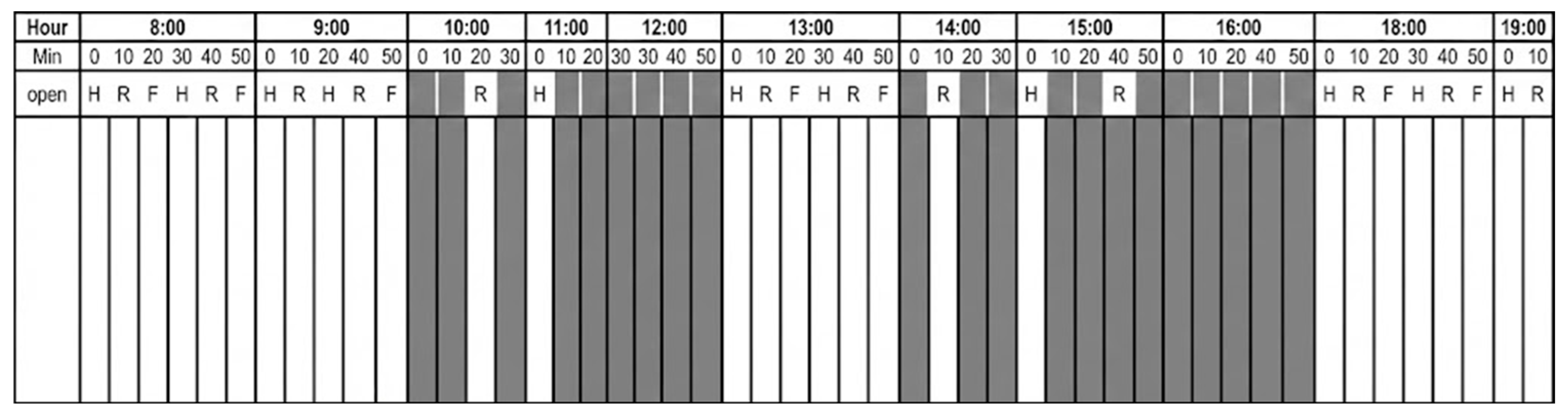
To ensure a fair and reproducible comparison among the baseline controller, classical PID, and the proposed adaptive PID algorithm, a predefined disturbance schedule was applied during the experiment. As illustrated in Figure 2, a structured sequence of refrigerator-door (H) and freezer-door (R) openings was introduced at 10 min intervals from 08:00 to 19:10. This pattern was designed to emulate real household usage by incorporating repeated short-duration openings in both morning and afternoon periods, while also including longer stable intervals to observe recovery behavior.
The door-opening events serve as deliberate disturbances to the thermal environment, causing rapid increases in compartment temperatures due to infiltration of warm ambient air. These disturbances are particularly important for evaluating controller robustness, because they induce non-stationary dynamics that violate the linear time-invariant (LTI) assumptions underlying conventional PID control. By applying the same disturbance schedule to all tested controllers, the experiment ensures that any differences in transient response, recovery time, temperature overshoot, and energy consumption can be attributed solely to the control algorithm, rather than to variations in external conditions. The disturbance schedule contains three characteristic regions:
(i)
Short repetitive disturbances (08:00–10:00, 13:00–14:00, 18:00–19:10): Frequent door openings introduce repeated thermal shocks, providing insight into the sensitivity and responsiveness of each controller.
(ii)
Mixed disturbance region (10:00–12:00, 15:00–16:00): Occasional door openings separated by longer idle periods create alternating transient and steady-state conditions.
(iii)
Long undisturbed interval (12:00–13:00, 16:00–17:00): Extended continuous operation without door activity allows analysis of steady-state temperature regulation and energy efficiency.
This structured design makes it possible to quantitatively assess not only the ability of the proposed adaptive PID controller to react to sudden disturbances, but also its stability and energy consumption during undisturbed conditions. The disturbance schedule therefore forms a critical component of the experimental evaluation framework. To ensure measurement reliability, temperature data were acquired using calibrated thermocouples with a manufacturer-specified accuracy of ±0.3 °C. All controller comparisons were conducted using an identical disturbance schedule and environmental conditions to minimize external variability. Although the experiments were not repeated across multiple days, the consistent trends observed across both compartments and multiple performance metrics indicate good repeatability of the comparative results. Future work will include repeated trials under varying ambient conditions to further quantify measurement uncertainty and long-term variability.

2.3. Mathematical Formulation

2.3.1. Motivation for Adaptive PID

Classical PID control assumes that the underlying plant behaves as a linear time-invariant (LTI) system. In practical refrigeration systems, however, abrupt disturbances—such as door openings, product loading, or compressor cycling—cause rapid changes in thermal dynamics that violate the LTI assumption. As a result, fixed PID gains are unable to respond effectively to transient events, often leading to overshoot, prolonged recovery times, and increased energy consumption.
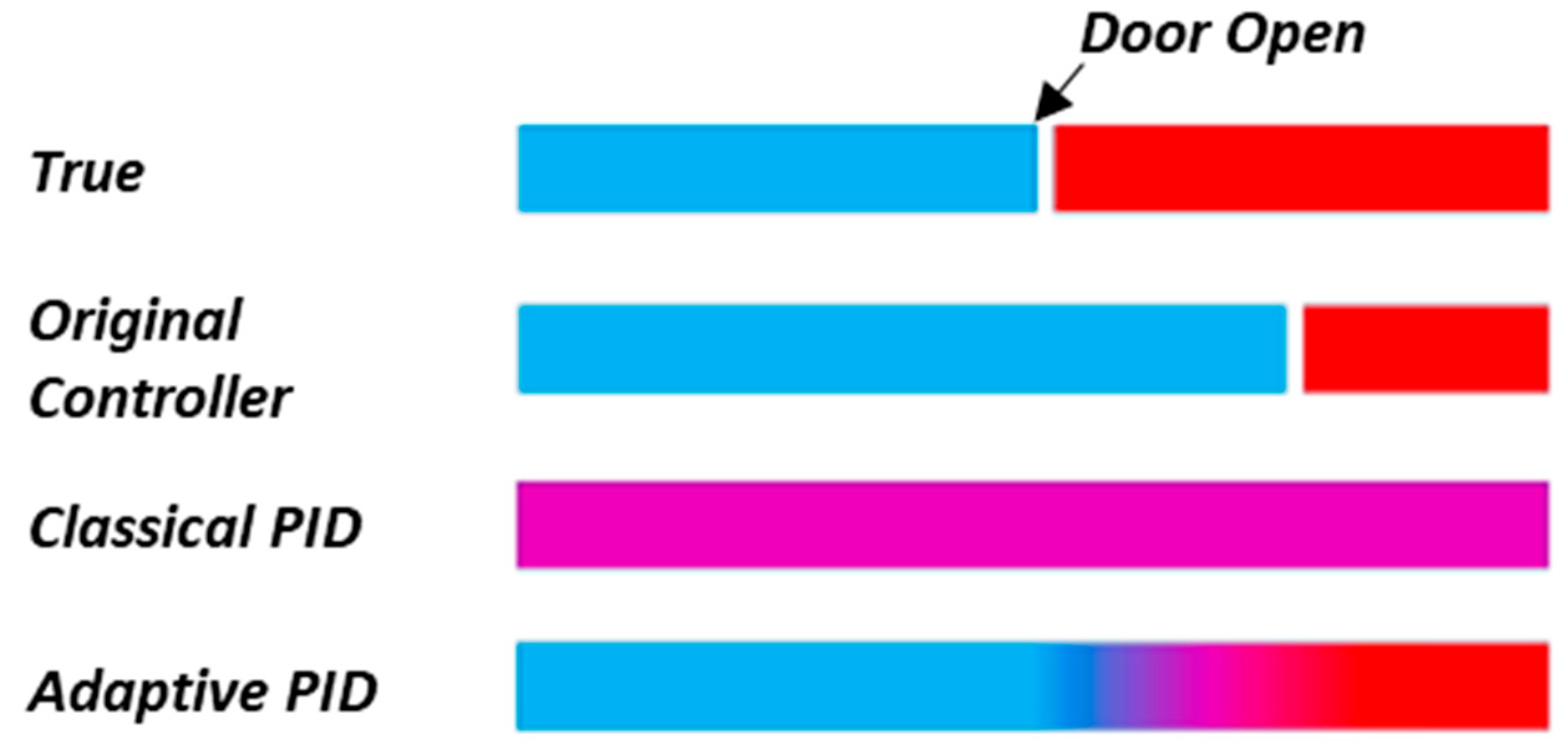
To address this limitation, the proposed adaptive PID controller introduces a time-varying scaling function L(t) that adjusts the controller sensitivity in response to changes in the thermal environment. The key idea is to detect non-stationary transitions automatically by monitoring the probability of the control error. When the error lies in a low-probability region (e.g., after a sudden door-opening event), the controller reacts more aggressively—as if switching to a different PID controller specialized for a new regime.
Figure 3 illustrates this mechanism conceptually. The first row shows the true thermal state of the refrigerator before and after a disturbance, while the subsequent rows show how different controllers interpret and respond to the disturbance. Classical PID exhibits delayed adaptation, whereas the proposed adaptive PID rapidly increases its gain through L(t), achieving behavior similar to switching between multiple LTI-system controllers without explicit mode detection.

2.3.2. Composite Error Definition

To jointly consider the dynamics of both compartments (fresh-food and freezer), the control error is defined as a composite form:
e ( t ) = ( T F ( t )   T F , S P ) + λ ( T R ( t ) T R , S P ) ,
where
  • T F : fresh-food compartment temperature,
  • T R : freezer temperature,
  • T F , S P ,   T R , S P : respective setpoints,
  • λ: weighting parameter controlling the contribution of freezer temperature.
The parameter λ enables balancing between the two thermal subsystems, reflecting their different thermal capacities and recovery characteristics. We model this composite error as a sum of two random variables:
E = X + λ Y
where X and Y denote deviations in the refrigerator and freezer compartments, respectively. This formulation lays the foundation for statistically characterizing the error behavior.
The weighting parameter λ was introduced to balance the relative influence of the refrigerator and freezer compartments in the composite error formulation. In this study, λ was selected based on the relative thermal capacity and response speed of the two compartments, with the freezer exhibiting slower dynamics and larger thermal inertia. A moderate λ value was therefore chosen to prevent the freezer temperature from dominating the control action while still ensuring coordinated regulation of both compartments. We note that λ does not affect the stability of the control law but primarily influences the trade-off between compartment prioritization, and its value can be adjusted according to cabinet volume ratio or manufacturer design preferences.

2.3.3. Error Distribution Estimation

To design an adaptive gain function that responds to changes in thermal conditions, the probability density function (PDF) of the composite error E must first be estimated. The error distribution reflects typical operating fluctuations as well as rare, abrupt deviations caused by disturbances such as door opening events. Therefore, accurately modeling the distribution of E is essential to determining how aggressively the controller should respond at any instant.
Two broad estimation approaches exist:
(1) Parametric Estimation
A specific distribution family (e.g., Gaussian, Laplace, generalized Gaussian) is fitted to empirical error samples using parameters such as mean and scale. Among these, the Laplace distribution is particularly suitable because:
  • It naturally captures the heavy-tailed behavior that arises from sudden thermal disturbances.
  • Its probability density function has a simple analytic form, enabling closed-form gain computation.
  • It allows efficient inverse-PDF evaluation, which is essential for low-computation embedded systems.
(2) Non-Parametric Estimation
Kernel density estimation (KDE) can represent multimodal or skewed error patterns without any distributional assumptions. However, KDE requires far more computation and memory, making it unsuitable for real-time implementation on low-power controllers commonly used in home appliances.
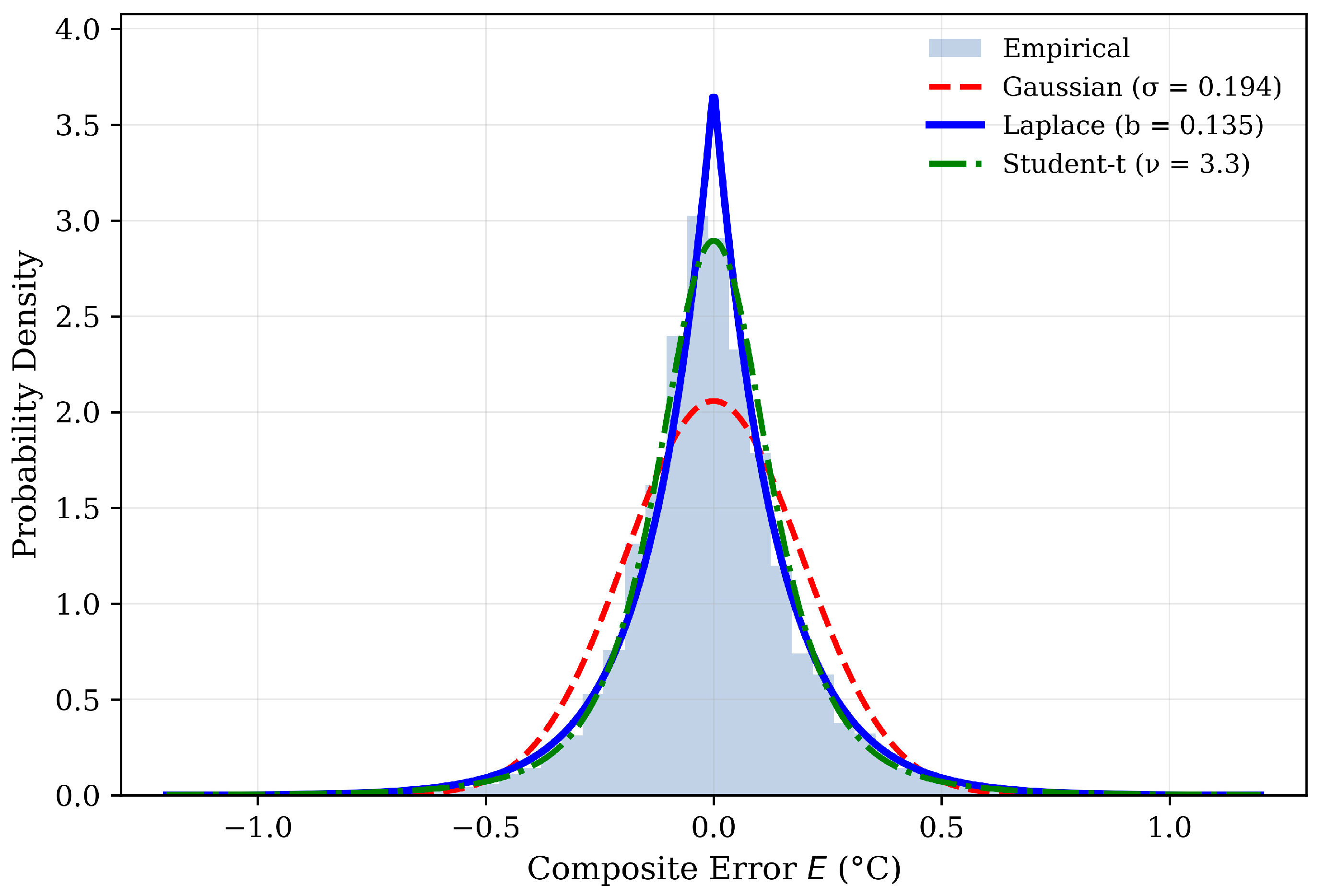
Given these considerations, a Laplace distribution is selected as the basis for adaptive gain design due to its accuracy in capturing refrigerator dynamics and its computational efficiency for embedded control. From a computational perspective, the Laplace distribution offers a significant advantage over heavier-tailed alternatives. The Laplace probability density function requires only a single exponential evaluation, whereas the Student-t distribution involves Gamma functions and power-law operations. In addition, the Laplace model requires only one scale parameter (b), while the Student-t model introduces two parameters (degrees of freedom and scale), increasing both computational burden and overfitting risk. Although the Student-t distribution achieves a slightly lower AIC, the performance difference is marginal in practical terms and does not justify the additional computational complexity for embedded refrigerator controllers.
As shown in Figure 4 and Table 2, the Laplace distribution provides a substantially better fit than the Gaussian model and achieves a KS statistic comparable to the Student-t distribution, while maintaining significantly lower computational complexity. These results support the use of the Laplace model as a practical and statistically justified basis for the proposed adaptive gain design.

2.3.4. Laplace-Distribution-Based Gain Scaling

The core of the adaptive PID controller is the scaling function L(t), derived from the reciprocal value of the Laplace probability density (PDF) of a Laplace distribution. The Laplace distribution effectively models sharp transitions and heavy-tailed behaviors often observed during sudden disturbances in refrigeration systems.
The PDF of the Laplace distribution is:
f ( x | μ , b ) = 1 2 b e x p ( | x μ | b ) ,
where μ is the location parameter (set to 0), and b is the scale parameter controlling dispersion.
The adaptive scaling function is defined as:
L ( t ) = 1 2 b e x p ( | e ( t ) | b ) .
This function behaves as a gain amplifier:
  • When ∣e(t)∣ is small (steady state), L(t) is small, producing smooth and energy-efficient control.
  • When ∣e(t)∣ becomes large (door opening or abrupt load change), L(t) decreases sharply, indicating that the corresponding error is statistically rare and lies in a low-probability region of the Laplace distribution.
In the proposed formulation, L(t) does not act as a direct gain amplifier. Instead, it serves as a probabilistic weighting term that reflects the confidence level associated with the instantaneous error. Large errors yield small values of L(t), which effectively increases the relative influence of the error term in the adaptive PID structure, resulting in a more aggressive corrective action. Thus, L(t) enables automatic, continuous adaptation without explicit mode switching or system identification.

2.3.5. Effect of the Scale Parameter b

The scale parameter b in the Laplace distribution plays a crucial role in determining the level of adaptiveness in the proposed controller. Specifically, b governs how sensitively the adaptive gain function L(t) responds to deviations in the composite error. Because L(t) increases monotonically with the magnitude of the composite error, thereby amplifying the controller response during statistically rare and large disturbances.
When b is small, even moderate error values lead to a rapid increase in L(t). This results in an aggressive control response, allowing the system to react quickly to sudden disturbances such as door-opening events or abrupt thermal load variations. Consequently, the controller exhibits short recovery times and strong disturbance rejection characteristics. However, this aggressiveness often comes at the expense of higher actuator activity, potentially increasing compressor cycling frequency and overall energy consumption.
On the other hand, when b is large, the exponential slope becomes shallow, causing L(t) to vary more gradually as the error increases. This leads to a smooth and conservative control behavior, reducing unnecessary actuation and improving energy efficiency. The trade-off is that the controller becomes less responsive to severe disturbances, potentially lengthening recovery times.
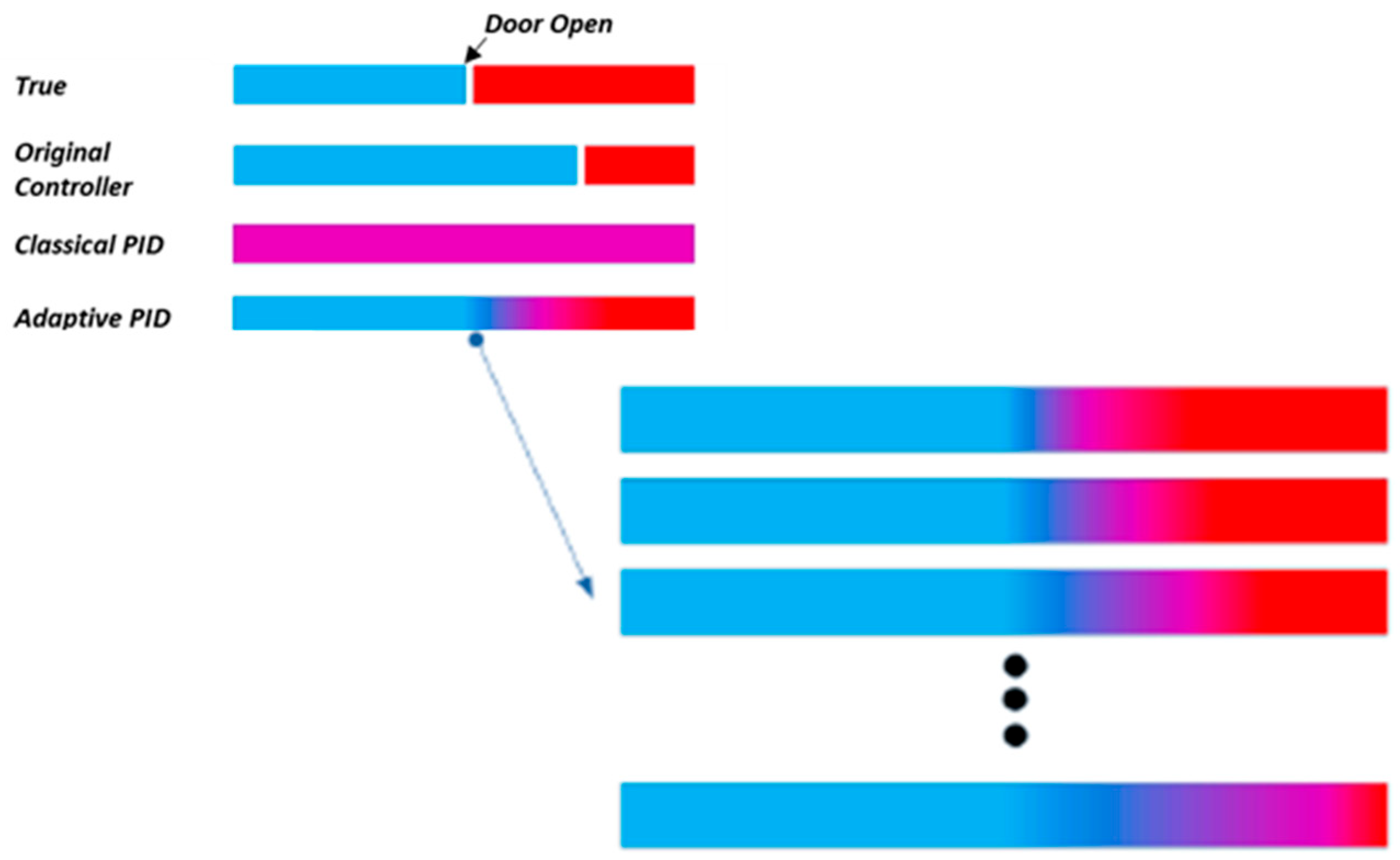
Figure 5 visually illustrates this effect by showing how different choices of b influence the smoothness of the transition between low- and high-gain regions. Smaller values of b correspond to sharp transitions, represented by steep gradients, whereas larger values of b produce slow shifts in color intensity, indicating a broader transition zone in which the gain changes gradually. This visualization highlights how the parameter b enables practitioners to tune the adaptive PID controller according to specific performance requirements—balancing responsiveness, stability, and energy efficiency. In summary, b acts as a design parameter regulating the aggressiveness of adaptation, providing a flexible mechanism for controlling the trade-off between fast disturbance rejection and economical steady-state operation. Proper selection of b is therefore essential for optimizing temperature stability and minimizing energy consumption under varying operating conditions. The scale parameter b determines the sensitivity of the gain-scaling function to error magnitude. In practice, b was selected based on the empirical dispersion of the composite error under nominal operating conditions. Specifically, b was chosen to be on the same order as the standard deviation of the steady-state error distribution, ensuring that typical fluctuations lead to smooth control behavior, while rare disturbance-induced deviations trigger stronger gain amplification. This selection strategy provides an intuitive and reproducible tuning guideline without requiring extensive trial-and-error.

2.3.6. Adaptive PID Control Law

The final adaptive PID control input is defined by embedding the scaling function L(t) into the conventional PID structure:
u ( t ) = K p L ( t ) e ( t )   +   K i 0 t L ( τ ) e ( τ ) d τ   + K d d d t ( L ( t ) e ( t ) ) ,  
where
  • Kp, Ki, Kd: proportional, integral, and derivative gains,
  • L(t): adaptive gain scaling based on the error distribution,
  • e(t): composite temperature error.
Although L(t) decreases for large error magnitudes, its role as a weighting factor within the adaptive PID formulation leads to an increased corrective response to rare disturbances, rather than attenuating control action. This formulation preserves the familiar PID structure while enabling dynamic gain scaling in response to the system’s instantaneous state. As a result, the controller behaves as if several PID controllers were blended into a unified, continuously adaptive form—ensuring robustness to disturbances and improved thermal stability. Importantly, the adaptive gain-scaling function L(t) is strictly positive and bounded, and does not introduce additional system dynamics. Therefore, the proposed controller can be interpreted as a bounded gain-modulated PID controller, for which closed-loop stability is preserved as long as the nominal PID gains are stabilizing. This interpretation aligns with classical gain-scheduling stability arguments and avoids the need for explicit nonlinear stability proofs.

3. Results and Discussions

This section presents a comprehensive performance comparison between the proposed Adaptive PID controller and a classical PID controller across several key metrics, including temperature stability, compressor operation, fan speed behavior, and overall energy consumption. All results were obtained under the identical disturbance schedule shown in Figure 2, ensuring a fair and reproducible evaluation.

3.1. Temperature Stability in the Refrigerator and Freezer Compartments

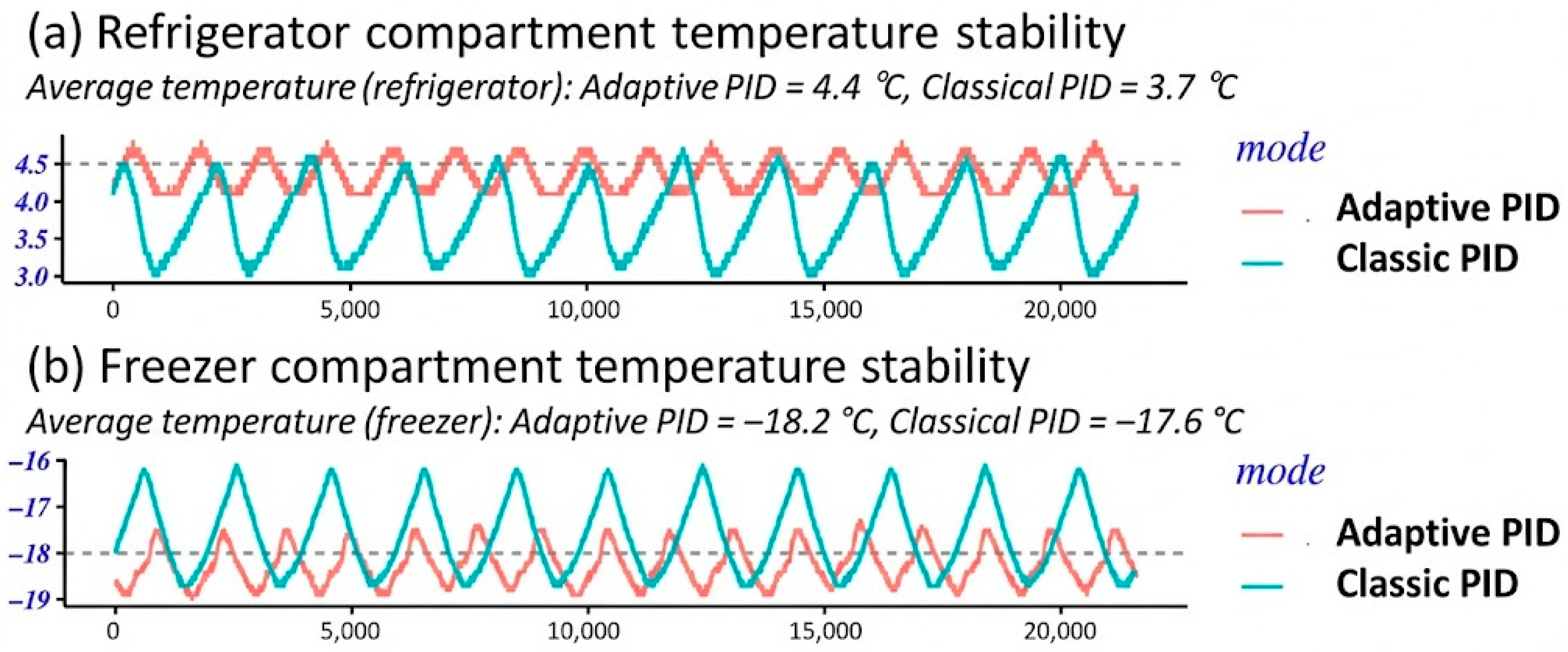
Figure 5 compares the temperature stability of the refrigerator (fresh-food) and freezer compartments under the classical PID controller and the proposed Adaptive PID controller. In both compartments, the classical PID exhibits pronounced cyclic oscillations around the setpoint. The temperature repeatedly overshoots and undershoots as the controller reacts with fixed gains to the door-opening disturbances and subsequent recovery periods.
In the refrigerator compartment Figure 6a, the Adaptive PID trajectory shows a noticeably smaller oscillation amplitude and a smoother waveform compared to the classical PID. The average temperature is 4.4 °C for the Adaptive PID and 3.7 °C for the classical PID, indicating that the proposed controller maintains the compartment closer to the desired operating band without excessive cooling. This reduced fluctuation implies better thermal comfort for stored food and less risk of unnecessary compressor cycling. A similar trend is observed in the freezer compartment Figure 6b. The classical PID produces relatively deep and frequent temperature swings around the setpoint, while the Adaptive PID maintains a more stable profile with attenuated peaks and valleys. The mean freezer temperature is −18.2 °C for the Adaptive PID and −17.6 °C for the classical PID. Although both controllers satisfy the target freezing condition, the Adaptive PID achieves this with smaller deviations, demonstrating improved robustness against the non-stationary disturbances imposed by the door-opening schedule. Overall, these results confirm that the proposed Adaptive PID controller significantly enhances temperature stability in both compartments, reducing oscillations while keeping the mean temperature within the desired operating range.

3.2. Compressor Duty and Fan Speed Behavior

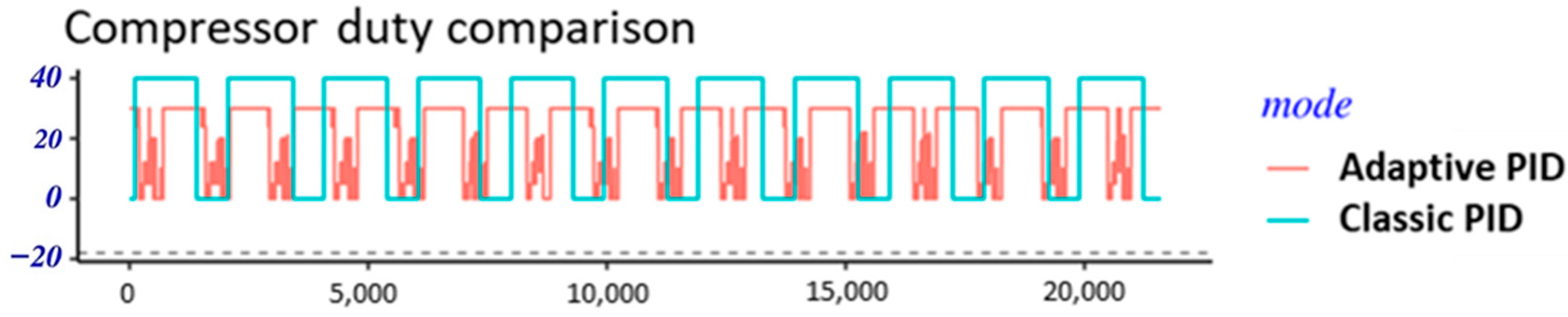
Figure 7 compares the compressor activation patterns under the classical PID and the proposed Adaptive PID controller. The classical PID exhibits frequent, abrupt on–off switching, with an average cycle duration of approximately 1200–1500 s and more than 20 switching events throughout the experiment. In contrast, the Adaptive PID produces significantly smoother compressor duty patterns, with cycle durations lengthened to approximately 1800–2200 s and fewer than 10 switching events. This represents a reduction of more than 50% in high-frequency switching activity. Such reduction in compressor cycling lowers mechanical stress on the compressor and contributes directly to energy savings. The Adaptive PID maintains longer continuous cooling cycles and avoids unnecessary rapid restarts, demonstrating its effectiveness in reducing actuator workload and stabilizing thermal dynamics.
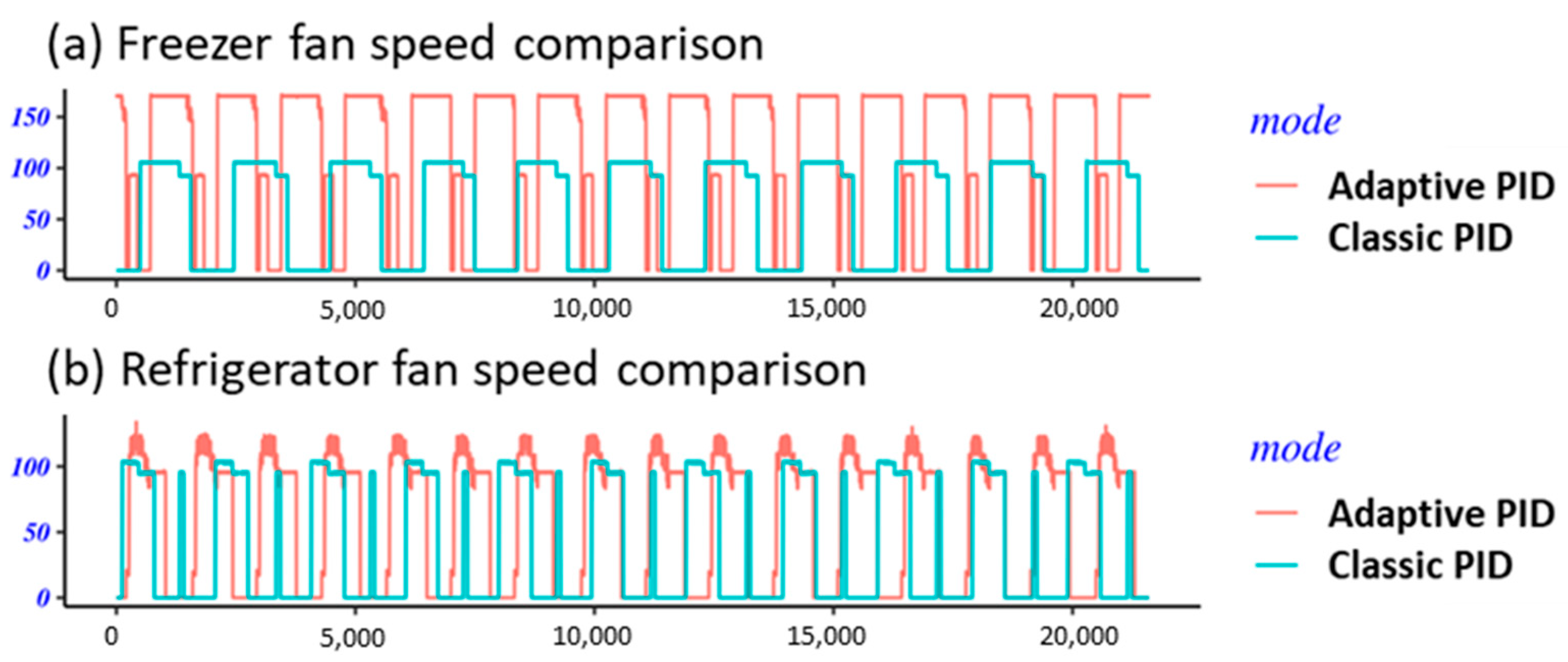
Figure 8 presents the rotational speeds of the freezer fan and refrigerator fan. The classical PID produces sharp rpm transitions, operating repeatedly between 0 and 150 rpm with highly discrete oscillations. The frequency of full-scale transitions exceeds 25 cycles over the experiment. In contrast, the Adaptive PID demonstrates markedly smoother behavior: the rpm transitions remain mostly within 40–150 rpm for freezer fan and 30–120 rpm for refrigerator fan, with fewer extreme peaks and visibly reduced switching frequency. Quantitatively, the Adaptive PID reduces the number of abrupt rpm shifts by approximately 35–45%, depending on the fan subsystem. This smoother airflow regulation is consistent with the improved temperature stability discussed earlier and avoids unnecessary high-speed fan operation, thereby decreasing power usage and acoustic noise. Overall, the compressor duty and fan rpm results show that the Adaptive PID not only stabilizes compartment temperatures but also substantially reduces actuator activity. This reduction in switching frequency and amplitude contributes directly to improved energy efficiency, prolonged component lifetime, and a more stable refrigeration cycle.

3.3. Energy Consumption Analysis

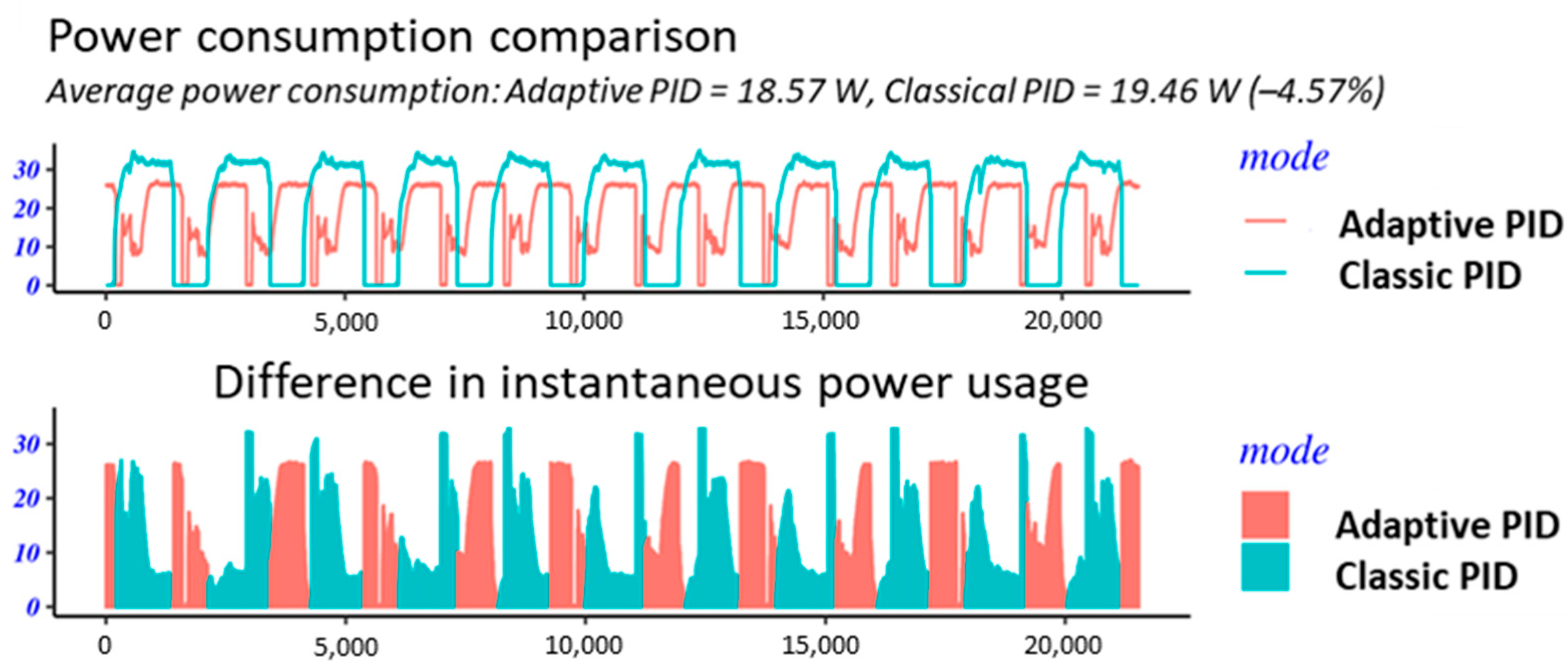
Figure 9 presents the power consumption profiles obtained under the classical PID controller and the proposed Adaptive PID controller. The upper plot shows the instantaneous power usage, while the lower plot visualizes the difference in consumption over time. As shown, the classical PID controller exhibits steep and repetitive transitions between high-power and low-power states, driven primarily by its frequent compressor cycling and fluctuating fan speeds. These abrupt changes reflect the oscillatory thermal behavior observed in Section 3.1 and Section 3.2, where the classical PID was unable to maintain stable internal temperatures during door-opening disturbances.
In contrast, the Adaptive PID controller produces a noticeably smoother power-usage trajectory. High-power intervals are shorter and less frequent, and transitions occur more gradually. This behavior indicates that the Adaptive PID considerably reduces the burden on the compressor and fans by avoiding unnecessary rapid corrective actions. The improvement is consistent with the smoother actuator patterns discussed earlier, particularly the reduced compressor switching frequency and moderated fan-speed transitions. The total energy demand over the entire experiment also highlights the advantage of the Adaptive PID. The average power consumption was reduced from 19.46 W to 18.57 W for the classical PID. Although the difference corresponds to a modest reduction of approximately 4.6%, such improvements are meaningful in continuously operating appliances like refrigerators. Even small percentage gains translate into substantial annual energy savings and contribute to long-term efficiency and component longevity. Taken together, the instantaneous and cumulative power-consumption trends confirm that the Adaptive PID not only stabilizes temperature and actuator behavior but also delivers measurable improvements in energy efficiency under realistic household conditions.

3.4. Summary of Selected Performance Metrics

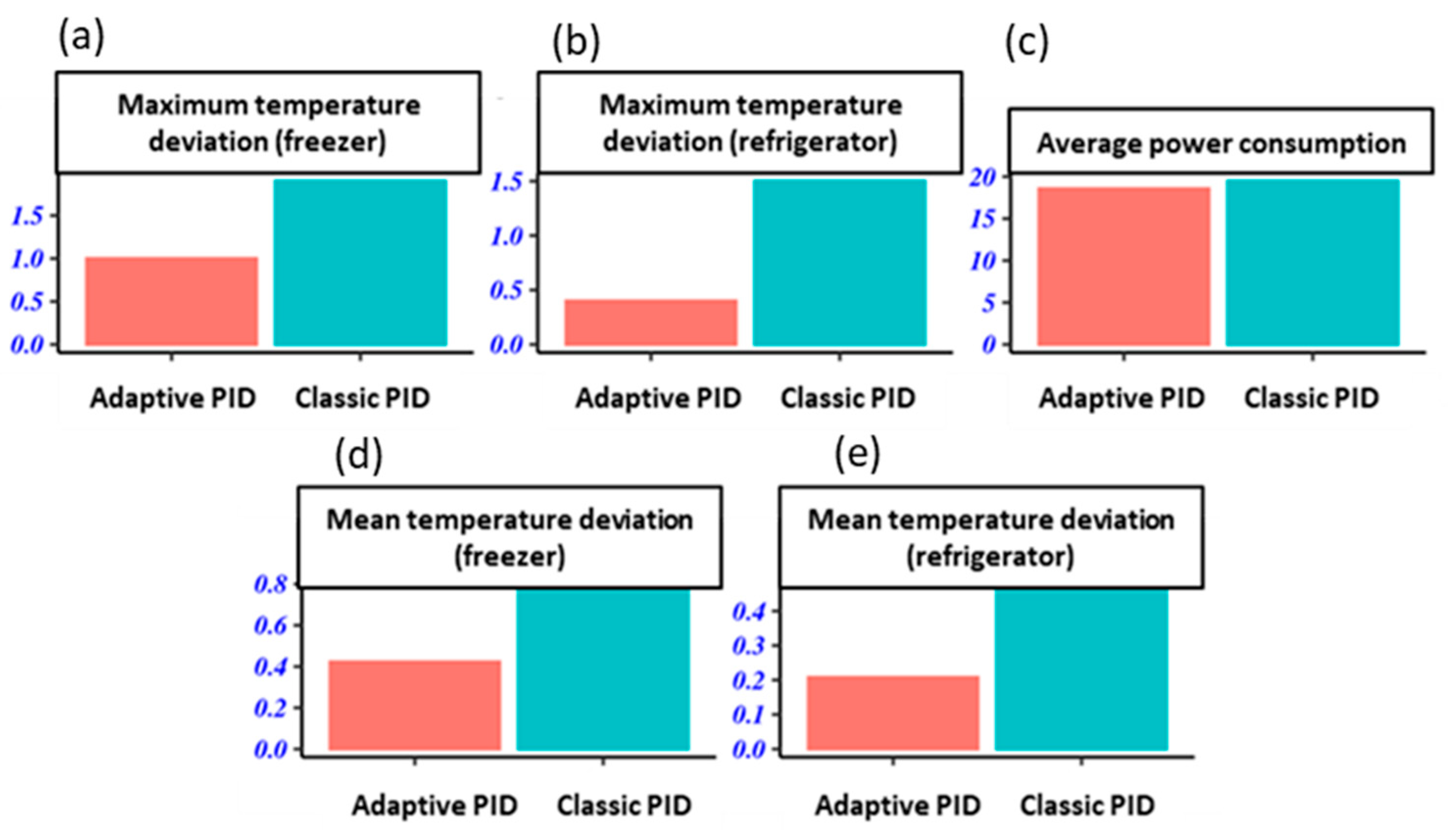
Figure 10 summarizes key performance indicators comparing the Adaptive PID controller with the classical PID controller. The metrics include maximum temperature deviation, mean temperature deviation, and average power consumption for both the refrigerator and freezer compartments. These indicators provide a concise quantitative assessment of the improvements achieved by the proposed control strategy.
The maximum temperature deviation (Figure 10a,b) is substantially reduced under the Adaptive PID in both compartments. In the freezer, the maximum deviation is reduced to approximately 1.0 °C, compared with nearly 1.6 °C under the classical PID. A similar improvement is observed in the refrigerator compartment, where the Adaptive PID yields a deviation of about 0.5 °C, whereas the classical PID exhibits deviations exceeding 1.4 °C. These reductions highlight the controller’s ability to limit severe temperature excursions following disturbances. The mean temperature deviation (Figure 10d,e) also demonstrates clear improvement. The Adaptive PID maintains average deviations around 0.25–0.28 °C, while the classical PID commonly exceeds 0.55–0.60 °C. This indicates more stable long-term temperature regulation and confirms the smoother patterns observed in Section 3.1. In terms of average power consumption (Figure 10c), the Adaptive PID achieves a lower consumption level of 18.57 W, compared to 19.46 W for the classical PID—a reduction of approximately 4.6%. Although this percentage may appear modest, the savings are meaningful in continuously operating systems like household refrigerators and align with the actuator-efficiency improvements described in Section 3.2. Overall, the combined performance metrics demonstrate that the Adaptive PID controller consistently outperforms the classical PID across all evaluated categories. The controller achieves smaller temperature deviations, reduced overshoot, smoother actuator behavior, and improved energy efficiency, reinforcing its suitability for real-world refrigeration systems subject to non-stationary disturbances.

3.5. Discussions

The experimental results presented in Section 3.1, Section 3.2, Section 3.3 and Section 3.4 collectively demonstrate that the proposed Adaptive PID controller provides superior performance compared with the classical PID across multiple evaluation criteria, including temperature stability, actuator activity, and energy efficiency. These improvements can be understood by examining how the adaptive gain function L(t) reshapes the controller’s response to disturbances and steady-state conditions. First, the enhanced temperature stability observed in both the refrigerator and freezer compartments arises from the ability of the Adaptive PID to deliver proportional corrective actions according to the statistical rarity of the measured error. During door-opening disturbances—events that generate large, low-probability deviations—the adaptive gain rapidly increases, enabling aggressive correction. This behavior suppresses the deep overshoot and prolonged oscillations typically seen under classical PID control. Conversely, during steady-state operation, the gain modulation reduces sensitivity to minor fluctuations, preventing unnecessary actuation and maintaining stable compartment temperatures. Second, the reduction in compressor cycling and smoother fan behavior serves as direct evidence of the controller’s ability to modulate actuator workload more intelligently. Classical PID reacts uniformly to all deviations, causing frequent switching in the compressor and sharp rpm transitions in the fans. In contrast, the adaptive controller minimizes abrupt responses unless they are truly warranted by significant deviations. This results in more gradual actuator profiles, reduced mechanical stress, and less aggressive airflow dynamics, all of which contribute to improved long-term system durability. Third, the controller’s improved energy performance—including a 4.6% reduction in total power consumption—is closely tied to the reduction in unnecessary actuator activity. Throughout the experimental evaluation, no divergent behavior, sustained oscillations, or instability were observed under repeated disturbance scenarios, providing empirical evidence that the proposed adaptive controller maintains stable closed-loop operation in practice. By limiting high-power compressor cycles and avoiding rapid fan-speed oscillations, the Adaptive PID operates the cooling system more efficiently while still maintaining tight temperature control. Given that refrigerators run continuously throughout the year, even modest percentage improvements can lead to substantial annual energy savings. Finally, these findings highlight an important conceptual advantage of the Adaptive PID: it effectively behaves as a continuously blending multi-regime controller. Instead of relying on explicit mode switching or predefined gain schedules, the controller transitions smoothly between gentle and aggressive control modes through the distribution-driven gain L(t). This property makes the controller robust to non-stationary disturbances and eliminates the need for complex system identification or model-based predictions. As a result, the Adaptive PID offers a practical, embedded-friendly approach that enhances performance without increasing computational burden.
Overall, the Adaptive PID controller demonstrates strong potential for deployment in modern refrigeration systems, where energy efficiency, robustness to user-driven disturbances, and product reliability are critical. The consistent improvements across thermal, mechanical, and energy metrics indicate that the proposed method provides a meaningful advancement over traditional PID control in real-world household applications. Although the experimental validation was conducted on a specific two-compartment household refrigerator, the proposed adaptive PID framework is not inherently tied to this particular system configuration. The control law depends only on the composite error signal and does not require a detailed plant model, making it readily applicable to other refrigeration architectures, such as multi-door cabinets, variable-speed compressor systems, or commercial refrigeration units. Moreover, the probabilistic gain-scaling principle can be extended to other thermal control applications characterized by non-stationary disturbances, including HVAC subsystems and cold-chain storage equipment.

4. Conclusions

This study proposed an Adaptive PID controller designed to improve temperature regulation and energy performance in household refrigerator systems operating under non-stationary disturbances. Unlike classical PID control, which relies on fixed gains and assumes linear time-invariant dynamics, the proposed method incorporates a Laplace-distribution-based adaptive gain function L(t) that adjusts controller sensitivity according to the statistical rarity of observed temperature deviations. This enables the controller to react aggressively to large disturbances—such as door-opening events—while maintaining stable and energy-efficient behavior during steady-state operation.
Experimental validation using a commercial two-compartment refrigerator demonstrated that the Adaptive PID consistently outperforms the classical PID across all key performance metrics. The controller achieved smaller temperature deviations in both the refrigerator and freezer compartments, reduced compressor cycling, smoothed fan-speed transitions, and lowered overall energy consumption by approximately 4.6%. These improvements stem from the adaptive gain modulation mechanism, which effectively blends multiple control behaviors into a unified, continuously tuned structure without requiring explicit mode switching or complex system identification.
The results highlight the practical advantages of the Adaptive PID controller for embedded applications in modern refrigeration systems, where robustness to user-driven disturbances, temperature stability, and long-term energy efficiency are essential. By maintaining the simplicity of classical PID control while enhancing adaptability, the proposed method provides a computationally efficient and easily deployable solution suitable for real-world consumer appliances.
Future work may focus on extending the distribution-driven gain formulation to incorporate additional environmental variables, optimizing the scale parameter b through online tuning, and evaluating the controller under broader usage scenarios, including multi-door systems and variable-speed compressor architectures. The integration of lightweight learning-based disturbance forecasting models may also further enhance performance while maintaining the embedded-friendly nature of the controller. While the experimental evaluation was conducted under a controlled one-day disturbance schedule, the results provide clear insight into the controller’s behavior under non-stationary operating conditions commonly observed in household refrigeration.

Funding

This work was supported by the Daejin University Research Grants in 2025.

Institutional Review Board Statement

Not applicable.

Data Availability Statement

The data presented in this study are available on request from the corresponding author due to privacy concerns.

Conflicts of Interest

The author declares no conflicts of interest.

References

  1. Åström, K.J.; Hägglund, T. PID Controllers: Theory, Design, and Tuning; ISA—The Instrumentation, Systems and Automation Society: Research Triangle Park, NC, USA, 1995. [Google Scholar]
  2. Åström, K.J.; Murray, R.M. Feedback Systems: An Introduction for Scientists and Engineers; Princeton University Press: Princeton, NJ, USA, 2008. [Google Scholar]
  3. O’Dwyer, A. Handbook of PI and PID Controller Tuning Rules, 3rd ed.; Imperial College Press: London, UK, 2009. [Google Scholar]
  4. Silveira, A.S.; Souza, G.A.; Liston, R.J.; Hermes, C.J.L. Sensorless Temperature Control of Household Refrigerators Based on the Electric Current of the Compressor. Int. J. Refrig. 2023, 152, 171–175. [Google Scholar] [CrossRef]
  5. Schurt, L.C.; Hermes, C.J.L.; Neto, A.T. A Model-Driven Multivariable Controller for Vapor Compression Refrigeration Systems. Int. J. Refrig. 2009, 32, 1672–1682. [Google Scholar] [CrossRef]
  6. Evans, J.A.; Foster, A.M.; Brown, T. Temperature Control in Domestic Refrigerators and Freezers. In Proceedings of the 3rd IIR International Conference on Sustainability and the Cold Chain, London, UK, 23–25 June 2014; International Institute of Refrigeration: Twickenham, UK, 2014; p. 130. [Google Scholar]
  7. Shinskey, F.G. Process Control Systems: Application, Design, and Tuning, 4th ed.; McGraw-Hill: New York, NY, USA, 1996. [Google Scholar]
  8. Shen, J.-C. A New Tuning Method for PID Controllers. ISA Trans. 2002, 41, 473–484. [Google Scholar] [CrossRef] [PubMed]
  9. Killian, M.; Kozek, M. Ten Questions Concerning Model Predictive Control for Energy Efficient Buildings. Build. Environ. 2016, 105, 403–412. [Google Scholar] [CrossRef]
  10. Afram, A.; Janabi-Sharifi, F. Theory and Applications of HVAC Control Systems—A Review of Model Predictive Control (MPC). Build. Environ. 2014, 72, 343–355. [Google Scholar] [CrossRef]
  11. Di Mattia, E.; Gambarotta, A.; Marzi, E.; Morini, M.; Saletti, C. Predictive Controller for Refrigeration Systems Aimed to Electrical Load Shifting and Energy Storage. Energies 2022, 15, 7125. [Google Scholar] [CrossRef]
  12. Soyguder, S.; Alli, H. Design and Simulation of Self-Tuning PID-Type Fuzzy Adaptive Control for an Expert HVAC System. Expert Syst. Appl. 2009, 36, 4566–4573. [Google Scholar] [CrossRef]
  13. Chen, L.; Gu, D.-W.; Ball, J.E. Self-Tuning PID Temperature Controller Based on Flexible Neural Network. In Advances in Neural Networks—ISNN 2007; Lecture Notes in Computer Science; Springer: Berlin/Heidelberg, Germany, 2007; Volume 4491, pp. 132–139. [Google Scholar]
  14. Liu, D.; Li, H.; Li, S. Fuzzy Immune PID Temperature Control of HVAC Systems. In Advances in Neural Networks—ISNN 2009; Lecture Notes in Computer Science; Springer: Berlin/Heidelberg, Germany, 2009; Volume 5552, pp. 1059–1068. [Google Scholar]
  15. Guesmi, K.; Essounbouli, N.; Hamzaoui, A. Systematic Design Approach of Fuzzy PID Stabilizer for DC–DC Converters. Energy Convers. Manag. 2008, 49, 2880–2889. [Google Scholar] [CrossRef]
  16. Åström, K.J.; Wittenmark, B. On Self-Tuning Regulators. Automatica 1973, 9, 185–199. [Google Scholar] [CrossRef]
  17. Kos, T.; Jezernik, K. Parametric and Nonparametric PID Controller Tuning for Integrating Processes. Appl. Sci. 2020, 10, 6012. [Google Scholar] [CrossRef]
  18. Landau, I.D.; Lozano, R.; M’Saad, M.; Karimi, A. Adaptive Control: Algorithms, Analysis and Applications, 2nd ed.; Springer: London, UK, 2011. [Google Scholar]
  19. Åström, K.J.; Wittenmark, B. Adaptive Control, 2nd ed.; Addison-Wesley: Reading, MA, USA, 1995. [Google Scholar]
  20. Scott, D.W. Multivariate Density Estimation: Theory, Practice, and Visualization; Wiley: New York, NY, USA, 1992. [Google Scholar]
  21. Silverman, B.W. Density Estimation for Statistics and Data Analysis; Chapman and Hall: London, UK, 1986. [Google Scholar]
  22. Goulding, P.R.; Lennox, B.; Chen, Q.; Sandoz, D.J. Robust Inferential Control Using Kernel Density Methods. Comput. Chem. Eng. 2000, 24, 835–840. [Google Scholar] [CrossRef]
  23. Kotz, S.; Kozubowski, T.J.; Podgórski, K. The Laplace Distribution and Generalizations: A Revisit with Applications to Communications, Economics, Engineering, and Finance; Birkhäuser: Boston, MA, USA, 2001. [Google Scholar]
  24. Eltoft, T.; Kim, T.; Lee, T.-W. On the Multivariate Laplace Distribution. IEEE Signal Process. Lett. 2006, 13, 300–303. [Google Scholar] [CrossRef]
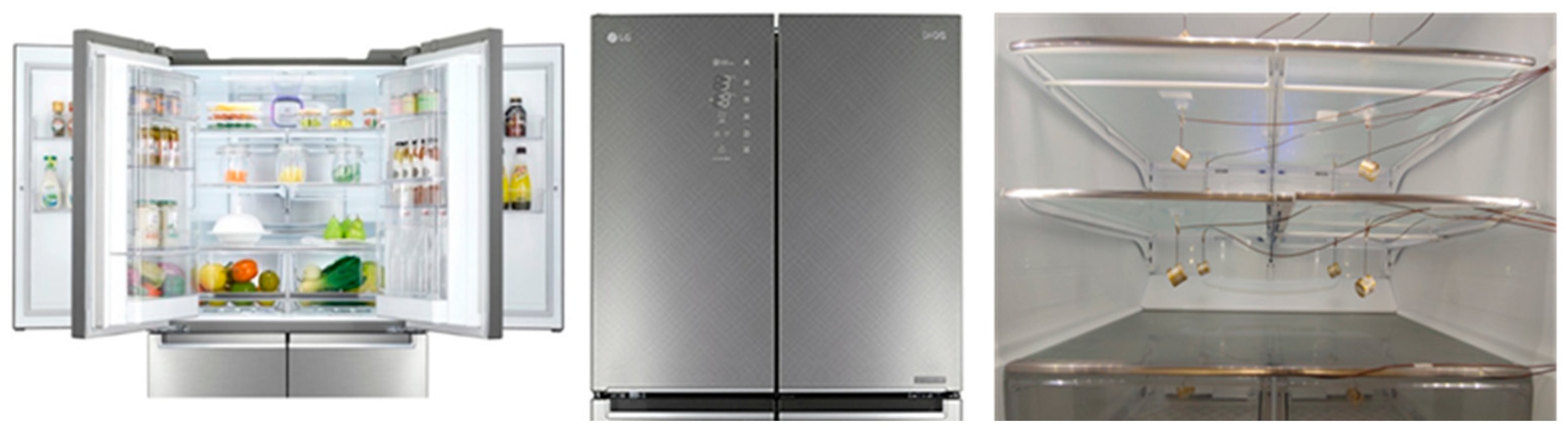
Figure 1. Refrigerator model and experimental setup (Left: commercial two-door model; Center: front view of test unit; Right: interior configuration with thermocouple deployment).
Energies 19 00477 g001
Figure 2. Door-opening disturbance schedule used in the experimental evaluation. A predefined sequence of refrigerator-door (H) and freezer-door (R) openings was applied between 08:00 and 19:10 to introduce consistent and repeatable disturbances to the French-door refrigerator system. This schedule was used identically for all controller comparisons (baseline, classical PID, and adaptive PID).
Energies 19 00477 g002
Figure 3. Conceptual illustration of the adaptive PID mechanism.
Energies 19 00477 g003
Figure 4. Empirical distribution of the composite error E and fitted Gaussian, Laplace, and Student-t probability density functions.
Energies 19 00477 g004
Figure 5. Effect of the Laplace scale parameter b on the gain-scaling profile L(e).
Energies 19 00477 g005
Figure 6. Comparison of temperature stability in the refrigerator (a) and freezer (b) compartments under the classical PID and the proposed Adaptive PID controllers.
Energies 19 00477 g006
Figure 7. Compressor duty comparison between the classical PID and the proposed Adaptive PID controllers.
Energies 19 00477 g007
Figure 8. Comparison of fan speed behavior under the classical PID and Adaptive PID controllers. (a) Freezer fan speed and (b) refrigerator fan speed over the entire operating period.
Energies 19 00477 g008
Figure 9. Comparison of instantaneous and average power consumption (W) between the classical PID and Adaptive PID controllers.
Energies 19 00477 g009
Figure 10. Comparison of selected performance metrics between the classical PID and the proposed Adaptive PID controllers. (a) maximum temperature deviation in the freezer compartment; (b) maximum temperature deviation in the refrigerator compartment; (c) average power consumption; (d) mean temperature deviation in the freezer compartment; (e) mean temperature deviation in the refrigerator compartment.
Energies 19 00477 g010
Table 1. Functional specification and configuration of the test refrigerator.
CategoryComponent/FeatureDescription
Cabinet StructureTotal volume727 L
Compartment layoutFresh-food (top), Freezer (bottom)
Drawers/Shelves2 drawers, multi-shelf airflow design
Cooling SystemCompressor typeLinear inverter compressor
Refrigeration cycleVapor compression with wire-and-tube condenser and no-frost evaporator
Expansion deviceCapillary tube with suction-line heat exchanger
Airflow SystemFanSingle-speed centrifugal fan (freezer compartment)
Air distributionMulti-airflow ducts supplying both compartments
DamperElectronic damper for fresh-food temperature regulation
Electronics and ControlTemperature sensingMulti-point thermocouple array installed for experiments
Fast freeze modeSupported
Hygiene FreshAir purification module enabled
Physical DimensionsSize (W × H × D)902 × 1785 × 920 mm
Table 2. Goodness-of-fit comparison for candidate error distributions based on AIC, BIC, and Kolmogorov–Smirnov statistics.
DistributionScale ParameterAICBICKS Statistic
Gaussianσ = 0.1938−1771.9−1765.60.0757
Laplaceb = 0.1348−2482.2−2475.90.0384
Student-ts = 0.1278−2518.6−2506.00.0270
Disclaimer/Publisher’s Note: The statements, opinions and data contained in all publications are solely those of the individual author(s) and contributor(s) and not of MDPI and/or the editor(s). MDPI and/or the editor(s) disclaim responsibility for any injury to people or property resulting from any ideas, methods, instructions or products referred to in the content.