1. Introduction
1.1. Background and Motivation
The rapid advancement of global economic and population growth has significantly increased the demand for energy, with fossil fuels continuing to be the predominant source [
1]. Recently, heightened consumption alongside geopolitical uncertainties has driven a surge in oil and gas prices, as well as complicating efforts to meet global energy requirements. Concurrently, widespread reliance on fossil fuels for large-scale energy production has triggered a range of environmental challenges, such as elevated greenhouse gas emissions, increased carbon output, and broader public health concerns. Although hydrocarbons are projected to remain a primary energy source in the near future due to their high energy yield and long-standing infrastructure, the Organisation for Economic Co-operation and Development (OECD) countries have acknowledged the strategic necessity of expanding their energy mix [
2]. In response, these nations prioritize large-scale investments in renewable energy, low-emission technologies, and cleaner power generation systems. The advancement of environmental technologies holds significant promise for curbing energy consumption and improving overall efficiency. These innovations not only help mitigate the environmental footprint of conventional energy use but also encourage policymakers to adopt more sustainable and adaptive energy strategies. As part of this broader movement, Australia, an OECD member, is actively pursuing initiatives to enhance the energy sector’s sustainability and performance.
Within this global context, microgrids (MGs) have emerged as a key enabler of decentralized, sustainable, and resilient energy systems.By integrating distributed energy resources (DERs), energy storage systems (ESSs), and flexible demand-side management (DSM), MGs can ensure secure power supply, reduce carbon intensity, and enhance local autonomy. Their ability to operate in both grid-connected and islanded modes positions them as vital building blocks in the transition to low-carbon energy infrastructures. Foundational surveys have long emphasized MGs’ role as a bridge between centralized fossil-based grids and distributed renewable architectures, identifying their strategic potential in sustainability transitions [
3,
4,
5].
Although many energy management techniques, such as optimization, forecasting, and AI, are applicable across different microgrid (MG) configurations, the motivation for categorizing MGs into residential, commercial, and industrial domains lies in their distinct operational contexts and performance priorities. Residential microgrids (RMGs) are typically characterized by small-scale, occupant-driven loads and prosumer participation.Commercial microgrids (CMGs) emphasize peak demand management, economic optimization, and service continuity, whereas industrial microgrids (IMGs) operate under large-scale, mission-critical loads with stringent reliability and production constraints. These differences lead to sector-specific EMS design choices, control architectures, storage integration strategies, and evaluation metrics, justifying the domain-oriented review structure.
1.2. State of the Art
Early MG research focused on cost optimization and DSM strategies [
6,
7]. Meanwhile, hybridized photovoltaic (PV)–diesel–pump storage hydro systems demonstrated online optimization to improve fuel efficiency and reliability in islanded contexts [
8]. In parallel, commercial and industrial (C&I) building MG studies highlighted the importance of flexible operating modes to manage both electrical and thermal loads under different grid conditions [
9,
10].
From 2019 onwards, attention shifted toward aggregated user models and applied EMS frameworks. Aggregating residential and commercial users under a Building Energy Management System (BEMS) improves coordination and scheduling efficiency [
11]. Electric vehicle (EV) integration has emerged as another frontier: demonstrated that the optimal design of EV charging parks within MGs can reduce operational costs while supporting grid stability [
12].
Advanced EMS approaches soon followed. Centralized EMS designs improved power quality through coordinated dispatch of DERs and reactive power support [
13], while intelligent EMS solutions applied AI to enhance off-grid hybrid MG management [
14]. Predictive EMS, including model-based and data-driven approaches, further improved reliability and cost optimization under uncertainty [
15].
A surge in review studies has consolidated knowledge and mapped EMS strategies. Comprehensive surveys have classified EMS architectures into centralized, decentralized, and distributed schemes, highlighting trade-offs in scalability, communication burden, and resilience [
16,
17,
18,
19,
20,
21]. Forecasting-focused reviews highlighted the importance of accurate short- and long-term demand and renewable prediction, advocating hybrid physical–statistical and AI-based methods to improve EMS scheduling [
22,
23,
24]. Meanwhile, advanced reviews emphasized computational intelligence [
25], hierarchical and multi-agent EMS [
26,
27], and sustainable system-level strategies that align technical, economic, and environmental objectives [
3,
28,
29].
Emerging trends emphasize multi-sectoral and integrated perspectives. Zhao et al. [
30] demonstrated efficient operation of combined residential and CMGs energy hubs, while Gholami et al. [
31] proposed shared BESS frameworks to coordinate residential and CMGs with economic and resilience benefits. Virtual power plants (VPPs), comprising aggregated MGs, have been studied for profitability optimization, bridging MG operation with market participation [
32]. Finally, net-zero strategies are increasingly prominent: Naseri et al. [
33] presented an islanded PV–H
2 EMS design achieving net-zero emissions through hydrogen integration.
1.3. Research Gaps and Challenges
Despite these advances, several gaps remain. First, integrating heterogeneous loads (residential, commercial, and industrial) poses challenges in demand forecasting, fair energy sharing, and coordinated scheduling. Second, while EMS frameworks optimize cost or reliability, few simultaneously account for holistic performance metrics such as resilience, emissions, and demand profile smoothness. Third, predictive EMS and AI-based controllers face challenges of interpretability, scalability, and cyber-security. Fourth, interoperability across multiple MGs, energy hubs, and VPPs is underexplored, particularly in high-renewable contexts. Finally, while hydrogen integration offers long-duration autonomy and net-zero potential, efficiency penalties and cost remain prohibitive.
Review articles have repeatedly flagged these unresolved areas. Forecasting reviews identified the lack of standardized benchmarks and the need for hybrid physical–AI methods to manage uncertainty in multi-MG settings [
22,
23,
24]. Strategic reviews stressed that while optimization methods are diverse, their scalability to multi-MG and sector-coupled contexts remains insufficient [
19,
34,
35]. The literature also highlights that techno-economic analyses often neglect socio-environmental dimensions such as community participation and carbon valuation, leaving a gap for holistic MG appraisal [
20,
21,
28]. Furthermore, resilience and stability remain underexplored in EMS reviews, particularly for networked and hybrid MGs, calling for standardized resilience evaluation frameworks [
26,
36].
1.4. Contributions of This Review
This review provides a sectoral synthesis of energy management in MGs, spanning commercial, industrial, and residential domains. Its contributions are fourfold:
- 1.
It surveys the evolution of EMS and optimization strategies across distinct sectors, from DSM-based and rule-based systems to predictive, AI-driven, and hydrogen-integrated approaches. This complements earlier review efforts that largely remained generic by offering a sector-specific lens.
- 2.
It provides a comparative analysis of sector-specific methods, highlighting differences in EMS objectives, load characteristics, and integration strategies, expanding on past surveys of MG control and management.
- 3.
It identifies shared and unique challenges across sectors, including forecasting, multi-energy integration, cyber-security, and policy gaps, building on gaps highlighted in forecasting-, uncertainty-, and trilemma-focused reviews.
- 4.
It outlines future research directions, emphasizing interoperability, digital twins, resilience valuation, and multi-vector storage (batteries + hydrogen). By linking sectoral insights with broader survey trends, this work extends the existing review landscape.
The remainder of this paper is organized as follows:
Section 3 reviews EMS strategies in CMGs;
Section 4 presents industrial MG applications;
Section 5 examines residential MGs;
Section 6 synthesizes cross-sectoral challenges; and
Section 7 discusses emerging trends and future directions.
2. Bibliometric Analysis of MG Energy Management Research
To contextualize the review, a bibliometric analysis of MG energy management is conducted using Web of Science data covering the period 2016–2025. The dataset comprised 9415 records, including journal articles and conference proceedings. Bibliometric mapping is performed using VOSviewer (version 1.6.20) to identify publication trends, influential sources, prolific authors, and emerging research clusters. The following subsections provide a structured overview.
2.1. Publication Trends (2016–2025)
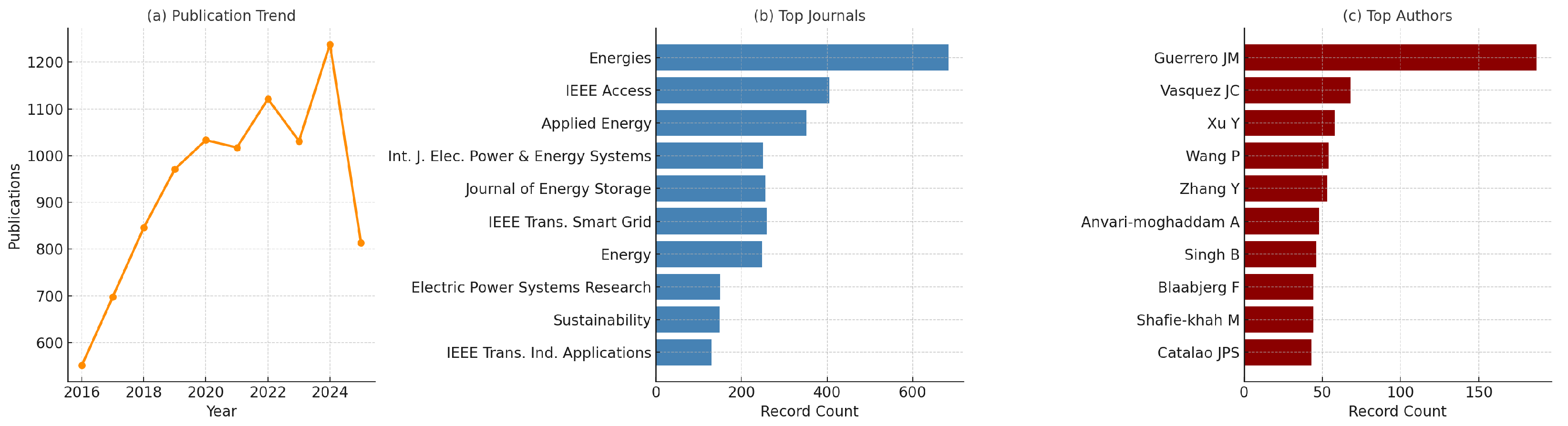
The volume of publications on MG energy management has shown consistent growth since 2016, reflecting the rapid expansion of renewable integration, storage technologies, and digitalized energy systems. A gradual increase is observed between 2016 and 2019, followed by a significant rise from 2020 onward, with the number of annual publications peaking in 2024. This trend coincides with the adoption of AI, advanced optimization methods, and deep reinforcement learning (DRL) for real-time energy management. The sustained increase in research outputs highlights both the academic and industrial importance of EMS in enabling reliable, cost-effective, and sustainable MG operation.
2.2. Top Journals
The most influential journals contributing to MG energy management research are illustrated in
Figure 1.
Energies leads with the highest publication volume, followed by
IEEE Access and
Applied Energy. Other key outlets include the
International Journal of Electrical Power & Energy Systems, the
Journal of Energy Storage, and
IEEE Transactions on Smart Grid. Collectively, these journals demonstrate the interdisciplinary nature of EMS research, bridging advances in power systems, renewable integration, storage technologies, and computational intelligence.
2.3. Influential Authors
Figure 1 highlights the most prolific contributors to MG energy management research. Guerrero, J.M. leads the field with the highest number of publications, followed by Vasquez, J.C. and Xu, Y. Other prominent contributors include Wang, P., Zhang, Y., and Anvari-moghaddam, A., alongside Singh, B., Blaabjerg, F., Shafie-khah, M., and Catalao, J.P.S. These researchers have advanced optimization methods, hierarchical and distributed control strategies, and AI-driven EMS frameworks, shaping the trajectory of MG research and its practical applications.
2.4. Keyword Co-Occurrence
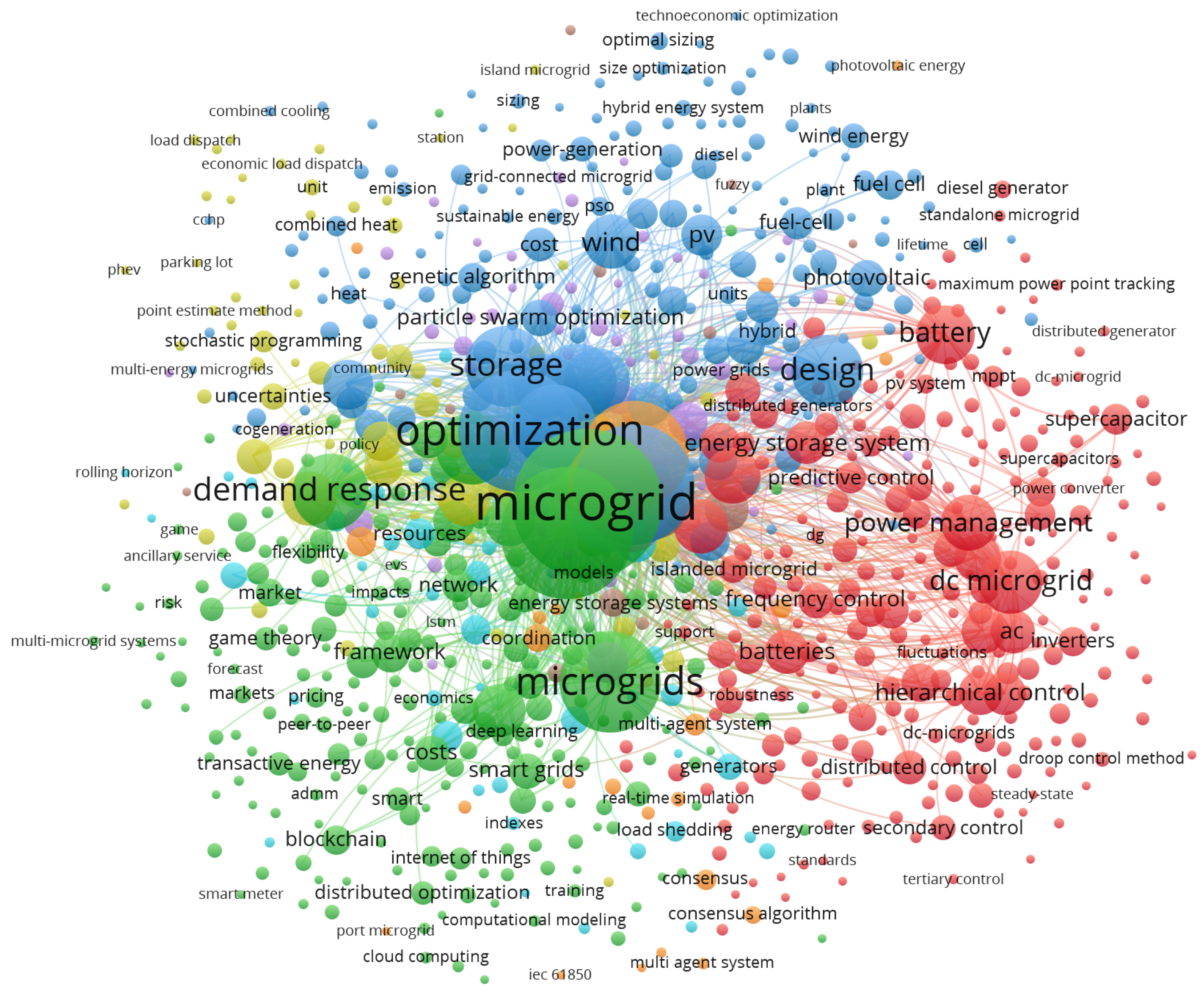
The keyword co-occurrence network in
Figure 2 reveals four dominant and well-structured research clusters, reflecting the core methodological and application-oriented themes in MG energy management research during 2016–2025:
Cluster 1 (Green): Optimization-driven MG planning and demand response (DR).
This cluster is centered on MG, optimization, demand response, and energy storage systems, with strong links to uncertainties, stochastic programming, market, pricing, flexibility, and game theory. The cluster highlights research focused on system-level planning, techno-economic optimization, and demand-side participation under uncertainty.
Cluster 2 (Blue): Renewable generation, storage, and sizing optimization.
Dominated by storage, wind, photovoltaic, power generation, and hybrid energy system, this cluster emphasizes optimal sizing and integration of renewable and storage resources. Frequently co-occurring methods include particle swarm optimization, genetic algorithm, and cost-based optimization, reflecting a strong focus on component-level design and techno-economic feasibility.
Cluster 3 (Red): Control-oriented energy management and DC MGs.
This cluster is characterized by power management, DC MG, battery, frequency control, hierarchical control, and distributed control. The dense connectivity indicates mature research on real-time control, converter-level coordination, and operational stability, particularly for DC and hybrid AC/DC MG architectures.
Cluster 4 (Yellow): Market interaction, coordination, and multi-agent frameworks.
This cluster captures emerging system coordination themes such as framework, coordination, peer-to-peer, blockchain, smart grids, and multi-agent system. The keywords reflect growing interest in decentralized decision-making, transactive energy, and cyber-enabled coordination mechanisms.
The network structure demonstrates strong coupling between optimization, storage, control, and market-oriented research streams, highlighting the multidisciplinary nature of modern MG energy management.
2.5. Thematic Insights and Implications
The bibliometric evidence reveals a clear thematic stratification in MG energy management research, with optimization, renewable integration, and control forming the methodological backbone of the field. Early and sustained emphasis on optimization-based planning and sizing reflects the foundational need to design economically viable and technically robust MGs under uncertainty.
The strong prominence of storage- and renewable-centric keywords indicates that energy storage systems and hybrid renewable configurations remain central enablers of MG flexibility and resilience. At the same time, the dense red cluster around power management, hierarchical control, and DC MGs highlights the maturation of real-time and control-oriented EMS research, driven by increasing deployment of power-electronic-dominated MGs. Emerging themes related to coordination, peer-to-peer interaction, blockchain, and multi-agent systems suggest a growing shift toward decentralized, market-aware, and cyber-enabled EMS architectures. These developments point to future MGs operating not only as isolated systems but as interactive entities within broader smart grid and energy market ecosystems.
Despite these advances, challenges remain in integrating optimization, control, and market mechanisms within unified EMS frameworks, particularly under high uncertainty and large-scale deployment. Future research is expected to focus on scalable, autonomous, and interoperable energy management systems that jointly address techno-economic performance, operational stability, and market participation.
3. Commercial Applications of MGs
CMGs have gained prominence as a reliable and cost-effective solution for meeting the energy demands of office buildings, shopping complexes, hospitals, universities, and other service-oriented establishments. By integrating renewable energy resources, distributed generation, and ESS, CMGs enhance energy efficiency, reduce operational costs, and provide resilience against grid disturbances and outages. Moreover, their ability to enable DR, peak load management, and integration of EVs positions them as a key enabler of sustainable commercial infrastructure. This section reviews existing applications of MGs in commercial sectors, analyzes prior methodologies, and highlights critical challenges and future research directions for advancing their adoption.
3.1. An Overview
The CMGs have emerged as a cornerstone in the transition towards sustainable and resilient energy systems for business facilities, health centers, and office buildings. They are designed to integrate renewable energy resources, storage technologies, and advanced control mechanisms to ensure both economic efficiency and supply reliability [
37,
38,
39,
40]. Compared to residential and industrial MGs, CMGs are characterized by higher and more dynamic load demands, requiring sophisticated energy management strategies to balance cost, reliability, and environmental performance.
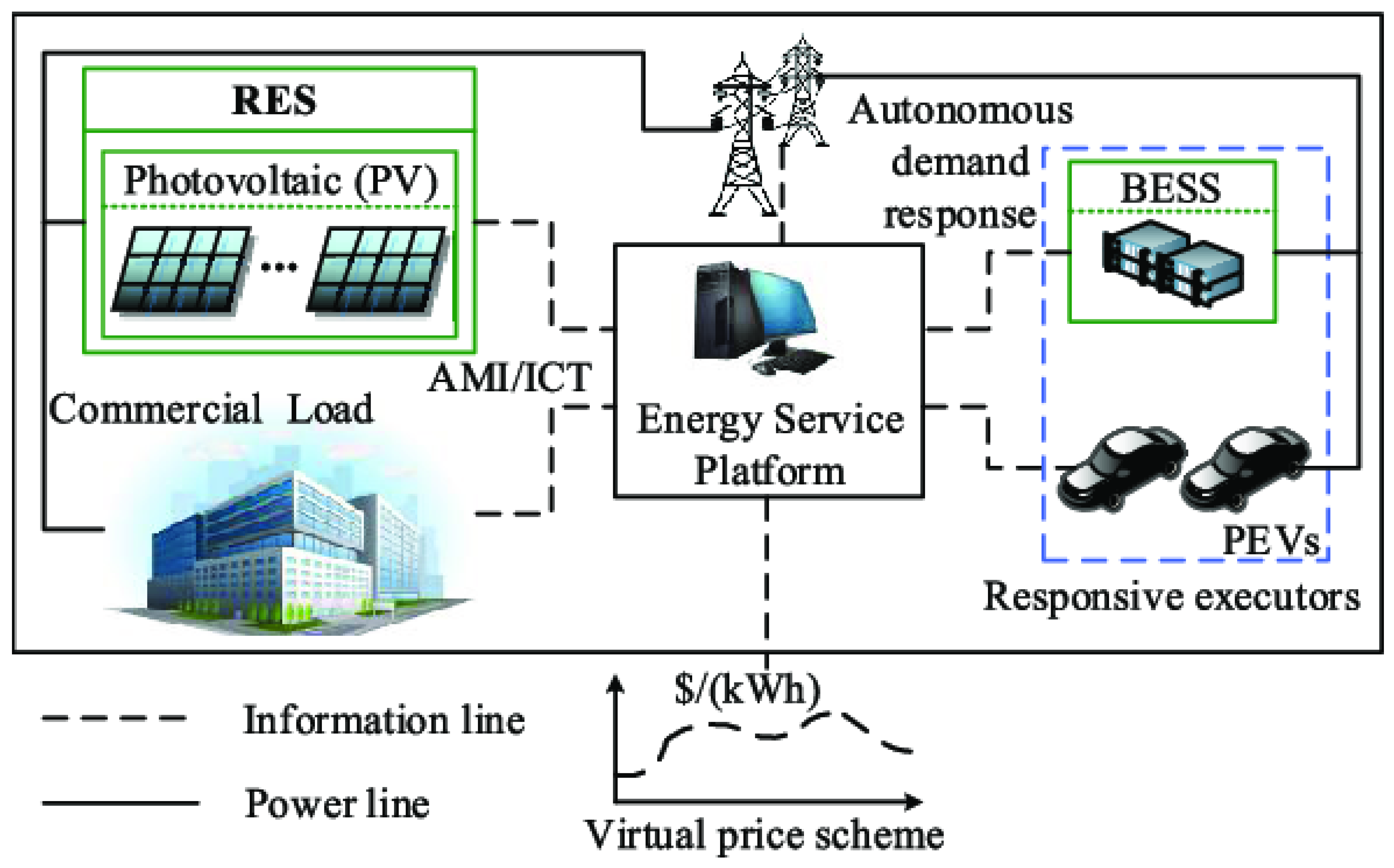
Figure 3 provides a conceptual illustration of a typical CMG, highlighting the integration of DERs such as PV systems, battery energy storage, EV charging infrastructure, and grid. The layered representation emphasizes the role of forecasting, optimization, and real-time control within the EMS, reflecting the multi-objective nature of MGs, where cost reduction, peak shaving, resilience, and service continuity must be addressed simultaneously.
Table 1 summarizes the key research focusing on CMGs. Early works emphasized the role of CMGs in enhancing resilience during emergencies through PV and battery-based strategies [
37], while subsequent studies explored hybrid AC–DC testbeds to validate energy management schemes under realistic commercial conditions [
38]. Recent studies expanded the scope to include comprehensive techno-economic assessments for hospitals, offices, and drone facilities, particularly in regions with unreliable grid infrastructure [
41,
42]. In parallel, digital twin frameworks have been introduced to evaluate economic and environmental sustainability in real time, enabling predictive optimization of building-integrated MGs [
39].
The evolution of CMGs has also been driven by the integration of EVs and hydrogen-based storage. For example, hybrid battery–fuel cell systems have been proposed for standalone commercial buildings to reach near net-zero operation [
47,
48]. Moreover, the literature reflects a growing emphasis on combining multiple objectives—such as minimizing cost of energy (COE), reducing greenhouse gas (GHG) emissions, and maximizing renewable energy penetration—within a unified energy management framework. Recent review studies have reinforced this trend, including comparative analyses of renewable-based DC MG EMS strategies [
43] and AI-driven forecasting approaches [
45]. Thus, CMGs represent an intersection of technological innovation, economic optimization, and environmental sustainability, positioning them as a vital enabler for the decarbonization of the commercial sector.
3.2. Related Work
Several studies have investigated CMGs from technical, economic, and environmental perspectives, demonstrating their versatility across diverse applications. Early contributions emphasized resilience-oriented strategies, where PV and battery storage were coordinated to sustain critical commercial loads during emergencies [
37]. To validate practical control strategies, hybrid AC–DC MG testing platforms were developed, enabling real-time assessment of EMS under commercial building operating conditions [
38].
Later research expanded the scope of CMGs by exploring their role in enhancing energy efficiency, reliability, and demand-side flexibility within commercial buildings [
40]. Comparative works highlighted the differences between renewable-based DC MG EMS strategies, with performance measured in terms of cost of energy, system reliability, and renewable penetration [
43]. Furthermore, hybrid off-grid and grid-connected systems were studied to integrate diesel backup with PV and storage, particularly suited for regions with unstable grids [
44].
Recent advances demonstrate a shift towards intelligent and data-driven frameworks. Digital twin models have been introduced to simulate and optimize CMG operation, offering improved economic and environmental sustainability by enabling predictive control [
39]. Similarly, AI has been employed for short-term commercial load forecasting, leveraging deep learning combined with bio-inspired optimization algorithms to enhance EMS accuracy and responsiveness [
45]. Hierarchical learning-based EMS approaches further support net-zero CMGs by coordinating multi-level controls to balance local generation and demand [
46].
Application-specific case studies further underline the versatility of CMGs. For example, a techno-economic analysis of a health facility MG in Ghana demonstrated substantial cost savings and improved reliability using a PV–battery–diesel hybrid configuration [
41]. Similarly, optimal design of electricity–hydrogen integrated charging hubs highlighted the role of CMGs in supporting EV mobility while maintaining commercial energy supply security [
42]. Hydrogen–battery hybrid storage has also been explored for standalone commercial buildings in Mediterranean climates, demonstrating the potential of multi-level storage to achieve net-zero operation [
47]. Most recently, EV-integrated CMGs with DR and net energy metering (NEM) schemes have been proposed, showcasing their ability to reduce energy costs, enhance resilience, and mitigate greenhouse gas emissions in office settings [
48].
Overall, the literature reflects a trajectory from resilience- and efficiency-focused CMGs to data-driven, AI-enabled, and hydrogen–EV integrated systems.
Table 2 summarizes the main contributions and application focus of representative works.
3.3. Technical Comparison of CMG Energy Management Technologies
MGs typically operate under predictable yet time-varying load profiles driven by occupancy patterns, business hours, and tariff structures. As a result, several EMS technologies have been widely adopted, each offering distinct trade-offs in performance and implementation complexity. Rule-based and scheduling-based EMS approaches remain common in small- to medium-scale commercial buildings due to their transparency, low computational burden, and ease of deployment; however, their performance is limited under high renewable penetration and dynamic pricing conditions. Optimization-based methods, including linear and mixed-integer programming, enable coordinated scheduling of DERs, batteries, and EV charging, providing superior economic performance and peak shaving capability. These methods are particularly effective for campus-scale CMGs with reliable forecasts but may face scalability challenges as system size and uncertainty increase. Metaheuristic and learning-based approaches, such as particle swarm optimization and reinforcement learning, offer greater adaptability to uncertainty and nonlinearity, making them suitable for CMGs with high renewable variability and flexible loads, albeit at the cost of higher computational and data requirements.
3.4. Recommended EMS Technologies for Representative CMG Scenarios
For conventional office buildings and retail centers with moderate renewable penetration, centralized optimization or enhanced rule-based EMS combined with DR participation is generally sufficient. In contrast, CMGs with dense EV charging infrastructure or dynamic occupancy patterns benefit from predictive and learning-based EMS frameworks capable of real-time adaptation. Campus-scale CMGs and mixed-use commercial districts are well suited to hierarchical or hybrid EMS architectures that combine centralized economic optimization with local real-time control. These comparisons demonstrate that, while similar EMS techniques may be employed across CMGs, their effectiveness depends strongly on scale, load flexibility, uncertainty, and operational objectives.
3.5. Challenges
Despite demonstrable gains in efficiency, resilience, and decarbonization, CMGs still face several interlinked challenges spanning architecture, control, forecasting, market design, and deployment (
Table 3). On the architectural side, hybrid AC/DC topologies improve conversion efficiency and interoperability but add complexity in coordination, protection, and interoperability of converters and ancillary devices (e.g., STATCOMs) [
38]. Resilience requirements in commercial facilities (e.g., hospitals, offices) intensify the need for robust emergency EMS that can prioritize critical loads under uncertainty (PV intermittency, grid outages) while maintaining acceptable costs [
37,
41].
From an energy management and control perspective, EMS must jointly optimize multiple objectives (COE, reliability indices, emissions) under stochastic demand and renewable generation, complicated further by reconfigurable hybrid AC/DC architectures and dynamic tariffs [
43,
44]. Accurate short-term forecasting for commercial loads is still non-trivial due to occupancy variability, EV charging arrivals, and weather-driven dynamics; while deep-learning/metaheuristic approaches help, they raise concerns on data requirements, generalization, and explainability for operators and regulators [
45,
46].
Storage and multi-energy integration introduce their own constraints. Battery cycling and life modeling are central to cost–reliability trade-offs; hydrogen pathways (e.g., metal-hydride) promise long-duration storage but face round-trip efficiency, sizing, and CAPEX/OPEX hurdles in commercial settings [
47]. EV integration further stresses distribution assets and EMS scheduling; realizing DR and net energy metering (NEM) benefits without burdening building operations requires robust market interfacing and careful capacity bidding strategies [
42,
48].
Finally, deployment challenges persist: (i) translating digital twins from pilots to routine operations with trustworthy data pipelines and cyber-security; (ii) aligning tariff structures, interconnection rules, and appraisal frameworks so CMG resilience and flexibility are financially recognized; and (iii) tailoring solutions to weak-grid regions where diesel backup is still prevalent and emissions goals are stringent [
39,
40,
44].
3.6. Future Research
The reviewed literature highlights promising trajectories for CMGs, yet several avenues remain open for advancing their technical maturity, economic viability, and sustainable adoption (
Table 4). A primary direction is the development of next-generation EMS frameworks that combine deterministic optimization with adaptive, learning-based modules. Hybrid EMS, leveraging model predictive control (MPC), reinforcement learning, and probabilistic forecasting, could balance explainability, robustness, and scalability across diverse commercial settings [
45,
46,
48].
Forecasting and digitalization represent another key frontier. Improved short-term demand and EV-charging forecasts are needed, potentially via federated learning or privacy-preserving AI, to address data availability and cyber concerns [
45]. Digital twins, still largely at the prototype stage, need integration into building management systems with continuous model updating, cyber-security safeguards, and validation across multiple climate zones [
39].
Future work should also focus on multi-energy integration, particularly hybrid hydrogen–battery storage configurations. Although demonstrated in Mediterranean and standalone commercial cases [
47], further research is required to reduce hydrogen infrastructure costs, improve round-trip efficiencies, and explore sector coupling with heating, cooling, and industrial gas demands.
The intersection of EV mobility and CMGs is another rapidly evolving research space. Coordinated scheduling of EV fleets, including bidirectional vehicle-to-building/grid strategies, alongside DR and NEM mechanisms, can improve cost efficiency and resilience while minimizing grid stress. However, regulatory frameworks for DR settlement, cybersecurity, and equitable incentive distribution remain underexplored [
42,
48].
Finally, policy, market design, and valuation frameworks must evolve to recognize the resilience, sustainability, and demand flexibility benefits of CMGs. Quantifying resilience value, establishing carbon pricing mechanisms for MG adoption, and incentivizing advanced storage or hydrogen integration are potential policy enablers [
40,
41]. Research in weak-grid and developing regions also requires scalable, low-cost CMG models tailored to local resources and institutional capacity [
44].
4. Industrial Applications of MGs
The IMGs have gained significant attention as an effective means of ensuring reliable, efficient, and sustainable energy supply for energy-intensive industries such as manufacturing, mining, petrochemicals, and data centers. Their ability to integrate renewable resources, provide resilience against grid disturbances, and enable cost-effective operation makes them indispensable in modern industrial infrastructures. In this section, the applications of MGs in industrial domains are introduced, followed by a review of related work, an examination of prevailing challenges, and a discussion of future research directions aimed at fostering their large-scale adoption.
4.1. An Overview
IMGs have gained increasing attention over the past decade as a reliable, cost-effective, and environmentally sustainable solution for powering industrial facilities, industrial parks, and large commercial sites. Unlike residential and commercial counterparts, IMGs are characterized by significantly higher and more variable load demands, critical reliability requirements, and often integration with EVs, combined heat and power (CHP), or heavy-duty machinery [
49,
50,
51]. These characteristics make them a cornerstone for energy-intensive industries aiming to meet decarbonization targets, enhance energy security, and reduce operational costs.
To provide a structured synthesis of these developments,
Table 5 summarizes the key research themes, methodologies, and application domains reported in the IMG literature, covering both foundational studies and recent advances in optimization, resilience, renewable integration, and intelligent EMS design.
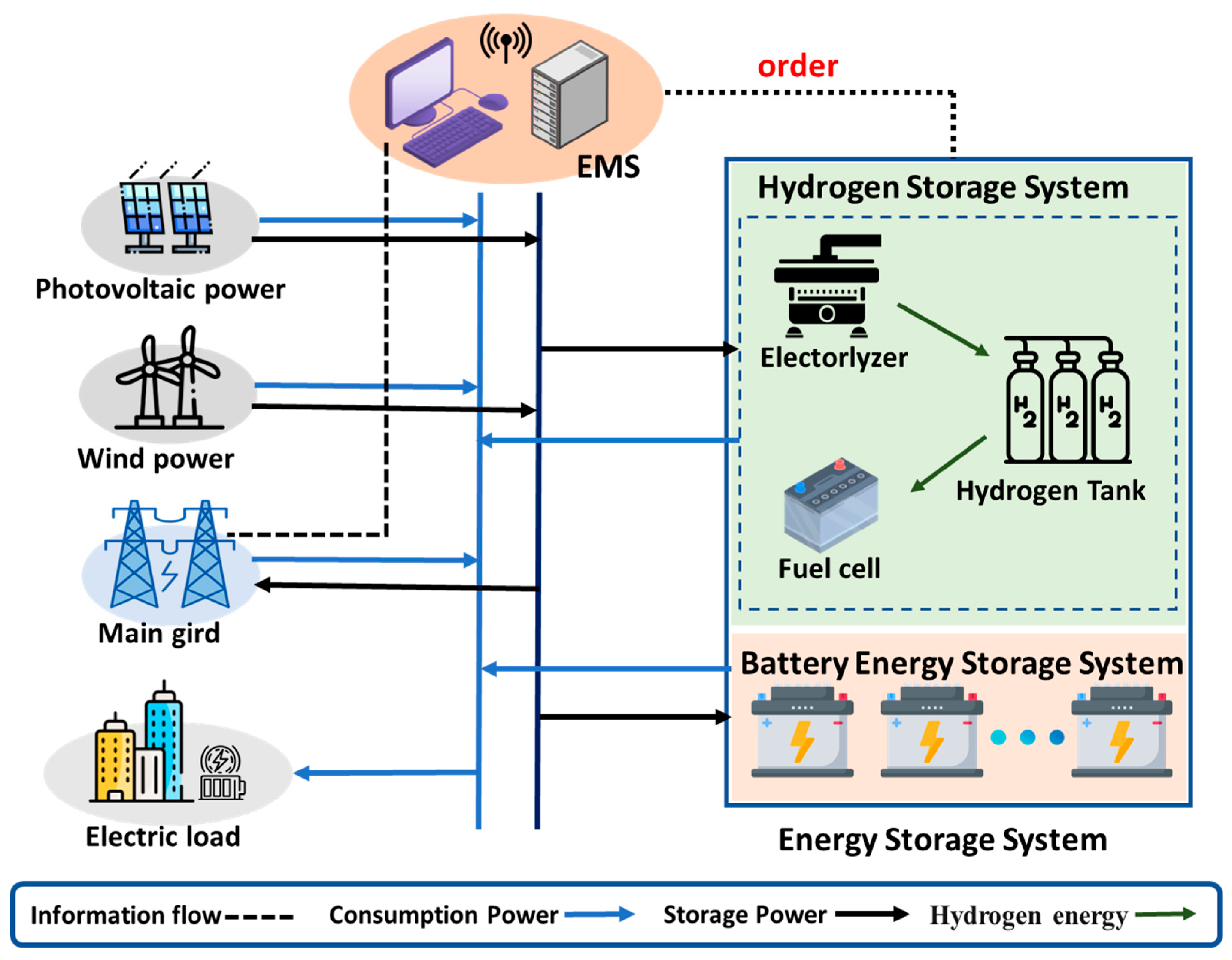
Figure 4 presents a multi-energy IMG configuration integrating PV and wind generation with grid interaction and hybrid ESS. In addition to battery storage, the figure highlights hydrogen-based long-duration storage, comprising electrolyzers, hydrogen tanks, and fuel cells, coordinated through a centralized EMS. This architecture captures the growing role of hydrogen pathways in IMGs, where surplus renewable energy is converted into hydrogen to enhance system autonomy, emission reduction, and resilience under high-load and long-duration operation.
The early literature emphasized two main aspects: the coordination of distributed generation with flexible loads such as plug-in electric vehicle (PEV) charging, and the economic allocation of PV-based IMGs [
52,
53,
54]. Subsequent work highlighted the importance of emergency automation schemes in industrial parks with interconnected MGs, ensuring continuity of supply during contingencies [
51]. Parallel studies explored the optimal design of IMGs in industrial complexes using advanced optimization methods such as particle swarm optimization (PSO) and mixed-integer programming, demonstrating significant cost and emission savings compared with grid-only supply [
55].
In recent years, case studies from both developed and developing regions showcased the techno-economic viability of IMGs in maintaining reliable power under grid uncertainty. For example, HOMER-based designs of IMGs in India and Saudi Arabia demonstrated that solar PV, wind, and storage can cut costs by more than 50% and reduce emissions by over 90% compared to conventional grid-diesel configurations [
56,
57]. Reviews further classified IMG energy management strategies, highlighting clustering into centralized, decentralized, heuristic, and hybrid EMS approaches [
21,
34,
58,
59].
The role of EV integration has grown substantially. IMG frameworks for EV charging based on solar resources employed stochastic and Monte Carlo simulations to manage demand uncertainty and optimize charging costs [
60]. At the same time, PV hosting capacity enhancement studies indicated that industrial zones can support significantly higher renewable penetration with advanced grid-supportive controls [
61]. Reviews have also underscored the importance of flexible demand-side participation and flexible energy sources in industrial and hybrid MGs, emphasizing both opportunities and challenges for scalability [
17,
19].
Recent contributions demonstrate the application of reinforcement learning and multi-objective optimization for IMG energy management [
62], as well as comprehensive surveys of DC MG control for industrial and smart city applications [
63]. Moreover, reviews have highlighted the increasing need to incorporate uncertainty modeling, life-cycle costing, and trilemma perspectives (balancing cost, sustainability, and security) into IMGs planning and EMS frameworks [
20,
35,
64]. The literature also emphasizes the growing interest in hybrid hydrogen storage integration, which is considered promising for industrial parks but remains challenged by cost and efficiency limitations [
65].
Overall, IMGs are evolving into complex, multi-energy systems that support both industrial productivity and sustainability. This evolution reflects a transition from basic scheduling and cost optimization toward advanced AI-driven EMS, renewable–hydrogen integration, and digitalized, flexible, and resilient multi-MG operations.
Table 5.
Key research focus in IMGs (2013–2024).
Table 5.
Key research focus in IMGs (2013–2024).
| Reference | Main Focus | Application |
|---|
| [49] | Coordination of generation scheduling with PEV charging | IMGs scheduling |
| [50] | Optimal allocation and economic evaluation of PV-based IMGs | Industrial PV MG design |
| [66] | Profit-based unit commitment with security | Fair cost allocation in IMGs |
| [51] | Automation scheme for emergency operation | Multi-MG industrial park |
| [56] | Reliable power supply case study | C&I sites (India) |
| [55] | Optimal MG design using PSO | Industrial complex (Texas) |
| [58] | Review and clustering of EMS methods | Industrial MG EMS classification |
| [59] | State-of-the-art review of renewable-based IMGs | Comprehensive review |
| [34] | Literature review on supervisory control/EMS | IMGs supervisory controllers |
| [60] | EV charging coordination using solar PV | Turkish Organized Industrial Zone |
| [61] | PV hosting capacity improvement | Remote IMGs |
| [67] | Techno-economic multi-resource IMG planning | Industrial zones with RES integration |
| [57] | Hybrid MG design with sensitivity/resilience analysis | Najran Industrial Institute, Saudi Arabia |
| [62] | RL-based EMS optimization | Advanced industrial EMS |
| [63] | Survey of DC MG energy management/control | Industrial + smart city MGs |
4.2. Related Work
Research on IMGs has evolved from foundational optimization and scheduling studies toward sophisticated frameworks integrating renewable energy, storage, EVs, and advanced control methods (
Table 6). The earliest contributions addressed the coordination of generation with PEV charging in industrial environments, proposing scheduling methods to minimize costs while ensuring secure system operation [
49]. At the same time, studies on optimal PV allocation and economic evaluation established the importance of considering both technical feasibility and economic returns in IMG planning [
50]. Profit-based unit commitment frameworks further highlighted the necessity of secure operation while fairly distributing cost savings among participants [
66].
By 2018, attention shifted toward ensuring operational resilience in industrial parks through automated control of interconnected MGs, emphasizing real-time protection and restoration [
51]. Around the same time, case studies from India and Texas illustrated the use of optimization tools (e.g., HOMER, particle swarm optimization) to design IMGs that achieve cost savings, improved reliability, and reduced emissions under varying outage conditions [
55,
56]. These works demonstrated that IMGs could deliver both economic and environmental benefits, especially in regions with unreliable grids.
From 2020 onward, the literature began clustering and systematizing IMG energy management strategies. Reviews categorized EMS approaches into centralized, decentralized, heuristic, and hybrid types, identifying their suitability for different industrial contexts [
21,
34,
58,
59]. Forecasting and uncertainty reviews further emphasized the role of probabilistic optimization and robust control in improving IMG performance under renewable variability and market fluctuations [
19,
22,
23,
35]. Meanwhile, flexible energy management strategies were identified as essential for adapting IMGs to evolving industrial demand and renewable variability [
17,
20].
Recent contributions extend beyond operations to consider broader sustainability and lifecycle perspectives. Techno-economic frameworks now integrate PV, storage, CHP, and hydrogen systems, validated in real-world industrial parks such as Najran Industrial Institute in Saudi Arabia [
57,
67]. Hybrid renewable–hydrogen systems are increasingly seen as viable solutions for extending autonomy and enhancing resilience, though challenges remain in cost and efficiency [
65]. Finally, surveys emphasize the importance of DC MGs in industrial and smart city contexts, highlighting both control advancements and integration challenges [
63].
Overall, related work reflects an evolution from operational scheduling and cost allocation to holistic frameworks integrating renewables, EVs, and AI-driven EMS, alongside comprehensive reviews that synthesize best practices for industrial applications.
Table 6 summarizes the representative related works.
4.3. Challenges
Although IMGs demonstrate significant potential in reducing costs, enhancing resilience, and enabling decarbonization, several technical, economic, and regulatory challenges remain unresolved (
Table 7).
From a technical perspective, industrial sites often feature highly variable and energy-intensive loads, requiring advanced coordination of DERs, storage, and flexible demand. Early work on coordinated generation scheduling with PEV charging demonstrated the complexity of balancing industrial demand and mobility services [
49]. While profit-based unit commitment models addressed security constraints and fair allocation, their computational intensity and scalability to larger IMGs remain limiting factors [
66]. Furthermore, hybrid AC/DC topologies and emergency automation schemes, while improving resilience, introduce challenges in converter coordination, fault protection, and cyber-secure communication [
34,
51].
On the energy management side, centralized optimization frameworks (e.g., MILP, PSO) ensure global optimality but are prone to high computational burden, while heuristic and rule-based EMS approaches lack adaptability under uncertainty [
21,
55,
58]. The need for multi-objective EMS that simultaneously optimize cost, emissions, and reliability in uncertain renewable and load conditions remains a persistent challenge [
19,
20,
35,
59].
Integration of renewables and EVs introduces further barriers. Solar-based EV charging in industrial zones revealed the stochastic nature of travel and charging behaviors, requiring probabilistic methods that are data- and computation-heavy [
22,
23,
60]. Similarly, PV hosting capacity enhancement studies showed that network limits (voltage rise, thermal overloads) constrain renewable penetration, necessitating advanced grid-supportive controls and reinforcement [
61]. Reviews also noted that hydrogen-based hybrid systems provide resilience but face technological and economic barriers in scaling for industrial use [
65].
Storage and multi-energy integration remain central bottlenecks. Batteries face degradation and replacement cost issues, while hydrogen pathways are hindered by high capital expenditure and efficiency penalties [
57,
65]. Reinforcement learning and AI-based EMS offer adaptability but face explainability, training data, and cyber-security concerns in critical industrial applications [
62].
Finally, policy and market challenges persist. Despite evidence of substantial COE and emission reductions, valuation of resilience and environmental benefits remains underdeveloped. IMG operators often lack financial mechanisms to monetize flexibility, resilience, or excess energy exports. Reviews emphasize that without tailored tariffs, incentive schemes, and regulatory clarity, widespread iMG deployment will remain constrained [
17,
59,
63,
64].
4.4. Future Research
Future research on IMGs must address multi-dimensional gaps in technology, control, economics, and policy to unlock their full potential (
Table 8).
Advanced EMS frameworks. While existing works cover centralized optimization, heuristics, and AI-driven methods, future EMS should combine explainable AI, MPC, and probabilistic forecasting. Such hybrid approaches could balance global optimality, computational tractability, and adaptability under uncertainty [
21,
58,
62].
Forecasting and digitalization. Improved short-term forecasting of industrial demand, EV charging, and renewable generation will be critical. Future research should explore hybrid physical–statistical and AI-driven approaches to improve accuracy and robustness [
22,
23,
35]. Digital twin integration into industrial EMS offers opportunities for real-time validation, cyber-secure operation, and scenario testing across multiple facilities [
59,
63].
Multi-energy integration. Hydrogen–battery hybrid solutions are promising for long-duration storage but remain costly and inefficient. Further research is needed on cost reduction, lifecycle optimization, and integration with CHP and industrial processes [
57,
65].
EV and fleet electrification. Large-scale integration of EV fleets in industrial zones demands advanced coordination. Future research should consider vehicle-to-grid (V2G) and vehicle-to-building (V2B) strategies in combination with DR programs to ensure reliability while monetizing flexibility [
60,
61].
Resilience and scalability. Case studies show IMGs can withstand contingencies with automation and hybrid storage [
51,
57], yet systematic resilience valuation is lacking. Future work should develop standardized metrics and link them with market mechanisms or insurance schemes [
64].
Policy and market mechanisms. IMGs require tailored policy support. Research should focus on tariff design, carbon pricing, and resilience incentives that reward flexibility and sustainability. Peer-to-peer trading frameworks and lifecycle-based valuation are potential enablers of scalable adoption [
17,
20].
5. Residential Applications of MGs
The RMGs have become increasingly important in addressing the rising demand for reliable, affordable, and sustainable energy at the household and community levels. By integrating DERs such as rooftop solar PVs, small-scale wind, battery storage, and EVs, residential MGs empower consumers to actively participate in energy management while reducing dependence on the central grid. They not only enhance supply reliability and enable cost savings but also contribute to emission reduction and energy self-sufficiency, particularly in urban neighborhoods, rural communities, and remote areas. This section presents an overview of RMG applications, reviews the existing body of literature, and identifies key challenges and prospective research directions to strengthen their role in future energy systems.
5.1. An Overview
RMGs have progressed from small, PV–battery islands into data-driven, multi-energy systems that coordinate PV, battery energy storage systems (BESSs), thermal storage, EVs, and smart home loads. Compared with commercial and industrial contexts, RMGs typically operate at smaller scales but face a wider diversity of occupant-driven demand patterns and appliance-level variability, which elevates the importance of forecasting, DR, and non-intrusive load monitoring (NILM) within EMSs. Early RMG studies focused on rule-based and fuzzy-logic EMS for autonomous operation and grid-smoothing [
68,
69], while subsequent works emphasized optimal sizing of combined electrical and thermal storage for islanded reliability and economic performance [
70,
71].
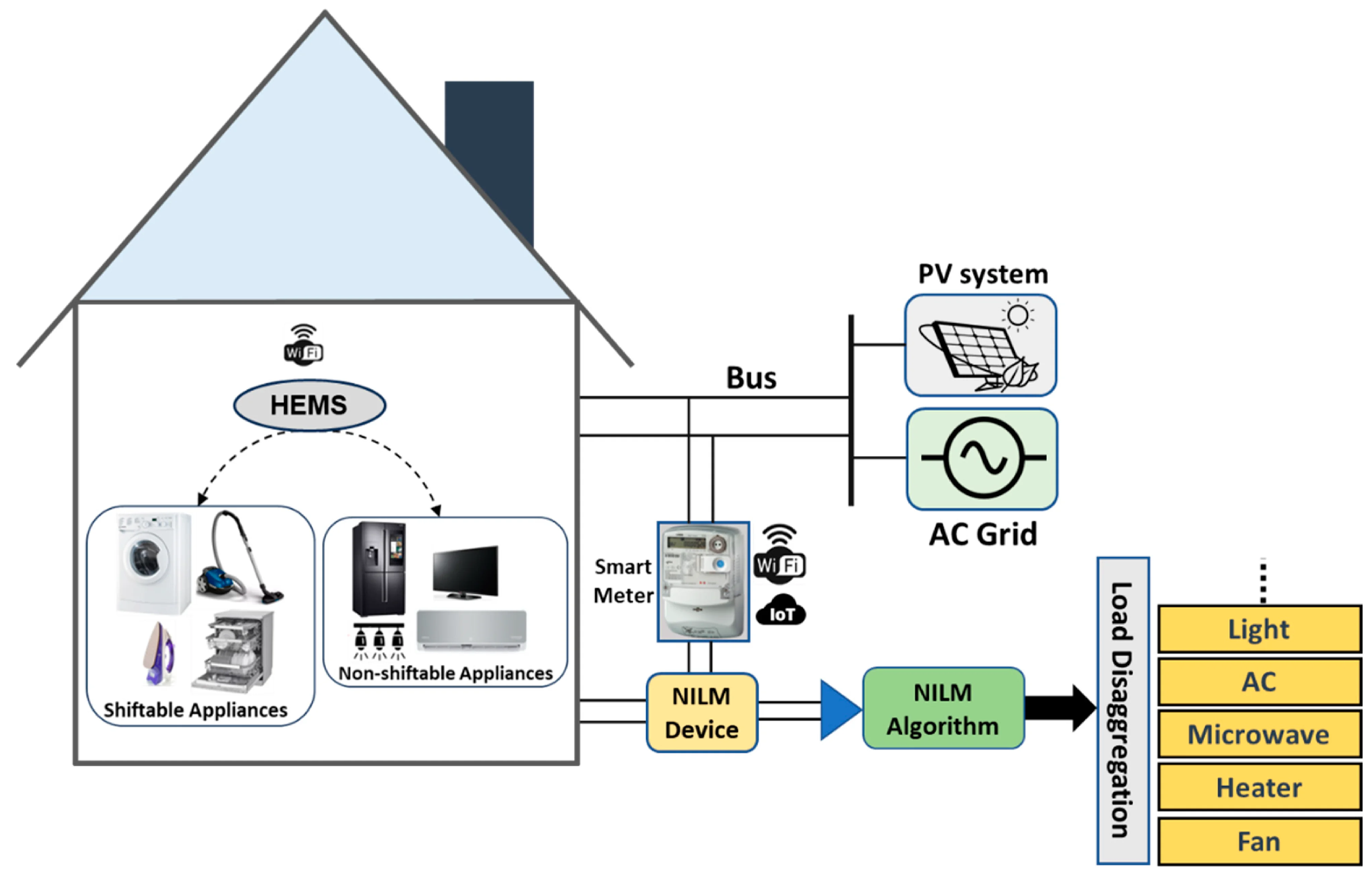
Figure 5 illustrates a residential MG energy management framework centered on a home energy management system (HEMS) supported by non-intrusive load monitoring and IoT-based communication. The figure distinguishes between shiftable and non-shiftable household appliances and demonstrates how NILM algorithms disaggregate aggregated smart meter data into appliance-level consumption profiles. This enables data-driven scheduling, DR, and improved self-consumption of rooftop PV generation while preserving user comfort and privacy.
A parallel stream surveyed DC MG energy management dedicated to residential settings, noting that DC architectures can reduce conversion losses and simplify control in PV- and storage-rich homes [
72]. At the same time, neighborhood and community-level schemes emerged to enable peer-to-peer energy exchange and multi-home coordination, improving self-consumption and reducing peak imports [
73,
74]. As datasets and computational methods matured, forecast-driven and metaheuristic EMS gained traction (e.g., ensemble forecasting with Grey Wolf Optimization), demonstrating tangible cost and emission reductions under uncertainty [
75,
76].
Recent contributions have broadened the RMG envelope in three directions. First, digital twins are being used to fuse operation, optimization, and lifecycle cost evaluation for residential communities [
77]. Second, advanced control and NILM techniques improve appliance-level flexibility without intrusive sub-metering, supported by IoT-based EMS for prosumer-centric systems [
78,
79,
80]. Third, hydrogen pathways (fuel-cell micro-CHP, green H
2 storage) are explored to extend autonomy beyond battery time scales and couple electricity with heat for prosumer households [
81,
82,
83,
84]. Altogether, the literature indicates a shift from single-home, rule-based control to community-scale, AI-enabled EMS with sector coupling and new storage vectors (thermal and hydrogen), aiming to jointly minimize cost of energy, enhance resilience, and decarbonize residential demand.
5.2. Related Work
Research on RMGs has progressed from early rule-/fuzzy-based controllers to optimization- and AI-enabled EMS, alongside community coordination, DC architectures, and sector coupling. Foundational works demonstrated autonomous DC RMG operation with optimized fuzzy logic [
68] and grid-smoothing via fuzzy EMS for electro-thermal homes [
69]. In parallel, surveys mapped the EMS/control landscape for RMGs, positioning residential use cases within a general taxonomy [
72,
85,
86].
Table 9 summarizes the key research focus on RMGs.
Coordination at the community layer has been approached through multi-neighborhood energy exchange and double-layer energy-sharing clouds, improving self-consumption and reducing peaks [
73,
74]. As computational methods matured, forecast-driven EMS integrated ensemble methods and metaheuristics, reporting cost/emission gains under uncertainty [
75]. Planning studies bridged design and operation by jointly sizing storage for islanded reliability, with later work refining multi-objective trade-offs [
70,
71].
Electro-thermal EMS with DSM and forecasting improved comfort and economics [
90]. NILM- and IoT-based EMS enabled appliance-level flexibility without intrusive sub-metering [
79,
80]. For DC homes with multiple sources, fuzzy multi-objective EMS supported real-time coordination [
87]. At the neighborhood scale, optimization for RES-based residential complexes showed planning pathways, while embedded EMS showed feasibility on constrained hardware [
76,
88].
Beyond batteries, hydrogen pathways extended autonomy and cogeneration: hybrid power–heat solutions in Spain, fuel-cell micro-CHP, and green-hydrogen storage demonstrated resilience potential [
65,
81,
82,
84]. Digital twins now couple techno-economic evaluation with operational optimization [
77], while advanced control supports fast, explainable, grid-supportive RMGs [
78]. Reviews classified EMS approaches under uncertainty [
35], comparative EMS strategies [
19], MG /nanogrid energy management [
18], computational intelligence methods [
25], trilemma perspectives [
20], and holistic EMS syntheses [
21,
64].
5.3. Challenges
Despite progress, RMGs face technical, operational, and socio-economic barriers (
Table 10).
Technical: stochastic occupant-driven loads challenge EMS design. Rule/fuzzy EMS offer transparency but lack robustness [
68,
69].
Optimization: metaheuristic/forecast-driven EMS reduce complexity but lack guarantees, while centralized MPC/MILP is computationally heavy [
70,
71,
75].
Appliance-level management: NILM + IoT unlock flexibility but raise privacy/cyber issues [
79,
80]. Electro-thermal EMS must balance comfort and forecasting errors [
90].
Integration: hydrogen pathways extend autonomy but face cost/efficiency hurdles [
65,
81,
82,
84]. Community EMS require robust markets and fairness [
73,
74].
Policy: weak incentives for resilience/carbon reduction slow adoption [
21,
72,
86].
5.4. Future Research
Future work on RMGs should target advanced control, scalable architectures, and sustainable multi-energy systems (
Table 11).
Next-gen EMS: merging explainable AI, MPC, RL, and probabilistic optimization for transparency and robustness [
25,
75].
Forecasting and digital twins: federated learning, privacy-preserving AI, and large-scale DT deployment [
77,
86].
Hydrogen pathways: rSOC, hybrid H
2–battery, and multi-vector EMS for cost-efficient resilience [
65,
81,
82,
83,
84].
Appliance flexibility: NILM + IoT for real-time DR with incentive schemes [
79,
80,
89].
Policy/adoption: tariff innovation, resilience valuation, peer-to-peer markets, contextual techno-economics [
21,
91].
6. Cross-Sectoral Challenges in MG Energy Management
Residential, commercial, and IMGs differ primarily in their operational scale, performance priorities, and system constraints, which in turn shape the design and implementation of their EMSs. RMGs typically operate at small scales with highly stochastic, occupant-driven loads, placing emphasis on DSM, user comfort, self-consumption, and prosumer participation. Their EMS solutions often prioritize simplicity, transparency, and low computational burden, with increasing use of non-intrusive load monitoring, HEMS, and community-level coordination. MGs occupy an intermediate position, characterized by larger and more predictable aggregated loads, time-varying occupancy, and strong sensitivity to electricity tariffs and peak demand charges. Consequently, their EMS strategies focus on economic optimization, peak shaving, DR participation, and service continuity, often supported by centralized platforms, advanced forecasting, and integration of EV charging infrastructure.
IMGs represent the most complex and energy-intensive category, operating under mission-critical reliability and production constraints. They commonly integrate multi-energy resources such as combined heat and power, hydrogen systems, and large-scale storage, and require EMS solutions capable of coordinating high-power loads, flexible processes, and long-duration autonomy. In this context, control architectures tend to be centralized or hierarchical, with increasing adoption of multi-objective optimization and AI-driven scheduling to balance cost, emissions, and operational security. These distinctions underline that, although common EMS methodologies may be applied across domains, their practical realization, control complexity, and evaluation metrics differ substantially, justifying the domain-specific analysis adopted in this review.
While sector-specific advancements in commercial, industrial, and MGs have been substantial, several cross-cutting challenges persist across domains (
Table 12). These challenges span forecasting, control, multi-energy integration, cyber-security, scalability, and policy frameworks.
6.1. Forecasting and Uncertainty
Accurate forecasting of renewable generation, load demand, and EV integration remains a universal challenge. Forecasting reviews emphasize that hybrid physical–statistical approaches improve performance but require high-quality data and weather predictions [
22,
23]. At the same time, model uncertainties, especially in islanded and high-renewable MGs, undermine scheduling and cost optimization [
35]. Ensuring robustness under these uncertainties is a shared need across all sectors.
6.2. Energy Management and Control
EMS architectures across MGs range from centralized, to decentralized, to distributed. Early supervisory control reviews highlighted the trade-offs in scalability, communication overhead, and resilience [
34]. More recent comparative reviews emphasized that while centralized methods offer global optimality, distributed and hierarchical frameworks enhance adaptability but complicate coordination [
19,
21]. Integrating computational intelligence and machine learning offers promise in adaptive EMS but raises interpretability and cyber-resilience concerns [
25]. While centralized optimization frameworks such as mixed-integer linear programming and metaheuristic methods (e.g., PSO) can be computationally intensive for large-scale or networked MGs, recent studies have shown that convex optimization-based formulations provide a high-efficiency alternative for specific classes of EMS problems. By leveraging convexified power flow models and steady-state representations of bi-directional converters, these approaches enable fast and globally optimal solutions for economic dispatch and coordinated operation of hybrid AC/DC and networked MGs [
94]. Such convex frameworks are particularly suitable for steady-state and market-oriented EMS applications, where integer decisions and strongly non-convex dynamics can be relaxed. However, their applicability may be limited in scenarios requiring detailed unit commitment, discrete operational constraints, or long-horizon uncertainty modeling, underscoring the complementary roles of convex, mixed-integer, and learning-based EMS approaches.
6.3. Multi-Energy and Sector Coupling
A key frontier in MG deployment is multi-vector energy integration. Hydrogen, thermal storage, and sector coupling (power–heat–mobility) provide extended autonomy but introduce cost, efficiency, and system complexity challenges [
65,
92]. Lifecycle-based evaluations emphasize that sustainability assessments must extend beyond energy cost minimization to include life cycle costing, environmental impacts, and social benefits [
20,
64].
6.4. Scalability and Interoperability
Scalability of MG control remains constrained by communication limits and optimization burdens. Reviews on hierarchical and multi-agent systems highlight the potential of peer-to-peer (P2P) frameworks and federated optimization for large-scale deployments [
27]. Similarly, surveys of networked MGs underscore interoperability as a bottleneck, where diverse ownership, heterogeneous DERs, and policy misalignments impede coordination [
93].
6.5. Policy, Market Design, and Adoption
Despite technical maturity, adoption is slowed by policy and market gaps. Energy management strategies reviewed under the trilemma lens highlight the tension between affordability, sustainability, and security, stressing that few EMS frameworks capture all three simultaneously [
20]. Resilience, carbon reduction, and demand flexibility remain undervalued in current regulatory and tariff structures. Without proper incentives, including carbon pricing and resilience valuation, MG deployment may stagnate even as technical solutions mature.
6.6. Solution Pathways for MG Energy Management Challenges
The challenges associated with MG energy management, ranging from renewable intermittency and scalability to cybersecurity and regulatory uncertainty, require coordinated solutions across technical, operational, and institutional dimensions. From a technical perspective, hybrid EMS architectures that combine centralized optimization with distributed and hierarchical control offer a promising solution to scalability and coordination challenges. Such architectures enable global economic optimization while maintaining local responsiveness and resilience.
Uncertainty arising from renewable generation, demand variability, and EV behavior can be mitigated through probabilistic forecasting, stochastic optimization, and learning-based control, which are supported by real-time data acquisition and adaptive scheduling. The growing adoption of digital twin technologies further enhances decision-making by enabling real-time system monitoring, scenario evaluation, and predictive maintenance under normal and contingency conditions.
Challenges related to long-duration autonomy and deep decarbonization can be addressed through multi-energy integration, particularly by coupling electrical MGs with thermal and hydrogen-energy systems. Coordinated EMS strategies that jointly manage electricity, heat, and hydrogen storage improve flexibility, reduce curtailment, and enhance system resilience, particularly in industrial and remote MGs.
From an operational and cyber resilience perspective, secure communication protocols, decentralized decision-making, and anomaly detection techniques are essential for protecting EMS against cyber threats and data integrity issues. Finally, regulatory and market-related challenges can be alleviated by policy frameworks and pricing mechanisms that explicitly value flexibility, resilience, and emission reduction, thereby incentivizing advanced EMS deployment and participation in DR and ancillary service markets.
Collectively, these solution pathways indicate that effective MG energy management requires an integrated approach that aligns technological innovations with operational strategies and supportive policy designs.
7. Future Directions and Emerging Trends
The synthesis presented in this review reveals several critical research directions that are expected to shape the next generation of MG energy managements (
Table 13). These directions extend beyond incremental improvements in optimization and control, pointing toward a more integrated, intelligent, and policy-aware MG paradigm.
7.1. Next-Generation EMS
Future EMS frameworks are likely to evolve toward hybrid architectures that combine centralized optimization with distributed and hierarchical control. Integrating MPC with reinforcement learning and explainable AI offers a promising pathway to balance global optimality, adaptability under uncertainty, and transparency for operators and regulators [
21,
25]. Developing EMS solutions that are both data-driven and interpretable remains a key research challenge, particularly for safety-critical industrial and networked MGs.
7.2. Forecasting and Digital Twins
Accurate forecasting of renewable generation, demand, and EV behavior will remain central to reliable MG operation. Emerging research increasingly emphasizes probabilistic and federated forecasting approaches to address data scarcity, privacy, and scalability issues. In parallel, digital twin technologies are expected to play a growing role in bridging planning and operation by enabling real-time validation, scenario analysis, lifecycle-aware optimization, and cyber-secure EMS deployment across multiple MGs [
3,
77].
7.3. Hydrogen and Long-Duration Storage
Hydrogen-based storage and hybrid battery–hydrogen systems are anticipated to become key enablers of high renewable penetration and long-duration autonomy, particularly in industrial, remote, and islanded MGs [
65,
92]. Future research must focus on improving round-trip efficiency, reducing capital costs, and developing EMS strategies that coordinate electricity, heat, and mobility vectors in a unified optimization framework. The integration of hydrogen systems also raises new challenges related to safety, infrastructure planning, and market participation.
7.4. Scalability, Interoperability, and P2P Energy
As MGs increasingly operate as part of interconnected clusters or VPPs, scalability and interoperability will become defining research priorities. Multi-agent and peer-to-peer energy management frameworks offer potential solutions but require standardized communication protocols, robust coordination mechanisms, and scalable optimization techniques [
27]. Ensuring cyber-resilience and secure data exchange across heterogeneous MG assets remains a critical open issue [
93].
7.5. Policy, Socio-Economic Integration, and the Energy Trilemma
Finally, future developments in MG energy management must be supported by appropriate policy and market mechanisms. Research is needed to quantify and monetize resilience, flexibility, and emission reduction benefits through tariffs, incentives, and carbon pricing schemes. Incorporating socio-economic factors, user behavior, and equity considerations into EMS design will be essential to enable widespread adoption and long-term sustainability of MGs [
20,
64].
The analysis indicates that MG energy management will require coordinated progress across technology, control, data, and policy domains, positioning EMS not only as an optimization tool but as a central enabler of resilient, low-carbon, and decentralized energy systems.
8. Conclusions
This review has presented a comprehensive and sector-specific synthesis of EMSs in MGs, encompassing commercial, industrial, and residential applications. The necessity of this work stems from the rapid evolution of MG technologies driven by high renewable penetration, increasing electrification of loads, digitalization, and growing requirements for resilience and decarbonization. Although a substantial body of literature exists on MG energy management, prior studies have largely focused on isolated technologies, optimization methods, or generic architectures. As a result, a fragmented understanding persists across application domains. This review addresses that gap by offering a comparative, sector-oriented perspective, enabling a clearer appreciation of both shared and distinct energy management challenges across MG types.
The significance of this review lies in its integrated and cross-sectoral approach, which bridges technical advances with operational, economic, and policy considerations. By systematically consolidating research from 2016–2025, this paper highlights how EMS objectives, control complexity, and storage requirements evolve from residential to commercial and industrial contexts. In particular, this review demonstrates that while RMGs emphasize user-centric flexibility and demand-side participation, MGs prioritize cost optimization, peak management, and service continuity, and IMGs demand stringent reliability, multi-energy coordination, and production-aware control. This structured synthesis provides a valuable reference for researchers developing advanced EMS algorithms, for practitioners designing resilient MG solutions, and for policymakers seeking to align regulatory frameworks with emerging decentralized energy systems.
Looking ahead, several important directions for future development emerge from this analysis. First, next-generation EMS frameworks are expected to increasingly integrate explainable AI, reinforcement learning, and MPC to balance adaptability, transparency, and computational efficiency under uncertainty. Second, digital twin technologies are poised to play a central role in real-time optimization, lifecycle-aware decision-making, and cyber-secure operation of MGs, particularly as systems scale toward networked and multi-MG configurations. Third, hydrogen and hybrid long-duration storage systems are likely to become critical enablers of high renewable penetration and net-zero operation, especially in industrial and remote MGs, provided that cost, efficiency, and integration challenges can be overcome. Finally, future research must move beyond purely technical optimization to address interoperability, resilience valuation, and policy-driven market mechanisms, ensuring that the flexibility, reliability, and emission-reduction benefits of MGs are appropriately recognized and incentivized.
This synthesis demonstrates that advancing MG energy management requires a holistic and coordinated approach that combines technological innovation with system integration, data governance, and supportive regulatory design. Addressing these dimensions collectively will be essential to enabling scalable, resilient, and sustainable MG deployments and to supporting the broader transition toward low-carbon and decentralized energy systems.




 ,
,