Review

A Review of Natural Hazards’ Impacts on Wind Turbine Performance, Part 2: Earthquakes, Waves, Tropical Cyclones, and Thunderstorm Downbursts


1
School of Arts and Design, Nanjing University of Industry Technology, Nanjing 210023, China
2
School of Engineering, University of Southampton Malaysia, Iskandar Puteri 79100, Malaysia
3
Solar Energy Research Institute, Universiti Kebangsaan Malaysia, Bangi 43600, Malaysia
4
Carbon Neutrality Research Group, University of Southampton Malaysia, Iskandar Puteri 79100, Malaysia
*
Authors to whom correspondence should be addressed.
Energies 2026, 19(2), 385; https://doi.org/10.3390/en19020385
Submission received: 29 May 2025 / Revised: 3 January 2026 / Accepted: 9 January 2026 / Published: 13 January 2026
(This article belongs to the Section A3: Wind, Wave and Tidal Energy)

Abstract

The rapid expansion of wind power as a key component of global renewable energy systems has led to the widespread deployment of wind turbines in environments exposed to diverse natural hazards. While hazard effects are often investigated individually, real wind turbine systems frequently experience concurrent or sequential hazards over their operational lifetime, giving rise to interaction effects that are not adequately captured by conventional design approaches. This paper presents Part 2 of a comprehensive review on natural hazards affecting wind turbine performance, combining bibliometric keyword co-occurrence analysis with a critical synthesis of recent technical studies. The review focuses on earthquakes, sea waves, and extreme wind events, while also highlighting other hazard types that have received comparatively limited attention in the literature, examining their effects on wind turbine systems and the mitigation strategies reported to address associated risks. Rather than treating hazards in isolation, their impacts are synthesised through cross-hazard interaction pathways and component-level failure modes. The findings indicate that wind turbine vulnerability under multi-hazard conditions is governed not only by load magnitude but also by hazard-induced changes in system properties and operational state. Key research gaps are identified, emphasising the need for state-aware, mechanism-consistent multi-hazard assessment frameworks to support the resilient design and operation of future wind energy systems.

1. Introduction

Natural phenomena are physical events arising from the Earth’s natural systems and occur independently of human intervention. These phenomena include hydrological, meteorological, and geological processes such as storms, ocean waves, and earthquakes, all of which can impose substantial loads on engineered structures. Wind turbines (WTs), deployed in both onshore and offshore environments to harness wind energy, are inherently exposed to these natural forces. Although many turbine sites are selected for their strong wind resources, they frequently coincide with regions prone to seismic activity, severe sea states, or extreme wind events. While the effects of meteorological hazards such as lightning, icing, and rainfall were examined in detail in Part 1 of this study [1], there remains a critical need to understand how other major natural hazards influence WT structural integrity, dynamic response, and energy production capability.
To support a systematic understanding of this research landscape, a bibliometric keyword co-occurrence analysis was conducted. This approach enabled the mapping of thematic relationships both within individual hazard categories and across the broader body of WT hazard-related research, thereby facilitating the identification of dominant research clusters, interconnections between themes, emerging research directions, and areas that remain underexplored. The resulting insights help reveal structural gaps in the existing literature and inform future research aimed at improving WT resilience under extreme environmental conditions.
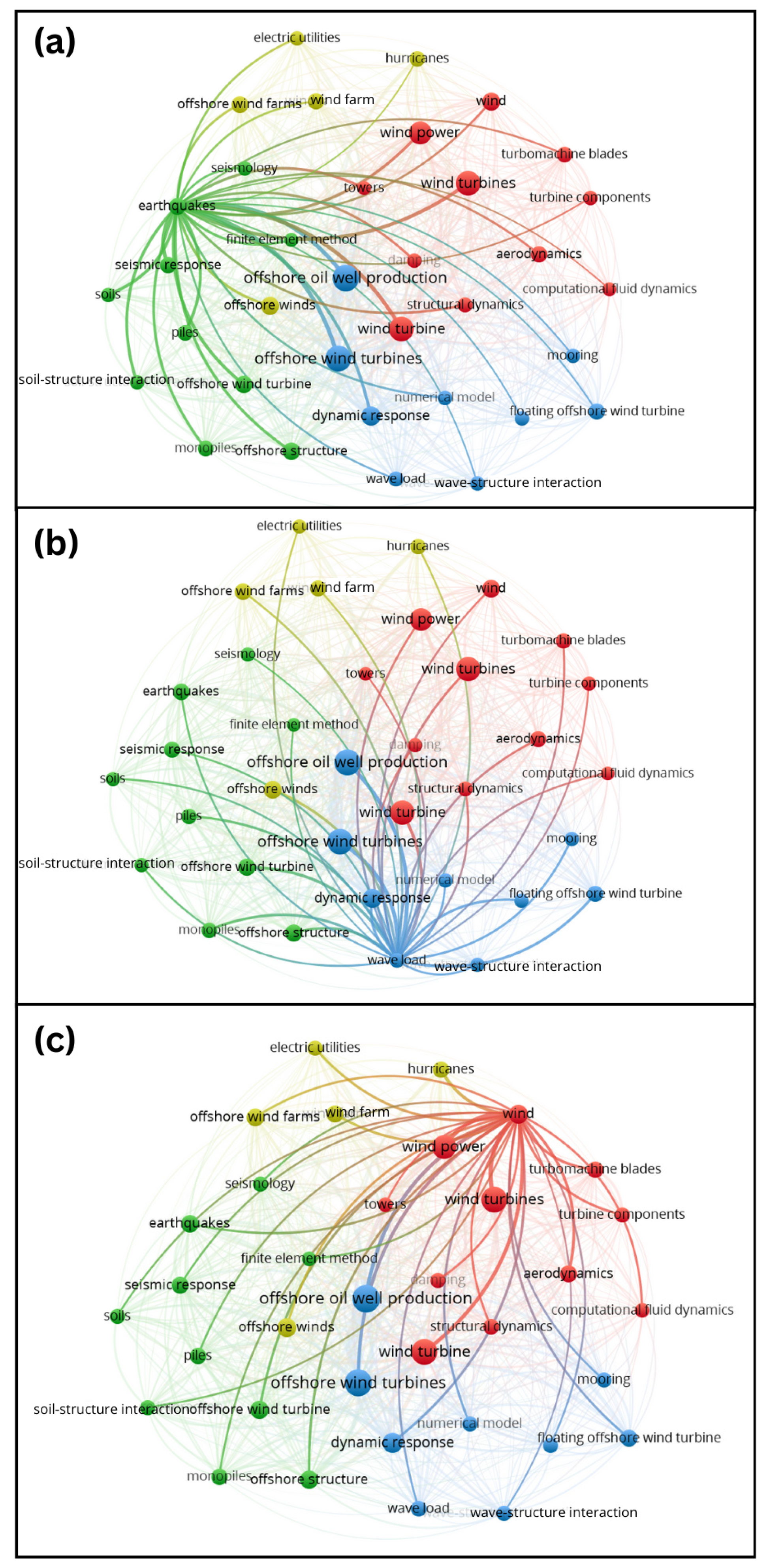
The bibliometric keyword co-occurrence analysis focused on the thematic evolution of WT hazard research, with particular emphasis on earthquakes, sea waves, and extreme wind events. Bibliographic records were retrieved from the Scopus database, which was selected for its broad coverage of peer-reviewed journals, reliable citation metadata, and consistent indexing of wind energy and environmental hazard research. Keyword co-occurrence networks were constructed using VOSviewer (version 1.6.20) to identify dominant research themes, inter-hazard linkages, and temporal shifts in research focus. To capture long-term developments while maintaining network interpretability, the analysis was conducted over two periods spanning the past two decades: 2005–2015 and 2016–2025. Owing to the rapid expansion of wind energy literature after 2015, different minimum keyword occurrence thresholds were applied, with a threshold of 80 occurrences for the earlier period and 150 occurrences for the later period. The higher threshold adopted for the recent period was necessary to limit excessive network density, reduce visual and semantic clutter, and ensure that the resulting networks highlight only the most influential and consistently recurring research themes rather than low-frequency or peripheral terms. This adaptive thresholding approach enables meaningful comparison of dominant thematic structures across the two periods. Detailed procedures for data identification, screening, eligibility, and inclusion are provided in Part 1 and are therefore not repeated here.
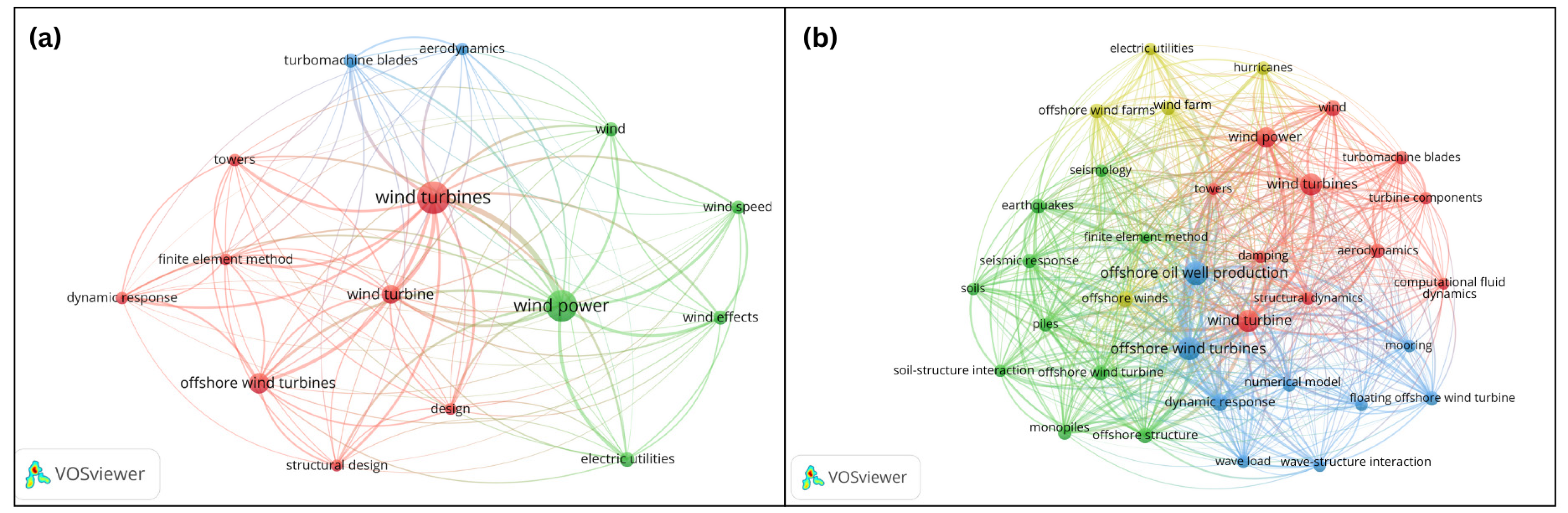
The resulting keyword co-occurrence networks, shown in Figure 1, reveal a clear evolution in how hazards affecting WTs have been conceptualised and analysed over time. During the 2005–2015 period, the network exhibits a relatively modular structure, with research concentrated within discipline-specific clusters related to structural design, finite element methods, aerodynamics, and wind power. Hazard effects during this period are largely embedded within broader concepts such as dynamic response and structural analysis, reflecting an emphasis on component-level reliability and deterministic load assessment. Offshore wind turbines appear as an emerging topic but remain weakly integrated with coupled environmental hazards. In contrast, the 2016–2025 network is denser and more interconnected, reflecting the rapid expansion of offshore and floating WT deployments. This shift is characterised by the increased prominence of keywords such as offshore wind turbines, floating offshore wind turbines, wave load, and wave–structure interaction, which are strongly linked to structural dynamics and damping. Earthquake-related keywords, including earthquakes and seismology, are no longer confined to geotechnical contexts but are closely associated with structural dynamics, dynamic response, and damping. Their co-occurrence with wind- and wave-related terms suggests the emergence of studies addressing coupled loading scenarios, particularly in offshore environments where wind, wave, and seismic effects may act concurrently or sequentially. This evolution reflects growing recognition that seismic excitation can influence wind- and wave-induced responses by modifying system stiffness, natural frequencies, and damping properties.
A similar convergence is observed for extreme wind hazards. The prominence of hurricanes and their strong associations with aerodynamics, computational fluid dynamics, and turbine components indicate a research focus on large-scale, long-duration extreme events and their impact on ultimate structural loads. In contrast, localised transient phenomena such as thunderstorm downbursts are weakly represented. Although underrepresented in bibliometric networks, downbursts are retained in this review because experimental and numerical studies demonstrate their potential to generate severe transient loads not captured by conventional wind turbine design models. Across all hazard types, damping emerges as a key parameter linking earthquakes, wind, and waves to the global structural response of WT systems, particularly in offshore and floating configurations. Despite its central role, damping is still predominantly treated through assumed or calibrated models, underscoring persistent uncertainties and the need for improved experimental characterisation.
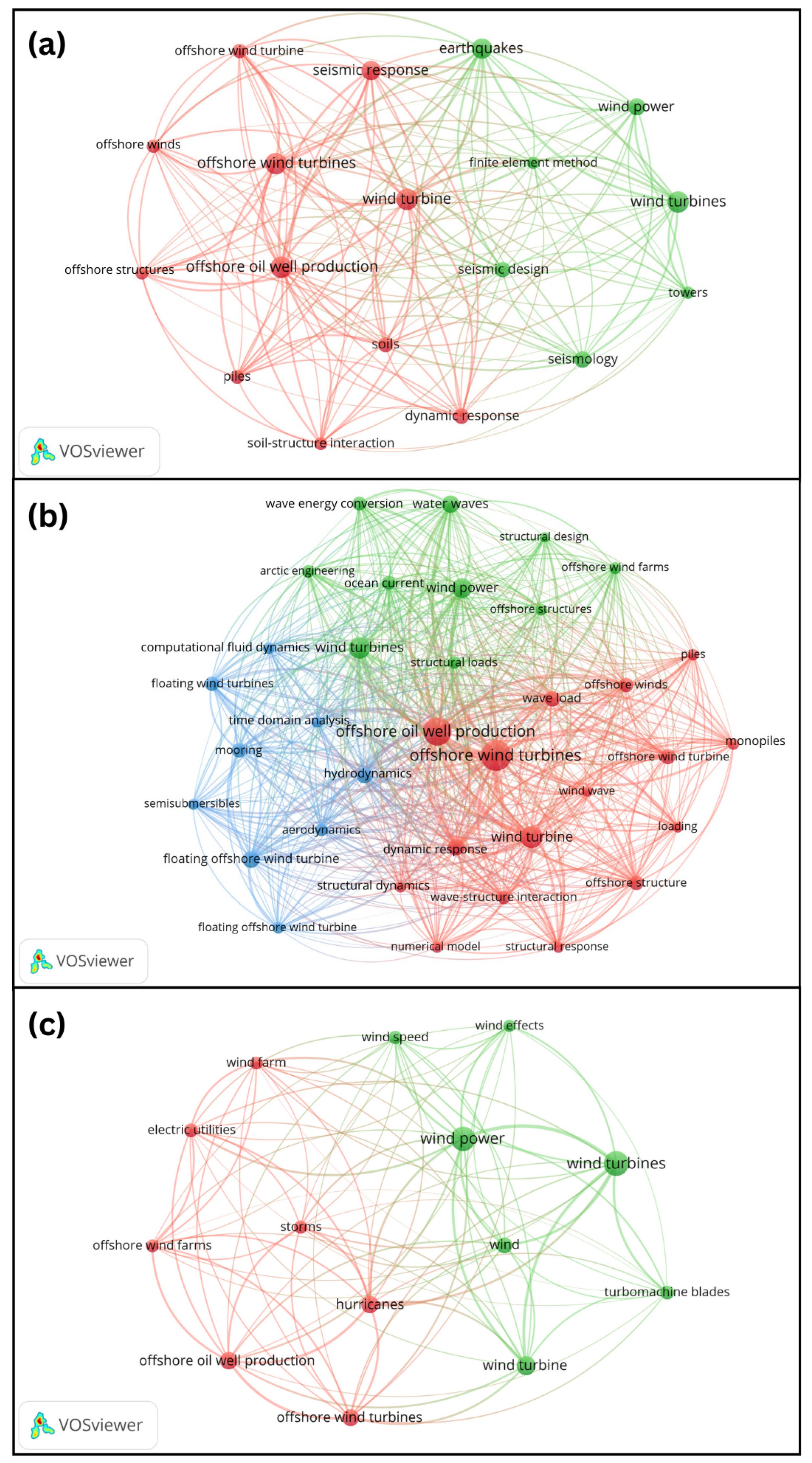
Building on the temporal analysis, hazard-specific keyword co-occurrence networks were further examined to isolate the dominant research themes associated with earthquakes, sea waves, and extreme wind events. The resulting hazard-focused networks, shown in Figure 2, exhibit clearly delineated yet partially overlapping thematic structures, reflecting how each natural hazard has been investigated in relation to wind turbine (WT) systems. These bibliometric patterns provide a data-driven basis for structuring the subsequent sections of this paper. Specifically, the earthquake network (Figure 2a) is dominated by keywords related to seismic response, soil–structure interaction, piles, and dynamic response, which inform the focus of the earthquake-related discussion. The sea-wave network (Figure 2b) shows strong clustering around wave load, wave–structure interaction, offshore foundations, hydrodynamics, and floating systems, motivating the organisation of the sea-wave section. The extreme wind network (Figure 2c) is characterised by the concentration of keywords related to wind power, aerodynamics, turbine components, and extreme wind phenomena such as hurricanes, thereby guiding the treatment of extreme wind hazards. Table 1 complements these network visualisations by summarising both common and hazard-specific keywords, distinguishing shared analytical foundations from themes unique to each hazard domain. Based on these keyword patterns, and consistently with the approach adopted in Part 1 of this study [1], each hazard-specific section is structured to first describe the formation mechanisms and physical characteristics of the hazard, followed by its effects on WT systems and the mitigation or design strategies reported in the literature.
As a continuation of the previous work [1], this Part 2 paper focuses on three major natural hazards that impose significant demands on wind turbine (WT) systems: earthquakes, sea waves, and extreme wind events, including hurricanes, tropical cyclones (TCs), and thunderstorm downbursts. Guided by the bibliometric findings, Section 2 examines earthquake hazards, covering seismic formation mechanisms, ground-motion characteristics, effects on WT structural dynamics and soil–structure interaction (SSI), load combinations, seismic fragility, and mitigation strategies. Section 3 addresses wave-induced hazards affecting offshore wind turbines (OWTs), with emphasis on hydrodynamic loading, wave–structure interaction for fixed and floating support structures, and control considerations in harsh marine environments. Section 4 discusses extreme wind hazards, including hurricanes, TCs, and thunderstorm downbursts, focusing on their aerodynamic characteristics, transient loading mechanisms, and impacts on turbine components, structural response, and operational reliability. Section 5 broadens the discussion to other natural hazards that have received comparatively limited attention in the literature, highlighting emerging risks and underexplored research areas. Section 6 synthesises the main findings across all hazard domains, identifies key research gaps revealed by both the bibliometric and technical analyses, and outlines future research directions for enhancing WT resilience under multi-hazard conditions. Finally, Section 7 concludes the paper.

2. Earthquakes and Wind Turbines

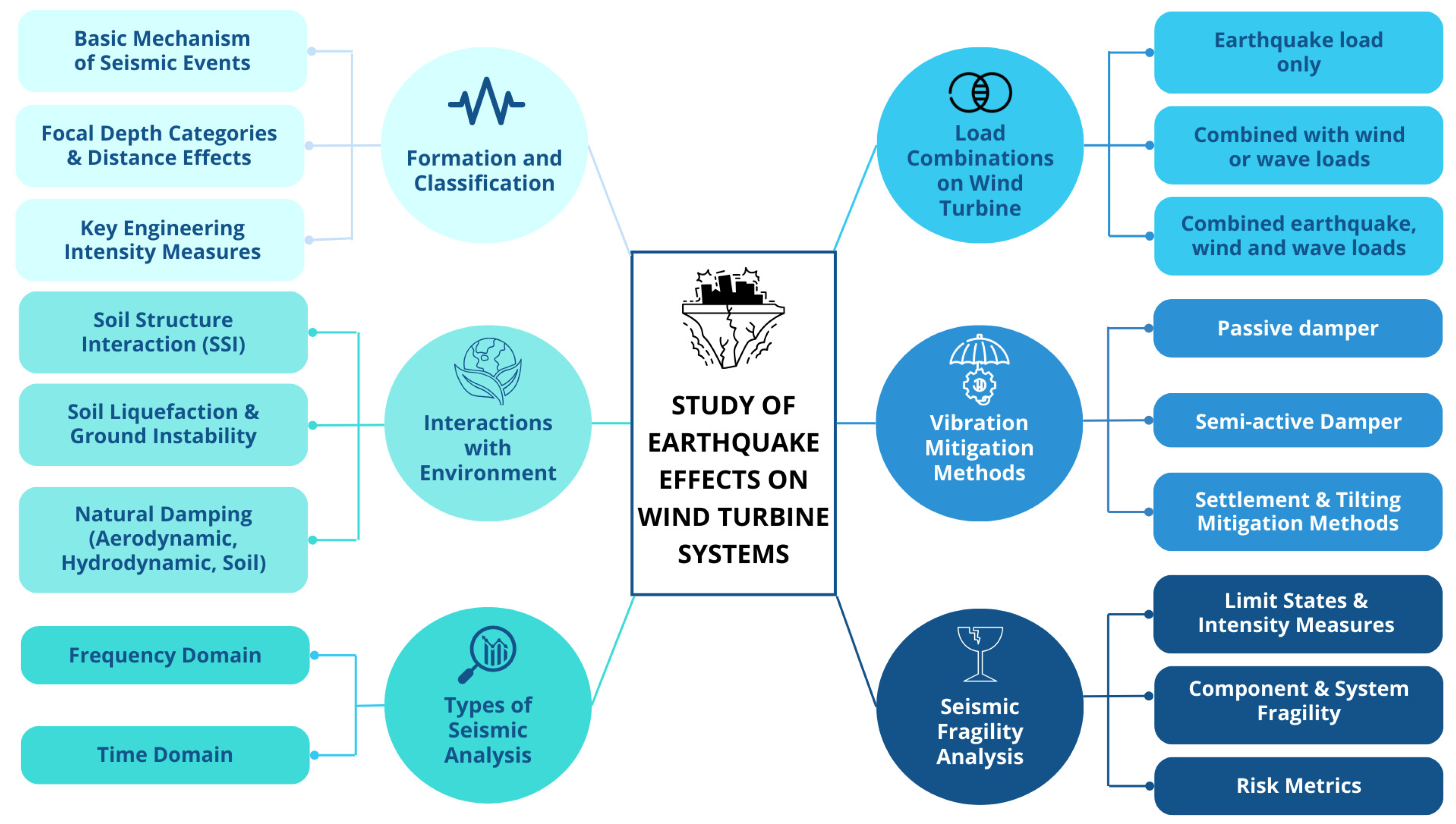
The growing global demand for clean wind energy, driven by carbon-emission reduction efforts, has intensified the need for suitable land for wind farm development. As a result, geographically constrained countries are increasingly installing WTs in seismically active regions, including areas exposed to potentially catastrophic M9-class megathrust earthquakes, such as those in the United States, China, India, and Southeast Asia [2]. These active fault zones impose additional requirements on structural design and seismic assessment. This chapter reviews earthquake formation mechanisms, the structural effects of seismic loading on WTs, the analytical approaches used to evaluate seismic response, and the mitigation strategies reported in the literature, as illustrated in Figure 3.

2.1. Earthquake Formation and Classification

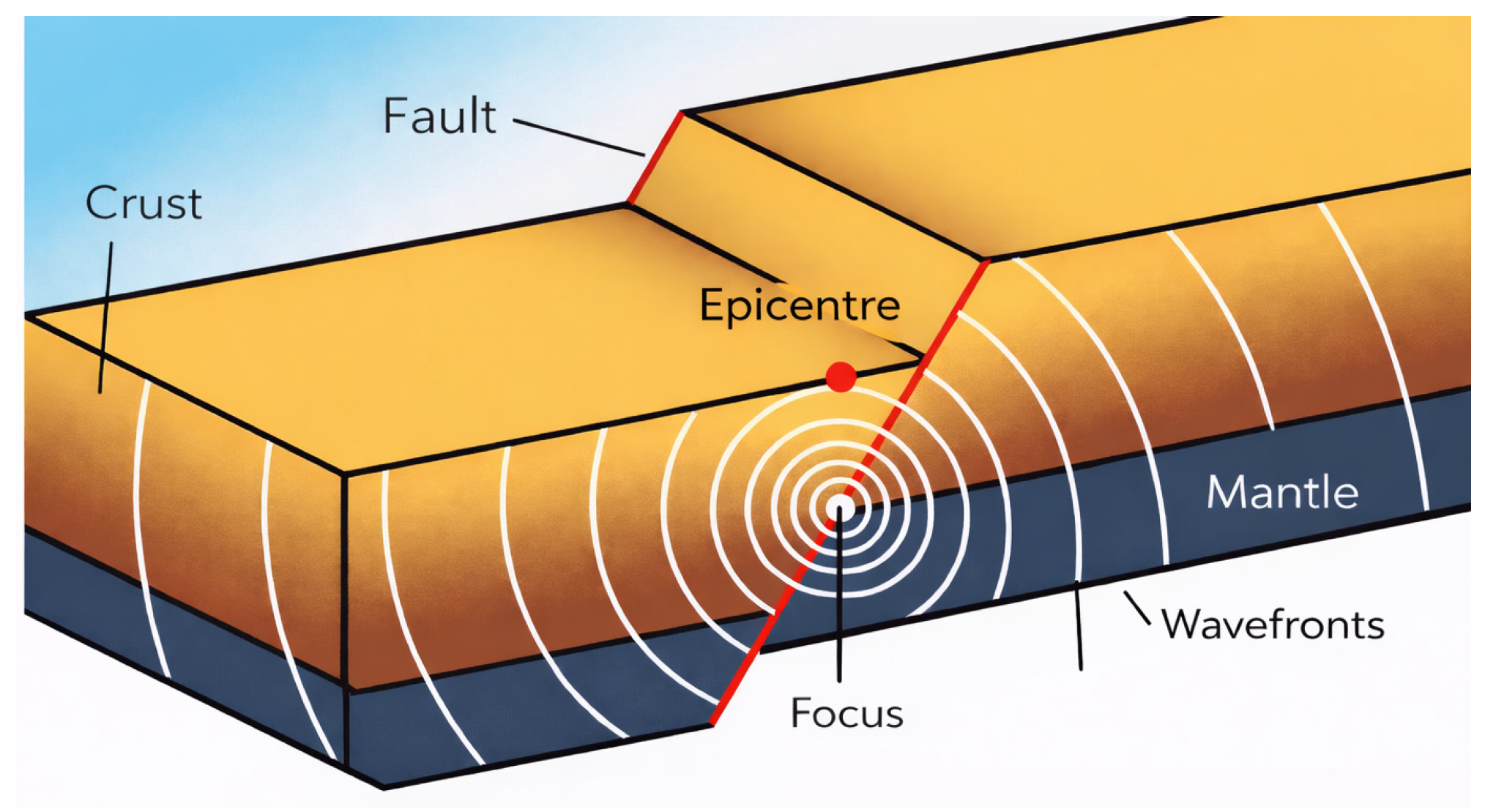
Earthquakes originate from the sudden release of accumulated strain energy along faults or subduction interfaces when tectonic stresses exceed the frictional resistance of the fault plane. This stress accumulation results from long-term plate motions, gravitational loading, and thermal contraction. Once the fault strength is exceeded, dynamic rupture initiates and propagates along the fault surface at several kilometres per second, generating seismic waves that radiate outward through the surrounding rock. The focus (or hypocentre) represents the point of initial rupture at depth, while the epicentre is the surface projection located directly above it, as illustrated in Figure 4 [3]. Rupture processes such as asperity failure, stick–slip motion, and dynamic frictional weakening govern the partitioning of released energy into seismic radiation, fault slip, and heat, explaining why earthquakes vary widely in magnitude, frequency content, and rupture duration. These behaviours are consistent with dynamic rupture mechanics, in which slip-weakening friction, rupture instability, and high-speed fracture control how seismic energy is released and radiated [4]. As rupture develops, both P (compressional) and S (shear) body waves are generated, with characteristics that depend on the elastic properties of the surrounding medium, forming an essential component of the wave–rupture interaction framework described in seismological studies [4,5].
Earthquakes can be categorised as shallow (0–70 km), intermediate (70–300 km), or deep-focus (300–700 km) events based on focal depth [3]. Shallow earthquakes are generally the most damaging due to their proximity to the Earth’s surface and the reduced attenuation of seismic waves during upward propagation, resulting in stronger ground motions at the site of interest. These events are commonly associated with brittle fracture and elastic rebound within the crust. However, this classical interpretation gives rise to the well-known heat-flow paradox, whereby the frictional heat predicted to be generated during fault slip is significantly greater than that observed in natural fault zones [6,7]. This discrepancy has motivated extensive research into dynamic frictional weakening mechanisms and energy dissipation processes during rupture. In contrast, deep-focus earthquakes occur within the mantle and may be associated with tensional or compressional stresses, slab bending, thermal effects, or mineral phase transitions. Such events tend to produce fewer aftershocks than shallow earthquakes, a behaviour commonly attributed to the high-pressure and high-temperature conditions at depth, where traditional brittle failure and frictional sliding mechanisms are less dominant.
In addition to focal depth, ground motion characteristics strongly depend on source-to-site distance. Earthquakes are often classified as near-field (<25 km) or far-field (>25 km) motions [8]. Near-field earthquakes typically exhibit large acceleration amplitudes and may contain pronounced long-period velocity pulses, with dominant periods often comparable to the natural frequencies of tall and flexible structures such as WTs. These long-period components can induce substantial displacement and drift demands in lightly damped systems and may trigger resonance effects, making near-field earthquakes generally more damaging than far-field events. By contrast, far-field motions tend to exhibit broader high-frequency content and reduced long-period energy. During seismic events, P-waves and S-waves propagate through the Earth and interact with structures at the surface. The propagation velocities and frequency characteristics of these waves depend on factors such as pressure, temperature, mineralogy, chemical composition, and the degree of partial melting of the surrounding medium [5], which collectively influence the severity and spectral content of ground motion.
Earthquake magnitude has historically been reported using the Richter scale, a logarithmic measure based on the amplitude of seismic waves recorded by standard seismographs [9]. However, amplitude-based local magnitude measures, such as ML, are now recognised to suffer from saturation effects for moderate-to-large earthquakes and do not reliably represent the physical parameters of fault rupture, particularly for events exceeding approximately magnitude 6.5 [10]. These limitations have been demonstrated in regional studies showing that ML can yield inconsistent and underestimated values for larger earthquakes [11]. Consequently, modern seismology predominantly adopts the moment magnitude scale (Mw), which is derived from the seismic moment and is directly related to the physical characteristics of rupture. The seismic moment, defined as the product of fault slip, rupture area, and the rigidity of the surrounding rock, provides a physically meaningful measure of earthquake size, and Mw converts this quantity into a logarithmic scale without saturation. Recent theoretical developments further reinforce the physical basis of Mw and explain its consistency across the full range of earthquake magnitudes [12].
From an engineering perspective, seismic demand is commonly characterised using intensity measures (IMs) such as peak ground acceleration (PGA), peak ground velocity (PGV), and spectral acceleration at period T, Sa(T), evaluated at periods corresponding to a structure’s principal vibration modes [13]. Although PGA remains a standard metric in seismic hazard mapping, long-period Sa(T) and PGV exhibit stronger correlation with displacement-driven damage demands in WT towers. For OWTs, the selection of appropriate IMs is particularly critical, as their seismic response is strongly influenced by the combined effects of wind, waves, and soil–structure interaction (SSI) [14]. Recent studies indicate that Sa(T) evaluated at the fundamental period provides a reliable predictor of seismic demand for fixed-bottom offshore turbines, especially when simultaneous horizontal and vertical ground motions are considered, as these combined excitations can significantly amplify nacelle accelerations and tower-base bending moments [15]. Offshore fragility analyses further demonstrate that concurrent wind and wave loading can modify the effective demand–capacity relationship of the structure, rendering IMs such as Sa(T) and PGV more suitable than PGA for capturing the true multi-hazard seismic demand on offshore turbines [16]. Collectively, these considerations highlight the importance of a rigorous understanding of earthquake characteristics and the appropriate selection of IMs for accurately characterising seismic actions in WT design and ensuring that site-specific dynamic demands are reliably captured in modern engineering assessments.

2.2. Wind Turbines’ Interaction with the Environment

Unlike static structures, WTs remain in continuous interaction with their surrounding environment throughout operation. Wind induces rotor motion, offshore waves impose dynamic loads on the tower, and the foundation continuously interacts with the supporting soil. Consequently, numerical analyses must account for these environmental interactions to obtain realistic estimates of WT seismic behaviour. The following sections review the roles of SSI, aerodynamic effects, hydrodynamic loading, and soil damping.

2.2.1. Soil-Structure Interaction (SSI)

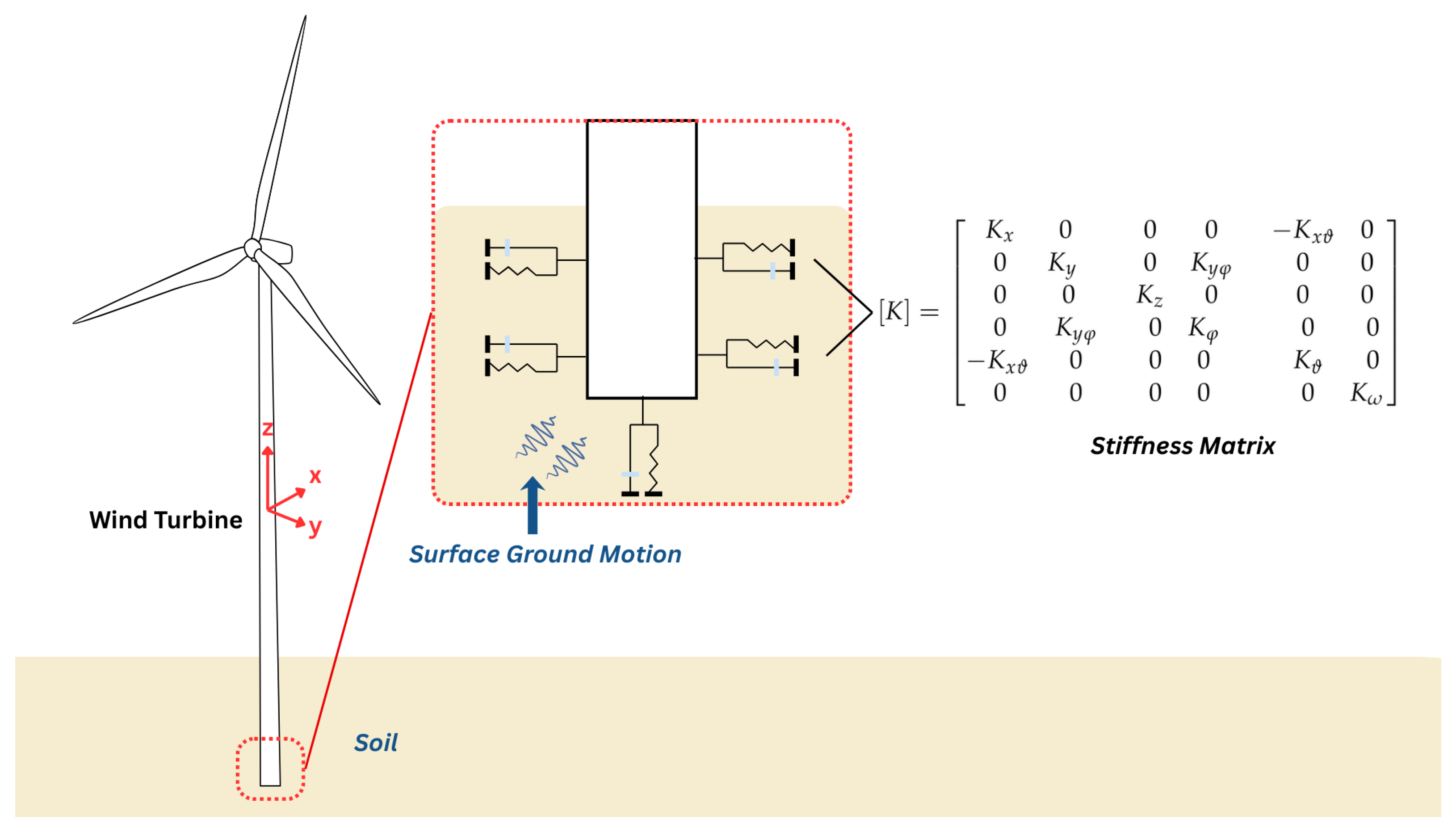
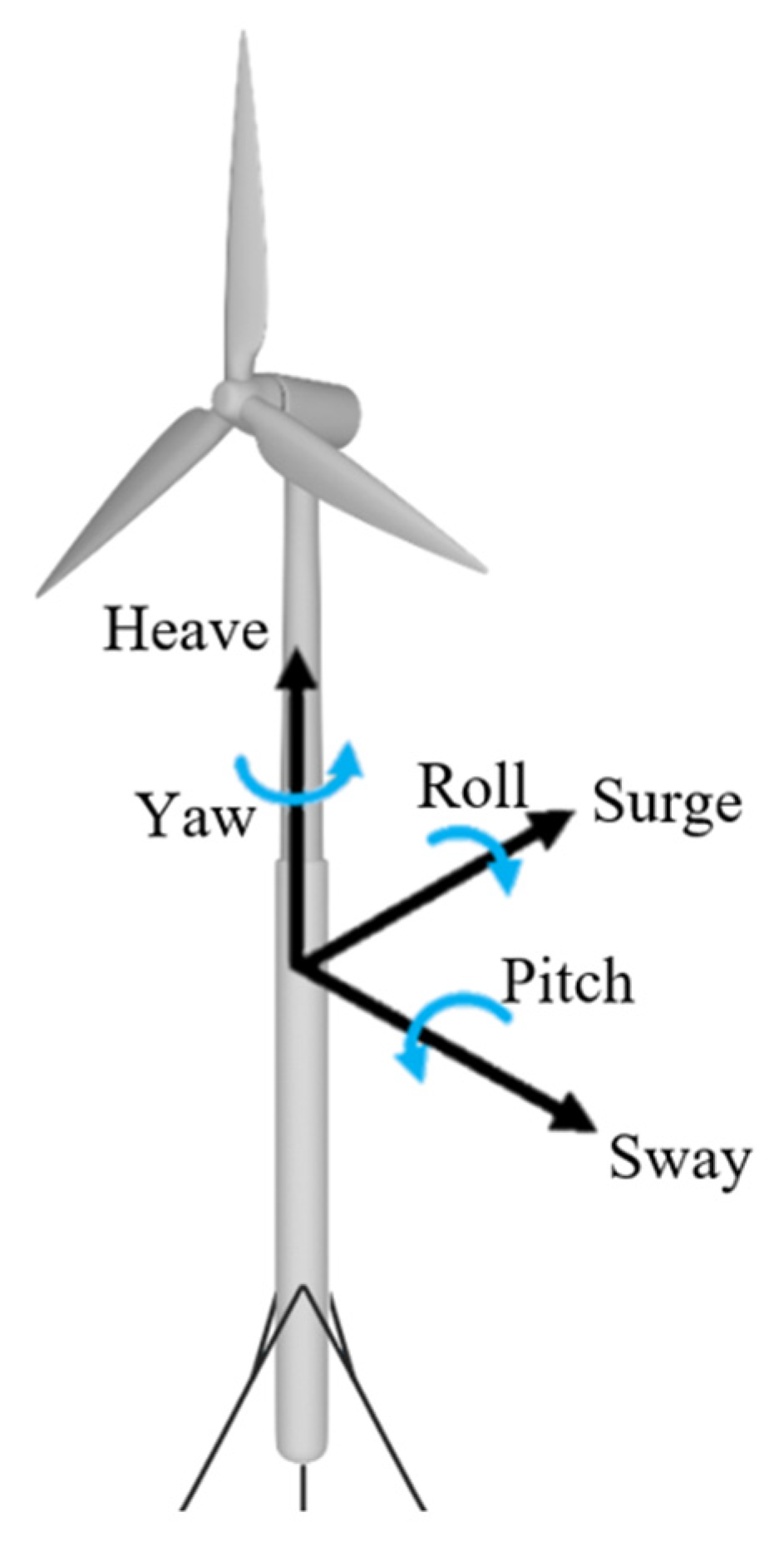
SSI is commonly represented using spring–dashpot systems or other spring-based modelling approaches implemented at the WT foundation to capture the inertial forces transmitted between the superstructure and the underlying soil [17]. This class of SSI modelling is widely applied to onshore WTs subjected to seismic loading and has also been extended to offshore applications, where SSI remains an important factor influencing structural response. A representative SSI modelling framework is illustrated in Figure 5, in which free-field seismic motion is applied at the foundation through a lumped soil stiffness representation. The stiffness matrix is defined in terms of six degrees of freedom (DOFs), comprising translational motions (surge, sway, and heave, corresponding to x, y, and z) and rotational motions (roll, pitch, and yaw, corresponding to ϑ, φ, and ω), including their directional coupling terms [18]. Previous investigations, such as Ghaemmaghami et al. [19] have shown that key response quantities, including displacement, rotation, acceleration, base shear, and bending moment, are strongly influenced by SSI. Reduced soil stiffness is generally associated with increased tower-top displacement and acceleration, consistent with findings reported in [2,20,21,22], where flexible-foundation models exhibited larger vibration amplitudes than rigid-foundation assumptions. Although SSI typically leads to a reduction in the fundamental natural frequency, this reduction may be modest when soil stiffness is relatively high [19]. Nevertheless, SSI has a more pronounced influence on higher vibration modes, which are more readily excited under seismic loading. In addition, maximum tower tilt is highly sensitive to foundation flexibility, with increased soil compliance potentially resulting in stiffness degradation under cyclic seismic excitation [2,17].
Yang et al. [20] further analysed three flexible-foundation models, namely Apparent Fixity (AF), Coupled Springs (CS), and Distributed Springs (DS), under seismic and multi-hazard loading conditions. Their results indicated that the second blade flap mode was excited under earthquake loading for the AF and DS models, but not for the rigid-base or CS models. The AF and DS configurations also exhibited higher sensitivity of peak blade-root bending moments to pseudo-spectral acceleration. De Risi et al. [2] compared a nonlinear foundation model, an impedance-based discrete spring representation, and a fixed-base condition, demonstrating substantial variation among the models and emphasising the importance of selecting an appropriate SSI representation. Yang et al. [21] similarly observed that flexible-foundation models resulted in greater tower-top displacement and mudline bending moments during emergency shutdown, reinforcing the necessity of incorporating SSI in WT dynamic analyses. More recent analytical investigations have further demonstrated that SSI exerts a substantial influence on the seismic behaviour of onshore WTs. Compared with fixed-base representations, models accounting for SSI exhibited increases of approximately 20% in peak displacement and 76–114% in peak base shear across the examined earthquake records [23]. These findings indicate that reliance on rigid-base assumptions can lead to potentially non-conservative estimates of seismic demand.
In offshore settings, centrifuge modelling has shown that foundation–soil coupling, soil densification, and liquefaction strongly influence seismic performance. Conventional monopile and friction-wheel systems experienced settlement and lateral displacement exceeding sensor measurement limits under liquefaction conditions, whereas a hybrid foundation comprising a monopile combined with a gravel-filled friction wheel and an inverted suction bucket maintained controlled settlement and stable lateral response, demonstrating superior performance [24]. Consistent trends have been reported in seismic fragility analyses of suction-bucket foundations, which revealed that simplified soil models neglecting site amplification can significantly misestimate seismic vulnerability. For a 10% exceedance probability of tower-top displacement (DS1), a simplified approach predicted a capacity of 0.461 g PGA, overestimating structural capacity by approximately 35% relative to the value of 0.342 g obtained using a rigorous site-effect model [18].
Recent numerical investigations of jacket-type OWTs have further quantified the influence of foundation–soil–foundation interaction (FSFI). The inclusion of FSFI reduced the fundamental fore–aft natural frequency by 35% for a reference jacket and by 20% for an optimised jacket configuration, indicating pronounced global softening. FSFI also increased peak stress demand by up to 31% compared to SSI-only models and by 13% compared with fixed-base conditions. Modal analyses further demonstrated that FSFI significantly alters higher-order dynamic characteristics of the jacket system. In particular, the third vibration mode observed under fixed-base and SSI-only assumptions disappeared when FSFI was included, indicating that through-soil coupling redistributes modal energy and suppresses higher-mode participation [25]. These findings further highlight that higher-mode contributions become increasingly important for tall or flexible support structures, and that rigid-foundation assumptions may overlook these effects, resulting in inaccurate estimates of modal interaction and seismic stress demand [25]. Collectively, these recent advances demonstrate that accurate seismic assessment of WTs requires explicit modelling of SSI mechanisms, including soil nonlinearity, site-specific amplification, foundation group effects, and higher-mode SSI coupling, as these factors critically govern tower displacement, mudline bending moments, internal force demand, and overall structural reliability, particularly for OWTs operating in complex soil conditions.

2.2.2. Soil Liquefaction

OWT foundations are considerably more vulnerable to earthquake-induced degradation than their onshore counterparts due to the presence of saturated, cohesionless soils that are susceptible to liquefaction. Following strong ground shaking, excess pore water pressure can accumulate within the seabed, leading to a pronounced reduction in soil stiffness and strength. This degradation diminishes both the bearing capacity and lateral confinement of the foundation, thereby increasing the risk of significant settlement and permanent tilting of the WT structure [26,27]. These effects are particularly pronounced for monopile-supported turbines, where liquefaction can compromise the upper soil layers and severely weaken pile–soil interaction, ultimately resulting in large residual tilts [26].
Although gravity-based foundations exhibit higher resistance to overturning due to their mass, they remain susceptible to substantial settlement under liquefaction, which can compromise overall stability. In addition, liquefaction-induced softening reduces the natural frequency of the soil–foundation–structure system, thereby increasing the potential for dynamic amplification and elevating inertial demands on the superstructure. This behaviour was observed in centrifuge experiments conducted by Yu et al. [26], where substantial stiffness degradation and permanent deformation occurred once liquefaction was initiated. Consistent trends were reported in 1:25 scale model tests performed in saturated sand, in which the natural frequency decreased progressively with increasing PGA, indicating a more severe liquefaction effect at higher shaking intensities [28].
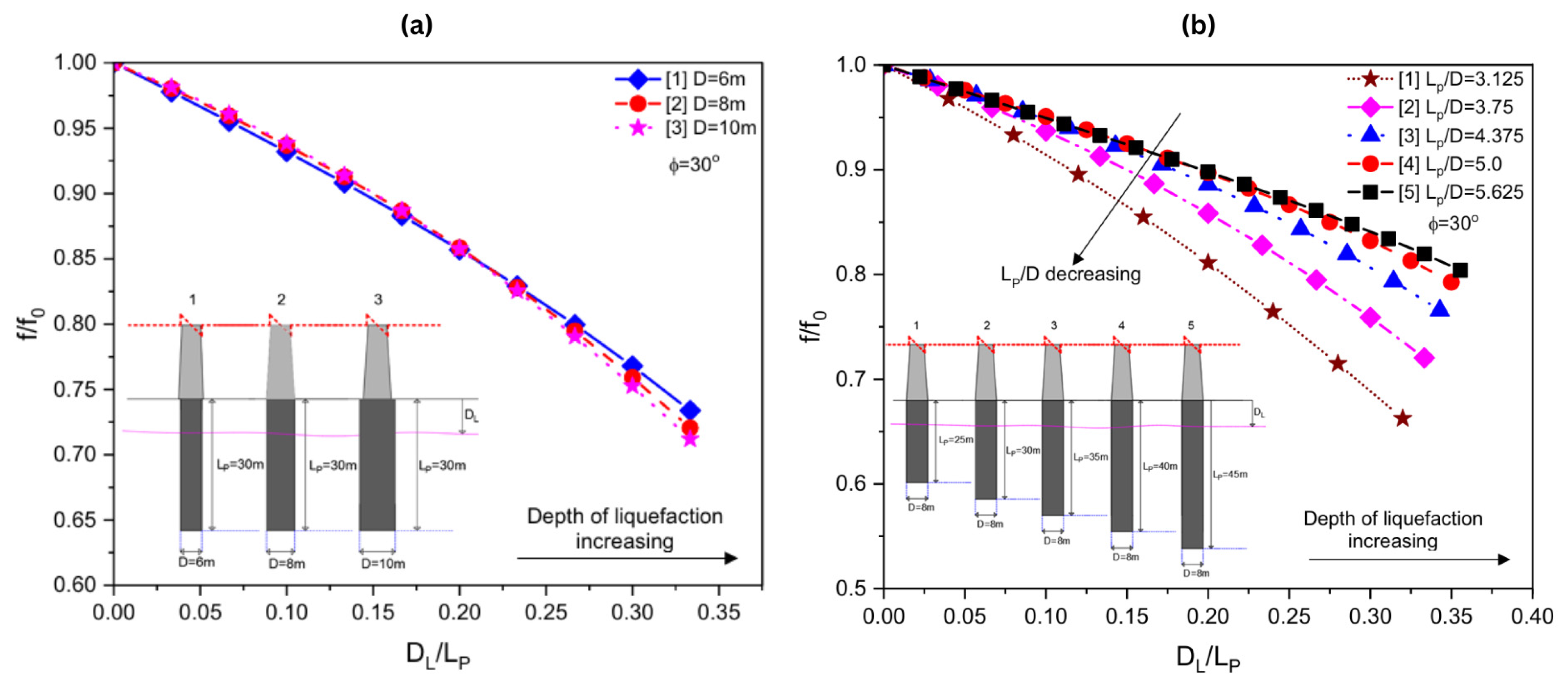
More recent studies have quantified the extent of dynamic degradation caused by soil liquefaction. Experimental and numerical investigations indicate that partial liquefaction can reduce the fundamental fore–aft natural frequency of monopile-supported OWTs by approximately 10–30%. Reductions of around 10% have been observed at liquefaction-depth–to–pile-length ratios near 0.10, increasing to nearly 30% as this ratio approaches 0.30–0.35. At these deeper levels of partial liquefaction, the post-liquefaction natural frequency decreases to approximately 60–70% of the pre-liquefaction value, demonstrating substantial stiffness loss even prior to full liquefaction, as illustrated in Figure 6 [22]. Complementary investigations on suction-bucket foundations further elucidate liquefaction effects on alternative support systems. Centrifuge and numerical analyses show that excess pore-pressure ratios (ru) around the bucket skirt can approach values of 0.9–1.0, indicating near-complete loss of effective stress and severe degradation of lateral stiffness. Under such conditions, the foundation undergoes significant settlement and lateral deformation associated with the formation of a distinct shear band propagating from the bucket skirt into the liquefied zone. The numerical models reproduce centrifuge observations closely, capturing pore-pressure evolution, settlement behaviour, and failure mechanisms, thereby demonstrating their capability to simulate liquefaction-induced bucket response [29].
Large-diameter monopiles exhibit distinct liquefaction behaviour under seismic loading. Analyses of a 10 MW offshore WT indicate that excess pore pressure accumulates most rapidly at the pile toe, where cyclic shear strains are highest, making this region the primary initiation point for liquefaction. As seismic shaking progresses, soil degradation intensifies and the liquefied zone deepens, particularly in soft sediment profiles, leading to more pronounced reductions in stiffness. This degradation results in increased pile rotation and settlement, with peak bending moments developing near the interface between liquefiable and non-liquefiable soil layers. These observations highlight that liquefaction alone can substantially weaken the soil–monopile system for large-diameter foundations [27]. Recent centrifuge modelling further demonstrates that liquefaction renders conventional monopile foundations highly vulnerable, with lateral displacement and settlement exceeding measurement limits once the upper soil layers lose stiffness under seismic excitation. In contrast, hybrid foundation systems integrating a monopile, friction wheel, and suction bucket exhibit markedly improved performance in saturated loose sand. The hybrid configuration suppresses liquefaction beneath the bucket, maintains lateral displacements within measurable and significantly smaller ranges (0.18–0.28 m for the hybrid systems compared with values exceeding 0.26 m for the monopile), and limits settlement to controlled levels. These results provide clear experimental evidence that the hybrid foundation enhances seismic stability by densifying and confining the surrounding soil during shaking [24]. Taken together, these studies demonstrate that liquefaction profoundly alters the stiffness, deformation patterns, and load-transfer mechanisms of offshore WT foundations, underscoring the need for explicit consideration of liquefaction effects in seismic design and performance assessment.

2.3. Damping of Wind Turbine Dynamic Response

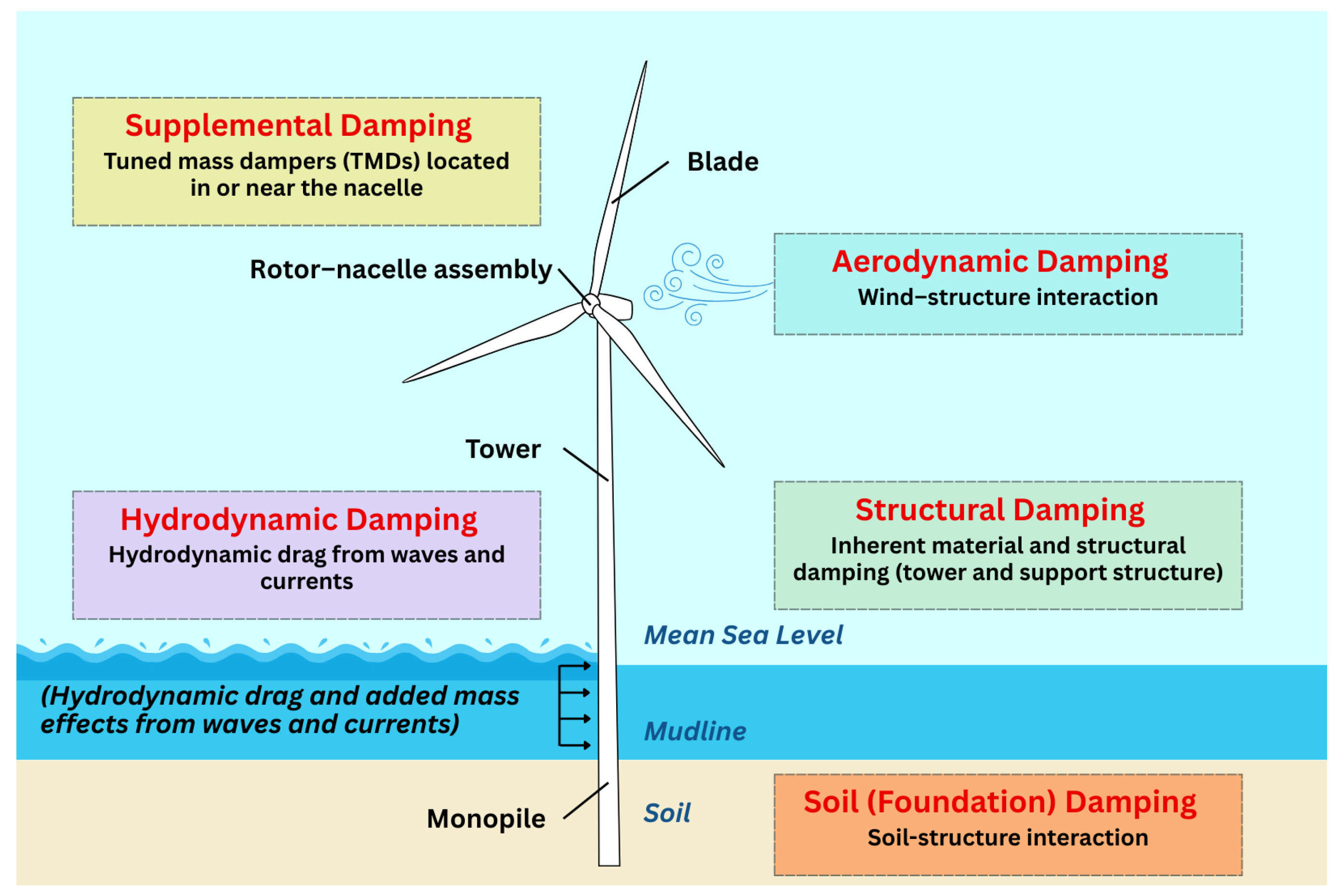
Several damping mechanisms contribute to the reduction in WT dynamic response under seismic loading. Operating turbines are affected by aerodynamic damping (AD), offshore systems experience hydrodynamic damping due to the surrounding water, and all foundation-supported turbines are subject to soil damping arising from wave radiation and material hysteresis. Each of these mechanisms plays a distinct role in the overall energy dissipation of the coupled soil–foundation–structure–aerodynamic system, as illustrated in Figure 7. The following subsections focus exclusively on the natural damping mechanisms, namely aerodynamic, hydrodynamic, and soil (foundation) damping.

2.3.1. Aerodynamic Damping (AD)

AD arises from the interaction between the WT structure and the surrounding airflow [30]. It plays a significant role in differentiating the seismic behaviour of turbines during operation from that in parked conditions. Operating turbines generally experience higher AD due to rotor rotation and active aerodynamic forces, whereas parked turbines exhibit relatively low AD [31]. Numerous studies have consistently shown that AD reduces maximum tower-top fore–aft displacement, as aerodynamic forces oppose motion parallel to the wind direction [21,32,33,34,35]. Further numerical investigations have confirmed the effectiveness of AD in mitigating seismic response by enhancing aerodynamic energy dissipation during blade motion. For example, simulations have shown that including AD can reduce tower vibration amplitudes of a 5 MW offshore horizontal-axis wind turbine by nearly an order of magnitude, from 1.94 m to 0.22 m, consistent with the action of a viscous-damper-like aerodynamic force opposing tower motion [34].
In contrast, the magnitude of AD in the side-to-side direction is significantly smaller, as aerodynamic forces are primarily aligned with the rotor plane [32,34]. This directional dependence is reflected in typical damping ratios for offshore turbines, which range from approximately 4–8% in the fore–aft direction but only 0.08–1.43% in the side-to-side direction, indicating that AD is far more effective along the wind axis than perpendicular to it [30]. AD is influenced by several aerodynamic parameters, including rotor speed, blade pitch angle, wind speed, angle of attack, and the associated lift and drag coefficients, and is further modified by operational conditions such as yaw misalignment, which alters the effective aerodynamic forces acting on the turbine [30,36]. Because AD varies with these dynamic parameters, the assumption of constant damping in frequency-domain response spectrum analysis is inadequate. Analytical approaches tend to underestimate AD at higher wind speeds because they commonly neglect contributions from drag and unsteady stall effects, both of which increase aerodynamic dissipation [30]. Consequently, frequency-domain methods often underestimate seismic response when compared with time-domain analyses, in which state-dependent AD is explicitly captured [31].
The influence of the control system further complicates AD behaviour. Yuan et al. [33] showed that although AD reduces peak response amplitudes, the mean structural response during operation may exceed that in parked conditions due to additional thrust forces generated by variations in rotor speed and blade pitch under baseline control strategies. In contrast, the probabilistic study reported in [37] observed larger seismic responses when wind loading was included, which was attributed to the omission of AD when comparing wind and earthquake force ratios. More recent studies further indicate that AD becomes highly frequency-dependent when soil softening or liquefaction reduces the natural frequency of the system, causing the effective AD evaluated at the dominant structural frequency to shift as soil–foundation stiffness evolves. Numerical analyses show that the AD ratio may vary within a range of approximately 5%, exhibiting non-monotonic behaviour with changing excitation frequency, and that incorporating AD can reduce seismic response by up to 65% at rated wind speed [38].
Overall, AD constitutes a key mechanism governing the seismic response of operating WTs, with its effectiveness controlled by rotor aerodynamics, control-system behaviour, and the evolving dynamic properties of the soil–foundation–structure system. Because AD interacts strongly with both wind loading and structural frequency, its explicit representation in time-domain simulations is essential for accurately capturing combined wind–earthquake demand under realistic operational conditions.

2.3.2. Hydrodynamic and Soil Damping

In offshore environments, hydrodynamic damping provided by the surrounding seawater contributes to the reduction in both vertical and lateral seismic response. Interaction between the monopile and the water column introduces additional energy dissipation through viscous drag and wave-radiation effects, which suppress structural motion relative to onshore conditions [39]. Numerical modelling of large-diameter monopiles indicates that these hydrodynamic forces behave as velocity-dependent damping during seismic loading, thereby restraining lateral and vertical displacements. Design practice commonly assumes hydrodynamic damping components of approximately 0.22% due to wave-radiation damping and about 0.15% due to viscous drag. These values are consistent with Germanischer Lloyd recommendations and lie near the upper bound of the 0.07–0.23% range reported in the literature for OWTs [27,30]. Although small compared with aerodynamic or foundation damping, hydrodynamic damping constitutes a measurable component of the overall offshore damping budget and should therefore be included in dynamic analyses.
Soil damping, also referred to as foundation damping, arises primarily from two mechanisms: radiation damping and material (hysteretic) damping. Radiation damping results from energy dissipation associated with outward-propagating soil waves, whereas material damping is related to hysteresis caused by interparticle friction and plastic deformation [21]. Incorporation of radiation damping in vertical seismic analyses has been shown to reduce vertical earthquake loads transmitted to the tower [40]. However, for offshore monopile foundations, recent studies indicate that radiation damping is generally negligible at typical wind–wave excitation frequencies below 1 Hz and becomes significant only at higher loading rates [30]. Material (hysteretic) soil damping is therefore considered the dominant foundation damping mechanism, with small-strain damping approaching a minimum constant value and increasing substantially at larger cyclic strain levels. Recent experimental measurements and numerical investigations report foundation damping values in the range of 0.17–0.28%. Inclusion of this damping in structural models has been shown to reduce maximum mudline bending moments by approximately 7–9%, highlighting its practical significance for dynamic response prediction [30,38]. These findings further emphasise the critical role of SSI in governing seismic and dynamic behaviour and reinforce the need to incorporate soil damping in numerical assessments of offshore monopile-supported turbines subjected to earthquake and wind loading.

2.4. Load Combinations on Wind Turbine

To investigate the effects of seismic loading on WT structural performance, a wide range of numerical and simulation tools have been employed in the literature to develop finite elements and coupled dynamic models. Commonly used platforms include OpenSees [2,41], SAP2000 [42], ANSYS [43], FAST [20,21,32,33,44], ABAQUS [39,45] and GH-BLADED [31]. Among these studies, the National Renewable Energy Laboratory (NREL) 5 MW OWT has been most frequently adopted as a reference model. In addition, historically recorded earthquake ground motions with well-documented characteristics are widely used to represent seismic excitation, including the Chi-Chi [28,46,47], El Centro [34,41,47,48], Taft [34,46], and Kobe [34,46]. Seismic analyses are typically performed under various combinations of wind, wave, and earthquake loading conditions to capture load interaction effects.

2.4.1. Earthquake Load Only

The dynamic response of WTs under earthquake loading generally increases with rising PGA of the input ground motion [32,41]. Wang et al. [41] conducted time-domain analyses of a monopile-supported HAWT considering SSI and various damping mechanisms and found that increasing soil shear modulus leads to reductions in maximum displacement and bending moment, while simultaneously resulting in higher peak accelerations under earthquake-only loading. Similar trends were reported in [19], where reduced soil stiffness was shown to increase tower-top displacement during seismic excitation. The adverse effects of soft soil conditions on WT seismic response were further confirmed in subsequent studies [2,43].
More recent earthquake-only investigations continue to highlight the sensitivity of WT seismic response to foundation stiffness and SSI modelling. Kitahara and Ishihara [49] demonstrated that seismic SSI significantly alters the modal characteristics and seismic force demands of WT support structures, even in the absence of aerodynamic and hydrodynamic loading. Their numerical results showed that, under soft soil conditions, SSI substantially lengthens the fundamental natural period and reduces base bending moments relative to fixed-base assumptions, underscoring the importance of accurate soil representation in earthquake-only analyses. Similarly, Ngo et al. [18] showed that SSI combined with site-specific ground-motion amplification can significantly increase earthquake-induced demands in OWTs supported by suction-bucket foundations. Their findings indicate that displacement response is particularly sensitive to these effects, with fixed-base models consistently underestimating seismic demand compared with SSI-informed analyses.
Experimental investigations further support these observations. Zheng et al. [47] conducted shake-table tests using a 30:1 scaled WT model on the Earthquake, Wave and Current Joint Simulation System under earthquake-only excitation. The results showed that the nacelle vibration trajectory followed an elliptical pattern, accompanied by simultaneous side-to-side motion, which was attributed to fabrication-induced stiffness asymmetry and mass irregularities in the structural model. These findings demonstrate that even under earthquake-only loading conditions, SSI effects combined with structural imperfections can induce significant multi-directional response components.
The influence of ground-motion directionality has also been examined under earthquake-only conditions. Mo et al. [50] investigated the seismic response of WTs subjected to ground motions applied at varying angles using finite-element modelling based on OpenSees and OpenFAST. Their numerical results indicated that the peak structural response is strongly dependent on the ground-motion direction, with maximum responses often occurring along directions oblique to the principal fore–aft and side-to-side axes, rather than along the fore–aft direction. Consequently, restricting seismic input to conventional bidirectional excitation along the fore–aft and side-to-side axes and neglecting directionality effects may lead to underestimation of peak structural responses for both parked and operating WT conditions.

2.4.2. Combined Wind and Earthquake Loads

The combination of wind and earthquake loading for onshore WTs is not straightforward due to the presence of AD, which has been shown to reduce the maximum structural response during operational conditions [21,32,33,35]. As a result, direct superposition of wind- and earthquake-induced responses is generally inappropriate. Although several AD ratios and load-combination criteria have been proposed in the literature, experimental validation of these approaches remains limited.
To address this limitation, Meng et al. [34] conducted an experimental investigation of AD using a 1:100 scaled WT model, in which a redesigned low-Reynolds-number airfoil was employed to compensate for the Reynolds number reduction associated with model scaling. The study evaluated the applicability of various wind–seismic combination coefficients, including η = 1 (direct superposition of individual responses), η = 0.75, and the square root of the sum of squares (SRSS) method. Based on the experimental results, the SRSS approach was found to provide a more accurate estimation of coupled wind–seismic response in WTs. The authors further demonstrated that coupling effects between wind and earthquake loading increase with wind speed but decrease with increasing PGA. In addition, the fore–aft AD coefficient was shown to increase with wind speed, and the formulation proposed in [36], derived from blade element theory, was reported to provide a reliable estimate of AD.
Building on these experimental findings, recent numerical studies have further examined combined wind–seismic effects using fully coupled simulation frameworks. Ishihara et al. [51] presented a numerical investigation of combined seismic and aerodynamic loading on WT support structures using both coupled and uncoupled modelling approaches, explicitly accounting for misalignment between wind direction and seismic input. Their results showed that both misalignment angle and turbine operational condition significantly influence combined dynamic response, with pronounced effects on tower-base bending moments and nacelle acceleration demand. Similarly, Ma et al. [52] investigated the dynamic response of operating WTs subjected to simultaneous wind and seismic excitation and demonstrated that structural demand is strongly governed by interactions between environmental and seismic loads. Their findings indicate that specific wind–earthquake combinations can substantially amplify displacement and bending responses.
Additional numerical and experimental investigations indicate that AD can significantly reduce the fore–aft seismic response of WTs during operation, particularly under moderate ground-motion intensities, whereas this mitigating effect diminishes for higher seismic intensities or parked conditions [53,54]. Combined wind–seismic loading has also been shown to modify global dynamic response characteristics and seismic fragility relative to earthquake-only analyses, particularly under operational wind conditions [16]. Directionality effects associated with combined environmental and seismic loading further influence structural response amplitudes, indicating that misalignment between wind and ground-motion directions can govern critical response demands and should be explicitly considered in numerical assessments [55].
In addition to load interaction effects, seismic ground-motion characteristics play a critical role in combined loading scenarios. Fan et al. [45] investigated the influence of ground-motion characteristics by comparing near-field and far-field seismic excitations using nonlinear time-history analyses. Unlike far-field motions, near-field ground motions are characterised by pulse-like waveforms with long pulse periods, which can strongly excite WTs due to their relatively long natural periods. Their results showed that horizontal displacement responses induced by near-field motions were approximately 33% greater than those caused by far-field motions. Moreover, the vertical component of seismic ground motion has been shown to exert a non-negligible influence on WT response. Although vertical excitation typically produces relatively small tower-top displacements, it can induce large acceleration responses in tall and slender turbine structures [39]. Finite element analyses of an onshore HAWT reported in [42] further demonstrated that vertical ground acceleration at the surface can be amplified by a factor of approximately two at the tower top, indicating that vertical seismic excitation should not be neglected in numerical analyses of WTs.

2.4.3. Combined Wave and Earthquake Loads

Research explicitly addressing wave loading on WT structures under earthquake excitation remains relatively limited, despite its potential significance in offshore environments. Zheng et al. [47] conducted an experimental investigation of the combined effects of earthquake and wave loading on a WT structure, in which wind loads were not considered. Three regular wave conditions and two random wave conditions generated using the Joint North Sea Wave Atmosphere Program (JONSWAP) spectral formulation were applied to the experimental model. Their results indicated that maximum tower accelerations reached approximately 0.069 m/s2, corresponding to nearly one quarter of the acceleration induced by earthquake loading alone. In addition, the presence of ocean waves was found to influence the initial conditions of earthquake-induced structural vibration, and the dynamic amplification factor under combined wave–earthquake loading exceeded that obtained under earthquake-only excitation. These results demonstrate that wave loading can influence seismic response characteristics of offshore WTs and should be accounted for in offshore seismic assessments.
Owing to the scarcity of offshore-recorded seismic data, many existing studies adopt onshore earthquake records as seismic input for offshore WT analyses. Zuo et al. [39] addressed this limitation through numerical simulations conducted in ABAQUS that explicitly accounted for SSI effects. Their results demonstrated that the use of onshore ground motions can lead to underestimation of both in-plane and out-of-plane responses of OWTs. In addition, they showed that assuming spatially uniform seismic excitation may result in overestimation of dynamic response when compared with depth-varying earthquake motions. These findings underscore the importance of selecting representative seismic input motions when evaluating offshore WT response under combined wave and earthquake loading.
More recent offshore-focused numerical studies have examined wave-related hydrodynamic effects under seismic excitation by incorporating wave-induced hydrodynamic actions into nonlinear dynamic and seismic fragility assessment frameworks for OWTs. These studies indicate that wave-induced hydrodynamic effects can influence seismic response amplitudes and deformation demands of OWT support structures, particularly under moderate seismic intensities, although their contribution to ultimate seismic fragility is generally secondary to that of seismic excitation alone [16]. Despite these advances, dedicated investigations isolating wave–earthquake interaction effects remain scarce, with most studies addressing wave influences within broader offshore fragility or multi-hazard frameworks. This gap highlights the need for targeted wave–seismic coupling studies under realistic offshore environmental and geotechnical conditions.

2.4.4. Combined Wind, Wave and Earthquake Loads

For OWTs, the simultaneous occurrence of wind, wave, and seismic loading during an earthquake represents a realistic and critical multi-hazard scenario. Numerical investigations reported in [41] indicate that, under combined loading conditions with relatively low PGA levels of approximately 0.1 g, structural displacement and bending moment responses are primarily governed by wind and wave actions. By contrast, as PGA increases to higher levels, such as 0.8 g, seismic excitation becomes the dominant contributor to overall structural response. This transition in load dominance indicates that seismic effects increasingly govern system behaviour as ground-motion intensity rises, a trend also observed in [34].
Similar observations were reported in [35], where tower-top acceleration under wind–wave loading was found to be smaller than that under earthquake-only loading as well as under combined wind, wave, and earthquake loading. This comparison further confirms that seismic excitation plays a dominant role in driving tower vibration when included in the load combination. The governing influence of earthquake loading on the dynamic response of offshore WTs under combined environmental and seismic actions has also been demonstrated in [21].
Building on these findings, recent numerical studies have further examined combined wind–wave–seismic effects using fully coupled aero–hydro–seismic simulation frameworks. Romero-Sánchez et al. [55] resented a numerical investigation of combined seismic and aerodynamic loading on WT support structures that explicitly accounted for misalignment between wind direction and seismic input. Their results showed that, although wind and wave load largely govern steady-state operational response, the inclusion of seismic excitation significantly amplifies transient structural demands, with tower accelerations and internal forces becoming strongly dependent on ground-motion characteristics under combined loading scenarios. Recent fragility-based assessments further indicate that wind loads influence response amplitudes and fragility characteristics at low to moderate PGA levels, whereas seismic excitation governs response and damage probability at higher intensities. Li et al. [16] similarly reported that interactions between aerodynamic and hydrodynamic loads and seismic excitation modify response amplitudes and fragility characteristics under operational wind conditions, while earthquake loading remains the controlling factor during high-intensity seismic events.
Collectively, these findings demonstrate that wind and wave loads define the operational baseline response of offshore WTs, whereas seismic excitation governs extreme structural demands under strong ground motions. Accurate assessment of offshore WT performance therefore requires fully coupled wind–wave–earthquake simulations capable of capturing load-dominance transitions and interaction effects across a broad range of seismic intensity levels.

2.5. Vibration Mitigation in Wind Turbines Under Earthquake Load

Earthquake-induced vibrations in WTs can cause damage to sensitive equipment housed within the nacelle and adversely affect turbine operation and reliability. As a result, a range of vibration mitigation strategies have been proposed to alleviate seismic-induced responses in WT systems, including both passive and semi-active damping approaches. However, the implementation of seismic vibration mitigation in WTs presents several practical challenges. These include limited available space within the tower or blades for installing mitigation devices, as well as the highly coupled and nonlinear dynamic behaviour of WT systems, which complicates the design, tuning, and robustness of mitigation measures under combined environmental loading conditions [56].

2.5.1. Passive Dampers

Among passive vibration control devices, the tuned mass damper (TMD) has been one of the most extensively investigated solutions for supplemental damping in WT applications. Yang et al. [35] conducted a finite element study incorporating SSI and AD effects and showed that a TMD installed in the nacelle was more effective in reducing tower-top displacement under earthquake-only excitation than under combined loading conditions, as it could not mitigate elastic deformation induced by wind and wave actions. Their results indicated that increasing the TMD mass required a lower tuning frequency to achieve improved mitigation performance, which consequently reduced the overall natural frequency of the system. A mass ratio of approximately 5% was recommended to effectively suppress first-mode vibrations in both the fore–aft and side-to-side directions, with mitigation performance shown to be highly sensitive to tuning frequency. Ju and Huang [44] similarly conducted time-history finite element analyses and demonstrated that a first-mode TMD could reduce vibrations induced by combined wind, wave, and seismic loading using a smaller mass ratio of 1.04%.
Recent studies have extended conventional TMD concepts by introducing inerter-based passive devices to enhance vibration mitigation efficiency under seismic excitation [57]. This mechanism effectively enhances dynamic inertia, enabling improved suppression of higher-mode contributions and seismic-induced tower base bending moments without relying on large physical masses. Numerical investigations further indicate that the effectiveness of TMDI systems is highly sensitive to inerter configuration and tuning strategy, highlighting the importance of optimisation to achieve robust mitigation across different ground-motion characteristics [57].
Conversely, studies focusing on non-seismic operational conditions have highlighted limitations of conventional TMD tuning strategies. Ghassempour et al. [58] reported that TMDs tuned solely based on the natural frequencies of the support structure may be unsuitable for OWTs operating under varying wind speeds, as optimal tuning is strongly dependent on operational wind velocity. Under parked conditions, however, the first support-structure mode may still serve as an effective tuning reference. Their results further indicated that a TMD mass ratio of approximately 5% provided the best overall performance, consistent with earlier findings [35].
Experimental validation of TMD performance has also been reported. Lin et al. [28] conducted shaking-table tests on a scaled WT model equipped with a single-degree-of-freedom TMD mounted at the nacelle. Their results showed reductions in root-mean-square nacelle displacement of 41.0–45.4% and 41.8–62.5% under far-field and near-field earthquake excitations, respectively. Peak displacement reductions were generally below 30%, with greater mitigation observed for far-field ground motions. AD effects were neglected in these experiments [28].
While a single TMD is effective in suppressing first-mode vibrations, it is generally less effective in mitigating higher-order modes excited during strong earthquakes. To address this limitation, Zuo et al. [59] proposed a multiple-tuned mass damper (MTMD) system distributed along the tower height. Their numerical results demonstrated that MTMDs outperformed a single TMD when both fundamental and higher modes were excited under combined wind, wave, and earthquake loading, although reduced effectiveness was observed when only the fundamental mode was excited in the absence of seismic loading. Recent numerical investigations incorporating SSI further indicate that damper placement and configuration significantly influence mitigation performance, with notable reductions in lateral displacement, bending moment, and internal force demands under both seismic and service loading conditions [60].
The large mass requirements of conventional TMDs present challenges for retrofitting existing WTs. To overcome this limitation, Zhang et al. [46] proposed a lightweight, retrofittable tuned parallel inerter mass system (TPIMS), consisting of a tuned mass, spring, and a series–parallel inerter configuration. Their results demonstrated significant reductions in tower-top displacement, base shear, and bending moment with substantially lower added mass than required by traditional TMDs for comparable mitigation performance. Alternative passive concepts incorporating negative-stiffness mechanisms have also been proposed to further enhance vibration mitigation efficiency. Recent studies on negative-stiffness-assisted tuned mass dampers (KDamper systems) indicate improved suppression of seismic-induced structural responses in WT towers relative to conventional TMD designs [61], while alleviating space and weight constraints. These systems also exhibit enhanced robustness against detuning caused by variations in structural natural frequency.
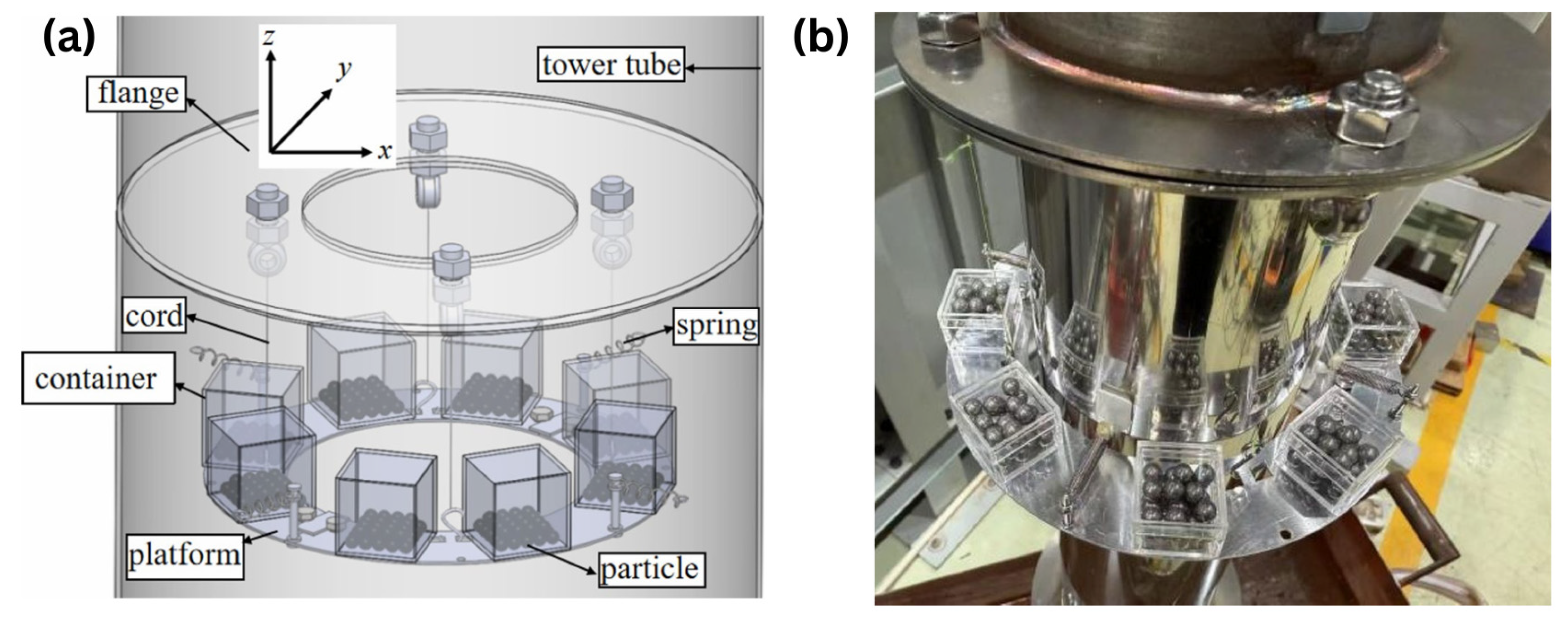
A novel implementation of a pendulum-pounding tuned mass damper (PTMD) was proposed in [62]. This system consists of a pendulum damper placed near a viscoelastic boundary, where energy dissipation occurs through material deformation during impact. The optimal tuning frequency of the PTMD was found to depend on the clearance between the pendulum and the boundary, while for sufficiently large gaps the PTMD behaves similarly to a conventional TMD. Numerical optimisation results showed that an optimised PTMD could outperform a traditional TMD by approximately 30% in terms of peak WT displacement reduction, while increasing the equivalent structural damping ratio from 1% to 4.3%. Impact-enhanced passive dampers therefore offer improved energy dissipation capacity compared with classical designs, although further investigation is required to address durability and long-term performance. Recent studies on impact-based and particle-assisted passive dampers, such as the multi-parameter pendulum tuned particle damper (PTPD) shown in Figure 8, have further demonstrated enhanced broadband vibration mitigation due to nonlinear energy dissipation mechanisms arising from repeated particle collisions and impacts [63].
Another passive damper investigated for WT applications is the tuned liquid damper (TLD). Chen et al. [48] constructed a 1:20 scaled WT model and conducted shaking-table tests using a novel TLD comprising two-layer hemispherical containers partially filled with water and mounted on top of a lumped mass representing the rotor–nacelle assembly. AD effects were neglected in the study. Vibration energy was dissipated through the sloshing motion of the liquid, with the natural sloshing frequency estimated using empirical formulations following [64]. The results demonstrated that the spherical TLD effectively enhanced the structural damping capacity, with more consistent response reduction observed when the excitation frequency approached the fundamental frequency of the system, a condition that is difficult to achieve in practice. Contrary to theoretical expectations, the mitigation effectiveness was found to increase nonlinearly with increasing water mass.
In addition to mass-based dampers, Zhao et al. [65] proposed a scissor-jack-braced viscous damper (VD-SJB) system installed inside a tubular steel tower. The scissor-jack mechanism amplifies the damper stroke while reducing the required damping force, thereby improving both effectiveness and feasibility. These findings indicate that stroke-amplification mechanisms provide a promising pathway for enhancing viscous damper performance in slender WT towers.
Vibration mitigation using isolation systems installed beneath the nacelle was investigated in [66]. In this study, vibration isolators were modelled using the Bouc–Wen hysteretic formulation and analysed through finite element simulations under wind and seismic loading applied separately, while SSI and wave effects were neglected. The results showed that nacelle-level vibration isolation could effectively reduce structural responses under both wind and seismic excitation. Furthermore, under wind-only loading conditions, the isolation system was found to mitigate vibrations and significantly improve structural fatigue life. These findings suggest that nacelle-based isolation systems have the potential to provide combined benefits in seismic response reduction and fatigue mitigation, although careful consideration of serviceability limits and control stability is required for practical implementation.
Overall, passive vibration mitigation strategies offer mechanical simplicity and inherent stability, making them attractive for WT applications. However, their effectiveness is often sensitive to tuning accuracy, excitation characteristics, and changes in structural properties, motivating the exploration of more adaptive control strategies under highly variable seismic and environmental loading conditions.

2.5.2. Semi-Active Dampers

Semi-active damper systems have shown strong potential for mitigating seismic-induced loads in WTs [66]. An important consideration in WT dynamic response is that the natural frequency of the tower can evolve over time due to cyclic loading effects and gradual reductions in soil stiffness, resulting in time-dependent structural characteristics. Semi-active dampers are less susceptible to performance degradation under such conditions because they can adapt their damping properties in real time, enabling effective vibration control despite changes in structural behaviour [56]. Among these systems, magnetorheological (MR) dampers have received considerable attention. Studies indicate that MR dampers can reduce WT vibration response by up to 48% in terms of edgewise blade vibration variability [67].
More recent numerical investigations demonstrate that semi-active damping systems integrated with adaptive control algorithms can significantly reduce tower displacement and acceleration responses while maintaining low power consumption and fail-safe behaviour [68]. Gain-scheduling-based semi-active TMD configurations have been shown to outperform passive systems by adaptively retuning stiffness and damping parameters in response to changing dynamic conditions. These characteristics highlight the robustness of semi-active strategies under non-stationary environmental and seismic loading.

2.5.3. Settlement and Tilting Mitigation

While vibration mitigation strategies primarily target transient dynamic responses, foundation settlement and permanent tilting can significantly influence post-earthquake WT performance and serviceability. Excessive settlement may alter structural stiffness, shift natural frequencies, and exacerbate vibration demands during subsequent events. Settlement and tilting mitigation measures are therefore complementary to vibration control strategies within seismic design frameworks.
Several mitigation techniques targeting liquefaction-induced settlement following earthquakes have been proposed and experimentally investigated through centrifuge tests conducted at 50 g centrifugal acceleration [26]. One such method is soil densification, which involves compacting the soil deposit beneath the structure to a relative density of approximately 85%. This approach was shown to substantially reduce post-earthquake settlement, decreasing settlement from approximately 33 cm to less than 10 cm. Another mitigation strategy involved the installation of stone columns encased with casings extending to the base of the centrifuge container beneath the structure. This configuration effectively reduced excess pore water pressure beneath the foundation and in the surrounding soil. When eight stone columns were installed, settlement was reduced by nearly 50%. However, this improvement was accompanied by increased structural acceleration, indicating a trade-off between settlement mitigation and dynamic response amplification. Cementation was also investigated as an alternative ground improvement method. Although cementation resulted in the lowest settlement among the tested approaches, it similarly led to a noticeable increase in tower-head acceleration, which could adversely affect WT operational performance. Collectively, these findings highlight a recurring trade-off in seismic mitigation design, whereby reductions in permanent settlement are often achieved at the expense of increased dynamic response demands.
In addition to soil improvement techniques, modifications to the WT foundation system have also been explored as a means of mitigating settlement and tilting [26]. One proposed approach involved anchoring the pile foundation into the underlying bedrock to restrain foundation movement during seismic excitation. While this strategy effectively limited settlement, it also resulted in increased tower-head acceleration. An alternative foundation configuration considered was a multi-pile system, such as a tripod foundation. Owing to its relatively lightweight structure and improved load distribution capability, the tripod foundation exhibited strong resistance to excessive settlement. Experimental results showed that the maximum tower-head acceleration during earthquake loading was approximately 0.2 g, with a corresponding tilt angle of 0.6°, both of which were roughly half of those observed for a monopile foundation. More recent physical modelling studies have further demonstrated that settlement and permanent tilt may be significantly amplified under combined environmental and seismic actions compared with wind-only or earthquake-only excitation, underscoring the importance of accounting for load interaction when evaluating serviceability limits for OWTs [69]. Shaking-table tests on suction bucket–supported OWTs additionally revealed that drainage-related design features, such as drainage holes in the bucket top cover, alter pore-pressure evolution and can reduce seismic capacity by suppressing negative pressure within the bucket and increasing cumulative tilt. These findings indicate that drainage provisions must be carefully evaluated rather than assumed to be universally beneficial in seismic design [69].
Further centrifuge testing conducted by Wang et al. [70] investigated the seismic performance of a novel suction bucket foundation. Centrifuge testing was employed to ensure stress conditions representative of full-scale behaviour, consistent with centrifuge scaling laws. The suction bucket foundation, installed through evacuation-induced penetration, offers advantages including removability, reusability, reduced material consumption, and cost efficiency. Test results indicated a lower tendency for liquefaction in the vicinity of the suction bucket compared with free-field soil. However, dissipation of excess pore water pressure following seismic excitation contributed to increased settlement and soil compaction beneath the foundation. Despite this, settlement of the suction bucket remained smaller than that observed at the free soil surface. Parametric optimisation studies further revealed that a narrow and deep bucket configuration exhibited the least settlement. In addition, incorporation of a honeycomb compartment design within the bucket reduced settlement by approximately 50% compared with a conventional suction bucket, demonstrating that internal compartmentalisation can significantly enhance liquefaction resistance of the supporting soil.
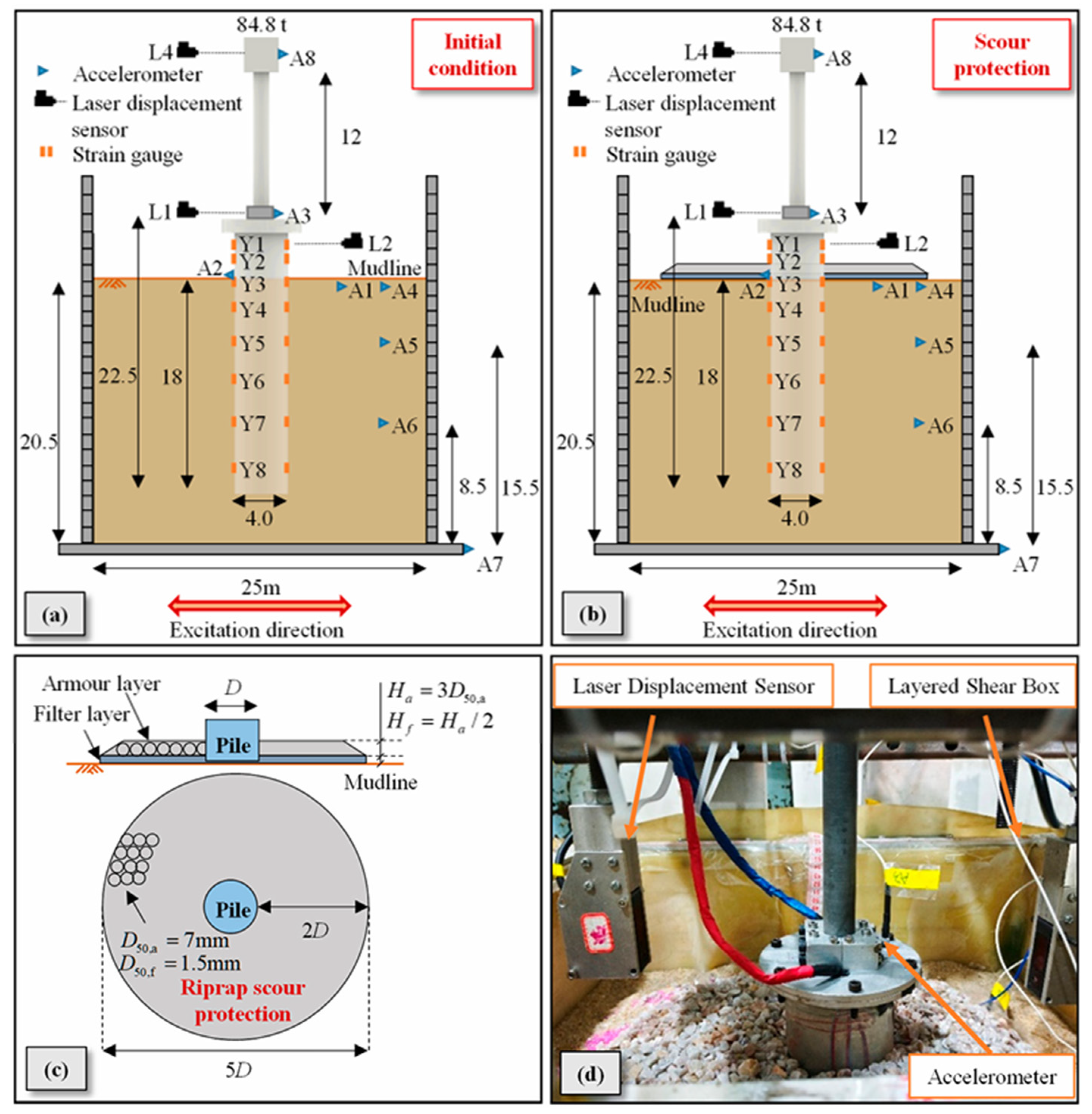
More recent investigations indicate that foundation protection and modification measures surrounding monopile systems can also influence seismic response characteristics by altering effective stiffness and load-transfer behaviour of the soil–foundation system, as illustrated in Figure 9 [71]. Although such measures are not primarily intended to directly mitigate liquefaction-induced settlement or permanent tilting, associated changes in foundation stiffness and dynamic properties can indirectly affect settlement-related behaviour and serviceability performance under seismic loading. For example, centrifuge shaking-table experiments combined with three-dimensional numerical modelling have shown that riprap scour protection leads to a slight increase in the first natural frequency of monopile-supported OWTs and produces measurable changes in key seismic response quantities [71]. These results further indicate that seismic response sensitivity is governed more strongly by the geometric extent of the protection layer than by the stiffness of the protection material itself. Consequently, geometric design parameters, such as the spatial extent and length of protection measures, play a critical role in influencing foundation response characteristics relevant to settlement- and tilt-related serviceability demands during earthquake events.

2.6. Seismic Fragility Analysis

Seismic fragility analysis is a probabilistic methodology used to estimate the conditional probability that a WT will reach or exceed a defined limit state, or damage state, given a specified level of earthquake ground-motion intensity [18]. As introduced in Section 2.1, fragility analysis conditions damage exceedance probabilities on selected ground-motion intensity measures (IMs). In WT fragility studies, PGA is most commonly adopted due to its compatibility with seismic hazard models and its widespread use in the literature. Nevertheless, alternative IMs, including Sa(T) and velocity-based measures, have also been investigated, particularly for displacement-controlled limit states [16,18]. Recent studies demonstrate that fragility estimates are influenced not only by the magnitude of the selected IM but also by its effectiveness in characterising the governing structural response. In particular, near-field pulse-like ground motions have been shown to induce amplified displacement demands when velocity- or spectral-based IMs are employed, especially under resonance conditions where the pulse period approaches the structural fundamental period [72].
Fan et al. [45] investigated the collapse behaviour of WTs by progressively increasing PGA levels until structural failure occurred. Their results indicated that tower-top displacement generally remained below the yield displacement, suggesting a relatively low probability of collapse under the ground motions considered. Pushover analyses further revealed that structural failure typically initiated at approximately 5 m above the tower base. However, SSI effects and operational states were not considered, both of which can significantly influence seismic demand and fragility outcomes. More recent modal-response investigations indicate that dynamic soil–structure interaction (DSSI) can substantially modify the modal characteristics of monopile-supported OWTs, including natural frequencies, mode shapes, and effective mass participation ratios, relative to fixed-base assumptions. Detailed three-dimensional modal analyses further demonstrate that simplified foundation models or fixed-base idealisations may significantly misrepresent higher-mode contributions. Consequently, neglecting DSSI effects and higher-mode participation can lead to biassed estimates of key seismic demand parameters, such as base shear and overturning moment, potentially resulting in either uneconomical or unsafe structural designs, particularly in earthquake-prone regions [73].
WT towers are commonly fabricated from welded rolled steel plates, and post-weld cooling can induce residual stress and geometric imperfections due to shrinkage at welded joints. Xu et al. [74] showed through finite element analyses that such initial imperfections increase displacement demands and reduce the PGA threshold required to initiate nonlinear behaviour in WT towers. Following the onset of nonlinearity, plastic hinge formation was observed, potentially leading to local buckling or global collapse. These plastic hinges were found to predominantly occur at approximately 0.5–0.75 times the tower height. The study further demonstrated that pulse-type near-field earthquake records induce significantly larger structural responses than non-pulse motions, highlighting the increased fragility of WTs under near-field seismic excitation.
Recent fragility-oriented investigations by Yuan et al. [72] further demonstrate that earthquake ground-motion characteristics exert a pronounced influence on WT seismic response and fragility, particularly under near-field pulse-like excitation. Numerical response and fragility analyses show that both ground-motion type and pulse characteristics, including pulse period and velocity-pulse content, can substantially amplify displacement and base moment demands. Near-field pulse-like records associated with forward-directivity and fling-step effects consistently produce larger tower-top displacements, higher base moments, and greater probabilities of exceeding serviceability and ultimate limit states than near-field non-pulse and far-field motions. Fragility curves are also shown to be highly sensitive to the ratio between the structural fundamental period and the pulse period, with resonance effects producing sharply increased damage probabilities when these periods are comparable. These findings highlight the importance of incorporating ground-motion classification and pulse-period compatibility into ground-motion selection for WT fragility assessment, particularly in near-fault regions.
During seismic events, WTs are typically triggered into emergency shutdown, and the abrupt change in AD associated with rotor deceleration can introduce short-term dynamic instability and amplify structural response [32]. Ju and Huang [44] demonstrated that reducing the pitch rate during emergency shutdown can mitigate abrupt changes in wind-induced forces. To address shutdown-induced instability, some studies have proposed maintaining rotor rotation during earthquake excitation, as wind–seismic coupling can reduce WT fragility [33]. More recent numerical investigations further indicate that wind–earthquake misalignment, defined by the directional relationship between aerodynamic and seismic actions, can significantly influence combined seismic and aerodynamic demand envelopes [51]. Coupled aero–seismic time-domain analyses show that different misalignment angles may govern critical response quantities depending on operational state, with emergency stop, normal operation, and parked conditions producing peak demands under different directional configurations. Consequently, fragility assessments based on single-directional or collinear load assumptions may systematically under- or overestimate demand measures, leading to biassed fragility estimates if directional uncertainty is neglected.
Additional structural features can further influence fragility outcomes. WTs with door openings in the tower shell have been shown to exhibit increased vulnerability to collapse due to stress concentration effects around the opening [2]. Consistent with earlier findings, recent fragility-oriented investigations confirm that strong and near-fault ground motions can substantially increase displacement- and force-based demands and the probability of exceeding serviceability and strength-related limit states, particularly under resonance conditions [72]. By contrast, fragility analyses by Ngo et al. [18] demonstrate that site-specific ground-motion amplification alone can significantly elevate tower-top displacement, mudline displacement, and tower stress demands, leading to increased damage exceedance probabilities. Taken together, these findings indicate that neglecting either near-field pulse effects or site amplification may result in non-conservative fragility estimates for OWTs in seismically active regions.
While fragility curves quantify the conditional probability of exceeding specified damage states given a seismic IM, they do not directly represent seismic risk. Risk metrics are obtained by integrating fragility relationships with site-specific seismic hazard models to estimate performance-based quantities such as annual probability of collapse, mean annual frequency of exceeding serviceability or ultimate limit states, and loss exceedance probabilities. Recent studies have employed such fragility–hazard coupling frameworks to assess seismic risk of OWTs under combined earthquake, wind, and wave loading. Khalil et al. [15], for example, adopted a risk-based methodology integrating hazard-consistent ground-motion selection with fragility analysis to estimate annual exceedance rates of acceleration demand for a jacket-supported OWT, highlighting the influence of higher-mode effects and vertical excitation. Similarly, Zhang et al. [75] developed multi-hazard fragility surfaces for monopile-supported OWTs subjected to stochastic combinations of wind, wave, and earthquake loading, demonstrating that operational conditions, SSI, and ground-motion characteristics can substantially influence predicted serviceability and ultimate limit state exceedance probabilities.
Overall, existing fragility studies indicate that WT seismic performance is governed by a complex interplay between structural characteristics, soil–structure interaction, operational state, and ground-motion features. These findings underscore the need for integrated fragility frameworks that explicitly account for aerodynamic–seismic coupling, higher-mode effects, and directional uncertainty. Although many existing studies focus primarily on fragility relationships rather than explicit risk quantification, fragility curves remain a fundamental input to seismic risk assessment when combined with seismic hazard models to estimate performance-based risk metrics, such as collapse probability and loss exceedance, as demonstrated in recent studies on OWTs [18].

3. Waves and Wind Turbines

Sea waves are generated by wind forcing at the air–sea interface and are capable of propagating over long distances as swell. They constitute a primary source of environmental loading for OWTs. To exploit offshore wind resources, WTs are increasingly deployed in marine environments. Compared with onshore installations, OWTs can accommodate larger rotors, enabling greater energy capture from relatively undisturbed wind fields with higher mean wind speeds, while also benefiting from lower noise pollution and fewer land-use constraints [76,77]. Although OWTs accounted for only approximately 7% of total global wind power capacity, corresponding to about 117 GW in 2024 [78], their installed capacity is expected to increase substantially over the coming decades, driven by technological advancements, large-scale deployment strategies, and declining installation and operation costs. Unlike land-based WTs, OWTs are subjected to additional hydrodynamic loads induced by sea waves and ocean currents. These environmental actions play a critical role in governing structural stability, fatigue damage accumulation, and power generation performance. Consequently, it is essential to understand wave-induced loading mechanisms and their interaction with turbine structures. To this end, a wide range of numerical, analytical, and experimental approaches has been developed to model the coupled aerodynamic and hydrodynamic response of OWTs, resulting in a diverse body of experimental, numerical, and hybrid modelling frameworks reported in the literature.

3.1. Sea Waves

Wind waves, also referred to as wind-generated waves, originate from the transfer of momentum and energy from the atmosphere to the ocean surface through surface stress and pressure gradients. Under sustained wind forcing, small surface disturbances are amplified and evolve into surface gravity waves [79]. As wind forcing continues, wave characteristics such as height, period, and wavelength are governed primarily by wind speed, wind duration, and fetch, defined as the distance over which the wind blows with approximately constant direction. Larger wave heights generally develop under higher wind speeds [80], longer wind durations, and greater fetch lengths [81,82]. The sea state continues to evolve as long as energy input from the wind exceeds dissipation mechanisms such as wave breaking and turbulence, and equilibrium is reached when these processes balance, resulting in a fully developed sea [82].
Under certain conditions, wave energy may become spatially focused due to mechanisms such as wave–current interaction or constructive interference, leading to the formation of rare and exceptionally large waves commonly referred to as freak or rogue waves [83]. Extreme and highly nonlinear wave conditions have received increasing attention in offshore wind research due to their potential to induce transient and nonlinear hydrodynamic loading, particularly for FOWTs, where platform motion and wave–structure interaction dominate system response [84]. In addition to wave amplification, nonlinear wave instability may lead to wave breaking, resulting in rapid energy dissipation and impulsive loading on offshore structures [85]. Recent experimental and numerical studies demonstrate that breaking-wave slamming loads can induce intense transient dynamic responses in OWT foundations, leading to significant vibration, local amplification of structural demand, and cumulative fatigue damage, particularly for fixed-bottom turbines installed in shallow and transitional water depths [86].
Sea waves may also be generated by underwater seismic activity and tidal effects. Beneath a propagating wave, water particles undergo oscillatory motion along approximately circular trajectories, while wave energy propagates in the direction of travel. The influence of this oscillatory motion extends to a depth of approximately half the wavelength. Below this depth, wave-induced motion becomes negligible, and the water body can be classified as deep water (see Figure 10). Consequently, maximum wave-induced loads occur near the free surface and decrease with increasing depth [87]. As waves propagate from deep water into shallower regions, interaction with the seabed progressively modifies particle motion, causing initially circular trajectories to become increasingly flattened and elliptical. This depth-induced transformation reduces wave celerity and wavelength while increasing wave height, a process known as wave shoaling, as illustrated in Figure 10.
In shallow water, interaction between oscillating water particles and the seabed distorts near-bed orbital motion and introduces wave nonlinearity through energy dissipation and waveform deformation [88]. Continued shoaling increases wave steepness, and once stability limits are exceeded, waves may become unstable and break, producing highly localised impulsive loading near both the free surface and the seabed. Under severe sea states, stronger nonlinear effects dominate wave behaviour, necessitating higher-order or fully nonlinear wave theories for accurate load prediction [89,90]. Consistent with this, recent offshore wind studies have shown that neglecting wave nonlinearity can lead to significant underprediction of dynamic response amplitudes and low-frequency motions, particularly for FOWTs, where nonlinear wave forces strongly influence platform dynamics and cyclic loading behaviour [91]. Key characteristics of sea waves relevant to offshore wind applications are summarised in Table 2.

3.2. Waves and Offshore Wind Turbines

3.2.1. Types of OWT Support Structures

OWT support structures can be broadly classified into two primary categories: fixed foundations and floating platforms. The selection of an appropriate support structure depends on several site-specific parameters, including water depth, seabed conditions, and economic considerations [93]. At shallow (<50 m) and intermediate water depths (50–80 m) [94], fixed foundations, such as monopile, jacket, gravity-based, and tripod structures, are most commonly employed. Recent design reviews indicate that advances in foundation engineering, including hybrid and optimised fixed-bottom concepts, are extending the applicability of fixed installations to greater water depths and more challenging seabed conditions [95].
Floating platforms are generally adopted in deeper water regions where fixed-bottom foundations become technically and economically impractical due to increased material requirements and installation complexity [96,97]. FOWTs have progressed from pilot-scale demonstrations toward early commercial and pre-commercial deployments, reflecting increasing confidence in deep-water solutions alongside ongoing efforts to reduce system costs [98]. As summarised in Table 3, barge, spar-buoy, tension leg platform (TLP), and semi-submersible configurations represent the most widely adopted floating platform concepts. Each configuration exhibits distinct hydrodynamic characteristics and dynamic responses under wave loading, which strongly influence platform motions, mooring system behaviour, and overall system performance during operation [99].

3.2.2. Techniques of Analysing Wave Effects on OWTs

Wave effects on OWTs are commonly investigated using a combination of experimental and numerical approaches. Experimental investigations typically employ scaled physical models tested in laboratory facilities, open-sea environments, or wave basins equipped with controlled wave and wind generation systems. These experiments enable the reproduction of realistic hydrodynamic loading conditions and provide direct insight into wave–structure interaction mechanisms. Recent wave-basin studies have increasingly focused on combined wind–wave loading scenarios and the coupled dynamic response of OWT systems, highlighting the importance of physical testing for capturing integrated system behaviour under realistic joint environmental conditions. Such experiments are particularly valuable for large-scale and floating configurations, where nonlinear coupling between aerodynamic loading, wave excitation, and mooring dynamics strongly influences overall system response [100].
In parallel with experimental investigations, numerical simulations are extensively used to evaluate wave-induced responses of OWTs. These simulations are performed using a range of computational tools, including FAST-based frameworks, computational fluid dynamics (CFD) solvers, and MATLAB-based models. Irregular sea states are most commonly represented using the JONSWAP spectrum, while wave-induced loads are typically computed using the Morison equation and/or potential-flow solvers such as the two-dimensional Harmonic Polynomial Cell (HPC) method, Reynolds-averaged Navier–Stokes (RANS) models, and OceanWave3D.
In recent years, CFD-based investigations have increasingly been applied to examine complex wave conditions, including focused or extreme wave groups and wave–current interaction around offshore foundations, for which simplified loading models may become less reliable [101,102]. Concurrent advances in numerical modelling have driven growing adoption of fully coupled aero–hydro–servo–elastic approaches, particularly for FOWTs. In such frameworks, turbine dynamics tools such as OpenFAST are coupled with high-fidelity CFD solvers (e.g., OpenFOAM, Foundation version 5.x) and mooring-system models to improve representation of nonlinear hydrodynamic effects and platform–mooring interactions [103,104].
Most studies incorporate aerodynamic loading to account for combined environmental effects, with the blade element momentum method commonly employed to evaluate wind-induced forces. To overcome inherent software limitations and improve modelling fidelity, researchers have frequently coupled user-defined codes with existing simulation platforms [87,105,106,107,108,109]. Recent validation-oriented studies further indicate that modelling choices related to hydrodynamic load formulations, wave kinematics, and the treatment of second-order wave effects can significantly influence predicted structural responses. These findings underscore the importance of transparent reporting of numerical assumptions to ensure reproducibility and enable meaningful comparison across studies [110]. Simulation results are typically analysed in the time or frequency domain and are often summarised using statistical metrics such as mean values and standard deviations for the corresponding load cases.
Most published investigations adopt the NREL 5 MW reference WT as a baseline model. Nevertheless, variations in modelling assumptions, numerical configurations, and environmental input parameters continue to hinder direct comparison of results across studies. Differences in experimental facilities, numerical solvers, and coupling strategies further contribute to the diversity of reported responses. To account for this methodological breadth, Table 4 provides a consolidated overview of the experimental and numerical approaches commonly employed in the analysis of wave effects on OWTs.

3.3. Effects of Waves on Offshore Wind Turbines

OWTs are exposed to time-varying wave loads arising from the stochastic and highly complex nature of the marine environment. Wave-induced loads become increasingly significant during severe sea states characterised by large wave heights [89,96], as well as under parked conditions, where aerodynamic loading and damping are substantially reduced [126,129]. In addition to their influence on structural response, wave conditions play a critical role in OWT operation and maintenance planning, as the deployment of maintenance personnel requires suitable weather windows with wave heights below prescribed safety limits [124]. Inaccurate prediction of wave conditions can therefore lead to substantial operational delays and economic losses, underscoring the importance of reliable wave forecasting for offshore wind applications [124]. The effects of wave loading on fixed and floating OWTs are discussed in the following sections.

3.3.1. Fixed Foundation

Under normal operating conditions, aerodynamic loads dominate the dynamic response of monopile-supported WTs compared with wave-induced loads, primarily due to the larger lever arm associated with the rotor [89,126]. However, the absence of AD in the side-to-side direction increases the vulnerability of OWTs to wind–wave misalignment, which commonly occurs in real sea states due to changes in wind direction [77,80,105,131]. Such misalignment is more pronounced at lower wind speeds [80,116]. Misaligned waves induce side-to-side nacelle motion and mudline bending moments, with response amplitudes increasing as the misalignment angle increases from 0° to 90° [77,80]. Despite this, fore–aft bending moments generally remain larger due to aerodynamic loading, leading to higher bending stresses on the rear side of the pile that vary with wave misalignment [77]. Beyond directional misalignment effects, recent investigations of focused and steep wave groups indicate that nonlinear wave kinematics can generate secondary load cycles and impulsive, slam-like contributions. These effects lead to local amplification of force and overturning-moment time histories on monopile foundations [132]. Although such nonlinear effects do not typically govern the global dynamic response of adequately damped OWTs, they introduce high-frequency load components and localised accelerations that are relevant for structural integrity and fatigue assessment under severe and intermediate-depth wave conditions.
Under extreme sea states characterised by large wave amplitudes, waves exceeding approximately 10 m in height have been shown to induce larger fore–aft overturning bending moments, while their influence on blade tip deflection remains negligible [117]. Wang et al. [89] further demonstrated that extreme wave forces exert a stronger influence on the dynamic response of OWTs than extreme wave heights alone, highlighting that the largest wave height does not necessarily correspond to the maximum wave force [113]. Under parked conditions, steep and highly nonlinear waves can trigger ringing-type responses at the first natural frequency of the structure due to reduced aerodynamic loading and damping [89]. Recent coupled dynamic analyses targeting ringing responses in monopile-supported OWTs confirm that accurate representation of strong wave nonlinearity and full aero–hydro–structural coupling is required to reproduce ringing-type amplification under extreme wave events [133]. Compared with bending moments, wave loading has a more pronounced influence on tower base shear forces, with increasing wave nonlinearity producing larger shear demands [88]. In addition, the butt weld connecting the monopile to the seabed experiences larger stress cycles and greater fatigue damage than the monopile–tower connection [77].
Breaking waves generate highly localised impact loads concentrated near the wave crest [85], with their occurrence influenced by seabed conditions and ambient currents [113]. At the point of wave–structure interaction, a triangular pressure distribution is typically observed, while non-breaking waves produce peak pressures approximately 30–50% lower below the impact region [85,113]. Laboratory investigations of breaking-wave impacts on monopile-type structures further report strong spatial variability in peak pressures and short-duration impulsive components, emphasising the need for sufficiently fine temporal resolution when translating pressure measurements into design loads [134]. Additional experimental studies comparing different breaking regimes demonstrate that slamming-force characteristics and pressure distributions are highly sensitive to the breaking process, which can shift the governing load features from quasi-hydrodynamic to impact-dominated responses [135].
Experimental studies by Maes et al. [85] showed that breaking-wave impacts on monopiles produce sudden increases in seabed-level shear forces and overturning bending moments, with inertial forces dominating over drag forces during impact events. Due to the strong nonlinearity of breaking waves, significant variability in wave elevation, pressure, and impact loads may occur even under nominally identical input conditions [85]. A case study by Paulsen et al. [113], based on environmental conditions at the Gemini offshore wind farm in the German Bight, demonstrated that wave impact loads generate high local accelerations, whereas extreme structural deflections are primarily driven by non-breaking waves and wind-induced excitation of the first and second structural modes.
Structural response is also strongly influenced by foundation geometry, resulting in different wave load characteristics under identical wave conditions [93,119,128]. Among commonly used foundation types, monopiles experience the highest average wave pressures, followed by gravity-based, tripod, and jacket foundations [93]. In contrast, gravity-based foundations are subjected to the largest maximum wave forces due to their greater exposed surface area, followed by tripod and monopile foundations [119,128]. The magnitude of maximum forces and the differences between foundation types decrease with increasing wave steepness, defined as the ratio of wave height to wavelength [119].
In addition to direct hydrodynamic loading, wave–structure interaction governs near-field flow and free-surface behaviour, resulting in significant wave run-up along foundation elements. Wave run-up may reach up to 50% of the incident wave amplitude, and if platform decks are constructed too low, frequent underside impacts can occur [93,119]. Run-up heights vary circumferentially around the pile, with maximum values occurring at the upstream face and increasing with wave steepness [119]. Numerical simulations by Lin et al. [93] using bichromatic waves showed that tripod foundations experience higher run-up heights than monopile, gravity-based, and jacket foundations. However, under moderate to high wave steepness in nonlinear wave conditions, tripod, monopile, and gravity-based foundations exhibit similar run-up performance [119].
Near-field hydrodynamic effects also extend below the seabed, where wave-induced oscillatory motion generates excess pore pressure that can compromise foundation stability. Oscillatory wave loading can induce pore pressures exceeding overburden stress, potentially leading to liquefaction around pile foundations, particularly on the upstream side [128]. More recent wave-flume studies investigating monopile–seabed–wave coupling demonstrate that pile motion, pore-pressure evolution, and wave loading form a strongly coupled feedback system. Increased pile displacement accelerates pore-pressure accumulation and further reduces foundation stiffness, indicating that simplified decoupled modelling approaches may underestimate monopile response and stability once critical wave height and period thresholds are exceeded [136].
Under wave-dominated conditions, waves may also induce seabed scour. Ong et al. [137] reported that short-crested waves produce greater scour than long-crested and linear waves, with the differences increasing with the RMS Keulegan–Carpenter (KC) number. This highlights the central role of KC as a governing parameter for wave-induced sediment mobilisation around monopiles. Scour does not occur for KC values below 6 for circular piles. While the presence of currents reduces the disparity in scour depth between different wave types, it increases the overall scour depth [137]. Recent large-scale physical model testing under irregular waves continues to support the central role of KC in controlling equilibrium scour depth and scour-volume development around monopiles, particularly across KC ranges representative of energetic sea states [138]. At the flow-structure level, recent laboratory studies under combined wave–current–vibration loading further indicate that vortex structures (e.g., horseshoe vortices) remain key drivers of scour, while additional excitation mechanisms can accelerate scour-hole evolution and alter scour morphology [139]. Although scour protection systems can mitigate erosion, they may increase the likelihood of breaking wave occurrences [113]. Furthermore, seabed interaction dissipates wave energy, leading to reductions in tower base shear forces and bending moments [88].
Overall, the response of monopile-supported OWTs to wave loading is governed by a combination of wave nonlinearity, wind–wave misalignment, foundation geometry, and seabed interaction. While aerodynamic loads dominate global response under normal operation, extreme and nonlinear wave conditions introduce high-frequency, impulsive, and localised effects that are critical for structural integrity, fatigue assessment, and foundation stability. These findings highlight the necessity of coupled aero–hydro–soil–structural modelling frameworks and foundation-specific design considerations when assessing OWT performance under severe sea states.

3.3.2. Floating Platform

FOWTs have six DOFs, as illustrated in Figure 11, including translational motions (surge, sway, and heave) and rotational motions (roll, pitch, and yaw). Excessive platform motions can negatively affect turbine electromechanical systems and overall operational performance [122]. Wave excitation can strongly influence these motions, particularly heave and pitch, due to the proximity of their natural frequencies (NFs) to dominant wave frequencies [121]. As significant wave height increases, the peak energy of wind-generated waves shifts toward lower frequencies, thereby approaching or coinciding with the platform motion’s natural frequencies [96]. Under operating conditions, surge and pitch are mainly governed by wind loading [90], whereas heave is predominantly wave-driven [90,96,127]. However, with increasing sea severity, wave contributions to surge, pitch, and roll motions increase substantially [90,96]. Recent multi-physics, fully coupled modelling frameworks further demonstrate that accurate prediction of surge, heave, and pitch responses under combined wind–wave excitation requires an integrated representation of hydrodynamic loading and aero-servo-elastic feedback, as wave-induced platform motions continuously modify rotor inflow and aerodynamic thrust, thereby influencing platform response characteristics and power performance [140].
Substantial responses are commonly observed in surge, pitch, and heave for an operating turbine under aligned wind and wave conditions [90]. Under wave-only loading, first-order wave forces induce oscillations about the equilibrium position, while mean drift forces and slow-drift (second-order) excitation loads shift the platform in the direction of wave propagation, leading to a non-zero mean surge [76,112]. Although second-order wave loads are comparatively small in magnitude, their low-frequency content enables efficient excitation of platform surge and pitch through resonance with the surge natural frequency [87,96,111,112]. In the presence of wind, aerodynamic loading shifts the platform to a new equilibrium, resulting in increased mean surge and pitch motions [105,141]. Recent work on short-duration “design wave” selection for floating wind highlights that second-order difference-frequency forces can dominate the conditions that maximise surge response, indicating that extreme platform motions may arise from sustained low-frequency excitation rather than visually extreme wave crests [142]. Directionally focused wave-group studies further indicate that wave spreading and steepness modify the distribution of higher-harmonic content in surge and pitch responses, which is particularly relevant for transient extreme-response assessment and local load effects [143].
Under wind–wave misalignment with varying wind direction, Li et al. observed reduced surge and pitch motions of both the platform and nacelle, alongside increased sway and roll motions due to changes in aerodynamic force components, while heave and yaw remained largely unaffected. Simulations by Lyu et al. [105] with varying wave directions showed that maximum surge decreases while mean surge increases as wave misalignment grows, attributed to reduced wave radiation damping. A similar trend was observed for pitch, whereas the mean heave slightly decreases due to increased wind contribution. Larger wave misalignment increases the wave contribution to sway, roll, and yaw, raising peak responses while mean values remain similar [105]. Beyond misalignment effects alone, more recent investigations further show that combined wind–wave misalignment and degraded mooring integrity can substantially increase drift risk and alter motion–tension coupling, particularly during transient re-equilibration following mooring failure, suggesting that misalignment-only sensitivity studies may underestimate operational vulnerability under faulted mooring conditions [144].
Freak waves can amplify platform motion, and the magnitude of the negative force can exceed that of the positive force [115]. For a spar-type platform, Qu et al. [115] found that superimposing a freak wave with an opposing current produces larger wave amplitudes, first-order forces and moments, and larger extrema in surge, pitch, and heave than in following-current conditions. Experiments on semi-submersibles in irregular waves by Cao et al. [112] showed that following currents increase the mean surge but provide additional damping that reduces surge and pitch fluctuations; reductions in mean pitch were also observed in irregular waves [63], although opposite trends were reported for freak wave cases [115]. These contrasting behaviours highlight the sensitivity of platform response to the detailed temporal and spatial characteristics of extreme waves. Recent numerical and experimental studies continue to report pronounced sensitivity of motion extrema to freak-wave profile parameters (e.g., crest–trough asymmetry and characteristic period), underlining the importance of representing realistic rogue-wave shapes in transient extreme-response assessment [145]. Coupled simulations of rogue-wave encounters on floating wind concepts similarly show that wave-group and rogue-wave formulations can produce markedly different peak responses even when “equivalent” wave heights are prescribed, with extreme responses frequently occurring offset from the instant of maximum wave crest due to low-frequency resonance and phase effects [146]. Recent work also emphasises that higher-harmonic wave loads and low-frequency resonance under extreme wave groups can become relevant to platform response and mooring integrity, particularly when low-frequency modes are weakly damped [147].
Wave-induced platform motion can substantially modify turbine wakes by distorting wake structure and altering vortex spacing, thereby introducing strong unsteadiness into the flow field [106,107]. Fang et al. [107] reported that severe wake interference can occur when pitch-induced platform velocities become comparable to or exceed the incoming wind speed or the characteristic vortex convection speed, enabling interaction between the rotor and previously shed wake structures. These effects highlight the importance of wind farm spacing for floating turbines, as downwind machines may experience unsteady aerodynamic loading arising from complex, asymmetric axial velocity profiles induced by platform motion [106,114]. Beyond HAWTs, similar sensitivities have been observed for vertical-axis wind turbines (VAWTs). For VAWTs, Lei et al. [109] showed that increased surge and pitch motions lead to larger centreline velocity deficits, with pitch additionally introducing wake offset. They further found that shorter pitch periods reduce the downstream extent of wake influence but intensify wake fluctuations, while larger surge amplitudes promote more dispersed far-wake structures [109].
More recent high-fidelity studies demonstrate that wake behaviour becomes even more complex under combined DOFs. Li et al. [148] showed that the interaction between yaw misalignment and lateral (sway-type) motion can fundamentally reshape wake asymmetry, spreading, and meandering characteristics, indicating that motion–yaw coupling should be treated explicitly in floating wake models. Complementary wind tunnel experiments by Fontanella et al. [149] provide further evidence that multi-DOF platform motion, such as combined surge and sway, skews the apparent wind experienced by the rotor and amplifies near-wake velocity variability, with direct implications for downwind turbine loading and control strategies in floating wind farms. In addition, recent studies on platform motion phase relationships demonstrated that neglecting these phase effects can lead to substantial underprediction of unsteady loads, reinforcing the need for realistic multi-DOF motion reconstruction rather than simplified single-DOF or in-phase motion assumptions in floating WT and wake interaction studies [150].
As the blade-relative wind speed varies across motion cycles, the power output (proportional to the cube of relative velocity) fluctuates, particularly under surge and pitch motions [106]. Larger surge and pitch motions produce larger power fluctuations, while mean power may slightly improve compared to fixed turbines at relatively small amplitudes and frequencies [107,120]. However, dynamic stall may occur during upwind pitching due to increased relative velocity and angle of attack [107]. Extreme pitch motion and yaw error can deteriorate power output [114,116]. Rolling motion may increase mean power through near-wake momentum gain, but very large amplitudes (e.g., 20°) reduce performance [114]. Power fluctuations are amplified under combined surge and pitch and depend strongly on phase, with the largest fluctuation reported at 180° out of phase [118]. Chen et al. [120] showed that combined motions can reduce power at rated wind speed due to complicated flow, whereas below rated wind speed, floating turbines may generate more power than fixed turbines by exploiting increased relative velocity [118]. VAWTs also show slight power improvements, with better gains under low-amplitude surging and/or longer periods [108].
Although small platform motions can enhance mean power output, fluctuating relative velocity and blade–wake interactions can increase fatigue damage on turbine blades due to thrust and torque variations that intensify with motion amplitude and frequency [106,107,111]. Chen et al. [120] indicated that pitch has a stronger effect on blade normal and tangential forces than surge due to higher induced relative velocity. Moderate motions increase fatigue load mainly in inboard and midspan sections, but drastic motions shift peak fatigue toward the outboard span [120]. Surge motion also increases torque and force fluctuations on VAWT blades and alters pressure coefficients, particularly on the suction side [108]. It should be noted that many existing studies prescribe sinusoidal motions, whereas real sea states are irregular and stochastic, potentially leading to an underestimation of fatigue damage accumulation [106,107,108,114,118,120].
Tower-base fore–aft and side-to-side bending moments are mainly associated with pitch and roll motions, respectively, and both are largely governed by aerodynamic loading on the rotor [76,90,127]. Cao et al. [112] observed near-zero mean tower-base bending moment under wave-only conditions. While wave loads may excite the tower’s NF, this response can be suppressed by AD; instead, wave loads influence tower response indirectly through intensified platform pitch and roll [76]. Additional side-to-side bending moments may arise due to increased roll under wave misalignment [105], while wind misalignment can influence both tower-base bending moments through its effect on platform pitch and roll [116]. Different responses occur under linear and nonlinear waves (Table 5), where linear waves can impose larger tower-base force and bending moments due to higher wave energy concentrated near relevant frequencies, leading to greater fatigue damage [90,92]. Conversely, for fixed-bottom turbines, nonlinear waves have been reported to induce larger peak forces and moments than linear waves [89].
Mooring systems (catenary or taut) anchor floating platforms and provide restoring forces against platform motions. Mooring tension is strongly coupled to horizontal translational motion (particularly wind-driven surge) and is also influenced by currents [90,92,94,115]. Larger horizontal motions increase mean and peak mooring tensions in the upwind direction or slightly misaligned directions [129]. Mooring tension exhibits nonlinear behaviour [94]. As a consequence of this nonlinear response, under wave-only loading, mooring fatigue damage scales with wave height and frequency [90]. Although wind often governs mooring tension and fatigue, larger waves associated with higher wind speeds can aggravate fatigue damage [90]. In addition to these general environmental effects, pitch motion has a stronger influence on taut moorings used in TLPs [127]. Adding clump weights and buoys can reduce extreme tensions for catenary moorings, but has a negligible impact on taut moorings [94]. Beyond the individual effects of wind, waves, and currents, recent studies highlight the importance of explicitly accounting for wave–current interaction in mooring analysis. Recent studies that explicitly model wave–current interaction (rather than treating waves and currents independently) show that currents can modify effective wave characteristics through frequency shifting and spectral redistribution, leading to altered platform motion responses and significantly different mooring-tension predictions, with direct implications for design-level load and fatigue estimates [151].
Unlike fixed turbines that route export cables beneath the seabed, part of an FOWT power cable is exposed to hydrodynamic loading and platform motion [130]. Hydrodynamic analyses remain comparatively limited, but Rentschler et al. [130] showed via hydrostatic analysis that cable configuration (catenary or lazy wave) and segment lengths substantially affect maximum tension and curvature under still-water conditions, indicating that optimising section length is crucial to mitigate failure under extreme tension and curvature. Building on these hydrostatic insights, recent studies have extended cable design investigations toward more realistic large-scale floating turbine configurations. Recent dynamic cable layout research for large (e.g., 15 MW class) floating turbines further demonstrates that lazy-wave geometry and buoyancy/clump design choices can significantly reduce tension and curvature demand, including under platform offset conditions representative of wave loading [152]. In parallel with configuration optimisation efforts, recent reference-model efforts for dynamic power cables also provide baseline nonlinear mechanical property datasets intended for integration into global coupled simulations, supporting more consistent cable fatigue and extreme-load assessment across studies [153].

3.4. Mitigation of the Effect of the Wave

A range of vibration mitigation strategies, including active, semi-active, and passive approaches, have been proposed to suppress excessive platform motions that can lead to increased fatigue damage, structural failure, and performance losses. Active control systems require external energy input and real-time controllers, whereas semi-active systems adjust mechanical properties (e.g., stiffness or damping) to optimise performance with lower energy consumption than fully active systems [123]. Passive mitigation devices such as tuned liquid column dampers (TLCDs), consisting of U-shaped containers partially filled with liquid [154] and TMDs require zero external energy input. TMDs typically contribute roughly 1–2% of total structural mass and can reduce dynamic loads for fixed turbines, particularly side-to-side responses induced by wind–wave misalignment [80]. However, their effectiveness in the fore–aft direction at rated wind speeds is constrained by maximum AD [80]. Stewart et al. [80] noted that the orientation of dual linear TMDs has a negligible effect on their performance, and that smaller devices are often preferable due to lower cost, reduced space requirements, and minimal sacrifice in effectiveness. Building on these limitations of conventional linear TMDs, more advanced pendulum-based and multi-directional damper configurations have been proposed to enhance mitigation performance under coupled loading conditions.
To mitigate bi-directional vibrations, Sun and Jahangiri [77] proposed a three-dimensional pendulum tuned mass damper (3D-PTMD) installed within the nacelle of a monopile WT, which outperformed dual linear TMDs in bending stress reduction and reduced fatigue damage at the butt weld connection by up to 50%. Jahangiri et al. [123] extended this concept to a three-dimensional pounding PTMD (3D-PPTMD) with additional viscoelastic pounding elements that enhance energy dissipation while occupying 25% to 35% less space than 3D-PTMD and dual linear TMDs, respectively, and achieve greater reductions in fore–aft and side-to-side nacelle displacements. The 3D-PPTMD also maintains effectiveness in off-tuned conditions where traditional passive systems degrade [123], although the 3D-PTMD may outperform it at higher frequency ratios [123]. Recent studies have explored advanced pendulum-type and multi-mass TMD configurations that can provide up to approximately 20% additional reduction in tower deflection–related fatigue indicators under optimal tuning conditions in floating systems under optimal tuning conditions compared to conventional TMDs, but whose effectiveness is highly sensitive to tuning relative to platform pitch and heave-dominated modes [155].
For FOWTs, it is crucial that the natural frequencies of the tower and all six platform DOFs avoid the dominant energy range of wave frequencies to minimise resonance [125]. Passive devices such as fixed heave plates (FHPs) can add hydrodynamic damping and mass, while tuned heave plates (THPs) using spring-dashpot connections further enhance mitigation performance [156,157]. Installed beneath the platform, FHPs reduce heave and pitch motions, but THPs typically deliver superior performance due to their frequency-tuning mechanisms [121]. A recent study proposed a novel tower damping system for semi-submersible FOWTs that demonstrated fatigue damage reductions of up to 72% and extended tower lifetime by 136% under combined wind and wave loading [158].
Vibration isolation systems (VISs) can also be used to reduce platform motions, but effective mitigation requires input frequencies above 2 times the isolated component’s natural frequency. Ma et al. [121,125] proposed inerter-based vibration mitigation systems with inertance greater than physical mass to target heaving and pitching responses of semi-submersibles. The inerter-based VIS (IVIS), installed between deck and columns, exhibits a broader effective frequency range and better results for deck heave than a conventional VIS [125]. Although both systems increase motion at pontoon levels, the adverse effects are less severe for IVIS. By optimising the inertance–mass ratio, the IVIS maintains performance across different sea states [125]. In addition, a rotational inertia damper (RID) incorporating a turning plate was proposed to generate damping forces that increase with platform motion, improving mitigation for heave and pitch under extreme waves; THPs perform better under operational sea conditions [121]. The pitch mitigation performance also improves with greater spacing between devices, with RID outperforming THP and FHP at spacings between 40 and 80 m [121]. In addition to platform-level isolation devices, inerter-based concepts have been extended to mass-based vibration absorbers. Tuned mass damper inerters (TMDIs) demonstrate superior suppression of multi-frequency coupled wind–wave–structural responses in FOWT towers compared to conventional TMDs, while achieving comparable or improved performance with reduced physical mass through inertial amplification effects [159]. Optimised TMDI configurations significantly improve structural reliability and reduce vibration-induced demand under misaligned wind–wave loading conditions, highlighting their potential for mitigating complex coupled responses in floating systems [159].
In addition to mass-based and isolation-oriented solutions, further mitigation concepts address specific DOFs: Mitra et al. [122] introduced a modified spar–torus combination (MSTC) where a submerged torus attached to a spar via springs and dashpots reduces sway, roll, and both fore–aft and side-to-side tower-top displacements under steady and turbulent wind with wind–wave misalignment while adding negligible structural mass. Complementary to passive structural modifications, recent work also includes semi-active motion controllers that utilise platform motion feedback within integrated floating wind (-wave) system control frameworks to reduce platform heave, pitch, and translational responses, achieving motion reductions of approximately 30% in controller tests [160]. A summary of the proposed mitigation methods is presented in Table 6.
Overall, the reviewed mitigation strategies demonstrate that no single solution universally suppresses wave-induced responses across all WT configurations and sea states. Instead, effective mitigation depends on a careful balance between targeted DOFs, dominant excitation mechanisms, structural configuration (fixed or floating), and operational conditions. For fixed-bottom turbines, mass-based passive devices such as advanced TMD variants remain attractive due to their simplicity and robustness, particularly for mitigating side-to-side responses under wind–wave misalignment. In contrast, FOWTs require mitigation concepts that explicitly address low-frequency platform motions and strong aero–hydro–servo–elastic coupling, motivating the development of heave plates, inerter-based isolation systems, and integrated semi-active control strategies. While recent advances demonstrate substantial reductions in motion, fatigue damage, and reliability demand, these gains are often accompanied by increased system complexity and sensitivity to tuning and environmental variability. Consequently, future mitigation design for OWTs must adopt a system-level perspective that jointly considers wave climate, wind conditions, structural dynamics, and control integration to ensure robust performance across the turbine’s operational and survival envelopes.

4. Extreme Wind and Wind Turbine

While wind energy provides a significant source of electrical power for modern cities, extreme wind events associated with severe weather systems can pose substantial risks to WT structures. Overwhelming wind conditions arising from TCs, thunderstorms, and tornadoes are particularly destructive. Certain regions are especially vulnerable to cyclonic wind hazards. For example, China experiences the highest annual frequency of TC landfalls worldwide, followed by the Philippines, Japan, and the United States [161]. In addition to TCs, thunderstorm-induced downbursts, which occur frequently across many parts of the world, can also cause severe structural damage to WTs. Consequently, this chapter provides a comprehensive review of the impacts of TCs and thunderstorm downbursts on WT systems.

4.1. Extreme Wind Hazards Affecting Wind Turbines

4.1.1. Tropical Cyclones (TCs)

A TC is a large-scale rotating storm system that develops over warm tropical oceans and is capable of producing extremely high winds and intense precipitation [162]. Depending on the geographical region, these systems are referred to as “hurricanes” in the Northeast Pacific and “typhoons” in the Northwest Pacific [163]. A TC typically consists of three main regions: the eye, the eyewall, and the outer gale region, as illustrated in Figure 12. The eye is a warm core region characterised by the lowest wind speeds and atmospheric pressure, with subsiding air that suppresses cloud formation and precipitation. Surrounding the eye is the eyewall, a highly turbulent and intense wind boundary layer that contains the maximum wind speeds and is the most hazardous region within a TC, where strong updrafts driven by deep convection transport heat and moisture vertically. Beyond the eyewall lies the outer gale region, where wind speeds are comparatively moderate and closer to ambient conditions, often accompanied by spiral rainbands [164], which contribute to intermittent gusts, localised heavy rainfall, and additional turbulence in the outer circulation. At upper levels, air diverges outward from the storm centre, forming an outflow layer that sustains the cyclone’s vertical circulation and energy balance, as depicted in Figure 12.
The turbulent flow within a TC is highly irregular and unsteady, exhibiting strong nonlinearity, intermittent gusts, and turbulence characteristics that differ fundamentally from those of the conventional atmospheric boundary layer. These features are inadequately represented in existing WT design assumptions, posing significant challenges for accurate load prediction and structural integrity assessment [165,166,167]. In addition, the vertical distribution of wind speed within TCs exhibits pronounced vertical shear, driven by height-dependent turbulence, nonlinear vertical advection, and evolving inflow–outflow layer dynamics. These effects are particularly significant within the lower 1 km of the TC boundary layer and have direct implications for rotor-layer wind loading on WTs [168].
TCs are also characterised by high atmospheric moisture content because they originate over the ocean, often exhibiting relative humidity levels up to 80%, which can influence rain-induced erosion and environmental loading on structures [169]. The maximum azimuthal wind speed within the eyewall typically occurs near the sea surface and generally decreases with increasing altitude [164]. The intensity of a TC is typically quantified by the maximum sustained wind speed within the eyewall near the storm centre [165], and TCs are classified using the Saffir–Simpson Hurricane Wind Scale, which categorises storms based solely on wind speed and includes an open-ended upper Category 5, as summarised in Table 7 [170].
The primary energy source driving a TC is the latent heat extracted from the warm ocean surface [171]. Consequently, TCs typically develop only over oceanic regions where sea surface temperatures exceed approximately 27 °C, with formation generally suppressed within about 5° latitude of the equator due to insufficient Coriolis forcing [172]. In addition to warm ocean conditions, tropical cyclogenesis is favoured in a moist and thermodynamically unstable atmosphere, often initiated by low-level tropical disturbances such as easterly waves or organised tropical cloud clusters [162]. Following initiation, the cyclonic wind circulation gradually intensifies through a process known as cyclogenesis, during which the storm’s rotational structure becomes increasingly organised.
As the system intensifies, the eye of the TC spins up primarily due to eddy-induced shear stresses that first develop near the eyewall. These stresses mechanically drive a thermally indirect circulation, leading to warming within the eye while simultaneously strengthening the surrounding cyclonic flow [164]. A key requirement for this intensification process is an atmospheric environment that supports deep moist convection in the presence of weak vertical wind shear [162]. Vertical wind shear, defined by changes in wind speed or direction with height, can disrupt the vertical alignment of the storm structure and inhibit further development. As a result, not all tropical disturbances evolve into fully developed and destructive TCs. Environmental factors such as relatively low sea surface temperatures or strong vertical wind shear can significantly suppress storm intensification and prevent the transition of tropical storms into hazardous TCs [162].
Upon landfall, TCs are often associated with extreme winds, torrential rainfall, and storm surge, collectively leading to substantial economic losses and human casualties. However, once a TC moves over land, its primary energy source, which is the warm, moist air above the ocean surface, is effectively removed. This loss of energy weakens the storm’s updrafts, while near-surface airflow increasingly converges toward the storm centre as the circulation decays [173]. In addition, although the gale wind field of a TC over the open ocean is generally close to axisymmetric, it becomes increasingly asymmetric and elongated as the system interacts with land surfaces. Despite extensive research into TC structure and dynamics, significant uncertainties remain regarding their formation mechanisms, and accurate prediction of cyclone tracks continues to pose a major challenge due to the inherently complex and nonlinear nature of these systems.

4.1.2. Thunderstorms and Downbursts

Thunderstorm-induced downbursts represent another significant extreme wind hazard to WTs. A downburst is defined as a strong downdraft that produces damaging winds at or near the ground surface [21]. After the downdraft impinges on the ground, the flow spreads radially outward while simultaneously decaying over a relatively short duration, typically up to 20 min [26]. Sengupta and Sarkar [174] modelled a microburst as a round jet impinging onto a flat plate and showed that the radial wind speed increases as height above the ground decreases, while the axial velocity diminishes as the flow approaches the surface. The maximum radial wind speed generally occurs close to the ground, at approximately 50–100 m above ground level (AGL), with mean value of around 80 m [175]. This altitude range coincides with the rotor-swept region of modern utility-scale WTs, rendering downbursts particularly hazardous to turbine operation.
In addition to the radial outflow, downbursts may exhibit a translational velocity parallel to the ground, allowing the wind field to propagate along a defined track, as illustrated in Figure 13. The turbulence intensity associated with downburst winds increases rapidly with radial distance [28] and more moderately with height above the ground [31]. Based on the spatial extent of their damage footprint, downbursts are classified as microbursts when the affected area is less than 4 km and macrobursts when it exceeds 4 km [21]. Although their lifespan is relatively short, intense microbursts can generate peak wind speeds of up to 75 m/s. Although their lifespan is short, intense microbursts can generate peak wind speeds approaching 75 m/s. Observational studies indicate that approximately 5% of thunderstorms worldwide are capable of producing downbursts [28].
Recent studies have emphasised that downburst wind fields are highly non-stationary, non-Gaussian, and fundamentally different from the atmospheric boundary layer flows assumed in conventional WT design standards. These characteristics include strong vertical velocity components, abrupt wind direction changes, and pronounced spatial gradients in wind speed, which collectively result in markedly increased transient aerodynamic loads and load fluctuations compared to synoptic-scale winds [178]. Field measurements and numerical simulations further demonstrate that the vertical wind profile of downbursts exhibits a characteristic “nose-shaped” distribution, in contrast to the monotonic power-law profile typical of boundary-layer winds, with the peak horizontal velocity occurring well below typical hub heights [176].
The loads experienced by a WT during a downburst are strongly dependent on the turbine’s relative distance from the downburst touchdown location and the direction of downburst translation [175]. Turbines located closer to the downburst track are subjected to rapid wind direction changes, leading to strongly yaw-misaligned inflow conditions [179]. Such yawed flows can induce substantial increases in aerodynamic and structural loads across the rotor, nacelle, and tower system. Zhang et al. [180] experimentally investigated a scaled WT subjected to an impinging-jet-type microburst simulator and demonstrated that microburst-induced wind fields are fundamentally different from atmospheric boundary-layer flows. Mean loads were found to be approximately four times higher, while load fluctuation amplitudes were up to an order of magnitude greater than those observed under conventional boundary-layer conditions.
When a WT is located near the core region of a downburst, pronounced downward-directed wind components may arise, posing a severe threat to structural integrity. Both aerodynamic forces and bending moments have been shown to reach their maximum values at a normalised radial distance of approximately 0.5 from the downburst core, corresponding to the transition region between the intense downdraft and the violent radial outflow [180]. Under such conditions, turbine blades experience repeated flapwise oscillations, which can lead to significant fatigue damage accumulation even over short exposure durations [179]. Recent CFD and experimental studies further indicate that increasing downburst jet velocity leads to near-linear growth in blade pressure coefficients, equivalent stress, and blade-tip displacement, while variations in jet height and diameter significantly alter the location and intensity of peak loading on the rotor [177].
The presence of strong vertical velocity components further distinguishes downburst-induced loading from synoptic-scale wind loading and leads to fundamentally different structural response characteristics compared to conventional boundary-layer winds [176]. Owing to their short duration, high turbulence intensity, rapid wind direction changes, and pronounced vertical velocity components, downbursts represent a unique and critical loading scenario for WTs. These effects are not adequately represented by conventional design wind models, including those used in current international design standards, highlighting the need for dedicated downburst-aware load modelling approaches [181].

4.2. Field Observations of WT Damage Under Extreme Wind

TCs have made multiple landfalls at wind farms worldwide, particularly in regions such as China, Japan, and Taiwan. Post-event field investigations have been conducted to document and analyse WT damage, with key observations summarised in Table 8. With the rapid expansion of offshore wind into typhoon-prone regions, recent reviews emphasise that TCs are increasingly being treated as a governing design and operational hazard rather than being addressed solely as rare extreme events [182].
Field investigations following TC landfalls reveal that turbine failures are often initiated by a small number of recurring system-level vulnerabilities. A recurring initiating factor in WT failures during TCs is loss of electrical power, often caused by damage to transmission lines and connecting components within the wind farm [165,183]. Power outages disable pitch and yaw control systems, leaving turbines stranded in unfavourable parked configurations under high aerodynamic loading and preventing realignment with rapidly changing wind directions. In addition, recent studies indicate that the highly unsteady wind conditions characteristic of typhoons can challenge turbine control systems, particularly collective pitch and variable-speed control, potentially leading to delayed or incomplete response to rapid wind speed changes [182]. Such control limitations may result in increased transient aerodynamic loads even when turbines are operating under protective or shutdown control strategies.
Blade damage observed in field investigations generally falls into two categories: penetrating shell cracks and torsional failure near the blade root. Blades with pre-existing cracks exhibit reduced torsional stiffness and are particularly vulnerable under the high turbulence intensity associated with TCs; twisting vibrations may develop and, if resonance occurs, can drive progressive surface delamination and eventual structural failure [165,184]. Similar crack locations, typically between 6 m and 14 m along the blade span, were reported following Typhoon Dujuan [185]. In addition to material degradation mechanisms, operational responses to turbulent inflow can further exacerbate blade loading. Intense, turbulent winds can also induce forced vibrations that trigger automatic braking events recorded in turbine control logs. During braking-stop conditions, blades are unable to feather and adjust to the incoming wind, resulting in large twisting moments and, in several cases, blade root failure [183]. Recent extreme-wind studies consolidate these observations into recurring “weakness themes,” notably control and parking vulnerability, elevated blade root demand under misalignment, and load underestimation when storm-specific inflow characteristics are not represented [186].
Beyond rotor-level damage, TC-induced loading has also resulted in widespread failures of primary load-bearing structural components. Tower collapse has also been widely documented in TC events. Chou et al. [187] reported that tower body buckling accounts for approximately 52% of failures, followed by bolt failure (36%) and foundation failure (11%), with most collapses occurring at normalised heights between 0.20 and 0.29. Consistent with these observations, Chen et al. [185] showed numerically that peak compressive stresses typically develop between 0.18 and 0.25 of the normalised tower height. Tower loads are further amplified when blades are stopped in unfavourable orientations with large projected windward areas. In addition to buckling, collapse may occur due to insufficient bolt strength or inadequate bolt numbers, leading to bolt fracture under combined tensile and shear forces [187]. Foundation overturning failures were primarily observed at wind speeds exceeding 70 m/s, while less common failure modes included stress concentration around tower access openings and tower–blade collisions caused by excessive blade deformation [187,188].
Pitch and yaw control systems are also vulnerable during TC events, with reported damage to yaw gears and V-support components attributed to high torque demands under rapidly shifting wind directions [183]. Wind direction can shift by 10–30° within periods shorter than 10 min [189]. While vertical wind veer contributes to increased turbine loading, large yaw misalignment can produce even more pronounced load amplification on both tower and blades [186]. Recent work has begun to explicitly target “anti-tropical-cyclone” yaw strategies that leverage storm wind-field characteristics, reflecting an operational shift from purely structural hardening toward active, control-informed resilience and fatigue-load mitigation under rapidly varying TC inflow conditions [190]. As a consequence of prolonged emergency control actions under extreme wind conditions, reported nacelle burn events show no evidence of lightning strikes or electrical short circuits, suggesting overheating due to extended braking durations [185]. Similarly, brake disc fragmentation has been attributed to sustained high friction forces between the disc and callipers during extended braking periods [183].
While TCs dominate documented extreme-wind damage cases, other convective phenomena impose fundamentally different but equally critical loading demands on WTs. Thunderstorm downbursts (including microbursts) are less frequently documented through post-event turbine damage investigations than TCs; however, recent peer-reviewed studies consistently highlight downbursts as a distinct and severe hazard due to their highly transient, non-stationary outflow structure and strong vertical velocity components [191]. Wind-energy LES studies show that downburst inflow can generate turbine load responses that are not well represented by atmospheric boundary layer assumptions commonly used in design load cases, implying potential underestimation of extreme transient demands during convective storms [192]. Complementary engineering-structures research has proposed downburst-specific design load provisions to reproduce better critical turbine loading features that conventional extreme-wind modelling approaches may miss [181]. Together, these studies indicate that downbursts represent a gap in current WT design frameworks, requiring dedicated inflow modelling and load provisions distinct from both synoptic and TC-based approaches.
Table 8. Summary of WT’s failure due to TC according to case studies.
No.SourceLocationTCMaximum Wind Speed (m/s)WT’s Failure Mode/Damaged Components
Blade Tower CollapsePitch Control SystemYaw SystemNacelle CoverNacelle BurnGeneratorPower OutageBrake DiscAnemometer/Wind Vane
1. Li et al. [183]; Yan et al. [165]Zhejiang, ChinaTyphoon Saomai>85-
2.Chen, Xu & et al. [185,193]Shanwei City, ChinaTyphoon Usagi69.4-----
3.Chen et al. [185]Shanwei City, ChinaTyphoon Dujuan63.9------

4.3. Extreme-Wind-Induced Loads on WTs

4.3.1. TC-Induced Loads and Structural Response of WTs

Wind speeds within a TC vary significantly across different storm regions, resulting in highly non-uniform and time-dependent loading on WTs. As a TC approaches a wind farm, the wind speed experienced by a turbine increases progressively and reaches its maximum as the eyewall passes over the site. When turbines enter the eye region, wind speeds decrease substantially and may remain relatively steady for a short duration. As the rear eyewall approaches, wind speeds increase again before gradually decaying as the cyclone moves away from the wind farm [183]. This multi-stage wind evolution introduces pronounced temporal variability in aerodynamic loading that is not captured by steady extreme-wind assumptions commonly adopted in design analyses [186]. Such highly transient wind evolution fundamentally governs the magnitude, variability, and non-stationary nature of the structural loads experienced by WTs during TC passage. In addition to wind speed variation, eyewall winds exhibit rapid and large-amplitude directional changes, which can result in persistent yaw misalignment and substantially amplify tower and blade loads. Load responses vary with the turbine’s position relative to the eyewall, reflecting the spatial asymmetry and evolving structure of TC wind fields. Despite their relatively short duration, eyewall conditions were shown to induce repeated high-amplitude and highly non-stationary load cycles, suggesting a strong potential for elevated fatigue demand compared with steady extreme-wind conditions [186].
These evolving wind characteristics translate directly into stage-dependent aerodynamic loading on individual turbine components. Wang et al. [194] investigated the multi-stage effects of TCs on WTs using a super-element numerical modelling approach and showed that aerodynamic loads in both the front and rear eyewall regions are significantly higher than those in other storm stages, primarily due to elevated wind speeds. Under parked conditions, the blade positioned vertically upward and parallel to the tower (hereafter referred to as the top blade) experiences the greatest wind load among the blades. This behaviour is attributed to higher wind speeds and stronger vertical wind shear at greater elevations. Similar observations were reported by Tang et al. and Han et al. [195,196]. Recent numerical investigations of hurricane eyewall inflow have shown that strong vertical shear and yaw misalignment can substantially amplify blade-root and tower loads compared with wind fields of similar mean speed that neglect direction change and veer [186].
However, despite the substantial aerodynamic loading experienced by the rotor during TCs, several studies indicate that the aerodynamic loads acting on the tower body can exceed those acting on the rotor [194,195,197]. Large-eddy simulation (LES)–based analyses reviewed by Li et al. [182] have shown that the combination of high turbulence intensity and rapid wind-direction changes in cyclone eyewalls can amplify tower base bending moments beyond those predicted using conventional boundary-layer inflow models. This apparent dominance of tower loading is further influenced by strong blade–tower aerodynamic and structural coupling under TC winds. Amirinia and Jung [198] demonstrated that blade-induced buffeting contributes significantly to base bending moments, resulting in coupled structural responses. When the dominant frequency range of the hurricane wind spectrum aligns with the natural frequencies of the WT, dynamic amplification may occur, resulting in larger structural responses. Recent studies have reinforced the notion that cyclone-induced turbulence contains substantial low-frequency energy, thereby increasing the likelihood of resonance with global turbine modes [186].
Comparisons between complete WT models and rotor-only configurations revealed that lift and drag amplitudes on blades are generally lower in full turbine models. This reduction is attributed to blade interaction with the tower wake, which diminishes the intensity of unsteady vortex shedding [195]. As these wake interactions, shielding effects, and three-dimensional flow phenomena vary strongly with wind direction and blade position, their influence becomes particularly pronounced under the rapidly veering winds characteristic of TCs. Consequently, the degree of aerodynamic interference between blades and the tower can change substantially under TC inflow, suggesting that turbine load predictions should explicitly account for directional effects and blade–tower interaction mechanisms.
These directional dependencies highlight yaw misalignment as a critical factor influencing WT loads under TC conditions. Tang et al. [195] reported that yaw angles of 45° and 135° induce the highest aerodynamic loads, whereas Han et al. [196] found that the most critical yaw angles for tower loading are 30° and 120°, with maximum blade tip displacement occurring at 30°. These discrepancies are likely influenced by differences in yaw-angle resolution and loading metrics adopted in the respective studies. Parametric investigations have demonstrated that yaw misalignment can substantially amplify damage-equivalent fatigue loads at critical turbine components, particularly blade roots, compared with nominally aligned conditions [199]. Under TC conditions, where rapid wind-direction changes and delayed yaw response are common, such misalignment effects are expected to play an increasingly important role in load amplification, consistent with yaw-misalignment fatigue trends reported in wind-farm-scale studies [200].
Beyond operational yaw misalignment, turbine configuration during parked or emergency shutdown conditions also plays a decisive role in determining extreme loads during TCs. In addition to yaw effects, blade stop position plays a crucial role in determining turbine loads during TCs. Ke et al. [173] identified the most unfavourable configuration as the case in which one blade fully overlaps the tower. In this arrangement, the blade wake generates a large-scale vorticity enhancement region, increasing typhoon-induced loads and elevating both the mean and RMS stresses in the tower due to blade–tower aerodynamic interaction effects. Such sensitivity of loads to rotor azimuth (halt/parked position) under typhoon inflow has also been demonstrated using coupled mesoscale–CFD approaches for utility-scale turbines. These findings highlight that blade–tower aerodynamic interaction under TC inflow is highly sensitive to rotor azimuthal position, and that transient vortex structures generated by unfavourable stop configurations can substantially amplify tower loading.
Numerical investigations of hurricane eyewall inflow have shown that strong wind shear and yaw misalignment produce highly non-uniform rotor loading, leading to substantially increased mean and fluctuating tower load responses compared with wind fields of similar mean speed that neglect veer and direction change [186]. Mesoscale and microscale wind-field modelling studies further confirm that extreme TC inflow exhibits highly three-dimensional and spatially heterogeneous structures, including strong variations in wind speed, shear, and veer, that are not well represented by standard boundary-layer inflow models and therefore pose a risk of underestimating extreme turbine loading in design assessments [201].
These observations underscore the necessity of employing TC wind models that explicitly represent the strong irregularity, non-stationarity, and broadband spectral content of cyclone inflow. Aerodynamic loads on WTs can be significantly underestimated when constant or steady wind speeds are assumed in numerical simulations [197]. Several numerical and LES-based studies demonstrate that TC wind fields exhibit elevated turbulence intensity, rapid wind-direction variation, and enhanced low-frequency energy relative to conventional atmospheric boundary-layer models, which can lead to substantially increased extreme load responses and elevated fatigue demand in WT structures [186]. Recent open-access assessments further indicate that standard design wind representations may fail to reproduce the peak gusts and shear profiles observed during severe TCs, thereby posing a risk of systematic underestimation of both ultimate and fatigue loading demands [182].
In addition to wind-induced effects, recent studies highlight the importance of accounting for concurrent environmental loading mechanisms during TCs, particularly intense rainfall. Wang et al. [202] showed the significance of accounting for rain loading during TCs, reporting that the maximum blade displacement, tower-top acceleration, and von Mises stress at the tower base can increase by approximately 13% under a rainfall intensity of 709.2 mm/h with wind incident at 90°. This is consistent with broader engineering research indicating that intense precipitation, when coupled with high wind speeds, can modify aerodynamic loading mechanisms through droplet–flow interaction effects. Recent studies further show that aerodynamic interactions between rain droplets and WT blades can influence local aerodynamic behaviour, leading to modified force distributions and altered loading conditions under combined rain and wind inflow [203]. Together, these findings indicate that a comprehensive assessment of TC loading on WTs must consider both complex wind-field dynamics and concurrent environmental effects, as neglecting rain–wind interaction may lead to underestimation of structural demand and fatigue accumulation during extreme weather events.

4.3.2. Thunderstorm Downburst-Induced Loads and Structural Response of WTs

Unlike TCs, thunderstorm downbursts are extremely short-lived yet highly impulsive wind events that impose intense, non-stationary inflow conditions on WTs. They are characterised by a sudden onset of strong, radially divergent winds, rapid acceleration and decay of wind speed, pronounced temporal non-stationarity, large wind-direction changes over short durations, and often significant vertical velocity components. These features differ fundamentally from the horizontally homogeneous and quasi-stationary atmospheric boundary-layer (ABL) profiles commonly assumed in conventional WT load design, which are rooted in synoptic-scale wind modelling [191]. Consequently, turbine loading under downburst conditions is governed by transient inflow characteristics such as short rise times and highly non-uniform vertical wind profiles, which challenge steady or stationary load assumptions and may lead to underestimation of extreme structural demands [191].
To capture these transient inflow features, LES has been widely adopted to resolve the unsteady turbulence structure of downburst outflows. LES studies show that downburst winds are characterised by coherent, rapidly evolving flow structures and strong temporal non-stationarity that are not adequately represented by classical stationary turbulence models, such as Kaimal or von Kármán spectra. Using LES-generated downburst wind fields, Lu et al. [178] demonstrated that turbine load responses under downburst inflow differ fundamentally from those predicted under atmospheric boundary-layer conditions with comparable mean wind speeds, particularly due to transient velocity ramps, strong vertical motions, and rapid changes in wind direction. Their results further indicate that neglecting inflow non-stationarity can lead to underestimation of both extreme and fatigue-relevant turbine loads during convective wind events. In addition, the impulsive nature of downburst winds was shown to excite turbine response characteristics that are less pronounced under boundary-layer inflow, contributing to transient load amplification and elevated fatigue damage potential [178].
These numerical findings are supported by experimental wind-engineering investigations and downburst-replication studies. Experimental wind-engineering investigations and downburst-replication studies confirm that the strong directional variability and downward velocity components associated with downbursts produce large, rapid fluctuations in aerodynamic loading on exposed structures. Solari [191] reviewed extensive experimental and numerical evidence demonstrating that thunderstorm outflows impose highly unsteady pressure and force distributions on tall structures due to rapid wind-direction changes and pronounced vertical flow components. When such impulsive inflow features interact with the natural frequencies of WT towers or blades, dynamic amplification of structural response may occur, suggesting that conventional IEC design load cases based on quasi-steady boundary-layer assumptions may underestimate extreme thrust and bending demands during downburst events.
Beyond the response of individual turbines, recent research has highlighted the importance of accounting for the spatial coherence of downburst inflow across entire wind farms. LES-based studies have shown that downburst outflows and associated gust fronts can extend over spatial scales comparable to wind-farm layouts, producing similar transient inflow features and load-driving conditions at multiple turbine locations within an array [178]. Such coherent inflow structures can give rise to concurrent extreme loading and correlated fatigue-relevant load cycles at the wind-farm level, effects that may not be adequately captured when downburst loading is assessed using isolated, single-turbine representations.
At the level of individual turbine components, these inflow characteristics translate into distinct load amplification mechanisms. Downburst-induced inflow has been shown to produce elevated flapwise and edgewise blade-root bending moments, pronounced transient rotor thrust, and complex drivetrain torque responses compared with standard boundary-layer wind conditions. LES-based aeroelastic simulations indicate that rapid wind-speed ramps, strong vertical velocity components, and abrupt wind-direction changes during downbursts strongly influence turbine dynamic response and load transfer pathways, particularly under normal operation or delayed shutdown conditions [178]. These findings underscore the need for downburst-specific inflow modelling approaches that explicitly account for non-stationarity, direction change, and vertical flow components, together with a realistic representation of turbine control and shutdown behaviour, to avoid systematic underestimation of extreme and fatigue-relevant loads under convective wind events. Overall, these results demonstrate that thunderstorm downbursts constitute a distinct extreme wind hazard for WTs, requiring dedicated inflow characterisation and load modelling approaches beyond those developed for synoptic-scale or TC winds.

4.4. Wind Turbine Design Strategies for Extreme Wind Hazards

4.4.1. Limitations of IEC 61400-1 Under Extreme Wind Events

Most WTs worldwide are designed according to IEC 61400-1 [204]. This standard defines three WT classes, namely Class I, II, and III, which correspond to increasing severity of the wind climate for which the turbine is designed. Class I represents the most severe conditions, with a reference 50-year extreme wind speed of 50 m/s and an associated 3 s extreme gust speed of approximately 70 m/s, as shown in Table 9. In addition to wind speed classification, each class is further subdivided into turbulence categories A, B, and C, defined by the reference turbulence intensity at a wind speed of 15 m/s.
Despite its widespread adoption, the IEC standard does not explicitly consider the wind characteristics experienced during TC landfalls or thunderstorm downbursts, as the prescribed wind speed and turbulence intensity envelopes remain lower than the actual gust characteristics associated with these extreme events [163]. For example, the mean wind speeds within the eyewall of a TC can exceed 90 m/s, which is substantially higher than the extreme wind speed considered for IEC Class I WTs [189]. Beyond magnitude alone, recent analyses further indicate that TC wind fields, including gust structure, turbulence intensity, and directional variability, can deviate systematically from the assumptions embedded in standard design wind models used for certification. As a result, IEC compliance alone does not necessarily ensure that all TC-specific load mechanisms are adequately represented [167]. In particular, field measurements and numerical modelling studies have demonstrated that strong vertical wind shear and directional veer across the rotor disc can be pronounced and spatially variable under different atmospheric stability conditions. Such effects can lead to asymmetric inflow and non-uniform aerodynamic loading, which are not captured by the stationary, horizontally homogeneous inflow assumptions commonly adopted in WT design [205].
Similar limitations arise when considering thunderstorm downbursts. These events are characterised by intense, short-duration wind gusts, strong vertical wind gradients, and rapid changes in wind direction, features that are not adequately represented within standard IEC design load cases. LES-based studies have shown that downburst-induced wind fields can impose highly transient and spatially non-uniform inflow conditions on WTs, generating load responses that differ substantially from those predicted using standard IEC extreme wind representations [178]. These findings reinforce the need for downburst-specific inflow modelling approaches, rather than reliance on conventional stationary turbulence representations, when assessing WT loading under convective storm conditions.

4.4.2. WT Classes and Turbulence Categories According to IEC 61400-1

In light of the limitations discussed in the previous subsection, the IEC Class S WT classification warrants consideration for wind farms located in regions prone to TCs and thunderstorm downbursts. Unlike the standard IEC Classes I–III, IEC Class S allows for the specification of site-specific extreme wind speeds, turbulence intensities, and gust characteristics, thereby enabling a more realistic representation of local extreme wind environments [193]. This flexibility is particularly important under TC conditions, where recent offshore and typhoon-focused field and modelling studies indicate that standard IEC turbulence parameterisations may under-represent turbulence intensity and directional variability. Such findings support the use of calibrated, site-specific turbulence models for load assessment and design evaluation in TC-prone regions [206]. As summarised in Table 9, while IEC Classes I–III prescribe fixed reference wind speeds and turbulence categories, the Class S framework provides the adaptability required to accommodate site-specific extreme wind and turbulence characteristics in regions exposed to TCs.

4.4.3. Structural Mitigation Strategies for WT Towers

Wind turbine towers are susceptible to collapse during TC and thunderstorm downburst events. Accordingly, mitigation efforts should prioritise enhancing the toughness and overall structural stability of WT towers, as well as improving the strength and reliability of bolted joints connecting tower segments [187]. It has been reported that as long as the tower remains erect, approximately 80% of WT components can be preserved, thereby significantly reducing economic losses [183]. In this context, Li et al. [183] further reported that tower collapse could be mitigated by surrounding the tower foundation with 2–3 m of compacted gravel soil, thereby improving foundation stability and load transfer during extreme wind loading. Recent reviews of historical WT tower collapse cases indicate that failures are rarely caused by extreme wind loading alone. Instead, collapses are more commonly triggered by the combined effects of extreme wind events, connection degradation, and deficiencies related to construction quality, operation, or maintenance. These findings underscore the importance of addressing both global structural capacity and local connection reliability when designing WT towers for regions prone to TCs and thunderstorm downbursts [207].
Chen and Xu [193] found that compressive stress in the tower body could be reduced by approximately 40% when the top blade failed due to improper feathering, thereby allowing the tower to survive the TC event. Although blade failure occurred, the overall structural integrity of the tower was maintained. Based on this observation, they proposed the concept of using the top blade as a sacrificial fuse, whereby controlled blade failure is permitted to protect the tower structure. Since blades typically account for only about 8% of the total WT cost, this approach represents a potentially cost-effective mitigation strategy.
Nevertheless, while global load-mitigation strategies can significantly reduce extreme demands on the tower, residual loads transmitted during and after extreme wind events must still be safely resisted by critical structural connections. Axial force loss in high-tension bolts has been identified as a key vulnerability mechanism governing the fatigue performance of WT tower joints, particularly under severe wind-induced cyclic loading and imperfect flange contact conditions [208]. Finite-element investigations further demonstrate that bolt axial force loss and associated fatigue damage are strongly influenced by flange gap geometry, with certain gap configurations arising from manufacturing tolerances, transportation, installation, or in-service conditions leading to substantial amplification of bolt internal force ranges compared with idealised no-gap assumptions [209]. These findings indicate that connection integrity is governed not only by global load levels but also by local geometric imperfections and preload conditions. Accordingly, effective structural mitigation for WT towers in TC- and downburst-prone regions must adopt a holistic approach that combines global load-reduction strategies with targeted measures for joint-level robustness, including bolt preload retention, flange gap control, and connection design optimisation.

4.4.4. Blade and Control System Mitigation Measures

Blade damage during extreme wind events is frequently associated with power grid failure, which can result in the loss of yaw and pitch control capability. Consequently, WTs operating in TC-prone regions should be equipped with backup power supply systems to ensure the continued operation of yaw and pitch control mechanisms, thereby minimising aerodynamic loads acting on the blades during TC events [183]. In addition, enhancing the adhesive strength between the blade shell and the main structural beam is necessary to prevent the initiation and propagation of surface cracks. The incorporation of glass-fibre cloth in composite blade construction has been shown to improve fatigue resistance under highly turbulent loading conditions [165].
Zhang et al. [210] further proposed the implementation of deformable trailing-edge flaps (DTEFs) on WT blades as an alternative or supplement to conventional pitch control systems. Compared with traditional pitch control, DTEF systems offer several advantages, including rapid response, compact size, wide controllable bandwidth, and reduced flow disturbance. Numerical analyses demonstrated that the application of DTEFs could reduce blade flapwise root bending moments and blade tip deflection by up to 43.1% and 40.1%, respectively. Nevertheless, this technology was initially evaluated primarily through numerical simulations, and further experimental validation was identified as necessary prior to large-scale implementation.
More recent work has integrated trailing-edge flap control into full aero-servo-elastic simulation frameworks (e.g., OpenFAST) for utility-scale reference WTs, demonstrating measurable reductions in blade loads through actively controlled flap deflection [211]. Figure 14 illustrates a representative system-level trailing-edge flap control framework, highlighting the integration of flap actuation within an aero-servo-elastic WT model to enable rapid blade load mitigation while remaining compatible with conventional turbine control architectures. However, despite encouraging numerical and system-level simulation results, experimental validation of trailing-edge flap and morphing concepts at wind-turbine-relevant scales remains limited. Existing experimental studies are largely confined to simplified airfoil sections or laboratory-scale setups, underscoring the need for further wind-tunnel and field-scale testing before such technologies can be considered for widespread commercial implementation.
In addition to flap-based load alleviation, emergency shutdown load-mitigation strategies have been proposed that actively regulate individual blade pitch rates during shutdown procedures to limit transient load excursions. Such approaches are particularly relevant under rapidly varying inflow conditions, including those associated with thunderstorm downbursts and highly unsteady TC wind fields [212]. Recent shutdown-control studies further demonstrate that large-scale WTs benefit from specifically designed shutdown control strategies, often involving reconfiguration of existing pitch and torque control architectures, to enable safer management of shutdown dynamics and structural loads under extreme operating conditions [213]. In this context, reliability-oriented control research has highlighted the sensitivity of shutdown performance to pitch actuator constraints and availability, motivating the development of fault-aware and redundancy-conscious mitigation strategies for extreme wind events in which actuator performance may be degraded or constrained. Collectively, these blade- and control-based mitigation measures highlight that improving WT resilience to TCs and thunderstorm downbursts requires not only enhanced structural robustness, but also reliable active control, fault tolerance, and system-level integration capable of managing highly transient extreme-wind loading scenarios.

5. Other Natural Hazards Affecting WTs

Beyond lightning, icing, drifting ice, rainfall, seismic loading, sea waves, and extreme winds, WTs may also be exposed to a range of additional natural hazards that can affect their aerodynamic performance, structural integrity, and operational reliability. These hazards are often site-specific and may become increasingly relevant as wind energy deployment expands into more diverse and challenging environments.
(i)
Sand, Dust, and Airborne Particulate Erosion
WTs operating in arid, semi-arid, desert-adjacent, and dust-prone regions are exposed to airborne sand and particulate matter that can induce progressive surface degradation, most notably in the form of leading-edge erosion (LEE) on rotor blades. LEE is widely recognised as a critical environmental degradation mechanism that degrades aerodynamic performance, increases maintenance and repair requirements, and reduces long-term energy yield [214].
At the material level, experimental investigations have shown that high-velocity sand and dust particle impacts cause severe abrasive wear, with erosion accelerating rapidly once protective surface layers are penetrated. Muntenita et al. [215] demonstrated that erosion severity is strongly governed by particle velocity and coating integrity, with substantial degradation observed in industrial blade composite materials following coating failure, as illustrated in Figure 15. Complementary coating-focused studies further report the formation of sand holes, cracks, and coating spallation under sustained erosion, leading to increased surface roughness and heightened susceptibility to subsequent mechanical and environmental damage [216].
Beyond material degradation, aerodynamic modelling and field-oriented studies have quantified the performance implications of sand- and dust-induced erosion. Increased surface roughness and leading-edge damage degrade aerodynamic efficiency through lift reduction and drag increase, resulting in measurable losses in annual energy production under realistic operating conditions, particularly in turbulent and high-wind regimes [217,218]. At the wind-farm scale, these impacts may be further compounded by flow-field interactions, as high-fidelity simulations indicate that particulate transport in wind–sand environments can modify wake structure and turbulence characteristics, potentially influencing downstream turbine performance [219].
Collectively, these findings indicate that sand and dust exposure constitutes a multi-scale natural hazard for WTs, linking micro-scale material degradation with aerodynamic performance deterioration and long-term operational impacts. Effective mitigation, therefore, requires an integrated approach combining erosion-resistant materials and coatings, robust leading-edge protection systems, and site-specific assessment of particulate exposure during turbine design and deployment.
(ii)
Wildfire and Thermal Hazards
WT installations, particularly in onshore regions characterised by dry vegetation and prolonged fire seasons, are increasingly exposed to wildfire and thermal hazards that pose significant risks to turbine components, site infrastructure, and overall wind-farm operability. WT fires are now widely recognised as a global safety and reliability concern, driven by the presence of combustible materials within nacelles and blades, ageing electrical and mechanical systems, and multiple potential ignition sources, including electrical faults and hydraulic system failures. Comprehensive fire-risk assessments have identified recurring failure mechanisms and emphasised the need for improved prevention, detection, and protection strategies for WTs operating under such high-risk environmental conditions [220].
Historical analyses of WT fire incidents further indicate that fires occur across a wide range of regions, turbine types, and manufacturers, with compiled incident databases reporting dozens of events annually and substantial associated asset losses. These findings underscore persistent vulnerabilities in fire prevention and management, particularly for onshore wind farms in remote or fire-prone areas [221]. Fire propagation within turbines can be exacerbated by high ambient temperatures, smoke and ash ingress, and thermal stress, which not only threaten turbine integrity but also hinder external firefighting due to turbine height and site accessibility. Although wildfires do not exclusively originate from turbine failures, interactions between wildland fires and wind farms can increase thermal loading on structures, contaminate sensors and aerodynamic surfaces, and elevate risks to electrical equipment. Collectively, these studies demonstrate that wildfire and thermal hazards constitute a non-negligible natural hazard for WTs, requiring dedicated risk assessment and integrated mitigation planning in fire-prone regions [220,221].
(iii)
Flooding and Inundation
Flooding and inundation hazards can affect wind farms through multiple pathways, including disruption of site access such as roads and hardstands, inundation of balance-of-plant infrastructure, including substations, cable routes, transformers, and SCADA or communication systems, and degradation of foundation performance due to soil softening and erosion processes. For offshore and nearshore assets, coastal inundation driven by storm surge can increase exposure of electrical infrastructure and transition components, while also intensifying hydrodynamic and wave conditions during extreme events. Recent storm-surge risk assessment studies using coupled hydrodynamic modelling and spatial risk frameworks demonstrate that inundation depth, coastal topography, and spatial exposure patterns play a critical role in determining coastal flood risk under severe storm conditions, providing a basis for understanding analogous vulnerabilities in wind energy infrastructure [222,223,224].
At the foundation level, these same extreme storm processes manifest through intensified wave–current interactions and seabed response. For OWTs, seabed response under storm- and wave-driven hydrodynamic loading is closely linked to local scour processes, which can reduce foundation stiffness, increase vulnerability to tilting or instability, and adversely affect structural performance under extreme conditions. Recent project-scale investigations have quantified scour characteristics for OWT foundations in realistic environmental settings, demonstrating that scour depth and extent are strongly influenced by hydrodynamic conditions, sediment properties, and foundation geometry, and that scour represents a non-negligible hazard to foundation stability that must be treated explicitly in design and assessment [225]. Complementary review studies further emphasise that local scour must be treated explicitly within the design and assessment of monopile-supported OWTs, and that appropriate scour assessment and protection measures are integral components of foundation engineering practice [226]. Collectively, these findings underline the necessity of incorporating scour prediction, monitoring, and mitigation strategies into the design and operational management of OWT foundations, particularly in regions exposed to strong wave–current interactions and severe storm events [225,226].
(iv)
Biofouling and Marine Growth
Biofouling and marine growth represent a persistent environmental hazard for OWTs, particularly for monopile and jacket support structures subjected to long-term seawater immersion. Shortly after installation, submerged structural surfaces are progressively colonised by biofilms and macrofouling organisms, such as mussels, barnacles, algae, and tubeworms, leading to increased effective member diameter, surface roughness, and structural mass [227]. This biological accumulation alters local hydrodynamic conditions by modifying drag and inertia coefficients and increasing projected area, thereby amplifying wave-induced loads acting on the support structure through increased drag forces and modified hydrodynamic coefficients.
These load modifications have direct implications for the global structural response of OWTs. At the structural response level, numerical and system-level investigations have demonstrated that marine growth can significantly influence the dynamic behaviour of OWTs. Shi et al. [228] showed that marine growth thickness and density strongly affect hydrodynamic loading and dynamic response, with notable impacts on higher-order natural frequencies and fatigue-relevant structural response components of jacket-supported WTs, even when first-order natural frequencies remain relatively unchanged. These effects become increasingly important over the turbine lifetime as marine growth accumulates and evolves spatially and temporally.
Alterations in dynamic response and fatigue loading, in turn, propagate into reliability and lifecycle performance. From a reliability and lifecycle perspective, marine growth introduces substantial uncertainty into load prediction and structural performance assessment. Schoefs and Tran [227] demonstrated that biofouling-induced variability in thickness and roughness can significantly reduce the reliability of offshore monopile structures under fatigue and extreme loading conditions, and that incorporating inspection data into probabilistic reliability-updating frameworks can substantially reduce uncertainty and improve maintenance decision-making. Their findings emphasise that marine growth should be treated as a stochastic, site-specific, and time-dependent process rather than a fixed design allowance.
These reliability implications also manifest practically in operation and maintenance activities. Beyond hydrodynamic and structural effects, biofouling also complicates inspection, maintenance, and corrosion protection activities by obscuring structural surfaces, increasing inspection effort, and potentially accelerating localised corrosion processes. Recent comprehensive reviews of biofouling on offshore wind energy structures, therefore, advocate for integrated mitigation strategies combining hydrodynamic load modelling, reliability-based inspection planning, and targeted cleaning or protective measures to manage marine growth throughout the service life of OWTs [229].
(v)
Future Research Gaps: Hail, Volcanic Ash, and Biological Interactions
In addition to the natural hazards discussed above, several environmental phenomena have been recognised as potentially relevant to WT operation and durability but remain insufficiently investigated at turbine or wind-farm scale within the recent peer-reviewed literature. These hazards are therefore identified as emerging or secondary risks and are classified here as priorities for future research rather than mature design considerations.
Hail impact represents one such emerging hazard and has received limited but notable attention, primarily in the context of leading-edge erosion and cumulative surface damage. Macdonald et al. [230] demonstrated that meteorological hail observations, when combined with turbine operational parameters such as blade tip speed, can be used to estimate erosion exposure and potential damage accumulation on WT blades. Their work provides an important link between atmospheric hail characteristics and turbine surface degradation; however, it does not extend to turbine-scale structural damage assessment, aerodynamic performance degradation, or inspection and repair strategies under realistic hailstorm conditions. As a result, the implications of hail impact for long-term turbine reliability and energy yield remain poorly quantified.
Beyond solid ice impacts, particulate deposition hazards also warrant consideration. Volcanic ash exposure represents another potentially severe but under-studied hazard for WTs, particularly in volcanically active regions. While the effects of volcanic ash on electrical and power systems have been extensively documented, including ash-induced insulation degradation, conductivity changes, and flashover risk, these investigations have largely focused on transmission and distribution infrastructure rather than WTs specifically [231]. Consequently, turbine-specific assessments addressing ash-induced erosion of blades, contamination of sensors and control systems, and degradation of nacelle and power electronic components remain scarce in the peer-reviewed literature, highlighting a clear gap in the transfer of established ashfall vulnerability knowledge from conventional power systems to wind energy applications [231].
Not all emerging hazards are geophysical in origin. Biological interactions, including insect contamination of blade leading edges, have been shown to influence aerodynamic performance but remain weakly represented in turbine-scale hazard assessments. Numerical simulations have demonstrated that insect debris accumulation on blade leading edges can significantly reduce lift and increase drag, resulting in measurable aerodynamic performance degradation and associated power losses [232]. However, such studies are largely based on two-dimensional section-level modelling and short-duration exposure scenarios, limiting their ability to capture the spatial, seasonal, and climatic variability of insect fouling under real operating conditions [232].
Collectively, these examples illustrate a common limitation across emerging environmental hazards. The limited scope, scale, and turbine specificity of existing studies indicate that hail, volcanic ash, and biological interactions remain insufficiently addressed within current WT design and certification frameworks. Future research should therefore prioritise turbine-scale field measurements, controlled impact and contamination testing, and system-level modelling to quantify their physical mechanisms, operational consequences, and mitigation strategies, particularly as wind energy deployment expands into increasingly diverse and extreme environments.

6. Synthesis of Natural-Hazard Impacts on WT Systems

The preceding sections of this review examined the effects of individual natural hazards on WT systems, with Part 1 focusing on meteorological hazards (lightning, icing, rainfall) and Part 2 addressing earthquakes, sea waves, and extreme wind events. While these hazards are often studied independently, real WT systems are exposed to multiple hazards over their operational lifetime, frequently in combination or sequence. This section synthesises the reviewed literature by reframing hazard effects through component-level failure modes, and cross-hazard interaction pathways, thereby providing an integrated perspective on WT vulnerability under multi-hazard conditions.

6.1. Cross-Hazard Interaction Pathways in WT Systems

While literature increasingly acknowledges that WTs are exposed to multiple hazards, interactions between hazards are often incorporated implicitly through concurrent loading assumptions. Synthesis of the reviewed studies and bibliometric keyword co-occurrence networks indicates that hazard interactions operate through distinct interaction pathways, rather than through load superposition alone.

Insights from Bibliometric Networks and Classifications

The bibliometric keyword co-occurrence networks in Figure 16 indicate that combined-hazard effects on WTs are increasingly investigated, particularly for offshore systems. Earthquake-related keywords are linked to offshore foundations and soil–structure interaction, wave-related terms cluster around wave–structure interaction and hydrodynamic response, and extreme wind-related keywords connect aerodynamic modelling with global structural dynamics. Across all hazard domains, system-level response descriptors such as “structural dynamics” and “dynamic response” act as common linking hubs. These patterns confirm that many studies already consider multiple hazards within a single analytical framework. However, interactions are typically incorporated implicitly through shared response variables or concurrent loading cases, rather than through explicit examination of the mechanisms by which one hazard modifies the system response to another.
A comparable evolution has occurred in offshore oil well production, where wind, waves, and seismic actions are routinely considered together. Offshore platforms and subsea production systems are routinely designed for combined wind, wave, and seismic actions, yet early design approaches likewise relied heavily on load superposition and global response checks. Over time, the offshore petroleum sector increasingly recognised that hazard interactions are governed by changes in system properties and operational state, such as soil degradation, stiffness loss, altered damping, and emergency shutdown conditions, rather than by load magnitude alone. This recognition led to the development of performance-based and state-dependent assessment frameworks for offshore structures. The bibliometric structure of WT hazard research suggests a similar transition is underway, but that formal classification of interaction mechanisms remains limited. This gap motivates the explicit identification of cross-hazard interaction pathways discussed in the following subsection.
Based on the synthesis of bibliometric evidence and the reviewed technical literature, the combined effects of multiple natural hazards on WT systems can be classified into three primary interaction pathways. This classification is important because it distinguishes how hazards combine to influence structural response, rather than merely noting that multiple hazards occur simultaneously. In particular, it explains why conventional load-based combination approaches, which focus only on concurrent external forces, often fail to capture critical response amplification and damage mechanisms observed under multi-hazard conditions.
(i)
Load addition pathways, in which multiple hazards act concurrently and contribute directly to external loading (e.g., combined wind–wave or wave–earthquake excitation). This pathway dominates existing OWT studies and captures first-order response effects.
(ii)
Property modification pathways, where one hazard alters system properties such as stiffness, natural frequency, or damping, thereby modifying the response to other hazards. Earthquake-induced soil softening and liquefaction are key examples, as they can shift modal characteristics and amplify wind- or wave-induced responses even when external loads remain unchanged.
(iii)
Operational switching pathways, in which hazards trigger changes in turbine operating state, such as emergency shutdown, blade pitching, or parking. These transitions modify aerodynamic forces and energy dissipation mechanisms and can introduce transient demand amplification under combined or subsequent hazards.
Together, these pathways provide a structured framework for interpreting multi-hazard interactions in WT systems. While load addition pathways govern baseline demand, property modification and operational switching pathways often control peak response and damage initiation by altering system characteristics or operating conditions. This interaction-based perspective motivates a complementary synthesis based on how such pathways ultimately manifest as component-level damage and failure, which is addressed in the following subsection.

6.2. WT Failure Modes as a Unifying Lens for Multi-Hazard Effects

Although natural hazards differ in origin and physical characteristics, their impacts on WTs ultimately manifest through a limited set of component-level failure modes, including blade damage, drivetrain malfunction, tower or foundation distress, and system-level instability. Reframing hazard effects in terms of damaged components and failure mechanisms provides a physically grounded and system-oriented basis for integrating the findings of Part 1 (meteorological hazards) and Part 2 (earthquakes, sea waves, and extreme winds), and for comparing hazards that are otherwise treated separately in the literature. The examples of these component-level failure modes are illustrated in Figure 17.
Meteorological hazards reviewed in Part 1 primarily affect blade integrity and surface condition. Lightning strikes can cause severe thermal and electrical damage, leading to blade tip detachment, internal delamination, or complete blade failure. Icing alters blade mass distribution and aerodynamic performance, increasing vibration levels, fatigue loading, and drivetrain stress. Rain and hail induce leading-edge erosion, progressively degrading aerodynamic efficiency and accelerating maintenance demand. These damage mechanisms are typically localised and cumulative, and they predominantly influence long-term performance, reliability, and operational costs rather than immediate global structural failure, with representative blade-level damage manifestations illustrated in Figure 17a–c.
In contrast, the hazards reviewed in Part 2 more frequently govern global structural response and system-level stability. Extreme winds associated with hurricanes, TCs, or downbursts can induce large transient aerodynamic loads, emergency shutdown events, and extreme bending demands on blades, towers, and foundations, in some cases leading to tower collapse or foundation overstressing. Earthquakes introduce inertial forces that interact with soil–structure systems, potentially causing excessive tower-top acceleration, plastic demand at the tower base, and permanent foundation deformation. Sea waves impose sustained hydrodynamic loading and platform motions on offshore and floating WTs, influencing fatigue accumulation, mooring integrity, and power output stability, as exemplified by large-scale tower failure reported in Figure 17d.
Table 10 summarises representative WT failure modes and their associated hazard drivers synthesised from Parts 1 and 2 of this review. Viewed collectively, meteorological hazards predominantly manifest as localised material degradation and surface damage, whereas earthquakes, sea waves, and extreme winds more often govern dynamic amplification, structural demand exceedance, and system-level instability. The diversity of observed failure modes underscores that WT damage frequently reflects the combined or sequential influence of multiple hazards, which remains insufficiently addressed in most hazard-specific studies. This component-level synthesis therefore provides a practical bridge between hazard interaction pathways and engineering consequences, supporting the development of integrated, state-aware multi-hazard assessment frameworks discussed in the subsequent section.

6.3. Recommendations for Future Research Directions

Based on the bibliometric analysis, hazard-specific reviews, and cross-hazard synthesis presented in this paper, several priority research directions are identified to address persistent limitations in the assessment of WT performance under earthquakes, sea waves, and extreme wind events.
(i)
Explicit modelling of cross-hazard interaction mechanisms
Most existing studies assess earthquakes, waves, and extreme winds either independently or through simplified concurrent loading assumptions. There remains a clear lack of studies that explicitly model interaction mechanisms in which one hazard modifies system properties or operational state before or during exposure to another hazard. Examples include earthquake-induced soil softening affecting subsequent wind or wave response, wave-driven platform motion altering AD during seismic excitation, and extreme-wind-triggered emergency shutdowns amplifying transient seismic demand. Future research should prioritise mechanism-based interaction modelling rather than load superposition approaches.
(ii)
Integrated state-dependent and multi-hazard modelling frameworks
Although many numerical studies incorporate aerodynamic, hydrodynamic, or soil–structure interaction effects individually, fully integrated simulation frameworks that simultaneously capture aerodynamic behaviour, hydrodynamic loading, structural response, soil nonlinearity, and control-system actions under extreme and sequential hazards remain largely absent. In addition, underexplored hazard types discussed in Section 5 are often excluded from such frameworks, despite their potential contribution to cumulative damage and interaction effects. Future research should develop state-dependent, time-domain modelling approaches that explicitly represent coupled aero–hydro–servo–soil processes and accommodate a broader range of hazard scenarios.
(iii)
Full-scale and near full-scale experimental validation under multi-hazard conditions
Most experimental studies reviewed in this paper are limited to laboratory-scale shake-table tests, centrifuge experiments, or wave basin tests conducted under single-hazard excitation. Full-scale field measurements and near full-scale experimental validation under combined or sequential hazards remain extremely limited. This gap restricts confidence in numerical predictions and hampers calibration of soil–structure interaction models, damping representations, and control-system behaviour under realistic operating conditions. Future work should prioritise large-scale testing, hybrid experimental approaches, and long-term field monitoring of WTs exposed to natural hazards.
(iv)
Underexplored extreme wind phenomena and transient loading effects
While TCs and hurricanes have received increasing research attention, other extreme wind phenomena, particularly thunderstorm downbursts, remain weakly represented in both bibliometric networks and technical studies. Existing evidence indicates that downbursts can generate highly non-stationary wind fields, strong vertical velocity components, and rapid wind direction changes that are not captured by conventional design wind models. Focused experimental and numerical investigations are required to characterise downburst wind fields and to quantify their implications for transient aerodynamic loading, yaw misalignment, and structural response.
(v)
Multi-hazard fragility, performance-based assessment, and design guidance
Most existing fragility and reliability studies focus on single hazards and ultimate limit states. There is a lack of multi-hazard fragility frameworks that incorporate hazard interactions, operational state changes, and cumulative damage processes. Future research should develop performance-based assessment methodologies that address serviceability, post-event functionality, and recovery in addition to collapse prevention. Such approaches are particularly important for offshore and floating WTs operating in seismically active or severe marine environments, where access constraints and downtime strongly influence lifecycle performance.

7. Conclusions

With Part 1, which reviewed meteorological hazards affecting WT systems, including lightning, icing, and rainfall-related effects, this two-part review provides a comprehensive synthesis of natural hazard impacts on WT performance. While Part 1 focused primarily on hazard-induced material degradation, surface damage, and operational reliability, Part 2 has examined hazards that more directly govern global structural response and system-level stability, namely earthquakes, sea waves, and extreme wind events. By integrating bibliometric keyword co-occurrence analysis with a critical review of recent experimental, numerical, and analytical studies, Part 2 has addressed hazard characteristics, structural and operational effects, mitigation strategies, and the mechanisms through which these hazards interact. This combined perspective supports a more holistic understanding of WT vulnerability under realistic environmental conditions.
For earthquake hazards, the reviewed literature indicates that seismic effects should be explicitly incorporated into the design and assessment of WTs located in seismically active regions. Although the probability of global structural collapse under seismic loading is generally low, earthquake-induced tower-top acceleration can be substantial and poses a significant risk to sensitive nacelle equipment, potentially compromising operational safety. Existing studies consistently demonstrate that realistic seismic response prediction requires explicit consideration of soil–structure interaction, soil liquefaction, and multiple damping mechanisms, including aerodynamic, hydrodynamic, and soil damping mechanisms. However, most available evidence remains limited to numerical simulations and laboratory-scale experiments, highlighting a lack of full-scale or field-based validation under realistic operating conditions.
Wave-induced hazards play a critical role in governing the structural performance and long-term reliability of OWTs. Although aerodynamic loads typically dominate under normal operating conditions, wave-induced loads can significantly accelerate fatigue damage and reduce service life during severe sea states. Fixed-bottom OWTs are subjected to additional structural demand, wave run-up effects, and seabed interaction, whereas FOWTs experience platform motions in multiple DOFs that influence wake behaviour, mooring-line and power-cable loads, and power output stability. While a range of mitigation strategies have been proposed to control wave-induced loads and motions, many existing solutions exhibit sensitivity to tuning, space constraints, or reduced effectiveness outside optimal conditions, indicating a need for more robust and adaptable approaches.
Extreme wind events, including TCs and thunderstorm downbursts, represent particularly severe hazards for WT systems and are expected to intensify under future climate conditions. The reviewed studies show that the wind field characteristics associated with these events differ fundamentally from those assumed in current design standards, including the IEC framework, and can induce highly non-stationary and transient aerodynamic loads. WT towers are generally more susceptible to failure than rotor components under extreme wind conditions, suggesting that tower strength and stability should be prioritised to reduce catastrophic failure and associated economic losses. While TCs have received increasing research attention, the effects of thunderstorm downbursts on WTs remain poorly understood, despite emerging experimental and numerical evidence indicating their potential to generate extreme transient loads.
A central contribution of this paper is the synthesis of hazard effects through cross-hazard interaction pathways and component-level failure modes. The analysis demonstrates that WT vulnerability under multi-hazard conditions is governed not only by external load magnitude but also by hazard-induced changes in system properties and operational state. Load addition, property modification, and operational switching pathways are shown to play distinct roles in shaping dynamic response, damage initiation, and failure progression. These interaction mechanisms are not adequately represented by conventional load-based combination approaches commonly adopted in current design practice.
Building on these insights, the findings of this review also enable the formulation of clear recommendations for WT design, assessment, and future research. Based on the findings of this review, several key recommendations can be drawn. First, WT design and assessment in hazard-prone regions should explicitly account for multi-hazard interactions rather than relying on hazard-specific or load-based combinations alone. Second, seismic, wave, and extreme wind effects should be evaluated using state-aware approaches that incorporate soil–structure interaction, operational conditions, and hazard-induced property changes. Third, future research should prioritise full-scale measurements and long-term monitoring to validate numerical and laboratory-based findings under realistic operating conditions. Finally, existing design standards, including the IEC framework, would benefit from incorporating non-stationary wind fields, coupled environmental loading, and interaction-driven failure mechanisms to improve WT resilience in increasingly challenging environments.
Overall, the findings of this review indicate that improving WT resilience under earthquakes, sea waves, and extreme wind events requires a shift away from hazard-specific and load-centric assessment methods toward integrated, state-aware, and mechanism-consistent multi-hazard frameworks. Addressing the identified research gaps, particularly the lack of full-scale experimental validation, the limited understanding of underexplored extreme wind phenomena, and the insufficient representation of hazard interactions and operational state changes, will be essential for ensuring the safety, reliability, and long-term performance of wind energy systems as deployment continues to expand into increasingly challenging environments.

Author Contributions

Conceptualization, X.-H.W. and K.-H.W.; formal analysis, J.-H.N.; investigation, C.-S.K. and S.-K.U.; resources, C.-S.K. and S.-K.U.; data curation, J.-H.N.; writing—original draft preparation, C.-S.K. and S.-K.U.; writing—review and editing, X.-H.W., J.-H.N., A.F. and K.-H.W.; visualization, J.-H.N., C.-S.K. and S.-K.U.; supervision, A.F.; project administration, X.-H.W. and K.-H.W.; funding acquisition, X.-H.W. All authors have read and agreed to the published version of the manuscript.

Funding

This research was supported by Nanjing University of Industry Technology for the Scientific Research Start-Up Fund (Grant No.: YK23-08-02).

Data Availability Statement

No new data were created or analysed in this study.

Conflicts of Interest

The authors declare no conflicts of interest.

Abbreviations

3D-PTMD3D pendulum tuned mass damper
3D-PPTMD3D pounding pendulum tuned mass damper
ADAerodynamic damping
BMBending moment
DOFDegree of freedom
FEMFinite element method
FOWTFloating offshore wind turbine
FSFIFoundation–soil–foundation interaction
HAWTHorizontal-axis wind turbine
IVISInerter-based vibration isolation system
IMIntensity Measure
JONSWAPJoint North Sea Wave Atmosphere Program
KCKeulegan–Carpenter number
LESLarge-Eddy Simulation
MRMagneto-rheological
MTMDMultiple tuned mass damper
NRELNational Renewable Energy Laboratory
OWTOffshore wind turbine
PGAPeak ground acceleration
PGVPeak ground velocity
PTMDPendulum-pounding tuned mass damper
RIDRotational inertia damper
RMSRoot-mean-square
Sa(T)spectral acceleration
SRSSSquare root of the sum of the squares
SSISoil-structure interaction
TCTropical cyclone
THPTuned heave plate
TLPTension leg platform
TLDTuned liquid damper
TMDTuned mass damper
VAWTVertical-axis wind turbine
VISVibration isolation system
WTWind turbine

References

  1. Wang, X.-H.; Khor, C.-S.; Wong, K.-H.; Ng, J.-H.; Mat, S.; Chong, W.-T. A Review of Meteorological Hazards on Wind Turbines Performance: Part 1 Lightning, Icing, and Rain. Energies 2025, 18, 6558. [Google Scholar] [CrossRef]
  2. De Risi, R.; Bhattacharya, S.; Goda, K. Seismic performance assessment of monopile-supported offshore wind turbines using unscaled natural earthquake records. Soil Dyn. Earthq. Eng. 2018, 109, 154–172. [Google Scholar] [CrossRef]
  3. Frohlich, C. The nature of deep-focus earthquakes. Annu. Rev. Earth Planet. Sci. 1989, 17, 227–254. [Google Scholar] [CrossRef]
  4. Uenishi, K. Rupture, waves and earthquakes. Proc. Jpn Acad. Ser. B Phys. Biol. Sci. 2017, 93, 28–49. [Google Scholar] [CrossRef]
  5. Condie, K.C. Chapter 1—Plate tectonics. In Plate Tectonics and Crustal Evolution, 4th ed.; Condie, K.C., Ed.; Butterworth-Heinemann: Oxford, UK, 1997; pp. 1–35. [Google Scholar]
  6. Lu, K.; Cao, Z.; Hou, M.; Jiang, Z.; Shen, R.; Wang, Q.; Sun, G.; Liu, J. The mechanism of earthquake. Int. J. Mod. Phys. B 2018, 32, 1850080. [Google Scholar] [CrossRef]
  7. Ziebarth, M.J.; Anderson, J.G.; von Specht, S.; Heidbach, O.; Cotton, F. Revisiting the San Andreas Heat Flow Paradox from the Perspective of Seismic Efficiency and Elastic Power in Southern California. J. Geophys. Res. Solid Earth 2023, 128, e2023JB027086. [Google Scholar] [CrossRef]
  8. Chiou, B.; Darragh, R.; Gregor, N.; Silva, W. NGA Project Strong-Motion Database. Earthq. Spectra 2008, 24, 23–44. [Google Scholar] [CrossRef]
  9. Richter, C.F. An instrumental earthquake magnitude scale. Bull. Seismol. Soc. Am. 1935, 25, 1–32. [Google Scholar] [CrossRef]
  10. Rafferty, J.P. Richter Scale; Encyclopedia Britannica: Chicago, IL, USA, 1935. [Google Scholar]
  11. Abd El–Aal, A.e.-A.K.; AbdelHafiez, H.E.; Saadalla, H.; Soliman, M.S. A homogenous moment magnitude and local magnitude scaling relation for earthquakes in Egypt. NRIAG J. Astron. Geophys. 2020, 9, 532–538. [Google Scholar] [CrossRef]
  12. Matsu’ura, M. A theoretical basis of the moment magnitude scale. Earth Planets Space 2025, 77, 151. [Google Scholar] [CrossRef]
  13. Aquib, T.A.; Sivasubramonian, J.; Mai, P.M. Analysis of Ground Motion Intensity Measures and Selection Techniques for Estimating Building Response. Appl. Sci. 2022, 12, 12089. [Google Scholar] [CrossRef]
  14. Wang, L.; Kolios, A.; Liu, X.; Venetsanos, D.; Cai, R. Reliability of offshore wind turbine support structures: A state-of-the-art review. Renew. Sustain. Energy Rev. 2022, 161, 112250. [Google Scholar] [CrossRef]
  15. Khalil, Z.; Stafford, P.J.; Elghazouli, A.Y. Seismic risk-based assessment of acceleration demands on a reference 10-MW jacket-supported offshore wind turbine under combined horizontal and vertical excitations. Bull. Earthq. Eng. 2025, 23, 6047–6081. [Google Scholar] [CrossRef]
  16. Li, J.; Lu, D.; Liu, H.; Chen, L.; Wu, W.; El Naggar, M.H. Seismic fragility analysis of offshore wind turbines considering wind and wave loads. Ocean Eng. 2025, 331, 121306. [Google Scholar] [CrossRef]
  17. Katsanos, E.I.; Thöns, S.; Georgakis, C.T. Wind turbines and seismic hazard: A state-of-the-art review. Wind Energy 2016, 19, 2113–2133. [Google Scholar] [CrossRef]
  18. Ngo, D.-V.; Lee, S.-I.; Kim, D.-H. Seismic Fragility Analysis of Offshore Wind Turbines Considering Site-Specific Ground Responses. Sustainability 2024, 16, 10575. [Google Scholar] [CrossRef]
  19. Ghaemmaghami, A.R.; Mercan, O.; Kianoush, R. Seismic soil-structure interaction analysis of wind turbines in frequency domain. Wind Energy 2017, 20, 125–142. [Google Scholar] [CrossRef]
  20. Yang, Y.; Li, C.; Bashir, M.; Wang, J.; Yang, C. Investigation on the sensitivity of flexible foundation models of an offshore wind turbine under earthquake loadings. Eng. Struct. 2019, 183, 756–769. [Google Scholar] [CrossRef]
  21. Yang, Y.; Bashir, M.; Li, C.; Wang, J. Analysis of seismic behaviour of an offshore wind turbine with a flexible foundation. Ocean Eng. 2019, 178, 215–228. [Google Scholar] [CrossRef]
  22. Demirci, H.E.; Jalbi, S.; Bhattacharya, S. Liquefaction effects on the fundamental frequency of monopile supported offshore wind turbines (OWTs). Bull. Earthq. Eng. 2022, 20, 3359–3384. [Google Scholar] [CrossRef]
  23. Bozyigit, B.; Bozyigit, I.; Prendergast, L.J. Analytical approach for seismic analysis of onshore wind turbines considering soil-structure interaction. Structures 2023, 51, 226–241. [Google Scholar] [CrossRef]
  24. Li, X.; Zeng, X.; Yu, X.; Wang, X. Seismic response of a novel hybrid foundation for offshore wind turbine by geotechnical centrifuge modeling. Renew. Energy 2021, 172, 1404–1416. [Google Scholar] [CrossRef]
  25. Romero-Sánchez, C.; Bordón, J.D.R.; Padrón, L.A. Influence of Foundation–Soil–Foundation Interaction on the Dynamic Response of Offshore Wind Turbine Jackets Founded on Buckets. J. Mar. Sci. Eng. 2024, 12, 2089. [Google Scholar] [CrossRef]
  26. Yu, H.; Zeng, X.; Li, B.; Lian, J. Centrifuge modeling of offshore wind foundations under earthquake loading. Soil Dyn. Earthq. Eng. 2015, 77, 402–415. [Google Scholar] [CrossRef]
  27. Zhang, J.; Yuan, G.-K.; Zhu, S.; Gu, Q.; Ke, S.; Lin, J. Seismic Analysis of 10 MW Offshore Wind Turbine with Large-Diameter Monopile in Consideration of Seabed Liquefaction. Energies 2022, 15, 2539. [Google Scholar] [CrossRef]
  28. Lin, G.-L.; Lu, L.-Y.; Lei, K.-T.; Liu, K.-Y.; Ko, Y.-Y.; Ju, S.-H. Experimental study on seismic vibration control of an offshore wind turbine with TMD considering soil liquefaction effect. Mar. Struct. 2021, 77, 102961. [Google Scholar] [CrossRef]
  29. Katsoularis, V.A.; Papadimitriou, A.G.; Chaloulos, Y.L. Suction bucket response under seismic liquefaction: Numerical simulations versus centrifuge experiments. In 5th International Symposium on Frontiers in Offshore Geotechnics; Université Gustave Eiffel: Champs-sur-Marne, France; Les collections de l’IFSTTAR: Nantes, France, 2025. [Google Scholar]
  30. Malekjafarian, A.; Jalilvand, S.; Doherty, P.; Igoe, D. Foundation damping for monopile supported offshore wind turbines: A review. Mar. Struct. 2021, 77, 102937. [Google Scholar] [CrossRef]
  31. Witcher, D. Seismic analysis of wind turbines in the time domain. Wind Energy 2005, 8, 81–91. [Google Scholar] [CrossRef]
  32. Yang, Y.; Ye, K.; Li, C.; Michailides, C.; Zhang, W. Dynamic behavior of wind turbines influenced by aerodynamic damping and earthquake intensity. Wind Energy 2018, 21, 303–319. [Google Scholar] [CrossRef]
  33. Yuan, C.; Chen, J.; Li, J.; Xu, Q. Fragility analysis of large-scale wind turbines under the combination of seismic and aerodynamic loads. Renew. Energy 2017, 113, 1122–1134. [Google Scholar] [CrossRef]
  34. Meng, J.; Dai, K.; Zhao, Z.; Mao, Z.; Camara, A.; Zhang, S.; Mei, Z. Study on the aerodynamic damping for the seismic analysis of wind turbines in operation. Renew. Energy 2020, 159, 1224–1242. [Google Scholar] [CrossRef]
  35. Yang, Y.; Bashir, M.; Li, C.; Michailides, C.; Wang, J. Mitigation of coupled wind-wave-earthquake responses of a 10 MW fixed-bottom offshore wind turbine. Renew. Energy 2020, 157, 1171–1184. [Google Scholar] [CrossRef]
  36. Valamanesh, V.; Myers, A.T. Aerodynamic Damping and Seismic Response of Horizontal Axis Wind Turbine Towers. J. Struct. Eng. 2014, 140, 04014090. [Google Scholar] [CrossRef]
  37. Martinez-Vazquez, P.; Gkantou, M.; Baniotopoulos, C. Strength demands of tall wind turbines subject to earthquakes and wind load. Procedia Eng. 2017, 199, 3212–3217. [Google Scholar] [CrossRef]
  38. Wang, P.; Bai, Y.; Xi, R.; Qu, Y.; Du, X. Influence of Soil Damping and Aerodynamic Damping on the Dynamic Response of Monopile Wind Turbines under Earthquake and Wind Loads. Mar. Energy Res. 2025, 2, 10003. [Google Scholar] [CrossRef]
  39. Zuo, H.; Bi, K.; Hao, H.; Li, C. Influence of earthquake ground motion modelling on the dynamic responses of offshore wind turbines. Soil Dyn. Earthq. Eng. 2019, 121, 151–167. [Google Scholar] [CrossRef]
  40. Kaynia, A.M. Seismic considerations in design of offshore wind turbines. Soil Dyn. Earthq. Eng. 2019, 124, 399–407. [Google Scholar] [CrossRef]
  41. Wang, P.; Zhao, M.; Du, X.; Liu, J.; Xu, C. Wind, wave and earthquake responses of offshore wind turbine on monopile foundation in clay. Soil Dyn. Earthq. Eng. 2018, 113, 47–57. [Google Scholar] [CrossRef]
  42. Kjørlaug, R.A.; Kaynia, A.M. Vertical earthquake response of megawatt-sized wind turbine with soil-structure interaction effects. Earthq. Eng. Struct. Dyn. 2015, 44, 2341–2358. [Google Scholar] [CrossRef]
  43. Hacıefendioğlu, K. Stochastic seismic response analysis of offshore wind turbine including fluid-structure-soil interaction. Struct. Des. Tall Spec. Build. 2012, 21, 867–878. [Google Scholar] [CrossRef]
  44. Ju, S.-H.; Huang, Y.-C. Analyses of offshore wind turbine structures with soil-structure interaction under earthquakes. Ocean Eng. 2019, 187, 106190. [Google Scholar] [CrossRef]
  45. Fan, J.; Li, Q.; Zhang, Y. Collapse analysis of wind turbine tower under the coupled effects of wind and near-field earthquake. Wind Energy 2019, 22, 407–419. [Google Scholar] [CrossRef]
  46. Zhang, R.; Zhao, Z.; Dai, K. Seismic response mitigation of a wind turbine tower using a tuned parallel inerter mass system. Eng. Struct. 2019, 180, 29–39. [Google Scholar] [CrossRef]
  47. Zheng, X.Y.; Li, H.; Rong, W.; Li, W. Joint earthquake and wave action on the monopile wind turbine foundation: An experimental study. Mar. Struct. 2015, 44, 125–141. [Google Scholar] [CrossRef]
  48. Chen, J.; Zhan, G.; Zhao, Y. Application of spherical tuned liquid damper in vibration control of wind turbine due to earthquake excitations. Struct. Des. Tall Spec. Build. 2016, 25, 431–443. [Google Scholar] [CrossRef]
  49. Kitahara, M.; Ishihara, T. Seismic soil–structure interaction analysis of wind turbine support structures using augmented complex mode superposition response spectrum method. Wind Energy Sci. 2022, 7, 1007–1020. [Google Scholar] [CrossRef]
  50. Mo, R.; Cao, R.; Liu, M.; Li, M. Effect of ground motion directionality on seismic dynamic responses of monopile offshore wind turbines. Renew. Energy 2021, 175, 179–199. [Google Scholar] [CrossRef]
  51. Ishihara, T.; Iida, Y.; Wang, L. Numerical study of combined seismic and aerodynamic loads on wind turbine support structures by coupled and uncoupled approaches. Structures 2024, 60, 105886. [Google Scholar] [CrossRef]
  52. Ma, B.; Zhou, A.; Lin, K. Influence of Seismic Direction on Dynamic Responses of Wind Turbine in Operation: An Experimental Study by Combining Wind Tunnel and Shaking Table Tests. Earthq. Eng. Struct. Dyn. 2025, 54, 1417–1432. [Google Scholar] [CrossRef]
  53. Zheng, C.; Wang, Y.; Weng, J.; Ding, B.; Zhong, J. Dynamic Characteristics Analysis of a Multi-Pile Wind Turbine Under the Action of Wind–Seismic Coupling. Energies 2025, 18, 2833. [Google Scholar] [CrossRef]
  54. Ma, B.; Zhou, A.; Lin, K. Dynamic response of operating wind turbines under near-field and far-field earthquakes: Experimental study through combined wind tunnel and shaking table tests. Thin-Walled Struct. 2026, 218, 113943. [Google Scholar] [CrossRef]
  55. Romero-Sánchez, C.; Padrón, L.A. Influence of wind and seismic ground motion directionality on the dynamic response of four-legged jacket-supported Offshore Wind Turbines. Eng. Struct. 2024, 300, 117191. [Google Scholar] [CrossRef]
  56. Zuo, H.; Bi, K.; Hao, H. A state-of-the-art review on the vibration mitigation of wind turbines. Renew. Sustain. Energy Rev. 2020, 121, 109710. [Google Scholar] [CrossRef]
  57. Huang, X.; Zhu, D.; Zhou, X.; Wang, Y.; Tang, H.; Su, N.; Bian, J. Tuned mass damper inerter for mitigating seismic loads on wind turbine hybrid towers. Eng. Struct. 2025, 341, 120818. [Google Scholar] [CrossRef]
  58. Ghassempour, M.; Failla, G.; Arena, F. Vibration mitigation in offshore wind turbines via tuned mass damper. Eng. Struct. 2019, 183, 610–636. [Google Scholar] [CrossRef]
  59. Zuo, H.; Bi, K.; Hao, H. Using multiple tuned mass dampers to control offshore wind turbine vibrations under multiple hazards. Eng. Struct. 2017, 141, 303–315. [Google Scholar] [CrossRef]
  60. Kontoni, D.-P.N.; Farghaly, A.A. Assessing seismic mitigation schemes of tuned mass dampers for monopile offshore wind turbine including pile–soil–structure interaction. Asian J. Civ. Eng. 2023, 25, 1773–1799. [Google Scholar] [CrossRef]
  61. Zuo, H.; Pan, X.; Bi, K.; Hao, H. Control of seismic induced response of wind turbines using KDamper. J. Infrastruct. Intell. Resil. 2024, 3, 100082. [Google Scholar] [CrossRef]
  62. Chapain, S.; Aly, A.M. Vibration attenuation in wind turbines: A proposed robust pendulum pounding TMD. Eng. Struct. 2021, 233, 111891. [Google Scholar] [CrossRef]
  63. Xiao, W.; Xie, Z.; Yao, W.; Mo, F.; Cai, Z. Multi-parameter pendulum tuned particle damper for vibration suppression in offshore wind turbine towers. Sci. Rep. 2025, 15, 41966. [Google Scholar] [CrossRef] [PubMed]
  64. Rattayya, J. Sloshing of liquids in axisymmetric ellipsoidal tanks. In 2nd Aerospace Sciences Meeting; American Institute of Aeronautics and Astronautics: Reston, VA, USA, 1965. [Google Scholar]
  65. Zhao, Z.; Dai, K.; Lalonde, E.R.; Meng, J.; Li, B.; Ding, Z.; Bitsuamlak, G. Studies on application of scissor-jack braced viscous damper system in wind turbines under seismic and wind loads. Eng. Struct. 2019, 196, 109294. [Google Scholar] [CrossRef]
  66. Van der Woude, C.; Narasimhan, S. A study on vibration isolation for wind turbine structures. Eng. Struct. 2014, 60, 223–234. [Google Scholar] [CrossRef]
  67. Xie, F.; Aly, A.-M. Structural control and vibration issues in wind turbines: A review. Eng. Struct. 2020, 210, 110087. [Google Scholar] [CrossRef]
  68. Ramírez, A.; Tomás-Rodríguez, M.; Sierra-García, J.E.; Santos, M. Metaheuristic Optimized Semi-Active Structural Control Approaches for a Floating Offshore Wind Turbine. Appl. Sci. 2024, 14, 11368. [Google Scholar] [CrossRef]
  69. Gao, B.; Li, C.; Zhou, F.; Zhu, W.; Ye, G. Shaking table tests of offshore wind turbine systems with a suction bucket foundation in sandy seabed subject to earthquake and wind loads. Mar. Struct. 2025, 99, 103706. [Google Scholar] [CrossRef]
  70. Wang, X.; Yang, X.; Zeng, X. Seismic centrifuge modelling of suction bucket foundation for offshore wind turbine. Renew. Energy 2017, 114, 1013–1022. [Google Scholar] [CrossRef]
  71. Zhang, H.; Jia, X.; Liang, F.; Yuan, Z. Centrifuge and Numerical Investigations on Responses of Monopile-Supported Offshore Wind Turbines with Riprap Scour Protection Under Earthquakes. J. Mar. Sci. Eng. 2025, 13, 1532. [Google Scholar] [CrossRef]
  72. Yuan, Y.; Bi, K.; Zuo, H. Influence of earthquake ground motion types on the seismic responses of wind turbines. Adv. Struct. Eng. 2024, 28, 468–487. [Google Scholar] [CrossRef]
  73. Sah, U.K.; Yang, J. Importance of higher modes for dynamic soil structure interaction of monopile-supported offshore wind turbines. Earthq. Eng. Struct. Dyn. 2024, 53, 2006–2031. [Google Scholar] [CrossRef]
  74. Xu, Y.; Ren, Q.; Zhang, H.; Shi, W. Collapse analysis of a wind turbine tower with initial-imperfection subjected to near-field ground motions. Structures 2021, 29, 373–382. [Google Scholar] [CrossRef]
  75. Zhang, Z.; De Risi, R.; Sextos, A. Multi-hazard fragility assessment of monopile offshore wind turbines under earthquake, wind and wave loads. Earthq. Eng. Struct. Dyn. 2023, 52, 2658–2681. [Google Scholar] [CrossRef]
  76. Chuang, Z.; Liu, S.; Lu, Y. Influence of second order wave excitation loads on coupled response of an offshore floating wind turbine. Int. J. Nav. Archit. Ocean Eng. 2020, 12, 367–375. [Google Scholar] [CrossRef]
  77. Sun, C.; Jahangiri, V. Fatigue damage mitigation of offshore wind turbines under real wind and wave conditions. Eng. Struct. 2019, 178, 472–483. [Google Scholar] [CrossRef]
  78. Council, G.W.E. Global Wind Report 2025; Global Wind Energy Council (GWEC): Lisbon, Portugal, 2025. [Google Scholar]
  79. Phillips, O.M. On the generation of waves by turbulent wind. J. Fluid Mech. 1957, 2, 417–445. [Google Scholar] [CrossRef]
  80. Stewart, G.M.; Lackner, M.A. The impact of passive tuned mass dampers and wind–wave misalignment on offshore wind turbine loads. Eng. Struct. 2014, 73, 54–61. [Google Scholar] [CrossRef]
  81. Cavaleri, L.; Alves, J.H.G.M.; Ardhuin, F.; Babanin, A.; Banner, M.; Belibassakis, K.; Benoit, M.; Donelan, M.; Groeneweg, J.; Herbers, T.H.C.; et al. Wave modelling—The state of the art. Prog. Oceanogr. 2007, 75, 603–674. [Google Scholar] [CrossRef]
  82. Young, I.R. Wind Generated Ocean Waves; Elsevier: Amsterdam, The Netherlands, 1999; Volume 2. [Google Scholar]
  83. NOAA. What is a Rogue Wave? Available online: https://oceanservice.noaa.gov/facts/roguewaves.html (accessed on 11 July 2021).
  84. Lauria, A.; Loprieno, P.; Francone, A.; Leone, E.; Tomasicchio, G.R. Recent advances in understanding the dynamic characterization of floating offshore wind turbines. Ocean Eng. 2024, 307, 118189. [Google Scholar] [CrossRef]
  85. Maes, K.; Weijtjens, W.; de Ridder, E.J.; Lombaert, G. Inverse estimation of breaking wave loads on monopile wind turbines. Ocean Eng. 2018, 163, 544–554. [Google Scholar] [CrossRef]
  86. Xie, J.; Wang, H.; Cai, X.; Zhang, H.; Ren, L.; Cai, M.; Xin, Z. Dynamics of Offshore Wind Turbine Foundation: A Critical Review and Future Directions. J. Mar. Sci. Eng. 2025, 13, 2016. [Google Scholar] [CrossRef]
  87. Li, H.; Bachynski-Polić, E.E. Analysis of difference-frequency wave loads and quadratic transfer functions on a restrained semi-submersible floating wind turbine. Ocean Eng. 2021, 232, 109165. [Google Scholar] [CrossRef]
  88. Wang, Y. Bottom effects on the tower base shear forces and bending moments of a shallow water offshore wind turbine. Mar. Struct. 2020, 70, 102705. [Google Scholar] [CrossRef]
  89. Wang, S.; Larsen, T.J.; Bredmose, H. Ultimate load analysis of a 10 MW offshore monopile wind turbine incorporating fully nonlinear irregular wave kinematics. Mar. Struct. 2021, 76, 102922. [Google Scholar] [CrossRef]
  90. Xu, K.; Zhang, M.; Shao, Y.; Gao, Z.; Moan, T. Effect of wave nonlinearity on fatigue damage and extreme responses of a semi-submersible floating wind turbine. Appl. Ocean Res. 2019, 91, 101879. [Google Scholar] [CrossRef]
  91. Deng, S.; Liu, Y.; Ning, D. Fully coupled aero-hydrodynamic modelling of floating offshore wind turbines in nonlinear waves using a direct time-domain approach. Renew. Energy 2023, 216, 119016. [Google Scholar] [CrossRef]
  92. Xu, K.; Shao, Y.; Gao, Z.; Moan, T. A study on fully nonlinear wave load effects on floating wind turbine. J. Fluids Struct. 2019, 88, 216–240. [Google Scholar] [CrossRef]
  93. Lin, Y.-H.; Lu, P.-Y.; Lin, C.-W. Numerical simulation of maximum wave loads and run-up heights on offshore wind turbine foundations influenced by the instability of bichromatic wave groups. Mar. Struct. 2019, 67, 102648. [Google Scholar] [CrossRef]
  94. Xu, K.; Larsen, K.; Shao, Y.; Zhang, M.; Gao, Z.; Moan, T. Design and comparative analysis of alternative mooring systems for floating wind turbines in shallow water with emphasis on ultimate limit state design. Ocean Eng. 2021, 219, 108377. [Google Scholar] [CrossRef]
  95. Kim, Y.-J.; Lim, J.S.; Kim, H.J.; Choi, S.-W. A comprehensive review of foundation designs for fixed offshore wind turbines. Int. J. Nav. Archit. Ocean Eng. 2025, 17, 100643. [Google Scholar] [CrossRef]
  96. Ruzzo, C.; Saha, N.; Arena, F. Wave spectral analysis for design of a spar floating wind turbine in Mediterranean Sea. Ocean Eng. 2019, 184, 255–272. [Google Scholar] [CrossRef]
  97. Myhr, A.; Bjerkseter, C.; Ågotnes, A.; Nygaard, T.A. Levelised cost of energy for offshore floating wind turbines in a life cycle perspective. Renew. Energy 2014, 66, 714–728. [Google Scholar] [CrossRef]
  98. Edwards, E.C.; Holcombe, A.; Brown, S.; Ransley, E.; Hann, M.; Greaves, D. Evolution of floating offshore wind platforms: A review of at-sea devices. Renew. Sustain. Energy Rev. 2023, 183, 113416. [Google Scholar] [CrossRef]
  99. Hong, S.; McMorland, J.; Zhang, H.; Collu, M.; Halse, K.H. Floating offshore wind farm installation, challenges and opportunities: A comprehensive survey. Ocean Eng. 2024, 304, 117793. [Google Scholar] [CrossRef]
  100. Guo, J.; Liu, M.; Fang, Z.; Chen, W.; Pan, X.; Yang, L. An experimental study on the influence of wind-wave-current coupling effect on the global performance of a 12 MW semi-submersible floating wind turbine. Ocean Eng. 2024, 304, 117795. [Google Scholar] [CrossRef]
  101. Ji, R.; Li, X.; Ye, Y.; Zhu, R.; Sun, K.; Wu, M.; Huang, F.; Reabroy, R. Hydrodynamic Characteristics of Offshore Wind Turbine Pile Foundations Under Combined Focusing Wave-Current Conditions. J. Mar. Sci. Eng. 2024, 12, 2068. [Google Scholar] [CrossRef]
  102. Haider, R.; Li, X.; Shi, W.; Lin, Z.; Xiao, Q.; Zhao, H. Review of Computational Fluid Dynamics in the Design of Floating Offshore Wind Turbines. Energies 2024, 17, 4269. [Google Scholar] [CrossRef]
  103. Kim, Y.J.; Charlou, M.; Bouscasse, B.; Leroy, V.; Aliyar, S.; Bonnefoy, F.; Kim, K.-H.; Choi, Y.-M. High fidelity simulations of a floating offshore wind turbine in irregular waves by coupling OpenFOAM and OpenFAST. Renew. Energy 2025, 243, 122486. [Google Scholar] [CrossRef]
  104. Xie, S.; He, J.; Zhang, C.; Kan, Y.; Ma, J.; Zhang, Z. Aero-hydro-servo-elastic coupled modeling and dynamics analysis of a four-rotor floating offshore wind turbine. Ocean Eng. 2023, 272, 113724. [Google Scholar] [CrossRef]
  105. Lyu, G.; Zhang, H.; Li, J. Effects of incident wind/wave directions on dynamic response of a SPAR-type floating offshore wind turbine system. Acta Mech. Sin. 2019, 35, 954–963. [Google Scholar] [CrossRef]
  106. Lee, H.; Lee, D.-J. Effects of platform motions on aerodynamic performance and unsteady wake evolution of a floating offshore wind turbine. Renew. Energy 2019, 143, 9–23. [Google Scholar] [CrossRef]
  107. Fang, Y.; Duan, L.; Han, Z.; Zhao, Y.; Yang, H. Numerical analysis of aerodynamic performance of a floating offshore wind turbine under pitch motion. Energy 2020, 192, 116621. [Google Scholar] [CrossRef]
  108. Lei, H.; Zhou, D.; Bao, Y.; Chen, C.; Ma, N.; Han, Z. Numerical simulations of the unsteady aerodynamics of a floating vertical axis wind turbine in surge motion. Energy 2017, 127, 1–17. [Google Scholar] [CrossRef]
  109. Lei, H.; Su, J.; Bao, Y.; Chen, Y.; Han, Z.; Zhou, D. Investigation of wake characteristics for the offshore floating vertical axis wind turbines in pitch and surge motions of platforms. Energy 2019, 166, 471–489. [Google Scholar] [CrossRef]
  110. Carmo, L.; Bergua, R.; Wang, L.; Robertson, A. Validation of Local Structural Loads Computed by OpenFAST Against Measurements from the Focal Experimental Campaign. In Proceedings of the 43rd International Conference on Ocean, Offshore and Arctic Engineering, Singapore, 9–14 June 2024. [Google Scholar]
  111. Wen, B.; Li, Z.; Jiang, Z.; Tian, X.; Dong, X.; Peng, Z. Blade loading performance of a floating wind turbine in wave basin model tests. Ocean Eng. 2020, 199, 107061. [Google Scholar] [CrossRef]
  112. Cao, Q.; Xiao, L.; Cheng, Z.; Liu, M.; Wen, B. Operational and extreme responses of a new concept of 10MW semi-submersible wind turbine in intermediate water depth: An experimental study. Ocean Eng. 2020, 217, 108003. [Google Scholar] [CrossRef]
  113. Paulsen, B.T.; de Sonneville, B.; van der Meulen, M.; Jacobsen, N.G. Probability of wave slamming and the magnitude of slamming loads on offshore wind turbine foundations. Coast. Eng. 2019, 143, 76–95. [Google Scholar] [CrossRef]
  114. Fu, S.; Jin, Y.; Zheng, Y.; Chamorro, L.P. Wake and power fluctuations of a model wind turbine subjected to pitch and roll oscillations. Appl. Energy 2019, 253, 113605. [Google Scholar] [CrossRef]
  115. Qu, X.; Li, Y.; Tang, Y.; Hu, Z.; Zhang, P.; Yin, T. Dynamic response of spar-type floating offshore wind turbine in freak wave considering the wave-current interaction effect. Appl. Ocean Res. 2020, 100, 102178. [Google Scholar] [CrossRef]
  116. Li, X.; Zhu, C.; Fan, Z.; Chen, X.; Tan, J. Effects of the yaw error and the wind-wave misalignment on the dynamic characteristics of the floating offshore wind turbine. Ocean Eng. 2020, 199, 106960. [Google Scholar] [CrossRef]
  117. Pokhrel, J.; Seo, J. Natural hazard vulnerability quantification of offshore wind turbine in shallow water. Eng. Struct. 2019, 192, 254–263. [Google Scholar] [CrossRef]
  118. Lin, L.; Wang, K.; Vassalos, D. Detecting wake performance of floating offshore wind turbine. Ocean Eng. 2018, 156, 263–276. [Google Scholar] [CrossRef]
  119. Lin, Y.-H.; Chen, J.-F.; Lu, P.-Y. A CFD model for simulating wave run-ups and wave loads in case of different wind turbine foundations influenced by nonlinear waves. Ocean Eng. 2017, 129, 428–440. [Google Scholar] [CrossRef]
  120. Chen, Z.; Wang, X.; Guo, Y.; Kang, S. Numerical analysis of unsteady aerodynamic performance of floating offshore wind turbine under platform surge and pitch motions. Renew. Energy 2021, 163, 1849–1870. [Google Scholar] [CrossRef]
  121. Ma, R.; Bi, K.; Hao, H. Using inerter-based control device to mitigate heave and pitch motions of semi-submersible platform in the shallow sea. Eng. Struct. 2020, 207, 110248. [Google Scholar] [CrossRef]
  122. Mitra, A.; Sarkar, S.; Chakraborty, A.; Das, S. Sway vibration control of floating horizontal axis wind turbine by modified spar-torus combination. Ocean Eng. 2021, 219, 108232. [Google Scholar] [CrossRef]
  123. Jahangiri, V.; Sun, C.; Kong, F. Study on a 3D pounding pendulum TMD for mitigating bi-directional vibration of offshore wind turbines. Eng. Struct. 2021, 241, 112383. [Google Scholar] [CrossRef]
  124. Catterson, V.M.; McMillan, D.; Dinwoodie, I.; Revie, M.; Dowell, J.; Quigley, J.; Wilson, K. An economic impact metric for evaluating wave height forecasters for offshore wind maintenance access. Wind Energy 2016, 19, 199–212. [Google Scholar] [CrossRef]
  125. Ma, R.; Bi, K.; Hao, H. Heave motion mitigation of semi-submersible platform using inerter-based vibration isolation system (IVIS). Eng. Struct. 2020, 219, 110833. [Google Scholar] [CrossRef]
  126. Zuo, H.; Bi, K.; Hao, H.; Xin, Y.; Li, J.; Li, C. Fragility analyses of offshore wind turbines subjected to aerodynamic and sea wave loadings. Renew. Energy 2020, 160, 1269–1282. [Google Scholar] [CrossRef]
  127. Bachynski, E.E.; Etemaddar, M.; Kvittem, M.I.; Luan, C.; Moan, T. Dynamic Analysis of Floating Wind Turbines During Pitch Actuator Fault, Grid Loss, and Shutdown. Energy Procedia 2013, 35, 210–222. [Google Scholar] [CrossRef]
  128. Asumadu, R.; Zhang, J.; Zhao, H.Y.; Osei-Wusuansa, H.; Akoto, A.B. 3-Dimensional numerical study of wave-induced seabed response around three different types of wind turbine pile foundations. SN Appl. Sci. 2019, 1, 1401. [Google Scholar] [CrossRef]
  129. Zhao, J.; Zhang, L.; Wu, H. Motion performance and mooring system of a floating offshore wind turbine. J. Mar. Sci. Appl. 2012, 11, 328–334. [Google Scholar] [CrossRef]
  130. Rentschler, M.U.T.; Adam, F.; Chainho, P.; Krügel, K.; Vicente, P.C. Parametric study of dynamic inter-array cable systems for floating offshore wind turbines. Mar. Syst. Ocean Technol. 2020, 15, 16–25. [Google Scholar] [CrossRef]
  131. Wanninkhof, R. Relationship between wind speed and gas exchange over the ocean. J. Geophys. Res. Ocean. 1992, 97, 7373–7382. [Google Scholar] [CrossRef]
  132. Hlophe, T.; Adcock, T.A.A.; Ding, H.; Zang, J.; Dai, S.; Tang, T.; Taylor, P.H. Nonlinear wave loads on monopile foundations and structural response in severe wave conditions. Appl. Ocean Res. 2025, 164, 104790. [Google Scholar] [CrossRef]
  133. Liu, J.; Chen, L.; Xu, S.; Ning, D. Coupled dynamic analysis approach for the ringing response of monopile-supported offshore wind turbines. Ocean Eng. 2025, 339, 122104. [Google Scholar] [CrossRef]
  134. Govindasamy, V.K.; Chella, M.A.; Sannasi Annamalaisamy, S.; Rajamanickam, P.S. Impact pressure distribution and characteristics of breaking wave impact on a monopile. Ocean Eng. 2023, 271, 113771. [Google Scholar] [CrossRef]
  135. Zhu, J.; Gao, Y.; Wang, L.; Li, W. Experimental investigation of breaking regular and irregular waves slamming on an offshore monopile wind turbine. Mar. Struct. 2022, 86, 103270. [Google Scholar] [CrossRef]
  136. Ye, H.; Fan, Y.; Bai, W.; Jiang, C. Experimental study of coupling response characteristics of offshore monopiles, seabed, and waves in various sea conditions. Sci. Rep. 2024, 14, 28560. [Google Scholar] [CrossRef] [PubMed]
  137. Ong, M.C.; Myrhaug, D.; Hesten, P. Scour around vertical piles due to long-crested and short-crested nonlinear random waves plus a current. Coast. Eng. 2013, 73, 106–114. [Google Scholar] [CrossRef]
  138. Chen, S.-g.; Gong, E.-y.; Zhao, X.; Arikawa, T.; Chen, X. Large-scale experimental study on scour around offshore wind monopiles under irregular waves. Water Sci. Eng. 2022, 15, 40–46. [Google Scholar] [CrossRef]
  139. Shi, L.; Cheng, Y.; Zheng, Y.; Xia, B.; Huang, X. Experimental Study on Local Scour at the Monopile Foundation of an Offshore Wind Turbine under the Combined Action of Wave–Current–Vibration. J. Mar. Sci. Eng. 2024, 12, 963. [Google Scholar] [CrossRef]
  140. Huang, H.; Liu, Q.; Iglesias, G.; Li, C. Advanced multi-physics modeling of floating offshore wind turbines for aerodynamic design and load management. Energy Convers. Manag. 2025, 346, 120437. [Google Scholar] [CrossRef]
  141. Ma, Y.; Hu, Z.-Q.; Xiao, L.-F. Wind-wave induced dynamic response analysis for motions and mooring loads of a spar-type offshore floating wind turbine. J. Hydrodyn. 2014, 26, 865–874. [Google Scholar] [CrossRef]
  142. Lande-Sudall, D.R.; Stansby, P.K. Short-duration design waves for modelling of extreme second-order surge response with spar substructure test case. Appl. Ocean Res. 2024, 153, 104232. [Google Scholar] [CrossRef]
  143. Aliyar, S.; Bredmose, H.; Roenby, J.; Tomaselli, P.D.; Sarlak, H. Directional focused wave group response of a floating wind turbine: Harmonic separation in experiments and CFD. Renew. Energy 2025, 254, 123516. [Google Scholar] [CrossRef]
  144. Que, Z.; Zou, D.; Yang, J.; Wei, H.; Liu, T. Effect of mooring failure and wind-wave misalignment on semi-submersible FOWT platform equipped with a novel primary-secondary mooring system. Ocean Eng. 2025, 326, 120877. [Google Scholar] [CrossRef]
  145. Li, Y.; Li, H.; Wang, B.; Meng, H.; Su, O.; Tang, Y. Effects of various freak waves on dynamic responses of a Spar-buoy floating offshore wind turbine. Ocean Eng. 2024, 311, 118837. [Google Scholar] [CrossRef]
  146. Meng, H.; Liu, Y.; Tian, D.; Long, K.; Han, Z.; Su, Y.; Sun, K. Dynamic response of novel floating wind turbine to freak waves during uninterrupted operation. Renew. Energy 2025, 239, 121984. [Google Scholar] [CrossRef]
  147. Liu, B.; Yu, J. Dynamic Response and Mooring Fracture Performance Analysis of a Semi-Submersible Floating Offshore Wind Turbine under Freak Waves. J. Mar. Sci. Eng. 2024, 12, 1414. [Google Scholar] [CrossRef]
  148. Li, Y.; Li, L.; Ge, M.; Wang, B. Wake characteristics of a floating wind turbine in yaw under sway motions. Phys. Fluids 2025, 37, 107148. [Google Scholar] [CrossRef]
  149. Fontanella, A.; Fusetti, A.; Cioni, S.; Papi, F.; Muggiasca, S.; Persico, G.; Dossena, V.; Bianchini, A.; Belloli, M. Wake development in floating wind turbines: New insights and an open dataset from wind tunnel experiments. Wind Energy Sci. 2025, 10, 1369–1387. [Google Scholar] [CrossRef]
  150. Arabgolarcheh, A.; Micallef, D.; Benini, E. The impact of platform motion phase differences on the power and load performance of tandem floating offshore wind turbines. Energy 2023, 284, 129271. [Google Scholar] [CrossRef]
  151. Wu, B.; Basu, B.; Chen, L.; Hua, X.; Wang, W. Coupling Effect of Waves and Currents on Dynamic Responses of a Semi-Submerged Floating Wind Turbine. Appl. Sci. 2025, 15, 1802. [Google Scholar] [CrossRef]
  152. Kwon, D.; Kim, H.K.; Choung, J. Dynamic Power Cable Layout Design for 15MW Floating Offshore Wind Turbines: Part 1—Configuration Analysis and Optimization. J. Ocean Eng. Technol. 2025, 39, 317–326. [Google Scholar] [CrossRef]
  153. Abrahamsen, A.B.; Faria, B.R.; Lund, R.S.; Verelst, D.R.; Roques, J.; Hochet, M.; Dykes, K. Reference dynamic power cable of floating offshore wind turbine for thermal and simple fatigue evaluation. J. Phys. Conf. Ser. 2024, 2767, 062036. [Google Scholar] [CrossRef]
  154. Colwell, S.; Basu, B. Tuned liquid column dampers in offshore wind turbines for structural control. Eng. Struct. 2009, 31, 358–368. [Google Scholar] [CrossRef]
  155. Martynowicz, P.; Katsaounis, G.M.; Mavrakos, S.A. Comparison of Floating Offshore Wind Turbine Tower Deflection Mitigation Methods Using Nonlinear Optimal-Based Reduced-Stroke Tuned Vibration Absorber. Energies 2024, 17, 1507. [Google Scholar] [CrossRef]
  156. Li, B.; Huang, Z.; Low, Y.M.; Ou, J. Experimental and numerical study of the effects of heave plate on the motion of a new deep draft multi-spar platform. J. Mar. Sci. Technol. 2013, 18, 229–246. [Google Scholar] [CrossRef]
  157. Liu, K.; Ou, J. A novel tuned heave plate system for heave motion suppression and energy harvesting on semi-submersible platforms. Sci. China Technol. Sci. 2016, 59, 897–912. [Google Scholar] [CrossRef]
  158. Tian, H.; Soltani, M.N.; Yeter, B.; Galván-Pozos, D.E. Design of a novel tower damping system for semi-submersible floating offshore wind turbines considering fatigue and ultimate limit states. Ocean Eng. 2025, 320, 120343. [Google Scholar] [CrossRef]
  159. Fitzgerald, B.; McAuliffe, J.; Baisthakur, S.; Sarkar, S. Enhancing the reliability of floating offshore wind turbine towers subjected to misaligned wind-wave loading using tuned mass damper inerters (TMDIs). Renew. Energy 2023, 211, 522–538. [Google Scholar] [CrossRef]
  160. Yu, S.-R.; Yuan, Z.-M.; Incecik, A. Motion Control of Floating Wind-Wave Energy Platforms. Mar. Energy Res. 2025, 2, 10001. [Google Scholar] [CrossRef]
  161. Fudeyasu, H.; Hirose, S.; Yoshioka, H.; Kumazawa, R.; Yamasaki, S. A Global View of the Landfall Characteristics of Tropical Cyclones. Trop. Cyclone Res. Rev. 2014, 3, 178–192. [Google Scholar]
  162. Montgomery, M.T.; Farrell, B.F. Tropical Cyclone Formation. J. Atmos. Sci. 1993, 50, 285–310. [Google Scholar] [CrossRef]
  163. Hong, L.; Möller, B. An economic assessment of tropical cyclone risk on offshore wind farms. Renew. Energy 2012, 44, 180–192. [Google Scholar] [CrossRef]
  164. Emanuel, K. 100 Years of Progress in Tropical Cyclone Research. Meteorol. Monogr. 2018, 59, 15.1–15.68. [Google Scholar] [CrossRef]
  165. Feasibility Study of the Impact of Typhoon on Offshore Wind Farm Operation in China, Report No. EEP-PMU/CN/12607/RE003. Available online: http://frankhaugwitz.com/doks/wind/2009_11_China_Wind_Offshore_Typhoon_EN.pdf (accessed on 20 July 2021).
  166. Hu, F.; Li, Q. Reconstruction of tropical cyclone boundary layer wind field using physics-informed machine learning. Phys. Fluids 2024, 36, 116608. [Google Scholar] [CrossRef]
  167. Sanchez Gomez, M.; Lundquist, J.K.; Deskos, G.; Arwade, S.R.; Myers, A.T.; Hajjar, J.F. Wind Fields in Category 1–3 Tropical Cyclones Are Not Fully Represented in Wind Turbine Design Standards. J. Geophys. Res. Atmos. 2023, 128, e2023JD039233. [Google Scholar] [CrossRef]
  168. Yang, J.; Zhao, J.-W.; Tang, Y.-N.; Duan, Z.-D. Modeling Tropical Cyclone Boundary Layer Wind Fields over Ocean and Land: A Comparative Assessment. Atmosphere 2025, 16, 1280. [Google Scholar] [CrossRef]
  169. Wu, L.; Su, H.; Fovell, R.G.; Wang, B.; Shen, J.T.; Kahn, B.H.; Hristova-Veleva, S.M.; Lambrigtsen, B.H.; Fetzer, E.J.; Jiang, J.H. Relationship of environmental relative humidity with North Atlantic tropical cyclone intensity and intensification rate. Geophys. Res. Lett. 2012, 39, L20809. [Google Scholar] [CrossRef]
  170. Camelo, J.; Mayo, T. The lasting impacts of the Saffir-Simpson Hurricane Wind Scale on storm surge risk communication: The need for multidisciplinary research in addressing a multidisciplinary challenge. Weather Clim. Extrem. 2021, 33, 100335. [Google Scholar] [CrossRef]
  171. Kleinschmidt, E. Grundlagen einer Theorie der tropischen Zyklonen. Arch. Für Meteorol. Geophys. Und Bioklimatol. Ser. A 1951, 4, 53–72. [Google Scholar] [CrossRef]
  172. Palmen, E. On the formation and structure of tropical hurricanes. Geophysica 1948, 3, 26–38. [Google Scholar]
  173. Ke, S.; Xu, L.; Wang, T. Aerodynamic Performance and Wind-Induced Responses of Large Wind Turbine Systems with Meso-Scale Typhoon Effects. Energies 2019, 12, 3696. [Google Scholar] [CrossRef]
  174. Sengupta, A.; Sarkar, P.P. Experimental measurement and numerical simulation of an impinging jet with application to thunderstorm microburst winds. J. Wind Eng. Ind. Aerodyn. 2008, 96, 345–365. [Google Scholar] [CrossRef]
  175. Nguyen, H.H.; Manuel, L. A Monte Carlo simulation study of wind turbine loads in thunderstorm downbursts. Wind Energy 2015, 18, 925–940. [Google Scholar] [CrossRef]
  176. Zhang, S.; Guo, K.; Yang, Q.; Xu, X. Review of Wind Field Characteristics of Downbursts and Wind Effects on Structures under Their Action. Buildings 2024, 14, 2653. [Google Scholar] [CrossRef]
  177. Wang, Y.; Zhang, F.; An, L.; Wang, B.; Yang, X.; Jin, J. Fluid-Dynamic Loads on Turbine Blades in Downburst Wind Fields. Fluid Dyn. Mater. Process. 2025, 21, 2651–2671. [Google Scholar] [CrossRef]
  178. Lu, N.-Y.; Hawbecker, P.; Basu, S.; Manuel, L. On Wind Turbine Loads During Thunderstorm Downbursts in Contrasting Atmospheric Stability Regimes. Energies 2019, 12, 2773. [Google Scholar] [CrossRef]
  179. Huy Nguyen, H.; Manuel, L.; Jonkman, J.; Veers, P.S. Simulation of Thunderstorm Downbursts and Associated Wind Turbine Loads. J. Sol. Energy Eng. 2013, 135, 021014. [Google Scholar] [CrossRef]
  180. Zhang, Y.; Sarkar, P.P.; Hu, H. An experimental investigation on the characteristics of fluid–structure interactions of a wind turbine model sited in microburst-like winds. J. Fluids Struct. 2015, 57, 206–218. [Google Scholar] [CrossRef]
  181. Ahmed, M.R.; El Damatty, A.; Dai, K. Design load provisions for simulating the critical effect of downbursts on wind turbines. Eng. Struct. 2023, 294, 116779. [Google Scholar] [CrossRef]
  182. Li, J.; Li, Z.; Jiang, Y.; Tang, Y. Typhoon Resistance Analysis of Offshore Wind Turbines: A Review. Atmosphere 2022, 13, 451. [Google Scholar] [CrossRef]
  183. Li, Z.-Q.; Chen, S.-J.; Ma, H.; Feng, T. Design defect of wind turbine operating in typhoon activity zone. Eng. Fail. Anal. 2013, 27, 165–172. [Google Scholar] [CrossRef]
  184. Chou, J.-S.; Chiu, C.-K.; Huang, I.K.; Chi, K.-N. Failure analysis of wind turbine blade under critical wind loads. Eng. Fail. Anal. 2013, 27, 99–118. [Google Scholar] [CrossRef]
  185. Chen, X.; Li, C.; Xu, J. Failure investigation on a coastal wind farm damaged by super typhoon: A forensic engineering study. J. Wind Eng. Ind. Aerodyn. 2015, 147, 132–142. [Google Scholar] [CrossRef]
  186. Kapoor, A.; Ouakka, S.; Arwade, S.R.; Lundquist, J.K.; Lackner, M.A.; Myers, A.T.; Worsnop, R.P.; Bryan, G.H. Hurricane eyewall winds and structural response of wind turbines. Wind Energ. Sci. 2020, 5, 89–104. [Google Scholar] [CrossRef]
  187. Chou, J.-S.; Ou, Y.-C.; Lin, K.-Y. Collapse mechanism and risk management of wind turbine tower in strong wind. J. Wind Eng. Ind. Aerodyn. 2019, 193, 103962. [Google Scholar] [CrossRef]
  188. Hallowell, S.T.; Myers, A.T.; Arwade, S.R.; Pang, W.; Rawal, P.; Hines, E.M.; Hajjar, J.F.; Qiao, C.; Valamanesh, V.; Wei, K.; et al. Hurricane risk assessment of offshore wind turbines. Renew. Energy 2018, 125, 234–249. [Google Scholar] [CrossRef]
  189. Worsnop, R.P.; Lundquist, J.K.; Bryan, G.H.; Damiani, R.; Musial, W. Gusts and shear within hurricane eyewalls can exceed offshore wind turbine design standards. Geophys. Res. Lett. 2017, 44, 6413–6420. [Google Scholar] [CrossRef]
  190. Cai, Z.; Feng, T.; Yao, Q.; Song, Q.; Lin, L. Anti-tropical cyclone yaw control of wind turbines based on knowledge learning and expert system. IET Control Theory Appl. 2023, 17, 2178–2189. [Google Scholar] [CrossRef]
  191. Solari, G. Thunderstorm Downbursts and Wind Loading of Structures: Progress and Prospect. Front. Built Environ. 2020, 6, 63. [Google Scholar] [CrossRef]
  192. Lu, N.-Y.; Manuel, L.; Hawbecker, P.; Basu, S. A Simulation Study on Risks to Wind Turbine Arrays from Thunderstorm Downbursts in Different Atmospheric Stability Conditions. Energies 2021, 14, 5407. [Google Scholar] [CrossRef]
  193. Chen, X.; Xu, J.Z. Structural failure analysis of wind turbines impacted by super typhoon Usagi. Eng. Fail. Anal. 2016, 60, 391–404. [Google Scholar] [CrossRef]
  194. Wang, H.; Ke, S.T.; Wang, T.G.; Zhu, S.Y. Typhoon-induced vibration response and the working mechanism of large wind turbine considering multi-stage effects. Renew. Energy 2020, 153, 740–758. [Google Scholar] [CrossRef]
  195. Tang, D.; Xu, M.; Mao, J.; Zhu, H. Unsteady performances of a parked large-scale wind turbine in the typhoon activity zones. Renew. Energy 2020, 149, 617–630. [Google Scholar] [CrossRef]
  196. Han, R.; Wang, L.; Wang, T.; Gao, Z.; Wu, J. Study of Dynamic Response Characteristics of the Wind Turbine Based on Measured Power Spectrum in the Eyewall Region of Typhoons. Appl. Sci. 2019, 9, 2392. [Google Scholar] [CrossRef]
  197. Lin, T.-Y.; Yang, C.-Y.; Chau, S.-W.; Kouh, J.-S. Dynamic Amplification of Gust-Induced Aerodynamic Loads Acting on a Wind Turbine during Typhoons in Taiwan. J. Mar. Sci. Eng. 2021, 9, 352. [Google Scholar] [CrossRef]
  198. Amirinia, G.; Jung, S. Along-wind buffeting responses of wind turbines subjected to hurricanes considering unsteady aerodynamics of the tower. Eng. Struct. 2017, 138, 337–350. [Google Scholar] [CrossRef]
  199. Bernardoni, F.; Rotea, M.A.; Leonardi, S. Impact of yaw misalignment on turbine loads in the presence of wind farm blockage. Wind Energy 2024, 27, 535–548. [Google Scholar] [CrossRef]
  200. Thedin, R.; Barter, G.; Jonkman, J.; Mudafort, R.; Bay, C.J.; Shaler, K.; Kreeft, J. Load assessment of a wind farm considering negative and positive yaw misalignment for wake steering. Wind Energy Sci. 2025, 10, 1033–1053. [Google Scholar] [CrossRef]
  201. Müller, S.; Larsén, X.G.; Verelst, D.R. Tropical cyclone low-level wind speed, shear, and veer: Sensitivity to the boundary layer parametrization in the Weather Research and Forecasting model. Wind Energy Sci. 2024, 9, 1153–1171. [Google Scholar] [CrossRef]
  202. Wang, Z.; Zhao, Y.; Li, F.; Jiang, J. Extreme Dynamic Responses of MW-Level Wind Turbine Tower in the Strong Typhoon Considering Wind-Rain Loads. Math. Probl. Eng. 2013, 2013, 512530. [Google Scholar] [CrossRef]
  203. Barfknecht, N.; von Terzi, D. Aerodynamic interaction of rain and wind turbine blades: The significance of droplet slowdown and deformation for leading-edge erosion. Wind Energy Sci. 2024, 9, 2333–2357. [Google Scholar] [CrossRef]
  204. IEC 61400-1:2019; Wind Turbines—Part 1: Design Requirements. International Electrotechnical Commission (IEC): Geneva, Switzerland, 2019.
  205. Ryu, G.H.; Kim, D.; Kim, D.-Y.; Kim, Y.-G.; Kwak, S.J.; Choi, M.S.; Jeon, W.; Kim, B.-S.; Moon, C.-J. Analysis of Vertical Wind Shear Effects on Offshore Wind Energy Prediction Accuracy Applying Rotor Equivalent Wind Speed and the Relationship with Atmospheric Stability. Appl. Sci. 2022, 12, 6949. [Google Scholar] [CrossRef]
  206. Dai, S.; Song, Y.; Zhu, Y.; Ye, M.; Wang, H.; Wen, J.-F. Recalibration of IEC Turbulence Model Based on Field Observations. J. Mar. Sci. Eng. 2025, 10, 1957. [Google Scholar] [CrossRef]
  207. Ma, Y.; Martinez-Vazquez, P.; Baniotopoulos, C. Wind turbine tower collapse cases: A historical overview. Proc. Inst. Civ. Eng. Struct. Build. 2019, 172, 547–555. [Google Scholar] [CrossRef]
  208. Kikuchi, Y.; Ishihara, T. Fatigue prediction of wind turbine tower considering the effect of high-tension bolt failure. Eng. Fail. Anal. 2025, 174, 109494. [Google Scholar] [CrossRef]
  209. Liu, M.; Geng, R.; Wang, J.; Li, Y.; Long, K.; Ding, W.; Zhou, Y. The Investigation of Various Flange Gaps on Wind Turbine Tower Bolt Fatigue Using Finite-Element Method. Appl. Sci. 2024, 14, 3670. [Google Scholar] [CrossRef]
  210. Zhang, M.; Yu, W.; Xu, J. Aerodynamic physics of smart load control for wind turbine due to extreme wind shear. Renew. Energy 2014, 70, 204–210. [Google Scholar] [CrossRef]
  211. Liu, Y.; Zhang, M.; Zhang, B.; Jia, H.; Zhao, N.; Zhang, Z. Research on the Flow Mechanism of a Large-Scale Wind Turbine Blade Based on Trailing Edge Flaps. Fluids 2025, 10, 157. [Google Scholar] [CrossRef]
  212. Jiang, Z.; Xing, Y. Load mitigation method for wind turbines during emergency shutdowns. Renew. Energy 2022, 185, 978–995. [Google Scholar] [CrossRef]
  213. Gambier, A. Control of Large Wind Energy Systems Throughout the Shutdown Process. Machines 2024, 12, 726. [Google Scholar] [CrossRef]
  214. Law, H.; Koutsos, V. Leading edge erosion of wind turbines: Effect of solid airborne particles and rain on operational wind farms. Wind Energy 2020, 23, 1955–1965. [Google Scholar] [CrossRef]
  215. Muntenita, C.; Titire, L.; Chivu, M.; Podaru, G.; Marin, R. Wind Turbine Blade Material Behavior in Abrasive Wear Conditions. Polymers 2024, 16, 3483. [Google Scholar] [CrossRef]
  216. Wang, J.; Gao, J.; Zhang, Y.; Cui, H. Analysis of the Sand Erosion Effect and Wear Mechanism of Wind Turbine Blade Coating. Energies 2024, 17, 413. [Google Scholar] [CrossRef]
  217. Visbech, J.; Göçmen, T.; Özçakmak, Ö.S.; Meyer Forsting, A.; Hannesdóttir, Á.; Réthoré, P.-E. Aerodynamic effects of leading-edge erosion in wind farm flow modeling. Wind Energy Sci. 2024, 9, 1811–1826. [Google Scholar] [CrossRef]
  218. Li, X.; Lu, H.; Xu, Y. Study on Erosion Wear of Wind Turbine Blades Dominated by Stokes Numbers. Coatings 2025, 15, 1412. [Google Scholar] [CrossRef]
  219. Ma, G.; Zheng, Q.; Li, D.; Wang, P.; Kong, L. Interaction between wind turbine wakes and sand transport in a wind-sand environment. Renew. Energy 2026, 256, 124531. [Google Scholar] [CrossRef]
  220. You, F.; Shaik, S.; Rokonuzzaman, M.; Rahman, K.S.; Tan, W.S. Fire risk assessments and fire protection measures for wind turbines: A review. Heliyon 2023, 9, e19664. [Google Scholar] [CrossRef]
  221. Palacios, A.; Palacios-Rosas, E.; Abdulaziz-Almughanam, T.; Sohn-Favela, C.; Gonzalez-Jimenez, J.D.J. Historical Analysis of Wind Turbine Fire Incidents. Chem. Eng. Trans. 2025, 116, 715–720. [Google Scholar]
  222. Wei, W.; Huang, S.; Qin, H.; Yu, L.; Mu, L. Storm surge risk assessment and sensitivity analysis based on multiple criteria decision-making methods: A case study of Huizhou City. Front. Mar. Sci. 2024, 11, 1364929. [Google Scholar] [CrossRef]
  223. Yu, L.; Qin, H.; Huang, S.; Wei, W.; Jiang, H.; Mu, L. Quantitative study of storm surge risk assessment in an undeveloped coastal area of China based on deep learning and geographic information system techniques: A case study of Double Moon Bay. Nat. Hazards Earth Syst. Sci. 2024, 24, 2003–2024. [Google Scholar] [CrossRef]
  224. Wang, F.; Liu, X.-Z.; Li, Y.; Yu, H.; Wen, M.-Z.; Hu, Y.-Z. Risk assessment of coastal flooding disaster by storm surge based on Elevation-Area method and hydrodynamic models: Taking Bohai Bay as an example. China Geol. 2024, 7, 494–504. [Google Scholar] [CrossRef]
  225. Wang, W.; Cao, Y.; Zeng, C.; Liao, S.; Chen, Y.; Liu, C.; Li, X.; Luo, S. Research on Foundation Scouring for Offshore Wind Turbines in the Vast Yangjiang Sea Area. Water 2024, 16, 2280. [Google Scholar] [CrossRef]
  226. Tang, Z.-H.; Melville, B.; Singhal, N.; Shamseldin, A.; Zheng, J.-h.; Guan, D.-w.; Cheng, L. Countermeasures for local scour at offshore wind turbine monopile foundations: A review. Water Sci. Eng. 2022, 15, 15–28. [Google Scholar] [CrossRef]
  227. Schoefs, F.; Tran, T.-B. Reliability Updating of Offshore Structures Subjected to Marine Growth. Energies 2022, 15, 414. [Google Scholar] [CrossRef]
  228. Shi, W.; Park, H.-C.; Baek, J.-H.; Kim, C.-W.; Kim, Y.-C.; Shin, H.-K. Study on the marine growth effect on the dynamic response of offshore wind turbines. Int. J. Precis. Eng. Manuf. 2012, 13, 1167–1176. [Google Scholar] [CrossRef]
  229. Poozesh, P.; Nieto, F.; Fernández, P.M.; Ríos, R.; Díaz-Casás, V. Biofouling on Offshore Wind Energy Structures: Characterization, Impacts, Mitigation Strategies, and Future Trends. J. Mar. Sci. Eng. 2025, 13, 1363. [Google Scholar] [CrossRef]
  230. Macdonald, H.; Infield, D.; Nash, D.H.; Stack, M.M. Mapping hail meteorological observations for prediction of erosion in wind turbines. Wind Energy 2016, 19, 777–784. [Google Scholar] [CrossRef]
  231. Wardman, J.B. Vulnerability of Electric Power Systems to Volcanic Ashfall Hazards. Ph.D. Thesis, University of Canterbury, Christchurch, New Zealand, 2013. [Google Scholar]
  232. Fiore, G.; Selig, M.S. A Simulation of Operational Damage for Wind Turbine Blades. In Proceedings of the 32nd AIAA Applied Aerodynamics Conference, AIAA Aviation, Atlanta, GA, USA, 16–20 June 2014. [Google Scholar]
  233. Katsaprakakis, D.A.; Papadakis, N.; Ntintakis, I. A Comprehensive Analysis of Wind Turbine Blade Damage. Energies 2021, 14, 5974. [Google Scholar] [CrossRef]
  234. Tian, Y.; Zhang, Z.; Wang, X.; Li, W.; Xu, Y. Icing Monitoring of Wind Turbine Blade Based on Fiber Bragg Grating Sensors and Strain Ratio Index. Energies 2025, 18, 4295. [Google Scholar] [CrossRef]
  235. Aird, J.A.; Barthelmie, R.J.; Pryor, S.C. Automated Quantification of Wind Turbine Blade Leading Edge Erosion from Field Images. Energies 2023, 16, 2820. [Google Scholar] [CrossRef]
  236. Tran, T.-T.; Kang, S.; Lee, D. Improving Structural Safety of L-Type Flange Joint for Wind Towers. Energies 2022, 15, 8967. [Google Scholar] [CrossRef]
Figure 1. Bibliometric keyword co-occurrence networks derived from the PRISMA-filtered Scopus dataset illustrating the evolution of WT hazard research: (a) early period (2005–2015) and (b) recent period (2016–2025).
Energies 19 00385 g001
Figure 2. Hazard-specific bibliometric keyword co-occurrence networks derived from the PRISMA-filtered Scopus dataset, illustrating dominant research themes and interconnections associated with (a) earthquakes, (b) sea waves, and (c) extreme wind events affecting WT systems. Node size represents keyword frequency, link thickness indicates co-occurrence strength, and colours denote thematic clusters.
Energies 19 00385 g002
Figure 3. Scope of study of the earthquake effects on the WT system.
Energies 19 00385 g003
Figure 4. Schematic illustration of earthquake generation, showing fault rupture, seismic focus (hypocenter), epicentre location, and outward propagation of seismic wavefronts through the Earth’s crust and upper mantle.
Energies 19 00385 g004
Figure 5. Schematic representation of SSI modelling for a WT. The foundation–soil system is condensed into a generalised stiffness matrix at the mudline, representing translational, rotational, and coupling effects. Free-field seismic motion is applied at the foundation level as surface ground motion, while the superstructure response is governed by the combined effects of foundation flexibility and external loading [18].
Energies 19 00385 g005
Figure 6. Normalised natural frequency (f/f0) versus normalised liquefaction depth (DL/LP) for (a) various monopile diameters, D, and (b) normalised monopile lengths, Lp/D (DL = liquefaction depth; f0 = flexible natural frequency of the OWT structure) [22].
Energies 19 00385 g006
Figure 7. Schematic illustration of major damping contributions in an OWT system, highlighting aerodynamic, structural, hydrodynamic, and soil–foundation damping mechanisms, as well as supplemental damping provided by tuned mass dampers (TMDs) [30].
Energies 19 00385 g007
Figure 8. Multi-parameter pendulum tuned particle damper (PTPD) for OWT vibration control by Xiao et al. [63]. (a) Schematic of the PTPD showing particle-filled containers suspended from a circular platform attached to the tower tube. (b) Photograph of the laboratory-scale PTPD prototype installed on a tower section.
Energies 19 00385 g008
Figure 9. Schematic illustration of centrifuge test configurations for monopile-supported OWTs: (a) initial condition, (b) scour protection condition, (c) typical scour protection geometry, and (d) photograph of the physical model and instrumentation layout [71].
Energies 19 00385 g009
Figure 10. Oscillatory motion of a sea wave.
Energies 19 00385 g010
Figure 11. 6 DOFs of an FOWT.
Energies 19 00385 g011
Figure 12. (a) Plan-view satellite image of a mature TC. (b) Vertical cross-section schematic illustrating the eye, eyewall, rainbands, and upper-level outflow over warm seawater, where red arrows denote ascending airflow and blue arrows denote descending airflow and outflow.
Energies 19 00385 g012
Figure 13. (a) Observed downburst event [176]. (b) Idealised schematic of a downburst wind field showing downdraft impingement, near-surface radial outflow, and associated effects on a WT, with arrows representing descending airflow and outward radial wind motion impacting the wind turbine [177].
Energies 19 00385 g013
Figure 14. Schematic diagram of a trailing-edge flap control platform integrated with a WT aero-servo-elastic model [211].
Energies 19 00385 g014
Figure 15. Sand-particle erosion of a WT blade composite at an impact velocity of 30 m s−1 and an exposure time of 90 s: (a) optical image of surface damage, (b) three-dimensional surface profilometry, and (c) section through the degraded area [215].
Energies 19 00385 g015
Figure 16. Bibliometric keyword co-occurrence networks illustrating dominant research themes and interconnections related to natural hazards affecting WT systems: (a) earthquakes, (b) sea waves, and (c) extreme wind events.
Energies 19 00385 g016
Figure 17. Representative WT failure modes associated with natural hazards reviewed in Parts 1 and 2: (a) lightning-induced blade delamination and burn damage [233]; (b) blade icing and surface accretion [234]; (c) leading-edge erosion caused by rain and hail [235]; and (d) large-scale tower failure reported in the literature [236]. The examples illustrate component-level damage manifestations that typically arise from cumulative loading, transient operating conditions, and multi-hazard interactions.
Energies 19 00385 g017
Table 1. Domain-specific and shared keywords identified from bibliometric co-occurrence analysis.
Hazard TypeEarthquakesSea WavesExtreme Winds
Common Terms Across Hazardswind turbines, offshore wind turbines, structural dynamics, dynamic response, damping, finite element method, numerical modelling
Dominant/Distinct Keywordsearthquakes; seismic response; seismic design; seismology; soils; piles; soil–structure interaction; towers; finite element method; dynamic response; offshore structures; offshore windswave load; wave–structure interaction; water waves; wind wave; hydrodynamics; structural dynamics; structural response; structural loads; numerical model; time domain analysis; mooring; floating wind turbines/floating offshore wind turbine; monopiles; offshore wind farms; ocean current; wave energy conversionwind; wind speed; wind effects; hurricanes; storms; electric utilities; wind farm; offshore wind farms; turbomachine blades
Table 2. Different characteristics of sea waves.
CharacteristicDescription
Regular
Energies 19 00385 i001
  • Characterised by constant wave frequency and amplitude.
  • Can be fully described using wave height and wave period.
Irregular
Energies 19 00385 i002
  • Composed of random wave frequencies and amplitudes.
  • Represented as the superposition of multiple regular wave components with different frequencies and amplitudes.
  • Commonly described using statistical parameters such as significant wave height and peak wave period.
Linear
Energies 19 00385 i003
  • Exhibit symmetric wave crests and troughs.
  • Typically occur under mild sea conditions and are often assumed in deep-water wave theories [88,89,92].
Non-linear
Energies 19 00385 i004
  • Display asymmetric wave profiles, with steeper and sharper crests and flatter troughs.
  • Commonly arise under severe sea states or in shallow-water regions, where nonlinear effects become significant [88,89,92].
Long-crested
Energies 19 00385 i005
  • Waves that propagate predominantly in a single direction, with crests extending over long distances relative to the wavelength.
Short-crested
Energies 19 00385 i006
  • Waves resulting from the superposition of wave components propagating in multiple directions, producing shorter and more irregular crest patterns.
Bi-chromatic
Energies 19 00385 i007
  • Waves formed by the superposition of two regular wave components with different frequencies, often used to study wave–wave interaction and modulation effects.
Table 3. Types of OWT support structures [28,34,95,99].
Fixed Foundations
MonopileJacketTripodGravity-Based
Energies 19 00385 i008Energies 19 00385 i009Energies 19 00385 i010Energies 19 00385 i011
  • A single large-diameter cylindrical pile driven into the seabed to support the WT structure.
  • A steel space-frame structure composed of tubular members, with the WT mounted on a platform at the top.
  • A support structure consisting of three smaller-diameter piles arranged symmetrically (120° apart) and connected to a central column supporting the WT.
  • A structure comprising a large-diameter base placed directly on the seabed, relying on its self-weight to resist external loads and moments.
Floating platforms
BargeSpar-buoyTension Leg Platform (TLP)Semi-submersible
Energies 19 00385 i012Energies 19 00385 i013Energies 19 00385 i014Energies 19 00385 i015
  • A floating platform with a relatively shallow draft, offering simple construction but reduced stability compared to other floating concepts.
  • A floating structure with a deep draft and heavy ballast, positioning the centre of mass below the centre of buoyancy to enhance stability and reduce pitch motions.
  • A floating platform stabilised by high-tension, vertically oriented mooring lines that provide restoring stiffness and limit vertical and rotational motions.
  • A floating platform consisting of multiple column structures connected by pontoons, offering good stability and flexibility in deployment.
  • Variants may include or exclude a central column, with active ballast systems used to maintain platform stability
Table 4. Overview of experimental facilities and numerical modelling approaches used to analyse wave effects on OWTs.
MethodFacility/Simulation Tools/SolverReferences
ExperimentalWater Basin[85,100,111,112,113]
Open Sea[96]
Wind Tunnel[114]
Numerical SimulationFatigue, Aerodynamics, Structures, and Turbulence (FAST)/OpenFAST (NREL aero–hydro–servo–elastic framework)[76,80,88,105,115,116,117,118]
Fully Coupled Aero–Hydro–Servo–Elastic Frameworks
(OpenFAST co-simulated with CFD and mooring solvers)
[103,104,110]
Computational Fluid Dynamics (CFD) (e.g., OpenFOAM; focused waves, extreme events, wave–current interaction)[87,93,107,108,109,118,119,120]
MATLAB Code[77,88,92,115,121,122,123,124,125]
Blade Element Momentum (BEM)[80,89,92,105,118,122,123,126]
HAWT Simulation Code 2nd Generation (HAWC2)[89,90,92]
SIMA (Simo-Riflex-AeroDyn)[76,87,127]
Reynolds-Average–Navier–Stokes (RANS)[119,120,128]
ANSYS AQWA[121,125]
2D Harmonic Polynomial Cell (HPC) [90,92]
OceanWave3D[89]
Nonlinear Vortex Lattice Method (NVLM)[106]
BHawC[113]
ABAQUS[126]
Probability Seismic Demand Analysis (PSDA)[126]
SESAM[129]
OrcaFlex[130]
HydroD[94]
WADAM[115]
Table 5. Comparison of platform responses, structural loads, and fatigue effects induced by linear and non-linear waves on a semi-submersible floating WT under parked conditions [90,92].
Linear WaveNon-Linear Wave
Wave elevationLowerHigher
Surge ResponseLowerHigher
Pitch ResponseSlightly HigherSlightly Lower
Heave ResponseSlightly HigherSlightly Lower
Tower Base Shear ForceHigherLower
Tower Base Bending MomentHigherLower
Mooring Line Tension (Upwind)LowerHigher
Fatigue DamageSlightly HigherSlightly Lower
Note: “Higher” and “lower” indicate relative magnitudes between linear and non-linear wave representations under otherwise identical environmental and structural conditions.
Table 6. Summary of proposed WT vibration and motion mitigating methods.
AuthorsMethodResearch MethodAdvantagesDisadvantages
Stewart et al. [80]Tuned mass damper (TMD)FAST with HydroDynReduction in dynamic loads; effective mitigation in the side-to-side directionLimited fore–aft effectiveness at rated wind speeds due to high AD
Sun and Jahangiri [77]3D pendulum tuned mass damper (3D-PTMD)MATLAB codeUp to ~50% greater fatigue damage reduction; bi-directional vibration mitigationLarge installation space requirement in the nacelle
Jahangiri et al. [123]3D pounding pendulum tuned mass damper (3D-PPTMD)MATLAB code ~25–35% reduced space requirement; robust performance under tuned and off-tuned conditionsReduced effectiveness at high frequency ratios under off-tuned conditions, compared to 3D-PTMD
Ma et al. [125]Inerter-based vibration isolation system (IVIS)ANSYS AQWAEnhanced heave-motion suppression; wider effective frequency range; adjustable inertanceIncreased motion at columns and pontoons below deck, though less severe than conventional VIS
Ma et al. [121]Rotational inertia damper (RID)ANSYS AQWASuperior heave and pitch suppression under extreme wave conditionsLower effectiveness under operational sea states compared to THP
Mitra et al. [122]Modified spar-torus combination (MSTC)MATLAB codeNegligible additional structural mass; mitigation of sway, roll, and tower-top displacements under wind–wave misalignmentPlatform geometry modification; limited adaptability post-installation
Fitzgerald et al. [159]Tuned mass damper inerter (TMDI)Numerical coupled aero-hydro-elastic modelsEnhanced tower displacement reduction; fragility reduction; improved reliability under misaligned wind–wave loadingIncreased optimisation complexity; inerter implementation and durability concerns.
Tian et al. [158]Advanced tower damping system for semi-submersible FOWTsFully coupled Aero–Hydro–Servo–Elastic time-domain simulationUp to ~72% fatigue damage reduction; ~136% fatigue life extension; reduced tower-top displacement and accelerationLimited impact on global platform motions; mechanical and control complexity
Yu et al. [160]Semi-active platform motion control integrated with turbine controlNumerical control-oriented simulationsUp to ~30% platform motion reduction; phase-tuned semi-active control; simultaneous power capture enhancementFrequency-dependent performance; controller tuning sensitivity; PTO system complexity
Table 7. Saffir–Simpson Hurricane Wind Scale [170].
CategoryWind Speeds Correspond to 1-Min Maximum Sustained Winds at 10 m Height (km/h)Converted to m/s
1119–15333–42
2154–17743–49
3178–20949–58
4210–25058–69
5>250≥70
Note: The Saffir–Simpson Hurricane Wind Scale remains open-ended at Category 5 (≥250 km/h). Recent studies have identified limitations of this structure under a warming climate and have proposed hypothetical extensions; however, no official revision to the scale has been adopted.
Table 9. WT’s classes according to the IEC standard.
WT ClassIIIIIIS
Vave (ms−1)
[annual mean wind speed at hub height]
108.57.5User Defined
(Site Specific)
Vref (ms−1)
[50-year extreme wind speed for 10 min]
5042.537.5
V50,gust (ms−1)
[50-year extreme gust over 3 s]
7059.552.5
IRef
[Mean turbulence intensity at 15 ms−1]
A (High)0.16
B (Medium)0.14
C (Low)0.12
Table 10. Representative WT failure modes associated with natural hazards reviewed in Parts 1 and 2.
WT Component/SubsystemFailure ModeAssociated HazardsCombined Damage/Failure Mechanism (Synthesis)
Blade (structural)Delamination, thermal ablation, internal “explosion”, rotor/blade failureLightning & extreme winds (TC/downburst)
  • Lightning-induced thermal/electrical overstress → local material degradation and delamination
  • TC/downburst loads → large bending and tensile stresses → crack initiation and partial blade failure
Blade (surface)Leading-edge erosion (LEE), pits/gouges, surface-layer delaminationRain
  • Rain erosion progression: pits → gouges → surface-layer delamination
  • Aerodynamic penalties (lift loss, drag rise) → elevated structural risk if unmitigated
Blade aerodynamics/energy yieldLift loss, drag rise, AEP reductionIcing & rainwater-film effects
  • Icing-induced roughness → degraded lift, increased drag, elevated vibration and fatigue
  • Rainwater films/droplet impingement → altered boundary-layer behaviour, drag increase, AEP loss
Tower (global structure)Plastic hinge formation, local buckling, and collapseEarthquakes & extreme winds (TC)
  • Seismic inertia + extreme wind loads → high fore–aft and side–side bending
  • Exceedance of elastic limits → plastic hinge formation and local buckling
Foundation/soil–structure systemSettlement, lateral displacement, permanent tilt, and stiffness degradation under liquefactionEarthquakes + SSI/liquefaction & Extreme winds (TC)
  • Liquefaction/SSI → reduced soil stiffness, increased tower displacement and tilt sensitivity
  • TC extreme winds → documented foundation failure and overturning at very high wind speeds
Mooring system (floating offshore)Increased peak tension and fatigue damageSea waves & wind/currents
  • Platform motions coupled with waves, wind-driven surge, and currents
  • Larger waves at high wind speeds → increased peak tension and accelerated mooring fatigue
Nacelle cover/nacelle integrityNacelle cover damage; nacelle burn/overheating under prolonged brakingLightning & extreme winds (TC)
  • Lightning → damage to nacelle systems and electronics
  • TC extreme winds → prolonged braking → overheating and nacelle burn (non-lightning cases)
Bearings/hydraulics/braking hardwareBearing pitting; hydraulic seal damage; brake disc fragmentationLightning & extreme winds (TC)
  • Lightning arcing → bearing pitting, lubricant film disruption, hydraulic seal damage
  • Extreme winds → prolonged braking → brake disc fragmentation and braking-system damage
Control/operational stateDerating/shutdown; emergency shutdown transients amplifying responseIcing, earthquakes & extreme winds
  • Icing → safety shutdowns, delayed restart, repeated icing–shedding wear cycles
  • Earthquakes/extreme winds → emergency shutdowns; abrupt damping change amplifies response
Disclaimer/Publisher’s Note: The statements, opinions and data contained in all publications are solely those of the individual author(s) and contributor(s) and not of MDPI and/or the editor(s). MDPI and/or the editor(s) disclaim responsibility for any injury to people or property resulting from any ideas, methods, instructions or products referred to in the content.