Active Damping Control for the Modular Multi-Active-Bridge Converter

Abstract
1. Introduction
2. Mathematical Model of the MMAB Converter
3. Instability of the Conventional CPC Loop in the MMAB Converter
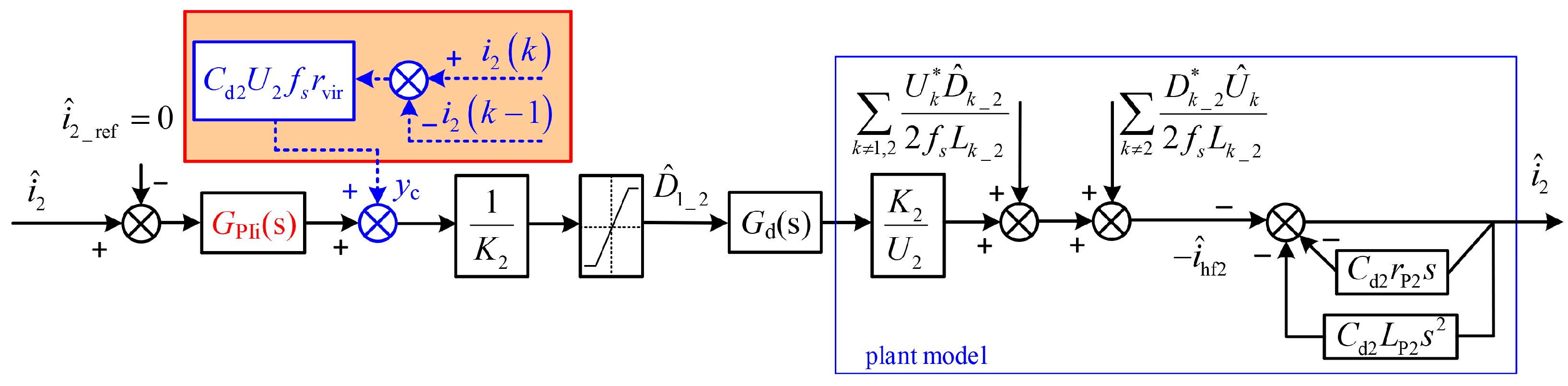
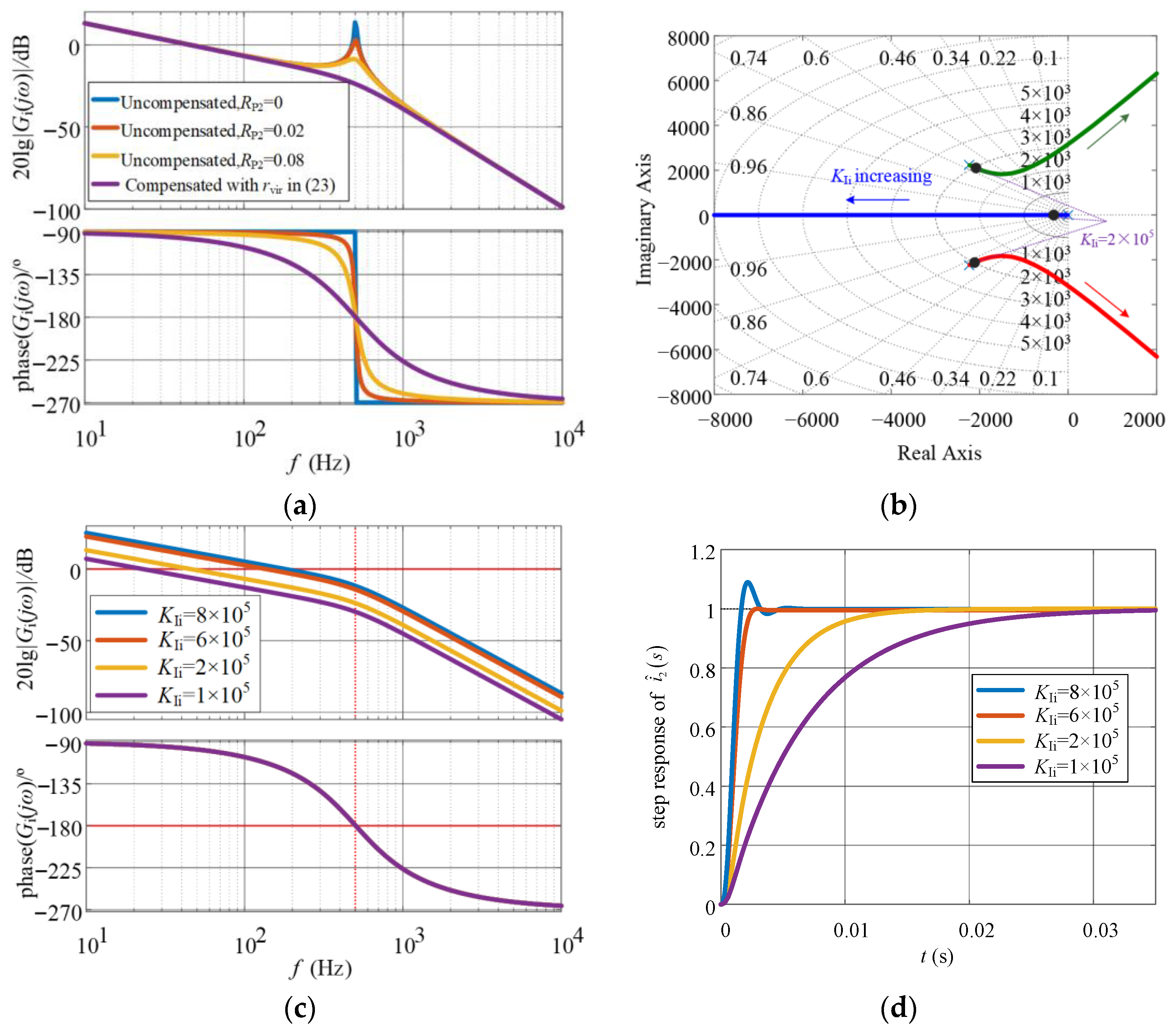
4. Active Damping Control of the MMAB Converter
5. Results
5.1. Simulation Results
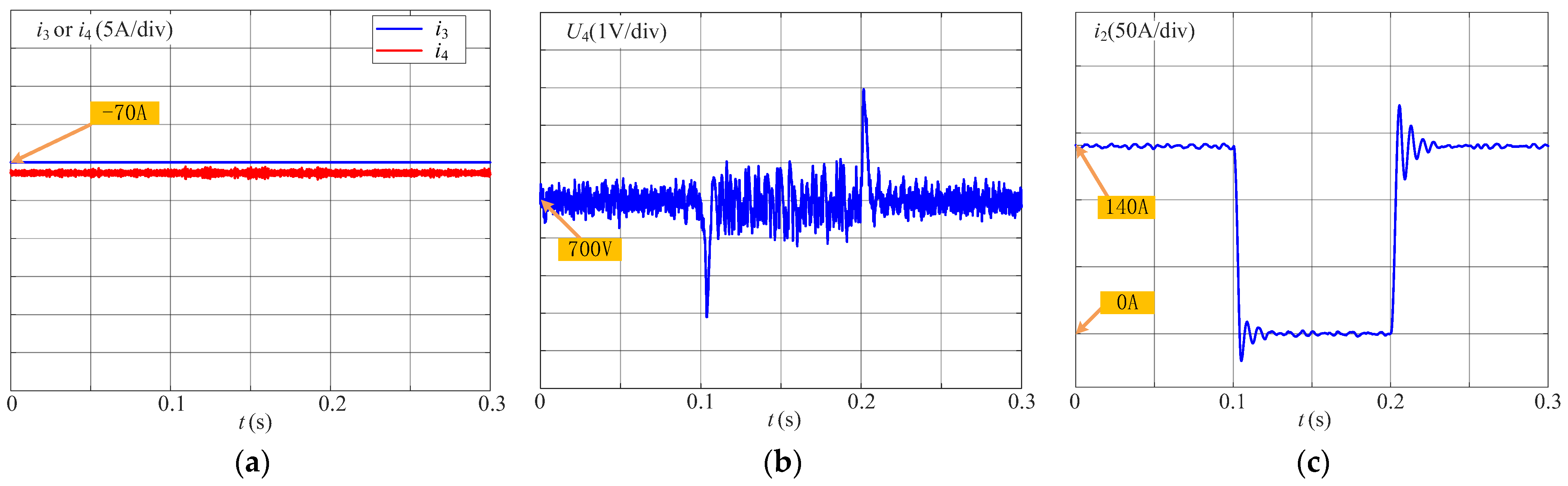
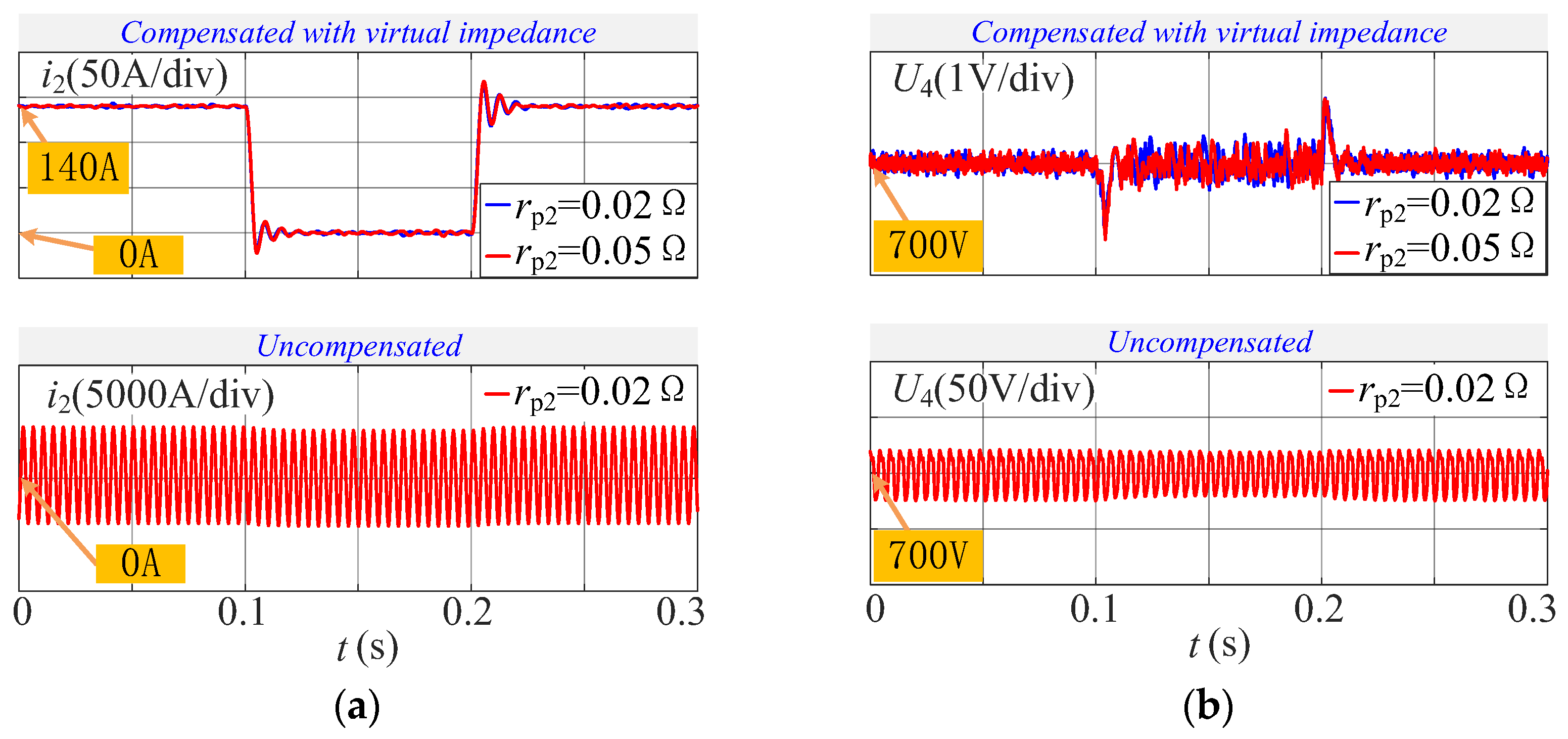
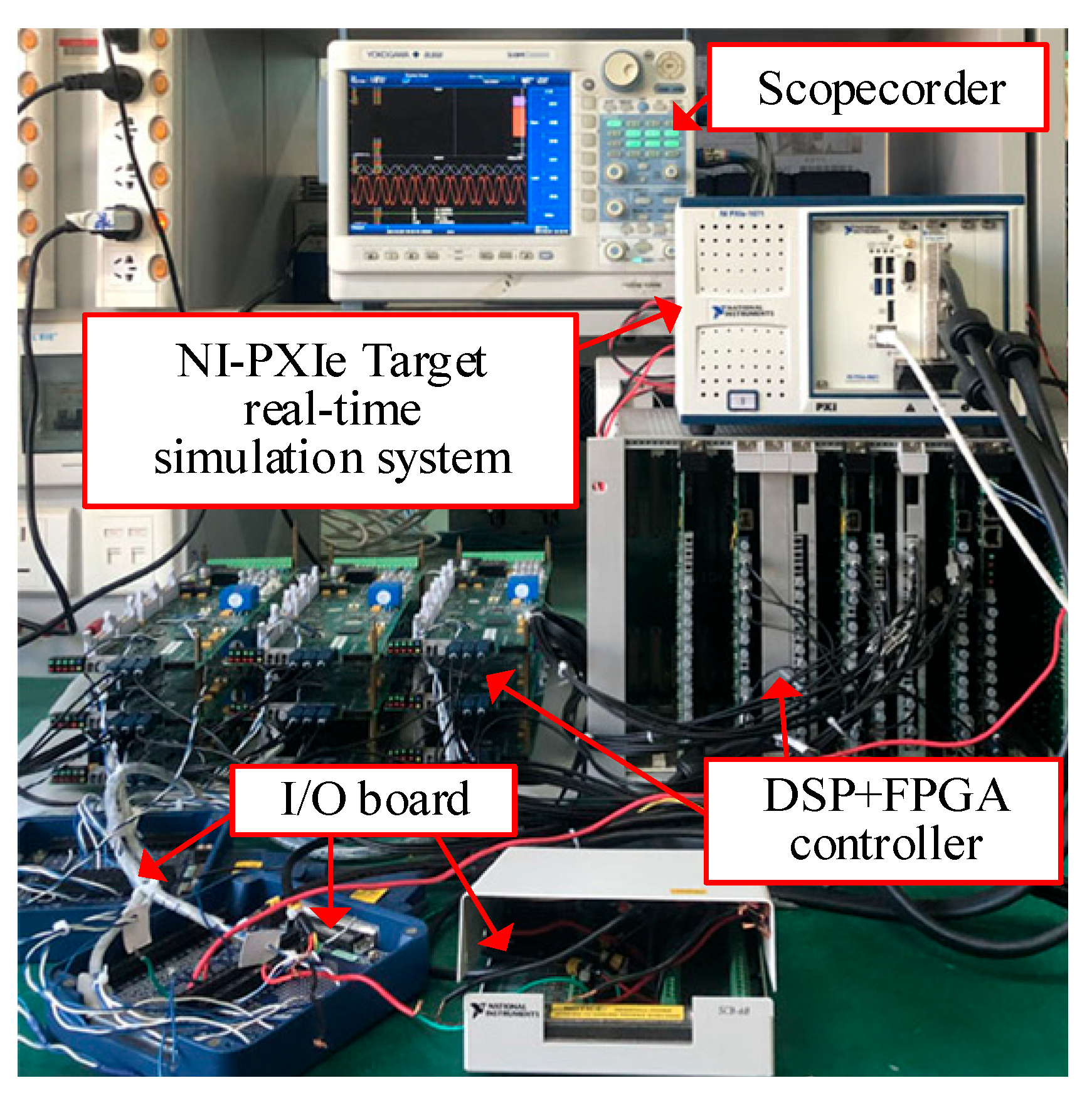
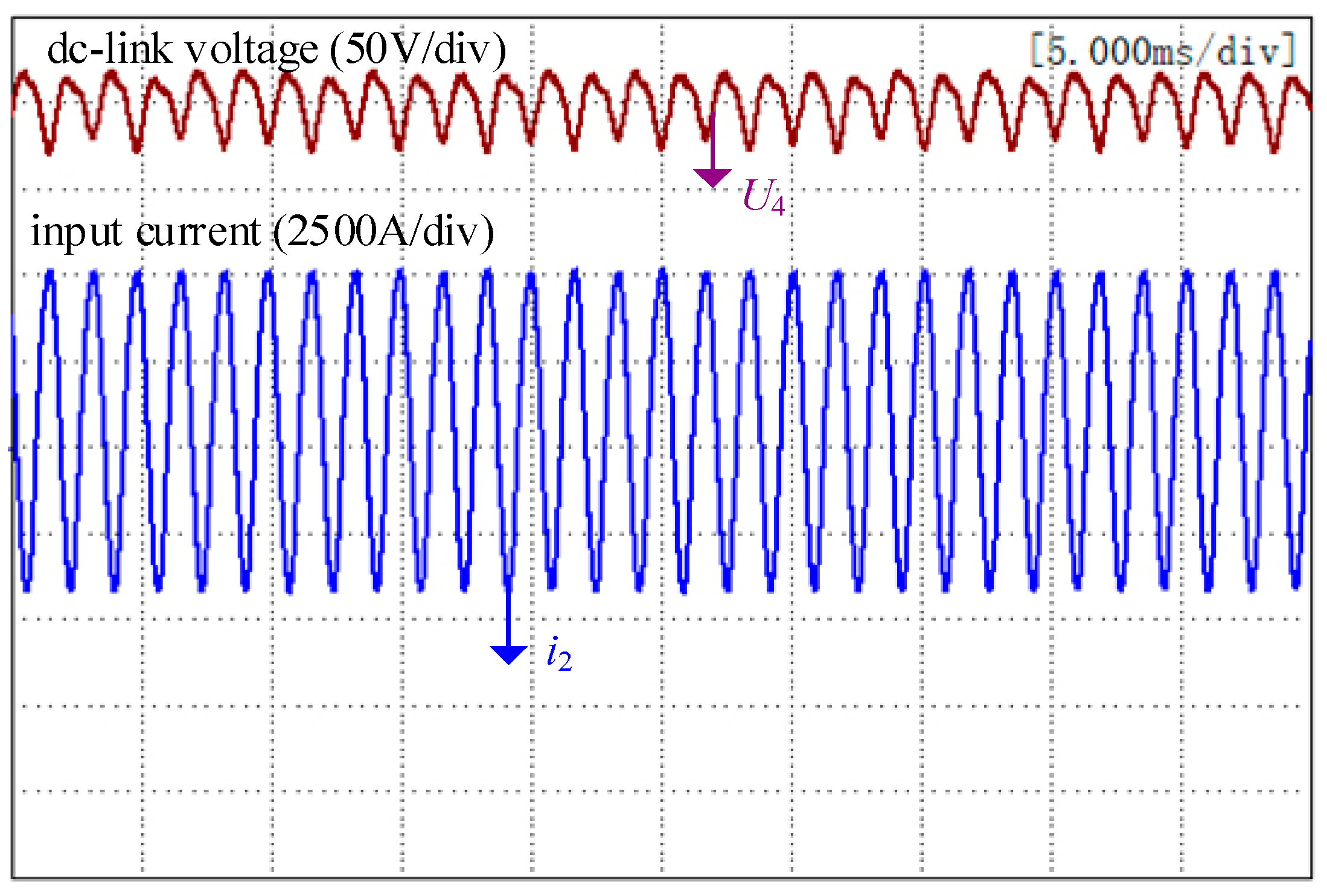
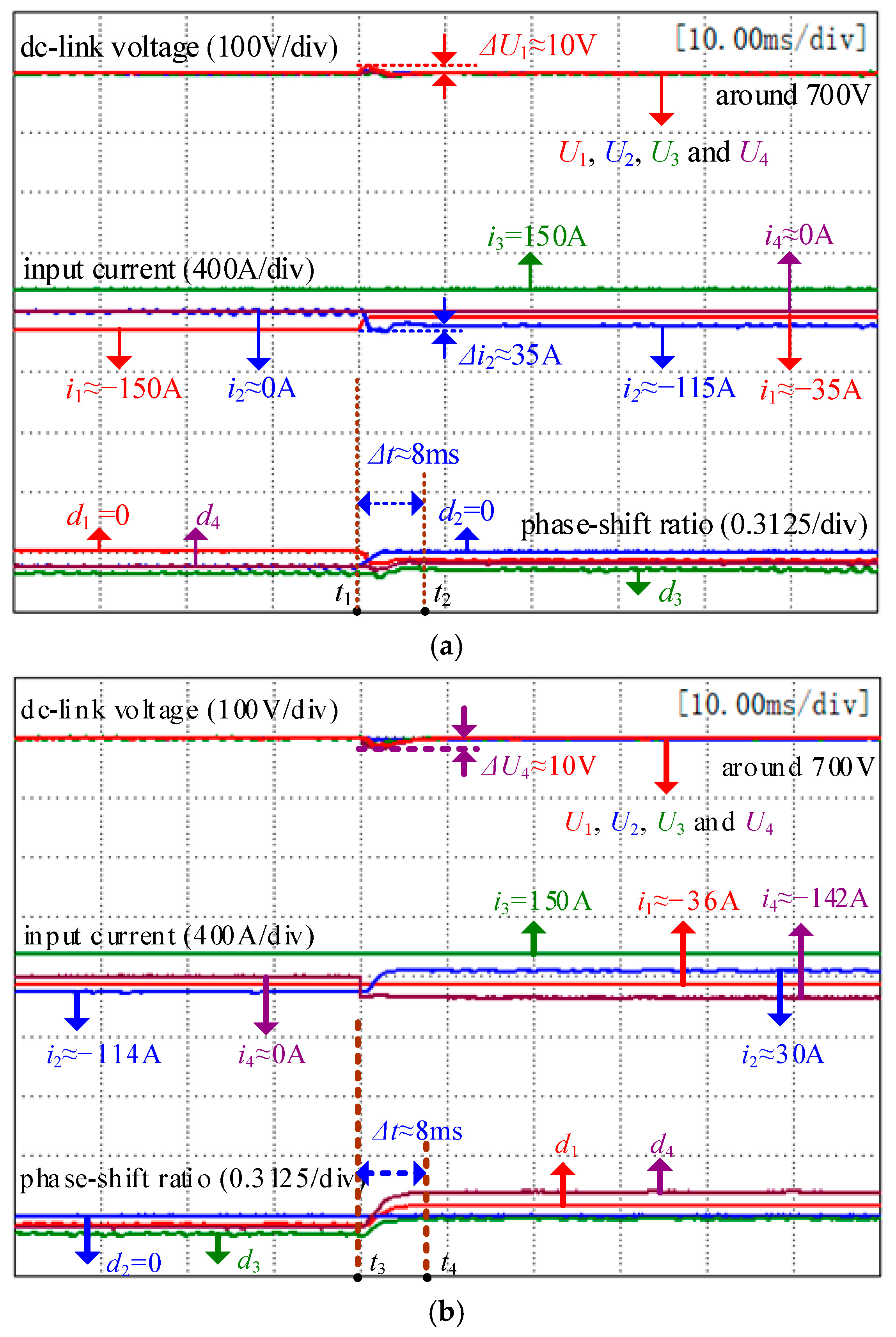
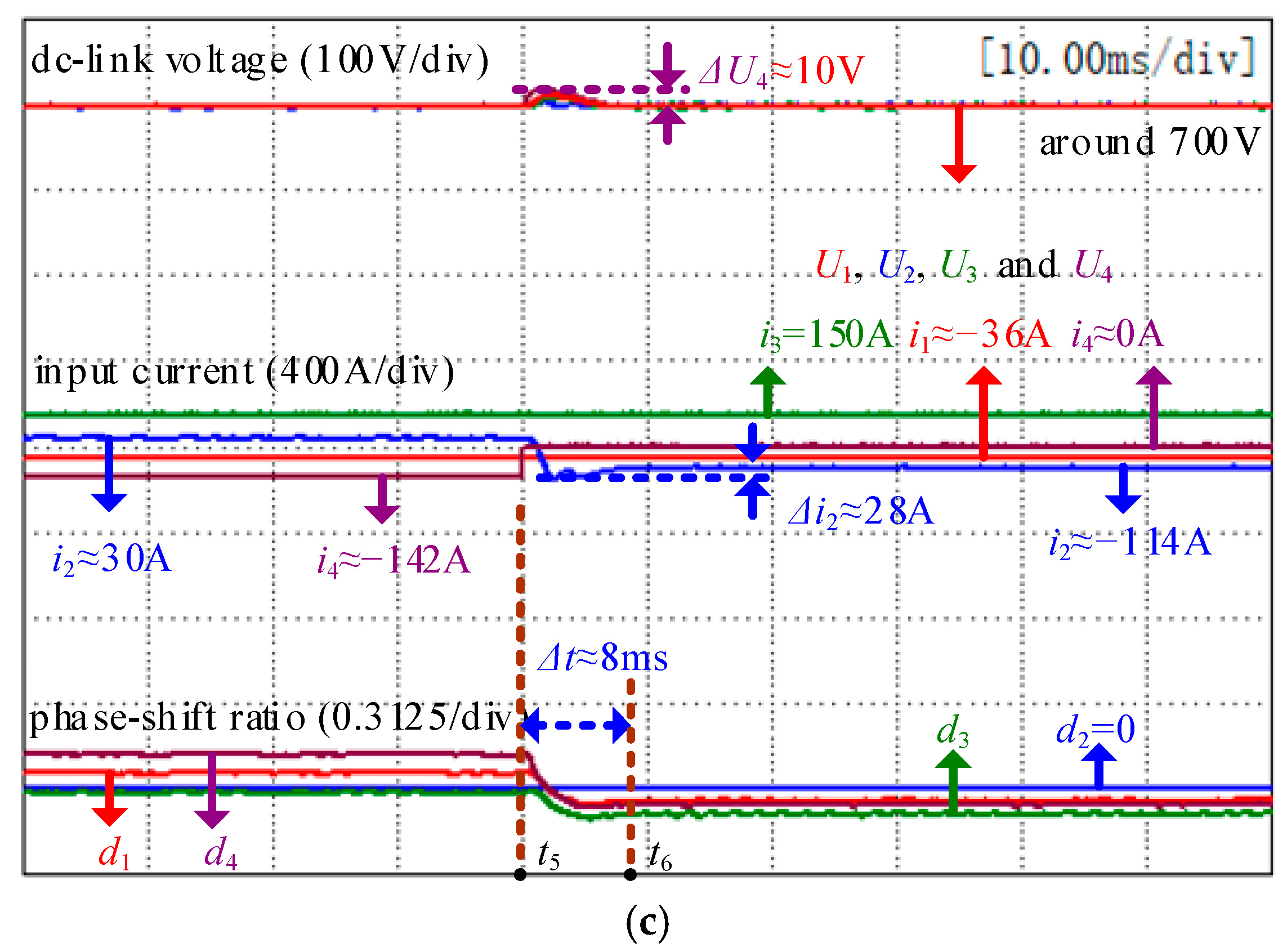
5.2. Experimental Results
6. Conclusions
Author Contributions
Funding
Data Availability Statement
Conflicts of Interest
References
- Zhao, B.; Song, Q.; Liu, W.; Sun, Y. Overview of dual-active-bridge isolated bidirectional dc-dc converter for high-frequency-link power- conversion system. IEEE Trans. Power Electron. 2014, 29, 4091–4106. [Google Scholar] [CrossRef]
- Jafari, M.; Malekjamshidi, Z.; Lei, G.; Wang, T.; Platt, G.; Zhu, J. Design and implementation of an amorphous high-frequency transformer coupling multiple converters in a smart microgrid. IEEE Trans. Ind. Electron. 2017, 64, 1028–1037. [Google Scholar]
- Zumel, P.; Fernandez, C.; Lazaro, A.; Sanz, M.; Barrado, A. Overall analysis of a modular multi active bridge converter. In Proceedings of the 15th Workshop on Control and Modeling for Power Electronics (COMPEL), Santander, Spain, 22–25 June 2014; pp. 1–9. [Google Scholar]
- Rashidi, M.; Altin, N.; Ozdemir, S.; Ahmed, A.; Nasiri, A. Design and development of a high-frequency multiport solid-state transformer with decoupled control scheme. IEEE Trans. Ind. Appl. 2019, 55, 7515–7526. [Google Scholar] [CrossRef]
- Shi, H.; Sun, K. Bridge-to-bidge independent control method for dual-active-bridge interlinking converter. IEEE Trans. Power Electron. 2022, 37, 8757–8761. [Google Scholar] [CrossRef]
- Qi, Y.; Liu, X.; Li, W.; Zhou, Z.; Liu, W.; Rajashekara, K. Decentralized control for a multiactive bridge converter. IEEE Trans. Ind. Electron. 2023, 70, 11412–11421. [Google Scholar] [CrossRef]
- Gao, C.; Li, K.; Zhang, Z.; Yuan, F.; Zhang, S.; You, X. Research on power decoupling and optimal control of modular multiactive bridge converter with relay port. IEEE Trans. Power Electron. 2025, 40, 5292–5308. [Google Scholar] [CrossRef]
- Mou, D.; Dai, Y.; Yuan, L.; Luo, Q.; Wang, H.; Wei, S. Reactive power minimization for modular multi-active-bridge converter with whole operating range. IEEE Trans. Power Electron. 2023, 38, 8011–8015. [Google Scholar] [CrossRef]
- Wang, H.; Zeng, Y.; Ji, S.; Zhao, Z.; Yuan, L.; Mo, X. ZVS soft switching operation region analysis of modular multi active bridge converter under single phase shift control. IEEE Trans. Ind. Electron. 2023, 70, 6865–6875. [Google Scholar] [CrossRef]
- Wang, H.; Ji, S.; Mou, D.; Yuan, L.; Zeng, Y.; Zhao, Z. Switching characterization and power loss optimization for modular multiactive bridge converter under common phase shift control. IEEE J. Emerg. Sel. Top. Power Electron. 2023, 11, 3924–3936. [Google Scholar] [CrossRef]
- Wang, H.; Mou, D.; Ji, S.; Yuan, L.; Zeng, Y.; Zheng, J. Universal Phase-Shift Modulation Scheme and Efficiency Optimization for Modular Multiactive Bridge Converter. IEEE Trans. Ind. Electron. 2024, 71, 7312–7321. [Google Scholar] [CrossRef]
- Wei, S.; Mou, D.; Wen, W.; Zhao, Z.; Li, K. Transient dc bias and universal dynamic modulation of multiactive bridge converters. IEEE Trans. Power Electron. 2022, 37, 11516–11522. [Google Scholar] [CrossRef]
- Gao, C.; Li, K.; Zhang, Z.; Zhang, S.; You, X. Generalized model of n-Port modular multiactive bridge converter with multiple-phase-shift modulation. IEEE Trans. Transp. Electrif. 2025, 11, 286–301. [Google Scholar] [CrossRef]
- Cui, B.; Xue, P.; Jiang, X. Elimination of high frequency oscillation in dual active bridge converters by dv/dt optimization. IEEE Access 2019, 7, 55554–55564. [Google Scholar] [CrossRef]
- Wei, S.; Zhao, Z.; Yuan, L.; Wen, W.; Chen, K. Voltage oscillation suppression for the high-frequency bus in modular-multiactive-bridge converter. IEEE Trans. Power Electron. 2021, 36, 9737–9742. [Google Scholar] [CrossRef]
- Wang, W.; Wei, Z.; Li, M.; Xiao, H. Research on active damping of grid-side inductor voltage feedback with bandpass filter and lead correction. In Proceedings of the 2022 IEEE 5th International Electrical and Energy Conference (CIEEC), Nanjing, China, 27–29 May 2022; pp. 1994–1999. [Google Scholar]
- Cecati, F.; Zhu, R.; Liserre, M.; Wang, X. State-feedback-based Low-Frequency Active Damping for VSC Operating in Weak-Grid Conditions. In Proceedings of the 2020 IEEE Energy Conversion Congress and Exposition (ECCE), Detroit, MI, USA, 11–15 October 2020; pp. 4762–4767. [Google Scholar]
- Guan, Y.; Xie, Y.; Wang, Y.; Liang, Y.; Wang, X. An active damping strategy for input impedance of bidirectional dual active bridge dc–dc converter: Modeling, shaping, design, and experiment. IEEE Trans. Power Electron. 2021, 68, 1263–1274. [Google Scholar] [CrossRef]
- Chen, Y.; Zhang, Y.; Qu, E.; He, M. Active damping method for LC-DAB system based on a power-based impedance model. IEEE Trans. Power Electron. 2023, 38, 4405–4418. [Google Scholar] [CrossRef]
- Wen, W.; Li, K.; Zhao, Z.; Yuan, L.; Mo, X.; Cai, W. Analysis and control of a four-port megawatt-level high-frequency-bus-based power electronic transformer. IEEE Trans. Power Electron. 2021, 36, 13080–13095. [Google Scholar] [CrossRef]
- Sun, J.; Yuan, L.; Li, K.; Gu, Q.; Zhao, Z. Analysis and suppressing method of magnetizing bias on high frequency transformer in electric energy router. In Proceedings of the IEEE Energy Conversion Congress and Exposition (ECCE), Portland, OR, USA, 23–27 September 2018; pp. 2612–2618. [Google Scholar]
- Bandyopadhyay, S.; Purgat, P.; Qin, Z.; Bauer, P. A multiactive bridge converter with inherently decoupled power flows. IEEE Trans. Power Electron. 2021, 36, 2231–2245. [Google Scholar] [CrossRef]
- Falcones, S.; Ayyanar, R.; Mao, X. A dc-dc multiport-converter-based solid-state transformer integrating distributed generation and storage. IEEE Trans. Power Electron. 2013, 28, 2192–2203. [Google Scholar] [CrossRef]



| Parameter | Value |
|---|---|
| DC side voltage reference Uh_ref | 700 V |
| DC support capacitor Cd1/Cd2/Cd3/Cd4 | 2 mF |
| DC-blocking capacitor Cr | 100 uF |
| Turn ratio of high-frequency transformer | 1:1 |
| Power transmission inductance Lr1/Lr2/Lr3/Lr4 | 3.2 μH |
| Port-2 DC side inductance LP2, rP2 | 100 μH, 50 mΩ |
| Port-1 DC side inductance LP1, rP1 | 300 μH, 3 mΩ |
| Switching frequency fs | 20 kHz |
| Control frequency fMMAB | 20 kHz |
Disclaimer/Publisher’s Note: The statements, opinions and data contained in all publications are solely those of the individual author(s) and contributor(s) and not of MDPI and/or the editor(s). MDPI and/or the editor(s) disclaim responsibility for any injury to people or property resulting from any ideas, methods, instructions or products referred to in the content. |
© 2026 by the authors. Licensee MDPI, Basel, Switzerland. This article is an open access article distributed under the terms and conditions of the Creative Commons Attribution (CC BY) license.
Share and Cite
Wen, W.; Zhang, Y.; Zhan, T.; Long, S.; Deng, H. Active Damping Control for the Modular Multi-Active-Bridge Converter. Energies 2026, 19, 369. https://doi.org/10.3390/en19020369
Wen W, Zhang Y, Zhan T, Long S, Deng H. Active Damping Control for the Modular Multi-Active-Bridge Converter. Energies. 2026; 19(2):369. https://doi.org/10.3390/en19020369
Chicago/Turabian StyleWen, Wusong, Yingchao Zhang, Tianwen Zhan, Sheng Long, and Hao Deng. 2026. "Active Damping Control for the Modular Multi-Active-Bridge Converter" Energies 19, no. 2: 369. https://doi.org/10.3390/en19020369
APA StyleWen, W., Zhang, Y., Zhan, T., Long, S., & Deng, H. (2026). Active Damping Control for the Modular Multi-Active-Bridge Converter. Energies, 19(2), 369. https://doi.org/10.3390/en19020369