Numerical Modelling of Loads Induced by Wind Power-Enhancing Parakites on Offshore Wind Turbines


Abstract
1. Introduction
2. Theory
2.1. Conditions of No Wind
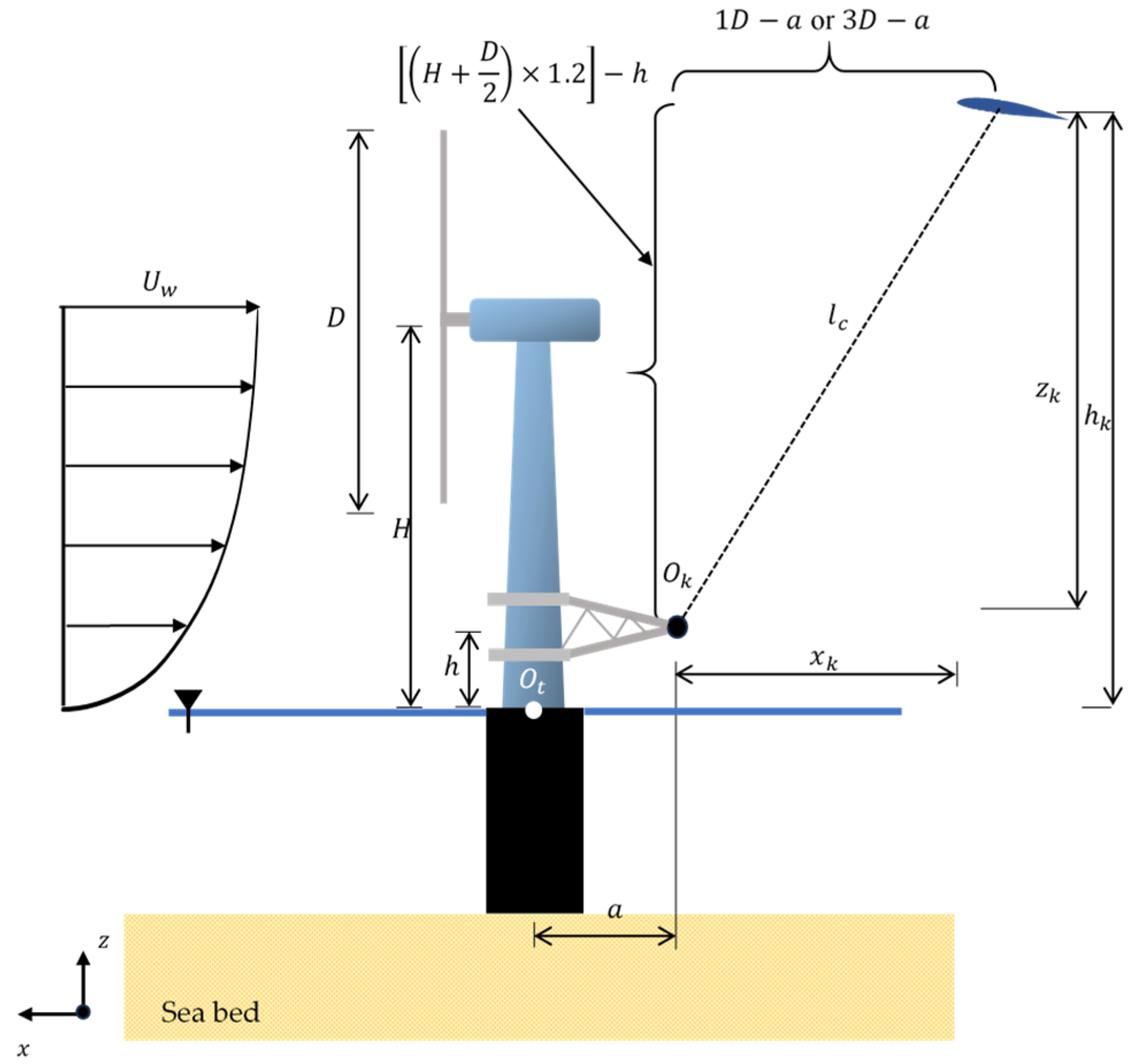
2.2. Subjected to a Wind Force
2.3. Moments at the Base of the Wind Turbine
3. Numerical Model
4. Methodology
4.1. Numerical Discretisation Error
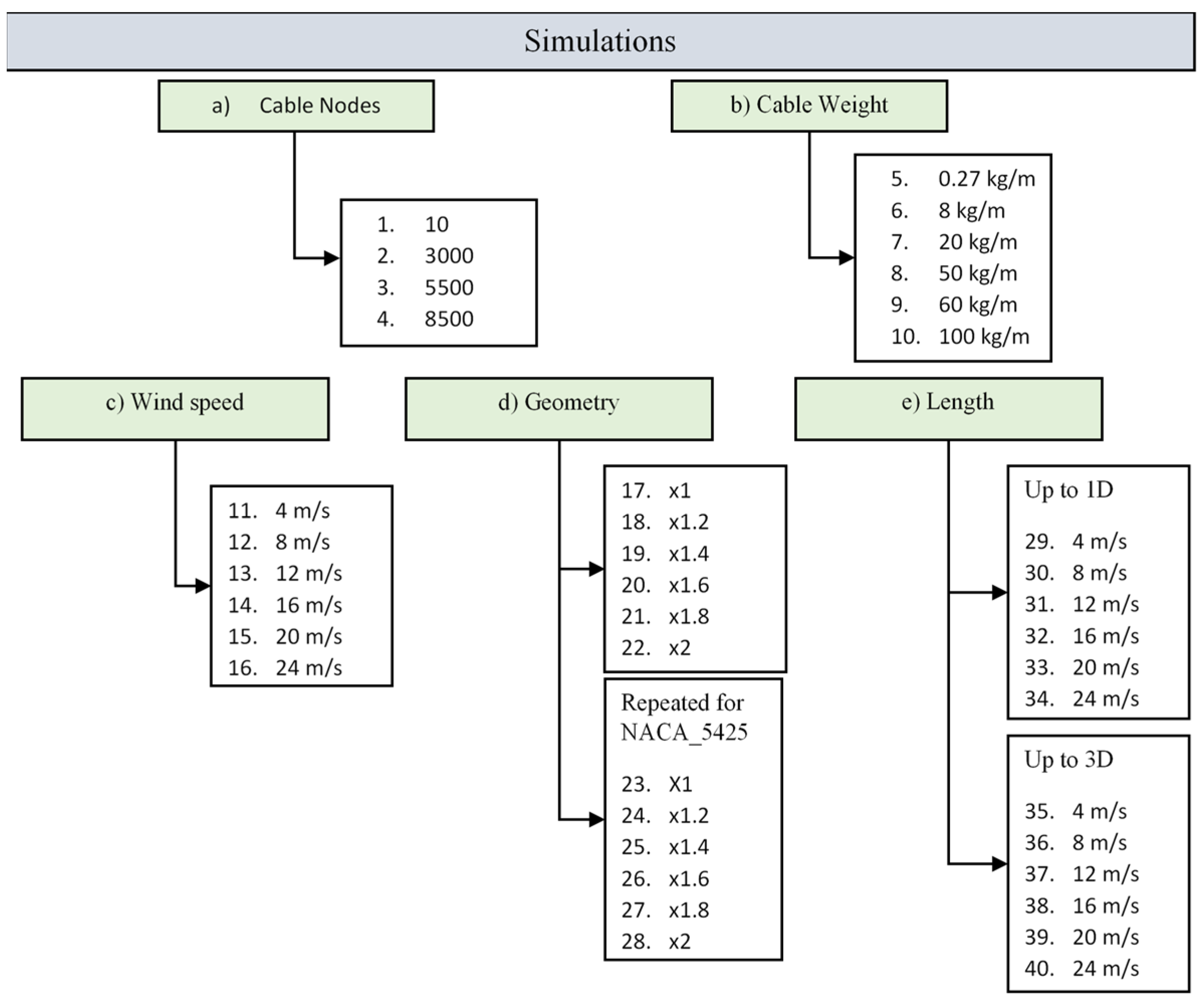
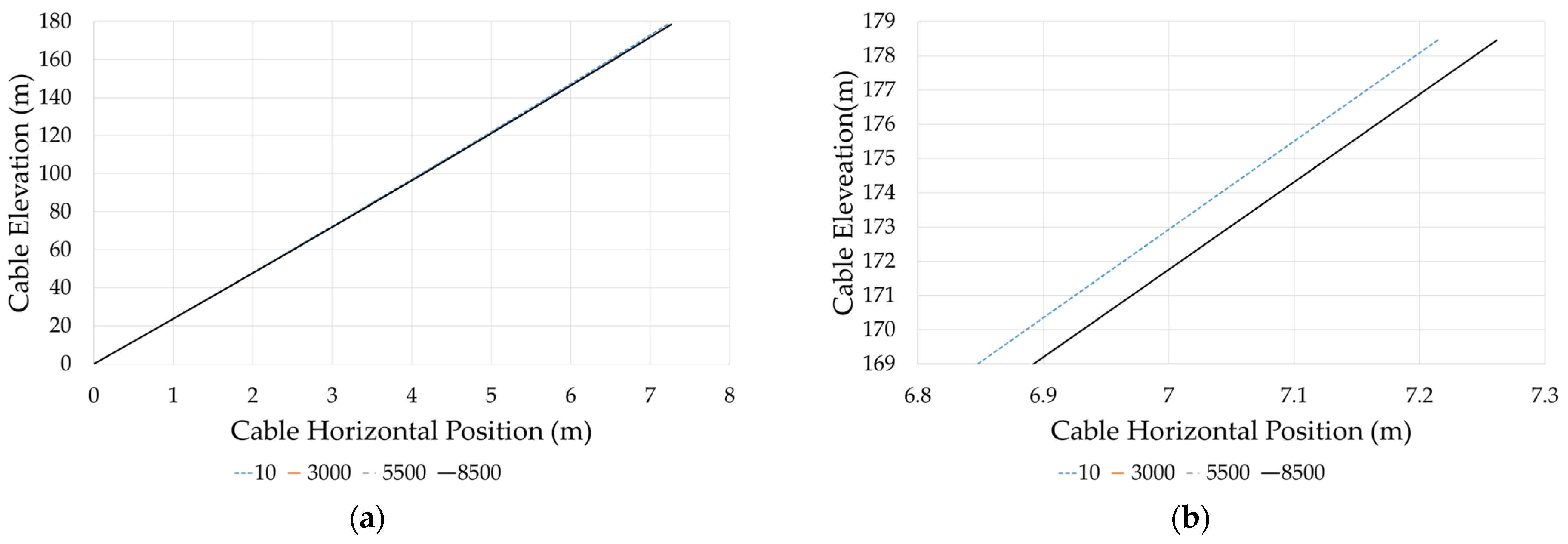
4.1.1. Cable Nodes
4.1.2. Cable Weight
5. Results and Discussion
5.1. Wind Speed Variation
5.2. Geometry Variation
5.3. Cable Length Variation
6. Conclusions
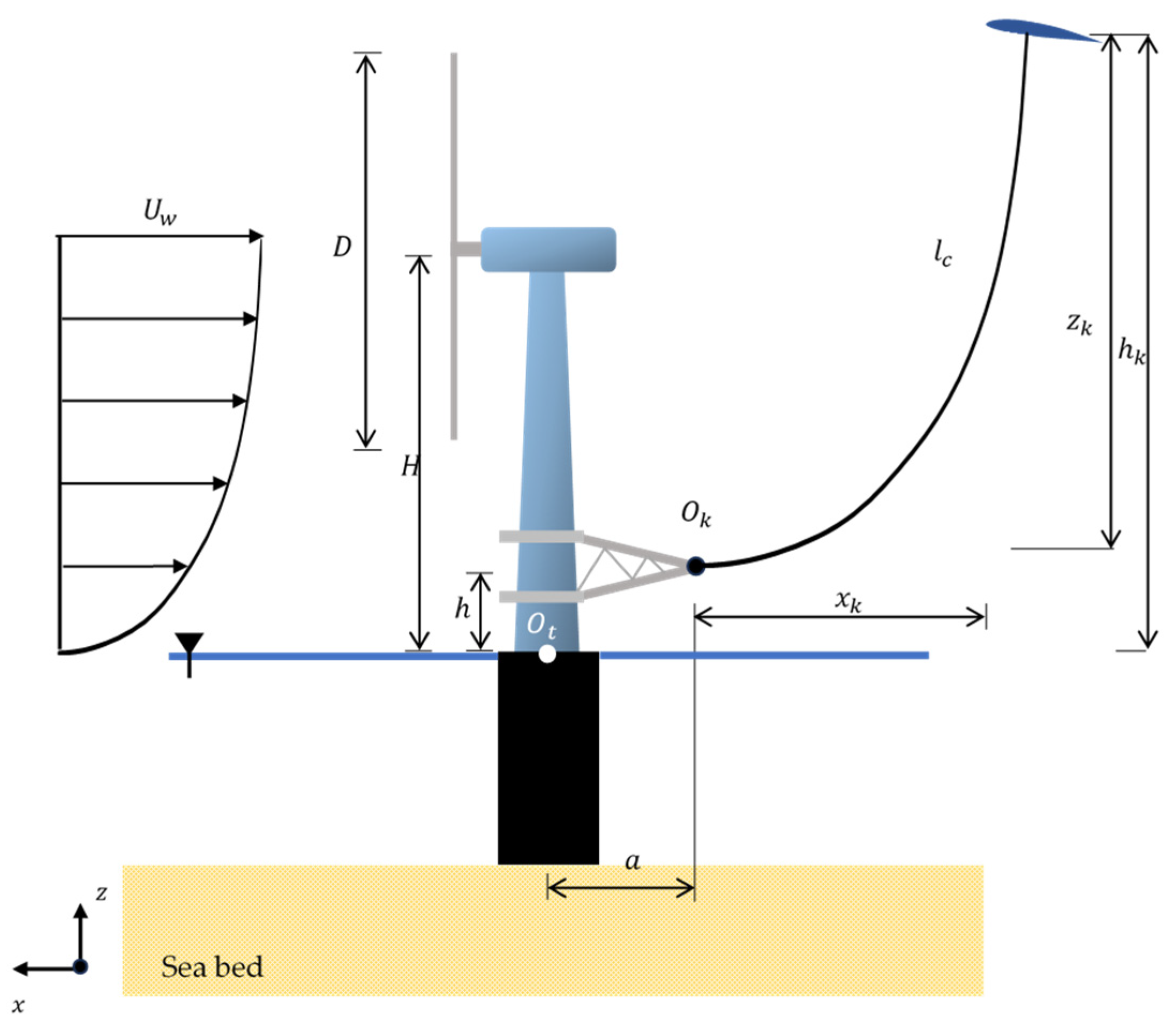
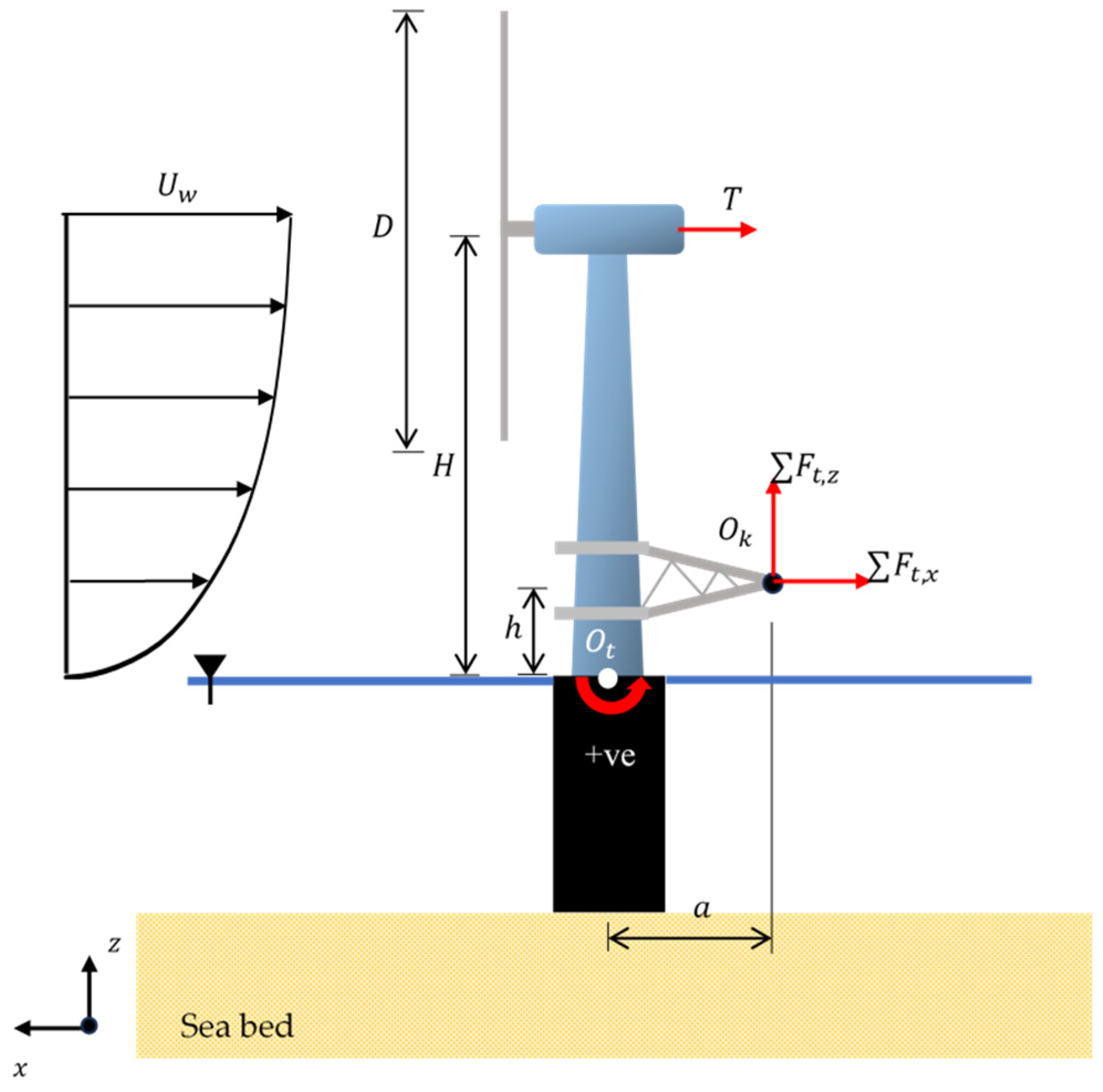
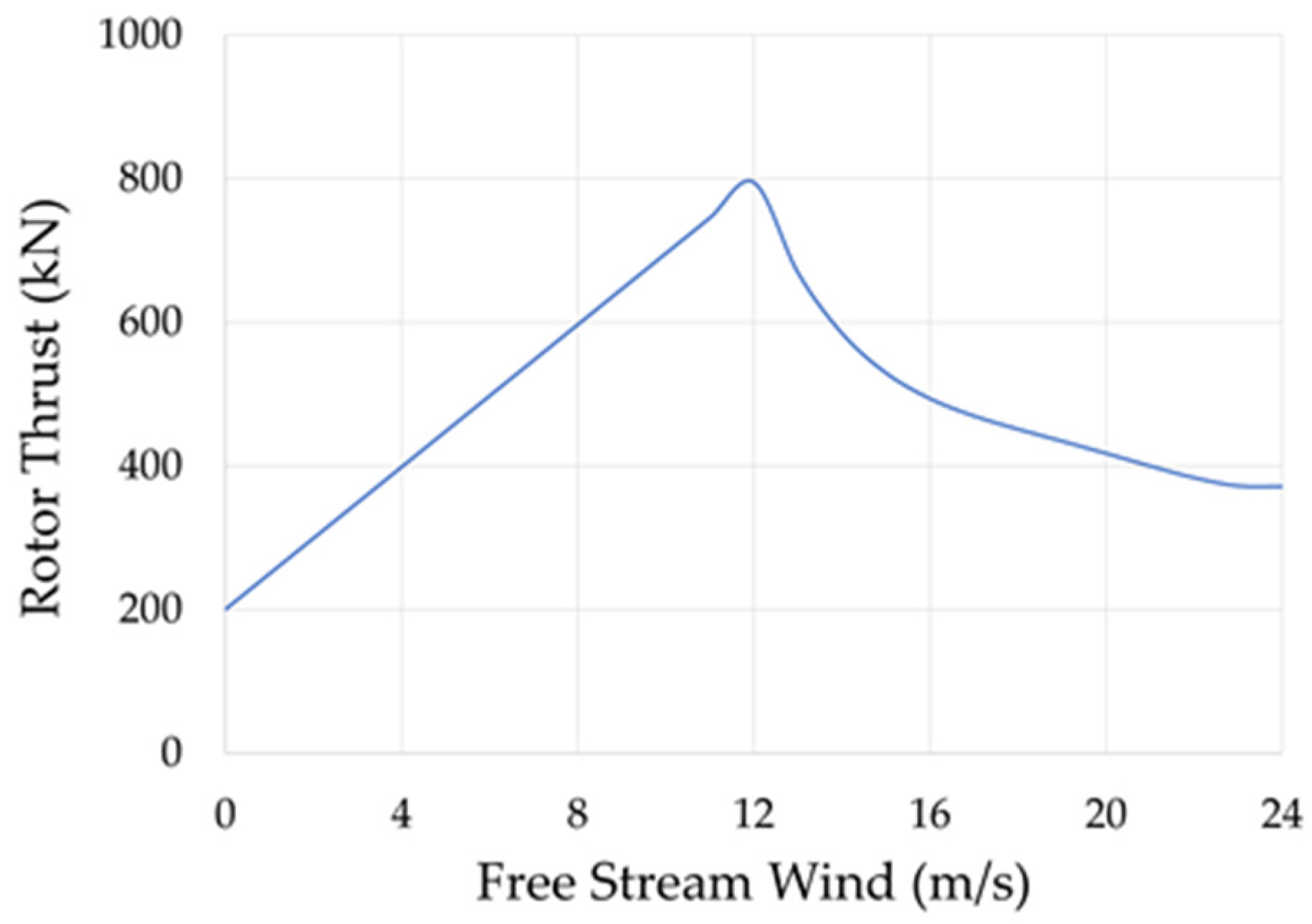
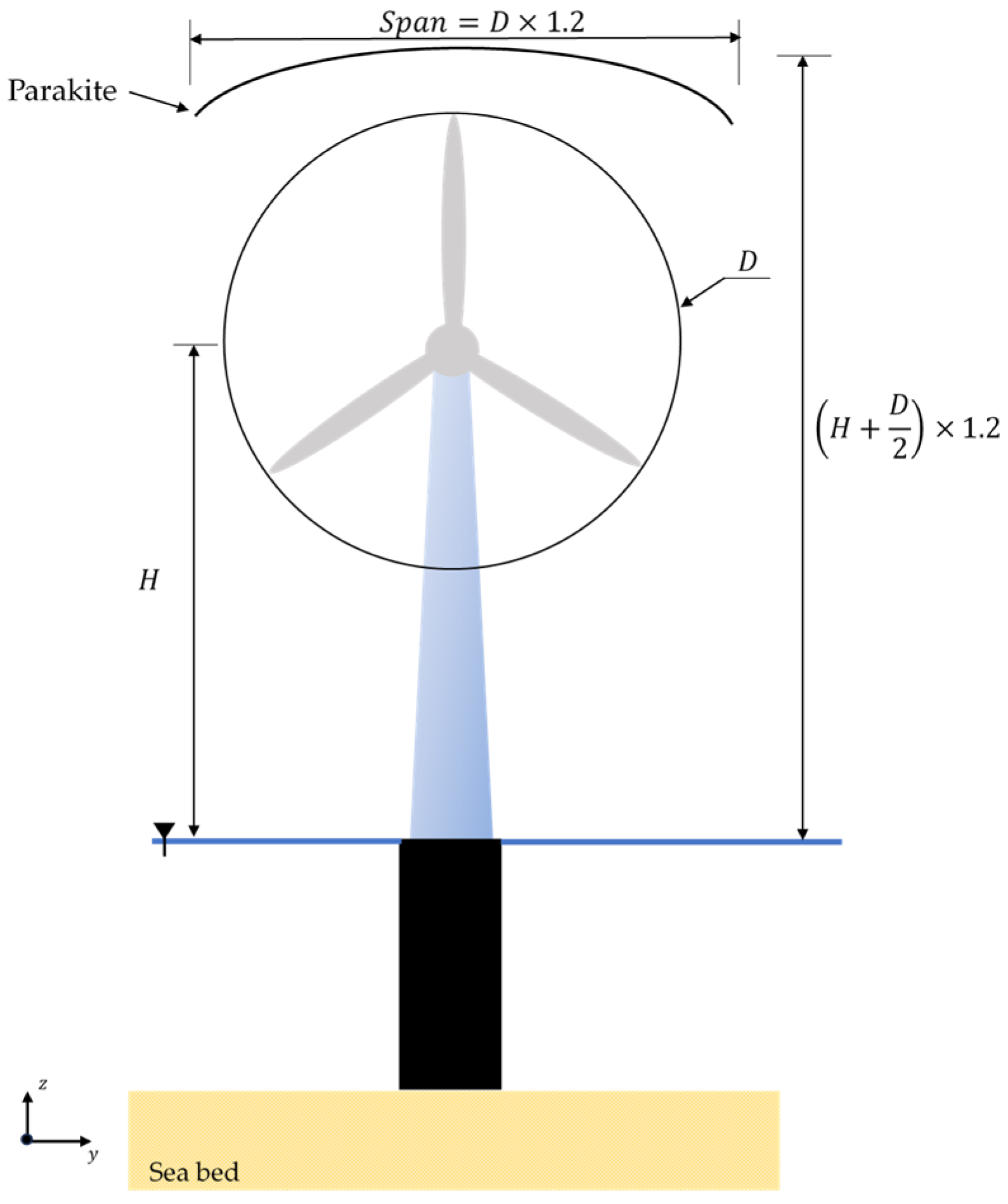
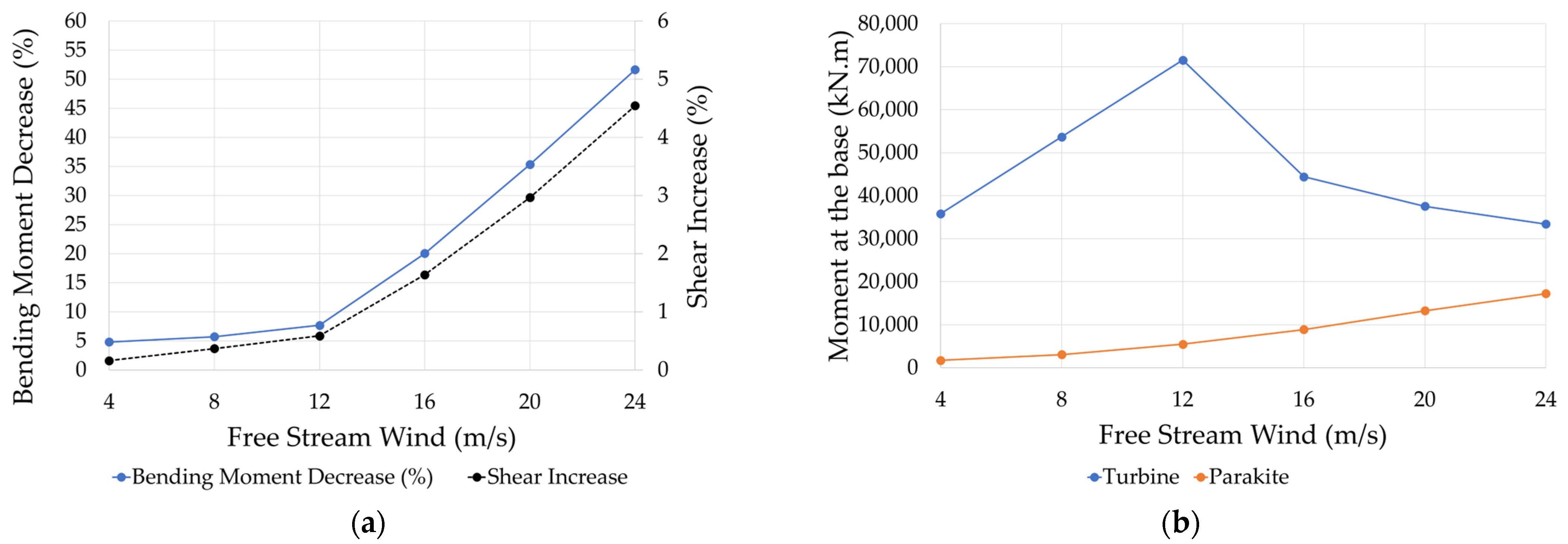
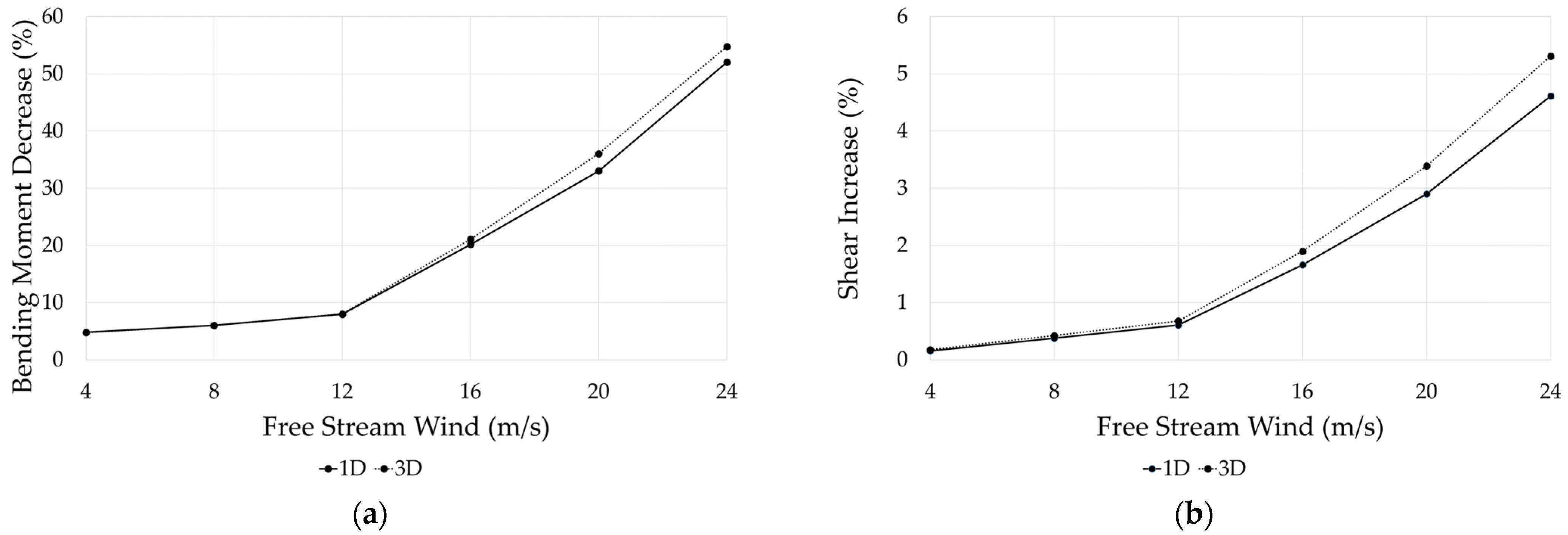
- The proposed concept (Figure 1) demonstrates a significant reduction in the bending moments acting at the base of the OWT tower. The lift generated by the parakite produces a counteracting moment opposing that induced by the rotor thrust, thereby reducing compressive and tensile stresses at the tower base. The overall structural impact is positive, as the moment reduction is achieved with only a marginal increase in shear force. It was estimated that the tower bending moment decreased by 7.7% at the rated wind speed, where the rotor thrust is at its maximum, while the corresponding shear force increased by 0.6%. At higher wind speeds, where the magnitude of the rotor thrust decreases, the percentage reduction in bending moment gradually increases to 51.7% at a wind speed of 24 m/s, with the corresponding shear force increasing by only around 4.6%. These finding provide a strong motivation for further exploration of the concept.
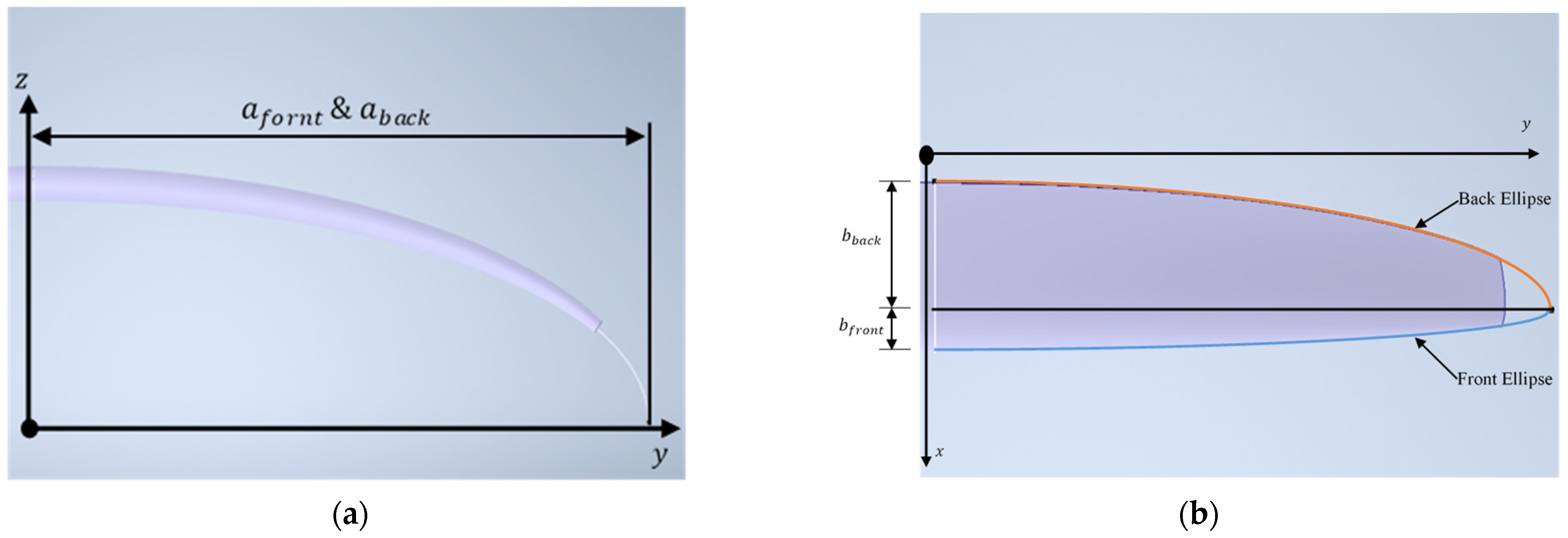
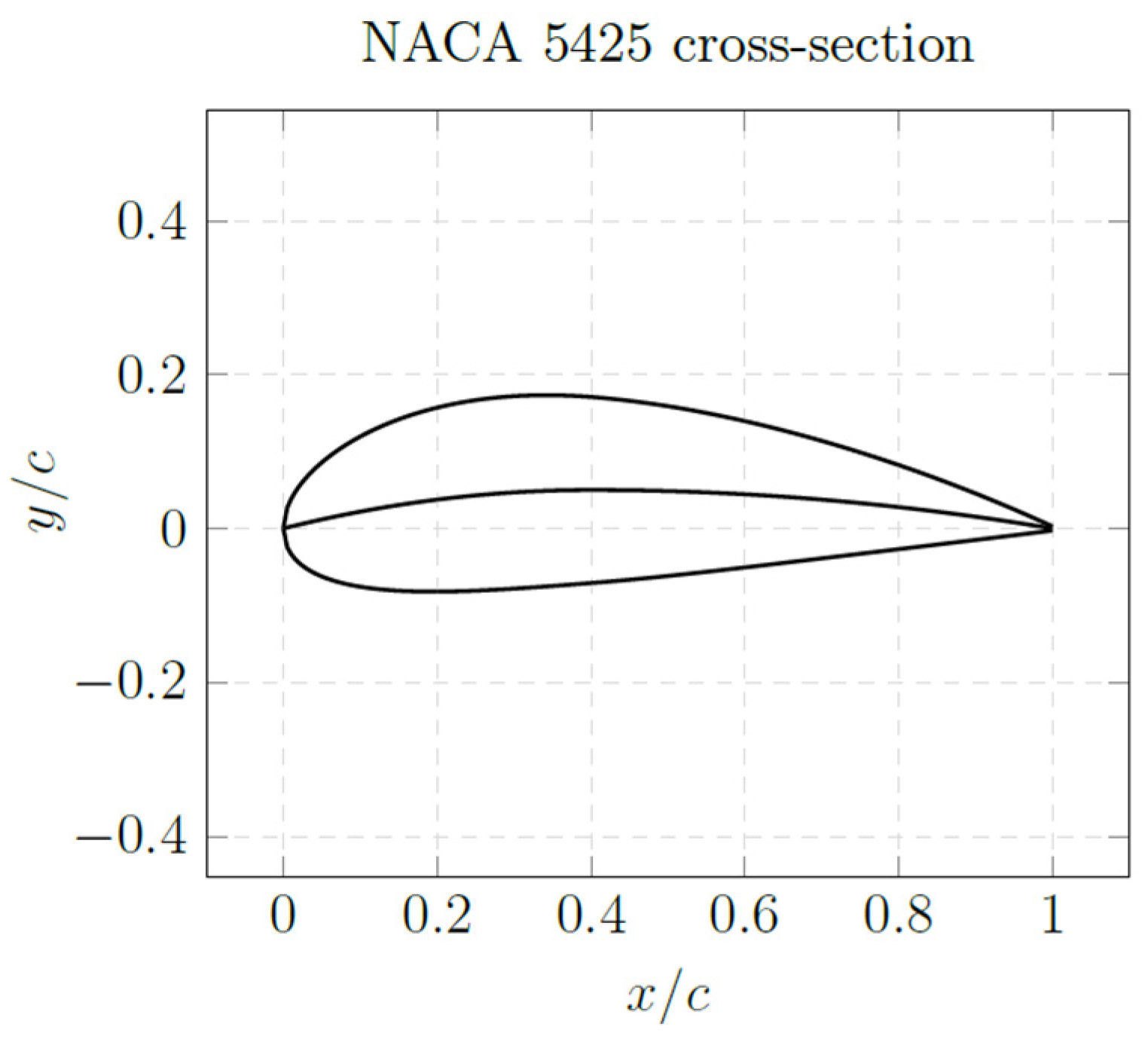
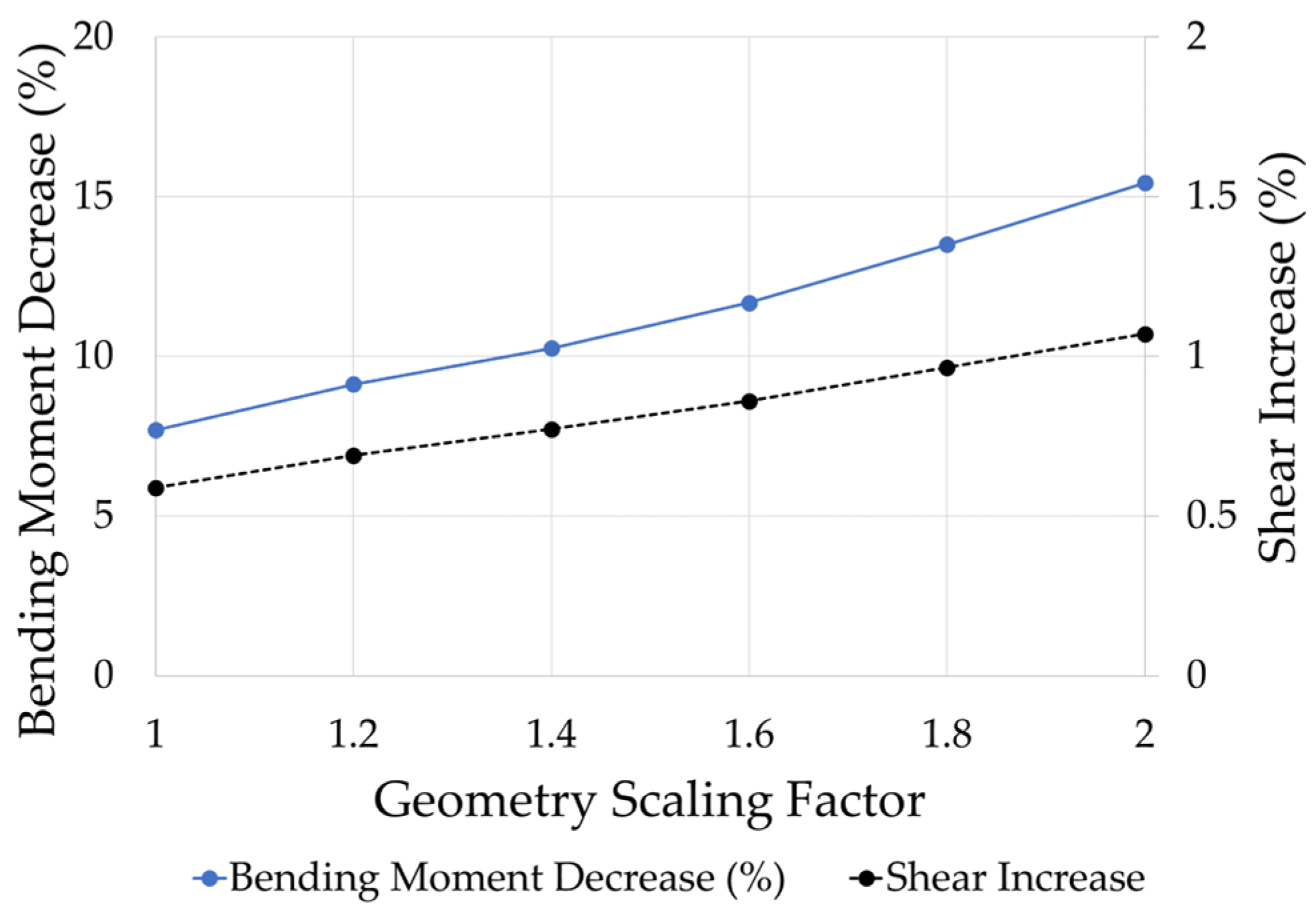
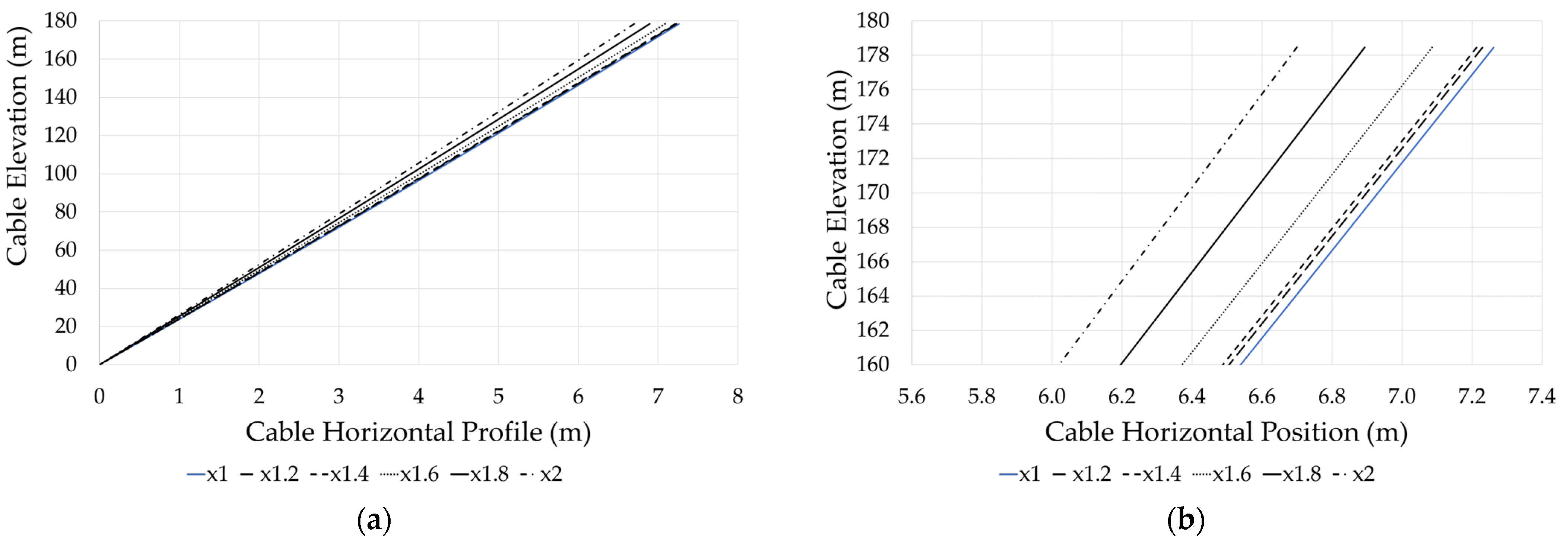
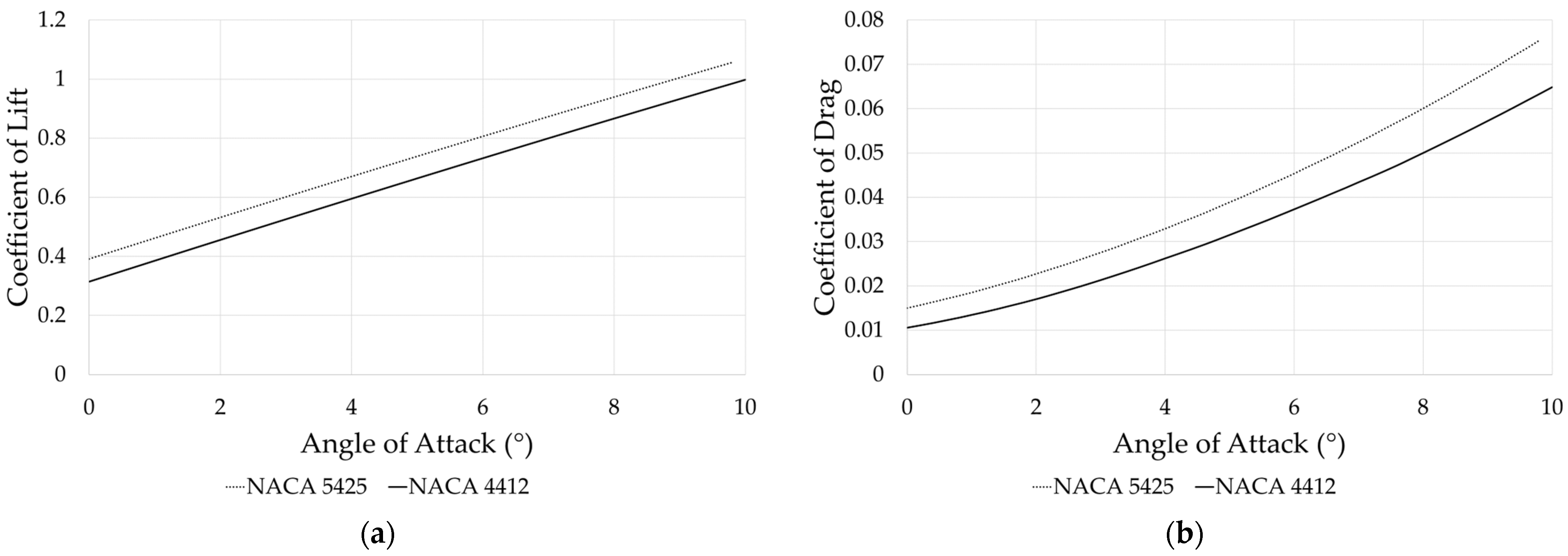
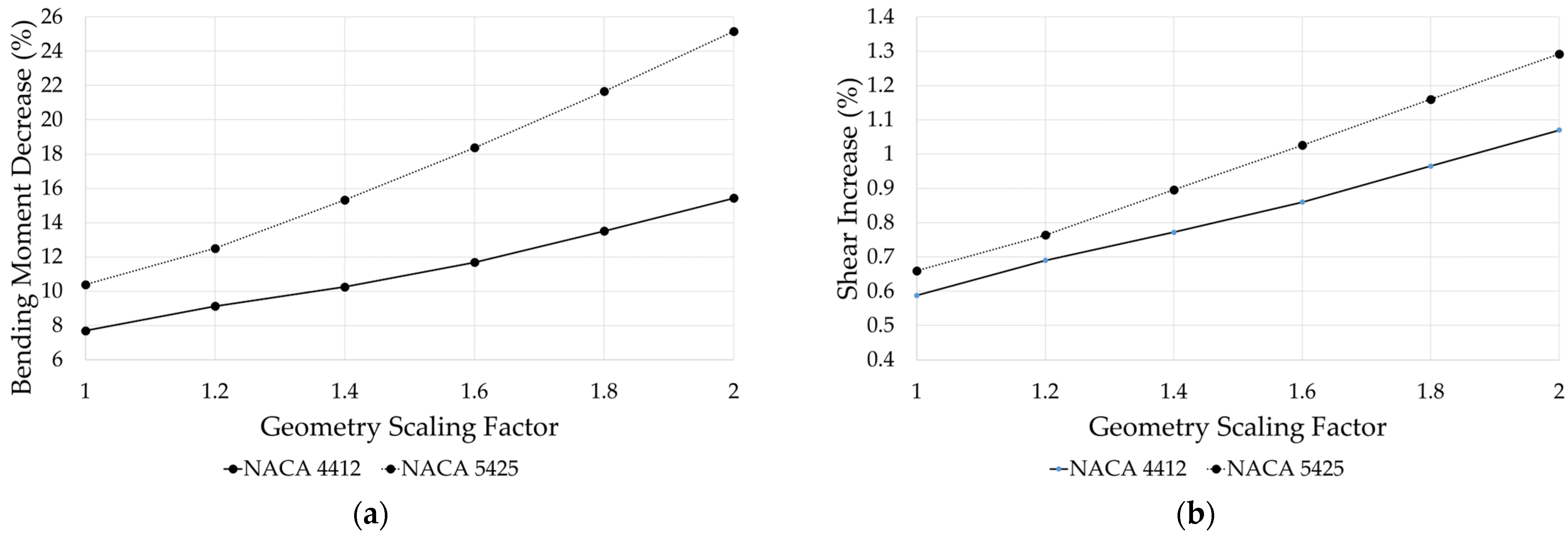
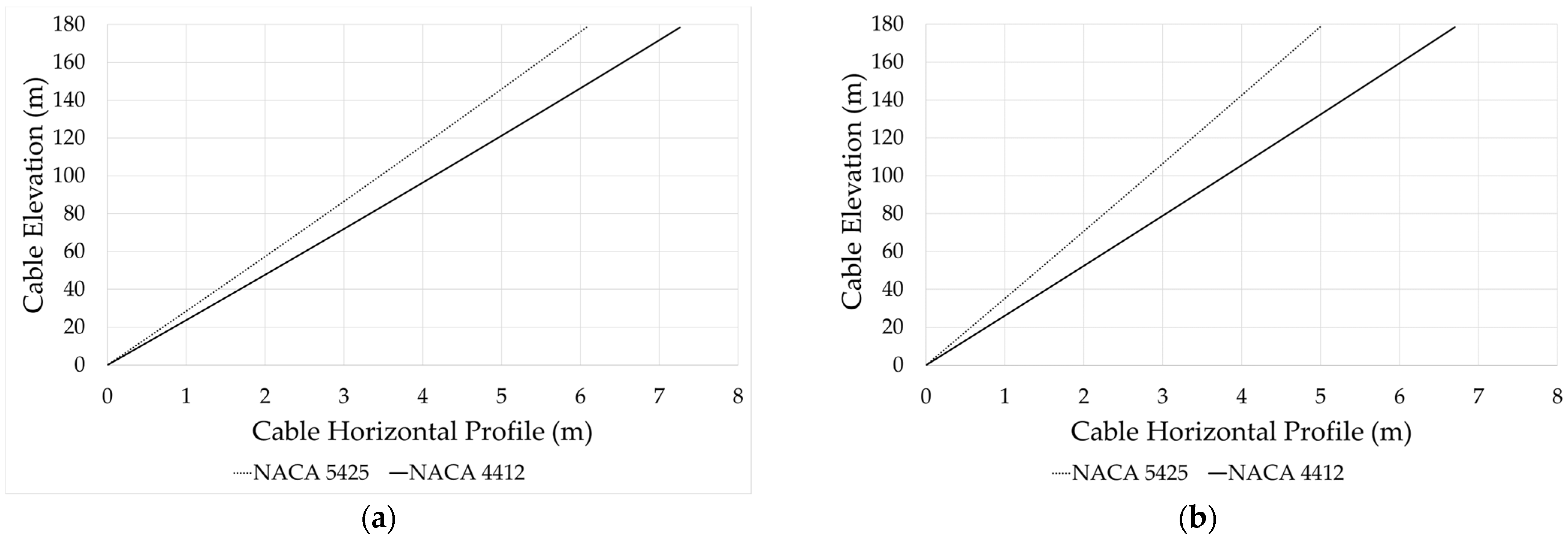
- For both NACA 4412 and NACA 5425 profiles, larger geometric scaling factors yielded higher lift and drag forces and thus greater tower bending moment reduction. The NACA 5425 parakite consistently produced higher lift coefficients (≈10–15% greater), leading to improved parakite performance compared with NACA 4412
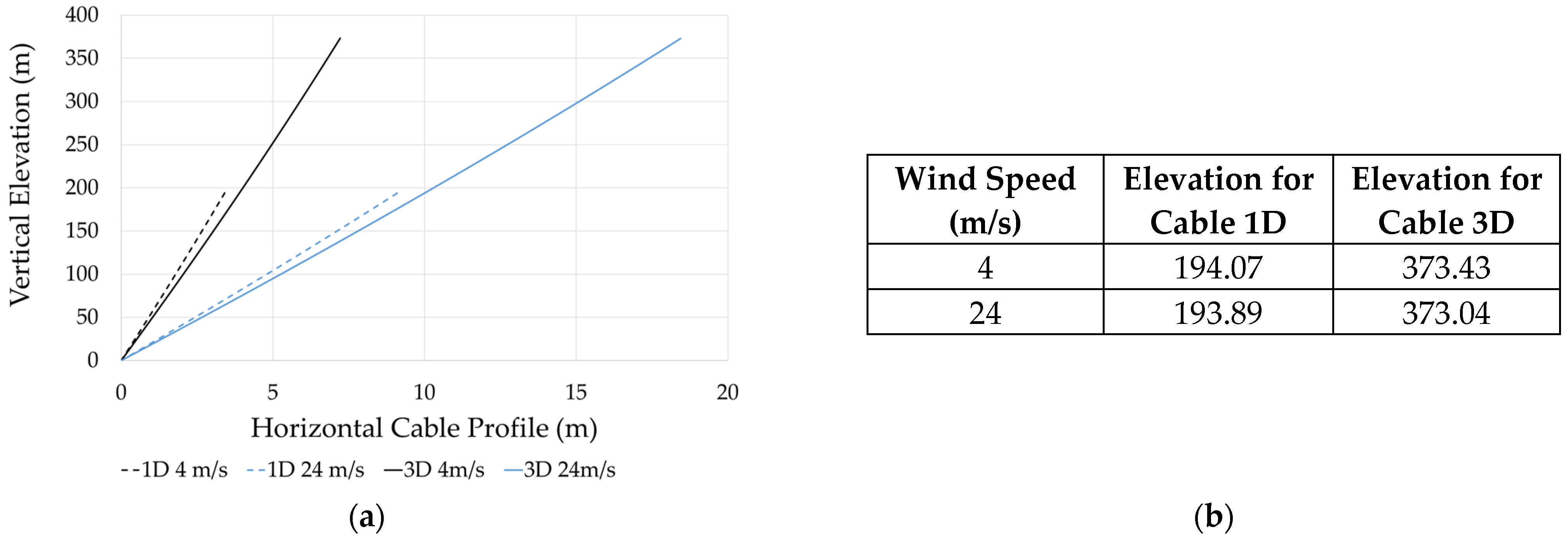
- Varying the cable length between 194.1 m and 373.5 m had minimal impact on the reduction in bending moment and the increase in shear force
Author Contributions
Funding
Data Availability Statement
Conflicts of Interest
Abbreviations
| AOA | Angle of Attack |
| AVL | Athena Vortex Lattice |
| MIT | Massachusetts Institute of Technology |
| NREL | National Renewable Energy Laboratory |
| OWT | Offshore Wind Turbine |
| RES | Renewable Energy Sources |
| VLM | Vortex Lattice Method |
References
- Castelino, R.V.; Kumar, P.; Kashyap, Y.; Karthikeyan, A.; Sharma, K.M.; Karmakar, D.; Kosmopoulos, P. Exploring the Potential of Kite-Based Wind Power Generation: An Emulation-Based Approach. Energies 2023, 16, 5213. [Google Scholar] [CrossRef]
- Olabi, G.; Wilberforce, T.; Elsaid, K.; Sayed, E.T.; Salmeh, T.; Abdelkarem, M.A.; Baroutaji, A. A Review on Failure Modes of Wind Turbine Components. Energies 2021, 14, 5241. [Google Scholar] [CrossRef]
- Liu, X.; Lu, C.; Li, G.; Godbole, A.; Chen, Y. Effects of aerodynamic damping on the tower load of offshore horizontal axis wind turbines. Appl. Energy 2017, 204, 1101–1114. [Google Scholar] [CrossRef]
- Bonou, A.; Laurent, A.; Olsen, S.I. Life cycle assessment of onshore and offshore wind energy-from theory to application. Appl. Energy 2016, 180, 327–337. [Google Scholar] [CrossRef]
- Carswel, W.; Johansson, J.; Lovhalt, F.; Madshus, C.; DeGroot, D.; Myers, A. Foundation damping and the dynamics of offshore wind turbine monopiles. Renew. Energy 2015, 80, 724–736. [Google Scholar] [CrossRef]
- Seidel, M. Substructures for offshore wind turbines-Current trends and developments. In Festschrift Peter Schaumann; Leibniz Universität Hannover: Hannover, Germany, 2014; pp. 363–368. [Google Scholar] [CrossRef]
- Rezaei, F.; Contestabile, P.; Vicinanza, D.; Azzellino, A. Towards understanding environmental and cumulative impacts of floating wind farms: Lessons learned from the fixed-bottom offshore wind farms. Ocean Coast. Manag. 2023, 243, 106772. [Google Scholar] [CrossRef]
- IRENA; CPI. Global Landscape of Renewable Energy Finance; International Renewable Energy Agency: Abu Dhabi, United Arab Emirates, 2020. [Google Scholar]
- Díaz, H.; Soares, C.G. Review of the current status, technology and future trends of offshore wind farms. Ocean Eng. 2020, 209, 107381. [Google Scholar] [CrossRef]
- Chen, J.; Kim, M.-H. Review of Recent Offshore Wind Turbine Research and Optimization Methodologies in Their Design. Mar. Sci. Eng. 2022, 10, 28. [Google Scholar] [CrossRef]
- Porté-Age, F.; Bastankhah, M.; Shamsoddin, S. Wind-Turbine and Wind-Farm Flows: A Review. Bound.-Layer Meteorol. 2020, 174, 1–59. [Google Scholar] [CrossRef]
- Warder, S.C.; Pigott, M.D. The future of offshore wind power production: Wake and climate impacts. Appl. Energy 2025, 380, 124956. [Google Scholar] [CrossRef]
- Barthelmie, R.; Pryor, S.C.; Frandsen, S.T.; Hansen, K.S. Quantifying the Impact of Wind Turbine Wakes on Power Output at Offshore Wind Farms. J. Atmos. Ocean. Technol. 2010, 27, 1302–1317. [Google Scholar] [CrossRef]
- Gupta, N. A review on the inclusion of wind generation in power system studies. Renew. Sustain. Energy Rev. 2016, 59, 530–543. [Google Scholar] [CrossRef]
- Boonman, D.; Broich, C.; Deerenberg, R.; Groot, K.; Hamraz, A.; Kalthof, R.; Nieuwint, G.; Chneiders, J.; Tang, Y.; Wiegernik, J. Wind Farm Energy: Design Synthesis Exercise Spring 2011. Group S12: Final Report (Student Report). 2011. Available online: https://repository.tudelft.nl/record/uuid:9ec5078c-c02a-43db-99b9-00bde8871b58 (accessed on 28 June 2011).
- Zhang, K.; Hayostek, S.; Amitay, M.; He, W.; Theofilis, V.; Taira, K. On the formation of three-dimensional flows over finite-aspect-ratio wings under tip effects. J. Fluid Mech. 2020, 895, A9. [Google Scholar] [CrossRef]
- He, K.; Ye, J. Dynamics of offshore wind turbine-seabed foundation under hydrodynamic and aerodynamic loads: A coupled numerical way. Renew. Energy 2023, 202, 453–469. [Google Scholar] [CrossRef]
- Lee, Y.-S.; Choi, B.-L.; Lee, J.H.; Kim, S.Y.; Han, S. Reliability-based design optimisation of monopile transition piece for offshore wind turbine system. Renew. Energy 2014, 71, 729–741. [Google Scholar] [CrossRef]
- Lee, Y.-S.; Gonzalez, J.A.; Lee, J.H.; Kim, Y.I.; Park, K.; Han, S. Structural topology optimisation of the transition piece for an offshore wind turbine with jacket foundation. Renew. Energy 2016, 85, 1214–1225. [Google Scholar] [CrossRef]
- CoolProp. Welcome to CoolProp. CoolProp. Available online: https://coolprop.org/ (accessed on 24 July 2025).
- Sun-Mach, S.; Minnis, P.; Chen, Y.; Kato, S.; Yi, Y.; Gibson, S.C.; Heck, P.W.; Winker, D.M. Regional Apparent Boundary Layer Lapse Rates Determined from CALIPSO and MODIS Data for Cloud-Height Determination. J. Appl. Meteorol. Climatol. 2013, 53, 990–1011. [Google Scholar] [CrossRef]
- Budziak, K. Aerodynamic Analysis with Athena Vortex Lattice (AVL); Department of Automotive and Aeronautical Engineering—Hamburg University of Applied Sciences: Hamburg, Germany, 2015. [Google Scholar]
- Drela, M.; Youngren, H. AVL. MIT. Available online: https://web.mit.edu/drela/Public/web/avl/ (accessed on 24 July 2025).
- White, F.M. Fluid Mechanics, 7th ed.; WCB McGraw-Hill: New York, NY, USA, 2011. [Google Scholar]
- Song, L.; Fu, S.; Dai, S.; Zhang, M.; Chen, Y. Distribution of drag force coefficient along a flexible riser undergoing VIV in sheared flow. Ocean Eng. 2016, 126, 1–11. [Google Scholar] [CrossRef]
- Schlichting, H.; Gersten, K. 1.6 Comparison of Measurements Using the Inviscid Limiting Solution. In Boundary-Layer Theory, 9th ed.; Springer: Berlin, Germany, 2017; pp. 14–26. [Google Scholar]
- Jonkman, J.; Butterfield, S.; Musial, W.; Scott, G. Definition of a 5-MW Reference Wind Turbine for Offshore System Development; No. NREL/TP-500-38060; National Renewable Energy Lab. (NREL): Golden, CO, USA, 2009.
- Shubov, M.V. Feasibility of Extremely Heavy Lift Hot Air Balloons and Airships. Phys. Sci. Biophys. J. 2022, 6, 1–8. [Google Scholar] [CrossRef]
- Lamartiniere, D.; Sphon, A.; Sant, T. Modeling the Aerodynamic Loads of a Wing-Shaped Kite Using CFD; Engineer Internship Report; University of Malta: Msida, Malta, 2024. [Google Scholar]
- Sonawane, B.S.; Fernandes, M.A.; Pant, V.; Tandale, M.S.; Pant, R.S. Material Characterization of Envelope Fabrics for Lighter-Than-Air Systems. In International Colloquium on Materials, Manufacturing and Metrology; IIT Madras: Chennai, India, 2014. [Google Scholar]
- Visich, A.; Conan, B. Measurement and analysis of high altitude wind profiles over the sea in a coastal zone using a scanning wind LiDAR—Application to wind energy. Wind Energy Sci. Discuss. 2023, 325, 120749. [Google Scholar] [CrossRef]
- Mat Web-Material Propery Data. Toyobo Dyneema® SK60 High Strength Polyethylene Fiber. Mat Web- Material Propery Data. Available online: https://matweb.com/search/datasheet.aspx?matguid=4481722d60e54cc3b3c112eb3d4b9d02&ckck=1 (accessed on 29 July 2025).



| Rating | 5 MW |
| Rotor Orientation, Configuration | Upwind, 3 Blades |
| Control | Variable Speed, Collective Pitch |
| Drivetrain | High Speed, Multiple-Stage Gearbox |
| Rotor, Hub Diameter | 126 m, 3 m |
| Hub Height | 90 m |
| Cut-In, Rated, Cut-Out Wind Speed | 3 m/s, 11.4 m/s, 25 m/s |
| Definition | Value | Units |
|---|---|---|
| Free stream wind | 12 | m·s−1 |
| Relative height of freestream wind | 90 | m |
| Wind shear exponent | 0.06 | n/a |
| Rotor diameter [27] | 126 | m |
| Rotor hub height [27] | 90 | m |
| Height of parakite fixture | 5 | m |
| Length of horizontal beam | 50 | m |
| Vertical parakite height from origin | 183.6 | m |
| Aerofoil type | NACA4412 | n/a |
| Lifting gas | Helium | n/a |
| Cable diameter | 0.019 | m |
| Number of nodes | 8500 | n/a |
| Ambient temperature | 293 | K |
| Cable length | 178.6 | m |
| arear | 82.44 | m |
| brear | 12.366 | m |
| afront | 82.44 | m |
| bfront | 4.122 | m |
| Cable density [28] | 970 | kg·m−3 |
| Cable ultimate tensile strength [32] | 3500 | MPa |
| Number of Nodes | δmom (%) | δshear (%) | δmom with respect to8500 (%) | δshear with respect to8500 (%) | Duration (s) |
|---|---|---|---|---|---|
| 10 | 7.845 | 0.592 | −2.055 | −0.680 | 1518 |
| 3000 | 7.687 | 0.588 | 0.000 | 0.000 | 1503 |
| 5500 | 7.687 | 0.588 | 0.000 | 0.000 | 1517 |
| 8500 | 7.687 | 0.588 | / | / | 1525 |
| Geometry Scaling Factor, Sf | Drag Force, D (kN) | Lift Force, L (kN) | Drag Force Percentage Change, δD, with respect to ×1 | Lift Force Percentage Change, δL, with respect to ×1 | Lift to Drag Ratio, (L/D) |
|---|---|---|---|---|---|
| 1 | 4.32 | 110.9 | / | / | 25.67 |
| 1.2 | 5.12 | 131.5 | 19% | 19% | 25.61 |
| 1.4 | 5.78 | 147.8 | 34% | 33% | 25.57 |
| 1.6 | 6.49 | 168.2 | 50% | 52% | 25.93 |
| 1.8 | 7.32 | 194.5 | 69% | 75% | 26.57 |
| 2 | 8.15 | 222.1 | 89% | 100% | 27.27 |
Disclaimer/Publisher’s Note: The statements, opinions and data contained in all publications are solely those of the individual author(s) and contributor(s) and not of MDPI and/or the editor(s). MDPI and/or the editor(s) disclaim responsibility for any injury to people or property resulting from any ideas, methods, instructions or products referred to in the content. |
© 2026 by the authors. Licensee MDPI, Basel, Switzerland. This article is an open access article distributed under the terms and conditions of the Creative Commons Attribution (CC BY) license.
Share and Cite
Briffa, L.J.; Zammit, K.; Mollicone, J.-P.; Sant, T. Numerical Modelling of Loads Induced by Wind Power-Enhancing Parakites on Offshore Wind Turbines. Energies 2026, 19, 336. https://doi.org/10.3390/en19020336
Briffa LJ, Zammit K, Mollicone J-P, Sant T. Numerical Modelling of Loads Induced by Wind Power-Enhancing Parakites on Offshore Wind Turbines. Energies. 2026; 19(2):336. https://doi.org/10.3390/en19020336
Chicago/Turabian StyleBriffa, Luke Jurgen, Karl Zammit, Jean-Paul Mollicone, and Tonio Sant. 2026. "Numerical Modelling of Loads Induced by Wind Power-Enhancing Parakites on Offshore Wind Turbines" Energies 19, no. 2: 336. https://doi.org/10.3390/en19020336
APA StyleBriffa, L. J., Zammit, K., Mollicone, J.-P., & Sant, T. (2026). Numerical Modelling of Loads Induced by Wind Power-Enhancing Parakites on Offshore Wind Turbines. Energies, 19(2), 336. https://doi.org/10.3390/en19020336