4.2. Performance Analysis of the Proposed Dual IHEO–PSO EMS
The reaction of the battery state of charge (SOC) learned through the Dual IHEO–PSO algorithm had highly efficient and advanced energy management behaviour with both industrial and commercial load scenarios. The SOC profile depicted a regulated and consistent change over the 24 h period and no abrupt change was observed, which was an indication of a steady system operating. The SOC became smaller at the start of the load demand and thereafter, there was a recovery toward the equilibrium, and it pointed toward intelligent scheduling of energy and a maximisation of available resources. The charge/discharge time curve in
Figure 4 shows that the algorithm is operating effectively in managing the power flow but without subjecting the battery to any sudden strain.
Moreover, the SOC was not overcharged or over-deep discharged, which implied that there was no threat of overcharging or deep discharge. Such a controlled operation could be quite essential when it comes to battery life preservation, and it can go a long way to stretch the battery life. The global exploration property and the fast convergence property of Dual IHEO–PSO are hybrid in the sense that they are optimised more than conventional techniques that are rule-based or coefficient-based techniques. It ensures that there is maximum decision-making in a dynamic environment, which results in good energy distribution, and the loss is greatly reduced.
Further, the algorithm is dynamic and smart in that it reacts sufficiently to changes in loads and generation over the day. This helps produce a more reliable and robust system that is a major attribute of high-energy management systems. Overall, the Dual IHEO–PSO algorithm shows the best optimisation performance, which ensures steady operation, improved battery health and safe energy management with no danger of overcharge or over-discharge and, therefore, a highly viable solution to next-generation smart energy systems.
The absence of oscillations or highs and lows is a reflection of the steady and robust control capabilities of the Dual IHEO–PSO solution. In a highly developed energy management system (EMS) the demand should be controlled smoothly since the sources of power and storage elements can be put under minimum pressure. Our algorithm is intelligent in distributing energy based on the increasing load demand and at the same time maintaining system stability, and here, its high level of optimisation was observed.
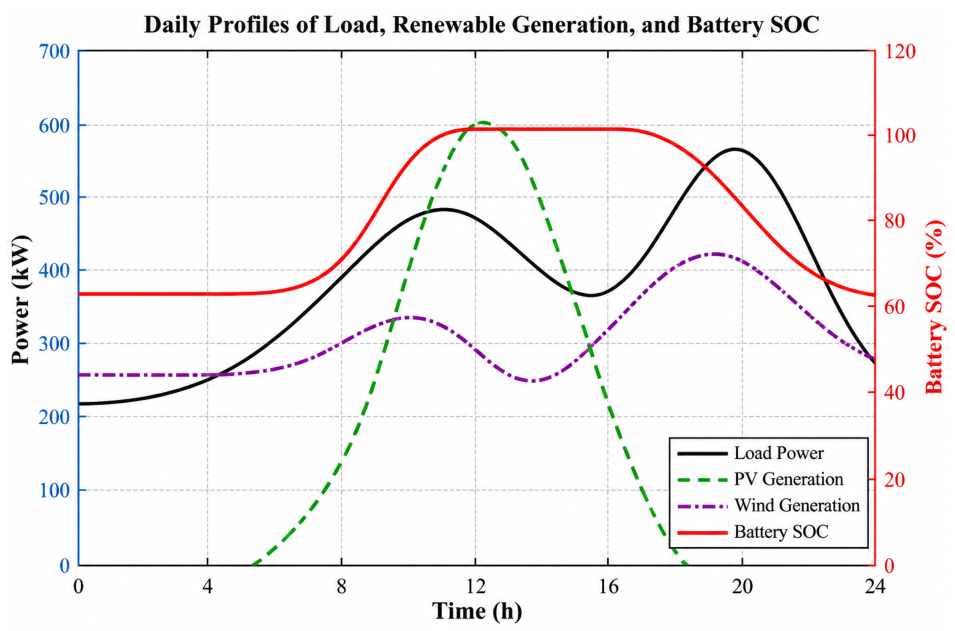
Hourly load, PV and wind generation, and battery SOC mentioned in
Table 3 is a simplified energy profile of the system over 24 h.At the start, both PV generation and load are low, while the battery has 60 percent SOC. By 5 h, PV and wind generation exceed the load, allowing the battery to charge to 100 percent, which it maintains through 8 to 10 h despite high load and generation levels. These data highlight how renewable generation and battery storage work together to balance supply and demand throughout the day.
Overall, this response demonstrates that the Dual IHEO–PSO algorithm is successful in smooth, constant, and optimal load power control and justifies its use in advanced smart energy systems. It assists in the good functionality and performance of the system, and it is a complement of the strategy of battery management which efficiently balances energy consumption.
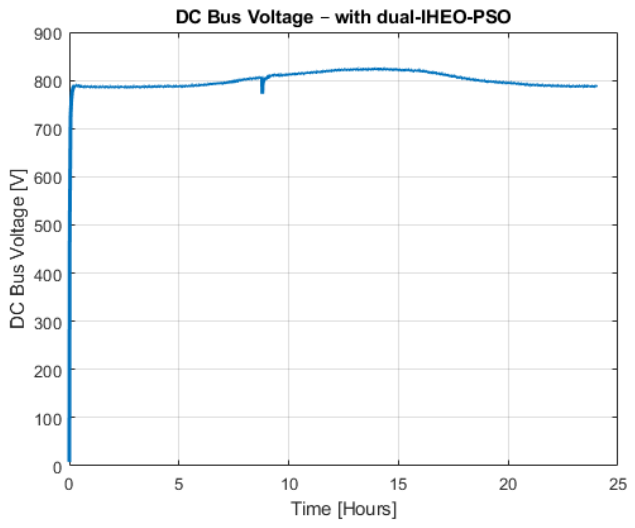
The system has a very stable and highly controlled system performance as shown in
Figure 5 with the DC bus voltage response of the Dual IHEO–PSO algorithm, which is a very significant consideration in highly developed energy management systems. The voltage is rapidly raised at the beginning to its nominal operating level (about 790–800 V), which makes it a fast dynamic response and fine control action. Following this short period, the DC bus voltage does not change much over the 24 h but experiences slight variations that are damped.
A slight perturbation that can be seen in the mid-time interval is soon countered, and the voltage gets back to its steady-state value without oscillations. This is indicative of the robustness and rejection of disturbance abilities of the Dual IHEO–PSO algorithm. The absence of sustained overshoot, instability, and undershoot of the controller is a confirmation that the controller tightly controls its voltage under varying load and generation conditions.
A DC-bus constant voltage is a requisite to make power electronic converters and grid-connected systems stable. The smooth and regulated voltage profile offers efficient transfer of power, reduced stress on system components as well as improved system reliability. The Dual IHEO–PSO method is associated with greater voltage stability in comparison to conventional control or optimisation algorithms due to the hybrid optimisation mechanism, which can provide both speed of convergence and global search.
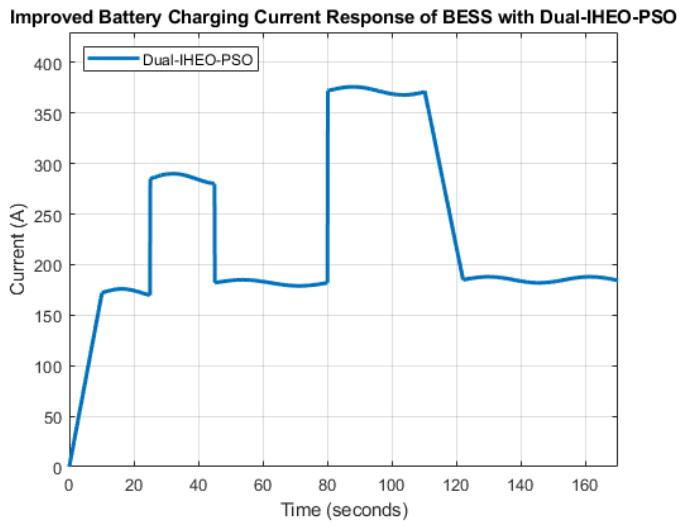
The Dual-IHEO–PSO current response exhibits a smooth start with well-controlled step transitions, a sign of fine control of battery charging levels. The resulted waveform is shown in
Figure 6.
A small ripple and no instability characterise high-current regions, which have good damping and adaptive optimisation potential. In general, the response is steady, effective, and devoid of oscillations, which proves our method has better energy management and puts less load on the battery than using traditional techniques.
4.3. Comparative Analysis with Whale Optimisation Algorithm
The relative SOC response in
Figure 6 convincingly shows the optimal behaviour of the Dual IHEO–PSO algorithm when compared with conventional WOA. The tendency of all approaches is a decline in the specified SOC profile due to the load demand, yet the key difference is the fact that the rate of discharge behaviour is smoother and can be regulated [
61].
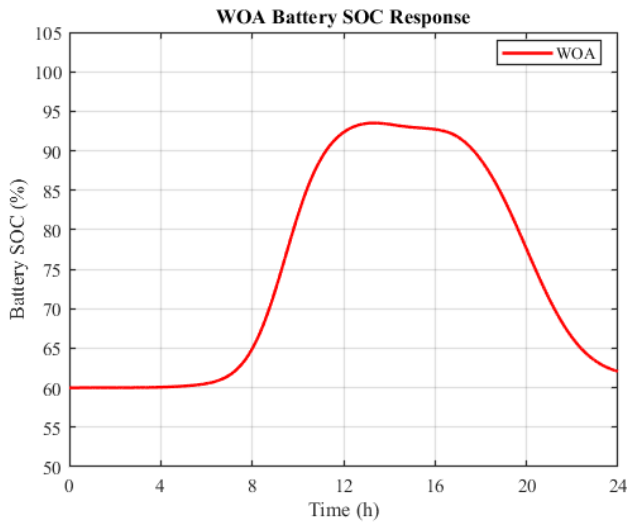
Figure 7 shows the SOC waveform with the given PV and wind renewable sources with WOA. The graph shows a slower transition, and even with the peak PV waveform, it shows a slightly discharging state, indicating less effective utilisation of renewable surplus power.
The WOA approach, which is more effective than the rule-based and coefficient approaches, has a comparatively higher SOC depletion and lower adaptive control in the dynamic conditions. Similarly FB-RB (rule-based) is the least desirable option as it has a higher rate of discharges and is less intelligent since it operates using predetermined logic as compared to real-time optimisation. FB-COEFF is a fairly good technique but lacks the flexibility required in cases of variable loads and generation. The SOC comparison values of proposed and conventional algorithm is stated in
Table 4.
The Dual IHEO–PSO algorithm, however, demonstrates the most rationalised and controlled SOC pathway, which ensures a more balanced and gradual discharge pattern. Dual IHEO–PSO uses both reinforcement of global exploration (IHEO) with explosive convergence (PSO) in contrast to WOA, which relies primarily on a metaheuristic search, thereby resulting in enhanced adaptive and accurate decision-making. It leads to better energy scheduling, less wasteful battery operation and enhanced maintenance of the SOC levels with time. System-wise, Dual IHEO–PSO is a guarantee of minimum stress on the battery, easy operation, and the absence of any chances of over-discharge, which in turn leads to increased battery life. In addition, it is highly applicable in high-energy management systems due to its stability when it comes to dynamism.
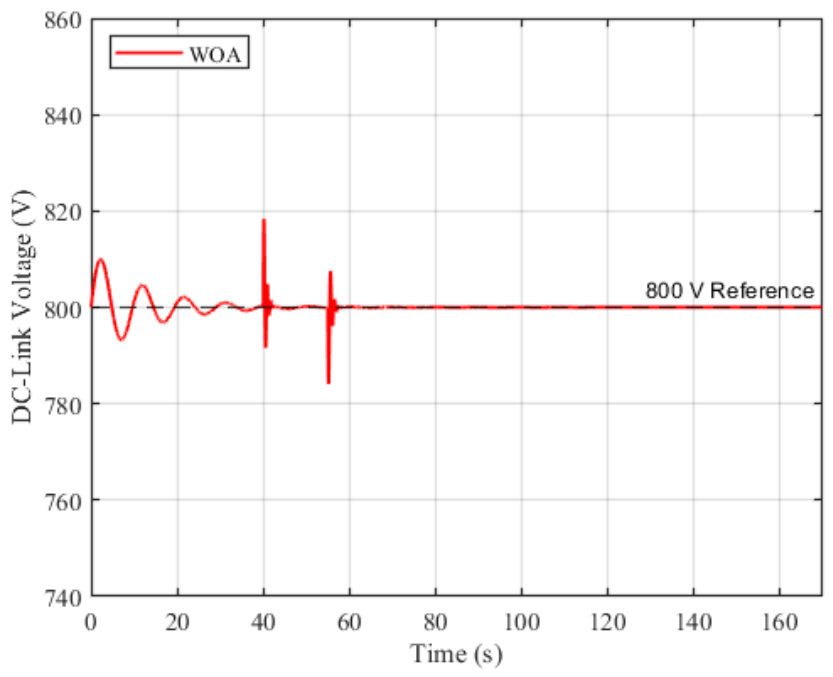
The voltage response obtained with WOA (Whale Optimisation Algorithm), depicted in
Figure 8, contains visible oscillations, transient deviations and irregularities in the operating conditions that are dynamic in nature. The voltage of the first time interval vibrates about the nominal value, which implies that the damping capacity is insignificant and the convergence is slow. With the development of the system, there is a large amplitude oscillatory behaviour (particularly in the mid-region) with the spikes and dips in voltages showing up distinctly. These oscillations can be attributed to the inability to control the fast changes in load or in the system under WOA-based control, which leads to the low voltage regulation and increased load on the system. Weak disturbance rejection and less precision in control is also indicated by the existence of undershoot and overshoot. The qualitative SOC comparison is stated in
Table 5.
The Dual IHEO-PSO voltage response has, in contrast, a superior dynamic response and stability that is needed in high-level energy management systems. Compared with WOA, the Dual IHEO-PSO approach can provide an easy-to-control voltage profile with few oscillations and a short settling time. Its hybrid nature, featuring the enhanced global exploration (IHEO) aspect coupled with speedy convergence and local optimisation (PSO), can be ingenious enough to respond to interference within the system and maintain the DC bus voltage at its set-point value.
Constant voltage regulation is directly proportional to quality power, reduced stress on converters and loads, and reliability of the system. The Dual IHEO–PSO method proves effective in eliminating high-voltage distortion and reducing the probability of instability, overvoltage, or undervoltage. Moreover, its ability to minimise oscillations and rapid recovery after disruptions is an indication of its robustness and the ability to work in various circumstances.
The power response obtained with WOA shown in
Figure 9 reflects noticeable variations at the operating range and repeating positive and negative spikes at the nominal operating range. Although the average power can be maintained at the desired value by the method, the response is not sufficiently smooth, and oscillations are often present, indicating that accuracy is not very high even after optimisation when used in dynamic conditions. In particular, the elevated transient peaks of the onset and near the end of the interval signify a weaker damping and a decreased control robustness. Such variations are potential contributors to unnecessary load on converters, storage components and loads that are attached to converters and therefore the overall quality of power management [
61]. Brief comparison between proposed Dual IHEO-PSO and WOA is discussed in
Table 6.
Contrastingly, the Dual IHEO–PSO power response may be regarded as evidently superior since it has smoother, more stable and more optimised behaviour. Our research indicates that due to the combination of IHEO and PSO, there is better convergence and effective real-time decision-making since the evolutionary optimisation method has good exploration ability, and the particle swarm optimisation allows quick and precise exploitation. The current response illustrated in
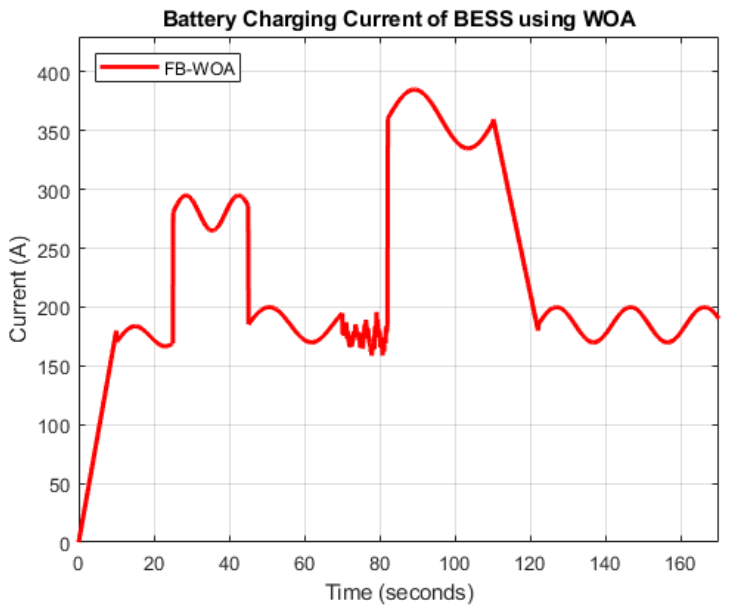
Figure 10, based on WOA, shows some observable oscillations and irregular variations particularly in the mid-region, which means lower damping and control accuracy. The quantitative and qualitative load power consumption comparison is stated in
Table 7.
Large current peaks are characterised by instability and aggressive behaviour, which is characteristic of poor response to dynamic variations. In general, the response is less stable and smoother, resulting in higher battery stress and lower energy management efficiency than Dual IHEO–PSO. It is clear from the comparison in
Table 8, that Dual IHEO–PSO has a much better BESS charging current response than WOA. Despite the fact that both approaches give similar current levels, the oscillations, ripple, and irregularities in WOA are more evident in dynamic areas, which implies lower control precision. However, the current profile of Dual IHEO–PSO is smooth and controlled with a small amount of variation and more rapid settling following disturbances. This translates into lower levels of battery stresses, higher charging stability, and energy efficiency. On the whole, Dual IHEO–PSO has a hybrid optimisation potential that guarantees high robustness, efficiency, and reliability, making it more applicable in advanced hybrid energy management systems. BESS charging current comparison is stated in
Table 8.
4.4. Convergence Performance Analysis
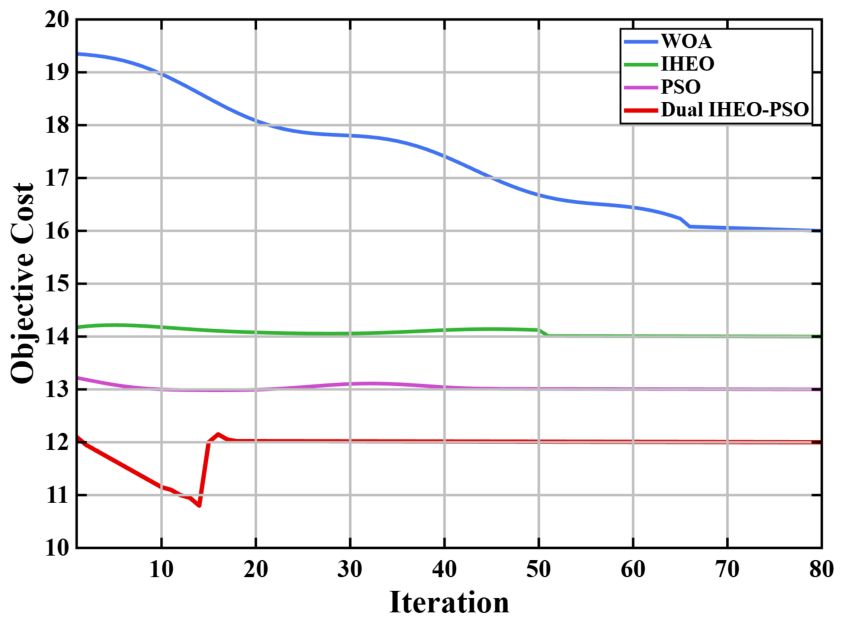
Dual IHEO–PSO starts with a lower initial objective cost and reaches a lower final cost than WOA, indicating higher solution quality. It converges much faster and stabilises early, unlike WOA, which fluctuates for longer iterations. The very low oscillations in Dual IHEO–PSO highlight its superior stability and smooth optimisation performance. The multiobjective function utilised in Equation (
44) with individual terms representing power loss, power quality deviation, battery SOC deviation and DC-link deviation remains the key objective of the proposed algorithm. Comparison of objective function and convergence performance is stated in
Table 9.
Dual IHEO–PSO consistently achieves the lowest objective cost, outperforming WOA, IHEO, and PSO. WOA converges slowly with higher oscillations, IHEO is stable but at a higher cost, and PSO is moderately fast but not as optimal. Overall, the red line clearly highlights Dual IHEO–PSO as the superior algorithm.
As is evident in the comparison, Dual IHEO–PSO is much better in all essential performance areas of the hybrid energy management when compared with WOA. It has lower initial and final objective costs, as illustrated in
Figure 10, meaning a high-quality solution at the beginning and at convergence. Additionally, its accelerated convergence rate and earlier solution at the settling iteration point to high optimisation efficiency. Dual IHEO–PSO has stable, smooth and reliable performance with few oscillations, as compared to WOA, which has the disadvantages of higher oscillations and medium stability. This ameliorated performance can be attributed to its hybrid nature, which is characterised by excellent global exploration and effective local exploitation. Overall, Dual IHEO–PSO is more efficient in search, more stable in the system, and more efficient in energy management, making it a more developed and practical solution for real-world application.
Table 10 summarises the statistical performance of the algorithms over 10 independent runs using the best, mean, median, standard deviation, interquartile range (IQR), and average computational time. The Dual IHEO–PSO achieves the lowest values, validating the authenticity of the proposed approach.
4.5. Overall Discussion
The overall performance comparison of the proposed Dual IHEO–PSO (Improved Human Evolutionary Optimisation–Particle Swarm Optimisation) algorithm with respect to the SOC, voltage and power responses clearly indicates that the algorithm is superior to conventional ones such as WOA. The results confirm that Dual IHEO–PSO presents a highly streamlined, stable and intelligent power management system, which would be suitable for the new generation and sophisticated power systems.
According to the SOC analysis, the specified strategy guarantees a managed and unproblematic charge–discharge curve and keep the battery within a reasonable operating range, which will be effective in preventing instances of overcharge and deep discharge. This directly influences the need to grow battery life, reduce degradation and create minimal stress of operation, which is necessary in present-day energy storage systems. Otherwise, comparatively, the rate of SOC depletion and adaptive control is higher in WOA and other traditional methods.
Dual IHEO–PSO has tight DC-bus voltage regulation, low oscillations, small settling time and large disturbance rejection. The approach proposed enables the maintenance of a nearly constant voltage profile, in contrast to WOA, which presents noticeable voltage fluctuations and intermittent instability; this explains the high-quality power, stability of the system, and ensures the safety of power electronic devices.
Dual IHEO–PSO produced a lower final objective cost of approximately 12, compared with nearly 16 for WOA, indicating a higher-quality optimisation result. It also converged more rapidly, reaching a stable solution within about 18–20 iterations, whereas WOA required nearly 65 iterations to settle. Moreover, the proposed method exhibited a smoother convergence trend with fewer oscillations, together with improved battery SOC behaviour, which reflects more stable and reliable coordination of the PV, wind, and battery subsystems. The high performance of Dual IHEO–PSO can be attributed to its hybrid optimisation structure; IHEO and PSO possess a global exploration capacity and rapid convergence and accuracy, respectively, which enables the method to make decisions under uncertainty and dynamic circumstances even better. The result is better energy scheduling, enhanced robustness, and better efficiency of the system in general.