1. Introduction
Slovakia is entering a new phase of nuclear energy development in which energy security, nuclear energy security and decarbonisation are increasingly inseparable. The policy portfolio now includes the commissioning of Mochovce Unit 4 [
1], long-term operation and possible uprating of the existing VVER-440 fleet [
2], diversification of nuclear-fuel supply [
3], preparation of a new state-owned large reactor at Jaslovske Bohunice [
4], and feasibility work on small modular reactors (SMRs) for electricity, heat, hydrogen and industrial applications [
3,
5]. These measures are not merely technology choices. They affect the resilience, affordability, sovereignty and environmental performance of the Slovak energy system over several decades.
In this article, energy security is understood more broadly than the reduction in fossil-fuel imports. It comprises the reliable availability of energy services, affordability for households and industry, environmental sustainability, resilience to technical and geopolitical shocks, adequate infrastructure and institutional capacity, and the fair allocation of costs and risks [
6,
7]. Nuclear energy security is used as a related but more specific concept: the ability of nuclear assets and their fuel cycle to provide dependable low-carbon electricity and heat while maintaining independently verified nuclear safety, protection against malicious acts, fuel and service diversification, regulatory competence, workforce continuity, climate resilience, credible radioactive-waste management and economically sustainable system integration. Nuclear safety concerns protection against accidental events, whereas nuclear security concerns prevention and response to theft, sabotage and other malicious acts; both are necessary conditions for nuclear energy security [
8,
9].
The phase-out of Slovak coal-fired generation must therefore be distinguished from the maintenance of domestic low-carbon generation. Coal is neither treated nor described here as a low-carbon source. Mining at Novaky ended in 2023, the Novaky power plant closed in December 2023, and coal firing at Vojany ended in March 2024 [
2,
10]. The policy question is how the removed dispatchable coal capacity is replaced by a portfolio of nuclear power, hydropower, solar photovoltaics, wind, storage, demand response, interconnection and, where justified, flexible gas or combined heat and power during the transition. The phrase “maintenance of domestic low-carbon generation” refers specifically to nuclear, hydro and renewable output, not to the preservation of coal.
Slovakia has one of Europe’s most nuclear-intensive electricity systems, but its position is not unique. International Atomic Energy Agency (IAEA) Power Reactor Information System (PRIS) data show that France had a higher nuclear share in 2025, while Czechia, Finland and Belgium also relied substantially on nuclear generation [
11]. This comparison strengthens rather than weakens the relevance of the Slovak case: small and medium-sized interconnected systems must manage both the benefits of low-carbon firm generation and the concentration risk created by a limited number of large units. The French fleet in 2022 illustrates correlated outage risk: average availability fell to 54%, and nearly 65% of capacity was offline at the annual low because of maintenance and stress-corrosion inspections [
12]. The nine-day outage of the 1450 MW Oskarshamn 3 unit in Sweden in December 2022 likewise demonstrated how one large unit can matter when regional margins are tight [
13]. These examples do not imply that similar events will occur in Slovakia; they show why nuclear energy security requires outage-resilient planning, reserves, interconnection and diversified flexibility.
Construction of Mochovce Units 3 and 4 was interrupted for many years and later resumed under changed ownership, regulatory and design requirements. The Slovak Supreme Audit Office reported completion costs approaching EUR 6 billion and identified weaknesses in project management and state oversight [
14], while WNISR records approximately 38 years from the start of construction to the grid connection of Unit 3 [
15]. This experience shows that political approval and international cooperation do not substitute for a final investment decision, a licensed design, a financeable contract, a mature supply chain or a credible schedule for the proposed Bohunice unit.
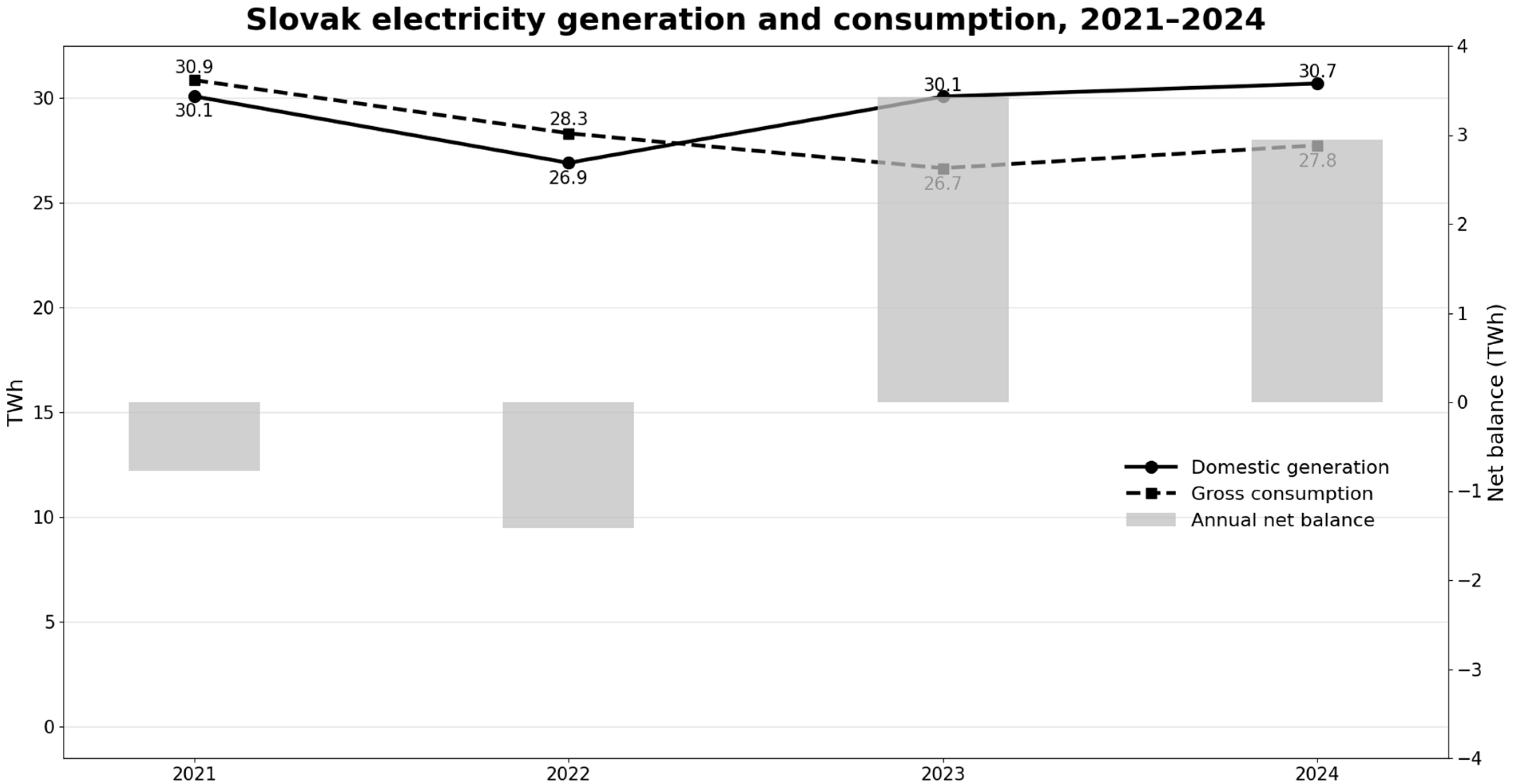
The electricity balance changed sharply between 2021 and 2024. In 2021 Slovakia produced 30.093 TWh and consumed 30.867 TWh, resulting in a 0.774 TWh import balance [
16]. Production and consumption both declined in 2022, to 26.916 TWh and 28.328 TWh respectively [
2]. After Mochovce Unit 3 entered operation, production recovered to 30.082 TWh in 2023 and 30.702 TWh in 2024, while consumption remained lower, at 26.660 TWh and 27.757 TWh [
5]. Slovakia therefore recorded export balances of 3.422 TWh in 2023 and 2.945 TWh in 2024 [
5]. These figures create two questions that a descriptive account cannot answer adequately: why consumption fell, and whether the resulting export position is durable under future electrification and industrial demand.
The proposed new large source magnifies these questions. Five operating reactors represented approximately 2306 MW of net nuclear capacity in mid-2026, while the six-unit fleet after Mochovce Unit 4 is expected to approach 2945 MW gross under the National Energy and Climate Plan (NECP) [
2,
11]. At capacity factors of 80–95%, a 1200 MW reactor would generate approximately 8.4–10.0 TWh per year. Its contribution must therefore be assessed against demand growth, exports, outage reserves, storage, non-electric uses and possible load-following operation.
This article examines which elements of Slovakia’s nuclear pathway are supported by robust evidence, which remain conditional policy intentions, and which system requirements must be fulfilled for nuclear development to strengthen rather than weaken energy security. The central research question is: under what technical, economic, institutional and system-integration conditions can existing and prospective nuclear capacity contribute to Slovak energy security and nuclear energy security up to 2050? Four subsidiary questions follow. First, what explains the 2021–2024 change in electricity generation, consumption and trade balance? Second, what do official 2040 scenarios imply for total generation and the nuclear share? Third, how would a 1200 MW unit and possible SMRs affect flexibility, non-electric uses and workforce requirements? Fourth, what alternative pathways remain credible if large nuclear projects are delayed, reduced or not realised?
The analytical contribution is threefold. First, the article appraises official, operator, industry, independent and scholarly sources according to their institutional position and evidentiary status. Second, it reconstructs the 2021–2024 electricity balance and reproduces the 2040 scenario outputs from the national resource-adequacy assessment. Third, transparent stress tests evaluate additional nuclear capacity and negative cases involving delay, high demand and stronger renewable development. Together, these elements provide an integrated assessment of energy-security trade-offs.
Section 2 presents the method and evidence hierarchy.
Section 3 analyses Slovakia’s energy and electricity profiles and the 2021–2024 balance.
Section 4 evaluates the operating fleet, nuclear energy security functions and non-electric uses.
Section 5 quantifies the 2040 scenarios, additional-capacity stress tests, load-following economics and alternative pathways.
Section 6 examines implementation constraints.
Section 7 discusses robust and conditional findings and the study limitations.
Section 8 presents policy recommendations, and
Section 9 concludes.
2. Materials and Methods
2.1. Research Design and Analytical Contribution
The study uses a qualitative-dominant mixed-method policy and system-security design, combining critical document analysis, source-position appraisal, comparative policy analysis, quantitative reconstruction, scenario comparison, transparent stress tests and negative-case analysis. The unit of analysis is the national policy portfolio rather than a single reactor project, encompassing the interactions of nuclear energy with electricity adequacy, fuel security, industrial demand, affordability, heat, hydrogen, flexibility, workforce and radioactive-waste governance. No commercial software, laboratory instruments, chemicals, reagents, cell lines, samples or proprietary materials were used in this document-based study.
Originality is generated through the integration and interrogation of evidence rather than through the reproduction of government targets. Every central claim was classified as one of four types: observed outcome, modelled scenario, institutional intention or author inference. Observed outcomes include historical generation and consumption. Modelled scenarios include the 2040 results of the resource-adequacy assessment. Institutional intentions include proposed commissioning dates, capacity envelopes and cooperation agreements. Author inferences include the calculated output of a 1200 MW unit under alternative capacity factors. This classification prevents a political announcement from being presented as an operational forecast.
2.2. Evidence Corpus and Source-Position Appraisal
The evidence corpus contains five source classes: (i) Slovak statutory and strategic documents; (ii) transmission-system, regulator and operator data; (iii) international intergovernmental databases and technical reports; (iv) industry and government stakeholder statements; and (v) independent and peer-reviewed scholarship. The core Slovak sources are the March 2025 NECP update [
2], the 2024 resource-adequacy assessment published in 2025 [
5], the 2021 electricity-supply security report [
16], energy-security and emergency-planning documents [
17,
18,
19,
20,
21,
22], and the Ministry of Economy annual report [
3]. Current reactor status was checked against IAEA PRIS and Slovenske elektrarne information up to 20 July 2026 [
1,
11,
23].
Source-position appraisal was applied to each item using five questions: What is the source’s legal or institutional mandate? Does it have a promotional, regulatory, commercial or independent role? Is the claim based on observed data, modelling, a political commitment or advocacy? What time horizon and uncertainty apply? Is the claim corroborated by a second evidence class? The World Nuclear Association profile [
24] is treated as a useful industry synthesis, while WNISR [
15] provides an independent counterpoint on construction performance and SMR maturity. U.S. Department of Energy and Slovak Ministry statements [
4,
25,
26,
27,
28] are treated as evidence of governmental direction and cooperation, not as proof of final vendor selection, financing closure or on-time delivery. The source classes and their analytical treatment are summarised in
Table 1.
2.3. Coding, Triangulation and Negative-Case Analysis
The documentary material was coded under ten themes: energy security; nuclear energy security; electricity demand and adequacy; affordability and financing; nuclear safety and nuclear security; fuel and supply-chain diversification; flexibility and load following; non-electric uses; workforce and institutional capacity; and waste, decommissioning and climate resilience. A claim-evidence matrix linked each substantive conclusion to at least two evidence classes wherever the evidence permitted. For example, the proposition that the 2024 export balance was driven by both higher nuclear output and lower consumption is supported by national balance data [
5], the commissioning of Mochovce Unit 3 [
2], and industrial-demand evidence from Slovalco [
35]. The complete coding and evidence-threshold framework is provided in
Appendix A.
Negative-case analysis tests outcomes in which announced nuclear projects are delayed, cancelled or accompanied by different demand and renewable-development trajectories. Four pathway conditions were examined: (A) timely delivery of the new Bohunice unit; (B) delayed or cancelled large new build; (C) high electrification and industrial demand; and (D) stronger renewables, wind, storage and demand response. The analysis asks whether energy-security outcomes remain acceptable under each condition. It also distinguishes an enabling agreement from an investment decision, a feasibility study from a licensed project, and installed capacity from electricity actually generated and absorbed.
2.4. Quantitative Reconstruction and Stress Tests
The quantitative component has three steps. First, annual electricity production, consumption and net balance were reconstructed for 2021–2024 from the 2021 monitoring report, NECP data and the 2024 resource-adequacy assessment [
2,
5,
16]. Second, the exact 2040 balances for Scenario A, Scenario B and the Ministry of Economy scenario were transcribed from Table 4.12 of the national assessment [
5]. Third, additional nuclear output was calculated using the transparent identity annual generation = capacity × 8760 h × capacity factor. No proprietary dispatch model is claimed.
For the proposed 1200 MW unit, annual output is tested at capacity factors of 80%, 90% and 95%, producing 8.410, 9.461 and 9.986 TWh respectively. A 300 MW SMR at a 90% capacity factor would produce 2.365 TWh. These figures are not forecasts. They are scale tests used to compare prospective output with official 2040 consumption, export/import balances, electrolyser demand and flexibility needs. The tests assume no transmission constraint and no curtailment; therefore, they deliberately show the upper-bound energy volume that would have to be sold, shifted, stored or converted.
2.5. Methodological Boundaries
The study does not rank reactor vendors, calculate a full levelized cost of electricity, optimise hourly dispatch or claim to prove project bankability. Publicly available data do not include final financing terms, vendor bids, site-specific cooling-water projections, heat-network investment plans, confidential outage probabilities or full hourly demand profiles. The method is therefore suitable for a transparent policy and energy-security assessment, but not a substitute for an investment-grade feasibility study. The implications of these boundaries are discussed in
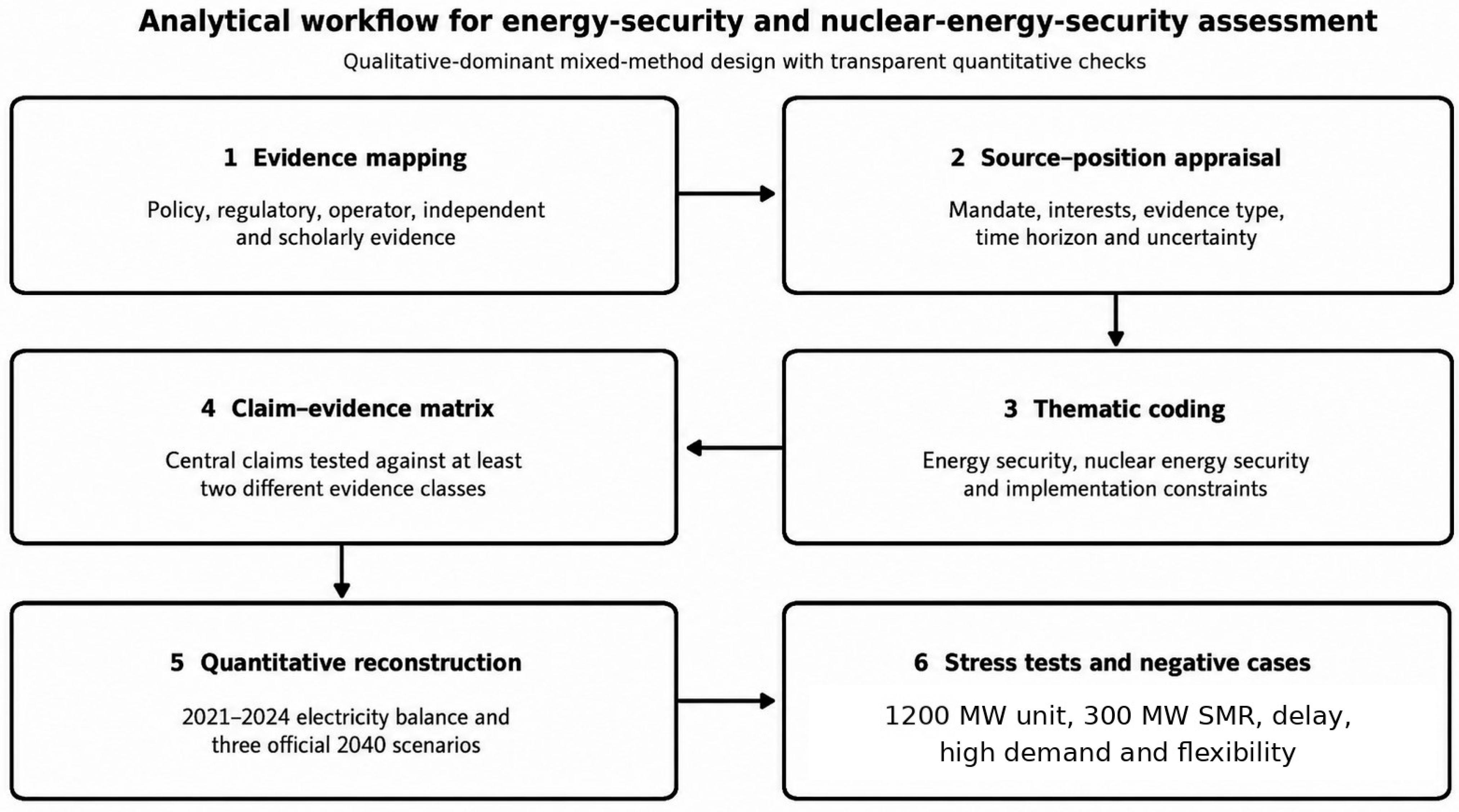
Section 7. The analytical workflow is summarised in
Figure 1.
4. Nuclear Fleet, Policy and Nuclear Energy Security
4.1. Existing Fleet, Mochovce Completion and Delivery History
As of 20 July 2026, IAEA PRIS listed five operating reactors in Slovakia and Mochovce Unit 4 as under construction or commissioning [
11]. The operating units were Bohunice V2 Units 3 and 4, Mochovce Units 1 and 2, and Mochovce Unit 3. They all belong to the VVER pressurised-water reactor family. Standardisation provides accumulated operating experience, common training and established maintenance capabilities, but it also concentrates fuel-design, component and licensing dependencies. Nuclear energy security therefore depends on preserving the benefits of standardisation while reducing single-supplier and common-mode risks.
The two Bohunice V2 units entered service in 1984 and 1985 and have been uprated to approximately 500 MWe gross each. They also supply heat to Jaslovske Bohunice and nearby urban areas, including Trnava, Leopoldov and Hlohovec [
2]. Mochovce Units 1 and 2 entered operation in 1998 and 2000 and were uprated to approximately 501.44 MWe gross each [
2]. Mochovce Unit 3 was synchronised with the grid on 31 January 2023 and materially increased annual nuclear generation [
2,
5]. These units form the current operational foundation of Slovak energy security, but lifetime extension beyond original design assumptions remains conditional on ten-year safety reviews, ageing management, investment and regulatory approval.
Mochovce Unit 4 (EMO4) is the decisive near-term addition. Fuel loading began on 29 June 2026, moving the 471 MW unit into active commissioning under the supervision of the Nuclear Regulatory Authority [
1,
28]. Once in stable commercial operation, the six-unit fleet is expected to reach approximately 2944.88 MW on the gross-capacity basis reported in the NECP [
2]. Operator statements that EMO4 could cover approximately 13% of Slovak consumption are useful for scale, but the realised contribution will depend on commissioning performance, outages, demand and the definition of consumption used [
1].
The project’s history is an energy-security warning as well as an engineering achievement. Units 3 and 4 were initiated in the 1980s, construction was suspended, and completion proceeded only after long delays, design changes and major financing commitments. The Supreme Audit Office found serious weaknesses in project control and reported a cost close to EUR 6 billion [
14]. WNISR records the unusually long construction duration of Unit 3 [
15]. Continued reliance on Russian-origin technology, documentation, services and fuel during the completion period also demonstrates that physical location inside Slovakia does not automatically equal technological sovereignty. The lesson for the new Bohunice project is that nuclear energy security must include delivery capability, transparent cost control and diversified life-cycle support. The status and energy-security functions of current and prospective nuclear assets are summarised in
Table 3.
4.2. Nuclear Power as an Energy-Security Asset and a Concentrated Risk
Official Slovak policy treats nuclear power as a core component of energy security, low-carbon generation and industrial policy [
2]. The analytical conclusion is narrower: nuclear power is a strong energy-security asset when its high availability, low operational carbon emissions, fuel storability and domestic generation reduce exposure to volatile gas and coal markets. It becomes an energy-security vulnerability when common-mode outages, fuel dependence, project debt, insufficient flexibility, weak waste governance or regulatory overload are ignored. The relevant question is therefore not whether nuclear energy is intrinsically secure, but under which governance and system conditions it contributes to nuclear energy security.
The coal phase-out increases the value of dependable low-carbon output, especially during winter periods of low solar production. Nuclear generation also reduces the need for gas-fired baseload electricity in a country that imports more than 98% of its gas consumption [
22]. Nevertheless, gas may continue to provide industrial feedstock, district heat and flexible generation. Energy security is strengthened most when nuclear power reduces fossil demand without creating a rigid system that depends on low-value exports or frequent curtailment.
A high share of generation from six large units also concentrates operational risk. A prolonged outage of one 500 MW unit equals approximately 17% of the expected six-unit gross nuclear fleet and a much larger share of winter reserve margin. Common design features can create correlated inspection or maintenance requirements. The experiences of France and Oskarshamn described in
Section 1 demonstrate why energy security requires spare capacity, demand response, hydro, storage, interconnection, diversified maintenance capability and realistic outage assumptions [
12,
13]. Annual nuclear shares alone do not measure this resilience.
4.3. Fuel Diversification and the Broader Meaning of Supply Security
Nuclear-fuel diversification is the most immediate nuclear energy security task. Slovak VVER-440 reactors historically relied on Russian TVEL fuel, and the risk-preparedness plan noted that alternative fuel must undergo complete plant-specific licensing [
2,
18]. Slovenske elektrarne has pursued parallel paths with Westinghouse and Framatome; the Ministry annual report records agreements with both, and the NECP expects first Framatome deliveries from 2027 [
2,
3]. Diversification is therefore progressing from political intent toward contractual and technical qualification, but it is not complete until fuel is licensed, fabricated, transported, stored, loaded and operated safely.
Two alternative fuel suppliers do not exhaust the energy-security choices. At the fuel-cycle level, Westinghouse and Framatome are parallel supplier paths. At the whole-system level, a third diversification path is to reduce the amount of nuclear output that must be secured at any single moment by expanding wind, solar, hydro, storage, demand response, efficiency and cross-border capacity. This does not replace the need for alternative VVER fuel; it reduces concentration risk. A robust strategy therefore combines supplier diversification inside nuclear energy with technology diversification across the electricity system.
Fuel security also extends beyond assemblies. Transport routes, export controls, sanctions, spare parts, digital systems, maintenance documentation, specialist services and reserve inventories are part of nuclear energy security [
40,
41]. A change in fuel vendor can introduce new licensing and operational requirements, while a new Western large reactor can create a different long-term dependency on the selected vendor and state partner. Sovereignty should therefore be measured by the ability to switch, stock, regulate and maintain critical inputs, not by the nationality of one supplier alone.
4.4. Nuclear Heat, Hydrogen and the Conditions for Non-Electric Use
Non-electric applications may improve the utilisation of nuclear assets, but they require more precise treatment than a general reference to “heat and hydrogen.” Existing Bohunice heat supply demonstrates that steam extraction and district-heating integration are technically possible [
2]. Conventional second- and third-generation district-heating networks commonly require supply temperatures above 80–100 degrees Celsius, while published nuclear district-heating studies report indicative supply ranges of about 80–130 degrees Celsius and return temperatures of about 45–70 degrees Celsius [
42,
43]. Actual temperatures vary by season and network design. Lower-temperature modern networks may reduce heat losses but can require building and network adaptation.
The public Slovak documents reviewed do not provide an investment-grade estimate of annual heat demand, peak load, pipeline distance, heat-exchanger configuration, network temperature, backup capacity, off-taker creditworthiness or delivered heat cost for an expanded Mochovce corridor or an SMR site. This is a material evidence gap. Before nuclear heat is counted as an energy-security benefit, a project must identify a geographically concentrated and durable heat demand, a technically and economically viable transmission corridor, municipal agreements, backup arrangements and a risk allocation between the nuclear operator and heat utility. Siting an SMR close enough to a city or industrial user to sell heat must also remain compatible with nuclear-safety, emergency-planning, water and land-use requirements.
Hydrogen production is similarly conditional. Electrolysers can absorb low-price electricity and provide a flexible load, and the 2040 official scenarios include 0.813–1.122 TWh of electrolyser consumption [
5]. Nuclear electricity could contribute to this supply, especially when co-located with industrial demand, but conversion losses, electrolyser utilisation, hydrogen transport, market demand and competition from renewable electricity determine economics. Hydrogen should therefore be treated as a possible flexibility and industrial-decarbonisation service, not as an automatic sink for surplus nuclear generation.
4.5. Financing, Affordability and Industrial Competitiveness
The phrase “acceptable prices” requires an explicit answer to the question of who bears project risk. The proposed Bohunice unit is described as state owned, and the Ministry launched a competition in June 2025 for a financial adviser with an estimated contract value of EUR 15 million [
26]. This confirms that the financing model was still under development. Possible structures include direct public equity, state guarantees, regulated asset-base mechanisms, contracts for difference, long-term power-purchase agreements or combinations of these instruments. Each shifts construction, market and financing risk differently among taxpayers, electricity consumers, industrial off-takers, the project company and suppliers.
Nuclear power does not automatically make industry competitive. Industrial competitiveness depends on the delivered electricity price, reliability, carbon intensity, contract duration, grid charges, flexibility costs, financing burden and access to risk-sharing mechanisms. Existing depreciated nuclear units may provide economically valuable low-carbon output, while a new capital-intensive unit may require public support or long-term revenue stabilisation. The analytical claim is therefore that nuclear power can support industrial competitiveness when it delivers predictable low-carbon electricity under disciplined financing and transparent contracts; it is not that higher nuclear capacity necessarily lowers market prices.
The state-ownership rationale may be justified by strategic control and long-term energy security, but public ownership increases the obligation to disclose assumptions, contingent liabilities and milestone performance. A credible nuclear energy-security framework should publish the reference financing model, expected weighted cost of capital, construction-risk allocation, consumer impacts, state-aid strategy and exit criteria before the project becomes irreversible. Without that information, the 2040 date remains a policy objective rather than a bankable schedule.
6. Implementation Constraints for Energy Security and Nuclear Energy Security
6.1. Project Delivery, Financing and Geopolitical Dependence
The most consequential uncertainty is project delivery. The May 2024 announcement referred to a state-owned unit of up to 1200 MW [
25], while the June 2025 financial-adviser competition described a planning envelope of up to 1700 MW and a minimum 60-year life [
26]. The January 2026 U.S.-Slovak intergovernmental agreement referred to a state-owned American 1200 MWe unit [
4], and an implementation steering committee subsequently began work [
27]. These developments demonstrate political momentum and a framework for cooperation. They do not yet demonstrate a final investment decision (FID), a completed engineering, procurement and construction (EPC) contract, a closed financing package, a final licensed design or an achievable commercial-operation date.
Recent European construction experience requires schedule humility. Mochovce, Olkiluoto, Flamanville and Hinkley Point C show that project preparation, licensing, supply-chain readiness and construction can take substantially longer and cost more than early political schedules suggest [
14,
15]. Poland’s nuclear programme also illustrates the distance between national commitment and first commercial operation [
47]. Accordingly, the article does not assume that a new Slovak unit will operate by 2040 or even by 2050. It treats operation around 2040 as a policy target and tests a delayed or non-delivery case.
Geopolitical cooperation creates both diversification and dependence. A U.S. framework can reduce reliance on Russian technology and fuel, but future administrations, export-control policy, trade disputes, sanctions, financing priorities and vendor capacity may change over a multi-decade project. The same applies to any foreign technology partner. Nuclear energy security requires contractual continuity, European regulatory compatibility, alternative suppliers for critical components and an explicit response to political change; alliance language alone is not a risk-allocation mechanism.
Financing is inseparable from energy security because high capital costs can affect public budgets and electricity bills for decades. Before construction, the state should publish a reference case and sensitivities for capital cost, construction duration, interest during construction, capacity factor, load following, decommissioning, spent fuel, cooling adaptation and delay. A project that improves physical supply but creates unmanageable fiscal or consumer exposure would not satisfy the broader definition of energy security used in this article.
6.2. Large-Unit Concentration, Flexibility and Operational Resilience
A 1200 MW unit would be the single largest generating asset in Slovakia. Its unplanned loss would require reserves, imports, demand response or rapid replacement from other resources. Grid connection studies must therefore test the largest-infeed loss, reserve procurement, transmission reinforcement, black-start arrangements and simultaneous outages of existing units. Regional interconnection reduces risk but cannot guarantee imports during a common cold-weather or regional scarcity event.
Operational resilience also depends on maintaining diversified ancillary services as synchronous fossil plants retire. Nuclear units contribute inertia and voltage support, but not every plant is optimised to provide all balancing services. Hydropower, pumped storage, batteries, flexible industrial loads and aggregators should be developed in advance of additional inflexible output. Flexibility is not an optional environmental add-on; it is part of energy security and nuclear energy security because it determines whether low-carbon generation can be used reliably and economically.
The load-following issue should be included in procurement and financing. Vendor guarantees should specify manoeuvring ranges, ramp rates, minimum stable output, fuel-cycle impacts and maintenance implications. The project financial model should include lower-capacity-factor sensitivities rather than assuming that every produced megawatt-hour will have equal value. This requirement is particularly important if wind reaches or exceeds the 3.203 TWh level in the Ministry scenario and photovoltaic capacity continues to grow [
5].
6.3. Workforce Continuity Beyond the Construction Peak
The proposed large programme creates a two-sided workforce problem: shortages before and during construction, followed by a possible employment cliff after completion. A single 1200 MW reactor can support thousands of temporary construction jobs but cannot automatically provide permanent work for all specialist trades after commissioning. Nuclear energy security planning must therefore distinguish construction craft, commissioning staff, licensed operators, maintenance personnel, regulators, researchers and decommissioning specialists.
Continuity can be improved through a sequenced national programme. Qualified welders and non-destructive-testing specialists can move from new-build construction to lifetime-extension outages, major component replacement, fuel-diversification modifications, maintenance, decommissioning of Bohunice V1, radioactive-waste facilities and, if justified, later SMR projects. Engineers can support operation, digital modernisation, safety review, the regulator, research and regional supply chains. However, these transitions require retraining and work-pipeline coordination; they should not be assumed merely because all activities are “nuclear.”
A national workforce plan should map annual occupational demand from project preparation through at least ten years after commissioning. It should include vocational education and training, university places, operator apprenticeships, regulator staffing, scholarships linked to service commitments, international placements and certification portability. Procurement should also require suppliers to present localisation and knowledge-transfer plans. The objective is not to maximise domestic content at any cost, but to retain the capabilities needed for safe operation and nuclear energy security after foreign contractors leave.
6.4. Spent Fuel, Radioactive Waste and Decommissioning
The back end of the fuel cycle is a binding governance condition. Each additional reactor increases spent-fuel inventories, interim-storage requirements, decommissioning liabilities and the financial contribution required for long-term management. Slovakia has decommissioning and waste-management experience [
3], but the absence of an operating deep geological repository means that long-term disposal remains unresolved.
New-build approval should therefore require a quantified spent-fuel and waste plan covering expected inventories, interim-storage capacity, transport, repository milestones, funding adequacy and responsibilities if schedules change. SMRs and advanced reactors should not be exempted on the assumption that smaller size or different fuel automatically simplifies disposal. The OECD NEA is examining how waste characteristics, storage, transport and disposal differ across advanced reactor designs, which confirms that back-end integration must begin at technology selection rather than after operation [
38].
Repository governance is also a public-acceptance issue. Communities and neighbouring states may reasonably distinguish between reliable reactor operation today and confidence in institutions that must manage waste for generations. Transparent inventory reporting, independent oversight, participation and realistic milestones are therefore energy-security instruments. Delaying the repository discussion may preserve short-term political convenience but weakens long-term nuclear energy security.
6.5. Climate Change, Cooling Water and Site Resilience
Climate change is a material implementation risk for the Slovak electricity system. Nuclear plants can be affected by higher cooling-water temperatures, drought, low river flow, flooding, storms and extreme heat. The OECD NEA notes that such events have already affected nuclear operation and that warmer cooling water can reduce thermal efficiency and available output [
48]. Hydropower, which is an important Slovak balancing resource, is also climate-sensitive; correlated low water availability could therefore affect both firm generation and flexibility.
The public documents reviewed do not provide a site-specific probabilistic assessment of future low-flow conditions, water temperature, heat rejection or climate adaptation for the new Bohunice unit or potential SMR sites. This absence should not be interpreted as evidence that cooling constraints are negligible. Environmental assessment and licensing should use updated climate projections, compound-event analysis and stress tests for simultaneous heat waves, drought, high demand and reduced imports. Technology selection should compare cooling-system options, water use, efficiency penalties and ecological limits.
Climate resilience also affects nuclear heat. A district-heating system may improve overall thermal utilisation in winter, but heat demand is seasonal and generally lower during summer periods when cooling constraints may be strongest. Heat sales therefore cannot be assumed to solve all surplus-output or cooling problems. A credible nuclear energy security case must test seasonal electricity, heat and water balances together.
6.6. Permitting, Cross-Border Acceptance, Nuclear Safety and Nuclear Security
Nuclear project preparation requires an environmental impact assessment, site approval, design licensing, construction authorisation and public participation. Early publication of environmental, seismic, hydrological and emergency-planning evidence can reduce procedural conflict, although it cannot guarantee agreement.
The regulator must simultaneously oversee EMO4 commissioning, existing-unit lifetime extension, alternative VVER fuel, the new large source and possible SMRs. Regulatory competence is therefore a scarce energy-security resource. Funding, staffing and training for the Nuclear Regulatory Authority should grow before the project pipeline expands. International peer review can support domestic capacity but cannot replace an independent national regulator.
Physical protection and cyber resilience must evolve with emerging threats. The national risk-preparedness plan includes cyberattack, loss of information and communication technology, extreme weather and industrial or nuclear accidents [
18]. Nuclear security measures should integrate cyber-physical exercises, insider-risk management, continuity of communications and coordination with police, military and emergency services. Details that would compromise protection should remain restricted, but governance responsibilities and preparedness standards should be publicly accountable.
Public communication should avoid both technological triumphalism and reflexive secrecy. Nuclear safety, nuclear security, costs, waste, cooling, emergency preparedness and project delays should be discussed as normal components of governance. Research on Slovak and Czech media discourse shows that nuclear energy can be framed as a reliable response to external insecurity, but credibility depends on transparent treatment of trade-offs [
31]. Energy-security rhetoric should not be used to prevent scrutiny; scrutiny is part of nuclear energy security. The principal implementation risks and required responses are summarised in
Table 7.
7. Discussion
7.1. Robust Findings and Conditional Findings
The analysis separates robust findings from conditional findings. Four conclusions are robust. First, nuclear power is the principal source of Slovak electricity and a major contributor to current energy security. Second, the coal phase-out concerns high-carbon generation, whereas the policy objective of maintaining domestic low-carbon generation concerns nuclear, hydro and renewables. Third, the 2023–2024 export position resulted from both increased generation and reduced demand. Fourth, nuclear energy security depends on the entire system of fuel, regulation, workforce, waste, flexibility, financing, climate adaptation and protection, not only reactor availability.
Other conclusions are conditional. EMO4 is in commissioning, but its full annual contribution is not yet observed. The new Bohunice unit has political and intergovernmental support, but project delivery, cost and operation around 2040 remain unproven. SMRs are under feasibility assessment, not commercial deployment in Slovakia. Nuclear heat and hydrogen may add system value, but no bankable Slovak off-take and infrastructure case is presently demonstrated in the reviewed public evidence. These distinctions prevent planned policy from being presented as a deterministic forecast.
The official 2040 scenarios provide the strongest quantitative insight. They indicate total gross generation of 43.9–48.5 TWh and a nuclear share of about 55%, not an unlimited rise in nuclear dominance. Scenario B demonstrates that high electrification can create an 8.5 TWh import balance and a reliability problem even with strong nuclear output [
5]. The Ministry scenario demonstrates that additional wind and a 300 MW SMR can coexist, but it does not establish that either will be built. The system problem is therefore a portfolio and timing problem rather than a binary choice between nuclear and renewables.
7.2. Added Analytical Value
The article’s analytical contribution comprises four elements. The first is causal qualification of the 2021–2024 balance: the demand decline is linked to the price shock and industrial curtailment, while the generation recovery is linked to Mochovce Unit 3 and changes in the supply mix. The second is scale: a 1200 MW unit would add 8.4–10.0 TWh per year, which is too large to discuss without a utilisation and flexibility strategy. The third is uncertainty: large new build, SMRs, nuclear heat and hydrogen are treated as contingent options. The fourth is resilience: energy security and nuclear energy security are evaluated under outage, delay, high-demand, climate and financing stress rather than only under the preferred policy case.
This perspective also clarifies industrial competitiveness. Reliable low-carbon electricity can support automotive, battery, metallurgical and manufacturing investment, but competitiveness is not reducible to wholesale price or nuclear share. Slovalco demonstrates that electricity contracts, carbon-cost compensation and policy stability can determine whether an efficient industrial facility operates [
35,
37]. A new nuclear project may support long-term contracts, but its financing and system costs must be allocated transparently. Nuclear capacity is therefore an input to competitiveness, not a sufficient explanation of it.
The broader regional literature supports a diversified reading of Slovak energy security. Research on the 2009 gas crisis and Visegrad energy-security cooperation shows that infrastructure, interconnection and institutions often advance after shocks [
49,
50,
51,
52]. Post-2022 Slovak policy has combined persistence with stronger security framing [
33]. EnergyPLAN research for Slovakia also shows that climate neutrality and security require interactions among nuclear, renewables, efficiency and flexibility [
30]. The present analysis extends this literature by quantifying the capacity-integration problem and by defining nuclear energy security as a multi-dimensional governance outcome.
7.3. Study Limitations
The study has important limitations. First, it does not include direct confidential interviews with the operator, transmission-system operator, industrial off-takers, financiers, energy economists, public-policy experts and environmental organisations. Consequently, the study cannot establish stakeholder consensus.
Second, the quantitative analysis is annual rather than hourly. Annual balances cannot reveal ramping, minimum-load, reserve, congestion, price and curtailment patterns. The additional-capacity calculations are transparent scale tests, not dispatch optimisation. Third, public data do not provide final cost, financing, vendor, cooling, heat-demand or project-contract information. Fourth, several projects are evolving rapidly; the evidence cut-off is 20 July 2026. Fifth, source-position appraisal reduces but cannot eliminate institutional bias, especially where government and industry announcements are the only current evidence.
These limitations mean that the article cannot prove that the proposed nuclear pathway is feasible in an investment or construction sense. It can identify conditions under which the pathway is technically conceivable and potentially supportive of energy security. Future research should use hourly system modelling, confidential stakeholder interviews, industrial-demand scenarios, distributional cost analysis, site-specific cooling studies, heat-network feasibility and probabilistic project-schedule assessment. These limitations define the scope of the conclusions.
9. Conclusions
Slovakia’s nuclear sector is central to its electricity system and to its present energy security. The country phased out coal-fired generation while maintaining domestic low-carbon generation from nuclear, hydro and renewables. Mochovce Unit 3 helped move the annual balance from import dependence in 2021–2022 to net exports in 2023–2024. Yet the lower 2024 consumption level was partly shaped by the energy-price shock and industrial curtailment, and it should not be treated as a permanent surplus.
Official 2040 scenarios project 43.9–48.5 TWh of gross generation and 24.2–26.7 TWh of nuclear generation, approximately 55% of the total. A 1200 MW unit would add roughly 8.4–10.0 TWh per year at capacity factors of 80–95%. This is a system-transforming quantity. Its energy-security value depends on industrial and electrification demand, exports, storage, demand response, heat, hydrogen, reserve requirements and economically credible load following. Additional SMRs can be accommodated only where they solve a defined system or off-taker problem.
Nuclear energy security is broader than reactor construction. It includes nuclear safety, nuclear security, diversified fuel and services, regulator capacity, climate-resilient cooling, workforce renewal, project delivery, affordability, radioactive-waste governance and public trust. A failure in any of these areas can reduce the security value of additional capacity. Conversely, a diversified portfolio of safe existing nuclear operation, renewables, wind, hydro, storage, flexible demand and selective new nuclear investment can reduce exposure to both fossil imports and single-technology risk.
The proposed Bohunice project is politically supported and technically conceivable, but its implementation feasibility is not yet demonstrated. The public evidence does not establish a final investment decision, closed financing, final vendor contract, licensed design or proven 2040 delivery schedule. Recent European experience and the Mochovce history justify explicit delay and non-delivery contingencies. SMRs and nuclear heat should likewise be treated as conditional options rather than inevitable components of the 2050 system.
The principal policy implication is the sequencing of decisions and investments. Slovakia should first convert EMO4, fuel-diversification contracts, wind planning and flexibility measures into verified operational capability. It should then decide on the scale and timing of large new nuclear projects and SMRs using updated demand, system and financing evidence. This adaptive approach protects energy security against both an adequacy deficit and an inflexible overcapacity problem.
The final conclusion is therefore conditional rather than deterministic. Slovakia can preserve a nuclear-intensive, low-carbon electricity system and strengthen energy security up to 2050, but only if nuclear development is governed as part of a diversified and climate-resilient energy system. Political momentum is a starting condition, not proof of delivery. Implementation quality, cost discipline, regulatory independence, flexibility and credible back-end governance will determine whether prospective nuclear capacity becomes an energy-security asset or a long-term liability.