
Article

Techno-Economic Evaluation and Configuration Design of Energy Storage Systems for Renewable-Rich Weak-Grid Regions

1
Yalong River Hydropower Development Co., Ltd., Chengdu 610051, China
2
Research Center for Eco-Environmental Sciences, Chinese Academy of Sciences, Beijing 100085, China
*
Author to whom correspondence should be addressed.
Energies 2026, 19(17), 4091; https://doi.org/10.3390/en19174091
Submission received: 28 July 2026 / Revised: 25 August 2026 / Accepted: 25 August 2026 / Published: 31 August 2026
(This article belongs to the Section D: Energy Storage and Application)

Abstract

With the ongoing advancement of China’s “dual carbon” strategy, wind power and photovoltaic installed capacity have grown rapidly, making renewable energy a critical pillar for building a new-type power system. However, their inherent intermittency, variability, and uncertainty pose significant challenges to the secure and stable operation of modern power systems. As renewable energy capacity continues to expand, regions rich in renewable resources increasingly coincide with areas characterized by relatively underdeveloped grid infrastructure. This has resulted in insufficient renewable energy accommodation on the generation side and inadequate transmission capacity within the grid. Consequently, the integration of renewable energy faces growing challenges, including spatial mismatches between generation and demand, insufficient system flexibility, and increasing pressure on grid security and reliability. This study presents a systematic review combined with a quantitative techno-economic assessment of electrochemical energy-storage deployment in renewable-rich and weak-grid regions. Three representative electrochemical energy storage technologies, namely lithium-ion batteries, sodium-ion batteries, and all-vanadium flow batteries, are quantitatively evaluated using technical indicators and levelized cost metrics, including the levelized cost of energy (LCOE) and levelized cost of storage (LCOS). The results show that lithium-ion batteries exhibit the best overall techno-economic performance, with LCOE/LCOS values of 670/440 CNY kWh−1, compared with 660/840 CNY kWh−1 for sodium-ion batteries and 690/490 CNY kWh−1 for all-vanadium flow batteries. Additionally, a 10%/2 h energy storage system improves day-ahead power prediction accuracy, ultra-short-term prediction accuracy, and the correlation coefficient by 67%, 44%, and 18%, respectively. These findings establish a quantitative basis for linking energy storage technology selection with regional resource–grid conditions and operational requirements, thereby supporting coordinated source-grid-load-storage planning and cost-effective and reliable renewable energy integration in weak-grid regions.

1. Introduction

China officially announced its strategic goals of achieving carbon peaking by 2030 and carbon neutrality by 2060, providing a clear direction for the country’s energy transition and green, low-carbon development [1]. Subsequently, bolstered by national policy support and strategic guidance, major Chinese energy enterprises and investors have accelerated the implementation of clean energy development and low-carbon transition strategies, thereby driving the transformation of China’s energy system toward sustainability [2]. The construction of large-scale wind and photovoltaic bases has been fully advanced, and the development of decentralized wind power and distributed photovoltaic power generation has been accelerated in accordance with local conditions [3,4].
By the end of July 2024, China’s installed capacity for wind and photovoltaic power generation had reached 1.206 billion kilowatts, achieving the national target for 2030 six years ahead of schedule [5]. This milestone demonstrates the remarkable growth of China’s renewable energy sector and its global leadership in clean energy development. Nevertheless, the rapid expansion of renewable energy capacity has also introduced significant operational challenges due to the inherent intermittency, variability, and uncertainty of wind and solar power [6]. Furthermore, achieving the target of increasing the share of non-fossil energy consumption to approximately 25% by 2030 requires continued improvements in renewable energy utilization efficiency and grid integration capability [7,8]. As renewable energy deployment continues to expand, newly exploitable wind and solar resources are increasingly concentrated in remote regions at the end of the power grid, where transmission infrastructure is relatively weak and load density is generally low [9,10]. This mismatch between renewable energy generation and grid carrying capacity has intensified problems such as renewable energy curtailment, transmission bottlenecks, and insufficient system flexibility [11]. Consequently, optimizing generation-side system configuration, enhancing renewable energy transmission and accommodation capacity, and improving grid operational flexibility have become critical requirements for developing a secure, efficient, low-carbon, and resilient new power system.
To address these challenges, energy storage has been widely recognized as a critical enabler for renewable energy integration. Previous studies have quantified the benefits of various storage technologies. For example, lithium-ion battery systems typically achieve round-trip efficiencies of 90–95% and cycle lives of approximately 5000–10,000 cycles, while levelized cost of storage (LCOS) values vary substantially with system cost, storage duration, cycling frequency, and application scenario [12,13]. Sodium-ion batteries can achieve round-trip energy efficiencies of approximately 88% and offer enhanced safety, while all-vanadium flow batteries are particularly suitable for long-duration storage, although their current LCOS remains higher due to elevated capital costs [14,15]. Field applications and system-level studies have demonstrated that generation-side energy storage can substantially reduce renewable-energy curtailment and mitigate the impacts of short-term renewable-power forecast errors, thereby improving renewable-energy utilization and grid flexibility in high-penetration systems [16,17]. However, most existing techno-economic evaluations focus on bulk power systems or strong-grid environments. Quantitative assessments specifically tailored to renewable-rich weak-grid regions—where transmission constraints, low local load, and reverse power flow coexist—remain limited. Moreover, few studies systematically compare lithium-ion, sodium-ion, and all-vanadium flow batteries using consistent levelized cost of energy (LCOE) and LCOS frameworks while linking the results to practical generation-side configuration strategies under China’s dual-carbon and new power system policies.
The “Action Plan for Accelerating the Construction of a New Power System” (2024–2027) encourages the development of smart microgrids tailored to local resource endowments and application scenarios. Specifically, in weak-grid regions and regions beyond the coverage of the main power grid, smart microgrids integrating wind, photovoltaic, and energy storage systems are being promoted to improve local power supply reliability [18,19]. Conversely, in regions with abundant renewable energy resources, source-grid-load-storage integrated smart microgrids are encouraged to enhance autonomous peak shaving and power balancing capabilities, increase the local accommodation of renewable electricity, alleviate the regulation burden on the main grid, and facilitate the development of emerging energy business models [20,21,22].
Given the pronounced source-load reverse distribution and weak grid infrastructure in China’s renewable energy-rich regions, it is imperative to investigate the optimal deployment of energy storage technologies and the coordinated operation of source-grid-load-storage systems under high renewable penetration [23,24]. China’s dual-carbon targets and the “Action Plan for Accelerating the Construction of a New Power System” (2024–2027) explicitly call for enhanced local accommodation, improved system flexibility, and the development of source-grid-load-storage integrated systems in grid-peripheral areas. To respond to these policy imperatives, this study systematically evaluates the techno-economic feasibility of representative electrochemical energy storage technologies, particularly lithium-ion batteries, sodium-ion batteries, and all-vanadium flow batteries. The resulting quantitative evidence and deployment strategies are intended to provide actionable decision support for translating national dual-carbon and new power system policies into concrete, cost-effective storage solutions in renewable-rich weak-grid regions.

2. Methodology

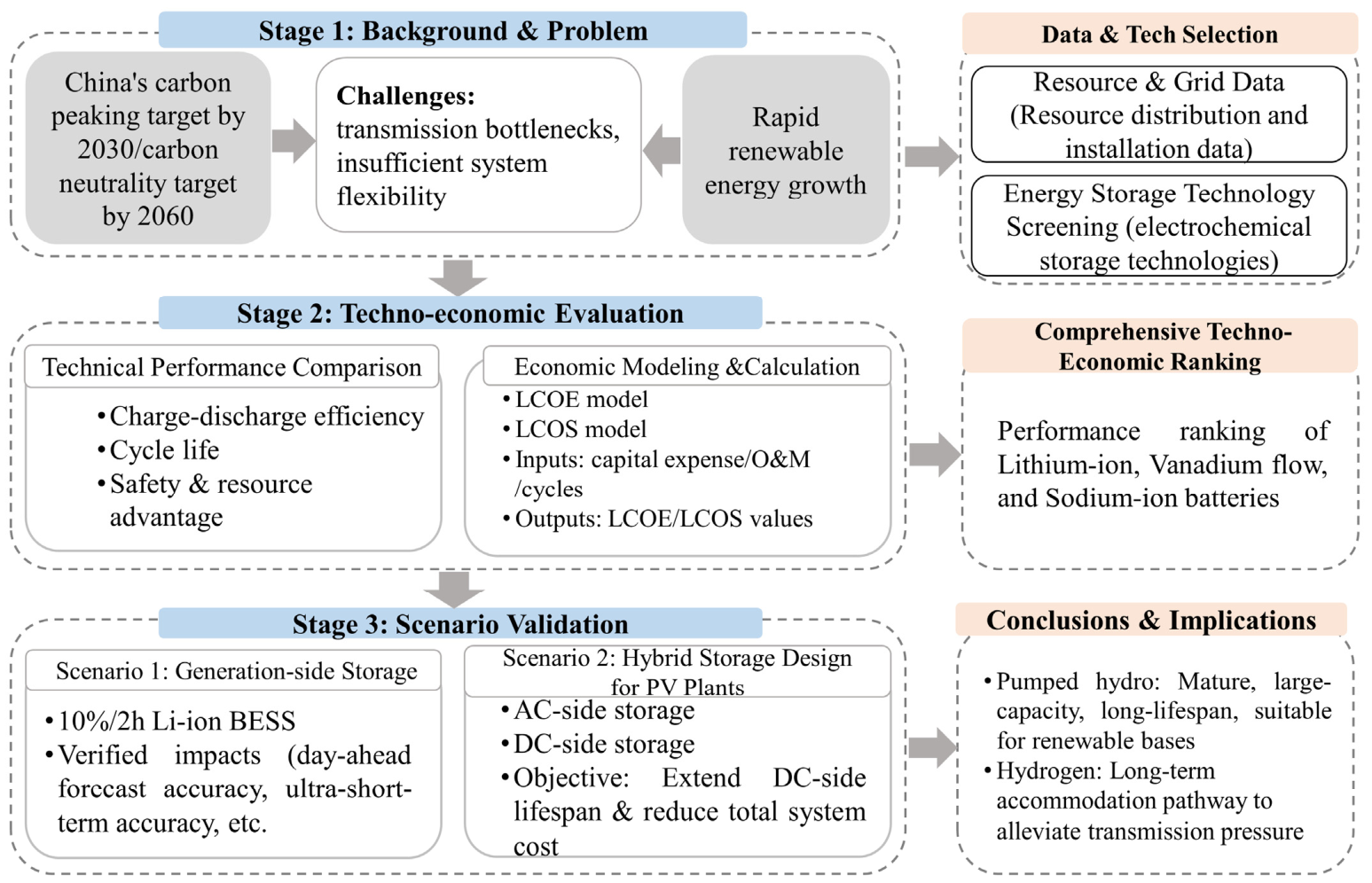
The overall research process and technical procedures are illustrated in Figure 1. Official statistics and policies are first used to characterize renewable-resource distribution, generation–demand mismatch and transmission constraints in China’s “Three Norths” and Southwest regions, while energy-storage capacity data and key battery indicators are compiled into comparative matrices. Three representative technologies (lithium-ion, sodium-ion and all-vanadium redox-flow batteries) are selected. LCOE and LCOS models are established for economic evaluation. A case study quantifies forecast-accuracy gains from co-locating a 10%/2 h lithium-ion system with a mountainous wind farm. Finally, a hybrid AC/DC-side storage architecture is formulated for large-scale photovoltaic plants to allocate frequency-regulation and energy-shifting duties optimally.

2.1. Data Sources and Literature Basis

The regional characteristics of renewable-energy resources, the spatial mismatch between power generation and electricity demand, and transmission constraints in China’s “Three Norths” and Southwest regions were characterized based on official statistical data and relevant national policies [25,26,27,28,29,30,31,32,33]. Global and Chinese cumulative installed energy-storage capacities through the end of 2023 were obtained from the International Renewable Energy Agency (IRENA) database [34]. These data provided the quantitative foundation for assessing the relative shares of pumped-hydro and emerging storage technologies [34]. Technical and economic indicators of representative battery technologies, including operating temperature, energy density, round-trip efficiency, rate capability, depth of discharge, cycle life, and unit cost, were compiled from peer-reviewed literature and industry reports [35,36,37]. The collected indicators were subsequently organized into a comparative matrix (Table 1) to support later techno-economic evaluation.
Capital-cost data used in the LCOE and LCOS calculations were obtained from publicly released bidding announcements on the China Power Bidding Network for utility-scale electrochemical energy-storage projects tendered between 2023 and 2024. These announcements provide contemporaneous, market-based unit investment costs for lithium-ion, sodium-ion and all-vanadium flow-battery systems under real Chinese project conditions. All monetary figures are expressed in constant CNY.

2.2. Selection of Representative Energy-Storage Technologies

Considering the substantial differences among energy-storage technologies in terms of safety, energy density, cycle life, cost, and application suitability, and with reference to the safety requirements specified in the Twenty-Five Key Requirements for Preventing Power Production Accidents (2022 Edition) issued by the National Energy Administration, three representative electrochemical energy-storage technologies were selected for detailed evaluation: lithium-ion batteries, sodium-ion batteries, and all-vanadium flow batteries. These technologies were selected to represent the major technological pathways characterized by high energy density, emerging low-cost and resource-abundant chemistries, and long-duration energy storage, respectively. The fundamental operating principles and key performance parameters of these three technologies were extracted from the literature [38,39,40,41,42,43,44,45] and assembled into a standardized comparison framework (Table 2). This selection ensures coverage of the principal technological pathways currently under consideration for large-scale renewable-energy integration.

2.3. Economic Evaluation Models

2.3.1. Levelized Cost of Energy

The levelized cost of energy (LCOE, CNY/kWh) is defined as the average cost per unit of energy generated over the entire project lifecycle after all costs and electricity generation have been leveled. It is calculated by dividing the present value of lifecycle costs by the present value of lifecycle electricity generation:
L C O E = P d y n a m i c _ c o s t n = 1 T O & M D d e p r e c i a t i o n R t a x 1 + R d i s c o u n t n + n = 1 T O & M P O & M 1 R t a x 1 + R d i s c o u n t n V r e s i d u a l _ v a l u e 1 + R d i s c o u n t T O & M n = 1 T O & M E a c c r u a l ( 1 + R d i s c o u n t ) n
where P d y n a m i c _ c o s t (CNY) is the construction cost, T O & M (yr) represents the operation period of the project, D d e p r e c i a t i o n (CNY) denotes the annual depreciation charge for fixed assets, while P O & M (CNY) covers all operational and upkeep expenditures. R t a x (%) refers to the applicable corporate income tax rate, and R d i s c o u n t (%) signifies the chosen discount rate. V r e s i d u a l _ v a l u e (CNY) represents the estimated salvage value of the capital equipment, and E a c c r u a l (kWh) corresponds to the total annual electricity output.

2.3.2. Levelized Cost of Storage

The levelized cost of storage (LCOS, CNY/kWh) is calculated using the following formula, which primarily takes into account the investment cost, operation and maintenance (O&M), and charging cost. The levelized cost of storage is determined by dividing the sum of these three by the total discharge over the investment period.
L C O S = C E + C P d + C E + C P d t = 1 T O & M t 1 + r t + P C η t = 1 T n t 1 + r t η t = 1 T n t 1 + r t
where CE (CNY/kWh) represents the capacity-related capital cost, while CP (CNY/kWh) denotes the capital cost that varies with power. Operation and maintenance costs are abbreviated as O&M, and PC (CNY/kWh) stands for charging costs. The system lifespan is indicated by T (yr), n(t) represents the number of annual cycles, and η signifies the cycle efficiency. d (h) is the duration, r (%) is the discount rate, and t (yr) is the operating year.

2.3.3. Key Parameters for LCOE and LCOS Calculations

The LCOE and LCOS calculations were performed using Equations (1) and (2) with the following key parameters. A representative 1 MW/2 h battery energy storage system (i.e., 2 MWh total capacity) was adopted as the calculation unit. The number of equivalent full cycles used in the calculations was consistent with the representative values adopted in the LCOE calculations of Table 3 and the LCOS calculations of Table 4. The assumed service lifetimes (calendar lives) were 10 years for lithium-ion batteries, 10 years for sodium-ion batteries, and 15 years for all-vanadium flow batteries. Round-trip energy efficiencies were taken as 90% for lithium-ion batteries, 88% for sodium-ion batteries, and 80% for all-vanadium flow batteries. Annual O&M costs were 0.06 CNY/W for lithium-ion systems, with modest differences for the other two technologies. A uniform discount rate of 6% and a residual value rate of 5% of the initial investment were applied.

2.4. Case-Study Configuration for Generation-Side Storage

To quantify the effect of co-located storage on power-forecast accuracy, operational data from a representative mountainous wind farm in Southwest China were employed. The wind farm, with a total installed capacity of 115 MW, is located in Liangshan Prefecture, Sichuan Province, in a high-altitude complex mountainous area characterized by abundant yet highly variable wind resources. It is situated at the end of a weak grid with low local load density and limited transmission capacity. A lithium-ion battery energy-storage system rated at 10% of the wind-farm capacity and with a 2 h duration was hypothetically co-located with the plant.
Day-ahead and ultra-short-term power forecasts generated before and after the addition of the storage system were compared. Relative improvements in forecast accuracy (measured by normalized root-mean-square error or equivalent metrics) and in the Pearson correlation coefficient between forecasted and actual power output were calculated. This configuration isolates the contribution of storage to forecast-error compensation under realistic operating conditions.

2.5. Hybrid Energy-Storage Design Framework

For large-scale photovoltaic plants, a hybrid AC/DC-side energy-storage architecture was formulated to exploit the complementary strengths of different storage technologies. The AC-side storage (high power density, long cycle life) is assigned primary frequency-regulation duty, while the DC-side storage (high energy density) performs energy shifting and provides supplementary frequency support only when the AC-side capacity is insufficient. This functional allocation is intended to minimize the number of deep cycles experienced by the higher-cost, energy-oriented DC-side devices, thereby extending their calendar and cycle life while still meeting grid-code requirements for frequency support and energy management. The framework provides a systematic basis for subsequent techno-economic comparison and practical deployment recommendations.

3. Results and Discussion

3.1. Current Status of Grid Construction and Challenges in Renewable Energy-Rich Regions

3.1.1. Regional Characteristics of Renewable Energy Resources

China’s renewable energy resources exhibit strong regional concentration. Excluding offshore wind, the “Three Norths” (Northeast, North, and Northwest) and the Southwest are the primary development areas. On the demand side, over 70% of the load originates from the central and eastern regions. A particularly illustrative case is the “Three Norths” region, which, despite holding less than 40% of the national power load, boasts over 70% of the national renewable energy installed capacity [29]. This situation has resulted in significant challenges for locally consuming wind and solar power generation due to the limited load, leading to reverse power flow and increased local voltage, which compromises grid operational safety [30].

3.1.2. Transmission Constraints

The development of cross-provincial and cross-regional power transmission channels is delayed, and the ultra-high voltage grid infrastructure remains in a transitional phase, creating challenges in exporting existing renewable energy [31]. For instance, in Sichuan Province, the exploitable renewable energy resources are primarily located in the Dadu, Yalong, and Jinsha river basins in western Sichuan. These areas account for more than 90% of the province’s technically exploitable renewable energy [32]. However, the grid in these regions (excluding the national dispatching ultra-high voltage transmission) constitutes less than 30% of the province’s total grid mileage. Numerous resource-rich counties lack even a primary network with a 220 kV voltage level, categorizing them as typical grid end regions [33]. Meanwhile, power load and cross-provincial and cross-regional power transmission are predominantly concentrated in the central and eastern regions, exhibiting a clear reverse distribution pattern of source-load within the provincial grid [28,29].
Compared with other major markets, China’s renewable-rich weak-grid context is distinctive in both scale and drivers. While the United States relies more on market mechanisms and federal incentives (e.g., the Inflation Reduction Act) with a balanced mix of utility-scale and behind-the-meter storage [46], and Europe emphasizes distributed storage plus strong interconnections to mitigate local balancing needs [47]. China has pursued rapid, policy-driven front-of-the-meter deployment co-located with large renewable bases, underpinned by the world’s lowest system costs and growing use of grid-forming technologies. Australia faces similar remote-grid challenges in mining regions but depends more on merchant revenue stacking and government underwriting [48]. These differences underscore that China’s simultaneous large-scale renewable expansion and storage build-out in transmission-constrained peripheral areas requires tailored source-grid-load-storage solutions that go beyond the approaches dominant in stronger-grid or more market-oriented systems.

3.2. Status of Renewable Energy Storage Technologies

3.2.1. Classification of Energy Storage Technologies

Energy storage is a key source of operational flexibility in modern power systems, playing an essential role in peak shaving, renewable energy integration, and maintaining the reliability and stability of power system operation [49]. In a general sense, energy storage is the process where energy is converted into a more stable form under natural conditions through a medium or device, stored for later release when required [50]. Energy storage technologies can be classified into five primary categories based on their storage methods: mechanical storage, electrical storage, electrochemical storage, thermal storage, and chemical storage [51].
With the large-scale integration of renewable energy, conventional energy storage technologies alone are no longer sufficient to meet the increasing demand for flexibility in emerging power systems. Consequently, emerging renewable energy storage technologies, defined as energy storage technologies other than pumped hydro energy storage, have attracted increasing attention in recent years [52]. These technologies primarily include lithium-ion batteries, sodium-ion batteries, flow batteries, flywheel energy storage, compressed air energy storage, hydrogen energy storage, and thermal (or cold) energy storage [53,54]. Compared with pumped hydro energy storage, emerging renewable energy storage technologies offer several advantages, including shorter construction periods, greater site flexibility, faster response times, and higher modularity. These features enable their widespread deployment on the generation, grid, and demand sides of power systems. Additionally, they provide a range of services such as renewable energy integration, frequency regulation, peak shaving, power quality improvement, and reserve capacity support [55,56].
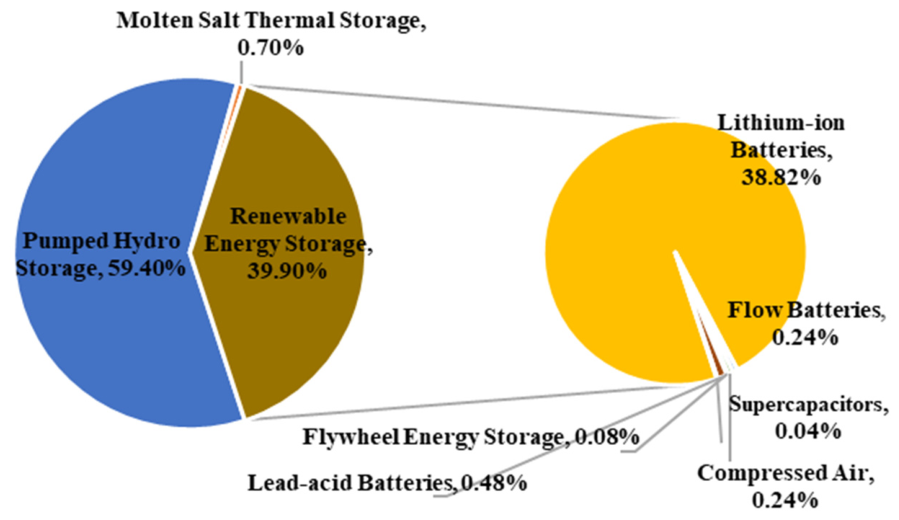
Driven by the rapid expansion of renewable energy deployment, the global emerging renewable energy storage industry has experienced remarkable growth in recent years. According to IRENA, the global cumulative installed energy storage capacity reached 237.2 GW in 2023, representing a 15% increase compared with the previous year. Pumped hydro storage remained the dominant technology, with a cumulative installed capacity of 191.5 GW, accounting for 80.7% of the total installed energy storage capacity. Among renewable energy storage technologies, lithium-ion batteries were overwhelmingly prevalent, with a cumulative installed capacity of 36.9 GW, accounting for 80.8% of the total renewable energy storage capacity and an annual growth rate of 85% (Figure 2). In 2023, China alone contributed 22.6 GW of emerging renewable energy storage capacity, accounting for 50.7% of the global annual additions, solidifying its position as the world’s largest energy storage market [34].

3.2.2. Electrochemical Energy Storage Technologies

A significant enhancement of renewable energy generation accommodation levels and the mitigation of the impact of renewable energy output on the grid are achievable through the use of electrochemical energy storage [57]. At present, batteries that are applicable for large-scale energy storage scenarios include lead-acid batteries, lithium-ion batteries, all-vanadium flow batteries, and sodium-sulfur batteries [35]. The key technical and economic indicators of batteries include operating temperature, energy density, energy conversion efficiency, rate (discharge) performance, depth of discharge, cycle life, and cost (Table 1).
High efficiency, long discharge times, numerous cycle counts, and rapid responses are significant advantages that have led to the widespread use of lithium-ion battery energy storage systems in the field of electrochemical energy storage [36]. Additionally, the ability of flow batteries to maintain a relatively stable output power and capacity allows for deep discharge without damaging the battery, thereby reducing the difficulty and cost associated with equipment maintenance and transformation, and contributing to their application value in intelligent energy storage stations [15].
The rapid deployment of renewable energy has made the selection of appropriate energy storage technologies a critical issue for future power systems. Given the significant differences among energy storage technologies in terms of safety, energy density, cycle life, cost, and application scenarios [37], a comprehensive techno-economic assessment is essential for identifying suitable storage solutions under different operating conditions. Moreover, the “Twenty-Five Key Requirements for Preventing Power Production Accidents (2022 Edition, Draft for Comment)” was issued by the National Energy Administration in July 2022, highlighting the increasing emphasis on operational safety. Consequently, this study focuses on three representative electrochemical energy storage technologies, namely lithium-ion batteries, sodium-ion batteries, and all-vanadium flow batteries. The following section systematically evaluates their technical characteristics, economic performance, and application potential through a comprehensive technical and economic feasibility analysis.

3.3. Technical and Economic Evaluation of Representative Energy Storage Technologies

3.3.1. Technical Characteristics and Performance Comparison

Lithium-Ion and Sodium-Ion Batteries
Lithium-ion batteries, a type of secondary battery, primarily function through the movement of lithium ions between the positive and negative electrodes [38]. During the charge and discharge cycles, Li+ ions are shuttled between the two electrodes, embedding and de-embedding: during charging, Li+ ions are de-embedded from the positive electrode, pass through the electrolyte, and are embedded into the negative electrode, which becomes lithium-rich; the process is reversed during discharge. Notably, the operation of sodium-ion batteries is based on the same principle as that of lithium-ion batteries [39].
Despite these similarities and the advantages of sodium-ion batteries in resource availability and safety, their large-scale deployment remains constrained by three key factors. First, the supply chain for materials specific to sodium-ion batteries, particularly hard-carbon anodes and cathode precursors, is still developing and lacks the maturity of the established lithium-ion industry [40]. Second, manufacturing scale-up, process optimization, and quality control experience remain limited, restricting economies of scale and increasing cost uncertainty [58]. Third, sodium-ion batteries currently exhibit lower practical energy density and lower initial Coulombic efficiency, which may increase system size and cost for applications demanding high energy density or compactness [59]. Further advancements in materials, cell design, and long-term durability are therefore essential for broader commercialization.
All-Vanadium Flow Batteries
In flow batteries, a secondary battery technology, the active materials are contained within a liquid electrolyte. This electrolyte is stored externally to the cell stack and is circulated through the stack by a pump, facilitating electrochemical reactions that enable the conversion between chemical and electrical energy, thereby achieving the storage and release of electrical energy [40,41]. Flow batteries can be classified into various technological pathways, such as all-vanadium, zinc/bromine, iron/chromium, organic, and others, depending on the active materials used [42,43]. Among these, the all-vanadium flow battery technology is the most advanced among these and has progressed to the stage of engineering application (Table 2).
Through the comparison of the performance of the aforementioned typical energy storage systems (Table 2), it is evident that lithium-ion batteries hold significant advantages in aspects such as charge-discharge efficiency, energy density, and power density. Furthermore, the safety performance of sodium-ion batteries is found to be superior to lithium-ion batteries, although enhancement is required in other performance metrics [44]. All-vanadium flow batteries, recognized as a typical long-duration energy storage technology, are distinguished by their high safety and long lifespan. However, they are characterized by very low energy density and high initial investment costs [45].

3.3.2. Economic Evaluation Methodology

Levelized Cost of Energy Model
The levelized cost of energy (LCOE) is a metric that represents the average cost per unit of energy generated by a project over its entire lifecycle, after the costs and the amount of electricity generated have been leveled out [60]. It is calculated by dividing the present value of the lifecycle costs by the present value of the lifecycle electricity generation. Accounting costs, such as depreciation of fixed assets, project operation costs, maintenance costs, financial expenses, and taxes, are encompassed within LCOE, as well as the opportunity cost of the capital invested in the project over the stipulated period (Table 3).
Levelized Cost of Storage Model
The levelized cost of storage (LCOS) can be described as the total lifecycle cost of an energy storage technology divided by its cumulative delivered energy or power, which reflects the internal average electricity price at the point where the net present value is zero, i.e., the investment’s break-even point [61]. The discounted cost per unit of discharge for a specific energy storage technology and application scenario is quantified by LCOS, considering all technical and economic parameters that impact the cost of discharge life [62]. It is comparable to the LCOE and serves as an appropriate tool for cost comparison among energy storage technologies [63]. The LCOS for various battery types is calculated for a 1 MW capacity energy storage system as follows in Table 4.

3.3.3. Economic Performance Comparison and Application Scenarios

From the calculations of the LCOE and the LCOS (Table 3 and Table 4), it is evident that lithium-ion batteries currently hold an advantage in terms of economic feasibility. However, constrained by equipment, production capacity, and high upfront investment (with the initial investment cost for all-vanadium flow batteries currently being approximately three times that of lithium-ion batteries), the lack of large-scale application continues to affect all-vanadium flow batteries [64]. The issue of high initial costs remains the biggest bottleneck for the large-scale commercial application of all-vanadium flow batteries. Nevertheless, it is also observed that all-vanadium flow batteries have experienced rapid development in recent times and possess the basic conditions and potential to compete with lithium-ion batteries in the energy storage market [65].
Overall, lithium-ion batteries exhibit the highest techno-economic competitiveness, with an efficiency of approximately 90%, power density of 1500–3000 W/kg, and LCOS of 440 CNY/kWh. These characteristics support their use in short-duration applications such as frequency regulation, forecast-error compensation, and curtailment reduction [66]. In the case study, the 10%/2 h lithium-ion configuration improved day-ahead forecast accuracy, ultra-short-term forecast accuracy, and correlation coefficient by 67%, 44%, and 18%, respectively. Sodium-ion batteries, with an efficiency of approximately 88% and LCOS of 840 CNY/kWh, are promising for peak shaving and remote microgrids where safety and resource availability are prioritized [14]. All-vanadium flow batteries, despite their higher initial investment, offer advantages for long-duration and multi-hour energy shifting because of their cycle life exceeding 10,000 cycles, independent scaling of power and energy capacities, and LCOS of 490 CNY/kWh. They are therefore particularly suitable for transmission deferral and renewable-energy accommodation in weak-grid regions.
For multi-day to seasonal balancing, pumped-hydro storage and hydrogen energy remain preferable because of their large capacity, long operational life, and technological maturity, as discussed in Section 3.4.4. These results indicate that storage technology selection should be based on the combined consideration of techno-economic performance, response time, storage duration, safety, and weak-grid requirements, rather than solely on LCOE or LCOS.

3.3.4. Sensitivity Analysis of Key Techno-Economic Parameters

The LCOE and LCOS results are strongly influenced by several key assumptions, including battery capital cost, cycle life, round-trip efficiency, discount rate, annual number of cycles, charging electricity price, and capacity degradation. However, the parameters in Table 2, Table 3 and Table 4 were compiled from heterogeneous literature, industry reports, and 2023–2024 bidding data; they represent technology-specific values rather than statistically independent observations from a common population. A uniform ±20% perturbation would therefore lack a rigorous statistical basis and could generate physically inconsistent configurations, because parameters such as cycle life, annual cycles, and calendar life are intrinsically interdependent, while round-trip efficiency is a technology-intrinsic characteristic.
Consequently, uncertainty was examined through a parameter-specific scenario approach: market-related variables (capital cost, O&M cost, discount rate) were allowed plausible scenario ranges, whereas technology-dependent parameters were held at representative, internally consistent values. This preserves physical consistency across the compared systems. For LCOE, the same market-related parameters exert the strongest influence: an increase in initial investment cost or discount rate directly elevates LCOE, while a longer cycle life (or higher annual energy throughput) reduces it [67]. For LCOS, the analysis confirms that capital cost and lifetime-related parameters remain the dominant drivers of variation; higher capital cost or discount rate, lower efficiency, and shorter effective life all increase LCOS [68]. In both metrics, these responses should be interpreted as scenario-based techno-economic outcomes rather than statistical confidence intervals. Overall, capital cost and battery lifetime-related parameters are the primary sources of uncertainty for both LCOE and LCOS.

3.4. Battery Energy Storage Solutions Based on Resource-Grid Coupling

3.4.1. Role of Energy Storage in Power Systems

In line with the dual-carbon strategy’s emphasis on improving renewable energy accommodation and system flexibility in resource-rich yet grid-constrained regions, the following subsections translate the preceding techno-economic findings into practical storage deployment approaches.
Being a flexible energy storage method, battery energy storage systems can effectively contribute to a reduction in wind and solar curtailment, a minimization of grid voltage fluctuations and network losses, and an assurance of load supply reliability in grids with a high proportion of renewable energy [69]. Once energy storage batteries are integrated into distribution networks that include renewable energy, an enhancement in renewable energy accommodation and dynamic reactive power reserves can be achieved, improvements in grid voltage and network losses can be realized, and an increase in load supply reliability can be attained, thereby effectively serving power sources, grids, and users [70]. Consequently, the impact of large-scale renewable energy grid integration on grid safety and operation and maintenance is alleviated, the output fluctuations of wind power and photovoltaic power generation are stabilized, and the grid’s ability to absorb renewable energy is enhanced [71].

3.4.2. Generation-Side Energy Storage Applications

There are two primary application scenarios for the configuration of energy storage on the power generation side. First, an enhancement in power transmission capacity and the proportion of renewable energy accommodation can be achieved, thereby leading to a reduction in the rate of electricity curtailment [72]. Second, power generation plans can be tracked, allowing for precise alignment of renewable energy generation with dispatch schedules [73,74], which in turn improves metrics such as the accuracy of power prediction and facilitates the integration of renewable energy generation into the grid.
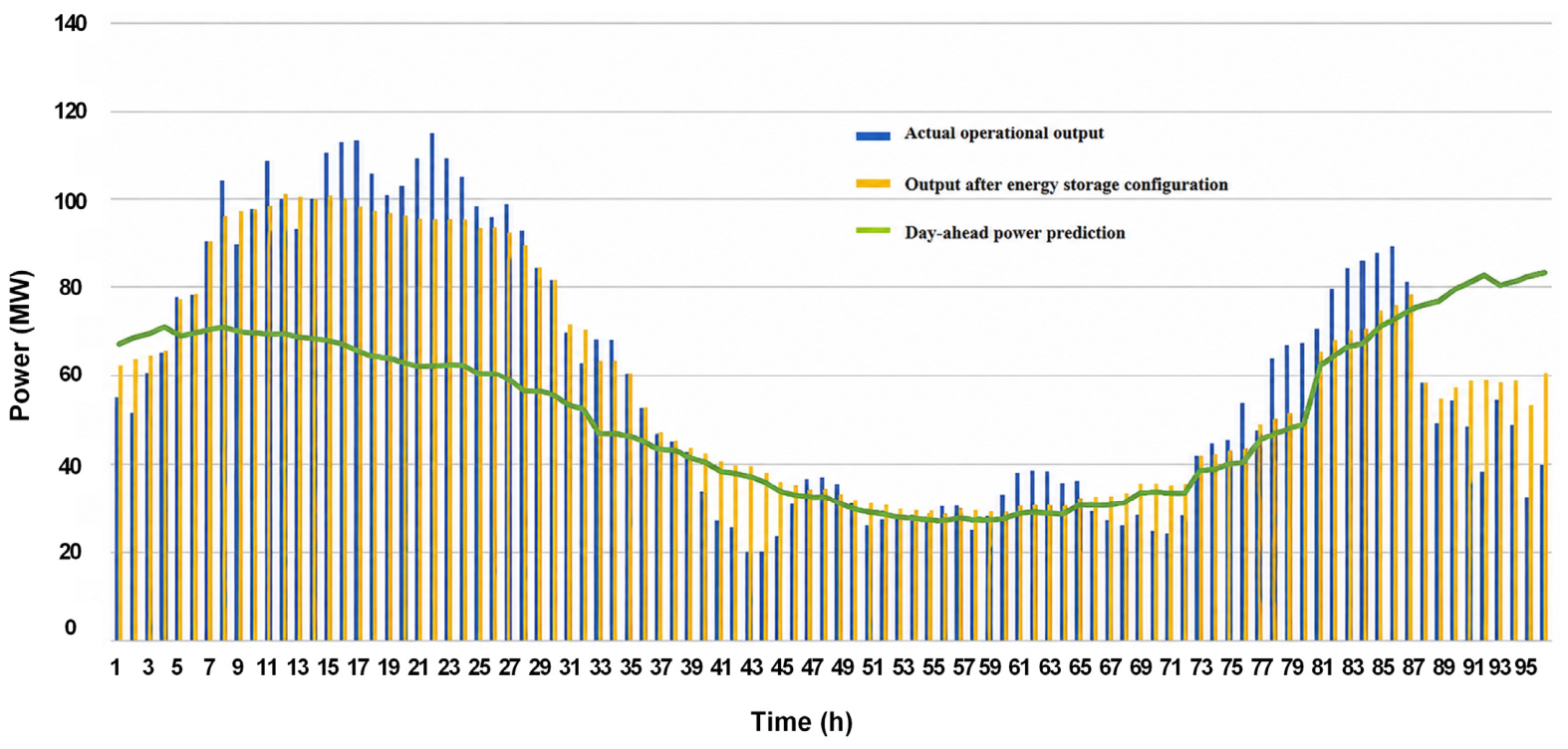
In new energy projects, the appropriate configuration of renewable energy storage enables the storage to be charged when actual operational data surpasses day-ahead forecast values, and discharged when actual operational data is below day-ahead forecast values [75,76]. This approach ensures that the actual electricity delivered to the grid is as close as possible to the day-ahead forecast values. This article examines the differences in power prediction under the scenario of a power generation-side energy storage configuration, utilizing operational data from a typical mountainous wind power project in Southwest China. The results indicate that after the implementation of a 10%/2 h energy storage system, the day-ahead power prediction accuracy, ultra-short-term accuracy, and correlation coefficient of the project saw increases of 67%, 44%, and 18%, respectively (Figure 3). In this process, the storage system actively interacts with renewable generation by absorbing excess power when actual output exceeds the forecast and releasing power when actual output is below the forecast. Under the transmission constraints typical of weak-grid regions, this real-time compensation simultaneously reduces curtailment risk and improves the quality of power delivered to the grid, thereby realizing source-grid coordination at the generation side.

3.4.3. Hybrid Energy Storage Design for Photovoltaic Power Plants

Based on wind and photovoltaic power output forecasting and optimal scheduling of energy storage charging and discharging, the configuration of energy storage systems in wind and solar power plants enables effective smoothing of renewable energy generation output. This approach not only satisfies grid connection requirements but also enhances the overall capacity for renewable energy integration [77]. Surplus wind and photovoltaic power can also be stored during periods of curtailment and released when demand increases. This process further improves the utilization of renewable energy [78].
Existing photovoltaic power plants often suffer from limitations such as the uniform type of energy storage devices and their predominant installation on the AC-side busbar. To overcome these issues, this study proposes a hybrid energy storage configuration. In terms of hardware arrangement, high-power-density and long-cycle-life storage units (typically lithium-ion or advanced sodium-ion batteries) are installed on the AC side of the photovoltaic plant, while high-energy-density storage units (typically all-vanadium flow batteries or energy-oriented lithium-ion systems) are installed on the DC side.
The corresponding control strategy follows a hierarchical, priority-based logic. Specifically, the AC side should be selected for its high power density and long cycle life. Its primary role is to provide system primary frequency regulation, while also aiding the DC-side storage in energy charging and discharging. Conversely, the DC-side energy storage should prioritize high energy density, primarily handling energy shifting for the photovoltaic plant and participating in primary frequency regulation only when the AC-side storage capacity is insufficient [79]. This functional allocation and priority-based dispatch minimize the number of deep cycles experienced by the energy-oriented DC-side devices, thereby extending their calendar and cycle life while still meeting grid-code requirements for frequency support and energy management. This hybrid design is consistent with the hierarchical source-grid-load-storage coordination framework described. The AC-side units respond first to grid frequency and voltage signals under weak-grid conditions, while the DC-side units perform longer-duration energy shifting to support local load balancing and alleviate transmission bottlenecks, thereby achieving coordinated interaction among generation, grid constraints, and demand.

3.4.4. Pumped Hydro Storage and Hydrogen Energy

Additionally, among the various types of energy storage, pumped hydro storage currently stands as the most mature, safest, and economically viable technology with the greatest potential for large-scale development [80]. It is characterized by advantages such as large storage capacity, long operational life, and technological maturity [81]. Given the natural advantage presented by the overlap of renewable energy resource-rich areas and hydropower resource-rich areas in the Southwest region [82], a focus should be placed on the deployment of pumped hydro storage power plants on the power generation side. The deployment of these power plants allows for the mitigation of the intermittency, randomness, and volatility of renewable energy generation at the generation side, thereby providing a stable power supply for the grid. In parallel with the development of the hydrogen energy industry, the consideration of deploying hydrogen utilization pilot projects is recommended to achieve a local accommodation of renewable energy generation and alleviate the pressure on grid transmission [83]. In China’s power system, hydrogen energy storage is particularly promising for multi-day to seasonal energy shifting and long-duration balancing in renewable-rich but weak-grid regions, especially the “Three Norths” and Southwest [29]. By converting surplus wind and solar power into hydrogen via electrolysis during periods of high generation and curtailment risk, and later converting it back to electricity or using it for industrial feedstock and transport, hydrogen can complement short-duration electrochemical storage and pumped hydro [84].

4. Outlook

As renewable-energy development increasingly expands into resource-rich but weak-grid regions, energy storage will play an increasingly important role in supporting the transition toward a flexible and resilient power system. Future development should focus on technology–application matching rather than pursuing a single dominant storage technology. Lithium-ion, sodium-ion, and all-vanadium flow batteries should be deployed according to differences in efficiency, cost, safety, cycle life, and storage duration, while grid-forming storage is expected to become increasingly important for maintaining voltage and frequency stability under high penetration of inverter-based renewable generation [70]. From a policy perspective, the large-scale deployment of energy storage requires a transition from capacity-oriented support toward market-based compensation for multiple system services. Mechanisms for capacity payments, ancillary services, renewable-energy integration, and energy arbitrage should be further improved to provide appropriate revenue streams for storage projects. Meanwhile, differentiated policies should account for regional differences in renewable resources, grid constraints, and storage requirements, thereby reducing inefficient investment and improving the utilization of energy-storage assets.
Future research should further develop source–grid–load–storage co-optimization frameworks that integrate storage capacity and power rating, operational scheduling, renewable curtailment, investment costs, transmission constraints, and system reliability [23,25]. Incorporating battery degradation, renewable and load uncertainties, and electricity-market mechanisms will enable more realistic techno-economic assessments. Such integrated approaches can provide stronger decision support for the cost-effective and reliable deployment of energy storage in renewable-rich and weak-grid regions.

5. Conclusions

This study systematically evaluated the techno-economic performance of lithium-ion, sodium-ion, and all-vanadium flow batteries for energy storage applications in renewable-rich weak-grid regions. The quantitative results show that lithium-ion batteries currently offer the best overall techno-economic performance, with LCOE and LCOS values of 670 and 440 CNY kWh−1, respectively, compared with 660 and 840 CNY kWh−1 for sodium-ion batteries and 690 and 490 CNY kWh−1 for all-vanadium flow batteries. In addition, a 10%/2 h lithium-ion storage system co-located with a mountainous wind farm improved day-ahead power prediction accuracy by 67%, ultra-short-term accuracy by 44%, and the correlation coefficient by 18%.
These findings indicate that lithium-ion batteries are most suitable for short-duration, high-efficiency applications such as frequency regulation, forecast-error compensation, and curtailment reduction; all-vanadium flow batteries are preferable for long-duration energy shifting and transmission deferral; sodium-ion batteries are appropriate for peak-shaving and remote microgrid support where safety and resource availability are critical; and pumped-hydro storage together with hydrogen energy remain the primary options for large-scale seasonal balancing. Practical deployment should therefore prioritize co-locating short-duration lithium-ion systems on the generation side to enhance forecast accuracy and reduce curtailment, while hybrid AC/DC-side architectures are recommended for large photovoltaic plants to allocate frequency-regulation and energy-shifting duties according to the complementary strengths of different storage technologies.
Overall, the quantitative techno-economic ranking (lithium-ion currently superior, sodium-ion and vanadium flow batteries promising for future long-duration applications) and the demonstrated improvements in power prediction accuracy directly address the operational bottlenecks that hinder the realization of China’s dual-carbon goals in weak-grid renewable bases. By providing a clear linkage between national policy requirements, technology selection criteria, and site-specific configuration strategies, this work offers a practical pathway for accelerating cost-effective and reliable renewable energy integration under the new power system framework. A hierarchical source-grid-load-storage coordination framework with priority-based dispatch logic has been proposed to clarify how storage interacts with renewable generation, grid constraints, and load demand.

Author Contributions

Conceptualization, H.W. and L.Y.; methodology, H.W.; writing—original draft preparation, H.W.; writing—review and editing, H.W. and L.Y. All authors have read and agreed to the published version of the manuscript.

Funding

This research was funded by Natural Science Foundation of Beijing Municipality, grant number L259037; Project on Eco-Environmental Technologies for Carbon Peaking and Carbon Neutrality, Research Center for Eco-Environmental Sciences, Chinese Academy of Sciences, grant number RCEES-TDZ-2021-13.

Data Availability Statement

The data presented in this study are available on request from the corresponding author.

Conflicts of Interest

Author Huan Wang was employed by the company Yalong River Hydropower Development Co., Ltd. The remaining authors declare that the research was conducted in the absence of any commercial or financial relationships that could be construed as a potential conflict of interest.

References

  1. Xi, J. Statement by H.E. Xi Jinping President of the People’s Republic of China at the General Debate of the 75th Session of the United Nations General Assembly. 22 September 2020. Available online: https://www.mfa.gov.cn/eng/xw/zyjh/202405/t20240530_11341451.html (accessed on 22 September 2020).
  2. Yang, Y.; Lo, K. China’s renewable energy and energy efficiency policies toward carbon neutrality: A systematic cross-sectoral review. Energy Environ. 2024, 35, 491–509. [Google Scholar] [CrossRef] [Scilit]
  3. Zhang, A.H.; Sirin, S.M. Overall review of distributed photovoltaic development in China: Process, dynamic, and theories. Glob. Sustain. 2024, 7, e28. [Google Scholar] [CrossRef] [Scilit]
  4. Wang, T.; Wang, Y.; Wang, K.; Fu, S.; Ding, L. Five-dimensional assessment of China’s centralized and distributed photovoltaic potential: From solar irradiation to CO2 mitigation. Appl. Energy 2024, 356, 122326. [Google Scholar] [CrossRef] [Scilit]
  5. State Council Information Office of the People’s Republic of China. China’s Energy Transition [White Paper]. 2024. Available online: https://english.scio.gov.cn/whitepapers/2024-08/29/content_117394316.htm (accessed on 29 August 2024).
  6. Manjula, A.; Niraimathi, R.; Rajarajeswari, M.; Chitra Devi, S. Grid integration of renewable energy sources: Challenges and solutions. In Green Machine Learning and Big Data for Smart Grids: Practices and Applications; Elsevier: Amsterdam, The Netherlands, 2025; pp. 263–286. [Google Scholar] [CrossRef] [Scilit]
  7. Li, M.; Li, F.; Qiu, J.; Zhou, H.; Wang, H.; Lu, H.; Zhang, N.; Song, Z. Multi-Objective Optimization of Non-Fossil Energy Structure in China towards the Carbon Peaking and Carbon Neutrality Goals. Energy 2024, 312, 133643. [Google Scholar] [CrossRef] [Scilit]
  8. Zahid, H.; Zulfiqar, A.; Adnan, M.; Iqbal, M.S.; Shah, A.; Mohamed, S.E.G. Global renewable energy transition: A multidisciplinary analysis of emerging computing technologies, socio-economic impacts, and policy imperatives. Results Eng. 2025, 26, 105258. [Google Scholar] [CrossRef] [Scilit]
  9. Eltohamy, M.S.; Aldawsari, M.M.S.; Sadek, A.R.A.; Hegazy, H.Y.A.; Ahmed, I.; Alsenani, T.R. Enhancing Electric Grid Flexibility for the ntegration of Variable Renewable Energy: Challenges, Innovations, and Future Directions. IEEE Access 2026, 14, 23080–23102. [Google Scholar] [CrossRef] [Scilit]
  10. Sakib, S.; Hossain, M.B.; Zamee, M.A.; Hossain, M.J.; Habib, M.A. Role of battery energy storage systems: A comprehensive review on renewable energy zones integration in weak transmission networks. J. Energy Storage 2025, 128, 117223. [Google Scholar] [CrossRef] [Scilit]
  11. Laimon, M. Renewable energy curtailment: A problem or an opportunity? Results Eng. 2025, 26, 104925. [Google Scholar] [CrossRef] [Scilit]
  12. Xu, Y.; Pei, J.; Cui, L.; Liu, P.; Ma, T. The Levelized Cost of Storage of Electrochemical Energy Storage Technologies in China. Front. Energy Res. 2022, 10, 873800. [Google Scholar] [CrossRef] [Scilit]
  13. Zhu, Y.; Shao, Y.; Ni, Y.; Li, Q.; Wang, K.; Zang, P.; Ding, Y.; Zheng, C.; Zhang, L.; Gao, X. Comparative techno-economic evaluation of energy storage technology: A multi-time scales scenario-based study in China. J. Energy Storage 2024, 89, 111800. [Google Scholar] [CrossRef] [Scilit]
  14. Liu, T.; Zhang, Y.; Jiang, Z.; Zeng, X.; Ji, J.; Li, Z.; Gao, X.; Sun, M.; Ling, M.; Zheng, J.; et al. Exploring competitive features of stationary sodium ion batteries for electrochemical energy storage. Energy Environ. Sci. 2019, 12, 1512–1533. [Google Scholar] [CrossRef] [Scilit]
  15. Ahmed, R.; Sharma, S.; Dhandapani, S.; Thumar, A.; Kamalanathan, R.; Iranzo, A.; Kauranen, P.; Chinnasamy, C.; Kannan, A.M. Bipolar plate flow channel designs for vanadium redox flow battery: A review. J. Power Sources 2026, 665, 239101. [Google Scholar] [CrossRef] [Scilit]
  16. Arbabzadeh, M.; Sioshansi, R.; Johnson, J.X.; Keoleian, G.A. The role of energy storage in deep decarbonization of electricity production. Nat. Commun. 2019, 10, 3413. [Google Scholar] [CrossRef] [Scilit] [PubMed]
  17. Peng, L.; Mauzerall, D.L.; Zhong, Y.D.; He, G. Heterogeneous effects of battery storage deployment strategies on decarbonization of provincial power systems in China. Nat. Commun. 2023, 14, 4858. [Google Scholar] [CrossRef] [Scilit] [PubMed]
  18. Chen, L.; Gao, L.; Xing, S.; Chen, Z.; Wang, W. Zero-carbon microgrid: Real-world cases, trends, challenges, and future research prospects. Renew. Sustain. Energy Rev. 2024, 203, 114720. [Google Scholar] [CrossRef] [Scilit]
  19. Elazab, R.; Dahab, A.A.; Adma, M.A.; Hassan, H.A. Reviewing the frontier: Modeling and energy management strategies for sustainable 100% renewable microgrids. Discov. Appl. Sci. 2024, 6, 168. [Google Scholar] [CrossRef] [Scilit]
  20. Nkambule, M.S.; Hasan, A.N.; Shongwe, T. A review of intelligent control strategies for energy management systems in microgrids. Energy Convers. Manag. X 2025, 28, 101323. [Google Scholar] [CrossRef] [Scilit]
  21. Yu, T. Electric energy replacement technology for new energy consumption. Mod. Ind. Econ. Inform. 2022, 12, 313–314. [Google Scholar] [CrossRef]
  22. Zhou, Y.; He, H.; Zhang, S.; Yu, F.; Yi, B. Impact of renewable energy resource endowment on capacity configuration optimization for wind-solar-storage-transmission systems. Energy Convers. Manag. X 2026, 31, 101957. [Google Scholar] [CrossRef] [Scilit]
  23. Song, C.; Wu, J.; Yang, H.; Zhao, D.; Wan, J.; Bai, J. Coordinated scheduling strategy for source-grid-load-storage integrated system considering frequency dynamic security constraint in a 100% renewable energy scenario. IET Gener. Transm. Distrib. 2025, 19, e70096. [Google Scholar] [CrossRef] [Scilit]
  24. Zhao, W.; Cui, J. Optimal allocation of renewable power sources for outbound supporting in trans-regional power transmission of China. Renew. Energy 2026, 265, 125645. [Google Scholar] [CrossRef] [Scilit]
  25. Guo, S.; Wang, C.; Ma, Z.; Zhang, Y.; Qin, Z.; Yan, J.; Qiao, Y. Geographic information system-based closed-loop co-optimization of site-capacity-operation for multi-energy complementary bases. Energy 2026, 347, 140398. [Google Scholar] [CrossRef] [Scilit]
  26. Chen, J.; Shen, J.; Zhang, S.; Wang, R.; Zhen, Z.; Wang, C.; Cai, W. Solar and wind power plant site selection in China: Machine learning-based regional and temporal probability. Appl. Energy 2026, 402, 127033. [Google Scholar] [CrossRef] [Scilit]
  27. Fan, Y.; Zhong, P.; Zhu, F.; Mo, R.; Wang, H.; Wei, J.; Zeng, Y.; Wang, B.; Qian, X. Assessing the potential and complementary characteristics of China’s solar and wind energy under climate change. Renew. Energy 2025, 249, 123213. [Google Scholar] [CrossRef] [Scilit]
  28. Li, M.; Han, C.; Meng, L.; Liu, P. Spatiotemporal dynamics and factors of renewable energy mismatch in China. Renew. Sustain. Energy Rev. 2025, 212, 115424. [Google Scholar] [CrossRef] [Scilit]
  29. Tang, W.; Qi, J.; Wang, Y.; He, J. Dense station-based potential assessment for solar photovoltaic generation in China. J. Clean. Prod. 2023, 414, 137607. [Google Scholar] [CrossRef] [Scilit]
  30. Akinyele, D.O.; Rayudu, R.K. Review of energy storage technologies for sustainable power networks. Sustain. Energy Technol. Assess. 2014, 8, 74–91. [Google Scholar] [CrossRef] [Scilit]
  31. Qiu, W.; Wang, M.; Lin, Z.; Yang, L.; Wang, L.; Sun, J. Comprehensive evaluation of shared energy storage towards new energy accommodation scenario under targets of carbon emission peak and carbon neutrality. Electr. Power Autom. Equip. 2021, 41, 244–255. [Google Scholar] [CrossRef]
  32. Jiang, P.; Zhang, H.; Li, M.; Zhang, Y.; Gong, X.; He, D.; Liu, L. Research on the structural optimization of the clean energy industry in the context of dual carbon strategy—A case study of Sichuan Province, China. Sustainability 2023, 15, 2993. [Google Scholar] [CrossRef] [Scilit]
  33. Hu, Y.; Huang, W.; Wang, J.; Chen, S.; Zhang, J. Current status, challenges, and perspectives of Sichuan’s renewable energy development in Southwest China. Renew. Sustain. Energy Rev. 2016, 57, 1373–1385. [Google Scholar] [CrossRef] [Scilit]
  34. IEA. Statistical Report on Renewable Energy Installed Capacity in 2023; IEA: Paris, France, 2023. [Google Scholar]
  35. Ratshitanga, M.; Ayeleso, A.; Krishnamurthy, S.; Rose, G.; Moussavou, A.A.A.; Adonis, M. Battery storage use in the value chain of power systems. Energies 2024, 17, 921. [Google Scholar] [CrossRef] [Scilit]
  36. Vega-Muratalla, V.O.; Serrano-Arévalo, T.I.; Ochoa-Barragán, R.; Lira-Barragán, L.F.; Ramírez-Márquez, C.; El-Halwagi, M.M.; Ponce-Ortega, J.M. Recent advances and engineering challenges of lithium batteries for grid-level energy storage: A review. Ind. Eng. Chem. Res. 2025, 65, 1424–1447. [Google Scholar] [CrossRef] [Scilit]
  37. Khosravani, A.; Sieving, J.K.; Billings, B.W.; Powell, K.M. Techno-economic analysis of long-duration energy storage integrated with high-penetration renewable energy systems. Energy Rep. 2025, 14, 4086–4110. [Google Scholar] [CrossRef] [Scilit]
  38. Wang, Y.; Wang, Y.; Wutian, Y.; Feng, G.; Peng, J.; Chen, T. Stress-induced challenges in sodium-ion battery layered oxide cathodes: Damage mechanisms and mitigation approaches. Energy Storage Mater. 2026, 84, 104857. [Google Scholar] [CrossRef] [Scilit]
  39. Hakim, C.; Sabi, N.; Saadoune, I. Mixed structures as a new strategy to develop outstanding oxides-based cathode materials for sodium ion batteries: A review. J. Energy Chem. 2021, 61, 47–60. [Google Scholar] [CrossRef] [Scilit]
  40. Cai, X.; Yue, Y.; Yi, Z.; Liu, J.; Sheng, Y.; Lu, Y. Challenges and industrial perspectives on the development of sodium ion batteries. Nano Energy 2024, 129, 110052. [Google Scholar] [CrossRef] [Scilit]
  41. Guo, Y.; Huang, J.; Feng, J.-K. Research progress in preparation of electrolyte for all-vanadium redox flow battery. J. Ind. Eng. Chem. 2023, 118, 33–43. [Google Scholar] [CrossRef] [Scilit]
  42. Du, B.; Ji, Y.; Niu, F.; Zhu, Z.; Zhang, Y.; Huang, X.; Jiang, Y.; Jiang, L.; Lv, H.; Ji, D.; et al. Recent advances in flow field of vanadium redox flow batteries: Structure, performance and prospect. Renew. Sustain. Energy Rev. 2026, 237, 117015. [Google Scholar] [CrossRef] [Scilit]
  43. Joseph, A.; Mathew, S. Ionic Liquid-Based Redox Flow Batteries. In Handbook of Energy Materials; Gupta, R., Ed.; Springer: Singapore, 2025. [Google Scholar] [CrossRef] [Scilit]
  44. Zheng, Q.; Shi, X.; Cai, Y.; An, L.; Zhang, D. Artificial intelligence-empowered modeling and management of flow batteries: A mini-review. Future Batter. 2025, 7, 100107. [Google Scholar] [CrossRef] [Scilit]
  45. Brimaud, S.; Marinaro, M.; Bischof, K.; Waldmann, T.; Jörissen, L.; Wohlfahrt-Mehrens, M.; Hölzle, M.; Böse, O. Comparative safety assessment of industrially produced Na-ion and Li-ion 20 Ah prismatic cells. J. Electrochem. Soc. 2025, 172, 070521. [Google Scholar] [CrossRef] [Scilit]
  46. Shan, R.; Kittner, N. Allocation of policy resources for energy storage development considering the Inflation Reduction Act. Energy Policy 2024, 184, 113861. [Google Scholar] [CrossRef] [Scilit]
  47. Carlini, E.M.; Schroeder, R.; Birkebæk, J.M.; Massaro, F. EU transition in power sector: How RES affects the design and operations of transmission power systems. Electr. Power Syst. Res. 2019, 169, 74–91. [Google Scholar] [CrossRef] [Scilit]
  48. Ellabban, O.; Alassi, A. Optimal hybrid microgrid sizing framework for the mining industry with three case studies from Australia. IET Renew. Power Gener. 2021, 15, 409–423. [Google Scholar] [CrossRef] [Scilit]
  49. Ge, Y.; Yong, M.; Zeng, X.; Xing, C.; Wang, Z.; Yang, J.; Luo, B.; Zhang, X. Biomass-derived materials for advanced vanadium redox flow batteries. Mater. Futures 2025, 4, 042104. [Google Scholar] [CrossRef] [Scilit]
  50. Wang, F.; Xue, Y. A review of the development of the energy storage industry in China: Challenges and opportunities. Energies 2025, 18, 1512. [Google Scholar] [CrossRef] [Scilit]
  51. Elalfy, D.A.; Gouda, E.; Kotb, M.F.; Bureš, V.; Sedhom, B.E. Comprehensive review of energy storage systems technologies, objectives, challenges, and future trends. Energy Strategy Rev. 2024, 54, 101482. [Google Scholar] [CrossRef] [Scilit]
  52. Koohi-Fayegh, S.; Rosen, M.A. A review of energy storage types, applications and recent developments. J. Energy Storage 2020, 27, 101047. [Google Scholar] [CrossRef] [Scilit]
  53. Areola, R.I.; Adebiyi, A.A.; Moloi, K. Integrated Energy Storage Systems for Enhanced Grid Efficiency: A Comprehensive Review of Technologies and Applications. Energies 2025, 18, 1848. [Google Scholar] [CrossRef] [Scilit]
  54. Hossain, E.; Faruque, H.M.R.; Sunny, M.S.H.; Sami, N.M.; Nawar, N. A comprehensive review on energy storage systems: Types, comparison, current scenario, applications, barriers, and potential solutions, policies, and future prospects. Energies 2020, 13, 3651. [Google Scholar] [CrossRef] [Scilit]
  55. Enasel, E.; Dumitrascu, G. Storage solutions for renewable energy: A review. Energy Nexus 2025, 17, 100391. [Google Scholar] [CrossRef] [Scilit]
  56. Zhao, H.; Xu, Y. Site selection evaluation of pumped storage power station based on multi-energy complementary perspective: A case study in China. Energies 2025, 18, 3549. [Google Scholar] [CrossRef] [Scilit]
  57. Liu, L.; Liu, F.; Ji, P.; Lin, W.; Zhang, X.; Tian, X.; Gao, F. Research on optimal control strategy of energy storage for improving new energy consumption. Electr. Power 2023, 56, 137–143. [Google Scholar] [CrossRef]
  58. Cui, Z.; Liu, C.; Manthiram, A. A perspective on pathways toward commercial sodium-ion batteries. Adv. Mater. 2025, 37, 2420463. [Google Scholar] [CrossRef] [Scilit] [PubMed]
  59. Singh, J.; Mallick, S.S.; Pal, B.; Gupta, K.K.; Roy, S. Overview on Sodium Ion Batteries: Anode, Cathode, and Electrolytes. ChemistrySelect 2025, 10, e05643. [Google Scholar] [CrossRef] [Scilit]
  60. Nikoobakht, A.; Aghaei, J.; Shafie-Khah, M.; Cataláo, J.P.S. Assessing increased flexibility of energy storage and demand response to accommodate a high penetration of renewable energysources. IEEE Trans. Sustain. Energy 2019, 10, 659–669. [Google Scholar] [CrossRef] [Scilit]
  61. Martín-Barrera, G.; Zamora-Ramírez, C.; González-González, J.M. Application of real options valuation for analysing the impact of public R&D financing on renewable energy projects: A company’s perspective. Renew. Sustain. Energy Rev. 2016, 63, 292–301. [Google Scholar] [CrossRef] [Scilit]
  62. Schmidt, O.; Melchior, S.; Hawkes, A.; Staffell, I. Projecting the future levelized cost of electricity storage technologies. Joule 2019, 3, 81–100. [Google Scholar] [CrossRef] [Scilit]
  63. Schmidt, O.; Hawkes, A.; Gambhir, A.; Staffell, I. The future cost of electrical energy storage based on experience rates. Nat. Energy 2017, 2, 17110. [Google Scholar] [CrossRef] [Scilit]
  64. Huang, Z.; Mu, A.; Wu, L.; Yang, B.; Qian, Y.; Wang, J. Comprehensive analysis of critical issues in all-vanadium redox flow battery. ACS Sustain. Chem. Eng. 2022, 10, 7786–7810. [Google Scholar] [CrossRef] [Scilit]
  65. Akman, A.L.; Arslan, M.Z.; Farsak, M. The rise of vanadium redox flow batteries: A game-changer in energy storage. J. Alloys Compd. 2025, 1038, 182869. [Google Scholar] [CrossRef] [Scilit]
  66. Zhao, C.; Andersen, P.B.; Træholt, C.; Hashemi, S. Grid-connected battery energy storage system: A review on application and integration. Renew. Sustain. Energy Rev. 2023, 182, 113400. [Google Scholar] [CrossRef] [Scilit]
  67. Obi, M.; Jensen, S.M.; Ferris, J.B.; Bass, R.B. Calculation of levelized costs of electricity for various electrical energy storage systems. Renew. Sustain. Energy Rev. 2017, 67, 908–920. [Google Scholar] [CrossRef] [Scilit]
  68. Luerssen, C.; Verbois, H.; Gandhi, O.; Reindl, T.; Sekhar, C.; Cheong, D. Global sensitivity and uncertainty analysis of the levelised cost of storage (LCOS) for solar-PV-powered cooling. Appl. Energy 2021, 286, 116533. [Google Scholar] [CrossRef] [Scilit]
  69. Zhou, Y.; Huang, S.; Xiong, L.; Chen, Q.; Gao, F.; Huang, W.; Li, Y.; Cao, Y. Multi-type energy storage modeling and large-scale allocation method for high-penetrated renewable energy transmission networks. J. Energy Storage 2025, 134, 118245. [Google Scholar] [CrossRef] [Scilit]
  70. Kang, Y.; Li, Z.; You, L.; Cai, X.; Feng, B.; Hu, Y.; Zou, H. Coordinated control strategy for active–reactive power in high-proportion renewable energy distribution networks with the participation of grid-forming energy storage. Processes 2025, 13, 3271. [Google Scholar] [CrossRef] [Scilit]
  71. Chen, Y.; Chen, Y.; Jia, Y.; Zhang, Q.; Zheng, Z.; Jiang, S.; Li, J.; Xiong, S. Optimization and operation strategy for energy storage configurations in high-proportion clean energy systems considering both supply reliability and energy utilization. Energy Storage Sci. Technol. 2025, 14, 2043–2056. [Google Scholar] [CrossRef]
  72. Wen, L.; Zhang, Y.; Jiang, W. Bi-level capacity optimization model of a wind-photovoltaic-storage energy system considering seasonal hydrogen storage. J. Energy Storage 2025, 132, 117741. [Google Scholar] [CrossRef] [Scilit]
  73. Guo, M.; Ren, M.; Chen, J.; Cheng, L.; Yang, Z. Tracking photovoltaic power output schedule of the energy storage system based on reinforcement learning. Energies 2023, 16, 5840. [Google Scholar] [CrossRef] [Scilit]
  74. Feng, Y.; Wei, W.; Tian, Y.; Mei, S. Integrating day-ahead unit commitment and real-time dispatch for a bulk renewable-thermal-storage generation base. J. Energy Storage 2024, 93, 112074. [Google Scholar] [CrossRef] [Scilit]
  75. Galvan, E.; Mandal, P.; Tseng, B.; Velez-Reyes, M. Energy storage dispatch using adaptive control scheme considering wind-PV in smart distribution network. In Proceedings of the 47th North American Power Symposium (NAPS), Charlotte, NC, USA, 4–6 October 2015. [Google Scholar] [CrossRef] [Scilit]
  76. Manojkumar, R.; Kumar, C.; Ganguly, S.; Catalão, J.P.S. Net load forecast error compensation for peak shaving in a grid-connected PV storage system. IEEE Trans. Power Syst. 2024, 39, 4372–4381. [Google Scholar] [CrossRef] [Scilit]
  77. Wang, Z.; Xu, C.; Yu, B.; Liao, Z.; Peng, H.; Niu, D. Multi-objective optimization of capacity configuration in a wind–PV–compressed air energy storage hybrid system. Energy 2025, 332, 137097. [Google Scholar] [CrossRef] [Scilit]
  78. Tan, Q.; Wang, Y.; Wen, X.; Qiao, L.; Wang, Z. Cross-regional peak-shaving scheduling for the hybrid pumped storage-wind-photovoltaic complementary system. Energy 2025, 326, 136119. [Google Scholar] [CrossRef] [Scilit]
  79. Wu, X.; Tang, Z.; Stroe, D.-I.; Kerekes, T. Dual-level design for cost-effective sizing and power management of hybrid energy storage in photovoltaic systems. Green Energy Intell. Transp. 2025, 4, 100194. [Google Scholar] [CrossRef] [Scilit]
  80. Yang, W.; Zhao, Z.; Pérez-Díaz, J.I.; Hunt, J.D.; Vagnoni, E.; Nøland, J.K.; Quaranta, E.; Wang, R.; Li, X.; Cheng, Y. Pumped storage hydropower operation for supporting clean energy systems. Nat. Rev. Clean Technol. 2025, 1, 454–473. [Google Scholar] [CrossRef] [Scilit]
  81. Wang, R.; Zhang, L.; Shi, C.; Zhao, C. A review of gravity energy storage. Energies 2025, 18, 1812. [Google Scholar] [CrossRef] [Scilit]
  82. Zhu, Z.; Mao, H.; Zhang, S.; He, X.; Zhang, D. Spatially resolved modeling of pumped storage and hydropower for China’s carbon neutrality. Energy Environ. Sci. 2026, 19, 906–925. [Google Scholar] [CrossRef] [Scilit]
  83. Brahim, T.; Jemni, A. Green hydrogen production: A review of technologies, challenges, and hybrid system optimization. Renew. Sustain. Energy Rev. 2026, 225, 116194. [Google Scholar] [CrossRef] [Scilit]
  84. Sepulveda, N.A.; Jenkins, J.D.; Edington, A.; Mallapragada, D.S.; Lester, R.K. The design space for long-duration energy storage in decarbonized power systems. Nat. Energy 2021, 6, 506–516. [Google Scholar] [CrossRef] [Scilit]
Figure 1. Research process and technical procedures.
Energies 19 04091 g001
Figure 2. Cumulative installed capacity distribution of energy storage projects in China by the end of 2023.
Energies 19 04091 g002
Figure 3. Comparison of predicted and actual wind power generation after the integration of a 10%/2 h energy storage system.
Energies 19 04091 g003
Table 1. Primary technical and economic indicators of various battery types.
IndicatorsLithium Iron Phosphate BatteryTernary Lithium-Ion BatteryFlow BatterySodium-Sulfur BatteryLead-Carbon Battery
Operating Temperature (°C)−20~55−30~50−30~50300~3505~35
Energy Density (Wh/kg)160~180150~20025~35>10030~40
Energy Conversion Efficiency (%)>80>9070~8070~8060~70
Rate (Discharge) Performance (C)0.5~10.5~12~50.1~0.50.1~0.3
Depth of Discharge (%)>95100100>90<70
Cycle Life (Cycles)5000~10,0001000~200020,0003500300
Cost (CNY/kWh)6501000800750700
Note: Technical and economic indicators were compiled from peer-reviewed literature and industry reports [35,36,37].
Table 2. Comparison of performance of typical energy storage systems.
MetricsLithium-Ion BatterySodium-Ion BatteryAll-Vanadium Flow Battery
Charge-discharge efficiency90%88%75–85%
Energy density (Wh/kg)80–30014512–40
Power density (W/kg)1500–3000200050–100
Calendar life5–10 yearsApproximately 10 years10–20 years
Cycle life1000–10,000 cycles6000 cycles>10,000 cycles
Unit investment cost1200–2400 CNY/kWh1500 CNY/kWh2500–3900 CNY/kWh
AdvantagesHigh energy density, high efficiencyEnvironmentally friendly, low cost, safe, wide range of raw material sourcesHigh safety, long cycle life, recyclable, abundant raw material resources, low life-cycle cost
DisadvantagesPoor safety, high external dependence on lithium resourcesLow voltage window, side reactions of electrode materials significantly affect the lifespanLow energy density, high initial
installation cost
Note: The technical and economic parameters were compiled from recent peer-reviewed literature and industry reports [42,43,44,45,46,47,48,49] and represent representative values or ranges rather than data from a single source.
Table 3. Comparison of LCOE calculations for various battery types.
Battery TypeCurrent SituationForecasted Scenario
Initial Investment CostNumber of CyclesLCOEInitial Investment CostNumber of CyclesLCOE
Lithium-ion battery1500 CNY/kWh4500670 CNY/kWh1300 CNY/kWh4900480 CNY/kWh
Sodium-ion battery1100 CNY/kWh3000660 CNY/kWh900 CNY/kWh4000390 CNY/kWh
All-vanadium flow battery6500 CNY/kWh12,000690 CNY/kWh5500 CNY/kWh14,000470 CNY/kWh
Note: Capital costs are taken from 2023 to 2024 China Power Bidding Network announcements. The “Forecasted scenario” corresponds to the target year 2030.
Table 4. Comparison of LCOS calculations for various battery types.
Battery TypeInitial Investment Cost (10,000 CNY)Number of Cycles (Times)Charge-Discharge Efficiency (%)Annual O&M Cost (10,000 CNY)LCOS
(CNY/kWh)
Lithium-ion battery35042008810440
Sodium-ion battery63038508820840
All-vanadium flow battery86510,5008240490
Note: Results are for a representative 1 MW/2 h system. Initial investment, cycle numbers, and efficiencies are derived from 2023 to 2024 China Power Bidding Network announcements. All monetary units are in CNY.
Disclaimer/Publisher’s Note: The statements, opinions and data contained in all publications are solely those of the individual author(s) and contributor(s) and not of MDPI and/or the editor(s). MDPI and/or the editor(s) disclaim responsibility for any injury to people or property resulting from any ideas, methods, instructions or products referred to in the content.