Article

Pumped Hydro Energy Storage Potential and Grid-Integration Feasibility for the Cuban Power System †

by
Leonardo Peña-Pupo
1,*,
Jyrki Luukkanen
1,
Yrjö Majanne
2,
Jari Kaivo-oja
1 and
Ingrid Noelia Vidaud-Quintana
3
1
Finland Futures Research Centre (FFRC), Turku School of Economics, University of Turku, UTU, 20014 Turku, Finland
2
Faculty of Engineering and Natural Sciences, Tampere University, 33014 Tampere, Finland
3
Faculty of Civil Engineering, University of Oriente, Santiago de Cuba 90900, Cuba
*
Author to whom correspondence should be addressed.
This paper is an extended version of the conference paper: Peña-Pupo, L.; Luukkanen, J.; Majanne, Y.; Kaivo-oja, J.; Vidaud-Quintana, I.N. Potential assessment of pumped storage technology in Cuba: The Mayarí project case study. In Proceedings of the III Convención Internacional Ciencia y Conciencia (Simposio 7), Santiago de Cuba, Cuba, 2023; pp. 185–192; ISBN 978-959-207-715-7.
Energies 2026, 19(16), 3857; https://doi.org/10.3390/en19163857
Submission received: 12 July 2026 / Revised: 8 August 2026 / Accepted: 14 August 2026 / Published: 17 August 2026

Abstract

As Cuba advances toward ambitious renewable energy targets, large-scale energy storage is essential to ensure grid stability and operational flexibility. Pumped Hydro Energy Storage (PHES) is the most mature technology for providing long-duration storage. This study proposes an integrated GIS-based screening and engineering validation methodology for PHES site selection and presents the first academic application of the Australian National University (ANU) Global Pumped Hydro Atlas to the Cuban context. Rather than replacing historical engineering studies, the proposed methodology complements them through automated geospatial analysis, local infrastructure assessment, environmental screening, and engineering validation. The GIS analysis identified 92 potential off-river closed-loop PHES sites across Cuba, including 14 sites in the 500 GWh storage class and 78 sites in the 150 GWh storage class, substantially expanding the national inventory. Comparison between the GIS-derived candidates and historical investigations demonstrates strong agreement between both approaches, while the Mayarí project serves as a representative case study for local validation. The results confirm significant PHES potential distributed across Cuba’s three main mountainous regions, with several sites exhibiting favourable hydraulic heads and cost classifications. The proposed methodology provides a transferable framework for integrating legacy engineering knowledge with modern GIS-based planning tools in islanded and developing power systems while highlighting the need for supportive regulatory frameworks to accelerate future PHES deployment.

1. Introduction

The technical and structural challenges associated with integrating large-scale renewable capacity into power networks are well-documented in current literature. To safeguard power grid reliability, energy storage infrastructure is essential due to the intermittent behaviour of solar PV and wind power (variable renewable energies, VRE) [1,2,3]. Compared to other technologies, energy storage solutions have consistently emerged as a key focal point in recent engineering forums and peer-reviewed journals. Currently, PHES is one of the most suitable technologies for large-scale energy storage capacity for isolated island microgrids [4,5]. Based on the 2023 Hydropower Status Report published by the International Hydropower Association (IHA), pumped storage hydro represents more than 94% of global utility-scale energy storage capacity, with 170 GW of installed capacity by the end of 2023 [6]. PHES provides 42% of the global expansion of electricity storage capacity. With over 40 GW of expansion in the next five years, PHES remains the largest source of installed storage capacity, achieving 200 GW cumulatively installed by 2026, three times larger than batteries [7]. Development in energy storage is fast.
China has the largest pumped storage capacity, followed by Japan and the United States of America. Table 1 shows the world’s ten largest pumped storage power plants in operation [8]. The Fengning pumped storage power station is the largest of its kind in the world, and it has a total installed capacity of 3.6 GW. The Fengning plant now surpasses the Bath County project in the U.S. as the largest pumped hydro station worldwide in terms of capacity. The global theoretical potential of PHES is 23,000 TWh in 616,000 potential sites [9], illustrating that PHES could be an excellent complement to PV and wind deployment.
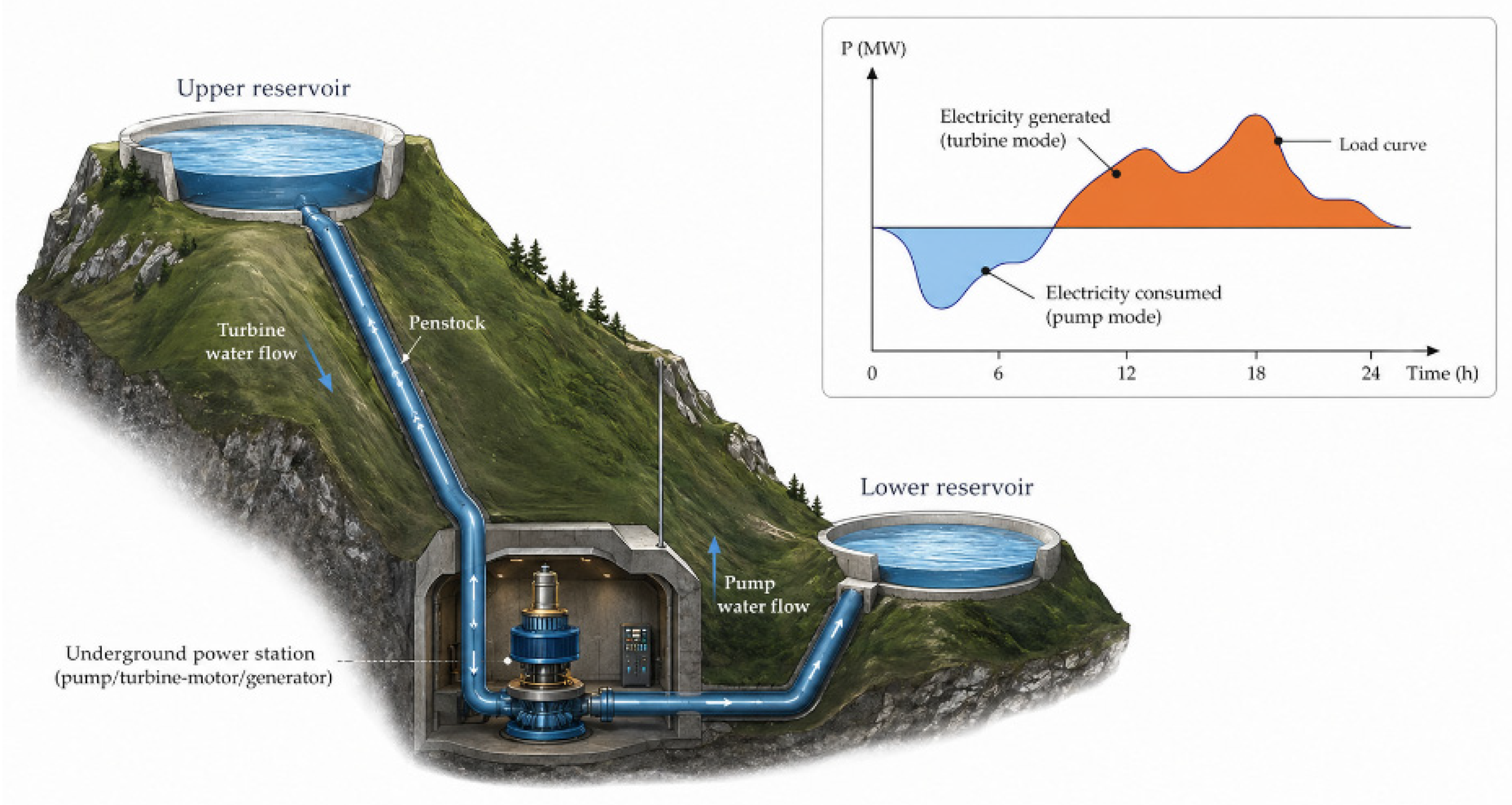
PHES has been in use for more than a century to store energy during low electricity demand. Currently, PHES is the most used Electrical Energy Storage (EES) for power system applications [5]. These facilities are the most efficient and practical large-scale energy storage systems, with typical overall efficiency in the range of 70–85%. PHES, like the scheme shown in Figure 1, entails pumping water from a lower reservoir to a nearby upper reservoir during off-peak hours, when electricity demand and electricity prices are low, and discharging the stored volume back into the lower basin via hydraulic turbine, then generation takes place during peak hours when electricity demand and cost is high.
As illustrated in Figure 1, the primary function of PHES is to smooth the load profile across the power system, consuming electricity when there is lower demand and generating when demand is maximum. PHES plants can start operating within minutes, providing critical flexibility that enhances power system reliability. However, this systemic benefit is not always fully recognized or monetized by current market designs [10,11]. This challenge is particularly evident in Cuba, where limited policy and regulatory support continue to undermine the economic viability of large-scale energy storage projects.
Thermal power plants driven by fossil fuels supply more than 95% of Cuba’s current electricity demand [12]. A combined share of under 2% was provided by clean energy assets, including hydro, solar, and wind technologies [13]. In 2021, clean power sources accounted for 4% of production, with sugarcane biomass contributing to this share [12]. To address these power sector challenges, state energy policies aim to scale up renewable generation to 37% of the primary energy mix by 2030 [13]. However, large-scale storage technologies are not being considered [14,15]. High relative quantities of variable and intermittent power will be increased in the Cuban energy mix according to the official decarbonizations pathways of the Cuban Electric System. Specifically, 700 MW of photovoltaic power and 680 MW of wind power are planned to be installed [16]. The terms variable and intermittent are characteristics of PV and wind power sources. For instance, for the PV, the power varies because there is no sun at night, and it is intermittent due to little or no sun during the day when there are clouds. The development of an energy system based on intermittent RES sources requires the use of storage capacity and demand flexibility to balance the production and consumption system [17,18]. A feasible solution is to store large amounts of intermittent energy in PHES. Previous studies highlight the need for energy storage deployment within the Cuban national electric grid [14,15], an operational control scheme, as well as enhancing grid flexibility capacity [19].
PHES flexibility supports large-scale thermal and nuclear assets in maintaining baseline operation at maximum efficiency. This driver primarily prompted the initial deployment of pumped-storage hydropower in Cuba during the 1980s [20]. Beginning with the initial PHES facility planned for Fomento, the project was ultimately cancelled early on due to the 1990s suspension of the Juraguá nuclear plant in Cienfuegos. The abandonment of the Fomento project in the 1990s represents a significant missed opportunity that must now be re-evaluated under the current necessity of energy sovereignty and grid stability. Today, the urgent need for grid-scale storage to accommodate high solar and wind penetration demands a modernized approach, one that synthesizes historical lessons with advanced GIS-based spatial planning and rigorous engineering validation.
The benefits of PHES for the Cuban power system far outweigh earlier estimates, positioning it as a core technology for advancing VRE integration. Nevertheless, accommodating renewable fluctuations calls for highly flexible energy storage, making variable-speed PHES solutions particularly well-suited to the Cuban context. PHES gives a multi-hour to multi-day energy supply. It is usually the most cost-effective option for long durations. Variable-speed designs add efficiency and a fast, flexible response that also helps smooth wind/solar energy supply [21]. Variable-speed units provide (1) fast frequency response, (2) efficient part-load operation, and (3) long asset lifetimes (decades) [22]. That makes them especially valuable for high VRE shares in Cuba.
The alignment of peak PV generation with off-peak demand hours could strengthen the economic viability of PHES projects. Storage infrastructure is crucial for contemporary power systems managing significant renewable energy shares [23]. Nevertheless, the primary advantage of this technology compared to alternative storage solutions lies in its massive energy capacity [24]. Another critical benefit for power system stability is the provision of synthetic inertia [25]. Unlike fixed-speed units, variable-speed PHES systems utilize power electronics to emulate an inertial response by rapidly adjusting the generator’s active power output. Some of the disadvantages of PHES are high capital costs [23] and topographic limitations, i.e., the available elevation difference between both lower and upper reservoirs as well as the environmental aspects [24].
Despite the global momentum of the PHES, its deployment in Cuba remains largely unexplored in academic literature, particularly regarding the transition from theoretical GIS-based potential to engineering-ready site validation. This paper addresses this gap by presenting the first comprehensive update on PHES potential in Cuba. Through a dual-methodology approach, we provide a first automated nationwide GIS screening expanding legacy 1970s assessments by identifying 92 new potential sites using an ANU-based GIS framework [26]. Subsequently, we bridge the gap between theoretical potential and technical reality by conducting a comparative case study (the Mayarí PHES project) where hydrological and topographical studies are assessed against GIS-derived results. By introducing Mayarí as a high-fidelity case study, this paper demonstrates how precise local-scale analysis can reconcile the discrepancy between global atlas projections and the technical requirements for grid integration. Ultimately, this work provides a replicable framework for decision-makers to de-risk PHES investment in islanded power systems with high VRE penetration.
The remainder of this paper is organized as follows. Section 2 reviews the role of PHES in renewable-based power systems and presents the Cuba’s historical and technical background regarding its development. Section 3 describes the proposed integrated GIS-based screening and engineering validation methodology for site selection. Section 4 presents the nationwide screening results, their cross-validation against historical engineering studies, and the identification of the most promising candidate sites. Section 5 discusses the implications of the proposed methodology for Cuba’s renewable energy transition, using the Mayarí project as a representative case study to examine technical and policy considerations. Finally, Section 6 and Section 7 present the study limitations and uncertainty analysis, followed by the main conclusions and future research directions.

2. Review of PHES and Energy Market Possibilities in the Cuban Electrical Grid

The absence of energy storage in Cuba’s current power grid underscores the potential of PHES to bolster system flexibility and stability. PHES projects could also improve the resilience of the Cuban energy system and supply. Following Category 3 Hurricane Ian on 27 September 2022, the Cuban electrical system experienced a blackout lasting nearly three days. It was the first of several blackouts that the Cuban electrical system has faced to date. Frequency instability caused the electrical system to go down, showing a lack of flexibility and low frequency control capacities [27], both primary and secondary [28]. This problematic issue could be improved by adding energy storage capacities to the Cuban electricity system.
Research activity on Cuba’s pumped storage is scarce in SCOPUS/WoS-indexed journals. However, this reality contrasts with the fact that several scientific papers on energy transition in Cuba highlight the possible role of energy storage in the Cuban electricity system. For instance, according to Vazquez, et al. (2018) [29], Cuba has sufficient sites with more than 300 m altitude drop, which can be used to deploy PHES facilities. Though the potential of this technology is unknown and consequently has been little addressed in Cuba. Korkeakoski, (2021) [30], states the need for energy storage, but concludes that battery storage or pumped hydro storage are not yet economically viable in Cuba with the current cost levels. The storage technologies’ costs have been widely discussed at present [31], and some authors point out that pumped-hydro energy storage is ideal for large-scale energy storage applications, while batteries are highly recommended for high power and low energy requirements [32]. Today, evolving federal policies and trade policy initiatives in the U.S such as adjustments to import tariffs and restrictions on certain Chinese-made products and electricity technology equipment, have introduced higher uncertainty. The escalating tariff conflict between China and the USA is poised to disrupt the global economy, catching many nations off guard. Market participants, however, are adapting quickly, supported in part by domestic battery production initiatives from key manufacturers. With the unexpected slowing of the growth of electric-vehicle battery demand, many producers are pivoting to stationary storage applications [7,33]. U.S. trade policy with tariffs can raise costs and slow deployment. It is quite obvious that U.S. import tariffs and anti-dumping and safeguard measures on things like solar modules, batteries, and EVs make those components more expensive in the short run, which can slow installations and emissions reductions. It is expected that trade policy uncertainty reduces firms’ willingness to invest in long-lived green projects or cross-border manufacturing, which can slow innovation and diffusion of low-carbon technologies, including battery technologies. Several industry and news analyses show that tariffs have pushed up module costs and shifted trade flows, reducing supply from targeted countries and increasing costs for U.S. and Latin America buyers [34].
Castro, et al. (2024) [19] focus on Cuba’s future electric vehicles (EV) development and note that smart recharge with vehicle-to-grid (V2G) technology would enable the stabilization of the network and could reduce net costs. Other research claims that micro pumped storage systems have a significant economic advantage over Li-ion batteries as storage capacity increases [31]. Brands, et al. (2024) [14], model cost-optimal technology mixes for the Cuban power system. These previous papers only considered battery storage, but Brands, et al. (2024) [14], conclude that electricity demand can only be met with 99 percent RES and high levelized cost of energy (LCOE), using large storage capacities as PHES plants.
A researcher from the National Renewable Energy Laboratory (NREL) states that Cuba has the potential to shift to a 100% RES. In doing so, it would create a system that could serve as a model for the future and become an economic export opportunity for Cuba [35]. In addition, Cuba will require some type of backup power source to use the inherently variable sources of solar and wind power, yet still keep energy flowing to meet the demand. Despite other storage technologies [32], PHES could be an ideal technology to integrate RES and to increase the flexibility and stability of the Cuban electrical grid.
According to Luukkanen, et al. (2022) [36], the future Cuban electrical grid needs storage capacity investments in pumped storage and hydrogen. Using the Long-range Integrated Development Analysis (LINDA) model to evaluate future scenarios for Cuba [37], in [36] it is proposed to invest in PHES projects in Cuba. Several countries have adopted the LINDA model to project long-term energy system developments [37]. The Cuban implementation of this tool is referred to as the CubaLinda model [38]. This tool operates in Excel and serves to evaluate potential future energy pathways.
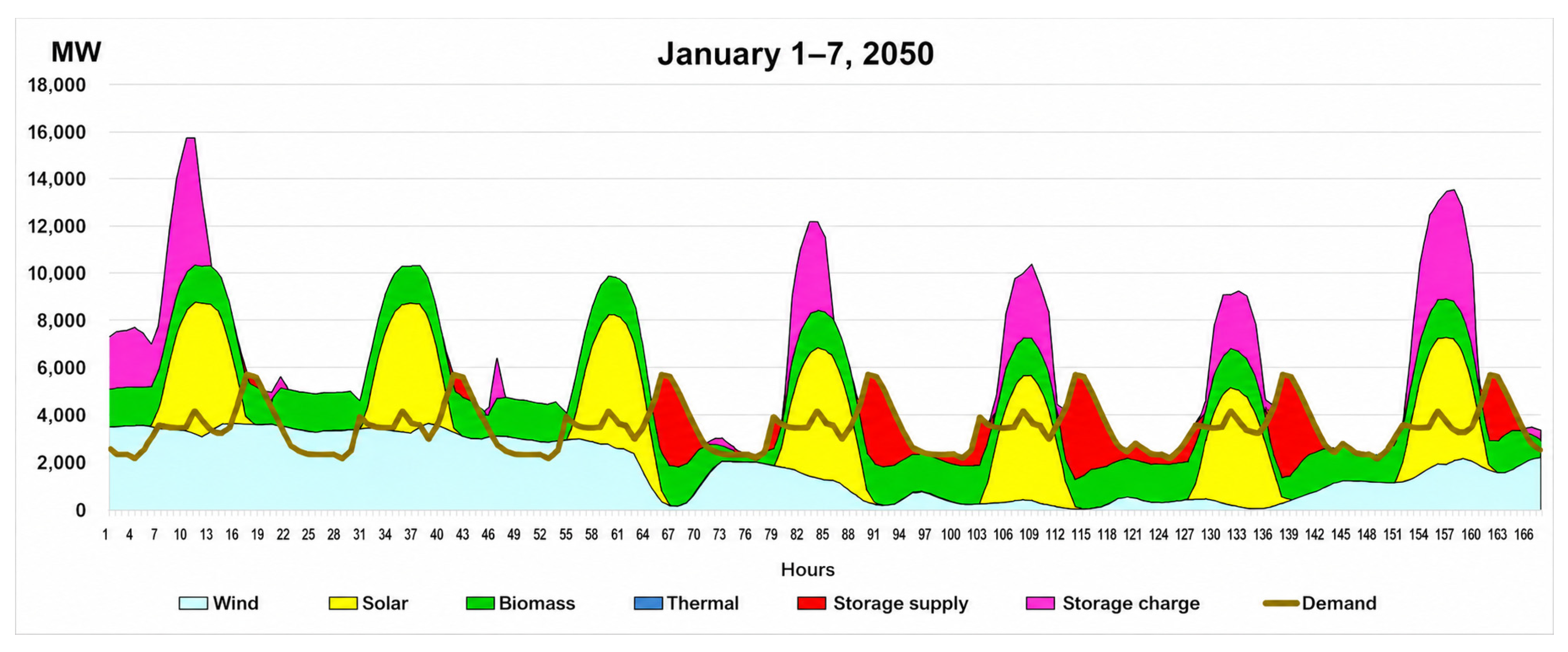
Figure 2 shows Cuba’s 2050 first week scenario constructed with CubaLinda model for the electricity consumption and production. Storage solutions like PHES help stabilize load profiles in systems with high VRE penetration, enabling reliable power delivery during maximum demand hours.
PHES plants provide essential grid stability services, though their response times depend on the underlying control mechanism [28]. While mechanical load-balancing via hydraulic regulation inherently requires several seconds, variable-speed units can leverage their power electronics converters to alter the generator’s electromagnetic torque within milliseconds. This rapid electronic control allows them to deliver emulated inertia and fast frequency response (FFR) almost instantaneously by temporarily drawing from or injecting into the rotor’s stored kinetic energy [28,39]. This technology has offered cost-effective grid services and balancing for decades. Whereas the oldest installations (1970s) were mostly provided with reversible pump-turbine units at a fixed speed (synchronous machines), current installations are often provided with variable speed units [24], which increase PHES availability, efficiency, and grid flexibility.
Variable speed PHES has great potential to provide flexibility but do not provide synchronous mechanical inertia within electrical networks to mitigate frequency regulation challenges associated with VRE [40]. Although variable-speed PHES incurs higher capital costs, it delivers approximately one-third greater operational flexibility compared to conventional fixed-speed systems [41]. Another significant advantage of PHES technology is its relatively low O&M cost profile [24] and long lifetime, ranging from roughly 50 years for electromechanical components to up to a century for civil works like dams. Owing to these long lifespans and utility-scale capacities, PHES currently offers the most cost-effective energy storage solution [42]. This utility-scale potential is ideal for balancing energy demand across daily and weekly operational cycles.
Cuba does not have an electricity market. The power plants belong to the government, except one natural gas generation plant, which is a joint venture. The Cuban electricity system does not contemplate differentiated tariffs according to peak hours, nor does it consider tariffs for the grid frequency regulation capacity. In a general sense, Cuba should leverage already existing experiences from nations with similar energy profiles, particularly island jurisdictions and nations with highly distributed systems. PHES plants could be an ideal RES complement and the motivation for the creation of an energy market. Yet, the main disadvantages of PHES for the Cuban context reside in its high upfront costs and environmental footprint [24,43]. Another key limitation stems from topographically defined boundaries, specifically the maximum elevation differential attainable between the storage reservoirs. Regardless of these drawbacks, official findings confirm that deploying PHES in Cuba remains a necessary and techno-economically feasible endeavour [20]. Investing in this grid infrastructure is vital for national economic development; attracting foreign capital could directly address the high capital intensity of PHES implementation [44].

Historical Evolution and Technological Context of PHES in Cuba

Although the foundational developments of PHES originated in Switzerland and Italy during the late 1890s, its initial commercial operation in the United States was established in 1930 [45]. Despite being capital-intensive and carrying local ecosystem impacts, PHES remains the most mature and economically viable technology for long-duration energy storage. Its long-standing commercial dominance has seen a global resurgence recently, fuelled by the urgent need for grid flexibility to absorb increasing shares of VRE.
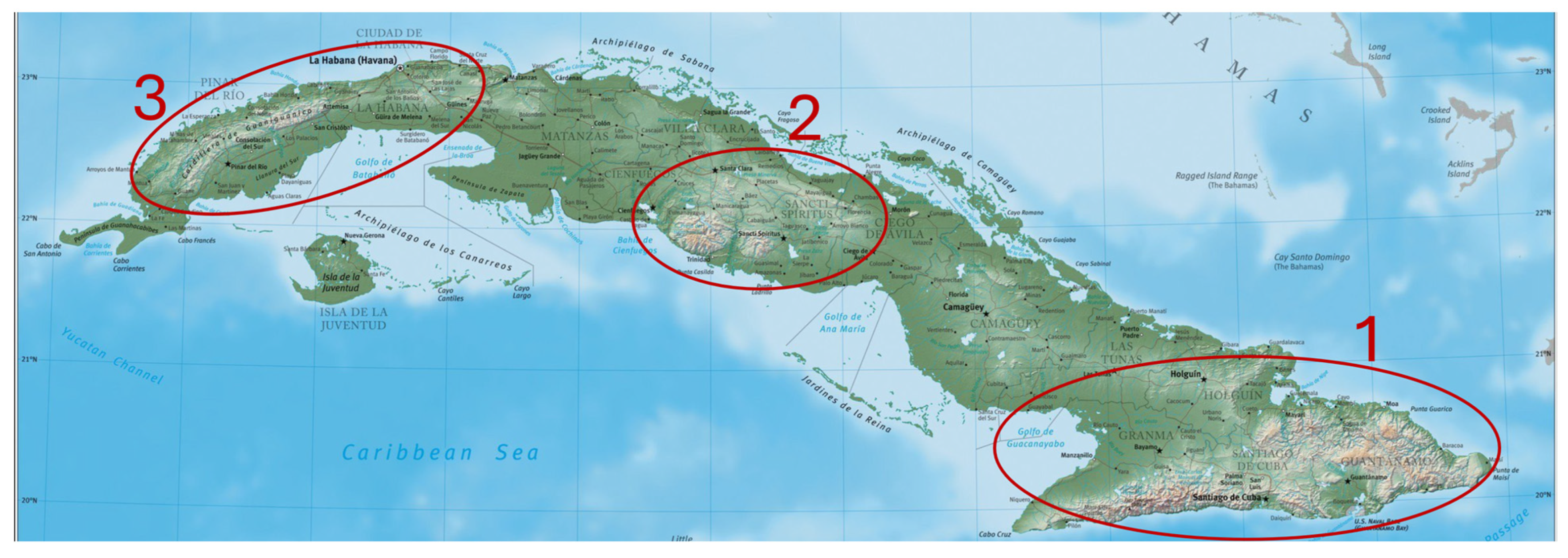
Among the various energy storage technologies currently available for deployment in Cuba [29,46], with capacities of up to several GWh, PHES remains the only technologically and economically mature solution capable of utility-scale storage. According to Vazquez, et al. (2018) [29], Cuba has adequate hydropower resources and mountainous regions with more than 300 m head [27] (Figure 3), which could be used to implement the PHES systems required for a government’s target transition to 100% renewable energy.
Interest in PHES in Cuba dates back to the 1970s, when the technology was investigated to improve the operational flexibility of the national power system, particularly in connection with the planned Juraguá Nuclear Power Plant. Extensive feasibility studies conducted during the 1970s and 1980s identified numerous potential PHES locations throughout the country’s main mountainous regions. Although these projects were never implemented, the resulting topographic, hydrological and engineering studies constitute a unique technical knowledge base that underpins part of the integrated methodology proposed in this study.
Initial feasibility assessments for PHES infrastructure in Cuba were initiated in the 1970s. The momentum behind these developments was primarily driven by the planned Juraguá Nuclear Power Plant (NPP) in Cienfuegos, as the inherent operational constraints of Cuba’s isolated national grid necessitated flexible storage capacity to balance off-peak generation and maintain baseload stability.
Comprehensive investigations into Cuba’s mountainous areas have been ongoing since the 1980s, initially driven by collaborative efforts with researchers from former socialist states (most notably the Czechoslovak Socialist Republic). To evaluate these sites, the authors carried out comprehensive field assessments between 2016 and 2019. The identified sites for PHES in Cuba account for a cumulative potential capacity of 16.18 GW [1,47]. The methodology followed in this previous study consisted essentially of determining the potential sites based on 1:50,000-scale topographic maps. Following this, hydrological studies were carried out with average rainfall data, and preliminary topographic studies were developed in situ. The preliminary topography sought to determine head differences between the possible upper and lower reservoirs, as well as the possible route of the penstock. With these results, technical and economic feasibility studies were developed, considering the economic growth indicators of Cuba at that time. Technical indicators were considered to predict the volumes of excavation and civil works required.
Based on optimal hydrological, geological, and topographical parameters, thirty-one suitable sites for PHES deployment were examined [20,27]. These locations span the country’s three primary geographic sectors: East (Region 1), Central (Region 2), and West (Region 3) (Figure 3).
Within the Sierra del Rosario Mountain range in western Cuba, twelve prospective sites have been catalogued (Table 2). Their close proximity to major national load centres and power generation infrastructure renders them highly advantageous. The primary design parameters for PHES in the western region of Cuba are summarized in Table 1. While the evaluated technical potential totals 5320 MW, certain projects lack economic viability, as their penstock length to hydraulic net head ratio (L/H) exceeds the threshold of 10.
The Cajálbana site (Pinar del Río) represents Cuba’s most thoroughly studied PHES prospect, driven by its close proximity to Havana’s high-demand power grid. Although technical and commercial proposals have been submitted by European and Asian firms from the 1980s to the present, feasibility studies consistently indicate that the project remains economically unviable [29]. Historically, the economic unviability of PHES in Cuba stems from heavily subsidized electricity rates and an insufficient price differential between peak and off-peak hours, which eliminates any potential for energy arbitrage. This challenge is further compounded by limited policy and regulatory support, presenting a high risk for infrastructure investment.
The penstock length-to-head ratio (L/H) is a critical parameter for determining economic feasibility because it directly dictates the need for a surge tank. A high L/H ratio (above 10) means a long water column with high hydraulic inertia, forcing a massive investment in a large surge tank to protect the system from water hammer effects. Conversely, a lower ratio between 4 and 10 is highly desirable [48], as it minimizes these pressure transients, allowing developers to reduce the size of (or entirely eliminate) the surge tank, thereby drastically cutting civil engineering costs.
Four sites have been evaluated since the 1970s in the central region of Cuba. The key design specifications for these four prospective PHES sites are presented in Table 3, representing a combined potential capacity of 1860 MW in the central region.
The Caracusey PHES site, historically termed the Fomento project after its host municipality, was initially planned alongside the Juraguá nuclear power plant in Cienfuegos Province. It stands out as the most feasible project among the four most economical sites evaluated in central Cuba. The remaining locations also display advantageous L/H ratios and strong technical specifications (Table 3). However, civil works were halted in the 1990s following the indefinite suspension of the Juraguá nuclear initiative. In the current context, this project could significantly enhance regional VRE integration and align with official government targets for a 100% renewable energy mix [1].
Cuba’s largest small hydropower plant (SHPP), with a capacity of 43 MW, is located in the central region near the Hanabanilla reservoir. Although the proposed Hanabanilla PHES project and the existing Hanabanilla SHPP are situated in close proximity, they represent distinct infrastructure projects.
The deployment of hydropower infrastructure in eastern Cuba has been thoroughly assessed for many years. The area is dominated by two primary mountain massifs: the Nipe-Sagua-Baracoa range in the northeast and the Sierra Maestra in the southeast. The latter is the country’s largest range and hosts Cuba’s highest elevation, Pico Real del Turquino (1974 m). A total of fifteen prospective PHES sites have been catalogued across this region (Table 4).
With 9000 MW of cumulative potential, the eastern region possesses the highest PHES capacity in the country. Aside from three sites where the L/H ratio exceeds 10 (Table 4), the eastern projects are technically sound. In particular, the Baconao 2 and Mayarí projects offer high strategic utility for Cuba’s energy transition due to potential synergies with dam construction. In the case of Baconao 2, the upper reservoir could share infrastructure with the proposed Baconao water supply dam in Santiago de Cuba province.
The existing Mayarí dam in Holguín province offers a significant head start by acting as the lower reservoir for the Mayarí PHES project. Other eastern prospects, such as Moa and Nibujón, face key trade-offs: Moa is less cost-effective due to its distance from the 220 kV substation, while Nibujón is restricted by nature conservation status. On a national level, PHES implementation is mainly hindered by economic, environmental, policy, and regulatory hurdles, in that order. Because most eastern sites reside within ecological conservation zones, rigorous environmental measures are essential.
Based on 1:50,000 topographic maps and hydrological studies from the 1970s, Cuba has identified and updated the main potential for PHES projects in three-country regions. The total PHES potential project of Cuba is in the amount of 16.18 GW using topographic studies [1]. This figure represents approximately 2.5 times of Cuba’s current installed generation power from all sources. Nevertheless, the assessment of the site location can be improved significantly using Geographic Information System (GIS) tools to automatically identify suitable locations for PHES development [49].

3. Methodology

3.1. Integrated GIS-Based Screening and Engineering Validation Methodology for PHES Site Selection

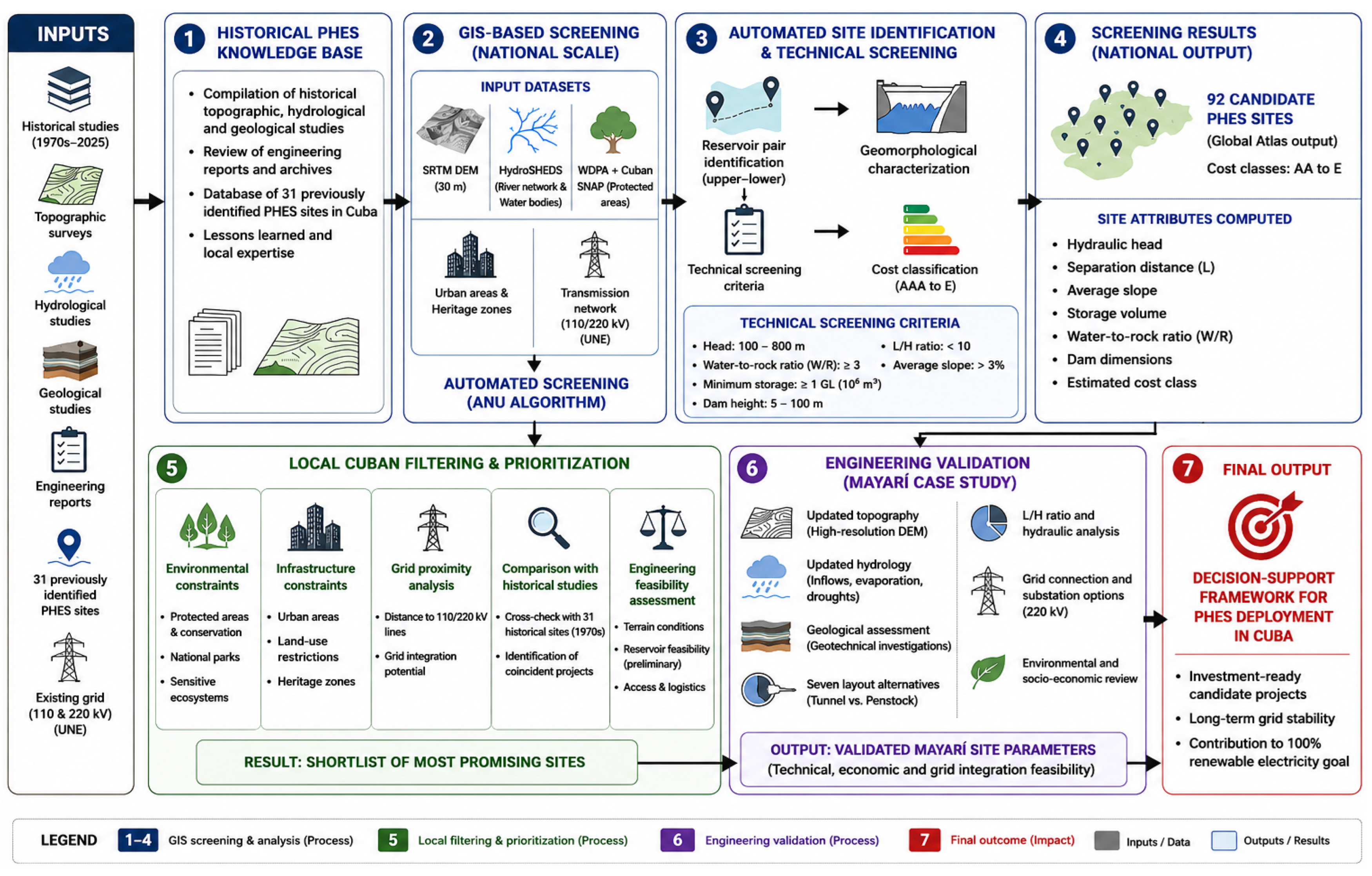
This study proposes an Integrated GIS-Based Screening and Engineering Validation Methodology for PHES Site Selection in Cuba (Figure 4). The framework combines historical topographic and hydrological investigations conducted in Cuba during the 1970s and 1980s with automated GIS-based screening, local spatial constraints, and detailed engineering validation.
Unlike conventional GIS-only approaches, the proposed methodology integrates historical engineering knowledge with modern geospatial analysis to identify, prioritize, and validate technically feasible closed-loop PHES sites. The methodology comprises four sequential stages: (i) historical knowledge compilation, (ii) automated GIS-based screening, (iii) local filtering and cross-validation with historical studies, and (iv) detailed engineering validation of the selected case study.

3.2. Historical PHES Database

The historical PHES database incorporated into the proposed framework originates from national investigations conducted during the 1970s and 1980s. These investigations identified candidate sites using 1:50,000-scale topographic maps, hydrological analyses based on long-term rainfall records, and preliminary field topographic surveys. The studies estimated hydraulic head, potential penstock alignments, excavation volumes, civil engineering requirements, and preliminary technical-economic feasibility. In the present work, this historical engineering information constitutes the first input layer of the proposed methodology and is subsequently used for cross-validation of the GIS-derived candidate sites.

3.3. GIS-Based Selection of Cuba’s PHES Potential Sites

The second stage of the proposed methodology consists of a GIS-based screening procedure to identify prospective off-river closed-loop PHES sites across Cuba. A GIS is a computer-based method that enables rapid, efficient, and versatile processing, analysis, and visualization of geographic data in several formats. Various factors affect the design selection of a prospective PHES system, including obvious topographical, hydrological, and geological parameters. The availability of water bodies, transportation infrastructure, grid expansion, protected areas, nature reserves, and heritage (historical) sites are also important factors to be considered. Therefore, the automatic search for potential sites reduces the assessment time of larger areas and allows for focusing on the most viable projects [50]. Nowadays, when identifying new sites, most of the studies locate the potential PHES sites in an automated way [51], like using GIS [50].
Several research papers related to the GIS-based PHES sites selection are reported in the literature. Similarly, many countries have chosen to use these technologies: China [48,52], the USA [53], France [54], Brazil [55], Iran [49], Spain [56], and Australia [50,57], among others [58]. This technology has also been used in the selection of PHES for small generation microsystems [59] and PV systems site selection [60].
A worldwide Atlas [9] of off-river PHES sites is available at [61]. This global survey of greenfield off-river PHES was carried out by the Australian National University (ANU). National Renewable Energy Laboratory (NREL) from the USA, developed a PHES GIS-based site assessment [26] by using both the developed ANU’s algorithms [57] and the cost model.
Furthermore, some other Cuban potential sites could be calculated using the ANU’s GIS PHES site search [61]. It is possible to pan and zoom to see details of all calculated Cuban potential PHES sites [62]. Nevertheless, accurate costing of PHES systems requires detailed engineering, geological, hydrological, environmental, heritage, and other studies.
To identify prospective off-river closed-loop PHES sites across Cuba, we combined the automated geospatial screening algorithm developed by the Australian National University (ANU) with local spatial constraint layers. The input datasets and technical parameters utilized in the screening pipeline are defined as follows: (1) Digital Elevation Model (DEM. Shuttle Radar Topography Mission (SRTM) 1-arcsecond (~30 m spatial resolution) global DEM provided by NASA/USGS. (2) Hydrological & Water Bodies Data. HydroSHEDS river network and surface water layer. (3) Exclusion Layers. World Database on Protected Areas (WDPA) cross-referenced with the Cuban National System of Protected Areas (SNAP), urban settlements, and heritage zones. (4) Infrastructure & Grid Layers. National 220 kV and 110 kV transmission line networks provided by Unión Eléctrica (UNE).
The automated search algorithm identifies pairs of upper and lower reservoirs capable of forming a closed-loop system. For each reservoir, key geomorphological attributes (including location, surface area, volume, and dam length and height) are quantified. The water-to-rock (W/R) volume ratio is highly critical, as a higher ratio signifies greater economic efficiency regarding dam construction. Potential upper and lower reservoir pairs are evaluated based on hydraulic head, horizontal distance, and slope. The screening criteria for these pairs require a head between 100 m and 800 m, a minimum W/R ratio of 3 to ensure civil engineering efficiency. A maximum reservoir separation distance (L) resulting in an average slope greater than 3%, an L/H ratio lower than 10, and a minimum storage capacity of 1 GL (1,000,000 m3). The model incorporates rock-fill or earth-fill embankment dams with heights from 5 m to 100 m, adjusting wall dimensions to ensure equalized water volumes for the targeted energy storage. Each pair is ranked from A to E based on estimated capital expenditures, with Class A representing the lowest-cost configurations. The optimization algorithm [57] processes all combinations based on the W/R ratio, head, slope, and power capacity requirements. Notably, cross-referencing with updated GIS databases confirms that none of the identified sites conflict with natural-conservation or urban areas.

3.4. Local Site Prioritization and Cross-Validation

While the initial candidate sites were generated using the automated ANU GIS-based screening algorithm, the final prioritization followed an additional validation stage specifically developed for Cuban conditions. This stage extends the global GIS screening by incorporating local spatial constraints, historical engineering knowledge, and project-specific feasibility considerations.
First, the GIS-derived candidates were filtered using updated national spatial datasets, including protected areas, urban settlements, heritage zones, and the national 110 kV and 220 kV transmission networks. These additional spatial constraints ensured that only technically feasible locations compatible with Cuban environmental regulations and existing grid infrastructure were retained.
Subsequently, the filtered candidate sites were cross-validated against the historical PHES investigations carried out in Cuba during the 1970s and 1980s. This comparison made it possible to identify sites previously recognized through conventional engineering studies, verify the consistency between historical assessments and GIS-derived results, and reconcile differences in site nomenclature.
Finally, the resulting candidate sites were prioritized considering not only the geomorphological indicators provided by the ANU methodology, but also engineering, operational, and infrastructure-related criteria that are not represented in the global atlas. These included the existence of previously constructed hydraulic infrastructure, proximity to high-voltage substations and transmission lines, accessibility, and the availability of historical technical information. Based on this multidisciplinary assessment, the Mayarí site was selected for detailed engineering validation presented in Section 4.3.

3.5. Engineering Validation Procedure

The final stage of the proposed methodology consists of the engineering validation of the most representative PHES candidate identified through the integrated screening process. Rather than validating all GIS-derived sites, a single case study (Mayarí PHES) was selected because it was independently identified by both the historical Cuban investigations and the GIS-based screening, and because it possesses existing hydraulic infrastructure that enables a comprehensive engineering assessment.
The engineering validation was performed using site-specific technical information collected during previous field investigations and updated engineering studies. This stage aimed to verify whether the theoretical suitability identified by the GIS screening could be translated into a technically feasible PHES configuration.
The validation procedure comprised the following engineering tasks:
  • Verification of the available hydraulic head through updated topographic information;
  • Evaluation of alternative layouts for the upper reservoir, waterways, powerhouse, and tailrace;
  • Assessment of geological and geotechnical conditions affecting tunnel alignment and dam construction;
  • Comparison of alternative water conveyance systems (pressure tunnel versus penstock);
  • Assessment of hydraulic parameters, including waterway length, L/H ratio, and expected hydraulic losses;
  • Evaluation of the existing lower reservoir and potential connection to the national transmission network;
  • Development of a preliminary engineering layout for the preferred PHES configuration.
The outcome of this engineering validation was subsequently compared with the GIS-derived characteristics to assess the consistency of the proposed methodology.

3.6. GenAI Use for Graphics Creation

Generative AI (ChatGPT, OpenAI version GPT-5.6 Luna) was used as a supportive tool during the preparation of this manuscript for the generation of conceptual sketches for Figure 1 and Figure 4. Specifically ChatGPT (GPT-5.6 Luna; OpenAI, 2026). All inputs, methodological decisions, and scientific content were defined and verified by the authors, who retain full responsibility for the accuracy, interpretation, and final presentation of the information. ChatGPT was used solely for visual concepts and did not replace the authors’ scientific judgment or analysis. Following the use of this tool, the authors thoroughly reviewed all outputs, completely redesigned the final figures independently, and assume full responsibility for the published work.

4. Results

4.1. GIS-Based Screening Results

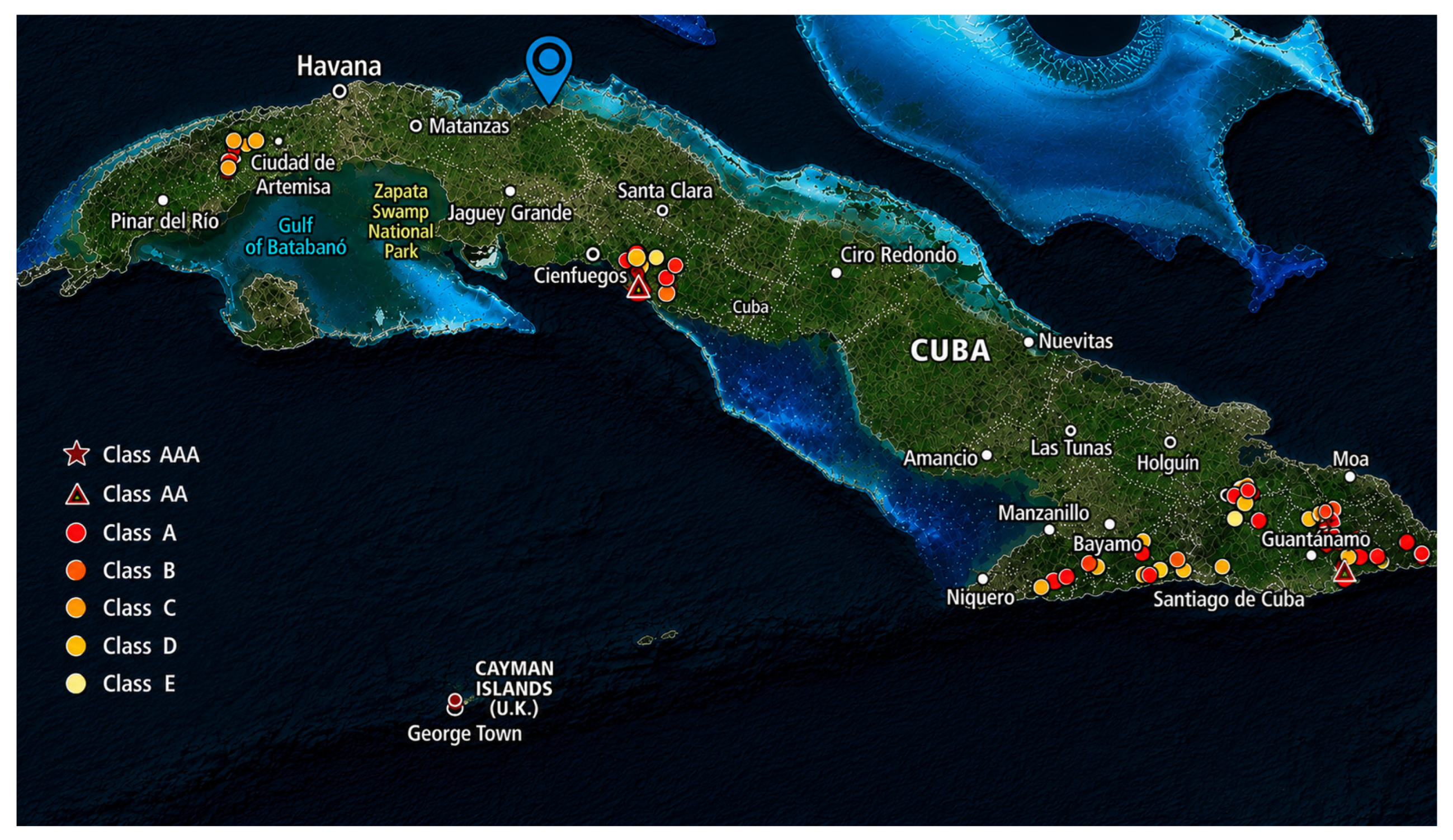
Application of the integrated GIS-based screening methodology to the Cuban territory generated a national inventory of potential closed-loop off-river PHES sites. The candidate sites were identified using the ANU Global Pumped Hydro Atlas screening algorithm together with the local spatial filtering described in Section 3. Figure 5 illustrates the spatial distribution of the resulting PHES candidates across Cuba. Each candidate is classified according to the ANU cost ranking (AAA to E), which reflects the estimated civil engineering cost based on terrain characteristics and reservoir configuration. The distribution reveals that the highest-ranked sites are concentrated in the country’s main mountainous regions, where favourable hydraulic head, reservoir separation, and topographic conditions are available.
The most feasible sites are marked in Figure 5 with stars (Cost Class AAA), triangles (Cost Class AA), or dark red dots (Cost Class A). The lower cost classes comprise B, C, D, and E. Different sizes can be selected in the Global Pumped Hydro Atlas [9], ranging from 2 to 5000 GWh. However, according to this atlas, Cuba’s potential sites do not exceed 500 GWh. In addition, research on land use suitability, excluding national parks and urban areas, should be conducted as recommended by [50]. Table 5 shows the 500 GWh-sized projects and their main characteristics. The separation column in Table 5 is the distance in kilometres between the closest part of the lower and upper reservoir. Similarly, the average slope column is the slope between the upper and lower reservoirs.
Some of the sites shown in Table 5 coincide with those presented in Section Historical Evolution and Technological Context of PHES in Cuba, although not all of them have the same name, except for the Mayarí project. No AAA cost class sites were found in Cuba. Nevertheless, 14 sites were determined with categories from AA to D, with sizes of 500 GWh. Similarly, 78 sites were determined with similar cost categories but a smaller size of 150 GWh. Seven projects in western, central, and eastern Cuba have cost classes AA and A, which is convenient for the Cuban electrical grid (see Table 4). The considered storage time of all these projects is 50 h. Notably, high hydraulic load as a unique indicator doesn’t means a better cost class, as can be seen in Table 5, nor is the stored volume. Detailed PHES cost calculation methodology can be found in [63]. According to the ANU cost methodology, projects with cost classes AA and A have investment costs of 20 and 40 USD/kWh, respectively.
The GIS-based analysis doesn’t take into account the economic factor that Mayarí already has the lower reservoir and the substation connection option to the grid, as presented in Section 4.3. But Table 4 confirms that the topographical-based selection of the Mayarí project is convenient.
Other projects have better cost conditions and technical characteristics, such as separation between reservoirs, storage volume, and water-to-rock ratio. The appropriate selection of a specific project should be carried out using a multidisciplinary method, considering also other socioeconomic and environmental criteria, such as the need to relocate population settlements and the environmental impact of the construction of these plants. A Cuban methodology that combines the results of topographic studies obtained in the 1970s with the use of GIS and decision support methods could help select sites that best meet the multidisciplinary decision-making criteria.

4.2. Integration of GIS Screening with Historical Engineering Studies

Comparison between the GIS-derived candidate sites and the historical Cuban PHES inventory reveals a strong agreement between both approaches. Several locations identified through the automated GIS screening coincide with sites previously recognized during the national engineering studies conducted since the 1970s, although different site names are occasionally used. Among them, the Mayarí project was independently identified by both methodologies, providing a robust reference for subsequent engineering validation.
The GIS-based screening identified 14 candidate sites within the 500 GWh storage class, seven of which belong to the most favourable cost categories (A and AA). Although no AAA-class sites were identified in Cuba, the close agreement between the historical investigations and the GIS-derived inventory demonstrates the consistency of the proposed integrated methodology. The comparison also highlights the complementary nature of both approaches. While the GIS screening objectively evaluates terrain suitability using topographic criteria, the historical investigations incorporate engineering knowledge obtained through field surveys, geological assessments, reservoir accessibility analyses, and infrastructure evaluations that cannot be fully represented in automated regional-scale screening.
Although the initial candidate inventory originates from the ANU Global Pumped Hydro Atlas, the principal contribution of the present work extends well beyond the direct application of the global screening algorithm. The proposed methodology integrates global GIS-based terrain screening with locally available spatial datasets, historical engineering investigations, and detailed project-level validation. Specifically, the contribution of this study consists of: (i) incorporating Cuban spatial constraint layers, including national protected areas (SNAP) and transmission network topology; (ii) evaluating socio-economic constraints and potential human settlement relocation risks within reservoir inundation zones; (iii) filtering and prioritizing candidate sites according to the operational requirements of the Cuban power system; (iv) cross-validating GIS-derived candidates against historical topographic and engineering investigations carried out since the 1970s; and (v) validating the selected Mayarí site through detailed engineering analyses using high-resolution field and design information. To explicitly delineate the scientific advancements and methodological novelties of the proposed framework over the baseline global atlas, a multi-dimensional comparison is summarized in Table 6.
It should also be noted that the 500 GWh and 150 GWh storage classes assigned by the Global Pumped Hydro Atlas represent theoretical upper-bound storage capacities derived exclusively from terrain geometry. They should not be interpreted as proposed plant capacities for future development in Cuba. Practical PHES projects would be designed according to the operational requirements of the Cuban power system, resulting in substantially smaller installed capacities and storage volumes consistent with national demand and transmission constraints.
The complete spatial dataset, including the geographical coordinates, hydraulic head, reservoir separation distance, storage volume, dam dimensions, and cost class of the 92 GIS-derived candidate sites, is provided in Supplementary Table S1.

4.3. Engineering Validation of the Mayarí PHES Project

Among the identified candidates, the Mayarí PHES project was selected for de-tailed engineering validation. This site represents the most suitable case study because it was independently identified by both the historical Cuban investigations and the GIS-based screening methodology. In addition, Mayarí benefits from the existence of a lower reservoir, previous engineering studies, and its proximity to the national 220-kV transmission network, making it an ideal benchmark for validating the proposed integrated methodology.
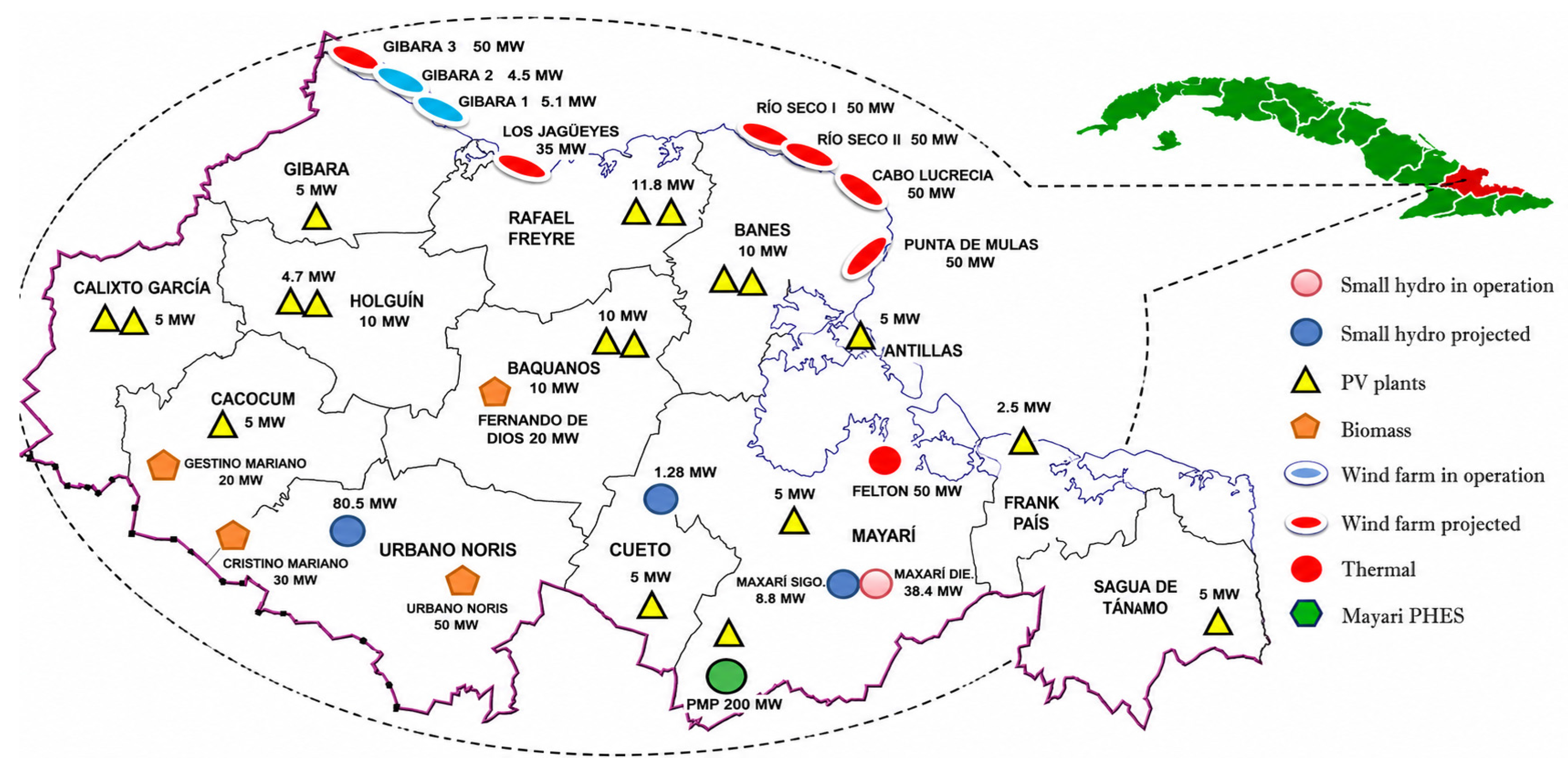
The Mayarí project is located in the eastern part of Cuba. Five provinces make up Cuba’s eastern region: Las Tunas, Holguín (Figure 6), Granma, Santiago de Cuba, and Guantánamo. Neither Granma nor Santiago de Cuba borders the high-wind northern coast, excluding them from planned wind energy projects. Meanwhile, the largely flat province of Las Tunas lacks mountainous terrain for hydropower, but possesses strong potential for northern coastal wind farms.
Similarly, the provinces of Guantánamo and Holguín offer optimal characteristics for hybrid renewable integration, featuring suitable topography for PHES in their mountain ranges and strong wind energy potential (blue and red ovals in Figure 6) along their northern coastlines. Furthermore, Holguín has some large PV projects constructed and plans to 2035 (yellow triangles in Figure 6). However, among the candidate regions, this is the only one equipped with an existing 220 kV transmission substation capable of accommodating new generating units exceeding 200 MW, representing a major advantage for future PHES deployment. As illustrated by the green hexagon in Figure 6, the proposed Mayarí PHES facility has a projected capacity of 200 MW. Figure 6 illustrates the geographical distribution of the existing power plants, transmission infrastructure, and planned renewable energy projects within the study area.
Beyond its favourable hydropower conditions, the province concentrates several strategic energy assets, including Cuba’s largest thermal power plant (500 MW, two generating units; red dot in Figure 6) and one of the country’s highest biomass generation potentials based on sugarcane residues (orange pentagons in Figure 6).
In addition to its favourable topographical conditions, the province is one of Cuba’s main industrial and economic centres, hosting the country’s nickel and cobalt processing industries, a rapidly expanding tourism sector, and a large population with significant electricity demand. These characteristics, together with its considerable renewable energy potential (Table 7) and existing 220 kV transmission infrastructure, make it an ideal case study for assessing the integration of PHES into the Cuban National Electric System (SEN). Furthermore, these conditions are consistent with the historical decision to prioritize the Mayarí project for detailed engineering assessment.
After two years of evaluation of variants based on topographical, hydrological studies from the 1970s, and current real construction conditions of these 31 sites, two sites with high potential and ideal conditions for the exploitation of PHES were defined. One site in Cuba’s central region at the Guamuaya massif and another one in the eastern region in the Sierra Cristal, belonging to the Holguín province. The selection criteria were based mainly on a ratio of 4 ≤ L/H ≤ 10 to ensure greater economic feasibility, proximity to electrical connection infrastructure (220 kV substations), and lower construction volumes.
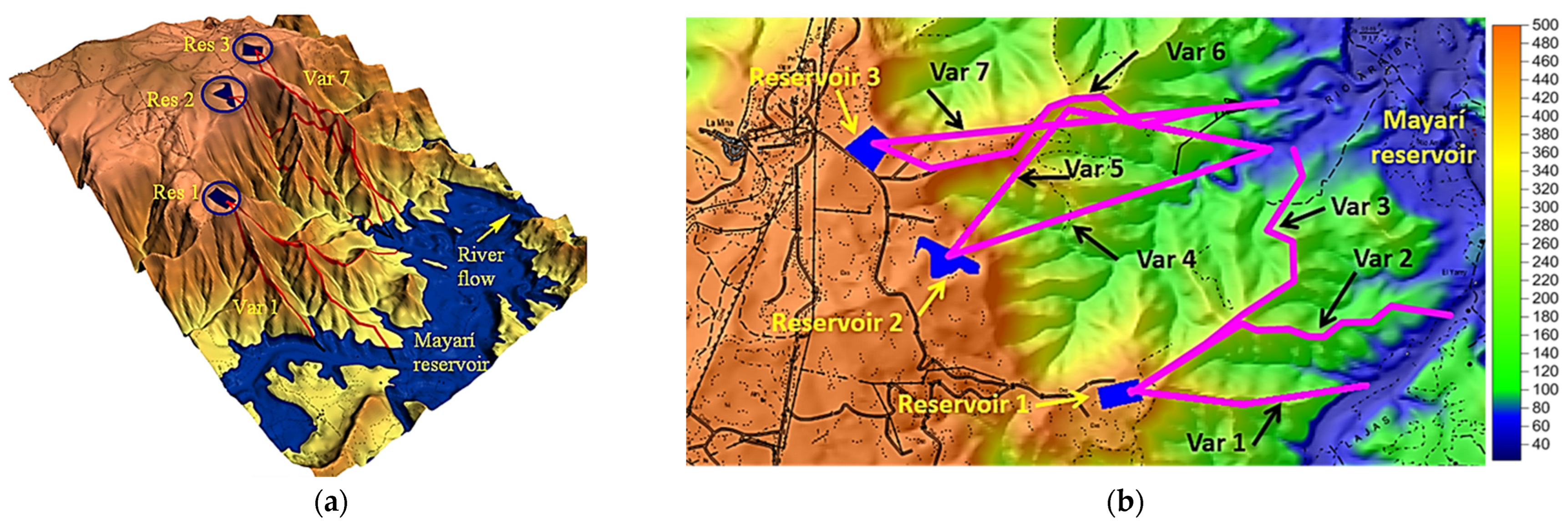
For these two potential sites, a topography and hydrology update were commissioned. This site benefits from pre-existing civil infrastructure by utilizing the operational Mayarí dam as a lower reservoir (Figure 7a,b). Building upon studies from the original Mayarí dam construction, the Mayarí PHES site demonstrates strong hydrological potential. As illustrated in Figure 7a,b, seven layout configurations were evaluated based on reservoir placement and water conveyance routes. These options encompass three candidate upper reservoir locations (Reservoirs 1 to 3 in Figure 7a,b), all designed to pair directly with the existing Mayarí reservoir.
For the Mayarí site, the penstock length to hydraulic net head (L/H) ratio falls within the range of 5 to 7 for all the studied variants. Another relevant factor is the fact that the lower reservoir is built and in operation with proven hydrological guarantees through simulations for 100 years.
Based on available geological and topographical data, seven layout configurations (Va1 to Va7, Figure 7b) were evaluated using two primary water conveyance methods: steel pipelines and excavated tunnels, along with hybrid systems where topographically suitable. As shown in the three-dimensional visual representation of the site’s potential (Figure 7a), the analysis reveals that tunnels offer superior cost-effectiveness compared to pipelines, which require exceptionally large diameters. Furthermore, pipeline construction poses greater environmental disruption (a critical factor given the region’s high biodiversity and presence of endemic species).

4.3.1. Key Design Data for the Mayarí PHES Project

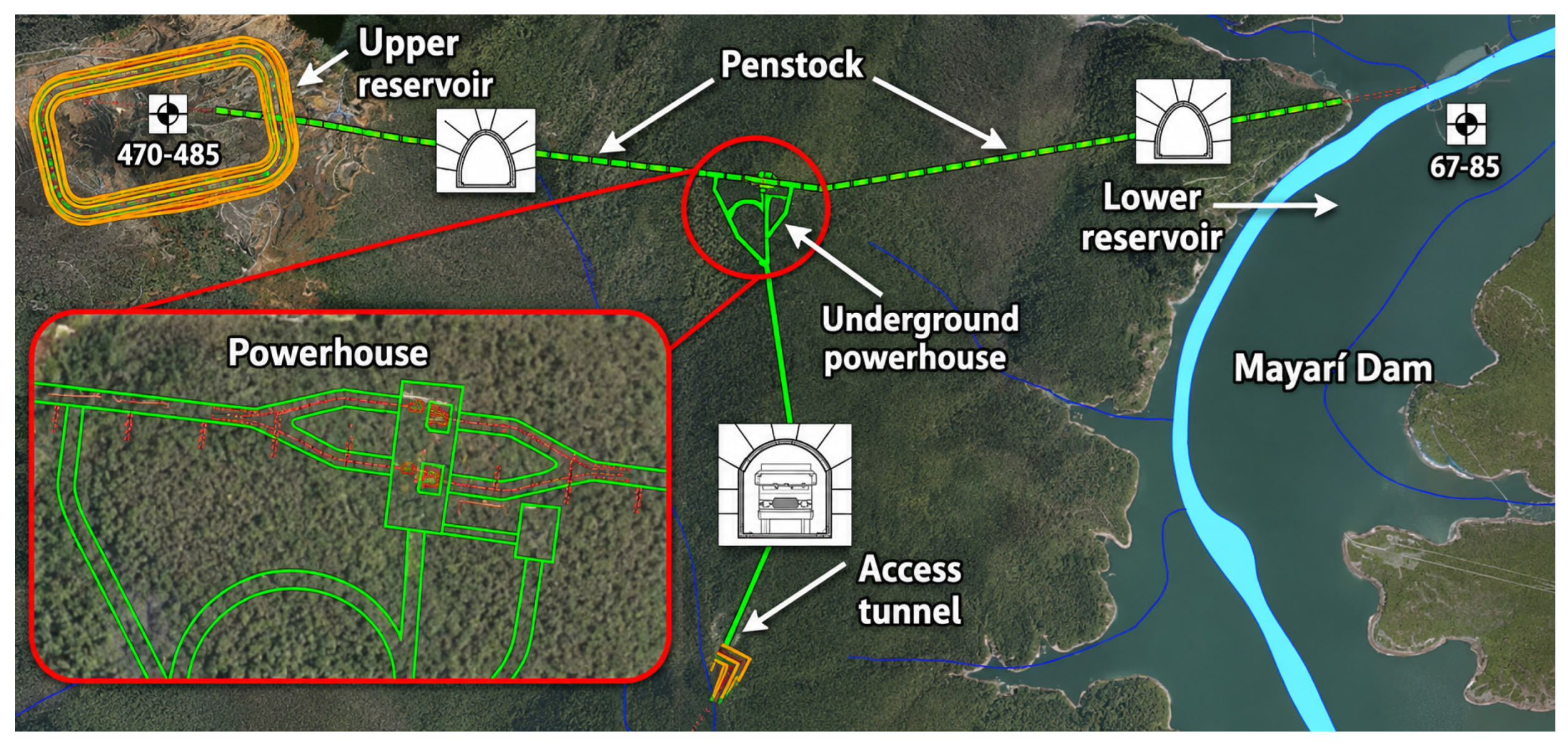
Variant 1 was selected as the optimal configuration for the eastern region based on technical and economic evaluations (Figure 8). Situated in the Mayarí municipality near the operational Mayarí dam, the site features favourable geological characteristics suitable for heavy construction works. The topographical relief provides elevation differences between 350 m and 450 m across a short horizontal alignment (2–3 km), yielding highly favourable conditions for pumped-storage development.
Featuring a storage volume of 106 m3, the upper reservoir is designed to utilize a decommissioned opencast nickel mining pit. Concrete-lined tunnels with oval cross-sections will handle both water supply and discharge operations. The access tunnel will also incorporate a reinforced concrete lining for structural support. Rather than a straight path, the tunnel features a curved alignment (Figure 8) optimized to bypass heavily fractured rock zones. This optimal route was selected by mapping the rock mass quality according to the Tunnelling Quality Index (Q-system) developed by Nick Barton and co-researchers [64].
Access to the facility will follow the left bank of the Mayarí reservoir, remaining above its maximum water surface elevation. From a construction and design perspective, the primary technical data are detailed in Table 8. During the initial design phase, a baseline installed capacity of 200 MW was proposed. Nevertheless, favourable topographical and hydrological conditions indicate the site could support expanded capacities of up to 600 MW (Table 4). The final plant sizing will ultimately be determined by a comprehensive techno-economic feasibility study of the Mayarí PHES project.
The technical design evaluates a 2 × 100 MW unit setup under design net heads of 475 m and 478 m. Rated flow rates are established at 61.31 m3/s during generation and 40.87 m3/s during pumping operation. Variant 1 exhibited the lowest L/H ratio (2.29), which serves as a critical indicator for ranking design options and confirming financial viability.
From an electrical systems perspective, the Mayarí PHES plant is designed to generate at rated capacity for 4 h daily and operate in pumping mode for 6 h daily, over an annual operating period of 255 days. Assuming a round-trip efficiency ( η R T E ) of 75.5%, the calculation of daily energy generation ( E G e n   d a y ), the water pumped volume ( V P u m p ), the pumped flow rate ( Q p u m p ), the daily pumped energy ( E p u m p   d a y ), and the pumped rated power ( P p u m p ) are calculated through Equations (1)–(5).
E G e n   d a y = 200   MW × 4   h = 800   MWh / day
V P u m p = 61.31 m 3 s × 14,400   s = 882,864   m 3
Q p u m p = V P u m p 21,600   s = 40.87   m 3 s
E p u m p   d a y = E G e n   d a y η R T E = 1059.6 M W h d a y
P p u m p = E p u m p   d a y 6   h = 176.6   M W
Daily and annual generation and pumping energy values are presented in Table 9, along with the upper reservoir’s calculated capacity of roughly 1 million m3 (adjusted for evaporation losses).

4.3.2. Mayarí PHES Project Comparison: GIS vs. Topography

This section provides a comparative analysis between the site selection of the Mayarí project based on 1:50,000 topographic maps and the results derived from the ANU global GIS atlas. The objective is to demonstrate that GIS-based methodologies offer a powerful, efficient tool for screening, though they must be interpreted in conjunction with site-specific engineering analysis. By leveraging GIS, it is possible to evaluate a wide range of variants that would otherwise be logistically and computationally prohibitive if limited solely to traditional topographic measurement.
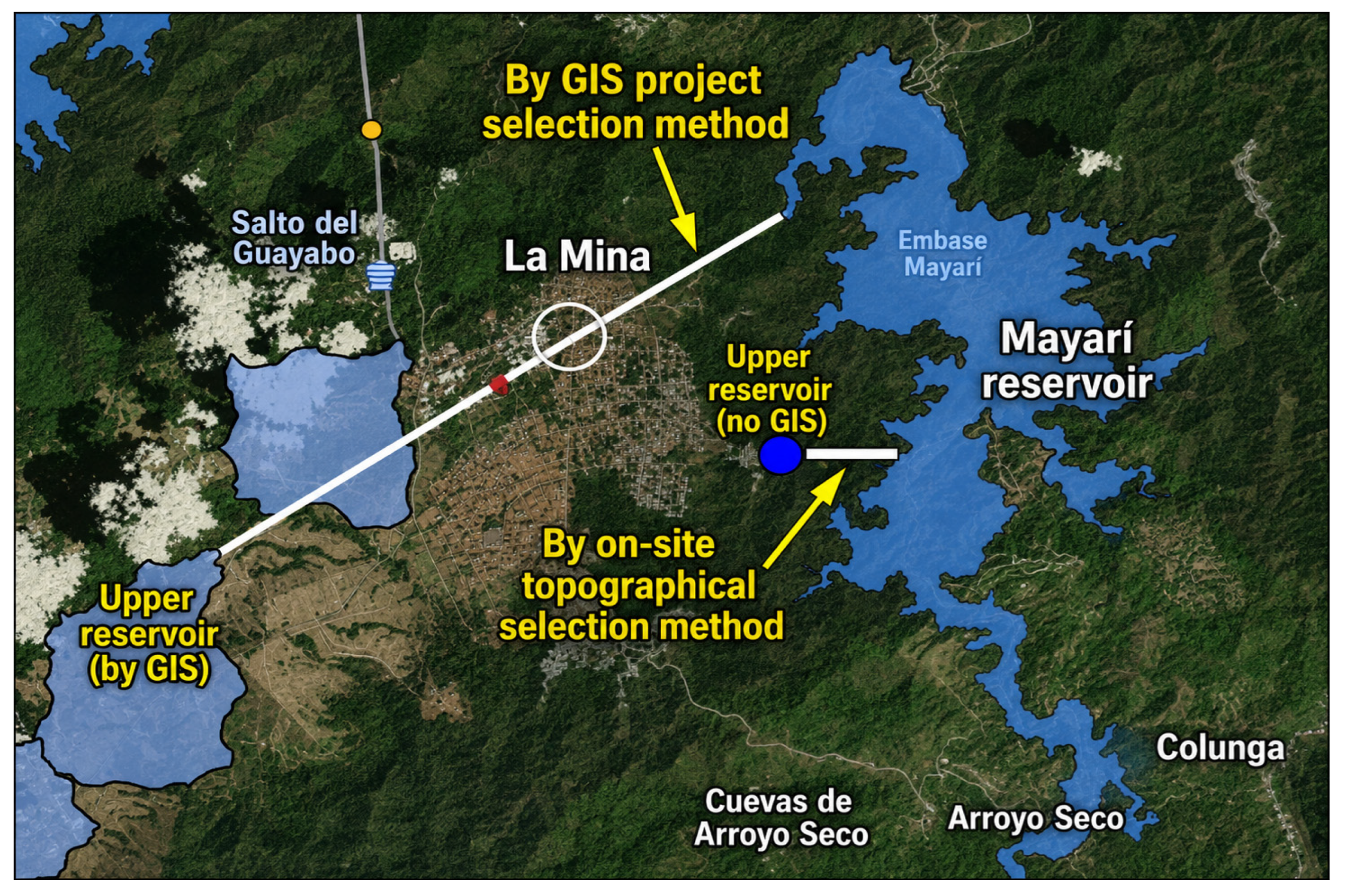
Figure 9 illustrates the spatial comparison between the upper reservoir locations determined by both methods. It is noteworthy that the lower reservoir identified by the global atlas coincides perfectly with the already constructed Mayarí reservoir. Regarding the upper reservoir, Figure 9 highlights the location explained in Section 4.3 and presented in Figure 8. While the underlying assumptions for site selection differ between the two methods, the use of GIS significantly streamlines the initial stages of identifying potential locations and sizing the reservoir. This is a critical advantage, as the capacity of the upper reservoir is directly linked to the generation time and energy potential at any given site.
Remarkably, a location near the one evaluated for 200 MW in Section 4.3 could generate 500 GWh for 50 h, according to the global atlas. Consequently, while the installed power value may fluctuate from the initial 200 MW estimate, the most significant change is the marked increase in storage capacity, as evidenced in Figure 9. This demonstrates a high degree of consistency between both methods regarding the overall selection of the site, despite differences in absolute capacity values. This divergence suggests that while GIS is a formidable decision-support tool, its results represent a theoretical potential that requires refinement through Multi-Criteria Decision Support Systems (MCDSS), to account for local geotechnical, environmental, and infrastructure constraints. Several contemporary papers utilize multi-criteria methods for the site selection of PHES [17] and PV installations [60] site variants.
To quantitatively evaluate the accuracy of the GIS screening framework against ground-truth engineering data, key hydraulic and spatial parameters for the Mayarí case study were statistically compared across three independent data sources: (1) historical 1:50,000 topographic maps, (2) the automated ANU global satellite GIS atlas, and (3) high-resolution on-site engineering surveys. For hydraulic net head (H), the global GIS atlas estimated a theoretical head of 570.0 m, whereas historical maps yield-ed 450.7 m and detailed engineering design established 475.0 m. This corresponds to a relative GIS overestimation error of 20.0% relative to on-site engineering, reflecting the 30 m SRTM DEM spatial smoothing over steep gorge micro-topography. For penstock length (L), the GIS atlas predicted 2580 m (L/H = 4.53), while high-resolution tunnel routing optimized via Barton’s Q-system determined a physical waterway distance of 1571 m (L/H = 2.29), representing a spatial deviation of 39.1% due to subterranean shortcutting not captured by surface DEM algorithms. Across the national inventory, cross-validation between the 31 historical survey sites and the 92 GIS-derived candidates demonstrated a 77.4% spatial coincidence rate (24 out of 31 legacy sites matched within a 3 km buffer), confirming the macro-level reliability of automated GIS screening for national-scale resource identification.

5. Discussion

5.1. Implications of the Integrated Methodology

The principal contribution of this work is the development of an integrated framework that combines historical engineering knowledge with modern GIS-based screening and engineering validation. Rather than replacing previous national investigations, the proposed methodology demonstrates how historical topographic surveys, automated geospatial analysis, local infrastructure constraints, and detailed engineering design can complement one another to improve PHES site selection. The high level of agreement observed between the historical Cuban inventory and the GIS-derived candidates confirms the robustness of both approaches while significantly reducing the uncertainty associated with regional-scale planning.
The proposed framework also illustrates that automated GIS screening should not be considered a stand-alone decision-making tool. Instead, it represents the first stage of a hierarchical planning process that must subsequently incorporate engineering, environmental, socio-economic, and electrical network constraints before selecting the most appropriate project for implementation.
Consequently, future national planning exercises would benefit from integrating GIS outputs with MCDSS, allowing technical, environmental, economic, and social indicators to be evaluated simultaneously according to national priorities.
To position the Cuban PHES inventory within the international state of the art, the geospatial results were compared with GIS-based national screenings conducted in China [48,52], Iran [49], Spain [56], the United States [53], and global island jurisdictions [55]. In terms of hydraulic head distribution, Cuba’s 92 identified sites exhibit a high mean net head (Hmean = 653.9 m for the 150/500 GWh shortlist and 385 m across regional clusters), which compares favourably with national averages reported in Spain (300 to 500 m; [56]) and Iran (450 m; [49]). High hydraulic head is technically advantageous as it reduces the required water storage volume per MWh generated, thereby minimizing reservoir surface footprint and civil construction CAPEX (20 to 40 USD/kWh for Class AA/A). Furthermore, while most international GIS studies rely exclusively on satellite DEM screening without field validation [53], the dual-methodology presented here (bridging satellite GIS screening with historical 1:50,000 surveys and site-specific geotechnical design) addresses a recognized gap in GIS energy planning literature regarding spatial error propagation in mountainous terrains.
The proposed framework is transferable to other islanded or developing power systems where historical engineering studies coexist with modern GIS-based planning tools.

5.2. Role of PHES in Cuba’s Renewable Energy Transition

Beyond traditional energy arbitrage, the Mayarí PHES project should be considered a strategic component of a diversified national energy storage portfolio. While PHES provides the large-scale, long-duration storage required for daily and weekly balancing, Battery Energy Storage Systems (BESS) offer rapid frequency response and short-duration services, whereas green hydrogen technologies may become suitable for seasonal energy storage. The complementary deployment of these technologies would substantially increase the flexibility and resilience of the future Cuban power system.
As the penetration of variable renewable energy increases, the reduction of synchronous generation will progressively decrease system inertia, making storage technologies increasingly important for maintaining frequency stability and operational security [21]. Within this context, PHES offers unique advantages due to its large storage capacity, long service life, and capability to simultaneously provide multiple ancillary services.
Consequently, the economic assessment of PHES projects should move beyond conventional energy arbitrage and incorporate the full system value provided by long-duration storage. This includes avoided fossil-fuel consumption, reserve provision, voltage support, black-start capability, frequency regulation, deferred network investments, and improved renewable energy utilization.
As a Caribbean island nation, Cuba is highly vulnerable to climate change im-pacts, including extreme weather events (e.g., Category 3–5 hurricanes such as Hurricane Ian in 2022, and Melissa in 2025), prolonged tropical droughts, and elevated open-reservoir evaporation rates. These climate stressors pose operational risks to initial reservoir filling and top-up replenishment. To guarantee long-term operational resilience, PHES civil engineering designs must incorporate climate-adaptation safeguards. In the Mayarí case study, the 106 m3 upper reservoir design explicitly incorporates a dedicated water reserve margin to offset seasonal evaporation losses during dry tropical months.
Notably, off-river closed-loop configurations inherently offer superior climate resilience compared to conventional on-river facilities, as they remain decoupled from riverbed flash flooding and heavy tropical sediment transport. Integrating robust long-term hydrological monitoring with Environmental Impact Assessments (EIAs) will be essential to ensure that PHES deployment enhances power system resilience without competing with agricultural or municipal water needs.

5.3. Policy Implications

The Cuban electricity sector currently lacks specific regulatory mechanisms capable of recognizing the multiple services provided by large-scale storage technologies. Consequently, limited policy support and the absence of ancillary service markets remain among the principal barriers to PHES investment.
In agreement with recent international literature [23,63], future policy actions should include the creation of dedicated institutional structures for energy storage planning, the development of a national long-term storage roadmap, and the implementation of financial incentives capable of reducing investment risk during the early deployment stages.
Furthermore, remuneration mechanisms should explicitly recognize the complete portfolio of ancillary services supplied by PHES, including frequency regulation, operating reserves, voltage support, inertia replacement, black-start capability, and transmission system support. The adoption of variable-speed pump-turbines could further improve operational flexibility and round-trip efficiency under high renewable penetration scenarios.

6. Study Limitations and Uncertainty Analysis

Although the proposed integrated methodology successfully combines historical engineering investigations, GIS-based regional screening, and engineering validation to identify promising PHES sites in Cuba, several limitations remain inherent to the regional-scale nature of this study. Consequently, the identified candidate sites should be interpreted as strategic planning alternatives rather than investment-ready projects. Before implementation, each selected site must undergo comprehensive geological, hydrological, environmental, economic, and electrical engineering assessments. The principal sources of uncertainty are summarized below.
The Shuttle Radar Topography Mission (SRTM) Digital Elevation Model (30 m spatial resolution) provides an efficient dataset for regional-scale screening but does not offer the level of detail required for detailed civil engineering design. Final reservoir layouts, penstock alignments, slope stability analyses, and earthwork calculations should be based on high-resolution LiDAR surveys or drone-based photogrammetry.
The GIS methodology does not explicitly account for subsurface geological conditions. Cuba contains extensive limestone karst formations characterized by cavities, fractures, and high permeability that may significantly affect reservoir watertightness and foundation stability. Therefore, detailed geotechnical investigations, drilling campaigns, geophysical surveys, and seepage analyses are required before construction.
Reservoir storage and yield estimates in this study are based on historical hydro-logical conditions and average precipitation records. However, climate-driven variability (including altered rainfall distribution, severe multi-year tropical droughts, and elevated evaporation rates) introduces operational uncertainty regarding long-term reservoir filling schedules and top-up replenishment cycles. Regional-scale GIS screening cannot fully capture localized micro-climatic shifts or extreme climate projections. Consequently, project-level feasibility studies must integrate downscaled regional cli-mate models (RCMs) alongside real-time hydrometric and meteorological monitoring networks across candidate watersheds (such as the Sagua-Baracoa and Sierra Maestra Mountain ranges) to dynamically recalibrate 100-year flood and drought risk models.
The present work focuses on identifying suitable PHES locations from a spatial planning perspective. It does not include chronological power system simulations, AC power-flow analyses, unit commitment optimization, or dynamic frequency stability studies under high renewable penetration scenarios. Future research should integrate the proposed methodology with electrical system simulation platforms such as DIgSILENT PowerFactory, PSS®E or ESFEX to evaluate the operational contribution of PHES within the Cuban National Electric System.
Although protected areas, urban settlements, and major environmental constraints were incorporated into the GIS screening process, detailed Environmental Impact Assessments (EIAs) remain essential for evaluating biodiversity conservation, land-use conflicts, agricultural water demands, population relocation, and other site-specific socio-economic impacts.
Despite these limitations, the proposed methodology substantially reduces the uncertainty associated with national-scale PHES planning by integrating historical engineering knowledge with modern geospatial analysis and engineering validation. As such, it provides a robust first-stage decision-support framework for identifying priority sites requiring detailed feasibility studies.

7. Conclusions

This study demonstrates that PHES projects represent a technically viable and strategically important solution for supporting Cuba’s transition toward a renewable-based electricity system. By combining historical engineering knowledge with modern Geographic Information System screening techniques, the proposed integrated methodology provides a comprehensive framework for identifying, validating, and prioritizing potential PHES sites. Rather than replacing previous national engineering studies, the methodology complements and extends them through automated terrain analysis and spatial filtering, thereby improving the robustness of site selection.
The application of this integrated methodology constitutes the first academic implementation of the ANU Global Pumped Hydro Atlas within the Cuban context. The GIS-based screening identified 92 potential off-river closed-loop PHES sites distributed throughout the country, substantially expanding the national inventory previously established from engineering studies conducted since the 1970s. While earlier investigations estimated a theoretical PHES potential of approximately 16.18 GW, the automated screening indicates that the country’s storage potential is even greater when larger reservoir configurations are considered. Among the identified candidates, fourteen sites belong to the 500 GWh storage class and seventy-eight to the 150 GWh class. Several of these sites exhibit favourable hydraulic heads exceeding 450 m, with an average head of approximately 385 m.
The comparison between historical engineering studies and GIS-derived candidates reveals a high degree of consistency between the two approaches. Several historically identified projects were independently rediscovered through the automated GIS screening, confirming the reliability of the methodology. Furthermore, incorporating local engineering information (including transmission infrastructure, environmental constraints, and field verification) significantly improves the practical value of the global GIS inventory for national planning purposes.
Among the evaluated alternatives, the Mayarí PHES project remains one of the most promising candidates for future implementation. Its favourable topography, existing lower reservoir, proximity to the 220 kV transmission network, and location within one of Cuba’s principal industrial and renewable energy development regions substantially reduce infrastructure requirements and investment risk. Nevertheless, the results also demonstrate that several additional sites exhibit comparable or even superior geomorphological characteristics, reinforcing the need for systematic project prioritization.
Beyond the Cuban case, the proposed integrated GIS-based screening and engineering validation methodology is readily transferable to other islanded and developing power systems where historical engineering information coexists with modern geospatial datasets. The framework illustrates how legacy technical knowledge can be successfully integrated with automated GIS tools to improve strategic energy infrastructure planning.
Future research should focus on integrating the identified candidate sites into multi-criteria decision support frameworks that incorporate technical, economic, environmental, geological, and social criteria. In parallel, detailed engineering investigations, high-resolution topographic surveys, dynamic power system simulations, and comprehensive cost-benefit analyses will be required to advance the most promising projects toward implementation. Finally, the establishment of regulatory mechanisms that appropriately remunerate long-duration energy storage and ancillary services will be essential for enabling the deployment of PHES as a cornerstone of Cuba’s future low-carbon electricity system.

Supplementary Materials

The following supporting information can be downloaded at: https://www.mdpi.com/article/10.3390/en19163857/s1. The Supplementary Material provides the complete dataset for all 92 candidate sites, including their geographic coordinates (latitude and longitude), hydraulic head, reservoir separation, storage volume, dam wall characteristics, and cost classification.

Author Contributions

Conceptualization, L.P.-P. and J.L.; methodology, L.P.-P., I.N.V.-Q., J.L.; software, L.P.-P., J.L.; validation, L.P.-P. and J.L.; formal analysis, L.P.-P., I.N.V.-Q., Y.M., J.K.-o., and J.L.; investigation, L.P.-P., I.N.V.-Q., and J.L.; resources, L.P.-P.; data curation, L.P.-P., J.L. and I.N.V.-Q.; writing—original draft preparation, L.P.-P., I.N.V.-Q., J.L.; writing—review and editing, L.P.-P., I.N.V.-Q., J.K.-o., Y.M., and J.L.; visualization, L.P.-P., I.N.V.-Q., and J.L.; supervision, L.P.-P., J.K.-o., I.N.V.-Q., Y.M., and J.L.; project administration, L.P.-P., J.L., and J.K.-o.; funding acquisition, L.P.-P., J.K.-o., and J.L. All authors have read and agreed to the published version of the manuscript.

Funding

This paper has received funding from the European Union’s Horizon Europe research and innovation programme under the Marie Skłodowska-Curie grant agreement No [101205310], M4IEMA project.

Data Availability Statement

Restrictions apply to the availability of these data. Data were obtained from EMFRE-UNE, and are available from the authors only with the permission of EMFRE-UNE.

Acknowledgments

Authors would like to thank RAUDAL® and EMFRE-UNE Engineers and administrative personnel for bringing access to Mayarí project information and Cuban PHES project information respectively. Also, to RE100 Group. Australia National University for sharing the worldwide PHES Atlas. During the preparation of this study, the authors used ChatGPT (GPT-5.6 Luna; OpenAI, 2026) for the purpose of generating conceptual sketches for Figure 1 and Figure 4. The authors have reviewed and edited the output and take full responsibility for the content of this publication.

Conflicts of Interest

The authors declare no conflict of interest. In addition, the funders had no role in the design of the study; in the collection, analysis, or interpretation of data; in the writing of the manuscript, or in the decision to publish the results.

References

  1. Peña-Pupo, L.; Hidalgo-González, R.; Vidaud-Quintana, I.N.; Luukkanen, J. Potential assessment of pumped storage technology in Cuba: The Mayarí project case study. In Proceedings of the III Convención Internacional Ciencia y Conciencia (Simposio 7), Santiago de Cuba, Cuba, 11–14 April 2023; pp. 185–192. [Google Scholar]
  2. Liu, Y.; He, Q.; Shi, X.; Zhang, Q.; An, X. Energy storage in China: Development progress and business model. J. Energy Storage 2023, 72, 108240. [Google Scholar] [CrossRef] [Scilit]
  3. Rana, M.M.; Uddin, M.; Sarkar, M.R.; Meraj, S.T.; Shafiullah, G.; Muyeen, S.; Islam, M.A.; Jamal, T. Applications of energy storage systems in power grids with and without renewable energy integration—A comprehensive review. J. Energy Storage 2023, 68, 107811. [Google Scholar] [CrossRef] [Scilit]
  4. Rehman, S.; Al-Hadhrami, L.M.; Alam, M.M. Pumped hydro energy storage system: A technological review. Renew. Sustain. Energy Rev. 2015, 44, 586–598. [Google Scholar] [CrossRef] [Scilit]
  5. He, W.; King, M.; Luo, X.; Dooner, M.; Li, D.; Wang, J. Technologies and economics of electric energy storages in power systems: Review and perspective. Adv. Appl. Energy 2021, 4, 100060. [Google Scholar] [CrossRef] [Scilit]
  6. IHA. 2024 World Hydropower Outlook. London. Available online: https://acrobat.adobe.com/id/urn:aaid:sc:us:6ba5f8fc-5ad3-4d52-a83c-0931ce5fa119 (accessed on 10 July 2024).
  7. IEA. Renewables 2025. Analysis and Forecasts to 2030; IEA: Paris, France, 2025; p. 238. Available online: https://www.iea.org/reports/renewables-2025 (accessed on 18 October 2025).
  8. IHA. Pumped Storage Tracking Tool. Available online: https://www.hydropower.org/hydropower-pumped-storage-tool (accessed on 16 January 2025).
  9. Stocks, M.; Stocks, R.; Lu, B.; Cheng, C.; Blakers, A. Global atlas of closed-loop pumped hydro energy storage. Joule 2021, 5, 270–284. [Google Scholar] [CrossRef] [Scilit]
  10. Nibbi, L.; Sospiro, P.; De Lucia, M.; Wu, C.-C. Improving Pumped Hydro Storage Flexibility in China: Scenarios for Advanced Solutions Adoption and Policy Recommendations. Energies 2022, 15, 7918. [Google Scholar] [CrossRef] [Scilit]
  11. Menéndez, J.; Fernández-Oro, J.M.; Loredo, J. Economic Feasibility of Underground Pumped Storage Hydropower Plants Providing Ancillary Services. Appl. Sci. 2020, 10, 3947. [Google Scholar] [CrossRef] [Scilit]
  12. Jaen, R.L.; Pupo, L.P.; Lora, E.E.S.; Eras, J.J.C.; Gutierrez, A.S. Assessing biomass production and electricity generation potential in current and future decarbonization scenarios in Cuba until 2050. Energy Convers. Manag. 2025, 332, 119698. [Google Scholar] [CrossRef] [Scilit]
  13. Figueredo Reinaldo, O.; Carmona Tamayo, E. Cuba en Datos: El Ineludible Cambio de la Matriz Energética Que Necesitamos. Available online: http://www.cubadebate.cu/especiales/2022/07/01/cuba-en-datos-el-ineludible-cambio-de-la-matriz-energetica-que-necesitamos/ (accessed on 5 July 2025).
  14. Brandts, M.; Bertheau, P.; Plana, D.R.; Lammers, K.; Rodriguez, M.A.R. An energy system model-based approach to investigate cost-optimal technology mixes for the Cuban power system to meet national targets. Energy 2024, 306, 132492. [Google Scholar] [CrossRef] [Scilit]
  15. Cunill, E.C.C.; Rodríguez, C.A.M.; Pupo, L.P.; Lora, E.E.S.; Venturini, O.J.; Opelowa, A.O.; Jaén, R.L. Long-term decarbonization pathways for Cuba’s electricity sector: A scenario-based analysis to 2050. Energy Convers. Manag. X 2026, 31, 102101. [Google Scholar] [CrossRef] [Scilit]
  16. MINEM. Energías Renovables y Eficiencia Energética. Available online: https://www.minem.gob.cu/es/actividades/energias-renovables-y-eficiencia-energetica (accessed on 13 November 2025).
  17. Sánchez, A.; Zhang, Q.; Martín, M.; Vega, P. Towards a new renewable power system using energy storage: An economic and social analysis. Energy Convers. Manag. 2022, 252, 115056. [Google Scholar] [CrossRef] [Scilit]
  18. Lipu, M.H.; Rahman, M.A.; Islam, Z.U.; Rahman, T.; Rahman, S.; Meraj, S.T.; Hossain, Y.; Mansor, M. Review of energy storage integration in off-grid and grid-connected hybrid renewable energy systems: Structures, optimizations, challenges and opportunities. J. Energy Storage 2025, 122, 116629. [Google Scholar] [CrossRef] [Scilit]
  19. Castro Fernández, M.; Vilaragut Llanes, M.; Hernandez, J.C. Electromobility and Energy Transition in Cuba. Sustainability 2024, 16, 9688. [Google Scholar] [CrossRef] [Scilit]
  20. Peña, P.L.; Hidalgo, G.R. Acumulación de energía hidráulica en Cuba. Proyección hacia el año 2030. Bol. Inf. Renov. CU 2019, 4, 2–6. [Google Scholar]
  21. Zhao, Z.; Zhang, M.; He, M.; Gao, Y.; Li, J.; Han, S.; Liu, Z.; Lei, L.; Díaz, J.I.P.; Cavazzini, G. Beyond fixed-speed pumped storage: A comprehensive evaluation of different flexible pumped storage technologies in energy systems. J. Clean. Prod. 2024, 434, 139994. [Google Scholar] [CrossRef] [Scilit]
  22. Li, Y.; Fan, Y.; Ke, X.; Huo, C.; Zhou, M.; Yang, Y.; Wang, J.; Xin, Y. Cost Recovery for Variable-Speed Pumped Storage Power Plants in the Market Environment. Energies 2025, 18, 153. [Google Scholar] [CrossRef] [Scilit]
  23. Yong, X.; Wu, Y.; Zhou, J.; Tao, Y.; Chen, W. Prospects and barriers analysis framework for the development of energy storage sharing. Sustain. Cities Soc. 2023, 89, 104368. [Google Scholar] [CrossRef] [Scilit]
  24. Koohi-Fayegh, S.; Rosen, M.A. A review of energy storage types, applications and recent developments. J. Energy Storage 2020, 27, 101047. [Google Scholar] [CrossRef] [Scilit]
  25. Nikolaos, P.C.; Marios, F.; Dimitris, K. A Review of Pumped Hydro Storage Systems. Energies 2023, 16, 4516. [Google Scholar] [CrossRef] [Scilit]
  26. NREL. Pumped Storage Hydropower Supply Curves. Available online: https://www.nlr.gov/gis/psh-supply-curves (accessed on 27 February 2025).
  27. Peña-Pupo, L.; Martínez-García, H.; García-Vílchez, E.; Domínguez, A.H.; Fariñas-Wong, E.Y. Improvements in Frequency Control of an AC Microgrid by Means of Micro-Hydropower Combined Flow-Reduced Dump Load Control Method. Renew. Energ. Power Qual. J. 2022, 20, 506–511. [Google Scholar] [CrossRef] [Scilit]
  28. Coban, H.H.; Rehman, A.; Mousa, M. Load Frequency Control of Microgrid System by Battery and Pumped-Hydro Energy Storage. Water 2022, 14, 1818. [Google Scholar] [CrossRef] [Scilit]
  29. Vazquez, L.; Majanne, Y.; Castro, M.; Luukkanen, J.; Hohmeyer, O.; Vilaragut, M.; Díaz, D. Energy System Planning towards Renewable Power Systems: Energy Matrix Change in Cuba by 2030. IFAC-Pap. OnLine 2018, 51, 522–527. [Google Scholar] [CrossRef] [Scilit]
  30. Korkeakoski, M. Towards 100% Renewables by 2030: Transition Alternatives for a Sustainable Electricity Sector in Isla de la Juventud, Cuba. Energies 2021, 14, 2862. [Google Scholar] [CrossRef] [Scilit]
  31. Boroomandnia, A.; Rismanchi, B.; Wu, W.; Anderson, R. Eco-economic comparison of batteries and pumped-hydro systems at the micro scale in buildings. Energy Convers. Manag. 2024, 312, 118527. [Google Scholar] [CrossRef] [Scilit]
  32. Mitali, J.; Dhinakaran, S.; Mohamad, A. Energy storage systems: A review. Energy Storage Sav. 2022, 1, 166–216. [Google Scholar] [CrossRef] [Scilit]
  33. Benguria, F.; Choi, J.; Swenson, D.L.; Xu, M.J. Anxiety or pain? The impact of tariffs and uncertainty on Chinese firms in the trade war. J. Int. Econ. 2022, 137, 103608. [Google Scholar] [CrossRef] [Scilit]
  34. Zhao, X.; Peng, M.; Wang, X.; Xu, R.; Cui, Y. The Effect of Trade Policy Uncertainty on Green Technology Innovation: Evidence from China’s Enterprises. Sustainability 2024, 16, 7150. [Google Scholar] [CrossRef] [Scilit]
  35. Zuo, W.; Chen, Q. Fast and informative flow simulations in a building by using fast fluid dynamics model on graphics processing unit. Build. Environ. 2010, 45, 747–757. [Google Scholar] [CrossRef] [Scilit]
  36. Luukkanen, J.; Saunders, A.; Majanne, Y.; Korkeakoski, M. Possibilities and challenges for developing a 100% renewables electricity system for Cuba. In Proceedings of the III Simposio Internacional sobre Generación Distribuida (SIGEDI 2022), La Habana, Cuba, 28 November–2 December 2022. [Google Scholar]
  37. Alberto Alvarez, E.; Korkeakoski, M.; Santos Fuentefría, A.; Lourdes Filgueiras Sainz de Rozas, M.; Arcila Padura, R.; Luukkanen, J. Long-Range Integrated Development Analysis: The Cuban Isla de la Juventud Study Case. Energies 2021, 14, 2865. [Google Scholar] [CrossRef] [Scilit]
  38. Luukkanen, J.; Saunders, A.; Majanne, Y.; Korkeakoski, M. Modelling Cuban energy system with CubaLinda model, Prospects for 100% renewable scenario. In Cuban Energy Futures. The Transition Towards a Renewable Energy System-Political, Economic, Social and Environmental Factors; Luukkanen, J., Saunders, A., Majanne, Y., Korkeakoski, M., Eds.; Finland Futures Research Centre (FFRC), University of Turku: Turku, Finland, 2022; Volume 3, p. 335. Available online: https://research.fi/en/results/publication/0397072322 (accessed on 18 October 2025).
  39. Vasudevan, K.R.; Ramachandaramurthy, V.K.; Venugopal, G.; Ekanayake, J.B.; Tiong, S.K. Variable speed pumped hydro storage: A review of converters, controls and energy management strategies. Renew. Sustain. Energy Rev. 2021, 135, 110156. [Google Scholar] [CrossRef] [Scilit]
  40. Zhao, Z.; Yuan, Y.; He, M.; Jurasz, J.; Wang, J.; Egusquiza, M.; Egusquiza, E.; Xu, B.; Chen, D. Stability and efficiency performance of pumped hydro energy storage system for higher flexibility. Renew. Energy 2022, 199, 1482–1494. [Google Scholar] [CrossRef] [Scilit]
  41. Xu, Z.; Deng, C.; Yang, Q. Flexibility of variable-speed pumped-storage unit during primary frequency control and corresponding assessment method. Int. J. Electr. Power Energy Syst. 2023, 145, 108691. [Google Scholar] [CrossRef] [Scilit]
  42. Zhao, J.-F.; Oh, U.-J.; Park, J.-C.; Park, E.S.; Im, H.-B.; Lee, K.Y.; Choi, J.-S. A Review of World-wide Advanced Pumped Storage Hydropower Technologies. IFAC Pap. 2022, 55–59, 170–174. [Google Scholar] [CrossRef] [Scilit]
  43. Shang, D.; Pei, P.; Zuo, Y. Techno-Economic Feasibility Analysis of Pumped Storage Hydroelectricity in Abandoned Underground Coal Mines. J. Energy Resour. Technol. 2020, 142, 122001. [Google Scholar] [CrossRef] [Scilit]
  44. Del-Campo, A.J.W. Hidroenergía. Características de red fluvial en Cuba. Bol. Inf. Renov. CU 2020, 8, 2–4. [Google Scholar]
  45. Uría-Martínez, R.; Johnson, M.M.; Shan, R.U.S. Hydropower Market Report; US Department of Energy, Office of Energy Efficiency & Renewable Energy: Washington, DC, USA, 2021; p. 158. Available online: www.osti.gov/bridge (accessed on 14 February 2021).
  46. Peña, P.L.; Gutiérrez, U.L.; Ramón, H.G.; Domínguez, A.H. Integration Proposal of a Solar Thermal Power Plant to the Cuban National Electric System. Rev. Tecnol. Quím. 2018, 38, 551–561. [Google Scholar]
  47. Shishkov, G.; Grigorov, S. Estudio Tecnico-Económico Comparativo de Ubicación de Centrales Hidroacumuladoras. Partes I-V: Variantes de Ubicación de Centrales Hidroacumuladoras en la Region Oriental, Central y Occidental. Conclusiones Generales; Instituto de Hidroeneconomía: Internal Report; Ministerio de la Construcción (MICONS): Havana, Cuba, 1980; p. 850.
  48. Li, J.; Chen, D.; Han, W.; Wang, P.; Zhao, Z.; Liu, G. Site identification and capacity determination of pumped hydro storage plants using GIS and spatial MCDM in Northwest China. Energy Convers. Manag. 2024, 322, 119179. [Google Scholar] [CrossRef] [Scilit]
  49. Ghorbani, N.; Makian, H.; Breyer, C. A GIS-based method to identify potential sites for pumped hydro energy storage-case of Iran. Energy 2019, 169, 854–867. [Google Scholar] [CrossRef] [Scilit]
  50. Ali, S.; Stewart, R.A.; Sahin, O.; Vieira, A.S. Integrated GIS-AHP-based approach for off-river pumped hydro energy storage site selection. Appl. Energy 2023, 337, 120914. [Google Scholar] [CrossRef] [Scilit]
  51. Görtz, J.; Aouad, M.; Wieprecht, S.; Terheiden, K. Assessment of pumped hydropower energy storage potential along rivers and shorelines. Renew. Sustain. Energy Rev. 2022, 165, 112027. [Google Scholar] [CrossRef] [Scilit]
  52. Song, Y.; He, H.; Yan, Y.; Zhai, L.; Yao, J.; Wu, B. A Toolbox for generalized pumped storage power station based on terrain in ArcGIS Environment. Renew. Energy 2024, 220, 119590. [Google Scholar] [CrossRef] [Scilit]
  53. Rosenlieb, E.; Heimiller, D.; Cohen, S. Closed-Loop Pumped Storage Hydropower Resource Assessment for the United States. Final Report on HydroWIRES Project D1: Improving Hydropower and PSH Representations in Capacity Expansion Models; National Renewable Energy Lab (NREL): Golden, CO, USA, 2022.
  54. Rogeau, A.; Girard, R.; Kariniotakis, G. A generic GIS-based method for small Pumped Hydro Energy Storage (PHES) potential evaluation at large scale. Appl. Energy 2017, 197, 241–253. [Google Scholar] [CrossRef] [Scilit]
  55. Hunt, J.D.; Lagore, B.; Brandão, R.; Diuana, F.A.; Quaranta, E.; de Miranda, M.; Lacorte, A.; Barbosa, P.S.; de Freitas, M.A.V.; Zakeri, B. Mapping the potential for pumped storage using existing lower reservoirs. J. Energy Storage 2023, 73, 109047. [Google Scholar] [CrossRef] [Scilit]
  56. de Luis-Ruiz, J.M.; Carcedo-Haya, J.; Pereda-García, R.; Castro-Alonso, P.; Pérez-Álvarez, R. Optimal location of hydraulic energy storage using geographic information systems and multi-criteria analysis. J. Energy Storage 2022, 49, 104159. [Google Scholar] [CrossRef] [Scilit]
  57. Lu, B.; Stocks, M.; Blakers, A.; Anderson, K. Geographic information system algorithms to locate prospective sites for pumped hydro energy storage. Appl. Energy 2018, 222, 300–312. [Google Scholar] [CrossRef] [Scilit]
  58. Soha, T.; Munkácsy, B.; Harmat, Á.; Csontos, C.; Horváth, G.; Tamás, L.; Csüllög, G.; Daróczi, H.; Sáfián, F.; Szabó, M. GIS-based assessment of the opportunities for small-scale pumped hydro energy storage in middle-mountain areas focusing on artificial landscape features. Energy 2017, 141, 1363–1373. [Google Scholar] [CrossRef] [Scilit]
  59. Maio, M.; Marrasso, E.; Roselli, C.; Sasso, M.; Fontana, N.; Marini, G. An innovative approach for optimal selection of pumped hydro energy storage systems to foster sustainable energy integration. Renew. Energy 2024, 227, 120533. [Google Scholar] [CrossRef] [Scilit]
  60. Gao, J.; Guo, F.; Ma, Z.; Huang, X. Multi-criteria decision-making framework for large-scale rooftop photovoltaic project site selection based on intuitionistic fuzzy sets. Appl. Soft Comput. 2021, 102, 107098. [Google Scholar] [CrossRef] [Scilit]
  61. RE100, g. RE100 Group, Australian National University Global Pumped Hydro Atlas. Available online: http://re100.eng.anu.edu.au/global/ (accessed on 20 January 2023).
  62. Blakers, A.; Stocks, M.; Lu, B.; Cheng, C. A review of pumped hydro energy storage. Prog. Energy 2021, 3, 022003. [Google Scholar] [CrossRef] [Scilit]
  63. Blakers, A.; Weber, T.; Silalahi, D. Pumped hydro energy storage to support 100% renewable energy. Prog. Energy 2025, 7, 022004. [Google Scholar] [CrossRef] [Scilit]
  64. Rehman, H.; Ali, W.; Naji, A.M.; Kim, J.-j.; Abdullah, R.A.; Yoo, H.-k. Review of Rock-Mass Rating and Tunneling Quality Index Systems for Tunnel Design: Development, Refinement, Application and Limitation. Appl. Sci. 2018, 8, 1250. [Google Scholar] [CrossRef] [Scilit]
Figure 1. Schematic representation of PHES operation and a 24-h demand profile in Cuba.
Energies 19 03857 g001
Figure 2. Projected energy scenario for Cuba by 2050. Adapted from: [36].
Energies 19 03857 g002
Figure 3. Potential regions for PHES projects deployment in Cuba. Adapted from: [1].
Energies 19 03857 g003
Figure 4. Integrated GIS-Based Screening and Engineering Validation Methodology for PHES Site Selection.
Energies 19 03857 g004
Figure 5. Cuban Potential Closed-Loop PHES sites calculated by [61].
Energies 19 03857 g005
Figure 6. Existing power plants and planned energy developments in Holguín province.
Energies 19 03857 g006
Figure 7. Studied variants for Mayarí PHES project. (a) 3D and (b) 2D.
Energies 19 03857 g007
Figure 8. Selected variant 1 for Mayarí PHES, main layouts.
Energies 19 03857 g008
Figure 9. Comparison of the Mayarí upper reservoir site: potential storage capacity from the global GIS atlas (light blue boundary) versus high-resolution site-specific topographic mapping (dark blue boundary).
Energies 19 03857 g009
Table 1. World’s ten largest operational pumped storage power plants.
Station NameYear *CountryPower Capacity
(MW)
Max. Head
(m)
Pumping Capacity (MW)
1Fengning2024China360020003600
2Bath County1985USA30037682880
3Kannagawa2005Japan282039182820
4Dnister PSP2010Ukraine239412402947
5Yangjiang2022China24006932400
6Huizhou2011China24001064.82400
7Hongping2016China240023202400
8Guangzhou2000China240010702400
9Baoquan2011China240020402400
10Ludington1973USA22382222238
* Commissioning year.
Table 2. Studied PHES projects in the western region of Cuba. Adapted from [47].
SiteOutput PowerNet HeadTunnel Length *Upper Reservoir CapacityLower Reservoir CapacityGross HeadL/H **
[MW][m][m][106 m3][106 m3][m]-
San Marcos200312.821906.44.4314.47
Los Palacios 1500264.234106.25.2266.612.9
Los Palacios 2500327.728905.64.1328.858.8
Santa Cruz500264.115758.15.1281.25.6
San Francisco500187201010.37.321310.8
San Cristobal 1500236.311705.65.6252.954.9
San Cristobal 2500398.214103.33.3402.753.5
San Cristobal 3500403.612903.33.34053.2
San Cristobal 4500363.525703.73.7363.27.1
Bayate500273276025.58.4286.810.1
San Claudio500319.316606.74.23355.2
Cajálbana12027614206.121.22695.27
* Only tunnels for penstock. ** length per gross head.
Table 3. Studied PHES projects in the central region of Cuba. Adapted from [47].
SiteOutput PowerNet HeadTunnel Length *Upper Reservoir CapacityLower Reservoir CapacityGross HeadL/H **
[MW][m][m][106 m3][106 m3][m]-
Caracusey4703246450.34.2326.85.33
Hondo450284.55208.514.70296.57.76
Hanabanilla470283.753001.214.55286.53.74
Guanayara470289.14400.64.60294.454.73
* Only tunnels for penstock. ** length per gross head.
Table 4. Cuba’s Eastern region PHES studied projects. Source: adapted from [47].
SiteOutput PowerNet HeadTunnel Length *Upper Reservoir CapacityLower Reservoir CapacityGross HeadL/H **
[MW][m][m][106 m3][106 m3][m]-
Pinares600367.723655.54.5369.26.4
Piloto600378.720604.254.25376.15.4
Guayabo600374.632508.64.3379.38.7
Mayarí600450.725804.553.55451.55.7
Levisa60032835304.94.9344.510.8
Moa600496.52965-3.3497.46
Jiguani60046016403.53.5464.13.6
Nibujon600466.416104.53.54673.5
Naranjo600346.626805.74.7348.77.7
Baconao 3600426.820503.83.8425.54.8
Baconao 2600414.21400-3.9431.83.4
Baconao 1600365.39204.44.5366.52.5
Santiago de Cuba600227.5267010.17.1238.111.7
Cauto600288.234405.75.729011.9
Mota600384.725104.24.2388.56.5
* Only tunnels for penstock. ** length per gross head.
Table 5. Cuba’s 500 GWh PHES GIS selected projects.
ProvinceSite NameCost ClassHead (m)Separation (km)Average Slope (%)Volume (GL)W/R (Pair)
Pinar del RíoBacunaguaA2702.312885.47.8
Villa ClaraEl NaranjoA6605.712361.24.3
La Vega 1A74213.363213.5
La Vega 2AA74013.75316.67.8
El NichoAA4253.114561.97.2
HolguínMayaríA5709.66415.73.8
PinaresC5398.56443.92.1
GuayaboD5306.58451.41.9
Santiago de CubaEl IrisD1902.481264.85.4
GuantánamoLa MesaAA4444.410531.46.7
YateritasB4548.35527.73.8
PilonesD5339.26448.92
Pozo azulB59110.85389.33
RinconcitoC72411.463291.8
Table 6. Dedicated comparison between the ANU Global Pumped Hydro Atlas and the proposed Integrated GIS-Engineering Framework.
Feature ANU Global Atlas (Raw Output)Proposed Integrated Framework (This Study)
Spatial Exclusion LayersGlobal WDPA protected areas layer onlyCuban SNAP national protected areas, urban buffers, heritage zones, and local land-use constraints
Socio-Economic & Relocation ImpactNo assessment of human settlements or population relocation in potential reservoir inundation zonesExplicit screening against inhabited zones and evaluation of potential population displacement/land-use conflicts
Grid & Infrastructure TopologyRadial distance to global high-voltage linesExplicit proximity analysis to Cuba’s 220 kV and 110 kV transmission lines and substations (UNE grid)
Capacity InterpretationTheoretical upper bounds (500 GWh/150 GWh) based purely on terrain geometrySystem-matched plant sizing (200 MW/800 MWh to 600 MW) aligned with Cuba’s peak demand (~3.2 GW)
Ground-Truth Cross-ValidationNone (purely automated satellite DEM analysis)Systematic cross-validation against 31 legacy sites from 1970s 1:50,000 engineering surveys
Sub-Surface & Civil DesignStandardized surface dam embankment equationsGeotechnical characterization via Barton’s Q-system index for fractured rock masses and underground powerhouse sizing
Hydraulic Energy BalanceTheoretical head/volume energy capacityRecalculated electromechanical cycle balance considering pipeline friction, transformer, and pump/turbine losses (ηRTE = 75.5%)
Table 7. Current installed capacity and projected additions of power generation facilities in Holguín.
Power PlantOutput Power (MW)Number of UnitsStatus
Energies 19 03857 i001Small Hydro2.81Operation
Energies 19 03857 i002Small Hydro1.684Projected
Energies 19 03857 i003PV Plants8019Projected
Energies 19 03857 i004Biomass *1003Projection
Energies 19 03857 i005Wind farm9.62Operation
Energies 19 03857 i006Wind farm3006Projected
Energies 19 03857 i007Thermal **5002Operation
Energies 19 03857 i008Mayarí PHES2002Projected
* From the sugar cane industry. ** Fossil.
Table 8. Key civil engineering and construction parameters for the proposed Mayarí PHES project.
ParameterValueUnit
Installed capacity2 × 100MW
Vertical tunnel length 370m
Horizontal tunnel length1571m
Intake tunnel diameter4m
Access tunnel length1221m
Submersion level *30m
Powerhouse chamber size 17 × 26 × 40m3
* Minimum for operation.
Table 9. Main Mayarí PHES project production and energy indicators.
IndicatorUnitTurbine ModePump Mode
Installed/Consumed PowerMW200.0176.6
Nominal Flow Rate (Q)m3/s61.3140.87
Daily Operating Hoursh/day4.06.0
Daily Water Volume Shifted106 m3/day0.8830.883
Electricity (Generated/Consumed) DailyMWh/day800.01059.6
Electricity (Generated/Consumed) Yearly (255 days)GWh/year204.0270.2
Overall Round-Trip Efficiency (ηRTE)%-75.5%
Upper Reservoir Required Volume106 m31.00 *-
* Includes evaporation reserve.
Disclaimer/Publisher’s Note: The statements, opinions and data contained in all publications are solely those of the individual author(s) and contributor(s) and not of MDPI and/or the editor(s). MDPI and/or the editor(s) disclaim responsibility for any injury to people or property resulting from any ideas, methods, instructions or products referred to in the content.