Article

Coordinated Scheduling Strategy for Diversified Energy Storage Considering Regulation Time-Scale Differences of Pumped Storage

1
Henan Tianchi Pumped Storage Co., Ltd., Nanyang 474650, China
2
School of Electrical and Electronic Engineering, Huazhong University of Science and Technology, Wuhan 430074, China
*
Author to whom correspondence should be addressed.
Energies 2026, 19(12), 2815; https://doi.org/10.3390/en19122815
Submission received: 24 April 2026 / Revised: 9 June 2026 / Accepted: 10 June 2026 / Published: 12 June 2026

Abstract

With the high penetration of renewable energy, the demand of the power system for flexible regulation resources is gradually growing. Pumped storage and battery energy storage are the most common storage types in the system, and the former can be further categorized into weekly-regulated (multi-day-regulated) and daily-regulated pumped storage. To fully leverage the regulation characteristics of these resources, this paper proposes a coordinated scheduling strategy for diversified energy storage considering varied regulation time scales. First, the correspondence of the regulation time scale of energy storage and the optimization time scale of scheduling is discussed. A two-stage coordinated scheduling framework for diversified energy storage is proposed. Second, based on models for pumped storage, battery energy storage, and thermal power units, considering deep peak shaving, an optimization model is established. This model achieves the optimal scheduling of regulation resources across day-ahead and intraday horizons. Finally, simulations are conducted on a modified IEEE 30-bus system. The results show that the proposed scheduling strategy reduces the system operating costs by 0.5% in the day-ahead scheduling and 16.1% in the intraday scheduling compared to the traditional strategy. The results verify that the proposed scheduling strategy can fully exploit the regulation characteristics of different types of storage, promote renewable energy accommodation, and ensure power supply in the power system.

1. Introduction

As the power system gradually transitions towards a clean, green, and low-carbon system, a large-scale amount of renewable energy sources, such as wind and solar power units, are being integrated. The randomness, intermittency, and volatility inherent to renewable energy generation not only increase the risks of system stability and security but also pose significant challenges to renewable energy accommodation [1]. Consequently, the demand of the power system for flexible regulation resources, represented by energy storage, is gradually growing. Energy storage can effectively smooth out power generation fluctuations and reshape the load distribution, thereby improving the accommodation of renewable energy while ensuring a stable power supply [2,3].
Since a single type of energy storage can only participate in power regulation on a single time scale, it is difficult to fully exploit its economic and technical advantages. Consequently, the power system often integrates multiple types of energy storage simultaneously, such as pumped storage (PS), battery energy storage (BES), and compressed air energy storage. Different types of energy storage can leverage their complementary regulation characteristics to meet the energy balance requirements of the power system across various dimensions, such as long-duration and short-duration and power and energy [4,5]. How to optimize the scheduling of these diversified energy storage resources across different time scales, to fully exploit their differentiated regulation characteristics while ensuring a stable power supply and high accommodation of renewable energy, has become an urgent problem to be solved.
Some existing literature has conducted research on the coordinated strategies for diversified energy storage in power system regulation, where energy storage types such as PS, BES, and supercapacitors are used for the purpose of renewable energy accommodation, peak-shaving, and economic operation [6,7,8,9,10,11,12,13]. In [14], an optimal scheduling model is established considering the differences in support capabilities of energy storage and thermal power units. A dynamic energy-regulation algorithm for hybrid energy storage systems is proposed in [15] to formulate charging and discharging plans for energy storage. Besides optimal scheduling, the applications of diversified energy storage in demand response, aggregated control, and capacity allocation are also discussed in [16,17,18,19,20,21].
In addition to the above research, some literature has also investigated the joint dispatching problem of hybrid energy storage in micro-energy grids and integrated energy systems, where energy storage types such as electrical, thermal, cold, gas, and hydrogen are considered [22,23,24,25,26,27,28,29,30,31]. In these studies, not only the electrical connections among different types of energy storage, but also interactions via other forms of energy, such as thermal, cold, and hydrogen energy, are considered in optimal dispatching.
Regarding the optimal scheduling problem, due to the distinct regulation time scales of diversified energy storage, many studies have established multi-stage optimization models to match the optimization time scales with the regulation time scales, where optimization stages such as day-ahead and intraday are proposed [32,33,34,35,36,37,38,39,40,41,42,43,44]. In [32], compressed air energy storage stations participate in the day-ahead market as independent system operators, while intraday rolling only considers the scheduling of power-type energy storage. In [33], the day-ahead stage considers energy storage with long regulation time scales, e.g., PS, and the intraday stage incorporates the charging and discharging of energy storage with short regulation time scales, e.g., electrochemical storage. In the two-level model proposed in [34], the upper level is a long time-scale model that utilizes BES to reduce system operating costs, while the lower level is a short time-scale model that employs supercapacitors to minimize the deviation between actual operating conditions and the upper-level optimization results.
The related literature on the multi-stage optimal scheduling for diversified energy storage is summarized in Table 1, including information such as scheduling stages, energy storage types, methodologies, optimization objectives, and testing systems in the case study.
An analysis of current research progress reveals that the considerations of existing multi-stage optimal scheduling models for the distinct characteristics of diversified energy storage, e.g., power and capacity, are not detailed enough. Most models simply categorize energy storage into corresponding optimization stages based on their storage types. For instance, PS, as long-time scale storage, is typically assigned to the day-ahead optimization stage, while intraday or hour-level optimization only considers short-time scale storage such as BES and supercapacitors, with PS merely following day-ahead scheduling plan or making minor adjustment.
The approaches present two main issues: first, the power and capacity regulation capabilities of energy storage are not differentiated in optimization. For example, PS is usually treated as a long-term regulation resource, but its power response speed is at the minute or second level. The optimization models fail to utilize the medium-to-short-term regulation capability of PS, which is inconsistent with practical needs. Second, energy storage is categorized into the corresponding stage solely by its type. The energy regulation time scale of storage is determined by its capacity. For example, PS, with large reservoir capacities, can achieve weekly or multi-day regulations, while those with smaller capacities operate on a daily routine. The scheduling models cannot account for these differences in the regulation time scales of different PS types.
To address these limitations, this paper proposes a two-stage coordinated scheduling strategy for diversified energy storage. This approach addresses the two mentioned issues of existing studies in the following ways: first, by characterizing the regulation time scales of energy storage into power and energy, the power and capacity regulations can be considered distinctly in the same stage. Consequently, in intraday scheduling, PS output can be optimized while its capacity regulation plan is optimized considering both day-ahead plans and system requirements. Second, the proposed criterion for energy storage optimization is based on the individual characteristics of energy storage rather than its type. This helps to achieve the differentiated treatment of energy storage of the same type but possesses different regulation time scales, e.g., the weekly-regulated and daily-regulated PS. The main contributions of this paper include the following:
  • The correspondence of the regulation time scales of energy storage and the optimization time scales of optimal scheduling is discussed, and a criterion is proposed to quantitatively analyze the correspondence. Based on the criterion, a day-ahead and intraday two-stage coordinated scheduling framework is proposed. The framework differentiates the regulation characteristics of weekly-regulated (multi-day-regulated) PS, daily-regulated PS, and BES.
  • Based on the models of PS, BES, and thermal power units participating in deep peak shaving, a coordinated scheduling model for diversified energy storage is established. In this model, the models of the energy storage are selected based on their regulation time scales, which helps to achieve the optimal utilization of regulation resources across day-ahead and intraday horizons. The coordination between the two optimization time scales is explicitly considered in the objectives and constraints.
  • Simulation tests are conducted on a modified IEEE 30-bus system. The results show that the proposed scheduling strategy reduces the system operating costs compared to the traditional strategy in both stages by leveraging the regulation characteristics of different types of energy storage, especially the two types of PS, and enhances the accommodation level of renewable energy.
The remainder of this paper is organized as follows: Section 2 introduces the methodology, which proposes a day-ahead and intraday two-stage coordinated scheduling framework and its mathematical model for optimal scheduling. Section 3 presents case studies to verify the effectiveness of the proposed strategy. Section 4 discusses the advantages and limitations. Section 5 concludes this paper.

2. Methodology

2.1. Correspondence of Regulation Time Scale of Energy Storage and Optimization Time Scale

Different types of energy storage possess distinct regulation characteristics, primarily in terms of power and capacity [45]. When considering the multi-stage scheduling of energy storage, two problems should be noticed [35], i.e., the “myopia” problem caused by considering only the local scheduling range but neglecting the optimization of a larger scheduling range and the “hyperopia” problem caused by considering a large scheduling range too much but neglecting the regulation needs of the current scheduling range. To achieve the balance between the two extremes, a criterion is needed to determine the consideration of energy storage in each scheduling stage.
In the proposed criterion, the energy-regulation time scale and the power-regulation time scale of energy storage are compared with the optimization time scale of scheduling. Regarding the energy-regulation time scale, when the optimization time scale is larger than the energy-regulation time scale, the optimization model should incorporate energy optimization of the energy storage to fully utilize its energy-regulation characteristics according to system requirements. Conversely, when the optimization time scale is smaller than the energy-regulation time scale, optimization should be performed on the basis of the energy-regulation plan from a larger time scale to avoid the “myopia” problem.
Similarly, regarding the power-regulation time scale, when the optimization time scale is larger than the power-regulation time scale, the power regulation of energy storage can be considered locally within the optimization period to avoid the “hyperopia” problem. Conversely, if the optimization time scale is smaller than the power-regulation time scale, it is necessary to refer to the optimization results of a larger time scale and treat the energy storage power as a fixed boundary.
The correspondence of the aforementioned regulation time scales of energy storage and optimization time scales is illustrated in Table 2.
In Table 2, TO denotes the optimization time scale, i.e., the time duration considered in the optimal scheduling. TER denotes the time scale of energy regulation of energy storage, which is determined by its maximal discharge duration. TPR denotes the time scale of power regulation, which is determined by the response speed of energy storage.
Since different types of energy storage may possess distinct power and energy-regulation time scales, their corresponding optimization models may vary under the same optimization time scale. In this paper, three types of energy storage are considered: weekly-regulated (multi-day-regulated) PS, daily-regulated PS, and BES. The main difference between the two types of PS lies in the ratio of the PS reservoir capacity to the total power capacity of PS units. Regarding the optimization time scale, two stages are considered in this paper: day-ahead and intraday (hourly). By mapping the regulation time scales of the three types of energy storage to the optimization time scales of the two stages, the following conclusions can be drawn according to Table 2: in terms of power regulation, since the power regulation time scale for both types of PS and BES ranges from seconds to minutes, which is far smaller than that the optimization time scales of the two-stage scheduling, their power output are optimized independently in the optimal scheduling models. In terms of energy regulation, the correspondence between the energy regulation time scales of different types of energy storage and the optimization time scales of the two-stage scheduling is shown in Table 3.
In Table 3, since the energy-regulation time scale of weekly-regulated PS is larger than the optimization time scales of day-ahead and intraday scheduling, the regulation plans from higher-level time scales should be considered in the two-stage optimization, i.e., the day-ahead optimization should refer to the weekly regulation plan as a basis for further optimization, while the intraday optimization should refer to the day-ahead scheduling plan for optimization. For daily-regulated PS, its energy-regulation time scale falls between the optimization time scales of the two stages. Consequently, its energy regulation is optimized independently in the day-ahead stage, whereas the day-ahead scheduling plan is considered in the intraday optimization. Regarding BES, its regulation time scale is at the hour level, so its energy regulation can be optimized independently in both stages.

2.2. Coordinated Scheduling Framework

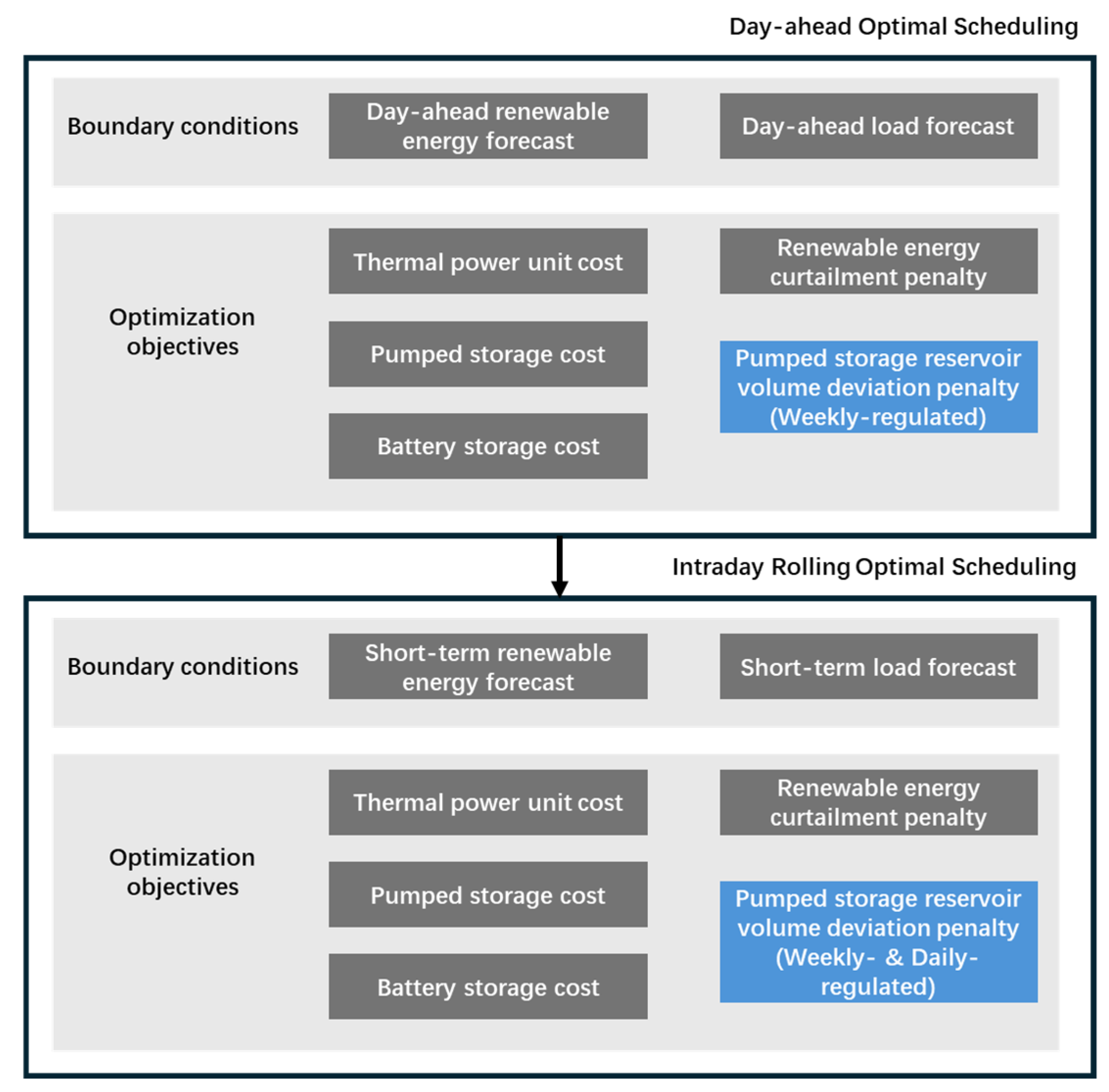
Based on the discussion on the correspondence of the regulation time scales of energy storage and optimization time scales in Section 2.1, a two-stage coordinated scheduling framework for diversified energy storage is proposed, as illustrated in Figure 1.
In the framework shown in Figure 1:
  • The optimization horizon for day-ahead scheduling is 24 h with a granularity of 1 h. Based on day-ahead forecasts of renewable energy generation and load, the optimization model optimizes the status and output of thermal units and energy storage. The objective function comprises the costs of thermal units, PS, and BES, as well as the penalty for renewable energy curtailment. According to Table 3, the penalty for the reservoir volume deviation between the day-ahead optimization and weekly plan is incorporated into the objective function for weekly-regulated PS. Related constraints are also adjusted accordingly. The optimization results from day-ahead scheduling can serve as a reference and basis for intraday scheduling.
  • The optimization horizon for intraday rolling scheduling is 4 h with a granularity of 15 min. Based on short-term forecasts of renewable energy generation and load, the optimization model minimizes an objective function comprising the costs of thermal units, PS, and BES, as well as penalties for renewable energy curtailment. According to Table 3, the model incorporates penalties and related constraints for the reservoir volume deviation between the intraday scheduling plans and the day-ahead optimization results for both weekly- and daily-regulated PS. The optimized 16-point output curves for thermal units, BES, and PS obtained from this process are directly executable in the intraday stage.

2.3. Optimal Scheduling Model

In this section, optimization models for PS, BES, and the thermal unit, considering deep peak shaving, are first established. Then, a day-ahead and intraday two-stage optimal scheduling model for diversified energy storage is proposed based on the established device models.

2.3.1. PS Model

Cost Model
The cost of a PS plant mainly consists of the construction cost and the operation and maintenance cost. In the optimal scheduling problem, only the latter is considered.
C P S = f f P S ( P P , max P S + P G , max P S ) + f v P S · t ( P P , t P S + P G , t P S )
where C P S denotes the cost of PS, measured in $; f f P S and f v P S denote the unit fixed and variable operation and maintenance costs in $/MW, respectively; P P , max P S and P G , max P S denote the rated pumping and generating power in MW, respectively; and P P , t P S and P G , t P S denote the pumping and generating power at time t in MW, respectively.
Operation Constraints
  • Power constraints:
P P , min P S u P , t P S P P , t P S P P , max P S u P , t P S
P G , min P S u G , t P S P G , t P S P G , max P S u G , t P S
where P P , min P S and P G , min P S denote the minimum pumping and generating power in MW, respectively; u P , t P S and u G , t P S are the status indicators for the PS unit operating in pumping and generating mode, respectively, where 1 denotes the PS is operating in the corresponding mode and 0 otherwise.
  • Operating status constraints:
The PS unit cannot operate in pumping and generating modes simultaneously.
u P , t P S + u G , t P S 1
  • Reservoir capacity constraints:
{ W U , min P S W U , t P S W U , max P S W D , min P S W D , t P S W D , max P S
where W U , max P S , W U , min P S , W D , min P S , and W D , max P S denote the maximum and minimum reservoir capacities of the upper and lower reservoirs, measured in m3, respectively; W U , t P S and W D , t P S denote the water volumes of the upper and lower reservoirs at time t in m3, respectively, which can be expressed as follows:
{ W U , t + 1 P S = W U , t P S + ( η P P S P P , t P S K P P S P G , t P S η G P S K G P S ) Δ t W D , t + 1 P S = W D , t P S ( η P P S P P , t P S K P P S P G , t P S η G P S K G P S ) Δ t
where K P P S and K G P S denote the unit water flow rates for pumping and generating conditions in m3/MW, respectively; η P P S and η G P S denote the pumping and generating efficiencies, respectively; and Δt is the time interval between adjacent periods.
For independently optimized PS, the reservoir volume continuity between the initial and terminal time instants must be considered:
| W U , t 0 P S W U , t e P S | W U , max P S
where t0 and te denote the initial and terminal time instants of the optimization period, respectively; W U , m a x P S denotes the limit of reservoir volume variation during the optimization period, measured in m3.

2.3.2. BES Model

Cost Model
Due to the relatively short lifespan of BES and its close correlation with the number of cycles, both the construction cost and the operation and maintenance cost are considered in the optimization.
  • Construction cost:
C cons   B E S = ( f P B E S P max B E S + f E B E S E max B E S ) × R B E S
where C cons   B E S denotes the construction cost, measured in $; f P B E S and f E B E S denote the unit power and unit energy construction costs, measured in $/MW and $/MWh, respectively; P max B E S and E max B E S denote the rated power and rated capacity of BES, measured in MW and MWh, respectively; and R B E S is the annualization factor, which is calculated as follows:
R B E S = r ( 1 + r ) T O B E S ( 1 + r ) T O B E S
where r denotes the discount rate, i.e., the interest rate used to convert future expected cash flows into their current value; T O B E S denotes the lifespan of BES, measured in y.
  • Operation and maintenance cost:
C m a i n t B E S = f f , maint B E S P max B E S + f v , maint B E S · t ( P C , t B E S + P G , t B E S )
where C m a i n t B E S denotes the operation and maintenance cost of BES, measured in $; f f , maint B E S and f v , maint B E S denote the unit fixed and variable operation and maintenance costs in $/MW, respectively; and P C , t B E S and P G , t B E S denote the charging and discharging power at time t in MW, respectively.
Operation Constraints
  • Power constraints:
P C , min B E S u C , t B E S P C , t B E S P C , max B E S u C , t B E S
P G , min B E S u G , t B E S P G , t B E S P G , max B E S u G , t B E S
where P C , max B E S , P C , min B E S , P G , m a x B E S , and P G , min B E S denote the maximum and minimum charging and discharging power in MW, respectively; u C , t B E S and u G , t B E S are the status indicators for the BES operating in charging and discharging mode, respectively, where 1 denotes the BES is operating in the corresponding mode and 0 otherwise.
  • Operating status constraints:
The BES cannot operate in charging and discharging modes simultaneously.
u C , t B E S + u G , t B E S 1
  • State of charge (SOC) constraints:
S O C min B E S S O C t B E S S O C max B E S
where S O C max B E S and S O C min B E S denote the maximum and minimum SOC, respectively; S O C t B E S denotes the SOC at time t, which can be expressed as follows:
S O C t + 1 B E S = S O C t B E S + ( η C B E S P C , t B E S P G , t B E S η G B E S ) Δ t / E max B E S
where η C B E S and η G B E S denote the charging and discharging efficiencies, respectively.
For independently optimized BES, the SOC continuity between the initial and terminal time instants should be considered:
| S O C t 0 B E S S O C t e B E S | S O C m a x B E S
where S O C m a x B E S denotes the limit of SOC variation during the optimization period.
  • Cycle life constraints:
The lifespan of BES is constrained by both by its cycle life and floating charge life [46]:
{ T O B E S T cyc B E S T O B E S T flow B E S
where T flow B E S denotes the floating charge life of BES in y, i.e., the life of BES when it is kept in a standby or backup mode; T cyc B E S denotes the cycle life in y, i.e., the life of BES determined by the number of complete charge and discharge cycles before its capacity drops below a certain threshold. The cycle life is calculated using an event-oriented battery aging accumulation model [46], which is expressed as follows:
D O D t B E S = ( 1 S O C t 1 B E S ) u cyc , t B E S
n t B E S = ( D O D t B E S ) k p
N eq B E S = t n t B E S
T cyc B E S = N 0 B E S 365 N eq B E S
where D O D t B E S denotes the depth of discharge at time t; u cyc , t B E S is the status indicator of the BES charge–discharge cycle, where 1 indicates that a charge–discharge cycle occurs, i.e., the BES transitions from charge to discharge mode or vice visa, and 0 otherwise; kp is the curve fitting parameter, which is an inner parameter of BES; n t B E S denotes the equivalent full discharge cycles of BES at time t, i.e., the equivalent number of charge–discharge cycles when converting the incomplete cycles to full cycles; N eq B E S denotes the daily equivalent full cycle number; and N 0 B E S is also a parameter of BES, denoting its maximum number of complete charge and discharge cycles.

2.3.3. Thermal Power Units Model Considering Deep Peak Shaving

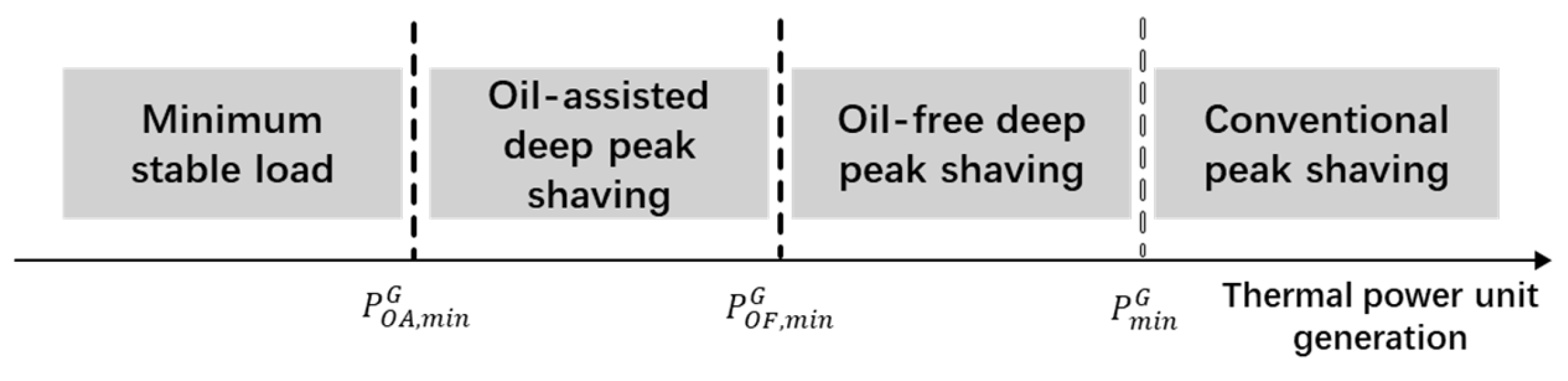
Deep peak shaving of thermal power units refers to the unit further reducing power below the minimum technical power, aimed at enhancing the unit’s peak shaving capability [47,48]. Based on the depth of regulation, deep peak shaving can be classified into two stages: oil-free deep peak shaving and oil-assisted deep peak shaving, as shown in Figure 2.
In Figure 2, P m i n G represents the minimum technical power of the unit in MW; P O F , m i n G and P O A , m i n G denote the stable combustion limits for oil-free and oil-assisted deep peak shaving in MW, respectively.
Cost Model
The fundamental operating costs of thermal power units include fuel cost and start-up cost. When the units are operating in deep peak shaving mode, the wear-and-tear cost and injected oil cost need to be further considered.
  • Fuel cost:
As long as the thermal power unit is operating, there exists the fuel cost, which is also known as coal consumption cost, i.e.,
C coal G = t [ a 1 ( P t G ) 2 + a 2 P t G + a 3 ]
where C coal G denotes the fuel cost of the thermal power unit, measured in $; P t G is the power of the unit at time t in MW; and a1, a2, and a3 are the coal consumption characteristic coefficients after economic conversion.
  • Wear-and-Tear Cost:
Based on the rotor fatigue life loss mechanism and the Manson–Coffin formula, the deep peak shaving wear-and-tear cost of thermal power unit can be calculated as follows [49,50]:
C dp G = t [ C b G 2 N t G ( β 1 u O F , t G + β 2 u O A , t G ) ]
where C d p G denotes the deep peak shaving wear-and-tear cost, measured in $; C b G denotes the acquisition cost of the power unit in $; β1 and β2 are the operation impact coefficients for the oil-free and oil-assisted deep peak shaving stages, respectively; u O F , t G and u O A , t G are the status indicators of the unit operating in the oil-free and oil-assisted deep peak shaving stages, where 1 indicates that the unit operates in the corresponding stage, and 0 otherwise; and N t G denotes the equivalent number of rotor fracture cycles of the power unit at time t, i.e., its estimated lifespan or fatigue limit of the generator’s rotating shaft, which can be calculated by an empirical formula [46]:
N t G = 0.005778 ( P t G ) 3 2.682 ( P t G ) 2 + 484.8 P t G 8411
  • Injected oil cost:
C o G = t Q t G C 0
where C o G denotes the injected oil cost of the unit in $, Q t G denotes the oil consumption of the unit operating in deep peak shaving at time t in L, and Co is the oil price in $/L.
Operation Constraints
  • Power constraints:
{ u R , t G P m i n G P t G u R , t G P m a x G u O F , t G P O F , m i n G P t G u O F , t G P m i n G u O A , t G P O A , m i n G P t G u O A , t G P O F , m i n G
u R , t G + u O F , t G + u O A , t G = u t G
where u t G is the operating status indicator of the thermal power unit at time t, where 1 indicates the unit is operating and 0 indicates the unit is shutdown; u R , t G is a status indicator denoting that the unit is operating in the conventional peak shaving stage; and P m i n G , P O F , m i n G , and P O A , m i n G are measured in MW, which are explained in Figure 2.
  • Ramp rate constraints:
{ P t + 1 G P t G v u p G Δ t P t G P t + 1 G v d o w n G Δ t
where v u p G and v d o w n G denote the maximum upward and downward ramp rates of the unit in MW/h, respectively.
  • Minimum startup/shutdown time constraints:
{ T O N , t G T O N , m i n G T O F F , t G T O F F , m i n G
where T O N , t G and T O F F , t G denote the continuous startup and shutdown durations of the thermal power unit in hour at time t, respectively; T O N , m i n G and T O F F , m i n G denote the minimum continuous startup and shutdown durations of the unit in h, respectively.

2.3.4. Day-Ahead Optimization Model

Objective Function
The objective function of the day-ahead optimization is to minimize the total system operating cost shown in Figure 1.
min     C d G + C B E S + C P S W + C P S D + C R E C + C d P S W
where C d G , C B E S , C P S W , and C P S D denote the day-ahead costs of thermal power units, BES, weekly-regulated PS, and daily-regulated PS, respectively; C R E C is the penalty for renewable energy curtailment; and C d P S W is the reservoir volume deviation penalty for weekly-regulated PS. All the costs are measured in $. The specific compositions of each cost item are as follows:
C d G = C coal G + C dp G + C o G + C ss G
C B E S = C cons   B E S + C m a i n t B E S
C R E C = t f R E ( P E , t R E P A , t R E )
C d P S W = f d P S W | W U , w P S W W U , d P S W |
where C ss G denotes the startup and shutdown cost of thermal power units; f R E is the penalty factor for renewable energy curtailment in $/MW; P E , t R E and P A , t R E denote the available power and actual grid-connected power of renewable energy in MW at time t, respectively; f d P S W is the reservoir volume deviation penalty factor for weekly-regulated PS in $/m3; and W U , w P S W and W U , d P S W denote the weekly planned and day-ahead reservoir volume variation of the weekly-regulated PS during the optimization period in m3, respectively.
Constraints
The constraints of the day-ahead optimization model include the following:
  • Thermal power unit operation constraints: all thermal power units satisfy Equations (26)–(29).
  • PS operation constraints: all PS units satisfy Equations (2)–(6). Additionally, daily-regulated PS units satisfy Equation (7).
  • BES operation constraints: all BES satisfy Equations (11)–(21).
  • Renewable energy power constraints:
0 P A , t R E P E , t R E
  • Power balance constraints:
P t G + P G , t P S W + P G , t P S D + P G , t B E S + P A , t R E = P P , t P S W + P P , t P S D + P C , t B E S + P t L
where P t L is the day-ahead load forecast of the power system at time t, measured in MW.

2.3.5. Intraday Rolling Optimization Model

Objective Function
The objective function of the intraday rolling optimization is to minimize the total system operating cost shown in Figure 1.
min     C i G + C B E S + C P S W + C P S D + C R E C + C i P S W + C i P S D
where C i G denotes the intraday cost of thermal power units; C i P S W and C i P S D are the reservoir volume deviation penalty for weekly-regulated and daily-regulated PS, respectively. All the costs are measured in $. The specific compositions of each cost item are as follows:
C i G = C coal G + C dp G + C o G
C i P S W = f i P S W | W U , d P S W W U , i P S W |
C i P S D = f i P S D | W U , d P S D W U , i P S D |
where f d P S W and f i P S D are the reservoir volume deviation penalty factors for weekly-regulated and daily-regulated PS in $/m3, respectively; W U , d P S W , W U , d P S D , W U , i P S W , and W U , i P S D denote the day-ahead and intraday reservoir volume variation of the weekly-regulated and daily-regulated PS during the optimization period in m3, respectively.
Compared with the day-ahead cost C d G in Equation (31), C i G in Equation (38) does not include the startup and shutdown cost of thermal power units.
Constraints
The constraints of the intraday rolling optimization model include the following:
  • Thermal power unit operation constraints: as the operating status of all thermal power units are determined, the power units satisfy Equations (26), (28) and (29).
  • PS operation constraints: all PS units satisfy Equations (2)–(6).
  • BES operation constraints: all BES satisfy Equations (11)–(21).
  • Renewable energy power constraints: all renewable energy units satisfy Equation (35), replacing the day-ahead forecast of renewable energy units with short-term forecast.
  • Power balance constraints: the power system satisfies Equation (36), replacing the day-ahead load forecast with short-term load forecast.

3. Results

3.1. Testing System Parameters

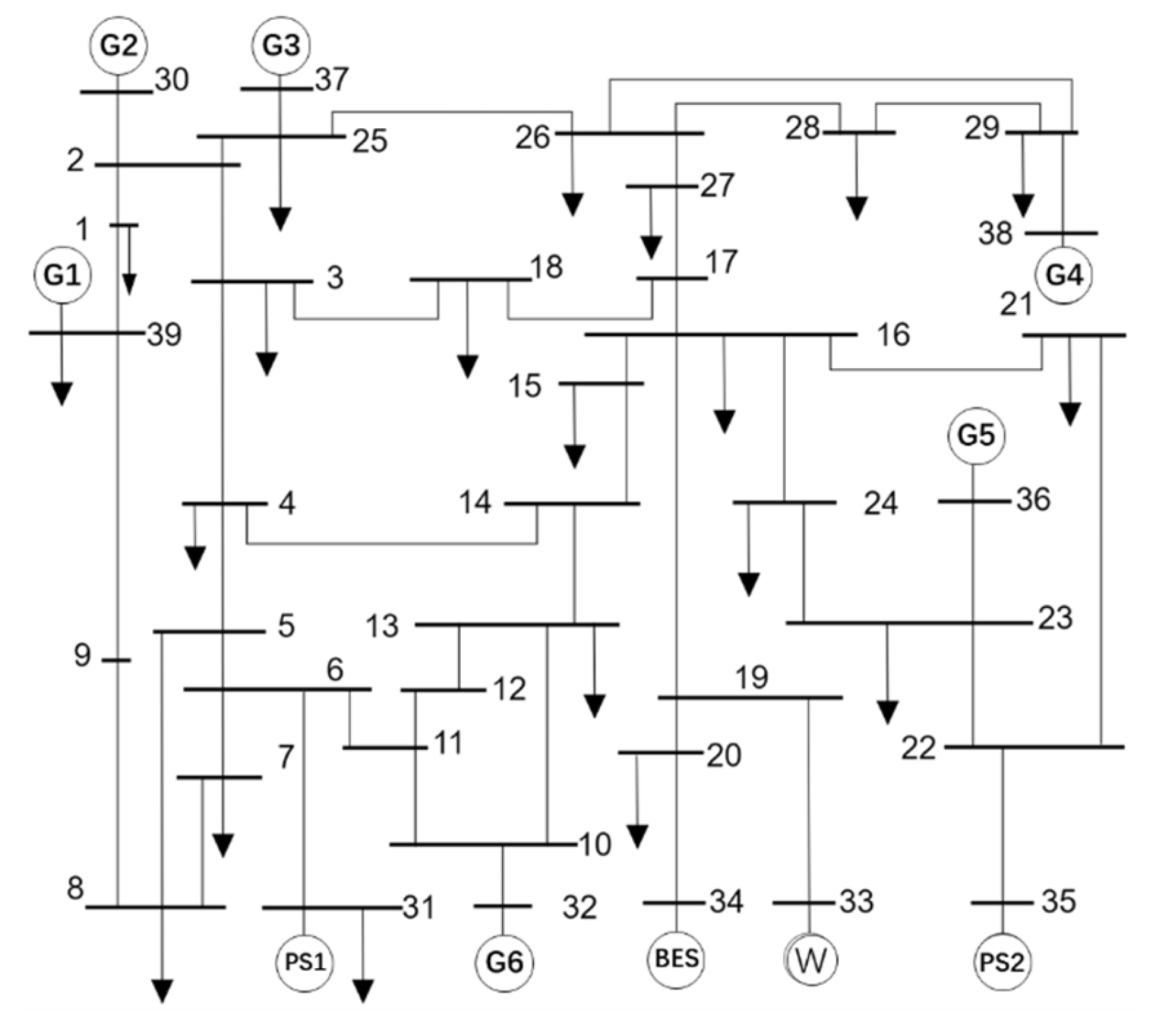
The proposed method is tested on a modified IEEE 30-bus system. Six thermal power units (G1–G6), a wind power plant (W), a daily-regulated PS (PS1), a weekly-regulated PS (PS2), and a BES are connected to the system, as shown in Figure 3. The main parameters of the thermal power units are listed in Table 4.
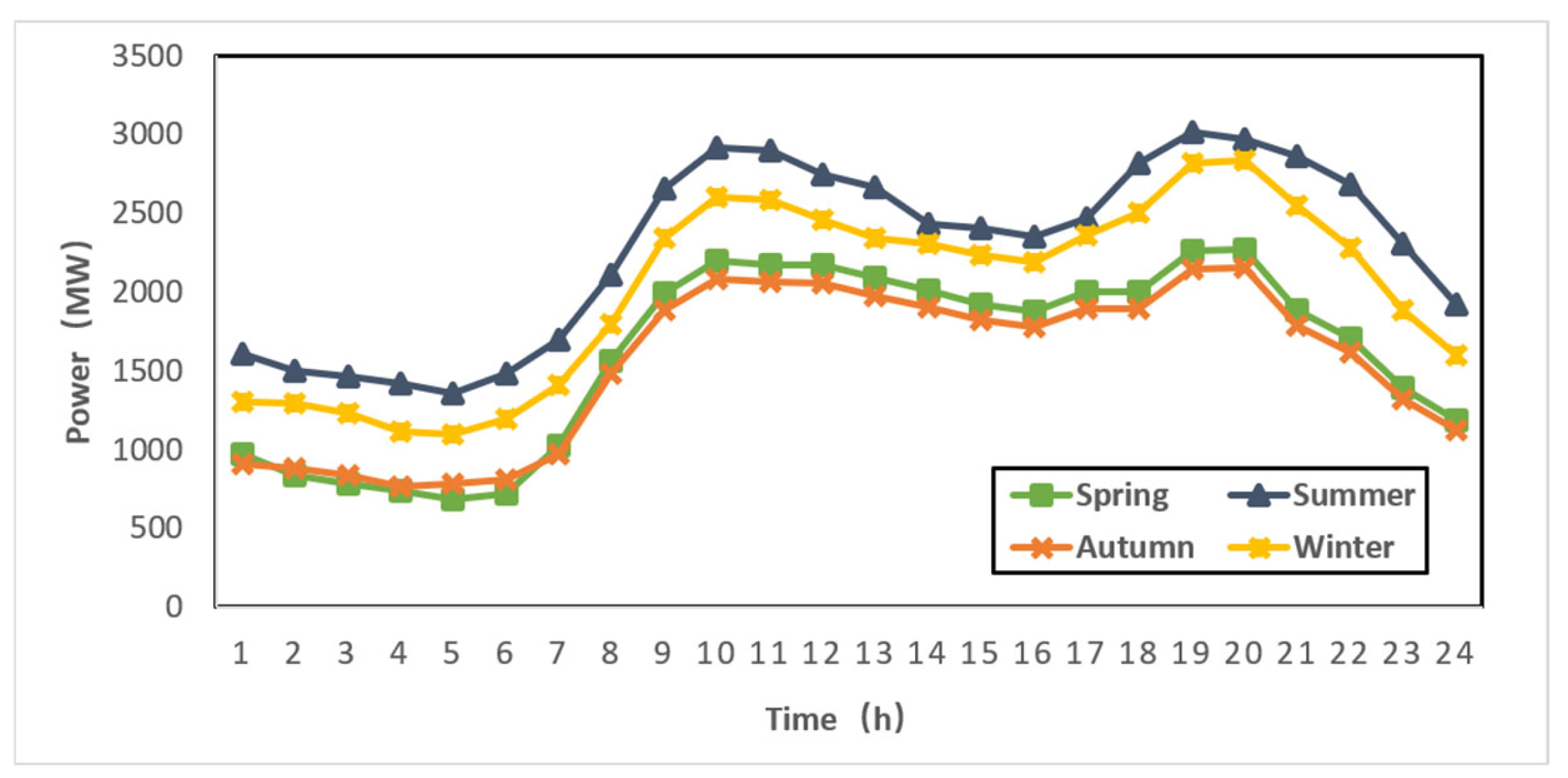
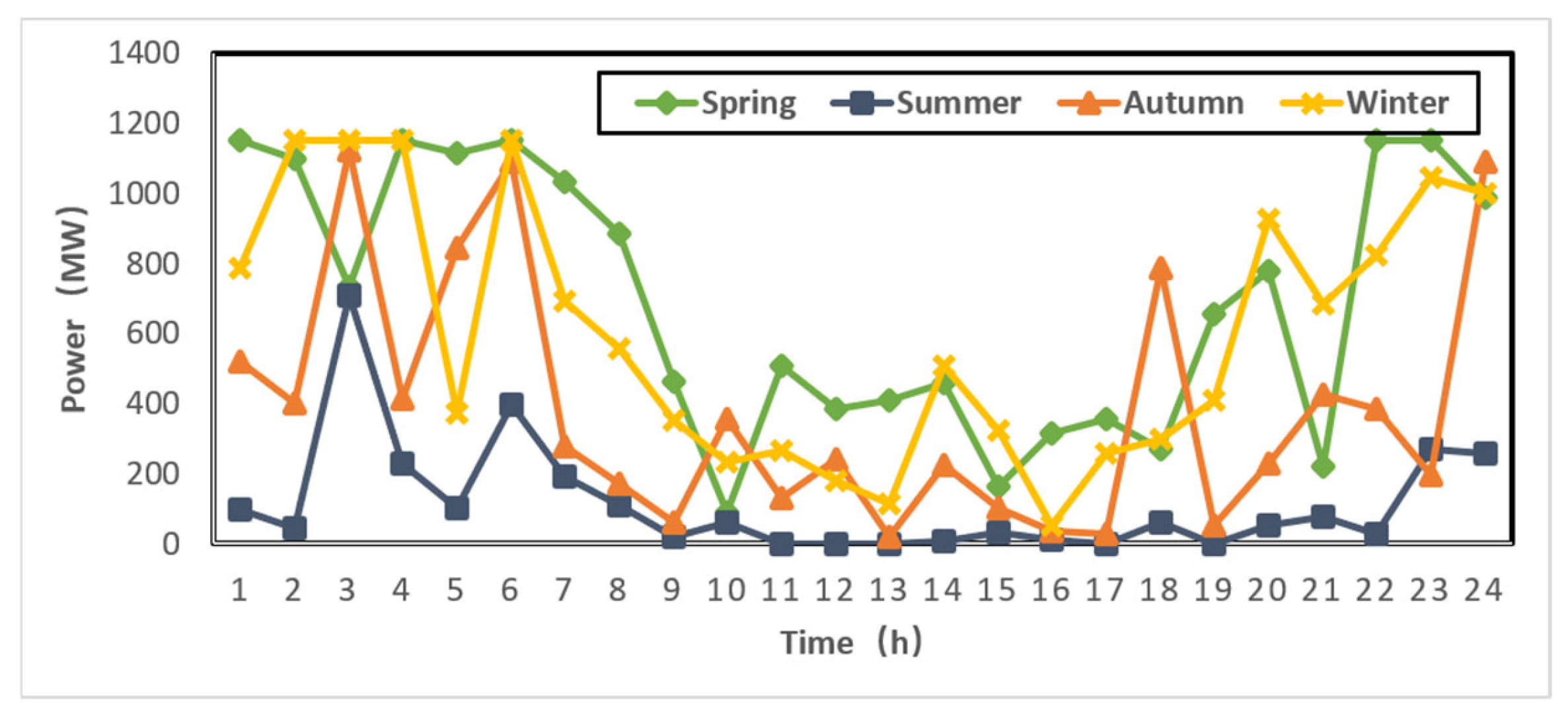
The generation and pumping capacities of PS1 are 300 MW/180 MW and 330 MW/320 MW, respectively. Its annualized fixed and variable operation and maintenance costs are $15,900/MW and $0.0025/MWh, respectively. For PS2, the generation and pumping capacities are 600 MW/360 MW and 660 MW/640 MW, respectively, with annualized fixed and variable operation and maintenance costs of $17,600/MW and $0.002/MWh, respectively. The capacity of BES is 100 MW/200 MWh, with its floating charge cycle assumed to be 10 years with a discount rate of 8%. Other cost parameters are determined based on [18]. The penalty costs for wind curtailment in both day-ahead and intraday stages are set to $2000/MW. The reservoir volume deviation penalty cost for PS2 in the day-ahead stage is $0.05/MW, while for both types of PS in the intraday stage, the penalties are $0.01/MW. Considering the distinct seasonal characteristics, the wind power and load forecast data of typical operating days in four seasons are used in this paper, as shown in Figure A1 and Figure A2 in Appendix A.

3.2. Day-Ahead Optimal Scheduling Strategy Test

3.2.1. Day-Ahead Scheduling Strategies for Different Scenarios

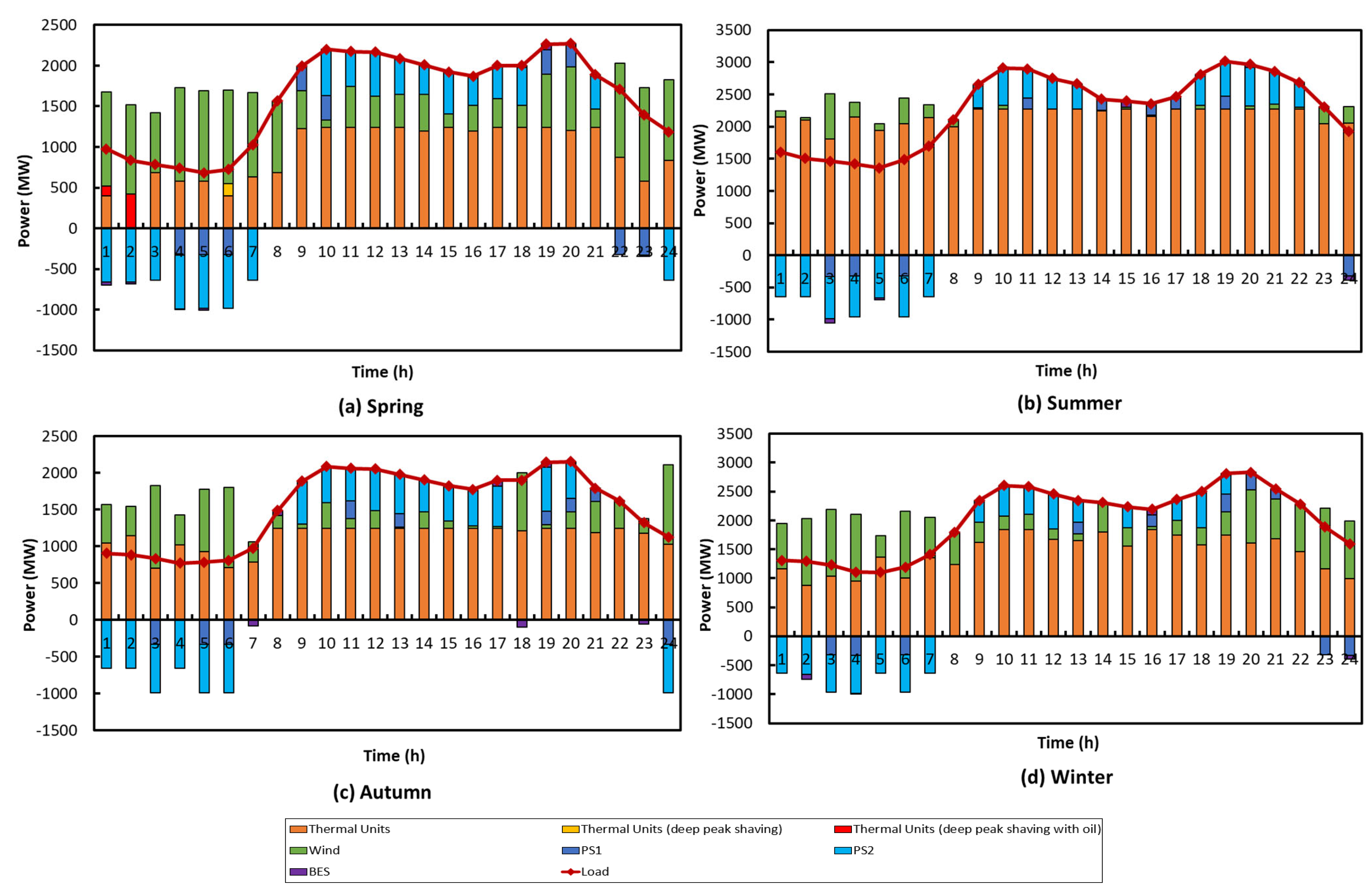
Using the wind power and load of typical days in the four seasons as day-ahead forecasts, the day-ahead scheduling strategies for the four scenarios are obtained and shown in Figure 4. In the scenarios, the weekly regulation plan for the weekly-regulated PS is set to increase the upper reservoir capacity reserve by 5%.
As shown in Figure 4, for each typical day, the proposed method can properly arrange the on/off status and output of various power units and energy storage systems, satisfying both renewable energy accommodation and load demand. For instance, due to the low load level and high wind power in spring, some thermal power units operate in deep peak shaving mode during early morning hours, and the energy storage operate in pumping/charging mode. The utilization rates for energy storage throughout the day are comparatively high due to the need for renewable energy accommodation. During summer, high load level and low wind power lead to generally high-power levels of thermal units. Consequently, the level of energy storage utilization is relatively low. Energy storage is utilized only during short peak and valley load periods. The load level in Autumn is similar to spring, but the wind power level is lower, leading to a higher level of thermal unit output and lower storage utilization rates. Winter has similar load level to summer, but with higher wind power, resulting in lower thermal unit output and higher energy storage utilization rates.
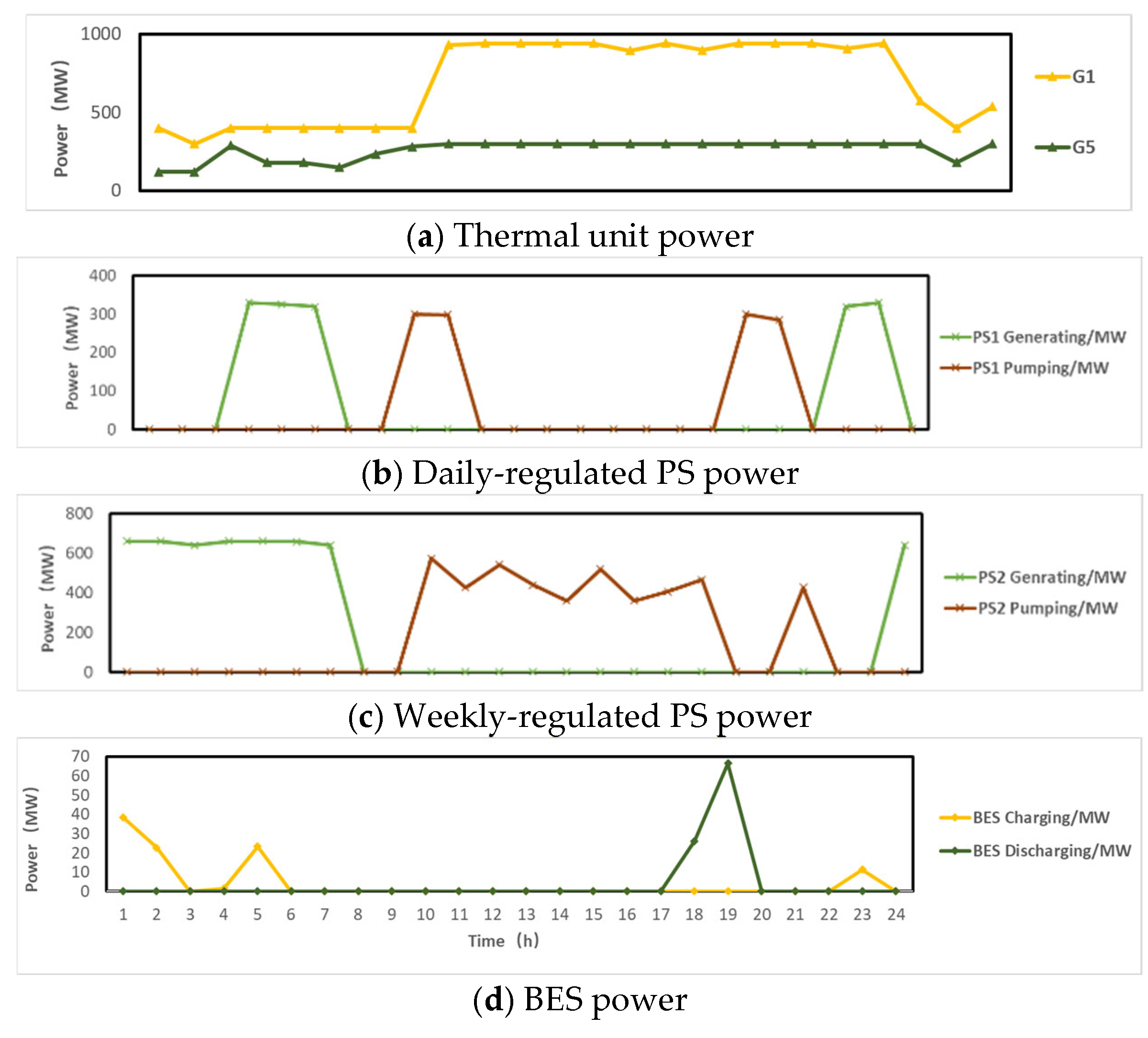
Taking the typical day in spring as an example, Figure A3 illustrates the detailed day-ahead scheduling strategy. In Figure A3, only two thermal units (G1, G5) are in operation throughout the day. During early morning hours, the weekly-regulated PS remains operating in pumping mode, whereas daily-regulated PS and BES can only operate in pumping/charging mode during specific periods due to the constraints of their capacities. In some periods, thermal units are required to perform deep peak shaving to ensure wind power accommodation. As the load increases, the power of thermal units gradually rises, and energy storage sequentially switches to generation/discharging mode. The weekly-regulated PS can operate in generation mode for most of the daylight hours, while the daily-regulated PS and BES operate in generation/discharging mode only during load peak hours due to capacity limitations.
The results prove that the proposed coordinated scheduling strategy for diversified energy storage can arrange the statuses and outputs of different types of PS and BES on a day-ahead time scale properly. By fully leverages the synergistic effects of multi-type energy storage, the strategy ensures system load supply as well as renewable energy accommodation.

3.2.2. Comparison of Different Scheduling Strategies for Weekly-Regulated PS

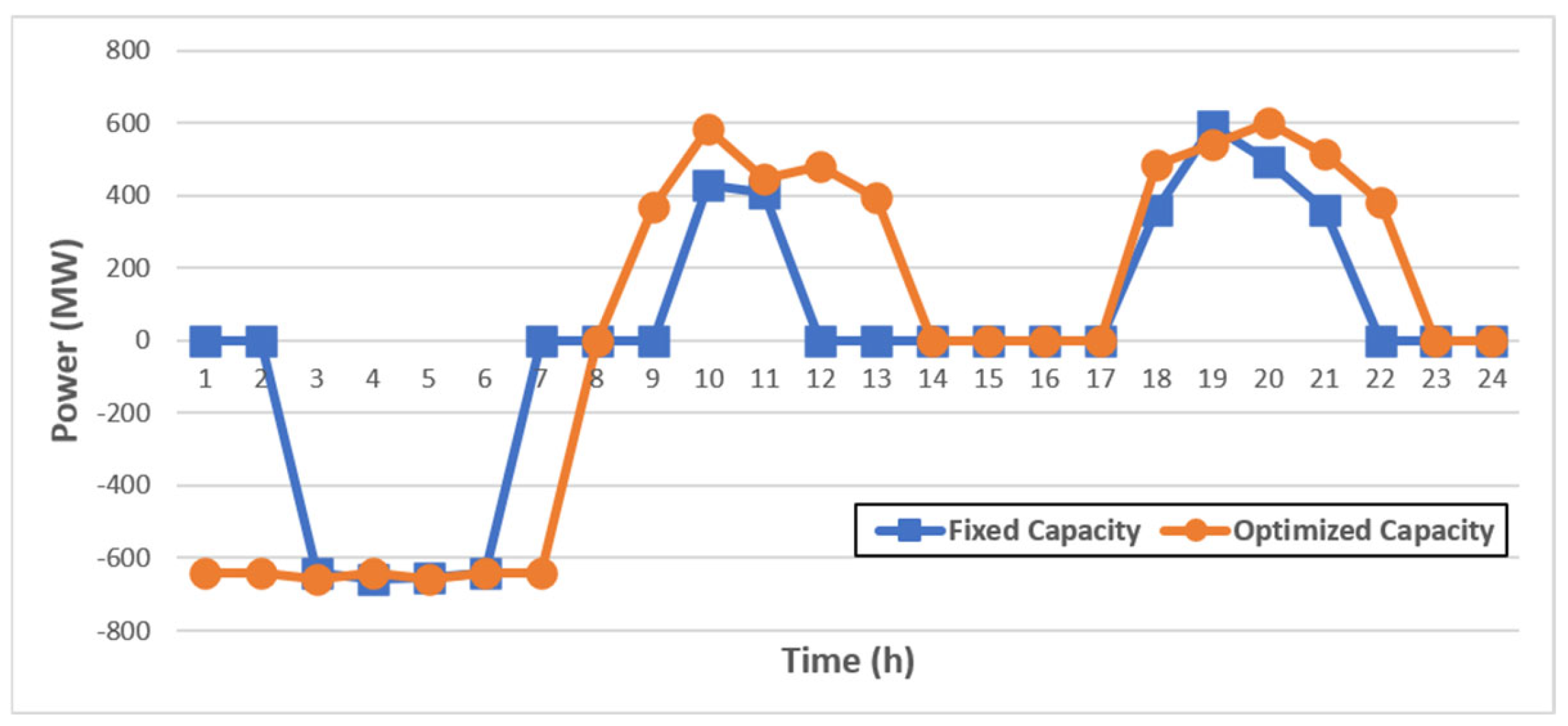
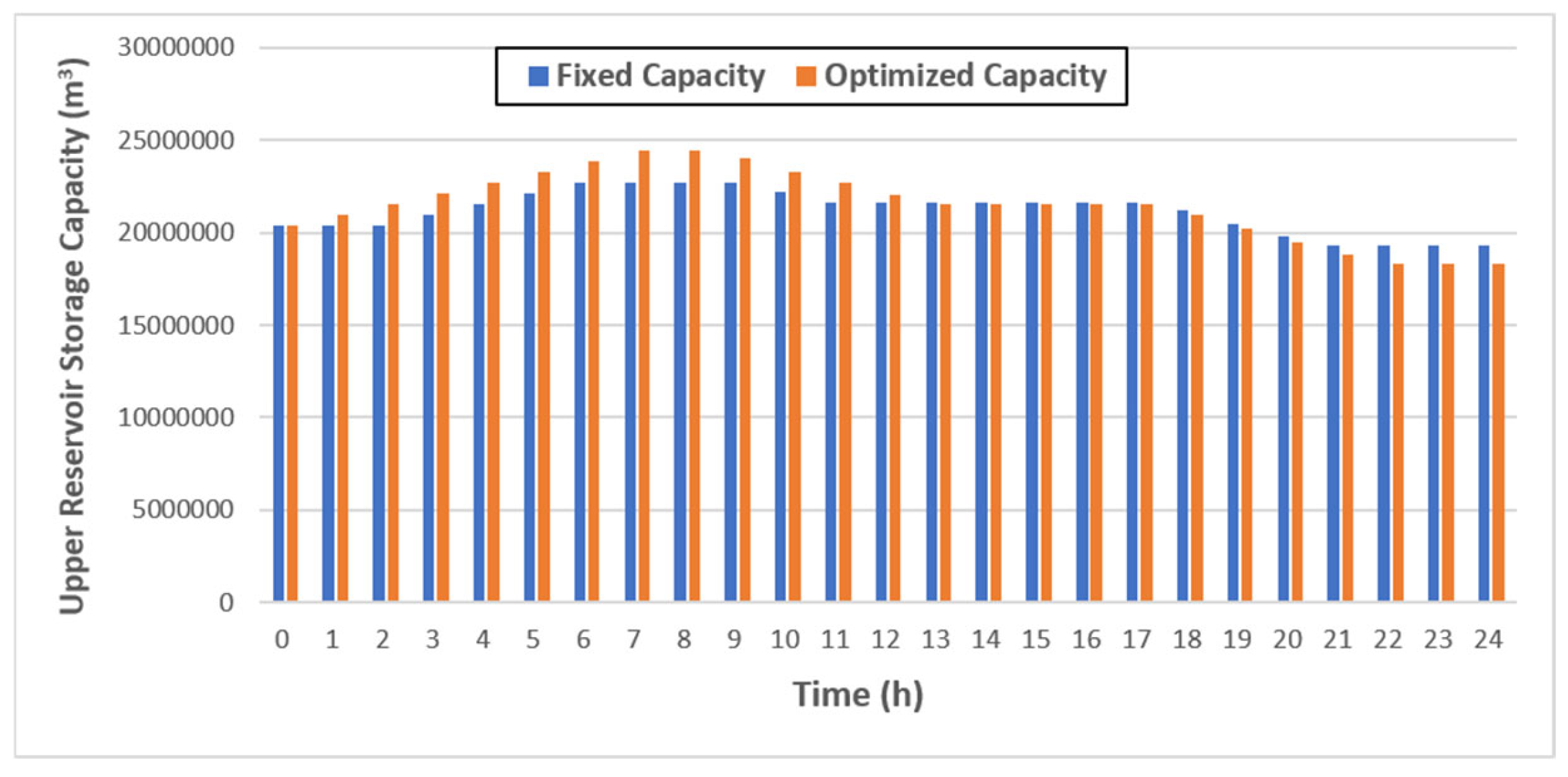
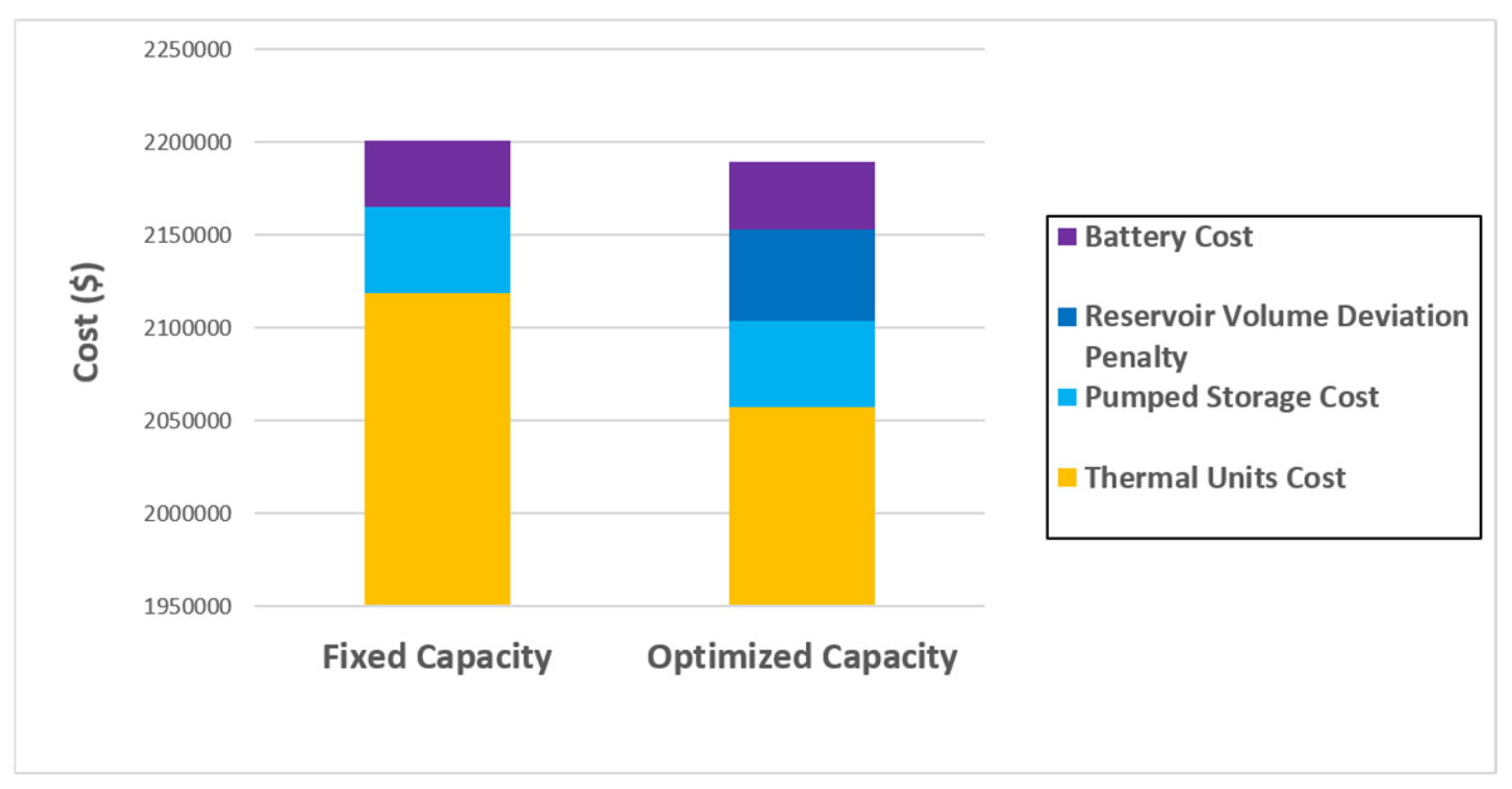
To validate the effectiveness of the correspondence of the storage regulation time scale and the optimization time scale proposed in this paper, a comparative analysis is conducted on the weekly-regulated PS under two distinct scheduling strategies. One is the coordinated scheduling strategy proposed in this paper, as detailed in Table 3. The other strategy is the traditional two-stage scheduling strategy [36]. In the strategy, the weekly-regulated PS strictly adheres to the weekly regulation plan, i.e., its output curve is optimized while fixing the reservoir volume variation during the optimization period to the weekly regulation plan. Using the typical summer day in Figure 4 as the testing scenario, the output and upper reservoir volume of the weekly-regulated PS under these two strategies are presented in Figure 5 and Figure 6, respectively.
In Figure 5, due to the high load level in summer, the weekly-regulated PS pumps more water into the upper reservoir at night and generates more power during daytime load peak hours to meet load demand under the proposed scheduling strategy. This performance is corroborated by the upper reservoir volume in Figure 6. Compared to the fixed weekly regulation plan, the upper reservoir volume at 24:00 of the proposed strategy is lower by 5.1%, implying that it consumes more water than the fixed plan on this specific day. Figure 7 presents a comparison of the system operating costs under the two scheduling strategies.
As shown in Figure 7, compared to the fixed regulation plan, the proposed scheduling strategy optimizes the output of the weekly-regulated PS by balancing the weekly plan with actual system needs. Although this incurs a reservoir volume deviation penalty as defined in Equation (30), the strategy reduces the overall system operating cost, particularly the thermal unit operating cost. The overall system operating cost is reduced from $2.201 M to $2.189 M, representing a 0.5% decrease. The percentage is not substantial, due to the capacity of PS2 being small compared to that of the thermal power plants. But given the system’s high daily operating cost in summer, the reduced operating cost still counts. This comparison validates that the proposed strategy can fully leverage the regulation capability of weekly-regulated PS to lower system operating costs, while ensuring proper coordination with the scheduling arrangements of larger timescale to avoid the “myopia” problem.

3.3. Intraday Rolling Optimal Scheduling Strategy Test

3.3.1. Intraday Scheduling Strategies for Different Scenarios

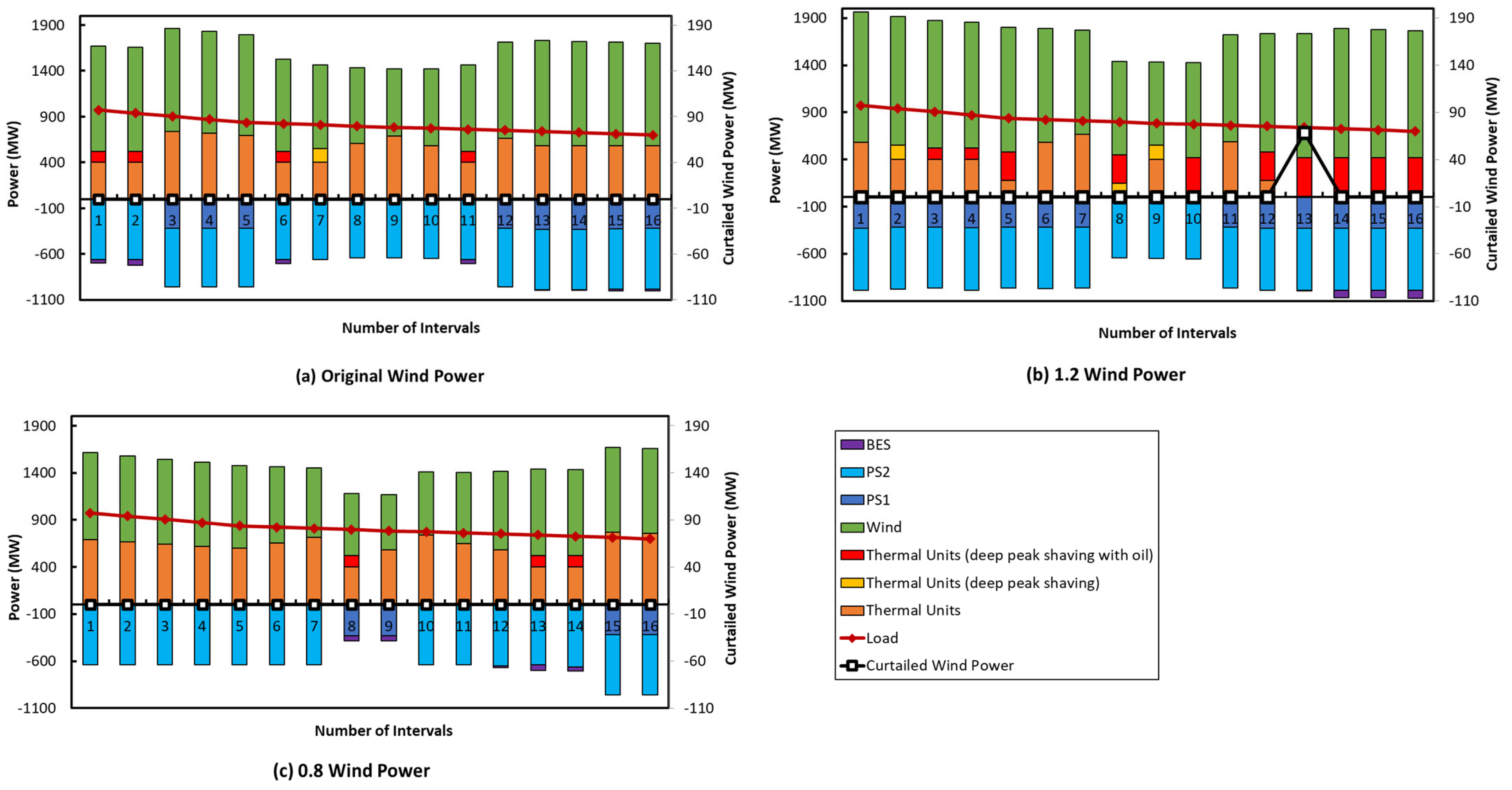
Selecting the early morning period (00:00–04:00) of the typical spring day in Figure 4 as the optimization horizon for intraday rolling scheduling, three scenarios are constructed based on the relationship between the short-term and day-ahead wind power forecast: the short-term forecast is equal to the day-ahead forecast and is 1.2 times and 0.8 times of the day-ahead forecast, respectively. The intraday scheduling strategies obtained by solving the optimization model for these scenarios are presented in Figure 8.
As shown in Figure 8, in Scenario (a), the intraday short-term wind forecast matches the day-ahead forecast, and the output of each energy storage remains basically consistent with the day-ahead scheduling plan. In Scenario (b), due to the increase in the short-term wind power forecast, the duration of pumping/charging for energy storage increases significantly, and thermal power units operate in deep peak shaving mode for longer periods. Specifically, during the period of 13 to 16 intervals, all thermal units are operating in the oil-assisted deep peak shaving mode, and all energy storage is operating in pumping/charging mode, yet a portion of wind power still cannot be accommodated, resulting in wind curtailment. In Scenario (c), due to the decrease in wind power, the durations of deep peak shaving for thermal units and the pumping/charging periods for energy storage are noticeably shortened. The results demonstrate that the proposed method can consider the regulation characteristics of different types of energy storage on the intraday optimization time scale, effectively meeting the system’s peak shaving requirements and renewable energy accommodation needs while maintaining coordination with the day-ahead plan.

3.3.2. Comparison of Different Scheduling Strategies for PS

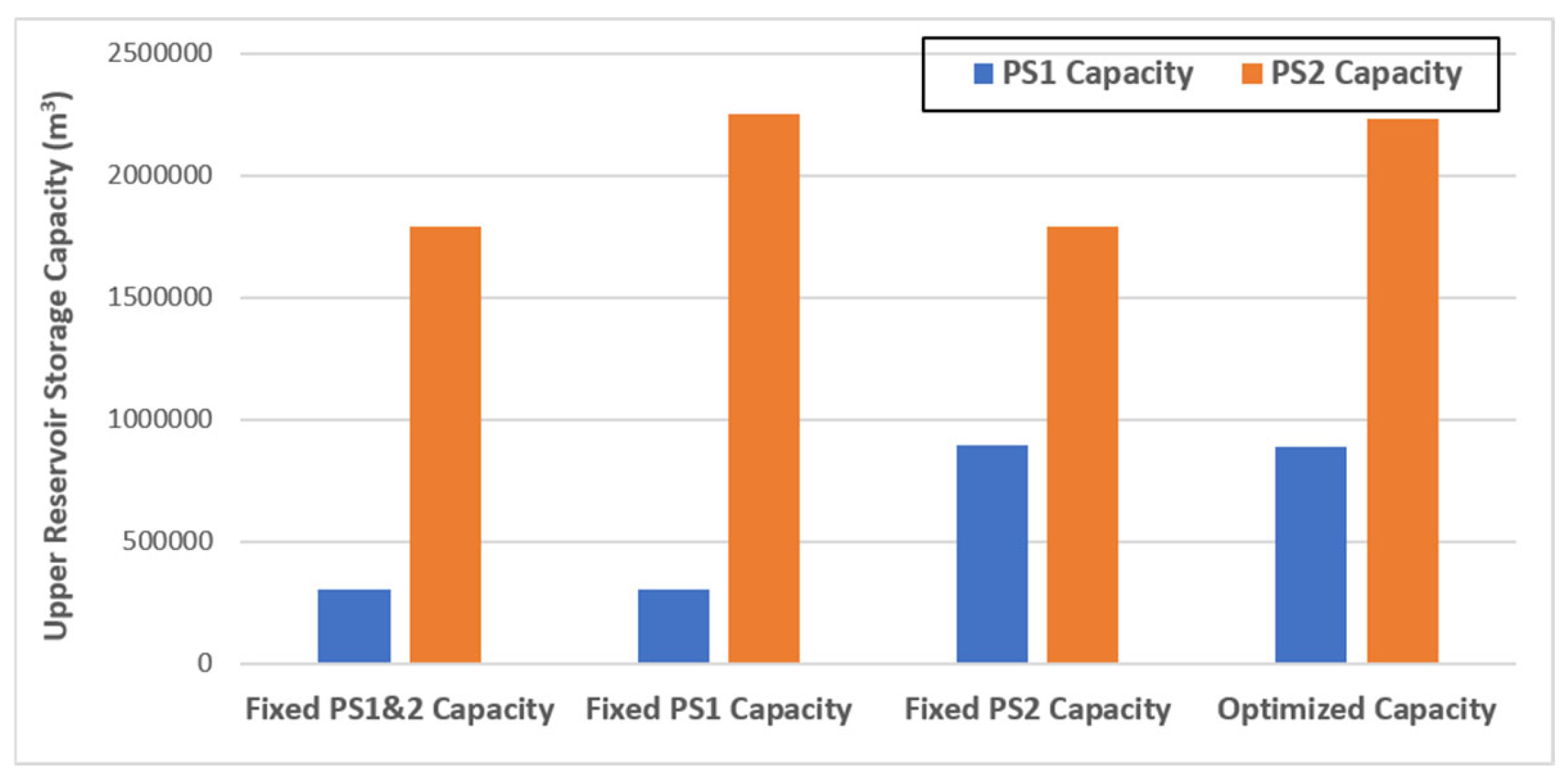
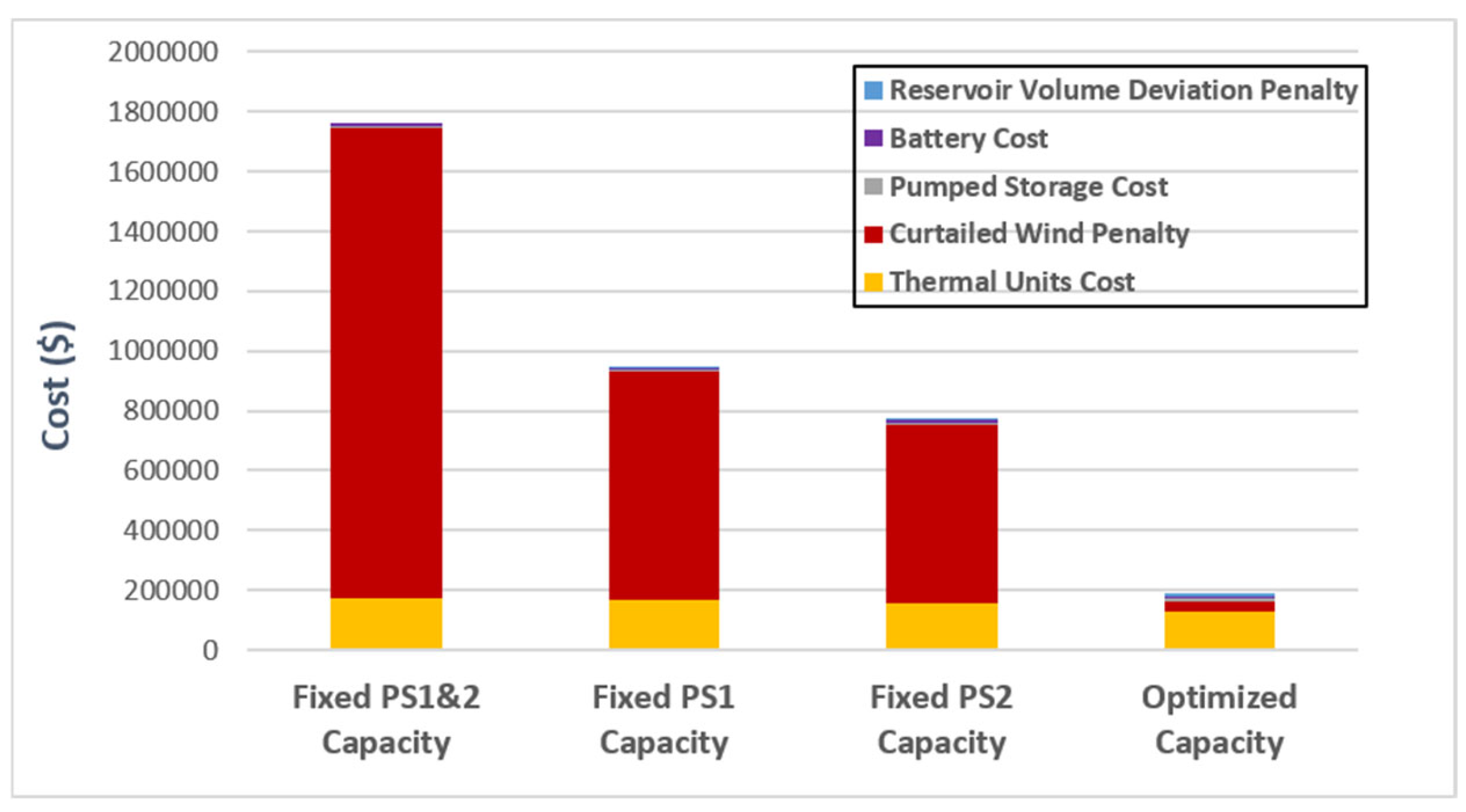
For Scenario (b) in Figure 8, compare the proposed coordinated scheduling strategy with the strategies where the day-ahead regulation plans for weekly-regulated PS and daily-regulated PS are fixed. Figure 9 presents a comparison of the PS upper reservoir volumes under different scheduling strategies.
In the testing scenario, due to low load level and high wind power during early morning hours, the system faces a large demand for valley peak shaving. Consequently, in Figure 9, when either the weekly-regulated or daily-regulated PS strictly adheres to the day-ahead regulation plan, the other type of PS tends to pump more water to maximize wind power accommodation, resulting in an increase in the upper reservoir volume by 25.9% and 197.2%, respectively. When both PS adopt the proposed scheduling strategy, their upper reservoir volumes are increased by 24.8% and 194.7%, respectively. The upper reservoir volumes are lower than the corresponding PS when the regulation plan of the other PS is fixed, indicating an optimal allocation of the pumping volume between two PSs. The results indicate that the proposed strategy incorporates differentiated consideration of the regulation characteristics of different types of PSs, thereby optimizing their pumping volume and output. Figure 10 presents a comparison of system operating costs under different scheduling strategies.
In Figure 10, the system cost is highest ($1761 k) when the regulation plans for both PSs are fixed, particularly due to significant wind curtailment penalties, with a renewable utilization ratio of 84.1%. When the fixed regulation plan is executed for only one type of PS, the system operating cost decreases ($943 k and $768 k), and the cost is lower when the output of daily-regulated PS is optimized compared to the weekly-regulated PS. The renewable utilization ratio also increases to 92.3% and 94.0%, respectively. This is primarily attributed to the fact that the weekly-regulated PS operates in the pumping mode for most intervals during the optimized period, leaving limited room for further optimization. When both types of PS adopt the proposed coordinated scheduling strategy, the system achieves the minimal operating cost ($179 k), with both wind curtailment penalties and thermal unit operating costs greatly reduced. The renewable utilization ratio increases to 99.7%.
The results demonstrate that the proposed strategy can comprehensively consider system operation requirements, the regulation time scales of energy storage, and the coordination of optimization strategies across different time scales, thereby leveraging the regulation capabilities of different types of PS to minimize system costs.

3.3.3. Comparison with Traditional Method

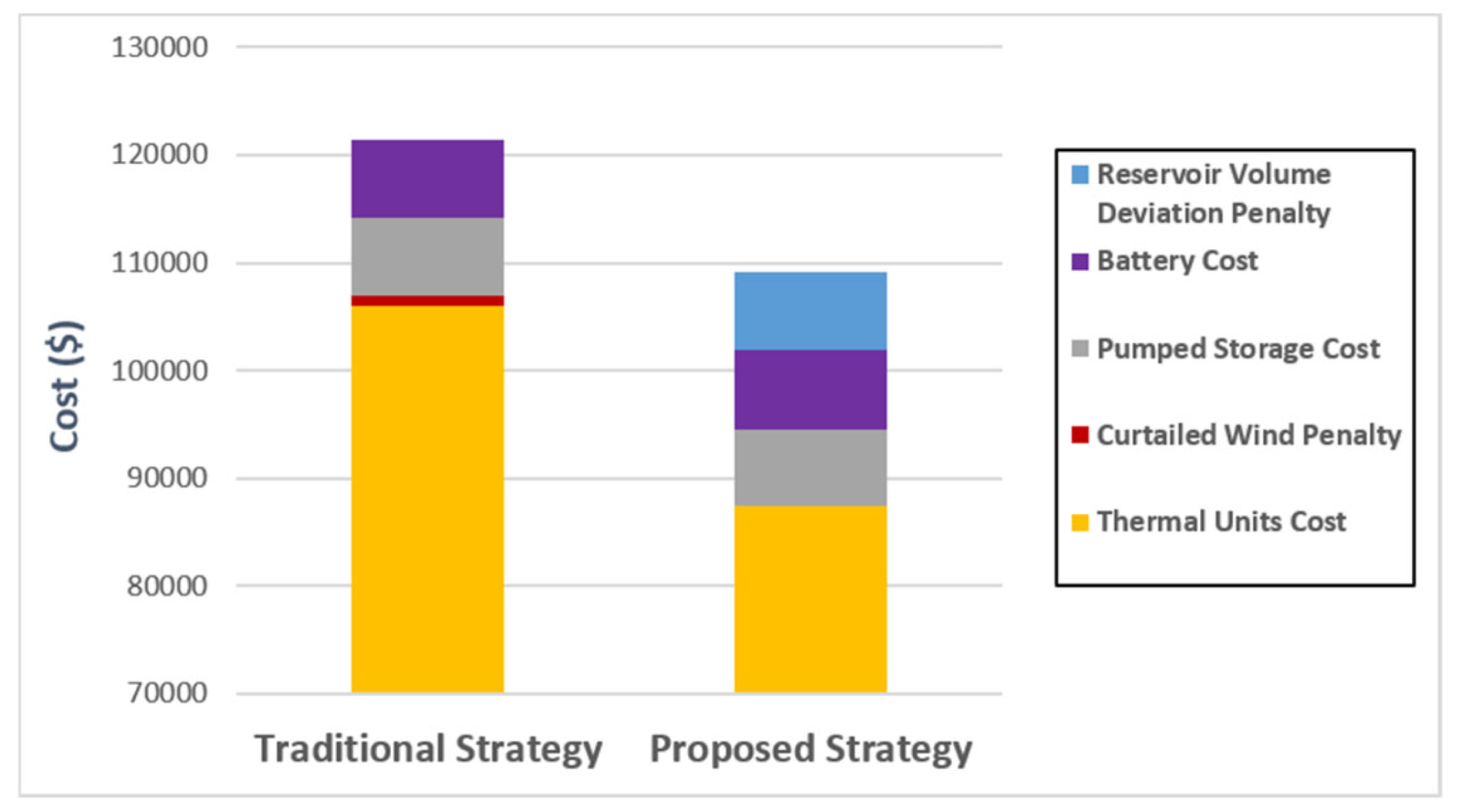
For Scenario (a) in Figure 8, compare the proposed coordinated scheduling strategy with traditional two-stage scheduling strategy [36], where the weekly-regulated and daily-regulated PS strictly follows the day-ahead scheduling plan. Figure 11 presents a comparison of system operating costs under different scheduling strategies.
In Figure 11, compared to traditional strategy, the system operating cost of the proposed strategy is reduced from $121.4 k to $101.8 k, with a reduction of 16.1%, where the thermal unit operating cost is reduced by 17.6%. The renewable utilization ratio increases from 99.9% to 100%, i.e., no renewable energy curtailment occurs. Compared to the traditional strategy, where only BES power is optimized, the proposed strategy also optimizes the PS power by balancing the day-ahead plan and actual system needs. Although this incurs a reservoir volume deviation penalty, the strategy reduces the overall system operating cost, particularly the thermal unit operating cost and the wind curtailment penalty. The results demonstrate that the proposed strategy can address the limitations of previous research that simply categorize energy storage into corresponding optimization stages based on their storage types and schedule the diversified energy storage in a more refined manner according to their distinct characteristics.

4. Discussions

4.1. Computational Performance

The case is tested on a laptop computer with an intel(R) Core(TM) i5-11400H CPU and 16 GB of memory, and the optimization solver is IBM ILOG CPLEX (IBM, Armonk, NY, USA) with default MIQCP solving parameters. For the day-ahead scenario in Section 3.2.1, the number of decision variables is 52, and the number of constraints is 3717. The solution time for each scenario is 4.24 s. The iteration number before convergence is 9562. For the intraday scenario in Section 3.3.1, the number of decision variables is 53, and the number of constraints is 2300. The solution time for each scenario is 3.89 s. The iteration number before convergence is 948, showing good convergence performance.
In case study, the IEEE 30-bus system is used as a demo to verify the advantages of the proposed method. To test the scalability of the proposed strategy, the optimal scheduling on a modified IEEE 118-bus system is simulated. For day-ahead scenario in Section 3.2.1, the computational time is 4.57 s, which increases slightly compared to the original case of a 30-bus system, demonstrating the applicability of the proposed method on larger-scale power systems. When applying the proposed strategy to large-scale power systems with more energy storage and larger renewable energy accommodation pressure, the economic improvement will surely increase due to the capability of the proposed strategy to fully exploit the regulation abilities of energy storage in different time horizons to enhance system operating performance and the renewable energy accommodation level.
Comparing the traditional two-stage method with the proposed method, the number of decision variables remains the same (both 52), and the number of constraints is increased from 3665 to 3717, denoting a similar optimization computational complexity. This can also be verified by their close solution time, i.e., 4.21 s and 4.24 s, respectively. The results demonstrate that the proposed method can enhance the system operational level without increasing the computational burden much in practical deployment.
In the proposed model, all the constraints are hard constraints, because they are either determined by the power system (e.g., power balance constraints) or the device-inherent characteristics (e.g., device power constraints). When solving the model, however, the solver may relax some constraints to obtain a solution. In this case, careful analysis is needed to judge whether the solution is feasible. Besides, when applying the proposed method to practical power system dispatch, optimal scheduling may also lead to infeasible solutions. This usually occurs as a violation of the power balance constraints, e.g., the load is beyond the maximum generation capability or the ramp up speed of power units cannot catch up with the load and renewable energy fluctuation. In infeasible conditions like this, human interference is needed to take operations, such as load control or the power regulation of higher or lower voltages.

4.2. Parameter Sensitivity Analysis

In this paper, the cost and operational parameters, such as coal-consumption characteristic coefficients and operation impact coefficients of thermal power units, are derived through a combination of theoretical calculations, experimental testing, and comprehensive evaluations of actual operating conditions. The penalty coefficients, i.e., wind curtailment and reservoir volume deviation penalty coefficients, are selected according to their priorities in the optimization objective. In case study, the former is much larger than the latter, denoting that the renewable energy accommodation is more important.
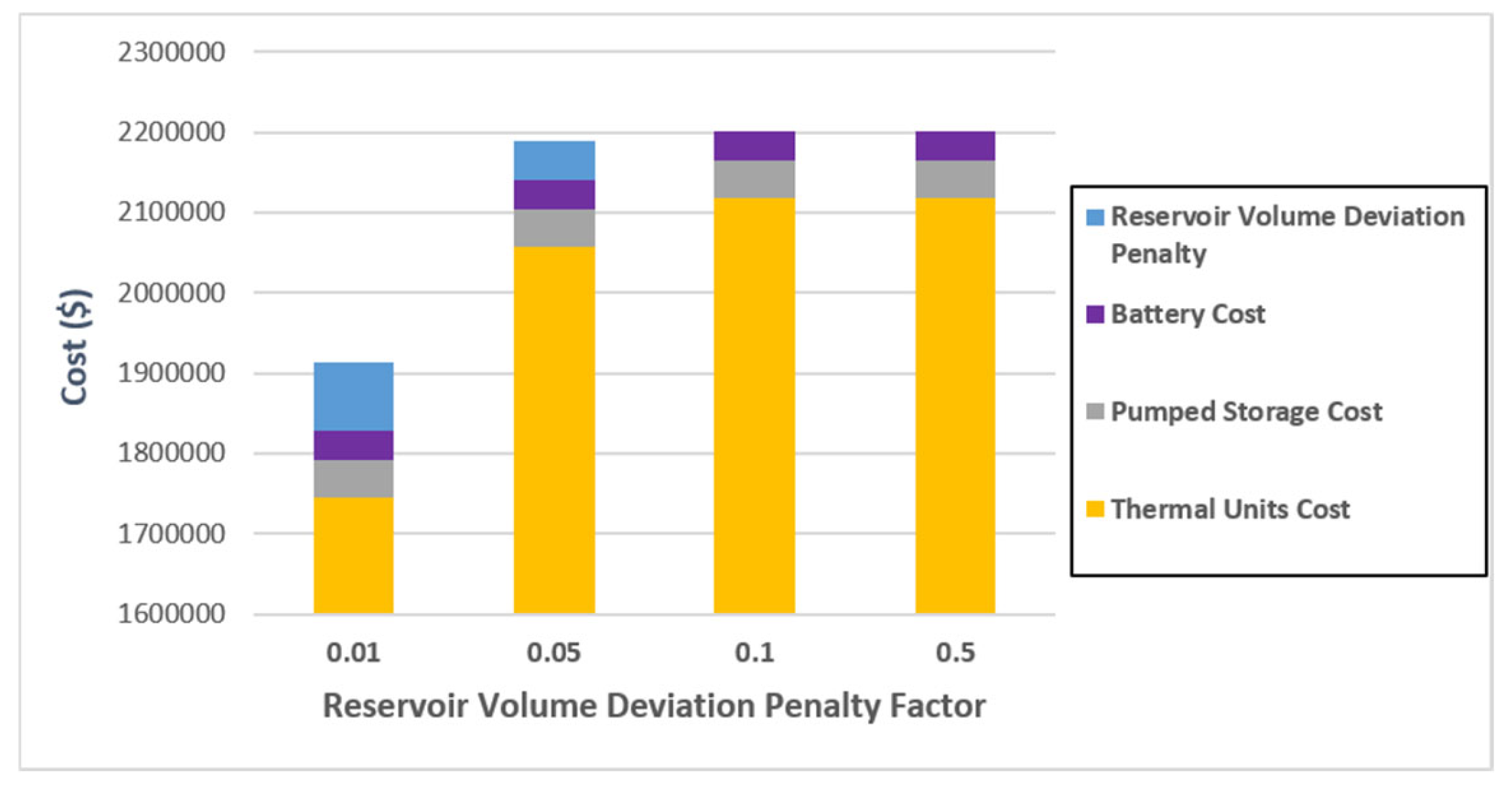
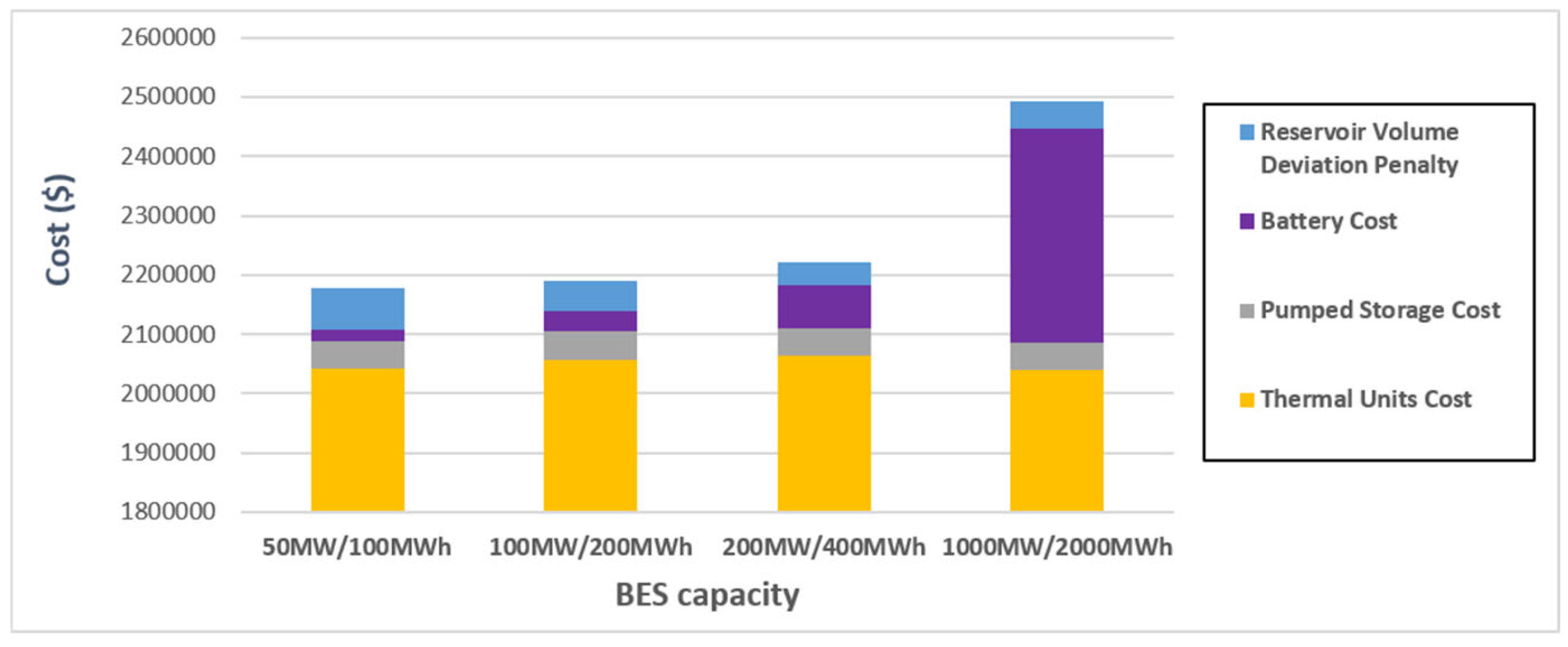
Using the typical summer day in Figure 4 as the testing scenario, the sensitivities of the reservoir volume deviation penalty factor for weekly-regulated PS, i.e., f d P S W , and the capacity of BES are analyzed. When changing the value of f d P S W from 0.01 to 0.5, the comparison of system operating costs is shown in Figure 12.
In Figure 12, the system operating cost first increases with f d P S W , because a smaller f d P S W means the penalty for reservoir volume deviation is smaller, and the utilization of PS2 is more flexible. When f d P S W is above 0.1, the reservoir volume deviation penalty is 0, denoting that PS2 strictly follows the weekly plan, and the system operating cost remains the same. The system operating costs with different BES capacities are shown in Figure 13.
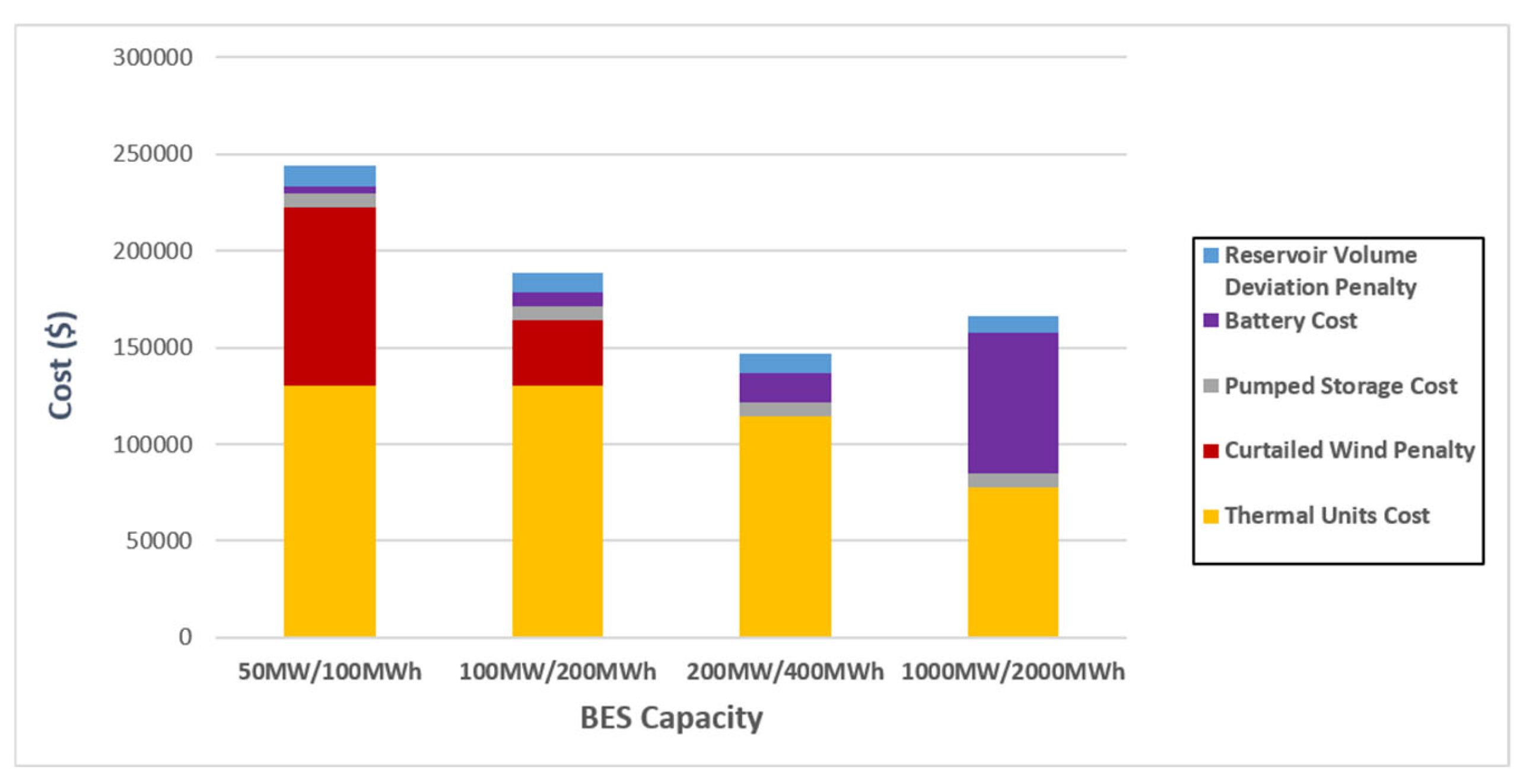
In Figure 13, as the BES capacity increases, the costs of thermal units and PSs decrease, because BES takes more system regulation tasks. However, since the BES cost increases enormously with its capacity, the overall system operating cost also increases. Considering the regulation time scales of BES, the sensitivity of BES capacities is tested on an intraday scenario, i.e., Scenario (b) in Figure 8. The results are shown in Figure 14.
In Figure 14, as BES capacity increases, the costs of thermal units and PSs decrease, and the BES cost increases, which is consistent with the trend in Figure 13. However, with a limited BES capacity, wind power curtailment occurs. Since BES helps mitigate this curtailment, the overall system operating cost initially decreases before increasing. The results demonstrate the effectiveness of BES in short-term system regulations.

4.3. Advantages and Limitations

From the above case studies, it can be summarized that the proposed strategy is better than the traditional approach because it can dispatch different energy storage in a more refined manner, e.g., the differentiated dispatch of weekly-regulated and daily-regulated PS, and the coordination of the scheduling plan of different time scales. By fully exploiting the regulation abilities of energy storage in different time horizons, the proposed strategy addresses the limitations of previous research and avoids the “myopia” and “hyperopia” problem commonly seen in optimal scheduling with energy storage. Due to the uncertainties of renewable energy and load, the optimization model may encounter mismatch issues. The two-stage scheduling model can manage some of the potential mismatches. In the day-ahead scheduling, the day-ahead forecasts for renewable energy and load are used for optimization. After the stage, the renewable energy and load may vary from the day-ahead forecasts, and the mismatch can be handled in the intraday stage. By comprehensively considering system operating requirements and the day-ahead scheduling plan, an intraday scheduling plan is formulated to handle the variation in renewable energy and load.
Despite the advantages, the proposed strategy still has limitations. In this paper, only day-ahead and intraday scheduling, i.e., with a granularity of 1 h and 15 min, respectively, are discussed. Real-time control, i.e., with a granularity of 5 min or less than 60 s, is not covered, where other constraints such as power quality, transient and steady state stability, and frequency regulations should be considered. Since real-time control is also crucial for practical power system operation, our future work will be focused on this topic. Besides, in the proposed optimization model, the uncertainty modeling for renewable energy and load, the detailed network operating constraints, and an in-depth BES degradation effect model are not considered, so our future research will also cover the aspects.
When applying the proposed method in practical implementation, several key aspects should be discussed. In the proposed two-stage strategy, the granularity of day-ahead and intraday scheduling is 1 h and 15 min, respectively. Existing power systems are already capable of meeting the communication requirements and cyber-physical coordination needs of the proposed method. When considering market mechanisms, the scheduling strategy formulated by the proposed method can serve as a pre-clearance step to establish energy-storage plans when PS or other energy storage does not participate in the market. Conversely, if energy storage participates in the market by submitting quantity and price bids, the proposed energy-storage model can be embedded into the market clearing algorithm. This allows for the comprehensive consideration of both the storage bids and system regulation needs to determine the optimal schedule. The integration of the proposed strategy with power market mechanisms will also be one of our future research directions. During practical deployment, power system operation rules, security guidelines, and market regulations should be strictly obeyed.

5. Conclusions

To fully utilize regulation resources with diverse characteristics and ensure both power supply and renewable energy accommodation in the context of high renewable energy penetration, this paper proposes a coordinated scheduling strategy for diversified energy storage considering their individual regulation time scales.
  • Based on the analysis of the differences in regulation time scales of different types of energy storage, the correspondence of regulation time scales and optimization time scales is explored. A day-ahead and intraday two-stage coordinated scheduling framework for diversified energy storage is proposed. The framework considers the optimal scheduling of PS and BES with varying regulation time scales.
  • Based on models of PS, BES, and thermal power units considering deep peak shaving, a coordinated scheduling model for multiple energy storage is established. This model achieves the optimal scheduling of resources with different regulation time scales across day-ahead and intraday stages to minimize system operating costs, while ensuring coordination between optimization strategies of different optimization time scales.
  • In the case study, the proposed scheduling strategy reduces the system operating costs by 0.5% in the day-ahead scheduling and 16.1% in the intraday scheduling compared to the traditional two-stage strategy. The results demonstrate that the proposed strategy comprehensively considers system operation requirements, storage-regulation time scales, and the coordination with optimization strategies of different time scales.
  • The practical implication of this study for system operators is that they can dispatch energy storage in a more refined manner for higher level of renewable energy accommodation and power supply reliability. Specifically, when allocating the power of weekly-regulated and daily-regulated PS, the power plans can be differentially optimized according to their respective reservoir capacities and regulation abilities.

Author Contributions

Conceptualization, J.Y. and Y.L.; methodology, L.Z.; software, Y.Z.; validation, Y.Z. and Z.Y.; formal analysis, J.Y.; investigation, Y.L.; resources, L.Z.; data curation, Y.Z.; writing—original draft preparation, L.Z.; writing—review and editing, J.Y.; visualization, Z.Y.; supervision, L.Z.; project administration, J.Y.; funding acquisition, Y.L. All authors have read and agreed to the published version of the manuscript.

Funding

This research was supported by State Grid XinYuan Group Co., Ltd. Science and Technology Project, grant number SGXYKJ-2025-024.

Data Availability Statement

The original contributions presented in this study are included in the article. Further inquiries can be directed to the corresponding authors.

Conflicts of Interest

Authors Juwei Yang, Yin Luo, Ying Zhao, and Zheng Yuan are employed by the company Henan Tianchi Pumped Storage Co., Ltd. The remaining authors declare that the research was conducted in the absence of any commercial or financial relationships that could be construed as a potential conflict of interest. The authors declare that this study received funding from State Grid XinYuan Group Co., Ltd. Science and Technology Project. The funder was not involved in the study design, collection, analysis, interpretation of data, the writing of this article or the decision to submit it for publication.

Appendix A

Figure A1. Load forecast data.
Energies 19 02815 g0a1
Figure A2. Wind power forecast data.
Energies 19 02815 g0a2
Figure A3. Day-ahead scheduling strategy of the typical day in spring.
Energies 19 02815 g0a3

References

  1. Du, Y.; Xue, Y.; Chen, L.; Shahidehpour, M.; Yang, L.; Zhang, X. Optimal capacity planning of hybrid renewable energy—CCHP system considering inter seasonal borehole thermal energy storage. IEEE Trans. Sustain. Energy 2025, 16, 2918–2933. [Google Scholar] [CrossRef]
  2. Chegari, B.; Tabaa, M.; Simeu, E.; Ganaoui, M.E. Optimal energy management of a hybrid system composed of PV, wind turbine, pumped hydropower storage, and battery storage to achieve a complete energy self-sufficiency in residential buildings. IEEE Access 2024, 12, 126624–126639. [Google Scholar] [CrossRef]
  3. Song, L.; Zhao, K.; Chen, X. Research on two-level optimal dispatching strategy of new energy power system including energy storage. Jilin Electr. Power 2022, 5, 30–35. (In Chinese) [Google Scholar]
  4. Rakhshani, E.; Ruiz, J.; Benavides, X.; Dominguez, E. Adaptive interoperable management of hybrid energy storage systems for grid-forming services. IEEE Trans. Ind. Applicat. 2025; in press.
  5. Yan, X.; Gao, B.; An, C.; Wang, Y.; Liu, N. Coupled capacity allocation mechanism for distributed hybrid pumped storage resources. IEEE Trans. Smart Grid 2026, 17, 1239–1249. [Google Scholar] [CrossRef]
  6. Shao, C.; Li, C.; Duan, R.; Guan, X. Multi-energy storage configuration and economical optimal scheduling for new energy consumption. Power Syst. Clean Energy 2025, 41, 141–147. (In Chinese) [Google Scholar]
  7. Guo, Y.; Ouyang, S.; Xin, X.; Zhang, J.; Zhang, Y. Collaborative optimization scheduling method for hybrid energy storage source and load based on dynamic time zone division. South. Power Syst. Technol. 2025, 19, 4–14. (In Chinese) [Google Scholar]
  8. Liu, Z.; Xu, Z.; Li, M.; Wu, H.; Liu, Q.; Li, Y. Day-ahead peak shaving dispatch of photovoltaic-hybrid pumped storage hydropower systems. In Proceedings of the 9th International Conference on Power Energy Systems and Applications, Nanjing, China, 20 June 2025. [Google Scholar]
  9. Peng, C. Multiple Flexible Resources Considering Uncertainty Participate in the Complementary Coordination Strategy of Peak Cutting and Valley Filling. Master’s Thesis, Southeast University, Nanjing, China, 2024. (In Chinese) [Google Scholar]
  10. Sun, C. Multi-Load Coordination Optimization Scheduling Strategy of Active Distribution Network to Improve New Energy Consumption Capability. Master’s Thesis, North China Electric Power University, Beijing, China, 2022. (In Chinese) [Google Scholar]
  11. Liu, S. Research on the Application of Multiple Energy Storage in Integrated Energy Systems. Master’s Thesis, North China Electric Power University, Beijing, China, 2022. (In Chinese) [Google Scholar]
  12. Zhang, H.; Liao, K.; Yang, J.; Yin, Z.; He, Z. Long-term and short-term coordinated scheduling for wind-PV-hydro-storage hybrid energy system based on deep reinforcement learning. IEEE Trans. Sustain. Energy 2025, 16, 1697–1710. [Google Scholar] [CrossRef]
  13. Jiang, L.; Zhang, Y.; Lu, B.; Wang, C.; Qi, Y. Optimization dispatch strategy for multi-energy storage systems considering energy storage capacity scheduling. Ningxia Electr. Power 2025, 1, 23–34. (In Chinese) [Google Scholar]
  14. Peng, Q.; Zhong, X.; Li, L.; Sun, W.; Li, Y.; Wang, X.; Zhong, H. Research on collaborative operation of pumped storage and new energy storage in new power system. South. Power Syst. Technol. 2026, 2, 30–38. (In Chinese) [Google Scholar]
  15. Zeng, G.; Zhong, J.; She, J.; Cao, F.; Liao, C. Research on dynamic energy regulation algorithm for hybrid energy storage in large-scale island microgrids. In Proceedings of the 4th International Conference on Smart Grid and Green Energy, Sydney, Australia, 28 February 2025. [Google Scholar]
  16. Liu, C. Research on Scheduling Method of Integrated Energy System Considering Hybrid Energy Storage. Master’s Thesis, Harbin Institute of Technology, Harbin, China, 2020. (In Chinese) [Google Scholar]
  17. Wang, J.; Wang, C.; Wei, Q.; Zhou, B.; Zhang, J.; Zhu, Y.; Fan, Z. Research on multiple time scales optimal dispatching strategy for user side energy storage participating in demand response. J. Electr. Eng. 2021, 3, 115–122. (In Chinese) [Google Scholar]
  18. Tang, X.; Su, J.; Li, L.; Liu, Y.; Liu, S.; Cheng, W.; Shi, X. Economic dispatching optimization of energy hub based on multiple energy storage micro grid. Power Capacit. React. Power Compens. 2021, 42, 182–187. (In Chinese) [Google Scholar]
  19. Koholé, Y.; Ngouleu, C.; Cyrille, F.; Fohagui, V.; Tchuen, G. Quantitative techno-economic comparison of a photovoltaic/wind hybrid power system with different energy storage technologies for electrification of three remote areas in Cameroon using Cuckoo search algorithm. J. Energy Storage 2023, 68, 107783. [Google Scholar] [CrossRef]
  20. Zhao, Z.; Zhang, H.; Du, G.; Xu, W. Key technology of integrated power generation system containing wind/solar/hydro/thermal and energy storage. In Proceedings of the IEEE 5th International Electrical and Energy Conference, Nanjing, China, 27 May 2022. [Google Scholar]
  21. Jordehi, A.; Javadi, M.; Catalão, J. Optimal placement of battery swap stations in microgrids with micro pumped hydro storage systems, photovoltaic, wind and geothermal distributed generators. Electr. Power Energy Syst. 2021, 125, 106483. [Google Scholar] [CrossRef]
  22. Lv, H.; Xiwang, A.; Lin, W.; Wang, L. Economic operation of microgrid based on hybrid energy storage dynamic scheduling. Comput. Simul. 2022, 39, 97–102. (In Chinese) [Google Scholar]
  23. Tephiruk, N.; Jamjang, P.; Taweesap, A.; Hongesombut, K. Hybrid energy storage system to enhance efficiency of renewable energy usage. In Proceedings of the 19th International Conference on Electrical Engineering/Electronics, Computer, Telecommunications and Information Technology, Prachuap Khiri Khan, Thailand, 24 May 2022. [Google Scholar]
  24. Huang, Q.; Gu, H.; Xu, Q.; Huang, D.; Sun, X.; Wu, Z.; Zhu, J.; Sun, M. Economic optimal dispatch of building micro-energy network with heat pump and electro-thermal hybrid energy storage. Power Demand Side Manag. 2023, 25, 60–65. (In Chinese) [Google Scholar]
  25. Xue, W. Cooperative Scheduling of Regional Integrated Energy System with Hybrid Energy Storage. Master’s Thesis, North China Electric Power University, Beijing, China, 2022. (In Chinese) [Google Scholar]
  26. Ma, Y.; Zhou, J.; Dong, X.; Wang, H.; Zhang, W.; Tan, Z. Multi-objective optimal scheduling model for multi-energy system considering uncertainty and hybrid energy storage devices. J. Electr. Power Sci. Technol. 2022, 37, 19–32. (In Chinese) [Google Scholar]
  27. Hou, H.; Liu, P.; Liu, Z.; He, S.; Xiao, Z.; Yao, Y. Optimal dispatch method for multi-energy storage system of electricity heat hydrogen. High Volt. Eng. 2022, 48, 536–543. (In Chinese) [Google Scholar]
  28. Cao, L. Optimal Scheduling of Building Integrated Energy System Considering Multi-Energy Storage. Master’s Thesis, North China Electric Power University, Beijing, China, 2022. (In Chinese) [Google Scholar]
  29. Chen, B.; Xu, R.; Xu, C.; Qiu, C.; Zhang, Q.; Zhang, X. Large-scale energy storage aggregation active power dispatching and control in subarea division of power grid. Electr. Power Eng. Technol. 2021, 40, 35–41. (In Chinese) [Google Scholar]
  30. He, C.; Cheng, S.; Xu, J.; Fang, Z. Coordinated optimal scheduling of integrated energy system considering multi-time scale and hybrid energy storage system. Proc. CSU-EPSA 2020, 32, 77–84. (In Chinese) [Google Scholar]
  31. Zhang, J.; Chan, X.; Xue, Y.; Bai, X.; Li, Z.; Wang, P. Optimal planning for electricity–gas–hydrogen integrated energy systems considering intertemporal long-term hydrogen storage and multiple uncertainties. IEEE Trans. Power Syst. 2025, 40, 4660–4674. [Google Scholar] [CrossRef]
  32. Xu, M.; Miao, S.; Li, G.; Tang, W.; Wang, T.; Wang, J. Day-ahead and intra-day optimal scheduling of power system considering multiple energy storage participating in spot market. Autom. Electr. Power Syst. 2025, 49, 51–62. (In Chinese) [Google Scholar]
  33. Sun, G.; Yuan, B.; Lu, G.; Wang, Z.; Xia, P.; Wu, C. Multi-time-scale scheduling of hybrid energy storage systems. In Proceedings of the IEEE International Conference on Energy Internet, Zhuhai, China, 1 November 2024. [Google Scholar]
  34. Lang, J.; Liu, K.; Lan, X.; Zheng, S. Research on bilayer energy scheduling of hybrid energy storage microgrid system. J. Anhui Univ. Technol. (Nat. Sci.) 2022, 39, 306–311. (In Chinese) [Google Scholar]
  35. Wu, Y.; Bao, Y. Coordinated Day-ahead and intra-day rolling scheduling strategy for electricity-power hybrid energy storage. Autom. Electr. Power Syst. 2024, 48, 77–87. (In Chinese) [Google Scholar]
  36. Gao, G.; Ren, J.; Yu, G.; Xin, C.; Zhang, S.; Yao, P.; Ye, M.; Cong, B. Study on the synergistic operation of pumped storage and electrochemical energy storage under high percentage new energy power system. In Proceedings of the IEEE 8th Conference on Energy Internet and Energy System Integration, Shenyang, China, 29 November 2024. [Google Scholar]
  37. Huan, Z. Research on Optimal Operation and Planning of Multiple Flexible Resources in Power System. Master’s Thesis, North China Electric Power University, Beijing, China, 2022. (In Chinese) [Google Scholar]
  38. Xue, T.; Li, Y.; Zhang, L.; Sun, Y.; Wang, X.; Song, D. Day-ahead and intra-day scheduling method for multi-decentralized energy storage considering cluster aggregation and subject self-regulation strategy. Guangdong Electr. Power 2024, 12, 97–110. (In Chinese) [Google Scholar]
  39. Yan, J. Optimal Scheduling Strategy for Intelligent Buildings Considering Multiple and Flexible Resources Responses. Master’s Thesis, Beijing Jiaotong University, Beijing, China, 2022. (In Chinese) [Google Scholar]
  40. Huang, W.; Li, Y.; Li, J.; Liu, Y.; Wu, F.; Wang, Z. Multi-time scale joint optimal scheduling for wind-photovoltaic-electrochemical energy storage-pumped storage considering renewable energy uncertainty. Electr. Power Autom. Equip. 2023, 43, 91–98. (In Chinese) [Google Scholar]
  41. Liu, X. Scheduling Control Strategy for Coordinated Peak Load Regulation of Multiple Energy Storage Power Stations. Master’s Thesis, Hunan University, Changsha, China, 2022. (In Chinese) [Google Scholar]
  42. Jiang, M.; Wang, X.; Dong, C.; Wang, S.; Zhou, H.; Gao, J. Optimal capacity configuration for hydroelectric-thermal-wind- photovoltaic-storage multi-energy complementary system based on sequential power generation simulations. J. Hydroelectr. Eng. 2024, 43, 71–83. (In Chinese) [Google Scholar]
  43. Wei, B. Research on Optimal Scheduling of Energy Storage Systems in Microgrid. Master’s Thesis, Nanchang University, Nanchang, China, 2020. (In Chinese) [Google Scholar]
  44. Chen, Y.; Du, Q.; Wu, M.; Yang, L.; Wang, H.; Lin, Z. Two-stage optimal scheduling of virtual power plant with wind-photovoltaic-hydro-storage considering flexible load reserve. In Proceedings of the 4th International Conference on Clean Energy and Electrical Systems, Tokyo, Japan, 2 April 2022. [Google Scholar]
  45. Zhang, C.; Zeng, J.; Zhang, W.; Xu, Q.; Peng, J.; Guo, M. Multi-time scale coordination control strategy of isolated microgrid with hybrid energy storage. Mod. Electr. Power 2020, 37, 74–82. (In Chinese) [Google Scholar]
  46. Zhang, S.; Miao, S.; Yin, B.; Yao, F.; Wang, T. Economic analysis of multi-type energy storages considering the deep peak-regulation of thermal power units. Electr. Power Constr. 2022, 43, 132–142. (In Chinese) [Google Scholar]
  47. Lin, L.; Yue, X.; Xu, B.; Sun, Y.; Wei, M. Sequence and strategy of pumped storage-thermal combined peak shaving considering benefits of pumped storage and deep regulation of thermal power. Power Syst. Technol. 2021, 45, 20–32. (In Chinese) [Google Scholar]
  48. Liu, S.; Xu, J.; Li, D.; Shi, Z.; Ye, T. Research on low carbon economic dispatch in power systems considering deep peak shaving and demand response. In Proceedings of the International Conference on New Power System Technology, Hefei, China, 24 September 2025. [Google Scholar]
  49. Bai, J.; Zhang, Y.; Wang, L.; Zhao, J. Analysis of the influence of deep peak shaving on the operation characteristics of thermal power generator. In Proceedings of the 4th International Conference on Energy, Electrical and Power Engineering, Chongqing, China, 23 April 2021. [Google Scholar]
  50. Ji, J.; Fu, R.; Wang, Z.; Ying, Y. Correlation analysis of deep peak shaving of power grid under renewable energy consumption. In Proceedings of the 12th IEEE PES Asia-Pacific Power and Energy Engineering Conference, Nanjing, China, 20 September 2020. [Google Scholar]
Figure 1. Two-stage coordinated scheduling framework for diversified energy storage.
Energies 19 02815 g001
Figure 2. Peak shaving stages of thermal power units.
Energies 19 02815 g002
Figure 3. A modified IEEE-30 node system.
Energies 19 02815 g003
Figure 4. Day-ahead scheduling strategies of the typical days of four seasons.
Energies 19 02815 g004
Figure 5. Output of weekly-regulated PS under different scheduling strategies.
Energies 19 02815 g005
Figure 6. Upper reservoir storage capacity of weekly-regulated PS under different scheduling strategies.
Energies 19 02815 g006
Figure 7. System operating costs under different scheduling strategies of weekly-regulated PS.
Energies 19 02815 g007
Figure 8. Intraday scheduling strategies under scenarios of different wind power forecasts.
Energies 19 02815 g008
Figure 9. PS upper reservoir capacity under different scheduling strategies.
Energies 19 02815 g009
Figure 10. System operating costs under different PS scheduling strategies.
Energies 19 02815 g010
Figure 11. System operating costs under different scheduling strategies.
Energies 19 02815 g011
Figure 12. System operating costs with different f d P S W values.
Energies 19 02815 g012
Figure 13. Day-ahead system operating costs with different BES capacities.
Energies 19 02815 g013
Figure 14. Intraday system operating costs with different BES capacities.
Energies 19 02815 g014
Table 1. Literature on multi-stage scheduling for diversified energy storage.
Scheduling StagesEnergy Storage TypesMethodologyObjectivesTesting SystemsReference
Day-ahead and intradayBES and compressed airOptimal schedulingSpot market clearing costsModified IEEE 118-bus[32]
Day-ahead, intraday, and real-timeBES and PSOptimal schedulingSystem operating costsIEEE 30-bus[33]
Long-term and short-termBES and super capacitorOptimal schedulingSystem operating costs and SOC deviation1-bus microgird[34]
Day-ahead and intradayBES and super capacitorOptimal scheduling considering finite time window and different temporal resolutionsSystem operating costsPJM 5-bus[35]
Day-ahead and intradayBES and PSOptimal schedulingSystem operating costs and deviation penalty chargeA transmission network[36]
Day-ahead, intraday, and real-timeBES and PSOptimal schedulingSystem operating costsModified IEEE 39-bus[37]
Day-ahead and intradayBES, gravity and compressed airCluster aggregation and optimal schedulingSystem operating costsModified IEEE 30-bus[38]
Day-ahead and intradayBES and electric vehiclesOptimal schedulingSystem operating costs and exchange power fluctuationA building network[39]
Day-ahead, intraday, and real-timeBES and PSGenerative adversarial network and density peak clusteringSystem operating costs and wind/photovoltaic curtailment A testing network[40]
Day-ahead and short-termLithium-ion battery and Vanadium redox flow batteryε-constraint optimizationSystem operating costs and battery load balancingPJM 5-bus[41]
Long-term and short-termBES, PS, and hybrid PSParticle Swarm OptimizationSystem operating costsA transmission network[42]
Long-term and short-termBESParticle Swarm OptimizationSystem operating costs1-bus microgird[43]
Day-ahead and real-timeBESOptimal schedulingSystem operating costs and deviation penalty22-bus testing network[44]
Table 2. Correspondence of the regulation time scale of energy storage and the optimization time scale.
CriterionConsideration
Energy Regulation T o < T E R Consider the energy regulation results on a larger time scale.
T o > T E R Optimize the energy regulation locally.
Power
Regulation
T o < T P R Consider the power regulation results on a larger time scale.
T o > T P R Optimize the power regulation locally.
Table 3. Correspondence of the energy-regulation time scales of energy storage and the optimization time scales of the two-stage scheduling.
Day-Ahead Optimal SchedulingIntraday Optimal Scheduling
weekly-regulated PSConsider the weekly energy regulation plan.Consider the daily energy regulation plan.
daily-regulated PSOptimize the energy regulation locally.Consider the daily energy regulation plan.
BESOptimize the energy regulation locally.Optimize the energy regulation locally.
Table 4. Parameters of thermal power units.
G1G2G3G4G5G6
P m a x G /MW10001000600600300300
P m i n G /MW400400300300180180
P O F , m i n G /MW350350250250150150
P O A , m i n G /MW300300220220120120
Disclaimer/Publisher’s Note: The statements, opinions and data contained in all publications are solely those of the individual author(s) and contributor(s) and not of MDPI and/or the editor(s). MDPI and/or the editor(s) disclaim responsibility for any injury to people or property resulting from any ideas, methods, instructions or products referred to in the content.