Mitigating Systemic Risks in the Global Energy Transition: Analyzing Techno-Ecological and Socio-Economic Interfaces to Redefine Energy Policy in the Age of Polycrisis


Abstract
1. Introduction
2. The Theory of Contact Zones: From Literary Studies to Energy Economics
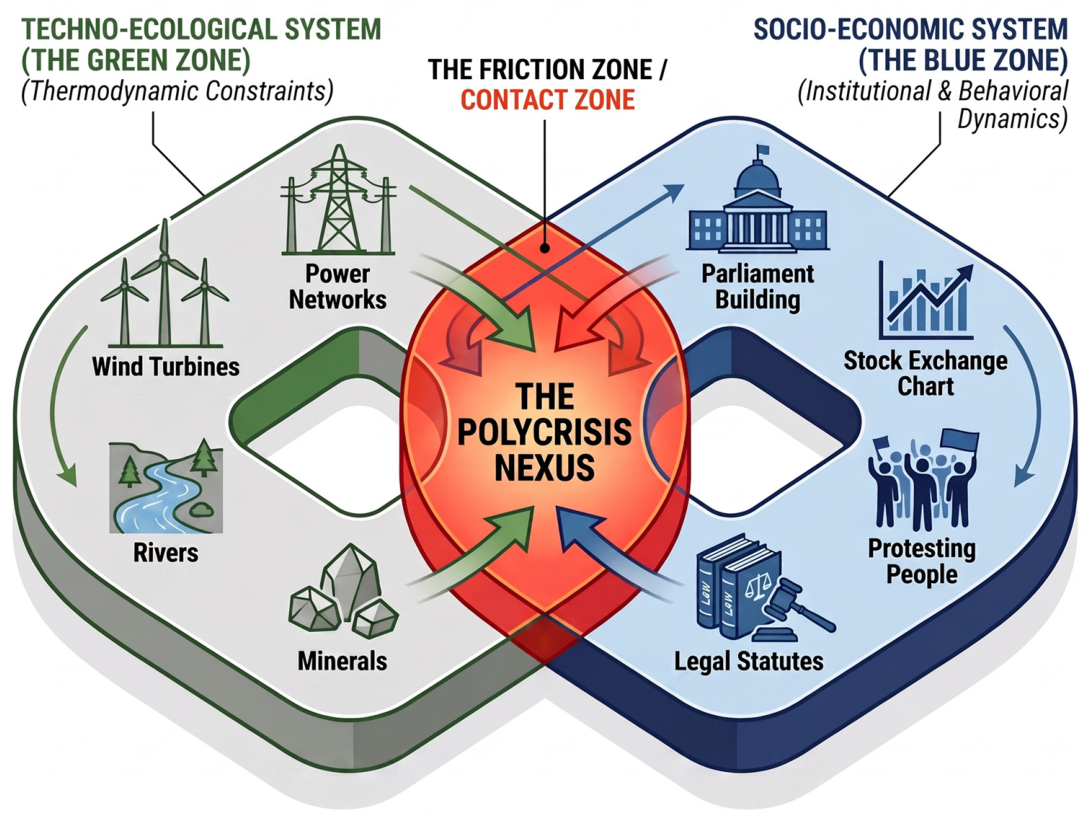
3. Operationalization of Contact Zones as System Interfaces
3.1. Human Contact Zones and More-than-Human Contact Zones in Energy Economics: Expanding the Scope of Energy Economics
- Cultural exchange—areas where different cultures meet, exchange ideas, and influence each other.
- Power dynamics—often involve asymmetrical power relationships, such as those found in colonial or post-colonial contexts.
- Conflict and cooperation—can be sites of both conflict and cooperation, as different groups negotiate their relationships and coexistence.
- Non-human agency—recognizes the agency of non-human entities and their role in shaping interactions and environments.
- Multispecies interactions—focuses on the relationships and coexistence of different species, including humans.
- Environmental justice—addresses issues of violence, injustice, and the decolonization of knowledge production related to environmental management.
3.2. Granular Analysis of Critical System Interfaces
3.2.1. Socio-Economic Interface Type A: Energy–Societal Subsystems (Human Energy Contact Zones)
- Urban energy systems. High-density load centers where infrastructure (power plants, grids, PV) directly impacts quality of life metrics. Policy optimization here focuses on balancing demand-side management with habitability standards.
- Industrial clusters. Zones with high energy intensity requiring decarbonization strategies. The focus is on energy efficiency protocols and fuel switching to mitigate environmental externalities.
- Rural and agro-energy landscapes. Interfaces where traditional land use coexists with distributed generation (bioenergy, solar). These are critical for regional economic resilience and analyzing the trade-offs between food security and energy production.
- Primary extraction and generation sites. Locations of resource origin (mines, oil fields, wind/solar farms). These define the “upstream” environmental and social footprint of the energy value chain.
- Transportation corridors. Energy-intensive logistic networks (highways, ports) where the transition requires the deep integration of grid-connected infrastructure (e.g., electromobility) and low-entropy alternative fuels.
- Digital-municipal interfaces. The emergence of digital platforms in energy management can create new infrastructural growth poles, particularly in regions with diverse natural assets (rivers, forests, lakes, hills). Here, digitalization acts as a catalyst for local economic development vectors [32].
- Stakeholder interaction matrices. Modeling the collaboration between citizens, local governments, and utilities is essential for project bankability and implementation speed.
- Social License to Operate (SLO). Equivalent to “community engagement”, this parameter mitigates the risk of project cancellation by tailoring infrastructure to local needs.
- Governance frameworks. The role of policy coherence in creating an investment-friendly environment for innovation in the energy sector.
- Knowledge transfer. Education and awareness campaigns serve as tools to reduce information asymmetry regarding renewable energy benefits.
- Socio-cultural dynamics. Analyzing these dynamics is necessary to preempt resource conflicts and ensure equitable distribution of transition costs.
3.2.2. Socio-Economic Interface Type B: Regulatory Intersection Nodes (Legal Contact Zones)
3.2.3. Socio-Economic Interface Type C: Governance & Implementation Vectors (Administrative Legal Contact Zones)
- Jurisdictional interoperability. The challenge of reconciling national, regional, and international energy codes.
- Contextual adaptation. Recognizing that administrative efficiency varies based on cultural and social variables.
- Policy deployment. The testing ground where theoretical governance models meet local constraints.
- Conflict resolution mechanisms. Administrative zones act as buffers for negotiating disputes between developers and regulators.
- Regulatory innovation. Testbeds for new legal frameworks and administrative procedures.
3.2.4. Techno-Ecological Interface Type A: Infrastructure–Biosphere Coupling Points (More-than-Human Energy Contact Zones)
- RES installation sites. Wind/solar farms and hydro dams where infrastructure footprint directly alters local ecosystems.
- Urban ecosystem services. Green infrastructure (rooftop gardens) acting as dual-purpose assets for energy efficiency and biodiversity.
- Agro-energy systems. Farmlands integrating bioenergy crops, requiring a balance between yield and soil health.
- Marine energy interfaces. Tidal/wave projects interacting with marine biology.
- Biomass resource bases. Forests where harvesting intensity is constrained by biodiversity conservation limits.
- Ecological agency. Recognizing that biological behaviors (e.g., migration patterns) impose physical constraints on infrastructure operation.
- Multispecies impact assessment. Preventing environmental injustice by modeling impacts beyond the human sphere.
- Integration of Indigenous Knowledge Systems (IKS). Decolonizing knowledge production means incorporating local/indigenous ecological data—often more granular than central models—to enhance system resilience.
- Systemic interconnectivity. Designing flexible energy solutions that adapt to biological complexity.
3.2.5. Techno-Ecological Interface Type B: Biodiversity Co-Existence Metrics (Multispecies Contact Zones)
- Urban co-habitation. Managing conflicts between infrastructure and urban wildlife (e.g., conflicts with urban wildlife such as raccoons or pigeons).
- Agricultural biodiversity. Monitoring the impact of energy crops on ecosystem health.
- Protected areas management. Balancing conservation mandates with energy tourism or research.
- Marine & forest interactions. Assessing the disruption of food webs by industrial activity.
3.3. Phenomenology of the Interface: Qualitative Inputs for Risk Analysis
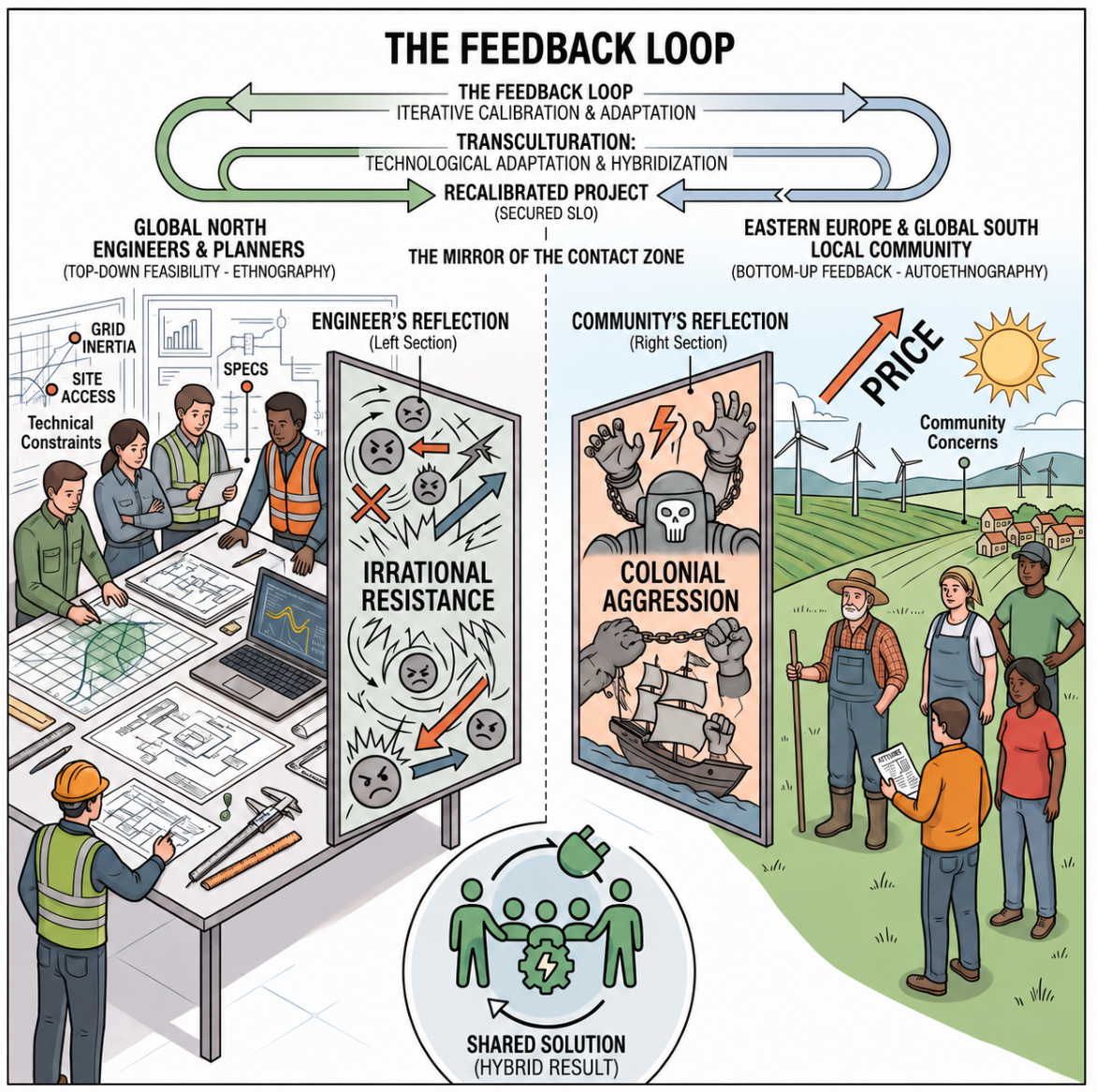
3.3.1. Ethnography and Autoethnography: The Mirror Dance of Stakeholders
3.3.2. Transculturation and Ortiz’s Inequality: Asymmetries in the Energy Transition
3.3.3. Conquest and Anti-Conquest: Narrative Strategies in Green Colonialism
3.3.4. Oikophilia and Living in a Bifurcated World: The Psychological Dimension of Transition
3.4. Mapping Contact Zone Phenomena onto Energy Policy Variables
- Ethnographic/autoethnographic texts are reinterpreted as stakeholder reporting & feedback data. The mirror dance becomes the iterative process of public consultation and project redesign, where developer plans (ethnography) clash with local community feedback (autoethnography), forcing a recalibration of technical parameters.
- Transculturation is operationalized as technological adaptation & hybridization, where imported energy solutions (e.g., western wind farm models) are modified by local geographic and social constraints, creating new, site-specific operational standards.
- Anti-conquest translates into Corporate Social Responsibility (CSR) & greenwashing risks. It represents the strategic narrative where aggressive infrastructure expansion is framed as benevolent ecological rescue, often masking the extraction of local value.
- Oikophilia is redefined as Place Attachment Factor (PAF), a measurable variable determining the intensity of NIMBY (Not In My Back Yard) or YIMBY (Yes In My Back Yard) reactions.
3.5. Visualizing Cognitive Bias and Transculturation in the Global Energy Transition
4. The System Dynamics Framework: From Observation to Control
4.1. Research Hypotheses: Linking Interface Friction to Systemic Failure
- The energy transition is identified as the central node of the polycrisis and its primary systemic driver. It is not an isolated technical process but a “hyper-object” that exerts pressure on all global subsystems. Therefore, skillful management of energy sources (the input variable) is the only viable method to dampen the volatility of the entire polycrisis (the output variable). The high-leverage points for this intervention are located strictly within the identified techno-ecological and socio-economic interfaces.
- Resolving the optimization problems of the energy transition is impossible through linear policy measures. Solutions can only be found by regulating the friction at critical system interfaces (formerly contact zones). The high-leverage intervention points are the specific operational variables within these interfaces—such as stakeholder feedback loops (mirror dance), technological hybridization (transculturation), and place attachment factors (oikophilia). Furthermore, system actors must resolve their agency conflict (reducing the bifurcation between prosumer and citizen roles) to minimize system oscillation.
- Concepts: The foundational theoretical constructs (e.g., polycrisis, contact zones, entropy debt).
- Variables (KPIs): The measurable systemic metrics defining the control levers (e.g., Place Attachment Factor, geopolitical instability indices, thermal entropy rates).
- Mechanisms: The dynamic structural interactions and iterative processes (e.g., transculturation, the mirror dance feedback loops, network shocks).
- Policy Implications: The strategic, real-world outputs required for system stabilization (e.g., securing a Social License to Operate, redesigning regulatory intersections, managing WACC for renewable projects).
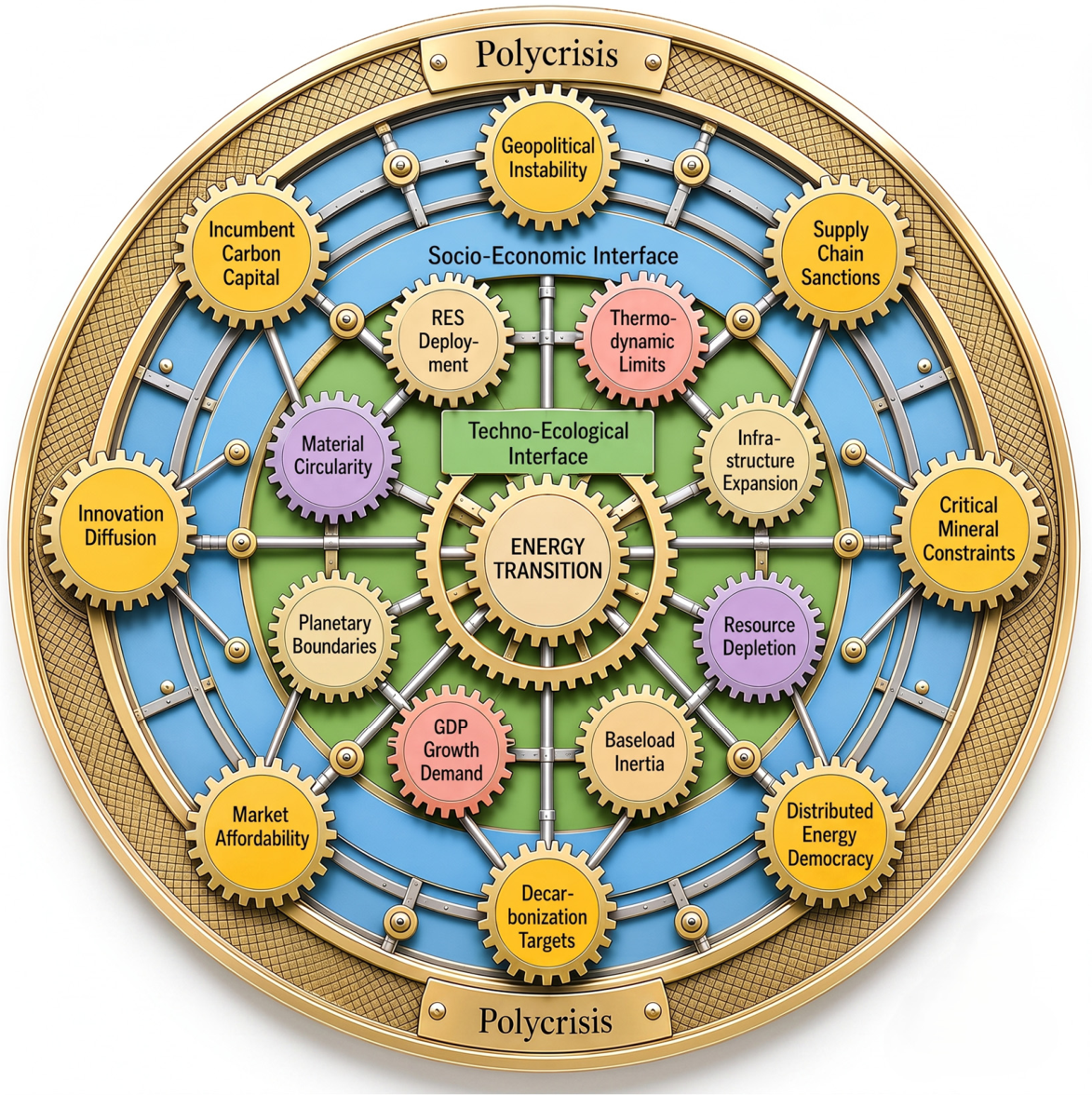
4.2. Operationalizing the Control Levers (The 16 Key Performance Indicators)
4.2.1. Control Levers in the Techno-Ecological Interface (Green Zone)
- RES Deployment vs. Baseload Inertia: The tension between the speed of renewable capacity integration and the stability of legacy fossil infrastructure;
- Thermodynamic Limits vs. GDP Growth Demand: The trade-off between physical entropy accumulation and the demand for continuous economic expansion;
- Infrastructure Expansion vs. Planetary Boundaries: The conflict between the physical expansion of the technosphere and the regenerative capacity of the ecosystem;
- Resource Depletion vs. Material Circularity: The race between raw material extraction and the efficiency of material recovery loops.
4.2.2. Control Levers in the Socio-Economic Interface (Blue Zone)
- 5.
- Geopolitical Instability vs. Decarbonization Targets: How security crises (e.g., nuclear threat) derail long-term climate governance;
- 6.
- Supply Chain Sanctions vs. Market Affordability: The direct correlation between geopolitical boycotts and energy price volatility;
- 7.
- Critical Mineral Constraints vs. Innovation Diffusion: The bottleneck where scarcity of materials (lithium, cobalt) limits the rate of technological progress;
- 8.
- Distributed Energy Democracy vs. Incumbent Carbon Capital: The structural conflict between decentralized prosumer models (democratization of assets) and centralized corporate fossil asset valuations.
4.3. Systemic Complexity and Open Architecture of the Model
5. Dynamics of the Techno-Ecological Interface: Managing Ecological and Thermodynamic Constraints
5.1. Control Lever 1: RES Deployment Versus Baseload Inertia
- Carbon lock-in (dependence on the carbon path). Fossil fuels remain a significant source of emissions, driving the system toward planetary boundary overshoots.
- Infrastructure interoperability. Integrating variable RES requires a reconfiguration of the grid architecture (smart grids, energy storage), moving from centralized baseload to decentralized flexibility.
- Labor market friction. The transition creates a socio-economic interface type A (energy–societal subsystem) conflict, where job creation in the green sector must outweigh displacement in extractive industries to maintain social stability.
5.2. Control Lever 2: Thermodynamic Limits Versus GDP Growth Demand
- Thermal entropy: The expansion of the planetary heat debt radiating into the cosmos, initiated by the Industrial Revolution;
- Material Entropy: The dispersion of matter in the ecosphere.
- Resource Depletion Rate (RDR). A metric of techno-ecological interface type A, where extraction rates exceed regeneration, increasing system fragility.
- Biospheric degradation. A failure of techno-ecological interface type B (multispecies co-existence), where industrialization destroys biodiversity, reducing the biosphere’s capacity to absorb entropy (waste).
- Circular economy implementation. Closing material loops to minimize material entropy (linked to control lever 4).
- Exergy efficiency innovation. Technological advances that maximize useful work per unit of energy.
- Regulatory intervention. Policies acting at the socio-economic interface to internalize the cost of entropy generation into market prices.
5.3. Control Lever 3: Infrastructure Expansion Versus Planetary Boundaries
5.4. Control Lever 4: Resource Depletion Versus Material Circularity
- Entropy generation in processing. Every recycling loop, while reducing demand for virgin materials, requires significant energy consumption, thereby increasing thermal entropy (as discussed in Section 5.2) and often leading to material degradation, making it challenging to maintain primary material quality [78,79].
- Energy–entropy nexus. The energy required for recycling processes creates an interdependence between control lever 4 and control lever 1 (decarbonization vs. inertia). Minimizing the entropic impact of recycling requires efficient energy use and reliance on RES.
- Design for circularity. This is a crucial technosphere intervention, focusing on product design (durability, easy disassembly) to minimize entropy generation at the end-of-life stage.
6. Dynamics of the Socio-Economic Interface: Managing Institutional and Geopolitical Constraints
6.1. Control Lever 5: Geopolitical Instability Versus Decarbonization Targets
- Technological scalability constraints. While nuclear energy is often proposed as a baseload solution for decarbonization, it faces severe implementation friction. Data from the United States shows that political support has consistently lagged behind economic and environmental constraints, creating a deployment gap [83] (pp. 530–531).
- Proliferation risks. The international transfer of nuclear technology acts as a double-edged sword; while it aids decarbonization, it increases the risk of nuclear proliferation. This exacerbates international tensions [84], thereby degrading the diplomatic trust required for effective cross-border climate policy.
- Resource-driven conflict. A negative feedback loop exists where unmitigated climate risks undermine international security, potentially driving states to use violent measures—including nuclear leverage—to secure dwindling resources. Breaking this mutually reinforcing cycle requires high-level international synchronization [85,86].
- Supply chain disruption. Nuclear threats exacerbate geopolitical tensions, destabilizing global energy markets and severing critical supply chains for renewable technologies;
- Capital allocation shift. During periods of heightened security risk, state budgets prioritize defense spending (immediate survival) over Green CAPEX (long-term sustainability), delaying infrastructure modernization;
- Policy prioritization. Fear of conflict skews public perception and policy hierarchies, pushing long-term climate goals below the horizon of immediate security concerns;
- Resilience strategy. Conversely, effective climate policy acts as a security asset. Diversifying energy sources through renewables enhances energy security, reducing dependence on imported fossil fuels and mitigating the geopolitical risks associated with resource control.
6.2. Control Lever 6: Supply Chain Sanctions Versus Market Affordability
6.2.1. General System Dynamics and Regulatory Principles
- Immediate shock phase. If the sanctioned supply cannot be immediately replaced by alternative sources or demand reduction, global prices rise asymptotically to clear the market;
- Displacement effect. The system seeks equilibrium by redirecting flows. Wealthier nodes (e.g., EU) secure resources (LNG) through higher bids, displacing poorer nodes (Global South) and causing “energy starvation”;
6.2.2. Case Study: The 2022 Russian Gas Crisis as Empirical Validation
- Carbon backsliding. The immediate imperative for energy security (affordability) often overrides climate goals, leading to increased fossil fuel consumption.
6.3. Control Lever 7: Critical Mineral Constraints Versus Innovation Diffusion
6.3.1. General System Dynamics and Risk Reduction Mechanisms
- Efficiency gains. Increasing the output-to-input ratio (reducing material intensity per MW);
- Substitution elasticity. The ability of the system to swap scarce inputs for abundant ones via R&D. However, the system is bounded by rigid thermodynamic parameters. The current global waste recycling rate stands at only 19% [97], revealing a massive “circularity gap” and implying that the Material Entropy Rate (MER) remains critically high at 81%. In parallel, the Energy Entropy Rate (EER) is constrained by the second law of thermodynamics; current thermal generation systems (steam turbines) operate near the Carnot Limit, capped at approximately 38% efficiency [98] (pp. 189–190). Therefore, technological progress acts not as a magic bullet, but as a crucial optimization function attempting to push system performance closer to these theoretical boundaries.
6.3.2. Specific Operational Examples and Feedback Loops
- Performance optimization. Advances in battery chemistry increase energy density and lifetime, directly reducing raw material demand per unit of storage [100];
- Governance protocols. Governments must act as accelerators by incentivizing R&D and mandating circular design standards;
- Data integration. Improving data management of critical materials is essential for predictive modeling of supply crunches [105].
6.4. Control Lever 8: Distributed Energy Democracy Versus Incumbent Carbon Capital
6.4.1. General System Dynamics and Compensation Mechanisms
- Centralized mode (fossil capitalism). Relies on high-density energy stocks (coal, oil) that require massive capital concentration for extraction. This creates a vertical, linear value chain where wealth accumulates at the top (the node owners).
- Distributed mode (solar communism). Relies on low-density energy flows (sun, wind) available ubiquitously. This favors a horizontal, mesh network where value is distributed among prosumers (the node edges).
6.4.2. Operationalization of System Archetypes
- Fossil capitalism (the incumbent model): Operationalized as an economic system dependent on the extraction rate of non-renewable stocks. Its primary control parameter is GDP growth driven by industrialization [106]. However, systemic analysis reveals it generates high negative externalities (pollution, GHG emissions) that are not internalized in the price mechanism. Furthermore, it inherently produces structural inequality, as the Pareto distribution of benefits favors those controlling the extraction nodes [107,108].
- Solar communism (the distributed model): Operationalized as a society where energy production is decoupled from scarcity logic. It postulates a system based on renewable flows (zero marginal cost), managed via principles of social justice and sustainability. This model emphasizes the decentralization of infrastructure, minimizing ecological impact, and creating equitable distribution mechanisms for energy dividends [109,110].
6.4.3. Future System Trajectory
7. Interface Hybridization and Recursive Embedding: The Third Dimension of Complexity
7.1. Mapping Control Levers to Interface Domains
- Primary localization (home interface). Every lever has a “home”—the domain where it physically or legally resides. For instance, lever L1 (decarbonization vs. baseload) concerns the physical stability of the power grid, so its home is the techno-ecological interface (TE-A).
- Identification of hybrid coupling (ripple effect). Pulling a lever in its home domain creates “ripples” in another interface. Enforcing rapid decarbonization (TE-A) impacts the governance and policy layer (SE-C). This is the hybrid interface.
- Calculating the friction. Friction occurs at the contact point between these two worlds. For example, in Lever L6, friction arises between international law (sanctions in SE-B) and the citizen’s wallet (affordability in SE-A). The greater the divergence between these spheres, the higher the systemic risk.
- Recursive feedback. The matrix demonstrates that the hybrid interface can “lock” the primary lever. If societal friction (SE-A) becomes too high, policymakers might retreat from sanctions (SE-B), which in turn alters the pace of the overall energy transition.
7.2. Meticulous Interdependencies Between Interfaces
- Techno-ecological interface type A (TE-A). This is the “hard limit” interface. Levers 1, 2, and 4 operate here by ensuring that the technosphere does not exceed thermodynamic thresholds. This interface provides the physical boundary conditions for all Socio-Economic (SE) levers.
- Techno-ecological interface type B (TE-B) is the “spatial limit” interface. Lever 3 dominates here. It links directly to SE-A because the physical presence of energy installations is where biological agency meets human social acceptance.
- Socio-economic interface type A (SE-A) is the “human-centric” interface. Levers 6 and 8 are critical here. This interface acts as the “receptor” for shocks generated in the global zones (SE-B, SE-C). For instance, a sanction (SE-B) becomes an affordability crisis in SE-A.
- Socio-economic interface type B (SE-B) is the “legal-market” interface. Levers 4, 6, and 7 are nested here. It serves as the mediator between the physical needs of the transition (TE-A) and the institutional rules of the global economy.
- Socio-economic interface type C (SE-C) is the “macro-governance” interface. Levers 1, 5, and 8 function within this domain. This interface is the “command layer” that sets the targets for the entire system, yet it is recursively dependent on the stability of the lower-level interfaces.
7.3. Comparative Advantage over Established Systemic Models
8. The Central Role of Energy Transition in Polycrisis: Systemic Proof of Hypothesis 1
8.1. Vectors of Techno-Ecological Stabilization (The Green Zone)
- Mitigation of biospheric feedback loops (climate & environment). The transition from fossil fuels to RES is the only mechanism capable of halting the accumulation of entropy debt (control lever 2). By reducing greenhouse gas emissions and minimizing habitat destruction, the transition dampens the thermal and material entropy rates that drive climate change and biodiversity loss. It is the direct control valve for the planetary thermostat.
- Reduction in biological friction (public health & pandemics). Fossil fuel combustion serves as a vector for respiratory pathology. Furthermore, the expansive logic of fossil capitalism drives the technosphere to encroach upon wild habitats. This aggressive interface creates “viral spillover” risks. As noted in recent studies, the degradation of global biodiversity driven by globalized capitalism is a major factor in the potential emergence of new pandemics [113,114]. Decarbonization and circularity (control lever 4) reduce this friction.
- Technological adaptation (innovation). The transition acts as a forcing function for R&D (control lever 7). It necessitates breakthroughs in storage, grid management, and material efficiency. These innovations are not merely sectoral improvements but are foundational for a resilient, low-entropy economic system.
8.2. Vectors of Socio-Economic Stabilization (The Blue Zone)
- 4.
- Damping of geopolitical oscillation (security & tensions). A significant number of global conflicts are driven by the competition for concentrated fossil stocks (control lever 5). The transition to distributed renewable flows reduces the strategic leverage of petrostates, thereby diminishing the Geopolitical Instability Index (GII). By enhancing energy security through diversification and domestic generation (e.g., stopping the Russian gas boycott effects), the transition stabilizes international relations.
- 5.
- Correction of economic inequality (stability & equity). Investing in renewable infrastructure serves as a stimulus for job creation, counteracting economic stagnation. Crucially, the transition offers a pathway to resolve the tension between fossil capitalism and energy democracy (control lever 8). By facilitating access to affordable, distributed energy (control lever 6), it addresses energy poverty and ensures that the “social dividends” of the economy are shared more equitably, preventing social unrest.
- 6.
- Governance synchronization (policy & resilience). Effective energy governance requires the alignment of short-term crisis responses with long-term sustainability goals. The transition forces a modernization of policy structures, creating a system that is resilient to crises—from natural disasters to economic shocks. Distributed renewable systems act as shock absorbers, being less vulnerable to centralized disruption than monolithic fossil grids.
8.3. Conclusion of the Proof for Hypothesis 1
9. Regulating Critical Interfaces: Proof of Hypothesis 2
9.1. Optimizing the Techno-Ecological Interface (The Green Zone)
9.1.1. Regulating Techno-Ecological Interface Type A (Infrastructure–Biosphere Coupling)
- RES installation sites & ecological agency. Wind and solar farms are not sterile assets but active participants in local ecosystems. Designing these sites requires recognizing non-human agency (e.g., migratory patterns). For instance, creating corridors between turbine clusters facilitates bird passage [115,116], effectively reducing the “entropic friction” of the installation. Research is currently being conducted to mitigate the mortality of bats associated with the operation of wind turbines [117].
- Agro-energy systems. This interface reconciles energy production with food security. Agrivoltaics represents a technological hybridization (transculturation) where solar panels coexist with crops or livestock [118,119]. This dual-use strategy increases land productivity and strengthens local food systems, directly addressing the resource scarcity lever.
- Conservoltaic systems. These are areas in which the installation of solar energy systems does not interfere with wildlife conservation efforts [120].
- Marine energy interfaces. Similar principles apply to offshore wind and tidal projects, where multispecies impact assessment is required to prevent disruption to marine biodiversity.
9.1.2. Regulating Techno-Ecological Interface Type B (Multispecies Co-Existence)
- Urban ecosystem services. Integrating PV with green roofs enhances urban co-habitation, reducing the urban heat island effect while generating power.
- Integration of indigenous knowledge systems. To avoid ecological colonialism, project design must incorporate local ecological data (e.g., traditional land management). This ensures that protected areas management respects historical biotic relationships. For instance, there has been an increasing trend of solar farms being planned with the consideration of natural wildlife movement corridors [123,124].
9.2. Optimizing the Socio-Economic Interface (The Blue Zone)
9.2.1. Regulating Socio-Economic Interface Type A (Energy–Societal Subsystems)
- Digital-municipal interfaces. In regions with lower socio-economic potential, knowledge transfer is critical. Digital platforms serve as vectors for educating the public about prosumption, overcoming information asymmetry.
- Socio-cultural dynamics. Building trust requires a mirror dance (iterative feedback loop) between developers and residents. Without this, rural and agro-energy landscapes become sites of conflict rather than cooperation.
9.2.2. Regulating Socio-Economic Interface Type B (Regulatory Intersection Nodes)
- Jurisdictional interoperability. The transition requires harmonizing local, national, and international codes to facilitate policy deployment.
- Contextual adaptation. Policies such as subsidies and tax incentives must be adapted to local economic realities to be effective. This avoids the trap of “one-size-fits-all” regulation which often fails in diverse contexts.
9.2.3. Regulating Socio-Economic Interface Type C (Governance Vectors) and Addressing Colonial Risks
- Conflict resolution mechanisms. Preventing this neocolonial nature requires employing regulatory innovation that ensures data sovereignty and resource equity [127].
- Bifurcation risks. When dominance is exerted without dialogue (conquest), the world bifurcates into colonies and peripheries. Resistance emerges as local communities challenge this exploitation [128].
- Systemic solution. The remedy lies in Ortiz’s transcultural equation. Instead of inequality (extraction), the interface must promote solar communism principles—fair distribution and decentralized control. This turns conflict into negotiation, ensuring that the transportation corridors and primary extraction sites benefit local populations, not just distant metropolises.
9.3. Conclusion of the Proof for Hypothesis 2
10. Conclusions: The Great Recalibration of Global Energy Transition
10.1. Main Findings
- Validation of Hypothesis 1 (system centrality). The analysis confirms that the energy transition is the master control node of the polycrisis. By mapping the causal links between the transition and the sixteen critical Key Performance Indicators across the eight control levers (visualized in the systemic control dashboard, Figure 3), it was demonstrated that the material–energetic reconfiguration of the global economy is the forcing function underlying phenomena ranging from geopolitical instability to biospheric degradation. The transition is not merely a sectoral change but a fundamental thermodynamic restructuring of global capitalism.
- Validation of Hypothesis 2 (interface regulation). The study proves that effective governance is impossible through linear policy measures. Solutions reside exclusively in the regulation of critical system interfaces (formerly contact zones). By operationalizing humanities-based concepts into engineering variables—transforming autoethnography into stakeholder feedback loops and transculturation into technological hybridization—specific high-leverage intervention points were identified. These points allow for the precise management of friction within the techno-ecological and socio-economic interfaces.
10.2. Theoretical Contribution
10.3. Policy Implications
- Techno-ecological regulation. Specific vectors for managing physical constraints were identified, such as balancing decarbonization with baseload inertia, and reconciling thermodynamic limits (entropy debt) with GDP growth. The introduction of control levers for resource depletion and infrastructure footprint provides a methodology for keeping the technosphere within planetary boundaries.
- Socio-economic regulation. The “soft constraints” of governance were mapped, leading to the identification of levers to manage geopolitical instability, supply chain sanctions, and the structural conflict between incumbent carbon capital and distributed energy democracy.
- Mandating Social Risk Metrics in Permitting. Energy regulators must mandate the inclusion of quantifiable social indices, such as the Place Attachment Factor (PAF), within standard Environmental and Social Impact Assessments (ESIA). This integrates the mirror dance feedback loop directly into the legal permitting phase, mitigating litigation risks and CAPEX overruns before physical construction begins.
- Institutionalizing Dual-Use Spatial Frameworks. To resolve the deadlock at the infrastructure–biosphere interface (Control Lever 3), regional spatial planning policies must legally prioritize and subsidize transcultural technological hybrids, such as Agrivoltaics and Conservoltaics, replacing zero-sum land expropriation with positive-sum co-existence models.
- Targeted Cost of Capital (WACC) Interventions. To shield the transition from geopolitical shocks (Control Levers 5 and 6), central banks and state treasuries must deploy targeted financial instruments—such as state-backed green guarantees—to decouple the Weighted Average Cost of Capital (WACC) for renewable infrastructure from general, conflict-induced inflation rates.
- Enforcing Circular Material Quotas. To manage entropic debt (Control Lever 4), industrial policy must shift from purely incentivizing extraction to legally enforcing circular design mandates and strict material recovery quotas for critical raw materials within all newly deployed energy infrastructure.
10.4. Limitations and Future Research Directions
Funding
Data Availability Statement
Conflicts of Interest
References
- Morin, E.; Kern, A.B. Homeland Earth: A Manifesto for the New Millennium; Hampton Press, Inc.: Cresskill, NJ, USA, 1999; ISBN 1-57273-248-2. [Google Scholar]
- Swilling, M. Economic crisis, long waves and the sustainability transition: An African perspective. Environ. Innov. Soc. Tr. 2013, 6, 96–115. [Google Scholar] [CrossRef]
- Swilling, M. The Age of Sustainability: Just Transitions in a Complex World; Routledge—Taylor & Francis Group: New York, NY, USA, 2020; ISBN 978-0-367-17815-4. [Google Scholar] [CrossRef]
- Albert, M.J. Navigating the Polycrisis: Mapping the Futures of Capitalism and the Earth; The MIT Press: Cambridge, MA, USA, 2024; ISBN 978-0-262547-75-8. [Google Scholar]
- Why are Some Criticizing the Concept of Polycrisis? Polycrisis Learning Journey. Available online: https://polycrisis.org/lessons/why-are-some-criticizing-the-concept-of-polycrisis/ (accessed on 6 September 2025).
- Ferguson, N. Doom: The Politics of Catastrophe; Penguin Press: New York, NY, USA, 2021; ISBN 978-0-593297-38-4. [Google Scholar]
- Zaidi, M. Our ‘permacrisis of polycrisis’. The News International, 6 December 2022. Available online: https://www.thenews.com.pk/print/1017127-our-permacrisis-of-polycrisis (accessed on 7 January 2026).
- Işıkara, G. Beating around the Bush: Polycrisis, Overlapping Emergencies, and Capitalism. The Developing Economics, 22 November 2022. Available online: https://developingeconomics.org/2022/11/22/beating-around-the-bush-polycrisis-overlapping-emergencies-and-capitalism/ (accessed on 7 January 2026).
- Walsh, Z. Global Polycrisis as a Pathway for Economic Transition. Medium, 19 April 2023. Available online: https://medium.com/@undp.innovation/global-polycrisis-as-a-pathway-for-economic-transition-8c0482bd2461 (accessed on 8 January 2025).
- Drezner, D. Are We Headed Toward a “Polycrisis”? The Buzzword of the Moment, Explained. The concept of “Polycrisis” Was Everywhere in Davos. But Is It Saying Anything Meaningful? Vox, 28 January 2023. Available online: https://www.vox.com/23572710/polycrisis-davos-history-climate-russia-ukraine-inflation (accessed on 8 January 2026).
- Heinberg, R.; Miller, A. Welcome to the Great Unraveling: Navigating the Polycrisis of Environmental and Social Breakdown; Post Carbon Institute: Corvallis, OR, USA, 2023; Available online: https://www.postcarbon.org/publications/welcome-to-the-great-unraveling/ (accessed on 9 January 2026).
- World Economic Forum. The Global Risks Report 2023: Insight Report, 18th ed.; In Partnership with Marsh McLennan and Zurich Insurance Group; World Economic Forum: Cologny, Switzerland, 2023; ISBN 978-2-940631-36-0. Available online: https://www.weforum.org/reports/global-risks-report-2023/ (accessed on 10 February 2026).
- Helleiner, E. Economic Globalization’s polycrisis: Theory note. Int. Stud. Q. 2024, 68, sqae024. [Google Scholar] [CrossRef]
- Lawrence, M. Polycrisis in the Anthropocene: An invitation to contributions and debates. Glob. Sustain. 2024, 7, e5. [Google Scholar] [CrossRef]
- Lawrence, M.; Janzwood, S.; Homer-Dixon, T. What Is a Global Polycrisis? And How Is It Different from a Systemic Risk? Version 2.0. Discussion Paper #2022-4, September 2022. Cascade Institute. Available online: https://cascadeinstitute.org/technical-paper/what-is-a-global-polycrisis/ (accessed on 14 February 2026).
- Lawrence, M.; Homer-Dixon, T.; Janzwood, S.; Rockstöm, J.; Renn, O.; Donges, J.F. Global polycrisis: The causal mechanisms of crisis entanglement. Glob. Sustain. 2024, 7, e6. [Google Scholar] [CrossRef]
- Lorenz, E.N. The Essence of Chaos; Taylor & Francis e-Library: London, UK, 2005; ISBN 0-203-27116-5. [Google Scholar]
- McGregor, S.L.T. Transdisciplinary consumption. Integral Rev. 2013, 9, 413–438. [Google Scholar]
- Tooze, J.A. Shutdown: How Covid Shook the World’s Economy; Viking: New York, NY, USA, 2021; ISBN 978-0-593297-56-8. [Google Scholar]
- Henig, D.; Knight, D.M. Polycrisis: Prompts for an emerging worldview. Anthropol. Today 2023, 39, 3–6. [Google Scholar] [CrossRef]
- Guamán Poma. Nueva Corónica y Buen Gobierno (1615); GKS 2232 4; Det Kongelige Bibliotek: København, Danmark, 1616; Available online: https://poma.kb.dk/permalink/2006/poma/info/en/frontpage.htm (accessed on 16 February 2026).
- Guamán Poma de Ayala, F. The First New Chronicle and Good Government: On the History of the World and the Incas up to 1615; Hamilton, R., Ed. and Translator; University of Texas Press: Austin, TX, USA, 2009; ISBN 978-0-292-71959-0. [Google Scholar]
- Pratt, M.L. Arts of the Contact Zone. Profession 1991, 1991, 33–40. [Google Scholar]
- Pratt, M.L. Imperial Eyes: Travel Writing and Transculturation; Routledge—Taylor & Francis Group: New York, NY, USA, 2003; ISBN 0-203-16309-5. [Google Scholar]
- Pratt, M.L. Planetary Longings; Duke University Press: Durham, NC, USA, 2022; ISBN 978-1-4780-1566-6. [Google Scholar] [CrossRef]
- Isaacs, J.R.; Otruba, A. Guest Introduction: More-than-human contact zones. Environ. Plan. E Nat. Space 2019, 2, 697–711. [Google Scholar] [CrossRef]
- Lussier, J.; Ruitenberg, C.W. Touch points: Educative experiences in multispecies contact zones. Philos. Educ. 2022, 78, 37–51. [Google Scholar] [CrossRef]
- Haraway, D.J. The Companion Species Manifesto: Dogs, People, and Significant Otherness; Prickly Paradigm Press: Chicago, IL, USA, 2003; ISBN 0-9717575-8-5. [Google Scholar]
- Jakimowicz, A.; Rzeczkowski, D. Contact zones in the energy transition: A transdisciplinary complex problem. Energies 2023, 16, 3560. [Google Scholar] [CrossRef]
- Jakimowicz, A.; Rzeczkowski, D. The impact of public administration digitalization on the decarbonization of the economy. Energies 2021, 14, 5739. [Google Scholar] [CrossRef]
- Jakimowicz, A.; Rzeczkowski, D. New measure of economic development based on the Four-Colour Theorem. Entropy 2021, 23, 61. [Google Scholar] [CrossRef] [PubMed]
- Jakimowicz, A.; Rzeczkowski, D. Municipality digital platforms and local development in the Warmia and Mazury region: Implications for smart specialization. In Partnerships for Regional Innovation and Development: Implementing Smart Specialization in Europe; Gancarczyk, M., Ujwary-Gil, A., González-López, M., Eds.; Routledge—Taylor & Francis Group: New York, NY, USA, 2021; pp. 246–270. [Google Scholar] [CrossRef]
- De Sousa Santos, B. The counter-hegemonic use of law in the struggle for a globalization from below. An. De La. Cátedra Fr. Suárez 2005, 39, 421–474. [Google Scholar] [CrossRef]
- Harris, J. Negotiating the contact zone. J. Basic Writ. 1995, 14, 27–42. [Google Scholar] [CrossRef]
- Schorch, P. Contact zones, third spaces, and the act of interpretation. Mus. Soc. 2013, 11, 68–81. [Google Scholar]
- Grobelski, T. Becoming a Side: Legal Mobilization and Environmental Protection in Poland. A Dissertation Submitted in Partial Fulfillment of the Requirements for the Degree of Doctor of Philosophy, University of Washington: Seattle, WA, USA, 2016. Available online: https://digital.lib.washington.edu/researchworks/handle/1773/38149 (accessed on 12 February 2026).
- Fredriksen, A. Encounters in the ebb and flood: Knowing marine ecologies in the intertidal contact zone. Environ. Plan. E Nat. Space 2019, 2, 761–780. [Google Scholar] [CrossRef]
- Todd, Z. From fish lives to fish law: Learning to see Indigenous legal orders in Canada. Somatosphere, 1 February 2016. Available online: https://somatosphere.com/2016/from-fish-lives-to-fish-law-learning-to-see-indigenous-legal-orders-in-canada.html/ (accessed on 18 February 2026).
- Abram, O. Trickster Chapters and more-than-human contact zones: Zoe Todd’s refraction in Eden Robinson’s “Trickster Drift”. Refract. A J. Postcolonial Cult. Crit. 2022, 1, 1–22. [Google Scholar]
- Haraway, D.J. When Species Meet; University of Minnesota Press: Minneapolis, MN, USA, 2008; ISBN 978-0-8166-5045-3. [Google Scholar]
- Sutherland, C.R. Encountering the burn: Prescribed burns as contact zones. Environ. Plan. E Nat. Space 2019, 2, 781–798. [Google Scholar] [CrossRef]
- Grant, A.; Canniford, R.; Shankar, A. Becoming nature: Classifying encounters in interspecies contact zones. J. Consum. Res. 2024, 51, ucae032. [Google Scholar] [CrossRef]
- Wilson, H.F. Contact zones: Multispecies scholarship through “Imperial Eyes”. Environ. Plan. E Nat. Space 2019, 2, 712–731. [Google Scholar] [CrossRef]
- Isaacs, J.R. The “bander’s grip”: Reading zones of human—Shorebird contact. Environ. Plan. E Nat. Space 2019, 2, 732–760. [Google Scholar] [CrossRef]
- Johannesson, K.; Le Moan, A.; Perini, S.; André, C. A Darwinian laboratory of multiple contact zones. Trends Ecol. Evol. 2020, 35, 1021–1036. [Google Scholar] [CrossRef] [PubMed]
- Skillington, T. Democracy, biodiversity and more than human justice imperatives: Institutional responses to crisis. Soc. Sci. 2020, 9, 166. [Google Scholar] [CrossRef]
- Hughes Waldick, Z. Self-representation in the contact zone: An autoethnographic reading of “The Conscript”. Confet. A World Lit. Cult. J. De Littératures Et Cult. Monde 2021, 7, 28–48. [Google Scholar] [CrossRef]
- Ortiz, F. Cuban Counterpoint: Tobacco and Sugar; Alfred A. Knopf, Inc.: New York, NY, USA, 1947; ISBN 978-0-307-82026-6. [Google Scholar]
- Bernasconi, R. Transculturation and the porosity of cultures: Fernando Ortiz. Diogenes 2024, 65, 162–171. [Google Scholar] [CrossRef]
- Tlostanova, M. From Ortiz to the decolonial option: Transculturation and border epistemology in contemporary sociocultural thought. Ann. Univ. Paedagog. Cracoviensis Stud. Sociol. IV 2012, 1, 9–16. [Google Scholar] [CrossRef]
- From City to Home: Spatial Histories of Modern East and Southeast Asia. The Rhetoric of Anti-Conquest in the Dutch’s Island of Paradise, January 31, 2023. Available online: https://www.spatialhistory.net/cities/2023/01/the-rhetoric-of-anti-conquest-in-the-dutchs-island-of-paradise/#identifier_8_926 (accessed on 26 February 2026).
- Scruton, R. Environmentalism Starts with Loving Our Own. The Conservative Online, January 2017. Available online: https://www.rogerscruton.com/articles/416-environmentalism-starts-with-loving-our-own-the-conservative-online-jan-2017 (accessed on 17 March 2026).
- Scruton, R. How to Think Seriously About the Planet: The Case for an Environmental Conservatism; Oxford University Press: New York, NY, USA, 2012; ISBN 978-0-19-989557-1. [Google Scholar]
- Bühlmann Quero, J.W. On the concept of “oikophilia”: Towards an organic environmentalism. In Walking with the Earth: Intercultural Perspectives on Ethics of Ecological Caring; Haaz, I., Adamavi-Aho Ekué, A., Eds.; Globethics Publications: Geneva, Switzerland, 2022; pp. 243–263. ISBN 978-2-88931-434-8. Available online: https://repository.globethics.net/handle/20.500.12424/4146293 (accessed on 17 March 2026).
- Pratt, M.L. Apocalypse in the Andes: Contact Zones and the Struggle for Interpretive Power; Encuentros March 1996, No. 15; The Cultural Center of the Inter-American Development Bank: Washington, DC, USA, 1996; Available online: https://publications.iadb.org/publications/english/document/Apocalypse-in-the-Andes-Contact-Zones-and-the-Struggle-for-Interpretive-Power.pdf (accessed on 19 March 2026).
- Schwartzman, D.; Schwartzman, P. Scenarios for combating global warming: China’s critical role as a leader in the energy transition. AIMS Energy 2024, 12, 809–821. [Google Scholar] [CrossRef]
- Karlilar Pata, S.; Balcilar, M. Decarbonizing energy: Evaluating fossil fuel displacement by renewables in OECD countries. Environ. Sci. Pollut. Res. 2024, 31, 31304–31313. [Google Scholar] [CrossRef] [PubMed]
- Raugei, M. Addressing a counterproductive dichotomy in the energy transition debate. Biophys. Econ. Sust. 2023, 8, 4. [Google Scholar] [CrossRef]
- Hailes, O.; Viñuales, J.E. The energy transition at a critical juncture. J. Intl. Econ. Law. 2023, 26, 627–648. [Google Scholar] [CrossRef]
- Georgescu-Roegen, N. The Entropy Law and the Economic Process, 2nd ed.; Harvard University Press: Cambridge, MA, USA, 1974; ISBN 0-674-25781-2. [Google Scholar]
- Rosser, J.B., Jr. Econophysics and the entropic foundations of economics. Entropy 2021, 23, 1286. [Google Scholar] [CrossRef] [PubMed]
- Sengupta, R. Entropy Law, Sustainability, and Third Industrial Revolution; Oxford University Press: New Delhi, India, 2020; ISBN 978-0-19-012114-3. [Google Scholar] [CrossRef]
- Jakimowicz, A. The material entropy and the fourth law of thermodynamics in the evaluation of energy technologies of the future. Energies 2023, 16, 3861. [Google Scholar] [CrossRef]
- Von Schilling, C.; Straussfogel, D. Entropy debt: A link to sustainability? In Making Liveable, Sustainable Systems Unremarkable, Proceedings of the 53rd Annual Meeting of the International Society for the Systems Sciences, Brisbane, Australia, 12–17 July 2009; ISSS: Brisbane, Australia, 2009; pp. 1–16. Available online: https://journals.isss.org/index.php/proceedings53rd/article/view/1302/465 (accessed on 25 March 2026).
- Von Schilling, C. Entropy Debt: A Link to Sustainability? Thesis Submitted in Partial Fulfillment of the Requirements for the Degree of Master of Science in Natural Resources and Environmental Studies; The University of Northern British Columbia: Ottawa, Canada, 2009; ISBN 978-0-494-60839-5. Available online: https://unbc.arcabc.ca/dissertations-and-theses/3109 (accessed on 25 March 2026).
- Jakimowicz, A. The costs of entropic debt in global energy policy: A thermodynamic and justice perspective. Energies 2026, 19, 2372. [Google Scholar] [CrossRef]
- Haff, P.K. Technosphere. In Handbook of the Anthropocene: Humans Between Heritage and Future; Wallenhorst, N., Wulf, C., Eds.; Springer: Cham, Switzerland, 2023; Volume 1, pp. 537–541. ISBN 978-3-031-25909-8. [Google Scholar] [CrossRef]
- Udo Küppers, E.W. Ingenious Principles of Nature: Do We Reckon with Nature or Nature Reckons with Us; Springer: Wiesbaden, Germany, 2022; ISBN 978-3-658-38098-4. [Google Scholar] [CrossRef]
- Galbraith, E.; Faisal, A.-A.; Matitia, T.; Fajzel, W.; Hatton, I.; Haberl, H.; Krausmann, F.; Wiedenhofer, D. Resolving the Technosphere. Preprint 2024, egusphere-2024-1133. [Google Scholar] [CrossRef]
- Turner, D.P. Peak Technosphere Mass and Global Sustainability. Taming the Technosphere, 21 June 2022. Available online: https://blogs.oregonstate.edu/technosphere/2022/06/21/peak-technosphere-mass-and-global-sustainability/ (accessed on 30 March 2026).
- Schipfer, F.; Burli, P.; Fritsche, U.; Hennig, C.; Stricker, F.; Wirth, M.; Proskurina, S.; Serna-Loaiza, S. The circular bioeconomy: A driver for system integration. Energ. Sustain. Soc. 2024, 14, 34. [Google Scholar] [CrossRef]
- Georgescu-Roegen, N. Afterword. In Entropy: Into the Greenhouse World, Revised ed.; Rifkin, J., Howard, T., Eds.; Bantam Books: New York, NY, USA, 1989; pp. 299–307. ISBN 0-553-34717-9. [Google Scholar]
- Georgescu-Roegen, N. Energy and matter in mankind’s technological circuit. In Energy Policy: The Global Challenge; Nemetz, P.N., Ed.; Institute for Research on Public Policy: Montreal, QC, Canada, 1979; pp. 107–127. ISBN 0-920380-30-1. [Google Scholar]
- Georgescu-Roegen, N. Energy, matter, and economic valuation: Where do we stand?/Reply. In Energy, Economics, and the Environment: Conflicting Views of an Essential Interrelationship; Daly, H.E., Umaña, A.F., Eds.; Westview Press, Inc.: Boulder, CO, USA, 1981; pp. 43–79, 193–200. ISBN 0-86531-282-6. [Google Scholar] [CrossRef]
- Busu, C.; Busu, M. Modeling the circular economy processes at the EU level using an evaluation algorithm based on Shannon entropy. Processes 2018, 6, 225. [Google Scholar] [CrossRef]
- Stephan, G. Circular economy: Illusion or first step towards a sustainable economy: A physico-economic perspective. Sustainability 2022, 14, 4778. [Google Scholar] [CrossRef]
- Skene, K.R. Circles, spirals, pyramids and cubes: Why the circular economy cannot work. Sustain. Sci. 2018, 13, 479–492. [Google Scholar] [CrossRef]
- Compart, F.; Gräbner, M. Using yield and entropy-based characteristics for circular economy. Circ. Econ. Sust. 2024, 4, 2169–2197. [Google Scholar] [CrossRef]
- Giungato, P.; Rana, R.L.; Tricase, C.; Lombardi, M.; Foltynowicz, Z. Entropic limits of circular economy. In Innovation, Quality and Sustainability for a Resilient Circular Economy: Volume 2: The Role of Commodity Science; AISME 2022: Circular Economy and Sustainability; Lagioia, G., Paiano, A., Amicarelli, V., Gallucci, T., Ingrao, C., Eds.; Springer: Cham, Switzerland, 2024; pp. 279–284. ISBN 978-3-031-55205-2. [Google Scholar] [CrossRef]
- Nuclear Warfare Risk at Highest Point in Decades, Secretary-General Warns Security Council, Urging Largest Arsenal Holders to Find Way Back to Negotiating Table. United Nations: Meetings Coverage Security Council, March 18, 2024. Available online: https://press.un.org/en/2024/sc15630.doc.htm (accessed on 2 April 2026).
- Allan, B.B. Second only to nuclear war: Science and the making of existential threat in global climate governance. Int. Stud. Q. 2017, 61, 809–820. [Google Scholar] [CrossRef]
- Scheffran, J. Climate change, nuclear risks and nuclear disarmament. Glob. Responsib. 2012, 63, 10–12. [Google Scholar]
- Lifset, R.D. Nuclear power in America: The story of a failed energy transition. Environ. Hist. 2019, 24, 524–533. [Google Scholar]
- Thorp, H.H. To solve climate, first achieve peace. Science 2022, 376, 7. [Google Scholar] [CrossRef] [PubMed]
- Scheffran, J. Climate Change, Nuclear Risks and Nuclear Disarmament—from Security Threats to Sustainable Peace. Report for the World Future Council, May 17, 2011. Available online: https://www.worldfuturecouncil.org/climate-change-nuclear-risks-and-nuclear-disarmament/ (accessed on 5 April 2026).
- Scheffran, J.; Burroughs, J.; Leidreiter, A.; van Riet, R.; Ware, A. The Climate-Nuclear Nexus: Exploring the Linkages between Climate Change and Nuclear Threats. Report for the World Future Council, November 27, 2015. Available online: https://www.researchgate.net/publication/285601318_The_Climate-Nuclear_Nexus_Exploring_the_linkages_between_climate_change_and_nuclear_threats (accessed on 7 April 2026).
- Schell, J. Seventh Decade: The New Shape of Nuclear Danger; Metropolitan Books, Henry Holt and Company: New York, NY, USA, 2007; ISBN 978-0-8050-8129-9. [Google Scholar]
- Adolfsen, J.F.; Kuik, F.; Lis, E.M.; Schuler, T. The impact of the war in Ukraine on euro area energy markets. European Central Bank. ECB Econ. Bull. 2022, 4, 46–53. [Google Scholar]
- Thomson, E. 6 Ways Russia’s Invasion of Ukraine has Reshaped the Energy World. World Economic Forum, 8 November 2022. Available online: https://www.weforum.org/stories/2022/11/russia-ukraine-invasion-global-energy-crisis/ (accessed on 12 April 2025).
- International Energy Agency. World Energy Outlook 2022; IEA: Paris, France, 2022; Available online: https://www.iea.org/reports/world-energy-outlook-2022 (accessed on 14 April 2026).
- Keliauskaitė, U.; Zachmann, G. The End of Russian Gas Transit via Ukraine and Options for the EU, October 17, 2024. Available online: https://www.bruegel.org/analysis/end-russian-gas-transit-ukraine-and-options-eu (accessed on 16 April 2026).
- Henderson, J. The impact of the Russia-Ukraine war on global gas markets. Curr. Sustain. Renew. Energy Rep. 2024, 11, 1–9. [Google Scholar] [CrossRef]
- Liu, Q.; Pan, C. Global energy outlook in the context of Russia-Ukraine conflict. In Annual Report on China’s Petroleum, Gas and New Energy Industry (2022–2023); Current Chinese Economic Report Series; China International United Petroleum & Chemicals Co., Ltd., Chinese Academy of Social Sciences, Peking University, Eds.; Springer: Singapore, 2024; pp. 3–25. ISBN 978-981-99-7288-3. [Google Scholar] [CrossRef]
- Torkington, S. We’re on the Brink of a ‘Polycrisis’—How Worried Should We Be? World Economic Forum, 13 January 2023. Available online: https://www.weforum.org/stories/2023/01/polycrisis-global-risks-report-cost-of-living/ (accessed on 22 April 2026).
- Ioannou, D.; Lebastard, L.; Schmith, A.; Vansteenkiste, I. A Year of International Trade Diversion Shaped by War, Sanctions, and Boycotts. European Central Bank, 12 April 2023. Available online: https://www.ecb.europa.eu/press/blog/date/2023/html/ecb.blog.230412~1d6e657dd5.en.html (accessed on 24 April 2026).
- Mitrova, T. The new Russian gas export strategy after the Ukraine crisis. In The European Gas Markets: Challenges and Opportunities; Hafner, M., Tagliapietra, S., Eds.; Palgrave Macmillan: Cham, Switzerland, 2017; pp. 195–225. ISBN 978-3-319-55800-4. [Google Scholar] [CrossRef]
- United Nations Environment Programme. Global Waste Management Outlook 2024: Beyond an Age of Waste—Turning Rubbish into a Resource; UNEP: Nairobi, Kenya, 2024; ISBN 978-92-807-4129-2. [Google Scholar] [CrossRef] [PubMed]
- Wiser, W.H. Energy Resources: Occurrence, Production, Conversion, Use; Springer Science + Business Media: New York, NY, USA, 2000; ISBN 978-1-4612-7050-8. [Google Scholar] [CrossRef]
- International Energy Agency. The Role of Critical Minerals in Clean Energy Transitions; IEA: Paris, France, 2021; Available online: https://www.iea.org/reports/the-role-of-critical-minerals-in-clean-energy-transitions (accessed on 25 April 2026).
- Innovations in Battery Technology Are Critical to Clean Tech Future. Available online: https://climate-change.ieee.org/news/battery-technology/ (accessed on 27 April 2026).
- Crownhart, C. What’s next for batteries. MIT Technology Review, 4 January 2023. Available online: https://www.technologyreview.com/2023/01/04/1066141/whats-next-for-batteries/ (accessed on 27 April 2026).
- Friedrich, K. Next-gen battery tech: Reimagining every aspect of batteries. From more efficient production to entirely new chemistries, there’s a lot going on. Arstechnica, 14 March 2024. Available online: https://arstechnica.com/science/2024/03/next-gen-battery-tech-reimagining-every-aspect-of-batteries/ (accessed on 28 April 2026).
- Tabish, M.; Khan, S.A.R.; Yu, Z.; Tanveer, M. A thorough overview of the literature on waste recycling in the circular economy: Current practices and future perspectives. Environ. Sci. Pollut. Res. 2024, 31, 61377–61396. [Google Scholar] [CrossRef] [PubMed]
- Chandrappa, R.; Das, D.B. Solid Waste Management: Principles and Practice, 2nd ed.; Springer: Cham, Switzerland, 2024; pp. 145–191. ISBN 978-3-031-50441-9. [Google Scholar] [CrossRef]
- International Renewable Energy Agency; Norwegian Institute of International Affairs. Critical Materials for Renewable Energy: Improving Data Governance; IRENA: Abu Dhabi, United Arab Emirates, 2024; ISBN 978-92-9260-631-2. Available online: https://www.irena.org/Publications/2024/Oct/Critical-materials-for-renewable-energy-Improving-data-governance (accessed on 3 May 2026).
- Malm, A. Fossil Capital: The Rise of Steam Power and the Roots of Global Warming; Verso: New York, NY, USA, 2016; ISBN 978-1-78478-130-9. [Google Scholar]
- Schwartzman, P.; Schwartzman, D. The Earth Is Not for Sale: A Path Out of Fossil Capitalism to the Other World That Is Still Possible; World Scientific Publishing Co. Pte. Ltd.: Singapore, 2019; ISBN 978-981-3234-24-6. [Google Scholar]
- Schwartzman, D. The Global Solar Commons, the Future That Is Still Possible: A Guide for 21st Century Activists; The Solar Utopia.org Press: Galesburg, IL, USA, 2021; Available online: https://www.theearthisnotforsale.org/solarcommons2021.pdf (accessed on 7 May 2026).
- Schwartzman, D. Solar communism. Sci. Soc. 1996, 60, 307–331. [Google Scholar] [CrossRef]
- Schwartzman, D. Solar communism. In The Routledge Handbook on Ecosocialism; Brownhill, L., Mauro, E.-D., Giacomini, S., Isla, T., Löwy, A., Turner, M., Eds.; Routledge—Taylor & Francis Group: New York, NY, USA, 2022; pp. 280–289. ISBN 978-042-934-142-7. [Google Scholar] [CrossRef]
- Angus, I. Facing the Anthropocene: Fossil Capitalism and the Crisis of the Earth System; Monthly Review Press: New York, NY, USA, 2016; ISBN 978-1-58367-609-7. [Google Scholar]
- Jakimowicz, A. The future of the energy sector and the global economy: Prosumer capitalism and what comes next. Energies 2022, 15, 9120. [Google Scholar] [CrossRef]
- Shah, S. Pandemic: Tracking Contagions, from Cholera to Ebola and Beyond in Sarah Crichton Books; Farrar, Straus and Giroux: New York, NY, USA, 2016; ISBN 978-0-374-70874-0. [Google Scholar]
- Shah, S. Think exotic animals are to blame for the coronavirus? Think again. The Nation, 18 February 2020. Available online: https://www.thenation.com/article/environment/coronavirus-habitat-loss/ (accessed on 15 May 2026).
- Powlesland, R.G. Impacts of Wind Farms on Birds: A Review in Science for Conservation 289; Department of Conservation Te Papa Atawhai: Wellington, New Zealand, 2009; ISBN 978-0-478-14526-7. Available online: https://www.doc.govt.nz/documents/science-and-technical/sfc289entire.pdf (accessed on 18 May 2026).
- Masden, E.A.; Haydon, D.T.; Fox, A.D.; Furness, R.W.; Bullman, R.; Desholm, M. Barriers to movement: Impacts of wind farms on migrating birds. ICES J. Mar. Sci. 2009, 66, 746–753. [Google Scholar] [CrossRef]
- Voigt, C.C.; Bernard, E.; Chun-Chia Huang, J.; Frick, W.F.; Kerbiriou, C.; MacEwan, K.; Mathews, F.; Rodríguez-Durán, A.; Scholz, C.; Webala, P.W.; et al. Toward solving the global green—green dilemma between wind energy production and bat conservation. Biosci. 2024, 74, 240–252. [Google Scholar] [CrossRef] [PubMed]
- Ferreira, R.F.; Lameirinhas, R.A.M.; Bernardo, C.P.C.V.; Torres, J.P.N.; Santos, M. Agri-PV in Portugal: How to combine agriculture and photovoltaic production. Energy Sustain. Dev. 2024, 79, 101408. [Google Scholar] [CrossRef]
- Soto-Gómez, D. Integration of crops, livestock, and solar panels: A review of agrivoltaic systems. Agronomy 2024, 14, 1824. [Google Scholar] [CrossRef]
- Nordberg, E.J.; Schwarzkopf, L. Developing conservoltaic systems to support biodiversity on solar farms. Austral Ecol. 2023, 48, 643–649. [Google Scholar] [CrossRef]
- Blaydes, H.; Potts, S.G.; Whyatt, J.D.; Armstrong, A. On-site floral resources and surrounding landscape characteristics impact pollinator biodiversity at solar parks. Ecol. Solut. Evid. 2024, 5, e12307. [Google Scholar] [CrossRef]
- Terry, G. State Pollinator-Friendly Solar Initiatives; Clean Energy States Alliance: Montpelier, VT, USA, 2020; Available online: https://www.cesa.org/wp-content/uploads/State-Pollinator-Friendly-Solar-Initiatives.pdf (accessed on 21 May 2026).
- Cypher, B.L.; Boroski, B.B.; Burton, R.K.; Meade, D.E.; Phillips, S.E.; Leitner, P.; Kelly, E.C.; Westall, T.L.; Dart, J. Photovoltaic solar farms in California: Can we have renewable electricity and our species, too? Calif. Fish. Wildl. 2021, 107, 231–248. [Google Scholar] [CrossRef]
- Kalies, L.; Garrison, G.; Tompkins, B.; Markus, C. Impacts of Conservation Practices at Solar Facilities: Vegetation, Pollinator, and Wildlife Monitoring (2018–2021). Available online: https://download-files.wixmp.com/ugd/3879ee_edca45ea713d49bc9d69d020cfe8e223.pdf (accessed on 28 November 2024).
- Kwet, M. Digital colonialism: US empire and the new imperialism in the Global South. Race Cl. 2019, 60, 3–26. [Google Scholar] [CrossRef]
- Müller, F. Energy colonialism. J. Political Ecol. 2024, 31, 701–717. [Google Scholar] [CrossRef]
- Ndemo, B. Addressing Digital Colonialism: A Path to Equitable Data Governance. UNESCO Inclusive Policy Lab, 8 August 2024. Available online: https://en.unesco.org/inclusivepolicylab/analytics/addressing-digital-colonialism-path-equitable-data-governance (accessed on 25 May 2026).
- Sánchez Contreras, J.; Matarán Ruiz, A.; Campos-Celador, A.; Fjellheim, E.M. Energy colonialism: A category to analyse the corporate energy transition in the Global South and North. Land 2023, 12, 1241. [Google Scholar] [CrossRef]



| Features of Contact Zones | Human Contact Zones | More-Than-Human Contact Zones |
|---|---|---|
| Scope of Interaction | Primarily focus on human-to-human interactions and cultural exchanges | Include interactions between humans and non-human entities, emphasizing a broader ecological perspective |
| Agency and Perspective | Often centered on human perspectives and experiences | Aim to account for non-human agency and multiple perspectives, promoting a more inclusive understanding of interactions |
| Applications | Used in studies of colonialism, migration, and cultural exchange | Applied in environmental research, conservation efforts, and studies of multispecies relationships |
| Features of Contact Zones | Original Humanities Concept [21,22,23,24,25,26,27,28] | Operationalized Energy Policy Concept (This Study) |
|---|---|---|
| Primary Domain | Human Contact Zones (Social Spaces, Culture) | Socio-Economic Interfaces (Markets, Governance, Geopolitics) |
| Interaction Type | Cultural exchange, negotiation of identity | Technology diffusion, regulatory harmonization, contractual negotiations |
| Power Dynamics | Colonialism, asymmetry, domination | Energy security, supply chain dominance, critical minerals dependency |
| Conflict/Risk | Social conflict, inequality, injustice | Market volatility, energy poverty, lack of Social License to Operate (SLO) |
| Secondary Domain | More-Than-Human Contact Zones (Ecosystems) | Techno-Ecological Interfaces (Grid, Infrastructure, Resources) |
| Interaction Type | Multispecies interactions, naturecultures | Coupling of energy systems with biosphere limits (e.g., land use for PV/Wind) |
| Agency | Non-human agency (animals/plants shaping space). | Physical constraints: Intermittency of RES (Renewable Energy Sources), grid inertia, thermodynamics |
| Goal | Environmental justice, decolonization | Sustainability metrics: EROI (Energy Return on Investment), LCA (Life Cycle Assessment) |
| Phenomenon (Anthropological Origin) | Operationalized Energy Transition Variable | Systemic Risk/Opportunity Function |
|---|---|---|
| Ethnographic Texts (Outsider Perspective) | Top-down planning documents (masterplans, feasibility studies by external developers) | Represents the technocratic baseline. Risk of data gaps regarding local constraints |
| Autoethnographic Texts (Insider Perspective) | Bottom-up community feedback (local protests, citizen science data, municipal inputs) | Represents local reality check. Provides granular data often missing in central models |
| Mirror Dance (Reflective Interaction) | Iterative project optimization loop | The mechanism of adjusting technical designs based on stakeholder feedback to secure Social License to Operate (SLO) |
| Transculturation (Cultural Merging) | Techno-institutional hybridization | The process where global technologies adapt to local regulations and grid conditions (e.g., local content requirements) |
| Ortiz’s Inequality (Loss/Gain Balance) | Transition cost–benefit asymmetry | Analyzing who bears the cost (e.g., landscape degradation) vs. who gains profit. High asymmetry = system destabilization |
| Conquest (Military/Territorial Control) | Eminent domain & land expropriation | Legal mechanisms for forcing infrastructure siting. High conflict potential |
| Anti-Conquest (Innocent Observer Narrative) | Greenwashing/benevolent narrative | Framing profit-driven expansion solely as “climate action” to minimize resistance. Risk of reputational collapse |
| Oikophilia (Love of Home) | Place Attachment Factor (PAF) | A predictor of social acceptance. High PAF can drive community energy projects (opportunity) or fierce resistance (risk) |
| Bifurcated World (Divided Reality) | Energy justice gap | The divergence between the “green transition” narrative (winners) and energy poverty realities (losers) |
| Features of Systems | Fossil Capitalism | Solar Communism |
|---|---|---|
| Energy Source | Relies on non-renewable fossil fuels | Utilizes renewable energy sources, primarily solar power |
| Environmental Impact | High environmental cost due to pollution and greenhouse gas emissions | Low environmental impact, promoting sustainability |
| Economic Model | Based on centralized capital accumulation, structurally tending to concentrate wealth and exacerbate social inequalities | Based on decentralized asset distribution, structurally aiming to create a more communal and equitable economic system |
| Social Implications | Perpetuates asymmetric power dynamics, resource extraction, and societal inequalities | Aims to create a more just and equitable society by distributing energy resources more fairly |
| Control Lever (Pair) | Primary Interface | Hybrid/Secondary Interface | Justification |
|---|---|---|---|
| L1: RES Deployment vs. Baseload | TE-A (Infrastructure–Biosphere) | SE-C (Governance) | Physical grid stability (TE-A) is mandated by national decarbonization protocols (SE-C) |
| L2: Thermodynamics vs. GDP Growth | TE-A (Infrastructure–Biosphere) | SE-A (Societal) | Thermodynamic exergy limits (TE-A) dictate the boundaries of economic utility and consumption (SE-A) |
| L3: Infrastructure Expansion vs. Boundaries | TE-B (Biodiversity) | SE-A (Societal) | Physical infrastructure expansion (TE-B) creates friction with land-use rights and local “oikophilia” (SE-A) |
| L4: Resource Depletion vs. Circularity | TE-A (Material Flows) | SE-B (Regulatory) | Closing material loops is a physical task (TE-A) enforced by circular economy regulations and trade standards (SE-B) |
| L5: Geopolitics vs. Decarbonization Targets | SE-C (Governance) | SE-B (Regulatory) | Global safety protocols (SE-C) are operationalized through specific cross-border legal frameworks (SE-B) |
| L6: Sanctions vs. Affordability | SE-B (Regulatory) | SE-A (Societal) | International trade barriers (SE-B) directly manifest as energy poverty and price shocks in local subsystems (SE-A) |
| L7: Minerals vs. Innovation | SE-B (Regulatory) | TE-A (Infrastructure) | Supply chain sovereignty (SE-B) is limited by the geological availability of critical raw materials (TE-A) |
| L8: Energy Democracy vs. Carbon Capital | SE-A (Societal) | SE-C (Governance) | The shift to prosumerism (SE-A) requires a fundamental restructuring of jurisdictional power (SE-C) |
Disclaimer/Publisher’s Note: The statements, opinions and data contained in all publications are solely those of the individual author(s) and contributor(s) and not of MDPI and/or the editor(s). MDPI and/or the editor(s) disclaim responsibility for any injury to people or property resulting from any ideas, methods, instructions or products referred to in the content. |
© 2026 by the author. Licensee MDPI, Basel, Switzerland. This article is an open access article distributed under the terms and conditions of the Creative Commons Attribution (CC BY) license.
Share and Cite
Jakimowicz, A. Mitigating Systemic Risks in the Global Energy Transition: Analyzing Techno-Ecological and Socio-Economic Interfaces to Redefine Energy Policy in the Age of Polycrisis. Energies 2026, 19, 3595. https://doi.org/10.3390/en19153595
Jakimowicz A. Mitigating Systemic Risks in the Global Energy Transition: Analyzing Techno-Ecological and Socio-Economic Interfaces to Redefine Energy Policy in the Age of Polycrisis. Energies. 2026; 19(15):3595. https://doi.org/10.3390/en19153595
Chicago/Turabian StyleJakimowicz, Aleksander. 2026. "Mitigating Systemic Risks in the Global Energy Transition: Analyzing Techno-Ecological and Socio-Economic Interfaces to Redefine Energy Policy in the Age of Polycrisis" Energies 19, no. 15: 3595. https://doi.org/10.3390/en19153595
APA StyleJakimowicz, A. (2026). Mitigating Systemic Risks in the Global Energy Transition: Analyzing Techno-Ecological and Socio-Economic Interfaces to Redefine Energy Policy in the Age of Polycrisis. Energies, 19(15), 3595. https://doi.org/10.3390/en19153595