Review

A Review of Decision-Making Approaches in Microgrid Energy Management Systems

1
KONČAR—Electrical Engineering Institute Ltd., 10 000 Zagreb, Croatia
2
Faculty of Electrical Engineering, Mechanical Engineering and Naval Architecture, University of Split, 21 000 Split, Croatia
*
Author to whom correspondence should be addressed.
Energies 2026, 19(15), 3560; https://doi.org/10.3390/en19153560
Submission received: 10 June 2026 / Revised: 6 July 2026 / Accepted: 15 July 2026 / Published: 29 July 2026

Abstract

The increasing integration of renewable energy sources into microgrid systems has driven significant advances in energy management system (EMS) design, yet the diversity of proposed approaches makes systematic comparison challenging. This paper presents a comprehensive review of decision-making approaches for microgrid EMSs, organized along three dimensions: architecture-based, decision-method-based, and application-context classification. The review covers deterministic mathematical programming; heuristic and meta-heuristic optimization; stochastic and robust optimization; data-driven intelligent and agent-based methods, including fuzzy logic, machine learning, reinforcement learning, and multi-agent systems; and model predictive control and its variants. For each category, representative studies are analyzed with respect to optimization objective, uncertainty handling, key components, and control architecture. The results show that classical methods offer transparency and optimality guarantees but are limited under uncertainty and nonlinearity conditions, while AI-based and MPC approaches provide adaptability and real-time performance at the cost of higher data requirements. This comparative analysis aims to guide researchers and practitioners in selecting appropriate EMS strategies for microgrid applications.

1. Introduction

The integration of hybrid systems into smart grids has significantly increased as a result of the current focus on employing renewable energy sources (RESs) [1]. These sources reduce greenhouse gas emissions and eliminate traditional fossil fuel-based electricity generation.
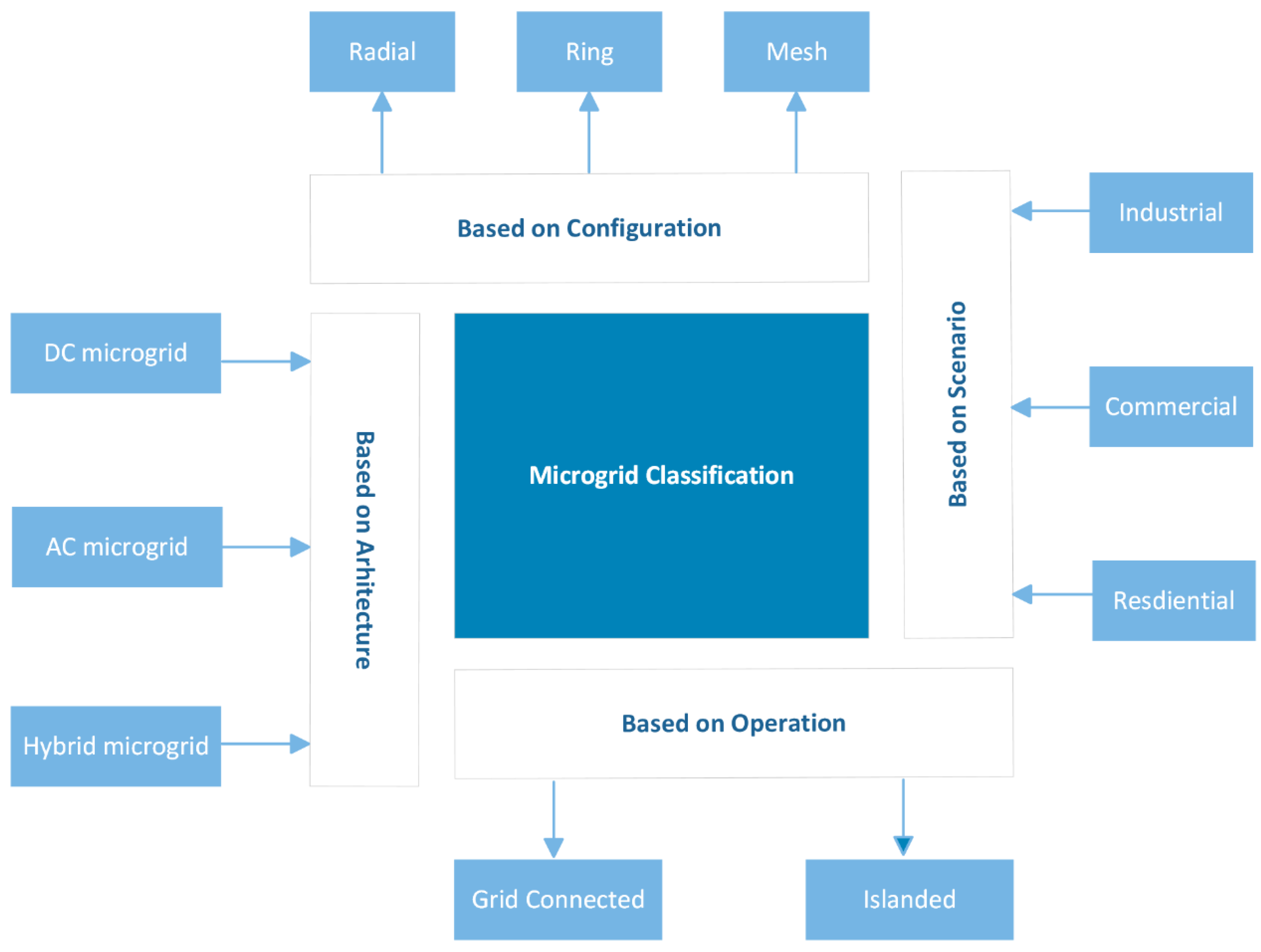
As a practical option, microgrids can run while permanently tied to the main grid, operate in isolation from it, or switch between the two modes as required [2,3]. Structurally, a microgrid brings together interconnected loads and RESs, including distributed generators (DGs), energy storage systems (ESSs), and controllable loads [4]. Depending on the nature of the sources being managed, it may be built as a direct current (DC), alternating current (AC), or hybrid system [5], while its layout can follow a radial, ring, or mesh topology, as shown in Figure 1.
Recent advances in microgrid protection and renewable energy integration have further expanded the applicability of microgrid systems [6,7]. The advantages of RES-based microgrids extend beyond environmental benefits and include financial gains [1]: they help reduce peak loads, enhance power supply reliability, and improve power quality. However, the random and intermittent nature of RES generation introduces reliability and stability challenges [8].
An Energy Management System (EMS) is an information-based control system designed to manage production, consumption, storage, and battery charging and discharging, with the objective of minimizing operational costs and associated emissions over a daily planning horizon [9]. The EMS coordinates modules such as forecasting, optimization, data analysis, and human–machine interface (HMI), supported by an energy service interface (ESI) and communication protocols [5,9]. Despite these capabilities, EMSs still face significant challenges arising from uncertainties in RES generation, load demand, and electricity market conditions, making cost-effective and reliable coordination among microgrids difficult [10].
Energy management is a critical topic across utility, industrial, commercial, and residential sectors [11]. Recent reviews have addressed EMSs from complementary perspectives, including broad EMS surveys [4], optimization-centered reviews [11], and intelligent-control-focused reviews [12]. While these contributions provide valuable foundations, a systematic review focused specifically on decision-making approaches—spanning classical optimization, heuristic methods, stochastic programming, artificial intelligence, multi-agent systems, and model predictive control—and their relationship to EMS architecture and application context remains lacking. This review addresses that gap by analyzing how the choice of decision-making method affects scalability, uncertainty handling, real-time feasibility, and implementation readiness across diverse microgrid configurations and operating conditions.
The motivations for continued EMS research include:
  • Reduction in operational costs by minimizing microgrid losses, indirectly lowering electricity bills for consumers.
  • Cost reduction through direct monitoring and control of controllable loads and energy sources, enabling optimized scheduling of production and consumption.
  • Rescheduling microgrid development and expansion strategies.
  • Mitigation of greenhouse gas emissions that adversely affect society and the environment.
The volume and methodological diversity of EMS research have grown substantially over the past decade. Metaheuristic approaches (PSO, GA, and ABC) account for the largest share of optimization-based contributions, followed by mathematical programming, multi-agent systems, and model predictive control [13]. The dominant paradigm has shifted progressively from rule-based and deterministic scheduling toward data-driven and learning-based methods, and a dedicated bibliometric analysis of 2150 Scopus-indexed records over 2011–2025 reports accelerating output on AI-based microgrid EMSs while showing that explainability-oriented research is rising faster than computational frugality [14,15,16]. This review reflects this trajectory and organizes the reviewed methods accordingly.
The remainder of this paper is organized as follows. Section 2 presents the EMS classification framework along three complementary dimensions: architecture-based, decision-method-based, and application-context classification. Section 3 reviews optimization-based EMS approaches, covering deterministic mathematical programming, heuristic and meta-heuristic methods, and stochastic, robust, and distributionally robust optimization. Section 4 addresses data-driven, intelligent, and agent-based EMS methods, including fuzzy logic, neural networks and machine learning forecasting, reinforcement learning, and multi-agent systems. Section 5 examines predictive and hierarchical control approaches, encompassing model predictive control, distributed and networked MPC, and AI-assisted MPC. Section 6 provides a comparative discussion of the reviewed methods and identifies open research gaps. Section 7 concludes the paper.

2. EMS Classification Framework

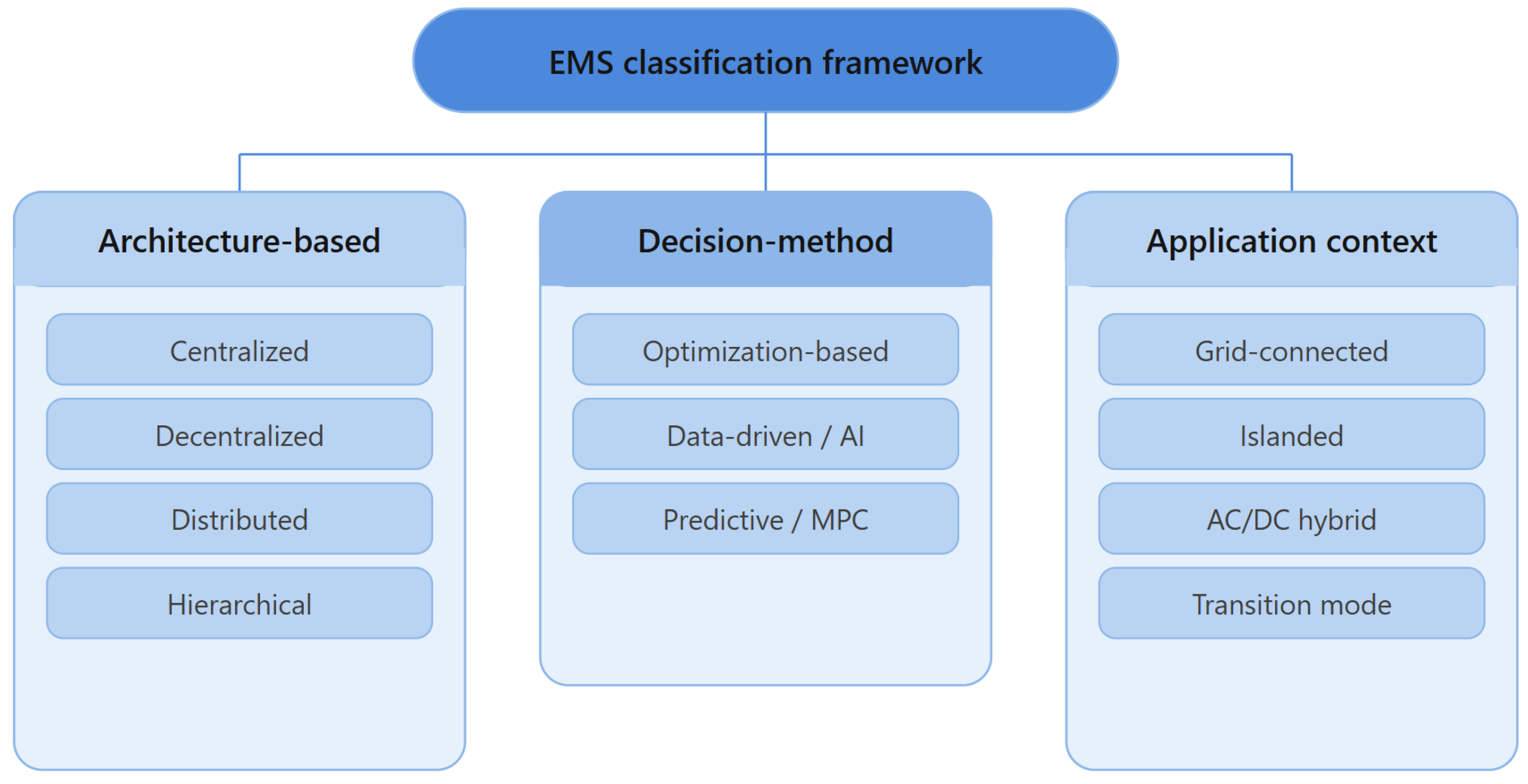
The classification of an EMS in a microgrid can be approached along three complementary dimensions: architecture-based, decision-method-based, and application-context classification, as illustrated in Figure 2.
Architecture-based classification describes how decision authority is distributed across the system; decision-method classification captures the algorithmic approach used to derive control actions; and application-context classification reflects the operating environment and deployment scale. Together, these dimensions provide a structured basis for assessing scalability, communication requirements, uncertainty handling, and real-time applicability—and EMS studies should report all three, not only the algorithm used.
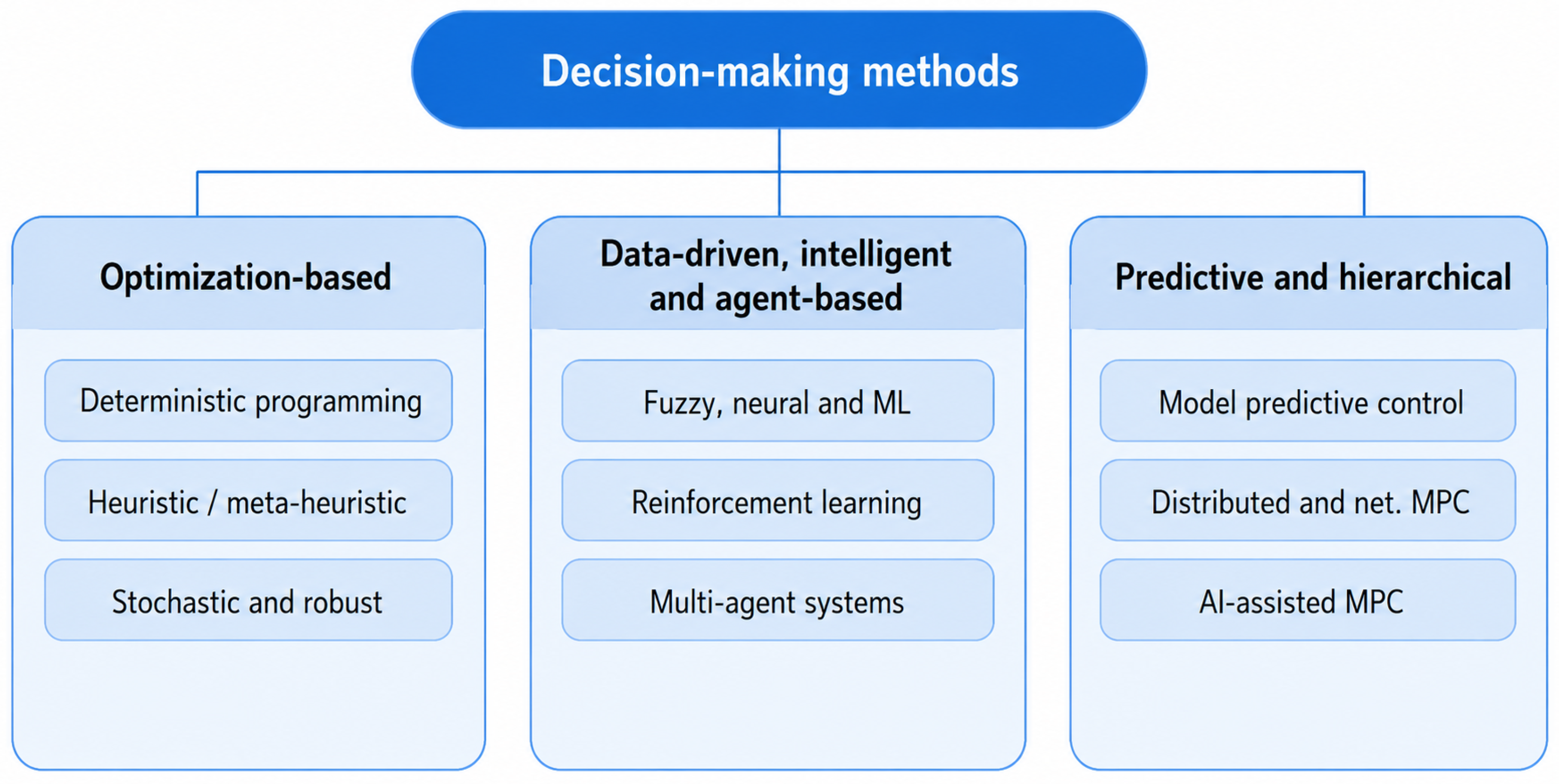
The decision-making methods reviewed in this paper are organized into three main categories: optimization-based EMSs, encompassing deterministic, heuristic, and stochastic approaches; data-driven, intelligent, and agent-based EMSs, including fuzzy logic, machine learning, reinforcement learning, and multi-agent systems; and predictive and hierarchical EMSs based on model predictive control and its variants, as shown in Figure 3.

2.1. Architecture-Based Classification

The principal EMS architecture classes reviewed in this section—centralized, distributed, and hierarchical—differ not only in their computational structure but in the application contexts for which they are best suited. Centralized architectures dominate grid-connected single-microgrid deployments where a single supervisory controller has full observability; distributed architectures suit multi-microgrid clusters where privacy, communication latency, or scalability preclude centralization; and hierarchical architectures emerge where multiple timescales of optimization must be coordinated. Each architecture is illustrated below with a concrete deployment example [13,17,18].
From an architectural perspective, microgrid EMSs can be classified as centralized, decentralized, distributed, or hierarchical. A centralized EMS gathers all measurements and forecasts at a supervisory controller and solves a system-level optimization problem, sending decisions back to local controllers [12,19,20]. A decentralized EMS allocates decisions to local controllers, reducing the communication burden but potentially limiting global optimality [21]. Distributed EMSs coordinate decisions through local communication and negotiation, improving scalability for networked microgrids. Hierarchical EMSs organize decisions across timescales, typically separating primary control, secondary restoration, and tertiary economic scheduling.
Representative centralized implementations, where a single controller retains full observability, include the IEEE 2030.7-compliant community and hospital microgrids of [13], the MILP-based residential controller validated by Power Hardware-in-the-Loop with a 120 ms PLC cycle and over 50% cost reduction in [22], and the OOBO-optimized grid-connected PV–diesel–battery EMS of [23], which reports 20–48% cost reduction relative to PSO, GA, and DE on an identical system.
Decentralized and distributed implementations, which both devolve decisions to local controllers, include the three-agent peer-to-peer market EMS of [24] (70.3% reduction in peak-hour grid imports), the Raspberry Pi + OPAL-RT hardware-in-the-loop EMS for an AC/DC microgrid cluster in [25] (54.95% cost reduction versus a fuzzy-logic EMS), and the consensus- and ADMM-based networked-microgrid coordination reviewed in [17].
Representative hierarchical and multi-microgrid implementations include the four microgrid LLM-coordinated cluster of [26], the 21-microgrid virtual-power-plant optimization of [27] across a 2050 horizon, the hybrid battery–hydrogen EMS of [28] validated over 12 scenarios, and the offshore islanded DC-microgrid EMS of [29] comparing rule-based, PSO, and MINLP strategies.

2.2. Decision-Method-Based Classification

From a decision-method perspective, EMSs can be grouped into deterministic mathematical programming, meta-heuristic and hybrid optimization, stochastic and robust optimization, data-driven intelligent methods, multi-agent coordination, and model predictive control. This classification links the mathematical decision mechanism to key implementation properties such as optimality guarantees, uncertainty handling, data requirements, interpretability, and computational burden.
The time required for implementation and execution of a decision is a critical parameter: offline and real-time (RT) platforms represent the two principal operating modes for EMS decision-making [11,30]. A comparative overview of these approaches is provided in Table 1.

2.3. Application-Context Classification

From an application-context perspective, EMSs differ according to operating mode, microgrid topology, energy carrier, and deployment scale. Important categories include grid-connected, islanded, and transition-mode microgrids; AC, DC, and hybrid AC/DC microgrids; single-energy and multi-energy systems; and residential, commercial, industrial, and community microgrids, whether isolated, networked, or organized as multi-microgrid systems.
This dimension is important because the most appropriate EMS method depends strongly on whether the objective is economic scheduling, resilience, power-quality support, real-time control, or coordination among multiple microgrids. The three-dimensional classification framework is summarized in Table 2.

3. Optimization-Based EMSs

3.1. Deterministic Mathematical Programming

The mathematical programming methods reviewed below are predominantly deployed in centralized EMS architectures for grid-connected day-ahead scheduling: LP and MILP require a single supervisory agent to collect all data, solve a global problem, and disseminate setpoints within the scheduling horizon [13,17]. In islanded or multi-microgrid contexts the same approach requires decomposition (ADMM, dual decomposition) or hierarchical aggregation [18].
The classical methods, also known as conventional, used in microgrid energy management are based on linear, non-linear and mixed integer programming techniques. The linear programming technique is used to model systems defined by linear constraints and an objective function that needs to be either maximized or minimized [33,34]. If the constraints are nonlinear, the system can be approached using nonlinear programming. On the other hand, when decision variables are constrained to take integer values (e.g., −1, 0, 1, 2) the problem is classified as mixed-integer programming (MIP). As a result of the constraint of integer variables, an optimization problem becomes non-convex, increasing computational challenges and complexity in solving the optimization problem. Dynamic programming refers to the process of simplifying decision-making by progressively breaking it down into a sequence of decision phases. The computational time required to solve a problem is reduced through the application of dynamic programming compared to approaches that do not reuse solutions to similar subproblems. Therefore, where a controller manages voltage and frequency, dynamic modeling is essential to determining the impact of control algorithms on the operational performance of individual microgrid components.
Furthermore, a dynamic model is used in demonstrating compliance with regulatory requirements and specific standards, such as the Institute of Electrical and Electronics Engineers (IEEE) Standard 1547 or the applicable local grid code [4]. In dynamic modeling, software packages are commonly employed either to select pre-made component models or to develop unique models derived from various software packages.
The multi-energy microgrid model integrates electricity and heat networks with PV panels, batteries, combined heat and power (CHP) units, and gas boilers in [35]. Two types of demand response programs (incentive-based and price-based) and three scenarios are applied. The problem is formulated as a mixed-integer programming model and solved using optimization solvers CPLEX, GUROBI, and CBC. A case study implemented in Belle Île en Mer, France, demonstrates that the “CHP Only” scenario and demand response strategies significantly reduces electricity and total energy costs. GUROBI is identified as the most efficient solver for large-scale problems.
The study [36] proposes a two-layer EMS for microgrid clusters, utilizing demand-side flexibility and a shared battery ESS to reduce operational costs and emissions while ensuring backup power to prevent blackouts. The lower layer schedules optimal day-ahead operation, while the upper layer coordinates the entire cluster for improved overall efficiency. The problem is formulated as a mixed-integer quadratic programming (QP) model with linear constraints. A cluster of three microgrids in Australia are used as a real case study that validate the effectiveness of this approach.
The authors of [37] propose a “mix-mode” EMS that jointly employs linear programming (LP) and mixed integer linear programming (MILP) to handle the objective functions, while particle swarm optimization (PSO) serves as the sizing routine that determines the battery storage capacity in kWh. Because storage capacity directly influences operating cost, the scheme optimizes the EMS and the battery size simultaneously.
A centralized formulation built around the notion of end-user flexibility is reported in [38], where a QP-based power scheduling method is refined to deliver optimal battery dispatch. Validation is carried out on a grid-connected microgrid comprising a PV farm and a battery, with the utility grid treated as a dispatchable source; the same architecture is further examined on a modified IEEE 33-bus distribution feeder hosting several microgrids and shown to be suitable for real-time use.
In [39], MILP is used to optimize a hybrid microgrid with RESs like wind, diesel, battery storage, and electric vehicles (EVs). The model includes costs from emissions, battery, and EV uncertainties. MILP enables efficient, coordinated control and is well-suited for planning and scheduling. However, its accuracy depends on forecast quality, especially for RESs. The paper [40] addresses the optimal EMS of microgrids equipped with ESSs. QP is employed as an effective optimization technique to optimize microgrid profitability and grid support requirements. An extended QP cost function is proposed to better reflect realistic operating conditions, keeping important benefits like reducing peak power use and ensuring enough power reserves. The approach is also extendable to EVs.
In [41], an optimal operation of studied microgrid with PV, energy storage and distributed resources is performed by solving a linear programming model. The authors proposed the concept of a virtual power plant (VPP) used for decision making of the resource dispatch such as the charge and discharge pattern for energy storage which leads to decrease in total costs.
The paper [42] presents a linear battery degradation model for stochastic MILP-based microgrid sizing considering various factors such as different sources of energy generation and loads, costs, constraints, and grid topology.
In [43], Rahbar et al. propose a real-time EMS for cooperative microgrids with individual RESs and ESSs to minimize total energy costs. An offline linear optimization problem is solved using Lagrange duality, followed by two low-complexity online algorithms: store-then-cooperate and cooperate-then-store, each suited to different cost-saving scenarios.
The authors in [44] formulate an EMS as a MILP problem for the tertiary control within a smart house, incorporating penalty terms for unbalanced demand, the cost of energy exchange, the EV battery cost, and EV range anxiety. Loads are represented through three profiles—adjustable, shiftable, and critical. Range anxiety is defined here as a driver’s concern about the battery being exhausted before reaching the destination, and three levels of this parameter are tested to explore how the average state of charge (SOC) of the EV batteries trades off against the microgrid’s total energy cost.
A MILP-based EMS for a hybrid grid-connected microgrid that refines the power reference signals sent to the DERs according to their operating modes is presented by Luna et al. [45]. Their design brings together a cost-minimizing optimization model, a two-stage charging procedure for the ESSs, and a fuzzy supervisory unit that compensates for utility power mismatch by tuning the DER references.
For a community of microgrids, Ref. [46] develops a bi-level hierarchical EMS cast as a MILP to economically coordinate operation. At the lower level, each microgrid minimizes its own operating cost by scheduling DER output, ESS charging and discharging, and the power traded with the main grid. The upper level then uses these outcomes to set device power levels community-wide and to govern power flows among microgrids and with the external network so as to minimize the total operating cost of the whole community. Nonlinearity in the model is handled through linearization, whereas nonconvexity is addressed by adding implicit logic constraints.
Reference [47] first applies a long short-term memory (LSTM) network to predict PV generation and load demand from operational records of a PV–energy-storage microgrid. A microgrid optimization model is then constructed to minimize the total daily operating cost under the relevant operational constraints, with particular attention to safety requirements on grid power exchange. This problem is recast as a MILP and solved with a computational solver to yield a cost-effective day-ahead schedule.
Most EMSs formulated using LP, NLP, or MILP assume centralized supervisory control. Advantages of this approach include its simplicity in implementation and ease of understanding. It is computationally efficient for small to medium-sized systems and can provide globally optimal solutions under ideal conditions. Moreover, many classical/conventional methods when applied to real-world problems face challenges such as neglecting numerical difficulties in the first- or second-order derivative calculation; divergence risk; or aspects related to insufficient modeling of microgrid elements. Also, the use of day-ahead forecast data is the most common approach to address uncertainty. While this method is straightforward to implement, it tends to have lower accuracy.
As shown in Table 3, deterministic mathematical programming approaches, including LP, MILP, and QP formulations, are most commonly applied to day-ahead scheduling in grid-connected microgrids, offering optimality guarantees under well-defined constraints.
Overall, classical optimization methods are most suitable when the EMS problem can be formulated with well-defined constraints, reliable input data, and have a moderate number of decision variables. Their transparency makes them attractive for planning and benchmarking; however, their performance decreases when microgrid operation involves strong nonlinearities, high uncertainty, or real-time adaptation requirements. Future studies should therefore use classical methods not only as standalone solutions but also as baselines for hybrid, uncertainty-aware, and learning-assisted EMS designs.
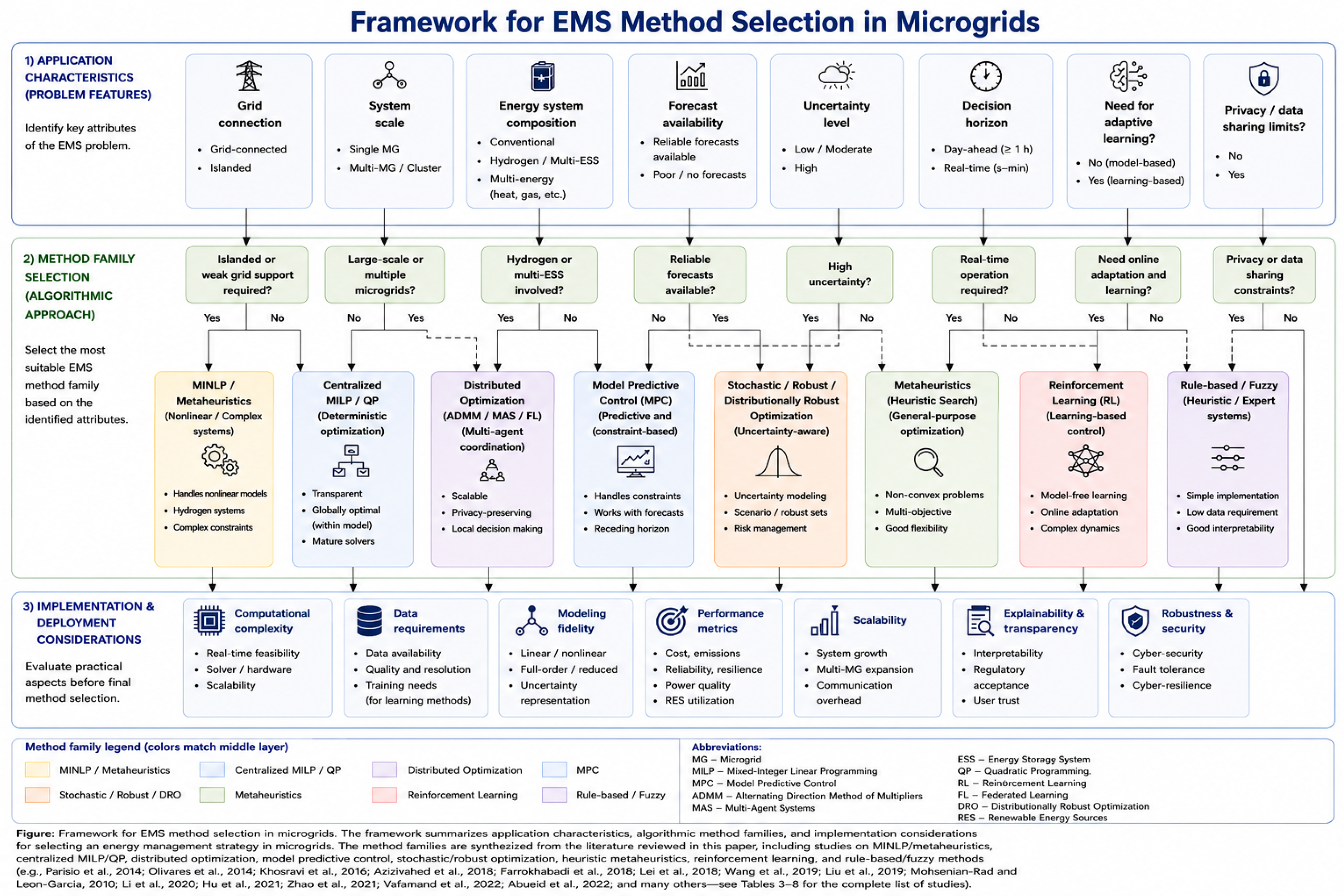
The reviewed formulations differ substantially in computational requirements, optimality guarantees, and applicability. LP (no binary variables) is fastest: Ref. [31] reports LP computation of 1853 s versus 5652 s for the equivalent MILP at a 0% optimality gap. MILP dominates grid-connected scheduling with on/off switching and outperforms PSO and LP on identical residential cost metrics [22]. MINLP is most accurate for electrochemical components but demanding: [29] reports convergence in three iterations (21.96 s) versus more than 200 iterations (178.5 s) for PSO, with a 36.53% cost reduction over the nearest rule-based baseline. Meta-heuristics (PSO, GA, DE, and OOBO) handle non-convexity naturally but offer no formal optimality guarantees: Ref. [23] reports 20–48% cost reduction, 30–45% faster than PSO/GA/DE, and the MTBO scheme of [48] reports 21.6% lower operating cost and 13.12% lower emissions than PSO on an identical test microgrid, with consistent gains over GWO and SSA. Distributed decomposition (ADMM) enables scalable multi-microgrid coordination without convergence guarantees for non-convex problems [18], while hybrid hierarchical tools (HOMER Pro + MATLAB) address coordination at different timescales [27]. Figure 4 synthesizes these trade-offs for practitioners.

3.2. Heuristic and Meta-Heuristic Approach-Based Energy Management Systems

To overcome the above-mentioned problems, heuristic and meta-heuristic techniques were proposed in the early 1970s [9]. Meta-heuristic algorithms are a class of search algorithms that employ various general heuristics to solve complex optimization problems [49]. The most attractive aspect of meta-heuristic algorithms is that their application does not require specific knowledge of the optimization problem at hand. Therefore, they can be used to describe a general problem-solving approach for optimization problems or related issues. The heuristic and meta-heuristic methods are applied across various engineering fields, including communications, power systems, microgrid EMSs, and transportation. Genetic Algorithms (GAs) and particle swarm optimization (PSO) are two commonly used meta-heuristic approaches in the development of microgrid energy management systems, primarily due to their parallel computing capabilities. In addition to the well-established PSO and GA techniques, newer approaches such as Gray Wolf Optimization (GWO) have emerged. Energy management in microgrids utilizes techniques such as Ant Colony Optimization (ACO), Bacterial Foraging Optimization (BFO), Artificial Immune Systems (AISs), Artificial Bee Colonies (ABCs), and Gray Wolf Optimization (GWO) [4].
The research [50] proposes an effective EMS for standalone and grid-connected solar microgrids using the Bald Eagle Search (BES) optimization algorithm. The microgrid includes PV panels, fuel cells, and BESSs. BES optimizes one-day scheduling to minimize operating costs, maintain stable DC bus voltage, improve efficiency, and protect the battery from overcharge and deep discharge. Compared to other optimizers like PSO, BES achieved lower energy costs, higher efficiency and better battery state-of-charge management. Despite the advantages mentioned above, its performance depends on proper parameter tuning and may require re-optimization for different system setups, limiting its generalizability and real-time application.
Dufo-López et al. [51] proposed a control strategy for optimal energy management of a hybrid system based on genetic algorithms. The system consists of renewable energy sources (solar, wind, and hydro), an AC generator, an electrolyzer, and fuel cells. Energy management is optimized to reduce operational costs, allowing the excess energy produced by the renewable sources to be used for charging the batteries or producing hydrogen in the electrolyzer. The load that cannot be supplied by renewable sources can be covered either by discharging the battery or by using the fuel cells.
The butterfly optimization algorithm is used in [52] for economic optimization scheduling of microgrid groups in both grid-connected and off-grid modes. Tent chaotic mapping and simplex search techniques are used to improve cost savings by managing distributed energy sources. However, it lacks adaptability to real-time data and takes longer to run as it scales up.
Luna et al. [53] presents the design and experimental validation of an adaptable EMS implemented in real time. The employed architecture enables interaction between measurement, forecasting, and optimization modules, where a generic generation-side mathematical problem is modeled with the objective of minimizing operational costs and load disconnections. The entire EMS has been experimentally tested on a test bench in both grid-connected and island modes. Furthermore, its performance has been validated in scenarios involving significant mismatches in forecast generation and load.
The proposed multi-objective intelligent EMS [54] aims to minimize the operational costs and environmental impact of a microgrid, considering its pre-operational variables such as the future availability of RESs and load demand. An artificial neural network (ANN) is used to predict the PV and wind power generation 24 and 1 h in advance, respectively, along with the load demand. The battery scheduling is obtained using a fuzzy logic-based expert system.
Reference [55] proposes a day-ahead optimal energy management strategy for industrial microgrids with high renewable penetration, operating both islanded and grid-connected. Using regrouping particle swarm optimization (RegPSO) over hourly intervals, the method accounts for forecast renewable generation and load demand. The microgrid meets local demand and trades energy with the main grid, buying or selling power. Objectives include minimizing fuel, operation, maintenance, and energy purchase costs while maximizing profits from energy sales.
In [56], a microgrid is integrated with wind power generation, fuel cells, a diesel generator, and an electrolyzer. A fuel cell is used when the energy demand is not covered by the wind turbine, to ensure energy balance when operating diesel generators to reduce the operational costs. The fuel cell operates to meet the high load demand, considering the economic and environmental benefits with a ~70% cost saving. The improved multi-objective PSO algorithm is used to solve the model.
Marzband et al. [57] proposed a multi-period ABC optimization algorithm for economic dispatch, incorporating generation, storage, and demand response offers, including the intermittent nature of solar energy resources and wind generation. The algorithm outperforms a modified conventional EMS, as validated on a microgrid testbed, achieving approximately 30% cost reduction. An ANN–Markov Chain model is employed to forecast non-dispatchable generation and load demand.
In [58] a novel multi-objective optimization approach for grid-connected microgrids is proposed integrating a fuzzy logic-based expert system with GWO. The method aims to minimize generation costs and fossil fuel emissions by optimizing battery capacity and reducing fossil fuel usage.
The authors in [59] develop a multi-objective optimization model for a microgrid EMS that includes degradation costs and a carbon trading mechanism. Using a hybrid energy storage system and demand response, the model smooths renewable fluctuations and reduces emissions. An artificial hummingbird optimization algorithm finds the optimal strategy, resulting in 20.2% lower costs, 4.5% less carbon emissions, and 32.6% longer battery life compared to conventional systems.
The authors of [60] presented a meta-heuristic optimization method to optimize a microgrid, focusing on the selection and sizing of generation and storage components. The paper applies two meta-heuristic algorithms: an evolutionary algorithm and PSO. The proposed approach ensures technical feasibility and economic viability. Moreover, it also recognizes the uncertainty of using RESs.
In the paper [61], the authors present a real-time EMS for microgrids, employing GA to minimize the overall costs of operation and CO 2 emissions while maximizing RES use. The system integrates MATLAB-dSPACE real-time tools and a ZigBee communication network designed for challenging environments. Experimental validation on a real microgrid testbed demonstrates the effectiveness of the proposed RT-EMS under real-world conditions.
A two-layer optimization algorithm for microgrid energy scheduling is introduced in [62]. Its goal is to drive down the total operational cost, which encompasses the bidding cost of RESs, the load-shedding penalty, the generation cost of the units, and the battery cost, together with demand-responsive loads. The scheme relies on an ACO method capable of handling time-dependent technical and economic constraints. When benchmarked against a modified conventional EMS and a PSO-based EMS, the proposed approach lowers energy cost by roughly 20% and 5% relative to those two methods, respectively. The authors additionally probe its plug-and-play behavior in several real-time scenarios and confirm satisfactory operation through experimental testing.
For multi-microgrid systems, Arefifar et al. [63] put forward a centralized EMS built on a Tabu search algorithm and introduce a probabilistic indicator, EMSI, that lets multiple energy-management options be assessed at once. This index is defined as the gap between the microgrid’s operating costs before and after the EMS is applied. Several sensitivity studies then demonstrate that the method not only recovers operating costs but also yields long-term financial benefits.
Table 4 provides a comparative overview of heuristic and meta-heuristic EMS approaches reviewed in this study, summarizing the optimization method, microgrid type, objective, uncertainty handling, and key components for each reference.
In summary, heuristic and meta-heuristic EMS approaches are preferable for complex, nonlinear, and multi-objective problems where traditional optimization methods struggle to obtain feasible solutions within a reasonable computational time. It can manage incomplete or uncertain data and is easy to adapt to different system models and scales. They are particularly useful for sizing, scheduling, and operational planning of microgrids with many components. However, they also have some disadvantages. They are computationally expensive, especially for real-time control, and may converge to local optima if not properly tuned. In addition to this, their dependence on algorithm parameters, stopping criteria, and case-specific tuning limits direct comparability among studies; therefore, future work should report standardized benchmarks, sensitivity analyses, and computational times more consistently.
The convergence properties of meta-heuristic and DRL methods are rarely documented with the rigor applied to deterministic solvers. Ref. [23] reports OOBO convergence curves reaching the optimum in fewer iterations than PSO, GA, and DE with matched initialization (population 100 and 100 iterations); the MTBO scheme of [48] likewise reports faster convergence and lower final cost than PSO, GWO, and SSA on an identical problem. The authors of Ref. [25] validated their EMS through 100 randomized simulations, reporting a mean 54.58% cost reduction with its standard deviation. For learning-based control, Ref. [64] identifies low convergence rate, sparse reward, and limited scalability as the primary DRL challenges, and [65] documents a reward-function sensitivity analysis exposing the explicit trade-off between unmet-load penalty and battery wear. Reported cost reductions are relative to author-defined baselines and cannot be ranked directly across studies as configuration, DER mix, load profiles, and pricing assumptions differ; the figures should be read as within-study indicators [26,31,65].

3.3. Stochastic, Robust, and Distributionally Robust Optimization Approaches

EMSs use stochastic and robust programming methods to handle uncertainties in key variables such as electricity prices, solar radiation, wind speed, and load demand. Stochastic programming models these uncertainties using known probability distributions, while robust programming addresses them without relying on probabilistic data, assuming values fall within a defined uncertainty range. Both approaches aim to minimize total operating costs—including energy trading and system operation—and support effective decision-making over single or multiple time periods [4,9].
Reference [66] proposes a stochastic mixed-integer programming model for optimal energy management of unbalanced three-phase AC microgrids. It accounts for uncertainties in demand, renewable generation, and voltage and includes contingency constraints for resilient operation. The model, solved via linearization and convex solvers, manages PV, storage, EV chargers, load control, and backup generation. Tested on real microgrid data, it minimizes operational costs while maximizing local renewable use and ensuring resilience during islanded operation.
In [67], EMSs for multi-energy microgrids (MEMGs) that supply both electricity and heat are presented. The MEMG operator sets energy prices and schedules using a game-theoretic model, while different users optimize their energy trading. The complex problem is simplified into a MILP for easier solving and stochastic optimization approach is used to handle day-ahead and intra-day market coordination, including risk management with conditional value-at-risk (CVaR). The solution involves breaking the problem into smaller parts solved in parallel, improving efficiency.
The study [68] proposes a two-stage robust optimization EMS for microgrids combining carbon trading and demand response to improve low-carbon goals, cost efficiency, and stability. The first stage plans energy use without full uncertainty, and the second adjusts based on real data. The model reduces emissions by encouraging renewables but may increase costs. Demand response and storage help balance loads. Though effective, the approach requires accurate uncertainty data and has higher computational demands.
Che Hu et al. [69] proposed an energy management model for a microgrid considering the uncertainties in the demand and supply of electricity. Their two-stage stochastic program, implemented in GAMS, is validated on a real network at the Nuclear Energy Research Centre in Taiwan. Battery capacity is sized in the first stage, whereas the second stage determines the microgrid’s optimal operating strategy.
The paper [70] proposes a two-stage energy management system for grid-connected microgrids with high RES and EV integration. It uses multi-layer scheduling for individual microgrids and their community, minimizing operational and risk costs in day-ahead and real-time markets. Uncertainties are modeled via stochastic programming with Monte Carlo simulation. The approach is validated on a standard system using GAMS.
The study in [71] presents a multi-objective stochastic EMS that aims to minimize costs, reduce losses, and maximize RESs use at the same time. It solves a single MILP problem considering various wind, solar, and load scenarios to create a set of optimal trade-off solutions (Pareto frontier). Operators can choose the best schedule based on their priorities. While this approach improves robustness and captures important trade-offs, it requires significant computing power, expert decisions to pick solutions, and relies on accurate probabilistic data.
A two-level pricing mechanism for coupled microgrids to achieve an optimal operating performance is shown in [72]. This mechanism, based on stochastic programming, is divided at two levels: the upper level guarantees operational quality by trading energy with energy market operator; and the lower level performs the actual transactions between networked microgrids.
The authors of [73] propose an optimization model with aim to maximize energy exchange benefits while minimizing social costs for an interconnected microgrid using the Taguchi orthogonal matrices. Uncertainties are represented through interval prediction. By targeting the worst-case realization, the resulting schedule stays robust across most uncertainty outcomes, as confirmed through Monte Carlo simulation.
For an interconnected microgrid containing RESs, diesel generators, a BESS, and assorted loads, Shen et al. [74] develop a stochastic EMS structured as a two-layer, scenario-based optimization. The upper layer performs forecast-driven economic scheduling, and the lower layer handles real-time control. Uncertainty is captured via Latin hypercube sampling within a Monte Carlo framework, producing a range of scenarios for the distributed resources, load, and electricity price, and a sensitivity study is used to derive the standard deviation of the expected price and the associated reliability level.
Reference [75] presents a stochastic energy management framework for microgrids during unplanned islanding events caused by main grid disturbances. The paper addresses uncertainty in islanding duration as well as prediction errors in demand and renewable power generation. Instead of predicting a fixed disconnection time, the model estimates a probability distribution and minimizes the expected operational cost. The model also considers the effect on later grid-connected operation and is formulated as a MILP problem.
Liu et al. [76] proposed two energy management problems for grid-connected microgrid considering RESs and load uncertainties. The first addresses scheduling that stays within predefined energy limits to safeguard the system, whereas the second examines the permissible real-time deviation in energy capacity for frequency regulation. To cope with the uncertainties introduced by renewable integration and fluctuating loads, both are cast as chance-constrained programs. The study shows these problems can be solved using LP and the approach is validated through two real-world case studies.
A hierarchical control scheme for scheduling and coordinating loads and dispatchable energy within a microgrid is put forward in [77]. It applies stochastic optimization on a slow timescale to mitigate RES forecast errors, while deterministic optimization runs on a fast timescale to refresh the optimal dispatch decisions.
The authors in [78] propose a probabilistic energy management system for remote hybrid AC/DC microgrids to ensure cost-effective dispatch under renewable energy uncertainty conditions. The approach includes load management for thermal and electric vehicles, considering generator limits, controllable loads, and battery charge/discharge constraints.
Table 5 summarizes the stochastic, robust, and distributionally robust optimization approaches reviewed in this study, which explicitly model uncertainties in renewable generation, load demand, and electricity prices, offering improved resilience compared to deterministic methods.
Beyond the classical scenario-based, stochastic, chance-constrained, robust, and distributionally robust formulations, Table 6 is extended with three learning-oriented families: Bayesian and Gaussian-process uncertainty quantification [79,80], probabilistic machine learning feeding chance-constrained MPC [81], and ensemble forecasting producing calibrated predictive intervals [80,82].
Taken together, stochastic and robust programming methods provide a systematic way to incorporate RESs, load, and market uncertainties into EMS decisions. They are especially appropriate for day-ahead scheduling, resilience-oriented planning, and risk-aware operation. Their main gap is computational scalability, which motivates decomposition techniques, scenario reduction, and hybrid combinations with faster online controllers.
Overall, optimization-based EMSs provide the clearest mathematical link between objectives, constraints, and operating schedules. Deterministic programming is implementation-ready and interpretable for moderate-size problems, meta-heuristics improve flexibility for nonlinear and multi-objective cases, and stochastic/robust methods improve uncertainty handling. Their main trade-off is computational burden, particularly for large scenario sets, integer variables, and real-time deployment.


4. Data-Driven, Intelligent and Agent-Based EMSs

4.1. Fuzzy, Neural, and Machine Learning Forecasting

In microgrids, power quality issues can be addressed using AI methods such as fuzzy logic, ANN, machine learning, deep learning, and game theory. The reliability of AI-based EMSs depends critically on data quality and the availability of sufficiently representative training datasets. Purely data-driven methods without physical constraints are prone to divergence from real system dynamics, particularly under limited data or noisy measurement conditions [83]. Fuzzy logic enables decision-making similar to human reasoning, while neural networks are inspired by the structure and function of the human brain. Compared to fuzzy systems, neural networks are more complex and typically require larger and higher-quality datasets for effective training [84,85]. Data scarcity remains a practical barrier in microgrid AI deployment, and recent approaches such as GAN-based synthetic data generation [84] and physics-informed learning [83,86] have been proposed to mitigate this limitation.
The proposed EMS in [54] for microgrids use AI techniques with LP-based multi-objective optimization. The main aim is to minimize the emissions and operational cost of microgrids using a neural network strategy to predict PV and wind generation, while a fuzzy expert-based scheduling approach is used for optimal battery management. The proposed algorithm is better in terms of efficiency than the other conventional multi-objective model according to the authors.
The study [87] presents a hierarchical EMS for residential microgrids using a hybrid hydrogen–electricity storage system. The system includes a hydrogen unit for long-term storage and a battery for daily energy use, managed by two fuzzy logic controllers operating at different timescales without relying on demand or renewable forecasts. Tested with real-world data, the proposed EMS shows better cost savings compared to other common methods like PSO-based and rule-based EMSs.
The authors in [88] present a fuzzy logic-based EMS for isolated microgrids combining PV, diesel generators, and BESSs. The EMS uses forecasts and optimization algorithms (particle swarm optimization and Cuckoo Search) to improve diesel generator usage, extend battery life, and minimize operating costs. A case study in Ecuador shows the system efficiently maximizes solar power use, preserves battery health, and reduces costs. The approach is validated via simulation and hardware testing.
This study [89] presents a centralized EMS for microgrids with hybrid PV and a BESS, using a convolutional neural network (CNN) optimized by an Enhanced Coati Optimization algorithm. The CNN-based controller enables near-real-time state-of-charge balancing without complex calculations. Simulations in MATLAB show that the method outperforms existing techniques, achieving significantly lower prediction errors and improved forecasting accuracy.
Study [84] uses Generative Adversarial Networks (GANs) within a semi-supervised learning framework to address the lack of data in microgrid EMSs. The GAN model generates realistic data, such as PV outputs, using both labeled and unlabeled inputs, which is useful when real measurements are limited. These synthetic data improve forecasting model training and help EMSs make better scheduling and operational decisions. GANs are also combined with deep learning and reinforcement learning (RL) to create adaptive EMS architectures. However, training GANs is unstable, and verifying the reliability of generated data remains a challenge, especially in safety-critical systems.
Jia et al. [90] proposed an adaptive intelligence technique for managing energy in interconnected microgrids using hybrid energy storage systems, combining batteries and ultra-capacitors. The goal is to minimize load fluctuations and enhance self-consumption of renewable energy, especially under uncertain RES generation conditions. The method introduces variable charging/discharging thresholds to manage energy flow without relying on accurate forecasts. Simulation results, using real RES data, show improved load smoothing and reduced power fed back to the main grid compared to conventional PSO-based methods.
The paper [91] addresses the development of a low-complexity fuzzy logic control strategy for energy management in a residential grid-connected microgrid. The system leverages generation and demand forecasting to optimize power exchange, considering battery SOC and forecast errors. Experimental validation in a real-world residential microgrid at the Public University of Navarre confirms the strategy’s reliability and effectiveness. In Table 7, the comparative overview of fuzzy, neural and ML approaches are proposed.

4.2. Reinforcement Learning

In [92], the authors used Reinforcement Learning (RL) to create a self-learning EMS for microgrids. In RL, an agent learns by interacting with its environment, adjusting its actions based on rewards to improve performance over time. This approach suits microgrids well due to variable demand and renewable energy output. RL is useful for tasks like energy dispatch, pricing, and demand management, and it does not need detailed system models. However, it can be slow and computationally demanding, especially in complex systems, and depends on well-designed reward functions for effective learning and stability.
Recent RL-based EMS studies show a shift from basic value-based learning toward deep, policy-gradient, safe, and multi-agent RL formulations. Alabdullah and Abido [93] formulated a microgrid EMS as a finite-horizon Markov decision process and used a deep Q-network (DQN) to obtain online scheduling policies under stochastic load, generation, and price signal conditions. Guo et al. [94] proposed a real-time optimal energy management strategy based on proximal policy optimization (PPO), combining offline training with online dispatch to handle uncertainties in RES generation, demand, and electricity prices. Yang et al. [95] developed a UCB-A3C strategy that improves exploration in actor–critic learning and targets uncertainty in wind generation, trading prices, and load demand. Goh et al. [96] focused on reward-function design and showed that multi-stage reward mechanisms can improve convergence and reduce the risk of suboptimal policies in DRL-based EMSs. Harrold et al. [97] extended RL to a multi-agent setting for renewable integration and microgrid energy trading, comparing centralized and distributed agents with DDPG, MADDPG, D3PG, and TD3 variants. Wang et al. [98] addressed one of the main weaknesses of model-free RL by introducing a physical-informed safe RL layer for multi-energy microgrids, ensuring that learned actions respect physical operating constraints during both training and testing.
As shown in Table 8, reinforcement learning approaches reviewed in this study offer online decision-making capability without requiring detailed system models, making them particularly suitable for real-time EMSs under stochastic renewable generation, load demand, and electricity price conditions.
Overall, RL-based EMSs are most attractive when microgrid dynamics are uncertain, nonlinear, or difficult to model explicitly. Compared with deterministic optimization, RL can improve online adaptability and reduce dependence on exact forecasts; compared with MPC, it can learn policies from repeated interaction rather than repeatedly solving an optimization problem online. However, implementation readiness remains limited by training-data requirements, reward-function sensitivity, constraint satisfaction, explainability, and the need for safe exploration. The most promising recent direction is therefore safe and hybrid RL, where learning-based policies are combined with physical constraints, MPC, or optimization-based safety filters.

4.3. Multi-Agent Systems (MASs)

Multi-Agent System (MAS)-based EMSs are treated in this review as data-driven, intelligent, and agent-based approaches. The defining characteristic of these systems is autonomous agent-based decision-making, where collective intelligence emerges from agent interactions, negotiation, and coordination rather than from a fixed control architecture. Individual agents may internally employ optimization algorithms, rule-based strategies, or machine learning methods, but it is this emergent collective behavior that distinguishes MASs from other approaches in this category.
MAS-based EMSs consist of autonomous agents that collaboratively solve tasks in complex environments. These systems include both virtual agents (software algorithms) and physical agents (controllable micro-resources) that interact locally within the microgrid environment. Unlike traditional centralized control methods, MASs operate with limited local knowledge and decentralized coordination, enabling scalability and robustness in smart grids with many devices. Communication among agents is typically limited to neighbors within the microgrid to balance efficiency and data transmission costs, making MASs an effective approach for microgrid energy management. With their flexibility and high reliability, MASs are well-suited for developing EMSs, which are reviewed in the following papers [99,100,101].
In Reference [102], an EMS based on an ontology-driven MAS is proposed for the supervision and optimal control of an integrated system comprising residential buildings and microgrids with various RESs and controllable loads. A range of agents, from simple reflex-based to advanced learning agents, are designed to cooperate in achieving optimal operational strategies while satisfying system objectives and constraints. The EMS is formulated as a coordinated distributed generation and demand response optimization task, solved through agent-based cooperation and communication. The effectiveness and applicability of the proposed EMS are validated through multiple case studies.
Zhao et al. [103] propose a MAS-based EMS for a high-altitude PV-small hydro hybrid microgrid. Using local information, distributed generation is controlled for stable and efficient operation. Virtual bidding enables fast scheduling, while real-time dispatch is handled via model predictive control. Simulations on a real-time platform demonstrate the strategy’s effectiveness in ensuring economic and secure system operation.
In [104], the design of two interconnected hybrid microgrids, each serving a neighborhood and integrating PV, wind turbines, diesel generators, and BESSs. Power exchange is enabled through network-controlled inverter which supports AC loads. A decentralized MA-based EMS is employed, including environmental uncertainties and load scheduling. Simulation results across four scenarios—ideal, sunny, cloudy, and blackout—demonstrate the system’s ability to maintain resilient and reliable energy distribution.
The article [105] presents an EMS with a decentralized MAS based on a bio-inspired T-cell optimization algorithm. The EMS enables real-time control, dynamic load balancing, and effective handling of renewable energy intermittency. Optimal set points for energy sources and storage are computed using the T-Cell algorithm and validated through OPAL-RT real-time simulation. A feedback loop ensures continuous monitoring and adjustment in response to anomalies. Implemented on the JADE platform, the MAS enables autonomous operation and system-wide coordination.
Reference [85] investigates a sustainable and intelligent EMS for microgrids, based on a MAS, designed to address the intermittency of RESs. The system enhances energy efficiency by leveraging AC–DC renewable source complementarity and load flexibility. A co-simulation using MATLAB and JADE evaluates the system’s performance in a grid-connected microgrid. The artificial intelligence-based approach offers several advantages. It can learn complex and changing patterns without the need for detailed system models, delivers high accuracy in forecasting demand and renewable generation, and supports real-time, autonomous energy management. However, it also has limitations. It requires large and high-quality datasets for effective training and its results can be hard to interpret and validate.
From a comparative perspective presented also in Table 9, MAS-based EMS architectures are well suited for geographically distributed microgrids, multi-microgrid coordination, and applications where local autonomy is required. Compared with centralized EMSs, they improve scalability and fault tolerance, but they increase dependence on communication quality, interoperability, cyber-security, and coordination protocols. However, real-time applicability depends on communication latency, cyber-security, consensus reliability, and the ability to maintain safe operation under agent or link failure conditions.
The reviewed AI-based EMS studies indicate a clear trend toward data-driven forecasting, adaptive control, and hybrid learning–optimization frameworks. Fuzzy logic and neural network methods are preferable when historical operational data are available and the microgrid exhibits nonlinear or time-varying behavior. Reinforcement learning extends this capability to sequential decision-making under uncertainty conditions, eliminating the need for explicit system models. Multi-agent systems complement these approaches by distributing intelligence across autonomous agents, enabling scalable coordination in networked and multi-microgrid configurations. However, limited interpretability, data quality requirements, dependence on well-designed reward functions, and weak validation on real microgrids remain important barriers to adoption across all these methods.
Overall, data-driven and agent-based EMSs are strong for forecasting, adaptation, nonlinear pattern recognition, and distributed coordination, but their implementation readiness depends on data quality, interpretability, and validation outside the training or deployment conditions. Compared with optimization-based EMSs, they can improve real-time responsiveness after training or deployment, but uncertainty handling is often implicit rather than formally guaranteed.

4.4. Emerging AI Paradigms in Microgrid EMSs

Beyond the data-driven and reinforcement-learning methods of Section 4.1, Section 4.2 and Section 4.3, five directions represent the current frontier of AI for EMSs.

4.4.1. Physics-Informed Neural Networks

By embedding physical laws (energy balance, Kirchhoff’s laws, and electrochemical degradation) into the loss function, physics-informed neural networks achieve superior parameter-estimation accuracy with limited or noisy data [83]; Ref. [86] reviews their use across power systems for state estimation, optimal power flow, and stability prediction. For EMSs, they enable physics-constrained forecasting of PV generation and BESS degradation [13].

4.4.2. Large Language Model-Based Negotiation

Rather than solving a numerical problem, an LLM interprets priority rules described in natural language and generates coordination decisions. Ref. [26] presents the first validated LLM + MILP framework for priority-aware multi-microgrid EMSs, achieving 100% scheduling reliability across four scenarios with six LLM configurations. The main open challenge is quadratic scalability: pairwise trading variables grow as O ( n 2 ) with the number of microgrids.

4.4.3. Federated Learning for Privacy-Preserving EMSs

In federated reinforcement learning each agent trains locally and shares only model updates, not raw data [64]. Ref. [106] proposes a federated multi-task reinforcement-learning framework combining federated averaging with shared multi-task layers, preserving privacy with non-IID data across heterogeneous microgrids; Ref. [17] discusses homomorphic encryption as a complementary mechanism. Open challenges include poisoned updates, trust without a central authority, and non-IID convergence [14].

4.4.4. Explainable and Frugal AI

Explainable AI is increasingly a deployment prerequisite for safety-critical EMS decisions. A bibliometric analysis of 2150 records (2011–2025) shows interpretability methods (SHAP, LIME, attention, and surrogate models) accelerating while computational frugality for edge deployment remains peripheral, producing an interpretability–frugality dichotomy and a deployability gap [16].

4.4.5. Generative and Agentic AI

Ref. [14] distinguishes generative AI as a scenario-intelligence layer (synthetic data, probabilistic forecasting) from agentic AI as a bounded decision layer (perception, multi-step planning, coordinated action) and identifies scalability beyond ∼20 nodes, explainability, and sim-to-real transfer as the primary open challenges for autonomous energy systems.

5. Predictive and Hierarchical Control EMSs

5.1. Model Predictive Control

Model predictive control (MPC) is presented as a separate category not because it is an independent optimization method but because it defines a closed-loop receding-horizon structure that may use any solver from Section 3 and Section 4 as its engine [13,18]. The key distinction is computational: MPC must solve its internal problem within each control interval. Ref. [22] reports a 120 ms PLC cycle for a MILP-based real-time EMS, and [65] reports DQN inference under 6 ms, whereas MILP-based MPC requires seconds to minutes per cycle—the operational boundary that justifies treating MPC as a distinct deployment paradigm. As [64] note, DRL can be embedded within an MPC loop, and [28] identifies hierarchical distributed MPC as the natural extension of batch EMSs to multi-microgrid operation, confirming MPC as a framework that builds on, rather than replaces, the methods of Section 3 and Section 4.
The paper [107] presents a DC microgrid with primary, secondary, and tertiary controllers operating in islanded mode. Because microgrids offer a way to embed distributed generation for powering isolated communities, effective control and optimal management are essential. The work designs and simulates all three control levels of an islanded DC microgrid and introduces an MPC-based EMS with real-time measurement feedback that delivers optimal dispatch, maintaining proper power-flow distribution and least-cost operation while prolonging BESS life. The EMS can respond to disturbances arising at the lower control layers. Microgrid behavior is assessed by contrasting two cases—without and with the EMS—under varying irradiation and electricity demand conditions, and power-balance compliance is judged from the output of each generation unit, the operating cost, and the battery SOC.
In [108], an MPC formulation exploits load-management actions such as shifting and curtailment. The model incorporates RESs, two storage technologies (lithium-ion batteries and supercapacitors) and conventional controllable loads, and it gauges how accurately disturbances can be forecast in order to coordinate battery operation with PV output and grid exchange.
A real-time EMS for DC residential microgrids using MPC and MINLP is presented in [109]. The proposed DC microgrid comprises four components: ESSs, including lithium-ion and lead-acid batteries; RESs consisting of PV panels and wind turbines; residential loads and a power distribution grid. Unlike traditional static approaches, the system integrates predictive simulation data for improved adaptability and efficiency. It includes a demand response strategy to reduce peak-time grid dependency. The results demonstrate its potential as a scalable and cost-effective solution for dynamic residential microgrid management.
An EMS for a hybrid microgrid that explicitly factors in energy-storage degradation costs is proposed by Ju et al. [110]. The approach adopts a two-layer predictive controller for a hybrid system combining batteries and supercapacitors. A key contribution is the explicit modeling of battery and supercapacitor degradation, which enables a more realistic estimate of the microgrid’s operating costs.
Model predictive control (MPC) offers several advantages, including high adaptability to fluctuations in demand and generation, a unified framework for managing systems with multiple inputs and outputs, and improved system stability with effective constraint handling. However, its performance is highly dependent on accurate microgrid modeling and reliable forecasts. Additionally, scalability can be limited due to significant computational requirements, and its effectiveness may decline in the presence of model or prediction errors.
Overall, MPC is most suitable for applications requiring explicit constraint handling, fast corrective action, and dynamic coordination between generation, storage, and controllable loads. Compared with purely optimization-based scheduling methods, MPC provides stronger closed-loop behavior, but it requires accurate models and reliable forecasts. A promising direction is the integration of MPC with AI-based forecasting and robust optimization to improve both adaptability and reliability.

5.2. Distributed and Networked MPC

Distributed and networked MPC extends the predictive-control concept from a single supervisory controller to multiple coordinated controllers. This structure is particularly relevant for networked microgrids, community energy systems, and multi-microgrid clusters, where each local controller optimizes local objectives while exchanging limited information with neighboring controllers or an upper-level coordinator.
Sen and Kumar [111] propose an adaptive Distributed MPC (DMPC) for energy management of a Building Integrated Microgrid (BIMG) with PV, wind turbines, battery storage, plug-in EVs, and a backup diesel generator. A Kalman filter updates the linearized system matrices in real time, while the objective function minimizes electricity costs, carbon emissions, and battery degradation, subject to occupant thermal comfort constraints (PMV/PPD indices). The strategy is validated through 24-hour MATLAB/Simulink simulations and Hardware-in-Loop experiments on an RTDS/dSPACE platform. In [112], a cooperative energy management scheme based on DMPC for grid-connected microgrid communities is proposed. The general structure is virtualized as a two-level hierarchy to simplify internal power exchange interactions, after which local MPC controllers installed in each MG solve the global cost function iteratively via a cooperative logarithmic-barrier method following a sparse communication protocol. The approach targets Pareto-optimal solutions approximating centralized MPC results, while significantly reducing computational time for large-scale microgrid communities. Real-time Hardware-in-Loop (HIL) experiments on a dSPACE platform validate the effectiveness of the proposed strategy.
The main advantages are scalability, modularity, and reduced dependence on a single central controller; the main challenges are communication delays, convergence, privacy, and robustness under partial information conditions.

5.3. AI-Assisted MPC

AI-assisted MPC combines model-based predictive control with data-driven forecasting, surrogate modeling, or adaptive parameter tuning. Machine-learning models can improve forecasts of RES generation, load demand, electricity prices, and battery degradation, while MPC translates these forecasts into constrained control actions.
Dankir et al. [113] integrate an LSTM-based load forecasting model within an Economic MPC (EMPC) framework for microgrid energy management. The LSTM captures long-term temporal dependencies in residential consumption data, providing adaptive predictions that improve the MPC’s forecasting accuracy and operational cost minimization.
Kayalvizhi and Kumar [114] propose a fuzzy adaptive MPC for load frequency control of an isolated microgrid comprising diesel, fuel cell, wind, solar, and battery storage units. A rule-based fuzzy controller dynamically tunes the weighting parameter R w in the MPC cost function, improving adaptability across different operating scenarios. The proposed approach outperforms both standard MPC with fixed tuning parameters and conventional PI controllers, as evaluated by the integral time square error (ITSE) performance index.
Table 10 summarizes the predictive and hierarchical control approaches reviewed in this section.
Overall, predictive and hierarchical control methods offer strong real-time applicability because they explicitly connect supervisory scheduling with dynamic system response. MPC is particularly attractive for constrained operation, but scalability and computational burden remain key concerns for large, networked, or multi-energy microgrids.

6. Comparative Discussion and Research Gaps

Across the reviewed literature, deterministic optimization remains useful for transparent benchmarking, meta-heuristic methods provide flexibility for non-convex and multi-objective EMS problems, stochastic and robust formulations improve uncertainty handling, AI-based methods improve forecasting and adaptation, MASs improve distributed coordination, and MPC improves closed-loop real-time operation. However, direct comparison remains difficult because studies often use different microgrid models, time resolutions, objective functions, uncertainty assumptions, and validation scenarios. As noted in Section 3, the reported improvements are within-study figures and are not directly comparable across studies, owing to differing baselines, test systems, and planning horizons.
The analysis, structured through the three-dimensional framework of architecture, decision method, and application context, reveals eleven specific gaps shown in Table 11.
Table 12 synthesizes the review by mapping representative studies onto the three-dimensional framework of Section 2 and the decision-method taxonomy of Section 3, Section 4 and Section 5, comparing them across eight dimensions ranging from control architecture and solver to hardware validation and implementation maturity.
Overall, Table 12 shows that most mature, hardware-validated deployments remain deterministic and single-microgrid in scope, whereas learning-based and multi-agent approaches extend to larger scales but are predominantly validated in simulation—reinforcing the gaps identified in G1–G11.

7. Conclusions

This paper emphasizes the critical role of EMSs in the efficient and sustainable operation of microgrids, particularly as the integration of distributed energy resources and electric vehicles increases. EMSs must balance multiple objectives, including cost reduction, system reliability, and environmental impact, while managing the variability inherent in RESs.
The choice of decision-making methods for EMSs depends on specific system goals, operational modes, and available computational resources. Various approaches, from traditional optimization techniques to artificial intelligence and agent-based methods, provide various benefits tailored to specific applications.
However, challenges remain in managing uncertainty, ensuring secure communication, protecting customer privacy, and validating EMS strategies under realistic operating conditions. Future research should prioritize benchmark datasets, hardware-in-the-loop and field validation, hybrid AI–optimization and AI–MPC frameworks, cyber-secure distributed control, privacy-preserving data exchange, and scalable EMS architectures for remote, islanded, and networked microgrids.

Author Contributions

Conceptualization, M.M. (Marija Mandić) and I.R.; methodology, M.M. (Marija Mandić), M.M. (Motalleb Miri) and I.R.; investigation, M.M. (Marija Mandić), M.M. (Motalleb Miri), I.R. and D.J.; writing—original draft preparation, M.M. (Marija Mandić), M.M. (Motalleb Miri), I.R. and D.J.; writing—review and editing, M.M., (Marija Mandić), M.M. (Motalleb Miri), I.R. and D.J. All authors have read and agreed to the published version of the manuscript.

Funding

This work has been fully supported by the Croatian Ministry of Science, Education and Youth under the project LUMINIH2 (NPOO.C3.2.R3-I1.04.0088).

Institutional Review Board Statement

Not applicable.

Informed Consent Statement

Not applicable.

Data Availability Statement

No new data were created or analyzed in this study. Data sharing is not applicable to this article.

Conflicts of Interest

Authors Marija Mandić, Motalleb Miri, Ivan Radaš were employed by the KONČAR—Electrical Engineering Institute Ltd. The remaining authors declare that the research was conducted in the absence of any commercial or financial relationships that could be construed as a potential conflict of interest.

Abbreviations

The following abbreviations are used in this manuscript:
AIArtificial intelligence
ANNArtificial neural network
BESSBattery energy storage system
CHPCombined heat and power
EMSEnergy management system
ESSEnergy storage system
GANGenerative adversarial network
LPLinear programming
MASMulti-agent system
MILPMixed-integer linear programming
MINLPMixed-integer nonlinear programming
MPCModel predictive control
PVPhotovoltaics
QPQuadratic programming
RESRenewable energy source
RLReinforcement learning

References

  1. Mandić, M.; Miri, M.; Barišić, M.; Popović, I. A Sizing and Techno-Economic Analysis for Local Hybrid Microgrid. In Proceedings of the 2023 8th International Conference on Smart and Sustainable Technologies (SpliTech), Split, Croatia, 20–23 June 2023; pp. 1–6. [Google Scholar]
  2. Kumar, A.; Singh, A.; Kumar, R.; Deng, Y.; He, X.; Bansal, R.; Naidoo, R. An effective energy management system for intensified grid-connected microgrids. Energy Strategy Rev. 2023, 50, 101222. [Google Scholar] [CrossRef] [Scilit]
  3. Parhizi, S.; Lotfi, H.; Khodaei, A.; Bahramirad, S. State of the art in research on microgrids: A review. IEEE Access 2015, 3, 890–925. [Google Scholar] [CrossRef] [Scilit]
  4. Eyimaya, S.; Altin, N. Review of energy management systems in microgrids. Appl. Sci. 2024, 14, 1249. [Google Scholar] [CrossRef] [Scilit]
  5. García Vera, Y.; Dufo-López, R.; Bernal-Agustín, J. Energy management in microgrids with renewable energy sources: A literature review. Appl. Sci. 2019, 9, 3854. [Google Scholar] [CrossRef] [Scilit]
  6. Čuljak, M.; Pandžić, H.; Havelka, J. Mathematical morphology-based fault detection in radial DC microgrids considering fault current from VSC. IEEE Trans. Smart Grid 2022, 14, 2545–2557. [Google Scholar] [CrossRef] [Scilit]
  7. Miri, M.; Tolj, I.; Barbir, F. Review of proton exchange membrane fuel cell-powered systems for stationary applications using renewable energy sources. Energies 2024, 17, 3814. [Google Scholar] [CrossRef] [Scilit]
  8. Ahmed, D.; Ebeed, M.; Ali, A.; Alghamdi, A.; Kamel, S. Multi-objective energy management of a micro-grid considering stochastic nature of load and renewable energy resources. Electronics 2021, 10, 403. [Google Scholar] [CrossRef] [Scilit]
  9. Sharma, P.; Mathur, H.; Mishra, P.; Bansal, R. A critical and comparative review of energy management strategies for microgrids. Appl. Energy 2022, 327, 120028. [Google Scholar] [CrossRef] [Scilit]
  10. Adefarati, T.; Bansal, R. Reliability, economic and environmental analysis of a microgrid system in the presence of renewable energy resources. Appl. Energy 2019, 236, 1089–1114. [Google Scholar] [CrossRef] [Scilit]
  11. Esparza, A.; Blondin, M.; Trovão, J. A review of optimization strategies for energy management in microgrids. Energies 2025, 18, 3245. [Google Scholar] [CrossRef] [Scilit]
  12. Nkambule, M.; Hasan, A.; Shongwe, T. A review of intelligent control strategies for energy management systems in microgrids. Energy Convers. Manag. X 2025, 28, 101323. [Google Scholar] [CrossRef] [Scilit]
  13. Ahmad, S.; Shafiullah, M.; Ahmed, C.B.; Alowaifeer, M. A review of microgrid energy management and control strategies. IEEE Access 2023, 11, 21729–21757. [Google Scholar] [CrossRef] [Scilit]
  14. Hinov, N. Agentic and Generative AI for Autonomous Energy Systems: Reference Architecture, Open Challenges, and Research Agenda. AI 2026, 7, 176. [Google Scholar] [CrossRef] [Scilit]
  15. Yasmin, R.; Nabi, M.N.; Azad, A.K.; Hossain, M.A. Recent advances in low-carbon hydrogen: Production, storage, and DC microgrid energy management under uncertainty. Renew. Sustain. Energy Rev. 2026, 240, 117229. [Google Scholar] [CrossRef] [Scilit]
  16. Dzonde Naoussi, S.R.; Mengue, F.D.; Tsuanyo, D.; Kamsu Foguem, B. Frugal and explainable artificial intelligence for microgrid energy management systems: A bibliometric view. Energy Inform. 2026, 9, 61. [Google Scholar] [CrossRef] [Scilit]
  17. Rodriguez-Gil, J.A.; Mojica-Nava, E.; Vargas-Medina, D.; Arevalo-Castiblanco, M.F.; Cortes, C.A.; Rivera, S.; Cortes-Romero, J. Energy management system in networked microgrids: An overview: JA Rodriguez-Gil et al. Energy Syst. 2026, 17, 315–346. [Google Scholar]
  18. Nawaz, A.; Zhou, M.; Wu, J.; Long, C. A comprehensive review on energy management, demand response, and coordination schemes utilization in multi-microgrids network. Appl. Energy 2022, 323, 119596. [Google Scholar] [CrossRef] [Scilit]
  19. Fiorini, L.; Aiello, M. Energy management for user’s thermal and power needs: A survey. Energy Rep. 2019, 5, 1048–1076. [Google Scholar] [CrossRef] [Scilit]
  20. Vandoorn, T.; Vasquez, J.; De Kooning, J.; Guerrero, J.; Vandevelde, L. Microgrids: Hierarchical control and an overview of the control and reserve management strategies. IEEE Ind. Electron. Mag. 2013, 7, 42–55. [Google Scholar] [CrossRef] [Scilit]
  21. Adegboyega, A.; Sepasi, S.; Howlader, H.; Griswold, B.; Matsuura, M.; Roose, L. DC Microgrid Deployments and Challenges: A Comprehensive Review of Academic and Corporate Implementations. Energies 2025, 18, 1064. [Google Scholar] [CrossRef] [Scilit]
  22. Laamim, M.; Sebti, A.; Lahmer, A.; Rochd, A.; Mahir, O.; El Qasery, M.; El Fadili, A. Comprehensive Design and Experimental Validation of a Hybrid Energy Management System Controller for a Residential Microgrid Using Power Hardware In-the-Loop. Clean. Eng. Technol. 2025, 30, 101125. [Google Scholar] [CrossRef] [Scilit]
  23. Gbadega, P.A.; Sun, Y.; Balogun, O.A. Optimized energy management in Grid-Connected microgrids leveraging K-means clustering algorithm and Artificial Neural network models. Energy Convers. Manag. 2025, 336, 119868. [Google Scholar] [CrossRef] [Scilit]
  24. Sajid, A.H.; Kazmi, S.A.A.; Iftikhar, M.Z.; Alghamdi, S.; Waseem, M. Market-driven decentralized energy management of the microgrids through multi-agent systems. Energy Rep. 2026, 15, 109361. [Google Scholar] [CrossRef] [Scilit]
  25. Carrasco-González, D.; Sarrias-Mena, R.; Horrillo-Quintero, P.; Llorens-Iborra, F.; Fernández-Ramírez, L.M. Development and experimental validation of a low-cost, real-time energy management system for microgrid clusters, based on electricity price and state of charge of hybrid energy storage systems. J. Energy Storage 2026, 149, 120217. [Google Scholar] [CrossRef] [Scilit]
  26. Armghan, H.; Xu, Y.; Zhang, K.; Ali, N.; Li, Y. Multi-agent energy management for priority-aware microgrids: Integrating LLM negotiation with two-pass MILP optimization. CSEE J. Power Energy Syst. 2026. [Google Scholar] [CrossRef] [Scilit]
  27. Ali, M.; Iftikhar, M.U.; Kazmi, S.A.A.; Waseem, M. Optimal planning and management of multi-microgrids with energy storage systems and renewables across 2050 horizon. Smart Energy 2026, 21, 100233. [Google Scholar] [CrossRef] [Scilit]
  28. González-Madrid, J.C.; Marín, L.G.; Chamorro-Cáceres, K.; Navas, A.; Vuelvas, J. Energy Management System for microgrid operation with green hydrogen storage in the Colombian electricity sector. J. Energy Storage 2026, 152, 120224. [Google Scholar] [CrossRef] [Scilit]
  29. Indrajith, B.; Gunawardane, K.; Hossain, M.A.; Li, L.; Nicholson, R.; Zamora, R.; Preece, M.A. Energy management in offshore islanded hydrogen DC microgrids: A cost and electrolyzer efficiency optimization approach. Int. J. Hydrogen Energy 2026, 222, 154256. [Google Scholar] [CrossRef] [Scilit]
  30. Zahraoui, Y.; Alhamrouni, I.; Mekhilef, S.; Basir Khan, M.; Seyedmahmoudian, M.; Stojcevski, A.; Horan, B. Energy management system in microgrids: A comprehensive review. Sustainability 2021, 13, 10492. [Google Scholar] [CrossRef] [Scilit]
  31. Kassab, F.A.; Celik, B.; Locment, F.; Sechilariu, M.; Liaquat, S.; Hansen, T.M. Optimal sizing and energy management of a microgrid: A joint MILP approach for minimization of energy cost and carbon emission. Renew. Energy 2024, 224, 120186. [Google Scholar] [CrossRef] [Scilit]
  32. Charalambous, C.; Polycarpou, A.; Efthymiou, V.; Georghiou, G.E. Optimization of hybrid AC/DC microgrid management for enhanced energy efficiency. Energy Convers. Manag. X 2025, 28, 101295. [Google Scholar] [CrossRef] [Scilit]
  33. Kimutai, I.; Maina, P.; Makokha, A. Energy optimization model using linear programming for process industry: A case study of textile manufacturing plant in Kenya. Int. J. Energy Eng. 2019, 9, 45–52. [Google Scholar] [CrossRef] [Scilit]
  34. Garcia, S.; Bracco, S.; Parejo, A.; Fresia, M.; Guerrero, J.; Leon, C. Cost-Effective Operation of Microgrids: A MILP-Based Energy Management System for Active and Reactive Power Control. Int. J. Electr. Power Energy Syst. 2025, 165, 110458. [Google Scholar]
  35. Hadi, M.; Elbouchikhi, E.; Zhou, Z.; Saim, A. Optimal energy management in multi energy microgrid with combined heat and power system and DSM response integration. Renew. Energy 2025, 256, 124076. [Google Scholar]
  36. Moazzen, F.; Hossain, M. A two-layer strategy for sustainable energy management of microgrid clusters with embedded energy storage system and demand-side flexibility provision. Appl. Energy 2025, 377, 124659. [Google Scholar] [CrossRef] [Scilit]
  37. Sukumar, S.; Mokhlis, H.; Mekhilef, S.; Naidu, K.; Karimi, M. Mix-mode energy management strategy and battery sizing for economic operation of grid-tied microgrid. Energy 2017, 118, 1322–1333. [Google Scholar] [CrossRef] [Scilit]
  38. Paul, T.; Hossain, S.; Ghosh, S.; Mandal, P.; Kamalasadan, S. A quadratic programming based optimal power and battery dispatch for grid-connected microgrid. IEEE Trans. Ind. Appl. 2017, 54, 1793–1805. [Google Scholar] [CrossRef] [Scilit]
  39. Mirbarati, S.; Heidari, N.; Nikoofard, A.; Danish, M.; Khosravy, M. Techno-economic-environmental energy management of a micro-grid: A mixed-integer linear programming approach. Sustainability 2022, 14, 15036. [Google Scholar] [CrossRef] [Scilit]
  40. Yoon, C.; Park, Y.; Sim, M.; Lee, Y. A quadratic programming-based power dispatch method for a DC-microgrid. IEEE Access 2020, 8, 211924–211936. [Google Scholar] [CrossRef] [Scilit]
  41. Correa, C.; Marulanda, G.; Garces, A. Optimal microgrid management in the Colombian energy market with demand response and energy storage. In Proceedings of the 2016 IEEE Power and Energy Society General Meeting (PESGM), Boston, MA, USA, 17–21 July 2016; pp. 1–5. [Google Scholar]
  42. Cardoso, G.; Brouhard, T.; De Forest, N.; Wang, D.; Heleno, M.; Kotzur, L. Battery aging in multi-energy microgrid design using mixed integer linear programming. Appl. Energy 2018, 231, 1059–1069. [Google Scholar] [CrossRef] [Scilit]
  43. Rahbar, K.; Chai, C.; Zhang, R. Energy cooperation optimization in microgrids with renewable energy integration. IEEE Trans. Smart Grid 2016, 9, 1482–1493. [Google Scholar] [CrossRef] [Scilit]
  44. Corchero, C.; Cruz-Zambrano, M.; Heredia, F. Optimal energy management for a residential microgrid including a vehicle-to-grid system. IEEE Trans. Smart Grid 2014, 5, 2163–2172. [Google Scholar] [CrossRef] [Scilit]
  45. Luna, A.; Diaz, N.; Graells, M.; Vasquez, J.; Guerrero, J. Mixed-integer-linear-programming-based energy management system for hybrid PV-wind-battery microgrids: Modeling, design, and experimental verification. IEEE Trans. Power Electron. 2016, 32, 2769–2783. [Google Scholar]
  46. Tian, P.; Xiao, X.; Wang, K.; Ding, R. A hierarchical energy management system based on hierarchical optimization for microgrid community economic operation. IEEE Trans. Smart Grid 2015, 7, 2230–2241. [Google Scholar] [CrossRef] [Scilit]
  47. Wang, Z.; Shi, L. Day-Ahead Optimal Scheduling for a Full-Scale PV–Energy Storage Microgrid: From Simulation to Experimental Validation. Electronics 2025, 14, 1509. [Google Scholar] [CrossRef] [Scilit]
  48. Shayeghi, H.; Davoudkhani, I.F. Uncertainty aware energy management in microgrids with integrated electric bicycle charging stations and green certificate market. Sci. Rep. 2025, 15, 26374. [Google Scholar] [CrossRef] [Scilit] [PubMed]
  49. Gavrilas, M. Heuristic and metaheuristic optimization techniques with application to power systems. In Proceedings of the 12th WSEAS International Conference on Mathematical Methods and Computational Techniques in Electrical Engineering, Timisoara, Romania, 21–23 October 2010; p. 9. [Google Scholar]
  50. Ferahtia, S.; Rezk, H.; Abdelkareem, M.; Olabi, A. Optimal techno-economic energy management strategy for building’s microgrids based bald eagle search optimization algorithm. Appl. Energy 2022, 306, 118069. [Google Scholar] [CrossRef] [Scilit]
  51. Dufo-Lopez, R.; Bernal-Agustín, J.; Contreras, J. Optimization of control strategies for stand-alone renewable energy systems with hydrogen storage. Renew. Energy 2007, 32, 1102–1126. [Google Scholar] [CrossRef] [Scilit]
  52. Zhou, M.; Wang, Y.; Li, T.; Yang, T.; Luo, X. Economic optimization scheduling of microgrid group based on chaotic mapping optimization BOA algorithm. Energy Inform. 2024, 7, 133. [Google Scholar] [CrossRef] [Scilit]
  53. Luna, A.; Meng, L.; Diaz, N.; Graells, M.; Vasquez, J.; Guerrero, J. Online energy management systems for microgrids: Experimental validation and assessment framework. IEEE Trans. Power Electron. 2017, 33, 2201–2215. [Google Scholar] [CrossRef] [Scilit]
  54. Chaouachi, A.; Kamel, R.; Andoulsi, R.; Nagasaka, K. Multiobjective intelligent energy management for a microgrid. IEEE Trans. Ind. Electron. 2012, 60, 1688–1699. [Google Scholar] [CrossRef] [Scilit]
  55. Li, H.; Eseye, A.; Zhang, J.; Zheng, D. Optimal energy management for industrial microgrids with high-penetration renewables. Prot. Control Mod. Power Syst. 2017, 2, 12. [Google Scholar] [CrossRef] [Scilit]
  56. Nivedha, R.; Singh, J.; Ongsakul, W. PSO based economic dispatch of a hybrid microgrid system. In Proceedings of the 2018 International Conference on Power, Signals, Control and Computation (EPSCICON), Thrissur, India, 6–10 January 2018; pp. 1–5. [Google Scholar]
  57. Marzband, M.; Azarinejadian, F.; Savaghebi, M.; Guerrero, J. An optimal energy management system for islanded microgrids based on multiperiod artificial bee colony combined with Markov chain. IEEE Syst. J. 2015, 11, 1712–1722. [Google Scholar] [CrossRef] [Scilit]
  58. EI-Bidairi, K.; Nguyen, H.; Jayasinghe, S.; Mahmoud, T. Multiobjective intelligent energy management optimization for grid-connected microgrids. In Proceedings of the 2018 IEEE International Conference on Environment and Electrical Engineering (EEEIC), Palermo, Italy, 12–15 June 2018; pp. 1–6. [Google Scholar]
  59. Li, L.; Ji, B.; Li, Z.; Lim, M.; Sethanan, K.; Tseng, M. Microgrid energy management system with degradation cost and carbon trading mechanism: A multi-objective artificial hummingbird algorithm. Appl. Energy 2025, 378, 124853. [Google Scholar] [CrossRef] [Scilit]
  60. Wasilewski, J. Optimisation of multicarrier microgrid layout using selected metaheuristics. Int. J. Electr. Power Energy Syst. 2018, 99, 246–260. [Google Scholar] [CrossRef] [Scilit]
  61. Elsied, M.; Oukaour, A.; Youssef, T.; Gualous, H.; Mohammed, O. An advanced real time energy management system for microgrids. Energy 2016, 114, 742–752. [Google Scholar] [CrossRef] [Scilit]
  62. Marzband, M.; Yousefnejad, E.; Sumper, A.; Domínguez-García, J. Real time experimental implementation of optimum energy management system in standalone microgrid by using multi-layer ant colony optimization. Int. J. Electr. Power Energy Syst. 2016, 75, 265–274. [Google Scholar] [CrossRef] [Scilit]
  63. Arefifar, S.; Ordonez, M.; Mohamed, Y. Energy management in multi-microgrid systems—Development and assessment. IEEE Trans. Power Syst. 2016, 32, 910–922. [Google Scholar]
  64. Tightiz, L.; Yoo, J. A review on a data-driven microgrid management system integrating an active distribution network: Challenges, issues, and new trends. Energies 2022, 15, 8739. [Google Scholar] [CrossRef] [Scilit]
  65. Ioannou, I.; Javaid, S.; Tan, Y.; Vassiliou, V. Autonomous reinforcement learning for intelligent and sustainable autonomous microgrid energy management. Electronics 2025, 14, 2691. [Google Scholar] [CrossRef] [Scilit]
  66. Silva, J.; López, J.; Arias, N.; Rider, M.; da Silva, L. An optimal stochastic energy management system for resilient microgrids. Appl. Energy 2021, 300, 117435. [Google Scholar] [CrossRef] [Scilit]
  67. Zou, Y.; Xu, Y.; Zhang, C. A risk-averse adaptive stochastic optimization method for transactive energy management of a multi-energy microgrid. IEEE Trans. Sustain. Energy 2023, 14, 1599–1611. [Google Scholar] [CrossRef] [Scilit]
  68. Zhang, Y.; Lan, T.; Hu, W. A two-stage robust optimization microgrid model considering carbon trading and demand response. Sustainability 2023, 15, 14592. [Google Scholar] [CrossRef] [Scilit]
  69. Hu, M.; Lu, S.; Chen, Y. Stochastic programming and market equilibrium analysis of microgrids energy management systems. Energy 2016, 113, 662–670. [Google Scholar] [CrossRef] [Scilit]
  70. Azarhooshang, A.; Sedighizadeh, D.; Sedighizadeh, M. Two-stage stochastic operation considering day-ahead and real-time scheduling of microgrids with high renewable energy sources and electric vehicles based on multi-layer energy management system. Electr. Power Syst. Res. 2021, 201, 107527. [Google Scholar] [CrossRef] [Scilit]
  71. Reddy, S. Optimization of renewable energy resources in hybrid energy systems. J. Green Eng. 2017, 7, 43–60. [Google Scholar] [CrossRef] [Scilit]
  72. Lu, T.; Ai, Q.; Wang, Z. Interactive game vector: A stochastic operation-based pricing mechanism for smart energy systems with coupled-microgrids. Appl. Energy 2018, 212, 1462–1475. [Google Scholar] [CrossRef] [Scilit]
  73. Xiang, Y.; Liu, J.; Liu, Y. Robust energy management of microgrid with uncertain renewable generation and load. IEEE Trans. Smart Grid 2015, 7, 1034–1043. [Google Scholar] [CrossRef] [Scilit]
  74. Shen, J.; Jiang, C.; Liu, Y.; Wang, X. A microgrid energy management system and risk management under an electricity market environment. IEEE Access 2016, 4, 2349–2356. [Google Scholar] [CrossRef] [Scilit]
  75. Farzin, H.; Fotuhi-Firuzabad, M.; Moeini-Aghtaie, M. Stochastic energy management of microgrids during unscheduled islanding period. IEEE Trans. Ind. Inform. 2016, 13, 1079–1087. [Google Scholar] [CrossRef] [Scilit]
  76. Liu, J.; Chen, H.; Zhang, W.; Yurkovich, B.; Rizzoni, G. Energy management problems under uncertainties for grid-connected microgrids: A chance constrained programming approach. IEEE Trans. Smart Grid 2016, 8, 2585–2596. [Google Scholar] [CrossRef] [Scilit]
  77. Zachar, M.; Daoutidis, P. Energy management and load shaping for commercial microgrids coupled with flexible building environment control. J. Energy Storage 2018, 16, 61–75. [Google Scholar] [CrossRef] [Scilit]
  78. Battistelli, C.; Agalgaonkar, Y.; Pal, B. Probabilistic dispatch of remote hybrid microgrids including battery storage and load management. IEEE Trans. Smart Grid 2016, 8, 1305–1317. [Google Scholar] [CrossRef] [Scilit]
  79. Cabrera-Tobar, A.; Massi Pavan, A.; Petrone, G.; Spagnuolo, G. A review of the optimization and control techniques in the presence of uncertainties for the energy management of microgrids. Energies 2022, 15, 9114. [Google Scholar] [CrossRef] [Scilit]
  80. Tayab, U.B.; Lu, J.; Taghizadeh, S.; Metwally, A.S.M.; Kashif, M. Microgrid energy management system for residential microgrid using an ensemble forecasting strategy and grey wolf optimization. Energies 2021, 14, 8489. [Google Scholar] [CrossRef] [Scilit]
  81. Casagrande, V.; Ferianc, M.; Rodrigues, M.; Boem, F. Learning-based MPC with uncertainty estimation for resilient microgrid energy management. IFAC-PapersOnLine 2024, 58, 556–561. [Google Scholar] [CrossRef] [Scilit]
  82. Von Krannichfeldt, L.; Wang, Y.; Zufferey, T.; Hug, G. Online ensemble approach for probabilistic wind power forecasting. IEEE Trans. Sustain. Energy 2021, 13, 1221–1233. [Google Scholar] [CrossRef] [Scilit]
  83. Chen, L.; Wang, Y.; Sun, W.; Dong, X.; Wang, B. Adaptable Parameters Estimation for Microgrid Distributed Energy Resources Using Modified Physics-Informed Neural Network. IEEE Trans. Sustain. Energy 2025, 17, 464–478. [Google Scholar] [CrossRef] [Scilit]
  84. Yin, L.; Zhang, B. Time series generative adversarial network controller for long-term smart generation control of microgrids. Appl. Energy 2021, 281, 116069. [Google Scholar] [CrossRef] [Scilit]
  85. Hamidi, M.; Raihani, A.; Bouattane, O. Sustainable intelligent energy management system for microgrid using multi-agent systems: A case study. Sustainability 2023, 15, 12546. [Google Scholar] [CrossRef] [Scilit]
  86. Huang, B.; Wang, J. Applications of physics-informed neural networks in power systems—A review. IEEE Trans. Power Syst. 2022, 38, 572–588. [Google Scholar]
  87. Wu, J.; Li, S.; Fu, A.; Cvetković, M.; Palensky, P.; Vasquez, J.; Guerrero, J. Hierarchical online energy management for residential microgrids with Hybrid hydrogen–electricity Storage System. Appl. Energy 2024, 363, 123020. [Google Scholar] [CrossRef] [Scilit]
  88. Rodriguez, M.; Arcos-Aviles, D.; Martinez, W. Fuzzy logic-based energy management for isolated microgrid using meta-heuristic optimization algorithms. Appl. Energy 2023, 335, 120771. [Google Scholar] [CrossRef] [Scilit]
  89. Srikanth, D.; Sukumar, G.; Sobhan, P. A convolutional neural network based energy management system for photovoltaic/battery systems in microgrid using enhanced coati optimization approach. J. Energy Storage 2025, 119, 116252. [Google Scholar] [CrossRef] [Scilit]
  90. Jia, K.; Chen, Y.; Bi, T.; Lin, Y.; Thomas, D.; Sumner, M. Historical-data-based energy management in a microgrid with a hybrid energy storage system. IEEE Trans. Ind. Inform. 2017, 13, 2597–2605. [Google Scholar] [CrossRef] [Scilit]
  91. Arcos-Aviles, D.; Pascual, J.; Guinjoan, F.; Marroyo, L.; Sanchis, P.; Marietta, M. Low complexity energy management strategy for grid profile smoothing of a residential grid-connected microgrid using generation and demand forecasting. Appl. Energy 2017, 205, 69–84. [Google Scholar] [CrossRef] [Scilit]
  92. Du, Y.; Li, F. Intelligent multi-microgrid energy management based on deep neural network and model-free reinforcement learning. IEEE Trans. Smart Grid 2019, 11, 1066–1076. [Google Scholar]
  93. Alabdullah, M.; Abido, M. Microgrid energy management using deep Q-network reinforcement learning. Alex. Eng. J. 2022, 61, 9069–9078. [Google Scholar] [CrossRef] [Scilit]
  94. Guo, C.; Wang, X.; Zheng, Y.; Zhang, F. Real-time optimal energy management of microgrid with uncertainties based on deep reinforcement learning. Energy 2022, 238, 121873. [Google Scholar] [CrossRef] [Scilit]
  95. Yang, Y.; Li, H.; Shen, B.; Pei, W.; Peng, D. Microgrid energy management strategy based on UCB-A3C learning. Front. Energy Res. 2022, 10, 858895. [Google Scholar] [CrossRef] [Scilit]
  96. Goh, H.; Huang, Y.; Lim, C.; Zhang, D.; Liu, H.; Dei, W.; Kurniawan, T.; Rahman, S. An assessment of multi-stage reward function design for deep reinforcement learning-based microgrid energy management. IEEE Trans. Smart Grid 2022, 13, 4458–4470. [Google Scholar] [CrossRef] [Scilit]
  97. Harrold, D.; Cao, J.; Fan, Z. Renewable energy integration and microgrid energy trading using multi-agent deep reinforcement learning. Appl. Energy 2022, 318, 119151. [Google Scholar] [CrossRef] [Scilit]
  98. Wang, Y.; Qiu, D.; Sun, M.; Strbac, G.; Gao, Z. Secure energy management of multi-energy microgrid: A physical-informed safe reinforcement learning approach. Appl. Energy 2023, 335, 120759. [Google Scholar] [CrossRef] [Scilit]
  99. Balaji, P.; Srinivasan, D. An introduction to multi-agent systems. In Innovations in Multi-Agent Systems and Applications-1; Springer: Berlin/Heidelberg, Germany, 2010; pp. 1–27. [Google Scholar]
  100. Dorri, A.; Kanhere, S.; Jurdak, R. Multi-agent systems: A survey. IEEE Access 2018, 6, 28573–28593. [Google Scholar] [CrossRef] [Scilit]
  101. Luo, R.; Peng, Z.; Hu, J. On model identification based optimal control and its applications to multi-agent learning and control. Mathematics 2023, 11, 906. [Google Scholar] [CrossRef] [Scilit]
  102. Bui, V.; Hussain, A.; Kim, H. A multiagent-based hierarchical energy management strategy for multi-microgrids considering adjustable power and demand response. IEEE Trans. Smart Grid 2016, 9, 1323–1333. [Google Scholar] [CrossRef] [Scilit]
  103. Zhao, B.; Xue, M.; Zhang, X.; Wang, C.; Zhao, J. An MAS based energy management system for a stand-alone microgrid at high altitude. Appl. Energy 2015, 143, 251–261. [Google Scholar] [CrossRef] [Scilit]
  104. Billah, M.; Zeb, K.; Uddin, W.; Imran, M.; Alatawi, K.; Almasoudi, F.; Khalid, M. Decentralized multi-agent control for Optimal Energy Management of neighborhood based hybrid microgrids in real-time networking. Results Eng. 2025, 27, 106337. [Google Scholar] [CrossRef] [Scilit]
  105. El Bakkali, Y.; Krami, N.; Rochdi, Y.; Boukaibat, A.; Laamim, M.; Rochd, A. Adaptive Energy Management for Smart Microgrids Using a Bio-Inspired T-Cell Algorithm and Multi-Agent System with Real-Time OPAL-RT Validation. Appl. Sci. 2025, 15, 10358. [Google Scholar] [CrossRef] [Scilit]
  106. Senisetty, M.; Kiran, P. Energy Optimization in Microgrids: A Federated Multi-Task Reinforcement Learning Approach. In Proceedings of the 2025 4th International Conference on Advances in Computing, Communication, Embedded and Secure Systems (ACCESS), Ernakulam, India, 11–13 June 2025; IEEE: Piscataway, NJ, USA, 2025; pp. 179–184. [Google Scholar]
  107. Basantes, J.; Paredes, D.; Llanos, J.; Ortiz, D.; Burgos, C. Energy management system (EMS) based on model predictive control (MPC) for an isolated DC microgrid. Energies 2023, 16, 2912. [Google Scholar] [CrossRef] [Scilit]
  108. Nassereddine, K.; Turzynski, M.; Bielokha, H.; Strzelecki, R. Simulation of energy management system using model predictive control in AC/DC microgrid. Sci. Rep. 2025, 15, 5388. [Google Scholar] [CrossRef] [Scilit] [PubMed]
  109. Roudnil, S.; Ghassem Zadeh, S.; Feyzi, M.; Aminzadeh Ghavifekr, A. Energy Management of Microgrids: An MPC-Based Techno-Economic Optimisation for RES Integration and ESS Utilisation. IET Gener. Transm. Distrib. 2025, 19, e70082. [Google Scholar] [CrossRef] [Scilit]
  110. Ju, C.; Wang, P.; Goel, L.; Xu, Y. A two-layer energy management system for microgrids with hybrid energy storage considering degradation costs. IEEE Trans. Smart Grid 2017, 9, 6047–6057. [Google Scholar] [CrossRef] [Scilit]
  111. Sen, S.; Kumar, M. Distributed-MPC Type Optimal EMS for Renewables and EVs Based Grid-Connected Building Integrated Microgrid. IEEE Trans. Ind. Appl. 2024, 60, 2390–2408. [Google Scholar] [CrossRef] [Scilit]
  112. Xing, X.; Xie, L.; Meng, H. Cooperative energy management optimization based on distributed MPC in grid-connected microgrids community. Int. J. Electr. Power Energy Syst. 2019, 107, 186–199. [Google Scholar] [CrossRef] [Scilit]
  113. Empowering Microgrid Energy Management with Artificial Intelligence and Model Predictive Control. IFAC-PapersOnLine 2019, 58, 436–441.
  114. Kayalvizhi, S.; Vinod Kumar, D.M. Load Frequency Control of an Isolated Micro Grid Using Fuzzy Adaptive Model Predictive Control. IEEE Access 2017, 5, 16241–16251. [Google Scholar] [CrossRef] [Scilit]
Figure 1. Microgrid classification.
Energies 19 03560 g001
Figure 2. EMS classification framework.
Energies 19 03560 g002
Figure 3. Overview of decision-making methods.
Energies 19 03560 g003
Figure 4. Decisionguideline for EMS method selection.
Energies 19 03560 g004
Table 1. Comparative overview of EMS decision-making approaches for microgrids.
ApproachTypical ObjectiveUncertainty HandlingComputational BurdenAdvantagesLimitationsTypical Application Scale
Classical optimizationCost, emissions, dispatch scheduling, and constraint satisfactionUsually deterministic or scenario-basedLow to high, depending on problem size and integer variablesTransparent formulation, mature solvers, and reproducible resultsLimited flexibility for nonlinear, uncertain, and highly dynamic conditionsSingle-MG (residential/grid-connected) [31]
Heuristic/meta-heuristic methodsMulti-objective scheduling, sizing, and nonlinear dispatchCan incorporate scenarios and penalty functionsMedium to highFlexible for non-convex and multi-objective problemsParameter tuning, convergence uncertainty, and limited optimality guaranteesSingle- to multi-MG [23,29]
Stochastic/robust programmingRisk-aware scheduling under RES, load, and price uncertainty conditionsExplicit probabilistic, scenario, or worst-case modelingHighImproved reliability and resilience under uncertainty conditionsRequires accurate uncertainty models and can become computationally intensiveSingle-MG to community
Artificial intelligence methodsForecasting, adaptive control, pattern recognition, and online decision supportLearns uncertainty patterns from dataMedium to high during training; often low during deploymentHigh adaptability and ability to model complex nonlinear behaviorData dependence, interpretability issues, and generalization risksSingle-MG to cluster [25]
Multi-agent systemsDistributed coordination, negotiation, and decentralized controlManaged through agent communication and local decisionsMedium, depending on communication architectureScalability, modularity, and reduced central dependenceCommunication security, interoperability, and coordination complexityMulti-MG/cluster [24,26]
Model predictive controlConstrained real-time dispatch and power control over a prediction horizonForecast-based receding-horizon optimizationMedium to highExplicit constraint handling and strong dynamic performanceDepends on accurate models, forecasts, and real-time computational resourcesSingle-MG to multi-MG [27,32]
Table 2. Three-dimensional classification framework for microgrid EMS studies.
Classification DimensionMain CategoriesTypical Role in EMS DesignMain Evaluation Criteria
Architecture-basedCentralized, decentralized, distributed/MAS, hierarchicalDefines where decisions are made and how controllers communicateScalability, communication burden, cyber-security, robustness to failures
Decision-method-basedDeterministic optimization, meta-heuristics, stochastic/robust optimization, AI/RL, MPCDefines how EMS decisions are computedOptimality, uncertainty handling, interpretability, data needs, computational effort
Application-context-basedGrid-connected/islanded, AC/DC/hybrid, single-/multi-energy, residential/commercial/industrial, networked microgridsDefines operating constraints, objectives, and validation scenariosCost, emissions, reliability, resilience, power quality, real-time feasibility
Table 3. Comparative overview of deterministic mathematical programming approaches for microgrid EMSs.
Ref.MethodMG TypeObjectiveKey ComponentsSolver/ToolTime/Optimality
[22]MILP + PSO + LPHybrid MGReal-time EMSPV, battery, hydrogenPython/PLCnext120 ms avg.; proven optimal
[23]OOBO/PSO/GA/DEHybrid MGEconomic dispatchPV, wind, batteryMATLAB30–45% faster; no guarantee
[25]Rule-based EMSResidential MGReal-time EMSPV, battery, smart loadsRule-based logicRaspberry Pi 4B, 1.081 ms; no optimality claim
[27]HOMER Pro + MATLABHybrid MGSizing and EMSPV, wind, battery, dieselHOMER Pro + custom Near-optimal
[29]MINLP/PSOHybrid MGOptimal schedulingPV, wind, battery, dieselYALMIP + BMIBNB + Gurobi MINLP: 21.96 s; PSO: 178.5 s
[35]MIPMulti-energyMinimize economic, emission, and operational costsPV, battery, CHP, heat storage, gas boilerCPLEXNot reported
[36]MIQPMG clusterReduce costs and emissions, prevent blackoutsShared ESS, DERsMIQP solver (exact solver not specified)Exact optimal solution; execution time not reported
[37]LP + MILPHybridMinimize operating costs and BES sizingBES, RESMATLAB (linprog, intlinprog) + PSOLP/MILP optimal dispatch; execution time not reported
[38]QPEnd-user-drivenMinimize grid power cost and battery dispatchPV farm, BESSMATLAB (quadprog)Not reported
[39]MILPGrid-connectedMinimize cost and emissionsWind, diesel, battery, EVCPLEXNot reported
[40]QPDC MGPeak shaving and electricity cost minimizationPV, wind, BESS, EVQP solver (standard quadratic programming formulation)Real-time capable; 58% faster optimization; suitable for real-time operation
[41]LPVPP-basedDecrease total operating costsPV, ESS, DERsGAMS (LP)Not reported
[42]MILP (DER-CAM)Commercial buildingOptimal DER sizing minimizing annual costPV, Li-ion batteryDER-CAM (CPLEX/GLPK)Not reported
[43]LP (Lagrange)CooperativeMinimize total energy costsRES, ESSLagrangian dual + CVX (MATLAB)Low-complexity online; runtime not reported
[44]MILPResidentialOptimize V2G integration and energy costEV, V2G, smart loadsCPLEX 12.5 (C)Not reported
[45]MILP + fuzzyHybridMinimize operating costsDERs, ESSGAMS/CPLEXExperimentally validated (HIL); runtime not reported
[46]Hierarchical MILPCommunityMinimize community operational costsDERs, ESS, multi-MGYALMIP (MATLAB)Near-constant decision time as MGs scale
[47]LSTM + MILPPV-storageMinimize daily operating costsPV, energy storageGurobiDay-ahead; run time not reported
[31]LP/MILPGrid-connectedCost minimizationPV, battery, diesel generatorCPLEXLP: 1853 s; MILP: 5652 s; 0% gap
[32]MILPHybrid AC/DC MGOptimal energy managementPV, battery, convertersGurobiProven optimal
Table 4. Comparative overview of heuristic and meta-heuristic approaches for microgrid EMSs.
Ref.MethodMG TypeObjectiveUncertainty HandlingPlanning Horizon
[50]BES algorithmStandalone/gridMinimize operating costs, stable DC bus voltageDeterministicDay-ahead (one-day scheduling)
[51]GAHybridReduce operational costs, excess energy managementDeterministicDay-ahead
[52]Butterfly optim.MG groupEconomic optimization schedulingDeterministicDay-ahead
[53]Generic optim.HybridMinimize operational costs and load disconnectionsImplicit (forecast-based)Real-time
[55]RegPSOIndustrialMinimize fuel, O&M, and energy purchase costsImplicit (forecast-based)Day-ahead (hourly)
[56]Multi-obj. PSOHybridReduce operational costs (~70% saving)DeterministicDay-ahead
[57]ABC + ANN–MarkovMG testbedEconomic dispatch (~30% cost reduction)Stochastic (Markov-chain forecast)Multi-period (day-ahead)
[58]GWO + fuzzyGrid-connectedMinimize generation costs and emissionsImplicit (fuzzy)Day-ahead
[59]Hummingbird optim.HybridMinimize costs and carbon emissionsDeterministicDay-ahead
[60]EA + PSOHybridOptimal sizing and schedulingDeterministic (uncertainty-aware sizing)Long term-planning
[61]GAReal MGMinimize costs and CO 2 , maximize RES useDeterministicReal-time
[62]ACO (2-layer)HybridMinimize total operational costDeterministicDay-ahead
[63]Tabu searchMulti-MGMinimize costs, long-term financial benefitsStochastic (probabilistic index)Long term-planning
Table 5. Comparative overview of stochastic, robust, and distributionally robust optimization approaches for microgrid EMSs.
Ref.MethodMG TypeObjectiveUncertainty HandlingPlanning Horizon
[66]Stoch. MILPAC unbalancedMinimize operational costs, maximize RES useStochastic (scenario)Day-ahead
[67]MILP + stoch. optim.Multi-energy MGOptimize energy pricing and schedulingStochastic (CVaR, risk-averse)Day-ahead + intra-day
[68]Two-stage robust optim.HybridMinimize costs, reduce emissionsRobust (two-stage)Day-ahead
[69]Two-stage stoch. prog.Grid-connectedOptimize battery capacity and operation strategyStochastic (two-stage)Day-ahead
[70]Stoch. prog. + Monte CarloMG communityMinimize operational and risk costsStochastic (Monte Carlo)Day-ahead + real-time
[71]Multi-obj. stoch. MILPGrid-connectedMinimize costs, losses; maximize RES useStochastic (scenario, Pareto)Day-ahead
[72]Stoch. prog. (two-level)Networked MGsOptimize energy trading performanceStochasticDay-ahead (pricing)
[73]Robust optim. (Taguchi)Interconnected MGMaximize energy exchange, minimize social costsRobust (interval/worst-case)Day-ahead
[74]Double-layer stoch. optim.Interconnected MGEconomic scheduling and real-time controlStochastic (LHS/Monte Carlo)Day-ahead + real-time
[75]Stoch. MILPIslanding eventsMinimize expected operational costStochastic (probabilistic)Intra-day (islanding event)
[76]Chance-constrained LPGrid-connectedEnergy scheduling and frequency regulationChance-constrainedReal-time
[77]Hierarchical stoch. + det.HybridOptimal load scheduling and dispatchStochastic (slow) + deterministic (fast)Multi-timescale
[78]Probabilistic EMSRemote AC/DC hybridCost-effective dispatch under RES uncertainty conditionsStochastic (probabilistic)Day-ahead
Table 6. Uncertainty modeling approaches for EMS optimization.
ApproachRepresentationTypical EMS UseMain Limitation
Scenario-based optimizationFinite set of RES, load, or price scenariosDay-ahead scheduling and sensitivity studiesScenario quality strongly affects solution reliability
Stochastic programmingProbability distributions or scenario probabilitiesExpected-cost minimization and risk-aware dispatchRequires probabilistic data and may be computationally expensive
Chance-constrained programmingProbabilistic limits on constraint violationsReliability-constrained operation under RES/load uncertainty conditionsConstraint reformulation can be difficult or conservative
Robust optimizationBounded uncertainty sets and worst-case conditionsSecure scheduling for uncertain RES generation and demandMay produce conservative schedules
Distributionally robust optimizationAmbiguity sets of probability distributionsRisk-aware EMS when exact distributions are unknownModeling and solution complexity remain high
Bayesian/Gaussian-process UQPosterior model weighting (BMA); Gaussian-process regression; information-gap (IGDT) setsProbabilistic forecasting and risk-aware dispatch without exact distributionsCost of posterior/kernel estimation; prior sensitivity [79,80]
Probabilistic ML (NN variance)Neural-network predictive mean and variance feeding chance constraintsChance-constrained MPC; calibrated real-time dispatch with confidence boundsRequires variance calibration and interval-coverage validation [81]
Ensemble forecastingMulti-model combination (3-FNN + BMA); online quantile ensemble (QPAR)Calibrated predictive intervals for PV/wind/load forecastingHigher training/maintenance overhead; combiner tuning [80,82]
Table 7. Comparative overview of fuzzy, neural, and machine learning approaches for microgrid EMSs.
Ref.MethodMG TypeObjectiveUncertainty HandlingPlanning Horizon
[54]ANN + fuzzy logicHybridMinimize emissions and operational costsImplicit (learned, ANN forecast)Day-ahead + intra-day
[87]Fuzzy logic (2-layer)ResidentialMinimize energy costs with hybrid storageImplicit (fuzzy, forecast-free)Multi-timescale (real-time)
[88]Fuzzy + PSO/CuckooIsolatedMinimize costs, extend battery lifeImplicit (forecast-based)Day-ahead
[89]CNN + Coati optim.Hybrid PV-BESSSoC balancing and forecasting accuracyImplicit (learned)Real-time
[84]GAN (semi-supervised)GeneralImprove EMS scheduling via data generationImplicit (generative data augmentation)Offline (training)
[90]Adaptive intelligenceInterconnected MGMinimize load fluctuations, maximize RESsImplicit (forecast-free, adaptive)Real-time
[91]Fuzzy logicResidential grid-conn.Optimize power exchange and battery SoCImplicit (forecast-based)Real-time
Table 8. Comparative overview of reinforcement learning approaches for microgrid EMSs.
Ref.MethodMG TypeObjectiveUncertainty HandlingPlanning Horizon
[93]DQNGrid-connectedOnline scheduling under stochastic conditionsImplicit (learned)Real-time
[94]PPO (deep RL)HybridReal-time optimal energy managementImplicit (learned)Real-time
[95]UCB-A3CHybridMinimize costs under uncertainty conditionsImplicit (learned)Real-time
[96]DRL (multi-stage reward)Grid-connectedImprove convergence and policy qualityImplicit (learned)Real-time
[97]DDPG/MADDPG/D3PG/TD3Multi-MGRenewable integration and energy tradingImplicit (learned, multi-agent)Real-time
[98]Safe RL (physical-informed)Multi-energyEnforce physical constraints during learningImplicit (learned) + physical constraintsReal-time
Table 9. Comparative overview of multi-agent system approaches for microgrid EMSs.
Ref.MethodMG TypeObjectiveUncertainty HandlingPlanning Horizon
[102]Ontology-driven MASResidential/multi-MGOptimal control and demand responseDeterministic (agent-negotiated)Day-ahead/operational
[103]MAS + MPCPV-hydro hybridStable and economic operationImplicit (forecast-based, via MPC)Real-time
[104]Decentralized MASInterconnected hybridResilient energy distributionStochastic (scenario)Real-time
[105]MAS + T-cell optim.HybridReal-time control and load balancingImplicit (real-time feedback)Real-time
[85]MAS (MATLAB/JADE)Grid-connectedEnhance energy efficiency and RES useImplicit (learned/adaptive)Real-time
Table 10. Comparative overview of predictive and hierarchical control approaches for microgrid EMSs.
Ref.MethodMG TypeObjectiveUncertainty HandlingPlanning Horizon
[107]MPCDC islandedMinimize operating costs, extend BESS lifespanImplicit (receding-horizon feedback)Rolling/receding
[108]MPCGrid-connectedOptimize battery performance and grid usageImplicit (forecast-based)Rolling/receding
[109]MPC + MINLPDC residentialMinimize peak-time grid dependencyImplicit (forecast-based)Rolling/receding
[110]Two-layer MPCHybridMinimize operating costs, including ESS degradationDeterministic (forecast-based)Rolling/receding (two-layer)
[111]Adaptive DMPCBuilding MGMinimize electricity costs and carbon emissionsImplicit (Kalman-filter estimation)Rolling/receding
[112]Cooperative DMPCMG communityMinimize overall community operational costsDeterministic (forecast-based)Rolling/receding
[113]EMPC + LSTMGrid-connectedMinimize operational costsImplicit (LSTM forecast)Rolling/receding
[114]Fuzzy adaptive MPCIslandedLoad frequency controlImplicit (fuzzy-adaptive)Real-time (LFC)
Table 11. Identified research gaps in energy management systems for hybrid microgrids.
GapDescriptionReferences
G1Architecture-aware benchmarking is absent. No study compares the same EMS algorithm for both centralized and distributed architectures using the same test system.[13,65]
G2Application-context coverage remains uneven. Islanded, offshore, and interconnected multi-microgrid scenarios are significantly underrepresented.[13,17]
G3Forecasting and optimization intervals remain too coarse. Real-time hardware implementations with sub-15 min online re-optimization are still unavailable.[13]
G4Battery energy storage system (BESS) degradation cost is neglected in most optimization formulations.[13,31]
G5Distributed optimization lacks rigorous convergence guarantees. Furthermore, no MPC-based EMS has demonstrated hardware validation for systems with more than two interconnected microgrids.[14,18]
G6Large language model (LLM)-based EMSs exhibit quadratic computational complexity ( O ( n 2 ) ) and have only been validated for systems containing up to four interconnected microgrids.[26]
G7Explainability remains largely absent in learning-based EMSs. Research on explainable artificial intelligence (XAI) substantially lags behind predictive-performance studies, while frugal AI approaches are even less explored.[14,16,23,65]
G8Power Hardware-in-the-Loop (PHIL) validation is rarely employed for experimental verification of advanced EMS strategies.[22,25]
G9Thermal dynamics of hydrogen-system components are omitted in the majority of EMS formulations.[28,29]
G10Communication delays and network reliability are generally neglected in EMS modeling and validation.[24,25]
G11Optimal allocation of AC and DC loads remains insufficiently investigated. Inappropriate allocation may increase grid imports by up to 20%.[32]
Table 12. Comprehensive comparison of the primary reviewed EMS approaches across eight dimensions.
Method (Ref.)Arch.CtxSolver/ToolUnc.HWScaleCost BenchmarkMaturityRelated Refs
Networked MG review [17]DGC + MMGReview (various)Stoch/RobNMG clusterSurvey (cost vs. isolated)Review[18,24]
MILP + PHIL [22]CGCPython/PLCnextDetPHILResidential50–58% cost reductionPrototype[31,45]
OOBO/K-means [23]CGCMATLABDetSimResidential20–48% vs. PSO/GA/DESimulation[48,57]
Real-time HIL [25]DGCRPi + OPAL-RTDetHILAC/DC cluster54.95% cost reductionPrototype[53,105]
LLM + MILP [26]HGC + MMGPython + LLMsDetSim4 MGsLower cost vs. baselinesSimulation[14,31]
21-MG VPP [27]HGC + MMGHOMER Pro + MATLABDetSim21 MGsLower LCOE vs. isolatedSimulation[41,46]
Battery–H2 [28]CISPython MIPDetSimResid./comm.Low loss-of-load prob.Simulation[15,29]
MINLP offshore [29]CISYALMIP + BMIBNBDetSimOffshore H236.53% (3 vs. >200 iter)Simulation[15,28]
Joint MILP [31]CGCCPLEXDetSimCampusLP 1853 s vs. MILP 5652 sSimulation[34,45]
Hybrid AC/DC [32]CGCGurobiDetFieldNanogrid∼20% grid-import reductionField[31,34]
Autonomous RL [65]CISDQN agentImplFieldIsland MG<6 ms; 73–95% rewardPrototype[64,93,94]
PINN [84]CGCCustom NNImplSimDER estimationSuperior accuracy (limited data)Simulation[84,86]
Abbreviations. Arch.: C = centralized, D = distributed, H = hierarchical. Ctx: GC = grid-connected, IS = islanded, MMG = multi-microgrid. Unc.: Det = deterministic, Stoch = stochastic, Rob = robust, Impl = implicit (learned). HW: Sim = simulation, HIL = hardware-in-the-loop, PHIL = power hardware-in-the-loop, Field = field/testbed. LCOE = levelized cost of energy.
Disclaimer/Publisher’s Note: The statements, opinions and data contained in all publications are solely those of the individual author(s) and contributor(s) and not of MDPI and/or the editor(s). MDPI and/or the editor(s) disclaim responsibility for any injury to people or property resulting from any ideas, methods, instructions or products referred to in the content.