Review

Wireless Charging Technologies for Electric Vehicles: Topologies, Control Strategies, Challenges, and Future Trends


Department of Electrical Engineering, Yeungnam University, Gyeongsan-si 38541, Republic of Korea
*
Author to whom correspondence should be addressed.
Energies 2026, 19(15), 3531; https://doi.org/10.3390/en19153531
Submission received: 23 June 2026 / Revised: 17 July 2026 / Accepted: 24 July 2026 / Published: 27 July 2026

Abstract

Wireless power transfer (WPT) has emerged as a promising technology for electric vehicle (EV) charging owing to its capability to provide convenient, safe, and contactless energy transfer. This paper presents a comprehensive review of recent advances in wireless EV charging systems. Different charging architectures, including static, quasi-dynamic, dynamic, and bidirectional configurations, are discussed. Basic and hybrid compensation topologies are critically examined with emphasis on their operating characteristics and suitability for EV applications. Various magnetic coupler structures, ranging from conventional circular coils to double-D, quadrature, bipolar, and multi-coil configurations, are reviewed in terms of coupling performance and misalignment tolerance. In addition, conventional, advanced, and intelligent control strategies, including frequency, phase-shift, duty-cycle, model predictive, adaptive, sliding mode, fuzzy logic, artificial neural network, and reinforcement learning approaches, are comparatively analyzed. Finally, the major technical challenges, electromagnetic compatibility and safety issues, economic barriers, emerging technologies, and future research directions are highlighted. This review provides a comprehensive reference for researchers and engineers and offers insights into the development of highly efficient, intelligent, and sustainable wireless EV charging infrastructures.

1. Introduction

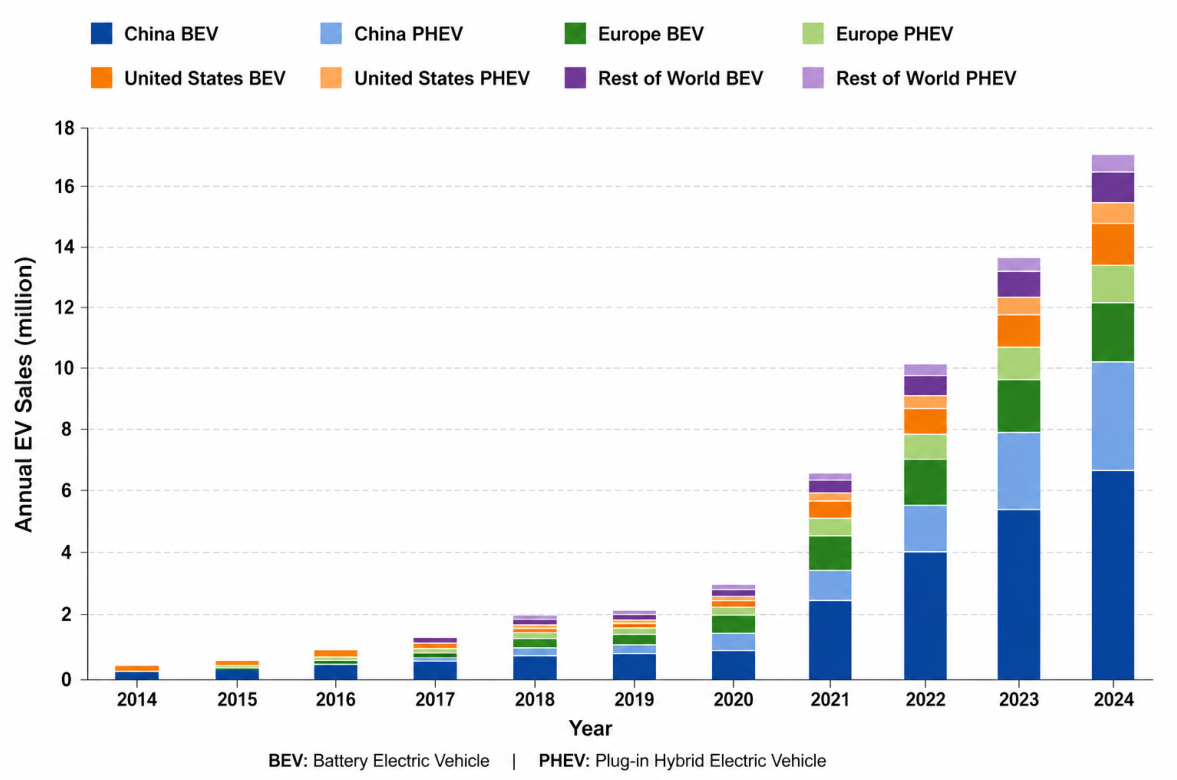
Wireless charging technologies based on wireless power transfer (WPT) have emerged as a promising alternative to conventional conductive charging systems for electric vehicles (EVs). The rapid electrification of the transportation sector, driven by global decarbonization initiatives and increasingly stringent emission regulations, has accelerated the deployment of battery electric vehicles (BEVs) and plug-in hybrid electric vehicles (PHEVs) worldwide [1]. Figure 1 illustrates the remarkable growth in global electric vehicle sales during the last decade [2]. The rapid increase in BEV and PHEV adoption across major regions, including China, Europe, the United States, and the rest of the world, highlights the increasing demand for reliable and efficient charging infrastructures. According to the International Energy Agency (IEA), global electric vehicle sales have experienced remarkable growth during the past decade, exceeding 17 million units in 2024 and accounting for more than 20% of total new vehicle sales worldwide. This rapid growth has increased the demand for reliable charging infrastructures and stimulated the development of advanced charging technologies to support sustainable transportation and reduce greenhouse gas emissions [3,4].
Currently, conductive charging systems represent the dominant approach for charging EVs. These systems employ physical connectors and charging cables, such as the Combined Charging System (CCS), CHAdeMO, North American Charging Standard (NACS), and GB/T standards, to transfer electrical energy from the grid to vehicle batteries [5]. Although conductive charging technologies have reached a high level of maturity and efficiency, they suffer from several limitations. Physical connectors are susceptible to wear and degradation, and cable handling may present inconvenience, particularly under adverse environmental conditions such as rain, snow, and dust [6]. Furthermore, conventional charging systems may introduce safety concerns associated with exposed conductive components, while the requirement for manual intervention limits their suitability for autonomous vehicles and future unmanned transportation systems [7]. The increasing density of charging stations in urban environments also raises concerns regarding infrastructure complexity, maintenance requirements, and aesthetic integration within smart cities [8].
To overcome these limitations, wireless power transfer (WPT) has attracted considerable attention as a contactless charging solution capable of enhancing user convenience, operational flexibility, and system reliability [9,10]. Among the various WPT technologies, inductive power transfer (IPT) based on resonant magnetic coupling has emerged as the most mature and commercially viable approach for EV applications owing to its high efficiency, robustness, and capability to deliver power levels ranging from several kilowatts to hundreds of kilowatts [11]. Compared with conventional plug-in charging systems, wireless charging offers improved safety, immunity to adverse weather conditions, reduced mechanical wear, and enhanced user convenience [12]. These characteristics make WPT particularly attractive for autonomous vehicles, robotaxis, connected mobility services, and unmanned logistics platforms, where charging without human intervention is essential [13,14]. In addition, dynamic wireless charging, in which electrical energy is transferred while vehicles are in motion, has attracted growing interest because of its potential to reduce battery capacity requirements, alleviate range anxiety, and improve vehicle utilization efficiency [15,16]. Consequently, wireless charging has evolved from a convenience-oriented technology into a strategic enabler of next-generation transportation infrastructures. Compensation networks are essential for maximizing power transfer capability and maintaining high efficiency under varying operating conditions [17]. Various topologies, including series-series (SS), series-parallel (SP), parallel-series (PS), parallel-parallel (PP), and advanced LCC and LCL structures, have been proposed to improve system performance and mitigate the effects of parameter variations and coil misalignment [18,19].
Magnetic coupler structures strongly influence coupling coefficient, power transfer efficiency, and misalignment tolerance [20,21]. Various coil geometries and electromagnetic shielding techniques have been developed to enhance magnetic coupling and ensure compliance with electromagnetic compatibility and human exposure requirements [22,23]. Advanced and intelligent control techniques have been developed to improve efficiency, enhance fault tolerance, and enable adaptive operation under varying coupling conditions [24,25]. Moreover, the integration of wireless charging systems with IoT platforms, smart grids, and vehicle-to-grid frameworks necessitates sophisticated communication and energy management strategies [26]. The commercialization of wireless EV charging technologies has been accelerated by international standardization efforts. Standards such as SAE J2954, along with initiatives from the IEC, IEEE, and ISO, provide harmonized frameworks for interoperability, electromagnetic compatibility, safety, and power transfer requirements, thereby promoting compatibility among vehicles and charging infrastructures and facilitating widespread adoption [27,28,29]. Despite significant advances, several challenges continue to hinder the large-scale deployment of wireless EV charging systems, including efficiency degradation under misalignment, thermal management, electromagnetic interference (EMI), infrastructure costs, interoperability issues, battery degradation, and the increased control and communication complexities associated with high-power dynamic charging and bidirectional vehicle-to-grid applications [30,31,32]. Although numerous review articles have investigated wireless power transfer technologies for electric vehicle charging, most have primarily concentrated on specific aspects such as wireless power transfer principles, compensation networks, magnetic coupler structures, converter topologies, or control techniques. In contrast, the present review provides a comprehensive and up-to-date perspective by integrating these key research areas within a unified framework. In addition to reviewing charging architectures, compensation topologies, magnetic coupler structures, and power electronic converters, this work presents an extensive discussion of conventional, advanced, and intelligent control strategies, communication frameworks, international standards, technical challenges, and future research directions. Furthermore, the review incorporates recent developments published through early 2026 and provides a comparative and system-level assessment of the advantages, limitations, and practical implementation considerations of wireless EV charging technologies, offering researchers and practitioners a comprehensive reference on next-generation wireless EV charging systems.

Review Methodology

This review adopts a structured narrative review methodology to provide a comprehensive and system-level assessment of wireless charging technologies for electric vehicles. The review synthesizes recent developments across wireless charging architectures, wireless power transfer principles, compensation network topologies, power electronic converter topologies, magnetic coupler structures, control strategies, communication frameworks, international standards, technical challenges, and emerging research directions. The literature survey was conducted using major indexed scientific databases, including IEEE Xplore, Scopus, Web of Science, ScienceDirect, SpringerLink, Wiley Online Library, MDPI, and Google Scholar. Publications from 2015 to 2026 were primarily considered to capture recent advances in wireless EV charging technologies, while seminal earlier studies were retained where necessary to establish fundamental concepts and technological evolution. The literature search employed combinations of keywords such as wireless power transfer, electric vehicle wireless charging, inductive power transfer, magnetic resonant coupling, dynamic wireless charging, bidirectional wireless charging, compensation topology, magnetic coupler, power electronic converters, control strategies, vehicle-to-grid integration, and related terms.
The initial literature search identified 953 publications. After removing duplicate records using publication metadata, 722 unique studies remained for title and abstract screening. Studies unrelated to wireless EV charging technologies, non-peer-reviewed publications, and articles lacking sufficient technical relevance were excluded, resulting in 366 candidate publications for full-text assessment. Following full-text screening, priority was given to peer reviewed journal articles, highly cited conference papers, international standards, and recent review papers that provide significant theoretical contributions, experimental validation, comparative performance analyses, or practical implementation insights relevant to wireless EV charging systems. This multi-stage screening process resulted in 259 publications being selected as the principal references supporting this review. The selected literature was subsequently organized into the major technical themes addressed throughout the manuscript to facilitate a comprehensive discussion of technology evolution, design trade-offs, practical implementation challenges, and future research directions in wireless EV charging systems. By integrating recent developments across power transfer technologies, power electronic converters, magnetic coupler designs, intelligent control strategies, and standardization efforts, this review provides a holistic perspective on the design, operation, and implementation of next-generation wireless EV charging infrastructures.

2. Fundamentals and Architectures of Wireless EV Charging

2.1. General Architecture of Wireless EV Charging Systems

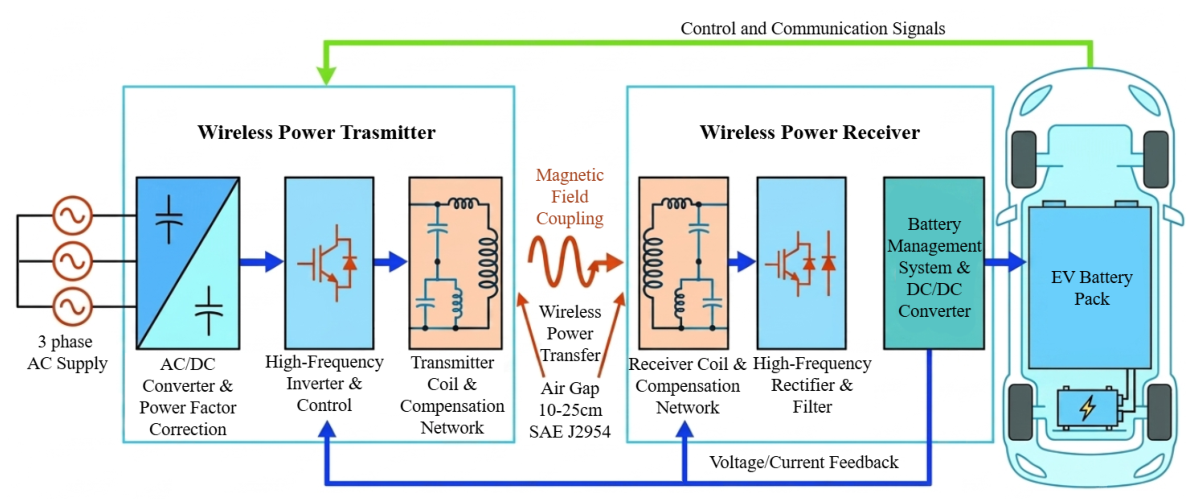
A wireless EV charging system generally consists of a grid-side transmitter unit and a vehicle-side receiver unit interconnected through a loosely coupled wireless link [33,34,35]. Figure 2 illustrates the general architecture of a wireless EV charging system. On the transmitter side, the utility supply is processed through a front-end AC/DC converter and a high-frequency inverter before energizing the primary compensation network and transmitting coil. The receiver side comprises the receiving coil, secondary compensation network, rectifier, and battery-side DC/DC converter, which regulate the transferred power according to the battery charging requirements [36,37,38]. Compensation networks are employed to establish resonance and improve power transfer capability and efficiency [39,40]. In addition to the power transfer path, modern wireless charging systems incorporate communication and feedback channels for power regulation, battery management, and system coordination. These auxiliary functions contribute to safe and reliable operation under varying load and coupling conditions [41].

2.2. Principles and Classification of Wireless Power Transfer

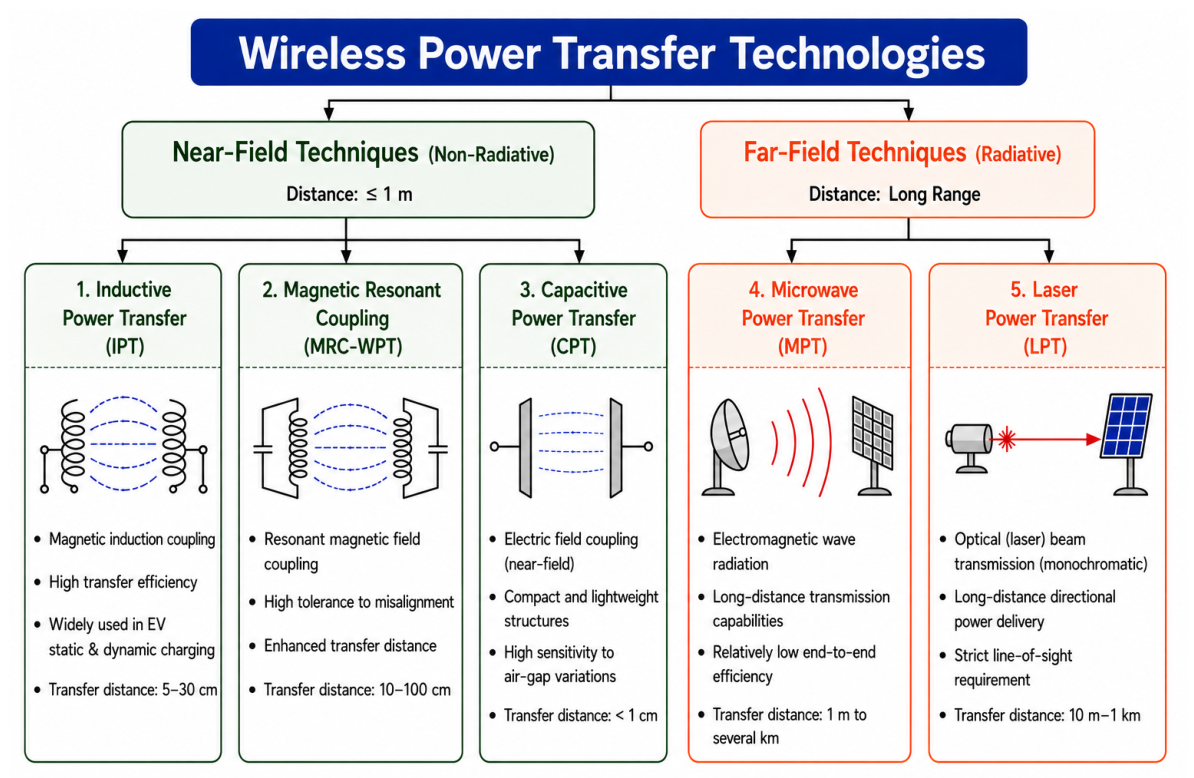
Wireless power transfer (WPT) enables contactless energy transmission through electric, magnetic, or electromagnetic fields without direct conductive connections [42]. Depending on the coupling mechanism, power transfer may occur through electric fields, magnetic fields, or propagating electromagnetic waves [42,43,44,45]. Based on the transfer mechanism and operating distance, WPT technologies are broadly classified into near-field and far-field approaches [43]. Near-field techniques employ non-radiative coupling and form the basis of most practical wireless charging systems, whereas far-field methods utilize radiative electromagnetic waves for long-distance power transfer [43]. Figure 3 illustrates the classification of the major WPT technologies.

2.2.1. Near-Field Wireless Power Transfer

Near-field wireless power transfer technologies operate over distances smaller than one wavelength and constitute the foundation of contemporary wireless EV charging systems. Typical air gaps range from 150 to 300 mm, although larger separations may be required in certain applications [11]. The principal near-field approaches include capacitive power transfer (CPT), inductive power transfer (IPT), and magnetic resonant coupling (MRC-WPT), each exhibiting distinct coupling mechanisms, power capabilities, and operating characteristics.
Inductive Power Transfer (IPT)
Inductive power transfer relies on electromagnetic induction between magnetically coupled coils and represents one of the earliest wireless charging techniques for electric vehicles. Conventional IPT systems typically operate between 10 and 50 kHz and can achieve efficiencies exceeding 90% over transfer distances of several centimeters [46,47]. Commercial implementations, such as the GM Magne-Charge system, demonstrated charging capabilities ranging from 6.6 kW to 50 kW [48], while subsequent research prototypes have further expanded the achievable voltage and power ranges [49,50]. Despite its maturity, conventional IPT suffers from a rapid reduction in efficiency with increasing air gap and faces challenges associated with coil design, electromagnetic shielding, foreign object detection, and high-frequency power converters [46,50,51,52]. These limitations have motivated the development of resonant wireless power transfer techniques.
Capacitive Power Transfer (CPT)
Capacitive power transfer employs electric field coupling between conductive plates to transfer energy and typically operates in the frequency range of 100–600 kHz [53]. Owing to its simple structure, low cost, and reduced electromagnetic interference, CPT has attracted interest for low-power applications and short-distance charging scenarios [54,55,56]. Recent developments have explored high-capacitance structures and novel vehicle-integrated receiver configurations to improve transfer efficiency [57]. However, the low permittivity of air fundamentally limits the coupling capacitance and consequently restricts the achievable transfer distance and power level. Although high-permittivity dielectric materials have been proposed to enhance performance, their complexity and cost hinder widespread adoption for EV charging applications [58]. At present, CPT systems are generally limited to power levels below 7 kW and require relatively small air gaps to achieve acceptable efficiencies [59].
Magnetic Resonant Coupling (MRC-WPT)
Magnetic resonant coupling, also referred to as resonant inductive power transfer, enhances conventional IPT by introducing resonant compensation networks to improve transfer capability and efficiency. It should be noted that IPT and MRC-WPT share the same underlying electromagnetic coupling principle and may exhibit overlapping operating-frequency ranges. The broader frequency range reported for MRC-WPT reflects the variety of resonant compensation-network designs investigated in the literature. In commercial EV charging applications, both IPT and MRC based systems are commonly designed to comply with the SAE J2954 operating frequency band of 79–90 kHz (nominally 85 kHz). Compared with traditional IPT, MRC-WPT offers larger transfer distances, higher power levels, and improved tolerance to misalignment, making it the most widely adopted technology for wireless EV charging [60]. Practical systems typically operate between 10 and 150 kHz, with coupling coefficients ranging from 0.2 to 0.3 owing to the relatively large air gaps required in EV applications [35,46]. The use of ferrite materials and litz-wire conductors further improves magnetic coupling and mitigates high-frequency losses caused by skin and proximity effects [61,62]. Significant progress has been achieved in recent years, with demonstrations exceeding 100 kW and efficiencies approaching 90% [63]. Large-scale research initiatives and pilot installations have further accelerated the commercialization of magnetic-resonance-based charging infrastructures for static and dynamic EV charging applications [15,64].

2.2.2. Far-Field Wireless Power Transfer

Far-field wireless power transfer technologies employ propagating electromagnetic waves and, in principle, enable energy transmission over distances extending from several wavelengths to much larger ranges [11]. Owing to their potential for long-distance, high-power energy delivery, far-field techniques have attracted considerable attention as prospective solutions for future wireless charging applications, although substantial technological challenges remain before their widespread implementation in EV charging systems [11]. Representative approaches include laser power transfer (LPT), microwave power transfer (MPT), and radio-frequency power transfer, while the historical development of far-field WPT has been extensively reviewed in [65].
Laser Power Transfer (LPT)
Laser power transfer utilizes resonating optical beams, typically operating at frequencies as high as 359 THz, to deliver energy from a distributed laser charging (DLC) transmitter to a receiver, where the collected power is regulated and supplied to the load [43,66,67]. Although practical applications have primarily been demonstrated in drones, autonomous vehicles, and space systems, laser-based charging is regarded as a promising candidate for future wireless charging infrastructures. Nevertheless, reliable operation requires a direct line-of-sight (LOS) path, and interruptions in the transmission channel immediately terminate power transfer [68]. Additional challenges include the need for complex tracking mechanisms and large antenna structures [11]. Significant research efforts are underway to address these issues, and the Japanese Aerospace Exploration Agency (JAXA) has reported the development of laser transmission systems capable of delivering power levels on the order of 10 MW over distances approaching 10 km [69].
Microwave Power Transfer (MPT)
Microwave power transfer shares many characteristics with laser charging and has demonstrated greater technological maturity through numerous experimental studies. Early investigations conducted by the Jet Propulsion Laboratory (JPL) successfully transmitted 30 kW over a distance of 1.54 km with a peak efficiency of 85% using a rectenna-based system [70]. Subsequently, microwave-powered aircraft demonstrations further validated the feasibility of long-range wireless energy transmission [71]. Recent studies have explored the application of microwave technologies to EV charging, including magnetron-based systems capable of transferring approximately 10 kW over 5 m with efficiencies approaching 80% at 2.45 GHz [72]. Despite these advances, microwave charging systems remain constrained by LOS requirements, large antenna dimensions, and sophisticated beam-tracking mechanisms, which currently limit their practical adoption for EV charging applications [11].
In addition to efficient power transfer, electromagnetic interference (EMI) and electromagnetic compatibility (EMC) are important considerations in wireless EV charging systems. The high-frequency magnetic fields generated during wireless power transfer may interact with nearby electrical and electronic equipment [73,74], while electromagnetic emissions from adjacent power electronic converters, renewable energy systems, industrial drives, or other high-frequency devices may influence the performance of wireless chargers through conducted or radiated interference [75]. Consequently, appropriate shielding techniques [73,76,77], compensation network optimization [78], filtering [75], grounding, and careful system layout are essential to minimize electromagnetic coupling and ensure stable operation [79]. Compliance with international standards such as SAE J2954 (which specifies electromagnetic field exposure and electromagnetic compatibility requirements together with alignment and interoperability), IEC 61980 (general requirements for wireless power transfer systems for electric vehicles), and CISPR 36 (radiated emission limits for electric and hybrid vehicles to protect off-board receivers below 30 MHz) further ensures electromagnetic safety, interoperability, and reliable operation in practical deployment environments [74,80].
Table 1 summarizes the characteristics and suitability of the major WPT technologies for electric vehicle charging applications. Among the available approaches, near-field techniques have emerged as the dominant solutions for contemporary wireless EV charging systems.

2.3. Architectures of Wireless EV Charging Systems

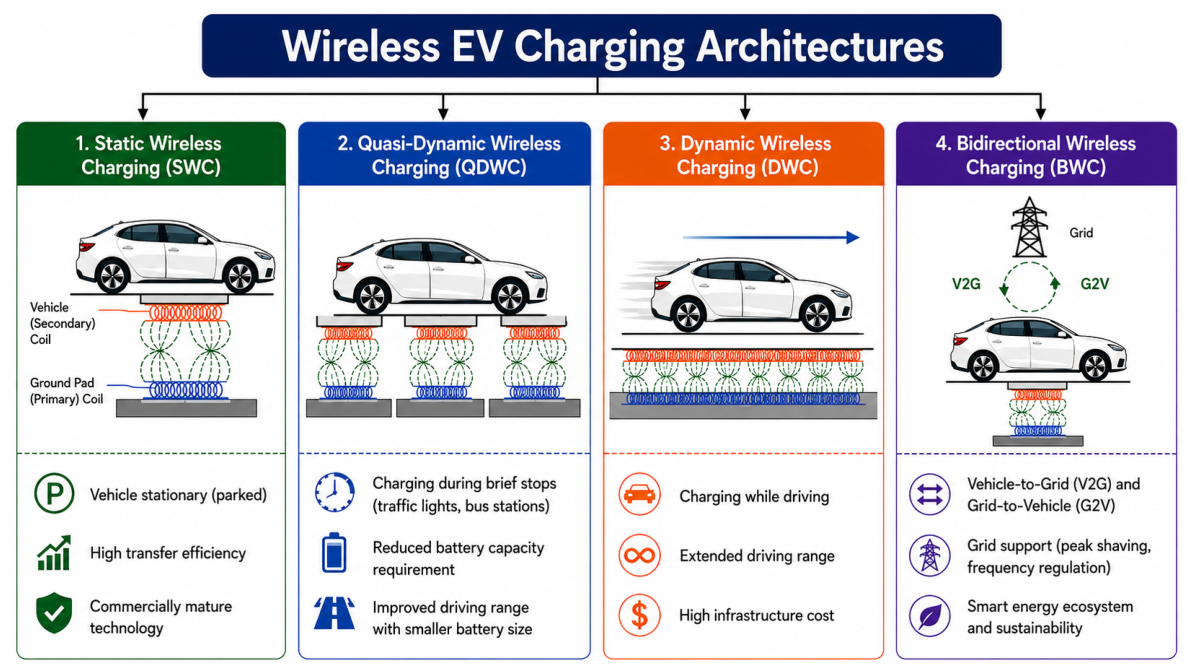
Wireless EV charging systems are generally classified into static, quasi-dynamic, dynamic, and bidirectional configurations based on the charging scenario and vehicle motion. These architectures differ in terms of infrastructure requirements, charging continuity, and grid interaction capabilities. Figure 4 illustrates the major wireless charging architectures employed in electric vehicle applications.

2.3.1. Static Wireless Charging

Static wireless charging (SWC) is the most mature and widely deployed architecture, in which energy transfer occurs while the vehicle remains stationary over a ground-embedded transmitter pad located at residences, workplaces, or public parking facilities. SWC typically employs resonant inductive power transfer using SS or LCC compensation networks. Under SAE J2954 compliant conditions, efficiencies of 90–93% at power levels of 3.6–11 kW with air gaps of 10–25 cm and lateral misalignment tolerance of ± 10 –15 cm have been reported [12]. However, performance remains highly sensitive to air-gap distance and coil alignment. Experimental studies showed efficiency degradation from 82.4% to 56.3% when the air gap increased from 4 cm to 8 cm, while a 25 mm lateral displacement reduced power transfer by approximately 22.4% [81]. A 5 kW SS-compensated IPT prototype achieved a peak simulated efficiency of 92.5% and a measured wall-to-battery efficiency of 88.4%, highlighting the importance of coil and compensation-network co-optimization [33]. Owing to its maturity and simplicity, SWC remains the reference architecture for international standards such as SAE J2954, IEC 61980, and GB/T 38775 [82]. Commercial deployment of static wireless charging has accelerated in recent years. SAE J2954-aligned wireless charging technologies have been commercialized for passenger electric vehicles, with production and near-production vehicles such as the BMW 530e and Genesis GV60 demonstrating practical implementation. In addition, Volvo has piloted static wireless charging for taxi fleets in Gothenburg, Sweden using commercially available wireless charging technology. Recent studies have further consolidated the technical advances in inductive, capacitive, and magnetic gear based wireless charging architectures and their suitability for practical deployment [82,83].

2.3.2. Quasi-Dynamic Wireless Charging

Quasi-dynamic wireless charging (QDWC) extends SWC by enabling power transfer during brief stops or low-speed operation at locations such as traffic intersections, bus stations, and taxi stands. Compared with fully static systems, QDWC requires rapid power ramp-up and communication between the vehicle and infrastructure controller [82,84]. It represents a cost-effective compromise between stationary and fully dynamic charging because charging pads are installed only at selected dwell-time locations. Optimization studies for urban electric bus networks have demonstrated that appropriate transmitter placement and photovoltaic-battery integration can minimize overall operating costs and improve energy independence [85]. QDWC has also been defined as a charging mode applicable during transient stops or low-speed operation, enabling bidirectional energy flow and demand-response services based on vehicle energy state and traffic conditions [83]. These features make QDWC particularly attractive for public transportation systems. Quasi-dynamic wireless charging has been actively investigated for public transportation applications, particularly electric buses operating on fixed routes. Pilot deployments employing opportunity charging at bus stops and traffic signals have demonstrated its potential to reduce onboard battery capacity requirements while extending vehicle operating range [85,86]. Recent studies have further formalized the planning and siting of quasi-dynamic charging infrastructure, presenting optimization frameworks for locating charging stations and sizing power transmitters and onboard batteries under grid-connected and PV-battery scenarios [85], and comparing the cost trade-offs of stationary, quasi-dynamic, and dynamic charging networks for urban bus transit systems [86]. Although commercial adoption remains limited compared with static wireless charging, quasi-dynamic charging is considered a promising intermediate solution between stationary and fully dynamic charging systems, a positioning reinforced by recent deployment-readiness reviews that frame static, quasi-dynamic, and dynamic WPT along a common standardization and readiness continuum [87].

2.3.3. Dynamic Wireless Charging

Dynamic wireless charging (DWC) enables continuous power transfer while vehicles are in motion by energizing sequential road-embedded transmitter coils. By providing energy during travel, DWC can reduce battery capacity requirements, vehicle weight, and range anxiety [88]. However, continuously varying coupling conditions introduce significant challenges for compensation-network and magnetic-coupler design. Finite-element analyses have shown that mutual inductance and power pulsations are highly sensitive to longitudinal, lateral, and air-gap variations [89], while a 10% increase in air gap may reduce transfer efficiency by approximately 15% [90]. Segmented DWC systems integrated with photovoltaic generation and battery storage have demonstrated the potential to reduce grid peak loading while maintaining highway-speed power delivery [91]. Nevertheless, infrastructure costs remain the major obstacle to large-scale deployment, and current implementations are largely limited to pilot projects such as those in Detroit and Trondheim [92]. Dynamic wireless charging is currently being demonstrated through several large-scale pilot projects. Dynamic wireless charging infrastructure has been deployed and evaluated in Sweden, Germany, Israel, Norway, and the United States for passenger vehicles, buses, and commercial fleets. Recent research has addressed the infrastructure planning and control challenges associated with large-scale deployment, including joint planning of charging lanes and power delivery infrastructure, coordinated operation within distribution networks, and data-driven charging-facility placement strategies [93,94].

2.3.4. Bidirectional Wireless Charging

Bidirectional wireless charging (BWC) supports both grid-to-vehicle (G2V) and vehicle-to-grid (V2G) operation, allowing EVs to function as distributed energy resources capable of providing peak shaving, frequency regulation, voltage support, and spinning reserve services [84,88,95]. Bidirectional operation requires four-quadrant converters and active control of the phase relationship between primary and secondary voltages. Comprehensive studies have identified compensation-network symmetry, power factor correction, switching losses, and current harmonic distortion as key design considerations [24]. Experimental investigations have further validated high-power onboard chargers for V2G and vehicle-to-load applications with stable active and reactive power control [96]. Battery degradation, communication standardization, and the cost of four-quadrant power electronics remain important challenges, motivating research into advanced battery management systems, ISO 15118 communication protocols, and wide-bandgap semiconductor devices [24,82].
Together, these architectures span a spectrum from mature stationary charging to grid-interactive bidirectional systems. Their comparative characteristics in terms of power level, efficiency, infrastructure complexity, battery sizing impact, and grid interaction capability are summarized in Figure 4, illustrating the diverse design space for future wireless EV charging deployment and standardization strategies [82,83,84,88,97]. Commercial interest in bidirectional wireless charging continues to grow with the advancement of vehicle-to-grid (V2G) technologies. Several research consortia and industrial initiatives are actively investigating wireless V2G operation for grid-support applications. Although commercially standardized bidirectional wireless charging systems remain at an early stage of deployment, recent experimental studies have validated medium-duty vehicle-grid-storage integration with grid-to-vehicle and vehicle-to-grid efficiencies exceeding 89% and 93%, respectively. In addition, comprehensive reviews of bidirectional charger topologies have highlighted the power-electronics architectures required for future wireless V2G-enabled charging systems [98,99].

3. Topologies for Wireless EV Charging

3.1. Compensation Network Topologies

Compensation networks are indispensable in resonant wireless power transfer systems because they supply the reactive energy required by the loosely coupled coils and establish the resonance condition necessary for efficient power transmission [100,101,102]. Appropriate compensation design reduces the apparent power demand of the primary converter, suppresses reactive power circulation, and enables soft-switching operation, thereby improving overall system efficiency [103]. In addition, compensation networks play a crucial role in mitigating the effects of frequency splitting, load variations, coupling fluctuations, and coil misalignment, while facilitating constant output characteristics and bidirectional power transfer capabilities [104,105]. These requirements have led to the development of numerous compensation structures, ranging from the classical single-capacitor configurations to more sophisticated hybrid topologies incorporating additional reactive elements.

3.1.1. Basic Compensation Topologies

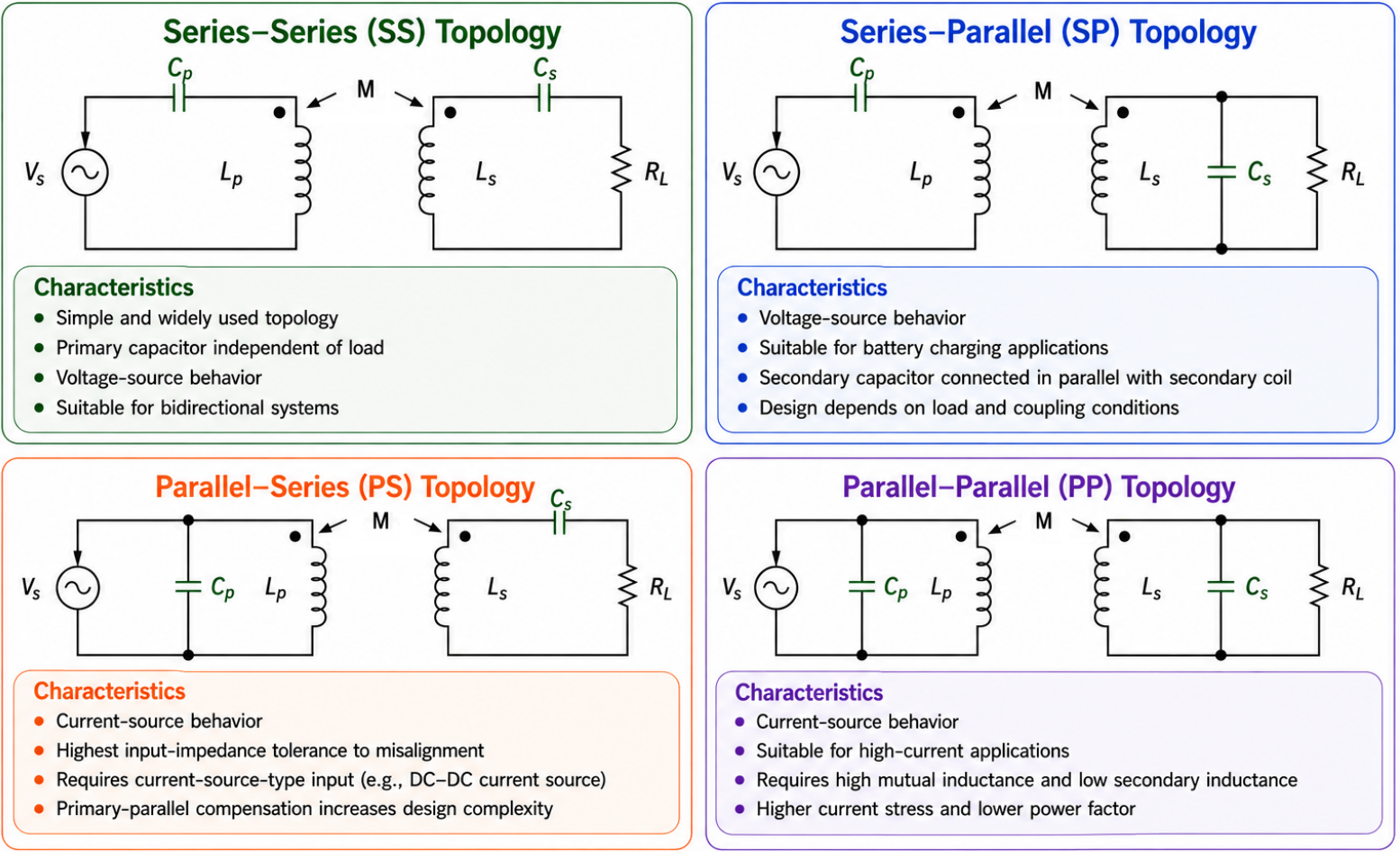
The classical one-element compensation networks, namely series–series (SS), series–parallel (SP), parallel–series (PS), and parallel–parallel (PP), constitute the foundation of resonant wireless power transfer systems and have been extensively investigated for electric vehicle applications [106]. Figure 5 illustrates the circuit configurations and principal characteristics of the four basic topologies.
Among these configurations, the SS topology has attracted the greatest attention owing to its resonant frequency being largely independent of load and coupling variations, which makes it particularly attractive for EV and dynamic charging applications where the coupling coefficient changes continuously during operation [107]. Moreover, SS compensation exhibits output current characteristics that are insensitive to load variations at resonance [108] and enables zero-voltage switching (ZVS) of the primary switches and zero-current switching (ZCS) of the output diodes, thereby facilitating high-frequency operation with reduced switching losses [109]. The reflected reactance of a series-compensated receiver becomes zero at resonance, providing favorable operating characteristics compared with parallel-compensated receivers [110]. Owing to its high efficiency and simple implementation, the SS topology remains the most widely adopted compensation network in practical wireless charging systems [108,111].
Compared with SS compensation, the SP topology requires lower secondary inductance values [108], although this advantage is achieved at the expense of larger primary capacitance requirements [112]. The input-output voltage transfer characteristics and power factor are strongly influenced by the primary-side capacitance [112], while the required capacitance further increases under strong coupling conditions [109]. In addition, the output voltage is directly related to the transmitting current and primary voltage [111], and improved performance can be obtained by increasing the mutual inductance between the coils [18].
The PS and PP topologies exhibit superior efficiency and wider tolerance to load and coupling variations under weak coupling conditions [106]. However, the PP configuration generally suffers from a low power factor because of the parallel compensation on both sides [113]. Misalignment studies reported in [107] revealed that SS and SP topologies experience increased source and load currents under degraded coupling conditions, whereas PS and PP configurations show a significant reduction in transferred power. Furthermore, series-compensated receivers (SS and PS) exhibit lower primary impedance phase angles than their parallel counterparts (SP and PP), leading to improved operating characteristics [110]. Because each topology exhibits different voltage-current characteristics, coupling sensitivities, and soft-switching capabilities, numerous studies have explored the optimal combination of series and parallel compensation to achieve desirable output profiles [109,114]. Systems employing long transmitting tracks particularly benefit from series compensation because of the reduced current stress and improved voltage characteristics of the capacitors [107]. Nevertheless, the inherent trade-offs associated with the basic topologies have motivated the development of hybrid compensation structures, which are discussed in the following subsection. Although PS and PP compensation topologies exhibit improved tolerance to load and coupling variations under weak-coupling conditions, these benefits are accompanied by higher current stress and, in some operating conditions, reduced power factor, resulting in design trade-offs that must be considered for practical wireless EV charging applications.

3.1.2. Hybrid Compensation Topologies

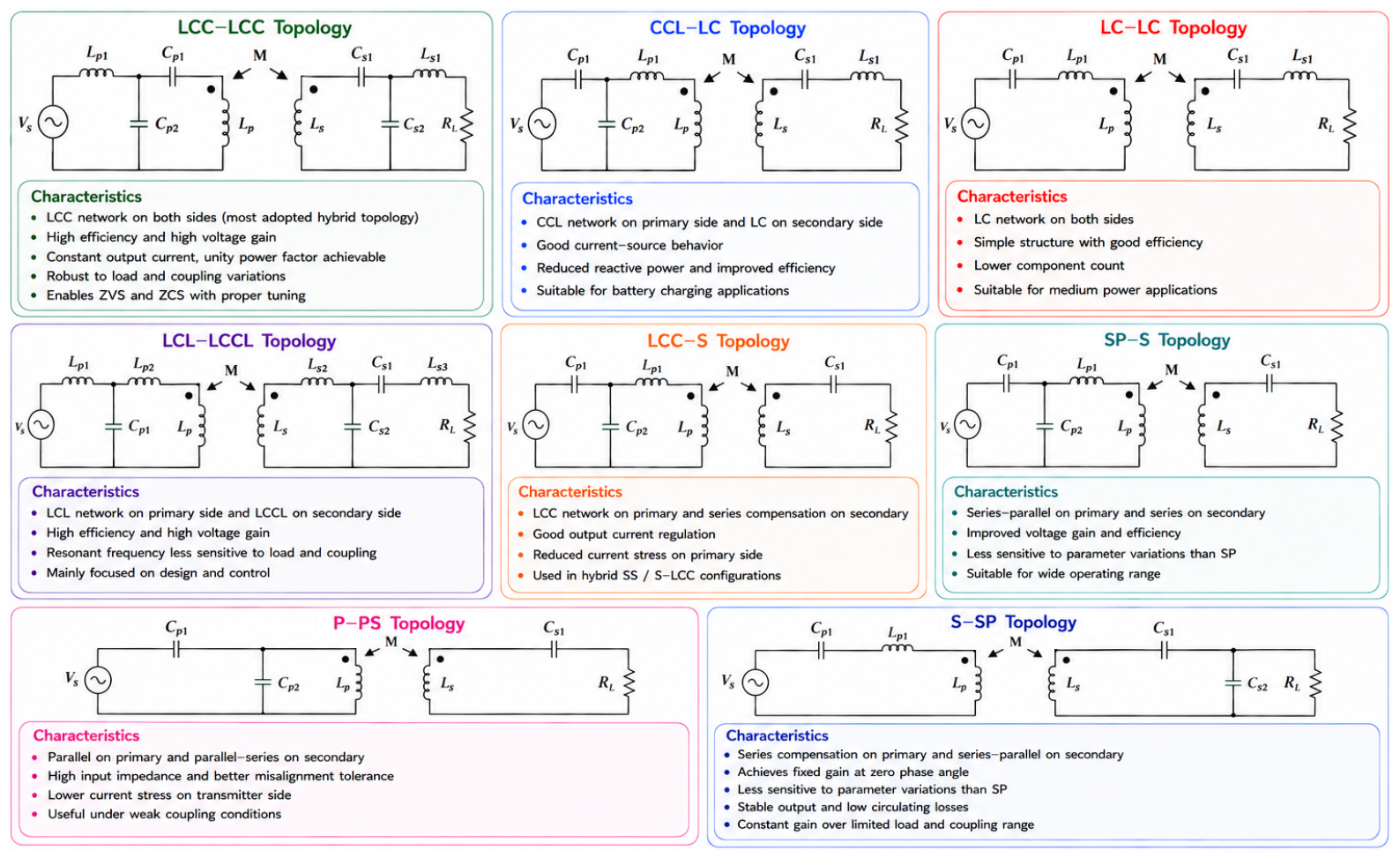
To overcome the limitations of basic compensation networks, numerous hybrid topologies employing additional inductors and capacitors have been developed. Figure 6 illustrates representative configurations, including LCC-LCC, CCL-LC, LC-LC, LCL-LCCL, LCC-S, SP-S, P-PS, and S-SP topologies. Among these approaches, LCL compensation has attracted considerable attention because of its load-independent characteristics and ability to maintain a unity input power factor over a wide operating range [115]. Early primary-side LCL networks demonstrated the feasibility of the concept, although their resonant frequency remained dependent on load and coupling conditions [102]. Subsequently, double-sided LCL and CLCL structures were introduced to reduce the influence of load and coupling variations on the resonant characteristics [116,117]. In addition, LCL and CLC networks have been shown to support constant-current and constant-voltage charging modes suitable for battery applications [117,118]. Cascaded LCL-P compensation combined with boost converters has also been investigated for EV charging systems [119], while the duality between series and parallel compensation has been exploited to tailor voltage- and current-source characteristics [120]. Hybrid SS/S-LCC schemes enabling simultaneous charging of multiple electric bicycles were reported in [121].
Recent research has increasingly focused on double-sided LCC compensation. Initial studies demonstrated that auxiliary inductors with lower inductance than the main coils enable zero-voltage switching and improve robustness against coupling and load variations [122]. Further investigations showed that double-sided LCC networks support zero-current switching with appropriate parameter design and provide favorable current-source characteristics for battery charging applications [118,123]. Effective compensation of secondary-side reactive power results in a pickup stage with a power factor approaching unity [118,124]. Owing to reduced inverter current stress, high efficiency, and enhanced tolerance to coupling variations and misalignment, double-sided LCC compensation has received considerable attention in modern wireless charging systems [118,124,125,126]. Comparative investigations further revealed greater robustness to coupling variations and lower voltage and current stresses than conventional SS compensation [127]. Several approaches have also been proposed to improve tolerance to misalignment and coupling variations. A CCL compensation network capable of maintaining nominal power transfer under 25% coil misalignment was reported in [128], while four-coil architectures and adaptive capacitor arrays were employed to mitigate coupling sensitivity and maintain constant power transfer over varying transmission distances [129,130]. Although these methods improve operating flexibility, the additional passive components and switching devices inevitably increase system complexity and may reduce overall reliability.
Hybrid topologies such as LCL-LCL and LCC-LCC have been shown to maintain high efficiency over wide load and coupling ranges [118,131,132]. However, the additional reactive elements introduce extra parasitic losses, increased cost, and greater control complexity compared with the simpler SS topology [131]. More recently, S/SP compensation networks have been proposed to achieve fixed-gain intersections at the zero-phase-angle operating point [133]. Compared with conventional SP compensation, these configurations exhibit lower sensitivity to parameter variations and reduced circulating losses [134], while systematic design methodologies have been reported in [135]. Table 2 compares the characteristics of the major basic and hybrid compensation networks. Overall, hybrid topologies provide improved soft-switching capability, enhanced operating flexibility, and greater robustness to parameter variations than conventional one-element compensation schemes. Among them, double-sided LCC compensation has emerged as one of the most promising candidates for high-power wireless EV charging applications.

3.2. Magnetic Couplers

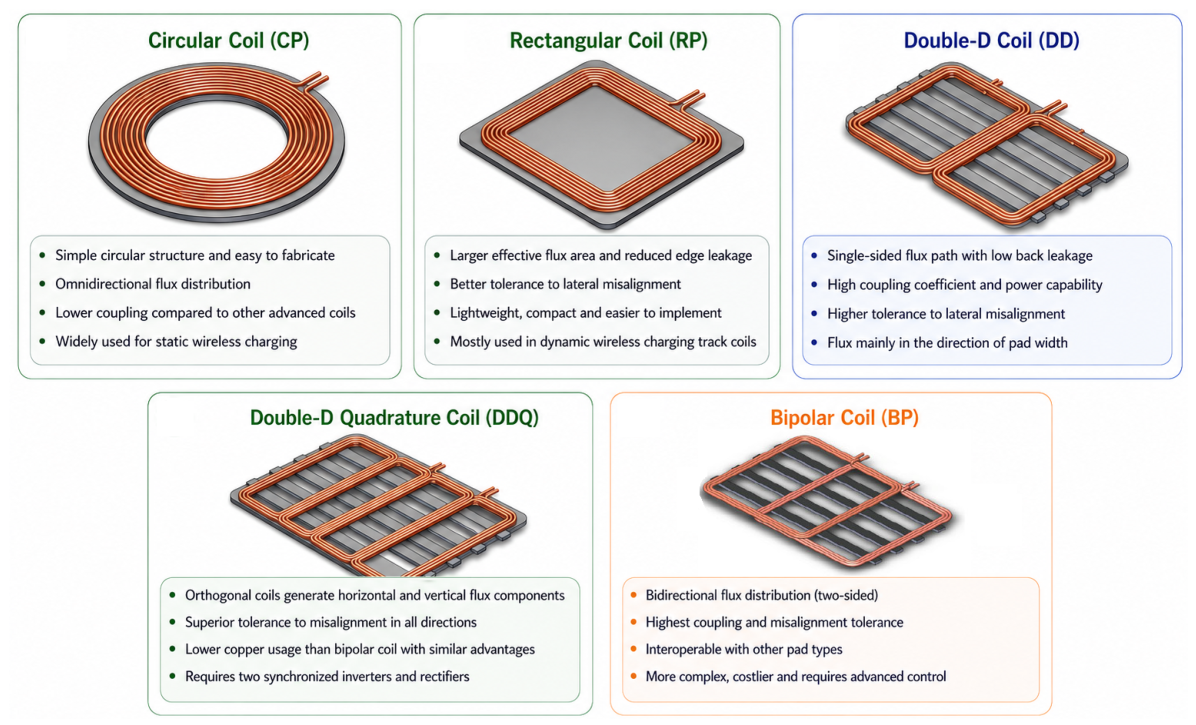
The magnetic coupler is one of the most critical components of wireless power transfer systems because the achievable power transfer capability and efficiency are largely determined by the coupling coefficient and quality factor of the coils [136,137]. Consequently, extensive research has focused on developing coil structures with enhanced coupling capability, reduced leakage flux, and improved misalignment tolerance [138,139,140,141,142,143,144,145,146,147,148]. Ferrite structures are commonly employed to increase self-inductance and magnetic coupling, although they may introduce additional core and copper losses [149]. Furthermore, the operating frequency of wireless EV charging systems is generally limited to around 85 kHz according to the SAE J2954 standard [137]. Figure 7 illustrates representative magnetic coupler geometries employed in wireless EV charging systems.
Among the various geometries, circular pads have been widely adopted owing to their simple structure and ease of fabrication [140,146,150]. Optimization studies have demonstrated dc-bus-to-battery efficiencies approaching 96.5% under appropriate coil dimensions and transfer distances [140,150]. Nevertheless, their relatively limited coupling coefficient and misalignment tolerance have motivated the development of more advanced structures [143,144]. Rectangular coils provide a larger effective flux area and are commonly employed in dynamic charging tracks because of their improved lateral misalignment characteristics. Double-D (DD) pads were proposed to enhance magnetic coupling and suppress leakage flux [143]. Subsequent investigations demonstrated higher quality factors and superior power transfer characteristics compared with conventional circular pads, leading to their widespread adoption in EV charging applications [143,144,145,146]. Analytical models and optimization procedures based on finite-element analysis and genetic algorithms were later developed for DD structures [147].
Further improvements in misalignment tolerance led to the Double-D Quadrature (DDQ) configuration, in which an orthogonal quadrature coil is incorporated into the DD structure [143]. Although the additional flux component improves tolerance to displacement in multiple directions, it increases the overall pad size. Bipolar pads (BP), consisting of partially overlapping coils, provide comparable coupling performance while requiring approximately 25–30% less copper than DDQ structures [145,151]. Multi-coil arrangements, including tripolar pads, have also been investigated to improve rotational alignment capability and coupling performance [147,152]. These structures have been shown to reduce apparent power requirements by nearly 45% compared with circular pads while maintaining leakage magnetic fields below ICNIRP limits [147,152,153]. However, their implementation requires multiple independent inverters and more sophisticated control schemes. Additional approaches based on three- and four-coil structures have been proposed to improve coupling characteristics and extend transmission distance [138,148]. Although auxiliary coils improve efficiency and reduce sensitivity to misalignment, improper design may result in frequency bifurcation and system instability [138]. Integrated magnetic structures employing auxiliary inductors have also been investigated to improve space utilization and compensate for misalignment effects [154,155]. More recently, double-DD and double-DDQ configurations have been proposed to further increase power density and improve tolerance to coil displacement, with power density improvements of approximately 50% reported for double-DD structures [156,157]. Recent advances in magnetic shielding materials have demonstrated that Fe-based nanocrystalline alloys offer several advantages over conventional Mn–Zn ferrites for wireless power transfer systems. Owing to their high saturation flux density, high magnetic permeability, superior thermal performance, and mechanical flexibility, nanocrystalline materials enable improved magnetic flux confinement, enhanced power density, and more compact magnetic coupler designs. In addition, laminated nanocrystalline structures provide greater design flexibility and can significantly reduce eddy-current losses in high-frequency applications. Emerging integrated magnetic structures based on nanocrystalline materials have further demonstrated the potential to simultaneously realize magnetic shielding and resonant capacitance functions, thereby reducing passive component count and improving system compactness. These characteristics make Fe-based nanocrystalline materials promising candidates for next-generation high-power and compact wireless EV charging systems [158,159].
Overall, magnetic coupler development has evolved from simple circular pads toward polarized and multi-coil structures with improved power density and robustness against misalignment. Table 3 summarizes the major magnetic coupler structures together with their typical power levels, applications, advantages, and limitations. Among the available geometries, DD and DDQ pads have emerged as particularly attractive candidates for high-power wireless EV charging systems, whereas bipolar and advanced multi-coil configurations offer further performance improvements at the expense of increased complexity.

3.3. Power Electronic Converter Topologies for Wireless EV Charging Systems

Power electronic converters are essential components of wireless EV charging systems, enabling efficient power conversion from the utility grid to the EV battery. Depending on the charging architecture, multiple converter stages are employed for AC–DC rectification, high-frequency DC–AC inversion, receiver-side rectification, and output voltage/current regulation [160].

3.3.1. Front-End AC/DC Converters

The front-end AC/DC converter provides grid interfacing, power factor correction (PFC), and harmonic mitigation. Conventional boost PFC rectifiers are widely adopted, whereas totem-pole PFC converters employing GaN and SiC devices offer improved efficiency and power density. Interleaved totem-pole PFC designs complying with IEC 61000-3-2 harmonic standards and bidirectional interleaved structures have been proposed for integrated on-board charger applications [161,162]. Multi-level PFC boost rectifiers have also been demonstrated for 5-kW wireless EV charging systems with near-unity power factor and reduced switching losses [163]. In addition, multi-pulse rectifier topologies, including twelve-, twenty-four-, and forty-eight-pulse configurations, have demonstrated significant reductions in total harmonic distortion and improved power quality for high-power applications [164].

3.3.2. High-Frequency Inverter Topologies

High-frequency inverters generate the AC excitation required for wireless power transfer. Full-bridge and half-bridge inverters remain the most widely adopted topologies, while half-bridge multi-leg inverter configurations have been proposed for dynamic wireless charging systems to independently energize transmitter coils and reduce system cost [165]. Resonant inverter topologies, including Class-D, Class-E, and Class-DE inverters, have demonstrated excellent switching performance at high operating frequencies. GaN-based Class-E inverters have reported system efficiencies of approximately 78% at 13.56 MHz [166]. Furthermore, GaN-based multilevel H-bridge inverters have achieved efficiencies exceeding 98.5%, while boost-integrated multilevel inverter structures operating at 85 kHz eliminate the need for receiver-side voltage regulation [167,168].

3.3.3. Secondary-Side Rectifier Topologies

The receiver-side rectifier converts the induced high-frequency AC voltage into a regulated DC output suitable for battery charging. Passive diode-bridge rectifiers are attractive because of their simplicity and low cost, whereas current driven Class-DE full-bridge rectifiers employing zero-voltage and zero-derivative switching have been proposed to reduce reactive power in compensation networks [169]. Active and synchronous rectification techniques improve conversion efficiency and enable bidirectional vehicle-to-grid (V2G) operation. Fully controllable active-rectifier-based wireless chargers have demonstrated independent regulation of active and reactive power, while wide-range zero-voltage-switching rectification techniques have enhanced CC/CV charging performance for bidirectional wireless charging applications [170,171].

3.3.4. DC–DC Converter Stage

The DC–DC converter stage regulates the charging voltage and current according to battery requirements. Non-isolated buck, boost, and buck–boost converters are commonly employed in low and medium power applications. For high-power and bidirectional wireless charging systems, isolated converter topologies such as LLC resonant converters and dual-active-bridge (DAB) converters provide galvanic isolation and bidirectional power transfer capability. Interleaved and parallel DAB converters have demonstrated scalable operation between 3.7 kW and 11.2 kW for EV charging applications, whereas symmetrical bidirectional resonant DAB-based wireless converters have demonstrated efficient bidirectional power transfer capability under CC/CV charging operation [172,173]. In addition, full-bridge LLC resonant converters integrated with wireless power transfer have demonstrated a dc–dc conversion efficiency of 97.08% at 3.7 kW across a 200-mm air gap [174]. Interleaved and multi-phase DC–DC converter structures have also been proposed to reduce output current ripple, improve thermal distribution, and enhance converter power density in fast wireless charging applications.

4. Control Strategies for Wireless EV Charging Systems

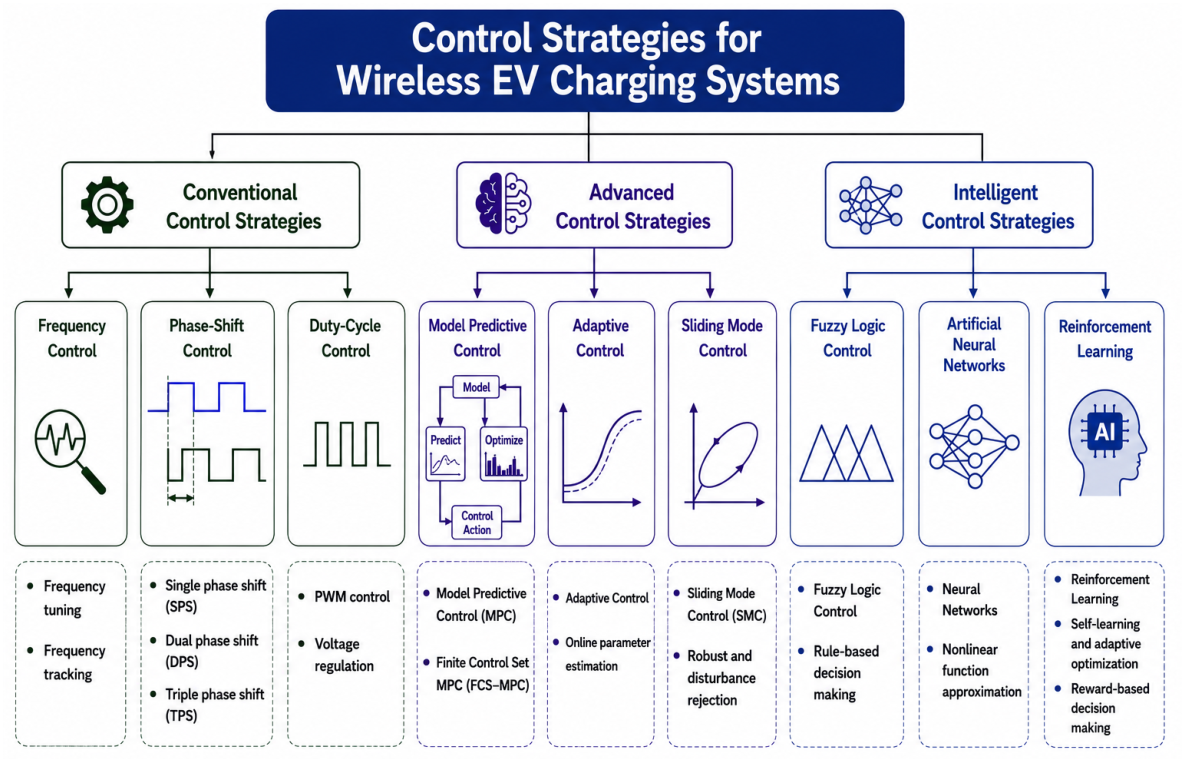
The performance of wireless EV charging systems depends strongly on the employed control strategy, which must maintain stable power transfer under varying load conditions, battery states, coupling coefficients, and coil misalignments. Conventional controllers provide simple and reliable regulation with low computational burden, whereas advanced and intelligent approaches offer improved dynamic performance and adaptability under uncertain operating conditions. Consequently, a wide range of control methodologies have been developed to satisfy the diverse requirements of static, quasi-dynamic, and dynamic charging applications.
Figure 8 presents the taxonomy of control approaches employed in wireless EV charging systems. Existing methods can be broadly classified into conventional, advanced, and intelligent strategies according to their complexity and degree of adaptability. The following subsections discuss the characteristics and recent developments associated with each category.

4.1. Conventional Control Strategies

4.1.1. Frequency Control

Frequency control is one of the earliest and most widely adopted techniques in resonant wireless power transfer systems. By adjusting the switching frequency of the inverter, the system can track resonance and compensate for variations arising from changes in coupling coefficient, load, or component tolerances. Various frequency-tracking and self-tuning schemes have been proposed for LCC-compensated systems to restore resonant operation and maintain high efficiency under parameter variations [175,176]. Variable-frequency control has also been extended to dynamic wireless charging applications, where the coupling coefficient continuously changes as the vehicle moves over segmented tracks [165]. More recently, reinforcement learning-assisted frequency regulation has been explored to automatically optimize controller parameters and enhance transient performance under uncertain operating conditions [177]. Despite its simplicity, frequency control is susceptible to frequency splitting and is constrained by the narrow operating band specified by SAE J2954 [46].

4.1.2. Phase-Shift Control

Phase-shift control regulates power transfer by adjusting the phase difference between the primary and secondary converters. Single phase-shift (SPS), dual phase-shift (DPS), and triple phase-shift (TPS) schemes provide progressively greater degrees of freedom for improving efficiency and extending zero-voltage-switching operation. TPS modulation has been shown to maximize efficiency over wide operating ranges and support both buck and boost modes [178,179]. Closed-loop TPS control has also been applied to DAB-LCC wireless charging systems to achieve unity power factor and optimized constant-current/constant-voltage operation [180]. Mode-switching strategies combining full-bridge and half-bridge operation have been proposed to reduce circulating reactive power and widen the soft-switching range [181]. Furthermore, phase-shift techniques have been successfully extended to bidirectional wireless power transfer systems employing AC–AC converter structures for simultaneous power factor correction and bidirectional energy flow [182].

4.1.3. Duty-Cycle Control

Duty-cycle control has been widely employed for realizing CC/CV charging in wireless EV charging systems because of its simplicity and ease of implementation. Bipolar duty-cycle control for SS-compensated systems was reported in [183], whereas a comprehensive review of PWM-based charging strategies was presented in [184]. Reconfigurable compensation networks and load-independent charging schemes eliminating secondary-side communication were subsequently developed in [185,186]. Several studies focused on improving converter performance through dead-time integrated pulse-density modulation, single-stage converter topologies, and boost-integrated multilevel inverters [168,187]. Hybrid duty-cycle and phase-shift modulation was investigated to improve light-load efficiency, while experimental studies quantified the impact of duty ratio on power transfer efficiency [188].
Recent efforts have emphasized communication-free and load-independent operation. Cascaded fuzzy-PWM controllers, primary-side regulation schemes, capacitance reconfiguration methods, receiver-side control strategies, and load-independent ZPA designs were reported in [109,189,190]. Hybrid compensated single-stage converters were further investigated in [191], whereas comparative studies on SS and SP compensation networks confirmed the flexibility of PWM-based control for implementing both CC and CV charging modes [111]. Although duty-cycle control offers low implementation complexity, excessive duty-ratio variations may introduce additional harmonics and switching losses.

4.2. Advanced Control Strategies

Advanced control techniques have been introduced to improve transient response, robustness, and efficiency under varying operating conditions. Compared with conventional methods, these approaches explicitly consider system nonlinearities, uncertainties, and constraints.

4.2.1. Model Predictive Control

Model predictive control (MPC) has emerged as a powerful framework for wireless EV charging owing to its capability to predict future system behavior and optimize control actions over a finite horizon. Both continuous-control-set and finite-control-set formulations have been investigated for static and dynamic wireless charging systems [192,193]. MPC-based approaches have demonstrated superior dynamic response and efficiency optimization compared with conventional PI controllers, while reduced-complexity algorithms have enabled real-time implementation for inductive charging and V2G applications [194,195]. Nevertheless, the relatively high computational complexity of MPC may pose challenges for real-time implementation and often necessitates high-performance embedded processors in practical wireless EV charging systems. Adaptive and gray-optimization-based MPC schemes have further improved tolerance to coil misalignment and parameter variations without requiring additional sensors [196]. Hybrid fuzzy-MPC frameworks have recently been proposed to simultaneously address battery thermal management, charging performance, and grid-support requirements [197].

4.2.2. Adaptive Control

Adaptive control strategies have been extensively investigated to address variations in mutual inductance, load conditions, and resonant parameters arising from coil misalignment and changing air gaps. Energy injection and particle swarm optimization techniques were employed for online parameter identification and zero-phase-angle restoration in [198], whereas robust load estimation methods for detuned IPT systems were developed in [199]. Primary-side parameter identification without auxiliary communication was subsequently demonstrated using pulse-density modulation and mutual inductance estimation techniques [200,201], while rotating-coordinate-based estimation methods were extended to dynamic charging applications [202].
Several studies focused on adaptive resonance compensation using variable reactive elements. Combined variable inductors and capacitors were employed to improve weak-coupling performance in [203], and dual-side variable inductors were shown to extend the charging range in [204]. Decoupled frequency tuning approaches and adaptive differential evolution algorithms were further introduced to improve convergence and parameter estimation robustness [175,205]. In addition, adaptive parameter estimation strategies for 85-kHz EV chargers [89] and dynamic resonance tracking methods for bidirectional EC-WPT systems [206] demonstrated the capability of maintaining stable power transfer under varying coupling conditions. Overall, adaptive control provides improved robustness against parameter uncertainties and coupling variations, although the associated parameter estimation and tuning mechanisms increase implementation complexity.

4.2.3. Sliding Mode Control

Sliding mode control (SMC) has attracted considerable attention in wireless EV charging because of its inherent robustness against parameter uncertainties and external disturbances. Early studies applied SMC to phase-shift and reactive power regulation in WPT systems, demonstrating stable operation under varying load and coupling conditions [207]. Super-twisting and higher-order SMC schemes were subsequently introduced to improve efficiency tracking and dynamic performance while alleviating chattering effects [208,209,210]. Fast terminal SMC was further employed for LCC-S compensated systems to achieve finite-time convergence and improved CC/CV charging performance [211].
Several studies have integrated SMC with observers and disturbance rejection techniques. Sliding-mode-observer-based maximum efficiency tracking and adaptive buck converters were investigated in [212], whereas model-free composite disturbance rejection control and SMC-based active disturbance rejection controllers were proposed for dynamic wireless charging applications [196]. In addition, reconfigurable SMC schemes and stabilization methods for SS-compensated systems were reported in [213,214]. To mitigate chattering and improve transient performance, several variants including boundary-layer SMC, fractional-order terminal SMC, and piecewise SMC with active disturbance rejection were developed [210,215]. Overall, SMC provides excellent disturbance rejection and robustness, although chattering and implementation complexity remain important challenges.

4.3. Intelligent Control Strategies

4.3.1. Fuzzy Logic Control

Fuzzy logic control (FLC) has been extensively investigated for wireless EV charging because of its ability to handle nonlinear system behavior without requiring accurate mathematical models. Early studies employed fuzzy-controlled pulse-density modulation and switching-frequency regulation for bidirectional WPT systems, enabling efficient power flow management in both G2V and V2G modes [216]. FLC-based DC/DC converters were subsequently demonstrated to provide superior voltage regulation compared with conventional PI controllers under varying battery impedance and state-of-charge conditions [217]. Hybrid fuzzy-PID and fuzzy-MPC strategies were further developed to improve charging performance, battery thermal management, and grid support capability [197,218].
Several studies have extended FLC to energy management and coordinated charging applications. Fuzzy-based charging systems for parking lots and decentralized microgrids were reported in [219,220], whereas optimized fuzzy controllers were proposed to reduce charging costs and improve load management under dynamic pricing scenarios [221]. Adaptive neuro-fuzzy inference systems (ANFIS) were also introduced to enhance voltage regulation over wide battery operating ranges [222]. In addition, fuzzy-based approaches have been employed for grid frequency regulation, renewable energy integration, and fast charging stations with energy storage support [223,224]. Enhanced output regulation and adaptive duty-cycle control using fuzzy inference were demonstrated in [225,226]. More recently, fuzzy logic has been incorporated into topology selection and compensation management schemes for IPT systems [18], while comprehensive reviews of bidirectional WPT systems have identified FLC as one of the most attractive interpretable intelligent control approaches for V2G applications [114]. Overall, FLC provides robust and easily interpretable control; however, its performance strongly depends on the design of membership functions and rule bases.

4.3.2. Artificial Neural Networks

Artificial neural networks (ANNs) have attracted considerable attention in wireless EV charging owing to their nonlinear approximation capability and data-driven learning characteristics. Their applications can be broadly categorized into parameter identification and system optimization. ANN and machine-learning based approaches have been employed for estimating mutual inductance, coupling coefficient, quality factor, and load conditions using primary-side measurements, thereby eliminating the need for auxiliary communication and facilitating adaptive control [227,228,229]. Furthermore, ANN models trained using FEM data have demonstrated accurate prediction of coupling variations under coil misalignment and improved resonance tuning compared with analytical methods [230].
ANNs have also been extensively utilized for optimization and control. ANN-assisted coil design and compensation optimization combined with metaheuristic algorithms have been investigated to maximize efficiency, coupling coefficient, and electromagnetic compatibility [231,232]. ANN-based maximum power point tracking and deep neural network controllers have further demonstrated improved transient and steady-state performance in EV charging systems [233,234]. For dynamic charging applications, lightweight deep neural networks and surrogate models have been proposed for trajectory optimization, free-position parking, and transmitter design while significantly reducing the computational burden associated with exhaustive FEM analysis [235,236,237]. Recent surveys have identified ANN and deep learning as key enabling technologies for autonomous WPT systems, supporting applications such as efficiency prediction, coil alignment sensing, foreign-object detection, adaptive control, intelligent power management, and secure WPT infrastructures [78,238,239]. Overall, ANN-based approaches provide high modeling accuracy and adaptability, although their performance strongly depends on the availability of representative training data and computational resources.

4.3.3. Reinforcement Learning

Reinforcement learning represents one of the most promising directions for next-generation wireless charging systems because of its self-learning and adaptive capabilities. Deep reinforcement learning has been applied to frequency regulation of resonant converters, yielding improved robustness and transient response compared with manually tuned controllers [177]. Data-driven RL algorithms have also been employed for converter control and EV charging management without requiring accurate mathematical models [240]. In addition, deep and multi-agent reinforcement learning frameworks have been investigated for optimal charging scheduling, vehicle-to-grid operation, and large-scale charging coordination under grid constraints [241,242,243].
Table 4 summarizes the characteristics of the principal control strategies employed in wireless EV charging systems. Conventional controllers offer low complexity and are widely used in commercial chargers, whereas advanced controllers provide enhanced robustness and dynamic performance. Intelligent control approaches offer superior adaptability and autonomy and are expected to play an increasingly important role in future wireless EV charging infrastructures.

5. Challenges and Future Trends

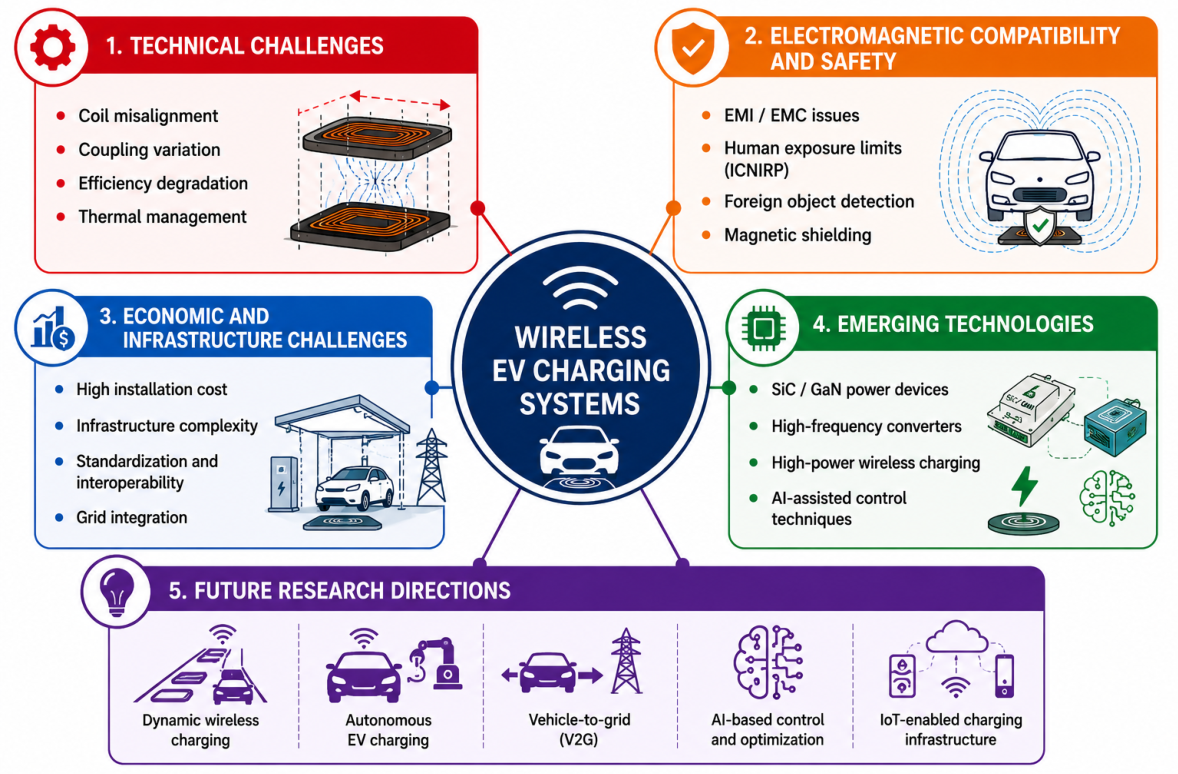
The large-scale deployment of wireless EV charging systems is influenced by a combination of technical limitations, safety requirements, economic considerations, emerging enabling technologies, and future research trends. As illustrated in Figure 9, these aspects can be categorized into five interconnected domains: technical challenges, electromagnetic compatibility and safety, economic and infrastructure challenges, emerging technologies, and future research directions. Each domain is discussed below with reference to recent developments reported in the literature.

5.1. Technical Challenges

Wireless EV charging systems are fundamentally constrained by the characteristics of loosely coupled magnetic circuits. The major technical challenges include coil misalignment, coupling variation, efficiency degradation, and thermal management. Coil misalignment reduces the mutual inductance and coupling coefficient between the transmitter and receiver pads, thereby deteriorating power transfer capability and system efficiency. Finite-element-based investigations have shown that longitudinal displacement, lateral offset, and air-gap variations significantly influence the magnetic coupling and must therefore be considered during coupler and compensation network design [89].
Coupling variation caused by vehicle positioning errors and road irregularities remains another major challenge. Misalignment-tolerant charging systems employing sensing coils and automatic positioning mechanisms have demonstrated improved robustness, while comparative studies have shown that coil geometry and compensation topology strongly influence sensitivity to coupling fluctuations [245,246]. The reduction in coupling coefficient directly translates into efficiency degradation. Experimental studies on high-power IPT systems have demonstrated noticeable efficiency reductions under increased air-gap conditions, highlighting the strong dependence of power transfer performance on alignment accuracy [34]. Thermal management represents another important concern, particularly for high-power systems where copper losses and ferrite-core losses generate significant heat. Recent investigations have explored microchannel cooling, phase-change materials, and immersion cooling techniques to improve reliability and maintain system efficiency [247].

5.2. Electromagnetic Compatibility and Safety

Operating frequencies around 85 kHz introduce electromagnetic compatibility and safety concerns that must satisfy standards such as SAE J2954 and IEC 61980. The main issues include EMI/EMC, human exposure limits, foreign object detection, and magnetic shielding. Magnetic shielding is essential for reducing stray magnetic fields and maintaining compliance with ICNIRP guidelines. Hybrid ferrite–aluminum shielding structures have been shown to reduce shielding losses while maintaining acceptable electromagnetic emission levels [73]. Human exposure studies further indicate that although field strengths generally remain within ICNIRP limits, occupant position and charging conditions should be carefully considered [248,249]. Foreign object detection (FOD) is another critical requirement because metallic objects located between the pads may experience excessive heating. Electromagnetic detection techniques and machine-learning-based approaches have recently demonstrated high detection accuracy while maintaining low computational complexity [250,251].

5.3. Economic and Infrastructure Challenges

Beyond technical considerations, the commercialization of wireless EV charging is strongly affected by economic and infrastructural constraints. The major barriers include high installation cost, infrastructure complexity, standardization and interoperability, and grid integration. Large-scale deployment requires substantial investment in charging pads, power electronics, communication systems, and civil infrastructure. Recent studies have emphasized the importance of innovative business models and coordinated public-private investment strategies to improve economic viability [252,253]. Infrastructure complexity arises from the integration of multiple subsystems, including resonant converters, communication networks, billing interfaces, and safety mechanisms. In addition, the coexistence of different standards, including SAE J2954, IEC 61980, and GB/T 38775, presents interoperability challenges that require collaboration among manufacturers, utilities, and regulatory organizations [83]. The increasing penetration of wireless charging systems also introduces grid-related concerns, including harmonic distortion and peak-load fluctuations. Grid-integrated charging architectures and advanced filtering strategies have demonstrated the capability to maintain power quality and support vehicle-to-grid operation [254,255]. Infrastructure readiness also varies considerably across different countries and regions owing to differences in charging standards, grid capabilities, regulatory policies, and public investment strategies. Countries such as Sweden, Germany, Norway, Israel, China, and the United States have initiated pilot deployments of wireless charging infrastructure for public transportation and passenger vehicles. However, large-scale commercialization remains constrained by infrastructure costs, standardization challenges, and grid integration requirements, particularly in regions where charging infrastructure and regulatory frameworks are still evolving.

5.4. Emerging Technologies

Several enabling technologies are expected to accelerate the development of next-generation wireless EV charging systems. Major trends include wide-bandgap semiconductor devices, high-frequency converters, megawatt wireless charging, and AI-assisted control techniques. Silicon carbide (SiC) and gallium nitride (GaN) devices have emerged as key technologies owing to their low switching losses, high breakdown voltage capability, and excellent thermal performance. These characteristics enable converter efficiencies exceeding 90% while significantly improving power density [256]. GaN-based bidirectional on-board chargers have further demonstrated compact size and high switching speed suitable for automotive applications [257]. Recent developments in resonant and multi-level converter architectures are enabling compact high-frequency wireless chargers with improved power density and reduced electromagnetic emissions. Furthermore, megawatt-level wireless charging systems are being investigated for heavy-duty vehicles, electric buses, and commercial transportation applications. Artificial intelligence is also becoming increasingly important in power converter control. Deep reinforcement learning and other data-driven methods have demonstrated the capability to optimize converter operation without requiring accurate mathematical models, thereby improving adaptability under varying coupling and loading conditions [240]. Higher switching frequencies have emerged as an important design trend in wireless EV charging systems because they enable reductions in passive component size and improvements in converter power density. Commercial wireless charging systems typically operate around 85 kHz in accordance with SAE J2954, whereas MHz-range operation has been actively investigated for compact and high-frequency wireless power transfer applications employing wide-bandgap semiconductor devices. Nevertheless, increasing the switching frequency introduces additional challenges related to switching losses, electromagnetic interference, and thermal management that must be carefully addressed in future converter designs.

5.5. Future Research Directions

Future developments in wireless EV charging are expected to be driven by dynamic wireless charging, autonomous charging systems, vehicle-to-grid integration, AI-based optimization, and IoT-enabled infrastructures. Dynamic wireless charging offers the possibility of transferring energy to vehicles while in motion, thereby reducing battery size requirements and alleviating range anxiety. Renewable-energy-assisted dynamic charging systems incorporating photovoltaic sources and battery storage have demonstrated promising results [91]. IoT-based adaptive charging architectures have shown improved efficiency and reduced thermal stress through real-time monitoring and optimization [81]. Autonomous charging systems are expected to enable self-driving vehicles to locate and align with charging pads without human intervention.
Vehicle-to-grid (V2G) technology transforms electric vehicles into distributed energy resources capable of supporting grid stability and peak-load management. Edge-AI-based optimization frameworks have further demonstrated the feasibility of simultaneously considering traffic conditions, user behavior, and grid constraints [258]. Artificial intelligence and the Internet of Things are expected to play a central role in future charging ecosystems. Comprehensive AIoT frameworks have shown that machine learning, cloud computing, and standardized communication protocols can facilitate intelligent charging scheduling, demand forecasting, anomaly detection, and coordinated energy management [259]. Overall, these developments indicate a transition from conventional stationary charging toward intelligent, autonomous, and grid-interactive wireless charging infrastructures. Future wireless EV charging systems are also expected to benefit from advancements in battery technologies, power transmission methods, converter architectures, and intelligent embedded control platforms. Emerging battery technologies, including solid-state and high-energy-density batteries, will impose new charging requirements related to charging profiles, battery lifespan and charge-cycle performance, thermal management, and safety. Novel power transmission approaches, such as metasurface assisted and hybrid wireless power transfer techniques, are expected to further improve transfer efficiency and charging flexibility. In addition, advanced converter topologies employing wide-bandgap semiconductor devices, together with embedded real-time control systems and AI-assisted control algorithms, will enable highly efficient and adaptive charging operation. The increasing penetration of renewable energy resources further motivates the integration of wireless EV charging systems with DC microgrids and vehicle-to-grid infrastructures, facilitating bidirectional energy exchange and intelligent energy management in future smart grids.

6. Conclusions

Wireless power transfer technology has emerged as a promising solution for next-generation electric vehicle charging owing to its capability to provide safe, convenient, and contactless energy transfer. This paper presented a comprehensive review of wireless EV charging technologies, covering the fundamental principles of wireless power transfer, system architectures, compensation networks, magnetic coupler structures, and control strategies. Static, quasi-dynamic, dynamic, and bidirectional charging configurations were discussed, highlighting their operating characteristics and application scenarios. Different compensation topologies, ranging from conventional SS, SP, PS, and PP networks to advanced hybrid structures such as LCC-S and double-sided LCC configurations, were critically analyzed. Likewise, the evolution of magnetic coupler designs from simple circular coils to DD, DDQ, bipolar, and multi-coil structures was reviewed, demonstrating the continuous efforts to improve power density, efficiency, and misalignment tolerance. The review also examined conventional, advanced, and intelligent control approaches. Frequency, phase-shift, and duty-cycle control methods continue to dominate practical implementations because of their simplicity, whereas model predictive control, adaptive control, and sliding mode control provide improved robustness and dynamic performance. Furthermore, intelligent approaches based on fuzzy logic, artificial neural networks, and reinforcement learning are increasingly enabling data-driven optimization and autonomous operation. Despite remarkable progress, several challenges continue to limit the widespread deployment of wireless EV charging systems. Coil misalignment, coupling variation, efficiency degradation, thermal management, electromagnetic compatibility, foreign object detection, infrastructure cost, and interoperability remain important concerns that require further investigation. In addition, the increasing power levels and complexity associated with dynamic charging and bidirectional vehicle-to-grid operation impose stringent requirements on converter design, communication frameworks, and system-level coordination. Emerging technologies, including wide-bandgap SiC and GaN devices, high-frequency converters, megawatt-class charging systems, and artificial intelligence-based control methods, are expected to play a pivotal role in future developments. Moreover, dynamic wireless charging, autonomous charging systems, vehicle-to-grid integration, IoT-enabled infrastructures, and AI-assisted energy management are anticipated to transform wireless charging from a standalone energy transfer technology into an intelligent and interconnected component of future transportation ecosystems. Overall, wireless EV charging is evolving rapidly from conventional stationary charging systems toward highly efficient, autonomous, and grid-interactive infrastructures. Continued advancements in power electronics, magnetic design, control algorithms, communication technologies, and international standardization will be essential for realizing reliable, sustainable, and commercially viable wireless charging solutions for next-generation electric mobility.

Author Contributions

Conceptualization, H.N.; methodology, H.N.; software, H.N.; validation, H.N.; formal analysis, H.N.; investigation, H.N.; resources, H.N.; data curation, H.N.; writing—original draft preparation, H.N.; writing—review and editing, H.N. and J.-K.S.; visualization, H.N.; supervision, J.-K.S. All authors have read and agreed to the published version of the manuscript.

Funding

This research received no external funding.

Data Availability Statement

No new data were created or analyzed in this study.

Acknowledgments

During the preparation of this manuscript, the authors used ChatGPT (OpenAI, GPT-5) for the creation of graphical icons and illustrative elements (e.g., vehicles, charging stations, transmission towers, and other symbolic graphics) included in several conceptual figures. The authors reviewed and edited the generated materials and take full responsibility for the content of this publication.

Conflicts of Interest

The authors declare no conflicts of interest.

References

  1. Habib, S.; Khan, M.M.; Abbas, F.; Sang, L.; Shahid, M.U.; Tang, H. A comprehensive study of implemented international standards, technical challenges, impacts and prospects for electric vehicles. IEEE Access 2018, 6, 13866–13890. [Google Scholar] [CrossRef] [Scilit]
  2. International Energy Agency. Global Electric Car Sales, 2014–2024. Licence: CC BY 4.0. 2025. Available online: https://www.iea.org/data-and-statistics/charts/global-electric-car-sales-2014-2024 (accessed on 22 May 2026).
  3. Mahesh, A.; Chokkalingam, B.; Mihet-Popa, L. Inductive wireless power transfer charging for electric vehicles—A review. IEEE Access 2021, 9, 137667–137713. [Google Scholar] [CrossRef] [Scilit]
  4. Khalid, M.R.; Khan, I.A.; Hameed, S.; Asghar, M.S.J.; Ro, J. A comprehensive review on structural topologies, power levels, energy storage systems, and standards for electric vehicle charging stations and their impacts on grid. IEEE Access 2021, 9, 128069–128094. [Google Scholar] [CrossRef] [Scilit]
  5. Kumar, R.; Singh, C.; Vakacharla, V.R.; Tiwari, N.; Panwar, T. Conductive and inductive charging for EVs technologies, standards: A review. In Proceedings of the 2024 IEEE 3rd International Conference on Electrical Power and Energy Systems (ICEPES); IEEE: New York, NY, USA, 2024; pp. 1–6. [Google Scholar]
  6. Sharma, P.; Sharma, A.K.; Priyadarshi, N.; Azam, F.; Padmanaban, S.; Bhoi, A.K. A comprehensive study on electrical vehicle in charging infrastructure, challenges and future scope. In Electric Vehicles: Modern Technologies and Trends; Springer: Berlin/Heidelberg, Germany, 2020; pp. 271–285. [Google Scholar]
  7. Amry, Y.; Elbouchikhi, E.; Le Gall, F.; Ghogho, M.; El Hani, S. Electric vehicle traction drives and charging station power electronics: Current status and challenges. Energies 2022, 15, 6037. [Google Scholar] [CrossRef] [Scilit]
  8. Naseem, H.; Goswami, P.; Choi, K.; Iqbal, A.; Hakami, H. Smart Charging and Vehicle-to-Grid Integration of Electric Vehicles: Technical Insights, Cybersecurity Risks, and Mobility-OrientedControl Strategies. Appl. Sci. 2026, 16, 1748. [Google Scholar] [CrossRef] [Scilit]
  9. Sagar, A.; Kashyap, A.; Nasab, M.A.; Padmanaban, S.; Bertoluzzo, M.; Kumar, A.; Blaabjerg, F. A comprehensive review of the recent development of wireless power transfer technologies for electric vehicle charging systems. IEEE Access 2023, 11, 83703–83751. [Google Scholar] [CrossRef] [Scilit]
  10. Ahmad, A.; Alam, M.S.; Chabaan, R. A comprehensive review of wireless charging technologies for electric vehicles. IEEE Trans. Transp. Electrif. 2017, 4, 38–63. [Google Scholar] [CrossRef] [Scilit]
  11. Panchal, C.; Stegen, S.; Lu, J. Review of static and dynamic wireless electric vehicle charging system. Eng. Sci. Technol. Int. J. 2018, 21, 922–937. [Google Scholar] [CrossRef] [Scilit]
  12. Trivino, A.; González-González, J.M.; Aguado, J.A. Wireless power transfer technologies applied to electric vehicles: A review. Energies 2021, 14, 1547. [Google Scholar] [CrossRef] [Scilit]
  13. Vatsa, A. Smart City Planning and Autonomous Vehicles: Liability and Privacy Concerns for Smart City Strategy. In Rethinking Resources: Strategies, Policies, and Partnerships for a Circular Future; Springer: Berlin/Heidelberg, Germany, 2025; pp. 21–35. [Google Scholar]
  14. Carbonara, F. Sustainable Urban Mobility: Dimensioning Robotaxi Fleet and Public Transportation For Future Cities. Master’s Thesis, Politecnico di Milano, Milan, Italy, 2024. Available online: https://hdl.handle.net/10589/223339 (accessed on 12 May 2026).
  15. Newbolt, T.; Mandal, P.; Wang, H.; Zane, R. Sustainability of dynamic wireless power transfer roadway for in-motion electric vehicle charging. IEEE Trans. Transp. Electrif. 2023, 10, 1347–1362. [Google Scholar] [CrossRef] [Scilit]
  16. Ahmed, M.M.; Enany, M.A.; Shaier, A.A.; Bawayan, H.M.; Hussien, S.A. An extensive overview of inductive charging technologies for stationary and in-motion electric vehicles. IEEE Access 2024, 12, 69875–69894. [Google Scholar] [CrossRef] [Scilit]
  17. Zhang, W.; Mi, C.C. Compensation topologies of high-power wireless power transfer systems. IEEE Trans. Veh. Technol. 2015, 65, 4768–4778. [Google Scholar] [CrossRef] [Scilit]
  18. Latha, B.; Irfan, M.M.; Reddy, B.K.; Basha, C.H. A novel enhancing electric vehicle charging: An updated analysis of wireless power transfer compensation topologies. Discov. Appl. Sci. 2025, 7, 240. [Google Scholar] [CrossRef] [Scilit]
  19. Chen, Y.; Zhang, H.; Park, S.J.; Kim, D.H. A comparative study of SS and LCCL-S compensation topologies in inductive power transfer systems for electric vehicles. Energies 2019, 12, 1913. [Google Scholar] [CrossRef] [Scilit]
  20. Chakibanda, V.; Komanapalli, V.L.N. Optimization in magnetic coupler design for inductively coupled wireless charging of electric vehicle: A review. Arab. J. Sci. Eng. 2023, 48, 14257–14294. [Google Scholar] [CrossRef] [Scilit]
  21. Xie, S.; Wu, L.; Zhang, X.; Huang, J.; Li, L. Misalignment-tolerant wireless power transfer system based on double-layer quadrature double-D coil with magnetic field control. IEEE Trans. Transp. Electrif. 2024, 10, 9945–9958. [Google Scholar] [CrossRef] [Scilit]
  22. Negintaji, M.; Ghaheri, A.; Afjei, E. Optimization and Comparative Study of Wireless Power Transfer Topologies for Electric Vehicles. In Proceedings of the 2024 4th International Conference on Electrical Machines and Drives (ICEMD); IEEE: New York, NY, USA, 2024; pp. 1–6. [Google Scholar]
  23. Liu, Y.; Zhang, J. Misalignment tolerance improvement and high efficiency design for wireless power transfer system based on DDQ-DD coil. Int. J. Circuit Theory Appl. 2024, 52, 111–128. [Google Scholar]
  24. Meraj, S.; Mekhilef, S.; Mubin, M.B.; Ramiah, H.; Seyedmahmoudian, M.; Stojcevski, A. Bidirectional wireless charging system for electric vehicles: A review of power converters and control techniques in V2G application. IEEE Access 2025, 13, 75246–75264. [Google Scholar] [CrossRef] [Scilit]
  25. Rajalingam, A.; Nesakumar, D.; Sathya, S.; Krishnankutty, J.E.; Pagunuran, J.R. The future of EV: Real-time development of an intelligent wireless charging system for electric vehicles. In Proceedings of the 2024 1st International Conference on Cognitive, Green and Ubiquitous Computing (IC-CGU); IEEE: New York, NY, USA, 2024; pp. 1–7. [Google Scholar]
  26. Iqbal, S.; Alshammari, N.F.; Shouran, M.; Massoud, J. Smart and sustainable wireless electric vehicle charging strategy with renewable energy and internet of things integration. Sustainability 2024, 16, 2487. [Google Scholar] [CrossRef] [Scilit]
  27. Shi, L.; Martin-Segura, G.; Fonseca, J.; Rivas, H.A.; García, O.; Fernandez, A. Analysis and modelling of normative WPT3 system based on standard SAE J2954. In Proceedings of the 2022 Wireless Power Week (WPW); IEEE: New York, NY, USA, 2022; pp. 857–860. [Google Scholar]
  28. Blankson, G.A. Frequency Hopping Wireless Power Transfer Within the SAE J2954 Operating Frequency Bandwidth for Charging Electric Vehicles. Ph.D. Thesis, Brunel University London, London, UK, 2025. [Google Scholar]
  29. Kaewnoen, P.; Nutwong, S.; Hatchavanich, N.; Mujjalinvimut, E. Design of the wireless EV charger to meet the performance requirement of SAE J2954 standard. Int. J. Power Electron. Drive Syst. 2026, 17, 11–24. [Google Scholar] [CrossRef] [Scilit]
  30. Alabsi, A.; Hawbani, A.; Wang, X.; Al-Dubai, A.; Hu, J.; Aziz, S.A.; Kumar, S.; Zhao, L.; Shvetsov, A.V.; Alsamhi, S.H. Wireless power transfer technologies, applications, and future trends: A review. IEEE Trans. Sustain. Comput. 2024, 10, 1–17. [Google Scholar] [CrossRef] [Scilit]
  31. Kodeeswaran, S.; Nandhini Gayathri, M.; Sanjeevikumar, P.; Peña-Alzola, R. High-power converters and challenges in electric vehicle wireless charging—A review. IETE J. Res. 2024, 70, 3167–3186. [Google Scholar]
  32. Liu, Z.; Li, T.; Li, S.; Mi, C.C. Advancements and challenges in wireless power transfer: A comprehensive review. Nexus 2024, 1, 100014. [Google Scholar] [CrossRef] [Scilit]
  33. Bentalhik, I.; Lassioui, A.; EL Fadil, H.; Bouanou, T.; Rachid, A.; EL Idrissi, Z.; Hamed, A.M. Analysis, design and realization of a wireless power transfer charger for electric vehicles: Theoretical approach and experimental results. World Electr. Veh. J. 2022, 13, 121. [Google Scholar] [CrossRef] [Scilit]
  34. Ayoade, I.A.; Longe, O.M. Design and experimental analysis for a high-power wireless charging system design for electric vehicles. Front. Future Transp. 2026, 7, 1739974. [Google Scholar] [CrossRef] [Scilit]
  35. Bouanou, T.; El Fadil, H.; Lassioui, A.; Bentalhik, I.; Koundi, M.; El Jeilani, S. Design methodology and circuit analysis of wireless power transfer systems applied to electric vehicles wireless chargers. World Electr. Veh. J. 2023, 14, 117. [Google Scholar] [CrossRef] [Scilit]
  36. Grazian, F.; Soeiro, T.B.; Bauer, P. Voltage/current doubler converter for an efficient wireless charging of electric vehicles with 400-V and 800-V battery voltages. IEEE Trans. Ind. Electron. 2022, 70, 7891–7903. [Google Scholar] [CrossRef] [Scilit]
  37. Li, Z.; Zhang, H.; Zhang, G.; Yu, S.; Zhang, Y.; Long, S. A novel LCC-C(CL)2 compensation network for efficient magnetically coupled resonant wireless power transfer for EV charging. Int. J. Circuit Theory Appl. 2024, 52, 2290–2317. [Google Scholar]
  38. Zhang, Y.; Wei, G.; Wang, C.; Yin, Y.; Feng, J.; Na, T.; Song, K.; Zhu, C. A hybrid compensation topology with constant current and constant voltage outputs for wireless charging system. IEEE Trans. Transp. Electrif. 2022, 9, 2070–2080. [Google Scholar] [CrossRef] [Scilit]
  39. Zhang, Y.; Wei, G.; Zhang, J.; Zhi, X.; He, H. An LCLC-LCC Compensated Wireless Charging System With Constant Current and Constant Voltage Outputs Under Variable Mutual Inductance. Int. J. Circuit Theory Appl. 2026, 54, 176–183. [Google Scholar]
  40. Zhang, Y.; Shen, Z.; Wu, Y.; Wang, H.; Pan, W. Dual-side phase-shift control for strongly coupled series–series compensated electric vehicle wireless charging systems. World Electr. Veh. J. 2021, 13, 6. [Google Scholar] [CrossRef] [Scilit]
  41. Zhang, X.; Zhu, C.; Song, H. Wireless Power Transfer Technologies for Electric Vehicles; Springer: Berlin/Heidelberg, Germany, 2022. [Google Scholar]
  42. Okasili, I.; Elkhateb, A.; Littler, T. A review of wireless power transfer systems for electric vehicle battery charging with a focus on inductive coupling. Electronics 2022, 11, 1355. [Google Scholar] [CrossRef] [Scilit]
  43. Mohammed, S.A.Q.; Jung, J.W. A comprehensive state-of-the-art review of wired/wireless charging technologies for battery electric vehicles: Classification/common topologies/future research issues. IEEE Access 2021, 9, 19572–19585. [Google Scholar] [CrossRef] [Scilit]
  44. Jang, Y.J. Survey of the operation and system study on wireless charging electric vehicle systems. Transp. Res. Part Emerg. Technol. 2018, 95, 844–866. [Google Scholar] [CrossRef] [Scilit]
  45. Machura, P.; Li, Q. A critical review on wireless charging for electric vehicles. Renew. Sustain. Energy Rev. 2019, 104, 209–234. [Google Scholar] [CrossRef] [Scilit]
  46. Özüpak, Y. Analysis and experimental verification of efficiency parameters affecting inductively coupled wireless power transfer systems. Heliyon 2024, 10, e27420. [Google Scholar] [CrossRef] [Scilit] [PubMed]
  47. Ghazizadeh, S.; Mekhilef, S.; Seyedmahmoudian, M.; Chandran, J.; Stojcevski, A. Performance evaluation of coil design in inductive power transfer for electric vehicles. IEEE Access 2024, 12, 108201–108223. [Google Scholar] [CrossRef] [Scilit]
  48. Lokhande, A.P.; Kadam, M. Review of static and dynamic wireless electric vehicle charging system. Int. J. Res. Appl. Sci. Eng. Technol. 2022, 10, 127–137. [Google Scholar] [CrossRef] [Scilit]
  49. Shen, Z.; Xie, R.; Liu, C.; Yu, X.; Cheng, X.; Zhang, Y. An electric vehicle wireless charging system with 400-V and 800-V battery tolerance and strong offset resistance. IEEE Trans. Power Electron. 2024, 40, 4722–4726. [Google Scholar] [CrossRef] [Scilit]
  50. Thiagarajan, K.; Deepa, T.; Mahalingam, P. Multi-objective hybrid optimized coil design for enhanced efficiency, improved voltage gain, and compactness for inductive power transfer. Sci. Rep. 2025, 15, 32242. [Google Scholar] [CrossRef] [Scilit] [PubMed]
  51. Lu, J.; Zhu, G.; Mi, C.C. Foreign object detection in wireless power transfer systems. IEEE Trans. Ind. Appl. 2021, 58, 1340–1354. [Google Scholar] [CrossRef] [Scilit]
  52. Xue, L.; Galigekere, V.P.; Gurpinar, E.; Su, G.J.; Chowdhury, S.; Mohammad, M.; Onar, O.C. Modular power electronics approach for high-power dynamic wireless charging system. IEEE Trans. Transp. Electrif. 2023, 10, 976–988. [Google Scholar] [CrossRef] [Scilit]
  53. Regensburger, B.; Sinha, S.; Kumar, A.; Maji, S.; Afridi, K.K. High-performance multi-MHz capacitive wireless power transfer system for EV charging utilizing interleaved-foil coupled inductors. IEEE J. Emerg. Sel. Top. Power Electron. 2020, 10, 35–51. [Google Scholar] [CrossRef] [Scilit]
  54. Wang, Y.; Zhang, H.; Cao, Y.; Lu, F. Remaining opportunities in capacitive power transfer based on duality with inductive power transfer. IEEE Trans. Transp. Electrif. 2022, 9, 2902–2915. [Google Scholar] [CrossRef] [Scilit]
  55. Sinha, S.; Kumar, A.; Pervaiz, S.; Regensburger, B.; Afridi, K.K. Design of efficient matching networks for capacitive wireless power transfer systems. In Proceedings of the 2016 IEEE 17th Workshop on Control and Modeling for Power Electronics (COMPEL); IEEE: New York, NY, USA, 2016; pp. 1–7. [Google Scholar]
  56. Amir, M.; Saifi, I.A.; Waseem, M.; Tariq, M. A critical review of compensation converters for capacitive power transfer in wireless electric vehicle charging circuit topologies. Green Energy Intell. Transp. 2025, 4, 100196. [Google Scholar] [CrossRef] [Scilit]
  57. Kodeeswaran, S.; Gayathri, M.N.; Kannabhiran, A.; Williamson, S.S. Design of a static capacitive power transfer system with six-plate coupler for electric vehicle wireless charging. IEEE Trans. Transp. Electrif. 2023, 10, 3927–3939. [Google Scholar] [CrossRef] [Scilit]
  58. Erel, M.Z.; Bayindir, K.C.; Aydemir, M.T. A new capacitive coupler design for wireless capacitive power transfer applications. Eng. Sci. Technol. Int. J. 2023, 40, 101364. [Google Scholar] [CrossRef] [Scilit]
  59. Yang, G.; Sun, P.; Liang, Y.; Zhang, X.; Shen, H. Design and Efficiency Optimization of a High-Power Capacitive Power Transfer System. Int. J. Circuit Theory Appl. 2025, 54, 3067–3081. [Google Scholar] [CrossRef] [Scilit]
  60. Mou, X.; Gladwin, D.T.; Zhao, R.; Sun, H. Survey on magnetic resonant coupling wireless power transfer technology for electric vehicle charging. IET Power Electron. 2019, 12, 3005–3020. [Google Scholar] [CrossRef] [Scilit]
  61. Hirata, A.; Onishi, T.; Shinohara, N.; De Santis, V.; Diao, Y.; Feliziani, M.; Hikage, T.; Lan, J.; Maradei, F.; Miwa, K.; et al. Electromagnetic field exposure assessment and mitigation strategies for wireless power transfer systems: A review and future perspectives. IEEE J. Wirel. Power Technol. 2026, 1, 0800119. [Google Scholar] [CrossRef] [Scilit]
  62. Wu, Y.; Nie, P.; Wang, Z.; Wang, L.; Hashimoto, S.; Kawaguchi, T. A Comprehensive Review of Magnetic Coupling Mechanisms, Compensation Networks, and Control Strategies for Electric Vehicle Wireless Power Transfer Systems. Processes 2026, 14, 287. [Google Scholar] [CrossRef] [Scilit]
  63. Xue, L.; Galigekere, V.; Su, G.J.; Zeng, R.; Mohammad, M.; Gurpinar, E.; Chowdhury, S.; Onar, O. Design and analysis of a 200 kW dynamic wireless charging system for electric vehicles. In Proceedings of the 2022 IEEE Applied Power Electronics Conference and Exposition (APEC); IEEE: New York, NY, USA, 2022; pp. 1096–1103. [Google Scholar]
  64. Tiemann, M.; Boehm, M.; Haussmann, N.; Clemens, M.; Schmuelling, B. Profitability and Cost-Effectiveness Analysis of Wireless and Conductive Charging Infrastructure for Autonomous Fleets: Insights From Real-World Data. IEEE J. Wirel. Power Technol. 2026, 1, 0101211. [Google Scholar] [CrossRef] [Scilit]
  65. Brown, W.C. The history of power transmission by radio waves. IEEE Trans. Microw. Theory Tech. 2003, 32, 1230–1242. [Google Scholar]
  66. Zhang, Q.; Shi, X.; Liu, Q.; Wu, J.; Xia, P.; Liao, Y. Adaptive distributed laser charging for efficient wireless power transfer. In Proceedings of the 2017 IEEE 86th Vehicular Technology Conference (VTC-Fall); IEEE: New York, NY, USA, 2017; pp. 1–5. [Google Scholar]
  67. Zhang, Q.; Fang, W.; Liu, Q.; Wu, J.; Xia, P.; Yang, L. Distributed laser charging: A wireless power transfer approach. IEEE Internet Things J. 2018, 5, 3853–3864. [Google Scholar] [CrossRef] [Scilit]
  68. Li, K.R.; See, K.Y.; Koh, W.J.; Zhang, J.W. Design of 2.45 GHz microwave wireless power transfer system for battery charging applications. In Proceedings of the 2017 Progress in Electromagnetics Research Symposium-Fall (PIERS-FALL); IEEE: New York, NY, USA, 2017; pp. 2417–2423. [Google Scholar]
  69. Baraskar, A.; Chen, H.; Yoshimura, Y.; Nagasaki, S.; Hanada, T. Verify the wireless power transmission in space using satellite to satellite system. Int. J. Emerg. Technol. 2021, 12, 110–118. [Google Scholar]
  70. Shinohara, N. Wireless power transmission progress for electric vehicle in Japan. In Proceedings of the 2013 IEEE Radio and Wireless Symposium; IEEE: New York, NY, USA, 2013; pp. 109–111. [Google Scholar]
  71. Shinohara, N. Beam efficiency of wireless power transmission via radio waves from short range to long range. J. Korean Inst. Electromagn. Sci. 2010, 10, 224–230. [Google Scholar] [CrossRef] [Scilit]
  72. Batool, U.; Rehman, A.; Khalil, N.; Islam, M.; Afzal, M.; Tauqeer, T. Energy extraction from RF/Microwave signal. In Proceedings of the 2012 15th International Multitopic Conference (INMIC); IEEE: New York, NY, USA, 2012; pp. 165–170. [Google Scholar]
  73. Quercio, M.; Lozito, G.M.; Corti, F.; Fulginei, F.R.; Laudani, A. Recent results in shielding technologies for wireless electric vehicle charging systems. IEEE Access 2024, 12, 16728–16740. [Google Scholar] [CrossRef] [Scilit]
  74. Woo, S.; Shin, Y.; Rhee, J.; Huh, S.; Ahn, S. Design of resonant circuit components to suppress both EMF and EMI in wireless power transfer systems for electric vehicles. IEEE J. Emerg. Sel. Top. Power Electron. 2025, 13, 4358–4368. [Google Scholar] [CrossRef] [Scilit]
  75. Zhang, Z.; Hu, Y.; Chen, X.; Jewell, G.W.; Li, H. A review on conductive common-mode EMI suppression methods in inverter fed motor drives. IEEE Access 2021, 9, 18345–18360. [Google Scholar] [CrossRef] [Scilit]
  76. Qin, R.; Li, J.; Sun, J.; Costinett, D. Shielding design for high-frequency wireless power transfer system for EV charging with self-resonant coils. IEEE Trans. Power Electron. 2023, 38, 7900–7909. [Google Scholar] [CrossRef] [Scilit]
  77. Canova, A.; Corti, F.; Laudani, A.; Lozito, G.M.; Quercio, M. Innovative shielding technique for wireless power transfer systems. IET Power Electron. 2024, 17, 962–969. [Google Scholar]
  78. Kumar, G.; Mikkili, S.; Bonthagorla, P.K. Smart and secure wireless power transfer for EVs: Exploring IoT, edge computing and blockchain solutions. IET Electr. Syst. Transp. 2025, 2025, 9926412. [Google Scholar] [CrossRef] [Scilit]
  79. Okada, R.; Ota, R.; Hoshi, N. Radiated EMI reduction and efficiency improvement in WPT systems with passive auxiliary circuits for soft-switching. In Proceedings of the 2023 IEEE Transportation Electrification Conference and Expo, Asia-Pacific (ITEC Asia-Pacific); IEEE: New York, NY, USA, 2023; pp. 1–3. [Google Scholar]
  80. Rahulkumar, J.; Narayanamoorthi, R. A review on resonant inductive coupling pad design for wireless electric vehicle charging application. Energy Rep. 2023, 10, 2047–2079. [Google Scholar] [CrossRef] [Scilit]
  81. Nandankar, P.V.; Chaturvedi, A.; Akram, P.S.; SivaramKrishnan, M.; Jayabalan, S.K.; Jelila, Y.D.; Ghouse, M.; Khan, T.Y. Experimental optimization of an IoT-driven load adaptive wireless charging system for electric vehicles using response surface methodology. Sci. Rep. 2025, 15, 43530. [Google Scholar] [CrossRef] [Scilit] [PubMed]
  82. Xue, Z.; Liu, W.; Liu, C.; Chau, K. Critical review of wireless charging technologies for electric vehicles. World Electr. Veh. J. 2025, 16, 65. [Google Scholar] [CrossRef] [Scilit]
  83. Mohamed, A.A.; Shaier, A.A.; Metwally, H.; Selem, S.I. Wireless charging technologies for electric vehicles: Inductive, capacitive, and magnetic gear. IET Power Electron. 2024, 17, 3139–3165. [Google Scholar] [CrossRef] [Scilit]
  84. Rabih, M.; Takruri, M.; Al-Hattab, M.; Alnuaimi, A.A.; Bin Thaleth, M.R. Wireless charging for electric vehicles: A survey and comprehensive guide. World Electr. Veh. J. 2024, 15, 118. [Google Scholar] [CrossRef] [Scilit]
  85. Aduama, P.; Al-Sumaiti, A.S.; Al-Hosani, K.H.; El-Shamy, A.R. Optimizing quasi-dynamic wireless charging for urban electric buses: A two-scenario mathematical framework with grid and PV-battery systems. Heliyon 2024, 10, e34857. [Google Scholar] [CrossRef] [Scilit] [PubMed]
  86. Correa, D.; Jakub, G.; Moyano, C. Systematic design of wireless charging transportation network. Transp. Res. Procedia 2021, 58, 527–534. [Google Scholar] [CrossRef] [Scilit]
  87. Colombo, C.G.; Chen, J.; Borgosano, S.; Longo, M. Inductive Wireless Power Transfer for Electric Vehicles: Technologies, Standards, and Deployment Readiness from Static Pads to Dynamic Roads. Future Transp. 2026, 6, 77. [Google Scholar] [CrossRef] [Scilit]
  88. Loureiro, M.; Pereira, R.M.; Pereira, A.J. Dynamic wireless charging for micromobility under electromagnetic field exposure regulations: A review of smart grid control and charging optimisation approaches. Sustainability 2026, 18, 2191. [Google Scholar] [CrossRef] [Scilit]
  89. Chowdary, K.V.; Kumar, K.; Nayak, B.; Kumar, A.; Bertoluzzo, M. Dynamic wireless charging performance enhancement for electric vehicles: Mutual inductance, power transfer capability, and efficiency. Vehicles 2023, 5, 1313–1327. [Google Scholar] [CrossRef] [Scilit]
  90. Korakianitis, N.S.; Nikolaos, N.; Vokas, G.A.; Ioannidis, G.C.; Kaminaris, S.D. Simulation-Based evaluation of dynamic wireless charging systems for electric vehicles: Efficiency, limitations, and future directions. AIMS Energy 2025, 13, 590–631. [Google Scholar] [CrossRef] [Scilit]
  91. Megahed, T.F.; Mansour, D.E.A.; Nayebare, D.; Kotb, M.F.; Fares, A.; Hameed, I.A.; El-Hussieny, H. Dynamic wireless charging of electric vehicles using PV units in highways. World Electr. Veh. J. 2024, 15, 463. [Google Scholar] [CrossRef] [Scilit]
  92. Automotive World. Dynamic Wireless Charging Advances from Proofs to Permits. 2025. Available online: https://www.automotiveworld.com/articles/dynamic-wireless-charging-advances-from-proofs-to-permits/ (accessed on 23 June 2026).
  93. Ye, Z.; Bragin, M.A.; Yu, N.; Wei, R. Joint planning of dynamic wireless charging lanes and power delivery infrastructure for heavy-duty drayage trucks. Appl. Energy 2024, 375, 124029. [Google Scholar] [CrossRef] [Scilit]
  94. Majidi, M.; Parvania, M. Dynamic in-motion wireless charging systems: Modelling and coordinated hierarchical operation in distribution systems. IET Gener. Transm. Distrib. 2024, 18, 3151–3160. [Google Scholar] [CrossRef] [Scilit]
  95. Naseem, H.; Seok, J.K. Recent advances in bidirectional converters and regenerative braking systems in electric vehicles. Actuators 2025, 14, 347. [Google Scholar] [CrossRef] [Scilit]
  96. Ayoade, I.A.; Longe, O.M. Modelling and analysis of onboard bidirectional charger for vehicle-to-grid and vehicle-to-load in electromobility energy systems. Eng. Res. Express 2025, 7, 035314. [Google Scholar] [CrossRef] [Scilit]
  97. Triviño-Cabrera, A.; González-González, J.M.; Aguado, J.A. Wireless Power Transfer for Electric Vehicles: Foundations and Design Approach; Springer International Publishing: Cham, Switzerland, 2020. [Google Scholar]
  98. Aktas, A.; Aydin, E.; Onar, O.C.; Su, G.J.; Ozpineci, B.; Tolbert, L.M. Medium-duty delivery truck integrated bidirectional wireless power transfer system with grid and stationary energy storage system connectivity. IEEE J. Emerg. Sel. Top. Power Electron. 2024, 12, 5364–5382. [Google Scholar] [CrossRef] [Scilit]
  99. Upputuri, R.P.; Subudhi, B. A comprehensive review and performance evaluation of bidirectional charger topologies for V2G/G2V operations in EV applications. IEEE Trans. Transp. Electrif. 2023, 10, 583–595. [Google Scholar]
  100. Bandyopadhyay, S.; Prasanth, V.; Elizondo, L.R.; Bauer, P. Design considerations for a misalignment tolerant wireless inductive power system for electric vehicle (EV) charging. In Proceedings of the 2017 19th European Conference on Power Electronics and Applications (EPE’17 ECCE Europe); IEEE: New York, NY, USA, 2017; pp. P.1–P.10. [Google Scholar]
  101. Villa, J.; Sanz, J.; Acerete, R.; Perie, M. Design considerations for WPT Dynamic charging applications. In Proceedings of the 2019 AEIT International Conference of Electrical and Electronic Technologies for Automotive (AEIT AUTOMOTIVE); IEEE: New York, NY, USA, 2019; pp. 1–6. [Google Scholar]
  102. Wang, C.S.; Covic, G.A.; Stielau, O.H. Investigating an LCL load resonant inverter for inductive power transfer applications. IEEE Trans. Power Electron. 2004, 19, 995–1002. [Google Scholar] [CrossRef] [Scilit]
  103. Zhang, W.; Wong, S.C.; Chi, K.T.; Chen, Q. Analysis and comparison of secondary series-and parallel-compensated inductive power transfer systems operating for optimal efficiency and load-independent voltage-transfer ratio. IEEE Trans. Power Electron. 2013, 29, 2979–2990. [Google Scholar]
  104. Nam, I.; Dougal, R.; Santi, E. General optimal design method for series-series resonant tank in loosely-coupled wireless power transfer applications. In Proceedings of the 2014 IEEE Applied Power Electronics Conference and Exposition-APEC 2014; IEEE: New York, NY, USA, 2014; pp. 857–866. [Google Scholar]
  105. Zhang, W.; Wong, S.C.; Chi, K.T.; Chen, Q. An optimized track length in roadway inductive power transfer systems. IEEE J. Emerg. Sel. Top. Power Electron. 2014, 2, 598–608. [Google Scholar] [CrossRef] [Scilit]
  106. Shu, X.; Wu, G.; Jiang, Y. Comparative analysis of SS, SP, PP and PS topologies for magnetic coupled wireless power transfer system composed of the negative resistor. Energies 2023, 16, 7336. [Google Scholar] [CrossRef] [Scilit]
  107. Zhang, Y.; Pan, W.; Wang, H.; Shen, Z.; Wu, Y.; Dong, J.; Mao, X. Misalignment-tolerant dual-transmitter electric vehicle wireless charging system with reconfigurable topologies. IEEE Trans. Power Electron. 2022, 37, 8816–8819. [Google Scholar] [CrossRef] [Scilit]
  108. Nakutis, Ž.; Lukočius, R.; Girdenis, V.; Kroičs, K. A measurement method of power transferred to an electric vehicle using wireless charging. Sensors 2023, 23, 9636. [Google Scholar] [CrossRef] [Scilit] [PubMed]
  109. Mao, X.; Chen, J.; Zhang, Y.; Dong, J. A simple and reconfigurable wireless power transfer system with constant voltage and constant current charging. IEEE Trans. Power Electron. 2021, 37, 4921–4925. [Google Scholar] [CrossRef] [Scilit]
  110. Zhang, W.; Xia, L.; Hong, X.; Gong, C.; Shen, L.; Ruan, Z.; Cheng, S.; Negue, D.M. Comparison of compensation topologies for wireless charging systems in EV applications. In Proceedings of the 2022 International Conference on Artificial Intelligence in Everything (AIE); IEEE: New York, NY, USA, 2022; pp. 17–21. [Google Scholar]
  111. Biswal, S.S.; Mohanty, P.P.; Kar, D.P.; Bhuyan, S. Convenience assessment of SS and SP compensation topologies used in wireless power transfer system for battery charging. In Proceedings of the 2023 International Conference in Advances in Power, Signal, and Information Technology (APSIT); IEEE: New York, NY, USA, 2023; pp. 516–519. [Google Scholar]
  112. Jose, J.; Therattil, J.P. WPT compensation topology optimized for PV embedded electric vehicle. Sustain. Energy Technol. Assess. 2022, 53, 102605. [Google Scholar] [CrossRef] [Scilit]
  113. Komeda, S. Characteristics of primary-parallel-compensation methods for wireless power transfer systems. In Proceedings of the 2021 IEEE 12th Energy Conversion Congress & Exposition-Asia (ECCE-Asia); IEEE: New York, NY, USA, 2021; pp. 1138–1143. [Google Scholar]
  114. Venkatesan, M.; Rajamanickam, N.; Vishnuram, P.; Bajaj, M.; Blazek, V.; Prokop, L.; Misak, S. A review of compensation topologies and control techniques of bidirectional wireless power transfer systems for electric vehicle applications. Energies 2022, 15, 7816. [Google Scholar] [CrossRef] [Scilit]
  115. Esteban, B.; Sid-Ahmed, M.; Kar, N.C. A comparative study of power supply architectures in wireless EV charging systems. IEEE Trans. Power Electron. 2015, 30, 6408–6422. [Google Scholar] [CrossRef] [Scilit]
  116. Thrimawithana, D.J.; Madawala, U.K. A generalized steady-state model for bidirectional IPT systems. IEEE Trans. Power Electron. 2013, 28, 4681–4689. [Google Scholar] [CrossRef] [Scilit]
  117. Madawala, U.K.; Thrimawithana, D.J. A bidirectional inductive power interface for electric vehicles in V2G systems. IEEE Trans. Ind. Electron. 2011, 58, 4789–4796. [Google Scholar] [CrossRef] [Scilit]
  118. Kan, T.; Nguyen, T.D.; White, J.C.; Malhan, R.K.; Mi, C.C. A new integration method for an electric vehicle wireless charging system using LCC compensation topology: Analysis and design. IEEE Trans. Power Electron. 2016, 32, 1638–1650. [Google Scholar] [CrossRef] [Scilit]
  119. Zaheer, A.; Neath, M.; Beh, H.Z.Z.; Covic, G.A. A dynamic EV charging system for slow moving traffic applications. IEEE Trans. Transp. Electrif. 2016, 3, 354–369. [Google Scholar] [CrossRef] [Scilit]
  120. Yang, L.; Li, X.; Xu, Z.; Liu, S.; Dong, Z.; Wu, Y. Analysis and design of a high-efficiency three-coil WPT system with constant current output. IET Electr. Power Appl. 2020, 14, 1933–1943. [Google Scholar] [CrossRef] [Scilit]
  121. Mai, R.; Chen, Y.; Li, Y.; Zhang, Y.; Cao, G.; He, Z. Inductive power transfer for massive electric bicycles charging based on hybrid topology switching with a single inverter. IEEE Trans. Power Electron. 2017, 32, 5897–5906. [Google Scholar] [CrossRef] [Scilit]
  122. Li, S.; Li, W.; Deng, J.; Nguyen, T.D.; Mi, C.C. A double-sided LCC compensation network and its tuning method for wireless power transfer. IEEE Trans. Veh. Technol. 2014, 64, 2261–2273. [Google Scholar] [CrossRef] [Scilit]
  123. Chen, Y.; Kou, Z.; Zhang, Y.; He, Z.; Mai, R.; Cao, G. Hybrid topology with configurable charge current and charge voltage output-based WPT charger for massive electric bicycles. IEEE J. Emerg. Sel. Top. Power Electron. 2017, 6, 1581–1594. [Google Scholar] [CrossRef] [Scilit]
  124. Deng, J.; Li, W.; Nguyen, T.D.; Li, S.; Mi, C.C. Compact and efficient bipolar coupler for wireless power chargers: Design and analysis. IEEE Trans. Power Electron. 2015, 30, 6130–6140. [Google Scholar] [CrossRef] [Scilit]
  125. Li, W.; Zhao, H.; Li, S.; Deng, J.; Kan, T.; Mi, C.C. Integrated LCC compensation topology for wireless charger in electric and plug-in electric vehicles. IEEE Trans. Ind. Electron. 2014, 62, 4215–4225. [Google Scholar]
  126. Shi, W.; Deng, J.; Wang, Z.; Cheng, X. The start-up dynamic analysis and one cycle control-PD control combined strategy for primary-side controlled wireless power transfer system. IEEE Access 2018, 6, 14439–14450. [Google Scholar] [CrossRef] [Scilit]
  127. Hatchavanich, N.; Konghirun, M.; Saengswang, A. LCL—LCCL voltage source inverter with phase shift control for wireless EV charger. In Proceedings of the 2017 IEEE 12th International Conference on Power Electronics and Drive Systems (PEDS); IEEE: New York, NY, USA, 2017; pp. 297–301. [Google Scholar]
  128. Villa, J.L.; Sallan, J.; Osorio, J.F.S.; Llombart, A. High-misalignment tolerant compensation topology for ICPT systems. IEEE Trans. Ind. Electron. 2011, 59, 945–951. [Google Scholar] [CrossRef] [Scilit]
  129. Zhu, Q.; Guo, Y.; Wang, L.; Liao, C.; Li, F. Improving the misalignment tolerance of wireless charging system by optimizing the compensate capacitor. IEEE Trans. Ind. Electron. 2015, 62, 4832–4836. [Google Scholar] [CrossRef] [Scilit]
  130. Lim, Y.; Tang, H.; Lim, S.; Park, J. An adaptive impedance-matching network based on a novel capacitor matrix for wireless power transfer. IEEE Trans. Power Electron. 2013, 29, 4403–4413. [Google Scholar] [CrossRef] [Scilit]
  131. Zakerian, A.; Vaez-Zadeh, S.; Babaki, A. A dynamic WPT system with high efficiency and high power factor for electric vehicles. IEEE Trans. Power Electron. 2019, 35, 6732–6740. [Google Scholar] [CrossRef] [Scilit]
  132. Diekhans, T.; De Doncker, R.W. A dual-side controlled inductive power transfer system optimized for large coupling factor variations and partial load. IEEE Trans. Power Electron. 2015, 30, 6320–6328. [Google Scholar] [CrossRef] [Scilit]
  133. Li, W.; Zhao, H.; Deng, J.; Li, S.; Mi, C.C. Comparison study on SS and double-sided LCC compensation topologies for EV/PHEV wireless chargers. IEEE Trans. Veh. Technol. 2015, 65, 4429–4439. [Google Scholar]
  134. Hou, J.; Chen, Q.; Yan, K.; Ren, X.; Wong, S.C.; Tse, C.K. Analysis and control of S/SP compensation contactless resonant converter with constant voltage gain. In Proceedings of the 2013 IEEE Energy Conversion Congress and Exposition; IEEE: New York, NY, USA, 2013; pp. 2552–2558. [Google Scholar]
  135. Hou, J.; Chen, Q.; Ren, X.; Ruan, X.; Wong, S.C.; Tse, C.K. Precise characteristics analysis of series/series-parallel compensated contactless resonant converter. IEEE J. Emerg. Sel. Top. Power Electron. 2014, 3, 101–110. [Google Scholar]
  136. Li, Z.; Zhu, C.; Jiang, J.; Song, K.; Wei, G. A 3-kW wireless power transfer system for sightseeing car supercapacitor charge. IEEE Trans. Power Electron. 2016, 32, 3301–3316. [Google Scholar] [CrossRef] [Scilit]
  137. Miller, J.M.; Onar, O.C.; Chinthavali, M. Primary-side power flow control of wireless power transfer for electric vehicle charging. IEEE J. Emerg. Sel. Top. Power Electron. 2014, 3, 147–162. [Google Scholar] [CrossRef] [Scilit]
  138. Moon, S.; Moon, G.W. Wireless power transfer system with an asymmetric four-coil resonator for electric vehicle battery chargers. IEEE Trans. Power Electron. 2015, 31, 6844–6854. [Google Scholar]
  139. Miller, J.M.; Daga, A. Elements of wireless power transfer essential to high power charging of heavy duty vehicles. IEEE Trans. Transp. Electrif. 2015, 1, 26–39. [Google Scholar] [CrossRef] [Scilit]
  140. Bosshard, R.; Kolar, J.W. Inductive power transfer for electric vehicle charging: Technical challenges and tradeoffs. IEEE Power Electron. Mag. 2016, 3, 22–30. [Google Scholar] [CrossRef] [Scilit]
  141. Long, B.R.; Miller, J.M.; Daga, A.; Schrafel, P.C.; Wolgemuth, J. Which way for wireless power: High Q or high k? In Proceedings of the 2016 IEEE PELS Workshop on Emerging Technologies: Wireless Power Transfer (WoW); IEEE: New York, NY, USA, 2016; pp. 6–10. [Google Scholar]
  142. Budhia, M.; Covic, G.A.; Boys, J.T. Design and optimization of circular magnetic structures for lumped inductive power transfer systems. IEEE Trans. Power Electron. 2011, 26, 3096–3108. [Google Scholar] [CrossRef] [Scilit]
  143. Budhia, M.; Boys, J.T.; Covic, G.A.; Huang, C.Y. Development of a single-sided flux magnetic coupler for electric vehicle IPT charging systems. IEEE Trans. Ind. Electron. 2011, 60, 318–328. [Google Scholar] [CrossRef] [Scilit]
  144. Budhia, M.; Covic, G.; Boys, J. A new IPT magnetic coupler for electric vehicle charging systems. In Proceedings of the IECON 2010-36th Annual Conference on IEEE Industrial Electronics Society; IEEE: New York, NY, USA, 2010; pp. 2487–2492. [Google Scholar]
  145. Zaheer, A.; Covic, G.A.; Kacprzak, D. A bipolar pad in a 10-kHz 300-W distributed IPT system for AGV applications. IEEE Trans. Ind. Electron. 2013, 61, 3288–3301. [Google Scholar] [CrossRef] [Scilit]
  146. Patil, D.; Ditsworth, M.; Pacheco, J.; Cai, W. A magnetically enhanced wireless power transfer system for compensation of misalignment in mobile charging platforms. In Proceedings of the 2015 IEEE Energy Conversion Congress and Exposition (ECCE); IEEE: New York, NY, USA, 2015; pp. 1286–1293. [Google Scholar]
  147. Kim, S.; Covic, G.A.; Boys, J.T. Tripolar pad for inductive power transfer systems for EV charging. IEEE Trans. Power Electron. 2016, 32, 5045–5057. [Google Scholar] [CrossRef] [Scilit]
  148. Kiani, M.; Jow, U.M.; Ghovanloo, M. Design and optimization of a 3-coil inductive link for efficient wireless power transmission. IEEE Trans. Biomed. Circuits Syst. 2011, 5, 579–591. [Google Scholar] [CrossRef] [Scilit]
  149. Moon, S.; Kim, B.C.; Cho, S.Y.; Ahn, C.H.; Moon, G.W. Analysis and design of a wireless power transfer system with an intermediate coil for high efficiency. IEEE Trans. Ind. Electron. 2014, 61, 5861–5870. [Google Scholar] [CrossRef] [Scilit]
  150. Covic, G.A.; Boys, J.T. Modern trends in inductive power transfer for transportation applications. IEEE J. Emerg. Sel. Top. Power Electron. 2013, 1, 28–41. [Google Scholar] [CrossRef] [Scilit]
  151. Covic, G.A.; Kissin, M.L.; Kacprzak, D.; Clausen, N.; Hao, H. A bipolar primary pad topology for EV stationary charging and highway power by inductive coupling. In Proceedings of the 2011 IEEE Energy Conversion Congress and Exposition; IEEE: New York, NY, USA, 2011; pp. 1832–1838. [Google Scholar]
  152. Kim, S.; Zaheer, A.; Covic, G.; Boys, J. Tripolar pad for inductive power transfer systems. In Proceedings of the IECON 2014-40th Annual Conference of the IEEE Industrial Electronics Society; IEEE: New York, NY, USA, 2014; pp. 3066–3072. [Google Scholar]
  153. International Commission on Non-Ionizing Radiation Protection. Guidelines for limiting exposure to time-varying electric and magnetic fields (1 Hz to 100 kHz). Health Phys. 2010, 99, 818–836. [Google Scholar] [CrossRef] [Scilit] [PubMed]
  154. Zhang, J.; Yuan, X.; Wang, C.; He, Y. Comparative analysis of two-coil and three-coil structures for wireless power transfer. IEEE Trans. Power Electron. 2016, 32, 341–352. [Google Scholar]
  155. Deng, J.; Li, W.; Li, S.; Mi, C. Magnetic integration of LCC compensated resonant converter for inductive power transfer applications. In Proceedings of the 2014 IEEE Energy Conversion Congress and Exposition (ECCE); IEEE: New York, NY, USA, 2014; pp. 660–667. [Google Scholar]
  156. Prosen, N.; Domajnko, J.; Milanovič, M. Wireless power transfer using double DD coils. Electronics 2021, 10, 2528. [Google Scholar] [CrossRef] [Scilit]
  157. Domajnko, J.; Prosen, N. A wireless power transfer system using a double DD quadrature coil structure. Electronics 2023, 12, 890. [Google Scholar] [CrossRef] [Scilit]
  158. Bailey, A.K.; Zhang, W.; Kim, S.; Covic, G.A. Anisotropic characterization of nanocrystalline alloys for inductive power transfer. IEEE Open J. Power Electron. 2024, 5, 1830–1841. [Google Scholar] [CrossRef] [Scilit]
  159. Liang, Z.; Luo, Z.; Zhang, B. An integrated inductive-capacitive nanocrystalline core for compact inductive power transfer systems. IEEE Trans. Power Electron. 2025, 40, 14351–14355. [Google Scholar] [CrossRef] [Scilit]
  160. Ramadoss, V.; Chandrasekar, B.; Ahmed, M.; Savio, D.; Rajamanickam, N.; Alghamdi, T.A. Research insights on recent power converter topologies and control strategies for wireless EV chargers: A comprehensive study. IEEE Open J. Power Electron. 2024, 5, 1641–1658. [Google Scholar] [CrossRef] [Scilit]
  161. Kushwaha, S.; Parakh, A. Design & Simulation of Totem-Pole PFC integrated LLC Resonant Converter For EV Application. In Proceedings of the 2025 IEEE International Conference on Interdisciplinary Approaches in Technology and Management for Social Innovation (IATMSI); IEEE: New York, NY, USA, 2025; Volume 3, pp. 1–6. [Google Scholar]
  162. Ali, T.F.; Dominic, D.A.; Prabhakaran, P.; Parameswaran, A.P. A bidirectional interleaved totem pole PFC-based integrated on-board charger for EV SRM drive. IEEE Access 2024, 12, 101909–101920. [Google Scholar] [CrossRef] [Scilit]
  163. Dakka, O.; Patthi, S.; Rao, J.R.; Kumar, P. A 5-kW unidirectional wireless power transfer EV charger with a novel multi-level PFC boost converter on front-end side. J. Eng. Appl. Sci. 2024, 71, 7. [Google Scholar] [CrossRef] [Scilit]
  164. Harahap, P.; Hamid, M.I.; Hazmi, A. Comprehensive Review of Advanced Multi-Pulse Rectifier Technology and Its Application in Electric Vehicle Fast Charging Systems. Andalasian Int. J. Appl. Sci. Eng. Technol. 2025, 5, 45–54. [Google Scholar] [CrossRef] [Scilit]
  165. Mahesh, A.; Chokkalingam, B.; Padmanaban, S.; Santhakumar, C. Analysis and implementation of variable frequency controlled dynamic wireless charging system with half-bridge multi-leg converter topology. Sci. Rep. 2025, 15, 22663. [Google Scholar] [CrossRef] [Scilit] [PubMed]
  166. Côte, N.; Garraud, N.; Sterna, L.; Périchon, P.; Frassati, F.; Boisseau, S. A design method to optimize GaN-based class E resonant inductive wireless power transfer systems–application to non-mating connectors. Eng. Res. Express 2025, 7, 015336. [Google Scholar] [CrossRef] [Scilit]
  167. Chevinly, J.; Rad, S.S.; Nadi, E.; Proca, B.; Wolgemuth, J.; Calabro, A.; Zhang, H.; Lu, F. Gallium nitride (GaN) based high-power multilevel H-bridge inverter for wireless power transfer of electric vehicles. In Proceedings of the 2024 IEEE Transportation Electrification Conference and Expo (ITEC); IEEE: New York, NY, USA, 2024; pp. 1–5. [Google Scholar]
  168. Venugopal, R.; Balaji, C. Novel wireless ev charging system utilizing boost integrated multilevel inverter. Iran. J. Sci. Technol. Trans. Electr. Eng. 2025, 49, 109–127. [Google Scholar]
  169. Ekkaravarodome, C.; Feungkeaw, S.; Bilsalam, A.; Jirasereeamornkul, K.; Kumsuwan, Y. Analysis of a ZVDS class-DE current-driven full-bridge rectifier to compensation network capacitance design for WPT system. AEU-Int. J. Electron. Commun. 2025, 191, 155660. [Google Scholar] [CrossRef] [Scilit]
  170. Triviño, A.; Casaucao, I.; Castilla, M. Flexible regulation of active and reactive power for a fully controllable V2G wireless charger. IEEE Trans. Transp. Electrif. 2023, 10, 1070–1079. [Google Scholar] [CrossRef] [Scilit]
  171. Li, T.; Li, S.; Liu, Z.; Fang, Y.; Xiao, Z.; Shafiq, Z.; Lu, S. Enhancing V2G applications: Analysis and optimization of a CC/CV bidirectional IPT system with wide range ZVS. IEEE Trans. Transp. Electrif. 2024, 10, 10182–10196. [Google Scholar] [CrossRef] [Scilit]
  172. Muhammetoglu, B.; Jamil, M. Dual active Bridge converter with interleaved and parallel operation for electric vehicle charging. Energies 2024, 17, 4258. [Google Scholar] [CrossRef] [Scilit]
  173. Wu, S.T.; Chen, J.Y. Implementation of a CC-CV wireless charging bidirectional resonant converter for electric vehicles. Wirel. Power Transf. 2024, 12, e002. [Google Scholar] [CrossRef] [Scilit]
  174. Tran, D.H.; Choi, W. Design of a high-efficiency wireless power transfer system with intermediate coils for the on-board chargers of electric vehicles. IEEE Trans. Power Electron. 2017, 33, 175–187. [Google Scholar]
  175. Tan, P.; Song, B.; Lei, W.; Yin, H.; Zhang, B. Decoupling control of double-side frequency tuning for LCC/S WPT system. IEEE Trans. Ind. Electron. 2022, 70, 11163–11173. [Google Scholar]
  176. Li, W.; Wei, G.; Cui, C.; Zhang, X.; Zhang, Q. A double-side self-tuning LCC/S system using a variable switched capacitor based on parameter recognition. IEEE Trans. Ind. Electron. 2020, 68, 3069–3078. [Google Scholar]
  177. Safari, R.; Hamzeh, M.; Dehkordi, N.M. Deep Reinforcement Learning-Aided Frequency Control of LCC-S Resonant Converters for Wireless Power Transfer Systems. IEEE J. Emerg. Sel. Top. Power Electron. 2025, 14, 2723–2733. [Google Scholar] [CrossRef] [Scilit]
  178. Lu, J.; Sun, S.; Ke, H.; Zhu, G. Triple phase shift modulation scheme for bidirectional wireless power transfer systems with efficiency maximization. IEEE Trans. Circuits Syst. II Express Briefs 2024, 71, 5029–5033. [Google Scholar] [CrossRef] [Scilit]
  179. Naseem, H.; Seok, J.K. Triple-phase shift power-level controller (TPSPC) for single-phase dual active bridge (DAB) DC/DC converter. In Proceedings of the 2022 IEEE Energy Conversion Congress and Exposition (ECCE); IEEE: New York, NY, USA, 2022; pp. 1–5. [Google Scholar]
  180. Cheong, Y.; Cao, S.; Naayagi, R.T.; Lee, S. Triple phase shift control of wireless charging DAB LCC resonant converter for unity power factor operation with optimized rectifier AC load resistance. Appl. Sci. 2022, 12, 11871. [Google Scholar] [CrossRef] [Scilit]
  181. Zhu, G.; Dong, J.; Shi, W.; Soeiro, T.B.; Xu, J.; Bauer, P. A mode-switching-based phase shift control for optimized efficiency and wide ZVS operations in wireless power transfer systems. IEEE Trans. Power Electron. 2022, 38, 5561–5575. [Google Scholar]
  182. Zhang, X.; Zhang, Q.; Zhang, F. Triple phase ratio shift control for bidirectional wireless power transfer application based on totem-pole single-stage AC-AC converter. IEEE Trans. Power Electron. 2025, 40, 11863–11873. [Google Scholar] [CrossRef] [Scilit]
  183. Vinod, M.; Kishan, D.; Reddy, B.D.; Harischandrappa, N. Efficient and cost-effective wireless CC/CV charging for electric vehicles: A bipolar duty cycle approach. Comput. Electr. Eng. 2024, 118, 109470. [Google Scholar] [CrossRef] [Scilit]
  184. Munsi, A.; Pradhan, S.; Aditya, K. Perspectives on control strategies for CC-CV charging in Resonant Inductive Power Transfer systems: A review of SS-RIPT configuration. Wirel. Power Transf. 2024, 11, e009. [Google Scholar] [CrossRef] [Scilit]
  185. Arulvendhan, K.; Nagaratnam, S.K.; Narayanamoorthi, R.; Milyani, A.H.; Alghamdi, S.; Alruwaili, M. Primary side hybrid reconfigurable compensation for wireless EV charging with constant current/constant voltage control. IEEE Access 2024, 12, 149960–149976. [Google Scholar] [CrossRef] [Scilit]
  186. Yenil, V.; Cetin, S. Load independent constant current and constant voltage control of LCC-series compensated wireless EV charger. IEEE Trans. Power Electron. 2022, 37, 8701–8712. [Google Scholar] [CrossRef] [Scilit]
  187. John, F.; Komarasamy, P.R.G.; Rajamanickam, N.; Vavra, L.; Petrov, J.; Kral, V. Performance improvement of wireless power transfer system for sustainable EV charging using dead-time integrated pulse density modulation approach. Sustainability 2024, 16, 7045. [Google Scholar] [CrossRef] [Scilit]
  188. Li, Y.; Sun, W.; Zhu, X.; Hu, J. A hybrid modulation control for wireless power transfer systems to improve efficiency under light-load conditions. IEEE Trans. Ind. Electron. 2021, 69, 6870–6880. [Google Scholar] [CrossRef] [Scilit]
  189. Vinod, M.; Kishan, D.; Kannan, R.; Iqbal, A.; Mohammed Sulthan, S. Primary side control strategies for battery charging regulation in wireless power transfer systems for EV applications. IET Power Electron. 2024, 17, 941–952. [Google Scholar] [CrossRef] [Scilit]
  190. Lu, J.; Zhu, G.; Lin, D.; Zhang, Y.; Jiang, J.; Mi, C.C. Unified load-independent ZPA analysis and design in CC and CV modes of higher order resonant circuits for WPT systems. IEEE Trans. Transp. Electrif. 2019, 5, 977–987. [Google Scholar] [CrossRef] [Scilit]
  191. Wang, J.; Wang, C.; Zhang, S.; Yuan, H.; Zhang, Q.; Li, D. Constant-current and constant-voltage output using hybrid compensated single-stage resonant converter for wireless power transfer. IEEE J. Emerg. Sel. Top. Power Electron. 2022, 10, 6371–6382. [Google Scholar] [CrossRef] [Scilit]
  192. Alkasir, A.; Abdollahi, S.E.; Abdollahi, S.R.; Wheeler, P. Enhancement of dynamic wireless power transfer system by model predictive control. IET Power Electron. 2022, 15, 67–79. [Google Scholar]
  193. Cao, L.; Sun, W.; He, J.; Loo, K.H. A computationally efficient hybrid optimization-based model predictive control for inductive power transfer systems. IET Power Electron. 2022, 15, 689–700. [Google Scholar] [CrossRef] [Scilit]
  194. González-González, J.M.; Triviño-Cabrera, A.; Aguado, J.A. Model predictive control to maximize the efficiency in EV wireless chargers. IEEE Trans. Ind. Electron. 2021, 69, 1244–1253. [Google Scholar] [CrossRef] [Scilit]
  195. Chen, S.; Ding, W.; Huo, L.; Wu, X.; Shi, S.; Hu, R. Dynamic improvement and efficiency optimization of wireless power transfer systems using improved FCS-MPC and P&O methods. IEEE Trans. Power Electron. 2023, 38, 14702–14718. [Google Scholar] [CrossRef] [Scilit]
  196. Yue, J.; Liu, Z.; Su, H. Model-free composite disturbance rejection control for dynamic wireless charging system based on online parameter identification. IEEE Trans. Ind. Electron. 2023, 71, 7777–7785. [Google Scholar] [CrossRef] [Scilit]
  197. Yadav, I.C.; Bajpai, R.S.; Gupta, S.; Shukla, A. Hybrid fuzzy-MPC based multi-objective control strategy for fast charging of electric vehicles with advanced battery thermal management and renewable grid support. Sci. Rep. 2025, 15, 42342. [Google Scholar] [CrossRef] [Scilit] [PubMed]
  198. Li, Z.; Li, L. Energy injection adaptive technology for wireless power transmission based on parameter identification. IET Power Electron. 2024, 17, 1820–1829. [Google Scholar] [CrossRef] [Scilit]
  199. Savaedi, H.; Yazdi, S.S.H.; Bagheri, M.; Namadmalan, A. Accurate and fast load estimation under detuned operation of IPT systems. Int. J. Circuit Theory Appl. 2025, 53, 5613–5625. [Google Scholar] [CrossRef] [Scilit]
  200. Dai, R.; Zhou, W.; Chen, Y.; Zhu, Z.; Mai, R. Pulse density modulation based mutual inductance and load resistance identification method for wireless power transfer system. IEEE Trans. Power Electron. 2022, 37, 9933–9943. [Google Scholar] [CrossRef] [Scilit]
  201. Yue, K.; Liu, Y.; Zhang, X.; Fu, M.; Liang, J.; Wang, H. Transmitter-side voltage-based mutual inductances and load tracking for two-transmitter LCC-S compensated wireless power transfer systems. IEEE J. Emerg. Sel. Top. Power Electron. 2023, 12, 2317–2332. [Google Scholar]
  202. Chen, K.; Zhang, Z. Rotating-coordinate-based mutual inductance estimation for drone in-flight wireless charging systems. IEEE Trans. Power Electron. 2023, 38, 11685–11693. [Google Scholar] [CrossRef] [Scilit]
  203. Song, K.; Lan, Y.; Wei, R.; Yang, G.; Yang, F.; Li, W.; Jiang, J.; Zhu, C.; Li, Y. A control strategy for wireless EV charging system to improve weak coupling output based on variable inductor and capacitor. IEEE Trans. Power Electron. 2022, 37, 12853–12864. [Google Scholar] [CrossRef] [Scilit]
  204. Yenil, V. A wireless power transfer system with high misalignment tolerance based on dual side variable inductor control. IEEE Access 2024, 12, 134937–134947. [Google Scholar] [CrossRef] [Scilit]
  205. Yang, Y.; Tan, S.C.; Hui, S.Y.R. Front-end parameter monitoring method based on two-layer adaptive differential evolution for SS-compensated wireless power transfer systems. IEEE Trans. Ind. Inform. 2019, 15, 6101–6113. [Google Scholar] [CrossRef] [Scilit]
  206. Sun, M.; Dai, X.; Wang, L.; Kang, D.; Lv, X. Inherent resonance frequency dynamic tacking method with misalignment of coupling plates for the bidirectional EC-WPT system. Wirel. Power Transf. 2024, 12, e004. [Google Scholar]
  207. Lassioui, A.; Fadil, H.E.; Rachid, A.; El-Idrissi, Z.; Bouanou, T.; Belhaj, F.Z.; Giri, F. Modelling and sliding mode control of a wireless power transfer system for BEV charger. Int. J. Model. Identif. Control 2020, 34, 171–186. [Google Scholar] [CrossRef] [Scilit]
  208. Ali, N.; Liu, Z.; Armghan, H.; Armghan, A. Super-twisting sliding mode controller for maximum power transfer efficiency tracking in hybrid energy storage based wireless in-wheel motor. Sustain. Energy Technol. Assess. 2022, 52, 102075. [Google Scholar] [CrossRef] [Scilit]
  209. Yenil, V. Robust output voltage controller for dynamic wireless charging of electric vehicles based on super-twisting algorithm. J. Power Electron. 2025, 26, 920–933. [Google Scholar] [CrossRef] [Scilit]
  210. Sami, I.; Ullah, S.; Ali, Z.; Ullah, N.; Ro, J.S. A super twisting fractional order terminal sliding mode control for DFIG-based wind energy conversion system. Energies 2020, 13, 2158. [Google Scholar] [CrossRef] [Scilit]
  211. Ali, N.; Liu, Z.; Hou, Y.; Armghan, H.; Wei, X.; Armghan, A. LCC-S based discrete fast terminal sliding mode controller for efficient charging through wireless power transfer. Energies 2020, 13, 1370. [Google Scholar] [CrossRef] [Scilit]
  212. Zhang, M.; Zhang, H.; Tao, W.; Liu, B.; Yang, M.; Tang, G. Integrated Optimization Approach for WPT System Based on Observer-Enhanced Sliding Mode Control and Adaptive Buck Converter. Int. J. Circuit Theory Appl. 2025, 56, 3343–3358. [Google Scholar] [CrossRef] [Scilit]
  213. Chen, Y.; Yang, B.; Li, Q.; Feng, H.; Zhou, X.; He, Z.; Mai, R. Reconfigurable topology for IPT system maintaining stable transmission power over large coupling variation. IEEE Trans. Power Electron. 2019, 35, 4915–4924. [Google Scholar] [CrossRef] [Scilit]
  214. Chen, K.; Pan, J.; Yang, Y.; Cheng, K.W.E. Stability improvement and overshoot damping of SS-compensated EV wireless charging systems with user-end buck converters. IEEE Trans. Veh. Technol. 2022, 71, 8354–8366. [Google Scholar] [CrossRef] [Scilit]
  215. Yang, S.; Ma, J.; Zhao, D.; Li, C.; Fang, L. Piecewise Sliding-Mode-Enhanced ADRC for Robust Active Disturbance Rejection Control Against Internal and Measurement Noise. Sensors 2025, 25, 6109. [Google Scholar] [CrossRef] [Scilit]
  216. Venkatesan, M.; Narayanamoorthi, R.; Emara, A.; Ghadi, Y.Y. Fuzzy logic controlled pulse density modulation technique for bidirectional inductive power transfer systems. IEEE Access 2024, 12, 55184–55200. [Google Scholar] [CrossRef] [Scilit]
  217. Saravanan, S.; Usha Rani, P.; Srivastava, A.; Bachhav, R. Evaluation and improvement of wireless charging system with DC–DC converter for EV employing the fuzzy logic controller. Multiscale Multidiscip. Model. Exp. Des. 2024, 7, 4519–4538. [Google Scholar] [CrossRef] [Scilit]
  218. Ahmed, M.U.; Qays, M.O.; Lachowicz, S.; Mahmud, P. Optimizing EV Battery Charging Using Fuzzy Logic in the Presence of Uncertainties and Unknown Parameters. Electronics 2025, 15, 177. [Google Scholar] [CrossRef] [Scilit]
  219. Hussain, S.; Ahmed, M.A.; Kim, Y.C. Efficient power management algorithm based on fuzzy logic inference for electric vehicles parking lot. IEEE Access 2019, 7, 65467–65485. [Google Scholar] [CrossRef] [Scilit]
  220. García-Triviño, P.; Torreglosa, J.P.; Fernández-Ramírez, L.M.; Jurado, F. Decentralized fuzzy logic control of microgrid for electric vehicle charging station. IEEE J. Emerg. Sel. Top. Power Electron. 2018, 6, 726–737. [Google Scholar] [CrossRef] [Scilit]
  221. Nag, S.; Lee, K.Y. Optimized fuzzy logic controller for responsive charging of electric vehicles. IFAC-PapersOnLine 2019, 52, 147–152. [Google Scholar] [CrossRef] [Scilit]
  222. Seth, A.K.; Singh, M. Unified adaptive neuro-fuzzy inference system control for OFF board electric vehicle charger. Int. J. Electr. Power Energy Syst. 2021, 130, 106896. [Google Scholar] [CrossRef] [Scilit]
  223. Falahati, S.; Taher, S.A.; Shahidehpour, M. Grid secondary frequency control by optimized fuzzy control of electric vehicles. IEEE Trans. Smart Grid 2017, 9, 5613–5621. [Google Scholar] [CrossRef] [Scilit]
  224. García-Triviño, P.; Fernández-Ramírez, L.M.; Torreglosa, J.P.; Jurado, F. Fuzzy logic control for an electric vehicles fast charging station. In Proceedings of the 2016 International Symposium on Power Electronics, Electrical Drives, Automation and Motion (SPEEDAM); IEEE: New York, NY, USA, 2016; pp. 1099–1103. [Google Scholar]
  225. Shabarish, P.; Krishna, R.P.; Prasanth, B.; Deepa, K.; Manitha, P.; Sailaja, V. Fuzzy based approach to enhance the wireless charging system in electric vehicles. In Proceedings of the 2020 4th International Conference on Electronics, Communication and Aerospace Technology (ICECA); IEEE: New York, NY, USA, 2020; pp. 176–181. [Google Scholar]
  226. Saravanan, S.; Usha Rani, P. A novel high gain interleaved Luo Dc–Dc converter with cascaded fuzzy logic controller for PV system application. J. Electr. Eng. Technol. 2023, 18, 925–940. [Google Scholar]
  227. He, L.; Zhao, S.; Wang, X.; Lee, C.K. Artificial neural network-based parameter identification method for wireless power transfer systems. Electronics 2022, 11, 1415. [Google Scholar] [CrossRef] [Scilit]
  228. Zhang, H.; Tan, P.-a.; Xu, S.; Zhang, X.; Liu, H. Machine learning-based parameter identification method for wireless power transfer systems. J. Power Electron. 2022, 22, 1606–1616. [Google Scholar] [CrossRef] [Scilit]
  229. Duong, Q.T.; Bui, C.V.; Vo, Q.T. Artificial Neural Network Based Load Estimation in Single-Input Single-Output Inductive Power Transfer Systems. In Proceedings of the International Conference on Intelligence of Things; Springer: Berlin/Heidelberg, Germany, 2024; pp. 160–169. [Google Scholar]
  230. Oezuepak, Y.; Aslan, E. Using artificial neural networks to improve the efficiency of transformers used in wireless power transmission systems for different coil positions. Rev. Roum. Sci. Tech. Sér. Électrotech. Énerg. 2024, 69, 195–200. [Google Scholar] [CrossRef] [Scilit]
  231. Thiagarajan, K.; Deepa, T.; Kolhe, M. Optimized coil design and advanced neural network control for enhanced wireless power transfer in electric vehicles using Taylor-based Firefly and Dove Swarm Optimization. Wirel. Power Transf. 2024, 11, e012. [Google Scholar] [CrossRef] [Scilit]
  232. Dharani, M.; Ravi, K. Optimized Wireless Power Transfer for Dynamic EV Charging Using a Hybrid Binary Waterwheel Plant Optimization Algorithm and Finite Element Interpolated Neural Network. J. Circuits Syst. Comput. 2026, 2650210. [Google Scholar] [CrossRef] [Scilit]
  233. Latha, B.; Irfan, M.M.; Reddy, B.K. Enhanced wireless power transfer for electric vehicles: A 7.2 kW ANN-based MPPT approach with LCC-LCC compensation topology. Energy Rep. 2025, 14, 2157–2169. [Google Scholar] [CrossRef] [Scilit]
  234. Sathya, K.; Guruswamy, K. Deep neural network control for LLC resonant converter in electric vehicles. Discov. Electron. 2025, 2, 71. [Google Scholar] [CrossRef] [Scilit]
  235. Naik, R.K.; Bharathi, M. A multi-objective adaptive metaheuristic algorithm with the lightweight deep learning based wireless charging management system for electric vehicle. J. Energy Storage 2026, 165, 122122. [Google Scholar] [CrossRef] [Scilit]
  236. Merrigan, H.; Yu-Hsin, W.; Shigematsu, K.; Yamamoto, M.; Imaoka, J.; Lesage-Landry, A. Optimising electric vehicle wireless charging systems using neural networks to enable free-position parking. In Proceedings of the 2024 13th International Conference on Renewable Energy Research and Applications (ICRERA); IEEE: New York, NY, USA, 2024; pp. 1510–1514. [Google Scholar]
  237. Noh, E.; So, J.; Lee, S.H. Machine-learning based optimal design of a wireless power transfer coil for battery-powered tram. In Proceedings of the 2023 11th International Conference on Power Electronics and ECCE Asia (ICPE 2023-ECCE Asia); IEEE: New York, NY, USA, 2023; pp. 1867–1872. [Google Scholar]
  238. Amadei, F.; Quercio, M.; Fulginei, F.R. Recent results on the use of Artificial Intelligence techniques applied to Wireless Power Transfer systems. IEEE Access 2025, 13, 58443–58464. [Google Scholar] [CrossRef] [Scilit]
  239. Rahman, M.M.; Shanto, M.S.I.; Sarker, N.; Rani, T.; Paul, L.C. A comprehensive review of wireless power transfer methods, applications, and challenges. Eng. Rep. 2024, 6, e12951. [Google Scholar] [CrossRef] [Scilit]
  240. Pesantez, D.; Menéndez-Granizo, O.; Dehghani, M.; Rodríguez, J. Data-Driven Control of a DC-DC Pseudo-Partial Power Converter Using Deep Reinforcement Learning for EV Fast Charging. Electronics 2026, 15, 1356. [Google Scholar] [CrossRef] [Scilit]
  241. Shibl, M.M.; Ismail, L.S.; Massoud, A.M. Electric vehicles charging management using deep reinforcement learning considering vehicle-to-grid operation and battery degradation. Energy Rep. 2023, 10, 494–509. [Google Scholar] [CrossRef] [Scilit]
  242. Wang, S.; Bi, S.; Zhang, Y.A. Reinforcement learning for real-time pricing and scheduling control in EV charging stations. IEEE Trans. Ind. Inform. 2019, 17, 849–859. [Google Scholar] [CrossRef] [Scilit]
  243. Qian, T.; Shao, C.; Li, X.; Wang, X.; Chen, Z.; Shahidehpour, M. Multi-agent deep reinforcement learning method for EV charging station game. IEEE Trans. Power Syst. 2021, 37, 1682–1694. [Google Scholar] [CrossRef] [Scilit]
  244. Zhang, H.; Liao, M.; He, L.; Lee, C.K. Parameter optimization of wireless power transfer based on machine learning. Electronics 2023, 13, 103. [Google Scholar] [CrossRef] [Scilit]
  245. Ramakrishnan, V.; Savio, A.D.; Balaji, C.; Narayanamoorthi, R.; Vishnuram, P.; Yang, T.; Bajaj, M.; Rathore, R.S.; Zaitsev, I. Design and implementation of a high misalignment-tolerance wireless charger for an electric vehicle with control of the constant current/voltage charging. Sci. Rep. 2024, 14, 13165. [Google Scholar] [CrossRef] [Scilit] [PubMed]
  246. Benalia, N.; Benlaloui, I.; Kroičs, K. Enhancing Misalignment Tolerance in Wireless EV Charging: A Comparative Study of Coil and Compensation Network Designs. J. Electr. Comput. Eng. 2026, 2026, 1110738. [Google Scholar] [CrossRef] [Scilit]
  247. Liu, J.; Zhong, W.; Lv, Z.; Li, C.; Liu, Y. Thermal Management in EV Wireless Charging: Breakthroughs, Challenges, and Next-Generation Cooling Strategies. DeCarbon 2025, 10, 100133. [Google Scholar] [CrossRef] [Scilit]
  248. Gliga, M.; Giurgiuman, A.; Munteanu, C.; Andreica, S.; Pacurar, C.; Constantinescu, C.; Dusa, S.; Botezatu, M. Analysis of Human Exposure to Electric and Magnetic Fields While Charging and Driving an Electric Vehicle. In Proceedings of the International Conference on Advancements of Medicine and Health Care through Technology; Springer: Berlin/Heidelberg, Germany, 2024; pp. 241–249. [Google Scholar]
  249. El-Shahat, A.; Danjuma, J.; Abdelaziz, A.Y.; Abdel Aleem, S.H. Human exposure influence analysis for wireless electric vehicle battery charging. Clean. Technol. 2022, 4, 785–805. [Google Scholar] [CrossRef] [Scilit]
  250. Han, H.; Bhatti, M.A. Enhancing wireless charging efficiency: Addressing metal interference through advanced electromagnetic analysis and detection techniques. Wirel. Power Transf. 2024, 11, e008. [Google Scholar] [CrossRef] [Scilit]
  251. Rajamanickam, N.; Abraham, D.S.; Alroobaea, R.; Abdelfattah, W.M. Foreign object debris detection on wireless electric vehicle charging pad using machine learning approach. Processes 2024, 12, 1574. [Google Scholar] [CrossRef] [Scilit]
  252. Latha, B.; Irfan, M.M.; Flah, A.; Blazek, V.; Prokop, L.; Rangarajan, S.S. Advances in EV wireless charging technology–A systematic review and future trends. e-Prime-Adv. Electr. Eng. Electron. Energy 2024, 10, 100765. [Google Scholar] [CrossRef] [Scilit]
  253. Deb, S.; Tammi, K.; Kalita, K.; Mahanta, P. Review of recent trends in charging infrastructure planning for electric vehicles. Wiley Interdiscip. Rev. Energy Environ. 2018, 7, e306. [Google Scholar] [CrossRef] [Scilit]
  254. Lenka, R.K.; Panda, A.K.; Senapati, L. Grid integrated multifunctional EV charging infrastructure with improved power quality. J. Energy Storage 2024, 76, 109637. [Google Scholar] [CrossRef] [Scilit]
  255. Elazim, S.M.A.; Elkholy, M.; Elgarhy, A.; Senjyu, T.; Gamil, M.M.; Song, D.; Ali, E.S.; Ludin, G.A.; Irshad, A.S.; Lotfy, M.E. Enhancing stability and power quality in electric vehicle charging stations powered by hybrid energy sources through harmonic mitigation and load management. Sci. Rep. 2025, 15, 28077. [Google Scholar] [CrossRef] [Scilit] [PubMed]
  256. Mpamije, L.; Freire, G. SiC and GaN Device-Based Power Converters for High-Efficiency Drive Applications. Natl. J. Electr. Drives Control Syst. 2025, 1, 1–9. [Google Scholar]
  257. Reali, A.; Alemanno, A.; Ronchi, F.; Rossi, C.; Florian, C. Development of GaN-based, 6.6 kW, 450 V, bi-directional on-board charger with integrated 1 kW, 12 V auxiliary DC-DC converter with high power density. Micromachines 2024, 15, 1470. [Google Scholar] [CrossRef] [Scilit] [PubMed]
  258. Rahmati, M. Edge-AI based multi-criteria optimization framework for dynamic EV charging with real-time grid load, traffic, and user behavior integration. Computing 2025, 107, 178. [Google Scholar] [CrossRef] [Scilit]
  259. Tightiz, L.; Dang, L.M.; Yoo, J.; Padmanaban, S. A comprehensive review on AIoT applications for intelligent EV charging/discharging ecosystem. Energy Convers. Manag. X 2025, 27, 101088. [Google Scholar] [CrossRef] [Scilit]
Figure 1. Global electric vehicle sales from 2014 to 2024 categorized by region and vehicle type.
Energies 19 03531 g001
Figure 2. General architecture of a wireless power transfer system for electric vehicle charging.
Energies 19 03531 g002
Figure 3. Classification of wireless power transfer technologies for electric vehicle charging.
Energies 19 03531 g003
Figure 4. Classification of wireless electric vehicle charging architectures.
Energies 19 03531 g004
Figure 5. Basic compensation topologies employed in wireless EV charging systems.
Energies 19 03531 g005
Figure 6. Hybrid compensation topologies employed in wireless EV charging systems.
Energies 19 03531 g006
Figure 7. Magnetic coupler structures employed in wireless electric vehicle charging systems.
Energies 19 03531 g007
Figure 8. Classification of control strategies employed in wireless EV charging systems.
Energies 19 03531 g008
Figure 9. Major challenges, emerging technologies, and future research directions for wireless EV charging systems.
Energies 19 03531 g009
Table 1. Comparison of major wireless power transfer technologies for electric vehicle charging.
TechnologyCategoryTransfer MechanismAdvantagesLimitationsEV Suitability
IPT [46,47]Near-fieldMagnetic inductionMature technology, high efficiency, and simple implementationSensitive to coil alignment and air-gap variationsExcellent
CPT [53,56,57]Near-fieldElectric-field couplingCompact structure and reduced magnetic-field emissionsLower power density and sensitivity to parasitic capacitancesModerate
MRC-WPT [35,61,63]Near-fieldMagnetic resonanceLarge air gap, improved misalignment tolerance, and high efficiencyHigher circuit complexity and tuning requirementsExcellent
LPT [43,69]Far-fieldOptical beam transmissionVery long-distance energy transfer capabilityLine-of-sight requirement and low overall efficiencyLimited
MPT [70,71,72]Far-fieldElectromagnetic radiationLong-distance power transmission capabilityLow efficiency and safety concernsLimited
Table 2. Comparison of compensation network topologies for wireless EV charging systems.
TopologyTypeKey FeaturesLimitationsSuitability
SSBasicSimple structure, load-independent resonance, high efficiency, suitable for dynamic chargingHigher current stress under weak coupling and misalignmentStatic and dynamic EV charging
SPBasicGood voltage regulation and lower secondary inductance requirementDesign depends strongly on coupling and load conditionsBattery charging and medium-power systems
PSBasicCurrent-source behavior and good weak-coupling performanceRequires current-source input and larger component ratingsHigh-power charging systems
PPBasicCurrent-source behavior and suitable for high-current applicationsLower power factor and higher current stressHigh-current EV charging
LCL/CLCLHybridImproved output regulation and reduced load/coupling sensitivityAdditional passive components and higher design complexityBattery charging and CC/CV operation
LCC-SHybridImproved current regulation and reduced primary-side current stressMore complex parameter design than basic topologiesMedium- and high-power EV charging
LCC-LCCHybridHigh efficiency, soft-switching capability, good misalignment toleranceHigher cost, more components, and increased control complexityHigh-power and dynamic wireless charging
S-SPHybridFixed-gain operation, reduced circulating losses, improved parameter robustnessLimited operating range and increased design complexityWide-range EV charging systems
Table 3. Comparison of magnetic coupler structures for wireless EV charging systems.
Magnetic CouplerPower LevelApplicationsAdvantagesLimitations
Circular Coil3.7–11.1 kWStatic wireless charging (WPT1–WPT3); SAE J2954 universal ground-side padSimple design, low cost, easy fabrication, and SAE-standard baseline topologyPoor lateral misalignment tolerance and weaker coupling than polarized pads
Rectangular Coil1–2 kWDynamic wireless charging tracks and road-embedded transmitter coilsLarger effective flux area and suitable for elongated track geometryLarger footprint and lower coupling efficiency under angular misalignment
Double-D Coil3.7–11 kWStatic wireless charging; SAE J2954 WPT3 reference topologyHigh misalignment tolerance and larger effective charging areaPotential coupling null under lateral misalignment and increased design complexity
Double-D Quadrature Coil3.7–11 kWStatic wireless charging requiring high multi-directional misalignment toleranceSuperior multi-directional misalignment tolerance and elimination of DD coupling nullLarger pad size, higher copper usage, and synchronized inverter requirement
Bipolar Coil4.75–50 kWStatic and dynamic high-power wireless charging applicationsComparable misalignment tolerance to DDQ with 25–30% less copper and scalable high-power capabilityMore complex design and shielding requirements
Table 4. Comparison of control strategies employed in wireless EV charging systems.
StrategyCharacteristicsAdvantagesLimitationsApplications
Frequency Control [46,165,175,176,177]Power regulation through switching frequency variationSimple implementation and resonance tracking capabilityFrequency splitting and reduced efficiency away from resonanceStatic and dynamic wireless charging systems
Phase-Shift Control [178,179,180,181,182]Fixed-frequency operation with phase modulationWide soft-switching range and high efficiencyIncreased control complexityHigh-power and bidirectional charging systems
Duty-Cycle ControlPower regulation through duty-ratio modulationSimple implementation and fast responseAdditional harmonics and switching lossesOutput voltage regulation and single-stage chargers
Model Predictive Control (MPC) [192,193,194,195,196,197]Model-based optimization with future-state predictionFast dynamic response and constraint handlingHigh computational burdenDynamic charging and V2G systems
Adaptive Control [203,204]Online adjustment of controller parametersImproved robustness under varying coupling conditionsIncreased implementation complexityMisalignment compensation and variable-coupling systems
Sliding Mode Control (SMC) [196,207,208,209,212]Nonlinear control with strong disturbance rejectionFast response and high robustnessChattering and switching lossesHigh-performance and dynamic charging systems
Fuzzy Logic Control (FLC) [197,216,217,218]Rule-based intelligent controlRobust operation without precise mathematical modelsPerformance depends on membership function designNonlinear and uncertain systems
Artificial Neural Network (ANN) [227,234,235,236,244]Data-driven nonlinear modeling and predictionHigh adaptability and estimation accuracyRequires large training datasetsParameter estimation and system optimization
Reinforcement Learning (RL) [177,240,241,242,243]Self-learning through interaction with the environmentAutonomous optimization and adaptive operationTraining complexity and convergence issuesIntelligent charging and energy management
Disclaimer/Publisher’s Note: The statements, opinions and data contained in all publications are solely those of the individual author(s) and contributor(s) and not of MDPI and/or the editor(s). MDPI and/or the editor(s) disclaim responsibility for any injury to people or property resulting from any ideas, methods, instructions or products referred to in the content.