Review

Modelling and Forecasting of Photovoltaic Generation for Renewable Energy Communities: A Narrative Review


by
Anabel Díaz-Labrador
1,
José M. Gonzalez-Cava
2,
Héctor Quintián
1 and
Juan A. Méndez-Pérez
2,*
1
CTC, CITIC, Department of Industrial Engineering, University of A Coruña, 15403 Ferrol, A Coruña, Spain
2
Department of Computer Science and Systems Engineering, University of La Laguna, 38200 San Cristóbal de La Laguna, Santa Cruz de Tenerife, Spain
*
Author to whom correspondence should be addressed.
Energies 2026, 19(15), 3527; https://doi.org/10.3390/en19153527
Submission received: 12 June 2026 / Revised: 13 July 2026 / Accepted: 22 July 2026 / Published: 27 July 2026

Abstract

This narrative review examines the state of the art in modelling solar energy production in energy communities, with a particular focus on photovoltaic systems. It explores a wide range of approaches, from classical parametric models to intelligent techniques such as machine learning and deep learning. It identifies key methods, their applications and limitations, with an emphasis on the transition from static models linked to physical system parameters to dynamic and data-driven approaches using weather data and historical data inputs. It further identifies a specific gap in the current literature: the predominance of short-term forecasting over real-time estimation and the limited integration of intelligent techniques with dynamic sharing coefficients and peer-to-peer exchange schemes. Synthesising advances in peer-to-peer energy exchange models, distributed generation frameworks, and predictive optimisation systems, this review highlights the integration of intelligent techniques as a promising direction for improving the management of renewable energy communities, since such techniques are data-driven and decoupled from the physical structure of the photovoltaic system.

1. Introduction

The continuous growth in global energy demand, historically met through fossil fuels, has driven the depletion of non-renewable resources and the emission of greenhouse gases responsible for climate change [1,2]. This has motivated a global transition towards renewable energy sources as a sustainable alternative.
Renewable energy sources have emerged as viable solutions to this issue. There are various types of renewable energy, including solar, wind, and hydropower. Initiatives such as “Agenda 2030”, introduced by the United Nations in 2015, actively promote their adoption.
Thanks to this awareness, the use of this type of energy has increased globally in recent years. According to the International Renewable Energy Agency (IRENA) [3], in 2023, renewable energy represented 43% of global electricity generation capacity, reaching 3869 Gigawatts (GW). There was an increase of 13.9% compared to the previous year and a growth of 127.6% since 2014. The year 2023 saw the largest increase in renewable energy capacity to date. In 2023, 473 GW of renewable capacity was added. Renewables made up 86% of global added capacity, mainly solar and wind energy.
In 2023, almost three quarters of additional electricity were generated from renewables, adding 346 GW of new capacity to reach a peak of 1419 GW. Wind energy contributed 116 GW, bringing its total capacity to 1017 GW. The expansion of solar photovoltaic (PV), which accounts for 99.52% of total solar capacity, is the main driver of this growth [3]. While this is record growth, the report notes that the world is still far from meeting the target set at the 2023 United Nations Climate Change Conference (COP 28) to triple installed renewable energy capacity to 11 terawatts (TW) by 2030 [4]. To reach this target, 1050 GW will need to be added every year until the end of the decade. This would be consistent with a scenario that limits global temperature rise to 1.5 °C. The report also expects faster growth in renewable power plants and distributed generation around the world [3].
In Europe, the trend towards renewables is equally remarkable. According to Eurostat (European Statistical Office of the European Union), the share of energy from renewable sources in the European Union’s (EU) gross final energy consumption reached 25.2% in 2024 [5].
Countries such as Sweden, Finland, and Denmark lead the way with shares above 40%, reflecting the EU’s commitment to reducing greenhouse gas emissions and promoting energy sustainability. Within this context, Spain accounts for a significant share of the European Union’s solar photovoltaic electricity generation [6].
Given this remarkable growth, this article focuses mainly on solar power generation, analysing its impact and future potential.
The inherent limitations of centralised energy systems, such as their structural rigidity and dependence on large-scale energy operators [7], have driven movement towards energy decentralisation. Decentralisation implies a transition towards more distributed and local energy systems, where energy generation is brought closer to the point of consumption [8].
This transformation allows greater efficiency and resilience of the system, making it easier to integrate renewable energies and reducing dependence on centralised infrastructures. In addition, energy decentralisation opens the door to more citizen participation in energy management and production. Citizens are no longer just passive consumers but can become “prosumers”, producing and consuming their own energy [9].
Citizen participation is an important step towards this new energy paradigm. Through initiatives such as energy cooperatives, distributed generation schemes, and government incentive programmes, citizens can become actively involved in the energy transition. This not only encourages the adoption of renewable energy but also promotes environmental awareness and community empowerment.
Energy communities (ECs) have emerged as a novel form of decentralised energy organisation. An EC is a collective of people, houses, and local groups that collaborate to generate and utilise their own energy through decentralised technology [9]. One type of EC is a renewable energy community (REC), which obtains its energy from renewable sources.
From a regulatory point of view, the concepts and structures of energy communities depend on each country, although at the European level, there are directives that each country then articulates in the form of regulations. At the European level, there are two defining concepts for energy communities: citizen energy communities and RECs.
“Citizen energy communities”, according to Directive (EU) 2019/944 of the European Parliament and of the Council [10], are legal entities made up of voluntary members that may include individuals, local authorities, or small businesses. Their approach is broader, allowing participation in various activities within the energy sector, such as generation, distribution, storage, and energy efficiency. Moreover, these communities have the capacity to oversee the management of charging infrastructures for electric vehicles, in addition to undertaking a range of other activities. The primary objective of these energy communities is not the pursuit of profit; rather, it is the provision of economic, social, and environmental benefits to their members and the localities in which they operate. These communities are not confined exclusively to the utilisation of renewable energies; this allows them to integrate diverse energy sources into their activities, depending on local needs and technological opportunities [10].
In contrast, RECs have a more specific focus, centred exclusively on the production, consumption, storage, and sale of energy from renewable sources. These communities facilitate resource sharing, environmental benefits, and energy independence. RECs cover a wide range of structures, from small local cooperatives to large regional grids. Their flexibility and adaptability contribute to the global energy transition, decarbonisation, and sustainability [9]. Like citizen communities, these entities are made up of individuals, small businesses, and local authorities, but with one key difference: their activity must be directly related to the development of clean energy. Private companies can participate in these communities, as long as their involvement does not represent their core business. The central objective of RECs is to contribute to the energy transition by promoting the use of renewable sources and ensuring that the benefits generated are kept within the community and its members [11].
Although energy communities can undertake a wide range of activities, generation for collective self-consumption is in practice among their most widespread ones [12], whereby the energy produced within the community is distributed among its members through sharing coefficients (a distribution key).
In Spain, the implementation of these European directives has materialised in several regulations. Of particular note are Royal Decree-Law 23/2020 [13], which introduces measures to promote renewable energies and regulates aspects of energy communities, and Royal Decree 244/2019 [14], which establishes the administrative, technical, and economic conditions for electricity self-consumption. However, current regulations only allow the sharing of generated power using static allocation coefficients. These remain the same throughout the year without considering the variable demands of the members. It is expected that future regulations will allow variable allocation coefficients, which would adjust power sharing between users according to their different daily or annual demand curves. Royal Decree-Law 5/2023 [15] grants the members of RECs similar rights and obligations to the subjects of the electricity sector, which strengthens their position and facilitates their active participation in the energy market.
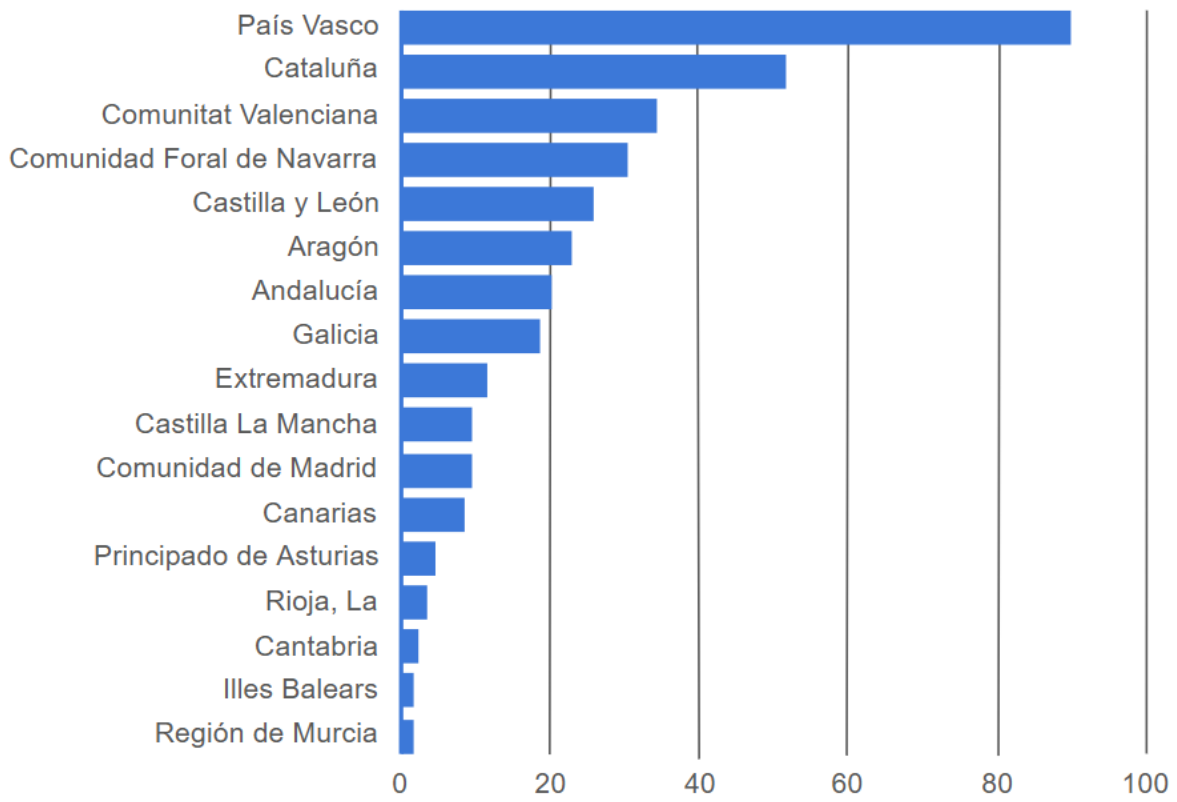
In Spain, energy communities are a relatively new sector, as can be seen from the dates when the relevant regulatory laws were issued. Nevertheless, they are experiencing significant growth. The report presented in [16] analyses 353 energy communities in Spain, investigating their structure, financing, participants, activities, and social impact. In Figure 1, taken from the report, all the autonomous communities in Spain are shown together with the number of analysed energy communities in each. There seems to be a predominance of the Basque Country, but there is a good representation of energy communities in general, with the Balearic Islands and the Region of Murcia being the smallest.
RECs consist of different parts that will be discussed in more detail in Section 3, but in short, it is important to stress that a network management and monitoring system is essential. Modelling in energy-community management aims to accurately estimate the power generated by various sources, such as solar or wind. For example, Zhang et al. [17] propose a data-driven stochastic approach for power sharing planning in microgrids, integrating grid constraints that address uncertainties associated with both investment and operation. Complementarily, Ayyub et al. [18] discuss risk modelling in energy systems in communities exposed to natural disasters, offering insights that enrich decision-making in high-variability environments. In addition, Adewuyi and Aki [19] explore optimal planning strategies for large-scale renewable energy integration, considering demand response, uncertainties, and operational flexibility.
These studies show that modelling is an essential tool to address the challenges of managing energy communities by enabling better capture and mitigation of uncertainties and optimising both the design and operation of systems. A key technological development that illustrates the need for modelling the electric power in PV systems is peer-to-peer (P2P) energy trading. Often using artificial intelligence, P2P systems allow energy-community members to exchange electricity directly, creating dynamic and decentralised markets. These systems rely heavily on accurate, real-time estimates of energy production and consumption to operate efficiently. This highlights the critical role of modelling in their implementation and success [20].
Renewable energy sources, in particular, are highly dependent on environmental factors that vary over time (such as the amount of solar radiation). Current methods, including fixed allocation coefficients, have significant drawbacks. They do not effectively account for these temporal variations. These disadvantages could be avoided by developing and implementing models that can estimate energy production in real time, thereby allowing accurate matching of supply and demand, avoiding unnecessary peak loads, and reducing production and storage costs.
In this context, this review aims to explore in depth the motivations and benefits associated with the use of modelling in energy communities, with a particular focus on solar energy production. Through the compilation and evaluation of existing methodologies, it will analyse different approaches to the modelling of PV generation systems, studying both their advantages and their limitations. In order to achieve this, different system modelling techniques will be analysed, focusing on those applicable to solar energy systems from the point of view of their mathematical representation, electrical models, optimisation models, and machine learning-based models.
The main contribution of this review is twofold. First, unlike previous reviews that address PV forecasting or PV system modelling in isolation, this work explicitly frames PV production modelling within the operational context of RECs, relating each family of methods to community-level decisions such as collective self-consumption and energy sharing. Second, it identifies a specific gap in the current literature: the predominance of short-term forecasting over real-time estimation, together with the limited integration of intelligent modelling techniques with dynamic sharing coefficients and peer-to-peer exchange schemes. To the best of our knowledge, this combined perspective has not been jointly addressed by existing reviews on PV prediction, PV system modelling, or energy-community management.
In order to delineate the structure of the present document, the review methodology is presented first. The following section then explains the structure and management of RECs, which is followed by an examination of management methods for current energy communities. The next section presents the different modelling methods for PV systems in general, classified as classical parametric models and intelligent techniques. The challenges of predictive modelling specific to energy communities are then discussed, and finally, the conclusions drawn are presented.

2. Review Methodology

This work is structured as a narrative literature review. Because the topic is inherently cross-cutting—it lies at the intersection of energy-community operation and PV generation modelling, two bodies of literature that are seldom indexed under a common set of terms—the search was organised into several thematic strands rather than a single query and was complemented by backward and forward citation searching from the most relevant works. The four strands correspond to the facets that structure the remainder of the paper: (i) the structure, management, and energy sharing of RECs; (ii) physically based and parametric PV modelling (e.g., equivalent-circuit and single/multi-diode models); (iii) PV forecasting and estimation based on statistical and classical machine learning methods; and (iv) PV nowcasting and very short-term forecasting based on deep learning and sky/satellite imagery. Representative Boolean search strings for each strand are reported in Table 1.
The searches were run on Web of Science, IEEE Xplore, and ScienceDirect, and supplemented with Google Scholar for citation tracking. They were restricted to peer-reviewed journal articles, conference papers, and reviews published between 2005 and 2026 and written in English. Studies were included when they addressed the modelling, forecasting, nowcasting or estimation of PV/solar power output, or the integration and management of PV generation within energy communities, and reported a concrete technique (parametric, statistical, or intelligent) together with results. Studies were excluded when they were unrelated to PV power modelling or energy-community management, addressed only cell materials or hardware without a modelling contribution, lacked methodological or empirical content (e.g., editorials or abstract-only items), or were unavailable in English or in full text.
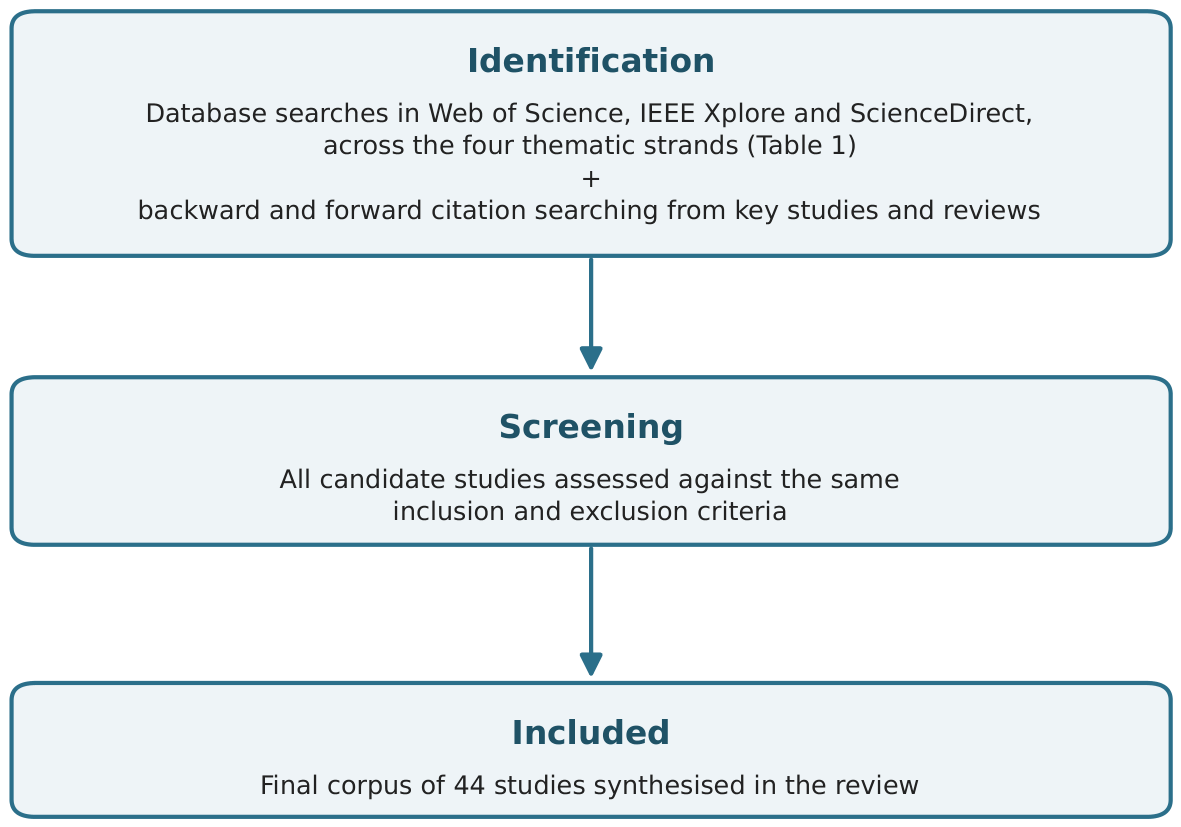
The community-oriented strand (i) returns a manageable number of records, whereas the general PV modelling strands (ii)–(iv) are considerably broader and only partially overlap with energy-community terminology. For this reason, citation searching from key studies and reviews contributed a substantial part of the foundational modelling literature synthesised here, rather than database querying alone. Combining the thematic database searches with citation searching, and after screening the retrieved records for relevance, the review synthesises a final corpus of 44 studies. All candidate studies, irrespective of whether they were identified through the database searches or through citation searching, were assessed against the same inclusion and exclusion criteria described above. The stages of this process are summarised in Figure 2. Given this design, the review does not claim exhaustive coverage of each individual field, but rather a transparent and reproducible synthesis of the literature at their intersection.

3. Structure and Management of RECs

The most common form of energy management is centralised energy management, which for many years has allowed good optimisation of energy resources and effective control of energy distribution and storage [21]. In a centralised energy management system, one entity monitors and regulates the flow of energy throughout the grid, thus facilitating the implementation of optimisation strategies, improving security of supply, and minimising transmission and distribution losses.
But there are limitations to the central model. The increase in the penetration of renewable energy sources and the demand for flexible solutions have been the driving forces behind the exploration of decentralised energy management models. These systems enable greater decentralisation of control, reduce dependence on centralised infrastructure, and encourage the integration of distributed generation such as solar and wind power at household or municipal scales. While distributed systems can improve resilience and reduce transmission costs, the lack of centralised coordination can lead to challenges in terms of operational efficiency and system stability [21].
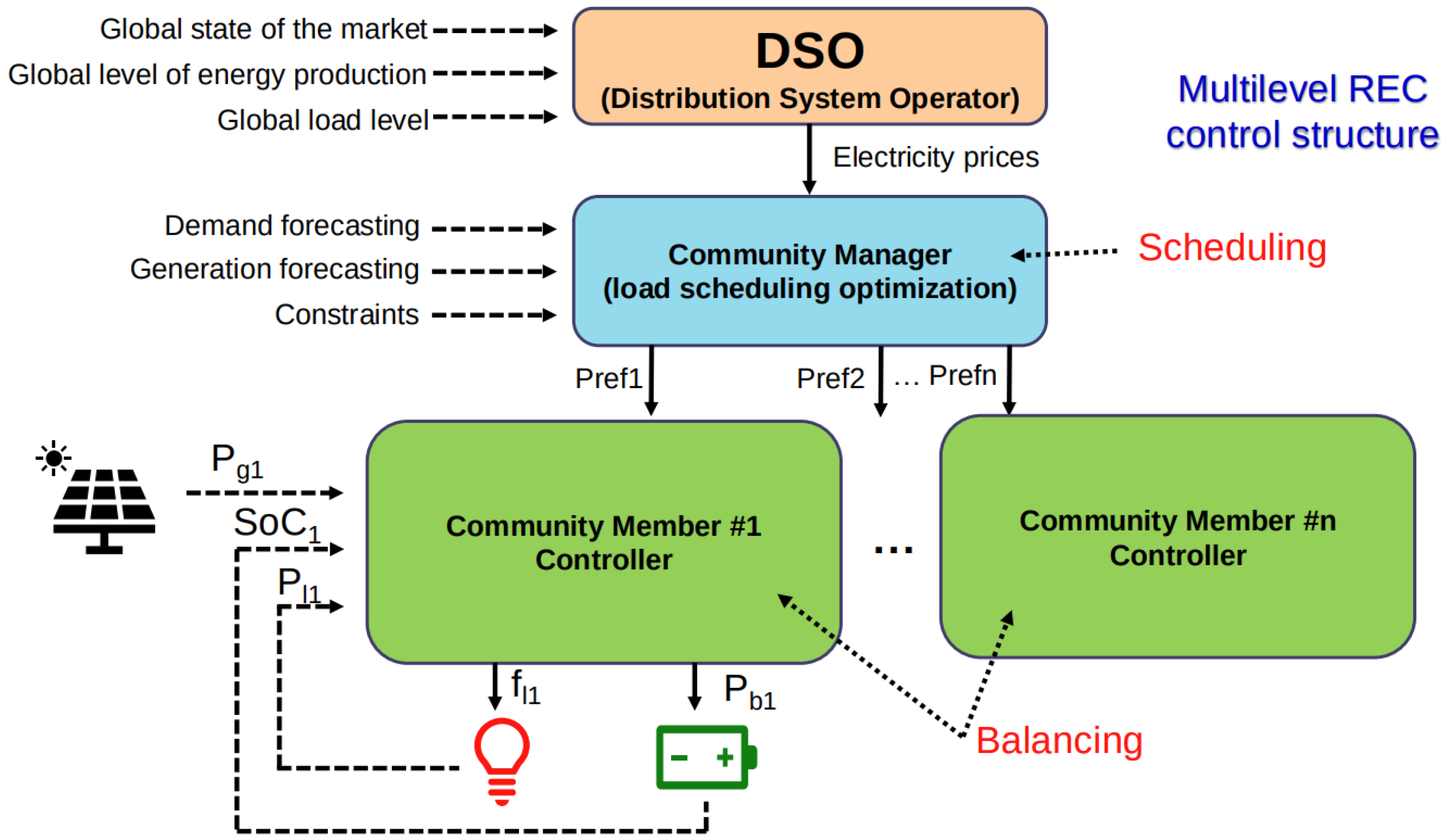
At the EC level, management can be implemented using either a centralised or a decentralised approach. In centralised schemes, a central manager is responsible for scheduling energy resources and supervising the activity of EC members. In the decentralised approach, the planning of energy resources is carried out locally using information from other members. In both cases, energy sharing is achieved through sharing coefficients. These coefficients represent numerical factors indicating the proportion of generated power ( P g i ), consumed load ( P l i ), or exchanged battery power ( P b i ) that each community member contributes to or receives from the community, facilitating an effective and balanced energy distribution within the EC. A detailed description of these variables is provided below.
The peer-to-peer (P2P) model presents itself as a natural extension of decentralised approaches, in line with this evolution towards more flexible and resilient systems. It is a decentralised system where participants interact directly without centralised intermediaries. This model in energy communities allows prosumers to exchange energy through smart grids, taking advantage of costs that vary in real time instead of the traditional sharing coefficients that are updated every few months depending on the country [20].
Given that renewable energy sources, in particular, depend on environmental factors that vary over time (such as solar radiation), these sharing coefficients have a number of disadvantages that could be avoided with a model that estimates energy production in real time. They can provide accurate estimates of energy sources that facilitate the matching of supply and demand, avoid unnecessary peak loads, and reduce production and storage costs.
Energy communities, in general, consist of the following elements:
  • Consumers;
  • Prosumers;
  • Power generators;
  • Grid distribution systems;
  • Energy storage systems;
  • Management, control, and monitoring systems.
To define them briefly, consumers are passive users of electricity, relying entirely on the grid for their energy needs. Prosumers, in contrast, are active participants in the energy system, both producing and consuming electricity. When their energy production exceeds their consumption, the excess can be fed into the grid, and the way this surplus is compensated depends on the regulatory scheme in place [22].
Electric generators are devices capable of transforming another form of energy into electrical energy. There are different types of electrical generators, but in RECs, the generators must be based on renewable sources.
Among the most common generators in a REC are the following:
  • Photovoltaic solar panels: one of the most commonly used sources of electricity generation in energy communities.
  • Wind turbines: these can be small or large scale, depending on the size of the community.
  • Biomass systems: these use organic waste to generate energy.
  • Small-scale hydropower: feasible in areas where water can be harnessed as an energy source.
Efficient management of RECs is a complex challenge with many variables and multiple constraints. A general framework for this management structure is shown in Figure 3. It relies on a multilevel control system, where different layers oversee various segments of the network and cooperate to plan and balance load and energy flows. At the top level is the Distribution System Operator (DSO), which sets electricity prices based on market conditions, total energy production, and overall load demand. Using these prices and additional inputs, such as demand forecasting, generation forecasting, and relevant constants, the community manager plans the loads for each member of the community.
Each community member then has their own controller, which manages local energy usage based on different variables to ensure a balanced operation. These variables may include the following:
  • P g i : Power generated by the solar panel.
  • S o C i : State of charge of the battery.
  • P l i : Power demanded by the loads.
  • f l i : Load flexibility or controllable load factor.
  • P b i : Power exchanged with the battery (charging/discharging power).

4. Management Methods for Energy Communities

To illustrate how the intelligent management of energy communities currently works, this section presents several studies and their approaches.
A study in [23] introduces a community electricity market model designed for prosumers. In this approach, a community manager coordinates the activities through distributed optimisation (ADMM) and convex programming. Simulations with 15 prosumers demonstrate a remarkable reduction in annual costs—from $5245 to $1577 (a 70% decrease)—compared to individual trading. However, when autonomy is prioritised, costs increase to $4064 because of import penalties. The model also achieves a 20% reduction in imported energy, a 50% decrease in exported energy, and a 30% cut in consumption peaks through peak-shaving techniques. To further enhance fairness, the system penalises the largest importer, boosting the Quality-of-Experience (QoE) index from 0.15 to 0.95 and even reaching perfect equity (1.0). Despite these promising outcomes, the study notes limitations such as the assumption of a perfectly competitive market with homogeneous prosumers, convergence challenges in extreme penalty scenarios with the ADMM algorithm, and the need to explore scalability and regulatory integration in real infrastructures.
In another investigation, the paper in [24] presents a two-level hierarchical energy management system (EMS). At the upper level, a Robust Model Predictive Control (MPC) scheme is employed, while a rule-based control system operates at the lower level to optimise microgrid operations. This dual strategy minimises the cost of extracted energy and maximises the self-consumption of renewables. By incorporating fuzzy models to handle uncertainties in generation and demand forecasts, the system achieves a mean absolute error (MAE) of approximately 3.75   k W and a root mean square error (RMSE) of around 5.20   k W over one-day horizons. Notably, when compared to a deterministic system, the robust EMS reduces energy costs from £168.01 to £165.28, lowers RMSE from 1.22   k W to 1.14   k W , and slightly decreases the equivalent full battery cycles from 6.40 to 6.07, thus mitigating battery wear. Furthermore, the loss of supply probability (LPSP) is reduced from 3.78% to 2.93%, and energy purchases are optimised by acquiring 994.08   k W h under cheap tariffs (C1) versus only 15.32   k W h under expensive tariffs (C3), in contrast to 25.48   k W h in the deterministic scenario. Nevertheless, the study acknowledges that the robust control approach is conservative, computationally intensive, and heavily dependent on forecast quality.
A different perspective is offered in the work of [25], which investigates the impact of the internal exchange tariff (IEE) on integrated community energy systems (ICESs) in a district of Gothenburg, Sweden. Using an optimisation model that minimises operational, import/export, and IEE costs, the study conducts a sensitivity analysis by varying the parameter β . The results are striking: by lowering β from 2.5 to 0.0001, the total community cost decreases by 30%, with import costs falling by 45.6% and export costs by 97.2%. Applied to 41 buildings with real data on electricity load, heating, and solar generation, the model also optimises asset usage—such as batteries and thermal storage—and identifies six distinct stages in the savings strategy. The analysis, however, points out limitations related to geographical and seasonal variations, infrastructure investment, heat exchange constraints, and the influence of national policies, all of which underscore the critical need for careful adjustment of the IEE tariff to maximise ICES benefits.
Furthermore, the article in [26] compares community-shared energy assets with individual assets, taking into account constraints on low-voltage grids. Two configurations are modelled: one with 200 prosumers operating independent assets and another where a community collectively invests in solar panels and batteries. Using the Newton–Raphson method to analyse power flows and real data from the Thames Valley Vision project along with UK Met Office solar radiation, the study evaluates scenarios under fixed (16 pence/kWh) and dynamic tariffs (up to 35 pence/kWh, with a minimum of 2.8 pence/kWh). A profit redistribution mechanism—based on marginal contributions and a Shapley value approximation—is also implemented. Although community assets yield higher overall benefits, grid constraints (over-voltages and the resulting curtailment) reduce the savings of the community-owned PV: the community’s annual bill increases, relative to the case without network constraints, by £2223 under a flat tariff and £3217 under a ToU tariff (and by £1874 and £4019, respectively, in configurations with solar generation and storage). The study also identifies limitations, such as assuming equal unit costs for individual and community properties and not accounting for additional revenues from ancillary services, thereby opening avenues for future research into peer-to-peer (P2P) markets and alternative energy carriers such as green hydrogen.
It is notable that all the aforementioned articles rely on a management system driven by statistical methods, with none explicitly incorporating artificial intelligence techniques. This gap makes it challenging to identify RECs that are managed by intelligent methods. One notable exception is presented in [27], which employs AI-based approaches.
Finally, the comprehensive review in [28] emphasises the emerging trend of integrating artificial intelligence with mathematical modelling for managing RECs. The review highlights various applications, including forecasting and simulating power grid fluctuations, optimising control strategies to stabilise grids, and using digital twins to evaluate and explore different scenarios. Clearly, this hybrid approach is anticipated to play a key role in the future of energy management.

5. Modelling Methods for PV Systems

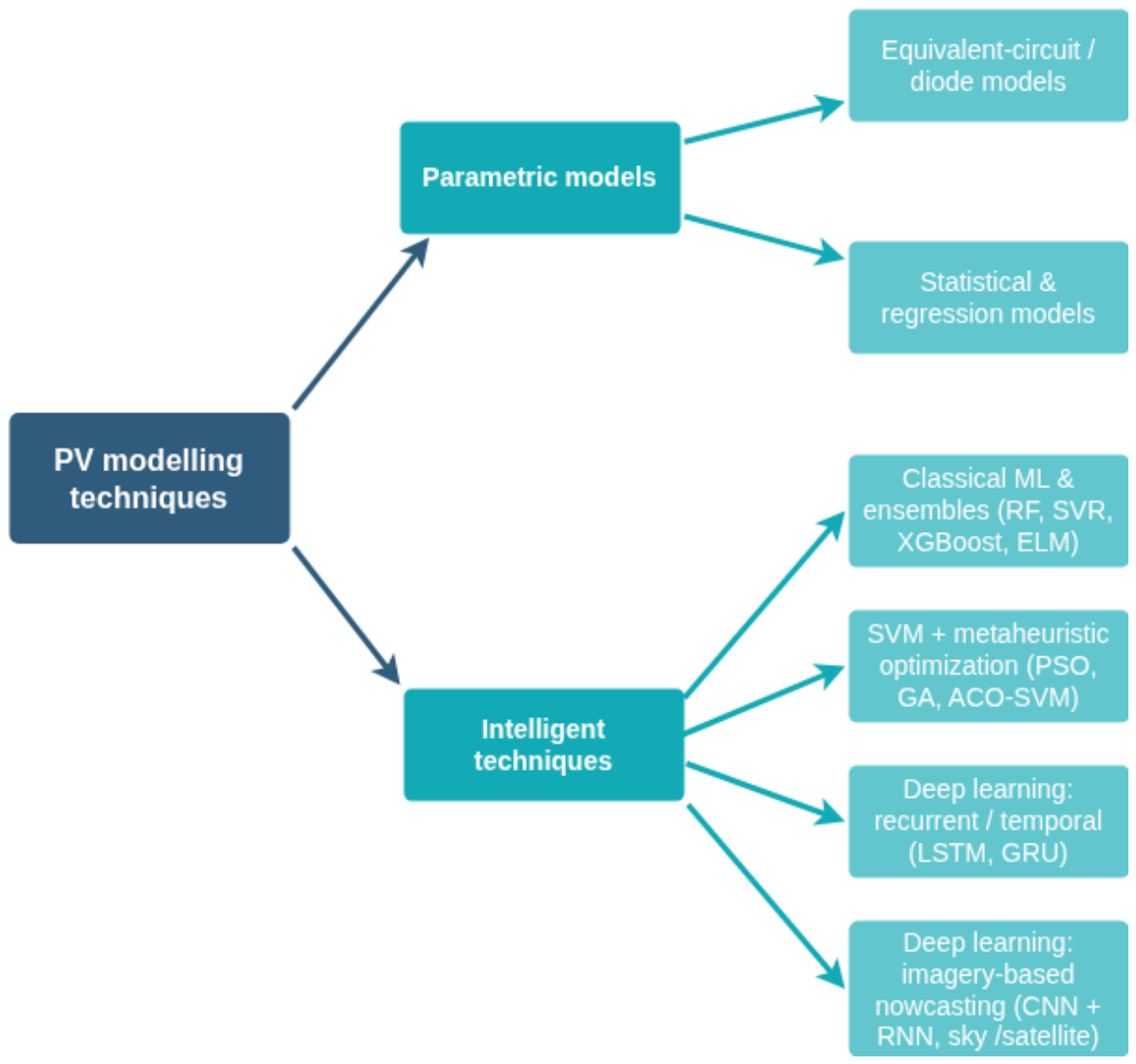
PV systems can be modelled using various techniques, which, for the purposes of this work, are classified into two main categories as a way to distinguish between physically grounded models and those driven by data and adaptability—parametric models and intelligent techniques—as illustrated in Figure 4.
Parametric models rely on clearly defined mathematical relationships between system variables and parameters. These models are grounded in fundamental physical principles of PV cells, such as diode saturation current and series resistance, providing clear physical interpretations. Consequently, parametric methods facilitate straightforward sensitivity analyses, possess relatively low computational demands, and enable direct adjustments to model structures based on specific analytical needs [29].
Intelligent techniques, on the other hand, encompass algorithms inspired by human cognitive processes such as learning, decision-making, and adaptability to changing environments. Typical examples include artificial neural networks, fuzzy logic systems, genetic algorithms, and hybrid methodologies [30]. The strength of intelligent techniques lies in their capability to capture complex, non-linear system behaviours directly from empirical data, without relying on explicit physical equations. This makes intelligent methods particularly valuable in scenarios where precise physical parameters are uncertain or when the system operates under rapidly changing environmental conditions.
The initial attempts at modelling PV systems date back to the 1950s, coinciding with the invention of silicon solar cells [31,32]. At that time, the models were very simple: they were based on an equivalent circuit composed of a current source, a diode, and resistors, so that they could reflect losses and non-ideal elements of the cells [33].
Later, between the 1970s and 1980s, improved models emerged that began to include environmental factors such as temperature and irradiance [34]. This led to a deeper understanding of the behaviour of PV cells under different climatic conditions and guided the development of more efficient systems.
Initially, each component (inverters, charge controllers, and batteries) was modelled specifically for the system in which it was used, as the electrical characteristics could vary significantly depending on the manufacturer, capacity, and technology [31]. As a result, there was no standardised and generic model that could be directly applied to different PV configurations without significant adjustments.
Finally, with the advancement of computing and the emergence of intelligent techniques, more flexible methods for estimating the generated energy were incorporated, integrating aspects such as neural network-based predictions and hybrid models [35]. These new approaches make it possible not only to consider multiple variables but also to take into account more of the aforementioned components, yielding more accurate estimates.
There are different approaches and methodologies for modelling solar energy production, which vary in complexity and accuracy. Some of the most common approaches used in the literature are presented below:

5.1. Clarification of Terminology

In different areas of the literature, especially in statistics, the term modelling is used to describe a simplified representation of real phenomena, from which predictions can be made by means of mathematical tools [36]. However, many of the approaches proposed in the field of estimating the electrical power of PV systems use other terms, such as real-time forecasting, short-term forecasting, and nowcasting, which are not strictly equivalent.
These terms, although closely related, are not equivalent, and we distinguish them as follows. Modelling denotes building a representation of the PV system from which its power output can be derived, whether physically based or data-driven [37,38]. Real-time estimation refers to producing the output value for the present instant from incoming measurements, rather than predicting a future one. By contrast, forecasting predicts future PV output and is conventionally split by horizon into short-term forecasting and nowcasting, as detailed below. Simulation, in turn, denotes exercising a model—physically based or data-driven—under prescribed or synthetic input conditions in order to study the system’s response, for example, in scenario, design, or sizing studies, rather than producing an operational estimate of the actual power output.
Short-term forecasting refers to predictions ranging from a few seconds to a few days. Such methods typically rely on recent historical data to find patterns and project power on short timescales, using time-series techniques, among others [39].
Finally, the concept of nowcasting can be confusing because it is sometimes used as real-time forecasting [40,41] and sometimes as short-term forecasting [42,43]. In this review, nowcasting is understood as very short-term forecasting over intra-hour horizons (approximately 5–60 min ahead), consistent with the horizon adopted in the comparative synthesis of Section 5.3.

5.2. Classic Parametric Models

This section examines the classical parametric models, which represent the most established approaches to modelling electrical power in PV systems.

5.2.1. Equivalent-Circuit Models

Recent research has shown a trend towards using three-diode models to estimate the performance of PV modules. These models have demonstrated a better ability to simulate internal losses compared to single-diode models and are suitable for capturing variations in current–voltage (I–V) and power–voltage (P–V) characteristics due to changes in irradiance and temperature.
In [44], the authors presented a method for modelling PV modules using a three-diode model optimised with the Sunflower Optimisation (SFO) algorithm. In this approach, nine electrical parameters are estimated, of which two are calculated analytically, while the rest are optimised. The simulations, applied to different commercial modules, achieved a difference of less than 0.5% between simulated curves and experimental data, showing high accuracy and validation under various irradiance and temperature scenarios.
On the other hand, ref. [45] applied the three-diode model using the Harris Hawks Optimisation (HHO) algorithm for parameter extraction from technical data of commercial modules (CS6K280M and KC200GT), achieving minimum RMSE values of 1.6054 × 10 2 A and 1.87 × 10 2 A, respectively. This work focused on reducing computational time by using data from technical sheets instead of extensive experiments. With around 20,000 evaluations and simulation times of less than 10 s in MATLAB 2018b, the HHO offered higher accuracy than methods such as the Whale Optimisation Algorithm (WOA), Sunflower Optimisation (SFO), genetic algorithm (GA), and Simulated Annealing (SA), achieving maximum absolute errors in the maximum power region of < 0.1 A (KC200GT) and < 0.05 A (CS6K280M). Comparisons between simulations and experimental data from these two commercial modules showed that the proposed method achieved high accuracy and minimal absolute error difference, underlining the effectiveness of the model in simulating I–V and P–V curves. Furthermore, the I–V and P–V curves showed high agreement with experimental data ( R 2 > 0.99 ) under variations in temperature (25–75 °C) and irradiance (200–1000 W/m2).
In [46], the authors introduced an application of the Chaos Game Optimisation (CGO) algorithm for the three-diode model, obtaining highly accurate results in parameter estimation. As in previous studies, this optimised approach was able to significantly reduce the error between the simulated curves and the experimental data, improving the accuracy of the modelling and allowing the results to be adapted to different operating conditions.
In [47], the authors proposed a diode model optimised by means of the Improved Arithmetic Optimisation Algorithm (IAOA), offering an effective alternative for representing PV modules with a reduced number of parameters. In this work, the IAOA was applied to extract the parameters of a single-diode PV solar cell model. The experimental results demonstrated that the optimised model achieved a root mean square error (RMSE) of 3.69 × 10 3 and a mean absolute error (MAE) of 2.73 × 10 3 , significantly outperforming several state-of-the-art metaheuristic methods, such as the Aquila Optimisation (AO) and the Arithmetic Optimisation Algorithm (AOA), in terms of both convergence speed and estimation accuracy. Additionally, the IAOA showed robust performance under varying irradiance and temperature conditions, confirming its reliability in real-world scenarios.
Across these equivalent-circuit studies, the reported coefficients of determination ( R 2 > 0.99 ) and sub-0.5% curve differences quantify curve-fitting accuracy—how closely the fitted I–V and P–V characteristics reproduce the measured curves under controlled irradiance and temperature—rather than out-of-sample predictive skill; such values are therefore expected for this class of deterministic parameter extraction problems rather than exceptional.
This type of modelling alone could be limited by considering only PV modules, making it necessary to incorporate additional models for inverters, batteries, and other components if representative and useful production curves are to be obtained in energy communities. This could lead to further complexity, especially when extrapolating results or evaluating different scenarios with varying components.

5.2.2. Statistical Models

Several approaches have exploited statistical models to estimate the electrical power generated by PV systems, integrating both physical and meteorological data [48]. In this case, a statistical model is a set of probability distributions in a given sample space [49]. In the following, some relevant contributions in the literature are presented.
A study by Al Hilfi et al. [50] proposes an innovative method that uses single-point irradiance measurements and correlation models (Hoff, Perez, ACM, and Lave) to predict power generation in distributed PV systems. The methodology incorporates meteorological factors (such as cloud speed and direction) and the distance between systems, applying wavelet transforms to decompose the signal into time scales (2–64 min) and select, at each scale, the highest variability reduction index (VRI). With data from 312 non-clear-sky days in Brisbane, a significant error reduction was evident: while the individual models showed a MAE between 1.2% and 17.6% (depending on cloud speed), the proposed technique achieved a minimum MAE of 1.1% in high-speed conditions (> 0.5 m/s) and 2.5% for low speeds. It is important to highlight that the location of the pyranometers played a decisive role, as at site PV-8, the accuracy exceeded 90% on 81% of the days, in contrast to less favourable sites such as PV-16. However, the technique loses effectiveness on clear or uniformly cloudy days, where irradiance variability is low.
In another approach, the study [51] analysed the influence of environmental and system factors on power generation in both PV and photovoltaic–thermal (PVT) systems. Using Pearson correlation and Varimax factor analysis, predictive regression equations were developed that showed very high accuracy: in summer, solar radiation, surface temperature, and relative humidity variables had correlations above 0.99, reaching accuracies of up to 96% for PV systems and 91.09% for PVT systems. In addition, the water cooling effect in PVT systems was found to reduce the surface temperature (between 2 and 13 °C), resulting in an average performance 3.66% higher than that of traditional PV systems in high-temperature environments.
Another work [52] combines machine learning techniques and physics-based equations to evaluate the PV potential in Mexico. Using data from NREL’s National Solar Radiation Database (NSRDB), monthly maps were generated with the k-means algorithm, grouping terrestrial cells into five clusters, with centroids between 4.04 and 7.69 kWh/m2 and an approximate Silhouette Score of 0.6, which indicates acceptable clustering. In addition, probability maps were produced for critical temperature ranges (25–30 °C and 30–35 °C), revealing that in the northwest, the probability of exceeding 30 °C in summer exceeds 50%, affecting the efficiency of the panels. Equations integrating irradiance, temperature, and the specific characteristics of the JAM78S30 580/MR panel (20.7% efficiency) were used to estimate PV generation, yielding variations between 0.6 and 1.6 kWh/m2 in June. However, validation with data from seven real plants showed discrepancies of between 5 and 22%, suggesting the need for more detailed hyperparameter analysis and more rigorous statistical validation.
In the field of energy-community optimisation, Elomari et al. [53] focus on the sizing and optimisation of renewable systems (PV panels, wind turbines, and battery storage) for residential neighbourhoods. Using machine learning, economic and environmental indicators were estimated with high accuracy, reaching a coefficient of determination ( R 2 ) of 0.9498 and a MAE of 0.004 kWh for the LCOE and an R 2 of 0.99968 with a MAE of 398.08 Pt for the environmental impact. The evaluated scenarios reveal important trade-offs: the least-cost scenario achieved an LCOE of 0.044 $/kWh (85.04% reduction compared to the base case) with a payback period of 7.1 years, favouring higher PV capacity (555 kW) over wind capacity (87 kW) and storage. In contrast, the minimum environmental impact scenario reduced this impact by 54.59% at the cost of a higher LCOE (0.220 €/kWh). A balanced solution, which weights both objectives equally, achieved an LCOE of 0.080 $/kWh (72.86% lower than the base case) but with a 27.02% increase in environmental impact. The Pareto analysis shows the inverse relationship between cost and impact and demonstrates that, compared to the NSGA-II algorithm, the proposed methodology offers a more diverse Pareto front.
An additional contribution is presented by Feng et al. [54], who developed a hybrid PSO-ELM model to estimate global horizontal irradiance (GHI) and PV power on the Loess Plateau. This model achieved high accuracy (MAE of 1.576 MJ m−2 day−1, RRMSE of 0.149 and a Nash–Sutcliffe coefficient of 0.914), outperforming other methods such as SVM, ELM, GRNN, MST, and AE, especially in arid climates. However, the reliance on empirical coefficients specific to single-crystal silicon cells limits its applicability to other materials and configurations, highlighting the need to develop adaptive methods that dynamically adjust these parameters.
Finally, in the field of real-time estimation, Bright et al. [40] combined satellite data (Himawari-8) with information from reference systems to predict PV fleet power. Four approaches were evaluated: satellite estimation, scaling, differential correction, and a hybrid model with exponential weighting. By applying physical and statistical models (such as the IDW and a quadratic PV model), these approaches achieved notable improvements in error metrics (MBE, rMBE, rRMSE, and RMSE), with both a single reference system and thirty. These results show the potential of integrating satellite and local data for more accurate real-time estimates.
Although these proposals provide interesting advances, it is important to note that most of them are tightly coupled to the specific characteristics of the PV system under study. This limits their usefulness in scenarios where systems are constantly changing or where the physical conditions are not known exactly, suggesting the need to develop more flexible and adaptive models.

5.3. Intelligent Techniques

In this section, we will present different articles that use intelligent techniques to estimate the electrical power in PV systems. In this paper, the term intelligent techniques refers to any data-driven method within the field of machine learning. As will be shown, the reviewed works rarely address modelling or, as clarified above, real-time prediction; most of them focus on short-term prediction.
Some studies focus on applying traditional and ensemble models that exploit basic meteorological information. For example, ref. [37] contrasts algorithms such as Linear Regression (LR) and SVR with methods based on Random Forest (RF) and neural networks (MLP), demonstrating that non-linear approaches better capture complex relationships. Similarly, ref. [27] uses ensemble algorithms such as XGBoost and GBDT, combined with recent consumption data and meteorological variables (temperature and humidity), achieving predictions with high accuracy (R2 of 0.9907) and reducing costs in renewable communities. Additionally, ref. [55] presents a selective ensemble approach that combines multiple MLPs with a deterministic physical model of solar radiation, reducing errors (NMAE and nRMSE) by approximately 1% and decreasing the computational burden by 17%.
Recent research has explored enhancing short-term prediction accuracy by combining Support Vector Machines (SVMs) with evolutionary algorithms and optimisation techniques. For instance, a hybrid approach presented in [56] integrates wavelet transform for effective data preprocessing, Particle Swarm Optimisation (PSO) for optimal parameter tuning, and SVM to model complex, non-linear relationships. This method demonstrated notable improvements, achieving a Mean Absolute Percentage Error (MAPE) of 4.22% and a Normalised Mean Absolute Error (NMAE) of 0.4% relative to the installed capacity.
Similarly, studies like [57,58] have incorporated Genetic Algorithms (GAs) with SVM to optimise model parameters. While these approaches have shown improvements in predictive accuracy under varying conditions, they also introduce increased computational complexity and heightened sensitivity to data quality, factors that must be carefully considered during implementation. For instance, in [58], the baseline SVM yields a MAPE of 100.47%, which drops to 1.71% once its parameters are optimised with the genetic algorithm; the large initial value therefore reflects the unoptimised baseline model rather than an implausible result.
The authors of [59] use an Improved Ant Colony Optimisation (I-ACO) algorithm to tune the SVM parameters, achieving a regression coefficient (R2) of 0.997 and reducing the MSE and MAE by 23.97% and 12.05%, respectively.
A different approach is found in the integration of deep learning models with optimisation strategies for the management of battery-assisted PV systems. Ref. [60] presents a method that combines an LSTM-based prediction model with MILP optimisation for generation planning in systems that include batteries. This approach improves system stability, reducing the rate of change of imbalance by 38% and improving the frequency deviation rate by 69% (from 4.56% to 1.42%), with performance in windows from 1 to 30 min (RMSE: 0.05, MAE: 0.03, MAPE: 17.54%). It is concluded that completely eliminating the imbalance would require increasing the capacity of the BESS by approximately 10%.
The article [61] explores the interdependence and importance of various meteorological variables in the estimation of PV power. Based on three years of data from nine variables and the output of ten systems in Utrecht (the Netherlands), techniques such as PCA, LSBoost and correlation analysis are applied to identify that relative humidity, visibility, temperature, and cloud cover are decisive in the prediction. This study makes it possible to reduce the dimensionality of the model without losing accuracy, although its results are conditional on the oceanic climate of the region.
The use of deep learning techniques for PV nowcasting has become increasingly relevant in recent years, as it makes it possible to capture the temporal and spatial dynamics of generation on minute scales. This section groups together studies that employ advanced architectures—such as LSTM, GRU, CNN, and even hybrid models that integrate frequency-domain processing or attention mechanisms—to improve very short-term prediction accuracy. For example, ref. [62] proposes an LSTM model for generation prediction at a solar tracking plant in Vietnam, demonstrating that this architecture outperforms RNN and CNN models under stable weather conditions, although it shows sensitivity to seasonality and requires large data volumes. Meanwhile, refs. [63,64] address nowcasting by integrating sky images, using models that combine CNN (to extract spatial features) and RNN (such as GRU or LSTM) to capture temporal dependencies; the former directly evaluates the correlation between pixels and PV output, while the latter (BILST) also integrates global information from time series and meteorological conditions.
Likewise, ref. [65] explores an architecture based on IoT and machine learning, comparing traditional models with a deep learning approach (3CNN+2LSTM), which shows the advantages and limitations of both approaches in terms of accuracy and training time. Complementarily, studies using satellite data, such as [66,67], show improvements in capturing abrupt changes in irradiance and in yield estimation by integrating CNN and LSTM or SVR models. Finally, other hybrid approaches combine frequency-domain techniques [68] or incorporate dual attention mechanisms (DA-GRU) [69] and hybrid 1D CNN-GRU architectures [70] to optimise prediction over horizons of up to 2 or 3 h.
These studies, despite their differences in architecture and data sources, demonstrate the potential of deep learning to address the high variability in PV generation over ultra-short horizons, although challenges remain in terms of computational complexity, dependence on large data volumes, and sensitivity to extreme weather changes.
Table 2 summarises the main characteristics of each study, detailing the techniques used, the input variables, the main results, and the limitations of each approach. This comparison shows that, despite the diversity of methodologies, there is a consensus on the use of meteorological data—in particular, solar radiation, ambient temperature, and humidity—as key inputs. Furthermore, while some studies include sky imagery and IoT sensor data, these sources are primarily used to capture meteorological phenomena rather than to provide additional or specialised information. Overall, there is a clear trend towards improving forecast accuracy through methods capable of capturing complex non-linear relationships.
The main advantage of intelligent methods is that they allow PV power forecasts to be made without relying on the technical specifications of the system, taking advantage of the wide availability of meteorological data. The review of the articles indicates that, within short-term horizons, models based on deep learning techniques and ensemble approaches achieved the best performance in several of the reviewed studies, although results vary with the forecasting horizon, the local climate, and the amount and quality of the available data. However, common challenges are identified related to the risk of overfitting, high computational costs, and limited generalisation to different geographical or climatic conditions. These aspects point to future lines of research aimed at integrating diverse data sources (e.g., sky imagery and advanced sensors) and developing adaptive architectures that optimise performance in varying environments.
While Table 2 documents each reviewed study individually, Table 3 synthesises these works by method family, making explicit for each family its typical forecasting horizon, its main strengths and limitations, its indicative computational cost, and the conditions under which it is most appropriate. When read across horizons, a clear division of labour emerges. Equivalent-circuit and statistical models are best suited to steady-state characterisation, resource assessment, and system sizing rather than operational forecasting. Classical machine learning and ensemble methods dominate the short-term range, from a few hours to day-ahead, where they capture the non-linear dependence of PV output on meteorological drivers without requiring system specifications. Recurrent deep learning architectures, and especially imagery-based nowcasting models—combining CNNs for spatial cloud features with RNNs for temporal dependencies—are the approaches that best capture fast, cloud-induced transients over intra-hour horizons of minutes to roughly one hour.
This horizon-based reading also clarifies the accuracy–cost trade-off. The highest accuracy on abrupt sub-hourly ramps is obtained by imagery-based CNN–RNN and attention-augmented recurrent models, but at the highest data and training cost, reaching tens of GPU-hours in some of the reviewed works. Crucially, this cost is not always justified: for a 90 min horizon, [65] reports that a classical Random Forest outperformed a 3CNN+2LSTM network while requiring far less training time, and several ensemble methods reach comparable short-term accuracy at a fraction of the computational burden. Consequently, classical machine learning and ensemble methods remain the pragmatic default for short-term forecasting in data- or compute-constrained settings and where interpretability is valued, whereas the additional cost of deep learning becomes justified specifically when intra-hour accuracy on rapid irradiance changes is the operational objective and high-frequency data and computing resources are available. For RECs in particular, this points towards ensemble and classical ML methods for routine scheduling, reserving deep learning and imagery-based nowcasting for sites where sub-hourly balancing of cloud-driven variability is critical.

6. Challenges of Predictive Modelling in Energy Communities

Predictive modelling in RECs should be assessed not only in terms of forecasting accuracy but also in terms of the operational value that forecasts provide to the community control problem. In practice, predicted PV output acts as an exogenous input for community-level scheduling, allowing the community manager to anticipate surplus and deficit periods, schedule flexible loads, plan grid imports or exports, and determine when local renewable production should be stored, shared internally, or traded through peer-to-peer mechanisms. When batteries are available, PV forecasts also directly affect charging and discharging decisions, state-of-charge trajectories, and reserve margins under expected uncertainty. This link is particularly relevant in hierarchical EMS architectures for energy communities, where the forecasted balance between generation and demand is translated into control actions at both community and member levels, and where forecast errors may require real-time corrective mechanisms to preserve grid-feasible exchanges [74].
From this perspective, the usefulness of each modelling family depends on the decision horizon it supports. Physically based and parametric models are useful for component characterisation, system sizing, and techno-economic assessment, but their role in REC operation is mainly indirect, as they do not directly address interval-by-interval energy sharing. In contrast, statistical, classical machine learning, and ensemble methods are better suited to routine operational decisions, including day-ahead scheduling, collective self-consumption, flexibility activation, and demand-response coordination. Thus, in RECs, predictive models should be evaluated not only by forecasting accuracy but also by their impact on avoided imports, reduced curtailment, improved self-consumption, fairer internal allocation, and lower battery degradation [75].
A distinctive challenge of energy communities, compared with utility-scale or centrally monitored PV systems, is the decentralised topology of measurement data. In many REC configurations, each member owns only local measurements, and these are frequently limited to net-meter signals rather than separate PV and load measurements. As a result, the actual PV contribution may be partially latent, especially in behind-the-meter settings. This limitation is important because advanced deep learning models generally require large, high-quality, and well-labelled datasets, whereas REC data are typically fragmented across households, heterogeneous in sampling quality, and affected by differences in orientation, shading, occupants’ behaviour, storage strategies, and communication availability. For this reason, the REC context is not only a forecasting problem but also an observability problem. The literature on behind-the-meter PV disaggregation and proxy-based estimation is therefore highly relevant to communities, since it shows how local PV generation can be inferred even when direct measurements are unavailable, and how nearby proxy systems or synthetic physical models can improve observability [76].
These data constraints also explain why decentralised and privacy-preserving learning architectures are increasingly relevant for REC applications. Federated learning is especially attractive because it allows collaborative model training without sharing raw household traces, which is consistent with privacy, ownership, and governance constraints in community settings. However, the same literature also shows that decentralised training is challenged by non-IID data distributions, unequal data volumes, communication overhead, and heterogeneous computational capabilities across clients. In REC terms, this means that a single global model may be suboptimal when members differ substantially in load patterns, PV exposure, or data quality. Personalised or hybrid federated schemes are therefore more promising than purely centralised or purely global approaches, since they can preserve privacy while still exploiting cross-member information. This point is particularly relevant for the advanced deep learning models reviewed in this paper, whose practical deployment in communities depends not only on predictive power but also on data governance and training architecture [77].
Another REC-specific challenge is the need to ensure consistency among local forecasts and measurements produced by different nodes, feeders, or controllers. Related microgrid research addresses this issue through decentralised dynamic state estimation, distributed filtering, and neighbour-to-neighbour consistency checks. In these approaches, each node builds a local estimate from its own measurements and exchanges compact information with neighbouring nodes. The resulting estimates are then refined through fusion or consensus mechanisms, while unreliable or anomalous information can be identified through residual-based tests. For energy communities, this suggests that future predictive architectures should not rely exclusively on a single central PV estimate. Instead, they should incorporate hierarchical or distributed reconciliation layers capable of aggregating node-level forecasts, detecting bad data, and quantifying uncertainty before forecast outputs are translated into sharing coefficients, peer-to-peer bids, or battery setpoints [78,79].
The challenge is therefore not simply to improve PV forecasting in isolation but to make prediction useful for the way energy communities actually operate. In this context, the best model is not necessarily the one with the lowest standalone forecasting error, but the one that helps the community make better decisions despite fragmented data, limited communication, fairness concerns, and uncertainty. Future research should place greater emphasis on combining probabilistic PV and load forecasting with distributed or federated training and receding-horizon optimisation. In this way, predictive models could be evaluated through their real contribution to community operation, including collective self-consumption, fair allocation, reduced battery wear, network-compliant operation, and resilience to imperfect data [80].

7. Conclusions

This review has traced the development of modelling techniques for solar energy production, with the main emphasis on PV systems: from classical parametric models, such as equivalent-circuit and statistical regression approaches, to advanced intelligent modelling techniques based on machine learning.
This review showed that deep learning techniques, in particular, are characterised by their capability to process real-time meteorological data and to adapt to different environmental conditions without being tied to specific characteristics of PV systems. These capabilities are of particular value for dynamic and distributed energy systems such as RECs, where flexibility and adaptability are crucial. Compared to classical methods, which depend on specific PV system parameters, data-driven models can offer greater flexibility and, in several of the reviewed studies, competitive or superior accuracy. However, their performance depends strongly on the availability and quality of training data, and no single approach can be regarded as universally superior. As summarised in the comparative synthesis of Section 5.3 (Table 3), physically based and statistical models remain valuable when interpretability, limited data, or known PV parameters are the priority, so that the two families are best regarded as complementary rather than competing.
Despite these advances, significant gaps remain. First, most models developed so far have focused on short-term forecasting rather than on real-time estimation, and hence, their practical applications remain somewhat limited with regard to energy management in RECs. Second, most studies are dominated by classical models, which do not adapt easily to heterogeneous, continually evolving community energy configurations.
Addressing these issues therefore calls for closer integration of research on modelling and real-time prediction using intelligent techniques. It may be beneficial to integrate deep learning models with P2P energy exchange frameworks or dynamic sharing coefficients. This would help to mitigate the impact of the variability of renewable energy generation, optimise resource allocation, lower operational costs, and improve the resilience of RECs.
Therefore, future work should be directed towards assessing the practical application of such advanced models through case studies in terms of energy cost savings, carbon emission reduction, and energy independence at the community level. Efforts should also be directed towards exploring how dynamic regulatory frameworks can support the integration of adaptive sharing coefficients while ensuring compliance and maximising the potential of distributed energy systems.

Author Contributions

Conceptualization, A.D.-L., J.M.G.-C. and J.A.M.-P.; methodology, A.D.-L., J.M.G.-C. and J.A.M.-P.; investigation, A.D.-L., J.M.G.-C. and J.A.M.-P.; data curation, A.D.-L.; writing—original draft preparation, A.D.-L., J.M.G.-C., J.A.M.-P. and H.Q.; writing—review and editing, A.D.-L., J.M.G.-C., J.A.M.-P. and H.Q.; visualization, A.D.-L.; supervision, J.A.M.-P. and H.Q.; project administration, H.Q. and J.A.M.-P.; funding acquisition, J.A.M.-P. and H.Q. All authors have read and agreed to the published version of the manuscript.

Funding

This research was funded by the project Sustainable Atlantic Communities (SAtComm) [EAPA_0019/2022], co-funded by the European Union through the Interreg Atlantic Area call. Anabel Díaz Labrador’s research was supported by the Xunta de Galicia (Regional Government of Galicia, Spain), through grants for industrial PhDs (http://gain.xunta.gal/), under the “Doutoramento Industrial 2024” grant with reference 02_IN606D_2024_3100897. This research was also funded by grant PID2022-137152NB-I00 funded by MICIU/AEI/10.13039/501100011033 and by ERDF/EU.

Data Availability Statement

The original contributions presented in this study are included in the article. Further inquiries can be directed to the corresponding author.

Acknowledgments

CITIC, as a Research Center of the University System of Galicia, is funded by Consellería de Educación, Universidade e Formación Profesional of the Xunta de Galicia through the European Regional Development Fund (ERDF) and the Secretaría Xeral de Universidades (Ref. ED431G 2019/01).

Conflicts of Interest

The authors declare no conflicts of interest.

References

  1. Wrigley, E.A. Energy and the English Industrial Revolution; Cambridge University Press: Cambridge, UK, 2010. [Google Scholar] [CrossRef]
  2. Intergovernmental Panel on Climate Change (IPCC). Climate Change 2021—The Physical Science Basis: Working Group I Contribution to the Sixth Assessment Report of the Intergovernmental Panel on Climate Change; Cambridge University Press: Cambridge, UK, 2023. [Google Scholar] [CrossRef]
  3. International Renewable Energy Agency. Renewable Capacity Statistics 2024; Technical Report; International Renewable Energy Agency (IRENA): Abu Dhabi, United Arab Emirates, 2024. [Google Scholar]
  4. International Renewable Energy Agency. World Energy Transitions Outlook: 2023; Technical Report; International Renewable Energy Agency (IRENA): Abu Dhabi, United Arab Emirates, 2023. [Google Scholar]
  5. Eurostat. Renewable Energy Statistics. Statistics Explained; Data for 2024. 2025. Available online: https://ec.europa.eu/eurostat/statistics-explained/index.php?title=Renewable_energy_statistics (accessed on 21 July 2026).
  6. Energy Institute. Statistical Review of World Energy (2026); Energy Institute: London, UK, 2026. [Google Scholar]
  7. Gui, E.M.; MacGill, I. Typology of future clean energy communities: An exploratory structure, opportunities, and challenges. Energy Res. Soc. Sci. 2018, 35, 94–107. [Google Scholar] [CrossRef]
  8. International Energy Agency. World Energy Outlook 2021; IEA Publications: Paris, France, 2021. [Google Scholar]
  9. European Commission: Directorate-General for Energy. Clean Energy for All Europeans; Publications Office: Luxembourg, 2019. [CrossRef] [PubMed]
  10. Parlamento Europeo y Consejo de la Unión Europea. Directiva (UE) 2019/944 Sobre Normas Comunes Para el Mercado Interior de la Electricidad y por la que se Modifica la Directiva 2012/27/UE; Diario Oficial de la Unión Europea, L 158, 14.6.2019; Parlamento Europeo y Consejo de la Unión Europea: Luxembourg, 2019; pp. 125–199.
  11. Parlamento Europeo y Consejo de la Unión Europea. Directiva (UE) 2018/2001 Sobre el Fomento del uso de Energía Procedente de Fuentes Renovables; Diario Oficial de la Unión Europea, L 328, 21.12.2018; Parlamento Europeo y Consejo de la Unión Europea: Luxembourg, 2018; pp. 82–209.
  12. Caramizaru, A.; Uihlein, A. Energy Communities—An Overview of Energy and Social Innovation; Number EUR 30083 EN; JRC119433; Publications Office of the European Union, Joint Research Centre (JRC): Luxembourg, 2020. [CrossRef]
  13. Jefatura del Estado. Real Decreto-ley 23/2020, de 23 de junio, por el que se aprueban medidas en materia de energía y en otros ámbitos para la reactivación económica. Boletín Of. Estado 2020, 175, 29. [Google Scholar]
  14. Jefatura del Estado. Real Decreto 244/2019, de 5 de abril, por el que se regulan las condiciones administrativas, técnicas y económicas del autoconsumo de energía eléctrica. Boletín Of. Estado 2019, 83, 35674. [Google Scholar]
  15. Hedo, E.B. Real Decreto-ley 5/2023, de 28 de junio, por el que se adoptan y prorrogan determinadas medidas de respuesta a las consecuencias económicas y sociales de la Guerra de Ucrania, de apoyo a la reconstrucción de la isla de La Palma y a otras situaciones de vulnerabilidad; de transposición de Directivas de la Unión Europea en materia de modificaciones estructurales de sociedades mercantiles y conciliación de la vida familiar y la vida profesional de los progenitores y los cuidadores; y de ejecución y cumplimiento del Derecho de la Unión Europea. Boletín Of. Estado 2023, 154, 90565–90788. [Google Scholar]
  16. Ecodes; Redeia; Ministerio para la Transición Ecológica. Informe 2023 Energía Común; Technical Report; Informe Sobre las Comunidades Energéticas en España; Ecodes: Zaragoza, Spain; Redeia: Zaragoza, Spain; Ecodes, Redeia, Ministerio para la Transición Ecológica: Zaragoza, Spain, 2023.
  17. Zhang, X.; Zhou, Y.; Ge, S.; Liu, H.; Yang, B. Data-Driven Stochastic Planning for Network Constrained Energy Sharing in Microgrids. In Proceedings of the 2024 IEEE Power & Energy Society General Meeting (PESGM), Seattle, WA, USA, 21–25 July 2024; pp. 1–5. [Google Scholar] [CrossRef]
  18. Ayyub, B.M.; Sawaya, R.; Butry, D.T.; Helgeson, J.; Oum, Y.; Loh, V. Risk Tolerance, Aversion, and Economics of Energy Utilities in Community Resilience to Wildfires. ASCE-ASME J. Risk Uncertain. Eng. Syst. Part A Civ. Eng. 2024, 10, 04024020. [Google Scholar] [CrossRef]
  19. Adewuyi, O.B.; Aki, H. Optimal planning for high renewable energy integration considering demand response, uncertainties, and operational performance flexibility. Energy 2024, 313, 134021. [Google Scholar] [CrossRef]
  20. Kumar, N.M.; Chand, A.A.; Malvoni, M.; Prasad, K.A.; Mamun, K.A.; Islam, F.; Chopra, S.S. Distributed Energy Resources and the Application of AI, IoT, and Blockchain in Smart Grids. Energies 2020, 13, 5739. [Google Scholar] [CrossRef]
  21. Zakeri, B.; Gissey, G.C.; Dodds, P.E.; Subkhankulova, D. Centralized vs. distributed energy storage—Benefits for residential users. Energy 2021, 236, 121443. [Google Scholar] [CrossRef]
  22. Poullikkas, A. A comparative assessment of net metering and feed in tariff schemes for residential PV systems. Sustain. Energy Technol. Assess. 2013, 3, 1–8. [Google Scholar] [CrossRef]
  23. Moret, F.; Pinson, P. Energy Collectives: A Community and Fairness Based Approach to Future Electricity Markets. IEEE Trans. Power Syst. 2019, 34, 3994–4004. [Google Scholar] [CrossRef]
  24. Marín, L.G.; Sumner, M.; Muñoz-Carpintero, D.; Köbrich, D.; Pholboon, S.; Sáez, D.; Núñez, A. Hierarchical Energy Management System for Microgrid Operation Based on Robust Model Predictive Control. Energies 2019, 12, 4453. [Google Scholar] [CrossRef]
  25. Alavijeh, N.M.; Alemany Benayas, C.; Steen, D.; Le, A.T. Impact of Internal Energy Exchange Cost on Integrated Community Energy Systems. In Proceedings of the 2019 IEEE Sustainable Power and Energy Conference (iSPEC), Beijing, China, 21–23 November 2019; pp. 2138–2143. [Google Scholar] [CrossRef]
  26. Norbu, S.; Couraud, B.; Robu, V.; Andoni, M.; Flynn, D. Modeling Economic Sharing of Joint Assets in Community Energy Projects Under LV Network Constraints. IEEE Access 2021, 9, 112019–112042. [Google Scholar] [CrossRef]
  27. Matos, M.; Almeida, J.; Gonçalves, P.; Baldo, F.; Braz, F.J.; Bartolomeu, P.C. A Machine Learning-Based Electricity Consumption Forecast and Management System for Renewable Energy Communities. Energies 2024, 17, 630. [Google Scholar] [CrossRef]
  28. Srinivasan, S.; Kumarasamy, S.; Andreadakis, Z.E.; Lind, P.G. Artificial Intelligence and Mathematical Models of Power Grids Driven by Renewable Energy Sources: A Survey. Energies 2023, 16, 5383. [Google Scholar] [CrossRef]
  29. Kalkan Okur, E.; Okur, F.; Altunişik, A. Applications and usability of parametric modeling. J. Constr. Eng. Manag. Innov. 2018, 1, 139–146. [Google Scholar] [CrossRef]
  30. Martin, N.; Jain, L. Introduction to Neural Networks, Fuzzy Systems, Genetic Algorithms, and Their Fusion; CRC Press: Boca Raton, FL, USA, 2020; pp. 1–12. [Google Scholar] [CrossRef]
  31. Huang, C.J.; Huang, M.T.; Chen, C.C. A Novel Power Output Model for Photovoltaic Systems. Int. J. Smart Grid Clean Energy 2013, 2, 139–147. [Google Scholar] [CrossRef]
  32. Ma, T.; Yang, H.; Lu, L. Solar photovoltaic system modeling and performance prediction. Renew. Sustain. Energy Rev. 2014, 36, 304–315. [Google Scholar] [CrossRef]
  33. Fakhry, E.A.; Gomaa, M.A.; Mohamed, O.K.M.; Omar, M.Z.L.; Siliman, K.A.; Mostafa, M.M.M.; Amin, O.H.; Elsaid, R.H.; Mohammed, B.S.A. Implementation and Modeling of PV Solar System; B.S. Graduation Project; Faculty of Energy Engineering, Aswan University: Aswan, Egypt, 2019. [Google Scholar]
  34. Esmaeel, W.; Gan, C.; Ab Ghani, M.R. Impact of Photovoltaic (PV) Systems on Distribution Networks. Int. Rev. Model. Simul. (IREMOS) 2014, 7, 298–310. [Google Scholar]
  35. Kumar, P.M.; Saravanakumar, R.; Karthick, A.; Mohanavel, V. Artificial neural network-based output power prediction of grid-connected semitransparent photovoltaic system. Environ. Sci. Pollut. Res. 2022, 29, 10173–10182. [Google Scholar] [CrossRef] [PubMed]
  36. Cox, D.R. Principles of Statistical Inference; Cambridge University Press: Cambridge, UK, 2006. [Google Scholar]
  37. Jebli, I.; Belouadha, F.Z.; Kabbaj, M.I.; Tilioua, A. Prediction of solar energy guided by pearson correlation using machine learning. Energy 2021, 224, 120109. [Google Scholar] [CrossRef]
  38. Pylorof, D.; Garcia, H.E. Situational awareness-enhancing community-level load mapping with opportunistic machine learning. Appl. Energy 2024, 366, 123291. [Google Scholar] [CrossRef]
  39. Dimitropoulos, N.; Sofias, N.; Kapsalis, P.; Mylona, Z.; Marinakis, V.; Primo, N.; Doukas, H. Forecasting of short-term PV production in energy communities through Machine Learning and Deep Learning algorithms. In Proceedings of the 2021 12th International Conference on Information, Intelligence, Systems & Applications (IISA), Chania Crete, Greece, 12–14 July 2021; pp. 1–6. [Google Scholar] [CrossRef]
  40. Bright, J.M.; Killinger, S.; Lingfors, D.; Engerer, N.A. Improved satellite-derived PV power nowcasting using real-time power data from reference PV systems. Sol. Energy 2018, 168, 118–139. [Google Scholar] [CrossRef]
  41. Berresheim, A.; Agudo, A. Photovoltaic Power Forecasting Using Sky Images and Sun Motion. In Proceedings of the ICASSP 2024—2024 IEEE International Conference on Acoustics, Speech and Signal Processing (ICASSP), Seoul, Republic of Korea, 14–19 April 2024; pp. 4260–4264. [Google Scholar] [CrossRef]
  42. Sakwa, M.; Ogliari, E.; Leva, S.; Betti, G.; Sgrò, D. Solar Irradiation Nowcasting Using Local Cloud Coverage Satellite Images for CNN-based Method: A Comprehensive Methodology and a Real Case Study. In Proceedings of the 2024 IEEE International Conference on Artificial Intelligence & Green Energy (ICAIGE), Yasmine Hammamet, Tunisia, 10–12 October 2024; pp. 1–6. [Google Scholar] [CrossRef]
  43. Hategan, S.M.; Stefu, N.; Petreus, D.; Szilagyi, E.; Patarau, T.; Paulescu, M. Short-term forecasting of PV power based on aggregated machine learning and sky imagery approaches. Energy 2025, 316, 134595. [Google Scholar] [CrossRef]
  44. Qais, M.H.; Hasanien, H.M.; Alghuwainem, S. Identification of electrical parameters for three-diode photovoltaic model using analytical and sunflower optimization algorithm. Appl. Energy 2019, 250, 109–117. [Google Scholar] [CrossRef]
  45. Qais, M.H.; Hasanien, H.M.; Alghuwainem, S. Parameters extraction of three-diode photovoltaic model using computation and Harris Hawks optimization. Energy 2020, 195, 117040. [Google Scholar] [CrossRef]
  46. Ramadan, A.; Kamel, S.; Hussein, M.M.; Hassan, M.H. A New Application of Chaos Game Optimization Algorithm for Parameters Extraction of Three Diode Photovoltaic Model. IEEE Access 2021, 9, 51582–51594. [Google Scholar] [CrossRef]
  47. Abbassi, A.; Ben Mehrez, R.; Bensalem, Y.; Abbassi, R.; Kchaou, M.; Jemli, M.; Abualigah, L.; Altalhi, M. Improved Arithmetic Optimization Algorithm for Parameters Extraction of Photovoltaic Solar Cell Single-Diode Model. Arab. J. Sci. Eng. 2022, 47, 10435–10451. [Google Scholar] [CrossRef]
  48. IBM. Statistical Models. Available online: https://www.ibm.com/docs/es/spss-modeler/saas?topic=nodes-statistical-models (accessed on 21 December 2024).
  49. McCullagh, P. What is a statistical model? Ann. Stat. 2002, 30, 1225–1310. [Google Scholar] [CrossRef]
  50. Al-Hilfi, H.A.H.; Shahnia, F.; Abu-Siada, A. An Improved Technique to Estimate the Total Generated Power by Neighboring Photovoltaic Systems Using Single-Point Irradiance Measurement and Correlational Models. IEEE Trans. Ind. Inform. 2020, 16, 3905–3917. [Google Scholar] [CrossRef]
  51. Jo, H.H.; Kim, J.; Kim, S. Enhancing the power generation performance of photovoltaic system: Impact of environmental and system factors. Appl. Therm. Eng. 2024, 240, 122221. [Google Scholar] [CrossRef]
  52. Borunda, M.; Ramírez, A.; Garduno, R.; Ruíz, G.; Hernandez, S.; Jaramillo, O.A. Photovoltaic Power Generation Forecasting for Regional Assessment Using Machine Learning. Energies 2022, 15, 8895. [Google Scholar] [CrossRef]
  53. Elomari, Y.; Mateu, C.; Marín-Genescà, M.; Boer, D. A data-driven framework for designing a renewable energy community based on the integration of machine learning model with life cycle assessment and life cycle cost parameters. Appl. Energy 2024, 358, 122619. [Google Scholar] [CrossRef]
  54. Feng, Y.; Hao, W.; Li, H.; Cui, N.; Gong, D.; Gao, L. Machine learning models to quantify and map daily global solar radiation and photovoltaic power. Renew. Sustain. Energy Rev. 2020, 118, 109393. [Google Scholar] [CrossRef]
  55. Nespoli, A.; Leva, S.; Mussetta, M.; Ogliari, E.G.C. A Selective Ensemble Approach for Accuracy Improvement and Computational Load Reduction in ANN-Based PV Power Forecasting. IEEE Access 2022, 10, 32900–32911. [Google Scholar] [CrossRef]
  56. Eseye, A.T.; Zhang, J.; Zheng, D. Short-term photovoltaic solar power forecasting using a hybrid Wavelet-PSO-SVM model based on SCADA and Meteorological information. Renew. Energy 2018, 118, 357–367. [Google Scholar] [CrossRef]
  57. Wang, J.; Ran, R.; Song, Z.; Sun, J. Short-Term Photovoltaic Power Generation Forecasting Based on Environmental Factors and GA-SVM. J. Electr. Eng. Technol. 2017, 12, 64–71. [Google Scholar] [CrossRef]
  58. VanDeventer, W.; Jamei, E.; Thirunavukkarasu, G.S.; Seyedmahmoudian, M.; Soon, T.K.; Horan, B.; Mekhilef, S.; Stojcevski, A. Short-term PV power forecasting using hybrid GASVM technique. Renew. Energy 2019, 140, 367–379. [Google Scholar] [CrossRef]
  59. Pan, M.; Li, C.; Gao, R.; Huang, Y.; You, H.; Gu, T.; Qin, F. Photovoltaic power forecasting based on a support vector machine with improved ant colony optimization. J. Clean. Prod. 2020, 277, 123948. [Google Scholar] [CrossRef]
  60. Ando, R.; Ishii, H.; Hayashi, Y.; Zhu, G. A Planned Power Generation for Battery-Assisted Photovoltaic System Using Short-Term Forecast. IEEE Access 2021, 9, 125238–125246. [Google Scholar] [CrossRef]
  61. AlSkaif, T.; Dev, S.; Visser, L.; Hossari, M.; van Sark, W. On the Interdependence and Importance of Meteorological Variables for Photovoltaic Output Power Estimation. In Proceedings of the 2019 IEEE 46th Photovoltaic Specialists Conference (PVSC), Chicago, IL, USA, 16–21 June 2019; pp. 2117–2120. [Google Scholar] [CrossRef]
  62. Nguyen, B.N.; Ogliari, E.; Pafumi, E.; Alberti, D.; Leva, S.; Duong, M.Q. Forecasting Generating Power of Sun Tracking PV Plant using Long-Short Term Memory Neural Network Model: A case study in Ninh Thuan–Vietnam. In Proceedings of the 2024 Tenth International Conference on Communications and Electronics (ICCE), Danang, Vietnam, 31 July–2 August 2024; pp. 333–338. [Google Scholar] [CrossRef]
  63. Zhang, R.; Ma, H.; Saha, T.K.; Zhou, X. On Sky Imaging Analysis and Deep Learning for Photovoltaic Output Nowcasting. In Proceedings of the 2020 IEEE Power & Energy Society General Meeting (PESGM), Montreal, QC, Canada, 2–6 August 2020; pp. 1–5. [Google Scholar] [CrossRef]
  64. Zhang, R.; Ma, H.; Saha, T.K.; Zhou, X. Photovoltaic Nowcasting With Bi-Level Spatio-Temporal Analysis Incorporating Sky Images. IEEE Trans. Sustain. Energy 2021, 12, 1766–1776. [Google Scholar] [CrossRef]
  65. Almonacid-Olleros, G.; Almonacid, G.; Fernandez-Carrasco, J.I.; Espinilla-Estevez, M.; Medina-Quero, J. A New Architecture Based on IoT and Machine Learning Paradigms in Photovoltaic Systems to Nowcast Output Energy. Sensors 2020, 20, 4224. [Google Scholar] [CrossRef] [PubMed]
  66. Bansal, A.S.; Bansal, T.; Irwin, D. A moment in the sun: Solar nowcasting from multispectral satellite data using self-supervised learning. In Proceedings of the e-Energy ’22: Thirteenth ACM International Conference on Future Energy Systems; Association for Computing Machinery: New York, NY, USA, 2022; pp. 251–262. [Google Scholar] [CrossRef]
  67. Catalina, A.; Torres-Barrán, A.; Alaíz, C.M.; Dorronsoro, J.R. Machine Learning Nowcasting of PV Energy Using Satellite Data. Neural Process. Lett. 2020, 52, 97–115. [Google Scholar] [CrossRef]
  68. Kumar, A.; Kashyap, Y.; Rai, A. An Integrated Frequency Domain Decomposition and Deep Neural Network Approach for Short-Term PV Power Forecast. Electr. Eng. 2024, 107, 5531–5544. [Google Scholar] [CrossRef]
  69. Su, Z.; Gu, S.; Wang, J.; Lund, P.D. Improving ultra-short-term photovoltaic power forecasting using advanced deep-learning approach. Measurement 2025, 239, 115405. [Google Scholar] [CrossRef]
  70. Thipwangmek, N.; Suetrong, N.; Taparugssanagorn, A.; Tangparitkul, S.; Promsuk, N. Enhancing Short-Term Solar Photovoltaic Power Forecasting Using a Hybrid Deep Learning Approach. IEEE Access 2024, 12, 108928–108941. [Google Scholar] [CrossRef]
  71. Salcedo-Sanz, S.; Cornejo-Bueno, L.; Prieto, L.; Paredes, D.; García-Herrera, R. Feature selection in machine learning prediction systems for renewable energy applications. Renew. Sustain. Energy Rev. 2018, 90, 728–741. [Google Scholar] [CrossRef]
  72. AlSkaif, T.; Dev, S.; Visser, L.; Hossari, M.; van Sark, W. A systematic analysis of meteorological variables for PV output power estimation. Renew. Energy 2020, 153, 12–22. [Google Scholar] [CrossRef]
  73. Zhang, J.; Verschae, R.; Nobuhara, S.; Lalonde, J.F. Deep photovoltaic nowcasting. Sol. Energy 2018, 176, 267–276. [Google Scholar] [CrossRef]
  74. Capillo, A.; Santis, E.D.; Mascioli, F.M.F.; Rizzi, A. An Online Hierarchical Energy Management System for Energy Communities, Complying with the Current Technical Legislation Framework. arXiv 2024, arXiv:2402.01688. [Google Scholar]
  75. Pelekis, S.; Pipergias, A.; Karakolis, E.; Mouzakitis, S.; Santori, F.; Ghoreishi, M.; Askounis, D. Targeted demand response for flexible energy communities using clustering techniques. Sustain. Energy Grids Netw. 2023, 36, 101134. [Google Scholar] [CrossRef]
  76. Chen, X.; Haji, M.M.; Ardakanian, O. A Data-Efficient Approach to Behind-the-Meter Solar Generation Disaggregation. arXiv 2021, arXiv:2105.08122. [Google Scholar]
  77. Grataloup, A.; Jonas, S.; Meyer, A. A review of federated learning in renewable energy applications: Potential, challenges, and future directions. Energy AI 2024, 17, 100375. [Google Scholar] [CrossRef]
  78. Nguyen, B.L.H.; Vu, T.V.; Ngo, T.A. Decentralized Dynamic State Estimation in Microgrids. arXiv 2019, arXiv:1907.03138. [Google Scholar]
  79. Nguyen, B.L.H.; Vu, T.V.; Guerrero, J.M.; Steurer, M.; Schoder, K.; Ngo, T. Distributed Dynamic State-Input Estimation for Power Networks of Microgrids and Active Distribution Systems with Unknown Inputs. arXiv 2021, arXiv:2108.01306. [Google Scholar]
  80. de Vilmarest, J.; Browell, J.; Fasiolo, M.; Goude, Y.; Wintenberger, O. Adaptive Probabilistic Forecasting of Electricity (Net-)Load. arXiv 2023, arXiv:2301.10090. [Google Scholar]
Figure 1. Number of energy communities per autonomous community in Spain, 2023 [16].
Energies 19 03527 g001
Figure 2. Conceptual overview of the study selection process.
Energies 19 03527 g002
Figure 3. Multilevel control framework for RECs.
Energies 19 03527 g003
Figure 4. Types of modelling techniques.
Energies 19 03527 g004
Table 1. Representative Boolean search strings for each thematic strand of the review. Strings were adapted to the syntax of each database (Web of Science, IEEE Xplore, and ScienceDirect).
Search StrandRepresentative Query
(i) REC structure, management and energy sharing(“energy communit*” OR “renewable energy communit*” OR “citizen energy communit*” OR “energy cooperative*” OR “collective self-consumption” OR “prosumer*”) AND (“photovoltaic” OR “solar”) AND (“management” OR “energy sharing” OR “peer-to-peer” OR “self-consumption” OR “microgrid”)
(ii) Physically based and parametric PV modelling(“photovoltaic” OR “solar cell” OR “PV module” OR “PV array”) AND (“model*” OR “equivalent circuit” OR “single-diode” OR “double-diode” OR “three-diode” OR “parameter extraction” OR “I-V characteristic”)
(iii) PV forecasting/estimation with statistical and classical ML(“photovoltaic” OR “solar power” OR “solar energy”) AND (“forecast*” OR “prediction” OR “estimation”) AND (“machine learning” OR “support vector machine” OR “SVM” OR “artificial neural network” OR “random forest” OR “ensemble” OR “feature selection”)
(iv) PV nowcasting/very short-term forecasting with deep learning(“photovoltaic” OR “solar power” OR “solar irradiance”) AND (“nowcast*” OR “very short-term” OR “ultra short-term” OR “intra-hour”) AND (“deep learning” OR “LSTM” OR “GRU” OR “convolutional” OR “CNN” OR “sky image*” OR “satellite”)
Table 2. Comparative summary of studies.
Ref.YearTechniquesInput VariablesResultsLimitations
[37]2021LR, RF, SVR, MLP, NNSolar rad, temp, humidity, atm. pressure, timeR2: >92%Overfitting; sensitivity; high NN cost
[71]2018Hybrid (CRO-SL + ELM)98 vars → 25 key varsHourly improvement: 20%; R2: up to 0.92Complex; overfitting on small sets
[72]2020MLR, LASSO, SVMs, RF, PCA, LSBoostTemp, humidity, dew point, visibilityAustin: MAE 8.3%, RMSE 16.1%; Utrecht: MAE 1–1.5%, RMSE 1.1–2.9%Excludes solar rad; geographic limits
[27]2024XGBoost, GBDT, ANN, MLR, decision algorithmLast 24 h consumption, temp, humidityR2: 0.9907; WAPE: 8.15%; Cost reduction: 9.8%Depends on storage/PV; high computation
[55]2022Selective Ensemble (MLP + physical model)Solar rad, temp, humidity, etc.NMAE: −1%; nRMSE: −1%; Comput. load: −17%High initial training; strict thresholds
[56]2018Hybrid Wavelet-PSO-SVMSCADA data, meteorological forecastsMAPE: 4.22%; NMAE: 0.4% (of capacity)Sensitive to concept drift; high complexity
[57]2017GA-SVMEnvironmental, meteorological dataError reduction: 12.25% → 9.28% (sunny)Data-quality dependent; higher complexity
[58]2019Hybrid GASVMLocal meteorological dataRMSE (base SVM → GA-SVM): 680.85 W → 11.226 W; MAPE: 100.47% → 1.71%Sensitive to hyperparameters; high computation
[59]2020SVM with Improved ACOPreprocessed meteorological dataR2: 0.997; MSE: −23.97%; MAE: −12.05%Handling large datasets; training-quality dependent
[60]2021LSTM + MILP optimisationPV production, BESS status, meteorological dataImbalance: −38%; Frequency deviation: −69%Forecast-accuracy dependent; increased BESS cost
[61]2019PCA, LSBoost, correlation analysis9 meteorological vars (humidity, visibility, temp, clouds)Key vars identified; effective dimensionality reductionConditioned to oceanic climate
[62]2024LSTM, RNN, CNN (comparison); 2-layer LSTM (100, 50 cells)Historical PV output; preprocessed time series5 min: MAE 0.192 MW, RMSE 0.393 MW; best in stable seasonsSensitivity to seasonality; high data demand; outliers
[63]2020CNN + GRUAll-sky images, PV outputSignificant RMSE reduction; optimal with 40 brightness levels; error increases with longer horizonsPerformance drops at extended horizons
[64]2021BILST: CNN + LSTM with attention + residual blocksSky images, historical PV data, weather infoOutperforms references at 15 min horizon; robust across seasonsDifficulty with abrupt changes; severe cloud deformation
[65]20203CNN + 2LSTM (compared with classical regressors)IoT sensor data, ambient data, PV outputBest classical (RF, 90 min): RMSE 360.13 W, MAE 173.47 W, R2 0.9983; DL: RMSE 531.08 W, MAE 274.87 W, R2 0.9964High training time; sensor dependency; generalization issues
[66]2022CNN + LSTM; self-supervised pre-trainingMultispectral satellite data, historical PV, physical varsImproves abrupt change prediction by 14–19%; inference: 72 ms; training: 86 h on GPUHeavy training; large historical dataset needed; no temperature input
[67]2020Lasso, linear SVR, MLP, Gaussian SVRSatellite radiance, clear-sky irradiance, PV dataGaussian SVR: Error 1.92% (1–3 h), 2.89% (4–6 h); Lasso identifies critical areasDepends on approximated satellite data; scalability issues
[73]2018MLP, CNN, LSTM; improved LSTM-Full with auxiliary tasksRGB sky images, historical PV dataLSTM yields 21% RMSE improvement; MAE: 5.6 W (clear) to 109.3 W (partly cloudy)Single site (Kyoto); struggles with abrupt changes; lower accuracy at longer horizons
[68]2024FFT for frequency decomposition + LSTM and LGBMFrequency components (LFC & HFC) of PV powerBest combo: MAE 4.94%, RMSE 7.10%, Corr 0.9734 at 15 minDifficulty capturing rapid HFC fluctuations; high computational complexity
[69]2025DA-GRU (GRU with dual attention + Encoder–Decoder)Historical PV output, meteorological dataMAPE improvements: 11% vs. CNN-LSTM, 36.2% vs. RF at 1 h horizonLower precision at longer horizons; extreme climatic changes impact
[70]20241D CNN-GRU; with SHAP, EMA smoothing, Gaussian noise augmentationTime series from floating hydro-solar plant87.57% faster training than traditional CNN; improved RMSE, MAE, R2 at 3 h horizonRegion-specific data; limited horizon; high-frequency data required
[38]2024SVR (linear and Gaussian) + PCANighttime dataMAPE: <10% in 75–90% of nightsRelies on representative nighttime data
[39]2021LSTM, CNN-LSTM, SVR, MLR, XGBoostProduction, irradiance, temp, humidity, clustersR2: up to 96.55%; RMSE: 0.95 kWNeeds meteorological data; requires sensors
[41]2024CNN-based segmentation (thresholding, SAMPI, NRBR)Sky images, sun position, cloud metricsNowcasting RMSE: 2.40 kW (SUNSET: 2.43 kW)Segmentation issues; data quality
[43]2025Ensemble: GBT, RF, LSTM, ARIMA; PCA, Extra Trees; ridge MLRMeteorological, radiometric, sky imagesSkill score: 27.8%; nRMSE outperforms persistenceNeeds real-time data; long training; high cost
Table 3. Comparative synthesis of the reviewed PV modelling and forecasting approaches by method family: typical forecasting horizon, main strengths and limitations, indicative computational cost, and conditions of use.
Method FamilyTypical HorizonMain StrengthsMain LimitationsCostWhen to Use
Equivalent-circuit/parametric (diode) modelsStatic (I–V/P–V characterisation; no forecast horizon)Physically interpretable; low cost once fitted; enables sensitivity analysis; very high curve fitting ( R 2 > 0.99 )Model the PV module only (inverter/battery models needed for community output); tightly coupled to specific module parametersLowKnown module specs; interpretability or limited data; system sizing and component-level simulation
Statistical and regression modelsIntra-hour to seasonal/designTransparent; moderate data needs; integrate physical and meteorological variables; accurate under stable conditionsAccuracy degrades outside the fitted regime (low-variability days, other climates or materials); site-specific validation gapsLow–Med.Interpretable relationships and physical grounding needed; resource assessment and sizing
Classical ML and ensembles (RF, SVR, XGBoost, ELM; feature selection)Short term (hours to day-ahead)Capture non-linearities without system specs; strong accuracy from meteorological data; feature selection cuts dimensionality; ensembles robustOverfitting on small datasets; limited geographic/climatic generalization; data-quality dependentMed.Short-term forecasting with good historical and meteorological data, when DL is unnecessary or compute is limited
SVM + metaheuristic optimisation (PSO/GA/ACO–SVM)Short termHigh accuracy after tuning ( R 2 up to 0.997; MAPE ≈ 1.7–4.2%); optimisation improves parameter selectionExtra complexity from the optimisation layer; sensitive to hyperparameters and data quality; scaling to large datasetsMed.–HighShort-term forecasting where added accuracy justifies tuning cost and datasets are moderate
Deep learning: recurrent/temporal (LSTM, GRU; hybrids)Very short term to a few hoursCapture temporal dynamics; best short-term accuracy; attention/frequency/MILP hybrids improve stabilityHigh computational cost; large data requirements; accuracy falls at longer horizons and under extreme weather; region specificHighVery short-term/intra-hour forecasting with abundant high-frequency data and compute
Deep learning: imagery-based nowcasting (CNN + RNN; sky/satellite)Intra-hour nowcasting (≈5–60 min)Capture spatial cloud dynamics; better on abrupt irradiance ramps; satellite extends spatial coverageHeaviest training (up to tens of GPU-hours); need image/satellite data and sensors; struggle with abrupt cloud deformationHighIntra-hour nowcasting where cloud-induced ramps matter and sky/satellite imagery is available
Disclaimer/Publisher’s Note: The statements, opinions and data contained in all publications are solely those of the individual author(s) and contributor(s) and not of MDPI and/or the editor(s). MDPI and/or the editor(s) disclaim responsibility for any injury to people or property resulting from any ideas, methods, instructions or products referred to in the content.