Analysis of the Internal Flow Characteristics and Impeller Strength of the Stay Vane Mixed Flow Chemical Pump



Abstract
1. Introduction
2. Numerical Simulations
2.1. Governing Equations
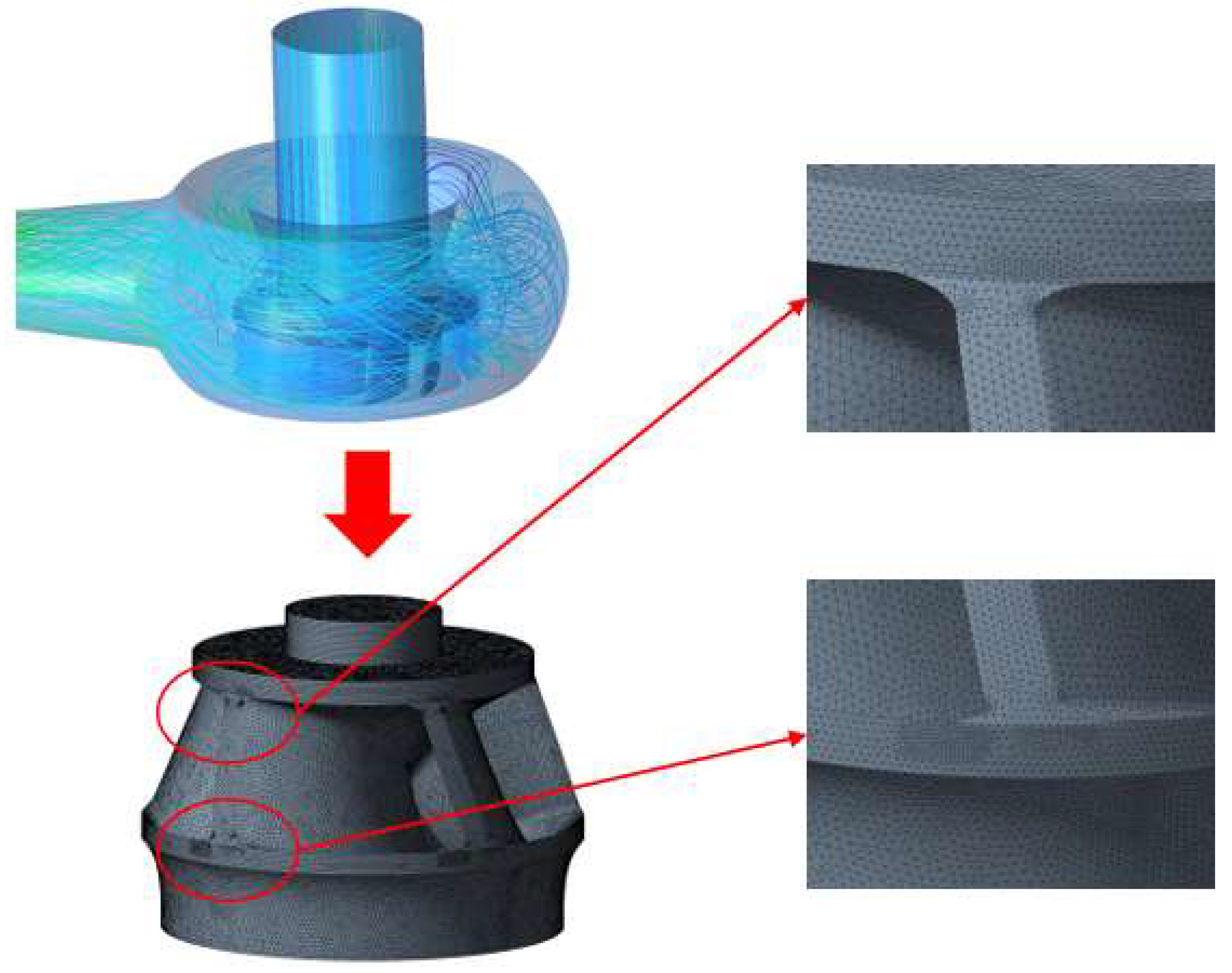
2.2. Geometric Model and Grid Generation
2.3. Boundary Conditions and CFD Setup
3. Experimental Testing and Validation
4. Results and Discussion
4.1. Flow Field Characteristics
4.2. Radial Force Analysis
4.3. Pressure Pulsation Signal Analysis
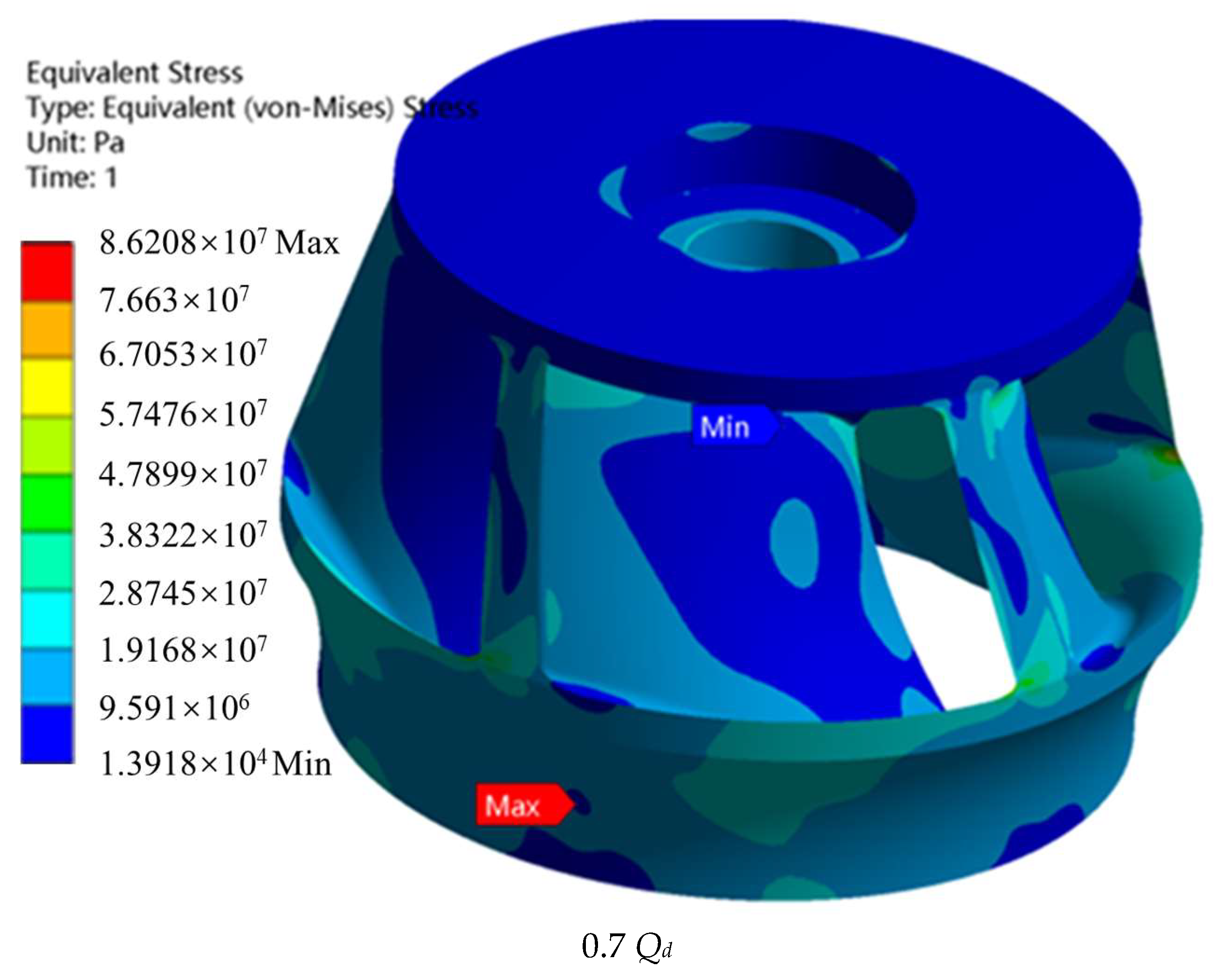
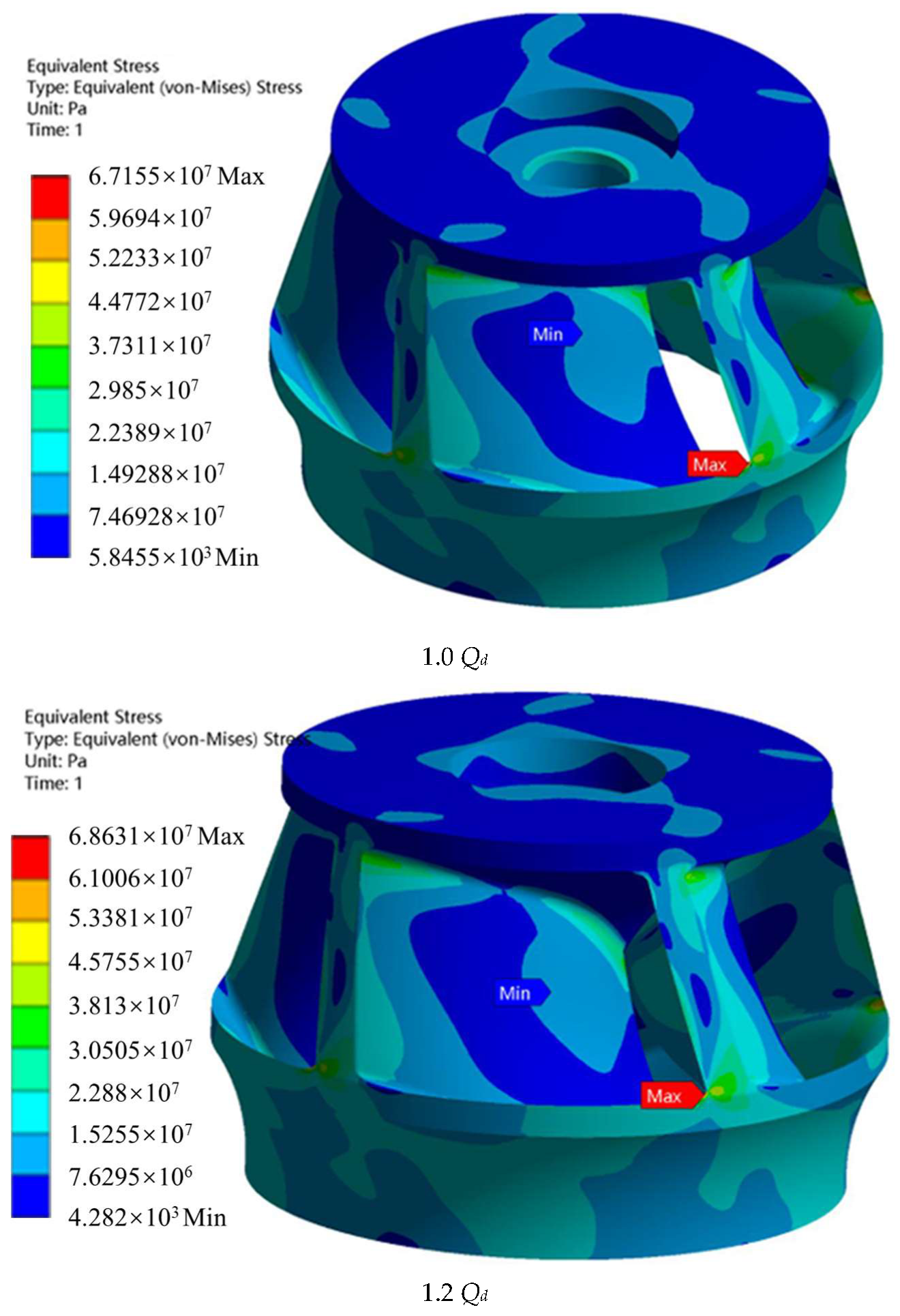
4.4. Analysis of the Strength of the Impeller
5. Conclusions
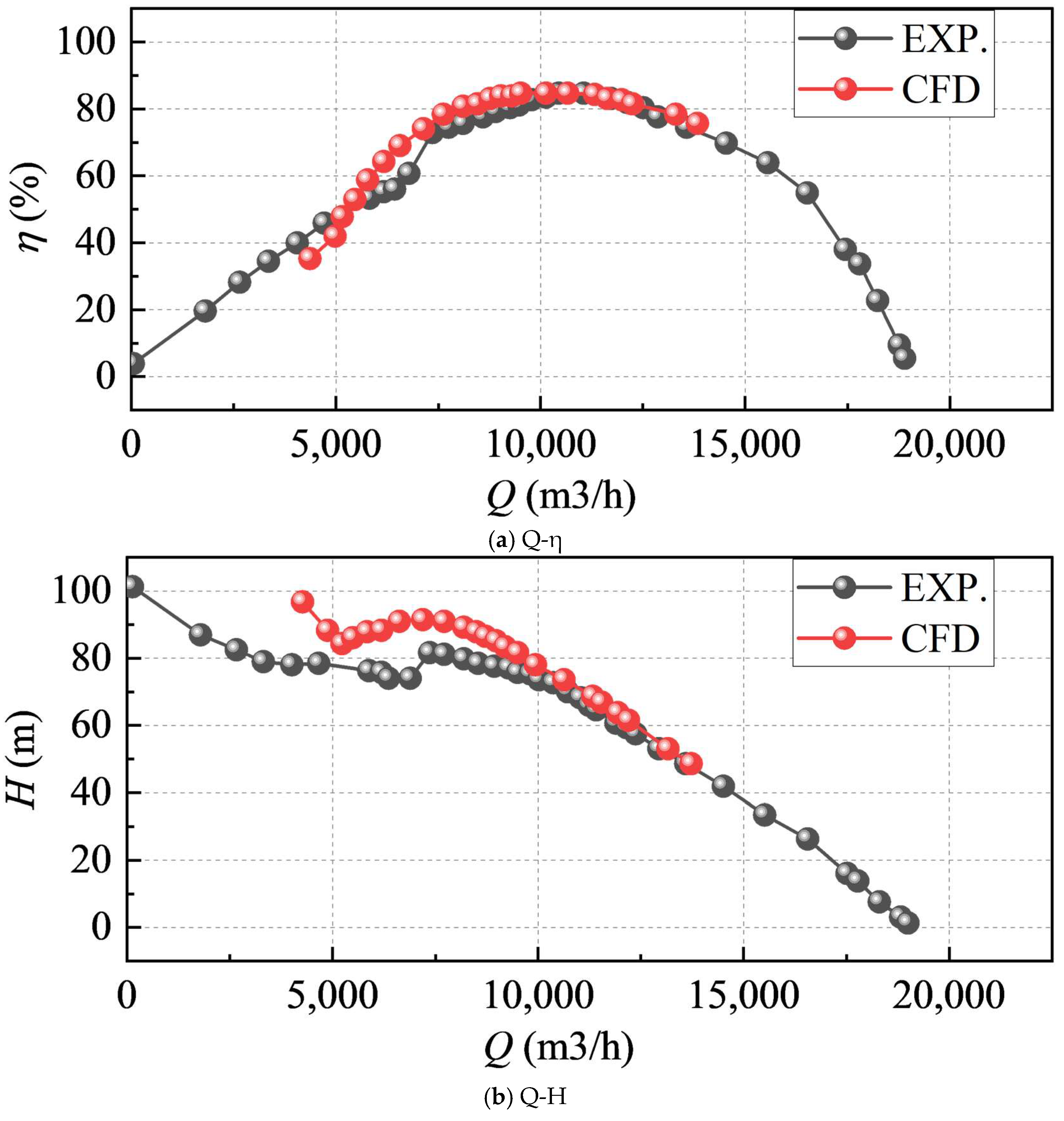
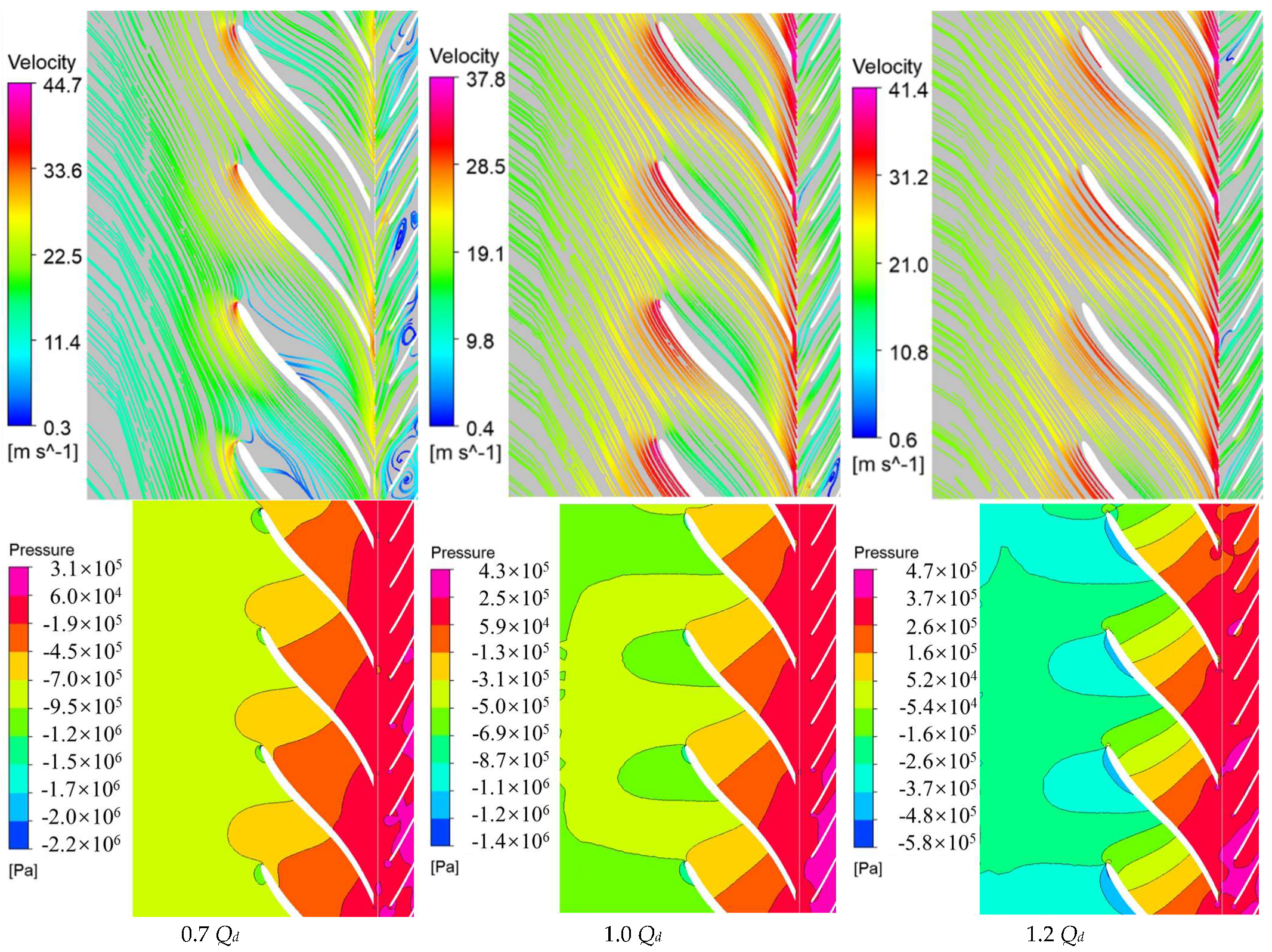
- Under the rated operating condition of 1.0 Qd, the internal flow presents uniform streamlines without flow separation or backflow. The velocity and pressure distribution are uniform, and the energy conversion efficiency is the highest. At a low flow rate of 0.7 Qd, backflow, flow separation and secondary flow are prone to occur, resulting in a significant increase in hydraulic loss. At a high flow rate of 1.2 Qd, the flow velocity is too high and local turbulence dissipation is enhanced. The rated operating condition is the optimal operating range for this pump.
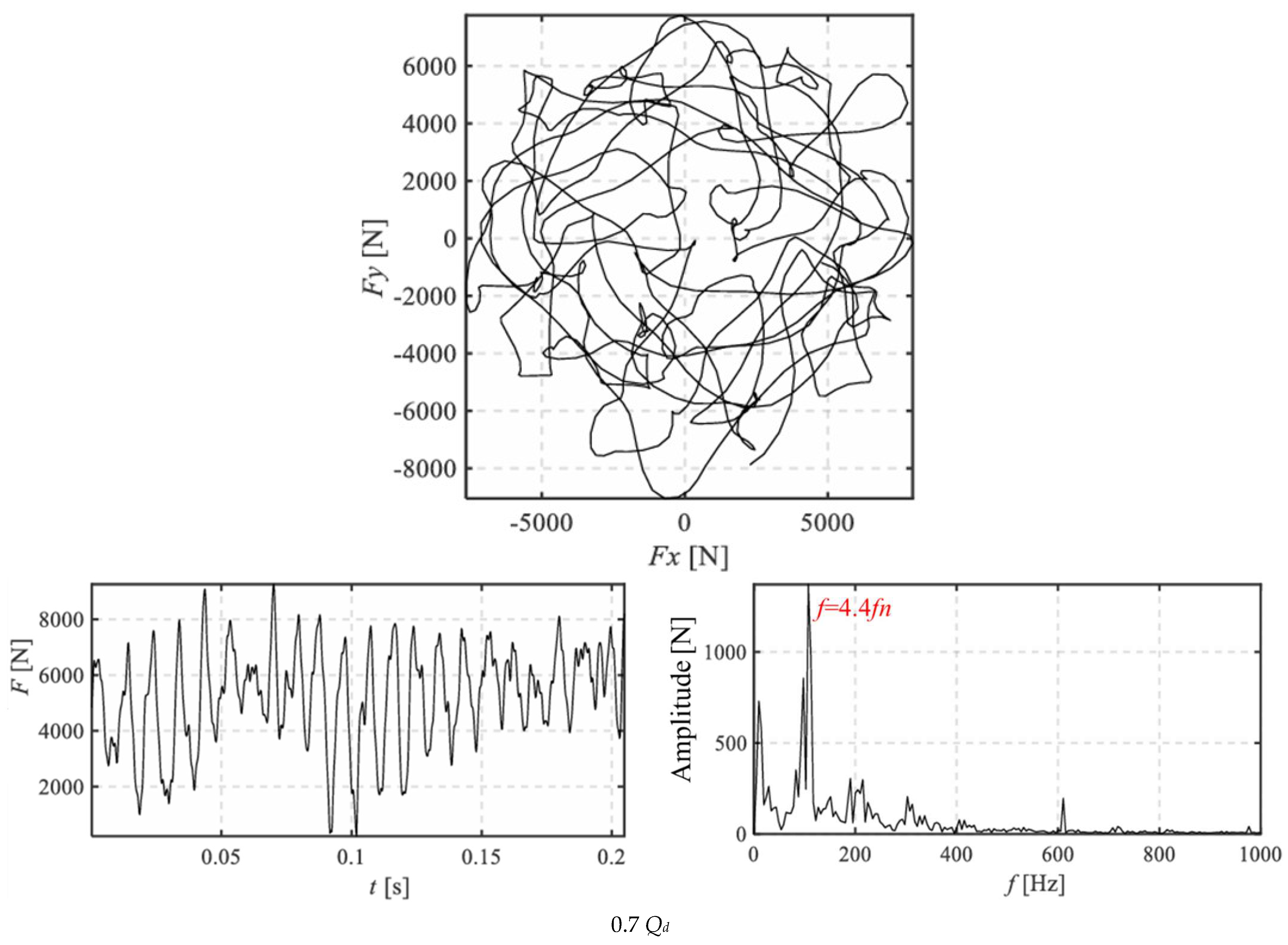
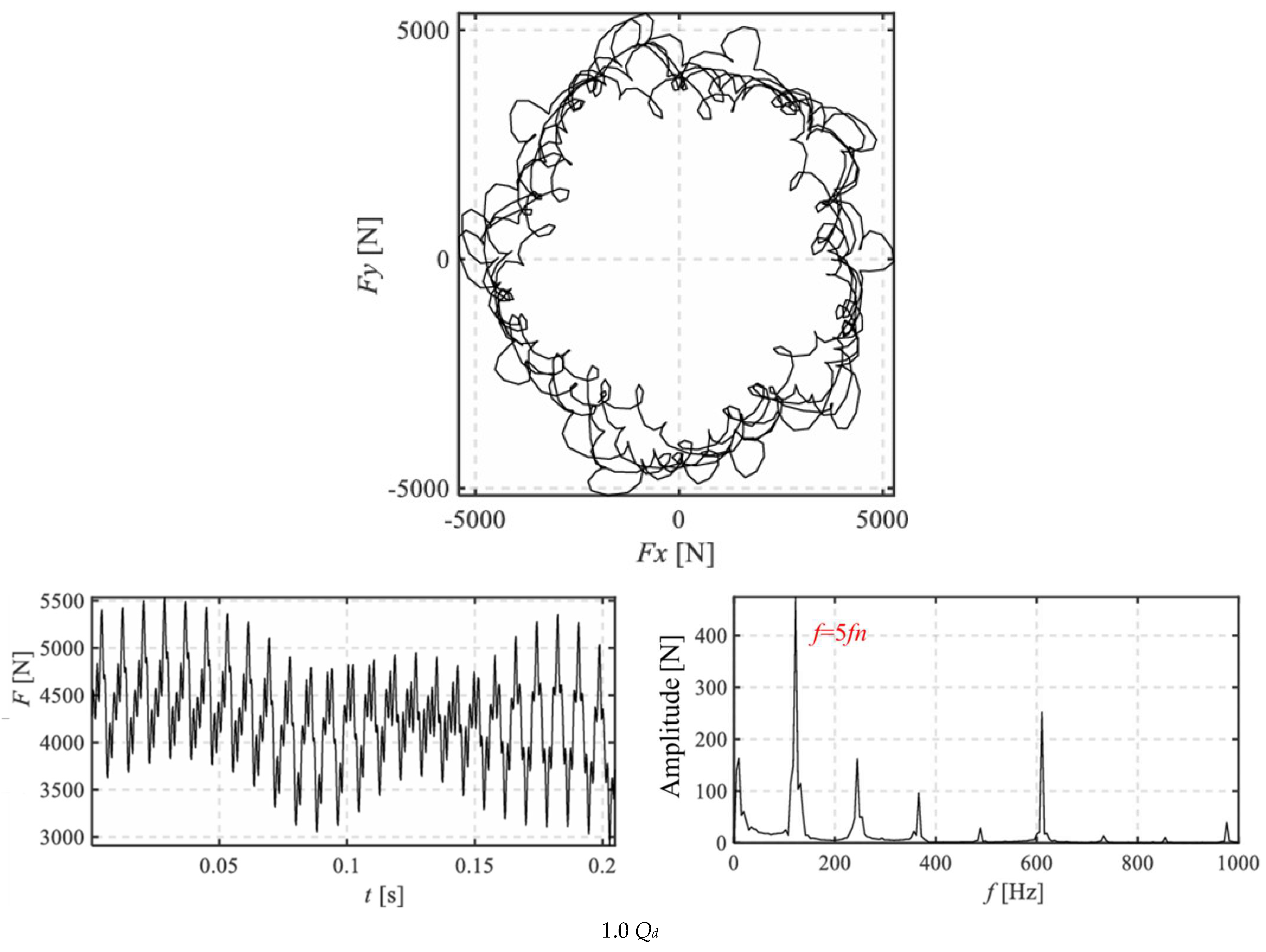
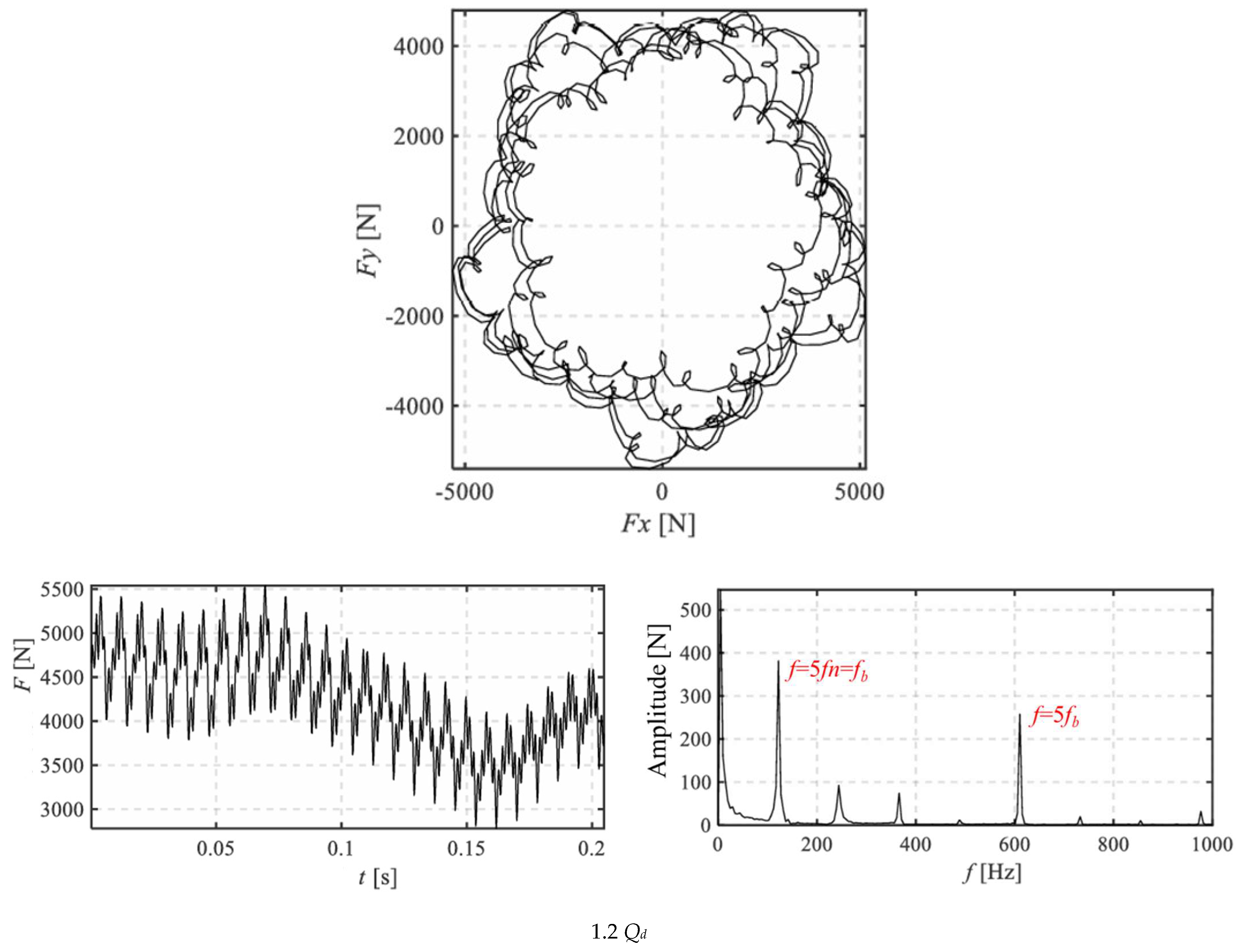
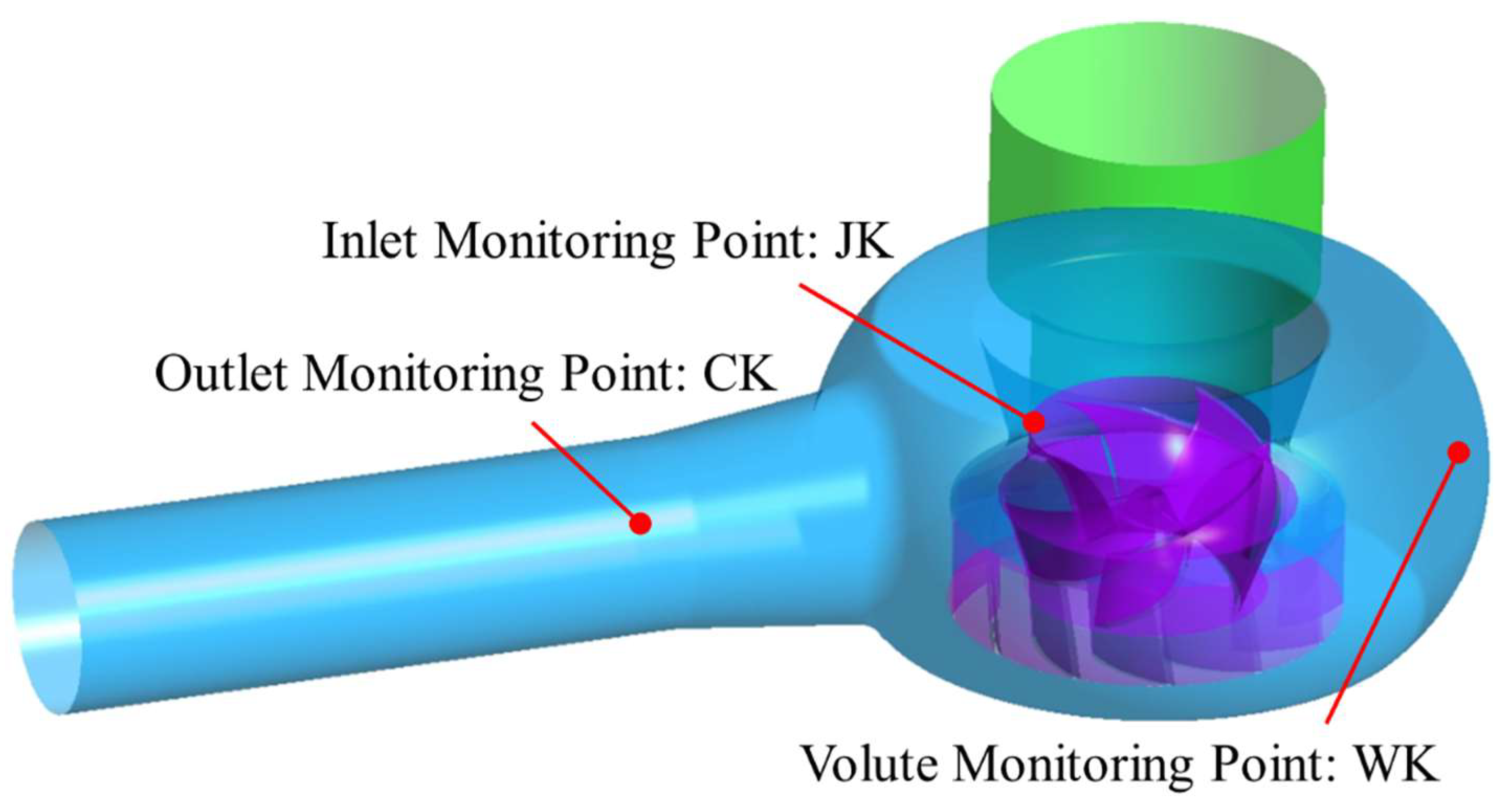
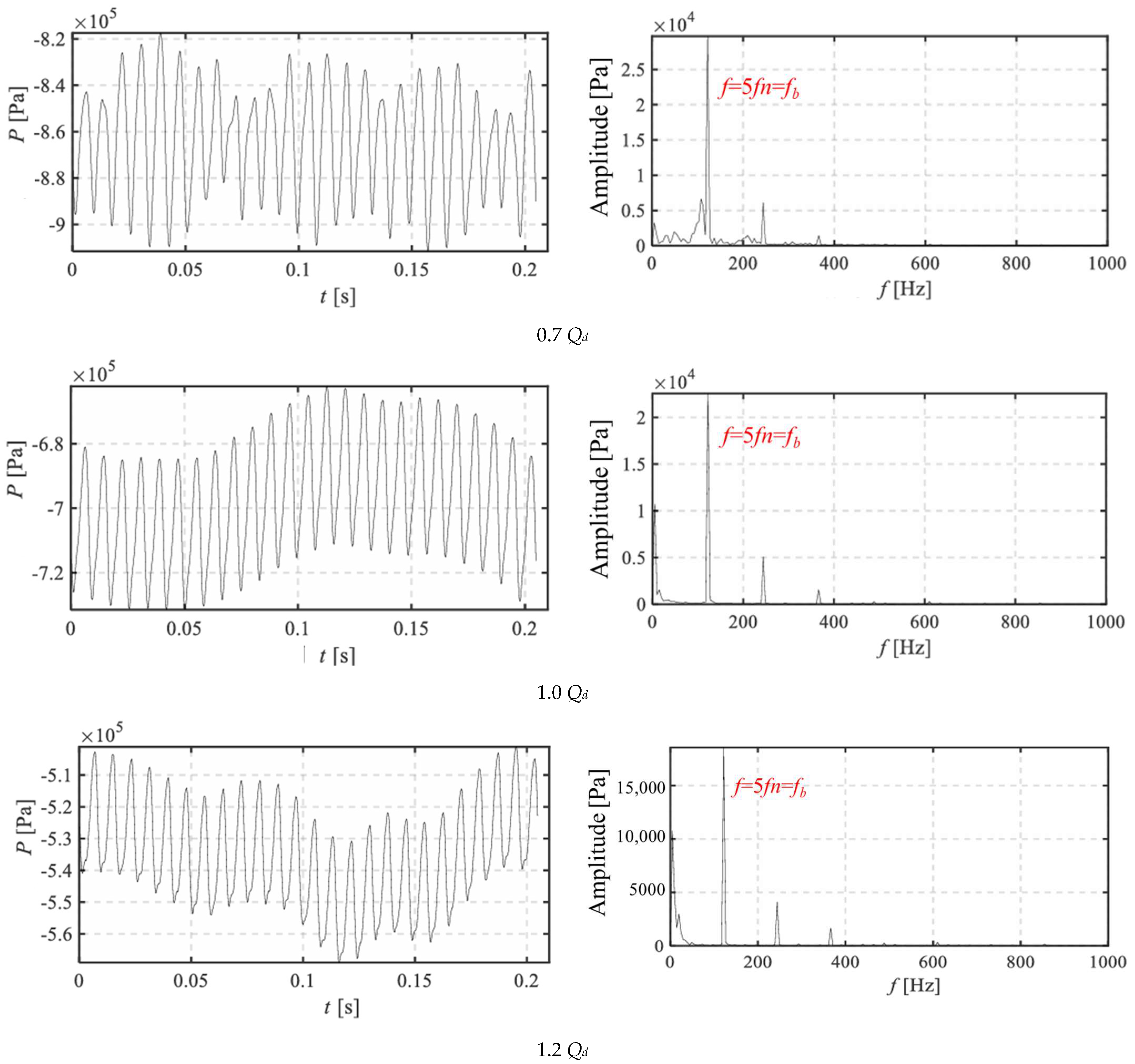
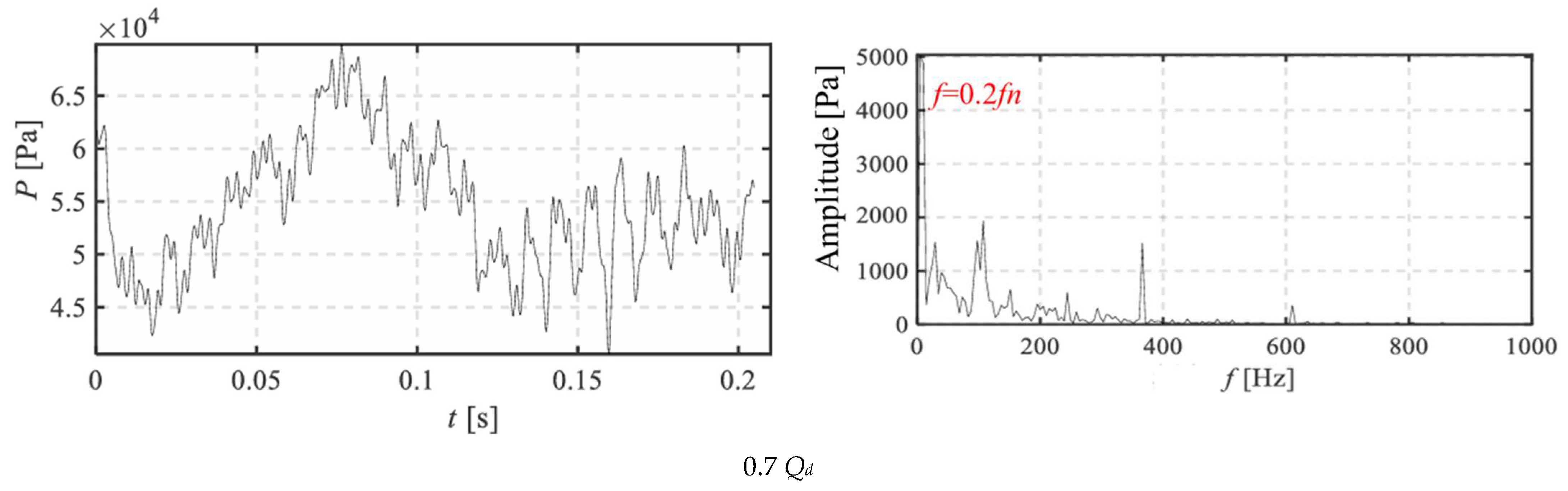
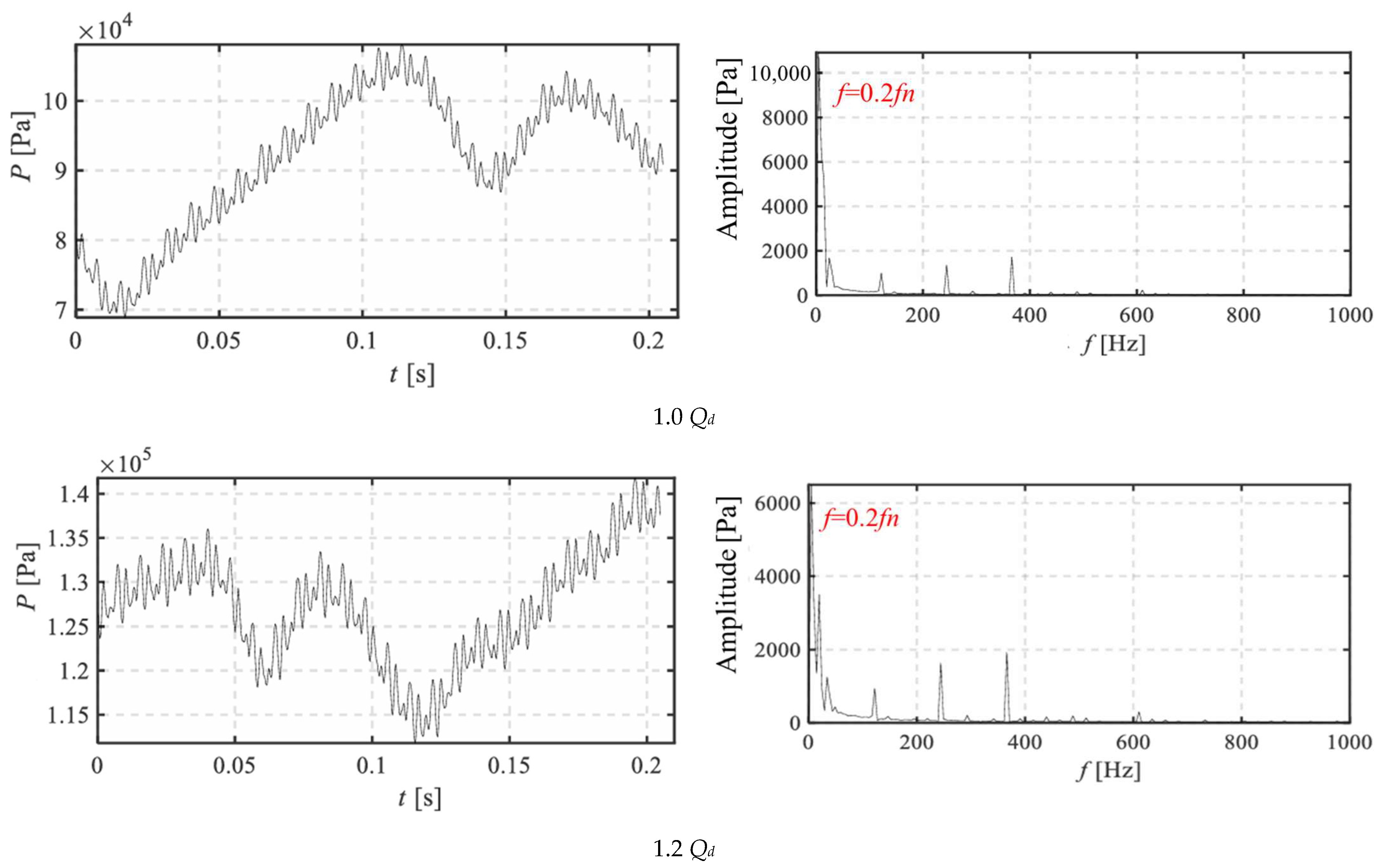
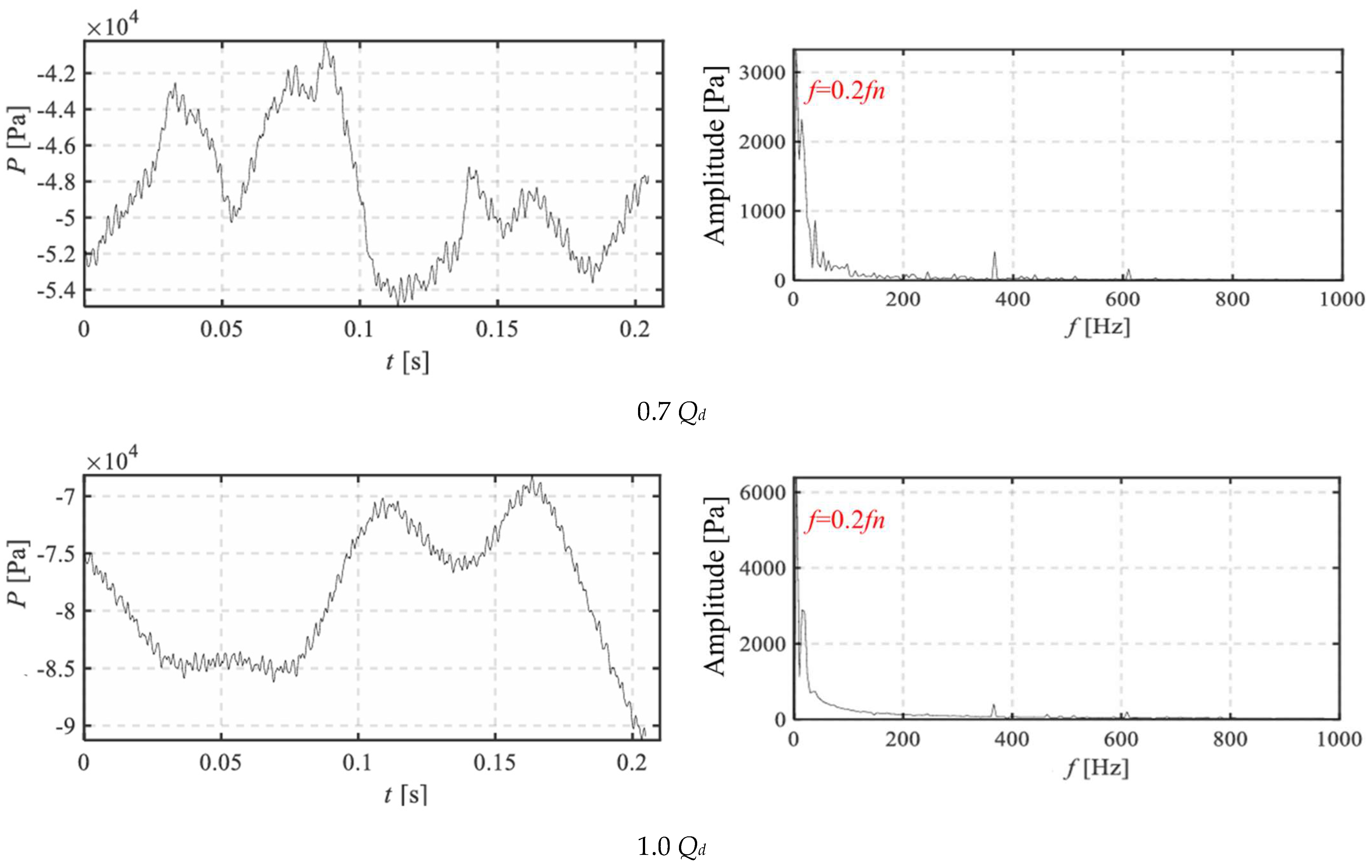
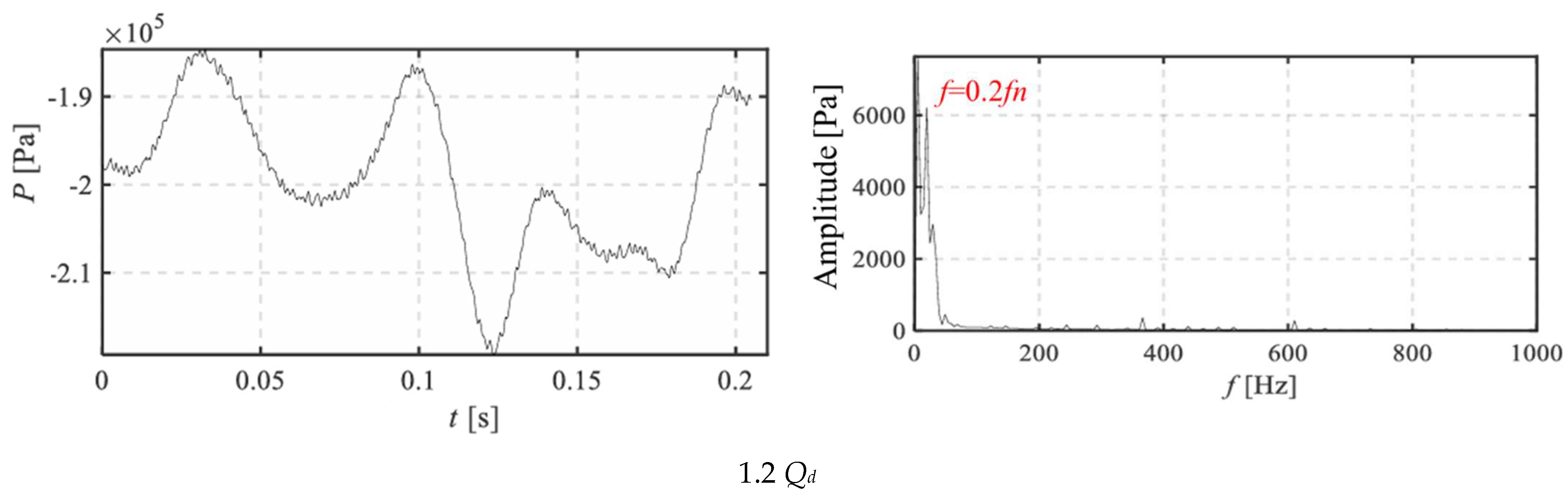
- Flow rate exerts a remarkable impact on impeller radial force and pressure pulsation. The impeller radial force and outlet pressure fluctuation reach the maximum under low-flow conditions, while the force remains the most stable with minimal pulsation at the design operating point. The dominant frequency of pressure pulsation is primarily governed by the blade passing frequency. Pressure fluctuation intensity peaks at the impeller outlet and attains the minimum within the volute. The amplitude of pressure pulsation in the volute rises considerably under large-flow conditions.
- The maximum equivalent stress of the blade appears at the junction of the blade root and hub. The stress is the highest under the low-flow condition (86.3 MPa) and the lowest under the rated condition (67.1 MPa). The maximum stress in all three conditions is less than the allowable stress, meeting the structural safety requirements. The low-flow condition is the key control condition for the strength and fatigue design of the impeller.
Author Contributions
Funding
Data Availability Statement
Acknowledgments
Conflicts of Interest
References
- Wang, R.; Wang, L.; Cai, J.; Du, S.; Hu, B.; Pan, Q.W.; Jiang, L.; Xu, Z. Research Status and Trends on Industrial Heat Pump and Network Utilization of Waste Heat. J. Refrig. 2017, 38, 1–10. [Google Scholar]
- Falter, C.; Pitz-Paal, R. Energy analysis of solar thermochemical fuel production pathway with a focus on waste heat recuperation and vacuum generation. Sol. Energy 2019, 176, 230–240. [Google Scholar]
- Wang, X.; Li, T.; Yu, Y.Y.; Mao, Q.; Liu, X.; Xu, C.; Li, G. Comprehensive analysis of a novel sustainable photovoltaic/thermal assisted ground source heat pump system with energy storage. J. Energy Storage 2024, 102, 14161. [Google Scholar] [CrossRef] [Scilit]
- Pellegrini, C.; Pedrera-Yanes, J.; Llanes-Santiago, O.; Vilalta-Alonso, G. A preliminary investigation on the operational efficiency of centrifugal pumps operating in single-branch, single-pump systems. J. Braz. Soc. Mech. Sci. Eng. 2024, 43, 151. [Google Scholar]
- Su, Y.; Chen, L.; Ge, Y.; Feng, H. Efficient ecological function optimization for endoreversible Carnot heat pumps. J. Non-Equilib. Thermodyn. 2025, 50, 231–239. [Google Scholar] [CrossRef] [Scilit]
- Bai, T.; Yao, Y.; Hu, B.; Feng, J.; Jin, Z. Thermodynamic analysis of exhaust waste heat recovery in a compound open absorption heat pump system. Appl. Therm. Eng. 2024, 257, 124387. [Google Scholar] [CrossRef] [Scilit]
- Zhou, T.; Zhu, Y.; Tang, S.N. Scale effect for hydraulic model of a mixed flow nuclear main pump. Nucl. Eng. Technol. 2025, 57, 103137. [Google Scholar] [CrossRef] [Scilit]
- Radosavljević, M.; Petrović, R.; Žeželj, B.; Belović, D.; Cvejić, S. Mathematical Modeling and Experimental Tests of Working Parameters of Piston-Radial Pumps in Hydraulic Systems of Mobile Machines. Appl. Sci. 2024, 14, 9979. [Google Scholar] [CrossRef] [Scilit]
- Yu, B.; Chen, G.; Liu, K.; Yan, G.; Zhang, Y.; Liu, Y. Research on the Maximum Regenerative Energy Commutation Control Strategy of a Dual-Mode Synergistic Energy Recovery Pump-Controlled Grinder. Energies 2025, 18, 2622. [Google Scholar] [CrossRef] [Scilit]
- Ye, Z.; Zeng, Z.; Lei, C.; Zhao, Y.; Pang, Y. Analysis of Operating Performance Parameters of the Internal Twin Screw Pump. Iran. J. Sci. Technol.-Trans. Mech. Eng. 2024, 48, 957–970. [Google Scholar]
- Konishi, T.; Hirano, Y.; Nishi, Y. Hydraulic Loss and Internal Flow of a Pump Equipped with an Impeller with Radial and Annular Flow Channels. Int. J. Fluid Mach. Syst. 2023, 16, 53–72. [Google Scholar] [CrossRef] [Scilit]
- Cai, L.; Xu, Y.; Long, Y.; Zhou, Z.; Zhu, R.; Yuan, S. Numerical simulation and experiment on internal flow characteristics of axial-flow nuclear reactor coolant pump. J. Drain. Irrig. Mach. Eng. 2024, 42, 1189–1195. [Google Scholar]
- Heng, Y.; Chen, Z.; Jiang, Q.; Bois, G.; Zhang, W. Internal flow visualization and performance characteristics of a disc pump under gas-liquid two-phase flow conditions. Energy 2025, 333, 137480. [Google Scholar] [CrossRef] [Scilit]
- Chen, X.; Cui, Y.; Zheng, Y.; Zhang, Y. Fatigue crack propagation simulation of vertical centrifugal pump runner using the extended finite element method. Mech. Adv. Mater. Struct. 2023, 31, 4586–4600. [Google Scholar] [CrossRef] [Scilit]
- Yan, D.; Zhang, C.; Wang, C.; Zhang, T.; Sun, F. Vibrational Analysis and Optimization of a Water Injection Pipeline in a High-pressure Plunger Pump. J. Appl. Fluid Mech. 2024, 17, 487–496. [Google Scholar] [CrossRef] [Scilit]
- Lu, J.; Yao, X.; Zheng, H.; Yan, X.; Liu, H.; Wu, T. Analysis of Unsteady Internal Flow and Its Induced Structural Response in a Circulating Water Pump. Water 2024, 16, 1294. [Google Scholar] [CrossRef] [Scilit]
- Zhang, Z.; Gong, B.; Chen, T.; Li, N.; Jin, Y.; Jiang, H.; Zhao, J.; Li, K. Flow induced acoustic characteristics analysis of propulsion pump by indirect acoustic variable method and FEM. Ocean Eng. 2024, 312, 119478. [Google Scholar] [CrossRef] [Scilit]
- Mathieu, J. An Introduction to Turbulent Flow; Cambridge University Press: Cambridge, UK, 2000. [Google Scholar]
- Zhao, H.; Zhu, B.; Jiang, B. Comprehensive assessment and analysis of cavitation scale effects on energy conversion and stability in pumped hydro energy storage units. Energy Convers. Manag. 2024, 325, 119370. [Google Scholar] [CrossRef] [Scilit]
- Zhao, H.; Zhu, B.; Wang, C.; Han, Y. A prospective assessment of vortex evolution mechanisms and pressure fluctuation coupling in novel low-head pumped hydro energy storage units. Energy Convers. Manag. 2025, 342, 120136. [Google Scholar] [CrossRef] [Scilit]
- Zhao, H.; Zhu, B.; Xu, R.; Tan, L.; Zhang, H.; Chen, L.; Liu, Z.; Yang, J.; Deng, F. Evaluating the predictive potential of modeling frameworks for Pelton turbine energy performance and guiding engineering modeling in hydroelectric applications. Energy 2025, 330, 136861. [Google Scholar] [CrossRef] [Scilit]
- Lu, J.; Li, F.; Tao, R.; Yao, Z.; Xiao, R.; Liang, Q.; Liu, W. Nonlinear stability analysis of the transient startup process of the turbine mode of pumped storage unit under different control strategies. Energy Convers. Manag. 2026, 359, 121546. [Google Scholar] [CrossRef] [Scilit]
- Lu, J.; Tang, Y.; Tao, R.; Zhu, D.; Yao, Z.; Xiao, R.; Wang, F.; Liang, Q.; Liu, W. Research on the dynamic evolution law of the transient process of pump mode shutdown in pump-turbine. J. Energy Storage 2026, 156, 121615. [Google Scholar] [CrossRef] [Scilit]
- Lu, J.; Tao, R.; Yao, Z.; Xiao, R.; Liu, W. Transient simulation energy study of fast opening of guide vane during start-up of pump turbine in energy storage mode. Energy 2025, 324, 135964. [Google Scholar] [CrossRef] [Scilit]
- Lu, J.; Han, X.; Tao, R.; Xiao, R.; Liang, Q. Research on transient performance changes during the non-simultaneous opening process of guide vanes in reversible pump-turbine units in pump mode. Energy 2025, 335, 138331. [Google Scholar] [CrossRef] [Scilit]
- Stanojević, M.; Milojević, S.; Marić, D.; Stojanović, B. Influence of Gears and Oil Levels Upon Efficiency of Ravigneaux Gearset. Teh. Vjesn. 2025, 32, 2048–2055. [Google Scholar] [CrossRef] [Scilit]



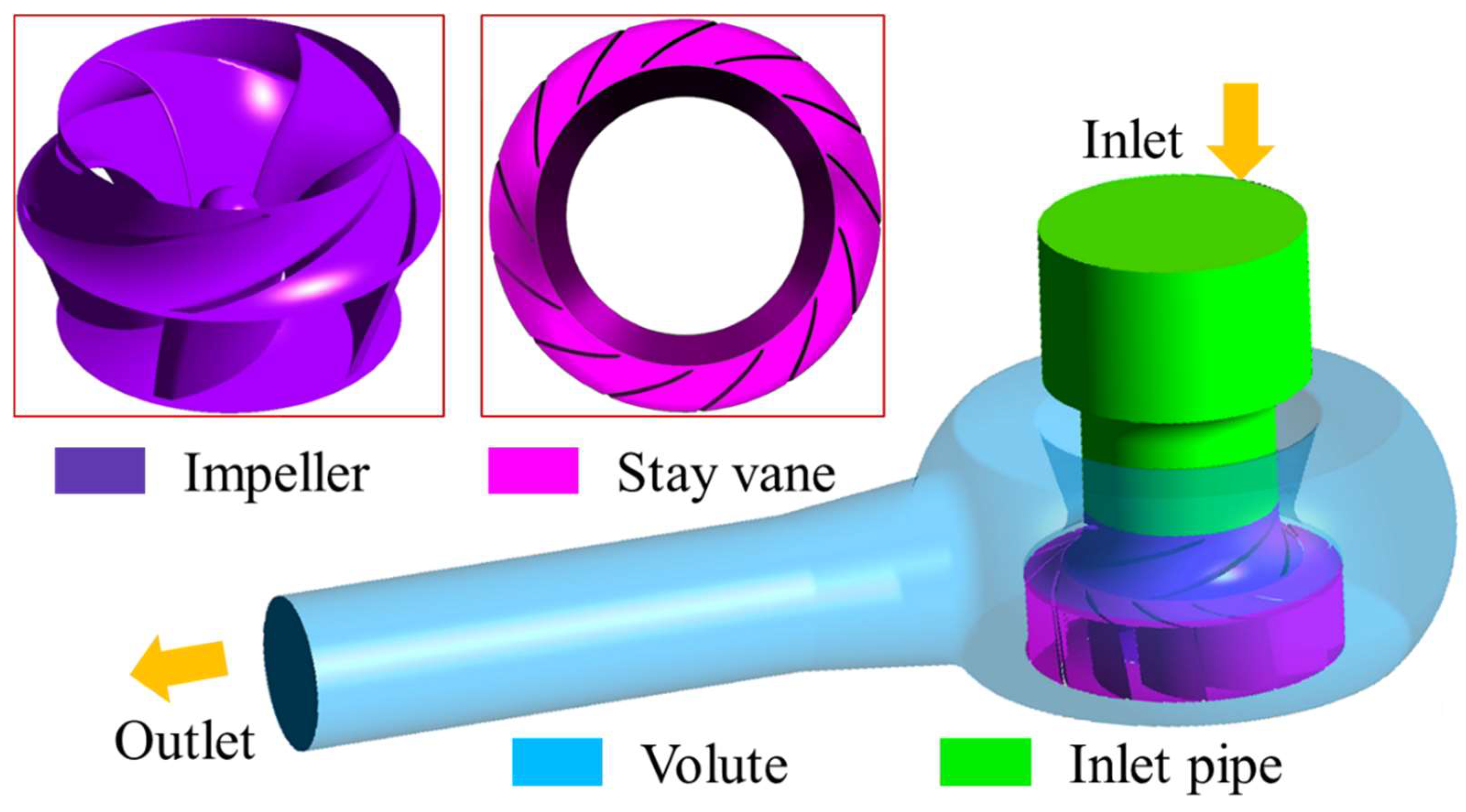
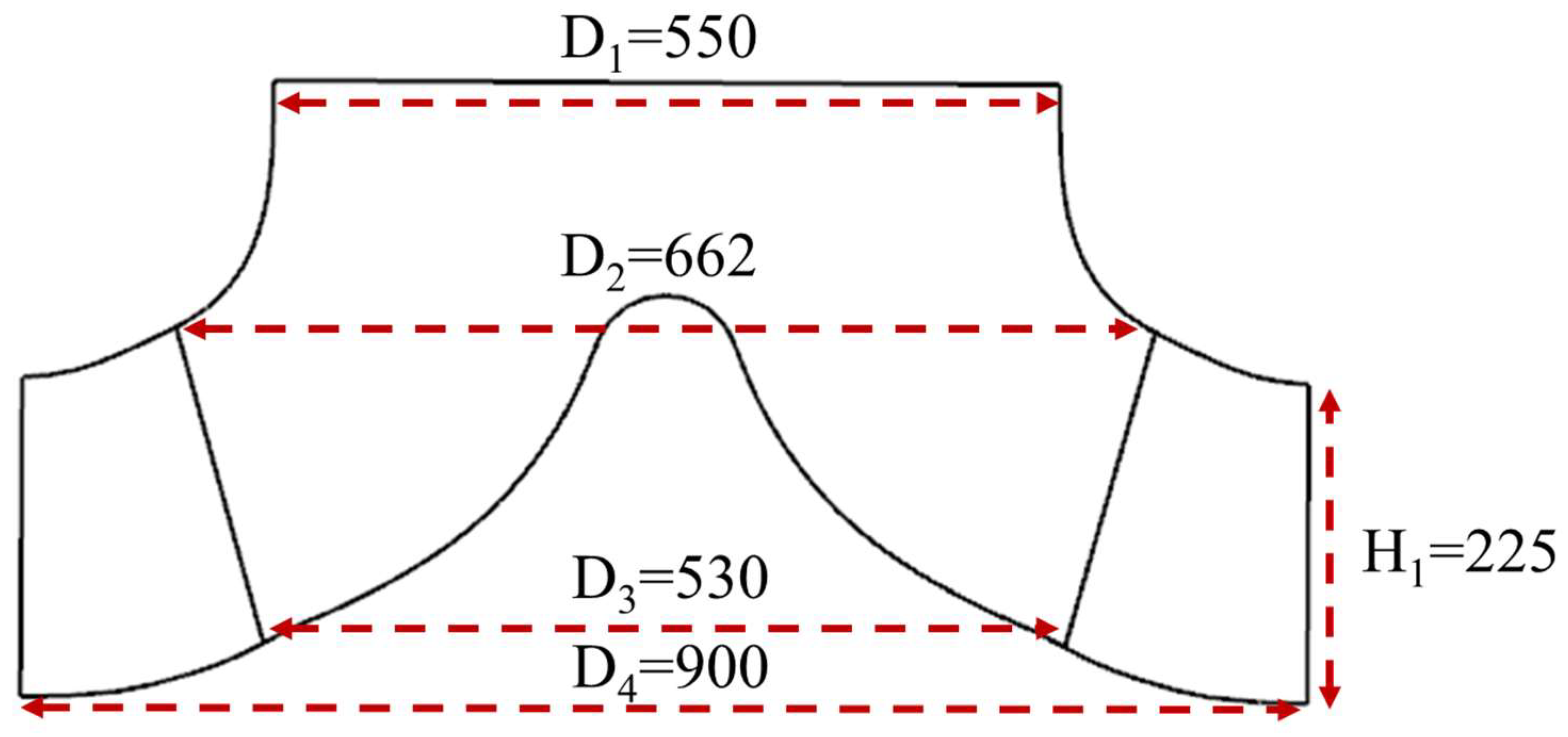
| Components | Value | Unit |
|---|---|---|
| The diameter of Inlet D1 | 550 | [mm] |
| The diameter near the shroud outlet edge D2 | 662 | [mm] |
| The diameter near the hub outlet edge D3 | 530 | [mm] |
| The height of the stay vanes outlet H2 | 225 | [mm] |
| Rated impeller speed nr | 1465 | [rpm] |
| Design flow Qd | 12,000 | [m3/h] |
| Rated head Hr | 56.3 | [m] |
| Number of impeller blades Zimp | 5 | [−] |
| Number of stay vane blades Zsv | 13 | [−] |
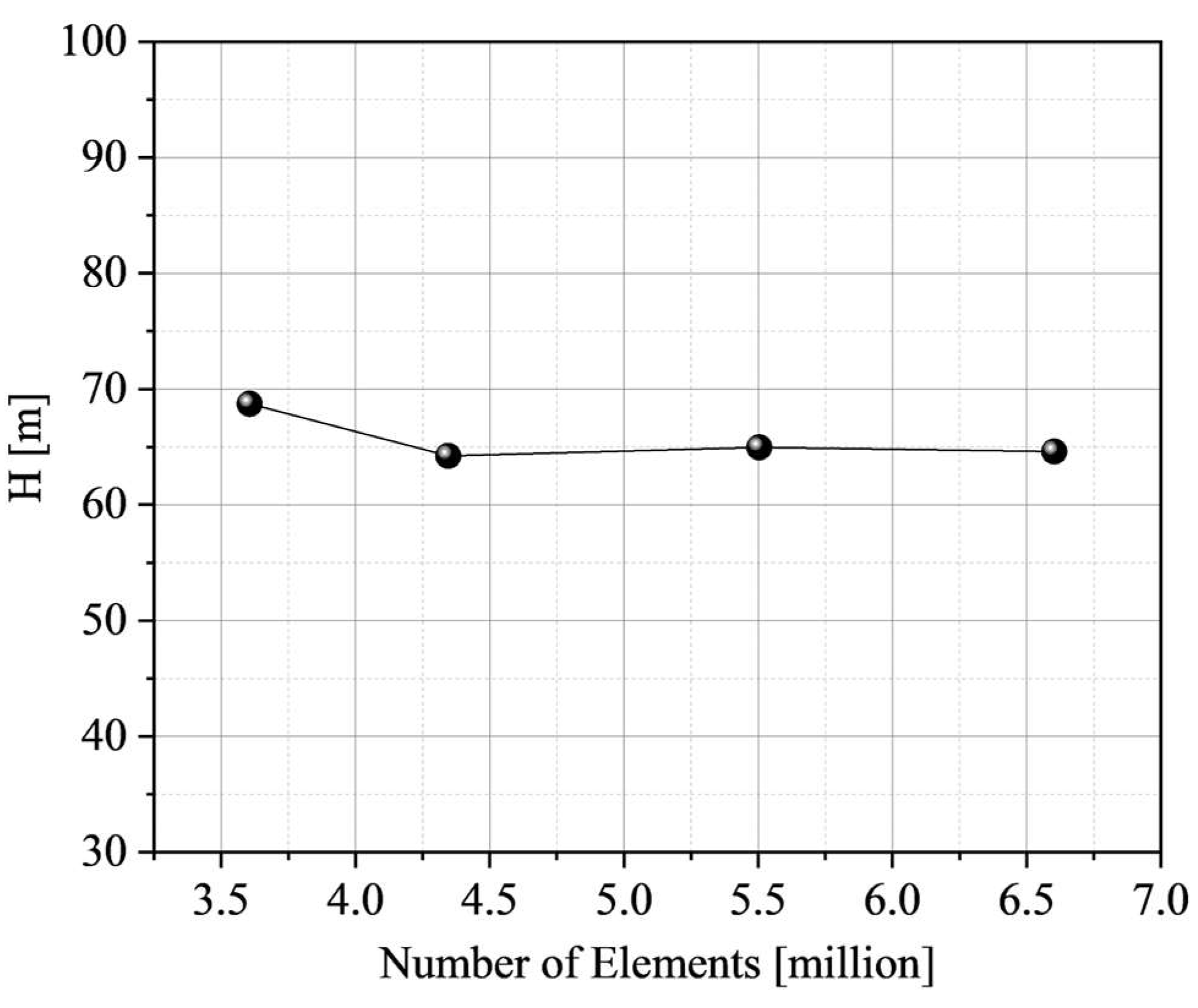
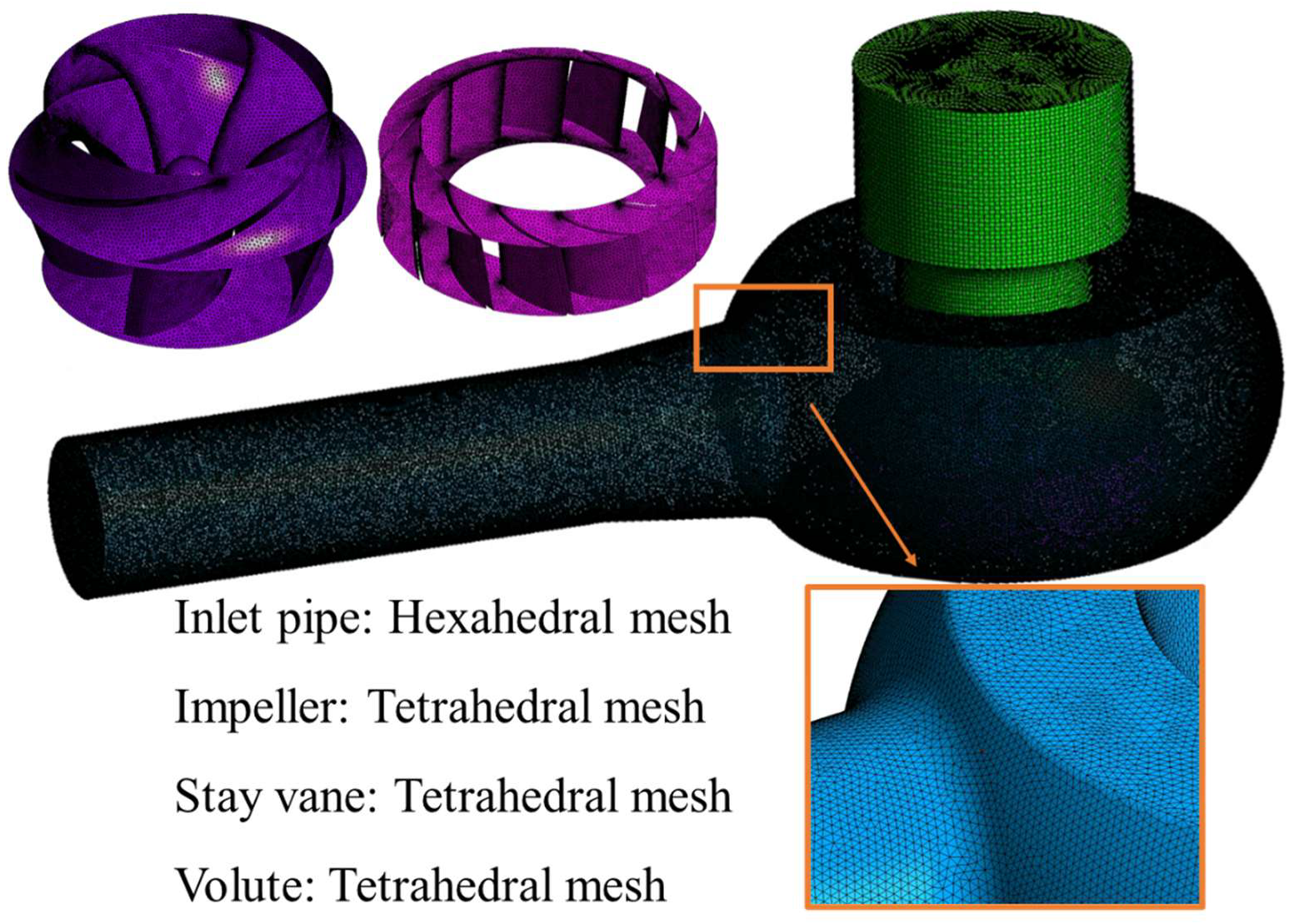
| Component | Mesh Type | Element Count |
|---|---|---|
| Inlet pipe | Hexahedral | 281,088 |
| Impeller | Tetrahedral | 1,965,011 |
| Stay vane | Tetrahedral | 1,376,869 |
| Volute | Tetrahedral | 1,881,143 |
| Total | 5,504,111 |
| Monitoring Points | Condition | △H | △H/Hd |
|---|---|---|---|
| JK | 0.7 Qd | 4.297 | 7.62 |
| 1.0 Qd | 2.725 | 4.83 | |
| 1.2 Qd | 3.661 | 6.49 | |
| WK | 0.7 Qd | 2.891 | 5.13 |
| 1.0 Qd | 3.998 | 7.09 | |
| 1.2 Qd | 3.058 | 5.42 | |
| CK | 0.7 Qd | 1.062 | 1.88 |
| 1.0 Qd | 1.762 | 3.13 | |
| 1.2 Qd | 3.535 | 6.27 |
| Name | Materials | Elasticity Modulus (N/mm2) | Density (kg/m3) | Poisson Ratio |
|---|---|---|---|---|
| Shroud | Steel | 2.1 × 10⁵ | 7.85 × 10⁻⁶ | 0.3 |
| Blade | Steel | 2.1 × 10⁵ | 7.85 × 10⁻⁶ | 0.3 |
| Hub | Steel | 2.1 × 10⁵ | 7.85 × 10⁻⁶ | 0.3 |
| Conditions | Flowrate (m3/h) | Maximum Equivalent Stress (Mpa) |
|---|---|---|
| 0.7 Qd | 8400 | 86.3 |
| 1.0 Qd | 12,000 | 67.1 |
| 1.2 Qd | 14,400 | 68.6 |
Disclaimer/Publisher’s Note: The statements, opinions and data contained in all publications are solely those of the individual author(s) and contributor(s) and not of MDPI and/or the editor(s). MDPI and/or the editor(s) disclaim responsibility for any injury to people or property resulting from any ideas, methods, instructions or products referred to in the content. |
© 2026 by the authors. Licensee MDPI, Basel, Switzerland. This article is an open access article distributed under the terms and conditions of the Creative Commons Attribution (CC BY) license.
Share and Cite
Lu, J.; Xiao, B.; Li, S.; Wu, G.; Xiao, R.; Lin, K. Analysis of the Internal Flow Characteristics and Impeller Strength of the Stay Vane Mixed Flow Chemical Pump. Energies 2026, 19, 3471. https://doi.org/10.3390/en19153471
Lu J, Xiao B, Li S, Wu G, Xiao R, Lin K. Analysis of the Internal Flow Characteristics and Impeller Strength of the Stay Vane Mixed Flow Chemical Pump. Energies. 2026; 19(15):3471. https://doi.org/10.3390/en19153471
Chicago/Turabian StyleLu, Jiahao, Baiyang Xiao, Shaobin Li, Guangyan Wu, Ruofu Xiao, and Kun Lin. 2026. "Analysis of the Internal Flow Characteristics and Impeller Strength of the Stay Vane Mixed Flow Chemical Pump" Energies 19, no. 15: 3471. https://doi.org/10.3390/en19153471
APA StyleLu, J., Xiao, B., Li, S., Wu, G., Xiao, R., & Lin, K. (2026). Analysis of the Internal Flow Characteristics and Impeller Strength of the Stay Vane Mixed Flow Chemical Pump. Energies, 19(15), 3471. https://doi.org/10.3390/en19153471