A Unified ANN-Based Approach for Fault Classification, Location and CCT-Based Stability Assessment in HVAC Transmission Systems

 ,
,  , ,
, ,  , and
, and 
Abstract
1. Introduction
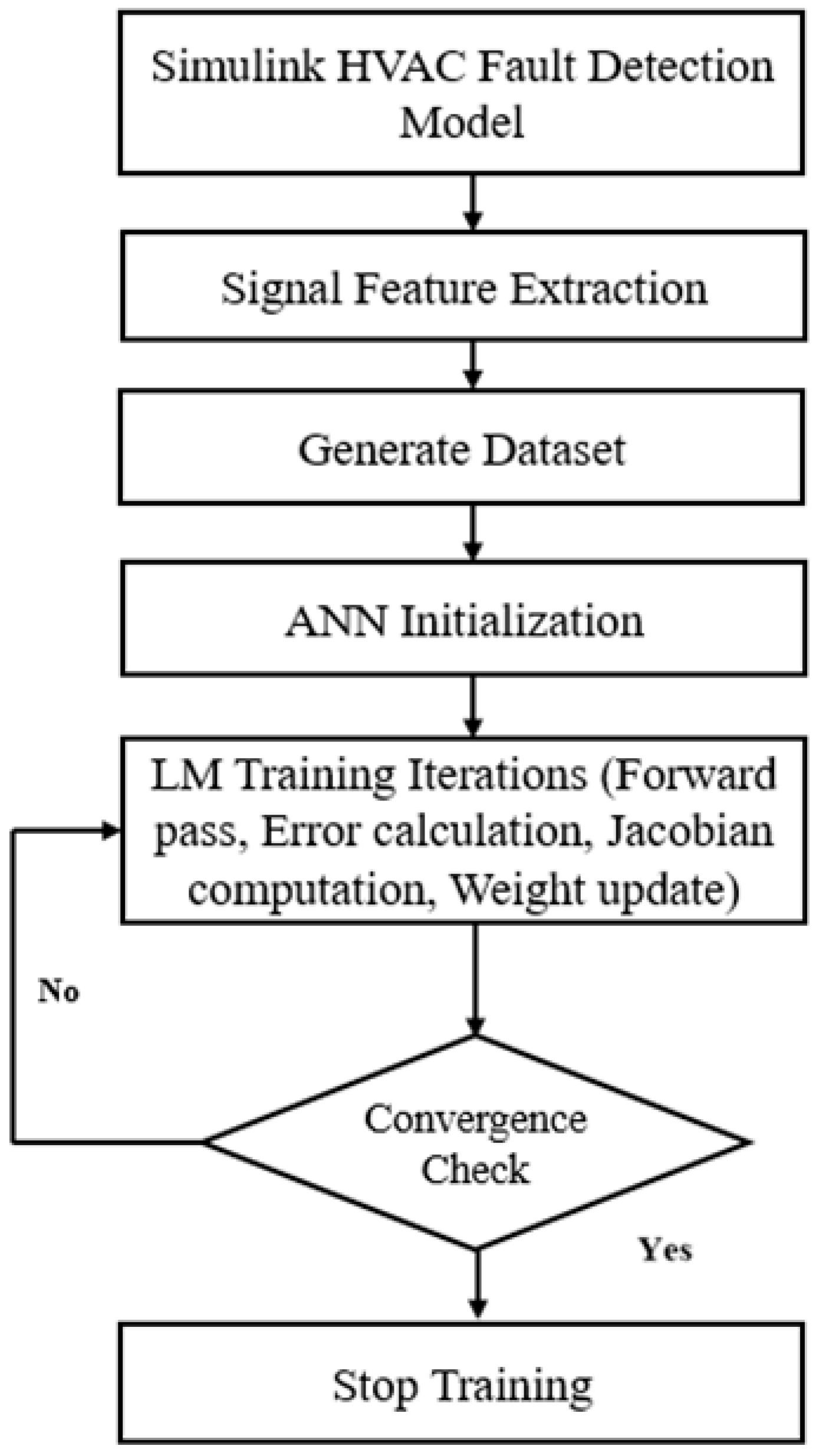
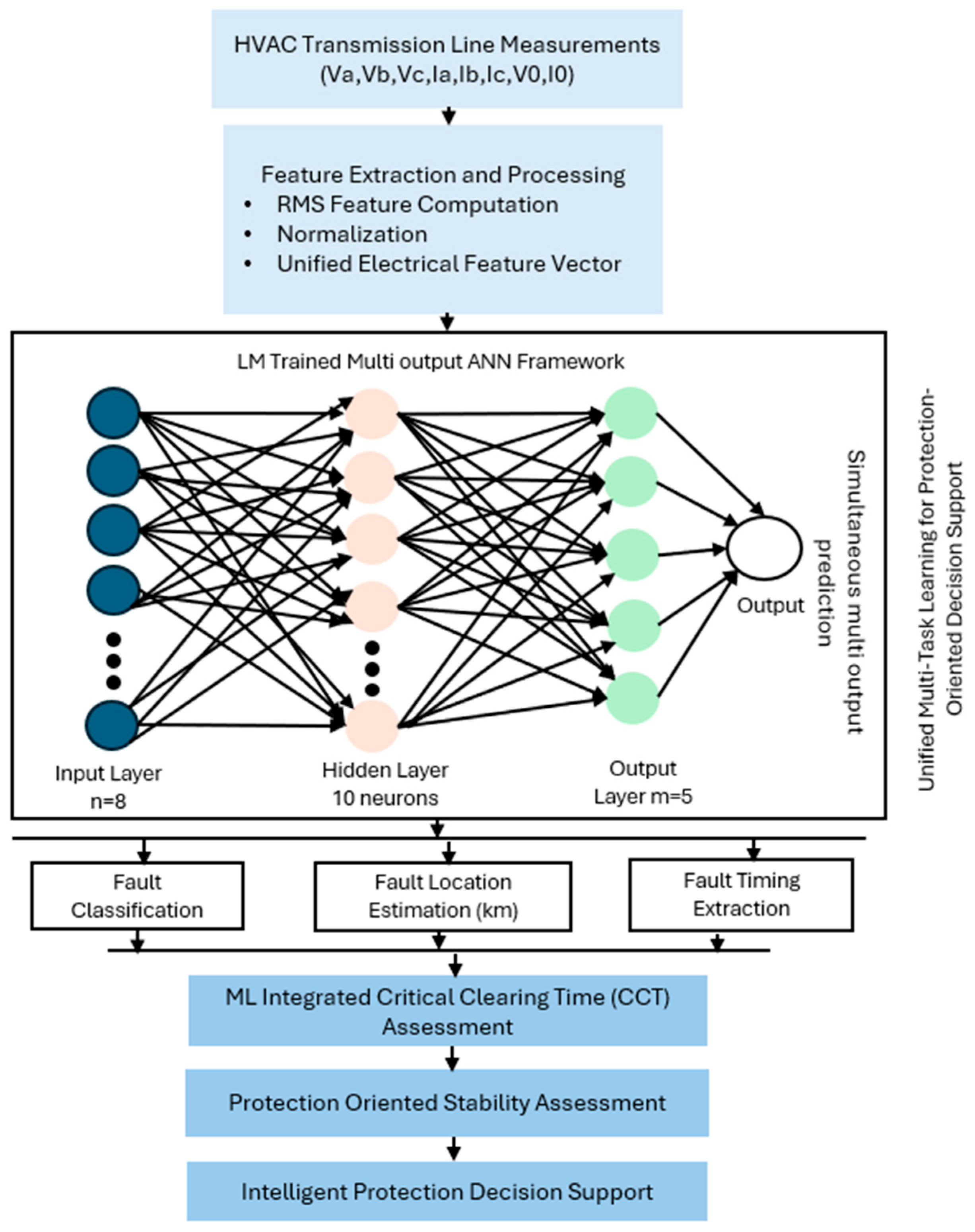
- A unified intelligent protection framework is proposed for HVAC transmission systems to simultaneously perform fault classification, fault location estimation, fault timing extraction, and ML-integrated Critical Clearing Time (CCT) assessment using a single LM-trained multi-output ANN and a unified electrical feature representation.
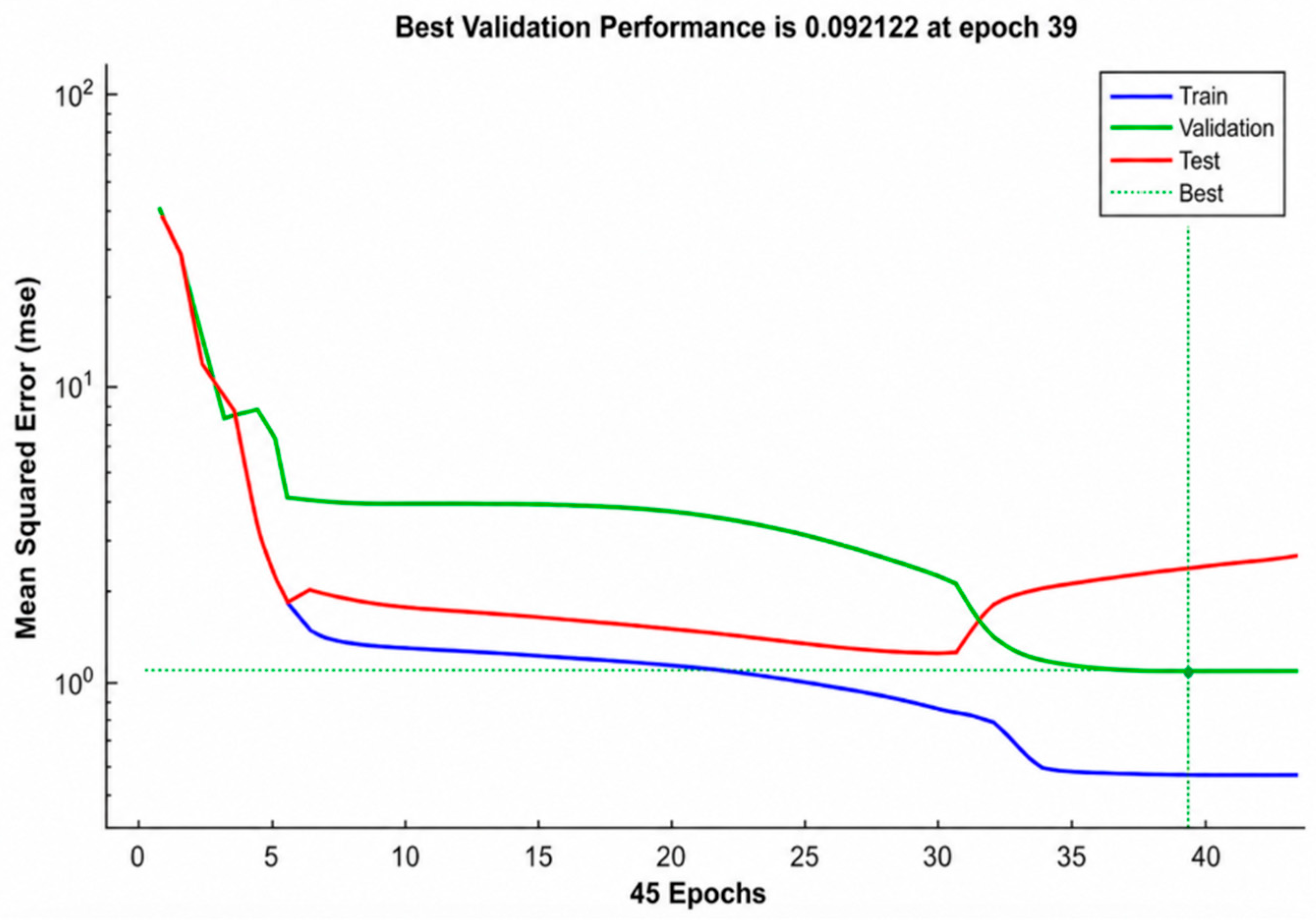
- A comparative evaluation of ANN training algorithms (BR, SCR, and LM) is conducted to determine the most suitable optimization strategy for the proposed multi-output ANN framework. Based on quantitative performance analysis, the LM algorithm is selected due to its superior convergence characteristics, lower prediction error, and higher regression accuracy for unified HVAC fault classification, per km fault location estimation, and ML-integrated CCT assessment.
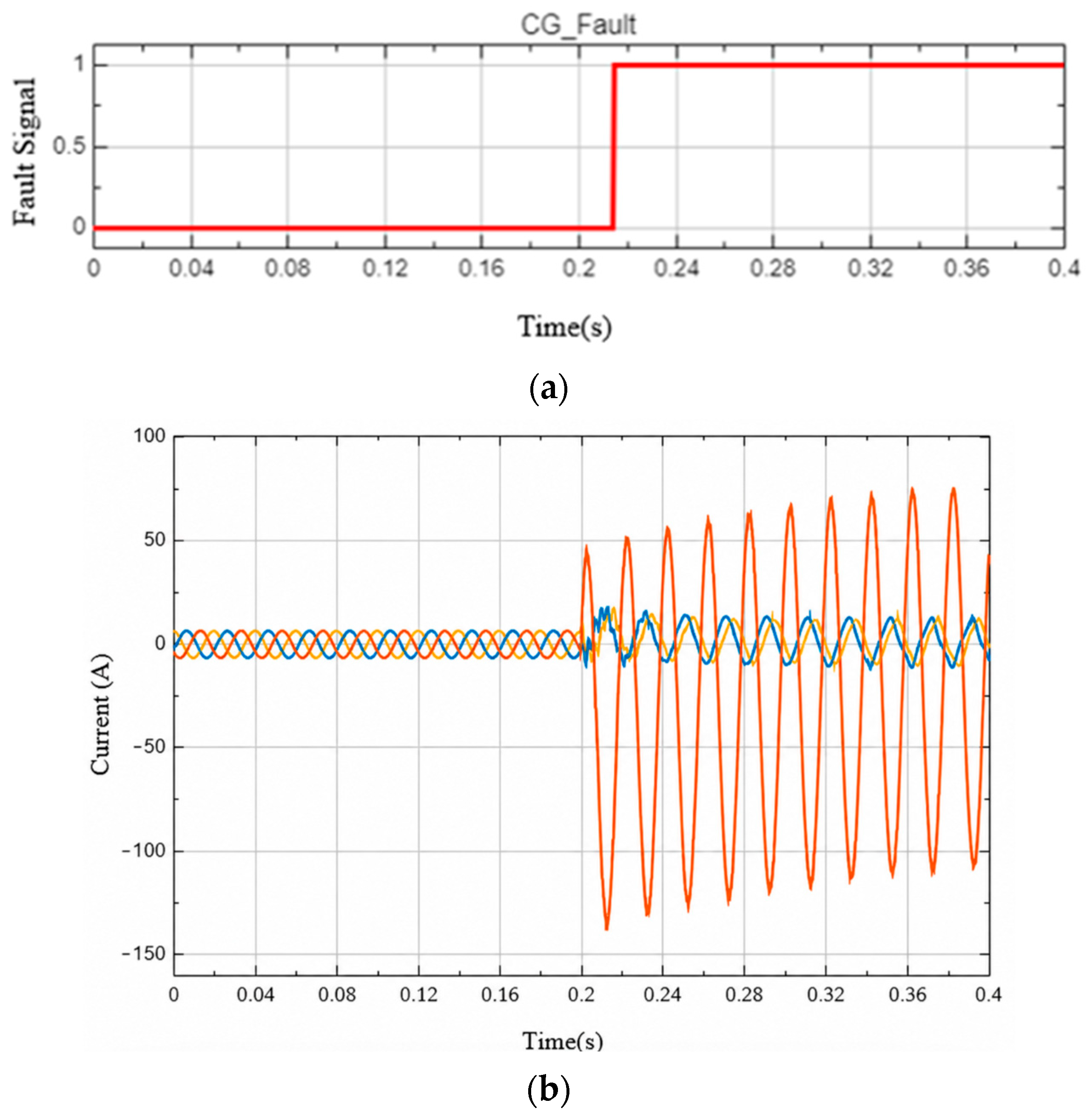
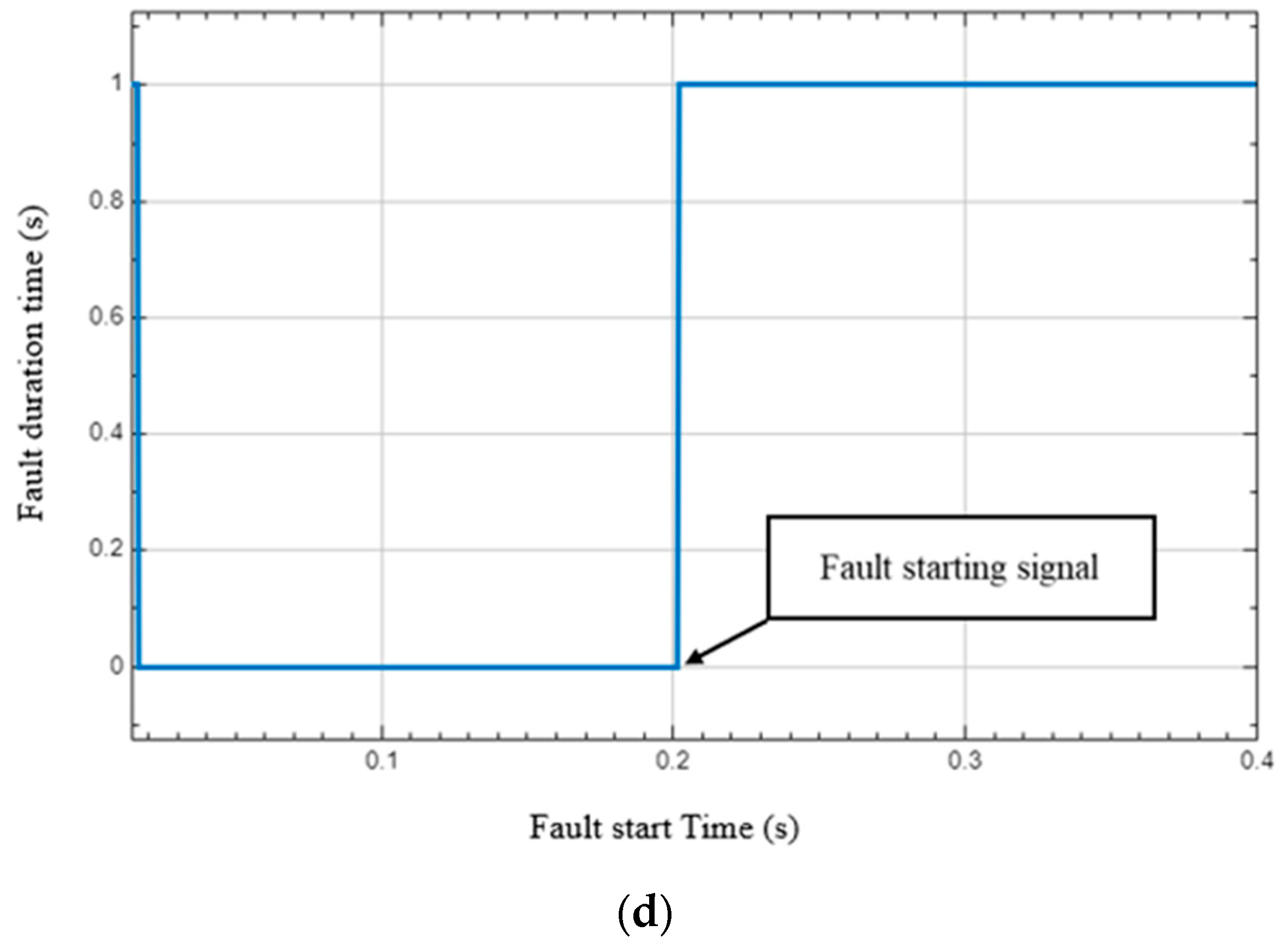
- Beyond fault types and location detection, the proposed method integrates the Critical Clearing Time (CCT) function to distinguish stability-critical faults from normal conditions, enhancing time-dependent protection decisions and improving overall system resilience. It also extracts fault inception time and fault persistence duration.
2. Related Work
2.1. Conventional Fault Detection Methods
2.2. Machine Learning-Based Methods
2.3. Deep Learning and Hybrid Approaches
2.4. Comparative Analysis and Research Gap
- Most previous research performs only a single protection task, such as fault classification or fault location estimation, while fault timing information and stability assessment are generally neglected. As a result, there has not been enough research done on a single protection framework that can concurrently carry out fault classification, fault location estimation, fault timing extraction, and CCT-based stability assessment.
- Existing research generally employs a single optimization method without performing an experimental evaluation of various ANN training strategies. Therefore, to determine the best training strategy for the suggested multi-output ANN framework, a systematic comparison with other optimization methods is required.
- Most of the current methods are only evaluated under certain fault conditions, with little attention to feature contribution analysis, high-impedance fault robustness, and the practical significance of zero-sequence components. Consequently, further validation is required to demonstrate the robustness and applicability of intelligent protection frameworks under diverse operating conditions.
3. Methodology
3.1. HVAC Line Model
3.2. Data Processing
Data Generation
- Correlation Analysis:
- Sensitive Analysis:
3.3. Data Training Process
3.3.1. Feature Selection
3.3.2. Fault Classification and Location Selection Cases
3.3.3. Critical Clearing Time (CCT)
3.3.4. Optimization Algorithm Selection for ANN Training
3.4. Artificial Neural Network (ANN) Based Fault Classification and Detection
3.4.1. Input and Output Selection
3.4.2. Structure of the ANN-Based Fault Classification
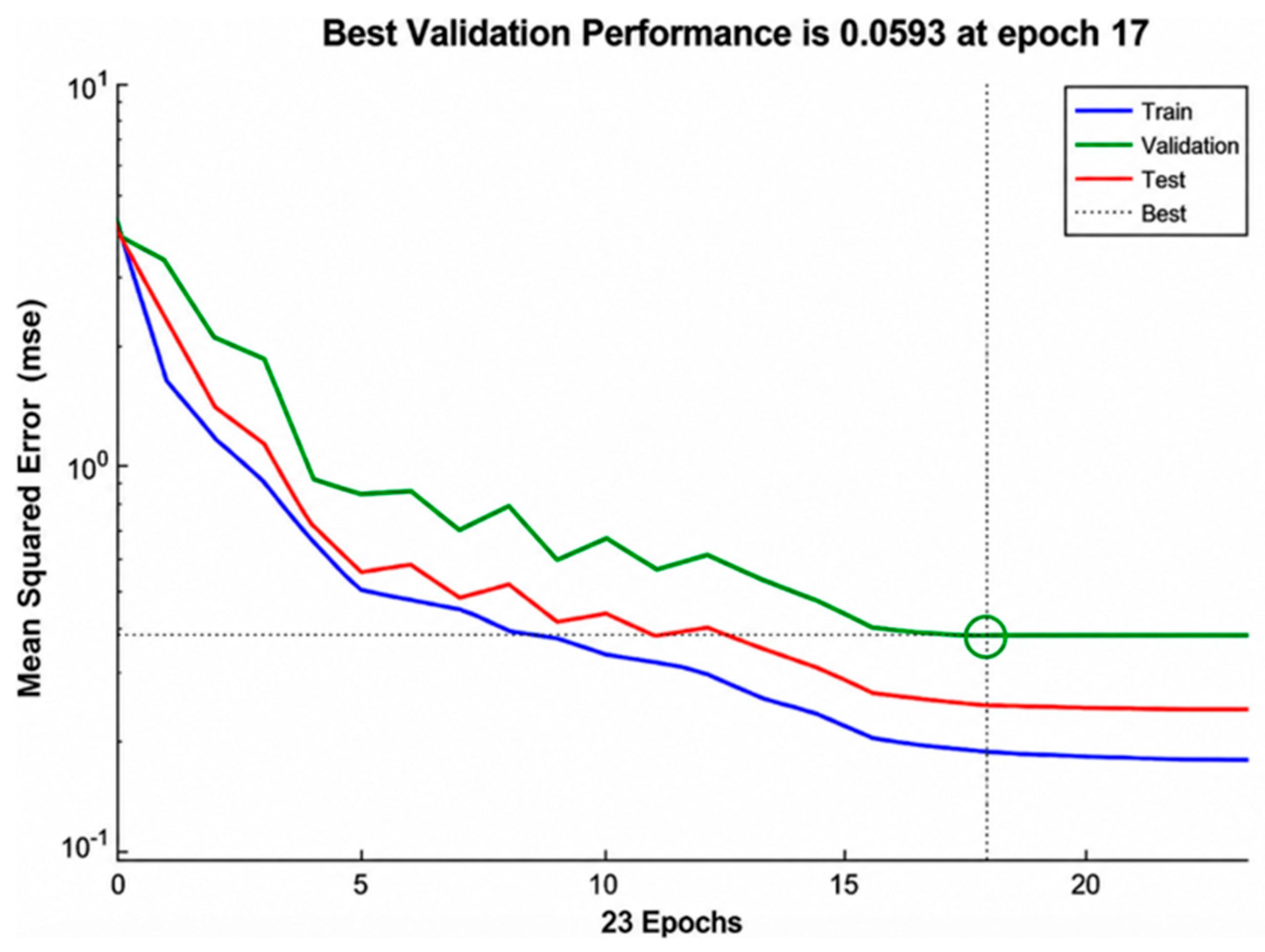
3.4.3. Training Performance Evaluation
4. Results Analysis
4.1. Fault Detection in HVAC System
- Test Result of Single Phase to Ground Fault Case-1:
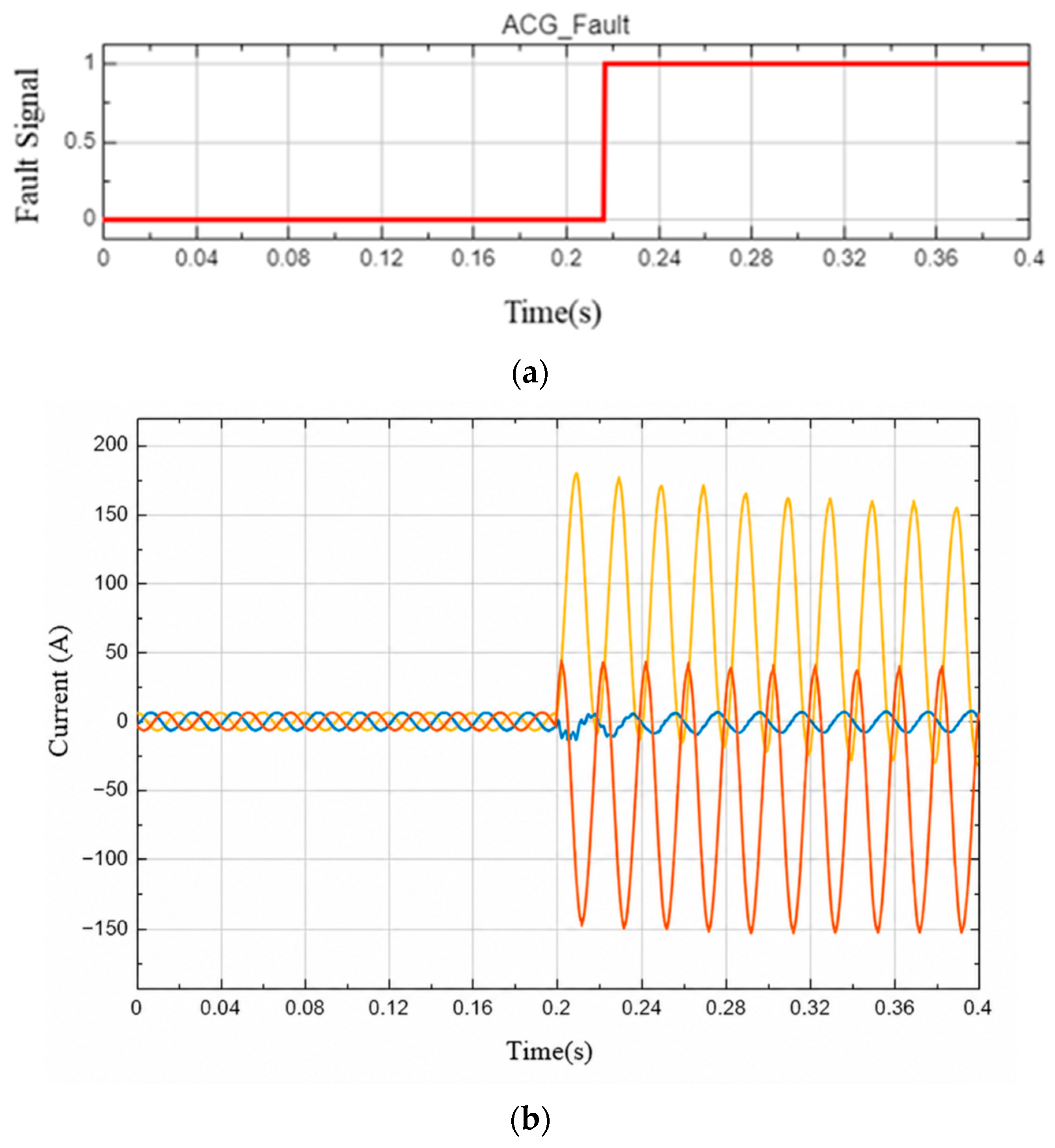
- Test Result of Double Phase to Ground Fault Case-2:
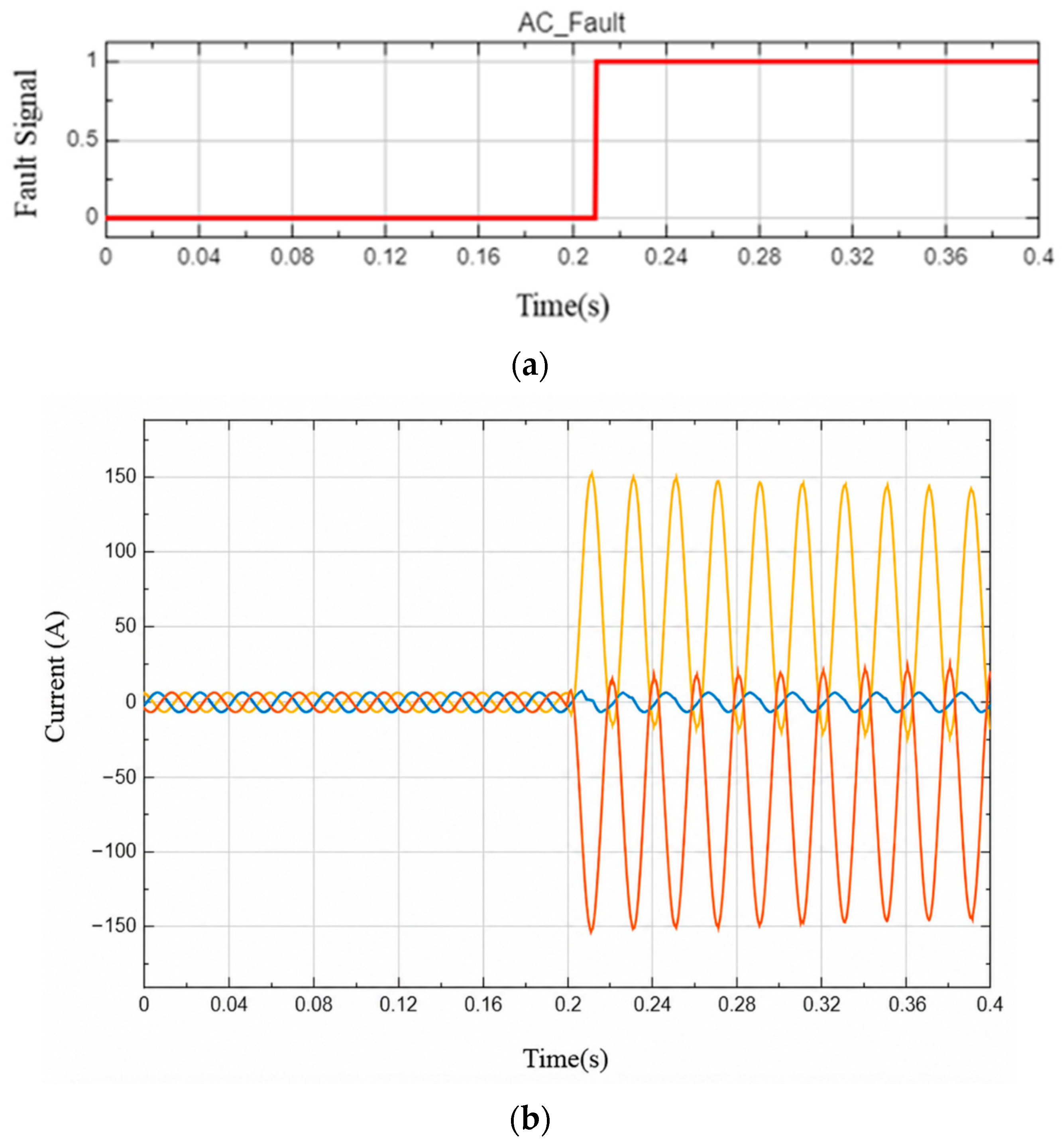
- Test Result of Phase-to-Phase Fault Case-3:
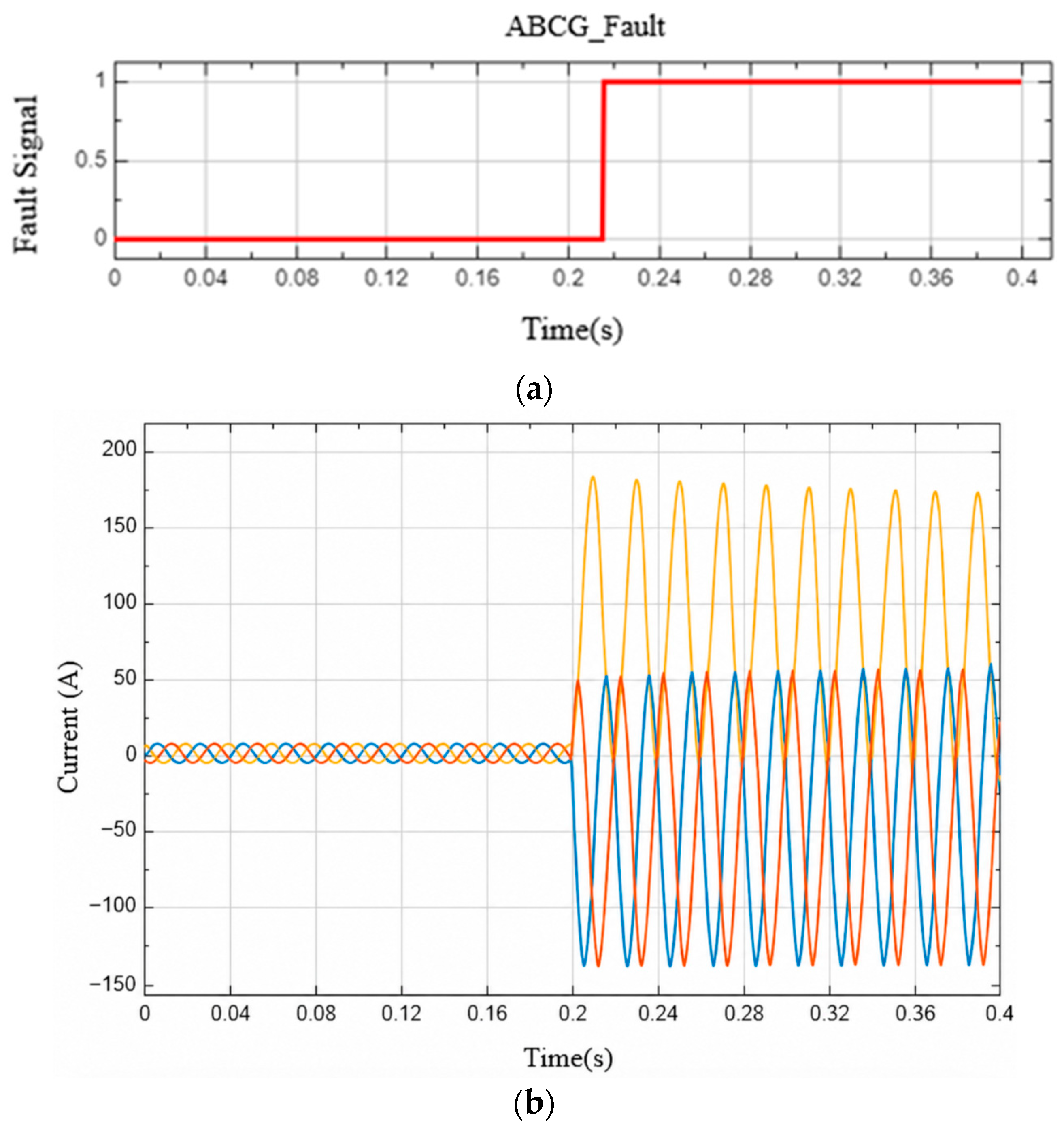
- Test Result of Three Phase to Ground Fault Case-4:
4.2. Performance Evaluation Under High-Impedance Fault Conditions
4.3. Fault Location Detection in HVAC System
4.4. Critical Clearing Time Based on Threshold Fault Stability Analysis
4.5. Feature Ablation Study of the Proposed LM-Trained ANN Framework
4.6. Comparison with Previous Research Works
5. Conclusions
Author Contributions
Funding
Data Availability Statement
Conflicts of Interest
Abbreviations
| HVAC | High Voltage AC |
| ANN | Artificial Neural Network |
| LM | Levenberg–Marquardt |
| CCT | Critical Clearing Time |
| LL | Line to line |
| LG | Line to ground |
| LLG | Double line to ground |
| LLL | Three phase |
| LLLG | Three-phase to ground |
| AI | Artificial Intelligence |
| DWT | Discrete Wavelet Transform |
| ML | Machine learning |
| KNN | K-nearest neighbors |
| SVM | Support vector machines |
| CNN | Convolutional neural networks |
| DNN | Deep neural networks |
| LSTM | Long short-term memory |
| NF | No fault |
| MSE | Mean squared error |
| SCG | Scaled Conjugate Gradient |
| BR | Bayesian Regularization |
References
- Xing, J.; Han, C.; Tian, J.; Wu, H.; Lu, T. Influence of Ion Flow Field on the Design of Hybrid HVAC and HVDC Transmission Lines with Different Configurations. Energies 2025, 18, 3657. [Google Scholar] [CrossRef] [Scilit]
- Fayazi, M.; Saffarian, A.; Joorabian, M.; Monadi, M. Analysis of induced components in hybrid HVAC/HVDC transmission lines on the same tower for various fault conditions. Electr. Power Syst. Res. 2024, 226, 109884. [Google Scholar] [CrossRef] [Scilit]
- Borghett, F.; Giovanni Colombo, C.; Longo, M.; Mazzoncini, R.; Somaschini, C. Development of a new urban line with innovative trams. In Proceedings of the Urban and Maritime Transport 2021; WIT Press: Billerica, MA, USA, 2021; pp. 167–178. [Google Scholar] [CrossRef] [Scilit]
- Mishra, D.P.; Ray, P. Fault detection, location and classification of a transmission line. Neural Comput. Appl. 2018, 30, 1377–1424. [Google Scholar] [CrossRef] [Scilit]
- Liu, Y.; Wu, J.; Zhang, J.; Leung, M.-F. Graph-Regularized Orthogonal Non-Negative Matrix Factorization with Itakura–Saito (IS) Divergence for Fault Detection. Mathematics 2025, 13, 2343. [Google Scholar] [CrossRef] [Scilit]
- Martino, A.D.; Prasad, G.S.; Foiadelli, F.; Longo, M. Energy Demand Model of Battery E-Buses for LPT: Implementation, Validation and Scheduling Optimization. IEEE Access 2023, 11, 52185–52198. [Google Scholar] [CrossRef] [Scilit]
- Bindi, M.; Piccirilli, M.C.; Luchetta, A.; Grasso, F. A Comprehensive Review of Fault Diagnosis and Prognosis Techniques in High Voltage and Medium Voltage Electrical Power Lines. Energies 2023, 16, 7317. [Google Scholar] [CrossRef] [Scilit]
- Adami, J.F.; Silveira, P.M.; Martinez, M.; Perez, R.C.; Dallbello, A.C. New Approach to Improve High-Voltage Transmission Line Reliability. IEEE Trans. Power Deliv. 2009, 24, 1515–1520. [Google Scholar] [CrossRef] [Scilit]
- Hazari, M.d.R.; Abu Talha, M.; Ahmad, S.; Jahan, E.; Hossain, C.A.; Abdul Mannan, M. Performance Analysis of Hybrid Power System with Wind Farms and Conventional Generators Under Fault Conditions. In Proceedings of the 2025 10th International Conference on Business and Industrial Research (ICBIR); IEEE: Bangkok, Thailand, 2025; pp. 381–386. [Google Scholar] [CrossRef] [Scilit]
- Yadav, A.; Dash, Y. An Overview of Transmission Line Protection by Artificial Neural Network: Fault Detection, Fault Classification, Fault Location, and Fault Direction Discrimination. Adv. Artif. Neural Syst. 2014, 2014, 230382. [Google Scholar] [CrossRef] [Scilit]
- Ahmad, S.; Hasan, S.M.d.N.; Hossain, M.d.S.; Uddin, R.; Ahmed, T.; Mustayen, A.G.M.B.; Hazari, M.d.R.; Hassan, M.; Parvez, M.d.S.; Saha, A. A Review of Hybrid Renewable and Sustainable Power Supply System: Unit Sizing, Optimization, Control, and Management. Energies 2024, 17, 6027. [Google Scholar] [CrossRef] [Scilit]
- Naik, S.; Koley, E. Fault Detection and Classification scheme using KNN for AC/HVDC Transmission Lines. In Proceedings of the 2019 International Conference on Communication and Electronics Systems (ICCES); IEEE: Coimbatore, India, 2019; pp. 1131–1135. [Google Scholar] [CrossRef] [Scilit]
- Johnson, J.M.; Yadav, A. Fault Detection and Classification Technique for HVDC Transmission Lines Using KNN. In Information and Communication Technology for Sustainable Development; Mishra, D.K., Nayak, M.K., Joshi, A., Eds.; Lecture Notes in Networks and Systems; Springer: Singapore, 2018; Volume 10, pp. 245–253. [Google Scholar] [CrossRef] [Scilit]
- Jawad, R.S.; Abid, H. HVDC Fault Detection and Classification with Artificial Neural Network Based on ACO-DWT Method. Energies 2023, 16, 1064. [Google Scholar] [CrossRef] [Scilit]
- Özüpak, Y. Machine learning-based fault detection in transmission lines: A comparative study with random search optimization. Bull. Pol. Acad. Sci. Tech. Sci. 2025, 73, e153229. [Google Scholar] [CrossRef] [Scilit]
- Ahmed, S.I.; Rahman, M.F.; Kundu, S.; Chowdhury, R.M.; Hussain, A.O.; Ferdoushi, M. Deep Neural Network Based Fault Classification and Location Detection in Power Transmission Line. In Proceedings of the 2022 12th International Conference on Electrical and Computer Engineering (ICECE); IEEE: Dhaka, Bangladesh, 2022; pp. 252–255. [Google Scholar] [CrossRef] [Scilit]
- Minh, N.Q.; Khiem, N.T.; Giang, V.H. Fault classification and localization in power transmission line based on machine learning and combined CNN-LSTM models. Energy Rep. 2024, 12, 5610–5622. [Google Scholar] [CrossRef] [Scilit]
- Tiferes, R.R.; Manassero, G., Jr.; Lacerda, V.A.; Gomis-Bellmunt, O. Comparative evaluation of conventional and advanced HVAC line protection algorithms: A case study. IET Conf. Proc. 2025, 2025, 290–296. [Google Scholar] [CrossRef] [Scilit]
- Shakiba, F.M.; Shojaee, M.; Azizi, S.M.; Zhou, M. Real-Time Sensing and Fault Diagnosis for Transmission Lines. Int. J. Netw. Dyn. Intell. 2022, 1, 36–47. [Google Scholar] [CrossRef] [Scilit]
- Saleem, U.; Arshad, U.; Masood, B.; Gul, T.; Khan, W.A.; Ellahi, M. Faults detection and classification of HVDC transmission lines of using discrete wavelet transform. In Proceedings of the 2018 International Conference on Engineering and Emerging Technologies (ICEET); IEEE: Lahore, Pakistan, 2018; pp. 1–6. [Google Scholar] [CrossRef] [Scilit]
- Yoon, D.-H.; Yoon, J. Development of a real-time fault detection method for electric power system via transformer-based deep learning model. Int. J. Electr. Power Energy Syst. 2024, 159, 110069. [Google Scholar] [CrossRef] [Scilit]
- Kouraichi, M.; Mansouri, M.; Trabelsi, M.; M’Halla, A.; Abdel-Khalik, A.S.; Sakly, A. Deep Learning for Fault Diagnosis in Power Transmission Lines: Current Trends, Limitations, and Future Directions. IEEE Access 2025, 13, 192105–192142. [Google Scholar] [CrossRef] [Scilit]
- Hu, H.; Lu, H.; Shi, R.; Fan, X.; Deng, Z. A novel fault diagnosis method for key transmission sections based on Nadam-optimized GRU neural network. Electr. Power Syst. Res. 2024, 233, 110522. [Google Scholar] [CrossRef] [Scilit]
- Kaur, H.; Kaur, M. Fault Classification in a Transmission Line Using Levenberg–Marquardt Algorithm Based Artificial Neural Network. In Data Communication and Networks; Jain, L.C., Tsihrintzis, G.A., Balas, V.E., Sharma, D.K., Eds.; Advances in Intelligent Systems and Computing; Springer: Singapore, 2020; Volume 1049, pp. 119–135. [Google Scholar] [CrossRef] [Scilit]
- Edalatifar, M.; Ghalambaz, M.; Tavakoli, M.B.; Setoudeh, F. New loss functions to improve deep learning estimation of heat transfer. Neural Comput. Appl. 2022, 34, 15889–15906. [Google Scholar] [CrossRef] [Scilit]



| Ref | Authors | Year | Method | Objective | Limitations |
|---|---|---|---|---|---|
| [18] | Tiferes et al., | 2025 | x | Fault classification using high-frequency transient signals and wave propagation characteristics. | It is highly sensitive to fault resistance, noise, and parameter uncertainty, and requires accurate modeling. |
| [19] | Shakiba et al., | 2022 | x | Fault classification using voltage and current measurement. | High sample rates and precise measurements are necessary. Performance drops in noisy and poor operating conditions. |
| [20] | U. Saleem et al., | 2018 | x | Fault classification and detection by using DWT. | Lack of fault identification and fault detection using advanced technology. |
| [15] | S. Naik et al., | 2019 | ML | Fault classification using KNN in the AC transmission line. | Lack of fault detection or classification result analysis. |
| [12] | Y. Ozupak et al., | 2025 | DT, LR, SVM-ML | Fault detection using decision tree, logistic regression, and support vector machine-based ML techniques. | Only focused on limited ML techniques. |
| [16] | J. Jhonson et al., | 2018 | ML | Fault classification for High Voltage AC transmission lines using K-nearest neighbors. | By using KNN, the model shows limited scalability and remains constrained to specific operating conditions. |
| [17] | R. S. Jawad et al., | 2023 | ML | Hybrid methods and optimization techniques are used for fault classification. | Lack of comprehensive fault analysis for location detection and stability analysis. |
| [13] | Ahmed et al., | 2022 | ML | Fault detection using hybrid methods and temporal feature extraction from raw signals. | No location or timing analysis. |
| [14] | Minh et al., | 2024 | ML | Fault detection using different types of hybrid techniques, which can automatically extract features. | No CCT, time series, and stability analysis. |
| [21] | Yoon et al., | 2025 | x | Transformer-based models are used for fault detection. | Lack of advanced model-based fault classification and stability analysis. |
| [22] | Kouraichi et al., | 2025 | DL | Reviewed current trends, limitations, and future directions of deep learning-based fault identification in transmission lines. | There was no discussion of generated datasets, no CCT, and no work based on a unified procedure. Specifically developed for image-based fault classification and key transmission sections (KTS). |
| [23] | Hu et al., | 2025 | DL | IEEE-14 bus using transient voltage and current waveform images. | Lacks a complete protective framework for realistic transmission systems to estimate fault locations or predict CCT. |
| Parameters | Positive Sequence | Zero Sequence |
|---|---|---|
| R(ohms/km) | 0.01273 | 0.3864 |
| L(H/km) | 0.933 × 10⁻³ | 4.126 × 10⁻³ |
| C(F/km) | 12.74 × 10⁻⁹ | 7.751 × 10⁻⁹ |
| Base Power | AC System 1 | AC System 2 |
| 100 × 106 | 100 × 106 | |
| AC system voltage | 500 KV | 345 KV |
| AC system frequency | 60 Hz | 60 Hz |
| No. of Faults | Fault Types | A Line | B Line | C Line | G Line |
|---|---|---|---|---|---|
| 1 | A_G (Phase A to ground) | 0 | 0 | 0 | 1 |
| 2 | B_G (Phase B to ground) | 0 | 0 | 1 | 0 |
| 3 | C_G (Phase C to ground) | 0 | 0 | 1 | 1 |
| 4 | AB_G (double line to ground) | 0 | 1 | 0 | 0 |
| 5 | AC_G (double line to ground) | 0 | 1 | 0 | 1 |
| 6 | BC_G (double line to ground) | 0 | 1 | 1 | 0 |
| 7 | ABC_G (three-phase to ground) | 1 | 0 | 0 | 0 |
| 8 | AB (line to line) | 1 | 0 | 0 | 1 |
| 9 | AC (line to line) | 1 | 0 | 1 | 0 |
| 10 | BC (line to line) | 1 | 0 | 1 | 1 |
| 11 | ABC (three-phase) | 0 | 1 | 1 | 1 |
| 12 | NF | 0 | 0 | 0 | 0 |
| Number | Va | Vb | Vc | Ia | Ib | Ic | V0 | I0 |
|---|---|---|---|---|---|---|---|---|
| 0 | 0.765264 | 0.765275 | 0.765286 | 4.698692 | 4.699217 | 4.699353 | 1.000000 × 10⁻¹⁰ | 5.260000 × 10⁻⁹ |
| 1 | 0.000541 | 0.750604 | 0.756007 | 49.105832 | 7.961843 | 8.200031 | 3.485646 × 10⁻¹ | 1.632792 × 101 |
| 2 | 0.763451 | 0.000534 | 0.753397 | 8.440489 | 48.503182 | 7.672964 | 3.483375 × 10⁻¹ | 1.626101 × 101 |
| 3 | 0.752875 | 0.755574 | 0.000540 | 7.978014 | 8.089689 | 48.975285 | 3.490605 × 10⁻¹ | 1.642476 × 101 |
| 4 | 0.000619 | 0.000611 | 0.748005 | 65.784434 | 65.784434 | 5.118487 | 3.524653 × 10⁻¹ | 1.655032 × 101 |
| Number | A | B | C | G | Length in km |
|---|---|---|---|---|---|
| 0 | 0 | 0 | 0 | 0 | 10 |
| 1 | 0 | 0 | 0 | 1 | 10 |
| 2 | 0 | 0 | 1 | 0 | 10 |
| 3 | 0 | 0 | 1 | 1 | 10 |
| 4 | 0 | 1 | 0 | 0 | 10 |
| 5 | 0 | 1 | 0 | 1 | 10 |
| No. of Patterns | Parameters | Set Values |
|---|---|---|
| 1 | Fault Types | Va, Vb, Vc, Ia, Ib, Ic, V0, I0 |
| 2 | Fault Resistance | Case 1: 1, 2, 3, …… 10 km Case 2: 1, 2, 3, …… 10 km Case 3: 1, 2, 3, …… 10 km …… Case 10: 1, 2, 3, …… 10 km |
| 3 | Ground Resistance | 0.001 Ω |
| 4 | Fault Resistance | 0.01 Ω, 10 Ω, 50 Ω |
| SL. No. | Case | Types of Faults | Fault Classification | ||||
|---|---|---|---|---|---|---|---|
| A | B | C | G | Length in km | |||
| 1 | 1 | NF | 0 | 0 | 0 | 1 | 10 |
| 2 | A_G | 0 | 0 | 1 | 0 | 10 | |
| 3 | B_G | 0 | 0 | 1 | 1 | 10 | |
| 4 | C_G | 0 | 1 | 0 | 0 | 10 | |
| 5 | AB_G | 0 | 1 | 0 | 1 | 10 | |
| 6 | AC_G | 0 | 1 | 1 | 0 | 10 | |
| 7 | BC_G | 0 | 1 | 1 | 1 | 10 | |
| 8 | ABC | 1 | 0 | 0 | 0 | 10 | |
| 9 | ABC_G | 1 | 0 | 0 | 1 | 10 | |
| 10 | AB | 1 | 0 | 1 | 0 | 10 | |
| 11 | AC | 1 | 0 | 1 | 1 | 10 | |
| 12 | BC | 0 | 0 | 0 | 0 | 10 | |
| 13 | 2 | NF | 0 | 0 | 0 | 1 | 9 |
| 14 | A_G | 0 | 0 | 0 | 1 | 9 | |
| SL. No. | Fault Types | Tfd | Fst | CCT |
|---|---|---|---|---|
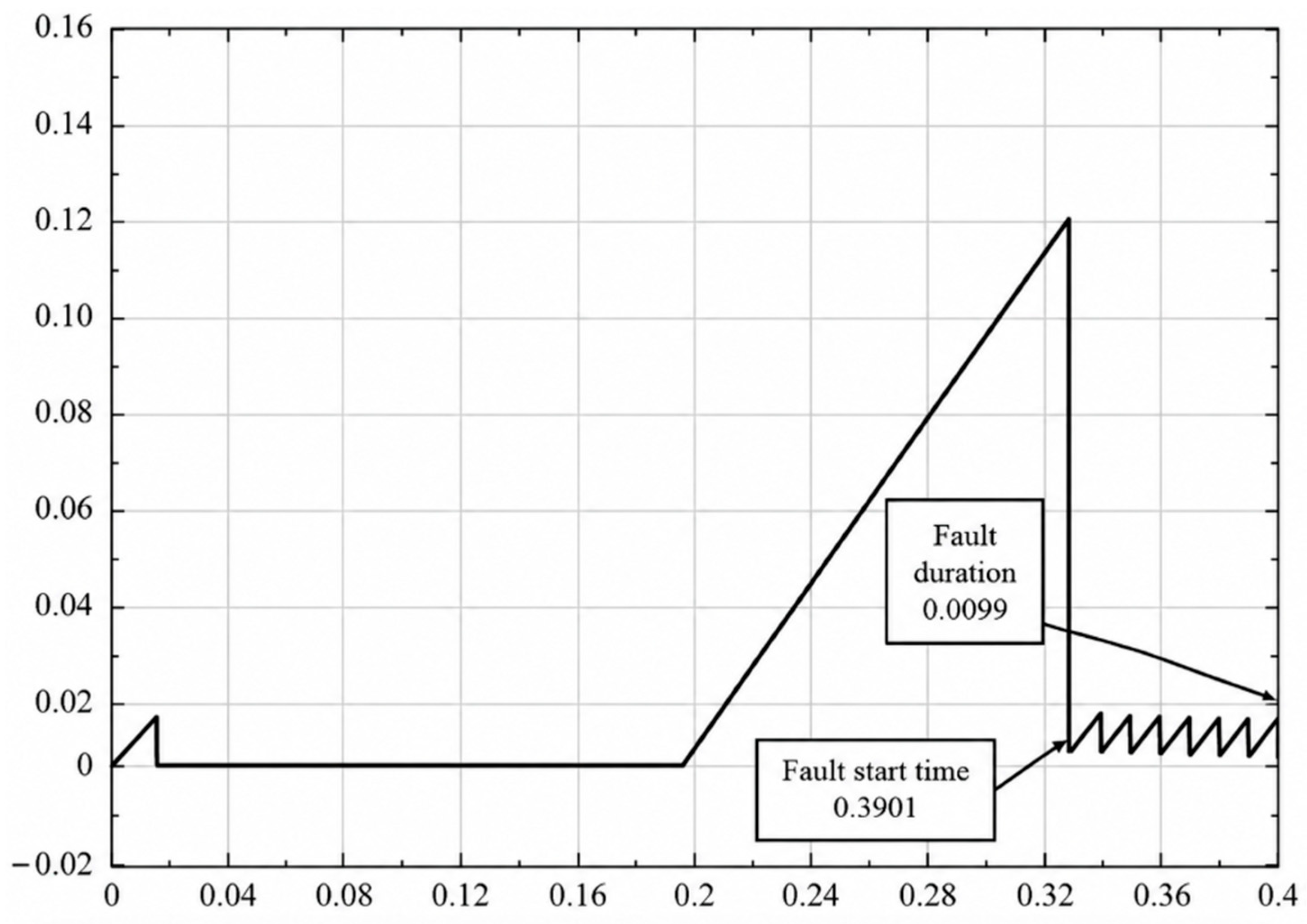
| 1 | A_G | 0.4 | 0.3901 | 0.0099 |
| 2 | B_G | 0.4 | 0.2053 | 0.1947 |
| 3 | C_G | 0.4 | 0.2064 | 0.1963 |
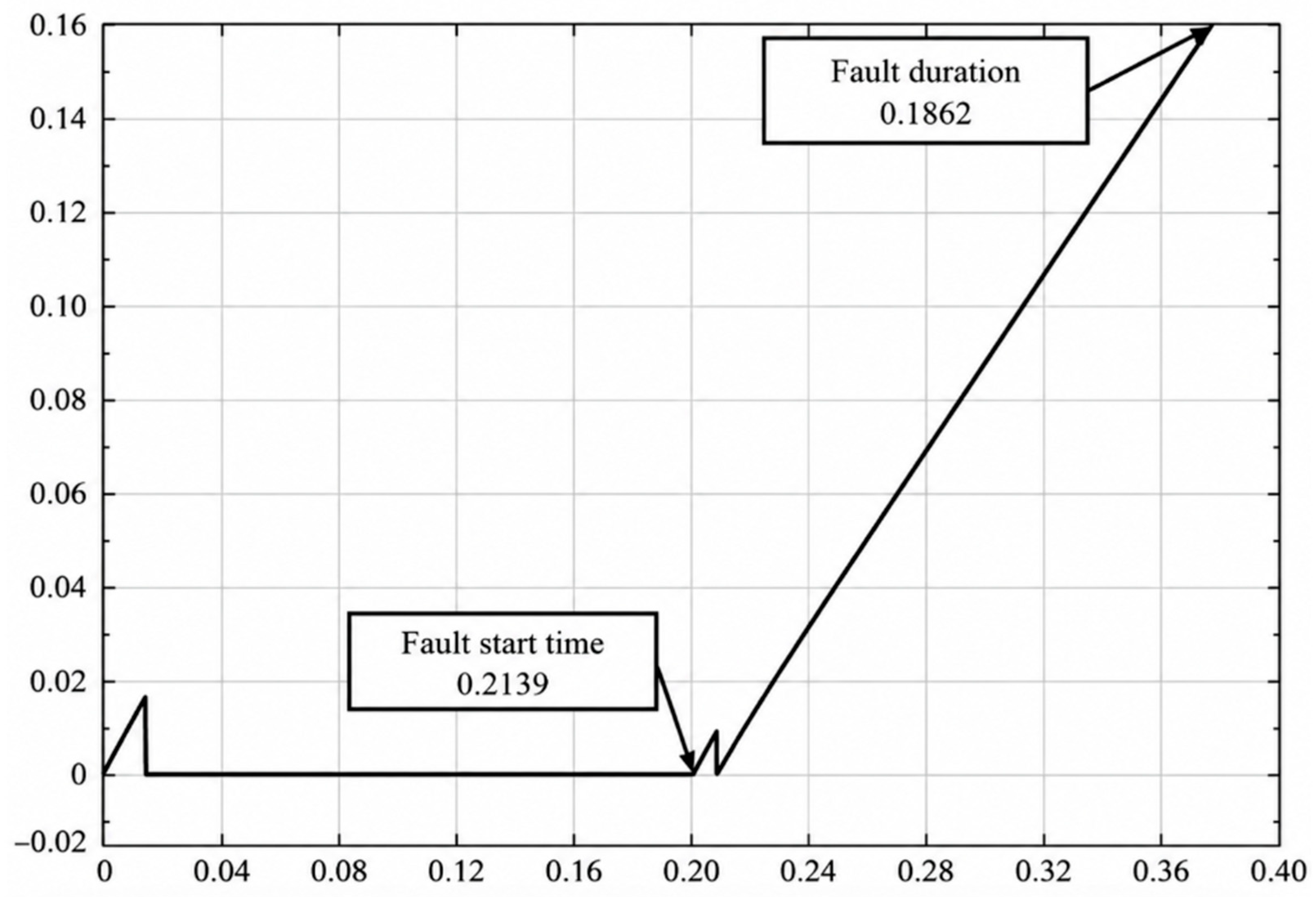
| 4 | AB_G | 0.4 | 0.2139 | 0.1861 |
| 5 | AC_G | 0.4 | 0.2089 | 0.1911 |
| 6 | BC_G | 0.4 | 0.2022 | 0.1978 |
| 7 | AB | 0.4 | 0.2021 | 0.1979 |
| 8 | AC | 0.4 | 0.2066 | 0.1934 |
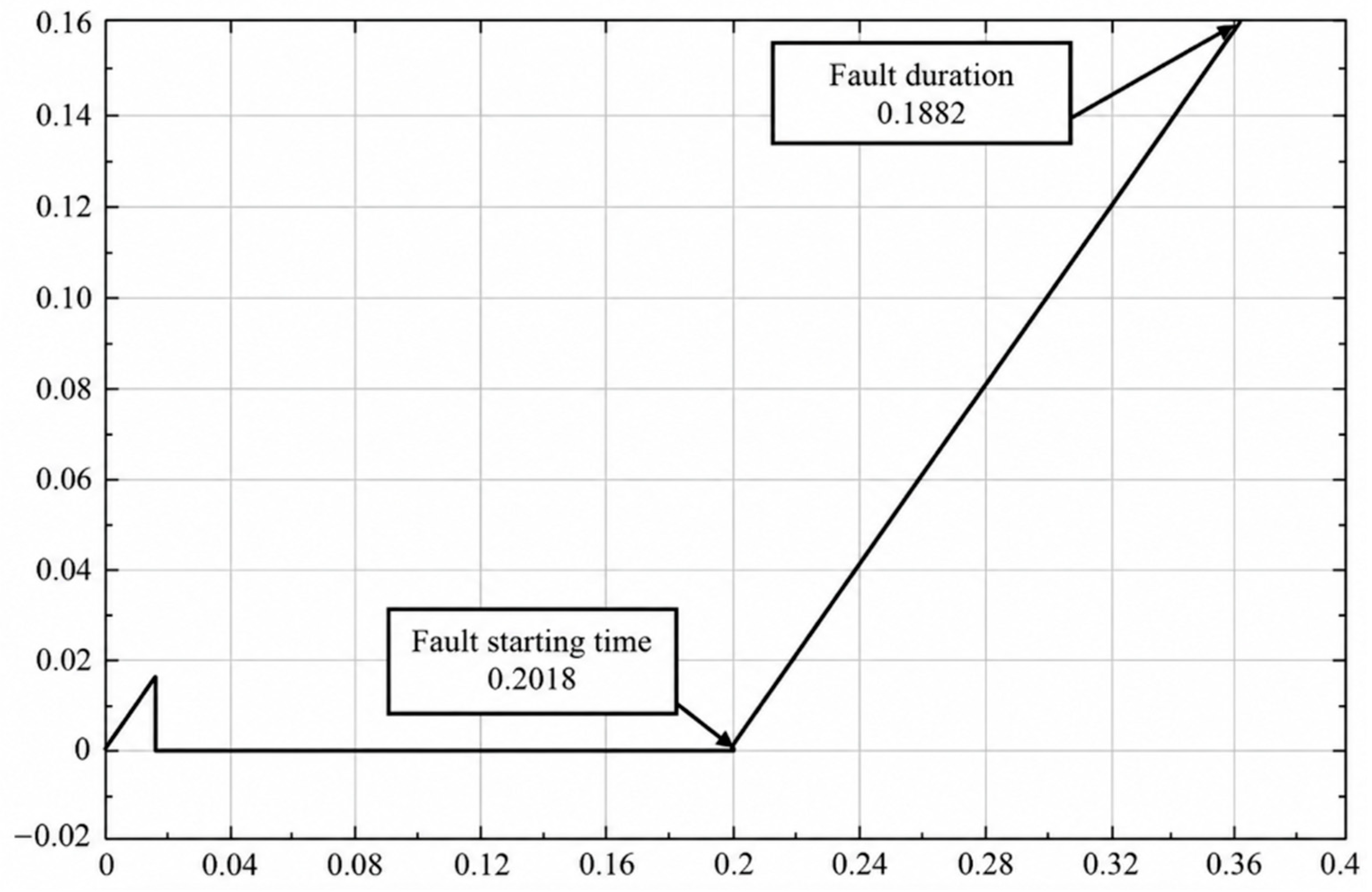
| 9 | BC | 0.4 | 0.2018 | 0.1982 |
| 10 | ABC | 0.4 | 0.2016 | 0.1984 |
| 11 | ABC_G | 0.4 | 0.2014 | 0.1986 |
| 12 | NF | 0.4 | 0 | 0 |
| SL. No. | Optimizer | Algorithm Type | Advantage | ANN Characteristics | Performance Metrics |
|---|---|---|---|---|---|
| 1 | Bayesian Regularization (BR) | Regularization based |
|
|
|
| 2 | Scaled Conjugate Gradient (SCG) | Conjugate gradient-based |
|
|
|
| 3 | Levenberg–Marquardt (LM) | Second order (quasi-newton method) |
|
|
|
| Parameters | Observations | MSE | R |
|---|---|---|---|
| Training | 84 | 0.0320 | 0.9973 |
| Validation | 18 | 0.0921 | 0.9925 |
| Test | 18 | 0.2384 | 0.9831 |
| Training Algorithm | Training MSE | Validation MSE | Test MSE | Training R | Validation R | Test R | Epochs |
|---|---|---|---|---|---|---|---|
| BR | 0.2354 | 0.1320 | 0.4637 | 0.9658 | 0.9768 | 0.9645 | 92 |
| SCG | 0.2655 | 0.1460 | 0.4287 | 0.9793 | 0.9803 | 0.9628 | 82 |
| LM | 0.0320 | 0.0921 | 0.2384 | 0.9973 | 0.9925 | 0.9831 | 45 |
| SL. No. | Fault Type | Fault Location in km | Fault Duration | ANN-Based Fault Classification Output | |||
|---|---|---|---|---|---|---|---|
| A | B | C | G | ||||
| 1 | A_G | 3.929 | 0.0099 | 0 | 0 | 0 | 1 |
| 2 | B_G | 2.832 | 0.1947 | 0 | 0 | 1 | 0 |
| 3 | C_G | 2.197 | 0.1937 | 0 | 0 | 1 | 1 |
| 4 | AC_G | 2.777 | 0.1911 | 0 | 1 | 0 | 1 |
| 5 | AB_G | 7.777 | 0.1862 | 0 | 1 | 0 | 0 |
| 6 | BC_G | 1.166 | 0.1981 | 0 | 1 | 1 | 0 |
| 7 | AB | 0.1989 | 0.1983 | 1 | 0 | 0 | 1 |
| 8 | BC | 0.9817 | 0.1985 | 1 | 0 | 1 | 1 |
| 9 | AC | 1.583 | 0.1935 | 1 | 0 | 1 | 0 |
| 10 | ABC | 0.7285 | 0.1982 | 0 | 1 | 1 | 1 |
| 11 | ABC_G | 0.7445 | 0.1979 | 1 | 0 | 0 | 0 |
| Case | Fault Type | CCT (Calculated) | Location | ||
|---|---|---|---|---|---|
| 1 | AG | 0.4 | 0.3901 | 0.0099 | 3.929 |
| 2 | ABG | 0.4 | 0.2139 | 0.1862 | 7.777 |
| 3 | ABC | 0.4 | 0.2018 | 0.1982 | 0.7285 |
| Features Configuration | Input Features | MSE | R |
|---|---|---|---|
| Voltage feature | Va, Vb, Vc | 0.1016 | 0.7708 |
| Current feature | Ia, Ib, Ic | 0.0668 | 0.8545 |
| Without zero-sequence components | Va, Vb, Vc, Ia, Ib, Ic | 0.0307 | 0.9359 |
| Proposed framework | Va, Vb, Vc, Ia, Ib, Ic, V0, I0 | 0.0401 | 0.9139 |
| Method | Types of Faults | Location | Timing | CCT | Real-Time Suitability | Unified Protection Framework |
|---|---|---|---|---|---|---|
| Impedance-based [18] | limited | - | no | no | medium | no |
| Traveling wave [18] | Short circuit | partial | yes | no | low | no |
| Wavelet based [12,20] | limited | partial | partial | no | medium | no |
| (KNN/SVM) [12,15,16] | partial | limited | no | no | low | no |
| CNN-based ML [13] | Most types of faults | limited | partial | no | medium | no |
| RNN OR LSTM-based ML [14] | Most types of faults | limited | yes | no | medium | no |
| CNN, LSTM/GRU [22] | Most types of faults | partial | partial | no | medium | no |
| GRU [23] | partial | - | - | no | low | no |
| Proposed model | All types of faults | High | yes | yes | High | yes |
Disclaimer/Publisher’s Note: The statements, opinions and data contained in all publications are solely those of the individual author(s) and contributor(s) and not of MDPI and/or the editor(s). MDPI and/or the editor(s) disclaim responsibility for any injury to people or property resulting from any ideas, methods, instructions or products referred to in the content. |
© 2026 by the authors. Licensee MDPI, Basel, Switzerland. This article is an open access article distributed under the terms and conditions of the Creative Commons Attribution (CC BY) license.
Share and Cite
Karima, N.N.; Hazari, M.R.; Ahmad, S.; Hossain, C.A.; Mannan, M.A.; Longo, M. A Unified ANN-Based Approach for Fault Classification, Location and CCT-Based Stability Assessment in HVAC Transmission Systems. Energies 2026, 19, 3405. https://doi.org/10.3390/en19143405
Karima NN, Hazari MR, Ahmad S, Hossain CA, Mannan MA, Longo M. A Unified ANN-Based Approach for Fault Classification, Location and CCT-Based Stability Assessment in HVAC Transmission Systems. Energies. 2026; 19(14):3405. https://doi.org/10.3390/en19143405
Chicago/Turabian StyleKarima, Nazmun Nahar, Md. Rifat Hazari, Shameem Ahmad, Chowdhury Akram Hossain, Mohammad Abdul Mannan, and Michela Longo. 2026. "A Unified ANN-Based Approach for Fault Classification, Location and CCT-Based Stability Assessment in HVAC Transmission Systems" Energies 19, no. 14: 3405. https://doi.org/10.3390/en19143405
APA StyleKarima, N. N., Hazari, M. R., Ahmad, S., Hossain, C. A., Mannan, M. A., & Longo, M. (2026). A Unified ANN-Based Approach for Fault Classification, Location and CCT-Based Stability Assessment in HVAC Transmission Systems. Energies, 19(14), 3405. https://doi.org/10.3390/en19143405