Perspective

Urban Building Energy Modelling: From Fragmented Efforts to a Common Foundation


by
Martina Ferrando
and
Francesco Causone
*
Department of Energy, Politecnico di Milano, Via Lambruschini 4, 20156 Milan, Italy
*
Author to whom correspondence should be addressed.
Energies 2026, 19(14), 3351; https://doi.org/10.3390/en19143351
Submission received: 26 May 2026 / Revised: 7 July 2026 / Accepted: 15 July 2026 / Published: 16 July 2026
(This article belongs to the Section G: Energy and Buildings)

Abstract

Urban Building Energy Modelling (UBEM) is increasingly recognised as a key tool for bridging building-scale analysis and city-level planning, supporting the decarbonisation of urban areas. It enables the assessment of building performance and the exploration of retrofit strategies, policy scenarios, and renewable integration. Over the past decade, UBEM has continuously evolved, encompassing physics-based, data-driven, and hybrid approaches, often supported by archetype generation and GIS workflows. Recent research also integrates microclimate, mobility, and green infrastructure. While this enriches analysis outcomes, it also leads to fragmentation, limiting tools’ comparability, transparency, and practical use by policymakers. This perspective paper provides a critical interpretation of the recent evolution in UBEM and proposes a goal-oriented classification of modelling approaches based on their final objectives rather than on calculation methodology. The paper also identifies three key gaps: the lack of scalable and consistent data frameworks, the absence of a shared terminology, and the need for criteria to assess whether models are “fit for purpose.” Addressing these issues through improved data infrastructures, conceptual clarity, and reliability assessment can support convergence without limiting innovation, fostering more robust and decision-relevant UBEM applications to support the energy transition.

1. Introduction

As the majority of the world’s population lives in cities and urban systems account for a dominant share of energy consumption and greenhouse gas emissions, the decarbonisation challenge increasingly manifests at the urban scale [1]; thus, the global energy transition is substantially taking momentum in urban areas [2]. In this context, the need for tools capable of describing, analysing, and forecasting energy use across building stocks has become urgent and unavoidable [3].
Urban Building Energy Modelling (UBEM) has emerged over the past decade as a pivotal approach to bridge the gap between building-level and city-scale simulations [4]. This evolution reflects a conceptual shift in the way energy systems are understood. While conventional building energy models (BEMs) have been developed to support design and compliance at the single-building level, UBEM operates from a systemic perspective, in which buildings are embedded in infrastructure networks and influenced by urban morphology, microclimate conditions, and human behaviour. Traditional BEMs, while highly accurate, are typically limited to a single or to a small group of buildings and therefore struggle to capture the diversity, scale, and interactions that characterise urban environments [5]. UBEM applications range from assessing current energy performance to exploring future scenarios, including retrofit strategies, electrification pathways, and the integration of renewables [6]. This capability is particularly relevant in the context of global decarbonisation efforts [7]. Policymakers and urban planners increasingly require tools to support evidence-based decision-making, to evaluate long-term scenarios, and to quantify the impacts of interventions. UBEM provides a structured framework for exploring these dimensions, linking physical modelling to strategic planning and enabling the assessment of both current performance and future pathways [8]. Beyond its technical role, UBEM is also gaining importance as a decision-support tool within broader urban sustainability agendas [9]. It enables the exploration of co-benefits and trade-offs across sectors, such as energy, mobility, and urban microclimate; moreover, it facilitates the alignment of energy strategies with spatial planning and policy objectives [10,11].
Over time, the field has expanded significantly, both in terms of methodologies and application domains [6]. Physics-based bottom-up models, data-driven approaches, and hybrid frameworks coexist and are often combined with geospatial data infrastructures, such as Geographic Information Systems (GIS), Building Information Modelling (BIM) and 3D city models. At the same time, UBEM has progressively incorporated additional layers of complexity, including urban microclimate, mobility patterns, and green and blue infrastructure [12]. This diversification has expanded the range of applications and increased the contextual relevance of UBEM studies, but at the cost of reduced comparability across approaches.
This rapid growth has thus led to a high degree of fragmentation. Different studies rely on heterogeneous data sources, inconsistent assumptions, and diverse modelling approaches, often developed for specific case studies or local contexts. The adopted terminology is not standardised, with key concepts such as “archetypes,” “prototypes,” and “reference buildings” used inconsistently across the literature [13,14,15]. Moreover, models are frequently designed with implicit objectives, making it difficult to compare results or assess their suitability for different applications [16,17]. As a consequence, despite its apparent methodological maturity, UBEM still struggles to deliver transparent, comparable, and decision-relevant outputs, particularly in policy-oriented applications. At the core of this fragmentation lies the unresolved relationship between data and modelling. UBEM is inherently data-intensive [18], requiring detailed information on building geometry, construction characteristics, systems, and occupancy [19]. Yet, such data are often incomplete, dispersed across institutions, or available at different levels of resolution. To address this limitation, many studies rely on simplified representations of the building stock, such as archetypes or reference buildings, which enable scalability while introducing additional layers of abstraction and uncertainty. While these approaches are essential for operationalising UBEM at scale, their definition and use vary significantly across studies, further complicating comparability [10,20].
In parallel, the objectives of UBEM applications have diversified. Some models are developed to support long-term energy planning [21] and policy evaluation [22] at the city or national scale, while others focus on detailed design questions, such as retrofit optimisation [23], renewable integration at the district or building level [24] or microclimate factors [25]. Despite this fundamental difference in purpose, the literature rarely classifies or evaluates models based on their intended use. Instead, most reviews focus on methodological distinctions, such as the type of modelling approach or the level of detail.
Thus, the current stage of development of UBEM calls for a shift from the multiplication of modelling approaches towards conceptual consolidation. Rather than further expanding the range of modelling techniques, there is a growing need to establish a common foundation that can support comparability, transparency, and effective application. Building on these considerations, this perspective paper draws on recent UBEM literature to provide a critical reading of the field, highlight its main research trajectories, and motivate a goal-oriented classification of UBEM approaches. Finally, it outlines a pathway towards a more coherent and reliable UBEM framework, grounded in improved data infrastructures, a shared language, and the development of reliability assessment criteria. By addressing these foundational aspects, the field can move towards stronger convergence while preserving the flexibility and innovation that have characterised its evolution.

2. An Overview of the UBEM Research Landscape

UBEM has progressively emerged as a distinct research field at the intersection of building simulation, urban analysis, energy planning, and data science. Since 2010, UBEM has no longer been treated as a mere extension of single-building energy modelling but rather as a methodological domain concerned with representing heterogeneous building stocks, their spatial embedding within cities, and their interaction with wider environmental and infrastructural systems. Some early contributions [26,27,28,29] already hinted at this broader urban framing, even before UBEM became fully consolidated as a recognised research field. For instance, in 2006, the paper by Guy [29] discussed buildings, energy efficiency, and innovation as an urban sustainability issue, approaching the topic from a socio-technical perspective and highlighting that energy choices in the built environment are conditioned by cultural, organisational, and policy contexts rather than by purely technical optimisation logics alone. This contribution anticipated one of the key tensions in later UBEM literature: the need to move beyond simplified engineering views and to acknowledge that urban energy questions are rooted in broader systems of decision-making.
A clearer methodological shift toward the urban scale emerges in the 2012 review paper by Bourdic et al. [30], which addresses district- and city-scale calculation tools, modelling approaches, and assessment systems. The study shows that simplified aggregation methods are often insufficient to capture the complexity of urban energy use and greenhouse gas emissions, thereby emphasising the need for more systematic, multi-scale modelling frameworks. The review [24] marks the transition from generalised urban energy assessment toward a more explicit concern with modelling urban building stocks and their spatial complexity.
From the mid-2010s onward, UBEM became clearly identifiable as a research field in its own right. The review of “a nascent field” [10] by Reinhart and Cerezo Davila formalises Urban Building Energy Modelling as an emergent domain and describes the main components of bottom-up urban simulation workflows, including input organisation, thermal model generation, execution, and validation [10]. The paper introduces a workflow-based approach to understanding UBEM, which subsequent reviews will progressively expand and diversify.
The same trend is reinforced by later review papers [6,11,31,32] that treat UBEM not only as an urban extension of building simulation, but as a decision-support framework for sustainability planning, retrofit analysis, and policy design. In particular, the review of modelling approaches and procedures for urban building energy use [11], the practical overview of UBEM tools and methods [31], the user-oriented comparison of physics-based bottom-up UBEM tools [6], and the review of urban neighbourhood energy calculation methods from the perspectives of databases, models, and platforms [32] collectively show how the field has become increasingly structured, yet also increasingly heterogeneous.
This indicates that UBEM has not developed as a single, unified methodological framework. Rather, it evolved as an umbrella field covering a wide range of approaches, scales, purposes, and disciplinary influences.
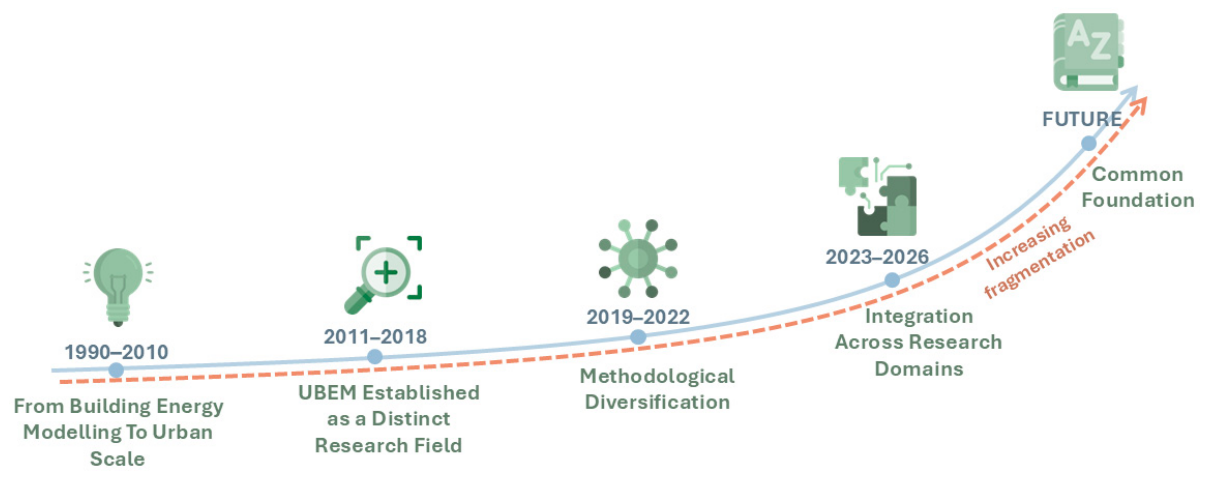
The evolution of UBEM over the past two decades is illustrated conceptually in Figure 1. Initially, urban-scale applications largely emerged as extensions of traditional Building Energy Modelling (BEM), focusing on scaling building-level simulations to districts and cities. As the field matured, UBEM progressively established itself as a distinct research domain and underwent a rapid methodological diversification, integrating advances in artificial intelligence, urban climate modelling, digital twins, and urban energy systems. This progressive expansion has substantially increased the analytical capabilities of UBEM, but has also contributed to the methodological fragmentation discussed throughout this perspective.

2.1. Main Research Trends

To identify the main research trends shaping the UBEM landscape, a targeted literature screening was conducted in Scopus. The search was intentionally restricted to review-type publications to capture consolidated knowledge, methodological developments, and emerging directions in the field. This choice reflects the aim of the perspective paper: rather than cataloguing all individual UBEM applications, the objective is to analyse how the field has been progressively interpreted, consolidated, and problematised by the literature itself. The query returned an initial set of 124 records, which were subsequently screened based on title, abstract, and thematic relevance. Papers were excluded if they focused on single-building energy modelling without urban-scale implications, on technology-specific analyses without a modelling component, or on broader urban sustainability topics not directly related to building energy modelling. Following this process, a final corpus of 75 review papers was retained. The selected studies were analysed qualitatively and grouped by primary research focus, enabling the identification of recurring thematic areas. These include:
i.
Core modelling paradigms (Section 2.1.1);
ii.
Building stock representation and archetype generation (Section 2.1.2);
iii.
Occupant behaviour modelling (Section 2.1.3);
iv.
Calibration, validation, and uncertainty (Section 2.1.4);
v.
Data acquisition and interoperability (Section 2.1.5);
vi.
GIS/BIM integration and digital twins (Section 2.1.6);
vii.
Urban morphology and inter-building effects (Section 2.1.7);
viii.
Microclimate integration (Section 2.1.8);
ix.
Integration with urban energy systems (Section 2.1.9);
x.
Emerging artificial intelligence (AI)-driven approaches (Section 2.1.10);
xi.
Life Cycle Assessment (LCA) and carbon emissions (Section 2.1.11).
Rather than providing an exhaustive classification, this section organises the literature into these thematic domains to highlight the breadth, diversity, and fragmentation of current UBEM research. The proposed categorisation is not intended to be mutually exclusive, as several review papers span multiple thematic areas simultaneously [4,33]. Table 1, therefore, summarises the distribution of the studies that could be primarily associated with one of the identified research trends, providing an overview of the main topics addressed and their relative representation within the reviewed corpus.
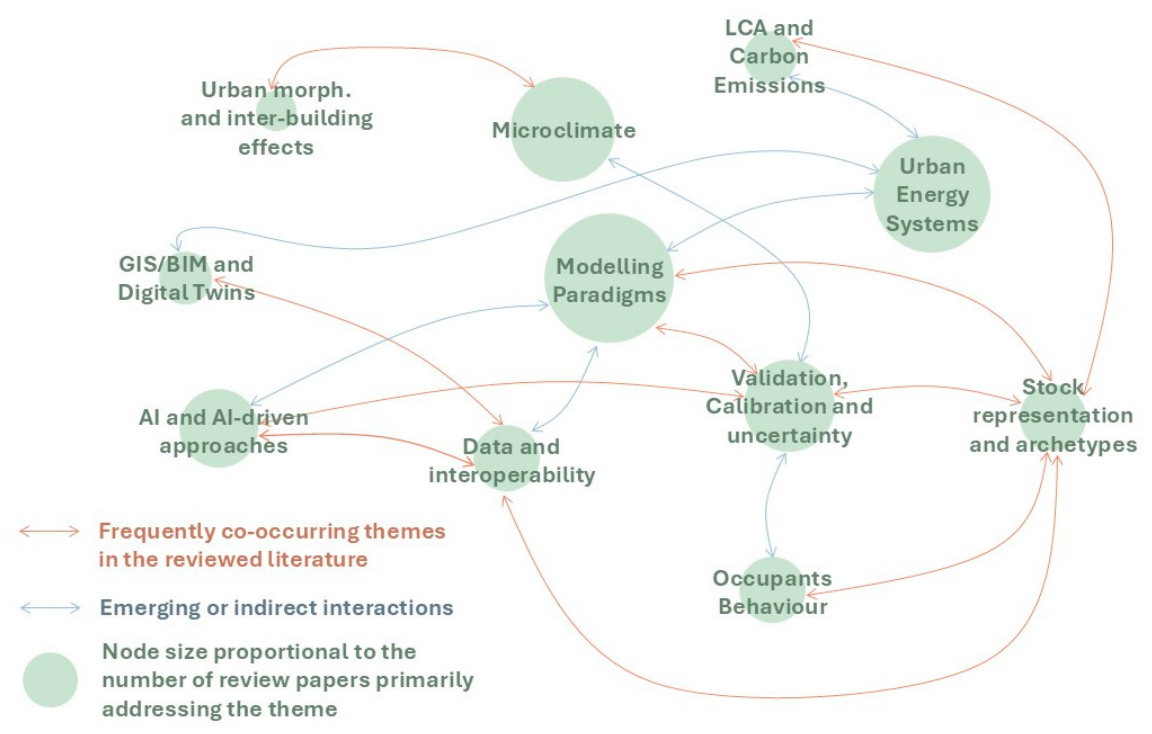
Although each review paper was assigned to a primary thematic category to facilitate the discussion presented in Table 1, this classification should not be interpreted as mutually exclusive. Many review papers simultaneously address multiple research themes, reflecting the increasingly interdisciplinary nature of UBEM research. For example, studies focusing on artificial intelligence frequently discuss data acquisition and interoperability issues, while research on urban microclimate is often closely connected with urban morphology, GIS-based workflows, and urban energy systems. Likewise, topics such as validation, calibration, and uncertainty permeate virtually all modelling approaches. Figure 2 conceptually illustrates these recurring thematic interconnections, highlighting the progressive overlap among research domains that characterises the current UBEM landscape. This overlap reinforces the idea that current UBEM classifications are useful for describing research themes but less effective at clarifying how models should be selected, evaluated, and interpreted for their intended use.

2.1.1. Core Modelling Paradigms: Physics-Based, Data-Driven, and Hybrid Approaches

The literature reports the coexistence of three broad modelling paradigms for UBEM: physics-based models, data-driven models, and hybrid approaches.
In the physics-based approaches, urban building stocks are represented using thermophysical descriptions, geometric information, operational assumptions, and weather-driven simulation engines. The work by Li et al. [11], reviewing urban building energy use modelling approaches and procedures, describes the workflow of physics-based bottom-up models, including model preparation, archetype definition, calibration issues, and applications for urban-scale energy assessment. Similarly, the review by Castaldo and Piselli [34] about dynamic simulation approaches bridges single-building modelling and district-scale analysis, showing how dynamic models support a more realistic assessment of buildings in urban contexts. These two early papers make clear that physics-based UBEM remains the preferred approach whenever interpretability, scenario testing, and physically meaningful outputs are priorities. This centrality of physics-based modelling is confirmed by later literature comparing tools and workflows. Ang et al. [16] propose a consolidated UBEM workflow and organise applications into categories, including urban planning, stock-level carbon reduction, individual building recommendations, and buildings-to-grid integration. Ferrando et al. [6] reviewed bottom-up physics-based UBEM tools from a user-oriented perspective, comparing required inputs, outputs, workflows, applicability, and target users. While Kamel [35] highlights the continuing importance of calibration, open-access data, heating and cooling system characterisation, and occupancy schedules. The more recent work by Cevallos-Sierra et al. [36], on the future of physics-based UBEM tools, further confirms that this approach remains foundational even as the field expands toward more integrated applications.
Alongside this, a second major trajectory has emerged around data-driven methods. Fathi et al. [37] studied ML applications for urban building energy forecasting, demonstrating that data-driven approaches have grown, particularly in tasks such as demand forecasting and energy performance estimation. The review [37] not only shows the potential of ML, but also identifies the scarcity of urban-scale studies compared with individual-building studies, the variability of input variables and forecasting targets, and the lack of universally comparable performance metrics.
Recent literature increasingly presents the future of UBEM as hybrid. Li et al. [38] reviewed the combination of physical approaches with deep learning techniques, discussing that AI can help overcome some of the limits of traditional physical modelling, while retaining the strengths of simulation-based approaches. Darvishvand et al. [39] focused on explainable artificial intelligence in UBEM, showing that the field is moving beyond raw prediction performance toward the need for transparency, stakeholder trust, and actionable explanations for planners, engineers, and decision-makers. Hybridisation also appears in other reviews of integrated frameworks, like under extreme heat, where physical, AI and ML, and microclimate-oriented approaches are combined to address complex multi-scale phenomena [40].
Taken together, these papers show that the research landscape is no longer centred on a single modelling approach. Instead, UBEM is increasingly characterised by methodological pluralism: physics-based models remain indispensable for physically grounded simulation, data-driven models offer scalability and speed, and hybrid approaches are emerging as a synthesis that addresses complex urban scenarios more efficiently.

2.1.2. Archetype Generation, Building Stock Representation, and the Challenge of Urban Heterogeneity

One of the most recurrent themes in the reviewed literature is the representation of heterogeneous building stocks. At the urban scale, detailed building-by-building modelling is rarely feasible, and therefore UBEM frequently relies on archetypal abstraction, clustering, and stock characterisation procedures. These representations are often referred to as archetypes, although the terminology varies across studies. This has made archetype generation one of the most important methodological challenges in the field.
Assessment of uncertainties in building characterisation for urban-scale energy modelling is especially relevant in this field, because these uncertainties enter the UBEM workflow at a very early stage, through incomplete or approximate representations of age, construction, geometry, systems, and occupancy [41]. In UBEM, uncertainty permeates both the simulation engine and the characterisation stage, indicating that model output quality is highly dependent on upstream simplifications. Dahlström et al. [42] reviewed advances in UBEM, including new model components and applications. Their work identifies the development of archetypes as one of the key underdeveloped aspects of current UBEM practice. The review [42] discusses archetypes not only as a purely technical necessity but as a modelling component that influences future scenario analysis, socio-economic representation, and even the potential integration of human behaviour and climate change. The most explicit contribution on this topic is the recent systematic review by Ma et al. [43] on the integration of archetypal building modelling into UBEM. The paper addresses the advantages and challenges of archetypal building modelling, emphasising persistent issues in standardising building types, modelling dynamic features, and ensuring cross-regional applicability. It also highlights how digital technologies and richer data sources may improve archetype-based modelling in the future.
A parallel line of work addresses the classification and validation of archetypes from a more applied angle. Some selected reviews [20,41,42] focus on the motivation, challenges, and methods of building archetype characterisation in bottom-up urban models, showing that characterisation choices depend strongly on the purpose and scope of the study, and that probabilistic and Bayesian approaches are gaining relevance because they can better manage diversity and uncertainty.
These reviews show that one of the defining features of UBEM is the continuous negotiation between representativeness, scalability, and data constraints. Urban heterogeneity is a conceptual challenge that affects model transferability, cross-city comparison, and methodological standardisation. The field is still far from consensus on how archetypes should be defined, validated, and reused across contexts.

2.1.3. Occupants, Occupancy Patterns, and Behavioural Realism

A second major stream within the UBEM landscape concerns occupant-related modelling. Across the reviews, occupants emerge as one of the most important and most difficult components to represent realistically. Whereas early UBEM workflows often adopted static schedules and deterministic assumptions, more recent literature increasingly claims that behavioural and occupancy dynamics are essential for reducing the performance gap between simulated and actual energy use [46].
The review by Happle et al. [48] categorises approaches into deterministic and stochastic modelling strategies and argues that stochastic models, and especially person-based approaches, are better suited for representing behavioural diversity.
The 2022 review by Dabirian et al. [47] on occupant-centric Urban Building Energy Modelling delves further into the occupant-related inputs that matter, including occupancy schedules, appliance use, lighting, setpoints, and domestic hot water demand. The contribution connects behavioural realism to data availability and co-simulation approaches, and it highlights the practical problem of deriving detailed occupant-related inputs at the urban scale.
More recent reviews continue to enlarge this theme. The overview by Banfi et al. [46], about occupant behaviour modelling to support urban building energy simulation, discusses available data sources, modelling approaches, and the challenges of scaling from the building to the urban level. The systematic review by Ren et al. [45], about occupancy pattern generation from the urban to the building scale, frames occupancy modelling not only as a building-energy issue but also as a problem involving mobility models, multi-source data, and the trade-off between complexity, breadth, and interpretability. Finally, the 2024 review by Banfi et al. [44], about integrating occupant behaviour into UBEM, emphasises that one of the main barriers is not only conceptual but also software-related: existing UBEM tools often rely on static occupant profiles because they do not yet provide flexible support for more advanced behavioural modelling.
UBEM is progressively moving away from a purely building-physics interpretation of cities. Occupant modelling introduces social and temporal dimensions that interact with energy systems, urban mobility, and the everyday use of urban space. UBEM also leans toward more dynamic, human-centred, and data-intensive urban modelling.

2.1.4. Calibration, Validation, Uncertainty, and Reproducibility

As the field matures, an increasing number of review papers shift attention from model construction to model reliability. Calibration, validation, uncertainty treatment, and reproducibility now appear as major themes.
Already in the review by Li et al. [11], calibration is identified as a core challenge, particularly because urban-scale models rely on numerous assumptions and often operate with limited measured data. The review by Castaldo et al. [34] also reinforces this concern, noting that calibration is essential to bridge the gap between theoretical model performance and field conditions. Later studies make these concerns even more explicit. The review by Bolluk et al. [41], already mentioned in relation to archetypes, demonstrates that uncertainty is pervasive and often originates from data assumptions rather than from simulation tools alone. The systematic review by Kong et al. [17] identifies inadequate treatment of input uncertainty, insufficient control over simulation and calibration procedures, and computational burden as major limitations of current practice. A particularly important contribution is the taxonomic review of information modelling for urban building energy simulation by Malhotra et al. [49]. The paper [49] concludes that a very large proportion of reviewed studies are not reproducible because they fail to fully report data formats, workflows, data sources, and validation methods. Thus, the current UBEM landscape is not only heterogeneous but also fragmented and weakly standardised.
The same concern is echoed by reviews that discuss data sources and tools more broadly. The systematic review by Kamel [35] stresses the lack of high-resolution data and the need for standard UBEM data acquisition and model development procedures. The review on data acquisition for UBEM by Wang et al. [50] notes that the cost, availability, and quality of the data used strongly affect the performance of the modelling workflow.
This growing concern with validation, calibration, and reproducibility is significant because it indicates a transition from exploratory tool development toward a phase in which UBEM is increasingly expected to support policy, planning, and operational decisions.

2.1.5. Data Acquisition, Open Datasets, and Interoperability

The growth of UBEM has been accompanied by a parallel expansion of research on data. In the reviewed literature, data-related issues appear in at least three forms: the acquisition of input data, the availability of open datasets, and the interoperability between data structures and modelling tools.
The review by Wang et al. [50] systematically discusses geometric, non-geometric, weather, and validation/calibration data, and emphasises that the quality and quantity of these inputs determine the reliability of the final model, showing how UBEM increasingly draws on methods from geography, transport, and computer science, thereby confirming the field’s interdisciplinary evolution. A complementary perspective is offered by Jin et al. [51]; in their review, they show that building energy use datasets have become central to regional planning, benchmarking, and policymaking, but also raise issues of privacy, public disclosure, and data standardisation. The open-data benchmarking review by Roth et al. [52] shows that public urban datasets can support data-driven benchmarking methods more effectively than generic national survey datasets in some contexts.
Interoperability is addressed most directly by the taxonomic review by Malhotra et al. [49], which identifies weak interoperability between input and output formats throughout the modelling chain. This problem is also closely connected to GIS/BIM integration and subsequent digital twin research, discussed in the next section. UBEM is no longer constrained only by model formulation, but also by the infrastructures through which data are acquired, exchanged, and documented. As a result, studies often rely on different data regimes, access conditions, and documentation standards.

2.1.6. GIS, BIM, and Digital Twins

A major research trend emerging from the most recent review literature concerns the progressive digitalisation of UBEM workflows through GIS, BIM, their integration and digital twin approaches. If early UBEM studies relied primarily on GIS for spatial data extraction, current work increasingly frames UBEM within richer, more interoperable, and sometimes real-time digital environments.
GIS is foundational to many physics-based applications because it enables building-stock mapping, geometric extraction, and spatial characterisation. However, the more recent literature shows a shift from basic GIS usage toward structured integration with BIM and semantic modelling [49,55]. The review by Malhotra et al. [49] is again important in this respect because it addresses data formats and interoperability challenges in ways that directly relate to GIS/BIM workflows. The review by Li et al. [54] is even more explicit in showing how remote sensing, GIS, and ML are becoming central to urban-scale energy and environmental assessment, linking geospatial technologies not only to modelling, but also to renewable potential assessment and policy support. A further step is represented by GIS- and BIM-integrated research. The review on GeoBIM for geothermal energy efficiency in buildings and smart cities by Pinto et al. [55] positions the integration of BIM and GIS as a multiscale framework that improves data quality, supports thermal performance assessment, and enables shallow geothermal applications.
Digital twins form another key branch of this digitalisation trend. Bibri et al. [56] show that digital twins are increasingly connected to energy management, AI, the Internet of Things (IoT), and real-time data analytics. They also emphasise predictive maintenance, operational optimisation, and cyber-physical integration. Zhang et al. [82] analysed the evolution from building digital twins to urban digital twins, highlighting the growing integration between energy systems, spatial data infrastructures, interoperability frameworks, and real-time urban management processes. These works are highly relevant to future convergence, pointing toward an urban modelling environment in which geometry, data streams, operational control, and energy simulation are integrated. As a matter of fact, UBEM is no longer only a simulation workflow; it is increasingly part of a digital urban infrastructure.

2.1.7. Urban Morphology, Inter-Building Effects, and Spatial Form

Another strong line of research in the UBEM landscape concerns the role of urban morphology. The reviewed literature repeatedly shows that building energy demand at the urban scale cannot be understood without accounting for density, orientation, spacing, form, and inter-building effects.
Quan et al. [57] explicitly map different measures of urban form, assumed mechanisms, and methodological approaches, and their work reveals that conclusions about densification, typology, and morphological effects are often diverse and sometimes contradictory. The paper [57] shows that spatial form is not a secondary modifier of building performance, but one of the main conceptual bridges between urban design and UBEM. A complementary methodological perspective is offered by Morganti et al. [58] in their review on urban metrics and their ability to predict local climate, thermal comfort, and energy demand. The paper [58] makes explicit that the field has developed numerous metrics to quantify built form, density, and typology, but that their predictive power and transferability remain uneven.
Want et al. [59] reviewed the inter-building effects and their impact on building energy and solar energy use, reinforcing the importance of urban spatial relations. It shows that neighbouring buildings affect not only heating and cooling demand, but also solar potential and indoor thermal comfort.

2.1.8. Microclimate Integration: UHI, Urban Wind, Green and Blue Infrastructure

One of the most dynamic areas of recent UBEM-related research concerns the integration of urban microclimate. Across the selected reviews [60,61,62,63,64,65,66,67], this topic appears through urban heat island (UHI) studies, urban wind environment reviews, green and blue infrastructure studies, and coupling strategies between urban climate and building energy models.
The literature on UHI is particularly strong. Li et al. [60], in 2019, reviewed UHI impacts on building energy consumption, providing a valuable overview of reported cooling and heating effects and showing significant variability across cities, climates, and methodologies. Later reviews strengthen this line of work by discussing UHI modelling approaches, outdoor comfort, and building energy demand more explicitly [61,62]. These papers are significant because they reveal how inconsistently UHI is still treated in practical energy simulation workflows. A particularly important contribution is the review by Sezer et al. [63] that moves the discussion into the methodological terrain of tool coupling, information exchange, and co-simulation. Worthy et al. [64], in a more recent review, explicitly devoted to bridging the simulation-to-reality gap in UBEM through microclimate integration, claim that current UBEM methodologies are constrained by reliance on non-urban-specific, aggregated climate inputs and propose hybrid observational and simulation-based strategies to obtain more representative weather inputs. A recent global meta-analysis of nature-based solutions, by Wei et al. [67], further expands this topic by synthesising the cooling and energy-saving effects of green and blue infrastructure across multiple climate zones and spatial scales.
Urban wind and vegetation constitute further branches of this line of work. Jie et al. [65] discuss mechanisms, tools, coupling methods, and validation issues of these aspects. On the other hand, the review by Zhu et al. [66], about numerical simulation of urban green infrastructure on building energy use, synthesises workflows, tools, and validation methods for modelling vegetation-related effects. In general, the reviews [83,84,85] on urban trees and their impact on building energy use further confirm that shading, microclimate modification, and placement strategies are becoming part of the broader environmental dimension of urban energy modelling. The city is an altered climatic environment in which vegetation, heat islands, local wind patterns, and land-surface conditions materially influence energy demand.

2.1.9. From Building Demand to Urban Energy Systems

A particularly important evolution in the literature is the progressive expansion of UBEM toward urban energy system modelling. Several review papers show that the field is moving beyond demand-side building simulation and increasingly engaging with district heating and cooling, renewable integration, energy hubs, flexibility, and multi-energy systems.
An early signal of this shift is the work by Kveselis et al. [68] about district heating and cooling technologies in the building sector, which discusses their role in meeting energy and environmental targets and highlights the importance of system-level infrastructure and policy. Zhang et al. [69] proposed a more explicitly urban-scale perspective on urban energy systems at the building-cluster level, incorporating renewable energy solutions, energy hubs, cluster-scale systems, and their optimisation. The literature on flexibility further broadens this viewpoint. Luc et al. [70] studied energy-demand flexibility in buildings and district heating systems, discussing how buildings and thermal systems can contribute to demand-side management and to integrated energy systems. More recent reviews develop this line through district heating technologies for building flexibility [71], energy storage control for buildings and districts [72], and energy hubs [73,74].
The most advanced formulation of this trend appears in two reviews: one is from Liu et al. [74] about multi-energy coupling and conversion methods for urban buildings, and the other is by Ngai et al. [75] about multi-energy systems in dense urban building clusters. These papers explicitly frame the separation between demand-side simulation and supply-side energy flow optimisation as a central research gap. The literature makes clear that UBEM must be coupled with broader urban energy system models to effectively support low-carbon urban transitions.
This evolution also reflects a conceptual shift in the role of buildings within UBEM. Rather than being modelled as isolated energy consumers, buildings are increasingly represented as active components of integrated urban energy systems, interacting with district heating and cooling networks, renewable generation, storage, and flexibility services. This trend reinforces the need for interoperable modelling frameworks capable of coupling demand- and supply-side analyses.

2.1.10. AI, ML, Deep Learning, Explainability, and Generative Workflows

AI is now one of the clearest drivers of innovation in the UBEM research landscape. In the reviewed literature, AI-related approaches appear in multiple forms: ML forecasting, deep-learning-enhanced physics-based models, explainable AI (XAI), generative design, and AI-supported retrofit optimisation.
The systematic review by Fathi et al. [37], about ML approaches in urban building energy performance forecasting, provides one of the earliest strong syntheses of this trend. It documents the growing use of learning algorithms to predict energy performance at the urban scale and identifies major gaps, including the scarcity of urban-scale applications, the absence of climate change integration, and the lack of consistent comparison criteria. The hybridisation of AI and physics-based modelling is then addressed more explicitly in the comprehensive review on combining physical approaches with deep learning techniques by Li et al. [38]. XAI introduces a further step in this evolution. The systematic review of XAI in UBEM by Darvishvand et al. [39] argues that explainability is necessary to make complex models understandable and actionable for stakeholders such as policymakers, planners, engineers, and building managers. This shows that the AI turn in UBEM is already moving toward governance and decision-making concerns.
Another interesting branch is the integration of UBEM with generative design and parametric workflows. The review on UBEM and generative design by Elshanshoury et al. [76] discusses how surrogate models, parametric exploration, and ML can support urban design optimisation. This emphasises that the latest innovations are not only improving simulation accuracy, but also changing how UBEM can be used in early-stage planning and design exploration.
Finally, AI also enters the field through retrofit and optimisation studies. Shan et al. [77] studied AI-driven multi-objective optimisation and decision-making for urban building energy retrofit, showing how ML, clustering, and optimisation are being combined to identify retrofit priorities and balance energy, cost, and environmental goals.
Together, these papers show that AI is not a single trend but a cluster of converging trajectories. It affects prediction, explainability, design, and decision support.

2.1.11. LCA, Carbon, and Broader Sustainability Assessment

Although UBEM is primarily concerned with operational energy modelling, the reviewed literature also reveals a growing connection with LCA, energy–carbon integration, and broader sustainability frameworks [78,79,80,81].
The review by Huang et al. [78] proposes a district-level systems perspective that integrates energy and carbon emissions and highlights interactions among buildings, the surrounding environment, and user behaviours. The paper anticipates subsequent efforts to move beyond operational energy to more holistic assessments of urban sustainability. More recent work pushes this boundary further. The work by Li et al. [79] integrates UBEM and urban-building environmental assessment, explicitly claiming to couple operational energy modelling with broader urban environmental assessment frameworks. Zhou et al. [80] reviewed UBEM in relation to the Sustainable Development Goals, expanding the scope beyond technical energy questions to include policy, equity, interdisciplinarity, and broader sustainability agendas.
Finally, although it sits somewhat adjacent to core UBEM, the review by Wang et al. [81] scales LCA to district energy systems. The work illustrates how environmental assessment is progressively moving from isolated building technologies toward system-level district analysis.
This strand remains smaller than others, but it is important because it signals an emerging tendency to position UBEM within wider decarbonization, life cycle, and sustainability assessment frameworks.

2.2. Discussion of the Research Landscape

Taken as a whole, the 75 review papers portray UBEM as a field that is simultaneously maturing and fragmenting. It is maturing because the literature now includes consolidated reviews of tools, workflows, archetypes, data acquisition, calibration, microclimate integration, behaviour modelling, AI applications, and energy system coupling. It is fragmenting because these lines of work are often developed in partially separate sub-communities, with different data practices, different modelling assumptions, and different conceptual definitions of what counts as “urban energy modelling”.
The first large group of studies remains centred on physics-based UBEM, workflow design, tool comparison, and scenario analysis [6,10,11,16,35,36]. The second cluster focuses on human and stochastic realism, especially through occupant behaviour and occupancy modelling [44,45,46,47,48]. The third group is concerned with data, interoperability, and digital infrastructures, including open datasets, GIS/BIM integration, geospatial methods, and digital twins [49,50,51,54,55,56]. The fourth group addresses urban context integration, particularly through urban form, UHI, microclimate coupling, wind, and vegetation [57,58,60,63,64,65,66]. Finally, the fifth group pushes UBEM toward urban energy systems and broader sustainability assessment, including flexibility, energy hubs, multi-energy systems, AI-based retrofit planning, LCA, and policy support [69,70,73,74,75,78,79,80].
The overall picture is therefore one of diversity without full integration. UBEM today encompasses tools and approaches ranging from bottom-up thermal simulation to ML forecasting, from archetype generation to digital twins, from UHI coupling to district-scale energy hubs. This diversity reflects the richness of the field, but also its methodological fragmentation. At the same time, a clear convergence is evident in the most recent literature: future UBEM is increasingly envisioned as a multi-domain, multi-scale, and interoperable platform in which buildings, urban form, microclimate, human behaviour, energy systems, and digital infrastructures are progressively connected. This suggests that the current research landscape should not be interpreted as a stable taxonomy, but as a field in transition. What started as a methodological effort to extend building energy modelling to districts and cities is increasingly becoming a broader project of integrated urban energy intelligence. The research landscape described above, therefore, shows that UBEM fragmentation is not only methodological but also functional: similar modelling techniques may serve very different purposes, while similar decision-making needs may be addressed through different methods. Consequently, the thematic trends discussed above are not proposed as an alternative taxonomy, but rather as complementary dimensions that can be interpreted through the goal-oriented framework introduced in the following section.

3. Categorising UBEM Approaches

The overview presented in Section 2 highlights a research landscape that is both rich and highly heterogeneous. UBEM has evolved through a wide range of modelling approaches, data structures, and application domains, reflecting its interdisciplinary nature and its progressive expansion. However, this diversity has also made it increasingly difficult to compare models, interpret results, and assess their suitability for specific applications [6,49]. Most existing classifications of UBEM approaches are based on methodological distinctions, typically differentiating between physics-based, data-driven, and hybrid models. While this type of classification is useful to describe how models are constructed, it provides limited insight into how they are intended to be used. In practice, models developed for fundamentally different purposes are often discussed within the same methodological categories, despite relying on different assumptions, data requirements, and evaluation criteria [12,86]. A recurring observation across the reviewed literature is that the final objective of the model strongly influences its structure, level of detail, and underlying assumptions [6,16]. For instance, models designed to support long-term urban energy planning operate at large spatial scales and rely on simplified representations of building stocks, whereas models developed for retrofit analysis or district design require greater detail and more accurate representations of building behaviour.
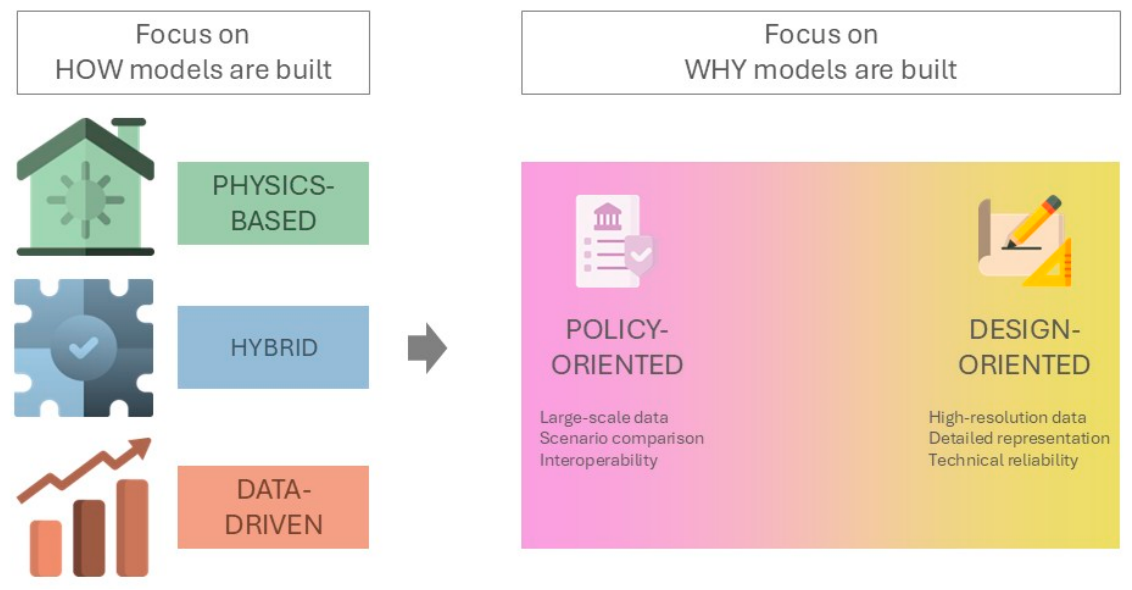
Objective-based readings of UBEM are not entirely absent from the literature. For example, Salvalai et al. [87] recently classified UBEM studies by application domain, including energy demand forecasting, policy evaluation, and tool development. The present perspective paper builds on this direction but adopts a different conceptual level of abstraction. The aim is not to replace application-based classifications but to provide a simplified interpretative framework that links modelling objectives to data requirements, validation expectations, reliability criteria, and fit-for-purpose assessment. Rather than organising application domains, the proposed framework seeks to reinterpret how UBEM models should be understood and evaluated in light of their intended use. This suggests that a complementary classification, based on the intended use and scale of application, can provide a clearer interpretation of the UBEM landscape. In this perspective, two main categories can be identified: policy-oriented models and design-oriented models. These two categories are deliberately broad. They are not intended to exhaust the diversity of UBEM applications, but to define two dominant modelling logics that differ in scale, expected accuracy, data requirements, validation strategies, and decision-making context. These categories should not be seen as rigid or mutually exclusive, but rather as two ends of a continuous spectrum, within which intermediate applications may exist, such as district-scale planning or neighbourhood retrofit prioritisation (Figure 3).

3.1. Policy-Oriented UBEM Approaches

Policy-oriented UBEM models are primarily developed to support strategic decision-making at the city scale [22,25,29,88]. Their main purpose is to provide a system-level understanding of energy use, enabling evaluation of long-term scenarios, assessment of policy interventions, and urban energy planning.
In this context, models are typically designed to explore questions such as the impact of large-scale retrofit programmes, the electrification of building systems or the integration of renewable energy at the urban scale. As a result, they operate on large datasets and require representations that are both scalable and computationally manageable. This often leads to the use of simplified building descriptions, such as statistical representations of building stocks, which allow the aggregation of heterogeneous buildings into a manageable number of categories, or in Resistance–Capacitance models when a physics-based approach is chosen. The reliance on simplified representations is not merely a methodological choice, but a necessary condition for operating at large spatial scales. However, it also introduces additional layers of abstraction and uncertainty. In many cases, input data are incomplete or available only at aggregated levels, and assumptions regarding occupancy, systems, and building characteristics must be generalised. Consequently, calibration and validation are often performed at aggregate levels, and the accuracy of individual building predictions is not the primary objective. The outputs of policy-oriented models reflect this work. Rather than focusing on detailed building performance, they provide indicators such as total energy demand, emissions, or the comparative impact of alternative scenarios. These outputs are particularly valuable for policymakers and planners, as they support evidence-based decision-making and long-term strategy development.
At the same time, the literature highlights several limitations of this approach [6,50,89]. The use of heterogeneous data sources, simplified assumptions, and context-specific modelling choices often reduces comparability between studies. Moreover, the implicit nature of many modelling assumptions can limit transparency and hinder the interpretation of results. Despite these challenges, policy-oriented UBEM remains a fundamental tool for addressing urban energy transitions, as it enables the exploration of large-scale interventions that cannot be captured through building-level analysis alone.

3.2. Design-Oriented UBEM Approaches

Design-oriented UBEM approaches, in contrast, are developed to support more detailed analysis at the scale of a district or neighbourhood [90,91,92]. Their primary objective is to evaluate energy performance with greater accuracy, often in the context of design optimisation, retrofit strategies, or renewable energy integration on specific buildings. These models are typically characterised by a higher level of detail in the representation of buildings. They rely more extensively on physics-based simulation [12,93,94], incorporating geometric data, construction characteristics, system configurations, and, when possible, more refined assumptions about occupancy and operation. This level of detail enables more accurate estimates of energy demand and system performance, making these models particularly suitable for technical decision-making. In design-oriented applications, calibration and validation play a prominent role. Because the objective is to evaluate specific interventions, such as envelope improvements, system upgrades, or the integration of renewable technologies, the reliability of results at the neighbourhood or district scale becomes critical, and a certain level of accuracy at the building level may be expected too. This often requires high-resolution data and more complex modelling workflows, which can increase both the effort required to develop the model and the associated computational cost. The outputs of design-oriented models are correspondingly more detailed. They typically include building-level energy demand, peak loads, system performance indicators, and quantitative assessments of specific interventions. This level of granularity is essential for engineers, designers, and consultants, who require precise information to support design decisions.
However, this increased level of detail comes at the cost of scalability. Models developed for design purposes are often difficult to extend to larger spatial scales, and their results may be highly context-dependent. As a result, they are less suited to supporting urban energy planning or policy evaluation, particularly when data availability is limited.

3.3. Comparison and Complementarities

Although policy-oriented and design-oriented approaches differ significantly in their objectives, scale, and level of detail, they should not be considered as separate or competing categories. Rather, they represent complementary perspectives within the broader UBEM framework.
Policy-oriented models provide a macroscopic view of urban energy systems, supporting scenario analysis and long-term planning. Design-oriented models, on the other hand, offer a more detailed and physically grounded understanding of building/district performance, enabling the evaluation and optimisation of specific solutions. Both perspectives are necessary to fully address the complexity of urban energy systems. A key issue emerging from the literature is the limited interaction between these two domains. Policy-oriented models often rely on simplified assumptions that are not systematically validated through detailed simulations, while design-oriented models are rarely scaled up to inform broader planning strategies. This separation creates a gap between strategic decision-making and technical implementation.
Bridging this gap represents one of the main challenges for future UBEM research. The development of multi-scale modelling frameworks capable of linking system-level scenarios to detailed building simulations would allow for greater consistency between planning and design. Such integration would also support a more coherent use of data, enabling models to operate across different levels of resolution while maintaining a consistent representation of the underlying system.
The proposed classification, developed on a different reading of the existing literature on UBEM, highlights the importance of explicitly linking modelling approaches to their intended application. Many of the limitations identified in the current literature can be traced to a lack of clear alignment among model structure, data requirements, and decision-making context. Recognising the distinction between policy-oriented and design-oriented models makes it possible to better define expectations regarding model performance, data needs, and reliability. In this sense, the concept of “fit for purpose” becomes central: a model should not be evaluated solely based on its methodological sophistication, but on its ability to provide meaningful and reliable outputs for a given application. At the same time, this classification provides a useful framework for addressing the broader issue of fragmentation in UBEM. By organising models according to their objectives rather than only their methods, it becomes easier to interpret the diversity of approaches, identify gaps, and support convergence across research efforts. Ultimately, the challenge is not to reduce this diversity, but to structure it in a way that enhances comparability, transparency, and practical usability.
To clarify the practical implications of the proposed classification, Table 2 summarises the main differences between policy-oriented and design-oriented UBEM approaches. The comparison does not aim to define rigid categories, but to make explicit how the intended use of a model influences its spatial scale, data requirements, level of detail, validation expectations, outputs, and target users. This distinction is particularly important because the same modelling methodology may be appropriate for one objective and less appropriate for another, depending on the level of reliability required by the decision-making context. Table 2 highlights that the distinction between policy-oriented and design-oriented UBEM is not merely about scale but about the relationship between modelling assumptions and decision-making needs. Policy-oriented models may be reliable even when they count on simplified representations, provided that they support robust comparisons across scenarios at aggregated scales. Conversely, design-oriented models generally require higher spatial and temporal resolution, since their outputs are expected to inform specific technical choices. This reinforces the need to evaluate UBEM models according to their intended use rather than according to methodological complexity alone.
This shift from method-based to goal-oriented classification provides a more actionable framework for interpreting UBEM applications and directly supports the definition of reliability criteria discussed in the following section. The implications of this distinction extend beyond model classification and provide the conceptual basis for interpreting the foundational challenges discussed in the following section.

4. Towards a Coherent and Reliable UBEM Framework

The overview presented in the previous sections highlights a clear paradox: while UBEM has expanded rapidly in methodologies, applications, and data sources, the development of its foundational structures has not kept pace. The field has demonstrated a remarkable capacity for innovation, incorporating advances in data science, urban analytics, and digital technologies. However, this expansion has occurred in a fragmented manner, with limited coordination across research efforts. As a result, UBEM is characterised by substantial heterogeneity not only in modelling approaches, but also in data structures, terminology, and evaluation criteria. While this reflects the field’s flexibility and adaptability, it also limits comparability, transparency, and practical implementation, particularly in the transferability of models and the consistency of decision-support applications.
A central argument of this work is that the current stage of UBEM development requires a shift from methodological diversification toward structural consolidation. Rather than further expanding modelling techniques, greater attention should be devoted to strengthening the foundations that support their use. Based on the literature review, three main gaps emerge as key barriers to coherence and reliability: the lack of structured and shared data frameworks (Section 4.1), the absence of consistent terminology (Section 4.2), and the lack of criteria for assessing model reliability and suitability (Section 4.3). These issues are closely interconnected and reflect a broader need to move from isolated modelling efforts toward a more interoperable, transparent, and purpose-driven UBEM ecosystem.
Although these three challenges concern the entire UBEM community, their practical implications differ depending on the model’s intended application. In policy-oriented UBEM, the main priorities are the availability of scalable, interoperable data, transparency in modelling assumptions, and consistency in scenario comparisons at aggregated scales. In contrast, design-oriented applications place greater emphasis on high-resolution data, appropriate model validation, and the reliability of predictions supporting specific technical interventions. Consequently, the concept of fit-for-purpose should not be interpreted as a universal quality criterion but rather as a model’s ability to provide reliable information for its intended decision-making context. The proposed classification is therefore not intended to introduce different modelling standards, but to provide a practical framework for interpreting how common challenges should be addressed in line with the objectives of each UBEM application.

4.1. Structured Data Collection and Cataloguing

One of the most critical limitations identified in the literature concerns the lack of consistent data frameworks for building stock characterisation. UBEM is inherently data-intensive, requiring information on building geometry, construction characteristics, systems, and occupancy. However, these data are often incomplete, fragmented, and available at different levels of resolution [50]. In practice, this leads to a proliferation of ad hoc solutions. Many studies rely on locally defined archetypes, simplified assumptions, or partial datasets that are difficult to compare or transfer across contexts [20]. Even when similar modelling approaches are adopted, differences in data sources and processing methods can produce significantly different results.
Addressing this issue requires structured, multi-scale data infrastructures capable of integrating information from different sources and spatial scales, from individual buildings to entire urban regions.
Several initiatives already point in this direction. Energy Performance Certificate (EPC) databases provide large-scale information on building energy characteristics and are increasingly used for building stock modelling. Similarly, open data platforms and urban data repositories are emerging as important resources for UBEM applications, particularly in cities with advanced data governance strategies. More recently, the integration of GIS, BIM, and remote sensing data has enabled more detailed and spatially explicit representations of urban environments.
Despite these developments, a coherent and widely adopted data framework is still lacking. The challenge is not only to collect more data, but also to organise it in a consistent, accessible, and interoperable way across modelling approaches and application domains. Without such a framework, the scalability of UBEM will remain limited and the comparability of results will continue to be a major issue.

4.2. Shared Terminology and Conceptual Consistency

A second major barrier to coherence in UBEM is the absence of a shared and consistent terminology. Across the literature, key concepts are often used with different meanings, or different terms are used to describe similar concepts. This is particularly evident in the case of building stock representation, where terms such as “archetype,” “prototype,” “reference building,” and “template” are frequently used interchangeably, despite referring to different modelling assumptions.
This lack of conceptual clarity is not a minor issue. It directly affects the interpretation of results, the comparison of studies, and the communication between disciplines. In an interdisciplinary field such as UBEM, where researchers come from building physics, urban planning, data science, and engineering backgrounds, the absence of a common language creates additional barriers to collaboration. Moreover, terminology is closely linked to modelling choices. Different definitions of “archetype,” for example, imply different levels of abstraction, different data requirements, and different assumptions about building behaviour. Without a clear and shared understanding of these concepts, it becomes difficult to assess whether two models are comparable or to interpret differences in their results.
The goal is not to impose a single definition for all concepts, but to move toward a more transparent and consistent use of terminology, supported by explicit definitions and clear documentation. Establishing a shared vocabulary would facilitate comparison across studies, improve communication between researchers and practitioners, and support the development of more coherent modelling frameworks.

4.3. Defining Reliability: Toward Fit-for-Purpose Modelling

A third and more fundamental gap concerns the absence of criteria to assess the reliability of UBEM models. While the literature extensively discusses modelling approaches, data sources, and validation techniques, it rarely provides clear guidance on when a model can be considered adequate for a given application. This issue is particularly critical given the diversity of UBEM applications. A model designed for long-term policy analysis does not require the same level of detail or accuracy as a model used for retrofit optimisation. Yet, in the absence of explicit evaluation criteria, models are often assessed using generic metrics or implicit assumptions, without a clear link to their intended use. This suggests the need to shift from a generic notion of “accuracy” toward a more nuanced concept of “fit-for-purpose” modelling. In this perspective, the quality of a model is not defined solely by its level of detail or predictive performance, but by its ability to provide reliable and relevant outputs for a specific decision-making context.
A first step in this direction can be found in a recent study by Ferrando et al. [90] that evaluates model performance across multiple spatial and temporal scales simultaneously. For instance, this work [90] shows that the impact of modelling assumptions varies significantly with the level of aggregation. The same model can provide consistent results at the annual neighbourhood scale, while showing large deviations at the hourly or single-building level. This highlights that model validity is inherently scale-dependent. To capture this variability, the study adopts a matrix-based evaluation approach, in which model performance is assessed across a range of spatial scales (e.g., single building, groups of buildings, entire district) and temporal resolutions (e.g., hourly, daily, monthly, yearly). In this framework, reliability is not expressed as a single value, but as a distribution of performance indicators across different aggregation levels. The use of metrics such as CVRMSE, as defined in the ASHRAE framework [95], for verifying single-building energy models, visualised through heatmaps, enables clear identification of where and when the model performs adequately. This type of representation can be interpreted as a reliability matrix, where: one dimension represents the spatial scale, the other represents the temporal resolution, and the values indicate a deviation from a reference case or calibration target. Such an approach provides a more nuanced understanding of model performance, revealing that the same model may be “fit” for certain applications (e.g., annual policy analysis) but not for others (e.g., hourly load matching or energy community design).
Building on this concept, a general reliability framework for UBEM could be structured as a multi-dimensional matrix including:
-
Spatial scale and time resolution,
-
Level of detail in building representation,
-
Data availability and quality,
-
Calibration and validation procedures,
-
Computational requirements,
-
Intended use (policy vs. design).
Rather than enforcing uniform standards, this matrix-based approach would allow models to be positioned within a defined space of applicability, making their assumptions and limitations explicit. This would facilitate comparison across studies, improve transparency, and support more informed decision-making. Importantly, this perspective suggests that standardisation should not aim to homogenise modelling approaches, but to structure how models are evaluated and interpreted. In this sense, reliability matrices or similar tools could act as a bridge between methodological diversity and practical usability, enabling the field to move toward greater coherence without limiting innovation.

5. Conclusions and Future Outlooks

UBEM has evolved rapidly over the past decade, establishing itself as a key framework for linking building-scale analysis with urban-scale decision-making. As highlighted throughout this perspective, the field has expanded across disciplines, data sources, and application domains, enabling a wide range of modelling approaches and urban applications. At the same time, this rapid growth has produced a fragmented landscape characterised by heterogeneous assumptions, inconsistent terminology, and limited comparability among models. These issues continue to constrain the broader operational and policy uptake of UBEM.
This perspective argues that the next phase of UBEM development should focus less on methodological proliferation and more on consolidating its foundational structures. In this perspective, three elements emerge as particularly important: data, language, and reliability.
First, the development of structured, interoperable data infrastructures is essential to improving model robustness, transferability, and scalability. Second, clearer and more consistent terminology would enhance transparency and comparability across studies and disciplines. Third, the growing use of UBEM in decision-making contexts requires more explicit evaluation frameworks to assess whether models are fit for purpose across different spatial, temporal, and application conditions.
These elements should not be interpreted as constraints on innovation, but as enabling conditions for a more coherent and mature research field. The objective is not to rigidly standardise UBEM, but to establish common foundations that allow different modelling approaches to coexist, interact, and be evaluated consistently.
Ultimately, the future impact of UBEM will depend not only on advances in modelling techniques but also on the field’s ability to improve transparency, interoperability, and reliability. Strengthening these foundations is essential to transforming UBEM from a predominantly academic modelling exercise into a robust, widely applicable decision-support framework for the urban energy transition.

Author Contributions

M.F.: conceptualisation, methodology, formal analysis, investigation, data curation, writing—original draft preparation, visualisation. F.C.: conceptualisation, methodology, writing—review and editing, supervision. All authors have read and agreed to the published version of the manuscript.

Funding

This research received no external funding.

Data Availability Statement

The original contributions presented in this study are included in the article. Further inquiries can be directed to the corresponding author.

Acknowledgments

During the preparation of this manuscript, the authors used ChatGPT (OpenAI, GPT-5.5 Edu version, closed-environment institutional access) exclusively for English language editing and text polishing. The authors have reviewed and edited the output and take full responsibility for the content of this publication.

Conflicts of Interest

The authors declare no conflicts of interest.

Abbreviations

The following abbreviations are used in this manuscript:
UBEMUrban Building Energy Modelling
GISGeographic Information Systems
BIMBuilding Information Modelling
AIArtificial Intelligence
LCALife Cycle Assessment
MLMachine Learning
IoTInternet of Things
UHIUrban Heat Island
XAIEXplainable AI
EPCEnergy Performance Certificate

References

  1. Take Action for the Sustainable Development Goals—United Nations Sustainable Development. 2022. Available online: https://www.un.org/sustainabledevelopment/sustainable-development-goals/ (accessed on 20 May 2026).
  2. Cities—United Nations Sustainable Development Action. 2022. Available online: https://www.un.org/sustainabledevelopment/cities/ (accessed on 20 May 2026).
  3. Tweed, C.; Jones, P. The role of models in arguments about urban sustainability. Environ. Impact Assess. Rev. 2000, 20, 277–287. [Google Scholar] [CrossRef] [Scilit]
  4. Hong, T.; Chen, Y.; Luo, X.; Luo, N.; Lee, S.H. Ten questions on urban building energy modeling. Build. Environ. 2020, 168, 106508. [Google Scholar] [CrossRef] [Scilit]
  5. Yang, Z.; Becerik-Gerber, B. A model calibration framework for simultaneous multi-level building energy simulation. Appl. Energy 2015, 149, 415–431. [Google Scholar] [CrossRef] [Scilit]
  6. Ferrando, M.; Causone, F.; Hong, T.; Chen, Y. Urban building energy modeling (UBEM) tools: A state-of-the-art review of bottom-up physics-based approaches. Sustain. Cities Soc. 2020, 62, 102408. [Google Scholar] [CrossRef] [Scilit]
  7. Energy Performance of Buildings Directive. Available online: https://energy.ec.europa.eu/topics/energy-efficiency/energy-performance-buildings/energy-performance-buildings-directive_en (accessed on 30 September 2025).
  8. Geske, M.; Voelker, C. Overcoming data scarcity by a probabilistic approach to consider future retrofit rates in urban building energy modeling. Energy Build. 2026, 357, 117168. [Google Scholar] [CrossRef] [Scilit]
  9. Chen, X.; Wang, T.; Wong, N.H.; Ang, Y.Q. Incorporating localized weather station data for microclimate-integrated urban building energy modeling: A campus-scale decarbonization study. Build. Environ. 2026, 290, 114150. [Google Scholar] [CrossRef] [Scilit]
  10. Reinhart, C.F.; Cerezo Davila, C. Urban building energy modeling—A review of a nascent field. Build. Environ. 2016, 97, 196–202. [Google Scholar] [CrossRef] [Scilit]
  11. Li, W.; Zhou, Y.; Cetin, K.; Eom, J.; Wang, Y.; Chen, G.; Zhang, X. Modeling urban building energy use: A review of modeling approaches and procedures. Energy 2017, 141, 2445–2457. [Google Scholar] [CrossRef] [Scilit]
  12. MIT Sustainable Design Lab. umi—Urban Modeling Interface. 2013. Available online: http://web.mit.edu/sustainabledesignlab/projects/umi/index.html (accessed on 20 December 2018).
  13. U.S. Department of Energy. Commercial Reference Buildings. 2020. Available online: https://www.energy.gov/eere/buildings/commercial-reference-buildings (accessed on 18 June 2021).
  14. Carnieletto, L.; Ferrando, M.; Teso, L.; Sun, K.; Zhang, W.; Causone, F.; Romagnoni, P.; Zarrella, A.; Hong, T. Italian prototype building models for urban scale building performance simulation. Build. Environ. 2021, 192, 107590. [Google Scholar] [CrossRef] [Scilit]
  15. Famuyibo, A.A.; Duffy, A.; Strachan, P. Developing archetypes for domestic dwellings—An Irish case study. Energy Build. 2012, 50, 150–157. [Google Scholar] [CrossRef] [Scilit]
  16. Ang, Y.Q.; Berzolla, Z.M.; Reinhart, C.F. From concept to application: A review of use cases in urban building energy modeling. Appl. Energy 2020, 279, 115738. [Google Scholar] [CrossRef] [Scilit]
  17. Kong, D.; Cheshmehzangi, A.; Zhang, Z.; Ardakani, S.P.; Gu, T. Urban building energy modeling (UBEM): A systematic review of challenges and opportunities. Energy Effic. 2023, 16, 69. [Google Scholar] [CrossRef] [Scilit]
  18. Ritchie, H.; Samborska, V.; Roser, M. Urbanization; Our World in Data: Oxford, UK, 2024. [Google Scholar]
  19. Cerezo, C.; Sokol, J.; AlKhaled, S.; Reinhart, C.F.; Al-Mumin, A.; Hajiah, A. Comparison of four building archetype characterization methods in urban building energy modeling (UBEM): A residential case study in Kuwait City. Energy Build. 2017, 154, 321–334. [Google Scholar] [CrossRef] [Scilit]
  20. Schildt, M.; Ferrando, M.; Nardelli, C.; Causone, F.; van Treeck, C.; Frisch, J. Cross-examination of country-specific archetypes generation for urban building energy modelling (UBEM). Sustain. Cities Soc. 2025, 135, 106940. [Google Scholar] [CrossRef] [Scilit]
  21. Ferrari, S.; Zagarella, F.; Caputo, P.; Bonomolo, M. Assessment of tools for urban energy planning. Energy 2019, 176, 544–551. [Google Scholar] [CrossRef] [Scilit]
  22. Nouvel, R.; Mastrucci, A.; Leopold, U.; Baume, O.; Coors, V.; Eicker, U. Combining GIS-based statistical and engineering urban heat consumption models: Towards a new framework for multi-scale policy support. Energy Build. 2015, 107, 204–212. [Google Scholar] [CrossRef] [Scilit]
  23. Jennings, M.; Fisk, D.; Shah, N. Modelling and optimization of retrofitting residential energy systems at the urban scale. Energy 2014, 64, 220–233. [Google Scholar] [CrossRef] [Scilit]
  24. Mohajeri, N.; Upadhyay, G.; Gudmundsson, A.; Assouline, D.; Kämpf, J.; Scartezzini, J.L. Effects of urban compactness on solar energy potential. Renew. Energy 2016, 93, 469–482. [Google Scholar] [CrossRef] [Scilit]
  25. Liu, K.; Xu, X.; Lin, D.; Zhang, R.; Zhao, L.; Abuduwayiti, A.; Causone, F. A scalable and efficient framework for city-scale building energy modeling with microclimate considerations. Sustain. Cities Soc. 2026, 138, 107187. [Google Scholar] [CrossRef] [Scilit]
  26. Grosso, M. Urban form and renewable energy potential. Renew. Energy 1998, 15, 331–336. [Google Scholar] [CrossRef] [Scilit]
  27. Herfray, G.; Peuportier, B. Life Cycle Assessment Applied to Urban Settlements, SB10 Mad. 2010, pp. 1–11. Available online: https://atikteam.s3.amazonaws.com/552837c8166197f098d7918c63d14d/1323271252QA0RpXCZL5rhsVPIcVobC7nRmC4ZV2Fq8Hw572UxzGCWUxdYFQ?AWSAccessKeyId=AKIAJRRAGXI4N6PIQGVQ&Expires=2147483647&Signature=Exk%2BvlfzX%2B7Cc5kLQOXDIZfHIoQ%3D (accessed on 14 July 2026).
  28. de Almeida, A.M.; Ben-Akiva, M.; Pereira, F.C.; Ghauche, A.; Guevara, C.A.; Niza, S.; Zegra, C. A framework for integrated modeling of urban system. In Proceedings of the 45th ISOCARP World Congress, Porto, Portugal, 18–22 October 2009; pp. 1–7. [Google Scholar]
  29. Guy, S. Designing urban knowledge: Competing perspectives on energy and buildings. Environ. Plan. C Gov. Policy 2006, 24, 645–659. [Google Scholar] [CrossRef] [Scilit]
  30. Bourdic, L.; Salat, S. Building energy models and assessment systems at the district and city scales: A review. Build. Res. Inf. 2012, 40, 518–526. [Google Scholar] [CrossRef] [Scilit]
  31. Ferrando, M.; Causone, F. An overview of urban building energy modelling (UBEM) tools. In Proceedings of the 16th IBPSA Conference, Rome, Italy, 2–4 September 2019; pp. 3452–3459. Available online: https://www.scopus.com/inward/record.uri?eid=2-s2.0-85107046249&partnerID=40&md5=53bb2234237411520daca9b9410591cf (accessed on 14 July 2026).
  32. Li, Z.; Lin, B.; Zheng, S.; Liu, Y.; Wang, Z.; Dai, J. A review of operational energy consumption calculation method for urban buildings. Build. Simul. 2020, 13, 739–751. [Google Scholar] [CrossRef] [Scilit]
  33. Sola, A.; Corchero, C.; Salom, J.; Sanmarti, M. Simulation tools to build urban-scale energy models: A review. Energies 2018, 11, 3269. [Google Scholar] [CrossRef] [Scilit]
  34. Castaldo, V.L.; Pisello, A.L. Uses of dynamic simulation to predict thermal-energy performance of buildings and districts: A review. Wiley Interdiscip. Rev. Energy Environ. 2018, 7, e269. [Google Scholar] [CrossRef] [Scilit]
  35. Kamel, E. A Systematic Literature Review of Physics-Based Urban Building Energy Modeling (UBEM) Tools, Data Sources, and Challenges for Energy Conservation. Energies 2022, 15, 8649. [Google Scholar] [CrossRef] [Scilit]
  36. Cevallos-Sierra, J.; Silva, C.S.; Ferrão, P. Future Perspectives for Physics-Based Urban Building Energy Modelling Tools. Energies 2025, 18, 4888. [Google Scholar] [CrossRef] [Scilit]
  37. Fathi, S.; Srinivasan, R.; Fenner, A.; Fathi, S. Machine learning applications in urban building energy performance forecasting: A systematic review. Renew. Sustain. Energy Rev. 2020, 133, 110287. [Google Scholar] [CrossRef] [Scilit]
  38. Li, Z.; Ma, J.; Tan, Y.; Guo, C.; Li, X. Combining physical approaches with deep learning techniques for urban building energy modeling: A comprehensive review and future research prospects. Build. Environ. 2023, 246, 110960. [Google Scholar] [CrossRef] [Scilit]
  39. Darvishvand, L.; Kamkari, B.; Huang, M.J.; Hewitt, N.J. A systematic review of explainable artificial intelligence in urban building energy modeling: Methods, applications, and future directions. Sustain. Cities Soc. 2025, 128, 106492. [Google Scholar] [CrossRef] [Scilit]
  40. Mondal, N.; Anand, P.; Khan, A.; Deb, C.; Cheong, D.; Sekhar, C.; Niyogi, D.; Santamouris, M. Systematic review of the efficacy of data-driven urban building energy models during extreme heat in cities: Current trends and future outlook. Build. Simul. 2024, 17, 695–722. [Google Scholar] [CrossRef] [Scilit]
  41. Bolluk, S.; Seyis, S. Review of Uncertainties in Building Characterization for Urban-Scale Energy Modeling. In Advances in Building Information Modeling; Communications in Computer and Information Science; Springer: Cham, Switzerland, 2022; pp. 159–182. [Google Scholar] [CrossRef] [Scilit] [PubMed]
  42. Dahlström, L.; Broström, T.; Widén, J. Advancing urban building energy modelling through new model components and applications: A review. Energy Build. 2022, 266, 112099. [Google Scholar] [CrossRef] [Scilit]
  43. Ma, Y.; Deng, W.; Hong, Y.; Zhang, H.; Ye, Y.; Chen, S.; Xu, D. The advantages and challenges of integrating archetypal building modelling for urban building energy models: A systematic review. Energy Build. 2025, 345, 116066. [Google Scholar] [CrossRef] [Scilit]
  44. Banfi, A.; Ferrando, M.; Li, P.; Shi, X.; Causone, F. Integrating Occupant Behaviour into Urban-Building Energy Modelling: A Review of Current Practices and Challenges. Energies 2024, 17, 4400. [Google Scholar] [CrossRef] [Scilit]
  45. Ren, J.; Zhou, X.; Jin, X.; Ye, Y.; Causone, F.; Ferrando, M.; Li, P.; Shi, X. A systematic review of occupancy pattern in urban building energy modeling: From urban to building-scale. J. Build. Eng. 2024, 95, 110307. [Google Scholar] [CrossRef] [Scilit]
  46. Banfi, A.; Ferrando, M.; Causone, F. Occupant behaviour (OB) modelling to support urban building energy simulation: An overview. In Proceedings of the 18th International Conference of the International Building Performance Simulation Association (BS2023), Shanghai, China, 4–6 September 2023; IBPSA Publications: Toronto, ON, Canada, 2023; pp. 3003–3010. [Google Scholar] [CrossRef] [Scilit]
  47. Dabirian, S.; Panchabikesan, K.; Eicker, U. Occupant-centric urban building energy modeling: Approaches, inputs, and data sources—A review. Energy Build. 2022, 257, 111809. [Google Scholar] [CrossRef] [Scilit]
  48. Happle, G.; Fonseca, J.A.; Schlueter, A. A review on occupant behavior in urban building energy models. Energy Build. 2018, 174, 276–292. [Google Scholar] [CrossRef] [Scilit]
  49. Malhotra, A.; Bischof, J.; Nichersu, A.; Häfele, K.-H.; Exenberger, J.; Sood, D.; Allan, J.; Frisch, J.; van Treeck, C.; O’Donnell, J.; et al. Information modelling for urban building energy simulation—A taxonomic review. Build. Environ. 2022, 208, 108552. [Google Scholar] [CrossRef] [Scilit]
  50. Wang, C.; Ferrando, M.; Causone, F.; Jin, X.; Zhou, X.; Shi, X. Data acquisition for urban building energy modeling: A review. Build. Environ. 2022, 217, 109056. [Google Scholar] [CrossRef] [Scilit]
  51. Jin, X.; Zhang, C.; Xiao, F.; Li, A.; Miller, C. A review and reflection on open datasets of city-level building energy use and their applications. Energy Build. 2023, 285, 112911. [Google Scholar] [CrossRef] [Scilit]
  52. Roth, J.; Lim, B.; Jain, R.K.; Grueneich, D. Examining the feasibility of using open data to benchmark building energy usage in cities: A data science and policy perspective. Energy Policy 2020, 139, 111327. [Google Scholar] [CrossRef] [Scilit]
  53. Ferrari, S.; Zagarella, F.; Caputo, P.; D’Amico, A. Results of a literature review on methods for estimating buildings energy demand at district level. Energy 2019, 175, 1130–1137. [Google Scholar] [CrossRef] [Scilit]
  54. Li, Y.; Feng, H. How geospatial technologies are transforming urban net-zero energy buildings: A comprehensive review of insights, challenges, and future directions. J. Build. Eng. 2025, 104, 112357. [Google Scholar] [CrossRef] [Scilit]
  55. Pinto, H.A.S.; Gomes, L.M.F.; Pais, L.J.A.; Nepomuceno, M.; Bernardo, L.F.A.; Gonçalves, V.; Morais, M.V.; Marchiori, L. GeoBIM for Geothermal Energy Efficiency in Buildings and Smart Cities: A Review. Smart Cities 2026, 9, 54. [Google Scholar] [CrossRef] [Scilit]
  56. Bibri, S.E.; Huang, J.; Omar, O.; Kenawy, I. Synergistic integration of digital twins and zero energy buildings for climate change mitigation in sustainable smart cities: A systematic review and novel framework. Energy Build. 2025, 333, 115484. [Google Scholar] [CrossRef] [Scilit]
  57. Quan, S.J.; Li, C. Urban form and building energy use: A systematic review of measures, mechanisms, and methodologies. Renew. Sustain. Energy Rev. 2021, 139, 110662. [Google Scholar] [CrossRef] [Scilit]
  58. Morganti, M. Spatial Metrics to Investigate the Impact of Urban Form on Microclimate and Building Energy Performance: An Essential Overview. In Urban Microclimate Modelling for Comfort and Energy Studies; Springer International Publishing: Cham, Switzerland, 2021; pp. 385–402. [Google Scholar] [CrossRef] [Scilit]
  59. Wang, P.; Liu, Z.; Zhang, L. Sustainability of compact cities: A review of Inter-Building Effect on building energy and solar energy use. Sustain. Cities Soc. 2021, 72, 103035. [Google Scholar] [CrossRef] [Scilit]
  60. Li, X.; Zhou, Y.; Yu, S.; Jia, G.; Li, H.; Li, W. Urban heat island impacts on building energy consumption: A review of approaches and findings. Energy 2019, 174, 407–419. [Google Scholar] [CrossRef] [Scilit]
  61. Ameer, B.; Krarti, M. Review of Urban Heat Island and Building Energy Modeling Approaches. J. Eng. Sustain. Build. Cities 2022, 3, 011003. [Google Scholar] [CrossRef] [Scilit]
  62. Hashemi, F.; Mills, G. On the impact of urban climate and heat islands on building energy performance: A critical review. Energy Build. 2025, 343, 115946. [Google Scholar] [CrossRef] [Scilit]
  63. Sezer, N.; Yoonus, H.; Zhan, D.; Wang, L.L.; Hassan, I.G.; Rahman, M.A. Urban microclimate and building energy models: A review of the latest progress in coupling strategies. Renew. Sustain. Energy Rev. 2023, 184, 113577. [Google Scholar] [CrossRef] [Scilit]
  64. Worthy, A.; Ashayeri, M.; Marshall, J.; Abbasabadi, N. Bridging the simulation-to-reality gap: A comprehensive review of microclimate integration in urban building energy modeling (UBEM). Energy Build. 2025, 331, 115392. [Google Scholar] [CrossRef] [Scilit]
  65. Jie, P.; Su, M.; Gao, N.; Ye, Y.; Kuang, X.; Chen, J.; Li, P.; Grunewald, J.; Xie, X.; Shi, X. Impact of urban wind environment on urban building energy: A review of mechanisms and modeling. Build. Environ. 2023, 245, 110947. [Google Scholar] [CrossRef] [Scilit]
  66. Zhu, S.; Causone, F.; Gao, N.; Ye, Y.; Jin, X.; Zhou, X.; Shi, X. Numerical simulation to assess the impact of urban green infrastructure on building energy use: A review. Build. Environ. 2023, 228, 109832. [Google Scholar] [CrossRef] [Scilit]
  67. Wei, H.; Bai, X.; Lu, Q.; Wu, J.; Su, F.; Hong, T.; Hu, Q.; Wang, W.; Quan, S.J.; Luo, Z.; et al. Urban cooling and energy-saving effects of nature-based solutions across types and scales. Nat. Cities 2025, 2, 1194–1204. [Google Scholar] [CrossRef] [Scilit]
  68. Kveselis, V.; Dzenajaviciene, E.F.; Masaitis, S. The role of district heating and cooling technologies in energy provisions for building sector: Challenges and perspectives. In Proceedings of the 8th International Conference on Environmental Engineering, ICEE 2011, Vilnius, Lithuania, 19–20 May 2011; Vilnius Gediminas Technical University: Vilnius, Lithuania, 2011; pp. 762–768. Available online: https://www.scopus.com/pages/publications/84880346534?origin=resultslist (accessed on 14 July 2026).
  69. Zhang, X.; Lovati, M.; Vigna, I.; Widén, J.; Han, M.; Gal, C.; Feng, T. A review of urban energy systems at building cluster level incorporating renewable-energy-source (RES) envelope solutions. Appl. Energy 2018, 230, 1034–1056. [Google Scholar] [CrossRef] [Scilit]
  70. Luc, K.M.; Heller, A.; Rode, C. Energy demand flexibility in buildings and district heating systems–a literature review. Adv. Build. Energy Res. 2019, 13, 241–263. [Google Scholar] [CrossRef] [Scilit]
  71. Guo, Y.; Wang, S.; Wang, J.; Zhang, T.; Ma, Z.; Jiang, S. Key district heating technologies for building energy flexibility: A review. Renew. Sustain. Energy Rev. 2024, 189, 114017. [Google Scholar] [CrossRef] [Scilit]
  72. Ferrara, M.; Bilardo, M.; Bogatu, D.-I.; Lee, D.; Khatibi, M.; Rahnama, S.; Shinoda, J.; Sun, Y.; Sun, Y.; Afshari, A.; et al. Review on Advanced Storage Control Applied to Optimized Operation of Energy Systems for Buildings and Districts: Insights and Perspectives. Energies 2024, 17, 3371. [Google Scholar] [CrossRef] [Scilit]
  73. Nozarian, M.; Hajizadeh, A.; Fereidunian, A. A methodological review on management of building cluster meso energy hubs in accordance with the agile framework: Exploring flexibility upward the building-cluster-city hierarchy. Sustain. Energy Technol. Assess. 2024, 67, 103834. [Google Scholar] [CrossRef] [Scilit]
  74. Liu, S.; Dai, Y.; Liu, X.; Zhang, T.; Wang, C.; Liu, W. A systematic review of modeling method of multi-energy coupling and conversion for urban buildings. Energy Build. 2025, 342, 115886. [Google Scholar] [CrossRef] [Scilit]
  75. Ngai, T.H.; Illankoon, C.; Sunindijo, R.Y. Multi-energy systems in dense urban building clusters: A systematic review and roadmap toward sustainable built environments. Energy Build. 2026, 357, 117185. [Google Scholar] [CrossRef] [Scilit]
  76. Elshanshoury, W.; Lila, A.; Lavaf-Pour, Y.; Lamond, J.; Marco, E. Urban Building Energy Modelling and Generative Design—An integration for energy-optimised urban design: A systematic review. In Proceedings of the 18th International Conference of the International Building Performance Simulation Association (BS2023), Shanghai, China, 4–6 September 2023; IBPSA Publications: Toronto, ON, Canada, 2023; pp. 1643–1650. [Google Scholar] [CrossRef] [Scilit]
  77. Shan, R.; Jia, X.; Su, X.; Xu, Q.; Ning, H.; Zhang, J. AI-Driven Multi-Objective Optimization and Decision-Making for Urban Building Energy Retrofit: Advances, Challenges, and Systematic Review. Appl. Sci. 2025, 15, 8944. [Google Scholar] [CrossRef] [Scilit]
  78. Huang, B.; Xing, K.; Pullen, S. Energy and carbon performance evaluation for buildings and urban precincts: Review and a new modelling concept. J. Clean. Prod. 2017, 163, 24–35. [Google Scholar] [CrossRef] [Scilit]
  79. Li, Y.; Feng, H. Integrating urban building energy modeling (UBEM) and urban-building environmental impact assessment (UB-EIA) for sustainable urban development: A comprehensive review. Renew. Sustain. Energy Rev. 2025, 213, 115471. [Google Scholar] [CrossRef] [Scilit]
  80. Zhou, J.; Li, J.; Xie, J.; Dong, X.; Wang, K.; Jing, R.; Tang, R.; Wang, M. State-of-the-art review of urban building energy modelling on supporting sustainable development goals. Appl. Energy 2025, 402, 126924. [Google Scholar] [CrossRef] [Scilit]
  81. Wang, Y.; Zhang, C.; Rezgui, Y.; Ghoroghi, A.; Luo, Z.; Li, Y.; Zhao, T. From buildings to district: A systematic review of life cycle assessment approaches for energy system planning and optimization. Build. Environ. 2026, 295, 114441. [Google Scholar] [CrossRef] [Scilit]
  82. Zhang, X.; Zheng, J.; Li, P.; Yang, Y.; Ye, Y.; Causone, F.; Shi, X. A review of building digital twins: Framework and enabling technologies. J. Build. Eng. 2025, 111, 113117. [Google Scholar] [CrossRef] [Scilit]
  83. Yang, C.; Xie, M.; Mendis, T. Evaluating the role of urban trees on building energy use: A global literature review. Landsc. Urban Plan. 2025, 264, 105475. [Google Scholar] [CrossRef] [Scilit]
  84. Susca, T. Green roofs to reduce building energy use? A review on key structural factors of green roofs and their effects on urban climate. Build. Environ. 2019, 162, 106273. [Google Scholar] [CrossRef] [Scilit]
  85. Susca, T.; Zanghirella, F.; Colasuonno, L.; Del Fatto, V. Effect of green wall installation on urban heat island and building energy use: A climate-informed systematic literature review. Renew. Sustain. Energy Rev. 2022, 159, 112100. [Google Scholar] [CrossRef] [Scilit]
  86. Nouvel, R.; Brassel, K.-H.; Bruse, M.; Duminil, E.; Coors, V.; Eicker, U.; Robinson, D. SIMSTADT, a New Workflow-driven Urban Energy Simulation Platform for CityGML City Models. In Proceedings of the International Conference CISBAT 2015 Future Buildings and Districts Sustainability from Nano to Urban Scale, Lausanne, Switzerland, 9–11 September 2015; Laboratoire d’Énergie Solaire et de Physique du Bâtiment: Lausanne, Switzerland, 2015; pp. 889–894. [Google Scholar] [CrossRef] [Scilit]
  87. Salvalai, G.; Zhu, Y.; Sesana, M.M. From building energy modeling to urban building energy modeling: A review of recent research trend and simulation tools. Energy Build. 2024, 319, 114500. [Google Scholar] [CrossRef] [Scilit]
  88. Waddell, P. A behavioral simulation model for metropolitan policy analysis and planning: Residential location and housing market components of UrbanSim. Environ. Plan. B Plan. Des. 2000, 27, 247–263. [Google Scholar] [CrossRef] [Scilit]
  89. Hong, T.; Langevin, J.; Kaiyu, S. Building simulation: Ten challenges Article History. Build. Simul. 2018, 11, 871–898. [Google Scholar] [CrossRef] [Scilit]
  90. Ferrando, M.; Ferroni, S.; Pelle, M.; Tatti, A.; Erba, S.; Shi, X.; Causone, F. UBEM’s archetypes improvement via data-driven occupant-related schedules randomly distributed and their impact assessment. Sustain. Cities Soc. 2022, 87, 104164. [Google Scholar] [CrossRef] [Scilit]
  91. Banfi, A.; Nardelli, C.; Ferrando, M.; Shi, X.; Causone, F. Using UBEM to Study Decarbonisation Strategies of Urban Neighbourhoods: A Case Study in Milan. In Proceedings of the 15th REHVA HVAC World Congress—CLIMA 2025; Lecture Notes in Civil Engineering; Springer: Cham, Switzerland, 2026; pp. 823–833. [Google Scholar] [CrossRef] [Scilit]
  92. Riera Pérez, M.G.; Rey, E. A multi-criteria approach to compare urban renewal scenarios for an existing neighborhood. Case study in Lausanne (Switzerland). Build. Environ. 2013, 65, 58–70. [Google Scholar] [CrossRef] [Scilit]
  93. Chen, Y.; Hong, T.; Piette, M.A. City-Scale Building Retrofit Analysis: A Case Study using CityBES. In Proceedings of the 15th International Conference of the International Building Performance Simulation Association (BS2017), San Francisco, CA, USA, 7–9 August 2017. [Google Scholar] [CrossRef] [Scilit]
  94. Fonseca, J.A.; Nguyen, T.-A.A.; Schlueter, A.; Marechal, F.F. City Energy Analyst (CEA): Integrated framework for analysis and optimization of building energy systems in neighborhoods and city districts. Energy Build. 2016, 113, 202–226. [Google Scholar] [CrossRef] [Scilit]
  95. ASHRAE. ASHRAE Guideline 14-2014: Measurement of Energy, Demand, and Water Savings; ASHRAE Guideline 14-2014; ASHRAE: Peachtree Corners, GA, USA, 2014; Volume 14, pp. 1–150. [Google Scholar]
Figure 1. Conceptual evolution of Urban Building Energy Modelling (UBEM).
Energies 19 03351 g001
Figure 2. Conceptual interconnections among the major identified UBEM research themes.
Energies 19 03351 g002
Figure 3. Conceptual shift from rigid methodological classification of UBEM approaches toward a goal-oriented spectrum ranging from policy-oriented to design-oriented applications.
Energies 19 03351 g003
Table 1. Classification of reviewed papers by research trend.
ThemeDescriptionReferences
Core modelling paradigmsThis theme covers the main modelling approaches adopted in UBEM: physics-based, data-driven, and hybrid methods. Physics-based models rely on thermophysical simulations, while data-driven approaches use statistical and machine learning (ML) techniques. Hybrid approaches combine both, aiming to balance accuracy, scalability, and computational efficiency.[6,11,16,34,35,36,37,38,39,40]
Archetypes and building stock modellingThis research area focuses on representing heterogeneous building stocks using archetypes or reference buildings. While essential for scaling simulations to the urban level, this approach introduces challenges related to classification, standardisation, transferability, and the trade-off between model detail and computational feasibility.[16,20,41,42,43]
Occupant behaviour and usage patternsOccupant-related modelling addresses the influence of user behaviour, schedules, and activity patterns on energy consumption. Recent studies move beyond static assumptions toward dynamic and stochastic representations, often relying on data-driven approaches to better capture variability at the urban scale.[44,45,46,47,48]
Calibration, validation and uncertaintyThis theme addresses the reliability of UBEM outputs, focusing on model calibration, validation procedures, and uncertainty quantification. The literature highlights the need for improved reproducibility, transparency, and standardised validation practices, especially in data-scarce urban contexts.[11,17,34,35,41,49,50]
Data acquisition and interoperabilityUBEM relies on large, heterogeneous datasets, including geometry, systems, and operational data. Research in this area focuses on data collection methods, open datasets, and interoperability challenges, emphasising the need for consistent data frameworks and shared data infrastructures.[49,50,51,52,53]
GIS, BIM and digital twinsThis theme covers the integration of geospatial and semantic data through GIS and BIM, enabling multi-scale modelling of urban environments. Recent developments are advancing digital twins, enabling real-time data integration, monitoring, and dynamic simulation of urban energy systems.[49,54,55,56]
Urban morphology and spatial effectsStudies in this area investigate how urban form (e.g., density, layout, and building configuration) influences energy demand through shading, solar access, and spatial interactions. Urban morphology is increasingly recognised as a key factor in improving UBEM accuracy.[57,58,59]
Urban microclimate and environmental factorsThis research stream focuses on the impact of urban climate conditions, including the urban heat island effect, wind, and green and blue infrastructure, on building energy use. It also explores coupling strategies between UBEM and environmental models to better represent local climatic variations.[60,61,62,63,64,65,66,67]
Urban energy system integrationThis theme reflects the expansion of UBEM toward system-level analysis, including integration with district energy systems, renewable energy, and multi-energy networks. Buildings are increasingly modelled as active components within broader urban energy infrastructures.[36,68,69,70,71,72,73,74,75]
AI, ML and advanced analyticsThis area includes the application of AI techniques to UBEM, such as ML, deep learning, explainable AI, and optimisation methods. These approaches aim to improve prediction accuracy, computational efficiency, and decision-support capabilities.[37,38,39,40,76,77]
Sustainability and LCA integrationThis theme connects UBEM with broader sustainability frameworks, including life cycle assessment and carbon accounting. It reflects an emerging trend toward integrating operational energy modelling with environmental impact assessment at building and urban scales.[78,79,80,81]
Table 2. Main differences between policy-oriented and design-oriented UBEM approaches.
DimensionPolicy-Oriented UBEMDesign-Oriented UBEM
Main objectiveSupport strategic planning, policy evaluation, and long-term scenario analysis.Support technical decision-making, design optimisation, retrofit assessment, and local energy strategies.
Typical scaleMunicipality, metropolitan area.District, neighbourhood, building cluster, or selected groups of buildings.
Model resolutionAggregated or simplified building-stock representation.More detailed building-level or district-level representation.
Data requirementsBroad, scalable, and harmonised datasets; tolerance for partial or aggregated data.High-resolution geometric, construction, system, occupancy, and operational data.
Typical methodsStatistical stock models, archetypes, simplified physics-based models, reduced-order models, GIS-based workflows, scenario models.Detailed physics-based simulation, optimisation workflows, parametric analysis, renewable/system integration models.
Validation expectationMainly aggregate validation at stock, district, or annual/monthly scale.More detailed validation at building or district scale, often requiring hourly or sub-hourly reliability.
Typical outputsTotal energy demand, emissions, retrofit potential, policy impacts, scenario comparison, urban-scale indicators.Building or district energy demand, peak loads, system performance, retrofit savings, comfort indicators, flexibility and local renewable potential.
Main usersPolicymakers, municipalities, urban planners, public authorities, energy agencies.Engineers, designers, consultants, researchers, energy planners, building/district managers.
Main limitationLimited detail, high uncertainty in assumptions, reduced suitability for building-specific decisions.Limited scalability, higher data and computational requirements, context-dependent transferability.
Fit-for-purpose criterionAbility to support robust comparative decisions at aggregated scale.Ability to provide sufficiently accurate outputs for technical decisions at the relevant spatial and temporal resolution.
Disclaimer/Publisher’s Note: The statements, opinions and data contained in all publications are solely those of the individual author(s) and contributor(s) and not of MDPI and/or the editor(s). MDPI and/or the editor(s) disclaim responsibility for any injury to people or property resulting from any ideas, methods, instructions or products referred to in the content.