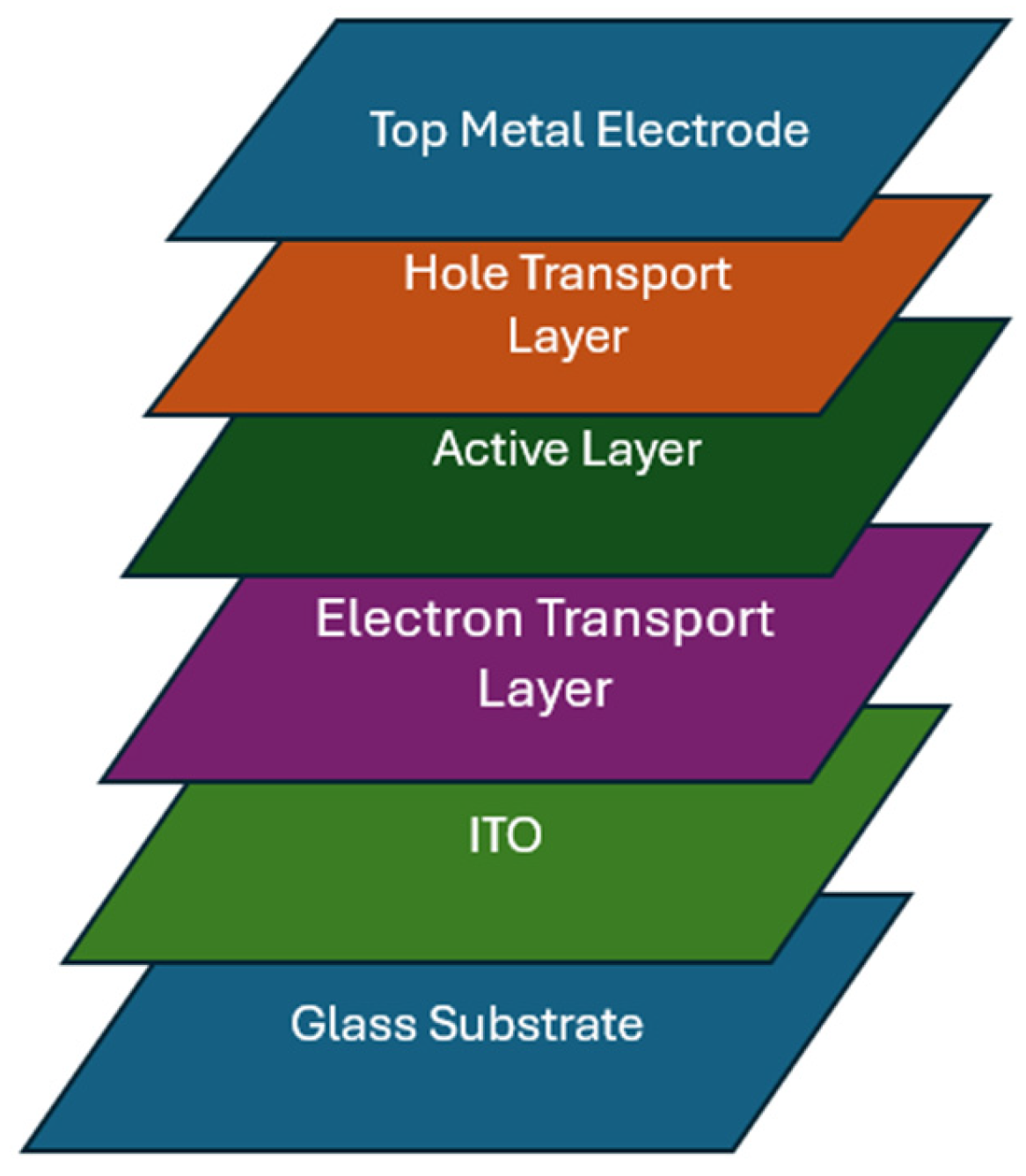
Donor–Acceptor Interactions in Organic Solar Cells: Linking Molecular Design, Energy-Level Alignment, and Device Performance


Abstract
1. Introduction
2. Fundamental of Donor–Acceptor Chemistry
Performance–Sustainability Trade-Offs in Molecular Design
3. Donor Landscape: Architectures and Use Cases
3.1. PTB7/PTB7-Th and BDT-TPD Families
3.2. PffBT4T Donors
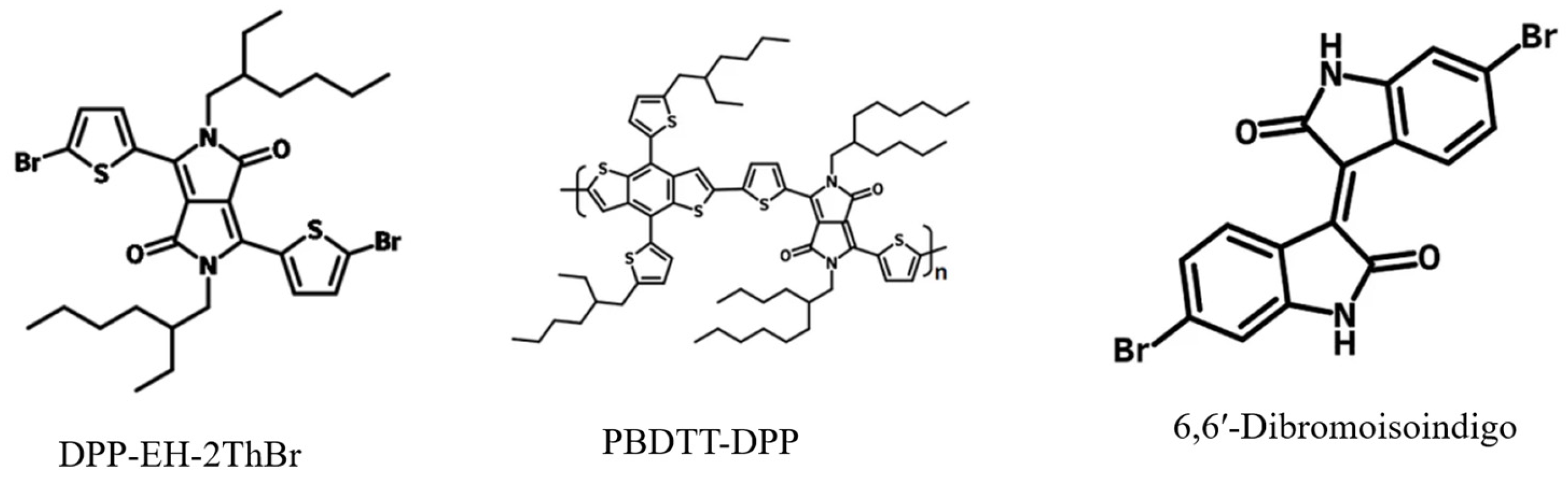
3.3. DPP and Isoindigo Donor Families
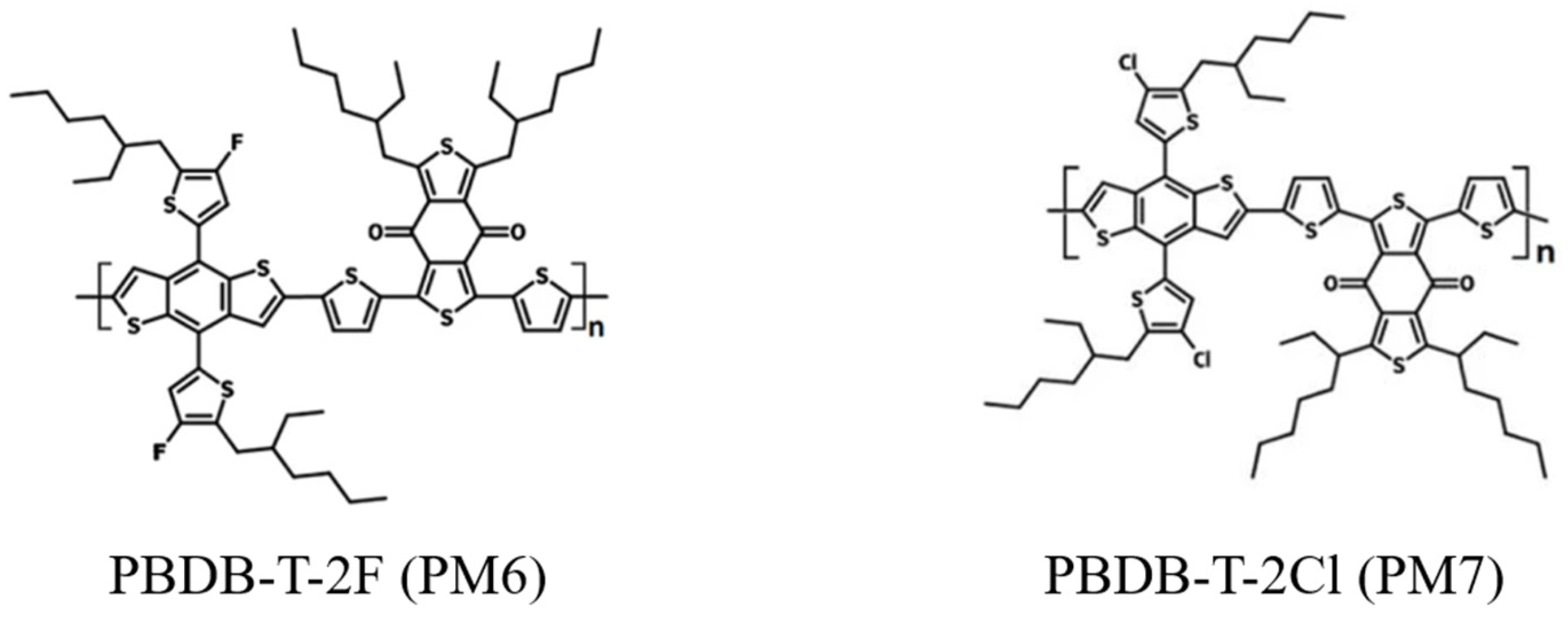
3.4. PBDB-T and Derivatives
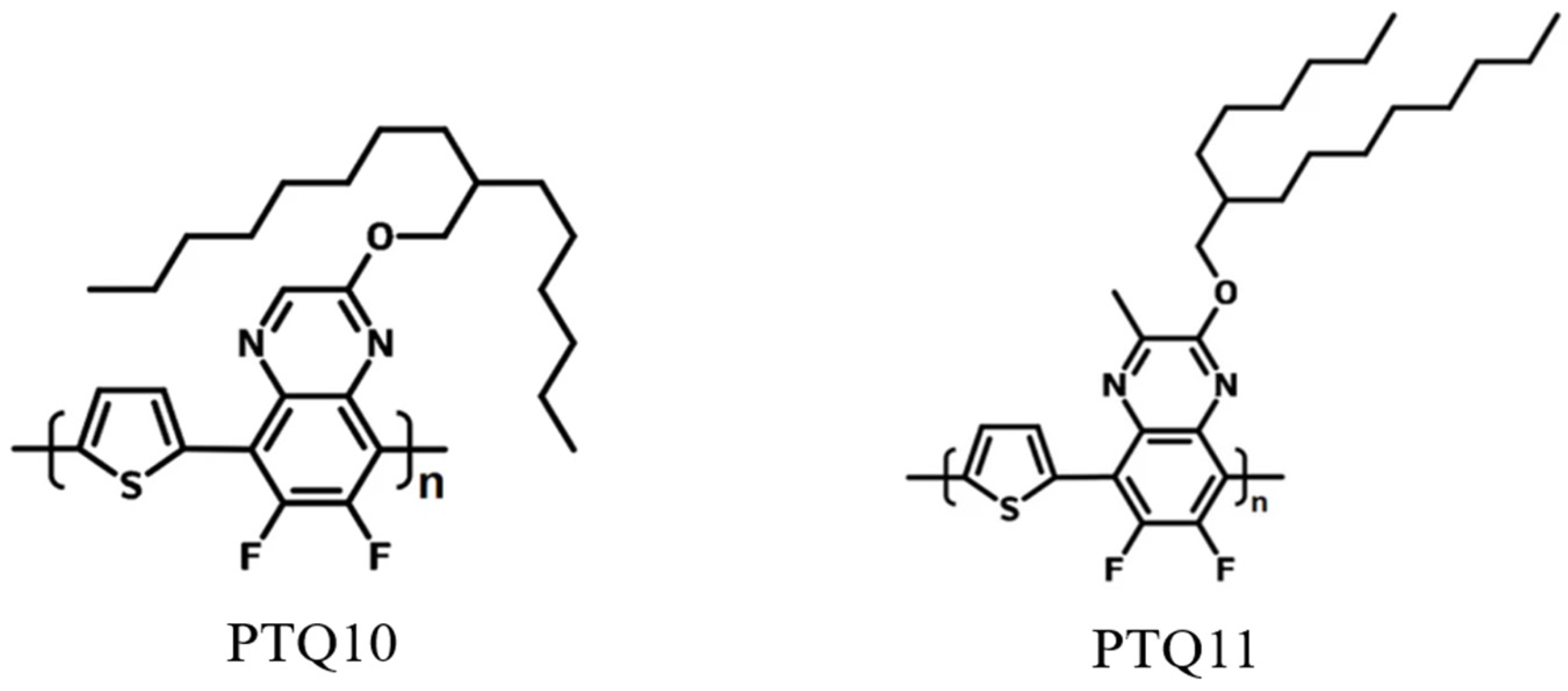
3.5. PTQ10 and Related Low-Cost Polymer
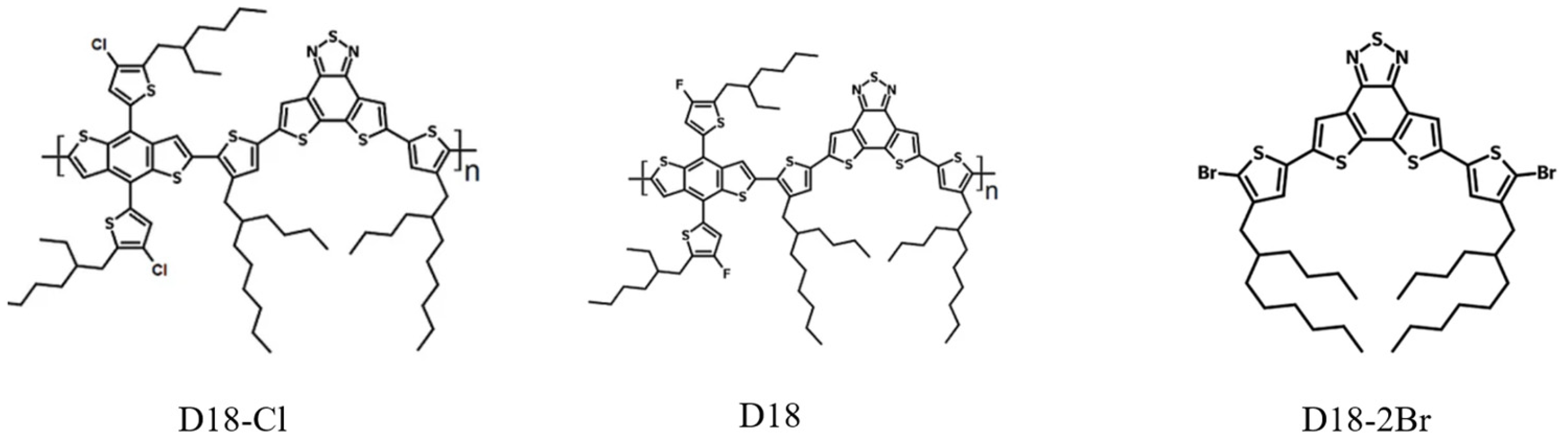
3.6. D18 and Derivatives
3.7. Ternary Blend Strategies: Performance Enhancement Beyond Binary Donor–Acceptor Systems
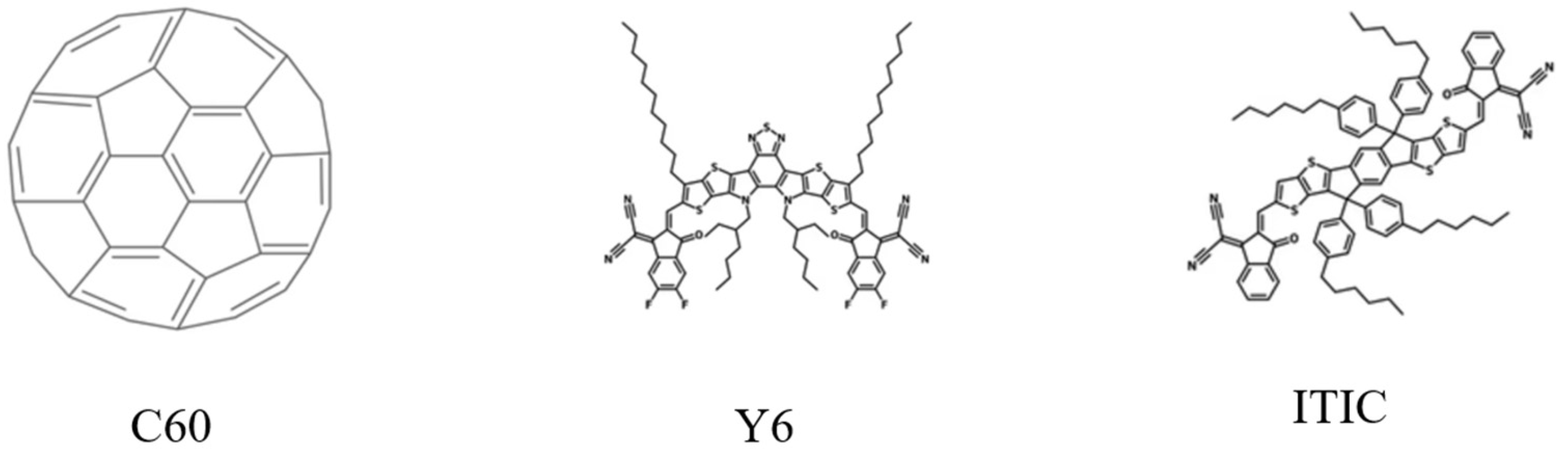
4. Fullerene-Based Electron Acceptors
4.1. A-D-A Non-Fullerene Acceptors: ITIC and the First Paradigm Shift
4.2. Y-Series Acceptors: Delocalization, Quadrupole Moments, and Barrierless Charge Separation
5. Energy Level Alignment at Donor–Acceptor Interfaces
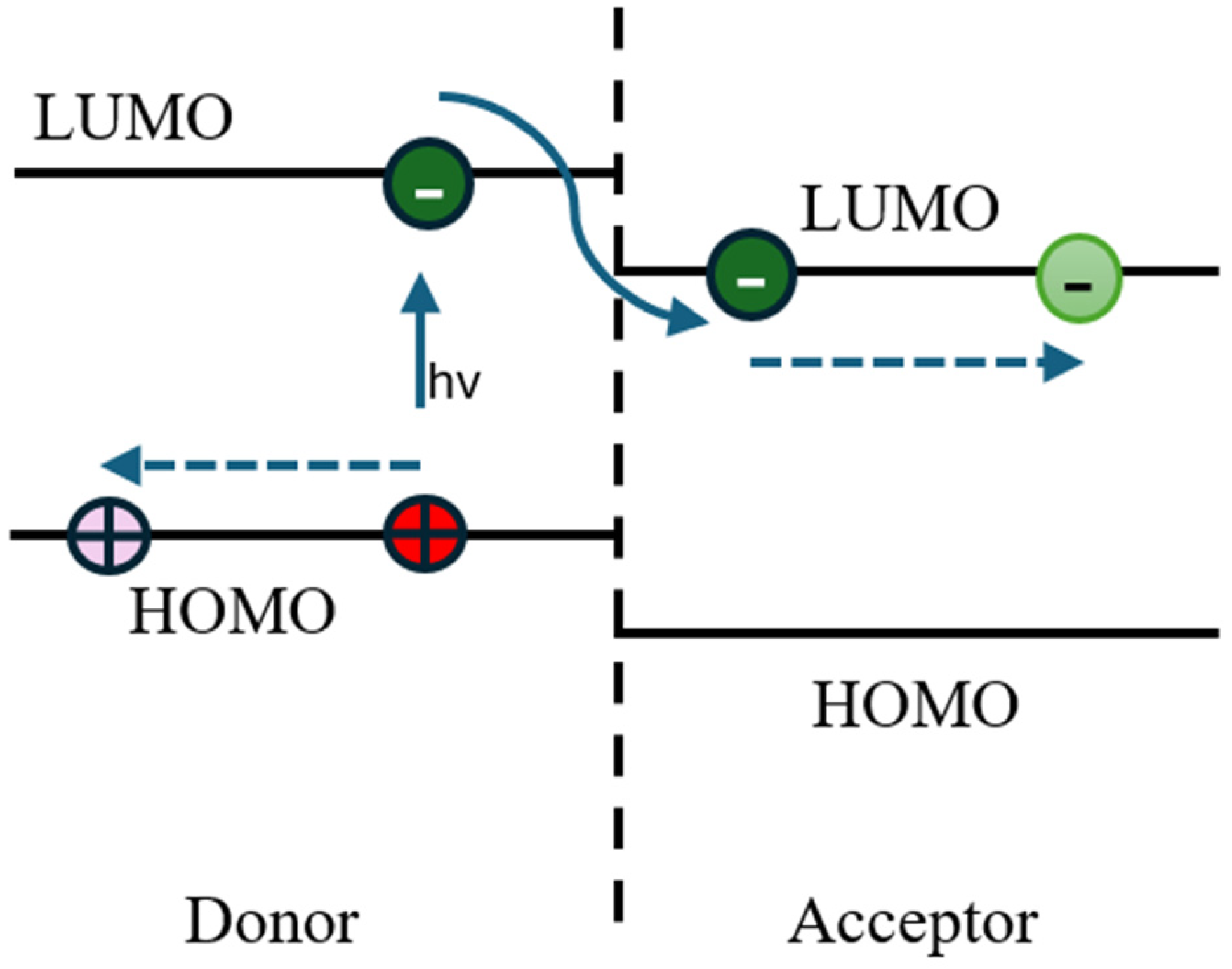
5.1. Frontier Orbital Alignment and Exciton Dissociation
5.2. Charge-Transfer States and Voltage Loss
5.3. Energy-Level Engineering in Modern Organic Solar Cells
6. Chemical Interactions and Morphological Organization in Donor–Acceptor Systems
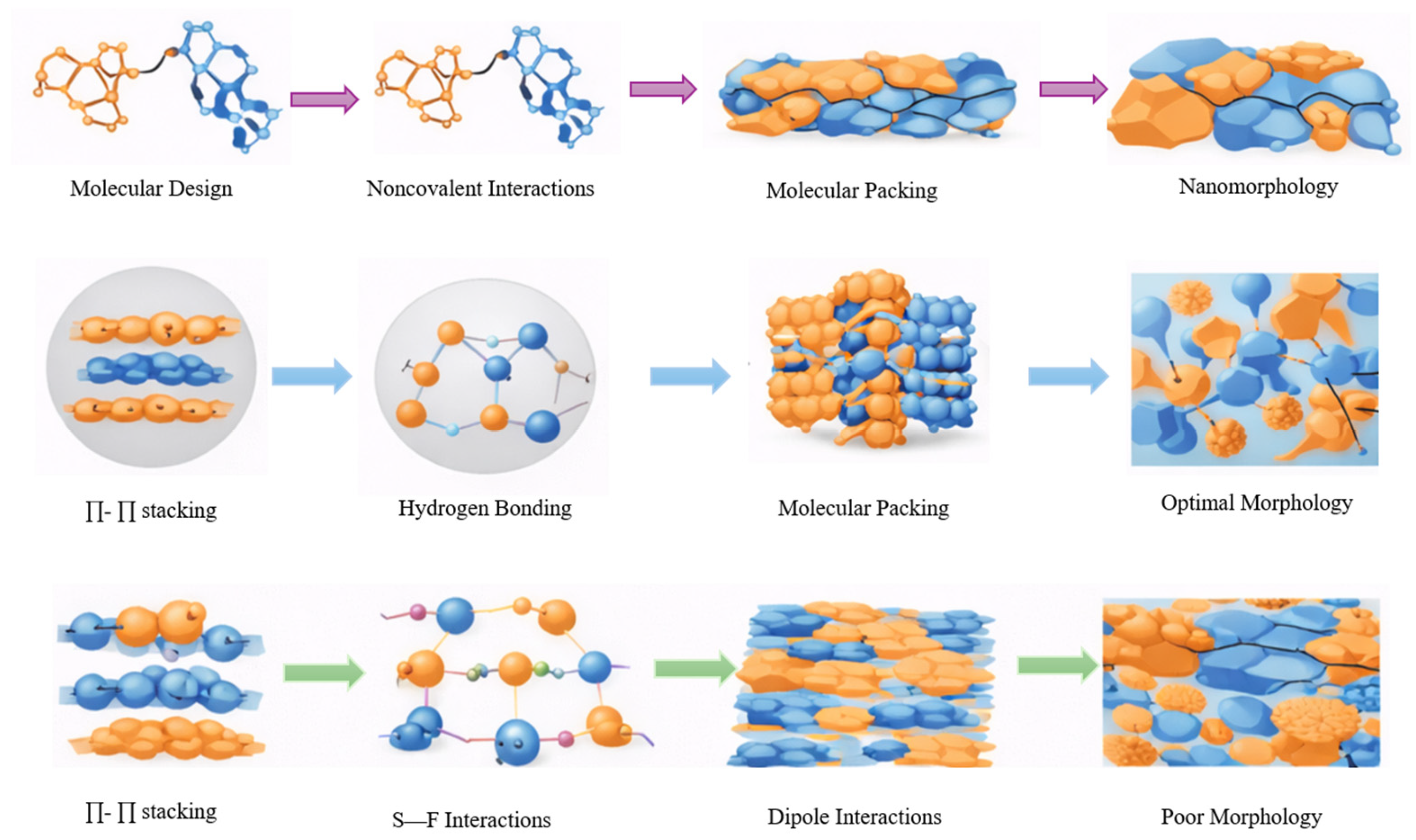
6.1. Intermolecular Noncovalent Interactions in Donor–Acceptor Blends
6.2. Molecular Planarity and Stacking in Conjugated Systems
6.3. Donor–Acceptor Miscibility and Phase Separation
6.4. Impact of Morphology on Device Performance
7. Device Engineering and Process Strategies
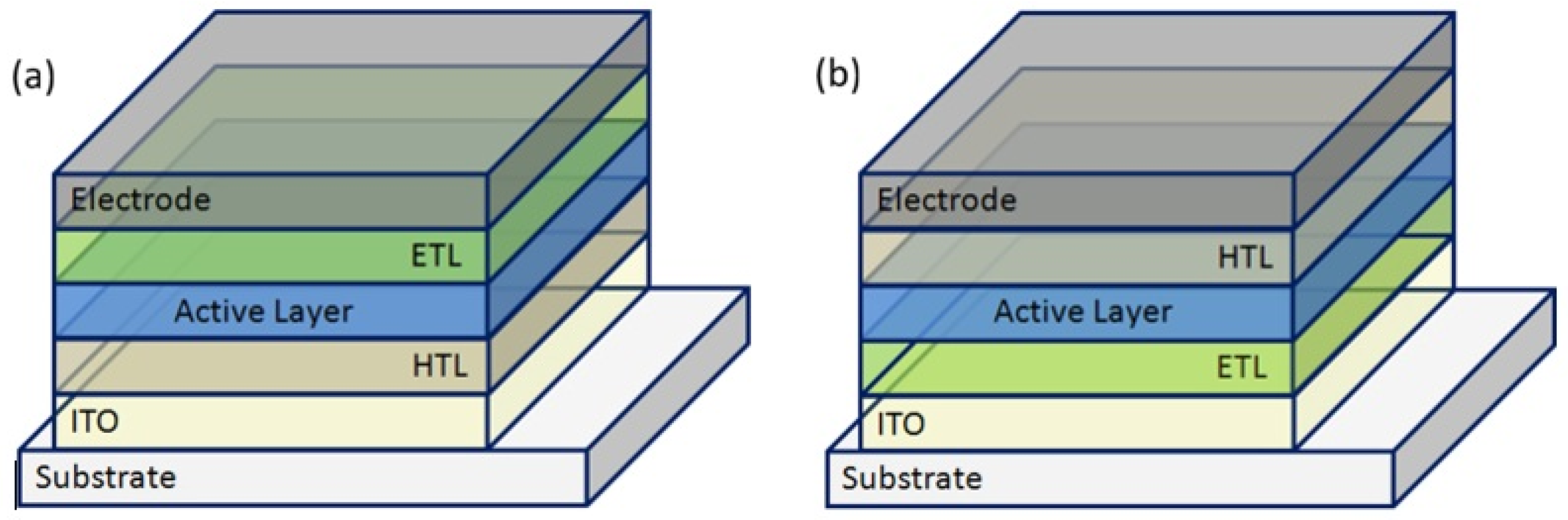
7.1. Bulk Heterojunction Architecture
7.2. Interface Engineering
7.3. Processing Techniques and Morphology Control
7.4. Device Stability Challenge
7.5. Ternary Blend Strategies
7.6. Emerging Device Architecture
8. Conclusion and Future Perspectives for Donor–Acceptor Chemistry in OSC
Author Contributions
Funding
Data Availability Statement
Acknowledgments
Conflicts of Interest
Abbreviations
| A-D-A | Acceptor donor acceptor |
| BHJ | Bulk heterojunction |
| BDT | Benzodithiophene |
| CB | Chlorobenzene |
| CF | Chloroform |
| CT | Charge transfer |
| D-A | Donor acceptor |
| DIO | 1,8-Diiodooctane |
| DPP | Diketopyrrolopyrrole |
| EL | Electroluminescence |
| EQE | External quantum efficiency |
| FF | Fill factor |
| FTPS | Fourier transform photocurrent spectroscopy |
| HOMO | Highest Occupied Molecular Orbital |
| ITC | 3,9-bis(2-methylene-(3-(1,1-dicyanomethylene)-indanone))-5,5,11,11-tetrakis(4-hexylphenyl)-dithieno [2,3-d:2′,3′-d’]s-indaceno [1,2-b:5,6-b’]dithiophene |
| JSC | Short circuit current |
| LUMO | Lowest unoccupied molecular orbital |
| NFA | Non-fullerene acceptor |
| NIR | Near-infrared |
| o-XY | o-Xylene |
| OFET | Organic field effect transistor |
| OPV | Organic photovoltaic |
| OSC | Organic solar cell |
| PC61BM | [6,6]-Phenyl-C61-butyric acid methyl ester |
| PC71BM | [6,6]-Phenyl-C71-butyric acid methyl ester |
| PCE | Power conversion efficiency |
| PL | Photoluminescence |
| Voc | Open-circuit voltage |
References
- Cheng, P.; Zhan, X. Next-Generation Organic Photovoltaics Based on Non-Fullerene Acceptors. Nat. Photonics 2018, 12, 131–142. [Google Scholar] [CrossRef]
- Lin, Y.; Wang, J.; Zhang, Z.-G.; Bai, H.; Li, Y.; Zhu, D.; Zhan, X. An Electron Acceptor Challenging Fullerenes for Efficient Polymer Solar Cells. Adv. Mater. 2015, 27, 1170–1174. [Google Scholar] [CrossRef] [PubMed]
- Cui, Y.; Yao, H.; Zhang, J.; Zhang, T.; Wang, Y.; Hong, L.; Xian, K.; Xu, B.; Zhang, S.; Peng, J.; et al. Over 16% Efficiency Organic Photovoltaic Cells Enabled by a Chlorinated Acceptor with Increased Open-Circuit Voltages. Nat. Commun. 2019, 10, 2515. [Google Scholar] [CrossRef] [PubMed]
- Zhang, G.; Chen, X.-K.; Xiao, J.; Chow, P.C.Y.; Ren, M.; Kupgan, G.; Jiao, X.; Chan, C.C.S.; Du, X.; Xia, R.; et al. Delocalization of Exciton and Electron Wavefunction in Non-Fullerene Acceptor Molecules Enables Efficient Organic Solar Cells. Nat. Commun. 2020, 11, 3943. [Google Scholar] [CrossRef] [PubMed]
- Chen, C.; Wen, G.; Xiao, Z.; Peng, J.; Hu, R.; Chen, Z.; Zhang, C.; Zhang, W. Charge Photogeneration and Recombination Dynamics in PTQ10:Y6 Solar Cells. Photonics 2022, 9, 892. [Google Scholar] [CrossRef]
- Perdigón-Toro, L.; Zhang, H.; Markina, A.; Yuan, J.; Hosseini, S.M.; Wolff, C.M.; Zuo, G.; Stolterfoht, M.; Zou, Y.; Gao, F.; et al. Barrierless Free Charge Generation in the High-Performance PM6:Y6 Bulk Heterojunction Non-Fullerene Solar Cell. Adv. Mater. 2020, 32, e1906763. [Google Scholar] [CrossRef] [PubMed]
- Tian, H.; Zhao, M.; Ma, X.; Xu, C.; Xu, W.; Liu, Z.; Zhang, M.; Zhang, F. Critical Progress of Polymer Solar Cells with a Power Conversion Efficiency over 18%. Energies 2023, 16, 4494. [Google Scholar] [CrossRef]
- Liu, C.; Li, Y.; Zhang, C. Green-Processed Non-Fullerene Organic Solar Cells Based on Y-Series Acceptors. Adv. Sci. 2023, 10, 2303842. [Google Scholar] [CrossRef]
- Panidi, J.; Logothetidis, S.; Bradley, D.D.C.; Anthopoulos, T.D. Biorenewable Solvents for High-Performance Organic Solar Cells. ACS Energy Lett. 2023, 8, 3355–3365. [Google Scholar] [CrossRef]
- Zhang, B.; Gao, F.; Brabec, C.J. Recent Progress in Large-Area Organic Solar Cells. Small Sci. 2023, 3, 2300004. [Google Scholar] [CrossRef] [PubMed]
- Vandewal, K.; Tvingstedt, K.; Gadisa, A.; Inganäs, O.; Manca, J.V. Relating the Open-Circuit Voltage to Interface Molecular Properties of Donor: Acceptor Bulk Heterojunction Solar Cells. Phys. Rev. B 2010, 81, 125204. [Google Scholar] [CrossRef]
- Deibel, C.; Dyakonov, V. Role of the Charge Transfer State in Organic Donor–Acceptor Solar Cells. Adv. Mater. 2010, 22, 4097–4111. [Google Scholar] [CrossRef] [PubMed]
- Scharber, M.C.; Mühlbacher, D.; Koppe, M.; Denk, P.; Waldauf, C.; Heeger, J.; Brabec, J. Design Rules for Donors in Bulk-Heterojunction Solar Cells—Towards 10% Energy-Conversion Efficiency. Adv. Mater. 2006, 18, 789–794. [Google Scholar] [CrossRef]
- Scharber, M.C.; Sariciftci, N.S. Efficiency of Bulk-Heterojunction Organic Solar Cells. Prog. Polym. Sci. 2013, 38, 1929–1940. [Google Scholar] [CrossRef] [PubMed]
- Azzouzi, M.; Kirchartz, T.; Nelson, J. Nonradiative Energy Losses in Bulk-Heterojunction Organic Solar Cells. Phys. Rev. X 2018, 8, 031055. [Google Scholar] [CrossRef]
- Menke, S.M.; Holmes, R.J.; Forrest, S.R. Understanding Energy Loss in Organic Solar Cells. Joule 2018, 2, 25–35. [Google Scholar] [CrossRef]
- Brabec, C.J. Plastic Solar Cells. Adv. Funct. Mater. 2001, 11, 15–26. [Google Scholar] [CrossRef]
- Burke, T.M.; McGehee, M.D. How Equilibrium between Free Carriers and Charge-Transfer States Affects the Open-Circuit Voltage of Organic Solar Cells. Adv. Energy Mater. 2014, 4, 1301370. [Google Scholar]
- Facchetti, A. Polymer Donor–Polymer Acceptor (All-Polymer) Solar Cells. Prog. Polym. Sci. 2013, 38, 243–270. [Google Scholar]
- Gao, C. Rational Design on D–A Conjugated P(BDT–DTBT) Polymers for Solar Cells. Polym. Chem. 2014, 5, 2559–2570. [Google Scholar] [CrossRef]
- Bao, W. Diketopyrrolopyrrole (DPP)-Based Materials and Applications: A Review. Polymers 2020, 12, 1704. [Google Scholar]
- Qu, S. Diketopyrrolopyrrole (DPP)-Based Materials for Organic Solar Cells. Chem. Commun. 2012, 48, 12289–12301. [Google Scholar] [CrossRef]
- Holliday, S. High-Efficiency and Air-Stable P3HT-Based Polymer Solar Cells with a Non-Fullerene Acceptor (o-IDTBR). Nat. Commun. 2016, 7, 11585. [Google Scholar] [CrossRef] [PubMed]
- Clarke, A.J. Photostability and Device Stability in Non-Fullerene Acceptors. Cell Rep. Phys. Sci. 2021, 2, 100593. [Google Scholar] [CrossRef]
- Rau, U. Reciprocity relation between photovoltaic quantum efficiency and electroluminescent emission of solar cells. Phys. Rev. B 2007, 76, 085303. [Google Scholar] [CrossRef]
- List, M.; Gehlhaar, R.; Koppitz, M. Quantifying the effect of optical microcavity on electroluminescence and photocurrent spectra of organic solar cells. Nat. Commun. 2018, 9, 3812. [Google Scholar] [CrossRef]
- Balzer, D.; Göhler, C.; Allard, S. Delocalization-assisted charge separation in organic solar cells. Sci. Adv. 2022, 8, eabl9692. [Google Scholar] [CrossRef] [PubMed]
- Eisner, F.D.; Azzouzi, M.; Fei, Z. Hybridization of local exciton and charge-transfer states in low-offset organic solar cells. J. Phys. Chem. Lett. 2019, 10, 7084–7090. [Google Scholar]
- Mikhnenko, O.V.; Blom, P.W.M.; Nguyen, T.-Q. Exciton diffusion in organic semiconductors. Energy Environ. Sci. 2015, 8, 1867–1888. [Google Scholar] [CrossRef]
- Sajjad, M.T.; Li, J.; Petty, M.C.; Turnbull, G.A.; Samuel, I.D.W. Strategies to enhance exciton diffusion length in organic semiconductors. Matter 2020, 2, 984–1006. [Google Scholar] [CrossRef]
- Sun, C.; Pan, F.; Bin, H. A Low-Cost and High-Performance Polymer Donor Material for Polymer Solar Cells. Nat. Commun. 2018, 9, 743. [Google Scholar] [CrossRef] [PubMed]
- Zheng, Z.; Wang, J.; Zhang, S. PBDB-T and Its Derivatives: A Family of Polymer Donors Enables Over 17% Efficiency in Organic Photovoltaics. Mater. Today 2020, 35, 115–130. [Google Scholar] [CrossRef]
- Jin, K.; Xiao, Z.; Ding, L. D18, an Eximious Solar Polymer! J. Semicond. 2021, 42, 010502. [Google Scholar] [CrossRef]
- Wang, Y.; Meng, L.; Ma, W. The Critical Role of the Donor Polymer in the Stability of High-Performance Non-Fullerene Acceptor Organic Solar Cells. Joule 2023, 7, 810–824. [Google Scholar] [CrossRef]
- Li, Y.; Sonar, P.; Murphy, L.; Hong, W. High Mobility Diketopyrrolopyrrole (DPP)-Based Organic Semiconductors for Organic Thin-Film Transistors and Photovoltaics. Energy Environ. Sci. 2013, 6, 1684–1710. [Google Scholar] [CrossRef]
- Li, Y.; Wang, J.; Liu, Y.; Qiu, M.; Wen, S.; Bao, X.; Yang, R. Investigation of Fluorination on Donor Moiety of Donor–Acceptor 4, 7-Dithienylbenzothiadiazole-Based Conjugated Polymers toward Enhanced Photovoltaic Efficiency. ACS Appl. Mater. Interfaces 2016, 8, 26152–26161. [Google Scholar] [CrossRef] [PubMed]
- Hamid, Z.; Wadsworth, A.; Rezasoltani, E.; Holliday, S.; Azzouzi, M.; Neophytou, M.; McCulloch, I. Influence of Polymer Aggregation and Liquid Immiscibility on Morphology Tuning by Varying Composition in PffBT4T-2DT/Non-fullerene Organic Solar Cells. Adv. Energy Mater. 2020, 10, 1903248. [Google Scholar] [CrossRef]
- Wang, T.; Bredas, J.L. Organic photovoltaics: Understanding the preaggregation of polymer donors in solution and its morphological impact. J. Am. Chem. Soc. 2021, 143, 1822–1835. [Google Scholar] [CrossRef] [PubMed]
- Zhang, Y.; Parnell, A.J.; Blaszczyk, O.; Musser, A.J.; Samuel, I.D.; Lidzey, D.G.; Bernardo, G. Effect of fullerene acceptor on the performance of solar cells based on PffBT4T-2OD. Phys. Chem. Chem. Phys. 2018, 20, 19023–19029. [Google Scholar] [CrossRef] [PubMed]
- Zhao, J.; Li, Y.; Lin, H.; Liu, Y.; Jiang, K.; Mu, C.; Yan, H. High-efficiency non-fullerene organic solar cells enabled by a difluorobenzothiadiazole-based donor polymer combined with a properly matched small molecule acceptor. Energy Environ. Sci. 2015, 8, 520–525. [Google Scholar] [CrossRef]
- Weu, A.; Hopper, T.R.; Lami, V.; KreB, J.A.; Bakulin, A.A.; Vaynzof, Y. Field-assisted exciton dissociation in highly efficient PffBT4T-2OD: Fullerene organic solar cells. Chem. Mater. 2018, 30, 2660–2667. [Google Scholar] [CrossRef]
- Jung, J.W.; Liu, F.; Russell, T.P.; Jo, W.H. Semi-crystalline random conjugated copolymers with panchromatic absorption for highly efficient polymer solar cells. Energy Environ. Sci. 2013, 6, 3301–3307. [Google Scholar] [CrossRef]
- Shaker, M.; Park, B.; Lee, J.H.; Trinh, C.K.; Lee, H.J. Synthesis and organic field-effect transistor properties of isoindigo/DPP-based polymers containing a thermolabile group. RSC Adv. 2017, 7, 51052–51060. [Google Scholar] [CrossRef]
- Bogdanov, A.V.; Mironov, V.F. Recent advances in the application of isoindigo derivatives in materials chemistry. Beilstein J. Org. Chem. 2021, 17, 1411–1435. [Google Scholar] [CrossRef]
- Ning, L.; Han, G.; Yi, Y. Conformational and aggregation properties of PffBT4T polymers: Atomistic insight into the impact of alkyl-chain branching positions. J. Mater. Chem. C 2019, 7, 6932–6942. [Google Scholar] [CrossRef]
- Purdy, M.; Fallon, K.; Congrave, D.G. Synthesis of asymmetric indolonaphthyridines with enhanced excited-state charge-transfer character. J. Mater. Chem. C 2022, 10, 12990–13001. [Google Scholar] [CrossRef]
- Biniek, L.; Schroeder, B.C.; Nielsen, C.B.; McCulloch, I. Recent advances in high-mobility donor–acceptor semiconducting polymers. J. Mater. Chem. 2012, 22, 14803–14813. [Google Scholar] [CrossRef]
- Zhao, W.; Zhang, Y.; Zhang, S.; Li, S.; He, C.; Hou, J. Vacuum-Assisted Annealing Method for High Efficiency Printable Large-Area Polymer Solar Cell Modules. J. Mater. Chem. C 2019, 7, 3206–3211. [Google Scholar] [CrossRef]
- Rusieddiy, M.R.; Chen, T.W.; Huang, S.C. PBDB-T-Based Binary Organic Solar Cells Achieving over 15.83% Efficiency via End-Group Functionalization and Alkyl-Chain Engineering of Quinoxaline-Containing Non-Fullerene Acceptors. ACS Appl. Mater. Interfaces 2022, 14, 21054–21064. [Google Scholar]
- Krinichnyi, V.I.; Yudanova, E.I.; Denisov, N.N. Light-Induced Electron Paramagnetic Resonance Study of Charge Transport in Fullerene and Non-fullerene PBDB-T-Based Solar Cells. J. Phys. Chem. C 2021, 125, 17973–17982. [Google Scholar] [CrossRef]
- Zhang, Q.; Yuan, Y.; Feng, Y.; Larson, B.W. Understanding the Interplay of Transport–Morphology–Performance in PBDB-T-Based Polymer Solar Cells. Sol. RRL 2020, 4, 1900442. [Google Scholar] [CrossRef]
- Chen, N.; Yang, L.; Yang, Y.; Chen, Y.; Wu, Y. PBDB-T Accessed via Direct C–H Arylation Polymerization for Organic Photovoltaic Application. ACS Appl. Polym. Mater. 2022, 4, 4412–4420. [Google Scholar] [CrossRef]
- Davis, D.; Sudheer, K.S. Numerical Investigation of Graphene Derivatives as Hole Transport Layers in PBDB-T: NCBDT Bulk Heterojunction Organic Solar Cells. Results Opt. 2024, 15, 100560. [Google Scholar]
- He, Y.; Chen, H.-Y.; Hou, J.; Li, Y. Indene−C60 bisadduct: A new acceptor for high-performance polymer solar cells. J. Am. Chem. Soc. 2010, 132, 1377–1382. [Google Scholar] [CrossRef] [PubMed]
- Cha, H.; Zheng, Y.; Dong, Y.; Lee, H.H.; Wu, J.; Bristow, H.; Zhang, J.; Lee, H.K.H.; Tsoi, W.C.; Bakulin, A.A.; et al. Exciton and Charge Carrier Dynamics in Highly Crystalline PTQ10: IDIC Organic Solar Cells. Adv. Energy Mater. 2020, 10, 1903299. [Google Scholar] [CrossRef]
- Zu, X.; Pan, F.; Sun, C.; Hong, S.; Chen, S. Understanding the Morphology of High-Performance Solar Cells Based on a Low-Cost Polymer Donor. ACS Appl. Mater. Interfaces 2020, 12, 52034–52043. [Google Scholar] [CrossRef]
- Zhang, W.; Sun, C.; Angunawela, I.; Meng, L. 16.52% Efficiency All-Polymer Solar Cells with High Tolerance of the Photoactive Layer Thickness. Adv. Energy Mater. 2022, 12, 2103155. [Google Scholar]
- Arunagiri, L.; Peng, Z.; Zou, X.; Yu, H.; Zhang, G.; Wang, Z. Selective Hole and Electron Transport in Efficient Quaternary Blend Organic Solar Cells. Joule 2020, 4, 1790–1805. [Google Scholar] [CrossRef]
- Chong, K.; Xu, X.; Meng, H.; Xue, J.; Yu, L.; Ma, W.; Peng, Q. Realizing 19.05% Efficiency Polymer Solar Cells by Progressively Improving Charge Extraction and Suppressing Recombination. Adv. Mater. 2022, 34, 2109516. [Google Scholar] [CrossRef]
- Kong, X.; Zhang, L.; Meng, L.; Sun, C.; Qin, S.; Zhu, C. 18.55 % Efficiency Polymer Solar Cells Based on a Small-Molecule Acceptor with Alkylthienyl Outer Side Chains and a Low-Cost Polymer Donor PTQ10. Chin. Chem. Soc. 2023, 44, 2300273. [Google Scholar]
- Duan, C.; Ding, L. The new era for organic solar cells: Polymer donors. Sci. Bull. 2020, 65, 1422–1424. [Google Scholar] [CrossRef] [PubMed]
- Feng, E.; Zhang, C.; Zhang, J.; Li, H.; Ding, L. Organic Solar Cells with D18 or Derivatives Offer Efficiency over 19%. J. Semicond. 2024, 45, 011001. [Google Scholar] [CrossRef]
- Xu, R.; Jiang, Y.; Liu, F.; Ran, G.; Liu, K.; Zhang, W. High Open-Circuit Voltage Organic Solar Cells with 19.2% Efficiency Enabled by Synergistic Side-Chain Engineering. Adv. Energy Mater. 2024, 14, 2304276. [Google Scholar]
- Zhong, X.; Chen, T.W.; You, L. Facile Synthesis of Key Building Blocks of D18 Series Conjugated Polymers for High-Performance Polymer Solar Cells. ACS Appl. Polym. Mater. 2023, 5, 4121–4130. [Google Scholar] [CrossRef]
- Wang, X.; Lu, H.; Liu, Y.; Zhang, A.; Yu, N. Simple Non-Fused Ring Electron Acceptors with 3D Network Packing Structure Boosting the Efficiency of Organic Solar Cells to 15.44%. Adv. Energy Mater. 2021, 11, 2101640. [Google Scholar] [CrossRef]
- Svennerstedt, C. Computational Spectroscopy of D18 Photodegradation. Master’s Thesis, Royal Institute of Technology, Stockholm, Sweden, 2025. [Google Scholar]
- Wang, H.; Wu, S.; Yang, D.; Yu, X.; Yang, S.; Ding, L. 19.3% Efficiency Ternary Organic Solar Cells Enabled by the Alkyl Side-Chain Effect of Guest Non-Fullerene Acceptors. Sci. China Mater. 2024, 67, 2451–2460. [Google Scholar] [CrossRef]
- Gasparini, N.; Salleo, A.; McCulloch, I. The Role of the Third Component in Ternary Organic Solar Cells. Nat. Rev. Mater. 2019, 4, 229–242. [Google Scholar] [CrossRef]
- Zhao, C.; Wang, J.; Zhao, X.; Du, Z.; Yang, R.; Tang, J. Recent Advances, Challenges and Prospects in Ternary Organic Solar Cells. Nanoscale 2021, 13, 2187–2210. [Google Scholar] [CrossRef]
- Zhang, J.; Zhao, Y.; Fang, J.; Yuan, L.; Xia, B.; Wang, G. Enhancing Performance of Large-Area Organic Solar Cells with Thick Film via Ternary Strategy. Small 2017, 13, 1700388. [Google Scholar] [CrossRef]
- Liu, X.; Yan, Y.; Yao, Y.; Liang, Z. Ternary Blend Strategy for Achieving High-Efficiency Organic Solar Cells with Non-fullerene Acceptors Involved. Adv. Funct. Mater. 2018, 28, 1802008. [Google Scholar] [CrossRef]
- Jiang, M.; Zhi, H.; Zhang, B.; Yang, C. Controlling Morphology and Voltage Loss with Ternary Strategy Triggers Efficient All-Small-Molecule Organic Solar Cells. ACS Energy Lett. 2023, 8, 1340–1348. [Google Scholar] [CrossRef]
- Duan, X.; Song, W.; Qiao, J.; Li, X.; Cai, Y.; Hu, W. Ternary Strategy Enabling High-Efficiency Rigid and Flexible Organic Solar Cells with Reduced Nonradiative Voltage Loss. Energy Environ. Sci. 2022, 15, 1785–1794. [Google Scholar] [CrossRef]
- Xu, W.; Ma, X.; Son, J.H.; Jeong, S.Y.; Niu, L.; Xu, C.; Zhang, S. Smart Ternary Strategy in Promoting the Performance of Polymer Solar Cells Based on Bulk-Heterojunction or Layer-by-Layer Structure. Small 2022, 18, 2106620. [Google Scholar]
- Yang, Y.; Wei, L.; Zhan, L.; Liu, Y.; Lu, H.; Wu, X. Ternary Strategy and Molecular Electrostatics Collaboratively Optimize Low-Molecular-Weight Polymer Donor Organic Solar Cells: Over 20% Efficiency and High Stability. Adv. Energy Mater. 2025, 15, 2400123. [Google Scholar]
- Yu, G.; Gao, J.; Hummelen, J.C.; Wudl, F.; Heeger, A.J. Polymer Photovoltaic Cells: Enhanced Efficiencies via a Network of Internal Donor–Acceptor Heterojunctions. Science 1995, 270, 1789–1791. [Google Scholar] [CrossRef]
- Hummelen, J.C.; Knight, B.W.; LePeq, F.; Wudl, F.; Yao, J.; Wilkins, C.L. Preparation and Characterization of Fulleroid and Methanofullerene Derivatives. J. Org. Chem. 1995, 60, 532–538. [Google Scholar] [CrossRef]
- Boukli Hacène, L. Modélisation numérique des cellules solaires organiques P3HT/PCBM. J. Énerg. Renouvelables 2014, 12, 45–56. [Google Scholar]
- Park, S.H.; Roy, A.; Beaupré, S.; Cho, S.; Coates, N.; Moon, J.S.; Moses, D.; Leclerc, M.; Lee, K.; Heeger, A.J. Bulk heterojunction solar cells with internal quantum efficiency approaching 100%. Nat. Photon 2009, 3, 297–302. [Google Scholar] [CrossRef]
- Hallermann, M.; Haneder, S.; Da Como, E. Charge-transfer states in conjugated polymer/fullerene blends: Below-gap weakly bound excitons for polymer photovoltaics. Appl. Phys. Lett. 2008, 93, 053307. [Google Scholar] [CrossRef]
- Krebs, F.C. Stability and Degradation of Organic and Polymer Solar Cells. Sol. Energy Mater. Sol. Cells 2009, 93, 394–412. [Google Scholar] [CrossRef]
- Li, G.; Zhu, R.; Yang, Y. Polymer Solar Cells. Nat. Photonics 2012, 6, 153–161. [Google Scholar] [CrossRef]
- Anitti, A.; Posw, P.; Bianchi, R.; Pasini, D. Recent Advances in Non-Fullerene Acceptors of the IDIC/ITIC Families for Bulk-Heterojunction Organic Solar Cells. Int. J. Mol. Sci. 2020, 21, 6820. [Google Scholar]
- Li, W.; Liu, D.; Wang, T. Stability of Non-Fullerene Electron Acceptors and Their Photovoltaic Devices. Adv. Funct. Mater. 2021, 31, 2104552. [Google Scholar] [CrossRef]
- Xiao, Z.; Ding, L.; Nelson, J.; Neher, D. A history and Perspective of Non-Fullerene Electron Acceptors for Organic Solar Cells. Adv. Energy Mater. 2021, 11, 2002097. [Google Scholar] [CrossRef]
- Zhan, X.; Marder, S.R. Non-Fullerene Acceptors Inaugurating a New Era of Organic Photovoltaic Research and Technology. Mater. Chem. Front. 2019, 3, 331–344. [Google Scholar] [CrossRef]
- Zhu, L.; Zhang, M.; Zhong, W.; Leng, S.; Zhou, G. Progress and Prospects of the Morphology of Non-Fullerene Acceptor-Based High-Efficiency Organic Solar Cells. Energy Environ. Sci. 2021, 14, 4341–4370. [Google Scholar] [CrossRef]
- Guo, Y.; Li, D.; Gao, Y.; Li, C. Recent Progress on Stability of Organic Solar Cells Based on Non-Fullerene Acceptors. Acta Phys.-Chim. Sin. 2024, 40, 2308012. [Google Scholar] [CrossRef]
- Wu, X.; Yang, X.; Chang, B.; Sun, R.; Min, J. Material Insights and Challenges for Organic Photovoltaics Based on Non-Fullerene Acceptors. Joule 2025, 9, 112–132. [Google Scholar] [CrossRef]
- Lee, C.; Nam, M.; Jeong, H.; Lim, C.; Heo, H. A Paradigm Shift toward Quasi-Thermodynamically Stable Bulk Heterojunction Morphology Enabled by Controlled Crystallization Kinetics of High Quadrupole Moment Non-Fullerene Acceptors. Adv. Energy Mater. 2025, 15, 2401987. [Google Scholar] [CrossRef]
- Lafargue-Hauret, V.; Hiorns, R.C.; Bégué, D. A DFT Bottom-Up Approach on Non-Fullerene Acceptors: What Makes Highly Efficient Acceptors. J. Mater. Sci. 2024, 59, 11234–11252. [Google Scholar] [CrossRef]
- Ade, H.; Stoll, H. Near-edge X-ray absorption fine-structure microscopy of organic and magnetic materials. Nat. Mater. 2009, 8, 281–290. [Google Scholar] [CrossRef] [PubMed]
- Marks, R.N.; Halls, J.J.M.; Bradley, D.D.C.; Friend, R.H.; Holmes, A.B. The photovoltaic response in poly(p-phenylene vinylene) thin-film devices. J. Phys. Condens. Matter. 1994, 6, 1379–1394. [Google Scholar] [CrossRef]
- Xu, H.; Han, J.; Chen, S.; Liu, Y.; Hernandez, L.H. Dissecting the structure–stability relationship of Y-series electron acceptors for real-world solar cell applications. Joule 2023, 7, 1416–1436. [Google Scholar] [CrossRef]
- Zhang, M.; Zhu, L.; Hao, T.; Zhou, G.; Qiu, C. High-efficiency organic photovoltaics using eutectic acceptor fibrils to achieve current amplification. Adv. Energy Mater. 2021, 11, 2101002. [Google Scholar]
- Campbell, I.H.; Smith, D.L.; Ferraris, J.P. Electrical impedance measurements of polymer light-emitting diodes. Appl. Phys. Lett. 1995, 66, 3030–3032. [Google Scholar] [CrossRef]
- Firdaus, Y.; Le Corre, V.M.; Karuthedath, S.; Liu, W.; Markina, A.; Huang, W.; Chattopadhyay, S.; Nahid, M.M.; Nugraha, M.I.; Lin, Y.; et al. Long-range exciton diffusion in molecular non-fullerene acceptors. Nat. Commun. 2020, 11, 5220. [Google Scholar] [CrossRef] [PubMed]
- Li, G.; Al-Hashimi, M.; Facchetti, A.; Marks, T.J. Decoding the halogenation cost–performance paradox in organic solar cells. Nat. Rev. Mater. 2025, 10, 112–130. [Google Scholar] [CrossRef]
- Wu, H.; Ma, Z.; Li, M.; Lu, H.; Tang, A.; Zhou, E. Impact of donor halogenation on reorganization energies and voltage losses in bulk-heterojunction solar cells. Energy Environ. Sci. 2023, 16, 2561–2572. [Google Scholar] [CrossRef]
- Dahiya, H.; Suthar, R.; Karak, S.; Sharma, G.D. Strategies and mechanisms to minimize energy loss in non-fullerene bulk heterojunction organic solar cells. ACS Energy Fuels 2025, 39, 1189–1210. [Google Scholar] [CrossRef]
- Sacramento, A.; Ramírez-Como, L. Effect of thermal annealing in the performance of non-fullerene acceptor based organic solar cells. Electrochem. Sci. Adv. 2025, 5, e2100234. [Google Scholar]
- Kirchartz, T.; Markvart, T.; Rau, U.; Egger, D.A. Impact of small energy losses on the performance of organic solar cells. J. Phys. Chem. Lett. 2018, 9, 939–946. [Google Scholar] [PubMed]
- Brabec, C.J.; Heeney, M.; McCulloch, I.; Nelson, J. Influence of blend microstructure on bulk heterojunction organic photovoltaic performance. Chem. Soc. Rev. 2011, 40, 1185–1199. [Google Scholar] [CrossRef] [PubMed]
- Clarke, T.M.; Durrant, J.R. Charge photogeneration in organic solar cells. Chem. Rev. 2010, 110, 6736–6767. [Google Scholar] [CrossRef] [PubMed]
- Benson-Smith, J.J.; Goris, L.; Vandewal, K.; Haenen, K.; Manca, J.V.; Vanderzande, D.; Bradley, D.D.C.; Nelson, J. Formation of a Ground-State Charge-Transfer Complex in Polyfluorene//[6,6]-Phenyl-C61 Butyric Acid Methyl Ester (PCBM) Blend Films and Its Role in the Function of Polymer/PCBM Solar Cells. Adv. Funct. Mater. 2007, 17, 451–457. [Google Scholar] [CrossRef]
- Naveed, H.B.; Zhou, K.; Ma, W. Interfacial and Bulk Nanostructures Control Loss of Charges in Organic Solar Cells. Acc. Chem. Res. 2019, 52, 2904–2915. [Google Scholar] [CrossRef] [PubMed]
- Vandewal, K.; Tvingstedt, K.; Gadisa, A.; Inganäs, O.; Manca, J.V. On the origin of the open-circuit voltage of polymer–fullerene solar cells. Nat. Mater. 2009, 8, 904–909. [Google Scholar] [CrossRef] [PubMed]
- Gregg, B.A. Excitonic solar cells. J. Phys. Chem. B 2003, 107, 4688–4698. [Google Scholar] [CrossRef]
- Slooff, L.H.; Veenstra, S.C.; Kroon, J.M.; Moet, D.J.D.; Sweelssen, J.; Koetse, M.M. Determining the internal quantum efficiency of highly efficient polymer solar cells through optical modeling. Appl. Phys. Lett. 2007, 90, 1435061. [Google Scholar] [CrossRef]
- Nelson, J.; Kirkpatrick, J.; Ravirajan, P. Factors limiting the efficiency of molecular photovoltaic devices. Phys. Rev. B 2004, 69, 035337. [Google Scholar] [CrossRef]
- Kirchartz, T.; Mattheis, J.; Rau, U. Detailed balance theory of excitonic and bulk heterojunction solar cells. Phys. Rev. B 2008, 78, 235320. [Google Scholar] [CrossRef]
- Loi, M.A. Charge transfer excitons in bulk heterojunctions of a polyfluorene copolymer and a fullerene derivative. Adv. Funct. Mater. 2007, 17, 2111–2116. [Google Scholar] [CrossRef]
- Kim, H. Electroluminescence in polymer-fullerene photovoltaic cells. Appl. Phys. Lett. 2005, 86, 183502. [Google Scholar] [CrossRef]
- Goris, L. Observation of the sub gap optical absorption in polymer-fullerene blend solar cells. Appl. Phys. Lett. 2006, 88, 052113. [Google Scholar] [CrossRef]
- Ma, W.L.; Yang, C.Y.; Gong, X.; Lee, K.; Heeger, A.J. Thermally stable, efficient polymer solar cells with nanoscale control of the interpenetrating network morphology. Adv. Funct. Mater. 2005, 15, 1617–1622. [Google Scholar] [CrossRef]
- Wurfel, P. The chemical potential of radiation. J. Phys. C 1982, 15, 3967–3985. [Google Scholar] [CrossRef]
- Yao, K.; Chen, L.; Li, F.; Wang, P.; Chen, Y. Cooperative assembly donor–acceptor system induced by intermolecular hydrogen bonds leading to oriented nanomorphology for optimized photovoltaic performance. J. Phys. Chem. C 2012, 116, 714–721. [Google Scholar] [CrossRef]
- Takeda, Y. Modulating the photophysical properties of twisted donor–acceptor–donor pi -conjugated molecules: Effect of heteroatoms, molecular conformation, and molecular topology. Acc. Chem. Res. 2024, 57, 2219–2232. [Google Scholar] [CrossRef] [PubMed]
- Das, A.; Ghosh, S. Supramolecular assemblies by charge-transfer interactions between donor and acceptor chromophores. Angew. Chem. Int. Ed. 2014, 53, 2038–2054. [Google Scholar] [CrossRef]
- Chen, L.; Peng, S.; Chen, Y. Cooperative assembly of pyrene-functionalized donor/acceptor blend for ordered nanomorphology by intermolecular noncovalent π-π interactions. ACS Appl. Mater. Interfaces 2014, 6, 8115–8123. [Google Scholar] [CrossRef] [PubMed]
- Lu, J.; Wu, J.; Huang, B.; Fang, Y.; Deng, X.; Zhang, J.; Yang, C. Non-Covalent Intramolecular Interactions Induced High-Performance Terpolymer Donors. Adv. Funct. Mater. 2024, 34, 2312545. [Google Scholar]
- Mati, I.K.; Cockroft, S.L. Molecular balances for quantifying non-covalent interactions. Chem. Soc. Rev. 2010, 39, 4195–4205. [Google Scholar] [CrossRef] [PubMed]
- Reed, A.E.; Curtiss, L.A.; Weinhold, F. Intermolecular interactions from a natural bond orbital, donor-acceptor viewpoint. Chem. Rev. 1988, 88, 899–926. [Google Scholar] [CrossRef]
- Zang, L.; Che, Y.; Moore, J.S. One-dimensional self-assembly of planar π-conjugated molecules: Adaptable building blocks for organic nanodevices. Acc. Chem. Res. 2008, 41, 1596–1608. [Google Scholar] [CrossRef] [PubMed]
- Zhu, C.; Kalin, A.J.; Fang, L. Covalent and noncovalent approaches to rigid coplanar π-conjugated molecules and macromolecules. Acc. Chem. Res. 2019, 52, 1089–1100. [Google Scholar] [CrossRef] [PubMed]
- Rudyak, V.Y.; Gavrilov, A.A.; Guseva, D.V.; Tung, S.H.; Komarov, P.V. Accounting for π-π stacking interactions in the mesoscopic models of conjugated polymers. Mol. Syst. Des. Eng. 2020, 5, 1137–1146. [Google Scholar] [CrossRef]
- Jiang, X.; Yang, J.; Karuthedath, S.; Li, J.; Lai, W.; Li, C.; Li, W. Miscibility-controlled phase separation in double-cable conjugated polymers for single-component organic solar cells with efficiencies over 8%. Angew. Chem. 2020, 132, 21867–21876. [Google Scholar] [CrossRef]
- Zhang, L.; Yi, N.; Zhou, W.; Yu, Z.; Liu, F.; Chen, Y. Miscibility tuning for optimizing phase separation and vertical distribution toward highly efficient organic solar cells. Adv. Sci. 2019, 6, 1900565. [Google Scholar] [CrossRef]
- Cowie, J.M.; Demaude, A. Miscibility enhancement in blends of polystyrene and polyisoprene modified with electron donor–electron acceptor groups. Polym. Adv. Technol. 1994, 5, 178–183. [Google Scholar] [CrossRef]
- Yan, C.; Barlow, S.; Wang, Z.; Yan, H.; Jen, A.; Marder, S.; Zhan, X. Non-fullerene acceptors for organic solar cells. Nat. Rev. Mater. 2018, 3, 18003. [Google Scholar] [CrossRef]
- Gao, Y.; Yang, X.; Sun, R.; Xu, L.Y.; Chen, Z.; Zhang, M.; Min, J. All-small-molecule organic solar cells with 18.1% efficiency and enhanced stability enabled by improving light harvesting and nanoscale microstructure. Joule 2023, 7, 2845–2858. [Google Scholar] [CrossRef]
- Tress, W. Organic Solar Cells: Theory, Experiment, and Device Simulation; Springer Series in Materials Science; Springer: Cham, Switzerland, 2014; Volume 208. [Google Scholar]
- Hoppe, H.; Sariciftci, N.S. Morphology of polymer/fullerene bulk heterojunction solar cells. J. Mater. Chem. 2006, 16, 45–61. [Google Scholar] [CrossRef]
- Krebs, F.C. Fabrication and processing of polymer solar cells: A review of printing and coating techniques. Sol. Energy Mater. Sol. Cells 2009, 93, 394–412. [Google Scholar] [CrossRef]
- Sacilotti, M.; Abraham, P.; Pitaval, M.; Ambri, M.; Benyattou, T.; Tabata, A.; Garcia Perez, M.A.; Motisuke, P.; Landers, R.; Morais, J.; et al. Structural and optical properties of AlInAs/InP and GaPSb/InP type II interfaces. Can. J. Phys. 1996, 74, 202–208. [Google Scholar] [CrossRef]
- Elsabawy, K.M.; El-Hawary, W.F.; Refat, M.S. Advanced Synthesis of Titanium-Doped-Tellerium-Camium Mixtures for High Performance Solar Cell Applications as One of Renewable Source of Energy. Int. J. Chem. Sci. 2012, 10, 1869–1879. [Google Scholar]
- Lin, F.; Jiang, K.; Kaminsky, W.; Zhu, Z.; Jen, A.K.Y. A non-fullerene acceptor with enhanced intermolecular π-core interaction for high-performance organic solar cells. J. Am. Chem. Soc. 2020, 142, 15246–15251. [Google Scholar] [CrossRef] [PubMed]
- Tang, H.; Bai, Y.; Zhao, H.; Qin, X.; Hu, Z.; Zhou, C.; Cao, Y. Interface engineering for highly efficient organic solar cells. Adv. Mater. 2024, 36, 2212236. [Google Scholar]
- Chen, H.; Zhang, W.; Li, M.; He, G.; Guo, X. Interface engineering in organic field-effect transistors: Principles, applications, and perspectives. Chem. Rev. 2020, 120, 2879–2949. [Google Scholar] [CrossRef] [PubMed]
- Li, F.; Jen, A.K.Y. Interface engineering in solution-processed thin-film solar cells. Acc. Mater. Res. 2022, 3, 272–282. [Google Scholar] [CrossRef]
- McDowell, C.; Abdelsamie, M.; Toney, M.F.; Bazan, G.C. Solvent additives: Key morphology-directing agents for solution-processed organic solar cells. Adv. Mater. 2018, 30, 1707114. [Google Scholar] [CrossRef]
- Cui, C.; Li, Y. Morphology optimization of photoactive layers in organic solar cells. Aggregate 2021, 2, e31. [Google Scholar] [CrossRef]
- van Bavel, S.; Veenstra, S.; Loos, J. On the importance of morphology control in polymer solar cells. Macromol. Rapid Commun. 2010, 31, 1835–1845. [Google Scholar] [CrossRef] [PubMed]
- Cheng, P.; Zhan, X. Stability of organic solar cells: Challenges and strategies. Chem. Soc. Rev. 2016, 45, 2544–2582. [Google Scholar] [CrossRef] [PubMed]
- Duan, L.; Uddin, A. Progress in stability of organic solar cells. Adv. Sci. 2020, 7, 1903259. [Google Scholar] [CrossRef]
- Tegegne, N.A.; Nchinda, L.T.; Krüger, T.P. Progress toward stable organic solar cells. Adv. Opt. Mater. 2025, 13, 2402257. [Google Scholar]
- Gupta, S.K.; Banerjee, S.; Singh, A.; Pali, L.S.; Garg, A. Modeling of degradation in normal and inverted OSC devices. Sol. Energy Mater. Sol. Cells 2019, 191, 329–338. [Google Scholar] [CrossRef]
- Subramanyam, B.V.R.S.; Mahakul, P.C.; Sa, K.; Raiguru, J.; Mahanandia, P. Investigation of improvement in stability and power conversion efficiency of organic solar cells fabricated by incorporating carbon nanostructures in device architecture. J. Phys. Mater. 2020, 3, 045004. [Google Scholar] [CrossRef]
- Li, W.; Liu, C.; Zhou, Y.; Bai, Y.; Feng, X.; Yang, Z.; Lu, L.; Lu, X.; Chan, K.Y. Enhanced Photocatalytic Activity in Anatase/TiO2(B) Core-Shell Nanofiber. J. Phys. Chem. C 2008, 112, 20539–20545. [Google Scholar] [CrossRef]
- Luke, J.; Yang, E.J.; Chin, Y.-C.; Che, Y.; Winkler, L.; Whatling, D.; Labanti, C.; Park, S.Y.; Kim, J.-S. Strong Intermolecular Interactions Induced by High Quadrupole Moments Enable Excellent Photostability of Non-Fullerene Acceptors for Organic Photovoltaics. Adv. Energy Mater. 2022, 12, 2201267. [Google Scholar] [CrossRef]
- Glenis, S.; Horowitz, G.; Tourillon, G.; Garnier, F. Electrochemically grown polythiophene and poly(3-methylthiophene) organic photovoltaic cells. Thin Solid Films 1984, 111, 93–103. [Google Scholar] [CrossRef]
- Friend, R.H.; Bradley, D.D.C.; Townsend, P.D. Photo-excitation in conjugated polymers. J. Phys. D. Appl. Phys. 1987, 20, 1367–1384. [Google Scholar] [CrossRef]
- Yu, G.; Zhang, C.; Heeger, A.J. Dual-function semiconducting polymer devices: Light-emitting and photodetecting diodes. Appl. Phys. Lett. 1994, 64, 1540–1542. [Google Scholar] [CrossRef]
- Chen, H.; Huang, Y.; Zhang, R.; Mou, H.; Ding, J.; Zhou, J.; Cheng, Q.; Gu, H.; Wu, X.; Zhang, T.; et al. Organic solar cells with 20.82% efficiency and high tolerance of active layer thickness through crystallization sequence manipulation. Nat. Mater. 2025, 24, 444–453. [Google Scholar] [CrossRef] [PubMed]
- Bao, S.; Yang, H.; Fan, H.; Zhang, J.; Wei, Z.; Cui, C.; Li, Y. Volatilizable Solid Additive-Assisted Treatment Enables Organic Solar Cells with Efficiency over 18.8% and Fill Factor Exceeding 80%. Adv. Mater. 2021, 33, 2105301. [Google Scholar] [CrossRef]
- Wang, J.; Wang, Y.; Bi, P.; Chen, Z.; Qiao, J.; Li, J.; Wang, W.; Zheng, Z.; Zhang, S.; Hao, X.; et al. Binary Organic Solar Cells with 19.2% Efficiency Enabled by Solid Additive. Adv. Mater. 2023, 35, 2301583. [Google Scholar] [CrossRef]
- Camaioni, N.; Carbonera, C.; Ciammaruchi, L.; Corso, G.; Mwaura, J.; Po, R.; Tinti, F. Polymer Solar Cells with Active Layer Thickness Compatible with Scalable Fabrication Processes: A Meta-Analysis. Adv. Mater. 2023, 35, 2210146. [Google Scholar] [CrossRef]
- Classen, A.; Chochos, C.L.; Brabec, C.J. The role of exciton lifetime for charge generation in organic solar cells at negligible energy-level offsets. Nat. Energy 2020, 5, 711–719. [Google Scholar] [CrossRef]
- Wang, J.; Han, C.; Han, J.; Bi, F.; Sun, X.; Wen, S.; Yang, C.; Yang, C.; Bao, X.; Chu, J. Synergetic Strategy for Highly Efficient and Super Flexible Thick-film Organic Solar Cells. Adv. Energy Mater. 2022, 12, 2201614. [Google Scholar] [CrossRef]
- Zou, B.; Wu, W.; Dela Peña, T.A.; Ma, R.; Luo, Y.; Hai, Y.; Xie, X.; Li, M.; Luo, Z.; Wu, J.; et al. Step-by-step modulation of crystalline features and exciton kinetics for 19.2% efficiency ortho-xylene processed organic solar cells. Nano-Micro Lett. 2024, 16, 30. [Google Scholar]
- Qiu, J.; Albrecht, J.; Janey, J. Synergistic Solvation Effects: Enhanced Compound Solubility Using Binary Solvent Mixtures. Org. Process Res. Dev. 2019, 23, 1343–1351. [Google Scholar] [CrossRef]
- Coropceanu, V.; Chen, X.K.; Wang, T.; Zheng, Z.; Brédas, J.L. Charge-transfer electronic states in organic solar cells. Nat. Rev. Mater. 2019, 4, 689–707. [Google Scholar] [CrossRef]
- Qian, D.; Zheng, Z.; Yao, H.; Tress, W.; Hopper, T.R.; Chen, S.; Li, S.; Liu, J.; Chen, S.; Zhang, J.; et al. Design rules for minimizing voltage losses in high-efficiency organic solar cells. Nat. Mater. 2018, 17, 703–709. [Google Scholar] [CrossRef] [PubMed]
- Gélinas, S.; Rao, A.; Kumar, A.; Smith, S.L.; Chin, A.W.; Clark, J.; van der Poll, T.S.; Bazan, G.C.; Friend, R.H. Ultrafast Long-Range Charge Separation in Organic Semiconductor Photovoltaic Diodes. Science 2014, 343, 512–516. [Google Scholar] [CrossRef] [PubMed]
- Van der Poll, T.S.; Love, J.A.; Nguyen, T.-Q.; Bazan, G.C. Non-Basic High-Performance Molecules for Solution-Processed Organic Solar Cells. Adv. Mater. 2012, 24, 3646–3649. [Google Scholar] [CrossRef] [PubMed]
- Kaake, L.G.; Sun, Y.; Bazan, G.C.; Heeger, A.J. Fullerene concentration dependent bimolecular recombination in organic photovoltaic films. Appl. Phys. Lett. 2013, 102, 133302. [Google Scholar] [CrossRef]



| Donor | Acceptor | Solvent/Additives | Processing Notes |
|---|---|---|---|
| PM6 (PBDB–T–2F) | Y6 (BTP–4F) | o-XY or Tol; CN/DIO optional; also, CB/CF variants | Green-solvent blade/slot-die demonstrated; barrierless free-charge generation reported in PM6:Y6 [6,8] |
| PM6 (PBDB–T–2F) | L8–BO (BTP–eC9) | o-XY, Tol; typically, additive lean | High-speed doctor/slot-die coating; large-area and thick-film compatible; scalable coating trends reported [8,10] |
| PTQ10 | Y6 | CB/CF; light CN/DIO if needed | Low-offset (small driving force) yet efficient charge generation demonstrated through time-resolved spectroscopy [5] |
| D18/D18–Cl | Y6/N3 | CB/CF; green processing routes also reported | High JSC and FF; single-junction devices approaching 18%(certified 17.6%); donor design motifs summarized [7] |
| PBDB–T (PCE12) | IT–4F (ITIC–4F) | CB/CF + DIO (typical for morphology control) | Baseline non-fullerene A–D–A system; ITIC family established the viability of NFAs [1,2] |
| PM6 (PBDB–T–2F) | Y7 (BTP–4Cl) | CB/CF; CN | Chlorination broadens absorption and reduces nonradiative loss; efficiency class around 16.5% [3,4] |
| Donor Family | Strengths | Limitations | Synthetic Complexity | Scalability | Stability |
|---|---|---|---|---|---|
| PTB7/PTB7-Th | Good efficiency | Requires additives, stability concerns | Moderate | Moderate | Moderate |
| PffBT4T | High mobility | Strong aggregation | High | Moderate | Good |
| DPP/Isoindigo | Excellent transport | Excessive crystallization | High | Moderate | Good |
| PBDB-T/ PM6 | Balanced performance | Halogenation dependence | Moderate | High | Good |
| PTQ10 | Low cost, simple synthesis | Slightly lower efficiency ceiling | Low | High | Good |
| D18/D18-Cl | Record efficiencies | Higher synthetic complexity | High | Moderate | Good |
| Strategy | System | Mechanism | Outcome |
|---|---|---|---|
| Reduced D-A offset | PM6: Y6 | Delocalization assisted charge separation | High Voc, low voltage loss |
| Chlorination | PM6: Y7 | Reduced nonradiative recombination | Improved Voc and PCE |
| Fluorination | PBDB-T-2F systems | HOMO tuning and reduced disorder | Higher Voc |
| CT-state engineering | PTQ10: Y6 | Reduced CT-state energy loss | Improved charge generation |
| Energy cascade design | Ternary OSCs | Facilitated charge transfer | Increased Jsc and PCE |
| Interaction Type | Representative Materials | Morphological Effect | Device Effect |
|---|---|---|---|
| π-π stacking | D18, PTQ10, Y6 | Enhanced molecular ordering | Improved mobility and FF |
| Hydrogen bonding | Functionalized D-A systems | Directed self-assembly | Improved phase organization |
| S···F interaction | PM6, PBDB-T derivatives | Backbone planarization | Reduced energetic disorder |
| S···O interaction | BDT based donors | Increased crystallinity | Enhanced charge transport |
| Quadrupole interactions | Y6 NFAs | Controlled aggregation | Reduced non radiative losses |
| D-A miscibility | PTQ10: Y6, PM6: Y6 | Optimal nanoscale phase separation | Higher PCE |
| System | Optimization | PCE Before | PCE After |
|---|---|---|---|
| P3HT: PCBM | Thermal annealing | ~2.5% | >5% |
| PTB7: PCBM | DIO additive | ~6–7% | ~8–9% |
| PM6: Y6 | Morphology optimization | ~15–16% | >18% |
Disclaimer/Publisher’s Note: The statements, opinions and data contained in all publications are solely those of the individual author(s) and contributor(s) and not of MDPI and/or the editor(s). MDPI and/or the editor(s) disclaim responsibility for any injury to people or property resulting from any ideas, methods, instructions or products referred to in the content. |
© 2026 by the authors. Licensee MDPI, Basel, Switzerland. This article is an open access article distributed under the terms and conditions of the Creative Commons Attribution (CC BY) license.
Share and Cite
Haque, M.S.; Foo, S.Y. Donor–Acceptor Interactions in Organic Solar Cells: Linking Molecular Design, Energy-Level Alignment, and Device Performance. Energies 2026, 19, 3246. https://doi.org/10.3390/en19143246
Haque MS, Foo SY. Donor–Acceptor Interactions in Organic Solar Cells: Linking Molecular Design, Energy-Level Alignment, and Device Performance. Energies. 2026; 19(14):3246. https://doi.org/10.3390/en19143246
Chicago/Turabian StyleHaque, Mirza Sanita, and Simon Y. Foo. 2026. "Donor–Acceptor Interactions in Organic Solar Cells: Linking Molecular Design, Energy-Level Alignment, and Device Performance" Energies 19, no. 14: 3246. https://doi.org/10.3390/en19143246
APA StyleHaque, M. S., & Foo, S. Y. (2026). Donor–Acceptor Interactions in Organic Solar Cells: Linking Molecular Design, Energy-Level Alignment, and Device Performance. Energies, 19(14), 3246. https://doi.org/10.3390/en19143246