1. Introduction
The BRICS grouping, initially comprising Brazil, Russia, India, China, and South Africa, has expanded its formal membership to a total of ten states through the accession of Egypt, Ethiopia, Indonesia, Iran, and the United Arab Emirates. These countries are home to a significant proportion of the world’s population and are experiencing rapid economic growth and urbanization. However, this growth has also led to increased energy demand, resulting in energy poverty. Energy poverty is defined as the lack of safe, affordable, and reliable access to modern energy services like electricity and clean cooking fuels, forcing households to choose between energy and necessities like food, impacting health, economic development, and education [
1]. According to ref. [
2], energy poverty is driven by high costs of over 10% of income, low-income levels, and inefficient housing appliances that lead to dangerous reliance on wood or paraffin and worsening conditions in both developed and developing countries. This study aims to investigate the impact of energy transition on energy poverty in BRICS nations, mainly focusing on access to electricity.
Energy poverty affects millions of people in BRICS nations, hindering economic development, education, and health outcomes. The BRICS nations are a mixture of low, middle, and high-income countries characterized by structural determinants of energy poverty such as rural–urban disparities, inadequate infrastructure, governance and policy issues, energy efficiency, and geopolitical factors and sanctions causing heavy reliance on fossil fuels and economic inequality [
3]. The purpose of this study is to explore the impact of energy transition on energy poverty in all BRICS nations. Ref. [
4] highlights that policymakers should implement policies that support population that lacks access to energy and poor energy infrastructure by using government subsidies to increase the share of renewable energy sources to mitigate energy poverty and improve the quality of life. This shows that the process of energy transition to bring alternative energy sources to economies is expensive in some countries; however, the benefits include improved quality of life and eradication of energy poverty. Similarly, ref. [
5] highlights that where higher energy costs of renewable energy consumption result in increased energy poverty, it is ideal for the government to provide financial subsidies as well as above-market tariff rates to assist companies in developing new renewable energy projects and minimizing their investment risk. Consequently, this will ensure that these subsidies are not passed to end users in terms of higher taxes if appropriate policies are implemented and monitored.
Ref. [
6] show that while the impact of gross final renewable energy consumption reduces energy poverty, it is the type of renewable energy that matters the most in this relationship, citing that the influence of wind and solar is less significant among the 27 European Union countries. The authors further highlight that the differences in the level of income across countries also have an important role in how energy transition mitigates energy poverty, since they found that in higher-income countries, energy transition reduces energy poverty.
The transition to renewable energy sources, known as the energy transition, is a key to addressing energy poverty and mitigating climate change. However, the impact of energy transition on energy poverty in BRICS nations is not well understood. The existing literature suggests that energy transition may have mixed effects on energy poverty, with some studies [
7,
8] indicating that it reduces energy poverty, while other studies [
9,
10,
11] suggest that it increases energy poverty. The problem is that energy transition policies in BRICS nations may not be effectively addressing energy poverty and may even be exacerbating it. The lack of understanding of the impact of energy transition on energy poverty in BRICS nations hinders the development of effective policies to address energy poverty and achieve sustainable development goals. If not addressed, energy poverty has several negative effects on the economy, including low economic development, health impacts, and environmental consequences [
9,
12,
13]. This study is motivated by the need to understand the impact of energy transition in the BRICS nations, and to inform policies and interventions aimed at reducing energy poverty and promoting sustainable energy development.
This study’s primary objective is to examine the impact of the energy transition on energy poverty in BRICS nations. The secondary objectives of the study are to investigate the heterogenous relationship between energy transition and energy poverty, and to identify the determinants of energy poverty in the BRICS nations. To achieve these objectives, the study addresses the following question: Firstly, what is the impact of the energy transition on energy poverty in the BRICS nations? Secondly, are there any heterogenous relationships between energy transition and energy poverty? Lastly, what are the determinants of energy poverty in the BRICS nations? These research questions will be answered by the following research hypothesis given below:
H1. Energy transition has a significant impact on energy poverty in the BRICS nations.
H2. There is a heterogenous relationship between energy transition and energy poverty.
H3. Economic growth, urbanization, and unemployment are significant determinants of energy poverty.
By investigating the study’s objectives, answering research questions, and testing hypotheses, this study contributes to the literature on energy transition and energy poverty by providing new evidence and a better understanding of the impact of energy transition on energy poverty in BRICS nations. This study will provide policy recommendations for BRICS nations to effectively address energy poverty through energy transition. The uniqueness of this study lies in focusing on the old and new members of BRICS nations, that is, Brazil, Russia, India, China, and South Africa, plus Egypt, Ethiopia, Indonesia, Iran, and the United Arab Emirates, offering nuanced insights and understanding of the complex relationships. Furthermore, this study offers a quantile-specific analysis of the impact of energy transition on energy poverty in these BRICS nations. This study is significant because it will contribute to the development of effective policies to address energy poverty in BRICS nations, which is essential for achieving sustainable development goals and mitigating climate change.
This study holds significant value for various stakeholders. For academics, it provides empirical evidence on the impact of energy transition on energy poverty in BRICS nations, filling a gap in the existing literature and exploring relationships between energy transition, urbanization, economic growth, unemployment, and energy poverty, thus offering insights for future research. For policymakers, the study highlights the unintended consequences of energy transition policies, which may exacerbate energy poverty in BRICS nations, informing the design of equitable energy policies prioritizing energy access and affordability. It also recommends aligning economic growth policies with energy policies to reduce energy poverty. For practitioners, the study emphasizes the need for energy infrastructure investment to support energy transition and reduce energy poverty, suggests energy transition policies should benefit the poor and marginalized, and highlights the importance of addressing governance and institutional frameworks to support energy transition and energy poverty reduction. Overall, this study provides valuable insights for stakeholders to develop effective strategies addressing energy poverty and promoting sustainable development in BRICS nations.
2. Literature Review
2.1. Theoretical Framework
This study relies on various theories that are linked to energy transition and energy poverty to formulate the research framework that provides a lens for this inquiry. Energy poverty theory explains the deprivation from a lack of sufficient, affordable, and reliable energy services for essential needs like heating, cooling, and lighting, impacting well-being, health, and economic stability [
14,
15,
16]. Theories diverge between the Global North, focusing on affordability, and the Global South, focusing on access to modern fuels. In other words, this theory suggests that energy poverty is a complex and multidimensional concept that encompasses not only access to energy but also its affordability, reliability, and quality in BRICS nations. This theory is applicable in our study since we use energy access as a measure of energy poverty in BRICS nations.
Energy Transition Theory explains the long-term shift in dominant energy sources, from fossil fuels like coal, gas, and oil, to renewables like wind, solar, and hydro, for cleaner, sustainable systems, involving complex technological, political, economic, and socio-cultural changes, often analyzed through frameworks like techno-economic, socio-technical, or political perspectives to manage the inevitable societal restructuring and ensure a just transition for affected workers and communities [
17,
18,
19]. In other words, energy transition in BRICS nations is a complex and sometimes nonlinear process that involves the substitution of one energy source for another, often driven by economic, technological, and institutional factors. This theory applies to this study, as we use energy transition as the primary explanatory variable for energy poverty in BRICS nations.
Energy Ladder Theory suggests that as households get richer, they trade up from dirty, inefficient fuels, like wood, dung, to cleaner, more efficient ones like electricity, LPG, and kerosene, moving up a ladder of energy sources for cooking and lighting [
20,
21,
22]. In other words, this theory posits that as the incomes of households in BRICS countries increase, they tend to move up the energy ladder, transitioning from traditional biomass fuels to more modern clean energy sources, such as electricity and gas. This study uses the energy ladder theory to examine how energy transitions affect energy poverty in different income groups. This theory is applicable in our study since we also investigate the impact of gross domestic product per capita on energy poverty in BRICS nations as a control variable.
2.2. Empirical Literature
2.2.1. Evidence from Multicounty Studies
A critical review of the existing literature reveals that studies examining the nexus between renewable energy transition and energy poverty have predominantly relied on conventional linear panel estimators. Fixed effects models remain the most frequently employed approach, as evidenced by studies such as [
7,
9,
23,
24]. While these models effectively control for unobserved heterogeneity, they assume homogeneous slope coefficients across countries and fail to capture nonlinearities, distributional heterogeneity, or asymmetric responses. Given the diverse economic, institutional, and energy structures characterizing countries under investigation, such assumptions may oversimplify the relationship between renewable energy transition and energy poverty.
A second strand of literature employs dynamic panel estimators, including Granger causality [
4], System-GMM [
7], two-stage GMM [
8], and two-step GMM [
25]. These methods improve upon static estimators by addressing persistence and potential endogeneity. However, they primarily focus on average effects and linear relationships, thereby overlooking the possibility that increases and decreases in renewable energy transition may exert asymmetric effects on energy poverty. Moreover, Granger causality establishes predictive relationships rather than structural causality, while GMM estimates remain sensitive to instrument proliferation and specification choices.
Another group of studies utilizes quantile-based approaches, particularly Method-of-Moments Quantile Regression (MMQR), as demonstrated by [
6,
10,
11,
25,
26]. These studies recognize that the effects of renewable energy transition vary across the distribution of energy poverty. Although MMQR captures distributional heterogeneity, it does not explicitly distinguish between short-run and long-run effects, nor does it account for positive and negative shocks separately. Consequently, important asymmetries in the renewable energy–energy poverty relationship may remain concealed.
Similarly, studies employing long-run estimators such as Dynamic Ordinary Least Squares (DOLS) and Mean Group estimators [
10] provide valuable evidence regarding cointegrating relationships. However, these techniques assume symmetric adjustment processes and therefore cannot reveal whether increases and decreases in renewable energy deployment produce different magnitudes or directions of impact on energy poverty.
More recent studies have adopted advanced estimators such as Bootstrap Bias-Corrected Fixed Effects [
27], Feasible Generalized Least Squares (FGLS), and Driscoll–Kraay estimators [
28]. While these approaches improve robustness against heteroscedasticity, serial correlation, and cross-sectional dependence, they remain largely focused on average linear effects and do not adequately address nonlinear dynamics or asymmetric adjustments.
Overall, the empirical literature presents highly contradictory findings. Studies such as [
6,
7,
8,
28] report that renewable energy transition alleviates energy poverty, whereas ref. [
9,
10,
25,
27,
29] conclude that renewable energy expansion exacerbates energy poverty. Other studies, such as [
5,
11], reveal mixed effects, suggesting that renewable energy may increase energy poverty during the early stages of transition but reduce it over the longer term. These inconsistencies indicate that the relationship is likely nonlinear, asymmetric, and heterogeneous across countries and levels of energy poverty.
Therefore, a major methodological gap remains. Existing studies largely overlook the possibility that positive and negative changes in renewable energy transition may affect energy poverty differently in both the short and long run. Furthermore, limited attention has been given to simultaneously accounting for cross-sectional dependence, long-run equilibrium relationships, heterogeneous effects, and distributional dynamics within a unified framework. Addressing these limitations requires econometric approaches capable of capturing asymmetries, nonlinear adjustments, and heterogeneous responses, thereby providing a more comprehensive understanding of how renewable energy transition influences energy poverty across countries.
2.2.2. Evidence from Single-Country Studies
A critical review of the literature reveals that several studies have employed household survey-based models to investigate the determinants of energy poverty. For instance, ref. [
30] utilized a logistic regression model based on data from 6961 households and 29,918 individuals in South Africa and found that race, education, household expenditure patterns, household size, dwelling characteristics, location, and energy access significantly influence energy poverty. Similarly, ref. [
31] employed a Probit model using China Family Panel Studies data and reported that clean energy adoption significantly reduces energy poverty. These micro-level approaches provide valuable insights into household-specific determinants of energy poverty and facilitate the identification of vulnerable populations. However, they are generally limited to cross-sectional or short-panel analyses and do not adequately capture long-run dynamics, macroeconomic influences, or cross-country heterogeneity associated with energy transition processes.
Another stream of literature relies on conceptual frameworks, scenario analyses, and case-study approaches. Studies such as [
32,
33,
34,
35,
36] examined the relationship between renewable energy and energy poverty through regulatory analyses, solar home system evaluations, community energy initiatives, photovoltaic deployment assessments, and business-as-usual scenarios. These studies generally suggest that renewable energy can alleviate energy poverty by reducing household energy costs and expanding energy access. Nevertheless, some evidence indicates that renewable energy deployment may increase residential electricity tariffs and exacerbate energy poverty under certain conditions. While these studies offer rich contextual and policy insights, they often lack rigorous econometric analysis and have limited generalizability across countries and time periods.
Some scholars have employed multidimensional measurement techniques to evaluate energy poverty. For example, ref. [
37] used Principal Component Analysis (PCA) and a synthetic indicator approach to assess the role of renewable energy sources in reducing energy poverty in Poland. The findings indicated that renewable energy contributes positively to mitigating energy poverty. Although PCA-based methods effectively capture the multidimensional nature of energy poverty, they are largely descriptive and provide limited evidence regarding causal relationships, dynamic interactions, or the long-run effects of renewable energy transition.
More advanced empirical studies have adopted dynamic panel estimators to address issues of heterogeneity and endogeneity. For example, ref. [
38] employed Difference Generalized Method of Moments (GMM), Augmented Mean Group (AMG), and Cross-Correlated Effects Mean Group (CCEMG) estimators to investigate the impact of low-carbon energy transition on energy poverty across Chinese provinces. The study found that natural gas consumption, economic growth, energy efficiency, and industrial restructuring contribute to reducing energy poverty, although the effects vary across provinces. These estimators improve upon static models by accounting for dynamic persistence, unobserved heterogeneity, and cross-sectional dependence. However, they primarily estimate average effects and assume symmetric relationships, thereby potentially overlooking nonlinear and asymmetric responses between energy transition and energy poverty.
The causality literature is represented by studies such as [
39], which employed a nonparametric panel causality-in-quantiles framework to examine the relationship between low-carbon energy transition and energy poverty in China. The findings revealed bidirectional causality between the two variables, implying that energy transition and energy poverty influence each other. Although causality-in-quantiles offers greater flexibility than conventional causality approaches by allowing relationships to vary across different points of the conditional distribution, it focuses mainly on predictive causality and provides limited information regarding the magnitude and persistence of short-run and long-run effects.
Other studies have utilized multiple regression and machine-learning-related techniques. For example, ref. [
40] employed Multiple Linear Regression and Least Absolute Shrinkage and Selection Operator (LASSO) estimators to investigate Poland’s transition from coal to natural gas. The findings indicated that energy transition may increase energy poverty because households reliant on cheaper fossil fuels may struggle to afford cleaner energy alternatives. While these approaches are useful for variable selection and addressing multicollinearity, they remain largely linear and static and are therefore less suitable for capturing dynamic and asymmetric relationships.
Spatial analytical techniques have also been applied in the literature. Study [
41,
42] employed spatial autocorrelation analysis to examine multidimensional energy poverty in China and found evidence of spatial clustering and gradual improvements in energy poverty over time. Although spatial methods contribute to understanding regional disparities and geographical spillovers, they focus primarily on spatial patterns rather than the dynamic mechanisms through which renewable energy transition affects energy poverty.
Long-run econometric approaches have also been widely used. For instance, ref. [
43] employed Autoregressive Distributed Lag (ARDL), Canonical Cointegrating Regression (CCR), and Fully Modified Ordinary Least Squares (FMOLS) models to investigate the drivers of energy poverty in Poland. The findings suggested that economic growth and financial development promote renewable energy consumption and consequently reduce energy poverty. These methods provide valuable insights into long-run equilibrium relationships and distinguish between short-run and long-run effects. Therefore, institutional ARDL, CCR, and FMOLS frameworks generally assume symmetric adjustment processes and therefore cannot determine whether positive and negative changes in renewable energy transition exert different effects on energy poverty.
Overall, the literature demonstrates considerable methodological diversity, ranging from logistic and Probit models to PCA, GMM, AMG, CCEMG, causality-in-quantiles, LASSO, spatial analysis, ARDL, CCR, and FMOLS estimators. Despite these advances, several methodological limitations persist. Most studies focus on average linear effects and assume symmetric relationships between renewable energy transition and energy poverty. Even studies employing advanced techniques such as GMM, FMOLS, and ARDL rarely investigate whether positive and negative changes in renewable energy transition produce asymmetric effects. Furthermore, limited attention has been given to simultaneously addressing heterogeneity, nonlinearities, cross-sectional dependence, long-run dynamics, and distributional effects within a unified framework. These methodological shortcomings may partly explain the contradictory findings reported in the literature, where some studies conclude that renewable energy alleviates energy poverty while others find that it exacerbates it. Consequently, there remains a need for more advanced econometric approaches capable of capturing nonlinear, asymmetric, and heterogeneous relationships between renewable energy transition and energy poverty.
2.2.3. Evidence from BRICS Studies
Using the CS-ARDL, CS-DL, AMG, and FMOLS models on panel data spanning from 1990 to 2022, ref. [
44] explored ways to address energy poverty. The findings revealed that energy intensity and income inequality exacerbate energy poverty, while trade openness, government spending, gross domestic product, and foreign direct investment mitigate it. The study recommends that policymakers should prioritize social welfare initiatives like education, health promotion, and job creation to lower energy poverty. Based on two-way fixed effects and quantile regression models on panel data spanning from 1991 to 2023, ref. [
3] explored the key determinants of energy poverty in BRICS nations. The findings revealed that energy imports, financial capacity, and energy efficiency reduce energy poverty and that the impacts of these determinants are heterogeneous across different quantiles. The study recommends that policy should combine decentralized renewables and clean-cooking delivery in rural areas, targeted income support, and urban switching tariff designs that incentivize energy-switching to mitigate energy poverty.
2.3. Research Gaps
The relationship between renewable energy deployment and electricity access is theoretically ambiguous, particularly in emerging economies. On one hand, renewable energy investments can expand generation capacity, support decentralized electrification, reduce dependence on imported fossil fuels, and enhance long-run energy security. On the other hand, the transition process may impose substantial capital requirements, increase electricity tariffs, create grid integration challenges, and divert resources away from conventional electrification projects. In countries characterized by financial constraints, inadequate transmission infrastructure, and institutional weaknesses, these transitional challenges may temporarily limit improvements in electricity access despite increases in renewable energy capacity. Consequently, the effect of renewable energy deployment on electricity access may differ between the short run and the long run, providing a theoretical explanation for the mixed empirical findings reported in the literature.
The existing literature on energy transition and energy poverty highlights several research gaps that need to be addressed to inform policy and practice. Most of the studies on energy transition and energy poverty focused on developed countries or specific regions, with limited attention to BRICS nations [
3,
44]. Given the significant economic and energy consumption in these countries, there is a need for more research on the impact of energy transition on energy poverty in BRICS nations. Furthermore, existing studies have reported mixed findings on the impact of energy transition on energy poverty. Some studies have found that energy transition reduces energy poverty [
7,
8], while others have reported that it increases energy poverty [
9,
10,
11]. These contradictory findings highlight the need for further research to understand the complex relationships between energy transition and energy poverty. The distributional impacts of energy transition on different segments of society, particularly the poor and vulnerable, are not well understood [
31,
33]. This suggests that future studies should investigate how energy transition affects different income groups and how policies can be designed to mitigate any negative impacts.
3. Materials and Methods
3.1. Research Design and Data Collection
This study follows a quantitative research structure relying on secondary panel data collected from reputable online statistical sources, like the World Bank, as shown in
Table 1 below. The data covers the 10 official BRICS members, that is, Brazil, China, India, Indonesia, Iran, Egypt, Ethiopia, the United Arab Emirates, Russia, and South Africa, spanning from 2000 to 2023 based on data availability. The study analyzes the current expanded BRICS member countries as the unit of observation rather than the timing of formal accession into the BRICS bloc. Historical observations prior to accession are retained to preserve the long-run time dimension required for panel cointegration and dynamic estimations. Consequently, the results should be interpreted as reflecting common energy, economic, and environmental dynamics among the current BRICS economies rather than the effects of BRICS membership itself. The study relies on EViews 10 and Stata 19 statistical software for estimating the relationships between the variables in the model.
The prior utilization of the variables and their expected influence are detailed in
Table 1 above. The definition of these variables is detailed below. Dependent Variable: LEPV signifies access to electricity as the percentage of the population with access to electricity. Electrification data are collected from industry, national surveys, and international sources. The study acknowledges that energy poverty is a multidimensional concept encompassing affordability, reliability, energy quality, and access to clean cooking technologies. However, this study employs access to electricity as the primary proxy for energy poverty due to both conceptual and data-related considerations relevant to BRICS countries over the 2000–2023 period. Firstly, access to electricity remains the most widely adopted and internationally comparable indicator of energy poverty in cross-country macroeconomic studies, particularly for emerging economies. In the context of BRICS nations, disparities in electricity access continue to reflect fundamental forms of energy deprivation associated with limited household welfare, constrained productive activities, and unequal energy distribution. Since the study focuses on long-run panel dynamics across multiple countries, electricity access provides a consistent and harmonized measure with adequate temporal coverage and comparability. Secondly, several multidimensional indicators of energy poverty, such as affordability, reliability, and clean cooking access, suffer from substantial data limitations and inconsistencies across BRICS countries over the study period. Incorporating such variables could significantly reduce the sample size and weaken the robustness of long-term panel estimations. Consequently, electricity access was selected as the most reliable indicator available for capturing broad patterns of energy deprivation within the BRICS bloc. Thirdly, the study interprets energy poverty primarily from the perspective of basic modern energy access rather than from a household-level multidimensional deprivation framework. In many developing and emerging economies, lack of electricity access remains a critical manifestation of energy poverty and continues to be strongly associated with lower living standards, reduced human development, and limited economic participation.
Independent Variables: “LETR” denotes energy transition, a share of renewable energy in total final energy consumption. “LURB” denotes urbanization; the annual urban population growth rate for year t is the exponential rate of growth of midyear urban population from year t − 1 to t, expressed as a percentage. Urban population refers to people living in urban areas as defined by national statistical offices, and it is calculated using World Bank total population estimates and urban ratios from the United Nations World Urbanization Prospects. “LEGR” denotes economic growth, represented by gross domestic product per capita annual growth percentage. “LUNE” denotes unemployment, referring to the share of the labour force that is without work but available for and seeking employment.
3.2. Methodology and Data Analysis
3.2.1. Model
Following the recent studies of [
5,
8,
11,
13,
25,
27,
28,
41,
43,
44] the model used in this study is specified as follows:
This functional relationship is specified as a multivariate linear econometric model as follows, where
denotes the energy poverty, proxied by electricity access;
represents energy transition;
denotes urbanization;
corresponds to economic growth rate; and
represents the unemployment rate. The variables were not transformed into natural logarithms. Instead, all variables were retained in their original units of measurement, with growth-related indicators such as GDP per capita growth and urbanization growth expressed as percentages. This approach avoids the complications associated with logarithmic transformation of variables containing zero or negative values and preserves the economic interpretation of the estimated coefficients.
Here, denotes the intercept, while represent the coefficients associated with the explanatory variables. The term is the stochastic disturbance, assumed to be independently and identically distributed as . The regression coefficients are assumed to be homogeneous across all countries, and the regressors are treated as nonstochastic, implying that the error term is uncorrelated with the explanatory variables, i.e., . The index denotes the cross-sectional units (South Africa, the United Arab Emirates, India, Indonesia, Iran, Brazil, China, Russia, Egypt, and Ethiopia), and indicates the period, spanning from 2000 to 2023.
3.2.2. Unit Root Test
The study will employ the second-generation panel unit root tests proposed by [
45,
46] to examine the stationarity properties of the variables. These tests will be used to determine whether the series are stationary in their levels or require transformation (for example, differencing) to achieve stationarity, thereby mitigating the risk of spurious regression results that may lead to misleading inferences. The Levin–Lin–Chu (LLC) panel unit root test estimates a specification that includes individual-specific effects but excludes a deterministic time trend, using variables observed over T time periods for N cross-sectional units (countries). In this framework, the coefficient on the lagged dependent variable is constrained to be homogeneous across all cross-sectional units, as formalized in the following model specification:
For
and
, the disturbance terms are assumed to be independent and identically distributed random variables following a normal distribution with finite variance. The null hypothesis of a unit root is specified as
and is tested against the heterogeneous alternative
for all
with auxiliary assumptions regarding individual effects, namely (
for all
under
. The Im, Pesaran, and Shin [
46] panel unit root test yields separate estimates for each cross-sectional unit
, thereby allowing for heterogeneity in the parametric specification, error variances, and lag structure across units. The IPS testing framework is typically formulated as follows:
The Im, Pesaran, and Shin (IPS) panel unit root test evaluates the null hypothesis that each time series in the panel contains a unit root, implying non-stationarity, and is formally specified as follows: H0: ρᵢ = 0 for all i. If the p-value associated with the IPS test statistic is lower than the selected significance level (e.g., 1%, 5%, or 10%), the null hypothesis is rejected, thereby providing evidence that the panel series is stationary.
3.2.3. Cointegration Test
The study will employ the cointegration test proposed by Kao [
47] to evaluate the presence of long-run equilibrium relationships among the variables included in the model. The Kao cointegration procedure is based on the following panel regression specification:
Let
and
be integrated of order one, I(1), and assume that they are not cointegrated. For
, ref. [
47] proposed Dickey–Fuller (DF) and Augmented Dickey–Fuller (ADF) type unit root tests for the residuals
, which are employed to test the null hypothesis of no cointegration. The DF and ADF statistics can be computed from the estimated residuals as follows:
Here, and , where the tilde denotes deviations from the cross-sectional mean. The null hypothesis of cointegration is specified as . This null is rejected in favour of the alternative hypothesis of no cointegration if the likelihood-based test statistic falls below the corresponding critical values at the 1%, 5%, or 10% significance levels, thereby indicating the absence of a cointegrating relationship. Westerlund is incorporated to test cross-sectional dependence.
3.2.4. Panel Data Analysis and Robustness Checks
This study will employ various panel data model frameworks to estimate the relationship between energy transition and energy poverty in BRICS nations. The study relies on the panel data framework of [
48,
49], who established fixed and random effects models, with the pooled OLS as the simplest form. The Pooled OLS regression specification treats panel data as one large dataset, ignoring the panel structure to estimate a single, constant relationship as specified below:
where
is the individual effects,
is the time, and
is the error term, assumed to have constant variance (homoskedasticity), no serial correlation, and be uncorrelated with the regressors.
is the dependent variable for the individual
at time
,
are the independent variables,
is a single constant, and
are slope coefficients across all individuals and time. The POLS model assumes the relationship between variables is the same for all individuals and across time, ignoring unobserved, time-invariant characteristics specific to each individual, and treats all observations as independent. Before considering the results of the POLS model, the study will perform the redundant fixed-effects to compare between pooled OLS and fixed-effects models. If the probability value is less than 0.05, we reject the null hypothesis and conclude that POLS is more appropriate. If the probability value is greater than 0.05, it means the fixed-effects model is the best. The fixed-effects model acknowledges unobserved, time-invariant individual effects but assumes they are constant for each entity and potentially correlated. The advantages of the fixed-effects model are such that it produces consistent and unbiased even with correlated unobserved heterogeneity, excellent for analyzing policy changes within a unit. The setback is that it cannot estimate the effects of time-invariant variables and can be less efficient. The study will perform the [
50] test to decide between fixed-effects and random-effects models. A significant result shown by the probability of less than 0.05 implies that the fixed-effects if better, while a non-significant result with a probability value greater than 0.05 suggests that the random-effects model is better. The random effects model is more efficient than the fixed-effects model when individual effects are uncorrelated with predictors and can estimate coefficients for time-invariant variables. However, its setback is that estimates are inconsistent if the assumption of uncorrelated effects is violated.
The study checks for robustness of the results using the panel Dynamic Ordinary Least Squares (DOLS) developed by [
51] and the panel Fully Modified Least Squares (FMOLS) developed by [
52] and later modified by [
53]. The DOLS model is used to estimate long-run relationships in panel data from multiple entities over a period of time by including leads and lags of the first difference of independent variables as additional regressors to correct for endogeneity and serial correlation biases, leading to more efficient estimates. The DOLS model allows for individual-specific fixed effects, time-specific effects, and heterogeneous short-run dynamics across different individuals in the panel, providing more precise estimates than single-equation methods. The panel DOLS used in this study is specified as follows:
where
is the dependent variable for the individual
at time
,
is the independent variable
,
are the first differenced independent variables with lags and leads (
),
is the individual-specific fixed effects,
are the individual-specific time trends, and
is the error term. Furthermore, the Fully Modified Ordinary Least Squares (FMOLS) specification involves estimating a long-run cointegrating relationship in a panel data set by adjusting for serial correlation, heteroskedasticity, and endogeneity, producing asymptotically efficient coefficient estimates, and requiring variables to be integrated of the same order I(1) and cointegrated, which standard OLS does not capture, making it superior. The basic FMOLS model used in this study can be specified as follows:
where
is the dependent variable is for the entity
at time
,
are the independent variables,
represent entity-specific effects (fixed or random),
are the long-run coefficients to be estimated, and
is the error term. The study also employs the bootstrap quantile regression model proposed by [
54] and later modified by [
55] to include bootstrap samples. The bootstrap quantile regression model combines the power of quantile regression with the bootstrap ability to estimate uncertainty on the entire outcome distribution rather than only the mean, offering advantages like robustness to non-normal errors or outliers, accurate confidence intervals for small samples, and identifying heterogeneous effects across the distribution, even for more complex models where standard confidence intervals are difficult to derive. It provides a powerful non-parametric way to get reliable inference when assumptions fail, improving on basic OLS by revealing how predictors affect different parts of the response. The panel quantile regression used in this study can be specified as follows:
where
is the response variable,
denotes the individual fixed effects,
is a p-vector of exogenous covariates and
is the conditional
—quantile of
given
. The bootstrap implicitly assumes that the pairs
are independent and allow for arbitrary forms of heteroskedasticity of
conditional on
. The objects resampled are
drawings from the joint distribution of
and
. Each bootstrap sample consists of some of the original pairs once, some of them more than once, and some of them not at all. For a given
—quantile of interest, the bootstrapped panel data quantile regression fixed effects estimator is given by the following equation:
where
is the pairwise bootstrap resampled data and
identifies the fixed effects. It is important to note that FMOLS and DOLS estimate linear long-run relationships and are employed to provide robust average effects in the presence of cointegration. Heterogeneity is subsequently examined through bootstrap quantile regression, which allows the magnitude and significance of the estimated effects to vary across different quantiles of the energy poverty distribution. Therefore, the study focuses on distributional heterogeneity rather than nonlinear relationships.
4. Results
Table 2 above presents the descriptive and statistical analysis of the data used in the study. The probability values of the Jarque–Bera statistics are all less than 0.05, indicating that we reject the null hypothesis in favour of the alternative hypothesis and conclude that the variables are not normally distributed. However, this does not pose a threat to our study since we assume normality of the residuals from the estimated model. The data further shows that energy poverty and economic growth are negatively skewed, while energy transition, urbanization, and unemployment are positively skewed. The kurtosis values for the variables are positive and greater than 3, indicating that the data is leptokurtic, showing more frequent extreme values.
Table 3 presents the correlation analysis between the variables used in the model to determine the direction of relationships. The results indicate that energy transition, urbanization, and economic growth are all inversely related to energy access. That is, as energy transition, urbanization, and economic growth rise, the share of the population with access to energy in BRICS countries falls. Unexpectedly, unemployment shows a positive impact on energy access in BRICS nations, confirming a direct relationship. These findings are all significant at 5% level for energy transition, urbanization, and economic growth, as well as at the 10% level for unemployment. Nonetheless, the relationships among the variables will be formally revealed by the panel modelling estimators that will be employed in this study.
Table 4 above reports the second-generation unit root tests proposed by [
45,
46], which are applied to verify data stationarity, avoid spurious regression outcomes, and enhance the reliability of the estimates. The findings indicate that LEPV, LETR, LURB, and LUNE are stationary at first difference, whereas LEGR is stationary at level form as well as at first difference. These findings indicate that the data needs to be transformed into first differences before modelling the relationships between the variables.
The study applied optimal lag length criteria, as reported in
Table 5 above, to identify the appropriate number of lags for the model. Based on the final prediction error, Hannan-Quinn, and Akaike Information Criterion, 3 lags were chosen, whereas the Schwarz Information Criterion indicated that only 1 lag is appropriate for the model. Considering these results, the study will use one lag as determined by the Schwarz Information Criterion, which is considered more effective than other criteria for selecting a parsimonious model [
56,
57,
58].
The study has performed the [
47] cointegration test to check for the presence of long-run relationships among the variables in the model as presented in
Table 6. The probability values for the Modified Dickey–Fuller, Dickey–Fuller, Augmented Dickey–Fuller, Unadjusted modified Dickey–Fuller, and unadjusted Dickey–Fuller
t-tests are less than 0.05, implying that we reject the null hypothesis of no cointegration in favour of the alternative hypothesis of cointegration. The Westerlund results also shows cointegration relationship controlling for cross-sectional dependence. We therefore conclude that there is a long-run relationship between the variables in the model.
The study has estimated the Redundant Fixed Effects test based on the cross-section F and Chi-square test to help choose between a simple panel ordinary least squares and fixed effects model by checking if the entity-specific effects are significant as presented in
Table 7. The probability values for both the cross-sectional F and Chi-square test are less than 0.05, implying that we reject the null hypothesis that the fixed effects model is best in favour of the alternative hypothesis that the pooled ordinary least squares model is the benchmark model. We therefore conclude that the study will employ the panel least squares model as baseline model within the fixed effects, not assuming that all the entities are entirely the same in the model. POLS serves as a preliminary benchmark against which the robustness and consistency of the heterogeneous estimators are evaluated.
The study estimated both the pooled ordinary least squares and fixed effects model for reporting purposes as presented in
Table 8 below. From the pooled least squares estimates, the R-squared value is 0.7331, indicating that energy transition, urbanization, economic growth, and unemployment together account for 73.31% of the variation in energy poverty in the model. The Adjusted R-squared is 0.7284, implying that, after adjusting for the number of explanatory variables in the panel least squares model, 72.84% of the variation in energy poverty among BRICS countries is explained by these factors. This suggests that the model has a very strong goodness of fit, with the observed data lying close to the predicted regression line.
Furthermore, the findings indicate a significant negative relationship between energy transition and energy access at 1% level. A 1% increase in energy transition significantly results in a 0.63% decrease in energy access in BRICS nations, ceteris paribus. These findings show that an increase in energy transition in BRICS nations is associated with an increase in energy poverty, as it reduces the share of the population with access to energy. This negative relationship signals an implementation gap, where the cost and distribution of renewable energy are not equitable, turning a solution into a new burden for the poor consumers in BRICS nations, thus increasing energy poverty despite overall energy transition. These findings contradict the findings of [
6,
7,
8], who reported that energy transition reduces energy poverty, while consistent with the studies of [
9,
10,
11,
25,
27,
29], who reported that energy transition may adversely affect the electricity access dimension of energy poverty. These results underscore the responsibility of policymakers to make sure that the shift toward clean energy neither overlooks marginalized communities nor introduces new obstacles to accessing affordable, dependable power.
The findings show a significant negative relationship between urbanization and energy access in BRICS nations at 1% significance level. A 1% increase in urbanization results in energy access declining by 2.54%, ceteris paribus. These findings imply that rising urbanization in the BRICS nations is associated with an increase in energy poverty. The findings mean that as urban populations grow, the availability of reliable, affordable, and sustainable energy per capita is strained, potentially decreasing, indicating that rapid urbanization is outpacing the development of adequate energy infrastructure, leading to significant challenges for policy, practice, and the economy. These findings are consistent with the findings of [
29], who found that urbanization reduces energy access, while inconsistent with the findings of [
27], who reported that urbanization increases energy access.
Moreover, the findings indicate a significant negative relationship between economic growth and energy access in BRICS nations at the 10% level. A 1% increase in economic growth results in energy access decreasing by 0.34%, ceteris paribus. These findings suggest that for BRICS nations, an increase in economic growth leads to an increase in energy poverty. These findings signal a significant policy failure in managing the energy sector during a period of economic expansion, suggesting that the benefits of growth are not translating into improved living standards and reliable services for the entire BRICS population. These findings are consistent with the studies of [
3,
25], who found that economic growth increases energy poverty, while inconsistent with the studies of [
8,
22,
29,
43,
44], who found that economic growth reduces energy poverty. These findings call for policymakers and the governments in BRICS nations to align their economic growth policies with energy policies to reduce energy poverty.
The findings show a significant negative relationship between unemployment and energy access in BRICS nations at 1% level. A 1% increase in unemployment results in energy access decreasing by 0.66%, ceteris paribus. These findings suggest a strong correlation between economic status and the ability to afford or access sufficient, reliable, and modern energy services, indicating a cycle of poverty and energy deprivation with significant socioeconomic implications. This suggests that policymakers should not treat energy access and unemployment as separate issues, but rather as interconnected challenges, where effective solutions must consider both economic and energy policies in BRICS nations. These findings align with the findings of [
3,
11,
29], who found that unemployment increases energy poverty.
The study has performed the residual cross-section test based on Pesaran [
59] CD test as reported by the data in
Table 9 above. The findings indicate that the probability of the Pesaran CD test statistic is 0.0813, which is greater than 0.05, implying that we fail to reject the null hypothesis of cross-sectional independence. We therefore conclude that there is no cross-sectional dependence; in other words, the residuals are independent across the units, and the results are reliable for policy formulation.
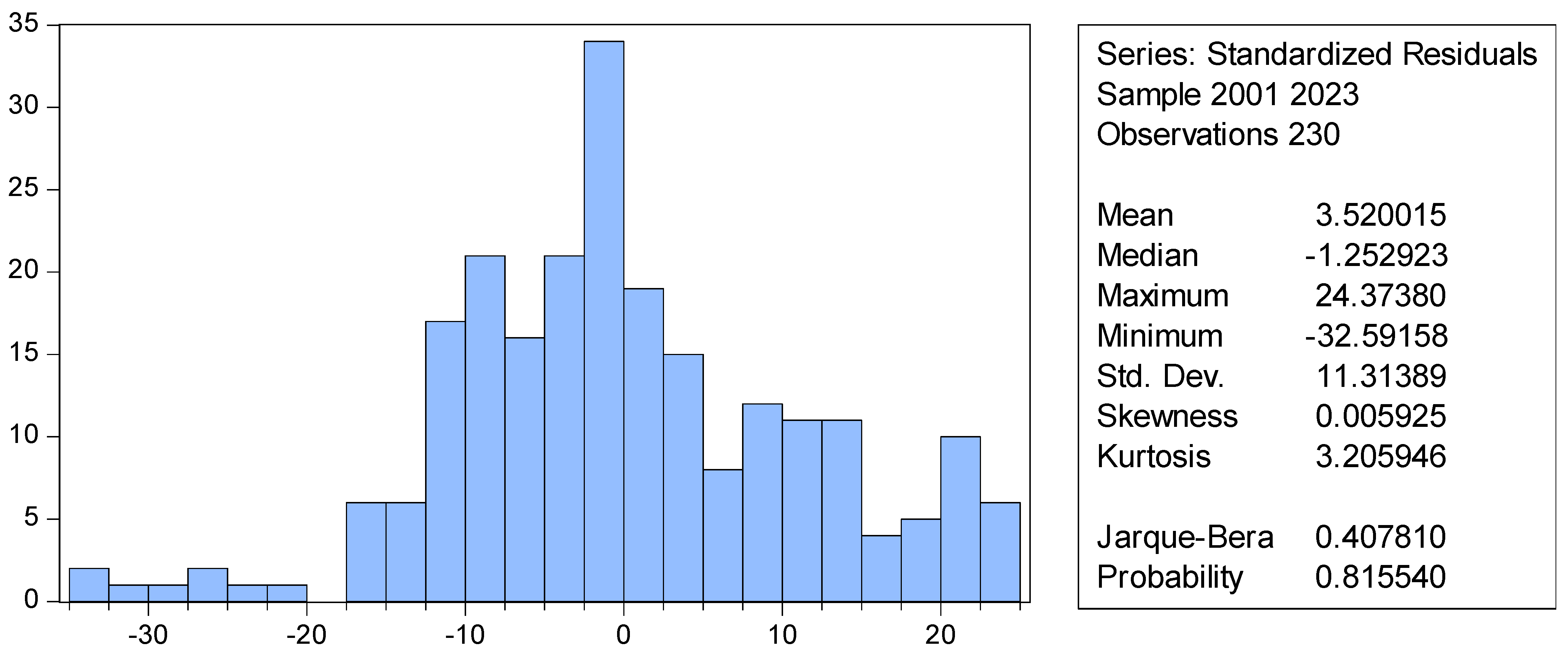
The study also performed the histogram normality test to check for normal distribution of the residuals from the estimated model, as shown in
Figure 1 above. The probability value of the Jarque–Bera test is 0.8155, which is greater than 0.05, implying that we fail to reject the null hypothesis that the residuals are normally distributed. These findings indicate that the estimated model is reliable for policy formulation and recommendations.
The study has employed the panel dynamic ordinary least squares and fully modified ordinary least squares for robustness checks and control for endogeneity among the variables as presented in
Table 10 above. The findings from both the PDOLS and PFMOLS show that there is a significant negative relationship between energy transition and energy access in BRICS nations at 1% level. A 1% increase in energy transition results in energy access falling by 0.52% and 0.69% respectively, based on the PDOLS and FMOLS, ceteris paribus. These findings are in line with the POLS results in
Table 8, showing that an increase in energy transition in BRICS nations is followed by an increase in energy poverty. These findings align with the studies of [
9,
10,
11,
25,
27,
29], who reported that energy transition may adversely affect the electricity access dimension of energy poverty. This calls for policymakers to design policies that balance energy transition with energy access to avoid energy poverty in BRICS nations.
Furthermore, the PDOLS results show that urbanization has an insignificant effect, while the PFMOLS shows a significant positive relationship between urbanization and energy access in BRICS nations at 1% level. A 1% increase in urbanization is followed by a 0.12% increase in energy access in BRICS nations, showing that urbanization leads to reduced energy poverty as a larger share of the population has access to energy. These results are in line with the economic theory that urbanization leads to reduced energy poverty and contradict the results of the POLS in
Table 8, implying that policymakers need to implement policies that promote urbanization to reduce energy poverty in BRICS nations. These findings support the findings of [
27], who reported that urbanization increases energy access.
The findings of the PDOLS show a significant negative relationship between economic growth and energy access at a 10% level, while the PFMOLS shows an insignificant relationship between these two variables. A 1% increase in economic growth is followed by a 0.14% decrease in energy access in BRICS nations, implying that economic expansion results in an increase in energy poverty. The findings support the findings from
Table 8 and contradict the studies of [
8,
11,
29,
43,
44], who found that economic growth reduces energy poverty. These findings suggest that policymakers in BRICS nations should implement policies that balance growth with energy access to avoid energy poverty.
Unexpectedly, the PDOLS and PFMOLS show a significant positive relationship between unemployment and energy access in BRICS nations at 5% and 1% levels, respectively. A 1% increase in unemployment is followed by 0.26% and 0.34% based on the DOLS and FMOLS, respectively, ceteris paribus. These findings imply that unemployment results in reduced energy poverty, contradicting the POLS results showing that an increase in unemployment is positively related to an increase in energy access in BRICS nations. These findings contradict the findings of [
3,
11,
29], who found that unemployment increases energy poverty. These findings suggest that policymakers should revise unemployment policies in BRICS nations to integrate with energy policies to avoid energy poverty.
The study employed a Bootstrap panel quantile regression to estimate heterogenous relationships among the variables in the model as presented in
Table 11 above. The findings show a significant negative relationship between energy transition and energy access from the 0.10th quantile to the 0.6th quantile, and from the 0.8th to 0.9th quantile. The coefficient shows a decreasing trend from lower quantiles to the upper quantile, meaning that energy transition has the most effect on energy poverty on those in lower quantiles than at upper quantiles. These findings indicate a heterogeneous effect, implying that energy transition policies developed to address energy poverty will have a greater impact on those in lower quantiles as opposed to those in upper quantiles. The findings are consistent with the findings of [
10,
11,
27], who reported that the energy transition may adversely affect the electricity access dimension of energy poverty, while contradicting the findings of [
6,
37], who discovered that energy transition reduces energy poverty. These findings call for governments and policymakers to revise energy transition policies so that they do not result in energy poverty in the region.
Furthermore, the findings indicate a significant positive relationship between urbanization and energy access across all quantiles at 1% level, ceteris paribus. These results show that an increase in urbanization is followed by an increase in energy access in BRICS nations, and the impact is felt more by those at higher quantiles than those at lower quantiles. This suggests that policies that are aimed at promoting urbanization will result in energy poverty alleviation and that the policy will have a greater impact on those in higher energy poverty areas. These findings are consistent with the studies of [
27], who reported that urbanization results in energy poverty alleviation. These findings call for the governments and policymakers of the BRICS nations to implement policies that promote urbanization as a way of alleviating energy poverty.
The findings show that there is a significant positive relationship between economic growth and energy access in BRICS nations from the 0.10th to 0.80th quantiles at 1% level. These findings show that an increase in economic growth increases energy access in BRICS nations, implying that economic expansion alleviates energy poverty, with the relationship having more impact on those in lower quantiles than those in upper quantiles. This suggests that policies aimed at increasing economic growth as a way of reducing energy poverty will have more impact on those in lower quantiles than those in upper quantiles. These findings are consistent with the studies of [
6,
11], who reported that economic growth alleviates energy poverty. These findings call for policymakers to promote economic growth as a way of alleviating energy poverty in BRICS nations, also considering the heterogeneous impacts across quantiles.
Unexpectedly, the findings show a significant positive relationship between unemployment and energy access in BRICS nations across all quantiles at 1% level. The findings show that an increase in unemployment in BRICS nations increases energy access, likely citing that unemployment is directly related to energy poverty alleviation. These findings show that the impact is more sensitive to upper quantiles than lower quantiles. The findings contradict the studies of [
3,
6,
10,
11], who reported that unemployment is related to an increase in energy poverty. These findings warrant further investigation to check the impact of unemployment on energy access using different models.
5. Discussion
This section presents the summary of key findings on the impact of energy transition on energy poverty in BRICS nations, discusses findings in relation to the previous studies, offers implications for policy and practice, and offers theoretical, knowledge, and methodological contributions of the study. The core interpretation and policy implications are based primarily on the FE, DOLS, FMOLS, and bootstrap quantile regression results, while POLS is retained only for comparative and robustness purposes. The key findings for the study based on empirical evidence are as follows:
Energy transition may adversely affect the electricity access dimension of energy poverty: A 1% increase in energy transition leads to a 0.63% decrease in energy access (POLS), 0.52% (PDOLS), and 0.69% (PFMOLS), indicating that energy transition is associated with increased energy poverty in BRICS nations. Energy transition may adversely affect the electricity access dimension of energy poverty, especially affecting those in the lower quantiles the most. The reductions in electricity access do not necessarily imply worsening energy poverty across all dimensions. In countries where electrification rates are already high, energy poverty may persist through affordability constraints, service reliability issues, or inadequate energy consumption despite near-universal access. Accordingly, the results should be interpreted as reflecting the relationship between energy transition and electricity access rather than the entirety of multidimensional energy poverty. The positive relationship between renewable energy transition and energy poverty should not be interpreted as evidence that renewable energy development is detrimental to energy access or welfare. Rather, it may reflect transitional challenges such as high implementation costs, affordability constraints, inadequate infrastructure, and institutional inefficiencies that can temporarily limit access to modern energy services. Therefore, policymakers should focus on designing inclusive energy transition strategies that combine renewable energy expansion with affordability measures, infrastructure investments, and targeted support for vulnerable households. Such complementary policies can help ensure that the long-term benefits of renewable energy deployment contribute to reducing, rather than exacerbating, energy poverty.
Urbanization Strains Energy Infrastructure: The findings show that rapid urbanization is outpacing energy infrastructure development, leading to decreased energy access and increased energy poverty. The heterogeneous quantile results show that urbanization increases energy access, especially benefiting those in higher quantiles.
Economic Growth Does Not Translate to Energy Access: Economic growth is not translating into improved energy access, indicating a policy failure in managing the energy sector.
Unemployment and Energy Access are Linked: Unemployment is strongly correlated with energy access, indicating a cycle of poverty and energy deprivation.
Policy Gaps Exist: The findings highlight policy gaps in energy transition, urbanization, economic growth, and unemployment, which need to be addressed to achieve energy access and poverty reduction.
The negative relationship between energy transition and energy access suggests that the cost and distribution of renewable energy are not equitable, turning a solution into a new burden for poor consumers. The findings contradict some previous studies [
6,
7,
8] that reported energy transition reduces energy poverty. However, they are consistent with other studies [
9,
10,
11,
25,
27,
29] that reported energy transition may adversely affect the electricity access dimension of energy poverty. The negative relationship between urbanization and energy access indicates that rapid urbanization is outpacing the development of adequate energy infrastructure. These findings are consistent with some studies [
29] that found that urbanization reduces energy access, while inconsistent with some studies [
27] which reported that urbanization increases energy access. Renewable energy expansion may initially crowd out traditional grid investment as governments redirect fiscal resources toward decarbonization objectives, renewable subsidies, and clean technology deployment. Similarly, the transition toward cleaner energy systems may increase electricity tariffs in the short run due to high capital costs, transmission upgrades, and carbon-pricing mechanisms, thereby reducing affordability and effective access to energy services. In addition, urbanization and rapid economic growth may intensify energy demand faster than infrastructure expansion, creating supply constraints and unequal distribution of electricity access. These interpretations are also theoretically supported by the energy transition literature and structural transformation theory, which suggest that the early phases of energy transition can generate adjustment costs, institutional bottlenecks, and temporary distributional inequalities before long-run benefits materialize. Therefore, the negative coefficients observed in the study should not necessarily be interpreted as evidence of outright policy failure, but rather as indicators of transitional inefficiencies, uneven implementation capacity, and short-run adjustment dynamics within rapidly transforming economies.
These findings are consistent with some studies [
3,
25], which found that economic growth increases energy poverty, while inconsistent with some studies [
8,
11,
29,
43,
44], which found that economic growth reduces energy poverty.
Regarding the empirical findings, the study interprets the negative relationship between renewable energy transition and electricity access primarily within the context of transitional adjustment dynamics rather than as evidence against clean energy transition itself. The findings suggest that, during the current phase of structural transformation in BRICS economies, renewable energy expansion may initially coincide with infrastructure constraints, financing pressures, tariff adjustments, and uneven distributional outcomes that can temporarily limit inclusive energy access. Similarly, the negative effects of urbanization and economic growth on electricity access indicate that rapid structural and demographic expansion does not automatically guarantee equitable energy distribution, particularly when infrastructure development and energy systems fail to expand at the same pace as demand growth. The significant negative impact of unemployment further emphasizes the affordability dimension of energy access, where lower household income and labour market vulnerability reduce the ability of households to secure reliable electricity services. Overall, the long-run relationship identified between energy transition and energy poverty reinforces the importance of designing socially inclusive and phased energy transition policies that simultaneously promote decarbonization and protect vulnerable populations from transitional energy inequalities.
The findings of this study have several implications for energy policy and practice in BRICS countries. The findings of this study challenge the core premise of just energy transit, highlighting that energy poverty can worsen due to high costs in the early stages of transition, infrastructure gaps, and policy failures, demanding multi-pronged, inclusive strategies to align climate goals with affordability, access, and social equity, moving beyond just cleaner fuels to address socioeconomic barriers and ensuring vulnerable groups are not left behind. Energy poverty is not just about having energy; it is about reliability, affordability, and clean energy; therefore, a transition failing to address access makes it a complex, multidimensional challenge. These findings confirm energy ladder and energy stacking behaviours, showing households adapt, but economic constraints like high costs of clean energy can trap them in energy poverty. The study’s findings suggest that policymakers should prioritize energy access and affordability for the poor, invest in energy transition that benefits the poor, and address access and unemployment as interconnected challenges. The findings call for policymakers to align economic growth policies with energy policies, promote energy transition that benefits the poor, and address energy access and unemployment as interconnected challenges.
This study contributes to the literature on energy transition and energy access in three ways. Firstly, the study provides new evidence on the impact of the energy transition on energy poverty in the official ten members of the BRICS nations, that is, Brazil, Russia, India, China, South Africa, Indonesia, Iran, Egypt, Ethiopia, and the United Arab Emirates, highlighting the need for policymakers to prioritize energy access and affordability for the poor. Secondly, the study makes a methodological contribution by using panel dynamic ordinary least squares, panel dynamic ordinary least squares, and fully modified least squares to control for endogeneity and provide robust estimates. Lastly, the study makes a theoretical contribution by applying the energy transition theory, energy ladder theory, and energy poverty theory to explain the relationship between energy transition and energy access, providing a framework for understanding the role of institutions in shaping energy transition.
6. Conclusions
The study investigated the impact of energy transition on energy poverty in BRICS nations from 2000 to 2023 using panel data analysis like pooled OLS, dynamic ordinary least squares, fully modified ordinary least squares, and a bootstrap quantile regression model. The findings indicated that energy transition, urbanization, and economic growth are increasing energy poverty in BRICS nations. Policymakers should address energy access, unemployment, and economic growth as interconnected challenges. Energy transition policies have a greater impact on those in lower quantiles of energy poverty, while urbanization benefits those in higher quantiles, implying heterogeneous effects. The study’s objectives were achieved by employing panel data models such as pooled, DOLS, FMOLS, and bootstrap quantile regression. The study found that energy transition, economic growth, urbanization, and unemployment are negative determinants of energy poverty in BRICS nations. The study also supported the hypothesis that energy transition, economic growth, urbanization, and unemployment have a significant impact on energy poverty in BRICS nations. The study is significant for policymakers and governments who analyze and develop energy transition policies to alleviate energy poverty in BRICS nations.
The study has several limitations that should be considered when interpreting the findings. The study assumes homogeneity for all the cross-sections based on the pooled least squares model selected by the data. Secondly, the study relies on panel data for 10 BRICS member states spanning from 2000 to 2023, and these countries differ in terms of their income groups and the rate at which they implement energy transition policies. Studies in the future can use different panel models and consider doing country-specific analysis for the BRICS nations to provide novel insights while including additional variables such as institutional quality, inflation, and non-renewable energy to see their impacts on energy poverty. A key limitation of this study is the use of access to electricity as a proxy for energy poverty. While this indicator captures an important dimension of energy deprivation, it does not fully account for other aspects of energy poverty, such as affordability, reliability of supply, energy quality, and access to clean cooking facilities. Consequently, the findings should be interpreted as reflecting the electricity access dimension of energy poverty rather than energy poverty in its broader multidimensional sense. We further recommend that future studies incorporate multidimensional indicators, including energy affordability, reliability, and clean cooking access, where consistent long-term data become available across BRICS economies. Future research may extend the analysis using instrumental variable approaches, System-GMM, Common Correlated Effects (CCE), or other causal identification frameworks to further investigate the direction and magnitude of these relationships.
Based on empirical evidence from the study, the following policy recommendations are made: Firstly, the policymakers and the governments in BRICS nations should design policies to balance energy transition with energy access to avoid energy poverty. This can be done through investing in energy infrastructure, renewable energy sources, energy efficiency, and smart grids aimed at developing and upgrading the energy infrastructure to support rapid urbanization and growing energy demand. Secondly, policymakers and the governments in BRICS nations should prioritize energy access and affordability to ensure that energy transition benefits are equitably distributed and that marginalized communities are not overlooked. This can be done through implementing policies to make energy affordable and accessible to the poor.
Thirdly, the government, policymakers, and private sector in BRICS nations should formulate and implement policies that promote urbanization to alleviate energy poverty through investing in urban energy infrastructure and services to support growing urban populations. Fourthly, the government and policymakers in the BRICS nations should integrate economic growth with energy policies through aligning economic growth policies with energy policies to reduce energy poverty. This will ensure that economic growth benefits are translated into improved energy access and living standards. Lastly, there is a need for policymakers and the governments in BRICS nations to revise unemployment policies and integrate them with energy policies to address energy poverty. This can be done through training and support for workers transitioning to renewable energy sectors.
For relatively higher-income and more industrialized BRICS economies, the study recommends accelerating technological innovation, smart-grid development, renewable energy storage systems, and energy efficiency improvements while maintaining social protection mechanisms that cushion vulnerable consumers against temporary tariff increases during decarbonization processes. These countries are better positioned to implement advanced market-based and technology-driven transition policies due to stronger fiscal and institutional capacity.
The primary intention of this study was to capture the transitional dynamics currently experienced within BRICS economies during the 2000–2023 period, a phase characterized by ongoing structural transformation, uneven infrastructure development, financing constraints, and evolving renewable energy policies. Within such contexts, the empirical findings suggesting adverse effects on energy access or energy poverty should be interpreted largely as short-to-medium-term transitional outcomes rather than permanent structural consequences of energy transition itself.
In many emerging economies, the initial stages of energy transition may involve substantial capital expenditures, electricity tariff adjustments, fossil-fuel subsidy reforms, grid restructuring, and uneven renewable energy deployment. These factors can temporarily constrain affordability and accessibility, particularly among vulnerable households and regions. However, as renewable technologies mature, infrastructure expands, economies of scale improve, and institutional capacity strengthens, the long-run effects of energy transition may become increasingly inclusive and welfare-enhancing. The results provide evidence on the determinants of the electricity access dimension of energy poverty. However, given the multidimensional nature of energy poverty, caution should be exercised when generalizing these findings to broader measures that incorporate affordability, reliability, energy quality, and clean cooking access.