

Research on Design and Optimization of Economic Operation for Indirect Liquid Cooling System in Data Center Servers


Abstract
1. Introduction
1.1. Background of Data Center Thermal Management
1.1.1. Current Status of Air Cooling in Data Centers
1.1.2. Current Status of Liquid Cooling in Data Centers
1.1.3. Current Status of Energy-Saving Optimization in Data Centers
1.2. System Modeling and Optimization Methods Based on the Heat Flow Method
1.3. The Main Work in This Paper
- (1)
- Piping Network Design and Resistance Calculation for Cabinet Liquid Cooling Systems
- (2)
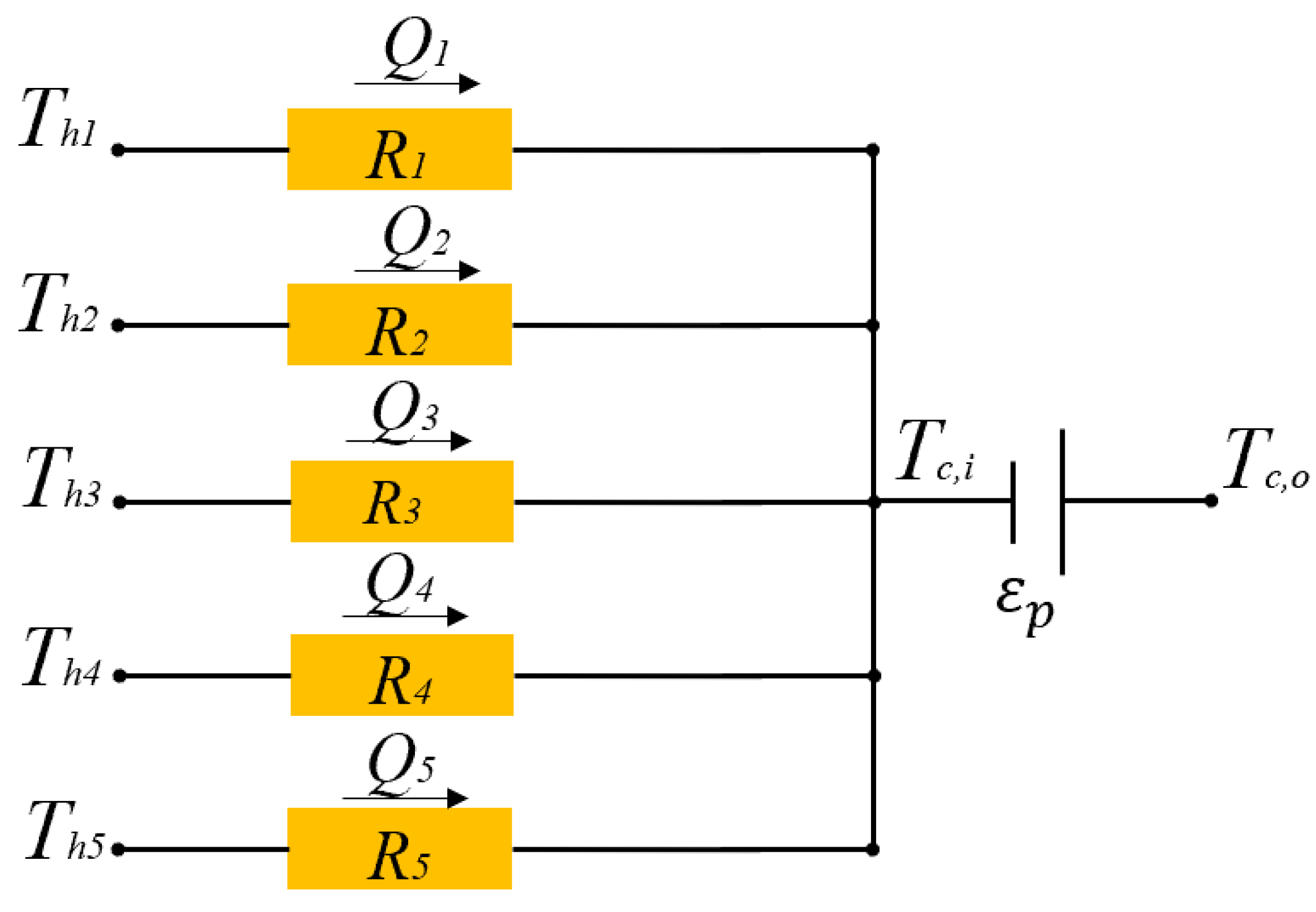
- Modeling of Cabinet Liquid Cooling Systems
- (3)
- Economic Operation Optimization and Analysis of Cabinet Liquid Cooling Systems
2. Analysis of Piping Network Resistance Characteristics in Server Cabinet Indirect Liquid Cooling Systems
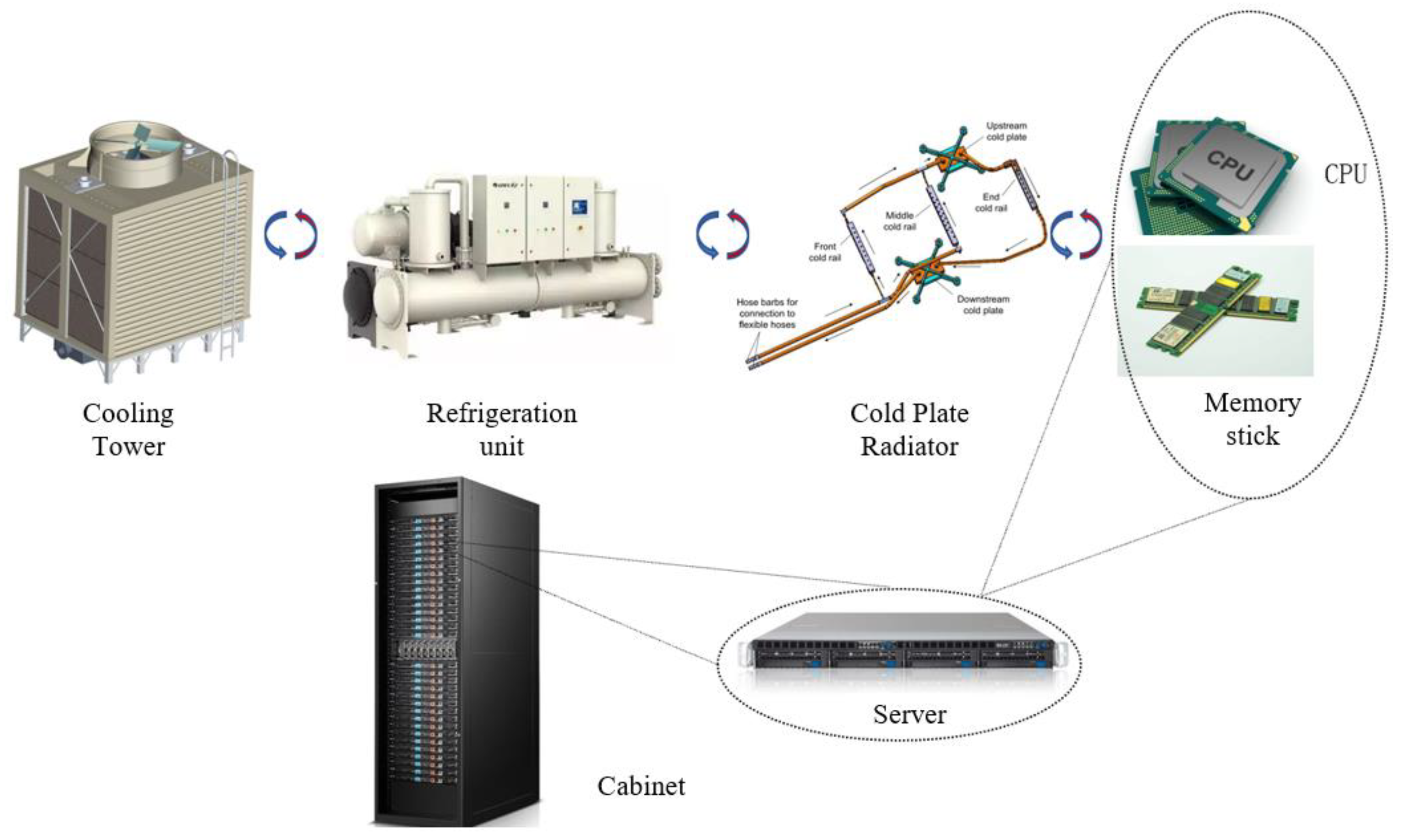
2.1. Introduction to Cabinet-Level Liquid Cooling Systems and Piping Network Design
2.1.1. Cabinet-Level Liquid Cooling Systems
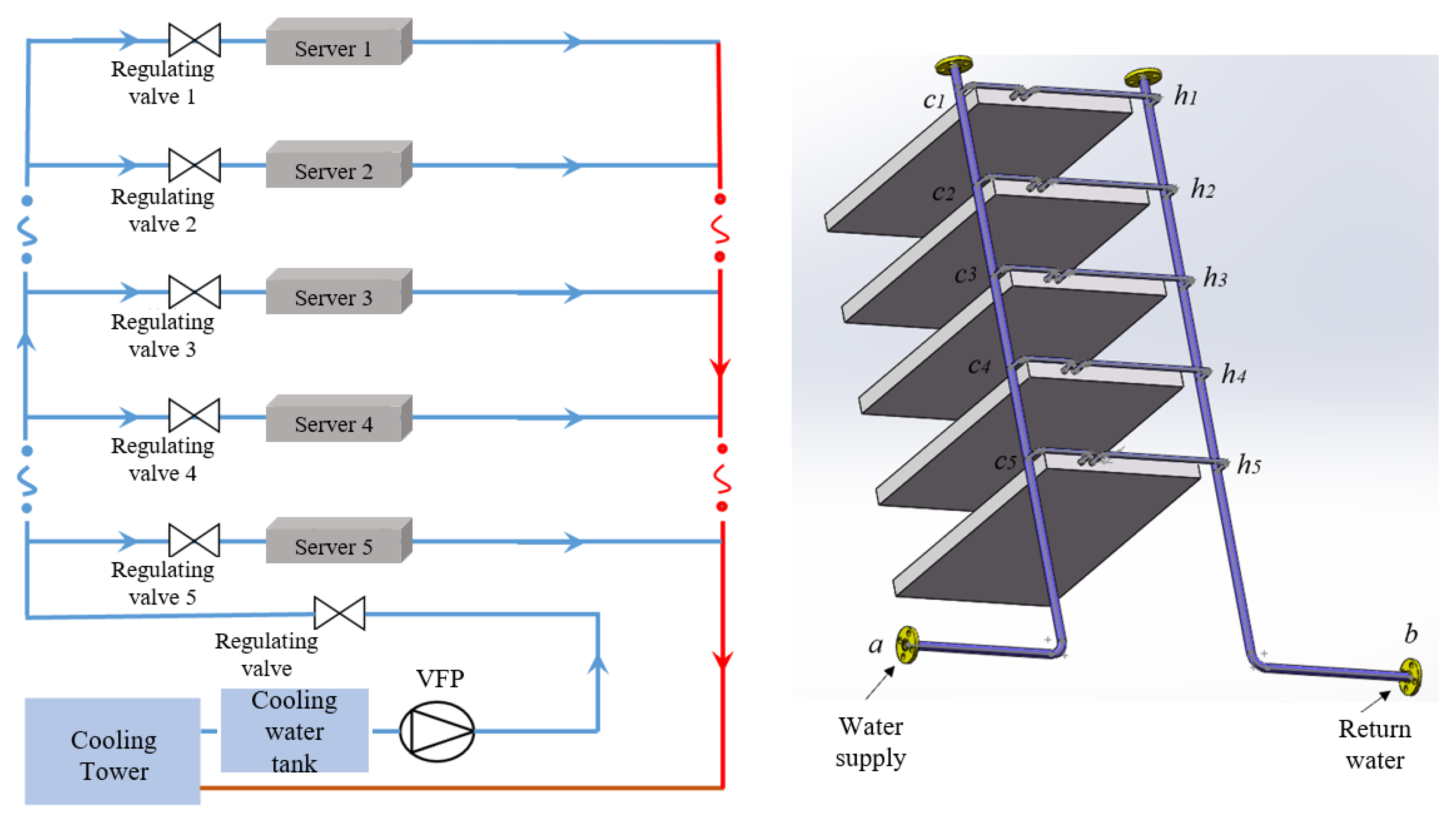
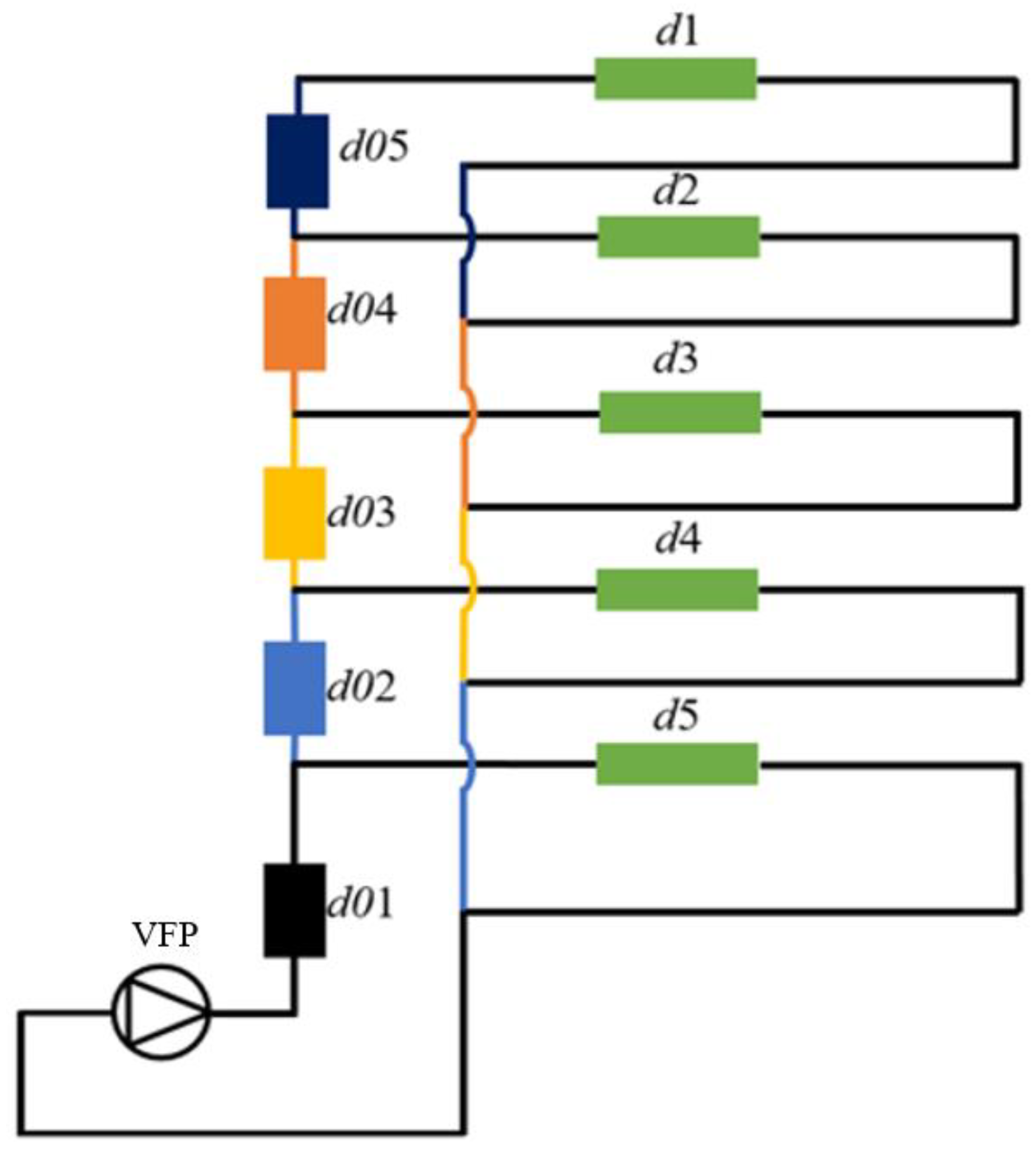
2.1.2. Piping Network Design for Indirect Liquid Cooling Systems
2.2. Piping Network System Design and Resistance Calculation
2.2.1. Piping Network Model Structure Parameters
2.2.2. Piping Network Resistance Calculation
- (1)
- Frictional Resistance
- (2)
- Local Resistance
2.2.3. Analysis of Piping Network Resistance Characteristics
3. Heat Flow Model for Cabinet Indirect Liquid Cooling Systems
3.1. Analysis of Heat Transfer and Flow Characteristics in Server Cabinet Cooling Systems
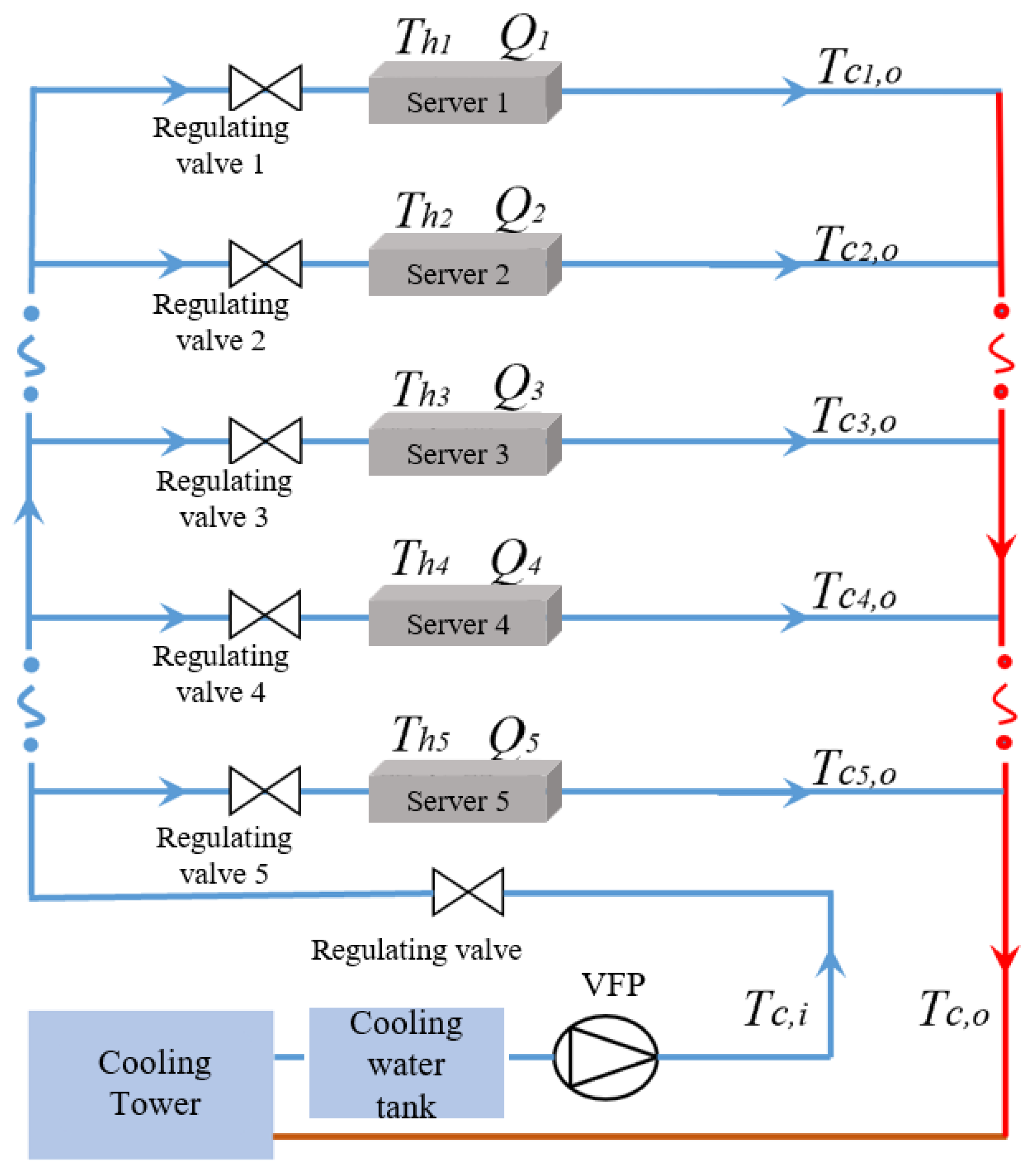
3.1.1. Analysis of Heat Transfer Characteristics in Indirect Liquid Cooling Systems
3.1.2. Analysis of Flow Characteristics in Indirect Liquid Cooling Systems
- (1)
- Construction of Flow Constraints for Centralized Pump-Driven Indirect Liquid Cooling Systems
- (2)
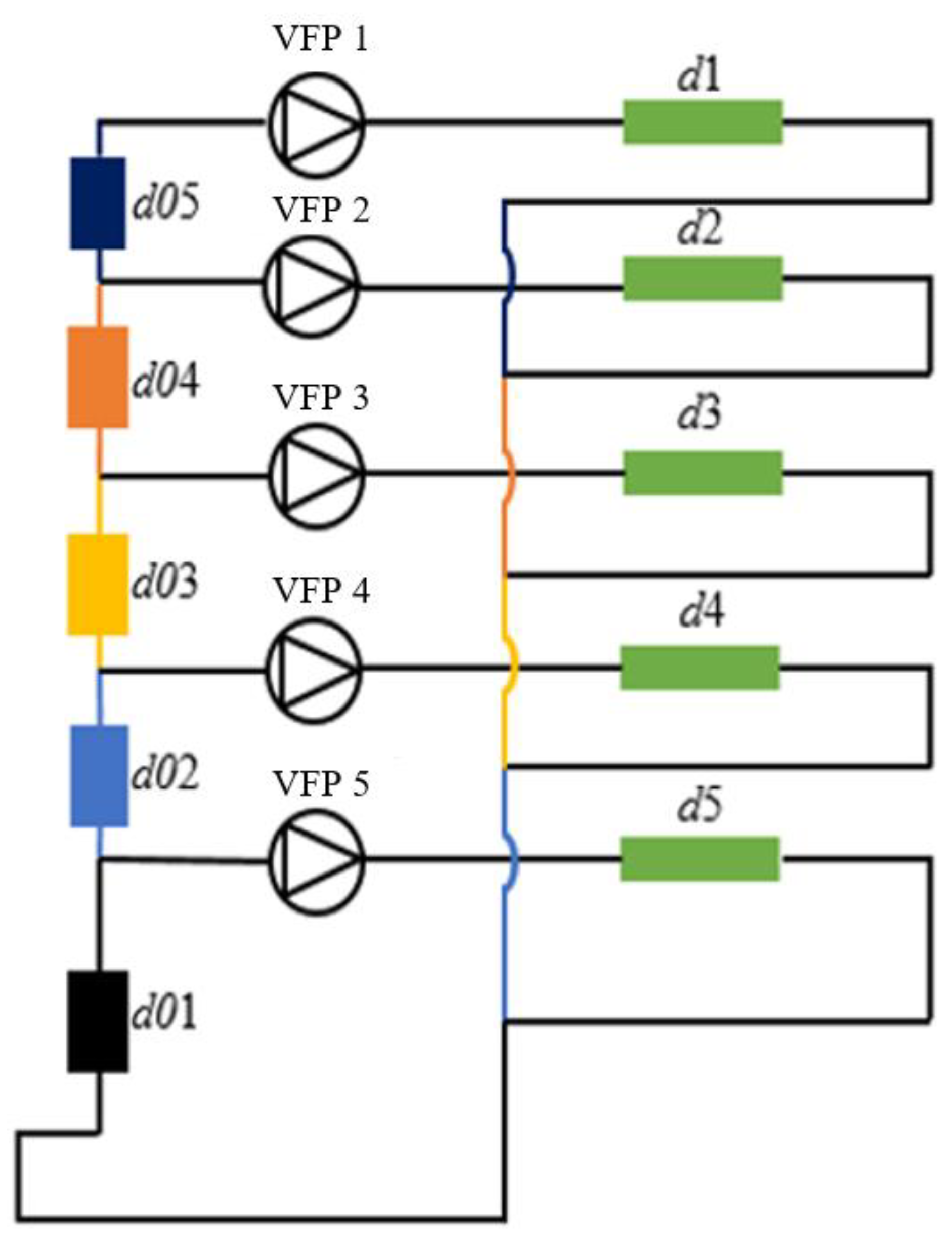
- Construction of Flow Constraints for Distributed Pump-Driven Liquid Cooling Systems
3.2. Boundary Conditions for Server Cabinet Cooling Systems
3.2.1. Heat Transfer Boundary Conditions
3.2.2. Flow Boundary Conditions
4. Comprehensive Economic Operation Optimization Analysis of Server Indirect Liquid Cooling Systems
4.1. Economic Operation Optimization of Centralized Pump Indirect Liquid Cooling Systems
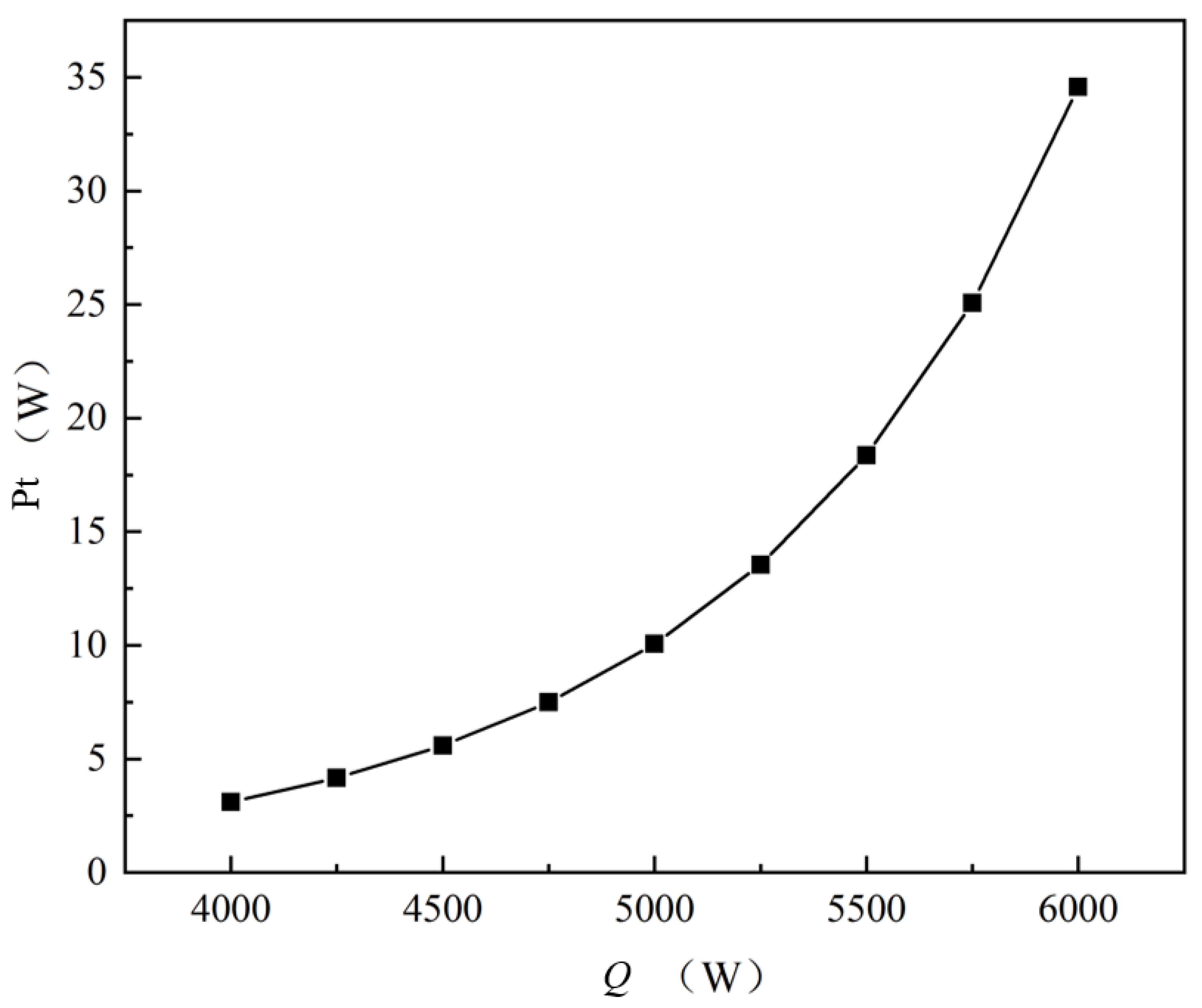
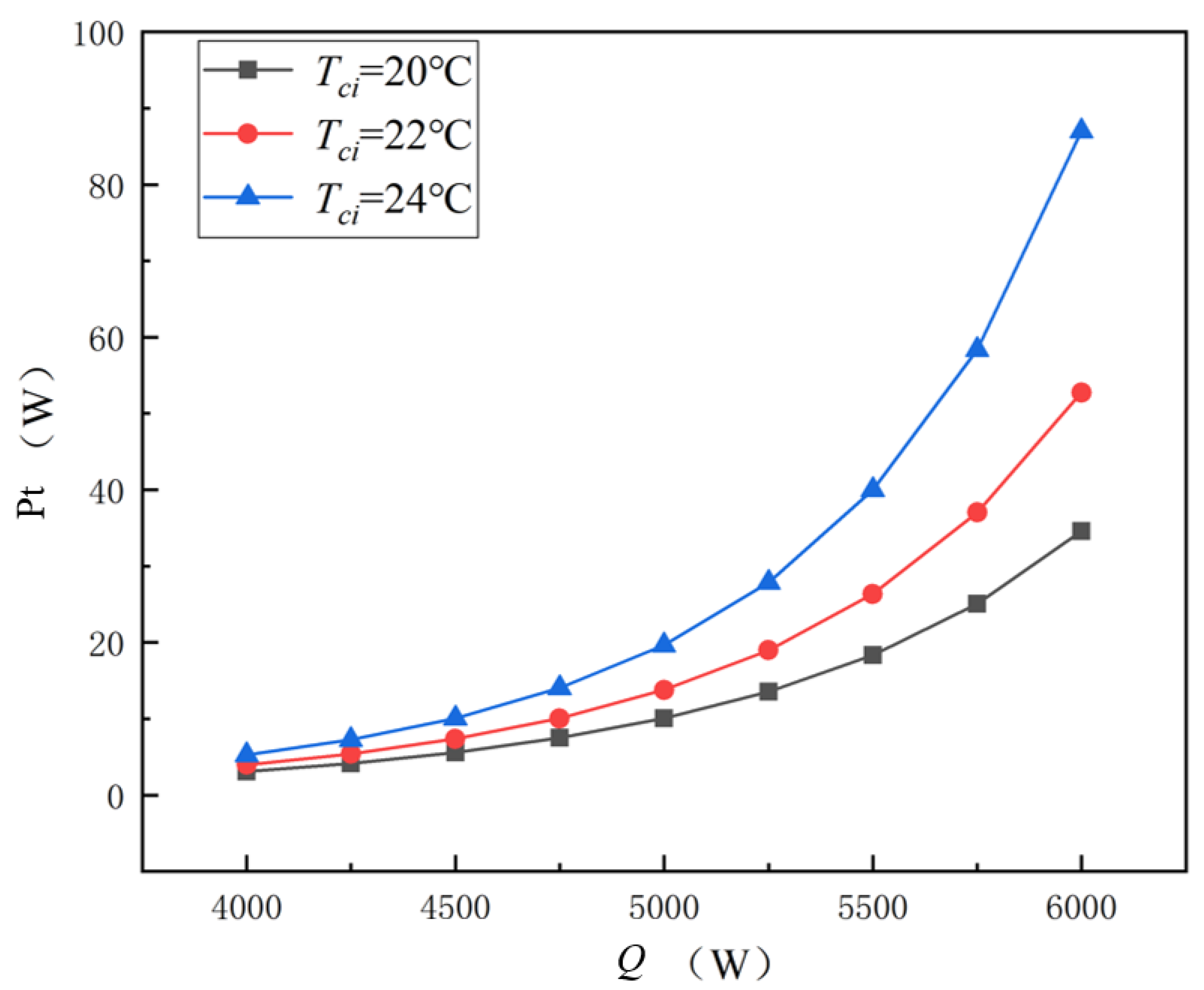
4.1.1. Economic Operation Optimization and Analysis Under Given System Total Load
4.1.2. Optimization and Analysis Under Given Total System Power
4.2. Economic Operation Optimization of Distributed Pump Indirect Liquid Cooling Systems
5. Conclusions
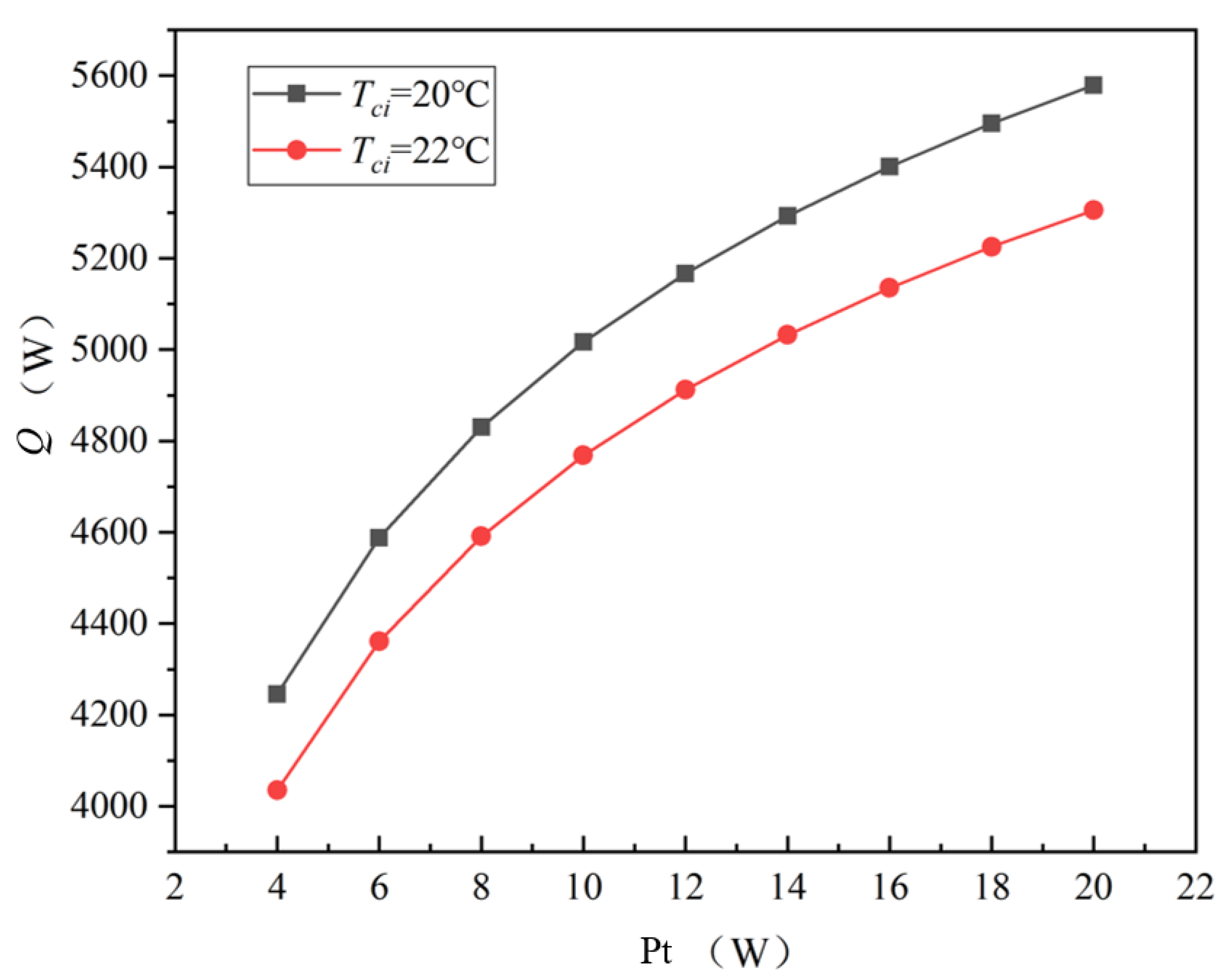
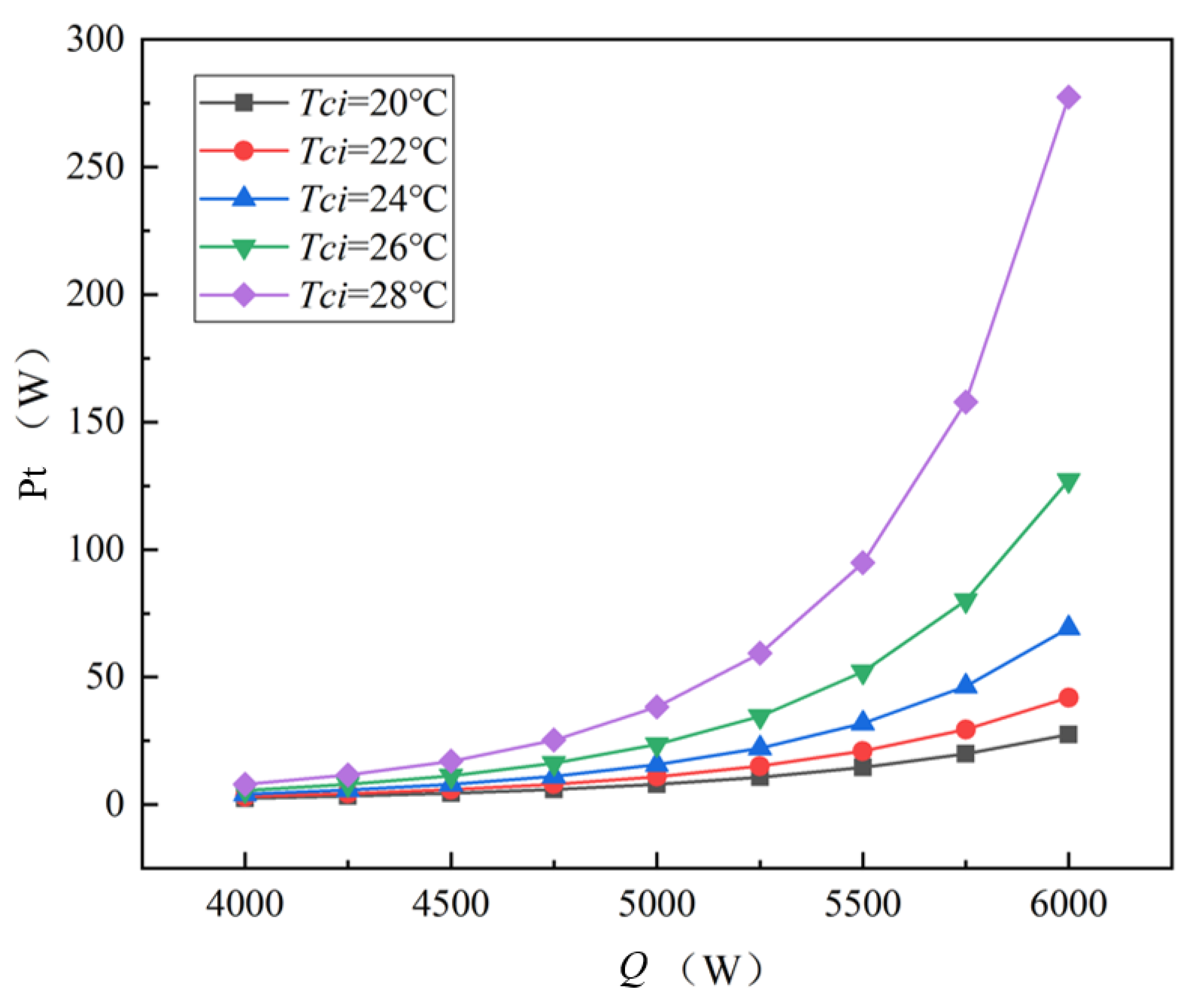
- Under a given thermal load, the total power consumption of the centralized pump liquid cooling system increases by 1.55 times when the cooling water temperature rises from 20 °C to 24 °C. At a given total power consumption, a 2 °C increase in cooling water temperature reduces the thermal load by 4.9%. When a 1.2 kW server is placed at the top and bottom of the cabinet, the total power consumption of the latter is 34.4% lower than that of the former.
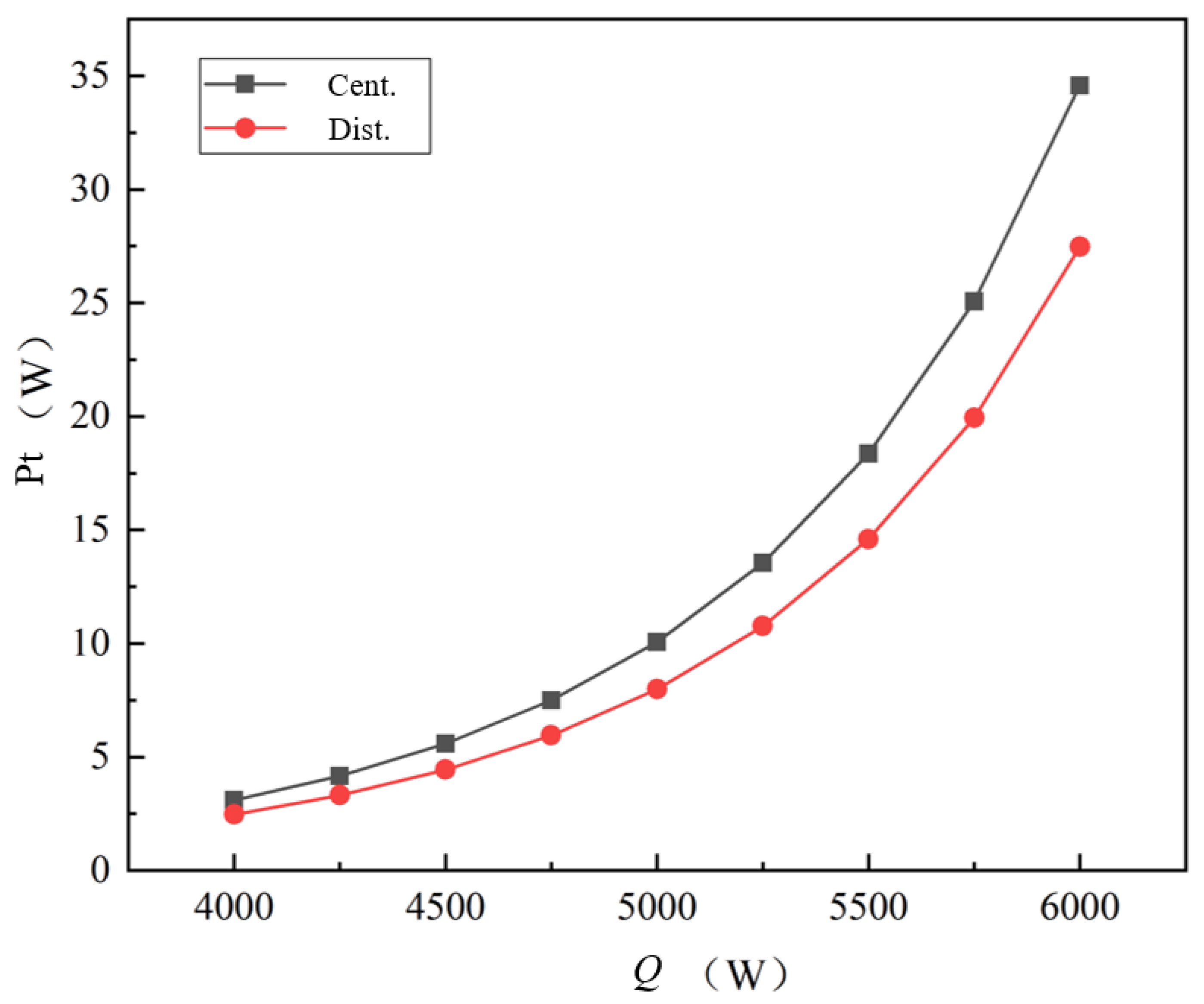
- When the total thermal load increases from 4.0 kW to 6.0 kW, the distributed system saves an average of 2.5 W compared to the centralized system, with a maximum saving of up to 7.09 W.
Author Contributions
Funding
Data Availability Statement
Conflicts of Interest
Nomenclature
| A | Area, m2 |
| a | Variable—frequency pump characteristic parameter |
| cp | Specific heat at constant pressure, J/(kg·K) |
| D | Diameter, m |
| d | Pipe network dynamic pressure head coefficient, m·s2/kg2 |
| G | Thermal capacity flow, W/K |
| g | Gravitational acceleration, m/s2 |
| H | Pressure head, m |
| h | Resistance loss, m |
| K | Heat transfer coefficient, W/(m2·K) |
| L | Length, m |
| m | Mass flow rate, kg/s |
| P | Pressure, Pa |
| Q | Heat flow rate, W |
| q | Heat flux density, W/m2 |
| R | Thermal resistance, K/W |
| Re | Reynolds number |
| S | Pipe cross—sectional area, m2 |
| T | Temperature, °C |
| v | Flow velocity, m/s |
| W | Power, W |
| Greek Letters | |
| ε | Thermoelectromotive force, °C |
| Lagrange multipliers | |
| ρ | Fluid density, kg/m3 |
| ω | Variable—frequency pump operating frequency, Hz |
| λ | Along—route resistance coefficient |
| Local resistance coefficient | |
| Fluid kinematic viscosity, m2/s | |
| Subscripts | |
| c | Low—temperature side |
| f | Along—route loss |
| h | High—temperature side |
| i | Inlet; i-th branch |
| j | The j-th |
| n | The n-th |
| o | Outlet |
| w | Local loss |
| ph | Thermal resistance of parallel—flow heat exchanger |
| ch | Thermal resistance of counter—flow heat exchanger |
References
- Garimella, S.V.; Yeh, L.T.; Persoons, T. Thermal Management Challenges in Telecommunication Systems and Data Centers. IEEE Trans. Compon. Packag. Manuf. Technol. 2012, 2, 1307–1316. [Google Scholar]
- Khalaj, A.H.; Halgamuge, S.K. A Review on efficient thermal management of air- and liquid-cooled data centers: From chip to the cooling system. Appl. Energy 2017, 205, 1165–1188. [Google Scholar] [CrossRef] [Scilit]
- Fakhim, B.; Behnia, M.; Armfield, S.W.; Srinarayana, N. Cooling solutions in an operational data centre: A case study. Appl. Therm. Eng. 2011, 31, 2279–2291. [Google Scholar] [CrossRef] [Scilit]
- Mulay, V.; Agonafer, D.; Irwin, G.; Patell, D. Effective Thermal Management of Data Centers Using Efficient Cabinet Designs. In Proceedings of the ASME InterPack Conference, San Francisco, CA, USA, 19–23 July 2009; Volume 2, pp. 993–999. [Google Scholar]
- Cho, J.; Woo, J. Development and experimental study of an independent row-based cooling system for improving thermal performance of a data center. Appl. Therm. Eng. 2020, 169, 114857. [Google Scholar] [CrossRef] [Scilit]
- Endo, H.; Kodama, H.; Fukuda, H.; Sugimoto, T.; Horie, T.; Kondo, M. Effect of climatic conditions on energy consumption in direct fresh-air container data centers. Green Comput. Conf. 2013, 78, 14–35. [Google Scholar]
- Song, Z. Studying the fan-assisted cooling using the Taguchi approach in open and closed data centers. Int. J. Heat Mass Transf. 2017, 111, 593–601. [Google Scholar] [CrossRef] [Scilit]
- Gess, J.L.; Bhavnani, S.H.; Johnson, R.W. Experimental Investigation of a Direct Liquid Immersion Cooled Prototype for High Performance Electronic Systems. IEEE Trans. Compon. Packag. Manuf. Technol. 2015, 5, 1451–1464. [Google Scholar] [CrossRef] [Scilit]
- Gess, J.; Bhavnani, S.; Ramakrishnan, B.; Johnson, R.W.; Harris, D.; Knight, R.W.; Hamilton, M.; Ellis, C. Impact of Surface Enhancements upon Boiling Heat Transfer in a Liquid Immersion Cooled High Performance Small Form Factor Server Model. In Proceedings of the InterSociety Conference on Thermal and Thermomechanical Phenomena in Electronic Systems, Orlando, FL, USA, 27–30 May 2014; pp. 435–443. [Google Scholar]
- Matsuoka, M.; Matsuda, K.; Kubo, H. Liquid immersion cooling technology with natural convection in data center. In Proceedings of the IEEE International Conference on Cloud Networking, Prague, Czech Republic, 25–27 September 2017; pp. 101–107. [Google Scholar]
- Zimmermann, S.; Meijer, I.; Tiwari, M.K.; Paredes, S.; Michel, B.; Poulikakos, D. Aquasar: A hot water cooled data center with direct energy reuse. Energy 2012, 43, 237–245. [Google Scholar] [CrossRef] [Scilit]
- Ovaska, S.J.; Dragseth, R.E.; Hanssen, S.A. Direct-to-chip liquid cooling for reducing power consumption in a subarctic supercomputer centre. Int. J. High Perform. Comput. Netw. 2016, 9, 242. [Google Scholar] [CrossRef] [Scilit]
- Iyengar, M.; David, M.; Parida, P.; Kamath, V.; Kochuparambil, B.; Graybill, D.; Schultz, M.; Gaynes, M.; Simons, R.; Schmidt, R.; et al. Server liquid cooling with chiller-less data center design to enable significant energy savings. In Annual IEEE Semiconductor Thermal Measurement & Management Symposium; IEEE: New York, NY, USA, 2012; pp. 212–223. [Google Scholar]
- Moazamigoodarzi, H.; Tsai, P.J.; Pal, S.; Ghosh, S.; Puri, I.K. Influence of cooling architecture on data center power consumption. Energy 2019, 183, 525–535. [Google Scholar] [CrossRef] [Scilit]
- Chen, H.; Peng, Y.H.; Wang, Y.L. Thermodynamic analysis of hybrid cooling system integrated with waste heat reusing and peak load shifting for data center. Energy Convers. Manag. 2019, 183, 427–439. [Google Scholar] [CrossRef] [Scilit]
- Zhai, Z.; Xiong, T.; Hu, L.; Liu, Y.; Liu, G.; Yan, G. Experimental investigation on performance enhancement of an air source heat pump by using a novel vapor bypass approach. Energy 2026, 344, 139909. [Google Scholar] [CrossRef] [Scilit]
- Xiong, T.; Wu, H.; Hu, L.; Liu, G.; Yan, G. Optimal design of vapor-bypassed heat exchanger for performance improvement of air source heat pump system. Renew. Energy 2025, 249, 123219. [Google Scholar] [CrossRef] [Scilit]
- Rubenstein, B.A.; Zeighami, R.; Lankston, R.; Peterson, E. Hybrid cooled data center using above ambient liquid cooling. In Proceedings of the Thermal & Thermomechanical Phenomena in Electronic Systems IEEE Intersociety, Las Vegas, NV, USA, 2–5 June 2010; pp. 1–10. [Google Scholar]
- Li, L.; Zheng, W.; Wang, X.; Wang, X. Placement optimization of liquid-cooled servers for power minimization in data centers. In Proceedings of the International Green Computing Conference, Dallas, TX, USA, 3–5 November 2014; pp. 1–10. [Google Scholar]
- Conficoni, C.; Bartolini, A.; Tilli, A.; Cavazzoni, C.; Benini, L. Integrated Energy-Aware Management of Supercomputer Hybrid Cooling Systems. IEEE Trans. Ind. Inform. 2016, 12, 1299–1311. [Google Scholar] [CrossRef] [Scilit]
- Díaz, A.J.; Cáceres, R.; Cardemil, J.M.; Silva-Llanca, L. Energy and exergy assessment in a perimeter cooled data center: The value of second law efficiency. Appl. Therm. Eng. 2017, 124, 820–830. [Google Scholar] [CrossRef] [Scilit]
- Han, Z.; Wei, H.; Sun, X.; Bai, C.; Xue, D.; Li, X. Study on influence of operating parameters of data center air conditioning system based on the concept of on-demand cooling. Renew. Energy 2020, 160, 99–111. [Google Scholar] [CrossRef] [Scilit]
- Chen, Q.; Fu, R.H.; Xu, Y.C. Electrical circuit analogy for heat transfer analysis and optimization in heat exchanger networks. Appl. Energy 2015, 139, 81–92. [Google Scholar] [CrossRef] [Scilit]
- Chen, Q.; Hao, J.H.; Zhao, T. An alternative energy flow model for analysis and optimization of heat transfer systems. Int. J. Heat Mass Transf. 2017, 108, 712–720. [Google Scholar] [CrossRef] [Scilit]
- Zhao, S.Y.; Chen, Q. Design criteria of different heat exchangers for the optimal thermodynamic performance of regenerative refrigeration systems. Appl. Therm. Eng. 2016, 93, 1164–1174. [Google Scholar] [CrossRef] [Scilit]
- Wang, Y.-F.; Chen, Q. A direct optimal control strategy of variable speed pumps in heat exchanger networks and experimental validations. Energy 2015, 85, 609–619. [Google Scholar] [CrossRef] [Scilit]
- Dai, Y.; Chen, L.; Min, Y.; Chen, Q.; Hu, K.; Hao, J.; Zhang, Y.; Xu, F. Dispatch Model of Combined Heat and Power Plant Considering Heat Transfer Process. In IEEE Transactions on Sustainable Energy; IEEE: New York, NY, USA, 2017; Volume 8, pp. 1225–1236. [Google Scholar]



| Pipe Segment Number | |||
|---|---|---|---|
| Pipe Length (m) | 16.0 | 2 | 0.8 |
| Pipe Diameter (mm) | 25.4 | 15.0 | 6.0 |
| Structure | Pipe | Segment | Number | ||
|---|---|---|---|---|---|
| Right-Angle Elbow | 2 | 0 | 0 | 2 | 0 |
| Sudden Expansion Structure | 0 | 0 | 0 | 1 | 1 |
| Sudden Contraction Structure | 1 | 0 | 0 | 0 | 1 |
| Tree | 0 | 5 | 5 | 0 | 0 |
| Valve | 1 | 0 | 0 | 0 | 1 |
| Server | 0 | 0 | 0 | 0 | 1 |
| Formula Name | Calculation Formula | Application Scenario |
|---|---|---|
| Aritsuri Formula | Comprehensive formula for turbulent flow in piping networks | |
| Blasius Formula | Derived from the aforementioned equation, this empirical formula specifically targets the smooth pipe zone by neglecting the minimal relative roughness (k/d). It is applicable when the condition () is satisfied. |
| Pipe Segment Number | Frictional Resistance Coefficient |
|---|---|
| 0.041276 | |
| 0.028776 | |
| 0.028776 | |
| 0.041276 | |
| 0.034221 |
| Resistance Component | Pipe Segment | Local Resistance Coefficient |
|---|---|---|
| Right-Angle Elbow | , | 1.44 |
| Sudden Expansion | 0.89 0.70 | |
| Sudden Contraction | 0.38 0.42 | |
| Tee | 1.50 | |
| Valve | 2.70 0.10 |
| Pipe Segment Pressure Head Coefficient | d01 | d02, d03, d04, d05 | d1, d2, d3, d4, d5 |
|---|---|---|---|
| CalculationValue () | 10.18 | 8.06 | 670.1 |
| Heat Sink Temperature (°C) | Cooling Water Temperature (°C) | Thermal Conductivity (W/K) | Gravitational Acceleration (m/s2) |
|---|---|---|---|
| 60 | 20 | 64 | 9.86 |
| Pipe Segment Pressure Head Coefficient | d01 | d02, d03, d04, d05 | d1, d2, d3, d4, d5 |
|---|---|---|---|
| Calculation Value() | 10.18 | 8.06 | 670.1 |
Disclaimer/Publisher’s Note: The statements, opinions and data contained in all publications are solely those of the individual author(s) and contributor(s) and not of MDPI and/or the editor(s). MDPI and/or the editor(s) disclaim responsibility for any injury to people or property resulting from any ideas, methods, instructions or products referred to in the content. |
© 2026 by the authors. Licensee MDPI, Basel, Switzerland. This article is an open access article distributed under the terms and conditions of the Creative Commons Attribution (CC BY) license.
Share and Cite
Xin, Y.; Yu, D.; Ren, X. Research on Design and Optimization of Economic Operation for Indirect Liquid Cooling System in Data Center Servers. Energies 2026, 19, 3068. https://doi.org/10.3390/en19133068
Xin Y, Yu D, Ren X. Research on Design and Optimization of Economic Operation for Indirect Liquid Cooling System in Data Center Servers. Energies. 2026; 19(13):3068. https://doi.org/10.3390/en19133068
Chicago/Turabian StyleXin, Yuxuan, Daoguang Yu, and Xiaohan Ren. 2026. "Research on Design and Optimization of Economic Operation for Indirect Liquid Cooling System in Data Center Servers" Energies 19, no. 13: 3068. https://doi.org/10.3390/en19133068
APA StyleXin, Y., Yu, D., & Ren, X. (2026). Research on Design and Optimization of Economic Operation for Indirect Liquid Cooling System in Data Center Servers. Energies, 19(13), 3068. https://doi.org/10.3390/en19133068