1. Introduction
With the accelerating transition of energy systems toward low-carbon, distributed, and digitalized operation, integrated energy systems (IES) have become an important pathway for improving energy efficiency, promoting renewable energy accommodation, and enabling coordinated multi-energy utilization. By coupling electricity, heat, gas, hydrogen, renewable generation, storage, flexible loads, and grid interaction, IESs can provide greater flexibility than conventional single-energy systems. However, the increasing penetration of photovoltaic and wind power intensifies source-side and load-side uncertainty, which challenges supply–demand balance, economic dispatch, and operational enforceability. In multi-campus scenarios, different campuses usually have heterogeneous resource endowments, load characteristics, and operational constraints. This heterogeneity creates opportunities for inter-campus energy complementarity, but also increases the complexity of coordinated scheduling under multiple agents, timescales, and coupled constraints [
1,
2].
Existing studies have provided important foundations for multi-energy coupling, flexible regulation, and uncertainty-aware scheduling. Dong et al. [
2] proposed a robust real-time scheduling strategy based on multi-step interval prediction to handle renewable and load uncertainties. Wang et al. [
3] studied low-carbon operation of electricity–heat–gas–hydrogen interconnected systems, while Zhang et al. [
4] investigated electricity–gas–heat scheduling by coordinating flexibility and reliability. These works show that IES scheduling should consider not only economic operation, but also multi-energy coupling, reliability, and flexible resource utilization.
Compared with single-area IESs, multi-campus IESs require stronger spatial coordination. Shi et al. [
5] studied distributed scheduling for IES clusters with peer-to-peer (P2P) energy transactions, demonstrating the potential of cross-regional energy sharing. Chen et al. [
6] proposed an asymmetric Nash bargaining-based cooperative trading strategy for multi-park IESs under carbon trading, and Liang et al. [
7] developed a mixed-game-based low-carbon dispatch method for regional IESs. These studies indicate that multi-campus and multi-agent IES scheduling has already received considerable attention. Therefore, the key gap is not the absence of multi-campus studies, but the lack of a unified framework that simultaneously characterizes heterogeneous campus coordination, uncertainty response, and day-ahead–real-time (DA–RT) execution consistency.
Cloud-edge collaboration provides a suitable architecture for hierarchical scheduling of distributed energy systems. The cloud layer aggregates global information and performs system-level optimization, while the edge layer responds rapidly to local disturbances. Xia et al. [
8] studied privacy-preserving operation of networked microgrids based on edge-cloud cooperative learning. Mansouri et al. [
9] proposed a cloud–fog framework for real-time energy management in multi-microgrid systems. Liu et al. [
10] constructed a cloud-edge cooperative scheduling model for regional multi-energy systems, and Yin et al. [
11] developed a cloud-edge collaborative multi-timescale scheduling strategy integrating day-ahead dispatch, intraday optimization, and real-time adjustment. These studies confirm the feasibility of cloud-edge coordination. However, most focus on communication architecture, privacy protection, task allocation, distributed control, or general multi-timescale dispatch. Explicit mathematical coupling between cloud-edge coordination and DA–RT plan-execution consistency remains insufficient. Although Li et al. [
12], Liao et al. [
13], and Han et al. [
14] have studied cloud-edge dispatch, bi-level scheduling, and hierarchical stochastic optimization, these works mainly emphasize economic dispatch, power allocation, or revenue coordination. The explicit DA–RT linkage between planned schedules and real-time execution trajectories under renewable and load uncertainty remains insufficiently characterized.
DA–RT coordinated scheduling is an effective way to balance economic planning and real-time feasibility. Chen et al. [
15] proposed a Stackelberg–Nash game-based low-carbon scheduling strategy for multi-agent park IESs. Jani and Jadid [
16] established a two-stage scheduling framework for multi-microgrid systems in a market environment, and Lu et al. [
17] developed a two-stage robust scheduling and real-time load control method for community microgrids with multiple uncertainties. These methods improve adaptability under uncertainty. Nevertheless, if real-time dispatch is treated only as an independent correction process, its result may deviate greatly from the day-ahead plan. Therefore, DA–RT deviation constraints or penalties are needed to balance consistency and flexibility.
Uncertainty modeling is another core issue in IES scheduling. Stochastic optimization relies on accurate scenario probabilities, whereas conventional robust optimization may become overly conservative when the uncertainty set is large. Fan et al. [
18] introduced distributionally robust adaptive model predictive control for IES scheduling under renewable uncertainty, showing that distributionally robust optimization can improve the balance between economy and robustness. Feng et al. [
19] studied integrated day-ahead unit commitment and real-time dispatch for a renewable-thermal-storage base, while Yang et al. [
20] proposed a two-stage robust optimization method for IESs considering ammonia energy and waste heat utilization. Risk-oriented methods further support robust decision-making. Duan et al. [
21] studied day-ahead and intraday scheduling of electricity–hydrogen–gas IESs considering spectral risk theory. Ji et al. [
22] proposed an information gap decision theory-based risk strategy for park-level IESs, and Han et al. [
23] developed a dual-layer model predictive control method for electricity–hydrogen–district heating systems. Theoretically, Rockafellar [
24] established the conditional value-at-risk (CVaR) framework, and Delage and Ye [
25] developed distributionally robust optimization under distributional ambiguity. Thus, a CVaR-based distributionally robust formulation is suitable for adverse high-cost scenarios when the actual uncertainty distribution is difficult to obtain.
P2P energy exchange, demand response (DR), and storage are important flexibility resources for multi-campus IESs. Bian et al. [
26] proposed a P2P energy sharing model considering shared energy storage, while Bo et al. [
27] studied P2P electricity–hydrogen trading for multi-microgrids. Gao et al. [
28] investigated distributed robust operation based on P2P multi-energy trading, and Jiang et al. [
29] developed P2P energy trading for energy local area networks with decentralized energy routing. Review studies by Gorbatcheva et al. [
30] and Tariq and Amin [
31] further summarized the development of P2P energy trading from electricity sharing toward decentralized multi-energy coordination. Xiong et al. [
32] studied IES operation considering energy trading and integrated DR, while Luo et al. [
33] analyzed refined load demand response under carbon trading. These studies demonstrate their value, but their joint contribution to DA–RT scheduling under distributional uncertainty remains insufficiently revealed.
Based on the above review, three research gaps remain. First, cloud-edge scheduling has not been sufficiently integrated with explicit DA–RT energy binding. Second, few studies combine a CVaR-based distributionally robust objective with plan-execution deviation control in multi-campus IESs. Third, P2P exchange, DR, and energy storage are often modeled separately, while their coordinated role under heterogeneous campus complementarity, uncertainty adaptation, and real-time execution consistency needs further investigation.
To address these gaps, this paper proposes a distributionally robust DA–RT coordinated scheduling model for multi-campus IESs under a cloud-edge collaborative architecture. The studied system consists of a photovoltaic campus, a wind power campus, and a CHP campus. Each campus is equipped with energy storage and transferable load resources, and the campuses are connected through P2P energy exchange lines. The cloud layer generates the day-ahead baseline dispatch plan, while the edge layer performs scenario-dependent real-time adjustment. Photovoltaic output, wind power output, and load demand uncertainties are represented by bounded-error scenarios. A CVaR-based distributionally robust objective is constructed to improve adaptability to adverse high-cost scenarios. Meanwhile, a soft DA–RT energy-binding mechanism is introduced to limit excessive deviation between day-ahead planned energy and accumulated real-time executed energy.
The main contributions are as follows:
First, a cloud-edge collaborative DA–RT scheduling framework is developed by embedding cloud-edge coordination into a two-stage optimization model.
Second, a CVaR-based distributionally robust objective is formulated to address photovoltaic, wind power, and load uncertainties without fixed scenario probabilities.
Third, a soft DA–RT energy-binding mechanism is established to maintain plan-execution consistency at both system and component levels.
Fourth, a unified coordination model of P2P exchange, DR, and storage is constructed to improve economy, renewable utilization, and robustness.
The remainder of this paper is organized as follows.
Section 2 presents the cloud-edge collaborative framework.
Section 3 formulates the proposed distributionally robust DA–RT coordinated scheduling model.
Section 4 provides case studies and comparative analyses.
Section 5 concludes the paper and discusses future research directions.
2. Frameworks
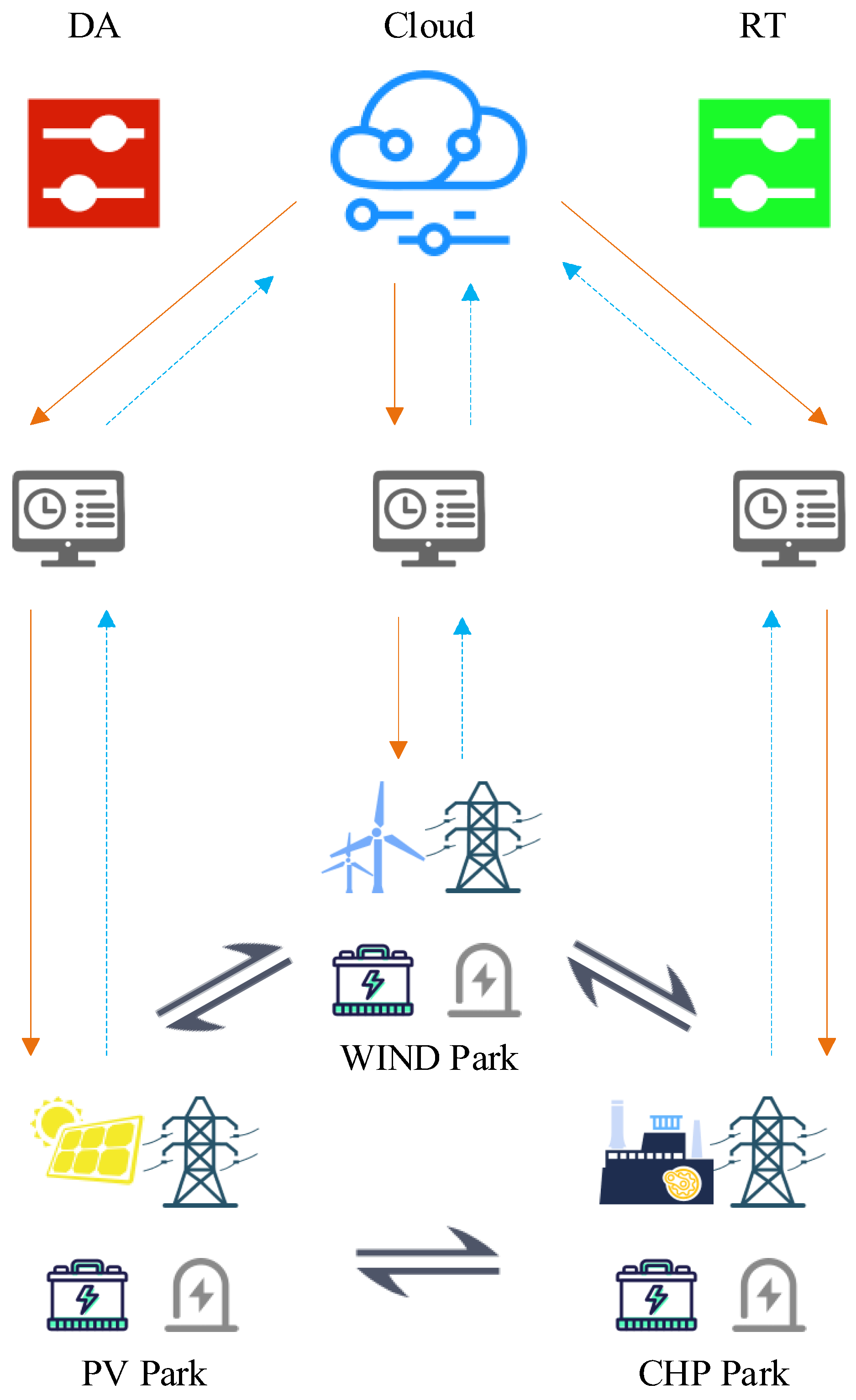
To achieve intelligent coordinated dispatch of multi-site integrated energy systems, this paper proposes an overall framework based on the cloud-edge collaboration concept. Guided by the design principle of “centralized coordination and distributed autonomy,” this framework establishes information exchange and decision-making collaboration mechanisms between the cloud and edge layers. This enables an organic integration of system-wide economic efficiency, local flexibility, and real-time operational responsiveness.
The system adopts a three-tier hierarchical structure comprising the cloud coordination layer, edge energy layer, and sensing communication layer, forming a closed-loop system of “cloud decision-making—edge execution—end-point sensing.” The sensing communication layer utilizes IoT devices to achieve high-precision sensing and real-time transmission of multi-source data, including PV output, wind power generation, CHP operational status, energy storage levels, campus loads, and electricity prices. The edge energy layer, centered on each park’s energy management system, handles local energy balancing and multi-energy coordinated scheduling. The multi-park system studied here comprises three typical node types: PV-load parks, wind-load parks, and CHP-load parks. Each park is equipped with energy storage devices, enabling local source–load–storage balancing and flexible regulation. The cloud coordination layer serves as the system’s global decision center, aggregating forecast and operational data from all campuses. It centrally plans wind and solar power utilization, energy storage charging/discharging strategies, and inter-campus energy mutual support relationships to ensure system energy conservation and constraint consistency.
Figure 1 illustrates the cloud-edge collaborative optimization framework proposed in this paper. The cloud layer leverages centralized computing resources to aggregate and optimize operational data from various campuses, generating scheduling plans through distributed collaborative algorithms. The edge layer performs autonomous control and energy allocation based on instructions issued by the cloud and local constraints. The perception layer enables real-time monitoring and information feedback, thereby establishing a closed-loop operational mechanism of “information aggregation—cloud decision-making—edge execution—feedback verification.” In
Figure 1, orange arrows denote scheduling instructions issued from the cloud-edge coordination layer, blue dashed arrows denote information feedback from edge devices and parks, and gray bidirectional arrows denote inter-park energy exchange.
This framework adopts a two-stage optimization structure: day-ahead and intraday. During the day-ahead stage, cloud-based systems perform global scheduling decisions to determine power purchase/sale capacities for each campus, energy storage operation trajectories, and energy exchange boundaries. In the intraday stage, edge nodes implement rolling adjustments to operational plans based on real-time disturbances and state changes, enabling rapid local responses while maintaining consistency with day-ahead constraints.
In summary, the cloud-edge collaborative optimization framework fully leverages the computational advantages of the cloud and the autonomous capabilities of the edge, balancing the system’s centralized and distributed characteristics. This system provides a unified operational foundation and data interface for the two-stage optimization model of multi-site integrated energy systems, effectively supporting the economic and efficient operation of integrated energy systems in complex environments.
3. Models
3.1. System Architecture
To characterize the coordinated operation of multi-campus integrated energy systems under renewable uncertainty, this paper constructs a multi-agent energy system composed of a photovoltaic park, a wind power park, and a combined heat and power park. The three parks are connected to the main grid through grid interconnection points and are also linked through P2P energy exchange lines. Each park is equipped with an energy storage system and transferable load resources, which provide flexible regulation capability for the day-ahead and real-time scheduling process.
The model adopts a day-ahead–real-time dual-scale coordinated optimization strategy. The day-ahead layer uses a 1 h time step and contains 24 periods, while the real-time layer uses a 15 min time step and contains 96 periods. Each day-ahead period is divided into four real-time periods. In the day-ahead stage, the cloud layer generates the baseline scheduling plan according to forecasted renewable generation, load demand, electricity prices, and inter-campus energy exchange conditions. In the real-time stage, the edge layer follows the day-ahead plan as the operational reference and performs local adjustments according to short-term fluctuations in renewable output and load demand.
3.2. Objective Function
To characterize the influence of renewable generation and load demand uncertainty on the operating cost of the multi-campus integrated energy system, this paper constructs a distributionally robust objective function based on the CVaR risk envelope. The objective is established on a finite set of sampled uncertainty scenarios. By allowing the probability weights of these scenarios to vary within a prescribed risk envelope, the incomplete knowledge of the actual uncertainty distribution can be represented. Therefore, the scheduling model can consider the overall economic performance under different scenarios while improving its adaptability to adverse high-cost scenarios.
The construction of the objective function consists of three parts. First, uncertainty scenarios of photovoltaic output, wind power output, and load demand are generated according to bounded forecast errors. Second, the real-time operating cost and the day-ahead–real-time deviation penalty are calculated for each scenario. Third, a distributionally robust objective is formulated based on the CVaR risk envelope.
For scenario
s, the photovoltaic output, wind power output, and load demand are expressed as:
The forecast errors satisfy:
where
denote the forecasted photovoltaic output, wind power output, and load demand of park
i at time
h, respectively;
denote the forecast errors of photovoltaic output, wind power output, and load demand; and
ε is the uncertainty bound. The scenario set contains both typical fluctuation scenarios and a conservative adverse scenario. The adverse scenario is used to describe the operating condition in which renewable generation decreases and load demand increases within the uncertainty bound. The remaining scenarios are generated by truncated disturbances within the same error bound. In this way, both common forecast deviations and adverse disturbance conditions can be represented.
The scenario cost consists of the real-time operating cost and the DA-RT deviation penalty:
where
is the total cost,
is the real-time operating cost, and
is the DA-RT deviation penalty.
The real-time operating cost includes grid purchase and sale cost, CHP fuel cost, energy storage degradation cost, and demand response cost, which is expressed as:
where
is the real-time scheduling interval;
are the electricity purchase and sale prices at time
k, respectively;
are the grid purchase and sale power of park
i at time
k under scenario
s;
is the CHP output of the CHP park;
are the charging and discharging power of the energy storage system;
denote the load shifted into and out of the current period;
are the cost coefficients of CHP generation, energy storage operation, and demand response.
To maintain the coordination between the day-ahead plan and real-time execution, a deviation penalty cost is introduced:
where
represent the DA-RT deviations of energy storage charging, energy storage discharging, demand response, CHP output, P2P energy exchange, grid purchase, grid sale, and net external energy under scenario
s, respectively. The corresponding
λ terms are the deviation penalty coefficients. Through the deviation penalty term, the model allows real-time dispatch to adjust according to uncertain disturbances while preventing excessive deviation from the day-ahead plan.
After the scenario costs
are obtained, the distributionally robust objective is further constructed under the CVaR risk envelope. Let
denote the probability weight of scenario
s,
S denote the total number of scenarios, and
β denote the risk level, where
. The feasible set of the scenario probability vector
is defined as:
where
is the probability ambiguity set constructed from the CVaR risk envelope. This set requires all scenario probabilities to be non-negative and sum to one, while the upper bound of
limits the maximum probability weight that can be assigned to a single scenario. As
β increases, the admissible upper bound of
increases, allowing adverse high-cost scenarios to receive larger weights under the worst-case probability distribution. Therefore,
β is used to regulate the trade-off between operating economy and robustness.
Based on the above probability ambiguity set, the distributionally robust objective is expressed as:
Equation (7) minimizes the expected operating cost under the most unfavorable probability distribution within the CVaR risk envelope. The objective is not optimized only for a single worst-case scenario. Instead, it adjusts the probability weights of scenarios and gives more attention to the set of high-cost scenarios, thereby improving the adaptability of the scheduling strategy to renewable generation and load uncertainty.
For computational tractability, Equation (7) can be equivalently transformed into the following linear CVaR form:
subject to:
where
is an auxiliary risk threshold variable, and
is the excess cost variable of scenario
s. When the scenario cost
is higher than
,
represents the part exceeding
and is included as the risk cost in the objective function. Therefore, Equations (8) and (9) assign higher importance to adverse high-cost scenarios while considering all sampled scenarios. Through this CVaR risk-envelope formulation, a distributionally robust objective function is established for the DA-RT coordinated scheduling of the multi-campus integrated energy system.
3.3. System Power Balance Constraints
In the day-ahead stage, each park forms a baseline power balance according to the forecasted generation and load. For park
i, the power balance at day-ahead time
h is expressed as:
where
is the local generation power of park
i at day-ahead time
h;
are the discharging and charging power of the energy storage system;
are the grid purchase and sale power;
is the net P2P inflow power; and
is the load after demand response.
In the real-time stage, the dispatch result varies with scenario
s. The power balance of park
i at real-time sub-period
k is:
is the net P2P inflow power in the real-time stage. The power balance constraints ensure that each park satisfies the balance among generation, load, storage, grid interaction, and P2P energy exchange at different timescales.
3.4. Energy Storage Constraints
The energy storage system regulates the park power balance through charging and discharging, and its state of charge changes with charging and discharging power. For simplicity,
t is used to denote a general scheduling period. For day-ahead scheduling,
t corresponds to the day-ahead period
h, while for real-time scheduling,
t corresponds to the real-time sub-period
k. For either scheduling layer, the state transition relationship can be expressed as:
where
is the corresponding time interval;
is the stored energy;
and
are the charging and discharging efficiencies; and
are the charging and discharging power.
The energy storage capacity and charging/discharging power are constrained by:
where
are the lower and upper limits of energy storage capacity;
are the maximum charging and discharging power; and
is the charging/discharging status variable.
To avoid cross-day energy transfer within the scheduling cycle, the terminal stored energy is constrained as:
This constraint ensures the daily energy closure of the energy storage system.
3.5. Constraints on Wind, Solar, and CHP Output
Photovoltaic and wind power are fluctuating renewable sources, and their available output is constrained by resource conditions. Under real-time scenario
s, their output constraints are:
where
and are the dispatched PV and wind output at time under scenario
s;
are the available PV and wind output in the corresponding scenario.
The CHP unit must satisfy its technical output limits:
where
is the CHP output, and
are the minimum and maximum technical output of the CHP unit.
The ramping constraint of the CHP unit is imposed as:
where
are the upward and downward ramping rates of the CHP unit.
3.6. Demand Response Constraints
Demand response is modeled through transferable loads. The adjusted load is determined by the baseline load, shifted-in load, and shifted-out load:
where
is the load after demand response of park
i at time
t under scenario
s;
is the baseline load in the corresponding scenario; and
are the load shifted into and out of the current period, respectively.
To ensure user comfort and load transfer acceptability, the shifted load is constrained by a transfer ratio:
where
is the maximum transferable load ratio.
Over the entire scheduling horizon, the total shifted-in load must equal the total shifted-out load:
The adjusted load must also satisfy the load envelope constraint:
3.7. P2P Energy Exchange Constraints Between Parks
To enhance resource complementarity among different parks, the P2P energy exchange mechanism is introduced. For P2P line
p connecting two parks, two non-negative power flow variables are used to represent forward and reverse transmission. To avoid simultaneous bidirectional transmission on the same line in the same period, a direction status variable is introduced:
where
denotes the power flow from park
to park
on line
p, and
denotes the reverse power flow from park
to park
.
are the transmission capacity limits in the two directions, and
is the direction status variable. In the day-ahead stage, the scenario index
s is removed, and
t is replaced by the day-ahead period
h.
The net P2P inflow power of park
i is determined by all P2P lines connected to the park:
where
is the net P2P inflow power of park
i.
3.8. Grid Connection Constraints
Each park can purchase electricity from or sell electricity to the main grid through its grid interconnection point. To avoid simultaneous purchase and sale in the same period, a grid interaction status variable is introduced:
where
are the grid purchase and sale power of park
i;
is the grid exchange limit; and
is the grid interaction status variable.
3.9. DA-RT Deviation and Energy Binding
The day-ahead plan provides an operating reference for real-time dispatch, while real-time dispatch performs corrections according to short-term fluctuations in renewable generation and load demand.
The net external energy of park
i at day-ahead time
h is defined as:
where
is the day-ahead net external energy;
is the day-ahead time interval;
are the day-ahead grid purchase and sale power; and
is the day-ahead net P2P inflow power.
Under scenario
s, the corresponding accumulated real-time net external energy within hour
h is:
where
is the accumulated real-time net external energy of park i within day-ahead hour
h under scenario
s, and
represents summation over all real-time sub-periods belonging to that hour.
The soft DA-RT binding relationship of net external energy is expressed as:
where
is the DA-RT deviation of net external energy. When this deviation is zero, the real-time execution is fully consistent with the day-ahead plan at the hourly energy scale. When the uncertainty disturbance is large, a certain deviation is allowed, and its magnitude is limited by the penalty term in the objective function.
In addition to the net external energy deviation, the model also considers component-level deviations, including energy storage charging, energy storage discharging, demand response, CHP output, P2P energy exchange, grid purchase, and grid sale. They are uniformly expressed as:
where
denotes different scheduling components.
r denotes the corresponding object index; it is the park index for energy storage, demand response, grid purchase, and grid sale, the line index for P2P exchange, and can be omitted for CHP.
is the day-ahead planned value of component
x at time
h,
is the accumulated real-time execution value of component
x within the same hour under scenario
s, and
is the corresponding DA-RT execution deviation. Through these deviation constraints, the model can realize real-time corrections under the guidance of the day-ahead plan while considering both plan consistency and uncertainty adaptability.
4. Case Study Analysis
4.1. Case Study Setup
The scheduling horizon is set to 24 h. The day-ahead layer adopts an hourly resolution, resulting in 24 scheduling periods, while the real-time layer adopts a 15 min resolution, resulting in 96 scheduling periods. Each day-ahead period therefore corresponds to four real-time sub-periods. In the day-ahead stage, the cloud layer determines the baseline dispatch plan according to forecasted renewable generation, load demand, electricity prices, and inter-park energy exchange conditions. In the real-time stage, the edge layer performs scenario-dependent adjustments under renewable generation and load uncertainty while maintaining consistency with the day-ahead plan through the soft DA–RT energy-binding mechanism.
Before comparing the operating performance of different cases, the solver settings and computational performance are first clarified. All optimization models were implemented in MATLAB R2024b using YALMIP 20230622 and solved by CPLEX 12.10.0.0. For the main DRO case, the uncertainty bound was set to ±10%, the CVaR risk level was set to 0.80, and the number of uncertainty scenarios was set to 12. The CPLEX mixed-integer programming solver adopted dynamic search and deterministic parallel mode with up to 16 threads. The relative MIP gap tolerance was set to 0.0001 to ensure high solution accuracy.
For the Proposed case, CPLEX presolve reduced the model to 43,051 rows, 51,413 columns, 267,194 nonzero coefficients, and 10,584 binary variables. The recorded wall-clock solution time was 53.69 s, and the model was successfully solved by CPLEX. In the deterministic benchmark cases, the solution times ranged from 0.81 s to 1.01 s, while the DRO sensitivity, ablation, and stress-test cases were solved within 9.18–82.44 s. These results indicate that the proposed model can be solved within an acceptable computational time for the studied three-campus system.
The first scenario is designed as a conservative adverse scenario, in which renewable generation decreases and load demand increases within the prescribed uncertainty bound. The remaining scenarios are generated as bounded fluctuation scenarios. This setting allows the model to consider both typical forecast deviations and adverse operating conditions. The main model parameters used in the case study are summarized in
Table 1.
For comparative analysis, four cases are designed to evaluate the contribution of different scheduling mechanisms:
Case 1 is the proposed model, in which P2P energy exchange, demand response, energy storage operation, and soft DA–RT energy binding are all considered.
Case 2 removes the P2P energy exchange mechanism while retaining demand response and energy storage, so as to evaluate the contribution of inter-park energy sharing.
Case 3 removes demand response while retaining P2P energy exchange and energy storage, so as to examine the regulation effect of transferable loads.
Case 4 removes energy storage operation while retaining P2P energy exchange and demand response, so as to analyze the role of energy storage in multi-period energy shifting and real-time fluctuation smoothing.
4.2. Data and DRO Scenario Generation
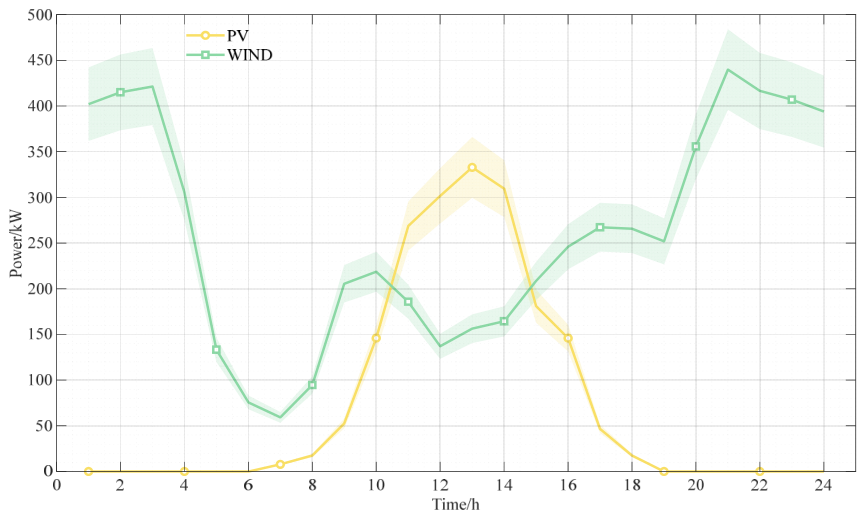
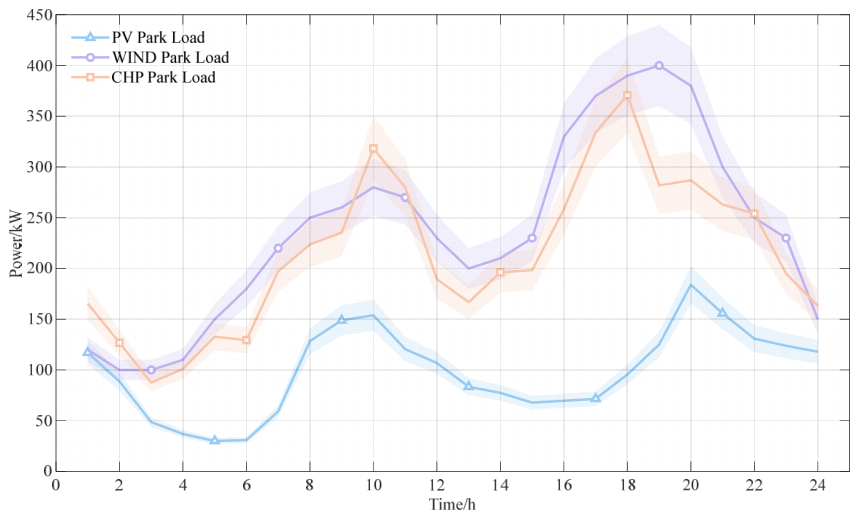
The input data include the forecasted photovoltaic output, wind power output, load demand of the three parks, and time-of-use electricity prices. The day-ahead scheduling layer uses 24 h forecast profiles as the baseline information, while the real-time scheduling layer uses scenario-dependent high-resolution profiles obtained from the uncertainty scenario set. The photovoltaic output, wind power output, and load demand are the main uncertain variables considered in the case study. Specifically, the forecast ranges of wind and photovoltaic power output are shown in
Figure 2, and the load demand ranges of the three parks are presented in
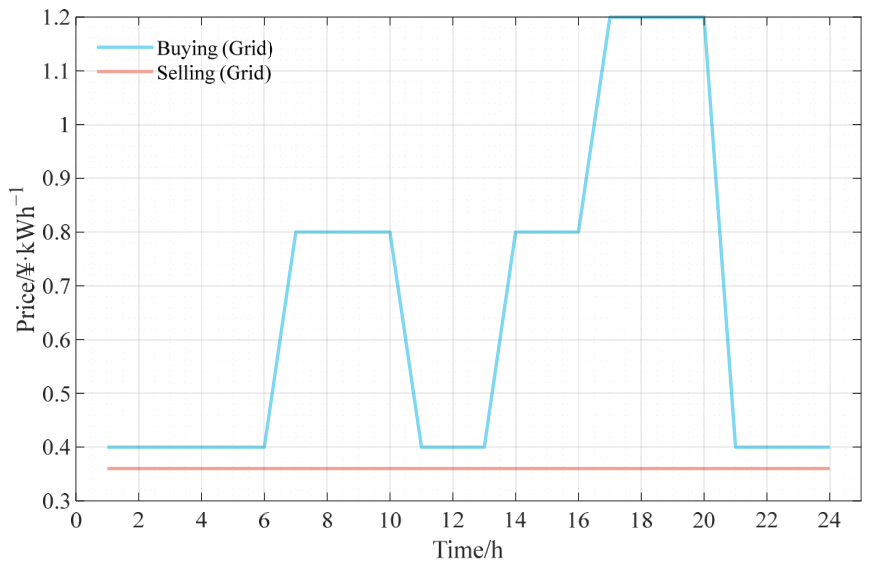
Figure 3. The electricity purchase and sale prices are regarded as known time-of-use price signals, as shown in
Figure 4.
To describe the uncertainty of renewable generation and load demand, a finite scenario set is constructed for the real-time layer. In the main case, the number of scenarios is set to 12, and the uncertainty bound is set to 0.10. For each scenario, the photovoltaic output, wind power output, and load demand are generated by applying bounded forecast errors to the corresponding day-ahead profiles. All error terms are restricted within the interval defined by the uncertainty bound. The first scenario is constructed as a conservative adverse scenario, in which photovoltaic and wind power outputs decrease while the load demands of all three parks increase. This scenario represents a high-cost operating condition caused by insufficient renewable generation and increased demand. The remaining scenarios are generated as bounded fluctuation scenarios to describe ordinary forecast deviations. For the distributionally robust optimization model, the scenario costs are not evaluated only under a fixed empirical probability distribution. Instead, the probability weights of the scenarios are allowed to vary within the CVaR risk envelope. Therefore, the model can assign greater importance to adverse high-cost scenarios while still considering all sampled scenarios. This setting enables the proposed scheduling strategy to balance operating economy and robustness under renewable generation and load uncertainty.
4.3. Overall Performance Comparison Under the DRO Setting
All cases are solved under the same scenario set, uncertainty bound, and CVaR risk level. Therefore, the comparison can reflect the operational contribution of each functional module under renewable generation and load uncertainty. The economic and risk-related results are summarized in
Table 2. The flexible resource utilization results are presented in
Table 3.
As shown in
Table 2, the Proposed case achieves the lowest objective value among the four cases. Compared with No-P2P, No-DR, and No-ESS, the objective value is reduced by 5.22%, 10.96%, and 5.05%, respectively. This indicates that the coordinated use of P2P energy exchange, demand response, and energy storage can effectively improve the overall scheduling performance under renewable generation and load uncertainty.
The comparison results also show the specific contribution of each module. When P2P exchange is removed, grid-purchase energy increases from 2411.80 kWh to 4289.26 kWh, indicating that inter-park energy sharing significantly reduces dependence on the main grid. When demand response is removed, the objective value and the standard deviation of scenario cost increase most significantly, showing that DR contributes to both economic operation and risk mitigation. When energy storage is removed, the mean deviation cost increases from 28.99 to 78.10, demonstrating that ESS plays an important role in smoothing the deviation between day-ahead planning and real-time execution.
In addition, the Proposed case achieves the highest renewable utilization rate of 82.76%. This result indicates that the proposed model does not improve economic performance by sacrificing renewable energy consumption. Instead, it coordinates P2P exchange, DR, and ESS to enhance renewable energy utilization while maintaining lower operating cost and better risk-control performance.
4.4. Power Balance Analysis of Three Parks
To further reveal the operational mechanism of the proposed scheduling model, this section analyzes the power balance results of the three parks under the proposed DRO dispatch case.
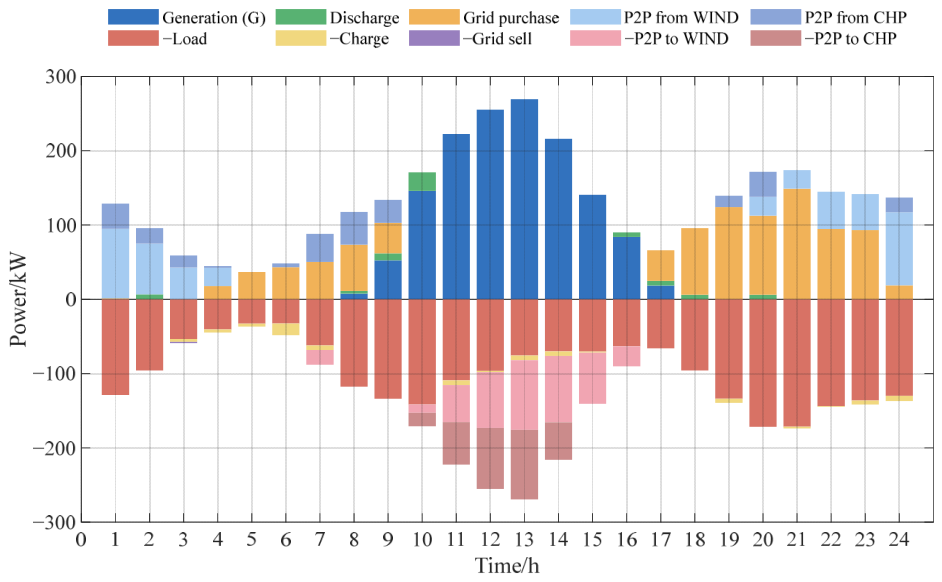
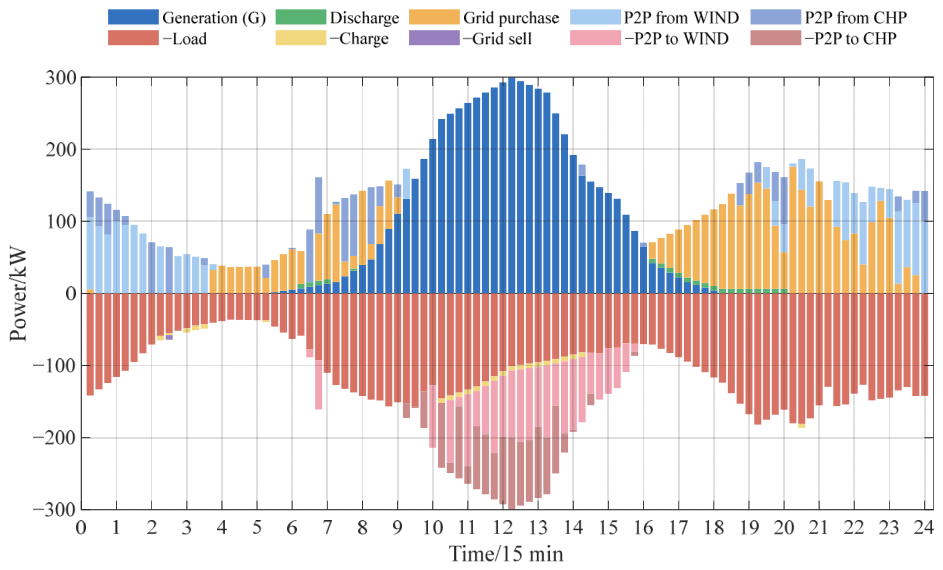
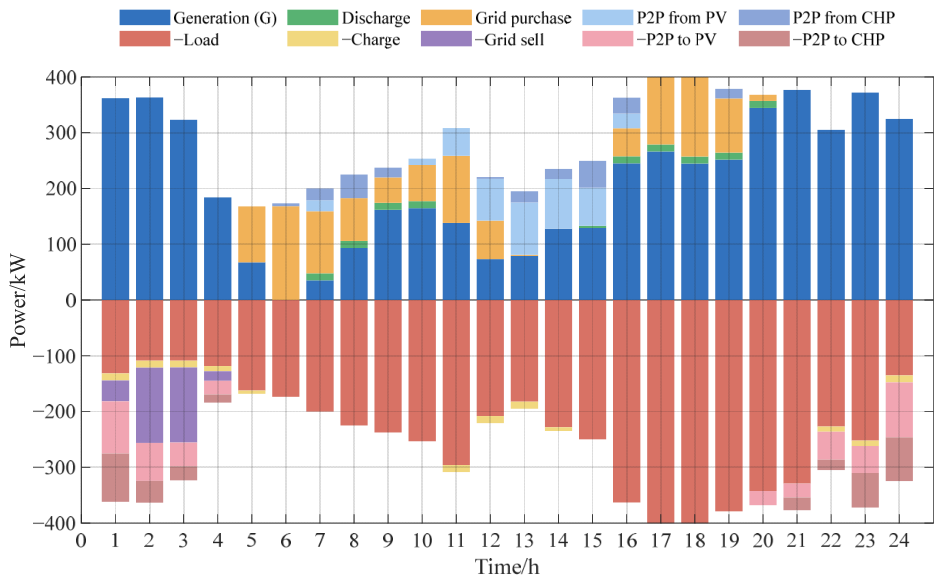
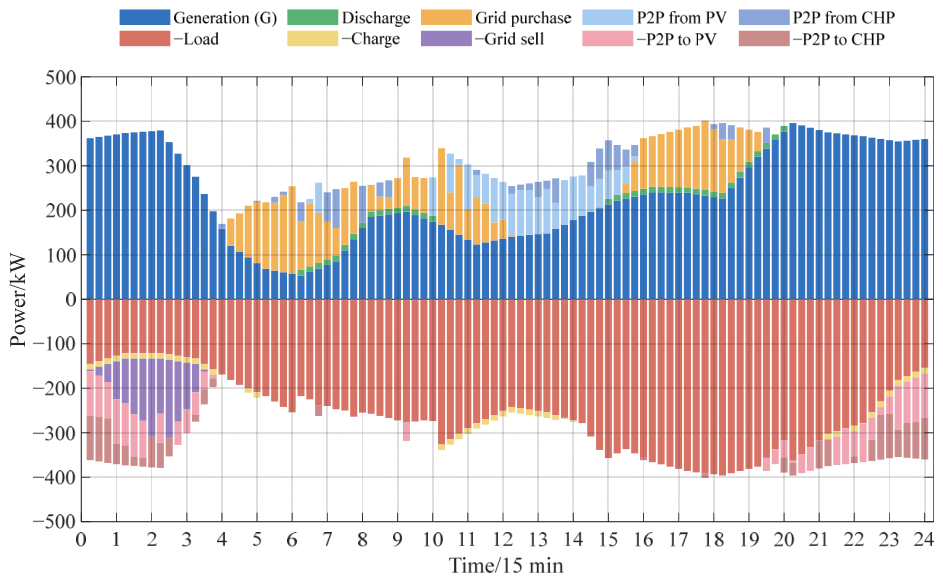
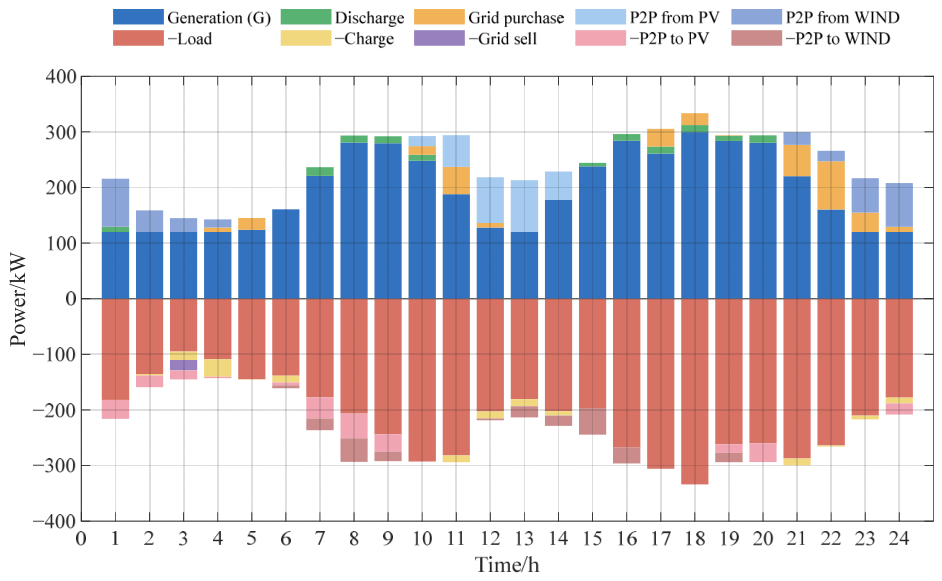
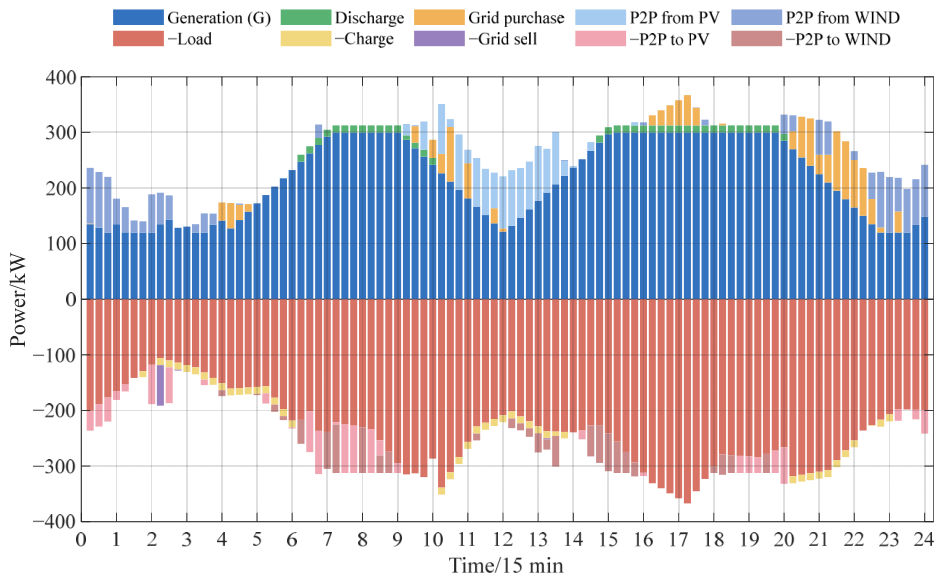
Figure 5,
Figure 6,
Figure 7,
Figure 8,
Figure 9 and
Figure 10 illustrate the day-ahead and intraday power balance results for the photovoltaic park, wind power park, and CHP park, respectively. Specifically,
Figure 5 and
Figure 6 show the day-ahead and intraday power balance of the PV park,
Figure 7 and
Figure 8 correspond to the wind power park, and
Figure 9 and
Figure 10 correspond to the CHP park.
For the photovoltaic park, the local generation is mainly concentrated during the daytime, especially around the middle of the scheduling horizon. During periods with sufficient photovoltaic output, the park can satisfy its own load demand and export surplus electricity to other parks through P2P exchange. When photovoltaic output is insufficient or fluctuates in the real-time stage, energy storage discharge, grid purchase, and P2P inflow jointly compensate for the power shortage. Compared with the day-ahead plan, the real-time power balance presents more detailed short-term adjustments, indicating that the edge-side dispatch can respond to photovoltaic uncertainty while maintaining the overall supply–demand structure.
For the wind power park, wind generation shows stronger fluctuation over the scheduling horizon. Its output does not completely coincide with the load demand profile, so the park frequently interacts with other parks and the main grid. In the day-ahead stage, the wind park participates in inter-park energy exchange according to the forecasted wind output and load demand. In the real-time stage, the P2P exchange and storage operation are adjusted according to wind power deviations. This demonstrates that the wind park mainly provides complementary support when wind output is sufficient and receives external support when wind output decreases.
For the CHP park, the CHP unit provides relatively stable generation and acts as a dispatchable supporting source in the multi-park system. Different from the photovoltaic and wind parks, the CHP park has stronger controllability and can maintain a more stable power balance under uncertain scenarios. During periods of insufficient renewable generation or high load demand, the CHP park supports the system through local generation and P2P exchange. Meanwhile, energy storage and grid interaction are used to further smooth short-term deviations and maintain operational feasibility.
Overall, the power balance results show that the proposed model can coordinate heterogeneous resources across different parks. The photovoltaic park mainly contributes daytime renewable generation, the wind park provides fluctuating but complementary renewable power, and the CHP park supplies stable dispatchable support. Through the joint operation of P2P exchange, energy storage, demand response, and grid interaction, the system can maintain power balance at both day-ahead and real-time timescales. The comparison between the day-ahead and intraday results further indicates that the proposed DRO scheduling model can preserve the main structure of the day-ahead plan while allowing necessary intraday corrections under uncertainty.
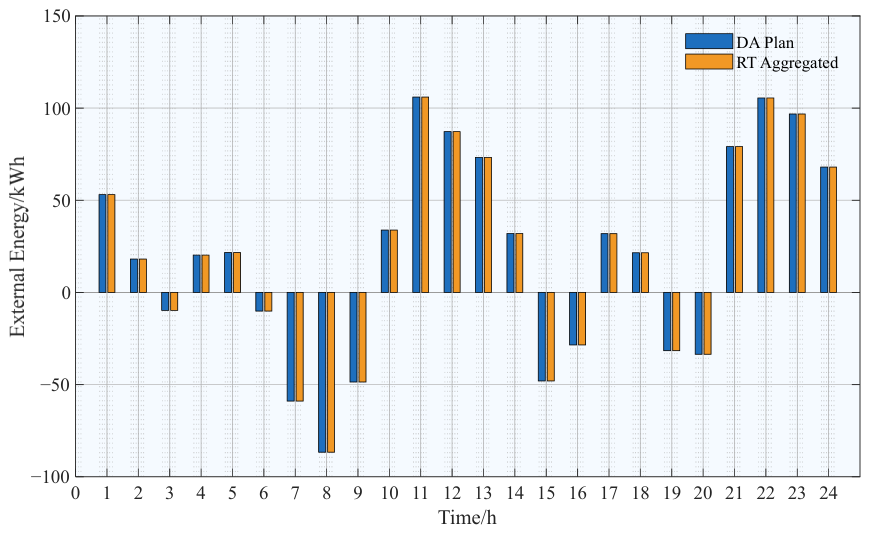
4.5. Verification of DA–RT Net External Energy Binding
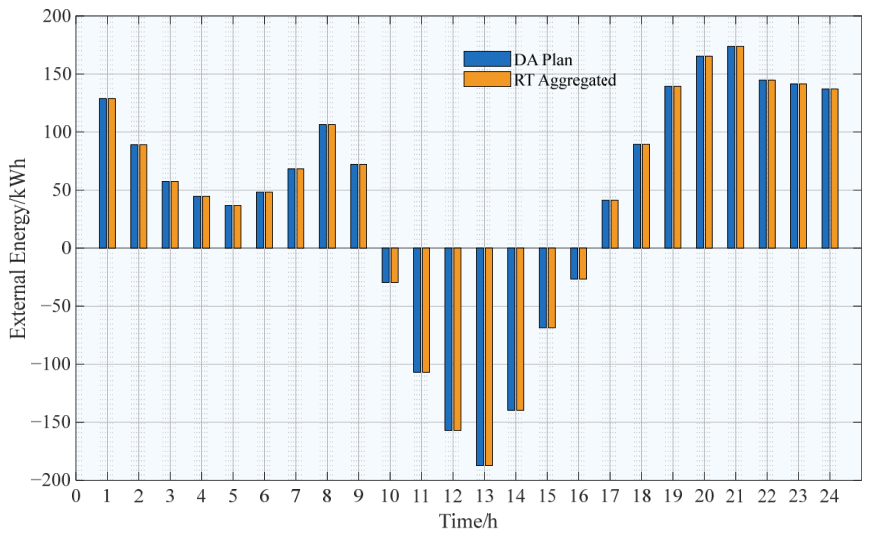
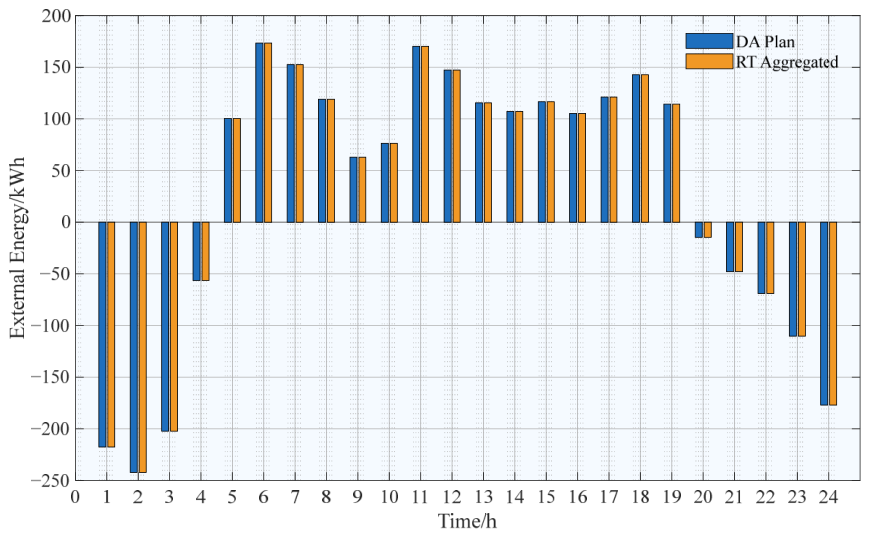
The DA–RT net external energy binding is introduced to maintain consistency between the day-ahead plan and intraday execution. In the proposed model, the net external energy of each park is determined by grid interaction and P2P energy exchange.
Figure 11,
Figure 12 and
Figure 13 show the DA–RT net external energy binding results of the PV park, wind park, and CHP park, respectively. The two sets of bars are close in most periods, indicating that the intraday dispatch maintains good consistency with the day-ahead plan. The small differences between them reflect necessary intraday corrections caused by renewable generation and load uncertainty.
As shown in
Figure 11,
Figure 12 and
Figure 13, the aggregated intraday net external energy generally follows the day-ahead planned value in all three parks. The consistency between the two bar groups demonstrates that the proposed soft-binding mechanism can effectively transmit the day-ahead energy schedule to the intraday execution layer. The results also show that the intraday layer does not rigidly replicate the day-ahead plan. Instead, it performs limited corrections according to the scenario-dependent renewable output and load demand. This is consistent with the soft-binding formulation in the proposed model. The deviation penalty suppresses excessive departures from the day-ahead plan, while the soft constraint still allows feasible intraday adjustments under uncertainty.
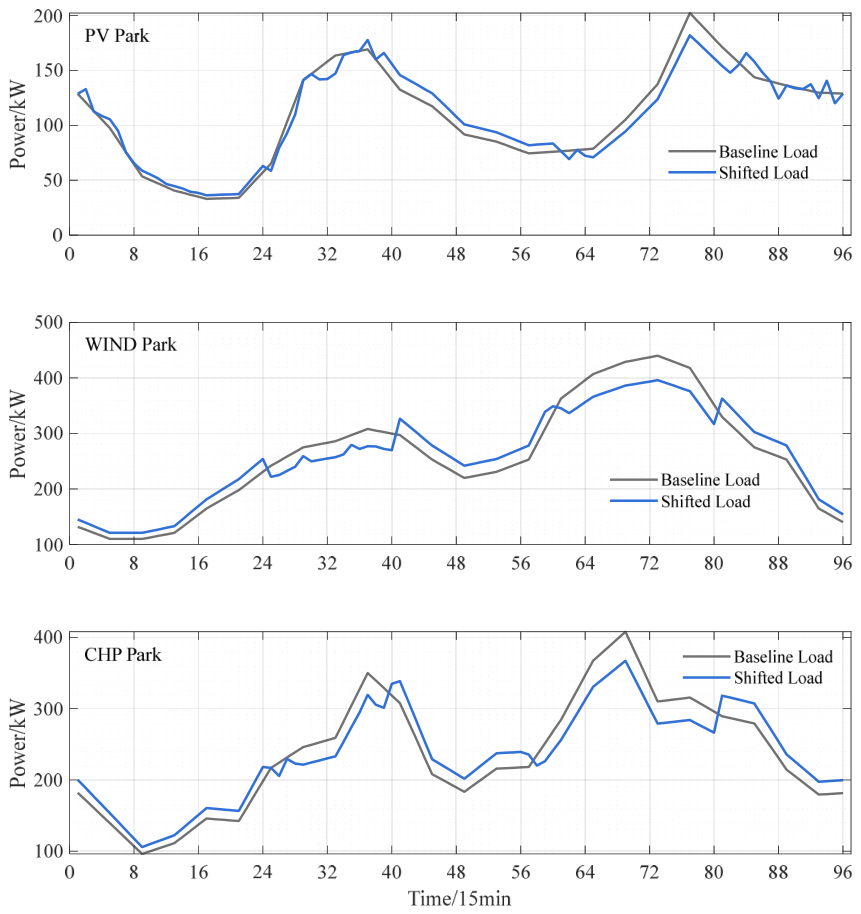
4.6. Demand Response Analysis
Figure 14 presents the intraday baseline load and shifted load profiles of the three parks after demand response. The comparison directly reflects the regulation effect of flexible loads under renewable generation uncertainty, electricity price signals, and DA–RT consistency requirements.
As shown in
Figure 14, the shifted load profiles generally follow the baseline load trends, while moderate adjustments appear in several periods. The load is redistributed according to renewable output, system balance requirements, and electricity price signals. This indicates that the proposed model does not rely on large-scale load reshaping in the intraday layer, but uses demand response as a flexible resource for local correction and short-term balancing.
The effectiveness of demand response is also supported by the comparative results in
Section 4.3. When demand response is removed, the objective value increases from ¥4478.88 to ¥5030.29, and the standard deviation of scenario cost increases from 81.98 to 189.19. This demonstrates that demand response contributes to both operating cost reduction and risk mitigation under uncertain scenarios.
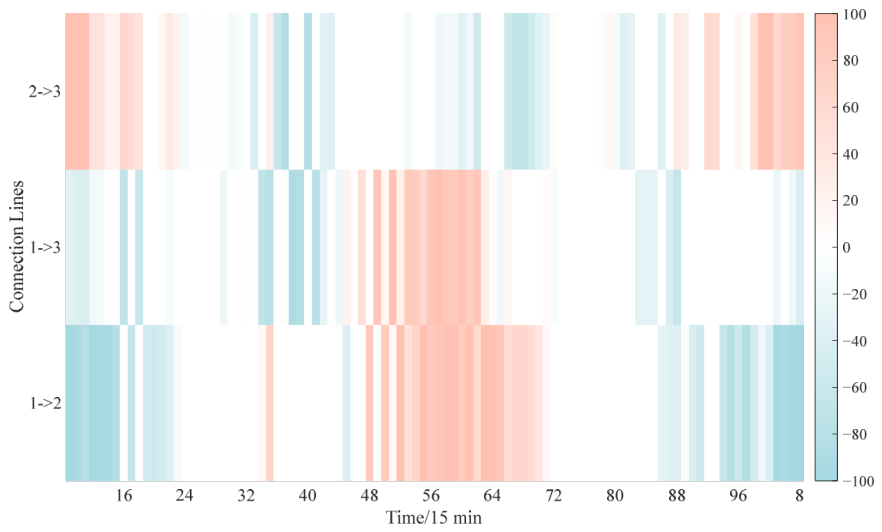
4.7. P2P Energy Exchange Analysis
Figure 15 shows the intraday P2P energy exchange among the three parks. Positive and negative values indicate opposite power-flow directions on each P2P line. The variation in P2P power indicates that the parks exchange energy according to their local supply–demand conditions, enabling spatial complementarity among PV, wind, and CHP resources.
The contribution of P2P exchange is further supported by the ablation results in
Section 4.3. When P2P exchange is removed, the grid-purchase energy increases from 2411.80 kWh to 4289.26 kWh, and the objective value increases from ¥4478.88 to ¥4725.57. Therefore, P2P exchange is not only a physical energy-sharing channel, but also an effective mechanism for reducing grid dependence and improving multi-park coordination.
4.8. Sensitivity Analysis of the Uncertainty Bound
To further evaluate the influence of renewable generation and load uncertainty on the proposed DRO scheduling model, sensitivity analysis is conducted by changing the uncertainty bound
ε. Four values are considered: 0.05, 0.10, 0.15, and 0.20. A larger ε represents a wider uncertainty range of photovoltaic output, wind power output, and load demand. The results are summarized in
Table 4.
As shown in
Table 4, the objective value increases from 3852.13 to 5893.91 as ε increases from 0.05 to 0.20. Meanwhile, the maximum scenario cost, standard deviation of scenario cost, and mean deviation cost also increase. This indicates that a wider uncertainty bound leads to higher operating risk and requires a more conservative scheduling strategy. The grid-purchase energy increases from 1736.42 kWh to 4053.47 kWh, while renewable utilization decreases from 90.71% to 63.33%. This shows that when renewable generation and load uncertainty becomes stronger, the system relies more on the main grid to maintain supply–demand balance. Therefore, the increase in operating cost reflects the robustness cost required to guarantee feasible operation under a wider uncertainty set.
4.9. Stress-Test Analysis
To further examine the adaptability of the proposed DRO scheduling model under constrained flexible resources, stress tests are conducted by reducing the P2P transmission capacity and energy storage capacity. Different from the uncertainty-bound sensitivity analysis in
Section 4.8, this section focuses on whether the system can maintain feasible and stable operation when the physical regulation capability is weakened. The results are summarized in
Table 5.
As shown in
Table 5, the proposed model remains feasible under all reduced-flexibility cases. When the P2P capacity decreases from 75% to 25%, P2P energy exchange decreases from 2126.46 kWh to 1062.45 kWh, while grid-purchase energy increases from 2502.03 kWh to 3369.24 kWh. This indicates that limited P2P capacity weakens inter-park energy complementarity and shifts part of the balancing task to the main grid. When the energy storage capacity is reduced, ESS throughput decreases significantly from 163.86 kWh to 48.88 kWh. The objective value increases from 4518.81 to 4609.42, indicating that insufficient storage capacity weakens inter-temporal regulation. However, the system still maintains feasible operation because P2P exchange, demand response, and grid interaction can provide complementary flexibility.
Overall, the stress-test results show that the proposed DRO model can remain operationally feasible when flexible-resource capacity is reduced. Lower P2P or ESS capacity increases the operating objective to different degrees, but the coordinated use of multiple flexibility resources helps preserve system robustness under constrained conditions.
5. Conclusions
This paper proposes a distributionally robust day-ahead–intraday coordinated scheduling model for multi-park integrated energy systems under a cloud-edge collaborative architecture. The model incorporates a CVaR-based DRO objective to address photovoltaic, wind power, and load uncertainty, and jointly considers P2P energy exchange, demand response, energy storage, and soft DA–RT energy binding. The main conclusions are as follows:
First, the proposed model improves the overall scheduling performance under uncertainty. Case study results show that the Proposed case achieves the lowest objective value. Compared with No-P2P, No-DR, and No-ESS, the objective value is reduced by 5.22%, 10.96%, and 5.05%, respectively.
Second, the three flexible mechanisms play complementary roles. P2P exchange reduces dependence on the main grid through inter-park energy sharing. Demand response reduces operating cost and scenario cost fluctuations through flexible load adjustment. Energy storage supports inter-temporal regulation and helps smooth the deviation between day-ahead planning and intraday execution.
Third, the DA–RT soft-binding mechanism maintains plan-execution consistency while allowing necessary intraday corrections. The net external energy binding results show that the aggregated intraday execution generally follows the day-ahead planned values, confirming the effectiveness of the proposed soft-binding formulation.
Fourth, the sensitivity and stress-test results verify the robustness of the proposed model. A larger uncertainty bound leads to higher operating costs and grid-purchase energy, reflecting the robustness cost under wider uncertainty sets. Under reduced P2P or energy storage capacity, the model can still maintain feasible scheduling by coordinating multiple flexibility resources.
Overall, the proposed model provides an effective optimization approach for cloud-edge collaborative multi-park integrated energy systems, achieving a balance among operating economy, renewable energy utilization, risk control, and execution feasibility.
Future work will extend the framework to electricity–heat–gas–hydrogen coupling, market-oriented mechanisms such as dynamic P2P pricing and carbon trading, and data-driven rolling optimization methods for more adaptive real-time operation.