Article

Synergistically Controlled Nest-Shaped Microporous Silicon Anode with a Thin-Film Coating and a Hard Carbon Nanotemplate Obtained from ZIF-67 for Highly Stable Lithium-Ion Batteries

1
School of Materials and Energy, Guangdong University of Technology, Guangzhou 510006, China
2
School of Material Science and Engineering, Hebei University of Science and Technology, Shijiazhuang 050018, China
*
Author to whom correspondence should be addressed.
These authors contributed equally to this work.
Energies 2026, 19(13), 3039; https://doi.org/10.3390/en19133039
Submission received: 18 May 2026 / Revised: 11 June 2026 / Accepted: 25 June 2026 / Published: 27 June 2026
(This article belongs to the Section D2: Electrochem: Batteries, Fuel Cells, Capacitors)

Abstract

Silicon anodes hold great promise in high-energy lithium-ion batteries (LIBs) owing to their ultrahigh theoretical specific capacity, appropriate operating voltage, and low costs. However, the drastic volume expansion, inferior electronic conductivity, and unstable solid electrolyte interphase of Si anodes severely restrict their practical application. Herein, a nest-shaped microporous silicon (NMPSi) is rationally designed via acid–base co-etching and then synergistically regulated by surface thin-film carbon coating and ZIF-67-derived hard carbon nanotemplate (NMPSi@THC) by an in situ liquid-phase coating strategy. The constructed unique architecture is capable of buffering the huge volume expansion of inner NMPSi during cycling and constructing an optimized electron/ion transport network, thereby stabilizing the SEI film and preserving the electrode’s structural integrity. When it is evaluated as a LIB anode, the NMPSi@THC exhibits typically improved initial coulombic efficiency (ICE) and outstanding long-life cyclic stability (622.7 mAh g−1 after 300 cycles at 1 A g−1 and 2 mg cm−2). Furthermore, the NMPSi@THC//LiFePO4 full cell delivers an ultrahigh ICE of 94% and a capacity retention rate of 86%, demonstrating its practical application potential. Compared with most recently reported Si anodes, this report delivers better cycling stability and maintains more intact electrode structure under relatively high current density and areal mass loading in half/full cells after long-term cycling. This research offers a convenient and scalable route to fabricate highly stable microporous Si anodes toward high-energy and long-lifespan LIBs.

1. Introduction

Silicon (Si) is considered an important innovative anode material to boost the energy density of LIBs on account of their extremely high theoretical specific capacity, suitable operating voltage, and low costs [1,2]. Nevertheless, their large-scale commercialization still faces critical challenges: (1) huge volume expansion (~300%) during (de)lithiation causes electrode pulverization, leading to rapid capacity decay; (2) extremely poor electrical conductivity (~10−3–10−4 S cm−1) results in sluggish reaction kinetics; and (3) labile solid electrolyte interphase (SEI) films continuously consume electrolyte and active lithium, bringing low ICE and shortened cycle life, limiting their industrial implementation [3,4]. Moreover, achieving excellent electrochemical performance under high areal loading and large current density remains a major obstacle for its commercialization.
Recently, enormous efforts have been made to tackle these bottleneck issues by designing and synthesizing plenty of Si anode materials with tailored structures and optimized sizes. The scalable fabrication of low-cost and high-tap-density microporous Si (MPSi) is an effective method to mitigate the volume effect and reduce agglomeration and interfacial side reactions [5,6,7]. This benefit originates from its adequate internal buffer space and hierarchical pore structure with accelerated ion/electron transport efficiency [8,9].
However, their stability improvement strongly relies on surface-coated nanolayers with high-conductivity networks, which can enable precise regulation of volume expansion and structural stability for improved lithium storage performance [10,11,12,13,14,15]. In particular, thin hard carbon coating layers have been extensively verified to tune the electrochemical properties of Si anodes in numerous previous works [16,17,18,19]. Metal-organic frameworks (MOFs) are regarded as attractive precursors for advanced energy storage materials. MOF can be readily pyrolyzed under an inert atmosphere to yield a homogeneously dispersed carbon nanotemplate, which can synergistically facilitate the construction of high-efficiency conductive carbon networks [20,21]. In recent years, hard carbon-modified Si anodes have attracted extensive research interest since they can resist cycling-induced mechanical stress and reinforce structural stability during cycling [22,23,24,25,26,27]. For instance, Chen et al. [20] reported a Si embedded in nitrogen-doped carbon frameworks composite with uniformly distributed Co, which can be easily synthesized from ZIF-67 precursors. Yu et al. [26] constructed a core-shell architecture Si composite, where the resultant layered carbonized biphenyl-polyoxadiazole uniformly encapsulates Si particles, serving as a robust mechanical skeleton. Therefore, this work aims to optimize interface stability, reaction kinetics, and structural durability and explore a novel feasible route for synergistic regulation using thin-layer carbon and MOF-derived carbon nanotemplates toward commercial high-performance MPSi anodes.
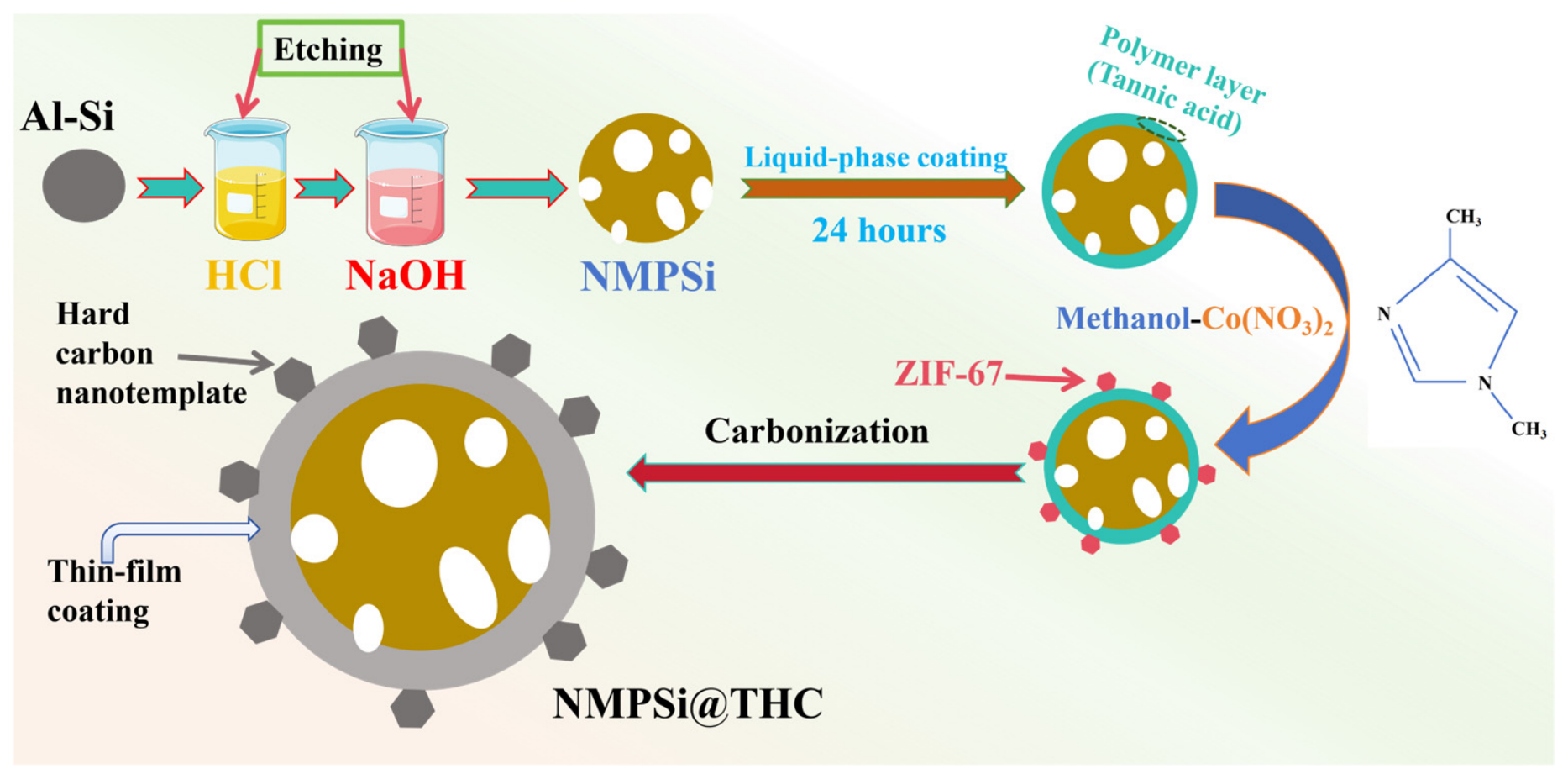
Herein, we present a viable structural design and controllable preparation route to obtain a nest-shaped microporous silicon (NMPSi) via acid–base co-etching and then apply a surface thin-film carbon coating and ZIF-67-derived hard carbon nanotemplate (THC) to synergistically regulate the inner NMPSi by an in situ liquid-phase coating strategy (Figure 1). The surface’s distinctive structure is conducive to alleviating volume expansion and stabilizing the SEI film of internal NMPSi. Meanwhile, the ZIF-67-derived carbon nanotemplates further optimize the electronic conductivity by building a robust nanocarbon network, thereby endowing exceptional structural stability and superior electrochemical performance. The NMPSi@THC anode delivers greatly enhanced ICE, superior rate, and cycling performance under high current densities and high areal mass loading. Specifically, it achieves a large reversible specific capacity of 622.7 mAh g−1 after 300 cycles under 1 A g−1 and 2 mg cm−2. Additionally, the NMPSi@THC//LiFePO4 (LFP) full cell attains an ultrahigh ICE of 94% and a capacity retention of 86%. The integrated synthetic strategy of acid–base co-etching and an in situ liquid-phase coating strategy introduces the surface ZIF-67-derived hard carbon nanotemplate and thin-film carbon coating to tune the inner NMPSi, laying a solid foundation for highly stable LIB anodes.

2. Experiments

2.1. Materials

Al-Si alloy spheres were purchased from Xingtai Benyu Metal Co., Ltd., Xingtai, China. Hydrochloric acid (HCl), Sodium hydroxide (NaOH), tris(hydroxymethyl)amino methane, tannic acid, cobalt nitrate, dimethylimidazole and other materials were bought from Shanghai McLyn Biochemical Technology Co., Ltd., Shanghai, China. without further purification before use.

2.2. Synthesis of NMPSi

NMPSi was fabricated via an acid–base co-etching strategy [11,16]. Briefly, 3 g Al-Si alloy spheres with a mass ratio of Al:Si = 80:20 and an average diameter of 10 μm were added into 200 mL anhydrous ethanol and ultrasonically cleaned. Subsequently, the alloy spheres were subjected to low-speed acid etching for 8 h using 2 mol L−1 HCl. The raw product was collected after washing with de-ionized (DI) water and vacuum drying. Using an identical etching protocol, the sample was further etched with a 2 mol L−1 NaOH solution to obtain nest-like micron porous silicon.

2.3. Synthesis of NMPSi@THC Composites

NMPSi@THC was synthesized via a modified in situ liquid-phase coating strategy [10,20]. Firstly, NMPSi (0.1 g) was integrated into 100 mL DI water and then ultrasonically dispersed, followed by the slow addition of 1 g tris (hydroxymethyl) aminomethane to create an alkaline environment. Afterwards, 0.2 g tannic acid was slowly introduced into the above dispersion, and the reaction proceeded under stirring at ambient temperature for 24 h to form a polytannic acid layer on the NMPSi surface. After washing and drying, the solid product was immersed in 20 mL methanol containing 0.5 g cobalt nitrate. Following a 15 min ultrasonic treatment, a 20 mL methanol solution with 2 g dimethylimidazole was gradually dropped into the mixture for the in situ growth of ZIF-67. After 24 h, the product was separated and washed by methanol. Finally, the dried precursor was placed in a tube furnace, heated up to 800 °C (5 °C min−1) under Ar, and carbonized for 2 h. Then, the NMPSi@THC composite was obtained after filtration, DI water washing, and vacuum drying.

2.4. Characterizations

The morphological features and microstructural information were characterized by scanning electron microscopy (SEM, SU8220, Hitachi, Tokyo, Japan) and transmission electron microscopy (TEM, Talos F200S, FEI, Hillsboro, OR, USA). Nitrogen adsorption–desorption tests (ASAP 2460, Micromeritics, Norcross, GA, USA) were utilized to measure specific surface area and pore size distribution using Brunauer–Emmett–Teller (BET) and Barrett–Joyner–Halenda (BJH) calculation models. X-ray diffraction (XRD, D/MAX-Ultima IV, Rigaku, Tokyo, Japan) and X-ray photoelectron spectroscopy (XPS, ESCALAB 250 Xi, Thermo Fisher Scientific, Waltham, MA, USA) were adopted to characterize crystalline structure and surface elemental composition. Thermogravimetric analysis (TGA, STA449F5, NETZSCH, Selb, Bavaria, Germany) under an air atmosphere from 30 °C to 800 °C at a heating rate of 10 °C min−1 was used to acquire the carbon content and thermal stability of different NMPSi@THC samples.

2.5. Electrochemical Measurements

Electrochemical performance was tested with CR2032 coin cells. Working electrodes were prepared by coating a homogeneous slurry containing 80 wt% active substance, 10 wt% Super P, and 10 wt% sodium alginate binder on copper foil. Afterwards, the electrode sheets were dried and cut into round disks. For all electrochemical measurements, 1 M LiPF6 dissolved in diethyl carbonate/ethyl methyl carbonate/ethylene carbonate (a volume ratio of 1:1:1) served as the electrolyte, polypropylene film acted as the separator, and Li foil functioned as the counter electrode. Galvanostatic charge–discharge (GCD) measurements of half cells were implemented within 0.01–1.5 V using a battery testing device (CT-4008, Neware, Shenzhen, China). Cyclic voltammetry (CV) and electrochemical impedance spectroscopy (EIS) were measured on an electrochemical workstation (CHI760E, CH Instruments, Shanghai, China). The initial five CV curves were collected at a scan rate of 0.1 mV s−1 from 0.01 to 3 V. EIS tests were conducted over 0.01–100 kHz with 5 mV alternating current amplitude. For full-cell characterization, pre-lithiated NMPSi@THC acted as anode and commercial LFP as cathode, with a negative-to-positive capacity ratio of 1.1:1. Full cells were conducted between 3.0 and 4.3 V at 0.5 C (1 C = 170 mA g−1, calculated based on the mass of LFP cathode material).

3. Results and Discussion

3.1. Structure and Composition of NMPSi@THC

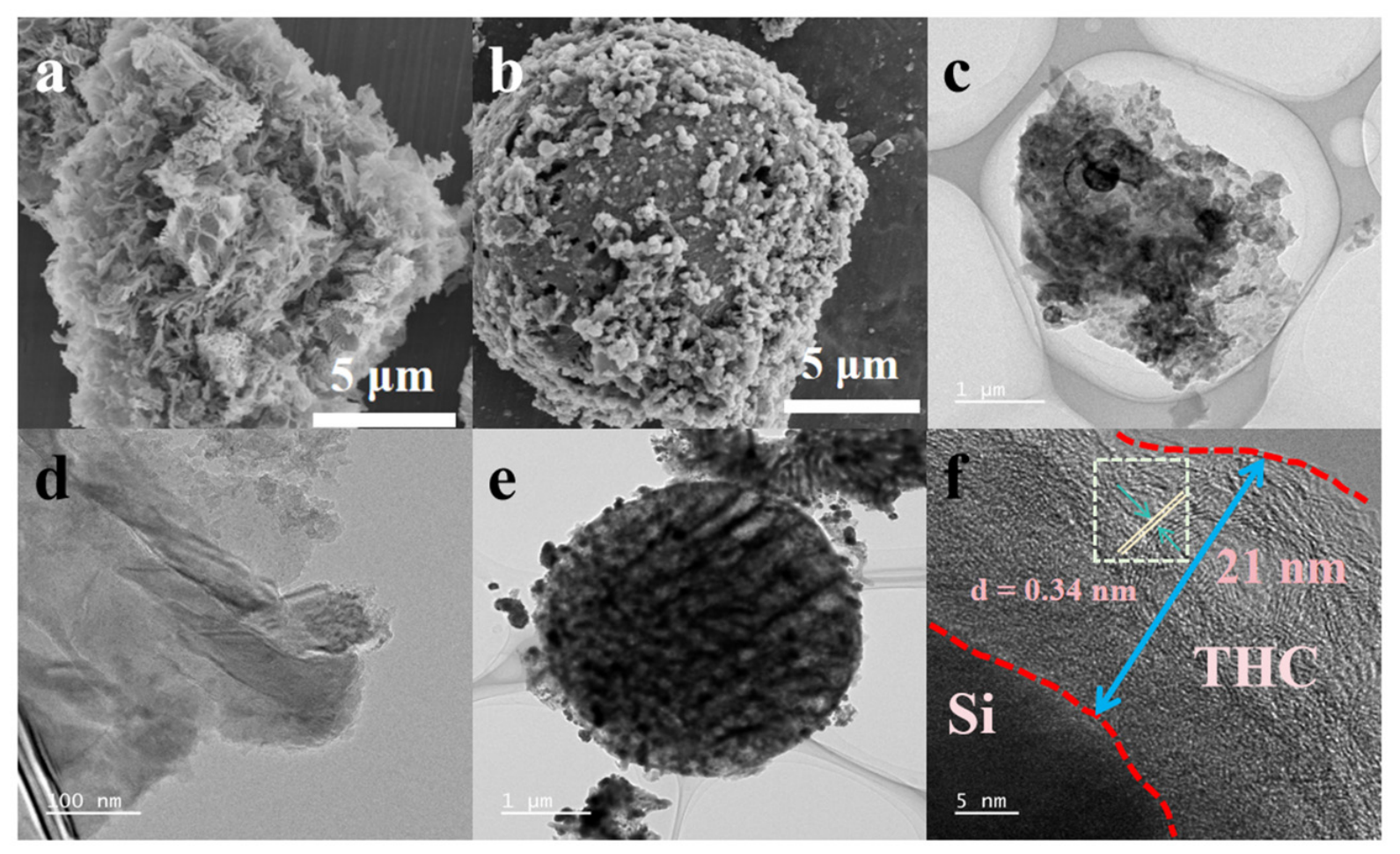
The morphological and microstructural characteristics of NMPSi and NMPSi@THC were systematically analyzed by SEM and TEM. As displayed in Figure 2a, the NMPSi exhibits a hierarchical porous, wrinkled sheet-like morphology with an interconnected disordered network, which is typical of micron Si frameworks [28,29,30]. In sharp contrast, after the surface modification with THC (Figure 2b), the NMPSi@THC composite preserves the original spherical morphology while displaying a thin-film carbon coating and ZIF-67-derived hard carbon nanotemplate on the surface, confirming the homogeneous coating of THC on the Si scaffold. TEM analysis further reveals the detailed structural evolution. Low-magnification TEM images (Figure 2c,d) reveal that the bare NMPSi consists of thin, flexible, and crumpled nanosheets with a highly porous internal structure that favors electrolyte infiltration and lithium ion diffusion [18,31,32,33]. Figure 2e shows a uniform thin-film carbon coating and ZIF-67-derived hard carbon nanotemplate on the NMPSi surface. Meanwhile, the high-magnification TEM image (Figure 2f) clearly resolves a uniform, conformal THC coating (~21 nm thick) wrapping around the Si core. A lattice fringe spacing of 0.34 nm matches the characteristic crystal plane (002) of graphitic carbon, confirming the complete encapsulation of THC [34,35,36]. Such a core-shell configuration preserves the structural stability and forms a robust conductive outer layer [37,38].
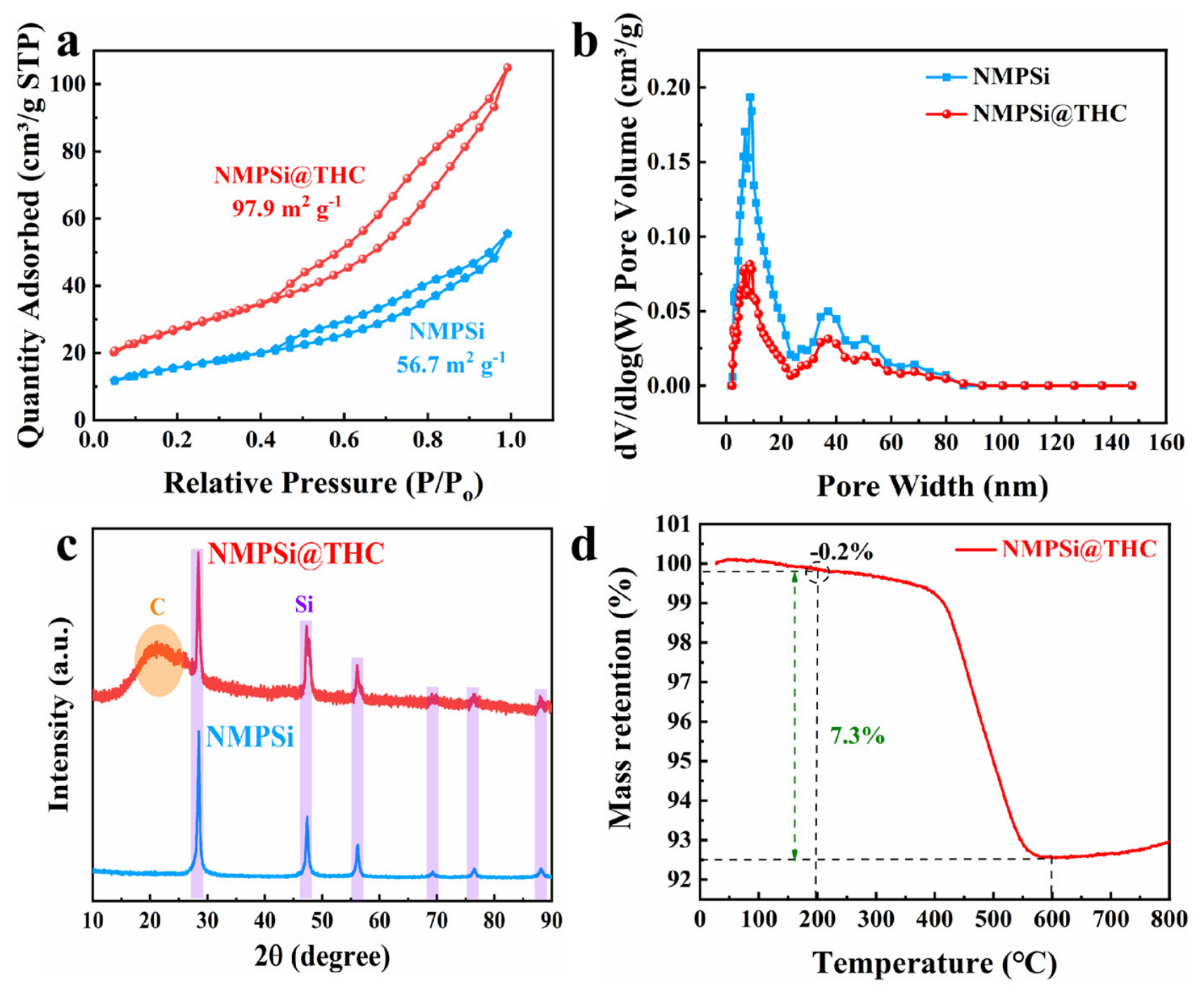
The textural properties and Li+ transport of NMPSi and NMPSi@THC were assessed via N2 adsorption-desorption tests (Figure 3a). The specific surface area rises from 56.7 m2 g−1 for NMPSi to 97.9 m2 g−1 after THC surface coating. This enhancement stems from the introduction of mesoporous THC coating, which provides extra surface area and porous channels for electrolyte penetration and Li-ion transport [39,40]. The corresponding pore size (Figure 3b) reveals that the average pore diameter of NMPSi (6.8 nm) is larger than that of NMPSi@THC (6.5 nm), indicating that the pore structure is slightly reduced after THC encapsulation, consistent with the BET results. The optimized mesoporous network not only provides abundant continuous transport channels for unobstructed solvated Li+ migration but also enlarges the electrode-electrolyte contact area to boost electrolyte accessibility. Consistent with EIS results, NMPSi@THC possesses a higher Li+ diffusion coefficient, verifying optimized porosity facilitates ionic transportation [34]. XRD patterns (Figure 3c) confirm the crystalline nature of the Si core in both samples. All diffraction peaks of NMPSi and NMPSi@THC align well with the cubic crystal phase of Si (JCPDS No. 27-1402), with no obvious shift in peak position after coating, indicating that THC exerts no change on crystal phase [18]. Notably, a broad hump around 25° appears in the XRD pattern of NMPSi@THC, matching the amorphous carbon in the THC layer, further confirming the successful coating of the thin hard carbon shell [19]. TGA was carried out to determine the carbon proportion of NMPSi@THC (Figure 3d). The slight initial weight loss (~0.2%) below 150 °C stems from the elimination of adsorbed water and residual organic solvents. An obvious mass loss of 7.3% takes place from 350 to 550 °C, matching the oxidation of the THC in the air atmosphere. This result confirms that the mass ratio of THC in the NMPSi@THC is approximately 7.3%, which is optimal to balance electronic conductivity and structural stability without sacrificing the active Si content [41]. Furthermore, XPS results (Figure S1) confirm the presence of cobalt (Co) derived from ZIF-67 in NMPSi@THC. The introduced Co can effectively create additional electrochemical active sites and enhance electrical conductivity [11].

3.2. Electrochemical Performance

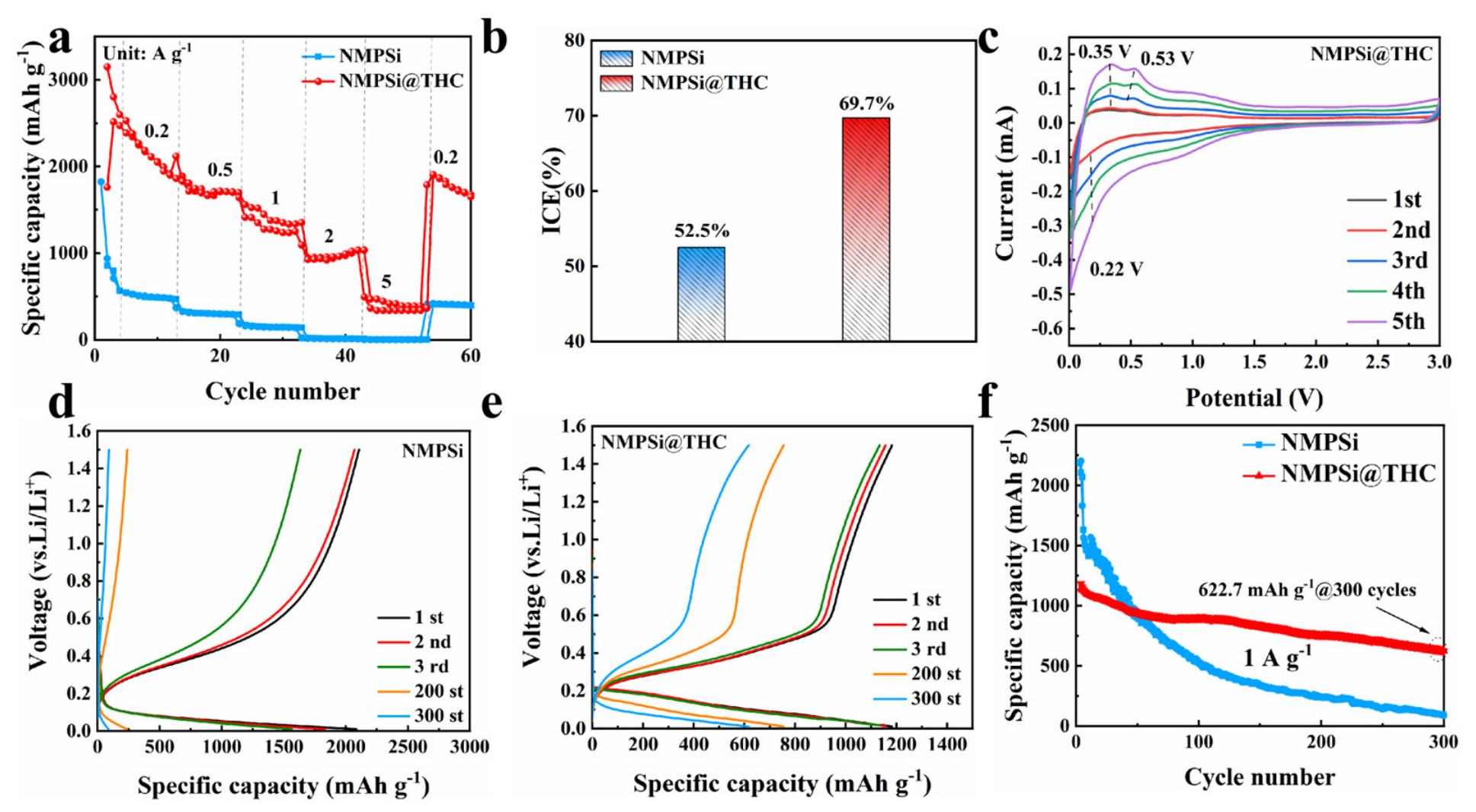
The electrochemical kinetics and lithium storage behavior of NMPSi and NMPSi@THC were systematically investigated via CV, rate capability, and long-term cycling. The rate capability (Figure 4a) of NMPSi@THC electrodes shows substantially higher specific capacity retention than the pristine NMPSi at current densities of 0.2–5 A g−1. At 0.2 A g−1, NMPSi@THC retains a high specific capacity of 1791.3 mAh g−1, while NMPSi only provides a much lower capacity (400 mAh g−1). NMPSi@THC still delivers stable specific capacity (338.9 mAh g−1) at a high current density of 5 A g−1, whereas the NMPSi electrode suffers from rapid capacity fading. This remarkable rate performance of NMPSi@THC originates from the robust thin-film carbon coating and ZIF-67-derived hard carbon nanotemplate, which alleviates volume change during repeated Li+ insertion/extraction [19,20,21]. Apart from the conductive effect of thin-film carbon coating and hard carbon nanotemplate, metallic Co derived from ZIF-67 also contributes to enhanced electrode conductivity and faster reaction kinetics, which is beneficial to boost the rate capability under high current.
The initial Coulombic efficiency (ICE) is a critical metric for Si anodes since low ICE causes irreversible Li+ loss and limits the energy density. As shown in Figure 4b, the NMPSi@THC electrode achieves an impressive ICE of 69.7%, which is remarkably higher than that of NMPSi (52.5%). The improved ICE of NMPSi@THC is ascribed to the protection of the THC, which restrains side reactions and reduces the irreversible loss of Li ions in the first cycles. CV curves of NMPSi@THC (Figure 4c) exhibit typical Li-Si alloying/dealloying redox behavior: An intense cathodic peak located at 0.22 V matches the lithiation reaction to generate LixSi alloys, whereas two anodic peaks at 0.35 V and 0.53 V relate to the stepwise delithiation processes. The peak intensities become steady after initial cycling, revealing the generation of stable SEI film and highly reversible electrochemical redox behavior [35,40]. Figure 4d,e displays the GCD profiles of the NMPSi and NMPSi@THC electrode at selected cycles (1st, 2nd, 3rd, 200th, and 300th). The initial discharge profile presents an obvious flat region at 0.2–0.3 V (vs. Li/Li+), matching the lithiation process of Si to form LixSi [42,43,44,45,46]. Following the first cycle, the subsequent charge/discharge profiles show favorable overlap, indicating highly reversible Li+ storage in the NMPSi@THC electrode. Even after 300 cycles, the GCD curves remain well-maintained with negligible voltage polarization, demonstrating the outstanding durability and performance of NMPSi@THC anode. In contrast, the pristine NMPSi electrode exhibits severe polarization and rapid capacity degradation under the same cycling conditions (consistent with the rapid fading observed in rate tests). Figure 4f illustrates the long-life cycling stability of NMPSi@THC electrodes at 1 A g−1. The NMPSi@THC keeps a high specific capacity of 622.7 mAh g−1 after 300 cycles with much slower capacity fading compared to NMPSi. The NMPSi suffers from a drastic capacity decline, with its specific capacity declining to almost zero after 300 cycles. The superior cycling stability of NMPSi@THC further validates that the THC effectively alleviates the volume expansion-induced pulverization of Si, preserves favorable contact between active grains and the collector, and stabilizes the SEI film [25,26,27]. Meanwhile, NMPSi@THC exhibits superior reversible capacity and cycle life compared to previous MPSi anode studies (Table S1).
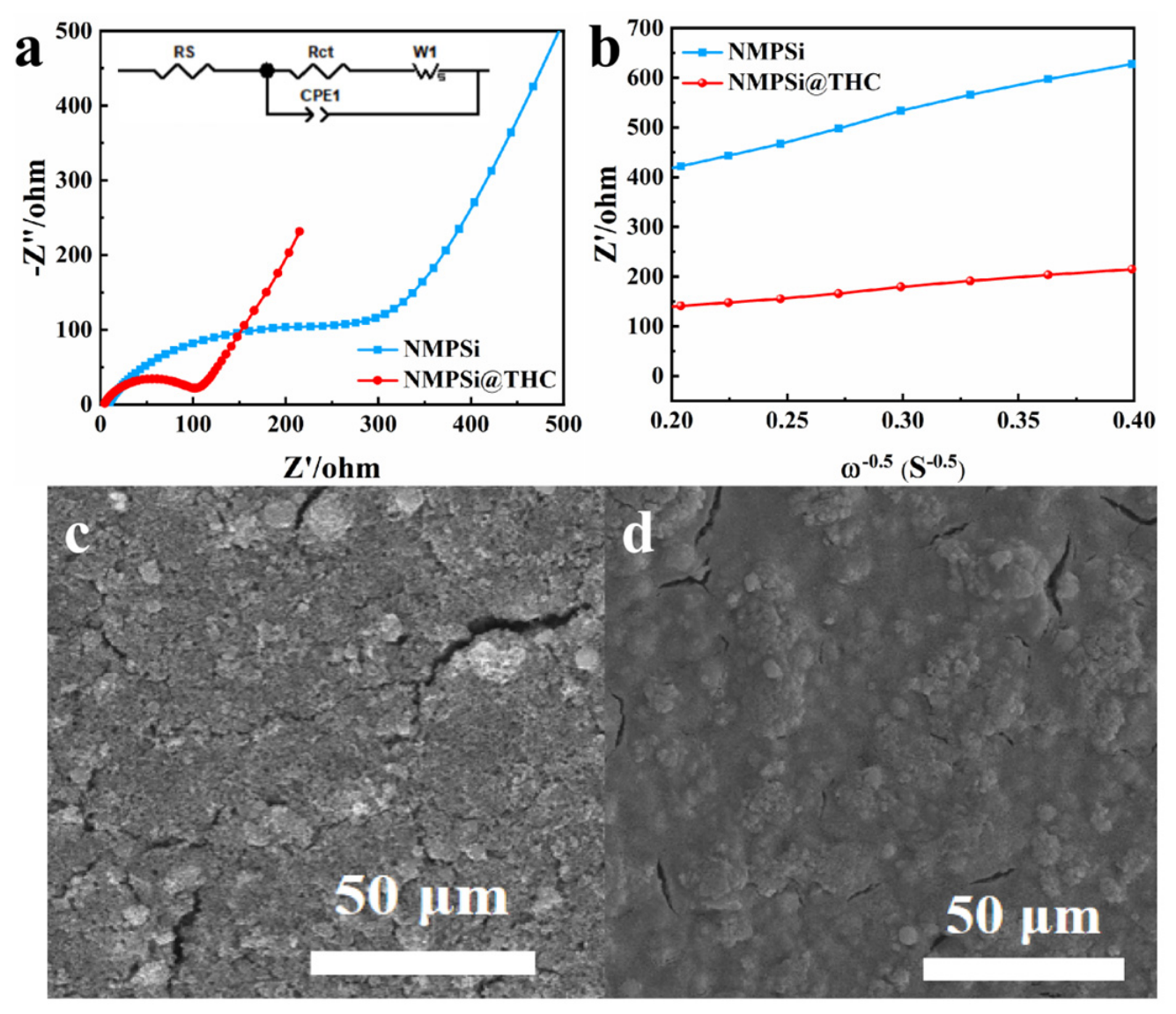
In Figure 5a, the Nyquist curves contain a depressed semicircle within the high-to-medium frequency range (charge-transfer resistance, Rct) [47]. The SEI resistance (Rs) of NMPSi@THC is 11.3 Ω, lower than that of NMPSi (17.4 Ω), indicating improved interfacial contact between the electrode and electrolyte after THC coating. More significantly, the Rct of NMPSi@THC decreases to 153.1 Ω, which is only 47.6% of that for NMPSi (321.4 Ω). This pronounced reduction in charge-transfer resistance stems from an interconnected THC carbon network boosting electronic conduction, which confirms that the conductive THC layer effectively promotes electron transfer at the electrode-electrolyte interface, thus accelerating electrochemical reaction kinetics. Meanwhile, decreased Rs confirm a stable SEI film with fewer parasitic side reactions, which provides auxiliary improvement for interfacial kinetics [32]. Consistent with EIS results, the correlation between Z′and ω−0.5 in the low frequency region (Figure 5b) reveals that NMPSi@THC exhibits a smaller slope, corresponding to a higher Li+ diffusion coefficient (DLi+), further verifying the enhanced ion transport kinetics [33]. Furthermore, the SEM top-view images were employed to analyze the micromorphology and volume expansion characteristics of NMPSi@THC electrode before/after 300 cycles. As observed from the morphological images, the NMPSi@THC electrode exhibited a relatively compact structure before cycling (Figure 5c). Notably, the NMPSi@THC electrode showed almost no obvious cracks after long-term cycling, and its architecture remained relatively intact and dense (Figure 5d). Meanwhile, SEM cross-sectional images (Figure S2) were applied to characterize the volume expansion of electrodes after cycling. The volume expansion rate of NMPSi@THC is 88%, which is significantly lower than that of NMPSi (200%). This demonstrates that the surface THC layer can effectively restrain volume change of NMPSi under high stress. XPS was performed to study the generation mechanism of stable SEI film on the THC after cycling. The Li 1s and F 1s spectra (Figure S3) show that the peak intensity of LiF in NMPSi@THC rises along with etching depth, which indicates the THC is capable of constructing a rich LiF SEI film to boost conductivity and stability [11,33,48]. This result demonstrates the synergistic effect of the thin-film coating and ZIF-67-derived hard carbon nanotemplate against the volume expansion and high internal stress of the inner NMPSi, thereby effectively enhancing the long cycling stability [11,32].
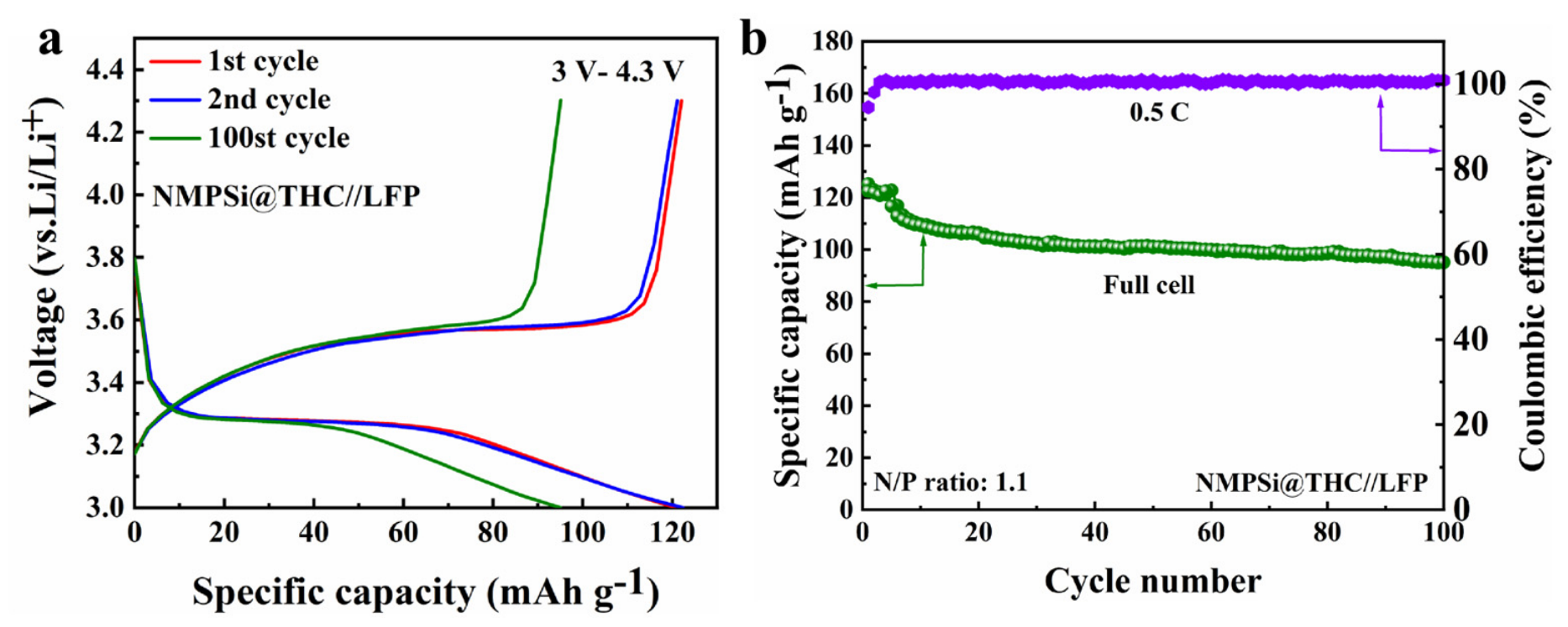
To assess the industrial practicability of NMPSi@THC for LIBs, full cells were fabricated by pairing this anode with a commercial LFP cathode (Figure 6a,b). When cycled within a voltage range from 3.0 to 4.3 V, the full cell exhibits an ultrahigh ICE of 94% at 0.5 C after pre-cycling at 0.1 C. Notably, it achieves a relatively high capacity retention of 86%, demonstrating excellent cycling stability and fast Li-ion transport kinetics [3,6,11].

4. Conclusions

In summary, a nest-shaped microporous Si anode synergistically modified by a ZIF-67-derived hard carbon nanotemplate and thin-film carbon coating (NMPSi@THC) was successfully synthesized through acid–base co-etching combined with a facile liquid-phase coating strategy. The NMPSi@THC composite presents a well-defined core-shell architecture, where a uniform and robust thin hard carbon shell tightly wraps the porous Si framework, accompanied by uniformly distributed ZIF-67-derived carbon nanotemplates. This unique hierarchical structure preserves the porous structure of NMPSi to restrain the large volume fluctuation during cycling and constructs a highly conductive network to accelerate electronic transport and ionic diffusion. Owing to the thin-film coating and ZIF-67-derived hard carbon nanotemplate, the NMPSi@THC anode exhibits remarkably enhanced electrochemical properties, including improved electronic conductivity, stabilized SEI film, and outstanding long-term stability. NMPSi@THC delivers a highly specific capacity of 622.7 mAh g−1 after 300 cycles at 1 A g−1 with an areal mass loading of 2 mg cm−2. Meanwhile, the full cell constructed with a commercial LFP cathode exhibits an ultrahigh ICE of 94% and an 86% retention rate after 100 cycles. Our study demonstrates a scalable approach to obtain highly stable MPSi anodes by integrating a ZIF-67-derived hard carbon nanotemplate and thin-film carbon modification toward practical LIB commercial applications.

Supplementary Materials

The following supporting information can be downloaded at: https://www.mdpi.com/article/10.3390/en19133039/s1, Figure S1: XPS full spectra of NMPSi@THC; Figure S2: Cross-sectional SEM images of NMPSi and NMPSi@THC before and after cycling; Figure S3: XPS spectra of NMPSi@THC electrode after cycling: (a) Li 1 s and (b) F1s; Table S1: Comparison of this work and previous work on performance. References [49,50,51,52,53,54,55,56,57,58] are cited in Supplementary Materials.

Author Contributions

J.S.: investigation, data analysis, and original manuscript drafting. H.X.: investigation, data analysis, methodology, and original manuscript drafting. C.Z.: software and methodology. H.A.: formal analysis. W.L.: conceptualization, resources, data analysis, and writing—review and editing. All authors have read and agreed to the published version of the manuscript.

Funding

This work was supported by the Natural Science Foundation of Guangdong Province (No. 2025A1515011649), the National Natural Science Foundation of China (No. 51803036 and No. 52203086) and the Science and Technology Program of Guangzhou City (No. 202201010292).

Data Availability Statement

The original contributions presented in this study are included in the article/Supplementary Material. Further inquiries can be directed to the corresponding author.

Conflicts of Interest

The authors declare no conflicts of interest.

References

  1. Dou, F.; Shi, L.; Chen, G.; Zhang, D. Silicon/Carbon Composite Anode Materials for Lithium-Ion Batteries. Electrochem. Energy Rev. 2019, 2, 149–198. [Google Scholar] [CrossRef]
  2. Zhang, P.; Wang, X.; Yang, Z.; Wei, Y.; Shen, N.; Chen, S.; Xu, B. Burgeoning Silicon/MXene Nanocomposites for Lithium Ion Batteries: A Review. Adv. Funct. Mater. 2024, 34, 2402307. [Google Scholar] [CrossRef]
  3. He, W.; Xu, W.; Li, Z.; Hu, J.; Yang, G.; Qin, G.; Teng, W.; Zhang, T.; Zhang, W.; Sun, Z.; et al. Structural Design and Challenges of Micron-Scale Silicon-Based Lithium-ion Batteries. Adv. Sci. 2025, 12, 2407540. [Google Scholar] [CrossRef]
  4. Liu, H.; Sun, Q.; Zhang, H.; Cheng, J.; Li, Y.; Zeng, Z.; Zhang, S.; Xu, X.; Ji, F.; Li, D.; et al. The application road of silicon-based anode in lithium-ion batteries: From liquid electrolyte to solid-state electrolyte. Energy Storage Mater. 2023, 55, 244–263. [Google Scholar] [CrossRef]
  5. Huang, X.; Hallac, J.Y.; Mao, S.; Chang, J.; Fell, C.R.; Metz, B.; Jiang, J.; Hurley, P.T.; Chen, J. Controllable Synthesis of Hollow Si Anode for Long-Cycle-Life Lithium-Ion Batteries. Adv. Mater. 2014, 26, 4326–4332. [Google Scholar] [CrossRef] [PubMed]
  6. Zheng, X.; Sun, J.; Xia, H.; Luo, W.; Huang, J.; Zhang, X.; An, H.; Liu, Z. Formicarium-Like Micron Porous Si Synergistically Adjusted by Surface Hard–Soft Nanoencapsulation as Long-Life Lithium-Ion Battery Anode. ACS Appl. Mater. Interfaces 2024, 16, 64774–64783. [Google Scholar] [CrossRef] [PubMed]
  7. Di, F.; Wang, Z.; Ge, C.; Li, L.; Geng, X.; Sun, C.; Yang, H.; Zhou, W.; Ju, D.; An, B.; et al. Hierarchical pomegranate-structure design enables stress management for volume release of Si anode. J. Mater. Sci. Technol. 2023, 157, 1–10. [Google Scholar] [CrossRef]
  8. Zhao, H.; Li, J.; Zhao, Q.; Huang, X.; Jia, S.; Ma, J.; Ren, Y. Si-Based Anodes: Advances and Challenges of Li-Ion Batteries for Enhanced Stability. Electrochem. Energy Rev. 2024, 7, 11. [Google Scholar] [CrossRef]
  9. Ouyang, Y.; Song, Y.; Wang, J.; Li, W.; Pan, A.; Han, C. Synthesis of nano-silicon anodes from silicate-based minerals and their applications for high-performance lithium-ion battery. Chem. Eng. J. 2025, 507, 160699. [Google Scholar] [CrossRef]
  10. Su, H.; Li, X.; Liu, C.; Shang, Y.; Liu, H. Scalable synthesis of micrometer-sized porous silicon/carbon composites for high-stability lithium-ion battery anodes. Chem. Eng. J. 2023, 451, 138394. [Google Scholar] [CrossRef]
  11. Xuan, H.; Zhang, C.; An, H.; Yin, P.; Luo, W. In-situ gradient assembled thin-layered nano-template with enhanced N-Co bonds regulated honeycomb-like micron Si anode for highly stable lithium-ion batteries. J. Energy Storage 2026, 155, 121675. [Google Scholar] [CrossRef]
  12. Zhu, R.; Wang, Z.; Hu, X.; Liu, X.; Wang, H. Silicon in Hollow Carbon Nanospheres Assembled Microspheres Cross-linked with N-doped Carbon Fibers toward a Binder Free, High Performance, and Flexible Anode for Lithium-Ion Batteries. Adv. Funct. Mater. 2021, 31, 2010487. [Google Scholar] [CrossRef]
  13. Ding, X.; Liu, X.; Huang, Y.; Zhang, X.; Zhao, Q.; Xiang, X.; Li, G.; He, P.; Wen, Z.; Li, J.; et al. Enhanced electrochemical performance promoted by monolayer graphene and void space in silicon composite anode materials. Nano Energy 2016, 27, 647–657. [Google Scholar] [CrossRef]
  14. Yu, P.; Li, Z.; Han, M.; Yu, J. Growth of Vertical Graphene Sheets on Silicon Nanoparticles Well-Dispersed on Graphite Particles for High-Performance Lithium-Ion Battery Anode. Small 2024, 20, 202307494. [Google Scholar]
  15. Wang, M.-S.; Wang, G.-L.; Wang, S.; Zhang, J.; Wang, J.; Zhong, W.; Tang, F.; Yang, Z.-L.; Zheng, J.-M.; Li, X. In situ catalytic growth 3D multi-layers graphene sheets coated nano-silicon anode for high performance lithium-ion batteries. Chem. Eng. J. 2019, 356, 895–903. [Google Scholar] [CrossRef]
  16. Luo, W.; Fang, C.; Zhang, X.; Liu, J.; Ma, H.; Zhang, G.; Liu, Z.; Li, X. In Situ Generated Carbon Nanosheet-Covered Micron-Sized Porous Si Composite for Long-Cycling Life Lithium-Ion Batteries. ACS Appl. Energy Mater. 2021, 4, 535–544. [Google Scholar]
  17. Man, Q.; An, Y.; Liu, C.; Shen, H.; Xiong, S.; Feng, J. Interfacial design of silicon/carbon anodes for rechargeable batteries: A review. J. Energy Chem. 2023, 76, 576–600. [Google Scholar] [CrossRef]
  18. Li, H.; Chen, Z.; Kang, Z.; Liu, W.; Chen, Y. High-density crack-resistant Si-C microparticles for lithium ion batteries. Energy Storage Mater. 2023, 56, 40–49. [Google Scholar] [CrossRef]
  19. Zhang, F.-Z.; Ma, Y.-Y.; Jiang, M.-M.; Luo, W.; Yang, J.-P. Boron heteroatom-doped silicon–carbon peanut-like composites enables long life lithium-ion batteries. Rare Met. 2022, 41, 1276–1283. [Google Scholar]
  20. Chen, Y.; Li, P.; Huang, M.; Wu, C.; Huang, Q.; Xie, T.; Lin, X.; Zeb, A.; Wu, Y.; Xu, Z.; et al. Elucidating the role of embedding dispersed cobalt sites in nitrogen-doped carbon frameworks in Si-based anodes for stable and superior storage. J. Energy Chem. 2024, 98, 180–195. [Google Scholar] [CrossRef]
  21. Zhang, D.; Yang, R.; Zhou, J.; Liu, W.; Qin, H.; Zhang, Z.; Lei, X.; Lu, A.; Mo, Z.; Miao, L.; et al. Uniform Li-ion diffusion and robust solid electrolyte interface construction for kilogram-scale Si@ZIF powder as the anode in Li-ion batteries. Energy Storage Mater. 2023, 63, 102976. [Google Scholar]
  22. Wan, X.; Mu, T.; Shen, B.; Meng, Q.; Lu, G.; Lou, S.; Zuo, P.; Ma, Y.; Du, C.; Yin, G. Stable silicon anodes realized by multifunctional dynamic cross-linking structure with self-healing chemistry and enhanced ionic conductivity for lithium-ion batteries. Nano Energy 2022, 99, 107334. [Google Scholar] [CrossRef]
  23. Zou, X.; Li, M.; Li, H.; Cao, G.; Jiang, Q.; Duan, R.; Qian, H.; Li, J.; Yang, X.; Cao, Y.; et al. Three-dimensional CNTs boosting the conductive confinement structure of silicon/carbon anodes in lithium-ion batteries. Chem. Eng. J. 2024, 498, 155573. [Google Scholar] [CrossRef]
  24. Wei, Y.; Xiao, Z.; Huang, Y.; Zhu, Y.; Zhu, Z.; Zhang, Q.; Jia, D.; Zhang, S.; Wei, F. Insights into the SiO2 Stress Effect on the Electrochemical Performance of Si anode. Small 2024, 20, 2310240. [Google Scholar]
  25. Lee, Y.-R.; Hong, S.C.; Kim, K.; Park, J.; Kim, J.; Kang, B.; Kim, Y.; Lee, C.; Son, S.; Cho, B.; et al. Multiscale Carbon-Integrated Silicon Anode for Stable Cycling Under Practical Lithium-Ion Battery Conditions. Adv. Energy Mater. 2025, 15, e04250. [Google Scholar]
  26. Yu, Y.; Yang, C.; Jiang, Y.; Shang, Z.; Zhu, J.; Zhang, J.; Jiang, M. Robust Nitrogen/Sulfur Co-Doped Carbon Frameworks as Multifunctional Coating Layer on Si Anodes Toward Superior Lithium Storage. Adv. Energy Mater. 2025, 15, 2403086. [Google Scholar] [CrossRef]
  27. Yi, S.; Yan, Z.; Li, X.; Wang, Z.; Ning, P.; Zhang, J.; Huang, J.; Yang, D.; Du, N. Design of phosphorus-doped porous hard carbon/Si anode with enhanced Li-ion kinetics for high-energy and high-power Li-ion batteries. Chem. Eng. J. 2023, 473, 145161. [Google Scholar] [CrossRef]
  28. Sun, L.; Wang, L.; Liu, Y.; Wang, H.; Jin, Z. Synergistic engineering of micron-sized porous silicon anodes via Ge doping and liquid metal alloy modification for high-energy-density lithium-ion batteries. J. Mater. Chem. A 2025, 13, 14346–14352. [Google Scholar] [CrossRef]
  29. Cao, Z.; Sun, H.; Zhang, Y.; Yuan, L.; Liao, Y.; Jia, H.; Hao, S.; Li, Z.; Qie, L.; Huang, Y. Metallized polymer current collector as “stress acceptor” for stable micron-sized silicon anodes. J. Energy Chem. 2025, 101, 786–794. [Google Scholar]
  30. Liu, T.; Chu, Q.; Yan, C.; Zhang, S.; Lin, Z.; Lu, J. Interweaving 3D Network Binder for High-Areal-Capacity Si Anode through Combined Hard and Soft Polymers. Adv. Energy Mater. 2019, 9, 1802645. [Google Scholar]
  31. Dong, H.; Fu, X.; Wang, J.; Wang, P.; Ding, H.; Song, R.; Wang, S.; Li, R.; Li, S. In-situ construction of porous Si@C composites with LiCl template to provide silicon anode expansion buffer. Carbon 2021, 173, 687–689. [Google Scholar]
  32. Liu, B.; Li, H.; Luo, W.; Zhang, X.; Liu, Z.; Yin, P.; Zhang, R. Flexible-rigid covalent nano-template of micron porous silicon towards ultra-robust Li-ion batteries. J. Mater. Chem. A 2024, 12, 10412–10421. [Google Scholar]
  33. Cheng, Z.; Lin, H.; Liu, Y.; Li, J.; Jiang, H.; Zhang, H. Enabling the Transport Dynamics and Interfacial Stability of Porous Si Anode via Rigid and Flexible Carbon Encapsulation for High-Energy Lithium Storage. Small 2024, 20, 2407560. [Google Scholar] [CrossRef]
  34. Xu, Z.-L.; Cao, K.; Abouali, S.; Garakani, M.A.; Huang, J.; Huang, J.-Q.; Heidari, E.K.; Wang, H.; Kim, J.-K. Study of lithiation mechanisms of high performance carbon-coated Si anodes by in-situ microscopy. Energy Storage Mater. 2016, 3, 45–54. [Google Scholar] [CrossRef]
  35. Yan, H.; Hu, D.; Dai, Y.; Zhang, X.; Yuan, H.; Li, W.; Huang, X.; Tan, Y. Self-assembly of carbon nanomaterials onto carbon fiber to improve the interfacial properties of epoxy composites. J. Mater. Sci. Technol. 2023, 161, 44–49. [Google Scholar] [CrossRef]
  36. Li, Z.; Han, M.; Yu, P.; Lin, J.; Yu, J. Macroporous Directed and Interconnected Carbon Architectures Endow Amorphous Silicon Nanodots as Low-Strain and Fast-Charging Anode for Lithium-Ion Batteries. Nano-Micro Lett. 2024, 16, 98. [Google Scholar] [CrossRef]
  37. Li, X.; Zheng, B.; Liu, L.; Zhang, G.; Liu, Z.; Luo, W. Long-Term Stable Hollowed Silicon for Li-Ion Batteries Based on an Improved Low-Temperature Molten Salt Strategy. ACS Omega 2020, 5, 27368–27373. [Google Scholar] [CrossRef] [PubMed]
  38. Xiao, M.; Xintong, X.; Haibang, X.; Tao, H.; Aishui, Y. Ultrastable Monodisperse Resin-Based Spherical Si-C Materials with Micropore Confined Growth of Silicon Nanoclusters for Lithium-Ion Battery Anodes. Adv. Funct. Mater. 2025, 35, 2504545. [Google Scholar] [CrossRef]
  39. Luo, W.; Wang, Y.; Chou, S.; Xu, Y.; Li, W.; Kong, B.; Dou, S.X.; Liu, H.K.; Yang, J. Critical thickness of phenolic resin-based carbon interfacial layer for improving long cycling stability of silicon nanoparticle anodes. Nano Energy 2016, 27, 255–264. [Google Scholar] [CrossRef]
  40. Xuan, H.; Luo, W.; Zhang, C.; An, H.; Huang, J.; Wang, W.; Yin, P. Quickly Generated N, Co Codoped Porous Graphene from Waste Biomass at Low Temperature for an Effective Oxygen Reduction Reaction. Langmuir 2025, 41, 15601–15611. [Google Scholar] [CrossRef] [PubMed]
  41. Kumar, S.K.; Ghosh, S.K.; Malladi, S.K.; Nanda, J.; Martha, S.K. Nanostructured Silicon–Carbon 3D Electrode Architectures for High-Performance Lithium-Ion Batteries. ACS Omega 2018, 3, 9598–9606. [Google Scholar] [CrossRef] [PubMed]
  42. Hong, Z.; Fang, Z.; Luo, Y.; Wu, H.; Tian, H.; Zhao, F.; Li, Q.; Fan, S.; Wang, J. Promising nano-silicon anodes prepared using the “disperse-anchor” strategy and functional carbon nanotube interlayers for flexible lithium-ion batteries. J. Mater. Chem. A 2022, 10, 23509–23520. [Google Scholar]
  43. Wu, F.; Dong, Y.; Su, Y.; Wei, C.; Chen, T.; Yan, W.; Ma, S.; Ma, L.; Wang, B.; Chen, L.; et al. Benchmarking the Effect of Particle Size on Silicon Anode Materials for Lithium-Ion Batteries. Small 2023, 19, 2301301. [Google Scholar]
  44. Tian, Y.; Pei, Z.H.; Luan, D.Y.; Lou, X.W. Anchoring Sn Nanoparticles in Necklace-Like B,N,F-Doped Carbon Fibers Enables Anode-Less 5V-Class Li-Metal Batteries. Angew. Chem. Int. Ed. 2025, 64, e202423454. [Google Scholar] [CrossRef]
  45. Tian, Y.; Pei, Z.; Luan, D.; Lou, X.W. In situ anchoring 2D hexagonal Zn-MOF on MXene toward robust anode-less 5 V-class Li metal batteries. Sci. Adv. 2026, 12, eabe1378. [Google Scholar] [CrossRef]
  46. An, Y.; Tian, Y.; Liu, C.; Xiong, S.; Feng, J.; Qian, Y. One-Step, Vacuum-Assisted Construction of Micrometer-Sized Nanoporous Silicon Confined by Uniform Two-Dimensional N-Doped Carbon toward Advanced Li Ion and MXene-Based Li Metal Batteries. ACS Nano 2022, 16, 4560–4577. [Google Scholar] [PubMed]
  47. Mu, T.; Zuo, P.; Lou, S.; Pan, Q.; Li, Q.; Du, C.; Gao, Y.; Cheng, X.; Ma, Y.; Yin, G. A two-dimensional nitrogen-rich carbon/silicon composite as high performance anode material for lithium ion batteries. Chem. Eng. J. 2018, 341, 37–46. [Google Scholar] [CrossRef]
  48. Kong, X.; Xi, Z.; Jiang, Y.; Shi, L.; Chen, X.; Zhang, J.; Wang, L.; Wan, Z.; Pan, A. Fe-N-C decorated fibrous network-wrapped biomass SiOₓ/C with gradient conductive structure for high performance Li-ion battery anodes. Chem. Eng. J. 2023, 477, 147178. [Google Scholar] [CrossRef]
  49. Xin, Y.; Li, Y.; Zhang, Y.; Zhang, F.; He, B.; Tian, H. Eco-Efficient, Nonacidic Etched and Cost-Effective Micron-Sized Porous Si–C Anodes for High-Performance Li-Ion Batteries. Energy Fuels 2025, 39, 7564–7575. [Google Scholar] [CrossRef]
  50. Ma, X.; You, Y. Molten NaCl-Assisted Synthesis of Hierarchical Porous Silicon/Carbon Composite Anode with a Fast Kinetic for High-Performance Lithium-Ion Capacitor. J. Power Sources 2025, 652, 237598. [Google Scholar] [CrossRef]
  51. Mu, T.; Zhang, Z.; Li, Q.; Lou, S.; Zuo, P.; Du, C.; Yin, G. Scalable Submicron/Micron Silicon Particles Stabilized in a Robust Graphite-Carbon Architecture for Enhanced Lithium Storage. J. Colloid Interface Sci. 2019, 555, 783–790. [Google Scholar] [CrossRef] [PubMed]
  52. Ahn, W.J.; Park, B.H.; Seo, S.W.; Kim, S.; Im, J.S. Designing of 3D Porous Silicon/Carbon Complex Anode Based on Metal-Organic Frameworks for Lithium-Ion Battery. Carbon Lett. 2023, 33, 2349–2361. [Google Scholar] [CrossRef]
  53. Liu, X.; Chao, D.; Zhang, Q.; Liu, H.; Hu, H.; Zhao, J.; Li, Y.; Huang, Y.; Lin, J.; Shen, Z.X. The Roles of Lithium-Philic Giant Nitrogen-Doped Graphene in Protecting Micron-Sized Silicon Anode from Fading. Sci. Rep. 2015, 5, 15665. [Google Scholar] [PubMed]
  54. Zhao, J.; Yang, K.; Wang, J.; Wei, D.; Liu, Z.; Zhang, S.; Ye, W.; Zhang, C.; Wang, Z.; Yang, X. Expired Milk Powder Emulsion-Derived Carbonaceous Framework/Si Composite as Efficient Anode for Lithium-Ion Batteries. J. Colloid Interface Sci. 2023, 638, 99–108. [Google Scholar] [CrossRef] [PubMed]
  55. Liao, S.; Shi, X.; Xu, Y.; Liu, M.; Ding, N.; Li, X.; Li, Z. Preparation of Porous Silicon Composite Anode Material Coated with Open Pore Polymethyl Acrylate and Its Electrochemical Performance as a Carbon Source. New J. Chem. 2023, 47, 19103–19113. [Google Scholar] [CrossRef]
  56. Lai, P.; Liu, C.; Sun, Z.; Zhang, Z. A Highly Effective and Controllable Chemical Prelithiation of Silicon/Carbon/Graphite Composite Anodes for Lithium-Ion Batteries. Solid State Ion. 2023, 403, 116415. [Google Scholar] [CrossRef]
  57. Zhang, L.; Wang, Y.; Jiang, T.; Li, R.; Tian, X.; Chen, Y.; Zhou, Y. Interfacial Cobalt-Carbon Bonding Reinforced Si with Metal-Organic Framework Glass and Carbon Coatings as Hierarchical Negative Electrodes for Highly Stable Lithium-Ion Batteries. J. Alloys Compd. 2026, 1063, 187757. [Google Scholar] [CrossRef]
  58. Ruan, H.; Zhang, L.; Li, S.; Li, L.; Huang, Y.; Gao, S.; Tian, Y.; Guo, S. Spatially Confined Silicon Nanoparticles Anchored in Porous Carbon as Lithium-Ion-Battery Anode Materials. ACS Appl. Nano Mater. 2022, 5, 13542–13552. [Google Scholar] [CrossRef]
Figure 1. Schematic illustration for the synthetic procedure of NMPSi@THC.
Energies 19 03039 g001
Figure 2. SEM images of (a) NMPSi and (b) NMPSi@THC; TEM low magnification and high magnification images of (c,d) NMPSi and (e,f) NMPSi@THC.
Energies 19 03039 g002
Figure 3. (a) Specific surface area, (b) pore size distribution, and (c) XRD of NMPSi and NMPSi@THC; (d) TGA curve of NMPSi@THC.
Energies 19 03039 g003
Figure 4. Electrochemical performance of NMPSi and NMPSi@THC anodes. (a) Rate, (b) ICE, (c) CV curves, (d,e) GCD curves, and (f) cycling performance.
Energies 19 03039 g004
Figure 5. (a) EIS curves of NMPSi and NMPSi@THC (equivalent circuit); (b) correlation between Z′ and ω under low frequencies. SEM top-view images (c) before/(d) after cycling of NMPSi@THC electrodes.
Energies 19 03039 g005
Figure 6. (a) GCD curves and (b) cycling performance of NMPSi@THC//LFP full cell.
Energies 19 03039 g006
Disclaimer/Publisher’s Note: The statements, opinions and data contained in all publications are solely those of the individual author(s) and contributor(s) and not of MDPI and/or the editor(s). MDPI and/or the editor(s) disclaim responsibility for any injury to people or property resulting from any ideas, methods, instructions or products referred to in the content.