1. Introduction
Energy security has become a major policy and management challenge for import-dependent economies. Recent disruptions, including the COVID-19 recovery period, the Russia–Ukraine war, geopolitical tensions, and volatile energy prices, show that energy security is no longer limited to securing a physical fuel supply. It is also closely linked to price stability, affordability, industrial continuity, inflation control, external balance, fiscal capacity, technological preparedness, and transition planning. For this reason, energy security should be examined as a macroeconomic resilience issue, particularly in economies where dependence on imported energy can rapidly transmit external shocks into domestic instability. Guarascio et al. [
1] show that energy vulnerability in the European Union is shaped by import dependency, energy-intensive production, market concentration, technological capacity, and policy readiness. Similarly, Schmitz et al. [
2] argue that energy security and resilience should be analyzed together because modern energy systems must absorb shocks, adapt to disruptions, and transform under long-term transition pressures.
Energy-security shocks affect economies through several macroeconomic channels. Energy price increases raise production costs, reduce household purchasing power, increase inflationary pressure, worsen current account balances, and weaken industrial competitiveness. Lebrand et al. [
3] and Nashi and Ouakil [
4] show that these effects differ depending on inflation dynamics, external balances, economic structure, energy dependency, and renewable energy development. Recent studies also connect energy-price shocks with fiscal-policy responses, monetary-policy transmission, distributional inflation effects, uncertainty-driven energy-price movements, emerging energy-security threats, oil-price-mediated inflation dynamics, and stock-market volatility in energy-importing economies [
5,
6,
7,
8,
9,
10,
11]. However, energy shocks should not be treated as a single homogeneous category. Natural gas shocks may affect economies differently from oil shocks because of their connection with heating, electricity generation, and industrial production [
12]. Oil-importing and oil-exporting countries also respond differently to crude oil shocks [
13], while electricity price volatility may spill across interconnected European markets [
14]. Geopolitical risk further complicates this relationship because supply routes, trade relations, prices, and investment decisions are shaped by political uncertainty [
15,
16,
17].
Energy transition may reduce fossil-fuel dependency, but its resilience effect is not automatic. Renewable energy expansion requires complementary investments in grid flexibility, storage capacity, digital infrastructure, demand-side management, and technology supply chains. Lekavičius et al. [
18] show that although the diversification of energy and fuel imports has improved in the European Union, imports of energy technologies have become more concentrated in areas such as solar and storage. Thus, the transition may reduce dependence on fossil-fuel imports while creating new dependencies on equipment, batteries, critical minerals, and advanced technologies. Energy efficiency is also central to resilience because high energy intensity increases exposure to price shocks and production-cost pressures. Braakmann et al. [
19] show that energy price shocks can influence demand for energy-efficient housing, supporting the view that reducing energy intensity is both an environmental and macroeconomic stabilization strategy.
Against this background, the central research question of this study is: how do energy-security shocks affect macroeconomic resilience in import-dependent economies, and which energy-management strategies remain robust under alternative shock scenarios? This question is important because energy-importing economies face both short-term shock exposure and long-term transition pressures. A purely macroeconomic analysis can identify vulnerability channels, but it does not directly show which strategies should be prioritized under uncertainty. Similarly, expert-based decision models can rank strategies, but they may not fully incorporate observed macroeconomic shock evidence. Therefore, a framework is needed that links empirical shock estimation with scenario-based and regret-sensitive decision support.
Previous studies have contributed substantially to the analysis of energy price shocks, energy-security indicators, renewable transition, macroeconomic vulnerability, and energy-policy prioritization. However, three gaps remain. First, many studies focus on single macroeconomic outcomes, such as inflation, growth, or current account balance, rather than a multidimensional measure of resilience. Second, average-effect models may overlook the fact that low-, medium-, and high-resilience economies can respond differently to the same shock. Third, decision-support studies often rely mainly on expert judgment and do not always show how econometric evidence is translated into strategy prioritization. These limitations create a need for a hybrid framework that can estimate heterogeneous shock effects, account for common global energy-market pressures, and convert empirical findings into decision-relevant strategy rankings.
This study addresses these gaps by examining macroeconomic resilience as the ability of an economy to absorb energy-related shocks, stabilize key indicators, and recover without severe long-term damage. Resilience is measured through a Macroeconomic Resilience Index constructed from GDP growth, inflation, unemployment, current account balance, and industrial production growth. Using a balanced panel of 18 mainly European energy-importing economies and Türkiye for 2000–2024, the study analyzes oil-price shocks, natural gas shocks, exchange-rate pressure, energy import dependency, renewable energy share, energy intensity, and macroeconomic controls. The sample is therefore most directly informative for European import-dependent economies and Türkiye, while the implications may be relevant to other economies with comparable energy-market, institutional, and macro-financial structures.
Methodologically, the study develops a two-stage hybrid framework. In the first stage, a Shock-Augmented Cross-Sectionally Dependent Panel Quantile ARDL model is used to estimate the effects of energy-security shocks across different resilience levels while accounting for cross-sectional dependence and common global shocks. Pesaran’s [
20] cross-sectional dependence framework and Chudik and Pesaran’s [
21] common correlated effects approach support this logic, while Fan et al. [
22], Nazlioglu et al. [
23], and Şanlı et al. [
24] demonstrate the usefulness of asymmetric, nonlinear, and quantile-based models for energy and exchange-rate effects. In the second stage, the econometric results are integrated into a Shock-Conditioned Bayesian Network–Regret MCDM model. The Bayesian Network translates shock and resilience relationships into conditional scenario information, while the regret-based MCDM component ranks strategies by considering both the expected performance and the risk of poor performance under adverse scenarios. Bayesian networks are suitable for modeling conditional relationships among shocks, criteria, and policy outcomes [
25,
26], while MCDM supports energy planning under economic, environmental, technological, and security trade-offs [
27,
28]. The detailed procedure linking the econometric and decision-making stages is provided in
Section 3.7 and
Section 3.8.
The study makes four main contributions. First, it constructs a multidimensional Macroeconomic Resilience Index that captures growth performance, price stability, labor-market stability, external balance, and industrial continuity. Second, it estimates the heterogeneous effects of oil shocks, gas shocks, exchange-rate pressure, energy import dependency, renewable energy share, and energy intensity across different resilience quantiles. Third, it accounts for cross-sectional dependence and common global energy shocks in a panel of import-dependent economies. Fourth, it links econometric shock evidence with Bayesian scenario modeling and regret-sensitive MCDM ranking to identify energy-management strategies that remain robust under uncertainty. In this way, the study moves beyond diagnosis and provides an evidence-informed decision framework for prioritizing energy-security strategies in the sampled import-dependent economies.
2. Literature Review
Energy security is increasingly understood as a resilience issue rather than only a question of fuel availability. Recent disruptions, including the COVID-19 recovery period, the Russia–Ukraine war, inflationary pressures, geopolitical tensions, and energy-price volatility, show that energy security also involves affordability, price stability, infrastructure reliability, technological readiness, institutional capacity, and recovery ability. Schmitz et al. [
2] argue that energy systems must be able to absorb shocks while adapting to long-term transition pressures. Similarly, Guarascio et al. [
1] show that energy vulnerability is shaped by import dependency, energy-intensive production, market concentration, technological capability, and policy readiness. This perspective is especially relevant for import-dependent economies, where supplier concentration, exchange-rate movements, and global price volatility can quickly become sources of macroeconomic instability. Lekavičius et al. [
18] and Török [
29] further show that European energy-security risks differ according to import dependency, diversification capacity, and exposure to volatility.
Energy-price shocks affect macroeconomic stability through several channels, including production costs, purchasing power, inflation, current account balances, and industrial competitiveness. Lebrand et al. [
3] and Nashi and Ouakil [
4] show that these effects vary according to inflation dynamics, external balances, economic structure, energy dependency, and renewable energy development. However, the literature also indicates that energy shocks should not be treated as a single homogeneous category. Gas shocks may differ from oil shocks because natural gas is closely linked to electricity generation, industrial use, and heating demand [
12]. Oil-importing and oil-exporting economies respond differently to crude oil movements [
13], while electricity price volatility can spill across interconnected European markets [
14]. Geopolitical risk further intensifies these effects by disrupting supply routes, increasing uncertainty, and influencing investment behavior [
15,
16,
17,
30,
31].
The energy transition can reduce fossil-fuel dependency, but its contribution to resilience depends on broader system readiness. Renewable energy may improve long-term independence, yet it requires investment in grids, storage, flexibility, digital infrastructure, and technology supply chains. Camacho Ballesta et al. [
32], Hu et al. [
33], Salman [
34], and Bergougui et al. [
35] show that renewable energy, digitalization, artificial intelligence-driven systems, and environmental technologies affect energy security under different institutional and economic conditions. At the same time, the transition may create new dependencies on imported solar panels, batteries, storage technologies, critical minerals, and advanced grid equipment. Lekavičius et al. [
18] and Olatunbosun et al. [
36] emphasize that technology concentration, green finance, renewable development, and energy-market risk are increasingly connected. Therefore, renewable energy expansion should be evaluated together with storage readiness, grid reliability, diversification, and demand-side capacity.
Energy resilience also depends on diversification, efficiency, digitalization, and policy capacity. Diversification covers fuel types, suppliers, import routes, domestic production, storage systems, and demand-side tools. Karpavicius et al. [
37] and Wołowiec et al. [
38] emphasize the importance of energy-security indicators, sustainable governance, and energy losses in resilience planning. Energy efficiency is particularly important because energy-intensive economies are more exposed to price shocks and production-cost pressures. Braakmann et al. [
19] show that energy shocks can increase demand for energy-efficient housing, supporting the view that efficiency can operate as a protection mechanism. Digitalization contributes to resilience through monitoring, automation, smart grids, blockchain, artificial intelligence, and low-carbon systems [
34,
35,
39,
40,
41,
42]. However, technological solutions require coherent policy design, fiscal capacity, institutional coordination, renewable development, and supportive macroeconomic conditions [
43].
From a methodological perspective, energy-security shocks require models that can address cross-sectional dependence, heterogeneity, nonlinear adjustment, and differences across resilience levels. Energy-importing economies are often exposed to common global shocks, but the size and direction of their responses may differ according to their structural dependency, energy intensity, renewable capacity, and macro-financial conditions. Pesaran [
20] and Chudik and Pesaran [
21] provide the basis for addressing common factors and heterogeneous dynamic panels, while Fan et al. [
22], Nazlioglu et al. [
23], Şanlı et al. [
24], Sarkodie and Owusu [
44], and Cho et al. [
45] support nonlinear, asymmetric, and quantile-based approaches in energy and macroeconomic analysis. These approaches are useful because average-effect models may hide important differences between low-, medium-, and high-resilience economies.
Decision-oriented methods are also needed because energy-security shocks often overlap and because policy makers must prioritize strategies under uncertainty. Schmitz et al. [
2], Yokuş et al. [
46], and Cevik and Zhao [
14] emphasize stress testing, early-warning perspectives, and interconnected shocks, while Ziemba [
27], Li et al. [
28], and Karpavicius et al. [
37] show the relevance of multi-criteria decision-making for energy-security assessment and renewable energy planning. Bayesian Networks can strengthen this type of analysis by representing conditional relationships among shocks, system conditions, and resilience outcomes. Regret-based decision logic adds another layer by considering the potential loss associated with selecting a strategy that performs poorly under severe or unexpected scenarios. Barton et al. [
25] and Roma et al. [
26] demonstrate the usefulness of Bayesian Network logic in energy-related decision contexts.
Despite these contributions, three limitations remain in the existing literature. First, many studies examine single macroeconomic outcomes, such as growth, inflation, or external balance, rather than a multidimensional index that captures the broader resilience of an economy. Second, many empirical studies focus on average effects, although energy-security shocks may affect low-, medium-, and high-resilience economies differently. Third, decision-support studies often rely mainly on expert evaluation and do not always explain how empirical macroeconomic evidence is incorporated into strategy prioritization. As a result, the link between econometric diagnosis and decision-making remains underdeveloped.
This study addresses these limitations by constructing a Macroeconomic Resilience Index, estimating the heterogeneous effects of oil-price shocks, gas-price shocks, exchange-rate pressure, energy import dependency, renewable energy share, and energy intensity, and translating the empirical findings into a Shock-Conditioned Bayesian Network–Regret MCDM model. In this way, the study links macroeconometric shock analysis with probabilistic scenario reasoning and regret-sensitive strategy ranking. This integrated structure allows the analysis to move beyond identifying vulnerability channels and toward prioritizing robust energy-management strategies under alternative shock scenarios.
3. Methodology
3.1. Research Design and Framework
This study applies a hybrid research design to examine how energy-security shocks affect macroeconomic resilience and to prioritize energy-management strategies under uncertainty. The framework combines two connected components: the Shock-Augmented Cross-Sectionally Dependent Panel Quantile ARDL model (SA-CS-PQARDL) and the Shock-Conditioned Bayesian Network–Regret Multi-Criteria Decision-Making model (SC-BN-RMCDM). The first component provides the empirical diagnosis by estimating the relationship between energy-security shocks and macroeconomic resilience. The second component converts the empirical evidence into a structured decision-support model for evaluating policy alternatives under different shock scenarios.
The research design follows eight sequential stages. First, a balanced panel dataset is constructed for 18 mainly European energy-importing economies and Türkiye over the period 2000–2024. The dataset includes macroeconomic indicators, energy-security shock variables, energy-system characteristics, and macroeconomic controls. Second, the Macroeconomic Resilience Index (MRI) is developed using GDP growth, inflation, unemployment, current account balance, and industrial production growth. Inflation and unemployment are treated as inverse resilience indicators because higher values represent weaker macroeconomic resilience. A Principal Component Analysis (PCA)-based alternative MRI is also constructed as a robustness check. Third, panel diagnostic tests are conducted to examine cross-sectional dependence, stationarity, and long-run relationships. These tests are necessary because the sampled economies are exposed to common global shocks, such as oil-price volatility, natural gas disruptions, geopolitical instability, and exchange-rate pressure.
Fourth, the SA-CS-PQARDL model is estimated to identify how energy-security shocks affect macroeconomic resilience across countries, time, and different resilience levels. This model is used because average-effect models may hide differences between low-, medium-, and high-resilience economies. The inclusion of cross-sectional averages allows the model to account for unobserved common factors and shared global energy-market pressures. Fifth, shock scenarios are constructed to represent oil-price shocks, gas-supply stress, exchange-rate pressure, and combined energy-security crisis conditions. These scenarios help move the analysis from historical estimation to forward-looking stress evaluation.
Sixth, the econometric and scenario results are transferred into a Bayesian Network. The Bayesian Network does not replace the econometric model; instead, it translates the empirical shock–resilience relationships into conditional probabilities among shock conditions, resilience-related criteria, and macroeconomic resilience outcomes. Seventh, expert evaluations are collected to assess the importance of decision criteria, scenario probabilities, and the performance of alternative strategies. These expert inputs provide practical judgment on feasibility, implementation conditions, cost, and policy relevance. Eighth, the regret-based MCDM component ranks energy-management alternatives by combining the expected performance with possible decision regret. This allows the framework to identify strategies that perform well not only under average conditions but also under adverse and uncertain shock scenarios.
The transition from the econometric stage to the decision-making stage is therefore evidence-informed but not mechanical. The SA-CS-PQARDL coefficients are used as empirical sensitivity signals showing which variables are most strongly associated with macroeconomic resilience. These signals support the definition and adjustment of decision criteria, but they are not treated as direct final MCDM weights. Final rankings are produced by combining econometric evidence, Bayesian scenario information, expert-based evaluations, and regret-based performance assessment. This structure improves transparency by showing how the study moves from shock diagnosis to strategy prioritization.
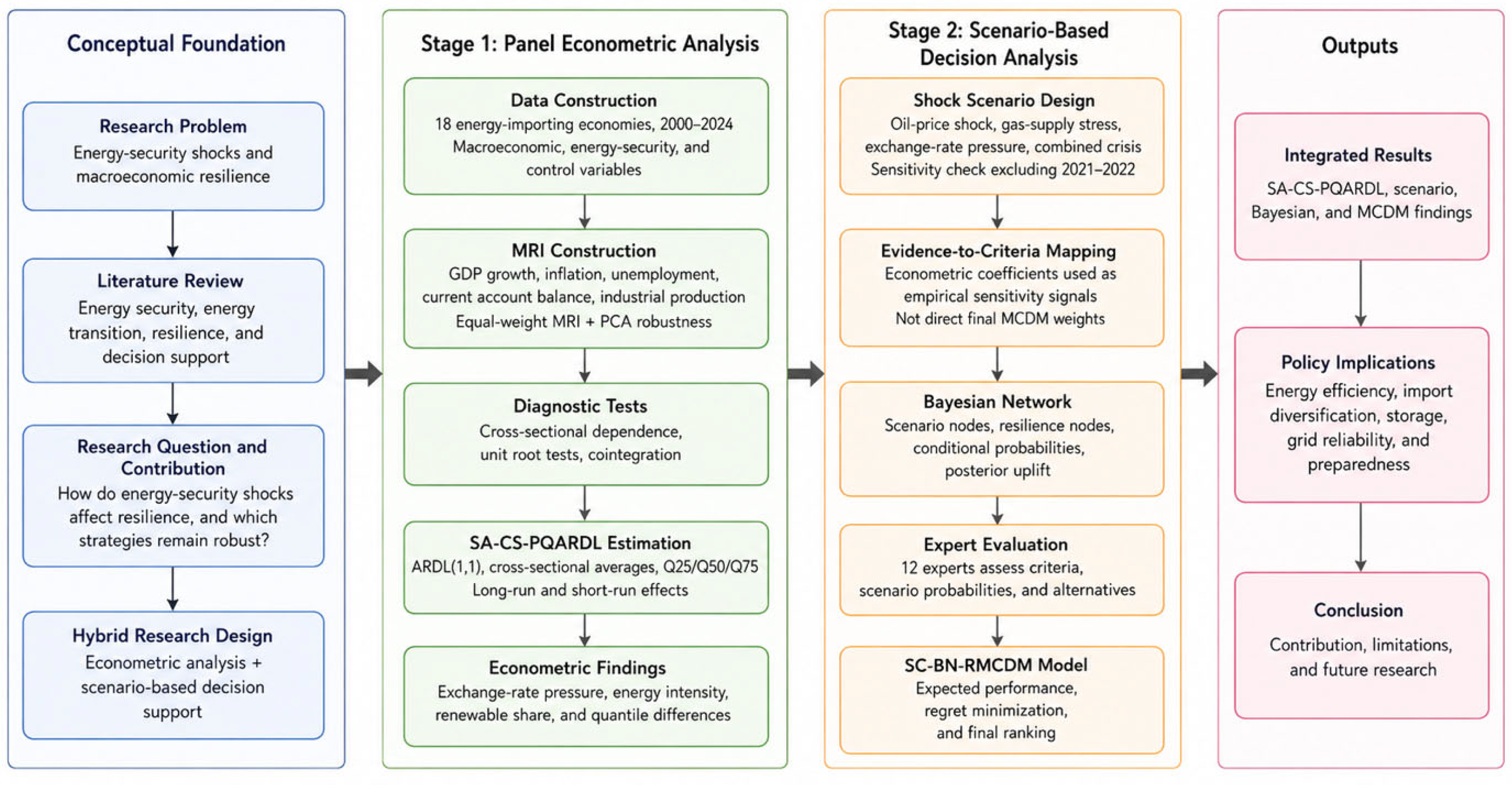
Figure 1 presents the workflow of the study. It shows the full sequence from data construction and MRI development to panel shock estimation, scenario design, Bayesian Network assessment, expert evaluation, and regret-based strategy ranking. The detailed procedures for transferring econometric results into decision criteria and for deriving the SC-BN-RMCDM rankings are explained in
Section 3.7 and
Section 3.8.
3.2. Sample Selection and Data Description
The empirical analysis uses a balanced panel of 18 mainly European energy-importing economies and Türkiye for the period 2000–2024. The countries included in the sample are Germany, France, Italy, Spain, the Netherlands, Belgium, Austria, Poland, Czech Republic, Hungary, Slovakia, Romania, Bulgaria, Croatia, Greece, Portugal, Ireland, and Türkiye. These economies were selected because they are exposed to imported energy, but they differ in energy import dependency, macroeconomic structure, industrial capacity, renewable energy development, energy intensity, and exposure to exchange-rate and energy-price shocks. This variation makes the sample suitable for examining how energy-security shocks are transmitted into macroeconomic resilience. However, because the sample mainly consists of European economies and Türkiye, the findings should be interpreted most directly for economies with similar energy-market, institutional, and macro-financial characteristics, rather than as automatically generalizable to all energy-importing economies.
The period 2000–2024 covers several major disruption episodes, including the 2008 global financial crisis, the COVID-19 shock, the post-pandemic recovery period, the Russia–Ukraine war, and the 2021–2022 energy-price surge. This time span allows the analysis to examine both short-run shock responses and longer-term resilience dynamics. The use of annual data is appropriate for the macroeconomic focus of the study and for linking energy-security pressures with national-level resilience indicators.
The dataset was constructed from internationally recognized sources. Macroeconomic and energy indicators were mainly obtained from the World Bank World Development Indicators. Unemployment data were based on WDI/ILO modeled estimates and cross-checked with ILOSTAT where necessary [
47,
48]. Financial variables were supported by the IMF Financial Development Index and the IMF Data Portal [
49,
50]. Brent crude oil prices were obtained from the U.S. Energy Information Administration, while natural gas prices were taken from the World Bank Commodity Markets/Pink Sheet dataset [
51,
52]. Oil-price shocks and gas-price shocks were not treated as directly observed shock variables; they were calculated by the authors as annual percentage changes in the corresponding global price series. Exchange-rate pressure was calculated from annual changes in country-level exchange-rate indicators.
To improve transparency and reproducibility, the variables used in the study are grouped into four categories: directly observed official variables, author-calculated variables, author-constructed proxy variables, and expert-based decision inputs. Directly observed official variables include GDP growth, inflation, unemployment, current account balance, industrial production growth, renewable energy share, energy intensity, grid losses, GDP per capita, trade openness, government expenditure, and financial development. Author-calculated variables include oil-price shocks, gas-price shocks, exchange-rate pressure, and the Macroeconomic Resilience Index. Author-constructed proxy variables are used only as scenario-support or decision-support inputs where direct comparable cross-country measures are not fully available. These include storage readiness, diversification capacity, and selected grid/digital reliability indicators. Expert-based decision inputs are used in the SC-BN-RMCDM stage to evaluate the criteria, scenarios, alternatives, and regret risk.
Table 1 summarizes the main variables, definitions, units, sources, and variable-origin categories.
The main econometric models use the Macroeconomic Resilience Index as the dependent variable and include oil-price shocks, gas-price shocks, exchange-rate pressure, energy import dependency, renewable energy share, energy intensity, and macroeconomic controls as explanatory variables. Additional indicators such as net energy imports, grid losses, diversification capacity, and storage-readiness proxies are not used as the main observed macroeconomic variables. Instead, they support robustness checks, scenario interpretation, and the decision-modeling stage where direct cross-country historical measures are limited.
For the SC-BN-RMCDM stage, a second dataset combines three types of information: econometric evidence from the SA-CS-PQARDL stage, Bayesian scenario information, and expert evaluations. The decision model evaluates six energy-management alternatives: renewable energy expansion, energy efficiency improvement, energy import diversification, strategic energy storage, smart-grid development, and demand-side management. These alternatives are assessed across nine criteria: macroeconomic resilience contribution, energy-security improvement, cost efficiency, environmental sustainability, implementation feasibility, shock absorption capacity, import-dependency reduction, grid and digital reliability, and macro-financial stabilization support. Experts assessed the alternatives under oil-price shock, gas-supply stress, exchange-rate pressure, and combined-crisis scenarios. The complete analysis-ready macroeconomic and energy-security dataset is provided in
Supplementary File S1, and the expert-panel data used for the SC-BN-RMCDM stage are provided in
Supplementary File S2.
A distinction is made between historical shock scenarios and forward-looking decision scenarios. In the historical panel, isolated gas-only shock years do not appear as separate events because the main gas-price shock years overlap with oil-price shock and combined-crisis conditions, especially during 2021–2022. Nevertheless, gas-supply stress is retained in the SC-BN-RMCDM stage as a forward-looking policy scenario because gas disruptions remain a distinct strategic risk for energy-importing economies. This distinction helps separate the historical econometric analysis from the scenario-based decision-support analysis.
3.3. Variable Definition and Measurement
This study uses four groups of variables: the dependent variable, energy-security shock and exposure variables, energy-system variables, and macroeconomic controls. All variables are measured annually and transformed where necessary to ensure comparability across countries and years. The variables were selected to capture both the direct macroeconomic effects of energy-security shocks and the domestic conditions that may weaken or strengthen resilience.
The dependent variable is the Macroeconomic Resilience Index (MRI), which reflects an economy’s ability to absorb energy-related shocks, stabilize key macroeconomic indicators, and recover without severe long-term damage. The index is constructed from five components: GDP growth, inflation, unemployment, current account balance, and industrial production growth. These variables represent five complementary dimensions of macroeconomic resilience: output performance, price stability, labor-market stability, external balance, and industrial continuity.
The MRI is constructed in three steps. First, all five components are standardized to make them comparable across countries and years. GDP growth, current account balance, and industrial production growth are treated as positive resilience indicators because higher values indicate stronger macroeconomic performance. These variables are standardized as follows:
where
Xit is the value of the relevant indicator for country
i in year
t,
Xˉ is the sample mean of the indicator, and
σX is the sample standard deviation.
Second, inflation and unemployment are treated as negative resilience indicators because higher inflation and higher unemployment indicate weaker macroeconomic resilience. Therefore, these two variables are inversely transformed after standardization:
This transformation ensures that higher transformed values consistently represent stronger resilience across all MRI components. In other words, after inverse transformation, lower inflation and lower unemployment contribute positively to the MRI.
Third, the standardized components are aggregated using equal weights:
where
ZGDP,it is the standardized GDP growth,
ZCA,it is the standardized current account balance,
ZIP,it is the standardized industrial production growth,
ZINF,it is the inversely transformed inflation, and
ZUNEMP,it is the inversely transformed unemployment. Higher
MRI values indicate stronger macroeconomic resilience.
Equal weights are used for two reasons. First, the five components represent theoretically complementary dimensions of macroeconomic resilience, and no single dimension is assumed to dominate the others in the baseline specification. Second, equal weighting improves transparency and avoids imposing subjective importance on one macroeconomic dimension without a strong theoretical or empirical basis. This approach provides a clear and reproducible baseline index. To ensure that the findings are not driven only by the equal-weighting choice, an alternative MRI is also constructed using Principal Component Analysis (PCA). The PCA-based MRI is treated as a supplementary robustness check rather than as a replacement for the equal-weight MRI. Because the first principal component captures mainly the output-recovery dimension and explains a limited share of the total variance, the equal-weight MRI is retained as the baseline index due to its stronger theoretical balance, transparency, and interpretability. The components and transformation rules are summarized in
Table A1, while the PCA loadings, eigenvalue, explained variance, and correlation with the equal-weight MRI are reported in
Table A7.
The energy-security shock and exposure variables represent external pressure on macroeconomic resilience. Oil-price shocks and gas-price shocks are calculated as annual percentage changes in Brent crude oil prices and international natural gas prices:
where
Shocket is the annual percentage change in energy price
e, and
Pet is the relevant energy price in year
t. Since oil and gas prices are global variables, these shocks are common across countries in a given year, although their macroeconomic effects may differ according to each country’s import dependency, energy intensity, exchange-rate exposure, and policy capacity. Exchange-rate pressure is included because currency depreciation increases the domestic cost of imported energy and may amplify inflationary and external-balance pressures. Energy import dependency captures structural exposure to external energy markets. The full list of shock and exposure variables is presented in
Table A2.
Energy-system variables capture domestic conditions that may strengthen or weaken resilience. The renewable energy share is expected to support resilience by reducing long-term dependence on imported fossil fuels, although its effect may depend on storage capacity, grid flexibility, technology supply chains, and demand-side capacity. The energy intensity is expected to weaken resilience because economies that use more energy per unit of output are more exposed to energy-price increases and production-cost pressures. Supporting energy-system indicators, including grid losses, diversification capacity, and storage-readiness proxies, are used mainly for robustness, scenario interpretation, and decision-support modeling. These indicators are listed in
Table A3, together with their data origin and construction logic.
Macroeconomic controls are included to reduce omitted-variable bias and to account for broader economic conditions that may influence resilience independently of energy-security shocks. The GDP per capita captures the level of economic development, trade openness reflects external integration, government expenditure captures the role of the public-sector capacity, and financial development represents the depth, access, and efficiency of the financial system. Their definitions and rationale are provided in
Table A4.
In addition to the main dynamic panel models, benchmark fixed-effects models test whether the renewable energy share and energy intensity moderate the effects of oil- and gas-price shocks. The interaction specification is written as follows:
where
MRIit is the Macroeconomic Resilience Index for country
i in year
t,
Shockt represents oil- or gas-price shocks,
EnergySystemit represents the renewable energy share or energy intensity,
Xit denotes the macroeconomic controls, and
εit is the error term. The coefficient
β3 captures whether the energy-system variable buffers or amplifies the effect of the shock. A positive interaction term suggests a buffering role when the energy-system variable strengthens resilience under shock conditions, whereas a negative interaction term suggests an amplifying vulnerability effect.
3.4. Econometric Model Specification
The study applies a Shock-Augmented Cross-Sectionally Dependent Panel Quantile Autoregressive Distributed Lag model (SA-CS-PQARDL) to examine how energy-security shocks affect macroeconomic resilience. This specification is appropriate for three reasons. First, the sampled economies are exposed to common global shocks, such as oil-price volatility, natural gas price changes, geopolitical instability, and post-pandemic recovery dynamics. Second, these economies may respond differently to the same shock because they differ in energy import dependency, energy intensity, renewable capacity, exchange-rate exposure, and macro-financial conditions. Third, the effect of energy-security shocks may vary across the resilience distribution, meaning that low-resilience economies may react differently from medium- or high-resilience economies. For this reason, the model combines dynamic panel estimation, cross-sectional dependence correction, and quantile-based heterogeneity.
The baseline dynamic relationship is specified as follows:
where
MRIit is the Macroeconomic Resilience Index for country
i in year
t.
Shocki,t-q includes oil-price shocks, gas-price shocks, exchange-rate pressure, and energy import dependency.
EnergySystemi,t-q includes the renewable energy share, energy intensity, and related energy-system characteristics.
Xi,t-q represents the macroeconomic controls, including GDP per capita, trade openness, government expenditure, and financial development.
αi captures country-specific effects,
μt captures common time effects, and
εit is the error term.
Because oil- and gas-price shocks are global variables, they may create common movements across countries. In addition, the sampled economies may be affected by unobserved common factors such as European energy-market integration, global financial conditions, geopolitical tensions, and the post-pandemic recovery. To address this issue, the model includes cross-sectional averages of the dependent variable and the main explanatory variables. This follows the logic of common correlated effects and helps reduce bias caused by cross-sectional dependence.
The cross-sectionally augmented specification is written as follows:
where
Zit includes the shock variables, energy-system variables, and macroeconomic controls.
represents the cross-sectional averages of the relevant variables at time
t. In the empirical specification, cross-sectional averages are included for the
MRI, the main shock variables, energy-system variables, and macroeconomic controls. These averages capture common global and regional shocks that affect all countries in the panel but may have different country-level consequences.
The ARDL structure is also expressed in error-correction form to distinguish short-run dynamics from long-run relationships:
where
Δ denotes the first-difference operator. The term inside the parentheses represents the long-run equilibrium relationship between macroeconomic resilience, energy-security shocks, energy-system variables, and macroeconomic controls. The coefficient
φi is the error-correction coefficient. A negative and statistically significant
φi indicates that deviations from the long-run resilience path are corrected over time after a shock. The long-run coefficients
θ1,
θ2, and
θ3 show the persistent effects of energy shocks, energy-system characteristics, and macroeconomic controls on resilience. The differenced terms capture short-run adjustments.
The panel quantile specification is estimated at the 25th, 50th, and 75th quantiles of the MRI distribution:
where
τ ∈ {0.25, 0.50, 0.75}. The 25th quantile represents low-resilience observations, the 50th quantile represents median-resilience observations, and the 75th quantile represents high-resilience observations. This specification allows the estimated effects of energy-security shocks to differ across the resilience distribution rather than assuming a single average effect for all countries and years.
The model is estimated using a parsimonious dynamic structure suitable for annual panel data. The baseline specification uses an ARDL(1,1) structure to avoid over-parameterization while still allowing both short-run adjustment and long-run relationships to be examined. Country effects are included to control for time-invariant national characteristics, while cross-sectional averages are included to address common shocks and cross-country dependence. Robust standard errors are used to improve inference under heterogeneity and possible serial correlation. Alternative lag structures and robustness specifications are examined later to assess whether the main findings are sensitive to the dynamic specification.
3.5. Estimation Procedure, Diagnostic Tests, and Robustness Analysis
The estimation follows a sequential procedure designed to ensure methodological transparency and reproducibility. First, descriptive statistics are calculated for the main macroeconomic, energy-security, energy-system, and control variables. This step provides an overview of the distribution of the Macroeconomic Resilience Index (MRI), energy-price shocks, energy import dependency, renewable energy share, energy intensity, and the macroeconomic controls used in the empirical models.
Second, Pesaran’s cross-sectional dependence test is applied to determine whether the sampled economies are affected by common global and regional shocks. This diagnostic step is necessary because the sample includes economies that are jointly exposed to global oil and natural gas price changes, geopolitical tensions, European energy-market linkages, and post-pandemic recovery dynamics. Evidence of cross-sectional dependence supports the use of a cross-sectionally augmented model rather than a conventional panel model that assumes independence across countries.
Third, second-generation panel unit root tests are used to examine the stationarity properties of the variables under cross-sectional dependence. Specifically, CADF and CIPS tests are applied to the country-level variables. Since the ARDL framework can accommodate variables integrated of order zero, I(0), and order one, I(1), but not variables integrated of order two, I(2), the integration properties of all variables are checked before model estimation. Global oil- and gas-price shock series are also tested for stationarity because these variables are common across countries but vary over time.
Fourth, panel cointegration diagnostics are applied to examine whether a long-run relationship exists among macroeconomic resilience, energy-security shocks, energy-system variables, and macroeconomic controls. Establishing a long-run relationship is important because the SA-CS-PQARDL model is expressed in an error-correction form that separates long-run equilibrium effects from short-run adjustments. The error-correction structure allows the analysis to test whether deviations from the long-run resilience path are corrected over time after shock episodes.
Fifth, the SA-CS-PQARDL model is estimated using annual country-level data. The baseline specification uses a parsimonious ARDL(1,1) structure. This lag structure is selected because the dataset is annual and the time dimension is limited. A more heavily parameterized dynamic model could reduce the degrees of freedom and increase the risk of overfitting. The ARDL(1,1) specification allows the model to capture both short-run adjustment and long-run relationships while maintaining parsimony. Cross-sectional averages of the dependent variable and the main explanatory variables are included to control for unobserved common factors and shared global shocks. The model is estimated at the 25th, 50th, and 75th quantiles of the MRI distribution to capture differences between low-, median-, and high-resilience observations.
Sixth, the econometric results are evaluated through a set of robustness checks. Benchmark fixed-effects models are estimated to compare the main results with a simpler average-effect specification. Interaction models are used to examine whether the renewable energy share and energy intensity moderate the effects of oil- and gas-price shocks. Additional quantile robustness estimates are reported to test whether the direction and significance of key variables remain stable across the resilience distribution. Alternative lag structures are also examined to assess whether the main findings depend on the ARDL(1,1) baseline specification.
Seventh, the construction of the MRI is tested through an alternative Principal Component Analysis (PCA)-based index. This robustness check addresses the possibility that equal weighting may influence the results, but it is interpreted cautiously. The PCA-based MRI is estimated using the same five components as the baseline index: GDP growth, inflation, unemployment, current account balance, and industrial production growth. The PCA loadings, eigenvalue, explained variance, and cumulative explained variance, and the correlation between the equal-weight MRI and the PCA-based MRI are reported in
Table A7. Since the first component explains 38.29% of the variance and the correlation between the equal-weight MRI and PCA-MRI is moderate, the PCA-based MRI is used only as a supplementary robustness check. The equal-weight MRI remains the main dependent variable because it provides a theoretically balanced representation of output performance, price stability, labor-market stability, external balance, and industrial continuity.
Eighth, alternative shock thresholds are examined to test whether the scenario results depend on the baseline threshold rule. Since the identification of oil-price shocks, gas-price shocks, exchange-rate pressure, and combined-crisis conditions depends on threshold-based coding, this robustness step evaluates whether the interpretation of the scenario findings remains stable when the shock-definition rule is modified.
Finally, an additional sensitivity analysis excludes the years 2021–2022. This test is included because the combined-crisis scenario overlaps with the post-pandemic recovery period, when GDP growth and industrial production rebounded strongly in several countries despite energy-price pressure and inflation. Excluding 2021–2022 helps assess whether the positive MRI value observed during combined-crisis years reflects genuine resilience under shocks or mainly the rebound dynamics of the post-pandemic period. The results of this sensitivity test are reported in
Table A8. The exclusion test shows that the historical combined-crisis category is fully concentrated in the 2021–2022 rebound period; therefore, the positive combined-crisis result in the full sample should be interpreted as a post-pandemic rebound artifact rather than as evidence that combined energy-security shocks improve resilience. The full estimation sequence, including diagnostic tests, main estimations, and robustness checks, is summarized in
Table A5.
3.6. Shock Scenario Design
The analysis is extended with shock scenarios to capture uncertainty and stress conditions that may not be fully reflected by average econometric estimates. This scenario-based extension is necessary because energy-importing economies may face overlapping shocks, such as energy-price increases, gas-supply stress, exchange-rate depreciation, and geopolitical disruptions. The scenario design allows the study to evaluate how energy-management strategies perform under specific stress conditions rather than only under average historical conditions. This approach is consistent with energy-security studies that emphasize uncertainty, stress testing, and resilience planning [
1,
2].
Four shock scenarios are considered: oil-price shock, gas-supply stress, exchange-rate pressure, and combined energy-security crisis. These scenarios represent different transmission channels. Oil-price shocks mainly affect production costs, inflation, transport costs, and external balances [
3,
4]. Gas-supply stress is especially relevant for electricity generation, heating, industrial production, and energy availability [
12]. Exchange-rate pressure affects the domestic cost of imported energy and can amplify inflationary and current-account pressures in import-dependent economies. Combined-crisis conditions capture situations in which several shocks occur at the same time and intensify macroeconomic vulnerability through overlapping channels, including geopolitical uncertainty [
15,
16].
Each shock is identified using a deviation-based threshold rule. For oil-price and gas-price shocks, the threshold is calculated from the historical distribution of the relevant global price-change series. For exchange-rate pressure, the threshold is calculated from the country-level exchange-rate change series, because currency depreciation differs across countries. The baseline threshold is set at one standard deviation above the historical mean, while alternative thresholds are later examined as robustness checks.
where
Shockkt is the binary shock indicator for shock type
k,
Zkt is the observed shock variable,
μk is its historical mean,
σk is its historical standard deviation, and
θ is the threshold parameter. In the baseline scenario design,
θ = 1. This rule identifies unusually large positive shock events, such as strong oil-price increases, gas-price increases, or exchange-rate depreciation. The focus is on positive stress events because the study examines vulnerability and resilience under adverse energy-security conditions.
The combined-crisis scenario captures years in which at least two shock indicators are active at the same time. It is defined as follows:
where
CSit is the combined-crisis indicator for country
i in year
t,
Shockoilt is the oil-price shock indicator,
Shockgast is the gas-price shock indicator, and
Shockfxit is the country-specific exchange-rate pressure indicator. This formulation identifies overlapping shock conditions rather than isolated single-shock events.
A distinction is made between historical scenarios used in the panel analysis and forward-looking scenarios used in the decision-support stage. In the historical panel, isolated gas-only shock years do not appear as a separate scenario because the main gas-price shock years overlap with oil-price shocks and combined-crisis conditions, especially during 2021–2022. Therefore, gas-market stress is interpreted in the historical analysis mainly as part of the combined-crisis scenario. However, gas-supply stress is retained as a separate forward-looking scenario in the SC-BN-RMCDM stage because gas disruptions remain a distinct strategic risk for energy-importing economies, particularly for countries with gas-dependent heating, power generation, and industrial systems.
The scenario design is also used to address the interpretation of the positive MRI values observed during combined-crisis years. Because combined-crisis conditions are concentrated around the 2021–2022 post-pandemic recovery period, the study conducts an additional sensitivity analysis excluding 2021–2022. This test evaluates whether the positive MRI pattern under combined-crisis conditions reflects genuine resilience to shocks or whether it is mainly driven by the rebound in GDP growth and industrial production following the COVID-19 contraction. The exclusion test shows that the historical combined-crisis category is fully concentrated in 2021–2022. This is not treated as a model weakness; rather, it is an important diagnostic finding showing that the full-sample positive combined-crisis coefficient reflects the overlap between energy-security stress and the post-pandemic rebound period. Country-level evidence for 2021–2022 is also used to support this interpretation where relevant.
The scenarios are then linked to the SC-BN-RMCDM stage. In this stage, scenario information is used to condition Bayesian probabilities and to evaluate energy-management strategies under specific stress environments. This allows alternatives to be assessed not only under normal conditions but also under oil-price shocks, gas-supply stress, exchange-rate pressure, and combined-crisis conditions. Thus, the scenario design provides the bridge between historical econometric evidence and forward-looking strategy prioritization.
3.7. Integration of Econometric Results into Decision Criteria
The transition from econometric analysis to decision modeling is a central part of the proposed hybrid framework. The purpose of this stage is to show how the empirical evidence obtained from the SA-CS-PQARDL model is translated into decision-relevant information for the SC-BN-RMCDM model. This step creates a transparent link between macroeconomic shock estimation and energy-management strategy prioritization. Instead of relying only on expert judgment, the study uses econometric results, shock-scenario findings, Bayesian Network probabilities, and expert evaluations in a sequential and complementary way.
The integration process follows five steps. First, the SA-CS-PQARDL model identifies which energy-security shocks and energy-system variables are most strongly associated with macroeconomic resilience. These results include long-run coefficients, short-run effects, quantile-specific estimates, and robustness findings. Second, the shock-scenario analysis identifies the conditions under which oil-price shocks, gas-supply stress, exchange-rate pressure, and combined crises become active. Third, the econometric and scenario results are mapped onto decision criteria that represent vulnerability, preparedness, and policy capacity. Fourth, the Bayesian Network converts scenario and resilience-related information into conditional probabilities and posterior uplift values. Fifth, expert evaluations provide the main criterion weights, scenario probabilities, and alternative performance scores, which are then combined with Bayesian scenario information and regret-based logic to rank the energy-management strategies.
The econometric results are not used as the only source of the final criterion weights. Rather, they are used as empirical sensitivity indicators showing which variables have stronger relationships with macroeconomic resilience. These sensitivity indicators help identify which decision criteria should receive closer attention under specific shock conditions. For example, if exchange-rate pressure has a strong negative association with the Macroeconomic Resilience Index, the decision model gives greater attention to macro-financial stabilization and import-exposure reduction under exchange-rate stress. Similarly, if energy intensity consistently weakens resilience, energy efficiency improvement becomes a more important criterion in the decision framework. This structure ensures that the decision model is evidence-informed while still incorporating expert knowledge about feasibility, cost, implementation capacity, and policy relevance.
The empirical sensitivity score for each resilience-related factor is calculated using the absolute value of the estimated coefficient:
where
sk represents the empirical sensitivity score of factor
k, and
βk is the estimated coefficient associated with that factor. The use of absolute values captures the strength of the relationship with macroeconomic resilience regardless of whether the effect is positive or negative. The sign of the coefficient is interpreted separately when discussing whether a variable strengthens or weakens resilience. These sensitivity scores are used to support scenario conditioning and criterion interpretation; they do not replace expert-based criterion weighting.
The mapping between the econometric findings and decision criteria is summarized in
Table 2. This table clarifies how the information moves from the econometric stage to the decision-support stage.
The decision criteria are grouped around three dimensions: energy security, macroeconomic stability, and implementation capacity. Oil-price shocks, gas-price shocks, exchange-rate pressure, and energy import dependency represent the shock exposure and vulnerability. The renewable energy share, energy intensity, import-dependency reduction, storage readiness, and grid reliability represent the energy-system preparedness and shock absorption capacity. Macroeconomic controls such as trade openness, government expenditure, and financial development help interpret the broader adaptive capacity and macro-financial stability.
Quantile-specific evidence from the SA-CS-PQARDL model is also used to recognize that low-, medium-, and high-resilience observations may respond differently to the same energy-security shock. This is important because a strategy that appears effective under average conditions may not perform equally well under low-resilience or high-stress conditions. Scenario-specific adjustments are therefore applied so that criteria linked to active shocks receive greater attention under the relevant scenario. For example, import-dependency reduction becomes more important under exchange-rate pressure and combined-crisis conditions, while energy efficiency receives greater emphasis under oil-price shock conditions.
In the final SC-BN-RMCDM stage, expert evaluations provide the primary criterion weights and alternative performance scores. Bayesian Network results and empirical sensitivity scores support scenario-conditioned adjustments by indicating which criteria become more relevant under particular shock conditions. The final ranking is then calculated by combining the expected performance with regret-based evaluation. This structure avoids two problems: relying only on subjective expert judgment and treating econometric coefficients as mechanically equivalent to decision weights. By integrating econometric evidence, Bayesian scenario logic, and expert assessment, the model provides a transparent and policy-relevant basis for prioritizing energy-management strategies under uncertainty.
The information flow across the hybrid framework is summarized in
Table 3.
3.8. Shock-Conditioned Bayesian Network–Regret MCDM Model
The second stage applies the Shock-Conditioned Bayesian Network–Regret Multi-Criteria Decision-Making model (SC-BN-RMCDM) to prioritize energy-management strategies under uncertainty. This stage translates the econometric and scenario evidence from the SA-CS-PQARDL analysis into policy-oriented rankings. The purpose is not to convert econometric coefficients mechanically into decision weights, but to combine empirical shock evidence, Bayesian scenario information, expert judgment, and regret-sensitive decision logic in a transparent sequence.
The SC-BN-RMCDM model consists of four connected elements: a Bayesian Network, expert-based criteria and alternative evaluations, a scenario-conditioned performance matrix, and a regret-based ranking mechanism. The Bayesian Network models conditional relationships among shock scenarios, resilience-related system conditions, and macroeconomic resilience outcomes. Expert evaluations provide practical information on criterion importance, scenario relevance, implementation feasibility, and alternative performance. The scenario-conditioned performance matrix combines expert-based scores with Bayesian and scenario-specific information. Finally, the regret-based ranking mechanism identifies strategies that perform well under expected conditions while also minimizing the risk of poor performance under adverse shock scenarios.
The decision model evaluates six energy-management alternatives: renewable energy expansion, energy efficiency improvement, energy import diversification, strategic energy storage, smart-grid development, and demand-side management. These alternatives are evaluated across nine criteria: macroeconomic resilience contribution, energy-security improvement, cost efficiency, environmental sustainability, implementation feasibility, shock absorption capacity, import-dependency reduction, grid and digital reliability, and macro-financial stabilization support.
Table 4 summarizes the decision criteria and policy alternatives used in the SC-BN-RMCDM model.
The Bayesian Network is structured around three layers: shock scenario nodes, resilience-related condition nodes, and the macroeconomic resilience outcome node. The scenario nodes include normal/no major shock, oil-price shock, gas-supply stress, exchange-rate pressure, and combined energy-security crisis. The resilience-related condition nodes represent energy efficiency, renewable capacity, import dependency, storage readiness, grid reliability, diversification capacity, and macro-financial stability. The outcome node is high or low macroeconomic resilience, defined according to the MRI distribution.
The direction of the Bayesian Network follows the logic of the study. Shock scenario nodes are placed at the first layer because they represent external stress conditions. These scenarios influence resilience-related condition nodes, such as energy efficiency, import dependency, storage readiness, and macro-financial stability. These condition nodes then influence the probability of high macroeconomic resilience. This structure reflects the assumption that energy-security shocks affect macroeconomic resilience through energy-system preparedness and macro-financial vulnerability channels.
The Bayesian Network was constructed using a hybrid logic. First, the structure was guided by the theoretical relationships discussed in the energy-security and macroeconomic resilience literature. Second, the SA-CS-PQARDL and scenario results were used to identify the most relevant shock and resilience channels. Third, expert judgment was used to validate whether the selected nodes and directional links were meaningful for energy-management decision-making. To avoid overfitting in an annual panel dataset, the network was kept parsimonious. Conditional on the active scenario and resilience-related nodes, additional direct dependencies among all nodes were not imposed unless they were theoretically or empirically justified.
Table 5 summarizes the main Bayesian Network nodes, their definitions, and their coding logic.
Expert input is used in the decision-making part of the SC-BN-RMCDM model. The expert panel consists of specialists with knowledge of energy economics, energy policy, macroeconomic resilience, energy management, grid systems, and decision analysis. Experts were selected based on their relevance to energy-security decision-making, familiarity with import-dependent economies, and experience in evaluating energy-policy alternatives. Expert opinions were collected through a structured evaluation form. The form presented the decision criteria, shock scenarios, and policy alternatives with short definitions to ensure that all experts evaluated the same constructs. Experts assessed the criterion importance, scenario probabilities, and alternative performance scores using a common rating scale.
The expert scores were aggregated using mean values and then normalized to obtain criterion weights and performance inputs. Standard deviations were reported to show the degree of agreement among experts. The relatively high agreement observed in some weights and scenario probabilities should be interpreted as consensus within the selected expert group rather than as universal agreement among all stakeholders. This agreement may reflect the structured evaluation form, the clearly defined scenarios and criteria, and the shared professional background of the expert panel.
To address the reliability of the expert-based decision inputs, formal inter-rater agreement was calculated using Kendall’s coefficient of concordance (W). Kendall’s W was selected because the expert panel provided comparative ratings of the criteria, scenario probabilities, alternatives, and regret risk. The test evaluates whether the experts showed statistically meaningful agreement beyond random judgment. The agreement statistics, chi-square values, degrees of freedom, and
p-values are reported in
Table A9.
The SC-BN-RMCDM procedure follows nine steps. First, the decision criteria and alternatives are defined. Second, shock scenarios are specified using the scenario design described in
Section 3.6. Third, Bayesian Network nodes and conditional relationships are constructed. Fourth, expert evaluations are collected for the criteria, scenarios, and alternatives. Fifth, expert-based criterion weights and alternative performance scores are normalized. Sixth, Bayesian scenario information is used to adjust criterion relevance under each shock scenario. Seventh, the expected performance is calculated for each alternative under each scenario. Eighth, regret values are calculated by comparing each alternative with the best-performing alternative under the same scenario. Ninth, final strategy scores are calculated by combining the expected performance and regret.
For each scenario, every alternative is evaluated against each criterion. The expected performance of an alternative is calculated by combining the normalized performance scores with scenario-adjusted criterion weights:
where
EPik is the expected performance of alternative
i under scenario
k,
wjk is the scenario-adjusted weight of criterion
j under scenario
k, and
rijk is the normalized performance score of alternative
i on criterion
j under scenario
k.
To include decision risk, the model uses regret logic. Regret represents the loss that occurs when an alternative performs worse than the best available alternative under the same scenario:
where
RGik is the regret value of alternative
i under scenario
k. A lower regret value indicates that the alternative is more robust under uncertain or adverse shock conditions.
The final strategy score combines the expected performance and regret:
where
SIi is the final strategy score of alternative
i,
EPi is the aggregated expected performance of the alternative across scenarios,
RGi is the aggregated regret value, and
λ represents the decision-maker’s risk preference. Alternatives are ranked in descending order of
SIi. A higher
SIi indicates that the strategy combines strong expected performance with lower regret under uncertain shock conditions.
The SC-BN-RMCDM model therefore provides an evidence-informed decision-support tool. It combines econometric shock evidence, Bayesian scenario logic, expert evaluation, and regret-sensitive ranking. This structure allows the study to identify energy-management strategies that are not only effective under expected conditions but also more robust under oil-price shocks, gas-supply stress, exchange-rate pressure, and combined-crisis scenarios. The resulting rankings should be interpreted as most directly applicable to the sampled mainly European import-dependent economies and Türkiye, while offering a transferable framework for similar import-dependent economies with comparable energy-market and macro-financial conditions.
4. Results
4.1. Descriptive Statistics and Data Overview
The empirical analysis uses a balanced panel of 18 mainly European energy-importing economies and Türkiye covering the period 2000–2024. The full dataset includes 450 country–year observations. After constructing lagged shock variables, the estimation sample decreases to 432 observations. The countries included in the sample are Germany, France, Italy, Spain, the Netherlands, Belgium, Austria, Poland, Czech Republic, Hungary, Slovakia, Romania, Bulgaria, Croatia, Greece, Portugal, Ireland, and Türkiye. As noted in the methodology, the sample is most directly representative of European import-dependent economies and Türkiye, although the framework may also be informative for economies with similar energy-market and macro-financial structures.
The dependent variable is the Macroeconomic Resilience Index (MRI), which is constructed from GDP growth, inflation, unemployment, current account balance, and industrial production growth. Inflation and unemployment were inversely transformed so that higher MRI values consistently indicate stronger macroeconomic resilience.
Table 6 presents the descriptive statistics for the main variables used in the econometric analysis.
The descriptive statistics support the relevance of the sample for energy-security and macroeconomic resilience analysis. The average energy import dependency is 62.223%, indicating that the sampled economies are strongly exposed to external energy markets. This confirms the importance of examining how imported-energy exposure interacts with macroeconomic stability. Gas-price shocks show substantially higher volatility than oil-price shocks, with a standard deviation of 89.067 compared with 28.454 for oil-price shocks. This difference supports the methodological decision to treat oil- and gas-price shocks separately rather than combining them into a single energy-price shock variable.
The descriptive results also show meaningful cross-country and intertemporal variation in resilience-related conditions. The wide range of GDP growth, inflation, current account balance, and industrial production growth indicates that the sample includes both stable and crisis-period observations. Similarly, the variation in renewable energy share and energy intensity shows that the sampled economies differ in energy-transition progress and efficiency performance. These differences justify the use of a panel quantile framework, since low-, median-, and high-resilience observations may respond differently to the same energy-security shock.
4.2. Panel Diagnostic Tests
Before estimating the SA-CS-PQARDL model, a set of panel diagnostic tests was conducted to examine the cross-sectional dependence, stationarity, cointegration, and lag suitability. These tests are important because the sampled economies are jointly exposed to global and regional shocks, including oil-price volatility, natural gas-market disruptions, exchange-rate instability, geopolitical uncertainty, and post-pandemic recovery dynamics. The diagnostic stage therefore provides the empirical justification for using a cross-sectionally augmented dynamic panel framework rather than a conventional panel model.
Table 7 reports the diagnostic test results.
The diagnostic results support the use of the SA-CS-PQARDL framework. The Pesaran CD test indicates strong cross-sectional dependence, confirming that the sampled economies are influenced by common shocks and shared energy-market conditions. This result justifies the inclusion of cross-sectional averages in the model to account for unobserved common factors and common global shock exposure.
The CADF/CIPS results show that the variables have mixed integration properties, with some variables treated as I(0) and others as I(1). Importantly, no variable is integrated of order two, I(2), which supports the use of an ARDL-type specification. The stationarity of the oil- and gas-price shock series also supports their inclusion as global shock variables in the dynamic model. The residual-based cointegration diagnostic indicates that a long-run relationship exists among macroeconomic resilience, energy-security shocks, energy-system variables, and macroeconomic controls. Therefore, estimating the model in an error-correction form is appropriate because it allows the analysis to distinguish long-run equilibrium effects from short-run adjustments.
The lag structure assessment also supports a parsimonious ARDL specification. Because the dataset is annual and the time dimension is limited, a heavily parameterized lag structure could reduce the degrees of freedom and create overfitting. For this reason, the baseline model uses an ARDL(1,1) structure, while alternative lag structures are examined as robustness checks. Overall, the diagnostic evidence confirms that the selected model is suitable for analyzing heterogeneous shock effects under cross-sectional dependence.
4.3. Long-Run SA-CS-PQARDL Results
After confirming the suitability of the panel structure through diagnostic tests, the long-run SA-CS-PQARDL model was estimated to examine the persistent effects of energy-security shocks and energy-system characteristics on macroeconomic resilience. This section provides one of the main empirical evidence bases of the study because it identifies which shock and resilience-related variables have long-run associations with the Macroeconomic Resilience Index (MRI). The model was estimated across the 25th, 50th, and 75th quantiles of the MRI distribution to capture differences between low-, median-, and high-resilience observations. Since the model includes lagged level variables and annual shock changes, the dynamic estimation sample covers 414 country–year observations.
Table 8 reports the long-run standardized coefficients derived from the error-correction specification. The table is used to identify the persistent vulnerability and resilience channels that later inform the Bayesian Network and regret-based decision model.
The error-correction terms are negative and statistically significant across all quantiles, confirming that deviations from the long-run resilience path are corrected over time. The magnitude of the adjustment coefficient increases from the low-resilience quantile to the high-resilience quantile, suggesting that higher-resilience observations return more quickly to their long-run path after a disturbance. This supports the use of an error-correction specification and confirms that the model captures both long-run equilibrium relationships and adjustment dynamics.
The most consistent long-run vulnerability channel is the exchange-rate pressure. Its coefficient is negative across all quantiles and statistically significant at the low-, median-, and high-resilience levels, with the strongest effect at the median quantile. This indicates that currency depreciation weakens macroeconomic resilience by increasing the domestic cost of imported energy and amplifying inflationary, fiscal, and external-balance pressures. This finding is important for the later decision stage because it supports the inclusion of macro-financial stabilization and import-dependency reduction as key decision criteria.
The renewable energy share has a positive and statistically significant long-run association with the MRI in the low- and median-resilience quantiles, but the effect is not significant in the high-resilience quantile. This suggests that renewable energy development may support resilience, especially where economies are more vulnerable or still strengthening their energy-transition capacity. However, the uneven significance across quantiles also indicates that the renewable energy share alone should not be interpreted as a complete resilience solution. Its effect likely depends on complementary investments in storage, grid flexibility, digital infrastructure, and demand-side capacity.
Energy intensity has a negative sign in the low- and median-resilience quantiles, although it is not statistically significant in the long-run specification. This result should therefore be interpreted cautiously in this section. However, because energy intensity becomes consistently negative and significant in the short-run, benchmark, and quantile robustness models reported later, it remains an important vulnerability channel in the overall analysis. For this reason, energy efficiency is retained as a central decision criterion in the SC-BN-RMCDM stage.
The oil-price and gas-price shock coefficients are not statistically significant in the long-run specification. This does not mean that energy-price shocks are irrelevant. Rather, it suggests that their long-run effects may operate indirectly through exchange-rate pressure, inflation, industrial production, import dependency, and energy-system conditions. This supports the decision to combine econometric estimation with scenario-based analysis, where oil and gas shocks can be evaluated under specific stress conditions rather than only through average long-run coefficients.
Overall, the long-run SA-CS-PQARDL results show that the exchange-rate pressure is the clearest persistent vulnerability channel, the renewable energy share provides conditional resilience support, and energy intensity requires further attention in the short-run and robustness analyses. These findings provide the empirical basis for the later evidence-to-criteria mapping and scenario-conditioned decision model.
4.4. Short-Run Dynamics and Error-Correction Results
Table 9 reports the short-run dynamics and error-correction terms of the SA-CS-PQARDL model. While
Section 4.3 examined the persistent long-run effects of energy-security shocks and energy-system characteristics, this table shows how resilience adjusts in the short run after shocks.
The error-correction term is negative and statistically significant across all quantiles. This confirms that macroeconomic resilience adjusts back toward its long-run equilibrium path after short-run disturbances. The adjustment coefficient becomes larger in absolute value from the low-resilience quantile to the high-resilience quantile, moving from −0.746 at Q25 to −0.882 at Q75. This suggests that higher-resilience observations correct deviations more quickly after shocks, while lower-resilience observations adjust more slowly. This finding supports the dynamic structure of the model and confirms the relevance of distinguishing between short-run shock effects and long-run resilience adjustment.
In the short run, exchange-rate pressure has a consistently negative effect on MRI across all quantiles. The effect is statistically significant at the low-, median-, and high-resilience levels. This reinforces the long-run finding that currency depreciation is one of the most important vulnerability channels for import-dependent economies. Since depreciation increases the domestic cost of imported energy, it can quickly transmit external energy shocks into inflation, external-balance pressure, and weaker macroeconomic stability.
Energy intensity also shows a consistently negative and statistically significant short-run effect across all quantiles. This result is important because the long-run estimates showed negative but statistically weaker energy-intensity coefficients. The short-run results indicate that economies using more energy per unit of output are more immediately exposed to energy-price increases and production-cost pressures. This provides strong empirical support for treating energy efficiency improvement as a central resilience strategy in the later decision model.
Gas-price shocks are statistically significant in the median- and high-resilience quantiles, while oil-price shocks are only weakly significant in the low-resilience quantile. This pattern suggests that oil and gas shocks operate through different short-run channels and should not be merged into a single energy-price shock indicator. Gas-price changes appear more relevant for economies with stronger or more industrially integrated resilience profiles, possibly because of the role of gas in electricity generation, heating, and industrial production. Oil-price shocks, by contrast, show weaker and less consistent short-run effects in this specification.
The renewable energy share does not show a statistically significant short-run effect in
Table 9. This does not contradict its positive long-run association reported in
Section 4.3. Rather, it suggests that renewable energy may contribute to resilience gradually and conditionally, especially when supported by storage, grid reliability, and demand-side flexibility. Therefore, renewable energy expansion should be interpreted as a medium- to long-term resilience factor rather than as an immediate short-run shock absorber.
The short-run results strengthen two main conclusions of the study. First, the exchange-rate pressure is both a short-run and long-run vulnerability channel for macroeconomic resilience. Second, energy intensity is a consistent short-run weakness, supporting the prioritization of energy efficiency improvement in the SC-BN-RMCDM stage. These findings provide a direct empirical bridge between the econometric results and the later strategy-ranking analysis.
4.5. Benchmark Fixed-Effects and Interaction Results
To assess whether the main findings are robust to a simpler average-effect specification, fixed-effects panel models were estimated as benchmark models. This section should be interpreted as a supporting robustness analysis rather than as the main empirical model. The SA-CS-PQARDL results remain the primary evidence because they account for dynamic adjustment, cross-sectional dependence, and quantile-specific differences. However, the fixed-effects models provide an additional check on whether the main vulnerability channels remain visible under a more conventional panel specification.
The baseline fixed-effects model examines the direct association between energy-security shocks, energy-system variables, and macroeconomic resilience. The interaction model tests whether the renewable energy share and energy intensity moderate the effects of oil- and gas-price shocks.
Table 10 reports the benchmark fixed-effects estimates.
The benchmark results provide additional support for one of the central findings of the study: energy intensity is negatively associated with macroeconomic resilience. The coefficient of energy intensity is negative and statistically significant in both the baseline and interaction specifications. This indicates that economies using more energy per unit of output are more vulnerable to macroeconomic instability, even when a simpler fixed-effects model is used. This result strengthens the empirical basis for prioritizing energy efficiency improvement in the SC-BN-RMCDM stage.
The positive coefficients for oil- and gas-price shocks should be interpreted cautiously. These coefficients should not be read as evidence that energy-price shocks improve resilience. Rather, they likely reflect contemporaneous recovery dynamics, particularly during years when energy-price increases coincided with rebounds in GDP growth and industrial production. This interpretation is consistent with the scenario analysis, where the positive resilience profile observed during combined-crisis years is examined further through sensitivity analysis excluding 2021–2022. Therefore, the fixed-effects results are treated as supporting evidence, while the dynamic and scenario-based analyses provide the main interpretation of shock effects.
The interaction terms are not statistically significant. This suggests that, in the average fixed-effects specification, the renewable energy share and energy intensity do not strongly moderate the relationship between oil- or gas-price shocks and macroeconomic resilience. However, this does not mean that renewable energy, efficiency, storage, or grid capacity are unimportant. Instead, it indicates that their effects may be conditional, gradual, or better captured through the quantile, scenario, and decision-support stages rather than through a simple average interaction model. Benchmark fixed-effects results support the robustness of the energy-intensity finding and provide a useful comparison with the SA-CS-PQARDL estimates. At the same time, the positive oil- and gas-shock coefficients and insignificant interaction terms are interpreted cautiously. This section therefore serves as a robustness check rather than the main basis for the study’s conclusions.
4.6. Quantile Robustness Results
Additional quantile regressions were estimated as robustness checks to examine whether the effects of energy-security shocks and energy-system characteristics differ across the resilience distribution. This section supports the main SA-CS-PQARDL findings by testing whether the key vulnerability channels remain visible when a simpler quantile specification is used. The models are estimated at the 25th, 50th, and 75th percentiles of the MRI distribution, representing low-, median-, and high-resilience observations.
Table 11 reports the quantile robustness results.
The quantile robustness results confirm that energy-security effects are not uniform across the resilience distribution. Oil-price shocks are strongest in the low-resilience quantile and become weaker at higher resilience levels. This suggests that economies or periods with weaker resilience are more exposed to oil-price-related cost, transport, and external-balance pressures. Gas-price shocks, by contrast, become stronger from the low-resilience quantile to the high-resilience quantile. This pattern indicates that gas-price shocks may affect economies through different structural channels, especially where industrial production, heating systems, and electricity generation are more closely linked to gas-market conditions.
Energy intensity remains negative and statistically significant across all three quantiles. This is the most important robustness finding in
Table 11 because it confirms that higher energy use per unit of output is a consistent vulnerability factor. The result supports the short-run SA-CS-PQARDL findings and strengthens the empirical basis for prioritizing energy efficiency improvement in the decision-support stage.
The renewable energy share is not statistically significant in the quantile robustness models. This result should be interpreted cautiously and does not imply that renewable energy is unimportant for resilience. Rather, it suggests that the renewable energy share alone may not directly explain resilience differences in this specification unless it is supported by storage capacity, grid reliability, demand-side flexibility, diversification, and broader system readiness. This interpretation is consistent with the long-run results, where the renewable energy share showed conditional support in the low- and median-resilience quantiles. Quantile robustness analysis supports two main conclusions. First, oil- and gas-price shocks affect resilience levels differently, which justifies treating them as separate shock channels. Second, energy intensity is the most stable vulnerability factor across quantiles, reinforcing the role of energy efficiency improvement as a central resilience strategy in the SC-BN-RMCDM model. These results are used as supporting evidence rather than as a replacement for the main SA-CS-PQARDL estimates.
4.7. Shock Scenario Findings
Following the dynamic, benchmark, and quantile analyses, shock scenarios were constructed to examine how macroeconomic resilience differs across specific energy-security stress conditions. This section serves as a bridge between the econometric results and the later Bayesian Network and regret-based decision model. While the SA-CS-PQARDL results identify the average and quantile-specific effects of shocks, the scenario analysis shows how resilience profiles change under clearly defined stress environments.
The scenario design applies the deviation-based threshold rule described in
Section 3.6. Oil- and gas-price shocks are identified when annual benchmark price changes exceed their historical mean plus one standard deviation. Exchange-rate pressure is identified when country-level depreciation exceeds the same threshold logic. Since annual shock variables require lagged price changes, the scenario analysis covers 432 country–year observations for 2001–2024.
Table 12 reports the operational definition and frequency of each scenario.
Table 12 shows that gas-price shock years do not appear as isolated historical events because the main gas-shock years, 2021 and 2022, overlap with oil-price shock years. Therefore, gas-market stress is interpreted in the historical panel scenario analysis mainly as part of the combined-crisis condition.
To compare the macroeconomic profile of each scenario,
Table 13 reports the mean values of the MRI and key contextual variables across normal periods, oil-price shock periods, exchange-rate pressure periods, and combined-crisis periods.
The scenario profile provides three important insights. First, exchange-rate pressure has the weakest MRI mean, indicating that currency depreciation is a critical vulnerability channel for the sampled import-dependent economies. This is consistent with the long-run and short-run SA-CS-PQARDL results, where exchange-rate pressure negatively affected resilience. Second, oil-price shock periods show a slightly weaker MRI profile than normal periods, mainly through external-balance pressure and higher energy intensity. Third, the combined-crisis scenario shows a positive MRI mean. This result should not be interpreted as evidence that combined shocks improve resilience. Rather, because the combined-crisis observations are concentrated mainly in 2021–2022, the positive MRI value likely reflects the post-pandemic rebound in GDP growth and industrial production occurring at the same time as energy-price shocks.
To examine whether the scenario differences remain after controls and country fixed effects,
Table 14 reports the fixed-effects scenario estimates. Normal/no major shock periods are used as the reference category.
The scenario regression shows that the combined-crisis dummy has a positive and statistically significant association with MRI. However, this coefficient should be interpreted cautiously because the combined-crisis period largely overlaps with the 2021–2022 post-pandemic recovery. During these years, several countries experienced strong GDP and industrial production rebounds after the COVID-19 contraction, which could raise the MRI even though inflation and energy-price pressures were also high. Therefore, the positive coefficient represents a contemporaneous recovery pattern rather than a beneficial effect of combined energy-security shocks.
To address this issue, an additional sensitivity analysis excluding 2021–2022 was conducted and is reported in
Table A8. The exclusion removes all combined-crisis observations because the historical combined-crisis condition is fully concentrated in the 2021–2022 rebound period. This result is not a model weakness; it is an important empirical diagnostic showing that the positive combined-crisis coefficient in
Table 14 is driven by the overlap between energy-security stress and the post-pandemic rebound period. Therefore, the full-sample positive combined-crisis coefficient should be interpreted as a post-pandemic rebound artifact rather than as evidence that combined energy-security shocks improve resilience. After the exclusion, the oil-price shock coefficient remains statistically insignificant, the exchange-rate pressure coefficient remains statistically insignificant, and energy intensity continues to have a negative and statistically significant association with the MRI.
Energy intensity remains negative and statistically significant in the scenario regression. This result is consistent with the short-run and quantile robustness findings and confirms that higher energy use per unit of output weakens macroeconomic resilience. The scenario findings therefore support different policy priorities under different shock conditions. Oil-price shock periods point to the importance of energy efficiency and import diversification. Exchange-rate pressure highlights the need for macro-financial stabilization and reduced import exposure. Combined-crisis conditions require portfolio-based responses that combine energy efficiency, import diversification, storage readiness, grid reliability, and demand-side capacity. These scenario results are used in the next stage to condition the Bayesian Network and support the SC-BN-RMCDM strategy ranking.
4.8. Bayesian Network Findings
The Bayesian Network analysis translates the scenario results into conditional decision information for the SC-BN-RMCDM stage. This section provides the probabilistic bridge between the econometric scenario analysis and the final regret-based strategy ranking. While the SA-CS-PQARDL and scenario models identify how shocks are associated with macroeconomic resilience, the Bayesian Network shows how shock conditions, energy-system characteristics, and macro-financial stability jointly shape the probability of high macroeconomic resilience.
The Bayesian Network uses the same 432 country–year observations for 2001–2024. It is structured around three layers: shock scenario nodes, resilience-related condition nodes, and the high/low macroeconomic resilience outcome node. The scenario layer includes normal/no major shock, oil-price shock, exchange-rate pressure, and combined crisis. Since isolated gas shocks do not appear in the historical panel, gas-supply shock is not modeled as a separate historical Bayesian node. However, gas-supply stress is retained in the later SC-BN-RMCDM stage as a forward-looking expert-evaluated policy scenario because gas-market disruptions remain a distinct strategic risk for import-dependent economies.
Table 15 reports the number of observations and prior probabilities for the historical shock scenario nodes. These prior probabilities represent the baseline likelihood of each scenario in the observed panel.
Normal/no major shock periods account for 75.9% of the observations, while oil-price shocks, exchange-rate pressure, and combined crises represent smaller but important stress conditions. These prior probabilities provide the scenario basis for estimating conditional resilience-related patterns in the Bayesian Network.
Table 16 reports the conditional probabilities of high macroeconomic resilience and favorable resilience-related nodes under each scenario. These probabilities show how the likelihood of specific resilience conditions changes when a given shock scenario is active.
The conditional probabilities show that exchange-rate pressure is associated with the lowest probability of high macroeconomic resilience and the weakest macro-financial stability. This finding is consistent with the SA-CS-PQARDL results, where exchange-rate pressure emerged as one of the clearest vulnerability channels. Oil-price shock periods are also associated with weaker energy efficiency, renewable capacity, diversification, and storage readiness than normal periods. This suggests that oil-price shocks tend to occur in conditions where the energy-system preparedness is weaker.
The combined-crisis scenario shows a high probability of an above-median MRI. However, this result should be interpreted cautiously. As explained in
Section 4.7, combined-crisis observations are concentrated mainly in 2021–2022, when post-pandemic recovery increased GDP growth and industrial production in several countries. Therefore, the high probability of macroeconomic resilience under combined-crisis conditions should not be interpreted as evidence that crises improve resilience. It is more appropriately understood as a contemporaneous rebound pattern that overlaps with energy-price and exchange-rate stress.
To convert the Bayesian probabilities into decision inputs, scenario-conditioned criterion importance scores were calculated by combining panel-based sensitivity signals with scenario-specific vulnerability information.
Table 17 reports the normalized criterion importance scores derived from the Bayesian Network.
The results show that macro-financial stabilization has the highest importance across all scenarios, especially under exchange-rate pressure and combined-crisis conditions. This indicates that energy-security shocks affect resilience not only through the physical energy supply but also through inflation, fiscal conditions, financial stability, and exchange-rate pass-through. Among the energy-management dimensions, import-dependency reduction and energy efficiency improvement stand out as the most relevant policy criteria.
Because macro-financial stabilization is not a direct energy-management alternative, the remaining energy-management criteria were re-normalized after excluding the macro-financial stabilization node. This step allows the decision model to focus on criteria that can be directly linked to energy-management strategies.
Table 18 presents the re-normalized energy-management criterion weights.
Table 18 shows that import-dependency reduction becomes the dominant energy-management criterion under exchange-rate pressure and combined-crisis conditions. Under oil-price shock conditions, energy efficiency improvement and import-dependency reduction receive the highest importance.
Finally, posterior uplift values were calculated to identify which favorable nodes are most strongly associated with high macroeconomic resilience. Posterior uplift compares the probability of high resilience when a favorable node is present with the probability of high resilience when that node is absent.
Table 19 reports these values.
Figure 2 shows that macro-financial stability and high grid reliability have the largest posterior uplift values, indicating that these two nodes are most strongly associated with high macroeconomic resilience in the Bayesian Network.
The posterior uplift results show that macro-financial stability and grid reliability have the strongest association with high macroeconomic resilience. Storage readiness also contributes positively, while energy efficiency, renewable capacity, diversification, and import dependency appear to operate more indirectly through their interaction with other system conditions. This finding is important because it shows that resilience is shaped by both macro-financial conditions and energy-system reliability.
4.9. SC-BN-RMCDM Ranking Results
The final decision stage applies the SC-BN-RMCDM model to prioritize energy-management strategies under uncertainty. This stage combines four sources of information: expert evaluations from 12 specialists, scenario probabilities, Bayesian Network results, and regret-sensitive ranking logic. The aim is to identify strategies that perform well not only under expected conditions but also under adverse energy-security scenarios.
The alternatives are evaluated according to nine criteria: macroeconomic resilience contribution, energy-security improvement, cost efficiency, environmental sustainability, implementation feasibility, shock absorption capacity, import-dependency reduction, grid and digital reliability, and macro-financial stabilization support. Expert scores were aggregated using mean values and then normalized to obtain criterion weights. Standard deviations are reported to show the level of agreement among experts.
Table 20 presents the expert-based criterion scores and normalized weights.
The expert-based weights show that import-dependency reduction receives the highest importance, followed by energy-security improvement, shock absorption capacity, macroeconomic resilience contribution, and macro-financial stabilization support. This pattern is consistent with the econometric and Bayesian findings. Exchange-rate pressure and import exposure appeared as important vulnerability channels, while macro-financial stabilization and grid reliability showed strong posterior uplift in the Bayesian Network. The zero standard deviations for some criteria indicate full agreement within the selected expert panel for those items; however, this should be interpreted as panel-level consensus rather than as general stakeholder consensus.
The formal inter-rater reliability results support the use of the expert judgments in the SC-BN-RMCDM stage. Kendall’s W indicates statistically significant agreement for criterion importance, scenario probabilities, normal alternative performance, scenario-specific alternative performance, and regret-risk evaluation. However, the regret-risk scores show lower agreement than the other expert-evaluation blocks, suggesting that experts were more heterogeneous in judging the downside risk of alternatives. This is theoretically reasonable because regret risk depends on assumptions about shock severity, implementation failure, and policy timing. These results are reported in
Table A9.
Table 21 reports the expert-based probabilities assigned to the five decision scenarios. These probabilities are used to aggregate scenario-specific strategy performance into the final ranking.
The scenario probabilities show that experts assign the highest likelihood to normal conditions, but combined energy-security crisis conditions also receive a notable probability. Although isolated gas shocks were not observed as separate historical events in the panel dataset, the gas-supply shock scenario is retained in this stage as a forward-looking policy stress condition. This is because gas-market disruptions remain a distinct strategic risk for import-dependent economies, especially where gas is important for heating, electricity generation, and industrial production.
Table 22 presents the scenario-specific ranking of the six energy-management alternatives. These rankings show whether each strategy remains stable across different shock environments or performs well only under selected conditions.
The scenario-specific rankings show that energy efficiency improvement ranks first under all scenarios. This confirms that it is the most stable strategy in the model. Energy import diversification performs strongly under normal conditions, exchange-rate pressure, and combined-crisis conditions, which is consistent with the importance of reducing exposure to imported energy, limited suppliers, and external price channels. The remaining strategies are more scenario-dependent. Renewable energy expansion performs better under oil-price shock conditions, while smart-grid development and strategic storage become more relevant under gas-related and combined-crisis scenarios. Demand-side energy management performs relatively well under oil-price shock and exchange-rate pressure scenarios because it provides flexible adjustment capacity during periods of uncertainty.
Table 23 reports the final expected performance, total regret, final score, and overall ranking of the alternatives. The final score is calculated using a neutral risk-preference parameter, where the expected performance and regret minimization receive equal importance.
The final MCDM results confirm that energy efficiency improvement is the most robust strategy. It has the highest expected performance and zero regret, meaning that it is the best-performing alternative across the evaluated scenarios. This finding directly supports the econometric results, where energy intensity consistently appeared as a key vulnerability factor in the short-run, benchmark, and quantile robustness models. Reducing energy intensity therefore emerges as both an empirically supported and decision-robust policy priority.
Energy import diversification ranks second. This result reflects the importance of reducing dependence on limited suppliers, fuels, routes, and external price channels. It is especially relevant under exchange-rate pressure and combined-crisis conditions, where import exposure can intensify macroeconomic instability. Demand-side energy management ranks third because it provides flexible adjustment capacity under uncertain shock conditions. Although it does not dominate every scenario, it helps reduce demand pressure and supports short-term adaptation when supply or price conditions deteriorate.
Renewable energy expansion, smart-grid development, and strategic storage remain important, but their rankings suggest that they should be treated as complementary long-term enablers rather than standalone resilience strategies. Renewable expansion contributes to long-term energy independence, but its effectiveness depends on storage capacity, grid flexibility, and demand-side management. Smart-grid development strengthens system reliability and monitoring capacity, while strategic storage provides buffering capacity during supply stress. However, these strategies may require larger investment, longer implementation periods, or stronger institutional coordination.
Figure 3 visualizes the final MCDM ranking by comparing the expected performance, total regret, and final score across the six energy-management alternatives.
The SC-BN-RMCDM results show that energy-importing economies should prioritize a policy portfolio centered on energy efficiency, import diversification, and demand-side management, supported by renewable integration, storage capacity, and smart-grid development.
4.10. Sensitivity and Robustness of the MCDM Results
A sensitivity analysis was conducted to assess whether the final SC-BN-RMCDM rankings remain stable under alternative risk-preference assumptions. This test is important because the final strategy score integrates the expected performance and regret-based risk. Accordingly, the ranking could change if decision-makers place greater emphasis either on avoiding regret under adverse scenarios or on maximizing the expected performance. To examine this possibility, the risk-preference parameter, λ, was varied across three values: 0.30, 0.50, and 0.70. A lower λ value assigns relatively greater importance to regret minimization, whereas a higher λ value gives greater weight to the expected performance.
Table 24 presents the resulting strategy rankings under these alternative risk-preference settings.
The ranking remains unchanged across all three risk-preference settings. This indicates that the final prioritization is not driven by a single assumption about the balance between the expected performance and regret minimization. Energy efficiency improvement remains the highest-ranked alternative under all settings, confirming its robustness as the core strategy. Energy import diversification consistently ranks second, while demand-side energy management remains third. The absence of rank reversal suggests that the SC-BN-RMCDM ranking is stable under different decision-maker risk attitudes.
Table 25 summarizes the main robustness findings of the SC-BN-RMCDM analysis across scenarios and risk-preference settings. The table clarifies which findings are central and which are scenario-dependent.
The robustness findings confirm that the final ranking is stable and not driven by a single scenario, weighting assumption, or risk-preference parameter. The consistency of energy efficiency improvement and energy import diversification supports their roles as the two strongest policy priorities for import-dependent economies. This result is also consistent with the econometric findings, where energy intensity and import-related vulnerability channels repeatedly appeared as important determinants of macroeconomic resilience.
Demand-side energy management also shows practical relevance because it provides flexible adjustment capacity in the short and medium term. Renewable expansion, storage, and smart-grid development remain essential, but they are more effective when implemented as complementary components of a broader resilience portfolio. Therefore, the sensitivity analysis does not change the main policy conclusion; instead, it strengthens the argument that energy-importing economies should prioritize a portfolio centered on efficiency, diversification, and demand-side flexibility, supported by renewable integration, storage, and grid modernization.
4.11. Integrated Summary of Findings
This section integrates the results from the SA-CS-PQARDL model, benchmark fixed-effects estimates, quantile robustness checks, shock scenario analysis, Bayesian Network assessment, and SC-BN-RMCDM ranking. The purpose is to distinguish the main empirical findings from the supporting results and to show how the econometric and decision-support stages jointly answer the research questions.
Table 26 summarizes the integrated findings.
The integrated findings indicate that macroeconomic resilience in import-dependent economies is shaped by both external shock exposure and domestic energy-system preparedness. The most consistent vulnerability channels are the exchange-rate pressure and energy intensity. Exchange-rate pressure weakens resilience by increasing the domestic cost of imported energy and amplifying inflationary and external-balance pressures. Energy intensity weakens resilience because economies that use more energy per unit of output are more exposed to energy-price increases and production-cost shocks.
The results also show that renewable energy contributes to resilience mainly under certain conditions. The long-run SA-CS-PQARDL results suggest a positive association between the renewable energy share and resilience in the low- and median-resilience quantiles, but the robustness models show that the renewable energy share alone is not always a statistically significant predictor. This means that renewable expansion should not be interpreted as an automatic resilience solution. Its resilience value depends on complementary investments in storage, grid reliability, demand-side flexibility, diversification, and macro-financial stability.
The Bayesian Network findings further show that resilience is not only an energy-supply issue. Macro-financial stability and grid reliability have the strongest posterior uplift values, indicating that high resilience is associated with both stable macro-financial conditions and reliable energy infrastructure. This result supports the study’s broader argument that energy security and macroeconomic resilience should be evaluated together rather than separately.
The SC-BN-RMCDM results translate these empirical patterns into policy priorities. Energy efficiency improvement ranks first, energy import diversification ranks second, and demand-side energy management ranks third. These strategies are robust across scenarios and risk-preference settings. Renewable energy expansion, strategic storage, and smart-grid development remain important, but their resilience value is strongest when they are implemented as mutually reinforcing components of a broader energy-security portfolio.
The findings support a portfolio-based resilience strategy for the sampled mainly European import-dependent economies and Türkiye. The core portfolio should prioritize energy efficiency, import diversification, and demand-side flexibility, while renewable integration, strategic storage, and smart-grid modernization should be developed as enabling investments. This integrated interpretation links the econometric evidence with the decision-support results and provides a clearer basis for policy prioritization under energy-security uncertainty.
5. Discussion and Policy Implications
The findings show that macroeconomic resilience in import-dependent economies is shaped by both external energy-security shocks and domestic energy-system preparedness. This supports Guarascio et al. [
1], who argue that energy vulnerability reflects import dependency, industrial structure, market concentration, technological capability, and policy readiness. It is also consistent with Schmitz et al. [
2], who define energy resilience as the capacity to absorb, adapt to, and transform under sudden shocks and long-term transition pressures. The present study extends this perspective by showing that energy security is also closely connected with exchange-rate pressure, inflation, industrial production, current account dynamics, and financial stability. Therefore, energy security should be interpreted as a broader macroeconomic resilience issue rather than as a narrow fuel-supply problem.
One of the clearest empirical findings concerns energy intensity. The short-run SA-CS-PQARDL results, benchmark fixed-effects estimates, and quantile robustness findings all show that higher energy intensity weakens macroeconomic resilience. This means that countries using more energy per unit of output are more exposed to external energy shocks because price increases can be transmitted into production costs, transport costs, consumer prices, and industrial activity. This finding is consistent with Braakmann et al. [
19], who show that energy price shocks increased demand for energy-efficient housing after Russia’s invasion of Ukraine. The present study extends this argument to the macroeconomic level by showing that energy efficiency is not only an environmental or cost-saving policy, but also a macroeconomic protection mechanism for energy-importing economies.
The results on renewable energy are more conditional. The renewable energy share has a positive long-run association with macroeconomic resilience in some quantiles, especially among low- and median-resilience observations. However, renewable expansion does not rank as the strongest standalone strategy in the SC-BN-RMCDM results. This finding supports Schmitz et al. [
2], Salman [
34], and Lekavičius et al. [
18], who emphasize that renewable energy improves resilience only when it is supported by broader system readiness. Renewable capacity alone is not sufficient. Its resilience contribution depends on storage readiness, grid flexibility, demand-side management, digital monitoring, technology-supply diversification, and stable macro-financial conditions. Therefore, renewable energy targets should be linked with storage procurement, grid reinforcement, forecasting systems, smart-grid investment, and demand-response programs.
The scenario findings confirm that different shocks require different policy responses. Oil-price shocks are mainly linked to import costs, production costs, transport costs, and current account pressure, which is consistent with Lebrand et al. [
3] and Nashi and Ouakil [
4]. Exchange-rate pressure appears as a stronger and more consistent vulnerability channel because depreciation increases the domestic cost of imported energy and intensifies inflationary and external-balance pressures. Gas-related stress is more complex because the main gas-shock years overlap with oil-price shock years in the historical panel, especially during 2021–2022. This supports Alessandri and Gazzani [
12], who argue that gas shocks should not be treated as equivalent to oil shocks. For this reason, gas-supply shock is retained as a forward-looking MCDM scenario, even though it does not appear as an isolated historical panel scenario.
The positive MRI value observed under combined-crisis conditions should be interpreted cautiously. The analysis indicates that this result mainly reflects the 2021–2022 post-pandemic rebound, when GDP growth and industrial production recovered strongly in several countries despite energy-price increases and inflationary pressure. Therefore, the combined-crisis result should not be understood as evidence that energy crises improve resilience. Instead, it shows that macroeconomic rebound effects can overlap with energy-security stress and may temporarily raise composite resilience indicators. This reinforces the need for sensitivity analysis and careful interpretation when crisis periods coincide with recovery cycles.
The findings also highlight the importance of geopolitical and macro-financial channels. Previous studies show that geopolitical risks affect energy prices, supply routes, investment decisions, and energy-security outcomes [
15,
16,
17]. This study adds that macro-financial stabilization has the highest scenario-conditioned importance, especially under exchange-rate pressure and combined-crisis conditions. Energy-security policy should therefore be coordinated with inflation control, exchange-rate management, fiscal capacity, and financial stability. In practice, energy ministries, finance ministries, central banks, industrial policy authorities, and grid regulators need integrated crisis protocols rather than fragmented responses.
The SC-BN-RMCDM results provide a clear policy sequence. Energy efficiency improvement ranks first across all scenarios and produces zero regret, making it the most robust strategy in the model. Energy import diversification ranks second because it reduces exposure to limited suppliers, fuels, routes, contracts, and geopolitical channels. Demand-side management ranks third because it provides flexible adjustment capacity when energy prices, supply conditions, or currency pressures change. This supports Ziemba [
27], who emphasizes the value of dynamic MCDM tools in energy-security assessment, and Li et al. [
28], who highlight uncertainty-sensitive decision approaches. Compared with policy approaches that prioritize renewable expansion as the first response, the findings suggest a more layered sequence: reduce energy intensity, diversify exposure, strengthen demand flexibility, and then expand renewable, storage, and smart-grid systems as complementary long-term enablers.
Digitalization should also be treated as a resilience enabler. Storage readiness, grid reliability, and demand-side flexibility increasingly depend on real-time monitoring, automation, secure data flows, and coordinated information systems. This is consistent with Thanh et al. [
39], Bergougui et al. [
35], and Ashraf et al. [
40], who show that digitalization, environmental technology, and blockchain-based systems can strengthen energy-security governance. The Bayesian Network results also show that grid reliability has one of the strongest posterior uplift effects on high macroeconomic resilience. Thus, smart grids and digital energy platforms should be viewed not only as technological upgrades but also as governance tools that improve monitoring, coordination, and response capacity during energy-security shocks.
Overall, the findings suggest that the sampled mainly European import-dependent economies and Türkiye need a layered resilience strategy. Resilience begins with energy efficiency because reducing energy intensity lowers exposure to price and supply shocks. However, resilience becomes sustainable only when efficiency is combined with import diversification, macro-financial stabilization, renewable integration, storage readiness, grid reliability, digital governance, and scenario-specific crisis planning. The main policy implication is therefore not to select a single dominant energy strategy, but to build a coordinated portfolio in which efficiency and diversification form the core, while renewables, storage, smart grids, and demand-side tools strengthen long-term adaptive capacity.
6. Conclusions
This study examined how energy-security shocks affect macroeconomic resilience in import-dependent economies and how energy-management strategies can be prioritized under uncertainty. Using a balanced panel of 18 mainly European energy-importing economies and Türkiye for the period 2000–2024, the study constructed a multidimensional Macroeconomic Resilience Index based on GDP growth, inflation, unemployment, current account balance, and industrial production growth. The analysis examined oil-price shocks, gas-price shocks, exchange-rate pressure, energy import dependency, renewable energy share, and energy intensity. Methodologically, the study combined SA-CS-PQARDL analysis, benchmark fixed-effects models, quantile robustness checks, shock scenario analysis, Bayesian Network assessment, and regret-based MCDM ranking.
The findings show that macroeconomic resilience is shaped by both external energy-security exposure and domestic energy-system preparedness. Exchange-rate pressure emerges as one of the most consistent long-run vulnerability channels, indicating that currency depreciation can weaken resilience by increasing the domestic cost of imported energy and amplifying inflationary and external-balance pressures. Energy intensity is the clearest structural vulnerability factor across the short-run, benchmark, and quantile robustness results. This indicates that economies using more energy per unit of output are more exposed to energy-price shocks and production-cost pressures. The renewable energy share contributes to resilience under some conditions, particularly in selected long-run quantile results, but its effect is not automatic. Its resilience value depends on complementary storage capacity, grid reliability, demand-side management, digital monitoring, and diversification mechanisms.
The decision-modeling results translate these empirical findings into strategy priorities. Energy efficiency improvement ranks as the most robust strategy across all scenarios and risk-preference settings. Energy import diversification ranks second, reflecting the importance of reducing exposure to limited suppliers, fuels, routes, contracts, and geopolitical channels. Demand-side energy management ranks third because it provides flexible adjustment capacity under uncertain price, supply, and currency conditions. Renewable energy expansion, strategic storage, and smart-grid development remain important, but the results suggest that they should be implemented as complementary long-term enablers within a broader resilience portfolio rather than as standalone solutions.
The main contribution of the study is its integrated empirical-to-decision framework. Unlike studies that focus only on macroeconomic shock estimation or only on expert-based strategy evaluation, this study connects dynamic panel quantile evidence with Bayesian scenario logic and regret-sensitive MCDM ranking. This structure allows the analysis to move from diagnosis to prioritization. It also provides a transparent way to link econometric findings, scenario probabilities, expert evaluations, and strategy rankings. In this respect, the study contributes to the energy-security and resilience literature by showing how macroeconomic vulnerability analysis can be converted into policy-relevant decision support.
The policy implications should be interpreted most directly for the sampled mainly European import-dependent economies and Türkiye. First, governments should reduce energy intensity through industrial efficiency programs, building retrofits, efficient transport systems, and firm-level energy-management practices. Second, energy-importing economies should diversify exposure through supplier options, fuel types, contract structures, infrastructure routes, and transition-technology supply chains. Third, renewable expansion should be integrated with storage capacity, smart-grid development, digital monitoring, and demand-response mechanisms. Fourth, energy-security planning should be coordinated with macro-financial stabilization because exchange-rate pressure, inflation, fiscal capacity, and financial stability shape how energy shocks affect resilience. Finally, governments should develop scenario-specific crisis protocols for oil-price shocks, gas-supply stress, exchange-rate pressure, and combined energy-security crises.
This study has several limitations. First, the annual country-level data may not fully capture short-term volatility, within-year disruptions, or sudden market reactions. Second, some energy-system indicators, such as storage readiness, grid reliability, and diversification capacity, require proxy measurement because fully comparable cross-country data are limited. Third, the MCDM stage relies on expert evaluations from 12 specialists, which provides structured decision insight but may still reflect judgment-based limitations and panel-specific consensus. Fourth, the sample mainly covers European import-dependent economies and Türkiye; therefore, the findings should not be generalized automatically to all energy-importing economies without considering institutional, geographic, and market differences.
Future research can extend this study in several ways. Quarterly or monthly data could be used to capture shorter-term energy-market volatility and faster macroeconomic adjustment. Comparative studies could examine differences between energy-importing and energy-exporting economies. Sector-level analysis could identify whether manufacturing, transportation, housing, or energy-intensive industries respond differently to energy-security shocks. Future models may also include climate-related disruptions, critical mineral dependency, renewable technology supply-chain risks, battery and storage constraints, and cybersecurity risks in digital energy systems.
The central message of the study is that energy transition, macroeconomic stability, and energy security should be treated as connected policy areas. Resilience begins with reducing energy intensity, but it becomes sustainable only when efficiency is supported by diversified supply structures, integrated renewable systems, storage readiness, grid reliability, digital governance, macro-financial coordination, and scenario-based crisis planning. Therefore, import-dependent economies should not rely on a single energy-security strategy. They need a coordinated resilience portfolio that combines efficiency, diversification, demand flexibility, renewable integration, storage, smart grids, and macroeconomic stabilization.