Systematic Review

A Systematic Review of Different Carbon Capture Technology Simulation Tools

by
Moones Keshvarinia
1,
Cameron A. MacKenzie
1 and
Mark Mba Wright
2,*
1
Department of Industrial and Manufacturing Systems Engineering, Iowa State University, Ames, IA 50011, USA
2
Department of Mechanical Engineering, Iowa State University, Ames, IA 50011, USA
*
Author to whom correspondence should be addressed.
Energies 2026, 19(13), 2988; https://doi.org/10.3390/en19132988 (registering DOI)
Submission received: 3 May 2026 / Revised: 10 June 2026 / Accepted: 23 June 2026 / Published: 25 June 2026
(This article belongs to the Section B: Energy and Environment)

Abstract

The growing global demand for energy and rising greenhouse gas emissions require effective mitigation strategies, including carbon capture and storage (CCS) technologies. This study reviews 16 widely used simulation tools, including Aspen Plus, MATLAB, Fluent, and gPROMS, for steady-state and dynamic modeling of post-combustion, pre-combustion, and oxy-fuel combustion carbon capture processes. The tools are evaluated using five criteria: chemical process simulation capability, dynamic modeling functionality, thermodynamic property management, heat transfer accuracy, and tool integration features. The results reveal distinct strengths across platforms. Aspen Plus and Aspen Plus Dynamics perform strongly in chemical process simulation and thermodynamic property modeling, reflecting their robustness in reaction modeling and property estimation. gPROMS excels in dynamic modeling, demonstrating strong capability for time-dependent and transient process analysis. MATLAB achieves the highest score in tool integration, highlighting its flexibility in coupling with optimization solvers, control systems, and external programming environments. Fluent shows strong performance in heat transfer modeling, particularly for detailed thermal analysis in oxy-fuel combustion systems. Most existing studies focus on individual carbon capture technologies rather than simulation tool capabilities. Following the PRISMA 2020 guidelines, a systematic search of Scopus yielded 53 peer-reviewed papers on CCS simulation, which were analyzed to identify dominant tools and inform the AHP-based evaluation. This work addresses that gap by clarifying tool-specific advantages, supporting informed model selection to improve the efficiency and sustainability of CCS process design.

1. Introduction

Energy consumption is increasing globally, resulting in considerable greenhouse gas (GHG) emissions, predominantly carbon dioxide (CO2), through the combustion of fossil fuels. GHGs contribute to climate change and have resulted in a 1.1 °C increase in the average world temperature [1,2]. Increasing temperatures negatively affect the variety of life and the interconnected systems of living organisms in different environments. CO2, the predominant GHG generated by human activities, presents irreversible environmental consequences and is a worldwide concern [3]. Elevated amounts of CO2 in the atmosphere have long-lasting warming effects spanning several decades, resulting in various climatic alterations, including elevated sea levels, warmer and more acidic oceans, diminished ice coverage, and higher surface temperature [4].
Possible technological solutions for reducing CO2 emissions from power plants include transitioning to lower-carbon fuels like natural gas, promoting the use of renewable or nuclear energy sources that have minimal or no CO2 emissions, and implementing CO2 capture and storage techniques [5]. The growing interest in carbon capture technology is driven by its potential to reduce CO2 emissions in the energy and manufacturing sectors, which is a step towards mitigating the worsening greenhouse effect and addressing climate change concerns [6]. Industrial operations or power plants can capture, transport, and store CO2 in deep geological formations, effectively reducing their emission into the atmosphere and facilitating the stabilization of atmospheric CO2 levels [7]. Carbon capture and sequestration is the process of capturing CO2 released by human activities and securely storing it [8]. The scientific literature extensively explores the utilization of carbon capture and storage to minimize CO2 emissions from the energy and industrial sectors. It focuses on developing strategies to minimize the release of atmospheric CO2 emissions [9].
Three leading CCS technologies to decrease emissions from fossil fuel power plants are post-combustion capture, pre-combustion capture, and oxy-fuel combustion capture [10]. Post-combustion CO2 capture extracts CO2 and other gases generated by the combustion of fossil fuels using physical or chemical processes. The capture process can be classified into adsorption, absorption, membrane separation, or chemical reactions, depending on the specific mechanisms involved [11]. In pre-combustion CO2 capture, CO2 is generated through the gasification of carbon-based fuels, involving partial oxidation and a shift reaction before utilizing the resulting syngas [12]. Oxy-fuel combustion produces a flue gas that contains a significant amount of CO2, making it easier to capture and eliminating the requirement for complex flue gas conditioning systems. This approach significantly reduces the space needed for post-combustion capture equipment, resulting in fewer environmental effects than other carbon capture technologies [13].
Careful process design is necessary to achieve the abovementioned technologies’ cost-efficient expansion and actual economic advantages [14]. Process simulation enables the creation of virtual environments to analyze different strategies and situations. Implementing the processes and system identification methods can provide a safer and more resilient dynamic operation in the face of different uncertainties and disturbances [15]. Fluent, Chemkin Pro, Aspen Plus, Hysys®, gPROMS®, and Thermoflex are popular commercial software packages that are utilized for simulation of large-scale chemical process systems [16]. Simulation is essential for improving carbon capture technology by offering a cost-efficient way to explore different scenarios and optimize system performance without relying on costly physical experiments [17]. Virtual environments enable researchers to conduct simulations and optimize processes by testing them under different situations, ultimately identifying the most efficient solutions [18]. Utilizing computational science approaches in the research and development process dramatically decreases development time and costs compared to traditional experimental methods [19]. These methods anticipate results and spot issues at a stage of design to make the overall process more efficient and effective. The use of simulations also helps reduce the impact of carbon capture systems by improving their efficiency through optimizing process designs and operating parameters for real-world application. This approach minimizes resource consumption and reduces waste and emissions [20]. Incorporating advanced multiscale modeling and simulation approaches into carbon capture technology results in improved performance, decreased expenses, diminished environmental impacts, and expedited innovation.
Although many studies in the literature have assessed and compared different simulation tools, these assessments usually highlight applications in general engineering or industries, such as production flow optimization or lean manufacturing strategies, rather than carbon capture and storage (CCS) systems [21,22,23]. These studies highlight the importance of simulation for decision-making and process optimization, but they do not emphasize CCS technologies. In addition, the comparative assessments in these studies predominantly depend on subjective or qualitative criteria, lacking the application of structured methodologies such as the Analytic Hierarchy Process (AHP) [24].
The Analytic Hierarchy Process (AHP), a prevalent multi-criteria decision-making method, was formulated in [25]. The AHP is especially effective for complex decision-making, as it structures decisions hierarchically and facilitates prioritization via pairwise comparisons of criteria. We utilized the AHP to compare and evaluate simulation options for carbon capture processes. The criteria weights and ratings for each software system were derived based on insights gained from a thorough review of relevant literature [26,27].
There is a need for a thorough integration and extensive examination of simulation approaches in carbon capture systems. Previous studies have primarily examined individual carbon capture systems and their efficiency, focusing on specific technologies, understanding their unique characteristics, and optimizing them in isolation [28,29,30]. However, there is a notable lack of research that reviews available simulation packages for CCS. Current research primarily emphasizes evaluating the effectiveness of distinct simulation software for carbon capture technologies, including post-combustion, pre-combustion, and oxy-fuel combustion, while failing to compare these tools across various carbon capture systems sufficiently. Although some studies have examined simulation tools for specific CCS applications [31], there is an absence of thorough evaluations that compare these tools across all principal CCS technologies utilizing a structured multi-criteria decision-making approach like the AHP. Multi-criteria decision-making (MCDM) methodologies, including the AHP, are established frameworks for assessing and ranking carbon capture technologies based on various criteria, such as economic viability, availability of technology, and environmental consequences [32]. Moreover, recent research has effectively employed MCDA techniques to determine optimal carbon capture technologies suited for particular power plant types, highlighting the efficacy and applicability of this systematic method in intricate technology evaluations [33]. This study fills the gap by providing a clear and reproducible framework for selecting simulation tools based on quantitative trade-offs. We reviewed 53 peer-reviewed papers focused on simulation of CCS technologies, selected following a systematic methodology based on relevance to modeling type (steady-state vs. dynamic), technology type (post-combustion, pre-combustion, or oxy-fuel), and simulation tool used. This limited focus constrains our comprehension of the performance of these simulation tools across more applications and varied operational conditions. We utilize the Analytic Hierarchy Process (AHP), a systematic decision-making framework, to evaluate and prioritize simulation software according to criteria including modeling capabilities, computational efficiency, and appropriateness for dynamic or steady-state conditions. Instead of using traditional qualitative evaluations, this study uses AHP, a method that ranks simulation tools numerically based on important CCS modeling criteria. This organized method makes decision-making clearer and makes it easier to choose the right tool for different CCS uses, filling in a major methodological gap in the research. To our knowledge, this is the first review to systematically compare multiple simulation tools across all three major capture routes (post-combustion, pre-combustion, and oxy-fuel combustion) within a single structured AHP framework, as prior CCS reviews have typically focused on the performance of individual capture technologies or on a single simulation platform.
The paper begins with an explanation of simulation processes for different CCS technologies, emphasizing their dynamic and steady-state modeling applications. Afterwards, it assesses the simulation tools utilized for CCS technologies, offering insights into their comparative capabilities. Section 4 uses the AHP to methodically evaluate and prioritize carbon capture simulation software according to different criteria. The paper concludes with an overview of the findings and suggestions for future research potential. The literature search and selection process underlying this review is described in Section 2.

2. Materials and Methods

2.1. Study Protocol

This systematic review was conducted following the Preferred Reporting Items for Systematic Reviews and Meta-Analyses (PRISMA) 2020 guidelines [34]. The completed PRISMA 2020 Checklist is provided in the Supplementary Materials.

2.2. Eligibility Criteria

Studies were eligible for inclusion if they met all of the following criteria: written in English and published in a peer-reviewed journal; explicitly used a simulation tool to model one or more CCS processes; and addressed at least one of the three target carbon capture technology types—post-combustion, pre-combustion, or oxy-fuel combustion. Studies were excluded if they were review articles or grey literature, conference abstracts without a reported full methodology, non-English language publications, studies not involving any of the three specified CCS technology types, or studies that did not employ an identifiable simulation tool.

2.3. Information Sources and Search Strategy

The systematic literature search was conducted in the Scopus database. The following search string was applied to titles, abstracts, and keywords:
TITLE-ABS-KEY ((“carbon capture” OR “CO2 capture” OR “CCS”) AND (“simulation” OR “modeling” OR “modelling”) AND (“Aspen Plus” OR “gPROMS” OR “MATLAB” OR “Fluent” OR “ANSYS” OR “post-combustion” OR “pre-combustion” OR “oxy-fuel” OR “oxy-combustion”)) AND (LIMIT-TO (DOCTYPE, “ar”)) AND (LIMIT-TO (LANGUAGE, “English”)).
The search returned 2427 records from Scopus. No restriction was placed on publication date, so the search covered all matching articles indexed in Scopus from database inception up to the date of retrieval. An additional 3 records were identified through backward citation tracking of included studies, specifically Refs. [35,36,37] yielding a combined pool of 2430 records carried forward to screening.

2.4. Study Selection and Data Extraction

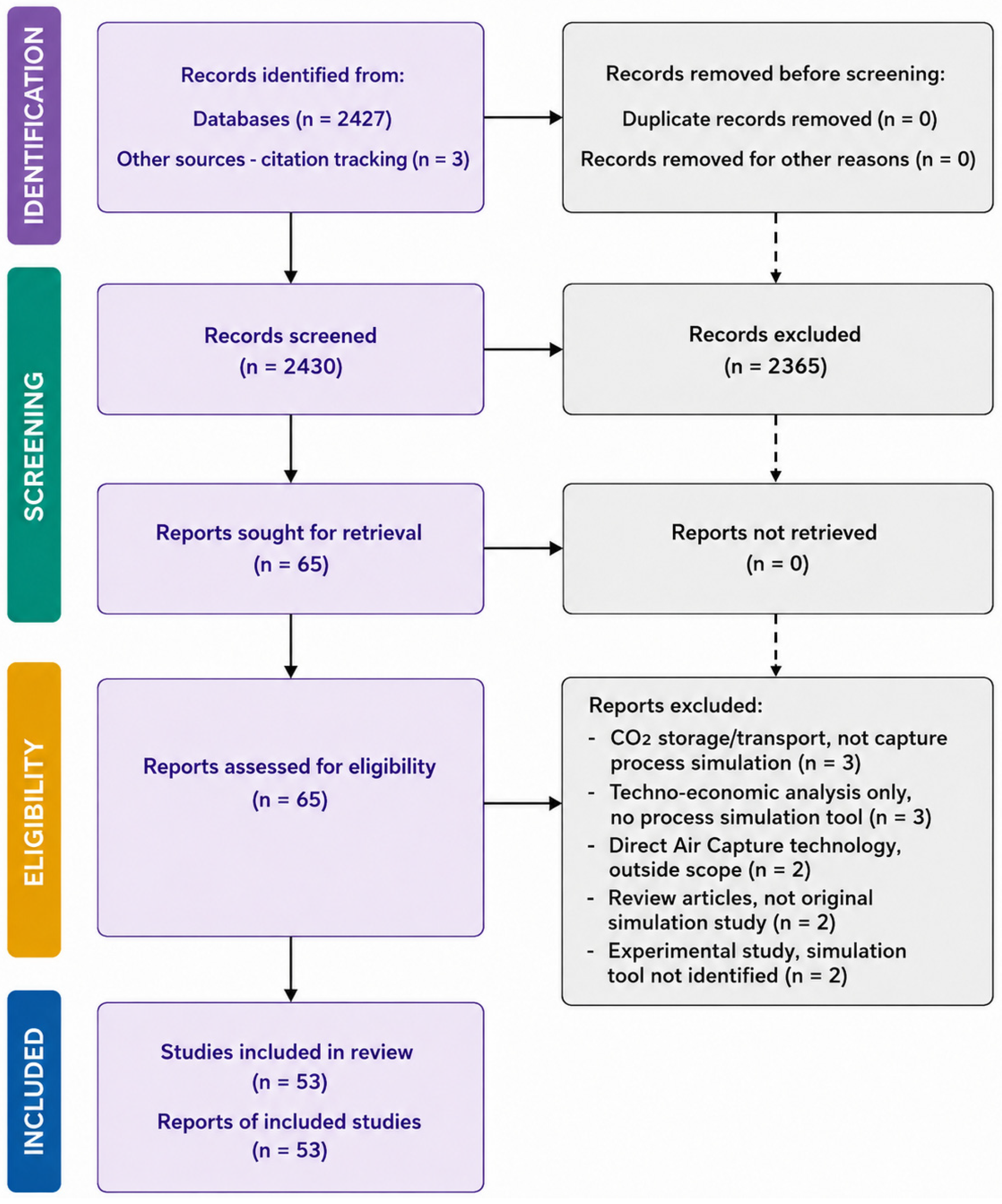
Screening was conducted in two sequential stages. In the first stage, titles and abstracts of all 2430 records were assessed against the eligibility criteria; 2365 records were excluded and 65 full-text articles were retrieved for closer review. In the second stage, each full text was evaluated in detail, and 12 articles were excluded for the following reasons: CO2 storage or transport was studied rather than capture process simulation (n = 3); only a techno-economic analysis was offered, with no explicit process simulation tool identified (n = 3); direct air capture technology, outside the scope of the three target CCS technologies, was studied (n = 2); the texts were review articles rather than original simulation studies (n = 2); and the texts were experimental studies with no identified simulation tool (n = 2). A total of 53 studies were retained for inclusion. For each included study, the following data were extracted: the simulation tool used, the CCS technology type addressed, the modeling approach (steady-state or dynamic), and the main findings reported.

2.5. PRISMA Flow Diagram

The complete identification, screening, and inclusion process is illustrated in Figure 1 as a PRISMA 2020 flow diagram [34].

3. Simulation Processes of Different Technologies

Substantial advancements have occurred in the domain of CCS, attributable to improvements in dynamic modeling and simulation research. The research in this domain has provided essential insights into the design, operation, and integration of CO2 capture systems. This section presents a summary of key findings from numerous impactful studies.
A range of process simulation tools are employed to replicate, assess, and improve processes. This allows engineers and researchers to model system behavior without relying on a physical system, resulting in substantial time and cost savings. It also fosters an understanding of process dynamics and opportunities for enhancements. Simulation tools usually suggest features for analyzing scenarios, handling uncertainties and predicting system performance under varying conditions. Tools like these play a role in manufacturing and energy by aiding the decision-making processes and improving operational effectiveness [38].
The authors of [24] assessed a range of simulation software systems, each customized to fulfill unique requirements, examining 16 tools. Their investigation identified Arena, AnyLogic, and Flexsim as the most prevalent options. However, these tools are designed for process and operational simulations and may not be directly applicable to modeling carbon capture and storage (CCS) systems.
Extensive research has been carried out on steady-state models, techno-economic simulations, design, and optimization. More recently, research has explored dynamic modeling and control [39]. In the context of steady-state modeling, it is assumed that the process conditions, such as temperature, pressure, composition, and flow rates, remain constant throughout the duration. Steady-state models do not include time as a variable; instead, they aim to determine the system’s performance under a particular set of conditions once all temporary behaviors have ceased [40]. Dynamic modeling involves time as a crucial factor, enabling it to replicate the changes in process conditions over time. This modeling approach captures the temporary behaviors of processes and how the system reacts to changes in inputs and disturbances [41]. In this research, we will focus on steady-state and dynamic carbon capture process modeling to see what kind of software will suit it.
Commonly used process simulation software systems for modeling CO2 capture processes include Aspen HYSYS, Aspen Plus, gPROMS, Aspen Custom Modeller, ProMax with Tsweet, and Protreat. Specific process modeling tools like gPROMS and Aspen Plus Dynamics have built-in dynamic simulation capabilities [31].

3.1. Post-Combustion CO2 Capturing Technology

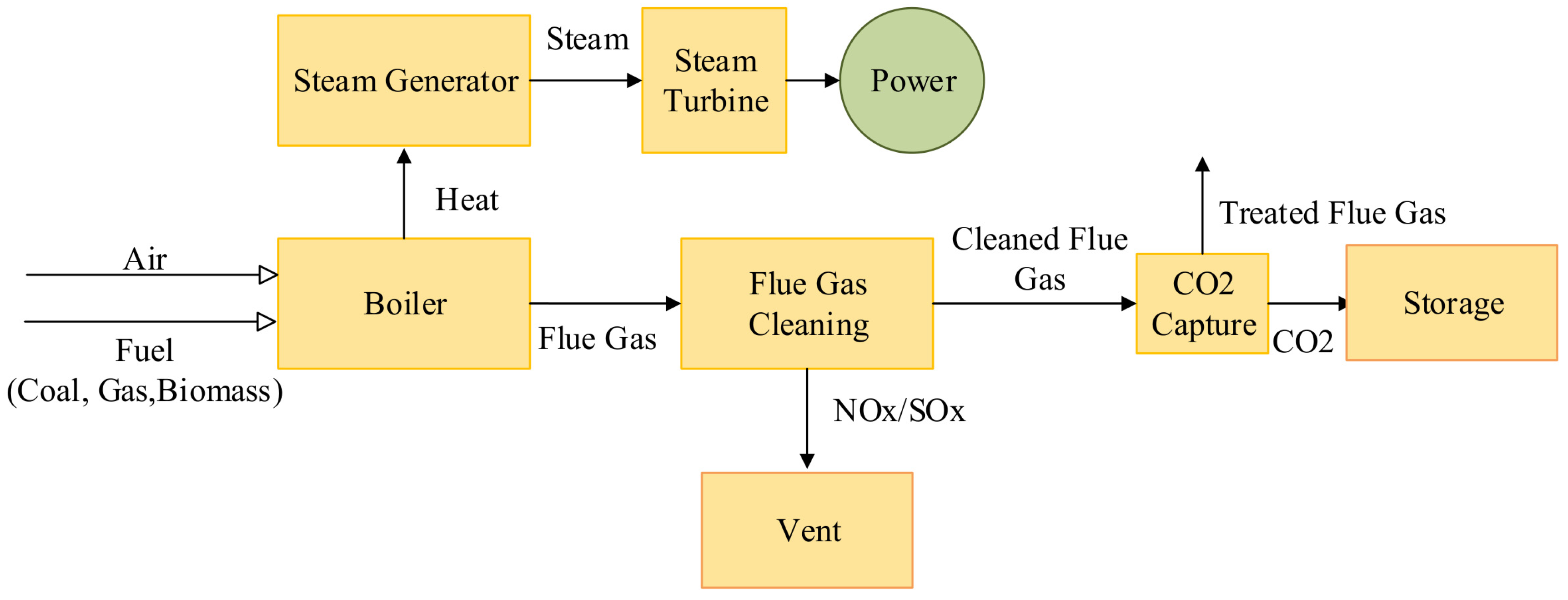
Figure 2 shows how fuel and air undergo combustion, leading to the formation of a CO2 mixture. Post-combustion, the gas proceeds to a CO2 capture phase, during which the CO2 is selectively extracted from the remaining gases. The CO2 that has been captured is subsequently separated for additional processing or storage [42].
This approach is an essential element of CCS systems that target the reduction of greenhouse gas emissions resulting from fossil fuel combustion in power plants and industrial processes.

3.1.1. Steady-State Modeling of Post-Combustion Technology

Researchers have employed steady-state modeling software to investigate aspects of post-combustion technology. We identified one study using gPROMS, two studies based on Aspen Plus, and four studies relying on other software.
Steady-state modeling for post-combustion carbon capture has utilized a variety of tools tailored to specific research objectives. gPROMS was employed by [44] to model rotating packed bed (RPB) absorbers, assessing intercooling needs and optimal designs for enhanced efficiency. Aspen Plus featured in studies by [35], focusing on cryogenic carbon capture, and Ref. [45], which developed thermodynamic models for optimizing energy systems. Other software systems included EBSILON Professional combined with CHEMASIM [46] for simulating power plants with CO2 scrubbers, ProMax [47] for its precise gas treatment capabilities, EBSILON Professional [48] for integrating carbon capture in combined cycle power plants, and Pyomo with the IPOPT solver [49] for optimization in post-combustion carbon capture processes.
These studies highlight the contributions of steady-state simulations in designing efficient and economically proper post-combustion CO2 capture systems.
The purpose of Table 1 is to show the use of different simulation tools in various studies on steady-state modeling of post-combustion technology.

3.1.2. Dynamic Modeling of Post-Combustion Technology

Several studies have employed dynamic modeling software to investigate aspects of post-combustion technology. We identified four studies using gPROMS, four studies based on MATLAB, and five studies relying on other software.
Dynamic modeling for post-combustion carbon capture has leveraged various tools for their unique capabilities. gPROMS was utilized in studies [51,52,53,54,55] to model dynamic behaviors in coal-fired power plants, demonstrating its effectiveness in capturing the nuanced interactions of integrated systems and its specialized library for carbon capture processes. MATLAB featured prominently in [54,56,57,58,59] for its robustness in managing differential equations and dynamic system modeling. Other software included Aspen Plus Dynamics, used by [50,55,60] for control system optimization; Modelica for analyzing absorption/desorption loops [61]; UniSim Design for evaluating stripper configurations [62]; and custom tools like Pyomo [63] and innovative mathematical models [64] for enhanced process simulations.
In this part, the objective was to review the dynamic modeling tools of post-combustion CO2 capture systems to show the importance of simulation tools in improving the effectiveness and economic viability of these processes. Table 2 aims to highlight how different simulation tools are utilized in various studies focused on dynamic modeling of post-combustion technology.

3.2. Pre-Combustion CO2 Capturing Technology

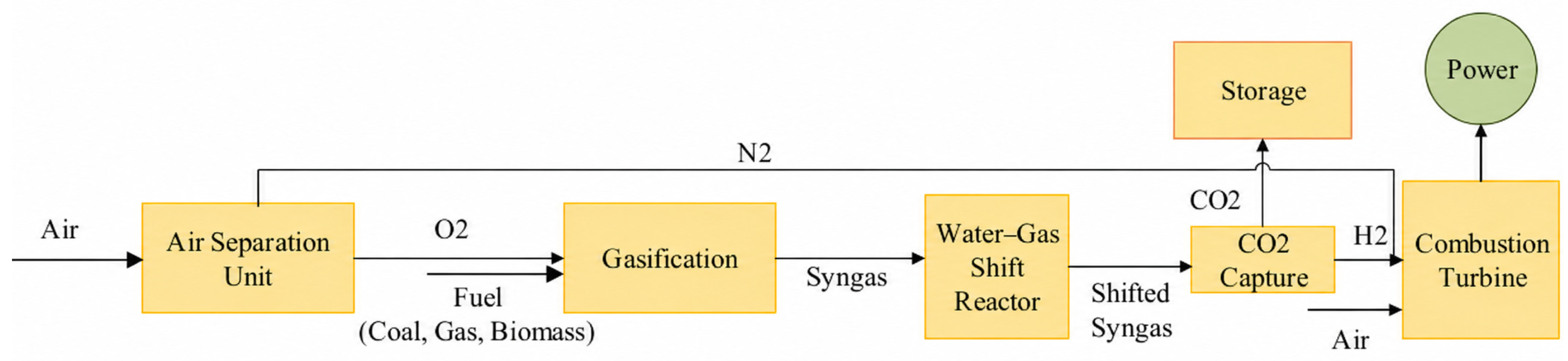
Pre-combustion carbon capture is a process where fuel is gasified to generate a syngas consisting mainly of hydrogen (H2), carbon monoxide (CO) and carbon dioxide (CO2). Figure 3 shows that the syngas is subjected to a water–gas shift process to transform CO into CO2 and H2, after which the CO2 is separated for capture.
The purified hydrogen-rich gas is subsequently utilized for combustion in gas turbines or alternative power generation systems [70].

3.2.1. Steady-State Simulation of Pre-Combustion CO2 Capture

Various software systems have been employed to develop steady-state simulation of pre-combustion CO2 capture systems. We identified three studies that used Aspen Plus, one that used Ansys Fluent, and five that used other tools.
Steady-state modeling for pre-combustion carbon capture has utilized a variety of tools tailored to specific research objectives. Aspen Plus was employed in studies by [71] for comparing IGCC systems with and without chemical looping combustion, [72] for evaluating solvents like Selexol in IGCC power plants, and [73] for optimizing Gas-to-Wire systems using ionic-liquid carbon capture. HYSYS was used by [74] for a comparative techno-economic analysis of carbon capture methods. Other software systems included UniSim [75] for dual-stage Selexol process simulation, ANSYS Fluent with user-defined functions [76] for optimizing PSA systems, SPIDER CFD code [77] for refinery upgrades, and ChemCAD [78,79] for assessing chemical and calcium looping techniques and biomass-based IGCC systems.
These studies highlight the versatility of steady-state simulations in optimizing pre-combustion CO2 capture technologies, enhancing efficiency, and enabling robust comparative analyses across various configurations and solvents. Steady-state simulations help enhance efficiency and allow for comparisons between different configurations and solvents. Table 3 highlights the application of various simulation tools in studies focusing on steady-state modeling of pre-combustion technology.

3.2.2. Dynamic Modeling of Pre-Combustion Technology

A few studies have employed dynamic modeling software to investigate aspects of pre-combustion technology. We identified one study that used gPROMS, two studies based on MATLAB, and two studies that relied on other software.
Dynamic modeling for pre-combustion carbon capture has employed varied tools to address complex process dynamics. Ref. [80] used gPROMS for pressure swing adsorption (PSA) in a power plant, focusing on optimizing amine-modified activated carbons for efficient CO2 recovery. MATLAB was utilized by [81] for dynamic simulations and control design in hydrogen membrane reforming (HMR) cycles and by [82] for modeling gas switching oxygen production (GSOP) reactors integrated into IGCC plants, improving efficiency and reducing energy penalties. Other tools included Modelica [83], which provided object-oriented modeling for dynamic simulations in IGCC plants, and an in-house PSA process model developed by [58], which facilitated accurate optimization of adsorption and desorption processes in IGCC configurations.
These studies demonstrate the utility of dynamic simulations in pre-combustion CO2 capture, enhancing system efficiency, control strategies, and energy performance. Table 4 showcases the use of different simulation tools in studies exploring dynamic modeling of pre-combustion technology.

3.3. Oxy-Fuel CO2 Capturing Technology

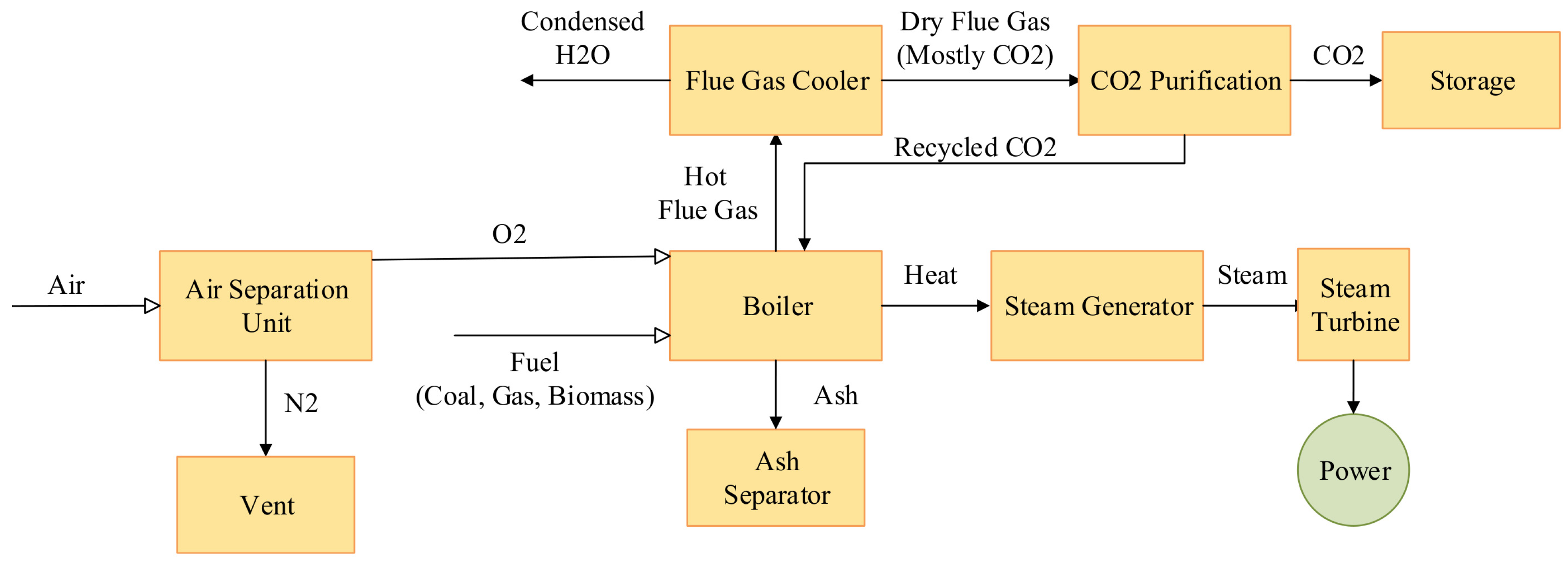
The oxy-fuel combustion technique for power production with carbon capture and storage (CCS) entails the utilization of pure oxygen, rather than air, for the process of combustion, as can be seen in Figure 4. This method guarantees that the emissions released consist mostly of carbon dioxide (CO2) and water vapor (H2O), resulting in a substantial decrease in nitrogen-based pollutants [84]. This is accomplished by isolating CO2 from water vapor upon condensation, resulting in nearly pure CO2 that may be compressed for storage.
The level of purity of the CO2 needs to be carefully adjusted to account for any decrease in efficiency, operating expenses, and safety prerequisites related to its transportation and storage [85].

3.3.1. Steady-State Modeling of Oxy-Fuel for Carbon Capture Systems

Software for steady-state modeling of oxy-fuel carbon capture systems ranges from ANSYS to MATLAB. ANSYS is the most employed software. Steady-state modeling for oxy-fuel CO2 capture has primarily utilized ANSYS Fluent for Computational Fluid Dynamics (CFD) simulations. Fluent is used to investigate combustion processes, heat transfer, and system performance, optimizing temperature predictions and emissions reductions in oxy-fuel systems [36,86,87,88,89]. Aspen Plus was employed by [90] to optimize CO2 capture using ionic-liquid absorbents and by [91] to model a cement plant integrating oxy-fuel combustion with power-to-gas technology, demonstrating energy efficiency advantages. Ref. [92] combined Fluent and MATLAB to analyze the challenges of scaling up oxy-fuel circulating fluidized beds (CFBs) and co-firing biomass with coal, emphasizing the role of both software systems in simulating complex industrial processes.
This section underscores the importance of steady-state simulations in optimizing oxy-fuel CO2 capture technologies, focusing on enhancing system efficiency, heat transfer accuracy, and process design. Table 5 illustrates the use of various simulation tools in studies examining steady-state modeling of oxy-fuel combustion technology.

3.3.2. Dynamic Modeling of Oxy-Fuel Carbon Capture Processes

We identified a few studies on the dynamic modeling of oxy-fuel CO2 capture. Most studies employed Aspen Plus Dynamic, but there is a greater variety of software packages employed.
Dynamic modeling for oxy-fuel CO2 capture has utilized a variety of tools tailored to specific research objectives. Aspen Plus Dynamics was employed in studies by the authors of [93,94,95] to optimize the mode-switching process between air and oxy-fuel combustion and to enhance system flexibility and control strategies. Ref. [96] used Fluent to investigate combustion behavior under high CO2 concentrations, focusing on flame stability and heat transfer. Apros Combustion was utilized by [95,97] for analyzing transient behaviors in fluidized bed boilers, including the use of biomass as a fuel source. Ref. [37] employed OpenFOAM for direct numerical simulations (DNSs) of turbulent oxy-fuel combustion, exploring the effects of CO2 and H2O diluents on flame dynamics.
These studies demonstrate the contributions of dynamic simulations in optimizing oxy-fuel CO2 capture technologies to enhance operational efficiency and adaptability. Table 6 demonstrates the utilization of different simulation tools in studies investigating dynamic modeling of oxy-fuel combustion technology.

4. Evaluation of Simulation Tools for CCS Technologies

Table 7 lists the simulation tools that were used in a sample of the CCS modeling studies that this work looked at. The counts summarized in Table 7 are drawn from the 53 peer-reviewed studies retrieved through the systematic Scopus search described in Section 2. They are reported as illustrative observations of the usage patterns within that sample and are not intended as universal measures of tool performance, superiority, or market share. The table displays the predominantly used simulation software for each CCS technology, emphasizing its use in dynamic and steady-state modeling. An analysis of the frequency of software references in post-combustion, pre-combustion, and oxy-fuel carbon capture processes shows the usage patterns that have been seen in published CCS studies. The analysis further emphasizes the frequency of usage of each software system for dynamic or steady-state models, providing a perspective on the most popular tools for various CCS scenarios.
Based on the studies reviewed, Aspen Plus is the most frequently used software for steady-state modeling of post-combustion processes, while gPROMS and MATLAB are the most commonly used systems for dynamic modeling in this area. For pre-combustion processes, Aspen Plus is the leading tool for steady-state modeling, and MATLAB is the one most frequently used for dynamic simulations. In the case of oxy-fuel combustion, Fluent is predominantly used for steady-state simulations, while Aspen Plus Dynamic leads in dynamic modeling.
Simulation software systems such as gPROMS, MATLAB, and Aspen Plus Dynamics are cited in other studies [52,62,67,68] as being well suited for dynamic modeling of post-combustion processes. For steady-state modeling of post-combustion processes, tools like gPROMS, EBSILON Professional, ProMax, CHEMASIM, and Aspen Plus are highlighted [44,45,46,63]. In pre-combustion processes, gPROMS and MATLAB are the primary tools for dynamic modeling [81,82], while UniSim, HYSYS, Aspen Plus, GateCycle, CHEMCAD, and Fluent are commonly employed for steady-state modeling [72,75,76]. Patterns were found in a sample of peer-reviewed CCS simulation studies that led to these conclusions. This association does not indicate that one tool is inherently better than another for a particular application; rather, it reflects the particular modeling requirements that are usually emphasized in each technology type.
For oxy-fuel combustion, dynamic process modeling is often carried out using Aspen Plus Dynamics, Fluent, Apros, and OpenFOAM [93,94,96], whereas Fluent, MATLAB and Aspen Plus are primarily used for steady-state modeling [36,86,90]. Due to their robust capabilities in managing intricate dynamic systems, adaptability in model development, and appropriateness for optimization tasks, gPROMS and MATLAB are extensively utilized for dynamic modeling of post-combustion and pre-combustion carbon capture processes. The primary advantage of gPROMS is its equation-based modeling methodology, which gives users the flexibility to change the mathematical formulas that describe a complex system’s chemical and physical processes. Users can directly access, modify, and personalize these equations with gPROMS. Furthermore, gPROMS integrates steady-state and dynamic simulations within a unified environment, facilitates the digital process design cycle, and provides an extensive library of models. Its robust multivariate optimization features allow users to identify optimal solutions, and its ability to connect to real-time data renders it an important tool for developing and optimizing complex systems [98]. Although MATLAB is capable of simulating chemical systems, it lacks the specific, integrated features for managing intricate chemical reaction kinetics, thermodynamics, and process optimization that gPROMS offers [54]. Based on its adaptability in solving differential equations and modeling control systems, MATLAB is a versatile and general-purpose tool extensively used in academia. Although less focused on chemical process modeling, its incorporation with Simulink renders it a widely favored option for modeling dynamic systems. The computational cost of MATLAB is dependent on the complexity of the model, but it is typically more effective than other software for solving mathematical problems and relatively smaller dynamic systems.
Aspen Plus Dynamics has been used in many studies on oxy-fuel combustion systems because it can model complete process chains that include air separation, combustion, and CCS units [95]. Because of its ease of use and compatibility with dynamic simulations, Aspen Plus Dynamics has been widely utilized in CCS research, even though other platforms also facilitate complex system modeling.
Aspen Plus Dynamics improves process comprehension and optimization by enabling users to simulate actual plant dynamics, thereby enhancing safety, operability, and cost-effectiveness. The integration with MATLAB and Simulink facilitates sophisticated control system design and evaluation on complex, non-linear process models, minimizing uncertainties and guaranteeing dependable control performance in practical applications. This seamless integration facilitates the development of more efficient and resilient process control systems [99].
Aspen Plus and Ansys Fluent are popular software systems in steady-state simulation for different carbon capture technologies. Most post-combustion and pre-combustion carbon capture studies favor the utilization of process simulation tools such as Aspen Plus over Computational Fluid Dynamics models like Fluent. Aspen Plus is mainly intended for process simulations that encompass chemical reactions, separation processes, and process optimization. It emphasizes steady-state simulations and is frequently employed in the design of chemical plants, refining processes, and the optimization of energy systems. Aspen Plus offers thermodynamic and kinetic models, rendering it suitable for system-level modeling of chemical processes [100]. Fluent’s strength in managing complex fluid dynamics and combustion makes it suitable for simulating oxy-fuel combustion. It enables accurate modeling of heat transfer and the impacts of various combustion parameters, which are essential for optimizing oxy-fuel processes. Fluent’s proficiency in managing high-temperature flows allows for accurate simulation of the combustion environment, essential for the effective design and optimization of oxy-fuel systems [96].
The four most frequently mentioned software systems are Aspen Plus, Fluent, MATLAB, and gPROMS, which are the focus of the rest of this paper. Although the literature survey identified 16 simulation tools (Table 7), these four were selected for in-depth AHP evaluation because they were by far the most frequently applied across the reviewed studies, spanning steady-state and dynamic modeling of all three capture routes (Table 7 and Table 8); the remaining tools each appeared in only one or two studies, too few to support a robust, criteria-based comparison, and were therefore retained in the survey but excluded from the AHP. Table 8 categorizes simulation tools based on their applications in steady-state and dynamic modeling across post-combustion, pre-combustion, and oxy-fuel technologies. The tools are listed with the total number of mentions in different studies indicated in parentheses.
When modeling carbon capture systems, selecting between dynamic and steady-state simulation tools involves important trade-offs related to modeling depth, computational complexity, and practical applicability in industrial-scale scenarios (see Table 9).
Aspen Plus is a widely used, steady-state process simulator known for its computational efficiency and robust thermodynamic property estimation. It is particularly effective for preliminary system design, mass and energy balance calculations, and feasibility studies of CCS technologies. However, it lacks the ability to simulate time-dependent behaviors such as system disturbances, startup/shutdown sequences, or load-following operations. Aspen Plus Dynamics’ dynamic modeling features help users get around this restriction by simulating process control and dynamic reactions. This can lead to a significant increase in computational time, particularly for large systems with recycle loops or embedded control logic, and comes with additional setup requirements, such as controller configuration [101]. It is essential to point out that although Aspen Plus Dynamics is frequently characterized in modular terms, it facilitates dynamic simulation by using converged steady-state Aspen Plus models, and its functionalities can be enhanced through integration with the Aspen Custom Modeler (ACM), allowing user-defined, equation-oriented model development [102].
gPROMS was designed from the ground up to be dynamic and equation-based. It gives you the flexibility to define your own process behavior and is perfect for capturing complex temporal dynamics like the ramp-up and shutdown phases of CCS systems [103]. The equation-oriented (EO) modeling environment gPROMS lets users create and solve sets of nonlinear algebraic and differential equations. This gives users a lot of freedom when modeling complex chemical equilibrium and process behavior. Its strong formula makes it good for accurate thermodynamic modeling and system optimization, especially when there are complex reaction mechanisms and equilibrium constraints to consider [104].
Fluent is a CFD-based tool that can do both steady-state and transient simulations [105]. It is particularly effective at modeling heat transfer and fluid flow in very detailed 3D spaces, which is very important for oxy-fuel combustion and reactor-level simulations [106]. However, using Fluent for dynamic simulations can be very computationally demanding [107], particularly when modeling a whole carbon capture plant. Therefore, in order to handle larger system-level processes more effectively, engineers need to simplify the model or integrate Fluent with other software.
MATLAB is not a typical process simulator, but it is used a lot for dynamic modeling, designing control systems, and in combination with optimization solvers or machine learning algorithms. It works well for dynamic simulations when used with Simulink or custom solvers, and it works with either surrogate modeling or hybrid frameworks [108]. However, it lacks built-in process libraries or thermodynamic models, which must be manually implemented or externally sourced.
Ultimately, these trade-offs affect the dependability of performance forecasts. For static design and comparative assessments, steady-state tools such as Aspen Plus are adequate. However, for real-time control, risk assessment, or integration with variable energy systems, dynamic tools such as gPROMS, Aspen Plus Dynamics, and MATLAB are more suitable. The selection of an appropriate tool is contingent upon the modeling objective, the data at hand, and the required accuracy in depicting CCS system dynamics.
In real-world CCS modeling, it is rare for a single simulation tool to include all the necessary process, control, and physical phenomena. So, workflows that use more than one piece of software are becoming more common. When modelers combine tools like MATLAB, Aspen Plus, Fluent, and gPROMS, they can use the best features of each one. For example, MATLAB is often used to connect to process simulators like Aspen HYSYS or Aspen Plus because it is easy to integrate with other programs [109]. However, interoperability presents several challenges, including inconsistent time steps, mismatched thermodynamic assumptions, unit incompatibilities, and delays in data exchange across platforms. These problems can make it hard to keep models consistent, make them scalable, and keep solvers stable. The use of standardized protocols such as CAPE-OPEN or middleware solutions (e.g., OPC servers and DLLs) improves feasibility but still demands careful synchronization and validation [110]. As CCS systems get bigger and more complicated, making modular, interoperable frameworks that make computations reliable and reduce integration costs is becoming more and more important for multi-software modeling to work.
In addition to modeling accuracy and computational performance, being able to measure uncertainty and evaluate sensitivity are also very important for designing a reliable CCS system. The simulation tools which were examined in this study help with uncertainty quantification (UQ) and risk assessment in different ways. When it comes to this, MATLAB gives users the most options. It can use custom or open-source libraries to do probabilistic optimization, global sensitivity analysis [111], and Monte Carlo simulation [112]. gPROMS has built-in tools for estimating parameters and uncertainty, such as Bayesian approaches and variance-based sensitivity tools [113]. This makes it a good choice for rigorous uncertainty propagation in dynamic systems. On the other hand, Aspen Plus does not have a lot of built-in support for UQ. However, users may perform basic sensitivity analysis or use external scripts to make probabilistic models [114]. Fluent, while advanced in physical modeling, lacks built-in capabilities for comprehensive stochastic simulations or uncertainty propagation and typically requires coupling with external tools or surrogate models to handle such tasks [115]. Overall, tools like MATLAB and gPROMS are more appropriate for applications involving complex risk analysis or stochastic CCS process optimization, while others may require additional development effort to achieve comparable analytical capabilities.
Tool suitability also depends strongly on process scale and operating envelope. Steady-state process simulators such as Aspen Plus and reduced-order or equation-based models in gPROMS and MATLAB remain computationally tractable from pilot to industrial scale and are therefore preferred for plant-wide design and optimization. High-fidelity CFD in Fluent, by contrast, scales poorly: computational cost rises sharply with mesh resolution, geometric detail, and transient or multiphase effects, so CFD is typically confined to unit-, burner-, or reactor-level analysis rather than whole-plant simulation. Boundary conditions matter as well. Elevated operating pressures (characteristic of pre-combustion and IGCC systems) and flue gas impurities (SOx, NOx, moisture, and trace metals) increase the demands placed on thermodynamic/property packages and reaction kinetics models; tools with rigorous, well-validated property methods (Aspen Plus and gPROMS) handle these conditions more reliably, whereas general-purpose environments (MATLAB) require user-supplied property models, and CFD tools require careful sub-model selection for radiation and chemistry under high-CO2 atmospheres. These factors should be weighed alongside the criteria scores when selecting a tool for a specific scale and feed composition. Table 9 summarizes the key advantages, limitations, and ideal CCS application scenarios for each of the evaluated simulation tools.
Gaps in the evaluated toolset (open-source and other options). The AHP focused on the four most frequently used platforms; several alternatives appear less often in the CCS literature but merit mention: OpenFOAM (open-source CFD, used in oxy-fuel DNS studies), OpenModelica/Dymola (open and commercial equation-based dynamic modeling), the Python-based IDAES platform and Pyomo optimization framework (open-source, equation-oriented, increasingly used for CCS process systems engineering), and COMSOL Multiphysics (multiphysics, used for sorbent/membrane-scale studies). Open-source options provide transparency, reproducibility, and extensibility, but generally have smaller CCS-specific model libraries and less vendor support than the commercial tools evaluated here.
Beyond the four tools evaluated in depth, several other platforms are relevant to CCS modeling and were identified in the broader survey but appeared too infrequently in the retrieved literature to support a criteria-based comparison. Aspen Custom Modeler (ACM) provides equation-oriented, user-defined model development that extends Aspen Plus Dynamics. COMSOL Multiphysics supports finite-element multiphysics modeling useful at the sorbent, membrane, and contactor scales. Dymola and the open-source OpenModelica implement the Modelica language for object-oriented dynamic simulation of integrated energy systems. The open-source, Python-based IDAES platform and the Pyomo optimization framework are increasingly used for equation-oriented, optimization-driven CCS process systems engineering. These platforms, particularly the open-source options, offer transparency and extensibility and represent promising directions for future comparative evaluation.
The present review focuses on post-combustion, pre-combustion, and oxy-fuel combustion, but two emerging routes—direct air capture (DAC) and bioenergy with carbon capture and storage (BECCS)—place new demands on simulation tools. DAC must model CO2 capture from ambient air at very low concentrations (~400 ppm), which requires accurate low-partial-pressure adsorption isotherms, large air-contactor geometries, sorbent regeneration cycles, and coupled heat-and-mass transfer over wide humidity and temperature ranges. BECCS adds biomass gasification or combustion, solid-fuel and char handling, ash chemistry, and heterogeneous solid-carrier reactions to the capture train. Existing tools address these only partially. Aspen Plus can represent BECCS and solid-sorbent DAC flowsheets but typically requires user-defined property sets, custom reaction kinetics, and manual thermodynamic adjustments for biomass and solid sorbents. gPROMS and MATLAB offer the equation-level flexibility to encode novel isotherms, cyclic adsorption, and heat–mass coupling, but at the cost of substantial user development and the absence of ready-made DAC/BECCS libraries. CFD tools such as Fluent capture contactor- and reactor-scale transport in detail but are impractical for full-system DAC/BECCS integration without reduced-order coupling. These gaps point to a need for dedicated low-concentration adsorption modules, validated biomass/solid-sorbent property libraries, and improved hybrid (process + CFD + data-driven) workflows and vendor support for next-generation CCS.

5. Analytic Hierarchy Process Analysis of Carbon Capture Simulation Software

Multi-criteria decision analysis (MCDA) entails assessing a range of alternatives according to multiple criteria and determines how to make trade-offs among those criteria. MCDA methods integrate expert knowledge to determine the optimal selection or rank alternatives in order of preference [116].
One of the more popular MCDA methods is AHP. The main idea behind it is to compare two elements at the same level of the hierarchy with respect to an element at a higher level. As suggested by [117], these comparisons use a standard scale from 1 to 9. A value of 1 means that both elements are equally important, while a value of 9 means that one element is much more important than the other.
AHP was chosen for this study because it can use structured pairwise comparisons to deal with both qualitative and quantitative factors. Its built-in consistency ratio reduces bias in subjective inputs even more. While other methods like TOPSIS and PROMETHEE also provide strong decision-making frameworks, they usually depend on clearly defined numerical inputs and do not include a step to check for consistency. Since some of our evaluation criteria were qualitative, AHP was thought to be a better fit for our analysis. AHP is recognized for its straightforward calculations and interpretability, which makes it accessible. Proponents emphasize its uncomplicated methodology as an advantage. However, a limitation is the possibility of suboptimal decisions in specific situations, where other methodologies may be more appropriate for managing different criteria [118].
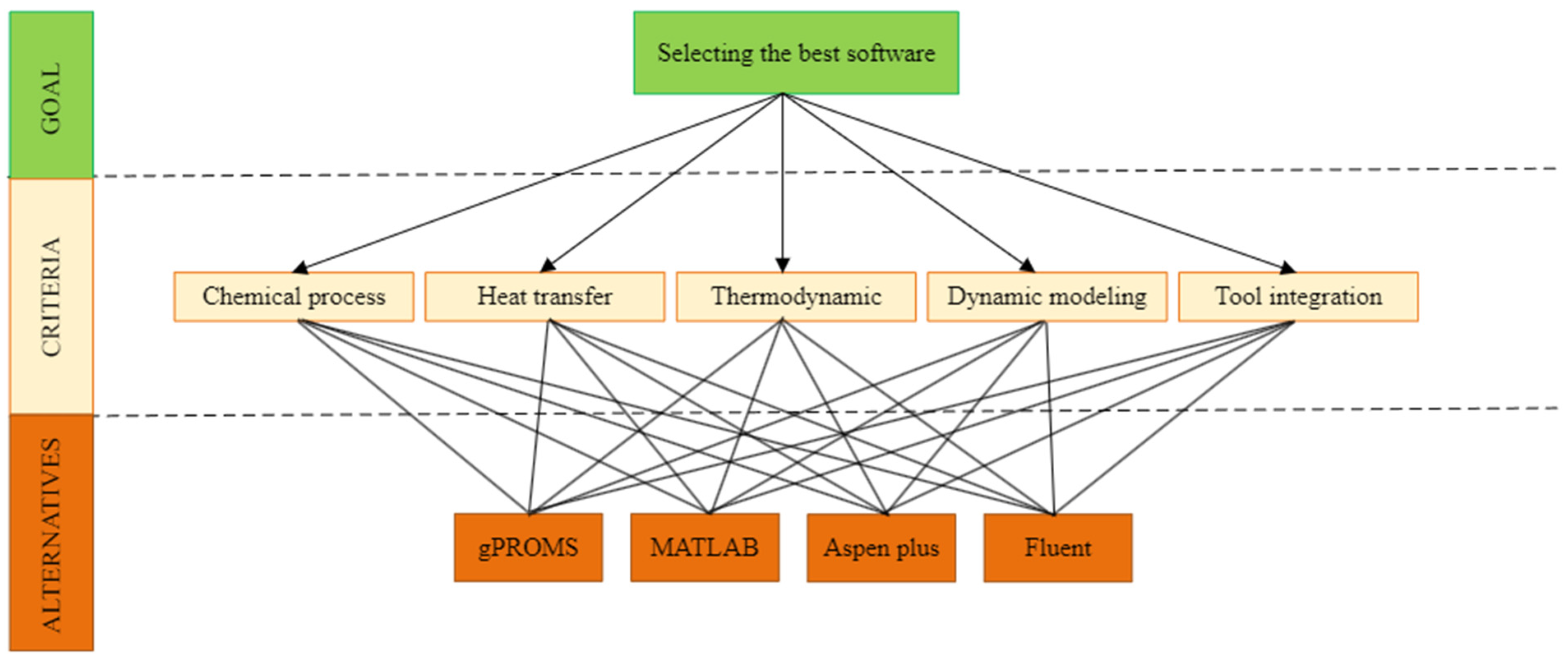
The criteria, chosen according to essential technical specifications for carbon capture modeling, encompass chemical process simulation, heat transfer, thermodynamics, dynamic modeling, and tool integration. A software system’s ability to accurately simulate chemical reactions and processes under various conditions (such as pressure, temperature, and flow rates) is evaluated by chemical process simulation, which often incorporates reaction kinetics and equilibrium calculations. Heat transfer evaluates how well the program can replicate conduction, convection, and radiation, among other heat transfer mechanisms. For applications where energy and mass balance are essential, such as chemical reactors and power plants, precise modeling in these areas is essential. The software’s ability to calculate properties such as enthalpy, entropy, and phase equilibria under various conditions is referred to as thermodynamics. Dynamic modeling refers to the software’s capacity to simulate time-dependent processes. Tool integration evaluates the software’s capacity to interface with other applications or environments, such as data analytics (e.g., Python and R), optimization solvers (e.g., Gurobi), and control software, which is essential for collaborative and complex workflows. The four most popular software tools for carbon capture modeling, determined by their ranking and normalized usage percentages, are gPROMS, MATLAB, Aspen Plus, and ANSYS Fluent.
Each tool was evaluated and ranked according to defined criteria, as depicted in Figure 5. The results of the pairwise ranking are presented in Table 10.
The values in Table 10 are rounded to two decimal places. Minor rounding differences may arise from the eigenvector computation of priority weights. The full unrounded values and complete derivation are provided in Supplementary Material S1.
The full pairwise comparison matrices, local priority weights, criteria weights, and consistency ratios (CR < 0.10 for all matrices) are provided in Supplementary Material S1.
A structured decision-making framework based on multiple evaluation criteria was used to make the rankings in Table 10. A review of the CCS literature was used to give each tool a score. They are not absolute performance rankings, but rather a reflection of how well each tool works in the different situations that were looked at. Aspen Plus and Aspen Plus Dynamics are treated as a single alternative because Aspen Plus Dynamics is built directly on converged steady-state Aspen Plus models and shares the same component databanks, property methods, and unit-operation models; they constitute one continuous modeling environment rather than two independent tools, so combining them avoids double-counting the same underlying platform.
When it comes to CCS modeling, it is important to keep in mind that each simulation tool has its own set of computational and numerical problems. For instance, Fluent provides highly detailed spatial resolution for combustion modeling but at high computational cost, particularly for transient or multiphase flows [119]. Even though MATLAB is flexible for combining control strategies, it needs to be handled carefully when working with stiff differential equations that are common in dynamic CCS systems [120]. gPROMS can handle stiff systems well and lets you change everything at the equation level, but you need to be an expert to make accurate models [121]. Aspen Plus is often used for steady-state modeling. It has an easy-to-use interface and a lot of process libraries. However, it might not be flexible enough for dynamic simulations unless it is paired with Aspen Plus Dynamics, which adds the ability to model transient events. Aspen Plus Dynamics simulations, on the other hand, can take a long time to run if they try to model large integrated systems with control loops [122]. These variations affect how well a tool works based on the CCS technology being modeled. They also show how important it is to match the tool’s features with the simulation goals and the size of the system being modeled.
Based on the AHP analysis, Aspen Plus/Aspen Plus Dynamics has the best weighted score of 0.31 because it performs especially well in chemical process simulation [100] and thermodynamic property modeling [93]. It is the best tool for steady-state simulations because it has a lot of libraries and strong thermodynamic models. This lets researchers design and improve carbon capture systems more accurately.
With a total weighted score of 0.26, gPROMS stands out in dynamic modeling. Its framework is based on equations that let users change and improve complicated chemical processes [39,98]. It works well with real-time data, which makes it perfect for situations that need dynamic simulations.
MATLAB comes in third with a score of 0.23, but it does the best job of integrating tools. Since MATLAB is frequently used in integrated CCS studies, it scored higher in this category even though the majority of commercial process simulators support external integration via COM, OLE, or CAPE-OPEN. It is a popular option for integrating data-driven or surrogate models with physical process simulations because of its intuitive scripting environment and compatibility with control and optimization libraries. MATLAB is flexible because it works with many optimization solvers and programming tools, and it also works with Simulink to design control systems [52,54].
With a score of 0.20, ANSYS Fluent does a great job of simulating heat transfer, which makes it a great tool for studying combustion and thermal systems in oxy-fuel carbon capture technologies. Fluent works best for tasks that need to do detailed simulations of fluid dynamics and heat transfer [88].
The AHP analysis was done to find out which simulation tools perform better for each criterion in modeling carbon capture. The consistency ratio (CR) was found for each set of criteria to make sure that the pairwise comparisons were valid. It was found that all of the CR values were less than 0.1, which means that the comparisons are valid and the results can be trusted.
Even though the AHP model’s criteria and weights were chosen after a careful review of the research, we acknowledge that there is still some subjectivity in the process. In particular, the criteria scores, including the tool-integration scores (where commercial simulators such as Aspen Plus also support standard CAPE-OPEN, COM, and OLE interfaces), reflect documented tool capabilities and the authors’ modeling experience rather than a quantitative benchmarking of every integration protocol and should be read as indicative rather than absolute. Computational performance, although discussed qualitatively in Section 4 (for example, the high cost of CFD in Fluent), was not included as a separate AHP criterion and could be incorporated in future work. The pairwise judgments were made by the authors and cross-checked for internal consistency (CR < 0.1); incorporating independent expert panels would further reduce single-rater bias. The consistency ratio was kept below 0.1 to make sure that everything made sense, but different opinions among experts could change the rankings. This work could be expanded in the future by using sensitivity analysis, adding more expert panels, or comparing the results of AHP with those of other MCDM methods to show that they are more reliable.

6. Conclusions

Although many studies examine individual carbon capture technologies or simulation software systems, there is an absence of thorough analysis comparing various simulation tools across different carbon capture processes. We addressed this gap by methodically examining various studies to determine the software systems most used for each carbon capture technology, namely, post-combustion, pre-combustion, and oxy-fuel combustion. The fragmentation in the literature restricts researchers’ capacity to make informed choices when selecting the most appropriate simulation software for various carbon capture processes. To address this gap, we performed an analysis of current research papers, pinpointing the specific software systems predominantly utilized for each category of carbon capture technology. This study aims to present a comprehensive overview of prevalent simulation tools utilized in carbon capture and storage (CCS) processes, derived from a representative sample of peer-reviewed research. From the preliminary analysis, four simulation tools, Aspen Plus, MATLAB, Fluent, and gPROMS, were identified as the most frequently referenced in research pertaining to several carbon capture applications. Identifying these as the principal instruments employed in the domain, we subsequently chose them for further assessment. We employed AHP to organize this assessment based on critical criteria, such as chemical process simulation capabilities, dynamic modeling functionalities, thermodynamic property management, accuracy in heat and mass transfer, and integration with other tools. Each software system was evaluated and ranked based on these criteria, facilitating a better understanding of their respective strengths and weaknesses.
Our research demonstrates that various software tools perform exceptionally well in specific domains: Aspen Plus/Aspen Plus Dynamics exhibits robust proficiency in chemical process simulation and thermodynamic modeling, while MATLAB provides versatility in tool integration; Fluent specializes in fluid dynamics and heat transfer, particularly for oxy-fuel processes; and gPROMS distinguishes itself with its chemical process simulation and optimization capabilities, especially in dynamic scenarios. We systematically ranked each software system through the AHP method, offering insights into the most effective tool for different facets of carbon capture modeling. The method provides a basis for choosing the best tool for a given application by quantifying how well each tool performs in areas like heat transfer, dynamic modeling, and chemical process simulation. By weighing the relative importance of various criteria, this ranking framework helps researchers and practitioners make well-informed decisions. This study provides a methodical assessment tailored to carbon capture systems. Our objective is to provide contextualized guidance for tool selection instead of isolated technical descriptions by implementing a multi-criteria framework that spans technologies and modeling requirements.
Our research shows that different carbon capture modeling software tools are better at different tasks. Aspen Plus is one of the most popular tools for steady-state simulations in the CCS literature. This is mostly because it has a lot of process libraries and thermodynamic models built in. It is often used for system design and process optimization because of these features. gPROMS distinguishes itself with its dynamic modeling, and it has an equation-based framework that lets researchers precisely change and improve complicated chemical processes. MATLAB can connect to a lot of different tools, which makes it a great choice for workflows that need to work with optimization solvers, programming tools, and control systems without any problems. Fluent is great for simulating combustion processes in detail, especially in oxy-fuel carbon capture technologies, because it performs well in heat transfer and fluid dynamics. We used the AHP method to systematically rank the tools, which gave us useful information about the best software for different parts of carbon capture modeling.
This study provides a framework for evaluating and choosing simulation tools to satisfy carbon capture modeling requirements. To combat climate change and mitigate CO2 emissions, the findings are intended to assist researchers in making decisions and provide sustainable and effective carbon capture solutions.
Our findings underscore numerous opportunities for enhancement of each tool. Novel technologies for capturing carbon, like direct air capture (DAC) and bioenergy with carbon capture and storage (BECCS), make modeling more complicated and make traditional simulation tools less flexible. Although gPROMS and MATLAB provide significant flexibility via equation-based and programmable frameworks, Aspen Plus necessitates customization to effectively model biological or solid-sorbent processes characteristic of BECCS and DAC. Fluent, while beneficial for intricate CFD analysis, is inadequately equipped for comprehensive system-level integration without external coupling. Recent research has illustrated this developing necessity. Ref. [123] built an integrated BECCS system using Aspen Plus, but their study needed a lot of process optimization and manual thermodynamic model adjustments to get a good picture of how the system worked. Ref. [124] used MATLAB to simulate a DAC system, but it took a lot of custom coding and the creation of substitute models to represent parts that were not in standard simulation libraries. These examples highlight the necessity of augmenting simulation tools with hybrid modeling functionalities, comprehensive property libraries, and modules designed for next-generation CCS technologies.
MATLAB could enhance its inherent functionalities for thermodynamics and heat transfer to diminish reliance on external packages. Aspen Plus would improve with enhanced integration of steady-state and dynamic simulations, as well as improved support for AI-driven extensions. gPROMS could improve accessibility by providing intuitive interfaces and pre-constructed CCS modeling templates. The application of Fluent in CCS would be enhanced by facilitating more efficient system-level integration and employing reduced-order models to mitigate computational complexity.
In the future, more research could add to this evaluation by looking at cost, regulatory compliance, and industrial validation requirements, all of which are important factors that affect how widely CCS simulation tools are used in the real world.
This review has several limitations that should be acknowledged. The literature search was conducted exclusively in Scopus; studies indexed in other databases such as Web of Science, IEEE Xplore, or Google Scholar may not be represented here. The review was further restricted to English-language publications, which may have excluded relevant work published in other languages. Additionally, the scope is confined to three CCS technology types—post-combustion, pre-combustion, and oxy-fuel combustion—and does not address other emerging capture approaches. Because the search relied on predefined keywords, papers describing the same simulation tools or processes using alternative terminology may have been overlooked. Furthermore, three studies were identified through citation tracking rather than the primary Scopus search, indicating that the search string alone did not retrieve all the relevant literature. In addition, computational performance was treated qualitatively in Section 4 rather than included as an AHP criterion, and economic and environmental assessment capabilities were not evaluated quantitatively; both represent important directions for future extensions of this comparative framework.


Supplementary Materials

The following supporting information can be downloaded at https://www.mdpi.com/article/10.3390/en19132988/s1. References [34,125,126] are cited in supplementary file.

Author Contributions

Investigation, M.K.; writing—original draft preparation, M.K.; writing—review and editing, C.A.M. and M.M.W.; supervision, C.A.M. and M.M.W.; funding acquisition, M.M.W. All authors have read and agreed to the published version of the manuscript.

Funding

The authors acknowledge the support of the US Department of Agriculture National Institute of Food and Agriculture program (award #2023-68016-40133).

Data Availability Statement

No new data were created in this review study. All data discussed are derived from publicly available, peer-reviewed sources cited in the references.

Conflicts of Interest

The authors declare no conflicts of interest.

References

  1. Luderer, G.; Vrontisi, Z.; Bertram, C.; Edelenbosch, O.Y.; Pietzcker, R.C.; Rogelj, J.; De Boer, H.S.; Drouet, L.; Emmerling, J.; Fricko, O. Residual Fossil CO2 Emissions in 1.5–2 °C Pathways. Nat. Clim. Change 2018, 8, 626–633. [Google Scholar] [CrossRef]
  2. AR6 Synthesis Report: Climate Change 2023. Available online: https://www.ipcc.ch/report/ar6/syr/ (accessed on 13 June 2024).
  3. Gautam, A.; Gore, P.M.; Kandasubramanian, B. Nanocluster Materials in Photosynthetic Machines. Chem. Eng. J. 2020, 385, 123951. [Google Scholar] [CrossRef]
  4. Ghiat, I.; Al-Ansari, T. A Review of Carbon Capture and Utilisation as a CO2 Abatement Opportunity within the EWF Nexus. J. CO2 Util. 2021, 45, 101432. [Google Scholar] [CrossRef]
  5. Field, C.B.; Barros, V.R. Climate Change 2014–Impacts, Adaptation and Vulnerability: Regional Aspects; Cambridge University Press: Cambridge, UK, 2014. [Google Scholar]
  6. Callas, C.; Saltzer, S.D.; Davis, J.S.; Hashemi, S.S.; Kovscek, A.R.; Okoroafor, E.R.; Wen, G.; Zoback, M.D.; Benson, S.M. Criteria and Workflow for Selecting Depleted Hydrocarbon Reservoirs for Carbon Storage. Appl. Energy 2022, 324, 119668. [Google Scholar] [CrossRef]
  7. Petrasch, J.; Klausner, J. Integrated Solar Thermochemical Cycles for Energy Storage and Fuel Production. WIREs Energy Environ. 2012, 1, 347–361. [Google Scholar] [CrossRef]
  8. Jansen, D.; Gazzani, M.; Manzolini, G.; van Dijk, E.; Carbo, M. Pre-Combustion CO2 Capture. Int. J. Greenh. Gas Control 2015, 40, 167–187. [Google Scholar] [CrossRef]
  9. Boot-Handford, M.E.; Abanades, J.C.; Anthony, E.J.; Blunt, M.J.; Brandani, S.; Mac Dowell, N.; Fernández, J.R.; Ferrari, M.-C.; Gross, R.; Hallett, J.P. Carbon Capture and Storage Update. Energy Environ. Sci. 2014, 7, 130–189. [Google Scholar] [CrossRef]
  10. Rubin, E.S.; Chen, C.; Rao, A.B. Cost and Performance of Fossil Fuel Power Plants with CO2 Capture and Storage. Energy Policy 2007, 35, 4444–4454. [Google Scholar] [CrossRef]
  11. Zhao, B.; Su, Y.; Tao, W.; Li, L.; Peng, Y. Post-Combustion CO2 Capture by Aqueous Ammonia: A State-of-the-Art Review. Int. J. Greenh. Gas Control 2012, 9, 355–371. [Google Scholar]
  12. Liu, J.; Baeyens, J.; Deng, Y.; Tan, T.; Zhang, H. The Chemical CO2 Capture by Carbonation-Decarbonation Cycles. J. Environ. Manag. 2020, 260, 110054. [Google Scholar] [CrossRef]
  13. Stanger, R.; Wall, T. Sulphur Impacts during Pulverised Coal Combustion in Oxy-Fuel Technology for Carbon Capture and Storage. Prog. Energy Combust. Sci. 2011, 37, 69–88. [Google Scholar] [CrossRef]
  14. Raksajati, A.; Ho, M.T.; Wiley, D.E. Techno-Economic Evaluation of CO2 Capture from Flue Gases Using Encapsulated Solvent. Ind. Eng. Chem. Res. 2017, 56, 1604–1620. [Google Scholar] [CrossRef]
  15. Hasan, M.F.; Zantye, M.S.; Kazi, M.-K. Challenges and Opportunities in Carbon Capture, Utilization and Storage: A Process Systems Engineering Perspective. Comput. Chem. Eng. 2022, 166, 107925. [Google Scholar] [CrossRef]
  16. Murphy, J.J.; Shaddix, C.R. Combustion Kinetics of Coal Chars in Oxygen-Enriched Environments. Combust. Flame 2006, 144, 710–729. [Google Scholar] [CrossRef]
  17. Siahpoosh, M.; Fatemi, S.; Vatani, A. Mathematical Modeling of Single and Multi-Component Adsorption Fixed Beds to Rigorously Predict the Mass Transfer Zone and Breakthrough Curves. Iran. J. Chem. Chem. Eng. IJCCE 2009, 28, 25–44. [Google Scholar]
  18. Li, S.; Deng, S.; Zhao, L.; Zhao, R.; Lin, M.; Du, Y.; Lian, Y. Mathematical Modeling and Numerical Investigation of Carbon Capture by Adsorption: Literature Review and Case Study. Appl. Energy 2018, 221, 437–449. [Google Scholar] [CrossRef]
  19. Eyring, A.; Hoyt, N.; Tenny, J.; Domike, R.; Hovanski, Y. Analysis of a Closed-Loop Digital Twin Using Discrete Event Simulation. Int. J. Adv. Manuf. Technol. 2022, 123, 245–258. [Google Scholar] [CrossRef]
  20. Lomas, K.J.; Eppel, H. Sensitivity Analysis Techniques for Building Thermal Simulation Programs. Energy Build. 1992, 19, 21–44. [Google Scholar] [CrossRef]
  21. Hoellthaler, G.; Schreiber, M.; Vernickel, K.; Be Isa, J.; Fischer, J.; Weinert, N.; Rosen, R.; Braunreuther, S. Reconfiguration of Production Systems Using Optimization and Material Flow Simulation. Procedia CIRP 2019, 81, 133–138. [Google Scholar] [CrossRef]
  22. Kuhn, W. Digital Factory-Simulation Enhancing the Product and Production Engineering Process. In Proceedings of the 2006 Winter Simulation Conference; IEEE: New York, NY, USA, 2006; pp. 1899–1906. [Google Scholar]
  23. Ojstersek, R.; Palcic, I.; Buchmeister, B. A New Approach of Integrating Evolutionary Computation Method Decision Logic into a Conventional Simulation Environment. Procedia Manuf. 2020, 51, 1446–1453. [Google Scholar] [CrossRef]
  24. Naciri, L.; Gallab, M.; Soulhi, A.; Merzouk, S.; Di Nardo, M. Modeling and Simulation: A Comparative and Systematic Statistical Review. Procedia Comput. Sci. 2024, 232, 242–253. [Google Scholar] [CrossRef]
  25. Saaty, T.L. A Scaling Method for Priorities in Hierarchical Structures. J. Math. Psychol. 1977, 15, 234–281. [Google Scholar] [CrossRef]
  26. Ramanathan, R.; Ganesh, L.S. Group Preference Aggregation Methods Employed in AHP: An Evaluation and an Intrinsic Process for Deriving Members’ Weightages. Eur. J. Oper. Res. 1994, 79, 249–265. [Google Scholar] [CrossRef]
  27. Repetski, E.J.; Sarkani, S.; Mazzuchi, T. Applying the Analytic Hierarchy Process (AHP) to Expert Documents. Int. J. Anal. Hierarchy Process 2022, 14. [Google Scholar] [CrossRef]
  28. Irfan, M.B.; Ahmed, M.; Ahmed, U.; Siddiqui, M.T. Design and Evaluation of Carbon Capture Systems for Enhanced Efficiency in Fossil Fuel Power Plants. In Proceedings of the Abu Dhabi International Petroleum Exhibition and Conference; SPE: Richardson, TX, USA, 2023; p. D021S072R003. [Google Scholar]
  29. Marinič, D.; Likozar, B. Direct Air Capture Multiscale Modelling: From Capture Material Optimization to Process Simulations. J. Clean. Prod. 2023, 408, 137185. [Google Scholar] [CrossRef]
  30. Sanni, E.S.; Sadiku, E.R.; Okoro, E.E. Novel Systems and Membrane Technologies for Carbon Capture. Int. J. Chem. Eng. 2021, 2021, 6642906. [Google Scholar] [CrossRef]
  31. Bui, M.; Gunawan, I.; Verheyen, V.; Feron, P.; Meuleman, E.; Adeloju, S. Dynamic Modelling and Optimisation of Flexible Operation in Post-Combustion CO2 Capture Plants—A Review. Comput. Chem. Eng. 2014, 61, 245–265. [Google Scholar] [CrossRef]
  32. Davarpanah, A. Comparative Evaluation of Carbon Capture, Utilization, and Storage (CCUS) Technologies Using Multi-Criteria Decision-Making Approaches. ACS Sustain. Chem. Eng. 2024, 12, 9498–9510. [Google Scholar] [CrossRef]
  33. Sepahi, N.; Ilinca, A.; Rousse, D.R. Multi-Criteria Decision Analysis for Evaluating Carbon Capture Technologies in Power Plants. Renew. Sustain. Energy Rev. 2025, 219, 115699. [Google Scholar] [CrossRef]
  34. Page, M.J.; McKenzie, J.E.; Bossuyt, P.M.; Boutron, I.; Hoffmann, T.C.; Mulrow, C.D.; Shamseer, L.; Tetzlaff, J.M.; Akl, E.A.; Brennan, S.E.; et al. The PRISMA 2020 Statement: An Updated Guideline for Reporting Systematic Reviews. BMJ 2021, 372, n71. [Google Scholar] [CrossRef] [PubMed]
  35. Asgharian, H.; Iov, F.; Araya, S.S.; Pedersen, T.H.; Nielsen, M.P.; Baniasadi, E.; Liso, V. A Review on Process Modeling and Simulation of Cryogenic Carbon Capture for Post-Combustion Treatment. Energies 2023, 16, 1855. [Google Scholar] [CrossRef]
  36. Yin, C. Nongray-Gas Effects in Modeling of Large-Scale Oxy–Fuel Combustion Processes. Energy Fuels 2012, 26, 3349–3356. [Google Scholar] [CrossRef]
  37. Zhong, S.; Zhang, F.; Peng, Z.; Bai, F.; Du, Q. Roles of CO2 and H2O in Premixed Turbulent Oxy-Fuel Combustion. Fuel 2018, 234, 1044–1054. [Google Scholar] [CrossRef]
  38. Kiaghadi, M.; Sheikholeslami, M.; Alinia, A.M.; Boora, F.M. Predicting the Performance of a Photovoltaic Unit via Machine Learning Methods in the Existence of Finned Thermal Storage Unit. J. Energy Storage 2024, 90, 111766. [Google Scholar] [CrossRef]
  39. Ahmad, F. Dynamic Scheduling and Control of MEA Absorption Processes for CO2 Capture Using gProms. Master’s Thesis, University of Waterloo, Waterloo, ON, Canada, 2019. [Google Scholar]
  40. Jørgensen, S.E.; Fath, B.D. Steady-State Models. In Developments in Environmental Modelling; Elsevier: Amsterdam, The Netherlands, 2011; Volume 23, pp. 159–174. [Google Scholar]
  41. Du, Q.; Yang, M.; Wang, Y.; Wang, X.; Dong, Y. Dynamic Simulation for Carbon Emission Reduction Effects of the Prefabricated Building Supply Chain under Environmental Policies. Sustain. Cities Soc. 2024, 100, 105027. [Google Scholar] [CrossRef]
  42. Dubey, A.; Arora, A. Advancements in Carbon Capture Technologies: A Review. J. Clean. Prod. 2022, 373, 133932. [Google Scholar] [CrossRef]
  43. Figueroa, J.D.; Fout, T.; Plasynski, S.; McIlvried, H.; Srivastava, R.D. Advances in CO2 Capture Technology—The U.S. Department of Energy’s Carbon Sequestration Program. Int. J. Greenh. Gas Control 2008, 2, 9–20. [Google Scholar] [CrossRef]
  44. Oko, E.; Ramshaw, C.; Wang, M. Study of Intercooling for Rotating Packed Bed Absorbers in Intensified Solvent-Based CO2 Capture Process. Appl. Energy 2018, 223, 302–316. [Google Scholar] [CrossRef]
  45. Weimann, L.; Dubbink, G.; van der Ham, L.; Gazzani, M. A Thermodynamic-Based Mixed-Integer Linear Model of Post-Combustion Carbon Capture for Reliable Use in Energy System Optimisation. Appl. Energy 2023, 336, 120738. [Google Scholar] [CrossRef]
  46. Cifre, P.G.; Brechtel, K.; Hoch, S.; García, H.; Asprion, N.; Hasse, H.; Scheffknecht, G. Integration of a Chemical Process Model in a Power Plant Modelling Tool for the Simulation of an Amine Based CO2 Scrubber. Fuel 2009, 88, 2481–2488. [Google Scholar] [CrossRef]
  47. Liang, Z.; Sanpasertparnich, T.; Tontiwachwuthikul, P.; Gelowitz, D.; Idem, R. Part 1: Design, Modeling and Simulation of Post-Combustion CO2 Capture Systems Using Reactive Solvents. Carbon Manag. 2011, 2, 265–288. [Google Scholar] [CrossRef]
  48. Subramanian, N.; Madejski, P. Analysis of CO2 Capture Process from Flue-Gases in Combined Cycle Gas Turbine Power Plant Using Post-Combustion Capture Technology. Energy 2023, 282, 128311. [Google Scholar] [CrossRef]
  49. Patrón, G.D.; Ricardez-Sandoval, L. Robust Real-Time Optimization and Parameter Estimation of Post-Combustion CO2 Capture under Economic Uncertainty. Chem. Eng. Sci. 2023, 281, 119124. [Google Scholar] [CrossRef]
  50. Jung, H.Y.; Lim, H.; Heo, S. Techno-Economic Analysis of Amine-Based Post-Combustion Carbon Capture Process with Flexibility Considerations. Fuel 2025, 390, 134634. [Google Scholar] [CrossRef]
  51. Lawal, A.; Wang, M.; Stephenson, P.; Yeung, H. Dynamic Modelling of CO2 Absorption for Post Combustion Capture in Coal-Fired Power Plants. Fuel 2009, 88, 2455–2462. [Google Scholar] [CrossRef]
  52. Lawal, A.; Wang, M.; Stephenson, P.; Obi, O. Demonstrating Full-Scale Post-Combustion CO2 Capture for Coal-Fired Power Plants through Dynamic Modelling and Simulation. Fuel 2012, 101, 115–128. [Google Scholar] [CrossRef]
  53. Wu, X.; Shen, J.; Li, Y.; Wang, M.; Lawal, A. Flexible Operation of Post-Combustion Solvent-Based Carbon Capture for Coal-Fired Power Plants Using Multi-Model Predictive Control: A Simulation Study. Fuel 2018, 220, 931–941. [Google Scholar] [CrossRef]
  54. Zhu, M.; Liu, Y.; Wu, X.; Shen, J. Dynamic Modeling and Comprehensive Analysis of Direct Air-Cooling Coal-Fired Power Plant Integrated with Carbon Capture for Reliable, Economic and Flexible Operation. Energy 2023, 263, 125490. [Google Scholar] [CrossRef]
  55. Jiang, S.; Li, Z.; Liu, P. A Hybrid Mechanism and Data-Based Modeling Approach to a Post-Combustion Carbon Capture Process in a Coal-Fired Power Unit. Processes 2025, 13, 186. [Google Scholar] [CrossRef]
  56. Guan, H.; Ye, L.; Wang, Y.; Shen, F.; He, Y. Dynamic Modeling and Sensitivity Analysis for an MEA-Based CO2 Capture Absorber. Comput. Syst. Sci. Eng. 2023, 36, 399. [Google Scholar] [CrossRef]
  57. Poblete, I.B.S.; Ofélia de Queiroz, F.A.; de Medeiros, J.L. Dynamic Analysis of Sustainable Biogas-Combined-Cycle Plant: Time-Varying Demand and Bioenergy with Carbon Capture and Storage. Renew. Sustain. Energy Rev. 2020, 131, 109997. [Google Scholar] [CrossRef]
  58. Subraveti, S.G.; Pai, K.N.; Rajagopalan, A.K.; Wilkins, N.S.; Rajendran, A.; Jayaraman, A.; Alptekin, G. Cycle Design and Optimization of Pressure Swing Adsorption Cycles for Pre-Combustion CO2 Capture. Appl. Energy 2019, 254, 113624. [Google Scholar] [CrossRef]
  59. Chen, X.; Shi, Z.; Zhang, Z.; Zhu, M.; Oko, E.; Wu, X. Dynamic Modeling and Comprehensive Analysis of an Ultra-Supercritical Coal-Fired Power Plant Integrated with Post-Combustion Carbon Capture System and Molten Salt Heat Storage. Energy 2024, 308, 132961. [Google Scholar] [CrossRef]
  60. Zhang, Q.; Turton, R.; Bhattacharyya, D. Development of Model and Model-Predictive Control of an MEA-Based Postcombustion CO 2 Capture Process. Ind. Eng. Chem. Res. 2016, 55, 1292–1308. [Google Scholar] [CrossRef]
  61. Dietl, K.; Joos, A.; Schmitz, G. Dynamic Analysis of the Absorption/Desorption Loop of a Carbon Capture Plant Using an Object-Oriented Approach. Chem. Eng. Process. Process Intensif. 2012, 52, 132–139. [Google Scholar] [CrossRef]
  62. Karimi, M.; Hillestad, M.; Svendsen, H.F. Investigation of the Dynamic Behavior of Different Stripper Configurations for Post-Combustion CO2 Capture. Int. J. Greenh. Gas Control 2012, 7, 230–239. [Google Scholar] [CrossRef]
  63. Patrón, G.D.; Ricardez-Sandoval, L. An Integrated Real-Time Optimization, Control, and Estimation Scheme for Post-Combustion CO2 Capture. Appl. Energy 2022, 308, 118302. [Google Scholar] [CrossRef]
  64. Atzori, F.; Barzagli, F.; Varone, A.; Cao, G.; Concas, A. CO2 Absorption in Aqueous NH3 Solutions: Novel Dynamic Modeling of Experimental Outcomes. Chem. Eng. J. 2023, 451, 138999. [Google Scholar] [CrossRef]
  65. Jayarathna, S.A.; Lie, B.; Melaaen, M.C. NEQ Rate Based Modeling of an Absorption Column for Post Combustion CO2 Capturing. Energy Procedia 2011, 4, 1797–1804. [Google Scholar] [CrossRef][Green Version]
  66. Fajardy, M.; Mac Dowell, N. Can BECCS Deliver Sustainable and Resource Efficient Negative Emissions? Energy Environ. Sci. 2017, 10, 1389–1426. [Google Scholar] [CrossRef]
  67. Gaspar, J.; Cormos, A.-M. Dynamic Modeling and Absorption Capacity Assessment of CO2 Capture Process. Int. J. Greenh. Gas Control 2012, 8, 45–55. [Google Scholar] [CrossRef]
  68. Léonard, G.; Mogador, B.C.; Belletante, S.; Heyen, G. Dynamic Modelling and Control of a Pilot Plant for Post-Combustion CO2 Capture. In Computer Aided Chemical Engineering; Elsevier: Amsterdam, The Netherlands, 2013; Volume 32, pp. 451–456. [Google Scholar]
  69. Yadav, S.; Mondal, S.S. A Review on the Progress and Prospects of Oxy-Fuel Carbon Capture and Sequestration (CCS) Technology. Fuel 2022, 308, 122057. [Google Scholar] [CrossRef]
  70. Di Lorenzo, G.; Barbera, P.; Ruggieri, G.; Witton, J.; Pilidis, P.; Probert, D. Pre-Combustion Carbon-Capture Technologies for Power Generation: An Engineering-Economic Assessment: Pre-Combustion Carbon-Capture Technologies. Int. J. Energy Res. 2013, 37, 389–402. [Google Scholar] [CrossRef]
  71. Erlach, B.; Schmidt, M.; Tsatsaronis, G. Comparison of Carbon Capture IGCC with Pre-Combustion Decarbonisation and with Chemical-Looping Combustion. Energy 2011, 36, 3804–3815. [Google Scholar] [CrossRef]
  72. Park, S.H.; Lee, S.J.; Lee, J.W.; Chun, S.N.; Lee, J.B. The Quantitative Evaluation of Two-Stage Pre-Combustion CO2 Capture Processes Using the Physical Solvents with Various Design Parameters. Energy 2015, 81, 47–55. [Google Scholar] [CrossRef]
  73. Carminati, H.B.; de Medeiros, J.L.; Ofélia de Queiroz, F.A. Sustainable Gas-to-Wire via Dry Reforming of Carbonated Natural Gas: Ionic-Liquid Pre-Combustion Capture and Thermodynamic Efficiency. Renew. Sustain. Energy Rev. 2021, 151, 111534. [Google Scholar] [CrossRef]
  74. Kheirinik, M.; Ahmed, S.; Rahmanian, N. Comparative Techno-Economic Analysis of Carbon Capture Processes: Pre-Combustion, Post-Combustion, and Oxy-Fuel Combustion Operations. Sustainability 2021, 13, 13567. [Google Scholar] [CrossRef]
  75. Ahn, H.; Kapetaki, Z.; Brandani, P.; Brandani, S. Process Simulation of a Dual-Stage Selexol Unit for Pre-Combustion Carbon Capture at an IGCC Power Plant. Energy Procedia 2014, 63, 1751–1755. [Google Scholar] [CrossRef]
  76. Chen, Q.; Rosner, F.; Rao, A.; Samuelsen, S.; Jayaraman, A.; Alptekin, G. Simulation of Elevated Temperature Solid Sorbent CO2 Capture for Pre-Combustion Applications Using Computational Fluid Dynamics. Appl. Energy 2019, 237, 314–325. [Google Scholar] [CrossRef]
  77. Weydahl, T.; Jamaluddin, J.; Seljeskog, M.; Anantharaman, R. Pursuing the Pre-Combustion CCS Route in Oil Refineries–The Impact on Fired Heaters. Appl. Energy 2013, 102, 833–839. [Google Scholar]
  78. Alabid, M.; Dinca, C. Parametrization Study for Optimal Pre-Combustion Integration of Membrane Processes in BIGCC. Sustainability 2022, 14, 16604. [Google Scholar] [CrossRef]
  79. Petrescu, L.; Cormos, C.-C. Environmental Assessment of IGCC Power Plants with Pre-Combustion CO2 Capture by Chemical & Calcium Looping Methods. J. Clean. Prod. 2017, 158, 233–244. [Google Scholar] [CrossRef]
  80. Azpiri Solares, R.A.; Soares dos Santos, D.; Ingram, A.; Wood, J. Modelling and Parameter Estimation of Breakthrough Curves for Amine-Modified Activated Carbons under Pre-Combustion Carbon Capture Conditions. Fuel 2019, 253, 1130–1139. [Google Scholar] [CrossRef]
  81. Zhao, L.; Michelsen, F.A.; Foss, B. Control Design and Dynamic Simulation of an HMR Pre-Combustion Power Cycle Based on Economic Measures. Energy 2013, 51, 171–183. [Google Scholar] [CrossRef]
  82. del Pozo, C.A.; Cloete, S.; Cloete, J.H.; Álvaro, Á.J.; Amini, S. The Oxygen Production Pre-Combustion (OPPC) IGCC Plant for Efficient Power Production with CO2 Capture. Energy Convers. Manag. 2019, 201, 112109. [Google Scholar] [CrossRef]
  83. Trapp, C.; Casella, F.; Colonna, P. Dynamic Modeling and Validation of a Precombustion CO2 Capture Plant for Control Design. Ind. Eng. Chem. Res. 2014, 53, 13098–13111. [Google Scholar] [CrossRef]
  84. Zheng, C.; Liu, Z.; Xiang, J.; Zhang, L.; Zhang, S.; Luo, C.; Zhao, Y. Fundamental and Technical Challenges for a Compatible Design Scheme of Oxyfuel Combustion Technology. Engineering 2015, 1, 139–149. [Google Scholar] [CrossRef]
  85. Chen, L.; Yong, S.Z.; Ghoniem, A.F. Oxy-Fuel Combustion of Pulverized Coal: Characterization, Fundamentals, Stabilization and CFD Modeling. Prog. Energy Combust. Sci. 2012, 38, 156–214. [Google Scholar] [CrossRef]
  86. Andersen, J.; Rasmussen, C.L.; Giselsson, T.; Glarborg, P. Global Combustion Mechanisms for Use in CFD Modeling under Oxy-Fuel Conditions. Energy Fuels 2009, 23, 1379–1389. [Google Scholar] [CrossRef]
  87. Edge, P.J.; Heggs, P.J.; Pourkashanian, M.; Stephenson, P.L. Integrated Fluid Dynamics-Process Modelling of a Coal-Fired Power Plant with Carbon Capture. Appl. Therm. Eng. 2013, 60, 242–250. [Google Scholar]
  88. Yin, C.; Rosendahl, L.A.; Kær, S.K. Chemistry and Radiation in Oxy-Fuel Combustion: A Computational Fluid Dynamics Modeling Study. Fuel 2011, 90, 2519–2529. [Google Scholar] [CrossRef]
  89. Yin, C.; Yan, J. Oxy-Fuel Combustion of Pulverized Fuels: Combustion Fundamentals and Modeling. Appl. Energy 2016, 162, 742–762. [Google Scholar] [CrossRef]
  90. Huang, X.; Ai, N.; Li, L.; Jiang, Q.; Wang, Q.; Ren, J.; Wang, J. Simulation of CO2 Capture Process in Flue Gas from Oxy-Fuel Combustion Plant and Effects of Properties of Absorbent. Separations 2022, 9, 95. [Google Scholar] [CrossRef]
  91. Talei, S.; Fozer, D.; Varbanov, P.S.; Szanyi, A.; Mizsey, P. Oxyfuel Combustion Makes Carbon Capture More Efficient. ACS Omega 2024, 9, 3250–3261. [Google Scholar] [CrossRef] [PubMed]
  92. Seddighi, S.; Clough, P.T.; Anthony, E.J.; Hughes, R.W.; Lu, P. Scale-Up Challenges and Opportunities for Carbon Capture by Oxy-Fuel Circulating Fluidized Beds. Appl. Energy 2018, 232, 527–542. [Google Scholar] [CrossRef]
  93. Chen, Z.; Zhang, X.; Luo, W.; Guo, J.; Tai, Z.; Li, P.; Liu, Z. Dynamic Modeling on the Mode Switching Strategy of a 35 MWth Oxy-Fuel Combustion Pilot Plant. Energy Fuels 2020, 34, 2260–2271. [Google Scholar] [CrossRef]
  94. Jin, B.; Zhao, H.; Zheng, C. Dynamic Simulation for Mode Switching Strategy in a Conceptual 600 MWe Oxy-Combustion Pulverized-Coal-Fired Boiler. Fuel 2014, 137, 135–144. [Google Scholar] [CrossRef]
  95. Sachajdak, A.; Lappalainen, J.; Mikkonen, H. Dynamic Simulation in Development of Contemporary Energy Systems–Oxy Combustion Case Study. Energy 2019, 181, 964–973. [Google Scholar] [CrossRef]
  96. Chen, L. Computational Fluid Dynamics Simulations of Oxy-Coal Combustion for Carbon Capture at Atmospheric and Elevated Pressures. Ph.D. Thesis, Massachusetts Institute of Technology, Cambridge, MA, USA, 2013. [Google Scholar]
  97. Mikkonen, H.; Lappalainen, J.; Kuivalainen, R. Modelling and Dynamic Studies of the Second Generation Oxy-Fired CFB Boiler. In Proceedings of the 22nd International Conference on Fluidized Bed Conversion, Turku, Finland, 14–17 June 2015; Åbo Akademi: Turku, Finland, 2015. [Google Scholar]
  98. Process Systems Enterprise. gPROMS Process. Available online: https://www.siemens.com/global/en/products/automation/industry-software/gproms-digital-process-design-and-operations/gproms-modelling-environments/gproms-process.html (accessed on 19 September 2024).
  99. AspenTech. Aspen Plus Dynamics. Available online: https://www.aspentech.com/en/products/engineering/aspen-plus-dynamics (accessed on 23 September 2024).
  100. Dai, W.; Banerjee, S.; Agarwal, R.K. Comparison of Energy Penalty in Post-Combustion and Pre-Combustion Calcium Looping Systems Using Aspen Plus. Int. J. Energy Environ. 2017, 8, 29–42. [Google Scholar]
  101. Tumilar, A.; Sharma, M.; Milani, D.; Abbas, A. Modeling and Simulation Environments for Sustainable Low-Carbon Energy Production—A Review. Chem. Prod. Process Model. 2016, 11, 97–124. [Google Scholar] [CrossRef]
  102. Feng, Z.; Rangaiah, G.P. Dynamic Simulation and Control of Intensified Chemical Processes. In Control and Safety Analysis of Intensified Chemical Processes; Patle, D.S., Rangaiah, G.P., Eds.; Wiley: Hoboken, NJ, USA, 2024; pp. 83–123. [Google Scholar]
  103. Wilkes, M.D.; Brown, S. Evaluating the Transient Operation of PCC for Fast Response Gas Turbines in a Future Low-Carbon Energy System. In Computer Aided Chemical Engineering; Elsevier: Amsterdam, The Netherlands, 2020; Volume 48, pp. 157–162. [Google Scholar]
  104. Garma, R.; Sioud, D.; Binous, H.; Bellagi, A. Introduction to the Modeling of Complex Chemical Reaction Equilibrium Using gPROMS® and GAMS®. Comput. Appl. Eng. Educ. 2024, 32, e22714. [Google Scholar] [CrossRef]
  105. Saraireh, M.A. Simulation of Steady-State and Dynamic Behaviour of a Plate Heat Exchanger. J. Energy Power Eng. 2016, 10, 555–560. [Google Scholar] [CrossRef][Green Version]
  106. Beneš, M.; Eichler, P.; Klinkovskỳ, J.; Kolář, M.; Solovskỳ, J.; Strachota, P.; Žák, A. Numerical Simulation of Fluidization for Application in Oxyfuel Combustion. Discret. Contin. Dyn. Syst.-Ser. S 2021, 14, 769–783. [Google Scholar] [CrossRef]
  107. Jones, D.A.; Clarke, D.B. Fluent Code Simulation of Flow Around a Naval Hull: The DTMB 5415; Defence Science and Technology Organisation: Edinburgh, Australia, 2010.
  108. Mitchell, M.; Udugama, I.; Currie, J.; Yu, W. Software Integration for Online Dynamic Simulation Applications. In Proceedings of the 2017 6th International Symposium on Advanced Control of Industrial Processes (AdCONIP); IEEE: New York, NY, USA, 2017; pp. 360–364. [Google Scholar]
  109. Furda, P.; Variny, M.; Labovská, Z.; Cibulka, T. Process Drive Sizing Methodology and Multi-Level Modeling Linking MATLAB® and Aspen Environment Plus®. Processes 2020, 8, 1495. [Google Scholar] [CrossRef]
  110. Csendes, V.F.; Egedy, A.; Leveneur, S.; Kummer, A. Application of Multi-Software Engineering: A Review and a Kinetic Parameter Identification Case Study. Processes 2023, 11, 1503. [Google Scholar] [CrossRef]
  111. Pianosi, F.; Sarrazin, F.; Wagener, T. A Matlab Toolbox for Global Sensitivity Analysis. Environ. Model. Softw. 2015, 70, 80–85. [Google Scholar] [CrossRef]
  112. Mojskỳ, V.; Achimskỳ, K. The Use of Monte Carlo Simulation Method in Decision Support Via MATLAB Script. Transp. Commun. 2020, 8, 17–24. [Google Scholar] [CrossRef]
  113. Kalyanaraman, J.; Kawajiri, Y.; Lively, R.P.; Realff, M.J. Uncertainty Quantification via Bayesian Inference Using Sequential Monte Carlo Methods for CO2 Adsorption Process. AIChE J. 2016, 62, 3352–3368. [Google Scholar] [CrossRef]
  114. Hughes, R.; Kotamreddy, G.; Bhattacharyya, D.; Omell, B.; Matuszewski, M. Modeling and Bayesian Uncertainty Quantification of a Membrane-Assisted Chilled Ammonia Process for CO2 Capture. Ind. Eng. Chem. Res. 2022, 61, 4001–4016. [Google Scholar] [CrossRef]
  115. Cravero, C.; De Domenico, D.; Ottonello, A. Uncertainty Quantification Approach on Numerical Simulation for Supersonic Jets Performance. Algorithms 2020, 13, 130. [Google Scholar] [CrossRef]
  116. Moslem, S. A Novel Parsimonious Spherical Fuzzy Analytic Hierarchy Process for Sustainable Urban Transport Solutions. Eng. Appl. Artif. Intell. 2024, 128, 107447. [Google Scholar] [CrossRef]
  117. Saaty, T.L. The Analytic Hierarchy Process (AHP). J. Oper. Res. Soc. 1980, 41, 1073–1076. [Google Scholar]
  118. Grošelj, P.; Zandebasiri, M.; Pezdevšek Malovrh, Š. Evaluation of the European Experts on the Application of the AHP Method in Sustainable Forest Management. Environ. Dev. Sustain. 2023, 26, 29189–29215. [Google Scholar] [CrossRef]
  119. Banerjee, S.; Agarwal, R.K. Transient Reacting Flow Simulation of Spouted Fluidized Bed for Coal-Direct Chemical Looping Combustion. J. Therm. Sci. Eng. Appl. 2015, 7, 021016. [Google Scholar] [CrossRef]
  120. Aliyu, B.K.; Osheku, C.A.; Funmilayo, A.A.; Musa, J.I. Identifying Stiff Ordinary Differential Equations and Problem Solving Environments (PSEs). J. Sci. Res. Rep. 2014, 3, 1420–1448. [Google Scholar] [CrossRef]
  121. Clark, G.; Rossiter, D.; Chung, P.W.H. Intelligent Modelling Interface for Dynamic Process Simulators. Chem. Eng. Res. Des. 2000, 78, 823–839. [Google Scholar] [CrossRef]
  122. Hussain, M.; Ali, O.; Raza, N.; Zabiri, H.; Ahmed, A.; Ali, I. Recent Advances in Dynamic Modeling and Control Studies of Biomass Gasification for Production of Hydrogen Rich Syngas. RSC Adv. 2023, 13, 23796–23811. [Google Scholar] [CrossRef] [PubMed]
  123. Zhang, J.; Wang, Y.; Zhang, Y.; Wu, Q.; Xin, L.; Zhou, Y.; Yin, K.; Wang, Y.; Li, X.; Cui, P. A Novel Power, DME, and Ammonia Polygeneration System Using Aspen plus Based on the Integration of Biomass Gasification and Syngas Chemical Looping. Energy Convers. Manag. 2024, 299, 117808. [Google Scholar] [CrossRef]
  124. Gama, V.V.; Dinh, S.; Alves, V.; Dantas, B.N.; Bishop, B.A.; Lima, F.V. Modeling and Process Operability Analysis Ofa Di Rec t A Ir Ca Pt Ure System. IFAC-Pap. 2022, 55, 316–321. [Google Scholar] [CrossRef]
  125. Saaty, T.L. The Analytic Hierarchy Process; McGraw-Hill: New York, NY, USA, 1980. [Google Scholar]
  126. Saaty, T.L. How to make a decision: The analytic hierarchy process. Eur. J. Oper. Res. 1990, 48, 9–26. [Google Scholar] [CrossRef]
Figure 1. PRISMA 2020 flow diagram illustrating the identification, screening, and inclusion process for this systematic review of simulation tools for carbon capture and storage technologies. Adapted from Page et al. [34].
Energies 19 02988 g001
Figure 2. Post-combustion carbon capture process [43].
Energies 19 02988 g002
Figure 3. Pre-combustion carbon capture process [43,69].
Energies 19 02988 g003
Figure 4. Oxy-fuel combustion carbon capture process [43,69,74].
Energies 19 02988 g004
Figure 5. Hierarchy of criteria for selecting optimal carbon capture simulation tools.
Energies 19 02988 g005
Table 1. Representative research articles demonstrating the use of simulation tools for steady-state modeling of post-combustion technology.
ResearchTools UsedMain Focus
Cifre et al., 2009 [46]EBSILON Professional, CHEMASIMPost-combustion CO2 capture
Liang et al., 2013 [47]ProMaxPost-combustion CO2 capture
Oko et al., 2018 [44]gPROMS ModelBuilder®Intercooling needs, RPB absorbers
Asgharian et al., 2023 [35]Aspen PlusCryogenic carbon capture
Patrón & Ricardez-Sandoval, 2023 [49]IPOPT solver, PyomoPost-combustion CO2 capture
Subramanian & Madejski, 2023 [48]EBSILON Professional®CCGT power plant, CO2 capture
Weimann et al., 2023 [45]Aspen PlusPost-combustion CO2 capture with MEA
Jung et al., 2025 [50]Aspen PlusTechno-economic analysis of amine-based post-combustion carbon capture process with flexibility considerations
Table 2. Representative research articles demonstrating the use of simulation tools for dynamic modeling of post-combustion technology.
ResearchTools UsedMain Focus
Lawal et al., 2009 [51]gPROMSDynamic modeling of CO2 absorption in coal-fired power plants
Jayarathna et al., 2011 [65]MATLABSimulation of absorption column in post-combustion CO2 capture plant
Lawal et al., 2012 [52]gPROMSDynamic modeling of post-combustion CO2 capture in a 500 MW coal-fired power plant
Dietl et al., 2012 [61]Modelica Library Thermal SeparationDynamic simulation of absorption/desorption loop in post-combustion CO2 capture plant
Karimi et al., 2012 [62]UniSim Design, Amine FluidDynamic modeling of different stripper configurations in post-combustion carbon capture
Zhang et al., 2016 [60]Aspen Plus DynamicsModel-predictive control system for post-combustion CO2 capture process
Fajardy & Mac Dowell, 2017 [66]Not specifiedApplication of advanced solvents and process intensification techniques
Wu et al., 2018 [53]gPROMSDynamic simulation of post-combustion solvent-based CO2 capture system
Poblete et al., 2020 [57]MATLAB, HYSYSDynamic simulation of biogas-combined-cycle plant with post-combustion CO2 capture
Patrón & Ricardez-Sandoval, 2022 [63]PyomoDynamic simulation method for optimizing and controlling PCC systems
Guan et al., 2023 [56]MATLAB/SimulinkDynamic modeling and sensitivity analysis of MEA-based post-combustion CO2 capture absorber; rate-based dynamic model validated against experimental data
Atzori et al., 2023 [64]Custom mathematical modelDynamic model for CO2 absorption in aqueous ammonia solutions
Zhu et al., 2023 [54]MATLAB Simulink, gPROMSDynamic simulations of DACC-CFPP integrated with PCC system using MEA
Jiang et al., 2025 [55]MATLAB (hybrid mechanism model)Hybrid mechanism and data-based modeling of post-combustion carbon capture in a coal-fired power unit
X. Chen et al., 2024 [59]MATLAB/SimulinkDynamic modeling and comprehensive analysis of ultra-supercritical coal-fired power plant integrated with post-combustion carbon capture and molten salt heat storage
Gaspar & Cormos, 2012 [67]MATLABDynamic modeling and absorption capacity assessment of CO2 capture process
Léonard et al., 2013 [68]MATLAB, Aspen PlusDynamic modeling and control of a pilot plant for post-combustion CO2 capture
Table 3. Representative research articles demonstrating the use of simulation tools for steady-state modeling of pre-combustion technology.
ResearchTools UsedMain Focus
Erlach et al., 2011 [71]Aspen Plus, GateCyclePre-combustion carbon capture in IGCC system
Weydahl et al., 2013 [77]SPIDERPre-combustion carbon capture in refineries
Ahn et al., 2014 [75]UniSimDual-stage Selexol process for pre-combustion carbon capture
Park et al., 2015 [72]Aspen PlusTwo-stage pre-combustion CO2 capture in IGCC power plant
Petrescu & Cormos, 2017 [79]CHEMCADEnvironmental evaluation of IGCC power plants
Q. Chen et al., 2019 [76]ANSYS FluentSolid sorbent-based CO2 capture in IGCC system
Kheirinik et al., 2021 [74]Aspen HYSYSTechno-economic evaluation of carbon capture methods
Carminati et al., 2021 [73]Aspen PlusGas-to-Wire (GTW) system with ionic-liquid pre-combustion carbon capture
Alabid & Dinca, 2022 [78]CHEMCADPre-combustion CO2 capture in BIGCC facility
Table 4. Representative research articles demonstrating the use of simulation tools for dynamic modeling of pre-combustion technology.
ResearchTools UsedMain Focus
L. Zhao et al., 2013 [81]MATLABHMR power cycle
Trapp et al., 2014 [83]ModelicaIGCC power plant
Solares et al., 2019 [80]gPROMS ProcessBuilderIGCC power plant
Subraveti et al., 2019 [58]In-house modelIGCC plants
del Pozo et al., 2019 [82]MATLABIGCC plant with GSOP
Table 5. Representative research articles demonstrating the use of simulation tools for steady-state modeling of oxy-fuel technology.
ResearchTools UsedMain Focus
Andersen et al., 2009 [86]ANSYS FluentGlobal combustion processes
Yin et al., 2011 [88]ANSYS FluentCombustion chemistry and radiation heat transfer
Yin, 2012 [36]ANSYS FluentNongray gas radiation models
Edge et al., 2013 [87]ANSYS FluentCoal-fired power plant
Yin & Yan, 2016 [89]ANSYS FluentOxy-fuel combustion of pulverized fuels
Seddighi et al., 2018 [92]Fluent and MATLABScaling up oxy-fuel circulating fluidized beds
Huang et al., 2022 [90]Aspen PlusCapturing CO2 from flue gas
Talei et al., 2024 [91]Aspen PlusOxy-fuel combustion with power-to-gas technology
Table 6. Representative research articles demonstrating the use of simulation tools for dynamic modeling of oxy-fuel technology.
ResearchTools UsedMain Focus
L. Chen, 2013 [96]ANSYS FluentSteady-state and dynamic simulations of oxy-fuel combustion
Jin et al., 2014 [94]Aspen Plus, Aspen Plus DynamicsSteady-state and dynamic behavior of an oxy-fuel combustion pulverized-coal boiler
Mikkonen et al., 2015 [97]Apros Combustion v. 5.14Dynamic simulations of a second-generation oxy-fuel CFB boiler
Zhong et al., 2018 [37]OpenFOAMDynamic DNS of premixed turbulent oxy-fuel combustion
Sachajdak et al., 2019 [95]Apros, Aspen Plus DynamicsAnalysis of second-generation oxy-fuel combustion power plant
Z. Chen et al., 2020 [93]Aspen Plus, Aspen Plus DynamicsSteady-state and dynamic models for a 35 MWth oxy-fuel combustion system
Table 7. Representative frequency of simulation software for various CCS technologies.
SoftwareOccurrences in Reviewed PapersPost-CombustionPre-CombustionOxy-Fuel
Aspen Plus/Aspen Plus Dynamic13337
MATLAB/Simulink8431
Fluent8017
gPROMS6510
Modelica language2110
Apros2002
UniSim Design2110
EBSILON Professional2200
CHEMCAD2020
Pyomo (Python)2200
HYSYS2110
Custom Mathematical Model1100
CHEMASIM1100
GateCycle1010
ProMax1100
OpenFOAM1001
Table 8. Simulation tools for steady-state and dynamic modeling in CCS technologies.
TechnologySteady-State ModelDynamic Model
Post-combustiongPROMS (1); Aspen Plus (2)gPROMS (4); MATLAB (4); Aspen Plus (Dynamics) (1)
Pre-combustionAspen Plus (5); Fluent (1)gPROMS (1); MATLAB (3)
Oxy-fuelFluent (6); Aspen Plus (3); MATLAB (1)Aspen Plus (Dynamics) (2); Fluent (1)
Table 9. Summary of advantages, limitations, and ideal CCS application scenarios for the evaluated tools.
ToolKey AdvantagesKey LimitationsIdeal CCS Application
Aspen Plus/Aspen Plus DynamicsExtensive component and property databanks; robust thermodynamics and reaction kinetics; mature steady-state flowsheeting; dynamics via converged SS models and Aspen Custom ModelerLimited spatial/CFD resolution; dynamics computationally heavy for large integrated systems; limited native uncertainty quantification; customization needed for novel sorbents/biological systemsPost- and pre-combustion process design, mass/energy balances, techno-economic feasibility, full-chain oxy-fuel modeling, control studies (Dynamics)
gPROMSEquation-oriented custom dynamic models; unified steady-state + dynamic environment; strong optimization and parameter/uncertainty estimation; CCS-oriented librariesSteep learning curve; smaller component database than Aspen; commercial license; not intended for detailed 3D CFDDynamic post-combustion absorption/desorption, flexible/transient operation, rigorous optimization
MATLAB/SimulinkGeneral-purpose; control-system design; easy coupling with optimization solvers and ML; custom ODE/PDE solvers; surrogate/hybrid modelsNo built-in process or thermodynamic libraries (must be implemented or coupled); care required with stiff ODEs; not a dedicated process simulatorControl and dynamic system studies, integration hub, data-driven/surrogate modeling, algorithm prototyping
ANSYS FluentHigh-fidelity CFD; detailed combustion, heat transfer and radiation modeling; 3D spatial resolutionVery high computational cost (transient/multiphase); not suited to full-plant system modeling; limited UQ; needs coupling or reduced-order models at system scaleOxy-fuel combustion, burner/reactor-level thermal analysis, detailed heat transfer
Table 10. Weighted criteria scores of simulation tools.
AlternativesChemical ProcessHeat TransferThermodynamicDynamic ModelingTool IntegrationTotal
Aspen Plus/Aspen Plus Dynamics0.110.040.110.030.020.31
gPROMS0.050.020.050.100.040.26
MATLAB0.020.010.020.060.120.23
Fluent0.010.140.010.020.020.20
Disclaimer/Publisher’s Note: The statements, opinions and data contained in all publications are solely those of the individual author(s) and contributor(s) and not of MDPI and/or the editor(s). MDPI and/or the editor(s) disclaim responsibility for any injury to people or property resulting from any ideas, methods, instructions or products referred to in the content.