Coordinated AC Fault Ride-Through Strategy for Wind Farms Integration via MMC-HVDC Using DC-Side Energy Storage


Abstract
1. Introduction
- (1)
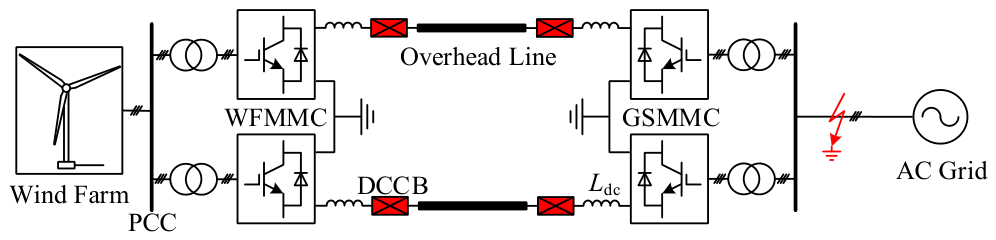
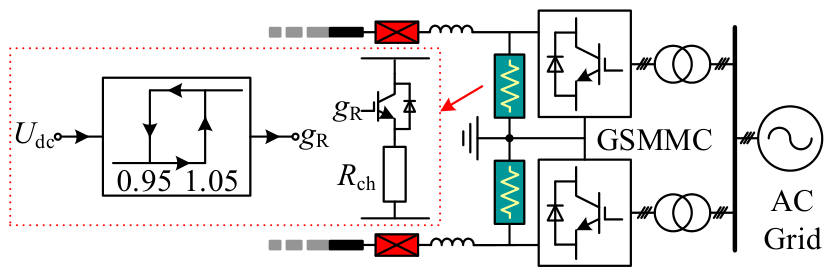
- Using additional energy-dissipating resistors. This method directly converts excess power into heat by installing energy-dissipating devices on the DC or AC side. Specific approaches include centralized [2], distributed [3], and hybrid [4,5,6] configurations. Among these, the distributed approach places resistors within submodules and regulates power through switching control, but faces challenges related to heat dissipation. For onshore systems, thyristor-controlled AC dissipation resistors can also be installed at the point of common coupling (PCC) to limit the impact of faults [7,8]. However, this method inherently involves energy loss and can result in significant energy waste, particularly during severe grid voltage sags.
- (2)
- Wind farm (WF) load shedding. This method reduces the output of wind turbines (WTs) at the source to eliminate excess power. There are three primary methods for transmitting load shedding signals: communication-based, voltage-reduction, and frequency-increase methods [9]. While the frequency-increase method overcomes the reliability issues caused by communication delays, it suffers from some dynamic response lag [10]; therefore, there is a greater body of literature on the voltage-reduction method. For example, by analytically deriving the output power during under-voltage control, rapid matching control between the voltage reduction of the WF-side modular multilevel converter (WFMMC) and the load shedding of WTs can be achieved [11]; alternatively, a linear relationship between the DC voltage and the PCC voltage can be established, and instability caused by deep voltage reduction can be avoided through adaptive voltage adjustment [12,13,14]. However, excessively low-voltage strategies may cause motor overcurrent, which could compromise control performance or even lead to secondary issues.
2. Materials and Methods
2.1. Topology of Wind Power Grid-Connection Systems via MMC-HVDC
2.2. AC Fault Ride-Through Control Strategy Considering Energy Storage
2.2.1. Analysis of Power-Dissipating Resistor Strategies
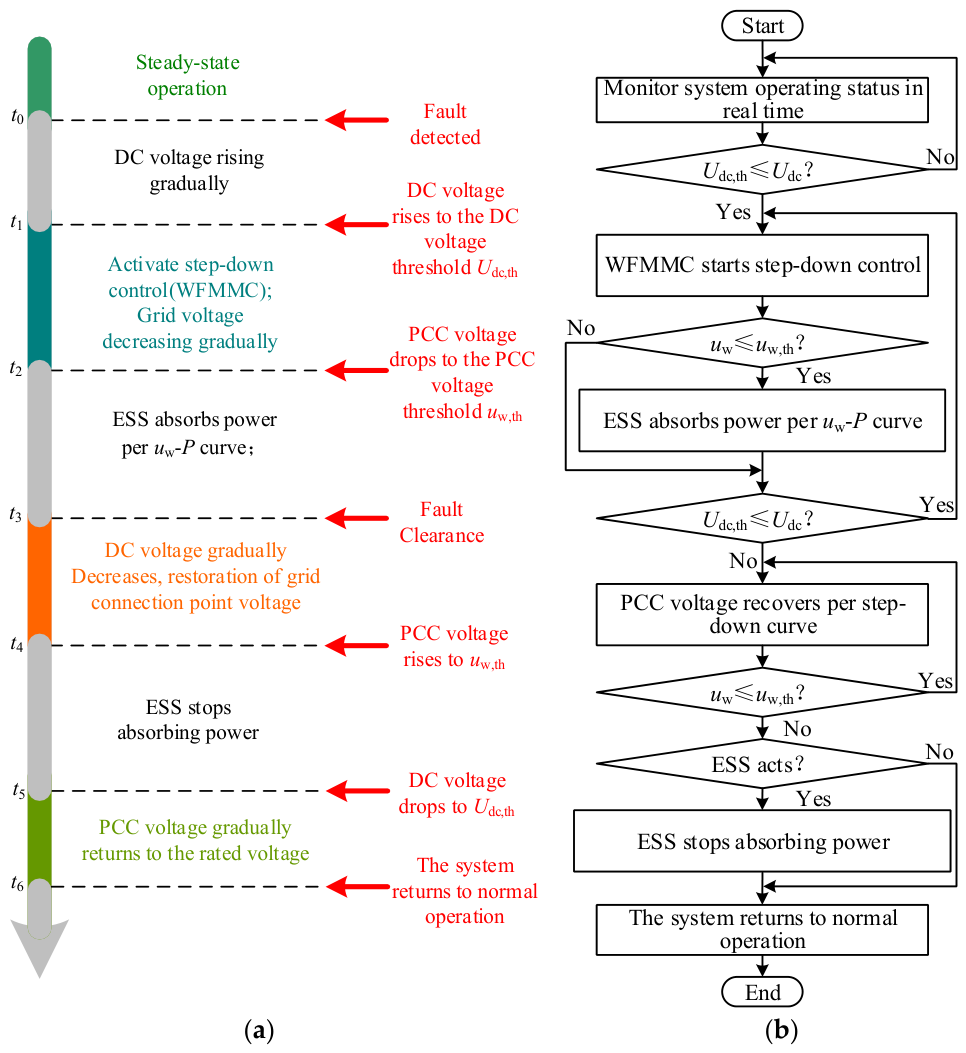
2.2.2. Coordinated Control Strategy Based on Wind-Storage DC-Side Coordination
2.2.3. Overall Control Logic and Energy Storage Parameter Design
3. Results and Discussion
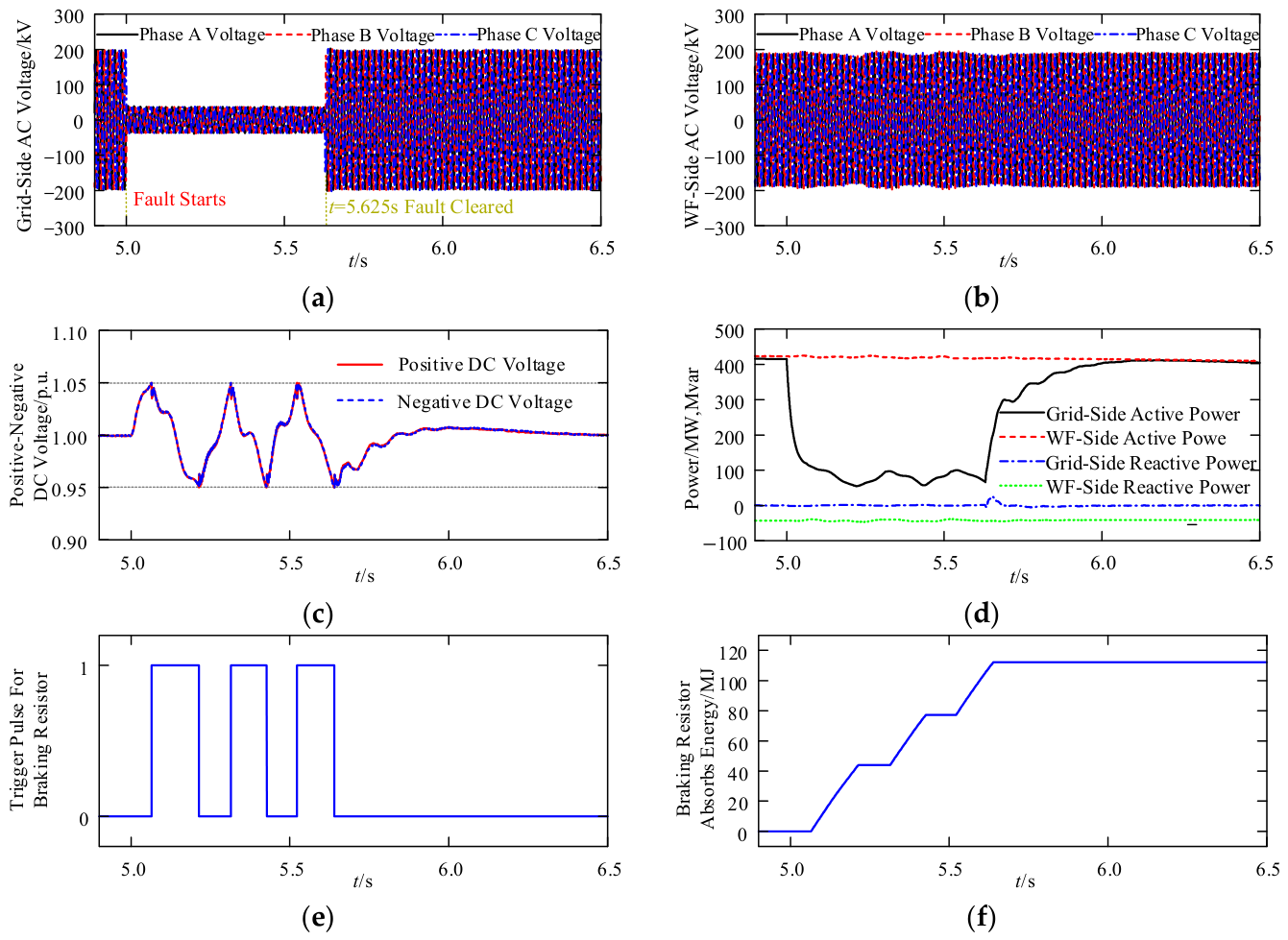
3.1. Simulation and Verification of Power-Dissipating Resistors
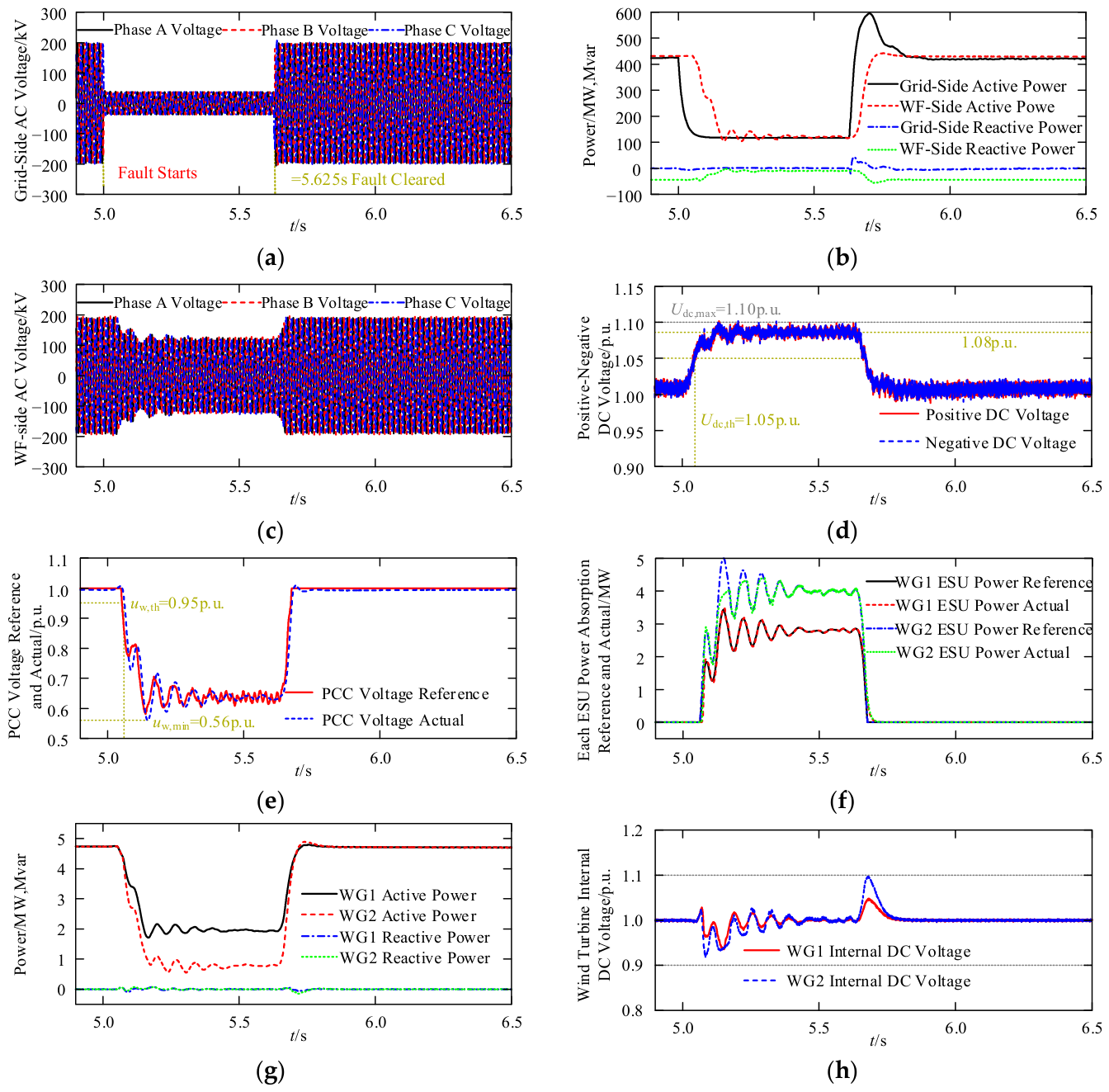
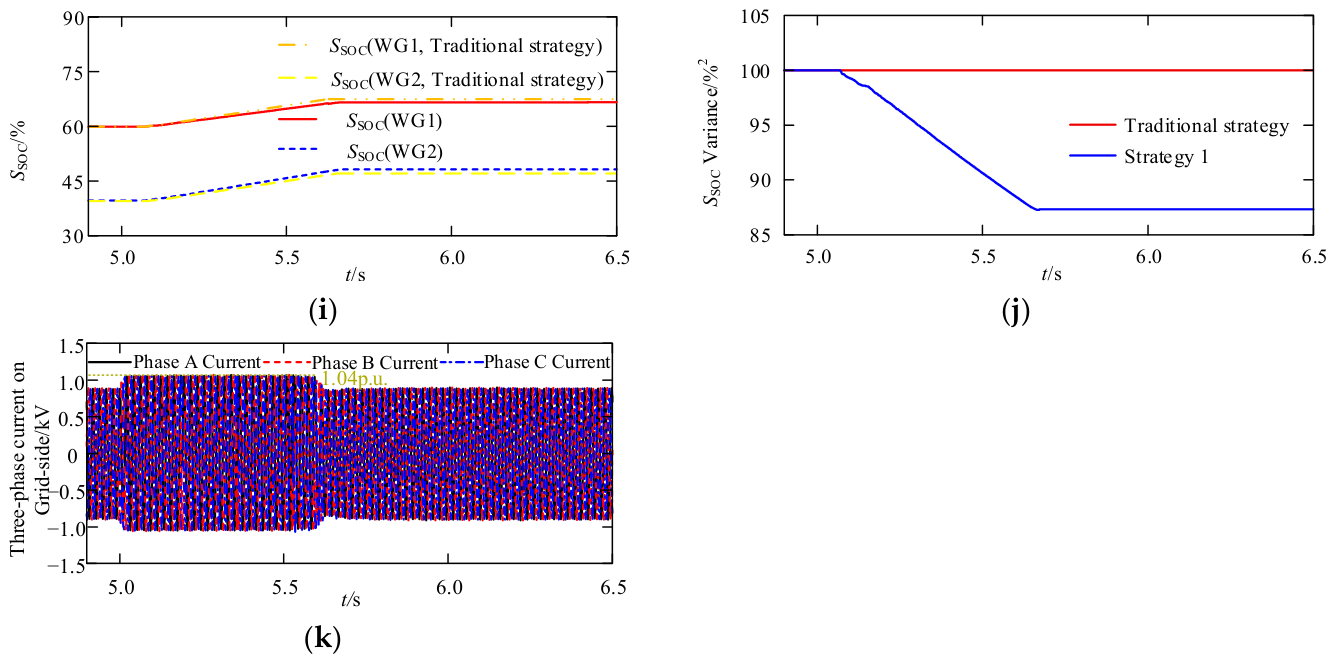
3.2. Simulation Validation of the Proposed Control Strategy
3.3. Verification of Ride-Through Strategy for Single-Phase Ground Faults in Receiver-Side AC Systems
4. Conclusions
- (1)
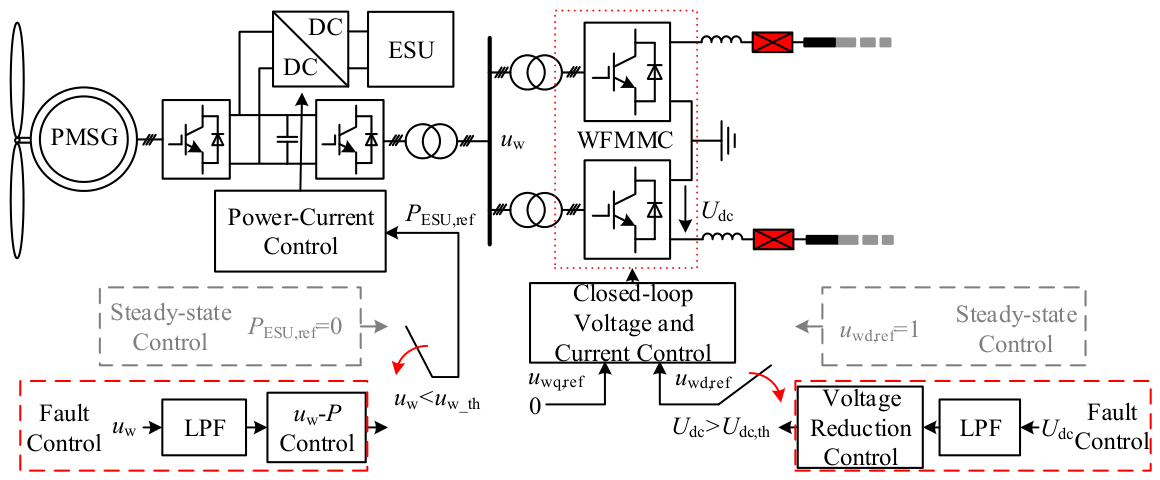
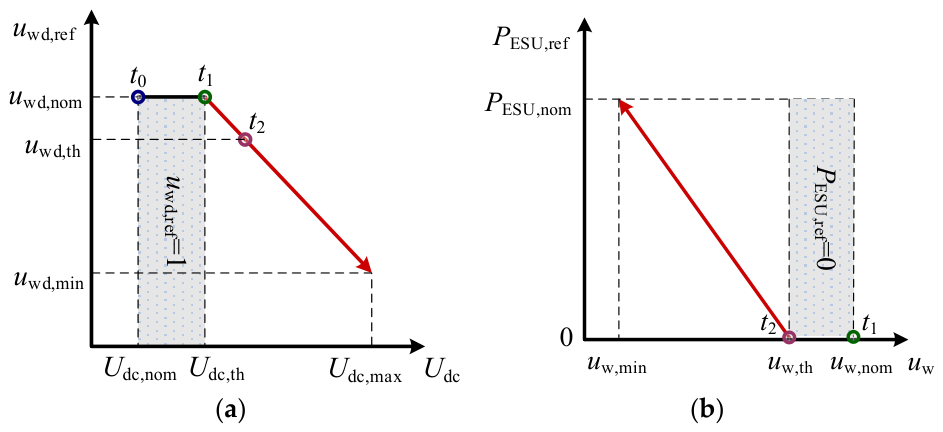
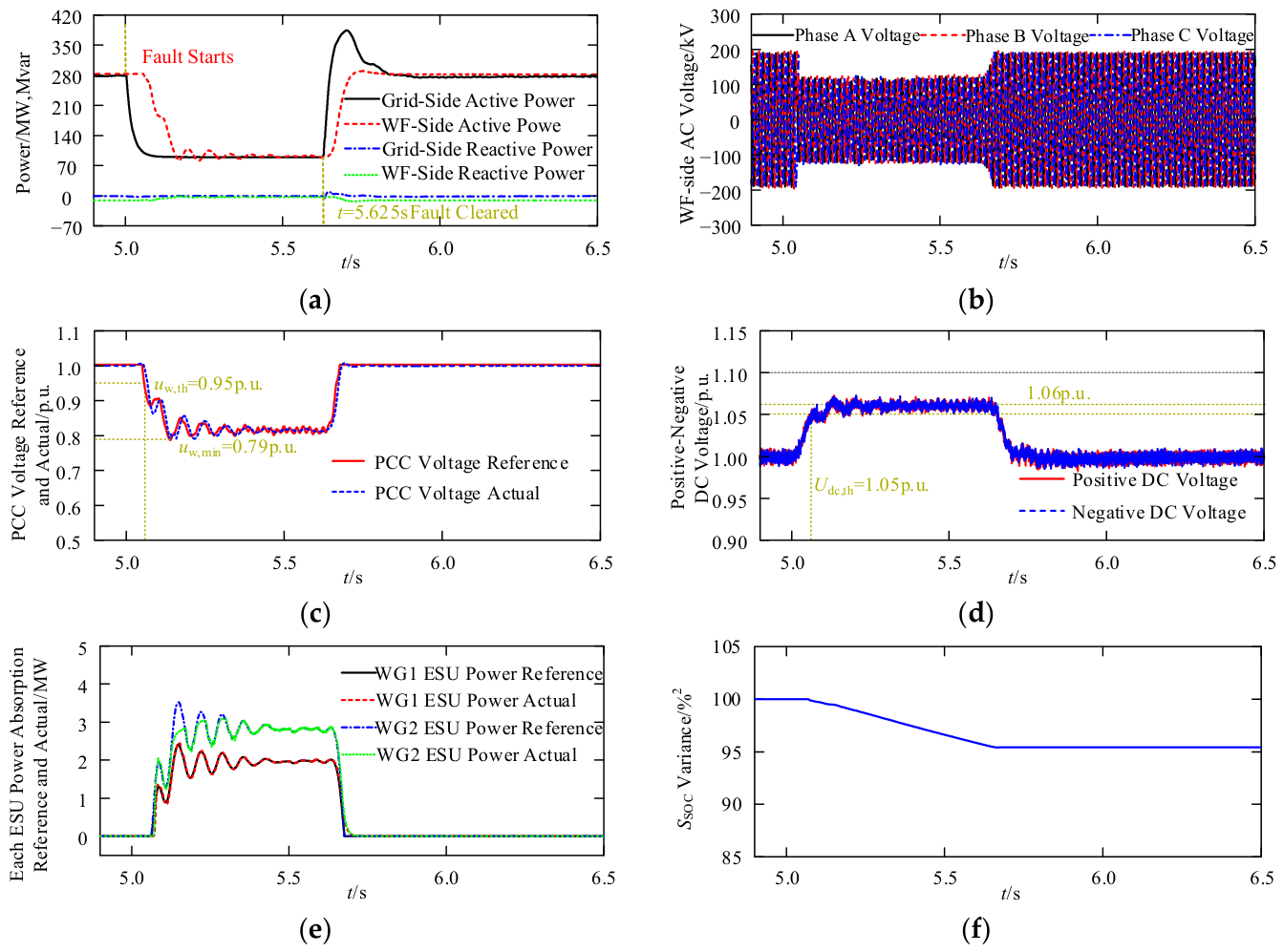
- A DC overvoltage suppression strategy based on wind-storage DC-side coordination is proposed. This strategy optimizes power allocation inversely proportional to SOC to prevent overcharge and maximize the utilization of available storage capacity. By relying on localized ESS absorption, the strategy eliminates the need for source-side WT load shedding, making it particularly suitable for scenarios with sufficient storage resources.
- (2)
- The robustness of the proposed strategy under asymmetric fault conditions has been confirmed. Although the primary validation focused on severe three-phase short-circuit faults, simulation results demonstrate that the control strategy still effectively suppresses DC overvoltage during a single-line-to-ground (SLG) fault when the WF operates at 70% capacity. Since the control logic is triggered by the PCC voltage magnitude rather than sequence components, it remains effective despite the presence of negative-sequence voltages. Nevertheless, a comprehensive investigation into negative-sequence current suppression and unbalanced dynamics is reserved for future work.
- (3)
- The strategy achieves overall control through DC-side coordination between WTs and ESS, eliminating the need for additional equipment (such as braking resistors) and reducing costs. Compared to traditional energy-dissipating resistor solutions, the proposed strategy exhibits smaller DC voltage fluctuations and smoother responses, while completely avoiding energy waste. While the present study focuses on active power coordination, the integration of grid-code-mandated reactive current support under current limiting constraints is identified as a key extension for future work.
Author Contributions
Funding
Data Availability Statement
Conflicts of Interest
Abbreviations
| AC | Alternating Current |
| DC | Direct Current |
| MMC-HVDC | Modular Multilevel Converter High-Voltage Direct Current |
| GSMMC | Grid-Side Modular Multilevel Converter |
| WFMMC | Wind-Farm-Side Modular Multilevel Converter |
| GSVSC | WT’s Grid-Side Voltage Source Converter |
| WTVSC | Wind-Turbine Voltage Source Converter |
| WF | Wind Farm |
| WT | Wind Turbine |
| PMSG | Permanent Magnet Synchronous Generator |
| ESS | Energy Storage System |
| ESU | Energy Storage Unit |
| SOC | State of Charge |
| FRT | Fault Ride-Through |
| LVRT | Low Voltage Ride-Through |
| PCC | Point of Common Coupling |
| DCCB | Direct Current Circuit Breaker |
| PLL | Phase-Locked Loop |
| DDSRF-PLL | Decoupled Double Synchronous Reference Frame Phase-Locked Loop |
| PI | Proportional-Integral |
| LPF | Low-Pass Filter |
| SLG | Single-Line-to-Ground |
| RC | Resistor–Capacitor |
| p.u. | Per Unit |
References
- Wang, Z.Y.; Liu, G.Y.; Tang, Y.C.; Ye, H.; Lu, X.C.; Lin, L. Collaborative optimization of “six elements” in modern power systems. Distrib. Util. 2025, 42, 3–11+22. (In Chinese) [Google Scholar] [CrossRef]
- Liu, F.S.; Ding, R.; Wang, Y.; Cheng, S.; Wang, Q.; Huang, X.F. Fault ride-through strategy for offshore wind power islanding via VSC-HVDC grid-connected system. Electr. Drive 2025, 55, 19–29. (In Chinese) [Google Scholar] [CrossRef]
- Li, Q.; Song, Q.; Liu, W.H.; Rao, H.; Xu, S.K.; Li, X.L. A coordinated control strategy for fault ride-through of wind farm integration based on VSC-HVDC. Power Syst. Technol. 2014, 38, 1739–1745. (In Chinese) [Google Scholar] [CrossRef]
- Su, L.; Shi, G.; Zhou, J.; Zang, J.; Cai, H.; Wang, Y.; Zhang, J. An Advanced Energy-Coordinated Control for Half-Bridge Submodule-Based Centralized DC Chopper in Offshore Wind MMC-HVDC Systems. IEEE Trans. Power Electron. 2026, 41, 11765–11779. [Google Scholar] [CrossRef]
- Xie, Y.Y.; Yao, H.Y.; Li, H.Y.; Yin, G.X.; Ouyang, Y.P.; LI, Z. Modular series connection DC energy braking device for VSC-HVDC system. Electr. Power Autom. Equip. 2021, 41, 117–123. (In Chinese) [Google Scholar] [CrossRef]
- Xu, B.; Gao, C.; Zhang, J.; Yang, J.; He, Z. A novel DC chopper topology for VSC-based offshore wind farm connection. IEEE Trans. Power Electron. 2020, 36, 3017–3027. [Google Scholar] [CrossRef]
- Wu, S.H.; Zhang, X.Y.; He, Z.G.; Jin, M.; Qi, L. An Economical Concentrated DC Chopper Based on Thyristors with Resonant Self-Turn-Off Ability for Offshore Wind VSC-HVDC System. IEEE Trans. Ind. Electron. 2024, 71, 9951–9955. [Google Scholar] [CrossRef]
- Cao, S.; Xiang, W.; Zuo, W.P.; Zhang, X.; Wen, J.Y. AC fault diagnosis and ride-trough control strategy for the wind power delivery system via HVDC grid. Proc. CSEE 2021, 41, 1295–1306+1537. (In Chinese) [Google Scholar] [CrossRef]
- Li, G.; Xu, Y.; Jiang, S.; Xin, Y.; Wang, L. Coordinated control strategy for receiving-end AC fault ride-through of an MMC-HVDC connecting offshore wind power. Power Syst. Prot. Control 2022, 50, 111–119. (In Chinese) [Google Scholar] [CrossRef]
- Ye, H.; Chen, W.; Wu, H.; Cao, W.; He, G.; Li, G. Enhanced ac fault ride-through control for mmc-integrated system based on active pcc voltage drop. J. Mod. Power Syst. Clean Energy 2023, 11, 1316–1330. [Google Scholar] [CrossRef]
- Huang, Q.; Li, K.; Fan, R.Q.; Li, Y.D.; Dong, X.Z.; Jia, K. A grid side fault ride-through control for renewable energy connected MMC-HVDC. Electr. Power Eng. Technol. 2025, 44, 165–173. (In Chinese) [Google Scholar] [CrossRef]
- Jing, Y.; Li, R.; Xu, L.; Yi, W. Enhanced AC voltage and frequency control on offshore MMC station for wind farm. J. Eng. 2017, 2017, 1264–1268. [Google Scholar] [CrossRef]
- Jia, K.; Dong, X.Z.; Li, J.T.; Li, Y.; Niu, H.M.; Bi, T.Z. A grid-side fault ride-through method suitable for offshore wind farms connected with MMCMTDC. Power Syst. Prot. Control 2023, 51, 76–85. (In Chinese) [Google Scholar] [CrossRef]
- Nanou, S.I.; Patsakis, G.N.; Papathanassiou, S.A. Assessment of communication-independent grid code compatibility solutions for VSC-HVDC connected offshore wind farms. Electr. Power Syst. Res. 2015, 121, 38–51. [Google Scholar] [CrossRef]
- Wu, S.; Yang, J.; Mu, X.; Jiang, L.; Li, Y.; Ma, K.; Zhang, X.; Qi, L.; Yu, Z. A Novel Flexible Thyristor Switch Modules Based AC Chopper for the Renewable Energy VSC-HVDC Transmission System. IEEE Trans. Power Electron. 2025, 41, 2463–2477. [Google Scholar] [CrossRef]
- Wang, Z.H.; Wang, X.D.; Li, J.L.; Li, G.Q. Overvoltage analysis and ride-through strategy of AC fault at receiving-end of the flexible HVDC system integrated with wind farms. South. Power Syst. Technol. 2023, 17, 11–22. (In Chinese) [Google Scholar] [CrossRef]
- Zhang, H.B.; Xiang, W.; Zhou, M.; Wen, J.Y. Cooperative strategy of active energy control and AC energy dissipation device in offshore wind power MMC-HVDC system. Proc. CSEE 2022, 42, 4319–4330. (In Chinese) [Google Scholar] [CrossRef]
- Zhang, H.B.; Xiang, W.; Wen, J.Y. Active energy control of offshore wind power MMC-HVDC system to handle AC faults of receiving-end power grid. Proc. CSEE 2023, 43, 4600–4614. (In Chinese) [Google Scholar] [CrossRef]
- Daoud, M.I.; Massoud, A.M.; Abdel-Khalik, A.S.; Elserougi, A.; Ahmed, S. A Flywheel Energy Storage System for Fault Ride Through Support of Grid-Connected VSC HVDC-Based Offshore Wind Farms. IEEE Trans. Power Syst. A Publ. Power Eng. Soc. 2016, 31, 1671–1680. [Google Scholar] [CrossRef]
- Hossain, M.I.; Hamanah, W.M.; Alam, M.S.; Shafiullah, M.; Abido, M.A. Fault ride through and intermittency improvement of renewable energy integrated MMC-HVDC system employing flywheel energy storage. IEEE Access 2023, 11, 50528–50546. [Google Scholar] [CrossRef]
- Yang, Y.K.; Xu, J.Z. Low voltage ride-through strategy for high-capacity direct-drive wind turbines based on supercapacitor energy storage. Power Syst. Prot. Control 2023, 51, 106–116. (In Chinese) [Google Scholar] [CrossRef]
- Ji, Y.R.; Gao, Y.F.; Chen, Y.S.; Zhao, B.; Yang, M.X.; Xu, C.; Hong, J.F. A DC-cascaded energy storage system and its power decoupling control. Power Syst. Technol. 2026, 50, 1455–1464. (In Chinese) [Google Scholar] [CrossRef]
- Zhang, F.; Huang, H.; Liang, X.G. AC fault ride-through strategy for wind power via flexible DC grid-connected system based on supercapacitor energy storage. Electr. Power Autom. Equip. 2025, 45, 37–44+66. (In Chinese) [Google Scholar] [CrossRef]
- Tao, Y.B.; Yin, S.; Li, G.J.; Hu, W.F. Design of topology, parameters and control technology for direct-hanging energy storage converter. Power Electron. 2026, 50, 35–39,73. (In Chinese) [Google Scholar] [CrossRef]
- Li, W.; Zhu, M.; Chao, P.; Liang, X.; Xu, D. Enhanced FRT and Postfault Recovery Control for MMC-HVDC Connected Offshore Wind Farms. IEEE Trans. Power Syst. 2019, 35, 1606–1617. [Google Scholar] [CrossRef]
- Wu, Z.; Zhu, J.; Hu, J.; Guo, Z.; Du, B.; Li, Y.; Guo, J. Piecewise Small-Signal Modeling and Stability Analysis of DR-MMC HVDC System for Offshore Wind Farms via Floquet and Filippov Theory. Power Electron. IEEE Trans. 2025, 40, 15491–15503. [Google Scholar] [CrossRef]
- Charkhgard, M.; Farrokhi, M. State-of-Charge Estimation for Lithium-Ion Batteries Using Neural Networks and EKF. IEEE Trans. Ind. Electron. 2010, 57, 4178–4187. [Google Scholar] [CrossRef]
- Li, Y.; Xu, J.; Xu, B.; Gao, C.; Wen, T. A Power Losses and Thermal Energy Optimization Method for Hybrid DC Chopper Based on Hysteresis Control Strategy. IEEE Trans. Power Electron. 2025, 40, 486–499. [Google Scholar] [CrossRef]
- GB/T 19963.2-2024; Technical Specification for Connecting Wind Power Plant to Power System—Part 2: Offshore Wind Power. Standards Press of China: Beijing, China, 2024.
- Mei, N.; Yin, S.; Wang, Y.; Li, Z.; Li, P.; Liu, Y.; Yue, B.; Li, Z. Small Signal Modeling and Stability Analysis of Modular Multilevel Converter Based on Harmonic State-Space Model. Energies 2020, 13, 1056. [Google Scholar] [CrossRef]



| Parameters | Udc,nom | Udc,th | Udc,max | uw,nom | uw,th | uw,min | PESU,nom |
|---|---|---|---|---|---|---|---|
| Values/p.u. | 1.0 | 1.05 | 1.1 | 1.0 | 0.95 | 0.5 | 1.0 |
| Parameters | Values |
|---|---|
| Rated AC-side voltage/kV | 220 |
| Rated DC-side voltage/kV | ±400 |
| Single-pole converter transformer ratio/(kV/kV) | 220/210 |
| Rated capacity of single-pole converter station/MVA | 400 |
| Number of submodules/unit | 200 |
| Submodule capacitance/μF | 10,000 |
| Arm reactor inductance/mH | 29 |
| Overhead line length/km | 200 |
| The rated power PMSG/MW | 5 |
| Number of PMSGs shown in figures/unit | 2* |
| ESU rated capacity/kWh | 2.5 |
| SOC operating limits | 0.2–0.9 |
| DC/DC efficiency | 0.95 |
| DC bus voltage/kV | 1 |
| Max charge/discharge current/kA | 1.2 |
| Converter | Inner Loop Proportional/Integral Parameters | Outer Loop Proportional/Integral Parameters |
|---|---|---|
| GSMMC | 1.8/0.2 | 2.5/25 |
| WFMMC | 0.3/0.5 | 2.5/30 |
| WTVSC | 1.0/0.5 | 2.0/10 |
| GSVSC | 1.5/1.0 | 1.5/50 |
Disclaimer/Publisher’s Note: The statements, opinions and data contained in all publications are solely those of the individual author(s) and contributor(s) and not of MDPI and/or the editor(s). MDPI and/or the editor(s) disclaim responsibility for any injury to people or property resulting from any ideas, methods, instructions or products referred to in the content. |
© 2026 by the authors. Licensee MDPI, Basel, Switzerland. This article is an open access article distributed under the terms and conditions of the Creative Commons Attribution (CC BY) license.
Share and Cite
Liu, J.; Gui, Y.; Dong, S.; Liu, B.; Zhao, S.; Yang, P.; Lu, M.; Sun, Y. Coordinated AC Fault Ride-Through Strategy for Wind Farms Integration via MMC-HVDC Using DC-Side Energy Storage. Energies 2026, 19, 2935. https://doi.org/10.3390/en19122935
Liu J, Gui Y, Dong S, Liu B, Zhao S, Yang P, Lu M, Sun Y. Coordinated AC Fault Ride-Through Strategy for Wind Farms Integration via MMC-HVDC Using DC-Side Energy Storage. Energies. 2026; 19(12):2935. https://doi.org/10.3390/en19122935
Chicago/Turabian StyleLiu, Jie, Yuzhi Gui, Shuang Dong, Bin Liu, Shize Zhao, Pu Yang, Mingzhi Lu, and Yinfeng Sun. 2026. "Coordinated AC Fault Ride-Through Strategy for Wind Farms Integration via MMC-HVDC Using DC-Side Energy Storage" Energies 19, no. 12: 2935. https://doi.org/10.3390/en19122935
APA StyleLiu, J., Gui, Y., Dong, S., Liu, B., Zhao, S., Yang, P., Lu, M., & Sun, Y. (2026). Coordinated AC Fault Ride-Through Strategy for Wind Farms Integration via MMC-HVDC Using DC-Side Energy Storage. Energies, 19(12), 2935. https://doi.org/10.3390/en19122935