Article

Saturated Volume Fracturing Technology for Horizontal Well Groups in Coal Seam Roof and Application in the Huainan Mining Area


1
Huainan Mining Group Coalbed Methane Development and Utilization Co., Ltd., Huainan 232000, China
2
CCTEG Xi’an Research Institute (Group) Co., Ltd., Xi’an 710077, China
3
China Coal Research Institute, Beijing 100013, China
4
Ping’an Coal Mining Engineering Technology Research Institute Co., Ltd., Huainan 232000, China
*
Author to whom correspondence should be addressed.
Energies 2026, 19(12), 2903; https://doi.org/10.3390/en19122903 (registering DOI)
Submission received: 18 May 2026 / Revised: 11 June 2026 / Accepted: 15 June 2026 / Published: 18 June 2026

Abstract

The Huainan Mining Area features extensively developed, fragmented-soft and low-permeability coal seams, characterized by low porosity and permeability, complex geological structures, and significant difficulty in coalbed methane (CBM) drainage. Horizontal wells with staged fracturing in the coal seam roof have become a key method for regional gas control. To further enhance the volume fracturing stimulation effect and single-well gas production, this study targets the horizontal well group in the roof of the No. 8 coal seam in the Huainan Mining Area as the research object. A saturated volume fracturing technology for horizontal wells in the coal seam roof, centered on the concept of a high pump rate (18–20 m3/min) and a high proppant volume (>250 m3/stage), is proposed. This study investigates the fracture propagation mechanisms and fracturing parameter optimization of this technology, and conducts engineering application to verify its stimulation effect. Increasing the fracturing pump rate improves the proppant-carrying capacity of the fracturing fluid, successfully enabling high-rate and high-volume proppant placement. Optimization of the perforation parameters—12 holes per m per cluster and a cluster spacing of 15–25 m—utilizes high perforation friction and moderate stress interference to promote balanced initiation and propagation of multiple fractures within a stage. The optimized ‘saturated’ injection mode, with a single-stage fluid volume exceeding 2400 m3, a single-stage proppant volume exceeding 250 m3, and a maximum sand ratio exceeding 20%, combined with a multi-size proppant mixture, enables full propping of both main and branch fractures. Microseismic monitoring shows that the hydraulic fracture extension length increased by approximately 50% compared to conventional wells, significantly enlarging the stimulated reservoir volume (SRV). Saturated fracturing achieved stable gas production of 2000 to 3000 m3/d, with average production ramp-up rates of 21.47–26.40 m3/d (five times higher than the 5.34 m3/d of the conventional well), and the stable plateau period was notably extended from 36 days to over 150 days. The saturated volume fracturing technology proposed in this study provides an important reference for efficient CBM extraction and surface gas control in mining areas with similar geological conditions.

1. Introduction

The Huainan Mining Area is one of China’s major coal production bases, characterized by abundant coal resources [1,2]. Under the combined influence of the Dabie Orogenic Belt and the Tanlu Fault Zone [3], the study area exhibits complex geological structures, high in situ stress, high gas pressure and content, low coal permeability, and significant challenges in gas extraction [4,5,6,7]. Following over 120 years of mining, all coal mines in the Huainan region have entered the deep coal development stage [8,9], with some reaching depths of 1000 m. As mining depth increases, the gas pressure and content continue to rise, substantially increasing the complexity and risk of gas-related disasters [10,11]. According to the Coal Mine Safety Regulations of China, when the in situ gas pressure of a coal seam reaches or exceeds 3 MPa, relying solely on traditional underground outburst prevention measures is insufficient, and a combined surface-well pre-drainage and underground joint extraction method must be adopted. This regulatory requirement highlights the urgent need for new regional gas control technologies, such as horizontal well group fracturing in coal seam roofs, to effectively pre-drain gas before mining while actively pre-splitting and modifying the roof rock mass to mitigate the dynamic disaster risks associated with thick hard roofs, as well as reducing the operational difficulties in fragmented-soft coal seams [12,13].
In recent years, surface horizontal well staged fracturing technology has been widely applied in CBM development and gas control in coal mining areas [14,15,16], achieving remarkable results. However, given the high stress, low permeability, and complex geological conditions of the Huainan Mining Area, enhancing fracturing intensity, optimizing fracture propagation geometry, and improving gas production per well remain critical technical challenges for gas control in the region [7]. In response, Chinese researchers have conducted extensive studies on horizontal well fracturing in coal mining areas. Zhang Qun et al. proposed a high-efficiency CBM extraction model using staged fracturing in horizontal wells within the roofs of soft and low-permeability coal seams [17]. Peng Yumin et al. analyzed the technological framework for regional gas control using horizontal wells in coal seam roofs in the Huainan Mining Area [18,19]. Liu Chao et al. explored the application of staged multi-cluster close-cutting fracturing technology for CBM extraction in the same area [20]. Although these studies have provided important technical support for surface gas control in coal mining areas, interpreting the complex fracture propagation remains a key challenge. In multi-stage horizontal well fracturing, the simultaneous propagation of multiple fractures is heavily influenced by the stress-shadow effect, which often leads to non-uniform fracture growth [21]. Achieving uniform fracture initiation requires the optimization of perforation density, cluster spacing, and limited-entry fracturing designs to generate high net pressures that can overcome these stress-shadow barriers. Furthermore, the induced hydraulic fractures must interact with the highly developed natural cleat and fracture networks within the coal reservoir [22], a process that fundamentally dictates the final SRV and triaxial permeability enhancement [23]. Consequently, systematic research remains limited regarding the quantitative optimization of key operational parameters (such as fracturing pump rate and proppant volume per stage), the design and evaluation of saturated fracturing to prevent post-fracturing fracture closure, and the verification of fracture propagation pathways connecting the roof and coal seam.
This paper takes the Pansan Mine in the Huainan Mining Area as the research object. Based on an analysis of the geological characteristics of the coal seam in the study area, a staged saturated volume fracturing technology suitable for horizontal wells in coal mining areas is proposed. By increasing the pump rate and proppant volume per stage and optimizing the fracturing process, field tests were conducted to verify its effectiveness, aiming to further enhance single-well gas production and regional gas control performance. The research results can provide a reference for surface gas drainage and coalbed methane development in coal mining areas with similar geological conditions.

2. Geological and Engineering Conditions of the Study Area

2.1. Stratigraphic Background

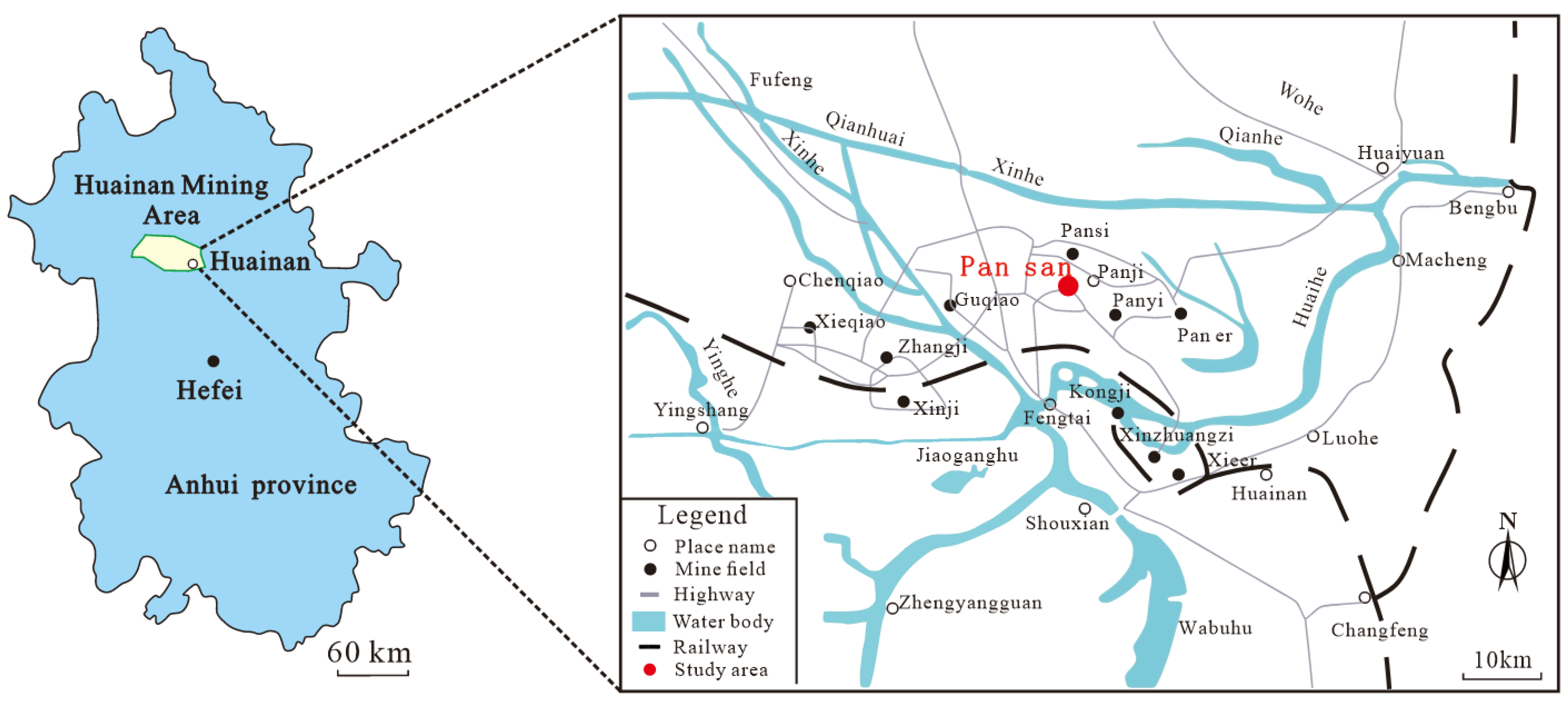
The Pansan mining area is located in the Huainan Mining Area, Anhui Province (Figure 1). The overall structural style is a monocline, with a stratum strike of NWW–SEE and dip angles generally ranging from 5° to 10°, though some areas affected by fault structures exhibit dips of 30–50°. The main coal-bearing strata in the area are the Permian Shanxi Formation, Upper Shihezi Formation, and Lower Shihezi Formation, comprising a total of 12 mineable coal seams with an average total thickness of 24.62 m. The target coal seam for gas drainage using the surface horizontal well group in this study is the No. 8 coal seam, which has a thickness ranging from 0 to 12.07 m (average 3.04 m) and a relatively simple structure. It is a moderately stable, fully mineable seam across the area. Based on underground sealed coring and desorption testing, the in situ gas content of the coal seam ranges between 3.24 and 5.28 m3/t (average 4.62 m3/t). The measured reservoir pressure is 9.26 MPa, and the burial depth ranges from 900 to 950 m. Furthermore, laboratory core-flooding permeability testing under simulated in situ reservoir stress conditions indicates that the reservoir permeability is 0.18 mD, classifying it as a low-permeability coal seam. The direction of the maximum principal stress is NE–SW. Owing to its simple structure and prominent reservoir characteristics, this seam was selected as the primary coal seam for the engineering test in this study.

2.2. Mineral Composition

Rock mineral composition is an important basis for evaluating reservoir fracturability; in particular, the content of brittle minerals directly determines the brittleness index. In this study, quantitative X-ray diffraction (XRD) was used to perform whole-rock mineral analysis on samples of the No. 8 coal seam roof and floor, while the brittleness index of the No. 8 coal seam itself was characterized using in situ logging data. The XRD test results of the roof and floor are shown in Table 1.
The XRD test results show that the roof of the No. 8 coal seam is mainly composed of quartz (56.2%) and clay minerals (24.6%), with small amounts of plagioclase (14.9%), siderite (1.6%), calcite (1.0%), K-feldspar (0.9%), and anhydrite (0.8%). In the floor of the No. 8 coal seam, clay minerals are the most abundant (55.6%), followed by siderite (26.6%) and quartz (17.8%), with no other carbonate minerals detected.
Based on the rock mineral composition, the calculated mineralogical brittleness index of the No. 8 coal seam roof reaches 67.4%. The evaluation formula is expressed as follows:
B I = W Q W Q + W C l + W C a r × 100 %
where BI is the mineralogical brittleness index, %; WQ is the quartz content, %; WCl is the clay mineral content, %; and WCar is the carbonate mineral content (the sum of calcite and siderite), %.
This calculation indicates that the roof rock has strong brittleness and is favorable for hydraulic fracturing initiation. Meanwhile, the brittleness index of the No. 8 coal seam was determined to be approximately 23.66 through in situ XMAC logging. Based on the elastic-parameter-derived method proposed by Rickman et al. [24].

2.3. Drilling Operation Overview

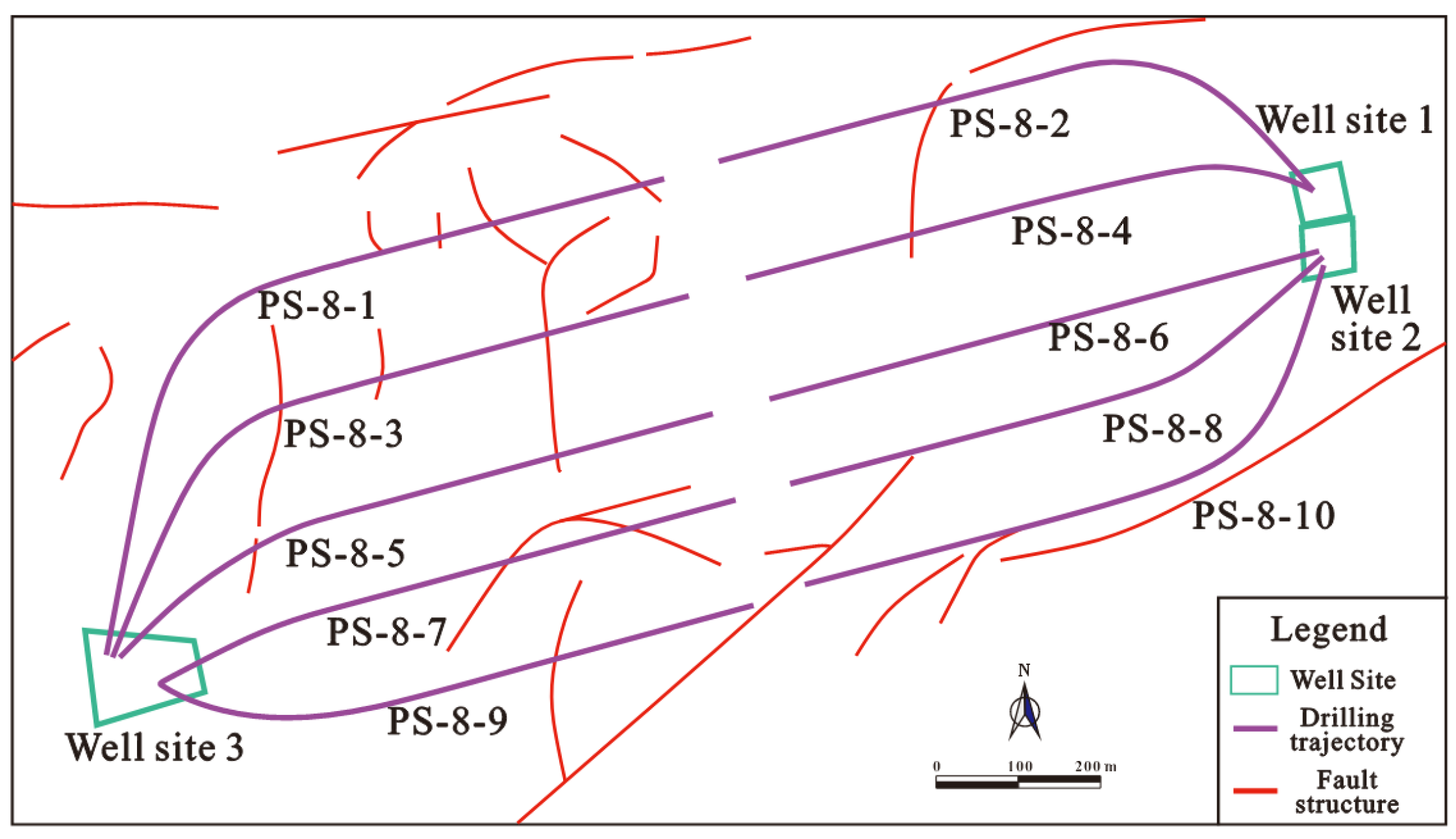
To develop the target No. 8 coal seam for CBM drainage, a three-dimensional ‘well factory’ model was adopted. This model is defined as a highly efficient development technology where multiple similar wells are centrally deployed within the same area, and operations such as drilling, fracturing, and gas production are conducted through a standardized, assembly-line, and factory-like workflow. Under this development framework, three well pads were deployed in this study, hosting a total of ten CBM horizontal wells, as illustrated in Figure 2. All these ten horizontal wells feature an L-shaped trajectory with a three-spud wellbore structure. In terms of wellbore dimensions, the maximum total measured depth of these wells is 2095 m, with a maximum true vertical depth of 831.50 m at the bottom, while the horizontal section lengths range from 645 m to 753 m.

3. Fracture Propagation Mechanism and Main Controlling Factors of Saturated Fracturing

3.1. Feasibility Analysis of Fracture Propagation Through Layers

Due to the relatively broken structure of the No. 8 coal seam in the study area, the roof fracturing technique was adopted for the stimulation process. According to data from adjacent exploration boreholes, the P-wave transit time of the No. 8 coal seam is approximately 128.51 μs/ft, the S-wave transit time is approximately 245.19 μs/ft, and the P-wave to S-wave velocity ratio is approximately 1.91. The Young’s modulus is approximately 0.94 × 10⁴ MPa, the bulk modulus is approximately 0.82 × 10⁴ MPa, the shear modulus is approximately 0.36 × 10⁴ MPa, and Poisson’s ratio is approximately 0.31. The fracture pressure is approximately 21.63 MPa, the maximum horizontal principal stress is approximately 26.52 MPa, the vertical stress is approximately 23.66 MPa, and the minimum horizontal principal stress is approximately 21.11 MPa. The in situ stress magnitudes follow the relationship σH > σv > σh (where σH is the maximum horizontal principal stress, σh is the minimum horizontal principal stress, and σv is the vertical stress), indicating a strike-slip fault stress regime, under which hydraulic fracturing predominantly generates vertical fractures. The roof has higher strength and a higher minimum horizontal principal stress than the coal seam, providing favorable conditions for the formation of vertical fractures that can propagate through the layer into the coal seam.

3.2. Proppant Transport Analysis

In CBM fracturing operations, issues such as limited proppant transport distance and near-wellbore deposition often constrain the stimulation effectiveness. Increasing the fracturing fluid pump rate can significantly improve proppant transport behavior within perforation clusters, enhance fluid velocity at the perforation entrance, thereby carrying the proppant to the rear of the perforation tunnel, reducing premature deposition on the leading wall, and effectively extending the proppant transport distance [25]. According to the Wasp equation [26] (Equation (2)), the minimum transport velocity of proppant particles is positively correlated with the pump rate. Only by ensuring a sufficiently high pump rate can the proppant overcome gravity and vortex effects, thereby achieving a uniform distribution within the fracture system.
v t = F 2 g ( s 1 ) D 1 / 2 d p D 1 / 6
where vt is the minimum transport velocity, F is an empirical constant (typically ranging from 0.4 to 1.5), D is the pipe diameter, g is the acceleration due to gravity, s is the ratio of particle and fluid densities and dp is the particle diameter.
Based on the above mechanism analysis, a high pump rate and high proppant volume stimulation strategy should be adopted for CBM volume fracturing. On the one hand, this increases the flow velocity of the proppant-laden fluid in the perforations and near-wellbore zone, maintaining effective proppant suspension and transport. On the other hand, it can offset the reduction in perforation friction caused by perforation erosion to some extent, thus ensuring the effectiveness of the limited-entry design and enabling high proppant volume injection per stage, which ultimately forms a main fracture network with high conductivity in the coal seam and enhances the SRV.

3.3. Analysis of Cluster Fracturing Propagation Behavior

Implementing stress interference through staged multi-cluster perforation is a key technical enabler for volume stimulation. In conventional staged fracturing of horizontal wells, single-cluster perforation per stage with separate fracturing is adopted to avoid inter-fracture interference. For volume stimulation, however, the ‘multi-cluster per stage’ perforation with simultaneous fracturing of multiple clusters is employed, utilizing inter-fracture interference to promote fracture reorientation and generate complex fracture networks. The induced stress model for a single-cluster fracture is as follows:
σ z = p r c c 2 r 1 r 2 3 2 sin θ sin 3 2 ( θ 1 + θ 2 ) + p r r 1 r 2 1 2 cos θ 1 2 θ 1 1 2 θ 2 1
σ y = p r c c 2 r 1 r 2 3 2 sin θ sin 3 2 ( θ 1 + θ 2 ) p r r 1 r 2 1 2 cos θ 1 2 θ 1 1 2 θ 2 1
σ y z = p r c c 2 r 1 r 2 3 2 sin θ cos 3 2 ( θ 1 + θ 2 )
According to Hooke’s law:
σ x = v σ z + σ y
where σ x , σ y , σ z are the induced stresses generated in the vertical, maximum horizontal principal stress, and minimum horizontal principal stress directions, respectively (MPa); r 1 , r 2 , θ are the polar coordinates; v is Poisson’s ratio of the rock; c is the fracture half-height, m; and p is the net pressure on the fracture wall (MPa).
From Equations (3)–(6), it can be seen that during staged multi-cluster fracturing of a horizontal well, the in situ stress field around the fractures changes under the action of the net pressure inside the fractures. The difference between the horizontal principal stresses decreases significantly within a certain range from the fracture wall, and may even reverse the directions of the maximum and minimum horizontal principal stresses. When the net pressure in actual operations reaches above 10 MPa, and the induced horizontal principal stress difference exceeds 2 MPa, fractures tend to reorient [27]. Under the combined action of bedding planes, main fractures, reoriented fractures, and natural fractures, a complex fracture network can be formed, thereby improving the effectiveness of volume stimulation.

3.4. Differences in Fracture Propagation Mechanisms Between Saturated Fracturing and Conventional Fracturing

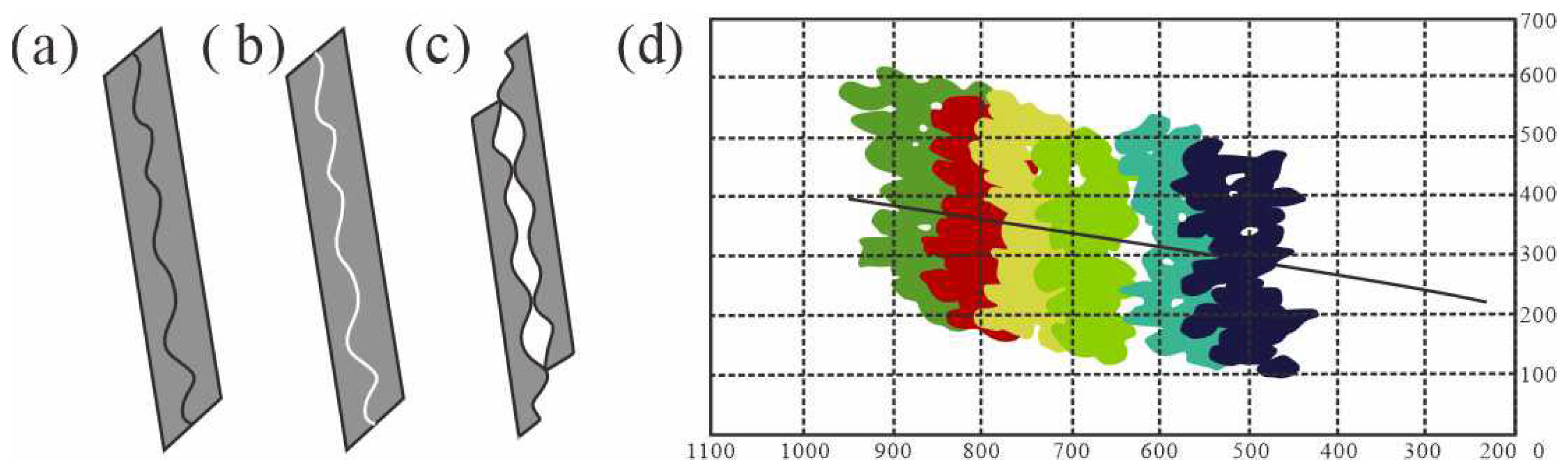
Volume fracturing connects natural fractures and rock bedding planes by applying techniques such as multi-cluster perforation per stage, high pump rate, large fluid volume, and low-viscosity fluids. It forcibly generates secondary fractures on the sides of the main fracture, and further branches to form second-order secondary fractures, resulting in a complex fracture network that involves mechanical behaviors such as shearing, slippage, and offset (Figure 3c). In contrast, conventional fracturing produces bi-wing symmetric fractures, typically dominated by a single main fracture to improve reservoir permeability, which is characterized by a single opening fracture (Figure 3a,b). The volume fracturing model breaks through the traditional fracture flow theory of conventional fracturing, significantly reducing the driving pressure required for effective fluid flow in the matrix and shortening the distance that the fluid in the matrix must travel to reach fractures. By generating a complex fracture network, the contact area between the fracture walls and the reservoir matrix is maximized, the matrix-to-fracture flow distance is shortened, and the overall permeability of the reservoir is greatly enhanced, thereby achieving comprehensive stimulation of the reservoir in the longitudinal, lateral, and vertical directions.
Specifically, saturated volume fracturing is conceptually and mechanically distinguished from conventional staged multi-cluster and volume-fracturing approaches. While conventional volume fracturing primarily aims to initiate complex fractures through high-rate injection, a large portion of the generated secondary and branch fractures tends to close rapidly after pump shut-in due to insufficient proppant transport and placement. Saturated volume fracturing, however, is a cooperative design that targets a state of ‘saturated propping’ across the entire fracture network. By executing a super-large fluid injection coupled with a high-volume, multi-size proppant blend, this technology ensures that both wide main fractures and narrow branching fractures are fully and effectively supported over the long term.

4. Optimization of Saturated Volume Fracturing Parameters for Horizontal Wells

4.1. Numerical Simulation Setup

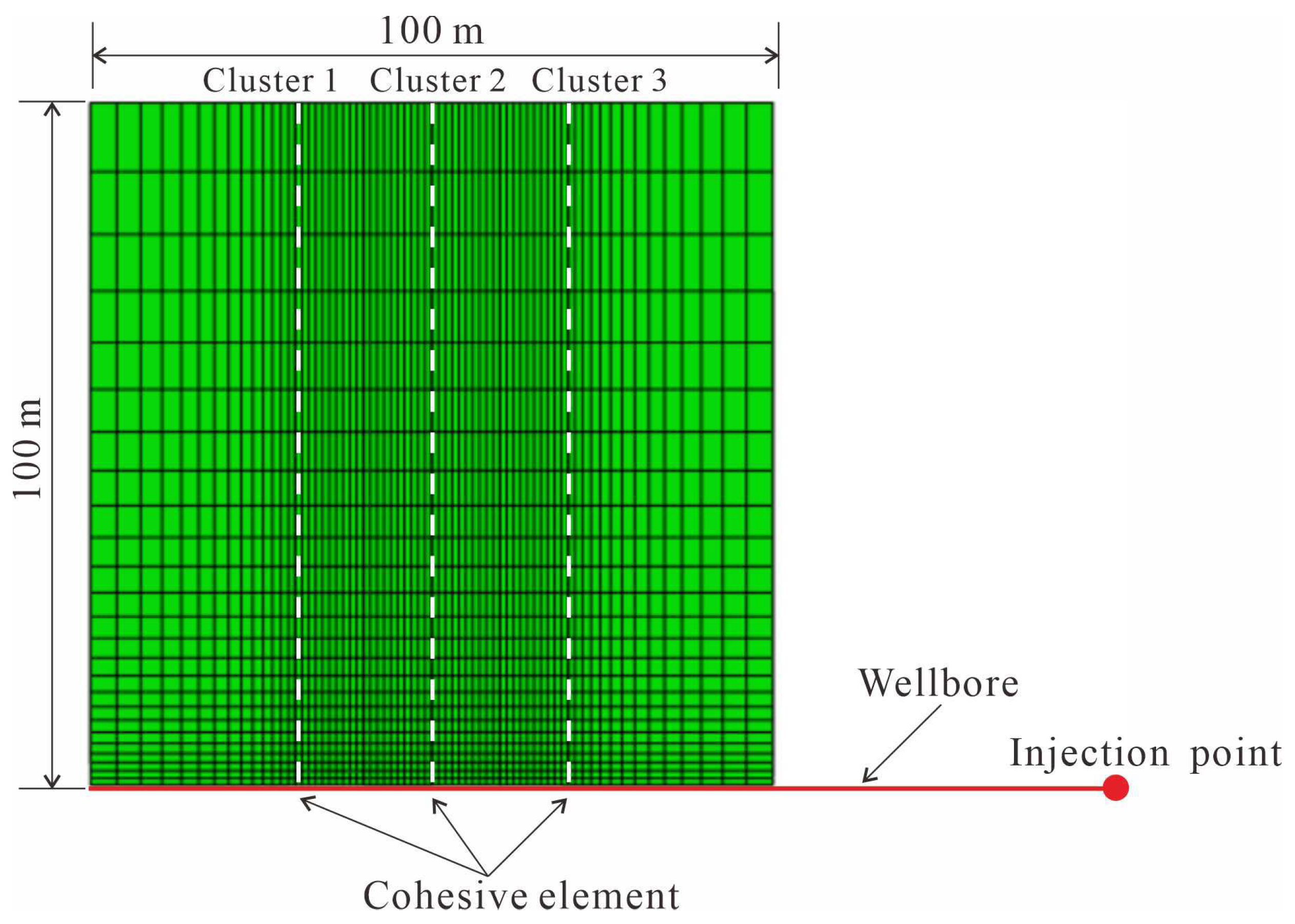
To systematically investigate the hydraulic fracture propagation morphology and optimize the fracturing parameters of horizontal wells deployed within the coal seam roof, a dual-software synergistic simulation strategy was implemented from both localized geomechanical and macroscopic operational perspectives. Specifically, the finite element software ABAQUS (version 2018) was used to simulate the localized geomechanical fracture propagation morphology under various perforation configurations (Section 4.3.1) and cluster spacings (Section 4.3.2). Meanwhile, the mature commercial hydraulic fracturing simulator Meyer was implemented to optimize the macroscopic pumping parameters, including the pump rate (Section 4.3.3) and the fracturing treatment scale (Section 4.3.4). To ensure physical consistency, the input geological, rock mechanical, and in situ stress parameters in the Meyer model were kept completely identical to those utilized in the ABAQUS model. In the ABAQUS framework, the Cohesive Zone Model (CZM) based on pore-pressure cohesive elements was implemented to dynamically capture fracture initiation and propagation.
The physical dimensions of the constructed ABAQUS numerical model are 100 m in length, 100 m in width, and 1 m in thickness. A variable-density meshing strategy was adopted, where the mesh density around the cohesive layers was significantly refined to accurately resolve the sharp gradients of pore pressure and fracture opening. The mesh types utilized were C3D8P for the rock matrix, and COH3D8P for the potential fracture pathways. The complete ABAQUS model and mesh configuration are schematically illustrated in Figure 4.
The horizontal wellbore, with a diameter of 121.36 mm and a perforation entry hole diameter of 10 mm, is positioned within the roof strata above the No. 8 coal seam. For this target No. 8 coal seam roof (sandy mudstone), the input rock mechanical and in situ stress parameters—including Young’s modulus of 3.63 × 10⁴ MPa, Poisson’s ratio of 0.24, and rock tensile strength of 3.5 MPa—are applied identically to both the ABAQUS and Meyer models. The in situ stress field follows a strike-slip faulting regime, with the maximum horizontal principal stress (σH), vertical stress (σv), and minimum horizontal principal stress (σh) acting as the boundary loading conditions. The fracturing fluid properties are set according to water, with a density of 1000 kg/m3 and a dynamic viscosity of 1.0 mPa·s, injected at a constant pump rate of 10 m3/min from the right side of the wellbore. Finally, to simulate fracture initiation in ABAQUS, the maximum nominal stress (MAXS) criterion is utilized as the damage initiation threshold.

4.2. Fracturing Fluid and Proppant System

Fresh water was selected as the fracturing fluid for the stimulation treatment because the targeted soft and low-permeability coal seam in this area is highly sensitive to chemical additives. Standard viscosifiers or friction reducers can easily induce severe water blocking, chemical adsorption, and clay swelling, thereby severely hindering subsequent gas desorption and flow. Utilizing low-viscosity fresh water minimizes reservoir sensitivity damage while promoting shear-induced branch fracturing under high pump rates. Furthermore, considering the in situ stress and proppant transport conditions, quartz sand was selected as the proppant instead of expensive ceramic proppants. Because the No. 8 coal seam roof lies at a moderate burial depth (900–950 m) with a relatively low in situ closure stress, this stress level is well within the mechanical crush resistance limits of cost-effective quartz sand.
To achieve hierarchical and saturated packing of the complex fracture network, a multi-size combination of quartz sand, including 70/100 mesh, 40/70 mesh, 20/40 mesh, and 16/20 mesh, was utilized to prop fractures of varying apertures. Specifically, in the pad fluid stage, 70/100 mesh quartz sand was used to reduce friction, control fluid loss, and fill the fine fracture network. During the proppant-laden fluid stage, 40/70 mesh and 20/40 mesh quartz sand were added to prop the main fractures and establish flow pathways. In the later stage of the treatment, a small amount of 16/20 mesh quartz sand was tailed in to enhance the conductivity of near-wellbore fractures. This multi-size proppant combination enables full propping of the fracture network at all scales, thereby ensuring high fracture conductivity. During the treatment, the sand ratio was maintained at no less than 20%.

4.3. Optimization of Fracturing Treatment Parameters

4.3.1. Number of Perforations

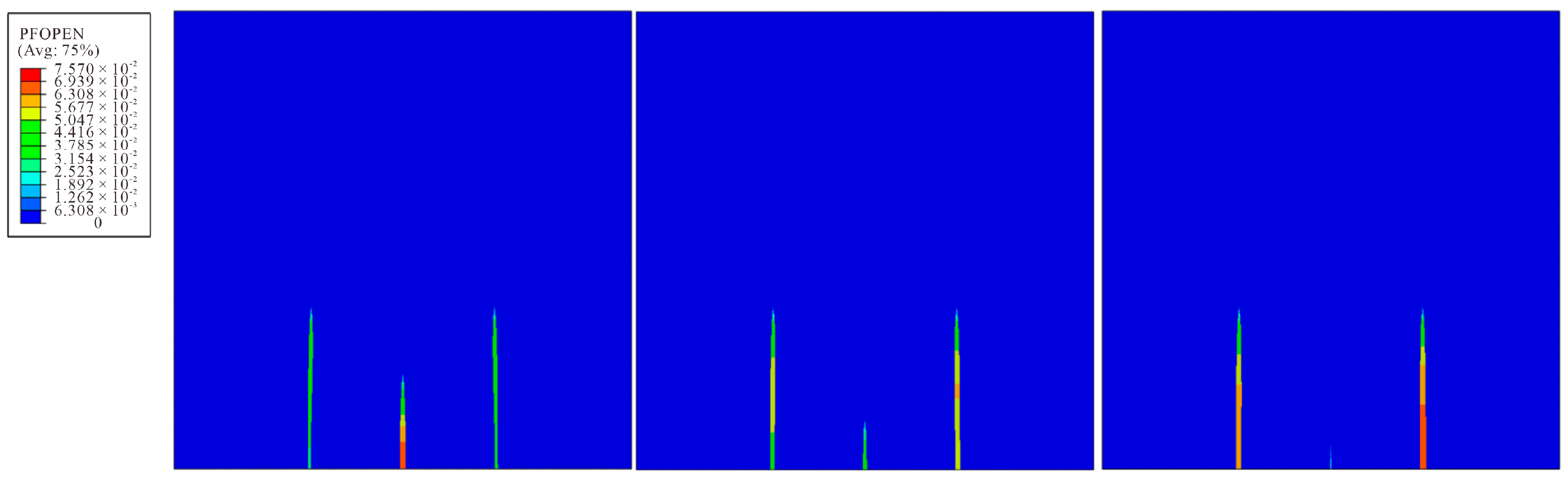
Under the condition of three clusters per stage, numerical simulations were conducted to investigate the fracture propagation morphology during large-scale fracturing when the number of perforations per cluster was 12, 16, and 20. The results are shown in Figure 5. When the number of perforations per cluster was 12, the fracture lengths of the three clusters were 36.29 m, 21.53 m, and 36.29 m, respectively. When the number of perforations was 16, the fracture lengths were 36.29 m, 11.48 m, and 36.29 m. When the number of perforations was 20, the fracture lengths were 36.29 m, 6.12 m, and 36.29 m. The smaller the number of perforations per cluster, the higher the perforation friction, which plays a role in limited-entry fracturing and promotes uniform fracture propagation among the three clusters. Therefore, based on the limited-entry fracturing concept, the number of perforations per cluster was designed to be 12 holes per m to increase the perforation flow friction and promote uniform propagation of fractures across clusters (as shown in Equation (7)) [28].
Δ P hf = 0.2369 q 2 ρ n 2 d 4 a 2
where Δ P hf is the perforation friction pressure loss, MPa; q is the pumping rate, m3/s; ρ is the fracturing fluid density, kg/m3; n is the total active perforation number per stage; d is the perforation entry hole diameter, m; a is the perforation flow coefficient, typically ranging from 0.6 to 0.9.

4.3.2. Cluster Spacing

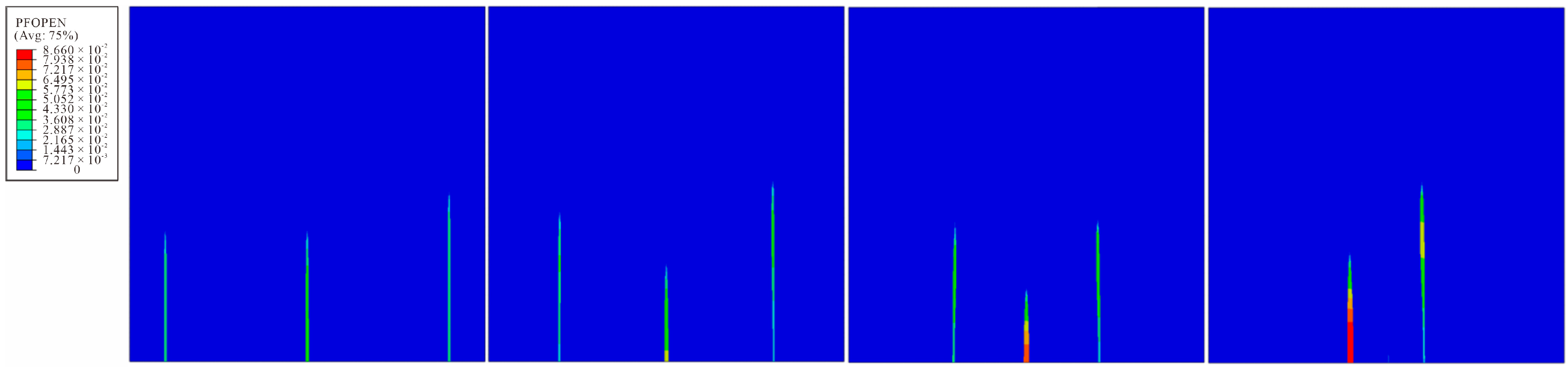
Under the condition of three clusters per stage, the finite element numerical simulation method was used to study the fracture propagation morphology when the cluster spacing was 10, 20, 30, and 40 m. The results are shown in Figure 6. When the cluster spacing was 10 m, the fracture lengths were 46.10 m, 3.31 m, and 51.77 m, respectively. When the cluster spacing was 20 m, the fracture lengths were 36.29 m, 21.53 m, and 36.29 m. When the cluster spacing was 30 m, the fracture lengths were 40.18 m, 28.26 m, and 45.68 m. When the cluster spacing was 40 m, the fracture lengths were 35.12 m, 35.12 m, and 42.88 m.
When the cluster spacing was 10 m, the fractures from the middle perforation cluster were subjected to severe stress interference from the side fractures and failed to develop effectively. As the cluster spacing increased, the interference of the side fractures on the middle fracture, as well as the mutual interference between the side fractures, weakened. On the one hand, the propagation length of the middle fracture increased; on the other hand, the width of the side fractures became more uniform. Therefore, the optimal cluster spacing was determined to be 15–25 m.

4.3.3. Pump Rate

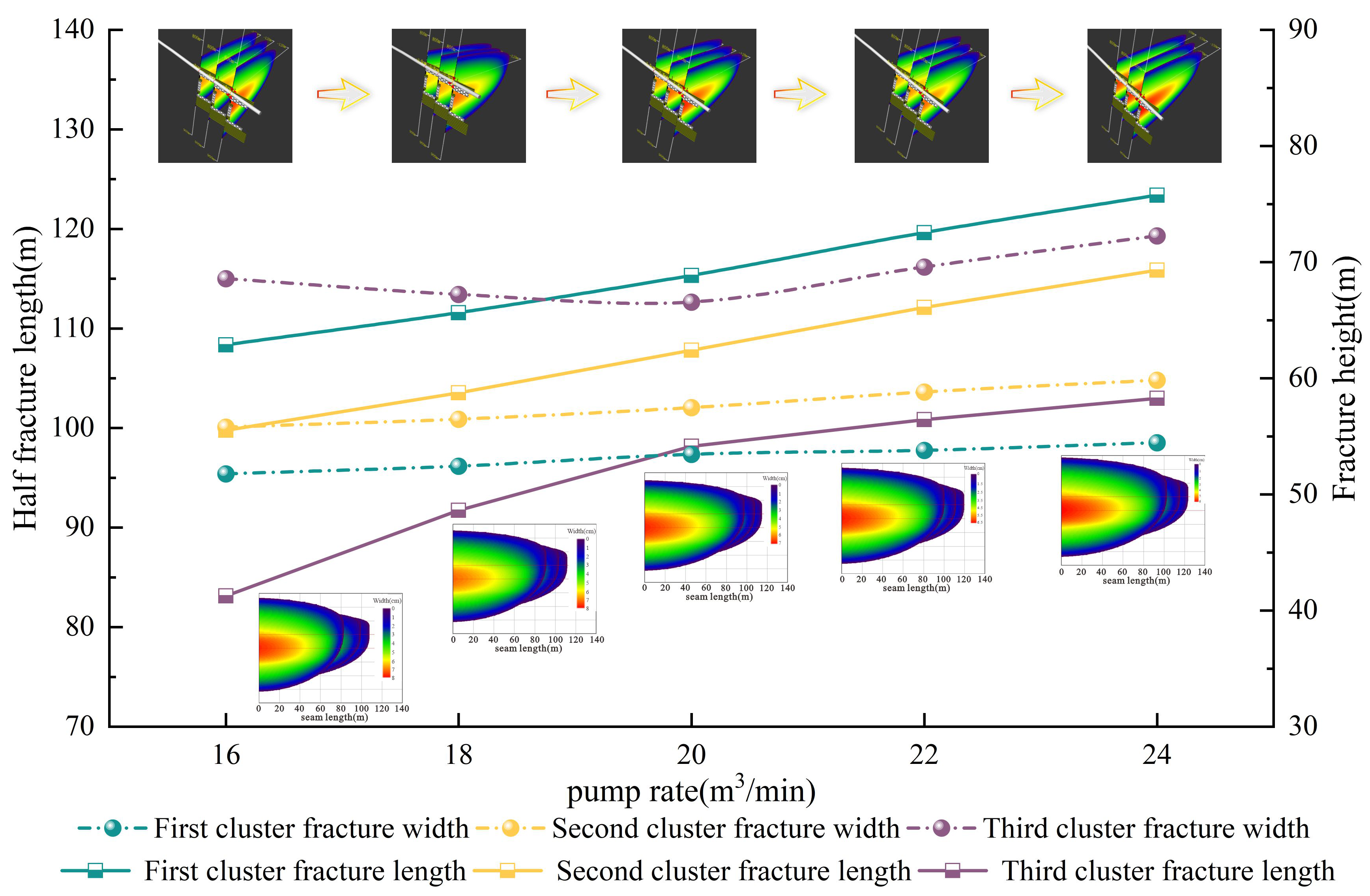
Under the condition of three clusters per stage and considering ground pressure limitations, numerical simulations were conducted to investigate the fracture propagation morphology at pump rates of 16, 18, 20, 22, and 24 m3/min. The results are shown in Figure 7. The numerical simulation results indicate that as the fracturing pump rate increases, both the fracture length and height increase. A higher pump rate leads to a higher surface treating pressure. The optimal pump rate is 18–20 m3/min, which can be further increased if the surface pressure remains within the allowable limit.

4.3.4. Fracturing Treatment Scale

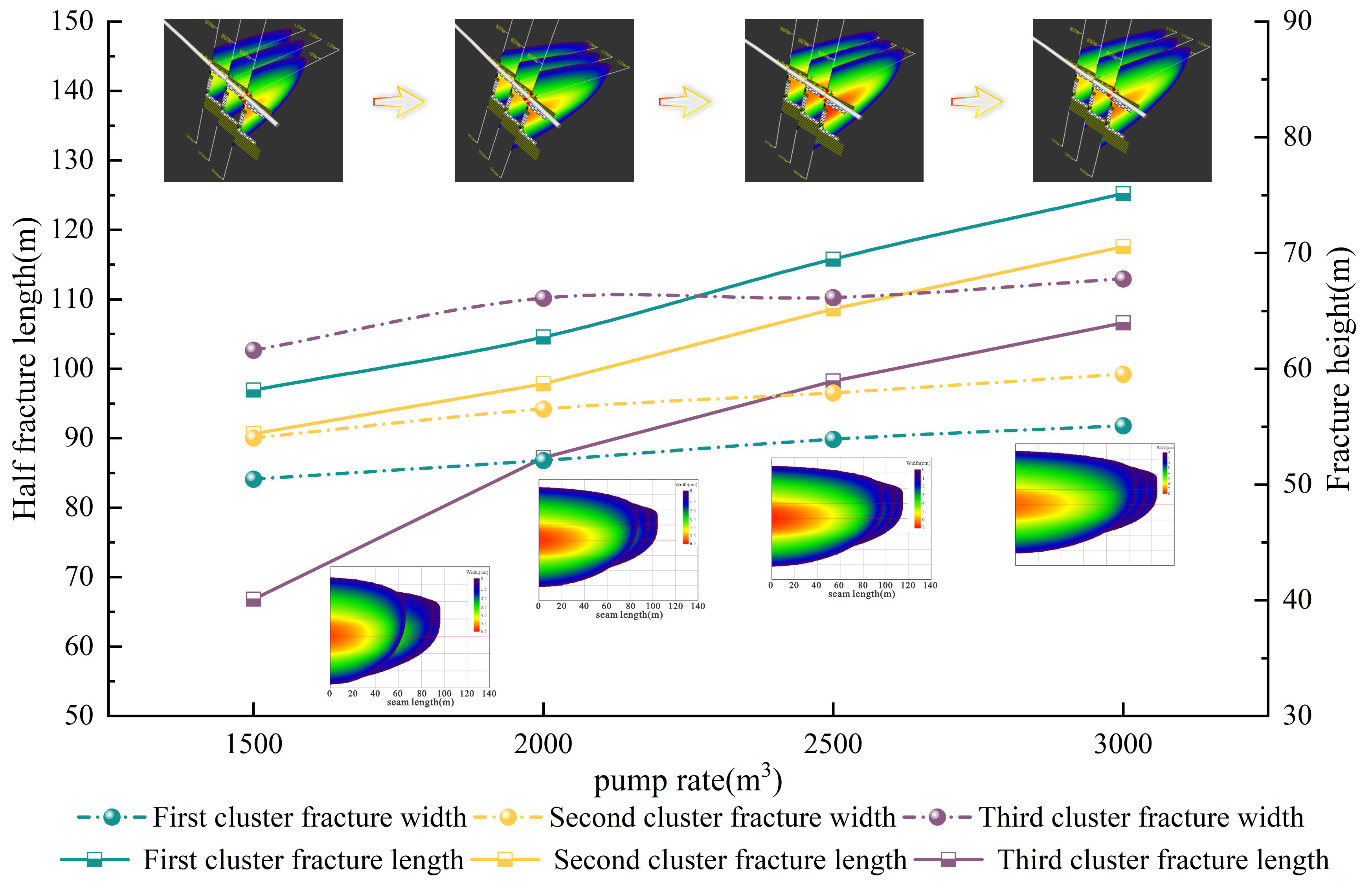
Under the conditions of three clusters per stage and a pump rate of 20 m3/min, numerical simulations were conducted to investigate the fracture propagation morphology at treatment scales of 1500, 2000, 2500, and 3000 m3. The results are shown in Figure 8. The simulation results indicate that as the treatment scale increases, both the fracture length and height increase. To ensure that the fracture length generated by perforation meets the requirement of 90–110 m, and in line with the concept of ‘fluid volume optimization (to prevent uncontrolled vertical height growth) and proppant volume maximization (to achieve saturated fracture propping),’ the optimal fracturing treatment scale is determined to be 2500–3000 m3.

4.4. Parameter Optimization for Saturated Volume Fracturing

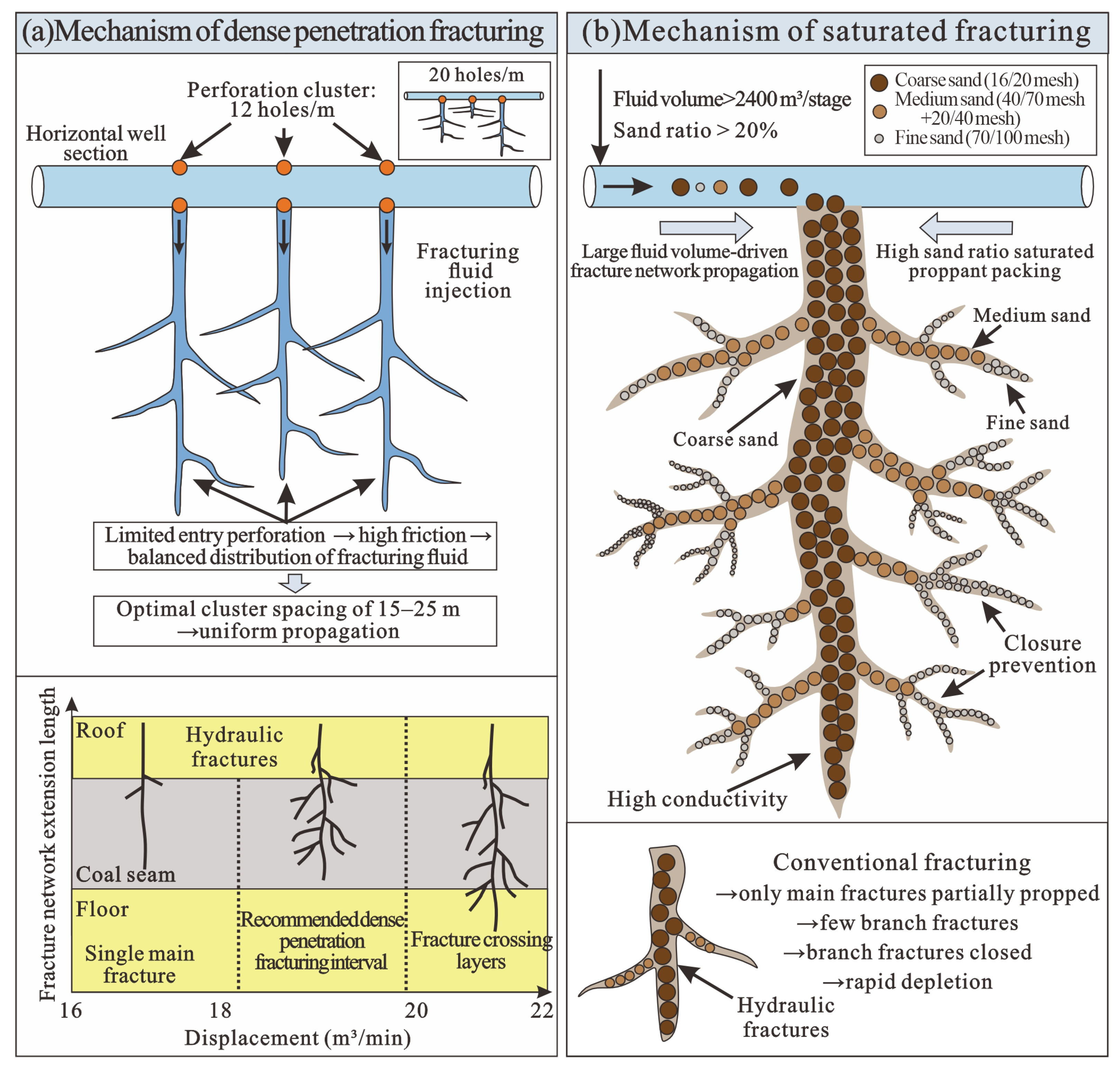
For saturated volume fracturing, the synergistic effect of limited-entry perforation and multi-cluster stress interference is the key to achieving uniform propagation of multiple fractures (Figure 9a). The limited-entry perforation technique increases perforation friction, forcing the fracturing fluid to distribute more evenly among clusters, thereby suppressing excessive propagation of dominant fractures. Meanwhile, the cluster spacing determines the strength of the induced stress field at the tips of adjacent fractures. If the spacing is too small, the middle fracture is completely suppressed; if the spacing is too large, the fracture density becomes insufficient. Moderate stress interference both ensures the effective propagation of the middle fracture and promotes fracture reorientation and branching along bedding planes or natural weak interfaces, thereby increasing fracture network complexity while avoiding repeated fracturing that could overly fragment the coal structure, which is detrimental to subsequent CBM well production.
Regarding the ‘saturated’ aspect, it is mainly reflected in the combined operation of a large fluid volume to drive full fracture network expansion and high proppant volume/sand ratio to achieve propping (Figure 9b). When the fluid volume per stage exceeds 2500 m3, the half-length of fractures increases by approximately 57% compared to conventional fracturing, and the high injection pressure activates secondary fracture networks. Under conditions of proppant volume per stage exceeding 250 m3 and a maximum sand ratio exceeding 20%, combined with a multi-size proppant mixture, the ‘saturated filling’ of branched fractures (defined conceptually as achieving the maximum possible proppant packing density and multi-scale bridging support across both primary and secondary fractures through the sequential injection of multi-size proppant mixtures) can be achieved, thereby preventing ineffective fracture closure after pump shut-off. Analysis of the main controlling factors indicates that the treatment scale, cluster spacing, and the number of perforations per cluster jointly influence the fracturing stimulation outcome. A pump rate of 18–20 m3/min represents an optimal range during fracturing; below this range, the fracture morphology tends to be single, while above it, the fracture height may become uncontrolled and penetrate the layer.

5. Field Test and Effect Evaluation

5.1. Overall Fracturing Operation of the Horizontal Well Group

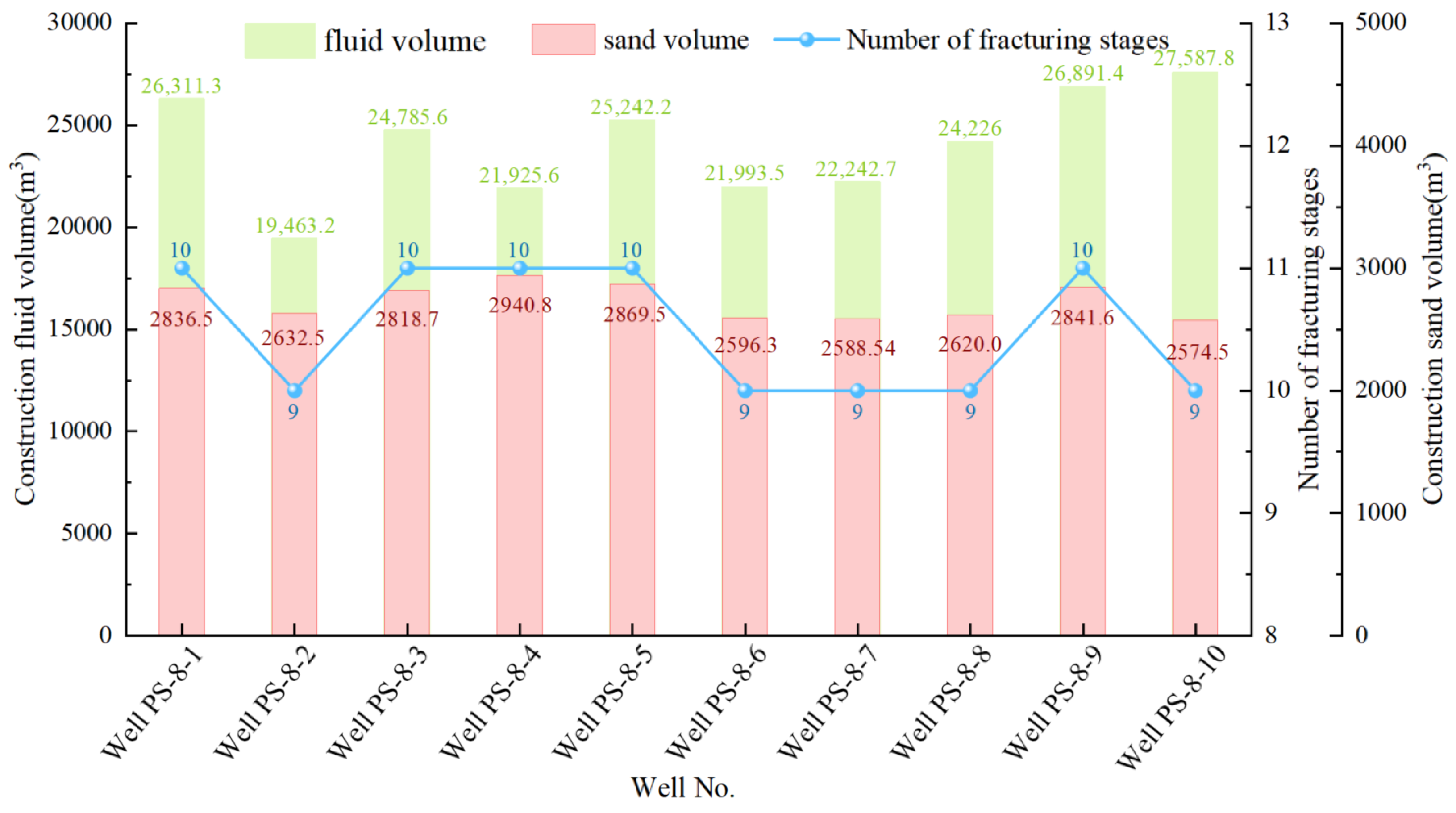
The fracturing operations of the 10 horizontal wells in the PS-8 well group in the Huainan Mining Area are shown in Figure 10. For each horizontal well in this well group, the fracturing fluid volume ranged from 19,463.2 to 27,587.8 m3, the proppant volume ranged from 2574.5 to 2940.8 m3, and the number of fracturing stages per well ranged from 9 to 10. The average fluid volume injected per stage in the well group ranged from approximately 1946.32 to 2758.78 m3/stage, and the average proppant volume injected per stage ranged from approximately 256.25 to 267.34 m3/stage. The overall treatment parameters were stable and controllable, and the per-stage injection levels of fluid and proppant satisfied the fracture propagation requirements and design criteria for saturated volume fracturing.

5.2. Comparison of Treatment Parameters Between Conventional Fracturing and Volume Fracturing

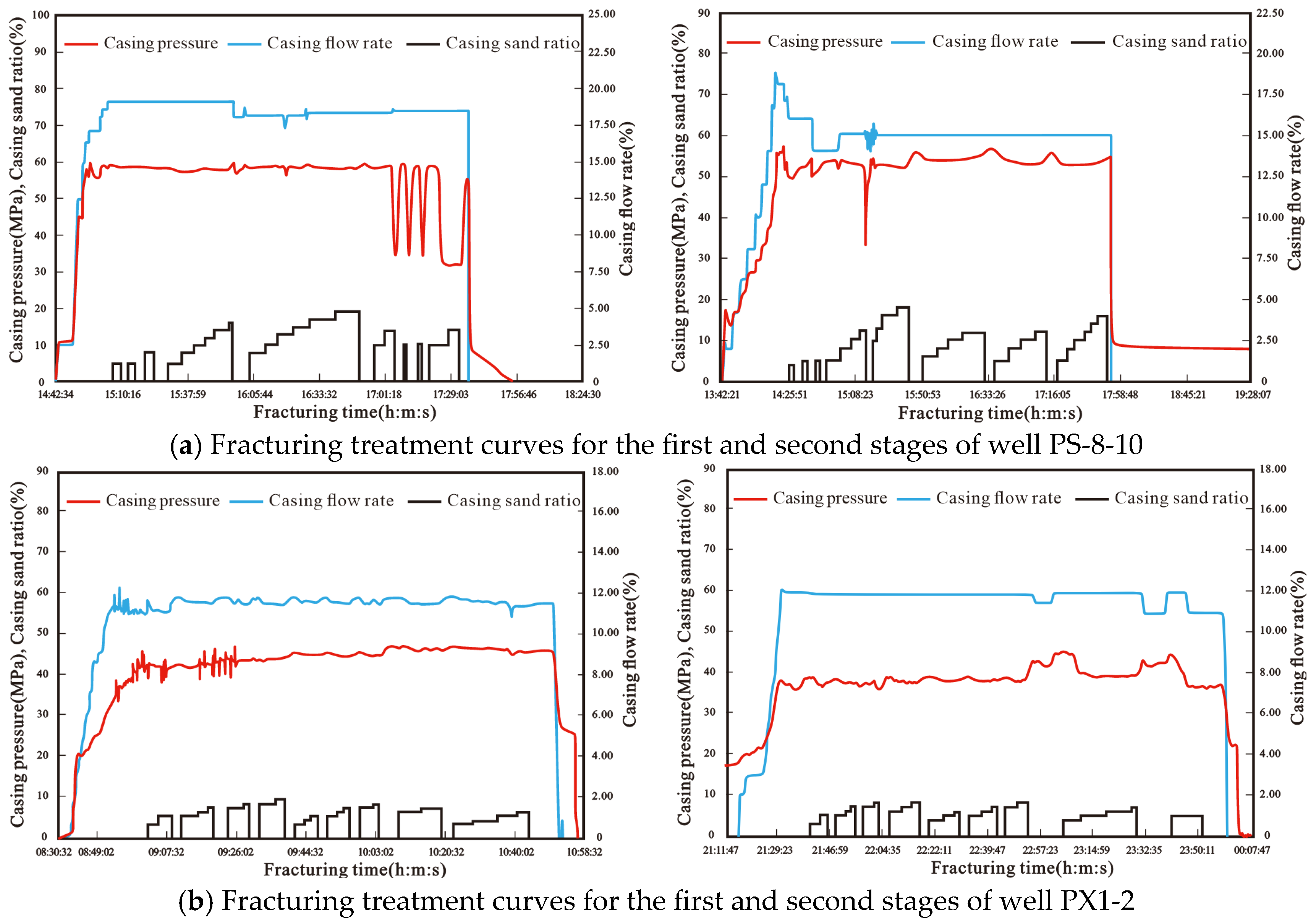
To compare the treatment characteristics of conventional fracturing and saturated volume fracturing, we first established a controlled baseline. The conventional well (PX1-2) and the saturated volume fracturing wells (PS-8-8 and PS-8-10) are located within the Huainan Mining Area, targeting the same No. 8 coal seam roof. Their key reservoir parameters are relatively similar, representing minor geological differences despite the inherent reservoir heterogeneity across the mining area. These comparable baseline conditions help minimize the influence of localized geological sweet-spots, suggesting that the differences in stimulation performance are largely driven by the distinct technical designs. For detailed comparative analysis, the first two stages of fracturing data from Well PS-8-10 and Well PX1-2 were selected. A comparison of the treatment parameters of the two wells shows that the volume fracturing operation in Well PS-8-10 exhibited notable characteristics of ‘high pump rate, large fluid volume, high proppant volume, and high sand ratio’ (Figure 11). The fluid volume per stage exceeded 2000 m3, the proppant volume per stage exceeded 230 m3, the maximum pump rate approached 15 m3/min, and the average sand ratio was approximately 10%, all of which were far higher than those of the conventional fracturing in Well PX1-2. It is worth noting that despite the significantly higher treatment intensity in Well PS-8-10, both stages were completed smoothly without any operational anomalies such as screen-outs. After pump shut-off, the pressure declined steadily during the pressure falloff test, indicating that the large-scale volume fracturing technique is feasible and the parameter design is reasonable, thereby effectively ensuring operational safety and quality.
Under the same coal seam conditions in the Huainan Mining Area, Wells PS-8-8 and PS-8-10 adopted the volume fracturing technique, while Well PX1-2 used conventional fracturing. Significant differences exist in the fracturing parameter design among the three wells. As shown in Table 2, while Wells PS-8-8 and PS-8-10 had 10 fracturing stages, the conventional well PX1-2 was completed with 13 fracturing stages. The total fluid volumes for Wells PS-8-8 and PS-8-10 were 24,226.00 m3 and 27,587.80 m3, respectively, with average fluid volumes per stage of 2422.60 m3 and 2758.78 m3, both much higher than those of the conventional fracturing Well PX1-2 (total fluid volume 20,580 m3, average per stage 1583.07 m3). In terms of proppant volume, the average proppant volume per stage for the volume fracturing wells exceeded 250 m3, with maximum sand ratios of 24.1% and 22.2%, respectively, while the conventional fracturing well had an average proppant volume of only 70.00 m3 per stage and a maximum sand ratio of only 4.95%.
The above parameter comparison shows that the saturated volume fracturing technology significantly increases the fluid volume, proppant volume, and sand ratio per stage. These increases aim to enhance the stimulation intensity, reflecting its technical characteristics of ‘large fluid volume, high proppant volume, and high sand ratio’ to form a more complex fracture network.

5.3. Evaluation of Volume Fracturing Effectiveness

5.3.1. Microseismic Monitoring Methodology

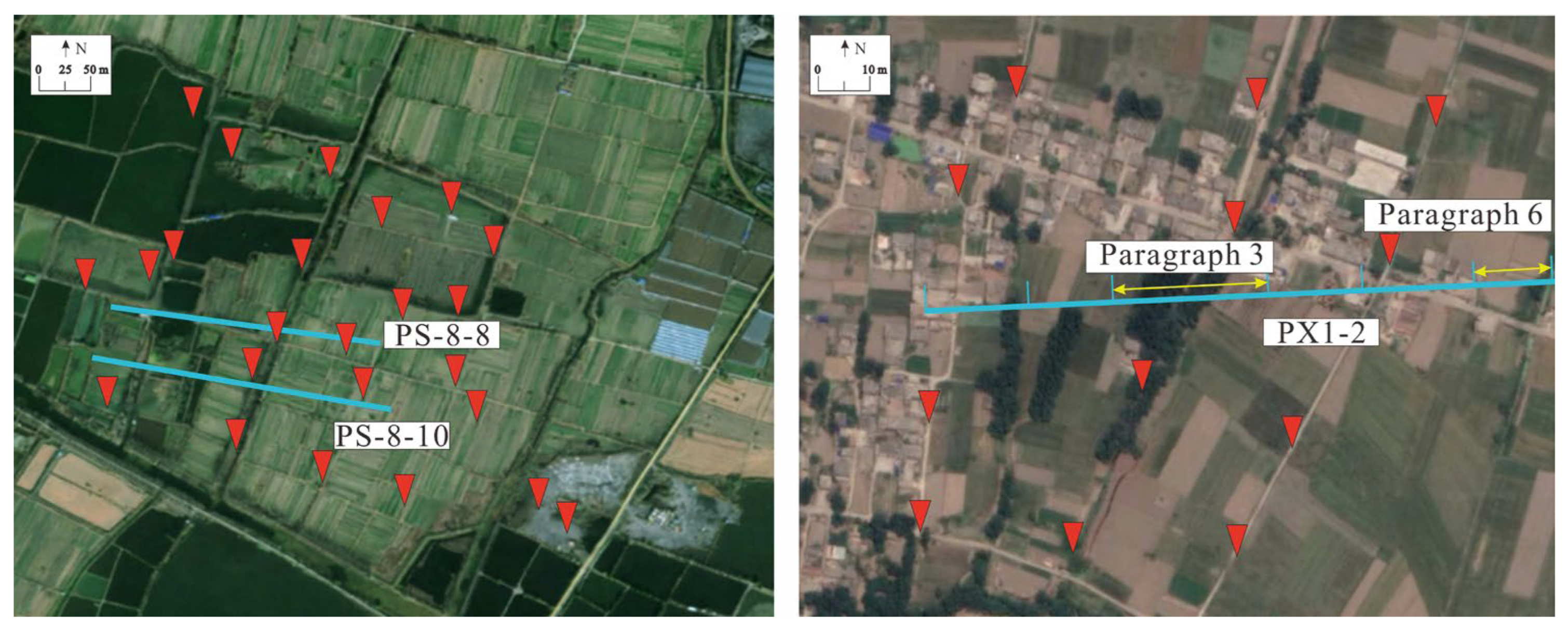
To evaluate the geometry of the induced fracture networks in situ, a real-time microseismic monitoring campaign was conducted. The surface geophone array configuration varied by well design: for the saturated volume fracturing Wells PS-8-8 and PS-8-10, a stationary array of 24 three-component (3C) geophone stations was deployed to monitor the entire wellbore, whereas for the conventional Well PX1-2, an array of 12 stations was deployed for every 5 fracturing stages and sequentially translated along the wellbore axis toward the next fracturing direction after every 5 completed stages, as illustrated in Figure 12. To ensure high location accuracy, the 3D layered velocity model was dynamically calibrated using actual in situ perforation shot waveforms as calibration sources, with arrival-time picking precision resolved in microseconds (μs). Location inversion was executed using a two-stage grid search algorithm, which refined a coarse 100 m mesh to a dense 10 m mesh while enforcing a strict 1 ms travel-time residual threshold to filter out background noise. Ultimately, the maximum horizontal and vertical envelopes of the located event clouds were interpreted to define the fracture propagation length and height, respectively.

5.3.2. Analysis of Fracture Geometry and Stimulated Reservoir Volume

To further evaluate the fracture stimulation effectiveness of volume fracturing, based on microseismic monitoring results, the fracture geometric parameters and SRV of wells PS-8-8, PS-8-10, and the conventional fracturing Well PX1-2 were compared. Due to limitations in microseismic monitoring data, representative fracturing stages from each well were selected for comparative analysis. The specific parameters are shown in Table 3.
In terms of fracture length, the volume fracturing wells show a clear advantage. For Well PS-8-8, the fracture lengths in stages 5 and 7 were 397 m and 408 m, respectively; for Well PS-8-10, the fracture lengths in stages 3 and 6 were 382 m and 418 m, respectively. In contrast, for the conventional fracturing Well PX1-2, the fracture lengths in stages 3 and 6 were only 268.4 m and 228.7 m. The comparison indicates that the fracture extension length of volume fracturing wells is significantly greater than that of conventional fracturing wells, with an increase of nearly 50%, reflecting a stronger fracture propagation capability under high pump rates and large fluid volumes. In terms of fracture height, the monitored fracture heights of the three wells are all in the range of 25–38 m, showing little overall difference, which indicates that the fractures primarily propagated within the coal seam and adjacent layers without significant uncontrolled layer breakthrough, thereby facilitating effective CBM reservoir stimulation. Regarding the SRV, since Well PX1-2 did not undergo microseismic monitoring or its SRV data were not provided, a direct comparison of its SRV is not possible. However, based on its smaller fracture length and the characteristics of conventional fracturing, it can be inferred that its fracture network complexity and SRV were far lower than those of the volume fracturing wells.

5.4. Gas Production Performance Analysis

5.4.1. Production Decline Curves of Saturated Volume Fracturing Wells

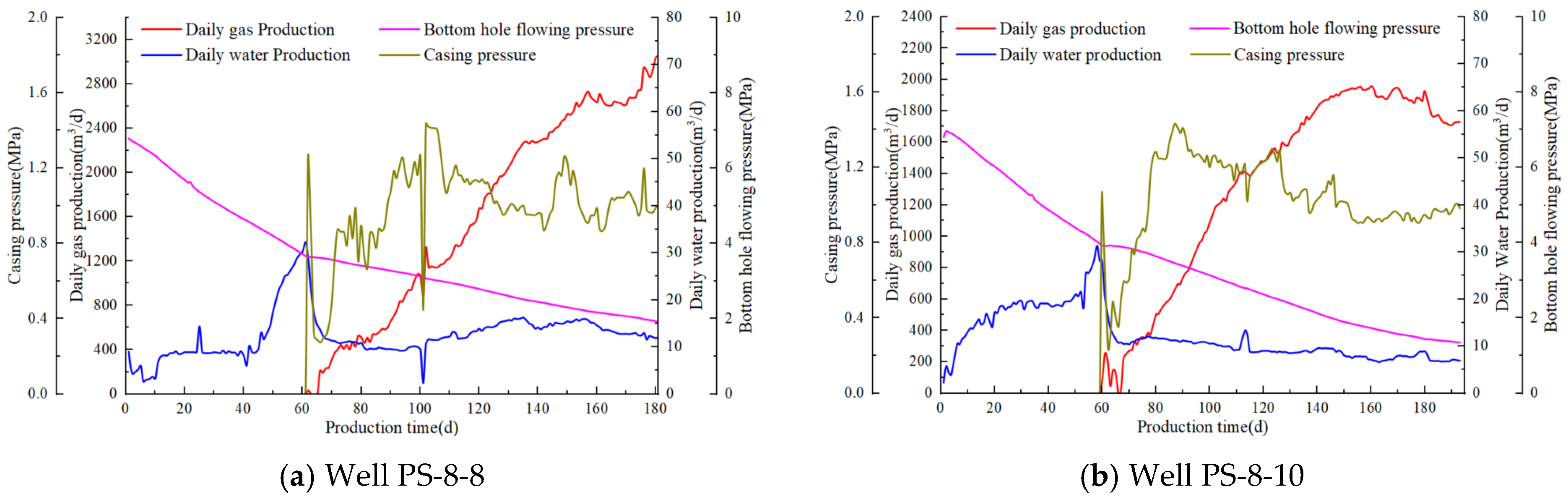
In the study area, Well PS-8-8 has been producing for approximately 180 days to date. Casing pressure was observed at 62 days of production, and gas production started after 4 days of stable casing pressure. To avoid uneven expansion of the pressure drawdown cone and reservoir sensitivity damage caused by excessive production intensity, the bottomhole flowing pressure was adjusted to a drawdown of 22.32 kPa/d. The current ramp-up production period has lasted 120 days. After adjusting the daily decrease in bottomhole flowing pressure and releasing gas, the gas production rate steadily increased to 3037.1 m3/d, with an average daily production ramp-up rate of 26.40 m3/d, and the remaining reservoir energy was 1.92 MPa (Figure 13a). For Well PS-8-10, casing pressure appeared after 60 days of production, and gas production started immediately after casing pressure manifestation, followed by a production ramp-up stage that lasted 90 days. With a bottomhole flowing pressure drawdown of 22.32 kPa/d, the maximum daily gas production reached 1932.7 m3/d, the average daily production ramp-up rate was 21.47 m3/d, and the remaining bottomhole flowing pressure was 1.34 MPa (Figure 13b).
From the production curves of the two wells, it is evident that the production systems of Wells PS-8-8 and PS-8-10 were reasonably adjusted during the ramp-up and stable production stages. Under saturated volume fracturing, the gas supply was sufficient, mainly characterized by a short ramp-up time and high daily gas production. Although the gas production rate of the CBM wells showed only a slight decline after reducing the production intensity during the stable production stage, the produced water remained clear, indicating that no serious reservoir sensitivity issues had occurred downhole. Based on the analysis of the remaining downhole energy, both wells still possess considerable production potential.

5.4.2. Characteristics of Production Decline Curves for Conventional Fracturing Wells

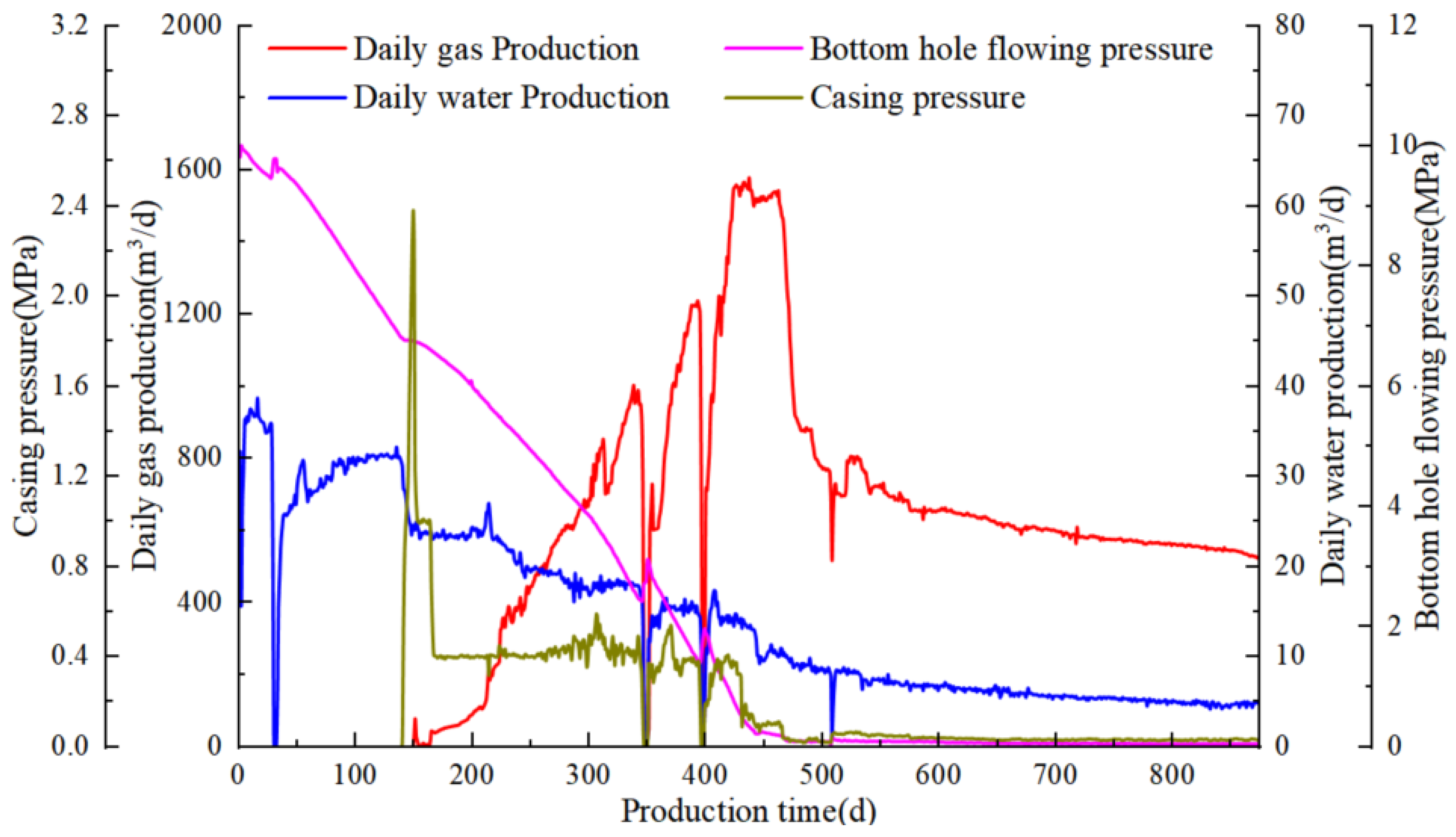
In the study area, Well PX1-2 has been producing for a total of 875 days to date. Casing pressure was observed after 140 days of production, and gas production started after 10 days of stable casing pressure. To avoid uneven expansion of the pressure drawdown cone and reservoir sensitivity damage caused by excessive production intensity, the bottomhole flowing pressure was adjusted to a drawdown of 22.63 kPa/d. The current ramp-up production period has lasted 285 days. After adjusting the daily decrease in bottomhole flowing pressure and releasing gas, the gas production rate steadily increased to 1522.81 m3/d, with an average daily ramp-up rate of 5.34 m3/d. A two-sample Student’s t-test performed on the daily production increments during the active ramp-up stages confirms that the difference in the daily ramp-up rates between the saturated volume fracturing well (with an average increment of 26.40 m3/d) and the conventional well is statistically highly significant (t = 6.01, p < 0.01), demonstrating that the gas production rate of the conventional well is far lower than those of the coalbed methane wells subjected to saturated volume fracturing. Meanwhile, the stable production period after reaching the maximum daily gas production lasted only 36 days before the gas production rate declined rapidly. The current stable gas production rate is only about 550 m3/d (Figure 14).
From the production curve of Well PX1-2, it is evident that under conventional reservoir fracturing, the gas supply was significantly insufficient, characterized primarily by a long ramp-up time, low daily gas production, and a short stable production period. After reaching the peak gas production rate, the gas production rate declined rapidly. The gas production performance was markedly lower than that of Wells PS-8-8 and PS-8-10.

6. Discussion

6.1. Applicability Conditions of Saturated Volume Fracturing Technology in Medium-Deep Coal Seams

Currently, volume fracturing technology is mainly applied in medium-deep CBM development to resolve the critical engineering challenge of regional gas control under deep, low-permeability, and high-stress conditions. In medium-deep reservoirs, high in situ stresses severely restrict fracture opening, while the low-permeability matrix hinders gas flow, collectively leading to high gas pressure accumulation and severe outburst risks. Saturated volume fracturing targeting the coal seam roof provides an analytical solution to these challenges: First, rather than direct treatment in the fragile and high-stress coal seam (which often leads to wellbore collapse or localized reservoir damage), placing the horizontal well in the stiffer roof rock establishes a stable platform. Second, under deep, low-permeability conditions, simple bi-wing fractures provide insufficient drainage area. Saturated volume fracturing utilizes low horizontal stress differences to forcefully shear and activate multi-directional natural fracture systems, thereby creating an extensively connected dual-porosity flow network. Third, the high-stress-induced closure of fractures is mitigated by the ‘saturated propping’ mechanism, thereby ensuring long-term high conductivity. Consequently, this technology achieves rapid, regional pressure drawdown and efficient gas desorption, transforming the deep, high-outburst-risk coal seam into a highly drainable and safe mining zone.
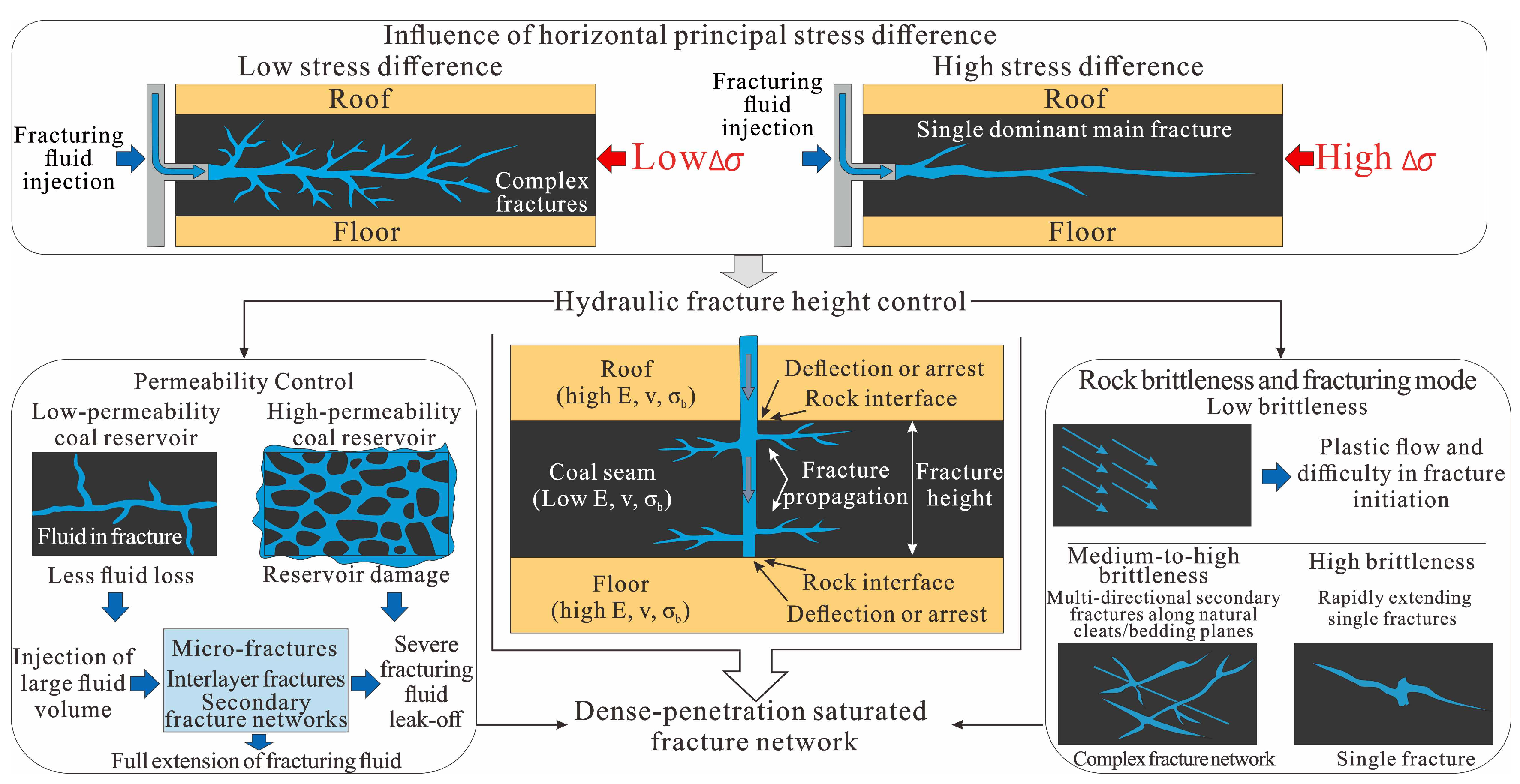
Within this geological context, the applicability of saturated volume fracturing technology is jointly determined by permeability, in situ stress difference, mechanical property differences between the roof and floor, and brittleness (Figure 15) [29,30,31]. During large fluid volume injection, the primary consideration is fluid loss and damage to surrounding reservoirs. Therefore, low-permeability coal seams are preferred so that the fracturing fluid cannot infiltrate into the matrix pores within the short fracturing time, thereby controlling the main fluid loss pathways to natural or induced micro-fractures, interlayer fractures, and secondary fracture networks, thereby reducing damage to the coal matrix and ensuring that the injected large fluid volume is truly used for fracture creation rather than ineffective loss [32]. Second, a small horizontal principal stress difference is key to forming a complex fracture network and avoiding excessive propagation of a single main fracture. Under low stress difference conditions, fractures are more likely to shear and open in multiple directions, generating high-density branch fractures rather than directionally penetrating layers or advancing along a single dominant direction, thereby keeping the fracture height and length within the production zone.
The significant mechanical property differences between the coal seam and its roof/floor serve as another barrier limiting vertical fracture height penetration. When the elastic modulus, Poisson’s ratio, and tensile strength of the medium-deep coal seam are significantly lower than those of the upper and lower barrier layers, hydraulic fractures deflect or arrest when encountering the hard-soft-hard interface vertically. The horizontal shear fractures and vertical branch fractures formed by volume fracturing collectively consume the energy within the fractures, thereby effectively confining the fracture height within the coal seam. In addition, moderately high brittleness is an internal factor for forming a complex fracture network: coal seams with excessively low brittleness tend to undergo plastic flow and render fracture initiation difficult, while excessively high brittleness may lead to overly simple fracture propagation. Coal rock with moderately high brittleness, under high pressure and high pump rate shear, easily opens along natural cleats/bedding planes and induces multi-directional secondary fractures, thereby achieving the objective of saturated stimulation.

6.2. Future Research Directions for Saturated Volume Fracturing Technology

(1)
Fine characterization of ‘sweet spots’ in medium-deep CBM reservoirs and the establishment of an adaptability evaluation system for saturated volume fracturing
Medium-deep CBM reservoirs are characterized by high in situ stress, low permeability, and strong heterogeneity; thus, not all blocks are suitable for saturated volume fracturing. Previous studies have shown that coal permeability, the horizontal principal stress difference, mechanical property differences between the roof/floor and the coal seam, and the brittleness index are the four main controlling factors for fracture network complexity and stimulated volume. Future research should comprehensively utilize well logging, seismic inversion, core experiments, and in situ stress field simulation to establish a comprehensive evaluation index system and propose quantifiable classification standards for saturated volume fracturing adaptability, thereby providing a scientific basis for well placement and fracturing design in medium-deep CBM blocks.
(2)
Development of highly efficient, low-damage saturated volume fracturing technology and material systems
Current saturated fracturing mainly uses fresh water combined with multi-size quartz sand. Although this meets the requirements of large fluid volume and a high sand ratio, the following problems remain: first, the proppant-carrying capacity of fresh water is limited, leading to a risk of screen-outs during high sand ratio operations; second, the injection of a large fluid volume may cause reservoir sensitivity damage such as water blocking and clay swelling within the coal matrix, thereby affecting the long-term production performance. Therefore, it is urgent to develop low-damage, high-proppant-carrying-capacity fracturing fluid systems suitable for medium-deep coal seams, such as low-concentration guar gum or slickwater, and to optimize fluid loss additives and clay stabilizers. In addition, further research should focus on the integrated technology of multi-cluster limited-entry perforation plus temporary plugging diversion within a stage, using degradable temporary plugging agents to achieve dynamic fracture diversion between clusters and stages, thereby further improving the fracture network complexity and stimulation uniformity.
(3)
Intelligent optimization of production systems for saturated volume fracturing wells and construction of productivity prediction models
Well PS-8-8 achieved an average daily ramp-up rate of 26.40 m3/d during the ramp-up stage, while the conventional well reached only 5.34 m3/d, indicating that complex fracture networks tend to cause rapid pressure drawdown expansion. However, excessive pressure drawdown may lead to coal fines production and fracture closure. Future research should invert fracture network structural parameters based on microseismic monitoring, tracer production profile tests, and production performance data, and establish a coupled fracture network–flow productivity model. On this basis, the potential of machine learning methods could be explored to analyze the latent mapping relationships between production parameters, gas production rate, and the stable production period. Although challenges such as data non-uniqueness and model generalizability persist, such statistical workflows can help guide differentiated, staged production optimization strategies under complex fracture network conditions, with the ultimate goal of supporting more efficient and stable CBM extraction. Additionally, although dynamic fracturing calibration is inherently more difficult than standard gas production matching due to unobservable fracture propagation, reducing simulation uncertainty is critical. Future work will focus on integrating higher-resolution microseismic monitoring, net-pressure matching, and larger comparative well databases to enhance validation and support the broad generalization of the technology.

7. Conclusions

(1)
Optimal perforation density is 12 holes per m per cluster with 15 to 25 m spacing, promoting uniform multi-fracture propagation via limited-entry and moderate stress interference.
(2)
Saturated fracturing, defined as single-stage fluid volume exceeding 2400 cubic m, proppant volume exceeding 250 cubic meters, and maximum sand ratio exceeding 20 percent, increases fracture half-length by approximately 50 percent and significantly enlarges the SRV compared to conventional fracturing.
(3)
Field wells PS-8-8 and PS-8-10 achieved stable gas production rates of approximately 3000 and 2000 cubic m per day respectively, with ramp-up rates five times higher than the conventional well PX1-2, which achieved only 550 cubic meters per day.
(4)
Applicability of this technology requires low permeability, low horizontal stress difference, strong mechanical contrast between roof and floor, and moderately high brittleness.
(5)
Future work should integrate sweet-spot characterization, low-damage fracturing fluids, and artificial intelligence-based production optimization.

Author Contributions

Methodology, H.D., S.Z., L.S., J.Q., S.S. and B.C.; Validation, H.L.; Resources, L.S., J.Q., S.S. and B.C.; Writing—original draft, H.D.; Writing—review & editing, H.D., S.Z. and L.S.; Supervision, S.Z., L.S., H.L. and S.S.; Funding acquisition, H.L., J.Q., S.S. and B.C. All authors have read and agreed to the published version of the manuscript.

Funding

General Program (Youth Project) of the Natural Science Basic Research Program of Shaanxi Province (2025JC-YBQN-376); Research on Staged Dense Penetration Saturated Volume Fracturing Technology for Coalbed Methane Wells (030503202400280).

Data Availability Statement

The original contributions presented in this study are included in the article. Further inquiries can be directed to the corresponding authors.

Conflicts of Interest

Authors Huazhong Ding, Lei Su and Jianjian Qi were employed by the Huainan Mining Group Coalbed Methane Development and Utilization Co., Ltd. Authors Shiliang Zhu, Haozhe Li and Siqing Sun were employed by the China Coal Technology and Engineering Group Xi’an Research Institute Co., Ltd. Author Benliang Chen was employed by the Ping’an Coal Mining Engineering Technology Research Institute Co., Ltd. All authors declare that the research was conducted in the absence of any commercial or financial relationships that could be construed as potential conflicts of interest.

References

  1. Wu, D.; Li, B.; Wu, J.; Hu, G.; Gao, X.; Lu, J. Influence of Mineral Composition on Rock Mechanics Properties and Brittleness Evaluation of Surrounding Rocks in Soft Coal Seams. ACS Omega 2024, 9, 1375–1388. [Google Scholar] [CrossRef] [PubMed]
  2. Wu, D.; Zhang, W.; Liu, G.; Zhan, R.; Hu, G. Characteristics and geological significance of germanium in Taiyuan coal formation of Huainan Coalfield, Anhui, China. Int. J. Coal Sci. Technol. 2020, 7, 662–675. [Google Scholar] [CrossRef]
  3. Zhang, H.; Xu, G.; Zhan, H.; Li, X.; He, J. Simulation of multi-period paleotectonic stress fields and distribution prediction of natural Ordovician fractures in the Huainan coalfield, Northern China. J. Hydrol. 2022, 612, 128291. [Google Scholar] [CrossRef]
  4. Ao, W.; Huang, W.; Tang, X.; Chen, P. Coal Quality Characteristics and distribution regularity in depth of Wangfenggang minefield, Huainan mining area. Procedia Earth Planet. Sci. 2011, 3, 123–130. [Google Scholar] [CrossRef][Green Version]
  5. Liu, D.; Yao, Y.; Tang, D.; Tang, S.; Che, Y.; Huang, W. Coal reservoir characteristics and coalbed methane resource assessment in Huainan and Huaibei coalfields, Southern North China. Int. J. Coal Geol. 2009, 79, 97–112. [Google Scholar] [CrossRef]
  6. Zhao, Z.; Li, A.; Zhang, J.; Chen, M. Research on In Situ Gas Resource Characteristics in the Xinzhuangzi Closed Coal Mine, Huainan Mining Area, Anhui Province, China. Appl. Sci. 2026, 16, 4502. [Google Scholar] [CrossRef]
  7. Sang, S.; Han, S.; Zhou, X.; Liu, S.; Wang, Y. Deep coalbed methane resource and its exploration and development prospect in East China. Pet. Reserv. Eval. Dev. 2023, 13, 403–415. (In Chinese) [Google Scholar] [CrossRef]
  8. Wei, Q.; Hu, B.; Li, X.; Feng, S.; Xu, H.; Zheng, K.; Liu, H. Implications of geological conditions on gas content and geochemistry of deep coalbed methane reservoirs from the Panji Deep Area in the Huainan Coalfield, China. J. Nat. Gas Sci. Eng. 2021, 85, 103712. [Google Scholar] [CrossRef]
  9. Wei, Q.; Li, X.; Hu, B.; Zhang, X.; Zhang, J.; He, Y.; Zhang, Y.; Zhu, W. Reservoir characteristics and coalbed methane resource evaluation of deep-buried coals: A case study of the No.13-1 coal seam from the Panji Deep Area in Huainan Coalfield, Southern North China. J. Pet. Sci. Eng. 2019, 179, 867–884. [Google Scholar] [CrossRef]
  10. Geng, M.; Lv, X.; Zhang, X. The Structural Analysis of Deep Gas Occurrence and Prevention of Gas Disaster in Fengfeng Coalfield. Adv. Mater. Res. 2013, 2482, 484–487. [Google Scholar] [CrossRef]
  11. Du, F.; Wang, K.; Sun, J.; Feng, C.; Ju, C.; Xu, C.; Wang, L.; Wang, C. Research on macroscopic and microscopic failure characteristics and energy mechanism of deep stress-dominated coal and gas outburst. J. China Coal Soc. 2026, 51, 1357–1376. (In Chinese) [Google Scholar] [CrossRef]
  12. Shang, X.; Zhu, S.; Jiang, F.; Liu, J.; Li, J.; Hitch, M.; Liu, H.; Tang, S.; Zhu, C. Study on Dynamic Disaster Mechanisms of Thick Hard Roof Induced by Hydraulic Fracturing in Surface Vertical Well. Minerals 2022, 12, 1537–1559. [Google Scholar] [CrossRef]
  13. Zhang, T.; Zhang, Y.; Di, S.; Zhang, Y.; Huang, P. Experimental Study on the Propagation Law of Hydraulic Fractures in the Roof of Fragmented Soft-Coal Seams. J. Energy Eng. 2026, 152, 04026041. [Google Scholar] [CrossRef]
  14. Li, H.; Liang, W.; Jiang, Y.; Wu, P.; Wu, J.; He, W. Numerical study on the field-scale criterion of hydraulic fracture crossing the interface between roof and broken low-permeability coal. Rock Mech. Rock Eng. 2021, 45, 4543–4567. [Google Scholar] [CrossRef]
  15. Yang, K.; Zhang, S.; Hua, X.; Liu, W.; Lu, X.; Chi, X.; Wang, C.; Li, C. Research progress, key scientific issues, and prospects of segmented fracturing and pressure relief gas drainage technology for coal seam roof horizontal wells. J. China Coal Soc. 2025, 50, 944–964. (In Chinese) [Google Scholar] [CrossRef]
  16. Zhao, H.; Luo, J.; Li, X.; Yao, W.J.; Ji, L.; Zhen, H. Experimental investigation into the fracture propagation behavior of horizontal well multi-stage and multi-cluster fracturing within the roof of crushed soft coal seams. Pet. Sci. 2025, 22, 4682–4713. [Google Scholar] [CrossRef]
  17. Zhang, Q.; Ge, C.; Li, W.; Jiang, Z.; Chen, J.; Li, B.; Wu, J.; Wu, X.; Liu, J. A new model and application of coalbed methane high efficiency production from broken soft and low permeable coal seam by roof strata-in horizontal well and staged hydraulic fracture. J. China Coal Soc. 2018, 43, 150–159. (In Chinese) [Google Scholar] [CrossRef]
  18. Peng, Y.; Ding, H.; Ding, T.; Su, L.; Tong, B.; Ying, S.; Chen, B.; Tang, Y.; Liu, C.; Yuan, G.; et al. Research and application of surface gas control technology for soft and low-permeability coal seams in Huainan mining area. Pet. Reserv. Eval. Dev. 2025, 15, 1061–1069. (In Chinese) [Google Scholar] [CrossRef] [PubMed]
  19. Peng, L.; Li, H.; Liu, C.; Su, L.; Sun, S.; Zhang, M.; Jiang, Z.; Zhou, R. Frac-hits characteristics and rapid recovery method of CBM extraction horizontal well in Zhujidong Coal Mine of Huainan. Coal Sci. Technol. 2026, 54, 1–10. (In Chinese) [Google Scholar] [CrossRef]
  20. Liu, C.; Yuan, G.; Li, H.; Liu, L.; Sun, S.; Peng, Y. Application of Staged Multi-cluster Dense-cutting Fracturing Technology in Coalbed Methane Extraction in Huainan Mining Area. Coal Technol. 2024, 43, 166–170. (In Chinese) [Google Scholar] [CrossRef]
  21. Chen, M.; Guo, T.; Zou, Y.; Zhang, S.; Qu, Z. Numerical Simulation of Proppant Transport Coupled with Multi-Planar-3D Hydraulic Fracture Propagation for Multi-Cluster Fracturing. Rock Mech. Rock Eng. 2022, 55, 565–590. [Google Scholar] [CrossRef]
  22. Zhang, F.; Ma, G.; Liu, X.; Tao, Y.; Feng, D.; Li, R. Experimental analysis of multiple factors on hydraulic fracturing in coalbed methane reservoirs. PLoS ONE 2018, 13, e0195363. [Google Scholar] [CrossRef] [PubMed]
  23. Jiang, W.; Sun, S. Discussion on Reservoir Characteristics and Hydraulic Fracturing Transformation Mechanism of Tectonic Coal. Energies 2026, 19, 1631. [Google Scholar] [CrossRef]
  24. Rickman, R.; Mullen, M.; Petre, E.; Grieser, B.; Kundert, D. A practical use of shale petrophysics for stimulation design optimization: All shale plays are not clones of the Barnett shale. In Proceedings of the SPE Annual Technical Conference and Exhibition, Denver, CO, USA, 21–24 September 2008; p. 15258. [Google Scholar] [CrossRef]
  25. Zhang, Y.; Wang, J. Analysis of Perforation Erosion Through Computational Fluid Dynamic Modeling. SPE Prod. Oper. 2023, 38, 272–285. [Google Scholar] [CrossRef]
  26. Wasp, E.J.; Aude, T.C. Deposition Velocities, Transition Velocities, and Spatial Distribution of Solids in Slurry Pipelines. In Proceedings of the Paper Presented at the 1st International British Hydromechanics Research Association Hydraulic Transport of Solids in Pipes Conference, Conventry, UK, 1–4 September 1970. [Google Scholar]
  27. Wu, Q.; Xu, Y.; Wang, T.; Wang, X. The revolution of reservoir stimulation: An introduction of volume fracturing. Nat. Gas Ind. 2011, 31, 7–12+16+121–122. (In Chinese) [Google Scholar] [CrossRef]
  28. Xiao, Y.; Zhu, Q.; Zhao, Q.; Wang, M. Research on adaptability of fracturing technologies for CBM horizontal wells based on the viewpoint of “unblocking and channeling”. Coal Sci. Technol. 2025, 53, 243–254. (In Chinese) [Google Scholar] [CrossRef]
  29. Zhao, H.; Li, W.; Pu, H.; Yang, K. Formation Applicability Analysis of Stimulated Reservoir Volume Fracturing and Case Analysis. Petroleum 2021, 7, 160–167. [Google Scholar] [CrossRef]
  30. Jiang, T.; Zhang, J.; Wu, H. Impact Analysis of Multiple Parameters on Fracture Formation during Volume Fracturing in Coalbed Methane Reservoirs. Curr. Sci. 2017, 112, 332–347. [Google Scholar] [CrossRef]
  31. Li, C.; Pang, Y.; Zhou, Y.; Zhan, J.; Zhu, S. Analysis on Forming Conditions of Fracture Network in Volume Fracturing of Formation. Fault-Block Oil Gas Field 2022, 29, 101–106. (In Chinese) [Google Scholar]
  32. Chen, S.; Tao, S.; Tang, D. In situ coal permeability and favorable development methods for coalbed methane (CBM) extraction in China: From real data. Int. J. Coal Geol. 2024, 284, 104472. [Google Scholar] [CrossRef]
Figure 1. Location map of the Pansan Mine in the Huainan mining area.
Energies 19 02903 g001
Figure 2. Plan view of the PS-8 horizontal well group layout in the study area.
Energies 19 02903 g002
Figure 3. Comparison of controlling mechanisms between volume fracturing and conventional fracturing ((a) original fracture; (b) opening fracture; (c) sliding/shear fracture; (d) microseismic monitoring map after volume fracturing (different colors represent different fracturing stages)).
Energies 19 02903 g003
Figure 4. Finite element numerical simulation model for staged multi-cluster fracturing.
Energies 19 02903 g004
Figure 5. Effect of number of perforations per cluster on fracture propagation (from left to right: 12, 16, and 20 perforations per cluster).
Energies 19 02903 g005
Figure 6. Comparison of fracture propagation morphology at different cluster spacings (from left to right: 10, 20, 30, and 40 m).
Energies 19 02903 g006
Figure 7. Fracture propagation behavior under different fracturing pump rates.
Energies 19 02903 g007
Figure 8. Variation trend of fracture propagation dimensions with three clusters per stage.
Energies 19 02903 g008
Figure 9. Schematic diagram of the fracture propagation mechanism and main controlling factors of saturated volume fracturing.
Energies 19 02903 g009
Figure 10. Comparison of fracturing operations in the study area.
Energies 19 02903 g010
Figure 11. Comparison of treatment curves between saturated volume fracturing and conventional fracturing.
Energies 19 02903 g011
Figure 12. Geophone array deployments for Wells PS-8-8 and PS-8-10 and Well PX1-2 (The red triangles indicate the locations of monitoring points, and the blue lines represent well trajectories).
Energies 19 02903 g012
Figure 13. Characteristics of production decline curves for saturated volume fracturing wells.
Energies 19 02903 g013
Figure 14. Characteristics of production decline curve for a conventional fracturing CBM well.
Energies 19 02903 g014
Figure 15. Key controlling factors for saturated volume fracturing in medium-deep coal seams.
Energies 19 02903 g015
Table 1. Quantitative X-ray diffraction results of rock samples.
Sample No.Whole-Rock Quantitative Analysis (%)
ClayGypsumAnhydriteAragoniteQuartzK-FeldsparPlagioclaseCalciteSideriteAmphibole
8# coal25.53.8/1.38.3////61.1
Roof of 8# coal24.6/0.8/56.20.914.91.01.6/
Floor of 8# coal55.6///17.8///26.6/
Table 2. Comparison of parameters between conventional fracturing and volume fracturing.
Well No.Number of Fracturing StagesFluid Volume (m3)Proppant Volume (m3)Avg. Fluid Volume per Stage (m3)Avg. Proppant Volume per Stage (m3)Max. Sand Ratio (%)
Well PS-8-81024,226.00 2620.00 2422.60 262.00 24.1
Well PS-8-10 1027,587.80 2574.50 2758.78 257.45 22.2
Well PX1-21320,580910.001583.0770.004.95
Table 3. Post-fracturing evaluation parameters of Well PS-8-8, Well PS-8-10, and conventional fracturing Well PX1-2.
Well No.Stage No.Fracture Length (m)Fracture Height (m)SRV/104 Cubic m
Well PS-8-8539730137.00
740825151.00
Well PS-8-10338235126.70
641830115.75
Well PX1-23268.438/
6228.730.1/
Disclaimer/Publisher’s Note: The statements, opinions and data contained in all publications are solely those of the individual author(s) and contributor(s) and not of MDPI and/or the editor(s). MDPI and/or the editor(s) disclaim responsibility for any injury to people or property resulting from any ideas, methods, instructions or products referred to in the content.