Review

Biomimetic Structures for Enhancing Fluid Flow and Heat Transfer: From Mechanisms to Applications


by
Hang-Ye Zhang
1,
Yu-Wei Wang
1,
Dong-Yu Chen
2,
Long Huang
3,
Wei-Rong Hong
1 and
Jin-Yuan Qian
1,*
1
Institute of Advanced Equipment, College of Energy Engineering, Zhejiang University, Hangzhou 310027, China
2
School of Mechanical Engineering, Shanghai Jiao Tong University, Shanghai 200240, China
3
School of Intelligent Manufacturing Ecosystem, Xi’an Jiaotong–Liverpool University, Suzhou 215400, China
*
Author to whom correspondence should be addressed.
Energies 2026, 19(12), 2888; https://doi.org/10.3390/en19122888
Submission received: 19 May 2026 / Revised: 12 June 2026 / Accepted: 16 June 2026 / Published: 18 June 2026
(This article belongs to the Section J: Thermal Management)

Abstract

Nature provides efficient strategies for fluid transport and thermal regulation through evolved structural features. This review summarizes recent progress in biomimetic thermal–fluid structures for enhancing fluid flow and heat transfer, with emphasis on the links among biological inspiration, engineering geometry, transport mechanisms, and application performance. Representative designs are classified into tree-like branching and fractal networks, compact hexagonal layouts, and bio-inspired curved morphologies, including riblets, grooves, fins, fluctuating channels, and TPMS structures. Their enhancement mechanisms involve flow redistribution, boundary-layer disturbance, secondary-flow and vortex generation, local acceleration, enlarged heat-transfer area, drag reduction, and compact flow organization. Applications using biomimetic structures are assessed in detail, such as in battery thermal management, electronic cooling, etc. The reviewed studies indicate that biomimetic structures can improve temperature uniformity, suppress hotspots, and enhance thermohydraulic performance, but the gains may be accompanied by pressure-drop or pumping-power penalties. Therefore, coupled thermal–hydraulic evaluation is essential for objective comparison. Key challenges of practical usage are identified in mechanism-based design, manufacturability, reliability, etc. This work establishes the guidance for translating biological forms into practical thermal–fluid structures with balanced efficacy.

1. Introduction

Sustainable energy utilization has become an urgent and irreversible global trend, driven by the ongoing transformation of energy systems [1]. However, the persistent energy crisis continues to bring major challenges, including fossil fuel shortages, global warming, and environmental pollution. To address these issues, many countries have proposed carbon neutrality strategies. China, for example, has committed to achieving carbon neutrality [2]. These efforts require not only renewable and stable energy resources, but also improvements in overall energy efficiency to reduce energy loss and waste across industrial applications.
Heat-transfer enhancement technologies, especially those involving fluid flow, have long been essential to engineering development. Many critical fields rely on efficient heat exchangers, including batteries, electronics, heating, ventilation, air conditioning and refrigeration (HVAC&R), power generation, chemical production, material manufacturing, and food processing [3,4]. Typical examples illustrate the close relationship between fluid-flow heat transfer and energy efficiency.
Electric vehicles (EVs)—Battery thermal management systems (BTMSs), as essential components of EVs, must maintain lithium-ion batteries within a safe operating temperature range. Effective heat-transfer designs are therefore crucial for improving energy efficiency while providing economic and environmental benefits [5].
Electronic devices—Fluid-based cooling techniques for electronics must dissipate increasingly high heat fluxes, especially with the continued miniaturization of electronic components [6].
Solar energy systems—In solar photovoltaic and photovoltaic–thermal systems, convective heat transfer through fluid flow has attracted increasing attention for temperature regulation and energy recovery [7].
Other related fields include latent thermal energy storage systems [8,9], refrigeration systems [10], nuclear reactors [11], and many other thermal systems. These applications are closely associated with fluid flow and heat transfer, demonstrating the importance of thermohydraulic enhancement. Accordingly, one approach to improvement involves modifying the fluid properties, such as using nanofluids [12,13], and liquid metal [14]. However, cost, stability, and long-term reliability remain important limitations. Another major approach is to optimize the flow field through active or passive methods [3]. Active methods include the use of turbulators or the application of external magnetic or electric fields, but they often require additional energy input. Passive methods rely mainly on structural modifications, such as pin fins [15], dimples, bumps, ribs, twisted tapes, bifurcations, cavities, and other flow-shaping structures.
Bionics, a term first introduced by Steele in 1958 [16], has developed into an interdisciplinary concept linking biology with science, engineering, and technology. Nature provides abundant inspiration for both morphological and functional mimicry [17]. Biological structures have evolved under long-term environmental selection and often exhibit complex or counterintuitive morphologies. When these natural features are translated into engineering prototypes, they can provide effective strategies for improving fluid transport and thermal regulation. Therefore, biomimetic design should move beyond simple shape imitation and focus more on functional mimicry, mechanism identification, and engineering abstraction.
Recent biomimetic examples demonstrate the vitality of this field, such as a stretchable electrocyte nanogenerator inspired by the electric eel [18] and a thermal-insulating aerogel textile modeled on polar bear hair [19]. Biomimetic concepts have also been applied in mechanics [20,21], energy engineering [22], nanomaterials [23], architecture [24], and other fields. Particularly, heat transfer applications can be optimized using biomimetic strategies. Although previous studies have summarized heat-transfer enhancement technologies [3,4], including biomimetic thermal storage [17] and biomimetic condensation surfaces [25], the relationships among biomimetic geometry, thermal–fluid mechanism, hydraulic penalty, and engineering applicability remain insufficiently organized.
In nature, biological structures often support thermal management and fluid transport through the efficient use of energy and mass. Biomimetic structures can therefore offer alternatives to conventional designs. However, a systematic understanding of their thermal–fluid mechanisms remains underdeveloped, and a clearer pathway from biological inspiration to engineering optimization is still needed. Therefore, this review focuses on biomimetic thermal–fluid structures and aims to organize recent studies according to three connected dimensions: structural abstraction from biological prototypes, dominant heat-transfer and flow mechanisms, and application-dependent thermal–hydraulic performance. This organization is intended to support clearer structural selection rather than only listing individual biomimetic examples.
Biomimetic designs for heat-transfer enhancement often involve irregular geometries inspired by natural forms, such as tree-like fractals, honeycombs, and shark-skin riblets. These structures are commonly evaluated against conventional benchmark geometries. Most representative designs operate at micro- to meso-scales, where channel topology, surface morphology, and compact layout strongly influence flow distribution, heat-transfer area, boundary-layer development, and hydraulic resistance. Therefore, analyzing the thermal–fluid mechanisms at these scales can help clarify the logic behind biomimetic structural design.
Representative biomimetic structures include tree-like branching and fractal networks, hexagonal or honeycomb-inspired layouts, and bio-inspired curved or surface morphologies. Their enhancement mechanisms mainly involve flow redistribution, secondary flow or vortex generation, boundary-layer disturbance, localized acceleration, compact spatial organization, and enlarged heat-transfer area. This review discusses not only biomimetic flow channels and secondary structures, such as pin fins, ribs, grooves, and subchannels, but also the underlying physical mechanisms that determine their thermohydraulic performance.
Furthermore, biomimetic studies are assessed according to major application fields, including BTMSs, electronic cooling, and emerging photovoltaic–thermal systems. These areas require high heat-dissipation capacity, temperature uniformity, and energy-conversion efficiency, making biomimetic design highly relevant. In cooling channels, biomimetic structures can enhance heat transfer, redistribute flow, and in some cases reduce flow resistance; however, their overall benefit depends on the balance between thermal enhancement and hydraulic penalty. Therefore, representative studies are compared with attention to both performance improvement and pressure-drop or pumping-power cost. The specialized designs discussed in this review may also provide inspiration for cross-field thermal-management applications.
For review methodology, this review was prepared through a structured literature search combined with critical screening of the representative studies. Relevant publications were mainly collected from Web of Science, Scopus, ScienceDirect, and Google Scholar, with emphasis on studies published recently. Earlier papers were also included when they provided fundamental theories or widely used design principles.
The literature search focused on biomimetic, bionic, bio-inspired, and nature-inspired structures related to fluid flow, convective heat transfer, and thermal management. Studies were included when they reported engineering thermal–fluid applications with identifiable biological inspiration, clear geometric features, and quantitative thermal or hydraulic performance indicators. Numerical, experimental, and combined numerical–experimental studies were all considered, while review papers were mainly used to identify research gaps and trace additional references. The selected studies were then classified according to structural type, enhancement mechanism, application field, working fluid, performance metric, and validation method.
Overall, numerous biomimetic thermal–fluid studies remain scattered across different structures, working fluids, operating conditions, and application scenarios. This fragmentation limits the development of clear design guidance. Future challenges include identifying the functional principles behind biological structures, translating them into controllable engineering parameters, and evaluating biomimetic designs through appropriate benchmarks and thermohydraulic metrics. By organizing recent advances from a structure–mechanism–application perspective, this review aims to clarify the role of biomimetic design in fluid flow and heat-transfer enhancement and to support the future development of energy-efficient thermal-management systems.

2. Biomimetic Mechanisms of Meso-Scale Structures

2.1. Biomimetic Tree Branching—Fractal and Bifurcation

Among various meso-scale structural designs, biomimetic tree-like branching configurations represent an important category. These structures typically exhibit natural fractal patterns characterized by repeated bifurcation and consistent branching rules. Such fractal morphologies are widely observed in botanical systems, including roots, trunks, and leaf veins. They also play essential roles in animal physiology, particularly in circulatory systems, respiratory systems, and other tissues and organs.
i.
Development of theories
The widespread presence of fractal branching structures in nature is generally associated with efficient spatial utilization and reduced energy cost for fluid transport. Researchers have therefore attempted to establish systematic theoretical frameworks to guide the design of thermal–hydraulic systems. Murray first proposed Murray’s law in 1926 [26]. This principle describes the cubic relationship between the radii of parent and daughter branches, derived from the requirement of minimum transport energy dissipation. Subsequently, West et al. [27] and Bejan et al. [28,29,30,31] further advanced the theoretical understanding of branching fractal structures from biological scaling and thermodynamic perspectives.
ii.
Basic physical models
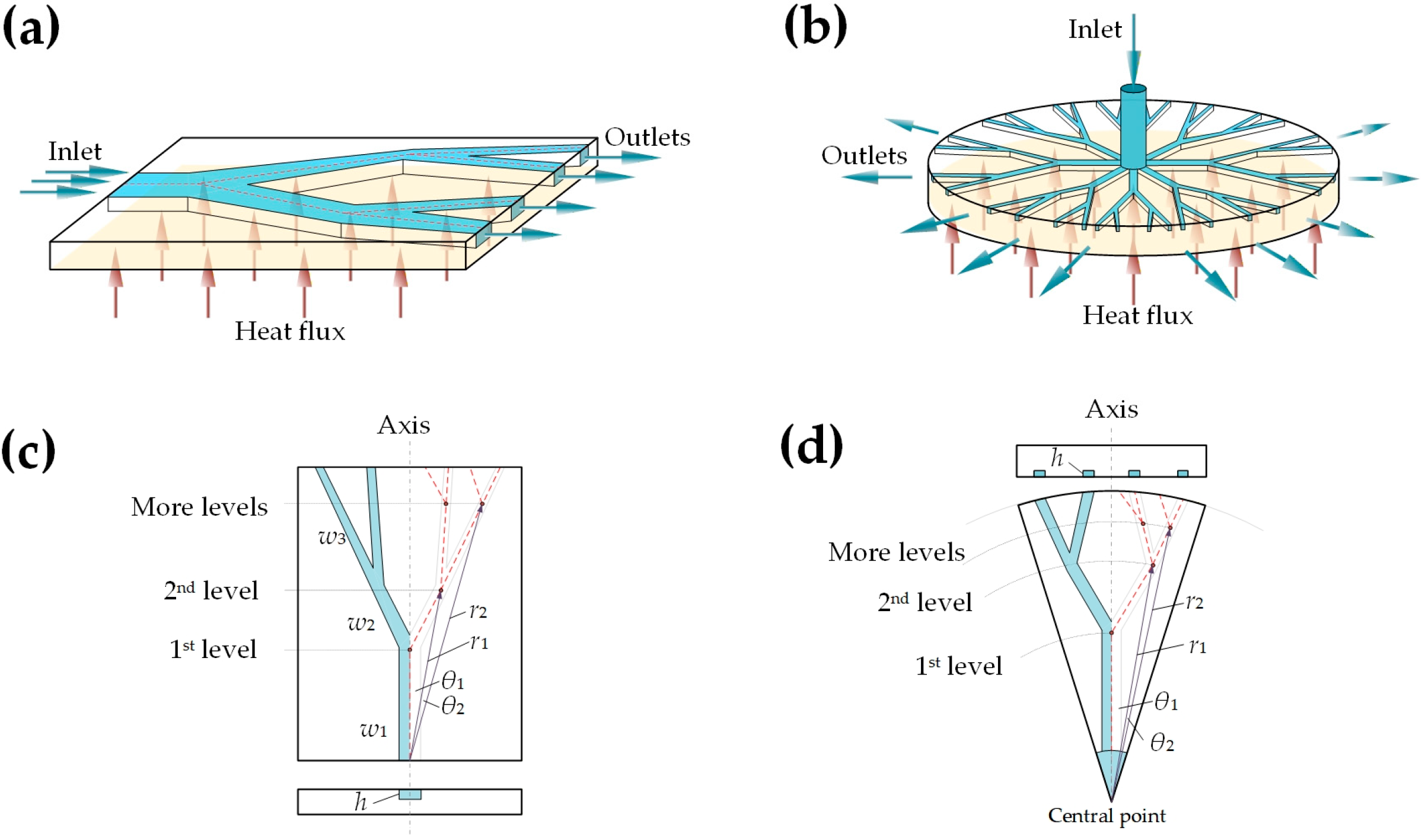
A common thermal–hydraulic application of these principles is heat-sink design. Figure 1 illustrates typical models constructed in standardized three-dimensional solid domains, including cylindrical and flat-plate configurations. In these models, the coolant flows through channels are arranged according to biomimetic tree-branching patterns under specified flow-rate, heat-flux, and thermal–hydraulic boundary conditions.
Branching geometries can generally be divided into T-shaped and Y-shaped bifurcation configurations. T-shaped designs were more frequently investigated in earlier studies, whereas recent research has placed greater emphasis on Y-shaped patterns [32,33,34].
Figure 1. Models of biomimetic tree branching heat sink: (a,b) thermal conditions of flat plate and cylindrical plate, respectively; (c,d) channel layout of flat plate and cylindrical plate, respectively.
Energies 19 02888 g001
iii.
Optimization approaches
Most contemporary studies adopt optimization procedures, often using Murray’s law as a basic design principle. Various methods have been applied, including multi-objective optimization genetic algorithm (GA) [35], gray analysis and variance analysis for influence rank investigation [36], response surface methodology (RSM), and artificial neural networks (ANNs) [37]. These studies mainly examine the effects of channel geometry, fractal characteristics, heat flux, flow rate, and other parameters on thermal resistance and pumping power.
iv.
Structural modifications and reasons
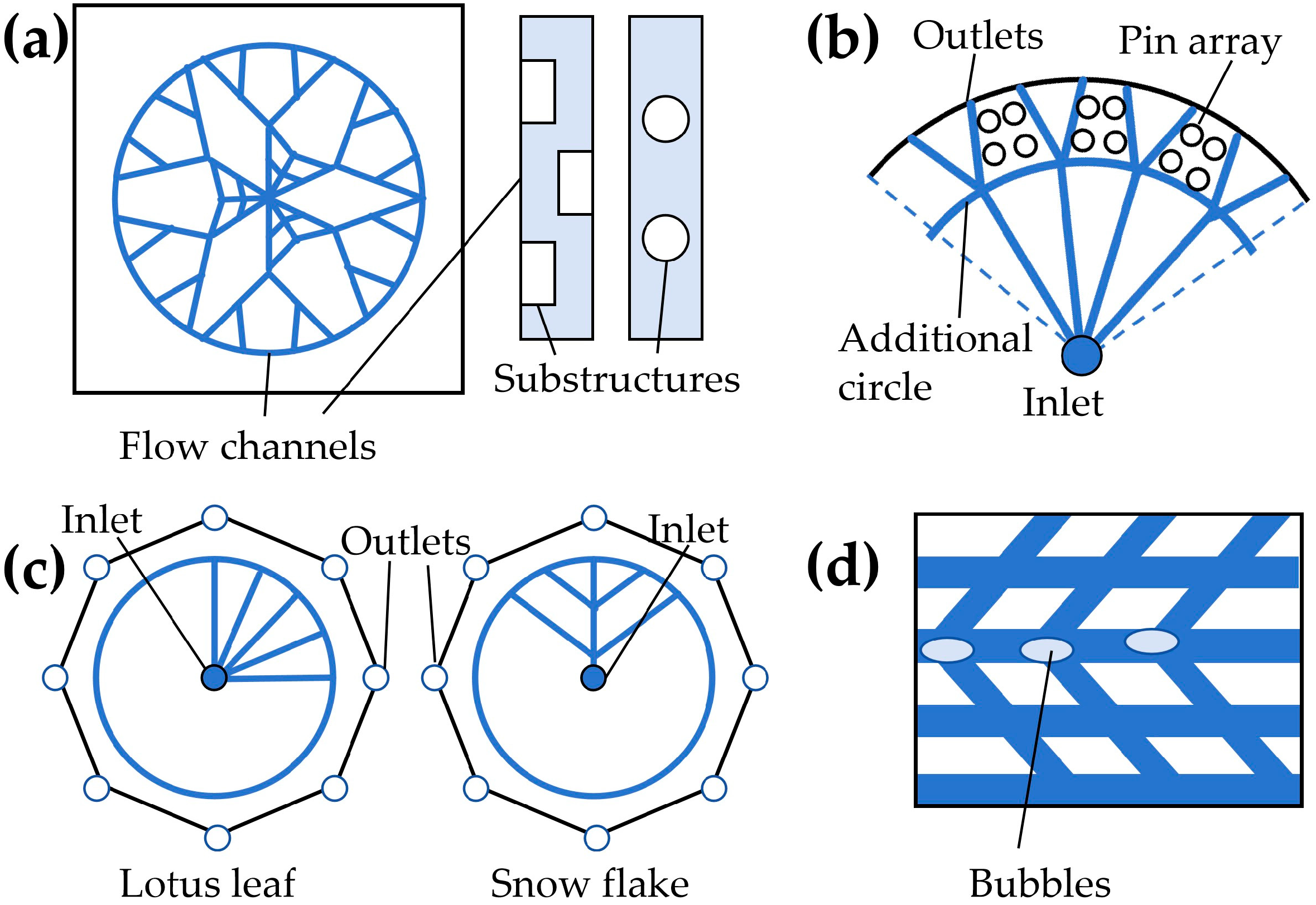
In addition to optimization-oriented studies, many investigations modify tree-branching structures at critical locations to improve thermal–hydraulic performance. Bifurcations can promote flow collision and mixing, generate local vortices, and intensify turbulence. Accordingly, researchers have adapted conventional designs or introduced additional structures to enhance these effects. Ma et al. [38] modified the channel by adding a secondary structure, including a leaf vein subchannel, lateral rib, and pin fin (Figure 2a). These features improved thermal–hydraulic performance through flow disruption, secondary-flow generation, and increased heat-transfer area, achieving a coefficient of performance (COP) as high as 45,350. Yan et al. [39] simulated a truncated double-layer heat sink with a Y-shaped fractal network to mitigate steep temperature gradients near the inlet. The truncation improved inlet-region temperature uniformity by 24–30%. They later introduced circular features and micro pin-fin arrays [40], as shown in Figure 2b, to enhance heat-exchange efficiency and reduce flow congestion at bifurcations.
Huang et al. [41] studied a Y-shaped microchannel with variable cross-sections that formed cavities and ribs. These modifications enhanced heat transfer through localized jetting and throttling effects, as well as the disruption and redevelopment of thermal and flow boundary layers and the generation of high-velocity secondary flows. Li et al. [42] developed a microchannel heat exchanger inspired by lotus leaf veins and snowflake structures using high-thermal-conductivity materials (Figure 2c). The resulting impinging and scattering flows enabled effective hotspot cooling, even under heat fluxes of 1000–1500 W cm−2. Zhao et al. [43] experimentally investigated boiling heat transfer in leaf-vein microchannels (Figure 2d). This structure suppressed flow instabilities and provided additional space for bubble expansion, increasing the two-phase heat-transfer coefficient by 83.2% compared with rectangular microchannels.
In heat exchangers, hierarchical tree-like fractals can improve compactness and reduce flow resistance. Li et al. [44] integrated tree fractals into microchannel distributor designs, improving spatial utilization and flow uniformity and achieving a flow non-uniformity as low as 0.24% under standard refrigeration conditions. Gürel et al. [45] designed a plate heat exchanger mimicking the human lung structure, which exhibited high compactness. Compared with conventional corrugated-fin designs, the biomimetic exchanger increased heat transfer by 71.30% and reduced pressure drop by 67.8%. Huang et al. [46] applied quadtree fractal microchannels to self-pumping transpiration cooling using densely arranged channels to generate strong capillary forces for fluid transport. Cao et al. [47] studied a leaf-veined mini-channel heat sink inspired by blade structures and found that it reduced thermal resistance by 92.59% and achieved a minimum entropy generation of 171.57 at Re = 9970, indicating optimal integrated performance.
In summary, tree-branching structures, whether based on simple bifurcations or complex fractal patterns, enhance heat transfer, reduce flow resistance, and improve thermal–hydraulic uniformity through an increased surface area, boundary-layer disruption, secondary-flow generation, and rational flow organization.
Figure 2. Biomimetic tree branching: (a) secondary structures such as subchannel, rib, and pin fin [38]; (b) additional circle and micro pin fin arrays [40]; (c) HEX with jet impingement and flow scattering [42]; (d) leaf vein-shaped microchannel for bubble expansion [43].
Energies 19 02888 g002

2.2. Compact Hexagonal Layout

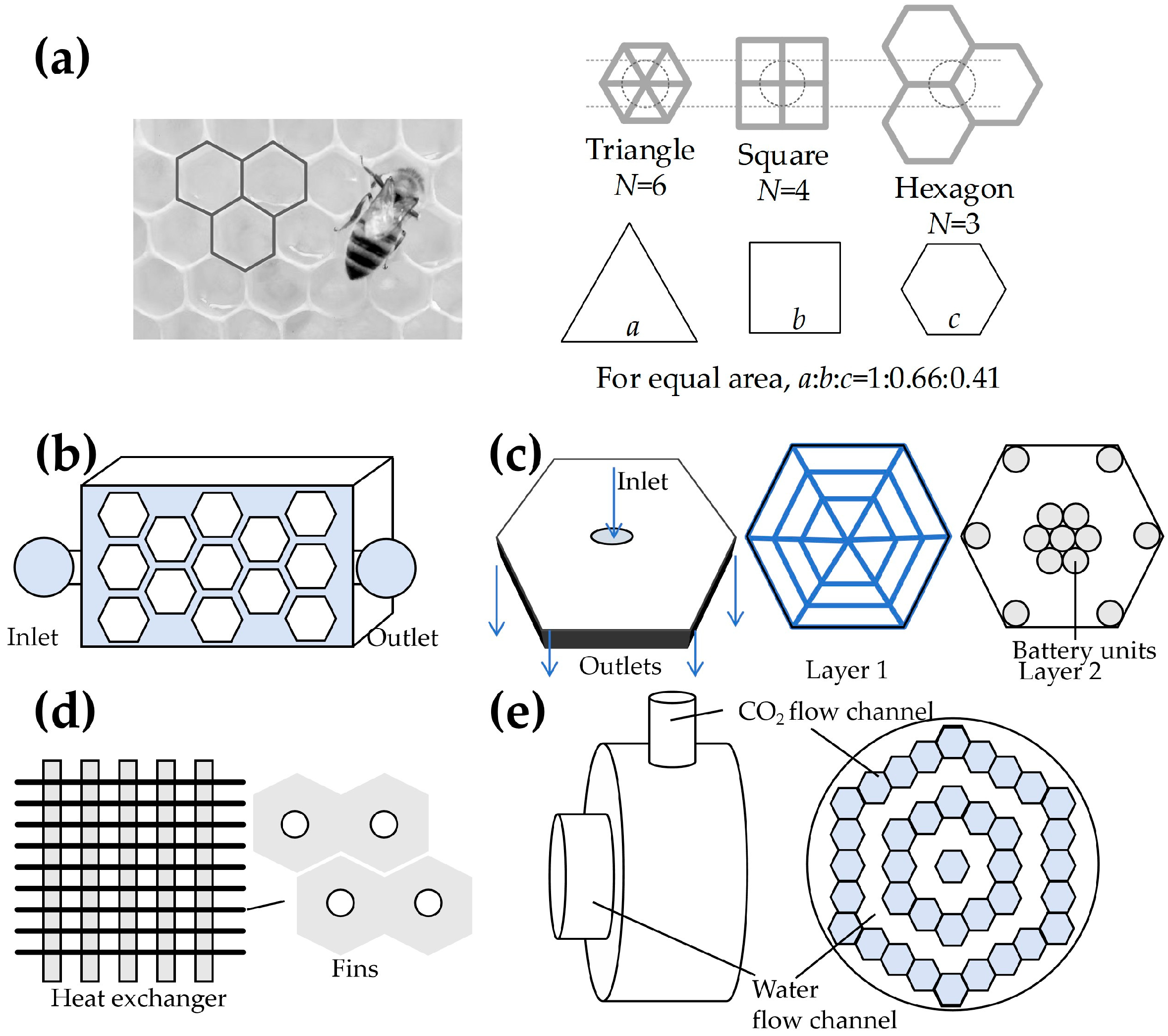
The hexagon is one of the few geometries that can tile a plane without gaps. For a given area, a regular hexagon has the smallest perimeter [48], as illustrated in Figure 3a. Owing to this geometric efficiency, hexagonal patterns are widely observed in nature, such as in honeycombs and spider webs. In materials science, the mechanical strength, permeability, and thermal performance of cellular materials can be enhanced and, in some cases, fundamentally altered by modifying the geometry of their space-filling skeletons [49], which often consists of space-filling polyhedral units. Similarly, in thermal engineering, three-dimensional periodic cellular structures have been recognized as effective configurations for enhancing turbulent convection [50] and PCM coupling [51], referring to the geometry of bones, sponges, etc. [17].
Although such three-dimensional structures have been widely studied, many practical fluid-flow and heat-transfer systems, such as cooling plates and gas coolers, are constrained by two-dimensional planar layouts. In these systems, the arrangement of channels or pipes is largely determined by two-dimensional geometric patterns, which directly influence compactness, flow distribution, and heat-transfer performance. Research on biomimetic hexagonal layouts has therefore focused on clarifying the underlying thermal–hydraulic mechanisms of such configurations.
Hexagonal channel patterns can be applied to cooling plate designs [52,53]. For instance, Zhao et al. [53] showed that each honeycomb pore surface directly contacts the coolant, thereby significantly enlarging the heat-transfer area (Figure 3b). This design improved overall heat dissipation in prismatic batteries.
For gas coolers, where the working fluid typically has low density and heat capacity but high flow velocity, hexagonal layouts can provide high spatial utilization and favorable heat-transfer performance. When cylindrical objects are cooled, a hexagonal arrangement can improve packing compactness and coolant distribution. Yang et al. [54] designed a biomimetic heat sink with air distribution channels inspired by both spider webs and honeycombs for lithium-ion battery cooling (Figure 3c), and the compact layout contributed to improved thermal management.
Honeycomb-like fins have also shown promising performance. Tang et al. [55] numerically investigated the honeycomb-type fins installed on the gas side of finned-tube heat exchangers (Figure 3d). These fins reduced flow stagnation and enhanced fluid disturbance. For gas-cooling applications, Zhang et al. [56] investigated a multi-layer honeycomb gas cooler for water and transcritical CO2 heat exchange. The structure alternates CO2–water–CO2 in a tube-in-tube configuration (Figure 3e), achieving a maximum compactness of 2812 m2 m−3 and a 357% performance improvement over conventional internal spiral-tube gas coolers.
From a mechanistic perspective, honeycomb and hexagonal layouts enhance thermal–fluid performance primarily through geometric compactness and flow-path organization rather than through strong vortex generation alone. The repeated cellular channels enlarge the wetted heat-transfer area and shorten the average conduction paths. The compact arrangement also helps distribute the coolant over a wider surface, thereby reducing local thermal accumulation and improving temperature uniformity. In gas-side applications, where the low heat capacity and density of gas often limit convective heat transfer, honeycomb-like passages and fins increase the specific surface area and suppress large stagnant zones. However, the benefit is strongly dependent on cell size, wall thickness, connectivity, and inlet/outlet arrangement. Excessively small cells or dense fins may increase frictional losses and maldistribution, whereas overly large cells weaken surface-area enhancement. Therefore, honeycomb-inspired structures should be evaluated through both heat-transfer improvement and pressure-drop penalty.
Figure 3. Biomimetic honeycomb layout: (a) hexagon geometry character; (b) honeycomb cooling plate [53]; (c) heat sink with spiderweb-shaped air distributor [54]; (d) honeycomb-shaped fins [55]; (e) compact transcritical CO2 gas cooler [56].
Energies 19 02888 g003

2.3. Biomimetic Curved Shapes and Outlines

Through long-term evolution, many species have developed body shapes optimized for hydrodynamic or aerodynamic performance, enabling efficient swimming and flight. These natural forms have inspired the design of pneumatically and hydraulically driven mechanical systems [20,21,57]. Their morphological features often improve fluid-dynamic behavior, making them valuable references for thermal–hydraulic applications. In heat-transfer-related flow systems, biomimetic curved shapes can improve thermal–fluid performance through flow guidance, drag reduction, boundary-layer disturbance, and vortex generation.
i.
Hydrodynamic shapes
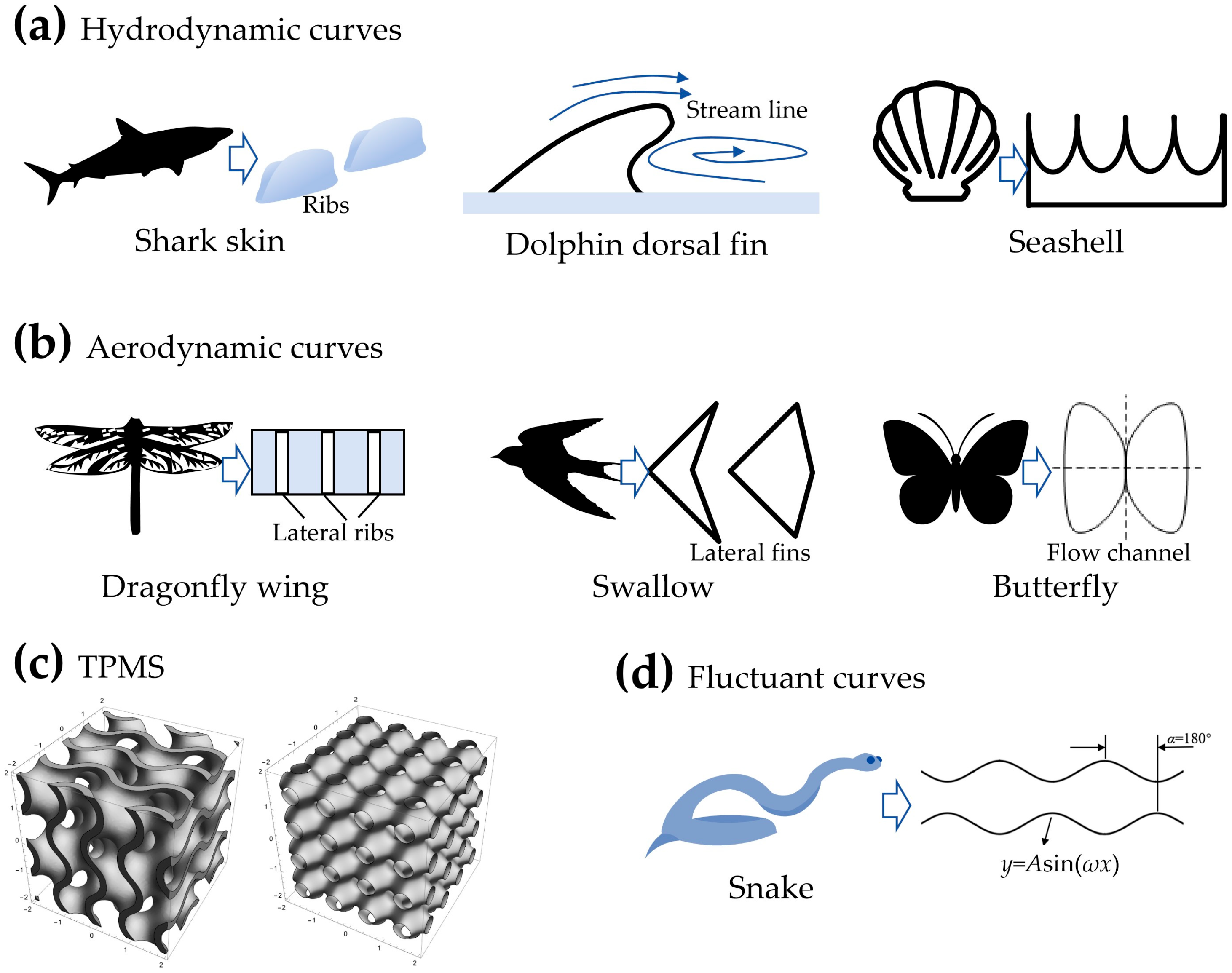
In heat exchanger channels, surface features such as bumps, ribs, pin fins, and grooves can be redesigned using biomimetic morphologies. For example, aquatic animals have inspired several liquid-side enhancement strategies, as shown in Figure 4a. Bashtani et al. [58] combined CFD simulations with an artificial neural network to analyze a heat exchanger equipped with dolphin-dorsal-fin-inspired turbulators. The streamlined contour reduced friction loss by 28% and increased the Nusselt number compared with conventional fins, while also disturbing the boundary layer. Li et al. [59] investigated the thermal performance of a microchannel heat sink with rib structures modeled on shark-skin micro-riblets. Compared with traditional parallel ribs, the biomimetic ribs redirected local flow, generated stronger vortices and secondary flow, and improved temperature uniformity. Wang et al. [60] introduced a seashell-like geometry into a channel heat sink, achieving a 40% improvement in thermal performance relative to a rectangular channel and improving flow-distribution uniformity. Dey et al. [61] integrated fish-scale-like fins along microchannel sidewalls to induce turbulence and enhance fluid mixing, increasing the Nusselt number by up to 14% compared with a plain microchannel.
ii.
Aerodynamic shape
Flying organisms also provide useful references for aerodynamic biomimetic design, as illustrated in Figure 4b. Wang et al. [62] mimicked the structure of dragonfly wings in microchannels to induce flow separation and vortex generation. The wing morphology was simplified into two cylinders with elliptical cross-sections connected by multiple vein-like structures, which were applied as wall roughness elements. This design increased heat transfer by 218% compared with a smooth channel. Zhu et al. [63] abstracted the flying profile of a swallow into concave and convex quadrilateral units. These biomimetic ribs changed the local flow direction and generated transverse swirls and recirculation zones, thereby enhancing local heat transfer through improved mixing and flow disruption. The structure increased the Nusselt number by up to 95.6% relative to smooth tubes. Das et al. [64] investigated a butterfly-wing-inspired vortex generator in a rectangular microchannel for fluid drag reduction and achieved a maximum performance enhancement of 23%.
From the perspective of mechanisms, streamlined profiles can reduce form drag by delaying flow separation and guiding the main stream along a smoother pressure-gradient path. These structures are useful when pressure-drop reduction and moderate heat-transfer enhancement are both required. In contrast, riblets, grooves, dimples, scales, and wavy channels usually enhance heat transfer by disturbing the near-wall region. These structures interrupt the thermal boundary layer, induce local separation and reattachment, generate secondary flow, and promote cross-stream momentum exchange. These mechanisms are particularly effective when the original flow is laminar or weakly disturbed, because boundary-layer redevelopment can substantially increase the local heat-transfer coefficient. Nevertheless, stronger disturbance is often accompanied by higher wall shear stress, form drag, and pumping power. Thus, the apparent superiority of a curved or roughened biomimetic surface depends on the flow rate, pitch, attack angle, hydraulic diameter, and thermal boundary distribution.
iii.
Triply periodic minimal surfaces (TPMS)
Porous media play an important role in fluid flow and heat transfer. One biologically inspired class of porous architectures is triply periodic minimal surfaces (TPMS), which are complex structures observed in nature, such as in butterfly wings and weevil exoskeletons [65] (Figure 4c). TPMS geometries feature high porosity and structural complexity, often spanning micro to meso-scale ranges [66]. Their heat-transfer enhancement mechanisms include near-wall secondary-flow generation, local fluid acceleration, vortex formation, and enlarged solid–fluid interfacial area [66]. These mechanisms depend strongly on TPMS type, porosity, wall thickness, unit-cell size, and flow direction. For example, gyroid, diamond, primitive, and hybrid TPMS structures may produce different levels of tortuosity, permeability, vortex intensity, and thermal mixing even at the same porosity. The main limitation is the pressure-drop penalty caused by tortuous passages and the repeated acceleration–deceleration of the flow. Therefore, TPMS structures are suitable when compactness and high heat-transfer density are prioritized, but their design requires the coupled optimization of heat-transfer area, permeability, mechanical strength, manufacturability, and pumping power.
iv.
Fluctuant curves
Natural wave-like patterns, such as the meandering motion of snakes and the microscopic texture of snake scales, have also inspired thermal designs. Tu et al. [67] experimentally investigated a heat exchanger with snake-motion-inspired grooves for waste-heat recovery (Figure 4d). The meandering grooves were modeled as sinusoidal curves with different amplitudes, frequencies, and phases. The results showed that energy-conversion efficiency depended on these geometric parameters, with a maximum enhancement of 23.7%. Foronda et al. [68] designed a heat sink with zigzag grooves inspired by the microfibrils of royal python skin, improving the thermal effectiveness by 40%. Related wavy-channel studies further indicate that such fluctuating geometries should be evaluated from a coupled thermal–hydraulic perspective. For example, hybrid-nanofluid flow through partially porous wavy channels with triangular, sinusoidal, and trapezoidal corrugations showed that porous inserts and corrugated walls can enhance thermal performance, but this enhancement is accompanied by increased pressure losses [69].
Figure 4. Biomimetic curved shape and outline: (a) hydrodynamic curves, shark skin [59,70]; dolphin dorsal fin [58]; seashell [60]; (b) aerodynamic curves, dragonfly wing [62]; swallow [64]; butterfly wing [71]; (c) TPMS [65,72]; (d) fluctuant curves [67].
Energies 19 02888 g004

3. Application-Oriented Assessment of Biomimetic Thermal–Fluid Structures

3.1. Applications in Battery Thermal Management Systems

Lithium-ion batteries are widely used as power sources for electric vehicles (EVs) because of their high energy efficiency and environmental benefits. However, inadequate battery thermal management (BTM) can deteriorate temperature uniformity, cause hotspot formation, degrade battery performance, and, in severe cases, increase the risk of thermal runaway [73]. Therefore, reliable and effective battery thermal management systems (BTMSs) are required, especially under high charge or discharge rates [74]. In BTMSs, biomimetic designs have been explored across various cooling methods, with emphasis on flow-related approaches. These structures adapt morphological features from natural systems that are well suited for efficient heat and fluid transport.
Cooling plates are a major research focus in liquid-based BTMSs because of their convenience, cost-effectiveness, and reliability. Applying biomimetic strategies to channel design and layout enables meso-scale thermal–fluid mechanisms to improve heat dissipation and energy utilization.
Biomimetic fractal-shaped cooling plates, such as leaf-vein and tree-like designs [32,75,76,77,78], can improve thermal uniformity through balanced fluid distribution. Bifurcation-induced turbulence can further enhance local heat transfer. However, excessive structural complexity may increase flow resistance, requiring more rational designs.
Ran et al. [77] proposed a tree-like channel with multiple distributed inlets and outlets to replace conventional single-direction flow. This configuration reduced pressure drop by approximately two-thirds at the same flow rate while maintaining a maximum temperature difference of 5 K at a 5 C discharge rate. Alnaqi et al. [75] applied an irregular leaf-vein-shaped design with non-Newtonian nanofluids and achieved a pressure drop as low as 0.075 Pa at a velocity of 0.05 m s−1. A similar pattern was adopted by Mustafa et al. in PCM-coupled simulations [79]. In addition, when branching structures are arranged between simple parallel channels, fishbone-like [80] or leaf vein-like [76,81] designs can be formed to enable more uniform thermal–hydraulic distribution.
Spider web-like channels can minimize the flow network perimeter while maximizing heat transfer area [52,82]. Yao et al. [82] simulated a web-like cooling plate that eliminated dead zones at bends, limiting the maximum temperature and temperature difference to 302.25 K and 3.8 K, respectively, with a pressure drop of 0.78 Pa at Re = 40. Other designs are derived from biomimetic curved geometries. For example, Wang et al. [71] introduced the butterfly-shaped channel, yielding an optimal pumping power of 0.011 W when the flow rate is 5 g s−1. Zhang et al. [83] numerically analyzed a cooling plate with fins mimicking the outline of Limuli simplified as semi-ellipses and circular arcs, demonstrating benefits for convective flow optimization. Liu et al. [84] studied a wavy–honeycomb hybrid cooling plate with staggered holes and Fe3O4-H2O nanofluid under a magnetic field, reducing the maximum temperature by 2.64 K and increasing the overall efficiency to 1.059.
For cylindrical batteries, wraparound cooling jackets can adopt spider web [85] or fern-inspired (Nephrolepis) [86] patterns. Some advanced BTMSs also integrate biomimetic waste-heat recovery loops. Tu et al. [87] applied sinusoidal biomimetic grooves to a heat exchanger for battery waste-heat utilization and systematically optimized curve shape, groove depth, and layout, including symmetric and staggered configurations. Sui et al. [88] further developed a fern-like finned cooling system. Table 1 compares the above studies in terms of biological inspiration and key thermal–hydraulic performance metrics, providing guidance for evaluating biomimetic channel designs in BTMSs.

3.2. Applications in Electronic Cooling

The development of electronic devices continues to face persistent thermal-management challenges, particularly as chip miniaturization advances [90]. Moore’s law, first proposed in the 1960s, predicts that the number of components on a chip doubles approximately every two years [91], leading to heat fluxes that reach 190 W cm−2 [90]. However, safe and reliable operation requires electronic devices to remain within appropriate temperature limits, typically 85–120 °C [92]. This thermal-management bottleneck increasingly constrains the continued evolution of electronics under Moore’s law [93]. Fluid-based cooling methods, owing to their high heat-dissipation potential, offer promising solutions for meeting these demanding thermal requirements [6].
Biomimetic designs provide innovative optimization strategies for fluid-based electronic cooling through mechanisms such as turbulence intensification, flow-resistance reduction, and compact layout design. Nature-inspired meso-scale geometries have demonstrated strong heat-removal capability in biomimetic heat sinks. Tang et al. [94] studied a heat exchanger with wavy-shaped grooves designed to generate stronger turbulence and flow disturbance (Figure 5a). They systematically analyzed the effects of wavy-geometry parameters on key performance indicators, including resistance coefficient, Nusselt number, and exergy efficiency. The optimized configuration achieved a minimum chip surface temperature of 29.1 °C. In another study, Tang et al. [95] developed a CPU cooling system with a biomimetic surface featuring cylindrical grooves and dimples inspired by the microstructure of louse wings (Figure 5b). Experimental results showed a 35.4% reduction in flow drag and a 14.96% decrease in surface temperature compared with a smooth surface. By varying the nanofluid concentration, Reynolds number, magnetic-field intensity, and magnetic-field angle, they demonstrated that the coupled biomimetic surface–nanofluid–magnetic-field strategy can significantly reduce CPU surface temperature and entropy generation. Inspired by aquatic organisms with surfaces that generate vortices and reduce drag, Yu et al. [96] designed V-shaped grooves and ribs mimicking shark skin for electronic-cooling applications. Their experimental system achieved an overall heat-transfer enhancement of 28.96%.
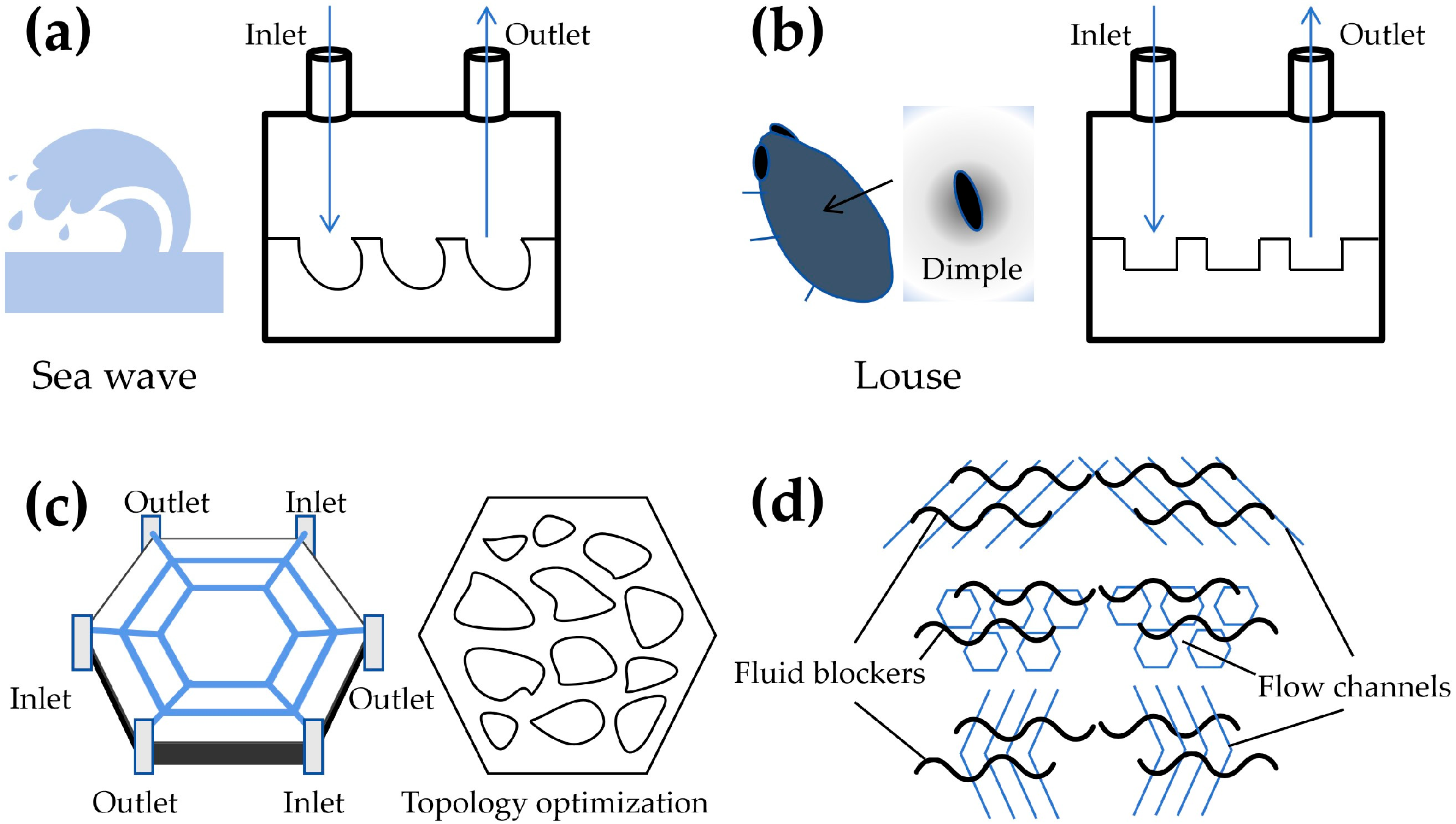
Biomimetic design also enables adaptive modifications by linking heat-sink geometry with biological transport mechanisms. Han et al. [97] proposed a new hexagonal prism cooling plate inspired by spider webs, featuring staggered inlets and outlets (Figure 5c). Through topology optimization and 3D-printed fabrication, the substrate temperature was reduced by 57.53% compared with the initial design. Liu et al. [98] investigated a Fibonacci-spiral microchannel heat sink optimized using a multi-objective genetic algorithm. Compared with uniform pin fins, this design reduced the maximum temperature by 8.8% and improved temperature uniformity by 34.6%, with only a 16.3% increase in pressure drop. Ghadikolaei et al. [99] designed CPU heat sinks with stationary fluid blockers using an eco-friendly nanofluid coolant. The blockers were arranged in biomimetic patterns, including ternate leaf veins, honeycomb, snowflake, and spider web layouts (Figure 5d). These configurations improved thermal efficiency by up to 8.5% compared with conventional smooth-baseplate designs.
Figure 5. Biomimetic heat sink designs in electronic cooling: (a) wave-shaped grooves [94]; (b) louse wing-like grooves [95]; (c) topology-optimized spider web [97]; (d) fluid blockers on heat sink baseplate in layouts of ternate leaf vein, honeycomb, snowflake, and spider web layouts [99].
Energies 19 02888 g005

3.3. Emerging Applications in Photovoltaic–Thermal Systems

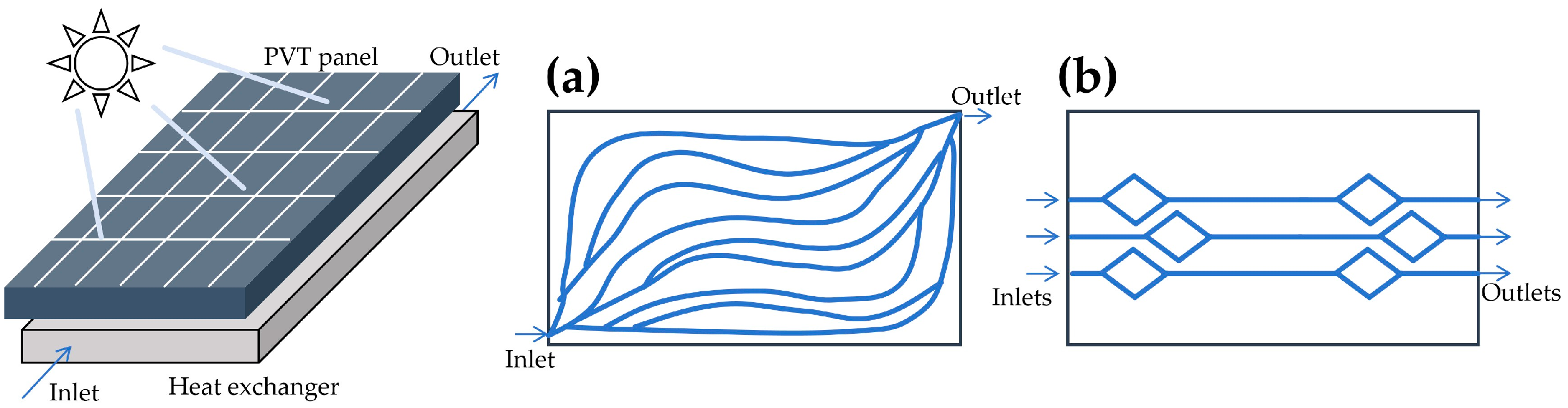
Compared with battery thermal management and electronic cooling, biomimetic thermal–fluid designs for PVT systems remain relatively limited. PVT systems require integrated thermal management to maintain electrical efficiency, recover waste heat, and ensure long-term operational reliability [7]. Biomimetic heat-exchanger designs have been introduced to improve their thermal performance [60,100,101,102], and existing studies have mainly focused on tree-like or fractal flow structures. Poredoš et al. [101] analyzed a PVT module with a biomimetic heat exchanger (Figure 6a), reporting higher solar-electrical efficiency and a 393 Pa reduction in pressure drop compared with conventional parallel-channel designs. Zareie et al. [102] developed a roll-bond PVT system incorporating fractal branching channels composed of rhombic subunits (Figure 6b). Under irradiation of 1000 W m−2, the system achieved an overall PVT efficiency of 79.56%. These studies indicate that biomimetic channel networks may be useful for balancing heat removal, flow distribution, and pressure drop in PVT systems. However, the available evidence is still narrower. Future studies should compare biomimetic PVT collectors under consistent irradiation, flow rate, electrical-efficiency, thermal-efficiency, and pumping-power conditions to clarify whether the added structural complexity is justified.

4. Conclusions and Discussion

This review highlights the interdisciplinary integration of biomimetic design with fluid flow and heat transfer, linking biological inspiration with materials science, energy engineering, and thermal–fluid system design. By abstracting transport-related mechanisms from natural structures, biomimetic thermal–fluid designs provide useful strategies for improving heat-transfer performance, flow organization, and system compactness. These structures have demonstrated potential in applications ranging from battery thermal management and electronic cooling to emerging photovoltaic–thermal systems, thereby supporting the development of more energy-efficient thermal-management technologies. The main conclusions are summarized as follows.
For micro- to meso-scale applications, tree-like branching and fractal networks have been widely implemented in heat exchangers and cooling channels, following natural principles of spatial utilization and transport-energy reduction. Their performance enhancement is mainly achieved through flow redistribution, local flow disruption, secondary-flow generation, and the introduction of additional substructures. Hexagonal layouts inspired by honeycombs and spider webs improve compactness and heat-transfer area in liquid cooling systems, while also showing promise for gas-cooling applications. Bio-inspired curved and surface morphologies, including aquatic and aerodynamic contours, riblets, grooves, TPMS structures, and fluctuating curves, enhance thermal–hydraulic performance through vortex generation, boundary-layer disturbance, local acceleration, drag regulation, and enlarged interfacial area.
In practical applications, including BTMSs, electronic cooling, and emerging PVT systems, biomimetic channel designs can improve thermal uniformity, suppress hotspot formation, and support operational stability. However, heat-transfer enhancement is usually accompanied by reduced flow resistance. Branching networks and streamlined profiles may improve flow distribution or reduce friction, whereas ribs, grooves, wavy channels, vortex generators, porous media, and TPMS structures often introduce additional pressure-drop or pumping-power penalties. Therefore, representative studies should be assessed using coupled thermal–hydraulic indicators, such as Nusselt number, thermal resistance, pressure drop, pumping power, performance evaluation criterion, exergy efficiency, and entropy generation. Table 2 summarizes typical biomimetic structures with relatively complete thermal and hydraulic results, highlighting their enhancement mechanisms, benchmarks, and performance tradeoffs.
Biomimetic research represents new pathways in thermal science, offering unique morphological and functional strategies that expand the boundaries of conventional design. Nevertheless, significant research gaps and engineering challenges remain. Many biomimetic mechanisms still lack systematic theoretical frameworks, resulting in geometry-driven optimization without clear physical guidance. The field also requires more objective evaluation standards to identify suitable biomimetic structures for specific applications and to quantify efficiency improvements under comparable thermal and hydraulic conditions. In addition to performance evaluation, practical implementation should be considered more explicitly. Many biomimetic channels, grooves, porous networks, and TPMS structures involve curved surfaces, small hydraulic diameters, multi-level branches, or complex internal cavities, which may increase manufacturing difficulty, cost, and structural uncertainty. Additive manufacturing offers greater geometric freedom, but it also introduces limitations such as surface roughness, dimensional deviation, residual powder removal, and post-processing requirements. Furthermore, complex microchannels and densely branched networks may suffer from clogging, fouling, increased pumping power, and maintenance difficulties during long-term operation. Mechanical strength, durability, material compatibility, scalability, and leakage prevention are also critical for practical applications. Therefore, future studies should move beyond idealized numerical demonstrations and provide more experimental validation under realistic heat fluxes, flow rates, coolant properties, manufacturing tolerances, and long-term operating cycles.

5. Outlooks

Future research on biomimetic thermal–fluid structures should shift from direct morphological imitation toward mechanism-based design. Rather than simply reproducing biological shapes, future studies should clarify the transport mechanisms behind biological prototypes and translate them into controllable engineering parameters, such as branching ratio, channel hierarchy, riblet spacing, groove amplitude, etc. Such a mechanism-oriented approach can provide clearer guidance for structural selection.
Standardized thermal–hydraulic evaluation is also required. Many studies report heat-transfer enhancement, maximum temperature reduction, or Nusselt number improvement, but the corresponding pressure drop, pumping power, friction factor, or entropy generation is not always evaluated consistently. Future work should compare biomimetic structures under identical boundary conditions, benchmark geometries, flow rates, and heat fluxes. Comprehensive indicators considering both thermal benefit and hydraulic penalty are necessary to determine whether a biomimetic design is truly advantageous for a specific application.
Another important direction is the integration of biomimetic structures with advanced thermal-management methods. Two-phase flow, boiling heat transfer, phase-change materials, nanofluids, hybrid nanofluids, and liquid metals may provide additional heat-transfer capacity when combined with suitable biomimetic channels or surfaces. Active-field-assisted methods, such as magnetic, electric, acoustic, or vibration fields, may further regulate flow distribution and interfacial transport. However, these coupled approaches should be assessed carefully because they may introduce additional complexity, energy consumption, material compatibility issues, or reliability concerns.
Additive manufacturing and advanced optimization methods will play increasingly important roles in this field. Complex branching networks, TPMS structures, porous media, and multi-scale hybrid geometries are difficult to fabricate using conventional methods, but they can be realized more effectively through additive manufacturing. Meanwhile, topology optimization, genetic algorithms, machine learning, and multi-objective optimization can help balance heat-transfer enhancement, pressure drops, mechanical strength, manufacturability, and cost. Future studies should place greater emphasis on experimental validation, long-term stability, fouling resistance, scalability, and practical operating conditions so that biomimetic concepts can move from numerical demonstrations toward reliable engineering applications.

Author Contributions

H.-Y.Z.: Conceptualization, Methodology, Formal analysis, Investigation, Writing—original draft. Y.-W.W.: Methodology, Formal analysis, Investigation. D.-Y.C.: Conceptualization, Methodology, Writing—review and editing. L.H.: Conceptualization, Writing—review and editing, Project administration. W.-R.H.: Conceptualization, Methodology. J.-Y.Q.: Conceptualization, Methodology, Project administration. All authors have read and agreed to the published version of the manuscript.

Funding

This research is financially supported by the National Natural Science Foundation of China (Grant Nos. 52422506, and 52306026).

Data Availability Statement

No new data were created or analyzed in this study.

Conflicts of Interest

The authors declare that they have no known competing financial interests or personal relationships that could have appeared to influence the work reported in this paper.

Abbreviations

The following abbreviations are used in this manuscript:
ANNArtificial neural networks
BTMSBattery thermal management system
COPCoefficient of performance
CPUCentral Processing Unit
DAGADistributed adaptive genetic algorithm
EVsElectric vehicles
GAGenetic algorithm
HVAC&RHeating, ventilation, air conditioning, and refrigeration
PCMPhase change material
PVTPhotovoltaic thermal
RSMResponse surface methodology
TPMSTriply periodic minimal surface

References

  1. Gielen, D.; Boshell, F.; Saygin, D.; Bazilian, M.D.; Wagner, N.; Gorini, R. The role of renewable energy in the global energy transformation. Energy Strategy Rev. 2019, 24, 38–50. [Google Scholar] [CrossRef]
  2. Li, L.; Zhang, Y.; Zhou, T.; Wang, K.; Wang, C.; Wang, T.; Yuan, L.; An, K.; Zhou, C.; Lü, G. Mitigation of China’s carbon neutrality to global warming. Nat. Commun. 2022, 13, 5315. [Google Scholar] [CrossRef] [PubMed]
  3. Mousa, M.H.; Miljkovic, N.; Nawaz, K. Review of heat transfer enhancement techniques for single phase flows. Renew. Sustain. Energy Rev. 2021, 137, 110566. [Google Scholar] [CrossRef]
  4. Wang, C.; Lu, Q.; Liu, Y.; Huang, H.; Sun, J. Progressive review of heat transfer enhancement technologies in 2010–2020. Sustain. Energy Technol. Assess. 2023, 56, 103121. [Google Scholar] [CrossRef]
  5. Li, X.; Wang, R. Towards integrated thermal management systems in battery electric vehicles: A review. Etransportation 2025, 24, 100396. [Google Scholar] [CrossRef]
  6. Chen, H.; Zhang, T.; Gao, Q.; Lv, J.; Chen, H.; Huang, H. Thermal management enhancement of electronic chips based on novel technologies. Energy 2025, 316, 134575. [Google Scholar] [CrossRef]
  7. Madurai Elavarasan, R.; Mudgal, V.; Selvamanohar, L.; Wang, K.; Huang, G.; Shafiullah, G.M.; Markides, C.N.; Reddy, K.S.; Nadarajah, M. Pathways toward high-efficiency solar photovoltaic thermal management for electrical, thermal and combined generation applications: A critical review. Energy Convers. Manag. 2022, 255, 115278. [Google Scholar] [CrossRef]
  8. Choure, B.K.; Alam, T.; Kumar, R. A review on heat transfer enhancement techniques for PCM based thermal energy storage system. J. Energy Storage 2023, 72, 108161. [Google Scholar] [CrossRef]
  9. Zhang, A.; Xiong, Y.; Zhao, Y.; Wu, Y.; Xu, Q.; Ding, Y. A review of passive building thermal management with phase-change materials. Renew. Sustain. Energy Rev. 2025, 211, 115334. [Google Scholar] [CrossRef]
  10. Li, W.; Kadam, S.; Yu, Z. Heat transfer enhancement of tubes in various shapes potentially applied to CO2 heat exchangers in refrigeration systems: Review and assessment. Int. J. Thermofluids 2023, 20, 100511. [Google Scholar] [CrossRef]
  11. Lu, Q.; Liu, Y.; Deng, J.; Luo, X.; Deng, Z.; Mi, Z. Review of interdisciplinary heat transfer enhancement technology for nuclear reactor. Ann. Nucl. Energy 2021, 159, 108302. [Google Scholar] [CrossRef]
  12. Alsabery, A.I.; Abosinnee, A.S.; Al-Hadraawy, S.K.; Ismael, M.A.; Fteiti, M.A.; Hashim, I.; Sheremet, M.; Ghalambaz, M.; Chamkha, A.J. Convection heat transfer in enclosures with inner bodies: A review on single and two-phase nanofluid models. Renew. Sustain. Energy Rev. 2023, 183, 113424. [Google Scholar] [CrossRef]
  13. Sriharan, G.; Harikrishnan, S.; Oztop, H.F. A review on thermophysical properties, preparation, and heat transfer enhancement of conventional and hybrid nanofluids utilized in micro and mini channel heat sink. Sustain. Energy Technol. Assess. 2023, 58, 103327. [Google Scholar] [CrossRef]
  14. Wang, S.; Zhao, X.; Luo, J.; Zhuang, L.; Zou, D. Liquid metal (LM) and its composites in thermal management. Compos. Part A Appl. Sci. Manuf. 2022, 163, 107216. [Google Scholar] [CrossRef]
  15. Ravanji, A.; Lee, A.; Mohammadpour, J.; Cheng, S. Critical review on thermohydraulic performance enhancement in channel flows: A comparative study of pin fins. Renew. Sustain. Energy Rev. 2023, 188, 113793. [Google Scholar] [CrossRef]
  16. Yu, H.; Zhang, J.; Zhang, S.; Han, Z. Bionic structures and materials inspired by plant leaves: A comprehensive review for innovative problem-solving. Prog. Mater. Sci. 2023, 139, 101181. [Google Scholar] [CrossRef]
  17. Zhang, C.; Huang, Y.; Chen, Y. Bionic study on latent heat thermal storage. Renew. Sustain. Energy Rev. 2023, 183, 113529. [Google Scholar] [CrossRef]
  18. Zou, Y.; Tan, P.; Shi, B.; Ouyang, H.; Jiang, D.; Liu, Z.; Li, H.; Yu, M.; Wang, C.; Qu, X.; et al. A bionic stretchable nanogenerator for underwater sensing and energy harvesting. Nat. Commun. 2019, 10, 2695. [Google Scholar] [CrossRef] [PubMed]
  19. Wu, M.; Shao, Z.; Zhao, N.; Zhang, R.; Yuan, G.; Tian, L.; Zhang, Z.; Gao, W.; Bai, H. Biomimetic, knittable aerogel fiber for thermal insulation textile. Science 2023, 382, 1379–1383. [Google Scholar] [CrossRef] [PubMed]
  20. Sun, J.; Zhang, C.; Sun, X.; Du, T.; Shen, C.; Fan, S. Weakening wave impact on submarine-launched vehicles by imitating humpback whale belly grooves. Ocean Eng. 2022, 244, 110451. [Google Scholar] [CrossRef]
  21. Zhu, X.; Guo, Z.; Zhang, Y.; Song, X.; Cai, C.; Kamada, Y.; Maeda, T.; Li, Q. Numerical study of aerodynamic characteristics on a straight-bladed vertical axis wind turbine with bionic blades. Energy 2022, 239, 122453. [Google Scholar] [CrossRef]
  22. Zhang, H.; Aggidis, G.A. Nature rules hidden in the biomimetic wave energy converters. Renew. Sustain. Energy Rev. 2018, 97, 28–37. [Google Scholar] [CrossRef]
  23. Zan, G.; Wu, Q. Biomimetic and Bioinspired Synthesis of Nanomaterials/Nanostructures. Adv. Mater. 2016, 28, 2099–2147. [Google Scholar] [CrossRef] [PubMed]
  24. Yuan, Y.; Yu, X.; Yang, X.; Xiao, Y.; Xiang, B.; Wang, Y. Bionic building energy efficiency and bionic green architecture: A review. Renew. Sustain. Energy Rev. 2017, 74, 771–787. [Google Scholar] [CrossRef]
  25. Gong, X.; Gao, X.; Jiang, L. Recent Progress in Bionic Condensate Microdrop Self-Propelling Surfaces. Adv. Mater. 2017, 29, 1703002. [Google Scholar] [CrossRef] [PubMed]
  26. Murray, C.D. The Physiological Principle of Minimum Work Applied to the Angle of Branching of Arteries. J. Gen. Physiol. 1926, 9, 835–841. [Google Scholar] [CrossRef] [PubMed]
  27. West, G.B.; Brown, J.H.; Enquist, B.J. A General Model for the Origin of Allometric Scaling Laws in Biology. Science 1997, 276, 122–126. [Google Scholar] [CrossRef] [PubMed]
  28. Bejan, A. Shape and Structure, from Engineering to Nature; Cambridge University Press: Cambridge, UK, 2000. [Google Scholar]
  29. Bejan, A. Constructal tree-shaped paths for conduction and convection. Int. J. Energy Res. 2003, 27, 283–299. [Google Scholar] [CrossRef]
  30. Bejan, A.; Lorente, S.; Lee, J. Unifying constructal theory of tree roots, canopies and forests. J. Theor. Biol. 2008, 254, 529–540. [Google Scholar] [CrossRef] [PubMed]
  31. Bejan, A.; Lorente, S. The constructal law and the thermodynamics of flow systems with configuration. Int. J. Heat Mass Transf. 2004, 47, 3203–3214. [Google Scholar] [CrossRef]
  32. Fan, Y.; Wang, Z.; Fu, T.; Wu, H. Numerical investigation on lithium-ion battery thermal management utilizing a novel tree-like channel liquid cooling plate exchanger. Int. J. Heat Mass Transf. 2022, 183, 122143. [Google Scholar] [CrossRef]
  33. Qiu, S.; Xie, Z.; Chen, L.; Yang, A.; Zhou, J. Entropy generation analysis for convective heat transfer of nanofluids in tree-shaped network flowing channels. Therm. Sci. Eng. Prog. 2018, 5, 546–554. [Google Scholar] [CrossRef]
  34. Tan, H.; Zong, K.; Du, P. Temperature uniformity in convective leaf vein-shaped fluid microchannels for phased array antenna cooling. Int. J. Therm. Sci. 2020, 150, 106224. [Google Scholar] [CrossRef]
  35. He, Z.; Yan, Y.; Feng, S.; Yang, Z.; Zhang, L.; Zhang, Z. Multi-objective optimizations on thermal and hydraulic performance of symmetric and asymmetric bionic Y-shaped fractal networks by genetic algorithm coupled with CFD simulation. Int. Commun. Heat Mass Transf. 2021, 124, 105261. [Google Scholar] [CrossRef]
  36. He, Z.; Yan, Y.; Zhao, T.; Zhang, L.; Zhang, Z. Multi-objective optimization and multi-factors analysis of the thermal/hydraulic performance of the bionic Y-shaped fractal heat sink. Appl. Therm. Eng. 2021, 195, 117157. [Google Scholar] [CrossRef]
  37. Li, F.; Kumar, T.C.A.; Elmasry, Y.; Singh, P.K.; Abed, A.M.; Algarni, A.D.; Nguyen, V.N.; Wae-hayee, M.; Phong Nguyen, P.Q.; Galal, A.M. Response Surface Methodology and Artificial Neural Network modellings on hydraulic and thermal performances of a disk-shaped heat sink with tree-like microchannels. Case Stud. Therm. Eng. 2022, 40, 102539. [Google Scholar] [CrossRef]
  38. Ma, C.; Sun, Y.; Wu, Y.; Zhang, Q.; Wang, Y.; Ding, G. A bio-inspired fractal microchannel heat sink with secondary modified structure and sub-total-sub fluid transmission mode for high heat flux and energy-saving heat dissipation. Int. J. Heat Mass Transf. 2023, 202, 123717. [Google Scholar] [CrossRef]
  39. Yan, Y.; Yan, H.; Feng, S.; Li, L. Thermal-hydraulic performances and synergy effect between heat and flow distribution in a truncated doubled-layered heat sink with Y-shaped fractal network. Int. J. Heat Mass Transf. 2019, 142, 118337. [Google Scholar] [CrossRef]
  40. Yan, Y.; Shen, K.; Liu, Y.; He, Z.Q. Thermal-hydraulic performance enhancement of miniature heat sinks using connected Y-shaped fractal micro-channels. Chem. Eng. Process.—Process Intensif. 2021, 166, 108487. [Google Scholar] [CrossRef]
  41. Huang, P.; Dong, G.; Zhong, X.; Pan, M. Numerical investigation of the fluid flow and heat transfer characteristics of tree-shaped microchannel heat sink with variable cross-section. Chem. Eng. Process.—Process Intensif. 2020, 147, 107769. [Google Scholar] [CrossRef]
  42. Li, Y.; Zhao, S.; Zhang, K.; Lu, G.; Li, Y. Extremely high heat flux dissipation and hotspots removal with nature-inspired single-phase microchannel heat sink designs. Appl. Therm. Eng. 2023, 234, 121282. [Google Scholar] [CrossRef]
  43. Zhao, Q.; Zhou, J.; Lu, M.; Liu, C.; Zhang, D.; Li, Q.; Chen, X. Irregular-shaped nucleated bubbles induced enhancement of subcooled flow boiling heat transfer in leaf vein inspired three-tiered open microchannels (LTOMCs). Int. J. Heat Mass Transf. 2023, 211, 124281. [Google Scholar] [CrossRef]
  44. Li, M.; Cheng, X.; Yuan, B.; Wei, J. Numerical study on the performance of a fractal vapor-liquid flow distributor. Case Stud. Therm. Eng. 2022, 40, 102537. [Google Scholar] [CrossRef]
  45. Gürel, B.; Akkaya, V.R.; Göltaş, M.; Şen, Ç.N.; Güler, O.V.; Koşar, M.İ.; Keçebaş, A. Investigation on flow and heat transfer of compact brazed plate heat exchanger with lung pattern. Appl. Therm. Eng. 2020, 175, 115309. [Google Scholar] [CrossRef]
  46. Huang, G.; Zhu, Y.; Liao, Z.; Xu, R.; Jiang, P. Biomimetic self-pumping transpiration cooling for additive manufactured porous module with tree-like micro-channel. Int. J. Heat Mass Transf. 2019, 131, 403–410. [Google Scholar] [CrossRef]
  47. Cao, W.; Shao, T.; Zhang, X.; Zhang, Y.; Wang, Y. Experimental and simulation study of flow and heat transfer characteristics of the leaf-veined mini-channel heat sink. Heat Mass Transf. 2025, 61, 30. [Google Scholar] [CrossRef]
  48. Li, L.; Chen, C.; An, M.; Liu, G.; Li, S. Flow and heat transfer analysis of the microfluidic thermal camouflage film based on bionic structure. Case Stud. Therm. Eng. 2023, 45, 102906. [Google Scholar] [CrossRef]
  49. du Plessis, A.; Razavi, N.; Benedetti, M.; Murchio, S.; Leary, M.; Watson, M.; Bhate, D.; Berto, F. Properties and applications of additively manufactured metallic cellular materials: A review. Prog. Mater. Sci. 2022, 125, 100918. [Google Scholar] [CrossRef]
  50. Yan, H.; Wu, W.; Zhao, Z.; Feng, F. Review and comparison of turbulent convective heat transfer in state-of-the-art 3D truss periodic cellular structures. Appl. Therm. Eng. 2023, 235, 121450. [Google Scholar] [CrossRef]
  51. Han, L.; Zhang, S.; Yan, Y. Honeycomb core inspired design and numerical simulation of heat transfer enhancement for thermal energy storage in heat exchangers. Int. J. Therm. Sci. 2026, 219, 110205. [Google Scholar] [CrossRef]
  52. Wang, J.; Liu, X.; Liu, F.; Liu, Y.; Wang, F.; Yang, N. Numerical optimization of the cooling effect of the bionic spider-web channel cold plate on a pouch lithium-ion battery. Case Stud. Therm. Eng. 2021, 26, 101124. [Google Scholar] [CrossRef]
  53. Zhao, D.; Lei, Z.; An, C. Research on battery thermal management system based on liquid cooling plate with honeycomb-like flow channel. Appl. Therm. Eng. 2023, 218, 119324. [Google Scholar] [CrossRef]
  54. Yang, W.; Zhou, F.; Chen, X.; Li, K.; Shen, J. Thermal performance of honeycomb-type cylindrical lithium-ion battery pack with air distribution plate and bionic heat sinks. Appl. Therm. Eng. 2023, 218, 119299. [Google Scholar] [CrossRef]
  55. Tang, S.; Li, H.; Zhou, J.; Li, H.; Zhang, D. Parametric investigation and correlation development for thermal-hydraulic characteristics of honeycomb 4H-type finned tube heat exchangers. Appl. Therm. Eng. 2021, 199, 117542. [Google Scholar] [CrossRef]
  56. Zhang, Y.; Wang, Z.; Jiang, X.; Wang, F.; Xu, K.; Ma, Z.; Dou, W. Heat transfer and performance enhancement investigation of biomimetic honeycomb gas coolers in transcritical CO2 heat pumps. Appl. Therm. Eng. 2023, 230, 120645. [Google Scholar] [CrossRef]
  57. Desbiens, A.L.; Pope, M.T.; Christensen, D.L.; Hawkes, E.W.; Cutkosky, M.R. Design principles for efficient, repeated jumpgliding. Bioinspir. Biomim. 2014, 9, 025009. [Google Scholar] [CrossRef] [PubMed]
  58. Bashtani, I.; Esfahani, J.A.; Kim, K.C. Hybrid CFD-ANN approach for evaluation of bio-inspired dolphins dorsal fin turbulators of heat exchanger in turbulent flow. Appl. Therm. Eng. 2023, 219, 119422. [Google Scholar] [CrossRef]
  59. Li, P.; Guo, D.; Huang, X. Heat transfer enhancement, entropy generation and temperature uniformity analyses of shark-skin bionic modified microchannel heat sink. Int. J. Heat Mass Transf. 2020, 146, 118846. [Google Scholar] [CrossRef]
  60. Wang, Y.; Xia, G.; Yan, Z.; Li, Q. Numerical study of bionic parallel mini-channel heat sink applied to the cooling of a linear Fresnel photovoltaic system. Int. J. Heat Mass Transf. 2022, 195, 123130. [Google Scholar] [CrossRef]
  61. Dey, P.; Hedau, G.; Saha, S.K. Experimental and numerical investigations of fluid flow and heat transfer in a bioinspired surface enriched microchannel. Int. J. Therm. Sci. 2019, 135, 44–60. [Google Scholar] [CrossRef]
  62. Wang, Z.; Li, B.; Luo, Q.; Zhao, W. Effect of wall roughness by the bionic structure of dragonfly wing on microfluid flow and heat transfer characteristics. Int. J. Heat Mass Transf. 2021, 173, 121201. [Google Scholar] [CrossRef]
  63. Zhu, S.; Li, L.; Qi, T.; Hu, W.; Cheng, C.; Cao, S.; Zhang, X.; Peng, Y. The effect of swallow-shaped bionic ribs on the thermal-hydraulic performance of heat exchanger tubes. Therm. Sci. Eng. Prog. 2023, 46, 102180. [Google Scholar] [CrossRef]
  64. Das, A.K.; Hiremath, S.S. Investigation on the thermohydraulic performance and entropy-generation of novel butterfly-wing vortex generator in a rectangular microchannel. Therm. Sci. Eng. Prog. 2022, 36, 101531. [Google Scholar] [CrossRef]
  65. Feng, J.W.; Fu, J.Z.; Yao, X.H.; He, Y. Triply periodic minimal surface (TPMS) porous structures: From multi-scale design, precise additive manufacturing to multidisciplinary applications. Int. J. Extrem. Manuf. 2022, 4, 022001. [Google Scholar] [CrossRef]
  66. Xu, H.; Yu, W.; Zhang, Y.; Ma, S.; Wu, Z.; Liu, X. Flow and heat transfer performance of bionic heat transfer structures with hybrid triply periodic minimal surfaces. Appl. Energy 2023, 351, 121847. [Google Scholar] [CrossRef]
  67. Tu, J.; Qi, C.; Tang, Z.; Tian, Z.; Chen, L. Experimental study on the influence of bionic channel structure and nanofluids on power generation characteristics of waste heat utilisation equipment. Appl. Therm. Eng. 2022, 202, 117893. [Google Scholar] [CrossRef]
  68. Foronda, E.; Ramírez-Gil, F.J.; Delgado-Mejía, Á.; Ballesteros, L.M.; Rudas, J.S.; Olmos-Villalba, L.C. Thermal enhancement of heat sinks with bio-inspired textured surfaces. Therm. Sci. Eng. Prog. 2023, 46, 102170. [Google Scholar] [CrossRef]
  69. Kumar, P.; Dwivedi, R.; Pandey, K.M. Hybrid-nanofluid Flow through Partially Porous Wavy Channels: Thermo-hydraulic Performance and Entropy Analysis. Heat Transf. Eng. 2024, 45, 211–232. [Google Scholar]
  70. Bixler, G.D.; Bhushan, B. Fluid Drag Reduction with Shark-Skin Riblet Inspired Microstructured Surfaces. Adv. Funct. Mater. 2013, 23, 4507–4528. [Google Scholar] [CrossRef]
  71. Wang, Y.; Xu, X.; Liu, Z.; Kong, J.; Zhai, Q.; Zakaria, H.; Wang, Q.; Zhou, F.; Wei, H. Optimization of liquid cooling for prismatic battery with novel cold plate based on butterfly-shaped channel. J. Energy Storage 2023, 73, 109161. [Google Scholar] [CrossRef]
  72. Qureshi, Z.A.; Al-Omari, S.A.B.; Elnajjar, E.; Al-Ketan, O.; Al-Rub, R.A. Using triply periodic minimal surfaces (TPMS)-based metal foams structures as skeleton for metal-foam-PCM composites for thermal energy storage and energy management applications. Int. Commun. Heat Mass Transf. 2021, 124, 105265. [Google Scholar] [CrossRef]
  73. Zichen, W.; Changqing, D. A comprehensive review on thermal management systems for power lithium-ion batteries. Renew. Sustain. Energy Rev. 2021, 139, 110685. [Google Scholar] [CrossRef]
  74. Xu, J.; Guo, Z.; Xu, Z.; Zhou, X.; Mei, X. A systematic review and comparison of liquid-based cooling system for lithium-ion batteries. Etransportation 2023, 17, 100242. [Google Scholar] [CrossRef]
  75. Alnaqi, A.A. Numerical analysis of pressure drop and heat transfer of a Non-Newtonian nanofluids in a Li-ion battery thermal management system (BTMS) using bionic geometries. J. Energy Storage 2022, 45, 103670. [Google Scholar] [CrossRef]
  76. Liu, F.; Chen, Y.; Qin, W.; Li, J. Optimal design of liquid cooling structure with bionic leaf vein branch channel for power battery. Appl. Therm. Eng. 2023, 218, 119283. [Google Scholar] [CrossRef]
  77. Ran, Y.; Su, Y.; Chen, L.; Yan, K.; Yang, C.; Zhao, Y. Investigation on thermal performance of water-cooled Li-ion cell and module with tree-shaped channel cold plate. J. Energy Storage 2022, 50, 104040. [Google Scholar] [CrossRef]
  78. Yan, Y.; Yan, H.; Yin, S.; Zhang, L.; Li, L. Single/multi-objective optimizations on hydraulic and thermal management in micro-channel heat sink with bionic Y-shaped fractal network by genetic algorithm coupled with numerical simulation. Int. J. Heat Mass Transf. 2019, 129, 468–479. [Google Scholar] [CrossRef]
  79. Mustafa, J.; Alqaed, S.; Almehmadi, F.A.; Sharifpur, M. Effect of simultaneous use of water-alumina nanofluid and phase change nanomaterial in a lithium-ion battery with a specific geometry connected solar system. J. Power Sources 2022, 539, 231570. [Google Scholar] [CrossRef]
  80. Fan, X.; Meng, C.; Yang, Y.; Lin, J.; Li, W.; Zhao, Y.; Xie, S.; Jiang, C. Numerical optimization of the cooling effect of a bionic fishbone channel liquid cooling plate for a large prismatic lithium-ion battery pack with high discharge rate. J. Energy Storage 2023, 72, 108239. [Google Scholar] [CrossRef]
  81. Liu, Z.; Liu, W.; Lv, S. Numerical study of battery thermal management system using bionic leaf-shaped channel liquid cooling plate. Appl. Therm. Eng. 2025, 268, 125898. [Google Scholar] [CrossRef]
  82. Yao, F.; Guan, X.; Yang, M.; Wen, C. Study on liquid cooling heat dissipation of Li-ion battery pack based on bionic cobweb channel. J. Energy Storage 2023, 68, 107588. [Google Scholar] [CrossRef]
  83. Zhang, F.; Huang, Z.; Li, S.; Sun, S.; Zhao, H. Design and thermal performance analysis of a new micro-fin liquid cooling plate based on liquid cooling channel finning and bionic limulus-like fins. Appl. Therm. Eng. 2024, 237, 121597. [Google Scholar] [CrossRef]
  84. Liu, Y.; Qi, C.; Guo, C. Composite bionic wave and honeycomb cooling plates coupling with magnetic field applied for power batteries thermal management. J. Energy Storage 2025, 119, 116393. [Google Scholar] [CrossRef]
  85. Xiong, X.; Wang, Z.; Fan, Y.; Wang, H. Numerical analysis of cylindrical lithium-ion battery thermal management system based on bionic flow channel structure. Therm. Sci. Eng. Prog. 2023, 42, 101879. [Google Scholar] [CrossRef]
  86. An, Z.; Zhang, C.; Gao, Z.; Luo, Y.; Dong, Y. Heat dissipation performance of hybrid lithium battery thermal management system using bionic nephrolepis micro-channel. Appl. Therm. Eng. 2022, 217, 119127. [Google Scholar] [CrossRef]
  87. Tu, J.; Qi, C.; Zhang, S.; Tang, Z. Comprehensive thermal-hydraulic performance and thermoelectric conversion efficiency of bionic battery waste heat recovery system. J. Energy Storage 2022, 48, 104039. [Google Scholar] [CrossRef]
  88. Sui, P.; Wen, X.; Zheng, J.; Chang, L.; Kou, G.; Mu, M. Multi-factors research of bionic fern-inspired hybrid cooling system for enhanced thermal management of lithium-ion batteries. J. Energy Storage 2025, 119, 116203. [Google Scholar] [CrossRef]
  89. Yang, W.; Zhou, F.; Chen, X.; Zhang, Y. Performance analysis of axial air cooling system with shark-skin bionic structure containing phase change material. Energy Convers. Manag. 2021, 250, 114921. [Google Scholar] [CrossRef]
  90. Sohel Murshed, S.M.; Nieto de Castro, C.A. A critical review of traditional and emerging techniques and fluids for electronics cooling. Renew. Sustain. Energy Rev. 2017, 78, 821–833. [Google Scholar] [CrossRef]
  91. Moore, G.E. Cramming More Components Onto Integrated Circuits. Proc. IEEE 1998, 86, 82–85. [Google Scholar] [CrossRef]
  92. Maqbool, Z.; Hanief, M.; Parveez, M. Review on performance enhancement of phase change material based heat sinks in conjugation with thermal conductivity enhancers for electronic cooling. J. Energy Storage 2023, 60, 106591. [Google Scholar] [CrossRef]
  93. Wang, X.; Liu, C.; Wei, Y.; Feng, S.; Sun, D.; Cheng, H. Three-dimensional transistors and integration based on low-dimensional materials for the post-Moore’s law era. Mater. Today 2023, 63, 170–187. [Google Scholar] [CrossRef]
  94. Tang, Z.; Qi, C.; Tian, Z.; Chen, L. Thermal management of electronic components based on new wave bio-inspired structures and nanofluids. Int. Commun. Heat Mass Transf. 2022, 131, 105840. [Google Scholar] [CrossRef]
  95. Tang, J.; Qi, C.; Ding, Z.; Afrand, M.; Yan, Y. Thermo-hydraulic performance of nanofluids in a bionic heat sink. Int. Commun. Heat Mass Transf. 2021, 127, 105492. [Google Scholar] [CrossRef]
  96. Yu, J.; Chen, L.; Qi, C.; Zhang, W.; Liang, L. Effects of shark bionic V-groove structures and nanofluids on thermal management of electronic components. Colloids Surf. A Physicochem. Eng. Asp. 2023, 679, 132639. [Google Scholar] [CrossRef]
  97. Han, X.; Liu, H.; Xie, G.; Sang, L.; Zhou, J. Topology optimization for spider web heat sinks for electronic cooling. Appl. Therm. Eng. 2021, 195, 117154. [Google Scholar] [CrossRef]
  98. Liu, S.; Chen, M.; Xiang, Z.; Hu, D.; Liang, Y.; Xu, H.; Wang, X.; Li, J. Multi-objective optimization of a bionic microchannel heat sink based on Fibonacci spiral for electronic components. Int. J. Heat Mass Transf. 2025, 253, 127544. [Google Scholar] [CrossRef]
  99. Ghadikolaei, S.S.; Siahchehrehghadikolaei, S.; Gholinia, M.; Rahimi, M. A CFD modeling of heat transfer between CGNPs/H2O Eco-friendly nanofluid and the novel nature-based designs heat sink: Hybrid passive techniques for CPU cooling. Therm. Sci. Eng. Prog. 2023, 37, 101604. [Google Scholar] [CrossRef]
  100. Peng, H.; Du, Y.; Hu, F.; Tian, Z.; Shen, Y. Thermal management of high concentrator photovoltaic system using a novel double-layer tree-shaped fractal microchannel heat sink. Renew. Energy 2023, 204, 77–93. [Google Scholar] [CrossRef]
  101. Poredoš, P.; Tomc, U.; Petelin, N.; Vidrih, B.; Flisar, U.; Kitanovski, A. Numerical and experimental investigation of the energy and exergy performance of solar thermal, photovoltaic and photovoltaic-thermal modules based on roll-bond heat exchangers. Energy Convers. Manag. 2020, 210, 112674. [Google Scholar] [CrossRef]
  102. Zareie, Z.; Ahmadi, R.; Asadi, M. A comprehensive numerical investigation of a branch-inspired channel in roll-bond type PVT system using design of experiments approach. Energy 2024, 286, 129452. [Google Scholar] [CrossRef]
Figure 6. Biomimetic heat exchanger design for PTV system; (a) optimized biomimetic pattern heat sink [101]; (b) roll-bond type system with rhombus sub-branch channels [102].
Energies 19 02888 g006
Table 1. Studies of biomimetic BTMS heat exchange channel, thermohydraulic effect comparison.
Ref.Mimicking ObjectAnalysis MethodConditionThermal ResultsHydraulic Results
[89]Shark skinExp. + simu.3 C discharge rate, v i n = 3 m/s T m a x = 308.98 K, T = 3.21 KEnergy consumption of 34.57 J
[54]HoneycombExp. + simu.3 C discharge rate, v i n = 12 m/s T m a x = 313.1 K, T = 1.7 K/
[75]Tree leafSimu.5 C discharge rate, v i n = 0.05 m/s T m a x = 290 K P = 0.075 Pa
[76]Leaf veinExp. + simu., algorithm opt.3 C discharge rate, v i n = 0.1 m/s T m a x = 303.46 K, T = 2.87 K P = 500 Pa
[80]FishboneSimu.6 C discharge rate, m ˙ i n = 17.5 g/s T m a x = 308.55 K, T = 8.664 K P = 3106.987 Pa
[83]LimulusSimu.5 C discharge rate, m ˙ i n = 0.5 g/s T reduced by 1.69 K
(4.61%, opt. vs. non-opt.)
P reduced by 6.81 Pa (54.26%)
Table 2. Cross-comparison of representative biomimetic thermal–fluid applications and reported performance.
Ref.Biomimetic InspirationMain MechanismThermal MetricHydraulic Metric/
Penalty
Benchmark
[45]Human-lung-pattern plate heat exchangerHierarchical flow distribution and compact heat-transfer areaHeat transfer increased by 71.30%Pressure drop reduced by 67.8%Conventional corrugated fin
[58]Dolphin dorsal fin turbulatorsStreamlining, boundary-layer disturbanceNusselt number increasedFriction loss reduced by 28%Conventional fins
[76]Tree-shaped cold plateFlow redistribution and shortened pathsMaximum temperature difference maintained at 5 KPressure drop reduced by about two-thirdsSingle-direction flow channel
[82]Limulus-like micro-finsLocal flow guidance and convective enhancementMaximum temperature reduced by 1.69 K, 4.61%Pressure drop reduced by 6.81 Pa, 54.26%Non-optimized finned channel
[94]Dragon-louse-wing-inspired biomimetic surface with Fe3O4–water nanofluid and magnetic fieldBiomimetic drag reduction, magnetic regulation, enhanced nanofluid transportCPU surface temperature reduced; entropy/exergy improvedDrag reduction up to 35.4%Smooth surface/no magnetic field
[98]Fibonacci spiral microchannelSpiral flow redistribution and hotspot suppressionTemperature uniformity improved by 34.6%Pressure drop increased by 16.3%Uniform pin fins
Disclaimer/Publisher’s Note: The statements, opinions and data contained in all publications are solely those of the individual author(s) and contributor(s) and not of MDPI and/or the editor(s). MDPI and/or the editor(s) disclaim responsibility for any injury to people or property resulting from any ideas, methods, instructions or products referred to in the content.