1. Introduction
Maritime transport is considered a fuel-efficient and environmentally sustainable mode compared with road, rail, and air transportation [
1]. Furthermore, ships account for approximately 90% of international trade, underscoring the heavy reliance of the global economy on the maritime sector [
2,
3]. However, the rapid expansion of the shipping industry has significantly increased pollutant emissions from ships, which pose considerable risks to air quality and human health in coastal areas [
3]. Pollutants such as nitrogen oxides (NO
X), sulfur oxides (SO
X), particulate matter (PM), carbon monoxide (CO), and volatile organic compounds (VOC
S) are produced by combustion in ship engines, and these substances have been classified as Group 1 carcinogens by the International Agency for Research on Cancer (IARC) [
4]. The combustion of commonly used marine fuels such as high-sulfur fuel oil (HSFO) and marine diesel oil (MDO) emits atmospheric pollutants, including SO
2, CO
2, NO
X, and PM [
5]. With the continued growth of the maritime sector, the impact of ship emissions on air quality is expected to become increasingly severe. In the absence of mitigation measures, greenhouse gas (GHG) emissions from ships are projected to increase by 150–250% by 2050 compared to 2012 levels [
6,
7,
8]. In addition, as the number of active vessels operating globally increases, maritime GHG emissions are expected to increase substantially by 2050 [
6,
7]. In response, major international organizations have long prioritized regulations on ship emissions and worked to develop policies aimed at reducing air pollutants [
1]. Notably, the International Maritime Organization (IMO), through its 80th Marine Environment Protection Committee (MEPC) session, adopted a target of net-zero GHG emissions from international shipping by 2050, with interim target reductions of 40% and 70% relative to 2008 levels by 2030 and 2040, respectively. At the subsequent MEPC 81 session, the Data Collection System (DCS) was expanded to include data on total fuel consumption by equipment and non-propulsion fuel use, and additional mid- to long-term measures were proposed under the revised 2023 IMO Greenhouse Gas Strategy. These measures include a phased GHG fuel standard, universal mandatory GHG levy based on emission levels, and revenue recycling mechanism to support zero-emission vessels [
9]. The IMO has implemented various regulations and policies to reduce greenhouse gas (GHG) emissions from ships [
3]. Although many countries have responded with regulations and policies that have contributed to significant annual reductions in GHG emissions, further efforts are still required [
10].
In Republic of Korea, maritime transport accounts for 99.7% of international freight volume and ranks second in domestic freight movement, reflecting the nation’s high dependence on the shipping sector [
11]. Given the essential role of maritime logistics, Republic of Korea has implemented various regulations to limit air pollutant emissions in line with international standards and mitigate climate change caused by environmental pollution. National ports and institutions are actively working to protect the environment through diverse policies. At Busan Port, one of the country’s primary ports, efforts to improve air quality include slow steaming programs, particulate matter cleaning vehicles, and Alternative Maritime Power (AMP), along with the public disclosure of hourly PM measurements [
12]. Ulsan Port developed a mid-term strategy for carbon neutrality by 2035 and introduced a GHG emissions trading system to realize an eco-friendly port environment [
13]. In the case of Incheon Port, phased efforts are underway to achieve carbon neutrality by 2050 [
14]. Yeosu-Gwangyang Port has set a mid- to long-term goal of achieving 100% energy self-sufficiency and is pursuing three key environmental objectives: development of a low-carbon smart port, improvement of port air quality, and promotion of environmentally friendly port operations [
15].
Although Republic of Korea is actively working to reduce air pollutant emissions through various means under increasingly stringent international regulations, the identification of more efficient compliance strategies requires a comprehensive understanding of ship emission characteristics. To achieve this, accurate and continuous emission estimates are essential. Accordingly, this study aims to quantitatively estimate air pollutant emissions from ships registered in Republic of Korea to establish a foundation for proactively responding to reinforced international regulations, including those of the IMO. It also seeks to identify major emission sources by ship type and support the formulation of effective emission reduction strategies through the targeted management of high-emission vessels. Furthermore, this study aims to evaluate the emission reduction effects of future eco-fuel-based ships and provide a basis for pre-assessing the effectiveness of various policy instruments.
2. Literature Review
Studies on the estimation of air pollutant emissions from ships have been conducted in various forms, including onboard measurements of operating vessels, the development of bottom-up emission inventories, and the projection of future emission levels. Researchers have applied various methodologies to estimate the emissions across different regions, ship types, timeframes, and pollutant categories.
Zhang et al. [
16] conducted quantitative measurements of emissions from inland vessels using a portable emission measurement system that directly captures the real-time characteristics of gaseous and particulate emissions. Their findings indicated high emission concentrations of CO, THC, PM, and PN during the startup and idling phases and peak NO
X and SO
2 concentrations during sailing. CO emissions were highest during the start-up phase and lowest during cruising.
Several studies have focused on optimizing vessel operations and port efficiency to mitigate emissions from container ships. Wang et al. [
17] demonstrated that the economic impact of carbon taxes could be mitigated through the optimal selection of routes, vessel sizes, and sailing frequencies. Similarly, Akakura [
18] utilized AIS (Automatic Identification System) data to quantify the increase in CO
2 emissions caused by port congestion and berth delays, highlighting the critical relationship between terminal operational efficiency and ship emissions.
To enhance estimation accuracy, bottom-up approaches utilizing AIS data and detailed ship specifications have been widely applied to specific regions or vessel types. For instance, Chen et al. [
19] evaluated the emission impacts of cruise ships in China and suggested operational mitigation strategies, while Lee et al. [
20] established a localized inventory for Incheon Port in Republic of Korea to predict future particulate matter emissions based on eco-friendly vessel conversion rates. Furthermore, Zhang et al. [
21] coupled an AIS-based emission inventory with satellite data to analyze the direct impact of ship exhaust on NO
2 concentrations within 200 NM of the Chinese coastline, emphasizing the need for location-specific reduction strategies.
In addition to regional emission inventories, several studies have investigated long-term emission trends and future reduction scenarios. Yu et al. [
8] estimated the carbon emissions from global container ships between 2015 and 2021. The results showed a decrease in emissions from 2016 to 2020, followed by an increase in 2021, with spatial clustering observed along coastlines and major maritime transport corridors. Emission levels in specific regions were closely associated with local vessel traffic density and trade activity.
Peng et al. [
22] explored a carbon-reduction roadmap for inland-waterway vessels in the Yangtze River Basin that could inform carbon-neutrality targets in the transport sector. Through scenario analysis, they developed a predictive emission model and evaluated existing policy and technological mitigation measures. Their results projected that emissions would peak by 2030 and decline by 39.4% from 2025 levels by 2060, indicating that energy transition alone would be insufficient to achieve net-zero emissions.
Sagot et al. [
23] monitored air pollutant emissions, including unburned methane, from dual-fuel cruise ships operating on LNG and marine gas oil (MGO) during sea trials. Compared with MGO, LNG showed clear advantages in reducing pollutant emissions, especially under high engine loads. However, under low-load operating conditions, where the average engine loads remain below 30% during real-world voyages, methane slip increased, suggesting that mitigation efforts targeting low-load operations are necessary.
Bottom-up emission estimation methods rely on detailed temporal and spatial activity data and thus offer precise emission quantification; however, their high data demand limits their broader adoption [
24]. In Republic of Korea, GHG emission estimates are primarily performed by the Ministry of Environment and largely based on fuel sale records, which contrasts with bottom-up approaches and introduces methodological limitations. To address this gap, bottom-up methodologies must be adopted despite the challenge of collecting detailed data required for this method.
Previous studies on the estimation of air pollutant emissions from ships have been conducted across various regions and ship types; however, most have been limited to specific regions or a single ship category, making it difficult to extend their findings to national-level analyses. In addition, although bottom-up approaches provide high accuracy, there have been no large-scale applications at the national level that incorporate real operational data for the entire registered fleet of a country.
In this study, reliable data were compiled for approximately 6000 powered vessels registered in Republic of Korea over a three-year period from 2021 to 2023. Based on these data, overall emission characteristics were analyzed according to various classification criteria, including ship type, tonnage, and vessel age. Furthermore, this study enhances the accuracy of national emission estimation and establishes a comprehensive foundation for estimating emissions from the entire registered fleet of Republic of Korea.
The operational characteristics and efficiency of ships evolve over time, which can affect emission estimation outcomes. Additionally, as emission factors become increasingly refined, previously estimated emissions are often recalculated using updated methods. Therefore, continuous research on emission estimation is essential to reflect current operational practices and respond effectively to these changes. By quantitatively analyzing emission trends by source, this study aimed to provide a basis for effective mitigation planning and support prioritization in equipment upgrades, facility investments, and operational adjustments. Although direct measurement of emissions offers the highest accuracy, directly measuring the emissions of all vessels is both time- and cost-intensive. Moreover, generalizing the results from a limited sample to an entire vessel class or tonnage group may compromise the representativeness. When estimated values are used in emission inventories, some degree of error relative to actual emissions is inevitable. To address this, the present study utilized real-world operational data and derived correction factors by ship type to minimize the gap between estimated and actual emissions. In addition to CO2, CH4, and N2O, the three GHGs prioritized by the IMO, this study also includes six key air pollutants: NOX, CO, PM10, NMVOCs, black carbon (BC), and SO2. This comprehensive approach enables a more inclusive and proactive analysis of emission characteristics.
3. Methodology
The procedure for estimating the emissions of air pollutants is shown in
Figure 1.
The vessel database of ships registered in Republic of Korea was used to collect the vessel specifications, excluding fishing boats and non-powered barges. The registered vessel data were provided by the Ministry of Oceans and Fisheries (MOF) and the Korea Maritime Transportation Safety Authority (KOMSA) specifically for this study and are not publicly accessible. The vessel classification results presented in
Section 4, Results and Discussion, were based on this registered vessel database. Information such as gross tonnage, fuel type, main engine type, and year of construction was gathered for the target vessels. The vessels were classified according to the ship type, tonnage, engine power, and age. For vessels without main engine power data, the values were estimated using simple regression analysis based on the gross tonnage of the vessel type. Using the collected information, the annual fuel consumption was estimated. Subsequently, emissions of various air pollutants were calculated based on these data. The detailed procedures for each step are explained below.
3.1. Collection of Ship Specifications and Classification of Target Vessels
Using data from the Ministry of Oceans and Fisheries (MOF) and the Korea Maritime Transportation Safety Authority (KOMSA), this study focuses on vessels registered in Republic of Korea from 2021 to 2023, excluding fishing boats and nonpowered barges. The target vessels were classified according to ship type, tonnage, engine power, and age. The classification criteria are listed in
Table 1 and
Table 2.
3.2. Estimation of Main Engine Power
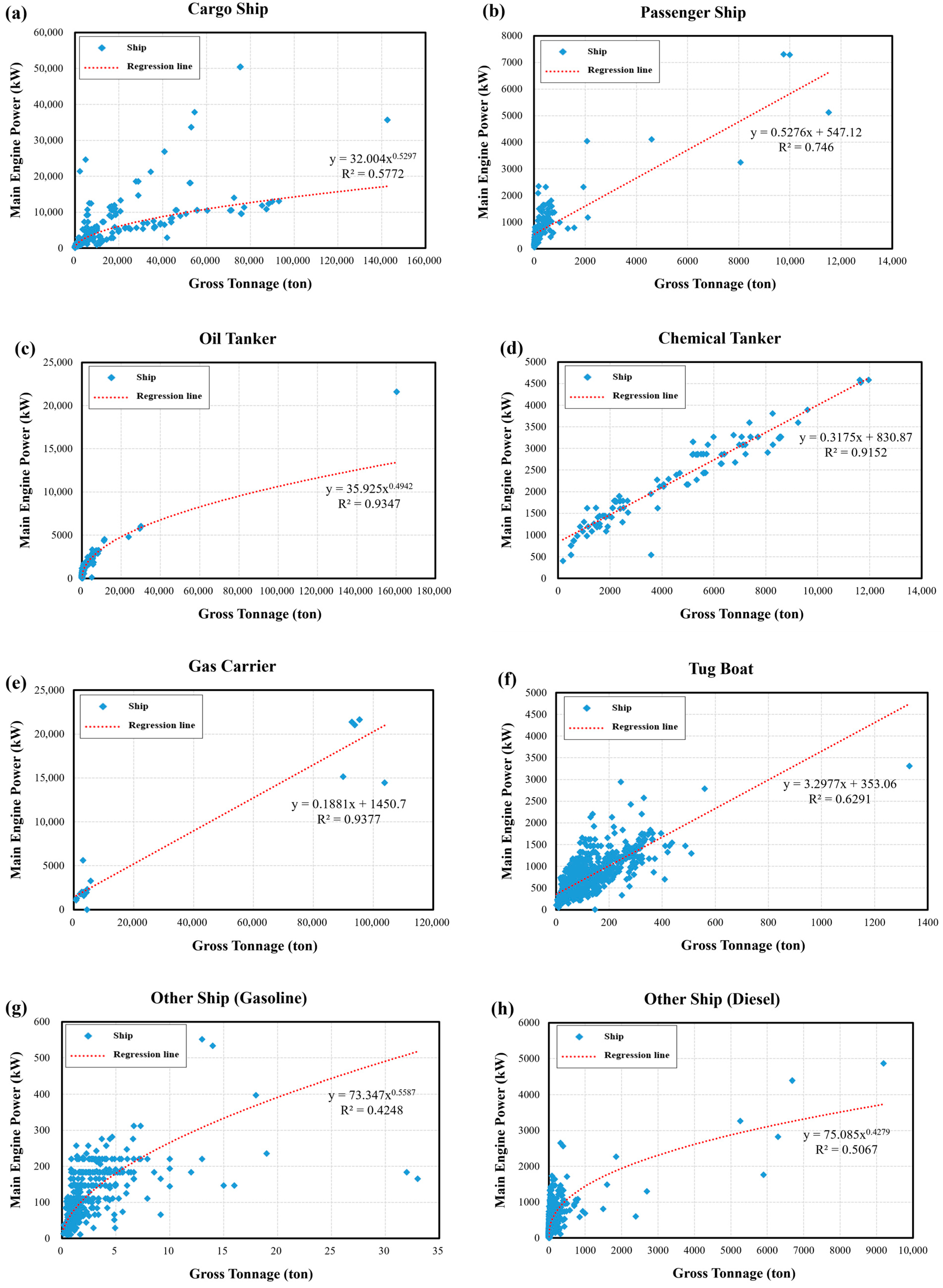
The main engine power of the vessels (kW) was based on that specified in the registration data from the MOF and KOMSA for each year. These datasets include information such as the gross tonnage, ship type, year of construction, and main engine power of vessels registered in Republic of Korea. For vessels lacking main engine power data, this parameter was estimated through a simple regression analysis based on the gross tonnage by ship type. Previous studies have established a positive correlation between gross tonnage and main engine power. To estimate the main engine power, data from vessels registered in 2023, including gross tonnage and main engine power, were utilized. The regression equations were derived by ship type using datasets comprising 489 cargo ships, 228 passenger ships, 532 oil tankers, 124 chemical tankers, 37 gas carriers, 904 tugboats, 602 other ships (gasoline), and 1897 other ships (diesel). Among the regression models, both nonlinear regression (y = ax
b) and linear regression (y = ax + b) were considered, and the model with the higher coefficient of determination (R
2) was selected. The results of the regression analysis are presented in
Section 4.2.
3.3. Estimation of Annual Fuel Consumption
To estimate air pollutant emissions, annual fuel consumption must be estimated. Annual fuel consumption was calculated using Equation (1).
where
FC represents fuel oil consumption;
P represents engine power;
SFOCx,y,z represents specific fuel consumption for engine type
x, construction year
y, and fuel type
z;
T represents annual operating hours;
LF represents load factor; and
CF represents correction factor.
Excluding the main engine power, the constants used in the calculation of annual fuel consumption are listed in
Table 3. The fuel type was selected based on the most commonly used fuel for each ship type, and for other vessels, those with no fuel information or those not using gasoline engines were assumed to use diesel fuel. The fuel consumption ratios were obtained from IMO data [
25], whereas the fuel consumption ratios for other vessels (gasoline) were obtained from data provided in Ref. [
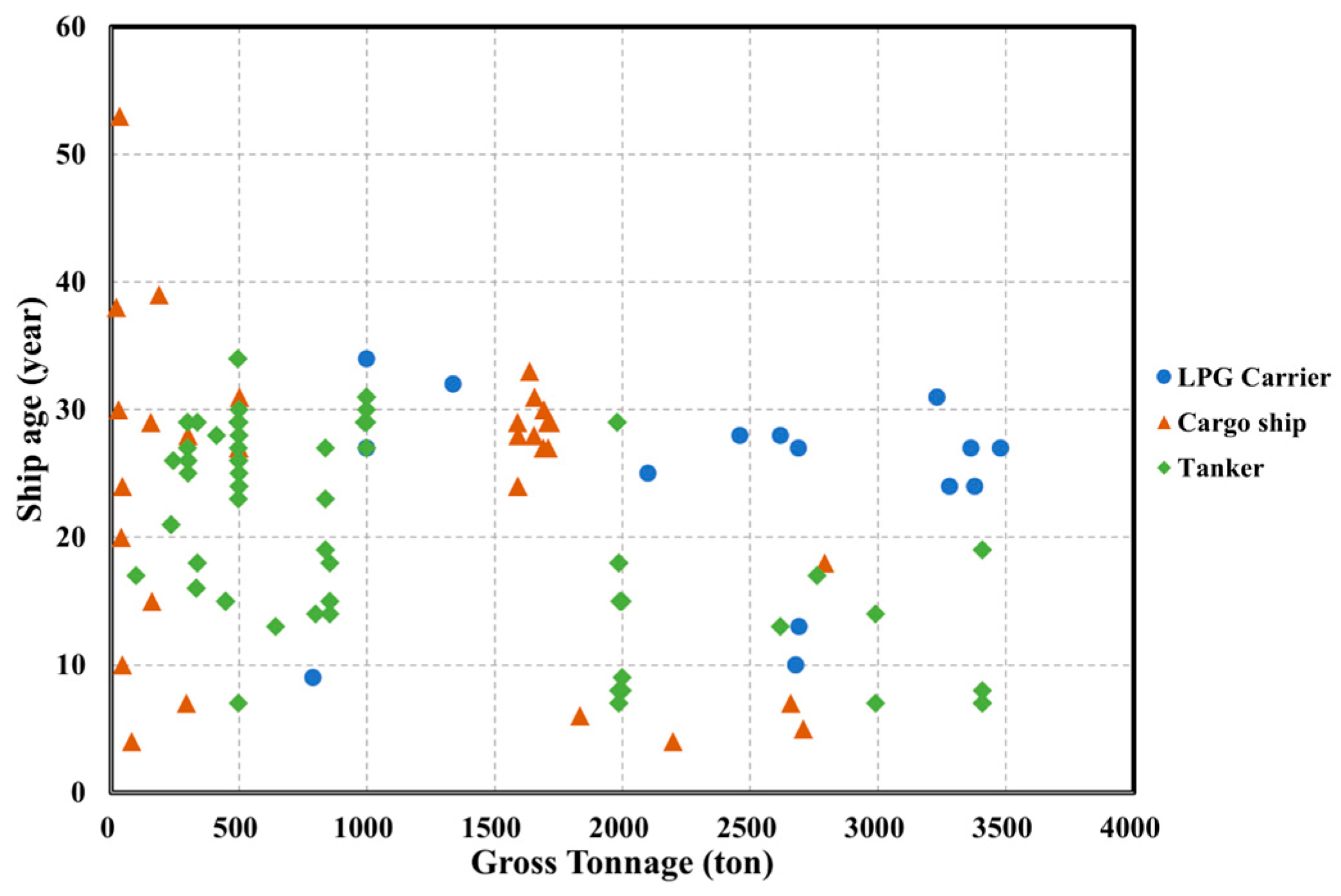
26]. Specifically, to ensure that ship age was reflected in the emissions, fuel consumption ratios were differentially applied based on the age of the registered vessels in accordance with the IMO guidelines. The annual operating hours were determined based on PORT-MIS (PORT-Management Information System) data from 41 ports in Republic of Korea. Port-MIS is a system operated by the MOF of the Republic of Korea, which manages all maritime port operation services and administrative affairs for 31 national trade ports. Through this system, vessel arrival and departure records are publicly accessible and can be viewed and downloaded by any user. For the analysis, one-year arrival and departure data for 1643 domestic cargo ships were utilized, and 256 records with missing time information from a total of 105,033 logs were excluded. The berthing time for each vessel was determined using the arrival and departure times at each port, which was then used to calculate the annual number of berthing days. Subsequently, the actual operating days were derived by subtracting the berthing days from 365 days, and the annual operating hours were finally determined by applying the average operating days for each ship type. This methodology was implemented to reflect the actual operational characteristics of domestic registered vessels. The average operating time was based on the annual operating hours calculated from PORT-MIS data, thus reflecting the operational characteristics of Republic of Korean vessels. The load factor was assumed to be 79%. In addition, correction factors by ship type were applied to adjust the differences from the actual fuel consumption using real vessel data. These correction factors were determined by comparing the actual fuel consumption with the estimated fuel consumption in this study for each ship type. The actual annual fuel consumption data were utilized, which were obtained directly from shipowners and ship management companies. The data from 34 cargo ships, 81 tankers, and 15 LPG carriers were used, and the target vessels were carefully selected to ensure a balanced distribution of gross tonnage and vessel age. The correction factors were established by comparing the actual annual fuel consumption with the fuel consumption calculated using the PORT-MIS data (i.e., actual annual fuel consumption divided by estimated annual fuel consumption via PORT-MIS). By applying these correction factors, the accuracy of the estimated fuel consumption was significantly enhanced.
Figure 2 illustrates the gross tonnage and ship age of the sample, and the average correction factor calculated for each ship type through fuel consumption comparison is 0.63. For the main engine type, the most commonly used engine type for each ship type was selected as the representative.
3.4. Estimation of Air Pollutant Emissions
After estimating the annual fuel consumption using Equation (1), the emissions of each air pollutant were calculated by applying the emission factors in Equation (2). Given the significant focus on GHGs by international organizations, the emission factors for the three GHGs CO2, CH4, and N2O among the nine pollutants were derived from the Fourth IMO GHG Study 2020. For the remaining pollutants, emission factors provided by the EEA, which offers factors for various air pollutants, were used. Additionally, to compare the impacts of greenhouse gases on global warming using CO2 as the reference, the Global Warming Potential (GWP) values specified in the Intergovernmental Panel on Climate Change (IPCC) Sixth Assessment Report were applied to CO2, CH4, and N2O, and the respective GWP values were 1, 27, and 273.
The fuel and main engine types were selected based on the ship type. For medium-speed engines, the average values of high-speed and medium-speed engines were used. The air pollutant emission factors used in this study are listed in
Table 4. Emission factors for CO
2, CH
4, and N
2O were derived from IMO emission factors, while emission factors for the other pollutants (NO
X, CO, PM
10, NMVOC
S, BC, SO
2) were obtained from the EEA. Although utilizing country-specific emission factors that reflect national characteristics is ideal, Republic of Korea currently lacks official emission factors developed nationwide for the shipping sector. Therefore, the IMO and EEA emission factors, which are widely accepted as international standards, were adopted in this study.
where
Ei represents the emissions of pollutant
i and
EF represents the emission factor.
4. Results and Discussion
4.1. Analysis Results of Ships Registered in Republic of Korea (2021–2023)
The classification results for vessels registered in Republic of Korea in 2021 are shown in
Figure 3. In 2021, a total of 6806 vessels were registered in Republic of Korea. By ship type, the largest number was other diesel-powered vessels (3187 vessels, 46.8%), followed by tugboats (1163 vessels, 17.1%), with the smallest number being gas carriers (48 vessels, 0.7%). In terms of tonnage, vessels under 10 tons (2079 vessels, 30.5%) represented the largest proportion, followed by vessels between 10 and 30 tons (1441 vessels, 21.2%). Overall, most vessels were small-sized, while the lowest proportion was represented by vessels weighing between 500 and 1000 tons (125 vessels, 1.8%). By engine power, the most common were vessels with engine power between 100 kW and 300 kW (2279 vessels, 33.5%), followed by those between 500 kW and 1000 kW (1153 vessels, 16.9%). Vessels with engine power under 50 kW (236 vessels, 3.5%) and over 10,000 kW (96 vessels, 1.4%) had the smallest proportions. By vessel age, the largest number was between 25 and 30 years old (1141 vessels, 16.8%), followed by vessels over 40 years old (942 vessels, 13.8%), and the smallest number was between 35 and 40 years old (379 vessels, 5.6%). The number of vessels decreased sharply after 30 years of age, although a significant increase was observed for vessels older than 40 years.
The classification results for vessels registered in Republic of Korea in 2022 are shown in
Figure 4. In 2022, there were a total of 6761 vessels registered in Republic of Korea. By ship type, the largest number was other diesel-powered vessels (3138 vessels, 46.4%), followed by tugboats (1134 vessels, 16.8%), with the smallest number represented by gas carriers (39 vessels, 0.6%). Compared to 2021, the total number of vessels decreased by 45, while the number of gasoline-powered other vessels increased by approximately 70. In terms of tonnage, vessels under 10 tons (2076 vessels, 30.7%) represented the largest proportion, followed by vessels between 10 and 30 tons (1425 vessels, 21.1%). As in 2021, small-sized vessels made up the majority, while vessels between 500 and 1000 tons (117 vessels, 1.7%) represented the smallest proportion. Compared to 2021, the number of vessels in all tonnage categories decreased, except for vessels between 5000 and 10,000 tons (217 vessels, 3.2%) and those over 10,000 tons (238 vessels, 3.5%). By engine power, the most common were vessels with engine power between 100 kW and 300 kW (2226 vessels, 32.9%), followed by those between 500 kW and 1000 kW (1143 vessels, 16.9%). Vessels with engine power under 50 kW (237 vessels, 1.7%) and over 10,000 kW (123 vessels, 1.8%) represented the smallest proportions. However, the number of vessels with engine power under 50 kW slightly increased. By vessel age, the largest number was between 25 and 30 years old (1117 vessels, 16.5%), followed by vessels over 40 years old (928 vessels, 13.7%), with the smallest number between 35 and 40 years old (390 vessels, 5.8%). The vessel age distribution was similar to that in 2021, although the number of vessels older than 30 years showed an increasing trend.
The classification results for vessels registered in Republic of Korea in 2023 are shown in
Figure 5. In 2023, there were a total of 6879 vessels registered in Republic of Korea. By ship type, the largest number was other diesel-powered vessels (3187 vessels, 46.3%), followed by tugboats (1127 vessels, 16.4%), with the smallest number represented by gas carriers (48 vessels, 0.7%). Compared to 2022, the total number of vessels increased by 118, and all ship types, except for passenger ships and tugboats, showed an increase. In terms of tonnage, vessels under 10 tons (2112 vessels, 30.7%) represented the largest proportion, followed by vessels between 10 and 30 tons (1423 vessels, 20.7%). Similar to 2021 and 2022, small-sized vessels made up the majority, while vessels between 500 and 1000 tons (125 vessels, 1.8%) represented the smallest proportion. Compared to 2022, the number of vessels in all tonnage categories increased except for vessels between 10 and 30 tons (1423 vessels, 20.7%) and those between 30 and 100 tons (1076 vessels, 15.6%). By engine power, the most common were vessels with engine power between 100 kW and 300 kW (2212 vessels, 32.2%), followed by those between 500 kW and 1000 kW (1162 vessels, 16.9%). Vessels with engine power under 50 kW (233 vessels, 3.4%) and over 10,000 kW (198 vessels, 2.9%) represented the smallest proportions. However, the number of vessels with engine power over 10,000 kW showed a slight increase compared to 2022. By vessel age, the largest number was between 25 and 30 years old (1102 vessels, 16.2%), followed by vessels over 40 years old (934 vessels, 13.58%). The smallest number was for vessels under 5 years old (413 vessels, 6.0%). The vessel age distribution was similar to that in 2021.
Changes in the number of vessels registered in Republic of Korea by ship type from 2021 to 2023 are summarized in
Table 5. In 2022, the total number of vessels decreased by 45 compared to the previous year, while in 2023, it increased by 118.
4.2. Estimation Results of Main Engine Power
The results of the regression analysis of main engine power based on gross tonnage by ship type showed that the coefficient of determination (R
2) was above 0.74 for all ship types except for other vessels and tugboats. While a coefficient of determination above 0.5 is often considered significant [
27], most studies evaluate models with an R
2 above 0.7, as well-reflected by the existing data [
28]. Therefore, regression models derived for most ship types demonstrate a high degree of explanatory power. For cargo ships and tankers, nonlinear models exhibited relatively higher R
2 values, indicating better prediction accuracy. On the other hand, other vessels (gasoline and diesel) and tugboats had lower R
2 values of 0.4591, 0.4064, and 0.6291, respectively, indicating lower explanatory power compared to other ship types. This is likely because these ship groups include vessels with highly diverse operational purposes and characteristics. For example, tugboats may require substantially different engine power even at similar gross tonnage depending on their operational roles, whereas the category of other vessels includes a wide variety of small vessels with heterogeneous operational characteristics, limiting the ability of a single regression equation to represent their characteristics. Although a more detailed ship classification system could improve the goodness-of-fit of the model, this study adopted a ship classification scheme that ensures representativeness for the construction of a national-scale emission inventory. The regression equations and R
2 values for each ship type are summarized in
Table 6. The corresponding regression analysis plots are presented in
Figure 6.
4.3. Estimation Results of Air Pollutant Emissions by Type
The emission results for the nine air pollutants are presented in
Table 7. Among the pollutants, CO
2 had the highest emissions, followed by NO
X, N
2O, and CO. CO
2, N
2O, and CH
4 are classified as major GHGs and are currently subject to regulatory restrictions, whereas NO
X emissions are also limited through regulation. CO, the fourth most-emitted pollutant, is not yet subject to emission regulations. However, this study identifies it as a relatively significant pollutant. CO can be oxidized to CO
2 in the atmosphere, thereby indirectly contributing to the greenhouse effect, suggesting that regulations on this pollutant may be introduced in the future as environmental regulations expand.
Table 8 presents the non-road mobile source emission results reported by the MOE for the period from 2021 to 2023 [
29]. The emission inventory results reported by the MOE can be accessed and downloaded through the Clean Air Policy Support System (CAPSS). According to the MOE results, SO
X emissions showed a sharp decrease in 2022 followed by a slight increase in 2023, while other air pollutants also exhibited a decreasing trend followed by stabilization.
Although the emission trends reported by the MOE differed somewhat from the continuously increasing trends observed in this study, these differences are considered to result from differences in the scope of the estimation targets. The MOE non-road mobile source inventory includes not only ships but also various sectors such as construction equipment, railways, and aviation, while international navigation vessels are excluded from the inventory. In addition, the reduction in SOX emissions reported by the MOE can be interpreted as reflecting the policy effects of the Domestic Emission Control Area (DECA) regulation, which has been implemented since September 2020 in Korea’s five major ports (Busan, Incheon, Ulsan, Yeosu-Gwangyang, and Pyeongtaek-Dangjin). In particular, the sulfur content limit for marine fuel oil (0.1% or lower), which was initially applied only to ships at berth, was expanded on 1 January 2022 to all vessels operating within the designated control areas, indicating that the policy has contributed to the observed reduction in SOX emissions.
4.4. Estimation Results of Annual Fuel Consumption by Ship Type
Table 9 presents the annual fuel consumption by ship type. Cargo ships accounted for only approximately 10% of the total registered fleet; however, they were responsible for more than 60% of total fuel consumption, indicating the highest emission contribution among vessel types. In contrast, other diesel-powered vessels accounted for approximately 46% of all registered ships, yet their contribution to total fuel consumption was less than 2%. This discrepancy can be attributed to the substantially larger gross tonnage and higher installed main engine power of cargo ships compared to other vessel types, as well as their longer annual operating hours associated with long-distance international voyage patterns. Conversely, other diesel-powered vessels are predominantly small-sized ships; therefore, despite their large share in the registered fleet, their contribution to fuel consumption and associated emissions remains limited.
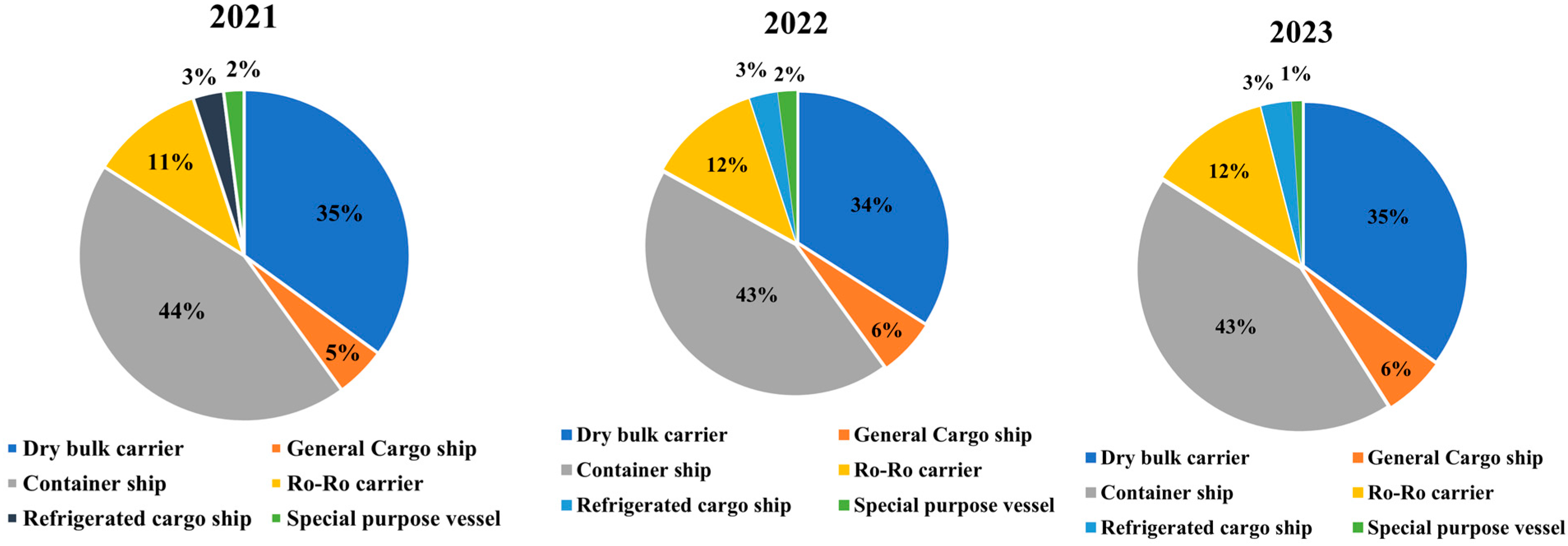
Given that cargo ships accounted for more than 60% of total fuel consumption, a more detailed analysis of their emission characteristics was conducted. Specifically, cargo ships were further classified into six subcategories to examine fuel consumption patterns in greater detail. The detailed classification of cargo ships is presented in
Table 10, while the fuel consumption characteristics by subcategory are shown in
Table 11. In addition,
Figure 7 illustrates the annual emission proportions according to each subcategory.
A notable characteristic of cargo ship emissions is that approximately 77% of total fuel consumption within the cargo ship category is attributed to two ship types, namely container ships and dry bulk carriers, and that emissions have shown a continuously increasing trend. In the case of container ships, although they accounted for only 17% of the total cargo ship fleet (as of 2023), they were responsible for approximately 43% of total cargo ship fuel consumption. This result is considered to reflect the high installed main engine power required to support high-speed operation.
In addition, although dry bulk carriers exhibit lower average fuel consumption per ship compared to container ships, they account for approximately 34% of total cargo ship fuel consumption due to their relatively large number of registered ships, making them the second-largest contributor to fuel consumption among cargo ship types. Accordingly, in order to achieve the most immediate and effective emission reduction, policy measures should prioritize container ships. Given their relatively small fleet size, government-level support such as the transition to low- or zero-emission fuels and the installation of energy efficiency improvement technologies is expected to yield the highest reduction efficiency.
For dry bulk carriers, since the large number of ships makes individual monitoring challenging, appropriate regulatory approaches include encouraging early scrapping of aging ships and supporting the construction of environmentally friendly alternative ships. Policies focusing on reducing total fuel consumption at the fleet level are therefore considered more appropriate for this ship type.
4.5. Estimation Results of Annual Fuel Consumption by Tonnage
Table 12 presents the annual fuel consumption by gross tonnage class. The results from 2021 to 2023 indicate that fuel consumption increases sharply as gross tonnage increases. In particular, large vessels exceeding 10,000 tons showed continuously increasing fuel consumption, at approximately 923,000 tons in 2021, 1,072,000 tons in 2022, and 1,121,000 tons in 2023, thereby driving the overall increase in total fuel consumption. In contrast, vessels with less than 1000 tons exhibited either stable or slightly decreasing annual fuel consumption. Accordingly, total fuel consumption has become increasingly concentrated in vessels above 1000 tons. These findings suggest that the ongoing trend toward vessel enlargement in the shipping industry is one of the key factors contributing to the increase in fuel consumption and the corresponding rise in air pollutant emissions.
4.6. Estimation Results of Annual Fuel Consumption by Engine Power
Table 13 presents the annual fuel consumption by main engine power class. The results indicate that fuel consumption increases proportionally with main engine power. In particular, vessels equipped with main engines exceeding 10,000 kW consumed approximately 842,000 tons of fuel in 2023, representing the highest fuel consumption among all categories. Vessels in the 3000–10,000 kW range also exhibited relatively high fuel consumption, indicating that they are significant emission sources. In contrast, low-power vessels with main engines below 500 kW contributed minimally to total fuel consumption. These results demonstrate that ship emissions are more closely related to installed main engine power than to the simple number of vessels. Accordingly, the application of energy efficiency improvement technologies to high-power vessels is expected to be a key strategy for emission reduction in the future. In particular, operational measures such as the transition to alternative fuels and slow steaming should be actively implemented as effective emission mitigation strategies.
4.7. Estimation Results of Annual Fuel Consumption by Ship Age
Table 14 presents the annual fuel consumption by ship age. The results by age class indicate that ships in the 10–15 year and 15–20 year age groups exhibited the highest fuel consumption from 2021 to 2023. In contrast, newly built ships (less than 5 years) and aged ships exceeding 35 years showed relatively low fuel consumption. In particular, ships older than 35 years may be less efficient in terms of energy performance due to their advanced age; however, their contribution to total fuel consumption was limited, as both the number of operating ships and their operational frequency were relatively low. Conversely, ships in the 10–20 year age range, which are actively operated in the current shipping market, showed high fuel consumption due to long-distance voyages and high operational intensity. According to
Table 15, cargo ships were most frequently distributed in the 15–20 year, 25–30 year, and 10–15 year age groups. Compared with other ship types, cargo ships generally consist of relatively larger gross tonnage vessels and are equipped with high-power main engines, resulting in the highest share of fuel consumption among all ship types. Accordingly, among the three age groups with a high proportion of cargo ships, the 10–15 year and 15–20 year groups, which also contain relatively fewer small vessels, showed particularly high emission levels.
Accordingly, for short-term emission reduction, priority should be given to implementing policies targeting these actively operating ship groups, including eco-friendly retrofitting, energy efficiency improvement measures, and operational optimization strategies.
For all air pollutants, emissions from cargo ships, which make up approximately 10% of the total fleet, accounted for the highest emissions by ship type at approximately 60%, while emissions from other diesel-powered vessels, which make up approximately 46% of the total fleet, were much lower at only approximately 2%. By pollutant, CO2 emissions were the highest. Cargo ships, which are relatively large in terms of gross tonnage, have longer annual operating hours and greater engine power, leading to higher emissions. In contrast, other diesel-powered vessels tend to be smaller, resulting in lower emissions.
These differences in emissions by ship type are associated with the physical characteristics of vessels (gross tonnage and main engine power) and their operational patterns. Cargo ships consist of vessels with larger tonnage and high-powered main engines compared to other ship types, and their long-distance international voyage characteristics result in significantly longer annual operating hours, leading to higher emissions. In contrast, other diesel-powered vessels are predominantly small- and low-power ships, with limited operational frequency and fuel consumption.
Analysis of annual trends from 2021 to 2023 further indicates that the trend toward larger and higher-powered ships has accelerated the increase in emissions. Large vessels exceeding 10,000 tons showed a continuous increase in fuel consumption from approximately 923,000 tons in 2021 to approximately 1,121,000 tons in 2023, thereby driving the overall increase in emissions. In contrast, small vessels below 1000 tons remained stable or showed a decreasing trend, confirming the concentration of emissions in large vessels. From the perspective of main engine power, vessels equipped with engines exceeding 10,000 kW and those in the 3000–10,000 kW range were identified as the primary emission sources, demonstrating that emission reduction priority is more closely related to vessel scale and installed engine power than to the number of vessels.
In addition, the analysis by ship age indicates that vessels in the 10–20 year age group, which are actively operating on domestic coastal and international routes, exhibited the highest fuel consumption, rather than aged vessels (over 35 years) with low efficiency or newly built vessels (less than 5 years). These findings suggest that while long-term measures such as the early decommissioning of aging vessels are important, short-term emission reduction should prioritize the implementation of strategies targeting actively operating vessels. Such strategies include the installation of energy efficiency improvement technologies, the transition to alternative low-carbon fuels, and operational measures such as slow steaming and voyage optimization.
4.8. Uncertainty Analysis of Emission Estimation
When estimating emissions, uncertainties accumulate from various factors involved in the calculation process. Chen & Yang et al. identified major uncertainty sources as missing vessel specification data, assumptions regarding fixed engine load conditions, errors during data collection, and emission factor uncertainty [
6]. Uncertainty issues associated with emission estimation were also discussed in the 2020 Fourth IMO Greenhouse Gas Study. Based on these previous studies, the major uncertainty sources considered in this study were defined as: (1) regression error associated with estimating main engine power, (2) correction factors applied to fuel consumption estimation, and (3) pollutant-specific emission factors. The influence weights of these uncertainty factors were assigned as shown in
Table 16. For the regression error, a relatively low weight was assigned because the regression models were applied only to vessels with missing specification data, and the coefficient of determination (R
2) for major ship types was higher than 0.74. The correction factor was assigned the highest weight because, although it was derived using actual fuel consumption data, some limitations and uncertainties remain. The emission factor was assigned a medium weight because its variability depends on the characteristics of individual air pollutants [
30].
Using the uncertainty weights presented in
Table 16 and applying the error propagation equation shown in Equation (3), the confidence interval of the national ship emission inventory was estimated to be approximately ±18.7%.
5. Conclusions
This study applied a bottom-up emissions estimation method to analyze the emission characteristics of nine air pollutants from approximately 6800 vessels registered in Republic of Korea from 2021 to 2023. While cargo ships, which make up approximately 10% of the total fleet, accounted for 60% of the total emissions, emissions from other diesel-powered vessels, which make up approximately 46% of the fleet, were very low, accounting for less than 2%, indicating that emissions remain at a very low level for these vessels and are highly concentrated in specific ship types. These differences were found to be strongly influenced not by the number of vessels alone, but by operational and technical characteristics such as gross tonnage, main engine power, and annual operating hours.
In addition, the results indicate that recent trends toward larger and higher-powered ships in the shipping industry have led to a continuous increase in fuel consumption among large and high-power vessel groups. In particular, vessels exceeding 10,000 tons and those equipped with main engines above 3000 kW were identified as major emission sources. The analysis by ship age further showed that vessels in the 10–20 year age group, which are actively operated and exhibit high operational frequency, demonstrated the highest emission characteristics. These findings suggest that future emission reduction policies should move beyond a vessel-count-based approach and instead focus on ship groups that make the highest contribution to emissions. Accordingly, technical and operational mitigation strategies such as the transition to low- or zero-emission fuels, installation of energy efficiency improvement technologies, slow steaming, and voyage optimization for large cargo ships are expected to be effective emission reduction measures.
Given that cargo ships account for more than 60% of total fuel consumption, this study further classified cargo ships into six subcategories to conduct a more detailed analysis of their emission characteristics. The results identified container ships and dry bulk carriers as the primary emission sources. Accordingly, for container ships, proactive government support policies such as the installation of energy efficiency improvement technologies and other green retrofitting measures are expected to be effective. For dry bulk carriers, policies focusing on total emission reduction, such as early scrapping of aging vessels and support for the construction of environmentally friendly alternative ships, are considered more appropriate. In addition, for aging vessels, operational measures such as slow steaming, voyage optimization, and early scrapping policies could contribute to emission reduction.
Meanwhile, this study applied a regression model based on gross tonnage to estimate main engine power for vessels with missing data, achieving relatively high explanatory power (R2 ≥ 0.74) for most ship types. However, lower explanatory power was observed for tugs and mixed-category “other vessels” with diverse operational characteristics, indicating the need for more refined classification in future studies to improve analytical accuracy. Although the model proposed in this study reflects actual vessel operational characteristics, several limitations remain. First, the regression models developed to estimate main engine power showed relatively high explanatory power, suggesting that the models may also provide reliable performance when applied to other countries or regions. However, the operating hours and ship-type-specific correction factors were derived based on actual fuel consumption data and may therefore reflect country-specific operational characteristics. Accordingly, it is recommended that these parameters be adjusted according to the characteristics of the target vessels in future studies. In addition, the emission statistics reported by the Ministry of Environment (MOE) of Korea include emissions from multiple non-road mobile source sectors and exclude international navigation vessels. Therefore, further detailed studies are required to estimate emissions using identical target vessel categories and to evaluate the deviation range between estimation results under consistent inventory boundaries.
In conclusion, this study demonstrates the applicability of a bottom-up national ship emission inventory framework that reflects actual vessel operational characteristics, moving beyond conventional fuel sales-based estimation methods. The developed emission inventory is expected to serve as foundational data for evaluating the effectiveness of future clean fuel adoption and emission reduction technologies. Furthermore, future research should integrate AIS-based real-time operational data with vessel-specific measured fuel consumption data and incorporate machine learning-based approaches to develop a more precise real-time emission prediction and management system that better reflects maritime operating conditions.