


Abstract
Recently there has been notable interest in the reduction in emissions of the shipping industry via the substitution of the currently used fossil fuels with alternative green fuels. One such alternative studied presently could be the use of pure vegetable oils, which are cheaper and easier to produce than other proposed fuels. In this study, pure vegetable oils were tested in a constant volume combustion chamber to assess their ignition quality via the measurement of their Estimated Cetane Number (ECN) and to compare it with that of heavy fuel oils (HFOs). Moreover, the effect of vegetable oil composition on ignition quality was investigated. It was found that all the vegetable oils tested possessed significantly higher ignition quality than standard heavy fuel oils. Vegetable oil ignition quality was found to be most impacted by their degree of unsaturation. The results of the present study indicate that from the point of view of ignition quality, vegetable oils are a viable alternative to fossil fuels, being expected to lead to an increase in the ignition quality of standard heavy fuel oils.
1. Introduction
In view of the increasingly rising magnitude of the effects of climate change, efforts are being made to find suitable and renewable alternative sources of energy to satisfy the demands of industries and to maintain or increase people’s standard of living. One such industry is shipping, which utilizes fossil fuels almost exclusively, with recent efforts being made to substitute these. This is highlighted by the most recent revision of the ISO 8217 standard for marine fuels of 2024 [1], which specifies new categories for mixtures of heavy fuel oils (HFOs) with fatty acid methyl esters (FAMEs). Since shipping is one of the most significant and influential sectors of the world economy affecting the cost of all goods, it is vital that proposed solutions for alternative fuels are inexpensive and, if possible, able to be used with existing technology.
A variety of candidate fuels to replace HFOs in shipping have been proposed. One such alternative is liquified natural gas (LNG) [2,3,4,5], which is not renewable, but due to its lower C/H ratio, it has a reducing effect on carbon emissions. A study of the emissions of LNG-fueled ships showed that sulfur dioxide, nitrogen oxides and particulate matter pollutants were significantly reduced, a small reduction in carbon dioxide was observed, and the emissions of carbon monoxide and methane were increased [6].
Liquefied petroleum gas (LPG), which can be propane, butane, or a mixture of these, can also be used as an alternative shipping fuel [2]. A reduction in emissions of small to medium-sized ships by the conversion to LPG fuel has been calculated, specifically a near elimination of particulate matter, along with significant reductions in sulfur dioxide, nitrogen oxides and carbon dioxide [7].
Another proposed alternative fuel is methanol, either pure or blended with diesel, which while reducing emissions is still not widely produced in a renewable manner [2,3,4,5,8,9]. Research has also been conducted on the potential use of renewable methanol, projecting a larger reduction in carbon emissions, but limited by cost and levels of production [10]. A computational analysis of the expected emissions of an engine service operational vessel fueled with methanol indicated that a reduction in carbon dioxide emissions would occur, though not as significant as with the use of LNG [11]. An evaluation of the economic feasibility of the use of a 30% renewable methanol and very low sulfur fuel oil blend showed that the cost is significantly higher in the short term than using 100% very low sulfur fuel oil, but that was reversed in the long-term [12].
Biodiesel has been investigated in the literature as an alternative shipping fuel, mainly to be used in blends with diesel or fuel oils, though the increase in its production scale may result in competition with food supply chains and adverse environmental impacts through intensive land use, while also being characterized by high cost [2,5,13,14]. A study of emissions generated from a marine diesel engine fueled with blends of 10–30% biodiesel with marine diesel and fuel oil showed a reduction in nitrogen oxides and carbon dioxide emissions for both cases [15].
Hydrogen as an alternative fuel offers a significantly higher reduction in emissions than other alternatives but is restricted by the current technology requiring further advancement before being a feasible option [2,3,4,5,16,17]. In a study on the possible retrofitting of marine vessels for short distances by replacing their engines with fuel cells, it was calculated that the refilling of a partially retrofitted ship could be achieved within the allowed hoteling time limit [18]. In that same study, the data presented does not allow for the timely filling of a fully retrofitted ship.
Lastly, ammonia has been studied as another alternative, being considered a carbon-free fuel, therefore reducing emissions greatly, but it is restricted by technology [2,3,4,5,19,20,21,22]. It has been reported that while ammonia is a potentially sustainable alternative fuel, it is necessary to regulate the emissions of nitrogen oxides and unburnt ammonia, to not overturn the potential benefits of its use [23].
The potential use of vegetable oils as alternative fuels for diesel engines has already been the subject of several studies in the literature. The performance of vegetable oils in diesel engines was found to be similar enough to that of conventional diesel, with an overall reduction in emissions also being reported [24,25,26]. Previous work in the literature shows that in a direct injection diesel engine, vegetable oil ignition delay was found to be similar to that of conventional diesel, but a lower peak heat release was exhibited, signifying a reduction in engine efficiency [27]. Studies in the literature have also linked the composition of vegetable oils to their ignition performance, specifically showing that an increase in the amount of double bonds contributes to an increase in ignition delay, which is expected to negatively impact engine performance [27,28,29]. A method for determining the ignition characteristics of vegetable oils via the use of a constant volume combustion chamber, primarily designed to test automotive diesel, showed that vegetable oil ignition quality is greatly influenced by chamber temperatures and injection pressures, contrary to conventional diesel [28]. The emissions of a small diesel engine fueled with vegetable oils, when compared to the use of conventional diesel, exhibited lower levels of nitrogen oxides due to lower peak heat releases, but showed increases in the emissions of carbon monoxide and total hydrocarbons attributed to the injection timing, as well as an increase in particulate matter caused by a reduction in in-cylinder temperatures and atomization efficiency [27]. The effects of the use of straight vegetable oils in small diesel engines have been documented and show that the increase in the fuel’s viscosity resulted in fuel impingement, leading to deposition and lubricating-oil dilution, as well as causing nozzle coking due to the prolongation of injection caused by nozzle dribbling [30]. It has been reported in the literature that the preheating of crude palm oil before injection in a diesel engine offered the required smooth flow without creating issues in the fuel injection system when preheating temperatures of up to 100 °C [31].
The present study aims to assess the use of vegetable oils as an alternative fuel for the shipping industry, by evaluating the ignition and combustion characteristics of vegetable oils in a constant volume combustion chamber, which attempts to replicate the operating conditions of heavier diesel engines. To achieve that, different vegetable oils were tested and compared to conventional HFOs, as far as their expected in-engine behavior is concerned. The effect of vegetable oil fatty acid composition on ignition quality was also studied, as well as the correlation between the Estimated Cetane Number (ECN), measured in the constant volume combustion chamber, and the Calculated Carbon Aromaticity Index (CCAI), which is derived from an empirical formula and is currently the measure of ignition quality in HFOs.
2. Materials and Methods
2.1. Materials
For the purposes of the experimental work of this study, 15 samples of refined vegetable oils were supplied by Pavlos N. Pettas S.A., Patras, Greece, which were used directly without further purification. A total of 23 samples of HFOs were supplied by Helleniq Energy, Athens, Greece and Motor Oil Hellas, Athens, Greece. Methanol of ≥99.8% purity (Sigma-Aldrich, Burlington, MA, USA) and sodium methoxide of ≥95% purity (Sigma-Aldrich) was used for the transesterification reactions performed to obtain the fatty acid profiles of the vegetable oils. Citric acid of ≥99.5% purity (Sigma-Aldrich) was used for the purification of the transesterification products.
2.2. Methods
To deduce the vegetable oils’ fatty acid compositions, a sample of each was transesterified using a standardized procedure. A 9:1 methanol-to-oil molar ratio, along with 1% wt. sodium methoxide catalyst, was used. The temperature was set at 60 °C and the reaction mixture was stirred at 600 rpm. The reaction flask was equipped with a reflux condenser to prevent methanol leaking to the environment. The reaction was allowed to continue for 2 h to ensure it was completed, and afterwards the glycerol phase was allowed to separate by gravity. The ester phase was washed with distilled water and a citric acid aqueous solution (2% w/v) to remove glycerol, glycerol soaps, and the remaining catalyst. The remaining methanol was then distilled from the ester phase using a rotary evaporator under a vacuum of 0.1 kPa at 80 °C and 200 rpm.
The vegetable oils’ FAME compositions were determined by gas chromatography according to test method EN 14103 [32]. Iodine value was calculated via chromatographic data, using the EN 16300 method [33]. Density was determined utilizing an Anton Parr SVM 3000, sourced by Anton Paar GmbH, Graz, Austria via the EN ISO 12185 method [34], where the uncertainty of the density measurements is equal to ±0.085 g/cm3 for measured densities over 0.9 g/cm3 and ±0.026 g/cm3 for measured densities under 0.9 g/cm3. Viscosity was determined using a Gallenkamp VS-615 bath, with Gallenkamp/Technico U-Tube reverse flow viscometers, sourced by A. Gallenkamp & Co. Ltd., Cambridge, UK according to the EN ISO 3104 method [35], where the uncertainty of the viscosity measurements is equal to ±3.6 mm2/s for measured viscosities over 100 mm2/s and ±0.25 mm2/s for measured viscosities under 100 mm2/s. Estimated Cetane Number (ECN) was determined via the FIA/100-FCA, a constant volume combustion chamber device, sourced by Fueltech Solutions AS, Trondheim, Norway according to test method IP 541/06 [36]. Both the density and viscosity were measured four times, while the ECN was measured twice, with the average values being extracted.
3. Results
3.1. Effect of Vegetable Oil Compositional Properties on Their Ignition Quality
The fatty acid profiles of the studied vegetable oils were used to extract their compositional properties, presented in Table 1. Table 1 also provides the iodine value and ECN of vegetable oils. In the following results, values of ECN above 40.0 appear, despite the method for measuring ECN being valid only up to 40.0. This has been done strictly for comparison reasons. The ECN values higher than 40.0 were extrapolated from the method’s formula, presented below
where ECN is the Estimated Cetane Number and MCD is the Main Combustion Delay expressed in ms.
ECN = 153.15 × exp(−0.2861 × MCD)
Table 1.
Vegetable oil compositional and fuel properties.
The test method used for the measurement of the ECN relies on a calibration curve tailored for HFOs, not for oxygenated biofuels, that are more reactive and typically exhibit shorter ignition delays. Therefore, the ECN values resulting from extrapolation may not be viewed as absolute, but may still offer a comparison basis, since the relationship between ignition quality and ignition delay is monotonous, meaning that a lower ignition quality will always result in higher ignition quality, expressed here as ECN.
The correlation of each compositional property with the ECN was evaluated by calculating the respective Pearson Correlation Coefficient (PCC), along with the relative confidence intervals (p-values). The results of these correlations are presented in Table 2.
Table 2.
Pearson correlation coefficients and confidence intervals for the correlations of compositional properties with ECN.
The PCC (r = −0.8695) between the total concentration of unsaturated fatty acids and ECN implies a strong negative correlation, meaning that an increase in the concentration of unsaturated compounds results in a decrease in ECN.
The relationship between the concentration of mono-unsaturated fatty acids and ECN is characterized by a low value of PCC (r = −0.2331), while the p-value shows a statistically non-significant correlation (p = 0.40 > 0.05). On the other hand, as implied by the relative PCC (r = −0.8724), there is a strong negative correlation between ECN and the concentration of poly-unsaturated fatty acids. It can be concluded that the impact of the degree of unsaturation, i.e., the total concentration of unsaturated fatty acids in the vegetable oil, can be mostly attributed to the concentration of poly-unsaturated fatty acids.
Based on the high value of the PCC (r = −0.8158) a strong negative dependence of ECN on the molecular weight can be assumed. Consequently, an increase in the molecular weight of the vegetable oil results in a decrease in ECN.
A very strong correlation with a negative trend between the iodine value and the ECN is observed, based on the value of the PCC (r = −0.9488). This can be interpreted as meaning that an increase in iodine value would result in a decrease in ECN.
3.2. Effect of Vegetable Oil and Fuel Oil Physicochemical Properties on Their Ignition Quality
The values of the measured physicochemical properties of vegetable oils and HFOs are shown in Table 3.
Table 3.
Vegetable and fuel oil physicochemical properties.
The densities of all the HFOs, as well as of those vegetable oils that were not in a fully fluid state (coconut, palm kernel, palm and their respective oleins), were measured at 50 °C and converted to the respective densities at 15 °C, by using the following formula
where D15 is the density at 15 °C expressed in kg/m3, D50 is the density at 50 °C expressed in kg/m3 and fcor is the correction factor dependent on the value of density at 15 °C, which for the present materials was equal to 0.63 for the HFOs and 0.65 for the vegetable oils.
D15 = D50 + fcor × (50 − 15),
The Calculated Carbon Aromaticity Index (CCAI) is based on an empirical formula, which is only applicable for HFOs. The application of CCAI for vegetable oils in the present study is only provided in the context of comparison. The formula used for the calculation of CCAI in the present study is the following
where D15 is the density at 15 °C expressed in kg/m3 and v50 is the viscosity expressed in mm2/s at 50 °C.
CCAI = D15 − 80.6 − 140.7 × log[log(v50 + 0.85)],
The physicochemical properties of both vegetable oils and HFOs are affected by their composition, as is their ignition quality. Therefore, in the present section it is not claimed that the physicochemical properties investigated have a causal relationship with ignition quality. They will be evaluated as predictors of ignition quality. The PCCs and the relative confidence intervals for the correlations between the physicochemical properties studied presently and the ECN of vegetable and fuel oils are provided in Table 4.
Table 4.
Pearson correlation coefficients and confidence intervals for the correlations of vegetable and HFO physicochemical properties with ECN.
In the case of vegetable oils, the correlation between density and ECN is weak and statistically non-significant (p = 0.67 > 0.05), while for HFOs it is characterized as moderate, based on the respective PCC (r = −0.3699). This can be explained by the fact that there is not significant variation in density values between vegetable oils, in contrast to HFOs, because differences in fatty acid structure, which have a noticeable effect on ignition quality expressed by ECN, do not have the same strong effect on density. In the case of HFOs, the negative trend of the correlation implies that an increase in density would have as a result a decrease in ignition quality, which is due to a potential increase in concentration of aromatics that possess poor ignition quality.
No significant correlation between either vegetable oil or HFO viscosity and ECN can be claimed, based on their respective p-values (p = 0.25 > 0.05 and p = 0.98 > 0.05). This can be explained by the fact that changes in compositional structure do not impact viscosity and ignition quality to the same extent. For example, an increase in the concentration of aromatic or long paraffinic molecules would both result in an increase in viscosity, but would have conflicting effects on ignition quality. Specifically, an increase in the concentration of aromatics is expected to lead to poorer ignition quality, while the opposite is expected when the concentration of long paraffinic molecules increases.
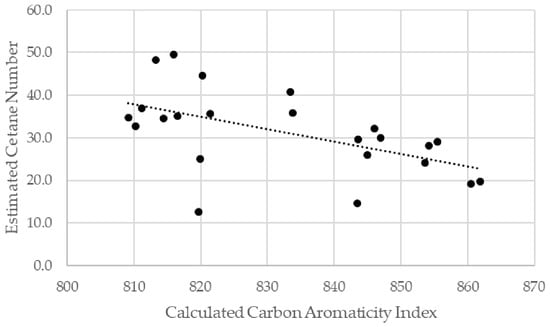
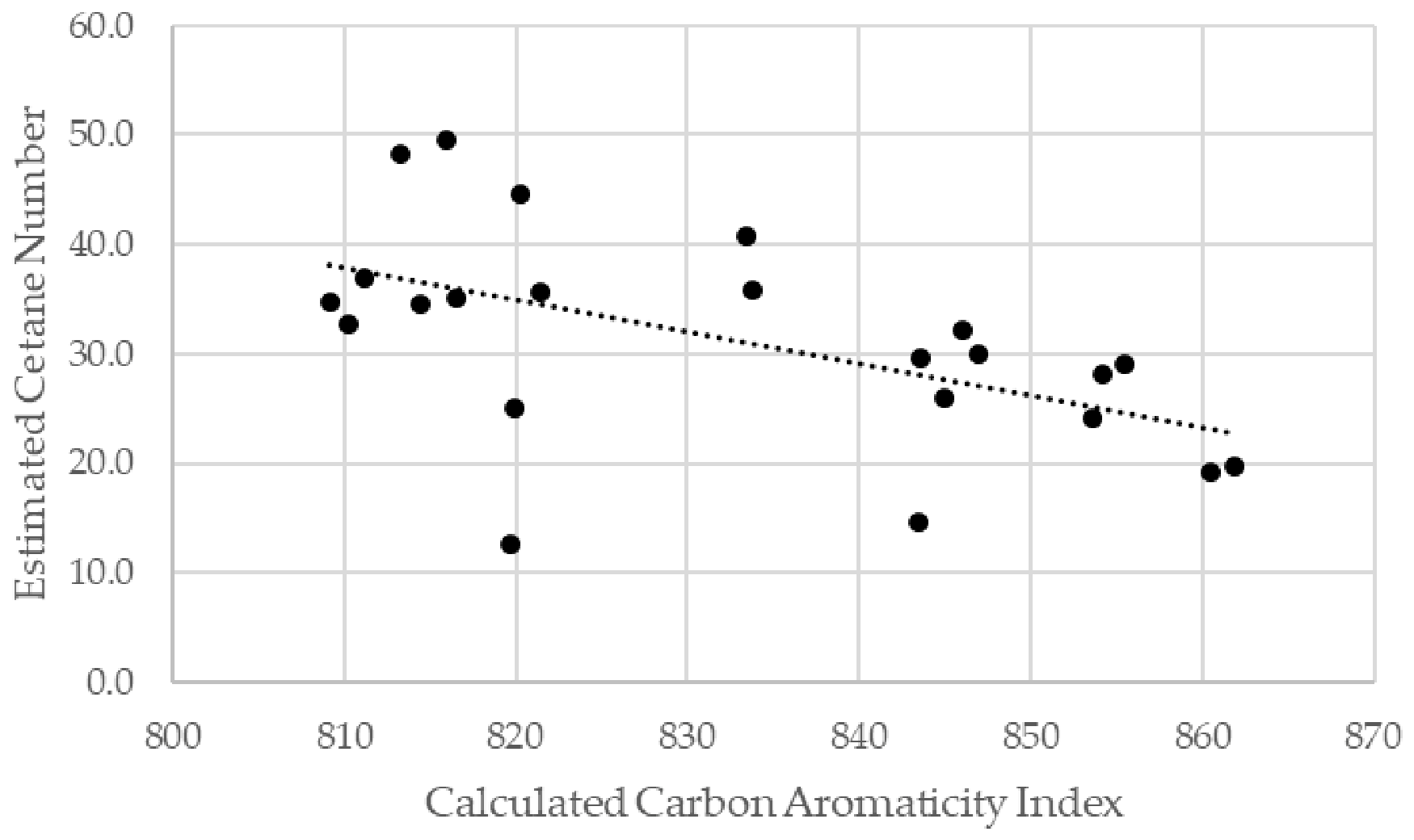
It is evident based on the very low PCC and high p-value (r = 0.0925 and p = 0.74 > 0.05) that no statistically significant relationship exists between vegetable oil CCAI and ECN. It is, therefore, not possible to predict the ignition quality of vegetables oils using the CCAI. Moreover, the prediction of the ignition quality of HFOs blended with oxygenated biofuels is, also, expected to be inaccurate. The inclusion of the CCAI in the ISO 8217 standard for marine fuels, as the sole ignition quality parameter for HFOs, would lead to inaccurate results in the case of blends of HFOs with FAMEs, as are currently allowed. The correlation between heavy fuel oil CCAI and ECN is characterized as moderate, based on the value of the PCC (r = −0.6165). The negative trend generally agrees with the expected result, as an increase in the fuel’s CCAI is expected to lead to poorer ignition quality, corresponding to a lower ECN value. However, the correlation between the two properties is not deemed significant enough to allow an accurate prediction of ignition quality by the CCAI. This is apparent in Figure 1, where fuels with similar CCAI values exhibit significant differences in ECN and, therefore, ignition quality. This can be explained by the unsatisfactory correlations between fuel oil density and viscosity with ECN, especially in the case of viscosity, since their impact on CCAI does not translate to their impact on ECN to the same degree.
Figure 1.
Correlation between CCAI and ECN for HFOs.
3.3. Evaluation of the Impact of the Use of Vegetable Oils on Engine Wear and Engine Efficiency
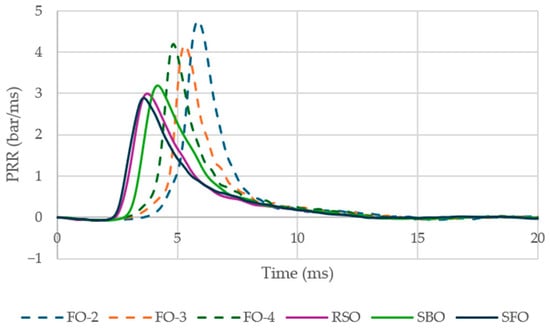
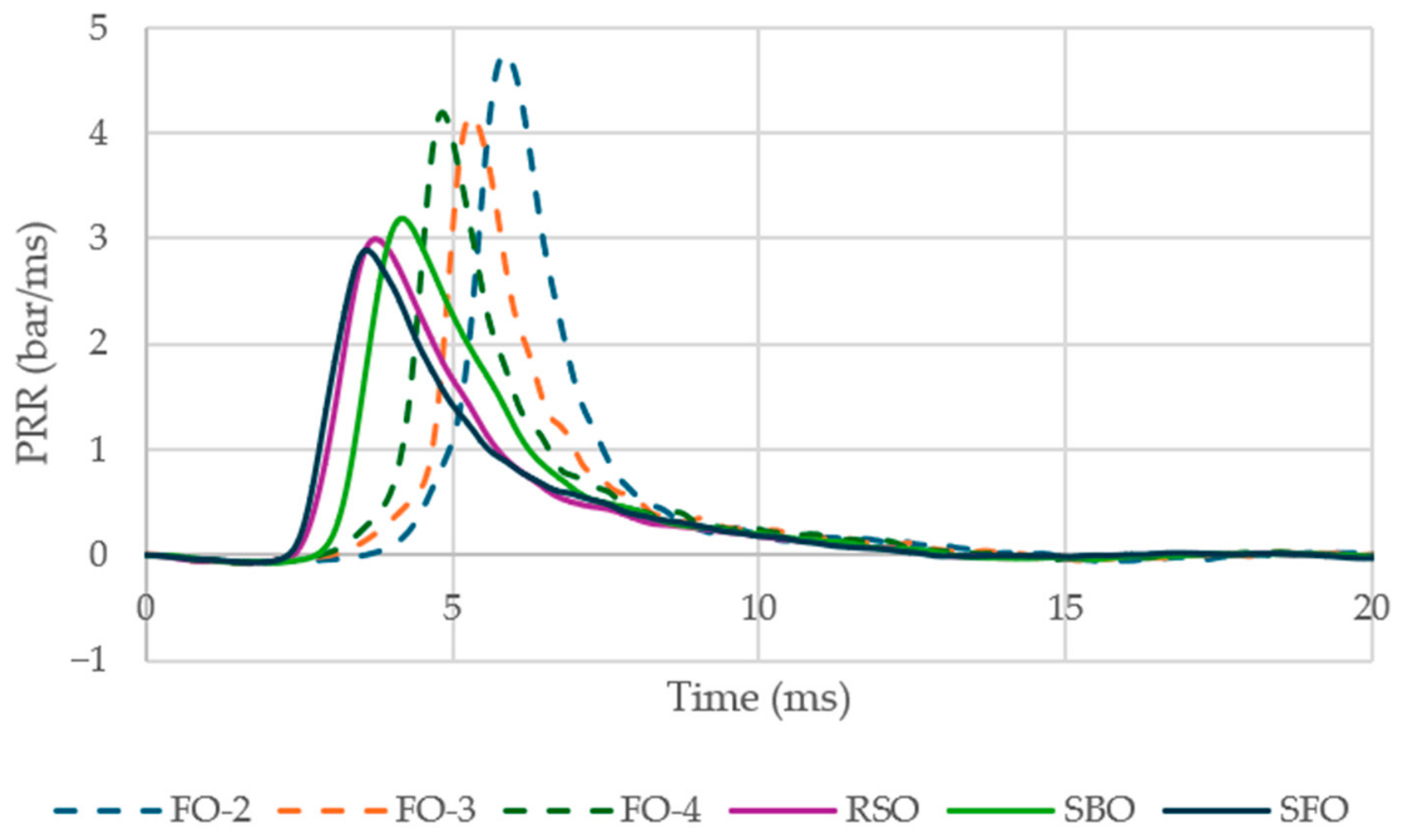
The maximum pressure rise rate (PRR) of vegetable oils is lower than that of most HFOs. Therefore, the combustion of vegetable oils in current engines could be expected to not cause significant additional wear on them, since the maximum PRR can be used as an indicator of the mechanical stress of the engine’s compartments caused by the fuel’s combustion, as the increase in maximum PRR has been linked to knock, which can potentially be damaging to the engine according to the literature [37]. In some particular cases it may be possible for vegetable oils to reduce the stress on the engine, but that would depend on the substituted fuel. This can be seen in Figure 2, where the PRR as a function of time is presented for a selection of representative HFOs and vegetable oils. It can also be seen that in the case of vegetable oils there is less delay in reaching the maximum PRR, which is tied to the rate of heat release of the burned fuel, signifying faster ignition and combustion, leading to an increase in engine efficiency.
Figure 2.
Pressure rise rate as a function of time for selected representative vegetable oils and HFOs.
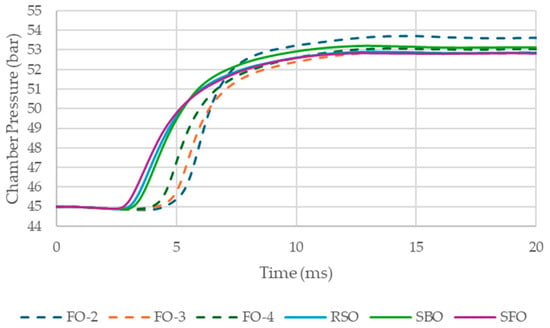
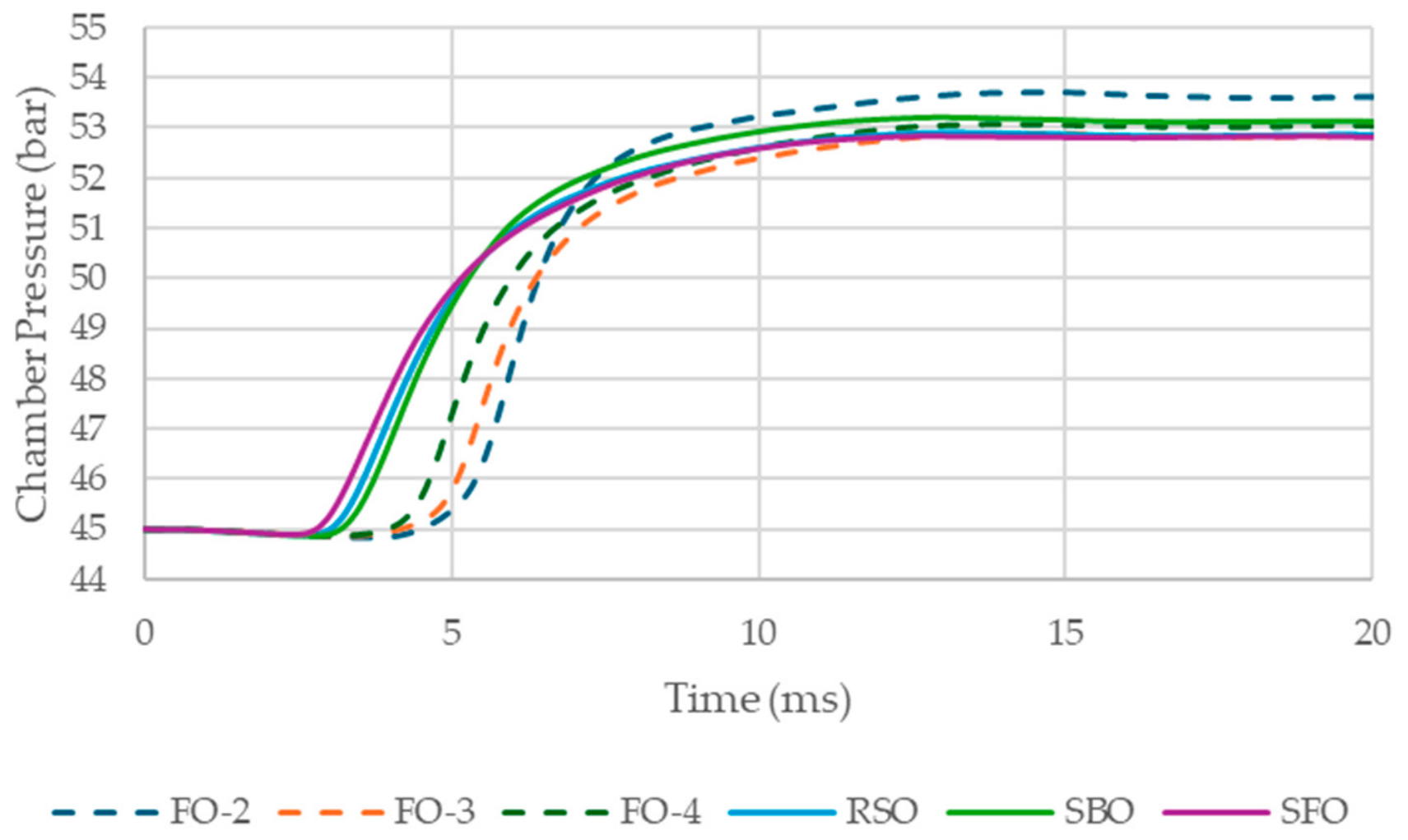
Figure 3 shows the chamber pressure as a function of time for the same HFOs and vegetable oils as above. The resulting maximum chamber pressure for vegetable oils is similar to that of HFOs, further signifying that the usage of vegetable oils should not lead to an increase in engine wear. Moreover, it can be confirmed once more by this chart that vegetable oils possess higher ignition quality than the studied HFOs, as can be seen by the fact that there is less delay in the increase in chamber pressure, which is caused by the formation of exhaust gases. This can also act as an indicator of improved combustion and engine efficiency.
Figure 3.
Chamber pressure as a function of time for selected representative vegetable and fuel oils.
4. Discussion
The dependence of ignition quality of vegetable oils on their fatty acid composition is evident, as shown by the experimental data. The concentration of unsaturated fatty acids negatively impacts vegetable oil ECN, a result which agrees with the reported reduction in cetane number of biodiesels with the increase in the concentration of unsaturated FAMEs [38,39].
The concentration of mono-unsaturated fatty acids in the vegetable oils studied is almost equal to the concentration of oleic acid, as the rest of the mono-unsaturated fatty acids are present in very low concentrations. Methyl oleate, the methyl ester of oleic acid, has been reported in the literature to possess a relatively high cetane number of 59.3 or 56.0, which signifies a sufficiently high ignition quality. If a similarly high ignition quality is assumed for the oleic acid, it may be because of this that its concentration does not greatly affect the ignition quality of vegetable oils [40,41].
The effect of the fatty acid chain length on ignition quality was not found to have a positive effect on vegetable oil ignition quality. On the contrary, it is shown to have a strong negative effect on it. According to the literature, an increase in molecular weight should have, as a result, an increase in cetane number for neat FAMEs [42,43]. Such a trend is not observed in the case of vegetable oils, which could be because the fatty acids are connected in triplets to the glycerol backbone. A higher molecular weight would result in a higher probability of long chain fatty acids being connected to the same glycerol backbone, thus increasing the strength of the intramolecular forces, when compared to those of neat FAMEs.
The degree of unsaturation, as described by the iodine value, is proven by the experimental data to possess the most significant effect on ignition quality. The iodine value is a measure of the amount of double bonds in a biodiesel or a vegetable oil, meaning that it depicts the degree of unsaturation of the vegetable oil, thus considering both the concentration of unsaturated fatty acids and their type, and whether they are mono- or poly-unsaturated. This explains why the iodine value exhibits such a high correlation with ECN.
Based on the experimental results, it is concluded that the physicochemical properties of both vegetable and HFOs cannot be reliably used to interpret the differences between ignition qualities of fuels. The experimental data shows no significant enough dependence of vegetable and HFO ignition quality on density or viscosity.
It is shown by the experimental data that the CCAI cannot be used to assess the ignition quality of vegetable oils, because of their negligible correlation. The CCAI was, also, shown to not be reliable enough to accurately predict HFO ignition quality. This would mean that the estimation of ignition quality of a blend of HFOs with vegetable oils would likely be even less accurate, necessitating the use of different methods to predict ignition quality. As mentioned above, CCAI is an empirical calculated value, used for the classification of HFO fuels according to their ignition quality. Since vegetable oils have completely different compositions compared to HFOs, the CCAI values of the vegetable oils are only indicative.
It is evident by the data of this study that all the vegetable oils studied could be used interchangeably as blending materials, due to their high ignition qualities, and are expected to have a positive effect on HFO blend ignition quality. This would allow flexibility in the choice of blending ingredients and the utilization of already existing crops.
Both the density and viscosity of vegetable oils are higher and closer to those of HFOs than those of FAMEs, which to fulfill the specifications of the EN 14214 standard for biodiesels must be within 860.0–900.0 kg/m3 and 3.50–5.00 mm2/s respectively [44]. These are two of the parameters to be taken into consideration for fuel blend stability. Therefore, there is an indication that vegetable oils would lead to more stable blends than FAMEs.
The experimental results show that vegetable oils possess significantly higher ignition quality than HFOs. Therefore, in terms of ignition quality, they are not only capable of substituting conventional fuels, but they may also improve combustion efficiency, which should lead to improved engine efficiency. As in the case of FAMEs, that have already been approved as substitutes for HFOs, vegetable oils are expected to cause a noticeable increase in ignition quality, but at a much lower cost, both from an economic and environmental perspective.
Another important remark regarding the potential use of vegetable oils as substitutes for heavy residual fuels is their significantly lower viscosity. This means that high preheating temperatures are not required to achieve the desired viscosity for fuel atomization (12–18 mm2/s), thereby reducing the possibility of thermal degradation of vegetable oils, which is more likely to occur at high temperatures.
5. Conclusions
The ignition quality of a variety of vegetable oils was determined in a constant volume combustion chamber to assess their expected behavior when used in a compression-ignition engine. The results showed that the vegetable oils tested possessed higher ignition qualities than standard HFOs. Therefore, it is indicated that vegetable oils could be used as substitutes for conventional HFOs, without negatively impacting the ignition quality of the final blend. On the contrary, it may be expected that they contribute positively to combustion efficiency.
The ignition quality of vegetable oils was found to be most significantly impacted by their degree of unsaturation. No significant dependence of vegetable and fuel oil ignition quality on either density or viscosity was found. The inability to use the CCAI for the prediction of vegetable oil ignition quality was confirmed, while it was shown that it is, also, inadequate for the estimation of HFO ignition quality.
The PRR data show a conflicting effect, where in some cases the tested vegetable oils lead to a lower maximum PRR and in other cases a higher one. The maximum PRR may act as an indicator of potential engine wear, but no definitive conclusion may be drawn on the effect of the use of vegetable oils on engine wear based on this data.
The high ignition quality that all the vegetable oils exhibited shows that they may be used interchangeably as blending materials, meaning that the already available crops may be utilized. Furthermore, the high ignition quality of vegetable oils highlights the fact that the goal of substituting conventional fuels and reducing emissions in the shipping industry may be achieved with the use of a cheaper fuel that does not require a synthesis process as complex as that of biodiesel, which is currently promoted by the newest revision of the ISO 8217:2024 standard for marine fuel specifications.
The potential use of vegetable oils as blending materials with heavy fuel oils needs to be assessed by examining the compatibility and stability of such blends, as well as the impact on properties related to long-term storage, such as their oxidative stability and corrosion activity. This is recommended as the focus of future research.
Author Contributions
Conceptualization, I.N.C. and D.K.; Methodology, I.N.C.; Formal Analysis, I.N.C.; Resources, D.K.; Data Curation, I.N.C. and D.K.; Writing—Original Draft Preparation, I.N.C.; Writing—Review and Editing, D.K.; Visualization, I.N.C.; Supervision, D.K. All authors have read and agreed to the published version of the manuscript.
Funding
This research received no external funding.
Data Availability Statement
The datasets presented in this article are not readily available because the data are part of an ongoing study. Requests to access the datasets should be directed to the corresponding author.
Conflicts of Interest
The authors declare no conflicts of interest.
Abbreviations
The following abbreviations are used in this manuscript:
| CCAI | Calculated Carbon Aromaticity Index |
| ECN | Estimated Cetane Number |
| FAME | Fatty Acid Methyl Esters |
| HFO | Heavy Fuel Oil |
| ID | Ignition Delay |
| IV | Iodine Value |
| LNG | Liquefied Natural Gas |
| LPG | Liquefied Petroleum Gas |
| MCD | Main Combustion Delay |
| MW | Molecular Weight |
| PCC | Pearson Correlation Coefficient |
| PRR | Pressure Rise Rate |
References
- ISO 8217:2024; Products from Petroleum, Synthetic and Renewable Sources—Fuels (Class F)—Specifications of Marine Fuels. International Organization for Standardization (ISO): Geneva, Switzerland, 2024.
- Wang, Y.; Cao, Q.; Liu, L.; Wu, Y.; Liu, H.; Gu, Z.; Zhu, C. A Review of Low and Zero Carbon Fuel Technologies: Achieving Ship Carbon Reduction Targets. Sustain. Energy Technol. Assess. 2022, 54, 102762. [Google Scholar] [CrossRef] [Scilit]
- Diamantakis, N.; Xynopoulos, N.; Sheth, J.; Andresen, J.; Maroto-Valer, M. Alternative Maritime Fuels for Net-Zero Shipping: A Comprehensive Operational, Techno-Economic and Regulatory Review. Hydrogen 2026, 7, 36. [Google Scholar] [CrossRef] [Scilit]
- Li, Z.; Wang, K.; Liang, H.; Wang, Y.; Ma, R.; Cao, J.; Huang, L. Marine Alternative Fuels for Shipping Decarbonization: Technologies, Applications and Challenges. Energy Convers. Manag. 2025, 329, 119641. [Google Scholar] [CrossRef] [Scilit]
- Zhang, W.; Wang, J.; Qin, G.; Kuntal, S.; Gong, F.; Yan, R. Review of the State-of-the-Art of Alternative Marine Fuels: A Viable Approach to Zero-Carbon Shipping. Clean. Logist. Supply Chain 2025, 16, 100232. [Google Scholar] [CrossRef] [Scilit]
- Livaniou, S.; Papadopoulos, G.A. Liquefied Natural Gas (LNG) as a Transitional Choice Replacing Marine Conventional Fuels (Heavy Fuel Oil/Marine Diesel Oil), towards the Era of Decarbonisation. Sustainability 2022, 14, 16364. [Google Scholar] [CrossRef] [Scilit]
- Yeo, S.-J.; Kim, J.; Lee, W.-J. Potential Economic and Environmental Advantages of Liquid Petroleum Gas as a Marine Fuel through Analysis of Registered Ships in South Korea. J. Clean. Prod. 2022, 330, 129955. [Google Scholar] [CrossRef] [Scilit]
- Rao, X.; Yuan, C.; Guo, Z.; Xu, Y.; Sheng, C. Methanol as an Alternative Fuel for Marine Engines: A Comprehensive Review of Current State, Opportunities, and Challenges. Renew. Energy 2025, 252, 123562. [Google Scholar] [CrossRef] [Scilit]
- Guo, X.; Luo, H.; Liu, L.; Liu, K.; Ge, J.; Nishida, K. Towards Green Marine Engines: A Review of Methanol Fueled Internal Combustion Engine. Green Energy Resour. 2026, 4, 100168. [Google Scholar] [CrossRef] [Scilit]
- Svanberg, M.; Ellis, J.; Lundgren, J.; Landälv, I. Renewable Methanol as a Fuel for the Shipping Industry. Renew. Sustain. Energy Rev. 2018, 94, 1217–1228. [Google Scholar] [CrossRef] [Scilit]
- Bortnowska, M. Projected Reductions in CO2 Emissions by Using Alternative Methanol Fuel to Power a Service Operation Vessel. Energies 2023, 16, 7419. [Google Scholar] [CrossRef] [Scilit]
- Wu, P.-C.; Lin, C.-Y. Feasibility and Cost-Benefit Analysis of Methanol as a Sustainable Alternative Fuel for Ships. J. Mar. Sci. Eng. 2025, 13, 973. [Google Scholar] [CrossRef] [Scilit]
- Mohd Noor, C.W.; Noor, M.M.; Mamat, R. Biodiesel as Alternative Fuel for Marine Diesel Engine Applications: A Review. Renew. Sustain. Energy Rev. 2018, 94, 127–142. [Google Scholar] [CrossRef] [Scilit]
- Kesieme, U.; Pazouki, K.; Murphy, A.; Chrysanthou, A. Biofuel as an Alternative Shipping Fuel: Technological, Environmental and Economic Assessment. Sustain. Energy Fuels 2019, 3, 899–909. [Google Scholar] [CrossRef] [Scilit]
- Sagin, S.; Haichenia, O.; Karianskyi, S.; Kuropyatnyk, O.; Razinkin, R.; Sagin, A.; Volkov, O. Improving Green Shipping by Using Alternative Fuels in Ship Diesel Engines. J. Mar. Sci. Eng. 2025, 13, 589. [Google Scholar] [CrossRef] [Scilit]
- Atilhan, S.; Park, S.; El-Halwagi, M.M.; Atilhan, M.; Moore, M.; Nielsen, R.B. Green Hydrogen as an Alternative Fuel for the Shipping Industry. Curr. Opin. Chem. Eng. 2021, 31, 100668. [Google Scholar] [CrossRef] [Scilit]
- Alavi-Borazjani, S.A.; Adeel, S.; Chkoniya, V. Hydrogen as a Sustainable Fuel: Transforming Maritime Logistics. Energies 2025, 18, 1231. [Google Scholar] [CrossRef] [Scilit]
- Melideo, D.; Desideri, U. The Use of Hydrogen as Alternative Fuel for Ship Propulsion: A Case Study of Full and Partial Retrofitting of Roll-on/Roll-off Vessels for Short Distance Routes. Int. J. Hydrogen Energy 2024, 50, 1045–1055. [Google Scholar] [CrossRef] [Scilit]
- Bayraktar, M.; Sokukcu, M.; Pamik, M.; Yuksel, O. Evaluating Ammonia as a Marine Fuel: Review and Illustration. Environ. Model. Assess. 2025, 30, 779–803. [Google Scholar] [CrossRef] [Scilit]
- Al-Aboosi, F.Y.; El-Halwagi, M.M.; Moore, M.; Nielsen, R.B. Renewable Ammonia as an Alternative Fuel for the Shipping Industry. Curr. Opin. Chem. Eng. 2021, 31, 100670. [Google Scholar] [CrossRef] [Scilit]
- Mallouppas, G.; Ioannou, C.; Yfantis, E.A. A Review of the Latest Trends in the Use of Green Ammonia as an Energy Carrier in Maritime Industry. Energies 2022, 15, 1453. [Google Scholar] [CrossRef] [Scilit]
- Fullonton, A.; Lea-Langton, A.R.; Madugu, F.; Larkin, A. Green Ammonia Adoption in Shipping: Opportunities and Challenges across the Fuel Supply Chain. Mar. Policy 2025, 171, 106444. [Google Scholar] [CrossRef] [Scilit]
- Wong, A.Y.H.; Selin, N.E.; Eastham, S.D.; Mounaïm-Rousselle, C.; Zhang, Y.; Allroggen, F. Climate and Air Quality Impact of Using Ammonia as an Alternative Shipping Fuel. Environ. Res. Lett. 2024, 19, 084002. [Google Scholar] [CrossRef] [Scilit]
- Misra, R.D.; Murthy, M.S. Straight Vegetable Oils Usage in a Compression Ignition Engine—A Review. Renew. Sustain. Energy Rev. 2010, 14, 3005–3013. [Google Scholar] [CrossRef] [Scilit]
- Dabi, M.; Saha, U.K. Application Potential of Vegetable Oils as Alternative to Diesel Fuels in Compression Ignition Engines: A Review. J. Energy Inst. 2019, 92, 1710–1726. [Google Scholar] [CrossRef] [Scilit]
- Agarwal, D.; Kumar, L.; Agarwal, A.K. Performance Evaluation of a Vegetable Oil Fuelled Compression Ignition Engine. Renew. Energy 2008, 33, 1147–1156. [Google Scholar] [CrossRef] [Scilit]
- Hellier, P.; Ladommatos, N.; Yusaf, T. The Influence of Straight Vegetable Oil Fatty Acid Composition on Compression Ignition Combustion and Emissions. Fuel 2015, 143, 131–143. [Google Scholar] [CrossRef] [Scilit]
- Plank, M.; Wachtmeister, G.; Remmele, E.; Thuneke, K.; Emberger, P. Ignition Characteristics of Straight Vegetable Oils in Relation to Combustion and Injection Parameters, as Well as Their Fatty Acid Composition. Fuel Process. Technol. 2017, 167, 271–280. [Google Scholar] [CrossRef] [Scilit]
- Emberger, P.; Hebecker, D.; Pickel, P.; Remmele, E.; Thuneke, K. Ignition and Combustion Behaviour of Vegetable Oils after Injection in a Constant Volume Combustion Chamber. Biomass Bioenergy 2015, 78, 48–61. [Google Scholar] [CrossRef] [Scilit]
- Ryan, T.W.; Dodge, L.G.; Callahan, T.J. The Effects of Vegetable Oil Properties on Injection and Combustion in Two Different Diesel Engines. J. Am. Oil Chem. Soc. 1984, 61, 1610–1619. [Google Scholar] [CrossRef] [Scilit]
- Bari, S.; Lim, T.H.; Yu, C.W. Effects of Preheating of Crude Palm Oil (CPO) on Injection System, Performance and Emission of a Diesel Engine. Renew. Energy 2002, 27, 339–351. [Google Scholar] [CrossRef] [Scilit]
- EN 14103:2020; Fat and Oil Derivatives—Fatty Acid Methyl Esters (FAME)—Determination of Ester and Linolenic Acid Methyl ester Contents. European Committee for Standardization (CEN): Brussels, Belgium, 2020.
- EN 16300:2024; Automotive Fuels—Determination of Iodine Value in Fatty Acid Methyl Esters (FAME)—Calculation Method from Gas Chromatographic Data. European Committee for Standardization (CEN): Brussels, Belgium, 2024.
- EN ISO 12185:2024; Crude Petroleum, Petroleum Products and Related Products—Determination of Density—Laboratory Density Meter with an Oscillating U Tube Sensor. European Committee for Standardization (CEN): Brussels, Belgium, 2024.
- EN ISO 3104:2023; Petroleum Products—Transparent and Opaque Liquids—Determination of Kinematic Viscosity and Calculation of Dynamic Viscosity. European Committee for Standardization (CEN): Brussels, Belgium, 2023.
- IP 541/06; Determination of Ignition and Combustion Characteristics of Residual Fuels—Constant Volume Combustion Chamber Method. Energy Institute (EI): London, UK, 2006.
- Dec, J.E. Advanced Compression-Ignition Engines—Understanding the in-Cylinder Processes. Proc. Combust. Inst. 2009, 32, 2727–2742. [Google Scholar] [CrossRef] [Scilit]
- Van Gepren, J. Cetane Number Testing of Biodiesel. In Proceedings, Third Liquid Fuel Conference: Liquid Fuel and Industrial Products from Renewable Resources; American Society of Agricultural Engineers: St. Joseph, MI, USA, 1996; pp. 197–206. [Google Scholar]
- Gopinath, A.; Puhan, S.; Nagarajan, G. Effect of Biodiesel Structural Configuration on Its Ignition Quality. Int. J. Energy Environ. 2010, 1, 295–306. [Google Scholar]
- Knothe, G.; Matheaus, A.C.; Iii, T.W.R. Cetane Numbers of Branched and Straight-Chain Fatty Esters Determined in an Ignition Quality Tester. Fuel 2003, 82, 971–975. [Google Scholar] [CrossRef] [Scilit]
- McCormick, R.L.; Graboski, M.S.; Alleman, T.L.; Herring, A.M.; Tyson, K.S. Impact of Biodiesel Source Material and Chemical Structure on Emissions of Criteria Pollutants from a Heavy-Duty Engine. Environ. Sci. Technol. 2001, 35, 1742–1747. [Google Scholar] [CrossRef] [Scilit] [PubMed]
- Knothe, G. Dependence of Biodiesel Fuel Properties on the Structure of Fatty Acid Alkyl Esters. Fuel Process. Technol. 2005, 86, 1059–1070. [Google Scholar] [CrossRef] [Scilit]
- Gopinath, A.; Sairam, K.; Velraj, R.; Kumaresan, G. Effects of the Properties and the Structural Configurations of Fatty Acid Methyl Esters on the Properties of Biodiesel Fuel: A Review. Proc. Inst. Mech. Eng. Pt. D J. Automob. Eng. 2015, 229, 357–390. [Google Scholar] [CrossRef] [Scilit]
- EN 14214:2012+A2:2019; Liquid Petroleum Products—Fatty Acid Methyl Esters (FAME) for Use in Diesel Engines and Heating Applications—Requirements and Test Methods. European Committee for Standardization (CEN): Brussels, Belgium, 2019.

Disclaimer/Publisher’s Note: The statements, opinions and data contained in all publications are solely those of the individual author(s) and contributor(s) and not of MDPI and/or the editor(s). MDPI and/or the editor(s) disclaim responsibility for any injury to people or property resulting from any ideas, methods, instructions or products referred to in the content. |
© 2026 by the authors. Licensee MDPI, Basel, Switzerland. This article is an open access article distributed under the terms and conditions of the Creative Commons Attribution (CC BY) license.