1. Introduction
All-solid-state lithium batteries are regarded as promising next-generation energy storage systems due to their high safety and potential high energy density [
1,
2,
3,
4,
5]. Unlike conventional lithium-ion batteries that use flammable liquid electrolytes, ASSLBs employ solid-state electrolytes, which act as efficient Li
+ conductors and stable separators, thereby simultaneously enhancing battery safety by suppressing Li dendrite growth and reducing risks of leakage or thermal runaway. To fulfill these roles, solid-state electrolytes should combine high ionic conductivity, low activation energy, a wide electrochemical stability window, and good compatibility with electrodes [
2,
3,
4,
5]. To meet these requirements, oxide, sulfide, polymer, and halide solid electrolytes have been widely studied. Among them, halide solid electrolytes have emerged as an important class of candidates.
Among various halide solid electrolytes, chloride-based compounds have attracted particular interest because of their excellent chemical compatibility with high-voltage cathodes such as LiNi
0.8Co
0.1Mn
0.1O
2 (NCM811) [
6,
7,
8,
9,
10,
11,
12,
13,
14,
15,
16]. Their soft lattice helps cold pressing, which can reduce interfacial contact resistance. In addition, many chloride electrolytes can be prepared by low-temperature methods, such as mechanochemical synthesis [
7,
8,
12,
14]. Recent studies report room-temperature ionic conductivities ranging from 0.1 to 1.0 mS cm
−1 for various chloride electrolytes, demonstrating competitive Li
+ transport compared with oxide counterparts. These features, combined with structural tunability and electrode compatibility, make chloride electrolytes promising candidates for high-energy-density ASSLBs [
7,
8,
9,
10,
11,
12].
Among chloride solid electrolytes, Li
2ZrCl
6 (LZC) is of particular interest because of its simple composition and relatively low cost [
10,
17,
18]. However, its relatively low room-temperature ionic conductivity and high activation energy limit its application in solid-state batteries [
18,
19,
20,
21]. To address these drawbacks, compositional doping has emerged as a feasible strategy to enhance its ion-transport properties [
10,
19,
20,
21]. For instance, Jeon et al. [
22] reported that Mn
2+ substitution increased conductivity from 0.4 to 0.8 mS·cm
−1 while enhancing initial discharge capacity in full cells. Liu et al. [
23] demonstrated that Ca
2+-substituted Li
2ZrCl
6 exhibited improved conductivity and cycling performance with high-voltage cathodes. Furthermore, Liang et al. [
24] showed that Dy
3+ doping increased ionic conductivity by more than fourfold and enhanced Li metal compatibility. These studies demonstrate that cation-site doping can effectively improve the ion transport performance of Li
2ZrCl
6. However, cation-site doping at the Zr
4+ position also introduces practical limitations. Low-valence cations, such as Mn
2+ or Ca
2+, require additional Li
+ ions or the formation of anion vacancies to maintain charge neutrality, which can induce lattice strain or local structural instability. High-valence cations, such as Dy
3+, reduce the Li
+ concentration, decreasing the number of mobile Li
+ carriers. In both cases, the overall improvement in ionic conductivity is constrained by the trade-off between Li
+ concentration and lattice stability. Moreover, some dopants may affect interfacial stability with Li metal or high-voltage cathodes, potentially limiting the performance of solid-state batteries.
Beyond cation substitution, anion-site regulation is also important for Li
+ transport. In solid-state electrolytes, Li
+ migrates through pathways defined by the anion framework. Thus, changing the anion sublattice can alter the Li
+ coordination environment, electrostatic interactions, and migration barriers. For example, Park et al. reported that in Li
3YCl
6, partial substitution of Cl
− by Br
− increased room-temperature ionic conductivity from 0.34 to 1.2 mS cm
−1, accompanied by a decrease in activation energy from 0.36 to 0.24 eV [
25]. Similarly, Kim et al. demonstrated that framework regulation in Zr-based halide electrolytes by anion substitution enhanced Li
+ conductivity by more than twofold and reduced the migration barrier by ~0.1 eV [
26]. These studies suggest that anion doping is a feasible strategy for enhancing Li
+ transport in chloride solid electrolytes [
7,
9,
11,
27].
In this work, N-doped Li2ZrCl6 solid electrolytes with the composition Li2ZrCl6−3xNx were prepared. Their phase structure, morphology, elemental distribution, and ion transport properties were studied by X-ray diffraction, scanning electron microscopy, energy-dispersive X-ray spectroscopy, and electrochemical impedance spectroscopy. All-solid-state cells were assembled to evaluate their electrochemical performance. This work provides insight into the relationship among N-related modification, structural evolution, and Li+ transport and provides a feasible strategy for improving Li2ZrCl6-based chloride solid electrolytes.
2. Materials and Methods
2.1. Synthesis
Li2ZrCl6−3xNx solid electrolytes with x = 0, 0.05, 0.10, 0.15, and 0.20 were prepared by a mechanochemical method. LiCl (>99.9%, Aladdin, Shanghai, China), ZrCl4 (>99.9%, Aladdin, Shanghai, China), and Li3N (>99%, Aladdin, Shanghai, China) were weighed according to the designed stoichiometric ratios. The precursors were first mixed in an agate mortar for 5 min. The mixture was then transferred into a ZrO2 milling jar with ZrO2 balls. ZrO2 balls with diameters of 10, 8, and 5 mm were used, and their total masses were 40, 30, and 10 g, respectively. The ball-to-powder mass ratio was 80:1. The mechanochemical reaction was carried out in a planetary ball mill at 600 rpm for 24 h. After milling, the obtained Li2ZrCl6−3xNx powders were collected and stored in a glovebox for further characterization and electrochemical measurements. All weighing, mixing, loading, collection, and storage steps were performed in a glovebox with H2O and O2 levels below 0.1 ppm.
2.2. Characterization
X-ray diffraction patterns were collected on an Empyrean diffractometer (Malvern Panalytical, Almelo, The Netherlands) using Cu Kα radiation (λ = 1.5406 Å). The instrument was operated at 40 kV and 50 mA. The data were recorded over a 2θ range of 10–80° with a step size of 0.01° and a dwell time of 8 s per step. The electrolyte powders were sealed with Kapton tape before measurement to avoid air exposure.
The morphology and elemental distribution of the Li2ZrCl6−3xNx solid electrolytes were characterized using a field-emission scanning electron microscope equipped with an energy-dispersive X-ray spectroscopy detector (FE-SEM/EDS, SU8600, Hitachi, Tokyo, Japan). SEM images were used to observe the particle morphology. EDS mapping was used to analyze the spatial distribution of Zr, Cl, and N in selected samples.
2.3. Ionic Conductivity and Activation Energy Measurements
Electrochemical impedance spectroscopy (EIS) was used to determine the ionic conductivity and activation energy of the Li2ZrCl6−3xNx solid electrolytes. For each measurement, approximately 100 mg of electrolyte powder was placed into a polyether ether ketone mold with a diameter of 10 mm and cold-pressed into a pellet under a uniaxial pressure of 375 MPa. The thickness of each electrolyte pellet was measured before the impedance measurement and was approximately 0.5 mm. The pellet was then sandwiched between two stainless-steel blocking electrodes to assemble a symmetric cell for EIS measurements.
Room-temperature EIS spectra were collected over a frequency range from 1 Hz to 1 MHz with an AC amplitude of 10 mV. The resistance
was obtained from the intercept of the Nyquist plot. The ionic conductivity
was calculated using the following equation:
where
L is the measured thickness of the electrolyte pellet,
R is the resistance obtained from the EIS spectrum, and
A is the electrode-electrolyte contact area determined by the pellet diameter.
Temperature-dependent EIS measurements were further performed from 30 to 80 °C to evaluate the Li
+ migration barrier. The ionic conductivity at each temperature was calculated using the same equation. The activation energy
Ea was determined according to the Arrhenius relationship:
where
T is the absolute temperature,
A0 is the pre-exponential factor, and
kB is the Boltzmann constant. The activation energy was calculated from the slope of the linear fitting of
ln(
σT) versus 1000/
T.
2.4. 7Li MAS Solid-State NMR Measurements
7Li MAS solid-state NMR spectra were obtained using a Bruker Avance NEO 600 spectrometer (Bruker, Rheinstetten, Germany) operating at a magnetic field strength of 14.1 T. The measurements were performed with a 3.2 mm HXY double-resonance MAS probe. The powdered samples were loaded into 3.2 mm MAS rotors inside an Ar-filled glovebox to avoid air exposure. The spectra were recorded under magic-angle spinning at 20 kHz using a single-pulse sequence. A total of 1024 scans were collected for each sample with a recycle delay of 1.0 s and a 90° pulse. The 7Li chemical shifts were externally referenced to 1 M LiCl aqueous solution.
2.5. Electrochemical Stability Measurements
The electrochemical stability of the Li2ZrCl5.7N0.1 solid electrolyte was evaluated by cyclic voltammetry and galvanostatic cycling tests. To improve the sensitivity for detecting possible oxidative reactions of the electrolyte, Li2ZrCl5.7N0.1 powder was thoroughly mixed with Super P (SP) at a mass ratio of 9:1 and used as the positive composite layer. Li6PS5Cl (LPSC) was used as the solid electrolyte separator, and Li metal was used as the negative electrode and reference electrode. The solid-state cell was therefore assembled with a configuration of Li|LPSC|Li2ZrCl5.7N0.1/SP. All cell assembly procedures were carried out in an Ar-filled glovebox to avoid exposure to air and moisture.
Cyclic voltammetry was performed at room temperature with a scan rate of 0.1 mV s−1. The voltage was first swept from the open-circuit voltage to 5.0 V vs. Li/Li+ and then reversed to 2.1 V vs. Li/Li+. This measurement was used to examine the oxidative behavior of Li2ZrCl5.7N0.1 at high potentials and its subsequent electrochemical response. Galvanostatic cycling was conducted using the same cell configuration at a constant current of 0.05 mA within the voltage window shown in the corresponding figure. The voltage profiles recorded during cycling were used to further evaluate the electrochemical stability of the Li2ZrCl5.7N0.1 solid electrolyte over a wide voltage range.
2.6. Solid-State Cell Assembly
For all-solid-state cell assembly, about 60 mg of Li2ZrCl5.7N0.1 solid electrolyte powder was first placed into a solid-state cell mold with a diameter of 10 mm. The powder was cold-pressed at 300 MPa to form the electrolyte layer. The composite cathode was prepared by mixing Li2ZrCl5.7N0.1, polycrystalline LiNi0.8Co0.1Mn0.1O2 (NCM811), and Super P (SP) at a mass ratio of 28:70:2. Then, 1 wt% polytetrafluoroethylene (PTFE), relative to the total solid mass, was added as a binder to obtain a cohesive cathode film. The cathode film was placed on one side of the electrolyte layer, and the stack was pressed at about 360 MPa for 5 min to ensure close contact at the cathode–electrolyte interface. To avoid direct contact between Li2ZrCl5.7N0.1 and the Li-Si anode, about 40 mg of Li6PS5Cl (LPSC) powder was placed on the other side of the electrolyte layer as a buffer layer. A Li-Si anode was then assembled on the LPSC layer, and the cell was pressed at about 200 MPa to improve interfacial contact.
All cell assembly procedures were conducted in an Ar-filled glovebox with H2O and O2 levels below 0.1 ppm. The assembled all-solid-state cells were tested using a LAND battery testing system. Long-term cycling and rate performance were evaluated in the voltage range of 2.5–4.3 V vs. Li/Li+. For long-term cycling, the first cycle was conducted at 0.1C for activation, followed by cycling at 1C or 3C. Rate performance was measured stepwise at 0.1C, 0.3C, 0.5C, 1C, 2C, and 3C.
3. Results and Discussion
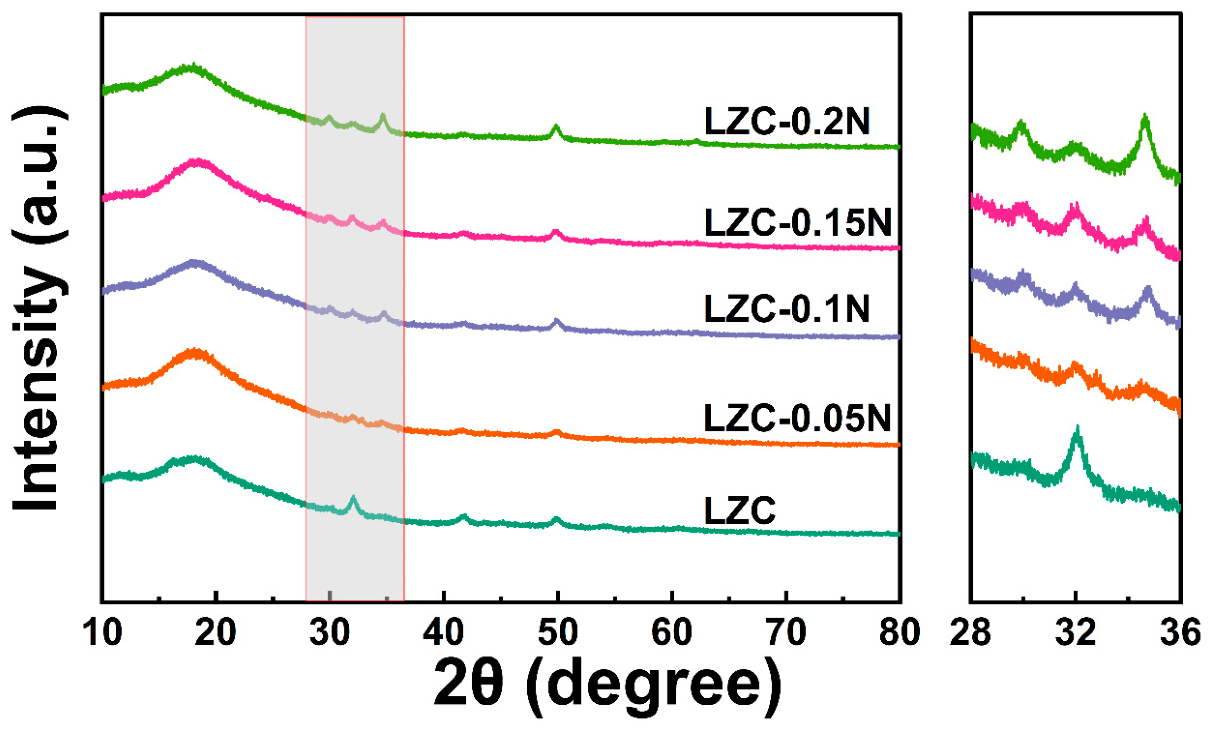
The XRD patterns of Li
2ZrCl
6−3xN
x are shown in
Figure 1. Pristine Li
2ZrCl
6 exhibits a
structure, with characteristic diffraction peaks near 32°, 41.68°, and 49.8°. After N doping, these peaks remain visible, indicating that the
structure is retained. Meanwhile, two additional weak peaks appear at about 30.0° and 34.7° in the doped samples, which are assigned to the
C2/m structure, and the coexistence of the retained
peaks and the
C2/m-related peaks indicates that N
3− incorporation induces a partial structural transition in Li
2ZrCl
6 [
8,
27]. As the N content increases, the
C2/m-related peaks gradually become stronger. They are weak at x = 0.05, become more pronounced at x = 0.10 and x = 0.15, and reach the highest intensity at x = 0.20. This trend suggests that the
C2/m-related structural features become more evident with increasing N content (
Figure S1). Similar anion-substitution-induced structural evolution has also been reported in O-doped Li
2ZrCl
6 [
28,
29,
30].
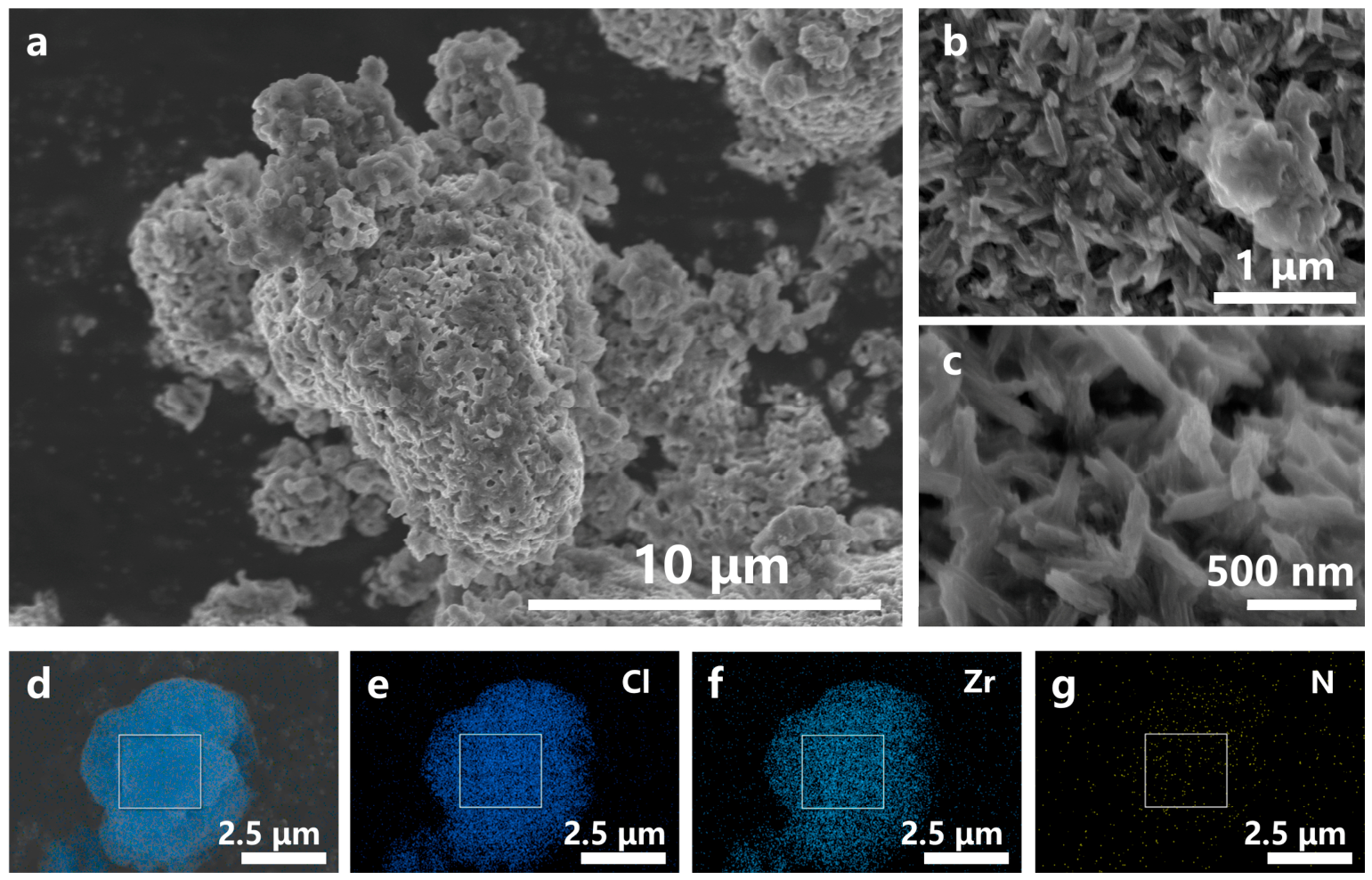
SEM and EDS were used to examine the morphology and elemental distribution of the Li
2ZrCl
5.7N
0.1 sample. The low-magnification SEM image (
Figure 2a) shows irregular micron-sized aggregates with rough surfaces and visible pores. This morphology can be attributed to repeated fracture, refinement, and re-aggregation of precursor particles during high-energy ball milling. The high-magnification SEM image (
Figure 2b,c) further shows that these aggregates consist of nanosized flake-like and short rod-like particles, which are interconnected to form a loose network. EDS mapping (
Figure 2d–g) shows that Zr and Cl are uniformly distributed in the particle region, indicating good elemental homogeneity. The N signal is relatively weak, which is mainly related to the low N content and the limited sensitivity of EDS for light elements. However, no obvious local N enrichment is observed, suggesting the absence of large-scale N-rich regions (
Figure S5).
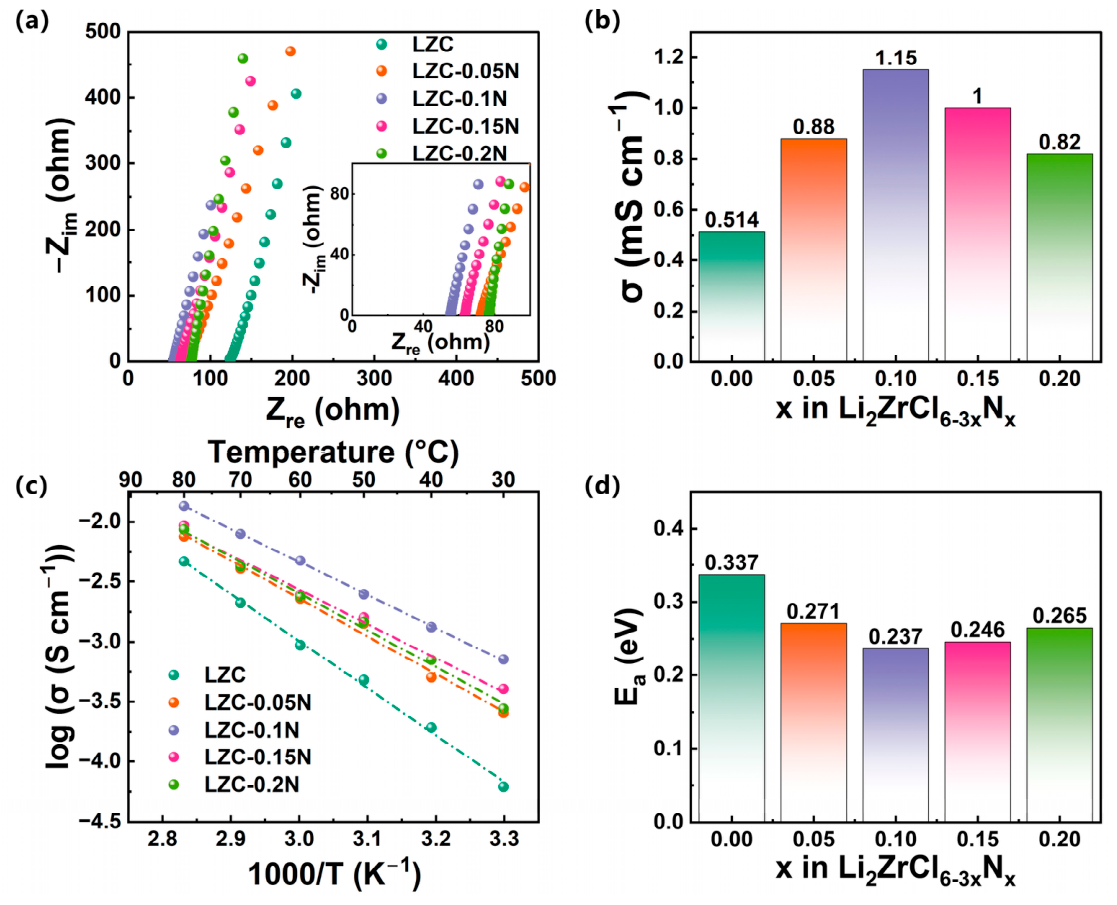
EIS and Arrhenius analyses show that N
3− doping improves the Li
+ transport properties of Li
2ZrCl
6−3xN
x solid electrolytes. The pristine LZC sample shows the largest impedance (
Figure 3a). After N doping, the impedance of the samples decreases. LZC-0.1N shows the lowest impedance, indicating the best ion transport performance. The room-temperature ionic conductivity of LZC is 0.514 mS cm
−1. The conductivities of LZC-0.05N, LZC-0.1N, LZC-0.15N, and LZC-0.2N are 0.88, 1.15, 1.00, and 0.82 mS cm
−1, respectively (
Figure 3b). LZC-0.1N shows the highest conductivity (
Figure S6).
The Arrhenius plots show good linear relationships (
Figure 3c). This indicates that Li
+ transport in these samples follows a thermally activated process. The activation energy of pristine LZC is 0.337 eV. After N doping, the activation energy decreases. The activation energies of LZC-0.05N, LZC-0.1N, LZC-0.15N, and LZC-0.2N are 0.271, 0.237, 0.246, and 0.265 eV, respectively (
Figure 3d). LZC-0.1N shows the lowest activation energy. This agrees with its highest room-temperature ionic conductivity. It indicates the lowest Li
+ migration barrier in this composition.
Overall, the ionic conductivity of Li
2ZrCl
6−3xN
x first increases and then decreases with increasing N content. The activation energy shows the opposite trend. LZC-0.1N has both the highest room-temperature ionic conductivity and the lowest activation energy. This indicates that appropriate N
3− doping can effectively reduce the Li
+ migration barrier. Combined with the XRD results, LZC-0.1N appears to provide a suitable degree of structural regulation for Li
+ transport. Further increasing the N content may introduce unfavorable local disorder or defects, leading to decreased conductivity and increased activation energy. Further increasing the N content leads to lower conductivity and higher activation energy. This suggests that excessive anion regulation is not favorable for further improving Li
+ transport [
28,
31].
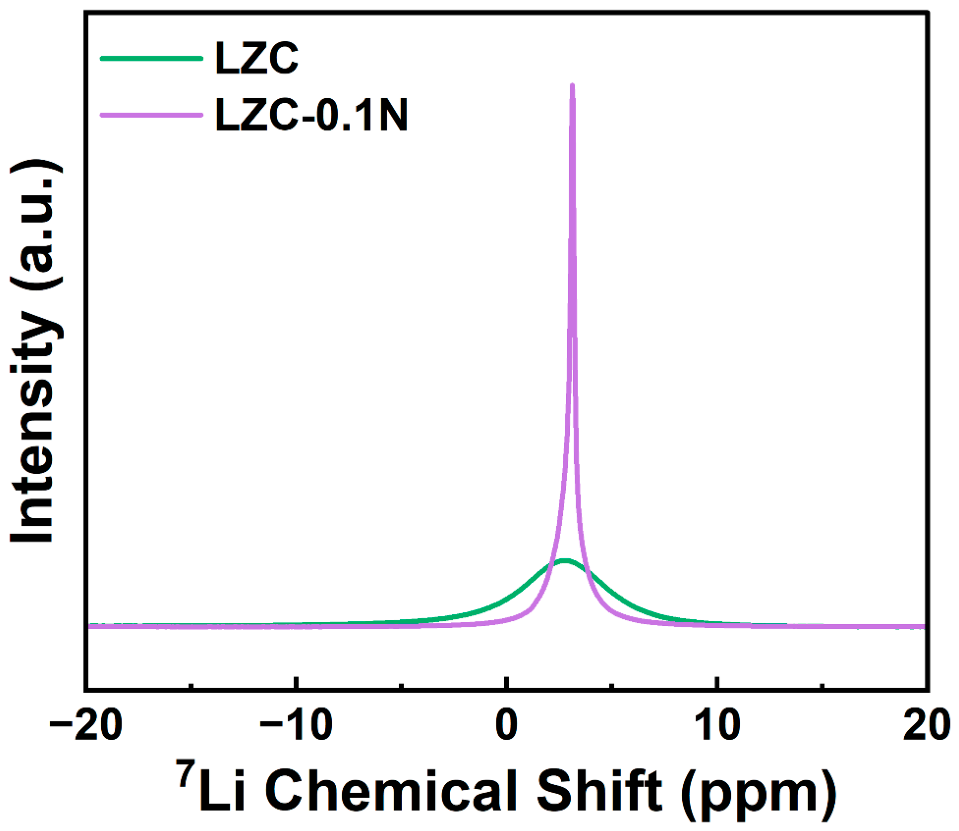
The
7Li solid-state NMR spectra of pristine LZC and LZC-0.1N are shown in
Figure 4. Both samples exhibit a dominant
7Li resonance at around 3 ppm, indicating that the main local Li environment is largely maintained after N doping. Although the XRD results reveal a structural evolution from
Pm1 to
C2/m, the similar
7Li chemical shifts suggest that the local coordination environment around Li
+ does not change drastically. Compared with pristine LZC, LZC-0.1N shows a sharper and narrower
7Li resonance peak, suggesting a narrower distribution of detectable Li local environments and/or motional narrowing associated with enhanced Li
+ dynamics. These results suggest that appropriate N-related modification affects the local structural environment and is beneficial to Li
+ transport in Li
2ZrCl
6-based chloride solid electrolytes.
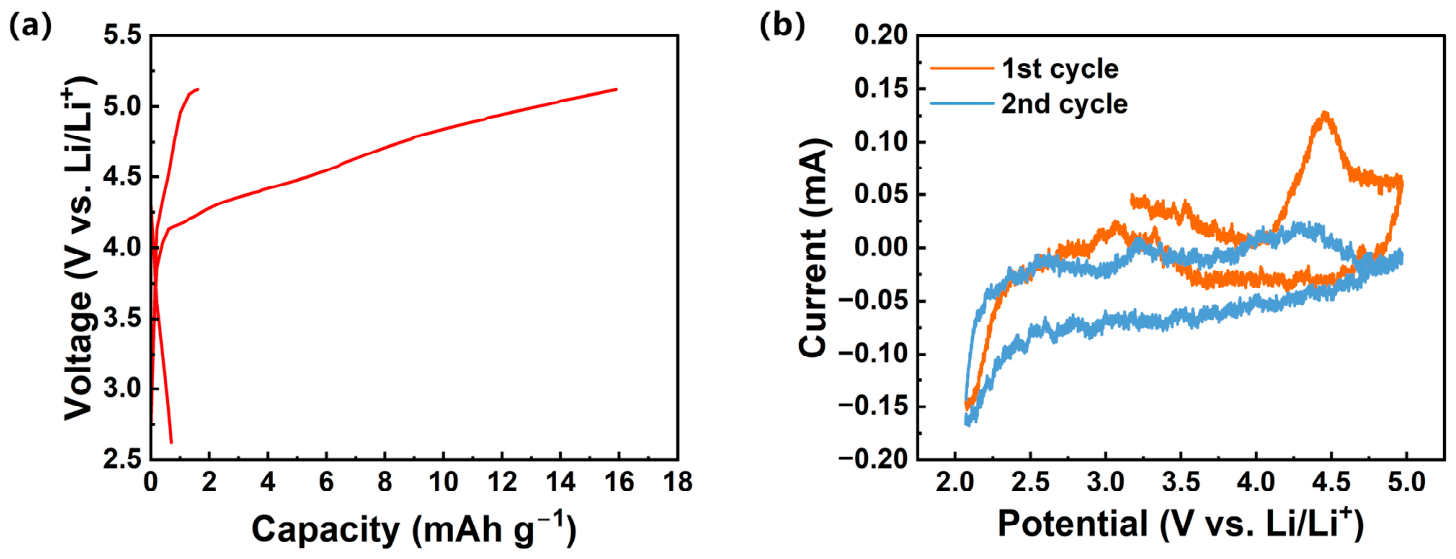
The electrochemical stability of Li
2ZrCl
5.7N
0.1 was evaluated by constant-current polarization and cyclic voltammetry, as shown in
Figure 5. In the constant-current polarization curve (
Figure 5a), the voltage rises rapidly at the beginning and then gradually increases to above 5.0 V vs. Li/Li
+. No obvious decomposition plateau appears below 4.3 V in this high-voltage test, suggesting that Li
2ZrCl
5.7N
0.1 can operate within the selected voltage range of the NCM811-based all-solid-state cell under the present electrode configuration. When the voltage is further increased, a continuous charge capacity is observed, whereas the following discharge capacity is very limited. This suggests that partial irreversible oxidation or interfacial side reactions occur at high potentials.
The CV curves show a similar trend (
Figure 5b and
Figure S2). During the first cycle, the current response is relatively weak at lower potentials, but a clear anodic peak appears at around 4.4–4.6 V. This peak can be attributed to high-voltage oxidative decomposition or interfacial reactions [
31]. The cathodic response in the reverse scan is broad and weak, suggesting poor reversibility of these reactions. In the second cycle, the overall current response is markedly reduced, especially in the high-voltage region. This indicates that the initial side reactions are suppressed after the first scan, possibly due to the formation of a passivating interfacial layer (
Figure S4). Therefore, Li
2ZrCl
5.7N
0.1 can support stable operation within the 2.5–4.3 V voltage window, although slight oxidative reactions may occur at higher potentials.
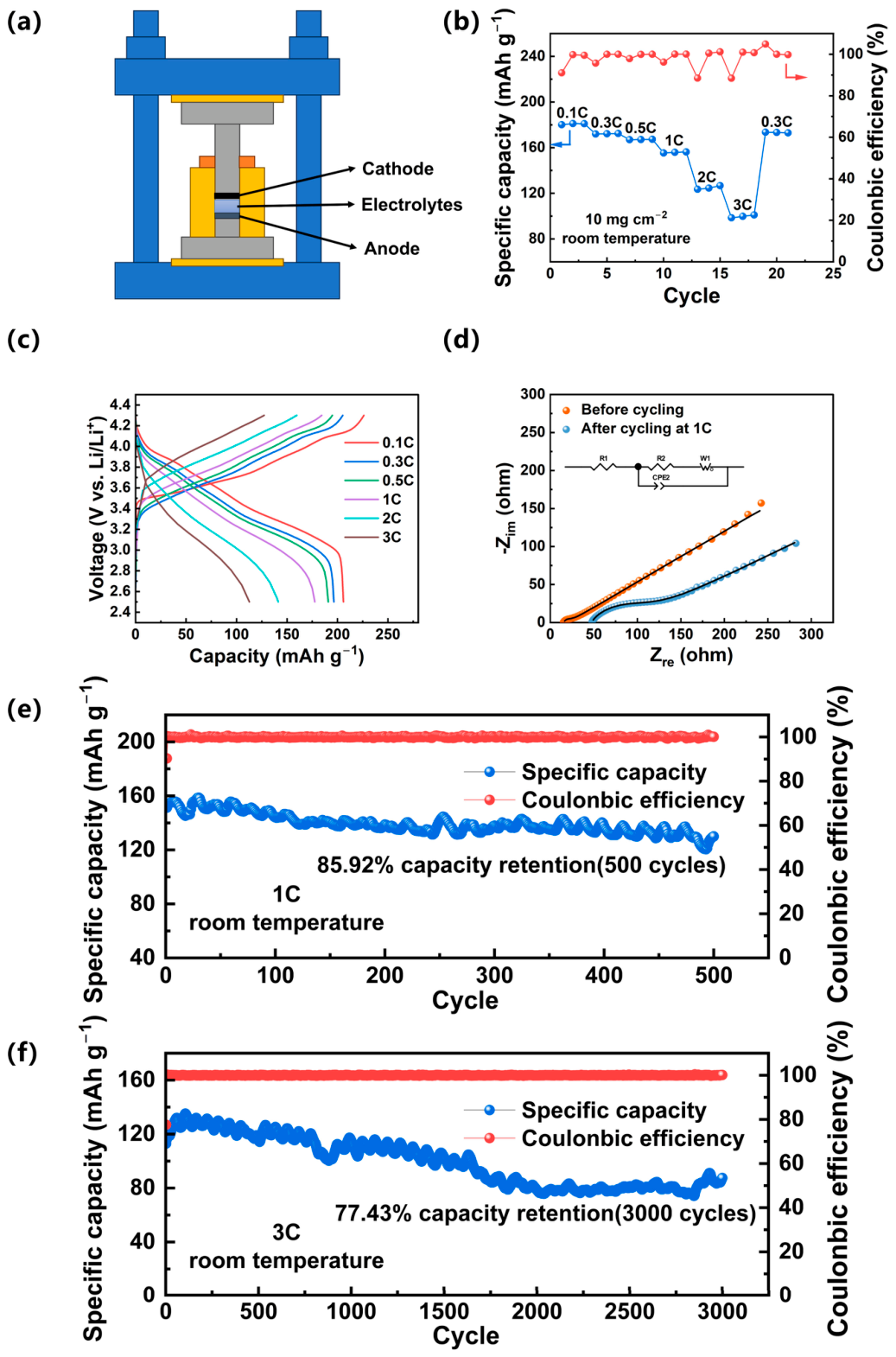
To evaluate the practical applicability of Li
2ZrCl
5.7N
0.1, an all-solid-state battery with a bilayer electrolyte configuration was assembled. The cell consisted of a Li-Si anode, an LPSC buffer layer, a Li
2ZrCl
5.7N
0.1 electrolyte layer, and a cathode composite, as shown in
Figure 6a. The LPSC layer was introduced between Li
2ZrCl
5.7N
0.1 and the Li-Si anode to improve interfacial compatibility and avoid direct contact between the chloride electrolyte and the anode [
32,
33,
34]. At room temperature, the cell with a cathode loading of 10 mg cm
−2 delivered a discharge capacity of approximately 180 mAh g
−1 at 0.1C. As the rate increased to 0.3C, 0.5C, 1C, 2C, and 3C, the capacity gradually decreased, while the cell still retained about 98.5 mAh g
−1 at 3C. When the rate was switched back to 0.3C, the capacity recovered to approximately 173.3 mAh g
−1, indicating good rate capability and reversible capacity recovery (
Figure 6b). The corresponding charge–discharge profiles at different rates are shown in
Figure 6c. The cell exhibits clear charge–discharge profiles at various rates. With increasing current density, the voltage polarization gradually increases, and the discharge capacity decreases, which is a typical behavior of solid-state batteries under high-rate operation. Even at 3C, the cell still maintains a reversible charge–discharge profile, further confirming the favorable Li
+ transport and reaction kinetics enabled by the Li
2ZrCl
5.7N
0.1-based electrolyte. To further evaluate the interfacial stability, EIS spectra were collected before cycling and after cycling at 1C, as shown in
Figure 6d. After cycling, the impedance increases to some extent, indicating that interfacial polarization develops during cycling. Nevertheless, the impedance growth is not accompanied by rapid cell failure, and the cell still maintains stable cycling performance under the present testing conditions. This result indicates that the Li
2ZrCl
5.7N
0.1-based electrolyte can support stable ion transport across the solid-state cell. For long-term cycling at room temperature, the cell maintained stable cycling at 1C and retained 85.92% of its capacity after 500 cycles, with a remaining capacity of about 130 mAh g
−1 (
Figure 6e). The Coulombic efficiency remained close to 100% during cycling, indicating good charge–discharge reversibility. More importantly, the cell also showed stable long-term cycling at a higher rate of 3C. After 3000 cycles, the capacity retention reached 77.43%, and the remaining capacity was about 87.5 mAh g
−1 (
Figure 6f and
Figure S3). These results demonstrate that the Li
2ZrCl
5.7N
0.1-based solid electrolyte can support stable operation of all-solid-state batteries at room temperature, especially under high-rate and long-cycle conditions.
4. Conclusions
In this work, N-doped Li2ZrCl6−3xNx solid electrolytes were successfully prepared via a mechanochemical method. Structural analyses, namely XRD, SEM, EDS, and 7Li MAS solid-state NMR, suggested that the main Li2ZrCl6-related features were largely retained, while appropriate N introduction modified the detectable Li local environment. Among the series, LZC-0.1N exhibited the highest room-temperature ionic conductivity of 1.15 mS cm−1, more than double that of pristine LZC (0.514 mS cm−1), and the lowest activation energy of 0.237 eV, indicating enhanced Li+ mobility. These improvements are attributed to N-doping-induced structural regulation and a more favorable local Li environment.
The practical performance of LZC-0.1N was further demonstrated in all-solid-state cells. The cells showed good rate capability and stable charge–discharge behavior at room temperature. Electrochemical impedance spectroscopy before and after cycling showed moderate impedance growth, indicating that interfacial polarization developed during cycling, although the cell still maintained stable cycling performance. The cells retained 85.92% of their initial capacity after 500 cycles at 1C and 77.43% after 3000 cycles at 3C, highlighting both long-term stability and high-rate performance.
Overall, this study demonstrates that appropriate N-anion doping is an effective strategy to simultaneously regulate crystal structure and local Li environment in Li2ZrCl6-based chloride solid electrolytes. This approach significantly enhances Li+ transport and enables high-performance all-solid-state batteries, providing valuable guidance for future design of halide solid electrolytes with improved ionic conductivity and electrochemical stability.




 and
and