Article

Suppression Method of Sub/Super-Synchronous Oscillation in Direct-Drive Wind Farms Based on a Hybrid GFL-GFM Control Configuration


College of Electrical Engineering, Shanghai University of Electric Power, Shanghai 200090, China
*
Author to whom correspondence should be addressed.
Energies 2026, 19(11), 2661; https://doi.org/10.3390/en19112661
Submission received: 23 April 2026 / Revised: 22 May 2026 / Accepted: 28 May 2026 / Published: 31 May 2026
(This article belongs to the Section A: Sustainable Energy)

Abstract

Currently, grid-following (GFL) control is widely adopted in direct-drive wind farms. Its external impedance characteristic exhibits negative resistance and capacitive reactance, frequently inducing sub/super-synchronous oscillations in the direct-drive wind farm and weak grid interactive system. The positive resistance characteristic of grid-forming (GFM) control can, to a certain extent, improve the impedance characteristic of wind farms and enhance the system stability margin. However, the influence of the proportion and deployment location of GFM control within a wind farm on the mitigation of sub/super-synchronous oscillations merits further exploration. First, this paper establishes the sequence impedance models for both GFL and GFM control, analyzes the underlying causes of system oscillations from an impedance perspective, and proposes a method for calculating the stability margin of a grid-connected direct-drive wind farm system that comprehensively accounts for the generalized short-circuit ratio, the critical short-circuit ratio of the equipment, and the steady-state operational constraints of the system. Subsequently, the mitigation effects of the connection location and capacity proportion of GFM wind turbines on sub/super-synchronous oscillations are quantitatively assessed, yielding feasible ranges of the short-circuit ratio under various operating conditions that ensure stable operation of the direct-drive wind farm. The system stability is further examined via Nyquist curve analysis. Finally, the effectiveness of the proposed method is validated by electromagnetic transient simulations in MATLAB/Simulink.

1. Introduction

With the intensification of global climate change and the energy crisis, energy transition has gradually become a common issue faced by countries worldwide. In alignment with the implementation of the “dual-carbon” energy strategy, the penetration rate of renewable energy sources, particularly wind power, has increased significantly [1,2]. The wind power industry exhibits pronounced regional characteristics, with large-scale direct-drive wind farms predominantly located at the grid extremities where the network architecture is weak and the power source structure is limited [3,4]. During grid integration, the power electronic devices within direct-drive wind farms are prone to interaction with the inductive weak grid, inducing sub/super-synchronous oscillation issues [5]. This poses substantial challenges to the safety and stability of power systems.
Conventional direct-drive wind farms predominantly employ GFL control to interface renewable generation with the grid via power electronic converters, which relies on a Phase-Locked Loop (PLL) to track the voltage frequency/phase information of the grid and inherently lacks rotational inertia [6]. Consequently, grid connection under this mode reduces the overall system inertia. When subjected to external disturbances, the system is highly susceptible to sub/super-synchronous oscillations [7]. To address the insufficient rotational inertia in direct-drive wind farms, Reference [8] proposes an adaptive regulation strategy for virtual inertia parameters, which achieves dynamic optimization of the inertia coefficient and virtual capacitance. This strategy avoids problems such as excessive frequency overshoot and slow recovery speed caused by fixed parameters in conventional methods. Regarding the oscillation issues induced by GFL-based wind turbines, studies [9,10,11,12] have demonstrated through impedance-based analysis that the impedance characteristics of GFL turbines exhibit negative-resistance capacitive behavior within the sub/super-synchronous frequency band. This characteristic readily interacts with the inductive weak grid, leading to LC resonance. Furthermore, the PLL within the GFL control scheme is vulnerable to external perturbations [13,14], which is detrimental to maintaining grid voltage stability.
To address the shortcomings of GFL control, GFM control has been proposed [15,16]. Direct-drive wind turbines based on GFM control feature capabilities such as virtual inertia, virtual damping, primary voltage regulation, and primary frequency regulation [17]. These capabilities enable active grid support and provide an optimal fit for power systems with a high penetration of renewable energy. Existing research has confirmed that the impedance characteristics of GFM turbines exhibit positive resistance behavior within the 40–200 Hz frequency band [18,19]. As the proportion of GFM control within a wind farm increases, the overall impedance characteristic of the direct-drive wind farm gradually aligns with that of the GFM units [20]. This shift can mitigate the negative-damping capacitive characteristics of conventional GFL wind farms, thereby enhancing system damping capability to suppress sub/super-synchronous oscillations. Literature [21] analyzes the influence of GFM turbine control parameters and grid strength on system stability within an islanded scenario, though it lacks quantitative assessment. Literature [22] investigates the coupling interactions between the two control modes and the grid within a hybrid system comprising both GFM and GFL controls, proposing stability boundaries for different operational scenarios.
However, the integration of GFM turbines into wind farms is not unconditionally beneficial. In hybrid direct-drive wind farms, both the control parameters and the penetration ratio of GFM turbines influence the distribution of system inertia and damping [16], thereby affecting overall system stability. Therefore, investigating the capacity ratio between GFL and GFM controls [23] holds significant theoretical relevance and engineering value for ensuring the stable operation of renewable energy grid-integration systems and suppressing post-disturbance sub/super-synchronous oscillations. Currently, research addressing the optimal capacity ratio between GFL and GFM controls primarily focuses on constraint conditions, stability domains, and optimization methodologies [24]. Reference [25] proposes a Semidefinite Programming model to determine the capacity proportion of GFM turbines based on the interaction between the short-circuit ratio and oscillation modes, along with an oscillation risk assessment for hybrid systems. Reference [26] establishes a static stability boundary based on generalized short-circuit ratio constraints and presents an engineering-oriented method for the siting and sizing of GFM turbines. Reference [27] quantifies the influence of controllers and virtual inertia, proposing a controller optimization method to enhance stability across the entire operating domain. While notable progress has been made regarding GFM capacity allocation, the aforementioned studies primarily focus on small-signal stability without comprehensively considering the combined impacts of steady-state operating constraints and converter reactive power limits on the system’s oscillation stability margin.
To further investigate these issues, this paper establishes a hybrid direct-drive wind farm model and evaluates the system stability margin by comprehensively considering the generalized short-circuit ratio, the critical short-circuit ratio of the equipment, and the system’s steady-state operating constraints. Through two typical case studies, the relationship between the stability margin of the hybrid grid-connected system and both the capacity ratio and the integration location of GFM control is elucidated. By developing impedance models of the generation equipment within the hybrid wind farm, a quantitative analysis of the stability margin is performed utilizing Nyquist plots, thereby delineating the stable operation boundary of the hybrid direct-drive wind farm. Finally, electromagnetic transient simulations are conducted using MATLAB/Simulink (Version R2023a) to validate the effectiveness of the proposed method in suppressing system oscillations.
The distinction between the proposed method and existing approaches lies in reconstructing the impedance characteristics of the entire grid-connected system by forming a hybrid direct-drive wind farm. This circumvents the drawbacks of existing methods that rely on improving individual devices or adding supplementary equipment. By providing frequency and voltage support through GFM control, it reshapes the impedance characteristic curve of the entire wind farm, thereby enhancing the stable integration capability of the wind farm under weak grid conditions. From an engineering perspective, compared with the full deployment of GFM control, the hybrid configuration of the two control schemes offers a more practical solution. It avoids the high cost and complexity of retrofitting all wind turbines in a wind farm, striking a balance between stability improvement and economic benefits.

2. Structure and Modeling of Hybrid Direct-Drive Wind Farms

In this paper, a hybrid direct-drive wind farm comprising both GFL and GFM control is constructed by retrofitting a portion of wind turbines from GFL control to GFM control.
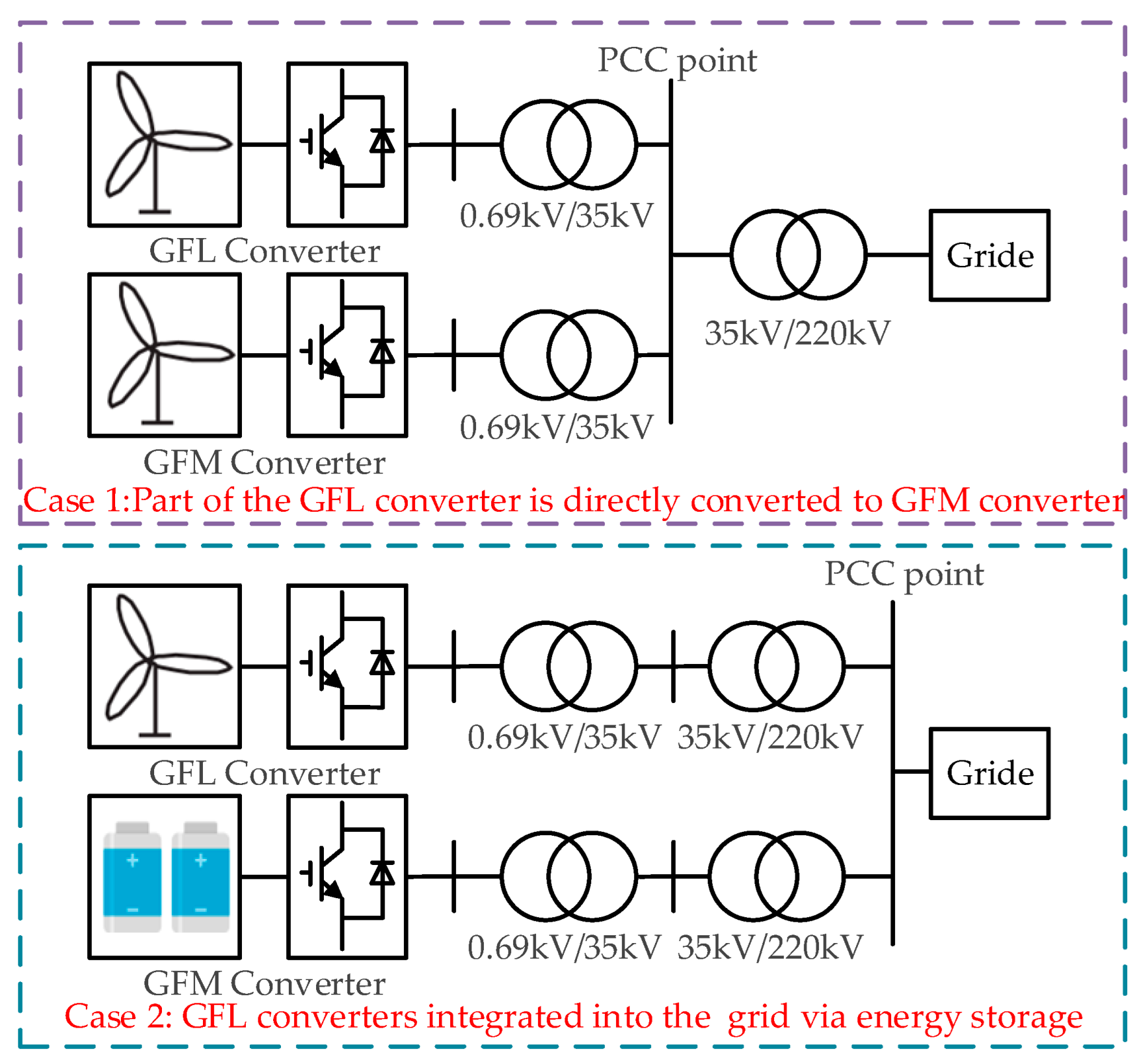
To quantitatively evaluate the mitigation effect of the hybrid wind farm on sub/super-synchronous oscillations and to analyze its stability margin, an equivalent order reduction is performed for the wind farm. Specifically, by categorizing the control schemes, the hybrid direct-drive wind farm is equivalently reduced to one GFL wind turbine and one GFM wind turbine, each representing an aggregation of eight 5-MW direct-drive wind turbines. Two cases are established, as illustrated in Figure 1. In Case 1, the grid-following turbines within the direct-drive wind farm are directly retrofitted, and the GFL and GFM inverters are connected in parallel to the 35 kV bus. In Case 2, the GFM control is deployed as an energy storage system and connected in parallel with the GFL inverters to the 220 kV bus.

2.1. Impedance Modeling of GFL and GFM Wind Turbines

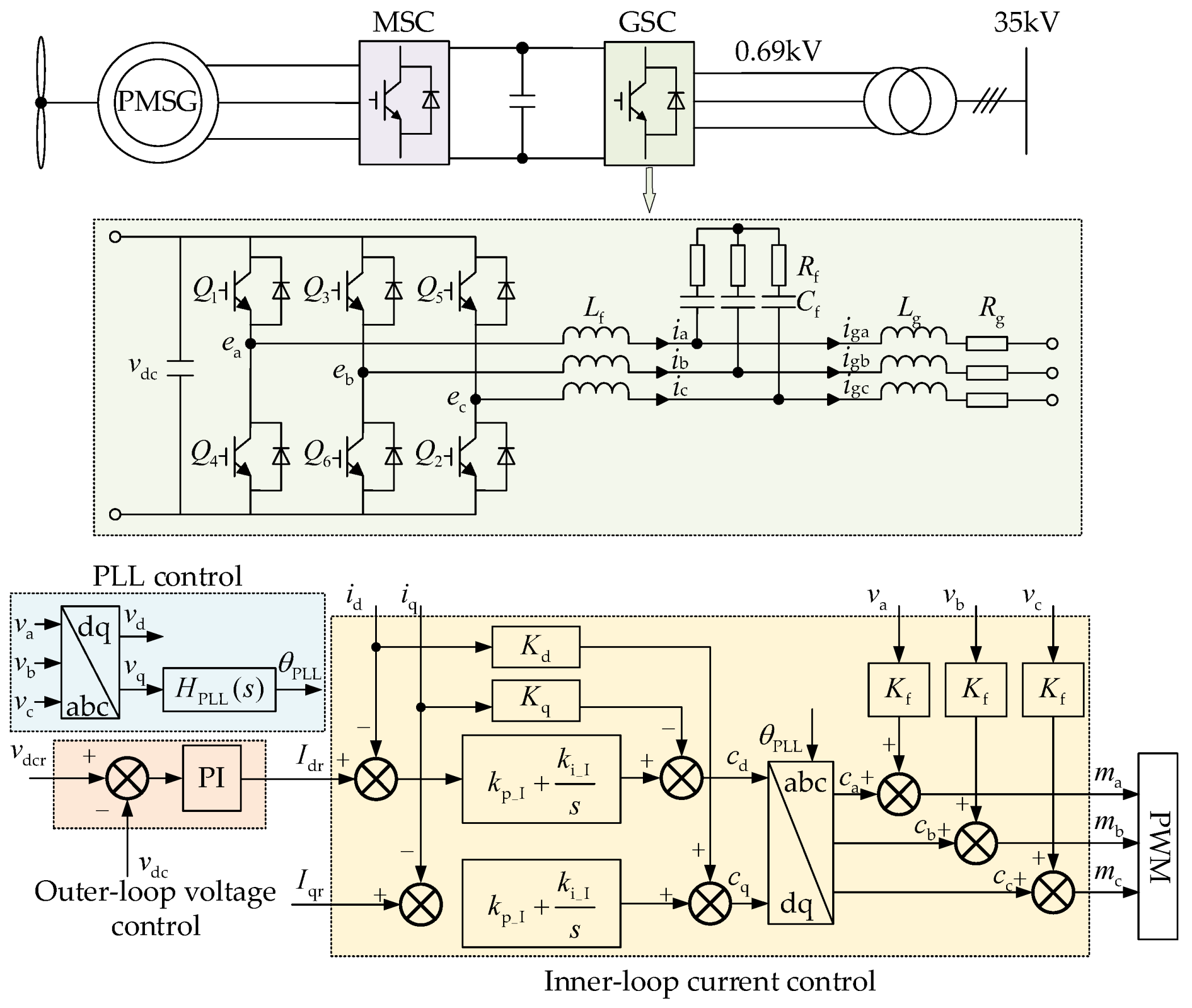
The topology and control scheme of the direct-drive wind turbine adopted in this paper are illustrated in Figure 2. Topology and control scheme of the direct-drive wind turbine. In the figure, i a , i b , i c , v a , v b , and v c denote the output current and output voltage of the wind turbine grid-side converter, respectively; L f , C f , and R f denote the filter inductance, filter capacitance, and damping resistance, respectively; v dcr and v dc denote the DC-side voltage reference value and actual value, respectively; i d is the d-axis current; and i q is the q-axis current; i d r and i q r denote the d-axis and q-axis current reference commands; k d and k q are the d-axis and q-axis current feedforward gain coefficients; k f is the voltage feedforward coefficient; c a , c b , c c stand for the modulation waves in the stationary reference frame; c d and c q represent the modulation waves in the rotating coordinate system; k p _ I and k i _ I denote the proportional and integral coefficients of the current loop.
Owing to the presence of a large capacitor between the machine-side converter (MSC) and the grid-side converter (GSC), the DC-link voltage of the GSC can be regarded as constant. Consequently, the DC-link voltage fluctuation can be neglected during the impedance modeling of the direct-drive wind turbine, and only the grid-side converter needs to be considered, thereby reducing the model complexity. In this paper, the harmonic linearization method is employed to derive the impedance model of the direct-drive wind turbine. By injecting a small-signal voltage perturbation at the point of common coupling (PCC), The perturbation voltage amplitude must be at least one order of magnitude lower than the fundamental frequency voltage, no more than 10% of the fundamental voltage, to avoid introducing excessive disturbances that could shift the steady-state operating point of the system. In this study, the injected perturbation voltage amplitude is set to 5% of the fundamental voltage, and the bandwidth of the small-signal perturbation is 1 Hz to 1 kHz. the frequency-domain expressions for the phase-A voltage and current are obtained as follows [28,29]:
V a [ f ] = V 1 = V 1 / 2 , f = ± f 1 V p = ( V p / 2 ) e ± j φ vp ,   f = ± f p V n = ( V n / 2 ) e ± j φ vn ,   f = ± f n
I a [ f ] = I 1 = ( I 1 / 2 ) e ± j φ i 1 ,   f = ± f 1 I p = ( I p / 2 ) e ± j φ ip ,   f = ± f p I n = ( I n / 2 ) e ± j φ in ,   f = ± f n
where V1 and I1 denote the amplitudes of the fundamental voltage and the fundamental current, respectively; Vp and Ip denote the amplitude of the positive-sequence perturbation voltage and the amplitude of the positive-sequence perturbation current response, respectively; Vn and In denote the amplitude of the negative-sequence perturbation voltage and the amplitude of the negative-sequence perturbation current response, respectively; and f1 denotes the fundamental frequency, while fp and fn denote the positive-sequence perturbation frequency and the negative-sequence perturbation frequency, respectively.
When the influence of the small-signal perturbation on the phase-locked loop (PLL) is considered, the synchronous rotating reference frame transformation matrix T ( θ P L L ) can be expressed as follows:
T ( θ PLL ) 1 Δ θ 0 Δ θ 1 0 0 0 1 · 2 3 cos θ 1 cos ( θ 1 2 π / 3 ) cos ( θ 1 + 2 π / 3 ) sin θ 1 sin ( θ 1 2 π / 3 ) sin ( θ 1 + 2 π / 3 ) 1 / 2 1 / 2 1 / 2
where θ 1 is the rotating reference angle generated by the fundamental positive-sequence voltage, and θ is the rotating reference angle generated by the injected perturbation voltage.
The output reference angle of the PLL equals the sum of the rotating reference angle generated by the fundamental positive-sequence voltage and the rotating angle generated by the injected perturbation voltage, i.e., θ = θ + θ 1 . When the influence of the injected perturbation on the PLL is neglected, θ = θ 1 , and the frequency-domain expression for the voltage at the PCC can be expressed as follows:
V d 1 [ f ] = V 1 , dc G v ( s ± j 2 π f 1 ) V p , f = ± ( f p f 1 ) G v ( s j 2 π f 1 ) V n , f = ± ( f n + f 1 )
V q 1 [ f ] = 0 , dc j G v ( s ± j 2 π f 1 ) V p , f = ± ( f p f 1 ) j G v ( s j 2 π f 1 ) V n , f = ± ( f n + f 1 )
where G v ( s ) is the voltage sampling function, which is used to emulate the sampling delay.
When the influence of PLL is considered, the expression for the PCC voltage in the synchronous rotating reference frame can be derived from the transformation matrix T(θPLL) as follows:
v d = v d 1 + Δ θ v q 1 v q = Δ θ v d 1 + v q 1
From Figure 2. Topology and control scheme of the direct-drive wind turbine, the relationship between the PLL and v q can be expressed as follows:
Δ θ [ f ] = H PLL ( s ) V q [ f ]
For simplicity, the relationship between the injected perturbation voltage and Δ θ is assumed to be:
Δ θ [ f ] = G p ( s ) G v ( s ± j 2 π f 1 ) V p ,   f = ± ( f p f 1 ) G n ( s ) G v ( s j 2 π f 1 ) V n ,   f = ± ( f n + f 1 )
Solving (6), (7), and (8) simultaneously yields the frequency-domain expressions for v d and v q as follows:
V d [ f ] = V 1 , dc G v ( s ± j 2 π f 1 ) V p , f = ± ( f p f 1 ) G v ( s j 2 π f 1 ) V n , f = ± ( f n + f 1 )
V q [ f ] = 0 , dc [ G p ( s ) V 1 j ] G v ( s ± j 2 π f 1 ) V p , f = ± ( f p f 1 ) [ G n ( s ) V 1 ± j ] G v ( s j 2 π f 1 ) V n , f = ± ( f n + f 1 )
To emulate the sampling delay and the PWM delay, the current sampling function is expressed as follows:
G i ( s ) = e T s s ( 1 e T s s ) / [ ( T s s ) ( 1 + s / ω i ) ]
where Ts is the sampling period, and ω i is the filter cutoff angular frequency.
Similarly, the frequency-domain expressions for i d and i q can be obtained as follows:
I d [ f ] = I 1 cos θ i , dc j I 1 sin θ i T PLL ( s ) · G v ( s j 2 π f 1 ) V 1 V p + G i ( s j 2 π f 1 ) I p ,   f = ± ( f p f 1 ) ± j I 1 sin θ i T PLL ( s ) · G v ( s ± j 2 π f 1 ) V 1 V n + G i ( s ± j 2 π f 1 ) I n ,   f = ± ( f n f 1 )
I q [ f ] = I 1 sin θ i , dc ± j I 1 cos θ i T PLL ( s ) G v ( s j 2 π f 1 ) V 1 V p G i ( s j 2 π f 1 ) I p ,   f = ± ( f p f 1 ) j I 1 cos θ i T PLL ( s ) · G v ( s j 2 π f 1 ) V 1 V n ± G i ( s ± j 2 π f 1 ) I n ,   f = ± ( f n f 1 )
where T PLL ( s ) = V 1 H PLL ( s ) / [ V 1 H PLL ( s ) + 1 ] .
According to the inductor current feedforward decoupling control, the modulating signals c d and c q for the grid-connected inverter in the synchronous rotating reference frame are obtained as follows:
c d = ( I dr i d ) H i ( s ) K d i q c q = ( I qr i q ) H i ( s ) + K d i d
where Hi(s) denotes the current PI controller.
From the inverse Park transformation, the expression for the modulating signal ca of the grid-connected inverter in the stationary reference frame is obtained as follows:
C a [ f ] = j 1 2 T PLL ( s j 2 π f l ) V 1 H i ( s j 2 π f 1 ) ( I qr ± j I dr ) G v ( s ) V p + [ H i ( s j 2 π f 1 ) ± j K d ] G i ( s ) I p , f = ± ( f p f 1 ) ± j 1 2 T PLL ( s ± j 2 π f l ) V 1 H i ( s ± j 2 π f 1 ) ( I qr j I dr ) G v ( s ) V n + [ H i ( s ± j 2 π f 1 ) j K d ] G i ( s ) I n , f = ± ( f n f 1 )
Based on Kirchhoff’s voltage and current laws, the relationship between the PCC voltage, the inductor current, and the midpoint voltage of the bridge arm for the grid-side converter of the direct-drive wind turbine can be expressed as follows:
s L f i a i b i c = c a + K f v a c b + K f v b c c + K f v c V dc 2 v a v b v c
where Kf denotes the voltage feedforward coefficient.
From the control block diagram, it can be obtained that m a = c a + K f v a , yielding the frequency-domain expression for ma as follows:
m a [ f ] = j 1 2 T PLL ( s j 2 π f l ) V 1 H i ( s j 2 π f 1 ) ( I qr ± j I dr ) G v ( s ) V p + K f G v ( s ) V p + [ H i ( s j 2 π f 1 ) ± j K d ] G i ( s ) I p , f = ± ( f p f 1 ) ± j 1 2 T PLL ( s ± j 2 π f l ) V 1 H i ( s ± j 2 π f 1 ) ( I qr j I dr ) G v ( s ) V n + K f G v ( s ) V n + [ H i ( s ± j 2 π f 1 ) j K d ] G i ( s ) I n , f = ± ( f n f 1 )
Substituting (17) into (16) yields the mathematical expression for the sequence impedance model of the direct-drive wind turbine.
Z GFL , P ( S ) = s L f + V dc 2 ( H i ( s j ω 1 ) j K d ) G i ( s ) 1 V dc 2 K f G v ( s ) V dc 4 T PLL ( s j ω 1 ) V 1 G v ( s ) H i ( s j ω 1 ) ( I dr + j I qr )
Z GFL , n ( S ) = s L f + V dc 2 ( H i ( s + j ω 1 ) + j K d ) G i ( s ) 1 V dc 2 K f G v ( s ) V dc 4 T PLL ( s + j ω 1 ) V 1 G v ( s ) H i ( s + j ω 1 ) ( I dr j I qr )
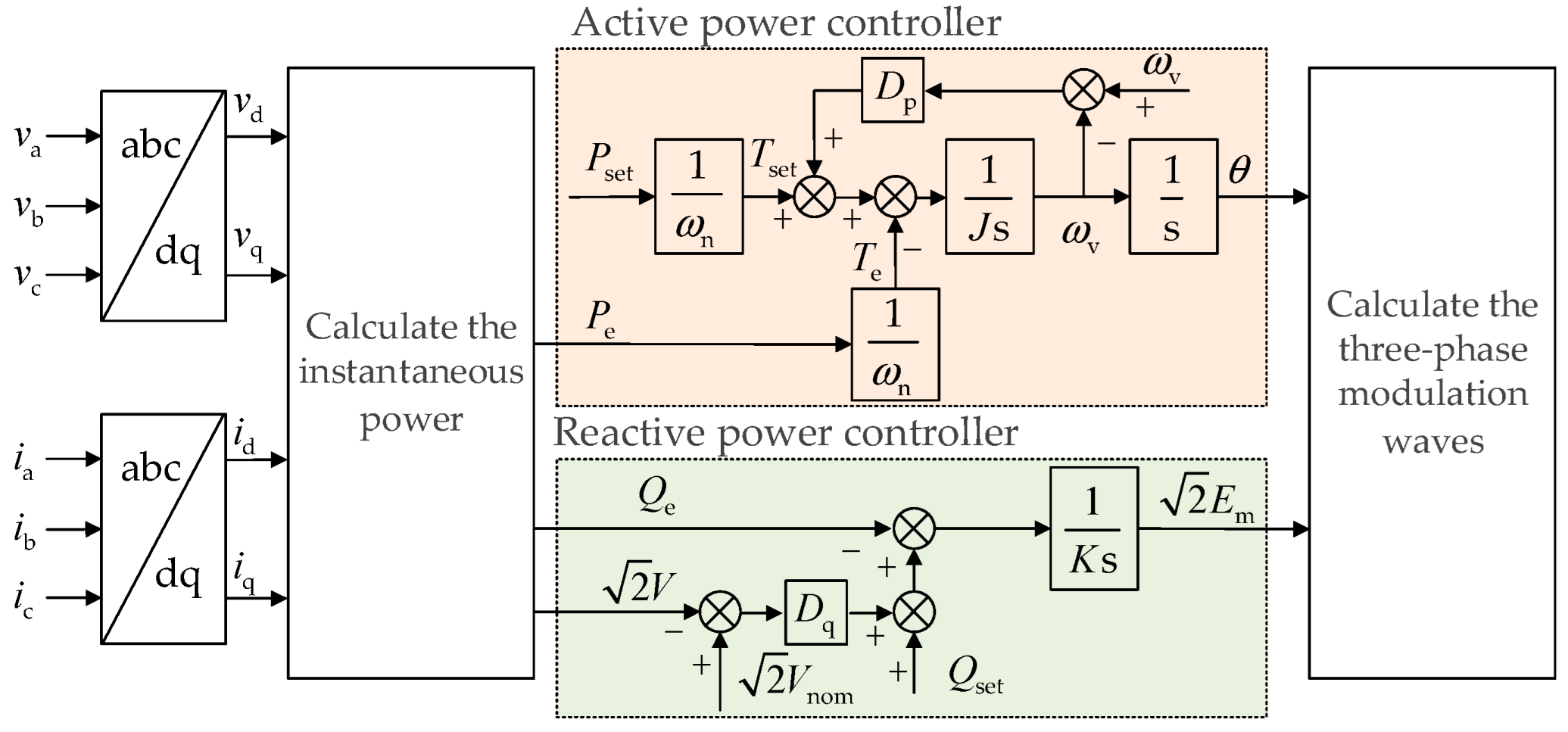
The control scheme of the grid-forming VSG control is illustrated in Figure 3. Its impedance modeling procedure follows the same approach as the sequence impedance modeling of the direct-drive wind turbine described previously and is therefore not elaborated in detail here. The derived mathematical model of the sequence impedance is given by:
Z GFM , p ( s ) = [ 3 V 1 4 ω n M ( s j 2 π f 1 ) K ( s ) e j φ vir + s L f ] / [ 1 + 3 I 1 4 ω n M ( s j 2 π f 1 ) K ( s ) e j ( φ vir φ i 1 ) ]
Z GFM , n ( s ) = [ 3 V 1 4 ω n M ( s + j 2 π f 1 ) K ( s ) e j φ vir + s L f ] / [ 1 + 3 I 1 4 ω n M ( s + j 2 π f 1 ) K ( s ) e j ( φ ii φ vir ) ]
where K ( s ) = 2 E m e 1.5 T s s / [ ( 1 + s / ω v ) ( 1 + s / ω i ) ] .

2.2. Comparison of Impedance Characteristics Between GFL and GFM Wind Turbines

To verify the accuracy of the impedance models established previously and to comparatively analyze the impedance characteristics of GFL control and GFM control, a frequency-scan simulation platform is constructed in MATLAB/Simulink in this section. The control parameters of the GFL wind turbine and the GFM wind turbine are listed in Table 1 and Table 2, respectively.
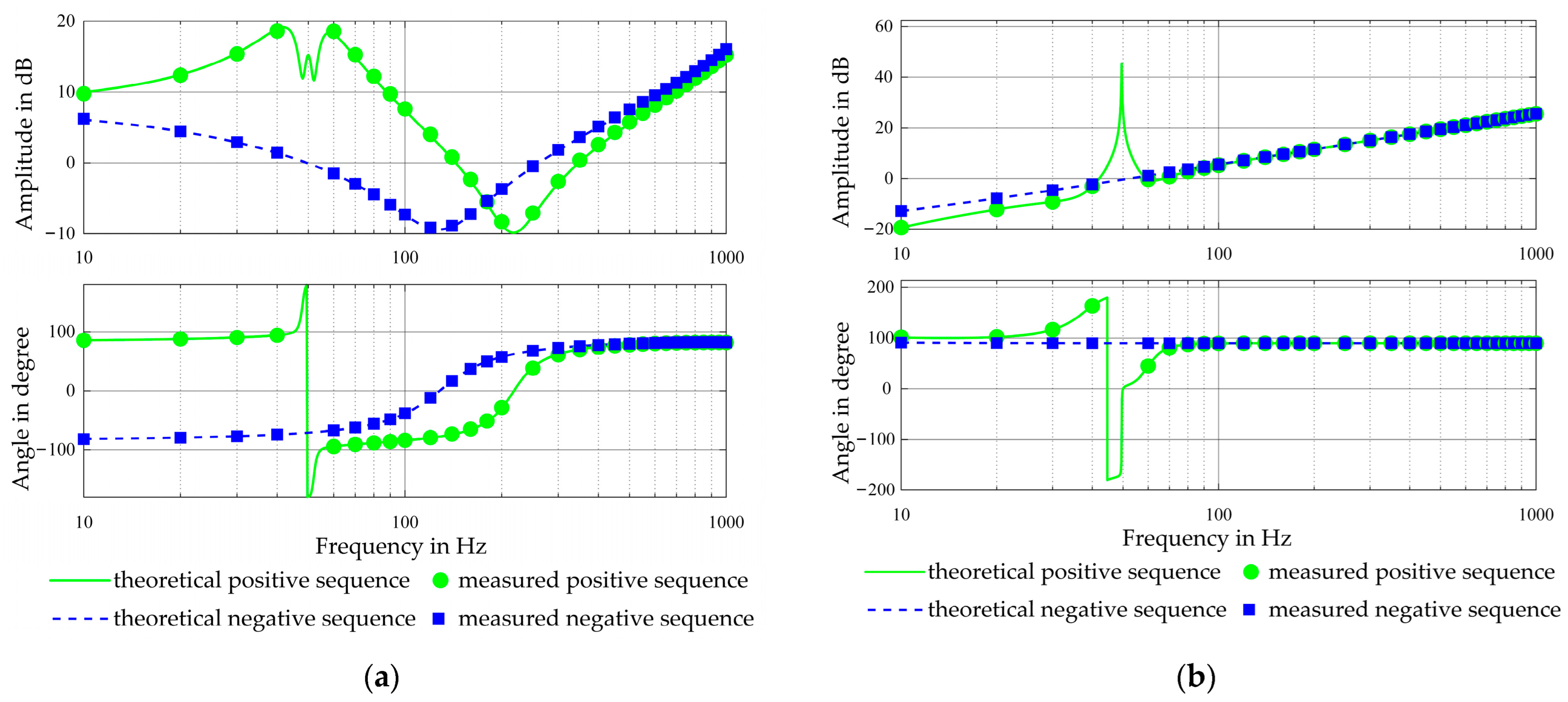
The impedance characteristic curves of the two control types obtained from the frequency-scan simulations are shown in Figure 4. The model developed in this paper incorporates nonlinear elements including the PLL, the current loop, PWM modulation and sampling delay, and the power controllers. As can be observed from Figure 4, within the sub/super-synchronous frequency range, the theoretical impedance values of the generation equipment in the direct-drive wind farm established in this paper agree well with the frequency-scan results, thereby validating the accuracy of the sequence impedance model developed in this section.
Consequently, this model can be reliably employed in the subsequent stability analysis of the grid-connected wind farm. From the sequence impedance characteristic of the GFL wind turbine, it is evident that within the sub/super-synchronous frequency band—particularly in the positive-sequence impedance—the magnitude-frequency response exhibits a negative-damping capacitive characteristic over the 40–200 Hz range. When integrated into a weak grid, this behavior readily couples with the inductive nature of the weak grid, leading to LC resonance and an elevated risk of system instability.
In contrast, the impedance characteristic of the GFM wind turbine displays a positive-resistance nature within the 40–200 Hz frequency range. Therefore, constructing a hybrid wind farm comprising both GFL and GFM wind turbines can effectively improve the overall impedance profile of the wind farm and suppress system oscillations from an impedance perspective. Nevertheless, the optimal capacity proportion of GFM wind turbines within such a hybrid configuration remains to be determined. In the following sections, the GFM penetration level will be determined based on the stability margin criterion and the steady-state operational constraints of the system, and the mitigation effects of different GFM proportions on sub/super-synchronous oscillations will be quantitatively analyzed.

3. Analysis of the Oscillation Mitigation Mechanism in Hybrid Wind Farms

3.1. Frequency Support Strength and Voltage Support Strength

In power systems, the strength of frequency support is generally reflected in two dimensions. The first is the inertial support capability, which characterizes the rate of change in frequency during the initial stage following an active power disturbance. The second is the primary frequency regulation capability, which reflects the amount of active power that the system can absorb or deliver in response to a frequency deviation.
Synchronous generators inherently possess both inertia and primary frequency regulation capability. Their inertia is a constant value, independent of the operating point, whereas their primary frequency regulation capability is closely related to the operating point and the droop setting of the governor. In contrast, for non-synchronous generation sources, both the inertial support and primary frequency regulation capability are entirely determined by their control strategies and available power margins. Currently, the non-synchronous generation sources deployed in wind farms predominantly operate under maximum power point tracking control, which decouples their output power from the grid frequency. Consequently, such generation sources provide virtually no frequency support to the grid.
The voltage support strength of a non-synchronous generation source refers to the capability of the grid-connected inverter to maintain the line-to-line voltage magnitude at the PCC. The actual control objective is achieved through conventional outer-loop and inner-loop controllers. However, when the d-axis and d-axis currents of the inner-loop current controller enter the saturation region, the inner-loop output can no longer track the preset control targets of the outer loop. Therefore, whether the inner-loop current controller operates within the saturation limits plays a decisive role in determining the external characteristics of the non-synchronous generation source. The fundamental cause of inner-loop current saturation is the voltage dip at the PCC. So, the PCC voltage must be maintained within a vicinity of its rated value to prevent the d-axis and d-axis currents from reaching the saturation boundaries, thereby ensuring stable operation of the wind turbine. Accordingly, the static voltage stability of the grid-connected wind power system following an external disturbance is a necessary prerequisite for maintaining stable system operation.

3.2. Enhancement Method for the Frequency and Voltage Support Strength of Hybrid Direct-Drive Wind Farms

To enhance the voltage support strength and frequency support strength of direct-drive wind farms, this paper proposes retrofitting a portion of the GFL wind turbines in conventional wind farms into GFM wind turbines, thereby constructing a hybrid direct-drive wind farm comprising both GFL and GFM wind turbines. By employing grid-forming VSG control to emulate the characteristics of synchronous machines, the direct-drive wind turbine is endowed with inertia and damping characteristics analogous to those of a synchronous generator, thereby strengthening its voltage and frequency support to the grid.
As illustrated in Figure 3, the primary frequency regulation capability of a synchronous generator is emulated through the active power control loop of the grid-forming VSG control, thereby providing frequency support for the direct-drive wind farm. The mathematical expression is given as follows:
T set + ( ω n ω v ) D p T e = J s ω v
T e = P e ω v P e ω n
T set = P set ω v P set ω n
ω v = s θ
where J denotes the moment of inertia, ω v denotes the output angular frequency, ω n is the grid angular frequency, D p denotes the active power damping coefficient, D q is the reactive power damping coefficient, T set denotes the torque reference value, T e denotes the electromagnetic torque, and θ denotes the phase angle of the internal voltage.
The reactive power control loop of the grid-forming VSG control provides voltage support for the direct-drive wind farm, thereby maintaining the static voltage stability of the grid-connected wind power system following an external disturbance. The corresponding mathematical expression is given as follows:
Q set + 2 D q ( V nom V ) Q e = 2 K s E m
where K denotes the reactive inertia coefficient, V nom denotes the rated RMS voltage, and V denotes the output RMS voltage.

3.3. Analysis of the Oscillation Mitigation Mechanism Based on the Short-Circuit Ratio

The short-circuit ratio (SCR) is defined as the ratio of the three-phase short-circuit capacity of the grid to the capacity of the connected equipment. A larger SCR generally indicates better system stability. In the hybrid direct-drive wind farm depicted in Figure 1, the capacity of the GFL wind turbine is normalized to unity. When no GFL wind turbine has been retrofitted to a GFM wind turbine, the system SCR can be expressed as follows:
S C R 1 = 1 X T + X g
where X T is the transformer impedance, and X g is the grid impedance.
After the addition of the GFM wind turbine, the system SCR can be expressed as follows:
S C R 2 = 1 X T + X g X 1 / S GFM
where X 1 / S GFM denotes the equivalent impedance of the GFM equipment.
From (27) and (28), it can be observed that the system SCR exhibits an increasing trend after the integration of GFM wind turbines into the wind farm. This phenomenon indicates that the inherent voltage-source external characteristic of GFM control can effectively enhance the grid strength at the point of interconnection, thereby improving the impedance characteristic and dynamic response capability at the PCC. Since the physical essence of the SCR can be interpreted as the sensitivity of the node voltage to the injected disturbance current, an increase in its value implies that the system possesses greater voltage stiffness in response to current fluctuations. Consequently, the introduction of GFM wind turbines contributes to the mitigation of potential sub/super-synchronous oscillations during the grid-connected operation of direct-drive wind farms and reduces the risk of resonance instability arising from the interaction between the PLL and series-compensated networks under weak grid conditions. Further analysis reveals that under lower short-circuit current levels, the system exhibits a higher sensitivity characteristic, which can provide the hybrid direct-drive wind farm with more sufficient frequency response capability and voltage support strength, thereby creating favorable conditions for maintaining the small-signal stability margin of the system.

4. Stability Margin Calculation Method for Hybrid Direct-Drive Wind Farm Grid-Connected System

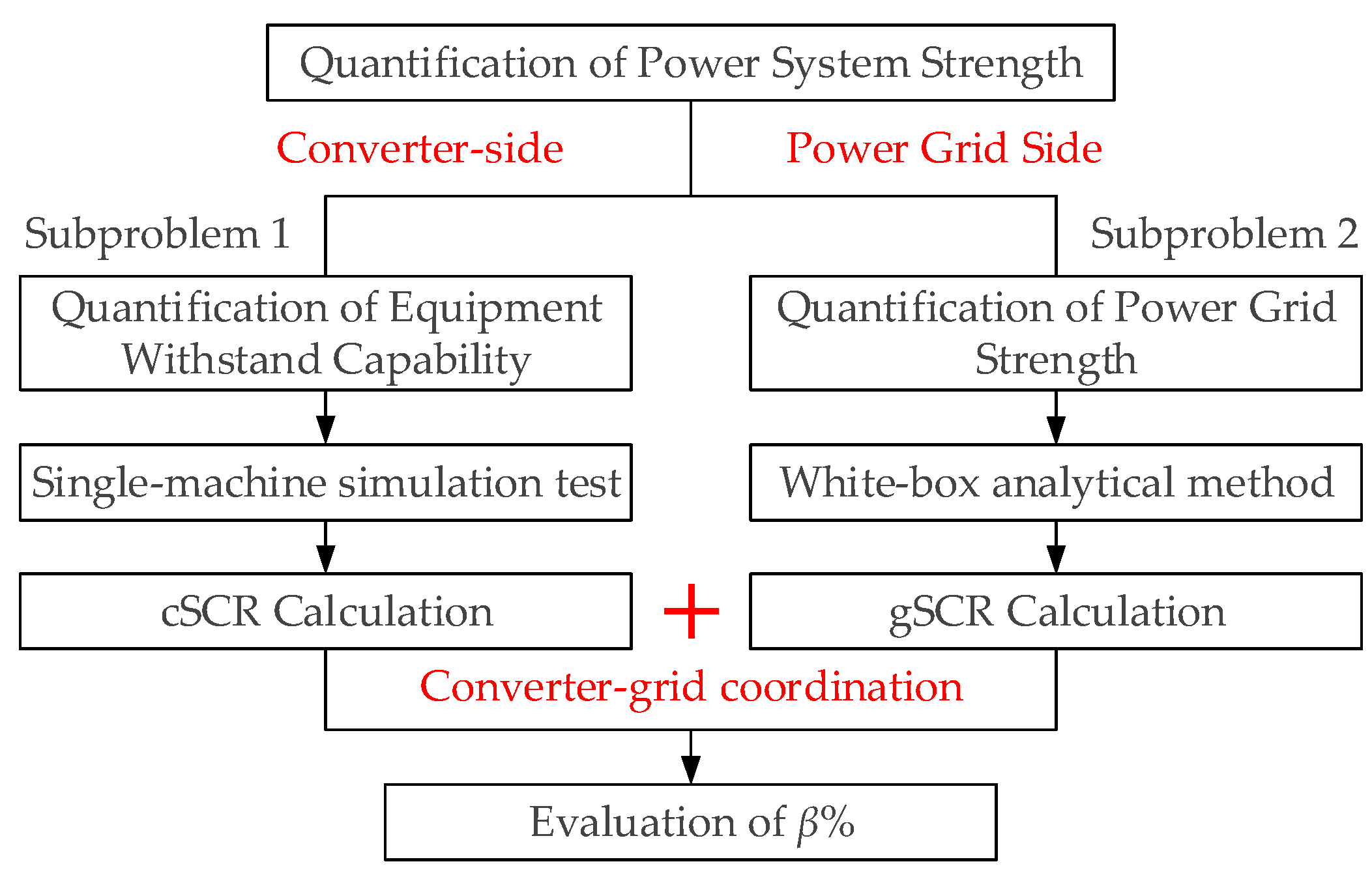
Based on the Technical Regulations for the Integration of Wind Farms into Power Systems, this section analyzes the limitations of the conventional generalized short-circuit ratio (SCR), which reflects only the grid-side characteristics while neglecting the equipment-side aspects. This paper explicitly distinguishes between the equipment short-circuit ratio and the grid short-circuit ratio (gSCR). Following a source-grid coordinated strategy, the system strength is defined by comprehensively considering both the equipment critical short-circuit ratio (cSCR) and the grid short-circuit ratio. Furthermore, a stability margin evaluation method for wind power grid-connected systems is proposed by comprehensively taking into account the steady-state operational constraints of the grid-connected direct-drive wind farm.

4.1. System Strength Constraints

The conventional gSCR only accounts for the influence of synchronous machine sources in the grid, while failing to consider the impact of non-synchronous generation sources in renewable energy plants. In emerging power systems characterized by an increasing penetration of power electronic equipment, relying solely on the gSCR to analyze the voltage support strength exhibits certain limitations. To address this issue, this paper proposes a coordinated “equipment-grid” approach by comprehensively incorporating the equipment critical short-circuit ratio and the generalized short-circuit ratio to define the system strength, thereby characterizing the voltage support strength.
The quantification procedure of the system strength is illustrated in Figure 5. The equipment side and the grid side of the grid-connected direct-drive wind farm system are first decoupled and then coordinated. Specifically, this can be decomposed into two sub-problems: (1) quantification of the grid strength; and (2) quantification of the equipment critical short-circuit ratio. The gSCR can be directly calculated using a white-box method based on the definition of the short-circuit ratio, provided that the grid parameters and the system short-circuit capacity are known. The quantitative determination of the cSCR is performed through single-machine simulation tests. By constructing a single-infeed simulation system containing only one direct-drive wind turbine, the minimum short-circuit ratio that ensures stable system operation can be obtained.
In practical engineering applications, to account for the influence of uncertain factors on the stability of grid-connected wind power systems, it is stipulated that the gSCR must exceed the cSCR. Additionally, a certain stability margin should be retained based on practical engineering experience. Consequently, the relative value between the gSCR and the cSCR, denoted by β % , is required to be greater than 0. When β %     20 % , the system is considered to possess a relatively high stability margin.
β % g S C R c S C R c S C R 100 %
Once the dynamic performance of the direct-drive wind turbine is determined, the cSCR remains unchanged. Under this condition, the system strength can be quantitatively described solely by the gSCR, and the system stability margin can be quantitatively analyzed based on (29). In engineering practice, the equipment critical short-circuit ratio is specified by the manufacturer upon delivery of the wind turbine. The equipment critical short-circuit ratio adopted in this study is 1.8. According to (29), when the gSCR ≥ 2.16, the stability of the grid-connected wind power system can be ensured, and a favorable stability margin is concurrently achieved.

4.2. System Steady-State Operational Constraints

According to the technical specifications for wind farm grid integration, the hybrid direct-drive wind farm established in this paper must satisfy not only the basic power flow constraints but also additional requirements, including the voltage deviation constraint at the PCC and the power factor constraint of the direct-drive wind turbine.
(1) PCC Voltage Deviation Constraint
The voltage at the PCC of the established hybrid direct-drive wind farm shall be permitted to fluctuate within the range of 0.9 p.u. to 1.1 p.u. Accordingly, the PCC voltage constraint is expressed as follows:
U min U WF U max
(2) Wind Turbine Power Factor Constraint
Since the GFM wind turbine control system can emulate the primary voltage regulation characteristic and the droop characteristic of a synchronous machine, it is necessary to impose limits on the reactive power of the GFM wind turbine while fully utilizing its reactive power regulation capability. The power factor of the hybrid direct-drive wind farm shall be dynamically adjustable within the range of 0.95 p.u. leading to 0.95 p.u. lagging. Accordingly, the power factor constraint to be satisfied is expressed as follows:
φ = arccos P GFM P GFM 2 + Q GFM 2
c o s φ > 0.95 p . u .

4.3. Calculation Method for the Stability Margin of Grid-Connected Hybrid Direct-Drive Wind Farm Systems

This section evaluates the influence of the GFM wind turbine proportion on the stability margin of the grid-connected system, using the minimum short-circuit ratio that ensures stable operation when the hybrid direct-drive wind farm is integrated into the AC grid as the quantitative index. The detailed solution procedure is outlined as follows:
Step 1: For a given set of operating conditions—namely, the total wind farm output PWF, the GFM wind turbine output PGFM, the GFL wind turbine output PGFL, and the gSCR, where P WF   =   P GFM   +   P GFL . Determine whether a feasible power flow solution exists under this operating condition. When a feasible power flow solution exists, assess, based on the resulting electrical quantities, whether the PCC voltage deviation and the wind turbine power factor constraints satisfy the steady-state operational requirements.
Step 2: Keeping the total wind farm output constant, sweep the GFM wind turbine proportion over the range of 1% to 50% with a step size of 1%.
Step 3: Keeping the total wind farm output constant, sweep the gSCR over the range of 0.1 to 10 with a step size of 0.01.
Step 4: Employ the method described in Step 1 to screen the operating conditions obtained in Steps 2 and 3, retaining only those that satisfy the multi-dimensional constraints. From these feasible conditions, determine the stable operation region of the grid-connected hybrid direct-drive wind farm, and further derive the corresponding SCR adaptation boundaries for different GFM wind turbine proportions.
Through the above solution procedure, the stable operation regions of the grid-connected hybrid direct-drive wind farm system under various operating scenarios can be obtained, along with the evolution characteristics of the system stability margin under different working conditions.

5. GFM Capacity Proportion and Simulation Verification Under Typical Scenarios

5.1. GFL Capacity Proportion Under Typical Scenarios

Based on the stability margin calculation method and associated constraints for grid-connected hybrid direct-drive wind farms proposed in the previous section, this section focuses on investigating the relationship between the capacity proportion of GFM wind turbines and the system stability margin under typical operating scenarios.
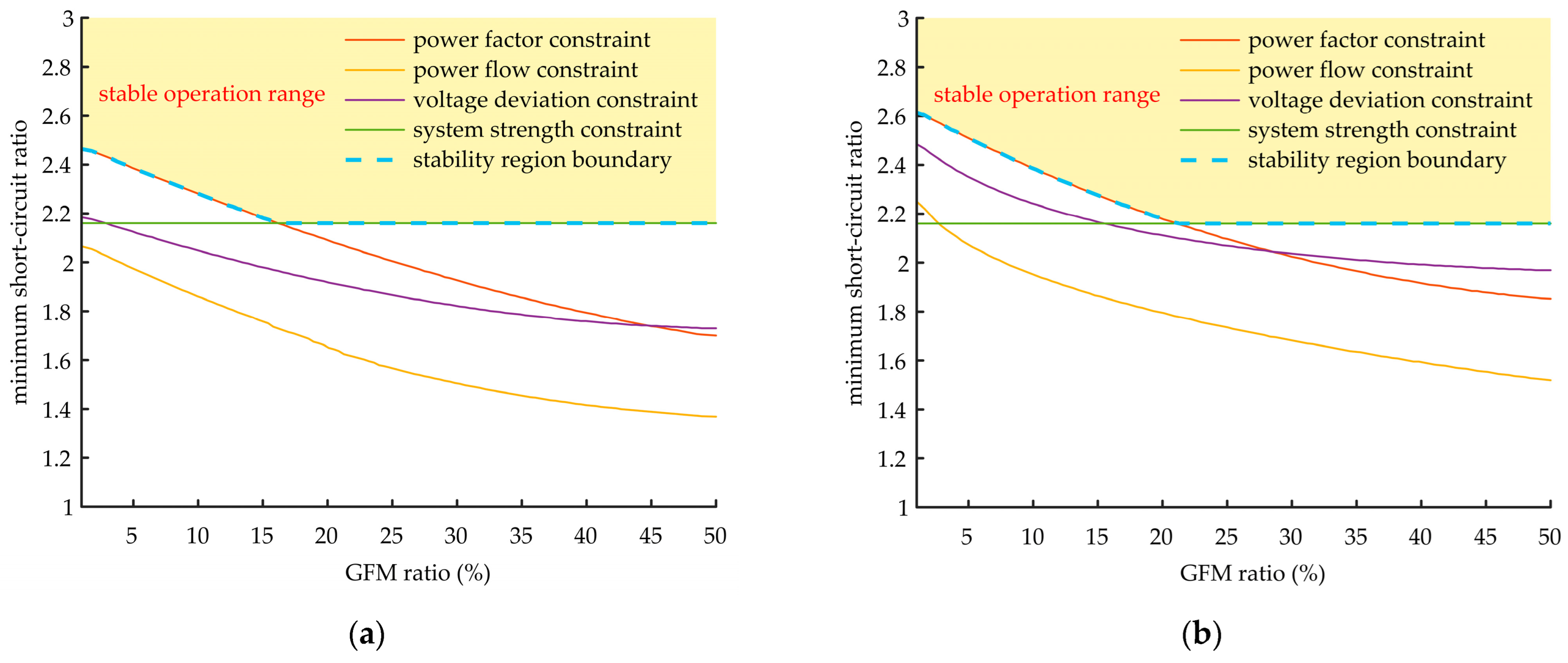
As can be observed from Figure 6a, in Scenario 1, the stable operation region of the grid-connected wind farm system exhibits significant differences under the power factor constraint, the power flow constraint, and the voltage deviation constraint, depending on the proportion of GFM wind turbines. Compared with the PCC voltage deviation constraint, the power factor constraint of the wind turbine exerts a more pronounced effect in reducing the stability margin of the hybrid wind farm grid-connected system. Nevertheless, as the GFM proportion increases, the system stability margin under the power factor constraint gradually improves. It can also be noted that the boundary of the stable operation region is predominantly limited by the wind turbine power factor constraint; the voltage deviation constraint only becomes evident when the GFM proportion is relatively high. Under the condition of considering the system strength constraint, when the GFM proportion exceeds 16.1%, the lower envelope of the system stable operation region remains constant, and the short-circuit ratio no longer decreases—that is, it equals the minimum gSCR required to satisfy a 20% stability margin under the “equipment-grid” coordinated governance framework. Consequently, a GFM proportion of 16.1% can be regarded as the minimum required value for the system stable operation region. Once this value is attained, no further retrofitting of GFL wind turbines is necessary; the wind farm can operate stably at the minimum grid short-circuit ratio permitted by the system strength constraint while maintaining a relatively high stability margin.
As illustrated in Figure 6b, in Scenario 2, where grid-forming energy storage is incorporated into the wind farm, the system stable operation region is primarily influenced by the power factor constraint and the voltage deviation constraint. Moreover, when the proportion of grid-forming energy storage exceeds 28%, the voltage deviation constraint becomes the dominant limiting factor, further reducing the stable operation region. Taking the system strength constraint into account, when the GFM proportion surpasses 21.3%, the lower envelope of the system stable operation region remains constant, and the short-circuit ratio no longer declines—that is, it equals the minimum grid short-circuit ratio that meets the stability margin requirement under the “equipment-grid” coordinated governance framework. Thus, a GFM proportion of 21.3% can be considered the minimum required threshold for the system stable operation region. Once this threshold is reached, no additional retrofitting of GFL wind turbines is required, and the wind farm can operate stably at the minimum grid short-circuit ratio allowed by the system strength constraint, ensuring a relatively high stability margin.
As shown in Table 3, based on the analysis of the GFM% under typical scenarios, the following conclusions can be drawn. In Scenario 1, where a decentralized grid-forming scheme is adopted by directly retrofitting the existing direct-drive wind turbines, the minimum GFM proportion required for the grid-connected direct-drive wind farm system to achieve stable operation—while satisfying both the system strength constraint and the steady-state operational constraints—is 16.2%. In Scenario 2, where a centralized grid-forming scheme is implemented by integrating grid-forming control in the form of energy storage, the minimum GFM proportion needed to meet the prescribed stability margin is 21.3%.
In summary, compared with the direct installation of additional grid-forming equipment, retrofitting existing GFL wind turbines necessitates a smaller proportion of GFM apparatus. Under the premise of ensuring stable system operation with an adequate stability margin, the decentralized grid-forming approach exhibits superior economic performance.

5.2. Simulation Verification

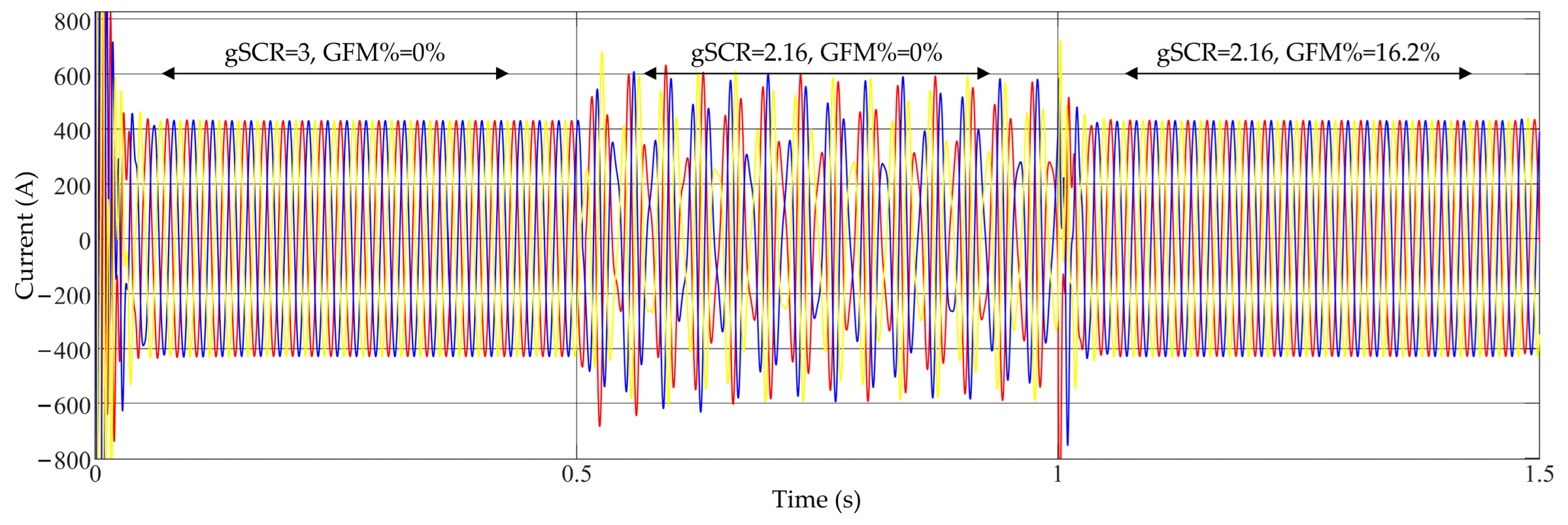
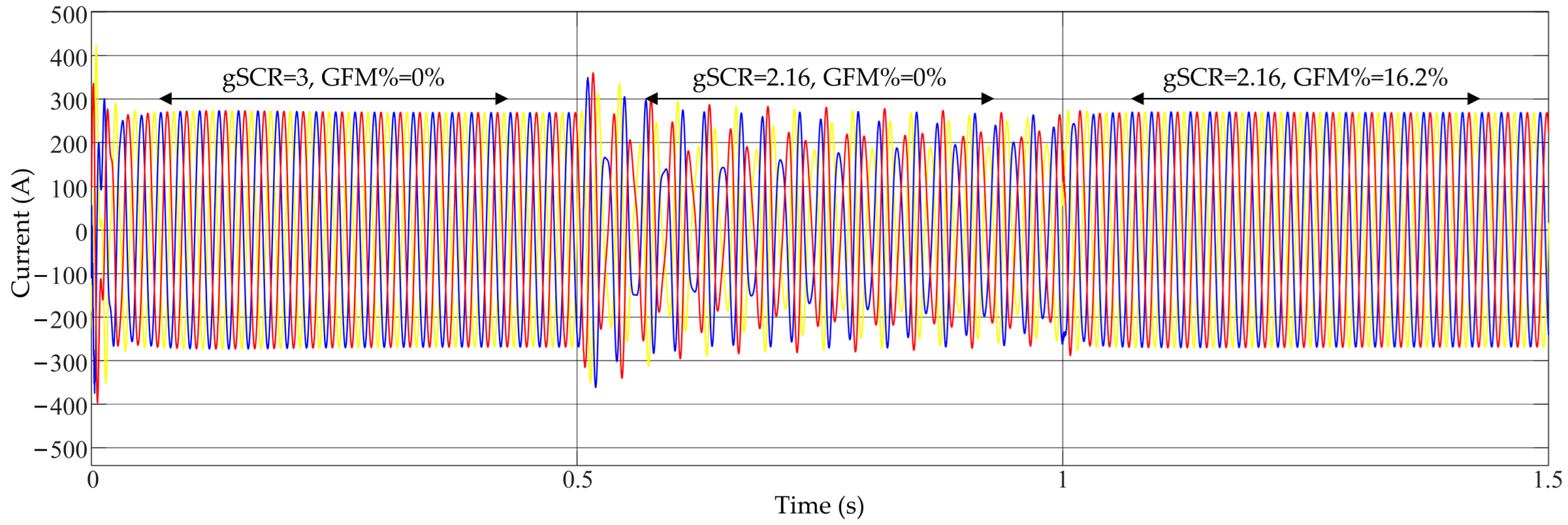
To verify the effectiveness of the proposed capacity ratio method for GFM equipment in suppressing sub/super-synchronous oscillations in the system, an electromagnetic transient simulation model is established using MATLAB/Simulink. Under Scenario 1, a typical value (gSCR = 3) is adopted. At 0.5 s, the operating condition is switched to a weak grid (gSCR = 2.16), and at 1.0 s, a GFM penetration level of GFM% = 16.2% is introduced. As can be observed from the current waveforms before and after GFM integration shown in Figure 7, severe oscillations occur in the system after switching to the weak grid condition. Once the grid-forming converter is activated, the sub/super-synchronous oscillations are effectively suppressed.
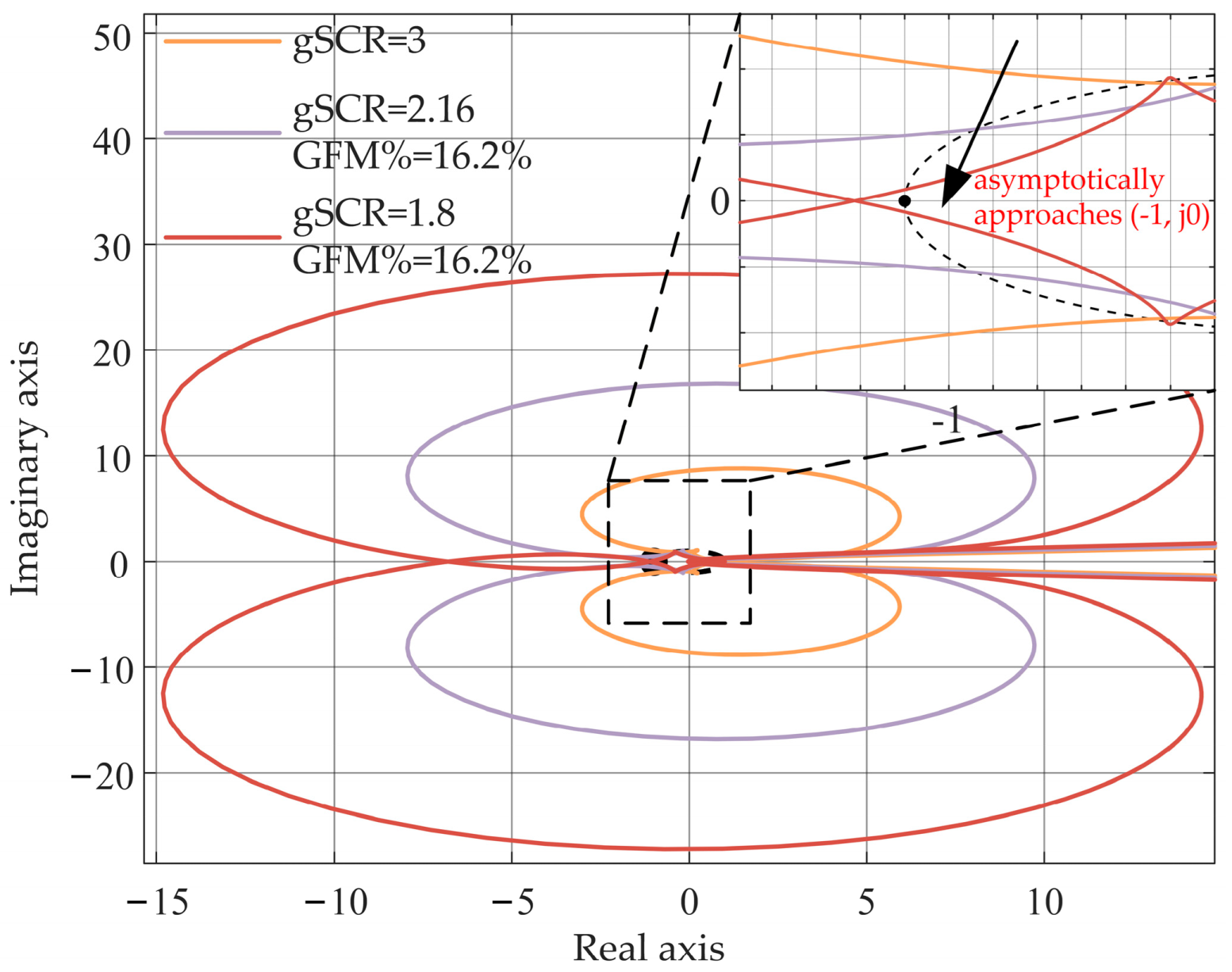
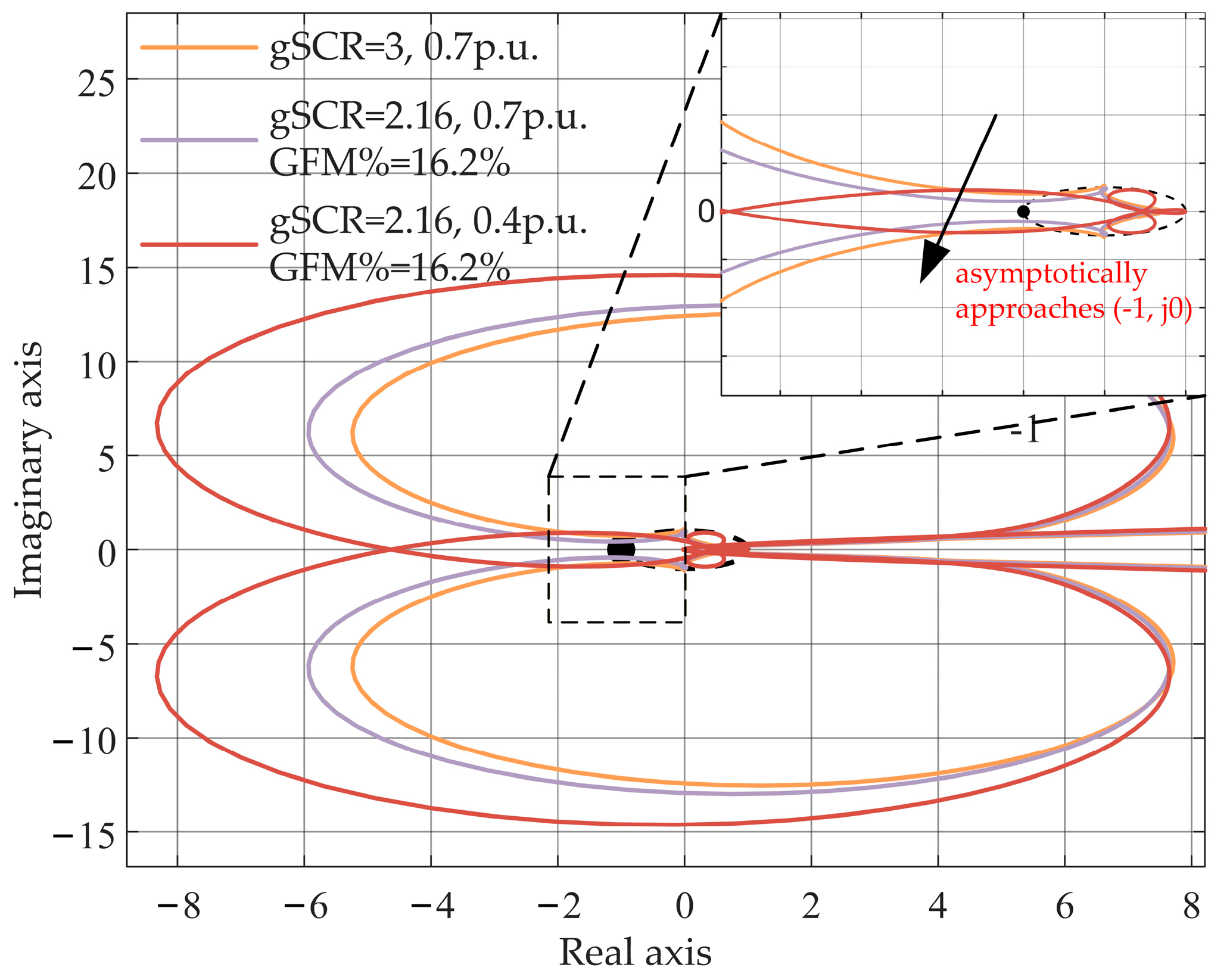
To more intuitively observe the variation in system stability margin after the activation of GFM control under different operating conditions, the Nyquist plots of the hybrid direct-drive wind farm connected to the grid are presented. As shown in Figure 8, the Nyquist locus progressively approaches the critical point (−1, j0) as the gSCR decreases. This trend indicates a concurrent deterioration in both phase margin and gain margin, implying a gradual increase in the risk of system instability. According to the system strength operational constraint established in the preceding section, when the gSCR = 2.16 and the GFM penetration level is set to GFM% = 16.2%, the system still retains a stability margin of 20%. As the gSCR is further reduced, when it gradually decreases to 1.8, the Nyquist locus approaches the critical point (−1, j0) and the stability margin declines. Nevertheless, the Nyquist locus does not encircle the critical point, indicating that the system remains capable of stable operation. This demonstrates that the proposed capacity ratio scheme for grid-forming wind turbines exhibits satisfactory robustness and validates the effectiveness of the proposed oscillation suppression method.
In Scenario 1, with distributed grid-forming configuration, under a weak grid condition of gSCR = 2.16, the proportion of GFM turbines required for the wind-integrated system to operate stably while maintaining a 20% stability margin is 16.2%. To verify the applicability of the proposed GFM capacity allocation method under extreme conditions, gSCR is gradually reduced. When gSCR = 1.8, the Nyquist curve gradually approaches the critical point but does not encircle the point (−1, j0), indicating that the system can still operate stably, albeit at the cost of reduced robustness. In Scenario 2, with centralized grid-forming configuration, the required GFM capacity proportion is 21.3%, which is higher than that in Scenario 1. When adopting the distributed grid-forming approach, only existing turbines need to be retrofitted without adding new equipment, and the required GFM capacity is relatively small. In contrast, the centralized grid-forming approach requires the addition of new grid-forming equipment and demands a higher GFM capacity proportion. Taking into account the complexity of implementation, economic factors, and oscillation suppression effectiveness, the distributed grid-forming method in Scenario 1 is superior to the centralized grid-forming method in Scenario 2.
Wind farm output is significantly influenced by wind speed. When the wind farm operates in partial load mode, as illustrated in Figure 9, the wind turbine output reaches 0.7 p.u. A typical value of gSCR = 3 is set under the condition of Scenario 1. The operating condition switches to weak grid with gSCR = 2.16 at 0.5 s, and GFM devices with the proportion of 16.2% are integrated at 1 s. According to the current waveforms before and after GFM integration, severe oscillation emerges in the system after switching to weak grid condition. The sub/super-synchronous oscillations are effectively restrained after the access of grid-forming converters.
To visually observe the stability margin of the system under this condition, Nyquist curves of hybrid direct-drive wind farm under diverse operating states are drawn, as illustrated in Figure 10. Under the wind turbine output of 0.7 p.u., the Nyquist curve does not encircle the point (−1, j0), and the system still possesses favorable stability margin at this moment. With the further reduction in wind turbine output, the Nyquist curve starts to surround the point (−1, j0) when the output drops to 0.4 p.u., and the system falls into instability consequently. To ensure stable operation of wind turbines, the access of only 16.2% GFM wind turbines cannot sustain system stable operation. It is essential to sacrifice partial economic benefits and raise the penetration ratio of GFM wind turbines.
Based on the simulation results, the following recommendations can be made for the operation of actual wind farms:
(1) The distributed grid-forming scheme described in Scenario 1 should be adopted as a priority, as it achieves a favorable balance between stability enhancement and economic benefits.
(2) When the distributed grid integration is employed, a capacity share of grid-forming (GFM) wind turbines reaching 16.2% allows a short-circuit ratio of 2.16 while still retaining a 20% stability margin. If the stability margin is disregarded, the minimum allowable short-circuit ratio is 1.8.
(3) Considering that the wind farm output and the grid topology are subject to variation, wind farm operators can refer to the stable operating region of the hybrid direct-drive wind farm under diverse conditions, and adopt an adaptive strategy to dynamically adjust the participation level of GFM wind turbines based on real-time operating states.

6. Conclusions

Addressing the issue of sub/super-synchronous oscillations in direct-drive wind farms connected to weak grids, this paper proposes a method based on the hybrid configuration of GFL and GFM wind turbines. Through quantitative calculations in two typical scenarios, the stable operating region and stability margin of the hybrid direct-drive wind farm are determined. The main conclusions are as follows:
(1) A “coordinated co-governance” approach between equipment and the grid is proposed, which rectifies the limitation of the traditional SCR definition that considers only synchronous machine sources while neglecting non-synchronous generation sources.
(2) A calculation method for the stable operating region of wind farms is proposed, which comprehensively considers system strength constraints and steady-state operating constraints. This method yields the quantitative relationship between the proportion of grid-forming equipment in the hybrid direct-drive wind farm and the adaptive range of the short-circuit ratio under different scenarios.
(3) Increasing the proportion of GFM wind turbines within the hybrid wind farm enhances the farm’s adaptability to weak grids. The minimum required GFM penetration ratio is 16.2% when employing a distributed grid-forming configuration, whereas a centralized grid-forming configuration requires a minimum GFM penetration ratio of 21.3%. Under the premise of maintaining system stability margins, the distributed configuration yields superior oscillation suppression performance, does not necessitate additional auxiliary equipment, and offers greater economic benefits.
The findings of this study can provide a reference for the coordinated optimization of the GFM/GFL capacity ratio and the siting of GFM equipment in practical power system applications.

Author Contributions

Conceptualization, K.W. and J.L.; methodology, K.W.; software, K.W.; validation, K.W.; formal analysis, K.W.; investigation, K.W.; resources, J.L.; data curation, K.W.; writing—original draft preparation, K.W.; writing—review and editing, J.L.; visualization, K.W.; supervision, J.L.; project administration, J.L.; funding acquisition, J.L. All authors have read and agreed to the published version of the manuscript.

Funding

This research was funded by the National Natural Science Foundation of China, under Grant No. 51977030.

Data Availability Statement

The research presented in this article relies on data from China State Gride, which confidential and proprietary information. Due to privacy and ethical restrictions imposed by the data provider, we are unable to make these data publicly available. We have adhered strictly to data confidentiality agreements and have only used the data for the purposes outlined in our research.

Conflicts of Interest

The authors declare no conflicts of interest.

References

  1. Qays, M.O.; Ahmad, I.; Habibi, D.; Aziz, A.; Mahmoud, T. System Strength Shortfall Challenges for Renewable Energy-Based Power Systems: A Review. Renew. Sustain. Energy Rev. 2023, 183, 113447. [Google Scholar] [CrossRef]
  2. Internationale Agentur für Erneuerbare Energien (Ed.) Global Renewables Outlook: Energy Transformation 2050; International Renewable Energy Agency: Abu Dhabi, United Arab Emirates, 2020; ISBN 978-92-9260-238-3. [Google Scholar]
  3. Ahmed, M.M.; Hasan, M.K.; Shafiq, M.; Qays, M.O.; Gadekallu, T.R.; Nebhen, J.; Islam, S. A Peer-to-Peer Blockchain Based Interconnected Power System. Energy Rep. 2021, 7, 7890–7905. [Google Scholar] [CrossRef]
  4. Kroposki, B.; Johnson, B.; Zhang, Y.; Gevorgian, V.; Denholm, P.; Hodge, B.-M.; Hannegan, B. Achieving a 100% Renewable Grid: Operating Electric Power Systems with Extremely High Levels of Variable Renewable Energy. IEEE Power Energy Mag. 2017, 15, 61–73. [Google Scholar] [CrossRef]
  5. Gu, Y.; Green, T.C. Power System Stability with a High Penetration of Inverter-Based Resources. Proc. IEEE 2023, 111, 832–853. [Google Scholar] [CrossRef]
  6. Wang, X.; Taul, M.G.; Wu, H.; Liao, Y.; Blaabjerg, F.; Harnefors, L. Grid-Synchronization Stability of Converter-Based Resources—An Overview. IEEE Open J. Ind. Appl. 2020, 1, 115–134. [Google Scholar] [CrossRef]
  7. Verbe, S.C.; Shigenobu, R.; Ito, M. Comparative Study of GFM-Grid and GFL-Grid in Islanded Operation. In Proceedings of the 2021 IEEE PES Innovative Smart Grid Technologies—Asia (ISGT Asia); IEEE: Brisbane, Australia, 2021; pp. 1–5. [Google Scholar]
  8. Hosny, M.; Marei, M.I.; Mohamad, A.M.I. Adaptive Hybrid Virtual Inertia Controller for PMSG-Based Wind Turbine Based on Fuzzy Logic Control. Sci. Rep. 2025, 15, 3757. [Google Scholar] [CrossRef] [PubMed]
  9. Wen, B.; Dong, D.; Boroyevich, D.; Burgos, R.; Mattavelli, P.; Shen, Z. Impedance-Based Analysis of Grid-Synchronization Stability for Three-Phase Paralleled Converters. IEEE Trans. Power Electron. 2016, 31, 26–38. [Google Scholar] [CrossRef]
  10. Li, G.; Pan, H.; Liu, X.; Yin, L.; Hwang Goh, H. PLL Phase Margin Design and Analysis for Mitigating Sub/Super-Synchronous Oscillation of Grid-Connected Inverter under Weak Grid. Int. J. Electr. Power Energy Syst. 2023, 151, 109124. [Google Scholar] [CrossRef]
  11. Tina, G.M.; Maione, G.; Stefanelli, D. The Impact of Grid-Forming vs. Grid-Following Converters on Frequency Regulation: Comparing Centralised or Distributed Photovoltaic Generation. Energies 2024, 17, 5827. [Google Scholar] [CrossRef]
  12. Wang, X.; Harnefors, L.; Blaabjerg, F. Unified Impedance Model of Grid-Connected Voltage-Source Converters. IEEE Trans. Power Electron. 2018, 33, 1775–1787. [Google Scholar] [CrossRef]
  13. Huang, L.; Wu, C.; Zhou, D.; Blaabjerg, F. A Double-PLLs-Based Impedance Reshaping Method for Extending Stability Range of Grid-Following Inverter Under Weak Grid. IEEE Trans. Power Electron. 2022, 37, 4091–4104. [Google Scholar] [CrossRef]
  14. Zhou, Y.; Xin, H.; Wu, D.; Liu, F.; Li, Z.; Wang, G.; Yuan, H.; Ju, P. Small-Signal Stability Assessment of Heterogeneous Grid-Following Converter Power Systems Based on Grid Strength Analysis. IEEE Trans. Power Syst. 2023, 38, 2566–2579. [Google Scholar] [CrossRef]
  15. Wu, H.; Wang, X. Control of Grid-Forming VSCs: A Perspective of Adaptive Fast/Slow Internal Voltage Source. IEEE Trans. Power Electron. 2023, 38, 10151–10169. [Google Scholar] [CrossRef]
  16. Lasseter, R.H.; Chen, Z.; Pattabiraman, D. Grid-Forming Inverters: A Critical Asset for the Power Grid. IEEE J. Emerg. Sel. Top. Power Electron. 2020, 8, 925–935. [Google Scholar] [CrossRef]
  17. Zhang, Y.; Unruh, P.; Fischer, B.; Braun, M. Comparative Impedance Characteristic Analysis of Grid-Following and Grid-Forming Inverters. IET Renew. Power Gen. 2025, 19, e70020. [Google Scholar] [CrossRef]
  18. Dokus, M.; Mertens, A. Sequence Impedance Characteristics of Grid-Forming Converter Controls. In Proceedings of the 2020 IEEE 11th International Symposium on Power Electronics for Distributed Generation Systems (PEDG); IEEE: Dubrovnik, Croatia, 2020; pp. 413–420. [Google Scholar]
  19. Zhao, F.; Wang, X.; Zhu, T. Low-Frequency Passivity-Based Analysis and Damping of Power-Synchronization Controlled Grid-Forming Inverter. IEEE J. Emerg. Sel. Top. Power Electron. 2023, 11, 1542–1554. [Google Scholar] [CrossRef]
  20. Wu, W.; Zhou, L.; Chen, Y.; Luo, A.; Dong, Y.; Zhou, X.; Xu, Q.; Yang, L.; Guerrero, J.M. Sequence-Impedance-Based Stability Comparison Between VSGs and Traditional Grid-Connected Inverters. IEEE Trans. Power Electron. 2019, 34, 46–52. [Google Scholar] [CrossRef]
  21. Lorzadeh, I.; Lorzadeh, O.; Bozalakov, D.V.; Dupré, L.; Vandevelde, L. Seamless Integration of Grid-Forming and Grid-Following Capabilities in a Single VSI Within a Unified Hybrid Control Framework Under Islanded Conditions. IEEE Access 2025, 13, 135273–135289. [Google Scholar] [CrossRef]
  22. Lima, L.A.M.; Watanabe, E.H. Hybrid Control Scheme for VSC Presenting Both Grid-Forming and Grid-Following Capabilities. IEEE Trans. Power Deliv. 2022, 37, 4570–4581. [Google Scholar] [CrossRef]
  23. Duan, Z.; Meng, Y.; Zhao, P.; Yan, S.; Wang, X.; Wang, X. Interaction Large-Signal Stability Analysis of M3C and GFM/GFL Hybrid Control Strategies Converters Based on the Novel Fuzzy Tensor Space Method. IEEE Trans. Power Electron. 2025, 40, 9986–9999. [Google Scholar] [CrossRef]
  24. Zhang, H.; Xiang, W.; Lin, W.; Wen, J. Grid Forming Converters in Renewable Energy Sources Dominated Power Grid: Control Strategy, Stability, Application, and Challenges. J. Mod. Power Syst. Clean. Energy 2021, 9, 1239–1256. [Google Scholar] [CrossRef]
  25. Shi, Q.; Dong, W.; Wang, G.; Ma, J.; Wang, C.; Guo, X.; Terzija, V. Grid Strength Assessment Method for Evaluating Small-Signal Synchronization Stability of Grid-Following and Grid-Forming Converters Integrated Systems. J. Mod. Power Syst. Clean Energy 2024, 13, 55–65. [Google Scholar] [CrossRef]
  26. Yang, C.; Huang, L.; Xin, H.; Ju, P. Placing Grid-Forming Converters to Enhance Small Signal Stability of PLL-Integrated Power Systems. IEEE Trans. Power Syst. 2021, 36, 3563–3573. [Google Scholar] [CrossRef]
  27. Pan, D.; Wang, X.; Liu, F.; Shi, R. Transient Stability of Voltage-Source Converters with Grid-Forming Control: A Design-Oriented Study. IEEE J. Emerg. Sel. Top. Power Electron. 2020, 8, 1019–1033. [Google Scholar] [CrossRef]
  28. Cespedes, M.; Sun, J. Impedance Modeling and Analysis of Grid-Connected Voltage-Source Converters. IEEE Trans. Power Electron. 2014, 29, 1254–1261. [Google Scholar] [CrossRef]
  29. Sun, J. Small-Signal Methods for AC Distributed Power Systems—A Review. IEEE Trans. Power Electron. 2009, 24, 2545–2554. [Google Scholar] [CrossRef]
Figure 1. Hybrid direct-drive wind farm equivalent model.
Energies 19 02661 g001
Figure 2. Topology and control scheme of the direct-drive wind turbine.
Energies 19 02661 g002
Figure 3. Control scheme of the grid-forming VSG.
Energies 19 02661 g003
Figure 4. (a) Output impedance characteristic of the GFL wind turbine; (b) Output impedance characteristic of the GFM wind turbine.
Energies 19 02661 g004
Figure 5. Quantification procedure of the system strength.
Energies 19 02661 g005
Figure 6. Stable operation regions of the grid-connected hybrid direct-drive wind farm: (a) under Scenario 1; (b) under Scenario 2.
Energies 19 02661 g006
Figure 7. Current waveforms before and after introducing GFM% = 16.2% under gSCR = 2.16.
Energies 19 02661 g007
Figure 8. Nyquist plots of the hybrid direct-drive wind farm under different operating conditions.
Energies 19 02661 g008
Figure 9. P = 0.7 p.u., Current waveforms before and after introducing GFM under gSCR = 2.16.
Energies 19 02661 g009
Figure 10. Nyquist plots of the hybrid direct-drive wind farm under different output levels.
Energies 19 02661 g010
Table 1. Control Parameters of the GFL Wind Turbine.
Control ParametersControl Parameter ValuesControl ParametersControl Parameter Values
V dc 1000 V k i _ I 75.7143
V 1 563 V K f 0.0029
L f 3 mH K d 0.0027
C f 160 μF K q 0.0027
R f 1.5 Ω k p _ PLL 0.2659
P N 2 kW k i _ PLL 10.9988
k p _ I 0.004738
Table 2. Control Parameters of the GFM Wind Turbine.
Control ParametersControl Parameter ValuesControl ParametersControl Parameter Values
V dc 1000 V Q set 0 kW
V 1 563 V f s 20 kHz
L f 3 mH J 0.06 kg·m2
C f 160 μF D p 6
R f 1.5 Ω D q 317
P set 10 kW K 6.97
Table 3. Minimum GFM proportion under typical scenarios.
ScenarioMinimum GFM%
Scenario 116.2%
Scenario 221.3%
Disclaimer/Publisher’s Note: The statements, opinions and data contained in all publications are solely those of the individual author(s) and contributor(s) and not of MDPI and/or the editor(s). MDPI and/or the editor(s) disclaim responsibility for any injury to people or property resulting from any ideas, methods, instructions or products referred to in the content.